Office of Information and Communication Generalate, Rome, Italy
November 2025
ISBN: 978-88-99383-36-7
INSTITUTE OF THE BROTHERS OF THE CHRISTIAN SCHOOLS
Tercentenary of the Letters Patent and the Papal Bull of Approbation of the Institute
The necessity of this Institute is very great
INTRODUCTION
Br. MauriceAuguste,
INTRODUCTION
The strength of Association's institutive principles.
Refounding the Institute again and again
We are coming to the end of a two-year period of important celebrations. It has been three hundred years since two vital documents in our institutional identity were issued: the Royal Letters Patent that gave legal existence to the Brothers of the Christian Schools and the Papal Bull that approved the Institute and the Rule, authorising a new Christian way of life in the Church. This edition of the Institute Bulletin wishes to celebrate this event, but with our eyes on the future.
Looking to the future is part of our Lasallian identity. Our Community was born in this way, clearly: responding to the existent needs of the poor while looking to the future of the world with a hope founded on the faith in Jesus.
It was the desire to collaborate in the coming of the Kingdom to society that impelled John Baptist de La Salle and the first generation of Brothers to create those first communities and schools. But, as has been so well reflected in our history, what led to establish this Society of the Christian Schools was not a premeditated plan, a brilliant intuition that came out of the blue. At the root of our Institute is an identity that is discovered along the way, the process of encountering people in the service of a mission that is constantly seeking and expanding. This is the
institutive strength that repeatedly gives rise to ever new forms of organisation: Association for the educational service of the poor.
“The necessity of this Institute is very great”. The title of this Bulletin is a quote from a conviction of identity. What is the need? It is to collaborate in bringing the Kingdom to this world by breaking the logic that, throughout history, has become entrenched in multiple systems that deepen inequality, spread hunger, exclude men and women, prevent the organic growth of people, foster the success of a few, reinforce enmities... In response to all this, the institutional commitment is to work “together and in association” to provide a pedagogy of fraternity that creates spaces where coexistence helps us learn to live well.
The structure with which we present the material in this Bulletin aims to follow the process of institutionalisation of the Institute. As Brother Michel Sauvage has emphasised so many times since 1998, certain moments in the life of the Institute must be understood as new foundations, as re-foundations. Not in the sense of ruptures that give rise to something else, but as moments in which the project is reborn, rediscovers the changing needs of the world and reinvents life, spirituality, community and mission. It is the strength of Association that seeks to revitalise the forms
that the charism received from the Spirit of Jesus Christ takes on in time and space.
A first section looks at the past and focuses on the Bull of Approbation of 1725.
The text of the Bull is not well known among Lasallians. For this reason, we asked Vincenzo Rosati, a young Italian Lasallian, teacher of Latin, who is currently serving in Mexico, to offer us a new translation in a language closer to modern speech. We are grateful for his generosity, as well as that of the various translators.
We have included two short articles on the history of the Bull: one on the process leading up to its promulgation and another by Brother Josean Villalabeitia on its reception among the Brothers. In addition, there is part of the classic study by Brother Maurice Auguste and an unpublished contribution by an Italian scholar who has done some work on this document. Gianna Calandrella has been kind enough to write an abridged version of her thesis for us.
This section concludes with the transcription of a presentation given by Brother Pedro Gil Larrañaga at the Seminar on Association held in October 2024. It is a note to help us situate the reading of the Bull. A reading with an eye to the future.
A second section focuses on the present.
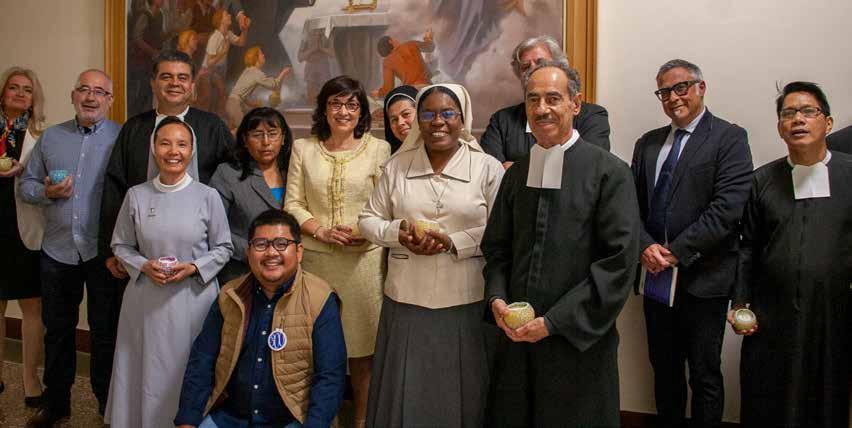
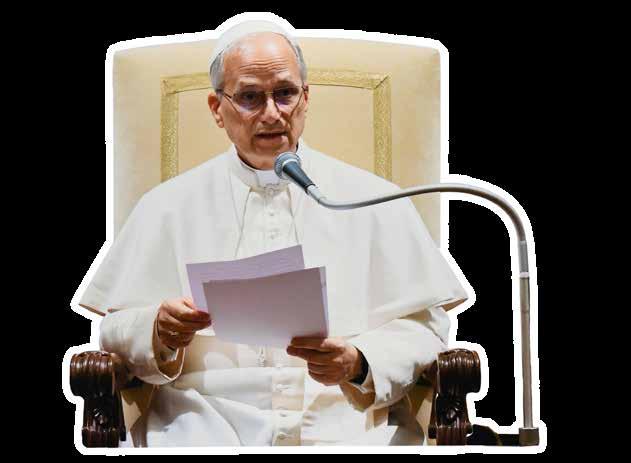
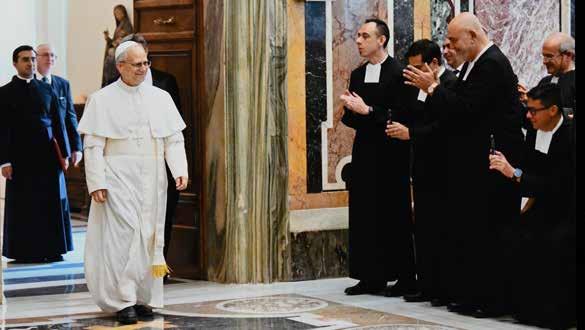
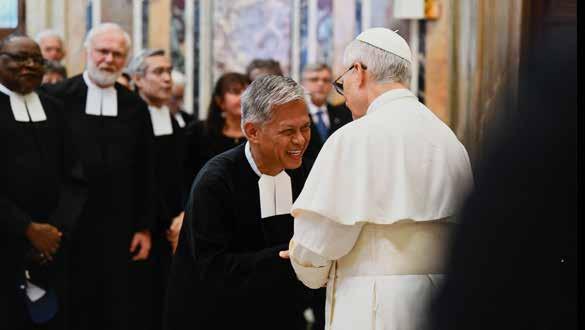
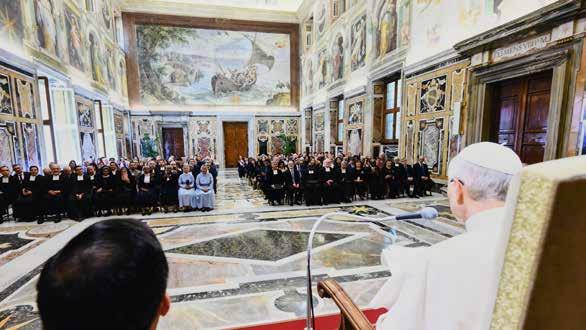
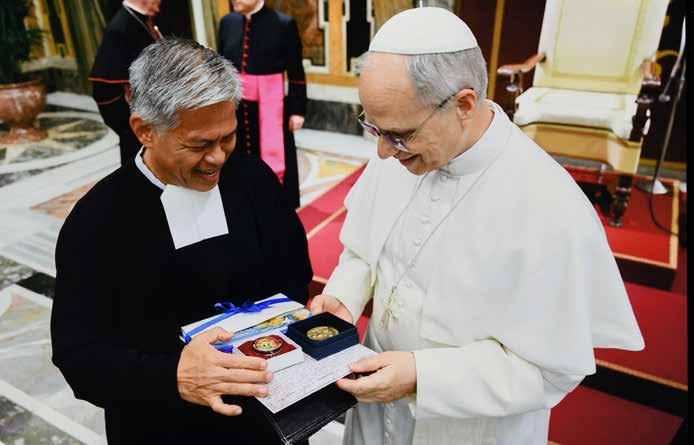
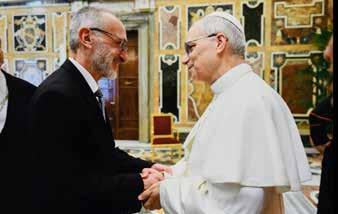
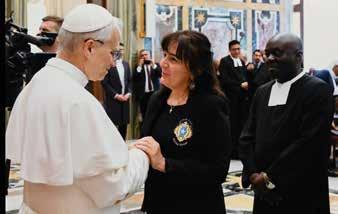
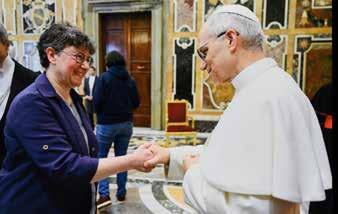
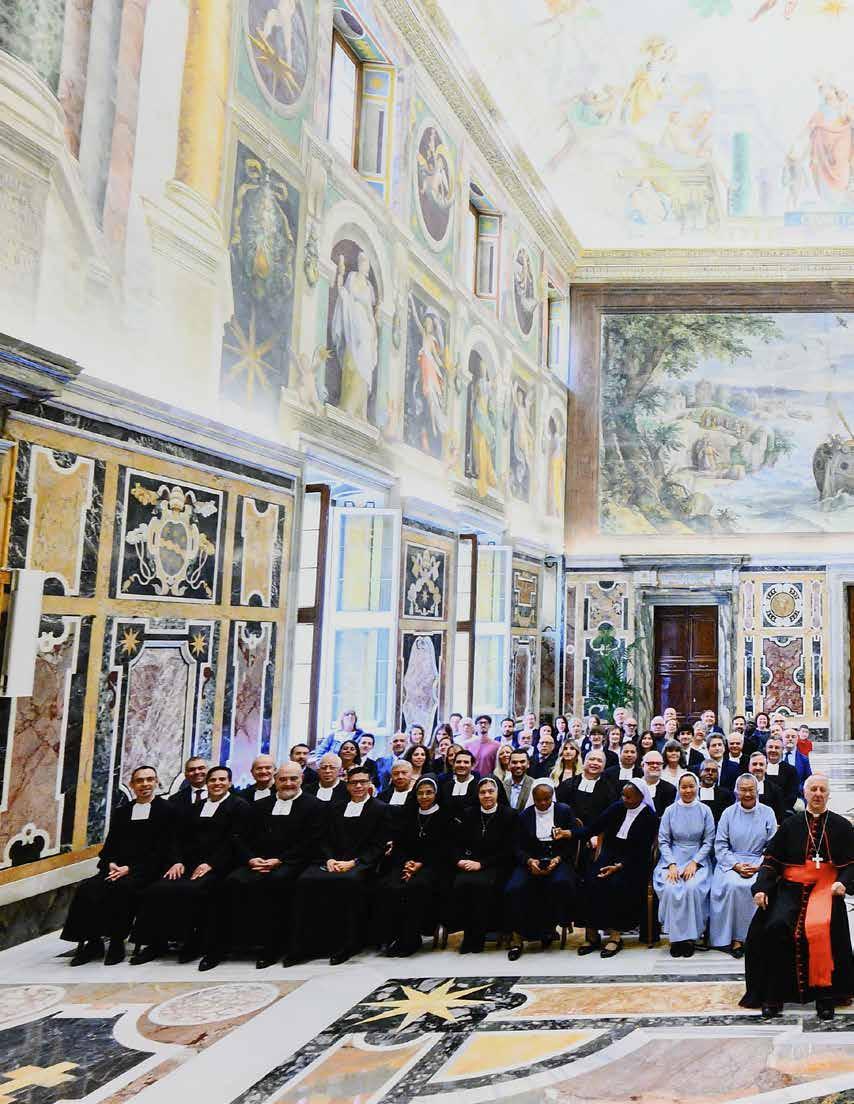
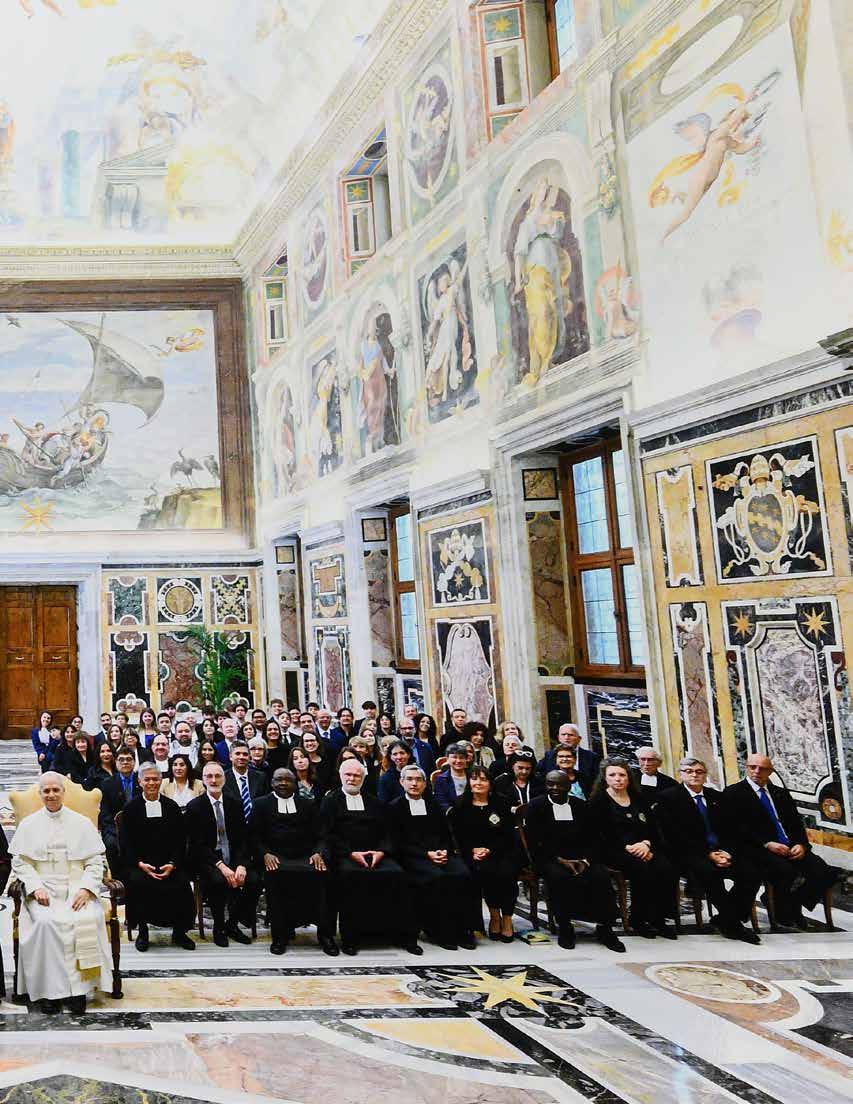
Its starting point is the audience we had on 15 May 2025 with Pope Leo. We had been working towards an audience with Pope Francis, and Providence gave us his successor. The Pope’s words have been very important in our history, and as we celebrated the Tercentenary of the first of those dialogues, we could not fail to seek a new dialogue.
Brother Claude Reinhardt takes up the question of the Bull and focuses on the questions that those words and Brother Josean’s reflection on them raised in the Institute.
Then, various contributions help us to look at the current situation of the Institute. Brother Carlos Gómez Restrepo, Vicar General, reflects on the necessary step that our identity must take in order to be significant in this world and not think that we are necessary without anything changing in the context of a changing era. Mr. Jerald Joseph, Chair of the Institute’s Commission on Justice and Peace, helps us to deepen our understanding of one of the great challenges we currently face: the ecological and socioeconomic crisis, which are one and the same.
Two articles close this section, pointing out some concrete paths forward. Brother Pedro Gil helps us to think about the new Lasallian Community, a Community of Brothers and lay people. And Brother Jeyakumar reflects on the Leavening Movement, of which he is a leading member.
The last section looks directly to the future.
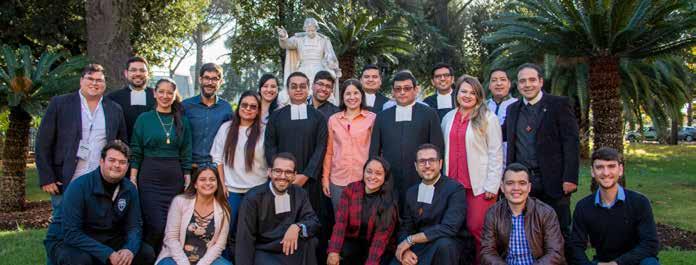
Brother Martín Digilio, General Councillor, reflects on the future of the Institute within the context of a great Lasallian movement. And three young Lasallians share their insights on how they envision the Institute on the pathway to the fourth centenary of the Bull. This group includes a woman, a lay person and a Brother. She is from PARC, the young lay person is from RELAL and the young Brother is from RELAF.
Finally, Brother Armin Luistro, Superior General, offers us a word that does not close but opens reflection.
To all, thank you very much for your collaboration. And to all of you, fellow readers, our wish is that reading this Bulletin will help you grow in awareness and generosity as Lasallians. That wish becomes a prayer for each and every one of you.
Brother Santiago Rodríguez Mancini
Bull
In Apostolicae Dignitatis Solio of Benedict XIII
MR. VINCENZO ROSATI District of Italy. Bachelor's Degree in Classical Languages. Lasallian volunteer in Mexico.
Benedict, Bishop, Servant of the Servants of God.
For perpetual remembrance of this event.
Appointed by the disposition of divine clemency to the See of Apostolic Dignity, without any merit of my own but only by an inexplicable grace of Divine Goodness, entrusted on earth with the functions of the one who reigns gloriously in heaven, to execute the pastoral duty of which I am charged, I am
pleased to attend to the pious will of the faithful and to support the decisions which ensure its legitimate fulfilment.
Of particular interest to me is that which concerns the establishment of Institutes intended to extend teaching, to promote the progress of poor children who wish to study in order to cultivate the Lord’s field and thus to promote the progress of doctrine and wisdom. For this reason, and especially when it is expressly requested, I am happy to reinforce with apostolic confirmation the beneficial ordinances and statutes of these Institutes, so that they may be more stable and respected in the future.
Therefore, after having evaluated, with mature and diligent examination, the conditions or circumstances of people, places and times, and finding in the Lord that it is good to do so, I willingly commit my help and the necessary support.
In particular, an appeal has recently reached me on behalf of our dear sons, the Superior General and the Brothers of the Christian Schools, a new institution, in Reims.
It states that in the past, that is, in the year of our Lord one thousand six hundred and eighty, the pious servant of God, John Baptist de La Salle, now deceased, then Canon of the metropolitan church of Reims, was moved to compassion by the innumerable troubles caused by ignorance, the source of all evils, especially among those who lack the necessities of life, either through poverty or because they have only the work of their hands to earn their living. Not
only are they ignorant of all human science, but, much sadder, they are often ignorant of the most elementary elements of the Christian religion.
For this reason, he founded in the city of Reims an Institute named the Brothers of the Christian Schools, with the following rules to be approved and confirmed by the Apostolic See, for the glory of God and for the relief of the poor, always under the authority of this See and under the patronage of the Child Jesus and Saint Joseph.
With the Lord’s blessing, the Institute has already borne fruit in various dioceses of the Kingdom of France, in particular in those of Rouen, Paris, Avignon, Chartres, Laon, Troyes, Saint-Omer, Boulogne, Alais, Grenoble, Mende, Marseille, Langres, Uzès and Autun, in which these Brothers have lived and continue to live according to the following Rules:
First. That, instituted under the protection of the Most Holy Child Jesus and the Patronage of St. Joseph, the Brothers should, above all, take care of the instruction of children, especially the poor, in what pertains to good Christian living; and that a passionate commitment to the education of children according to the principles of the Gospel should be the main strength and spirit of the Institute.
Second. That they obey the Superior General existing pro tempore, elected by them, and that they remain in the diocese to which they are admitted with the consent of the bishops and under their authority.
Third. That their Superior General be elected for life; that his election be by scrutiny and secret ballot at a meeting of the Directors of the principal houses; and that in the same way two Assistants be elected, at the same Assembly and by the same persons, to be Councillors to the existing Superior General pro tempore and to help him to govern properly.
Fourth. That the Assistants remain in the house where the Superior General pro tempore resides, take part in Council meetings and, if necessary, help him to answer the letters he receives.
Fifth. That the Brothers instruct the children free of charge and that they receive neither money nor gifts from their pupils nor from their parents.
Sixth. That they always run the schools in association and that there are at least two in the management of each school.
Seventh. That none of the Brothers aspire to the priesthood or to holy orders.
Eighth. That the Brothers be admitted to the said Institute at the age of sixteen or seventeen. That they first commit themselves to vows for three years only, and renew them each year until they are twenty-five years of age, at which time they may be admitted to perpetual vows.
Ninth. That the vows of the Brothers be chastity, poverty, obedience, stability in the said Institute, as well as to teach the poor free of charge, bearing in mind, however, that the Roman Pontiff existing
pro tempore may dispense the Brothers from simple vows.
Tenth. That dispensation from vows may not be requested or granted except for grave causes, judged as such by the General Chapter of the Brothers and recognised by a majority vote.
Eleventh. That the Superior General may be deposed by the General Chapter of the Brothers for these causes: heresy, impudence, homicide, mental incapacity, senility, dilapidation of the goods of the Institute, or any major crime judged worthy of such a penalty by the General Chapter of the Brothers, which will be convoked for this purpose by the Assistants.
Twelfth. That the Brother Directors of the various houses govern them for three years only, unless, for a just cause, it seems more convenient to the Superior General existing pro tempore and his Assistants to shorten or prolong this period. That the Superior General may communicate to the Directors of the particular houses his will regarding the vow of poverty, regarding the administration of temporal goods, or regarding the faculties to be granted to each Brother. And that neither the Directors nor the Visitors who are sent pro tempore may in any way alienate funds, movable or immovable property without consulting the Superior General and his Assistants pro tempore.
Thirteenth. That the General Chapters, to which thirty Brothers from among the most senior Brothers and the Directors of the principal houses shall be convoked, shall
be held every ten years, unless it seems more opportune to convoke, in certain circumstances, an extraordinary Assembly. That the elected Assistants shall hold office during this ten-year period, unless grave necessity obliges them to be removed earlier or to remain in office after this period has elapsed.
Fourteenth. That the Visitors, appointed by the present Superior General pro tempore to exercise their office for three years, visit the houses once a year. That they should ask the Directors for an account of the entries and departures, and that immediately, at the end of their visitation, they should refer to the Superior General pro tempore what should be corrected in each house.
Fifteenth. That the General Chapters be convoked wherever the Superior General has established his residence, but that the Provincial Chapters meet as much as possible in the centre of each province, so that access may be easier for the Brothers. And that these Provincial Chapters be presided over by a Visitor, delegated for this purpose by the Superior General pro tempore.
Sixteenth. That all daily exercises, both those of the community and those of the school, be done in common, both in the morning and in the afternoon.
Seventeenth. That the Brothers teach the children not only how to read and write, spelling and arithmetic, but above all that they instil in their souls the precepts of Christianity and the Gospel. That they do catechesis for half an hour on weekdays and an hour and a half on Sundays and
holy days of obligation. On those same days, that they take the children to church to attend parish mass and vespers. Finally, that they teach them to recite morning and evening prayers and to instil in them the precepts of the law of the Church and all that is necessary for salvation.
Eighteenth. That the cassock of the Brothers correspond to evangelical poverty and humility. Let it be made of common black cloth, long almost to the feet and fastened only with iron hooks, with a mantle of the same length. The hat, shoes and stockings are to be free of refinement and of anything that sounds of worldly vanity.
As they have lived until now, so they live from now on.
As has been expressed in the same supplication, things strengthened by the support of the Apostolic See are more stable and tend to be observed by all with more attention. For this reason, you ardently desire that this Rule and your Institute be approved and confirmed by me and by this See , so that it may receive a daily increase in strength and that the state in which it finds itself today may be even more stable.
For this reason, the Superior General and the Brothers have humbly begged me, with apostolic benevolence, to take the appropriate measures with regard to the above.
Therefore, I, who with sincere affection desire that all souls may grow spiritually and in all that is good and proper, wishing to accompany the Superior General and
the Brothers, absolve all of them from any excommunication, suspension, interdiction or other ecclesiastical sentence, censure or penalty, if they should have incurred any in any way whatsoever, and I wish them to be considered absolved, as a special favour and in order to obtain in particular the success of what is now established.
Being disposed therefore in favour of this supplication and with the favourable vote of our venerable brother cardinals of the Holy Roman Church, interpreters of the decrees of the Council of Trent, without prejudice of any kind and by apostolic authority, I approve and confirm the Institute and the Rule in question and all things contained therein, as long as they are correct and integral and not contrary to the sacred canons and the Apostolic Constitutions as well as to the Decrees of the Council of Trent, and I add to them the force of apostolic power.
I desire, moreover, that all the properties and all the goods which the said Institute already possesses, justly and canonically, or which it may, with God’s help, acquire hereafter, by concession of the Popes or by the generosity of Kings and Princes, as gifts of the faithful or in any other opportune way, be so maintained and in all their integrity.
Likewise, that the present provisions be forever and remain in perpetuity, and that they produce and obtain their full and complete fruit, without it being possible to revoke them in any way, or to limit or suspend them, or to include them in any other contrary provision, but that they be
always exempted. And that whenever such provisions are made, the present ones shall be reinstated by right, reintroduced and fully restored to their first and most perfect state.
Thus, in conformity with all that precedes and not otherwise, they are to be regulated and defined by all judges, whoever they may be, ordinary or delegated, even by the Auditors of causes of the Apostolic Palace, the Cardinals of the Holy Roman Church, or their legates or vice legates or nuncios of the Holy See. And if it should happen that these provisions should be violated by any authority, consciously or through ignorance, I declare it null and
void, without prejudice to any contrary constitution or apostolic ordinance.
I wish, moreover, that now and forever, none of the Brothers of this Institute may validly neither withdraw from the Institute nor return to the secular world without the express consent of the Superiors General of this Institute, not even under the pretext of embracing a stricter consecration, but that they remain in obedience to their Superiors and in no other situation.
Let no one, therefore, permit himself in any way to violate these letters which contain our absolution, approval, confirmation, reinforcement, decree and will, nor recklessly oppose them. If anyone should have the audacity to attempt to do so, let him know that he will incur the indignation of almighty God and of his holy apostles Peter and Paul.
Given at Rome, at Saint Peter’s, in the year one thousand seven hundred and twentyfour of the Incarnation of the Lord, on the seventh day of the Kalends of February, the first year of my Pontificate.
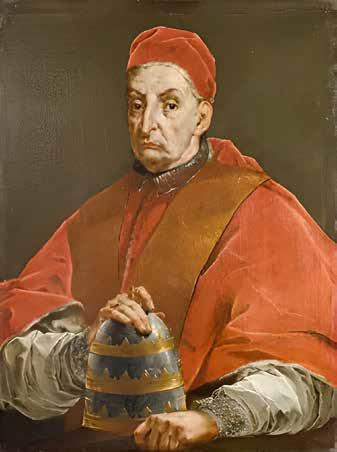
Benedict XIII, 245th Pope of the Catholic Church (1724–1730).
In seeking to legalise the Work, we found much
more
John Baptist de La Salle was well aware of the regulations which obliged religious or secular communities providing services such as education to have royal authorisation in the form of Letters Patent. For example, as laid down in the Royal Decree of 1667,
“No establishment of schools, monasteries, religious or secular communities... may be made without proper and duly verified letters patent”.
Our Father had arranged them for the Sisters of the Child Jesus of Rheims. He knew how to do it well. On 27 April 1678, Nicolas Roland died. Roland had been interested in popular education for girls since 1670 and was the spiritual director of John Baptist, to whom he was bound by ties of kinship and friendship. De La Salle together with another of his relatives, Nicolas Rogier, a deacon, are the executors of Roland’s will. Roland had received two Sisters from Father Barré’s community in 1672 and that year opened the first school for girls in Rheims. In May, Bishop Le Tellier, son
BR. SANTIAGO RODRÍGUEZ MANCINI, FSC
District of ArgentinaParaguay. Director of the Generalate and Director of the Institute’s Office of Lasallian Heritage and Research.
to the French Secretary of State and brother of the Minister of War, appointed Guillaume Rogier, the brother of Nicolas Rogier, as ecclesiastical superior of the Sisters of the Child Jesus. John Baptist had only been ordained a priest for a month.
On 23 May, the Bishop, who took this foundation as his own, gave the royal letter of consultation on the establishment of the Sisters of the Child Jesus to the Council of the city of Rheims. A few days later, John Baptist de La Salle began the formalities for the Sisters to receive donations and drew up a statement of the Sisters’ accounts and property. Two months later, the city council still had not dealt with the matter and the bishop protested to this body. On 1 August, De La Salle and Nicolas Rogier intervened before the Council, proposing that the matter of the establishment be dealt with. On 8 August, the municipal commission and the bishop approved the constitutions of the Sisters and on 11 August, the Council met and approved the legal establishment of the Sisters. De La Salle and Rogier immediately asked the opinion of 5 canons, 12 parish priests, 3 abbots and 7 religious superiors of the diocese (as required by law) who were unanimously in favour of the establishment of the Sisters.
On 15 December, De La Salle purchased a house for the Sisters and rented it out, and in February 1679, Royal Letters Patent were issued for the Sisters of the Child Jesus, which were registered by the Parliament of Paris on 17 December.
In short, nine months and twenty days to get this legal authorization. And yet, with the Brothers, this was not the case.
From the earliest years of the conscious existence of the Community of the Christian Schools, back in 1684, some Brothers wanted the procedure to be carried out. It was a way of giving security to their existence, but not only that. In fact, the schools, each in its own right, had a legal existence as entities dependent on parishes,
bishoprics, municipalities or lordships. It was the community that lacked any legal status. And, precisely, its autonomy and its own identity were at risk by not having one. However, De La Salle, according to the first biographers, said that “it was not yet the time”. We know that his faith in Providence led him not to get ahead of himself but to let God show the way.
A testimony to the difficulties he endured are the condemnations of the Paris courts in the trials which took place, numerous times, between 1704 and 1712. De La Salle did not defend himself against the accusations made sometimes against him, sometimes against one of the Brothers, not because of humility or a false evangelical spirit. It was because his community was illegal. An illegality happily tolerated by parish priests and bishops because the good produced was immense.
According to a certain interpretation of the early biographers, our Founder’s idea of obtaining the approbation of the Community was quite different from that proposed by the Brothers. He wanted a papal document that came from the recognition that the existence of the schools and the Brothers’ community was of the utmost necessity. And that would be achieved when the Pope could see the success of the schools in Rome. Some lines in the letters he wrote to Brother Gabriel Drolin and a paragraph in his Testament seem to indicate this, though not so clearly. He himself thought of going to Rome from Marseilles, although he was unable to do so because of urgent problems in the communities around that area.
However, even if he did not seek the Letters Patent, he did not stop trying different ways of safeguarding the properties he was able to acquire. Thus, for example, he created a civil society with his brother Jean-Louis in Rheims in 1700-1701.
Another interesting initiative is the one reported in a strange manuscript we have in the archives. It is Manuscript 103. Some researchers maintain that it is a text by John Baptist de La Salle himself. It would have been written around 1707 and it speaks of the project of the Community of the Christian Schools as a threefaceted organisation: the community of Brothers supporting the schools in the towns; the seminaries for rural teachers, also supported by the Brothers; and a community of priests who would act as chaplains in the communities and schools. Such a priestly community would have to have the same spirit as the Brothers and would do a kind of external guidance.
According to some experts, the document could be the one presented to Father Claude Poullart Desplaces, founder of the Spiritans, with whom De La Salle had contact regarding the school in Saint Denis. If this is the case, perhaps, we find ourselves with a way of resolving another aspect of the lack of legal status. It is the ecclesiastical one. The Church at that time could not accept an exclusively lay community without a priest as its superior. It was precisely after those trials that the Community lost, due to the abandonment of M. De La Chétardie, parish priest of Saint-Sulpice, that the Archbishop of Paris was forced to appoint ecclesiastical
superiors outside the communities and, little by little, other bishops did the same.
Then, among the Sulpician superiors, they wondered whether they might not be the community of priests to lead externally the Brothers who operated with such success and recognition in their parish schools. De La Chétardie’s personal difficulties with John Baptist de La Salle meant that this did not go ahead.
It was precisely out of these difficulties that, a few years before the trials, the valuable document we call “Memoir on the Habit” emerged, which is an affirmation of the particular identity of the Community of the Christian Schools. An exclusively lay community, dedicated solely to the education of the children of the artisans and the poor in the towns, living in community and training its own candidates and teachers for rural schools. An identity they did not want to lose. Its novelty was such that, perhaps, it was the reason why our Father avoided closing the process by obtaining a legal endorsement.
In fact, during De La Salle’s long journey to the South of France, when the Society of the Christian Schools was jeopardized with being reduced to a network of autonomous communities with external superiors, Brother Barthélémy, who was in charge in Paris, together with other Brothers, tried to obtain the Letters Patent from the King. To begin with, they asked for endorsements from various bishops between 1712 and 1713.
Beyond the problem of the recognition of the Community and its identity in the civil society, the greatest drawback lay in the impossibility of buying and selling except in the name of private individuals. On the death of the Founder, the assets were in the name of one of his family members or a Brother. And these, too, were dying. This was taken care of in his will, but it was necessary to take a more institutional step.
And Br Barthélémy, his first successor, had barely had time to begin the task. Elected Superior on 16 May 1717, he died on 8 June 1720.
On 7 August 1720, Brother Timothy, whom some historians of the Institute call “the second founder”, was unanimously elected Superior General. He had been a member of the Society of the Christian Schools for 20 years.
We do not know on which day, but we do know that it was in the first quarter of 1721 that Brother Timothy wrote a letter to Father Jean Vivant. This priest, an expert canonist, was part of the entourage of Card. De Rohan, French ambassador to the Court of St. Peter. The Brothers had come to know the Cardinal through one of their members who, before joining the Community, had been a servant of that family. The letter argues that, in order to obtain Letters Patent at the court of Philip of Orleans, Regent of France during the minority of Prince Louis, a Bull was necessary. Philip was a man who was not pious at all. “Nothing represents more fully and, we would even dare to say, with greater rigour and prominence, this
libertine, sceptical, scandalous, boastful and impious generation of which La Bruyère spoke”. So says Georges Rigault in his History of the Institute.
In fact, seeking the expansion of the Society, the Brothers tried to obtain the Letters Patent directly, but the secretary of a royal official, a Jansenist himself, managed to convince the Regent of the need to prevent the expansion of the Brothers. Thus, the Regent, three times, refused for three years, until his death, to grant the Letters Patent. When the young King Louis XV took over, the request was quickly granted. But that was already 1723. Let us not get ahead.
As we mentioned earlier, in order to put pressure on the court in view to obtain civil authorisation, the Brothers thought of obtaining papal recognition. Because of the liberties of the Gallican Church, recognition by a congregation of the Holy See was not enough; a Bull was required. This was the only type of document that the Court was obliged to accept. These liberties of the Church in France were expressed, for example, in this way:
“We recognise in France the authority of the Holy See, the power of the Pope, head of the Church, common father of all Christians; we owe him every kind of respect and obedience, such is the belief of the king, eldest son of the Church, and the belief of all Catholics who are in true communion. But we do not recognise in France the authority, the power, nor the jurisdiction of the congregations which meet in Rome1 ; which the Pope may establish as he pleases, but the sentences and decrees of these congregations have no authority or execution in the Kingdom, and when on occasions of a contentious matter, such decrees, as in matters of dispensation, nullity of vows, transfer of religious, the court has declared the orders emanating from these congregations null and abusive, without prejudice to the parties having recourse through the ordinary channels, namely, the chancery
1 The current dicasteries and other bodies of the Roman Curia.
where the acts are issued under the name and title of the Pope in whose person the legitimate authority resides”.2
Father Vivant, at the request of the Brothers and with the Cardinal’s entire entourage, went to Rome for the conclave in which Pope Innocent XIII was elected. However, in this first contact with the Pope, the Cardinal did not keep his promises and the dossier remained dormant for a while. In addition, the French chargé d’affaires to the Holy See was opposed to dealing with the approval before the Letters Patent had been granted, which created a difficult situation to solve.
Back in Paris, Fr Vivant found an alternative way to address the Brothers’ request. He sought out a friend of his in Rome, a sort of French chargé d’affaires at the Vatican Court, to take charge of the matter. He, likewise, looked for a manager to move things along. His name: Joseph Digne.
Digne read the dossier that the Brothers had consigned to Vivant. There he found the Rules, a summary of the Rules, the endorsements of several bishops indicating the fidelity of the Brothers to Rome and the Church’s need for such a community. He saw fit to modify the way in which the life of the Brothers was presented in the supplication which was at the heart of the dossier. This was in the European spring of 1722. He therefore resolved, presumably in agreement with Br Timothy, the Superior of the Brothers, to add the vows of chastity and poverty, as well as other organisational matters which assimilated them to other existing organisations, particularly the Confraternities of Catechists which abounded in Italy and were well known in the Vatican. The presentation was made in the Dataria Apostolica on 8 August 1722. Let us recall the problem of the Gallican liberties, for which he was obliged to ask for a “confirmatio” of the Institute and the Rule to be resolved in the form of a Bull signed by the Pope himself.
2 PITHOU, Preuves des libertés de l’église gallicane, Paris, 1651, t. I, p. 219: « Conclusions de M. Talon, avocat général, sur un décret de l’ Inquisition de Rome qui condamne cette proposition : saint Pierre et saint Paul sont deux chefs en l’Eglise, qui n’en font qu’un, avec I’arrêt de la cour sur ce intervenu ». 1647.
The procedure was carried out in the socalled Congregation of the Council to which he was referred by the Dataria on 28 July 1724.3 On 3 August, Digne submitted the dossier to this Congregation and not to the Congregation of Religious, so that it was clear to the officials that the ecclesial status of the Community was not changed: it was a community of laymen consecrated to the education and evangelisation of the poor in the gratuitous school. In the presentation it is clearly stated that the way of life is that of association, whereby everything is done together. Perhaps this is why, during the whole process, Brother Gabriel Drolin, the only Brother in Rome who had been there alone since 1702, took no part.
One element is very striking for us today: for the first time, a papal document speaks of lay people who, with the authority of the supreme pontiff, could give catechesis. Until then, this ministry was only possible for ordained ministers.
As mentioned before, the action of the French ambassador requesting the Royal Patents stopped the process for a while. We know that Brother Timothy and his assistant, Brother Jean Jacquot, made a vow at the end of 1722 to fast on 7 December and to consecrate themselves to the Blessed Virgin on 8 December until the Letters Patent could be obtained. In February 1723, Philip died. Humours of history.
3 The Congregation of the Council (of Trent) was in charge of all kinds of questions concerning the application of the decrees of the Council itself. Among them, everything that set in motion apostolic, catechetical, scholastic, etc. initiatives.
Soon a new request for Letters Patent was organised before King Louis XV by Louis de la Vergne de Tressau and Card. De Fleury. It was successful this time and in September 1724 they were granted.
In the meantime, Pope Innocent XIII died and was crowned Benedict XIII on 29 May 1724. With the change of Pope, things took on a new rhythm. Soon the supplication was dealt with under the leadership of Cardinals Orsini and Lambertini. As the institution resembled the well-known Confraternities of Catechists, there was no detailed study of the dossier. After the interruption of the work for the summer, a favourable report was produced for the Congregation of the Council on 22 November. It entered the agenda of the session of 16 December: No. 123 out of 140 items dealt with that day. There was no detailed study or much discussion at the session. Christmas with its winter recess, together with the preparations for the Holy Year which was about to begin with it, brought the work to a halt again. And the Brothers had their Bull, published on 26 January 1725, almost at the same time as the Letters Patent, on 27 February 1725 with all their certifications. This time, Melchior de Polignac, the French ambassador who had been so opposed, was in favour.
The Bull encountered some obstacles when it entered France, but these were quickly
overcome. Brother Timothy convoked a General Chapter to receive it, to order the necessary modifications to the Rule and to pronounce the new vows according to the Rule and the Bull (as we do to this day). With the reception, a misunderstanding arose among the Brothers which went its way to transform things over time: the Bull recognised a community of lay educators and catechists, the Brothers understood themselves as religious.
If we examine the prologue to the new Rule which was most probably written by Brother Jean Jacquot, who had accompanied John Baptist de La Salle for so long, we can get a general idea of how his consideration of the identity itself had changed. From the Memoir on the Habit to this Rule, this lay association had come a long way.
Analysis of the Solemn Letter
In apostolicae dignitatis solio of 26 January 1725 issued by Benedict XIII for the approval of the religious congregation of the Brothers of the Christian Schools founded by John Baptist de La Salle.
MRS. GIANNA
CALANDRELLA
Italian. Researcher in Italian language and culture.
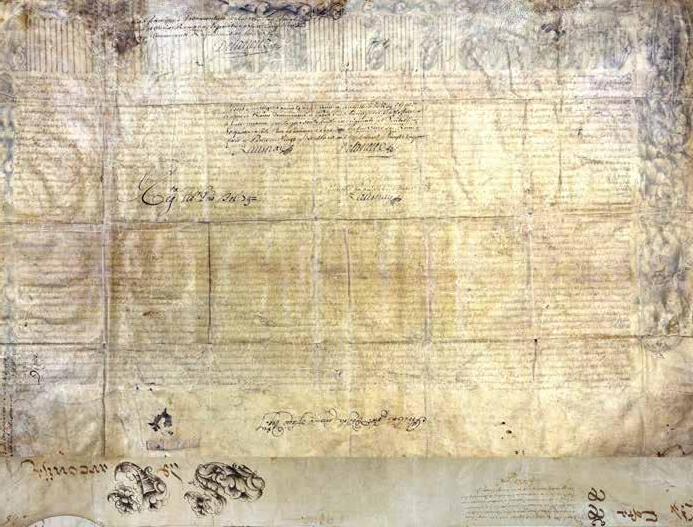
The document is written in a particular script that is artificial and far removed from other contemporary graphic models in daily and documentary use: it is the minuscule bollatica or littera Sancti Petri, typical and exclusive to the offices of the Papal Chancellery, abolished by Leo XIII in 1878. Considered very difficult to read because of the broken strokes that substantially deform the letters, it has always been presented as an inferior script by palaeographers who have rarely studied it in depth.
The document presents the usual articulation of solemn papal letters in protocol, text and excerpt.
The protocol consists of a first line, all written in elongated characters (litterae elongatae) and contains the intitulatio consisting of the pontiff’s name without the numeral, (pope Benedictus, author of the document), followed by his title of bishop of Rome (episcopus). There is then the formula of humility (servus servorum Dei), and that of perpetuity (ad perpetuam rei memoriam), the latter typical of public documents in the form of privileges. On the other
hand, the inscriptio, i.e. the indication of the addressee, and the salutatio (usually indicated with the words salutem et apostolicam benedictionem) are missing.
The text starts from the second line.
In apostolicae... solio: this is the beginning of the manifesto or preamble, i.e. that part of the document that illustrates the ideal motivations of the legal action enunciated in the deliberation, from a religious or juridical point of view. It is therefore not the actual reasons for issuing the document but those ethical and religious principles, as in this case, that prompted the act.
Pontifical documents are indicated by the first words of the manifesto.
Nostris... Nobis... Nostras... etc.: the use of the plural maiestatis is a rule in papal diplomacy that persists to this day in the Latin documents of the Holy See. It should be noted, however, that in the case of the pontiff, the use is justified by theological reasons and not mere etiquette.
Sane pro parte... vivitis de praesenti: this section of the text is the narratio, i.e. the exposition of the circumstances that prompted the author of the document, in this case Pope Benedict XIII to perform the juridical action. In this case the exposition of the rule of the Brothers of the Christian Schools is part of the narratio as the juridical action is expressed later.
Hactenus vixistis, et vivitis de praesenti: Note the change of tone in the text. Evidently due to an error, the impersonal form of the text is changed to the second person.
Cum autem... non alias: the dispositio of the document, i.e. the part in which the legal act being performed is declared, i.e. the approval of the rules takes up a lot of space. First reference is made to the petitio, i.e. the supplication sent to the pope, then the Holy See’s concern is illustrated (in praemissis opportune providere de benignitate apostolica dignaremur), then there is the approval of the rule (Nos igitur... apostolica auctoritate approbamus et confirmamus,
eisque apostolicae firmitatis robur adicimus) the effects of which are extended indefinitely into the future (semper et perpetuo validas esse et fore, suosque plenarios et integros effectus sortiri et obtinere debere) notwithstanding any contrary norm (non obstantibus constitutionibus et ordinationibus apostolicis contrariis).
Some differences must be noted between the text of the solemn letter and that of the supplication sent for approval. In Article 8 the letter contains a restrictive wording: Fratres admittantur... in decimo sexto aut decimo septimo eorum aetatis anno while the petition read: quo tempore poterunt admitti ad vota perpetua emittenda, thus expressing only one possibility. In Article 9 the text of the letter is very precise: vota Fratrum sint castitatis, paupertatis, obedientiae, et permanentiae in dicto instituto, nec non pauperes gratis edocendi. In fact, the words pauperes gratis edocendi are not present in the supplication. The supplica itself specified that the vows in question were simple; moreover, it attributed to the pope (not to the bishops) the dispensation from the aforementioned vows.
This is followed by a number of clauses: the prohibitive one concerning the impediment of leaving religion without the superior’s permission and the subsequent one of sanctio (Volumus autem... absque expresso consensu superiorum generalium... ex praefato instituto egredi, aut ad seculum redire valeat... sed sub obedientia suorum superiorum maneat).
Nulli ergo... se noverit incursurum: this is the sanctio or minatio, i.e. the exposition of the juridical or religious consequences of failure to comply with the document’s dictate; it is a formula to protect compliance with the provision. In this case it is a sanctio negativa that alludes to penalties of a spiritual nature (excommunication, expressed with the words “indignationem omnipotentis Dei, ac beatorum Petri et Pauli apostolorum eius, se noverit incursurum”).
The oddity concerning the indignation of Saints Peter and Paul, whose presence in the text would not be necessary at all, since divine indignation is certainly superior to everything, was justified, precisely in the 18th century, by the fact that the written text would be longer, thus guaranteeing a higher fee for the Dataria officials.
At the end of the document is the excatocollo containing the datatio and some subscriptions of Curia officials in charge of controlling the various stages of the document’s preparation.
Datum Romae, apud Sanctum Petrum, anno incarnationis dominicae millesimo septingentesimo vigesimo quarto, septimo kalendas Februarii, pontificatus nostri anno primo: this is the date in short form (the indention is missing). The year is expressed in the style of the incarnation, which placed the new year at 25 March each year (this was the day of the annunciation to Mary). Also used is the Florentine computation (which coincides with the common year from 25 March to 31 December and has one less unit from 1 January to 24 March). The day (septimo kalendas Februarii) is given according to the usual usage of the Roman calendar, which counts the days backwards from three reference dates in the month, in this case the first day of the month. Finally, the year of pontificate is also given: the first. Since Benedict XIII began dating his documents from the date of his coronation, i.e. 4 June 1724, the first year of pontificate was from that date to 3 April 1725. The day indicated in the document is 26 January and therefore, for all that we have seen above, the year is 1725. The deed was issued at St Peter’s Basilica, the church taken by preference by the popes from the middle of the 17th century.
The document presents some unexpected anomalies that remain unresolved. An official of the Office of the Contradictory Letters, a certain Andrea Santini, who, in 1869, described to the Lasallians the appearance of the current AAV, Regestum Litterarum contradictarum 147 (at the time evidently still in the Chancellery), speaks about it:
“The bull of Pope Benedict XIII of happy remembrance by which the pious Institute of the Religious of the Christian Schools in Rheims is confirmed, was drafted, as will be seen from what has just been said, to be sent in a personal gratiosa form, that is to say, to those who requested the grace, and therefore: Dilectis filiis superiori generali et Fratribus Scholarum Christianarum nuncupatorum civitatis Remen. But this bull was then sent in Forma gratiosa perpetua, or Ad perpetuam rei memoriam; so that the draft of this bull had to be corrected in the sense that the Pontiff was no longer speaking to the religious, but rather to the religious of the pious Institute.
Moreover, some of these corrections in the draft of the bull went unnoticed, which can be found in the original register of the bull itself, transcribed as is customary on the draft. In the aforementioned register, one can then see the correction made in the form mentioned above, with the following being deleted: Dilectis filiis superiori generali et Fratribus Scholarum Christianarum nuncupatorum civitatis Remen. Salutem etc. (this etc. requires the words: et apostolicam benedictionem); and replaced by the call at the end of the register before its legalisation: Ad perpetuam rei memoriam”.
In addition to the text of the solemn letter In apostolicae dignitatis solio on the bull, there are several other texts written at later times.
They recount the progress of the documentary process.
�� The parchment was stamped, verified and taxed on 25 February 1725.
�� In the meantime, his minutes had also been recorded (texts nos. 1-3).
�� Delivered to Joseph Digne, the parchment was immediately countersigned by him and
�� Forwarded to his correspondent from Paris, Denis-François de La Noue (cf. texts nos. 6-7).
�� The latter had the bull checked on 26 March (texts nos. 4-5).
�� A month later, on 26 April, Louis XV granted his accompanying letter (see below).
�� On 12 May 1725, the Court of Parliament of Rouen registered the papal act and authorised its execution (text on the plica).
�� And finally, on the 26th of the same month, the Archbishop of Rouen, de la Vergne de Tressan, also saw the document.
�� With this document Benedict XIII approved and confirmed the congregation of the Brothers of the Christian Schools. The letter did not sanction its establishment or erection, and so no new juridical institution was created: instead, it was recognition at the highest level of the work of John Baptist de La Salle, consisting of a foundation to support the poor in their educational expenses. On the other hand, the rules recognised the legitimacy of the possession of goods and even provided for sanctions against any squandering.
Then there are the articles concerning the conditions for the admission of Brothers into the congregation, as well as those that oppose leaving the Institute without the consent of the superiors.
In the bull, the 18 articles as expressed in the supplication are approved: all the rest of the Lasallian literature, however, did not receive approval nor is it mentioned anywhere in the text of Benedict XIII’s letter.
The articles in question were the only ones to be approved because nothing else was requested in the supplication, illustrating once again, the attention that the Roman Curia paid to the ‘verbum’ of the texts presented.
The text of the supplication had been drafted with caution to avoid that the institute of the Brothers of the Christian Schools could be assimilated to a religious order: as a result, the type of approval, from a legal point of view, was similar to that of university statutes, chapters, and lay confraternity communities.
The extrinsic aspects of the document (handwriting, seal) as well as the intrinsic aspects of the text (formulary) do not allow the slightest alteration to be detected and therefore point to the authenticity of this specimen of Benedict XIII’s solemn letter.
PHOTO 1
Position of the first text.
PHOTO 2
The text in French on the envelope.
PHOTO 3
Positions of the texts on the reverse side of the solemn letter.
Canonical commentary on the Bull
Excerpt from Cahiers Lasalliens No. 11.
Conclusions
BR. MAURICEAUGUSTE (ALPHONSE HERMANS, FSC)
Belgian Lasallian researcher (1911 - 1987). He was Procurator General of the Institute of the Brothers of the Christian Schools.
“lnstitutum et Regulas hujusmodi... Apostolica auctoritate approbamus et confirmamus, eisque Apostolicae firmitatis robur adjicimus”.
“Praeterea, quascumque possessiones et quaecumque bona quae idem Institutum... possidet, aut... poterit adipisci, firma et illibata permanere”.
“Volumus autem quod de caetero, perpetuis futuris temporibus, nullus ex Fratribus lnstituti hujusmodi, absque expresso consensu Superiorum generalium ipsius Instituti, etiam praetextu arctiorem religionem amplectendi, ex praefato Instituto egredi aut ad saeculum redire valeat...”.
Benedict XIII’s bull essentially consists of these few lines. All that is added, as an obligatory complement, are the protocol clauses and the perfectly stereotyped executory, imprecatory and comminatory formulas.1
“Approbamus et confirmamus”, not “instituimus et erigimus”: the Pope ratifies and corroborates, he does not intend to institute. His intention is not to establish a new work, or even to give legal existence to a creation that does not yet have legal status in the Church. Appropriating the terms of the petition presented to him, Benedict XIII intervened only to recognise and sanction a preexisting state of affairs. He confirmed, adding the weight of his apostolic authority, the initiatives attributed to John Baptist de La Salle: a foundation and regulations for its execution; and the acts of the diocesan Ordinaries who had previously authorised both.2 Firmer and more precisely guarded, such would henceforth be the provisions retained by the pontifical document, in accordance with the wishes of the promoters, ratified by the Bull. Neither the prelates who will open their dioceses to them; nor the judges who might be seized of their causes, be they cardinals, nuncios or legates; nor the Brothers themselves will henceforth be able to destroy, alter or modify in any way whatsoever these texts which contain the approval, confirmation, affirmation, decree and will of the Roman Pontiff.3
1 Needless to say, our document is similar to the small bulls or bulls of privilege, and not to the Letters of Decree.
2 Although the pontifical document makes no explicit reference to any act of diocesan authority canonically erecting the Institute, the terms in which it speaks of the Reims foundation and of existing or possible branches in other dioceses leave little doubt in this respect: it was indeed with the consent of the Ordinaries and under their authority that the Institute came into being and spread. We have said elsewhere what the interventions of the bishops of France were in fact reduced to: although they accepted and even desired the help of the Brothers, none of them seems to have taken it upon themselves to canonically erect the Institute in any form whatsoever.
3 “et propterea corumdem Institutum salubribus Ordinationibus et Statutis, ut firmiora subsistant et perpetuo futuris temporibus observentur, potissimum cum a Nobis petitur, Apostolicae confirmationis robur libenter adjicimus” – “Cum autem, sicut eadem petitio subjungebat, ea quae Sedis Apostolicae pracfatae munimine roborantur, firmiora sint, et exactius soleant ab omnibus observari... “– Nulli ergo omnino hominum liceat hanc paginam Nostrae absolutionis, approbationis, confirmationis, roboris adjectionis, decreti et voluntatis infringere, vel ei ausu temerario contraire”.
“Institutum approbamus”. Used in the ways we know, in the Tribunal of the Roman Curia and at the Council,4 the term obviously could not find a constant meaning in the Bull. Deliberately very concise, the formula of approval is perplexing. The first lines of the papal text leave no room for doubt: for its author, the Institutum was indeed the capital set up to ensure the work of the Christian schools, and accepted for this purpose in the name of the Church.5 This foundation, John Baptist de La Salle had wanted and accomplished for the benefit of the poor, of those who cannot themselves meet the expenses necessary for their education.6 Other passages enshrine the legitimacy of property and goods,7 and even provide for the most serious sanctions against any squanderers.8 Finally, other articles restore to the term the precise meaning given to it in Lasallian texts: they speak of the conditions of admission of the Brothers to the Institute9 or oppose
4 For the Brothers, in the wording of the supplication: Institutum = their society, the college of people who make it up. For Cardinal Corsini, in his report to the Council: Institutum = all the essential provisions defining the corporate purpose of the association.
5 This led the editor to speak of the pious wills of the faithful, and of foundations intended to help poor schoolchildren.
6 John Baptist de La Salle was led to his work by “considering the innumerable disorders engendered by ignorance, the source of all evils, especially among people who, overwhelmed by indigence or forced to work their hands to earn a living, not only remain ignorant of all the human sciences, for want of being able to meet the necessary expenses, but, what is far more deplorable, very often ignore the elements of the Christian religion”.
7 “We want all the properties and goods of any kind which the said Institute already possesses justly and canonically, or which it will be able, God helping, to acquire henceforth by concessions from Popes, largesse from Kings and Princes, donations from the faithful, or in any other just manner, to remain stable and in all their integrity”. Such a way of writing obviously does not prejudge the collegial or non-collegial character of the Institute; but it certainly does not oblige us to abandon the understanding of a non-collegial entity clearly retained by the first paragraphs of the Bull.
8 “That the Superior General may be deposed by the General Chapter of the Brothers, for these causes, namely: heresy, impurity, homicide, feeble-mindedness, obsolescence, squandering of the goods of the Institute” – Same remark as in the previous note.
9 “That the Brothers be admitted to the said Institute in the sixteenth or seventeenth year of their age”.
their leaving without the consent of the Superiors.10 Foundation or collegial grouping constituted as guardian and executor of the latter, the Bull therefore seems to have had one or the other of these two meanings. The many changes made to certain parts of the text and the diversity of editors, correctors and secretaries easily explain these ambiguities. But in the absence of the nonexistent foundation, the bull’s approbamus et confirmamus could only reach the collegiate grouping of the Brothers of the Christian Schools, in the eyes of the impetuous, as well as in the eyes of the Ordinaries of France.
“Institutum et Regulas”. There can be no doubt that the Rules referred to here are those which the Bull reproduces in their entirety, the eighteen articles which we read in the supplication of the Tribunal of the Roman Curia, without always being able to identify their source. The pontifical approval therefore reaches these constitutions in full – in specific way – but only these constitutions. No approval was granted – in a common way, explicitly or implicitly – to the numerous Lasallian normative texts not included in the letters of Benedict XIII.
Is it necessary to emphasise the apparently unusual fact that approval was given for both the Institute and the Rules? We do not think so.11 If an author makes a remark of this kind, it seems to us that he immediately misunderstands the value of the formulas used by our Bull. In his eyes, the Bull would erect the Congregation of the Brothers of the Christian Schools and approve its Institute. The latter term would then take on a meaning similar to that attributed, in his report of 1724, by Mgr Corsini: fundamental constitutive text, affirming the specific characteristics of an association, whether it be a Religion proper, a Society such as religion, or even a simple association of the faithful.12 Nothing
10 “That none of the Brothers of the Institute may, without the express consent of the Superiors General of this Institute, leave the said Institute, even under the pretext of embracing a narrower religion”.
11 We have mentioned elsewhere, the rarity of the expression confirmatio instituti on the supplications of the Daterie or on the files of the Council.
12 Practical School of Religious Law. Notes taken during the lessons given by His Excellency Fr. Arcadio LARRAONA, in the 1951-1952 Academic Year, Specialised Section. “Chapter II. Dell'Institutum. 1. Significato del termine”. In Religious Law, the term
seems to us to authorise this reading. If the term Institutum does not always unequivocally designate the collegial grouping of the Brothers of the Christian Schools, it does not once, in our text, take on the meaning attributed to it here, and which probably only the proximity of the two terms – Institutum and Regulas – and the insertion in the Bull of only a few articles of these Rules, will have suggested. It therefore seems pointless to us to present the bull In apostolicae as the latest pontifical letter, attaching to the act of erecting a quasi-religious society, the approval of its institute.13
Although the Holy See was completely unaware – apart from the eighteen articles it reproduced – of the Common Rules and others that the Brothers of the Christian Schools had given themselves, it goes without saying that it bore no responsibility for the division instituted between the Lasallian texts. The choice of the few points submitted for its approval was entirely the responsibility of the candidates who presented them to it. After as before the Bull, the criteria that guided Brother Timothy and his assistants remain debatable; and this discussion in no way detracts from the high value and full effectiveness of the papal document.14 The extracts presented were recognised as valid, not because of the broader texts that they would have suggested, but as they stand, in themselves, without any reference to other constitutions that have not been produced. For the various parties involved, and for the Pope himself, the Brothers of the Christian Schools had no Rules other than those mentioned in the supplication and in
has a specific meaning and indicates the set of ideas or elements characteristic of a religion that distinguishes it from others. The constituent elements of the Institutum are: the purpose, the spirit, the works, the classes, etc.
13 Id. “Some religions have their Institutum well defined in the document of approval itself. In fact, for a time, the pontifical document by which a religion was erected or approved also contained its characteristic elements, and this in a form distinct from the Constitutions. Sometimes the Institutum is contained in the Bull of Erection: the latest example is the Brothers of the Christian Schools, approved by Clement XI” (sic)”. Let us overlook this historical error. Where Archbishop Corsini had seen the Institutum and the Constitutions, the Rev.me – now the Eminentissime – would see only the Institutum. This is difficult to reconcile with the terms of the Bull.
14 A fortiori, the Bull only attributed the text of the eighteen articles to John Baptist de La Salle on the basis of the petition presented by the Brothers. The Holy See had no intention of adopting the judgement of others in these matters; it merely reported it.
the Bull that followed it. The eighteen articles were retained, not because the Roman authority had detected in them, among others, points that were more significant or more important, but for the very good and very simple reason that the Brothers presented only these few extracts for the approval of the Holy See as Rules.
The difficulty we have encountered in justifying this choice,15 and the ease with which, on the contrary, these articles were to be received in the Congregation, perhaps require an attempt at explanation. A first observation is in order. With the exception of vows status, to which we will return in a moment, most of the norms retained in the eighteen articles are susceptible of a double juridical significance. Even if they do not all recognise them as equally traditional among themselves, the Brothers certainly do not hesitate to place them in the ascetical and spiritual context of Lasallian texts, and to attribute to them, therefore, the value of a religious Rule. For an outside reader, on the other hand, these regulations, judged to be complete by themselves, might appear to define a simple confraternity.16 Better informed than he was about how to approach the Roman court, outside advisors – Jean Vivant, for example – may well have guided Brother Timothy’s choice. So as not to give rise to abusive pretensions, it was better to discard anything in the articles submitted for approval that would have assimilated the Institute too closely to a religious Order. On their own, the Brothers would no doubt have been less cautious: in Rouen, as we know, and before the municipal authorities, however, they had just presented in some detail their strictly religious obligations and practices.17 They would have done less in this respect in the texts intended for the Curia, had they not been dissuaded by advice from outside. Such advice must also have prevailed in the drafting of these articles of government – the domicile and powers of assistants, the deposition of the general, the mandates of directors and visitors, the holding of general and provincial chapters – which were finalised and perhaps even entirely composed during these first steps. The result would be a
15 See above, chapter XIII, the Constitutiones; chapter XVIII, the cardinal’s information.
16 See above, chapter XVIII, the information of the cardinal.
17 We are referring to the Memoir of Rouen of 1721, so often quoted in our third and fourth parts, transcribed in extenso: cfr. chapter X. The documents in the file sent to Jean Vivant.
paradoxical situation: on the one hand, the Curia would receive our texts all the more willingly because it would find in them nothing that was not appropriate in the statutes of a secular society; on the other hand, the Brothers who had these same texts incorporated into the pontifical document would feel all the more justified in conceiving and honouring them as the charter of their religious life.
Vows status itself would account for similar confusions. The first time they approached their legal intermediaries, the Brothers had not mentioned the vows of chastity and poverty. How were these expeditionaries or their advisers led to believe that this omission was harmful? How did they come to consider it indispensable to mention these two commitments, traditional only in the canonical states of Christian perfection? There is nothing to suggest that the Tribunal of the Roman Curia or the Congregation of the Council were particularly attentive in this regard.18 Only one hypothesis seems plausible to us. On examining the complete Common Rules, sent to Rome in 1721, Joseph Digne or one of his advisors was a little hasty in concluding that a request for approval of these texts would be sent to the Sacred Congregation of Bishops and Regulars. Hence the expeditionary’s insistence on mentioning the three traditional vows. However, at the same time as highlighting the nomenclature of the vows, the writer of the supplication and
18 In listing the vows, Mgr. Corsini makes no mention of the fact that the vows of poverty and chastity were introduced on request. He does, however, examine carefully the duration of the various commitments to be made; he warns of an objection concerning the vow of perseverance; he points out that these are simple vows and provides for the possibility of dispensation. Nothing emphasises the presence of the three traditional vows.
the summary recalled each time their status as simple vows. And this last detail naturally enough led to our petition being sent to the Congregation of the Council. The Brothers would obviously not appear there as pretenders to the status of regulars. And their cause would be treated, in every respect, in the same way as confirmations of statutes for universities,19 chapters, secular communities or confraternities.20
The terms and context of the pontifical approval would be interpreted differently in Rouen. The invitation from Rome to add the other two traditional vows to the vow of obedience had fulfilled the aspirations of the Brothers:21 they accepted it as a pledge of the promotion of their Institute to the rank of a religious Order. Once they had the Bull in their hands, they no longer doubted that their vows were vows of religion,22 they even immediately described them as solemn,23 despite the unequivocal terms of the papal letters. A fortiori, they made these commitments public vows, pronounced in front of the Church and received by it. On 15 August 1725, Brother Timothy, his Assistants and a number of their confreres made their perpetual vows before the Grand Vicar, mandated for this purpose by the Archbishop of Rouen, in accordance with the Bull of Approbation.24 The text of Benedict XIII did not prescribe anything similar: without pronouncing on the modalities of issue, it certainly did not ask the Brothers to innovate to this point. The traditional ceremonial, excluding the presence of
19 In the texts of the time, the term universitas continued to be used to designate communities of very different types.
20 The terms confraternitas, sodalitas, sodalitium, confraternitas laicorum, congregatio, pia unio, societas, coetus, consociatio were used almost equivalently, and were sometimes used interchangeably in the same documents and in relation to the same associations.
21 B1, LL, p. 191.
22 Chapter record of the reception of the Bull, AMG, SCa, Register A, pp. 24-25.
23 As early as 28 July 1725, a Memorandum presented in the name of the Brothers of Rouen expressed himself as follows: “The Pope had given the suppliants a bull dated the 7th of the Kalends of February 1724, by which, in giving them a particular bull, he obliged them to make solemn and perpetual vows, this bull having been authorised by letters patent of 26 April, they were registered in the parliament of Rouen” (Rouen, Archives départementales de la Seine maritime, D. 537; photocopy in AMG, photo 39).
24 Chapter record of the reception of the Bull, AMG, SCa, Register A, pp. 26-27.
any delegate of the Ordinary, therefore did not need to be reformed for the occasion. If the Brothers and the archbishopric itself were reluctant to do so, it would seem that it was because it was too easy to confuse legally irreducible solemnities: the handing over to the capitulating Brothers, by the diocesan officialdom, of a bull confirming the existence and the Rules of the Institute, took on the appearance of the executory formalities of a bull erecting a monastery. At the same time, from the moment he was supposed to erect Saint-Yon as a regular house, the Grand Vicar was asked or assumed the right to receive the vows of the Superiors and the first members of the new Order....
Once again, we see the precariousness of certain traditional positions. Once again, above all, we perceive the difficulty of clarifying what a society without solemn vows might have looked like in the eyes of the witnesses of that time – whether members or outsiders – when it was striving to embrace many of the conditions of the canonical religious state.
However, we must be wary of stretching the limits of such approximations. At the very moment when they were seeking to avail themselves of the title of religious, the Brothers of 1725 had no intention of submitting to the provisions of the common law of regulars. Although they considered the Institute of the Brothers more like a Confraternity, Cardinal Corsini nevertheless praised, and his eminent colleagues ratified after him, a voting status which went far beyond the framework of the commitments usually provided for in confraternities. It remains doubtful, however, that any of the prelates noticed, lost among the terms, the mention of an exorbitant privilege: that which authorised the Superior General to refuse the Brothers entry into religion on the same basis as a return to the century.25 Finally, if the Institute was
25 More than others, this formula certainly retains the touch of its first drafters, the Brothers of the Christian Schools. Later, the Brothers would still consult the Sorbonne to find out whether this statement in the Bull implied recognition of the Institute as a religion. “Does the Bull, by saying that they cannot leave the said Institute to return to the world, or even to embrace a more austere religion, mean that it (the Institute) is regular or secular? And the Doctors replied in the terms that we can imagine: in no place in his letters does Benedict XIII treat the Institute as equal to a religion. “And these words which we read at the end of the Bull (etiam praetextu arctiorem religionem amplectendi) do not prove that the
approved mainly, if not solely, because of its social, educational and apostolic purpose, and especially because of its catechetical works, the prelates of the Council recommended it, and the Pope after them approved and confirmed it in the very forms it had given itself. If its particular configuration is not perfectly understood, neither in the text of the petition, nor in the report of Mgr. Corsini, nor in the papal bull, the latter in fact legitimises the Institute as M. de La Salle had realised it, as it existed around 1722, in sixteen dioceses of France. There is nothing in the texts to suggest that any of those involved wished to modify in any way the institution or the statutes it had submitted to the Holy See. On the contrary, the formal intention, repeated several times in the letters of Benedict XIII, was to give the Constitutions they maintained and confirmed the value and force of a pontifical law proper to the Brothers of the Christian Schools.26
Such an arrangement could only be fully valid. Among other congregations with simple vows, older or contemporary, the Institute of the Brothers remains one of the finest examples of unfailing fidelity to its primitive charter. It does not follow, as
Congregation of the Brothers of the Christian Schools is regular, since on the one hand, the Pope in this place still only gives the said Congregation the name of Institute, and that on the other hand, for the comparison to be made between this Congregation and a more austere religion, it is sufficient that this one, though secular, be, as it is in fact, a religion improperly so called, because in it the three vows are made which take place in strict religions”. Moreover, the great utility of the functions for which the Brothers of the Christian Schools are destined may have been sufficient reason to determine the Pope to forbid them to leave the Institute, even under the pretext of embracing a more austere Religion, without having first obtained the express consent of the Superiors General” (Extract from a consultation of the Sorbonne, deliberated on 7 March 1777; several copies printed in the AMG, EJh. 2, 16 and others). Personally, it seems to us just as likely that such a clause, especially worded in this way, was obtained only by surprise: apart from the scribes (dispatchers, correctors, minutanti and clerks responsible for registration) no one would have read it, even given the place it occupied among the traditional clauses.
26 Our aim was to provide an introduction to the bull of approval, not to study it as such. We believe we can content ourselves with these few remarks. An exhaustive commentary on the letters of Benedict XIII would have to examine their dispositive formulae more closely. It would be prudent to approach this study of the text only after placing it in its proper context: that of the pontifical literature of the time. Finally, it would be necessary to take into account the meanings – exact or approximate – that were attributed to it during the first decades that followed.
these few pages will have shown, that we should conclude that the various agents who earned it pontifical recognition were exceptionally far-sighted. It would be an oversimplification to use the Bull of Benedict XIII as an argument for affirming the greater favour shown by the Holy See, from 1725 onwards, towards congregations with simple vows as such. The study we are about to complete would rather emphasise the decisive role played, in our case, by the specific purpose of an institution. In the final analysis, it was the institution that recommended us, much more than our way of life ad instar religiosorum. And it was precisely because it had a duty to encourage and support our mission as catechist-teachers that the Congregation of the Council wished, and then obtained from the Holy Father, the maintenance and strengthening of our Institute, in the more or less clearly perceived forms in which it had then existed for nearly forty years.
Perhaps it will not be in vain now to draw up a summary assessment of the modest contributions made by our essay. We believe that the essay has not betrayed its title: it invited research, it has endeavoured to lead and pursue it despite the inevitable obscurities along the way; it had to question all the witnesses, to make all the texts likely to shed some light speak for themselves: it has tried not to fail in this, despite the poverty of certain contributions. He has kept as firmly as possible to the narrow limits he has set himself: it has only called upon History insofar as its testimony proved indispensable to the definition of the law; it has only taken up certain pages from
the annals of the Institute of the Brothers in order to ask them to justify facts and acts of juridical incidence; in time, it has only very exceptionally gone beyond the framework of a period circumscribed by the first origins of the Lasallian work and the solemn act of Benedict XIII.
Our introduction, however, and in order to fulfil its very function, returned for a moment to earlier foundations, selecting from among these only those most representative of an evolution in law, or those closest to the institutions which were to be the subject of our study. In a few very brief pages, we then followed the initial progress, and soon the decisive stages, of the Lasallian foundation: a community of a few teachers, a half-religious halfsecular society, a hierarchically constituted institute, equipped with all the organs necessary for its full effectiveness. More than at other points in our work, we were indebted here to the biographers of Saint John Baptist de La Salle and to the historians of the Institute of the Brothers of the Christian Schools. We repeat this once again, with a very keen sense of how much we owe them. Their point of view, however, was not our own; they were writing the history, and above all the external history, of a religious and social work; we were looking for the foundations of law, and so we focused above all on the internal history, on the gradual formation, on the rising evolution of institutional forms. In this respect, our first part already contributes to the historical contributions that preceded it: it could even lay the foundations for an even more attentive
study, which new archival research will perhaps make possible in the coming years.
Two factors in particular are decisive in determining the initial legal orientation of the Lasallian creation: the vows and the specific habit. In order not to weigh down the present work, we have preferred to deal exhaustively with both of these questions elsewhere. A first study has already appeared, under the title: Les Vœux des Frères des Écoles chrétiennes avant la Bulle de Benoît XIII.27 A second, which is nearing completion, will appear shortly under a very similar title: L’Habit des Frères des Écoles chrétiennes avant la Bulle de Benoît XIII.28
Other points of history were poorly known or had been dealt with in an excessively summary and purely accidental manner. Under the title “Towards a canonical recognition of the Institute of the Brothers of the Christian Schools”, we have endeavoured to make an inventory, to criticise and to analyse the facts and the acts that were sometimes unknown, often misinterpreted, and always scattered among our many predecessors. However cautious they may be, our conclusions are no less enlightening: at the present time, no act of a diocesan authority canonically erecting the Institute can be produced; none of the known episcopal declarations prior to 1721 even approves the Society or its rules in any way. It remains obvious that the Institute could not have existed, and then spread, without the tacit approval
27 In the Cahiers lasalliens collection, 2-3.
28 In the same collection, 5.
of the Ordinaries. There is no evidence that any steps were taken, or even firmly decided upon, to obtain the approval of the Holy See before the General Chapter of 1720: the accounts of the biographers and the letters of the saint only show intentions to this effect.
Things would take a completely different turn from 1721. But before tackling this decisive stage, we have tried, at the beginning of this third part, to define better, not the still too imperfect legal status of the Institute, but its position in terms of ecclesiastical law: what we called, for want of a more appropriate expression, the first legal coordinates of the Institute of the Brothers of the Christian Schools. Without being exhaustive, this rapid examination nevertheless led us to some fairly clear-cut positions. As it presented itself from its origins, our Institute in no way prefigured the canonical form of state of perfection known today under the name of secular institute: the insistence on separation from the world and the wearing of a distinctive habit, the transposition in our case of all the traditional obligations in matters of common life, leave no room for doubt on this point. On the other hand, although he proposed to his sons the ideal of full perfection, although in doing so he appropriated the lessons of the masters of monasticism, although in many of his institutions he reproduced the forms used among the centralised religious Orders, Monsieur de La Salle did not undertake anything, as far as we know, which should give rise, for himself or for his Brothers, to a claim to the juridical status of religious.
Finally, if we take into account the evolution of the law over the last three centuries, we find in the Institute of the Brothers, as it has existed since 1694 at least, and as it continues to exist after the death of its founder, the legal form of a society of common life without public vows. But it remains impossible to decide whether or not the saint intended to have the commitments introduced among his members formally recognised by the Church as public vows.
Our last three parts are both more traditional and newer. More traditional, because for sixty years the essential texts had been produced. Newer, because we have endeavoured to control and justify everything. Our research and analysis may have been seen as too meticulous. We had no choice: either we took credit for the approximations of our predecessors, or we had to sift through every piece of data they provided. Many neglected particularities also kept their price. The parties involved were not well known, the procedure was unknown, the practice of the Court of Rome was almost always misinterpreted: in this way, texts drawn up at the time of his immediate predecessor were attributed to Benedict XIII; in these same texts, there was confusion. The data attributable to the Brothers and the parts owed to the expeditionaries, themselves taken at this point to be officers of the Curia, were too readily accommodated to the needs of certain difficult explanations.
It therefore seemed to us that everything had to be taken up again. Months of training at the Archives of the Ministry of Foreign Affairs in Paris and at the Vatican Secret Archives put correspondence, registers and original documents in our hands and before our eyes. Slowly, by examining these countless folios, we have become familiar with all the details of an administration that is now outdated; although we have only exceptionally found information relating explicitly to our problem, we have gleaned abundant details on more or less similar cases, dealt with, in any case, at the same time and through the same channels. Our contributors themselves appeared to us in an entirely new light. A Cardinal de Rohan, an Abbé de Tencin, for example, not to mention Canon Jean Vivant, acted, wrote and almost thought in front of us; the prelates of the Roman congregations, the officers of the dicasteries and the French expeditionaries became familiar to us. And even if we have not been able to refer to them each time with a precise note,
there is not one of our detailed assertions that is not based on this knowledge acquired through prolonged contact with the sources. Once again, to make up for the silence of our documents, was there any other method? Could we hope to grasp the motives of our various agents before we had done everything, we could to reach them and follow them in the months and years they worked for us?
At first sight, one fact might surprise you: the Archives of the Congregation of Religious were not put to use. Less than twenty years ago, the Reverend Father Elie Gambari questioned them at length, even searching with particular diligence for witnesses to the period we had to study. The reading of his remarkable dissertation: De evolutione historico-iuridica Congregationum religiosarum, and, in addition, a few questions put to its author, left no room for doubt: as was to be expected, the cause of our approval or other contemporary and similar ones, had left no trace in the Archives of the Congregation of Bishops and Regulars.
The data collected in the course of our inventory has enabled us to sketch out, in two or three relatively brief chapters, the indispensable historical reconstructions. Each of them introduces one or other of the essential steps: sending an initial dossier to Rome (1721), drafting the Supplication of the Tribunal of the Roman Curia (1722), the relationship of the cardinal rapporteur (1724).
We spent more time studying the files. First of all, we tried to find the documents that had been assembled, and perhaps produced, as early as 1721. As several of them had been lost, we thought we could offer a partial reconstruction, based on certain texts produced elsewhere at the same time. Fortunately, these witnesses are explicit: the Brothers wanted pontifical approval for their Institute and their Rules. The terms in which they express themselves certainly do not make any formal claim to the regular state. But their existence is described as entirely religious; and one would readily believe that, in their eyes, the act they postulate could give them, in the Church, a juridical situation very similar to that of regular institutions.
In the Tribunal of the Roman Curia supplication, we tried to distinguish between the authentic Lasallian texts and the additions or interpolations introduced, in all probability, at the very moment when the text intended for the Curia was being drawn up. Taken up again later by the Bull of Benedict XIII, this long text is therefore less homogeneous; less faithful, in any case, to the original orientation. The insistence of the editors on specifying the corporate name of the Institute, the number, quality and functioning of its various bodies, leaves the quasi-religious aspect of the Brother’s life in the shadows. An exception is made, however, in favour of the simple vows, listed both in the summarium and in the full text of the Supplication.
From the report presented to the Congregation of the Council, we have inventoried the sources, assessed the information and weighed the arguments. Judging the Institute on the basis of the laconic text of the eighteen articles, the rapporteur, and after him the cardinals of the Congregation, could hardly recognise it as anything other than a pious confraternity, taking charge of the Schools of Christian Doctrine.
This gives us a clearer picture of the facts and actions, and enables us to better situate and appreciate the interventions to which the Institute was subjected two hundred and forty years ago. Driven by their generous desires, disadvantaged by the inaccuracies prevailing around them, ill-prepared to read the Bull with the fair rigour it demanded, our Brothers of 1725
would give the papal document a scope that it certainly did not have. Accustomed to the categories of current law, some of us would still be making the same mistakes today. In their eyes, since its approval by Benedict XIII, the Institute had taken its place among the properly and canonically religious organisations. From then on, the bull In apostolicae dignitatis solio took on the value of an exception and an anticipation. It would have placed on the level of religious Orders a Congregation with simple vows, composed exclusively of unclerical catechist-teachers.
The reality, as was to be expected, seems both simpler and more normal. In the forms in which it is received by the Curia and the Supreme Pontiff, the Institute of the Brothers retains its rank among secular associations, with, however, for the faithful who commit themselves to it, the faculty of taking simple, temporary and then perpetual vows, the dispensation of which is reserved to the Holy See.
By ratifying such a system, Benedict XIII in no way prejudged – need we say it? – of a slow evolution of the law over the next two centuries, an evolution that would finally allow the most recent codifications to bring together, under the single title of Religions, both Orders with solemn vows and Congregations with simple and public vows. But the gesture of the Dominican Pope fully covered the Lasallian Institution. Even if imperfectly understood by those who had promoted it, recommended it and then approved it, it now had a right of citizenship in the Church. It remained,
for all its members, a school of Christian perfection, as much as a specialised apostolic fraternity. The pontifical document respected and even strengthened the indissoluble unity of the existence of the Brother of the Christian Schools, entirely dedicated to God for an ecclesial task. In fact, it further strengthened the spiritual links already so strongly forged between the Institute and the canonical state of full Christian perfection.
The reception of the Bull, according to the Preface of the Rules of 1726
BR. JOSEAN VILLALABEITIA, FSC
Arlep District (Spain and Portugal).
Postulator
of
the Institute of the Brothers of the Christian Schools.
On 26 January 1725, Pope Benedict XIII signed the Bull “In apostolicae dignitatis solio”, by which the Institute of the Brothers of the Christian Schools was officially approved in the Church. The granting of the Bull of Approbation was a major event in the Institute, and its official reception was surrounded by great solemnity. In this atmosphere, the Superior General, Brother Timothy, convoked a General Chapter for the 9th August 1725 to solemnly receive the papal document and to revise the Rules in case anything had to be changed to bring them into line with the indications of the Bull. In fact, the capitulants incorporated two entirely new chapters, both referring to the vows, the provisions of which the Bull modified considerably; in addition, they added several articles, retouched the last chapters and made numerous editorial adjustments to the text of 1718. Once the adaptation had been completed, it was decided to make an official publication of the new Rules, which would appear in 1726.1 Finally, on 15 August
1 The Cahier Lasallien 25 – hereafter CL 25 – offers a very didactic edition of the first three Rules of the Institute that we know of: those of 1705, 1718 and 1726. In
1725, the Brother capitulants professed for the first time the five perpetual Lasallian vows, as indicated in the Bull and which would henceforth be the norm in the Institute.
Where did the immense joy with which the Bull was received by the Brothers come from? Partly because the pontifical text resolved several difficulties that the Brothers had been experiencing, since the time when the Founder was still alive, in relation to their legal capacity, as a recognised institution, to own property and any kind of goods, to decide who their Superiors were and, in general, to organise the Institute from within, without the intervention of outsiders.
They were also filled with joy by the conviction that they had ceased to be a Society of lay teachers and had become an Institute of religious men. There is no doubt – and it is only right to emphasise this – that the De La Salle’s teachers, from the first moments of their foundation, had an existence very similar to that of any religious community of apostolic life. This does not mean that they were seen as religious men by the families of their students and by the people in general, nor that they considered themselves as such; they were simply teachers.
2 When the Bull
its pages, it is really easy to make a comparative reading of these texts, especially those of the two Rules which interest us most.
2 In the Conduct of the Christian Schools, the word teacher is used much more frequently (730 times) than the word Brother (107). Although it is also worth recalling that in the Memorandum on the Habit, which repeatedly insists that De La Salle’s teachers are not clerics, it is also stated that “this distinctive habit encourages laypeople to look upon those who belong to this Community
was received, yes, they believed that, at last, the time had come for them to become religious, and, as we have seen, this made them very happy. However, various experts in these matters, after analysing the text of the Bull and the details of its procurement, are not so sure that the Brothers were right in thinking that they had become religious. Let us look at it...
A pious association of teachers
The Papal Bull reproduced again, with some slight retouching, the document – called a ‘supplication’ – which, through a friendly solicitor, the Brothers had presented in Rome to justify their request. Brother Maurice-Auguste, canonist, probably the greatest Lasallian expert on these matters, is very clear: “Judging the Institute on the basis of the laconic text of eighteen articles presented to them, the Roman rapporteur and, after him, the cardinals of the pontifical congregation, could hardly recognise it as anything other than a pious fraternity, taking as an example the Schools of Christian Doctrine”,3 well known in Rome. Hence, they endorsed the double insistence on apostolic mission and organisation which characterised the document presented, in which the community and spiritual aspects, proper to religious life, which were not practised in those Schools of Christian Doctrine, were completely absent. According to our Brother canonist, the responsibility for everything should be attributed to the dossier presented by the Brothers to the Roman Curia, which was the model on which the Bull would later be based. In fact, the Pope himself assures us in his Bull that he is convinced that what was presented to him reflected the norms “in which the said Brothers have lived up to the present and are living now”,4 a question that is more than debatable.
as persons separated and withdrawn from the worldly concerns”; Rule and Foundational Documents, Memorandum on the Habit, No. 40 p. 188.
3 CL 11, p. 300.
4 We take the text of the Bull of the Rules and Constitutions of the Brothers of the Christian Schools, published at the Generalate in Rome in 1947; the text of the Bull, which opens the book, is paginated in Latin numerals between V and XVII; we will use these Latin numerals to quote it. Here, Bull, pp. VII-VIII.
For, the petition presented to the Roman Curia “summarised – even disfigured – the rich and very abundant content of the Common Rules of the Brothers in six articles, which were, moreover, among the shortest in the Bull: ‘The Brothers shall teach the children gratuitously (5), ‘they shall run the schools associated’ (6), ‘they shall not aspire to the priesthood or to ecclesiastical orders’ (7), ‘they shall make all the daily exercises in community’ (16), ‘they shall not only teach the children reading, writing, spelling and arithmetic, but above all they shall instil in their souls the precepts of Christianity’ (17) and ‘the habits of the Brothers shall be in conformity with evangelical poverty and humility: made of common black cloth’ (18)”.5 For anyone familiar with the life of the Brothers and the writings of their Founder, this document undoubtedly contained interesting aspects of the Lasallian experience, but if it was intended to set out the full thought of John Baptist de La Salle and the fundamental features of the experience of his teachers, it is clear that several essential aspects had been left out. For example, almost all those referring to the community life of the Brothers and the spiritual living out of their vocation.6
Those responsible for the choice and drafting of the eighteen articles presented in Rome did not reject in any way the aspects that were left out of the request, of course; they may even have considered them very important. But they considered that, for the effective management of obtaining the Bull in the Roman offices, it was more convenient to present this reduced version, which emphasised only certain aspects and ignored others, which in different forums would undoubtedly have been of great interest. On this occasion, however, it was better to present only those eighteen articles.7 This essentially utilitarian approach speeded up the obtaining of the Bull but, at the same time, it concealed from the eyes of the Roman prelates the true nature of the Lasallian
5 CL 11, p. 271.
6 Brother Maurice-Auguste gives an exhaustive analysis of the aspects of the Brothers’ Rules that were left out of the supplication in CL 11, p. 271.
7 Among the reasons for modifying the wording of the original vow to “keep together and by association gratuitous schools” (FV 2,0,3) to “teach gratuitously” (CL 25, p. 140), one could also find the intention of getting around the growing difficulties that the French administrations were placing in the recognition of institutions that lived off public charity, in order to avoid their proliferation.
Institute. Brother Maurice-Auguste puts it as follows: “The insistence of the drafters of the supplication on specifying the corporate name of the Institute, the number, the quality and the functioning of its various government bodies leaves in the shadows, or little less, the quasi-religious aspect of the Brother’s life”.8
Everything seems to indicate, then, that by the Bull, the Sovereign Pontiff had approved what he believed to be a pious association of faithful believers engaged in the school apostolate, and never a religious congregation.9 But the Brothers interpreted it completely differently; in their view, the official intervention of Pope Benedict XIII had succeeded in bringing the Lasallian Institute into the – in their eyes – select group of congregations of religious. Moreover, the Bull In apostolicae dignitatis solio had for them a valuable anticipatory character, because it added to the list of religious orders a congregation of simple vows, composed exclusively of Christian teachers, but not clerics.10 So, even if from the canonical point of view they were not right, the Brothers were very satisfied with the publication of the Bull, because from that moment on they considered that they had become fully fledged religious. And where we can best appreciate what we are commenting on is in the preface of the Rules of 1726,11 a very novel element, since the previous versions of the Rules were never preceded by a text of this style; it is clear that the relevance of the moment made it advisable to introduce it.
8 CL 11, p. 300.
9 Brother Maurice-Auguste assures us that, if we start from “the way it is received by the Roman Curia and the Sovereign Pontiff, the Institute of the Brothers is included among the associations of laymen, although with the faculty, for the faithful who commit themselves in them, of pronouncing simple vows, first temporary and then perpetual, whose dispensation is reserved to the Holy See”; CL 11, p. 300.
10 Cf. ibid.
11 Brother Maurice-Auguste has studied the sources from which the Preface draws: a series of spiritual authors well known among the religious of the time. One of them, Rodriguez, is even expressly quoted in it. This preface was retained for almost two centuries in all the editions of the Rules, until the revision of 1901 decided to suppress it; cf. Campos Miguel, Itinerario evangélico de San Juan Bautista de La Salle, Editorial Bruño, Madrid 1980, p. 304; hereafter, Itinerario evangélico ..., p. 304. This last work which we cite offers a brief but very penetrating analysis of the preface which concerns us, examined from the point of view of Lasallian spirituality; cf. pp. 303-308.
A very revealing preface
In the opinion of Brother Michel Sauvage, this “Preface [to the Rules of 1726] seems dazzled by what it mistakenly believes to be a ‘promotion’-access [of the Brothers] to the canonical religious state”.12 Logically, being a text which precedes the Rules, the Preface has the clear purpose of exalting the importance of the observance of the rules for any religious, and therefore also for the Brothers. Accepting this basic approach, it is, however, striking that the references to the figure and doctrine of John Baptist de La Salle which can be found in it are almost non-existent; “the argumentation of the Preface owes much more to other spiritual authors”.13 In fact, his approach is to set out various considerations about religious life in general, and then to apply them directly to the specific case of the Brothers of the Christian Schools. It is a movement which is already evident from the first lines of the Preface: “Among the infinity of particular graces which God has granted to religious, and for which they can never be sufficiently grateful, the greatest and most important of all is to have provided them with many evangelical rules and counsels, by means of which they are in a position to resist all the enemies of their salvation. This is an advantage enjoyed by all religious in general, and in particular by the Brothers of the Christian Schools”.14 This same approach is then repeated, with different phrasing, in several other paragraphs of the Preface.
The introduction among Lasallians of the explicit profession of the three classical vows of religion, in addition to the two specific traditional ones of teaching gratuitously and stability, also has its important place: “The Preface emphasises the relationship between observance of the Rule and fidelity to the triad of vows. The argument is classical but stresses the negative character of the three vows as the remedy for triple concupiscence”;15 “this
12 Campos, Miguel -Sauvage Michel, The Fragile Hope of a Witness. The journey of Br Michel Sauvage (1923-2001), Brothers of the Christian Schools, Rome 2014, p. 411; hereafter, The Fragile Hope....
13 Itinerario evangélico ..., p. 304.
14 CL 25, 12 [1] and beginning of [2]; the same approach is found in paragraphs [4] [5] [6] [7] [8] and [14].
15 The Fragile Hope ..., p. 411.
Preface no longer situates the evangelical aspect of he Brother in the Gospel in action, which the Founder invites us to contemplate and to live, but in the ‘three evangelical counsels’ presented also as a morality in two stages”,16 that is, by establishing a distinction between precepts and counsels.17
What is most curious is that the Preface seems to completely ignore the specific Lasallian vows. It is true that, in order to illustrate the general theory, valid for any religious, it includes some concrete examples taken from the life of the Brothers. But, of course, sometimes he had no choice but to juggle what had never been together. As when he introduces into the new vow of poverty what had always belonged to the vow of teaching gratuitously: “For example, what possibility would there be of observing the vow of poverty if this point of the Rules is not observed: that the Brothers will possess nothing of their own, that they will receive nothing from the students or their parents?”.18 Or in relation to the interpretation of the traditional vow of obedience of the Brothers, always referred among the first Lasallians to the apostolic mission, in the new context of exaltation of the three classical vows of religion: “It would be a serious presumption to convince oneself that the vow of obedience can be observed if one is not exact in the observance of all the practices indicated in the Rules and Constitutions”.19
16 Ibid.
17 For a long time, the Theology of Consecrated Life distinguished between precepts and counsels in its foundation of the Christian life. In short, the approach was as follows: the Word of God proposes numerous precepts, the observance of which is obligatory for every Christian who wants to deliver a morally sound life. But in the Word of God there are also certain evangelical counsels, which are not obligatory, optional for those who wish to live a ‘more perfect’ life, with more ‘merit’, ‘superior’ – to use the vocabulary of the time – to those who are content to comply exclusively with the obligatory precepts. Religious would have chosen to fulfil precepts and counsels, so that the moral quality of their Christian life would be superior, more perfect, more holy, than that of other Christians. The evangelical counsels that the religious committed themselves to practise would be contained, above all, in their vows of religion. Today, this approach has become completely obsolete and no one in their right mind in our post-conciliar Churchcommunion would argue that the life of the laity is, by definition, of inferior Christian quality to that of the religious.
18 CL 25, p. 14 [21].
19 Ibid.
Faithful to the conception of religious life known at the beginning of the 18th century, “the Preface defines the religious state as a closed world, a citadel protected from the harmful influence of the world by the triple wall of commandments, the vows and the Rule”.20 And what is more serious, even completely absurd in the case of the Brothers of the Christian Schools, the Preface “offers the Brother the ideal of a religious life without an apostolate”.21 The fact is that the life of the Brother that we can imagine without doing anything other than reading this invitation to fulfil the Rules of 1726 is very far from the Lasallian vision formulated by the Founder in the Rules of 1718, for example at the beginning of chapters 2, on the spirit of faith, and 16, on regularity. In fact, the Preface does not contain a single reference to the spirit of faith, the ‘spirit of the Institute’, presented by De La Salle as ‘what is most important and to which the greatest care should be taken in a community’. On the other hand, it provides hardly any quotations from the word of God, considered in the Lasallian chapter on the spirit of faith as ‘the first and principal rule’ of the Brothers. In fact, “the ‘identity’ of the Brother seems to be defined, in this Preface, independently of any reference to ‘purpose’ [...] The Brother is defined on the basis of the ‘religious state’, which is also conceived in an abstract way”.22 “In order to demonstrate the obligation to [fulfil] the Rules, the author of the Preface presents them as a text ‘inspired’ directly by God to the Founder, forgetting that they had been progressively elaborated by him and his Brothers in the course of a long process of progressive structuring of a living community”.23
Let us underline, finally, that this way of presenting the life of the Brother as a religious who, above all, must fulfil his vows, seriously compromises that fruitful tension between the profound identity of the Brother and the apostolic purpose of his mission which was lived in the Institute in the Founder’s time. As a consequence, a series of dichotomies will emerge in the life of Lasallians which are totally alien to the thinking of De La Salle and the first Brothers: between religious life and apostolic life, life of prayer and mission,
20 The Fragile Hope ..., p. 411.
21 Ibid. p. 411.
22 Itinerario evangélico..., p. 307.
23 Ibid.
spirit of faith and zeal, charity and observance..., dichotomies which, in time, will prove to be very negative, hurtful and even harmful for many Brothers.
Towards a new concept of the Brothers’ life
So, in short, the Brothers were enthusiastic about the new status that the Church had given to the Institute: that of being a Congregation of religious men like so many others. They were delighted to have become officially religious. It seems that they were mistaken in their assessment, but, beyond their error, evident only to the most conspicuous canonists, perhaps they did not realise that the conceptions which became commonplace among them after the reception of the Bull betrayed the spirit they had inherited from the pioneers of the Institute, with De La Salle as the lead. It is even possible that this new concept of Lasallian life inoculated the Institute with a kind of progressive infection, of slow progress and delayed effects, which little by little, with ever greater intensity, would affect the Brothers, destroying in them a large part of the original features, from so many points of view, of that peculiar project which was set in motion when Canon De La Salle received in Rheims, from the hands of Adrien Nyel, the letter sent to him by a distant relative asking him for support for the foundation of a school for poor children. Perhaps this was the case until the explosion in the Church of the Second Vatican Council, with its invitation to religious to go back to their founding origins and try to find in them a new light and new energy to adapt to the convulsive contemporary times. Those post-conciliar years, full of courage and research, allowed the Brothers to counter to a large extent the conception of the Lasallian Institute which appeared in the Preface of the Rules of 1726, so reductive and far removed from its original intuitions, to restore to it, at least in its official documents, a charismatic foundational originality which it should never have lost.24
24 In fact, from the canonical point of view, the Brothers of the Christian Schools became a religious Institute – and, consequently, the Brothers became religious – with the approval of the Code of Canon Law of 1917, which, because of the First World War, did not begin to be applied in our Institute until 1920. This canonical situation of the Lasallian Institute was confirmed in the new Code of Canon Law of 1983, which is currently in force.
But neither should we underestimate the effect of what a recent Lasallian Circular called “traditions stronger than the Bull”.25 That is to say that, over and above the indications of such an important pontifical document and the consequences which the Brothers could draw from them for their life, there already existed a very solid and very lively tradition, almost half a century old, which guided the Institute, as if unintentionally, along paths of fidelity to what had always been its most authentic and original being. Documents are important and have an influence on institutions, no doubt, but it is difficult for them to make us forget completely and in an instant a life which has been unfolding for a long time, thriving and full of enthusiasm, starting from the interior of individuals. All the more so when that life is imbued with the firm conviction that it emerges from a call from God, that it develops on the ground the will of a God overflowing with love, that it comes from God himself, who in reality creates it, recreates it and allows it to develop. For these convictions are but the wellspring from which spring such sentiments as those which St. John Baptist de La Salle set down in one of his best-known personal commitments: “I will always regard the work of [...] the founding and governing of our Community as the work of God. This is why I will abandon the care of both to Him”. Or, to express it in those words of the prophet Habakkuk which were so dear to the Founder, “Domine opus tuum”.26
25 Circular 406, p. 66.
26 Rule and Foundational Documents, Rules I have imposed on myself, No. 8, p. 199.
Looking at the Past from the Present:
Association
When talking about ‘Association’ our first stance is to regard the present from the past.
Quite naturally we tend to regard what we perceive from what we already know. It is always like this: to interpret what is new we draw on what is already known.
Therefore, in order to arrange our gestures and our words to the new relations assumed by the ‘Association’, we look for reference in the past. We try to accommodate what we already knew and what we already did. And then we judge schedules, functions, words... according to what we already knew. This is the most frequent attitude.
But there is another way of looking at it: looking at the past from the present.
In this case, we place ourselves in what we are living and we project it onto the past as it is told to us. Then we get surprised,
BR. PEDRO GIL, FSC
Arlep District (Spain and Portugal). Lasallian researcher.
amused, offended, shocked, scandalised, admired.... This is also logical, natural.
And we can go further.
We can think that in the past they were human beings like us. They felt the same as we do, they dreamed the same as we do, they believed in God the same as we do, they saw the poor and education the same as we do. What is more: they knew, like us, that a school is effective if its teachers think together, operate together, and belong to the same ideal.
And then they did the same as we did: they associated themselves. With other teachers and with other schools.
They were committed to others, to many others. People witnessed their commitment. At first it seemed good to them, because their school was running well. Then, when they noticed that there were many of them or that they were in other schools, they started to get a bit strange: what was it that united them in such an organisation?
Thus, they found that these teachers were committed for a reason that went beyond contract, money, social prestige. They were committed for something as inexplicable as the fact that God was counting on them. Nothing less. They said so.
It was visible because they lived in an inexplicable way. And we have to recognise that their life was incomprehensible: in that group of associated schools there were always tired people, not
very hard workers, but it didn’t matter. Humanly speaking, there was no justification for them as a whole....
Which is precisely what is being proposed to us today with the discourse of ‘Association’.
The way of life of those first members of those communities is not proposed to us. No. That way of life was the one proposed by their time (Times of Christianity, after the Council of Trent and at the beginning of Modernity).
But the same commitment to schools for the least privileged is proposed to us. This commitment, yes. It is the proper thing to do in these times, when three centuries of Modernity and at the same time the times of Christianity have passed.
It is proposed to us to establish groups united by the same faith and the same service.
It is proposed to us that we do not forget the three centuries of tradition, in which the source and the secret of everything was in the commitment to others, in the faith that God was behind and the Poor needed that school.
It is proposed to us that we go further than all our predecessors and make our school a Sign of what is greater. And it is proposed to us that we believe that therein lies the ultimate source of our professional excellence.
If we look closely, there is not that much difference between the Community of the past and what is being proposed with the ‘Association’.
There is none. And it would do us all good to realise that our discourse today is the same as it was at the beginning, only three centuries later. It is not a new thing, now that there are ‘no vocations’ (nor were there so many before, if we look at the quality of life underneath the figures).
If we look at the past from the present, we come to at least this question:
what if ‘association’ were the form those Lasallian schools would take today?
Address by Pope Leo XIV
at the audience on 15 May 2025
In the name of the Father, of the Son, and of the Holy Spirit, peace be with you.
Your Eminence, Dear brothers and sisters, welcome!
I am very pleased to receive you, in the third centenary of the promulgation of the Bull In apostolicae Dignitatis solio, with which Pope Benedict XIII approved your Institute and your Regulations (26 January 1725). It also coincides with the 75th anniversary of the proclamation, by Pope Pius XII, of Saint John Baptist de La Salle as “Heavenly patron of all educators” (cf. Apostolic Letter Quod ait, 15 May 1950: AAS 12, 1950, 631-632).
After three centuries, it is good to see how your presence continues to bear the freshness of a rich and vast educational entity, with which, in various parts of the world, you still dedicate yourselves to the formation of the young with enthusiasm, fidelity and a spirit of sacrifice.
Precisely in the light of this anniversary, I would like to pause and reflect with you on two aspects of your history that I consider important for all of us: attention to current events and the ministerial and missionary dimension of teaching in the community.
The beginnings of your work say a great deal about “current events”. Saint John Baptist de La Salle began by responding to the request for help from a layperson, Adriano Nyel, who was struggling to maintain his “school of the poor”. Your founder recognized in his request for help a sign of God; he accepted the challenge and set to work. Thus, beyond his own intentions and expectations, he brought to life to a new teaching system: that of the Christian Schools, free and open to everyone. Among the innovative elements he introduced in this pedagogical revolution were the teaching of classes and no longer of individual pupils; instead of Latin, the adoption of French as the language of instruction, which was accessible to all; Sunday lessons, in which even young people forced to work on weekdays were able to participate; and
the involvement of families in the school curriculum, according to the principle of the “educational triangle”, which is still valid today. Thus, problems, as they arose, instead of discouraging him, stimulated him to seek creative answers and to venture onto new and often unexplored paths.
All this can but make us think, and it also raises useful questions. What, in the world of youth today, are the most urgent challenges to be faced? What values are to be promoted? What resources can be counted on?
Young people of our time, like those of every age, are a volcano of life, energy, sentiments and ideas. It can be seen from the wonderful things they are able to do, in so many fields. However, they also need help in order for this great wealth to grow in harmony, and to overcome what, albeit in a different way to the past, can still hinder their healthy development.
While, for example, in the seventeenth century the use of the Latin language was an insuperable barrier to communication for many people, today there are other obstacles to be faced. Think of the isolation caused by rampant relational models increasingly marked by superficiality, individualism and emotional instability; the spread of patterns of thought weakened by relativism; and
the prevalence of rhythms and lifestyles in which there is not enough room for listening, reflection and dialogue, at school, in the family, and sometimes among peers themselves, with consequent loneliness.
These are demanding challenges, but we too, like Saint John Baptist de La Salle, can turn them into springboards to explore ways, develop tools and adopt new languages to continue to touch the hearts of pupils, helping them and spurring them on to face every obstacle with courage in order to give the best of themselves in life, according to God’s plans. In this sense, the attention you pay, in your schools, to the training of teachers and to the creation of educating communities in which the teaching effort is enriched by the contribution of all is commendable. I encourage you to continue along these paths.
But I would like to point out another aspect of the Lasallian reality that I consider important: teaching lived as ministry and mission, as consecration in the Church. Saint John Baptist de La Salle did not want there to be priests among the teachers of the Christian Schools, but only “brothers”, so that all your efforts would be directed, with God’s help, to the education of the pupils. He loved to say: “Your altar is the cathedra”, thus promoting a reality hitherto unknown in the Church of his time: that of lay teachers and catechists, invested in the community with a genuine
“ministry”, in accordance with the principle of evangelizing by educating, and educating by evangelizing (cf. Francis, Address to participants in the General Chapter of the Brothers of the Christian Schools, 21 May 2022).
In this way the charism of the school, which you embrace with the fourth vow of teaching, besides being a service to society and a valuable work of charity, still appears today as one of the most beautiful and eloquent expressions of that priestly, prophetic and kingly munus we have all received in Baptism, as highlighted in the documents of the Vatican Council II. Thus, in your educational entities, religious brothers make prophetically visible, through their consecration, the baptismal ministry that spurs everyone (cf. Dogmatic Constitution Lumen Gentium, 44), each according to his or her status and duties, without differences, “as living members, to expend all their energy for the growth of the Church and its continuous sanctification” (ivi., 33).
For this reason, I hope that vocations to Lasallian religious consecration may grow, that they may be encouraged and promoted, in your schools and outside them, and that, in synergy with all the other formative components, they may contribute to inspiring joyful and fruitful paths of holiness among the young people who attend them.
Thank you for what you do!
I pray for you, and I impart to you the apostolic Blessing, which I gladly extend to all the Lasallian Family.
The Bull and the Letters Patent:
Constraints or a new call?
BR. CLAUDE REINHARDT, FSC
District of France and French-speaking Europe. Former General Councillor of the Institute of the Brothers of the Christian Schools.
A DUAL RECOGNITION: FACTS AND QUESTIONS FOR TODAY
The successive publications of the Letters Patent (on 24 September 1724) and the Bull of Approbation (signed on 26 January 1725) were two significant events. The few months that separated the two documents marked a decisive step in the history of the Institute, and recalling these two events provides us with the opportunity to ask ourselves some questions for our time.
What recognition do we enjoy today? What are the relations of our communities and our educational network with dioceses, states, ministries or secretariats of education? Each country where Lasallians are present has drawn up its own laws concerning education. They range from simple recognition of the existence of totally private schools or ministries, to open or contractual collaboration, involving the financial participation of the state or private entities and controls of varying degrees. As for the dioceses, here too we find a variety of forms of recognition and collaboration, depending on whether the local bishop is more or less close to the religious men and women in his diocese, and whether he is more or less close to Catholic educational institutions and the organisation of these institutions in his diocese. In addition, in some dioceses and quite widely, as we also know, the Brother’s vocation is not well known or promoted, whereas the La Salle educational network is known and recognised.
Therefore, the anniversary we are celebrating could invite us to better understand these links and relationships, to revisit them, and possibly to question them.
THE BULL OF APPROBATION: BEYOND THE CRITICISMS, WHAT DOES IT MEAN FOR US TODAY?
The Criticisms
Like many others, I have read the excellent Cahier Lasallien No. 11 by Brother Maurice-Auguste, published in 1962. I have also read the criticisms articulated about the Bull of Approbation. These criticisms are well known, made especially in the 1970s and 80s, a time of systematic criticism of all institutions, that of the states, of a certain so-called classical and traditional culture, and of the Churches as (overly) structured organisations.
Yes, one may think – in retrospect and according to one’s own ecclesiological options – that the Bull and the successive modifications of Canon Law have placed us in a “box”, a definition, an all-too-common status of consecrated life in the Church. In the same way that some women’s congregations, born for the direct service of the people, had enclosure imposed on them, so too, some
regret, the Brothers have had to integrate the three traditional vows of religion (even though obedience was already included and poverty and chastity were lived) into their formula of vows and have found themselves in the category of religious with public vows, although simple and not solemn as in the “great orders” of monastics and conventuals (an old distinction which was slowly erased after Vatican II and disappeared with the new Code of Canon Law of 1983). Of course, there have been times in the history of the Church when the Church, and the Institute with it, has defined the life of so-called “active” religious on the basis of the contemplative model: personal sanctification through the search for God in a life of prayer, asceticism and renunciation, leaving aside the intention and orientation towards mission. This model could not well suit those who, following the intuition of a founder or foundress, understood their commitment as being directed towards a mission of service in and for the world.
The year 2025: What is the relevance today?
But do we need to spend time and energy today continuing to argue these moments in history, repeating the old criticisms, sometimes justified, often too easy? Historical research has been legitimate and has made it possible to re-establish the facts and clarify intentions. Our recent General Chapters have done their job. The capitulants have made the successive changes we wanted to our Rule, the one we have today, which have been approved by the dicastery for institutes of
consecrated life. This Rule is clear: the vow of association has taken first place among the other vows, restoring to the formula of vows its internal logic and its orientation towards the mission of educating the poor. This mission of education, accomplished by those who associate themselves to live it, is not an imprecise notion; it is expressed in concrete terms that seem easier to forget than sterile debates about the vows. It’s about establishing, together and by association, schools for the service of the poor...
The celebration of the Bull, rather than justifying the repetition of our criticisms of the past, should entail an opportunity for us to use clear language and to give joyful witness to who we are! The pastoral ministry of Lasallian vocations, including that of the Brother, would gain a great deal from this. We would avoid the contradictory and dissonant positions that we sometimes hear.
YES, THE BROTHERS REJOICED
We can understand why the first Brothers welcomed this official recognition. They had lost their founder, who was a priest and who held a Doctorate in Theology. He was their superior, and in fact they had recalled him to continue to be their leader (Letter from the principal Brothers in 1714). He was the point of contact for pastors and for those who asked for Brothers in their towns and parishes. After his death, the first Brothers could legitimately wonder about the future of their relationship with
the pastors of the Church, the validity of their Rules and the future of their new society within the Church, particularly in a religiously divided France, marked by Protestantism and Jansenism.
In the Bull of Approbation, the new Society was recognised as non-sectarian (it was Catholic) and as original. The Brothers took simple vows and not the solemn vows of “regular” religious, so it was not an order of cloistered religious, nor was it a group of schoolteachers, even if they were pious.
This Institute is recognised: it can be trusted, it has proven itself through the quality of life of its members and through its “achievements”, its professional and apostolic “success”.
This Institute is organised: it has a legitimately elected superior at its head, a Brother, one of them as the Brothers wished, who can be approached.
In more theological terms, we could say that the Bull of Approbation of 1725 marked the transition from a “charismatic” type institute, i.e. an intuition not yet validated, a group led by the founder, to an approved and, in a way, institutionalised religious institute. It helps the Brothers to better understand their identity and purpose, and gives them institutional security and a chance to develop.
AND THE INSTITUTE WAS ABLE TO DEVELOP
The official recognition of the Institute by the Church enabled its incredible development. With this Bull, a congregation within the Church was born, whose members would be able to assume responsibility and manage their own society.
The Institute’s status of pontifical right gives it the “competence” to create works, to run them and to animate them, with the authorisation of the local bishop. Even more so in the history of the Institute’s expansion, this status has made it possible to receive calls from bishops or others to respond to educational needs and to serve in foreign and distant countries. Today, the responsibility of the major superior, the Brother Visitor in the Districts, continues to be exercised. The major superior is the first and last person responsible for the mission, but he does not exercise it without one or more advisers. It is interesting to observe, in the different Districts of the Institute, how the Brother Visitor surrounds himself with a Council or several Councils (which Council? which members?) to exercise his responsibility as major superior, at a time when the Church itself (responsibilities of the laity in a more synodal Church) and the Institute (46th General Chapter, III AIMEL, General Council and CIAMEL) are inviting us to a serious revision of our organisational charts and our practices.
Therefore, the reminder of 1725 also invites us to continue deepening on the questions that affect the future of the structures that
carry out our mission and the role of the people, lay people and Brothers, who are responsible for them: how can a new body, made up of a few Brothers and many lay people, exercise its missionary responsibility over a network of educational ministries? What kind of call and what kind of recognition by the local bishop? How should it be positioned in the local Church? What stable or at least lasting commitments are needed to ensure that the work continues? Reflection is underway in many Districts and in the Institute as a whole; it requires time, consultation to get to know local cultures, and maturation within the Lasallian Family.
But let’s come back to the recognition of the Institute of the Brothers.
CHARISMA AND INSTITUTIONS: THE INEVITABLE TENSION
This tension has always existed and does not only affect Church groups, but it is what we are talking about. From the very beginning of the Church, the apostles each had a style, a personality, a way of envisioning the proclamation of the good news and of positioning themselves in relation to those who would share the Christian faith. The history of the Church is the history of all these stories of creations and initiatives to follow Jesus Christ and serve his brothers and sisters, in the thousand and one forms of this service, from the contemplative life to service to society and especially to the poor. The orders and congregations, associations and movements of the Church bear witness to this, all of which came into being under the impetus of a “charismatic” founder. Inevitably, it took time, and sometimes a few justifications and conflicts, before these new societies were recognised by ecclesiastical authority. Admittedly, the latter did not always fully understand the founders’ intentions and sometimes “formatted” some of the new societies, especially those for women, a little too much. However, these recognition processes are essential. They open up a time for discernment, a process that can sometimes be lengthy, but which makes it possible to verify as far as possible the Christian authenticity of the company. And this cannot be done by the new group itself.
Recent examples in the Church remind us of this. New communities, born over the last sixty years, have recently
discovered the serious faults, even the crimes and deceptions, of their founders. In their beginnings, these groups or communities wanted to keep the bishops and major superiors at a distance, inviting them to control nothing, to “let the Spirit blow” and to let what was new be born! But today, if abuses are discovered, Christians, the media and public opinion point the finger of blame at the bishops or religious superiors for failing to see the excesses, hypocrisies and abuses. These examples and trials remind us that the tension between charism and institution is inevitable. It is also healthy and allows us to verify the psychological health of a group and the evangelical authenticity of a foundation, pledges of a possible and fruitful future.
BROTHERS: HUMILITY AND PRIDE
Humility: is this new society so unique?
Yes, this new Institute of the Brothers of the Christian Schools is an original society in the Church, a society of Brothers, without priests, therefore non-clerical, a “lay” congregation as we read in classification lists, although this adjective does not exactly cover what we are or the group to which we belong in the Church: that of the religious Brothers! We are legitimately proud to be so, because this position keeps us close to all our lay colleagues who work with us and who, if they so wish and understand it, share our mission of human and Christian education. Pride but also humility! As Brothers, we claim no title other than that, and seek no place of honour. Moreover, in a hierarchical and “clerical” Church, we are well aware that our opinion counts for little in certain Church circles and that we are rarely asked, even by the Christian media, to present our achievements, even in our field of expertise. We also need to remain humble and avoid overstating our originality in our speeches. Long before us, there were other groups that were “original” in relation to the monastic model of cloistered religious, groups that were also recognised:
The Friars Minor of St. Francis of Assisi (recognition of the Rule of the Friars Minor by the Bull of Pope Honorius III in 1223), and the new mendicant orders,
The Brothers and Sisters of the Common Life (14th and 15th centuries in the Netherlands in the Devotio Moderna movement, based on the model of the Beguines, Brothers without vows who live together in obedience, founder Gérard Groote).
The Society of Jesus (recognised by the Bull of Pope Paul III in 1540), a very new model.
RELIGIOUS MEN AND WOMEN IN 2025, A LEGITIMATE SOURCE OF PRIDE
If there have been times or moments in the history of the Institute when some Brothers have understood their vocation in too “monastic” a way, and other times when some, a minority, have raised the question of the priesthood, our thinking and our documents today are clear, the fruit of the discernment of recent General Chapters. And we are happy to talk about promoting Lasallian vocations in their variety and complementarity. It is only in this clarity about life projects and lifestyles that each person will be respected, without confusion or imitation.
In this happy context of the Lasallian Family, we Brothers have many reasons to be proud of being religious, despite our weaknesses, and to celebrate this year the Bull of Approbation of our Institute. Our pride is not haughtiness or a feeling of superiority; it is solidarity with the Sisters and Brothers in the Church. We know that it is they, and often the Sisters, who are on the front lines of service in the name of the Gospel, in the peripheries, in areas of extreme poverty, religious intolerance, war, incurable disease, ignorance and cultural emptiness, and the globalisation of indifference, as Pope Francis puts it.
Faced with new educational challenges and the needs of young people everywhere in uncertain times, we can look to the future and, as La Salle International Network and the Lasallian Family, continue to offer children and young people, especially the
poor, the education they all deserve. The reminder of the Bull of Approbation is like a new call, a boost, a way of saying to each other again: yes, the Church continues to entrust you people with this mission of human and Christian education, Come on!
From the necessary to the meaningful:
The importance of a spiritual and historical exodus
BR. CARLOS GÓMEZ, FSC
Lasallian District of Bogotá. Vicar General of the Institute of the Brothers of the Christian Schools.
THE ORIGINS
The years of the foundation of the Institute meant a process of openness to history and to the promptings of the Spirit. An occasional and accidental encounter triggered a series of events that gave birth to the Institute of the Brothers of the Christian Schools. More than a particular year or date, the foundation of the Institute is a journey of a little more than fifteen years, with its ups and downs, searches and setbacks, crises and desertions, trials and errors, seen, indeed, through the eyes of faith.
Little by little, together and by association, they discovered and embodied God’s Will, until they “founded on Providence” the
emerging society. They together discovered the power of the Community and the role they would play in the education of the “children of artisans and the poor”. The Memorandum of the Habit and the Common Rules are expressions of this research which shaped the Institute forever.
The “Common Rules of the Brothers of the Christian Schools”1 say in the first Chapter entitled “The Purpose and Necessity of this Institute” that:
The necessity of this Institute is very great because the working class and the poor, being usually little instructed and occupied all day in gaining a livelihood for themselves and their children, cannot give them the instruction they need and a respectable and Christian education (Ch 1,4). It was to procure this advantage for the children of the working class and of the poor that the Christian Schools were established (Ch. 1,5).
From the beginning it was always clear to De La Salle and the first Teachers-Brothers that the recipients of their nascent commitment would be the children and young people of those who worked in simple and basic tasks, as well as those who, because of their social conditions, lived in poverty.
It is not the purpose of this short essay to discuss who the poor were in France in the seventeenth and eighteenth centuries. When one reads all of De La Salle’s writings and the works of historians it is manifest that there were many poor people wandering the streets begging for their livelihood while there were some – the artisans – who could be employed in work for little pay and which today we might classify as human groups living on the margins of a rigidly structured society divided between nobles and ordinary people, rich and poor, with not many grey colours in between.
1 SJBDLS. Rule and Foundational Documents. “Common Rules of the Brothers of the Christian Schools”. Although there were several attempts to compile rules from the early 1680s onwards, it was not until 1694 that the Common Rules were formally drafted.
The focus of the mission of De La Salle and the first Brothers was precisely the commoners and the poor, close to and committed to those on the margins of exclusion.
Nor was there in France anything resembling what we might call an “education system” in which, for the most part, initial education is compulsory. Today, people know the importance of education for their development in that it builds capacities, enables social mobility, generates cohesion, and provides the skills to live or survive, and to generate some kind of consensus for the very existence of countries and their political, social, labour, etc. models.
De La Salle and the Brothers understood the “necessity” of their mission and indeed it was necessary in a deeply exclusionary and stratified society. Providing schooling to the children of the “artisans and the poor” was, to say the least, revolutionary and, if anything, a generator of some kind of social mobility. It was clear to them that their passage through “the Christian schools” not only provided them with a foundation for faith but also the skills to dignify their lives insofar as they could find more decent and remunerative jobs.
When one reads other writings of De La Salle such as the “Rules of Christian Decorum and Civility” it becomes evident that in the “Christian schools” one not only learned to read and write, the rudiments of Mathematics and other important knowledge to get an employment, but also learned rules for social decorum, consistent with a Kingdom in which the nobility was a caste and the pleb was the generality.
It could be said that early “Lasallian” education was not only inclusive in that it improved economic conditions, but also “raised the social tone” which was then a value that opened doors and made a social impact. Our current sensibilities may be suspicious of these 18th century educational approaches but, if we review a good part of the Lasallian atavisms, we see that today they continue to be important in what we call “integral education”.
That “18th century Lasallian”education had a fundamental influence and impact on France at this time is undeniable. Brother Edgar Hengemülle did a monumental work in “Lecturas de unas lecturas” – “Reading of some readings”2 and shows the impressive influence and impact De La Salle’s writings had on many authors in the history of education. It has even been suggested, not without historical support, that the education of the “Christian schools” served as a contributing element to the French Revolution and the beginning of a new period in history. Voltaire is said to have referred to the Brothers as “les petites ignorantes” (“the little ignorant ones”), perhaps ironically referring to the immense influence they had on the formation and education of the working classes in the years leading up to the Revolution.
The educational needs of the 17th and 18th centuries seemed obvious. Illiteracy was characteristic and it is estimated that at the time of Louis XIV, the “Sun King”, it reached 70% of the population. So, the work done by De La Salle and other “quixotes” (idealistic people) of the time such as the Ursuline Sisters, the Daughters of Charity, the Sisters of the Child Jesus was fundamental in alleviating a reality that was per se excluding.
Over the years, educational processes in many countries improved significantly. Europe achieved significant literacy rates in the 19th century and some countries such as Prussia achieved very high primary education coverage rates in the early 20th century.
BEYOND FRENCH BORDERS
The Brothers began their missionary enterprise in the middle of the 19th century when they expanded into the Middle East, Egypt and Canada, places where French was the majority language at the time. In the second half of the 19th century, they went to the United States, Latin America, and several countries in Southeast Asia such as Vietnam where they arrived in 1866, then a French protectorate. In all these places, their evangelising and educational work responded to very clear educational urgencies. The popularisation of primary schools and the establishment of teacher training
2 Hengemülle, Edgar. Lectura de unas lecturas. RELAL, Bogotá, 2003.
colleges helped greatly to solve the problem of illiteracy and to lay the foundations of local educational systems.
It can be assumed that the Lasallians helped a great deal in overcoming educational exclusion and in the processes of universalisation of the school. The “Christian school” was necessary in terms of the new geographical realities to which their missionary passion delivered them, and the Brothers were fundamental. Together with other institutions, many of religious origin, the processes of universalisation of primary education, literacy advanced steadily. To the above must be added the teacher training schools and other educational processes that allowed the dissemination of natural sciences and many studies of the fauna and flora of the countries where they arrived. Latin America is a good example of this reality.
Much remains to be researched and written about the contribution of Lasallians to the study of the natural sciences in many countries, especially fauna, flora and geography in Latin America. Not only for the scientific contribution in taxonomies, the discovery of species new to science, and work in herpetology, botany, traditional medicine, but also for what this means in the construction of nationalities, ecosystems, and knowledge of the realities of each place.
The “Textos de Bruño” played a pivotal role in the educational processes of Latin America and it is not unreasonable to suggest that “Modernity” arrived and was “popularised” in various parts of the continent by school textbooks, especially in Natural Sciences, Mathematics and the study of the mother tongue (Spanish).3
I highlight the importance of these realities, especially in Latin America, because Lasallian education (the “Christian School”) played a leading role in the consolidation of the shaky republics born in the 19th century after the Independences, and the creation of a new horizon which, although it did not specifically touch on the political, did provide elements to consolidate nationalities; a necessity in the first decades of our fragile republics.
3 G.M. Bruño. La edición escolar en Colombia, 1900-1930. ECOE Ediciones, Universidad Tecnológica de Pereira. 2013.
Lasallians faced evident educational needs and were vital in the universalisation of education in many countries. The “Christian school” that reached so many places in little known geographies was necessary for the development and evolution of countries, especially those that were more on the peripheries, in the colonies, and in the expansion of the frontiers of Europe.
THE URGENCY OF SEARCHING FOR SPACES OF “MEANINGFULNESS”; FROM THE NECESSARY TO THE MEANINGFUL
The present Rule of the Brothers takes up the above-mentioned elements of the Common Rules and expresses:
Since the time of Saint John Baptist de La Salle, “this Institute has been very necessary”. Young people, the poor, the world and the Church need the witness and ministry of the Brothers (Lasallians). By making gratuity a fundamental characteristic of his foundation, La Salle invited the Brothers to manifest the gratuity of the love of God. His disciples, like himself, experience personally that the Lord does not abandon “his work” but “is pleased to make it bear fruit from day to day”. Today, with their Partners, the Brothers wish to respond in a creative way to the educational and spiritual needs of young people, especially of those who are the most vulnerable (Rule 152-153).
I would not like to seem like an iconoclast and disagree with the Founder and the recent Rule, but I think they need to be re-read. We must start from the principle that the future does not depend on us, nor that we are necessary or indispensable. Public education systems have grown and advanced quantitatively and qualitatively in most countries. Fortunately, the Rule also recognises that we are helping to meet the educational needs of young people, particularly the vulnerable.
Certainly, there remain places on earth where quality is poor and access remains exclusive. Places where we might still “be necessary”. Some of these places are already on our radar and presence. Perhaps we should take a closer look at the places where educational deficiencies make us think about how significant our presence could be.
Nevertheless, the articles of the Rule quoted above acknowledge realities that today are manifestations of God’s goodness and blessings towards the Institute. This allows us to make the joyful recognition that the transition from being “the Brothers’ school” to the “Lasallian School” is a manifest sign that “God does not abandon his work, but delights to make it bear fruit”. It is the blessing of these times: Brothers and Lay Lasallians, together, leading the way and expanding the mission.
Thus, together, Brothers and Lasallians “wish to respond in a creative way to the educational and spiritual needs of young people, especially of those who are the most vulnerable”. We move, then, from being or feeling ourselves necessary to responding to current needs with the same passion of the origins, but with the creativity necessary for us to be significant. Today it is imperative that education of the poor cannot be confused with poor education for the poor. And this is the scenario where our significance can make the difference.
And we will be so to the extent that we are able to look with hope at the horizons that are in front of us, to strive to understand
the dynamics of today’s global and diverse world, to help build meaning, to become deep and solid men and women to guide and take risks, to proscribe the tendency to maintain and return, to be faithful to the founding spirit and not to the structures we have built for other times, to accept our limitations, to feel part of a Church, no longer a monopoly but the people of God, journeying between light and shadows, to recognize that we are “one” proposal in the midst of diversity and to have the audacity to believe and create, even at the cost of making mistakes; of no longer stretching the past in order to convert ourselves to the future.
We have all the possibilities and capacities to be immensely significant in education as mobilisers, transformer agents of society, in the formation of a critical conscience, and for the poor, for whom we were founded and for whom we must continue to fight. Here I find our future in the different continents and the opportunity to be an evangelising leaven at this moment in history.
In this way, and only in this way, will we be generators of hope and enablers of meaning. Hope can only come about on the basis of the acceptance of reality and the search for a proactive attitude that allows us to subvert it. Nothing is more revealing of the death of hope than the fatalism that leads to immobilism and the entrenchment in religious languages and symbols that are incoherent with current dynamics, that trap us in a religion without conscience, or the nostalgia and longing for bygone times
that settle in the past and that will never return.
This hope goes hand in hand with faith, convictions, the ability to believe with others and the passion to generate life. These are times of “staking everything” and “burning one’s boats”: there is no turning back.
In a reality marked by the undermined and exhausted credibility of the Churchinstitution, by forces that pull vigorously towards the past, by an Institute that in various parts of the world is experiencing accelerated processes of ageing and little perseverance among the young but, at the same time, by courageous Brothers who nourish hope beyond their strength, by committed and generous Lay people who passionately dedicate their lives to education, for a mission that demands creativity and proposals, for Networks of Schools that nourish their vitality in the passion for the education of the poor, for peoples who seem to find ways to overcome many problems although they are still marked by inequity and injustice, it is necessary to let hope shine fervently and to stand up for utopias that envision horizons, incite creativity, inspire paths, and provoke commitments.
In short, to recover our utopian vocation, which provides answers to the present and inspires the future, which gathers in hope and bets on a better world. I said before that these are not easy times, but they are certainly fascinating. Times of crisis are times of re-foundation and
re-creation. I believe that as Lasallians we need to reinvent ourselves in every place and every time.
Yesterday’s responses may be neither prophetic, nor hopeful, nor relevant. Perhaps it is our responsibility to make the dryness of the desert fertile, to rekindle hope, to listen to the voice of those who live on the margins, to get out of our comfort zones, to be witnesses of Jesus Christ in the midst of the storm. The desert can be fertile and the solitude murmuring.
Francis, the Pope, has made that call to us:
And so, the biggest threat of all gradually takes shape: “the grey pragmatism of the daily life of the Church, in which all appears to proceed normally, while in reality faith is wearing down and degenerating into small-mindedness”. A tomb psychology thus develops and slowly transforms Christians into mummies in a museum.
Disillusioned with reality, with the Church and with themselves, they experience a constant temptation to cling to a faint melancholy, lacking in hope, which seizes the heart like “the most precious of the devil’s potions”.
Called to radiate light and communicate life, in the end they are caught up in things that generate
only darkness and inner weariness, and slowly consume all zeal for the apostolate. For all this, I repeat: Let us not allow ourselves to be robbed of the joy of evangelization! (Evangelii Gaudium, 83).
IN CONCLUSION
And what would this world be like if we understood and communicated in our educational projects that sustainable development is possible, that we can take steps towards an ecological conversion, that science and technology can be allies of social justice and the preservation of life and the planet? What if we could contribute more decisively to communicating a new paradigm about human beings, society, politics, ethics?4
Where would we get to if we were able to testify with certainty that education humanises, creates happy people, touches hearts to create meaning and generates solidarity and commitment to justice? What would a new Lasallian springtime be like if we all never tired of sowing hope in the heart of every child and young person we educate? What would happen if together and by association we reaffirmed that our lives would continue to be consumed in the construction of a better possible world, a utopia of peace, harmony, love and equity?
We must be aware that the situation of the Church in many countries may deliver it to withdraw into itself and choose to wind the clock while the storms pass; I do not think this is the most pertinent or the most evangelical thing to do. On the contrary, it may be time to turn the clock forward. An entrenched Church is a dead Church: we need to go out, we need to “take faith to the streets”, not just “observe history”; these may be times when creativity can become a reality and, above all, the courage to take risks.
In the same way, an Institute that does not take risks and opts to dream, believe, create and take risks is bound to be insubstantial, to remain in the “grey pragmatism of daily life” and to forget the founding deed that brought the poor closer to the ideal of good
4 Cf. Francis. Laudato si’.
education for all, and to change it for the routine entrenchment in times that no longer exist, missing out on the exciting adventure of helping to build the road that still seems diffuse.
Wouldn’t it be the moment to propose, to create, to let our imagination run free in order to open ourselves to some new scenarios of mission? Couldn’t we “burn our boats to stake everything” on something new that attracts, that generates hope, that tackles some challenge for the poorest in order to breathe a new air and a different positioning? Without new risks, vitality can erode and, above all, can end up killing hope.
Yes, we Lasallians are not necessary today in the terms expressed above, but we can be immensely meaningful. We will not change the world and certainly not alone; but we can touch hearts, enlighten minds, show the paths, and risk for the Kingdom. This could mean a new springtime. In fact, there is already a lot of leaven expanding and growing a mission that is renewing and reinventing itself, that is committed to being “immensely significant”.
Together, we can build a world rooted in justice, sustainability and a profound spiritual commitment to the common good.
(BR. ARMIN LUISTRO, PASTORAL LETTER 2024)
Ecology and Economy:
Two Crises That Are One and the Same
MR. JERALD JOSEPH
Lasallian East Asia District (LEAD). Chair of the Institute’s Commission on Justice and Peace of the Brothers of the Christian Schools.
INTRODUCTION: ONE CRISIS IN TWO FORMS
As the global Lasallian movement enters a new century of mission with the clarity offered by the 46th General Chapter and the Leavening Project, we are confronted by a truth we can no longer ignore: the ecological crisis and the economic crisis are not separate battles, but interwoven strands of a single human emergency. The cry of the earth and the cry of the poor are not distinct voices, but a single lament from the margins of our world.
In the spirit of “Building New Paths to Transform Lives”, the Lasallian Family is called to confront this dual crisis with prophetic courage. This call echoes across the seven Pathways of Transformation identified by the 46th General Chapter,
particularly the Pathway of Integral Ecological Conversion. These documents remind us that Lasallian institutions must evolve beyond charity alone into active, systemic advocacy for justice and sustainability.
In recent years, the world has witnessed an intensification of two deeply interconnected crises: the degradation of the environment and the increasing inequality and instability of the global economy. While the world has taken its time to discuss and discourse on these topics in separate journeys, that artificial divide has given way to the bare truth that these are not parallel challenges but interwoven expressions of the same systemic dysfunction. It is a development model that prioritizes short-term profit over sustainability, solidarity, and justice. For the Lasallian world, which is grounded in a mission of faith, service, and community, it is essential to recognize that ecology and economy are not separate concerns. They represent a single moral imperative for transformation. As the Lasallian community journeys to seek greater strength in its mission, this is a timely opportunity to reflect on how the Lasallian community can and must respond to this twin crisis with prophetic imagination and action.
THE STRUCTURAL LINK BETWEEN ECOLOGY AND ECONOMY
The dominant economic systems around the world, particularly the neoliberal capitalist model, have historically externalized environmental costs. Industrial agriculture, fossil fuel extraction, deforestation, and hyper-consumerism are all driven by an economic logic that measures growth in GDP rather than
well-being or sustainability. This same logic concentrates wealth, exploits labour, and marginalizes the vulnerable. It is no coincidence that communities most affected by environmental degradation are often the same communities facing poverty, displacement, and exclusion.
Pope Francis, in his encyclical Laudato si’, rightly points out that “the cry of the earth and the cry of the poor are one and the same” (Laudato si’, 49). The ecological crisis is not merely a technical problem but a deeply moral one. For example, the rise in global temperatures is directly linked to intensified droughts, floods, and resource conflicts, disproportionately affecting communities in the Global South. Similarly, economic systems that fail to value care work, community resilience, and ecological stewardship contribute to both material poverty and environmental collapse. The current economic paradigm incentivizes extraction rather than regeneration, exploitation rather than inclusion.
Moreover, global economic inequality has deepened. According to Oxfam, in 2023, the richest 1% of the global population owned nearly half of the world’s wealth. At the same time, millions continue to live without access to clean water, nutritious food, or basic education. This wealth gap is intrinsically connected to ecological injustices. Those who contribute least to climate change often suffer the worst consequences, while those most responsible can shield themselves from its effects.
This systemic injustice is not accidental. It is the result of powerful political and economic forces that have entrenched systems of inequality. Multinational corporations and fossil fuel giants exert disproportionate influence over policy-making processes, often shaping environmental and economic regulations to serve their interests. Many of these entities invest heavily in lobbying and political campaigns, securing favourable subsidies and deregulations that enable them to continue polluting with impunity. According to the Climate Action Tracker, G20 nations alone provide over USD 300 billion annually in fossil fuel subsidies, even as they claim to uphold climate commitments under the Paris Agreement.
In the Global South, trade agreements and international debt regimes frequently pressure governments to open up their natural resources for extraction and export, often at the expense of Indigenous land rights and ecological sustainability. These extractive arrangements benefit wealthy nations and elite local actors while leaving communities dispossessed and ecosystems degraded. The asymmetry of power allows these practices to continue with limited accountability. International financial institutions, such as the World Bank and IMF, have historically promoted policies of austerity and privatization that erode public services and deepen social vulnerability, while supporting industrial projects with significant ecological footprints.
The link between ecological collapse and economic inequality is perpetuated by a global system that privileges corporate
interests and short-term financial gain over long-term ecological and human flourishing. This system is protected by a complex web of legal frameworks, political alliances, and economic instruments that shield the powerful from scrutiny while silencing those who resist. Recognizing this structure is essential for the Lasallian community if we are to effectively challenge it through education, advocacy, and solidarity.
THE CRISIS ON THE GROUND
In Southeast Asia, particularly in countries like the Philippines and Indonesia where many Lasallian institutions are located, climate change manifests in rising sea levels, more powerful typhoons, and food insecurity. The Lasallian school in Tacloban, which was devastated by Typhoon Haiyan in 2013, stands as a testament to both vulnerability and resilience. Lasallian educators and students were not only victims of the storm but also played leading roles in community rebuilding efforts, demonstrating the power of faith-based education in times of crisis.
In the Amazon region, home to vital carbon sinks, extractive industries have displaced Indigenous communities and ravaged biodiversity in pursuit of short-term economic gain. Similarly, in Africa’s Sahel region, desertification driven by climate change has disrupted pastoral livelihoods, contributing to food insecurity and forced migration. In these contexts, ecological degradation and economic instability feed into cycles of conflict and disempowerment.
The COVID-19 pandemic laid bare how ecological imbalance and economic injustice reinforce each other. The exploitation of ecosystems for industrial food production contributed to zoonotic disease emergence. Meanwhile, the economic shutdowns highlighted how precarious the lives of informal workers, migrants, and the poor have become. Lasallian ministries across the globe found themselves called not only to provide education but also to offer food aid, mental health support, and advocacy. This dual role shows how deeply intertwined social, economic, and ecological well-being really are.
We haven’t yet calculated the dire needs of the stateless and the refugees that are desperately in need of identity so that they can defend their economic needs and also contribute to the protection of the planet. The images of the 1 million Rohingya refugees in Cox Bazaar, Bangladesh is daunting as the massive number of people are cramped into a fixed space and little possibility for cultivating a healthy environment to be in sync with the planet and the animals. They also long for a balanced life.
WHY THE LASALLIAN WORLD MUST RESPOND
The Lasallian Mission calls for an integral human development rooted in justice, peace, and care for creation. As an international association of educators, the Institute has the spiritual, moral, and institutional capacity to respond meaningfully to the ecological-economic crisis. Our schools, universities, and social
centres are uniquely positioned to form young people with ecological literacy, economic consciousness, and ethical courage, to have a deeper analysis of the political-economic forces that are behind the burst of this crisis.
This can be done through utilizing our present network of schools and institutions that we have. Curricular Integration where the content of climate justice and economic justice can be embedded into every level of Lasallian education, from pedagogy to praxis. As we have over 1 million students in our institutions, we can offer and enable students to have more Community Immersion which is a type of formation program that includes immersive exposure to both economic marginalization and environmental degradation. We could also encourage a deeper Institutional Commitment from our schools where the commitment for carbon neutrality and socially inclusive economic models will be a firm commitment.
The 46th General Chapter of the Brothers of the Christian Schools called for a prophetic response to the signs of the times, including the ecological crisis. It urged Lasallians to walk in solidarity with the most vulnerable and to promote a culture of sustainability in all aspects of community and ministry life. In light of this, ecological and economic justice must be integrated into Lasallian educational frameworks and institutional planning.
There is a call for Lasallian educators to train students to not only participate in civic life, but to transform it. This includes engagement with local policy, coalition-building with grassroots movements, and amplifying the voices of those unheard in the corridors of power.
We must also invest in regional and international solidarity. Ecological and economic crises do not respect borders. They are global in cause and consequence. Our response must therefore be transnational in compassion and coordination. The Lasallian Global Compact on Education is a tool for this, allowing us to align across continents while respecting local contexts.
It is also timely to grow a community of practitioners of Lasallian Justice and Peace leaders that are committed to these economic and ecological crises. The variety of creative responses in the
past decades in different corners of the world is testimony that the conviction and power of the Lasallian justice and peace actors can be harnessed as a collective voice for international advocacy and solidarity.
TOWARDS AN INTEGRATED LASALLIAN RESPONSE
The Lasallian world must adopt an educational praxis that treats ecological and economic justice as core components of curriculum and formation. This includes promoting critical thinking about consumerism, environmental degradation, and economic inequality. Lasallian classrooms should become spaces where students grapple with real-world issues such as climate change, extractive industries, social inequality and systemic racism.
Our institutions (where we have full control) must practice what they teach by divesting from fossil fuels, implementing green campus initiatives, supporting local economies, reducing waste, and advocating for policy changes that protect people and the planet. For example, De La Salle University in the Philippines has taken steps toward energy efficiency and environmental awareness through its campus sustainability programs.
The Lasallian community must engage in solidarity actions, especially with frontline communities. This means amplifying the voices of Indigenous peoples, environmental defenders, and youth movements who are already leading the struggle for climate and economic justice. Partnerships with grassroots organisations, interfaith coalitions, and civil society networks can deepen our impact and embody the Lasallian principle of faith in action.
Spiritual and communal renewal must accompany structural reform. The ecological and economic crises are also crises of meaning and relationships. Through prayer, reflection, and communal discernment, Lasallian communities can reimagine what it means to live simply, to consume ethically, and to love generously. Retreats, community engagements, and ecotheological education can all foster a deeper spiritual resilience and prophetic clarity.
CONCLUSION: REFOUNDING THE INSTITUTE FOR A PLANETARY FUTURE
To truly refund the Institute again and again is to respond with urgency and hope to the signs of the times. Ecology and economy are not two problems but two faces of one crisis, a crisis that threatens the survival of both people and planet. But within this crisis lies the invitation to become what we are called to be; artisans of peace, builders of justice and stewards of creation. Let us make our 300-year legacy a living promise to the future: that we will not abandon our youth to a burning planet or a broken economy. That we will teach them to see the sacred in the soil, the dignity in the disinherited, and the power of education to build the Kingdom of God.
The Lasallian response must be bold, integrated, and prophetic. Let us rise to the challenge, together, with faith in our mission and in one another.
REFERENCES / BIBLIOGRAPHY
1. Boff, Leonardo. Cry of the Earth, Cry of the Poor. Orbis Books, 1997.
2. Brothers of the Christian Schools. The 46th General Chapter: Documents and Final Statement. Institute of the Brothers of the Christian Schools, 2022.
3. Climate Action Tracker. “Fossil Fuel Subsidies and Net Zero Commitments”, 2023. [https://climateactiontracker.org/]
4. Francis, Pope. Laudato si’: On Care for Our Common Home. Vatican Press, 2015.
6. Lasallian Reflection Series. Identity, Mission and Association: Lasallians Responding to the Challenges of Today. La Salle Generalate, Rome.
7. Oxfam International. “Inequality Kills: The unparalleled action needed to combat unprecedented inequality in the wake of COVID-19”. January 2023. [https://www.oxfam.org/en/research/inequality-kills]
8. Shiva, Vandana. Soil Not Oil: Environmental Justice in a Time of Climate Crisis. South End Press, 2008.
9. UNHCR, “Operational Data Portal” June 2025. [https://data.unhcr.org/en/country/bgd]
10. United Nations. Global Sustainable Development Report 2023. New York: United Nations Department of Economic and Social Affairs. [https://sdgs. un.org/gsdr/gsdr2023]
11. World Bank. “Global Economic Prospects”, June 2023. [https://www.worldbank.org/en/publication/global-economicprospects]
The Leavening Project The Leavening ProjectGrowing
togetherintheLasalliandream
The Leavening Movement
BR. JEYAKUMAR KULANDAISAMY, FSC
Lasallian South Asia District (LASAD).
The Leavening Project of our Institute is a transformative initiative aimed at revitalizing our mission and fostering deeper engagement within communities. This is a dynamic movement that seeks to revitalize the Lasallian Mission with prophetic audacity and sincerity of heart. This movement aligns deeply with Gospel values and the teachings of our founder, St. John Baptist de La Salle. I am indeed happy to write this reflection in three areas.
WHAT I LIKE MOST ABOUT THIS MOVEMENT IS
It is a spiritual renewal
Inspired by the Gospel call to “be transformed by the renewing of your mind” (Romans 12:2), this initiative fosters deeper faith and commitment among Lasallians, echoing St. John Baptist de La Salle’s emphasis on prayer and trust in God. It calls for encouraging deeper faith-based reflection and commitment among Lasallians.
⁕ Encourages deep faith and prayer life (Romans 12:2).
⁕ Re-centers Lasallian identity around trust in God.
⁕ Promotes personal and communal transformation rooted in Gospel values.
Educational Innovation
Rooted in Christ’s teaching to “go and make disciples of all nations” (Matthew 28:19), this movement calls all our Lasallian schools to embrace modern methodologies to ensure holistic education, as our Founder envisioned.
⁕ Modern teaching methodologies aligned with Christ’s command to “make disciples of all nations”.
⁕ Promotion of STEM, inclusive education, and valuesbased curricula.
⁕ Training programs for educators focused on ethical leadership.
Community Engagement
Following Jesus’ command to “love your neighbor as yourself” (Mark 12:31), this project strengthens outreach programs, serving the poor and marginalized. A core mission of Lasallian education is to serve impoverished and vulnerable groups.
⁕ Outreach to marginalized groups.
⁕ Environmental stewardship and disaster response initiatives.
⁕ Street education and youth empowerment programs.
It is a pathway to leadership development
The Leavening Movement serves as a pathway to leadership development by fostering a transformative, synodal, and serviceoriented approach to leadership. It calls for engagement with the peripheries and encourages leaders to step beyond their comfort zones and engage with marginalized communities. This immersive experience fosters compassionate leadership, where we develop a deep understanding of social realities and respond with justice and service. This movement is a pathway to synodal leadership. The movement promotes collaborative decision-making, ensuring that leadership is shared, inclusive, and participatory. Leadership within the Leavening Movement is rooted in spirituality and encourages bold, creative, and risktaking leadership. It invites global & local impact leadership to integrate our mission with broader Lasallian initiatives. By embracing the Leavening Movement, we develop leadership that is transformative, inclusive, and deeply rooted in service.
⁕ Encourages risk-taking, collaboration, and creativity.
⁕ Emphasizes mentorship, alumni networks, and leadership retreats.
Vocational Discernment
The Leavening Movement serves as a pathway to vocational discernment by fostering a reflective, mission-driven, and spiritually grounded approach to discovering one’s calling.
The movement encourages us to listen to the voice of God in our lives, fostering a prayerful and contemplative approach to vocational discernment. Stepping beyond comfort zones and serving those in need, we gain clarity and purpose, helping us discern how our gifts align with the mission of service. It is a synodal discernment. It promotes collective reflection and dialogue, ensuring that vocational discernment is not an isolated process but one enriched by community wisdom and shared experiences. This movement calls for courageous commitment to embrace our vocation boldly, encouraging us to take risks, trust in God’s plan, and commit to a life of service.
⁕ Encourages individuals to discover their life purpose in dialogue with God.
⁕ Builds a culture of collective vocational reflection.
⁕ Promotes bold commitment to service.
The global Lasallian network
The movement encourages Lasallians from different Regions to exchange experiences, best practices, and innovative approaches to education and service. We are in need of cross-pollination of ideas. This movement invites all the Lasallians to engage with the peripheries. We are called to step beyond our local contexts and engage with communities in need, fostering a shared commitment to justice and education. It calls for Lasallian advocacy efforts by ensuring initiatives at local, regional, and global levels are aligned and impactful.
By embracing the Leavening Movement, we, the Lasallians worldwide, strengthen our bonds, deepen our mission, and create a unified global network dedicated to educational service.
⁕ Facilitates cross-border collaboration and innovation.
⁕ Creates platforms for shared advocacy and global educational reform.
⁕ Strengthens the Lasallian identity worldwide.
Missionary expansion
This movement is calling Lasallians to go beyond borders and engage with communities in need. Let us go to the peripheries. The movement challenges us to step outside our familiar spaces and bring education, faith, and service to marginalized communities. It is encouraging Lasallians to learn from diverse contexts and apply insights to our missionary work. The movement inspires Lasallians to create intentional communities dedicated to education, justice, and evangelization, ensuring a sustainable missionary presence. It promotes shared leadership, ensuring that missionary expansion is not an isolated effort but a collective movement that integrates local, regional, and global initiatives. The movement encourages creative responses to contemporary challenges, ensuring that missionary work remains dynamic, relevant, and transformative. This project empowers the Lasallians to expand our missionary outreach, ensuring that our work touches hearts, transforms lives, and strengthens communities.
⁕ Expands presence in underserved regions.
⁕ Forms intentional communities for education and justice.
⁕ Encourages contextual, relevant evangelization through service.
IMPACT OF MOVEMENT IN OUR LIFE PROGRAM:
⁕ The project is encouraging us to step beyond our comfort zones and engage in meaningful action.
⁕ It challenges us to embrace bold and transformative decisions, pushing them toward social impact.
⁕ The movement fosters a sense of belonging, urging us to work together for a more just and compassionate world.
⁕ Rooted in Lasallian values, it invites us to interpret the Gospel in contemporary contexts, making faith an active force in my life.
⁕ The project emphasizes solidarity with the poor and vulnerable, ensuring that we contribute to real change.
DREAMS OR OUTCOMES
From the reality in line with the guidelines of the 46th GC and those of the III AIMEL, I believe the following dreams or outcomes can be achieved with this Leavening Movement.
Spiritual animation along with action
⁕ Encourage volunteer initiatives among the students and educators to actively participate in social causes.
⁕ Partnerships with local organizations enhance the impact of community service projects.
⁕ Promote sustainable development programs to uplift disadvantaged communities.
Educational Innovation
⁕ Promote inclusive education programs to ensure students with disabilities receive quality education.
⁕ Offer teacher training workshops to equip educators with modern instructional strategies.
⁕ Create online learning platforms to help students access education remotely.
⁕ Accompany Lasallian leadership programs to train students to become ethical and faith-driven leaders.
Community Engagement
⁕ Lasallian Disaster Response Teams to assist communities affected by calamities.
⁕ Lasallian environmental initiatives to promote sustainability and care for creation.
Leadership Development
⁕ Lasallian Leadership Formation Programs to train students, lay partners and Brothers to lead with faith and integrity.
⁕ Leadership Retreats to focus on servant leadership, inspired by Christ’s example.
⁕ Lasallian Mentorship Initiatives to pair experienced leaders with young Lasallians for guidance.
⁕ Lasallian Alumni Networks to support graduates in leadership roles across various levels.
⁕ Lasallian Leadership Awards to recognize individuals who exemplify faith-driven leadership.
Inter-Congregational Collaboration.
⁕ Joint initiatives with other religious congregations to promote shared missions.
⁕ Collaborative service projects to unite various congregations in social outreach.
⁕ Lasallian partnerships with Catholic universities to strengthen educational programs.
Sustainability Efforts
⁕ Lasallian Green Schools Initiative to promote eco-friendly practices in education.
⁕ Solar energy projects to reduce carbon footprints in Lasallian institutions.
⁕ Tree-planting campaigns to engage students in environmental stewardship.
⁕ Eco-friendly infrastructure development to integrate sustainability into school design.
The Leavening Project is a key initiative aimed at deepening the sense of shared mission and community between the Brothers and our lay partners. It provides a formative experience that fosters both personal growth and a communal understanding of the Lasallian mission.
The Leavening Project is more than a training program; it’s a transformational journey that:
⁕ Deepens spiritual and communal bonds,
⁕ Promotes a shared vision for mission,
⁕ Encourages discernment and leadership,
⁕ Builds a sustainable future for the Lasallian Family, Brothers, and lay partners.
The Leavening Movement is an apostolic initiative that calls us to engage with the peripheries, delivering the Gospel through education and fostering transformation. This movement encourages us to embrace a renewing effect, leveraging multiculturalism and cross-pollination to broaden our vision and deepen our mission.
Let us walk in this pilgrimage and dream together.
From one Community to Another
BR. PEDRO GIL, FSC
Arlep District (Spain and Portugal). Lasallian researcher.
In 1962 Brother Maurice-Auguste published a paper full of light and suggestions: The Institute and its canonical status, from 1679 to 1725, (CL 11).
It is a thesis, a dissertation in Canon Law: this goes without saying, because its outward appearance, which is natural in such a work, may scare off more than one reader. For this reason, it is advisable to dispense with the notes and just follow the story. It is worth it.
He provides a cordial chronicle: the journey of the first community from its beginnings to the Chapter of reception of the Bull. In language that is not very common in this type of work, he takes sides. He studies and presents ‘our’ school, ‘our’ institution, ‘our’ community.... From his hand we feel the mentality and the work of those Brothers, in need of a legal status as an institution.
It is important to bear that in mind in order to understand its pages. Because the Bull is the end point, the satisfaction of a need, rather than a treatise on the identity of the applicant community. That is why it is important to feel the process and not to seek in the Bull what it does not give: it approves an already defined institution.
Nor did the Brothers expect a definition. If they needed the Bull, it was to achieve an institutional autonomy that would make their project sustainable. They recognised themselves as members of the Church, servants of the Gospel and of the children of the poor, suited to the new urban societies. But they needed to be autonomous and recognised as an institution and a project.
It was a self-interested process, extremely self-interested, on his part. We understand it in the focus of the thesis: it is the chronicle, the history, the first generation of the Lasallian community, risking their lives, their meaning and their legacy.
Reading the Bull, we should think about the applicants rather than the final formula.
THE PROCESS AND ITS OUTCOME
That community was initiating a new way of being in the Church.
They knew what to devote themselves to, and how to ensure the stability of their lives. They felt they were believers, thought of by God and his ministers, angels for their students, the face of Jesus. They lived it together, committed to each other, with order and system, in constant exchange, in a network.
They were neither clerics nor monks, although their spiritual codes were strongly influenced by both clergy and monastery.
They committed themselves to one another before God. They did not do so before any ecclesiastical authority, but in the intimacy of the community oratory, even if their reference was always the parish, the diocese and Rome.
They were a new creature, with no reflection in law, neither civil nor canonical.
For their schools this was not a problem: they were all under the protection of the local Church. The problem arose when they thought of themselves as a network of schools, that is, as a network of communities that reached beyond the lives of those individuals. Then there was the need to ensure both the continuity of the project and the formation of new members and the retirement of older ones.
What they read in the Bull was that: their capacity to act as a network of communities and schools, capable of outliving their present membership by serving the French society and Church of the time. That is why they sought the legal establishment of their network and the recognition that their project went beyond a given region and time frame.
There was a double need for assurance: if Parliament and the Church revealed it, then they could behave with organisational seriousness and venture into the future with the gospel in hand. It was a tremendous challenge: we cannot forget that in 1725 it was still almost a century before the first Ministries of Education or Public Instruction appeared.
The result of their journey was their recognition as an autonomous and responsible network, with a future before God and before their people. It is true that the document was more important to them as the result of a five-year process than the basis of its definition. Very soon, however, they tended to understand their own rationale from that outcome. The terms were reversed.
Considered from the point of view of social anthropology, what happened in the Lasallian institution after the Bull can be interpreted as the predominance of the instituted over the instituting. As in all social institutions, in the Lasallian institution too there had to be a dialectic between the instituting and the instituted, a condition of health. Therefore, the reception of the Bull meant a strong emphasis on the instituted, that is to say, on the consolidation of the established. This is understandable.
This is what happens when a specific result (the instituted), however important it may be, is prioritised over the process that has led it there (the instituting).
THE MONASTIC TRIAD
The drift or the emphasis on the instituted over the instituting is due to the interpretation of some new factor within or in the environment of the particular institution. In the Lasallian community, between the initial foundation and the outcome of 1725, there was one concrete factor: the vows, in the modality we know as the monastic triad.
We know that they were introduced at the initiative of a certain Roman expert to facilitate approval, since without the triad it might not be possible to achieve anything. The Brothers accepted it, full of interest, and we understand that.
The triad had a canonical and civil effect.
Its canonical value: it typified a regular community, i.e. one governed by a rule, so that the ecclesiastical authority approved of known features in it. Then, its civil acceptance, because ecclesiastical recognition normally implied that of civil law. These were the days of the Old Regime and in fact the two recognitions worked as one.
The triad thus almost automatically meant that the Brothers’ twofold need was satisfied: structure and hope, present and future. And so, it was, as the various regional Parliaments validated the Bull and the royal Letters Patent.
The new problem arose as the acceptance or legal recognition of the Lasallian institution spread: the Bull had not made them religious and they, without being so, seemed to be and believed they were living as such. They would not become so, canonically, until the 1917 Code.
Thus, half a century later, as a very clear symptom of a defective institutional conscience, we find the Circular of Brother Agathon, Superior General, on the scope of the vows (in fact there were two, published together in a little book of 320 pages, in 1785).
The Brothers, in fact, were not quite clear whether their vows were simple or solemn, that is, whether they were annullable, but validated a subsequent married life or made it impossible. The Superior writes his Circular explaining the scope of each of the five vows, beginning with the two specifics to his community, stability and the education of the poor. He then does the same with the triad.
The order of his explanation is symptomatic in that it points to the survival of that original foundation, prior to the Bull. However, the very necessity of the Circular is the important symptom: the identity of the Brothers is interpreted in relation to their closeness to a life that was not their own, the monastic life.
And there is another testimony contemporary to the Superior’s texts. Rigault recounts it in his Histoire Générale.... In this case it is the Governor or Intendant of Melun, where the Superior resides, and he shows his perplexity at the legal nature of that community, halfway between the clerical and the secular. ‘Amphibians’: that’s the way he calls them, uneasy, because he doesn’t quite know where he stands with the Brothers, whether they are clerics, monks or laymen. And it was an important question, at that time of Enlightenment and Pre-Revolution.
BETWEEN THE COMMUNITY AND THE MISSION, BACK AND FORTH
We speak of an incomplete understanding of Lasallian identity. This is also the conclusion to which Maurice’s study opens us. The issue is a serious one, because the most valuable heritage we
have received from these three centuries of Lasallian history is precisely the model of community.
If we look at the life of the Brothers in the times before the Bull, we see that the Community was arranged from and for the Mission, not from the vows.
There is no doubt: if they felt called to a Christian commitment, to an evangelising work, to a service to what would soon become the working classes, they had to shape their community in a certain way. Their timetable, their formation, their daily animation, their network, their creed, their conscience..., everything had to be set up according to the mission.
In this regard we speak of the soul of the legacy received with the Bull: a community shaped by the mission. These are the eighteen articles contained in the Bull.
But that was not all, and this is where we find the limits of the Bull in relation to the Institution it approved. It turns out that the Community, thus constituted, intervened in its turn in the configuration of the mission. We can even say that the Community configured the mission. And this does not contradict the reciprocal affirmation.
That was how it was. The life of the popular school gave shape to the community, but the character of that community was substantially modifying its mission: it was no longer just a question of a school service, but of presenting itself as a Sign of the One who united them. That is why the mission of that community was not just to animate the school like any other. They were a community, not just an organisation, and so their way of managing the school was to constitute it as a reflection of their own sharing.
Therein lay the novelty of that institution in the discourse of the theology of consecration, a novelty that no theological treatise or pontifical document had taken up.
Because that was what it was all about: offering themselves to their people and to their Church as a sign of possible humanity, both
personally and in the totality of the world and of history. Being, through the popular school, a Sign of the possible society in the Modernity that was beginning: this was the Mission of that Institute.
But this is not mentioned in the Bull. Nor was it possible to talk about it, since it is something that only the path of history has made us see. Neither the applicants nor the grantors, nor their ecclesiastical and social environment could see it.
By the time the Brothers gained access to the Letters Patent and the Bull, the theological and spiritual situation was no longer as it had been half a century before, when the Christological accent was very clear in the spiritual orientation. With the arrival of the new century, however, tensions were exacerbated not so much in the world of Theology as in the political implications of Theology. This meant that an ascetic or moralistic approach to faith predominated over the following decades.
Indeed, it was not a time for cultivated consciences but for organised and effective behaviour.
For example, if one looks at the letters of Brother Solomon in the second half of the century, it will be found quite clearly: in his reflections we hardly discover any Lasallian origins or Christological reference. Everything consisted of serious rather than clear-sighted behaviour. In these conditions, the vows no longer expressed a consecration but a social status.
Thus, half a century after the Bull, the Lasallian community has settled into what we could call a kind of tolerable schizophrenia, of a temporary nature, valid as long as social conditions do not change substantially. This will happen a century later; for the moment an attentive look at the following generations shows us that the real life of the Brothers is richer than their discourse. Also now, without a doubt: there are so many examples of simple, everyday holiness.
ONE CENTURY TO MOVE FROM ONE COMMUNITY TO ANOTHER
Three centuries later, especially since the latter, we have learned that our heritage consists in this mutual configuration of Mission and Community, and that this configuration is what consecrates us, day after day, together. The community-mission combination is the place of manifestation and the encounter with the God who calls and consecrates. Because He is its soul, this combination is possible.
Fifty years ago, at the 1966-67 Chapter, this had not yet been formulated. Thus, the issue was raised with ardour and even violence, but without a solution to the big questions. This is the message we received, in particular, from “The Brother in the World Today: A Declaration”: it advances answers, yes, but its two halves remain more juxtaposed than integrated. It can be noticed in the internal chronicles of the Chapter in the fourth quarter of 1967.
They accepted the indisputable scope of the Mission in the Community. But no one could accept the reduction of the community to an organisation: there would be no sense in consecration, so they had to reject this Community-Mission relationship as insufficient. And those capitulants knew, at least by hearsay, the thesis of Brother Maurice, who was present there.
In the face of the Declaration, we all agree on each of its two halves. But when we think about it, our agreement also seems to us to be insufficient: to live the second part we do not need the first; and for those who live the first, any other second half is indifferent. They are not integrated, no, and that would make their whole irrelevant to the new forms of the Lasallian community.
They did not take the missing step: the path from mission to community now leads from community to mission. The daily life of that community was a function of their school life, their work, their service. But they lived together. What is more: they believed that their God was asking them to believe in others as much as in themselves. They were all the object of the same call, so that it made sense to commit themselves for life to that common call. And this changed everything.
The daily life of their school showed this very clearly: wherever they went, their people initially took notice of what they did; very soon, however, they began to take notice of who they were. Their most important and definitive service was the testimony of their living together in that school work. What was important, what was defining, was the mystery of their community, that is to say, the establishment of a group of professionals in something greater or at least of a different order than their work.
But the conventional doctrine on consecration did not take this into account. That is why that Declaration had two parts, whereas it should have had only one....
Today, half a century later, we see it more clearly: the Lasallian Community configures the Mission as something very different from a job. It turns the School into a Sign. This was already the case in 1725, in the face of reason made social order; and in 2025, in the face of human relationships in an inhumanly organised world.
That is why, reading the Bull from its process, we realise that, after that Declaration of the Brother, we need another one today. This time, without any possible extension of time, it must be on The Lasallian Community in the World Today.
PART THREE
Tomorrow 03
One Movement, one Hope:
Christian Educators on the move
BR. MARTÍN DIGILIO, FSC
District of ArgentinaParaguay. General Councillor of the Institute of the Brothers of the Christian Schools.
If stillness is possession, movement is hope.
And hope for full possession where there will be neither mine nor yours. Because there will be no owners there. There, no one will impose his or her name on others or on the landscape, because everyone will have their own name and we will all be for everyone, precisely because we are authentically ourselves.
Fr. Mamerto Menapace OSB (Madera Verde)
The resonances of the 46th General Chapter continue to beat strongly in the hearts of those of us who share the Lasallian Educational Mission. Among them, there is one which is particularly clear and powerful: the need to think of and live this mission as a movement rather than as a structure. This is not simply a terminological change, but a profound change which calls us to a true conversion: spiritual, pastoral and ecclesial. We are invited to recognise ourselves as a People of God on a journey, a community animated by the Spirit, a fraternity that proclaims the Gospel in the corridors of schools, in soup kitchens and on the margins where so many children and young people are waiting for a word of life.
The image of the chrysalis illustrates well this threshold moment we are living through. We are not only facing a period of restructuring like those we have had: we are living through a profound, disturbing and challenging transformation. The call is not to preserve what we have received as heirs, but to give birth to the new as pioneers, from the heart of the charism. This awareness deeply challenges both Brothers and lay people committed to the mission, challenging us to imagine new forms of communion, mission and leadership that keep the Gospel as good news for the poor, especially in the area of education and evangelisation.
From the first meetings of the General Council, it was on the reflection table both the Leavening Movement and the need for all those involved in the Lasallian Mission to understand each other in a movement of departure, a movement which would provide us with the opportunity for a new birth. From here the word movement was heard again and again in the reflection of the General Council as a word which described the call to set out from where each one of us is, to meet others on the only way which is Jesus Christ. This is where I asked myself if it was not also the way to understand all the very rich experiences of association which exist in the Institute and the very long experience of lay people’s taking part in the Lasallian Educational Mission first of all, then in the community, and then with expressions of consecration. My question is: how to respect this long path of very valuable experiences of communities, fraternities, intentional groups rooted in cultures; and at the same time move us to a common place? It
was there that the question was born in me as to whether the most appropriate way of sustaining and allowing the Association to grow would not be a Movement of Lasallian Educators, in the style of an international Association of the faithful such as those which exist in the Church. This hypothesis is the subject of these pages.
ASSOCIATION FOR THE EDUCATIONAL SERVICE OF THE POOR: A VOCATION AND KEEPS ON MATURING
To speak of Association in Lasallian terms is much more than speaking of shared management, or of taking part in management or government. It is to assume a concrete way of living the Church: as communion of charisms and ministries, as a synodal journey where each vocation finds its place and its expression.
Over the last decades, Association has matured as a true expression of synodality. It is no longer just a legal or organisational tool: it is a way of ecclesial life. We recognise ourselves as associates because we have been touched by the same charism, convoked to the same mission, sent out by the same Spirit.
Synodality, in this framework, is not only a more participative form of organisation: it is a spiritual way of walking together, of discerning in community, of integrating vocational diversity as a richness and not as a tension. In this sense, Association is one of the clearest manifestations of the fact that the Church is a body, communion, missionary fraternity.
Living Association through synodality implies sharing not only tasks, but also meaning and direction; it implies that the voice of the Brothers and that of the laity are not only complementary, but also co-responsible. We are all protagonists in a single mission that is diversified in services, styles and paths.
From this perspective, the hypothesis of a movement of Christian educators is neither the dream of a functional collective nor an operational category. It can be a living body where Brothers and lay people walk together, discerning, accompanying, announcing, educating. Religious life, far from losing relevance, would find here a new fruitfulness: that of offering its prophetic memory,
its evangelical witness and its fraternal availability so that the charism may flourish in new community forms.
In the end, Association is not a transitory stage or a response to a crisis of vocations. It is a mature expression of the Spirit who renews the Church from within, from the mission and from the shared community. In so far as we know how to live it deeply, the Lasallian charism will continue to generate new life in the midst of the people of God.
A CHURCH AND AN INSTITUTE THAT GET TRANSFORMED IN ORDER TO REMAIN FAITHFUL TO THEIR MISSION
The Church, and consecrated life within it, we are in a moment of profound transformation. Vatican II taught us to look at the Church as the People of God on pilgrimage, and Pope Francis insists on a Church on the move, in constant discernment, capable of leaving behind what no longer serves the Gospel in order to embrace new forms of creative fidelity.
A movement of Christian educators can only come into existence from this perception of an open, participatory and missionary Church. This vision is not improvised: it lies on a theological matrix of at least four pillars that interweave to form an ecclesial model at the service of the educational mission:
Anthropological
Because we start from a profoundly human vision: we believe that each person is made for relationship, community and shared growth. Instead of individualistic or vertical models, we propose a culture of encounter, of community discernment and of leadership understood as service. Every educator, every pastoral minister, every agent of mission, is a person on the way who needs spaces where he or she can be listened to, accompanied and called to display his or her gifts. This relational anthropology is the basis of all synodality.
Christological
Because we follow a Master who teaches by walking. Jesus did not find bureaucratic structures, but living communities born of encounter, listening and devotion. The pedagogy of Jesus –dialogical, close, incarnated – is a model for our educational and pastoral relationships. To educate as Christians is to follow in his footsteps: to teach with mercy, to look with compassion, to educate with firmness and tenderness. Jesus not only transmitted content, but transformed lives. That is what we too aspire to.
Ecclesiological
Because we believe in a Church that is not the property of a few, but the common home of all the baptised. Co-responsibility in mission is not a concession of the hierarchy, but a direct consequence of baptism. Lay, religious and ministerial vocations are interwoven as threads of the same ecclesial fabric. In this way of understanding the Church, there are no secondary roles: we are all active subjects of the mission. Only from a truly synodal Church can a movement emerge that embraces and empowers all vocations at the service of the Kingdom.
Charismatic-Lasallian
Because this model is not generic: it has a concrete face, a language of its own, a living history. The Lasallian charism has been entrusted to us as a gift for the Church and for the world. In it, education is the mediation of the Kingdom, and fraternity, its concrete form. We are not simply educating students; we are opening up pathways of social and spiritual transformation. The charism teaches us to look at the poor not as recipients, but as protagonists. It invites us to live the school as a place of salvation, and the educational community as a sacramental space where God makes himself present.
This horizon does not threaten institutionality: it matures it, updates it, makes it fruitful. What is at stake is not form, but fidelity.
STRUCTURES AT THE SERVICE OF THE SPIRIT
Every movement needs to be sustained by concrete forms, but these forms must be flexible, living and synodal. A structure that serves is one that animates, not one that encloses; one that channels, not one that imposes.
To propose differentiated but complementary structures – one for the Brothers and another for the Movement of Christian Educators – is not to fragment the charism, but to give it space to grow according to its internal diversity. In the Church, parishes, congregations, associations and movements coexist, all at the service of the same mission. In the Lasallian setting, we can imagine international networks that integrate spirituality, pedagogy and commitment to the most vulnerable.
THE BROTHERS’ HORIZON: THE RADICAL RESPONSE TO GOD
In this context, many of us are asking ourselves today: What then is the place of the Brothers in the Lasallian Mission today? The answer lies neither in administration nor in nostalgia for a glorious past, but in a vocational re-configuration.
We Brothers are called to be a living memory of the Gospel within educational communities. We are no longer the only ones who are the memory, heart and guarantee of the charism, nor the only stewards of the mission, but we continue to be prophetic references, artisans of communion, animators of discernment and spiritual mentors. Our simple, fraternal and close witness continues to be an inspiring strength for lay people, especially young people, who seek to live their vocation following the Gospel to the full.
If our religious community understands itself as “Leaven”, then the dough of shared mission will be tastier, more solid, more abundant.
WHAT IF THIS MOVEMENT OF CHRISTIAN EDUCATORS WERE ARTICULATED AS AN INTERNATIONAL ASSOCIATION OF THE FAITHFUL?
The possibility of establishing this movement as an international association of the faithful is not only viable from a canonical point of view, but I think it would be desirable from a mature ecclesial vision. This figure would make it possible to give a juridical and pastoral channel to a spiritual experience that is already real in many parts of the world with a great richness and diversity of forms.
What would this form bring?
Full recognition as a lay vocation in the Church.
Communion between cultures without uniformity.
Common formation processes.
Institutional dialogue with the universal Church.
Charismatic continuity alongside or beyond the presence of the Brothers.
What risks should we avoid?
The clericalization of the lay movement.
The bureaucratisation of the mission.
Unresolved institutional tensions.
Formation inequalities between contexts.
This canonical form should not be an end, but a means at the service of discernment, communion and the expansion of the charism.
THE PASTORAL MINISTRY OF VOCATIONS: SOWING THE FUTURE WITH HOPE
A Movement of Christian Educators, if it wants to be faithful to its evangelical and ecclesial inspiration, cannot do without a renewed and transversal ministry of vocations. This is not a strategy for recruiting members or supporting structures, but a service to the heart of each person: to help them discover their unique place in the community and in the mission.
In a world where so many voices confuse, where fragmentation paralyses and fear of commitment grows, to propose vocational discernment is to offer a horizon of meaning. The pastoral ministry of vocations should not be confined only to those who seek religious life or ordained ministry. It is called to embrace all forms of response to God’s call: lay, consecrated, matrimonial, educational, pastoral.
This pastoral ministry must be audacious, clear-sighted and deeply incarnated. It cannot be intimidated by the culture of individualism, nor can it shy away from a society that is suspicious of anything that implies self-giving, sacrifice or transcendence. On the contrary, we are called to show – with gestures, words and witness – that the fullest freedom is achieved in self-giving, that personal fulfilment is not opposed to community commitment, and that choosing from the values of the Gospel is not a renunciation, but a form of fulfilment.
Today, many young people do not reject God, but the impoverished or disfigured images of God that we sometimes offer them. For this reason, an effective pastoral ministry of vocations is one that proposes real encounters, meaningful bonds and deep community experiences, where the vocational question arises not as a pressure, but as a natural response to a shared life with meaning.
This movement can be a privileged place where young people and adults meet with the living Word, with passionate witnesses, with communities that incarnate the joy of the following. The witness of Brothers, Sisters, educators, animators, administrators and
committed catechists is often the first vocational language that young people understand.
For this reason, taking care of the pastoral ministry of vocations is also caring for the future of the charism. Because there will only be mission if there are people who incarnate it; there will only be community if there are those who sustain it; there will only be Gospel in the classrooms if there are educators who live it with passion and consistency.
ARTICULATION BETWEEN EDUCATIONAL NETWORKS, THE MOVEMENT OF CHRISTIAN EDUCATORS AND THE BROTHERS’ ORGANISATION
One of the most fruitful challenges emerging from the new Lasallian horizon is to discern how to articulate the educational networks of the Districts with the Movement of Christian Educators and the Brothers’ organisation. This is not a minor or merely operational question: it touches the very heart of how we conceive the charism today and how we project it into the future in a synodal, co-responsible and global manner. RELEM, which has recently decided to form itself into two Districts, with three educational networks and with a long-standing lay movement in intentional communities, fraternities and other expressions and formative experiences in association which have been going on for many years, offers us an experience to look at closely. Nevertheless, I dare to briefly describe four exercises of distinguishing without separating and the possibility of articulating without confusing.
Differences in origin and purpose
The District educational networks are canonical and institutional structures whose purpose is to administer, coordinate and strengthen the running of the educational works. Their task focuses on pedagogical, pastoral, administrative and professional training aspects. They look after the quality of the educational proposal, accompany the management teams, systematise best practices and guarantee the link between the ministries and the Lasallian identity.
On the other hand, the Movement of Christian Educators and the Brothers’ organisation are not born out of the need for management or institutional functionality, but out of a spiritual, charismatic and ecclesial experience. Its purpose is not to administer works, but to cultivate the educational vocation as a way of following Jesus. It is a broad, transversal and vocational space that brings together Brothers, lay people, educators, pastoral ministers, animators, former students and families who want to live the charism beyond the work or institutional frameworks.
Two logics that complement each other
The two dimensions respond to different but converging logics:
The educational network supports the present of the institutional mission.
The Movement and the Brothers can nurture the future of the charism and its ecclesial projection.
The network guarantees continuity, protocols and professionalism.
The Brothers and the Movement can foster vocation, spirituality and communion.
The network administers resources, processes and structures.
The Movement and the Brothers can bring together people, testimonies and ways of life.
Thus, one relies on the others, and neither should function without connection to the other. Where there is a net without movement, there is a structure without a soul. Where there is movement without a net, there is fire without a channel.
Possible forms of articulation
Articulation can be thought of at three levels:
Identity-vocational: educators who take part in the Movement and the Brothers can find in its deep inspiration for their work in schools, and vice versa: the professional and pedagogical witness lived in the networks can be a vocational seed within the Movement and the Brothers.
Formative-pastoral: it is possible to generate joint instances (conferences, retreats, programs, communities of life and mission) that allow for dialogue and shared experience between agents in both areas.
Community-organisational: although the structures are different, institutional bridges can be built to promote synergy, mutual respect, integrated planning and crossspiritual accompaniment.
An organisational ecology of the charism
What is at stake is much more than a question of order or management. It is a question of animating an organisational ecology of the charism, where each space (the network, the Movement and the Brothers) finds its place, autonomy and connection, without absorbing or excluding the other.
The Brothers, or the Movement, do not replace the educational network, but transcends it in spiritual and ecclesial breadth. The network does not absorb the Movement, nor the Brothers, but needs
them as a source of inspiration, prophecy and discernment.
In this dynamic balance a new form of charismatic presence in the Church and in the world can grow.
TOWARDS A NEW PENTECOST ...
The Movement of Christian Educators should not remain confined to the institutional. It is called to be an ecclesial Kairos, a time of grace in which the Spirit gives rise to new languages to proclaim the Kingdom from the school and from the margins. It should not be an appendage of the Institute of the Brothers of the Christian Schools, but a mature expression of the charism, rooted in history and projected into the future.
In this way, the Leavening Project is a spiritual provocation: it invites us to recognise ourselves as leaven in the dough, as yeast that is not seen but transforms, as small gestures that, in what is hidden, make hope grow. The Movement of Christian Educators and the Brothers’ Communities are called to be this leaven when they form living educational communities, when they animate vocational processes, when they tenderly accompany the smallest and most vulnerable, when they translate the Gospel into daily pedagogy.
But this new Pentecost is also played out on the wider stage of the Church and the world. In this sense, the Global Compact on Education, promoted by Pope Francis, offers us a compass. His call to “place the person at
the centre”, to “educate to serve”, to “listen to the new generations” and to “create a global village of education” is deeply in line with the spirit of the movement of departure that we as an Institute have initiated. It is not just a matter of aligning discourses, but of committing ourselves deeply to a transformative, inclusive, ecological and spiritual education.
The Movement of Christian Educators can be, in this context, a privileged platform to incarnate the Compact in the concrete realities of each continent. From the diversity of cultures, languages and contexts, it can offer paths of communion, intercultural formation, inter-religious dialogue and youth leadership. It can also be a critical voice against reductionist, mercantilist or technocratic educational models, and an alternative that defends dignity, fraternity and meaning.
In this framework, the Leavening Movement is not only the symbol of an internal change. It is also an ecclesial and social contribution to the dream of a reconciled humanity through education. We are called
to live this time as a new Pentecost: not as a sporadic event, but as a permanent style of mission, a way of being Church that listens, discerns and accompanies.
We are on the verge of something new. Not a fad, not just another model, but a different way of being Church and living the mission. A Movement of Christian Educators is not the answer to a crisis, but the expression of a hope. A hope that becomes flesh in every classroom, in every community, in every heart available to walk with others.
As at Emmaus, we walk without fully knowing what is emerging. But the hearts are burning.
It burns when education becomes compassion, when the classroom becomes a shared table, when the charisma expands and gives itself away. We do not yet know what the future shape will be like. But we know whom we follow. And we know that the Spirit, as at Pentecost, never ceases to blow where it finds willing hearts.
Towards the 4th Centenary
BR. DELENCE NGUÉLÉ, FSC District of Central Africa. Member of the Regional Standing Committee of Young Brothers for RELAF.
This year, the Lasallian Family is celebrating the tercentenary of the Bull of Approbation of the Institute of the Brothers of the Christian Schools. This is a timely moment to question ourselves about our future in the face of an increasingly fluctuating world. We are sharing our desire, our wishes, our dreams for the future of the Institute and the great Lasallian Family.
OUR DESIRE
The human and spiritual distress of young people, especially the poor, has always been the driving force behind the Lasallian Family. My desire for the Institute and the Lasallian Family is that we should be closer to the poor, the vulnerable on the peripheries,
without forgetting those in urban areas, because our interest cannot favour some and neglect others. Let us take a holistic view.
OUR WISHES
We work in rural areas with the Pygmies in Eastern Cameroon, where education remains a rare commodity for this social minority, for whom the Institute is committed to running Basic Education Centres. These centres have existed for several decades. The time has come for us to move on to a new vision. These are our two wishes:
Integrating digital technologies into education to offer a modern and relevant education.
Promoting inclusiveness and diversity to create a special atmosphere animated by the evangelical spirit of freedom and love.1
OUR DREAMS FOR THE FUTURE OF THE INSTITUTE AND THE LASALLIAN FAMILY
Our Lasallian Family and our Institute are getting more and more needed in the world. Our action in the world remains important, if only for those it touches. These are our dreams:
1 Declaration on the Lasallian Educational Mission.
To see more young people interested in the Lasallian Educational Mission
Young Lasallians are strongly represented in our various schools, and our dream is that these young people will understand our schools not only as places of education but also as places of integration and of human and spiritual growth. That our schools and our pedagogy encourage creativity and provide young people with the tools to find and/or create employment.
To focus on the different forms of poverty
The current focus of our Institute is the “peripheries”. Our dream is that our mission may be extended to those who do not have access to education. Action is already in progress, but there is still much to be done for the marginalised, the indigenous and those experiencing extreme material poverty.
To promote the Lasallian vocation as well as the vocation of Brother of the Christian Schools
We are well aware that everyone is called to holiness. For decades, efforts have been made in Districts and Regions to sustain the Lasallian educational mission. Furthermore, it is undeniable the relevant role of the people who dedicate their entire lives to spreading and continuing the mission of Saint John Baptist de La Salle through consecration. Concrete actions are being taken wherever the Brothers are to find young people who are interested in their lives. These should be encouraged and supported.
To strengthen the international Lasallian Network
To enrich the educational experience of our teachers and students, international exchanges could be envisaged to create links between educational communities in different parts of the world.
We have presented our desire, our wishes and our dreams for the future of the Institute and of the Lasallian Family, in order to express the hope that we place in this “work of God” to transform our world according to the Gospel.
Bearers of Hope:
Dreams and Passions that Drive the Commitments of Young Lasallians in the Philippines
MRS. CHELSEA
CATLI
Lasallian East Asia District (LEAD). Coordinator of the Lasallian Youth Office at De La Salle Philippines.
“I want to be remembered as a reflection of the communities I am part of.
Whoever I was before, and who I want to be, is shaped by my values, the people I have journeyed with, and the mission we share”.
Jenise Soqueña, University of St. La Salle, PH
These words came from a Young Lasallian leader and volunteer who currently serves as the Chairperson of the Lasallian Youth Commission when asked about the impact she hopes to leave in her school and communities. It is both striking and serendipitous that these words echo my own journey as a Lasallian.
In 2022, I had the responsibility of representing young people from the Pacific Asia Regional Conference at the 4th International Symposium of Young Lasallians. This global gathering aimed to chart the future of the Young Lasallian Movement for the next seven years. Though I initially grappled with doubt and uncertainty about what I could contribute, saying ‘yes’ to this challenge became a transformative experience. It deepened my understanding of the Lasallian community – one that celebrates diversity, responds to the needs of the times, and empowers young people to shape their own future. After this two-week encounter, I felt a renewed commitment to sharing the empowerment I had experienced with my fellow young people. The next transformative journey I embraced was serving as the National Youth Coordinator in the Philippines in 2023.
Over the past two years in the Youth Ministry, I have witnessed firsthand the abundance of hope and passion among young people and have embraced these hopes and dreams as my own. Most, if not all Young Lasallian I have encountered, carry a deep conviction and vision of what their ideal Lasallian community is. Across different conversations, two desires remain constant: the longing for a community that fosters belonging and a commitment to seek the peripheries. What inspires me most is how Young Lasallians channel their passions – whether in leadership, sports, volunteering, journalism, or the arts – into meaningful contributions to the Lasallian Mission.
This passion for service does not emerge in isolation; it is nurtured through consistent involvement, mentorship, and support. A student leader once shared a commitment that I believe is deeply Lasallian: ‘to be a spark that inspires other young leaders to take action and make their own commitments to our shared dreams.’ Yet, we recognize that young people cannot turn hope
into commitment alone. While it is clear that young people possess passion, this vision requires the support of those who have been shaped by experience – adults, formators, partners, and Brothers. This support must go beyond guidance; it requires truly listening and continuously co-creating spaces of vulnerability and growth, and ensuring that all Young Lasallians – regardless of background – have the opportunity to discern and pursue their vocations. I am privileged to have received this kind of support from my own community, which has allowed me to grow into the vocation I now embrace. But I know that not all young people across our communities can say the same.
When we speak of dreams and visions of Young Lasallians, I have found that we seldom speak of it in an individualistic sense. More often, our dreams are intertwined with the communities we are part of. We dream of a community that embodies the vision of One La Salle – a global community that takes pride in working together, a place where everyone is included and empowered. We dream of a community that nurtures diverse aspirations and vocations. We dream of a community that serves. If there is one dream I have carried with me since the Symposium, it is to help build a community that continually engages with young people in realizing their vision of an ideal Lasallian community and where Young Lasallians are recognized as active contributors to the Mission.
No community is ever perfect, but our greatest anchor is hope. Hope that,
despite challenges, we can strive to create something better – each of us playing a role in shaping the community we envision. Hope that transforms into commitment when paired with action. This same hope fuels the vision and the dedication we bring to our ministries, our passions, and our involvement in the mission. In different discernment exercises and writings, we are compelled to reflect on the question: “Where is our focus?”. In the same light, we are invited to shift said focus to the peripheries, where God’s preferred are. This remains to be a clear call to our community. We do not just form empowering communities. We do it with accompaniment in mind, and service as its core – we form our communities to serve our brothers and sisters in the peripheries, and possibly become bearers of hope in a world that needs a lot of healing.
Despite the work ahead of us, we remain believers. As a Lasallian Family, we prepare to celebrate significant milestones in 2025 – the Year of Lasallian Spirituality, the 300th anniversary of the Brothers receiving the Bull of Approbation, the 2025 Jubilee Year, and the 75th anniversary of St. John Baptist de La Salle being proclaimed the Universal Patron Saint of Teachers of the Young. These moments serve as powerful reminders of our collective mission. What better time than now to renew our commitment to the heart of our educational ministries –young people – and to continue building communities that embrace the many gifts our diverse global family brings? This is the community we are proud to reflect: a global family that transforms hope into
action, grounded in a shared mission and core values.
In an address to the Institute Commissions during the 2024 Plenary Assembly, our Superior General, Br. Armin Luistro FSC, reminded us that we must accept that the
future is in our hands. It is in audacious dreaming that we remain pilgrims and bearers of hope, and as we move forward, we remember: the Institute – our Lasallian Family – is not only about the legacy we have built or the impact we have made. It is also about what we choose to do next, together.
Hope and Mission:
The Future of the Lasallian Family
MR. DYEISON THOM Brazil-Chile District. Member of the District Pastoral Coordination Team.
In the present context, marked by profound inequalities as well as cultural and social challenges, universal fraternity, proposed by Pope Francis in the encyclical Fratelli tutti, emerges as a fundamental ideal. We dream of a Lasallian Family as a living expression of fraternity, building bridges of dialogue and cooperation between peoples and cultures. It aims at acting as an agent of transformation to confront injustice and to promote human dignity. Lasallian educational, religious and missionary communities should continue to be spaces of hope, where global citizens may be educated, committed to building a more just, supportive and sustainable world.
The future of the Lasallian Family is projected as a dynamic continuity of its educational mission, guided by the five core
values proposed in the Leavening Project1: prophetic audacity, solidarity, interiority, culture of encounter and integral ecological commitment. Inspired by the vision of Saint John Baptist de La Salle and the first Brothers, the Lasallian Family should continue to be committed to social transformation, prioritising attention to the most vulnerable, promoting a humanising and dignifying education and valuing diversity as a richness to be celebrated.
To achieve this future, it is essential to reinforce some fundamental dimensions of its identity and mission. In the first place, holistic education must remain a priority, considering all dimensions of the human being: intellectual, emotional, spiritual and social. As the Identity Criteria for the Vitality of Lasallian Educational Ministries underline, it is necessary to continue to promote creative and inclusive methodologies that respond to the specific needs of each context, welcoming cultural and religious plurality, while remaining faithful to the universal values of the Lasallian charism.
Synodality, a central component highlighted in MEL Bulletin No. 60,2 must be consolidated as an everyday practice. This means fostering shared leadership, inclusive decision-making processes and co-responsibility involving all members of the educational community. This approach cultivates a sense of community, stimulates innovation and strengthens unity in diversity.
1 Access to the Leavening Project: https://www.lasalle.org/en/the-leavening-project/
2 Access to MEL 60: https://www.lasalle.org/wp-content/uploads/2024/06/CM60_EN.pdf
Another key aspect is the strengthening of action in the pastoral ministry and commitment to charity. Inspired by the teachings of Fratelli tutti, the Lasallian Family must intensify its response to the cries of the marginalised. The projects aimed at the vulnerable populations, such as street children, migrants and ethnic minorities, should be a priority, reaffirming the commitment to social justice and inclusion. This pastoral dimension must be lived as a concrete service to universal fraternity and social friendship.
Association, which is a historical pillar of the Lasallian charism, must be continually strengthened. The union between De La Salle Brothers and lay Lasallians is essential to ensure the continuity of the mission. As has been emphasised throughout Lasallian history, association is not only an organisational means, but a concrete expression of communion and co-responsibility in the educational mission. The consolidation of networks of dialogue and cooperation among the different Lasallian communities around the world will be vital to promote unity and the richness of diversity.
The future of the Lasallian Family will be built on a renewed commitment to education as a tool for social transformation, fraternity as an inspiring principle and synodality as a core practice. Keeping alive its mission of forming good citizens and committed Christians, it will continue to be an example of Gospel witness and a place of hope. It will also continue to act as an
engine of transformation in a world crying out for justice, solidarity and peace.
In this sense, the future of the Brothers and lay Lasallians is seen as a dynamic movement that starts from the peripheries, both geographical and existential, recognising that it is in these spaces where the most significant challenges and opportunities for the educational and pastoral mission are to be found. This approach reflects the commitment to Global Compact on Education and the Pathways of Transformation proposed by the 46th General Chapter, connecting the local with the global and the personal with the institutional.
Thus, “belonging to the Lasallian Family means experiencing the Absolute on a daily basis, in meeting others, in our ordinary tasks, especially when we discover the needs and talents of children and young people as well as our own”.3 In this way, the Lasallian Family reaffirms its vocation to be a beacon of hope, illuminating paths of personal and social transformation, while moving forward with courage and commitment through an education that touches hearts and transforms lives.
3 A Conversation for the Lasallian Family: Deepening our Identity (Rome: CIAMEL / Brothers of the Christian Schools, 2020, p. 13.
CONCLUSION
Walking in synodality
BR. ARMIN LUISTRO, FSC
Lasallian East Asia District (LEAD). Superior General of the Institute of the Brothers of the Christian Schools.
In the last quarter of the 17th century, John Baptist de La Salle, then 29 years old, found himself actively engaged in laying the foundation for a new religious family in the Church. This was not part of his personal plan or long-term vision. He received his life’s mission not through an extraordinary vocational call that was instant and dramatic but by means of many unremarkable human events that nudged him to act with interest and concern as a disciple of Jesus. Always attentive to the voice of God in his heart, one commitment led to another until he was fully immersed and personally invested. More than just a personal journey, the stage was set for him to be the protagonist in a pioneering educational project under the care of a community of Brothers who became convinced that they too were called to this educational ministry by the Lord. More than just an effective response to an existing societal need, he looks back at his itinerary and recognizes a graced encounter with the God of the Journey:
“God who guides all things with wisdom and serenity, whose way it is not to force the inclinations of persons, willed to commit me to the development of the schools. God did this in an imperceptible way and over a long period of time, so that one commitment led to another in a way that I did not foresee in the beginning”.
The 300th anniversary of the issuance of King Louis XV’s Letters Patent in September 1724 and Pope Benedict XIII’s Bull of Approbation four months later in January 1725 are milestone events in our Institute history. These official recognitions – royal and pontifical – offered civil and ecclesiastical protection to the then nascent community, providing security and stability to a faithbased fraternity that did not necessarily fit the known categories of religious communities at that time. Akin to a company ID, our new legal status was a welcome development which benefited our schools and communities. It was a great moment for the young Institute which, during the early years of Br. Barthelemy’s mandate had less than 300 Brothers residing in 28 communities. We can only imagine the great relief and joy experienced especially by those Brothers who had to manage organizational vulnerabilities and external threats. Barely five years from the time of the death of the Founder, the official stamp of approval from both the State and the Church served as votes of confidence and validations of their identity and mission. Within the next few decades, there would be a marked growth in the number of Brothers and the opening of many new establishments. The heightened esprit de corps was a source of great encouragement for all the members of the Institute and reinforced the confidence of its leaders.
While organizational stability brought many corresponding benefits to the congregation, this did not come without a price. The shape and form of the Institute’s governance structure henceforth would have to conform with the definitions and expectations which provided legitimacy and authority to the congregation in the first place. We could attribute the collective achievements and impact of the Lasallian Educational Mission in the world these past 344 years to the Institute’s form of government which has proven to be resilient enough to outlive and outsmart social and political upheavals experienced in France and many other parts of the globe for three centuries and counting.
Through the centuries and within those defined parameters, we may still recognize many innovative strategies that were created or adapted by the central government or the local major superiors either as a creative response to specific needs of poor children or in consideration of the local context or some socio political exigency. Creative adaptations and new governance models came about not without much debate and tension among its proponents and the members of the congregation. But these efforts, though not always successful or advantageous to the Institute at large, have further shaped and reshaped the Institute’s governance framework since its foundation in 1680. At the heart of this creative tension is the struggle of the members of the Institute to live in authentic fraternity and committed service to the educational mission entrusted to it by the Church.
As we celebrate the Year of Lasallian Spirituality, 2025 is also an opportune time to heed the call of the 46th General Chapter and review the governance structure of the Sectors, Districts, and Regions especially from the perspective of “a global vision for the Institute as opposed to a confederation of Districts” and our desire to “overcome our fears to transform our diversity into richness” (GC46, pp. 14-15). The clarion call was for Renewed Structures for the Future: “structures of animation and governance of the Institute must generate co-responsibility, sustainability, transparency and solidarity to ensure the life and mission of the Lasallian Family throughout the world” (GC46, p. 28).
It is the task of all Lasallians today to assess whether our current governance frameworks fulfill our global educational mission effectively and efficiently. We need to review our policies and processes as well as working relationships with all stakeholders – students, teachers, staff, administrators, parents, but most importantly all those other groups pushed to the margins of society and who remain in the peripheries, especially poor youth.
The invitation of the 46th General Chapter is directed to individuals but also to the communities and institutions. The preferred process is to undertake a synodal pilgrimage to our sisters and brothers in the peripheries via a road less travelled but in a convoy – patiently going through multiple Lasallian conversations over a period of time, listening attentively to each other’s divergent points of view without debating nor insisting on who is right or wrong, but allowing consensus to emerge from within those shared safe spaces where we can dream together and by association. In essence, it is an invitation to open our hearts to a profound conversion – a metanoia – so that our hearts may truly be in the peripheries: “to strengthen Association for Mission in the spirit of creative fidelity, and to work in synodality in order to respond, together and by association, to the needs of a world that cries out from the peripheries, so that our educational ministries are places of salvation” (GC46, p. 35).
May our Gentle God accompany us on the road and keep our hearts burning with faith and zeal.