





































































































BY JAMES ROGERS
My
first job as a financial journalist began in early October 2008. As I walked down Wall Street for my first day of work, the financial collapse was gathering steam all around me. Lehman Brothers had declared bankruptcy just weeks earlier and stock markets were crashing around the world.
Each night, leaving the office, I ran a gauntlet of camera crews staking out our building − hungry for any word from the traders inside. It felt like being in the eye of a storm. But despite the chaos, it wasn’t the end of the world. And it gave me a lasting respect for what markets can absorb.
Make no mistake: the last 12 months have tested that resolve. From President Donald Trump’s “Liberation Day” tariffs to the oil price shocks triggered by this year’s conflict with Iran, volatility has been a constant companion.
But volatility is also an invitation. As author Morgan Housel has argued, it is effectively the “price of admission” to the superior long-term returns that equities can deliver. The discomfort isn’t incidental − it is the mechanism.
Data tied to the VIX volatility index, which is Wall Street’s “fear gauge,” certainly back this up. The Wells Fargo Investment Institute has highlighted how, when the VIX spikes to a level above 40, notable S&P 500 gains often follow over a 12-month period. Hot on the heels of “Liberation Day,” for example, the VIX hit 40 on April 4, 2025, and from that day to April 6, 2026, the S&P 500 gained 31.9 percent.
Research released in December by Trueshares found that, over 10 instances when the VIX surged 50 percent in a single month, the S&P 500 saw greater returns one year later than the historical 12-month average. Indeed, there were only three out of the

10 instances when the S&P 500 didn’t see gains over that period. And for advisors, it’s also good for business. Some 78 percent of the 783 financial advisors in a recent survey by tech platform for diversified investments Insperex said volatility increases client engagement and communication − and the same share said it generates opportunities to demonstrate their value.
Advisors know that being out of the market isn’t an option. If an investor missed the 10 best days in the market between 2006 and 2025, their S&P 500 returns would have been more than cut in half, according to recent J.P. Morgan data.
Set against this backdrop, mindset matters. As Richard Reyle, co-founder of Questar
From President Donald Trump’s “Liberation Day” tariffs to the oil price shocks triggered by this year’s conflict with Iran, volatility has been a constant companion
So how do you seize that opportunity? In this issue of InvestmentNews, we examine how RIAs and independent broker-dealers are equipping their advisors for volatile markets. We also look at the products and approaches advisors are using, from buffer ETFs to long-short SMA tax strategies. And Cambridge Investment Research CEO Amy Webber talks M&A and shares how AI is reshaping the advisor experience.
Capital Partners, put it to me recently, “It’s kind of like doing a lifeboat drill. There’s going to be turbulence, and so these kinds of days are not only expected but they’re necessary.” His point cuts to the heart of the advisor’s role − helping clients understand that volatility isn’t a flaw in the system. It’s the reason the returns are there at all.
VP - Editorial: James Burton
Managing Editor: James Rogers
Senior Columnist: Bruce Kelly
Retirement & Planning Editor, Multimedia Anchor: Gregg Greenberg
Journalists: Andrew Cohen, Leo Almazora
Senior Sponsored Content Writer: Manal Ali
SALES
Chief Revenue Officer: Dane Taylor dane.taylor@keymedia.com
Business Development Managers: Catherine Reale catherine.reale@keymedia.com; Victoria Hamilton victoria.hamilton@keymedia.com; Barry Echavarria barry.echavarria@keymedia.com
Lead - Fulfillment Team: Cole Dizon
Fulfillment Coordinators: Cyrus Arroyo, Pauline Talosig
PRODUCTION
VP – Production: Monica Lalisan
Lead Production Editor: Roslyn Meredith
Production Editors: Tara Tovell, Christina Jelinek, Karen Atienza, Allison Ingusan
Production Coordinators: Kat Guzman, Loiza Razon
Designers: Joenel Salvador, Aira Olgado, Juan Ramos Design Manager: Sheila San Miguel
Creative Director: Marla Morelos
EVENTS VP – Events: Katie Jones
Head of Event Marketing: Oliver McCourt
Awards Director: Jessica Duce
Head of Event Production: Jesse Friedl
Marketing Coordinators: Princess Capili, Ara Briones Event Coordinators: Dyan Del Rosario, Honey Gonzaga, Sara Sousa, Ann Tayao
MARKETING & RESEARCH
Global Director: Claire Preen Marketing and Operations Director: Danica Mendoza
Managing Editor – Special Reports: Chris Sweeney
VP – Marketing Services: Lauren Counce
Marketing Activation Manager: Rissa De Leon
Project Manager: Kristyn Dougall
CORPORATE
President: Tim Duce
Director, People and Culture: Julia Bookallil
CIO: Terry Szames
CEO: Mike Shipley
COO: George Walmsley
INSURANCE BUSINESS AUSTRALIA sophie.knight@keymedia.com
INSURANCE BUSINESS CANADA chad.beck@keymedia.com
INSURANCE BUSINESS UK gemma.powell@keymedia.com
BENEFITS & PENSIONS MONITOR


























With 276 RIA transactions completed, 2025 proved to be yet another recordbreaking season for dealmakers and strategic acquirers.
Source:
Data from AdvicePay show the fee-for-service planning model is catching on, with prices consistently ratcheting up across both monthly and quarterly subscription models, advisors becoming more confident in justifying their value to clients, and firms recognizing the strength of recurring revenue from subscription-based engagements.

RAYMOND JAMES WINNING THE TALENT WAR
In a half-decade that saw nearly 39,000 representatives run for the exits, LPL and Raymond James saw some of the industry’s biggest net hauls from their recruitment efforts, according to ISS Market Intelligence.

While a two-fifths majority of teens polled by Schwab first learned about investing at home from their parents, nearly a third said their initial education began at school and with resources they were able to access on YouTube, reflecting an increasingly digital way of interacting with the world.







An AdvizorPro analysis of thematic ETF adoption among RIAs showed the commoditiesfocused ETFs from iShares and SPDR gained the most new RIA users year-on-year, reflecting a broader shift from using real assets as tactical positions to long-term allocations.
Heightened geopolitical risks may have made the market squeamish, but that hasn’t stopped four-fifths of advisors surveyed by Insperex this spring from seeing opportunities to tighten their ties with clients.
Large broker-dealers and registered investment advisors have, since 2020, been developing or sticking to strategies and tactics to combat the pain of intense, short-term market volatility
BY BRUCE KELLY
Over the past six years, financial advisors have been dealing with volatile market or political events that have led markets to spiral and to seize up, although for short periods of time.
There was the COVID shutdown in 2020, just weeks after the January 6 attack on the US capital.
Soon came Russia’s full-scale invasion of Ukraine in 2022, along with the first spike in interest rates in living memory for many advisors.
Add in the regional banking crisis in 2023, President Trump’s tariff announcements in 2025, and now the conflict in Iran, which caused oil prices to have their largest quarterly spike in more than three decades.
That’s a lot of client hand holding for financial advisors to do in a relatively short period.
Meanwhile, large broker-dealers and large registered investment advisors have been developing or sticking to strategies and tactics to combat the pain of intense, short-term market volatility.
To help financial advisors and their workloads, big firms have been investing millions of dollars in better technology, particularly time- and cost-saving functions that rely on artificial intelligence.
To boost yields in client portfolios, big firms have been expanding their suites of alternative investment products.
And to tie advisors to the mothership, some large firms have been increasing payouts on assets managed in-house by investment management programs and RIAs owned by broker-dealers.
“It’s a lot easier for advisors to not leave a big firm these days than it has been in the past,” says Larry Roth, managing partner at RLR Strategic Partners and former CEO of broker-dealer networks.
After the shocks of market volatility, the broad stock market has snapped back and recovered.
From January 2020 to May 27, 2026, the S&P 500 Index is up close to 132 percent.
And financial advisors who pulled clients out of stocks during and after each shock of volatility have customers who missed out on some of the bounce-back, leading to uncomfortable client discussions.
“Financial advisors who panicked and took money out of market during one of these events have been lambasted by clients because they missed out on the market bounce,” says one senior industry executive, who spoke privately to InvestmentNews about the matter.

“It’s a lot easier for advisors to not leave a big firm these days than it has been in the past”
LARRY ROTH, RLR STRATEGIC PARTNERS
“When the world ultimately normalized, risk appetite returned and investors refocused on fundamentals,” says Stephen Schwarzman, chairman and CEO of Blackstone Inc., during a conference call in May with analysts. “To that end, what we see through the lens of our extensive global portfolio is an economy that has been highly resilient through the macro shocks of the past several years.”
Cutting advisor pay at any time will have a negative impact on firms trying to keep their advisors happy. Cutting compensation during an

“When the world ultimately normalized, risk appetite returned and investors refocused on fundamentals”
STEPHEN SCHWARZMAN, BLACKSTONE INC.
era punctuated by bouts of market volatility will cause some advisors to look to work elsewhere.
Toward the end of 2024, UBS said it was redrawing its pay plan for advisors in the Americas.
A few months later, in February, the firm reported that it expected some financial advisors to leave the firm after the move; the firm was cutting in 2025 a bonus for teams that was unique in the industry.
It also cut rates on its pay grid that squeezed advisors who were the lower producers of revenue, a long-running tactic by large firms to boost margins.
At the end of June 2025, UBS reported a net decline in financial advisor headcount over 12
months of 229 fewer advisors at UBS in the Americas, with a total of 5,773. A year earlier, the firm reported 6,002 advisors employed in the region.
UBS management had apparently seen enough, and last September appeared to be backtracking from the pay reduction in some advisors’ overall compensation. The firm announced internally it would add to some advisors’ pay in 2026, if they met certain targets.
In contrast, Cambridge Investment Research Inc., a broker-dealer with a sizable RIA, Cambridge Investment Research Advisors, in 2024 said it was willing to pay potential financial advisor recruits a better deal if they move client
assets to the firm’s in-house money management system, WealthPort.
“Despite all the volatility, some broker-dealers have increased compensation, with some paying from 95 to 100 percent of the fees to advisors on their RIA business,” Roth says. “They have moved much closer in parity to the giant custodians, Schwab and Fidelity.”
“The broker-dealers then turn around and make money off advisors on custody and affiliation charges, along with compensation that comes from product companies,” he adds.
Don’t look for broker-dealers to stop there, regardless of any further bouts of market volatility.
“The days of ‘invest and forget’ are not viable,” says the senior industry executive who spoke privately to InvestmentNews . “The large brokerdealers and RIA aggregators are concentrating their power on the investment management side of the business. They can save on costs and expenses, and big firms are under pressure to drive revenue and this is a way to do it.”
BY GREGG GREENBERG
The ICI reported $7.63 trillion in money market fund assets at the end of April. And while that tally was slightly down from $7.8 trillion from the previous month, it’s still a pretty substantial sum being held on the sidelines by both retail and institutional investors.
So much so that it’s got a lot of wealth managers wondering if they can be using a different vehicle, like buffer or defined-outcome ETFs, as a structured way to simultaneously obtain yield, downside protection, and the liquidity to jump back into stocks if necessary.
Buffer ETFs, for the record, have rapidly expanded to over $85 billion in total assets under management across 470 or more funds as of early 2026. Average expense ratios for the ETFs generally run around 0.76 percent to 0.88 percent. First Trust and Innovator (soon to be acquired by Goldman Sachs) are currently the leaders in the buffer-ETF market, respectively listing the largest number of funds and collectively holding the majority of assets in this category.
Stuart Chaussee, managing director and senior wealth advisor at Lido Advisors, for one, calls buffer ETFs a targeted way for conservative or moderaterisk investors to gain exposure to the stock market by typically tracking the return of a reference asset, such as the S&P 500, to a cap, while protecting against initial losses during the outcome period, which is typically 12 months. Most of his clients are either nearing retirement or already retired and would like to have some protection against losses in the stock market. As a result, he implements defined-outcome strategies as core holdings for most of his clients.
“Most pre-retirees or retirees that I work with prefer a mix of shallow to moderate buffers. The protection will typically range from 9 percent to 15 percent over a 12-month outcome period, and the protection will typically refresh in a new outcome period, not a taxable event, so they can be held as long-term investments,” Chaussee says, adding that for more risk-averse investors he can purchase buffer ETFs that provide deeper protection of 20 percent or more.
Mike Bernard, owner of Korhorn Financial, meanwhile, says defined-outcome ETFs are an ideal vehicle for clients who have long-term dollars sitting in cash, because they are either nervous about the current levels of the stock market or are unsure about the potential headwinds in the market.
“Many individuals feel like the market is too high or too risky right now to deploy a lump sum of cash into the markets, while at the same time feel a


“Like bonds, Buffer ETFs have a defined tenor, often three months or one year, but unlike bonds, they don’t mature. Instead, they simply rebalance in a tax-efficient manner and start a new outcome period”
GRAHAM DAY, INNOVATOR ETFS
growing sense of urgency that they need to get these dollars working for them as they watch the interest they are earning on their cash decline. Definedoutcome ETFs are a way to get those dollars to work despite those concerns,” Bernard says.
For pre-retirees and retirees who have a defined withdrawal strategy, Bernard says he is using defined-outcome ETFs for some of their intermediate-term dollars, in that they provide some
market participation on the upside while having defined downside buffering should the market face volatility in the next one to five years before the retiree needs to draw that money.
“In this way, you could say these defined-outcome ETFs are being used as an alternative to bonds or a complement to bonds,” Bernard says.
Over time, Bernard says he has shifted from a 15 percent buffer more toward the Ultra buffer, which offers a 30 percent buffer after a 5 percent decline. In his view, these have grown more attractive to clients due to the recent surge in the markets, as clients find more comfort in
buffering more downside after the sharp rise of the markets.
And to help specifically with idle cash, Bernard says he is seeing an increased number of clients, particularly those in retirement who have excess cash, using the 100 percent buffer funds.
“Given their ETF structure, these definedoutcome ETFs can be a great solution in both non-qualified and qualified accounts. Therefore, the client’s goals, preferences, and financial plan really drive where and how these strategies are used, not the tax treatment,” Bernard says.
FITTING BUFFER ETFS IN A PORTFOLIO
Lido Advisors’ Chaussee believes defined-outcome strategies, either via custom option strategies or through buffer ETFs, fit strategically in an overall asset allocation. In his opinion, they can act as a hedge of sorts, for an unhedged equity portfolio, or they can act as a complement, or replacement, to a fixed-income portfolio.
“I think replacing a portion of a fixed-income portfolio with buffer ETFs is particularly

“Given their ETF structure, these defined-outcome ETFs can be a great solution in both non-qualified and qualified accounts”
MIKE BERNARD, KORHORN FINANCIAL
attractive in the current low-yielding bond-market environment. After inflation, taxes, and fees, an investor may be losing money in bonds every year. Buffer ETFs, with moderate protection, give an investor the potential for higher returns than a short-term Treasury bill, while having a defined level of protection in place in case the stock market heads south,” Chaussee says.
Graham Day, chief investment officer at Innovator ETFs agrees, calling the bond comparison a good one.
“Like bonds, Buffer ETFs have a defined tenor, often three months or one year, but unlike bonds, they don’t mature. Instead, they simply rebalance in a taxefficient manner and start a new outcome period. This
allows advisors to communicate clear expectations to clients over a defined period while incorporating tax efficiency, both invaluable features,” Day says.
And like bonds, defined-outcome ETFS can also be laddered to help ease concerns about buyer’s remorse.
“When incorporated effectively, laddering can smooth out the client experience and provide a more evergreen approach to defined-outcome investing. A popular method is laddering four to six Innovator Power Buffer ETFs, each offering S&P 500 ETF exposure with a 15 percent annual buffer. Another method is to use a single actively managed laddered strategy, such as a Managed Buffer or Floor ETF,” Day says.
In volatile markets, the pressure to deliver certainty in retirement income increases.
Protected income from Symetra helps:
•Lock in market gains
•Reduce distribution risk
•Deliver guaranteed income for life

As wirehouses and broker-dealers keep losing advisors and assets to RIA channels, industry leaders say the decade-long migration is still only in its early innings
BY ANDREW COHEN

As advisor headcount and assets continue to flow from wirehouses and broker-dealers into RIA channels, top RIA industry executives say this trending movement has been a one-way street for the past decade.
“In the history of finance, there’s been a lot of people who have left wirehouses to go to RIAs, but no one’s ever gone from an RIA back to a wirehouse,” said Larry Restieri, CEO of leading mega-RIA aggregator Hightower Advisors. “I think the RIA model allows advisors to really put the client first, and I think it’s just a more fulfilling way for advisors to practice, and that’s why it’s been so popular for advisors.”
Restieri, who was a partner and CEO of Goldman Sachs’ Ayco division before he left the bank last year to join Hightower, was speaking on a panel at the third-annual Goldman Sachs RIA Professional Investor Forum in Manhattan alongside CEOs of other top RIA firms. Also on the panel, Dynasty Financial Partners CEO Shirl Penney agreed, noting, “There are really no takeback brokers. It’s a one-way street. You don’t see advisors going back the other way.”
“In the history of finance, there’s been a lot of people who have
left wirehouses to go to RIAs, but no one’s ever gone from an RIA back to a wirehouse”
LARRY RESTIERI, HIGHTOWER ADVISORS
The RIA industry entry from Goldman Sachs, arguably the most prestigious brand in finance, marks added momentum for the shift toward independent wealth. Goldman tried being a direct player, buying United Capital in 2019 for $750 million in cash, but it sold that RIA to Creative Planning in 2023 to focus as a service provider to




Wirehouses, IBD, and insurance brokerdealers collectively lost 12 percentage points of advisor headcount share over the decade.
Independent and hybrid RIA channels grew from approximately 20% to 31% of all advisors over the same period.
ASSETS UNDER MANAGEMENT RIA asset share grew from roughly 20% to 27% of total advisor-managed assets from 2014 to 2024.
ANNUAL FLOW
Approximately $400 billion per year in assets flows into major RIA custodians. Of that, an estimated $100 billion comes from breakaway advisors; the remaining $300 billion comes from clients proactively leaving banks and wirehouses on their own, according to Dynasty Financial Partners CEO Shirl Penney.
Source: Cerulli Associates
RIAs through its GS Custody Solutions platform and its fledgling RIA client referral program, being rolled out this year.
Data from Cerulli Associates shows that from 2014 to 2024, wirehouse, independent broker-dealer, and insurance broker-dealer channels collectively lost roughly 12 percentage points of advisor headcount share, while independent and hybrid RIA channels grew from approximately 20 to 31 percent of total advisor headcount over the same period. RIA asset share grew from roughly 20 to 27 percent.
Year-end 2025 market data from Cerulli will be available later this year. Penney tells InvestmentNews that the wealth management industry is still in the “early innings” of its shift toward independent advisor channels.
“One of the biggest reasons why I think we’re still in the early innings is the breakaway client movement is actually four times larger today than the breakaway advisor movement,” he says. “If you look at the migration, [about] $400 billion a year in terms of assets flow into the major custodians − Schwab, Fidelity, Pershing− and now Goldman obviously being in the space and doing well as a new entrant, which I think is contributing to more attention obviously coming at the space as well.”


“The breakaway client movement is actually four times larger today than the breakaway advisor movement − about $400 billion a year in assets flows into the major custodians”
SHIRL PENNEY, DYNASTY FINANCIAL PARTNERS
Of that $400 billion, Penney says that about $100 billion is from breakaway advisors and the other $300 billion is from clients proactively leaving banks and wirehouses for independent advisor models. Susie Cranston, CEO of the RIA and multi-family office Cresset, is also bullish about 2026 still being only the beginning of assets shifting toward RIAs.
“If you look at the percentage of AUM that’s in the wirehouses versus the RIAs, this year it might be 50−50, but that means there’s so much opportunity that’s still left to migrate,” says Cranston. “And I think we’ll see the continued creation of smaller RIAs that is faster than the consolidation that’s happening. So it feels like early days and a lot more to come.”
Last year’s breakaway of the $129 billion OpenArc Corporate Advisory team from Merrill Lynch marked the biggest advisor team jump yet from a wirehouse to go independent. Their breakaway was supported with investment, custody, and technology services from Dynasty and Schwab, who remain in litigation with Merrill Lynch over OpenArc’s decision.
OpenArc caters a large portion of its business to corporate stock plan administration, which has traditionally been controlled by the wirehouse ecosystem but marked as the “last big box that needed to be checked,” in terms of being the one major capability wirehouses had that RIAs didn’t offer advisors.
“There wasn’t the ability for a stock plan team to go independent and then work alongside an administrative platform to help make sure that clients find their way to the advisors for
reinvestment. We checked that box in partnership with Schwab,” says Penney. “It allows us to collaborate and service them in a holistic way that years ago would have been reserved only for the major Wall Street firms.”
Advisor industry recruiter Louis Diamond of Diamond Consultants points to the capital gains tax benefit of going independent − realized once an advisor decides to sell their RIA − as the obvious leading economic benefit for advisors leaving captive models. The ability to tax-writeoff other business expenses, higher payouts, control of brand marketing, and flexibility to create their own tech stack are other pros of going independent.
Advisors also need to consider the downsides of going independent. Diamond describes these as the heavy operational lift of running their own business, the forfeiting of unvested deferred compensation and a retirement plan in their current firm, and the realization that net takehome may not rise as much as expected.
He notes that once the costs of running their own RIA are factored in − such as office space, staffing salaries, website, marketing, legal costs, and custodial fees − the most common cold feet moment sets in for advisors contemplating the jump to independence.
“They have a perception in their mind that they’re going to make all of this extra money. And then they look at P&Ls, and they start running the numbers,” says Diamond. “And it’s like, I’m only going to net like 15 percent more than where I am now. This doesn’t seem worth it − I thought it would be higher.”



































M OST INVESTORS aren’t dazzled by new instruments or swept away chasing the latest high-pro le cryptocurrency. In fact, InvestmentNews’ 5-Star Wealth Management Teams 2026 analysis shows that tenure and independence are the decisive factors for clients. The cohort was selected after a structured qualitative and quantitative review of all submissions to evaluate measurable client impact and broader industry contributions.
Rather than thrill-seeking, even in 2026, clients want to know they’re dealing with a team that has been around the block and is unencumbered by complicated ownership structures that could get in the way of making objective calls for clients.
“Beyond that, the best teams are good listeners, very transparent with clients, and constantly learning so they can connect people to what matters,” says Brian Dunham, partner and wealth and asset management strategy lead at KPMG.
Structurally, standout teams are diversi ed and specialist-led yet operate as a single, coordinated unit. Rather than a generalist trying to be all things to all people, these leading teams bring together tax, planning, investment, and credit expertise into one integrated offering for high- and ultra-high-net-worth clients. This breadth of capability under one roof matters particularly because wealthy clients increasingly expect seamless, end-to-end support from liquidity events to intergenerational planning

without having to manage a patchwork of disconnected advisors.
Dunham adds, “Clients with signi cant wealth have a lot of choice, and they respond to advisors who understand how they made their money, what they care about, and what their planning needs look like.”
EY’s Global Wealth Research states that satisfaction in North America looks especially strong. The region is setting the standard for the industry when it comes to satisfaction in the crucial area of investment performance (87 percent) but also in other key areas, such as access to products and services (90 percent).


Valley National Financial Advisors
Bethlehem, PA

40 years independently owned and operated • $1.325 billion AUM • 202 combined years of experience
At a structural level, Valley National Financial Advisors offers an unusually comprehensive suite of services under one roof. Rather than stopping at portfolios and projections, the team delivers nancial planning, wealth management, and tax planning and preparation. This means investment strategy, tax strategy, and life planning are designed together, not in separate silos. It handles all tax and wealth management in-house, resulting in a coordinated, technically rigorous approach that can anticipate knock-on effects across a client’s full nancial picture. Its independence and longevity give it a rare degree of alignment with clients. “We’ve stayed true to our clients and employees with our independence and making sure we don’t have con icts with other corporations or a white ivory tower somewhere telling us what to do or what to sell – and that really has been a differentiator for us,” says CEO Matthew Petrozelli.
Behind offering a sophisticated and wideranging operating model, the team has to stay



in line with different regulators and multiple tax authorities. Petrozelli says, “Internally, we’ve got a great team that really collaborates across departments. Many of our senior advisors are also certi ed nancial planners and CPAs, so people know what’s going on across all the departments.”
Culturally, the team is intentional about serving the right clients in the right way. Over time, it has shifted away from one-off tax or investment jobs toward families that use the full suite of services and see the total value of what the team provides. That focus has created stronger relationships, more referrals, and better business development platforms and has moved the team decisively beyond the transactional model. “Our touch pattern and business model are really in sync because we don’t have many standalone engagements anymore,” adds Petrozelli.
Today, some of its client families span three or four generations, and in moments like a death or business sale, it is one of the rst phone calls. That level of embedded trust is hard to win and easy to lose, but Valley National has held it for decades.
The team also distinguishes itself in how it navigates volatile markets and new technologies. In turbulent periods, the investment team produces weekly commentary, white papers, and
videos, webinars, and special communications so that clients have context instead of fear. Its message is grounded in 40 years of cycles, emphasizing that wealth is built by being smart in the long term.
On technology and AI, the team combines a modern stack with clear ethical boundaries. It uses AI to write better correspondence with clients and to dramatically accelerate complex deep-dive research and tax law analysis but draws a hard line at letting algorithms make buy, sell, and hold decisions. Human judgment remains central. “Where we stop is we don’t use AI to make investment decisions,” says Petrozelli.
Ultimately, what makes this team special is its people. Some staff members have been with the rm for 35 years, while others have been there two years, but they are all working toward a common goal. Petrozelli says, “Our ability to work together and provide a phenomenal client experience across all our services is something that really differentiates us from our competition. For us, it’s about the team and supporting each other.”
In an era of robo-everything, this is a quietly differentiated proposition: a multidisciplinary, techenabled, but deeply human advisory team that stands shoulder to shoulder with families for generations.











“ALTHOUGH THE VALUATION OF THE COMPANY IS IMPORTANT, WE’RE NOT LOOKING TO SELL IT. OUR OWNERSHIP STRUCTURE AND INDEPENDENCE ARE WHY WE CAN MAKE INVESTMENTS FOR THE LONG TERM”


MATTHEW
PETROZELLI, VALLEY NATIONAL FINANCIAL ADVISORS


“I’VE BEEN IN THIS BUSINESS NOW FOR
50 YEARS AND HAVE SEEN A LOT, GOING BACK TO BLACK MONDAY, BUT I’VE ALWAYS PRIDED MYSELF IN TRYING TO LOOK BEYOND THE HORIZON AND TO SEE WHAT’S COMING”
JOSEPH BERT, CERTIFIED FINANCIAL GROUP, INC.
Certified Financial Group, Inc. Altamonte Springs, FL

Founded in 1976, independent and CEFEXcertified • $1.215 billion AUM • 106 combined years of experience
Nothing shouts credibility more than a rigorous annual audit of a rm’s duciary practices. It’s estimated that only 1 percent of rms in the US hold the Centre for Fiduciary Excellence (CEFEX) status, and maintaining it demands strict adherence by Certi ed Financial Group, Inc. (CFG)
Source: State of U.S. Wealth Management Technology 2026
“People don’t understand what needs to be done to get to their end result, which is a solid retirement. That’s why we do a lot of workshops to bring clients in and educate them as to what we do and how we do it,” says Bert.
Rather than responding to fads, they use Bert’s crisis-tested experience to lter new opportunities that can blow up client wealth. He adds, “We’ve shied away from private credit and private equity, speci cally for that reason. I’ve been around long enough to know that you don’t want to necessarily jump on the new shiny thing, and even when everybody’s doing it, it’s not always the best idea.”
The team is actively exploring how AI and emerging technology can enhance analysis, reporting, and client service while remaining highly conscious of data security and regulatory constraints. It adopts advanced tools through the established software it already uses, rather than experimenting with client data in uncontrolled environments.
Taken together – independent duciary validation, crisis-tested experience, a multigenerational collaborative team, a disciplined investment process, and genuinely comprehensive planning – CFG’s wealth management team stands out for durable reliability. It offers clients what is increasingly rare: a steady, deeply quali ed partner committed to safeguarding and growing their wealth over the long term.
in terms of standards around disclosure, ethics, and process. On top of that, its lead advisors are all Certi ed Financial Planners and Accredited Investment Fiduciaries.
“Anybody can call themselves a nancial planner, and many people do, but our CEFEX designation is important. We have it in our disclosures, and we want people to be aware of that distinction,” says founder Joseph Bert, who was among some of the earliest CFP professionals by qualifying in 1980.


“OVER THE LAST 12 MONTHS, THE LEVEL OF UNCERTAINTY ACROSS MARKETS, INTEREST RATES, AND GEOPOLITICS HAS REINFORCED THE IMPORTANCE OF HAVING A DISCIPLINED, LONG-TERM APPROACH”
JARED CHASE, TEAM HOLMES – SIGNATURE ESTATE & INVESTMENT ADVISORS (SEIA)
For clients, this translates into a high level of assurance that recommendations are driven by their needs, not by product sales or hidden incentives. The practice is focused on retirees and pre-retirees, clients for whom capital preservation and sustainable income are far more important than “shooting for the moon.” Its approach emphasizes diversi cation and quality, implemented through best-in-class ETFs and, where appropriate, mutual funds. It is not a stockpicker or trend-chaser, which means its discipline pays off in periods of stress: for example, when major indices fell in 2026, its retired and nearretired clients nished the quarter essentially at. For people at a critical life stage, that ability to avoid meaningful losses is more valuable than headline-grabbing outperformance.
Working alongside Bert is his son, an Air Force Academy graduate who has been with the rm for 18 years and now drives the practice day to day. They operate as a cohesive unit rather than a starand-support model, so clients aren’t dependent on a single individual.
“My clients see my gray hair and wonder when I’m going to hang it up. But the good news is they recognize that there’s a backstop. And it’s not only me, but we also have 16 certi ed nancial planners here,” says Bert. “The strength of our rm and the strength of my practice is our clients know that if you get hit by the proverbial bus, then there’s backup.”
While steeped in history, CFG takes a holistic, evolving view of what clients need. This goes beyond investment management to include nancial planning, estate planning access, and even in-house tax return preparation. It invests heavily in education through workshops and clear communication, such as quarterly letters that contextualize market events and explain how the rm is positioning portfolios.

Los Angeles, CA
A seasoned team with the composure to stay less reactive when uncertainty spikes • $1.7B AUM • 108 years of experience
Instead of trying to call the next move in the market, Team Holmes – Signature Estate & Investment Advisors (SEIA) focuses on ensuring every decision ts within a long term plan. That discipline shows up in periods of volatility, where it helps clients stay grounded rather than chasing headlines or short-term moves.
Jared Chase explains, “Clients come to Team Holmes for thoughtful, coordinated advice that helps them navigate complex nancial decisions with con dence over time.”
Its experience is multilayered, spanning different generations of advisors, creating a balance between seasoned judgment and fresh perspective. Clients benefit from advice that feels steady and well considered rather than rushed. This mix is particularly valuable for highnet-worth clients with complex needs, where one-dimensional investment answers are no longer enough.
Independence is another quiet but powerful differentiator. While they operate within the broader SEIA platform, client decisions are made at the team level, close to the individual’s objectives and family realities.
“From a practical standpoint, that shows up in how we build portfolios, select partners, and structure planning strategies. We have the exibility to adapt based on the client in front
of us, rather than working within a rigid or one-size- ts-all model,” says Chase. At the same time, SEIA’s research, process, and operational backbone mean their bespoke advice is supported by institutional-grade infrastructure. Clients get the best of both worlds: personalized, team-level decision-making with the strength of a larger platform behind it.
The last 12 months of upheaval have highlighted these strengths. The team has used this period to lean into communication, spending
more time explaining market moves, portfolio implications, and where opportunities may lie.
“We’ve spent more time walking clients through what’s happening in the market, how it impacts their portfolios, and where there may be opportunities,” says Chase. “Whether it’s evaluating xed income in the context of changing yields, thinking through portfolio risk, or broader capital allocation decisions, we’ve taken a proactive approach to helping clients
InvestmentNews recognized leading wealth management rms in the United States that demonstrated exceptional success in client growth and retention over the preceding 12 months.
Eligibility
Eligible participants were US-based advisory teams consisting of three (3) or more advisors. Teams were required to operate within a registered wealth management or nancial advisory rm.
Nomination process
• Advisory teams were invited to nominate their rms through a structured submission process.
• No independent third-party judging panel was utilized.
• The IN research and editorial teams independently reviewed and assessed all submissions.
Population disclosure
Total number of entries: 772
Total number of recipients: 97
Percentage of nominees receiving recognition: 12.65%
Providing nominee and recipient totals ensures transparency regarding selectivity and avoids overstating exclusivity.
Editorial review
The IN editorial team conducted a structured qualitative and quantitative review of all submissions to evaluate measurable client impact and broader industry contributions. Selection was based solely on the stated methodology below.
Evaluation criteria and scoring
Submissions were evaluated across multiple weighted categories. While exact scoring weights are proprietary, the evaluation included both qualitative and quantitative assessment of:
A. Client impact and contributions
• Demonstrated meaningful contributions to clients
• Evidence of enhanced client outcomes, service innovation, or engagement initiatives
• Examples of duciary-focused practices and client-centric strategies
B. Understanding of client needs
• Clear articulation of client demographics and planning complexities
understand both the risks and the opportunities in the current environment.”
Technology and AI are woven in thoughtfully, used to prepare for meetings, organize information, and accelerate research so more time can be devoted to planning conversations. Crucially, tech supports their process; it doesn’t replace human judgment.
In the team’s own words, clients come to them for “thoughtful, coordinated advice that helps them navigate complex nancial decisions with con dence over time.”
• Customized service models
• Retention strategies and relationship management approach
C. Notable achievements (past 12 months)
• Strategic growth initiatives
• Expansion of services or capabilities
• Operational improvements or leadership within the profession
What the award measures
This award measures:
• Demonstrated client growth and retention over the prior 12 months
• Team-level operational success
• Evidence of meaningful client impact
• Contributions to advancements in the nancial services industry
• Business scale indicators such as AUM and overall team results
The award re ects a combination of quantitative metrics and qualitative editorial assessment based on submitted information.
What the award does not measure
This award does not measure or represent:
• Investment performance history
• Portfolio returns relative to benchmarks
• Client testimonials or satisfaction surveys (unless explicitly included in submitted materials as contextual information)
• A ranking of all US wealth management rms
• Future performance or guaranteed client outcomes
• An evaluation of regulatory standing beyond publicly available information
• Recognition is based solely on the information provided in submissions and the stated evaluation methodology
Fee and promotional disclosure
No fee was required for nomination or selection consideration.
Selection was independent of any advertising, sponsorship, or marketing relationships.
If optional marketing or promotional packages are offered:
• Recipients may choose to purchase marketing enhancements or promotional materials.
• The purchase of promotional services does not in uence selection.




Certi ed Financial Group, Inc.
Phone: 407 869 9800
Email: j.bert@ nancialgroup.com
Website: nancialgroup.com

Team Holmes – Signature Estate & Investment Advisors (SEIA)
Phone: 602 319 3437
Website: seia.com
Gilbert & Cook
Email: cshindler@gilbertcook.com
Website: gilbertcook.com


Hershey Team – Bryn Mawr Trust
ISTO Advisors
Phone: 248 458 1100
Email: info@istoadvisors.com
Website: istoadvisors.com
Palm Beach – HB Wealth
Phone: 404 264 1400
Email: info@hbwealth.com
Website: hbwealth.com




Valley National Financial Advisors
Phone: 610 868 9000
Email: fromourteam@valleynationalgroup.com

Website: valleynationalgroup.com
Adalan Private Wealth
Adams Wealth Advisors
Af rm Wealth Advisors – Ameriprise Financial Services, LLC
Allworth Northwood Team – Allworth Financial
AMR Team – Wealth Enhancement








Andrea Riley Arnesen – Ameriprise Financial Services, LLC
Andy Schwartz Team – OnePoint BFG Wealth Partners
Angeles Wealth Management
Aquest Wealth Strategies
Associated Investor Services
Atlas Team – Wealth Enhancement
Axelrod and Barbakoff Team – OnePoint BFG Wealth Partners
Boston Bay Advisors Team – Centinel Financial Group, LLC
Burling Wealth Partners
Caliber Wealth Management
Canon Capital Wealth Management
Carr-Neeley-Beard Team – Wealth Enhancement
Carter Financial Management
Chi-Cap Team – Chicago Capital, LLC
Clarity Capital Partners – Summit Financial, LLC
Columbia Associates Wealth Management Group
Condor Capital Wealth Management
Connecticut Wealth Management, LLC
Cooney Team – OnePoint BFG Wealth Partners
Cornerstone Private Wealth
Coyle Financial Group – Steward Partners
Credent Wealth Management Advisory Team – Credent Wealth Management
Diversi ed
Drucker Wealth
EnRich Financial Partners Wealth Team – EnRich Financial Partners LLC
EP Wealth – EP Wealth Advisors
Fiduciary Financial Group
Fortitude Family Of ce
Foundation Wealth Advisors
Fragasso Financial Advisors
Frazier Financial Advisors








Your Practice. Your Freedom.

At Centaurus, independence is more than a model—it’s our foundation. We empower nancial professionals to build their business their way, backed by the strength, service, support, and exibility to thrive independently.
Independent by Design
•Privately held
•Not for sale
•We answer to you

Built for Your Success
•Powerful diverse menu
•Innovative technology
•Unmatched support


Advisor First
•Your vision
•Your business
•Your way

Independence Accelerated
•Elite producer community
•Best-in-class workshops
•Teamwork at its nest


Fulton Team – Wealth Enhancement
Gateway Advisory – Summit Financial, LLC
Gordon Asset Management – Summit Financial, LLC
GRANTvest Financial Group
Great Point Wealth Advisors
Gurien Group – Merrill Lynch
Heffron Wealth Management Group – Wells Fargo Advisors
Heritage Financial Consultants
Hirsh Team – Signature Estate & Investment Advisors (SEIA)
Hoggatt Team – Wealth Enhancement
Hutchison Team – Wealth Enhancement
Kayne Anderson Rudnick
King Financial Network
Koenig Team – Wealth Enhancement
Larry Bell – Summit Financial, LLC
Legacy Financial Partners – Ameriprise Financial Services, LLC
Merriweather Team – Wealth Enhancement
MCF Advisors
Novare Capital Management
Olistico Wealth, LLC
Pappas Financial
Peak Asset Management
Pennington Wealth Management – Ameriprise Financial Services, LLC
Pension & Wealth Management Advisors (PWMA)
Perigon East – Perigon Wealth Management
Pickler Wealth Advisors
Presilium Private Wealth
Quantum Financial Planning Services, Inc.
Riverpoint Wealth Management
RZH Advisors
Sandy Springs Team – Wealth Enhancement
Schmidt Financial Management Team – Schmidt Financial Management, Inc.
SEIA Team Johnson – Signature Estate & Investment Advisors (SEIA)
SEIA Team West – Signature Estate & Investment Advisors (SEIA)
Signature Wealth Partners – Raymond James Financial Services
StraightLine Group, LLC
StrongBox Wealth
Summit Financial LLC
Sweet Financial Partners – Carson Wealth
The Davies Adams Group – Baird
The Di Vito Consulting Group – RBC Wealth Management
The Hamilton Group – Concurrent Investment Advisors
The Legacy Team – Wealth Enhancement
The Liles Group – Baird
The Oakwood Team – Wealth Enhancement
The Rock House Team – Wealth Enhancement
The Scroggins Team – Wealth Enhancement
Tidwell-Premock-Basilone Private Wealth Management –Concurrent Investment Advisors
Twelve Points Wealth Management
Vantage Pointe Team – Wealth Enhancement
Washington Wealth Team – Wealth Enhancement
Weinerman Wealth Management
Wood, Moran, Coulman – Grimes & Company
INSIGHTS
As part of our editorial process, InvestmentNews’ researchers interviewed the subject matter expert below for an independent analysis of this report and its ndings.

Brian Dunham Principal and Wealth and Asset Management Strategy Lead KPMG




It sure is a nice feeling for clients to know they have a source of guaranteed lifetime income through a built-in income rider. By adding our award-winning Brighthouse Shield Level Pay Plus® II Annuity to their portfolio you can help give them that.1
1 Brighthouse Shield Level Pay Plus ® II Annuities. Barron's Best Annuities, 2025. This is not an offering of any securities for sale in New York. This communication refers to Brighthouse Shield
collectively referred to as “Shield Level Pay Plus ® Annuities” or “Shield Level Pay Plus ® II Annuities,”
Level Annuities Product Suite” or “Shield ® Level Suite Annuities.” These products are index-linked annuities issued by, and
Insurance Company, Charlotte, NC 28277, on Policy Form 5-213-1 (07/24) (“Brighthouse Financial”). Shield Level Pay Plus Annuities
All are Brighthouse Financial affiliated companies. Shield Level Pay Plus Annuities
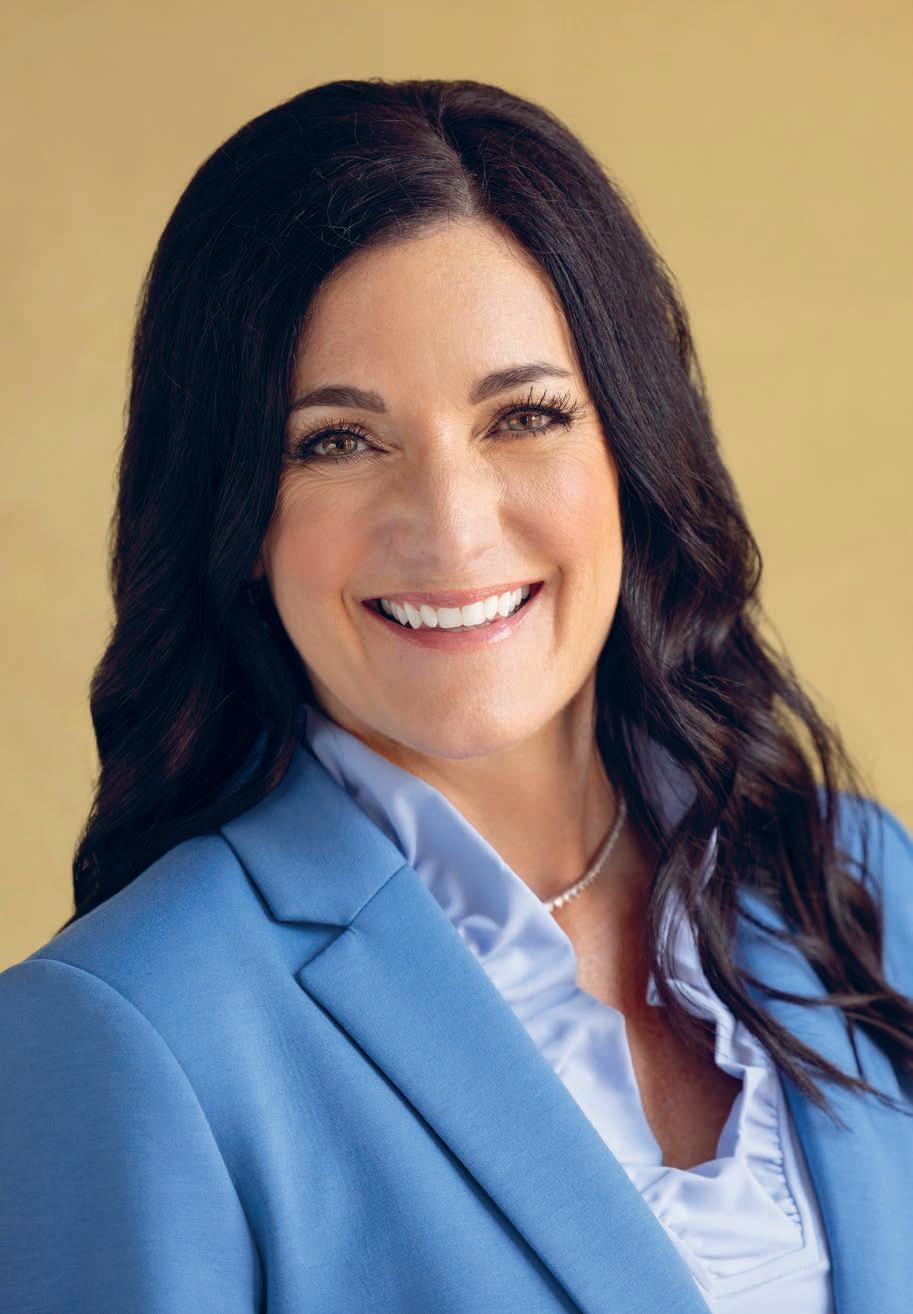
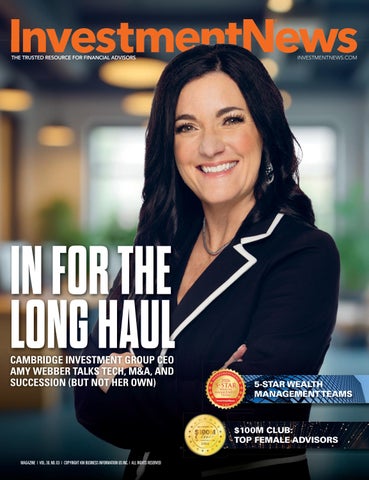
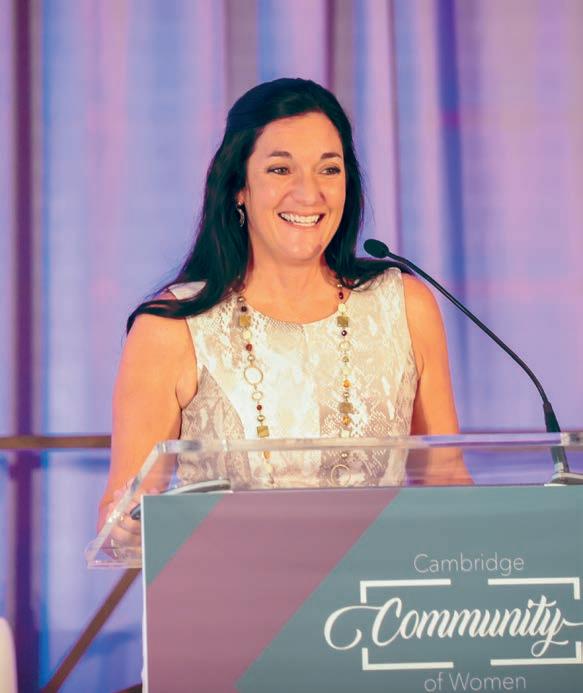
The Cambridge CEO talks M&A, AI, and succession (but not her own)
BY GREGG GREENBERG
FOR ALL the talk of job-hopping one’s way to the top, continually trading loyalty for a better title, it’s worth noting that sometimes sticking around and displaying one’s skills pays off. And handsomely, too.
Just ask Cambridge Investment Group CEO Amy Webber.
Webber was hired as Cambridge’s 22nd associate in 1998 and rose up the ranks until she was named CEO in 2016, succeeding founder Eric Schwartz. Over those nearly three decades in the same old place, she’s seen Cambridge grow into an industry powerhouse most recently boasting $267 billion in assets under advisement and more than 4,100 producing financial advisors nationwide.
To be clear, she’s done far more than simply watch Cambridge snowball over that time. She’s helped lead the charge.
“What has kept me here is the combination of independence, entrepreneurship, and a deeply people-centered culture. Cambridge has always believed advisors should have the freedom to serve clients in the way that best fits their business, while also having the support of a strong, valuesdriven firm behind them,” Webber says.
Adds Webber: “That has always been a natural fit for me because I care deeply about building something durable – a firm that can grow, evolve, and still do the right thing, even when no one is looking.”
CAMBRIDGE THEN AND NOW
The size and scale of Cambridge may have changed since Webber started (and Bill Clinton was president, for the record), but she maintains that the core of the firm has remained both sound and consistent. For her, that means employees staying focused on supporting advisors as both partners and clients, preserving choice, and creating a culture where advisors and associates feel they are part of something bigger than themselves.
“That is only possible because of our long-standing commitment to organizational longevity through internal control,” Webber says.
What has changed significantly in Webber’s view is the complexity of the overall business. The regulatory environment, cybersecurity and fraud risks, technology and platform expectations, client needs, and the competitive landscape are all far more sophisticated than they were in 1998. As a result, she’s pushed the Cambridge team to become more disciplined, efficient, and continuously innovative.
Put simply: the tools, infrastructure, and scale may have evolved, but Webber’s commitment to independence, internal control, service that earns unwavering client loyalty, and long-term partnership has remained the same.
CAMBRIDGE CEO AMY WEBBER
HOMETOWN: Cuba City, WI
CURRENT RESIDENCES: Lighthouse Point, FL, and Fairfield, IA
EDUCATIONAL BACKGROUND: Madison Business College, Madison Area Technical College
HOBBIES: Spending time with family, boating, and traveling
PERSONAL: Happily married for 31 years with two adult children

“I am here for the long haul. I love what I do and truly enjoy the people I am fortunate enough to work with”
And when Cambridge finally crossed the $2 billion annual revenue mark for the first time last year, it provided Webber with a clear confirmation that “the model works.” Or, as Webber puts it, that Cambridge’s advisors are growing and thriving, and that the investments they have made in strengthening relationships, elevating service, building flexible technology, supporting and developing their people, and enhancing their platform capabilities are creating real momentum.
“Most of all, though, I felt gratitude. I am deeply grateful for the trust and confidence of our advisors, the commitment of our associates, and the foundation Eric and so many others worked so hard to build,” Webber says.
A BRAVE NEW M&A
Cambridge has not only been building on its foundation under Webber’s leadership but it has also been buying. Yes, like many of its competitors, Cambridge is also a major participant in the private equity-fueled M&A battles taking place in the wealth management arena.
Cambridge acquired Georgia-based Dempsey Lord Smith last year, adding roughly 75 financial professionals. It also brought over Ameriflex Group, which was affiliated with Osaic, representing $11.9 billion in client assets and 129 advisors.
“What differentiates us in this space is how we apply our core value of flexibility to every opportunity. We understand that no two firms, advisors, or succession plans are exactly alike. Our goal is not simply to complete a transaction – it is to create long-term alignment that supports advisors, their clients, and the long-term health of the business,”Webber says.
She adds that M&A at Cambridge is not limited to transactions at the corporate level. Equally important to her is the work they do supporting succession and acquisition opportunities between
advisors, or between advisors and one of its Office of Supervisory Jurisdiction business executives.
Last year, Cambridge supported nearly 180 succession and acquisition transactions across its network, in addition to executing eight transactions directly with Cambridge representing more than $20.6 billion in invested or acquired assets under advisement. In six of those transactions, Cambridge established 100 percent ownership.
Still, Webber is quick to concede that private equity has radically changed the competitive landscape, particularly as more private equitybacked firms have entered the independent and mid-sized firm space.
“There is significantly more capital competing for quality businesses, which has driven higher valuations across the industry. Recent industry reporting showed record levels of RIA M&A activity in 2025, and while valuations continue to rise for high-quality firms, we believe the highest price is not always the best outcome,” Webber says.
Despite this heightened M&A environment, Webber is quick to point out that organic growth remains a major focus for Cambridge. She notes that a firm Cambridge’s size must rely heavily on organic growth to create meaningful enterprise value over time. That means supporting their existing advisors as they continue to grow and scale their businesses through deeper practice management support, more effective lead generation, succession and continuity planning, family office capabilities, and more specialized engagement strategies.
And, of course, better technology. As in AI. The question is, How does Webber expect AI to impact the associate and advisor experience over time?
“Roles will change. Skill sets will continue to evolve. But we believe the strongest model is human associates and digital capabilities working
Founded: 1981
Headquarters: Fairfield, IA
Total revenue: $2.18B
Producing financial advisors: 4,100
AUA (assets under advisement): $267B
Associates: 900
together. At the same time, I am not naive about the risks. AI brings both known and unknown challenges, and firms must approach implementation thoughtfully and responsibly with proper due diligence and a clear understanding of return on investment,” Webber says.
Her advice to firms is to explore and implement AI responsibly, but with urgency.
“As I have shared with our teams, we cannot allow fear to impede progress,” Webber says.
With all the talk about succession planning in the financial industry, the questions regarding Webber’s future at Cambridge naturally arise. Seriously, she has been with the firm since Bill Clinton was impeached (once again, for the record).
“I am here for the long haul. I love what I do and truly enjoy the people I am fortunate enough to work with. Leaders, particularly at the highest levels, can sometimes stay in their roles beyond the point where they are contributing at the level they once did. I spend a significant amount of time making sure I am focused on where I can provide the highest and best value for the greater good of Cambridge,” Webber says.
Going forward into the next – however many –decades, Webber says her focus is on making sure Cambridge is built to last well beyond any one person, including herself. That means recruiting and developing leaders, and team members overall, who are fully aligned with Cambridge’s culture and values.
“I do not view succession as a single event. I view it as an ongoing responsibility. One of the most important jobs of a CEO is to make sure the organization is stronger, more resilient, and better prepared for the future than it was when you stepped into the role,” Webber says.
Custodian restrictions from Schwab and Fidelity are forcing advisors and asset managers to rethink fast-growing
BY ANDREW COHEN
Policy changes from custodians Schwab and Fidelity have advisors and asset managers rethinking strategies around long-short separately managed accounts (SMAs), which involves buying long equity positions while also selling short on underperforming stocks to offset capital gains for wealthy clients.
Amid surging demand for the tax-efficient strategy, in December 2025 Fidelity began blocking RIAs from opening and funding new long-short SMAs, and as of May 1 it instituted higher fees for some existing long-short SMA clients. Meanwhile, Charles Schwab recently put a 30 percent maximum limit on the portion of an RIA’s assets in its account that can be allocated to long-short strategies.
“The Fidelity pause was like an earthquake in the wealth management industry for people that were focused on a taxable practice, or taxable clients that had been using it over the last several years,” says Ehren Stanhope, chief investment strategist of Franklin Templeton’s custom indexing platform, Canvas. “I think that advisors, they’ve adapted well to that Fidelity pause, because Schwab fortunately had become available. Because previously, Schwab was not available for these long-short strategies at all.”
Canvas manages about $30 billion across long-only, long and short, ETFs, and managed options strategies, including its recently launched equity SMA for Josh Brown’s Ritholtz Wealth Management. Franklin Templeton has been providing taxaware longshort SMA strategies to advisors for less than a year. Its offerings range from 115/15 to 200/100, meaning portfolios that hold 115 percent to 200 percent in long positions and 15 percent to 100 percent in short positions while maintaining roughly 100 percent net market exposure.
“Prior to Schwab and Fidelity − really Schwab − starting to curtail things, we were on track for offering a 250/150 as well, but they’ve sort of capped the leverage up to a 200/100,” says
Stanhope. “And for some cases, some players [before custodian restrictions] were going as much as 300 percent long, 200 percent short. The more leverage that you have, the greater the ability to do loss harvesting.”
Invesco has been offering its longshort SMA strategies for roughly the last five years. The tax benefits to offset capital gains amid rising US equity markets has resulted in clients using a long-short SMA strategy at account sizes as low as $500,000, Invesco’s head of SMAs Eddie Bernhardt told InvestmentNews
“It’s no longer just family offices and multifamily offices and sophisticated RIAs − we’re starting to hear incoming calls from wirehouse corner office teams, regional broker dealers, from middle market RIAs. And so the uptake here is accelerating very quickly. I’d guess it’s on the hundreds, if not thousands, of RIAs who are now looking at these strategies, if not utilizing them,” says Bernhardt.

BY THE NUMBERS
$39 billion SMA platform assets
300% growth in long-short custom equity SMA over two years
9%+ tax alpha possible in a single year
“It’s slowed flows overall. We were accelerating at such a fast pace − the market seemed to have doubled in a year in size, which is remarkable,” says Bernhardt. “It’s also an opportunity for other custodians to potentially put a flag in the ground, though I’d say none has done it really effectively. Schwab and Fidelity have big service offerings and are built to serve the wealth management community.”
Falcon Wealth, a $6 billion RIA based in California, has about 70 percent of its client assets custodied with Fidelity and 30 percent with Schwab. Fidelity notified Falcon Wealth president Gabriel Shahin that it was increasing financing rates for long-short strategies from 60 basis points to 152 basis points, which is above the 40 to 120 basis point range (depending on client account size) that Shahin says Schwab charges Falcon Wealth for long-short SMAs.
“I’m more surprised with Schwab than I am with Fidelity. Because Fidelity is just saying I’m upping my fees by almost a percent, which is a lot on an investment that’s targeted to get 10 percent returns,” says Shahin, in reference to Schwab’s instituting a 30 percent limit on RIA assets being in long-short SMAs.
“The Fidelity pause was like an earthquake in the wealth management industry for people that were focused on a taxable practice”
EHREN STANHOPE, FRANKLIN TEMPLETON
Research from Invesco shows its custom equity 130/30 long-short SMA can produce more than 9 percent tax alpha in a year and between 2 and 4 percent tax alpha long term on a conservative basis.
The asset manager’s SMA platform totals around $39 billion in assets, while Invesco’s long-short custom equity SMA has grown nearly 300 percent over the last two years, even as inflows have slowed due to custodian restrictions.
“All those long-short portfolios are 100 percent moving to Schwab from Fidelity,” Shahin says of his RIA. “These [long-short SMAs] are really good strategies. I would probably say 40 percent of our clients that did this are people who sold a business and need write-offs.”
Both Shahin and Andrew Herzog, an advisor with The Watchman Group RIA in Texas, say that the 30 percent limit passed by Schwab was a threshold they would never intend to reach for


“It’s an opportunity for other custodians to potentially put a flag in the ground, though I’d say none has done it really effectively”
EDDIE BERNHARDT, INVESCO
long-short allocation, even before that maximum was adopted.
“It is not for every client we have. It’s actually, for the vast majority, not appropriate. So we’re well below the 30 percent limit that Schwab just now rolled out,” says Herzog. “The best ones [for long-short SMA] are people who are going to be realizing a capital event − selling a business, for instance − or they have concentrated stock positions and they want to get out of it because they’re overly concentrated.”
Fidelity serves as a clearing and custodian company but not a bank, whereas Schwab is the 12th largest bank in the US by total assets. “Schwab probably had a little bit more control in saying, we will restrict it to 30 percent of AUM for each RIA − it was a little bit more their choice,” says Herzog. “Unlike Fidelity, who probably had to consult with their bank partner, and the bank just put a hard stop on it for now, or at least severely restricted it. That’s my understanding.”
Fidelity has offered access to third-party long-short SMAs since 2023 for third-party
Fidelity blocked new long-short SMA accounts from December 2025
Schwab capped long-short allocation at 30% of RIA assets
One California-based RIA reported Fidelity raising its financing rates from 60bps to 152bps, and Schwab charging between 40 and 120bps − though rates may vary by advisor and account size
wealth management firms. Sources indicated to InvestmentNews that Fidelity is encouraging advisors to diversify long-short SMA providers and will support transfer steps amid the company’s ongoing pause on the opening and funding of new long-short SMA accounts.
“These decisions reflect Fidelity’s long-term approach to monitoring resources across the platform as we manage the growth of long/ short SMAs,” a spokesperson for Fidelity told InvestmentNews
“We are committed to long/short SMAs on Schwab’s platform,” said a Schwab spokesperson. “The changes we have recently shared with our participating RIA clients are designed to ensure long/short SMAs on Schwab’s platform grow responsibly over the long term. Schwab has the scale, the balance sheet, and the expertise to support this offer and will continue to meet the needs of RIAs and their clients.”
Hedge funds AQR and Quantinno are other active investment managers used by RIAs to gain access to long-short SMA strategies.
The asset managers reached by InvestmentNews agree that Schwab and Fidelity were justified in their long-short restriction reaction given the explosive growth of the strategy.
“I felt like it was hard for advisors, but responsible,” says Stanhope. “[Schwab] is just saying, we think that there’s an upper limit on the leverage that’s responsible, and we also don’t want an advisor coming to our custodian only for long-short strategies − hence that 30 percent cap. Because my sense is that custodians want the whole household; I’m sure that there’s greater profitability and efficiencies associated with that.”
Centaurus Financial touts its independence as a key selling point at a time when many firms are being swallowed up
BY JAMES ROGERS
Choice and culture are key weapons in the advisor playbook when it comes to battling market volatility, according to Centaurus Financial.
While the financial advisory industry has seen widespread consolidation in recent years, the national independent broker-dealer offers its network of advisors a vast array of options, from investments to technology.
There are about 650 independent financial advisors affiliated with the broker-dealer, which has around 100 employees spread across its home office in Anaheim, California, and four corporate offices in Virginia, Georgia, New Jersey, and Idaho.
“We have partnered with numerous money managers, platforms, and insurance carriers. We provide access to multiple custodians and have several experts within our home office that our advisors can turn to,” Adam Simon, Centaurus Financial’s SVP and chief administrative officer, tells InvestmentNews. “Even though our advisors are independent, they’re never alone – and we make sure that their choices are vast.”
Founded in 1992, Centaurus now has more than $20 billion in assets under administration. The company touts its independence as a key selling point at a time when many firms are being absorbed into larger financial advisory companies. “Consolidation has been turning larger independent firms into ‘wirehouses in disguise,’” says Simon. “In order to scale, these firms have no choice but to deploy service and technology models that make things easier on them – we like to make things easier on the advisor. We understand that our advisors are our most important asset.”
“More importantly, we offer our advisors stability so they don’t have to worry about consolidation. Our firm has not been bought or sold since inception, and we plan on keeping it that way,” says Simon.
The wealth management industry has certainly seen a big push toward consolidation. In 2023 a PwC report predicted that 16 percent of asset and wealth management companies will be


“Even though our advisors are independent, they’re never alone – and we make sure that their choices are vast”
FINANCIAL
swallowed up or fall by the wayside by 2027, a figure that is twice the historical turnover rate.
Market volatility has also been a key theme in recent months, as advisors and their clients attempt to navigate a turbulent geopolitical climate that has sent energy stocks soaring and taken indexes on a rollercoaster ride.
But John Trentor, chief distribution officer at Centaurus, says that the company is perfectly positioned for this scenario. “When [our financial advisor partners] take into account a surging market or a declining market, they can feel comfortable knowing they have solutions available to them to meet the specific needs of their clients,” he says.
“So if there is a client that is looking to preserve and protect their assets, we offer many conservative solutions.”
“And if there are investors that are trying to capitalize on the upside of the market, we offer solutions that meet that objective as well,” he adds. “We’re very comprehensive by design in what we offer our advisors. We like to think of ourselves as the best kept secret in the industry.”
Culture is also critical, according to Simon. “From our experience, culture matters more than scale in this industry, and I think we sit in a sweet spot – we’re a mid-sized broker-dealer that still knows all of our advisors and many of their family members by name,” he says. “And all of our advisors have direct access to executive leadership at all times – we love to pick up the phone, unlike some other firms.”
Trentor echos these sentiments: “There is so much consolidation going
on out there in the industry right now with broker-dealers – everybody seems to be chasing large scale,” he says. “Everybody wants to be the LPLs of the world – that’s okay, that’s just not us.”
“We’re family-owned and -operated, we carry no debt, we’re just a really well-run company and we’re flexible,” he adds.
That flexibility is crucial when it comes to tackling some of the biggest issues the wealth management industry faces – an aging advisor community and shifting client demographics. Set against this backdrop, succession has been thrust firmly into the spotlight in recent years, as has the need to cater to younger generations of clients. Centaurus acknowledges this aging demographic.
“We offer our advisors a detailed road map to assist in their successionplanning efforts,” says Trentor.
“As we start to recruit the younger advisors, and some of the younger clients of those advisors, technology is a big need and want,” says Simon, noting that AI is on everybody’s mind right now. “We continue to make significant investments in technology to make it much easier for the advisor and much easier for the client.”





































ON ANY GIVEN DAY, nancial advisors across America are talking someone off a ledge built from fear – fear of outliving savings, of market swings triggered by a presidential tweet, and of what happens to a lifetime of work when the person who managed it for 30 years retires. In an industry that has long been de ned by the white-haired men who shaped it, that voice of calm reason is increasingly female.
InvestmentNews has identi ed some of the top nancial advisors in the US through its $100M Club – a distinction awarded to female advisors who individually manage at least $100 million. This year, 108 women received that recognition, drawn from a competitive eld of nominees, each veri ed by their rm’s compliance department and selected solely on the basis of assets under management (AUM) reported between January 1 and December 31, 2025. No fees were required to nominate, and no marketing relationship in uenced the selection.
Behind those numbers lies a more complicated story – one about an industry still grappling with its
own demographics, a wealth landscape on the verge of a seismic shift, and the women quietly building practices that may well de ne the next chapter of American nancial life.
THE U.S.
The numbers are unambiguous. Women represent approximately 24 percent of the nation’s nancial advisors – a gure that has not only stalled but also edged slightly backward from the high-20s range seen in the 2010s, despite sustained efforts to improve it. Among Certi ed Financial Planner professionals – the industry’s most recognized credential – women make up 23.8 percent as of December 2025, according to the CFP Board. The advisory workforce remains, as one industry analysis put it, a profession still plateauing in its diversity gains.
Yet step back, and the broader industry picture is one of remarkable expansion. The US had approximately 326,000 personal nancial advisor jobs in 2024, up from around 271,000 in 2019,
according to the Bureau of Labor Statistics. The agency projects a further 10 percent employment growth through 2034, adding roughly 24,100 new openings annually. Meanwhile, SEC-registered investment advisers now oversee a record $144.6 trillion in assets – a 12.6 percent increase from 2023 – according to the Investment Adviser Association’s 2025 data. The number of clients also reached a record 68.4 million.
The industry’s structure remains heavily dominated by smaller operators. According to the Investment Adviser Association’s 2025 data, 58.3 percent of all SEC-registered advisers manage between $100 million and $1 billion in assets – the same range that includes this year’s $100M Club honorees. Nearly 88 percent have fewer than 50 employees. Yet it is the top tier that controls most of the assets: the 207 largest rms alone manage 66.1 percent of all AUM. The $100 million threshold, in other words, marks a meaningful professional milestone but not an elite scale – it is where most of the profession actually lives.
Between the 1970s and the 2010s, female representation in the profession climbed steadily, from around 4 percent to roughly 28 percent. Since then, the share has slipped back to approximately 24 percent – a decline that re ects structural barriers still embedded in how the profession recruits, promotes, and retains women.
There is an encouraging counterpoint in the numbers, however. Between 2021 and 2024, the number of women earning CFP certi cation grew by 13.9 percent – outpacing the 10.7 percent growth rate for men, according to the CFP Board. Meanwhile, nearly one in four RIA rms (23.5 percent) has at least one female owner or executive, based on 2025 data from AdvizorPro. Among advisors with less than 10 years of experience, women now represent nearly 30 percent of the workforce, suggesting a younger generation entering the profession is more evenly balanced than the industry overall.
Yet the ground beneath the profession is shifting. Of the estimated $124 trillion in assets expected to change hands in the US between now and 2048, a signi cant portion will rst pass to surviving spouses – 95 percent of whom are projected to be women, according to Cerulli Associates’ June 2025 data. By 2030, women are expected to control $34 trillion in investible assets, up from approximately $11 trillion in 2020 – nearly triple



“It’s not just about getting you the biggest pot of money sitting in an investment account –it’s about getting the most spendable income”
KRISTEN
GRATTON, GRATTON & KERR FINANCIAL GROUP
the amount they held at the start of the decade, according to research from McKinsey & Company and Citizens Bank published in February 2025. Whoever earns the trust of those women will help shape the next era of wealth management.
Avani Ramnani, managing director at Francis Financial in New York and a respected voice on gender equity in the profession, sees the moment as both urgent and promising. “Barriers still exist, though they feel more structural and less overt,” she says. “The pipeline skews male, and there remains a very high emphasis on sales rather than client development.” Women, she argues, still need sponsorship – not merely mentorship – and rms that have built genuinely diverse leadership are beginning to see the commercial logic of that investment.
Francis Financial itself is led by an all-female leadership team, a fact Ramnani cites with visible pride. “That has organically allowed more female advisors to be interested in joining our team, and from there we work very diligently to support their career paths,” she says.
For Ramnani, the $100 million threshold is meaningful but incomplete as a measure of impact. “Some of the most impactful work being done by female advisors is with clients who are building wealth for the rst time, navigating major life transitions, or working with communities that historically have had little access to sophisticated nancial guidance,” she adds. “That work doesn’t always show up in a $100M number, but it’s exactly the kind of practice that will matter most as the wealth landscape shifts over the next decade.”
INDUSTRY EXPERT: AVANI RAMNANI
Managing director, Francis Financial – New York, NY (industry expert and commentator)
How would you de ne a “Top Female Advisor” in 2026? Are there still barriers?
“A top female advisor starts with the same qualities as any excellent advisor: deep trust, duciary advice, and sound judgment under pressure. But the recognition still matters because women remain underrepresented. Women advisors tend to serve higher numbers of female clients, who have distinct planning needs around longevity, caregiving priorities, and career transitions. That’s a specialized skill set, and increasingly, that’s where the need and opportunities are.”
How would you characterize $100M+ AUM for female advisors?
“It is a major milestone for any advisor. In my experience, for women, it often re ects something deeper. AUM tells you the size of a practice, not the depth of its impact. Some of the most impactful work being done by female advisors is with clients who are building wealth for the rst time or working with communities that historically have had little access to sophisticated nancial guidance. That work doesn’t always show up in a $100M number, but it’s exactly the kind of practice that will matter most as the wealth landscape shifts.”
What steps would create better opportunities, especially at senior levels?
“Creating better opportunities at senior levels requires three things: intentional sponsorship, transparent progression criteria, and client access. I am so proud of our rm, which has an all-female leadership team and focuses on serving women. That has organically allowed more female advisors to be interested in joining our team, and from there, we work very diligently to support their career paths –beyond just mentorship.
METHODOLOGY AND AWARD DISCLOSURE










This award recognizes female nancial advisors who demonstrate signi cant scale in their advisory practices as measured by assets under management (AUM). The list highlights advisors managing substantial client assets during the evaluation period.
Eligibility and nomination process
To compile the annual list, InvestmentNews solicited nominations from advisors, industry professionals, and clients.
Eligibility requirements included:
• Nominees must be female nancial advisors.
• Nominees must individually manage at least $100 million in AUM.
All submitted information regarding nominees was required to be veri ed by the nominee rm’s compliance department before being accepted for consideration.
Population of nominees: 340



The perpetual student Financial advisor, Gratton & Kerr Financial Group –Mars, PA
It is 5:30 in the morning, and Kristen Gratton is already awake. She has just returned from an overnight ight home from a retirement-incomeplanning conference in Orlando – the kind of conference that most established advisors might consider optional, a perk of seniority rather than a professional obligation. For Gratton, it is simply Tuesday.
“I want to be the best advisor I can be,” she says plainly, describing the relentless educational drive that has come to de ne her practice. “I’ve got to know what’s new and what’s changing.”
Gratton built Gratton & Kerr Financial Group from the ground up, eventually hiring her husband as part of the team ve years in. She leads a staff of three nancial advisors and two administrative professionals, and her days are now split between client work and the less glamorous demands of running a growing rm.
“It’s hard to lead people where you haven’t been,” she says. “When you’re doing it yourself, you know this is really hard to run a business, so it gives you more perspective on the challenges your clients are facing too.”
Over the past several years, Gratton has identi ed what she sees as the most underserved dimension of the advisory relationship: tax planning. Not tax preparation – she is clear that her rm does not le returns – but the kind of forward-looking tax strategy that most clients assume their advisors are already doing, and most are not. Her approach now involves sitting down with clients’ accountants, analyzing tax returns alongside investment strategy, and asking what she calls the fundamental question: how do we pay the least amount of lifetime taxes?
Number of recipients: 108
Percentage of nominees receiving award: 31.76%
Methodology and criteria
Award is based on: AUM
The nal list was determined based on each eligible advisor’s individual AUM reported between January 1 and December 31, 2025.
Award is NOT based on:
• Client testimonials or feedback
• Investment performance history
• Other factors unrelated to AUM levels
Only nominees meeting the minimum AUM threshold and completing the compliance veri cation process were considered for inclusion.
Fees and promotional considerations
No fees were required for nomination or consideration for this award.
Any marketing or promotional opportunities related to the award are separate from the editorial selection process and do not in uence award results.
Disclaimers and material facts
This award re ects the stated methodology and criteria and is based on reported assets under management during the evaluation period. It does not measure investment performance, guarantee client outcomes, or represent a ranking of all nancial professionals.
Compliance review
All nominee information must be reviewed and veri ed by the nominee rm’s compliance department before being accepted for consideration or publication.


“Seeing that we’re engaged in community is part of our marketing, but it has to ring true. People can tell if it’s hollow”
LAUREE HARRISON, CASCADE GUIDED WEALTH
because they wanted someone who would take time to explain without the jargon.
Harrison came to nance through an unconventional route. She found the profession through a job listing and built her way toward eventually owning her own rm. Along the way, she acquired two books of business from female advisors in Seattle who retired and speci cally sought a like-minded successor.
The US nancial advisor workforce has grown steadily and is projected to continue expanding at roughly double the national average for all occupations.
Sources: U.S. Bureau of Labor Statistics Occupational Outlook Handbook (2024); BLS projects 10% employment growth from 2024–2034. Historical estimates sourced from Investment Adviser Association (IAA) and BLS data.
Her niche has crystallized around pre-retirees – typically clients between 45 and 65 who want to retire early, before Medicare eligibility. It is a demographic de ned by two overlapping anxieties: health insurance costs and the fear of running out of money. Gratton has made herself a specialist in both. On the question of gender in her profession, Gratton is candid rather than bitter. At a conference recently, she was assumed to be administrative staff. Her husband, present as her business partner, had been congratulated on her behalf. “I feel like I have to prove myself a little,” she says. “Maybe it’s part of my drive – I’ve got to be the best. I’ve got to learn. I’ve got to know.” Her 16-year-old daughter, she adds, recently corrected a classmate who assumed her father was the breadwinner. “She’s like, ‘Actually, no, my mom’s the money maker.’ That makes me really proud.”
Q&A: Kristen Gratton
You’ve built both a client practice and a business simultaneously. How do those two roles relate? “They work together, but it’s de nitely different challenges. Running your own business versus meeting with clients – they’re very different. But owning a business gives me additional insight when I’m working on my own – to realize the challenges my business-owner clients are facing.”
You recently returned from an overnight conference. What drives that level of continued education?
“I like to learn. I want to be the best advisor I can be. Things can adjust – 20 years ago, there were only
mutual funds. Now there are ETFs, direct indexing, and structured notes. If you don’t keep up with it, you’re not doing the best thing for your clients.
As a woman in a male-dominated field, how has that shaped your approach?
“I think it can be a huge bene t – we have the ability to make clients comfortable. But it has also been a challenge. Maybe that’s part of my drive to keep learning, keep growing.”
She grew up, as she puts it, with no money and a lot of money stress. That background, she believes, gives her a kind of credibility that clients from similar circumstances nd disarming. “Our industry has an upper-crust sort of reputation,” she says. “They all think: you came from money; you went to a great school. It’s like, no, I had student loans. I fought to be here.”
Her view of growth is notably unsentimental for an industry that often equates scale with success. She has turned down acquisition opportunities that did not t her client pro le. She has no interest in managing 20 advisors if it means losing direct contact with the clients she serves.
What de nes success for Harrison is simpler and harder to quantify. She describes being the second call a widow made after her husband died – and then helping that widow notify the attorney, the CPA, and the other advisors in her nancial life. “It feels nice to be relied upon and just to be that center of trust,” she says.


Lauree Harrison describes her competitive edge with a single, unexpected word: superpower. As a female advisor in Seattle – a city she notes is demographically and politically distinct, where community ties matter – she has come to see her gender not as an obstacle to navigate but as a lens that makes certain relationships possible.
She says, “The relationships that we do have are stickier because the people who seek us out want the bene t of having a female nancial advisor.” Harrison works with women navigating widowhood, divorce, and major career transitions – and with male clients who actively sought a female advisor
She also offers an observation about the behindthe-scenes reality of advisory work that rarely makes pro les. “Running a really good business in our industry is hugely about the non-sexy piece –the administrative work,” she says. “We are really, really persistent about making sure every single piece of paperwork is processed correctly, on time, and followed up on.” It is, she says, a large part of why her clients stay.
Q&A: Lauree Harrison
You’ve called being a female advisor a “superpower.” What do you mean by that?
“The relationships we have are stickier because the people who seek us out speci cally want the bene t of having a female advisor. I work with women navigating widowhood and divorce – it’s a natural t. I’ve also had male clients say they speci cally wanted a female advisor because they didn’t want someone to talk over their heads. They just wanted a conversation.”


Sources: Investment Adviser Association, 2024 Evolution Revolution Report; additional analysis sourced from SmartAsset
You grew up without financial security. How does that shape how you work?
“Clients assume you came from money. It’s like, no, I had student loans. I fought to be here. I think that puts them at ease – knowing I understand how much nancial security means, because I fought for my own.”
How do you think about growth for your firm?
“I’ll be exible and open to opportunities if they seem right. But I’ve turned down acquisitions that just weren’t the right client pro le. I still really, really want to talk to my clients. I won’t give that up. A lot of the advisors I admire are having the same debate: why grow at all costs?”
Mulcahy grew up in Boston in a construction family – the daughter of a household where eighteen-wheelers parked outside and life-sized Tonka trucks were part of the scenery. She stumbled into nance in the early 80s, navigated the informal hierarchies of an industry where, as she puts it, Irish Catholics did not always t with the Boston Brahmin set, and accumulated, across four decades, a kind of wisdom that cannot be taught.
She is based now in Florida, where she trades Boston winters for perpetual heat and serves a predominantly older client base. During the pandemic, when the rest of the nancial industry retreated to home of ces, Mulcahy was in the building every day.
“People need to know that there was still someone managing your money,” she says. “They just wanted to know someone was there.”
The steady hand

Senior wealth advisor and partner, Destiny Wealth Partners – Tavares, FL
Carol Mulcahy has been doing this since 1985. She has navigated the 1987 crash – on her birthday, as it happens – the dot-com collapse, the nancial crisis of 2008, and the turbulence of 2021. She has sat with families as they buried parents, untangled estates, and discovered that the bene ciary designations they never updated had redirected decades of savings to an ex-spouse. She has been, as her former institutional colleagues used to call her, the priest. “They would send me out,” she recalls with a laugh, “and people would just tell me everything.”
Her core strategy, which she calls the Retirement Distribution System, divides client assets into three pools based on time horizon: money needed in the next 10 years, held conservatively; money in the 10- to 20-year range, invested for growth; and a legacy pool designed to grow over decades. It is an approach built explicitly for the kind of volatility that has de ned markets in recent years.
Much of Mulcahy’s practice is now focused on elder-care planning – guiding Florida clients and their families through the nancial and emotional complexity of aging. She works with CPAs, attorneys, and other advisors to build coordinated plans, catching the kinds of errors – outdated bene ciary designations and missed charitable distribution opportunities – that can otherwise cost families years of careful planning.
She does this with a deliberate neutrality she traces back to something close to a philosophy. “I’m not your Jiminy Cricket,” she says. “You can tell me
“We’re all in the same storm, but some people have a dinghy, some people have a sailboat, and some people have a mega yacht. How do I help you get through it with what you have?”
CAROL MULCAHY, DESTINY WEALTH PARTNERS
what you want to give. Whether I like it or not is irrelevant. This is your money.”
After four decades, Mulcahy is nding, for the rst time, a measure of balance. She works from home one day a week, a modest adjustment she describes as signi cant. She is still motivated by the same thing that drove her through a decade in which she raised a son alone, cared for aging parents, and held down a major institutional client while going back to school at night. “I look back now and say, how the heck did you do it?” she says. “But sinking was not an option.”
Q&A: Carol Mulcahy
You’ve been in this industry since 1985. What has changed most in how you serve clients?
“The industry is completely different now than it was then. When I started, I didn’t know a bear from a bull. What I’ve learned is that every family has a unique situation. I’ve gone through 1987, the tech bubble, 2008, and 2021 – you go through all of this, and you realize we’re going to come out eventually. The key is knowing how to get through it in the smoothest, least complicated way possible.”
How do you think about helping clients navigate uncertainty?
“I use a three-pool strategy. I keep the money clients will need for the next 10 years pretty safe, so no matter what’s happening – geopolitically, tariffs, whatever – it’s not money they need right now. We’re not just setting it and getting it and hoping for the best. When sectors change, our investment committee goes and nds the next opportunity.”
What’s the most important thing you do for clients that they might not even realize?
“The bene ciary works. A named bene ciary supersedes a will and a trust. Once, I saw a former spouse get everything because no one had updated the paperwork, and the current spouse and children got nothing. So every year I go through a full review – not just what we have here, but everything. Do you have a 401(k) elsewhere? A life insurance policy? I want to see the whole picture.”
There is a common thread running through the careers of these honorees, and it is not the assets under management, though those are impressive. It is something harder to measure: a particular quality of attention. The ability to read the room – to hear what is being said underneath what is being said –and to show up not just as a technically competent manager of money but also as someone clients turn to when life happens.
The industry is changing, slowly and unevenly. The CFP Board’s Accelerate & WIN initiative, launched in March 2025, represents a structured effort to build a more diverse pipeline – reaching into high schools, colleges, and career-change programs to nd the women who might not have considered nance a viable path. The numbers, at roughly 24 percent female CFP representation, suggest the work is not nished.
But the women being recognized this year by IN – 108 of them, managing assets that span the full range of American nancial life, serving retirees in Florida and millennials in Seattle – are not waiting for the pipeline to x itself. They are building practices, acquiring books of business from one another, mentoring the next wave, and making the case through results that the thing their industry has too often undervalued is precisely the thing their clients most need.
As Ramnani puts it, the shifting demographics of wealth are nally forcing the industry’s hand. “Shifting client demographics are steering advisory rms to make this transition,” she says. Whether the rms follow the clients – or the clients force the issue themselves – the direction, at least, is clear.
What is the InvestmentNews’ $100M Club?
The IN’s $100M Club is an annual recognition program that identi es top female nancial advisors in the US who individually manage at least $100 million in assets under management. Honorees are nominated by advisors, industry professionals, and clients, and all submitted information is veri ed by the nominee rm’s compliance department before inclusion. The award is based solely on AUM and does not measure investment performance or client outcomes.
How many female financial advisors are there in the US?
As of 2025, women represent approximately 24 percent of the roughly 326,000 personal nancial advisors employed in the United States, according to July 2025 data from AdvizorPro, which analyzed more than 776,000 securities-licensed advisors. Among Certi ed Financial Planner (CFP) professionals speci cally, women account for 23.8 percent of the 107,529 total CFP professionals – a share that has doubled over the past decade but has largely plateaued since around 2010, according to December 2025 data from the CFP Board.
What does it take to be recognized as a top female financial advisor in the US?
To be eligible for the IN’s $100M Club, a female nancial advisor must individually manage a minimum of $100 million in assets under management. All nominee data must be veri ed by the advisor’s rm’s compliance department. Beyond the threshold, the honorees pro led in this report share several qualities: a commitment to continuous education, deep
client relationships built on trust, a holistic approach to nancial planning that includes tax strategy and estate planning, and the ability to navigate clients through nancial and personal complexity.
Which women were recognized as top financial advisors by IN in 2026?
IN recognized 108 women as part of its 2026 $100M Club. Among those pro led in this report are Kristen Gratton of Gratton & Kerr Financial Group (Mars, PA), a specialist in tax planning and early retirement strategies; Lauree Harrison of Cascade Guided Wealth (Seattle, WA), who focuses on women investors and millennial clients; and Carol Mulcahy of Destiny Wealth Partners (Tavares, FL), a 40-year veteran specializing in elder-care planning and estate transitions.
Why are female financial advisors important in the US wealth management industry?
Female nancial advisors play an increasingly critical role as the demographics of US wealth shift. By 2030, women are projected to control $34 trillion in investible assets – up from approximately $11 trillion in 2020, nearly triple the amount they held at the start of the decade, according to 2025 research from McKinsey & Company and Citizens Bank.Research shows that female advisors often develop deeper client relationships, particularly with women navigating major life transitions such as divorce, widowhood, or inheritance. Yet women remain signi cantly underrepresented in the profession, making recognition programs such as IN’s $100M Club: Top Female Advisors an important signal of progress.
Carol Mulcahy
Destiny Wealth Partners
Phone: 352 343 2700
Email: info@destinywealth.com
Website: destinywealth.com
Kristen Gratton
Gratton & Kerr Financial Group
MassMutual
Phone: 724 624 8267


Email: kgratton@grattonkerr nancialgroup.com
Website: grattonkerr nancialgroup.com
Lauree Harrison
Cascade Guided Wealth
Cetera Wealth Services
Phone: 425 453 2343
Email: lauree@cascadegw.com
Website: cascadegw.com
Michele Newhouse
Newhouse Team
Wealth Enhancement
Phone: 952 249 6963


Email: mnewhouse@wealthenhancement.com
Website: wealthenhancement.com
Sharon Hayut
Magnus Financial Group
Phone: 845 641 4223

Email: sharon.hayut@magnus nancial.com
Website: magnus nancial.com
Alice Gabriele
Pinnacle Associates
212 652 3255
Phone:

Email: agabriele@pinnacle-associates.com
Website: pinnacle-associates.com/team/alice-gabriele
Charlotte Vidal
HB Wealth
Phone: 404 264 1400
Email: charlotte.vidal@hbwealth.com
Website: hbwealth.com
Cristina Campbell
Empirical Wealth Management
Phone: 424 341 4427



Email: cristina.campbell@empirical.net
Website: empirical.net
Emily Dixon
The Trust Company
Phone: 785 537 7200
Email: emilyd@thetrustco.com
Website: thetrustco.com
Grace Salvino
Performance Wealth


Email: gsalvino@performancewealthpartners.com
Website: performancewealthpartners.com
Ivana Vukanic Performance Wealth

Email: ivukanic@performancewealthpartners.com
Website: performancewealthpartners.com
Monica Jalife
Pinnacle Associates
Phone: 212 652 3250
Email: mjalife@pinnacle-associates.com
Website: pinnacle-associates.com/team/monica-jalife
Rebecca Trethewey EFS Advisors
Phone: 763 552 6057
Email: rebeccat@efsadvisors.com

Website: rebeccatrethewey.efsadvisors.com
Rose Price VLP Financial Advisors
Phone: 703 356 4360
Email: rprice@vlpfa.com Website: vlpfa.com
Sandra Field
Asset Planning
Phone: 714 827 5794
Email: sandra@assetplanninginc.com
Website: assetplanninginc.com
Adria Siewert Siewert Team Wealth Enhancement
Alexandra Quitko Baranski Perigon East Perigon Wealth Management
Ali Girardi
RBC Wealth Management RBC Capital Markets
Amanda Marcello JFS Wealth Advisors
Amie Lamborn Legacy Financial Partners Ameriprise Financial
Amy Miller Wealthspire
Amy Wolff AJW Financial Cetera Wealth Services
Anahid Luke Comprehensive Financial Services Avantax Cetera
Angela Schwartz Legacy Financial Partners Ameriprise Financial
Angelika Caulford
The Morton Caulford Consulting Group RBC Wealth Management
Ashley Iddings Wealthspire
Ashley Schueth
Schueth Kenny Investment Group RBC Wealth Management
Barbara Letvinchuk
Generational Wealth Management RBC Wealth Management




Courtney Mahoney Kerrigan Mahoney Investment Group RBC Wealth Management
Crystal Garrett Ameriprise Financial Tiras Wealth Management
Cynthia Hansen Hansen Wealth Management Group RBC Wealth Management
Cynthia McHugh Clemens McHugh Financial Consulting Group RBC Wealth Management
D.S. Howland, CFA Howland and Associates
Dana Larsen The Larsen Group RBC Wealth Management
Deborah Pursey Wealth Enhancement
Debra Cirksena CIO Wealth Strategies Ameriprise Financial
Devan White Three Rivers Team Wealth Enhancement
Diana Castro Goodman Financial
Donna Levy Wealthspire
Elizabeth Hrubala Jeter Hrubala Wealth Strategies Raymond James Financial Services
Elizabeth Schleifer Armstrong, Fleming and Moore Commonwealth Financial Network
Emily Boothroyd Merit Financial Advisors
Erica Cummings The Harmony Financial Wellness Group RBC Wealth Management
Francesca Federico Twelve Points Wealth Management
Francine Lai Gerber Kawasaki Wealth & Investment Management
Gina Thompson Kinetix Wealth Group RBC Wealth Management
Hannah Buschbom The AmeriFlex Group
Heather Krause The Krause Collective RBC Wealth Management
Canon J. Price, AAMS Signature Estate & Investment Advisors (SEIA)
Christian Ofner Ofner Wealth Management Group RBC Wealth Management
Jackie Hall Murphy Hall Group RBC Wealth Management
Jeanette Lucas Condor Capital Wealth Management
Majdah
Kathleen
Kathryn
Kerri
Kristin
Kylie
Washington Wealth Team Wealth Enhancement
Maureen Hansen The Hansen Team Wealth Enhancement
Megan Rosenstiel Gilbert & Cook
Michelle Cortes-Harkins Harkins Wealth Management
Michelle Magner Socium Advisors Northwestern Mutual
Michelle Mathieu Fulcrum Capital
Michelle Maton The Planning Center
Morgann Zimmer Goodman Financial
Nicole Roberts Rock House Team Wealth Enhancement
Nora Yousif Empower House Financial Group RBC Wealth Management
Patrice Bening Morton Wealth
Rachel Panasuk The LakeFront Group RBC Wealth Management
Renae Ransdell Diversi ed
Lisa
Liza
Sarah Avila VLP Financial Advisors
Sarah LePhew Carroll Team Wealth Enhancement
Sarah Rooney Legacy Financial Partners Ameriprise Financial
Sharon Kresse CIO Wealth Strategies Ameriprise Financial
Sonja Breeding, CFP, CCFC Rebalance
Stacey McKinnon Morton Wealth
Stephanie Chang Wealth Enhancement
Stephanie Ford The Ford Team Wealth Enhancement
Stephanie Mattson Hockert Essman Team Wealth Enhancement Advisory Services
Stephanie Stumpf WealthCrossing
Susan Hovanec The Winslow Group RBC Wealth Management
Tania Kvakic Imperial Wealth Management Group RBC Wealth Management
Tanya Walliser Condor Capital Wealth Management
Tarah Sikkenga Siewert Team Wealth Enhancement
Tiffany Rosetti Sandy Springs Team Wealth Enhancement
Robyn Jameson Merit Financial Advisors
Sandra Dalton Dalton Bahney Treinen & Powers Private Wealth RBC Wealth Management
Sarah Amey JFS Wealth Advisors
As part of our editorial process, InvestmentNews’ researchers interviewed the subject matter expert below for an independent analysis of this report and its ndings.

Avani Ramnani Managing Director Francis Financial
But will the time savings make it worth the cost?
When an advisory firm needs a piece of technology for a certain function, the most common path is to buy a piece of software “off the shelf” from an outside software provider and plug it into the firm’s existing tech stack. This usually makes sense because RIAs aren’t software developers and don’t have the expertise or resources in-house to create their own bespoke technology, and off-the-shelf solutions are good enough to meet most (if not quite 100 percent) of advisory firms’ needs. Which makes it a better idea most of the time to license the software from a third party rather than invest in building it internally, since the incremental gains from building wouldn’t be enough to justify the massive extra cost of doing so.
ADVISORTECH
MICHAEL KITCES AND BEN HENRY-MORELAND
When a firm reaches a certain level of size and scale, though, it sometimes does start to make sense to build technology internally. Even if off-the-shelf software does 95 percent of what the advisory firm needs it to do, that extra 5 percent – multiplied by hundreds or thousands of employees across the firm – can start to add up to significant dollars and flip the cost-benefit comparison in favor of building. Thus why, historically, the largest advisor enterprises – e.g., major wirehouses with 10,000+ advisors each – were often the builders of the best (proprietary) technology.
But that doesn’t mean that just because an advisory firm has the resources to build in-house, it necessarily should do so: it’s really about whether or not the in-house product would drive meaningfully better margins to justify the cost of building it, compared to going with the off-the-shelf solution that does “almost” everything for a fraction of the cost to build. Especially in a world where now, thanks to the rise of the internet and APIs, independent software platforms often have tens or even hundreds of thousands of advisor users, which means the technology firms often have more resources (and users to amortize their costs across) to build specialized solutions than even
the largest advisory firms have resources to build for themselves.
But business owners – advisory firm owners included – can sometimes be a little dazzled by the possibilities for efficiency gains and cost savings that new technology brings, which can make it hard to see the economics clearly for what they are. One example is Carson Group’s rollout last year of its AI assistant “Steve,” which it claimed would save its employees five minutes per search or a cumulative 5,000 hours per year across its network. But with 287 investment advisor representatives per Carson’s most recent ADV filing, those 5,000 hours equate to around 20 minutes per week per advisor, or about 0.8percent of their working time (or alternatively, about 2.5 team members assuming 2,000 working hours per year). It isn’t clear how much Steve cost to build, but it’s fair to wonder if Carson could have achieved the same less than 1 percent productivity gains that allow it to replace 2.5 team members with a thirdparty tool that didn’t require the more than 2.5 staffers (between product and development) just to build an in-house solution from scratch in the first place.
Or more recently, there’s Savant Wealth Management’s announced plans to spend $15–20 million per year ($50M in total over the next three years) to build an AI operating infrastructure in order to replace a chunk of its
part because of the limits in how much productivity can realistically be generated from AI, with their estimate that even in 10 years gen-AI-enabled tools will only deliver time savings of 6 to 12 percent. (Although Savant CEO Brent Brodeski’s remarks that Savant’s agents “don’t take vacation” and “never speak back unless you ask them to” suggest that there are other motives behind the investment in AI agents beyond just process automation, perhaps to the chagrin of its existing human employees.)
The decision to invest so heavily into internal AI tools seems even stranger when comparing those investments to the cost of an off-the-shelf solution. Advisors can license AI tools like Vega Minds, CogniCor, or Zeplyn for somewhere between $500 and $1,200 per seat per year. Compare that to Savant’s plans of spending $50 million, which with a reported 727 employees equates to $68,775 per employee – and doesn’t include the very real costs the firm will face to maintain and keep iterating on the software after the initial build. Will the in-house version really be so much better that it’s worth spending around 60 times the annual cost of the equivalent off-the-shelf product to build it themselves (plus more to keep it maintained and updated every year in a rapidly evolving AI environment)?
Or viewed another way, are even “mega-RIAs” like Savant still too small with too few advisors or team members to fully justify the cost of building their own technology (as compared to a wirehouse with 10,000+ advisors to amortize those costs across)? After all, even Commonwealth with its 2,000 advisors decided in 2019 to spin off Advisor360 because it found the ongoing costs to maintain and iterate on their own proprietary CRM and portfolio management system were just too high without having more advisors (as an independent software company) to spread the development costs across.
It’s worth noting that there’s also a third option for investing in technology besides buying an off-the-shelf solution
“The decision to invest so heavily into internal AI tools seems even stranger compared to the cost of off-the-shelf solutions”
human knowledge workers with “bionic agents”that it hopes will help it scale faster as it grows, while claiming that doing so could help Savant quadruple its revenue while “only” doubling its staff headcount. In other words, Savant expects its new AI agents to double each of its employees’ productivity, even though there’s no evidence so far of AI generating anywhere near that kind of a productivity boost. Even the recent McKinsey report highlighting a 100,000 advisor shortage noted that the industry has a talent shortage in
or building an in-house version, which is to buy software from third-party providers – but then also invest into the technology providers themselves (most of whom are star=tups still in active fundraising mode). This happened recently when RFG Advisory made a strategic investment into Zocks as part of Zocks’ recent Series B fundraising round earlier this year. A strategic investment can serve as a sort of middle path between licensing off-the-shelf software and building the technology internally: It provides
more visibility and perhaps input on the product strategy and roadmap (and sometimes even a board seat) to give more assurance that the technology company is building their product in the direction that the advisory firm wants it to, while at the same time requiring far fewer internal resources for planning and building the software than an internal build. And then if the software provider does well and grows in value, the advisory firm gets to participate in that upside, offsetting or even eliminating the cost of the investment to achieve the tech they wanted to see built in the first place.
Ultimately, there can be good reasons to buy, invest in, or even build software internally. But the greater the investment, the more the advisory firm would need to realize in return – in terms of higher margins driven by efficiency or providing higher value services, or literally realizing a return on investing into a technology provider itself – in order to justify the cost compared to an admittedly not perfect but also far less expensive off-the-shelf option. In an age of so much talk about the future possibilities of AI, there’s always a strong temptation for business leaders to be seen as being ahead of the curve – but it’s hard to see where the math adds up for embarking on a massive internal AI build when the true long-term gains that proponents have been claiming to be just around the corner for several years now are still very much a question mark.
This article first appeared on the Nerd’s Eye View at Kitces.com at https://kitc. es/advisortech-may2026, and has been reprinted here with permission.
Ben Henry-Moreland is a senior financial planning nerd at Kitces.com, where he specializes in writing and speaking on financial planning topics including tax, practice management, and technology. He also co-authors the monthly Kitces #AdvisorTech column. Drawing from his experience as a financial planner and a solo advisory firm owner, Ben is passionate about fulfilling the site’s mission of making financial advicers better and more successful.
Michael Kitces is head of planning strategy at Focus Partners Wealth, which provides an evidence-based approach to private wealth management for near- and current retirees, and Focus Partners Advisor Solutions, a turnkey wealth management services provider supporting thousands of independent financial advisors through the scaling phase of growth. In addition, he is a co-founder of the XY Planning Network, AdvicePay, fpPathfinder, and New Planner Recruiting, the former practitioner editor of the Journal of Financial Planning, the host of the Financial Advisor Success podcast, and the publisher of the popular financial planning industry blog Nerd’s Eye View through his website Kitces.com, dedicated to advancing knowledge in financial planning. In 2010, Michael was recognized with one of the FPA’s Heart of Financial Planning awards for his dedication and work in advancing the profession.
Krupa’s dad talked the young Doug out of following in his footsteps and becoming a firefighter
BY JAMES ROGERS
When Doug Krupa was growing up in 1990s Rockland County, across the Hudson River northwest of Manhattan, the influences that would shape his later career were very much front and center.
Krupa, who is now partner and head of global wealth solutions in the Americas at private equity giant KKR, tells InvestmentNews that he grew up in an environment where work ethic was core to the family dynamic.
“I will say my parents worked extraordinarily hard,” he says, noting that his dad rose through the ranks of the FDNY to become a battalion chief and later served as the head of the officers’ union.
With his mother taking care of him and his sister, Krupa watched his dad, like the other firefighters who lived nearby, putting in extremely long hours in a hugely demanding job.
“He worked hard to put us through college, and that really instilled a strong work ethic with me,” Krupa says, explaining that at holidays such as Christmas, firefighters would get paid double overtime. So, rather than their typical 24-hour shift, Krupa Sr. and his fellow firefighters were working 48-hour shifts. “They’d be in the firehouse, on call, sleeping there … I don’t know how you survive on barely any sleep for 48 hours, especially given how active they are.”
While his dad talked the young Doug out of following in his footsteps and becoming a firefighter, he did instill in him a philosophy about work that he still lives by. “He said, ‘Whatever you do, try to make an impact in the industry you’re
in,’” Krupa recalls. “And that’s always kind of stuck with me.”
His first job came when he was in high school and provided an outlet for his enduring curiosity and his love of electronics and computing. “I had a stint in high school, back when people still had desktops and not laptops … where I’d go to the computer shows, get the component parts, build them, and sell them to families from school,” he says.
major and graduated from SUNY Geneseo in 2000 with a finance-focused management degree.
Shortly after graduation, he worked at UBS PaineWebber, where he served as a financial advisor. At that time, about half of his book of business was New York City firefighters. “I also was very, very curious, trying to figure out why these pensions were so over-funded. Even in the late 90s, early 2000s, there was still a lot of talk of not every pension being fully funded, but here we
“I think advisors appreciate knowing that I spent time in their shoes, that I get out there and spend time to stay connected”
Doug
Krupa, KKR
“You made a decent profit back in the day,” Krupa notes, and jokes that Michael Dell figured out that business model on a much bigger level than he could.
A participant in math league in high school, Krupa also had the heart of “a math geek.”
He started out as a computer science major in college, although internships at Smith Barney prompted him to shift direction. “I got to use the quantitative analytical side of my brain,” he explains. “And it scratched the itch in terms of the analytics, the math.” As a result, he ended upswitching his
had a union and an investment arm that figured out the importance of alternatives,” he says. “Roughly 30 percent of the FDNY’s pension was in private markets, and that led to them, again, achieving higher actuarial rates, getting better outcomes.”
Krupa notes that his penchant for increasing access and availability of alts dates back to this time, noting that the seed was planted during his UBS PaineWebber days.
Alternatives became an ongoing theme for Krupa, as he went on to oversee the equity and alts product business at Citi Salomon, before he




“ [My dad] worked hard to put us through college, and that really instilled a strong work ethic with me”
Doug Krupa, KKR
got a call to come over to Blackstone. He was at the private equity behemoth for eight years. At Blackstone, Krupa rose into a leadership role, helping expand the firm’s reach into the wealth channel and developing products that laid the foundation for the Blackstone Real Estate Investment Trust and broadened access to private real estate strategies for individual investors. He joined KKR in 2019, with the remit of building out the investment firm’s wealth business,
as well as its product lineup. “It took us about three years to develop those big building blocks − for private equity, for private infrastructure, for private real estate, for private credit now in two flavors, one for direct lending, one for asset-based finance,” he says. “But once we had that foundation, things really started moving at a supersonic pace.”
And there could be more to come. “We’ve built the big core asset-class building blocks, but are there other specialized areas that make sense
Graduates from SUNY Geneseo in 2000
Shortly after graduation, works at PaineWebber as a financial advisor
Oversees equity and alts product business at Citi Salomon
Spends eight years at Blackstone Joins KKR in 2019
in a client’s portfolio?” he asks. “Can you create strategies similar to direct indexing or other tax-advantaged approaches using private markets? We’re thinking about that.”
“Is there something in digital infrastructure? We’re thinking about that,” he adds.
KKR has certainly been busy − earlier this year the private equity giant clinched a $1.4 billion deal to buy sports team investor Arctos Partners. The deal, which closed earlier this month, highlights KKR’s desire to give mass-affluent and high-net-worth investors access to the sports asset class.
KKR’s private wealth business is growing. In its recent fiscal first-quarter results, the company said that assets under management for its retailfocused K-Series products, which are aimed at wealthy individual investors, grew to $38 billion across asset classes, up from $21 billion in the prior year’s quarter. Co-CEO Scott Nuttall also described KKR’s private wealth push as a “multi-decade build.”
Set against this backdrop, Krupa is focused on how advisors can harness his company’s products. “We don’t start by talking about what our portfolio of products is,” he says. “We start by asking the advisor, What do your clients not have in the portfolio? What are they asking for? What are they missing in their allocation today that we can be helpful with?”
More than 20 years since he worked as an advisor, Krupa can also draw on his own experiences. “I think advisors appreciate knowing that I spent time in their shoes, that I get out there and spend time to stay connected,” he says. “A lot of times I’ll attend an event as a speaker, but I make sure I spend time with my relationship managers in that market and connect with their advisors, and even clients.”
“And I think talking about my experience … it builds like and trust.”

FIDELITY INVESTMENTS is ending its hybrid work arrangement for a large portion of its US workforce, telling employees at four locations they will need to be in the office five days a week beginning this September.
This marks a significant departure from the current schedule, which has allowed employees to work remotely for up to half of each month.
The mandate covers all Bostonbased staff – about 6,200 people –along with employees at Fidelity hubs in Merrimack, NH; Covington, KY; and Albuquerque, NM
Workers in phone-based customer service roles are exempt. People managers at the vice president level and above will also be required to return full-time in September, regardless of location, including senior staff in India and Ireland.
Edelman welcomes new CFO, reshuffles senior leadership in bid to accelerate organic growth
EDELMAN FINANCIAL ENGINES
one of the largest independent wealth management firms in the United States, recently announced a slate of senior leadership appointments, adding a new C-suite executive and naming three senior vice presidents.
The leadership updates come as the Santa Clara, California-based firm pushes to deepen its roster of planning talent and accelerate the organic growth that has eluded it in recent years.
The company announced that Steve Gaven will join the firm’s ex ecutive team as chief financial offi cer effective June 1, bringing more than 25 years of experience in wealth management and financial services. Gaven most recently served as chief growth officer at SageView Advisory, where he worked at the intersection of workplace retirement solutions and individual wealth management – an area that sits at the heart of Edelman’s core business strategy.
OSAIC CEO Jamie Price says that two of the company’s AI tools have enjoyed the fastest-ever takeup among its giant network of broker-dealers and registered investment advisors.
Speaking at Osaic’s 2026 NXT conference in Boston, Price told InvestmentNews that, while concerns about AI have swirled around both the corporate world and society as a whole, Osaic’s network of just under 11,000 advisors and broker-dealers have been quick to adopt the technology.
The advisor network began using Jump, a financial planning AI tool, and Zocks, an AI platform for automating workflows, in early 2025.
“Independent advisors are very independent − they will decide what they are going to use and they will decide at their own pace,” said Price. “So when you launch a tool in the independent space, the takeup rate can be very slow. It can take two to three years to get a penetration rate where

Wealth snaps up $1.1B New Jersey RIA in fifth deal of 2026
BLUESPRING WEALTH has added another planning-led firm to its roster, announcing a deal to bring on Synthesis Wealth Planning, a Kestra
the word of mouth, people using it, you get to 60, 70 percent.”
However, this was not the case with Jump and Zocks. “We launched Jump, and then Zocks quickly after – we saw almost a 30 percent take up rate in less than a year,” he said. “I have only been here 10 years and have not seen anything like that.”
It is, of course, relatively early days in the AI revolution, which makes the tools’ adoption rate even more marked. The latest Advisor Wealthtech Survey, released by Orion earlier this year, found that while about three quarters of advisory firms are using AI in some capacity, just 6 percent are utilizing agentic workflows and only 5 percent have implemented cross-system AI integration. However, over half of the respondents said that AI and automation will have the biggest impact on firm success in 2026 and beyond.
For Price, the cultural aspects of AI deployments outweigh even the
Financial−affiliated RIA based in Morristown, New Jersey.
The transaction also folds in IFG Wealth Strategies, a Raritan, New Jersey−based firm that Synthesis had previously acquired, rounding out a combined operation with offices stretching from central New Jersey to Jupiter, Florida, and bringing the total AUM from the new acquisition to roughly $1.1 billion in assets.
Synthesis was launched in 2018 by managing partners Alex Panas, Daniel C. Singer, and Eric K. Rosenberger, who departed a legacy planning firm to build what they described as a full-service, outcomesfocused practice.
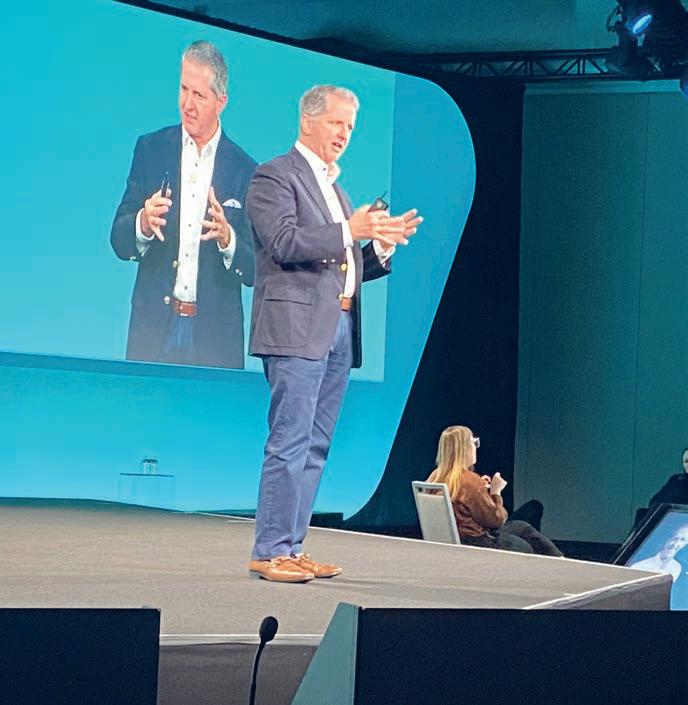
“Independent advisors are very independent − they will decide what they are going to use and they will decide at their own pace”
JAMIE PRICE, OSAIC
technology itself. “I think the big differentiator is not being first, it’s going to be a fast follower, and more importantly, have you culturally got all your employees and all your advisors comfortable with using AI?” he told InvestmentNews. “How do you create
RITHOLTZ WEALTH MANAGEMENT is expanding its investment lineup with the launch of a new equity separately managed account strategy developed in partnership with Franklin Templeton.
The $7.6 billion registered investment advisor said Tuesday that the
a workforce that is totally empowered by it, understands it, knows how to use it? Because adoption rate, in the end, will be the game − it won’t be the tool, it won’t be that you picked the right tool first because all these tools are going to change so fast.”
new strategy, called Porterhouse, will be offered exclusively to its clients and is intended to complement the firm’s existing asset allocation models.
Powered by Franklin Templeton’s Canvas platform, the strategy is actively managed and uses a quantitative process to identify stocks exhibiting both strong price momentum and solid business fundamentals, including earnings and cash flow.
The approach is based on research behind Ritholtz chief executive Joshua Brown’s “Best Stocks in the Market” list and is designed to concentrate portfolios in companies showing sustained leadership.
platforms are adding litigation finance opportunities for financial advisors, but many RIAs remain cautious about allocating client capital to a strategy whose returns hinge on courtroom outcomes rather than market performance.
SEI announced earlier this year that it expanded its alternatives marketplace, SEI Access, to include a litigation finance offering from Pravati Capital, an Arizonabased firm that’s funded more than $248 million to law firms and litigants since its founding in 2013. The global litigation funding
investment market was valued at more than $20 billion in 2025 and is projected to grow to more than $50 billion by 2036, according to a report from consulting firm Research Nester.
“Oftentimes litigation finance for the United States isn’t nearly as adopted as it is outside the United States − in Europe specifically − and historically it has been institutional in terms of who would be allocating to it,” Pravati Capital managing director Kris Kjolberg tells InvestmentNews.
“But now advisors are looking at asset classes like litigation finance, which leads us to platforms like SEI’s Access, like CAIS, like iCapital. They provide compliance workflow, due diligence, and operational controls that wealth managers, RIAs really require.”
WEALTH MANAGEMENT exec-
utive Clara Sierra has been named managing director by BridgePort Financial Solutions, tasked with leading the firm’s strategic direction, operational performance, and expansion efforts as it builds out its platform for fee-only independent advisors.
Sierra will report to Jeff Vivacqua, president of growth and development at Cambridge, and will
oversee leadership initiatives tied to advisor experience, wealth management services, technology, operations, compliance collaboration, and both organic and acquisition-driven growth.
BridgePort was launched by Cambridge in 2024 to help advisory firms navigate industry changes and succession planning challenges while offering flexible business models for RIAs.
CETERA’S RECENT move to merge two of its existing RIA practices, Avantax Planning Partners and The Retirement Planning Group (TRPG), was the wealth management industry’s latest example of broker-dealer platforms evolving as competitors in the RIA M&A market.
Avantax and TRPG were both acquired by Cetera in 2023, then merged last week to form Cetera Planning Partners, a national RIA with nearly $19 billion assets under administration and over 100 advisors who will operate as W-2 employees.
“Cetera Planning Partners is designed as an employee-advisor

Jennifer Hanau, president of Cetera’s RIA and branches channel, tells InvestmentNews. “As part of our succession strategy, there are a small number of independent contractors who are in the process of introducing clients to new wealth advisors. Once those transitions are complete, all advisors within Cetera Planning Partners will be employees.”

THE CHARITY PARITY ACT has drawn wide attention for what it would add to the qualified charitable distribution toolkit. But for advisors who already know their clients’ 401(k) plans well, the more pressing question may be what the QCD framework still lacks – even if the bill passes.
That’s the informed take from Robert Westley, senior vice president and regional wealth advisor at Northern Trust, who spoke with InvestmentNews about the bipartisan legislation and its implications for high-net-worth retirees.
Introduced recently in both the House and Senate, the bill would allow individuals aged 70½ or older to make qualified charitable distributions directly from 401(k), 403(b), and 457(b) plans, eliminating a detour through an IRA rollover that can trigger fees and administrative friction.
Westley, an InvestmentNews ’
5-Star Financial Planner for 2026, views the proposal with tempered enthusiasm.
“I think it’s a positive improvement,” he said. “There should be more parity between IRAs and 401(k)s just from a simplification standpoint and a procedural standpoint.”
Following the 2017 Tax Cuts and Jobs Act, Westley said fewer taxpayers and clients – particularly retirees – elected to itemize their deductions because of new limitations that took effect. Many non-itemizers would choose to take the standard deduction, but in doing so they didn’t get to enjoy much benefit from charitable deductions they’re eligible for.
“QCDs, for retirees who are taking RMDs, were a great way to satisfy their [required minimum distributions] and then also get an effective charitable deduction,” he explained.
THE SECURITIES AND EXCHANGE COMMISSION is pumping the brakes on a wave of exchange-traded funds that would give retail investors direct exposure to prediction market contracts − products that allow users to place binary bets on whether specific events, from election outcomes to recession scenarios, will occur.
SEC Chairman Paul Atkins confirmed May 20 that he has instructed agency staff to seek public input before the commission takes any further action on so-called event contract ETFs, a category that spans political forecasting, macroeconomic projections, and sector-level labor data. Fund sponsors have agreed to voluntarily delay the effectiveness of their filings while the review is underway.
“Novel products raise novel questions, and I appreciate the willingness fund
REGULATORY AUTHORITY has launched a formal review of how broker-dealers supervise concentrated client positions in some of the structured products market’s most complex instruments, putting firm compliance programs squarely in the spotlight.
FINRA announced it will examine firm practices related to non−principal protected “worst-of” structured notes – a category that includes products where payoffs are tied on the worst-performing asset in a group of two or more reference assets.
The regulator said it has identified multiple instances in which representatives concentrated client assets in products carrying both a lack of principal protection and worst-of features, a combination it describes as presenting “particularly complex features.”
“Highly concentrated investments can pose risk, and that risk is heightened when the concentrated investment is a complex product,”FINRA said in its announcement. “Some investors have lost significant portions of their portfolios through such concentrated positions.”
sponsors have shown in delaying the effectiveness of a number of novel ETFs, including event contract ETFs, while we consider the implications,” Atkins said in a statement published by the SEC.
The delay affects approximately 24 ETFs from issuers including Bitwise Investments, Roundhill Investments, and GraniteShares, according to earlier reports. The filings, submitted in February, had been approaching the end of a standard 75-day review window when the commission intervened. No timeline was given for the public comment process.
As noted by Bloomberg, the ETF structure has absorbed a series of onceunconventional strategies over the past decade – from volatility futures to, more recently, spot Bitcoin and Ethereum –

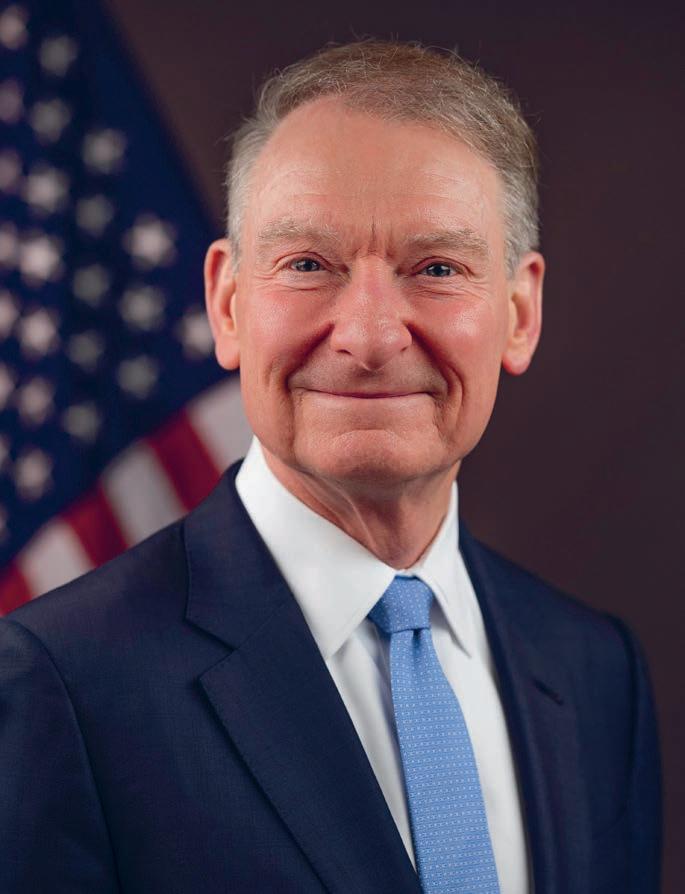
PAUL ATKINS, SEC
with each expansion testing the limits of what the fund wrapper can accommodate. Prediction market ETFs are the latest frontier, and they differ meaningfully from anything the commission has previously approved.
The underlying instruments – event contracts offered by platforms such as Polymarket and Kalshi – function as yesor-no bets on the probability of a specific outcome. Investors win or lose based entirely on whether a defined event occurs. Fund filings from Bitwise warned that investors could lose “substantially
all” of their investment if the outcome goes against them, reflecting the distinct risks of prediction markets compared to long-only equity or fixed-income funds.
According to The Block, a crypto news outlet, Polymarket and Kalshi collectively surpassed $25 billion in monthly trading volume in April, fueled in part by regulatory support from federal agencies.
Currently, accessing those markets still requires dedicated accounts. An ETF wrapper would drop these contracts into standard brokerage accounts, dramatically widening their reach.
HESTER PEIRCE, one of the Securities and Exchange Commission’s three remaining commissioners and its most prominent crypto advocate, will leave the agency in November for the hallowed halls of academia.
The Regent University School of Law in Virginia Beach, Virginia, recently announced it will be welcoming Peirce as an associate professor – signaling a departure that would strip the already hobbled SEC of one of its most recog-

nizable voices while raising fresh questions about the commission’s ability to function at full capacity.
The university announcement adds to a cascade of senior departures at the SEC that has reshaped – and in some ways destabilized – the agency over the past year.
SEC kills ‘gag rule’ that silenced thousands of settling defendants for over 50 years

EXCHANGE COMMISSION has scrapped a decades-old policy that barred defendants from publicly disputing the agency’s allegations as a condition of settling enforcement actions in a move that raises fresh questions about how settlements will play out going forward.
The SEC rescinded Rule 202.5(e) of its informal rules of procedures, which had required settling defendants to agree not to publicly deny the allegations against them. The policy had been in place for more than half a century.
The commission said the change aligns it with the vast majority of
federal agencies that never had such a requirement and gives it more flexibility in resolving enforcement cases, which it said conserves resources and can speed the return of money to harmed investors.
“For more than 50 years, the Commission has conditioned settlement on a defendant’s promise not to publicly deny the Commission’s allegations. I am pleased that we are rescinding the no-deny policy today,” said SEC Chairman Paul S. Atkins. “Speech critical of the government is an important part of the American tradition. This recission ends the policy prohibiting such criticism by settling defendants.”
THE SEC’S crackdown on public companies and their subsidiaries has slowed to a crawl, with new research showing the regulator initiated just five enforcement actions in the first half of fiscal year 2026 − the lowest tally for any opening half of a fiscal year in at least 16 years.
The figures come from a Cornerstone Research report drawing on data compiled through the Securities Enforcement Empirical Database, a joint project between Cornerstone and the NYU Pollack Center for Law & Business.
While the five actions represent a modest climb from the three brought in the second half of fiscal 2025, the numbers remain historically depressed. Analysts caution, however, that the raw count alone doesn’t tell the whole story.
“Nuance is important when comparing SEC enforcement action data,” said Sara Gilley, Cornerstone
Research securities litigation cohead and report co-author. “SEC enforcement activity against public companies and subsidiaries remained near 16-year lows, but it’s higher than the previous six months. Historically, the SEC tends to initiate more actions in the latter half of the fiscal year.”

JEFF BEZOS , the world’s fourthrichest person, made a pointed case recently for eliminating federal income taxes on lower-income Americans, while casting doubt on whether raising taxes on the ultra-wealthy would meaningfully improve the lives of those who are struggling.
Speaking on CNBC’s Squawk Box from Florida, the Amazon executive chair said the bottom half of US earners – those making less than roughly $54,000 per year –should owe nothing to the federal government. The bottom 50 percent of taxpayers currently contribute
about 3 percent of total federal income tax revenue, a figure Bezos said should be zero.
“I don’t want to reduce it − I want to eliminate it,” Bezos told anchor Andrew Ross Sorkin. “I think there’s something very powerful about zero. Zero is a better number than $1.”
Bezos, whose net worth is estimated at approximately $270 billion, argued that zeroing out the tax burden for low earners would free up capital and foster entrepreneurship.
“Maybe they’re going to be the next Steve Jobs,” he said.

THE YOUNGEST cohort of American adults is caught between growing financial ambition and an economic reality that keeps moving the goalposts.
Bank of America has released the findings of a survey of 1,133 adults ages 18 to 29 that highlights how
Gen Z is increasingly self-reliant and savings-minded but is still squeezed by housing costs, insufficient wages, and a lingering sense that the financial odds are stacked against them.
“The effort and outcome aren’t always connected − and for a lot
RETIREMENT PLANNING can feel overwhelming, but separating “the math from the emotion” is key for advisors as they build successful strategies for their clients, says Michael Conrath, managing director and chief retirement strategist for J.P. Morgan Asset Management.
“Retirement planning, it’s something that we see in our research − most people find it overwhelming, they find it daunting,” he tells InvestmentNews “Someone who’s in this every day says, ‘Well, follow these steps, these principles and you’ll be just fine,’ but the reality is there’s so many decisions that people have to make.”
Conrath explains that individuals have to think about savings, investments, and market volatility, all within the context of world events. There are also other key considerations,
of young people right now, that’s a frustrating reality,” Matt Gellene, head of specialized consumer client solutions at Bank of America, told InvestmentNews . “They’re cutting back on dining out, picking up side hustles, and starting budgets, so clearly the discipline is there. But when nearly half of Gen Z still point to the high cost of living as their biggest barrier while wages aren’t keeping pace, you have to see that the math just isn’t working in their favor.”
The 2026 Better Money Habits report revealed that 42 percent of respondents say they are living paycheck to paycheck, and the pressure doesn’t let up as income rises. Nearly half of those
such as healthcare, Medicare, Social Security, and long-term care.
“And many people are trying to balance their retirement goals with other things they want to accomplish, like funding education for their children or their grandchildren, their legacy, their estate,” Conrath adds. “So again, it can feel overwhelming.”
In J.P. Morgan Asset Management’s latest annual guide to retirement, the company highlighted generating sufficient income, managing spending volatility, and maintaining emergency savings as top concerns for retirees and those preparing for retirement. The guide, which was released in February, uses anonymized household data and proprietary research to examine key retirement trends such as spending and saving patterns.

earning between $50,000 and $100,000 annually report the same struggle, and even 29 percent of those making over $100,000 say they can’t seem to get ahead between pay periods.
“Retirement planning, it’s something that we see in our research − most people find it overwhelming, they find it daunting”
MICHAEL CONRATH, J.P. MORGAN ASSET MANAGEMENT
Taking a methodical approach is key, according to Conrath. “I think one of the pitfalls is that people think they have to tackle all these things at once, and you don’t,” he says. “If you just break it out to some steps … that’s where an advisor can help you separate the math from the emotion, but bring it together in one plan.”
Conrath explains that much of his time is spent talking to advisors and he is often asked what “the ideal retirement plan” looks like. “My short answer is it’s not something that’s terribly complicated, but it’s something that’s easily explainable but also
actionable − that the client on the other side of the desk can actually do something with it, they don’t feel so overwhelmed,” he says. “And I think what it comes down to is marrying the math with the emotion.”
The J.P. Morgan retirement strategist says that clients, specifically, need to work out how much of their income they need to replace in retirement when transitioning from working and how long their money needs to last. “And then it’s based on that,” he adds. “How much do I actually need in order to retire? What’s my number?”
Workers are financially drowning, and retirement savings is a major red flag
A MAJOR new survey of American employers and workers reveals a workforce under severe financial strain, which many employers appear to be significantly underestimating.
The survey of 1,900 employers and more than 6,100 workers in late 2025 found a consistent pattern of employers overestimating the financial health of their workforce while workers quietly absorb the consequences of per-
sistent inflation, inadequate benefits, and mounting retirement anxiety.
Almost eight in 10 employers expressed optimism about their company’s future, but their employees see things differently: only 56 percent of workers felt optimistic about their own prospects − a 22-point gap that threads through virtually every financial finding in the Employers, Workers, and the New World of Work report from the
Workers want financial help from employers, and they’re ready to walk if they don’t get it

FINANCIAL STRESS is quietly eating away at workforce productivity, and employees are increasingly looking to their employers to do something about it, with many prepared to find a new job if they don’t.
That’s the central message from Morgan Stanley at Work’s sixth annual State of the Workplace Financial Benefits Study , which surveyed 1,000 employed US adults and 600 HR leaders and found widespread anxiety about personal finances bleeding directly into the workplace.
More than half of employees said financial stress is negatively affect-
ing their job performance, while 61 percent are pulling back on contributions to workplace benefits as inflation and recession fears take hold. Meanwhile, 80 percent of HR managers expressed concern that their workers’ money troubles are hitting productivity.
Nine in 10 employees said they would consider leaving their current employer for one that offered benefits better aligned with their financial goals, while 85 percent said they would feel more committed to their company if it provided benefits tailored to their specific needs.

non-profit Transamerica Institute.
“As AI promises to revolutionize business models, employers are upbeat about the future, but they may be overlooking their most valuable asset − their employees,” said Catherine Collinson, CEO and
president of Transamerica Institute and its Transamerica Center for Retirement Studies. “It takes people to implement and operationalize new technologies, and right now, workers are stressed and strained in today’s economy.”
PRUDENTIAL ADVISORS is using AI technology to trawl through vast amounts of historic data and provide its advisors with information carefully crafted to the needs of each client.
“Everyone’s looking for these ways that AI can help,” Mike Klein, Prudential Advisors’ chief marketing officer, told InvestmentNews “For Prudential Advisors, one of the things we’re using AI for is around our referrals and leads program.”
Klein explained that Prudental Advisors is using AI to work through literally “millions” of proprietary leads that the company has in its systems. “It might be past life insurance clients that we’ve had over the past 150 years – it might be employees of some of our largest institutional clients,” he said. “AI can help us en-
rich the information about who these people are.”
This means that when an advisor reaches out to a client, rather than just knowing that they purchased a certain product from the company 20 years ago, they are armed with much more data that is relevant to the person. “AI can help,” Klein said. “So, when you talk to them, you can connect, and you can build a relationship, and you can uncover additional opportunities that they might be interested in.”


Why do people donate? And why do so few people know about DAFs?
THE NON-PROFIT sector has spent much of the past year bracing for a donor retreat. The data tells a different story.
Active donors (who have given within the past 12 months) remain deeply committed to the organizations they support, with 95 percent saying they trust the non-profits they donate to with their funds and 97 percent agreeing those organizations are aligned with their values. The findings cut against a narrative of sector-wide erosion that has dominated recent industry commentary.
The Harris Poll surveyed 1,003
donors and 405 fundraising decision-makers across the US in March, with the donor sample weighted by age, gender, race and ethnicity, region, and household income to reflect national demographics.
What the research shows in a report from fundraising software firm Bloomerang is less a crisis of confidence than a crisis of execution − and for financial advisors whose clients include active philanthropists, the gap between donor intent and completed gifts has direct implications for charitable planning conversations.
FOCUS
‘The only regret I have is that I didn’t do it sooner’:
going RIA
FIVE YEARS ago, Monish Verma was making final preparations for the jump from wirehouse to RIA and worrying about how his clients at UBS would react.
At that time Verma was a senior vice president for wealth management at UBS, where he had
However, Verma says that clients were very open to the move, which happened in May 2021, and after a conversation, they appreciated why he was doing it. “They understood the custodian concept because we had discussions about it after I moved,” he says.
“I was at a traditional wirehouse most of my career” MONISH VERMA, VARDHAN WEALTH MANAGEMENT
worked since 2009. “One of the biggest concerns I had was to make sure that the clients would be comfortable with me doing a transfer − I was at a traditional wirehouse most of my career,” Verma, now the founding partner and CEO of Vardhan Wealth Management, tells InvestmentNews
The newly formed Vardhan Wealth Management, named after the Sanskrit words for “bestower of wealth” and “victory,” enjoyed plenty of success bringing former clients over. The Farmington Hills, Michigan-based company was able to bring over between 95 and 97 percent of Verma’s former client base within about four
Clients expect to know if you use AI, but don’t realize that their portfolios are likely exposed
WEALTHY AMERICANS are warming to artificial intelligence in their everyday lives, but that familiarity has not translated into confidence when it comes to their portfolios.
Janus Henderson Investors’ survey of 1,000 US investors with at least
$250,000 in investable assets examines attitudes across three distinct areas: personal use of AI for financial decisions, how clients feel about advisors deploying the technology, and whether AI-linked companies belong in a longterm portfolio.
months of leaving UBS. However, that figure had jumped to 115 percent within six to eight months of the move. “We were getting more wallet share of current clients, and referrals from those clients,” Verma says.
“The biggest thing, I think, that resonated with them was the level of how we were becoming a fiduciary now, and what that really meant,” he adds. “Even though we kind of acted in that role all along, they now fully understood it, and that kind of promoted some additional referrals.”
The Vardhan team, which at that
Nine out of 10 respondents said they have at least some concerns about investing in AI, but roughly one-third of respondents said they use AI tools continually or often, a figure that climbs sharply among millennials (72 percent) and among investors with $3 million or more in assets (47 percent).
However, widespread familiarity has done little to erode the barriers people cite when it comes to AI-powered investment guidance.
Three in four respondents flagged concerns about biased or conflicted recommendations, nearly as many worried about data privacy, and 72 percent said they simply do not trust AI-driven guidance enough to act on it.
time consisted of Verma and three staff members, worked for 21 days straight after making the move. “All of my teams were calling all our clients, then we called all our prospects, then we called all our centers of influence, and then we started over again,” he says.
“So, we would go back to them and say, ‘Now that we had our first call, what questions would come up from that, what are you thinking?
Now that we have you in transfer, we wanted to come back to you and have a more in-depth conversation’ − things of that nature.”

ARTIFICIAL INTELLIGENCE is no longer a distant disruption on the horizon for wealth firms; it is, for most of the advisors they support, already embedded in daily workflow.
Yet the industry’s relationship with these tools remains uneven, shaped by age, the size of a practice, and a persistent question about where human judgement ends and machine efficiency begins.
According to the Spring 2026 InspereX Pulse Survey of 783 financial advisors, conducted between March 27 and April 7, 70 percent of respondents said they actively use at least one AI tool in their practice today.
That number climbs sharply among the profession’s highest

earners: 84 percent of advisors managing $351 million or more in assets report current AI use, compared with 70 percent across all respondents – a 14-percentage-point gap that tracks closely with how conviction about AI’s competitive impact also intensifies at higher AUM levels.

FINANCIAL ADVISORS are charging more for planning services than they were three years ago, and the pace of that repricing is accelerating. But the data behind the headline points to a tale of two client types: new engagements advisors have just welcomed and longer relationships that they have fostered for years.
According to the 2026 State of Financial Planning Fees study by Datos Insights, prepared for Envestnet MoneyGuide, the average annual retainer fee among advisors who charge separately for financial planning has surged 52 percent since 2023, climbing from $4,484 to $6,815.
Flat fees are up 15 percent over the same period, to an average of $2,926, while subscription fees – used by a small but growing slice of the market – have nearly tripled, from $215 per month to $595 per month.
The study, which surveyed 491 financial advisors in the first quarter of 2026, is the fifth edition in a series dating to 2015.
The findings reflect a market in active repricing mode. Among advisors who charge for planning, 53 percent report having raised their fees in the past 12 months. But the mechanism most of them are using is telling, with most survey participants raising rates for new clients only.
Wealthy women want alternatives, but why haven’t their advisors discussed it?

HIGH-NET-WORTH WOMEN are eager to add alternative investments to their portfolios, but most are still sitting on the sidelines, mainly because their advisors have never brought it up.
That is the central finding of a new survey from Brookfield’s Alts Institute, conducted by CoreData on behalf of Brookfield’s private wealth business. The research examined the attitudes of wealthy investors in the US and Canada with at least $2.5 million in household investable assets, with a particular focus on women.
The results point to an underserved client segment whose in-
vestment instincts are well suited to private markets and who are far more open to alternatives than their current allocation levels would suggest. Only 44 percent of female respondents currently hold alternative investments, despite widespread interest in the asset class.
The alignment between how women tend to invest and how alternatives work is hard to miss.
Nearly nine in ten respondents said their primary focus is long-term investing, and 94 percent called diversification critical to managing portfolio risk, both orientations that private markets strategies are designed to serve.
THE INEXORABLE rise of cryptocurrency in recent years has brought with it a new set of challenges when it comes to estate planning, warns Stacy Francis, the founder and president of fiduciary wealth management firm Francis Financial.
“One of the biggest pieces that I am seeing more and more and more of is cryptocurrency,” she said, during a recent seminar on wills, estates, and trusts at the offices of law firm Anderson Kill in midtown Manhattan. “Has anyone dealt with cryptocurrency either in a divorce or in a situation where someone has passed away? It can be a nightmare.”
Francis explained that cryptocurrency can be held in different ways, such as at a custodian like Coinbase, where the asset is easily findable. “You get documents every year also that you use, that you report to the IRS,” she said.
But that’s only one part of the cryptocurrency picture, according to Francis. “There is another type of cryptocurrency where it might be on this computer,” she said, gesturing toward a nearby laptop. “I could have $5 million worth of cryptocurrency in this hard drive. And the only way that my heirs are going to find it is if I have written out my key − and my key is like 20, 25 letters and numbers.”
“Think about someone who even has the key,” Francis said, acknowledging that this can make things difficult. “You could be leaving your heirs without any idea at all for that key.”
“That’s really important … letting your heirs know where all your assets are so that they get them and so that they don’t find themselves in a place where they don’t know what you have and they don’t know what to do next,” she added.
FRANKLIN TEMPLETON has launched a suite of Private Markets Model Portfolios built on Corastone’s digital infrastructure platform, the latest step in the asset manager’s accelerating effort to make alternative investments more accessible to financial advisors and their clients.
The new portfolios use a singlesubscription, separately managed account-style structure that allows advisors to give clients diversified exposure to private market assets – including private equity, private credit, and real estate – without navigating the operational tangle that
has long made alternatives difficult to scale across managed account platforms.
The launch comes as Franklin Templeton’s alternatives business has grown sharply. The firm reported $280 billion in alternative assets under management as of March, representing roughly 16percent of its total $1.74 trillion in AUM.That figure was $249.7 billion just 13 months earlier, reflecting what’s been described as a deliberate acquisitiondriven strategy to build out one of the largest alternatives platforms in the world.
For advisors, the appeal of private markets’ model portfolios lies in what

they take away as much as in what they offer. Historically, incorporating private market funds into a client portfolio required navigating separate subscription documents, manual processing, and frag-
mented administrative workflows – a burden that kept many advisory practices on the sidelines. The Franklin Templeton− Corastone structure attempts to collapse those steps into a single integration point.
STACY FRANCIS
“One of the biggest pieces that I am seeing more and more and more of is cryptocurrency”
STACY
FRANCIS, FRANCIS FINANCIAL
Cryptocurrency access has made headlines in recent years. In 2016 NBA star Kevin Durant invested in bitcoin on Coinbase but was subsequently unable to find the password, CNBC reported last year. With Durant unable to sell any of the bitcoin during that
time, the value of his holding reportedly went “through the roof,” according to his agent.
In September 2025 Coinbase CEO Brian Armstrong wrote on X that the issue had been fixed. “Account recovery complete!” he added.
GLOBAL EQUITY markets have climbed into positive territory this year, but the rally is built on increasingly shaky ground, according to FTSE Russell’s latest Global Equity Insights report.
The headline numbers look reassuring, with the FTSE AllWorld up 6.8 percent year-to-date, but dig beneath the surface and a concentration problem of historic proportions begins to emerge. During April’s rebound, roughly half of all gains across the entire All-World index were generated by
just 13 stocks out of approximately 4,250 constituents. Every single one was tied to the artificial intelligence theme.
That’s fewer than a quarter of a percent of the index’s holdings carrying the bulk of the load − a level of market narrowness that analysts at FTSE Russell say is reducing overall resilience.
The market’s two-speed nature became especially apparent during the Middle East conflict that rattled investors in March.
Traditional defensive sectors delivered inconsistent protection. Healthcare and consumer staples offered limited shelter, while energy, utilities, listed infrastructure, and mega-cap technology names emerged as what the report calls “new defensives” − sectors that held up or even gained as broader markets sold off.
April’s partial recovery then snapped back toward technology leadership, mirroring the pre-conflict playbook.

ETFs win the wrapper war as advisors and RIAs pull away from mutual funds
WHEN THE same strategy is available in three different wrappers, most financial advisors aren’t thinking twice: they’re going with the ETF.
That’s the long and short of a recent advisor pulse report from ISS Market Intelligence, which asked advisors to choose between an open-end mutual fund, a separately managed account, and an ETF – assuming the same strategy and asset manager across all three options. Sixty percent in the poll selected the ETF, while SMAs came second at 30 percent. Mutual funds brought up the rear at just 10 percent.
The findings from ISS revealed that ETF conviction is not equal across advisor channels.
RIAs showed the strongest preference, with 80 percent selecting ETFs as their first choice – something ISS attributed to the channel’s longstanding emphasis on transparency, cost control, and tax efficiency. Bank-independent advisors and regional broker-dealer advisors followed at approximately 60 percent, reinforcing ETFs as a dominant portfolio building block across mainstream advice channels.
The numbers mark a meaningful shift from 2022, when ETF preference stood at 53 percent and mutual fund selection was twice as high at 20 percent.

FEES, PAST performance, and risk tolerance are the dominant factors driving mutual fund purchase decisions among American households, according to new survey data that offers a detailed picture of how retail investors evaluate their options.
The Investment Company Institute’s Annual Mutual Fund Shareholder Tracking Survey, conducted across a nationally representative sample of more than 9,000 households, found that 72.7 million US households (roughly 54 percent of the country) held mutual funds in 2025. The newly released results
show investors arriving at purchase decisions armed with a consistent checklist of criteria, with costs and returns sitting near the top.
“Investors continue to choose mutual funds because of their flexibility, diversification, cost-effectiveness, and professional management,” says Shelly Antoniewicz, ICI’s chief economist. “Retirement savers are not the only ones benefiting from these attractive investment vehicles.
In 2025, 72 percent of mutual fund–owning households held mutual funds outside employer-sponsored retirement plans, underscoring the role mutual funds play in helping families save for education, homeownership, and retirement.”
Fund fees and expenses ranked among the most scrutinized factors, with more than nine in 10 mutual fund–owning households reporting they reviewed costs before buying.




ANTHROPIC, THE San Franciscobased artificial intelligence company behind the Claude assistant, has taken its first formal step toward a stock market listing.
The firm has confirmed that it has confidentially submitted a draft registration statement on Form S-1 to the US Securities and Exchange Commission.
“This gives us the option to go public after the SEC completes its review,” the company said in a statement. The number of shares and offering price have not yet been set, and any IPO remains contingent on market conditions.

The filing puts Anthropic ahead of
















The Women to Watch Awards recognize leaders who are setting new standards in nancial advice. Their decisions shape markets, their strategies in uence policy, and their leadership paves the way for the next generation. These awards highlight the achievements that rede ne success and push the industry forward.
Celebrate a woman whose in uence deserves recognition. Nominations close June 19.



Don’t miss out. NOVEMBER 5, 2026 | 583