PLEASE submit material by email in time to meet these deadlines to TLA Incoming Editor, Roger Watts, rwatts@lindsayllp.ca You can also call or email either editor with questions.
The Transportation Lawyer (ISSN 1533 6018) is published five times per year (Feb., April, July, Oct. and Dec.) It is published by the Transportation Lawyers Association. POSTMASTER: Send address change to The Transportation Lawyer, 111 West Jackson Blvd., Ste. 1412, Chicago, IL 60604, email: TLA -info@kellencompany.com.
JulyContents
TLA Mission Statement
The Transportation Lawyers Association (“TLA”) is an independent bar association, comprised of in-house, government and private practice attorneys. Its members assist providers and commercial users of domestic and international logistics and transportation services, in all modes. TLA is dedicated to keeping its members ahead of the constant changes in the specialized legal environment governing all aspects of the supply chain and passenger travel. With commitment to excellence in continuing legal education, and a long tradition of collegiality and exchange of ideas, TLA is a collaborative resource for lawyers seeking to maximize the quality of the legal services they provide and enhance their professional lives.
Association Business
T L A President’s Message
Congratulations to Kathy Garber for a highly successful year at the helm of TLA. Kathy embodies the rule that true leadership is not just about making decisions but about ensuring that every voice is heard and valued. Each of her meetings was a resounding success, with timely and informative educational programs and excellent networking events, culminating with an outstanding Annual Conference in beautiful Rancho Mirage, California.
Prior to this year’s Annual Conference, David and I were fortunate enough to spend a few days with good friends in Twentynine Palms and Joshua Tree, just on the edge of the national park. The landscape in that part of America is transcendental: full of meaning, memory, and transformation. With old U2 songs playing in my mind, we explored the rugged terrain and laid-back villages, before making our way to Rancho Mirage. It saddened me to think that many fellow Canadians have cancelled cross-border travel plans, either as a way of protesting against the ongoing trade war and incessant talk of annexation, or in response to the weakened Canadian dollar. So it was heartwarming to see the red maple leaf banners draped from all the lampposts in downtown Palm Springs, showing love to Canadian visitors and snowbirds. This may have been a small gesture, but it turned that stroll down Palm Canyon Drive into a Beautiful Day Long may that warm, welcoming spirit prevail.
improved communications and education programs; (iii) breakeven or better financial performance; and (iv) enhanced networking opportunities. We have made progress in some of these areas but will need to redouble our efforts in others. In pursuing these objectives, I hope to continue building on the hard work of Kathy Garber, Eric Benton, Chris Kelly and Steve Canty, the TLA officers who first welcomed me onto the executive ladder four years ago.
Our first major task will be to prepare a Canty-style budget for the upcoming year, one that prioritizes prudence and caution, with conservative income projections and generous expense estimations. On membership, I will be asking all my fellow officers to join me in working closely with the Damm Recruitment and Members Services Committee and the newly launched International Outreach Committee, to increase touchpoints with existing members, find new avenues for interaction and engagement, and promote TLA across North America and overseas. At the same time, I am asking all Committee Chairs to pursue Chris Kelly’s goal of revitalizing TLA’s subject area and modal committees, to bring “relevant relationship and substance” to our Association.
I am excited about the upcoming year, and delighted to serve alongside a dedicated and enthusiastic team of officers: PresidentElect Patrick Foppe, First Vice President Roger Watts, Second Vice President Kristen Johnson and Secretary-Treasurer Carlos Sesma, Jr. Kathy Garber will continue to play a key role as our immediate past-president, and I am truly fortunate that the following individuals have agreed to share their wisdom and provide ongoing guidance as Voting Past Presidents: Dirk Beckwith, Hillary Arrow Booth, Kathleen Jeffries, Jeffrey Simmons and Greg Summy. A special welcome to our four new Representatives-at-Large: Eric Baker, Patrick Bobo, Jason Orleans and Arturo Rivero Gavaldon, and CTLA Representative-at-Large Elizabeth Fashler. I am very much looking forward to working with all of them, and with our existing Representatives-at-Large, Billy Davis, Emileigh Hubbard, Alex Karcher, and Joelle Nelson
With this cast of characters, you just know it’s going to be a fun year, but it will also be a very busy year. At a meeting in Boston some years ago, the TLA Executive Committee had developed a Strategic Plan for the period 2023—2026. That plan included four main objectives: (i) membership retention and growth; (ii)
Executive Director Erin Erickson and her colleagues Missy Green and Macy Murray have been hard at work behind the scenes to prepare the three main conferences for this coming year. You will not want to miss the Transportation Law Institute, which will be held at the historic Westin Book Cadillac Hotel in downtown Detroit on October 24, 2025. Program co-chairs Christina Nugent and Tim Groustra have put together a terrific educational program. The Chicago Boot Camp and Regional Seminar will take place on January 22-23, 2026, at the Fairmont Chicago Millennium Park in Chicago. Program chairs are Madison Romine and Jameson Rice, while John Wilcox and Stevan Baxter are coordinating the Boot Camp, which will focus on Brokers. We will round out the year with our Annual Conference at the beautiful Omni Amelia Island Resort & Spa in Fernandina Beach, Florida, 30 miles from Jacksonville International Airport (JAX), from April 29 to May 2, 2026. Program chairs are Emileigh Hubbard and Alex Karcher. A special thanks to the faculty advisors who are working with this year’s program chairs: Beata Shapiro, Matt Barrette and Jeff Simmons
I am immensely grateful for the honour of serving as president of the Transportation Lawyers Association. This is a privilege and a responsibility that I do not take lightly. I hope that over the course of the coming year, I will earn the trust and confidence you have placed in me.
Louis Amato-Gauci
TLA President Louis Amato-Gauci Biography
Carole McAfee Wallace
Years ago, someone told me that Louis Amato-Gauci was a brilliant corporate/commercial lawyer. I did not believe them. I will come back to that later.
Born on the sun-kissed Mediterranean island of Malta, on August 23, 1967, our new TLA President began life surrounded by rich history, and the warmth of a close-knit community. He is one of eight children, a rowdy crew that includes an insurance adjuster, a cybersecurity expert, a police officer, a teacher, an art curator, two doctors, and a lawyer. Their father, Philip, was a life insurance salesman, while their mother, Victoria, was initially a grade-school teacher, and later moved to banking.
At the time of Louis’ birth, Malta was a newly independent archipelago that had (at least initially) retained HM Queen Elizabeth II as its head of state. Although it continued to host NATO’s Mediterranean branch headquarters, its strategic importance as an island fortress within the British Empire was rapidly diminishing. Louis’ family was a microcosm of the curious blend of cultures that were unique to Malta in those days. On his father’s side: Anglophiles and monarchists, with compact families, stiff upper lips, and a tradition of military and senior civil service going back several generations. On his mother’s side: dedicated Italophiles, all very much in favour of independence from the United Kingdom, many of them doctors, lawyers, teachers, poets, and politicians, with large boisterous families.
Louis had the unique experience of growing up across three continents. His father was an avid traveller, who had set his sights on a new life in the New World, and initially moved the young family to Sydney, Australia. In fact, Louis’ first big adventure in transportation was a 30-day voyage from Valletta to Sydney on board the ill-fated M/S Achille Lauro. His second big adventure in transportation was in late-1973, during a Qantas flight from Sydney to Rome on board a brand new Boeing 747, where he and his younger brother, Joe, emerged from a dazzling tour of the cockpit vowing that they would both become airline pilots. Or maybe astronauts. Sadly, that never happened. However, they were both very keen Air Scouts for several years, and they did help their father set up an after-school roller skating club that frequently saw several kids flying through the air unexpectedly.
In between that, and tennis lessons, and field hockey, Louis was a soloist with the Stella Maris College Choir, with frequent performances at weddings, holiday events and church services. At the age of 11, he was a soloist on two tracks of the choir’s debut album, Man of Galilee. Three years later, a new chapter began with a further move to Toronto. More than four decades later, Canada remains his home. Louis embodies the spirit of a global citizen with a proud Canadian heart.
In keeping with his non-conformist streak, Louis attended Cardinal Newman High School, perched high above the Scarborough Bluffs just east of downtown Toronto. Newman was, at the time, the only Catholic school in the diocese that did not require its students to wear a uniform, and it had vibrant theatre and music programs. All of that suited Louis perfectly, because – much to his parents’ chagrin – he was determined to pursue a career in musical theatre. From high school productions of West Side Story (Bernardo), Agatha Christie’s The Mousetrap (Mr. Paravicini), Fiddler on the Roof (Perchik), Taming of the Shrew (Petruchio) and Evita (Che), Louis moved on to community theatre, appearing in Grease (Kenickie), Jesus Christ Superstar (Peter), Mame (Judge Bregoff and chorus), and Torch Song Trilogy (Alan), and he appeared in a television commercial promoting registered retirement savings plans for the Canadian Imperial Bank of Commerce.
While he could have been a contender for an Emmy, a Tony, or a Grammy, Louis settled for a career in law. And so, after a gap year that had evolved into a seven-year break from his studies, he enrolled in the University of Toronto, graduating with a bachelor of arts with High Distinction (1995), and a Juris Doctor (1998). He was called to the Bar of Ontario in 2000, having completed his articles of clerkship with Morris/Rose/Ledgett (M/R/L).
Transportation law was a key focus of his practice right from the outset. M/R/L was home to a number of legendary transportation lawyers, including the late CTLA Past President Hugh G. Morris, Q.C., Joel M. Rose, K.C., TLA Past President Catherine Pawluch, and CTLA Past President Joanne Coldwell. The M/R/L practice group joined Aird & Berlis, where he became a partner in 2003. Years later, Louis moved his M&A, commercial, and regulatory practice over to Fernandes Hearn, where we had the pleasure of working together. In 2019, he accepted a new challenge as the co-lead of Miller Thomson’s National Transportation and Logistics Team, a role he still holds today, alongside current CTLA President Jaclyne Reive.
So why, you might ask, did I not believe it when I was told that Louis Amato-Gauci was a brilliant corporate/commercial lawyer? Well, this is because I had always thought he was a brilliant litigator. I first met him when we were on opposite sides of a hotly contested hearing before the Ontario Highway Transport Board. His client had applied for a public vehicle operating licence, and
together with the late Robert Warren, I had filed an opposition on behalf of a competing bus company. At the hearing, Louis was strategic, knowledgeable, skilled, and of course, somewhat theatrical. But, unfortunately, he did not win. To this day, Louis will tell you that victory was snatched away from him when, at a crucial point in his masterful cross-examination of our key witness, my co-counsel abruptly rose to his feet, shaking his fist and protesting loudly. In doing so, Robert sent a water jug flying off the counsel table in the general direction of the tribunal. Try as he did, Louis was unable to regain the momentum. He remained cordial notwithstanding this bitter loss, but many years would pass before we dared to reexamine the how and the why of it!
Louis attended his first CTLA Annual Conference in Whistler, BC, in 2001, his first TLA Annual Conference in Maui in 2003, and has helped organize educational programs for both groups for more than 20 years. He has served as president of the Canadian Transport Lawyers Association (2008-2009), and as president of the Association of Transportation Law Professionals (2022-2023). He is the third Canadian to serve as president of the TLA. He also gives back to the community in several other ways: volunteering to support newcomers to Canada and helping them find accommodation, training, and employment; taking on pro bono matters from time to time; and serving as a founding member and director of The Urban Orchestra.
With all that he has going on, Louis manages to devote time to the things that really matter in life: his family, his friends, and of course, his life partner, David Hopley.
I am very proud to call TLA’s new President, Louis Amato-Gauci, my friend.
TLA Website: www.translaw.org
Members Only area:
User Name: Email address where you receive TLA emails.
Password: translaw1
If you wish, you can personalize your user name and password using the ID & Password link in the members services area of the TLA website.
Are you receiving emails from TLA?
If not, your spam blocker may be preventing you from receiving important updates about TLA events and developments in transportation law. To ensure that you will receive updates, be sure that your system will accept emails from TLA -info@kellencompany.com.
President’sCTLAMessage
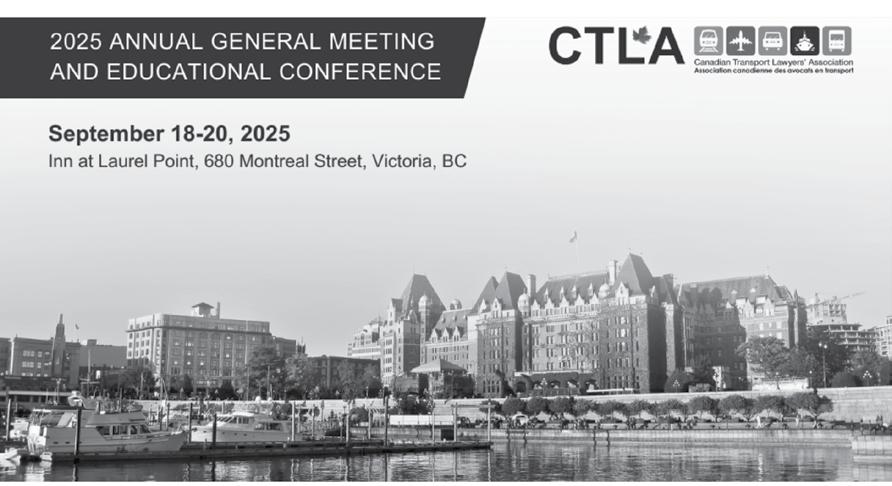
I’m very much looking forward to the 2025 CTLA Annual Educational Conference and AGM in beautiful Victoria, British Columbia, on September 18 to 20, 2025! Victoria is known for its rich history, stunning natural surroundings, and Britishinspired architecture. In addition to its colonial charm, Victoria has a vibrant arts scene, lots of outdoor activities, and a fantastic food scene. Members will have the chance to gather at The Inn at Laurel Point and listen to engaging speakers, while also participating in networking opportunities, including the annual “Can-Am Competition,” which will take place this year at Peacock Billiards and James Joyce Bistro
This billiards establishment dates back to 1981 and features great food, atmosphere and artwork! The Bistro wall panels, table tops and bars are lined with artwork inspired by Joyce’s Finnegan’s Wake and Ulysses.
The educational program will feature a variety of industry-focused topics, including the following (which may be subject to change):
• Update on Transport Canada’s Ongoing and Upcoming Initiatives
o Speaker: Mylaine Des Rosiers, Director of National Enforcement Operations, Transport Canada
o Moderator: Jaclyne Reive, Miller Thomson LLP
• Driving Deals: Recent Trends in Transportation & Logistics M&A
Speakers:
o Sarah Shiels, Shiels Marine Legal Services Inc.
o Dino Rossi, Borden Ladner Gervais LLP
o Alan Cofman, Loopstra Nixon LLP
• From Draft to Dispute: The Hidden Powers of Contract Drafting in Logistics presented by CTLA’s Young Lawyers Committee
Panelists will discuss contract drafting trends in the shipper/broker and broker/carrier context and how it plays out in practice, including from the litigation perspective.
Explore the latest shifts shaping mergers and acquisitions in the transportation and logistics sector, including consolidation strategies, tech-driven deals, and the impact of global supply chain dynamic
o Moderator: Jaclyne Reive, Miller Thomson LLP
Speakers:
o Andrew Ashenhurst, General Counsel, North American, DB Schenker
o Jonathan Todd, Benesch, Freidlander, Coplan & Aronoff LLP
o Maryam Zargar, Miller Thomson LLP
• Navigating Risks: Marine Environmental Challenges in Transportation Infrastructure
This panel will explore the complex environmental risks associated with transportation infrastructure, focusing on marine settings. Experts will discuss key challenges such as pollution, safety, and habitat disruption linked to ports, harbors, rail corridors, and bridges.
Speakers:
o Andrea Chiu, Miller Thomson LLP
o Connor O’Brien, McCarthy Tétrault LLP
o Conner Wylie, McMillan LLP
• Full Steam Ahead: Rail Regulatory Roundup
This panel will address a selection of the hottest rail regulatory developments of 2025
Speakers:
o Elizabeth Fashler, Borden Ladner Gervais LLP
o Pascale De Meyer, Counsel – Regulatory Affairs, CN
o David Blair, McCarthy Tétrault LLP
• Evolving Tort Landscapes: Navigating Post-Reform Damages and Verdict Trends
This panel will explore key post-tort reform issues in Florida and across other U.S. states, focusing on the calculation of medical treatment damages. It will also examine the rise of nuclear verdicts in personal injury cases, including recent trends in capping pain and suffering awards and strategies for mitigating excessive jury awards in the current legal climate.
Moderator: Bennet Misskey, MLT Aikins LLP
Speakers:
o Maria Papasakelariou, Wilson Elser Moskowitz Edelman & Dicker LLP
o Danielle T. Gauer, Wilson Elser Moskowitz Edelman & Dicker LLP
• Cybersecurity in Motion: Managing Privacy and Data Risks in the Transportation Sector
Delve into the growing cyber and privacy risks facing the transportation industry, with a focus on trucking and broader implications for shippers, freight forwarders, load brokers, and other intermediaries. Using recent Canadian data breaches as case studies, examine the impact of these incidents and present practical strategies to
Jaclyne Reive
Association Business
mitigate vulnerabilities and strengthen cyber resilience across the logistics chain.
Moderator: Bennet Misskey, MLT Aikins LLP
Speakers:
o Jamal Rehman, Gardiner Roberts LLP
o Barbara Bennett, Frost Brown Todd LLP
• Cleared for Takeoff: Mastering Aircraft Purchasing and Financing in Canada
Examine the key legal, regulatory, and financial considerations in the purchase and financing of aircraft in Canada. Topics will include due diligence, registrations and risk management strategies, offering practical insights for buyers and lenders involved in Canadian aviation transactions.
Speakers:
o Ehsan Monfared, YYZlaw
o Jaclyne Reive, Miller Thomson LLP
• On-Board Cameras and Privacy: Insights into Locomotive Voice and Video Recorder Regulations
This panel will explore the latest developments in privacy concerns related to on-board voice and video recorders in locomotives and heavy vehicle equipment, with a focus on compliance and ethical considerations.
o Annie St-Cyr, Senior Legal Counsel, Via Rail Canada
o Michael Grodinsky, Borden Ladner Gervais LLP
• Risk, Roadblocks, and Litigation: Unpacking Transportation Claims
This panel will explore the complexities of risk assessment in transportation-related claims, focusing on the presumption of guilt and its impact on liability. Experts will discuss how this assumption shapes risk evaluations, along with the unique challenges posed by cross-border claims. The session will also provide valuable insights from an insurer/underwriter perspective, highlighting key challenges and emerging trends in transportation risk assessment.
Speakers:
o John Franklin, General Counsel, FLS Transportation Services
o Brian Lipson, McCarthy Tétrault LLP
o Caitlin Van Duzer, Miller Thomson LLP
• Equity, Diversity and Inclusion in the T&L Industry: Cross-Border Perspectives
Moderator: Carole McAfee Wallace, Gardiner Roberts LLP
Speakers:
o Pui Hong, Senior Legal Counsel & Privacy Officer, Trimac
o Ana Gabriela Rangel Cerecedo, Sesma, Sesma & McNeese Abogados
• Hot Topics in Immigration Law: Recent Impacts of Government Decisions
This panel will explore the latest developments in immigration law and their implications in the trucking industry. We will address key issues such as cabotage and the specific challenges related to heavy vehicles drivers.
o Moderator: Jean-Sébastien Tremblay-Mimeault, Cain Lamarre
o Speaker: Joel Beaudoin, Cain Lamarre
While my term as President of the CTLA will soon come to a close, I’d like to thank the CTLA Executive, Board of Directors, and Committee Chairs (including our Membership Committee, Young Lawyers Committee, EDI Committee and Conference Planning Committee) who have been instrumental in making this year a success. Tireless efforts and dedication have been put forward by all on their respective initiatives. In particular, I would also like to acknowledge and thank Pui Hong, Brian Lipson, Seamus Ryder and Elizabeth Fashler for their guidance, dedication and support. Each of you has been truly exceptional in your Executive Committee roles. It has been an honour and great privilege to serve as President over the past months.
I look forward to seeing everyone in Victoria later this year!
Editor’sTLAColumn
Greetings and welcome to the 2025/26 edition of The Transportation Lawyer (TTL) ! It is my privilege to assume the mantle of TTL Editor for this coming year, and to do my small part to continue to bring you the latest in news and developments in the transportation law arena.
Whether by land, air, or sea, the TTL has long served as a useful and informative resource created especially for, and by, the TTL membership. Needless to say, we hope to bring you more of the same great content over the coming year, while keeping you up to date on the activities and events that make the TLA the special place and community that it is.
As is the case every year, the incoming editor always has the opportunity to add their own particular touch to the style and look at the TTL . This year is no exception, as for the next 12 months, the TTL will once again find itself within the icy clutches of – gasp! – a Canadian. No doubt you will have noticed the bright, friendly red cover, which is the same colour that graces the Maple Leaf. And you may notice that the editing itself retains a certain Canadian… flavour. But they keep telling me that the world needs more Canada, so I’m happy to do my bit in furtherance of that goal.
• Jeffrey Cox and Elle Slattery’s great paper on recent regulatory changes proposed by the FMCSA dealing with broker transparency in transportation transactions;
• A very interesting article from Frank Botta and John Sieber on the many (and oft overlooked) environmental impacts and obligations that can arise from trucking accidents;
• Chris Razek’s engrossing paper on the ABCs of warehousing law, and the ways in which it interfaces with the broader transportation legal landscape; and
Indeed, this year marks a milestone for the TLA executive, in that there are in fact more non-Americans on the TLA Executive Committee this year than Americans. In my humble opinion this is particularly timely, given the interesting times in which the North American cross-border trade market currently finds itself. As such, it is my hope that the content and material featured in this year‘s TTL will amply reflect the issues and developments affecting not only U.S. trade, but transportation issues across North America and beyond.
But what then, you ask, does this issue have for us? Our feature TLA articles of the July 2025 issue include the following interesting topics:
• Jonathan Meer and Dominik Cvitanovic’s excellent article on the havoc that criminal activity in the cyber world can wreak on the transportation industry, the landscape of cyber exposure and related litigation in 2025, and some practical steps for organizations to take to enhance their security;
• David Popowski’s valuable take on a recent United States Supreme Court decision that considered whether a business or property loss resulting from a personal injury case is recoverable under RICO
Our sincere thanks to these dedicated members for their contributions to the TTL; as always, we couldn’t do it without members taking the time to put together such excellent material. We certainly encourage you and members of your office to do the same, and help keep the TTL a premier transportation law information resource.
We of course also have plenty of material covering recent and upcoming TLA events. You will find photos and material recapping the recent TLA annual conference in Rancho Mirage, California, including acknowledgements of major awards received by deserving members of our organization for outstanding service over the years. Please also be sure to check out the materials regarding the upcoming annual Transportation Law Institute (TLI) seminar in Detroit, which promises to be a great event. Our Program Co-Chairs Christina Nugent and Tim Groustra, and Faculty Advisor Beata Shapiro, are putting together a stellar program that you won’t want to miss out on. (Plus Detroit is itself awfully close to Canada, and that’s just really never a bad thing.)
Finally, I would like to extend sincere thanks to Patrick Foppe, who has gone the extra mile in helping me to learn the role and get me ready for my year as TTL Editor. I’m looking very much forward to another successful TLA year with President (and fellow Canuck) Louis Amato-Gauci and my other esteemed colleagues on the Executive, and to making the TTL a big part of the year’s success. Cheers!
Roger Watts
Editor’sCTLAColumn
This marks my final issue as Canadian editor of The Transportation Lawyer, and after four issues of looming deadlines, cheerful pestering, and the occasional existential crisis over word counts, I’ll be stepping down with the quiet satisfaction of someone who finally got all the cats into the canoe — only to remember he forgot the paddle.
A successor will be chosen at the CTLA’s Annual General Meeting this September. I encourage anyone interested to step forward — it’s a rewarding role, and relatively few editorial jobs allow you to issue polite threats to senior counsel in the name of binational cooperation.
This issue features three excellent Canadian contributions, each tackling a different corner of the transportation law landscape with insight and practical value.
First, Mathew Crowe of Alexander Holburn Beaudin + Lang LLP writes on delay in traffic court in Traffic Court Delay: How Long Is Too Long?, a thoughtful piece that unpacks the Charter’s section 11(b) right with clarity — and explains how even minor traffic infractions can lead to major constitutional debates.
Next, Simon Ledsham of Borden Ladner Gervais LLP breaks down the U.S. Trade Representative’s
recent Section 301 actions in Chinese Ship Fees Provide Relief for Canadian Shipowners and Exporters. His analysis offers both clarity and cautious optimism for Canadian shipping interests navigating an ever-shifting regulatory seascape south of the border.
Finally, Jaclyne Reive of Miller Thomson LLP brings us Buckle Up! Legal Tips for Implementing a Carrier Safety Plan in Canada, a comprehensive and practical guide to the legal and regulatory foundations of carrier safety programs. Whether you operate in Alberta or Ontario, this piece is a reminder that in trucking, as in law, documentation is everything — especially when regulators come calling.
Seamus Ryder
My thanks to all who contributed over the past two years — particularly those who submitted early or at least pretended to. And to the CTLA, thank you for the trust and the opportunity to help shape the Canadian voice in this joint publication. It has been an honour.
Yours in traffic tickets, tariff exemptions, and safety abstracts, Seamus Ryder Outgoing Canadian Editor, The Transportation Lawyer
CTLA Website: www.ctla.ca
User Name: Transport
Members Only Password: ship
TTL Call for Articles
We are looking for more featured articles and case notes for upcoming issues. Submitting an article to the TTL provides a unique opportunity to gain nationwide recognition, showcase your expertise, and contribute to a well-respected industry publication. The submission deadline for the next publication is August 4, 2025
Please direct any questions and submissions to TTL Editor, Roger Watts, rwatts@lindsayllp.ca
TLA Secretary/Treasurer’s Report
AsI sit down to write my final Treasurer’s Report for the Transportation Lawyers Association, my heart is full of gratitude and pride for this incredible community. Serving as your Secretary and Treasurer this past year has been an honour, and I’m deeply thankful for the trust you have placed in me. The TLA is more than an organization— it’s a family of passionate, dedicated lawyers who lift each other up. I am eager to continue serving with the leadership team in the years ahead.
Reflecting on Rancho Mirage
Kristen M.J. Johnson
What a way to cap off the year! The 2025 Annual Conference at the Westin Rancho Mirage Golf Resort & Spa in Palm Springs was a resounding success, thanks to the stellar leadership of Immediate Past President Kathy Garber. Kathy and the program team, Ashley Winskey and Rob Reeb, put together a program that was equal parts inspiring and engaging, with topnotch CLE sessions, lively networking events, and plenty of time to reconnect under the California sun. Jeffrey Simmons and McGriff hosted the crew for “Shots in the Night,” playing golf under the stars of the expansive Palm Springs sky. The entire conference was electric, and it was clear that our TLA community is stronger than ever. A huge thank you to all the attendees, speakers, and sponsors who made this event one for the books.
Looking Forward
We may not know exactly what this year will bring to the world of transportation. I spend more time reading supply chain news than I ever have before, and it seems to change daily. This leads to unpredictability in the industry, but despite this, one thing remains certain: The TLA has never been more relevant than today. This group of lawyers represents the best minds in the world working tirelessly to navigate today’s choppy waters. My commitment to the TLA is to continue bringing each of us together, elevating the voices and diverse views of our members, and increasing our communication—both internal and external. I’m excited that our new website is nearing its launch, something we have committed special project funds to build out and make a much-needed improvement for our membership.
As we turn the page to a new TLA year, I’m thrilled about the future under the leadership of our new President, Louis Amato-Gauci. Louis brings a wealth of vision and enthusiasm to the role, and I have no doubt that the TLA will continue to thrive under his care. With exciting future programming already in the works, there’s much to anticipate. I know Louis and the Executive
Committee will continue to grow our community and elevate our impact in the transportation legal industry.
Welcoming Carlos Sesma Jr.
Congratulations to Carlos Sesma Jr., our newest appointee to the Executive Board and my successor as Secretary and Treasurer. Carlos is a dynamo—smart, dedicated, and deeply committed to the TLA’s mission. He brings fresh energy to the team and will do an outstanding job keeping our financial house in order while fostering the connections that make this organization so special. Carlos, you’ve got this, and I’m cheering you on!
Financial Overview
As always, I’m pleased to share a snapshot of our financial position as of March 30, 2025. Our current financial state reflects our continued commitment to fiscal responsibility while investing in the TLA’s growth.
Category
With four months remaining in TLA’s fiscal year, I am pleased to report that the TLI in Pittsburgh, resulted in a $10,709 surplus and the Chicago Regional surpassed revenue projections resulting in a $30,574 surplus. The Annual Conference will be recognized in the May financials; however, we do expect a small loss once all expenses are paid. The TLA Executive Committee will meet this summer to review and approve the FY26 budget.
A Heartfelt Thank You
It’s hard to imagine that one year has already passed since I took up my role at the “bottom” of the executive ladder. One rung
Association Business
up, and I remain honoured (and still slightly shocked) at having been asked to climb this ladder. The TLA is the single most impactful professional network in my career. This organization is a testament to the power of a true professional legal community. I am increasingly
grateful for the friendships, mentorships, and memories we have built together. I look forward to staying involved, cheering on our new leadership, and seeing all of you at future events.
2025 Annual Conference Wrap-up
Robert L. Reeb and Ashley Winsky Program Committee Co-Chairs
This year’s Annual Conference took place April 30 through May 2 at the Westin Rancho Mirage Golf Resort & Spa in Rancho Mirage, California. The Resort, set against the backdrop of the majestic mountainous desert landscape, proved to be a beautiful venue for the Conference.
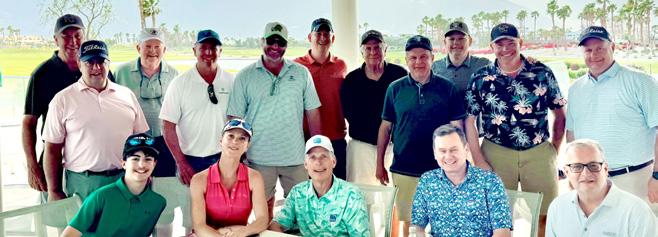
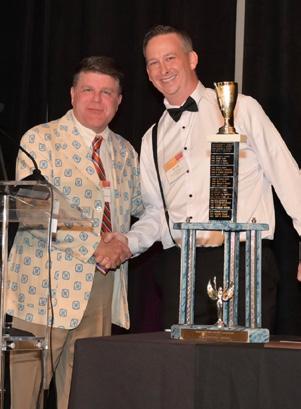
The Conference featured two days of golf on the Tuesday and Wednesday, co-chaired by Allen Jones and Charles Riley culminating in the award of the coveted Ugly Jacket to Steven Stanasak, for his calm, cigar smoking demeanour during a demonstration of sand shot futility, all videotaped for posterity.
Wednesday night’s Welcome Reception featured a beautiful view of the golf course with old and new friends and colleagues coming together to open the Conference’s series of networking and social events.
President Kathy Garber welcomed attendees on the Thursday morning for the official start of the Conference.
As the Program Committee Co-Chairs, we then opened three days of panel discussions and committee meetings addressing a wide range of topics of interest to transportation law practitioners. We are indebted to the efforts and contributions of our Educational Committee, which included Mark Barber, Alex Celio, Emileigh Hubbard, Fred Marcinak , Eric Palombo, and Robin Squires. The panel presentations addressed the following key items of interest:
• Maritime Law as presented in the March 2024 allision of the M/V Dali with the Francis Scott Key Bridge in Baltimore;
• Express Federal Preemption in Road, Air, and Rail;
• Claims for High-Value Cargo and Strategies for Mitigating Risk;
• Competition and Anti-Trust issues across the United States, Canada, and Mexico;
• Developments on FTC Non-Competes, DOL Salaries, and FLSA Exemptions in the Transportation Industry;
• FMCSA’s Regulatory Outlook – Latest Developments;
• Attorneys’ Ethical Obligations relating to the use of Artificial Intelligence;
• Developments in Transportation Insurance Law;
• Multi-Modal Lightening Round - Road, Ocean, Rail, and Air Transportation;
• Defending Against Mass Casualty Road Accidents resulting from Acts of God;
• Industry Responses to Fraud in the Supply Chain; and
• Legal Responsibility for AV Crashes.
A huge “thank you” to the moderators and the speakers who provided excellent papers and presented so well. Their efforts helped make the Conference the success that it was.
TLA’s committees met on Thursday and Friday afternoons providing for further detailed discussion on current issues in our industry.
The TLA Annual Business Meeting was held on Thursday afternoon. By operation of our Association by-laws, Louis Amato-Gaucci assumed the position of President and Kathy Garber assumed the role as Immediate Past President. Patrick Foppe was elected President Elect, Roger Watts was elected First Vice President, Kristen Johnson was elected Second Vice President, with Carlos Sesma Jr joining the TLA “ladder” in being elected SecretaryTreasurer. Additionally, Eric Baker, Patrick Bobo, Jason Orleans, and Arturo Rivera Gavaldon were elected to the Executive Committee as representatives-at-large. Elizabeth Fashler was elected to the Executive Committee as the CTLA Representative.
On Thursday evening of the conference, we ventured to Shots in the Night for dinner and golf with the beautiful desert as our backdrop.
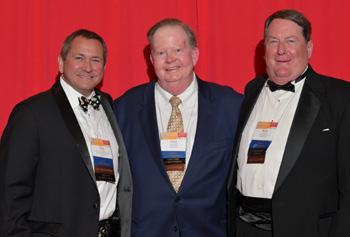
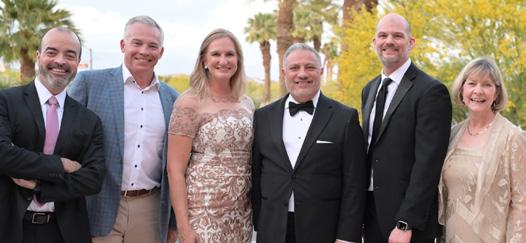
The TLA Annual Banquet on Friday evening served as the opportunity for the bestowing of awards, some deserving of infamy, each being awarded on particular merit. Billy Davis won the prestigious Iron Man award.
Carlos Sesma Jr. showed his skill in the lawyerly art of persuasion and gracious balderdash by winning the privately admired, and respected, Bullshipper Award.
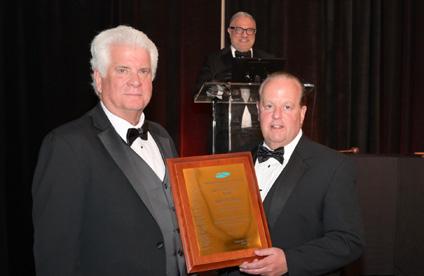
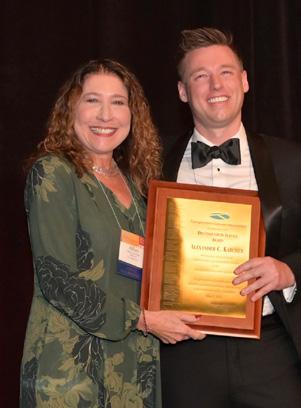
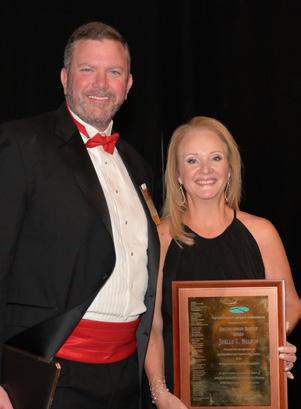
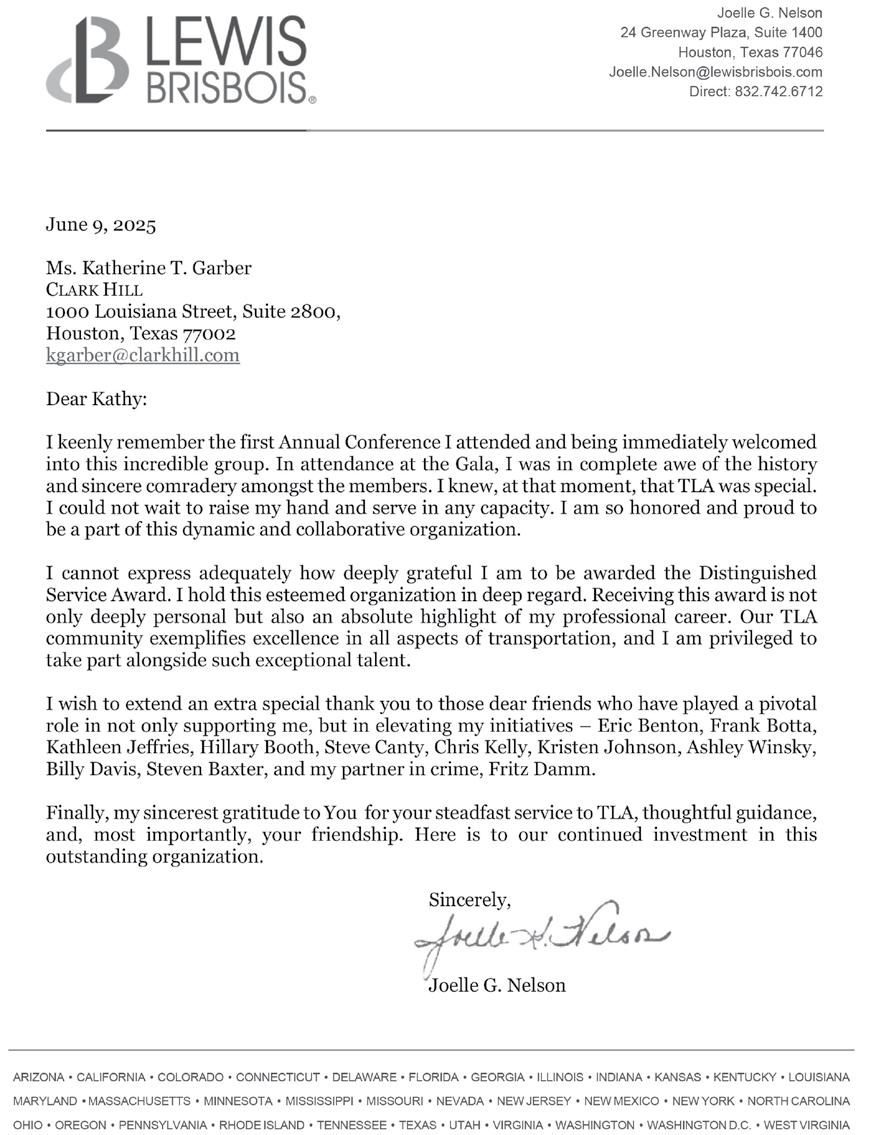
At the Banquet, Past President Fritz Damm was awarded a special recognition for over 20 years of faithful service in leading the Damm Membership Committee. Alex Karcher and Joelle Nelson
Association Business
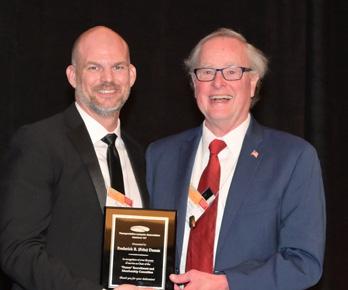
were recognized with the Distinguished Service Award, for their tremendous contributions to the TLA. Frank Botta was awarded the TLA Lifetime Achievement Award, in recognition for his years of leadership and service to the TLA.
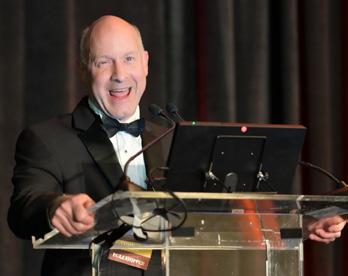
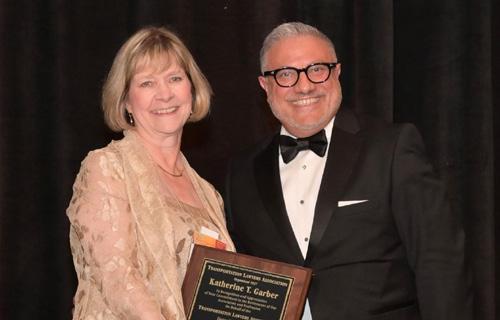
Kathy Garber was recognized for her stewardship of TLA over this last year, who then introduced new President Louis AmatoGaucci who in his fine inaugural remarks offered his vision for TLA for the upcoming year.
Congratulations to Kathy Garber for a wonderful and successful Conference. Special thanks to Kevin Brejcha for running the ever-famous Hospitality Suite, Alex Karcher for organizing the Annual 5K Fun Run, and to Erin Erickson, Missy Green, Macy Murray, and the team at Kellen for their assistance both leading up to and at the Conference in making it a remarkable event.
2025 Annual Conference
Rancho Mirage, CA
The 58th Transportation Law Institute
Friday, October 24, 2025
Westin Book Cadillac Detroit Hotel, Detroit
Christina Nugent and Tim Groustra 2025 TLI Program Chairs
Beata Shapiro, Faculty Advisor
The Transportation Lawyers Association 58th Transportation Law Institute is scheduled for Friday, October 24th at the Westin Book Cadillac Detroit Hotel in Detroit.
Ain’t no party like a Detroit Party! And we do a pretty fantastic conference as well. Although the Superbowl-contending Lions may be on a bye week, the Tigers are making their pitch to be playing October baseball. But the home of the pan pizza, Joe Louis, and Motown will surely show you why “Made in Detroit” is the mantra of pride in the Motor City. Whether you search out a paczki, a coney or a Faygo, venture out to pick up a classic Shinola watch or shop the Carhardt headquarters store, visit GM’s headquarters at the Renaissance Center, walk along the spectacular RiverWalk from Rosa Parks Boulevard to Belle Isle Bridge, or head east to admire the tile at Pewabic Pottery, you will be impressed. Condé Nast Traveler selected Detroit in its Best Places to Go in 2024 list, and the New York Times recently ranked Detroit among the top 52 places around the world worth visiting in 2025:
“For years, Detroit was associated with urban decline, but today it is showing remarkable signs of renewal. The biggest addition looms large above the Detroit River — the 1.5-mile Gordie Howe International Bridge will be North America’s longest cable-stayed bridge when it opens in the fall, connecting motorists, cyclists and pedestrians to Windsor, Ontario, and the Trans Canada Trail. Public art and signs near the U.S. and Canadian ports of entry on both sides of the bridge commemorate the Underground Railroad, reminding visitors of the thousands of African Americans who fled enslavement into Canada or found sanctuary in Detroit. Also planned for fall is the Ralph C. Wilson Jr. Centennial Park, a lush 22-acre haven along Detroit’s revitalized West Riverfront. And Michigan Central Station, the once-abandoned Beaux-Arts train depot built in 1913, re-emerged last year as a start-up tech hub thanks to a $950 million restoration project by Ford Motor Company — fitting for Detroit’s comeback tale.”
– Lauren Mattison –
New York Times
No, this is not your father’s Detroit. Come see for yourself the Detroit that has captured the imaginations of everyone from Kid Rock to Red Hot Chili Peppers, and from Smokey Robinson and the Miracles to Martha and the Vandellas. Check out what’s new and exciting about the Motor City. There may be Dancing in the Street!
Accommodations
The TLA has contracted a room rate of $259 per night for our members at the Westin Book Cadillac Detroit, plus applicable taxes and fees. The deadline to book your reservation and take advantage of this room rate is October 1, 2025. A link will be provided to book hotel accommodations closer to the time we launch registration in August.
This historic hotel offers pet-friendly guestrooms and an unparalleled location in the heart of downtown Detroit. In 1924, Detroit’s Book brothers transformed Washington Boulevard, known as the “Fifth Avenue of the Midwest,” with the opening of the Book Cadillac Hotel, then the world’s tallest hotel at 33 floors and 1,136 guestrooms. Designed by Louis Kamper in Italian Renaissance style, it became Detroit’s premier address, attracting high-profile meetings and social events and welcoming notable guests, including four U.S. Presidents, Rev. Martin Luther King, Jr., Lady Bird Johnson, Joe DiMaggio, Babe Ruth, Lou Gehrig, Ted Williams, Errol Flynn, Danny Thomas, Frank Sinatra, Joe Louis and many others. The hotel has recently undergone a multi-year, $20 million renovation, and features a new, contemporary design, a fully-equipped WestinWORKOUT Fitness Studio, and an indoor pool.
Who Can Attend?
TLI is open to attorneys with an interest in transportation law, practice, or procedure. TLI especially presents a perfect opportunity to expand new and young lawyer development, offering a mix of networking with substantive programming in a short one-anda-half-day format that is sure to provide associates with lasting connections and valuable information.
Association Business
Registration
The registration fee for the TLI includes attendance at the program sessions, comprehensive program materials, continental breakfast on Friday morning, lunch on Friday, refreshments at each break, and the Friday evening reception.
Pre-Registration
An online registration link will be available on the Event page of the TLA website (translaw.org) in August. Available presentations and a pre-registered attendee list will be distributed online approximately one week prior to the TLI and at the event upon registration check-in on Friday morning.
Activities
We are putting the finishing touches on our networking program for the TLI, so please watch for further details on the Event page of the TLA website (translaw.org). Networking opportunities will include a reception and group dinner on Thursday evening, our traditional wine and cheese reception followed by a dine-around on Friday evening, and a further optional activity on Saturday for those registrants who plan to stay the weekend to explore this vibrant city.
Continuing Legal Education (CLE)
The education program will cover developments in personal data and privacy rights, liability for brokers and shippers arising out of high-loss truck accidents and FAAAA preemption, the use of AI in legal practice with respect to contracts, litigation and compliance, ESI spoliation sanctions, tariff and cross-border issues, and includes a multi-modal “lightning round” offered by legal experts on maritime, aviation, international trade, and rail. Each panel will provide both legal and industry perspectives on the topics covered.
Accreditation will be requested for the 58th Transportation Law Institute for every state from which participants indicate they will require CLE credit. As you are likely aware, each state has its own rules regarding program approval and attendance reporting, as well as its own definition of CLE. Certificates of attendance will be available on-site.
Program agenda
Rail, Sea, Air
. . .
and Beyond!
Moderator: Eric Zalud, Benesch Friedlander Coplan & Aranoff LLP
This panel will provide timely updates – relevant to all our practices – on legal and regulatory developments in the rail, maritime, air transport and trade sectors, in an entertaining fashion. We will have a multi-modal panel consisting of legal experts on 1) maritime law; 2) aviation law; 3) international trade; 4) rail law; 5) Canadian law; and 6) Mexican law. The topics will be focused, entertaining, interesting, and also germane to the practices of the attendees. The panel will consist of a diverse array of veterans, but also new and recent member speakers. The panel will also be entertaining, in a fashion, because each panelist will have ten minutes, and the moderator will have a bell at the table, to ring when the ten minutes is complete. It will be a true lightning round, and consistent with the TLA’s multimodal focus.
Liability of Brokers and Shippers Arising Out of Catastrophic Truck Accidents and the FAAAA Preemption Defense
Moderator: Chris Cotter, Roetzel
This panel will address the increasing number of lawsuits arising out of catastrophic truck accidents where plaintiffs sue not only the truck driver and motor carrier, but also the broker, shipper, and other parties “upstream” from the motor carrier. This panel will focus on the effective defense of these claims, including FAAAA preemption.
Personal Data and Privacy Rights - What Are Transportation Companies’ Obligations?
Moderator: Kristen Johnson, Flexport, Inc.
This panel will provide comprehensive guidance on managing personal data and privacy obligations, covering customer information (e.g., contact details, payment data), employee records, telematics, and IoT-generated data from connected vehicles. Experts will outline what qualifies as personal data under frameworks like GDPR and CCPA, emphasizing transportation-specific data such as passenger manifests and driver logs. The session will explore where to implement privacy policies—at data collection points, storage systems, and third-party sharing—and offer practical compliance strategies, including data protection impact assessments, encryption, and clear privacy notices. Attendees will gain insights into addressing cross-border data transfers, federal regulations (e.g., FMCSA, FAA), and data breach risks, equipping them to advise clients on balancing operational needs with legal compliance in a data-driven industry.
The Age of AI – Using AI for All Aspects of Legal Practice: Contracts, Litigation and Compliance
Moderator: Sophia Bernard, Taylor Nelson
Artificial Intelligence is rapidly reshaping the legal landscape, and its impact is being felt across all areas of law practice—from contract drafting and document review to litigation strategy, compliance monitoring, and risk management. This panel will offer an in-depth and practical discussion on how transportation lawyers can effectively and responsibly integrate AI tools into their daily workflows. Our panel of experienced lawyers will explore real-world use cases that demonstrate how AI can enhance efficiency, improve accuracy, and reduce costs across contract analysis, e-discovery, legal research, and compliance reporting. We’ll also address best practices for developing precise and legally sound AI prompts and how to avoid the common pitfalls that can arise when relying on generative AI tools. Importantly, this session will include a candid discussion about ethical boundaries, data privacy, and the risk of overreliance on AI—including the concern that excessive dependence on automation may erode traditional legal reasoning and judgment. Panelists will provide practical advice on maintaining professional standards and safeguarding your reputation while leveraging AI’s benefits.
ESI Spoliation Sanctions – A Trap or a Silver Bullet
Moderator – Brett Mason, Degan, Blanchard & Nash
This panel will address electronically stored information, FRCP Rule 37(e) and the “intent to deprive”, as well as information regarding computer, phone, internet, text, and ephemeral messaging, all in the context of evolutions in the law since the amendments to Rule 37(e).
Tariff and Cross-Border Issues in 2025
Moderator: Robin Squires, Borden Ladner Gervais LLP
This panel will discuss the ramifications of the Trump
administration’s tariff policies on commerce between the United States, Mexico, and Canada, and how those policies impact crossborder transportation, logistics and global supply chains, as well as what it means for the USMCA, and other broad implications.
Questions
Questions pertaining to the program agenda, registration, or continuing legal education accreditation should be directed to the TLA Executive Office at TLA-info@kellencompany.com.
TLA Lifetime Achievement Award Presented to Frank C. Botta
Presentation by Eric Benton, TLA Past President
Ladies and gentlemen, esteemed colleagues, and honoured guests,
It is my privilege tonight to stand before you to recognize an individual whose 25 years of dedication, leadership, and contributions to the Transportation Lawyers Association have been nothing short of extraordinary. Tonight, we gather to celebrate the remarkable career of the recipient, a pillar of our organization, as we present them with the Lifetime Achievement Award.
Leadership and Service
Our recipient's journey with our association has been marked by unparalleled commitment and distinction. They have held every office on the path to becoming President, demonstrating the ability to lead, inspire, and serve at every level. These roles have included Immediate Past President, President, First and Second Vice President, Editor of The Transportation Lawyer, Secretary/Treasurer and various positions on the Executive Committee and as a Voting Past President as well as serving as Program Chair and Co-Chair for numerous conferences. During his tenure as President, our recipient was instrumental in implementing strategic initiatives that enhanced our organization's influence within the legal community. He fostered stronger relationships with other professional organizations and oversaw the development of new arbitration training programs, further solidifying our association's reputation as a leader in transportation law.
Industry Impact
One of our recipient’s most significant contributions to the industry has been his pioneering work as one of the original defenders of the "owner operator concept" in the small package business. This model, which has become a standard in the industry, revolutionized how delivery services operate. When the company that he worked for introduced the independent contractor arrangement for small package pickup and delivery, it signaled a significant shift in the industry which had been dominated by UPS and their Teamster workforce. Challenging the model that had been in place for decades, the new company could compete with UPS and allowed this new company to quickly grow to over a billion dollars in revenue.
Coupled with his extensive knowledge of arbitration, our recipient traveled across the country, defending the independent small package companies against claims by and against the small business owners who were establishing these delivery services. His expertise in arbitration was invaluable, helping to establish legal precedents and protect the interests of these entrepreneurs. This work not only showed his legal acumen but also his commitment to supporting innovation and growth in the transportation sector.
Training and Mentorship
Our recipient also has been instrumental in training and
mentoring many of our members. He has been a driving force in helping them qualify as arbitrators, not only for our organization's arbitration service but also for the prestigious American Arbitration Association. His dedication to developing the next generation of legal professionals has enriched our community and expanded the reach of our association.
Personal Life and Interests
Beyond his remarkable professional achievements, our recipient's personal life is a testament to his character and passions. Growing up in a vibrant neighborhood filled with the love and encouragement of fellow immigrants and hardworking neighbors, our recipient developed a strong foundation of community and perseverance. His love for baseball was evident from an early age, leading him to letter for his school's baseball team all four years of college. This passion has endured, with our recipient having visited every major league baseball stadium. In a fascinating turn of events, a chance meeting at a fan camp led him to co-found a sports agency with a former great from his hometown team. The agency flourished, with numerous players drafted by major league teams. True to his character, our recipient's impact extended beyond the playing field; he was instrumental in connecting many young athletes with college coaches, securing them scholarships and opportunities to improve their lives. Finally, our recipient took the next step combining his love for baseball with his legal skills and was part of the legal team that sued Major League Baseball. As a result of this legal action, minor league salaries at all levels have tripled at the highest level and for the player chasing his dream at the lowest of minor league levels that minimum annual salary is now seven times what it was in 2019. In addition, the team now provides in-season housing, transportation to the ballpark, meals and per diems. This blend of professional success and personal fulfillment reflects the depth of our recipient's commitment to making a positive impact in all aspects of his life.
Conclusion
As we present our recipient with this Lifetime Achievement Award, we honour not just his achievements but also the spirit of service and excellence he embodies. His contributions have elevated our association, enriched our members, and set a high standard for leadership and mentorship. Please join me in congratulating our recipient and my good friend on this well-deserved recognition. Frank Botta
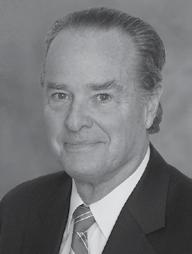
The Damm Legacy: Honouring Fritz R. Damm’s Enduring Impact on TLA
Presented by Patrick E. Foppe
For more than two decades, Fritz R. Damm has helped shape the very fabric of the Transportation Lawyers Association through steady, faithful, and unmatched service. At this year’s Annual Conference, TLA recognized that legacy in the most fitting way possible.
For 21 years, Fritz served as Chair of the Membership Services and Recruiting Committee—what many of us have long referred to, with admiration and appreciation, as the "Damm Membership Committee," a title has become a widely embraced and enduring tribute.
To appreciate the depth of that legacy, consider this: in 2004, I was just finishing law school, taking the bar exam, and getting married. At that same time, Fritz was launching what would become—not his first, but his second career within TLA—one defined by tireless leadership, thoughtful mentorship, and a level of dedication that continues to inspire.
Fritz’s contributions to TLA are immense, but his influence has never been confined to any one title or term. He served as President from 2001 to 2002. His leadership of the Membership Committee hasn’t just been long-standing—it has been transformative. Through personal outreach, consistent follow-through, and a sharp eye for talent, Fritz brought hundreds of lawyers into the fold—not merely as members, but as active, welcomed participants.
That’s the thing about Fritz: he doesn’t just invite you in. He remembers your name, your practice area, your law partners’ names, your last conversation—and probably the names of your kids, too. He builds genuine friendships and encourages others to do the same. That quality—rare as it is—has shaped the professional
and personal trajectories of countless TLA members.
Yes, TLA is known for its outstanding educational programming. But its greatest and most enduring strength lies in the friendships forged across jurisdictions, firms, and generations. Fritz has been one of the principal architects of those connections. Whether greeting a first-time attendee at a conference or coaxing a lapsed member back into the fold, he always made people feel like they belonged.
The Association’s awards speak to this legacy. Fritz is a past recipient of the Distinguished Service Award, the Lifetime Achievement Award, and yes, even the Bullshipper Award—each a reflection of his character, leadership, and good humour. In fact, he has earned nearly every honour TLA offers. And now, the creation of a special award for extraordinary and enduring service stands as yet another testament to his impact.
To Fritz: thank you—not only for the years you’ve given or the positions you’ve held, but for the friendships you’ve built and the lives you’ve touched. Please know that Damm Membership Committee will always live on in your name and spirit—and with it, the values you represent: service, connection, and support.
You have set a standard few can match. And for that, your TLA family is deeply grateful.
(Continued on page 24)
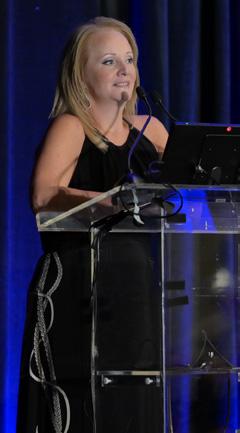
TLA Distinguished Service Award 2025 Joelle G. Nelson
Presented by William M. Davis
Good evening, everyone.
Tonight’s recipient is someone who represents the best of what we hope to be not only as professional colleagues, but also as friends.
From the moment this recipient joined TLA, this person has leaned in—with time and talent—and most importantly, heart. This person raises a hand to help, not for the recognition, but because genuine care about the work we’re doing here. Whether it’s mentoring new members, leading educational programs, or simply being a thoughtful voice in the room, this recipient brings purpose and presence to every role she takes on.
I met tonight’s recipient at my first TLA event. I’ve described my first TLA meeting as an experience similar to switching schools as a kid. Even though everyone is welcoming…even though everyone is excited to meet someone new…I still proceeded tenuously those first couple of conferences. I wanted to take in the culture of the organization, I wanted to fit in. I wanted to learn the inside jokes. It can be intimidating.
At that second meeting, tonight’s recipient spoke on a panel discussion. I was thoroughly impressed by this person’s command of the subject matter and the ease with which she moved from one topic to the next. I felt lucky to be in the same room. Watching this recipient speak gave me many ideas about being a better lawyer. And so, just as if I switched schools as a kid, I hoped that this person would think I was cool enough to be friends with. I’m glad to say that it worked out, and I am so proud that we are friends in business and in life.
This recipient’s legal credentials are impressive in their own right. An equity partner at one of the largest firms in the country, co-chairing national practice groups that handle complex litigation across a wide range of industries. Construction. Environmental claims. Product liability. And, uh….. oh, yeah, Transportation. If it looks like a tort and walks like a tort, this person has seen it--and handled it with skill and professionalism.
But what makes this person stand out isn’t just what she does— it’s how she does it.
This person is a natural leader. One who prepares like it’s trial every day. Who listens, asks the right questions, and finds common ground. Clients trust this recipient. Colleagues rely on this recipient. Opposing counsel respect this recipient.
And then, there’s what this person has done for TLA.
When we needed leadership for one of our most important regional seminars, the recipient stepped in as co-chair and
delivered a topnotch event. This person is a force in the meetings of the executive committee, helping to move the organization forward by elevating its already high standards. This person is helping lead one of our most important committees. Quietly. Consistently. Without asking for anything in return.
That kind of selflessness takes resolve. And I witnessed that resolve, firsthand, on tough day for my friend. It was a couple of years ago at the TLA event in Salt Lake City. A few of us had decided to go for a hike up Bell Canyon, and we were all happy that tonight’s recipient joined us.
Looking back on things, it’s now perfectly clear that we hadn’t planned very well. As we ascended the hike wearing ordinary shoes, the trail became slippery as we encountered ice and snow. But we pressed on, inspired by the reward waiting for us at the end of the hike—a beautiful waterfall.
My friend didn’t make it to see the waterfall that day. She slipped on the ice and dislocated her shoulder. The area we were in was so remote that there was no way to transport her off the mountain. Walking down through the snow and ice was the only path to help.
Each of us did our best to assist as we could, but none of us were spared from watching our friend suffer that day as we made our way down the mountain. I can’t imagine the pain she was in.
And yet, she never complained. She barely let on that she was hurting. I even hoped that perhaps her injuries weren’t that bad. But I would later learn, once she was in the hospital, that she needed surgery and had injured her shoulder and wrist.
How someone handles suffering tells you a lot about them, and I’m proud to say that my friend handled it with poise and grace.
And she didn’t let it slow her down. She went home, recuperated, and got back to doing what she does not only as a mother, lawyer and TLA contributor—she continued helping others. She helps lead a program that supports a nonprofit school for children with learning differences.
I wanted to end this presentation with a montage of photos to honour tonight’s recipient. To do that, I spent some time scrolling through her Facebook page. She has a lot of photos. And, I know
Awards
they’re posted there with the intention of being shared, but I’m old fashioned and I would be lying if I didn’t say I felt like a bit of a creep scrolling…and scrolling….and scrolling.
But I’m glad I did. Because the pictures were a privilege to view—a visual story of tonight’s recipient’s life. The photos spanned decades, and there were some trends among them that stood out in sharp relief. Her deep love for her daughter and husband was so evident. They have so much fun together! She has a broad circle of friends, and she is frequently out-and-about, enjoying all that life has to offer.
That tells you everything you need to know about her endurance, her character, and her commitment.
So tonight, we honour not just a lawyer. Not just a colleague. We honour someone who has made this Association stronger. Someone who has earned our respect, our admiration, and our gratitude. Someone whose service, frankly, deserves more recognition than a single award can offer—but we’ll start here.
It is my tremendous pleasure to present the 2025 Distinguished Service Award to:
Joelle Nelson.
Joelle, on behalf of all of us—thank you for your service, your leadership, and your example.
Congratulations.
TLA 2025-2026 Officers
TLA
Katherine T. Garber Immediate Past President
Louis Amato-Gauci President
Carlos Sesma, Jr. Secretary/Treasurer
Kristen Johnson Second Vice President
Roger Watts First Vice President
Patrick E. Foppe President-Elect
TLA 2025-2026 TLA Committee Chairs
PRACTICE DIVISION
President-Elect Patrick E. Foppe, Officer in Charge
Subject Area C o mm i tt e es
Alternative Dispute Resolution
Wilson Elser Moskowitz Edelman & Dicker LLP, Two Houston Center, 909 Fannin Street, Suite 3300, Houston, Texas 77002
Brokerage, Logistics and E-Commerce ...............................................................................................................................
Law Office of Seaton & Husk, LP, 2240 Gallows Rd., Vienna, VA 22182
Rail Transportation .......................................................................................................................................................................................................... Chair: Eric C. Palombo
Flaster/Greenberg P.C., 100 Front Street, Suite 100, Conshohocken, PA 19428
Technology/Social Media ...............................................................................................................................
Bovis, Kyle, Burch & Medlin, LLC, 200 Ashford Center North, Suite 500, Atlanta, GA 30338
The National Star Route Mail Contractors Association, 8521 Leesburg Pike, Suite 350, Vienna, VA 22182
Phone: (202) 543-1661 Email: GregReed@nsrmca.org
Roetzel & Andress, LPA, 41 South High Street, 21 Floor, Columbus, OH 43215
Phone: (614) 636-1966 Email: akarcher@ralaw.com
Continuing Legal Education Committees
2025 Transportation Law Institute ...............................................................................................................................
Hanson Bridgett LLP, 500 Capitol Mall Suite 1500, Sacramento, CA 95814
Criminal activity in the cyber world can impact all industries, including transportation. For example, the CrowdStrike faulty software update and the Blue Yonder ransomware attack were well-publicized and impacted many companies. Other cyberattacks target one entity. In August 2024, Rhysida ransomware group reportedly attacked the Seattle-Tacoma International Airport, which rebuilt its affected systems rather than pay a ransom, with port officials stating that paying the ransom would not be a good use of taxpayer money.
These are just some of many examples of cyber criminals impacting the transportation world. This article will address the landscape of cyber exposure in 2025, as well as some of the lawsuits that have been filed in connection with these losses. The article also will provide some practical steps for organizations to consider with respect to their cyber hygiene.
Historical Cyber Attacks
There have been a couple of cyberattacks in the past that have significantly impacted the transportation industry. One of the most devastating was the NotPetya cyber-attack, a ransomware attack attributed to a Russian military intelligence agency. It primarily targeted computer systems in the Ukraine, but it had a significant impact on many businesses around the world. The shipping company A.P.
Jonathan E. Meer* and Dominik Cvitanovic**
Moller-Maersk estimated that NotPetya had cost the company between $250 million and $300 million, though some have estimated that the impact was far greater. The NotPetya attack also impacted TNT Express, a division of FedEx, where it was claimed that they lost about $400 million. Others in the shipping industry have been subject to ransomware attacks and cyber breaches. The French shipping company CMA CGM reported that it was the victim of cyberattacks in 2020 and then in 2021.
U.S. government agencies involved in transportation have also reported cyber incidents outside of the one with the Seattle-Tacoma International Airport noted above involving ransomware over stolen files. It was reported in 2021 that the Santa Clara Valley Transportation Authority and New York City Metropolitan Transportation Authority were separately subject to cyberattacks. In 2023, the U.S. Department of Transportation had a data breach impacting the personal information of current and former workers. More recently in June 2024, the Honolulu Department of Transportation Services had a cyber-attack that caused an outage of their bus and van systems’ GPS services and card readers.
The Cyber World from 2024 into 2025
According to the GRIT 2025 Ransomware and Cyber Threat Report, there were 4,848 ransomware victims in 2024, or 13.2 average daily victims.1 That same study noted the manufacturing industry was the most frequently impacted by ransomware in 2024. This was followed by technology, retail and wholesale,
healthcare, consulting, and construction. Further, the study reported that those ransomware victims impacted for only a short period of time included healthcare, government, banking and finance, engineering, and automotive. In another study, data breaches continued at historic levels in 2024, with 3,158 data compromises. In connection with these data breaches, victim notices surged 211 percent to 1.3 billion, with five mega-breaches each triggering more than 100 million notices.2
The CDK Global ransomware event in June 2024 demonstrated the significant impacts of supply chain cyber vulnerabilities leading into 2025. CDK Global operated a management system for automotive dealerships, which was crippled by a ransomware attack linked to the BlackSuit cybercriminal group. CDK’s system was down for approximately two weeks, causing significant downstream effects to dealerships across the country. CDK reportedly paid a $25 million ransom to alleviate the effects of the attack but estimates of the total financial loss for dealerships and auto manufacturers exceed $1 billion.
More than half of large organizations identified supply chain risks such as the CDK event as the biggest barrier to achieving cyber resilience in 2025.3 Supply chain disruptions can impact businesses in multiple ways, causing delays, increased costs, and reputational damage, without ever impacting an organization’s own network environment directly.
TLA Feature Articles and Case Notes
Meanwhile, 2024 saw two major exits from the ransomware scene. LockBit and ALPHV, two dominant Ransomware as a Service (RaaS) criminal organizations, were the targets of law enforcement actions. LockBit’s activity has significantly declined, and ALPHV announced their “retirement” early that year.4 Nevertheless, the number of victims reported on ransomware leak sites increased, rather than decreased, over the course of the year.
Upcoming Reporting Obligations for the Transportation Sector
Although there were successful law enforcement actions in 2024, organizations should continue to plan and prepare for continued ransomware attacks in addition to other cyber-attacks, including phishing attacks that attempt to misdirect funds to bad actors. This continually evolving cybersecurity activity keeps the regulatory landscape in flux for the transportation sector. In May 2024, the U.S. Cybersecurity and Infrastructure Security Agency (CISA) published its Notice of Proposed Rulemaking (the Proposed Rule) pursuant to the Cyber Incident Reporting for Critical Infrastructure Act of 2022 (CIRCIA).5
If adopted in 2025, the Proposed Rule would significantly expand reporting obligations across the economy, including the transportation systems sector, a sector already identified by CISA as a critical infrastructure sector. According to CISA, this sector consists of seven key subsectors:
• Aviation
• Highway and motor carrier
• Maritime transportation system
• Mass transit and passenger rail
• Pipeline systems
• Freight rail
• Postal and shipping.
The Proposed Rule would require certain organizations to report covered cyber incidents to CISA within 72 hours and report any ransom payments to a threat actor within 24 hours.
As always, whether an organization in the transportation systems sector will have to report such incidents to CISA depends on
the organization, as the Proposed Rule, if put into effect, would create a classification depending whether such organization (1) exceeds the small business size standard specified by the applicable North American Industry Classification System Code (the size-based criterion), or (2) meets one or more sector-based criteria, such as certain over-the-road bus operators, pipeline facility or system operators, or certain vessel owner/operators subject to the Maritime Transportation Security Act.
CISA is scheduled to update and publish a final rule pursuant to CISA in the latter half of 2025, so organizations should prepare now to review and update their policies and consider their administrative, technical, and physical safeguards to ensure they are ready for the cyber threats of 2025 and beyond as well as the potential regulatory exposure.
Meanwhile, the U.S. Coast Guard published its final rule regarding cybersecurity requirements for U.S.-flagged vessels, Outer Continental Shelf (OCS) facilities, and facilities subject to the Maritime Transportation Security Act of 2002 (MTSA). This final rule adds cybersecurity requirements including developing and maintaining a cybersecurity plan, designating a cybersecurity office, and taking additional steps to maintain cybersecurity in the Marine Transportation System such as annual cybersecurity assessments. This rule is currently scheduled to go into effect on July 16, 2025.6
For cyber reporting obligations, this new rule extends existing reporting obligations under 33 C.F.R. 6.16-1, which required actual or threatened cyber incidents involving vessels, harbours, ports, or waterfront facilities, including any data, information, network, program, system, or other digital infrastructure thereon or therein, be reported immediately to the Federal Bureau of Investigation, CISA (for cyber incidents), and the Captain of the Port, or their respective representatives. Those entities not already subject to Section 6.16-1, such as OCS facilities, must report to the National Response Center (NRC).
This rule is similar to other cybersecurity obligations that already exist in the transportation sector. For example, certain
owner/operators of passenger railroad carriers or rail transit systems must consider Security Directive 1582-21-01 of the Transportation Security Administration, which went into effect on December 31, 2021. This directive similarly required covered entities to conduct cybersecurity vulnerability assessments, develop cybersecurity incident response plans, and report cybersecurity incidents to CISA. The new CISA and U.S. Coast Guard rules show that cybersecurity remains a priority in the transportation sector, and those in the transportation industry should consider how these new rules may apply to them.
Cyber Litigation
In connection with the insurance coverage aspect of cyber claims and share of responsibility there are disputes with those in the transportation industry and their insurers that have spilled over into the court system. Two of the most pronounced disputes involved the airline industry, including Southwest Airlines Co. v. Liberty Insurance Underwriters Inc., and CrowdStrike Inc. v. Delta Air Lines Inc., both of which remain pending.7
One recent disruption to air travel due to a cyber event was the security software provider Crowdstrike’s error on July 19, 2024, that grounded much of North American air travel, including Delta Air Lines. In its public comments and later in the litigation, Delta claimed that CrowdStrike’s software update caused an IT outage that “crippled Delta’s operation for several days, forced thousands of flight cancellations and delays, and adversely affected more an a million Delta customers,” leading to lost revenue estimated at $500 million for the flight cancellations.8 On October 25, 2024, CrowdStrike filed a declaratory judgment action in the U.S. District Court for the Northern District of Georgia against Delta, seeking a declaration that “(1) the liability limitations set forth in the parties’ June 30, 2022, Subscription Services Agreement apply to this dispute between Delta and CrowdStrike; (2) the parties are not liable to each other for any indirect, incidental, punitive, or consequential damages of any kind related to this dispute under the same agreement; and (3) CrowdStrike was neither
grossly negligent nor did it commit willful misconduct.”
In response on the same day, Delta filed an action against CrowdStrike in the Superior Court of Fulton County, Georgia, with causes of action of:
• Computer Trespass
• Trespass to Personalty
• Breach of Contract
• Intentional Misrepresentation/ Fraud by Omission
• Strict-Liability: Product Defect
• Gross Negligence
• Deceptive and Unfair Business Practices Act stemming from its damages from the same incident.
Also in response, on November 1, 2024, Delta filed a motion to dismiss, arguing that there was no subject-matter jurisdiction before the federal court and that even if there were subject-matter jurisdiction, the action is not proper “because it merely asserts CrowdStrike’s non-liability to damages claims based on its past conduct.9
CrowdStrike, on November 22, 2024, voluntarily dismissed its action in federal court based on Delta permitting CrowdStrike to refile its claims against Delta in Georgia state court. Currently pending is CrowdStrike’s motion to dismiss, seeking to dismiss all but the breach of contract claim as not being proper, as well as arguing that the contract claim is subject to the limitations of that contract.
One example of a cyber coverage dispute from a transportation outage is Southwest Airlines Co. v. Liberty Insurance Underwriters Inc., which is pending in the U.S. District Court for the Northern District of Texas.10 This stems from the 2016 computer network failure, for which Southwest sought insurance coverage for mitigation costs. As noted in the court’s summary of events, on July 20, 2016, Southwest suffered a massive computer failure, which resulted in a three-day disruption of its flight schedule impacting approximately 475,839 Southwest customers. In connection with its claim for “Loss …solely as a result of a System Failure,” Southwest calculated that it ultimately incurred more than $77 million.11 While the primary insurer and first three excess layers paid their policy limits up to $50 million for the loss, Liberty challenged five categories of Southwest’s claimed losses. In 2019, Southwest brought the coverage action against Liberty, to which the trial court in September 2022 granted Liberty’s motion for summary judgment, agreeing that Southwest’s claims failed due to the lack of coverage under the System Failure Coverage.12 This was later reversed in January 2024 by the Fifth Circuit, which held that Southwest sought coverage for costs that were not “categorically barred” from coverage and that the lower court erred in holding the costs were purely discretionary.13 This case was set for a jury trial on March 4, 2025, though stayed on January 22, 2025, and later will address whether the system failure was the sole
cause of the costs incurred by Southwest, which include “FareSaver” promo codes, travel vouchers, refunds, “Rapid Rewards Points,” and advertising costs because of the disruption.14
Conclusion and Steps Going Forward
The above pending actions involving the transportation industry highlight some of the concerns that cyber incidents may create. In connection with this looming threat, all organizations, including those in the transportation industry should take some proactive stems to be prepared. These can include internal data mapping to determine an organization’s risks and vulnerabilities to cyber-attacks, as well as increasing the funds, technology, and personnel to handle network-level monitoring, testing, and system updates.
Organizations also should consider adopting cybersecurity safeguards for thirdparty vendors, customers, and clients who have access to the company’s system. It also may include the adoption of information governance controls, written policy and procedures for data management, training for employees as to their own cyber hygiene, and internal cybersecurity plans in the event of a cyber breach. With the growing threat of data breaches and ransomware, organizations should be aware of their own potential vulnerabilities and what steps they can take to, hopefully, minimize cyber threats.
Endnotes
1 GRIT 2025 Ransomware and Cyber Threat Report, published Jan 16, 2025.
3 Global Cybersecurity Outlook 2025 | World Economic Forum, p. 24 (large organizations representing organizations responding to the survey with revenue exceeding $5.5 billion).
6 Final Rule: Cybersecurity in the Marine Transportation System > United States Coast Guard News > Maritime Commons.
7 Southwest Airlines Co. v. Liberty Insurance Underwriters Inc, (ND TX) (19-cv-02218); CrowdStrike Inc. v. Delta Air Lines Inc , (ND GA) (24-cv-4904).
8 Complaint ¶2, Delta Air Lines, Inc. v. CrowdStrike, Inc., Georgia State Court, Superior Court of Fulton County, 24-cv-013621.
9 Delta’s Motion to Dismiss, Crowdstrike, Inc. v. Delta Air Lines, Inc., 23-cv-4904, November 1, 2024, p. 15.
10 Southwest Airlines Co. v. Liberty Insurance Underwriters Inc , (ND TX) (19-cv-02218).
11 Southwest Airlines Co. v. Liberty Insurance Underwriters Inc , (ND TX) (19-cv-02218), doc. No. 1, ¶23.
12 Southwest Airlines Co. v. Liberty Insurance Underwriters Inc , (ND TX) (19-cv-02218), doc. No. 91.
13 Southwest Airlines Co. v. Liberty Insurance Underwriters Inc , No. 22-10942, p. 1 (5th Cir. Jan 16, 2024).
14 Southwest Airlines Co. v. Liberty Insurance Underwriters Inc , (ND TX) (19-cv-02218), doc no. 138.
Broker Transparency: The FMCSA Explores its Role as the Guardian of Commerce
The precursor to the Federal Motor Carrier Safety Administration (FMCSA) was the Interstate Commerce Commission (ICC). The ICC performed the licensing and safety functions of the FMCSA, but unlike the FMCSA, the ICC played a greater role in the regulation of commerce provided by domestic motor carriers as well as other transportation entities. This included promulgating certain regulations relating to the commercial conduct of brokers, freight forwarders, and motor carriers. It also included regulations concerning how these entities interacted with each other. An example of one of the commercial regulations, which was created by the ICC and has persisted to today is 49 C.F.R. § 371.3. Section 371.3 covers records that must be maintained by property brokers and presently states:
(a) A broker shall keep a record of each transaction. For purposes of this section, brokers may keep master lists of consignors and the address and registration number of the carrier, rather than repeating this information for each transaction. The record shall show:
1 The name and address of the consignor;
2 The name, address, and registration number of the originating motor carrier;
* Seaton & Husk, LP (Vienna, VA)
Jeffrey Cox*
3 The bill of lading or freight bill number;
4 The amount of compensation received by the broker for the brokerage service performed and the name of the payer;
5 A description of any non-brokerage service performed in connection with each shipment or other activity, the amount of compensation received for the service, and the name of the payer; and
6 The amount of any freight charges collected by the broker and the date of payment to the carrier.
(b) Brokers shall keep the records required by this section for a period of three years.
(c) Each party to a brokered transaction has the right to review the record of the transaction required to be kept by these rules.
The FMCSA is considering revising § 371.3 and launched a rulemaking process on August 19, 2020, which is presently in the comments stage. The initial notice regarding this rulemaking can be found at 85 FR 65898. A more comprehensive Notice of Proposed Rulemaking (“NPRM”) was issued by the FMCSA on November 20, 2024. The purpose of this paper will be to explore the revisions that the FMCSA isThe purpose of this paper will be to explore the revisions that the FMCSA is considering for § 371.3, as expressed in the November 2024 NPRM, and its rationale for considering these changes. The FMCSA is labeling its revisions to § 371.3 as a way to achieving greater transparency in broker carrier
transactions. News articles covering the proposed changes to § 371 have labeled the issue “Broker Transparency”.
This broker record production requirement has, until recently, been a relatively forgotten regulation in that it is common practice to see waivers of the broker’s duties under § 371.3 in broker carrier agreements. It is relatively rare for a carrier to request such records and § 371.3 is silent as to the timeframe in which brokers have to reply. Furthermore, the broker’s duties under § 371.3 are considered included in 49 U.S.C. § 14101 waivers, which are also commonly found in broker carrier agreements.
With respect to § 371.3 there are some uncertainties surrounding the text. The first is that neither the FMCSA, nor the ICC, addressed what constitutes brokerage services versus non-brokerage services: see 49 C.F.R. § 371.3(4)(5). Second, the regulations are silent as to the enforcement of § 371.3 in a situation where a carrier has requested such records and believes the broker has not provided a complying response. The changes proposed by the FMCSA address these uncertainties and are designed to enhance the regulations in response to petitions filed by certain motor carrier interest groups.1
The FMCSA proposes making four changes to § 371.3. The first proposed change is that property brokers would be required to keep their transaction records in an electronic format.2 Second, the FMCSA proposes to eliminate the distinction between brokerage and nonbrokerage services. In its place the broker would be required to disclose “all charges and payments connected to the shipment, including a description, amount and date.”3 This would include claims made on
a shipment for cargo damage or delay as well as accessorial charges/fees.4 Thirdly it would be required that the broker transmit the transaction records to a motor carrier within 48 hours of the motor carrier filing the request. NPRM (Sec. II(B)). The fourth, and most significant, amendment would be redefining the obligations of brokers pursuant to § 371.3 as a regulatory duty imposed on the broker by the FMCSA.5
As to this last change, in the FMCSA’s view, the broker’s duties under § 371.3 would be similar to a broker’s regulatory obligation to maintain a bond / trust in the amount of $75,000 under 49 CFR 387.307.6
The FMCSA became interested in revising § 371.3 after the sharp decline in freight rates following the COVID-19 pandemic.7 In May 2020, the Small Business in Transportation Coalition (SBTC) and the Owner-Operator Independent Driver Association “OOID”) petitioned the FMCSA to address broker transparency duties under § 371.3. NPRM (Sec. V(B)). The present NPRM is the response to said petitions. NPRM (Sec. IV(C)). Many sizable brokers, as well as the Transportation Intermediaries Association (“TIA”) responded with comments critiquing the FMCSA’s proposed regulations as well as the SBTC and OOIDA petitions. The comment deadline as to certain questions posed by the FMCSA in the November NPRM was to close on January 21, 2025, but was extended to March 20, 2025. As of early March there were well over five thousand comments posted to the docket.
In exploring the proposed changes to § 371.3 it is important to address the thought behind the creation of the regulation. What we know today as 49 C.F.R. § 371.3 was created by the ICC in an October 17, 1980, rulemaking. See 45 FR 68941. The purpose of the October 1980 rulemaking was to create “rules which would govern the operational practice of property brokers.”8 At the time the ICC saw value in flexible rules because it saw an “increased need for property brokers” and it did not want to unduly impede the “free operation of the marketplace.”9
The ICC was not persuaded with arguments made in 1980 that once a broker
TLA Feature Articles and Case Notes
had a freight account, the motor carrier had little bargaining power. That argument had been advanced by a carrier transporting exempt agriculture commodities.10 The ICC believed that carriers operating in nonexempt industries would be easily able to bypass brokers if the carriers thought they were not receiving a good deal by the brokers due to the fixed nature of the distribution points: see 45 FR 68941. In the present-day rulemaking it appears that the FMCSA is potentially concerned with an asymmetry of information between brokers and motor carriers and is considering if this asymmetry is affecting not only freight rates but also the efficiency of the system: see NPRM (Sec. II(A), VIII(A)(2)). In assessing the economic impact of the new regulatory text the FMCSA received different comments from motor carriers and brokers. OOIDA expressed belief that with greater transparency freight rates would substantially increase for motor carriers.11 Other motor carriers noted that they did not possess the data to make an informed reply due to prevalence of § 371.3 waivers in broker carrier agreements.12 Brokers provided data on the estimated costs of compliance with the proposed regulatory changes but to date have not commented to any changes in freight rates.13
The FMCSA expressed concern that it could not make a more accurate determination about how its changes could impact freight rates based on the presently available information. This was confirmed by the FMCSA requesting further comments regarding if and to what degree its proposed regulatory changes could impact freight rates. 14
A second argument that was dismissed in the 1980 rulemaking by the ICC, but is different in the modern transportation industry, was the primary entity served by brokers.15 When the ICC was considering the topic, it disagreed with an argument advanced by Yellow Freight Systems that the benefits of brokers flowed only to the shipper.16 At that time, the ICC believed that both the carrier and broker were on the same footing to negotiate with the broker.
“We wish to emphasize, however, that the carrier and shipper are
free to deal directly with each other. The carrier may, for example, convince the shipper that it will get all the necessary services from the carrier at a cheaper price. Only where the shipper finds that it can get better service from the broker will it stay with the broker. In short, we believe the carrier has it within its power to market its service in a way that will make it attractive for the shipper to deal directly with the carrier.” 17
During the present rulemaking process, one of the objections raised by the TIA to the FMCSA’s proposal was the concern that changes to the regulations could “jeopardize the confidentiality of propriety pricing” suggesting that the modern broker industry recognizes its services primarily benefits shippers.18
Contrasting the 1980 rulemaking to the 2024 rulemaking, it appears that changes to the operation of the transportation industry, and the petitions filed by OOIDA and SBTC, have caused the FMCSA to question whether the premises on which the original brokerage regulations were promogulated are still valid.19
Returning to the changes proposed by the FMCSA in the November 2024 notice of proposed rulemaking, the regulatory changes the FMCSA seeks to implement to facilitate what has become known as “broker transparency” are as follows:
1. Amend § 371.1(a) to require that brokers keep the required records in an electronic format;
2. Amend § 371.3(a) to revise the required contents of brokers’ records;
3. Amend § 371.3(c) to clarify that brokers must provide records upon request; and
4. Amend § 371.3 (c) to require that records must be provided electronically within 48 hours of request.” NPRM (Sec. VIII(A) (2)).
The FMCSA indicated that the revisions to § 371.3 would apply to all brokers regardless of size.20 It was the FMCSA’s view
TLA Feature Articles and Case Notes
that transparency was needed across the industry and did not believe that compliance would be cost prohibitive to smaller brokers.21
The revisions to § 371.3 (c) are the most significant since the proposed change would make it a regulatory duty of the broker to provide records upon request to the motor carrier.22 This regulatory duty is expressly aimed at the common practice of brokers requiring carriers to waive their ability to request the broker produce records under § 371.1 in broker-carrier agreements.23 The FMCSA indicated that by the ICC originally labeling the record request provision as a “right to review” by the carrier, it did not capture the ICC’s true intent behind the regulation.24 Making record production a regulatory duty, the FMCSA believes, will make this an obligation that cannot be waived by contract 25. For example, a motor carrier cannot contract out of its requirements to carry the prescribed level of bodily injury and property damage insurance in a shipper-carrier agreement nor can a broker contract around maintaining a trust fund or surety account under 49 C.F.R. § 387.307. By changing the text of 371.3(c) so that it reads it is the broker’s regulatory duty to produce electronic accounting records to the carrier, the FMCSA intends to prevent contractual waiver in broker-carrier agreements.
One of the most interesting topics addressed by the FMCSA in the discussion surrounding waivers of § 371.3 in broker carrier contracts was its position concerning waivers under 49 U.S.C. § 14101. Opponents argued that the FMCSA’s proposed revisions to § 371.3(c) would be in contravention to § 14101 waivers commonly found in broker-carrier contracts.26 The FMCSA indicated it was its view that the text of § 14101 referred to shippers and motor carriers and not brokers. The FMCSA continued stating, “the Agency believes that in most brokered transactions, the broker is not the shipper, and 49 U.S.C. §
14101(b) does not apply.”27 Therefore, the FMCSA did not see 49 U.S.C. § 14101 applying to brokers and there was no conflict with its proposed edits to § 371(c) and § 14101. 28 The FMCSA supported its position by citing a number of Federal circuit court and district court cases regarding the applicability of § 14101 to brokers.29 The implications of the FMCSA taking such a definitive position on the applicability of waivers under 49 U.S.C. § 14101 in broker-carrier contracts may have ramifications outside its rulemaking on broker transparency.
A critique of the FMCSA’s proposed changes to § 371(c) from the TIA, and several large brokerage operations, was to indicate that in the modern competitive marketplace transportation pricing is considered a trade secret.30 NPRM (Sec. IV(B) (7)). The FMCSA’s response to this was to note that, in its view, confidentiality provisions in broker-carrier agreements would not be affected by its proposed changes and would provide protection to the broker.31 The FMCSA believed that concerns regarding efficiency and fair dealings in the marketplace overrode concerned expressed by brokers as to the release of financial information called for in § 371.3.32 The NPRM indicated that the FMCSA was concerned about claims from motor carriers that they were often not given much information as to “charge backs”, accessorial fees and surcharges deducted from their settlements by the broker.33 Further, the carriers expressed that they lacked information as to how such additional fees were calculated when paid to them, leaving the motor carriers to wonder if they were being paid the full rates.34 The FMCSA viewed the present situation as creating mistrust in the transportation system, thereby having a detrimental effect on efficiency of the domestic surface transportation industry.35
A final significant topic addressed in the NPRM was on the issue of the FMCSA’s enforcement of the proposed revisions to §
371.3. By changing the text of 371.3(c) to state that a broker has a regulatory duty to produce, upon request, the relevant financial records, the FMCSA indicated that it has the authority to revoke a broker’s operating authority for willful compliance failures and/ or decline to renew a brokerage authority for the same reason. 36 Additionally, the FMCSA noted its ability to levy civil penalties for non-compliance with its regulations.37 However, the FMCSA did not give an estimate as to the amount of any such penalties it would assess for a broker’s willful failure to comply with the proposed revisions or what would constitute willful non-compliance.38
In its enforcement discussions, the FMCSA made an interesting statement. In addressing the topic of its authority to act on the broker transparency issue, the FMCSA indicated that it was addressing the issue from its authority to protect motor carriers rather than enforcing a right the motor carriers had to review brokerage transactional records.39 In the decades since the deregulation of the ICC, motor carriers have seen numerous regulations promogulated by the FMCSA aimed at addressing safety in the transportation industry. The rationale for much of the FMCSA’s actions have been to protectthe traveling public. This is one of the few regulatory changes that the FMCSA has put forward that address conduct within the transportation industry.
Opinions will differ as to the need or the effectiveness of these proposed regulatory changes, but the FMCSA’s expressed intent for proceeding with revising § 371.3 is something to note. Time will tell if the FMCSA continues on this path to take on the role the ICC once had of acting as a guardian of interstate commerce.
Elle Slattery, of Taylor Nelson, Winter Haven, Florida, contributed to this article.
TLA Feature Articles and Case Notes
Endnotes
1 NPRM (Sec. II(A), (B)).
2 NPRM (Sec. II(B)).
3 Id.
4 Id.
5 Id.
6 NPRM (Sec. IV(A)(3)).
7 NPRM (Sec. IV(A)(5)).
8 Id.
9 Id.
10 Id.
11 NPRM (Sec. IV(B)(5)).
12 Id.
13 Id.
14 NPRM (Sec. IV(B)(5)).
15 45 FR 68941.
16 Id.
17 45 FR 68941.
18 NPRM (Sec. V(C)).
19 Another interesting change is the present-day number of registered brokers. Data provided by the FMCSA in its November 2024 NPRM indicated that the number of registered brokers increased from 16,745 in 2015 to 28,773 in 2023. NPRM (Sec. VII(A)(3)). This included losses caused during the COVID-19 pandemic. One wonders if the ICC in 1980 could have imagined the role that freight brokers would come to play in the surface transportation industry.
20 NPRM (Sec. IV(B)(3)).
21 Id.
22 NPRM (Sec. VI(A)(3)).
23 Id.
24 NPRM (Sec. VI(A)(3)).
25 In supporting its position the FMCSA cites the case of Taylor Energy Co. LLC v. United States, 975 F.3d 1303, 1306 (Fed. Cir. 2020)(This case stands for the proposition that regulated entities cannot contract out of regulatory duties).
26 Proponents of the waivers cited the ICC case of Dixie Midwest Express, Inc., Extension-General Commodities, No. MC-125038 (Sub-No. 24), 132 M.C.C. (Feb. 3 1982)(In this case the ICC held that a broker is a shipper in relation to the motor carrier in the transportation transaction). In supporting its position that there was no conflict between its edits to § 371.3 and § 14101 the FMCSA distinguished this case noting that the issue in Dixie Midwest was whether a “broker could be considered a shipper in the context of supporting an application for carriage authority.” NPRM (Sec. IV(B)(8)).
27 NPRM (Sec. IV(B)(8)).
28 Id.
29 The following cases were cited by the FMCSA to support its position on the applicability of § 14101 waivers: Excel, Inc. v. Refrigerated Transp., Inc. v. S. Refrigerated Transp., Inc., 807 F.3d 140, 148-149 (6th Cir. 2015); Supreme Auto Transp., Inc. v. JBL Logistics, LLC , 2017 WL 4334064 at *4 (D. Colo. Mar. 8, 2017); United Rd. Logistics, LLC, v. Alpha Transp. Grp. LLC , 2017 WL 1755825 at * 2 (E.D. Mich. May 5, 2017); TransCorr Nat’l Logistics, LLC v. Chaler Corp., 2008 WL 5272895 at * 4 (S.D. Ind. 2008); REI Transp., Inc. v. C.H. Robinson Worldwide, Inc ., 519 F.3d 693, 694 (7th Cir. 2008). NPRM (Sec. IV(B)(8)).
30 NPRM (Sec. IV(B)(7)).
31 The FMCSA was not persuaded by an argument advanced by brokers that their pricing constituted trade secretes under the Defend Trade Secrets Act (DTSA) 18 U.S.C. § 1831 et seq. The FMCSA indicted that its modified regulations were compatible with the DTSA because it did not require the broker to release all its financial dealings with the motor carrier. Additionally, the FMCSA expressed skepticism that information could be classified a trade secret when it was required to be disclosed by an existing Federal regulation. NPRM (Sec. IV(B)(7)).
32 NPRM (Sec. IV(B)(6)).
33 Id.
34 Id.
35 NPRM (Sec. IV(B)(6)).
36 NPRM (Sec. IV(B)(2)).
37 Id.
38 Id.
39 NPRM (Sec. IV(B)(2)).
Be Wary not Weary: Warehousing ABCs — from Accessorials to Bonds to Contracts — Practical Legal Advice Your Clients Need to Know
Fundamentals of Warehousing
Emerging Trends and Distinctions in Warehousing Services
Transportation law covers commerce by surface, air, and water, including shipping, safety standards, and vehicle regulation. Warehousing law, on the other hand, is primarily concerned with storage, handling, and associated activities. Fundamentally, warehousing is classified as a “bailment” under common law, where a service provider gives reasonable care to items in its possession and control given to it by others without the passage of title.
Certain traditional transportationoriented services are often sold as part of a mature warehousing services portfolio, depending on the customer base. Crossdocking is a warehousing function and unregulated, but from a legal perspective it is often viewed as “storage in transit” and subject to the carrier’s liability in the first instance. Consolidation and deconsolidation are often required in the intermodal space as well as at regional distribution centers, which again may be viewed as “storage in transit” depending on the circumstances of the movement. Yard management and yard storage may also be offered where dry
* Benesch (Cleveland, OH)
Christopher C. Razek*
vans and tanks receive yard space or where the service is in fact managing a customer’s yard. Typically, liability for this service is viewed in a transportation lens and is often outside of the United States Department of Transportation’s safety jurisdiction.
The traditional form of warehousing, in which a depositor contracts directly with a service provider remains the dominant form of performance of services. Transportation service providers, particularly brokers, are looking to leverage their vast networks of service providers to fulfill depositors’ warehousing needs. Therefore, “warehouse brokerage” or “warehousing intermediary” services have emerged as a filler to the service gap between shippers who desire a provider to perform transportation and a separate provider to arrange for warehousing services.
Intersection of Warehousing with Other Fields of Law
i. Real Estate
While some warehousemen will own the land and building on/in which the warehouse services are performed, many will lease such space. In addition to warehousing considerations, from a real estate perspective, warehouse operators typically need to consider how the property is zoned to make sure the intended use complies with local laws. They must also be mindful of local building codes and safety regulations, such as fire safety, accessibility and structural integrity. Compliance with environmental laws is also crucial to avoid liability associated with dangerous goods/ hazardous materials that may be stored on the property.
ii. Insurance
Common types of insurance held by warehousemen include:
• Property Insurance: This would cover damage to the warehouse structure, equipment, and inventory due to events like fire, theft, or vandalism.
• General Liability Insurance: This would protect against claims of bodily injury or property damage that may occur on the premises, covering legal costs and settlements.
• Warehousemen’s Liability Insurance: This would protect warehouse operators against claims arising from damage to or loss of goods stored in their facilities.
• Workers’ Compensation Insurance: Required in most states and provinces, this insurance covers medical expenses and lost wages for employees injured on the job.
• Business Interruption Insurance: This would assist with financial support if the business operations are disrupted due to a covered event, helping to cover lost income and ongoing expenses.
• Environmental Liability Insurance: This insurance may be necessary if the warehouse handles hazardous materials or dangerous goods, protecting against claims related to pollution or environmental damage.
• Cyber Liability Insurance: This insurance is becoming more common as warehouses increasingly rely on technology. This coverage
can protect against data breaches and cyberattacks.
iii. Intellectual Property
Like all businesses, warehouse operators may have their own brand that they wish to utilize to promote their services and reputation in the industry. These businesses also need to consider how best to protect their brand from an intellectual property perspective, whether it be by registering a trade name or business name, or applying for trademark registration.
iv. Corporate Finance
A warehouse operator’s customers may have credit facilities with various lenders to assist with the operation of their businesses. Those lenders will often obtain a general security agreement in their favor, with the customer’s assets and inventory that are stored by the warehouse forming part of the lender’s collateral, along other things. Since warehousemen are generally entitled to a statutory possessory lien, there may be a tension between the lender’s collateral rights and the warehousemen’s lien rights, resulting in the warehouse and the lender negotiating lien subordination agreements, such as bailee waivers, in order to allow the lender priority over the collateral assets, subject to first paying out the warehouse any amounts that it is owed for storage.
Primary Legal and Regulatory Issues Facing Warehousing Businesses
Overview of the Liability Regime
Associated with Warehousing
Absent contrary terms accepted by a depositor, a warehouseman’s liability is singularly focused on fault. In common law jurisdictions, including the vast majority of the United States, fault is determined under the theory of negligence. That is, a depositor must establish a warehouseman’s duty of care relating to the goods, breach of that duty of care, causation, and damages. This proposition is also codified in each state’s Commercial Code. Simply, a warehouseman is liable for damages for loss of or injury to the goods caused by its failure to exercise care with regard to the goods that
a reasonably careful person would exercise under similar circumstances. Conversely, a warehouseman is not liable for damages that could not have been avoided by the exercise of that care.
The establishment of a liability regime based on fault negates the common misconception among depositors that a warehouseman is an insurer of the goods in its possession. Practically, this means that warehousemen are customarily not responsible for loss, damage, or destruction of goods caused by Acts of God or other events typically described as “force majeure” absent a showing a fault. More stringent liability regimes, such as strict liability for loss or damage occurring within a warehouse facility, can be contracted for although typically reserved for more dedicated relationships.
Regulatory Environment for Warehousing
Compared to other transportation and logistics-based services, warehousing and the storage of a third-party’s goods is significantly less regulated. There is no universal federal or state license or permit required for the performance of warehousing services (traditional storage and handling), but the warehousing of highly regulated commodities may carry a requirement to obtain a specialized license or permit, mostly from agencies within the jurisdiction where the facility is located. Operators should be aware that storage of goods such as alcohol, hazardous materials, aerosols or flammable/combustible materials, pharmaceuticals, food and drink, bonded merchandise, and other highly regulated goods typically involve greater regulatory oversight.
Analysis of Key Concepts Liens
Unless waived, a warehouseman will have a specific statutory lien against the bailor on the goods covered by a warehouse receipt or storage agreement under the state commercial code where the facility and goods are located. Warehouse operators may utilize their lien rights as security for the payment on the account, entitling the warehouse operator to withhold release
of goods or potentially sell goods on delinquent accounts, when enforced correctly. For services performed for merchants, the overarching test in enforcement of a warehouseman lien is commercial reasonableness. Such law generally sets out the framework applicable to maintaining a warehouseman’s lien, including procedures associated with selling stored goods.
Shrinkage
Shrinkage refers to the loss of inventory, and is the difference between recorded inventory and actual inventory. The warehouseman would generally be liable for shrinkage, subject to the standard of care, unless the contract with the customer specifically addresses the issue and allows for a permitted amount of shrinkage (usually a percentage of recorded inventory) for which a warehouseman is not responsible.
Primary Risk Mitigation Tactics for Warehousing Businesses
Simply, contracts. Typically, warehouse operators will have standard form contracts that address issues of particular importance from a risk management perspective. For example, the contract would address the applicable standard of care, liability in the event of a breach of the standard of care, the imposition of a cap on liability, shrinkage allowances, and lien rights (including in some cases, for non-payment of goods that have already been released). Practically, the limitation of liability will depend materially on the value of the goods in storage, the strength and sophistication of the respective parties, and the availability of either the depositor’s or the warehouseman’s applicable insurance policies to cover the loss or damage. Additionally, many contracts will address responsibilities as it relates to regulated goods, such as quality control or special handling requirements, including which obligations remain with the customer. In warehousing, more so than in transportation, the parties’ contractual commitments to one another are vital in protecting against risk of non-payment and uncapped liability.
Enforcement across federal and state regulatory agencies is on the rise across the
TLA Feature Articles and Case Notes
country. Warehousemen need to be keenly aware of the characteristics and types of goods they are storing for depositors.
Warehousemen will ultimately be responsible for their own legal compliance and need to consult their advisors to assess
whether anticipated goods stored require additional licensure, bonding, or other financial responsibility.
Environmental Implications of Trucking Accidents: Regulatory Compliance and Risk Mitigation Strategies in 2025
When a trucking accident occurs, the immediate focus is rightly on the safety of the driver and any other individuals involved. However, accidents involving commercial vehicles often present another, less visible threat—environmental contamination. Leaks and spills from fuel tanks, coolant systems, and transported cargo can lead to significant regulatory liabilities, costly cleanup operations, and long-term environmental damage.
I. Federal Reporting Obligations Triggered by Environmental Releases
Even relatively minor trucking accidents can trigger environmental reporting obligations under a complex framework of federal statutes and state regulations. Among the most significant federal laws governing environmental liability is the Comprehensive Environmental Response, Compensation, and Liability Act (CERCLA), codified at 42 U.S.C. §§ 9601–9675. The CERCLA imposes strict liability on parties responsible for the release of hazardous substances and includes specific notification requirements that are directly applicable to commercial trucking operations.
* The Lynch Law Group, LLC (Pittsburgh, PA)
Frank C. Botta* and John P. Sieber*
Under 42 U.S.C. § 9603(a):
“[a]ny person in charge of a vessel or an onshore or offshore facility shall, as soon as he has knowledge of any release (other than a federally permitted release) of a hazardous substance from such vessel or facility in quantities equal to or greater than those determined pursuant to section 9602 of this title, immediately notify the National Response Center of such release.”1
For purposes of the statute, commercial trucks qualify as “onshore facilities.” As defined in § 9601(18), the term “onshore facility” includes “any facility (including, but not limited to, motor vehicles and rolling stock) of any kind located in, on, or under, any land or non-navigable waters within the United States.”2
The required notification threshold—the reportable quantity (RQ)—is further established in § 9602(b). That section provides:
“Unless and until superseded by regulations establishing a reportable quantity under subsection (a) of this section for any hazardous substance as defined in section 9601(14) of this title, (1) a quantity of one pound, or (2) for those hazardous substances for which reportable quantities have been established pursuant to section 1321(b)(4) of title 33, such reportable quantity, shall be deemed that quantity, the release of which requires notification pursuant to section 9603(a) or (b) of this title.”3
In practical terms, this means that trucking accidents involving substances such as diesel fuel (which has a reportable quantity of 100 gallons under 40 C.F.R. § 302.4) 4, hydraulic fluid, or transported hazardous cargo may create immediate federal reporting obligations.
Notification must be made immediately upon discovery of the release. According to the U.S. Environmental Protection Agency, “immediate” means without delay, and typically no later than 15 minutes after a person has knowledge of the release, with shorter delays expected whenever practicable.5 Failure to provide notification in a timely manner may result in civil penalties of up to $25,000.6
Similarly, the Environmental Protection Agency (EPA) requires reporting of oil discharges that create visible environmental impacts, even in small quantities. Under what is commonly known as the “sheen rule,” a discharge must be reported if it causes a visible sheen or film on the surface of navigable waters, discolouration of the water or adjoining shorelines, or sludge or emulsion beneath the surface or on shorelines.7 This rule, codified at 40 C.F.R. § 110.3, is based on the EPA’s interpretation of the Clean Water Act’s prohibition on discharges of oil in quantities that may be harmful to public health or the environment. As a result, even minor oil leaks from diesel fuel, lubricants, or hydraulic fluid can trigger federal reporting obligations if they
TLA Feature Articles and Case Notes
reach a waterway or stormwater system connected to one.8
Under federal regulations, any party responsible for an oil discharge that causes a visible sheen, discolouration, sludge, or emulsion on navigable waters or adjoining shorelines must immediately notify the National Response Center (NRC).9
Pursuant to 40 C.F.R. § 110.6, this notification must include critical details such as the location and timing of the discharge, the quantity and source (if known), potential environmental or public health threats, and any containment or cleanup measures undertaken or planned.10 The reporting obligation is designed to facilitate a prompt governmental and emergency response to mitigate environmental harm. Failure to comply with these notification requirements can result in substantial civil penalties under the Clean Water Act and may expose the responsible party to criminal liability for knowing violations.11
II. Common Environmental Hazards Arising from Trucking Accidents
The primary environmental risks in trucking accidents generally fall into three categories:
Fuel Leaks from the Tractor: Diesel fuel spills are among the most common environmental hazards. Industry estimates suggest that up to one percent of commercial trucks experience fuel leaks annually, with average spill sizes around 100 gallons—volumes sufficient to necessitate immediate containment and cleanup.12
Leaks of Engine Fluids: Fluids such as brake fluid, coolant, and hydraulic oils, while often not classified as hazardous under federal law, can still trigger statelevel reporting requirements and civil penalties, especially if they contaminate storm drains or waterways.
Cargo-Related Spills:
When commercial trucks transport hazardous materials (HAZMAT), the potential for environmental exposure and regulatory liability increases significantly. These materials are subject not only to the CERCLA, but also to the U.S. Department of Transportation’s Hazardous Materials Regulations (HMR) and
the Resource Conservation and Recovery Act (RCRA). The HMR, found at 49 C.F.R. Parts 171 through 180, establish comprehensive requirements for the classification, packaging, labeling, placarding, and safe transportation of hazardous substances, along with emergency response procedures in the event of a spill or release.13
In addition, the RCRA, 42 U.S.C. §§ 6901–6992k, governs the management of hazardous waste resulting from such incidents. If a spill results in the release of a substance that meets the definition of hazardous waste—based on its ignitability, corrosivity, reactivity, toxicity, or listing under 40 C.F.R. Part 261—the responsible party must comply with RCRA’s cradle-tograve waste management requirements.14 This includes proper identification, labeling, storage, manifesting, transportation, and disposal of the waste at permitted treatment, storage, and disposal facilities (TSDFs).15 Importantly, the generator of the waste—often the carrier or shipper— retains responsibility for compliance, even when third-party cleanup contractors are engaged. 16
Under both the HMR and CERCLA frameworks, carriers and drivers have a legal duty to immediately notify appropriate authorities—including the NRC—upon discovery of any release of hazardous materials during transport that meets or exceeds specified reportable quantities.17 Failing to comply with the HMR or RCRA can lead to significant civil and criminal penalties, in addition to liability under broader environmental statutes.18 Therefore, trucking companies involved in the transport of hazardous cargo must implement rigourous operational controls, including regular training, incident response planning, and coordination with emergency responders, to effectively manage the risks associated with cargo-related spills.
III. Federal and State Regulatory Frameworks Governing Liability
Truck drivers and their companies are generally considered the “spill generators” under federal law, regardless of the circumstances leading to a release. Under CERCLA’s strict liability framework,
responsibility attaches to the party that had care, custody, and control of the hazardous material at the time of the incident—even if the release resulted from the actions of a third party or external factors.19
In addition to the federal requirements imposed by CERCLA and RCRA, state environmental laws often establish more stringent standards that impose independent obligations on trucking operators. In Pennsylvania, for example, the Clean Streams Law and the Hazardous Sites Cleanup Act require notification to the Pennsylvania Department of Environmental Protection (PA DEP) for any discharge to surface water or groundwater—regardless of the amount released.20 These laws are designed to ensure the Commonwealth is immediately alerted to potential threats to water quality and public health, and failure to notify can result in administrative penalties, enforcement actions, and even criminal liability.
Moreover, Pennsylvania regulations broadly define what constitutes a “reportable spill.” Under Title 25 of the Pennsylvania Code, any spill exceeding five gallons is generally considered reportable, and virtually all spilled or released materials—whether hazardous or not—are presumptively treated as “waste” subject to regulated cleanup requirements. 21 This classification triggers obligations not only to notify the PA DEP, but also to characterize, contain, and properly dispose of the material in accordance with state-approved protocols. Trucking companies must be prepared to engage licensed environmental contractors, conduct site assessments, and document remediation efforts to the satisfaction of state regulators.
IV. On-Scene Response Protocols: The Driver’s Role in Environmental Mitigation
Accidents are high-stress events, and drivers often serve as the first line of defense against escalating environmental harm. Carriers should ensure drivers are trained to:
• Immediately stop the vehicle and activate hazard lights;
• Move the vehicle away from storm drains and ignition sources if safely possible;
• Inspect the vehicle for leaks without igniting a fire or using open flames;
• Deploy emergency spill response kits to contain minor leaks;
• Notify dispatch, emergency services, and environmental consultants if necessary;
• Identify and protect potential paths to waterways, including stormwater catch basins;
• Avoid handling hazardous cargo without proper training and personal protective equipment (PPE).
Training must emphasize that untrained personnel should not attempt to repair damaged tanks or clean up hazardous materials, as such actions could violate Occupational Safety and Health Administration (OSHA) regulations and endanger the driver’s safety.
V. Corporate Response Strategy: Internal Communications and Emergency Coordination
Time is of the essence following an accident. Trucking companies should designate an emergency contact available 24/7 to coordinate the response. This individual must maintain a comprehensive contact list for legal counsel, environmental consultants, insurance representatives, and regulatory authorities. Notably, voicemail and email alone are insufficient methods of emergency communication.
All internal communications related to the accident, including driver statements, should be managed under counsel’s supervision to preserve attorney-client privilege. Avoid text messages, intra-office emails, or unofficial recordings, as these may become discoverable during litigation.
VI. Spill Prevention and Preparedness: Tools, Training, and Insurance
Proactive preparation can dramatically reduce liability exposure. Each truck should
carry a spill response kit tailored to the cargo type, including booms, absorbent pads, drain covers, PPE, and temporary containment vessels.
• Fleets should implement and train drivers on spill response checklists and contingency plans, covering:
• A list of emergency contacts and state-specific reporting thresholds;
• Procedures for notifying insurance carriers and regulatory bodies;
• Pre-arranged access to environmental consultants and spill contractors;
• Defined roles for internal staff and legal counsel during post-incident response.
Additionally, carriers must verify insurance coverage for environmental cleanup. While primary liability policies often cover fuel leaks, hazardous cargo usually requires separate policy endorsements. Immediate notification to insurers is essential to maintain coverage eligibility.
VII. 2025 Regulatory Developments
Impacting Environmental Compliance in Trucking
In response to mounting environmental concerns, climate policy shifts, and the increasing risks associated with commercial freight transport, regulatory agencies have intensified compliance requirements across the trucking industry in 2025. These developments reflect a coordinated effort among federal agencies to reduce environmental harm, enhance public safety, and ensure that carriers are financially equipped to address the consequences of hazardous material releases and other pollution events.
Stricter Emissions Standards
The Federal Motor Carrier Safety Administration (FMCSA), in coordination with the Environmental Protection Agency (EPA), has implemented more stringent emissions standards for heavy-duty commercial vehicles. These updated rules mandate that fleet operators phase in engines compliant with EPA Tier 4 standards or adopt low-emission technologies,
such as electric or hybrid drivetrains. The new standards specifically target reductions in nitrogen oxides (NOx), particulate matter (PM), and carbon dioxide (CO2) emissions.22 For many carriers, compliance will require substantial capital investments in newer equipment or retrofitting existing trucks with certified emissions control systems. These changes are part of a broader federal initiative to curb transportation-sector emissions and align with national climate goals.
Enhanced Electronic Logging Devices (ELDs)
New federal regulations now require ELDs to interface directly with vehicle telematics systems. This integration allows for continuous monitoring of not only driver hours but also metrics such as braking patterns, idling time, fuel efficiency, and engine diagnostics. 23 These expanded capabilities are intended to prevent fatiguerelated accidents, improve mechanical oversight, and enable proactive safety interventions. The rule changes also enhance regulatory enforcement capabilities by allowing inspectors to access more granular real-time data during roadside inspections or post-incident investigations.
Higher Minimum Insurance Requirements
In recognition of the substantial financial exposure associated with environmental spills, accidents involving hazardous cargo, and multimillion-dollar cleanup operations, the FMCSA has significantly increased the minimum insurance coverage thresholds for commercial motor carriers.24 Carriers transporting hazardous materials must now demonstrate proof of financial responsibility through expanded pollution liability coverage, often through specialized endorsements or stand-alone environmental insurance policies. These increased requirements aim to ensure that funds are available for remediation, emergency response, and compensation to affected communities in the event of a significant release or incident.
Environmental
Impact Assessments (EIA)
Regulations under the National Environmental Policy Act (NEPA) have also evolved in 2025 to reflect growing
TLA Feature Articles and Case Notes
concern over climate resilience, habitat degradation, and cumulative environmental impacts. Transportation infrastructure projects—including new logistics terminals, freight corridors, and truck staging areas— must now undergo more comprehensive Environmental Impact Assessments. 25 These assessments require explicit evaluation of potential effects on ecosystems, endangered species, and flood-prone areas, and must propose mitigation strategies for reducing greenhouse gas emissions. In particular, projects in proximity to wetlands, aquifers, and biodiversity hotspots face heightened scrutiny and are often required to implement advanced stormwater controls, green infrastructure, or conservation easements as conditions of approval.
Collectively, these regulatory updates represent a paradigm shift in environmental
Endnotes
compliance for the trucking industry. Carriers must not only maintain traditional operational standards but also adapt to a rapidly evolving legal landscape that prioritizes sustainability, accountability, and public health.
VIII. Conclusion: Managing Environmental Risk Through Compliance and Readiness
Trucking accidents pose not only physical and operational risks but also serious environmental and legal consequences. As regulatory scrutiny intensifies in 2025, carriers can no longer afford to treat environmental compliance as an afterthought. A single spill—whether from fuel, engine fluids, or hazardous cargo—can trigger complex reporting obligations, expose carriers
to substantial civil and criminal liability, and damage a company’s reputation and financial stability.
However, these risks are manageable with the right systems in place. Carriers must adopt a proactive posture: equipping drivers with training and tools, maintaining robust internal protocols, and staying ahead of evolving federal and state regulations. Legal counsel should be closely involved in developing response strategies that preserve privilege and ensure regulatory compliance.
Ultimately, while not every accident can be prevented, every company can control its readiness to respond. In doing so, they not only protect the environment and public health—but also secure the long-term resilience and integrity of their operations in an increasingly regulated landscape.
1 Comprehensive Environmental Response, Compensation, and Liability Act (CERCLA), 42 U.S.C. § 9603(a) (2025) (requiring notification to the National Response Center upon release of a reportable quantity of a hazardous substance).
2 CERCLA, 42 U.S.C. § 9601(18) (2025) (defining “onshore facility” to include motor vehicles and rolling stock).
4 40 C.F.R. § 302.4 (2025) (listing diesel fuel as a hazardous substance with a reportable quantity of 100 gallons).
5 U.S. Environmental Protection Agency, Definition of Immediate for EPCRA and CERCLA Release Notification (2024), https://www.epa.gov/epcra/definitionimmediate-epcra-and-cercla-release-notification (explaining that delays in required notifications should generally not exceed 15 minutes after knowledge of the release).
6 CERCLA, 42 U.S.C. § 9609(a) (2025) (authorizing civil penalties for failure to comply with notification requirements under § 9603).
7 40 C.F.R. § 110.3 (2025) (defining oil discharges that may be harmful under the EPA sheen rule).
8 Id.
9 40 C.F.R. § 110.6 (2025) (requiring immediate notification to the National Response Center upon knowledge of an oil discharge that violates Clean Water Act § 311(b)(3), including discharges causing visible sheen, discolouration, sludge, or emulsion on navigable waters or shorelines).
10 Id. (specifying that notification must include location and time of discharge, quantity and source (if known), environmental or public health threats, and any containment or cleanup actions).
11 Clean Water Act, 33 U.S.C. § 1321(b)(5) (2025) (providing for civil penalties and potential criminal liability for failure to report oil discharges).
12 Deborah Lockridge, Are You Ready for a Fuel Spill?, Trucking Info (Aug. 2014) (citing Spill Center report that approximately 1% of fleet power units experience fuel spills annually, averaging just over 100 gallons).
13 U.S. Department of Transportation, Hazardous Materials Regulations, 49 C.F.R. pts. 171–180 (2025).
14 Resource Conservation and Recovery Act (RCRA), 42 U.S.C. §§ 6901–6992k (2025); see
15 Id.
16 Id.
17 49 C.F.R. §§ 171.15, 171.16 (2025) (requiring immediate telephonic and written reports to the National Response Center for certain hazardous materials incidents); see also 42 U.S.C. § 9603(a) (2025).
18 49 U.S.C. § 5123 (2025) (providing civil penalties under the Hazardous Materials Regulations); 42 U.S.C. § 6928 (2025) (providing civil and criminal penalties under RCRA).
19 CERCLA, 42 U.S.C. § 9607(a) (2025) (imposing strict liability on parties who had “care, custody, and control” of hazardous substances at the time of release).
21 25 Pa. Code § 262.463 (2025) (defining waste and setting forth spill reporting requirements in Pennsylvania).
22 U.S. Environmental Protection Agency, Heavy-Duty Highway Compression-Ignition Engines and Vehicle Standards, 40 C.F.R. pt. 86 (2025).
23 Federal Motor Carrier Safety Administration (FMCSA), Electronic Logging Device Integration Final Rule, 49 C.F.R. Part 395 (effective Jan. 2025). FMCSA, Final Rule on Minimum Levels of Financial Responsibility for Motor Carriers, 49 C.F.R. § 387.9 (2025) (increasing minimum coverage for carriers transporting hazardous materials).
24 FMCSA, Final Rule on Minimum Levels of Financial Responsibility for Motor Carriers, 49 C.F.R. § 387.9 (2025) (increasing minimum coverage for carriers transporting hazardous materials).
25 National Environmental Policy Act (NEPA), 42 U.S.C. § 4321 et seq. (2025); see also Council on Environmental Quality (CEQ), 2025 NEPA Rule Revisions (requiring expanded analysis of climate-related impacts in transportation projects).
U.S. Supreme Court – Rico and a Truck Driver Sues a Drug Testing Company
In a 5 to 41 decision handed down on April 2, 2025, the United States Supreme Court (“Supreme Court”) held that a truck driver who was terminated for a positive marijuana test has a claim against the testing company that misled him under the federal statute titled the Racketeer Influenced and Corrupt Organizations Act (RICO) Medical Marijuana, Inc. v. Horn (“Medical Marijuana”). The specific issue is whether a business or property loss that had as its antecedent a personal injury case is recoverable under RICO.
RICO was enacted in 1970 and is both a criminal and civil statute. On the civil side, it prohibits two or more persons from intentionally conspiring to damage someone in a business setting.2 In addition to actual damages, it provides for treble damages and attorney fees; and, as is here relevant here, RICO excludes personal injury cases from its ambit.3
In Medical Marijuana, a truck driver named Douglas Horn (“Horn”) injured his back and shoulder in an auto accident. Horn and his wife, Cindy Harp-Horn were working as a team of commercial truck drivers for Enterprise Transportation Company. Because standard treatment did not alleviate his pain, he sought relief from cannabis. He found a company, Medical Marijuana, that advertised that its product did not
* Popowski Law Firm, LLC (Charleston, SC)
Endnotes
David Popowski*
contain tetrahydrocannabinol (THC). THC contains the mind-altering properties associated with marijuana. Horn and his wife sought to ensure the advertisement’s accuracy by watching YouTube videos, reviewing the FAQ page of Dixie X’s website, and calling a customer-service line - all of which corroborated the advertisement’s representation that Dixie X did not contain THC. Horn purchased and used the product. Later, his trucking company employer chose him for a random drug test. The result was positive. Horn refused to participate in a substance abuse program viewing it as an admission of guit and Horn was terminated. Horn sued Medical Marijuana in the United States District Court(“District Court”) raising, among other causes of action, a civil RICO claim contending that Medical Marijuana was a RICO enterprise engaged in marketing, distributing, and selling the cannabis and that Medical Marijuana’s false or misleading advertising satisfied the elements of mail and wire fraud and that those crimes constituted a “pattern of racketeering activity.”4 The District Court granted summary judgment to Medical Marijuana; and the United States Circuit Court of Appeals for the Second Circuit (“Second Circuit”) reversed.5 The Second Circuit concluded that Horn had been “injured in his business” when he lost his job and that the harm he suffered here flowed from Medical Marijuana’s actions and not the auto accident personal injury. While the Ninth Circuit agreed with the Second Circuit, The Sixth,
1 Medical Marijuana, Inc. et al. v. Horn, 604 U.S. ___ ; 145 S.Ct. 931(2025);Case No. 23-365.
2 18 U.S.C. Section 1961 et seq., Definitions.
3 18 U.S.C Section ( c), Civil Remedies.
4 18 U.S.C. Section 1961(5), Definitions.
5 Medical Marijuana, Inc. v. Horn, 80 F.4th 130 (2nd Cir. 2023)
6 604 U.S. ____, 145 S.Ct. at 939
7 604 U.S. ____, 145 S.Ct. at 946 -965
Seventh, and Eleventh Circuits had essentially held that the personal injury exception controlled; and, thus, the Supreme Court granted certiorari to resolve the split.6
In the majority opinion authored by Justice Amy Comey Barrett, the Court stated:
“In short, a plaintiff can seek damages for business or property loss regardless of whether the loss resulted from a personal injury. The phrase “injured in his business or property” does not preclude recovery for all economic harms that result from personal injuries.”
The essence of the dissenting opinions authored by Justices Clarence Thomas and Brett Kavanaugh is that: (1) there was in issue whether Horn actually sustained a personal injury; and (2) Plaintiff Horn’s approach would dramatically expand civil RICO and allow plaintiffs to seize on RICO to replace ordinary state-law tort suits.7
I do think that RICO causes of action will now appear more frequently in civil cases in general. Fortunately, in cargo loss and damage cases, there are pre-emption principles available.
Save the Date! CTLA 2025 Educational Conference and AGM
La version française suit
We are pleased to announce that the Canadian Transport Lawyers’ Association Educational Conference and Annual General Meeting will be held in beautiful Victoria, British Columbia, between September 18 – 20, 2025, at the Inn at Laurel Point. Victoria is a charming city located on Vancouver Island and is known for its rich history, stunning natural surroundings, and British-inspired architecture. In addition to its colonial charm, Victoria has a vibrant arts scene, lots of outdoor activities, and a fantastic food scene.
The hotel features stunning views of Victoria harbour and is located only a 10-15 minute walk away from the picturesque area, which is lined with historic buildings, including the British Columbia Legislature, and offers views of boats and the waterfront.
Nous sommes heureux d’annoncer que la conférence éducative et l’assemblée générale annuelle de l’Association canadienne des avocats en transport se tiendront dans la belle ville de Victoria, en Colombie-Britannique, du 18 au 20 septembre 2025, à l’Inn at Laurel Point. Victoria est une charmante ville située sur l’île de Vancouver et est connue pour sa riche histoire, son environnement naturel superbe et son architecture d’inspiration britannique. En plus de son charme colonial, Victoria possède une scène artistique dynamique, de nombreuses activités de plein air et une scène gastronomique fantastique.
L’hôtel offre une vue impressionante sur le port de Victoria et est situé à seulement 10-15 minutes à pied de cette région pittoresque, bordé de bâtiments historiques, y compris l’Assemblée législative de la Colombie-Britannique, et offre une vue sur les bateaux et le front de mer.
Traffic Court Delay: How Long Is Too Long
Mathew Crowe*
Traffic court hearings are notoriously delayed. It is common for hearings to occur more than a year from the date the ticket was issued. Section 11(b) of the Canadian Charter of Rights and Freedoms (the “Charter ”) guarantees accused persons the right “to be tried within a reasonable time.” That begs the question: at what point does the delay become unreasonable?
In R v. Sangha, 2022 BCSC 874 (“Sangha ”) the Supreme Court of British Columbia considered the application of s. 11(b) to violation tickets in traffic court and decided that a period of delay exceeding 18 months is presumptively unreasonable. The remedy is for a judicial stay of the ticket.
Judicial Justice
On September 4, 2020, an accused motorist was issued a violation ticket under British Columbia’s Motor Vehicle Act (the “MVA ”) for allegedly using an electronic device while driving. After 95 days, the accused applied to a judicial justice (the “Judicial Justice”) presiding in traffic court for an adjournment of the trial to bring an application under the Charter on grounds of unreasonable delay. As the Judicial Justice ruled that she did not have jurisdiction to rule on Charter issues, the trial was adjourned so that the unreasonable delay question could be heard by a provincial court judge.
Provincial Court
The judge presiding in the British Columbia Provincial Court (the “Judge”) calculated the period of delay at 17 months and three days. It was decided that for offences under the MVA commenced by a violation ticket there was a presumptive ceiling of 14 months for charges to be tried,
beyond which the delay would be presumed unreasonable. The Judge found that the presumptive ceiling in the case law of 18 months did not apply to violation tickets under the MVA. A stay of proceedings was granted on the grounds that the delay had exceeded 14 months.
Supreme Court
The Crown appealed the Judge’s decision to stay the ticket. The justice presiding in the Supreme Court of British Columbia (the “Justice”) decided that the Judge had erred in principle in establishing a new 14-month ceiling for offences under the MVA commenced by a ticket (as opposed to an information).
The Justice started by reviewing the principles set out in R. v. Jordan, 2016 SCC 27 (“Jordan”). In that case the Supreme Court of Canada (the “SCC”) addressed the “culture of complacency” that had developed in the criminal justice system resulting in inappropriate delays in charges proceeding to trial. The majority reviewed the then-existing jurisprudence and s. 11(b) framework and stated that it was “too unpredictable, too confusing, and too complex” and there was a need for change.
As a result, the SCC simplified the issue by imposing two ceilings based on the level of trial court, beyond which delay was deemed to be presumptively unreasonable. This was 18 months in provincial court and 30 months in superior court from the time of the charge to the end of the trial.
If the total delay (minus defence delay not caused by “legitimate procedural requirements”) exceeds the ceiling, then the delay is presumptively unreasonable. The idea is that the defence cannot benefit from its own delay-causing action or
* Alexander Holburn Beaudin + Lang LLP (Vancouver, BC)
inaction whereas defence actions legitimately taken to respond to the charges do not constitute defence delay. The Crown may still rebut the presumption by establishing exceptional circumstances. If the total delay (minus defence delay and any exceptional circumstances) is below the ceiling, the defence may still show the delay is unreasonable by establishing that “(1) it took meaningful steps that demonstrate a sustained effort to expedite the proceedings, and (2) the case took markedly longer than it reasonably should have”. Stays below the ceiling will be granted only in clear cases.
The Justice added that subsequent to Jordan, in R. v. K.J.M., 2019 SCC 55 (“K.J.M ”), the SCC considered whether a unique s. 11(b) presumptive ceiling should be created for charges prosecuted under Canada’s Youth Criminal Justice Act.
The majority rejected a unique ceiling for several reasons: (1) no problem had been demonstrated with delay in the youth criminal justice system; (2) setting a new ceiling would undermine the uniform ceiling approach established in Jordan adopted to simplify and streamline the s. 11(b) framework; (3) the fact that Parliament established a separate youth criminal justice system is not by itself a sound rationale to alter constitutional standards through statute; and (4) the difficulty of accounting for transitional cases, which do not preclude a lower ceiling, but is another reason to question the advisability of doing so.
CTLA Feature Articles and Case Notes
The Justice decided that the Judge erred by failing to consider and apply the principles in Jordan and the grounds for not deviating from the ceilings in Jordan as discussed in K.J.M.
In particular, the findings included: (1) there was no evidence of a current problem generally regarding delay in traffic violation matters; (2) the decision would result in a lower ceiling for charges under the MVA as opposed to other provincial offences, which is incompatible with the uniform ceiling approach in Jordan; (3) there was no evidentiary foundation that all MVA offences should be able to be reasonably completed within 14 months to justify a new constitutional ceiling; (4) if a new 14-month ceiling is not set aside, there would be a need to account for transitional cases, which was “yet another reason” to avoid setting a new unique ceiling; and (5) this issue had been previously considered by an appellate decision of “persuasive authority” in R. v. Nguyen, 2020 ONCA 609, where the Ontario Court of Appeal decided that the ceilings established in Jordan apply
uniformly to matters proceeding in provincial court .
In addition, the Justice did not accept the accused’s alternative argument that if the court finds that the Judge erred in establishing a 14-month ceiling, the delay was still unreasonable even though it was under the 18-month presumptive ceiling. It was decided that the accused had neither established that she had made sustained effort to expedite the proceedings nor that the delay was unreasonable as Jordan requires.
In the end, the Justice allowed the appeal. The judicial stay of proceedings resulting from the Judge’s decision that there is a 14-month presumptive constitutional ceiling for MVA offences commenced by violation ticket, was set aside and the case was remitted to the provincial court for the hearing of the trial.
Implications
Sangha decides that the presumptive 18-month constitutional ceiling applies to violation tickets in the Provincial Court
of British Columbia. The principle should apply equally to personal and commercial traffic tickets (which can lead to driving prohibitions and impact insurance) and to all sorts of other comparable tickets in that court.
What this means is that if 18 months pass from the time of the charge to the end of the trial, the delay may be presumed unreasonable and the ticket stayed. Although the defence cannot orchestrate delay to benefit the accused, legitimate procedural requirements (such as requesting disclosure) may increase the overall delay.
Even if the 18-month ceiling is not met, the defence may still show the delay is unreasonable by establishing that it sustained meaningful effort to expediate the proceedings and that the case took much longer than it should have.
The takeaway is that the presumptive constitutional ceiling offers a useful tool for transportation lawyers to defend these types of tickets and that legitimate steps can and should be taken to help increase the chances of success.
Final U.S. Trade Representative Chinese Ship Fees Provide Relief for Canadian Shipowners and Exporters
On April 17, 2025, the Office of the United States Trade Representative (“ USTR ”) issued its long-anticipated “Notice of Action and Proposed Action in Section 301 Investigation of China’s Targeting the Maritime, Logistics, and Shipbuilding Sectors for Dominance” under Section 301 of the Trade Act of 1974. 1 The notice set out the fees that would be levied on Chinesebuilt vessels calling at American ports, among other trade measures targeting the People’s Republic of China.
Discussions and speculation surrounding these measures had fuelled concerns from shipping industry actors worldwide, including Canadian shipowners and operators, charterers, and shippers.
Many Canadian shipowners operate Chinese-built ships due to their availability on the market and relatively low cost. The initially proposed fees would have had a significant negative impact on shipowners and charterers, especially smaller operators in the Great Lakes and on the East and West coasts, whose ships frequently call on U.S. ports. The costs would likely be passed on to charterers or cargo owners, and ultimately to consumers, creating a ripple effect through the supply chain.
However, in response to comments received from various stakeholders, the USTR softened the proposed measures.2 Most importantly for Canadian shipowners, there are significant exemptions for ships engaged in the Great Lakes trade or shortsea shipping, as well as smaller ships.
* Borden Ladner Gervais LLP (Montreal, QC)
Simon Ledsham*
Overview of the Section 301 Investigation and the Notice of Action
On April 17, 2024, the USTR launched its Section 301 investigation of Chinese trade practices in the maritime, logistics, and shipbuilding sectors in response to a petition from several unions in those sectors. 3 The petition alleged that the People’s Republic of China had engaged “in a wide range of unreasonable or discriminatory acts, policies, and practices that provide unfair advantages across maritime industries,” such as industrial planning, anti-competitive practices, providing financing advantageous to Chinese firms, controlling freight rates, and tolerating industrial espionage.4
After soliciting pre-hearing comments and holding a hearing on May 29, 2024, the USTR released its Notice of Determination and its Report on the Section 301 investigation on January 16, 2025, concluding that (i) China had targeted the maritime, logistics, and shipbuilding sectors for dominance, (ii) the targeting was unreasonable, and (iii) the targeting burdened or restricted U.S. commerce.5
On February 21, 2025, the USTR released its Notice of Proposed Action.6 It provided several proposed fees payable by the operators of certain vessels, generally ranging from $500,000 to $1,500,000, including:
• A fee on Chinese vessel operators;
• A fee on operators whose fleet
The author wishes to acknowledge the assistance and feedback provided by Jean-Marie Fontaine, Borden Ladner Gervais LLP
included Chinese-built vessels; and
• A fee on operators with orders for vessels at Chinese shipyards.
It also proposed mandating that a certain percentage of U.S. goods be exported on U.S.-built and/or U.S.-flagged vessels only.
These proposed actions elicited numerous comments from various states, U.S. and international industry and trade associations, shipowners, shipbuilders, and other stakeholders. After consideration of these comments, as well as detailed testimonies over two days of hearings on March 24 and 26, 2025, the USTR issued its final Notice of Action regarding the applicable fees on April 17, 2025.7
The Notice of Action included significant revisions of the proposed fees, apparently based on comments received and considered by the USTR. It provided for incremental fees, generally based on tonnage or capacity, for:
• Chinese vessel operators and owners (Annex I);
• Operators of Chinese-built vessels (Annex II); and
• Operators of foreign vehicle carriers (Annex III).
In addition, the proposed restriction on exportation of US goods was limited to liquid natural gas only (Annex IV).
Finally, the notice also proposed tariffs
CTLA Feature Articles and Case Notes
on Chinese ship-to-shore cranes and cargohandling equipment (Annex V), which were the subject of another hearing on May 19, 2025.
The Chinese ship fees
Annex II of the Notice of Action is the most relevant to Canadian shipowners and exporters. It establishes a service fee payable by operators of Chinese-built vessels that call at U.S. ports.8 Upon the vessel’s arrival in the U.S., the operator must pay a fee corresponding to the higher of two calculation methods, based on net tonnage or on the number of containers discharged at the port. Both formulas include a $0 grace period until Oct. 14, 2025, after which the fees will increase yearly until 2028. The fees are as follows:
April 17, 2025
Oct. 14, 2025
April 17, 2026
April 17, 2027
April 17, 2028
$0 $0
$18 $120
$23
$153
$28 $195
$33 $250
For vessels that are calling on several U.S. ports in succession, the fee will only be applied to the first port call for the entire string or rotation.9 Furthermore, t he fee will only be charged a maximum of five times per year, per vessel 10
The Exemptions
The Notice of Action provides a number of exemptions to the imposition of the Chinese ship fees,11 including three broad exemptions that cover virtually all Canadian shipping to the U.S.
First, the Notice of Action excludes
relatively smaller vessels with a capacity of up to 55,000 deadweight tons (“ DWT ”), or an “individual bulk capacity” of up to 80,000 DWT. Presumably, this means that bulk carriers of up to 80,000 DWT are exempt, while the maximum capacity for other vessels (for instance, tankers or heavy lift ships) is of 55,000 DWT. This exemption covers the vast majority of the Canadian bulk carrier fleet. The exemption also applies to containerships with a capacity of no more than 4,000 Twenty-Foot Equivalent Units; however, there is little or no Canadian-owned container trade to the U.S.
Second, the fees are not applied to ships engaged in short-sea shipping — that is, those arriving at a U.S. port after a voyage of less than 2,000 nautical miles (“nm”) from a foreign port. For example, this exclusion would apply to a direct voyage from Montréal to New York, or from Vancouver to Los Angeles. Also, as the fees only apply at the first port in a string of U.S. port calls, virtually all Canada-U.S. coastal and Great Lakes trade is covered by this exemption.
Third, the fees exclude ships identified as “Lakers Vessels,” meaning “vessels principally identified as “Lakers Vessels” on CBP Form 1300 [Vessel Entrance or Clearance Statement], or its electronic equivalent.”12 As there is no further definition of “Lakers Vessels” in the Notice of Action or in U.S. Customs and Border Protection Form 1300, the exemption relies on self-reporting of the vessel type during the customs clearance process. In plain terms, it would seem to apply to ships that trade primarily on the Great Lakes, especially those designed for Great Lakes steaming (with rounded “bluff” bows, for example). This exemption would appear to
be redundant, considering the 2,000 nm exemption described above, but it reinforces that the USTR intends not to affect Great Lakes shipping with these measures.
These broad, overlapping exemptions should reassure Canadian shipowners, considering the disastrous potential that the proposed fees held before they were implemented in their final, revised form.
There are also various other exemptions for:
• “vessels arriving empty or in ballast”13 – that is, only loading in the U.S. for export, without any other cargo aboard on arrival;
• specialized chemical tankers (“specialized or special purpose-built vessels for the transport of chemical substances in bulk liquid forms” );14
• vessels carrying U.S. government cargo;
• U.S.-owned or U.S.-flagged vessels enrolled in various government sealift programs (“the Voluntary Intermodal Sealift Agreement, the Maritime Security Program, the Tanker Security Program, or the Cable Security Program”);15 and
• “U.S.-owned vessels, where the U.S. entity owning the vessel is controlled by U.S. persons and is at least 75 percent beneficially owned by U.S. persons.”16
While these measures have largely spared Canadian shipowners, the United States’ trade measures remain fluid and unstable. Canadian shipowners, charterers, and exporters to the U.S., as well as their counsel, should continue monitoring developments accordingly, including potential legal challenges to these measures.
CTLA Feature Articles and Case Notes
Endnotes
1 See Office of the United States Trade Representative, “Notice of Action and Proposed Action in Section 301 Investigation of China’s Targeting the Maritime, Logistics, and Shipbuilding Sectors for Dominance, Request for Comments”, April 17, 2025 <https://ustr.gov/sites/default/files/files/Press/ Releases/2025/301%20Ships%20-%20Action%20FRN%204-17.pdf > (“ USTR Notice ”); All documents related to the investigation are available on the USTR website: <https://ustr.gov/issue-areas/enforcement/section-301-investigations/section-301-chinas-targeting-maritime-logistics-and-shipbuilding-sectorsdominance>.
2 A record of written comments and notices of appearance at the hearings is available on the USTR comments portal: <https://comments.ustr.gov/s/docket?docketNumber=USTR-2025-0008>.
3 See Office of the United States Trade Representative, “Initiation of Section 301 Investigation: China’s Acts, Policies, and Practices Targeting the Maritime, Logistics, and Shipbuilding Sectors for Dominance,” April 17, 2024 <https://ustr.gov/sites/default/files/301%20CN%20Maritime%20Logisitcs%20 Shipbuilding%20-%20FRN_1.pdf>.
4 See “Petition for Relief Under Section 301 Of The Trade Act Of 1974, As Amended – China’s Policies in the Maritime, Logistics, and Shipbuilding Sector,” March 12, 2024 <https://ustr.gov/sites/default/files/Section%20301%20Petition%20-%20Maritime%20Logisitics%20and%20Shipbuilding%20Sector.pdf >.
5 See Office of the United States Trade Representative, “Report on China’s Targeting of the Maritime, Logistics, and Shipbuilding Sectors for Dominance,” January 16, 2025 <https://ustr.gov/sites/default/files/enforcement/301Investigations/USTRReportChinaTargetingMaritime.pdf>.
6 See Office of the United States Trade Representative, “Proposed Action in Section 301 Investigation of China’s Targeting of the Maritime, Logistics, and Shipbuilding Sectors for Dominance,” February 21, 2025 <https://ustr.gov/sites/default/files/files/Issue_Areas/Enforcement/Ships%20Proposed%20Action%20 FRN.pdf>.
7 See USTR Notice.
8 See p. 31-33 of the USTR Notice.
9 See p. 31 of the USTR Notice: “upon the arrival of a Chinese-built vessel to a U.S. port or point from outside the Customs territory on a particular string”.
10 See p. 32 of the USTR Notice.
11 See p. 33 of the USTR Notice.
12 See p. 33 of the USTR Notice; Form 1300 is available on the U.S. Customs and Border Protection website: <https://www.cbp.gov/sites/default/files/2024-10/cbp_form_1300.pdf>.
13 See p. 33 of the USTR Notice.
14 See p. 33 of the USTR Notice.
15 See p. 33 of the USTR Notice.
16 See p. 33 of the USTR Notice.
Buckle Up! Legal Tips for Implementing a Carrier Safety Plan in Canada
In connection with the operation of commercial motor vehicles in Canada, an “operator” (meaning the entity responsible for the operation of the fleet of vehicles) is generally expected to prioritize safety. The operator is responsible for the conduct of its drivers, the mechanical safety of the fleet of vehicles, as well as the goods and/or passengers on the vehicles. Some examples of these responsibilities include employing qualified drivers and monitoring their safety performance, identifying and resolving driver safety issues efficiently, maintain the vehicles in a safe condition, ensuring load security, ensuring that daily and annual inspections are completed of the vehicles, and keeping comprehensive records related to these responsibilities.
Infractions of highway traffic laws are recorded on the operator’s carrier abstract/ profile and can result in an increase to the operator’s overall violation rate, eventually leading to a potential downgrading of their safety rating. The suspension or cancellation of a safety fitness certificate can significantly disrupt and undermine day-to-day activities, particularly when the operator is then forced to seek third-party carriers to assist them.
Canada’s Carrier Safety Legislation
After the deregulation of the
* Miller Thomson LLP (Toronto, ON)
Jaclyne Reive*
transportation industry in Canada in the late 1980’s, federal and provincial ministers responsible for transportation and highway safety signed a memorandum of understanding promising to develop and implement a “national safety code” that would focus on promotion road safety as well as harmonization and reciprocity in the management of commercial motor vehicles across the provinces and territories.1 Members of the Canadian Council of Motor Transport Administrators (CCMTA) worked together to develop the National Safety Code, a set of 16 minimum performance standards applying to persons responsible for the safe operation of commercial motor vehicles.2 The provincial legislation governing motor carriers, drivers and commercial vehicles are based on these standards, allowing for a level of uniformity among each province’s requirements and enforcement mechanisms, though some nuances remain.3
Carrier Safety Plans
Given the emphasis on safety, there is a general expectation by transport regulatory authorities that operators will have policies and procedures in place, typically referred to as a “carrier safety plan”, to ensure that their operations are conducted with safety at the forefront. Some provinces require this plan to be in writing, while others do not mandate that a written plan be created. For example, Alberta’s Commercial Vehicle Certificate and Insurance Regulation (AR 314/2002) reads as follows:
40(1) The registered owner of every commercial vehicle who is required to operate the vehicle under the authority of a safety fitness certificate must establish, maintain and follow a written safety program that, in a manner that is clearly documented, addresses
matters relating to the safe use and operation of commercial vehicles, including:
(a) speed limits, seatbelt use, drug and alcohol use, defensive driving, load security, and fuelling;
(b) proper records and recording of information including, as required, bills of lading, manifests, dangerous goods documents, time records, drivers’ daily logs, weigh slips and any other records that are required by or under any transportation legislation;
(c) policies that drivers are expected to comply with the law, and policy and procedures related to driver training, responsibilities, conduct and discipline;
(d) instructions for the use of safety equipment, including, as required, the use of fire extinguishers, goggles, and hard hats;
(e) training for employees about safety laws and their application and an ongoing program for evaluating their driving skills;
(f) retention of complete records for each driver in accordance with section 41;
(g) policies for ensuring that drivers are properly qualified for the type of vehicle they operate.
However, even in provinces where written plans are not mandatory, it is generally viewed as a best practice to have such a plan set out in writing to act as evidence of the practical steps that an operator is taking to ensure safe operations. For example, the Commercial Vehicle Operators’ Safety Manual published by the Ontario Ministry of Transportation (most recently updated in
2022) reads as follows in Module 7 – Safety Programs, Record Keeping and Driver Files :
In Ontario, there are no legal requirements under the Highway Traffic Act to develop or maintain a safety program for your business. However, it is considered a best practice to develop a program that addresses matters relating to the safe use and operation of commercial vehicles.
Why a Safety Program Is Good Practice
A safety program ensures that management has the information available to make proper decisions to establish safe working conditions for all operators and operators’ employees, coupled with heightened awareness of road-safety compliance. A good safety program will reduce property damage and, more importantly, prevent injuries and deaths. It is also a resource for the employees, to know and understand their rights and responsibilities. Having written procedures can also be a useful tool to show due diligence in the event that an operator’s safety rating is downgraded and the operator is required to defend itself to the transport regulatory authority at a show cause hearing to argue against suspension or cancellation of its safety fitness certificate. Canadian provincial transport regulators will also often ask for copies of the plan, or documents that together constitute the plan. However, while a written plan is helpful, it is of utmost importance that operators take steps to implement their carrier safety plan on an ongoing basis, and the implementation process will be the stronger focus of the regulatory authority in the event of a show cause hearing related to a proposed safety rating downgrading.
Best Practices
The following are examples of the types of practices that a motor carrier can put in place as part of their carrier safety plan to enhance their commitment to safety and to assist with the avoidance of incidents that could result in increases to its overall violation rate and potential safety rating downgrading. Canadian provincial
transport regulators will also typically question a carrier in a show cause hearing regarding their practices on such topics to determine the carrier’s level of compliance in the event that their safety rating is at risk of being downgraded or in connection with a facility audit.
1. Driver Vetting. When hiring drivers, fleet operators should always obtain and carefully review a copy of the prospective driver’s “driver abstract” to assess their driving history. Once the driver hired, the operator should go beyond checking the validity of drivers’ licenses and medical certificates, and should also be regulatory monitoring their drivers’ abstracts (at least on an annual basis, if not more frequently) to detect any changes to driving records and identify emerging trends that could pose safety risks.
2. Driver Training. At the time of onboarding, operators should also be verifying that new drivers have received proper training prior to starting to provide services. Ideally, this training would include classroom and on-the-road training. Additionally, drivers should be subject to annual “refresher” training. The operator may also need to consider whether any type of specific re-training and/ or coaching is necessary in the event that that a particular driver is subject to an infraction, whether related to an accident, a vehicle defect, or some other kind of incident. Re-training and coaching should be used to address the specific incident that occurred. Copies of any prior training, training conducted during onboarding, and any annual or incident-related training / coaching records should be kept in the driver’s file, along with their contract and any other applicable documents.
3. Regularly Scheduled Safety Meetings. Operators should hold safety meetings with their drivers
on a regular basis (ideally at least monthly) to address recent safety issues and discuss strategies for preventing those issues in future. These meetings can be used as an opportunity to discuss carrier safety more generally, new policies to be implemented by the company, particular safety trends noted on the company’s safety fitness certificate (e.g., CVOR) abstract reviews, and also to celebrate positive actions and behaviours. To ensure accountability and to support any discussions with regulators, the operator should maintain detailed records of these safety meetings, including attendance and topics covered.
4. Safety Fitness Certificate Abstract/Profile Reviews. The operator’s safety team should review the safety fitness certificate abstract/profile of the company on a quarterly basis, if not more regularly. More frequent reviews may be particularly necessary if a carrier’s overall violation rate has been increasing or if there has been an upward trend in the number of infractions. This review should be similar to the review of the driver abstract, except that the safety team should be looking at the fleet’s operations as a whole. The review should include an analysis of the types of infractions that have occurred, identification of any recurring patterns that may indicate underlying issues requiring attention, and a comparison of current violation rates against previous periods to highlight any significant changes or trends. This review will assist in determining topics for future safety meetings, whether a particular type of refresher training is needed for all drivers, whether any changes to business practices are required, and whether any incidents indicate a need for a particular driver to receive retraining, coaching,
CTLA Feature Articles and Case Notes
and/or discipline in accordance with the company’s progressive discipline policy. Copies of the abstracts/profile and any relevant determinations should be kept on file as evidence that these steps have been taken.
5. Incident Reporting. The operator should have a policy that requires drivers to report any infractions and that outlines the investigation steps the company would typically take. Depending on the severity and frequency of incidents, the company will need to determine what type of disciplinary action, if any, is needed. The nature of the incident may warrant a warning, re-training, coaching, or termination, but as discussed above, these types of steps should be set out in a progressive discipline policy so that drivers have clear expectations of what could occur in the event of an infraction. The employment contract or independent contractor agreement with the driver may also impact what steps are taken by the company and should also be considered. A record of the results of the investigation and any actions taken should be kept on file.
6. Vehicle Maintenance. Operators should ensure that they have a vehicle maintenance policy in place that clearly sets out maintenance timing and the roles of the
Endnotes
safety team in ensuring that maintenance is completed. Similarly, when a repair is required, the company should have clear procedures in place to assign responsibility and ensure the repair is completely in a timely and effective manner. Documentation should be kept on file for each vehicle demonstrating when maintenance and repairs have been reported and how they have been addressed.
7. Carrier Safety Plan. As discussed, operators should ensure that all of the above-noted practices and procedures are set out in a written policy document (or combination of documents), forming the company’s “carrier safety plan”. Having a written plan in place is prudent even when it is not mandatory and is generally considered best practice by provincial transport regulators. Operators should also ensure that drivers and relevant company personnel are fully informed of these policies and procedures and receive comprehensive training to ensure proper implementation and adherence.
Communication is Key!
As the Ontario Ministry of Transportation reminds motor carriers in its Commercial Vehicle Operators’ Safety Manual, “communication is key to the success of a safety program”. Having written procedures and policies in place will not be
enough if the carrier is not actually implementing the policy on a day-to-day basis. The Ontario Ministry of Transportation recommends that:
• Management should be aware of all critical items that affect the company, so they can respond to problems that arise.
• Items such as training, incidents, collisions, convictions, and so on should be documented.
• Recall systems should be set up for items such as annual inspections, expiry dates for drivers’ licences, drivers’ abstracts and schedules (for preventive maintenance, future training and so on).
• Employees should be trained, and trainers must be qualified to give instruction.
• Employees, by attending training, will understand what is required to be in compliance with the expectations outlined in the carrier’s safety program.
The motor carrier should also have procedures in place to evaluate whether its safety plan is being properly implemented. By implementing these best practices along with other compliance procedures, operators can ensure compliance with carrier safety requirements, establish a strong due diligence defence and mitigate the risk of having their safety rating downgraded.
1 Canadian Council of Motor Transport Administrators, “National Safety Code”, online: < https://www.ccmta.ca/en/national-safety-code>
2 Ibid.
3 Ibid. See also: Transport Canada, “National Safety Code”, online: < https://tc.canada.ca/en/road-transportation/motor-vehicle-safety/national-safety-code>
TLAApplication for Membership
State(s)/Province(s) to which I am admitted:
7. I am involved in the following areas of transportation law:
8. Who may we thank for referring you to TLA:
*In order to be part of this committee you must be a corporate counsel member
Please enclose payment with application form
Check enclosed (please make checks payable to TLA in U.S. Currency) MasterCard VISA Discover American Express
No.
10. I hereby make the following representations:
Amount $
Yes No - By submitting this application, I verify that I, as required by the TLA’s Bylaws, am a licensed lawyer who is engaged in any field or phase of transportation law which involves representing and/or assisting providers and/or commercial users of logistics and transportation services, and do not hold myself out as one who regularly engages in the prosecution of plaintiff’s personal injury claims against providers of logistics and transportation services. (If an explanation is suggested by your response to this inquiry, please provide on a separate sheet.)
Signature of Applicant Date
Please send to: Transportation Lawyers Association 111 West Jackson Blvd., Suite 1412 Chicago, IL 60604
[NOTES: Submission and acceptance of this membership application authorizes the TLA Executive Office the right and privilege to email you as a member.
TLA does not sell or distribute in any other manner its member email address list.
TLA does not invoice for services, including membership and event registration
TLA Committees Application Form
Please indicate your choices for committee assignments on the following committees:
PRACTICE DIVISION
Subject Area Committees
Alternative Dispute Resolution
Antitrust and Unfair Trade Practices
Brokerage, Logistics and E-Commerce
Casualty Litigation
Commercial a nd Business Litigation and Bankruptcy and Creditors’ Rights
Federal Regulations
Freight Claims
International Trade and Transportation
Labor and Human Resources
Modal Committees
Admiralty and Maritime
Aviation
Motor Carrier
Rail
Please print or type the following information:
Name: Company: Address:
City/State/Zip: Telephone: Fax:
Email:
MEMBERSHIP AND ADMINISTRATIVE DIVISION
Constitution and Bylaws
Corporate Counsel
Diversity, Equity and Inclusion
Memorials/History
New and Young Lawyers
Recruitment and Member Services
Student Scholarship Committee
Technology/Social Media
Please send to: Transportation Lawyers Association 111 West Jackson Blvd., Suite 1412 Chicago, IL 60604 913-222.8652 • TLA-info@kellencompany.com • www.translaw.org
If you have any questions about membership or member services, please contact the TLA Executive Office at (913) 222-8652 or the Chair of the Committee on Recruitment and Member Services, Fritz Damm, at (313) 910-8929 or sfritzlaw@outlook.com.
January 2025
Contact Information/Coordonnées
Name of Applicant
Nom du requérant
Date of Birth
Date de naissance
Company or Law Firm &
Street Address Société ou cabinet et adresse civique
City, Prov, Postal Code Ville, prov. ou état, code postal Work Phone
No. de téléphone au bureau
Email Address
Courriel
Membership Category / Catégorie de membre
Private Sector Lawyer (Canadian Resident)
Non-resident Lawyer
Government/ Public Sector Lawyer Young Lawyer (in practice 5 years or less)
In-house Counsel
Law Student or Articling Student
Professional Status / Statut professionel $265 _____
In the year _ __, I was admitted to practice as a Barrister and Solicitor or Attorney-at-Law by the Bar or Law Society of ___________________________, and I remain a member in good standing. I am engaged in and/or interested in transportation law, regulatory policy and procedure.
JOIN ONLINE AT https://ctla.ca/join
Payment Details/Paiement
En l’an ________,j’aiete admis pour pratiquercomme avocat(e) par le Barreau du/de la ______________________, et je suis un membre en règle. Je suis impliqué et/ou m'intéresse au droitdu transportainsi qu'aux politiques et procédures réglementaires y reliées. ___ VISA ___MC ___Amex ____CHEQUE make payable to / A l’ordre de la CANADIAN TRANSPORT LAWYERS ASSOCIATION
Please deliver completed application form with payment to: CANADIAN TRANSPORT LAWYERS ASSOCIATION c/o Brian Lipson, Treasurer McCarthy Tétrault LLP 500 Grande Allée East, 9th Floor, Quebec City, QC G1R 2J7 Tel: (418) 521-3037 Email: blipson@mccarthy.ca
2025
Save The Date!
Please see the Upcoming Events and CLE section of the TLA website at www.translaw.org for the latest information on these events.
October 24
The Transportation Law Institute Detroit, MI
2026
January 22 – 23
Chicago Regional Seminar and Bootcamp Chicago, IL
April 29 – May 2
TLA Annual Conference and CTLA Midyear Meeting Amelia Island, FL