
ORGANIZED APRIL 2, 1885 I INCORPORATED JUNE 21, 1909
PUBLISHED BY THE ORDER OF THE SOCIETY, 2017, NO. 121
CHARLESTON, SC

OF THE
HUGUENOT
SOCIETY
OF SOUTH
CAROLINA
1885-2016
1885 - 1886
Wilmot Gibbes deSaussure
1886 - 1889 Daniel Ravenel
1889 - 1894
1894 - 1899
1899-1913
1913 - 1925
1925 - 1928
W. St. Julien Jervey
Benjamin K. Neufville
Dr. Robert Wilson
Thomas W. Bacot
William C. Miller
1928 - 1935 Alfred Huger
1935 - 1937 C. Bissell Jenkins
1937 - 1940
1940 - 1948
1948 - 1951
1951-1954
1954 - 1957
Charles S. Dwight
General Charles Pelot Summerall
Samuel Gaillard Stoney
The Reverend Edward Guerrant Lilly
William Lucas Gaillard
1957 - 1960 St. Julien Ravenel Childs
1960 - 1963 Dr. Pierre Gautier Jenkins
1963 - 1965 Major Francis D. Dundas
1965 - 1968 Horry Frost Prioleau
1968 - 1971 J. Ross Hanahan
1971 - 1974 Thomas E. Myers
1974 - 1977 Henry Ravenel Dwight, Jr.
1977 - 1980 Edward Brailsford Guerry
1980 - 1983 deRosset Myers
1983 - 1985 Theodore Bogert Guerard
1985 - 1988 John Miles Horlbeck
1988-1991 Thomas Oregon Lawton, Jr.
1991 - 1996 Arthur Manigault Wilcox
1996 - 1999 Henry Spann Laffitte
1999 - 2003 Daniel Ravenel
2003 - 2004 Gordon H. Garrett
2004 - 2005 David Maybank, Jr.
2005 - 2008 Eugene Patrick Corrigan Ill
2008 - 2011 Robert Means Prioleau
2011 - 2014 John Edward Cuttino
2014 - 2015 Charlton deSaussure, Jr.
2015 - Ford Prioleau Menefee
BOARD OF PRESIDENT Ford Prioleau Menefee
DIRECTORS
FIRST VICE PRESIDENT Charlton deSaussure, Jr.
SECRETARY
TREASURER
VICE PRESIDENTS
Charleston
Goose Creek
Orange Quarter
French Santee
St. John's Berkeley
Purrysburg
New Bordeaux
CHAPLAIN
Helga Preston Wrenn Billings
John E. Huguley, Jr.
Russell B. Guerard
Jane Brooks Ball
J. Hagood S. Morrison
Daniel Ravenel, MD
John B. Williams
J. Palmer Gaillard Ill
Charles B. Upshaw Ill
The Reverend Philip G. Porcher
EXECUTIVE DIRECTOR Renee LaHue Marshall
RESEARCHER Harriott Cheves Leland
REGISTRAR Catherine LaRue Hyman
COPYRIGHT ©2018 by The Huguenot Society of South Carolina Charleston, South Carolina
REVEREND CLAUDE PHILIPPE DE RICHEBOURG: A CALVINIST IN ANGLICAN ROBES
INDEX.

HENRY BRYSON BAILEY 1
This article documents what is known of the life of Reverend Claude Philippe de Richebourg, a Huguenot pastor who fled France after the Revocation of the Edict of Nantes in 1685. This is a sketch, a rather detailed one, of his life and trials. It is not, however, a biography. Unfortunately, we possess far too little documentary evidence to produce a full biography. We do possess enough details to his life, trials, and controversies in America to allow one to see his character. Some of these controversies were not of his making, but many were. We must, therefore, delve into the politics of the Church of England and her colonial offshoots, the state-church politics of colonial Virginia and South Carolina, the founding of the Manakin Town colony in 1700, and some of the men who played a large role in Richebourg's life and trials in America. Along the way we hope to do away with many of the romanticized myths and misconceptions that have crept into research on Richebourg, particularly in the nineteenth century, and resolve a 300-year old controversy.
Claude Philippe de Richebourg was born most likely between 1660 and 1670 in Berry Province, France. 2 Berry, located in central France, was a hilly and wooded land, divided by the lndre River, a tributary of the Loire. Enclosed within the Loire Valley to the north, the Massif Central to the west, and the Limousin to the southwest, Berry had a mild and humid climate. The main occupational pursuit of its inhabitants was agriculture.
For many years Richebourg's birthplace was believed to have been in the town of Saint-Severe, located in the southwest section of the province. Evidence now indicates that he was probably born nearer La Chatre. According to the Director of the Departmental Archives at Chateauroux, there is no record of a
Richebourg family living in Berry except for one located in the parish of LysSaint-Georges near La Chatre. 3 This would seem the most likely birthplace of Richebourg.
La Chatre and her sister town of Saint-Severe have been described as being "like two jewels strung on one ribbon. Nine miles apart, they are nevertheless connected by the River lndre after a very charming fashion all its own. This is a most picturesque, winding little stream, on whose banks stands many a lovely old chateau, renowned, probably, once in ancient warfare, but now sleeping in a peaceful solitude. " 4
Richebourg was identified years ago as a cousin or kinsman of Isaac Porcher of Saint-Severe and later the parish of St. James Santee in South Carolina. There seems to have been a close bond between the two men, but no evidence has been found to indicate a blood relationship. 5 Baird wrote that "the Porcher Family descended from the Comtes de Richebourg." He further stated, "To the same family, doubtless, belonged Claude Philippe de Richebourg, a Huguenot pastor. " 6 This long supposed genealogy has since been shown to be erroneous.
The title "Comte de Richebourg" was not in existence until the early nineteenth century when it was created by Napoleon. M. Porcher du Pleix, the first to hold the title, took the name of a small estate located in Lys-Saint-Georges, near La Chatre. He had recently purchased this "Richebourg" estate, thus his title. His son, who left no heir, was the last person to hold this title. 7 Neither Isaac Porcher nor Claude Philippe de Richebourg descended from the "Comtes."
Nothing is known of Richebourg's early life. Many have made the claim that he was originally a Catholic priest, but no documentation for this statement was found. 8 It seems more likely that he was Protestant from birth. What little that is known about the Richebourg family indicates a family with strong ties to the Calvinist faith. In fact, John Calvin, the great Protestant reformer and theologian, was a friend of the Richebourg family. In 1541, while Calvin was in Ratisbon, a plague killed many of his friends including Louis de Richebourg who, with his brother Charles, lived in Calvin's home in Strasbourg. Upon hearing of the death of Louis, Calvin wrote a condolence letter to the father of Louis and Charles, the lord of the village of Richebourg, between Rauen and Beauvais in Normandy. He mentioned that Charles was safe from the sickness and staying with Calvin's wife and brother. 9
While many authors have made the claim that Richebourg was of the nobility, no firm evidence has been provided. He does seem to have belonged to the rising classes of intellectuals and artisans, who along with the nobility embraced the Protestant faith and were for the most part among the educated. 10
For eighty-seven years the Protestants and Catholics lived in uneasy peace. In 1593 France, and particularly Paris, was in danger of revolt at the threat of the loss of a Catholic heir to the throne. Henry of Navarre, who became Henry IV, recanted his Protestant faith and rallied moderate Catholics to his side. In 1598, after consolidating his power and with the support of moderates (the "politiques"), Henry promulgated the Edict of Nantes which permitted a limited amount of religious freedom to the Protestants. The Huguenots were also granted a limited amount of civil liberties but were only allowed to exercise their religion in two hundred designated towns and in the chateaux of Huguenot nobles. 11
After the death of Henry IV, his grandson Louis XIV began chipping away at the liberties enshrined within the Edict. From 1640 to 1660, he instituted legislation denying the Huguenots the right to pursue their possessions, educate their children, bury their dead, and to worship their (my italics) God by singing Psalms. From 1660 to 1685, Louis carried out a determined campaign of state terrorism to force conversions to Catholicism. Dragoons were billeted in Huguenot homes and committed horrendous state-sanctioned atrocities. 12
As the dragoons moved from province to province, Huguenots who could emigrate left by the thousands to other European nations. Even more Huguenots recanted their faith. Louis XIV added up the results of his campaign and was able to conclude (one must imagine with tongue firmly planted in cheek) that there were no more Huguenots in France. Thus, in 1685 he officially revoked the Edict of Nantes. This was the coup de grace for Protestants in France. Huguenot temples were destroyed, and religious gatherings by those of the "So-Called Reform Religion" were forbidden. All Huguenot ministers unwilling to embrace the Catholic faith had to leave France within fifteen days. Protestant schools were forbidden, and all Huguenot children over the age of seven had to be baptized in a Catholic church. Huguenot exiles had to return to France within four months or forfeit their property to the state, and those who left, including the clergy, could not remove any possessions or property out of France. 13 In all, approximately 150,000 to 200,000 Huguenots fled France after the Revocation. 14
It appears that Richebourg, like the large majority of Huguenot ministers, became impoverished because of this banishment. In addition to the cost of travel, the short time allowed for departure meant that these ministers lost all of their lands, goods, and assets. They had to grab what they could and flee. That Louis XIV wanted them to go penniless is proven by the totally unreasonable provision in Article IV of the Revocation that "ministers who would not abjure their faith must leave our realm and the lands of our obedience within a fortnight of the publication of our present Edict, with no reprieve." 15 Richebourg's impoverishment would continue throughout the remainder of his life.
The date of Richebourg's departure from France is unknown but should probably be understood as occurring within the fifteen-day window allowed by the Revocation. Beginning with Baird's History of the Huguenot Emigration to America in the 1880s, it was believed that Richebourg had fled to England, perhaps in the company of Isaac Porcher and his family who were in London by 1683. There is a statement, supposedly found in "some records of the Porcher family," to the effect that Richebourg baptized Elizabeth Porcher on August 12, 1685, at the French church on Threadneedle Street in London. 16 In fact, no record of his having performed this or any service in England has been found.17
Richebourg is conspicuous by his absence from a statement of faith written by the Huguenot ministers in England, dated March 30, 1691, and signed by ninety-five ministers. This statement was a response to questions raised by the Anglican clergy concerning the Huguenot teachings, particularly relating to the question of Socinianism. 18 Richebourg's absent signature is a further indication that he was not, in fact, in England. Senator Sam Ervin raised the possibility that Richebourg may have been in Northern lreland. 19 Again, there is no documentary evidence of his having ever been in lreland. 20
If he was not in England or Ireland, it seems reasonable to conclude that Richebourg was still in continental Europe. If, as probable, he left France after the October 22, 1685, Revocation of the Edict of Nantes, he had fifteen days to leave and find refuge elsewhere. When confronted with the absolute need to move without delay, Richebourg and all Huguenot ministers had to quickly decide where to go. The most obvious places were the Protestant countries surrounding France: the United Provinces (Holland), Switzerland, England, and parts of Germany. Of these four choices, the United Provinces and Switzerland had the most appeal. Their Calvinist churches had a long and special relationship with the Huguenots, and many French ministers had received their education there. There was also no language barrier. 21
Geography also played an important part in deciding where to go. It should come as no surprise that those closer to Switzerland fled there while others closer to England fled there. 22 A 1968 study by Samuel Mou rs showed the location to which the Huguenot ministers first fled. He concluded that 277 went to the United Provinces, 188 to Switzerland, 160 to England, and 50 to Germany. 23
From his home in Berry, France, Switzerland was the closest place of refuge for Richebourg. William Simpson has persuasively argued for this destination
and concluded that Richebourg settled in the Canton of Vaud, near Geneva. 24 There are several clues that lead to this conclusion. The Mary and Ann, the ship that brought Richebourg to Virginia, first docked in Rotterdam where seventyfive refugees from Switzerland boarded. From there the Mary and Ann proceeded to Gravesend, England, where it docked for two days before departing for Virginia. 25 If, as it appears, Richebourg was among those from Switzerland, this would indicate why he did not appear in the English records. According to Simpson, the refugees from Vaud would most likely have come with a minister (as the passengers on the second ship would later do). 26
The second piece of evidence is a letter from Col. William Byrd II sent to the Lords in Council. This letter, which makes the case for settling the refugees on his lands instead of the original Norfolk County, specifically mentions "a considerable number of French and Vaudois Refugees." 27 From this it can be surmised that if Richebourg did come from Switzerland with a congregation, it would have most likely been the one from Vaud.
A third clue is his marriage to Anne Chastain. The date of their marriage is unknown. There is no indication that Richebourg was married before fleeing France. There is also no evidence that the families knew each other before arriving in Vaud. The fact that they arrived in Virginia in 1700 with no children leads to the conclusion they had married in Vaud (or possibly Rotterdam) shortly before emigrating. The fact that their first child was not born until about 1705 could indicate that Anne was several years younger than Richebourg and that they may even have married in Virginia. 28
Several articles about the Richebourg family include discussion of the marriage of Richebourg and Anne Chastain, as well as of her father's identity, but no proof of the statements made is given. In 1997, an article on John Richbourg stated that Anne Chastain, daughter of Etienne Chastain was with Claude Philippe de Richebourg when he escaped from France. "They went first to England, thence about 1699 to the Colony of Virginia." No proof for this statement has been found to date and, as noted above, it is unlikely that the families knew each other in France since the Chastain family was from Dauphine in the east of France and Richebourg was from the central part of the country. It is possible that they met while escaping or that a shipboard romance was kindled during the long voyage across the Atlantic. 29
There was an Etienne (or Estienne) Chastain who apparently fled from Vesc in Dauphine Province, France, to Vaud and then emigrated to Manakin Town on the Mary and Ann along with Claude Philippe and Anne Richebourg. 30 He was supposedly one of the two doctors sent to the colony. 31 He was also among the members of the Manakin Town church who supported Richebourg in his controversies with the vestry (to be discussed later). 32 According to the Swiss traveler Francis Louis Michel who visited Manakin Town in 1701, "The captain
or head of the place is a surgeon by profession, named Chaltin [Etienne Chastain], who had long resided at lfferton [Yverdon, Switzerland]." 33
Why would Richebourg and his congregation wish to leave Vaud? They lived in a French-speaking part of Switzerland with a strong Reformed church which shared with the Huguenot refugees a Calvinist faith. On the surface it would seem to be an idyllic life.
The answer to the question of why Huguenot refugees, including Richebourg's Vaudois congregation, would wish to immigrate to America is multifaceted. As mentioned previously, they had fled France under great duress and went to the closest countries deemed safe. Initially most went to Holland and Switzerland with smaller numbers going to England and Germany. Thus they moved by necessity, not choice. Although the Huguenot refugees found a certain peace and, for the most part, religious freedom in their new residences, many found it difficult to build comfortable and stable lives and homes.
For this beleaguered minority, immigration to America was much more complicated than their initially simple flight from religious persecution. It entailed a dangerous ocean crossing, not just moving to a friendly nearby country. It was much more dangerous, challenging, and, most importantly, usually irrevocable. Moving to America represented an important and dangerous new choice to these Huguenot refugees. It would transform them into immigrants. 34 It is significant that many were able to exert some control over their resettlement opportunities. In the first place, their status as a persecuted religious group won them sympathy and aid from Protestant states. Secondly, they brought a wealth of skills with them that made them desirable to governments wishing to increase their own new manufacturing productivity. 35
Huguenot refugees who immigrated to America were drawn from the younger generation that fled France in the 1680s. The older age of many of the refugees that crowded the exile centers of Europe was a major indication that their flight was involuntary. The average age at death for adult Huguenots in Geneva between 1685 and 1690 was fifty years. There is much evidence that suggests if older people dominated the Huguenot exodus from France, the younger dominated the migration to America. This indicates that a major element of
choice, not force, brought these Huguenot refugees to America after their escape from France. 36
In the 1680s and 1690s, many proprietary colonies sent promotional tracts throughout Western Europe. These tracts extolled the beauty and richness of the land. They promised land with room to grow and with religious and social freedoms. More importantly, the tracts offered a chance for people to build new societies of their own making. This would have offered the beleaguered refugees a new start, a chance to make the new lands their own. In choosing new places to reside, the prospects for material opportunity became as important as freedom from persecution.37
The main impetus for settling Huguenots in America came from England. The French artisans were encouraged to integrate into the work force. When English artisans and unions objected, the government often used force to effect the integration. This sometimes erupted into riots against the Huguenots. 38
The Church of England's changing attitudes toward the Huguenots seems to have been a primary impetus for the Huguenot migration to America. Before 1680 the Anglican Church had permitted the French to form independent congregations. After 1680 the Anglicans discarded this liberal policy. 39
During this period the Anglicans became worried about a potential HuguenotDissenter alliance, particularly with the Presbyterians, since Presbyterians and Huguenots presumably shared a common Calvinist theological and ecclesiastical tradition. The Dissenters had long been using the Huguenots as models. The fear was that this Huguenot-Dissenter relationship had evolved "beyond intellectual contact. " 40
The growing political instability in England, instigated by riots and political intrigues, moved the Anglicans to attempt to enforce political and religious order. This was begun in 1661 with an attempt to force the Huguenots to conform to Anglican ecclesiastical order. This meant using the liturgy translated into French, accepting the authority of Anglican bishops, and using only ministers ordained or re-ordained by Anglican bishops. It is not clear exactly what "conformity" entailed. At Wandsworth, in the diocese of Winchester, the Bishop complained a year after the congregation had formed that it was "in some disorder for want of a due regulation," and issued the order:
That henceforward there be no Consistory, but they yearly chose two Churchwardens, the one nominated by the Minister, the other by the heads of Familyes, who are to be regulated by the Canons and our Articles of Visitation, in performance of theire duty; and that they call a Vestry consisting of the heads of familyes soe oft as occasion shall require, according to the usage of the Church of England. 41
Apparently the original arrangement, before the Bishop's interference, had been to conform to those of the Reformed churches in France.
Another tactic was to use the Huguenot aid committees to lure Huguenots into the Church of England. They refused aid to Huguenot ministers who had refused Anglican re-ordination. Also, any refugee was denied aid if they had not taken communion in a French Conformist congregation. 42
The Huguenots, on their side, rejected conformity to the Church of England mainly because its liturgical worship clashed with traditional Huguenot worship. 43 Most Huguenot refugees of the first generation simply did not wish to conform to the Church of England, although since the reign of Elizabeth I, all foreign churches in England - conformist or non-conformist - had acknowledged episcopal oversight to greater or lesser degrees. There was a wide range of views on bishops within the Huguenot community. Many ministers were unhappy with having to be re-ordained in order to be accepted into the Church of England, particularly since proselyte converts from Catholicism did not.
44
As it became evident that many English people wanted the Huguenots sent elsewhere, the refugees found a powerful ally in King William Ill. After over 2,000 Huguenot officers and soldiers had joined William's army in Holland and aided his rise to the English throne during the "Glorious Revolution," he had shown admiration and gratitude for their services. 45
Although there was no central governmental agency to direct, control, or encourage removal to America, colonial governments, proprietors, and private individuals, both English and French, promoted such immigration.
While the situation in England was less than ideal, the lives of the Huguenot refugees in the cantons of the Swiss Confederation were becoming much worse. The Pays de Vaud, located on the northern and eastern shores of Lake Geneva and on the east bank of the upper Rhone River, might, at first glance, seem to have been the ideal place of exile for the Huguenot refugees. It was well-placed for those escaping central and southern France and was offered protection by the Jura Mountains and the Alps. Vaud was French-speaking, Reformed, politically neutral, and relatively free from the greediness of kings and princes with their ever-changing alliances. The front door to the Pays de Vaud was Geneva, independent but surrounded by dangerous nations. The back door was the mountain passes which provided well-traveled routes of escape long before and long after the Revocation of the Edict of Nantes. 46
It has been estimated that as many as 45,000 to 60,000 Huguenots passed through the Swiss Confederation. 47 Although most only passed through on their way to Germany, Holland, or England, the strain on the limited resources
of the cantons was enormous. Louis XIV's ambassador to the Confederation reported that "the fugitives continue to crowd Zurich; I met a number of them on the road from Basie to Soleure." A month later, he reported to Louis that "the roads were still full of French subjects heading for Basie and Zurich and that cartloads of French people poured through the streets of Basie almost daily." 48 The monetary strain of providing for the refugees was enormous. Geneva and Zurich spent over 10,000,000 florins. 49 Berne and Vaud contributed another 4,000,000 florins. 50 William Ill provided funds to the Huguenots by allowing his Letter Patents to be used to raise money for those specifically in the Swiss cantons. 51
Only about 6,000 Huguenots remained and made the Swiss cantons their permanent home, the majority in Vaud. 52 Political and economic factors limited permanent settlement. Agricultural productivity was just barely sufficient to support the resident population, and imports were encumbered by strategic dependency on richer, more powerful countries. There existed only a modest industrial capacity. 53 As early as 1687 there was already a lack of openings for Huguenot ministers, and after years of Swiss generosity, the refugees had exhausted their welcome. 54 That same year, Daniel Chamier, a Huguenot minister in Neuchatel, wrote a letter saying, "The people and ministers hate us. " 55
The Protestant and Catholic cantons of the Confederacy were unwilling to jeopardize their new, hard-won neutrality and independence, which led to them offering the refugees only limited, not permanent, protection and aid. In fact, the Swiss cantons offered the least amount of protection in all of Europe. 56 The members of the Swiss Confederation were always vulnerable to Louis XIV's threats of economic and military sanctions, and they were facing a most turbulent time in their history. Europe was moving from wars of religion into a new "secular international power grid with a new intellectual climate." 57 The Confederation members were thus led to attempt to shift the refugee problem to other countries. 58 Huguenot agents from the Swiss cantons traveled to other European states to discuss resettlement. Swiss representatives specifically discussed Huguenot resettlement to the German territories. 59
Meanwhile in Virginia, the settling of the Huguenots in Manakin Town was the culmination of a long and arduous process. It began with Lord Galway [Henri de Massue de Ruvigny], a Huguenot general, and later Lord Justice of Ireland, who aided William of Orange in seizing the English throne in the late 1680s. Lord Galway spent over ten years attempting to put together a Huguenot resettlement network. He served William Ill throughout Europe and made
contacts in France, England, Ireland, the Reformed Cantons of Switzerland, Geneva, and Piedmont [Vaudois]. 60 Galway was able to establish a Huguenot settlement at Portarlington in Ireland for retired Huguenot soldiers, but the political atmosphere precluded his dream of settling Huguenots from the continent in Ireland. The previously discussed problems in England and the problems William Ill was having in the mid-1690s with members of his government made further efforts to resettle refugees in Ireland politically untenable. 61 One of Galway's most trusted agents in Europe during this time was Charles de Sailly who was to play a much larger role in the founding of Manakin Town than has been previously noted. 62
The political situation in England became precarious as many enemies of William Ill began to attack his favorites and the grants of land given them in Ireland. There was a real possibility that Galway's lands in Ireland could be forfeited and the Huguenots already there displaced. Seeing his dream of settling continental refugees in Ireland begin to fade, Galway began looking elsewhere. Thus it has been claimed that the Manakin Town project was a backup plan devised by William Ill and Galway. 63 Added to these problems, the fate of the Huguenots in the Swiss cantons became even more precarious. In 1698, over 3,000 Vaudois were expelled from Piedmont and fled to the already crowded Swiss cantons. During this time period, a major failure of the harvest made matters in Switzerland perilous. In 1698, the Cantons ordered the refugees to leave by the spring of 1699. This became known as the "Grand Depart." 64 The time for action had arrived.
An "indenture made 2d day of May, 1698, between Daniel Coxe, in the County of Middlesex, Proprietary of Carolana and Florida, on the one part, and Sir William Waller, Knight, Oliver, Marquis de la Muce, and Monsieur Charles de Sailly, of the other part" was promulgated. 65 One provision of the contract stated that "the said parties and their associates" were to plant a colony "within the space of 2 years." This two-year deadline for starting a colony may be one of the main reasons the expedition needed to happen before May 1700. 66
The indenture with Coxe was for the purchase of half a million acres of land near Appalachua Bay in Florida. The purchasers were to have the option of buying an additional half million acres at the nominal rent of a "ripe Ear of Indian Corne in the season" for the first seven years. Far from being humanitarians, Coxe, de la Muce, and Sailly were businessmen who intended to make a profit by selling land to the members of their expedition. 67 To prepare for this colonization, Coxe dispatched two ships to explore the projected settlement site. Upon arriving at the mouth of the Mississippi River, the Coxe ship, which included de la Muce and two sons of Sailly, met a French ship belonging to Louis XIV. With the French apparently planning to colonize the area and the
Spanish occupation of much of Florida, this proposed Huguenot settlement project fell apart when the Council of Trade formally rejected the proposal. 68
Before leaving on the above expedition to the Mississippi, de la Muce, in order to attract settlers for the migration to America, wrote a tract entitled "Proposals for Settling a Colony in Florida." This tract was written in 1698 and distributed in England and the Continent. At the same time, Sailly was assigned to market the migration on the continent for a newly formed association. Several months after the May 1698 indenture with Coxe, an association was formed. Its charter read in part "in London on 10 October 1698, an association was formed under the leadership of Mr. Reboulet, 69 or in case he could not be present, another from Holland, wanted permission to distribute promotional literature in other protestant states. " 70 Sailly was on the continent doing just this. He left several entries in the reconciliations of funds "for all the Copys and Maps left in several Citys of Holland, Germany and Switzerland, and in Geneva, and printing 2000 projects in Geneva." 71
This trip of Sailly's in the summer of 1699 between Geneva and Rotterdam was directly connected to the future Manakin Town expedition. Sailly's reconciliations of the expenses of the trip to Virginia appear to indicate a relationship between this voyage and a contingent of Swiss settlers: "In Rotterdam for the charge of 2 days of 75 come from Switzerland." 72 Alexandre de Chambrier references an article entitled "Le Mirage de la Floride" which sheds an ironic light on the episode. She reports that in April 1699 Sailly presented to a meeting of the evangelical Swiss cantons at Aarau a request in favor of "an unfortunate colonization project in Florida in which his role was not brilliant." 73 Although the request was denied, seventy-five refugees living in the Swiss cantons arrived in Rotterdam in July 1699, exhausted and with no money and intending to go on this voyage. For some unknown reason, Sailly left them in Rotterdam and returned to England. 74 This is the group of which Richebourg is believed to have been a member. We will return to this group shortly.
After the rejection of the Carolana-Florida project, de la Muce and Sailly began to negotiate with Coxe about settling on his Norfolk County land on the Virginia-North Carolina border. A competing plan to settle the Huguenots in Jamaica was proposed by Gilbert Heathcote, a prominent English businessman, and by M. Galdie, a Huguenot refugee. 75 The Jamaica proposal did not get far, but the negotiations with Coxe progressed. Despite initial resistance to the Norfolk County location by the proposed settlers, their leaders were won over by Coxe and the project was approved. We may see the intrigues of Galway behind the approval of this expedition at this time. In early 1700, while all these negotiations were continuing, Galway sent several letters to William Ill. It has been conjectured that these letters may have concerned a migration to offset the possible loss of the Irish refuge. Because of the ongoing
anti-foreigner controversies, Galway may have chosen to hide his participation by possibly employing either Coxe, de la Muce, or Sailly to conceal his backing. 76
William Ill donated £3,000 and a royally backed committee contributed to a fund totaling another £12,000. Not only were the settlers provided money for their transport, but also funds for the building of a church, support of two ministers, Bibles, common prayer books [in French], and other books of devotion. The authorities in Virginia were to cooperate and support the refugees in any way possible. 77
Before the voyage proper began in mid-April of 1700, two important events occurred. The first event solves a 317-year controversy. Whether on his own or with the aid of Sailly, Claude Philippe de Richebourg left Rotterdam in early April 1700 and slipped across the Channel to London where, on April 5, he was ordained a deacon and priest by Bishop Henry Compton. 78 Secondly, the seventy-five Swiss refugees in Rotterdam were picked up and brought to Gravesend, England for the loading of the remainder of the passengers and the storing of supplies.
It was thus with high hopes that on or about April 19, 1700, the Mary and Ann set sail from Gravesend. 79 The refugees were leaving to construct a "city on a hill" and proclaimed upon departing that "they sailed thither to put themselves in a capacity to receive such of their brethren as should afterwards imitate their example." 80 After thirteen weeks crossing the Atlantic, this first party, which included Richebourg, his wife, 81 de la Muce, and Sailly, landed at Hampton, Virginia, on July 23, 1700. 82 Trouble greeted them as soon as they set foot on Virginia soil. The settlers learned that the Virginia Council was not going to follow the instructions as delivered to them by the king. On August 8, 1700, the Council decided to settle the refugees at Manakin Town, an abandoned Indian village, about twenty-five miles above the falls of the James River.83 The Council claimed that there was no land in Norfolk County available for settlement as it was in dispute between Virginia and North Carolina. As an inducement to settle at Manakin, the refugees were told that the soil was fertile and that as the land belonged to the colony, it would be given to them for their use. 84 In a letter dated August 12, 1700, Governor Francis Nicholson intimated to the
British Lords of Trade the real reason for this change of venue. In a meeting with William Byrd I and Benjamin Harrison, Nicholson decided that placing the French together in one settlement under government supervision would be better for English interests. This settlement being on the edge of the frontier would also act as a buffer for the English in eastern Virginia.Bs Furthermore, this land was bordered by lands of Byrd, one of the most powerful men in Virginia, who also owned the only mill near the proposed place of settlement.B 6
The 207 refugees [110 men, 59 women and girls, and 38 children] from this first ship next had to face the threat of further hardships occasioned by the loss of one of their supply ships, a loss which cost them £300. Since the settlement was twenty-five miles above the Falls of the James, it was not accessible by boat. Therefore the refugees had to endure a trying walk overland from the Falls to Manakin Town. On arrival they discovered a few ramshackle huts standing in a clearing in the woods.B7
Many of the refugees fell sick after this tortuous journey. To make matters worse, their monetary funds were soon depleted and some families began selling their clothes and tools in order to survive.BBEnough of these settlers went to the Falls begging the government for food and supplies that the Council felt compelled to act.B9 William Byrd I also collected supplies from his neighbors to lessen their plight and offered the free use of his mill and storehouse. 90 The French had arrived too late to plant crops and, to further exacerbate the situation, the second ship, Peter and Anthony, arrived on October 6, 1700, bringing another group of settlers who proceeded to join the first group at Manakin Town. This immediately led to problems as the first group had only £21 with which to purchase food until they could harvest their first crops in 1701. 91 The Colonial government had begun to provide some relief but the two groups began fighting amongst themselves. The later arrivals suspected the first group of misappropriation and hoarding. The first group substantiated this last charge by holding on to their meager provisions and then even demanded all those brought by the second group. 92 This led some of the second ship to actually seize supplies from the first group by force. 93 On October 20, 1700, a third ship arrived and added nine more settlers to the one hundred and fifty from the Peter and Anthony. 94
Of the 369 settlers of Manakin Town in 1700, only 218 survived that first hard winter. 95 Those that did survive did so only through the generosity of the Council, Governor Nicholson, and Byrd, who as previously shown donated supplies from his stores at the Falls and his Falling Creek mill. 96
Despite these efforts, times remained difficult for the settlers. This is exemplified in the following excerpt from a letter written by de la Muce to Nicholson, dated February 15, 1701:
S'r - Here enclosed is a copy of ye List of ye Refugees given to ye Miller, as it has been sent unto me by Messrs. de Joux and Philipe [Richebourg] under their hands; but there is no Corn, and Mr. de Sail lee lying here sick since he came from Westopher [Westover], and having already provided all what He could, cannot supply them any longer; so I don't know what to do unless some care be taken to send some corn up .... Mr. Philipe having no allowance in England is not able to subsist with his wife unless your Exc'y grant him some money out of the gratifications made to the refugees which shall be a Charity very great and necessary .... 97
This last plea was apparently answered swiftly as, according to Hirsch, Richebourg began receiving a bushel of Indian corn per month beginning in February of 1701. 98 In another disbursement of money, Richebourg and other unspecified persons received £42 17s 3d 9 "to assist them in their distemper, and tooles to put them to work." 99
Manakin Town was originally developed on part of a 10,000 acre tract of land on the south side of the James River and stretched five miles along the shore. 100 The settlers were each to receive 133 acres of land fronting the river and running back to the foot of the nearby hills. On December 5, 1700, the settlement was created as the Parish of King William [Paroisse du Roy Guillaume]. This gave the French a sense of controlling their own destiny but their incorporation into the governmental apparatus of Virginia led to problems among themselves and their assimilation into the Anglican Church. King William Parish was unique among the parishes of Virginia for its small size [one-fifth the size of other parishes] and the fact that its ministers were exempted from the legal salary. In essence, it was a "parish within a parish." 101 In practice this protected the French church as a cultural entity, but the incorporation of it as an Anglican parish began the process of acculturation. 102 The Anglican Church was firmly established as the state church and was an integral part of the Virginia government. All regions of the colony were within the jurisdiction of an Anglican parish. These parishes had the right to tax support and were the administrators of much of the colony's welfare duties. Thus it was important that the French be subject to such governmental control. The creation of this French parish served this need. 103 The French who settled in Manakin Town had already been subtly linked with the Anglican Church before their departure from England. Their ministers had been given Anglican ordination or re-ordination, and they had been provided with French translations of The Book of Common Prayer. 104 The Council only tightened these links by the creation of King William Parish.
The settlers at Manakin Town did not need more than one minister but three came with the expedition, two of whom remained at Manakin. Louis Latane arrived in Virginia on March 5, 1701, aboard the fourth ship, Nassau. Instead
of joining the Manakin settlement, he chose to locate in South Farnham Parish in Essex County where he served until March 24, 1734/35. 105 Claude Philippe de Richebourg, who arrived on the first ship, was not an official minister to the colony. Benjamin de Joux arrived in Manakin Town in the second ship. 106 He was appointed one of the two ministers specified in the king's authorization for the expedition. 107 The parish funds could not adequately maintain one minister, much less two, and tensions ran high. Whether there were tensions between Richebourg and Joux is unclear, but economic tensions did split the settlement. In fact, a great number of the second group left Manakin Town proper and settled about five miles east along the James where they established the "Lower Settlement." 108 The majority of the settlers did look to Joux as their leader, both spiritual and temporal. This was perhaps because he had taken up the people's cause by petitioning the Council that Sailly be made to account for the funds to be used in the building of a church. 109 Sailly attempted to have this petition squashed, calling the petition "ye Factious and scandalous Petition presented by Mr. de joux be delivered unto me if you please, or burnt, to pacifie all what is past, avoid complaints and disputes, and to procure Peace and Love." 110 With the arrival of these grievances, the governor immediately recognized Joux as the more competent leader. 111
It is also possible that Richebourg, as a member of the mistrusted first group and apparently a friend of de la Muce and Sailly, was looked upon with some resentment and hostility. Richebourg apparently lived on the outskirts of the town between Manakin and Powick Creeks, while Joux lived in the town proper. 112 Despite any differences, Richebourg and Joux worked together in providing for the settlers and Richebourg did apparently serve the Manakin church as an associate under Joux. 113 Joux continued his attempt to secure his authority over all the settlers at Manakin Town. He was described as "a practical man of great force of character" who enjoyed the complete allegiance of his flock. 114
Despite the settlers acknowledgement of Joux's leadership, he could not prevent several of the settlers from departing, most likely those who had supported de la Muce and Sailly. George Mason reported in a letter to Governor Nicholson, dated October 28, 1701, that "ye ffrench Refugees is, most of them gone to Maryland and have left an ill distemper behind them." 115 Although this statement vastly overestimates the numbers leaving the settlement, tensions were inevitable in such a small, compact settlement with a constantly changing face. There was a constant influx of new arrivals, exchanges of settlers with nearby areas of Virginia, and a high mortality. Despite this, there appear to have been no other major conflicts under Joux's leadership until his death.
During the first winter several families would live together or unmarried men would live with families. By the second year, the settlers had established a
relatively stable family housing pattern. 116 The main town was built surrounding the church with several other settlers branching out along the nearby creeks and streams. Eventually secular authority was secured by the appointment of two Frenchmen as magistrates in 1701 . 117 This separate secular government soon vanished, and after 1705 the town had a Justice of the Peace and a constable chosen from among the settlers. 118
On March 22, 1702, Richebourg and about 150 settlers petitioned the Council for naturalization. 119 Some settlers had been naturalized in March of 1700 before departing England under instructions issued by William Ill, but the majority had not. The remaining settlers arrived at Manakin Town still French aliens. Naturalization was necessary if they were to claim their allotments of land. 120 The Council, upon receipt of this petition, asked the House of Burgesses to formulate a policy for the naturalization of the French. The House passed an act naturalizing the Manakin Town settlers en masse but did not establish the necessary protocol to administer the oaths of naturalization. For over a year nothing else was done. Then on April 3, 1703, the House strengthened its previous act by authorizing the governor "to commissionate so many persons as he shall think fit to administer the oaths and test to the French Refugees in order to their naturalization." 121 A second year passed before the procedure for administering the oaths was actually set up. During this time, the governor and Council received several more petitions from the settlers "praying for naturalization," but they appeared to be in no particular hurry to accommodate the settlers. 122
It was the outbreak of the War of the Spanish Succession that finally spurred the Virginia government into action. In the spring of 1704 rumors reached Virginia that the French and their Indian allies were invading the northern colonies. 123 Now that France and England were at war, an appeal by the French to the Virginia French appeared to be a distinct possibility. Nicholson and the Council agreed that it was "of very great consequence that the settlement be established on a right foot. " 124 On April 26, 1704, the House of Burgesses passed a second act of naturalization. The Manakin settlers were included in this act. The following day the governor and Council ordered the justices of the counties of Henrico and King William to administer the oaths, and on May 4 the attorney general finally prepared the draft of a commission for administering the necessary oaths. This commission required the approval of the House of Burgesses, which delayed approval until May 3, 1705. 125 After almost five years, Richebourg and the bulk of the Mana kin settlers were naturalized.
Successes were also gained in the economic sector further stabilizing the settlement. The fertile soil was ideal for growing maize and wheat. The first real monetary gain came probably from livestock, which the colonial government had encouraged by providing animals. 126 The settlers also established a small
vine growing industry, producing in 1702, "a strong-bodied Claret, of good flavor." 127 The cloth industry, though, did not prove successful.
Despite the beginnings of a stable community, the future problems that would bedevil the settlement were sown in the ecclesiastical-political realities of colonial Virginia. The colonial church was never fully brought under the authority of the Church of England. This meant that Virginians, and especially the laypeople, had a more personal role in the operation of the church than did their co-religionists in England. 128
It was only in the late 1680s that attempts to bring the colonial church more firmly under the control of the hierarchy of the English church were initiated. This proved only partially successful. Henry Compton, Bishop of London, sought to gain control over the colonial churches by asking for official authority from the king. It is uncertain whether this authority was ever granted, but from this time onward, Compton maintained an active, but limited, oversight of the colonial church. 129 Compton drafted instructions to colonial governors that required them to ensure that colonial churches operated according to English strictures and that ministers served only if they could produce a certificate of ordination from Compton himself. 130
While Compton took an increasingly active role in Virginia's religious affairs, it must be understood that the colonial church had existed beyond the power of a bishop [there being no resident bishop in Virginia] for a long enough period to have developed alternate lines of authority. This authority was exercised through the local vestries and the colonial government. This authority thus developed in ways distinguishable from the church in England, despite increasing interest. 131
In terms of organization, the colonial church was markedly different from its English counterpart. In England, the church was governed hierarchically by a "confusing welter of canons, priests, prebendaries, deans, bishops, and ultimately, the archiepiscopal sees of York and Canterbury. " 132 Also, church governance was established through regular diocesan visitations and church courts. By contrast, the church in Virginia was governed by statute and in practice by the local vestries.
Compton attempted to gain control over the colonial churches by the creation of the Office of Colonial Commissary in 1684, "the perfect representation of the imperfect connection between the colonial church and the Anglican hierarchy in Britain." 133 He understood the new office to be an extension of his authority over the colonial church, but its powers were limited and ambiguously spelled out, leaving the officeholder with little real authority to take action on the bishop's behalf. 134 The Virginia government and the colonists, as
noted above, were used to operating by their own devices and resisted this attempt at outside interference.
The tensions that arose in Manakin Town were never a matter of whether the Manakin church was Anglican or Calvinist, and no extant source records arguments over theology. The controversies that developed were, as we shall see, essentially those of organization. The Anglicans were willing to allow the use of French translations of the Book of Common Prayer, the ordination of any French minister who desired it, and a broadness about doctrine which allowed for the Calvinist beliefs of the French. 135 It was thus in organization that the Anglicans demanded conformity. The French church in Virginia was set up in a hierarchical system rather than the synodical form of France. Since Virginia did not have a resident bishop but only a Commissary, ecclesiastical control did not actually exist. Usually, unless the congregation directly wrote the Commissary, he did not interfere in their affairs. The interference came from the Virginia governor. In 1702, upon hearing a report from suspicious English neighbors that the Manakin church might not be using "confirmed" liturgy, Nicholson asked "Mr. Commissary Blair to take care that the French Ministers at Manacan Town conform themselves to the Liturgy of the Church of England, being he had been informed they did not." 136 "Mr. Commissary Blair said that pursuant to the order of July 15, he had written to M. de Joux, the French Minister at the Mana kin Town, and also made enquiry of several other persons there, whether he doth conform the Liturgy of the Church of England, which by letter he doth positively affirm that he doth." 137 Joux had written Nicholson and Blair "that he constantly every Lords day reads the Service of the Church of England and administers the Sacraments as by the Liturgy is directed." 138 It is surprising that Joux was ever accused of not conforming as he was specifically ordained by the Bishop of London as the minister of the settlers at Manakin Town. 139 Further evidence of his ties with the Bishop of London was the receipt in August 1701 of two silver cups or bowls for use in the Manakin church. 140 Also, at the time of Joux's death in 1703, the Council received word of his pension. 141
Joux had been able through the respect shown him by the community to mediate differences and heal the divide between the bickering factions. With his death, Richebourg became sole minister, and squabbles broke out anew and continued for the next eight years. Richebourg quickly proved himself unable, or unwilling, to heal these splits and divisions. Perhaps he had less force of character than Joux had exhibited. As a result Richebourg did not possess the full confidence of many of the settlers. 142
The death of William Ill on March 8, 1702, also directly affected the settlement. The new monarch, Anne, was the Protestant daughter of James II and younger sister of Queen Mary, William's deceased consort. With William's death, the
settlement lost its top-level patronage. After his death, the Huguenots would not necessarily continue to receive the same priority from Anne. 143
De la Muce had returned to England in the summer of 1701. 144 Charles de Sailly had left Virginia sometime between April and September of 1703 and returned to lreland. 145 William Byrd I died on December 5, 1704, and was succeeded by his son, William Byrd 11.146 With the deaths or departures of the founding fathers of the settlement, there was no person to help mediate the future disputes, and the next few years proved fractious and divisive.
It should be understood that the religious characteristics of the Manakin Town settlers may not have been those of the strict Calvinism portrayed by early Huguenot historians. 147 The Huguenots who left France were ecclesiastically disordered and latitudinarian in theology. 148 The Huguenot Church in France had been plagued by poor clerical training, lax discipline, and the lack of a certain ministerial zeal. 149 It seems that these weaknesses characterized much of the struggle that was to occur at Manakin Town. 150
In April of 1703 the King William Parish vestry was chosen. 151 As early as March 3, 1704, Abraham Salle, a member of the vestry of the Manakin church, complained to Council about the "ill-conduct and immoralitys of Monsr Philippe at Manicantown." 152 The sources do not indicate the specific reasons behind this complaint, but it would appear that it involved a power struggle between Richebourg and the vestry.
The Manakin Town church was controlled by the laity under a system based on Virginia law, but superficially resembled the former organization of French elders. The vestry at Manakin Town believed that its authority and structure came from Virginia practice and not French tradition, in spite of any superficial resemblance. The vestry had been formed according to Virginia law when the parish was organized and included twelve members. The vestry chose new members when vacancies occurred. In essence, the Manakin vestry was a closed corporation. 153
This was the source of the differences between Richebourg and the vestry. It seems that Richebourg considered the vestry a continuation of French practices and held that a new vestry be elected each year. He also expected and demanded great freedom of action including control of all parish records, particularly the vestry book. 154 He went so far as to threaten expulsion from communion for all those who opposed him. 155 The vestry, though, was composed of a majority who wished to adapt to Virginia customs and thus considered itself self-perpetuating and responsible for all the concerns of the church. On the surface this seemed to be a simple power struggle, but the gut issue was that of assimilation. As Gundersen puts it, "Richebourg looked back to France, the vestry forward towards Virginia." 156 It appears that Crewdson may be correct in
writing that "perhaps de Richebourg supported the original concept of a closeknit settlement divorced from the alien influence of the surrounding colony, while Salle favored greater involvement with the surrounding colony and the colonial administration." 157 A statement found in the Calendar of State Papers implies that "the main differences that have arisen among the said Refugees do chiefly proceed from an opinion that their said Settlement is to be under distinct Government from the rest of the Colony." 158
It is not possible to ascertain how soon the French at Manakin incorporated Anglican form into their worship. Neither is it possible to discern whether they abandoned their Calvinist doctrines. The quarrel between Richebourg and the vestry highlighted the fact that the Manakin church practiced French, not Anglican, forms of communion. Anglican ministers could refuse communion to those considered unworthy, but there is no evidence showing that this ever occurred in Virginia. Richebourg's threat over exclusion from communion was couched in language indicating the French custom of issuing tickets to those qualified for admission to communion. 159
The inevitable showdown came in March of 1707. On March 27 the vestry passed a resolution that condemned the actions of Richebourg in conjunction with some of his supporters as illegal. This resolution read:
It was decreed that in view of the indirect methods and the unusual and irregular conduct displayed at the session by Mr. Philipe, the minister, that the arrangement and agreement which he has made with several parishioners is entirely disapproved by the vestry, being made contrary to the laws and customs established in Virginia and without the participation of the vestry, that therefore the vestry will make no order nor lay no tax for its payments. 160
Jacob Amonnet, a member of the vestry, attempted to read the resolution in church on March 30, 1707, but was shouted down by Richebourg's supporters. Salle, who was Justice of the Peace as well as a member of the vestry, tried to restore order but had swords drawn against him. No one was injured and tensions eased somewhat, with relief being sought from the Council. 161 On April 22, 1707, the petition of Richebourg was presented to the Council, "Praying ye since the Assembly have erected their Settlement into a Parish they may be admitted to choose a Vestry in ye same manner as other parishes have elected ye same according to the Constitution of England and that the Vestry now established among them may be dissolved. " 162
The Council ruled that Richebourg and three supporters and Salle with three of his supporters should attend the next meeting to have a fair and impartial hearing of their positions. In the meantime the Court of Henrico County, of
which King William Parish was a part, was forbidden to interfere with the Vestry of Manakin Town. 163
At the same Council meeting, Richebourg presented another petition complaining that "Abraham Salle did on Sunday the 30th of March last insult the petitioner whilst he was in the pulpit and after he came out continued to abuse him with sev[era]II opprobrious words. " 164 The full petition of April 19, 1707, reads:
To the Honourable Colonel Jenning President and the Honourable Council,
We the undersigned in our own name as well as in the names of the inhabitants of Manakin Town, have been expressly chosen to represent to your Honour and to the Honourable Council that we are extremely troubled to see dissentions in our parish, caused by some persons. We supplicate you to remedy them, and to restore order, and as it has pleased the Honourable Council to designate us as a parish, we earnestly supplicate that it will still please the Honourable Council to give us an order either for Colonel Randolph, or some other person to assemble all the members of the said parish who according to their desire will by a plurality of voices choose twelve persons who may adjust the differences according to the laws and statutes established in Virginia.
It is true that from the time of our arrival in this country, in order to preserve method and government among ourselves M. Dejoux named three persons, and others nominated three more. After the death of M. Dejoux, six were added provisionally without prejudicing the right of election. Now that our franchise is near expiring we can make a much better choice, knowing each other better than we did at the time.
There are nevertheless some who wish to establish themselves in this office without the consent of the parishioners, who are opposed to it, and who believe that in conformity to the customs of the new churches which have been formed in Europe and elsewhere, they ought to have the choice and nomination of the most honourable persons among themselves when they conform to the laws and have adopted them for life.
We therefore most earnestly petition that it will please the most Honourable Council to grant to our parish that which they demand, as they know that here are some persons, and particularly Abraham Salle, who
are the cause of the difficulties in the said parish in such manner that some of the members have felt obliged to relinquish everything rather than dwell in contention.
God knows how much we have suffered and if the Honourable Council could realize the oppression we endured and the very irregular conduct of M. Salle of which we have already made complaint to the Council in May 1704, without doubt they would pay attention to it.
This is what we petition and for which we will pray God all our lives for the prosperity of the Council and the members who compose it.
[Signed] C. Philippe De Richebourg, Minister, Jacques Lecaze, Estienne Chastain, Antoine Rapine. 165
The Council ordered Salle to appear at the next Council meeting to answer this grave complaint.
At the Council meeting held on September 2, 1707, Salle attended as ordered. There is no record of Richebourg's attendance. Salle's answer to Richebourg's charges are given almost in its entirety as it sheds light on the tremendous tensions, hatreds, and potential for violence this controversy caused. Salle answered:
That whereas, the s[ai]d Philipe Complained that I affronted him on the 30th day of March last, while he was in the Pulpit, by calling him seditious, and the chief of ye seditious, I beg leave to represent to your honnors the whole fact as it happen'd, which I flatter myself will be a compleat justification. When Mr. Philipe had finish'd the service of the day, he continued in the Pulpit as his custome is where there is any Parish business to be done, the first thing he did, was to demand the Register of Christenings to be delivered up to him out of ye Clerk of the Vestry' hands, and in case he refused to do it, he would excommunicate him; he was pleas'd to say this with a rage very unbecoming the place, which made me intreat him to have a little patience till the dispute should be ended, whether the Register should be in the Vestry's Custody or his; I assur'd him that the Vestry had no intention either to encroach upon his Rights or to give up their own, and therefor desir'd to inform themselves more fully of that matter; upon this, he flew out into a gretter passion than before, and frankly told that he acknowledg'd no Vestry there was, neither would he have the people acknowledge any, Immediately after his nameing the People, sevarol of his party, and particularly Lacaze and Michel, stood up, and in the Church took the liberty to utter many injurious things against me; and the last prest thro' the whole congregation to get up to the place HUGUENOT
where I was, and then catching me by the coat, he threatened me very hardly, and by his Example, several of the crowd were heard to say, we must assassinate that damn'd fellow with the black beard, and that Bougre de Chien ought to be hanged up out of the way, and several other violent Expressions, not very proper for the Church. The s[ai]d Philipe in the mean time, was so far from endeavouring to appease their tumult, that 'twas observed he did his best to inflame it, and was - lowder and more outrageous than anybody. I thought it now my duty as a Justice, to command the peace, putting the people in mind of the day and occasion, and the place where they were, but all to little purpose: the Queen's name had no effect upon them. When I found matters in that dangerous condition, I thought it prudent to withdraw, and when I came to the Church door, I told Mr. Philip "twas visible that he had fomented that sedition, and therefore he was a seditious person, and even the Chief of the Seditious." This is the naked fact as it happened, which I am ready to prove to your honours by sufficient testimony, which, if I do, I have the confidence to hope I need no further Justification. 166
Salle further stated the position of the Vestry as duly elected under the laws of Virginia. He stated that twelve men were chosen by a plurality of the major portion of the parish, having been called together by Richebourg. Furthermore, Salle insisted that, unlike Richebourg's claims, the vestry was not chosen for one year as were the elders in France but as a lawful vestry and been recognized as such for several years. Even Richebourg gave them recognition as such by always applying for his salary through them. The vestrymen had been called "anciens" [elders] because the French had no word for vestrymen. Salle stated that there had never been a question of whether they were a legal vestry until recently when "the Sir Philipe, upon a quarrel he's had with some particular member of it, would get this Vestry quashed, to introduce his onne Creature that will be ready to Sacrifice." 167
The petition was heard and referred to the next General Court, at which Richebourg was to attend. 168 At the Council meeting of October 30, 1707, the Council considered the conflicting petitions and rendered a decision. Regarding Richebourg's complaint against Salle, the Council's opinion was "that the complaint of Mr. Philippe is groundless and vexatious & ordered that ye same be dismist." As for Richebourg's complaint against the illegality of the vestry, the Council was of the opinion that "it hath been fully made out by the vestry book of the s[ai]d parish of Mana kin Town that the present vestry were fairly & legally chosen in April 1703 by the plurality of Voices of the whole parish." The vestry was ordered to stand as then constituted. 169
It appears that in the aftermath of the parish disputes, some settlers left and migrated to North Carolina. Some Huguenots had settled along the Pamlico River as early as 1704 or 1705. 170 John Lawson, Surveyor-General of North Carolina and a resident of Bath, met Richebourg there in August 1708. He wrote that Richebourg "assur'd me, that their Intent was to propagate Vines, as far as their Circumstances would permit, provided they could get any Slips of Vines, that would do. " 171 It seems, according to Lawson, that more Manakin settlers were expected to arrive in North Carolina in the near future. 172 We will return to the subject of Manakin Town settlers migrating to North Carolina in the next section.
How long Richebourg remained in the Bath area, or what his true intentions were, is not known. He was definitely back in Manakin Town by early 1709. It appears that the disputes between him and the vestry continued to fester and finally broke out anew in the spring and summer of that year. On September 12, 1709, the Council heard another complaint against Salle by Richebourg. 173
As early as May 10, William Byrd II had noted in his diary that in an effort to resolve the controversy over the Book of Christenings, "I wrote a petition for Mr. Salle that the clerk of the vestry might return the books." 174
From his diary entries, it is evident that Byrd supported Salle in the ongoing controversy. In fact, Byrd records in his diary of having met with Salle at least five times to discuss the Manakin controversies. In an entry made September 15, 1709, three days after Richebourg's petition, Byrd wrote, "Mr. Salle came about the contest with the parson, who is a pestilent fellow." 175
On October 22, 1709, Richebourg and Salle appeared before the Council and presented their opposing views. As Byrd wrote, the Council was willing to hear out the dispute "between the parson and the vestry of Manakin Town." 176 Neither party had sufficient proof of their respective allegations, and the Council, apparently tiring of this recurring matter, appointed William Randolph and Benjamin Harrison to go to Manakin Town and inquire of all parties involved about the situation. They were to report back to the Council with their findings. 177
Nothing had been settled by late 1710. Richebourg and Salle had a meeting with the governor who attempted to settle the dispute. This meeting was described in Byrd's diary entry of September 23, where he wrote:
About 8 the Governor appeared and several of the French came to wait on the Governor. He recommended to them, particularly to Mr. Salle and to the parson, to live in peace and to be reconciled to one another. The parson [seemed] more difficult to be reconciled than anybody, which the Governor resented and told them if they put him to the trouble of hearing their disagreement he would never forgive them that were in fault. This frightened them into an agreement and they
promised that they would forgive what was past and for the future live with kindness to one another. 178
This agreement was accepted and enacted by the Manakin Town Vestry at a meeting on October 3, 1710:
It was decreed, in consequence of the arrangement which it pleased his Excellency Alexander Spotswood, esq., Lieutenant-Governor for Her Majesty in Virginia, to make on the 23d of September past, for the maintenance of the peace between the vestry and the parishioners, that all the differences which have existed up to the present time between the said vestry and the said parishioners shall be entirely obliterated, as well with regard to what has been said as with reference to what has been written, and that no reproaches shall be made on that account. As has been set forth in the said arrangement and in conformity with the same, the said vestry approves and confirms the agreement which the said parishioners have made with Mr. Phillippe, the minister, for the present year, and the bargain made with Antoine Rapine for the building of a church. 179
The Council finally intervened and by compromise settled the dispute. Richebourg retained the church records and the Vestry members expelled by Richebourg were reinstated. 180 The vestry's view of the law was upheld.
It should not come as a surprise that the vestry won the argument with Richebourg. In Virginia, the parish was the most immediate and powerful institution of government to parish inhabitants. 181 The vestry decided when to build a church, when to hire or fire a minister, when to bind an orphan, and identified and cared for the poor. These were understood as "normal and natural functions" of the vestry and reflected "a sense of community united in its beliefs, values, and needs. " 182 Because of the lack of resident bishops and ecclesiastical courts, the county court assumed many of the functions of the church hierarchy. Twice yearly the county grand juries, using information largely provided by the parish churchwardens, brought "presentments against violators of the laws defining moral offences and requiring church attendance." 183 As Philip Bruce observed:
In the long run, the vestries proved themselves to be, of all the public bodies in the Colony, the most tenacious of their right of independent action, and in their contentions with Governor, Commissary, and clergy invariably turned up the victorious party In the firmness and persistency with which they, on so many occasions, refused to be guided by anything but what was called for by the welfare of their community, they revealed themselves as the earliest defenders to spring up in Virginia of the principle of local administration free from all outside
interference [They] were looked up to as the models of all that was most polished and cultured in their respective parishes. 184
Richebourg next appears in Virginia records on November 18, 1710, when he and Salle presented a petition on "behalf of themselves and other French Refugees, Inhabitants of Manakin Town. 185 This petition argued that the full and proper allotment of 133 acres per settler had not been accomplished a full ten years after the founding of the settlement. As was seen above, the original petition had been made in 1705. This allotment had still not been properly completed as late as April 26, 1712. 186
Richebourg and Salle seemed to have put their differences behind them, at least when working jointly for the benefit of the entire settlement. There are no more disputes documented between them. Richebourg's tenure as Manakin Town's minister was to last through the middle of June 1711. He was paid his full salary for 1710, amounting to £40. 187 Richebourg was still minister as of the vestry meeting of April 3, 1711, but was no longer employed as such by the meeting of June 30, 1711. 188 The diary of Byrd provides some valuable information concerning Richebourg's last days as minister. Byrd wrote on May 25, 1711, that "in came Mr. Ca iron, the minister sent for Manakin Town. " 189 On May 28 he noted "I met Mr. Anderson, Mr. Finney, and Mr. Brodie who were going to the Manakin Town and they persuaded me to go there with them." 190 On May 29 he related, "About 10 o'clock we mounted and proceeded to the Manakin Town Mr. Finney and I went to Mr. Salle's and ate some eggs, and then went to Mr. Phillipe's and from thence to the coal pit .... We stayed here about half an hour and then returned, the parsons to Mr. Phillipe's and I to Mr. Salle's." 191 On May 30 he wrote, "While on the expedition among the French, I recommended peace and union to them and conjured them to be courteous to Mr. Phillipe notwithstanding he was removed, which Mr. Salle promised me they would." 192
The last payment for his services by the vestry was for service through June 15 and recorded in the minutes of November 21, 1711, and signed for by Richebourg. 193 Thus sometime in late May of 1711, Richebourg was fired from his position as minister of Manakin Town.
At the vestry meeting November 21, 1711, the vestry discovered that Richebourg had committed one more egregious act. The vestry minutes detail exactly what this act was:
We the vestry having assembled and having made an inspection of the minutes, which have been heretofore adopted in the old register, have found with surprise that two of the said records have been erased by the Sieur Philipe, without one of the said vestry having anything to do with it; namely, the first, that of March 27, 1707, and the other, that of
April 7 of the same year. It was decreed, in view of the boldness and impudence of the said S[ieu]r Phillippe in undertaking such a thing of his own motion that the said minutes be entered anew on the register of the said vestry, having been for that purpose deciphered and transcribed word for word, as an authentic proof of his wicked conduct, it having been even found that the last pages of the said register were taken away. All of this could have been done only by the said S[ieu]r Philipe as an extraordinary act of spite and with perfect deliberation and volition on his part, when he had possession of the said register, the said S[ieu]r Reynaud, the clerk, having protested to us that he had delivered it to him in the same state, and that the said Phillipe had told him that it was he who had erased the said minutes, having himself declared it to the vestry. 194
It was at this juncture in his life that Claude Philippe de Richebourg is supposed to have traveled with his wife and at least two sons to the Trent River in North Carolina. 195 Regardless of where he went immediately after being fired from his pastorate at Manakin Town, Richebourg soon left Virginia, never to return. Once he left there was no more open French resistance to Anglicanism in Virginia. 196 It had taken only a decade for the Huguenots of Mana kin Town to become assimilated into Virginia's established Anglican Church. 197
NORTH CAROLINA: THE TRENT RIVER SETTLEMENT AND THE "LOST COLONY" OF THE MIDLANDS
Sometime in 1707, a large group of Manakin settlers supposedly migrated to the Trent River in North Carolina. As mentioned previously, some scattered Huguenots had settled near Bath on the Pamlico River in 1704 or 1705. 198 These new refugees from Manakin are said to have settled about two miles above the mouth of the Trent River in Archibald Precinct of Bath County, attracted by its plentiful and fertile lands. 199 Why would these settlers wish to migrate to North Carolina so soon after having settled in Manakin Town? Some may have come because of the church controversies between Richebourg and Salle. The main reason was more likely economic: the lack of adequate land and the encroachment of the English settlers around Manakin Town. 200 As previously mentioned, Richebourg had petitioned for the allotment of 133 acres of land per family in 1705. In 1710, Richebourg and Salle had presented another petition for the allotment and this still had not been accomplished by 1711. Lawson offered some reasons for the migration:
These French Refugees have had small Encouragement in Virginia, at their first coming over, they took their Measures of Living, from Europe; which was all wrong; for the small Quantities of ten, fifteen, and twenty Acres to a family did not hold out according to their way of Reckoning, by Reason they made very little or no Fodder; and the Winter, there being much harder than with us, their Cattle fail'd; chiefly, because the English took up and survey'd all the Land round about them all which is highly prejudicial in America, where the generality are bred up to Planting. 201
Lawson further stated, "The French are good Neighbors amongst us, and give Examples of Industry, which is wanted in the Country. They make good Flax, Hemp, Linnen-Cloth and Thread; which they exchange amongst the Neighborhood for other Commodities, for which they have occasion." 202 Lawson wrote that Richebourg, whom he had met in Bath in 1708, "assur'd me, that their Intent was to propagate Vines, as far as their present Circumstances would permit; provided they could get any Slips of Vines, that would do." 203
The Trent River settlement as an offshoot of Manakin Town appears to have anticipated more settlers at the beginning. Lawson, after meeting with Richebourg in Bath, reported that "most of the French who lived at that Town [Manakin] on the James River, are remov'd to Trent-River, in North Carolina, where the rest were expected daily to come to them." 204
There are no records to substantiate such a large migration as having taken place from Manakin Town to the Trent River. All of the first-hand information comes from Lawson and his one documented meeting with Richebourg. 205 There is no definitive record of this Huguenot settlement on the Trent save one land grant in 1707 for five hundred and fifty acres of land somewhere on the Trent to Pierre Baudry, one of the original settlers of Mana kin Town. 206 Despite this grant, there is no positive proof that he settled on the Trent. 207
The entire Trent River settlement is a mystery. This colony has been described as the "Lost Colony" of the midlands. 208 There are no extant records giving the exact location of the colony, the number of settlers, their names, or their final fate. 209 There is no record of a church having been erected and as late as 1709, the main city of the county, Bath, did not have a church. 210
Paschal writes that some of the 1704 settlers to Bath appear to have settled permanently along the Pamlico River. The majority of these settlers soon moved to the Trent River.211 If this move occurred in 1707 or 1708, this might have been confused with more settlers coming from Manakin Town. William Gordon, a missionary of the Society for the Propagation of the Gospel [hereafter S.P.G.], wrote the Society on May 3, 1709, about the people in Bath County. He mentioned the Pamlico and Neuse Rivers as "being lately peopled with a
few French who left Virginia." 212 There is still no record of the supposed mass exodus from Manakin Town as late as 1709.
Huguenot refugees who arrived at a later time left documentary traces of their presence in the Neuse region, but the first Huguenots left no records for posterity. 213 Little came of these Huguenot settlements as some soon moved to South Carolina or drifted out of the historical record, leaving no trace of a distinctive settlement or religious footprint. 214
In 1710 a large group of Swiss and Palatine settlers came to North Carolina and founded New Bern. They were led by Christoph von Graffenried and Francis Louis Michel. Ample records of their settlement exist in land grants, letters of settlers, reports to the Company sponsoring the colony, and the journals of Von Graffenried. Though this Swiss and German colony was located near the purported Huguenot settlement on the Trent, there is nothing in the above mentioned records to indicate that these later refuges had even heard of the Huguenot settlement which supposedly preceded them. 215 In fact, Von Graffenried in his multiple writings about the settlement of New Bern never mentioned the Huguenots or their settlement of the Trent. 216
During the Tuscarora War, which began in 1711, there is no indication of a large, or even middle-sized Huguenot settlement on the Trent River. Only the Huguenots of Bath are specifically mentioned. Rev. G. D. Bernheim relates:
The slaughter was indiscriminate, and the wonder is that any white person escaped. Gray-haired age, and vigorous manhood, and childhood's helplessness, all fared alike. One hundred and thirty victims were butchered in the settlements on Roanoke. The Swiss and Palatines around Newbern, to the number of sixty or more, were murdered. The poor Huguenots of Bath and its vicinity, to what number we know not, fell under the knife or the tomahawk. Happy he who could hide himself, or escape from the scene of horror, but soon the torch was applied to the dwelling and storehouse alike, and the concealed were forced from their hiding places. 217
The facts seem to indicate that the expected migration of a large portion of settlers from Manakin Town to the Trent River may have been planned or expected as Richebourg's conversation with Lawson in 1708 indicates. But, equally, records, or the lack thereof, indicate that this migration never actually occurred. The known facts show that there were only a few Huguenots who settled on the Trent in 1707. 218 Lawson, the founder of Bath, seems to have let his zeal and enthusiasm for attracting colonists to his town into giving the impression of a much larger and permanent Huguenot settlement than actually ever existed. 219 In essence, on the basis of one documented meeting of Richebourg and Lawson, later writers have extrapolated a huge Huguenot
migration from Manakin Town and their subsequent settlement on the Trent. In addition to the lack of extant records regarding this supposed settlement, the purported leader of this migration, Claude Philippe de Richebourg, soon after his meeting with Lawson, returned to his parish in Virginia and remained there until at least November 1711.
It has been suggested that Manakin Town was devastated by the removal of Richebourg and 600 refugees. 220 Manakin Town never had 600 residents. Well over half of the refugees on the four ships of the expedition settled in other parts of Virginia. The population seems to have peaked at no more than roughly 350 persons. In fact, the little evidence that survives indicates that in the early years the population remained fairly stable. There were about 250 Huguenots living in the town and surrounding area after the first winter. 221 In November 1701 there were at least 203 inhabitants. 222 In 1701, William Byrd I writes of seventy huts in the town and in 1702 Francis Louis Michel writes of finding sixty families. 223 In 1714, seven years after the supposed mass exodus of settlers with Richebourg, there were 291 townspeople. 224 In 1707 there were ninety-six titheables and by 1710 there were seventy-two. 225 After that year, the number of titheables gradually increased. Manakin Town survived until about 1750 and was a vibrant settlement for many of these years. Economics and assimilation was the ultimate downfall of Manakin Town.
Richebourg next made the decision to relocate to South Carolina. He arrived at Charles Town before August 19, 1712, aboard a sloop from Virginia. 226 Even on the high seas, Richebourg could not escape trouble. His sloop was stopped and boarded by privateers for three hours. They departed only upon sighting an English man-of-war. 227
Richebourg left Charles Town and had settled in Jamestown on the Santee River (French Santee) by the end of August 1712. It seems that he had been called by the parishioners of St. James Santee Parish to become their minister. His predecessor at French Santee, Jacques Gignilliat, an S.P.G. missionary, had a contentious and disappointing eighteen-month pastorate there. 228 He had married an older French widow and immediately began to squander her fortune and neglect his duties in the parish. He eventually left his wife and returned to Switzerland with the remainder of her fortune. The parish was disillusioned and angry and Dr. Francis Le Jau alerted the S.P.G. 229 Le Jau wrote that because of
"the Peoples Disposition [he] durst not give any encouragement for a minister to come to French Santee. " 230 Le Jau's observation was correct. In the autumn of 1711 the angry parishioners of French Santee decided to find a replacement through their own efforts, bypassing the S.P.G. and the Bishop of London. 231 They apparently contacted Richebourg at an opportune time. He had just left his pastorate at Manakin Town in June of 1711 and was free to relocate. The parishioners of French Santee had perhaps learned of Richebourg being at Manakin Town when two Frenchmen from Virginia arrived in September 1703 to relate to the South Carolina officials of "ye Circumstances of ye French Protestants in Virginia." The South Carolina governor and council recommended that in:
Consideracon [of] ye miserable condicon of forty families of ffrench protestants in virginia w[hi]ch have a desire to remove from ye place to Settle here w[hi]ch for want of vessels they cannot doe. These people when here will add a Considerable ffrench to our colony, w[hi]ch in this time of war we have need of and will not less add to its manufactur, production & trade, we therefore advise you to Send ye Sloop Scout to Virginia to transport these people hither. 232
The Commons House of Assembly also spoke with the French and learned of an agent who had been sent from Virginia to determine if South Carolina was a suitable place to relocate. The Assembly concluded that these French were not "yet Ready and Resolved to come hither," so thought it not wise to send the sloop. They gave the French their assurance "they Shall be Kindly and friendly Received here," and they were encouraged to transport themselves to South Carolina. 233 This would have been an excellent opportunity for Isaac Porcher, who may have once resided at St. James Santee, to learn about the whereabouts of his old friend whom he had presumably not seen in over twenty-eight years.
Regardless of how they knew of his presence in Manakin Town, the parishioners of French Santee hired Richebourg as their new minister. Le Jau wrote, "Mr. Philip a ffrench Minister sent for as I hear by the french inhabitants of Santee he was settled in Maningantown a french colony in Virginia." 234
Before we proceed further, it is necessary to delve briefly into the process of Anglicization of the Huguenots in South Carolina. In other words, whether and/ or to what extent they had been assimilated into the Anglican Church and English society. Sam Ervin stated the following in regard to the Huguenots along the Santee River:
It is simply incredible that the French Huguenots on the Santee would have lightly or willingly abandoned at that time in history the profound religious convictions for which their fathers and their contemporaries
had suffered martyrdom and for which they themselves had exchanged their native land and their earthly possessions for exile and poverty. 235
David Duncan Wallace maintained that the Huguenots "occupy a position of distinction in South Carolina history as the group who had endured the most for their faith. " 236 According to Hirsch, the Huguenots were:
foreigners of a race other than that of the most numerous class in the community and spoke a language not only very different than that in general use in the Province, but also held in contempt outside of English court circles. They came in want from a country that for centuries had been the political enemy of Great Britain. They were religious refugees and ardent advocates of a faith dissimilar to Anglicism. 237
Despite the prejudices of the English, within a few decades the Huguenots had become fully assimilated through marriage and business with the English population. This is not to suggest that this was accomplished rapidly or without problems. Many Huguenots maintained a deep love for their native France and harbored dreams of returning there when and if religious persecutions ended, or perhaps to settle in a French colony elsewhere in America. This caused many English to look upon them as foreigners intending to reap the advantage of their colony with the intention of leaving for a better-loved land when the opportunity arose. Needless to say, this brought about more persecution upon the Huguenots who had looked to South Carolina as a haven where they would be free of such. 238
Compounding the ethnic prejudices, there were religious and political ones as well. In the late 1690s and early 1700s, the Anglicans became embroiled in a battle for religious and political supremacy with the Dissenters [Presbyterians, Congregationalists, Baptists, Quakers]. Although Anglicans made up only about 40 percent of the population, they had the powerful support of the Church of England behind them. So, although they were outnumbered by the Dissenters, there existed between the parties an almost equal political balance of power.
The quarreling amongst the English continued to confuse the situation. The Anglicans were no more willing to share power with English Calvinists than they were with French Calvinists. This is the main reason that the Huguenots gained an importance greater than their otherwise small numbers warranted. 239
The Dissenters naturally expected the Huguenots to join forces with them because of their shared non-Anglican faith. The Dissenters fearing a HuguenotAnglican alliance made a strange and strategic miscalculation. They began attacking the Huguenots by challenging the validity of the Huguenot ministers' ordinations. This, in turn, challenged the legality of Huguenot marriages and the
legitimacy of their children. 240 On the political front, the Dissenters attempted to destroy the Huguenots' prestige within the colony. Huguenot ships were regularly seized. The Huguenots charged that the Dissenters' actions rewarded their purses as much as their consciences. 241
The English Calvinists made one other egregious mistake. They attempted to force the Huguenots to pray in English. This aided in driving the Huguenots to the Anglicans who allowed them to continue praying in French. 242 Wallace puts the situation succinctly:
But there were shrewd Anglican politicians and proselyters who saw that these French had inherited no hostility toward the Anglican establishment. The French realized the advantage of joining the official church of the country that had given them land and freedom and could not overlook the advantage or freedom from the double burden of supporting their own clergy and also contributing through the taxes to the support of the Anglicans. All their six churches joined the establishment except one, which still exists [the French Protestant (Huguenot) Church in Charleston]. The Anglican absorption of the great body of the Huguenots rendered secure their supremacy in the province. 243
One must be careful not to confuse conformity with conversion. The Church of England, although episcopal in character and in polity, was essentially a Protestant church. In Huguenot eyes, it was a church born of the Reformation. 244
Robert Kingdon has identified six reasons that led the Huguenots to the Church of England: financial security, socioeconomic promotion, political ambition, gratitude, Erastianism [strong lay influence within the colonial Church of England], and the flexibility of the ecclesiology of a true church. 245 As Van Ruymbeke states:
The Church of England offered them a venue in which they could best express the deep sense of monarchistic allegiance that they all shared and which they could no longer feel toward Louis XIV. Conformity provided them with invaluable compensation for the post-Revocation loss of their legitimate monarch Conformity was essentially a practical response to new challenges brought about by the dispersion and the transatlantic migration. The sudden loss of traditional ecclesiastical structures, which turned out to be difficult to reconstruct in the New World, led the Huguenots literally to seek an environment in which they could best live - albeit somewhat secretly or at least internallytheir Calvinism. 246
Butler maintains that changing economic conditions contributed greatly to the Huguenot assimilation with the English. As the Huguenots gradually abandoned
their traditional occupations and took up farming and became slave owners, they by necessity became more involved with the English. Their craftsmen and tradesmen also needed the English to retain and maintain their livelihoods. 247 This is not to say that all Huguenots joined the Church of England. A small minority did unite with the Presbyterians.
This brings us to the Church Act of 1706 which officially and effectively made the Church of England the province's established church. In November of that year, South Carolina was divided into ten parishes and funds were appropriated for churches in each. Ministers, vestrymen, and wardens were chosen in each parish by members of the Church of England who were taxpayers. Charges for repairs and other parish concerns were to be levied on all inhabitants of the parish.
In April 1706, seven months before the passage of the 1706 Church Act, the Assembly received a petition from an unknown number of Huguenots at French Santee requesting that the settlement be made an Anglican parish. According to Van Ruymbeke, the consistory made this decision and then explained it to the members of the settlement. 248 They "expressed their desire of being united to the Church of England, whose doctrine and discipline they professed highly to esteem." 249 On April 9, 1706, the Assembly swiftly passed an act establishing the settlement as an Anglican parish. This act authorized an Anglican-ordained minister to be paid a yearly salary of £100 in South Carolina currency and required the parishioners to use a French translation of the Book of Common Prayer [meaning Durel's La Liturgie]. 250 This act was later superseded by the Church Act dated November 10, 1706, which declared the Jamestown settlement as the Parish of St. James Santee. This Act, however, stated that no payment for the support of a minister would commence before the arrival of a minister sent by the Right Reverend Father in God, Henry, Lord Bishop of London, or his successor. 251 Howe writes that:
The reservation clause in the Act precluded the Huguenot minister, Mr. Robert, from the benefit of its provisions. It is evident, indeed, from the spirit and phraseology of the law, that its operation was necessarily suspended until a minister, episcopally ordained, had been commissioned by the Bishop of London to assume the duties of the cure; and that so long as the congregation remained under the pastorship of a French Protestant minister, the rectorship would be in abeyance, and the church would remain under its original and ancient constitution. 252
This clause seems to be the cause of some writers' confusion over St. James Santee Parish becoming Anglican. It was necessary for them to receive an episcopally ordained minister before they could fully implement the main provisions of the act. This occurred when Jacques Gignilliat was sent in 1710 to the
pastorate at French Santee. His arrival completed the official conformity to the Church of England. •
After 1706, the majority of Huguenots lived and worshiped within the religious strictures of Anglicanism, but beneath the Anglican conformity lay a more complex reality. The settlers in French Santee chose "passive resistance in adopting, when they were not ignoring, Anglican practices to their treasured Calvinist traditions. " 253
As noted previously, Richebourg was called to the pastorate of the Jamestown church by the parishioners of the parish. Howe states that Pierre Robert remained the minister until 1715 and after his death Richebourg became minister. 254 This is an often repeated fallacy. Robert, pastor for 23 years, retired before January 10, 1710. 255 As was shown earlier, Jacques Gignilliat replaced Robert as pastor in 1710. Richebourg took over the pastorate in late August of 1712. Dalcho has perpetuated another fallacy in stating that Richebourg was the first rector of St. James Santee Parish. 256 Since Pierre Robert had not been episcopally ordained in the Church of England, Gignilliat was actually the first rector. 257
Although Richebourg was ministering in a conformist parish as a conformist pastor, trouble developed almost immediately. The Huguenots in St. John's Berkeley asked him to come to their parish and conduct services. Their pastor, Florent-Philippe Trouillart, who had served the parish since 1706 had recently died. 258 As Commissary Gideon Johnston wrote, "being known to some French parishioners [who] entreated [him] to preach and administer the Sacrament of the Lord's Supper to them in their own Language, as being most easy and familiar to them. " 259 Richebourg agreed to see to their spiritual needs "as often as he could be well absent from his Parish." 260 Trouillart had allowed the Anglican Robert Maule to perform services in the Huguenot church. Maule had arrived in 1707 and been assigned to St. John's Berkeley, but few of the French attended his services due to the language barrier. 261 By 1711, the French congregation was in the process of affiliating with the Anglicans and for two months prior to Richebourg's arrival had been worshiping with them.
Richebourg's interference at this time, according to Hirsch, enraged the Anglicans and reopened the quarrels between Anglican and Huguenot. 262 Maule, "a worthy good Man," agreed to allow Richebourg to conduct services "provided every thing was done as it should be according to the Canons and Rubrick" [of the Church of England], to which Richebourg is reported to have promised. Richebourg soon broke his promise, as Maule was informed "both by Eye and Ear witnesses," that Richebourg had "basely and treacherously broke [his word], and wholly made use of the Geneva way. " 263 Hirsch contends that Richebourg did this not to rebel against the Anglicans but rather "to win favor
with the newly acquired French Protestant constituency and at the same time to lure back to the Established Church the large number of scattered Dissenters who had forsaken it. " 264
Rev. Maule was so upset over this that he complained to Commissary Johnston. Maule was willing to overlook the matter until Johnston instructed him to bring it up at the next ministerial meeting. Johnston had decided to confront Richebourg directly and put a stop to his nonconformity. Maule made the complaint at the next meeting and Johnston, after lecturing Richebourg, wrote, "Mr. Richbourg after some dodging & shuffling did confess enough of the charges to him very criminal, & solemnly promised he woud do so no more. " 265 Henrietta, Johnston's wife and herself from a Huguenot family, wrote, "that Mungrell sort of Clergy does great deal of hurt, and greatly foment the differences, and widen the Breaches, between [the] Church and the French. " 266
The parishioners at French Santee had complained about his absences from his own parish and Johnston "absolutely charg'd him at his peril, never to officiate in any other Parish, directly or indirectly without mine, as well as ye Ministers express leave & consent had thereto. " 267
Van Ruymbeke believes that Richebourg probably behaved in a similar way in his own parish because as Le Jau wrote, "he that is a Calvinist in Another Man's Parish will not stick much at being one in his own. " 268 It appears that ten years after the establishment of a state church, the French of St. James Santee and St. John's Berkeley had still not fully conformed to the Church of England.
In addition to provoking the ire of Johnston, Richebourg was having problems with the parishioners of his own parish. In a letter to Johnston dated December 1712, only about five months since Richebourg's arrival, Le Jau reported that the parish was wracked with "divisions and Quarrels" and "Swords were drawn at the Church door after divine Service. " 269 Throughout these troubles, Richebourg was comforted and defended by Le Jau. In his letter to Johnston, Le Jau wrote:
I thought our Brother had no share in all those Affairs. I know you advised him to take no party & I told him also the best I could and that if I were in his place I would content myself with the doing of my duty in the Pulpit & when sent for, but I found needless to give private Advice to Men who do not sin Ignorantly, & whom I find no ways disposed to follow it, for my part I have a very good Opinion of our Brother, and hope you will use your Authority that he may have comfort in his station. 270
How involved Richebourg was in these controversies is not known. Le Jau's letter seems to indicate that Richebourg at least attempted to mediate between the parties. Van Ruymbeke, however, believes that "in light of his previous
altercations with the Manikintown vestry, Richebourg was most likely involved in these bitter disputes. " 271
The year 1713 would prove to be a tumultuous one for Richebourg. Sometime that year the French Church in Charles Town sought his services as minister. 272 Although Richebourg apparently accepted the offer to replace Paul L'Escot, Johnston forbade "Mr. Richbourg to Preach at the French Church in Charlestown, because it is not Episcopal." 273 This is an example of Johnston's double standard in his dealings with Huguenot ministers. A few months before, he had allowed L'Escot, a Calvinist minister, to perform a marriage ceremony in St. Philip's, Johnston's own church [Anglican]. This is a prime example of Johnston's calculated carrot-and-stick policy. He threatened and reproached Huguenots such as Richebourg but gave compliments and gifts to those Huguenots such as L'Escot who cooperated with him and the Anglicans. 274 In a letter, dated August 2, 1713, Henrietta Johnston wrote her husband:
I had lately a great complaint made of you, of your severity in requiring the French Clergy to observe the strict discipline of the Church of England, & not permitting Mr. Richbourg to Preach at the French Church in Charleston, because it is not Episcopal, whereas (they say) the Bishop of London lets them serve both sorts in London, & receive salarys from both. 275
On March 4, 1713, Johnston left for England. His ministerial colleagues contributed toward his voyage and were bonded for £200 to cover the debts that had kept him from leaving South Carolina. The ministers of the province promised to carry on his services at St. Philip's in his absence. 276 With Johnston away, Richebourg apparently felt free of the constraints put on him and again caused disruption and controversy in the South Carolina Anglican community. According to Butler, "Richebourg compromised the Anglican cause again when he slighted Durel's La Liturgie and returned to traditional French Calvinist services. Commissary Johnston charged that Richebourg 'wholly made use of the "Geneva Way'" despite his receipt of a government salary." 277 This may not have been Richebourg's choice entirely. When his predecessor, Gignilliat, had arrived in 1709 he wrote the S.P.G. in London that the parishioners in St. James Santee looked upon La Liturgie as strange. He told the S.P.G. that they would most likely reject its use despite his reassurances that its prayers and rituals "derive[d] from the primitive church." 278
Jean La Pierre, Huguenot minister at St. Denis, also faced opposition to using La Liturgie. 279 In fact, when he began to frequently depart from it, Johnston threatened to suspend his salary and to send him from the parish. When La Pierre began to use La Liturgie again, his parishioners invited Richebourg to come and perform the traditional Calvinist rituals. Johnston had to once again
demand that he return to his parish and not meddle in the affairs of other parishes. 280
Then Richebourg, despite his promise to Johnston to remain in his parish and not interfere in Rev. Maule's parish of St. John's Berkeley, broke that promise and once again began conducting services there. In a letter to Johnston dated May 30, 1713, Le Jau wrote:
Relating to our particular concerns I only say the promise made to do all things regularly has not been well kept by some. We will refer to setting of those affairs till you return [from England], & content ourselves when we meet to express our dislike of what has been done; however I must observe, that the Persons, who exact a disobedience from any of us are sadly divided; so that we hope things will return of themselves into the right course; this bids us wait patiently for Gods time. 281
Henrietta Johnston also related to her husband the activities of Richebourg in St. John's Berkeley. In a letter dated August 30, 1713, she wrote:
Mr. Richbourg behaves himself very ill in worthy Mr. Maule's Parish, notwithstanding his Promises to you and to the Whole Clergy, ye contrary; he takes his opportunity when the good Gentleman is here [Charles Town] serving for you. Mr. Maule's patient temper was not for acquainting you with it, till you came, but I begged leave to let you know, all that comes to my Ears while you are where perhaps you may take better measure for the redress of Errors, then you could here; No doubt that Mungrell sort of Clergy does a great deal to hurt, & greatly foment ye differences, & widen ye Breaches, between our Church & the French. I fancy it woud be much for your case as well as the God of ye Church of this province, if they coud be provided elsewhere, & sound Men put in their stead. 282
Johnston, who by this time, was fully convinced that Richebourg should be dismissed wrote to the Bishop of London in 1713:
[S]ince my coming away this unhappy Person has once more broke thro' all those Engagements, & has made himself an Exception to this general Rule; by which means the French are supported by one of our own false Brethren in their aversion to our church and they are so angry with me about this Thus your Lordship sees, how basely and unworthily, this man behaves himself, without any regard to his vows & promises, & canonical subscriptions, and what trouble he gives us, & mischief he does the church of England by such false & perfidious practices; And it being in your Lordships power to withdraw his License, I am verily persuaded, it will be very much for the good of the Church,
and the clergy's satisfaction that you do so; & that he be transplanted to some other Province in America, where he may be wanted, & where this gentle chastisement, (which is too slight a Punishment indeed for so notorious an Offender) may perhaps teach him to be a little more sincere for the future .... But I believe Mr. Richbourg makes his people pretty easy this way, as his Predecessors did And it is certain, there in his Cure are absolutely the most factious & restless of all the French Refugees in that Province. 283
This request was never acted upon. Henry Compton died in July 1713 and was succeeded by John Robinson as Bishop of London. Robinson expressed far less enthusiasm for the affairs in America than had Compton. 284
Richebourg was not alone in his Calvinist "heresy." La Pierre, Gignilliat, and Samuel Thomas, an English Anglican, had also incurred the wrath of Johnston. These men claimed the right to administer the sacraments in any form in which they desired. They baptized without the sign of the cross and without godparents, and they administered communion kneeling, sitting, or standing, whichever the people wanted. Their parishioners were Huguenots who had only recently united with the Church of England, who had a limited understanding and loyalty to that church. Bolton points out that "had de Richebourg and La Pierre been more orthodox, they would have been less popular." 285
In the midst of all this controversy, a happy occasion came in April of 1713. On April 23 Richebourg conducted the marriage ceremony for Elizabeth Porcher and Theodore Verditty. She was the daughter of Isaac Porcher and Claude de Cherigny. In the family register kept by Pierre Porcher is written, "My sister Verditty was born ye last day of July 1685 in London and was married on ye 23 rd , day of April 1713 by ye Rev. Mr. de Richbourg minister of St. James Santee. " 286
As the Anglican ministers of the province had promised, they took turns tending to the needs of Johnston's parishioners at St. Philip's Anglican Church in Charles Towne. Richebourg took his turn but ran into some difficulty. Johnston received a letter from his wife Henrietta, dated August 2, 1713, relating the problems encountered by Richebourg, "Mr. Richbourg came to town in this town [sic], but might as well have stay'd away, for as none can understand him, they grumble as much as they do now, that there is none here at all. " 287 It is not known whether Richebourg served at St. Philip's more than once. As Johnston was in England for thirty months, in would appear that he may have served more than once as there were only eight Anglican ministers in the province and at least one, La Pierre, refused to serve. 288
In May 1713, Richebourg signed a memorandum on a deed to land known as Dassen purchased by the parish of St. James Santee from the estate of
Alexandre Thesee Chastaigner. 289 This purchase would turn into a heated and nasty conflict that shook the parish in general and Richebourg in particular.
Chastaigner had died in extreme debt in March 1712. In June the Assembly had authorized his widow, Ralph Izard, Henry Le Noble, and Pierre de St. Julien to sell Chastaigner's estate to cover his debts. 290 The vestry of St. James Santee Parish wanted to purchase this land for a church and glebe and wanted Chastaigner's house for a presbytery. 291 On June 3, 1712, the vestry petitioned the Assembly for financial assistance to make this purchase. The Assembly ordered "that the sum of £100 be paid the Vestry and Churchwardens of the Parish of Saint James Santee, out of the Public Treasury, towards purchasing the plantation of Alexander Chastaigner, and the Houses thereon standing for a Glebe, Parsonage-House and Church, and to no other purpose or design." 292
The vestry selected one of its members, Isaac Le Grand, Jr., to buy the three tracts of land "as Cheap a Rate as He Could." He was given two hundred Carolina pounds and was directed to "returne the Overplus." 293 Le Grand, however, decided to defraud the vestry and make a profit for himself. He conspired with Henry Le Noble, a member of the Assembly, to buy eleven hundred acres for the parish and illegally took possession of the remaining one hundred acres. He bought the entire estate for one hundred fifty Carolina pounds and gave fifty pounds to Le Noble for his silence. Because the estate had not been surveyed, the vestry was unaware of the deceit.
In November 1713, perhaps suspecting that one of the most powerful men in the parish had been informed of the swindle by a co-conspirator, Le Grand further conspired with Charles Ducros de la Bastie, who owned land adjacent to Dassen, to quickly sell the illegally gotten land. De la Bastie sold three hundred acres, which included Le Grand's ill-gotten hundred acres, to Philip Dawes. Le Grand and Ducros de la Bastie most probably were to share the profits. 294
That same month, Barthelemy Gaillard, a member of the St. James Santee vestry, learned of the conspiracy. Without enough evidence to take the matter to court at that time, he instead libeled Ducros de la Bastie, his wife Helene, and Richebourg. Gaillard made the accusation that "[Helene] was a whore and the whore of Mr. de Richebourg, Minister of Santy and that the whore had four bastards. " 295 In March 1714, Ducros de la Bastie and his wife filed a suit for libel in the Court of Common Pleas against Gaillard for "falsely, Scandallously & Malliciously" making the statement that Helene was a whore and had four bastards. Their lawyer, George Redd, told the court that Helene, "Chast & honest Subject of our Soveraign Lady the Queen [who] hath been accounted, known, talked & reputed without Stain or Scandal! of Whoredom Adultery or fornication or any other hurtful fault of Notorious Crime" has been "greavously wounded in her fame, name, Creditt and reputation" by Gail lard's accusations.
It was necessary for her to sue Gaillard for redress as she was "in great danger of losing the Company and Society of her said husband and also to be divorced from him and to fall into extreme Infamy and Scandal of being a notorious whore and harlot." 296 Ducros de la Bastie sued Gaillard for five hundred Carolina pounds which was the equivalent of seventy pounds sterling. Unfortunately the suit was never settled because of the death of one of the plaintiffs.
It can never be known for certain the truthfulness of Gaillard's claims about Helene Ducros de la Bastie's and Richebourg's adultery. Having been in the parish for only fifteen months, it is certain that Richebourg was not the father of her four children. Whether he was innocent, a co-conspirator, or simply knew about the swindle, he had made a powerful enemy in Gaillard.
Little is known about Richebourg's activities in 1714. On March 17, 1714 he witnessed a slave transaction between Isaac Chovin and James Le Grand. 297 On June 12 an act was passed "to erect a Parochial Chapel of Ease; separate from the church of St. James' Santee, in Craven County, in the Parish of St. James." This Chapel of Ease was to be built at Echaw and the rector of the Parish was required to perform the divine service at both, officiating alternately. 298 On November 24 of the same year, Richebourg, along with the rest of the Anglican clergy in the province, signed a letter of loyalty to King George 1.299
Apart from his religious and judicial problems, Richebourg's life in St. James Santee was far from trouble-free in other respects. In April of 1715, the Yemassee Indians began to make war on the inhabitants of South Carolina. The settlers in the sections of the colony furthest from Charles Town suffered most. On April 15, the Yemassees charged into the settlements "like a torrent" and began to murder the settlers and destroy their homes. 300 The ministers "suffered in common with their flocks they fled before the tomahawk and scalping knife, and left their possessions a prey to the enemy. " 301 On October 18, 1715, eleven clergymen, including Richebourg, sent the following letter to the Bishop of London:
At the beginning of this bloody Warr we had but little prospect of Success, & when several! of the Inhabitants w[i]th most of the Dissenting Teachers retired for safety to the neighboring Colonies, We, thought it our Duty to improve this Opportunity & convince our several! Congregations that We sought not theirs but Them, & regarded not our bodyes & temporal! concerns, it we might contribute somew[ha]t towards the saving their Souls & promoting their spiritual Wellfare. 302
They further stated that the southern parts [one-fifth the province] were entirely depopulated. Richebourg's plight became so bad that he intimated his desire to leave South Carolina. 303 The S.P.G., in order to reduce such great needs, ordered that their missionaries be given a half-year's salary. They also ordered
that any clergyman in the province who had suffered in the "general calamity," though not in the service of the Society, be given a sum of up to £30. 304 This act of the Society was not unique. It has been found that the S.P.G. was "so liberal that in some instances they supported clergymen who were not episcopally ordained. " 305
Richebourg graciously accepted the Society's bounty and described the dire circumstances experienced by him, his wife, and children. A garrison had been kept constantly at his house and the army had destroyed all his provisions. His parish was the remotest in the province and therefore the most exposed. His parishioners had been forced to run away by May 6, 1715. The following week they returned to fortify themselves. Richebourg wrote, "[O]ur fortifications being not yet finished we heard ye terrible news of mr barker [Captain Thomas Barker] and his company killed then Skin King [Schenkingh] fort taken and ye Garrison miserably murdered by five hundred Indians upon our river and not far off from us. " 306 The Indians whom they had trusted proved to be their enemies "by burning a plantation and killing negroes in our Settlement, and by a plott to fall upon us and cut our throats. " 307
On January 25, 1716, the ministers ofthe province convened in Charles Town. Commissary Johnston reported to them the plight of Richebourg and his fellow Frenchman, La Pierre. Johnston stated:
[They] were in so great want, the one, if not both of them, were thinking of quitting the Country, before the Societies bounty overtook them .... Mr. Richbourgs houses were from the beginning, and Still are Garrisons; by which means, not to Say anything of that uncomfortable way of life, their orchards, gardens, and out houses were destroied; and where everything must be suppos'd to be in common in such places, it is natural to believe, that great loses must be sustain'd within doors, as well as without, and that the poor clergy must be at uncommon Expenses, on this unhappy occasion. 308
Though crippled by the Yemassee War, the colonial church soon recovered. By 1718, six of the twelve parishes were filled by rectors or missionaries of the S.P.G. At the Parishes of St. James Santee and St. Denis, Anglican services were being conducted in French for the benefit of the two Huguenot congregations by Richebourg and La Pierre. 309 It was about this time that Richebourg again introduced La Liturgie into the St. James Santee services. 310
Commissary Johnston drowned off the coast of Charles Town on April 23, 1716. A letter, signed by Richebourg and seven other ministers, was sent informing John Robinson, Bishop of London, of his tragic death. They related the somber event, the search and finding of the body, and their hopes to bury what remains they could find at his church. They also begged "your Goodness in the behalf
of Mr. Commissaryes Widow, four children and family, left in great Afflication and in Deplorable Circumstances. 311 In a postscript to this letter, Le Jau wrote, "I think it is my duty to Let Your Lordship know that with much difficulty Mr. Commrys corps was brought this day [June 7, 1716] to this town & we are going to Bury him as decently as we can." 312
Hirsch maintains that Richebourg preached at the French Church in Charles Town sometime in 1717. 313 It must be remembered that this church had tried to hire Richebourg in 1713. Perhaps with the death of Johnston a year earlier it was easier to gain permission to preach, at least temporarily, there. Unfortunately, it is not known with certainty whether he preached at this church or not. Howe writes that "the French Protestant Church in Charleston cannot be very distinctly traced through this decade [1710-1720]. 314
Events turned grim at St. James Santee in 1718. Barthelemy Gaillard as a churchwarden and parishioner, brought a class action suit against Isaac Le Grand "on behalf of himself and the inhabitants of the parish of St. James Santee. 315 He contended that "Evilly Intending to Cheat and Defraud The Inhabitants of the said Parish," Le Grand "combine[d] and Confederat[ed]" with the late Henry Le Noble to purchase only two of three tracts of eleven hundred instead of twelve hundred acres, for 200 Carolina pounds, whereas Le Noble had estimated Chasteigner's entire estate at 150 pounds. " 316 Why did he wait five years from the alleged swindle to bring this suit? Probably because he first had to gather the evidence. Secondly, he needed to await the outcome of Ducros de la Bastie's suit against him. And finally, the Yemassee War interceded by stopping almost all processes of government for several years. Although Richebourg was not named in this suit, he had been implicated by Gaillard's 1713 accusation of adultery between him and Helene Ducros de la Bastie. Like Ducros de la Bastie's suit against Gaillard, the outcome to Gaillard v. Le Grand is unknown. Van Ruymbeke believes that the St. James Santee vestry obtained a verdict in its favor since Gaillard was the justice of the peace for Craven County and had drawn up the writ of subpoena addressed to Le Grand. 317
Richebourg's finances, which had never been good, were in shambles by the conclusion of the Yemassee War. One of his many friends in French Santee, Pierre de St. Julien, left him a small legacy in his will of February 6, 1718. The will read in part, "I give and bequeath to Monsieur Claude Phillipe de Richebourg, minister, the sum to Twenty pounds current money of the Province which I beg that he will accept as a token of my warm friendship." 318
Richebourg also developed a great friendship with Philip Gendron, an early settler of French Santee and a member of the local church. Demonstrated in a humorous anecdote, Frederick Porcher writes:
Their [choristers] zeal was frequently too ardent, and the delicate ear of the parson was in danger of being overpowered by strong discordant voices. Mr. Richebourg, the pastor of Jamestown, was not blinded by his friendship into any indiscreet admiration of his voice. Thus, after announcing the hymn, he would say: "Don't sing, Mr. Gendron, your voice is like a goats; you be quiet. Mr. Guerry, your voice is sweet; you may sing." 319
Another incident about Gendron who was overdue in French Santee after a trip to Charles Towne was cited by Porcher who wrote that the incident took place while Richebourg was the minister. Since Lawson had told the same story about the minister Pierre Robert and Gendron in his 1701 account of French Santee, the later Porcher account attributing it to Richebourg is suspect. 320
The last we hear of Richebourg is contained in two letters from the Rev. William Tredwell Bull to the Bishop of London. On May 15, 1718, Bull wrote that Richebourg was ministering at St. James Santee Parish. 321 He wrote again on March 20, 1718/19 that since his last letter [November 18, 1718), "Mr. de Richbourge, Minister of St. Deny's is dead and left his wife and several children in a mean condition. " 322 Richebourg had written his will on February 15, 1718/19, but its contents are unknown as the will has been lost, stolen, or destroyed. According to Howe, the will "breathes the true spirit of the Christian, resigned under the dispensations of Providence, steadfast in the faith, and triumphant at his approaching death." 323 It may never be known with certainty, but it is most likely that he was buried in St. James Santee Parish, either on his planation or in the church graveyard.
Richebourg, upon his death between February 15 and March 20, 1719, was survived by his wife, Anne Chastain, and their six children. He did not leave them financially secure, but under the care and kindness of his parishioners and friends. Anne Chastain Richebourg remained in St. James Santee the remainder of her life. It has been stated by one writer that she was blind, but she seems to have been confused with the wife of La Pierre, minister of Orange Ouarter. 324
On February 15, 1721, John Barnet and his wife Hannah conveyed "One Plantation or Tract of Land containing Two Hundred Acres" to Anne Richebourg who was in the process of moving the family from the parish parsonage. 325 This new land was situated near the plantations of Daniel Senechaud, Pierre Couillandeau, and Andrew Rembert II. On April 16, 1723, Albert Pouderous requested permission to provide aid to the "orphaned children of his predecessor Philippe Richebourg, who need charitable care." 326
Sometime after obtaining the Barnet land, Anne married Francis Marinna, a chirurgien [surgeon] of Craven County, who owned land to her west. He also owned the 300-acre Senechaud plantation which was situated between her
land and the parish glebe. 327 They were married before Isaac Porcher, possibly an old friend from France, was appointed by the Orphan's Court on November 26, 1725, as guardian of James, Claudius, and Elizabeth, Richebourg's youngest children. 328 On the same date, Porcher obtained an indenture on Morinna's land. This was to insure the three children's inheritance, the money to be paid on November 26, 1731. Morinna put his plantation of 300 acres on the south side on the Santee and next to lands belonging to the parsonage of St. James Santee as bond. 329
Isaac Porcher died in March of 1727. In his will he wrote that his wife had wanted to give some property to her godchildren, but he did not identify them. In the next paragraph he reminded his children of the deathbed words of their mother about brotherly union. 330 He further reminded his children that "charity is one of the greatest Christian virtues" and directed them "to take care of the children of the late Mr. Richbourg as being objects of compassion." 331
Anne Chastain and Francis Morinna may have had two daughters, Juliana Albertina and Magdalen. 332 It is likely that Anne Chastain Richebourg Morinna died before April 6, 1733, when the Barnet land reverted to the Richebourg children. 333 On that date, John Richebourg made a memorial on the plantation as "son and heir of the said Anne Richebourg." 334 The land remained in the Richebourg family until at least 17 64 when Claudius, son of Claude Philippe de Richbourg and Anne Chastain, placed an advertisement in the Gazette on March 17, 1764. The advertisement offered a tract of 200 acres of land in St. James Santee for sale, it further stated that the land was originally a tract of land granted to John Barnett in 1705, who in turn conveyed it to "my mother, Ann de Richbourg," and directed anyone interested in said tract to contact Mr. Peter Porcher in Charles Town, where the deeds could be seen, or with the subscriber in St. Mark's Parish, about 25 miles from Nelson's Ferry.335
Claude Philippe de Richebourg and Anne Chastain had six known children: Charles, Rene, John, James, Claudius, and Elizabeth. 336
I had two purposes in writing this sketch. First, I wanted to gather into one place all known facts concerning the life of Claude Philippe de Richebourg. Second, I wanted to correct the errors, misinterpretations, myths, and romanticizing embellishment surrounding his life. Except for the record of his ordination by
the Bishop of London, all facts concerning his life have been readily available for decades. Surprisingly, only one other person known to the author has attempted to do the same. 337
If the Vestry Book of King William Parish and The Secret Diary of William Byrd of Westover had been closely scrutinized, it would have become evident that Richebourg, except for one verifiable visit to North Carolina, had remained at Manakin Town until his firing in May of 1711. This would have, in turn, shown that he had not settled along the Trent River in Bath County in 1707 or any other time. The letters of Dr. Francis Le Jau have shown that Richebourg was called to be the pastor of French Santee by the parishioners there and had not haphazardly found his way there from Virginia [or North Carolina]. These letters show that he came to South Carolina from Virginia by sloop and not on foot. A close study of Brock's records of the Manakin Town expedition show that Benjamin de Joux and Louis Latane had been sent as official ministers and that Richebourg had not been so designated.
Claude Philippe de Richebourg's life story has also been affected by the romanticizing of writers from the nineteenth century. These writers would lead one to believe that Richebourg was universally loved and admired wherever he went. The fact is that he had strong and powerful enemies and many good friends. Although he was a man of God and suffered greatly because of this, he was capable of being tempestuous, hard-headed, argumentative, and of showing a certain lack of good judgment. In fact, Richebourg made promises on which he later reneged. He was involved in controversy wherever he settled. The blame cannot always be laid at the feet of others as many writers would have one believe, but was shared in most cases equally with Richebourg. He was often equally guilty of not displaying Christian love as were his opponents.
Claude Philippe de Richebourg, as with any ancestor, is not an ideal of perfection. He, and others, were ordinary human beings in sometimes extraordinary times. He, and they, had the same weaknesses, temptations, and capacity for making the wrong choices as we have today. He should be looked upon with some pride as a man who tried to serve God as best he could in trying circumstances and as one who tried to lead a Christian life. He, like we, succeeded in part. We could not ask for more. Indeed, we should hope and pray that we will do as well as he.
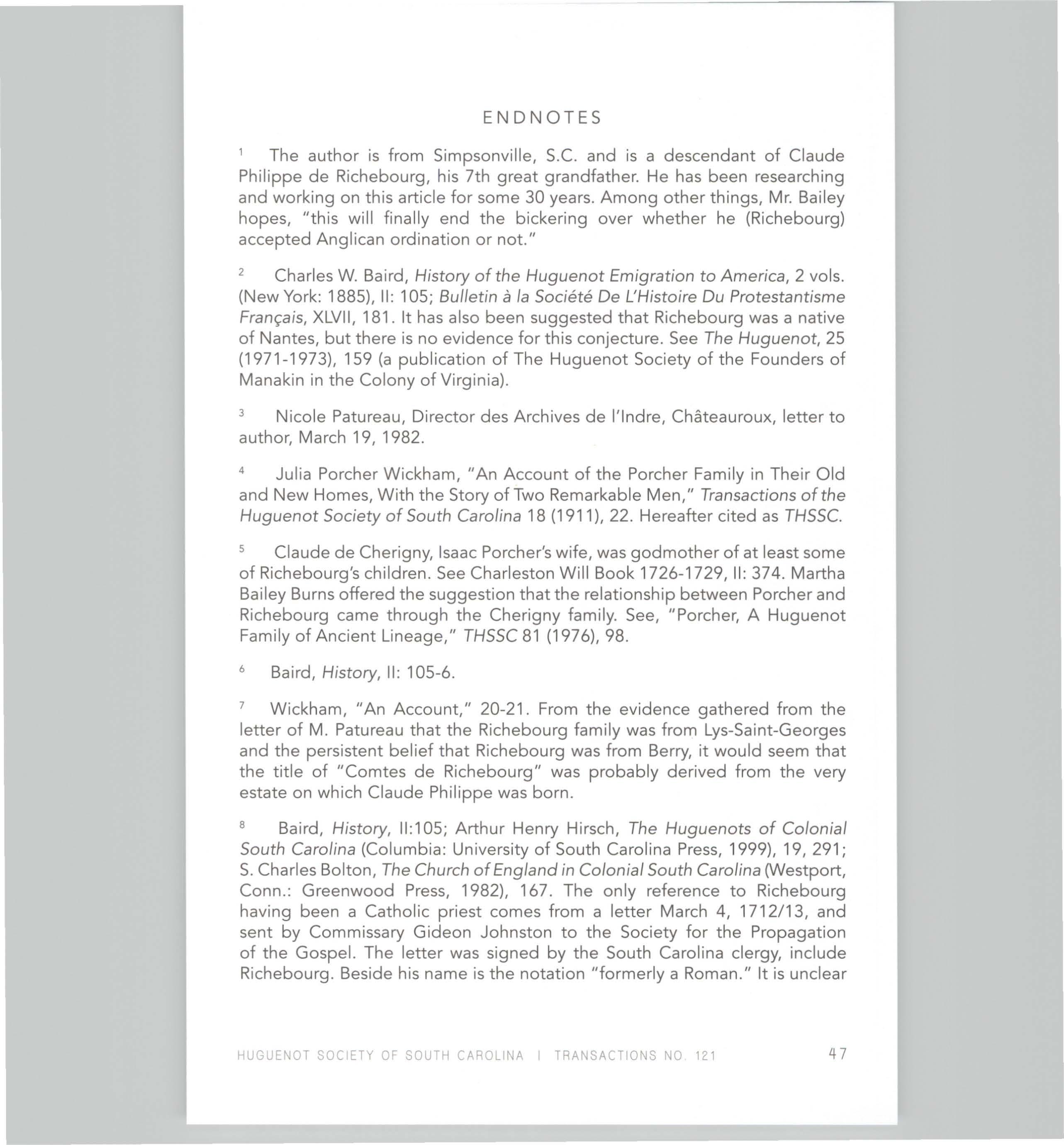
The author is from Simpsonville, S.C. and is a descendant of Claude Philippe de Richebourg, his 7th great grandfather. He has been researching and working on this article for some 30 years. Among other things, Mr. Bailey hopes, "this will finally end the bickering over whether he (Richebourg) accepted Anglican ordination or not."
2 Charles W. Baird, History of the Huguenot Emigration to America, 2 vols. (New York: 1885), II: 105; Bulletin a la Societe De L'Histoire Du Protestantisme Franr;ais, XLVI I, 181. It has also been suggested that Richebourg was a native of Nantes, but there is no evidence for this conjecture. See The Huguenot, 25 (1971-1973), 159 (a publication of The Huguenot Society of the Founders of Manakin in the Colony of Virginia).
3 Nicole Patureau, Director des Archives de l'lndre, Chateauroux, letter to author, March 19, 1982.
4 Julia Porcher Wickham, "An Account of the Porcher Family in Their Old and New Homes, With the Story of Two Remarkable Men," Transactions of the Huguenot Society of South Carolina 18 (1911), 22. Hereafter cited as THSSC.
5 Claude de Cherigny, Isaac Porcher's wife, was godmother of at least some of Richebourg's children. See Charleston Will Book 1726-1729, II: 374. Martha Bailey Burns offered the suggestion that the relationship between Porcher and Richebourg came through the Cherigny family. See, "Porcher, A Huguenot Family of Ancient Lineage," THSSC 81 (1976), 98.
6 Baird, History, II: 105-6. Wickham, "An Account," 20-21. From the evidence gathered from the letter of M. Patureau that the Richebourg family was from Lys-Saint-Georges and the persistent belief that Richebourg was from Berry, it would seem that the title of "Comtes de Richebourg" was probably derived from the very estate on which Claude Philippe was born.
8 Baird, History, 11:105; Arthur Henry Hirsch, The Huguenots of Colonial South Carolina (Columbia: University of South Carolina Press, 1999), 19, 291; S. Charles Bolton, The Church of England in Colonial South Carolina (Westport, Conn.: Greenwood Press, 1982), 167. The only reference to Richebourg having been a Catholic priest comes from a letter March 4, 1712/13, and sent by Commissary Gideon Johnston to the Society for the Propagation of the Gospel. The letter was signed by the South Carolina clergy, include Richebourg. Beside his name is the notation "formerly a Roman." It is unclear
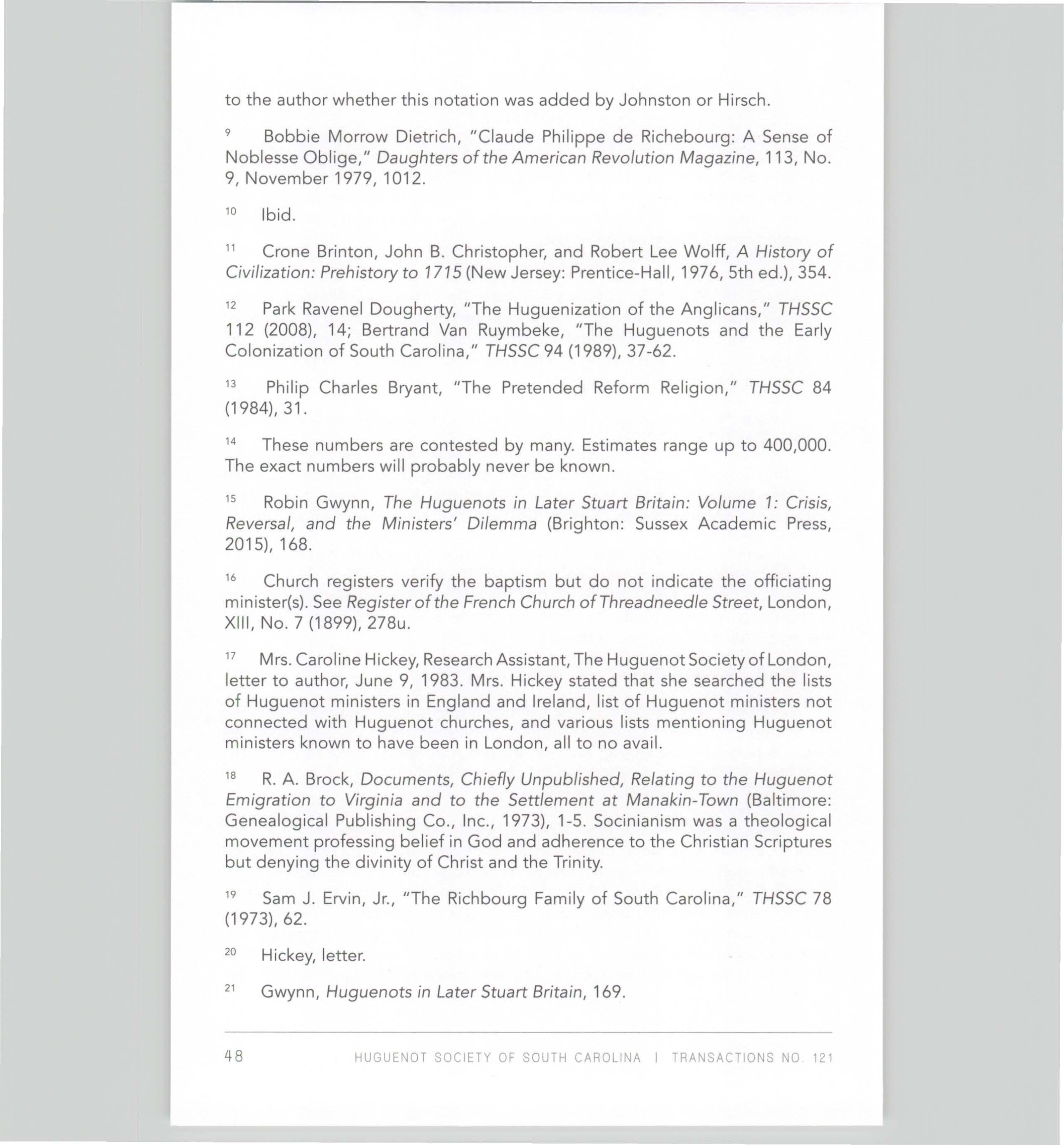
to the author whether this notation was added by Johnston or Hirsch.
9 Bobbie Morrow Dietrich, "Claude Philippe de Richebourg: A Sense of Noblesse Oblige," Daughters of the American Revolution Magazine, 113, No. 9, November 1979, 1012.
10 Ibid.
11 Crone Brinton, John B. Christopher, and Robert Lee Wolff, A History of Civilization: Prehistory to 1715 (New Jersey: Prentice-Hall, 197 6, 5th ed.), 354.
12 Park Ravenel Dougherty, "The Huguenization of the Anglicans," THSSC 112 (2008), 14; Bertrand Van Ruymbeke, "The Huguenots and the Early Colonization of South Carolina," THSSC 94 (1989), 37-62.
13 Philip Charles Bryant, "The Pretended Reform Religion," THSSC 84 (1984), 31.
14 These numbers are contested by many. Estimates range up to 400,000. The exact numbers will probably never be known.
15 Robin Gwynn, The Huguenots in Later Stuart Britain: Volume 1: Crisis, Reversal, and the Ministers' Dilemma (Brighton: Sussex Academic Press, 2015), 168.
16 Church registers verify the baptism but do not indicate the officiating minister(s). See Register of the French Church of Threadneedle Street, London, XIII, No. 7 (1899), 278u.
17 Mrs. Caroline Hickey, Research Assistant, The Huguenot Society of London, letter to author, June 9, 1983. Mrs. Hickey stated that she searched the lists of Huguenot ministers in England and Ireland, list of Huguenot ministers not connected with Huguenot churches, and various lists mentioning Huguenot ministers known to have been in London, all to no avail.
18 R. A. Brock, Documents, Chiefly Unpublished, Relating to the Huguenot Emigration to Virginia and to the Settlement at Manakin-Town (Baltimore: Genealogical Publishing Co., Inc., 1973), 1-5. Socinianism was a theological movement professing belief in God and adherence to the Christian Scriptures but denying the divinity of Christ and the Trinity.
19 Sam J. Ervin, Jr., "The Richbourg Family of South Carolina," THSSC 78 (1973), 62.
20 Hickey, letter.
21 Gwynn, Huguenots in Later Stuart Britain, 169.
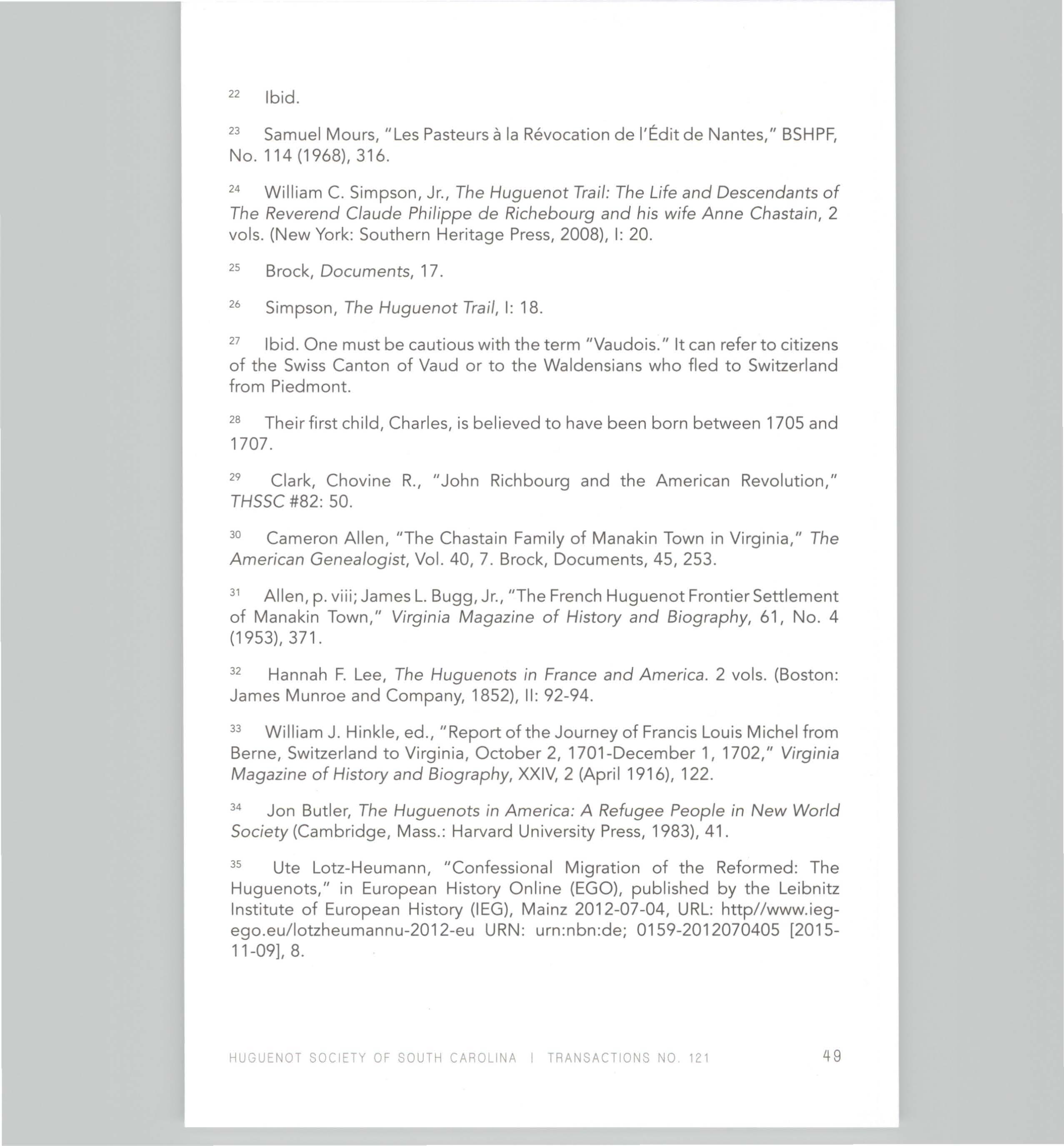
22 Ibid.
23 Samuel Mours, "Les Pasteurs a la Revocation de l'Edit de Nantes," BSHPF, No. 114 (1968), 316.
24 William C. Simpson, Jr., The Huguenot Trail: The Life and Descendants of The Reverend Claude Philippe de Richebourg and his wife Anne Chastain, 2 vols. (New York: Southern Heritage Press, 2008), I: 20.
25 Brock, Documents, 17.
26 Simpson, The Huguenot Trail, I: 18.
27 Ibid. One must be cautious with the term "Vaudois." It can refer to citizens of the Swiss Canton of Vaud or to the Waldensians who fled to Switzerland from Piedmont.
28 Their first child, Charles, is believed to have been born between 1705 and 1707.
29 Clark, Chovine R., "John Richbourg and the American Revolution," THSSC #82: 50.
3° Cameron Allen, "The Chastain Family of Manakin Town in Virginia," The American Genealogist, Vol. 40, 7. Brock, Documents, 45, 253.
31 Allen, p. viii; James L. Bugg, Jr., "The French Huguenot Frontier Settlement of Manakin Town," Virginia Magazine of History and Biography, 61, No. 4 (1953), 371.
32 Hannah F. Lee, The Huguenots in France and America. 2 vols. (Boston: James Munroe and Company, 1852), II: 92-94.
33 William J. Hinkle, ed., "Report of the Journey of Francis Louis Michel from Berne, Switzerland to Virginia, October 2, 1701-December 1, 1702," Virginia Magazine of History and Biography, XXIV, 2 (April 1916), 122.
34 Jon Butler, The Huguenots in America: A Refugee People in New World Society (Cambridge, Mass.: Harvard University Press, 1983), 41.
35 Ute Lotz-Heumann, "Confessional Migration of the Reformed: The Huguenots," in European History Online (EGO), published by the Leibnitz Institute of European History (IEG), Mainz 2012-07-04, URL: http//www.iegego.eu/lotzheumannu-2012-eu URN: urn:nbn:de; 0159-2012070405 [201511-09], 8.
36 Ibid., 56-57.
37 Ibid., 58.
38 Ibid., 34.
39 Ibid.
40 Ibid., 35.
41 Bodleian Library, Rawlinson MS C 984, f. 213r. See Robin Gwynn, "Conformity, Non-Conformity and Huguenot Settlement in England in the Later Seventeenth Century," ed. Anne Duncan-Page, The Religious Culture of the Huguenots, 1660-1750 (Farnham: Ashgate Publishing, Ltd., 2008), 32-33, 38.
42
43
44 Butler, The Huguenots in America, 36. Ibid., 37.
Gwynn, "Conformity, Non-Conformity and Huguenot Settlement," 38.
45 Matthew Glazier, The Huguenot Soldiers of William of Orange and the Glorious Revolution of 1688: The Lions of Judah (Eastbourne: Sussex Academic Press, 2008), 118-19; see also Anne Duncan-Page, The Religious Culture of the Huguenots, 98-9.
46 Vivienne Larminie, "Exile, Integration and European Perspective: Huguenots in the Pays De Vaud," ed. David J.B. Trim, The Huguenots: History and Memory in Transnational Context: Essays in Honour and Memory of Walter C. Ult (Leiden: Brill, 2010), 241.
47 Ibid., 242, (Larminie has 45,000); Phil Orchard, A Right to Flee: Refugees, States, and the Construction of International Cooperation (New York: Cambridge University Press, 2014), 62, (Orchard states 60,000).
48
49 so
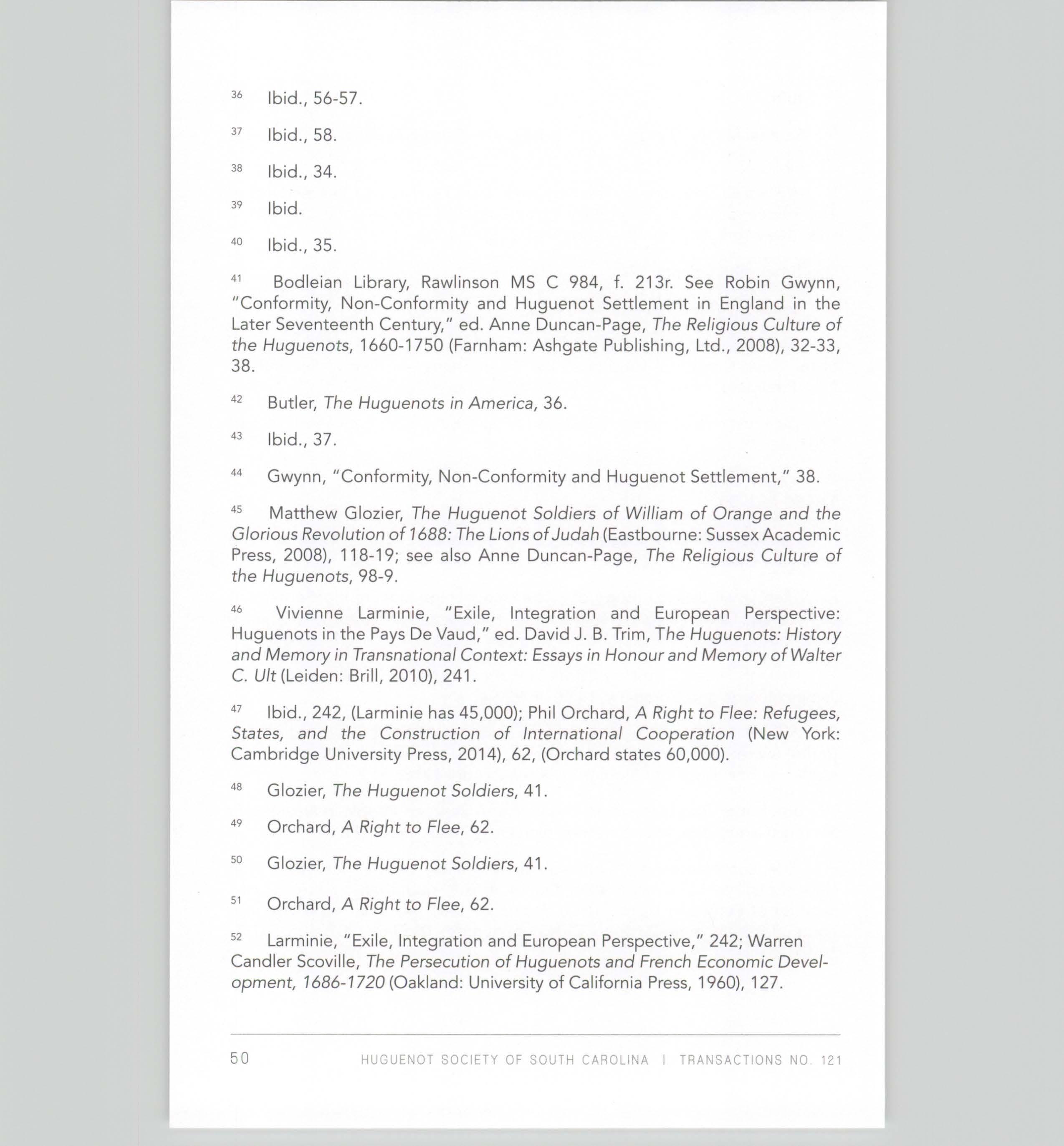
Orchard, A Right to Flee, 62.
Glazier, The Huguenot Soldiers, 41.
51 Glazier, The Huguenot Soldiers, 41.
Orchard, A Right to Flee, 62.
52 Larminie, "Exile, Integration and European Perspective," 242; Warren Candler Scoville, The Persecution of Huguenots and French Economic Development, 1686-1720 (Oakland: University of California Press, 1960), 127.
50 HUGUENOT SOCIETY OF SOUTH CAROLINA I TRANSACTIONS NO 121
53
54
55
56 Larminie, "Exile, Integration and European Perspective," 242. Gwynn, Huguenots in Later Stuart Britain, 175.
Bibliotheque de Geneva, Archives Tronchin 54, 24 Oct. 1687.
Lotz-Heumann, "Confessional Migration," 11.
57 Jonathan Steinberg, Why Switzerland? (New York: Cambridge University Press, 1996), 35.
58 Ibid., 243; Orchard, A Right to Flee, 62; Lotz-Heumann, "Confessional Migration," 7.
59 Lotz-Heumann, "Confessional Migration," 7.
60 David E. Lambert, The Protestant International and the Huguenot Migration to Virginia (New York: Peter Land, 2010), 41.
61 Ibid., 54-74.
62 Ibid., 48-49.
63 Ibid., 24.
64 Ibid., 82-83.
65 Dr. Daniel Coxe was a physician (reportedly to Charles II and Queen Anne) and a member of the Royal Society. He was also titular governor of the proprietorship of West New Jersey. He purchased the Carolana grant in June 1696. Coxe had previously sent Huguenots to Cape May, NJ in an unsuccessful attempt to establish a colony there. See James P. Hand, "Doctor Coxe and the Cape May Huguenots," TH SSC 115 (2011 ), 21-38. Waller had been a member of Parliament. He was staunchly anti-Catholic and a supporter of the Huguenot refugees, having been a member of the invasion force of William of Orange. He died on July 18, 1699, before the Manakin Town settlement. De la Muce was a staunch Protestant who was, after the Revocation in 1685, imprisoned by Louis XIV for refusing to convert to Catholicism. He was then, along with other "confessors" expelled from France and abandoned on the English coast. De la Muce was listed as a Gentleman Usher of the Privy Chamber of Queen Mary.
66 Lambert, The Protestant International, 89.
67 Baird, History, II: 176-77, 180; Brock, Documents, viii-ix, 71-73, 25152; Butler, The Huguenots in America, 217-18.
68 Lambert, The Protestant International, 105.
69 This Mr. Reboulet was most likely the Daniel Reboulet who in 1688 unsuccessfully requested that the United Provinces sponsor a group of Huguenots to the Cape of Good Hope.
70
71
72 Lambert, The Protestant International, 98. Ibid., 99.
Brock, Documents, 17.
73 Alexandre de Cham brier, Henry de Mirmand et /es Refugies de la Revocation de /'Edit de Nantes, 1650-1721 (Neuchatel: Attinger Freres, 1910), 215 n3.
74 Nathaniel Weiss, "Le Mirage de la Floride (1698-1699)," BSHPF,39 (1890), 141-42.
75
76 Lambert, The Protestant International, 106-8. Ibid., 109.
77 Baird, History, 11:176;Brock, Documents, viii; William Stevens Perry, ed., Historical Collections Relating to the American Colonial Church, 5 vols. (New York: AMS Press, 1969), 1:113-15; Charles Weiss, History of the French Protestant Refugees, trans., Henry William Herbert, 2 vols. (New York: 1854), 1:258; Joan R. Gundersen, "The Huguenot Church at Manakin in Virginia 17001750," paper presented to the 1978 Northern Great Plains History Conference.
78 LMA [London Metropolitan Archives], MS 9535/3, 96, referenced in Gwynn, Huguenots in Later Stuart Britain, 387.
79 Baird, History, II: 176-77; Lambert, The Protestant International, 1234.
80 Leslie Tobias, "Manakin Town: The Development and Demise of a Protestant Refugee Community in Colonial Virginia" (Master's thesis, College of William and Mary, 1982), 20.
81 This is the first record indicating his marriage. Her purported father or possibly brother, Estienne Chastain was also a passenger on the Mary and Ann.
82 Brock, Documents, 251; Lambert, The Protestant International, 136.
83 Brock, Documents, ix. The Manakin, or Monocan, Tribe once resided from the falls of the James to the settlement known as Mana kin Town.
52 HUGUENOT SOCIETY OF SOUTH CAROLINA I TRANSACTIONS NO. 121
84 Henry R. Mcilwaine and Wilmer L. Hall, eds., Executive Journals of the Council of Colonial Virginia (Richmond: The Virginia State Library, 1927), II: 101-2. Hereafter cited as EJC.
85 Brock, Documents, 251-52. "[S]o we thought it would be best for them to go to a place about twenty miles above the Falls of James River.... There is a great deal of good Land and unpatented, where they may at present be all together, w'ch we thought would be best for his MaUes]ty's Service and Interests, and that they would be a strengthening to the Frontiers."
86 Brock, Documents, 6-7, 54; Bugg, "Settlement of Manakin Town," 363.
87 Bugg, "Settlement of Manakin Town," 355; Gundersen, "Huguenot Church at Manakin," 3.
88 Gundersen, "Huguenot Church at Manakin," 3; Christopher E. Hendricks, The Backcountry Towns of Colonial Virginia (Knoxville: University of Tennessee Press, 2006), 60.
89
90 91
92
93 EJC, December 23, 1700, 122-23.
Hendricks, The Backcountry Towns, 60-61. Brock, Documents, 21.
Gundersen, "Huguenot Church at Manakin," 3. Brock, Documents, 49-52, 54-9.
94 The name of this third ship is unknown as well as the total numbers of passengers.
95 James Luckin Bugg, Jr., "Manakin Town in Virginia," The Huguenot, No. 25 (1971-1973), 5.
96
97
98
99 Ibid. Brock, Documents, 25.
Hirsch, Huguenots of Colonial South Carolina, 19. Brock, Documents, 21.
100 Elmer L. Puryear, "The Huguenots of the Upper South," THSSC 66 (1961), 8. There was supposedly a plan for 5,000 acres on the south side of the river to be named "Calais" and 5,000 on the north side named "Dover".
101 John K. Nelson, A Blessed Company: Parishes, Pastors, and Parishio-
ners in Anglican Virginia, 1660-1776 (Chapel Hill: University of North Carolina Press, 2001), 97.
102 Gundersen, "Huguenot Church at Manakin," 6-7. Acculturation is the process of inter-cultural borrowing marked by the continuous transmission of traits and elements between diverse peoples and resulting in new and blended patterns.
103 Ibid.
104 Butler, The Huguenots in America, 219-20. Perry, Historical Collections, I: 114.
105 Latane, the second official minister to Manakin Town, was ordained by Bishop Compton a deacon on September 22, 1700 [LMA, MS 9535/3, 98-99] and as priest on October 18, 1700 [LMA, MS 10,326/303].
106 Benjamin de Joux was born about 1637 in the Vaudois part of Dauphine province. He served Reformed churches throughout Dauphine and later in Lyons and removed to Switzerland in consequence of the Revocation of the Edict of Nantes. Joux traveled extensively between Switzerland, Holland, and England from about the late 1680s to 1700. He knew Sailly which may have influenced his appointment as an official minister to Manakin Town. He was ordained by Bishop Compton as deacon and priest in June 1700 [LMA, MS 9535/3, 97]. Brock, Documents, 55 (" About two months after the first embarquement, there departed a second, bound to the same place, consisting of about 150 Refugees, among whom was Monsieur De Joux, sent along with them to exercise his pastoral! function as Minister of all ye s[ai]d Colony, and who for that end was admitted into holy orders by my Lord Bishop of London.").
107 Robert L. Crewdson, "The Manakin Experiment: A French Protestant Colony in the New World," Historical Magazine of the Protestant Episcopal Church, 55, No. 3 (Sept. 1986), 204; Lambert, The Protestant International, 126.
108
111
Bugg, "French Huguenot Frontier Settlement," 369.
EJC: August 3, 1669-April 27, 1705, 11:227.
Brock, Documents, 25.
Crewdson, "The Manakin Experiment," 207.
112 Brock, Documents, 46. Bugg, "French Huguenot Frontier Settlement," 369.
113 Brock, Documents, 25, 28. Hirsch, Huguenots of Colonial South Carolina, 19.
114 Crewdson, "The Manakin Experiment," 207.
115 Brock, Documents, 44; Lyon B. Tyler, ed., Tyler's Quarterly Historical and Genealogical Magazine, Vol. V (1924): 176.
116 Gundersen, "Huguenot Church at Manakin," 5.
117 Ibid., 5; Bugg, "French Huguenot Frontier Settlement," 383-85. One of those chosen to serve as a magistrate was Estienne Chastain.
118 Gundersen, "Huguenot Church at Manakin," 5.
119 William Waller Hening, The Statutes at Large, Being a Collection of All the Laws of Virginia, (Philadelphia: Thomas Desilva, 1823), 380.
120 Bugg, "French Huguenot Frontier Settlement," 380.
121 Mcilwaine, Leg. Jour. of Council, 1:387; John P. Kennedy and Henry R. Mcilwaine, eds., Journals of the House of Burgesses of Virginia, 1619-1776, (Richmond, 1905-1915), 11:21;Hening, Statutes at Large, 111:228;Noel W. Sainsbury, Calendar of State Papers: Colonial Series, America and the West Indies, 1574-1718, (London, 1860-1939), XXl:311.
122
123
124 Bugg, "French Huguenot Frontier Settlement," 381. Jour. of the H. of B., 1702-1712, 53.
Bugg, "French Huguenot Frontier Settlement," 381.
125 Jour. of the H. of B., 1702-1712, 53, 104; Leg. Jour. of the Council, I: 396.
126 EJC, 227-28. The Council ordered that goods which could not be evenly distributed among the settlers be sold and with the profits that Cattle and livestock be purchased for them.
127 Brock, Documents, ix.
128 Jewel L. Spangler, Virginia Reborn: Anglican Monopoly, Evangelical Dissent, and the Rise of the Baptists in the Late Eighteenth Century (Charlottesville: The University of Virginia Press, 2008), 13.
129 Ibid., 14.
130 Ibid. As has previously been shown, both de Joux and de Richebourg were able to produce this certificate.
131 Ibid.
132 Jacob M. Blosser, "Pursuing Happiness: Cultural Discourses and Popular Religion in Anglican Virginia, 1700-1770," (PhD diss., University of South Carolina, 2006), 61.
133
134
135 Spangler, Virginia Reborn, 14.
Ibid., 14-15.
Gundersen, "Huguenot Church at Manakin," 7.
136 Rev. James Blair (1660-1743) was appointed Commissary in 1689. He was president of the Council of Virginia and one the founders and first president of William and Mary College. Minutes of Council of Virginia, 15 July 1702, CSPC, #760, 472; EJC, II: 261.
137 Minutes of Council of Virginia, 18 August 1702, CSPC, #855, 526; EJC, II: 269.
138
139
140
141
142
143 Nelson, A Blessed Company, 98.
Gundersen, "Huguenot Church at Manakin," 4. EJC, II: 179.
Ibid., 339. De Joux was dead by October 1, 1703.
Crewdson, "The Manakin Experiment," 207.
Lambert, The Protestant International, 165.
144 Ibid., 159. The last reference to de la Muce was a document dated March 10, 1701 that "ordered that the Marquis De la Muce, M. de Sailee and M. de Joux do render unto His Excellency and Council a true and perfect state of the affair of the French Refugees."
145
146 Ibid., 172. Ibid., 172.
147 G. Maclaren Brydon, "The Huguenots of Manakin Town," Virginia Magazine of Biography and History, 42 (1934): 325, 327.
148 Latitudinarian is to be tolerant of variations in religious opinion or doctrines.
149
150 58 Butler, The Huguenots in America, 16. Crewdson, "The Manakin Experiment," 204.
HUGUENOT SOCIETY OF SOUTH CAROLINA I TRANSACTIONS NO. 121
151 Minutes of Council of Virginia, 30 October 1707, EJC, Ill: 163.
152 EJC, II: 353. Abraham Salle was not an original member of the Manakin Town expedition, but came from New York where he had resided for several years.
153 Gundersen, "Huguenot Church at Manakin," 8-9; Joan R. Gundersen, "The Myth of the Independent Virginia Vestry," Historical Magazine of the Protestant Episcopal Church, XLIV (197 5): 133-141.
154 Gundersen, "Huguenot Church at Manakin," 9.
155 R.H. Fife, trans., "The Vestry Book of King William Parish, Virginia 1707-1750," Virginia Magazine of History and Biography, 11, No. 4 (Apr. 1904): 427. Minutes of March 27, 1707 inserted following minutes of November 21, 1711.
156
157
158 Gundersen, "Huguenot Church at Manakin," 9. Crewdson, "The Manakin Experiment," 209.
Tobias, "Manakin Town," 15.
159 Fife, "Vestry Book," 427. Minutes of March 27, 1707, inserted following minutes of November 21, 1711.
160
161
162
163
164 Ibid. Brock, Documents, 69.
EJC, April, 22, 1707, 143.
Ibid.
Ibid.
165 Hannah F. Lee, The Huguenot in France and America, 2 vols. (Boston: James Munroe and Company, 1852), II: 92-94.
166
167
168
169 Brock, Documents, 69-70.
Ibid.
EJC, Ill: 153-54.
Ibid., 162-63.
17° Francis L. Hawks, History of North Carolina, 1663-1729, 2 vols. (Fayetteville: E. J. Hale & Son, 1858; reprint ed., Spartanburg: The Reprint Company, 1969), II: 85,518.
171 John Lawson, A New Voyage to Carolina, Hugh Lefler, ed. (London, 1709; reprint ed., Chapel Hill: University of North Carolina Press, 1967), 11920.
172 173 Ibid., 90.
EJC, Ill: 222.
174 Louis B. Wright and Marion Tin ling, eds., The Secret Diary of William Byrd of Westover 1709-1712 (The Dietz Press, 1941), 33.
175 176
182
183
Ibid., 83.
Ibid., 96.
EJC, Ill: 225.
Wright and Tinling, Secret Diary, 234.
Fife, "Vestry Book," 298-9. Minutes of October 3, 1710.
Ibid.
Nelson, A Blessed Company, 11-12.
Ibid., 15.
Ibid., 12.
184 Philip Bruce, Institutional History of Virginia in the Seventeenth Century: An Inquiry into the Religious, Moral, and Educational, Legal, Military, and Political Condition of the People Based on Original and Contemporaneous Records (New York: G. P. Putnam's Sons, 1910), 63-64.
185 186 Brock, Documents, 71-73.
EJC, Ill: 311.
187 Fife, "Vestry Book," 300. Richebourg wrote, "We, the undersigned, minister and clerk of the parish of King William, acknowledge having received from the church wardens of the said parish the payment for forty-five pounds, due us for our services for the year 1710, each for the portion which falls to him, namely forty-one pounds for Mr. Phillippe, minister, and four pounds for Mr. Reynaud, clerk. In testimony of which we have signed the 3 of March, 1711."
188 Ibid. "The vestry assembled the 30 of June, 1711, Mr. Cairon, minister, being present."
189 Wright and Tinling, Secret Diary, 349.
190 Wright and Tin ling, Secret Diary, 351. The Rev. Charles Anderson was minister of Westover Parish. The Rev. William Finney was minister of Henrico Parish and the Rev. William Brodie was minister of St. Peter's Parish, New Kent, Virginia.
191 Ibid.
192 Ibid., 352.
193 Fife, "Vestry Book," 426. "J'ay recu des Church Wardens de la Paroisse du Roy Guillaume la somme de vingt et une pieces huit shilings deux sols qui mestoient deub par la d. paroisse, tant p. cinq mois et demy de mon ministere que pou. frais, dont je les tients quitte fait a monocantown ce 21 e 9bre, 1711."
194 Ibid., 373.
195 Gundersen, "Huguenot Church at Manakin," 10; Lambert, The Protestant International, 173.
196 Gundersen, "Huguenot Church at Manakin," 15.
197 Edward L. Bond, Spreading the Gospel in Colonial Virginia: Sermons and Devotional Writings (Lanham, MD.: Lexington Books, 2004), 29.
198 Walter H. Conser and Robert J. Cain, Presbyterians in North Carolina: Race, Politics, and Religious Identity in Historical Perspective (Knoxville: University of Tennessee Press, 2011 ), 2; Hugh T. Lefler and William S. Powell, Colonial North Carolina, A History (New York: Charles Scribner's Sons, 1973), 112.
199 Herbert R. Paschal, Jr., A History of Colonial Bath (Raleigh: Edwards & Broughton Co., 1955), 4-5.
200
201
202
203
204 Ibid., 4. Lawson, New Voyage, 119-20.
Ibid., 119.
Ibid., 119-20.
Ibid., 90.
205 Alonzo Thomas Dill, Jr., "Eighteenth Century New Bern: A History of the Town and Craven County, 1700, 1800," Part 1, "Colonization of the Neuse," North Carolina Historical Review, 22, No. 1 (January 1945), 20.
206 Ibid., 20; Brock, Documents, 22. "Liste des Personnes du Second Convoy Oui Serent Toute L'Annee a Manicanton." Puryear, "The Huguenots of the Upper South," 1O; Land Grant Records, I: 156. The bounds give no indication as to the location of the tract.
207 Baudry is recorded as selling land in Perquimans Precinct in 1706. Colonial Land Records, I: 653-54.
208
209
210
211 Dill, "Colonization of the Neuse," 20.
Puryear, "Huguenots of the Upper South," 10.
Lefler, Colonial North Carolina, 55.
Paschal, A History of Colonial Bath, 5.
212 William Gordon, "Letter to the Secretary," Colonial Records of North Carolina (Washington: Government Printing Office), 714.
213
214 215 Dill, "Colonization of the Neuse," 20.
Conser and Cain, Presbyterians in North Carolina, 2.
Dill, "Colonization of the Neuse," 21.
216 Ibid. Von Graffenried wrote of the founding of New Bern in English, French, and German editions, all varying slightly.
217 G. D. Bernheim, History of the German Settlements and of the Lutheran Church in North and South Carolina (Philadelphia: Sherman & Company, 1872; reprint ed., Spartanburg: The Reprint Company, 1974), 73-7 4.
218
Dill, "Colonization of the Neuse," 21.
Ibid.
Simpson, The Huguenot Trail, I: 48, 51.
Brock, Documents, 45-48.
Ibid., 42-44.
Ibid. Hinkle, "Journey of Francis Louis Michel," 122-24.
Brock, Documents, 112-15.
225 Fife, "Vestry Book," 296, 302. Tithables were persons assessed for taxation and included only men and boys over nineteen years of age and all slaves, both male and female, over that age.
226 Francis Le Jau, "Letter to the Secretary," dated August 19, 1712 in The Carolina Chronicle of Dr. Francis Le Jau, 1706-1717, Frank J. Klingberg, ed. (Berkeley: University of California Press, 1956), 118.
227 Ibid.
228 Gignilliat was from Berne, Switzerland. He was ordained deacon and priest by Bishop Compton in October 1709 [LMA, MSS 10, 326/39 and 9535/3].
229 Dr. Francis Le Jau (1665-1717), son of Huguenot parents, fled France after the Revocation. After removing to England, he was ordained into the Church of England. Sometime before 1700 he was a Canon at St. Paul's Cathedral in London. The S.P.G. sent him to South Carolina in 1706 where he remained until his death. He served the parish of St. James Goose Creek.
230 Bertrand Van Ruymbeke, From New Babylon to Eden: The Huguenot Migration to Colonial South Carolina (Columbia: University of South Carolina Press, 2006), 134.
231 Ibid.
232 Susan Baldwin Bates and Harriott Cheves Leland, French Santee: A Huguenot Settlement in Colonial South Carolina (Baltimore: Otter Bay Books, 2015), 291.
233 Ibid.
234 Le Jau, "Letter to the Secretary," 118.
235 Sam J. Ervin, Jr., "The Richbourg Family of South Carolina," THSSC 78 (1973), 65.
236 David Duncan Wallace, South Carolina: A Short History 1520-1948 (Chapel Hill: University of North Carolina Press, 1951; reprint ed., Columbia: University of South Carolina Press, 1969), 62.
237
238
239 Hirsch, Huguenots of Colonial South Carolina, 138.
Wallace, South Carolina, 64.
John S. Coussons, "The Huguenot Spirit," THSSC 83 (1978), 5.
240 Hirsch, Huguenots of Colonial South Carolina, 117; Butler, The Huguenots in America, 103. Wallace vigorously denies this was the work of the Dissenters. See Wallace, South Carolina, 65.
241 Coussons, "The Huguenot Spirit," 5.
242 Ibid., 6.
243 Wallace, South Carolina, 64.
244 Ruymbeke, From New Babylon to Eden, 97-98.
245 Robert M. Kingdon, "Why Did the Huguenot Refugees in the American Colonies Become Episcopalians?" Historical Magazine of the Protestant Episcopal Church, 49 (1980), 317-35.
246
247
248 Ruymbeke, From New Babylon to Eden, 98-99.
Butler, The Huguenots in America, 95-6, 100.
Ruymbeke, From New Babylon to Eden, 131.
249 Frederick Dalcho, The Protestant Episcopal Church in South Carolina 1670-1820 (Charleston: E. Thayer, 1820; reprint ed., Arno Press Inc., 1970), 295.
250 A. S. Salley, ed., Journal of the Commons House of Assembly [1706) (Columbia:, 1937), 41; Butler, The Huguenots in America, 115.
251
252
253
254 Howe, History of the Presbyterian Church, I: 169.
Ibid.
Ruymbeke, From New Babylon to Eden, 131.
Howe, History of the Presbyterian Church, 167.
255 Thomas 0. Lawton, Jr., "A Tribute to Pasteur Pierre Robert in the 300th Anniversary of His Ordination to the Ministry," THSSC 87 (1982), 7.
256 Dalcho, The Protestant Episcopal Church, 295.
257 Lawton, "Pasteur Pierre Robert," 8. Rector was the official title of an episcopally ordained minister in the Church of England.
258 Florent-Philippe Trouillart (1641-1712) was never re-ordained as an Anglican.
259 Ruymbeke, From New Babylon to Eden, 134; Hirsch, Huguenots of Colonial South Carolina, 133.
260 261 262 82
Ruymbeke, From New Babylon to Eden, 134.
Howe, History of the Presbyterian Church, I: 151-52.
Hirsch, Huguenots of Colonial South Carolina, 133.
263
264 Ibid., 300-1; Ruymbeke, From New Babylon to Eden, 134. Hirsch, Huguenots of Colonial South Carolina, 133-34.
265 Letter from Johnston to the Bishop of London, "The Present State of the Clergy of South Carolina, with respect to that part of the Church Discipline, which more immediately concerns themselves," in Hirsch, Huguenots of Colonial South Carolina, 300.
266 Margaret Simons Middleton, Henrietta Johnston of Charles Town, South Carolina: America's First Paste/list (Columbia: University of South Carolina Press, 1966), 32.
267 Letter from Johnston to the Bishop of London. Hirsch, Huguenots of Colonial South Carolina, 300-1.
268 Ruymbeke, From New Babylon to Eden, 135. Hirsch, Huguenots of Colonial South Carolina, 302.
269
270
271
272 Letter to Commissary Johnston. Klingberg, Dr. Francis Le Jau, 126.
Ibid.
Ruymbeke, From New Babylon to Eden, 135.
Ibid., 159; Bates and Leland, French Santee, 292.
273 Amy Friedlander, ed., "Commissary Johnston's Report, 1713," South Carolina Historical Magazine, 83 (1982), 271.
274
275
276
277
278 Ruymbeke, From New Babylon to Eden, 159.
Middleton, Henrietta Johnston, 31.
Ibid., 28.
Butler, The Huguenots in America, 116.
Ibid.
279 Jean La Pierre was ordained a deacon on December 21, 1707, and priest on February 23, 1708, by Bishop Compton [LMA, MS 9535/3].
280 Butler, The Huguenots in America, 117.
281 Letter from Le Jau to Johnston. Hirsh, Huguenots of Colonial South Carolina, 301.
282 Middleton, Henrietta Johnston, 32-33.
283 Letter from Johnston to the Bishop of London. Hirsh, Huguenots of Colonial South Carolina, 302-3.
284
285 Bolton, Southern Anglicanism, 35. Ibid., 90.
286 Catherine Cordes Porcher, comp., "Porcher, A Huguenot Family of Ancient Lineage," THSSC 81 (1976), 93.
287 Letter from Johnston to the Bishop of London. Hirsh, Huguenots of Colonial South Carolina, 302.
288
289
290 Ibid.
Bates and Leland, French Santee, 292.
Ruymbeke, From New Babylon to Eden, 135.
291 Bates and Leland, French Santee, 292. Ruymbeke, From New Babylon to Eden, 136.
292 Dalcho, The Protestant Episcopal Church, 296.
293 Bartholomew Gaillard, "Church Warden, on behalf of Himself and the Inhabitants of the Parish of St. James Santee v. Isaac Legrand Dunnerville," in Anne King Gregorie, ed., Records of the Court of Chancery of South Carolina, 1671-1779 (Washington: The American Historical Association, 1950), 240-43.
294 Ruymbeke, From New Babylon to Eden, 136.
295 Records of the Court of Commons Pleas, Judgment Rolls, Box 5 (1714-15), 1714, case #301, South Carolina Department of Archives and History.
296 Ibid.
297 Caroline T. Moore, ed., Abstracts of Records of the Secretary of the Province, 1692-1721 (Columbia: R. L. Bryan, 1978), 327. Memorandum: came before me Messrs. De Richebourg and La Batie [Bastie] and swore they did see Isaac Chovin sign within instrument in writing. - John Gaillard, 21 Feb.1715/6.
298
299 Dalcho, The Protestant Episcopal Church, 40.
Klingberg, Dr. Francis Le Jau, 183-84.
300 Alexander Hewatt, An Historical Account of the Rise and Progress of the Colonies of South Carolina and Georgia, 2 vols. (London: Alexander Donaldson, 1779; reprint ed., Spartanburg: The Reprint Company), I: 212-23.
See also Chapman J. Milling, Red Carolinians (Columbia: University of South Carolina Press, 1969), 135-64.
301 Dalcho, The Protestant Episcopal Church, 97.
302 Edgar Legare Pennington, "The South Carolina Indian War of 1715, as Seen by the Clergymen," The South Carolina Historical and Genealogical Magazine, Vol. 32,259.
303 Dalcho, The Protestant Episcopal Church, 98.
304 David Humphreys, Two Hundred Years of the S.P.G.: An Historical Account of the S.P.G. in Foreign Parts 1701-1900, 2 vols. (London: C. F. Pascoe, 1901 ), I: 18.
305 Edward McCrady, South Carolina Under the Proprietary Government 1670-1719(NewYork: McMillan, 1897), 339.
306
307
308 Pennington, "South Carolina Indian War," 263. Ibid. Ibid 262-63.
309 "A Short History of the Diocese of South Carolina," Publications of the Dalcho Historical Society of the Diocese of South Carolina (Charleston, 1953), 18.
310 Butler, The Huguenots in America, 116.
311 Frank J. Klingberg, Carolina Chronicle: The Papers of Commissary Gideon Johnston 1707-1716 (Berkeley: University of California Press, 1946), 167-69.
312
313
314 Ibid., 169. Hirsch, Huguenots of Colonial South Carolina, 53. Howe, History of the Presbyterian Church, I: 165.
315 Gregorie, Court of Chancery, 241; Records of the Court of Common Pleas, Judgment Rolls, Box 5 (1714-15), 1714, case #301, South Carolina Department of Archives and History.
316 Gregorie, Court of Chancery, 242.
317 Ruymbeke, From New Babylon to Eden, 136.
318 Caroline T. Moore and Agatha Aimar Simmons, eds., Abstracts of
Wills of the State of South Carolina 1670-1740(Columbia: R. L. Bryan Co., 1960), I: 60.
319 Frederick A. Porcher, "Historical and Social Sketch of Craven County, South Carolina," Southern Quarterly Review, April 1852, 100.
320 Ibid., 125 fn 1; Bates and Leland, French Santee, 138 fn 728.
321 George W. Williams, "Letters to The Bishop of London from the Commissaries in South Carolina," South Carolina Historical and Genealogical Magazine, 78 (1), 16.
322 Ibid., 20. The reference to de Richebourg being minister of St. Denis is obviously in error.
323 Howe, History of the Presbyterian Church, I: 167. Howe says the will was dated "Ouinzieme jour de Janvier, !'an mill sept cens dix-huit dix-neuf."
324 Middleton, Henrietta Johnston, 31; Hirsch, Huguenots of Colonial South Carolina, 77.
325 South Carolina Department of Archives and History, Memorials, Vol. 5, 88.
326 George W. Williams and Gene Waddell, eds., Letters from the Clergy of the Anglican Church in South Carolina 1696-1775 (Charleston: College of Charleston Library, 2008), 345.
327
328 Bates and Leland, French Santee, 294. Ibid.
329 Mesne Conveyance Records, Charleston County, Book K, 258; Porcher, "Porcher, A Huguenot Family," 98.
330 331 Porcher, "Porcher, A Huguenot Family," 98. Charleston Will Book 1726-1729, Vol. 2, 374.
332 Ibid., 297. Julianna Albertina Marinna was baptized by Albert Pouderous, minister at St. James Santee. On June 1, 1739, she requested that "such good Education as may be fitting until 21 years." Her sister Magdalen married Thomas Threadcraft July 15, 1745, in the Parish of St. Thomas and St. Denis.
333 Ibid., 295.
334 South Carolina Department of Archives and History, Memorials, Vol. 5, 88.
335 Janie Revill, Sumter District (Columbia: State Printing Company, 1968), 9.
336 For more information about them see Bates and Leland, French Santee, 295-7.
337 Simpson, The Huguenot Trail.
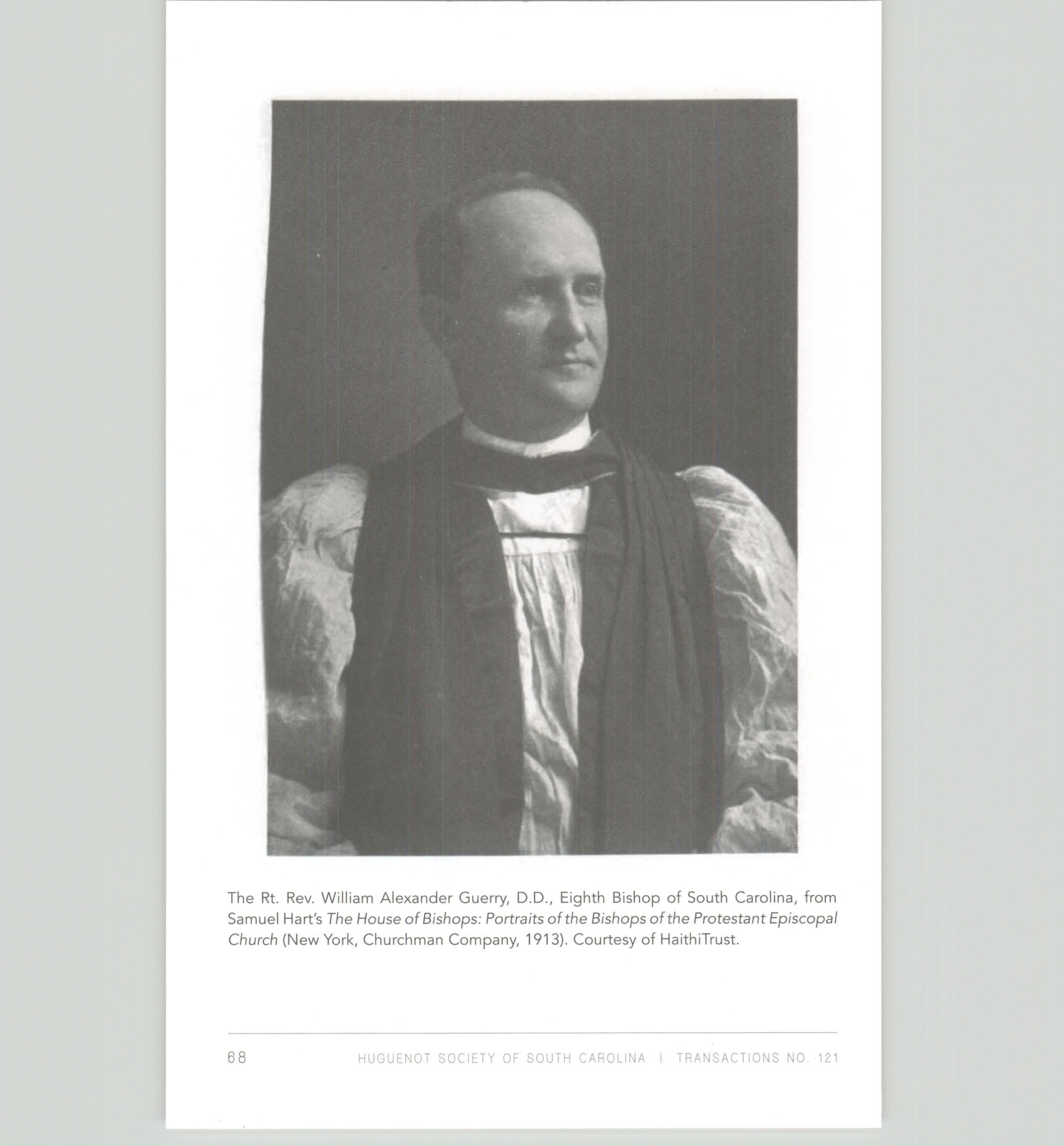
WILLIAMALEXANDERGUERRY1
Editor's Note: The following autobiography was written in 1918, shortly before Bishop Guerry left on a two-month trip to France under the auspices of the YMCA. While in France, he acted as a "special preacher" to the American soldiers stationed there during World War I. This sketch was taken from a typed copy of the memoir that was given to Society member Harold Guerry in 1958 by Edward B. Guerry, the Bishop's son. Edward B. Guerry later wrote a biography of his father titled A 20th Century Prophet: Being the Life and Thought of William Alexander Guerry, Eighth Bishop of South Carolina (Sewanee, TN: University Press of Sewanee, TN: 1976). This memoir was included in his book.
Minor editing was made to the original text for clarity. Added footnotes appear in italics to differentiate them from the footnotes that were included in the typed manuscript. Note that there are more in-depth footnotes in the version of the memoir published in A 20th Century Prophet.
I was born on July 7, 1861, at my maternal grandfather's summer home, "Pinegrove," situated in what was known as the "Sand-Hills" of Clarendon County, South Carolina. 2 These "Sand-Hills," which bordered on the rich alluvial lands lying along the north bank of the Santee River, were famous for their climate and healthfulness. It was here that the rich planters for many miles along the river lands were accustomed to gather during the summer months. They built themselves summer homes in these hills, and the neighborhood covering an area of four or five miles square was rather thickly settled with some of the oldest and best known families in the State. From this locality came six governors of South Carolina, the present governor [Richard Irvine Manning Ill] being among the number. He was born in the same county and neighborhood as myself, and not more than three miles distant from my birth place. 3
At the time of my birth my father was the rector of Mt. Zion Church, Eastover, South Carolina. It was in the rectory, still standing, of the parish church that my mother died in 1865. 4 I remember her quite distinctly, nor shall I ever forget the day when my father, taking me in his arms, carried me in her room where she was lying still and cold in death and bade me tell her goodbye. That scene is indelibly impressed upon my childish memory.
I have no recollection of the Civil War, except once when father sent my younger brother, LeGrand, and myself across the branch near the rectory to spend the night at Mr. Garden Clarkson's, and Mrs. Clarkson gave us children sassafras tea to drink. And once at my grandfather's house in Clarendon, I remember seeing my uncle, David Brailsford, who had just returned from the war, walking around on crutches. I do not know exactly how long father remained at Eastover, but I recall that we moved from there across the Wateree River into Sumter County about 1866 to a plantation called Lynwood near to St. Philip's Church, Bradford Springs, which was the burying ground of the Guerrys. In that graveyard rest the mortal remains of my grandfather, William Capers Guerry, his wife, Virginia Felder, and their children, John, Walter, Irene, Anna, and Virginia, the mother of Frederick and Walter Green. Also buried there was my younger brother, LeGrand Brailsford, who died at Florence about 1870. My mother is buried just in the rear of the Church at Eastover, and a marble slab marks the spot. I visited it when I was at Eastover last July and offered the prayer for All Saints' Day. My sister, Serena, named for her mother, was buried in the Brailsford enclosure in the graveyard of St. Mark's Church, Clarendon. There is no slab to mark the spot, but Uncle Moultrie Brailsford and Aunt Clara ought to be able to point it out.
Father must have lived at Lynwood for two years, during which time he held services at St. Philip's, Bradford Springs, and at Sumter. In 1868 my Uncle Walter Guerry, who had just come out of the war, been ordained deacon, and taken charge of the mission at Florence, South Carolina, died suddenly of typhoid fever. Father was called to succeed him. We went to live in Florence about 1868 or 1869. My father's family at that time consisted of my grandmother (my father's mother), my Aunt Irene Guerry, who afterwards married Edward H. Lucas of Florence, my sister Serena, my brother LeGrand, and me. Florence at that time was only a straggling railroad village, but being a railroad center it grew rapidly and gave promise even then of one day becoming a large town. In order to supplement his small salary, and for the support of his family, Father opened a day school in Florence, which soon grew into a flourishing parochial school and was well-attended. It was here that I had my first lessons in reading and writing, and the foundation of all that I subsequently learned was laid in this parochial school. During my father's stay in Florence he built the first Episcopal church and rectory. 5 These were days of great poverty and hardship. It was just after the war, the people were poor, and the salary was meagre, and as a consequence we all had to work and to help around the place. It was as a boy at Florence that I first learned to cut wood, an art that I have never ceased to practice and to enjoy. The first money I ever made was as a boy cutting wood, and with my earnings I bought a pair of red top boots. During these days of my early childhood and boyhood at Florence, the Negroes used to tell us children the most dreadful tales of the Kuklux. I had no very clear idea of what was meant, but if ever I was caught away from home at night I scurried
back for fear the Kuklux would catch me. It was while we were at Florence that my brother LeGrand died. 6 As I remember him, he was a strong and vigorous child, and the cause of his death has always been a mystery to me to this day.
It was about this time that I had an experience which left an impression upon my childish mind, that I recall now as having some bearing upon the modern study of Psychology and Telepathy. I had a very dear Aunt Lizzie, my mother's younger sister, who made a great pet of me after my mother's death, and to whom I was devotedly attached. 7 One morning, I remember it as vividly as though it were yesterday, I awoke in great distress of mind and told my father between sobs and tears that Aunt Lizzie was dead. I was inconsolable. At last my father, taking me aside into his room to comfort me, said, "My son, why do you think your Aunt Lizzie is dead? The last time we heard from her she was perfectly well, now, you must stop this crying; there is nothing the matter with your Aunt Lizzie." A few hours later he was handed a telegram telling him that Aunt Lizzie had died the day before and asking him to come over and read the funeral service. I shall never forget my father calling me aside, with the telegram in his hand, and saying, "My son, you know that you have been thinking all day that your Aunt Lizzie was dead. Well, she is dead, and here is a telegram asking me to come and bury her." I could not have been more than nine or ten years old at the time. The whole sad experience made a lasting impression on my mind, and not until in more recent years, when I have come to believe in the power of telepathy could I explain the occurrence.
It was while we lived in Florence that father married again. In 1872 he married Miss Julia Evans, of Columbus, Georgia, a younger sister of the wife of his oldest brother, Dr. William Guerry, who moved to Columbus, Georgia, to practice medicine prior to the Civil War. My half-brother, Dr. LeGrand Guerry, was born in the rectory at Florence in 1873. In 187 4 father was called back to his old parish at Sumter, South Carolina. There we lived for three years, and it was while I was a lad in Sumter, at the school of Miss Minnie Yeaden, that I had my first experience in the art of public declamation. During these years and throughout my early boyhood it was always my custom to visit my grandmother Brailsford and my uncles and aunts in Clarendon. 8 The family at that time lived at a place called "White Ponds." Those visits were the brightest spots in my young life. It was here that I first learned to ride a horse and to shoot a gun, and early acquired that taste for sports and all out-door games which has been so characteristic of my life ever since. These visits to Clarendon were eagerly looked forward to, and never a vacation came around but what I spent a portion of it with my mother's relatives at White Ponds or at Sherwood (Uncle Moultrie's place) and Panola (Uncle David's place). But I learned a good deal more on these visits than how to ride and shoot. My Uncle Edward, Colonel Edward B. Brailsford of the Palmetto Guards, was a most orderly and punctilious soldier. 9 He early impressed upon me the duty of neatness and the
importance of carefulness and attention to form and dress. My grandmother, whom everyone regarded as a saint, and whom the whole neighborhood loved and revered, used to read to me on Sunday afternoons out of the Bible and Prayer Book. She first put it into my mind to study for the ministry; and it was doubtless due to her influence and suggestion that while quite a young boy I used to stand upon a dry goods box in the back yard on Sunday afternoons and harangue the Negroes.
My father was also a man of a devout and earnest Christian spirit. Never a day passed in his house without family prayers. He was also a very earnest and, at times, moving preacher. He had a wonderfully rich and beautiful voice. His prayers and Christian example, together with my grandmother's influence and teaching, were among the most powerful religious forces shaping and molding my early life.
My paternal great-grandmother was Sarah Capers, a young sister of the celebrated Methodist Bishop Capers, the father of my esteemed predecessor in the Diocese of South Carolina. 1° From her by heredity, and from contact in childhood with certain devout and earnest members of the Methodist Church, I derived much of my early religious experience. The personal element in religion, and that mysticism which has played so large a part in the history of the Church, has never ceased to attract and profoundly influence me.
In 1876, the year which saw the overturning of the Carpet Bag Government in South Carolina, and the redemption of the State under General Wade Hampton, father moved to Summerville, South Carolina. It was in this eventful year that I first saw Hampton's red shirt brigade, by which order was maintained at the various political gatherings which were held at this time. I remember my Uncle Moultrie putting me on a mule and sending me around the neighborhood to summon the members of this red shirt brigade to report for duty at Sumter the next day. 11
While at Summerville, I made rapid progress in my studies under a Captain Thomas Parker, a Confederate Captain of the Artillery, who had a boys' school in the village. In 1877, due to the kinqness of some friends who refugeed in Summerville from the yellow fever epidemic which broke out in Charleston in 1876, my father was persuaded to send me to the Porter Academy in Charleston, at that time known as the Holy Communion Church Institute. There I came under the influence of two very remarkable but quite different men: one was the Rev. A. Toomer Porter, D. D., the head and founder of the institution; and the other was Mr. John Gadsden, my teacher in Latin and Greek and the beloved Superintendent of the school. I shall never forget Mr. Gadsden's Sunday night talks to the boys. They were wonderful, and made a profound impression upon every boy who was privileged to hear them. He would speak to us, not always on religious topics, but more frequently on matters of personal honor
and behavior. He sought always to instill into us the highest principles of Christian character, and of how a gentleman should conduct himself. We had such love and respect for him that every word he said fell on fruitful soil and in many cases brought fruit abundantly.
It was while I was at the Holy Communion Church Institute that I was confirmed when I was about seventeen years of age by Bishop Howe, along with a class of boys from the Academy.12 It was here also that I got my taste for literature and for reading, and first really learned how to study and to love my books. The school had an excellent library and every spare moment I had was spent in devouring Scott and Cooper and Gilmore Sims, etc. It was while I was a student at the H. C. C. I. that the Government of the United States turned over to Dr. Porter, and a Board of Trustees which he would appoint, the property known as the Arsenal. The school was accordingly moved to its new and larger surroundings about 1880 while I was a member of the institution. In March 1881 Dr. Porter gave me a Sewanee scholarship, and I was sent to the University of the South to complete my education. I was so well advanced in Latin and in some of my other studies that I was enabled by hard work to take my B. A. and M.A. degrees in three years.
During my last year at the Porter Academy I had taken a great interest in the work of the literary societies and had founded a rival society known as the Pi Gamma (Porter and Gadsden), so as to increase the interest and to arouse competition in the field of public speaking. I brought with me, therefore, to Sewanee, a keen interest in the work of the literary societies and a strong appreciation of their great educational value. I had no sooner become a student at Sewanee when I joined the Pi Omega Literacy society and from the very first took a deep interest in its proceedings. I attribute whatever success I have had as public speaker and writer as much to the influence of those literary societies as to any other factor that ever came into my life.
It was at Sewanee in the summer of 1881 that I won my first medal for declamation, and the following year brought my first success in oratory in a contest between the Sigma Epsilon and Pi Omega societies.
From the very first, Sewanee was destined to exercise a very deep and farreaching influence upon my life. And in those early college days there was no man whose lectures I enjoyed more or to whom I owe more of the ability to think things out for myself than to the Rev. William P. Du Bose, S. T. D., the beloved Professor at that time of Ethics and Christian Evidences. 13 What his life, example and teaching have meant to me is impossible to express here. He first taught me to love the truth and to seek it with my whole heart. To him I owe the philosophical and intellectual foundations of my religious belief; and what theology I have today I got from him when I sat under his instruction in the Theological Department. To me he has always seemed to embody and
to express more of the spirit, purpose, and ideals of Sewanee than any other living man. He combined in a wonderful way what is exceedingly rare, a deep and genuine mysticism, a true inward life and light of Christ in the soul, with a profound intellect which led him to search deep into the hidden things of God, and to believe that God in Christ was not only the truest and greatest good of humanity but the Highest Reason.
While at Sewanee my early love of sport soon took me to the athletic field. We had no gymnasium in those days of the summer session and the winter vacation. I joined the Hardee Baseball team, and with "Billy Nauts" as catcher and Bratton on first base and Alex Mitchell, whom the boys called "Clams," on third base, I pitched many a game in the annual series that we played with our rivals of the Sewanee Baseball team. It was not until later, about 1884 or 1885, that these two teams were combined and the series of intercollegiate contests, especially with our rival, Vanderbilt, began. I was privileged to pitch one of three intercollegiate games with Vanderbilt in 1886 (I was now in the Theological Department), but this was my last appearance in the box as we were badly beaten. On the return game, played a few weeks later at Sewanee, the late Dr. John Hodgson was the pitcher, and I played center field. It was on this occasion when Vanderbilt was ahead and we had two men on bases that I knocked the one and only home run that I ever made, and scored three runs, putting Sewanee ahead, and winning the game. I don't know how I happened to do it, unless it was due to the good training at the hands of a professional baseball coach that we had received since our defeat in Nashville, or whether it was due to the presence of a certain young lady who had come down with others from Fairmount College to witness the game, and who afterwards became my wife. 14
But my pen is in danger of running ahead of my story, and I must now retrace my steps to 1884 when I graduated from the Collegiate Department of the University. Besides my diplomas of graduation as Bachelor and Master of Arts, I also won the Master's Medal for Greek in this year, the special subject being Homer. The examination was conducted in part orally, with members of the faculty and visitors present. It lasted all day and was of the most grueling contest of the kind I have ever experienced. In 1884 I went to Charleston to teach in the Porter Military Academy, the name having been changed by action of the Trustees from the H. C. C. I. in honor of the great founder of the school. This year's experience in teaching and in handling the problem of discipline was of great value to me in later life.
It was while I was at Porter's that I definitely and finally made up my mind to study for the Ministry. I therefore returned to Sewanee in the summer of 1885 and entered the Theological Department. The following spring, I won the Intercollegiate Oratorical medal at Nashville, my subject being "The Future of
American Literature." It was a close and exciting contest. A young man named Bailey, afterwards Senator Bailey of Texas, who represented the Lebanon Law School, was my most dangerous rival, and the judges, I am sure, had a hard time deciding between us. 15 During the time I was a Theological student at Sewanee, I supported myself in large part by acting as assistant instructor in Latin. My Sundays I spent in visiting Calvary Mission, Rowark's Cove. It was here that I first learned to know and appreciate the Sewanee mountaineer for his true worth. I was a constant visitor in the homes of the people of Rowark's Cove. I taught their children in Sunday School and preached to them on Sunday, and when I left them in 1888 it was with very genuine regret. The little congregation gave me as a parting gift a handsome Oxford Bible with my name and the dates of my service printed on it, which I still have and value very highly.
But there was another event which happened during my connection with the Theological Department which was destined to exercise a very far reaching influence over my life, and which I must not forget to mention here. It was in the autumn of 1885 that I first saw my wife. She had come down to attend the wedding of my cousin McNeely DuBose to Rose Anderson and was entertained at St. Luke's Hall by the daughters of Dr. DuBose. 16 I was sitting at the table in the dining room of St. Luke's when I looked up and saw a lovely and beautiful young lady, dressed in a most becoming blue silk dress, which I still cherish as a precious possession of those early days. Upon inquiry I was told her name was Anne McBee, a sister of Silas McBee, the Principal of the school at Fairmount.17 I cannot now adequately describe or recall my sensations on seeing her. I am sure of one thing, that I was powerfully attracted to the young lady from the very first, and lost no time when dinner was over in seeking an introduction. Closer acquaintance did not efface but only enhanced the force of that first and most vivid impression. Our courtship began by my asking her to take a walk to one of Sewanee's famous views. This was followed by many visits to Fairmont. One thing which aided me in my suit was a remark that Dr. Du Bose made at the time to the effect that "Guerry never neglected his studies when he was making visits to Fairmount." He was throughout my friend and confidant.
I graduated in Theology in 1888 and was ordained Deacon that fall by Bishop Howe in Christ Church, Greenville, South Carolina. He sent me to Florence where my Uncle Walter and father had preceded me. 18 It seemed a strange reversal of fortune that after twenty years I should return to the home of my boyhood as the rector of the parish church. During 1888 and 1889 I built the present St. John's Church, Florence, and started a fund for a rectory.
On Wednesday, November 27, 1889, in St. Luke's Church, Lincolnton, North Carolina, I married Anne McBee, daughter of Vardry Alexander and Mary Elizabeth McBee. 19 My father and Dr. Whetmore officiated at the ceremony. I must
relate here one very amusing experience which took place in connection with my trip to get married. The baggage master at Florence, by some strange mistake, checked my trunk, containing my wedding suit, to Charleston. This suit had been made for me by Mr. Pillet, the celebrated Sewanee tailor who made clothes for all the boys in my day, however far away. I did not discover that the trunk was not on the train until we changed cars a few hours later at Sumter. Imagine my dismay when I realized the full significance of my misfortune. I confided my troubles to Captain Webb, the conductor on the A. C. L.,20 and from that time until we reached Columbia, he kept the wires hot. Just before leaving the train he told me the trunk had been located in Charleston and would follow me on the next train. But as there was only one train by which it could reach me in time for the wedding, you can well imagine that I spent a very anxious day in the bride's home at Lincolnton. Nor was my anxiety relieved until the night before the porter knocked on the front door and brought in the trunk. The joke was on me, as my friend and best man, the Rev. James G. Glass, had threatened to take my place at the wedding if my suit did not come in time.
The wedding service was most beautiful and impressive. The bride's brother, Dr. Vardry McBee, played the wedding march from the "Rose Maiden." Her sisters, Mary and Mattie, and her niece, Lizzie Justice, were the bridesmaids; James T. Williams, Jr., now editor of the Boston Transcript, carried the white service book; the bride came in on the arm of her father. After the service we all returned to the McBee home, where we were surrounded by friends and relatives and received the congratulations and best wishes of all present.
One little incident of this wedding reception, which I shall never forget, occurred when Lizzie, my wife's old nurse, and a trusted servant of the family, slipped up behind me us and said, "Now you chillum don't forget to keep up your courtin''," a piece of advice that I have never ceased to value, and which I have had occasion often since to pass on to other members of my family when they were married. A portion of our honeymoon was spent in Charleston, and the day after the wedding being Thanksgiving Day we attended service at St. Michael's Church, and later made a trip to Fort Moultrie on Sullivan's Island. The following week we went to visit my grandmother and aunt and uncles in Clarendon County. Our wedding trip came to a close at the home of Uncle Moultrie Brailsford in the Sand Hills, where together we revisited the scenes of my boyhood and the lovely, old St. Mark's Church where my father and mother were married. From Clarendon we went to Florence and took up our abode in a little three room cottage next door to my friend and kinsman by marriage Edward H. Lucas. 21 We did not keep house, but enjoyed the privacy of our cottage home and took our meals next door with Mr. and Mrs. Lucas. The people of Florence were wonderfully good and kind to us, and I shall never forget them for all they did for us in those early days of our married life. I was
ordained to the Priesthood in the Church at Florence on December 22, 1889 shortly after my marriage.
On October 17, 1890, Alexander, my oldest son, now in France, was born at Lincolnton, North Carolina, where his mother had gone several months prior to his birth. 22 I remember it was Saturday that I got the news of his birth, and so anxious was I to see my first born and the dear young mother that I asked my Vestry to excuse me and to give me a holiday for the next Sunday. This they gladly did, and I lost no time in catching the first train to Lincolnton. Alexander was a beautiful baby to me the first time I ever laid eyes on him, and he grew more lovely and attractive each time I saw him after that. Two years later, in the same month, on October 6, 1892, my second son, was born in the rectory at Florence. 23
There was one incident of my early ministry which happened when I was at Florence which I record here because of its unusual character. It was Sunday, July 7 th , my birthday, and I had exchanged pulpits with the Rev. John Kershaw, who had charge of St. Mark's Church, Clarendon. When I stood up on that Sunday morning to preach I recall that the thought came to me, how strange that I should be preaching on my birthday in the church where my father and mother had married. But if that coincidence was unusual, it was as nothing to what was to follow. Later in the afternoon I was asked to preach to the colored mission of St. Augustine. On my way back from this service I said to the boy who was driving me, "Is not my grandfather's place, "Pinegrove," somewhere near this road?" "Yes, sir," he said, "and if you would like to go by and see it I can take you there as it will not be much out of our way."
Although a thunderstorm was threatening, we changed our course and in a few moments drew up to the door of the house in which I had been born, on my birthday. I had no recollection of the place whatsoever, but as we drew near to the house a venerable old Negro came out to meet us. I said, "And what is your name?" "My name is January Richardson, sir." 24 "Well, January," I said, "I don't suppose you know me." "No, sir, I can't say as I ever saw you before." When I told him my name he exclaimed, "Bless gracious, boss, why I'm the man who drove you' pa and ma to Church to get married." "Well, January," I said, "that's most interesting, and I am glad to meet you. Tell me, who owns this house?" "I do, sir." "And so you own this house in which I was born? Were you here, January, when I was born?" "Yes, sir, I was right here, and you were born in this room." Whereupon he walked to the door of the room and threw it wide open. And there I stood looking into the room in which I had been born, on my birthday, and the Negro who stood by my side owned the house and had been the coachman who drove my parents to the Church to be married; and all this happened by pure coincidence.
Before I could say goodbye and drive away, January disappeared in the house and brought me out a beautiful waiter of very fine peaches. "Allow me, sir," he said with an old-fashioned bow, "to present you with a birthday present." I rode away wondering at the strange coincidences of that day and at the extraordinary reversal of human fortune that the scene portrayed and the changed conditions that had come over the South since the Civil War.
I had a wife and two children when, after a rectorship of five years in Florence, I was called to Sewanee as Chaplain of the University and Professor of Homilitics and Pastoral Theology in 1893. The election came as a great surprise to me and marked a turning point in my life. At the time I was seriously considering a call to Trinity Church, Columbia, and if the call to Sewanee had come a few days later how different would have been my career! I entered upon my duties at Sewanee feeling utterly unequal to the position I was called fill. To stand in St. Augustine's Chapel and preach before the students and faculty of the University and to follow in the steps of so eloquent and popular a preacher as Bishop Gailor, was an ordeal to test the metal of any man's soul. 25 I don't know how I ever lived through those trying days, when I was so painfully aware that I was not measuring up to the requirements of my position, and was coming for my full share of criticism from my fellow professors who sat on my left in what the students called the "Synagogue." But my brave and loyal wife was a great help to me in those days, as she has been ever since. Her encouragement and praise of my best efforts, and her loving and frank criticism of my greatest failures, were like a beacon light to a weather-beaten mariner in a stormy sea.
The fourteen and a half years I spent at Sewanee as Chaplain and Professor in the Theological Department were without doubt the best years of my life. The work was strenuous but most inspiring and stimulating. The problem of living and supporting a growing family of five children on $1,500.00 and having to pay house rent was often serious and threatened to bankrupt us. And yet by taking up extra work during my winter vacation and filling some vacant church in Atlanta or New York or Pittsburg or Chicago we managed to make ends meet. The fact that I have kept out of debt and been able to meet my obligations when they fall due, I attribute to no business sense of my own, but entirely to my wife's wonderful economy and good business head. In all these years of married life, she has been my balance wheel, my wise counselor, my best critic, my most loyal and devoted friend and loving wife. I owe more to her than to any other human being. The passing years only bring with them a growing appreciation of her worth and a deeper affection and regard for her beautiful life and unselfish character. It was while I was Chaplain at Sewanee that Anne and Moultrie and Edward were born. Anne, my dear daughter, was a Christmas present, having been born at Lincolnton on Christmas Day, 1894, after I had gone to Church and preached the sermon. 26 Moultrie was also born in Lincolnton on February 12, 1899, in the midst of a terrible blizzard. 27 Edward
was born on September 2, 1902, in the Noble Infirmary in Atlanta. 28 Thus, God has blessed me with four sons and a daughter - five children in all. My quiver, as Dr. DuBose expressed it, was indeed full and my cup running over.
It was at the close of my stay at Sewanee, about the year 1903, that I first conceived the idea of raising a fund with which to build the new All Saints Chapel. Reinforced by resolution of the Board of Trustees, and sent out by the Vice-Chancellor, I traveled from North Carolina to Texas during the most of my winter vacation for personal canvass and solicitation. I succeeded in raising over fifty thousand dollars over three years for a new chapel. Accordingly, in 1906, the corner-stone was laid and the walls begun. This work was only partially completed when I was elected Bishop of South Carolina in May 1907. It was hard to say good-bye to dear Sewanee and give up the work which had meant so much to me, but when my native State and people called me back as their chief pastor, I felt that it was a clear call to a larger sphere of usefulness, and one in which, while serving the diocese, I would also be permitted to work for my beloved alma mater. And so I accepted the call and was consecrated Bishop Co-Adjuter of the Diocese of South Carolina in Trinity Church, Columbia, on September 15, 1907.
Of my life since, and of the doings of my Episcopate, I do not feel myself competent to speak. These are matters of official records and lie outside of that personal and intimate review of my life which I have attempted here for the sake of my wife and children, to whom I am soon to say good-bye before I go overseas. May God grant me a safe voyage and watch over my dear absent ones at home; and may He bless my poor efforts to His glory and the good of those to whom I am sent.
Isl Wm. A. Guerry
Sewanee, Tenn. Aug. 1, 1918. 29
This document was shared with the Society by Harold Guerry, a member of the Society and a relative of Bishop Guerry.
Alexander Baron Brailsford was his maternal grandfather.
3 Richard Irvine Manning Ill (1855-1931) served as Governor of South Carolina from Jan 1915 to Jan 1919.
4 Serena Margaret Brailsford (1837-9 Apr 1866), wife of LeGrand Felder Guerry (1836-1908).
St. John's Episcopal Church in Florence, SC was consecrated in 1871.
6 LeGrand Brailsford Guerry (1862-21 May 1871) was buried in the graveyard of St. Philip's Episcopal Church, Lee County, SC.
7 Elizabeth B. Brailsford (7 Mar 1849-6 Aug 1870) was buried in St. Mark's Episcopal Churchyard, Pinewood, Sumter County, SC.
8 His grandmother was Anna Eliza James Du Bose (Mrs. Alexander Baron Brailsford).
9 Mistake, should be Richardson's Guards (see Bishop Guerry's Scrapbook). The present location of the Scrapbook is not known.
10 William Capers (26 Jan 1790-29 Jan 1855) was an early bishop of the Methodist Church. He married first Anna White and second Susan McGill. His youngest son, Ellison Capers (14 Oct 1837-22 Apr 1908) became the Seventh Bishop of South Carolina in 1893.
11 Wade Hampton Ill (1818-1902), a former cavalry officer in the Confederate Army, was the Democratic candidate for governor in 187 6. Running against the Republican incumbent governor, Daniel H. Chamberlain, the election was sometimes violent and highly contested. The South Carolina Supreme Court eventually declared Hampton the winner. His election effectively ended Reconstruction in South Carolina.
12 William Bell White Howe was born in New Hampshire in 1823. He was the Sixth Bishop of South Carolina in 1871 and served in that capacity for 22 years. He died in Charleston in 1894.
13
14 80 Doctor of Sacred Theology or Sacrae Theologiae Doctor.
Fairmount College at Monteagle, TN.
15 Joseph Weldon Bailey Sr. (October 6, 1862 -April 13, 1929) was a United States Senator and Representative. He was probably a student at Cumberland University in Lebanon, Tennessee.
16 McNeely DuBose (1859-1911) was born in Winnsboro, SC, the son of Cowan McNeely Du Bose and Margaret Ann Du Bose. Rosalie Anderson (18601945) was born in Rome, GA, the daughter of Henry Mortimer Anderson and Julia Isabella Hand.
17 Anne (Annie) McBee was born 5 Aug 1864 in Lincolnton, North Carolina, the daughter of Vardry Alexander McBee and Mary Elizabeth Sumner. Her brother Silas McBee (1853-1924), an architect and educator, and his wife Mary Estelle Sutton (1854-91) had two daughters, Emma Estelle and Mary Virginia Vardrine, who founded Ashley Hall School in Charleston, SC.
18 In 1867 the Rev. Walter C. Guerry opened a mission which became St. John's Episcopal Church in Florence, SC. He preached his first and only sermon there in mid-July of that year and died the next month.
19 Indexed Register of Marriage, Lincoln County, NC.
20 A C. L. probably refers to the Atlantic Coast Line Railroad.
21 Edward Henry Lucas (1848-1908) married Caroline Deas Ravenel (1859-1940) of Aiken, SC. They were living in Florence when the 1880 Census was taken and were buried in Mount Hope Cemetery there.
22 Alexander Guerry (1890-1948) was Vice Chancellor of the University of the South from 1938 until his death.
23 Sumner Guerry (1892-1951) was also a minister in the Episcopal Church.
24 January Richardson (Jan 1830 or 1835) was born in Sumter County, SC. He and his wife Caroline (c. 1843-before 26 Dec 1900) were listed on the 1880 Census with ten children and a niece. In his will dated 26 Dec 1900, he did not mention his wife, but did name seven children and one grandson. Sumter County Will Book Vol. A3-C3:413-416 (Images 950-2).
25 In 1882, Thomas Frank Gaitor (1856-1935) became the professor of ecclesiastical history and polity at the School of Theology of the University of the South in Sewanee, Tennessee. He held this position until 1893 when he became the Third Bishop of Tennessee.
26 Anne (Annie) Guerry (1894-1957) married James Young Perry (18951981) in 1917.
27 Moultrie Guerry (1899-1987) married Elizabeth Robertson Parker (1901-1983). He also served as a minister in the Episcopal Church.
28 Edward Brailsford Guerry (1902-1992) married Ella Marion Hoffman (1908-1995).
29 The Rt. Rev. William Alexander Guerry died 9 June 1928, five days after he was shot by The Rev. James Herbert Woodward in Guerry's office in Charleston, SC. Woodward died from a self-inflicted gunshot wound 4 June 1928 and was buried at sea off the coast of Georgia. To learn more about Bishop Guerry, see A 20th Century Prophet: Being the Life and Thought of William Alexander Guerry, Eighth Bishop of South Carolina (Sewanee: University Press at Sewanee, TN: 1976.) by his son, The Rev. Canon Edward B. Guerry.
From a newspaper clipping originally printed in the Macon Telegraph and later reprinted under date of April 14, 1937 1
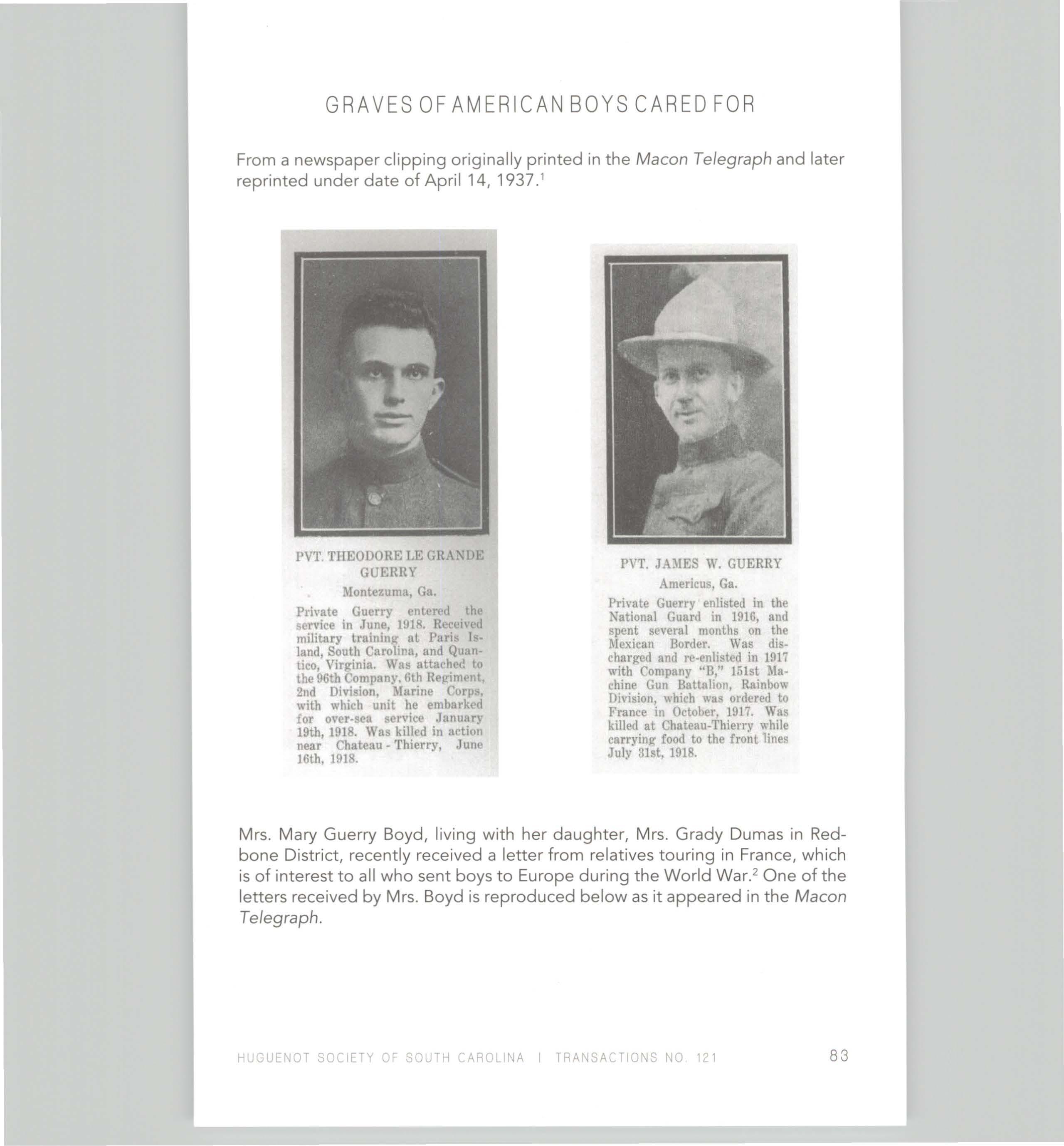
PVT. TilEODORE LE GRA-:-:DE GUERRY
Montezuma, Ga.
Private Guerry entered the service in June, 1018. Rccein·d military training at Pari8 Island, South Carolina, and Quantico, Virginia. Was attacher. to lhe 96th Company, 6th Re~iment, 2nd Division, :Yarine Corps, with which unit he embarked for over-sea service January 19th, 1918. Was killed in action near Chateau - Thierry, ,lune 16th, 1918.
PVT. JAMES W. GUERRY
Americus, Ga.
Private Guerry enlisted in the National Guard in 1916, and spent several months on the l\Iexican Bordel', Was diRcharged and re-enlisted in 1917 with Company "B," 151st Machine Gun Battaliot1, Rainbow Division, which was ordered lo France in October, 19)7. Was killed al Chateau-Thierry while carrying- food to the fronL lines ,July 31st, 1918.
Mrs. Mary Guerry Boyd, living with her daughter, Mrs. Grady Dumas in Redbone District, recently received a letter from relatives touring in France, which is of interest to all who sent boys to Europe during the World War. 2 One of the letters received by Mrs. Boyd is reproduced below as it appeared in the Macon Telegraph.
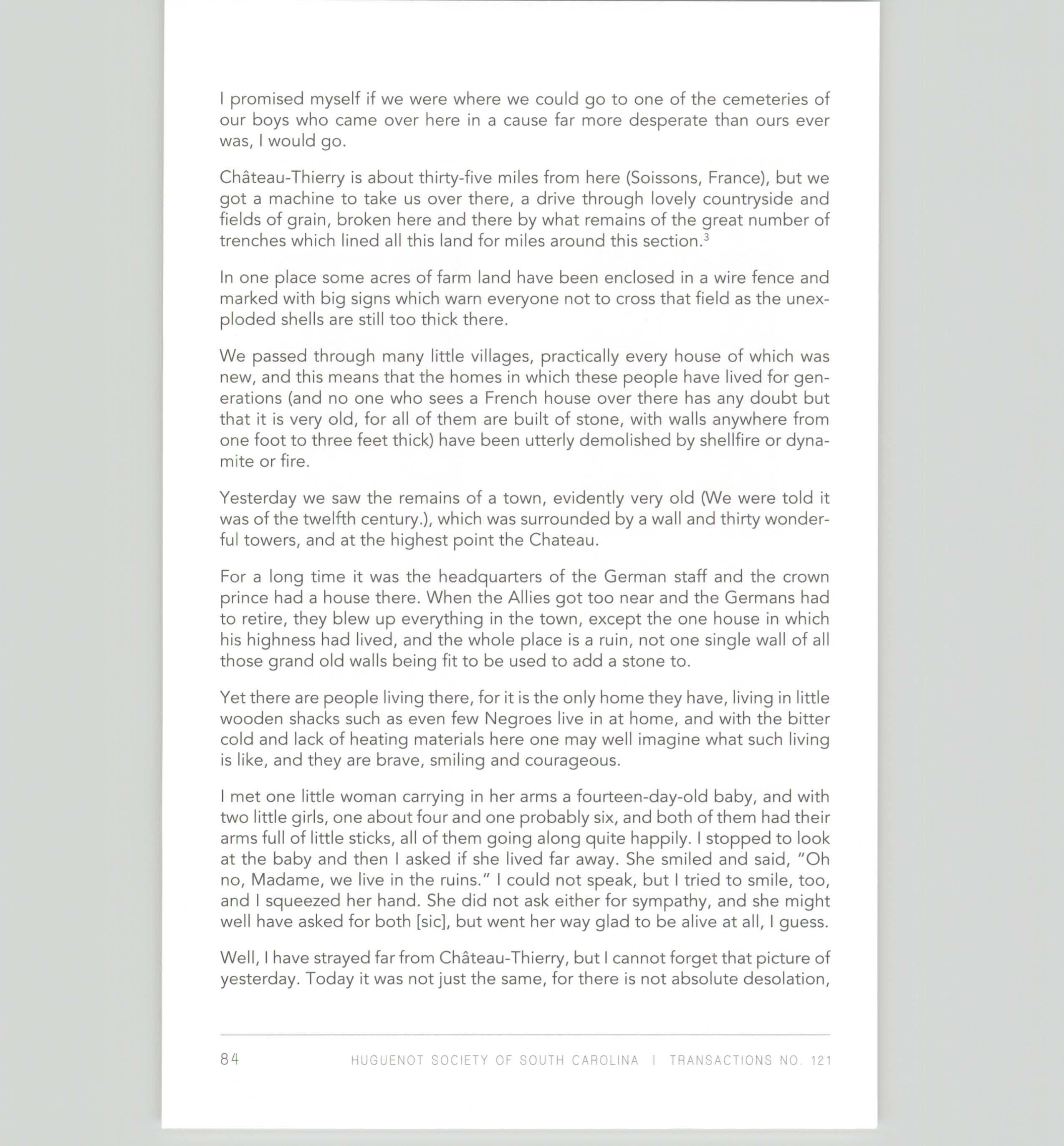
I promised myself if we were where we could go to one of the cemeteries of our boys who came over here in a cause far more desperate than ours ever was, I would go.
Chateau-Thierry is about thirty-five miles from here (Soissons, France), but we got a machine to take us over there, a drive through lovely countryside and fields of grain, broken here and there by what remains of the great number of trenches which lined all this land for miles around this section. 3
In one place some acres of farm land have been enclosed in a wire fence and marked with big signs which warn everyone not to cross that field as the unexploded shells are still too thick there.
We passed through many little villages, practically every house of which was new, and this means that the homes in which these people have lived for generations (and no one who sees a French house over there has any doubt but that it is very old, for all of them are built of stone, with walls anywhere from one foot to three feet thick) have been utterly demolished by shellfire or dynamite or fire.
Yesterday we saw the remains of a town, evidently very old (We were told it was of the twelfth century.), which was surrounded by a wall and thirty wonderful towers, and at the highest point the Chateau.
For a long time it was the headquarters of the German staff and the crown prince had a house there. When the Allies got too near and the Germans had to retire, they blew up everything in the town, except the one house in which his highness had lived, and the whole place is a ruin, not one single wall of all those grand old walls being fit to be used to add a stone to.
Yet there are people living there, for it is the only home they have, living in little wooden shacks such as even few Negroes live in at home, and with the bitter cold and lack of heating materials here one may well imagine what such living is like, and they are brave, smiling and courageous.
I met one little woman carrying in her arms a fourteen-day-old baby, and with two little girls, one about four and one probably six, and both of them had their arms full of little sticks, all of them going along quite happily. I stopped to look at the baby and then I asked if she lived far away. She smiled and said, "Oh no, Madame, we live in the ruins." I could not speak, but I tried to smile, too, and I squeezed her hand. She did not ask either for sympathy, and she might well have asked for both [sic], but went her way glad to be alive at all, I guess.
Well, I have strayed far from Chateau-Thierry, but I cannot forget that picture of yesterday. Today it was not just the same, for there is not absolute desolation,
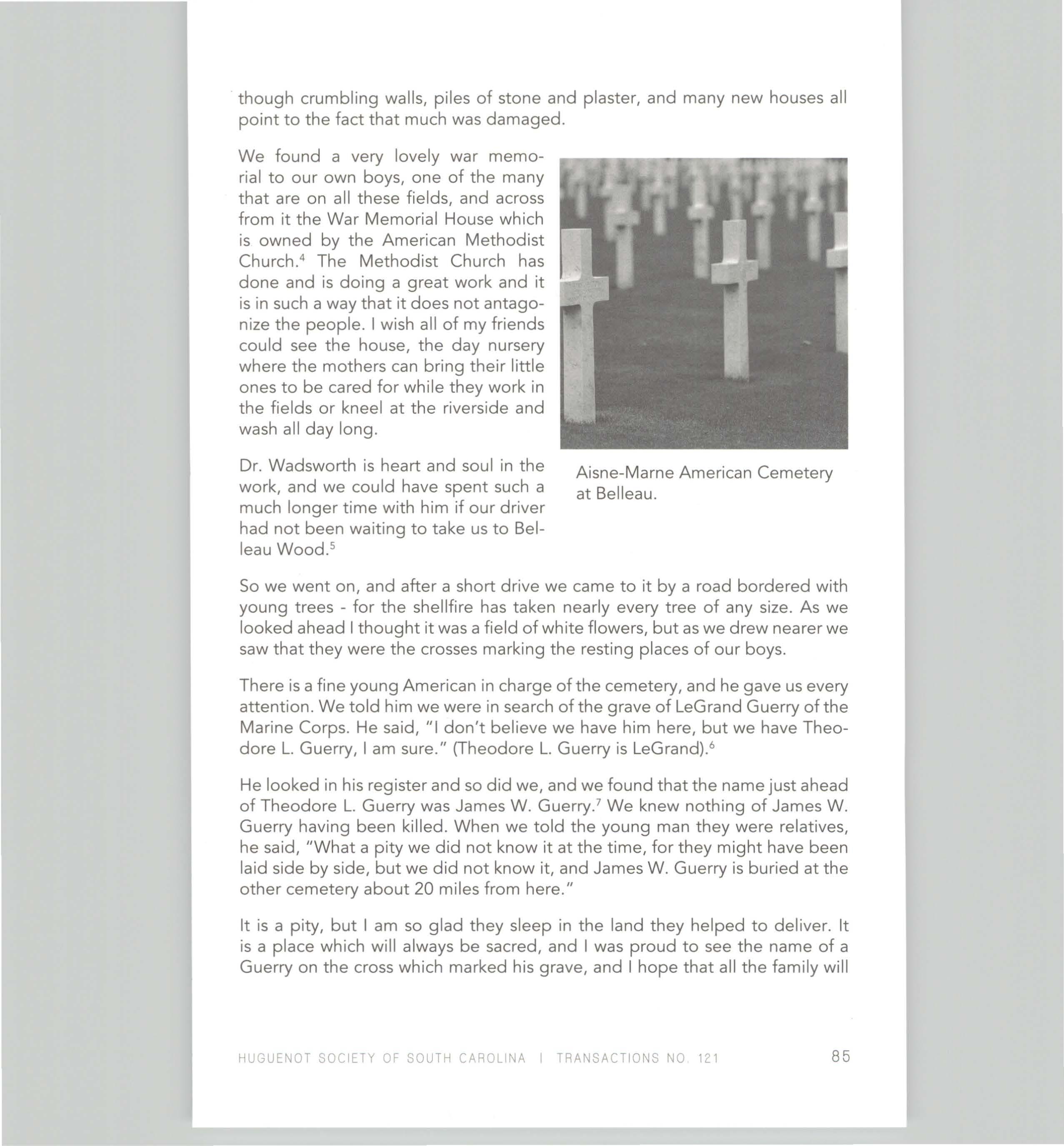
• though crumbling walls, piles of stone and plaster, and many new houses all point to the fact that much was damaged.
We found a very lovely war memorial to our own boys, one of the many that are on all these fields, and across from it the War Memorial House which is owned by the American Methodist Church. 4 The Methodist Church has done and is doing a great work and it is in such a way that it does not antagonize the people. I wish all of my friends could see the house, the day nursery where the mothers can bring their little ones to be cared for while they work in the fields or kneel at the riverside and wash all day long.
Dr. Wadsworth is heart and soul in the work, and we could have spent such a much longer time with him if our driver had not been waiting to take us to Belleau Wood. 5
So we went on, and after a short drive we came to it by a road bordered with young trees - for the shellfire has taken nearly every tree of any size. As we looked ahead I thought it was a field of white flowers, but as we drew nearer we saw that they were the crosses marking the resting places of our boys.
There is a fine young American in charge of the cemetery, and he gave us every attention. We told him we were in search of the grave of LeGrand Guerry of the Marine Corps. He said, "I don't believe we have him here, but we have Theodore L. Guerry, I am sure." (Theodore L. Guerry is LeGrand). 6
He looked in his register and so did we, and we found that the name just ahead of Theodore L. Guerry was James W. Guerry. 7 We knew nothing of James W. Guerry having been killed. When we told the young man they were relatives, he said, "What a pity we did not know it at the time, for they might have been laid side by side, but we did not know it, and James W. Guerry is buried at the other cemetery about 20 miles from here."
It is a pity, but I am so glad they sleep in the land they helped to deliver. It is a place which will always be sacred, and I was proud to see the name of a Guerry on the cross which marked his grave, and I hope that all the family will
feel so, that since he gave his life, it was a cause for which one might well be proud to fight.
Dr. Wadsworth asked me if we would like to have him and his wife take LeGrand as one of "Their Boys," by that he meant to take flowers to his grave and hold a little service of prayer for the deceased's family. 8 Dr. Wadsworth has the names and photographs of thirty boys for whom he does this at Christmas and Easter. He told us that he does not want any money sent to him, but just for the family to let him know if they want him to do this for their family member. I told him I would ask. He says they take the French Boy Scouts out there on Christmas morning and they all sing Christmas carols. He said, "I feel the boys are at home again when we do this." To me it is a beautiful thought and I hope it will be to all the mothers who have boys over there. Dr. Wadsworth keeps the pictures in the Museum at Chateau-Thierry.
NOTE from the Editors: We found out more about Dr. Julian Wadsworth and his wife, and we did find records which indicate that Minnie (Mary Theophilius Logan) Guerry, mother of Theodore LeGrand Guerry, traveled from New York to Cherbourg, France on the ship Washington in 1930. She was listed among other women, mostly mothers, who "Desired Pilgrimage" in 1930.
Aisne-Marne American Cemetery. Above: Entrance; Left: Chapel.
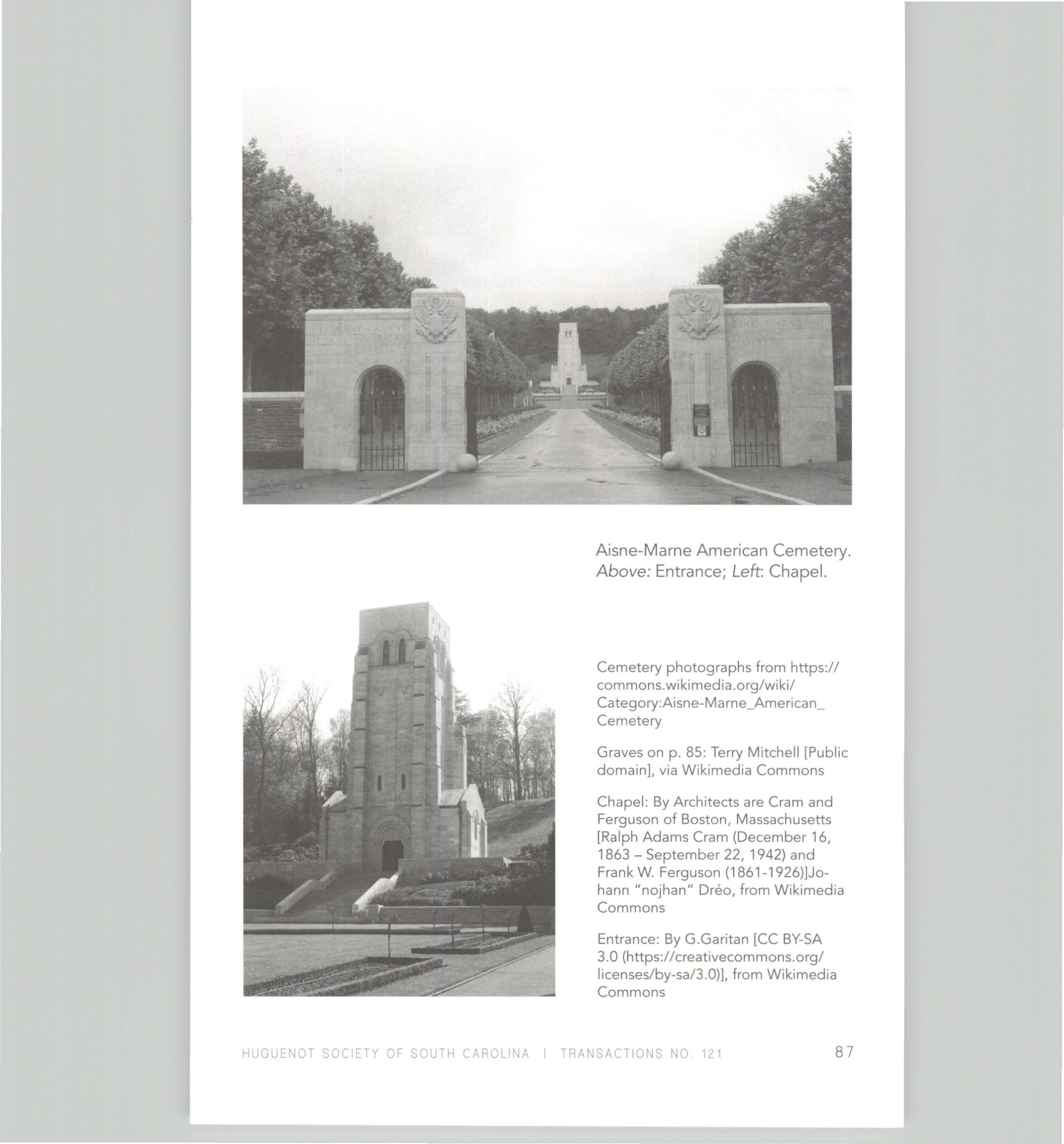
Cemetery photographs from https:// commons.wikimedia.org/wiki/ Category:Aisne-Marne_American_ Cemetery
Graves on p. 85: Terry Mitchell [Public domain], via Wikimedia Commons
Chapel: By Architects are Cram and Ferguson of Boston, Massachusetts [Ralph Adams Cram (December 16, 1863 - September 22, 1942) and Frank W. Ferguson (1861-1926)]Johann "nojhan" Oreo, from Wikimedia Commons
Entrance: By G.Garitan [CC BY-SA 3.0 (https://creativecommons.org/ licenses/by-sa/3.0)], from Wikimedia Commons
The newspaper article was sent to Harold E. Guerry by Nanita Guerry Gattman on 22 Jun 1982. The editors were unable to verify the source of the original newspaper article.
2 Mary Rivers Guerry Boyd, 3 Sep 1858-21 May 1962, lived all of her life in Americus, GA.
3 The Battle of Chateau-Thierry was fought on July 18, 1918, in World War I. It was part of the Second Battle of the Marne and was one of the first actions of the American Expeditionary Forces (AEF) under General John J. "Black Jack" Pershing. Wikipedia.
4 After World War I, a memorial was built on Hill 204, 2 miles (3 km.) west of the town for which it is named. The Chateau-Thierry Monument, designed by Paul Philippe Cret of Philadelphia, was constructed by the American Battle Monuments Commission "to commemorate the sacrifices and achievements of American and French fighting men in the region, and the friendship arid cooperation of French and American forces during World War I." There is also a monument in front of the Bronx County Courthouse in New York City that was presented by the American Legion on November 11, 1940. The monument consists of the "Keystone from an arch of the old bridge at Chateau Thierry," which the monument notes was "Gloriously and successfully defended by American troops." Wikipedia: Battle of Chateau-Thierry.
The Reverend Julian Sturtevant Wadsworth, delegate of the Board of Foreign Missions of the Methodist Episcopal Church, and his wife, Florence Maie Short Wadsworth, were instrumental in their dedication to honor the memory of fallen soldiers while assisting residents of Chateau-Thierry and the surrounding villages. Dr. Wadsworth, son of Archibald Clark Wadsworth and Delia Witherbee, was born in Jacksonville, Morgan County, IL 5 Dec 1860 and died in Geneva, Switzerland in 1939. His wife was the daughter of William Fletcher Short and Sarah Belle Laning. She was born in Williamsville, Sangamon, IL 24 May 1860 and died in Jacksonville, IL in 1950.
On 1 June, Chateau-Thierry and Vaux fell, and German troops moved into Belleau Wood. The Battle of Belleau Wood (1-26 June 1918) occurred during the German Spring Offensive in World War I, near the Marne River in France. The battle was fought between the U.S. 2nd (under the command of Major General Omar Bundy) and 3rd Divisions along with French and British forces against an assortment of German units. Chateau-Thierry and Belleau Wood are about 55 miles east of Paris along the Marne River.
6 Theodore LeGrand Guerry, 16 Jul 1899-18 Jun 1918 was killed in action at Chateau-Thierry while serving in the United States Marine Corps. He was buried in the Departmente de Meurthe-et-Moselle, Lorraine, France. Born in Montezuma, GA, he was the son of Samuel Guerry and Minnie Sandford Lee Guerry.
James Wright Guerry, Jr., 17 Mar 1898-18 Jun 1918 was also killed in action at Chateau-Thierry while serving in the United States Army. He was buried at Oise-Aisne American Cemetery and Memorial, Fere en-Tardonois, Departmente de-L'Aisne, Picardie, France. Born in Americus, GA, he was the son of James Wright Guerry and Mary Theophilius Logan Guerry. Theodore LeGrand Guerry and James Wright Guerry Jr.'s great grandparents were James Guerry and Mary Michau Guerry, who were born in St. James Santee Parish, SC and moved to Twiggs County, GA.
Copies of photographs of tombstones at St. Stephen's Episcopal Churchyard, St. Stephens, SC. Donated by Dee Thompson.
Family Bible of Serre Dubose (1812). Donated by Mary Martin Deloach Rench.
Fields, William C. Abstracts of Cumber/and County, NC, Books 1-3, 1754-70, and Books 4-7, 1770-85. Donated by John Morgan.
The following items were donated by Harriott Cheves Leland: Ballecastle's Heritage & Town Guide. [Ireland]
Berkeley, Edmund and Dorothy S. Berkeley. Dr. Alexander Garden of Charles Town.
Billingsley, Andrew. Yearning to Breathe Free; Robert Smalls of South Carolina and His Families.
Bull, Henry DeSaussure. The Family of Stephen Bull of Kinghurst Hall, County Warwick, England and Ashley Hall, South Carolina, 1600-1960.
Leland, Abigail Toomer Morrison. Way Back Yonder.
Poston, Jonathon H. The Buildings of Charleston: A Guide to the City's Architecture.
Severens, Martha R. and Charles L. Wyrick. Charles Fraser of Charleston: Essays on the Man, His Art and His Times.
Shalhope, Robert E. John Taylor of Carolina: Pastoral Republican.
The following items from the library of Philip Edward Porcher, Oakland Plantation, Mount Pleasant, SC were donated by The Rev. Philip Gendron Porcher:
Abstract of Proceedings, Number One. The Huguenot Society of America.
Account Book: Estate of John Cordes 1765-1798 and Register of the Porcher Family copied from the original MS in possession of P. G. Porcher, 1937.
Catalogue of the South Carolina College 1891-2.
Catalogue and List of graduates of the College of Charleston.
Commemoration of the Bi-Centenary of the revocation of the Edict of Nantes, October 22d, 1885, New York.
Diocese of South Carolina, 1888 Convention.
Gaillard, Thomas. A Contribution to the History of the Huguenots of South Carolina consisting of Pamphlets by Samuel DuBose and Frederick A. Porcher.
Gaillard, Thomas and Elizabeth C. Porcher, transcriber. Genealogy of the Huguenot Family of Porcher in part: Compiled by Thomas Gaillard of St. John's Berkeley, SC who removed to Alabama where he died leaving a numerous family.
Journal of the Ninety-Seventh Annual Convention of the Protestant Episcopal Church in the Diocese of South Carolina, 1887.
Last of the Huguenots: 1933 Obituary of Isaac de C. Porcher.
Liste des Francois et Suisses from an old manuscript list of French and Swiss Protestants settled in Charleston, on the Santee and at the Orange Quarter in Carolina who desired Naturalization.
Memoir of Professor F. A. Porcher in Papers - 1889, Historical Society of South Carolina.
Meriwether, Colyer and Herbert B. Adams, Editor. History of higher Education in South Carolina with a Sketch of the Free School System: Circular of Information No. 3, 1888.
Official Register of the South Carolina Military Academy, July 1892, Charleston, SC.
Porcher, F. Peyre. Address before the Association of the Survivors of the Confederate Surgeons of South Carolina at the Annual Meeting held at Columbia, SC November 1889.
Proceedings of the State Agricultural Society of South Carolina, c. 1839-45.
Ravenel, Henry Edmund. Ravenel Records: A History and Genealogy of the Huguenot Family of Ravenel of South Carolina with some incidental accounts of the Parish of St. Johns Berkeley.
Snowden, Yates. A Carolina Bourbon. HUGUENOT SOCIETY OF SOUTH CAROLINA I TRANSACTIONS NO. 121 91
South Carolina Historical Magazine, No. 4 of Vol. II, No. 2 of Vol. V and No. 2 of Vol. VI.
South Carolina Historical Magazine, Vols. IX, X, XI, XII and No. 1 of Vol. XIII.
Stoney, Samuel Gaillard. Colonial Church Architecture.
The History of the Santee Canal Prepared by the late Prof. F. A. Porcher and Dedicated to the South Carolina Historical Society, 1875, with an Appendix by A. S. Salley, Jr.
Thomas, John Peyre. The Life and Labors of the Rev. Samuel Thomas: An Epic of the Infant Church in South Carolina, 1702-1706. Address Delivered in St. James Church, Goose Creek, SC, Sunday April 17th 1904.
Transactions of the Huguenot Society of South Carolina, Vols. XI, XII, XIII, XIV.
Twenty-Fifth Annual Catalogue of the Porter Academy, July 1, 1892, with Curriculum for the Years 1892, 1893.
Walker, C. Irvine. Ro/ls and Historical Sketch of the Tenth Regiment, So. Ca. Volunteers in the Army of the Confederate States, 1861-1865.
Wells, Edward L. A Sketch of the Charleston Light Dragoons from the Earliest Formation of the Corps.
Wilson, Robert. An Address Delivered Before the St. John's Hunting Club at lndianfield Plantation, St. John's Berkeley, July 4, 1907.
Wilson, Robert. An Oration Delivered Before the Inhabitants of Pineville, So. Ca. on Monday, July 4, 1831, the 58th Anniversary of the Declaration of American Independence.
Yale College Catalogue [no title page or date].
Youmans, LeRoy F. Alumni Association. Address delivered in the hall of the House of Representatives before the Alumni of South Carolina College.
Young, Henry Edward and Edward S. Joynes. Robert E. Lee - Centennial Celebration of His Birth Held under the Auspices of the University of South Carolina on the Nineteenth Day of January, 1907.
THE HUGUENOT SOCIETY OF SOUTH CAROLINA
The Huguenot Society of South Carolina offers a scholarship to a student working toward a graduate degree in history. The scholarship is based on the submission of an essay. The winning submission will be published in Transactions of the Huguenot Society of South Carolina, and the author will be awarded $1,000.
The essay must be a work of scholarship on a Huguenot topic that examines any aspect of the religious, political, economic, social, or intellectual history of the French or Walloon Protestants from the sixteenth century to the present. The essay may deal with any appropriate geographical area.
For full instructions, please visit the scholarship page of the Society's website. All essays must be submitted no later than December 31st. The winner will be announced at the Society's Anniversary Meeting the following April. Scholarships will be awarded according to the decision of the judges and may not be awarded every year.
The Huguenot Society of South Carolina publishes Transactions of the Huguenot Society of South Carolina annually. The publication focuses on both Huguenot history and Huguenot genealogy.
Contributions to Transactions are encouraged. All submissions must include footnotes and other necessary documentation, and permission to publish when needed. Please use the Chicago Manual of Style's notes and bibliography system for citations. The editorial staff reserves the right to edit all submissions for spelling, punctuation, grammar and style.
Please mail a hard copy of the article as well as emailing the article and any illustration as separate attachments to director@huguenotsociety.org.
HUGUENOT SOCIETY OF SOUTH CAROLINA
138 LOGAN STREET, CHARLESTON, SC 29401-1941 (843) 723 3235 I www.huguenotsociety.org HUGJENOT
Aarau, Switzerland 11 Baudry, Pierre 28
Aisne-Marne American Cemetery 85, 87 Belleau Wood, France 85, 88
All Saints Chapel 79 Berne, Switzerland 9
American Battle Monuments Commission Bernheim, G. D ...................................... 29 88
American Expeditionary Forces (AEF) 88
Berry, France 1, 4, 5, 47
Bishop oflondon ... 17, 18, 31, 34, 37, 38,
American Methodist Church 85 41,42,44,46
Amonnet, Jacob 20 Blair, James ...................................... 18, 56
Anderson Book of Christenings 24
Charles 26, 59 Book of Common Prayer 18, 34
Henry Mortimer 81 Boston Transcript ................................... 7 6
Rosalie 75, 81 Boyd, Mary Rivers Guerry 83, 88
Anglican Church 14 Bradford Springs, SC 70
Anglicans 4, 7, 8, 18, 35 Brailsford
Bay, FL
Joseph Welson Sr 75, 81 Moultrie 70-72, 76
Barnet Brodie, William 26, 59 Hannah 44 Bronx County Courthouse, NY 88
John .44, 45 Bruce, Philip 25 Bath, NC 24, 27-29 Bull, William Tredwell 44
Bundy, Omar .......................................... 88
Byrd
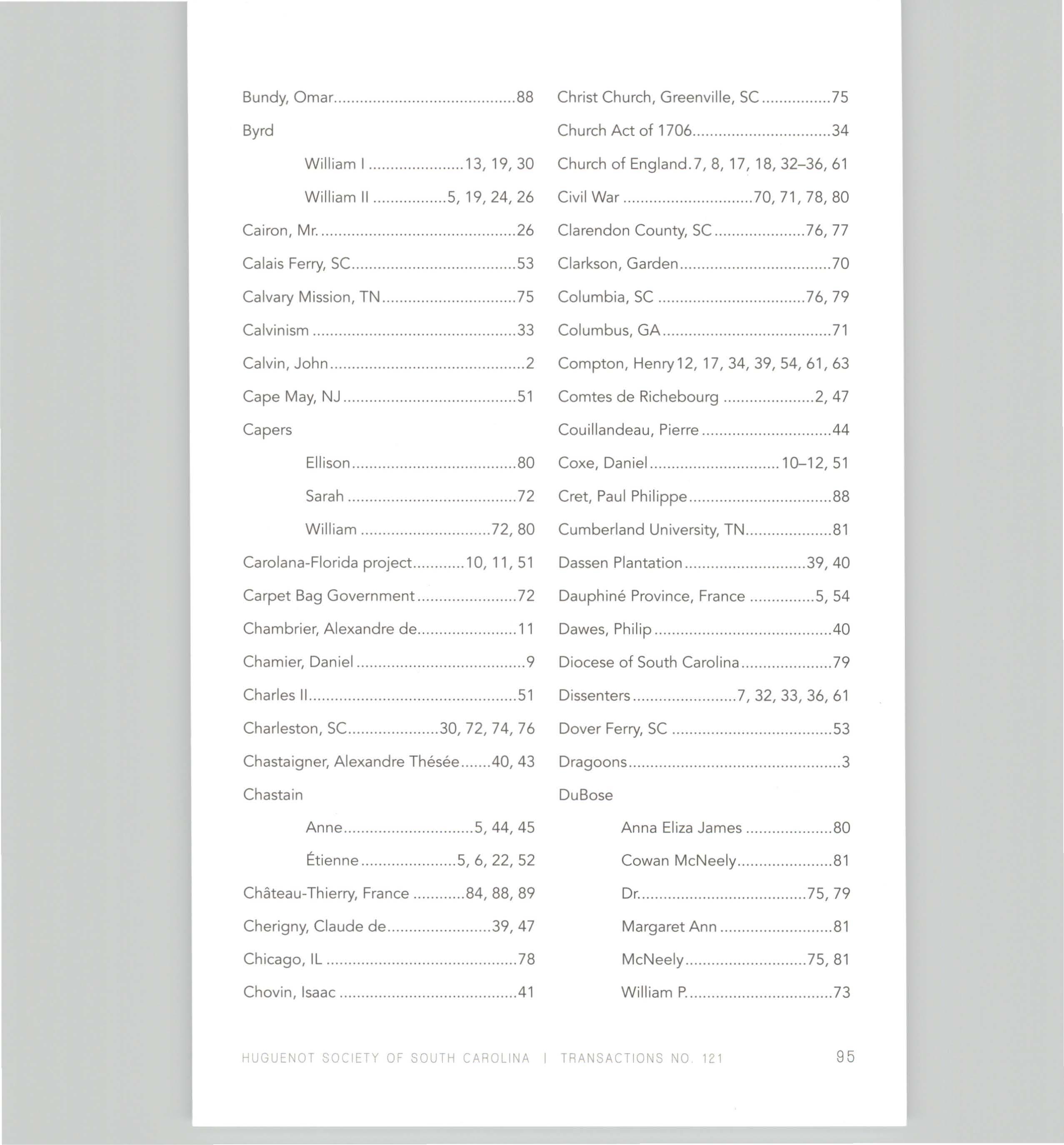
William I ...................... 13, 19, 30
Christ Church, Greenville, SC ................ 75
Church Act of 1706 ................................ 34
Church of England. 7, 8, 17, 18, 32-36, 61
William II ................. 5, 19, 24, 26 Civil War 70, 71, 78, 80
Ca iron, Mr 26
Clarendon County, SC 76, 77
Calais Ferry, SC. 53 Clarkson, Garden 70
Calvary Mission, TN 75 Columbia, SC 76, 79
Calvinism 33 Columbus, GA 71
Calvin, John 2
Compton, Henry 12, 17, 34, 39, 54, 61, 63
Cape May, NJ ........................................ 51 Comtes de Richebourg ..................... 2, 47
Capers
Couillandeau, Pierre .44
Ellison ...................................... 80 Coxe, Daniel .............................. 10-12, 51
Sarah ....................................... 72
Cret, Paul Philippe ................................. 88
William 72, 80 Cumberland University, TN 81
Carolana-Florida project ............ 10, 11, 51
Carpet Bag Government.. ..................... 72
Dassen Plantation ............................ 39, 40
Dauphine Province, France ............... 5, 54
Chambrier, Alexandre de ....................... 11 Dawes, Philip .40
Chamier, Daniel 9 Diocese of South Carolina ..................... 79
Charles ll ................................................ 51
Dissenters 7, 32, 33, 36, 61
Charleston, SC..................... 30, 72, 74, 76 Dover Ferry, SC 53
Chastaigner, Alexandre Thesee .40, 43 Dragoons 3
Chastain DuBose
Anne 5, 44, 45
Anna Eliza James 80
ttienne 5, 6, 22, 52 Cowan McNeely 81
Chateau-Thierry, France 84, 88, 89 Dr 75, 79
Cherigny, Claude de ........................ 39, 47
Margaret Ann 81
Chicago, IL ............................................ 78 McNeely 75, 81
Chovin, Isaac .41
William P.................................. 73
HUGUENOT SOC ETY OF SOUTH CAROLINA I TRANSACTIONS NO 121 85
Ducros de la Bastie, Charles ...... 40, 41, 43 Gaillard, Barthelemy .................. 40, 41, 43
Dumas, Grady 83 Gaillardv. Le Grand ............................... 43
Eastover, SC. 69, 70 Gailor, Thomas Frank 81
Echaw Chapel of Ease, SC ................... .41 Galdie, M 11
Edict of Nantes Gendron, Mr 44
Promulgation of 3 Geneva, Switzerland 5, 6, 8-11, 88
Revocation of .......... 1, 3, 4, 8, 54 Geneva Way 35, 37
Elizabeth 1 8 Georgia .71, 81
England 5-8, 12, 54 German Spring Offensive 88
Ervin, Sam .4, 31 Germany 4, 6, 8
Evans, Julia 71 Gignilliat, Jacques 30, 34, 35, 37, 39, 61
Fairmount, WV 74, 75, 80 Glass, James G .76
Falling Creek Mill, VA 13 Glorious Revolution 8
Felder, VA 70 Gordon, William 28
Finney Gottman, Nanita Guerry 88 Mr 26 GrandDepart 10
William 59 Gravesend, England 5, 12
Florence, SC 70, 71, 75-78, 81 Green Florida 10, 11
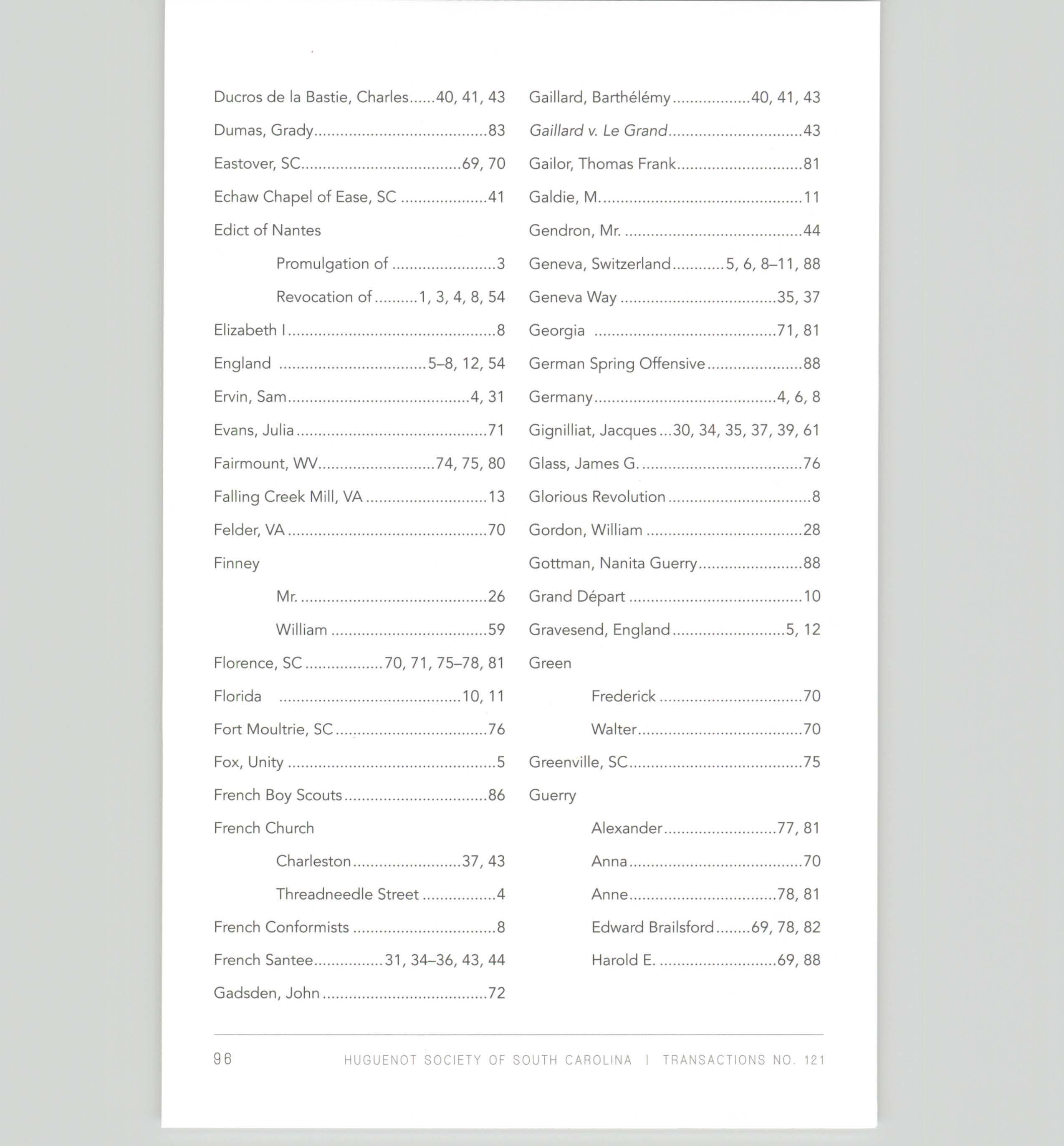
French Boy Scouts ................................. 86 Guerry
French Church Alexander 77, 81 Charleston 37, 43 Anna 70
Threadneedle Street .4 Anne 78,81
French Conformists ................................. 8 Edward Brailsford ........ 69, 78, 82
French Santee 31, 34-36, 43, 44 Harold E............................ 69, 88
Gadsden, John 72
Guerry, lrene 70
Hoffman, Ella Marion 82
James 89 Holland 6, 8, 54
James Wright .......................... 89
James Wright Jr 83, 85, 89
John ........................................ 70
LeGrand Brailsford .................. 70
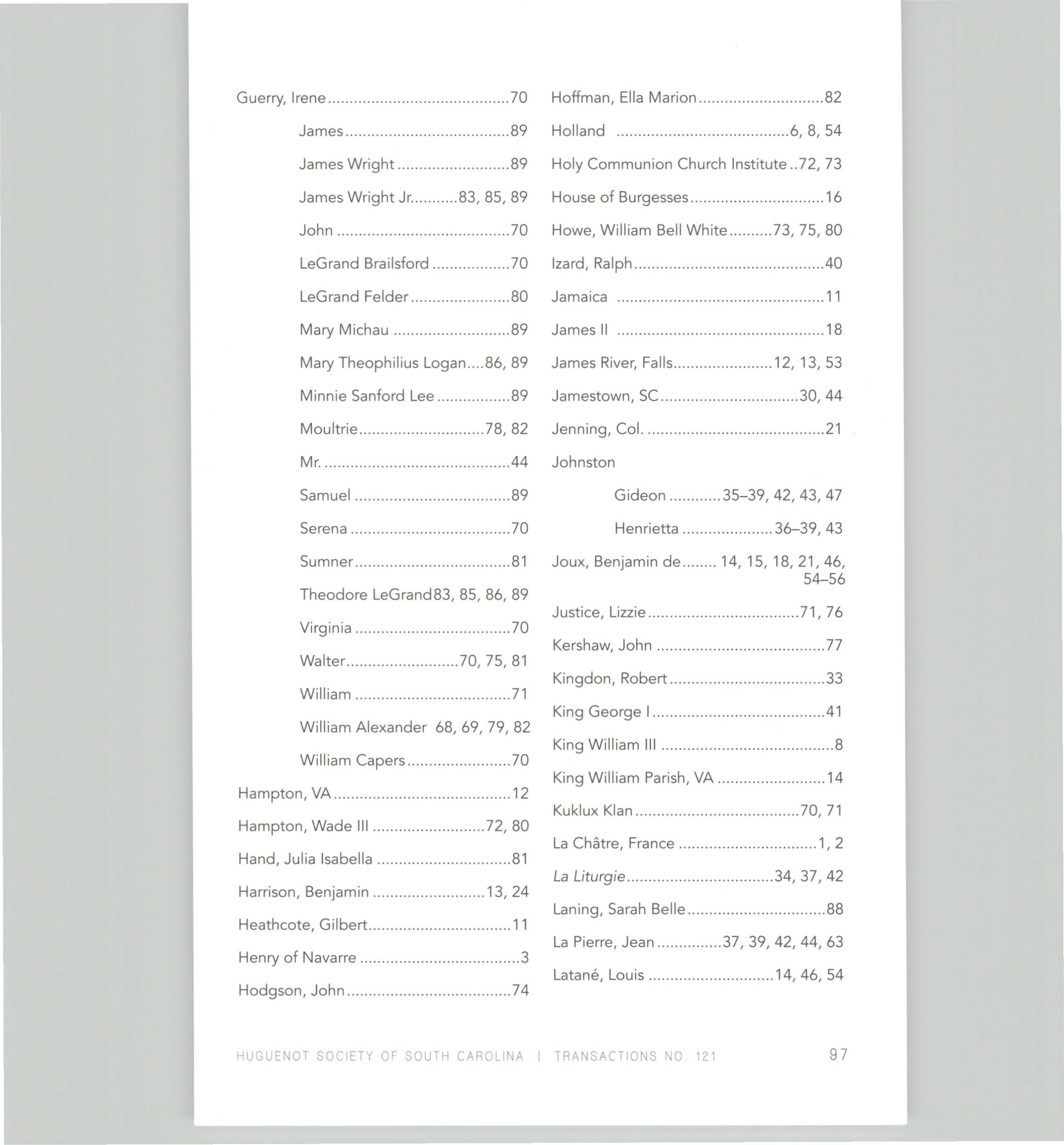
Holy Communion Church Institute ..72, 73
House of Burgesses 16
Howe, William Bell White .......... 73, 75, 80
Izard, Ralph ............................................ 40
LeGrand Felder 80 Jamaica 11
Mary Michau ........................... 89
Mary Theophilius Logan 86, 89
Minnie Sanford Lee ................. 89
Moultrie ............................. 78, 82
James II ................................................ 18
James River, Falls 12, 13, 53
Jamestown, SC ................................ 30, 44
Jenning, Col. ......................................... 21
Mr............................................ 44 Johnston
Samuel .................................... 89 Gideon ............ 35-39, 42, 43, 47
Serena 70 Henrietta 36-39, 43
Sumner .................................... 81
Theodore LeGrand83, 85, 86, 89
Virginia 70
Walter 70, 75, 81
William 71
William Alexander 68, 69, 79, 82
William Capers 70
Hampton, VA 12
Hampton, Wade Ill .......................... 72, 80
Hand, Julia Isabella 81
Harrison, Benjamin .......................... 13, 24
Heathcote, Gilbert 11
Henry of Navarre ..................................... 3
Hodgson, John 74
Joux, Benjamin de ........ 14, 15, 18, 21, 46, 54-56
Justice, Lizzie 71, 76
Kershaw, John 77
Kingdon, Robert .................................... 33
King George I 41
King William Ill ........................................ 8
King William Parish, VA 14
Kuklux Klan 70, 71
La Chatre, France 1, 2
La Liturgie .................................. 34, 37, 42
Laning, Sarah Belle 88
La Pierre, Jean 37, 39, 42, 44, 63
Latane, Louis 14, 46, 54
Latitudinarian 19, 56 Maryland 15
Lawson, John ....................... 24, 27-30, 44 Mason, George ...................................... 15
Lebanon, TN .75, 81 Maule, Robert 35, 36, 38
Lecaze, Jacques 22 McBee
Le Grand Anne 75
Isaac .43 Anne (Annie) 81 Isaac, Jr 40 Emma Estelle 81
James 41 Mary 76
Le Jau, Francis 30, 31, 36, 38, 43, 46, 61
Le Noble, Henry .40, 43
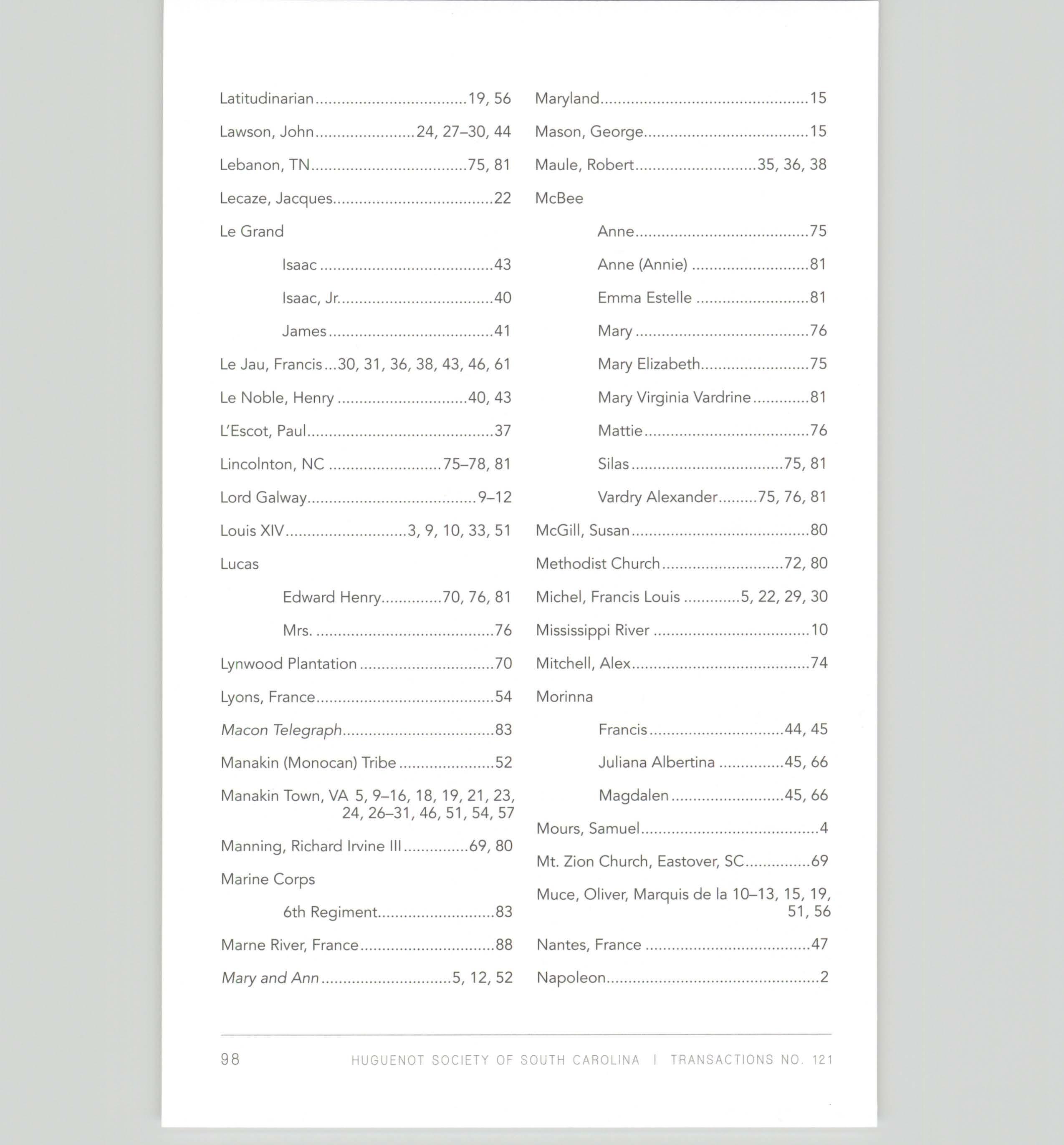
Mary Elizabeth 75
Mary Virginia Vardrine 81
L'Escot, Paul 37 Mattie 76
Lincolnton, NC 75-78, 81 Silas 75, 81
Lord Galway 9-12 Vardry Alexander 75, 76, 81
Louis XIV 3, 9, 10, 33, 51 McGill, Susan 80
Lucas Methodist Church 72, 80
Edward Henry .............. 70, 76, 81 Michel, Francis Louis ............. 5, 22, 29, 30 Mrs 76 Mississippi River 10
Lynwood Plantation 70 Mitchell, Alex 74
Lyons, France ......................................... 54 Morinna
Macon Telegraph 83 Francis .44, 45
Manakin (Monocan) Tribe 52
Juliana Albertina .45, 66
Manakin Town, VA 5, 9-16, 18, 19, 21, 23, Magdalen ......................... .45, 66 24,26-31,46,51,54,57
Manning, Richard Irvine 111 69, 80
Marine Corps
6th Regiment ........................... 83
Marne River, France 88
Mary and Ann 5, 12, 52
Mours, Samuel .4
Mt. Zion Church, Eastover, SC. 69
Muce, Oliver, Marquis de la 10-13, 15, 19, 51,56
Nantes, France ..................................... .47 Napoleon ................................................. 2
Nashville, TN 74
Nassau ................................................ 14
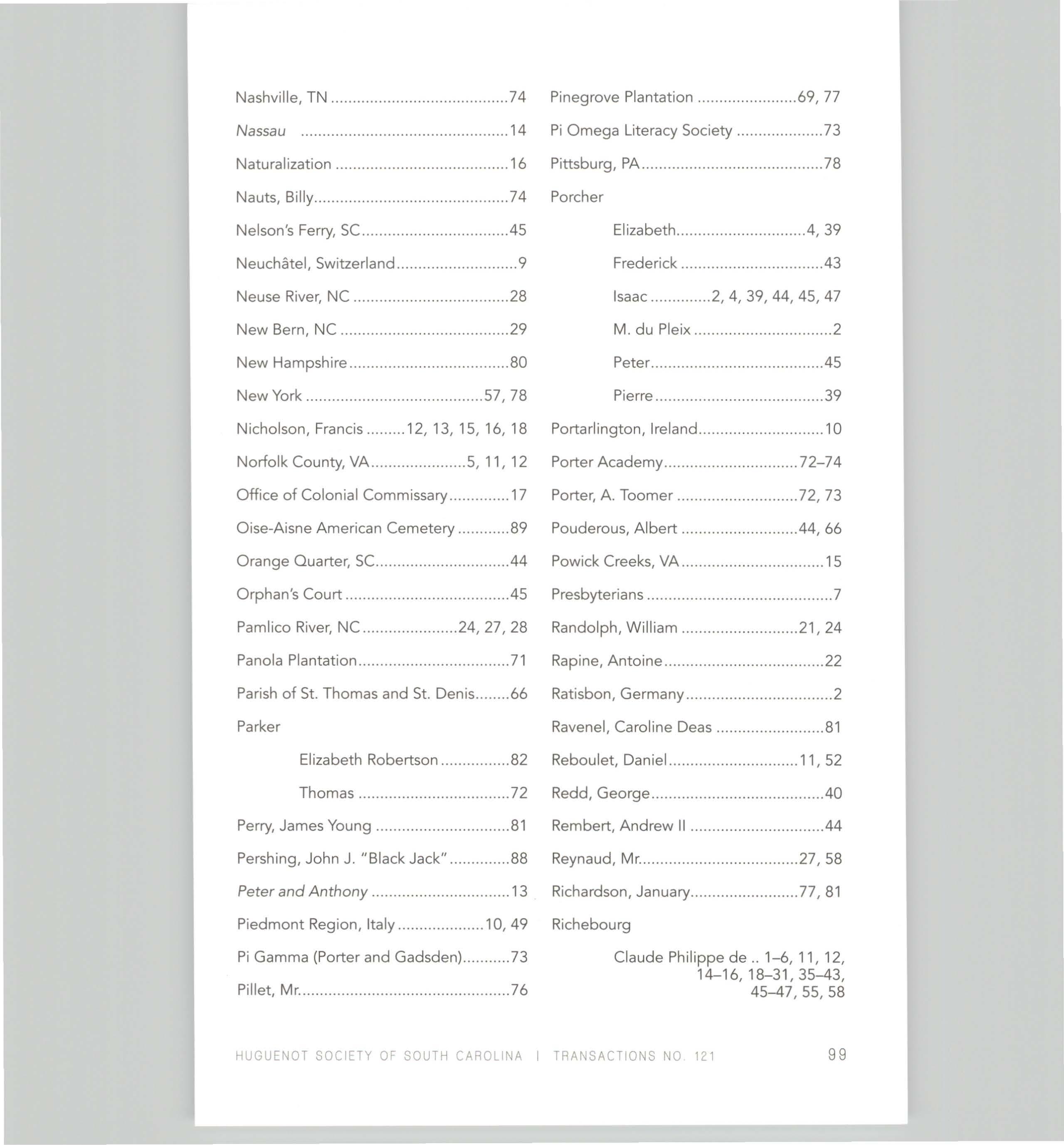
Pinegrove Plantation 69, 77
Pi Omega Literacy Society .................... 73
Naturalization ........................................ 16 Pittsburg, PA.......................................... 78
Nauts, Billy 74 Porcher
Nelson's Ferry, SC. 45
Elizabeth .4, 39
Neuchatel, Switzerland 9 Frederick .43
Neuse River, NC 28 Isaac 2, 4, 39, 44, 45, 47
New Bern, NC 29 M. du Pleix 2
New Hampshire 80 Peter .45
NewYork 57, 78 Pierre 39
Nicholson, Francis 12, 13, 15, 16, 18
Norfolk County, VA 5, 11, 12
Portarlington, lreland 10
PorterAcademy 72-74
Office of Colonial Commissary 17 Porter, A. Toomer 72, 73
Oise-Aisne American Cemetery 89 Pouderous, Albert .44, 66
Orange Quarter, SC 44 Powick Creeks, VA 15
Orphan's Court .45 Presbyterians 7
Pamlico River, NC 24, 27, 28 Randolph, William 21, 24
Panola Plantation 71 Rapine, Antoine 22
Parish of St. Thomas and St. Denis 66 Ratisbon, Germany 2
Parker Ravenel, Caroline Deas ......................... 81
Elizabeth Robertson 82 Reboulet, Daniel 11, 52
Thomas ................................... 72 Redd, George ....................................... .40
Perry, James Young 81 Rembert, Andrew II 44
Pershing, John J. "Black Jack" .............. 88 Reynaud, Mr..................................... 27, 58
Peter and Anthony ................................ 13 Richardson, January ......................... 77, 81
Piedmont Region, Italy 10, 49 Richebourg
Pi Gamma (Porter and Gadsden) 73
Claude Philippe de 1-6, 11, 12, 14-16, 18-31, 35-43, Pillet, Mr 76 45-47, 55, 58
Richebourg
Elizabeth 45
James ...................................... 45
John .............................. 5,45,49
Louis de 2
Rene ....................................... .45
Roanoke, VA 29
Robert, Pierre ............................ 34, 35, 44
Robinson, John ................................ 39, 42
Society for the Propagation of the Gospel 28,30,31,37,41,42,47,61
Socinianism....................................... .4, 48
Soissons, France 84
South Farnham Parish, VA ..................... 15
Spotswood, Alexander .......................... 25
St. Augustine Mission Church ................ 77
St. Denis Parish, SC ................... 37, 42, 44
St. James Goose Creek Parish, SC 61
St. James Santee Parish, SC ..... 30, 34-36, Rome, ltaly ............................................. 81 39-44, 66, 89
Rotterdam, Holland 5, 11, 12
Rowark's Cove, TN ................................. 75
Royal Society 51
Ruvigny, Henri de Massue de .................. 9
Sailly, Charles de10-12, 14, 15, 19, 54, 56
Saint-Severe, France 1, 2
Salle, Abraham ........ 19, 21-24, 26, 27, 57
Schenkingh fort ..................................... 42
Second Battle of the Marne .................. 88
Senechaud, Daniel .44
Sewanee Baseball Team 74
Sewanee,TN 73,7~78,79
Sherwood Plantation ............................ .71
Short, William Fletcher .......................... 88
Sigma Epsilon 73
Simpsonville, SC 47
Simpson, William .4
St. John's Berkeley, SC 35, 36, 38
St. John's Episcopal Church, Florence, SC .......................................... 75, 81
St. Julien, Pierre de .40, 43
St. Luke's Church 75
St. Mark's Church 76, 77
St. Mark's Parish, SC 5, 45
St. Paul's Cathedral. 61
St. Philip's Church
Bradford Springs, SC. 70
Charleston, SC 37, 39
Strasbourg, France .................................. 2
Sullivan's Island, SC 76
Summerville, SC 72
Sumner, Mary Elizabeth ......................... 81
Sutton, Mary Estell 81
Swiss Confederation ............................ 8, 9
Switzerland 4-6, 30, 54
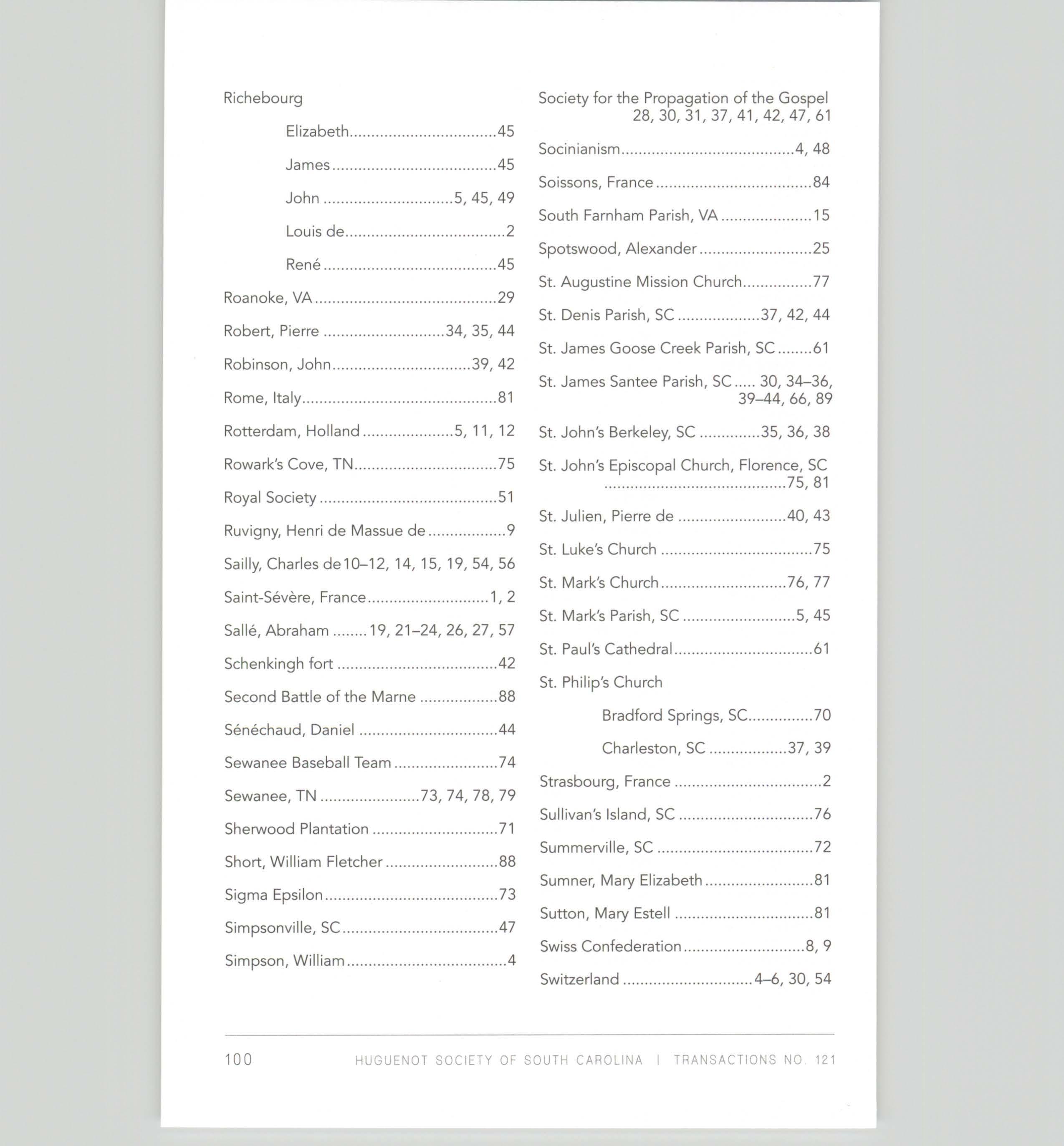
100 HUGUENOT SOCIETY OF SOUTH CAROLINA I TRANSACTIONS NO 121
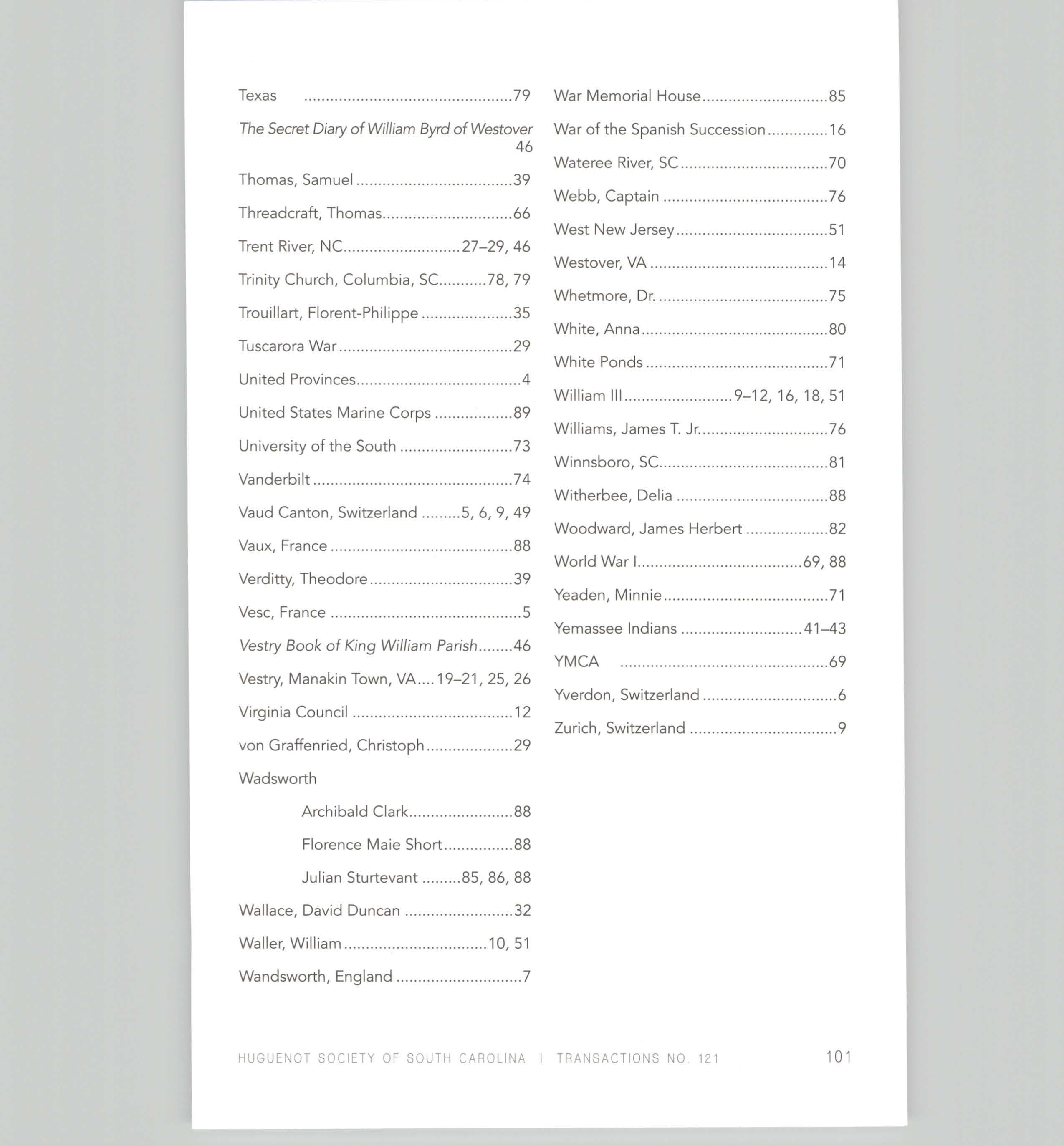
Texas 79 War Memorial House 85
The Secret Diary of William Byrd of Westover War of the Spanish Succession .............. 16 46
Thomas, Samuel .................................... 39
Threadcraft, Thomas 66
Trent River, NC. 27-29, 46
Trinity Church, Columbia, SC. 78, 79
Trouillart, Florent-Philippe 35
Tuscarora War 29
United Provinces 4
United States Marine Corps 89
University of the South .73
Vanderbi It 74
Vaud Canton, Switzerland 5, 6, 9, 49
Vaux, France 88
Verditty, Theodore 39
Vesc, France 5
Vestry Book of King William Parish........ 46
Vestry, Manakin Town, VA 19-21, 25, 26
Virginia Council 12
von Graffenried, Christoph 29
Wadsworth
Archibald Clark 88
Florence Maie Short 88
Julian Sturtevant ......... 85, 86, 88
Wallace, David Duncan 32
Waller, William 10, 51
Wandsworth, England 7
Wateree River, SC. 70
Webb, Captain 76
West New Jersey 51
Westover, VA 14
Whetmore, Dr 75
White, Anna 80
White Ponds 71
William 111 9-12, 16, 18, 51
Williams, James T. Jr 76
Winnsboro, SC. 81
Witherbee, Delia 88
Woodward, James Herbert 82
World War l. 69, 88
Yeaden, Minnie 71
Yemassee Indians 41-43
YMCA 69
Yverdon, Switzerland 6
Zurich, Switzerland 9