HOLLAND PARK SCHOOL ambition for everyone
Parent Planner
2026 - 2027
CONTENTS Page 2
Term Dates & School Day
Page 3 - 4
Key Dates & Events
Page 5
Introduction | Dame Sally Coates
Page 6 - 7
Attendance
Page 8
Student Planner
Page 9 - 12
Communication, Roles and Responsibilities
Page 13 - 24
Calendar 2026 - 27
Page 25
Maps of Learning Links
Page 26
Continuity Curriculum
Page 27 - 28
Independent Study
Page 29 - 30
The Holland Park School Workbooks & Workbook Presentation
Page 31 - 32
Achievement & Rewards
Page 33 - 36
Supporting Behaviour & DRB
Page 37 - 38
Safeguarding & Well Being
Page 39
The Holland Park Way
Page 40
Year 9 Options
Page 41
Blocks & Setting
Page 42
Assessment
Page 43 - 44
Understanding Reports
Page 45
Morning & Afternoon Routines
Page 46 - 47
Senior Leadership Assemblies
Page 48
The House System
Page 49
Extracurricular Expectations
Page 50 - 51
Uniform Expectations: A Smart School
Page 52 - 53
PE Kit Expectations: A Smart School
Page 54
Equipment Expectations
Page 55
KS3 Reading List
Page 56
Character Education
Page 57 - 60
An A to Z of Information and Guidance
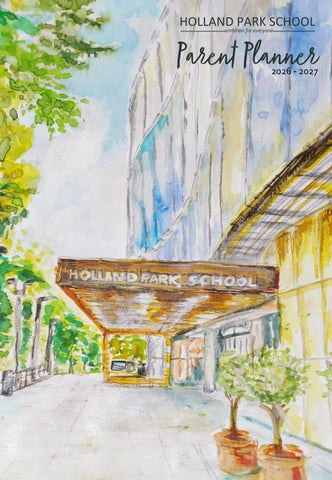
Front Cover: Francisco Rodriguez Khortov, Year 10 (2026) Student, Parent & Staff Planner 2026– 27 Design by Ms Olivia Tukacevska 01
TERM DATES & TIMES OF THE SCHOOL DAY AUTUMN TERM 2026 Thursday 3rd September – Friday 16th October 2026 Half term: Monday 19th October – Friday 30th October 2026 Monday 2nd November – Friday 18th December 2026 INSET Days: Tuesday 1st September, Wednesday 2nd September SPRING TERM 2027 Tuesday 5th January – Friday 12th February 2027 Half term: Monday 15th February – Friday 19th February 2027 Monday 22nd February – Thursday 25th March 2027 INSET Day: Monday 4th January 2027 SUMMER TERM 2027 Tuesday 13th April – Friday 28th May 2027 Half term: Monday 31st May – Friday 4th June 2027 Monday 7th June – Friday 16th July 2027 INSET DAY: Monday 12th April 2027 TIMINGS 08.25
08.30 – 09.00
SCHOOL DAY STRUCTURE SCHOOL GATE CLOSES Students arriving after this time will be marked late and receive a same-day detention. AM TUTOR Students in Y7-11 go to their line-up areas and then attend assembly or tutor time.
09.00 – 09.50
PERIOD 1
09.50 – 10.40
PERIOD 2
10.40 – 11.00
BREAK Food is served in the Dining Hall and outside. Students are not permitted on Floors 2-4.
11.00 – 11.50
PERIOD 3
11.50 – 12.40
PERIOD 4
12.40 – 13.25
LUNCH Food is served in the Dining Hall and outside. Students are not permitted on Floors 2-4.
13.25 – 14.15
PERIOD 5
14.15 – 15.05
PERIOD 6
15.05 – 15.15
PM TUTOR
15.30 – 16.30
EXTRACURRICULAR / INTERVENTION 02
KEY DATES & EVENTS PARENTS’ EVENINGS • Year 13 Parents’ Evening: Thursday 21st January 2027 • Year 11 Parents’ Evening: Thursday 28th January 2027 • Year 12 Parents’ Evening: Thursday 11th February 2027 • Year 9 Parents’ Evening: Thursday 25th February 2027 • Year 10 Parents’ Evening: Thursday 4th March 2027 • Year 11 Parents’ Evening (invite only): Wednesday 24th March 2027 • Year 8 Parents’ Evening: Thursday 22nd April 2027 • Year 7 Parents’ Evening: Thursday 6th May 2027
PARENTS’ DAYS • Parents’ Day 1: Wednesday 2nd December 2026 • Parents’ Day 2: Friday 9th July 2027
PTA EVENTS • Welcome BBQ: Friday 11th September 2026, 15:30 • Comedy Night: Thursday 15th October 2026 • PTA Christmas Craft Fair: Wednesday 2nd December 2026 • Parent vs Teacher Quiz Night: Thursday 4th February 2027 • PTA International Evening: Wednesday 14th April 2027 • Colour Run: Wednesday 30th June 2027
OPEN EVENTS • School Open Evening: Wednesday 16th September 2026. School finishes at 12:35 for students • Open Morning: Friday 18th September 2026, 08:55–10:35 • Open Morning: Monday 21st September 2026, 08:55–10:35 • Sixth Form Open Evening: Thursday 1st October 2026
YEAR 11 / YEAR 10 INFORMATION • Year 11 Final Countdown and Information Evening: Thursday 24th September 2026 • Year 10 Information Evening: Wednesday 7th October 2026 • Year 11 mock examinations: Monday 2nd–Monday 16th November 2026 • Year 11 and Year 13 mock examinations: Monday 22nd February–Monday 8th March 2027 • Year 11 and Year 13 leavers’ photograph: Friday 12th March 2027, provisional • Year 11 Prom: Friday 18th June 2027, provisional
YEAR 7 • Year 7 Meet the Tutor: Thursday 8th October 2026
YEAR 9 OPTIONS • Year 9 Options Evening: Wednesday 3rd February 2027 • Year 9 Options deadline: Friday 5th March 2027
03
KEY DATES & EVENTS SIXTH FORM • Year 12 registration: Wednesday 2nd September 2026 at 13:30 • Year 12 and Year 13 return: Friday 4th September 2026 at 08:25 • Year 12 Parent Welcome Evening: Wednesday 9th September 2026 • How to Revise at A Level: Thursday 24th September 2026 • Sixth Form Open Evening: Thursday 1st October 2026 • Year 13 Parents’ Evening: Thursday 21st January 2027 • Year 12 Parents’ UCAS Evening: Thursday 4th February 2027 • Year 12 Parents’ Evening: Thursday 11th February 2027 • Year 13 Leavers’ Tea: Friday 7th May 2027 • Year 12 Taster Days: Tuesday 22nd and Wednesday 23rd June 2027 • Sixth Form Dinner and Alumni Event: Friday 2nd July 2027
SEND EVENTS • SEND Coffee Morning: Friday 25th September 2026 • SEND Coffee Morning: Thursday 26th November 2026 • SEND Coffee Morning: Thursday 4th February 2027 • SEND Coffee Morning: Thursday 22nd April 2027
PERFORMANCES, EXHIBITIONS AND AWARDS • DofE Awards Night: Friday 25th September 2026 • Art Aptitude Winter Exhibition: Wednesday 2nd December 2026 • School Production: Wednesday 9th–Friday 11th December 2026 • Art Aptitude Spring Exhibition and An Evening of Music: Tuesday 16th March 2027 at 18:00 • Holland Park School Ethos Awards: Thursday 8th July 2027 • Live from Holland Park Summer Recital: Wednesday 14th July 2027, 17:30–18:00 • DofE Awards Evening: Thursday 15th July 2027
OTHER IMPORTANT DATES • Staff and student photographs for Years 7 and 13: Tuesday 15th September 2026 • Late start for all students: Thursday 17th September 2026 • Parent Forum: Thursday 12th November 2026, 18:00–19:00 • School closes at 12:35: Friday 18th December 2026 • School closes at 12:35: Thursday 25th March 2027 • Sports Day: Thursday 24th June 2027 • School closes at 12:35: Friday 16th July 2027
04
INTRODUCTION | DAME SALLY COATES Dear Parents, The Parent Planner provides the key information you need to support your child and understand the routines, expectations and opportunities that shape life at Holland Park School. We begin the year following a very positive Ofsted inspection, which recognised the strength of our school. This is an important milestone, but our focus remains firmly on the future. We are determined to secure the highest academic standards and prepare every pupil for life beyond school, with the knowledge, character and confidence to succeed. Parents and carers are essential partners in this work. Strong attendance and punctuality are fundamental to achievement, as even a small number of missed lessons can create gaps in knowledge. Your support with homework, independent study and revision is equally important in establishing the habits pupils need for examinations and further study. We also ask families to support our high expectations for conduct, courtesy and uniform. These reflect our values of Aspiration, Integrity and Respect and help maintain a calm, purposeful school in which every pupil can thrive. Please contact us promptly if you have any questions or concerns. Open communication allows us to address difficulties quickly and celebrate success together. I am proud to lead Holland Park School and grateful for the support of our families. By working together, we can ensure that every pupil benefits from excellence, ambition and opportunity.
Dame Sally Coates Executive Principal
05
ATTENDANCE Attendance Policy Strong attendance is central to student achievement and successful engagement in school life. There is a clear link between attendance and academic outcomes. Students with high attendance are significantly more likely to achieve strong GCSE outcomes, while repeated absence can negatively affect progress, confidence, and future opportunities. Research indicates that 13 days of absence across Years 7–11 can result in an average drop of one GCSE grade per subject. Our expectation is that students attend every lesson, every day, with attendance of at least 97% wherever possible.
96% & ABOVE Excellent Attendance Great Job! Keep it Up! BELOW 96% Stage 1 Intervention Tutor Conversation & Contact Home BELOW 93% Stage 2 Intervention Warning Letter Sent Home Attendance Support Warning BELOW 90% Stage 3 Intervention Attendance Support Plan Pass / Fail
Attendance Monitoring Stages Stage 1: Below 96% attendance: Tutor check-in conversation. Stage 2: Below 93% attendance: Warning letter issued. Stage 3: Below 90% attendance: Attendance Support Plan; 4-week monitoring period with targets and support. Stage 4: Persistent absence below 90% or significantly low attendance: Attendance panel meeting with Vice Principal, followed by intensive monitoring and further action if required.
PERSISTENT ABSENCE Stage 4 Intervention Meeting with Vice Principal Urgent Change Needed!
Attendance processes • Planned absences must be requested in advance using an absence request form, these are available by emailing attendance@hollandparkschool.co.uk • Same-day absences must be reported via the school’s automated phone system, please call the school on 020 7908 1000 and follow the instructions. • Where an absence has not been reported, the school will contact parents/carers to establish the reason for the absence and when the student is expected to return. • Parents/carers are responsible for reporting absence, but absence is authorised by the school rather than by the parent/carer. • Medical or dental appointments must be supported with evidence to be authorised and again, you must email the school as it is a planned absence. • Term-time holidays will not be authorised as we believe students have enough time for holidays during their half term and extended breaks. • Requests for leave during term time will only be authorised in exceptional circumstances and will be considered on an individual basis. 06
ATTENDANCE Absence due to illness • Only the first 3 days of illness absence during the year will be authorised without medical evidence; further absence will require proof. • During formal assessment periods, including Mid-Year Exams, End of Year Exams and mock exams, illness absence will only be authorised with medical evidence. • If your child has a medical condition and is likely to be absent for more than 3 days, please email attendance@hollandparkschool.co.uk so we can ensure appropriate support is in place. Medical evidence may include a prescription receipt, proof of a medical appointment or similar evidence; it does not need to be a doctor’s note. • 10 sessions of unauthorised absence within 10 weeks may result in a referral for a fixed penalty notice, with a fine of up to £80 per parent, per child, rising to £160 if unpaid within 21 days. There are two registration sessions each day, AM and PM. Arrival after 9.30am counts as one unauthorised absence session. • Since September 2025, schools have been required by the borough to track illness absence and report when a student reaches 15 days. If your child is approaching this threshold, we will invite you to meet with our school nurse to consider whether an Individual Healthcare Plan (IHP) may be appropriate. • Our school nurse is available to support students who feel unwell during the school day. If a student is sent home due to illness, this will be recorded as an authorised absence. Our Attendance Officers, Ms. Palmer and Ms. Gladwyn, are also available to support families. Attendance rewards and competitions To encourage excellent attendance, students who maintain 100% attendance over a set period will be entered into our 100% Attendance Club Competition prize draw. Each term, one student in each year group who achieves 100% attendance will win a £100 Amazon voucher. Students with 100% attendance will also receive badges and certificates. Heads of Year will regularly award attendance postcards to students who improve their attendance or maintain consistently high attendance. Key information Regular attendance is essential because every lesson contributes to learning, progress and future success. Research shows that for every 13 days missed between Year 7 and Year 11, a student may drop by one GCSE grade in every subject. Poor attendance can also affect future opportunities, with studies suggesting that each day missed may reduce future annual earnings by around £750. Attending school every day helps students stay on track, build confidence and achieve their full potential. There is also an impact on lost learning due to the number of lessons missed: Attendance (Academic Year)
Equals this many days absent
Equals this many weeks absent (approx.)
Equals this many lessons missed
95%
9 days
2 weeks
60 lessons
90%
19 days
4 weeks
120 lessons
85%
29 days
6 weeks
180 lessons
80%
38 days
8 weeks
240 lessons
70%
57 days
12 weeks
360 lessons
07
THE STUDENT PLANNER 2026 - 27 All students must carry their Student Planner at all times. It has been designed to fit inside the Holland Park School blazer pocket and should be kept there when not in use. The Planner is both a useful reference document and an important tool for developing organisation, structure and good habits. Students must complete the timetable pages at the front and update them following any changes. The Smart Card pages at the back are used to record uniform infringements and recognise consistently faultless uniform. The Planner also contains key information about achievement points, the warning system, the House system and wider school expectations. Students should use their Planner to record essential information, including timetables, tutor rooms, reminders and lateness. Parents and carers are expected to check and sign it weekly so that messages are read promptly and any patterns can be addressed. The Planner has been specially produced with student artwork (Bella C - Year 13 2025 – 26) on the cover. Students must not write on or decorate the front and are expected to keep it in good condition throughout the year.
08
THE HOME / SCHOOL PARTNERSHIP The school’s telephone number is 020 7908 1000: this will connect you to our receptionists, who can respond to your query, pass it on to the relevant member of staff, or take a message if they are unavailable. Please note that the primary purpose of staff between 08.25 and 15.15 is the education of children, so staff will most likely be inaccessible during these hours. Our receptionists will do their utmost to respond to your queries quickly, but we ask that you engage appropriately and respectfully with them. If you have concerns or frustrations about a particular aspect of school life or provision, our receptionists are not responsible for its management and should not be on the receiving end of frustration. During peak times (08.00–09.00 and 14.00–16.00) phone lines can be busy, so it is often easier to contact the school by email: info@hollandparkschool.co.uk is a good first port of call if you are unsure who to contact directly. Your email will be acknowledged and passed to the relevant member of staff. Please note again that staff are busy with students until approximately 16.00 each day: most do not check their emails until this time, and your patience is warmly appreciated. Staff will try to respond to all enquiries within 2 working (school) days, but in some circumstances this is not possible. Before contacting the school, please review the Parent Planner and your child’s Student Planner, as most queries are addressed there. The weekly parent newsletter and termly In The Know magazine (Ms Tukacevska) may also answer your query. Please also consider whether events might provide an opportunity for dialogue. Parents’ Evenings are calendared for each year group, and additional events such as SEN/Safeguarding Information Evenings, GCSE Parents’ Workshops, A-Level Parents’ Workshops and GCSE Options Information Evenings are designed with families in mind. School leaders and administrators are usually present at these events and available for discussion. Remember that your child’s bag and blazer pocket often contain the most productive avenues of communication. Notes for tutors are best conveyed through the Student Planner, which is reviewed regularly, while notes for subject teachers can be passed via workbooks. These should be a dialogue (or trialogue) between your child’s work, their teacher’s feedback, and parent comment. The following pages detail key contacts in school. In the main, email addresses are constructed as firstname.surname@hollandparkschool.co.uk. For example: chloe.wedlake@hollandparkschool.co.uk. HEADS OF YEAR YEAR 7
Mr Richard Sykes
YEAR 8
Ms Philippa Askew
YEAR 9
Mr Angus Watts
YEAR 10
Ms Aya Benfellahi
YEAR 11
Ms Zoe Thompson 09
COMMUNICATION | SUBJECTS The list to the right identifies key members of staff at Holland Park School, including heads of department, heads of year, the pastoral team and the leadership team, alongside their areas of responsibility.
HEADS OF DEPARTMENT & SUBJECT LEADS DEPARTMENT
STAFF
Art
Mrs Olivia Burley (Tukacevska)
Business
Ms Zahraa Kansouh
Classical Civilisations
Ms Kate Tucker
Computing
Ms Deepa Padhee
DofE
Mr Blair Douglas
Drama
Mr Kieran Salt
DT
Mr Andre Russell
Economics
Mr Jonathan Gladwyn
English
Mr Aaron Waterhouse
EPQ
Mr Hugo Jasniak
Food Tech
Ms Rebecca Odoi
When emailing staff, please keep the following in mind:
Geography
Mr Alex MacNeal
History
Ms Helen Rolt
• Staff members’ first priority is the education and supervision of pupils. They are therefore unlikely to respond to emails during the school day, between 08:30 and 16:00.
Latin
Ms Chiara Dona
Maths
Ms Charlotte Neary
MFL
Ms Tanya Hart
Music
Ms Amy Chapman
Photography
Ms Kirsty Fitton
Physical Education
Mr Dan James
Politics
Ms Helen Rolt
Psychology
Ms Elizabeth Ashcroft
PSHE
Mr Luke Farrell
RE
Mrs Poppy Metherell (Bertie)
Science
Mr Christopher Baptiste
If you have a question or concern, please use this list to direct your email to the most appropriate member of staff. Following the correct communication route helps us respond efficiently, while allowing classroom teachers to remain focused on teaching, planning and supporting pupils. Staff email addresses follow the format: firstname.surname@hollandparkschool.co.uk. For example, Mr Waterhouse’s email address is aaron.waterhouse@hollandparkschool.co.uk.
• Please allow up to 48 working hours for a response, in recognition of staff members’ teaching and wider responsibilities. Please do not send a follow-up email until three full school days have passed. If you have not received a response after this time, you may resend your query and copy in the relevant head of department, indicated in bold in the contact list. • Our staff work hard to support pupils, and we expect all communication from parents and carers to remain courteous and respectful. Please refer to our Parent Code of Conduct for further information. Emails that do not meet these expectations may not receive a response, and inappropriate communication may result in proportionate action by the school.
INCLUSION TEAM
10
Assistant Principal: Inclusion
Ms Ailish Langan
SENCO
Mr Andrew McWilliams
SEND Manager
Ms Aliyah Barnett
SEND Admin
Ms Elena Worth
COMMUNICATION | THE LEADERSHIP TEAM THE LEADERSHIP TEAM Mr Benjamin Arnold Assistant Principal
Literacy, Oracy, Workbooks, Library and Teacher Training. Link Subjects: English and Drama.
Ms Elena Bailey Assistant Principal
Achievement, Standards and Pastoral Support in Years 10 and 11. Link Subjects: Business and Economics.
Ms Olivia Burley (Tukacevska) Assistant Principal
Teaching & Staff Development, School Publications, Parent & Staff Communications, Displays, Parent Forum & Surveys. Link Subjects: Food Tech, DT, Art, Photography and Music.
Dame Sally Coates Executive Principal
Overall Leadership and Strategic Direction of the School, including Ethos, Values, Staffing and Budget.
Mr Billy Egleton Senior Vice Principal
Staffing, Behaviour, Attendance, Pastoral Care, Safeguarding, Achievement, Admissions and the School Timetable. Link Subjects: PE and MFL.
Mr Luke Farrell Associate Assistant Principal
Education with Character, Student Leadership, Trips, Visits and Careers.
Mr Jonathan Gladwyn Assistant Principal
ECTs, Internal Examinations, Class Setting, Staff Duties and Parents’ Evenings. Link Subject: Maths.
Mr Dan James Associate Assistant Principal
House System and Extracurricular Clubs.
Ms Ailish Langan Assistant Principal
Inclusion, SEND, Pupil Premium and English as an Additional Language. Link Subject: Geography.
Mr Christian Mba Vice Principal
Personal Development, Education with Character, Careers, Sixth Form, Trips and Visits, Inclusion, SEND and Extracurricular Activities. Link Subjects: History, Politics, PSHE and Psychology.
Ms Poppy Metherell (Bertie) Assistant Principal
ECTs, Scholarship, Bright Sparks and Educational Research. Link Subjects: Computing and RE.
Ms Alex Pugh Associate Assistant Principal Ms Zoe Thompson Associate Assistant Principal
Community Relations, Fundraising, Whole-School Events and Year 7 Transition. Whole-School Attendance.
Ms Victoria Webb Vice Principal
Teaching and Learning, Curriculum, Assessment, Homework, Staff Development and Teacher Training. Link Subject: Science.
Ms Chloe Wedlake Assistant Principal
Achievement, Standards and Pastoral Support in Years 7 to 9, including Year 7 Transition. Link Subject: Classical Civilisations.
Ms Faye Mulholland, Ms Alex Bott and Ms Olivia Hill are currently on maternity leave. 11
COMMUNICATION | PASTORAL TEAM LEADERSHIP PASTORAL TEAM ROLE
STAFF
Senior Vice Principal
Mr Billy Egleton
Assistant Principal (KS3)
Ms Chloe Wedlake
Assistant Principal (KS4)
Ms Elena Bailey
YEAR TEAMS Head of Year 7
Mr Richard Sykes
Head of Year 8
Ms Philippa Askew
Head of Year 9
Mr Angus Watts
Head of Year 10
Ms Aya Benfellahi
Head of Year 11
Ms Zoe Thompson
Year 7 Behaviour Support Officer
Ms Katarina Endom
Year 8 Behaviour Support Officer
Ms Simone Anthony
Year 9 Behaviour Support Officer
Ms Shelir Chamdin
Year 10 Behaviour Support Officer
Mr Tyrone Brooks
Year 11 Behaviour Support Manager
Mr Roland Andrews
SAFEGUARDING TEAM Designated Safeguarding Lead
Mr Billy Egleton
Safeguarding Manager & Deputy DSL
Mr Joe Clarke
Sixth Form Pastoral Director & Deputy DSL
Ms Elizabeth Ashcroft
Safeguarding Officer
Ms Jo Parker
ATTENDANCE TEAM Associate Assistant Principal (Attendance)
Ms Zoe Thompson
Education & Welfare Officer (KS3)
Ms Forat Gladwyn
Education & Welfare Officer (KS4)
Ms Malrena Palmer
SIXTH FORM TEAM Sixth Form Director: Pastoral
Ms Elizabeth Ashcroft
Sixth Form Director: Academics
Ms Tanya Hart
Sixth Form Coordinator
Ms Charlotte Agullano
Pastoral Support Officer
Ms Roda Abdulle 12
CALENDAR 2026 - 27 MONTH
WEEK
01
SEPTEMBER
02
03
04
DATE
GENERAL EVENTS
MONDAY
31
BANK HOLIDAY
TUESDAY
01
INSET
WEDNESDAY
02
INSET – YEAR 12 RETURN
THURSDAY
03
YEAR 7 RETURN
FRIDAY
04
YEAR 13 RETURN
SATURDAY
05
DofE Staff Training (South Downs) BDO/DHI
SUNDAY
06
DofE Staff Training (South Downs) BDO/DHI
MONDAY
07
ALL STUDENTS RETURN (YEAR 7 - 13)
TUESDAY
08
WEDNESDAY
09
THURSDAY
10
FRIDAY
11
SATURDAY
12
SUNDAY
13
MONDAY
14
Extracurricular Clubs Begin (DJA)
TUESDAY
15
Year 7 and 12 Photographs
WEDNESDAY
16
Open Evening | School finishes at 12:35 for students
THURSDAY
17
LATE START FOR ALL: All students back on site by 10:55
FRIDAY
18
Open Morning (08:55 - 10:35)
SATURDAY
19
SUNDAY
20
MONDAY
21
Open Morning (08:55 - 10:35)
TUESDAY
22
Maths Olympiad for Girls (JCA)
WEDNESDAY
23
THURSDAY
24
Sixth Form How to Revise at A Level (THA, EAS) | Year 11 Final Countdown (Expectations & Information)
FRIDAY
25
SEND Coffee Morning (ALA) | DofE Awards Night (BDO/DHI) | Mini-SLT Election Day (LFA)
SATURDAY
26
SUNDAY
27
Year 12 Parent Welcome Evening (EAS/THA)
Welcome BBQ (PTA) 15.30
13
CALENDAR 2026 - 27 MONTH
WEEK
05
OCTOBER
06
AUTUMN HALF TERM
07
DATE
GENERAL EVENTS
MONDAY
28
TUESDAY
29
WEDNESDAY
30
THURSDAY
01
Year 11 Geography Fieldwork (AMC) | Sixth Form Open Evening (THA)
FRIDAY
02
Year 11 Geography Fieldwork (AMC)
SATURDAY
03
DofE London Training Weekend (BDO/DHI) | Art Aptitude (Year 6 only) Exam 08:15 - 09:30 (CWE/KFI/OTU)
SUNDAY
04
DofE London Training Weekend (BDO/DHI)
MONDAY
05
TUESDAY
06
WEDNESDAY
07
Senior Maths Challenge (JCA) | Year 10 Information Evening (HoY)
THURSDAY
08
Flu Vaccinations (all day) | Year 7 Meet the Tutor
FRIDAY
09
SATURDAY
10
SUNDAY
11
MONDAY
12
TUESDAY
13
WEDNESDAY
14
Live From Holland Park: Debuts (ACH) 17:30-18:00, Thorpe Lodge
THURSDAY
15
Comedy night (APU & PTA)
FRIDAY
16
DofE Registration Deadline (BDO/DHI) | Culture Day (LFA)
SATURDAY
17
SUNDAY
18
MONDAY
19
TUESDAY
20
WEDNESDAY
21
THURSDAY
22
FRIDAY
23
SATURDAY
24
SUNDAY
25
European Day of Languages (NGA)
Art Aptitude Gallery Visit (OTU/KFI) | Holland Park Hauntings Ghost Story Competition Launch (BAR, AWA)
14
CALENDAR 2026 - 27
OCTOBER
MONTH
WEEK
07
NOVEMBER
08
09
10
DATE
GENERAL EVENTS
MONDAY
26
TUESDAY
27
WEDNESDAY
28
THURSDAY
29
FRIDAY
30
SATURDAY
31
SUNDAY
01
MONDAY
02
TUESDAY
03
WEDNESDAY
04
THURSDAY
05
FRIDAY
06
SATURDAY
07
SUNDAY
08
MONDAY
09
TUESDAY
10
WEDNESDAY
11
THURSDAY
12
FRIDAY
13
SATURDAY
14
SUNDAY
15
MONDAY
16
TUESDAY
17
WEDNESDAY
18
Andrew Jobbings Senior Kangaroo/ British Maths Olympiad Round 1 (JCA) | GCSE & A Level Gallery Visit Trip (OTU/KFI)
THURSDAY
19
Year 7 and 8 Enquiry Day (All Day) – Main Hall in Use
FRIDAY
20
SATURDAY
21
SUNDAY
22
DofE International Training Day (On-site) (BDO/DHI/IMC) | Year 11 Mock Exams Begin | Year 7 Reset
Parent Forum Autumn Term 18.00 – 19.00 (SCO/BEG/OTU/VWE/CMA)
School Production Rehearsal 9:00-12:00 (ACH), Main Hall
Year 11 Mock Exams End
15
CALENDAR 2026 - 27
NOVEMBER
MONTH
WEEK
11
DECEMBER
12
13
14
DATE
GENERAL EVENTS
MONDAY
23
TUESDAY
24
WEDNESDAY
25
THURSDAY
26
FRIDAY
27
SATURDAY
28
SUNDAY
29
MONDAY
30
TUESDAY
01
WEDNESDAY
02
THURSDAY
03
FRIDAY
04
SATURDAY
05
SUNDAY
06
MONDAY
07
School Production Tech Rehearsal
TUESDAY
08
School Production Dress Rehearsal
WEDNESDAY
09
School Production (ACH, KSA, CWE, PBE)
THURSDAY
10
School Production (ACH, KSA, CWE, PBE)
FRIDAY
11
School Production (ACH, KSA, CWE, PBE) | Year 12 Visit to Oriel College (RMC, THA)
SATURDAY
12
SUNDAY
13
MONDAY
14
TUESDAY
15
DofE First Aid Nights PM (BDO/DHI)
WEDNESDAY
16
DofE First Aid Nights PM (BDO/DHI) | Holland Park Hauntings Readings (AWA, BAR, Thorpe Lodge)
THURSDAY
17
Student Winter Lunch & Christmas Jumper Day (LFA)
FRIDAY
18
School closes at 12:35
SATURDAY
19
SUNDAY
20
Holland Park Hauntings Deadline (BAR, AWA)
SEND Coffee Morning (ALA) | Careers Speed Networking Event (Year 9 - Year 13) (AM)
School Production Main Hall rehearsals begin (ACH)
Art Aptitude Winter Exhibition (OTU/KFI) | Parents' Day (1) & PTA Christmas Craft Fair
School Production Rehearsal 9:00-12:00 (ACH), Main Hall
16
CALENDAR 2026 - 27 WEEK
WINTER BREAK
DECEMBER
MONTH
JANUARY
15
16
DATE
GENERAL EVENTS
MONDAY
21
TUESDAY
22
WEDNESDAY
23
THURSDAY
24
FRIDAY
25
SATURDAY
26
SUNDAY
27
MONDAY
28
TUESDAY
29
WEDNESDAY
30
THURSDAY
31
FRIDAY
01
SATURDAY
02
SUNDAY
03
MONDAY
04
TUESDAY
05
WEDNESDAY
06
THURSDAY
07
FRIDAY
08
SATURDAY
09
SUNDAY
10
MONDAY
11
TUESDAY
12
WEDNESDAY
13
THURSDAY
14
FRIDAY
15
SATURDAY
16
SUNDAY
17
INSET DAY
Mid Year Assessments Begin (Year 8, 9, 10 & 12)
Mid Year Assessments End (Year 8 & 9)
17
CALENDAR 2026 - 27 MONTH
WEEK
JANUARY
17
18
FEBRUARY
19
20
DATE
GENERAL EVENTS
MONDAY
18
TUESDAY
19
WEDNESDAY
20
British Maths Olympiad Round 2 (JCA)
THURSDAY
21
Year 13 Parents’ Evening
FRIDAY
22
Mid Year Assessments End (Year 10 & 12)
SATURDAY
23
SUNDAY
24
MONDAY
25
TUESDAY
26
WEDNESDAY
27
Intermediate Maths Challenge (JCA)
THURSDAY
28
Year 11 Parents’ Evening
FRIDAY
29
Alumni Event (RMC)
SATURDAY
30
SUNDAY
31
MONDAY
01
TUESDAY
02
WEDNESDAY
03
Year 9 Options Evening
THURSDAY
04
SEND Coffee Morning (ALA) | Year 12 UCAS Parents' Evening (THA, Thorpe Lodge) | PTA Parent vs Teacher Quiz Night (APU)
FRIDAY
05
SATURDAY
06
SUNDAY
07
MONDAY
08
TUESDAY
09
WEDNESDAY
10
THURSDAY
11
Year 12 Parents' Evening | Latin trip to Italy (CDO, RMC, THA)
FRIDAY
12
Latin trip to Italy (CDO, RMC, THA)
SATURDAY
13
SUNDAY
14
DofE Navigation Day Richmond (BDO/DHI)
Art Aptitude Trip (OTU/KFI) | Charity Week (LFA) | DofE International Training Day (IMC/ BDO)
18
CALENDAR 2026 - 27 WEEK
SPRING HALF TERM
FEBRUARY
MONTH
21
MARCH
22
23
DATE
GENERAL EVENTS
MONDAY
15
TUESDAY
16
WEDNESDAY
17
THURSDAY
18
FRIDAY
19
SATURDAY
20
SUNDAY
21
MONDAY
22
TUESDAY
23
WEDNESDAY
24
THURSDAY
25
FRIDAY
26
SATURDAY
27
SUNDAY
28
MONDAY
01
TUESDAY
02
WEDNESDAY
03
THURSDAY
04
Year 10 Parents' Evening
FRIDAY
05
Year 9 Options Deadline
SATURDAY
06
SUNDAY
07
MONDAY
08
TUESDAY
09
WEDNESDAY
10
THURSDAY
11
Year 10 University of Bath Trip (LFA)
FRIDAY
12
Year 11 & 13 Leavers’ Photograph (Provisional Date)
SATURDAY
13
An Evening of Music Rehearsal, 9:00-12:00, Main Hall (ACH)
SUNDAY
14
Year 11 & 13 Mocks Begin
Year 9 Parents' Evening (Previous Teacher)
Year 11 & 13 Mocks End
19
CALENDAR 2026 - 27 MONTH
WEEK
MARCH
24
SPRING BREAK
APRIL
25
DATE
GENERAL EVENTS
MONDAY
15
TUESDAY
16
WEDNESDAY
17
THURSDAY
18
Grey and Pink Kangaroo/ Cayley, Hamilton & Maclaurin Olympiad (JCA)
FRIDAY
19
DofE Silver/Gold Practice Expedition (BDO/DHI)
SATURDAY
20
DofE Silver/Gold Practice Expedition (BDO/DHI)
SUNDAY
21
DofE Silver/Gold Practice Expedition (BDO/DHI)
MONDAY
22
TUESDAY
23
WEDNESDAY
24
Year 11 Parents' Evening (Invite Only)
THURSDAY
25
School closes at 12:35
FRIDAY
26
Bank Holiday
SATURDAY
27
SUNDAY
28
MONDAY
29
TUESDAY
30
WEDNESDAY
31
THURSDAY
01
FRIDAY
02
SATURDAY
03
SUNDAY
04
MONDAY
05
TUESDAY
06
WEDNESDAY
07
THURSDAY
08
FRIDAY
09
SATURDAY
10
SUNDAY
11
Art Aptitude Spring Exhibition (OTU/KFI) & An Evening of Music (ACH) 18:00
20
CALENDAR 2026 - 27 MONTH
WEEK
APRIL
26
27
MAY
28
29
DATE
GENERAL EVENTS
MONDAY
12
TUESDAY
13
WEDNESDAY
14
THURSDAY
15
FRIDAY
16
SATURDAY
17
SUNDAY
18
MONDAY
19
TUESDAY
20
WEDNESDAY
21
THURSDAY
22
FRIDAY
23
SATURDAY
24
SUNDAY
25
MONDAY
26
TUESDAY
27
WEDNESDAY
28
THURSDAY
29
FRIDAY
30
SATURDAY
01
SUNDAY
02
MONDAY
03
TUESDAY
04
WEDNESDAY
05
Junior Maths Challenge (JCA)
THURSDAY
06
Year 7 Parents' Evening
FRIDAY
07
Year 13 Leavers’ Tea | DofE International Training Snowdon (BDO)
SATURDAY
08
DofE International Training Snowdon (BDO)
SUNDAY
09
DofE International Training Snowdon (BDO)
PLANNING DAY | Year 11 & 13 study skills
PTA International Evening (APU)
SEND Coffee Morning (ALA) | Year 8 Parents' Evening
BANK HOLIDAY | Year 11 & 13 Study Skills
21
CALENDAR 2026 - 27 MONTH
WEEK
MAY
30
31
SUMMER HALF TERM
JUNE
32
DATE
GENERAL EVENTS
MONDAY
10
TUESDAY
11
WEDNESDAY
12
THURSDAY
13
FRIDAY
14
SATURDAY
15
SUNDAY
16
MONDAY
17
TUESDAY
18
WEDNESDAY
19
DofE Gold Assessed Expedition (BDO/DHI)
THURSDAY
20
DofE Gold Assessed Expedition (BDO/DHI)
FRIDAY
21
DofE Gold Assessed Expedition (BDO/DHI)
SATURDAY
22
DofE Gold Assessed Expedition (BDO/DHI)
SUNDAY
23
DofE Gold Assessed Expedition (BDO/DHI)
MONDAY
24
TUESDAY
25
WEDNESDAY
26
THURSDAY
27
FRIDAY
28
SATURDAY
29
SUNDAY
30
MONDAY
31
TUESDAY
01
WEDNESDAY
02
THURSDAY
03
FRIDAY
04
SATURDAY
05
SUNDAY
06
22
CALENDAR 2026 - 27 MONTH
WEEK
33
JUNE
34
35
36
DATE
GENERAL EVENTS
MONDAY
07
TUESDAY
08
WEDNESDAY
09
THURSDAY
10
FRIDAY
11
SATURDAY
12
SUNDAY
13
MONDAY
14
Year 7 – 9 Assessments Begin
TUESDAY
15
Junior Kangaroo/ Junior Maths Olympiad (JCA)
WEDNESDAY
16
THURSDAY
17
FRIDAY
18
SATURDAY
19
SUNDAY
20
MONDAY
21
Year 10 and 12 Work Experience Week
TUESDAY
22
Year 12 Taster Day (THA, EAS)
WEDNESDAY
23
Year 12 Taster Day (THA, EAS)
THURSDAY
24
Sports Day (BEG)
FRIDAY
25
INSET DAY
SATURDAY
26
SUNDAY
27
MONDAY
28
TUESDAY
29
GCSE & A Level End of Year Show (OTU/KFI)
WEDNESDAY
30
Colour Run (PTA) | DofE Silver Assessed Expedition (BDO/DHI)
THURSDAY
01
DofE Silver Assessed Expedition (BDO/DHI) | Shakespeare Competition & Drama showcase (KSA)
FRIDAY
02
Sixth Form Dinner (APU) | Staff Tennis (DJA) | Sixth Form Alumni Event (THA) | DofE Silver Assessed Expedition (BDO/DHI)
SATURDAY
03
SUNDAY
04
Year 10 & 12 Assessments Begin
Year 7 – 12 Assessments End | Year 11 Prom (provisional)
23
CALENDAR 2026 - 27 MONTH
WEEK
37
SUMMER BREAK
JULY
38
DATE
GENERAL EVENTS
MONDAY
05
Year 8 Residential Trip (LFA) Group 1 | DofE International Expedition (BDO)
TUESDAY
06
Year 8 Residential Trip (LFA) Group 1 | DofE International Expedition (BDO)
WEDNESDAY
07
Year 8 Residential Trip (LFA) Group 1 Return & Group 2 Depart | DofE International Expedition (BDO) | London QM School Character Conference (SCO) Main Hall
THURSDAY
08
Year 8 Residential Trip (LFA) Group 2 | Holland Park School Ethos Awards (CMB) | DofE International Expedition (BDO)
FRIDAY
09
Year 8 Residential Trip (LFA) Group 2 | DofE International Expedition (BDO) | Parents' Day (2)
SATURDAY
10
DofE International Expedition (BDO)
SUNDAY
11
MONDAY
12
DofE Bronze Assessed Expedition (BDO/DHI)
TUESDAY
13
DofE Bronze Assessed Expedition (BDO/DHI)
WEDNESDAY
14
Live From Holland Park: Summer Recital (ACH) 17:30-18:00, Thorpe Lodge
THURSDAY
15
DofE Awards Evening (BDO/DHI)
FRIDAY
16
School closes at 12:35
SATURDAY
17
SUNDAY
18
MONDAY
19
TUESDAY
20
WEDNESDAY
21
THURSDAY
22
FRIDAY
23
SATURDAY
24
SUNDAY
25
MONDAY
26
TUESDAY
27
WEDNESDAY
28
THURSDAY
29
FRIDAY
30
SATURDAY
31
SUNDAY
01
24
MAPS OF LEARNING The Maps of Learning linked below provide an overview of what your child will study throughout the year as they progress through the curriculum.
Art Business Studies
Student-friendly versions also appear in your child’s workbooks. These help students, and parents, understand where they are in their learning, which knowledge and skills they are building on, and what they are likely to study next.
Classical Civilisations Computing Design and Technology Drama
This is helpful for you for a number of reasons: • You can understand what you are likely to see in your child’s workbook and where their learning is leading. • You can get a sense of what may be assessed in the Mid-Year and End of Year Examinations by looking at the content covered before those assessment points. • If your child has finished all their homework, the Maps of Learning can help you suggest useful topics to revise, consolidate or explore further.
Economics English Food Preparation and Nutrition Geography History Latin
Maps of Learning are useful, but it is worth noting a few key points: • They are not the entirety of our curriculum planning. They provide the broad overview and are supported by detailed schemes of work and lesson plans for every subject and year group. • They should not be treated as a weekby-week guide. Teachers carefully monitor the pace of learning and may spend longer on a topic where students need more time, or move more quickly where appropriate. A class may therefore be a week or two ahead of, or behind, the published Map of Learning without this being a concern.
Mathematics Modern Foreign Languages Music PE Photography PSHCE RE
Any significant concerns about your child’s progress through the curriculum should be directed to the relevant Head of Department.
Science Click on each subject to view its curriculum 25
CONTINUITY CURRICULUM The Continuity Curriculum is an online shadow curriculum for students who are temporarily unable to attend lessons, helping to maintain continuity of learning and reduce gaps in their knowledge. Students should use the Continuity Curriculum when they are absent from school or unable to attend their usual lessons for a period of time. This may include absence due to illness, an agreed period away from lessons, or other circumstances where access to normal classroom teaching is temporarily interrupted. The curriculum allows students to: • identify the learning they have missed by checking the relevant dates; • complete lesson materials independently; • keep up with the sequence of learning taking place in school; • revisit or consolidate previous learning where helpful; and • identify and complete any homework assignments missed during their absence.
Year 7 Year 8 Year 9 Year 10 Year 11
Students are expected to use the dates provided to ee locate and complete the lessons they have missed and should also follow up on any outstanding homework. All online materials can be accessed from a computer, tablet or mobile phone. If a student is unable to access the documents at home, they should inform their Head of Year so that appropriate arrangements can be made. The Continuity Curriculum can be accessed by clicking here
26
INDEPENDENT STUDY Homework is an important ingredient that helps secure the rapid progress we want all students at Holland Park School to make. Homework consolidates that which students have learned previously, and/or prepares them for learning which is to come by foregrounding vocabulary or providing prereading that will assist them what that which is to come. Students will have a section in their student planners to record their homework deadlines so that they can keep track of them.
WHEN IS HOMEWORK SET? Homework is set every Monday for students and is due the following week in their next lesson for that subject. For example, if a student is set Geography homework on Monday and they have lessons on a Wednesday and Friday, they will complete that homework for the following Wednesday (a week and two days later).
YEAR 7 HOMEWORK For the first half term, students in Year 7 will only be set homework for English, maths and their carousel subjects (subjects including Design and Technology, Textiles, Food Technology that are taught on a 6-week rotational basis) so that they can get used to completing homework at secondary school. After this point, students will be set homework in all subjects weekly.
WHERE IS HOMEWORK SET? The primary platform used for homework is Microsoft Teams where homework is set centrally on the Year team for that subject. For example, Year 7 geography homework will always be set on the Year 7 geography team so that all students have access to the same homework. eeeeeeeeeeeeeeeee Some departments use online platforms for homework, such as Sparx Maths. Further information on the platforms used can be found on our website under the tab 'students' and 'homework’. Click here to access. Homework for eeee KS5 is set by the classroom teacher on teams.
Subject Homework Statements
Check that your child h as completed the Homew ork Timetable in their Studen t Planner, wit h each subje written in th ct e correct da y and period . This sho ws them when each subjec t’s homework is due th e following we ek.
27
INDEPENDENT STUDY SUPPORTING YOUR CHILD WITH HOMEWORK To support your child with their homework, please ensure that they've recorded their deadlines in their student planners. Do also speak with your child about their homework and ensure that they are confident with what they need to do. Ensure that they spread their homework tasks across the week and do not leave everything until the night before. This means that your child can then ask their class teacher if they have any questions about their homework before the deadline.
IF HOMEWORK IS NOT COMPLETED Teachers will log if a student does not bring their homework or if the homework is incomplete. Two of these logs in a half term will lead to a detention. In addition, if your child continuously does not complete homework, they may be placed on a homework report where they will remain after school to complete their homework for a week but you will be contacted if this is something that your child is required to attend.
28
THE HOLLAND PARK WORKBOOKS From 2023 onwards, Ms Tukacevska and Mr May began using objects directly connected to each subject to spark students’ interest and curiosity, from flowers, sweets and herbs to our very own resident reptile, Gary the Gecko (below right). We have also kept the workbook covers consistent so that they do not need to be redesigned and reprinted each year. This reduces costs, allowing more money to be spent directly on students, while also reducing unnecessary waste. However attractive the covers may be, and however much care goes into planning, photographing and preparing them, the content inside the workbooks is their greatest asset. This has been refreshed from 2023 onwards, so we encourage parents to look through their child’s workbooks regularly. Inside, you will find key vocabulary to test and discuss at home, guides to important equations and formulae, examples of how to annotate artwork, and a wide range of other subject-specific resources designed to support learning and revision.
29
WORKBOOK PRESENTATION EXPECTATIONS We are incredibly fortunate that students’ workbooks have been crafted for you with care by your teachers: we take pride in the uniqueness of Holland Park workbooks and we expect students to take pride in their work in return. Workbooks are: • Your record of progress: they show how you are developing skills and knowledge over time; • Your primary revision tool for examinations; • A way for you as parents and carers to keep track of students’ learning and see progression through the maps of learning in the previous pages. As a result, we insist on exemplary presentation (and will ask students to rewrite work where it is not the very best that they can do) and on clear organisation of work and ideas. Workbooks should be:
PRESENTED WITH PRIDE Teachers will give achievement points for faultless presentation. Handwriting should be cursive, clear, and legible to all.
SET UP FOR SUCCESS Holland Park lessons follow a clear structure to give you consistency and to help you make rapid progress. Every lesson in your workbook should be set up to reflect your success and progress in that lesson:
Parents can support teachers by ensuring that presentation is neat and that marking is responded to. This page is ready for the student to respond to the teacher’s marking in blue pen, including correcting the literacy error five times in blue pen. 30
CELEBRATING ACHIEVEMENT Achievement is the core purpose of any school, and Holland Park School is no different. Our mission is ambition for everyone: we want all students to aim and achieve as highly as possible academically, whether in internal assessments, GCSEs or A-Levels; to achieve in the development of their character through the qualities of respect, enthusiasm, confidence and creativity; and to achieve beyond the curriculum by engaging in enrichment opportunities, trips, visits and by aiming for 100% attendance. We recognise achievement in many ways, but the primary form of recognition is through achievement points. Excellent Classroom Oracy
ACHIEVEMENT POINTS o Each achievement is worth one point. For example, one piece of work can only receive one achievement point, no matter how exceptional it is. o Achievement points for attendance are added automatically by the admin team when a student achieves 100% attendance for the week. Tutors do not need to enter these. o Achievement points are tracked throughout the year. Tutors can use Arbor to view students' totals and celebrate achievements through shoutouts and praise during afternoon tutor time.
Outstanding Classwork 100 POINTS
Outstanding Homework Demonstrating Respect Demonstrating Integrity
200 POINTS
Showing Aspiration 100% Homework Completion (weekly)
300 POINTS
100% Attendance (weekly) 100% Punctuality (weekly) 0 Behaviour Incidents (weekly)
OTHER ACHIEVEMENT RECOGNITIONS
Extracurricular Engagement
REASON FOR REWARD
REWARD
Ambition Awards
Demonstrating the school values: Aspiration, Integrity, Respect. This is for 1 student every year group once per week
Holland Park School Ambition Badge to be worn on the school uniform
Attendance Awards
Recognising students who come to school every day throughout the year (100% per term)
Badge awarded and certificate sent home: 100% attendance for 1st term = Bronze, 2nd term = Silver, 3rd term = Gold.
Bronze AP Awards
Recognising students with 100 AP
Badge provided & certificate awarded
Silver AP Awards
Recognising students with 200 AP
Badge provided & certificate awarded
Gold AP Awards
Recognising students with 300 AP
Badge provided & certificate awarded, celebration meeting with HoY
Head’s Award
Recognising excellence. 500 AP and 96%+ attendance
Badge provided & certificate awarded and Tea with Principal praising the students’ amazing contribution towards Holland Park School
31
CELEBRATING ACHIEVEMENT REWARDS TRIPS AND EVENTS Whilst the majority of our trips are open to all students as we believe them to be important parts of students’ curriculum and enrichment, there are some trips that are organised as rewards to encourage, celebrate, and motivate students to work hard and be kind. At the end of the year, we recognise students who always do the right thing, by taking any student in KS3 who has over 96% attendance and fewer than five behaviour incidents to Thorpe Park.
GOLDEN TICKETS At Holland Park, we believe every lesson is a fresh start. Each time a student is greeted at the classroom door, they have the opportunity to reset and aim for their best. Each teacher has one Golden Ticket to award per lesson to a student who most clearly demonstrates one or more of our core values: aspiration, integrity and respect. Aspiration might be shown through hard work, challenge or going above and beyond; integrity through responding thoughtfully to feedback, making improvements or supporting others; and respect through excellent speaking and listening, good manners and positive classroom behaviour. Students who receive a Golden Ticket can either enter it into the ballot box at Reception for weekly or half-termly prize draws, with rewards such as chocolate or Amazon vouchers, or save their tickets. Ten Golden Tickets can be exchanged for a Principal’s Postcard, which qualifies students for termly and annual prize draws, with larger prizes such as AirPods or games consoles. The system recognises both immediate effort and sustained commitment, while celebrating the values at the heart of our school community.
HOLLAND PARK SCHOOL ETHOS AWARDS The Holland Park School Ethos Awards are our annual end-of-year celebration of student achievement and character. Awards recognise outstanding academic performance, students who consistently demonstrate our values of aspiration, integrity and respect, and exceptional progress or contributions within each year group. The ceremony also celebrates achievement in areas such as PE, music, drama and dance, before culminating in the prestigious Head’s Award, presented to a student who exemplifies the spirit and ethos of Holland Park. The Ethos Awards recognise both achievement and character, ensuring that the successes and contributions of our students are valued and celebrated. 32
SUPPORTING STUDENT BEHAVIOUR Every student has the right to disruption-free learning, and our role is to make that a reality. Teachers work to prevent challenging behaviour by planning engaging lessons, using seating plans, building respectful relationships, and following clear routines. When behaviour does not meet expectations, it is challenged with consistency and clarity. Our warning system gives students clear signals to adjust their behaviour, but many strategies are used before a warning is necessary.
BEFORE A WARNING IS GIVEN To minimise the need for warnings, teachers will: • Meet and greet students at the door by name, with a smile and personal connection. • Consider seating plans carefully. • Use non-verbal cues, such as moving closer, holding up a hand, or repeating instructions. • Give clear instructions and check for understanding. • Reinforce positive behaviour with praise.
FIRST WARNING
BEFORE A WARNING
FIRST WARNING
A first warning is given if behaviour disrupts the flow of the lesson (e.g. persistent talking, calling out, or distraction). Teachers will say: •“[Name], this is your first warning because [reason]. If this continues, you will receive a behaviour point and a final warning.” The student’s name will be written under the First Warning section on the whiteboard, with a brief note if needed. FINAL WARNING
FINAL WARNING A final warning is given if a student shows further poor behaviour after a first warning (the behaviour does not need to be the same). Teachers will say: •
“[Name], this is your final warning before you are removed from REFOCUS ROOM the lesson. This is because [reason]. You have been given a A dedicated space for behaviour point.” reflection. FINAL WARNING Teachers will: • •
Record the student’s name under the Final Warning section on the FIRST WARNING A preliminary alert to whiteboard. address the issue. Log a behaviour point on Arbor under Final Warning.
33
A final reminder to emphasise the urgency of maintaining focus.
SUPPORTING STUDENT BEHAVIOUR REMOVAL FROM LESSON
LESSON REMOVAL
If a student continues to disrupt after a final warning, they must be removed to the Refocus Room. They remain there until the end of the next break (e.g. until P3 if removed in P1/2; until P4 if removed in P3) and complete a one-hour detention that day. •Say: “[Name], after a first and final warning you are now being removed. Please pack up silently and go to the Refocus Room (4.22). The time is [XX:XX]; you must be there within five minutes or further sanctions will follow.” •Do: Log ‘Removal From Lesson’ on Arbor, which notifies the Refocus Room Administrator. After the lesson, add details of the first and final warnings given. •Follow up: Contact parents the same day (phone preferred, email if necessary) and log this on Arbor. Before your next lesson with the student, complete a restorative conversation in the Refocus Room or Detention Hall.
ACTIONS & SANCTIONS The below is not exhaustive and may vary subject to contextual and circumstantial factors. This is for staff reference. Incident Likely Sanction Not having the correct equipment | A minor uniform infringement | Chewing gum | Wearing SMART card jewellery signature DRB: Age | DRB: Bullying | DRB: Disability | DRB: Gender Reassignment | DRB: Misogyny | DRB: Racism | DRB: Religion | Follow D.R.B Policy DRB: Sexism | DRB: Sexual Orientation | DRB: Socio-economic status Same-day detention 3 Final warnings in 5 consecutive days | 2 logs of Incorrect PE kit in a half-term | 2 logs of Incomplete homework in a half term (15:15 – 16:00) Severity -1 6TH FORM ONLY: incorrect uniform | 6TH FORM ONLY: mobile phone use | 6TH FORM ONLY: no homework | 6th FORM ONLY: printer misuse | Breaching exam conditions | Eating Afterschool in the building | Failure to attend homework intervention | Failure to follow staff instructions detention | Failing to tidy kitchen in food technology | Graffiti | No PE kit | No planner | No workbook | (15:15 – 16:00) Out of bounds | Poor corridor behaviour | Pushing in the lunch queue | Running in the Severity -2 corridor | Talking during assembly | Talking during line up | Timetable not written in planner | Unsafe behaviour in science lab Failed to attend afterschool detention | Failed afterschool detention | Lesson removal | Full Twilight detention smart card | In a toilet cubicle with another student | Late to school | Late to lesson | Lost (15:15 – 17:00) planner | Removing pages from student planner Severity -3 Saturday detention Truancy | Students may be issued ad hoc Saturday detentions at the discretion of their Head of (09:00 – 11:00) Key Stage. Severity -4 Failed to attend Twilight detention | Failed Twilight detention | Dishonest behaviour | Internal Exclusion Rudeness towards staff | Defiance towards staff | Selling items on school site | (09:00 – 17:00) Unamendable uniform issues | Vandalism Severity -4 Physical altercation | Swearing at staff | Failed Internal Exclusion | Theft | Threatening Off-Site Direction/ behaviour towards staff | Persistent truancy | Suspension Refusal to hand in mobile-phone when seen Severity -5 Persistent breaches of the school’s behaviour policy | Possession of drugs on school site | Permanent Exclusion Possession of an offensive weapon on school site | Dangerous behaviour (serious fight) Severity -5 34
DISCRIMINATION, RACISM, AND BULLYING At Holland Park School, we take discrimination seriously. We encourage students to report incidents and respond with both education and appropriate sanction. Early education helps change understanding and language use, as most discriminatory behaviour is learned and can be unlearned. Our calm, structured, and restorative approach supports this. A tiered system for discriminatory language and bullying allows us to track students’ progress and provide further support or intervention where needed. All staff log every incident of discriminatory language on WW Arbor when they hear it. Even if the ‘incident’ is remedied easily with a quick educational conversation, staff will still log it so that we can track any patterns of discriminatory language across school and understand STEP 1: if we need to undertake a broader piece of work (for example, REPORTING educating a year group on antisemitic language if multiple instances arise). At this stage, the log is neutral and may not come with a sanction. TIER 1 What warrants Tier 1?
A first minor offence: uneducated comment or first incident of micro-aggression. • The incident will be logged as Tier 1. If the educational conversation was successful with the teacher who logged the incident, nothing more will occur apart from the incident being placed on the DRB Arbor report. • If the conversation was not successful, a DRB lead will have an educational conversation with the student; this will be escalated if not successful. • If this is a repeat offence, the tier applied will be increased.
•
Actions
STEP 2: DECIDING ON TIER AND DEALING WITH INCIDENT
TIER 2 What warrants Tier 2?
Tier 2a: A repeat Tier 1 offence or an intentional discriminatory comment. Tier 2b: A repeat Tier 2a offence. •
Actions
Tier 2a: Refocus Room placement; educational pack and examination to be completed – 100% required in order to pass the Refocus Room. • Tier 2b: Refocus Room placement; educational pack and examination to be completed – 100% required in order to pass the Refocus Room. Parental meeting will also be held with a representative from the school’s DRB team. • Additional actions may be taken such as work with external professionals via mentoring programmes or workshops. TIER 3
What warrants Tier 3?
A third tier 2 offence, or a hate crime. •
Actions
• Minimum of an off-site direction from school. In the most serious circumstances school reserves the right to use the strictest sanctions for Tier 3 breaches. • A parental meeting will be held with the school’s Vice Principal or Executive Principal
35
DISCRIMINATION, RACISM, AND BULLYING The most important step, of course, is to change the general culture within a setting around discriminatory language, bullying, and racism. This happens when all of us unite around a common purpose to identify and tackle DRB consistently, and we make use of all resources available to us, for example:
STEP 3: CHANGING THE CULTURE
• • • • • • • •
PSHE time: structured lessons that we take seriously as part of our roles; Assemblies: carefully planned, impactful assemblies followed up by tutors; Educational conversations: taking the time to talk to young people; Workshops; Use of outside agencies; Prominent speakers; Promoting an open, inclusive environment for all; Use of student ambassadors to educate other students in the school.
DRB: Bullying
DRB: Racism
DRB: Sexism
DRB: Disability
DRB: Gender Reassignment
DRB: Misogyny
DRB: Socio-Economic Status
DRB: Age
DRB: Sexual Orientation
HOW STUDENTS CAN REPORT DISCRIMINATION, RACISM AND BULLYING • Students can talk to their tutor, Head of Year or any trusted adult in school regarding a discrimination, racism or bullying concern; • They will log this on Arbor andthe Head of Year will follow tier system as previously discussed; • If they feel the incident does not class as D.R.B, they will meet with the student who reported the concern explain why; • Staff can also raise concerns about staff by logging concerns via the low-level concern Microsoft form pinned to the Arbor homepage.
BENEFITS OF THE TIERED APPROACH TO D.R.B • This system offers a clear approach to tackling discrimination, racism and bullying at Holland Park School which is handled as a unique and important cultural issue rather than simply being lumped in with other behavioural concerns; • It provides clear data which can be reviewed to plan interventions and PSHE sessions for areas which are most reported; we can spot patterns in particular year groups, times of year, and even particular social groups to see which students might be in need of what forms of education; • It allows us to conduct student, staff and parent surveys on how they feel the school is dealing with discrimination and ask for feedback (shows we are listening to parents and are being proactive in dealing with a serious issue); • The data will be able to show us the impact we are having over the year (for example, following an intervention for a particular year group on LGBT+-based discrimination, we might hope to see a reduction in offences) 36
SAFEGUARDING & WELLBRING At Holland Park School, we want our students to flourish, strive, be kind, grow in independence, and feel safe. Neuroscience shows that the developing adolescent brain holds great potential but is also vulnerable to peer pressure and risk-taking. As teachers and parents, being mindful of young people’s mental health is essential.
Good Habits Looking after physical wellbeing helps build resilience to manage challenges. It is important to: • Eat well. • Sleep screen-free and early enough for eight hours of rest. • Exercise regularly in enjoyable ways. • Read widely and engage in meaningful discussion.
High Expectations Reaching potential takes time. Every student has a unique mix of interests, talents, and skills, so all should have the chance to succeed in academic, social, artistic, and physical pursuits through a broad and balanced curriculum.
Open-Mindedness It is important to be intellectually challenged, to meet those who think differently, and to recognise the merits of alternative viewpoints. Through the curriculum, PSHE, and tutor sessions, students are introduced to wide-ranging issues and open-ended discussion.
Clear Responses Parents’ evenings are opportunities to discuss wellbeing and progress. Tutors, classroom teachers, and pastoral leads — who see students most regularly — will share concerns with parents. The Safeguarding and Pastoral teams also keep parents informed, especially when working with external agencies. Parents can write to teachers, call the school, or arrange meetings outside of school hours if needed.
Parent and Secondary-School Child Wellbeing • • • • •
Conflict is normal; your child is learning independence. Choose carefully what is worth taking a stand on. Give clear guidelines. Boundaries show care. Show interest and respect their views, without expecting total agreement. Encourage conversation about feelings without turning it into pressure. Encourage them openly. Express love, even if the response is muted. Share your own experiences, including mistakes you learned from. Parents have a challenging role too — ensure you also have people to talk to when you need support.
SOME RESOURCES TO HELP YOU STAY SAFE AND HAPPY
Kooth (kooth.com) an online mental wellbeing community; Calm (calmharm.co.uk) a free app for managing self-harm urges; Women and Girls Network (wgn.org.uk) Barnardo’s (mymentalhealth.barnardos.org.uk) Childline (childline.org.uk) We Got U, U Got This (westminster.gov.uk/we-got-u)
37
WELL-BEING AND SAFEGUARDING WHO CAN MY CHILD TURN TO FOR HELP? Look in your child’s blazer pocket. Right there, nestled amongst the odd sweet wrapper, should be their Student Planner. Printed in this, and their PSHE workbook, and on posters around the school, is this flowchart. It is not exhaustive, and any adult ear will always be a listening ear when students are upset or worried, but it indicates who some of the most useful people might be for students to speak to when they have any concerns. Familiarise yourself with your child’s tutor and establish contact with them – they are a vital first port of call for communicating any concerns or worries you might have.
NAVIGATING STUDENT SUPPORT AT SCHOOL Student Wellbeing Ambassadors
Teachers
Tutor
Pastoral Team
PASTORAL SUPPORT TEAMS YEAR 7
Head of Year 7: Mr Sykes
YEAR 8
Head of Year 8: Ms Askew
YEAR 9
Head of Year 9: Mr Watts
YEAR 10 YEAR 11
Ms Wedlake Assistant Principal Key Stage 3
Mr Egleton Senior Vice Principal
Head of Year 10: Ms Benfellahi Head of Year 11: Ms Thompson
Pastoral & Safeguarding (2.16)
VI Form Pastoral Lead: Ms Ashcroft Sixth Form VI Form Pathways Lead: Ms Hart
SAFEGUARDING TEAM Safeguarding Manager & Deputy DSL (2.13)
Mr Clarke
VI Pastoral Lead & Deputy DSL (2.25)
Ms Ashcroft
Designated Safeguarding Lead (2.16)
Mr Egleton
Safeguarding Officer (2.13a)
Mx Parker
The Key Stage 3 & 4 Team is based in 2.18 (Ms Wedlake & Ms Bailey 2.11) The Sixth Form Team is based in 2.15 (Mr Mba, 2.23) 38
THE HOLLAND PARK WAY
ASPIRATION:
Work hard, aim high, be creative
We know that hard work reaps rewards; we always show determination in our approach to learning
We are fully equipped and ready to learn We view mistakes as opportunities to learn
We are inquisitive about learning and ask questions
We treasure creativity and seek to be independent thinkers
We are articulate and confident when we speak
We always seek ways to improve academically We know that attendance leads to success: we strive to be in school and on time every single day
We have a growth mindset with a ‘can do’ attitude We take pride in the work we present
INTEGRITY:
Do the right thing, even when no-one is watching
We are true to ourselves and take pride in who we are as unique individuals
We support others through kindness We listen to feedback to help us improve
We always think before we act We offer to help others without being asked
We value honesty, modelling this in all we do We express our gratitude to others
We are reliable and adhere to our commitments
We take accountability for our actions and apologise when we make mistakes
We do not ignore wrongdoing and we always stand up for what is right
RESPECT RESPECT:
Be kind, show good manners, value our school
We promote good manners at all times: we greet others politely and hold doors open
We positively represent our school in the community
We do as we are asked: first time, every time
We wear our uniform with pride
We speak politely and listen actively
We value and look after our wonderful school building
We champion diversity and difference We conduct ourselves sensibly around the building We respect decisions made by those who want the best for us
We listen to different views and seek opportunities to learn from others 39
YEAR 9 OPTIONS At Key Stage 4, students follow a broad and balanced programme of core and option subjects, in line with national requirements and Holland Park School policy. All qualifications have equal status, though they develop different skills and approaches to learning. Students are encouraged to consider their strengths and preferred ways of learning when making choices.
CORE SUBJECTS Core GCSE subjects are English Language and English Literature, Mathematics, Science (Triple or Combined Trilogy) and Religious Education. Religious Education is examined at the end of Year 10, with the remaining core subjects examined at the end of Year 11. Students also continue with PE and Personal Development as non-examined subjects.
OPTIONS PROCESS In Year 9, students select four GCSE option subjects to study in Years 10 and 11. The process begins in tutor time, supported by assemblies and guidance from form tutors to help students consider which courses are most suitable.
PARENT INFORMATION EVENING A Parent Information Evening will take place on Wednesday 3rd February 2027. All Year 9 parents and students are expected to attend, as this marks the start of the formal selection process. The deadline for submitting option choices is Friday 5th March 2027. The range of subjects offered may vary each year, but the information below gives a general indication of what may be available: OPTION 1
History or Geography
OPTION 2
TWO FROM:
French or Spanish or Latin
Business Studies BTEC Sport Computer Science PE Art Photography Drama Food Technology Music History Geography French Spanish Latin
Mr McCarthy, Head of Careers, coordinates Work Experience Weeks for Years 10 and 12, visiting speakers and workshops, and, alongside Mr Farrell (Head of PSHE) and Heads of Year, ensure students understand the range of careers and pathways available. We welcome support from parents across all sectors, including speaking to students, offering work experience placements or arranging workplace visits. If you are interested, please contact Mr McCarthy at robert.mccarthy@hollandparkschool.co.uk. Further details of our careers programme are available on the school website. 40
BLOCKING & SETS Key Stage 3: We aim to provide students with a broad foundation in a range of subjects, albeit there is a slight emphasis on the EBacc subjects of English, mathematics, science, history, geography, and languages. Students in Years 7, 8 and 9 study English, mathematics, science, history, geography, French or Spanish, Religious Education, classical civilisations, Latin (for some students from Year 8 determined by aptitude), Art, Drama, Music and PE. In addition, students have the opportunity to learn Computing, Design Technology, Food Technology and Textiles through a carousel programme. Personal Development: PE and Personal Development are offered to students across all three key stages.
BANDS AND SETTING Bands: There are two bands for each year group: A and B. At Key Stage 3, students are placed in a band depending on their language: French (A) or Spanish (B). Within each band, there are four sets: 1 4, and placement within sets depends on prior attainment. At Key Stage 4, students are placed in Band A or B for their Core subjects. However, this is no longer dependent on their language. Instead, each band should have an even distribution of differing prior attainers. There may be some changes to band at Year 11 to ensure balanced class sizes for maths and science (based on tiers). However, changes to band midway through Key Stage 4 are as limited as possible. Sets: Students are set for most subjects (save for creative and performing arts) based on prior attainment in summative assessments. Sets are changed once at the start of the year, and on one further occasion in Spring 2 as follows: End of Year Assessments > September sets Mid-Year Assessments > Spring 2 sets The exceptions to this are as follows: Year 11: Students may change sets in January 2027 based on their performance in the November 2026 mock examinations. Changes are expected to be minimal, particularly in English, and are made where necessary to ensure students are in the most appropriate set and, for Mathematics and Science, the correct tier of entry. Year 7: Maths and Science: Students will be placed into sets following baseline assessments, with sets taking effect after the October half term. English and Humanities: Students will remain in mixed-ability classes during the Autumn term. Further assessments will take place after Winter break, after which students will be placed into sets for the remainder of the academic year. This is designed to provide curriculum continuity during the first term, for example while students study Great Expectations in English. Parents will be informed of their child’s English baseline assessment results. The assessment results are used to determine sets at Key Stage 3 as follows: English stream
(English, humanities, classical civilisations / Latin): based on attainment in all subjects save for classical civilisations / Latin with English being double-weighted
Maths and science stream
(Maths and science): based on attainment in both disciplines with equal weighting
PE
based on practical competency
Performing arts
(art, drama, music): mixed ability 41
ASSESSMENTS HOW ARE ASSESSMENTS CONDUCTED? GCSE and A Level mock examinations are conducted under the same conditions as the real examinations, usually in the Main Hall or Sports Hall. For Years 7–10 and Year 12, mid-year and endof-year assessments are separate from the regular assessments set by individual subjects. Where possible, some of these assessments will also take place in the Main Hall so that students gain experience of formal examination conditions. Key Stage 3 assessments may take place in classrooms, with desks spaced out and examination conditions maintained so that students become familiar with the process.
YEAR 11 ASSESSMENT Each assessment is particularly important for Year 11 students, as results help determine their intervention programme and, where applicable, their tier of entry for GCSE examinations.
TIERS OF ENTRY GCSE students can be entered for either Higher or Foundation Tier in: • Mathematics • Combined Science • French and Spanish The Autumn Mocks are the final opportunity for students to change tier in these subjects, as examination entries must be made by 21st February 2027, before the Spring Mocks. Heads of Department will communicate with students where tier decisions apply and will make the final decision based on each student’s performance and the most appropriate route to securing their best possible outcome.
ACCESS ARRANGEMENTS Access Arrangements provide additional support in examinations for students who meet the relevant criteria. These arrangements are led by Ailish Langan and Andrew McWilliams, working alongside the SEND team. Existing Year 11 and Year 13 students, and current Year 10 students, have already been assessed. During 2026–27, the SEND team will focus on external Year 12 students and current Year 9 students, with the aim of completing assessments by March 2027. Parents who have concerns about a possible additional need that may affect their child in examinations should contact the SEND team in the first instance. Assessment Dates
Year Groups
Type
Reports Re-Grouping
3–18 Sept
7
United Learning Baseline, English & Maths, MidYIS
8 Oct
2 Nov
2 - 16 Nov
11
Autumn Mocks
2 Dec
5 Jan
11 – 15 Jan
8&9
Mid – Year Assessments
4 Feb
22 Feb
11– 15 Jan
7
11–22 Jan
10 & 12
Mid-Year Assessments
11 Feb
1 Mar
22 Feb – 8 Mar
11 & 13
Spring Mocks
23 Mar
-
13 Apr – 30 April
11 & 13 (All)
MFL Speaking Exams (incl. community languages)
-
-
5 May–24 June
11 & 13
GCSE & A Level Examination Window
-
-
14 - 18 June
7–9
End of Year Assessments
9 July
Sept 2027
7 – 18 June
10 & 12
End of Year Assessments
9 July
Sept 2027
Core Subject Check Point
42
UNDERSTANDING REPORTS REPORTS Parents receive reports following the school’s Mid-Year and End of Year Assessments. Reports provide a detailed picture of a student’s academic achievement, approach to learning, attendance, behaviour and contribution to wider school life. Reports bring together four key areas: • Academic achievement in each subject • Effort and approach to learning • Attendance, achievement and behaviour • Participation in extracurricular activities
UNDERSTANDING REPORTS | ACADEMIC ACHIEVEMENT For each subject, parents may see: • Assessment Grade – the grade achieved in the most recent assessment • Predicted Grade – the grade the student is currently expected to achieve • Percentage – the percentage mark achieved in the assessment • Assessment Taken – confirmation of whether the student completed the assessment • Subject Rank – the student’s position within the subject cohort • Cohort Size – the total number of students in that cohort These measures should be considered together to give a fuller picture of attainment.
KS4 PREDICTED GRADE The Predicted Grade is different from the Assessment Grade. In KS4, the Assessment Grade reflects performance in the specific assessment reported, while the Predicted Grade indicates the grade your child is currently expected to achieve based on the evidence available at that point in the year.
COMPARING PERCENTAGES AND RANK Assessment percentages should be read in context. Different subjects and assessments vary in difficulty, so a lower percentage does not necessarily indicate weaker performance. Subject Rank, alongside Cohort Size, shows where your child’s performance sits compared with other students taking that subject.
EFFORT Students are also assessed in five areas: • Attitude to Learning • Oracy • Work Presentation • Homework • Kindness & Courtesy These reflect behaviours such as engagement in lessons, organisation, speaking and listening, presentation of work, completion of homework and respectful behaviour towards others. Effort is reported using the following scale: 4 – Consistent | 3 – Often | 2 – Sometimes | 1 – Never 43
UNDERSTANDING REPORTS ACADEMIC EFFORT: SUCCESS CRITERIA The criteria below set out what strong academic effort looks like at Holland Park School. They are used to help students and parents understand the behaviours and habits that sit behind each effort judgement, and what students should aim to demonstrate consistently across their lessons. Academic effort Engagement with classwork and all activities Attitude to Learning
Organised and equipped for learning Following Holland Park behaviour expectations Always speak to fellow students and teacher in full sentences
Oracy
Use an audible classroom voice (clear & crisp)
Mark Descriptors (4) Consistent (3) Often (2) Sometimes (1) Never
Provide developed responses to questions posed Demonstrate breadth of subject specific vocabulary Neat, legible, and, ideally beautiful handwriting
Lesson Headers underlined and meeting presentational expectations Work Presentation Consistent use of blue pen, including responding to SPaG errors (CW & HW) Clear organisation for all work produced (e.g worksheets glued in) Consistent punctuation, including capital letters and full stops. Homework
All homework completed on time, and to a high standard Demonstrate effort in homework, showing independent thought and intellectual curiosity. Respectful and thoughtful manners Holds doors open
Kindness & Courtesy
Positive greetings Listens well, particularly to other students’ contributions Offers to help
ATTENDANCE, ACHIEVEMENT & BEHAVIOUR Reports also include key pastoral information, including attendance, lates to school and lessons, achievement points, lesson removals and final warnings. This helps parents understand their child’s wider engagement with school alongside their academic performance. Attendance shows the percentage of school sessions your child has attended. All absence, including authorised absence, reduces this figure. Strong attendance is closely associated with stronger academic outcomes, so this should always be considered alongside assessment results.
EXTRACURRICULAR PARTICIPATION Reports also record the number of clubs attended and the number of extracurricular sessions attended during the academic year, recognising students’ contribution to life beyond the classroom. 44
TUTOR TIME & MORNING ROUTINES Weeks have a rhythm and a routine: by reinforcing these structures with students, we help them to understand the importance of order and organisation, of planning ahead and knowing what comes next, and set them up for success each day. Our morning routines combine the organisational (line-ups) with the developmental (PSHE delivered through Year Assemblies and Tutor PSHE) and (hopefully!) the inspirational (Tutor Reading, Mentoring, and Hall Assemblies). MORNING ROUTINES: 08.25 – 09.00 YEAR GROUP YEAR 7 YEAR 8 YEAR 9 YEAR 10
MONDAY Hall Assembly Tutor Reading Tutor Reading Year Assembly
TUESDAY Tutor Reading Hall Assembly Tutor Reading PSHE
WEDNESDAY Year Assembly Tutor Reading Hall Assembly Tutor Reading
THURSDAY Character Education Year Assembly Tutor Reading Hall Assembly
FRIDAY Tutor Reading Tutor Reading Year Assembly Tutor Reading
YEAR 11
Intervention
Year Assembly
PSHE
Intervention
Hall Assembly
YEAR 12
Mentoring
Mentoring
Mentoring
Hall Assembly
Mentoring
YEAR 13
Mentoring
Mentoring
Mentoring
Mentoring
Hall Assembly
AFTERNOON ROUTINES: 15:05 - 15:15 YEAR GROUP YEAR 7 YEAR 8 YEAR 9 YEAR 10 YEAR 11 YEAR 12 YEAR 13
MON Pastoral Check-in Pastoral Check-in Pastoral Check-in Pastoral Check-in
TUES Pastoral Check-in Pastoral Check-in Pastoral Check-in Pastoral Check-in
WED Pastoral Check-in Pastoral Check-in Pastoral Check-in Pastoral Check-in
THURS Pastoral Check-in Pastoral Check-in Pastoral Check-in Pastoral Check-in
Pastoral Check-in Pastoral Check-in Pastoral Check-in
Pastoral Check-in Pastoral Check-in Pastoral Check-in
Pastoral Check-in Pastoral Check-in Pastoral Check-in
Pastoral Check-in Pastoral Check-in Pastoral Check-in
FRI House Update House Update House Update House Update House Update Pastoral Check-in Pastoral Check-in
LINE-UPS: Line-ups are used to register students, check uniform and jewellery, and bring the year group together for key messages. These include priorities for the day, upcoming events, and moments of celebration and recognition. HALL ASSEMBLY: Led by the Leadership Team, Hall Assemblies provide a moment of calm reflection and thought, while also building cultural capital through timely and relevant messages. Students enter silently with planners ready, prepared to engage with the week’s theme. YEAR ASSEMBLY: Led by Heads of Year, these assemblies (held in the Sports Hall, or Thorpe Lodge for Year 13) introduce the weekly PSHE theme. They also provide an opportunity to address character development and specific pastoral matters. 45
SENIOR LEADERSHIP ASSEMBLIES YEAR ASSEMBLIES Weekly year-group assemblies, led by Heads of Year, are an important part of life at Holland Park School. They provide a regular opportunity to celebrate achievement, recognise contribution and bring each year group together around shared expectations and experiences. Assemblies also introduce key themes from PSHE, character education and the Holland Park Way, helping students to reflect on the values, habits and choices that shape both their school life and their development as young people.
MAIN HALL ASSEMBLIES Main Hall assemblies are among the most formal and distinctive moments in the school week. They bring students together as a community and provide a shared space in which to reflect on our core values of aspiration, integrity and respect. These assemblies are designed to broaden horizons and stimulate thought. Themes may draw on history, culture, current events, literature, significant commemorations and the stories of individuals whose lives offer something worth considering. They also provide a rare and valuable moment of stillness, giving students time to listen, reflect and consider ideas beyond the immediate demands of the school day. At certain points in the year, the usual programme may change to accommodate major school events, including the School Production and House Assemblies. The provisional assembly schedule for 2026–27 is shown below, with themes drawn from the Holland Park Way.
Week
Lead
Assembly Theme Autumn 1
1
Staggered start to term (DSC Leads assemblies)
2
CMB
Our Motto: Ambition for Everyone
3
BEG
Our Ethos: The Holland Park Way
4
VWE
Integrity: Authenticity
5
PBE
Aspiration: Curiosity and Questioning
6
CWE
Respect: Empathy
7
OTU
Aspiration: Attention to detail Autumn 2
9
ALA
Respect: Remembrance
10
JGL
Integrity: Sincerity
11
BAR
Aspiration: The joy of reading
12
No Assembly – School Production
13
No Main Assembly – School Production (HoH Assembly Sports Hall)
14
HoY
Christmas Reward Assemblies 46
SENIOR LEADERSHIP ASSEMBLIES Week
Lead
14
HoY
Assembly Theme Christmas Reward Assemblies Spring 1
15
CMB
Aspiration: goal-setting
16
Mid Year Assessments – No assemblies
17
Mid Year Assessments – No assemblies
18
ZTH
Integrity: Reliability
19
EBA
Respect: Diversity and difference
20
LFA
Aspiration: Critical thinking Spring 2
21
BEG
Integrity: Accountability
22
BAR
Aspiration: Reimagining constraints
23
ABO
Respect: International Women’s Day
24
DJA
Integrity: Conscientiousness
25
ALA
Respect: Boundaries Summer 1
26
VWE
Aspiration: Growth Mindset & Embracing failures
27
PBE
Respect: Earth Day – respecting our environment
28
EBA
Integrity: Responsibility
29
JGL
Respect: Fairness, equity and equality
30
LFA
Aspiration: Comfort with ambiguity
31
BEG
Integrity: The bystander
32
OTU
Aspiration: Resilience & Grit Summer 2
33 End of Year Assessments – No Hall Assemblies 34 35
CMB
Respect: Honouring the achievements of others
36
ABO
Integrity: Humility
37
HoH
House Assemblies
38
HoY
End of Year Reward Assemblies 47
THE HOUSE SYSTEM
Holland Park School was, quite literally, built on its Houses. The four Houses were named after the grand Victorian villas that used to occupy the land Holland Park School was built on, pictured in the map above which shows our local area as it was in 1869. These expensive and luxurious houses were cleared in order to build this trailblazing comprehensive school in 1956, and that act inspires our school motto: the fact that we have ambition for everyone, not just the few. Our Houses now act as little families within school – competitions between Houses on everything from punctuality to spelling to football to Rubik’s Cube mastery enable you to demonstrate your skills and talents, enjoy the experience of being part of a team and learn the joy of winning and the challenge of losing gracefully. All students and all members of staff are part of a house, organised through tutor groups.
Holly
Moray
Mr Altaie
Ms Daley
Argyll
Wycombe
Ms Tucker
Ms Hazell 48
EXTRACURRICULAR EXPECTATIONS At Holland Park School, we place great importance on the richness of education beyond the classroom. Students in Years 7 to 10 are expected to attend at least one extracurricular club each week, with many choosing to take part in several. Clubs run from 3.30pm to 4.30pm each day, apart from Tuesday, and attendance is carefully monitored. Students are also required to have their planners signed in the Extracurricular Tracker (page 21 - 23) as a record of their involvement. Our extensive programme provides opportunities in the academic, artistic, cultural, and sporting spheres, and forms an integral part of each child’s development, encouraging them to broaden their horizons, pursue personal interests, and contribute to the life of the school community.
HOLLAND PARK CULTURAL CAPITAL PASSPORT In addition to the above, students from Years 7 to 9 will have the opportunity to enrich their subject specific knowledge by completing the Holland Park Cultural Capital Passport. Each term, subject departments will set a task on teams that students can choose to complete. It can be something to visit, create, listen to, read, or watch. The tasks will be free and accessible for all, and therefore inclusive. The goal here is not about intellectually stretching and challenging the most able but rather giving our students access to a deeper and broader curriculum. Those who complete these tasks will be presented with bronze, silver, or gold certificates recognising their accomplishments.
CLUBS ON OFFER Our extracurricular programme offers students opportunities to pursue existing interests, discover new ones and take part in activities beyond the classroom. Clubs planned for 2026–27 include: Sport & Wellbeing: Table Tennis, Running Club, Basketball, Girls’ Football, Boys’ Football, Netball, Volleyball, Rugby, Rackets Club, Strength & Conditioning, Yoga, Skateboarding and Dance. Creative Arts: Art, Art Aptitude, Design & Technology, Textiles Club, Orchestra, Choir, School Production and National Theatre Connections. Academic, Leadership & Enrichment: Debate, Expedition, Chess, Linguistics, Philosophy, Science, Coding, Engineering, Astronomy, Book Club, Cooking, Knitting, Charity & Volunteering, Biodiversity & Greenhouse, Film and Card Games. 49
UNIFORM EXPECTATIONS | A SMART SCHOOL
Our uniform plays a valuable role in promoting the school's ethos, identity and sense of community. We expect every student to wear their Holland Park School uniform with pride and represent the school positively at all times. Uniform is checked daily, and any infringements will be recorded on your Smart Card. Students wearing items that are not permitted may be removed from circulation and spend the day in the Refocus Room until the issue is resolved. The school uniform requirements are as follows: GIRLS MUST WEAR: üHolland Park School Blazer (branded) üCharcoal Grey Trousers (Stevensons or unbranded alternative) üMid-Blue Blouse (Stevensons or unbranded alternative) üHolland Park School Bag (branded) üPlain black or navy coat üPlain black socks or tights and plain black formal shoes OPTIONAL ITEMS: üCharcoal Grey A-Line Skirt (Stevensons) üHolland Park Jumper or Cardigan (branded) üPlain black or white headscarf (for religious purposes) 50
UNIFORM EXPECTATIONS | A SMART SCHOOL BOYS MUST WEAR: üHolland Park School Blazer (branded) üCharcoal Grey Trousers (Stevensons or unbranded alternative) üMid-Blue Shirt (Stevensons or unbranded alternative) üHolland Park School Tie (branded) üHolland Park School Bag (branded) üPlain black or navy coat üPlain black socks and plain üBlack formal shoes OPTIONAL ü Holland Park Jumper (branded) WEARING YOUR UNIFORM CORRECTLY üShirts and blouses must be tucked in. üIf wearing a tie, the top button must be fastened and the tie worn correctly. üSkirts must be around knee length and must not be rolled up or altered. üTrousers must be worn around the waist, with no tracksuit trousers worn underneath. üBlazers must be worn in corridors. THESE ITEMS ARE NOT PERMITTED: ✗Jewellery (including necklaces, bracelets and facial piercings). ✗Trainers, boots or Velcro-fastened shoes. ✗Make-up, false eyelashes or nail varnish. ✗Unnatural hair colours, tramlines, shaved eyebrows or extreme hairstyles. ✗Rolled-up, altered or pleated skirts. ✗Face coverings that obscure the face
51
PE KIT EXPECTATIONS | A SMART SCHOOL
All students in Years 7-11 have regular PE lessons, and our uniform policy for PE kit applies in all cases, as well as for extra-curricular sports. THE IMPORTANCE OF HAVING YOUR KIT We know that physical well-being and positive mental health are hugely important to young people. Having PE kit enables students to participate positively in Physical Education in school and gain all the associated health and character education benefits. Students who consistently have their PE kit will be able to participate in PE lessons fully and extra-curricular sport, thereby earning achievement points, qualifying to represent the school in fixtures and be eligible for subject-based awards in PE.
WHAT YOU NEED TO BRING: THE HOLLAND PARK SCHOOL PE KIT INCLUDES ü Holland Park School PE Top - House colour (branded) ü Navy PE Shorts – Unbranded (leggings and cycling shorts are not permitted) ü Navy football socks or white tennis socks – Unbranded ü Navy jogging bottoms – Unbranded ü Sports trainers or astroturf shoes (activity dependent) OPTIONAL ITEMS: ü Navy base layer ü Plain navy jumper – Unbranded ü Sports bra ü Sports hijab 52
PE KIT EXPECTATIONS | A SMART SCHOOL FOR SAFETY: ü Long hair must be tied back for all practical activities. ü Headscarves and hijabs must be securely tucked into the PE top. THESE ITEMS ARE NOT PERMITTED: ✗ Jewellery: watches, bracelets, earrings and necklaces
INJURIES & MEDICAL REQUIREMENTS Students must bring their full PE kit on the days they have PE lessons. If injured or unwell, they are still expected to bring their kit, get changed and take part through alternative roles such as coaching, officiating or assessing. If your child is unable to participate physically, you must email both their PE teacher and Head of Year before the lesson. Otherwise, they will be expected to take part as normal. In exceptional cases where an injury makes changing into PE kit impossible, please email the PE teacher in advance to explain the circumstances. WHAT HAPPENS IF YOU DON’T HAVE YOUR KIT Students who bring kit that does not meet our PE uniform policy will still be allowed to take part in the lesson. However, an "Incorrect PE Kit" log will be recorded on Arbor. If a student receives two "Incorrect PE Kit" logs, they will be issued an after-school detention.
53
EQUIPMENT EXPECTATIONS At Holland Park School, the most important priority in lessons is learning: doing one’s best, working hard and making progress. This is only possible when students arrive ready to learn and properly prepared for the school day. YOU MUST HAVE THIS EQUIPMENT ü ü ü ü ü ü ü ü ü ü ü ü ü ü ü
Your Student Planner A reading book of your own (not just the book currently being studied in English lessons) A scientific calculator A 30cm ruler Two black ink pens (fountain or Uni-ball pens recommended, not biro) A blue ink pen (not biro) All of these es An HB pencil (an additional 2B pencil is optional for Art) sential items must be kept to An eraser gether in the clear pencil case A sharpener and brought to school every day A protractor . Students are w elcome to bring A compass an additional pencil case cont A reading ruler (Years 7 to 10 only) aining other stationery if they A glue stick wish, but the items above fo A whiteboard pen rm the core equipment require A long, clear pencil case large enough to contain a 30cm d for lessons. Being ruler consistently well equipped helps students to make the most of their learning and prepares them for the expectations of formal and public examinatio ns.
54
KS3 READING LIST “It is what you read when you don't have to that determines what you will be when you can't help it.” | Oscar Wilde Reading widely helps students broaden their knowledge, deepen their understanding and develop stronger thinking and communication skills. We encourage all students to read regularly beyond the texts they study in lessons, both for enjoyment and to support their wider academic development. The school’s full reading lists can be found by clicking the link here
KS3 Reading List
Year 7 General Reading List
1. Grimms’ Fairy Tales | Brothers Grimm 2. The Saga of Darren Shan | Darren O’Shaughnessy 3. Jamaica Inn | Daphne Du Maurier 4. Artichoke Hearts | Sita Brahmachari 5. When the Sky Falls | Phil Earle 6. A Kind of Spark | Ellen McNicoll 7. The Marvellers | Dhonielle Clayton 8. The House Saphir | Marissa Meyer 9. Thirst | Darren Simpson 10.Cemetery of Forgotten Books Series | Carlos Ruiz Zafón
Year 8 General Reading List
1. Rime of the Ancient Mariner | Samuel Taylor Coleridge 2. One Thousand and One Nights | various 3. Fahrenheit 451 | Ray Bradbury 4. The Big Sleep | Raymond Chandler 5. East of Eden | John Steinbeck 6. The Great Gatsby | F. Scott Fitzgerald 7. The Adventures of Huckleberry Finn | Mark Twain 8. Wuthering Heights | Emily Brontë 9. The Count of Monte Cristo | Alexandre Dumas 10.The Odyssey | Homer
Year 9 General Reading List
Below is a selection of recommended titles for each Key Stage 3 year group. Parents may find these useful when supporting reading at home or helping students choose their next book.
1. No Logo Naomi | Klein 2. A Brief History of Time | Stephen Hawking 3. Awakenings | Oliver Sacks 4. White Teeth | Zadie Smith 5. Vanity Fair William | Thackeray 6. Emma | Jane Austen 7. Anna Karenina | Leo Tolstoy 8. The Three Musketeers | Alexandre Dumas 9. The Metamorphosis | Franz Kafka 10.Frankenstein | Mary Shelley 55
CHARACTER EDUCATION Character is about doing the right thing, at the right time, for the right reason. At Holland Park School, we believe that character is developed through everything students experience. It is shaped by the values we promote, the relationships students build, the examples set by adults, the curriculum they study and the choices they make each day. Our aim is for character to be caught, taught and sought: caught through positive role models and school culture, taught explicitly through lessons and wider opportunities, and sought by students as they take increasing responsibility for their own choices and development. Being ‘of good character’
Having ‘character’
Being ‘characterful’
A person of good character has integrity and ‘does the right thing even when no-one is looking.
A person has character when they dig deep, show resilience and persist in the face of adversity.
A person who is full of character has interests, knows what matters to them and can express those things
WHAT ARE VIRTUES? We define virtues as positive personal strengths that help young people make good choices, respond well to challenge, contribute to their community and develop into thoughtful, responsible adults.
Civic
Autonomy – thinking and acting independently. Critical Thinking – evaluating ideas carefully and objectively. Curiosity – wanting to learn and understand more. Judgement – making thoughtful decisions. Reasoning – using logic to reach conclusions. Reflection – learning by thinking about your experiences. Resourcefulness – finding practical solutions to problems.
Citizenship – acting responsibly in your community. Civility – treating others with politeness and respect. Community – supporting and belonging to others. Awareness – understanding the needs of others. Neighbourliness – being kind and helpful to those around you. Service – using your skills to help others. Volunteering – giving your time to help without reward.
Performance
Moral
Compassion – caring about others and wanting to help. Courage – facing fear and doing the right thing. Gratitude – appreciating what others do for you. Honesty – telling the truth and acting truthfully. Humility – being modest and recognising your weaknesses. Integrity – doing the right thing, even when no one is watching. Justice – treating people fairly. Respect – valuing yourself, others and the world around you.
Intellectual
At Holland Park School, we group these virtues into four areas:
Confidence – believing in your abilities. Determination – continuing despite challenges. Motivation – having the drive to succeed. Perseverance – not giving up when things are difficult. Resilience – recovering from setbacks and trying again. Leadership – inspiring and guiding others. Teamwork – working effectively with others towards a shared goal.
56
AN A TO Z OF INFORMATION AND GUIDANCE
A B
C
D
Parents must request and complete an ‘Absence Request Form’ in advance of any planned ABSENCE DURING absence. Authorisation is required from Mr Egleton, Vice Principal. The school does not condone TERM TIME term-time holidays. Absences taken for holidays without the school’s consent will be recorded as (STUDENTS) unauthorised and a Fixed Penalty Notice may be issued. ARBOR Is our student information management system. We promote the fundamental British values of: • Democracy • The rule of law • Individual liberty • Mutual respect BRITISH VALUES • Tolerance of those with different faiths and beliefs Actively promoting these values means challenging opinions or behaviour that are contrary to these principles. We encourage their development during tutor time, through SMSC within the curriculum, and in our everyday interactions with students. We aim to teach students to be proud of being British and all that this identity encompasses. The school building and its resources are among our greatest learning assets. We all have a responsibility to look after them and ensure that they are treated with respect. THE BUILDING Any student found deliberately damaging school resources or the building will be charged for the cost of replacement or repair and is likely to receive a serious sanction. For the safety of everyone, the school is protected by CCTV, both inside and outside the building. The school is fortunate to be well resourced and aims to provide students with the materials they need to succeed. Students should not be charged for resources that are necessary for accessing the curriculum, such as essential texts or textbooks. Where additional resources are recommended, such as revision guides, these must not be required for participation in lessons. CHARGING Students may be charged for educational visits where these are not essential for completing the curriculum or gaining a qualification. Any charges will be made in accordance with the school’s Trips and Visits Policy. Mr Egleton, Vice Principal, is the school’s Designated Safeguarding Lead (DSL) and Designated Child Protection Officer. He is supported by: Mr Clarke, Safeguarding Manager and Deputy Designated Safeguarding Lead CHILD for Years 7–11. Ms Ashcroft, Sixth Form Pastoral Lead and Deputy Designated Safeguarding Lead PROTECTION for Years 12–13. They are responsible for supporting students and staff where there are concerns relating to safeguarding or child protection. The school has two main communication channels for Parents: Parent Bulletin (weekly): Shares important information and upcoming events with parents and carers. COMMUNICATION In The Know (half termly): Celebrates trips, events, achievements, and highlights from across the school during the half term. If you would like to include an item, submit an article using the link here: Parent Bulletin & In The Know Submissions 2026 - 27 – Fill in form The school operates a same-day detention system. Students may receive: • After-school detention: 3.15pm–4.00pm. • Twilight Detention: 3.15pm–5.00pm. DETENTIONS • Saturday detention: 9.00am–11.00am, including for truancy. Students are expected to attend detentions when issued and to meet the school’s expectations for conduct throughout. Failure to attend may result in a more serious sanction. Students are expected to use technology safely, responsibly and respectfully, both in and outside school. Students should never share inappropriate images or messages, access or distribute harmful content, impersonate others online, or use digital platforms to bully or harass another DIGITAL SAFETY person. Students should protect their passwords and personal information and should report anything online that makes them feel unsafe or uncomfortable to a trusted adult. Parents and carers are encouraged to maintain an active awareness of their child’s online activity and to discuss safe and responsible use of technology regularly. The Dining Hall is located in the basement and is the main area in which students may eat during the school day. Students are expected to behave respectfully, follow staff instructions, dispose of litter appropriately and leave their eating area clean and tidy. Food should only be eaten in the DINING HALL Dining Hall or in designated outdoor areas. Students found eating elsewhere in the building will be challenged and may be sanctioned.
57
AN A TO Z OF INFORMATION AND GUIDANCE DISCRIMINATION, RACISM & BULLYING DUKE OF EDINBURGH EVACUATION
E
EXAMINATION & ASSESSMENT DATA EXTRACURRICULAR
F
FOOD
H
HANDWRITING
ILLNESS DURING THE SCHOOL DAY
INFORMATION TECHNOLOGY
I INDEPENDENT STUDY
LITTER
L
LOST PROPERTY
LIBRARY
Holland Park School is committed to providing a safe and respectful environment in which discrimination, racism and bullying are not tolerated. Incidents relating to discrimination, racism or bullying are recorded and addressed in accordance with the school’s Discrimination, Racism and Bullying Policy. Students are encouraged to report concerns to a member of staff as soon as possible. All concerns will be taken seriously, investigated appropriately and followed up with the students and families involved. Duke of Edinburgh is led by Ian McClelland, a trained leader, and internally organised by Blair Douglas, with contributions from a range of other staff. Students line up in Tutor Groups in their allocated place on the MUGA, facing their tutor, in alphabetical order and in silence. If the continuous alarm sounds, students and staff must evacuate the building immediately. If the intermittent alarm sounds, everyone should remain in their classroom and await further instructions. Ms V Webb is responsible for external examinations and the analysis of external examination data. Mr J Gladwyn, Assistant Principal, leads on internal examinations, data collection and reporting to parents. Students are expected to attend a minimum of one extra-curricular club each week. Attendance is monitored, and students are encouraged to participate in more than one club where possible. Extra-curricular clubs run from 3.30pm to 4.30pm on every school day (apart from Tuesdays). Eating is only permitted in the Dining Hall, located in the basement, and in designated outdoor areas. Students should not eat in classrooms, corridors, stairwells or other areas of the school building. Students found eating outside the permitted areas will be challenged and may be sanctioned. The Dining Hall is the main space for students to eat at break and lunchtime, and students are expected to leave the area clean and tidy after use. During wet lunch, when outdoor spaces cannot be used, students may also eat their lunch in designated areas on the 1st floor. Handwriting remains an important skill, particularly for success in examinations, where students need to write clearly and at an appropriate pace. Students are expected to take pride in the presentation of their work, ensuring handwriting is neat and legible. Teachers will model high standards and support students where handwriting affects the clarity or quality of their written work. If a student feels unwell during the school day, they should not contact home independently to arrange collection. At break or lunchtime, students may attend First Aid to be assessed. During lessons, they should inform their teacher, who can request assistance through the school’s emergency alert system if required. The student’s Head of Year will then assess whether it is appropriate for them to go home. Students will only be permitted to leave the school site once the school has spoken to a parent or carer and received confirmation that they may leave. Students should be aware that all use of school IT, including the use of school email accounts outside school, is subject to monitoring and the school’s Acceptable Use of IT Policy. Homework is an important part of learning at Holland Park School. It helps students consolidate previous learning and prepare for what comes next. Homework is set each Monday and is due in the student’s next lesson for that subject the following week. Students should record all deadlines in their Student Planner. Homework is usually set through Microsoft Teams, although some subjects use other platforms, such as Sparx Maths. Sixth Form homework is set by individual teachers through Teams. During their first half term, Year 7 students receive homework in English, Maths and their carousel subjects only; after this, homework is set weekly across all subjects. Parents can support by checking Student Planners, discussing upcoming tasks and encouraging students to spread their work across the week. Incomplete or missing homework will be logged, with two logs in a half term resulting in a detention. Students who repeatedly fail to complete homework may be placed on a short-term homework report, with parents contacted in advance. Keeping the school clean is everyone’s responsibility. Students may be asked to pick up litter, even if it is not their own, to help maintain a clean and respectful environment. Lost property can be collected from Reception. Students are expected to take responsibility for looking after their own belongings, including uniform, PE kit, water bottles, lunch boxes and personal items. The school cannot guarantee the recovery of lost items, so all belongings should be clearly named wherever possible. The school library provides students with access to a wide range of fiction, non-fiction and study resources to support reading, research and independent learning. Students are encouraged to make regular use of the library, borrow books and read widely beyond the curriculum. They are responsible for looking after any books or resources they borrow and returning them promptly.
58
AN A TO Z OF INFORMATION AND GUIDANCE MEDICATION
M
It is school policy not to issue painkillers or other forms of medication to students. The designated First Aid area does not hold paracetamol for student use. Students may bring their own medication, such as spare inhalers or hay fever tablets, which can be given to the First Aid lead for safekeeping where necessary.
Holland Park School is a mobile phone-free school. Students who bring a mobile phone to school must hand it in during morning line-up. Phones are stored securely during the school day and returned during afternoon registration. If a student is found in possession of their phone during the school day: • First occasion: the phone is returned at the end of the school day. • Second occasion: the phone is returned only to a parent or carer. • Third occasion: the phone is held until the end of the week and returned only to a parent or MOBILE PHONES carer. Refusal to hand over a mobile phone is considered Red Zone behaviour and will result in an additional sanction, including time in the Refocus Room. Students bring mobile phones to school at their own risk. The school accepts no responsibility for lost, stolen or damaged devices, including devices that have been confiscated. Mobile phones must never be taken into an examination. The school reserves the right to prohibit individual students from bringing mobile phones onto the school site if expectations are repeatedly breached.
PE KIT
P
YEARS 7–11: The Holland Park School PE kit is navy and consists of the Holland Park School PE top, linked to the student’s House when purchasing a replacement or for new starters, together with plain, unbranded navy shorts, navy or white sports socks, and suitable sports trainers or astroturf football shoes depending on the activity. Students may also wear plain, unbranded navy jogging bottoms, a plain navy jumper without a hood and a navy base layer. Stretch shorts are permitted but should not be cycling shorts or leggings. Students should also bring any additional items required for safe participation, including a hair tie for long hair, shin pads, a sports bra or a sports hijab where appropriate. For health and safety reasons, long hair below shoulder length must be tied back securely, headscarves and hijabs must be tucked into clothing, all jewellery must be removed before practical PE lessons, and appropriate footwear must be worn for all activities. If a student does not bring kit that allows them to access their lesson, they will receive a same-day after-school detention. If they bring incorrect kit but can still participate, an incorrect kit log will be recorded on Arbor; two incorrect-kit logs within a half term will result in a detention. If parents or carers are unable to source the correct PE kit, they should email the student’s PE teacher before 8.00am, explaining when the correct kit will be available. If a student is unable to participate because of illness or injury, an email must also be sent to the PE teacher before 8.00am on the day of the lesson. Students who are unable to participate are still expected to bring their PE kit and change. YEARS 12–13: Sixth Form students should wear dark-coloured PE kit in navy, black or charcoal grey. Items may be branded, provided that logos are discreet. The same health and safety expectations regarding jewellery, long hair, headscarves, appropriate footwear and specialist equipment apply.
Any personal belongings are brought onto the school site at students’ own risk. The school cannot accept responsibility for their loss or damage. This includes mobile phones, wallets, money and clothing. The school is fortunate to have a thriving PTA that supports school events and raises funds to benefit the school community. Parents or students wishing to contact the PTA should contact Ms PTA Pugh at Alexandra.Pugh@hollandparkschool.co.uk. Extremism has no place in our school. The school fully complies with the Prevent Duty, ensuring that students are protected from being drawn into terrorism or extremist ideologies. RADICALISATION Safeguarding students from radicalisation is an important part of our wider safeguarding responsibilities. References for Year 11 students are organised by Ms Thompson, Associate Assistant Principal REFERENCES (KS4). UCAS references are organised by Ms Hart and Mr Mba, Vice Principal (KS5). (STUDENTS) The Refocus Room is located in Room 4.22 and is led by Sean James, Inclusion Manager. Students continue to access learning through school laptops while working in the Refocus Room. Students REFOCUS ROOM removed from lessons will normally remain in the Refocus Room until the end of that lesson. More serious incidents, such as physical violence or rudeness towards staff, may result in students remaining out of circulation for the remainder of the day and receiving a more serious sanction. Student reports are shared with parents following the submission of achievement data. REPORTS Jonathan Gladwyn, Assistant Principal, oversees the reporting process. PERSONAL BELONGINGS
R
59
AN A TO Z OF INFORMATION AND GUIDANCE SATURDAY & HOLIDAY INTERVENTION
SOCIAL MEDIA
Saturday and holiday intervention sessions run from 9.00am to 12.00 noon. The school gate closes shortly after 9.00am, and students arriving after this time will not be admitted. These sessions provide students with additional academic support and are supported by staff who volunteer their time to help students. Students should think carefully before posting or sharing anything online. A digital footprint can have lasting consequences, even if content is later deleted. If in doubt, do not post. Students must treat others with the same respect online as they do in school. Bullying, harassment, discriminatory language, sharing images without permission, impersonating others or creating fake accounts to target someone are unacceptable and may result in school sanctions. Students must only contact teachers through their school email account. Communication with staff through personal social media or messaging platforms is not permitted. The school may investigate inappropriate online behaviour where it affects the safety, wellbeing or reputation of students, staff or the wider school community. AGE LIMITS As of August 2026, the main platform age limits are: • Instagram, Facebook, TikTok, Snapchat, X and Discord: 13+ • WhatsApp: 13+ • YouTube: under-13s may use a parent-managed supervised account; some content is restricted to 18+ These are minimum platform ages, not a recommendation that every child is ready to use social media at that age. The UK Government has announced plans to restrict access to major social media platforms for children under 16, with changes expected from Spring 2027. Parents should continue to follow current platform age requirements until the new rules come into force. Parents and carers are encouraged to know which platforms their child uses, check privacy and parental-control settings, ensure their child uses their correct age, and talk regularly about online safety, screen time and who they communicate with online. Students are organised into eight mixed-ability tutor groups across two halves of the year:
S
• Band A, where students study French. • Band B, where students study Spanish.
STUDENT GROUPING
STUDENT LEADERSHIP
STUDENT PLANNER
Within each half, students are grouped by current attainment for: • Maths • English • Science • Humanities Students are also grouped separately for subjects including Languages, Music, Drama and DT Skills. Grouping decisions are based on internal assessment data, except where there are exceptional safeguarding, SEND or behavioural circumstances. Students should expect to move between groups throughout their time at Holland Park School as their current attainment changes. Teachers do not discuss individual grouping decisions with students or parents outside the published regrouping process. Parents are informed in writing of any changes. Any queries should be directed to Ms Hill, Assistant Principal, or, while Ms Hill is on maternity leave, to Mr Gladwyn, Assistant Principal. There is a Student Leadership Team led by Luke Farrell, Associate Assistant Principal. The team includes: • Four Student Principals from the Sixth Form. • Senior Prefects drawn from Key Stages 4 and 5. • 20 House Captains drawn from Years 7–11, with four representatives from each year group. The Student Leadership Team organises whole-school events including Culture Day, the Christmas Charity Drive, Charity Week and Environment Day. Prefects also have opportunities to lead and support other students through mentoring and involvement in extra-curricular clubs. Students must bring their Student Planner to school every day. It is used to record homework deadlines, timetables, reminders and other important information. Parents are encouraged to check the Planner regularly to help their child stay organised and prepared. The Smart Card pages are located at the back of the Planner and are used to record infringements. If your child is receiving repeated Smart Card signings, please speak with them about the issue and support them in meeting the school’s expectations.
60