Gwangju and Jeonnam International Magazine
October 2026 #296
ISSN 3140-3190
(GN with Microsoft Copilot)
3 Gwangju & South Jeolla International Magazine
October 2026, Issue 296 Published: October 1, 2026
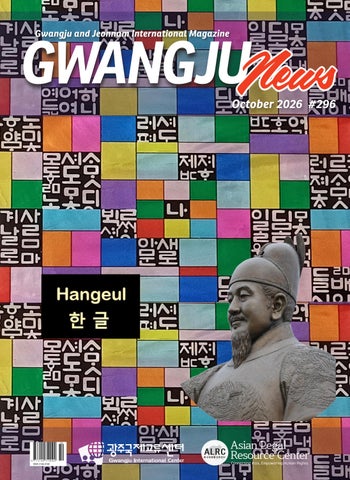
Cover Image Gwangju News creation with Hangeul card case pattern.
Publisher
Dr. Shin Gyonggu
Editor-in-Chief & Copy-Editing Dr. David E. Shaffer Copy-Editing Joey Nunez Layout Editor & Online Editor Johanna Lezada The Gwangju News is the first English monthly magazine for the general public in Korea, first published in 2001. Each monthly issue covers local and regional issues, with a focus on the roles and activities of the international residents and local English-speaking communities. Copyright ©2026 by the Gwangju International Center. All rights reserved. No part of this publication covered by this copyright may be reproduced in any form or by any means – graphic, electronic, mechanical, photocopying, recording, or otherwise – without the written consent of the publisher. The Gwangju News is published by the Gwangju International Center: Jungang-ro 196-beon-gil 5 (Geumnam-ro 3-ga), Dong-gu, Gwangju 61475, South Korea
Registration No. 광주광역시 라. 00145 ISSN: 3140-3190 (online) Registration Date: February 22, 2010 The Gwangju News is co-sponsored by Asian Legal Resource Center (ALRC) Korea
T
he ginkgo nuts are raining down on Gwangju’s sidewalks, and still on the trees, the ginkgo leaves are thinking about turning to their distinct goldenyellow hue. The nights are providing a welcomed midnight chill after a summer of tropical nights, signaling that the fullness of autumn in finally upon us. And with it, we provide you with the October issue of the Gwangju News. Though we have just wound up a long Chuseok holiday at the end of last month, early October provides us with an additional duo: Gaecheon-jeol and Hangeul Day. We have decided to feature the Korean alphabet (Hangeul) for this month’s issue. Our main feature, “Hangeul: Korea’s Alphabet, Designed for All,” discusses the alphabet from its beginnings to its presentday transformation and the challenges and progress in between, and Hangeul Day (October 9) as well. Our closely related second feature, “Romanizing Hangeul: Toward a System Korean Speakers Can Read Back,” is a scholarly discussion of the current romanization of Hangeul used in Korea, its drawbacks, and a proposal for a remedy. We have by no means overlooked Gaecheon-jeol (the “Openingof-the-Heavens Day” – October 3). We have an enjoyable article on how the heavens opened up, sending down the diety’s son, who married a bear, who bore a son, who created the first Korean kingdom, which… well, the rest is history. You are sure to enjoy reading about that history in “Dangun: Son of Heaven, Guardian of the Korean Peninsula.” Moving from mostly mythical to artifactual history, we have for you an article that propounds that the south Jeolla region was not a part of the Baekje Kingdom for nearly as long as previously believed. The Mahan culture continued to prevail in this region for centuries after the birth of Baekje – and there are keyholeshaped tomb mounds and jar coffins as artifacts to prove it! Read “Mysterious Mahan: Visiting the Naju National Museum.” Our Human Rights section offers two articles. The first is on “Lessons from Gwangju,” the topic of a presentation at Peace Festival Week 2026 in Thailand given by our publisher, who also authored the article. The second article is about the K-drama Teach You a Lesson and how it can teach a lesson about bullying. There is of course much, much more on offer in this October issue of the Gwangju News. Enjoy!
David E. Shaffer Editor-in-Chief Gwangju News
GWANGJU NEWS, OCTOBER 2026
Tel: (+82)-62-226-2733 Fax: (+82)-62-226-2731 Website: www.gwangjunewsgic.com Email: gwangjunews@gic.or.kr
From the Editor
Photo of the Month
4
GWANGJU NEWS, OCTOBER 2026
Echoes of Ancient Korea
A Korean Buddhist temple chime hangs beneath the ornate eaves, carrying centuries of tradition beneath the endless sky. Its graceful form reflects a quiet harmony between faith, artistry, and the timeless beauty of Korea. This photograph was taken at Yeosu’s Hyangil Hermitage, near Impo in late autumn.
The Photographer Neha Bisht is a native of India, pursuing her PhD at Chonnam National University. She loves to travel and enjoys capturing historic and scenic views as her memories. (Photo of the Month submissions are open to all readers: gwangjunews@gic.or.kr)
5 October 2026
CONTENTS
ISSUE 296
03 From the Editor 04 Photo of the Month 06 Special City News FEATURES 10 Hangeul: Korea’s Alphabet, Designed for All 16 Romanizing Hangeul: Toward a System Korean Speakers Can Read Back HUMAN RIGHTS 20 From Gwangju to Bangkok: Reflections on Peace Festival Week 2026 at Mahidol University 25 Do Bullies Have Human Rights? : What Teach You a Lesson Gets Us Talking About HISTORY & TRADITION 28 Mysterious Mahan: Visiting the Naju National Museum 31 Dangun: Son of Heaven, Guardian of the Korean Peninsula KOREA IN FOCUS 34 In My Opinion... : Out with Regionalism in Korea
COMMUNITY 42 Inside the GIRC: Health, Happiness, Healing – The Han-maeum Walking Festival
OUR PLANET 49 The Changing Earth: The Yeongsan River – Flowing Under One Government SCIENCE & TECHNOLOGY 52 When Machines Began to Dream: The Age of Artificial General Intelligence 57 The InnoCORE Project: Investing in the People Who Will Shape Korea’s Scientific Future CULTURE & THE ARTS 60 The Art of Change: Inside the 2026 Gwangju Biennale 65 The Calcuttan in Korea: Experts of the In-Between – Insights from Chiang Mai 69 Movie Review: The Beauty Inside – A Man with No Face 73 Book Review: All the Beauty in the World FOOD & BEVERAGE 75 D’s Café Column: A Cozy Autumn Coffee Break at Essenza Coffee SPORTS & ENTERTAINMENT 76 Sports Focus: Gwangju FC Honored After Dramatic Roadside Rescue 78 Area Sports Roundup 81 Music: More Than Just K-Pop – Korea Rocks with Day6 and Xdinary Heroes 83 October Upcoming Events
GWANGJU NEWS, OCTOBER 2026
TRAVEL & DISCOVERY 35 Exploring Korea: Beneath Yeowol’s Mountains – Into 400 Million Years 38 Naju in Half a Day: From Outer Space to Lakeside 40 A Journey to Boryeong: A Meeting of Mount and Sea
44 Inside the Gwangju News: The Calcuttan with a Cause – Reeti Roy
Special City News
6
Special City News The Yeosu-Suncheon 10.19 Incident Remembered
official reports. Exhibitions, photography displays, and academic programs are also planned around the ceremony.
Gwangju Chungjang Festival Connects Generations Through “Songs of Memory”
T Paying respects to victims of the Yeosu-Suncheon 10.19 Incident. (Gurye County)
A
joint memorial ceremony for the 78th anniversary of the Yeosu-Suncheon 10.19 Incident will be held in Suncheon on October 19. In September, the Jeonnam-Gwangju Special Metropolitan City met with bereaved families and advisory committee members to discuss the ceremony’s direction and program. Participants called for an event that honors victims and bereaved families while helping people across regions and generations remember the incident.
GWANGJU NEWS, OCTOBER 2026
The incident began on October 19, 1948, when some members of the 14th Regiment stationed in Yeosu refused orders to suppress the Jeju (April 3) uprising. Armed conflict and suppression operations continued in parts of South Jeolla, North Jeolla, and South Gyeongsang Provinces until 1955, resulting in many civilian casualties. The city announced that it had completed factfinding investigations into 2,419 unresolved reported cases by August. It plans to identify unreported victims and bereaved families by comparing reports with official records, examining family-register documents, and conducting field inquiries. The total number of victims is estimated at 25,000 to 30,000, while about 6,850 people have been identified through
he 23rd Gwangju Chungjang Street Festival will take place from October 7 to 11 along Geumnam, Chungjang, and Art Streets, and the May 18 Democracy Square area. This year’s theme, “Songs of Memory,” focuses on music that recalls personal memories and emotions while connecting generations, local communities, and visitors from different countries. The opening show on October 7, titled “Songs Awaken Memories,” will feature five sections of music and performances from different periods. October 8, designated as Intergenerational Empathy Day, will include the Chungjang Children’s Festival, the youth dance competition “March of Youth,” and the nighttime program “Chungjang Bright Night.” October 9 will be Asian Culture Day, followed by March Days I and II on October 10 and 11. The festival’s signature parade will be expanded to four performances over three days. Citizen-
Preliminary event for the 23rd Gwangju Chungjang Street Festival. (Jeonnam-Gwangju)
Special City News
7
Special City News participation performances and parades featuring global, Korean, and local cultures will take place throughout the old downtown area. Launched in 2004 to revitalize central Gwangju, the Chungjang Festival has developed into one of the city’s major urban arts and culture events. This year’s program invites residents and visitors to share musical memories and create new ones in the streets of the Chungjang area.
Gwangju Libraries Offer Autumn Reading Programs
L
ibraries across Gwangju are offering reading and cultural programs during September, Korea’s Reading Month, and the autumn cultural season. From September through October, Gwangju Library is organizing the “Library, People, and Books” program with Songjeong Dagachi Culture Library, Chaekjeongwon Library, Gwangju Student Education and Culture Center, and Jungheung Library. The program includes author talks, book discussions, family activities, and performances.
and registration information are available on the websites of participating libraries.
Jangseong Leafy Greens Reach Gwangju Tables
J
eonnam-Gwangju Special Metropolitan City selected pesticide-free leafy vegetables grown by the family of farmer Lee Hyeok-jae in Jangseong County as September’s eco-friendly agricultural product. The family has practiced eco-friendly farming for three generations on about 21,400 square meters of farmland. The farm grows lettuce, perilla leaves, cucumbers, cherry tomatoes, water parsley, and other crops.
Pesticide-free leafy vegetable farm. (Jeonnam-Gwangju)
Public libraries in Buk-gu are also operating second-half reading programs for elementary school students and adults. Activities include picturebook reading, book-art workshops, English picturebook sessions, board games, and science experiences. Some activities will continue regularly through October. Detailed schedules
Jangseong County opened the Jangseong Local Food Sangmu Direct Store in Ssangchon-dong, Seo-gu in August. The store sells fresh produce, processed foods, livestock products, and prepared side dishes. The existing Cheomdan Direct Store, which opened in 2022, has supply agreements with more than 1,800 farms.
Lee’s farm produces approximately 40 to 50 tons of eco-friendly produce annually. Its products are supplied to public school-meal centers, food-service companies, local food stores, and individual consumers. To reduce heat damage, the farm uses shade screens and roof vents in its greenhouses. It also manages the soil with beneficial microorganisms, certified eco-friendly compost, and natural nutrients.
GWANGJU NEWS, OCTOBER 2026
Songjeong Dagachi Culture Library will host writer Kang Won-guk for a lecture on writing. Chaekjeongwon Library will present “One Family, One Book,” featuring a family lecture, a book talk, and a bubble performance. At Gwangju Student Education and Culture Center, author Jeong Seung-ik will discuss ways to make learning enjoyable. Jungheung Library will host author Lee Eun-kyung for a lecture on preparing children for the future in the age of artificial intelligence.
Special City News
8
Special City News Samgye Agricultural Cooperative was also selected for the 2027 eco-friendly agriculture production-and-distribution infrastructure project, securing 500 million won. It plans to establish an advanced seedling production system and link it with a local food wholesale outlet scheduled to open next year.
connecting the two events with nearby tourist sites. Guided art walking tours in Yangnim-dong are offered on Fridays and Saturdays through November 14. The city also plans one-night, twoday tour packages, accommodation discounts, and regional tourism products during October’s Honam Tourism and Culture Week.
From the Gwangju Biennale to the Yeosu World Island Expo
Learning, Working, and Staying in Jeonnam-Gwangju
T
Easter Island Pavilion at the Yeosu World Island Expo. (Jeong Chanjong)
T
GWANGJU NEWS, OCTOBER 2026
he 16th Gwangju Biennale and the 2026 Yeosu World Island Expo opened on September 5, offering linked cultural and tourism programs across Jeonnam-Gwangju. The Gwangju Biennale, themed “You Must Change Your Life,” continues through November 15, while Yeosu World Island Expo, themed “Connecting Islands, the Ocean, and the Future,” runs through November 4 in the Dolsan Jinnam area, at the Yeosu Expo site, and on Gaedo and Geumodo.
he Jeonnam-Gwangju Special Metropolitan City’s Office of Education plans to introduce the Jeonnam-Gwangju Regional Joint Academic Assessment for third-year high school students in September 2027. The assessment will combine Jeonnam’s J-FINAL College Scholastic Ability Test mock examination and Gwangju’s Final Completion Mock Assessment. It will cover Korean language, mathematics, English, Korean history, social studies, and science, using an operating system similar to the National Academic Achievement Assessment. The Office of Education plans to establish an integrated test-development headquarters, use a residential system for preparing and reviewing questions, and introduce computerized scoring. Students will receive individual score-analysis reports and learning-diagnostic materials, while schools will be provided with data on item-response rates, correct-answer rates, and
Jeonnam-Gwangju Special City is linking the two events through transportation, accommodation, and tourism programs, with a target of attracting three million visitors. The Pavilion Shuttle Bus operates through November 14, connecting Biennale venues, the Asian Culture Center, and Yangnim-dong. Biennale ticket holders may use the service without a daily ride limit. A special Namdo Tour Bus route will operate 12 times throughout September and October,
Jeonnam-Gwangju Office of Education. (Jeonnam-Gwangju)
Special City News
9
Special City News achievement levels. The assessment is scheduled to expand to first- and second-year students in 2028, with a goal of becoming a supervising education office for the National Academic Achievement Assessment in 2029. In 2026, Suncheon Future Science High School, Mokpo Girls’ Commercial High School, and Suncheon Hyosan High School were selected as Jeonnam Glotech Schools. Their programs will focus on semiconductors; artificial intelligence and future services; and the food, dessert, and digital-content businesses. Each school is expected to receive 500 million won in start-up funding and financial support for up to six years.
On September 7, the city submitted its first supplementary budget proposal of 22.6962 trillion won. It includes funding for criticalpatient transfers, regional medical institutions, essential medical services, Gwangju Metro Line 2, city bus operations, and public transport farerefund support.
Autumn of the Special City: What May Change for Residents?
J
eonnam-Gwangju Special Metropolitan City was launched on July 1 this year through the administrative integration of Gwangju Metropolitan City and Jeonnam Province. Before its launch, the central government approved 30 enactments and revisions of enforcement decrees related to the Special Act. The decrees establish operating standards for special provisions in administration, education, urban development, and industrial promotion. They also allow the city to adjust its organizational structure within one percent of its standard personnel budget during its first four years.
Content Creator Jeong Chanjong has been working with the Gwangju International Center since March 2026. He is teaching humanities at Chonnam National University.
GWANGJU NEWS, OCTOBER 2026
Transportation reform is a central policy area. The city is considering the “10-30-60 Transportation Transformation” plan, which aims to provide access to public transport within 10 minutes of any city location, essential services such as health care, education, and cultural facilities within 30 minutes, and connections between major Gwangju and Jeonnam hubs within about 60 minutes. The plan includes linking bus, rail, road, transfer, and fare systems through an integrated mobility platform.
Special Act establishing Jeonnam-Gwangju Special Metropolitan City passes at the National Assembly plenary session. (National Assembly, ROK)
Feature
10
Hangeul
Korea’s Alphabet, Designed for All By David Shaffer
F
or anyone who has recently arrived in Korea, the Korean alphabet, Hangeul (한글), can seem at once familiar and mysterious. The letters are unlike the Roman alphabet used by English and Western European languages, yet they are remarkably systematic. Once you learn the basic letters, you can begin sounding out Korean words – even before you know what those words mean. This apparent simplicity is no accident. Hangeul was deliberately designed to be learnable. Its story begins nearly six centuries ago, with a Joseon king who was concerned that many of his subjects could speak Korean but could not write it.
A New Alphabet for a Korean Language
GWANGJU NEWS, OCTOBER 2026
In the 15th century, Korea was ruled by King Sejong (reign 1418–1450), the fourth king of the Joseon Dynasty. The educated, upper-class Koreans could write in Classical Chinese, known in Korea as hanmun (한문), using Chinese characters (hanja, 한자), which was the written medium of government, scholarship, and the elite. This was incongruous, to say the least: being speakers of Korean but having to write in the Chinese writing system. Korean was not Chinese. Its sounds and grammar were fundamentally different, and writing Korean with thousands of Chinese characters was quite cumbersome, taking years to learn. For people without access to elite education, which was the greater part of the Korean population, literacy was particularly difficult, and impossible for most. King Sejong therefore initiated the creation of a writing system specifically suited to the Korean language. The new script was completed in 1443.
King Sejong, creator of Hangeul (r. 1418–1450). (Original artist Kim Ki-chang)
Three years later, in 1446, the king officially promulgated it in a book called Hunmin-jeongeum (훈민정음), meaning “the correct sounds for the instruction of the people.” Hangeul is often described simply as having been “invented by King Sejong,” and that is essentially how the historical tradition presents it. In the introductory explanation to Hunmin-jeongeum, it states that Sejong created 28 new letters. The scholarly team associated with the royal court, however, was involved, subsequently producing the Hunmin-jeongeum Haerye-bon (훈민정음
Feature
해례본), an explanation of how the letters were
word 한글, for example, groups six letters into two syllabic blocks: 한 + 글.
The reason for the new writing system was equally explicit: The Korean language had sounds of its own, and the Chinese writing system was not designed to represent them conveniently. The king wanted ordinary people to be able to learn to read and write without having to master the enormous body of Chinese characters required for a classical education. The original Hangeul system comprised 28 letters – 17 consonants and 11 vowels – designed to be simple enough for ordinary people to learn and use.
So Why Didn’t Everyone Immediately Start Using Hangeul?
constructed and used.
Why Do the Letters Have the Shapes They Have?
One reason Hangeul has acquired a reputation as an unusually systematic writing system is that its basic letter shapes are connected to the way their sounds are produced. The five basic consonant letters in the original system were modeled on the shapes or positions of the speech organs involved in pronunciation: the tongue, lips, teeth, throat, and related structures. Other consonants were derived from these basic forms by adding strokes according to phonetic relationships.
11
Hangeul was designed to be easy to learn, often described as “the world’s most scientific alphabet,” but social acceptance of a writing system is not the same thing as technical simplicity. For centuries, Classical Chinese remained the prestigious written language of educated Korean society. The Joseon state was deeply influenced by Confucian scholarship, and mastery of Classical Chinese was closely connected with education, government service, and elite status. The civilservice examination system depended heavily on knowledge of Classical Chinese. Classical Chinese was the gatekeeper for the upper class. Consequently, Hangeul acquired a lower cultural status even though it was much easier to learn. It was often called eonmun (언문), or “vernacular writing,” a name that itself reflected its perceived position below literary Chinese. For elite men, writing serious scholarship in Hangeul could be regarded as inappropriate or lacking prestige.
For example, consider the relationship among ㄴ, ㄷ, and ㅌ. The basic ㄴ represents a sound associated with the position of the tongue (“n” sound, with tongue touching top of upper teeth). Adding a stroke produces ㄷ (voiceless “d” sound), and another stroke produces ㅌ (voiceless “t” sound). The additional strokes reflect differences in the strength or character of the sound.
Rather than writing a Korean word as a simple, linear sequence of individual letters, Hangeul groups them visually into syllable blocks. The
GWANGJU NEWS, OCTOBER 2026
The vowel system follows another organizing principle. Three basic elements represented heaven, earth, and the human being: originally a dot (ㆍ), a horizontal line (ㅡ), and a vertical line (ㅣ). Combinations of these elements produced the other vowels. (The dot has transformed into the short stroke or strokes of vowel letters.)
Hunmin-jeongeum, first page.
Feature
12
This does not mean that Hangeul was ignored. It found particularly strong uses among women, who were often excluded from the formal educational and political institutions that trained men in Classical Chinese. Elite women, too, became accomplished Hangeul readers and writers, producing letters, poetry, practical writings, and fiction. Hangeul was also used in religious texts, educational materials, government publications intended for wider audiences, medical works, translations, letters, songs, and popular literature. So the story is not “Hangeul was invented and then nobody used it for 400 years.” Rather, it gradually developed an important parallel life while Classical Chinese retained its position as the prestige language of formal scholarship.
Korean vernacular novel. By the 18th and 19th centuries, Hangeul was increasingly important in the production of popular literature. Yet Classical Chinese continued to coexist with it and remained the dominant writing system.
The Newspaper That Changed Everything
The great transformation came in the late 19th century. Korea was undergoing political and social upheaval, and reformers increasingly saw mass literacy as essential to modernization. In 1896, the reformer and intellectual Seo Jae-pil (known internationally as Philip Jaisohn) helped establish the newspaper Dongnip Sinmun (The Independent).
Reading Korean Literature Before 1900
Korean literature provides an extraordinary record of how Hangeul was actually used. Among the earliest major works associated with the new alphabet are Yongbieo-cheonga (Songs of the Dragons Flying to Heaven), completed in 1445, and Worin-cheongangji-gok (Songs of the Moon’s Reflection on a Thousand Rivers), produced around the same period. They are regarded as among the earliest literary works to make substantial use of the newly created script.
GWANGJU NEWS, OCTOBER 2026
Other early Hangeul publications included translations and adaptations of Buddhist scriptures, Confucian classics, instructional texts, medical works, and dictionaries. These were important because they demonstrated that Hangeul could be used for far more than informal correspondence. Over the following literature flourished.
centuries,
vernacular
Among the works associated with the long tradition of Korean-language fiction are Hong Gildong-jeon (The Story of Hong Gildong) and Chunhyang-jeon (The Story of Chunhyang). Hong Gildong-jeon, traditionally attributed to Heo Gyun and generally placed in the early 17th century, is particularly significant as an early
Dongnip Sinmun (The Independent), Korea’s first allHangeul newspaper (Read from right to left).
The newspaper was revolutionary in several respects. Its Korean-language pages were printed entirely in Hangeul rather than the traditional
Feature
mixture of Hangeul and Chinese characters. It was intended to reach a broad readership and was published three times a week when it began. It also carried an English section. This mattered enormously. By putting current events, political discussion, practical information, and public debate into Hangeul, Dongnip Sinmun helped demonstrate that Hangeul was capable of serving as the writing system of a modern society. By the beginning of the 20th century, Hangeul was moving from the margins of written culture toward the center.
From 28 Letters to Today’s Hangeul
If you could travel back to the 15th century and open a copy of Hunmin-jeongeum, you would recognize Hangeul, but you would also encounter letters that modern Korean speakers no longer use. The original alphabet had 28 letters: 17 consonants and 11 vowels. Modern Hangeul has 24 basic letters: 14 consonants and 10 vowels. Four of the original basic letters disappeared from ordinary Korean writing: ㆁ, ㆆ, ㅿ, and ㆍ. At the same time, the modern system developed additional combinations. The 24 basic letters can form double consonants such as ㄲ, ㄸ, ㅃ, ㅆ, and ㅉ, and numerous compound vowels and finalconsonant combinations. Another historical feature that disappeared was the use of small tone marks, or bangjeom (방점), used in the original system to indicate tonal distinctions in Middle Korean.
From Vertical Columns to Horizontal Lines
Today, Korean is normally written horizontally from left to right, much like English. The transition was gradual. Experiments with horizontal
Hangeul writing appeared as early as the first half of the 20th century, but vertical writing remained dominant in newspapers, books, and magazines for decades after liberation in 1945. When this author arrived in Korea in the early 1970s, vertical writing was still quite common. The Hankyoreh, founded in 1988, became the first major Korean daily to use horizontal writing throughout. Other newspapers followed, and by the late 1990s the major newspapers had largely abandoned traditional vertical typesetting. Closely related to this is the decline of Chinese characters.
“Dongnip Sinmun helped demonstrate that Hangeul was capable of serving as the writing system of a modern society.” What Happened to Chinese Characters?
If you look at a Korean newspaper or textbook from the 1950s or 1960s, you may be surprised by how many Chinese characters appear alongside Hangeul. For much of modern Korean history, “mixed writing” was common. Korean grammatical endings and native Korean words were written in Hangeul, while Sino-Korean vocabulary was frequently represented with hanja. Hanja could help distinguish words with identical pronunciation and was associated with formal education and intellectual tradition. After liberation in 1945, South Korea debated intensely over whether hanja should continue to be used. The government changed policy back and forth on teaching Chinese characters in secondary schools and in use in official government documents. Newspapers gradually used fewer and fewer Chinese characters for words until the present when in newspapers, for example, they are relegated to parenthetical use only when useful for disambiguation.
GWANGJU NEWS, OCTOBER 2026
Another change that visitors to Korea may find surprising is the reading/writing direction. Historically, Hangeul was written vertically, with characters proceeding from top to bottom and with columns progressing from right to left. This was consistent with the traditional East Asian writing environment in which Classical Chinese and Chinese-character texts were also written.
13
Feature
14
Hong Gilding-jeon (The Story of Hong Gildong), an early Hangeul novel.
Hanja, however, has not disappeared completely. It remains visible in historical documents, dictionaries, academic contexts, personal names, calligraphy, signs, and the occasional newspaper appearance. But ordinary contemporary Korean is overwhelmingly written in Hangeul, and one can live comfortably without any knowledge of hanja.
GWANGJU NEWS, OCTOBER 2026
North and South: Similar Alphabet, Different Conventions
North and South Korea still use closely related forms of the same basic writing system, but their standards have diverged since the division of the peninsula. There are easy-to-notice differences in spelling, for example. South Korean spelling changes certain initial ㄹ and ㄴ sounds in particular positions, whereas North Korean spelling generally retains them. For example, the word for “dragon” is spelled (and pronounced) 룡 in North Korea, while in the South, it is 용. Nevertheless, the underlying writing system remains unmistakably similar on both ends of the peninsula.
How Hangeul Day Began
Every October 9, Korea celebrates Hangeul Day (Hangeul-nal), but the holiday itself is much younger than the alphabet. The first organized celebration took place in 1926, when the Korean Language Research Society (Joseon-eo Yeonguhoe) marked the 480th anniversary of the promulgation of Hunmin-jeongeum. The day was then called Gagya-nal (가갸날), a name derived from the traditional way beginners learned Hangeul syllables. The name was changed to Hangeul Day in 1928. Hangeul Day became a public holiday in 1946, lost its public-holiday status in 1990, but regained this status in 2013.
How Hangeul Day Is Celebrated
For someone living in Korea, Hangeul Day can be a good opportunity to experience a side of Korean culture that goes beyond food, music, television, and popular entertainment. National and local events commonly include exhibitions, lectures, calligraphy demonstrations, competitions, language activities, typography and design exhibitions, children’s programs,
Feature
15
and opportunities to learn about the history of the alphabet. The celebration is increasingly international as well. Korean Cultural Centers abroad have organized Hangeul calligraphy competitions, Korean-language contests, exhibitions, workshops, and lectures for nonKoreans.
presence. People encounter Korean letters on K-pop albums, television programs, cosmetics, clothing, restaurant signs, social media, websites, and advertisements. Korean-language programs offered by King Sejong Institutes and other institutions have also brought Hangeul to learners around the world.
“Social acceptance of a writing system is not the same thing as technical simplicity.”
And perhaps the most fitting aspect of Hangeul’s future is that its original purpose remains relevant.
Hangeul Leaves Korea
Hangeul’s influence has also crossed Korea’s borders in a more literal sense. One of the bestknown examples is Cia-Cia, an Austronesian language spoken in and around Baubau on Buton Island in Indonesia. Cia-Cia traditionally had no widely established writing system of its own. In 2009, a project involving South Korean linguists and the Hunmin-jeongeum Society developed a way of representing Cia-Cia using Hangeul. A Cia-Cia textbook was published that year, and classes began at a local elementary school. The experiment demonstrates something significant about Hangeul: Because its basic principles are phonetic and its letters can be combined systematically, the writing system can be adapted to languages other than Korean.
What Might the Future Hold?
Its future may be equally dynamic. Today, Hangeul is part of Korea’s global cultural
But Hangeul is unusually welcoming once you understand its logic. Learn the consonants. Learn the vowels. See how they combine. Notice how a syllable block is assembled. Listen to the sound and connect it with the shape. Suddenly, that wall begins to break apart. And that may be the most remarkable legacy of Hangeul. It is not simply an old Korean cultural artifact. It is a living writing system whose creators explicitly intended it to help people communicate – in Korea, in Korean, in Hangeul, and beyond.
The Author David Shaffer first encountered Hangeul when he came to Korea in the early 1970s, a time when he needed to also learn Chinese characters to be able to understand the mixed writing system in common use at that time. Dr. Shaffer is now the editor-inchief of the Gwangju News.
GWANGJU NEWS, OCTOBER 2026
Hangeul has already undergone several transformations: from a royal project to a vernacular writing system; from a script used alongside Classical Chinese to Korea’s dominant writing system; from vertical columns to horizontal lines; and from hand-written manuscripts, hand-carved woodblocks, and metal type to computer keyboards, smartphones, digital fonts, and artificial intelligence.
Sejong’s writing system was created to make communication more accessible – to give people a practical means of recording the language they actually spoke. Nearly 600 years later, people who arrive in Korea from other countries face their own version of that challenge. The signs on the subway, the menus in restaurants, the notices in apartment buildings, and the names of streets can initially seem like an impenetrable wall of symbols.
Feature
16
Romanizing Hangeul
Toward a System Korean Speakers Can Read Back By Shin Gyeonggu
M
ost visitors meet the Korean language first through Roman letters: on road signs, subway maps, and bus stops. How we write Korean in the Latin alphabet therefore shapes one’s first impression of the language. In 2000, the national standard of Korean romanization was issued by the Ministry of Culture and Tourism, now the Ministry of Culture, Sports, and Tourism. A quarter of a century later, it is worth asking how well it serves both Koreans and foreigners.
GWANGJU NEWS, OCTOBER 2026
International practice offers yardsticks. The United Nations Group of Experts on Geographical Names (UNGEGN) works from four basic principles for romanizing geographical names: • Transcription or transliteration: Choose whether to represent the pronunciation (transcription) or the original spelling (transliteration). • Reversibility: Ideally, the original script should be recoverable from the romanized form. • Simplicity: Use clear, easy-to-type Roman letters and avoid unnecessary special symbols. • One standard system: Each language should have one official system to prevent confusion. The UN has pressed these points for decades. Its first resolution on the subject (I/9, 1967) warned against the confusion caused by systems “based on the phonetic structure of the receiver languages” and called for a single system “based on scientific principles.” In 1977, the UN adopted China’s Hanyu Pinyin as the international standard for Chinese (III/8), a phonemic system built for Mandarin speakers.
The RR 2000 System
Chapter 1 of the Korean 2000 Revised Romanization System (RR 2000) lays down two general principles: (a) Korean is romanized according to its standard pronunciation, and (b) symbols other than Roman letters are avoided as far as possible. The first makes the system a transcription; the second rules out diacritics such as the breves of the former McCune–Reischauer romanization system. Four out of eight special notes in Chapter 3 show how these principles work in practice. Note 1: Sound changes are written as pronounced. – This reverses the logic of Korean orthography itself, which is morphophonemic: 강북 is spelled the same whether it stands alone or takes a particle. The romanization, however, must change with the sound: 강북 is Gangbuk, but 강북에 becomes Gangbuge; 집 is jip, but 집에 becomes jibe. The unique word form disappears inside the pronunciation. Note 2: A hyphen may be used where pronunciation could be confused, as in 중앙 jungang (not jun-gang). Note 3: A hyphen is placed before administrative units, and sound changes across it are not reflected. – Thus 인왕리, pronounced [이놩니], is written Inwang-ri, not Inwang-ni. This openly departs from the first principle. It is a quiet admission that for names, writing the word in transliteration is better than writing the sound in transcription. Note 8: For academic work requiring reconstruction of Hangeul, the spelling itself is transliterated. – Accordingly, ㄱ, ㄷ, ㅂ, ㄹ are always g, d, b, l; the silent ㅇ before a vowel is
Feature
marked by a hyphen except at the beginning of a word (see Table 1).
강북에 from Gangbuge. A system that cannot be
Table 1. Transliteration Under Note 8
3. Exceptions weaken the standard The rules of RR 2000 allow personal names and established company names to keep earlier spellings, so Lee, Park, Hyundai, and Samsung coexist with the official I, Bak, Hyeondae and Samseong. China, by contrast, converted place and personal names to Pinyin across the board, and the result is a single, predictable spelling.
집 값 독립 굳이
jib gabs doglib gud-i
짚 붓꽃 먹는 밖
jip buskkoch meogneun bakk
In other words, the Ministry already possesses a reversible system. It simply reserves it for specialists. In fact, Korea de facto runs two official systems, which conflicts with the UN's onesystem principle. The solution is not to abolish Note 8 but to make it the only system.
Problems of the RR 2000 System
Hangeul is widely praised as one of the most scientific alphabets in the world: Each letter represents a phoneme, and the shapes of the consonants reflect the articulators that produce them. Its romanization (RR 2000) is far less scientific, largely because it was designed from the viewpoint of English-speaking listeners rather than Korean speakers, precisely the “receiver language” approach the UN cautioned against.
2. No way back Because spellings in the RR 2000 system follow sound changes, the one-to-one link between Hangeul and Roman letters is lost. Neither a learner nor a computer can reliably recover
read back teaches foreigners the sound of a place name but not the name itself.
4. Inconsistent and colliding vowels Since 어 is eo, 워 must be weo. But RR 2000 writes 수원 as Suwon instead of the consistent Suweon, and won but not weon for 원. More seriously, the system has no syllable-boundary marker for vowels. Seoul is regularly read as three syllables, se-o-ul by text-to-speech voice apps. Ae may be pronounced as both ㅐ as in 개 gae and ㅏ + ㅔ (가에 gae). 바다에 badae reads back as 바대; 우이동 and 의동 are spelled the same, as Uidong.
Learning from Other Systems
1. German: Letters need not sound like English German uses the Roman alphabet with its own values: ch is [x], v is [f], z is [ts], chs is [ks], and eh is a long [eeː]. Nobody finds this unscientific. German also devoices final consonants, yet it may spell differently two words with the same phonetic sound (see Table 2 at the end). The spelling pays off as soon as an ending is added: Rad becomes Räder with a clear [d], while Rat becomes Räte with [t]. Korean works in exactly the same way: 집 jib and 짚 jip sound alike alone but differ in 집에 jib-e and 짚에 jip-e. We need the Note 8 spelling system for everyone, not only for scholars. 2. Hanyu Pinyin: One phoneme, one symbol Approved in 1958, Pinyin assigns Roman letters to Mandarin sounds without regard for English speakers: q, x, c, z, zh, and ch all have Chinese values. Korean newspapers once rendered q as “k,” but readers soon learned. Pinyin’s b, d, g are, in its own description, pronounced with no
GWANGJU NEWS, OCTOBER 2026
1. One letter, two spellings The same Hangeul consonant is romanized differently by position: ㄱ, ㄷ, ㅂ are g, d, b before a vowel but k, t, p at the end of a syllable, and ㄹ is r or l. Phonetically this is defensible, since Korean final stops are unreleased. Yet Korean speakers do not perceive them as different letters, just as English speakers do not notice that the p in “spin” lacks the puff of air in “pin,” and English does not spell them differently. The RR 2000 system is also inconsistent with itself: if ㄱ is g, its tense counterpart ㄲ should be gg, not kk.
17
Feature
18
vibration of the vocal cords, which is close to Korean ㅂ, ㄷ, ㄱ. Its e stands for a vowel close to [ə], and i is written the same in si [sɨ] and qi [ʧi] since Mandarin speakers recognize them as i in both contexts. Pinyin also has a syllableboundary marker, the apostrophe, placed before a syllable beginning with a, o, or e (see Table 3). Table 3. The Pinyin Apostrophe Chinese Pinyin Syllables Meaning 西安 Xī’ān xī + ān Xi’an City 先 xiān one first, before 皮袄 pí’ǎo pí + ǎo leather coat 飘 piāo one to float
3. Russian: A sign for a boundary The Library of Congress Russian table renders the hard sign ъ with the double prime ʺ, preserving a boundary that affects pronunciation: подъезд, “entrance,” is written podʺezd and pronounced [pɐdˈjest]. A single, simple mark keeps the word both readable and reversible.
Proposing New Principles and a New System
GWANGJU NEWS, OCTOBER 2026
The following five principles may well be accepted to find solutions to the problems caused by the RR 2000 system of Hangeul romanization: • Morpho-phonemic, not phonetic: Like Hangeul itself, the romanization should represent phonemes. 밥 is always bab, never bap; 강북 is Gangbug, and 강북에 is Gangbug-e, which reads back into Hangeul without loss. • One Hangeul letter, one symbol, in every position (see Tables 4 and 5). • The apostrophe marks syllable boundaries between vowels; the hyphen separates morphemes only: Seo’ul, Gwangju-si. • Pronunciation guidelines, not spelling changes, explain how letters sound in context. • All government documents and signage follow the system, without exceptions. Vowels keep their RR 2000 values, except that ㅝ becomes weo (원 weon, 수원 Suweon)
for consistency with ㅓ eo. A short set of pronunciation guidelines then cover what the current RR 2000 system forces into the spelling: • Final stops are unreleased: gag is [gaɡ ̚] and bab is [bab], while dad, sis, jaj, chach, tat and hoh all end in [ t ̚]. Final n, m, ng, and l are pronounced in full, as in nan [nan], mam [mam], ang [aŋ], and lal [ɾal]. • b, d, g, j are voiceless at the beginning of a word and voiced between vowels, as in Pinyin. • s is pronounced [ʃ], close to “sh,” before i. • Regular Korean sound changes (doglib read [동닙], johda read [조타]) are taught as rules. • The apostrophe separates vowels that would otherwise merge: Seo’ul, a’i, ga’e, ga’e, bada’e, U’idong, ui’in.
Conclusion
The UN has also urged countries not to revise romanization systems once adopted (IV/15, 1982), and any change carries a real cost in signs, maps, and habits. That is exactly why the next reform, if there is one, should be the last – a system built on the logic of Hangeul rather than on the ear of English. A romanization that Korean speakers find natural, that learners can read back into Hangeul letter by letter, and that admits no exceptions would be the shortest path for foreigners into the Korean language. Hangeul deserves a romanization system as scientific as itself. References Library of Congress (2012). Russian Romanization Table. https://www.loc.gov/catdir/cpso/romanization/ russian.pdf Ministry of Culture, Sports, and Tourism (2014). Romanization of Korean. https://korean.go.kr/ kornorms/regltn/regltnView.do?regltn_code=0004#a Princeton University Press (2014). Hanyu Pinyin Romanization System. https://assets.press.princeton .edu/chapters/i10279.pdf UNGEGN (2017). Romanization Guidelines. https://unstats. un.org/unsd/ungegn/documents/RES_UN_ Korean_1-11_CONF.pdf
The Author
Shin Gyeonggu is executive director of the Gwangju International Center, senior policy advisor on human rights and international affairs for the city of Gwangju, professor emeritus of English at Chonnam National University, and chair of the Global Steering Committee of the World Human Rights Cities Forum.
19 Feature
GWANGJU NEWS, OCTOBER 2026
Human Rights
20 20
From Gwangju to Bangkok Reflections on Peace Festival Week 2026 at Mahidol University By Shin Gyonggu
At the beginning of the concert, a royal tribute was shown on screen; Thais customarily stand for the Royal Anthem.
A Regional Hub for Human Rights Education
GWANGJU NEWS, OCTOBER 2026
Mahidol University, founded in 1888, is one of Thailand’s leading research universities. It is internationally recognized for its strengths in medicine, public health, and the life sciences, while also offering undergraduate through doctoral programs across seventeen faculties, colleges, and institutes on campuses in Bangkok, Salaya, and Kanchanaburi. Within this broad academic ecosystem, the Institute of Human Rights and Peace Studies (IHRP), based on the Salaya campus outside Bangkok, has established a distinct regional reputation. It is widely regarded as one of Asia’s leading centers for human rights education, research, and peace studies. IHRP took its present form through the merger of two earlier institutions: the Center for Human Rights Studies and Social Development, established in 1998, and the Research Center for Peacebuilding, founded in 2004 to support conflict transformation in Thailand’s southernmost
provinces. In 1999, it started Southeast Asia’s first graduate program in empirical human rights studies. Since then, IHRP, supported by a faculty of twelve full-time professors and lecturers, has developed a comprehensive range of graduate programs, taught largely in English, offering a Master of Arts in Human Rights and an interdisciplinary Doctor of Philosophy in Human Rights and Peace Studies. Over more than two decades, IHRP has educated students from more than twenty countries, many of whom now serve as academics, human rights defenders, and officials in NGOs, governments, and international organizations across Asia and beyond.
Linking May 18 Gwangju and October 6 Bangkok
From August 17 to 19, 2026, IHRP convened Peace Festival Week 2026 at its Salaya campus. The three-day program opened with a press conference and a special lecture by Professor Thongchai Winichakul, a distinguished historian. Thongchai was himself a student leader
Human Rights
at Thammasat University in the mid-1970s. Following the massacre of October 6, 1976, he was imprisoned, to be released only under the 1978 amnesty. The Festival’s central theme “From Gwangju, South Korea, to the 50th Anniversary of 6 October 1976: Democracy, Human Rights and Justice – Transitioning Towards a Peaceful and Just Democratic Society” placed the Gwangju Uprising of May 1980 in direct conversation with the Thammasat massacre. Through panel discussions, a policy roundtable, and public sessions, academics, activists, students, and policymakers from Thailand and other parts of the region examined how two societies, separated by geography but linked by comparable experiences of state violence, have struggled to turn historical trauma into democratic renewal. Thailand’s democratic movement has important similarities with South Korea’s democratization struggle. In both countries, students, workers, labor unions, intellectuals, religious communities, civic organizations, and ordinary citizens have mobilized against authoritarian rule and demanded dignity, constitutional government, and justice for victims of repression.
Nevertheless, the movement continues to confront deeply entrenched military, judicial, and conservative elite vetoes that challenge popular electoral mandates. This underlying authoritarianism remains visible in everyday public life. For instance, individuals are still obliged to stand before portraits of Queen
Suthida, and representations of King Maha Vajiralongkorn remain ubiquitous throughout Bangkok. Against this long and unfinished historical backdrop, Peace Festival Week invited a Korean perspective on what democratic transition can achieve over time.
From Democracy to Creativity
I was privileged to speak at the Festival about how the Gwangju Uprising has shaped not only Korea’s democratization but also, less obviously, the country’s subsequent cultural boom. In May 1980, paratroopers were sent to suppress student protests in Gwangju. Ordinary citizens joined the resistance and defended their city for ten days before the uprising was brutally crushed. For years afterward, the events were officially distorted and the victims were stigmatized.
“Political freedom and cultural creativity draw from the same well of human energy.” This, however, ignited a grass-root movement toward South Korea’s long democratic transition, culminating in the restoration of direct presidential elections in 1987 and fully civilian governments in 1993 and 1998. The Gwangju Special Law of 1995 and other subsequent measures made the truth publicly acknowledged. The dead were honored at what is now the May 18th National Cemetery, and the archives of the Gwangju Uprising were inscribed on UNESCO’s Memory of the World Register in 2011. My central message was simple: When democracy and human rights are denied, a society wastes its most valuable resources – the energy, idealism, and talent of its young people. They are forced
GWANGJU NEWS, OCTOBER 2026
Thailand’s youth-led protests of 2020–21, the electoral rise of the progressive Move Forward Party in 2023, and the constitutional reform process of 2026 demonstrate that the nation’s democratic movement remains vibrant and resilient. This enduring energy is what makes events like Peace Festival Week possible, dedicated to commemorating the history of the pro-democracy movement and honoring the victims of state violence.
21
22
Human Rights
to devote their lives to securing basic rights: the right to speak, organize, assemble, and be heard. Every hour a young activist spends resisting censorship or evading surveillance is an hour not spent writing, composing, filming, building a business, conducting research, or developing new ideas. When democracy and human rights protections take root, however, that same human energy can be redirected to drive national development in culture, technology, education, and the economy. Korea’s experience illustrates this vividly. The generations that once organized underground against censorship and martial law helped create the social and political conditions in which Korean film, television, music, and technology could flourish locally and globally. Directors could make films such as Parasite; producers could support globally influential dramas such as Squid Game; and K-pop entertainment agencies could develop artists whose work reached audiences across the world.
GWANGJU NEWS, OCTOBER 2026
“When democracy and human rights are denied, a society wastes its most valuable resources – the energy, idealism, and talent of its young people.” This does not mean that democracy alone explains Korea’s cultural and economic success. Many other conditions also mattered: investment in education, industrial development, technological capacity, entrepreneurship, and international exchange. Yet political freedom created essential space for people to criticize, create, experiment, and imagine without constant fear. Political freedom and cultural creativity draw from the same well of human energy. When people are not
exhausted from pushing back against political pressures, they can contribute more fully to everything a society hopes to build.
Lessons from Gwangju for the Region
Peace Festival Week 2026 was more than a commemorative gathering. Discussions over the three days led to concrete policy recommendations concerning transitional justice, democratic safeguards, and reconciliation. Participants shared the conviction that genuine peace cannot be built by concealing historical wounds. It must rest on truth, accountability, and the meaningful participation of those most affected by violence and repression. Among the commitments proposed at the policy roundtable were the following: • Constitutional protections against extrademocratic seizures of power. • An independent and transparent truth-seeking body to document past political violence. • An end to impunity for state actors responsible for human rights violations. • Holistic reparations combining restorative justice with public acknowledgment and official apology. • Reform of the military, security services, and police to ensure democratic civilian oversight. • Memorial sites and public-memory spaces to prevent historical amnesia. • Stronger decentralization and local-government capacity for conflict prevention and early warning. • Education in peace, democracy, human rights, and political history at every level. • Greater responsibility by media organizations and digital platforms in countering disinformation and incitement. Gwangju’s own path, from a city under martiallaw siege in May 1980 to an internationally recognized center for democracy, human rights, and peace, was repeatedly invoked as evidence that these principles are not merely aspirational. Over four decades, Gwangju has shown that historical trauma can be transformed into
Human Rights
23
Dr. Shin Gyonggu presents on lessons from Gwangju’s May 18 at Peace Festival Week in August.
institutions that safeguard democracy: truthseeking processes, a national cemetery, a national commemoration day, museums and memorial parks, and a substantial body of scholarship and civic education centered on what Koreans call the “Gwangju Spirit.”
For a Thai public still debating how to establish an effective truth-seeking mechanism for events that occurred half a century ago, Gwangju’s experience is not a distant historical curiosity. It is
What Gwangju Can Learn from Mahidol and FNF
The Peace Festival was made possible in part through support from the Friedrich Naumann Foundation for Freedom (FNF), a German political foundation established in Bonn in 1958 at the initiative of Theodor Heuss, the first Federal President of the Federal Republic of Germany. It was named after Friedrich Naumann, a German liberal thinker. Today, FNF works internationally to promote freedom, human rights, democracy, civic participation, and liberal values. According to its financial plan for 2025, the Foundation projected total expenditure of approximately €88 million, largely financed through German federal grants.
GWANGJU NEWS, OCTOBER 2026
Speakers also noted Gwangju’s continuing regional role through platforms such as the World Human Rights Cities Forum, which brings together cities, civil-society organizations, and human rights practitioners from around the world. For Thailand and the wider region, Gwangju offers practical lessons as they confront the unresolved legacy of October 6, 1976.
a working case study in how truth, remembrance, and accountability can eventually take root.
24
Human Rights
In 2024 alone, it reported holding more than 2,300 international events that reached over 155,000 participants. As Thekla Ebbert, FNF’s regional project advisor and project lead for Thailand, noted in her message of support for the Festival, the Foundation remains committed to advancing freedom and human rights in sustainable ways around the world. FNF’s model offers a useful lesson for South Korea, and particularly for Gwangju. Korea’s international development cooperation has been carried out largely by the Korea International Cooperation Agency (KOICA), whose work has understandably focused on poverty reduction, quality of life, inclusive development, grant aid, technical cooperation, training, volunteer programs, humanitarian assistance, and partnerships.
GWANGJU NEWS, OCTOBER 2026
“Gwangju’s experience is a working case study in how truth, remembrance, and accountability can eventually take root.” However, Korea could strengthen its international engagement in democracy and human rights. Gwangju, whose sacrifice made a major contribution to Korea’s democratization, is especially well placed to support human rights activists, researchers, educators, and civic organizations in other countries through training, fellowships, exchanges, and modest but sustained funding. Rather than relying on one-off gestures, Gwangju could develop long-term regional partnerships that support truth-telling, civic education, peacebuilding, and democratic resilience. Possible initiatives could include co-funding
projects in neighboring countries confronting unresolved histories of violence, including Thailand’s October 6 legacy and Myanmar’s ongoing crisis; establishing fellowships for young activists and scholars to study the Gwangju experience firsthand; and developing the World Human Rights Cities Forum into a year-round platform for regional cooperation, exchange, and joint action. In this regard, the Global NGO Master’s Program (GNMP) at Chonnam National University’s May 18 Institute should be expanded with more funding and with better management. Sitting in the audience at Mahidol and later speaking from the stage, I was struck by how naturally the conversation moved between Gwangju and Bangkok, between May 1980 and October 6, 1976. It was as if the two cities were comparing notes on the same unfinished project. That may be the truest measure of Peace Festival Week 2026’s success: It did not offer easy answers, but it made two societies’ most difficult histories more legible to one another – and left both better equipped to continue the work. Watch the Festival
Full video recordings of Peace Festival Week 2026 are available on the Facebook page of the Institute of Human Rights and Peace Studies, Mahidol University (IHRP.Mahidol). The author’s presentation appears in the August 17 morning session, from 1:53:18 to 2:46:35. • August 17, 2026, morning session: https://www. facebook.com/IHRP.Mahidol/videos/15978135 28481083
The Author
Shin Gyonggu is executive director of the Gwangju International Center, senior policy advisor on human rights and international affairs for the city of Gwangju, professor emeritus of English at Chonnam National University, and chair of the Global Steering Committee of the World Human Rights Cities Forum. (Photographs courtesy of the author)
Human Rights
25
Do Bullies Have Human Rights? What Teach You a Lesson Gets Us Talking About
N
By Luis Andrés
etflix’s recent Korean series Teach You a Lesson (참교육) has attracted attention with a premise that is simultaneously interesting, uncomfortable, and perhaps deliberately excessive: What if someone could finally do something about school bullying? The series follows the Educational Rights Protection Bureau, a fictional government agency established to intervene when students, teachers, or parents cross the line. Its inspectors are not exactly subtle. Netflix itself describes their methods as “unconventional,” which is a polite way of saying that these are definitely not just filling out a report. Behind the action sequences and the cathartic pleasure of watching seemingly untouchable people finally face consequences, however, Teach You a Lesson raises a surprisingly complicated question: Do people who violate the rights of others still deserve their own rights? The short answer is yes. The longer answer is also yes, but it is considerably less straightforward.
Without spoiling exactly what happens, the Educational Rights Protection Bureau does not operate through politely worded administrative notices and afterschool detention. They use far more hurting and humiliating methods. The
Teach You a Lesson (참교육) series. (Netflix)
following episode consequently opens another debate: If intimidation, humiliation, and physical force are being used against violent people in order to protect their victims, are those methods justified? Within the series, the political controversy surrounding the bureau is strategically manufactured by its opponents. But the question
GWANGJU NEWS, OCTOBER 2026
The first episode of the drama introduces a school terrorized by the son of a powerful politician. His bullying has devastating consequences, while the adults around him appear incapable of stopping him. His father’s political influence has made accountability nearly impossible. Then inspector Na Hwa-jin arrives.
26
Human Rights
underneath it is real, and it appears constantly in discussions about crime, punishment, terrorism, bullying, and public safety. Why should we care about the rights of someone who clearly did not care about anybody else’s? This is where human rights become difficult. It is relatively easy to defend the rights of people we like. The actual test of a human rights system is whether those protections remain meaningful when applied to people we dislike, fear, or even consider reprehensible. But human rights are not prizes for good behavior.
GWANGJU NEWS, OCTOBER 2026
This important distinction gets somewhat lost in the drama because it is an action-drama series rather than a human rights seminar. However, it is worth diving into a little: Under international human rights law, states have three broad obligations: to respect, protect, and fulfill human rights. States must avoid violating rights themselves, protect people from abuses committed by others, and take positive measures that allow people to exercise their rights. The Office of the United Nations High Commissioner for Human Rights explicitly describes these as fundamental responsibilities of governments. That changes how we should frame the dilemma. Imagine a student being violently bullied. The state has a responsibility to protect that student. Schools, educational authorities, police, courts, and other institutions cannot simply watch serious abuse happen and decide that it is a private disagreement between two teenagers. But the state does not fulfill that responsibility by abusing the bully instead. The alleged perpetrator retains rights too: bodily integrity, due process, protection from cruel or degrading treatment, and other legal guarantees depending on the circumstances. This can sound frustrating because we instinctively imagine a scale: the victim on one side, the perpetrator on the other. Protecting one appears to require taking something away from the other. But human rights do not work particularly well as a scale.
For starters, the state’s responsibility is precisely to protect both. It must protect the victim from the perpetrator, while simultaneously protecting everyone involved from arbitrary state power. That distinction becomes particularly important when the person administering punishment is not another student but an official carrying the authority of the government. Giving public officials permission to suspend someone’s basic rights because that person is considered sufficiently bad creates a rather obvious problem: Someone, then, has to decide who is bad enough; and history suggests we should probably not hand governments that particular blank check.
(GN with ChatGPT)
There is a second issue that Teach You a Lesson invites us to consider. Human rights are universal because they derive from human dignity rather than individual merit. The basic principle of the Universal Declaration of Human Rights is remarkably straightforward: Human beings are born free and equal in dignity and rights. That includes wonderful people. It includes annoying people. And, while hard to accept for some people, it includes people who have done terrible things. However, this does not mean
Human Rights
abandoning accountability. Protecting the rights of perpetrators does not mean ignoring victims, forsaking repair, or pretending that violence did not happen. It means distinguishing justice from vengeance. Justice asks what is necessary to protect victims, establish responsibility, repair harm where possible, prevent repetition, and reintegrate people into society. Vengeance asks how much suffering someone deserves in return. Those are very different questions, and punitive systems can make us feel that vengeance is necessary for achieving justice. This distinction is not easy for victims, including myself. I was bullied in school, and there is an uncomfortable reality about bullying that no satisfying television finale can solve: Some things cannot be undone. You cannot retroactively give someone back the days they were afraid to go to school. You cannot completely erase humiliation, isolation, or the strange little ways those experiences sometimes follow people into adulthood. Consequences matter. Accountability matters enormously. But suffering is not arithmetic.
There is perhaps no better city in Korea to have this conversation than Gwangju. This is a city whose contemporary identity is deeply connected to democracy, resistance to
state violence, and the protection of human dignity. Human rights here are not merely an attractive phrase printed on conference banners. They are connected to a historical understanding of what can happen when institutions decide that certain people no longer deserve ordinary protections. That history also offers Gwangju an opportunity. A human rights city should be capable of defending victims fiercely without reproducing the logic of humiliation and violence that created victims in the first place. That applies to schools, prisons, migration, policing, gender-based violence, discrimination, and every other type of structural violence. Human rights cannot become a scoreboard where one violation earns us permission to commit another. Victims deserve protection, recognition, accountability, and justice. Perpetrators must be stopped and held responsible. Institutions that ignore abuse must also be questioned. But none of this requires abandoning human dignity. Perhaps that is the lesson underneath Teach You a Lesson that is considerably harder to dramatize. Justice sometimes feels disappointingly restrained. It does not always provide the primal emotional outlet that revenge seems to offer. But that restraint is precisely the point of living in a peaceful society. If human rights belong only to people we believe deserve them, they are no longer human rights. They are privileges.
The Author
Luis Andrés González is a Mexican GKS scholar and master’s student in cultural anthropology at Chonnam National University. He advocates for LGBTQ+ rights and gender equality, and explores global affairs through pop culture. He is the founder of Erreizando, a digital magazine. Instagram: @luisin97 / @erreizando
GWANGJU NEWS, OCTOBER 2026
If something terrible happens to the people who bullied me, my own experiences do not disappear. Their pain does not subtract from mine. What I can hope is that they grew up. I can hope that they are no longer violent people. That they learned something. That they became productive members of their communities and that nobody else had to experience from them what I experienced. And, realistically, we make that outcome considerably less likely if our response to violence is simply institutionalized violence in the opposite direction. The objective of justice should be fewer victims, not a more equitable distribution of suffering.
27
History & Tradition
28
Mysterious Mahan
Visiting the Naju National Museum By Don Baker
Mahan jar coffins. (Naju National Museum)
GWANGJU NEWS, OCTOBER 2026
W
hen I lived in Gwangju in the early 1970s, people who knew I was interested in Korean history would tell me that from about 2,000 years ago to around 1,400 years ago the Korean Peninsula had been divided into three kingdoms: Baekje in the southwest, Silla in the southeast, and Goguryeo in the north. They also told me that Gwangju was part of Baekje, which, they claimed, had been founded in 18 BCE. No one at that time mentioned the name Mahan. Our picture of early Korean history has gotten more complicated since then. We now know that Baekje did not become a full-fledged kingdom
until the 4th century. This means that the claim that the Jeonnam area was part of the Baekje kingdom for several centuries is incorrect, since Baekje went out of existence in the second half of the 7th century. Moreover, Baekje did not completely absorb the Jeonnam region until the early 6th century. Jeonnam was controlled by Baekje for only around a century and a half. Before Baekje absorbed the Jeonnam region, there was another culture, and confederation of small chiefdoms, here called Mahan. Mahan existed for several centuries before Baekje absorbed it. In fact, a 3rd-century Chinese report on the Korean Peninsula describes Mahan (which it says was
History & Tradition
composed of 54 different autonomous polities) but doesn’t mention a separate kingdom called Baekje. The report doesn't pay much attention to Baekje because in the 3rd century what later grew into the Baekje Kingdom was nothing more than a small settlement along the Han River. Though Baekje in its early stages may have been one of the groups that the Chinese considered part of Mahan, the core Mahan region in the southwest and Baekje farther north had different cultures, evident in different burial practices. Such cultural differences persisted well into the 6th century. Mahan’s existence has been gaining more attention lately. A new national museum dedicated to Mahan opened in Naju in 2013. Last year, I decided to visit that Naju National Museum. I knew I was getting close when I noticed a sign on the road heading there that read “Welcome to Mahan.”
29
distinguish prehistoric cultures and ethnic groups by their burial practices. To them, it is clear that the Mahan region had its own unique culture. Does that mean that the people of Mahan were also a separate ethnic group? We don’t have any written documents from Mahan, so we don’t know for sure that the people of Mahan considered the people of Baekje and Silla to be their relatives. However, it is likely they did, since we can find evidence of substantial economic and cultural interactions between Mahan and the other polities on the peninsula 1,500 or more years ago. Moreover, no evidence has been unearthed so far of organized armed resistance to the slow advance of Baekje deep into Mahan territory in the 5th and 6th centuries.
One of the exhibition halls in that museum is dedicated to the distinctive burial practice of Mahan: jar coffins. In the Mahan region, from at least the 4th through to the 6th century, the bodies of the recently deceased were placed in jars, with the head and upper part of the body in the larger jar and the rest of the body in a smaller jar with a rim that would be placed inside the larger jar. Apparently, this was done to lock in the spirit of the dead person so it could not escape!
A mystery that archaeologists and historians of ancient Korea are still unable to solve is why Mahan was the only place on the entire Korean Peninsula to bury their dead this way. Archaeologists often
(GN with ChatGPT)
Another mystery that has yet to be solved is the political character of Mahan. The 3rd-century Chinese record clearly describes Mahan as a group of small, loosely connected self-governing polities. And none of the earliest histories of Korea written by Koreans describe Mahan as a kingdom. Mahan does not appear to have had the centralized administration, headed by a king, that we associate with kingdoms.
GWANGJU NEWS, OCTOBER 2026
No other region on the Korean Peninsula, including Baekje, practiced jar burials. In addition, Mahan placed several individuals in the same jar, while Baekje preferred to give each corpse its own coffin. Over in the southeast, archaeologists have found a few cases of several individuals in the same grave, but that appears to be because of a practice of human sacrifice to ensure that a high-ranking individual would have the same servants in the afterlife that he or she had in this life. Mahan did not do that.
History & Tradition
30
Yet, if you visit the Naju National Museum, you will see a gilt-bronze crown (unless it is out on loan) that was unearthed from one of the burial mounds you can see from the museum parking lot. These burial mounds appear to date from the 5th century, before Baekje gained control of that area. The crown resembles crowns worn by the kings of Baekje and Silla but is different enough that we know it is not a crown for a ruler of either of those kingdoms.
Gwangju, and Gochang, just across the border in Jeonbuk Province, have some of the largest number of dolmens (huge boulders placed over graves) in the world? Are they the tombs of local rulers in the pre-Mahan period? And why have archaeologists recently found some 6th-century tombs near the Yeongsan River that appear to be smaller versions of the keyhole-shaped tomb mounds as the graves of the political elite in Japan at that time? Had some people moved to Mahan from the Japanese islands? All these unanswered questions add to the mystery of Mahan and the Jeolla region in prehistoric times. ▪ More information on Mahan and its distinctive characteristics can be found in a YouTube lecture by the American archaeologist Jack Davey: https://www.youtube.com/watch? v=89Iuk4xd5i4 ▪ You can also watch a video tour of the Naju National Museum at: https://www.youtube .com/watch?v=Y1s-GCcmaNE The narrator of this video calls Mahan a kingdom, which most scholars do not do.
GWANGJU NEWS, OCTOBER 2026
Mahan crown. (Naju National Museum)
The question then arises: Who was that crown worn by? Was the crown bestowed on the most powerful person among the leaders at that time of the various polities that constituted Mahan? Did that person consider themself a king or queen? Or was it a gift from the king of Baekje to a person he considered a subordinate, and his representative in Mahan, much as emperors in China granted formal recognition to rulers of vassal states? Unless we find written documents stating who wore that crown and for what reason they did so, we will not be able to speak definitively about what the existence of that crown tells us about Mahan. There are some other unanswered questions about the ancient history of the Jeolla region that the Naju National Museum does not address. For example, why do Hwasun, just south of
(Von Ulanwp¹)
The Author
Don Baker taught English in Gwangju as a U.S. Peace Corps volunteer from 1971 to 1974. He later earned a PhD in Korean history from the University of Washington and taught Korean history and culture at the University of British Columbia from 1987 until his retirement this year.
¹ CC BY-SA 3.0, https://commons.wikimedia.org/w/index. php?curid=47221772
History & Tradition
31
Dangun
Son of Heaven, Guardian of the Korean Peninsula By Murdock O'Mooney
O
ne of the first mythological tales I heard when I arrived in Korea in 2009 was the legend of Dangun. The way I remembered it, a bear and a tiger had a human baby, and that was Dangun. He was divine and watched over the Korean Peninsula. He also helped shape Korea’s cultural, social, and educational values. I was right about Dangun’s influence but wrong about how he came to be, although his mother, according to legend, was a bear that had been transformed into a woman. After her transformation, she became known as Ungnyeo and married Dangun’s father, a divine being named Hwanung. Hwanung was sent to earth by his father Hwanin, a central figure in Korean mythology known as the Lord of Heaven.
Hwanung’s impact on the human world was immediate and substantial, as he became known as a bringer of order and peace. His entourage
Portrait of Dangun by Chae Yong-sin (1850-1941). (Restoration by ChatGPT)
included three ministers – The Masters of Rain, Wind, and Clouds – and with the ministers’ help, he taught humans agriculture, medicine, law, morality, and over 360 other human affairs. These efforts helped birth the Kingdom of Gojoseon, founded in 2333 BCE, which is largely accepted as the first kingdom on the Korean peninsula.
GWANGJU NEWS, OCTOBER 2026
Legend has it that Hwanung longed to go to Earth and experience life among humans. After some convincing by Hwanung, his father, Hwanin, sent him to Earth with three sacred items and 3,000 followers. These three sacred items, or chun-buin, (천부인) consisted of a sword, a mirror, and a bell. These relics match actual Bronze Age artifacts uncovered in Korean archaeological digs. The mirror represents spiritual foresight, the bell is for rituals, and the bronze sword is for military authority. With these sacred items and his 3,000 followers, Hwanung descended to Mount Taekbaek (also known as Mount Baekdu) and established the City of God, or Sinsi.
32
History & Tradition
(GN with ChatGPT)
These specifics are recorded in historical texts, most notably the Samguk Yusa, written in the 13th century.
GWANGJU NEWS, OCTOBER 2026
Word of Hwanung’s successful leadership spread to the animal world and soon a bear and a tiger wanted in on the action, asking Hwanung to make them human. Hwanung agreed, but they had to pass a test: They had to stay in a cave for 100 days eating only mugwort and garlic. If they could complete this challenge, they would be transformed into humans.
over the Korean Peninsula. Mountain spirits in Korean mythology are caretakers who safeguard villages, help balance nature, and answer the prayers of ordinary people seeking health, protection, and good harvests. Basically, they tirelessly aid and help humanity for nothing more than respect, reverence, and the occasional celebration in their honor.
The big cat, with its fickle ways and sensitivity, gave up after some days. But the stubborn bear persevered and was turned into a human woman by Hwanung. Her name was Ungnyeo, and she made such an impression on Hwanung that he married her. Soon thereafter, she gave birth to Dangun. The myth helps emphasize the union between two very different groups, one advanced heavenly society (Hwanung) and a more traditional earth-worshiping tribe (Ungnyeo).
The legend of Dangun can be observed in modern-day Korea through the celebration of Foundation Day, or Gaecheon-jeol, on October 3. The name of the holiday translates to “the day the sky opened” and marks the beginning of the Gojoseon Kingdom. As this is a public holiday in Korea, there are many events that take place, such as sacred ancestral rites known as cheonje rituals. One of the most well known of these rituals takes place at the summit of Mount Mani on Ganghwa Island to thank heaven for the nation’s birth. Commemorative services are also held in Seoul at the Dangun Shrine in Sajik Park and at various regional altars as well.
As the chief sansin (mountain spirit or mountain god), Dangun is also believed to literally watch
The Korean government hosts major civic ceremonies as well, often at venues like the
History & Tradition
Sejong Center for the Performing Arts, focusing on Dangun’s philosophy of hongik ingan, which roughly translates as “benefiting all mankind.” Hongik ingan has become Korea’s national founding philosophy and serves as a guiding principle in civic values and the nation’s public education system. Beyond being divine, having a mother who was once a bear, and being profoundly philosophical and wise, Dangun also lived to be 1,908 years of age, according to legend. That’s pretty old! At this time, he changed forms once again and became a mountain spirit. Korean scholars view 1,500 years as the symbolic lifespan of priest-kings. Not only did Dangun live well beyond 1,500 years, but his transformation into a mountain spirit reinforces Korean shamanic beliefs regarding ancestors protecting the homeland.
There is also a religion dedicated to Dangun known as Daejonggyo. This Korean religion was founded in 1909 by Na Cheol. The faith treats Hwanin, Hwanung, and Dangun as a Holy Trinity (Samsin) representing the creator, the teacher, and the ruler. During the early 20th century, Daejonggyo served as a major spiritual
engine for the anti-Japanese armed independence movement in Manchuria, and gave Korean fighters a metaphysical edge. The story of Dangun gets even more interesting when we consider the Cold War Era, when North Korea claimed to have actually found his physical remains. In 1993, Pyongyang announced the discovery of the “Tomb of Dangun” near Mount Taebak. The site was complete with ancient human bones, and North Korea constructed a massive pyramid tomb at the site, utilizing the Dangun legacy to reinforce nationalism and legitimacy. Personally, I take comfort in the idea of deities such as Hwanin, Ungnyeo, and Dangun watching over us and protecting us. Maybe Korean independent fighter and intellectual Kim Gu (1876–1949) got it right in his essay My Wish (Baekbeom Ilgi) when considering the legend of Dangun. He wrote, “I believe that hongik ingan – to broadly benefit all humanity – our founding principle visioned by our founding father Dangun, is the culture that can bring peace to our people, and the world.” Amen. Sources Equibal, R. (2024, December 4). The myth of Dangun. Spine Online. https://spineonline.co/mythology/dangunmyth Jung, J., & Lee, J. (2019, October 4). Array of events commemorate Nat’l Foundation Day. Korea.net. https:// www.korea.net/NewsFocus/Society/view?articleId= 175850 Kim, V. (2014, August 14). Dangun, father of Korea: Korea’s foundation tale lends itself to many interpretations. Korea.net. https://www.korea.net/ NewsFocus/Culture/view?articleId=121092 Gojoseon Period, Buyeo Kingdom, Samhan Period. (n.d.). National Museum of Korea. https://www.museum .go.kr/ENG/contents/E0201030400.do?showHallId =760&showroomCode=DM0048 Daejongism. (2026, July 18). In Wikipedia. https:// en.wikipedia.org/wiki/Daejongism
The Author Murdock O’Mooney is an educator and writer and a believer in the divine. He treads carefully over this beautiful Earth garden and shows respect to Hwanin, Ungnyeo, and of course, Dangun, whom he is sure has kept him safe in Korea a time or two.
GWANGJU NEWS, OCTOBER 2026
Expanse of the Gojoseon Kingdom at about 100 BCE.
33
Korea in Focus: In My Opinion...
34
Out with Regionalism in Korea By Park Nahm-Sheik
“U
GWANGJU NEWS, OCTOBER 2026
nited we stand; divided we fall” is a foundational credo taught to Korean elementary school students. Division, territorial or otherwise, is undesirable. This national overarching mission statement is perceived as being a near genetic legacy with the deepest of roots. Some struggle as they stand by while regionalism continues. Some articulate that the continuing regionalism in Korea is an ill omen for future generations and ultimately should be avoided. Regionalism has been perceived as a mortal peril. Nonetheless, regional friction oftentimes surfaces during day-to-day discussions of national politics and/or governance. Recently, for instance, whether to locate Korea’s newest semiconductor manufacturing cluster in the Jeonnam-Gwangju region was noted as a contentious issue among the politically sensitive elite of Korean society. With this as a backdrop, President Lee Jae Myung recently made it public that the Jeonnam-Gwangju region has too long been slighted and exploited unfairly and unjustly, while the Daegu-Gyeongbuk area has benefited at the expense of Jeonnam-Gwangju. Lee proposed that appropriate amends would be made for the historic wrongs endured by Gwangju and Jeollanam-do for decades and even centuries (for example, disfavoring Jeolla-do during the Joseon Period and bias in the funding of projects during the ROK period). President Lee was hoping to substantively correct this wrongful situation. Evidently, he has attempted to prevent any further tilt in governmental policies that favor the DaeguGyeongbuk area, proposing a few tangible remedial measures in the process. This move has understandably pleased some Gwangju leaders but also has drawn the ire of others.
Subsequently, in a related policy statement recently issued, President Lee proposed to allot the long-contemplated new semiconductor manufacturing cluster to Gwangju. He immediately ran into opposition of explosive proportions from the pro-Daegu-Gyeongbuk crowd. In truth, the package of measures referenced is much overdue – decades, and even centuries, overdue. Throughout Korean history, southeastern Korea has been commonly recognized as the “favorite son” of the land while Gwangju and Jeollanam-do have persistently been given the “cold shoulder,” as it were. Regionalism between southeastern and southwestern Korea has long endured. One example of this is that there was no thoroughfare connecting the two areas until the late 1980s, when the two-lane 88 Expressway connected Gwangju to Daegu. This highway, however, may have been instrumental in creating closer ties between the two cities in more recent years, with the formation of the Dalbit Alliance in 2009. For an update on the semiconductor facility, the Gwangju International Airport site has been confirmed as the location of the nation’s stateof-the-art semiconductor hub. Hopefully, this will be viewed as a measure in the direction of correcting the wrongs of the past and, again hopefully, alleviating the regionalism of the present. The Author
Park Nahm-Sheik is a native of Gwangju. After graduating from Chonnam National University, he received an MA at the University of Hawaii and his PhD at Georgetown University, both in the U.S. Upon completing his career at Seoul National University, Prof. Park served as president of the International Graduate School of English.
Travel & Discovery: Exploring Korea
35
Beneath Yeongwol’s Mountains Into 400 Million Years By Neha Bisht
T
here are journeys remembered for a single landmark, and then there are journeys remembered for the feeling of moving through an entire landscape. My two-day trip to Gangwon Province was the latter. Sponsored by High1 Resort, the trip brought together around 20 foreigners from Gwangju to experience the geological, cultural, and natural beauty of one of Korea’s most fascinating regions.
The Gangwon Paleozoic National Geopark
The Gangwon Paleozoic National Geopark spans Taebaek City and Jeongseon, Pyeongchang, and Yeongwol Counties. Designated in 2017, it includes 21 geological sites showcasing Paleozoic history through limestone formations, caves, fossils, rivers, and karst landscapes. What makes the geopark fascinating is that its geological heritage can be experienced directly rather than simply studied in textbooks. It appears as caves formed in limestone, ancient
rock formations, winding rivers, and landscapes shaped by millions of years of erosion. Our journey from Gwangju began early in the morning. High1 Resort had arranged a bus for the group, making the approximately four-hour journey comfortable and convenient. After arriving, our first experience was unexpectedly gentle: flower-tea tasting at the Yeongwol community center. We were introduced to the Korean tradition of preparing and serving flower tea and learned about the careful process behind it. Sitting together around the tea table and tasting the delicate tea offered a peaceful introduction to the trip. After lunch and coffee, we continued our tour.
Jangneung Royal Tomb: Walking Through Joseon History
Our next stop was the Jangneung Royal Tomb, the final resting place of King Danjong, the sixth
GWANGJU NEWS, OCTOBER 2026
The Jangneung Royal Tomb.
36
Travel & Discovery: Exploring Korea
king of the Joseon Dynasty. Danjong became king when only 12 years old. After his uncle, Grand Prince Suyang, seized the throne, the young king was exiled to Yeongwol, where he eventually died. His tragic story remains closely connected with the history of the region.
Walking through Jangneung, I was struck by its quietness. Rather than feeling like a monumental historical site, the tomb seemed naturally absorbed into the surrounding forest and hills. The trees, gentle slopes, and ceremonial spaces created a peaceful atmosphere.
Jangneung forms part of the Royal Tombs of the Joseon Dynasty, which were inscribed on the UNESCO World Heritage List in 2009. The royal tombs are valued not only for their architecture but also for their relationship with the surrounding natural landscape and traditional ancestral rituals. Their locations were carefully selected according to principles of pungsu (geomancy), with hills protecting the rear and views toward water and distant mountains.
Knowing Danjong’s story while walking through the site made the visit more emotional. The landscape was beautiful, but there was also a sense of sadness – the story of a young king whose life ended far from the palace. After exploring Jangneung, we continued toward High1 Resort, checked into our rooms, and took some time to rest.
An Evening at High1 Resort
Surrounded by the mountains of Jeongseon, High1 Resort offered a different atmosphere from the historical sites we had visited earlier in the day. The resort combines accommodation and leisure facilities within a mountain setting. In the evening, our group had a special opportunity to enter the casino. It was an unusual addition to a cultural and geological trip and gave us a glimpse of another side of the resort.
GWANGJU NEWS, OCTOBER 2026
Later, we had dinner at the resort cafeteria. After an early start and a full day of sightseeing, returning to our rooms felt especially satisfying. It was a restful end to our first day. In Yeongwol, geological time is not something confined to a textbook – it rises from the ground, flows with the rivers, and waits quietly inside the caves.
Gossi-gul reveals different colors of flowstones and stalagmites.
Gossi Cave: A Journey 400 Million Years into the Past
The following morning began with breakfast before we continued with the day’s program. After breakfast, my friend and I used some free time to explore the area around the resort. Away from the main buildings, we discovered a traditional tea café surrounded by hills. We stopped for coffee and enjoyed the peaceful mountain surroundings before it was time to continue toward Yeongwol and our next destination, Gossi Cave (Gossi-gul).
Travel & Discovery: Exploring Korea
Gossi-gul is one of Yeongwol’s best-known geological attractions and an important site within the Gangwon Paleozoic National Geopark. Formed mainly in limestone, the cave preserves evidence of a geological history stretching back hundreds of millions of years. Entering the cave felt like leaving the world above behind. The cool air, darkness, and narrow passages created an adventurous atmosphere as we moved through the underground landscape. Stalactites and stalagmites revealed the slow work of water and time.
“Yeongwol felt like history written directly into the land.” Although our visit was relatively short, the cave represented an enormous geological timescale. Walking through it made the idea of geological history feel much more tangible than simply reading about it.
Cheongnyeongpo: A Landscape Shaped by River and History
From Gossi-gul, we continued to Cheongnyeongpo, one of Yeongwol’s most famous scenic and historical locations. The area is closely associated with exiled King Danjong.
We followed the trail through the hills and surrounding forest, enjoying the changing views along the way. During our hike, we reached the vantage point overlooking the famous Korean Peninsula-shaped terrain (한반도지형). The winding river and surrounding land create an outline remarkably similar to the Korean Peninsula. Seeing this miniature peninsula from
above was one of the highlights of the trip. After hiking through the surrounding hills, reaching the overlook felt especially rewarding. The landscape also showed why Yeongwol is so important as a geopark. The peninsular shape has been created through the long-term interaction of the river, land, and erosion, producing a natural formation that is both geographically fascinating and visually striking. The combination of Cheongnyeongpo’s history and the Korean Peninsula-shaped terrain’s topographical beauty made this part of the trip particularly memorable. Within the same walk, we could experience both the story of a Joseon king and the forces that have shaped the land over geological time. From a 400-million-yearold cave to a river winding around the Korean Peninsula-shaped landscape, Yeongwol felt like history written directly into the land.
Returning to Gwangju
After finishing our hike, we began our journey back to Gwangju. Looking back, the two days had brought together an unforgettable mix of geology, nature, history, and culture – from flower tea and Jangneung to High1 Resort, Gossi-gul, and the Korean Peninsula-shaped landscape. Traveling with other foreigners from Gwangju made the experience even more special. By the time we returned, the mountains were behind us, but the memories remained vivid. Yeongwol was not simply a destination; it was a story told through rocks, rivers, forests, and people. The Author
Neha Bisht is a native of India, pursuing her PhD research at Chonnam National University’s School of Materials Science and Engineering. She loves to meet new people and make new friends. Neha endeavors to contribute to the well-being of society in whatever way she can. Follow @philla_korea (Photographs courtesy of the author)
GWANGJU NEWS, OCTOBER 2026
Cheongnyeongpo has a naturally secluded character, with the river surrounding three sides of the area and steep terrain forming a natural barrier. Dense pine trees and mountain slopes create a peaceful landscape that contrasts strongly with its tragic history.
37
Travel & Discovery
38
Naju in Half a Day
From Outer Space to Lakeside By Dhivyaa S. P.
Uzu Dream.
W
ho says a quick getaway has to feel rushed? My half-day escape to Naju took me from glowing imaginary planets to a peaceful forest trail beside Naju Lake, and somehow, those two completely different worlds fit together perfectly.
GWANGJU NEWS, OCTOBER 2026
Some weekend trips are carefully planned with spreadsheets, reservations, and a list of “mustsees.” This was not one of them. My Naju escape was wonderfully simple: Spend a few hours wandering through a surreal media-art universe, then step outside and trade neon planets for forest paths and lake views. Space first, nature second. What a combination! This was a half-day visit, not an ambitious sightseeing marathon. I could stop for photos, linger in the planet rooms I liked, and still have plenty of time for a walk afterwards. Weekend rule number one: Less rushing, more looking! I started at Uzu Dream, the immersive Space Media Art Museum inside Jungheung Gold Spa and Resort. The exhibition covers more than
3,300 square meters and takes visitors on an imaginary journey aboard Space-NJ through five fantastical planets: Elysion, Chronotera, Cosmo Eye, Aquata, and Florasphere. Digital media, kinetic art, installations, metal and fabric craft, and AI all come together here. In other words, this is not a “look at a painting and move along” kind of museum. You walk into the artwork. And honestly, the fun begins almost immediately. One moment, I was in a purple-lit corridor lined with greenery and glowing rings; the next, I had somehow landed on a fantasy beach with a lifeguard tower, surfboards, and playful seaside details. Then came giant jellyfish suspended in a darkened room, glowing like strange creatures from another planet. “Where am I now?” became my running joke because every few minutes the atmosphere changed completely. My favorite stop was the mirror room. Blue light bounced in every direction, repeating the space and me, until I seemed to be standing inside an endless digital universe. I looked up, saw another
Travel & Discovery
version of myself above my head, and naturally had to reach for it. Very sophisticated museum behavior! Then the mood softened in Florasphere, where huge white flowers filled the room under peach, gold, and cool blue lighting. After all the futuristic mirrors and cosmic drama, it felt dreamy and almost romantic. Uzu Dream works because it keeps surprising you. There is always another doorway, another glow, another “Wait, take my photo here!” moment. For planning purposes, regular admission is 20,000 won for adults aged 14 and over, and 15,000 won for children aged 36 months to 13 years, while children under 36 months enter free with proof of age. Online tickets can be cheaper; current advance tickets are listed at 18,000 won for adults and 13,500 won for children, so checking before you go can save a little money. After the exhibition, I did not get back in the car and head home. That would have been too easy! Instead, I went straight to the nearby Naju Lake Loop Trail (나주호 둘레길), and this was where the day completely changed pace. The trail began beneath a wooden entrance marked “나주호 둘레길” (Naju-ho Dulle-gil). Beyond it was a narrow forest path disappearing into the trees. It felt like a proper threshold: goodbye glowing galaxies, hello wet earth and green leaves.
39
The weather was cloudy, but somehow that made the walk even better. The hills looked deeper and greener, and the lake had a quiet, silvery surface. Before long, the path opened toward wooden decks and a long curving boardwalk stretching over the water. Seen from above, it snaked along the edge of the lake in wide bends, framed by dense forest. No flashing lights. No special effects. Just one of those views that makes you stop without anyone telling you to. That was the best part of this half-day outing: the contrast. At Uzu Dream, everything is designed to make you look around in surprise. At Naju Lake, nothing is trying that hard. You simply walk, listen to your footsteps, watch the water, and breathe a little more slowly. One place says, “Look at this!” The other says, “Stay awhile.” I liked both. You can easily combine the exhibition and lakeside walk into a half-day visit, which is exactly what I did. But if you want to turn it into a proper weekend getaway, Jungheung Gold Spa and Resort is right there, so you can book a room and stretch the experience into an overnight stay. The resort offers several room sizes, making it an option for couples, families, or groups who would rather stay around Naju Lake a little longer. My takeaway? Naju reminded me that a getaway does not need ten attractions to feel satisfying. Give me one imaginary trip through space, one quiet forest entrance, and one beautiful lake, and I am happy.
The Author
Dhivyaa believes that every action, no matter how small, contributes to a bigger change. Up Next: Village Experience. Naju Lake Loop Trail (Naju-ho Dulle-gil).
(Photographs by the author)
GWANGJU NEWS, OCTOBER 2026
Half a day, two completely different worlds. Not bad for a weekend escape!
Travel & Discovery
40
A Journey to Boryeong A Meeting of Mount and Sea By Tabbu Shaikh
O
ur brains were practically scrambled eggs after weeks of staring at high-impact research papers until the text blurred into gibberish; my friends and I decided enough was enough. We traded the weight of a thousand citations for a ticket to the coast. As the rhythm of the rails replaced the heavy and pressured vibe of the research lab, our cognitive fog did not just lift – it evaporated! By the time we hit the halfway mark, we were no longer researchers; we were adventurers, feeling our clarity return with every mile, as if our minds were finally coming back online.
GWANGJU NEWS, OCTOBER 2026
Sunlit paths and silent moments.
Beautiful wooden walkway.
For as long as we have been buddies, my best friend and I have harbored a classic, unresolved debate. He is a fierce defender of the sea, captivated by its boundless horizons; I am a soul rooted in the mountains, drawn to their quiet, stoic majesty. We have spent countless late-night study breaks arguing over which landscape holds the ultimate truth. But as we stepped onto Juk Island, Boryeong offered us a rare geographical truce, a place where the mountains walk down to meet the tide.
Travel & Discovery
This place is Sanghwa-won, a hidden garden where nature and architecture have finally figured out how to be roommates without arguing. Here, the land doesn’t crash awkwardly into the Yellow Sea; it strolls with it, hand-in-hand, beneath a continuous roof of dark, weathered wood. Walking onto this two-kilometer wooden corridor feels like stepping into a living ink-andwash painting. The path hugs the island’s edge, wide open to the salty spray on one side and embraced by stubborn pine trees and mountain bamboo on the other. Because the entire walkway is roofed, you can wander through a rainstorm looking like a philosophical main character in a movie, rather than scurrying for cover like a wet cat.
“Boryeong offered us a rare geographical truce, a place where the mountains walk down to meet the tide.”
But the adventure did not end in the shadows of the pines. We chased the light down the coast of
Chasing sunsets by the shore.
Daecheon Beach, where the cozy wooden roof gave way to a cathedral of wide-open sky. The pale-blue sky deepened into rich amber, then a dramatic violet that bled into the tidal flats. The sun dipped low, painting the wet sand in molten gold and fiery crimson. Standing at the water’s edge, I let the surf rush over my feet, feeling the cold pull of the receding waves and the soft kiss of flying sand. In that moment, the sunset felt like a lesson: An ending can be just as beautiful as a beginning if you fill it with colors. It is the art of setting, only to rise again with new joy. Rinsed by the cold water and warmed by the day’s last rays, our souls received the ultimate reboot. We left laughing and barefoot – mountain lovers and ocean dreamers alike. The research papers were still waiting for us, but we returned to them no longer as “scrambled eggs.” We were researchers once more, but this time, we were people who had rediscovered how to breathe freely. The Author
Tabbu Shaikh, an international research student from India, has spent her Spring 2026 exchange program at Chonnam National University in Gwangju. Deeply immersed in her academic research, Tabbu balances her analytical mind with the soul of a poetess, constantly finding inspiration in nature and translating her surroundings into verse. (Photographs by the author)
GWANGJU NEWS, OCTOBER 2026
The walk isn’t just exercise: It is a moving meditation. The steady tap-tap-tap of our shoes harmonized with the rhythmic sigh of the tide. Standing between the forested cliffs and the roaring water, our long-standing debate finally dissolved into silence. We realized that the sea and the mountain do not compete; they complete. The mountain provides the steadfast anchor, a monument to endurance, while the sea offers the grace of movement, a reminder of infinite possibility. True harmony doesn’t require choosing one truth but appreciating how different strengths coexist to create a perfect whole. Halfway through the loop, the garden offered us supreme enlightenment disguised as local hospitality: a cup of warm tea and a traditional rice cake. Honestly, nothing heals academic trauma quite like free snacks at the edge of the world.
41
Community: Inside the GIRC
42
Health, Happiness, Healing The Han-maeum Walking Festival By Kim Minsu
Under October’s high blue sky, Korean and international residents stretch, walk, eat, and spend a day together, benefitting both body and mind.
P
icture a thousand people standing together on the grass at Hwang-nyong Waterfront Park (황룡친수공원) on a cool Sunday morning in October. An instructor calls out from the stage, “Arms go up, shoulders roll back, knees bend” – international and Korean residents, side by side, doing the same warm-up before setting off on the same path. The moment is the heart of the 2026 JeonnamGwangju Han-maeum Walking Festival. Hanmaeum (한마음) means “one heart/mind,” and on October 18, the festival, being held for the first time, will bring together Korean and international residents from across the region for a day built on a simple hope: that we can be healthy and happy here, together, in the place we all call home.
Starting Together
GWANGJU NEWS, OCTOBER 2026
The morning opens gently. After the opening ceremony at 10:00 a.m., everyone joins the warm-up stretching session; then the walk begins at 10:30, with a group photo and a send-off. The course is a two-kilometer loop around the park lined with cosmos flowers, taking about thirty minutes at an easy pace. There is no timing and no ranking; it’s not a race. Families with small children, older walkers, and anyone who would rather stop and gaze at the river can take it just as slowly as they’d like. October in Gwangju is made for such an event: The sky is high and clear; the air is finally cool.
Official poster for the 2026 Jeonnam-Gwangju Han-maeum Walking Festival, October 18. (GIRC)
Along the way, experience booths wait at points around the loop, and participants collect stamps by participating at each one. Complete the mission and a commemorative gift is waiting at the end. The stamps are a small thing, but they do
Community: Inside the GIRC
their job: They turn a walk into a reason to stop and talk to someone.
Tasting, Trying, Meeting
From 10:00 a.m. to 3:00 p.m., the festival grounds will feature a variety of booths offering foods, crafts, cultural experiences, and support for international residents. Ten of the booths offer world food and culture. Five serve dishes and desserts from participating countries; the other five invite you to try something with your hands – traditional games, costumes, crafts, and musical instruments – and they are run by residents originally from those countries, sharing their own culture rather than having it explained.
“A raffle … closes out the day.” Reusable tableware and eco-friendly products will be used wherever possible so that the park is left the way it was found. Bringing your own container and tumbler is even better – for yourself and for the environment. Several booths will be operated by local international communities. Musubu Gwangju introduces Japanese culture through language and play. And Ukuland, the local ukulele community, will play a few songs and let you try out your skill on the instrument.
Health is woven through the day as well. Four booths are staffed by health professionals offering free blood pressure and blood sugar checks, along with guidance on oral care and chronic disease prevention. They can also connect you to local clinics if a follow-up is needed.
Eight more booths will be staffed by organizations that support international residents all year round – counseling, education, family support, interpretation – plus partner banks offering plainlanguage help with opening an account, sending money home, and spotting financial scams.
Ending Well
A raffle from 1:30 to 2:00 p.m. closes out the day, using the participant numbers handed out at registration. No forms, no extra steps; winners simply need to be present. The festival is hosted by Jeonnam-Gwangju Special Metropolitan City and organized by the Jeonnam-Gwangju International Residents Center, with the Gwangju Immigration Office, in cooperation with the Gwangju Police Agency, the Gwangsan-gu Facilities Management Corporation, the Gwangsan-gu Family Center, and the Global Gwangju Network. Come stretch with us, walk at your own pace, eat something you have never tried before – and return home with a little more of this place feeling like yours.
2026 Jeonnam-Gwangju Han-maeum Walking Festival 전남광주 한마음 갇기 축제
Date: Sunday, October 18, 2026, 10:00 a.m. – 3:00 p.m. Venue: Hwang-nyong Waterfront Park (24131 Seonam-dong) Gwangsan-gu, JeonnamGwangju Special Metropolitan City 전남광주통합특별시 광산구 선암동 241-31 Inquiries: Jeonnam-Gwangju International Residents Center (GIRC): girc@gic.or.kr, 062-714-2732
The Author Kim Minsu is the managing director of the Gwangju International Center (GIC), where she has worked since 2005. She oversees the overall management of both the GIC and the GIRC, with more of her time these days spent in support of the GIRC.
GWANGJU NEWS, OCTOBER 2026
If you have ever wanted to meet people from different countries or find a global community here in Gwangju, this is a great opportunity. You may come for the walk and find, by chance, a new community, a new interest, or simply someone you are glad to have met.
43
Community: Inside the Gwangju News
44
Inside the Gwangju News
The Calcuttan with a Cause Reeti Roy
Those of you who read the Gwangju News regularly have seen this name quite often over the past year. Reeti Roy pens our Calcuttan in Korea column and authors additional monthly articles on a variety of topics from art to education to governance with her unique inner eye. Here we bring you this issue’s interview with Ms. Roy. — Editor
G
wangju News (GN): I’d like to begin by thanking you for making time for this interview, which coincides with your travel plans, and by asking you to give us a little background information on your earlier days before Gwangju and the Gwangju News. Reeti: I grew up in Calcutta and studied English literature at Jadavpur University. At 21, I moved to England and studied social anthropology at the London School of Economics. Moving away from home at that age was very formative. Literature had taught me to pay attention to language, narrative, and ambiguity; anthropology taught me to look at people and societies in context.
GWANGJU NEWS, OCTOBER 2026
While I was in England, I volunteered as a playworker with the British Refugee Council, working with refugee children. That was one of my earliest encounters with questions around migration and social justice in a very direct way. You can read about asylum policy as an abstract political issue, but when you actually spend time with refugee children, the human dimension becomes impossible to ignore. When I returned to India, my work moved between research, public policy, education, and development. I became a LAMP Fellow and worked as a legislative assistant to Shashi Tharoor, and subsequently worked with organizations including Pratham, the Harvard Business School India Research Centre, Columbia Global Centers, and UNICEF. Eventually, I founded Aglet Ink in 2014. So, if you look at the trajectory on paper, it can seem quite eclectic. But to me there has always been a thread running through it: an
Reeti at the KOTE cultural and arts complex in Insa-dong, Seoul.
interest in people, institutions, ideas, and the stories we tell about them. GN: And how did your work in Parliament influence you? Reeti: It taught me how much work happens behind the scenes of public life. During my time as a LAMP fellow and legislative assistant, I was doing research, drafting parliamentary questions, Zero Hour interventions, private members’ bills, speeches, and press material. The subjects could be incredibly varied, from education and migration to gender and diversity. What mattered was learning to understand an issue properly before trying to communicate it. It also taught
Community: Inside the Gwangju News
45
Reeti (center) with teachers at Shailaja Memorial Girls Higher Secondary School, Murshidabad.
me something about writing that has stayed with me: Clarity is a form of respect. If you’re asking people to pay attention to an argument, you owe them the work of making that argument understandable. GN: You eventually founded Aglet Ink. How did that transition happen?
GN: How did your connection to Korea evolve? Reeti: Korea was in my life much earlier than my own travels here. My father lived in Korea for about two years in the 1980s and worked for
As a child, Korea felt almost dreamlike to me. It was this distant place that had been part of my father’s life. So there was something quite strange and lovely about eventually coming here myself and discovering the country behind those stories. But I think it is important to distinguish between inheriting an awareness of a place and developing your own relationship with it. My relationship with Korea has since been built through my own experiences – through living here, learning the language, making friendships, teaching, writing, and researching. GN: I think your first approach to the Gwangju News was through an email to me. What created your interest in our magazine? Reeti: I was drawn to the Gwangju News because it is rooted in an actual community. I wasn't looking for somewhere to produce generic travel writing about Korea. I’m interested in what
GWANGJU NEWS, OCTOBER 2026
Reeti: Quite organically. I realized that much of what I had been doing throughout my career involved interpreting information and helping people communicate it. Aglet Ink began in 2014 as a strategic and editorial advisory firm. A significant part of my work is helping people articulate their professional lives through CVs, LinkedIn profiles, and career narratives. It sounds very different from my earlier work, but I don’t actually experience it that way. Whether you’re helping someone articulate a career or researching a policy question, you have to listen carefully, identify what is significant, and distinguish substance from noise.
Samil Accounting Corporation, which was the name used for PwC Korea. When I was about three, he would make kimchi at home, so I grew up eating it. This was long before I knew anything about the Hallyu wave. Korea wasn't something I encountered first through K-pop or Korean dramas. I knew it through my father’s stories.
46
Community: Inside the Gwangju News
happens when you stay somewhere long enough to notice things that aren’t necessarily part of the tourist narrative. The ordinary details of a city can tell you an enormous amount about its history and its people. And I liked the possibility of writing about Korea from an Indian perspective without making every piece explicitly about “India versus Korea.” Sometimes the comparison is there simply because I am the person looking.
resources. I’ve never been particularly interested in announcing that I have a cause. I’d rather work on something and let the work speak for itself.
GN: The title of this interview was created only partially for its alliterative effect. I believe that you have more than one cause that you feel strongly about.
Reeti: There is a lot of overlap. I’ve always been interested in the space between disciplines. My professional life moves between business, writing, research, and education, while my intellectual interests move between anthropology, literature, cities, migration, and culture. I don't think cultural commentary necessarily means having an opinion about everything. For me, it means paying attention to the cultural assumptions underneath things that we often take for granted.
Reeti: I do. I’m interested in social justice, migration, education, cultural memory, and questions of belonging. I’ve always been particularly interested in people who find themselves between categories – migrants, refugees, people living between countries, people who don’t fit neatly into professional or cultural boxes. Education is another important part of that. Through the Biren Roy Foundation, where I am a trustee, I’ve been involved in work in Lalgola, Murshidabad, where my family has deep roots.
GWANGJU NEWS, OCTOBER 2026
One project particularly close to me has been a library initiative for a government girls’ school serving around 4,000 students. We organized a nationwide book donation drive to help build up the school’s library. I love the idea that something as simple as a library can quietly alter the horizon of a young person’s life. You aren’t only giving someone books. You’re giving them access to worlds they may otherwise never encounter. GN: Is that how you understand social justice – as something that can operate through relatively small interventions? Reeti: I think social justice has to exist at both scales. There are obviously structural questions – law, policy, inequality, migration, access to education. But there is also the question of what you actually do with your own time and
GN: In your author bio in the Gwangju News, you refer to yourself as a cultural commentator. Is this in reference to your causes, or is it a reference to other areas of professional interest? Or is there overlap?
GN: You have been giving invited lectures at universities and institutions in a variety of countries. Could you tell us about where you have spoken and what the talks have covered? Reeti: What I find most interesting is that I often end up speaking to audiences outside what might conventionally be considered my discipline. At Ewha Womans University, I was invited for an Architecture and the City lecture, where I spoke on “Justice and the City: Refugees, Children, and Urban Life.” That brought together questions of urban space with my earlier experience working around refugees and vulnerable communities. At Pusan National University, I spoke to the Department of Global Studies on “Experts of the In-Between.” That is a subject particularly close to me – the idea that there is a kind of expertise that comes from living and working between cultures, disciplines, and systems. At Chiang Mai University, I spoke to the Department of Social Science and Development about migration and human mobility. I’ve also spoken in cultural settings about art, literature, memory, and cities. I actually like
Community: Inside the Gwangju News
the fact that these audiences are so different. Architecture students will ask different questions from social science students. A global studies classroom will look at a problem differently from a cultural audience. Those differences make the conversation much richer. GN: You’ve spent several periods of time in Korea in recent years. What were the purposes of those stays? And you’re just beginning a new one! Reeti: For the past thirteen years, my primary home has been Bombay, although my work has always meant that I spend a great deal of time in Delhi and Calcutta as well. I was used to traveling for work – an occasional five-day trip here, a week there, usually with a very clear purpose and a return ticket. Over the past year, that changed quite dramatically. What had once been an occasional five-day work trip became months and months abroad. Instead of moving between Indian cities, I found myself moving between countries, often staying long enough for
47
a place to stop feeling like a destination and start becoming part of my everyday life. I was in Chiang Mai quite recently, and that felt oddly like home, too. I think that’s something I’ve become increasingly aware of: Home doesn’t necessarily have to be a single geographical point. Sometimes it is a rhythm, or a familiarity, or simply the feeling that you know how to move through a place. Korea has been particularly important in that process. I’ve been here for writing, research, teaching, and cultural work, but also simply to live here and see what happens when you give yourself enough time to get beyond the obvious version of a place. And this time I’m returning in a rather different capacity. I’ll be in Wonju as an overseas artist at the Toji Cultural Foundation. That’s particularly meaningful because it gives me something that constant movement doesn’t: sustained time to write and think. There is also something rather lovely about the trajectory. Korea was a dreamlike place in my childhood because of my father’s stories; later, I came here independently and developed my own relationship with the country; now, I’m returning as a writer, with a period specifically devoted to creative work. I think I’m increasingly interested not simply in traveling but in what happens when you stay somewhere long enough for it to become complicated – and familiar. GN: You’ve told me that you divide your life equally into three areas of endeavor. Could you elaborate on that for us? GWANGJU NEWS, OCTOBER 2026
At Egg Gallery in Yeosu, Jeonnam-Gwangju.
Reeti: I think of it as one third for work, one third for adventure, and one third for social justice. Work is Aglet Ink: writing, teaching, and research. Adventure is travel: learning languages, living in unfamiliar places and saying yes to experiences that I can’t completely predict. And social justice is the part of my life that takes me outside my own immediate concerns: my interest in migration and refugees, education, and projects like the library initiative in Murshidabad.
48
Community: Inside the Gwangju News
I don’t actually think these are three separate compartments. Ideally, they feed each other. Adventure keeps me curious. Work gives me independence. And social justice keeps both from becoming too inward-looking. GN: Now, to get more personal in my questioning. I’ve seen in your KakaoTalk profile that your photo is that of a kitten, and one of your articles for the Gwangju News featured a tuxedo named Finesse. How attached are you to the fuzzy felines? Reeti: Extremely. Finesse is one of the great constants in my life. And there are now a few more little kittens living with my parents in Calcutta, so the feline population has expanded considerably. Finesse is also entirely unimpressed by anything I might consider an achievement, which is probably healthy for me. You can spend an entire day thinking about work, publications, or professional ambitions, and then come home to Finesse, whose principal concern is whether dinner has arrived. There is something wonderfully grounding about cats. They don't care about your résumé. They just require you to be present.
GWANGJU NEWS, OCTOBER 2026
GN: You’ve been quite prolific recently in writing for the Gwangju News, often two articles per issue, including your column, The Calcuttan in Korea. Where do you find the time for all this writing? Reeti: I don’t really wait for inspiration. I take notes constantly. I’ve been journaling since I was five, and I have notes everywhere. I am always writing. I notice conversations, places, gestures, small contradictions. When you’re living somewhere unfamiliar, there is material everywhere if you’re paying attention. And I think writing becomes possible when you stop treating it as something that requires perfect conditions. You sit down and do it. The difficult part isn’t finding things to write about. It’s deciding what deserves to become an essay. GN: What future plans do you have for yourself – both short-term and long-term?
Reeti: In the immediate future, I want to give myself more uninterrupted time for writing. Toji is important to me for precisely that reason. I also want to continue developing the India– Korea strand of my work but without turning it into a formula. I don’t want to become someone who simply repeats the same observations about Korea. Longer term, I want to write a book and continue moving between writing, teaching, cultural work, and travel. I’m increasingly comfortable with not having a perfectly mapped-out career. I think some of the most interesting things in my life have happened because I left room for them. GN: In concluding this interview, is there anything that you would like to say to our readers? Reeti: Stay curious, and spend enough time somewhere to let it contradict your assumptions about it. I think that’s one of the great gifts of living somewhere else. You arrive with an idea of a place, and if you’re lucky, the place gradually becomes much more complicated than the idea. That’s when you really begin to know it. And to you, our editor-in-chief, thank you. It has been such a pleasure to write for the Gwangju News, and an even greater pleasure to have these conversations with you. I’m very grateful for the warmth with which you have welcomed my work and given me the space to explore these ideas. I hope there will be many more conversations to come. GN: Well, thank you for the thank-you. And thank you for sharing with us these many interesting aspects of your life and the many interesting articles you have shared with the Gwangju News. I’m sure there will be many more of both in the future.
Interviewed by David Shaffer.
(Photographs courtesy of Reeti Roy)
Our Planet: The Changing Earth
49
The Yeongsan River Flowing Under One Government For the first time, almost the entire Yeongsan basin, from its source in Damyang to the estuary near Mokpo, sits inside a single administration. That alignment could reshape how the region cleans, plans, and protects its defining river.
O
By Siddhant K.
n July 1 of this year, Gwangju Metropolitan City and Jeonnam Province (Jeollanam-do) stopped existing as separate governments. They became Jeonnam-Gwangju Special Metropolitan City, a single provincial-level administration of roughly 3.2 million people, reuniting a city and a province that had been run separately since 1986. Most of the attention has gone to semiconductors, jobs, and whether young people will now build their lives here rather than in Seoul. But the merger also did something quieter that the region has never pulled off before: it placed nearly the whole Yeongsan River under one jurisdiction. For a river that has spent decades being managed in pieces, that is not a small thing.
Naju, the estuary, and the sea. One continuous body of water, three separate segments of authority. Since July, all of it answers to the same government.
One River, Two Old Borders
Trace the channel, and you used to cross the old administrative line not once but twice. The headwaters sat in Jeollanam-do; the middle reach, including the Gwangju urban core and the Seungchon Weir, sat inside Gwangju city limits; then the river passed back into Jeollanam-do for
(GN with Canva)
Why the Old Map Made the River Hard to Clean
A river collects two very different kinds of pollution, and the old boundary happened to split them almost perfectly. The point sources of sewage plants and runoff from paved ground were
GWANGJU NEWS, OCTOBER 2026
The Yeongsan River rises on Byeongpung Mountain in Damyang, runs about 129.5 kilometers southwest through Gwangju, past Naju and across the lower plain, and drains into the Yellow Sea beyond the estuary bank near Yeongam and Mokpo, which was built in 1981. Its basin covers roughly 3,468 square kilometers, the smallest of Korea’s four major rivers, but it’s the water supply and the rice bowl for the entire southwest.
50
Our Planet: The Changing Earth
concentrated in the Gwangju reach. The city’s two main treatment plants alone are estimated to carry on the order of 15.6% of the river’s flow, and paved, water-shedding ground in the Gwangju stretch runs close to double the basin average. That was Gwangju’s to manage. The non-point sources of nutrients washing off of paddies, fields, and livestock areas across the Naju Plain were spread thinly across the countryside, diffuse and weather-driven. That was Jeollanamdo’s. The result is the recurring summer problem the region knows well: algal blooms that pool behind the weirs and turn stretches of the river green. Improving city discharge alone never fixed it because the nutrients feeding the blooms were arriving from farmland under a different government’s remit.
permits still come from the Ministry of Climate, Energy, and Environment, the renamed and enlarged national environment ministry. Day-today basin monitoring and enforcement still run through the Yeongsan River Basin Environmental Office in Gwangju. And the largest single decisions about the river’s structure sit with the basin and national water-management committees, not with city hall. What did change is the local seam. Where there were two governments, each with its own priorities, its own budget cycle and no single owner of the whole river, there is now one. Urban wastewater and farm runoff finally sit under the same roof; land-use planning can, in principle, run from the headwaters to the estuary, and the region speaks to Sejong with one voice instead of two.
The Weirs: The Clearest Test
GWANGJU NEWS, OCTOBER 2026
Nothing shows the limits of local power more sharply than the Seungchon and Juksan weirs. Built on the main channel in 2011–2012 under the Four Major Rivers Project. The Seungchon Weir in Nam-gu, Gwangju, and the Juksan Weir in Naju have slowed the river, lengthened its retention time, and been linked to the persistent algal blooms ever since.
(GN with Canva)
Who Actually Pulls the Levers
Integration reshapes the local tier, but it leaves the national one untouched, and that distinction matters. Water-quality standards and discharge
Their fate has swung with national politics. A plan to dismantle Juksan and permanently open Seungchon was finalized by the national water authority in early 2021, then cancelled in 2023, and as of early 2026, the government was once again reviewing whether to keep the weirs for water supply and flood control. The point for readers is this: Even a unified regional government cannot simply decide the weirs’ future on its own. What it can now do is arrive at that national table as the single, coherent voice of the entire basin – upstream city and downstream farmland together – rather than as two governments that did not always agree.
What One Government Could Actually Do The promise of integration is alignment. A single administration can, at least on paper, write one
Our Planet: The Changing Earth
51
The Yeongsan River flowing through Damyang. (By Byungjoon Kim - IMG_1144 ¹)
basin plan instead of two that stop at a shared border; direct a single budget to wherever on the river can best be used; and coordinate the sewage upgrades of the former city with the farm-runoff measures of the former province so that the two finally pull in the same direction. The reach extends past water quality. The same government now oversees the estuary and coast where the river meets the sea, the tidal wetlands of the lower basin, and Jeonnam’s fastgrowing offshore-wind and energy plans – all of which interact with the health of the Yeongsan. A regional climate and water strategy that treats the basin as one connected system, from Damyang’s reservoirs to the Yeongam estuary, is now an administrative possibility rather than a diplomatic negotiation between two capitals.
What the Merger Will Not Fix by Itself
For Residents: What to Watch
For international residents who walk, cycle, or run the Yeongsan River path, three things are worth following over the next year. First, whether the new city publishes a single, basin-wide water or environment plan, and whether it names the Naju Plain’s farm runoff, not just city sewage, as a target. Second, the weir decision, which will be made nationally but shapes the water you see. Third, summer algal-bloom advisories, which the Yeongsan River Basin Environmental Office continues to issue, and which are the most immediate, practical guide to when and where to keep pets and children away from the water’s edge. Forty years after Gwangju and Jeollanamdo were separated administratively, the river that was always shared is now, on paper, whole again. The next few years will show whether the government that inherited it treats it that way. The Author
Siddhant K. is a geochemical oceanographer and researcher at TMBL at the Gwangju Institute of Science and Technology (GIST). His work focuses on marine minerals, sediment chemistry, and paleoenvironmental change. He is passionate about communicating ocean science to broader communities in Korea.
1 CC BY 2.0, https://commons.wikimedia.org/w/index. php?curid=7518579
GWANGJU NEWS, OCTOBER 2026
It is worth being sober. Redrawing the map does not automatically merge the pipes, the farm subsidies, the monitoring datasets, or the staff who ran two systems for forty years. The major source of pollution – diffuse agricultural runoff – remains major, whoever is in charge. The biggest structural lever, the weirs, stays with the national tier. And beneath the new special city, districts and county-level functions continue, so “one government” is really one strengthened coordinating layer, not a single desk. Integration removes an excuse and creates an opportunity. Whether the river actually gets cleaner depends
on what the new administration chooses to do with both.
Science & Technology
52
When Machines Began to Dream The Age of Artificial General Intelligence By Muhammad Umar Tahir
GWANGJU NEWS, OCTOBER 2026
F
or most of the history of computers, machines waited for us. We pressed a button, typed a command, opened a program, and told them exactly what to do. Even the smartest software remained a tool in our hands. But something is beginning to change. Today, an AI system can receive a goal, search for information, write documents, analyze data, create software, use digital tools, correct some of its own mistakes, and continue working through several steps before returning with a result. The machine is still following human direction, but it is no longer waiting for an instruction at every single step. This change may be the beginning of one of the most important transitions in the history
of technology: the journey from artificial intelligence toward artificial general intelligence, commonly known as AGI. We already live with artificial intelligence everywhere. It recommends the next movie we might enjoy, translates languages, recognizes faces in photographs, writes emails, generates images, answers questions, and helps programmers create software. Yet most AI systems are still better at some tasks than others. A system can solve an extremely difficult mathematics problem and then make a surprisingly simple mistake. It can produce an impressive business plan but misunderstand an ordinary real-world situation. Modern AI can appear brilliant one moment and strangely confused the next. Researchers
Science & Technology
sometimes describe this as a “jagged” intelligence: extremely capable in certain areas but still unreliable across the full range of situations humans handle naturally.¹ AGI represents a much bigger idea. There is no single definition accepted by everyone, but in simple language, AGI usually refers to an artificial intelligence that can understand, learn, reason, and work across many different kinds of tasks rather than being designed mainly for one area. Instead of having one AI for writing, another for coding, another for science, and another for planning, an AGI could potentially move between these areas, learn unfamiliar tasks, connect different kinds of knowledge, and adapt much more like a capable human being.² The difference is similar to the difference between a calculator and a person. A calculator can perform arithmetic faster than almost any human, but it cannot suddenly decide to learn Korean, organize a conference, understand a joke, design a house, or help solve a business problem. Human intelligence is general. We carry what we learn from one situation into another. AGI aims toward something closer to that flexibility.
The same idea can move into the workplace. Instead of asking AI to write one paragraph of a report, a person might give it a much broader goal: study a market, compare competitors, analyze company documents, prepare charts, identify unusual changes, and create a first version of the report. The human would still guide the goal
and review important decisions, but much of the work between the beginning and the final result could increasingly be handled by the machine. That is the meaning behind the phrase “when machines began to dream.” Machines are not literally dreaming like humans, and there is no scientific evidence that today’s AI systems experience dreams, feelings, or inner consciousness. The phrase describes something more practical: Machines are moving from simply responding to commands toward systems that can plan a path toward a goal. And that small change could transform almost everything. Consider education. Today’s students can already ask AI to explain a difficult lesson. An AGI-like tutor could go much further. It might understand how a particular student learns, recognize which ideas are causing confusion, change the explanation, create personalized exercises, remember previous weaknesses, and continue adapting over months or years. Two students sitting in the same classroom could receive completely different learning experiences designed around their individual needs. Healthcare could also become more personalized. An advanced general AI might help professionals connect information from medical research, patient history, laboratory results, medical images, and previous treatments. Instead of searching through many separate sources, doctors could work with an intelligent system capable of bringing relevant knowledge together. The important decisions would still require professional responsibility and human judgment, but the amount of information available to support those decisions could become far greater. Scientific research may become one of the most exciting areas. Science often advances by making connections that were previously missed. A researcher may spend years becoming an expert in one field and still have limited knowledge of discoveries happening in another. A sufficiently capable general AI could study information across physics, chemistry, medicine, engineering,
GWANGJU NEWS, OCTOBER 2026
This is why the current rise of AI agents is so interesting. Until recently, most people experienced AI through a simple conversation: Ask a question and receive an answer. Newer AI systems are increasingly able to use tools and carry out longer tasks. Instead of asking, “Which hotel should I choose?” a system might be asked to organize an entire journey within a budget. It could compare transport, study hotel locations, arrange a schedule, check possible conflicts, prepare a travel plan, and adjust everything when something changes.
53
54
Science & Technology
biology, and computing at the same time. It might help researchers identify patterns that humans working inside separate disciplines would not easily notice. The scientist of the future may therefore work very differently. Instead of spending weeks searching literature or testing every possible direction manually, researchers could work with AI systems that suggest ideas, compare thousands of possibilities, run simulations, and help design experiments. Human curiosity would remain important, but the speed between asking a scientific question and exploring possible answers could become much shorter. Businesses may experience an equally large change. Today’s companies are organized around people performing many separate tasks: writing emails, preparing presentations, checking accounts, studying customers, organizing meetings, analyzing information, and managing projects. AGI could connect many of these tasks. A future AI colleague might understand the overall purpose of a project rather than waiting for hundreds of individual instructions.
GWANGJU NEWS, OCTOBER 2026
“Today’s AI still needs us far more than futuristic stories sometimes suggest.” This does not necessarily mean that one morning every job disappears. Technology usually changes work in more complicated ways. Some tasks become automated, some jobs shrink, new roles appear, and the skills valued by employers change. When calculators arrived, mathematics did not disappear. When computers entered offices, office work did not disappear. But what people spent their time doing changed significantly. AGI could create a much more significant version of this shift. If machines become very good at producing information, writing, analyzing,
planning, and solving routine problems, human value may move increasingly toward deciding what should be done, not simply performing every step ourselves. Judgment, responsibility, creativity, communication, leadership, empathy, and the ability to understand real human needs could become even more important. There is also another possibility that is easy to overlook. AGI may not arrive as one dramatic invention with a flashing headline saying, “Today AGI has been created.” It may arrive gradually. A few years ago, talking naturally with an AI assistant felt extraordinary. Then AI began creating realistic images. It learned to generate video, write complex software, reason through difficult scientific questions, use computers, browse information, and perform longer tasks with less supervision. According to the 2026 International AI Safety Report, general purpose AI has continued improving especially in mathematics, coding, scientific reasoning, and autonomous operation, although today’s systems still make basic mistakes and remain unreliable on many longer tasks.¹ That uneven progress matters because AGI is sometimes discussed as if there were a clear line separating “ordinary AI” from “general intelligence.” Reality may be much less dramatic. Each generation of AI may simply become able to do a little more, remember a little more, work for longer, use more tools, and require fewer instructions. Eventually, society may look back and realize that the relationship between humans and machines had already changed before anyone agreed on the exact moment AGI arrived. The most visible change may be independence. Today, we often ask AI questions. Tomorrow, we may increasingly give it objectives. Instead of “Tell me how to do this,” the request becomes “Take care of this and show me the result.” That is a very different relationship with technology. A personal AI aide could organize schedules, prepare documents, compare purchases,
Science & Technology
monitor household expenses, plan travel, help children learn, and manage routine digital tasks. A company could have thousands of AI agents working alongside employees. A scientist could work with several AI research partners. Governments could use advanced systems to study transportation, energy, public services, or emergency planning. At that point, intelligence itself begins to look different. Until now, advanced intelligence has always been connected to biological life. A skilled engineer has one brain and limited hours in a day. A doctor cannot read every new medical paper. A scientist cannot personally test millions of ideas. But a powerful artificial system could potentially work across enormous amounts of information at a speed and scale very different from human thinking. This is where excitement about AGI also becomes concern. A system capable of doing more on its own can also make larger mistakes on its own. An incorrect answer from a chatbot can be inconvenient. An error from an autonomous system controlling important financial, industrial, medical, or digital processes could have much greater consequences. The 2026 International AI Safety
55
Report notes that AI agents are becoming more capable but still make mistakes during complex, multi-step work, which is why reliability and human oversight remain important.¹ There are also questions of power. If AGI becomes one of the most valuable technologies ever created, who controls it? Will its benefits be available widely, or mainly to a small number of companies and countries? What happens when extremely capable AI systems compete with one another? How should governments create rules for a technology that may develop faster than traditional regulation? Perhaps the most difficult questions, however, will not be technical. If an AI can write a beautiful novel, is creativity still uniquely human? If it can make scientific discoveries, how will we define intelligence? If it can teach, plan, design, negotiate, and solve difficult problems across many fields, what qualities will remain most important for us? These questions do not mean that machines are becoming human. Intelligence and consciousness are not the same thing. A machine may become extremely capable without experiencing happiness, fear, ambition, or curiosity in the
GWANGJU NEWS, OCTOBER 2026
56
Science & Technology
way humans do. We still do not fully understand human consciousness, and there is no established evidence that today’s AI systems possess subjective inner experiences.
“If an AI can write a beautiful novel, is creativity still uniquely human?” So perhaps the age of AGI should not be imagined as a science fiction moment when a machine suddenly opens its eyes and announces that it is alive. The real transformation may be quieter. The machines may simply become increasingly capable of understanding our goals and finding ways to achieve them. That could be much more important than a dramatic robot awakening.
GWANGJU NEWS, OCTOBER 2026
For centuries, humans built machines mainly to increase physical power. Engines became stronger than muscles. Cars moved faster than legs. Aircraft carried us farther than our bodies ever could. Computers then expanded our ability to calculate and store information. AGI would represent another step: building machines that extend general intellectual ability. If that happens, the future may not become a competition between human intelligence and artificial intelligence. The more interesting possibility is that much of human progress will come from combining the two. People may provide purpose, values, experience, curiosity, and responsibility, while machines provide speed, memory, analysis, and the ability to explore enormous numbers of possibilities. Today’s AI still needs us far more than futuristic stories sometimes suggest. It makes mistakes, misunderstands situations, and remains unreliable in many real-world tasks. But its progress has been remarkably fast. Stanford’s 2026 AI Index reports that frontier systems continue to improve rapidly even while showing strange weaknesses, for example, excelling at
advanced mathematics while still failing some simple everyday tests.³ That contradiction may perfectly describe where we are today. We have machines that can do things that once seemed to require exceptional human intelligence, yet they are still far from possessing the balanced, flexible understanding people associate with AGI. The age of artificial general intelligence may therefore still be ahead of us. Nobody can say with certainty when, or even exactly how, it will arrive. But perhaps one day people will look back at this period and see it differently. They may not remember one particular machine or one exact date. They may remember it as the time when computers stopped being tools that simply waited for commands and slowly became partners capable of planning, learning, and acting alongside us. And that may be when we say that machines first began to “dream,” not because they dreamed like humans but because, for the first time, they could begin carrying an idea from “What do you want?” to “Here is what I did.” The real question of the AGI era may therefore not be whether machines can think exactly like us. It may be what humanity chooses to do when thinking is no longer ours alone. References ¹ International AI Safety Report 2026. General-purpose AI capabilities, agents, limitations, and risks. ² OpenAI Charter. One influential definition describes AGI as highly autonomous systems that outperform humans at most economically valuable work; definitions of AGI vary across researchers and organizations. ³ Stanford AI Index 2026. Recent progress and the uneven or “jagged” nature of frontier AI capabilities.
The Author
Muhammad Umar Tahir is an electrical engineer pursuing his PhD in the Artificial Intelligence Convergence Department at Gwangju Institute of Science and Technology (GIST). He is interested in applying AI to healthcare devices, medical imaging technologies, and brain stimulation. (Images by GN with ChatGPT)
Science & Technology
57
The InnoCORE Project Investing in the People Who Will Shape Korea’s Scientific Future By Saqib Sharif
How a new national research initiative is building the next generation of scientists and connecting Korea’s strategic technologies with Gwangju’s growing research ecosystem.
GIST AI-ACE InnoCORE group holds 2026 milestone sharing and capability-building workshop, August 6–7. (GIST InnoCORE)
disciplines. To remain competitive, Korea needs not only better technologies but also a new generation of researchers capable of working across these boundaries. This is the idea behind InnoCORE (“innovation” + “core”), a national initiative designed to strengthen Korea’s strategic technology capabilities by putting outstanding postdoctoral researchers at the center of research. This project aims to establish a new model of group and
GWANGJU NEWS, OCTOBER 2026
S
outh Korea has built its economic success on technology. From semiconductors and automobiles to biotechnology and advanced electronics, Korean industries have repeatedly transformed scientific discoveries into products that reach the world. But the next technological race will be different. Artificial intelligence, quantum technology, advanced mobility, biotechnology, future materials, and other emerging fields are developing rapidly, often crossing the boundaries between traditional
58
Science & Technology
interdisciplinary research, connect universities with government-funded research institutes, nurture future research leaders, and expand Korea’s pool of highly skilled scientific talent. Its name reflects the central idea: developing the core researchers who can drive innovation in strategic technologies. The project covers fields ranging from AI and semiconductors to biotechnology, quantum technology, advanced mobility, energy, the environment, and future materials.
“To remain competitive, Korea needs … a new generation of researchers.”
GWANGJU NEWS, OCTOBER 2026
But a national venture becomes meaningful through the places where it is put into practice. One of those places is Gwangju. At the heart of Gwangju’s science and technology ecosystem is the Gwangju Institute of Science and Technology (GIST). For years, GIST has been developing research strengths in areas that are now becoming central to Korea’s technological future. Through InnoCORE, the institute is taking on a new role: not simply conducting research but creating a collaborative environment where young researchers, university faculty, governmentfunded research institutes, hospitals, and international partners can work together on complex problems. In 2026, GIST launched several InnoCORE research projects, including both GISTled research groups and projects connected with government-funded research institutes. InnoCORE is explicitly designed around postdoctoral researchers as key research personnel. The result is something larger than a collection of research projects. It is an attempt to build a research ecosystem.
From a National Vision to a Gwangju Opportunity
For Gwangju, this matters because the city already has many of the ingredients needed for
such an ecosystem. GIST provides advanced scientific research and international connections. Chonnam National University and its medical facilities provide another important research base. Government-funded institutes and tech companies add specialized expertise and pathways toward practical applications. InnoCORE can help connect these pieces. Consider the range of questions being explored: How can artificial intelligence help identify diseases earlier? How can nanotechnology improve medical diagnostics? How can advanced materials support future devices? How can microfluidics, robotics, and digital technologies be combined to solve healthcare problems? These are not questions that belong to a single laboratory. They require physicists to work with engineers, engineers to work with biologists, AI researchers to work with doctors, and young researchers to learn how to communicate across disciplines. That is precisely where the value of InnoCORE becomes visible.
Optical setup for high-resolution brain microscopy and imaging experiments in a GIST InnoCORE lab. (Saqib Sharif)
At GIST, for example, the Ignite InnoCORE research group is building research around global infectious-disease response technologies. It combines microfluidics, microparticle manipulation, blood separation, computational fluid dynamics, and topology optimization,
Science & Technology
59
Another GIST InnoCORE initiative is bringing AI and nanotechnology together for early diagnosis of brain diseases. Such projects demonstrate why interdisciplinary research is becoming increasingly important. The most important scientific problems are rarely confined to one field. For Gwangju, this creates an opportunity to position the city not only as a place where researchers work but as a place where different kinds of researchers work together. And that may ultimately be the most important impact of InnoCORE. (Poster detail, GIST InnoCORE)
while also providing connections to international researchers and industry. The current fellowship model is planned to run from 2026 to 2030, with 25 elite postdoctoral positions as its initial target and a longer-term goal of nurturing 50 researchers.
“[InnoCORE] is an investment in research but also in people.”
Sources InnoCORE. (2026). GIST InnoCORE. https://www .innocore.or.kr/gist REMAP. (2026). https://gistnpl.github.io/REMAP/
The Author
Saqib Sharif is a robotics engineer with a PhD in mechanical engineering, specializing in the design of smart healthcare devices and microrobots. With a strong background in medical technology and innovation, he is passionate about creating solutions that enhance smart healthcare. Dr. Sharif has been living in Gwangju for the past ten years. Currently, he serves as an InnoCORE research fellow at the Gwangju Institute of Science and Technology (GIST).
GWANGJU NEWS, OCTOBER 2026
REMAP (Reprogramming Metabolism and Plasticity) is a GIST InnoCORE project led by Professor Euiheon Chung in collaboration with KIST (Korea Institute of Science and Technology). The project explores ultra-highfrequency magnetic stimulation as a potential new approach to understanding and treating Alzheimer’s disease. By bringing together magnetic stimulation, neuroscience, brain metabolism, and biomedical engineering, REMAP reflects the interdisciplinary research model that InnoCORE is designed to promote. More importantly, it gives young researchers an opportunity to work on ambitious healthcare challenges while connecting GIST’s research capabilities with national and international scientific networks.
Research funding is often measured in familiar numbers: the amount invested, the number of projects, publications, patents, or technologies developed. InnoCORE deserves to be viewed through another measure as well: the people it develops. A postdoctoral researcher joining an InnoCORE group today may become a professor, research leader, entrepreneur, or industrial scientist tomorrow. The skills developed during these years can travel far beyond GIST and Gwangju. InnoCORE therefore represents a long-term investment. It is an investment in research but also in people. It is an investment in collaboration, but also in the future identity of Gwangju as a science and technology city. And if this project succeeds, its most important discoveries may not be the ones that appear first in a laboratory paper. They may be the researchers who go on to make the next discovery.
Culture & The Arts
60
The Art of Change Inside the 2026 Gwangju Biennale By Luis Andrés
T
he time has come again for the Gwangju Biennale. As happens every September, during the first week of the month, the Biennale opened its doors once again to visitors from Gwangju and around the world.
GWANGJU NEWS, OCTOBER 2026
Last year, we had the Gwangju Design Biennale, which focused on innovative ideas, objects, and technologies that have changed our lives and may continue to transform them in the future. However, the Gwangju Biennale was originally established as an art biennale, which now takes place in even-numbered years. In 2026, it returned under the theme “You Must Change Your Life.” This year’s theme can be understood as an invitation to recognize change, embrace it, and live through it rather than simply letting it pass us by. Changes in our lives take many forms. Sometimes they are inevitable, like our bodies growing older. Sometimes they are daring choices, like moving abroad. Sometimes we build something new and better, and sometimes we destroy what we already had. Sometimes we gain something obviously useful, while at other times, things become apparently useless until we discover a new purpose for them. These different ways of experiencing transformation appear throughout the works of the artists gathered at this year’s Gwangju Biennale. It is also particularly fun to explore the Biennale this year because of its multiplatform and multimedia character. Painting and sculpture,
One work of art had no linear boundaries from the others. They were all interacting. Clumped Compositions by Jean Barth, and the Resin Pond by Goldin+Senneby.
the classical fine arts, now share the same spaces with films and AI-generated art. Live performances and body art coexist with works produced through standardized, repetitive, and cyclical machinery. There are visual and sound installations, but also olfactory experiences and even works involving taste. Change, in other words, is present not only as the subject of the exhibition but also in the very ways in which art is produced, presented, and experienced. Another interesting change, very much in keeping with this year’s theme, is the implementation of AI docent tours. Visitors can take a picture of the artwork they are looking at with their phones and
Culture & The Arts
receive a description and explanation of the piece, in both voice and text, in a variety of languages. It was particularly interesting to see many children engaging with the artworks through this process, taking pictures and actively looking for information about what they were seeing. Whether young people should depend so much on their phones is, of course, a topic for another day. Still, in this context, the technology also makes the exhibition more accessible.
61
The Biennale brings together artists, perspectives, and methods from around the world. People who worry that they “do not understand” contemporary art may find the interactive features, including the AI docent, a useful way into the exhibition. Meanwhile, those looking to be challenged, confused, surprised, or even unsettled will still have their hands full with the many representations of change and the different histories, experiences, and events that shape the works on display. In this sense, this year’s Biennale once again captures something essential about Gwangju in more ways than one. The city’s growing emphasis on technology and AI-driven regional development appears alongside the democratic spirit, international outlook, and concern for inclusion that have become central to the way Gwangju presents itself. Perhaps this combination is especially appropriate for an exhibition telling us that we must change our lives. Change does not necessarily mean forgetting what came before. New technologies do not have to erase history, and innovation does not have to come at the expense of accessibility or human experience. Sometimes change means finding new ways of interacting with what we already have, seeing familiar things differently, or opening spaces to people who might previously have remained outside them.
Old machine repurposed for art with stones, batteries, and other salvaged materials that seemed useless. Necromancer by Nina Canell.
The Author
Luis Andrés González is a Mexican GKS scholar and master’s student in cultural anthropology at Chonnam National University. He advocates for LGBTQ+ rights and gender equality, and explores global affairs through pop culture. He is the founder of Erreizando, a digital magazine. Instagram: @luisin97 / @erreizando (Photographs by the author)
GWANGJU NEWS, OCTOBER 2026
It can help visitors who may struggle to read labels in dark exhibition spaces or who have other accessibility needs. It can assist international visitors who are not comfortable reading Korean or English, as well as people who might find it difficult to follow the pace of a traditional docent tour. On a much simpler level, it also means fewer people crowding around a tiny label trying to read the same artwork description. Technology, when used this way, can actually make the physical experience of the exhibition space feel broader.
The 2026 Gwangju Biennale is therefore more than another major cultural event on the city’s calendar. It is also one of Gwangju’s flagship messages to Korea and the world: A city can continue changing while carrying its history, values, and identity with it.
Culture & The Arts
62
Yangnim’s Got Biennale Pavilions! By Chung Hyunhwa
GWANGJU NEWS, OCTOBER 2026
T
he 2026 Gwangju Biennale suddenly felt real when an artist and a curator booked to stay at my AirB&B to participate in the event. This prompted me to go visit their exhibit.
guests, Luis Enrique and Silvana Lagos at the Peru-Uruguay Pavilion on opening day. I had the luck of meeting two additional artists there also to hear about their displays.
This year’s Gwangju Biennale has 10 pavilions situated in the Yangnim-dong area, away from its main exhibition hall in the Buk-gu district. At Yangnim Art Center near Sajik Park, I met our
Luis Enrique Zela-Koort from Peru was collaborating with another Peruvian artist, Alonso Leon-Velarde under the title of “At the Threshold” for this show. Luis had a northern European look with his blond hair and blue eyes. He spoke fast, and his eyes sparkled with passion when talking about his art. His sculptures on display were his AntiProduction Series. They were gigantic “industrial transmission gears moving at a slow, unrelenting, other-worldly rhythm,” according to the brochure description. What I noticed was that the gears were composed of metal axes and terracotta ceramic teeth, which were producing terracotta dust beneath them as they moved, due to abrasion caused by friction. It showed the paradox that the gears were built for production but that they also consumed themselves to achieve “antiproduction.” According to Luis, the ceramic parts symbolized the technologies that have existed since pre-historic times, while the metal parts represented modern technologies. He offered, “Technologies do not forget the past.”
Yangnim Art Center on opening day.
He smartly designed the terracotta teeth to wear away at different speeds by firing them at various temperatures, but even careful calculation could not fully control the abrasion, so it would occur in unpredicted ways. Just like life. For the 72 days of the Biennale, the gears will run to keep grinding down, and in the end, most of the terracotta teeth will disappear, as if all living things return to dust.
Culture & The Arts
Luis thinks that what happens to these mechanical objects is rather “human.” Nothing remains the same. He also designed them to sound differently when spinning. He intended them to function as percussion instruments to make music together by running at different speeds.
63
glasses. He introduced himself saying that he had been studying and working internationally and that he was displaying three vivid oil-paintings in this show, each using different techniques. In the brochure, I read, “His Vision Paintings approach a different kind of threshold, the space between the earthly and the spiritual, the observable and the hallucinatory.” Alonso said that the images in his abstract paintings reflected the visions that he perceived in his mind. They could vary from mirages he observed to religious visions, following the visionary painting traditions. Although Alonso’s paintings seem to be far from Luis’ mechanical AntiProduction in medium and method, they were both “at the threshold” between matter and imagination, and between ancestral knowledge and speculative futures,” to again borrow the wording in the brochure. On my way out, I met another artist, Diego Masi from Uruguay with Lukas Kühne, a
Artist Luis Enrique from Peru.
On the same floor, I also met Alonso LeonVelarde. He had black hair and was wearing
GWANGJU NEWS, OCTOBER 2026
I asked Luis if there is a theme that threads through his artworks. Luis answered, “Possibilities and relationships.” He questioned why ceramics could not be used for the metal gears. He was open to exploring every possibility and considering the relationships among things. He never seemed to accept anything that many of us take for granted without questioning it; instead, he seemed to want to convince us that we should question those assumptions as well. Artist Alonso Leon-Velarde from Peru with his art piece.
Culture & The Arts
64
German curator working with him. Diego’s three artworks were installation art under the theme “Territorium.”
GWANGJU NEWS, OCTOBER 2026
Diego Masi’s work.
The first art piece was a small briefcase on the wall, playing recorded messages saying that freedom should be ensured. One visitor to the gallery asked if the embassy supported their attending this Biennale when his artworks were rather political. He said yes, and explained that Uruguay achieved democracy. As a Korean national, freedom seemed to have been naturally given and felt like air around us, but thinking again, I realized it had not been so long ago that we started to have our full freedom, and we did not get it for free, either. There are still countries in the world where freedom is something that is strongly wished for, as the briefcase pleaded. I thought it was really nice to see the visitors talking with the artists on opening day in front of their artworks. Diego also had two installations on display. One room displayed a lot of speakers on the wall in a nice visual pattern. If you put your ear close to
the speakers, you can hear the recorded voice of a singer, Anibal Sampayo, who was prisoned in 1972 under Uruguay’s then military dictatorship. As a person from Gwangju, I felt I already knew what the singer was saying, even though I didn’t understand the Spanish he was using. The other installation used computer fans, which dangled over black flexible pipes. The pipes were supposed to represent territory, and the fans were to be drones flying over it. While watching the dangling fans, I thought about what the territory was that the artist intended for us to think of. The opening reception was to begin at the end of the day in front of the gallery. The gallery was in the traditional Korean hanok building style, so I thought it well suited for such an occasion. The pink crape myrtle flowers bloomed with grace at the entrance to the building, and the air had just started to shake off the summer heat. It was one fine day to find people from anywhere were not that different, and we had a language that we could communicate in without saying anything. I hope you can also find some time to explore the pavilions in Yangnim-dong, while enjoying the fall atmosphere. Guided Tour Information
There are guided tours for the 10 pavilions in the Yangnim-dong area, from September 18 until November 14. Go to Naver Booking for the Biennale Exhibition Tour. 10,000 won includes the tour and a 5,000-won coupon for the local stores. What a deal! Use the QR code for reservations.
The Author
Chung Hyunhwa, a native of Gwangju, recently worked for a local horticultural company. She led the international ecohike group Gwangju Hikers at the GIC in 2020 and 2021. Previously, she taught English at Yantai American School and Yantai Korean School in China and worked in school administration at Branksome Hall Asia in Jeju. She holds a master’s degree in TESOL from TCNJ in the U.S. and has a license to teach Korean. She loves plants, birds, dogs, and repurposing items creatively. (Photographs by the author)
Culture & The Arts: The Calcuttan in Korea
65
Experts of the In-Between Insights from Chiang Mai By Reeti Roy
I
Mural Painting of the Lanna Peoples at the Lanna Folklore Museum. The Lanna Folklife Museum used to be a Teakhouse belonging to Prince Uparat Suriya, who later became Prince Inthawaroot Suriyawongse, the 8th King of Chiang Mai.
think the first lesson Korea taught me was that every city deserves to be read before it is judged.
Months later, when Professor Amporn Jirattikorn invited me to Chiang Mai University to deliver another guest lecture, I realized I was carrying Korea with me. Not in my suitcase but in my way of
GWANGJU NEWS, OCTOBER 2026
When I first arrived in Seoul, I was captivated, as most visitors are, by the obvious things. The efficiency. The skyline. The immaculate public transport. But living there slowly changed the way I looked at cities. Beneath every gleaming façade was another story, one of war, occupation, division, democratization, and extraordinary reinvention. Korea taught me that cities are not built merely from concrete and steel. They are built from memory. From grief. From resilience. From the quiet, persistent, ordinary acts of repair.
Earlier this year, invited by Professor Lee Sang Kook, I delivered a guest lecture under Yonsei University’s BK21 Project titled “Experts of the In-Between: What Urban Refugees Taught Me About Resilience, Belonging, and the Social Architecture of the City.” The lecture asked a question that has refused to leave me: Who understands a city best? Is it those born comfortably within its boundaries or those who have had to fight to belong?
66
Culture & The Arts: The Calcuttan in Korea
seeing. Somewhere between Calcutta and Seoul, Korea had quietly become less a destination and more a lens – a worldview, if you will. I no longer arrived in new places asking what there was to see; I found myself asking different questions: How does this city remember? Who does it care for? What stories has it chosen not to forget? Those questions followed me into the Chiang Mai City Arts and Cultural Centre. The museum does something remarkable – it refuses to begin with Chiang Mai. Before King Mangrai founded the city in 1296, before the Lanna Kingdom became northern Thailand’s political and cultural centre, people had already lived in these valleys for millennia. They traded here, buried their dead here, and built communities here. The city, the museum seemed to suggest, was only one chapter in a much longer story. It reminded me immediately of Korea. The story of the peninsula never begins with Seoul, nor with a single dynasty. It unfolds through Goguryeo, Baekje, Silla, Goryeo, and Joseon, each leaving behind traces that continue to shape the present long after political power shifted. Walking through the galleries in Chiang Mai, I realized that Lanna occupies a similar place in northern Thailand’s imagination to that of Goryeo in Korea’s. Both produced distinctive Buddhist art, refined craft traditions, and cultural worlds that defined their eras. Their political boundaries disappeared centuries ago, but their artistic traditions, philosophies, architecture, and language remain deeply alive.
never simply preserved behind museum glass. It continues to shape the ways people live, create, worship, and imagine themselves. Growing up in Calcutta, history always felt heavy. It was everywhere, in decaying colonial buildings, intense political conversations, and inherited memories. Korea taught me something different: History is not simply inherited; it is continually negotiated. Every generation decides what it chooses to preserve. That realization stayed with me as I wandered through the artistic village of Ban Kang Wat. I arrived carrying a glass of butterfly pea tea, its impossible blue catching the afternoon light. Children drifted between ceramic workshops while someone sat reading outside an independent bookshop. Artists worked with their doors open. Nothing felt staged. Nothing demanded attention. Almost instinctively, I thought of Julie of KOTE and our long afternoons in Seoul at the culture and art space. The two places could not have looked more different. KOTE existed within one of Asia’s
GWANGJU NEWS, OCTOBER 2026
Kingdoms disappear. Ways of seeing rarely do. In Seoul, I had learned that memory could survive astonishing reinvention. A city devastated by war had rebuilt itself into one of Asia’s great metropolises without entirely severing itself from its past. Chiang Mai suggested something different. Here, memory endured not because the city had to rebuild but because it had never stopped carrying the traces of Lanna into everyday life. Different histories, different trajectories, yet both reminded me that history is
Art on the wall of the Free Bird Café.
Culture & The Arts: The Calcuttan in Korea
most dynamic global cities, constantly creating conversations between artists across borders. Ban Kang Wat emerged quietly from the neighborhood around it. Yet both believed something remarkably similar: Art is not decoration; art is social infrastructure. Julie taught me that the most meaningful conversations rarely ended inside a gallery; they continued over coffee, during walks home, and in friendships that crossed languages. Ban Kang Wat taught me the same lesson without saying a word. Here, art was not separated from ordinary life – it was how neighbors met, how children learned creativity, and how memory remained alive without becoming nostalgic.
67
The same thought returned at the Chiang Mai Women’s Correctional Institution, where women prepare for life after prison through vocational training. Watching them, I found myself thinking of my work in Murshidabad, where I have spent years witnessing communities rebuild dignity through education and livelihoods. Different histories, different countries, yet the same question lingered: Do we believe people can truly begin again?
I began asking myself another question: Can art become a form of social justice? That question followed me to Thai Freedom House. Before arriving, I knew it as an organization supporting refugees, primarily from Myanmar. What I encountered instead was something far more intimate. English lessons were in progress. Paintings covered the walls. Children laughed. Adults discussed work, education, and the future. It reminded me how often we freeze refugees at the moment they flee. We rarely imagine what comes afterwards: learning another language, making new friends, creating art, and rebuilding ordinary routines.
“Art is not decoration; art is social infrastructure.”
Last year, Chiang Mai asked me that question differently. I arrived during devastating floods and found myself helping to donate coffins for those who had died without families able to bury them. It was the first time I had understood disaster – not through news reports or statistics, but through the quiet dignity of ensuring that someone who had lost everything could still receive a proper farewell. There was nothing extraordinary about the act; it simply felt necessary. This year, compassion appeared in another form altogether. Before I left, chef P’Nun quietly packed stir-fried morning glory for my journey because he remembered it was my favorite dish. One encounter was about death, the other about lunch. Yet both revealed the same truth: Care is
GWANGJU NEWS, OCTOBER 2026
At Yonsei University in Seoul, I had argued that refugees are “experts of the in-between.” Standing inside Thai Freedom House, I finally understood what I meant. Living between countries, languages, and identities demands extraordinary resilience. It also reveals something about the society that welcomes them. The true measure of a city is not how it treats the powerful but how it creates space for those who arrive carrying uncertainty.
Northern Thai foods in a local market.
68
Culture & The Arts: The Calcuttan in Korea
rarely measured by the size of the gesture but by the attention we give another person’s humanity. No speech. No ceremony. Just care. It reminded me of a Korean idea I have come to admire: that relationships are built not through dramatic gestures but through the steady accumulation of everyday kindness. I have found that spirit in Seoul and, unexpectedly, in Chiang Mai too.
I have been writing about Asia. Calcutta gave me my conscience. Korea gave me the discipline to observe before I concluded. Chiang Mai reminded me that the most important lessons are rarely found in conferences or classrooms, but in refugee centers, artists’ villages, temple courtyards, neighborhood restaurants, and the quiet acts of care through which strangers become neighbors.
One afternoon, after listening to me speak about migration and people’s movements, someone smiled at the notebook in my hand.
“Relationships are built
“This is not a pen,” he said. “This is a sword.”
not through dramatic gestures but through the steady accumulation of everyday kindness.” As I write this in Chiang Mai, preparing for the next chapter of my journey at the Toji Cultural Foundation in Wonju, Korea, I realize that the “in-between” is no longer simply the subject of my research. It has become the place from which I see the world. Somewhere between Calcutta and Seoul, between classrooms and communities, between museums and refugee centers, I have learned that belonging is rarely something we inherit. It is something we practice. Korea taught me to approach every new city with curiosity before certainty, observation before judgement, and care before conclusion. Perhaps that is what it truly means to become an expert of the in-between.
GWANGJU NEWS, OCTOBER 2026
KOTE, an artistic and cultural space in Seoul.
I have thought about those words often. Not because I believe writing should wound but because I finally understand that it must cut through the indifference that allows us to look away from suffering. When I began writing The Calcuttan in Korea, I imagined I was writing about Korea. I now realize
The Author
Reeti Roy is a cultural commentator and the founder of Aglet Ink. A graduate of Jadavpur University and the London School of Economics, she is currently based between Korea and India, investigating Indo-Korean social architectures through an anthropological lens. (Photographs courtesy of the author)
Culture & The Arts: Movie Review
69
The Beauty Inside A Man with No Face By Farrukh Anique Title: The Beauty Inside (뷰티 인사이드) Director: Baek Jong-yeol Year: 2015 Genre: Fantasy, Romance, Drama Cast: Han Hyo-joo, Kim Dae-myung, Park Seo-joon Where to watch in Korea: Disney+, Netflix
I
n 2012, Intel and Toshiba produced an unusual six-part “social film” called The Beauty Inside. Its central idea was simple enough to be explained in one sentence: A man wakes up every morning in a completely different body. His age, face, race, and even gender may change, while the person living somewhere inside that body remains the same. Three years later, Korean director Baek Jong-yeol took that premise and turned it into a feature film. The question at its heart is one that human beings have probably asked in one form or another for centuries: When we say that we love someone, what exactly is it that we love? The face? The voice? The body? The familiar way someone walks into a room? Or is there somewhere beneath all this a person whom we would continue to recognize even if every visible sign by which we knew them disappeared?
Official poster for The Beauty Inside. (Next Entertainment World)
He works from home, designs furniture, and keeps only one close friend, Sang-baek, who has known his secret for years. His computer
GWANGJU NEWS, OCTOBER 2026
Woo-jin is a furniture designer who has lived with a strange condition since his eighteenth birthday. Every time he falls asleep, he wakes in a different body. Today he may be a handsome young Korean man; tomorrow an elderly woman; the following morning a Japanese woman, a middle-aged man, or perhaps someone whose language he cannot even speak properly. There is no pattern and no cure. So, he builds his life around anonymity.
70
Culture & The Arts: Movie Review
contains countless photographs and videos through which he keeps a record of all the bodies he has inhabited. His identity survives not in a face but in memory: the furniture he has made, the people he loves, the things he knows, and the small habits that remain his no matter what reflection greets him in the mirror.
“When we say that we love someone, what exactly is it that we love?”
GWANGJU NEWS, OCTOBER 2026
But then he meets Yi-soo. She works in a furniture store, and perhaps that profession is not accidental. Furniture occupies an interesting place in this film. A chair may be made from different pieces of wood, different fabrics, different joints and surfaces, yet what matters finally is whether the person sitting in it feels at home. Woo-jin is himself something like that: The exterior changes endlessly, while somewhere within all those changing materials, the same design remains. Woo-jin begins visiting the store simply to see Yi-soo. The difficulty is obvious. A conventional lover can spend weeks gathering courage before asking someone to dinner. But Woo-jin must also worry about what face he will have when morning arrives. One day he wakes as an exceptionally handsome young man and decides that fate has finally given him his chance. He goes to the store, speaks to Yi-soo, invites her to dinner, and spends the next few days desperately avoiding sleep so that the same face will remain long enough for her to know him. It is a charming section of the film, and deliberately so. Woo-jin has momentarily been granted what every ordinary man takes for granted: continuity. Yesterday’s face will still be there tomorrow. The woman who smiled at him tonight will recognize him when she sees him in the morning. Eventually, of course, his exhausted body gives in. He sleeps. The handsome young man disappears.
And Woo-jin must decide whether to let Yisoo disappear with him or tell her something so absurd that no reasonable person could be expected to believe it. He chooses the truth. From this point onward, The Beauty Inside becomes much more interesting than its fantasy premise initially suggests. The real difficulty is not convincing Yi-soo that Woo-jin changes bodies. Once she sees the evidence, that part is relatively easy. The difficult question is whether knowledge can substitute for recognition. She may know intellectually that the stranger standing outside her workplace is Woo-jin. But knowing is not the same as recognizing. For the rest of us, love is built partly upon thousands of tiny repetitions. We learn a face. We recognize footsteps approaching a room. We identify a voice through a telephone before a name is spoken. In a crowd, our eyes automatically search for one particular shape. These things seem trivial until the film removes every one of them. Yi-soo receives none of those comforts. Every morning she meets her boyfriend again for the first time. Some days Woo-jin is handsome. Some days he is old. Sometimes he is a woman. Sometimes he appears so different from the man she was holding the previous evening that even touching him requires her to overcome the instinctive hesitation one has before touching a stranger. This is where I think the film’s title acquires its real meaning. “The beauty inside” sounds at first like the familiar moral lesson that physical appearance does not matter and that true beauty lies within. But the film is more convincing when it refuses to make the issue that simple. Appearance does matter. Not because beautiful people deserve more love but because human relationships are embodied relationships. We do not love invisible souls floating in empty space. We love people through faces, voices, gestures, smells, hands, and physical memories. Yi-soo’s struggle therefore does not make her shallow. On the contrary, it makes her human. Woo-jin has had years to become accustomed to his condition. Yi-soo is expected to reconstruct her entire understanding of intimacy almost
Culture & The Arts: Movie Review
71
The many faces of Woo-jin. (Next Entertainment World)
overnight. Whenever she enters a restaurant, she does not know which stranger is waiting for her. When somebody approaches her affectionately in public, she must first ask herself whether this person is her lover. Even the simple act of introducing him to another person becomes nearly impossible. Gradually, the strain begins to show. And this is one of the film’s more mature decisions. It does not pretend that love, simply because it is sincere, automatically cures every practical difficulty surrounding it. Yi-soo loves Woo-jin, yet loving him begins to exhaust her. Her anxiety grows until medication enters her life. Woo-jin, seeing what the relationship is doing to her, arrives at the conclusion many lovers reach for far less extraordinary reasons: Perhaps loving someone sometimes means leaving them alone.
Perhaps every long relationship therefore asks, in a far less dramatic form, the same question Yisoo is asked: How much can this person change before I can no longer find the person I once loved? Baek Jong-yeol handles the film with the polished visual sensibility of someone who came from art direction and advertising. The interiors are carefully designed, the furniture workshop is almost unnaturally beautiful, and the photography gives ordinary objects – wood, lamps, tables, fabric, windows – a soft tactile quality. Sometimes the film looks almost too elegant for the emotional disorder unfolding inside it. Yet that aesthetic works surprisingly well because Woo-jin himself is a designer. He cannot control the shape of his own body, so perhaps it is fitting that he spends his life creating objects whose shape he can control completely. The film’s most difficult technical problem, however, was not visual. It was acting. Woo-jin
GWANGJU NEWS, OCTOBER 2026
There is another layer to Woo-jin’s condition that deepens this idea. He eventually learns that what he had considered his own private curse had existed before him as well. His father suffered from the same condition. The man had not simply abandoned his family, as Woo-jin had long believed. He had disappeared because he thought his absence would give the people he loved a more normal life. Suddenly the father’s disappearance no longer looks like desertion from quite the same angle. And Woo-jin finds himself standing in almost exactly the same situation. This is where the film’s fantasy begins
to behave like a metaphor for far more ordinary relationships. Very few people wake up every morning with another person’s face. But people do change. Bodies age. Faces become wrinkled. Illness transforms people. Personalities shift under grief, work, parenthood, trauma, or time. The person one marries at thirty cannot possibly remain physically or psychologically identical at sixty.
Culture & The Arts: Movie Review
72
is played by more than twenty actors. Ordinarily, when twenty actors play one character, the audience would naturally feel that it is watching twenty different people. Here the screenplay, editing, repeated gestures, voice-over, and the actors’ restraint somehow persuade us to accept the opposite. Not every Woo-jin feels perfectly identical, and perhaps that would have been impossible. But the film maintains enough continuity that after some time we stop asking which actor is playing him. We begin to simply think, Woo-jin woke up like this today. That is an achievement.
GWANGJU NEWS, OCTOBER 2026
Still, the film slightly weakens its own argument at times. Some of its most conventionally romantic moments are disproportionately entrusted to unusually handsome versions of Woo-jin. The choice is understandable commercially. A romantic film filled with well-known actors naturally uses their appeal. But thematically it is a compromise. A film arguing that the person beneath the face is what matters should perhaps have been even more fearless about giving its most intimate, seductive, and emotionally decisive moments to bodies cinema does not ordinarily present as romantic ideals. Han Hyo-joo, therefore, has the hardest role in the entire film. Every actor playing Woo-jin can arrive, perform one fragment of his life, and disappear. Han Hyo-joo must provide the continuity against which all those changing faces become one person. The audience understands Woo-jin partly because Yi-soo’s eyes tell us that the stranger before her is Woo-jin. Her strongest work comes not during the overtly romantic portions but in the gradual exhaustion that follows. She has to show affection and unfamiliarity simultaneously – to look at a face she has never seen before while behaving as though she has loved the person behind it for months. That contradiction is the emotional engine of the film, and she carries it with considerable restraint. There are two moments I especially like. One comes when Yi-soo is forced to confront how
helplessly dependent ordinary love is upon recognition. Woo-jin is somewhere nearby, but she cannot find him simply by looking. Imagine that for a moment. The person you love is standing somewhere in a room full of people. He can see you. He knows everything about you. Perhaps he is only a few steps away. Yet unless he comes forward and identifies himself, you have absolutely no way of knowing which person he is. What kind of loneliness is that? The other is connected to Woo-jin’s mother and the truth about his father. For years, Woo-jin has carried the wound of believing that his father left them. Then he understands that his father lived under the same strange law of existence and had made the same calculation Woo-jin is now making about Yi-soo. The son who once judged the father finally arrives at the exact point from which the father had made his decision. Very few things make us understand our parents as completely as becoming old enough to face the choices for which we once judged them. The Beauty Inside is not flawless. Its premise is stronger than some portions of its screenplay, its visual polish occasionally drifts toward advertisement-like prettiness, and its casting sometimes retreats from the radical implication of its own message. Yet underneath all that is a surprisingly thoughtful love story. We spend enormous energy searching for the right face: the face that attracts us, comforts us, excites us, and eventually becomes so familiar that seeing it feels like returning home. This film asks a rather cruel question: What if one morning that face disappeared, while everything you loved behind it remained? Would you still know how to find the person?
The Author Farrukh Anique, originally from Pakistan, is a PhD student at Chonnam National University. He’s got a real love for the performing arts, culture, literature, and languages. In his spare time, he dives into Korean culture and history, and stories that spark his curiosity. Oh, and he absolutely loves strawberries. Email: farrukh.ask@gmail.com
Culture & The Arts: Book Review
73
All the Beauty in the World Reviewed by Michael Attard All the Beauty in the World: The Metropolitan Museum of Art and Me By Patrick Bringley 240 pages, Simon & Schuster, 2023
T
he author, Patrick Bringley, is trying to escape from time, or at least to make it stand still. Yet his story in a chronological order, covers about ten years of his life from his mid-twenties to mid-thirties, including side trips into the world of art. The need to not move follows the death of his older brother Tom at the age of twenty-seven. “My heart is full, my heart is breaking, and I badly want to stand still awhile.” The world of art provides his refuge, as he has grown up believing the world of art is “an entirely beautiful one.” What better place could there be for him to just stop and be? He was excited with the discovery of a loophole, allowing him to “drop out of the forward-marching world and spend all day tarrying in an entirely beautiful one” – this being a job as a security guard at the New York Metropolitan Museum of Art.
While adoring his privacy, he often refers to the museum visitors, offering a somewhat lightness and humor to the book. He claims that there are three distinct types of lovers: “The Art Lover,
(Simon & Schuster)
quiet, intent looking … the face doesn’t move much but the mind is furiously churning.… Lover of the Met itself, a local who’s known it as a secular church…. Finally, there are the Lovebirds, who flutter through the galleries … where silences aren’t awkward.” For the author, the world of art is not a parallel universe; it is very much of this world. But he is
GWANGJU NEWS, OCTOBER 2026
In the beginning he says, “I feel something like a traveler in a strange and distant land.” Reluctant to make friends, he enters into relationships with particular pieces of art. One such piece is the portrait of a young man by the artist Titianus, known in English as Titian. He describes it as “fluently executed, … it appears like a chance reflection on a sun-dappled pond.” Throughout the book, the author excels at translating the visual into poetic clarity.
74
Culture & The Arts: Book Review
uncertain about the relationship. “I am sometimes not sure which is the more remarkable: that life lives up to great paintings, or that great paintings live up to life.” He finds what I think can be called a balance in Pieter Bruegel’s The Harvesters. The backdrop is a “deep landscape” with a church, harbor, and rolling fields. But the heart of the painting is in the foreground, where nine peasants “have broken from their labor to sit and sup beneath a pear tree.” This would have been such a commonplace scene in Bruegel’s time that it would have taken an effort to notice it. “But he [Bruegel] did notice it.”
has two children. But his family, and coworkers, while taking prominence in certain situations are not pertinent to the story. There is no need for character development, as this memoir is more like the sharing of an intimate diary. The theme of a common place within art, as per Bruegel’s The Harvesters, is also expressed clearly through the author’s relationship with the statue of a young Greek male called a kouros. As he often does, the author piques the readers’ interest via a description of where he is in the museum. And often, as in this case, the reader is provided with a historical setting. Transported back in time, we land “about a hundred-fifty years after Homer and a hundred-fifty years before Socrates.” I for one, found the book’s historical contextualization to highlight not only the temporal movement of wonders on display but to emphasize the human link between then and now. Kouros translates as “male youth,” and the one in the Metropolitan Museum of Art is made of marble, has a height of 1.84 meters, and dates circa 600 BCE. The author is struck by the beauty and the commonness: “But this young man is not a pharaoh, not a king, and not a god … the kouros was a grave marker, carved simply to say ‘This was a mortal man.’”
GWANGJU NEWS, OCTOBER 2026
Patrick Bringley. (Jason Wyche/Simon & Schuster)
The slow coming to terms with his brother Tom’s death is never far removed from the protection of art’s beauty. He understands that losing someone puts a hole in life, and he realizes that through his security guard job, he has seized the “opportunity to conflate my hole with a grand cathedral, to linger in a place that seemed untouched by the rhythms of the everyday.” He realizes that grief is a loss of rhythm, but as time passes, he says, “I don’t wish to stay quiet and lonesome forever.” To be clear, the author’s story has nothing to do with depression. In fact, apart from his private struggles, his life is harmonious. He marries and
The time comes to leave the museum and to start another chapter of his life. The author’s story of his time as a security guard at the Met is much like that of a person in the hot desert coming across an oasis. The beauty within the museum nourishes him until he is ready to again venture forth. For art lovers and those uninitiated, being surrounded by All the Beauty in the World is a repose from all that hinders you. The Reviewer
Michael Attard is a Canadian citizen but has lived in Gwangju for over twenty years. He has taught English as a second language in academies and within the public school system. He is officially retired and spends time reading, writing, hiking, and spending time with friends.
Food & Beverage: D’s Café Column
75
A Cozy Autumn Coffee Break at Essenza Coffee By Dhivyaa S. P.
S
ome cafés just feel right for autumn. Warm wood, soft light, a quiet corner, and a good cup of coffee. Essenza Coffee in Duamdong, Gwangju, gave me exactly that feeling. I stopped by Essenza Coffee (에센자 커피) on a bright afternoon, and the first thing I noticed was the atmosphere. The café felt warm without trying too hard. There were wooden tables, soft sofas, and plenty of space between seats. The high ceiling made it feel open, but the warm tones kept it cozy. It had that early autumn kind of mood. The kind that makes you want to sit near the window, order something warm, and stay longer than planned. The café offers a good variety of drinks. There are espresso-based coffees, hand drip options, and signature drinks like Flame Orange and Peanut Butter Flat. Desserts such as financiers and egg tarts are also popular, so it is easy to turn a quick coffee stop into a proper little break. I ordered a latte and kept things simple.
What I liked most was how relaxed the space felt. You could come here to chat with a friend, read, work quietly, or do absolutely nothing. And honestly, that last option sounds best. Warm coffee, wooden interiors, and no rush at all. Very good autumn vibe.
Essenza Coffee
581-5 Duam-dong, Buk-gu, JeonnamGwangju Website: https://naver.me/F93Azzas Business Hours: 10:00 a.m. – 10:00 p.m. Instagram: @essenza.coffee
The Author Dhivyaa loves discovering places with character. Whether it’s a cozy café, a jazz bar, or a quiet corner of the city, she’s always looking for spaces where stories, culture, and good conversations come together.
GWANGJU NEWS, OCTOBER 2026
It came in a floral cup with smooth latte art on top. Maybe it was the patterned cup, maybe it was the quiet interior, but it felt very autumn coded. Soft, calm, and a little nostalgic. The latte was creamy and easy to drink. Nothing too complicated. Just the kind of coffee that works perfectly when you want to slow down for a while.
Café Essenza. (Dhivyaa S. P.)
Sports & Entertainment: Sports Focus
76
Gwangju FC Honored After Dramatic Roadside Rescue By Zhang Jiuzhou (Julius)
Shin Chang-moo and Hólmbert Fridjonsson receive commendations from the Gwangju Fire Department for their heroic rescue. (Gwangju FC)
GWANGJU NEWS, OCTOBER 2026
G
wangju FC may be enduring a difficult season on the pitch, but four members of the club have earned widespread praise for actions that went far beyond football. In the early hours of August 9, the Gwangju squad was returning home by team bus following a K League 1 away match against Bucheon FC 1995 when it came across a serious traffic accident on Gwangju’s ring road. A passenger car had collided with a truck near the Singa underpass. The truck overturned, while flames began rising from the front of the car. With an unconscious driver still inside and the fire threatening to spread, members of the Gwangju delegation responded immediately.
Vice-captain Shin Chang-moo was the first to approach the vehicle and check on the driver. Icelandic striker Hólmbert Fridjonsson and trainer Lee In-sung quickly followed, helping pull the trapped motorist from the burning car. Club staff member Kim Jong-moon took a fire extinguisher from the team bus and began containing the blaze before firefighters arrived. Other members of the traveling party also assisted at the scene, and the rescued driver was eventually handed over to emergency personnel. For Shin, there was little time to consider the danger. “When I saw the car on fire, all I could think of was that we had to stop,” he said. “Someone had to do it. I just happened to
Sports & Entertainment: Sports Focus
be there. Shin admitted that approaching the burning vehicle was frightening, particularly with the injured driver bleeding and unconscious. Yet his greater concern was getting the motorist out before the flames spread, while avoiding causing further injury during the rescue. Fridjonsson said Shin’s decision to move first prompted his own response. “Shin Chang-moo acted first, and that made me act immediately as well,” he said. “I thought the fire could spread or the car might explode, but fortunately that did not happen.”
“Approaching the burning vehicle was frightening, particularly with the injured driver bleeding and unconscious.” The rescue initially took place with little public attention. It became widely known after footage was submitted to Korean traffic safety YouTube channel Han Moon Chul TV, showing the Gwangju team bus stopping and several members of the squad rushing toward the crash.
77
For Gwangju FC, the incident carried particular meaning as a community-owned club. A club official said the willingness of its players and staff to act without hesitation in a dangerous situation represented the kind of responsibility the organization hopes to demonstrate toward the city it represents. The episode also provided a rare uplifting moment during a challenging season for Gwangju. Results have been difficult to come by, leaving the club fighting near the bottom of K League 1. Shin hopes the positive energy generated away from the pitch can now be followed by better news on it. “Many people have told us that we did something good,” he said. “Now I hope something good happens for the team as well. I will work harder, and I hope we can give our fans good news through our results.” Football clubs are usually measured by victories, goals, and trophies. Yet the response of Gwangju’s players and staff offered a reminder that a team’s place in its community can also be defined by what its members do when there is no crowd watching and no result at stake. On a dark road in Gwangju, four members of the club were faced with such a moment. They chose to stop and help.
Recognition soon followed.
Shin and Fridjonsson were also honored by the Gwangsan Fire Station at a ceremony at Gwangju Football Stadium.
The Author
Zhang Jiuzhou (Julius) is from Harbin, China. He began writing in 2022 and has contributed to the Chinese media in Gwangju. Julius currently serves at a sports data company and is pursuing a master’s degree in media and communications. He is also responsible for the Chinese Students Association at Chonnam National University.
GWANGJU NEWS, OCTOBER 2026
The Korea Professional Football League decided at its fifth disciplinary committee meeting to present commendations for good deeds to Shin, Fridjonsson, Lee, and Kim. The league praised the four for refusing to ignore a person in danger, responding quickly and helping prevent the accident from causing greater harm. “Their strong sense of civic responsibility set an example for others and enhanced the reputation of the K League,” the league said.
Sports & Entertainment
78
Area Sports Roundup Baseball – Soccer – Volleyball By Zhang Jiuzhou (Julius)
Kim Do-yeong Powers Kia’s August Surge
T
he Kia Tigers emerged as the KBO’s hottest team in August, combining improved pitching with one of the league’s most productive offenses to climb from fifth to third place. Kia went 11–4 in 15 games during the month for a league-best .733 winning percentage. The Tigers ranked third with a 3.94 team ERA, while their .292 batting average and .840 OPS both placed second in the league. At the center of the surge was Kim Do-yeong. The Kia star batted .321 in August, tied for the monthly lead with six home runs and led the league with 16 runs and a .714 slugging percentage. On August 23, Kim hit his 38th homer to match his career high from his MVP-winning 2024 season, then surpassed it three days later with number 39.
GWANGJU NEWS, OCTOBER 2026
The power surge represents another step in Kim’s evolution following an injury-plagued 2025 season. Recurring hamstring problems limited him to just 30 games and forced Kia to carefully manage his baserunning. The setback also prompted Kim to reduce some of the physical demands on his legs and devote greater attention to his work at the plate. The adjustment has paid off. Once known primarily for the breadth of his five-tool game, Kim has developed into an even more dangerous power hitter without abandoning the versatility that made him one of the league’s brightest stars. There could still be another chapter to that development. Kia has explored the possibility of eventually moving Kim from third base to
Kim Do-yeong at bat during a recent game. (Kia Tigers)
shortstop, and manager Lee Bum-ho has publicly discussed the idea. Kim has also expressed interest in taking on the challenge. A shortstop capable of producing around 40 home runs would give Kia an unusually valuable combination of power and defensive versatility. For now, however, Kim has a more immediate target. He is chasing the first home run title of his career. With the Tigers pushing toward the top of the standings, Kim’s remarkable season has become central to both Kia’s postseason ambitions and his own pursuit of a historic individual finish.
Sports & Entertainment
Gwangju FC Handed a Relegation Lifeline
G
wangju FC could become an unlikely beneficiary of K League expansion, 12 years after suffering relegation during an earlier restructuring of the competition. After 26 rounds of the 2026 K League 1 season, Gwangju sits at the bottom with the longest winless run in K League 1 history. Climbing out of last place will be difficult. Under previous rules, finishing bottom would have meant automatic relegation. This season, however, Gwangju may receive another chance. Gimcheon Sangmu will drop to K League 2 at the end of the season regardless of their final position following the expiration of their homecity agreement. Meanwhile, K League 1 will expand from 12 to 14 clubs next season, bringing changes to the promotion and relegation system. If Gimcheon Sangmu finishes above last place, the bottom-ranked K League 1 club will avoid direct relegation and instead enter a promotionrelegation playoff against a K League 2 side. If the current standings remain unchanged, Gwangju
79
would therefore have one final opportunity to preserve their top-flight status. The situation carries historical irony. In 2012, Gwangju finished 15th in the then 16-team K League and were relegated as the league reduced the number of top-flight clubs ahead of the full introduction of promotion and relegation. They eventually returned to the first division in 2015 after winning through the playoffs. This time, restructuring could work in their favor, although survival remains far from guaranteed. Gwangju must first end their prolonged winless run and improve their form before any potential playoff. Manager Lee Jeong-kyu is already preparing for that possibility. He recently revealed that Gwangju’s coaching and analysis staff have begun monitoring K League 2 teams and studying potential opponents. Twelve years after league restructuring contributed to their first relegation, Gwangju now finds itself on the opposite side of history. Whether they can turn that lifeline into survival will depend on what they do with the opportunity.
GWANGJU NEWS, OCTOBER 2026
Gwangju FC players gather to discuss tactics during a recent match. (Gwangju FC)
Sports & Entertainment
80
Soop Supers Build for a New Beginning
T
he Soop Supers are preparing for their first V-League season with a new identity, a reshaped roster, and ambitions to establish themselves as a competitive force in Korean women’s volleyball. The club confirmed Gwangju as its home city after Soop acquired the former AI Peppers franchise. Along with unveiling a new emblem, the Soop Supers have begun building closer ties with the local community while preparing Yeomju Gymnasium for the 2026–27 season.
Captain Ko Ye-rim will play an important role in that process. After an injury-hit season and months of uncertainty surrounding the former AI Peppers franchise, she enters the new campaign healthy and with greater leadership responsibility. With several established players departing, Ko is now one of the squad’s senior figures. The club has also added experienced outside hitter Jeon Sae-yan, who is looking to revive her career after seeing limited playing time over the past two seasons. Jeon believes the move offers a fresh opportunity to compete for a larger role while providing leadership to a younger roster. The Soop Supers’ international signings could prove equally important. American-Peruvian opposite Audriana Fitzmorris brings size, versatility, and experience from leagues across Europe and the Americas. At 198 centimeters, she can play opposite, middle blocker, or outside hitter and is expected to shoulder a significant attacking load. Chinese middle blocker Xue Yizhi, the club’s first Asian-quota player, adds another imposing presence at the net. The 193-centimeter veteran has competed in both China and the United States and hopes her international experience will ease her transition to the V-League.
Kim Se-jin, the first head coach in Soop Supers history.
GWANGJU NEWS, OCTOBER 2026
(Soop Supers)
Head coach Kim Se-jin, who previously guided expansion club OK Savings Bank to consecutive men’s V-League championships, has set an ambitious target. While acknowledging that the Soop Supers may begin the season with one of the league’s less proven rosters, Kim wants his team to play organized, aggressive “system volleyball” built around blocking, defense, and coordinated movement. “We have to dream big. Our goal is to win the championship,” Kim said. “I want us to establish our own style of volleyball and build the team with confidence.”
With a new name, new coaching staff, and extensively rebuilt roster, the Soop Supers enter their debut campaign with plenty still to prove. Yet the message from players and coaches is consistent: Establish strong foundations, develop a clear identity, and give Gwangju supporters a team capable of growing together.
The Author
to the city.
Zhang Jiuzhou (Julius) is a dedicated follower of Gwangju’s sports scene. He has regularly attended games of the Kia Tigers, Gwangju FC, and AI Peppers, closely observing the unique identity and competitive spirit each team has brought
Sports & Entertainment: Music
81
More Than Just K-Pop Korea Rocks with Day6 and Xdinary Heroes By Paul Singh
Day6, the pop rock band that formed in Seoul in 2015, consists of Park Sungjin on guitar, Kang Young-hyun (aka Young K) on bass, Yoon Dowoon on drums, and Kim Wonpil on keyboards. They blend elements of pop rock, pop punk, and power punk with K-pop. The group recently toured The Decade (their 10th Anniversary Tour), beginning in August 2025 and running into this year. While the group toured out of the country this January by visiting Hong Kong, Malaysia, and the Philippines, Day 6 visited Daegu in early February. Then, in March, they played in Taiwan, returning home again for performances in Gwangju and Daejeon. A month later, they toured in Singapore and Japan, concluding their tour in Seoul on July 5. The Decade tour stretched across 27 countries in Asia, Europe, Oceania, and North America. Their first world tour back in 2018–19 also spanned 24 cities in multiple countries.
According to Monash University, “This is especially important considering the year of the song’s release; 2020 can be vividly remembered as the year when the COVID-19 pandemic erupted, and isolation policies were enforced on populations worldwide. During this period, listeners may have felt as though they were ‘zombies.’” “Love Me or Leave Me” is about a tense moment of uncertainty in a relationship, desperately seeking clarity about their feelings and grappling with the coldness of a rejecting partner. The song additionally discusses the painful acknowledgement of an unwillingness to let go, embodying the struggle between loss and fear. Other song themes include enduring the tension between hope and resignation, along with a desperation to be admired. Day6 doesn’t have any upcoming tour dates to announce yet, but we can expect more music and more touring to be coming.
“Zombie,” off their album The Book of Us: The Demon, was the anthem released when the band was a five-piece group with Jae Park, who left in December 2021. Both this song and the album’s focus relied upon such challenges as despair and emotional imbalance.
Day6, (from left) Wonpil, Sungjin, Dowoon, and Young K. (Nine Stars¹)
GWANGJU NEWS, OCTOBER 2026
Their songs “Zombie” and “Love Me or Leave Me,” released in 2020, were hits played alongside “Congratulations,” their first single, released in 2015. In addition, not only do they sing in Korean, but they also have four Japanese singles, including “If: Mata Aetara” released in 2018.
82
Sports & Entertainment: Music
O.de, Gunil, Jun Han, Gaon, Jooyeon, and Jungsu of Xdinary Heroes at Gimpo International Airport last year. (TV10²)
Xdinary Heroes
Xdinary Heroes is another K-rock band from Seoul formed in 2021, featuring Jungsu on vocals, Gaon on guitars, O.de on keyboards and synthesizers, Jun Han also on guitars, and Jooyeon on bass. Specifically, the group combines elements of alternative rock, punk rock, hard rock, and pop rock with catchy K-pop structures.
GWANGJU NEWS, OCTOBER 2026
Xdinary Heroes (pronounced “ex-din-ary”) has toured in Japan, China, Malaysia, Singapore, Indonesia, Thailand, and Taiwan in Asia; the United Kingdom, France, Germany, Italy, Spain, and Poland in Europe; and in the United States. The group released three EPs along with hits such as “Happy Death Day,” as their first single, “Strawberry Cake,” “Good Enough,” “Save Me,” “Voyager,” “X room,” and “KTM.” Among their greatest hits are “Good Enough” and “Strawberry Cake.” Recently, they released their eighth mini album “Dead And” in April. The tracklist contains seven tracks: “X Room,” “Voyager,” “Helium Balloon,” “No Cool Kids Zone,” “Hurt So Good,” “KTM,” and “Rise High Rise.” Their most unforgettable show was at the Hollywood Palladium in 2025, when they were still a six-piece band. They started the show with “Beautiful Life,” which blends elements of
rock and a ballad and escalating the energy with “Xymphony” shouting “LA, are you ready?!” at the crowd. The personality of each member came through throughout the performance. From reporting by the Knockturnal, the artists reveled in the spotlight: “O.de bounced across the stage with boundless energy, rocking a playful shirt. Jun Han, more reserved in his presence, delivered intensity through his performance. Together, they set the tone: intentional, raw, and powerful.” Xdinary Heroes was a six-piece band; however, their drummer Gunil left in August of this year amid controversy. Regardless, the group continues to make great music and tour South Korea and around the world. At the time of this writing, they were headed to an upcoming tour date at the K-Pop World Festival at the Alamodome in San Antonio, Texas, with performances slated for October 30 and 31.
The Author
1&2
Paul Singh is a British-American journalist who recently graduated from San Francisco State University with a BA in journalism. He specializes in the music scene in South Korea. In his free time, Paul loves to play the guitar and bass.
CC BY 3.0. https://creativecommons.org/licenses/by/3.0/
Sports & Entertainment: Upcoming Events
83
October Upcoming Events PLAYS & MUSICALS Cheonha Mu Bbong Dates: October 1–3 (Thu. –Sat.) Times: Thursday 9:30 & 11:00 a.m. / Saturday 11:00 a.m. & 3:00 p.m. Venue: Children’s Culture Center, Children’s Theater Admission: Ages 3 and above Tickets & Info: Foundation’s website / Box office / Call center
Overview: A sound unlike anything heard since the beginning of time! An interactive performance in which the audience takes center stage.
Turandot
Overview: Experience outstanding performing-arts productions through vivid high-definition screenings. The tenth presentation of 2026 features Turandot, Giacomo Puccini’s final masterpiece, staged at the Vienna State Opera.
Date: October 2 (Fri.) Time: 7:30 p.m. (approximately 90 minutes) Venue: Bitgoeul Citizens’ Cultural Center Tickets & Info: 20,000 won for all seats. Inquiries: 010-5663-0704 / 1544-6399 Overview: A romantic concert in which Elgar’s wistful lyricism and Dvořák’s passion intertwine.
The 8th Performing Arts Festival Graze: Musical Love Rides the Rain Date: October 1 (Thu.) Time: 7:30 p.m. (100 minutes; no intermission) Venue: Asian Culture Center, Grand Theater Tickets & Info: 30,000 won / S seats: 20,000 won / A seats: 10,000 won. Inquiries: 062-613-8235 Overview: A musical presentation of Love Rides the Rain as part of the 8th Performing Arts Festival Graze.
GWANGJU NEWS, OCTOBER 2026
Date: October 7 (Wed.) Time: 7:00 p.m. Venue: Cultural Information Center, Theater 3 (B3) Admission: Ages 7 and above (born in 2019 or earlier) Tickets & Info: As seating is limited, please make reservations only if you intend to attend. This program is subject to a reservation restriction policy for no-show customers.
Romantic Harmony: Harmony of Two Nations
Sports & Entertainment: Upcoming Events
84 CONCERTS
The 8th Performing Arts Festival: Graze × Provence Saxophone Ensemble – “Saxophone in Autumn” Date: October 1 (Thu.) Time: 6:00 p.m. Venue: Special Outdoor Stage, Lawn Plaza Tickets & Info: JeonnamGwangju Special Metropolitan City Arts Center Admission: Free
Hello Baroque II: When Bach Met the Piano Date: October 14 (Wed.) Time: 7:30 p.m. Venue: ACC, Small Theater Admission: Free for all seats Tickets & Info: 010-71593092
Overview: Under the title When Bach Met the Piano, Hello Baroque! II presents Bach’s keyboard concertos. The program also features Mozart’s concerto for three pianos under the subtitle When Bach Met Mozart. By bringing together piano concertos by Bach and Mozart, the concert offers audiences an opportunity to compare and appreciate how the relationship between solo instruments and orchestra has evolved and expanded over time.
GWANGJU NEWS, OCTOBER 2026
ART EXHIBITIONS Impressionism: Brilliant Moments Dates: September 23, 2026 – February 21, 2027 Times: Tuesday, Thursday, Friday, & Sunday: 10:00 a.m.–6:00 p.m. Wednesday & Saturday: 10:00 a.m.–8:00 p.m. Closed on Mondays; open
as usual on public holidays Admission: 13,000 won / Children and youth: 10,000 won / Early-bird tickets: 6,500 won per person Tickets & Info: Tickets open on Thursday, August 13, via Ticketlink, Naver, Kakao, and NOL Ticket. 062-601-4684
Overview: Meet masterpieces of Impressionism and Post-Impressionism in one exhibition, featuring renowned artists such as Claude Monet, PierreAuguste Renoir, Vincent van Gogh, and Paul Cézanne.
2026 ACC Emerging Local Artists Exhibition II (University Division) Dates: Ceramic Design, Chosun University: September 10–20 Western Painting, Chonnam National University: October 1–18 Visual Convergence Design, Honam University: November 5– 22 Times: Tuesday–Sunday: 10:00 a.m.–6:00 p.m. Wednesday & Saturday: 10:00 a.m.–8:00 p.m. Closed every Monday. Venue: ACC Cultural Information Center, Bamboo Garden
Overview: An exhibition featuring three university departments in the region selected through an ACC open call. The program provides emerging local artists at a formative stage of their careers with opportunities to present their work to the public.
Taiwan Pavilion at the 16th Gwangju Biennale: Instance Dungeons: Gray Zone Dates: September 5 – November 15 Times: Tuesday, Thursday, Friday, & Sunday: 10:00 a.m.–6:00 p.m. Wednesday & Saturday: 10:00 a.m.–8:00 p.m. Closed every Monday. Venue: ACC Culture Creation
Sports & Entertainment: Upcoming Events Center, Complex Exhibition Hall, Hall 5 Admission: Open to all ages Tickets & Info: 1899-5566
Overview: “Instance Dungeons: Gray Zone,” the Taiwan Pavilion at the 16th Gwangju Biennale, begins with Taiwan’s complex historical and political context and its strategic geopolitical position. It interprets the idea of the “dungeon” metaphorically – as a space where histories and conflicts become entangled amid struggles for power – and explores information warfare and cognitive warfare in gray zones, as well as individual agency and active subjectivity.
Mithila Painting: Art Connecting the Heart and Everyday Life Dates: August 20, 2026 – February 28, 2027 Times: Tuesday, Thursday, Friday, and Sunday: 10:00 a.m.–6:00 p.m. Wed. & Sat.: 10:00 a.m.–8:00 p.m. Venue: Cultural Information Center, Asia Culture Museum, Special Exhibition Gallery 2
Admission: Free Tickets & Info: 1899-5566
Overview: Mithila Painting: Art Connecting the Heart and Everyday Life is the first exhibition of Mithila painting to be held in Korea. Mithila painting is a traditional art form handed down from the ancient Kingdom of Mithila, where women painted on the earthen walls and floors of their homes to offer prayers for blessings, well-being, and peace.
EXHIBITIONS Opera: Closer to You
Overview: A traveling cultural performance presented by the Jeonnam-Gwangju Special City Opera Company, bringing opera closer to local audiences.
2026 ACC X Music Festival Dates: October 1–4 (Thu.–Sun.) Venues: ACC Theater 1 Big Door Outdoor Stage, Theater 2, Sky Yard, Atelier 2, Arts Theater Lobby, and other locations Tickets & Info: 1-day pass: 50,000 won / 3-day pass: 120,000 won / Earlybird 3-day pass: 70,000 won. Asia Culture Center Foundation website / Ticketlink Overview: Building on 17 years of history, the ACC X Music Festival moves toward a broader world of music. The letter “X” represents the festival’s value of creating new connections and expanding possibilities through encounters among different cultures, genres, and sensibilities. Going beyond the familiar, the festival invites audiences to discover new music and experience a stage where diverse artistic experiments coexist. It aims to be a music platform where audiences and artists engage with one another and cultures come together.
2026 ACC Future Prize: To Future Listeners – Moving Sounds Dates: September 3, 2026 – February 14, 2027 Times: Tuesday–Sunday: 10:00 a.m.–6:00 p.m. Wed. & Sat.: 10:00 a.m.–8:00 p.m. Venue: ACC Culture Creation Center, Complex Exhibition Hall, Hall 1 Admission: Open to all ages Tickets & Info: Free admission; no reservation required. Inquiries: 1899-5566 Overview: The Gwangju Sound Festival was created to support traditional Korean vocalists actively performing in the Gwangju area and to give local residents more opportunities to enjoy and experience traditional culture. Held in Gwangju, a city renowned for its artistic heritage, the festival offers a special stage where the audience can experience the depth, excitement, and charm of the five classic repertoires of regional traditional pansori in one place.
GWANGJU NEWS, OCTOBER 2026
Date: October 15 (Thu.) Time: 12:00 p.m. Venue: Jeonnam-Gwangju Special City Government, Gwangju Government Complex, Citizens’ Hall
85
(GN with ChatGPT)