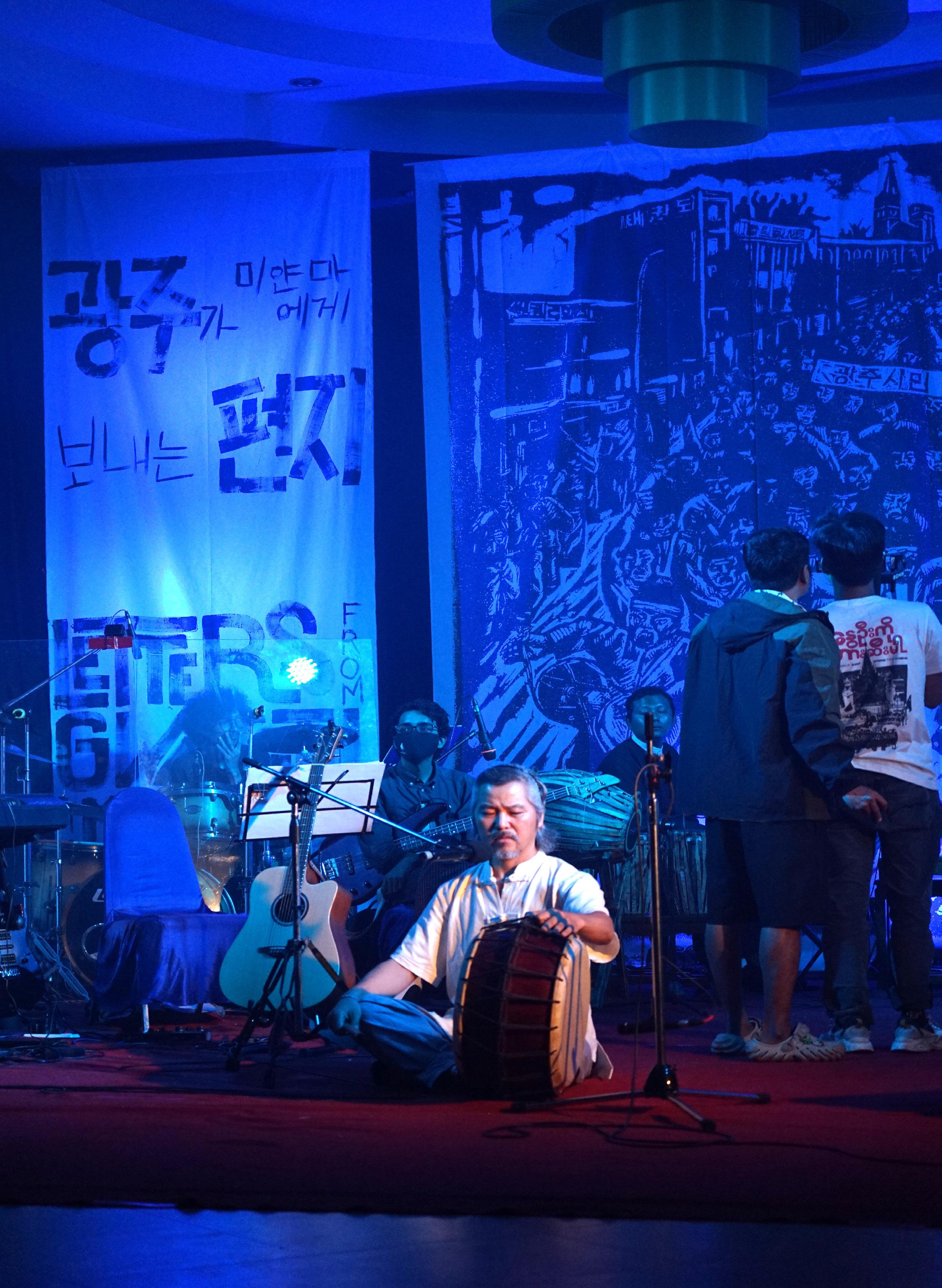

Gwangju Dreamers Go Live for Myanmar
Gwangju & South Jeolla International Magazine
Gwangju & South Jeolla International Magazine

December 2025, Issue 286
Published: December 1, 2025
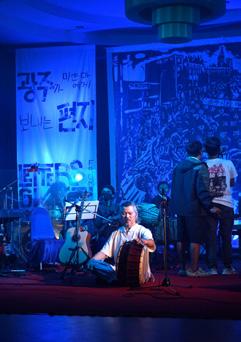
Cover Photo
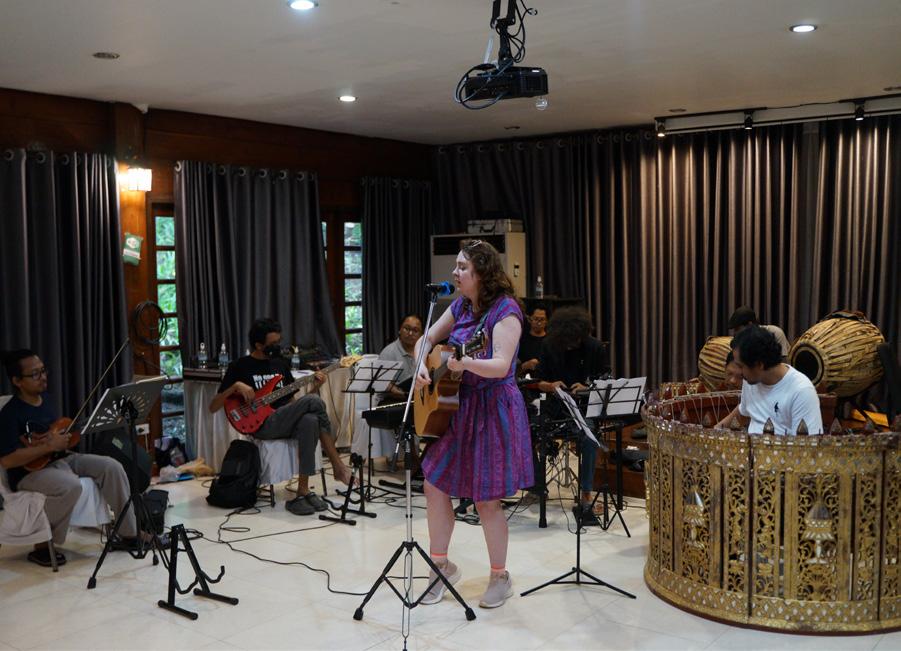
Dreamers member Choi Euntae rehearses in Myanmar border area while organizers confer behind, Oct. 7, 2025.
Courtesy of Park Taesang.
Publisher Dr. Shin Gyonggu
Editor-in-Chief Dr. David E. Shaffer
Copy Editing Dr. David E. Shaffer, Timm Berg
Layout Editor Johanna Lezada
Online Editor Johanna Lezada
The Gwangju News is the first English monthly magazine for the general public in Korea, first published in 2001. Each monthly issue covers local and regional issues, with a focus on the roles and activities of the international residents and local English-speaking communities.
Copyright ©2025 by the Gwangju International Center. All rights reserved. No part of this publication covered by this copyright may be reproduced in any form or by any means –graphic, electronic, mechanical, photocopying, recording, or otherwise – without the written consent of the publisher.
The Gwangju News is published by the Gwangju International Center: Jungang-ro 196-beon-gil 5 (Geumnam-ro 3-ga), Dong-gu, Gwangju 61475, South Korea
Tel: (+82)-62-226-2733
Fax: (+82)-62-226-2731
Website: www.gwangjunewsgic.com
Email: gwangjunews@gic.or.kr
Registration No 광주광역시 라 00145
ISSN 2093-5315
Registration Date: February 22, 2010
For volunteering and article submission inquiries, please contact the editor at gwangjunews@gic.or.kr
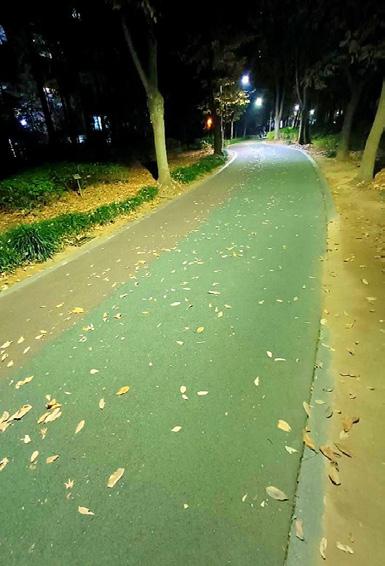
Ilove walking Gwangju’s Pureun-gil (Green Path) at this particular time of year. There are more leaves on the ground than on the trees – reds and golds, sun-kissed yellows and chestnut browns. The colorful fallen foliage, combined with that distinctive crispness in the air, subtly signals the change of the seasons. The section of the path that I most frequently transverse, includes relatively straight stretches that trail off into the distance, not revealing what is in the section beyond, and striking me as a fitting metaphor for the coming new year. But there is always brightness at the end – sunlight by day, electric light by night – a good omen for 2026.
Before we come to 2026 though, we have a month of December to enjoy with the Gwangju News! Our cover feature is of the Gwangju Dreamers’ trek to the Myanmar border area to add an exclamation mark to the Burmese struggle for human rights through a carefully planned performance. Our second feature is of the Gwangju Kimchi Festival. What better place to relish the kimchi-making season than in the hometown of the vegetable dish’s best fermented flavors.
Our Global Focus is on war-torn Ukraine, in which a former resident of our city gives us a first-hand view of what daily life in her beloved country has become since the invasion. Focus in Korea highlights the other side of “global Korea” – the politics of antiforeigner rallies.
Ponderings and Contemplations spotlights luminaries from Mokpo. Travel and Discovery takes us to Damyang’s Jungnok-won with its bamboo forests, to the European Christmas market in Seoul, and on a wintery tale to the snow-covered ski slopes of Muju.
Our Community section introduces Jeollanam-do’s tea-brewing culture, Gwangju’s friendship city Leipzig, Germany, and the Gwangju News’s fearless sports news writer Zhang Jiuzhou (Julius). Don’t miss our four stories in Teaching and Learning on language and the expat, Korean vs. expat teaching experiences, an 80% expat kindergarten, and teaching on both sides of the Pacific. We bring you our Drone Park story, reports on Daein Art Market and an art exhibition, and a Coffee Walk that was much more than a walk!
Take in our book review, our Joseon era café review, our sports rundown, and our upcoming events, along with a creative writing piece. All to provide you with happy holidays and a joyous new year!
David E. Shaffer
Editor-in-Chief Gwangju News

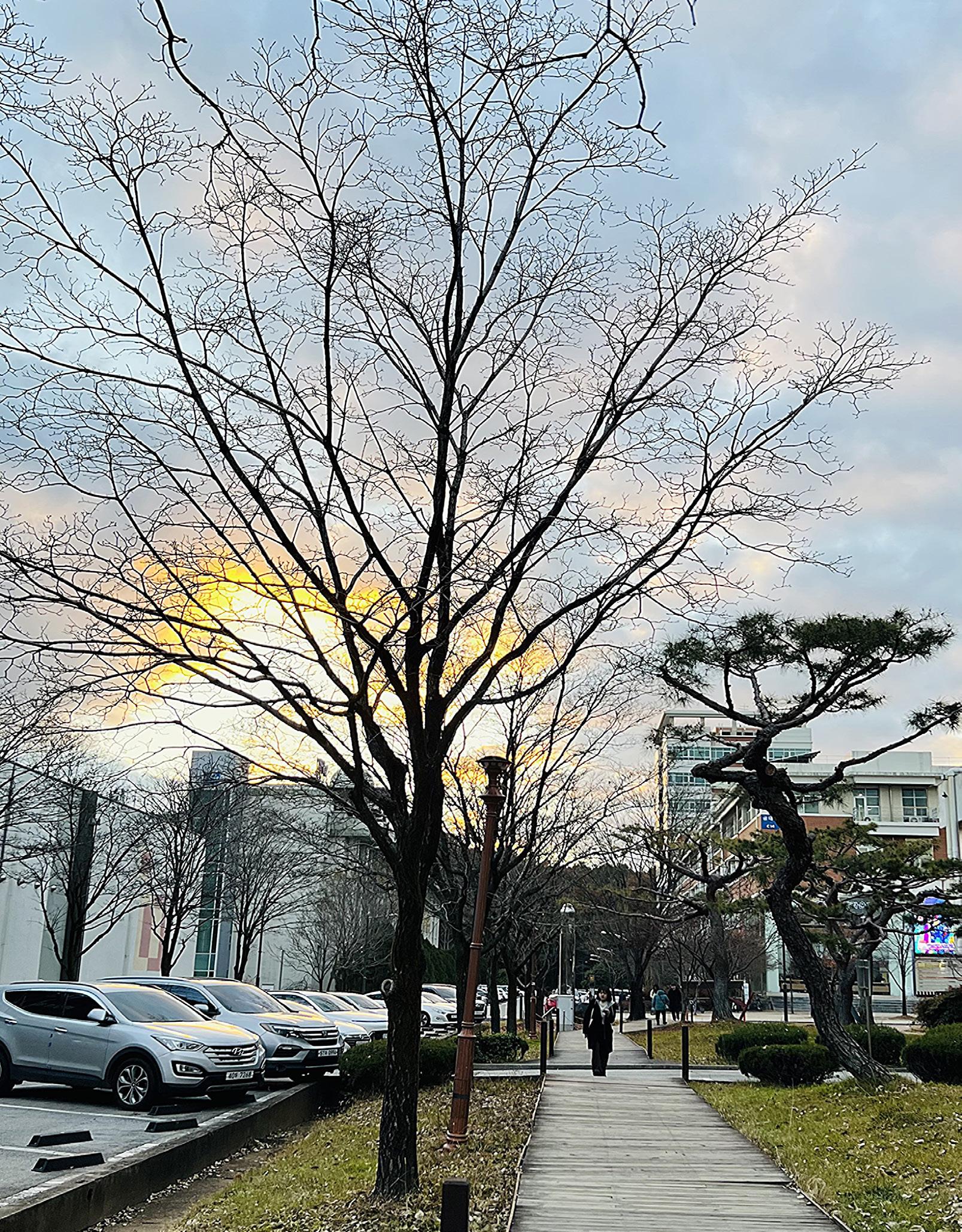
Nature teaches us resilience – to stay rooted through life’s winters, knowing that warmth and growth always find their way back.
The Photographer
Neha Bisht is a native of India, pursuing her PhD at Chonnam National University. She loves to travel and likes capturing the historic and scenic views of her memories.
The photograph was taken at Chonnam National University’s Yongbong Campus in Gwangju during the early winter season.
03 From the Editor
04 Photo of the Month 06 Gwangju City News
FEATURE
09 Human Rights in Harmony: Gwangju’s
Dreamers Carry the Torch to Myanmar
12 Preserving the Warmth of Autumn: Community Kimchi-Making at the Gwangju Kimchi Festival
GLOBAL FOCUS
14 The Day That Changed Everything: Ukraine After February 24, 2022
KOREA IN FOCUS
16 The Other Side of Global Korea: Anti-Foreigner Rallies
HISTORY & TRADITION
18 Ponderings & Contemplations: Luminaries from Mokpo
TRAVEL & DISCOVERY
20 A Breath of Fresh Air: Jungnok-won Bamboo Forest
22 Exploring Korea: Midnight in the Mountains – A Winter Tale from Muju
24 European Christmas Market — In Seoul COMMUNITY
26 Shall We Have a Cup of Tea? –Tea-Brewing Culture in Jeollanam-do
29 Friendship Cities: Gwangju and Leipzig – Bound by Democracy
30 Inside the Gwangju News: Sports Enthusiast and Writer – Zhang Jiuzhou (Julius)

TEACHING & LEARNING
32 The Life and Language of an Expat: To Learn or Not Learn the Local Lingo
34 The Same Roof but Different Roles: How Korean Teachers and American Teachers Experience Korean Academies Differently
38 Growing Together in Diversity: A Kingergarten with 80% Foreign Students
40 Teaching on Both Sides of the Pacific: Two Educators’ Perspectives
SCIENCE & TECHNOLOGY
42 Goodbye Fireworks, Hello Drones: A New Era in the Night Sky
CULTURE AND THE ARTS
44 Autumn Nights at Daein Art Market: Vitality in the Arts
45 Transitions: When Art Crosses Borders – An Art Exhibition for Togetherness
46 Book Review: Transient Desires
48 Creative Writing: Love, Loss, and a Snickers Bar in Seoul
FOOD & BEVERAGE
51 D’s Café Column: Stepping into the Joseon Era – A Cultural Café Experience
53 Walk the Walk, Sip the Coffee: My Time at Gwangju’s Annual Coffee Walk
SPORTS & ENTERTAINMENT
52 Sports Focus: Kia Tigers Face Tough Decisions Ahead of Free Agency Market
54 Area Sports Round-Up
56 December Upcoming Events
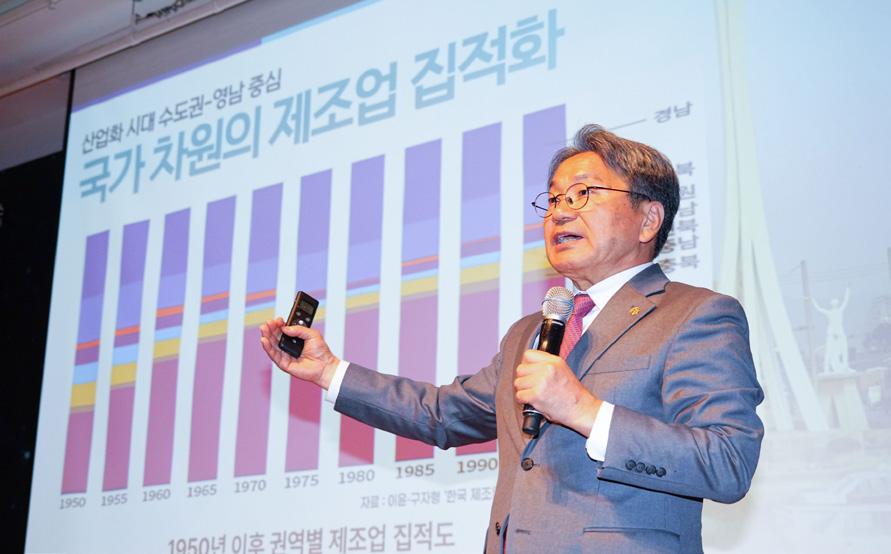
Gwangju Mayor Kang Gi-jung delivered a keynote speech titled “AI Model City Gwangju: Toward Korea’s Top 3 in AI” at the 10th Seoul Future Conference held at the Shilla Hotel in Seoul on November 5. In his keynote, Mayor Kang proposed the establishment of a national NPU (AI semiconductor) computing center during his keynote speech at the 2025 conference.
The mayor emphasized that building a dedicated NPU center is essential to foster Korea’s AI semiconductor ecosystem and advance the nation into the global top three in AI technology. Kang pledged to make Gwangju a leader in the domestic NPU market, highlighting the city’s experience with the National AI Data Center and partnerships with 25 fabless AI chip companies. Gwangju’s AI model city strategy includes four pillars: (a) establishing the national NPU computing center and (b) a national AI research institute in Gwangju, (c) developing an AI+mobility smart city, and (d) designating a mega-sandbox AI convergence complex.
Seven innovative companies in Gwangju have been recognized for their technological excellence
at the Consumer Electronics Show (CES) 2026, earning one Best Innovation Award and six Innovation Awards. LBS Tech Co. won the Best Innovation Award in the new Travel and Tourism category for its AI-based urban mobility design system, receiving CES honors for the second consecutive year. GhostPass Co. also achieved a third straight win for its data-free identity and payment solution, Cityflow.
Other winners include innoDtech (digital health), inDJ (AI for autonomous vehicle safety), All The Time (AI-based women’s safety platform), MainSpace (3D interior design), and Deepscent (digital olfactory technology). The city government stated that these achievements highlight Gwangju’s growing global competitiveness in cutting-edge industries and pledged continued support for international marketing and innovation programs.
Gwangju Metropolitan City will implement a pilot project to introduce foreign skilled workers into the automotive parts sector under the E7-3 employment visa. The program targets mold, forming, and welding specialists to help local auto parts companies address labor shortages and strengthen industrial competitiveness. Four regions – Gwangju, Gyeongbuk, Chungbuk, and Chungnam – were selected as pilot areas, with the project running from October 2025 to September 2027. In the first year, 40 of the 100 allocated workers will be placed in Gwangju, with secondyear allocations adjusted based on results.
The E7-3 visa allows foreign general skilled workers to work in designated shortage industries, with eligibility for permanent residency after five years. Previously, the visa applied only to sectors like shipbuilding, aviation, and aquaculture, but
auto parts manufacturing has been newly added due to growing labor demand in the field.
The Korea Automotive Technology Institute will manage the project. In September, Gwangju surveyed local companies, receiving applications from 16 firms for 122 workers. From October to November, skills assessments will be conducted in Vietnam and Indonesia, with 40 workers expected to start in Gwangju by the end of 2025.
The
(Gwangju City Hall)
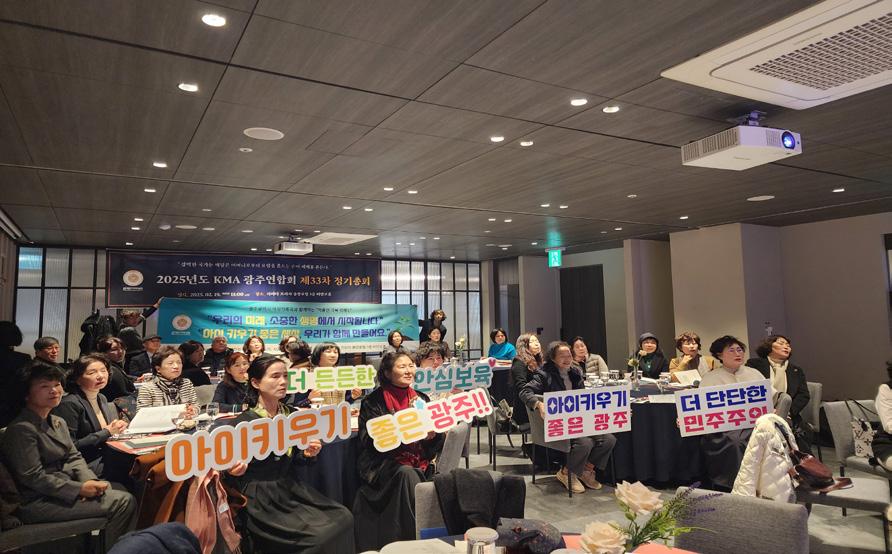
Gwangju’s birth rate is rising sharply in 2025. In August, 572 babies were born – a 9.6% increase over last year – ranking first among metropolitan cities and second nationwide. From January to August, births totaled 4,328, up 6.1% from 2024, while marriages also rose 8.1%, supporting ongoing population growth.
Lee Young-dong, director of the Women and Family Bureau, credited the city’s family-friendly policies for creating an environment conducive to childbirth. Gwangju provides various supports, including newborn celebration cards, fertility treatment subsidies, late-night and moonlight children’s hospitals, and household care services for pregnant women and grandparents caring for their grandchildren.
Notably, Gwangju’s “10 a.m. Start for Elementary School Parents” program will expand nationwide next year under the Ministry of Employment and Labor’s “10 a.m. Start for Childcare” initiative.
“
The Gwangju Metropolitan City Urban Railway Construction Headquarters conducted a joint inspection with the Gwangju Disability Rights Advocacy Network to review temporary walkways near the Nam-gu Pureun-gil (Green Road) area of Metro Line 2. The inspection aimed to address public complaints about walking inconveniences caused by construction. Participants, including persons with disabilities and social workers, checked whether temporary facilities such as bus stops, crosswalks, and sidewalks were accessible to all users.
Key issues identified included difficulties for wheelchair users on removed sidewalk sections and missing tactile paving at construction boundaries. Director Oh Young-geol stated that feedback from the inspection will be reflected in future construction phases to create safer and more inclusive pedestrian environments.
Compiled by Charlene Lee

Charlene Lee is the founder of Charlene English Institute. Having lived in many different countries, she loves to explore and experience diverse cultures. She hopes to contribute to making Gwangju a more vibrant city.
By Kaitlyn Wachter
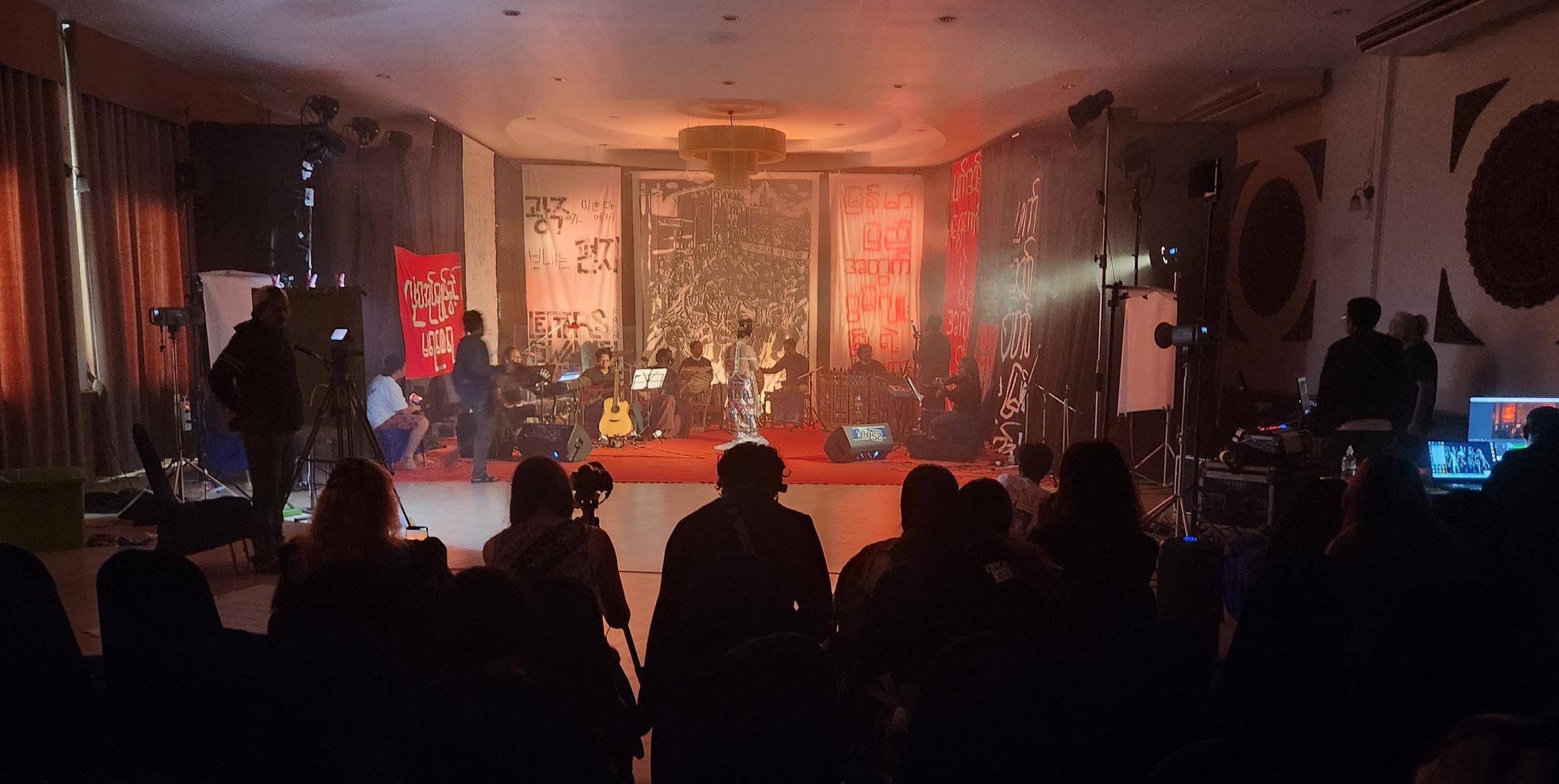
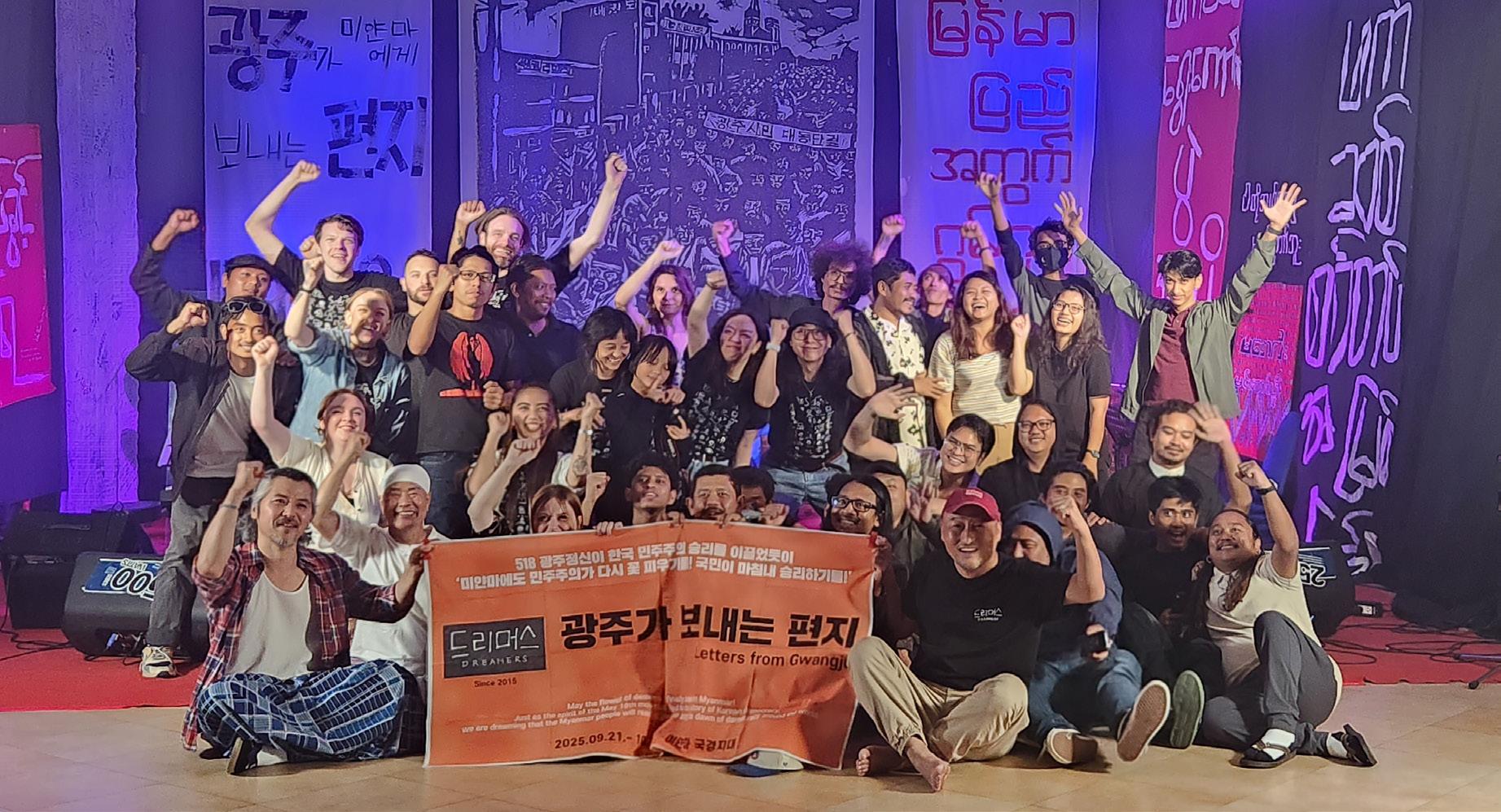
This October, on the border between Myanmar and Thailand, a group of people came together in a cacophony of cultural exchange, music, and solidarity. The culmination of this week was Letters from Gwangju to Myanmar, a sprawling concert featuring musicians and performers from six countries. It was a collaboration between Burmese pro-democracy activists and members of the Dreamers community from Gwangju.
Dreamers, which was established in 2015 by Park Taesang, is a community of Korean and international residents of Gwangju who have held Saturday night Break the Walls open mic-
style music nights at Gwangju’s downtown Daein Market for the past ten years, and now has members spread over the world. Dreamers was created with the intention of bringing people of different cultures together with the common language of music and has a primary focus of promoting human rights.
“What seemed like a pipe dream started to take shape.”
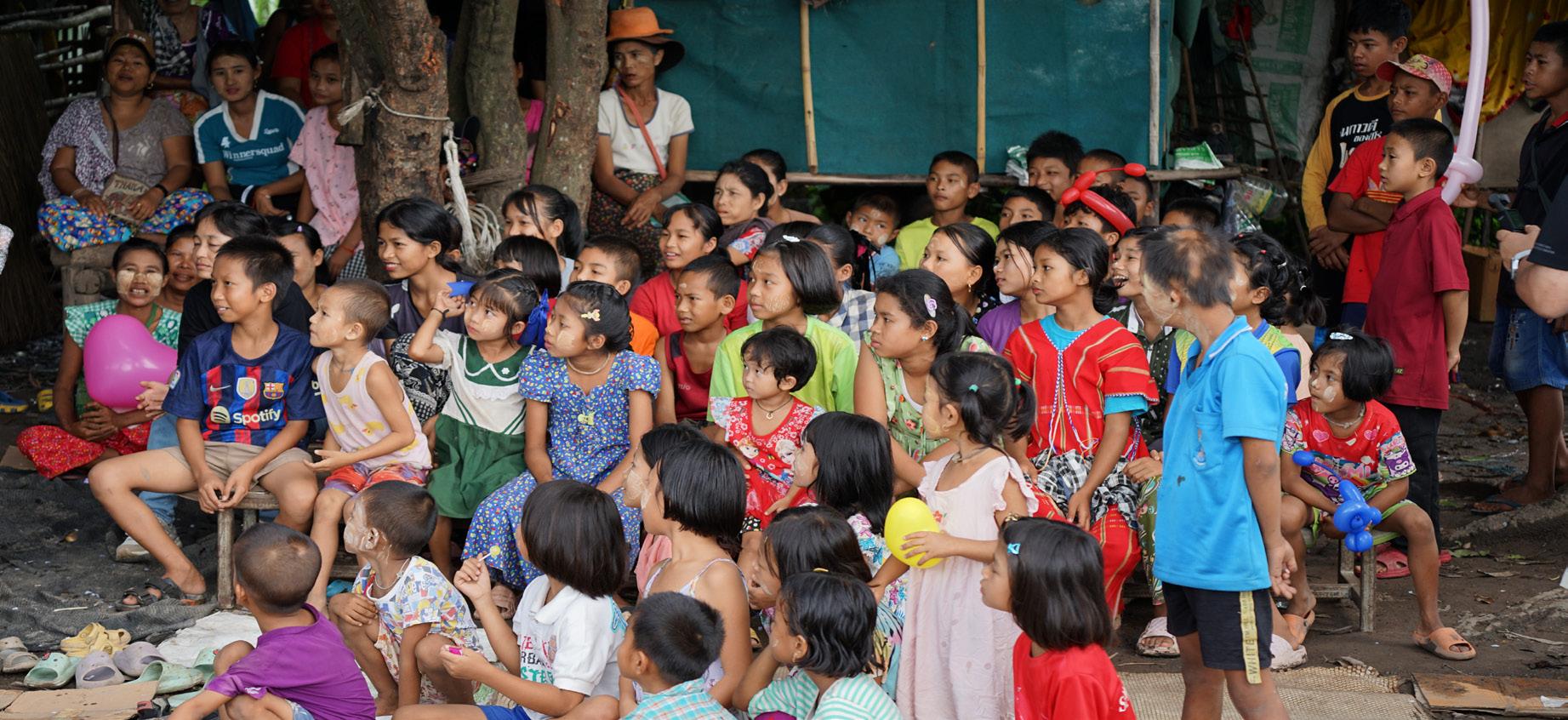
It was that focus on human rights that brought this group of Gwangju residents 2,000 miles
across Asia to a small border town in Thailand. Following the banks of the muddy river that separates the two countries, border towns like this one have become the reluctant home to many thousands of Myanmar refugees who have been forced to flee due to the brutal military coup that took place in February 2021.
This coup echoed that of Korea’s past. The subsequent democratic movements, called the Spring Revolution, further echoed Gwangju’s 1980 May 18 Uprising, which helped to bring about democracy in Korea. In those early days of Burmese protest, the world cried out with the protesters in Myanmar. Gwangju citizens held
protests and put the faces of fallen activists and victims of government violence up in Democracy Square. Dreamers collaborated with Burmese students and musicians to create two music videos in support. We felt the kindred spirit of revolution and hoped Myanmar would soon celebrate democracy just as Gwangju had done not so many years ago. Unfortunately, the reward of democracy has yet to come to the freedom fighters of the Burmese Spring Revolution, though they continue to work tirelessly toward that end.
Dreamers could see their friends lose hope that the world still remembered and stood with the people of Myanmar. Through three visits over the past three years Park came to know and love a number of pro-democracy activists and artists. He met with musicians, editors, painters, and filmmakers. On his visit in 2024, he started to make a plan. He promised that he would come back and create a concert that would show the people of Myanmar that Gwangju continues to stand with them. “We Dreamers have been striving for positive and better change in our society and the world through music. Therefore, we planned the Myanmar–Gwangju Solidarity Concert as a way to express our solidarity and comfort to all Myanmar citizens resisting the Myanmar military, not only in the Myanmar
border region but also around the world,” said Park of the prospective project.
Dreamers set to work gathering the support that would be necessary to put on such an event. Approximately six million won was raised through internal fundraising in cooperation with Gwangju International Center, with 10 million won in support from the Gwangju Human Rights Peace Foundation. A total of 16 million won was spent on the production costs for the concert. It was important to Park to support the living expenses of the Myanmar musicians, technicians, and democracy activists who participated in the concert, and to use whatever funds remained to support refugee children. Dreamers members personally covered most of their own travel and accommodation expenses. Park stated, “I would like to take this moment to express my sincere gratitude to the Dreamers members who have sacrificed time, money, and hardship to participate in this meaningful concert and journey.”
At the same time, musicians began their own planning. Over Zoom calls and group chats, over hours of meetings and artistic debates, a plan began to form. Each musician selected songs that reflected the messages of the concert: solidarity, a call to action, a fight for democracy. What seemed like a pipe dream started to take shape.
Finally, in early October, all of the once separate worlds began to come together to put to sound what had previously just been ideas. Nine Dreamers musicians from Korea, the US, Canada, the UK, and Thailand came together with a
dozen Burmese musicians, including vocalists, traditional drummers, a classically trained violinist, and several multi-instrumentalists. The group collaborated and folded together their many styles to create a powerful fusion of modern and traditional cross-cultural sound. Soon it was time for the big event.

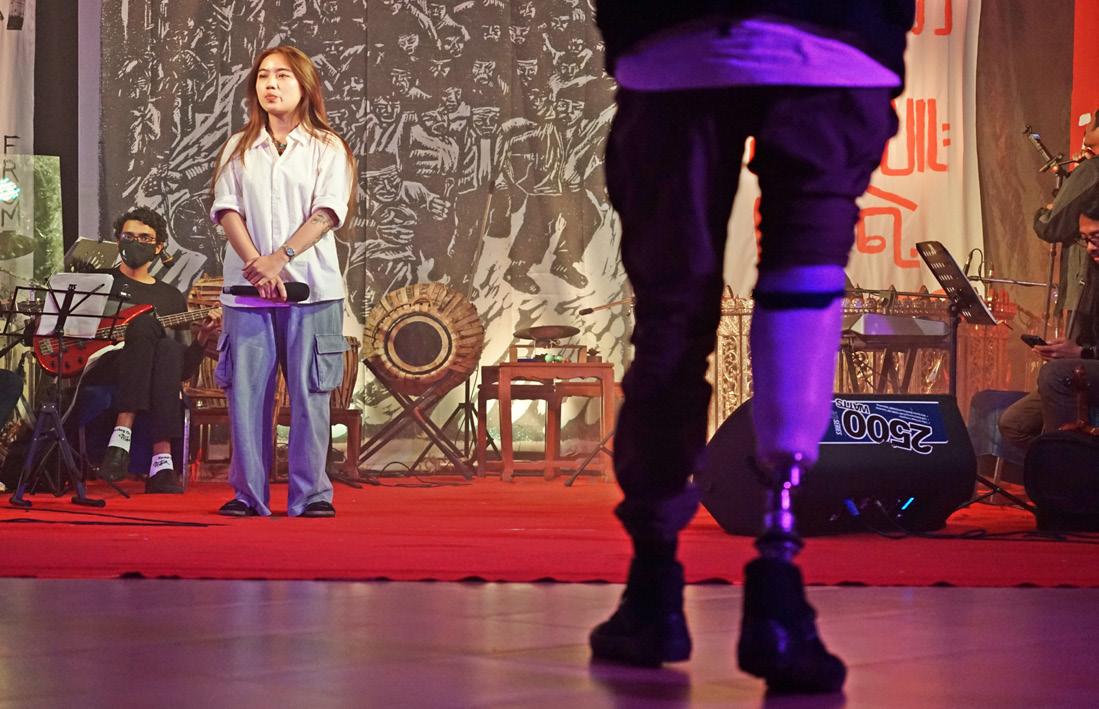
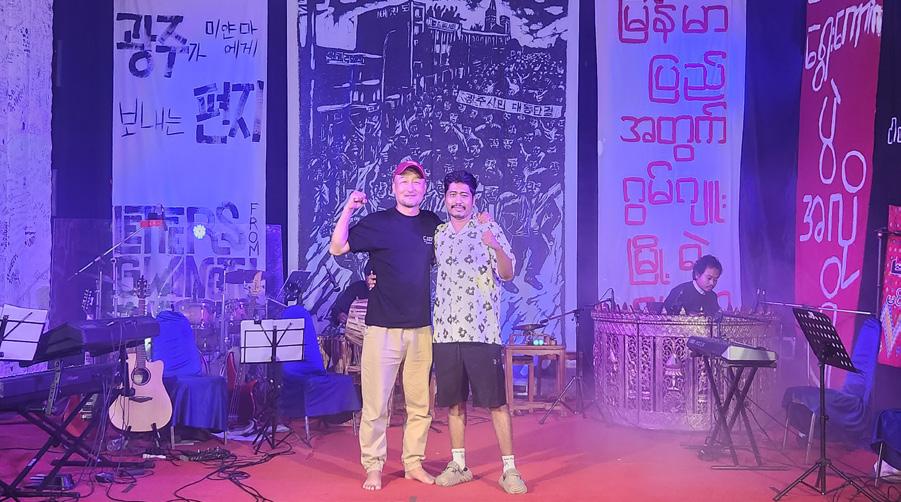
The stage was constructed using large, fourmeter-tall banners. To accommodate the stage, four construction scaffolding towers were installed within a concert hall. In center stage hung a grand copy of a woodblock print by Gwangju native artist and victim of military government violence Lee Sang-ho, entitled “The Battle of Jungang-ro 1987” which was hung with his permission. In the June Struggle of 1987, the Korean people overcame the pain of 1980 and achieved their first victory over the military junta, securing a constitutional amendment for
direct elections. Artist Lee Sang-ho, who fought against the military dictatorship in the 1980s and suffered trauma from torture and imprisonment, has continued to portray the May spirit by capturing the stories of democratic martyrs on canvas.
The “letters from Gwangju” referenced in the title of the concert took the form of a large banner on which folks young and old had written messages of support to the Burmese freedom fighters. This joined Lee Sang-ho’s print, as well as a banner of messages to Gwangju from the Myanmar activists and protest banners written in Burmese calling out against the military junta and the upcoming sham election to take place in Myanmar this December and January. It was against this backdrop that the performers took the stage.
For over ten hours, performers, stage crew, audio engineers, and camera technicians worked to put together a spectacular show featuring a medley of Burmese protest songs, a collaboration of traditional Korean and Burmese drums, traditional dances from both cultures, covers of artists such as Kim Jung Mi and The Cranberries, originals by Daniel Saw, and Emily Terry, and a final bombastic medley of the Korean protest song “March for the Beloved,” the Burmese protest song “How Can I Forget,” and a musical setting of the poem “Let’s Walk This Road Together” by Jeollanamdo’s Kim Namju. Each song meticulously translated from its mother tongue into Burmese, Korean, and English.
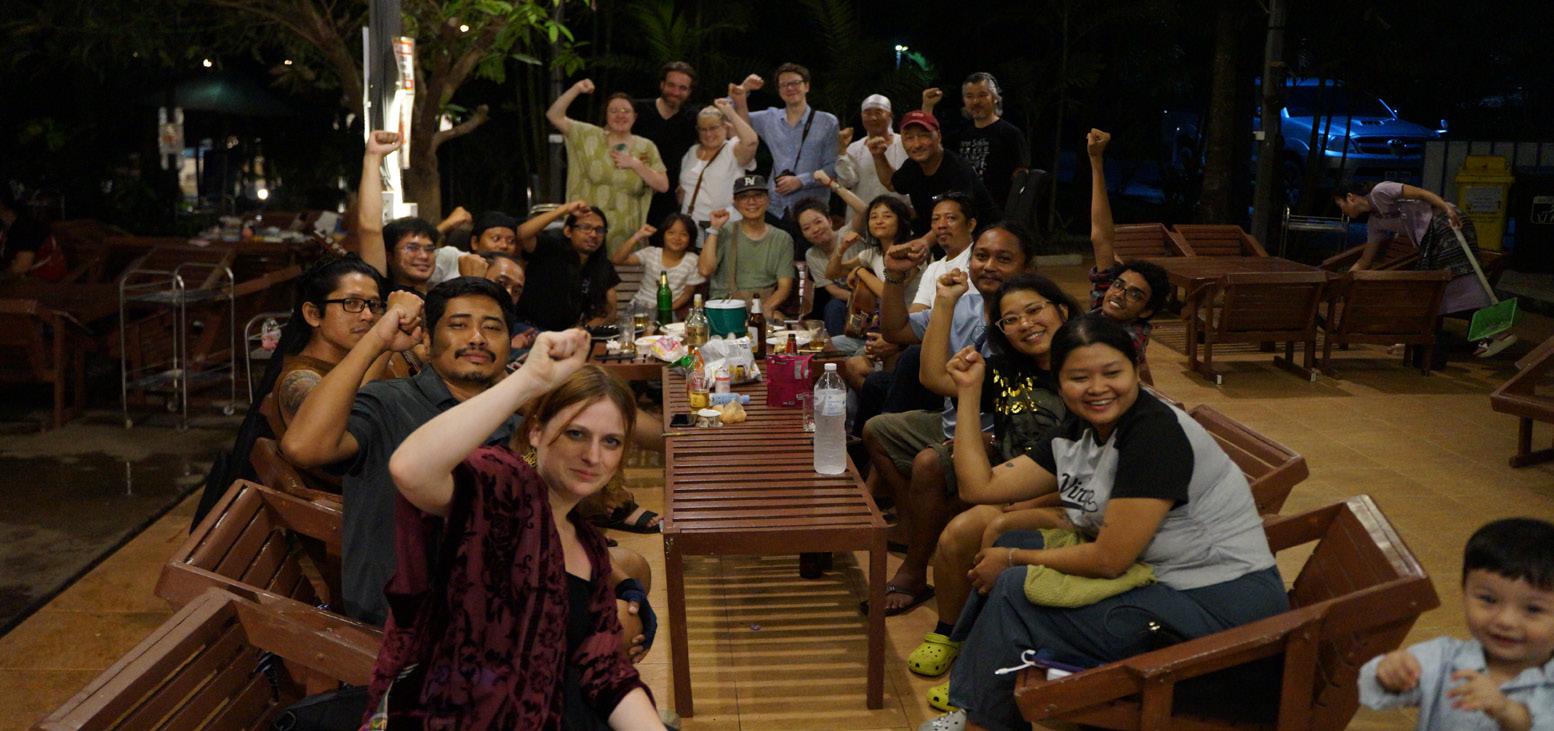
As the lights came down on the stage, many tears were shed. Musicians, stage crew, and technicians embraced one another as comrades and friends. A heavy buzzing feeling hung in the air. A feeling of hope and possibility for a future without fear and violence for our Burmese family.
Letters From Gwangju will be published on YouTube by Myanmar pro-democracy media channels ahead of the upcoming sham election. This will allow more Myanmar citizens to access this content. All proceeds generated from this video, as well as all other music projects, videos, and song recordings made on this trip, will be donated to the Myanmar democracy movement. Every view directly benefits the brave Burmese people fighting to reclaim their home.

The “Letters” music concert is now available on YouTube. Enjoy it at https://www.youtube.com/ watch?v=TfqkcZsmWy4 — Ed.

Kaitlyn Wachter is a New York native who has called Gwangju her home since 2016. She enjoys crochet and the change of the seasons, and lives with her husband, two-year-old son, and sweet pets in a traditional hanok home outside Daein Market.
Photographs courtesy of Park Taesang
By A. Ayuningsih
Autumn in Korea always leaves a special impression. The cool air, the changing colors of the leaves, and the bustling harvest scenes across the country mark the transition into winter. For Koreans, this season is a time of gratitude, a moment to enjoy the rewards of a year’s hard work. Beginning with the traditional Chuseok holiday, this spirit of thankfulness now extends to modern festivals that revive old traditions in new ways, ranging from food and cultural festivals to agricultural celebrations.
Among the many festivals held across the nation, culinary festivals have a unique charm. Food, especially traditional and authentic food, is more than something to eat; it carries stories. Stories of the soil where the ingredients grow, of the hands that prepare them, and of the culture that gives meaning to every flavor.
Each region in Korea has its own culinary identity, but one of the most distinctive is that of Gwangju and the surrounding province of Jeollanam-do. Known for its relatively warm climate, fertile farmland, and abundant seafood, Jeollanam-do cuisine stands out for being diverse, colorful, and full of flavor, especially when it comes to kimchi. Although taste is subjective, many people consider Jeollanam-do kimchi to be the most delicious in Korea.
Thanks to the region’s rich natural resources, its kimchi has a deep, savory, and spicy flavor with a
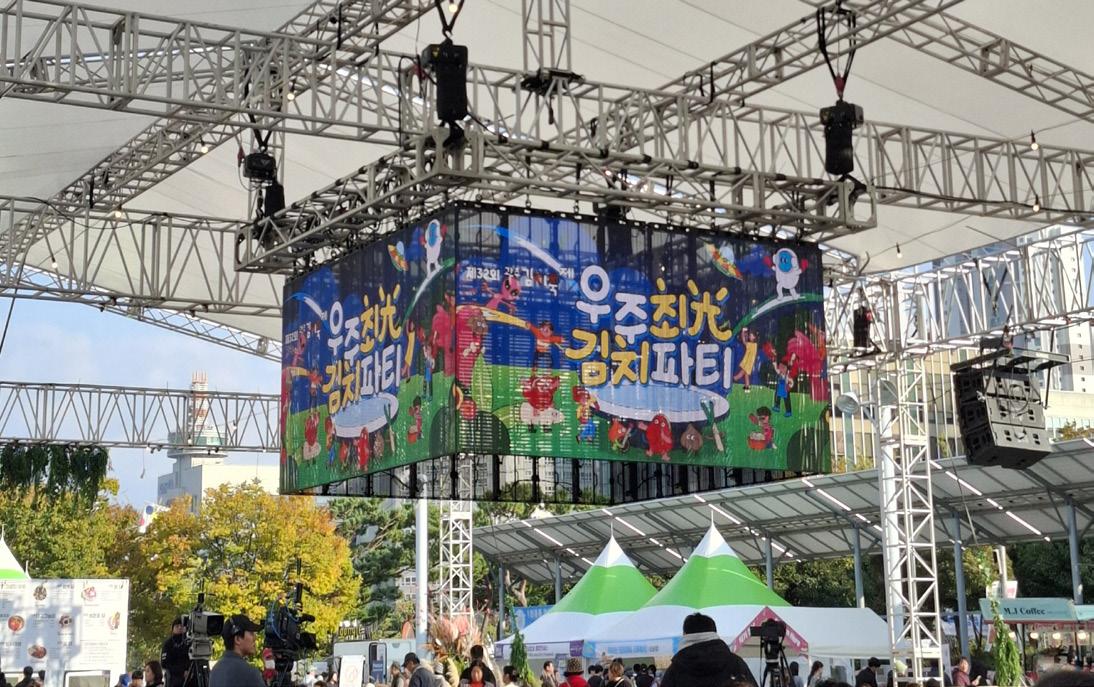
The main stage of the Gwangju Kimchi Festival, “The Universe’s Biggest Kimchi Party,” where everyone gathers to celebrate Korea’s favorite flavors.
strong aroma. In the southern area, the seasoning is thicker and saltier – a mix of fresh red peppers ground with water, glutinous rice porridge, and generous amounts of fermented anchovy sauce. Unlike northern regions, no extra kimchi brine is added, resulting in a bolder and richer taste. With such abundant local ingredients, people here don’t just make cabbage kimchi but also a wide variety of other kimchis: kkaennip kimchi (깻잎 김치, perilla leaf kimchi), dolsan-gat kimchi (돌산갓 김치, mustard leaf kimchi) from Yeosu, godulppaegi kimchi (고들빼기 김치, wild radish kimchi), u-eong kimchi (우엉 김치, burdock kimchi), and dongchimi (동치미, radish water kimchi) from Naju.
One of the most surprising things I discovered is that Jeolla kimchi isn’t limited to cabbage and
seasoning. I’ve recently tried many varieties that include seafood and protein ingredients such as octopus, shrimp, abalone, and even crab. It shows that kimchi is far more than a simple fermented vegetable; it’s a versatile dish that reflects the diversity of Korea’s local ingredients and culinary creativity. I discovered these varieties on October 31 through November 2 at the Gwangju Kimchi Festival!
The uniqueness of these flavors is celebrated every year at Gwangju’s Kimchi Festival, held since 1994. The festival honors the tradition of kimjang (김장), the communal making and sharing of kimchi, which has been recognized by UNESCO as an Intangible Cultural Heritage. Beyond preserving this tradition, the festival also serves as a platform to introduce the distinctive flavors of Jeollanam-do to visitors from across Korea and around the world.
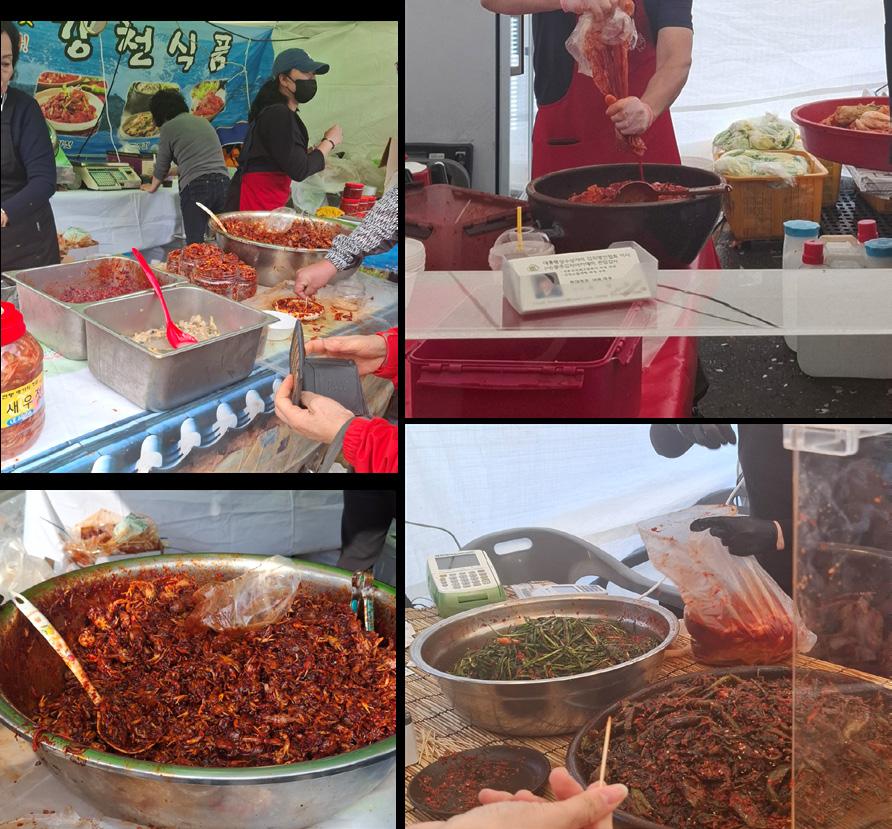
The festival offers a wide range of exciting activities for all ages. Families and children can join the Kimchi-Making Experience or play at the Kimjang Playground, where they learn about kimchi ingredients and preparation in a fun, hands-on way. International visitors are also welcomed at the Global Kimchi Lounge, which provides a cross-cultural experience and a chance to taste various regional kimchi varieties from all over Korea.
For those who enjoy exploring and tasting, there are Kimchi Market and Local Farm Market stalls selling Jeollanam-do specialties, from traditional kimchi to locally produced agricultural goods. One of the most popular areas is the section featuring the winners of the Korea Kimchi Contest, where visitors can sample and purchase kimchi made by kimchi masters who have received the prestigious Presidential Award. This section gives the public a chance to experience high-quality kimchi firsthand and to learn how differences in ingredients, recipes, and techniques from each region create unique flavors. The program highlights that kimchi is not only a cultural heritage but also a living symbol of creativity and regional pride.
Meanwhile, the Food Truck Zone and Picnic Lounge offer relaxed spaces for visitors to gather, enjoy snacks, and take in the lively atmosphere. With its inclusive setting and diverse activities, the Gwangju World Kimchi Festival has become an event that is not only flavorful but also heartwarming, a place where everyone can learn, taste, and celebrate Korean culture together.
Now, as winter arrives and the kimchi made during kimjang is stored in every household, this tradition continues to warm daily life in Korea. The festival may have ended, but its spirit lives on, reminding us that gratitude and togetherness are not limited to the harvest season but continue to flavor the year ahead.
For more details about upcoming events and programs, visit the official website at kimchi. gwangju.go.kr.
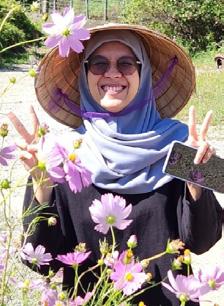
A. Ayuningsih is a graduate student seeking to express the concerns she observes in her surroundings. She hopes that her words may raise awareness and offer a meaningful contribution to the broader community and society in which she lives.
Photographs by A. Ayuningsih.
By Anastasiia Andriievska
February 24, 2022 – the date that forever changed the lives and daily reality of every Ukrainian. It marks the beginning of Russia’s full-scale invasion of Ukraine. The whole world has heard about it through the news, social media, and online posts, but few truly understand how deeply this war has affected the life of every Ukrainian. In this article, I would like not only to remind everyone that the war in Ukraine is still ongoing but also share how, for almost four years now, Ukrainians have been living in a completely new reality.
Of course, the war has impacted Ukrainians not only psychologically but also in their everyday routines. Every time an air raid siren sounds, people have to stop everything; leave their homes, workplaces, or classrooms; and run to the nearest shelter to save themselves from missile or drone attacks. In Ukraine, there are even special mobile applications and websites that warn people about air raids even before the sirens go off. Local television channels and radio stations also interrupt their broadcasts to report potential attacks from Russia.
Russia deliberately destroys infrastructure: power and heating plants, transportation networks, hospitals, schools, and residential buildings to make life in Ukraine unbearable. Recently, another thermal power plant was hit, killing and injuring civilians. There were no military facilities or equipment in any of those areas – only civilian infrastructure. Major enterprises that provide thousands of jobs are being destroyed, along with expensive equipment worth hundreds of millions of dollars. Civilians lose their homes; many are forced to flee, especially those living near the frontlines, leaving everything behind just to survive. Large farms and crops have also been
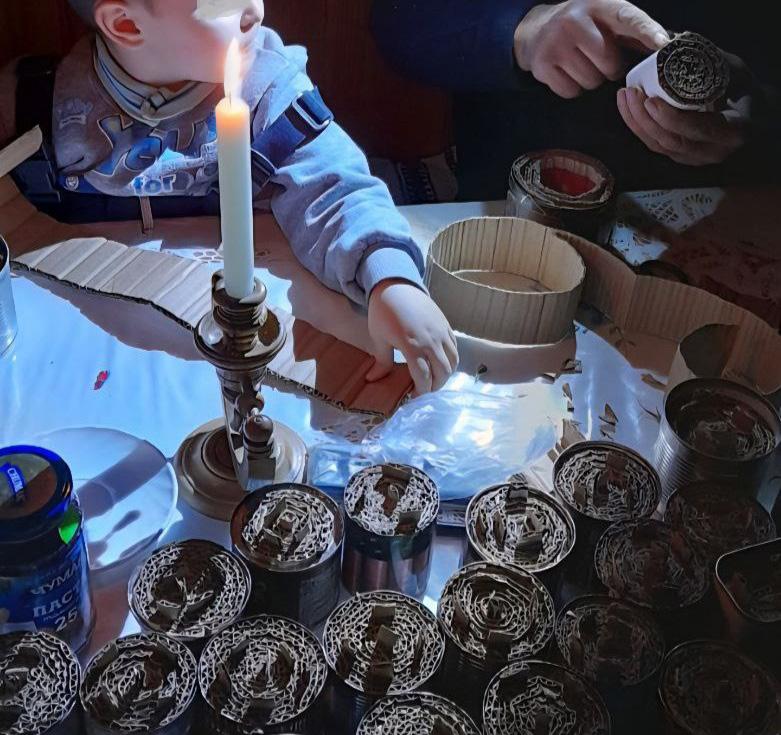
targeted. In just a few months, over 100,000 heads of cattle were killed on one farm alone. Russia is also trying to erase our language and culture –this summer, the largest Ukrainian-language printing house was destroyed, and in occupied territories, Russian forces burn or confiscate any books written in Ukrainian.
Because of this, the everyday life of Ukrainians has drastically changed. The destruction of power plants has caused severe electricity shortages. Across the country, scheduled power outages last for many hours, sometimes even for entire days. This also leads to water, communication, and internet disruptions, leaving people unable to contact relatives, read the news, or perform their daily work tasks. The destruction of gas facilities and oil refineries has caused fuel shortages and price increases. Many Ukrainians cannot afford to heat their homes, even during freezing winters. Food supply is unstable due to the destruction of farms and crops, leading to shortages and price
hikes. Constant Russian attacks on roads and railways disrupt deliveries of essential goods. Pharmacies face shortages of medicine because pharmaceutical companies and warehouses have been destroyed. Imported medicine is extremely expensive and unaffordable for many Ukrainians.
Education has also changed dramatically. During air raids, students and teachers must stop classes and move to shelters. In the worst cases, schools and universities switch completely to online learning. The most tragic part is that Russia targets kindergartens, schools, universities, and orphanages. Every sixth educational institution in Ukraine has suffered from Russian aggression. As of October this year, 17.11% of 25,465 educational facilities have been damaged (3,958) or destroyed (400). Among them, the majority are schools (2,046) and kindergartens (1,506). The Kharkiv region suffered the most: 96 educational buildings have been destroyed and 727 damaged. Many students, teachers, and children have lost their lives. More information about the destruction of schools across Ukraine is available on the official website of the Ministry of Education and Science of Ukraine: https:// saveschools.in.ua/en/.
Despite all this, Ukrainian soldiers continue to defend the country. Unfortunately, many lose their lives every day. Although there are no official statistics, almost every local news broadcast includes announcements about farewells to fallen heroes. When the bodies of soldiers return home, citizens line the streets, kneeling and holding flowers – a symbol of honor and deep respect. Every morning at 9:00 a.m., Ukraine observes a nationwide minute of silence to pay tribute to fallen soldiers and thank those who continue to protect our country.
Sadly, war has become a part of daily life in Ukraine. Many citizens, regardless of age, now know how to provide first aid, stop bleeding, or perform CPR. They know how to act in emergencies. Yet despite the constant danger, Ukrainians volunteer and help one another. For us, volunteering carries a special meaning. Volunteers actively support the army: sewing
clothes, preparing long-lasting foods, and creating items to help soldiers in the trenches. As autumn and winter come, Ukrainians make “trench candles” – small, long-burning candles used for heating or cooking in field conditions. Others weave camouflage nets for soldiers. For example, my family makes natural homemade energy bars, which are delivered to soldiers near the front line. Soldiers often have no way to cook or rest, and rely on these nutritious and sustaining bars. Ukrainians help each other by donating food, ingredients, clothing, and money – all voluntarily, without expecting anything in return.
When I shared all of this with my Korean and other international friends during my stay in Korea, many were shocked to hear about the reality of the war started by Russia. Sadly, young people often know little or are not interested in what happens in other countries, including Ukraine. The older generation in Korea, however, understands and sympathizes deeply with what is happening in my homeland – which truly touched me. People often asked whether it was safe in Ukraine and if I needed any help. In Korea, I met wonderful people who began not only reading more news about Ukraine, but also spreading awareness among others.
For us, the war in Ukraine is not a distant event on the news; it is a daily reality that has reshaped how millions of people live, work, study, and simply exist. Yet despite constant danger and loss, Ukrainians continue to support one another, rebuild communities, and protect their country’s future. Our resilience is not only about survival but about preserving our identity, culture, and humanity. And as long as we stand together, we continue to believe in peace and in the day when the war will end.
The Author
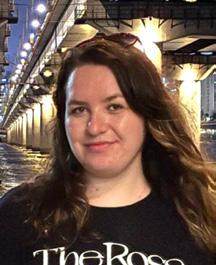
Anastasiia Andriievska was a Global Korea Scholarship student from Vinnytsia, Ukraine, from 2024 to 2025. She is an active Ukrainian and international volunteer.
Photograph courtesy of Anastasiia Andriievska.
By Yousra Feriel Drioua

Reading news about anti-foreigner rallies is a hard pill to swallow for any tax-paying alien, anywhere on earth, including Korea, a country that often leverages the word “global” to market its different sectors, such as entertainment and education.
“In a Confucian society that prizes harmony and sameness, even foreigners are placed in a box.”
With foreigners making up 5.17 percent of South Korea’s population – 2.65 million out of 51.2 million – the country now qualifies as a multicultural society by OECD standards, as
the Dong-A Ilbo reported in late May. Foreign residents are now deeply embedded in daily life: restaurants, factories, and even schools rely on their presence.
However, one survey conducted this year revealed that despite the increasing number of long-term immigrants, Korean society remains harsh in accepting them, even more so when it comes to refugees. According to a Korea Institute for Health and Social Affairs (KIHASA) report, 96 percent of the Koreans surveyed, said they were willing to accept immigrants as part of society, but only 8 percent said they would accept them as family members. The same survey found that 38.7 percent of respondents were fine with immigrants as neighbors, 30.5 percent as colleagues, and 18.35 percent as best friends. However, just 8.37 percent said they would welcome one as family

– just 8.37 percent – The Korea Herald reported on July 18.
President Lee Jae-myung has recently taken measures to crack down on anti-foreigner rallies, calling them a “self-harming” act to Korea’s image and economy. A new bill introduced by the ruling Democratic Party of Korea targets rallies that incite hate or discrimination against specific groups. This move comes as a surprise to many, since Korea has been increasingly open toward freedom of speech and the right to assemble. Critics have called it selective enforcement, noting that anti-China rallies have been restricted while anti-U.S. protests have been left unbothered. The debate has since reignited discussions over whether restricting discriminatory speech strengthens or weakens democracy, according to The Korea Times on October 14.
As someone who has experienced both hospitality and indifference from Koreans, these rallies don’t come as a surprise. In a highly competitive society, nationalism is bound to appear, especially among those with the shorter end of the stick. Despite the efforts of global and international centers to integrate foreigners and migrants in Korea, discrimination remains a common social experience, whether at school or in the workplace.
These patterns reveal a deeper challenge. The problem is not the absence of pertinent centers and institutions but how effective they are at
reshaping social attitudes. Integration cannot stop at language classes or cultural events; it must also teach how to welcome difference, not as a gesture of tolerance but as part of everyday coexistence among neighbors, friends, colleagues, and even spouses.
“President Lee Jae-myung has recently taken measures to crack down on antiforeigner rallies, calling them a ‘self-harming’ act.”
For many foreigners, this coexistence is a mixed experience. At times, foreignness can be liberating, freeing you from expectations to perform a specific role or fit a certain stereotype. Yet that same difference can quickly turn into distance. In a Confucian society that prizes harmony and sameness, even foreigners are placed in a box. For Korea, becoming a truly global society may depend less on how many foreigners it welcomes and more on how comfortably they are allowed to belong.
The Author Yousra Feriel Drioua

is a freelance writer and activist with an MA in media communication and journalism. She’s an Algerian citizen residing in South Korea and aspires to be someone of benefit to society. In her free time, she’s a barista! Instagram: @myyigli
By Park Nahm-Sheik
When thinking of famous Koreans who were from the city of Mokpo, first to come to mind for most is the late President Kim Daejung, who I discussed in my previous piece [Gwangju News, October 2025, pp. 12–13]. However, he is not the only luminary from this southwestern port city of Jeollanam-do.
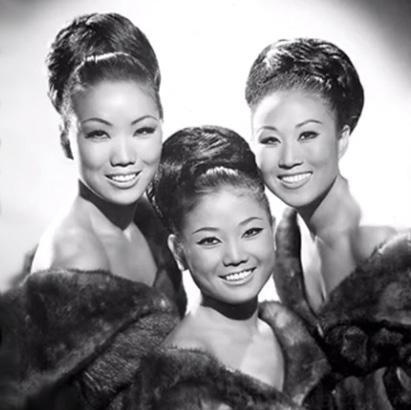
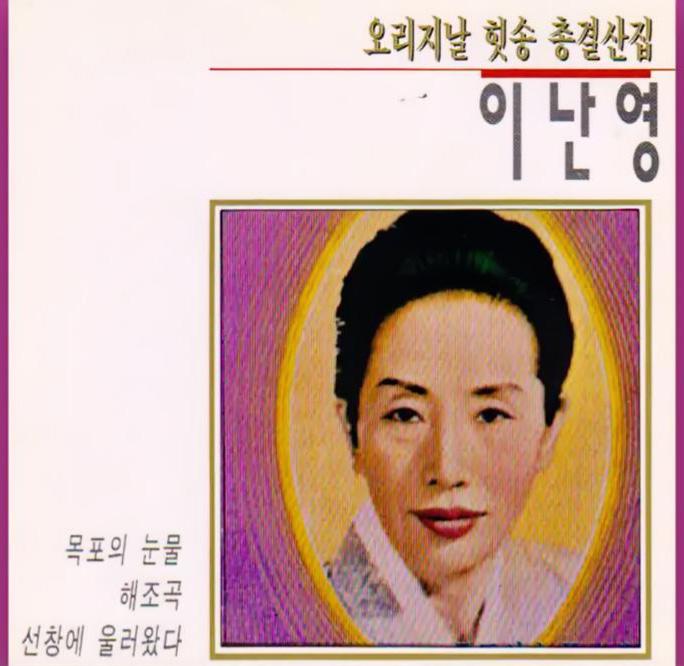
I should like to begin this piece by discussing Lee Nan-young of “Tears of Mokpo” fame. The celebrated pop diva is remembered to this day for that wistful melody and for another magnum opus titled “Hometown (My Beloved Hometown).” She was the reigning Korean pop queen of her era, from the late 1930s through the 1940s, 1950s, and into the 1960s. She was far and away the most prolific pop diva of her generation, with approximately one hundred songs to her credit, most of them wistful tear-jerkers steeped in nostalgia. Lee Nan-young is also well known as the mother of the Kim Sisters, a fabulous mid20th-century girl group.
The Sisters scored many successes on U.S. stages and eventually headlined popular American TV shows such as The Ed Sullivan Show. They were just as popular, productive, and prolific stateside as their mother had been back home in Korea. They were clearly blessed with distinctive musical genes – like mother, like daughters. Truth to tell, one of the four members was not Lee’s biological daughter; she was the daughter of one of Lee’s elder brothers. Mokpo also produced quite a few other luminaries.
One of them was the late Seo Jeong-su an alumnus of Mokpo High School (Class of 1952). He made his name as a leading Korean grammarian of his
day. He began his college education in the highly acclaimed undergraduate physics program at Seoul National University (SNU). After earning his BS degree from SNU, however, he changed course and decided to focus on the learning and teaching of Korean as a foreign language. To pursue this new goal, he enrolled in the Korean language bachelor’s program at Yonsei University. This shift was a byproduct of his deep-rooted allegiance to his motherland and to anything that shed light on it.
The combination of humanities and natural sciences in his background endowed him with penetrating insights into subjects near and dear to his heart. It also shed light on his incessant attention to all things Korean, including his mother tongue. Before long, Seo landed an instructorship at the Korean Language Institute of Yonsei University. For him, it was truly a
dream come true. Soon after, he was invited to spearhead a project to produce a compendium of Korean grammar.
The project started with a bang, thanks largely to a solid funding commitment from the late Han Chang-gi, the legendary CEO of Encyclopedia Britannica Korea. A distinguished alumnus of Gwangju High School and the Seoul National University Law School, he was an enlightened aficionado of the Korean language. He thus showcased a top-flight partnership between scholastic expertise and business acumen. The compilation project under discussion was fueled by an ambitious collaboration between these two inventive sons of Jeollanam-do.
Seo Jeong-su was one of my neighbors in Seattle in the mid-to-late 1990s, which is how I came to know him well. In hindsight, I was fortunate. He was not only an outstanding researcher, scholar, and educator; he was also a kind, grounded person and a devoted family man. As a fellow Catholic, I attended Sunday Mass with him throughout our time in Seattle.
Seo is among the most gifted graduates of Mokpo High School. Among his best-known classmates was Kim Eun-guk (aka Richard E. Kim), the novelist who made his name on the international literary scene with The Martyred, his debut
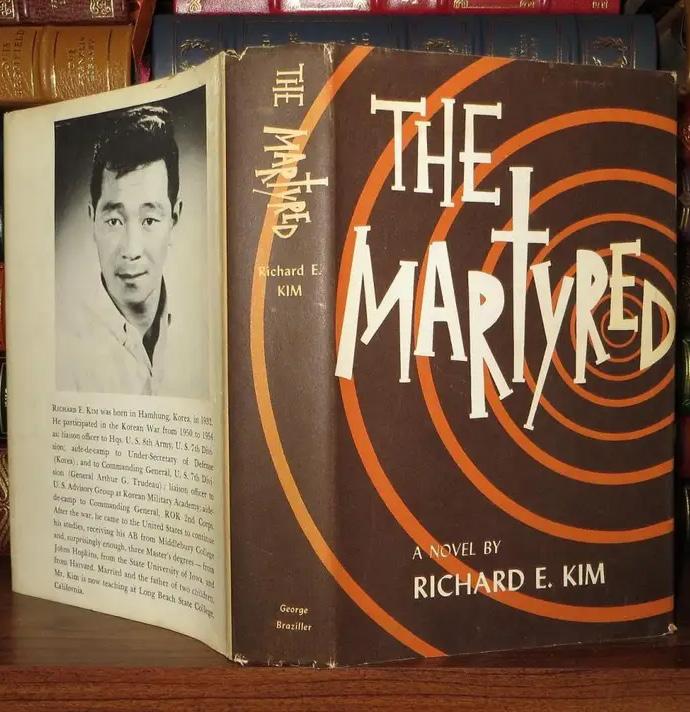
novel, written and published in English in the United States. This extraordinary work of fiction created quite a stir both in Korea and abroad. Another well-known figure from Mokpo is Kim Seong-hun, a former minister of Agriculture in the Korean government during the presidency of Kim Daejung. Incidentally, he received an assistantship in agricultural economics at Chonnam National University on the same day I was appointed an English-language teaching assistant at the same institution, my alma mater as well.
Lee Nan-young, the Kim Sisters, Seo Jeong-su, Richard Kim, Kim Seong-hun, and of course, Kim Daejung – quite an array of celebrity from Mokpo, small in size but large in stature.
The Author
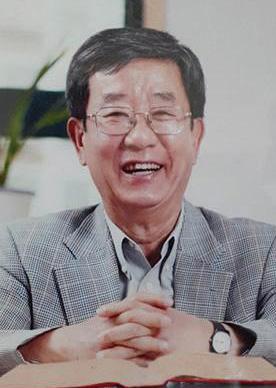
Park Nahm-Sheik is a native of Gwangju. After graduating from Chonnam National University, he went on to receive a master’s degree at the University of Hawaii and a PhD (applied linguistics) at Georgetown University, both in the U.S. Upon completing an illustrious career at Seoul National University, Prof. Park served as president of the International Graduate School of English.
By Fatimah Muthiah Irbah
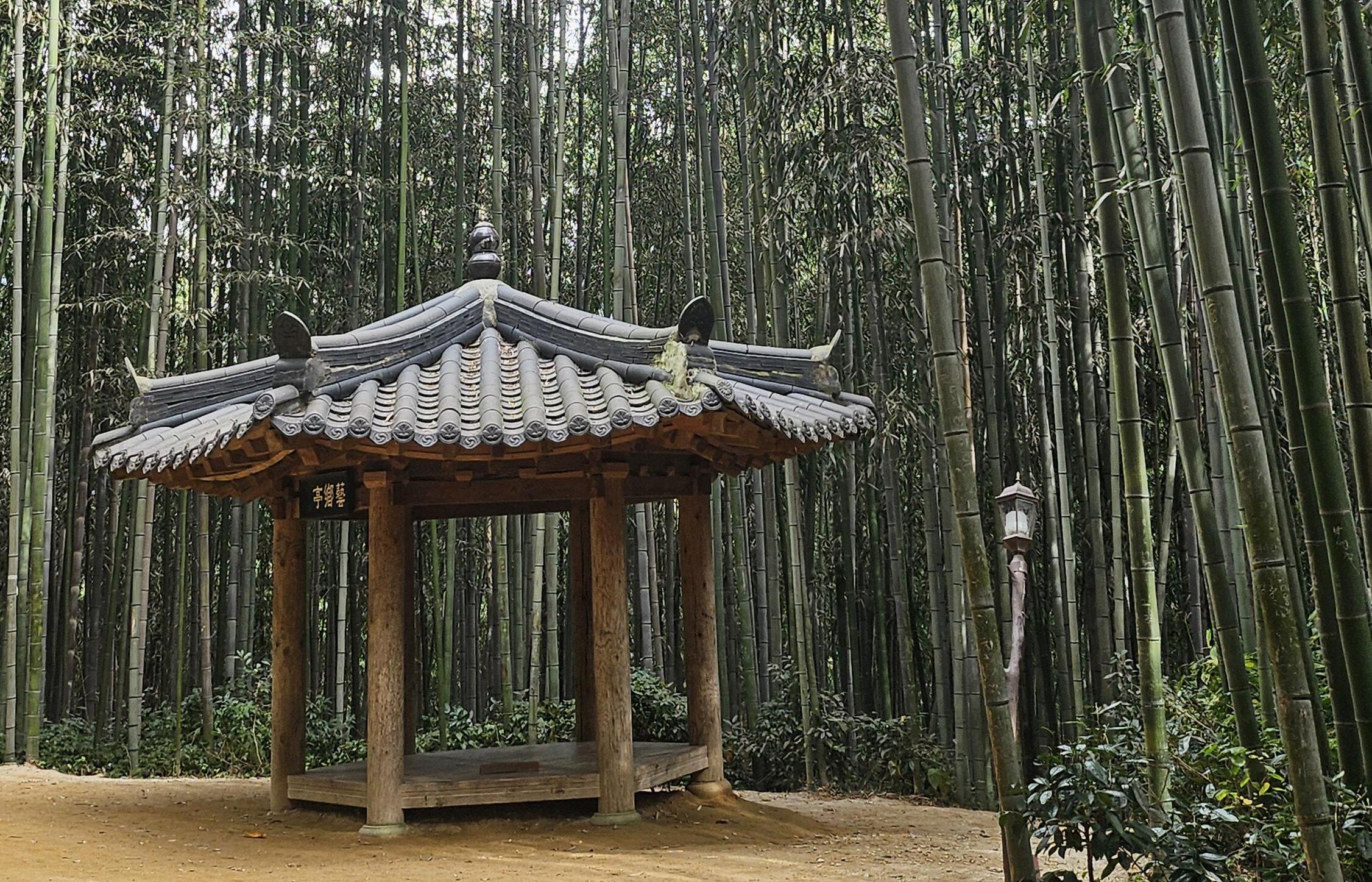
Amid the Hallyu wave, South Korean culture, such as music and drama, is becoming increasingly popular in Indonesia and around the world. Korea has thus become a favorite destination for tourists around the globe. However, beyond the glamour and hip culture that South Korea has, there is a place where you can take a breath of fresh air and pause for a moment. Have you heard of Jungnok-won?
Jungnok-won (죽록원) is a shady green bamboo forest located on the outskirts of Damyang. Damyang is near Gwangju but far from the noise of a city. Here, visitors can take a deep breath and feel the fresh air, surrounded by the towering bamboo trees. But Jungnok-won offers more to see than just the bamboo.
Before the entrance, there is a stone bridge made of stepping stones, flanked by trees with leaves starting to change color, with a mountain in the background. Many visitors cross this bridge, stopping to take photos. From the entrance, there are several paths to choose from, but every path offers equal beauty. The paths are quite steep. However, there’s no need to worry. There are many wooden gazebos and long benches to rest on before continuing the journey.
Additionally, there is a small waterfall with panda statues, as well as a playground equipped with swings and slides, suitable for visitors with children. Near the back entrance of Jungnokwon, there is a piano that can be played; some visitors stop to play or just to hear the music from
the piano. It’s located in one of the traditional Korean houses there. Complete with a view of the lake, several fountains, and brown, orange, and red leaves, it adds to the tranquility of this place.
After exploring Jungnok-won, visitors can relax at either of the two unique cafés with hanok (traditional Korean house) exteriors, located within the Jungnok-won area. Among all the items on the menu, there is one specialty dish found only here: bamboo extract ice cream.
Visitors can also visit the Jungnok-won Museum at no additional cost. Here, videos about the bamboo garden are shown, and on the second floor, there is a dome-shaped screen that visitors watch while lying down; there are also bean bags freely available for visitors to take a break from their explorations.
I visited when summer was changing to autumn, as the leaves on the trees began to change color. It was quite cool for someone from a tropical
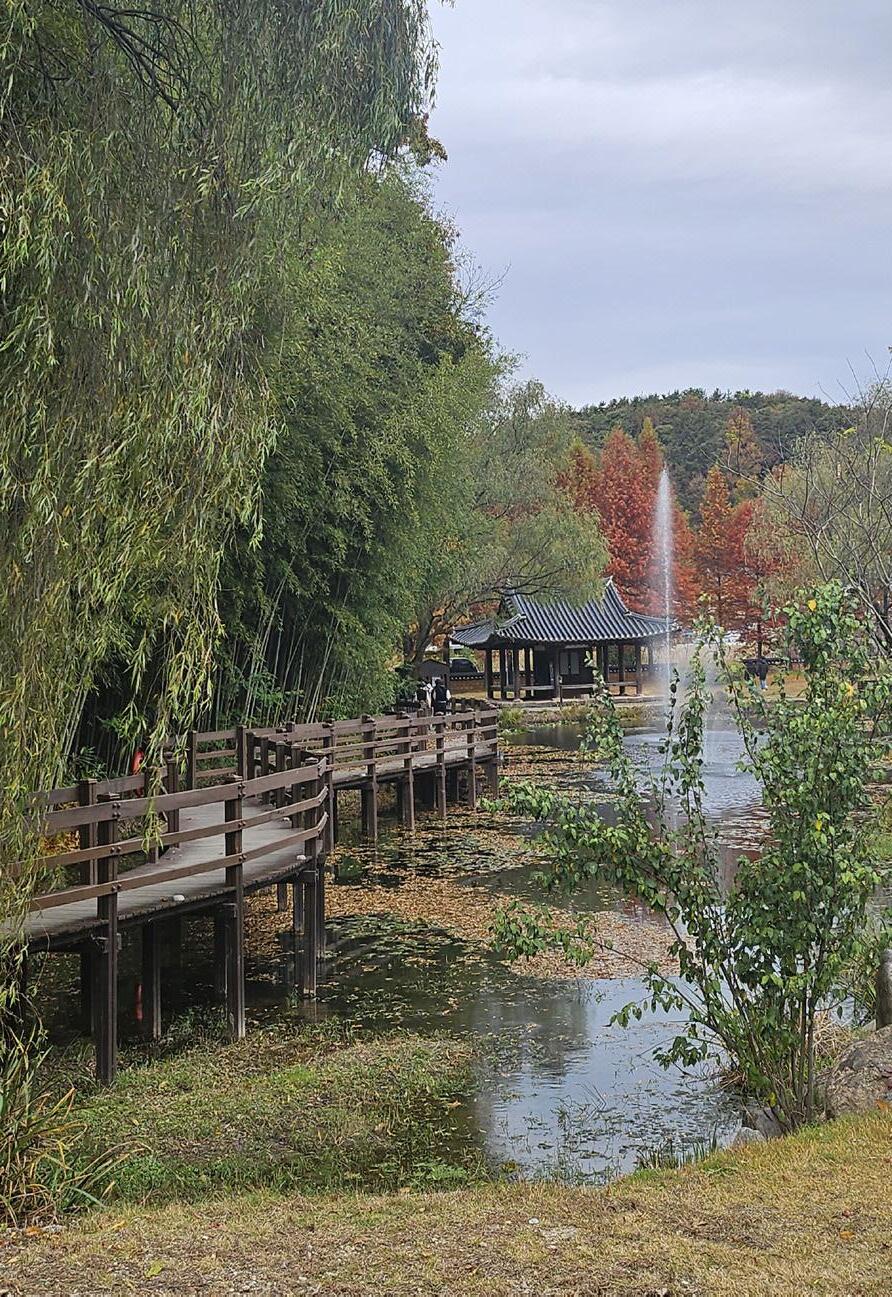
country as the temperature dropped into the teens (in degrees Celsius). This is a perfect place for witnessing the beginning of autumn with its falling leaves.
“Jungnok-won is an underrated destination among international tourists. Its location is not very popular because it is far from frequently visited tourist spots like Busan and Seoul. But this place is truly beautiful,” said an international student from the Philippines studying at a university in Gwangju.
Not many foreign tourists were seen during my visit. However, the domestic visitors were diverse, ranging from young couples and families with small children to the elderly. In fact, hiking is a hobby for many elderly people in Korea, and Jungnok-won has great trails for hiking.
For just 3,000 won for an adult admission ticket, visitors can enjoy Jungnok-won to the fullest. Access is easy, just a 50-minute bus ride from Gwangju U-Square, with the bus stop right in front of the Jungnok-won entrance, and the trip is only 2,900 won.
A tip from the author: Wear appropriate clothing for the time of your visit. Because the trails are quite long and steep, it is recommended to wear shoes that are comfortable for long periods, such as sneakers.
In my opinion, as an international student exploring Korea, Jungnok-won in Damyang is highly recommended for a visit. It’s an ideal choice for those seeking peace and a time to reconnect with nature.
Fatimah Muthiah Irbah is now a student in Indonesia. She spent the Fall 2024 semester as an exchange student at Chonnam National University. She is up to challenges and loves trying new things. Through her writing, she aims to convey her experiences so the reader can feel them too. Instagram: @fatimah.irbh
Photographs by Fatimah Muthiah Irbah.
By Neha Bisht
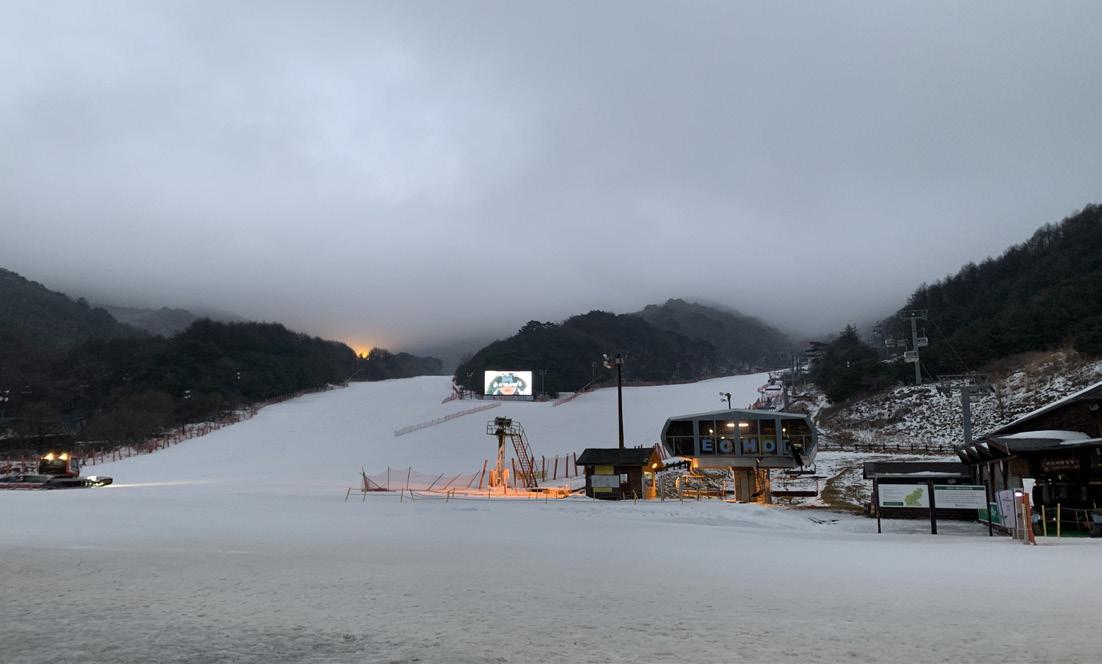
Jeollanam-do and Jeollabuk-do are two of South Korea’s most vibrant provinces –home to serene mountains, dense forests, snowy valleys, and more adventurous attractions than one could explore in a lifetime. As someone who loves discovering every hidden corner of these regions, I wanted my New Year’s Eve to be special this time – something thrilling, memorable, and far from the usual celebrations. That’s how my friend and I decided to welcome the New Year not under fireworks, but on the snowy slopes of Muju Deogyu-san Ski Resort, one of Korea’s most scenic winter destinations.
It was a bitterly cold winter morning. We left early from Gwangju and drove through the winding winter roads, watching the world turn whiter with every passing kilometer.
Since it was New Year’s Eve, the traffic thickened near Muju, and the snowfall slowed us down. By the time we reached the resort, it was already afternoon. The entire place buzzed with holiday energy. Our first challenge? The biting cold that stung our faces the moment we opened the door.
We bought our ski passes with excitement, only to learn that the slopes were closed for afternoon maintenance. At Muju, the ski runs operate in two sessions – morning and evening – with a break in between for grooming and repairs. So, we had no choice but to wait for the evening session.
But waiting in Muju is hardly boring. We wandered around the snowy landscape, took countless photos, played in the snow like kids, and admired the view of Deogyu-san’s vast, peaceful mountains. The time passed surprisingly quickly.
When the slopes finally reopened, we rented our ski clothes and equipment and headed toward the gondola. The ride up was magical – gliding slowly above the snow-covered trees, watching the lights of the resort shine below us like tiny stars. For all of us, it was our first skiing experience, so nerves and excitement mixed in equal parts.
And then came the moment of truth: jumping off the gondola onto the snow platform. Of course, we slipped immediately – one after another. It was clumsy, hilarious, and absolutely unforgettable.
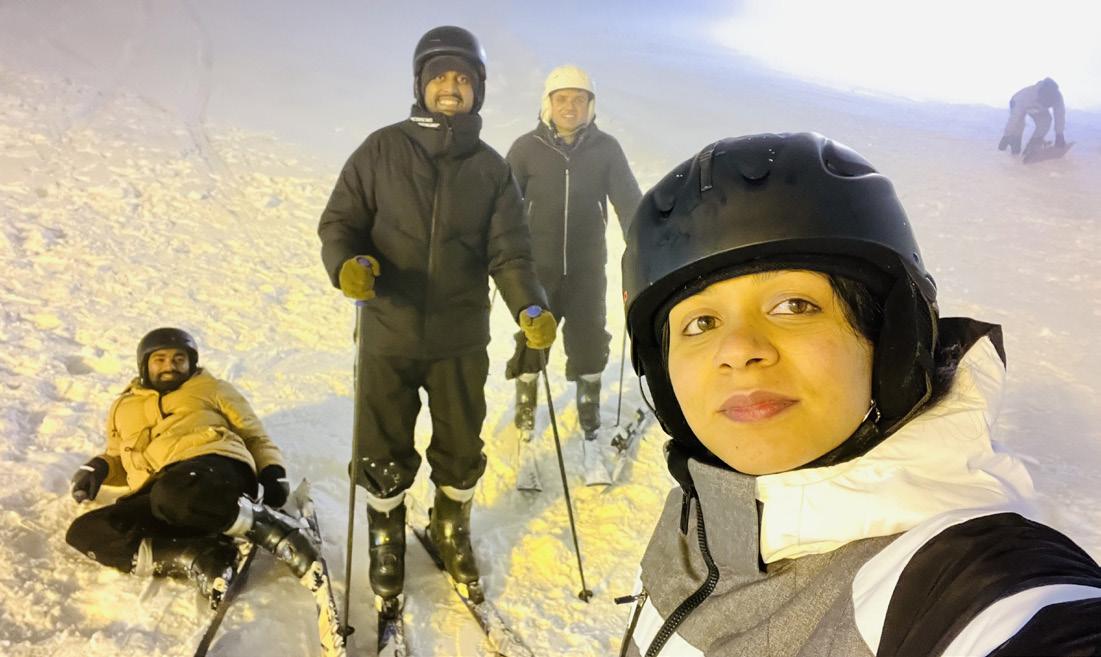
The top platform was filled with beginners practicing and experts gracefully gliding past them. We joined the beginners’ area, taking turns falling, getting up, and cheering for one another. Every fall hurt, but every attempt brought more laughter.
Then came our biggest mistake – we accidentally entered a medium-level slope instead of the beginner one. Within minutes, we were separated. I found myself alone, sliding, falling, standing, and falling again. Whenever I struggled to get up, kind strangers and skilled skiers stopped to help me. Their small acts of kindness kept me going.
Two of my friends gave up even before making it halfway and called the pick-up service. One friend miraculously completed the full course.
And me? I somehow managed to make it halfway down but eventually became too exhausted to continue. The cold, the tumbles, and the endless attempts drained all my energy. I couldn’t even figure out where I was on the mountain.
My friends called me, then requested the resort staff to send a rescue ride. One of them even came along to locate me. Finally, they found me half-frozen, half-determined, and took me safely down to the base. We reunited, laughed over our endless falling stories, and replayed each moment as if it were a comedy movie.
By the time we changed out of our ski gear, it was already around 10 p.m. The slopes were still alive with skiers sliding elegantly under bright golden lights. We warmed ourselves with hot coffee and steaming ramyeon, sitting outside in the cold, chatting, and enjoying the crisp, peaceful air.
As midnight approached, small fireworks sparkled from nearby resorts, lighting up the snowy mountains. We watched them in quiet joy, welcoming the New Year under the cold winter sky, feeling both adventurous and strangely calm.
The midnight drive back was an adventure in itself. The road wound through silent villages, dark forests, and a river that glimmered faintly in the moonlight. The world felt still, peaceful, almost dreamlike. We reached Gwangju in the early hours, ate a warm meal, and finally headed home – tired, bruised, and incredibly happy.
My Muju skiing adventure was far from perfect. I fell more times than I can count, got lost on the slope, and ended the night with sore muscles. But it was magical – a mix of challenge, laughter, friendship, and winter beauty that I will remember forever.
There are many ways to welcome a New Year, but sliding down a snowy mountain – laughing, struggling, learning – felt like the perfect one.
• Go early if you want to join the morning skiing session – it fills up fast!
• Bring your own gloves, cap, and socks – rentals don’t include them and buying them there is expensive.
• Rent only the essentials: jacket, pants, boots, skis/poles. Bring the rest to save money.
• Pack your own food and snacks for mid-day breaks – resort meals are pricey and crowded.
• Carry heating pads (hot packs) to stay warm during evening sessions.
• Layer your clothes for better warmth and comfort.
• Check timings and updates on the official site: mdysresort.com/English
• Start early to avoid traffic, especially on holidays or snowy days.
The
Author
A native of India, Neha Bisht is pursuing her PhD research at Chonnam National University’s School of Materials Science and Engineering. She loves to meet new people and make new friends. Neha endeavors to contribute to the well-being of society in whatever way she can.
Photographs by Neha Bisht.
By David J. Richter
Christmas in Korea can be, for lack of a better word, rather underwhelming for people that grew up in countries where it’s one of the biggest holidays of the year. Where in the West, Christmas is a holiday for family, here in Korea it is a holiday more in line with Valentine’s Day, which can feel quite odd once Christmas time comes around.
One big part of the Christmas season back home in Europe are the Christmas markets. They usually open up in early December and are a staple of the Christmas season — be it to go on a date, to spend
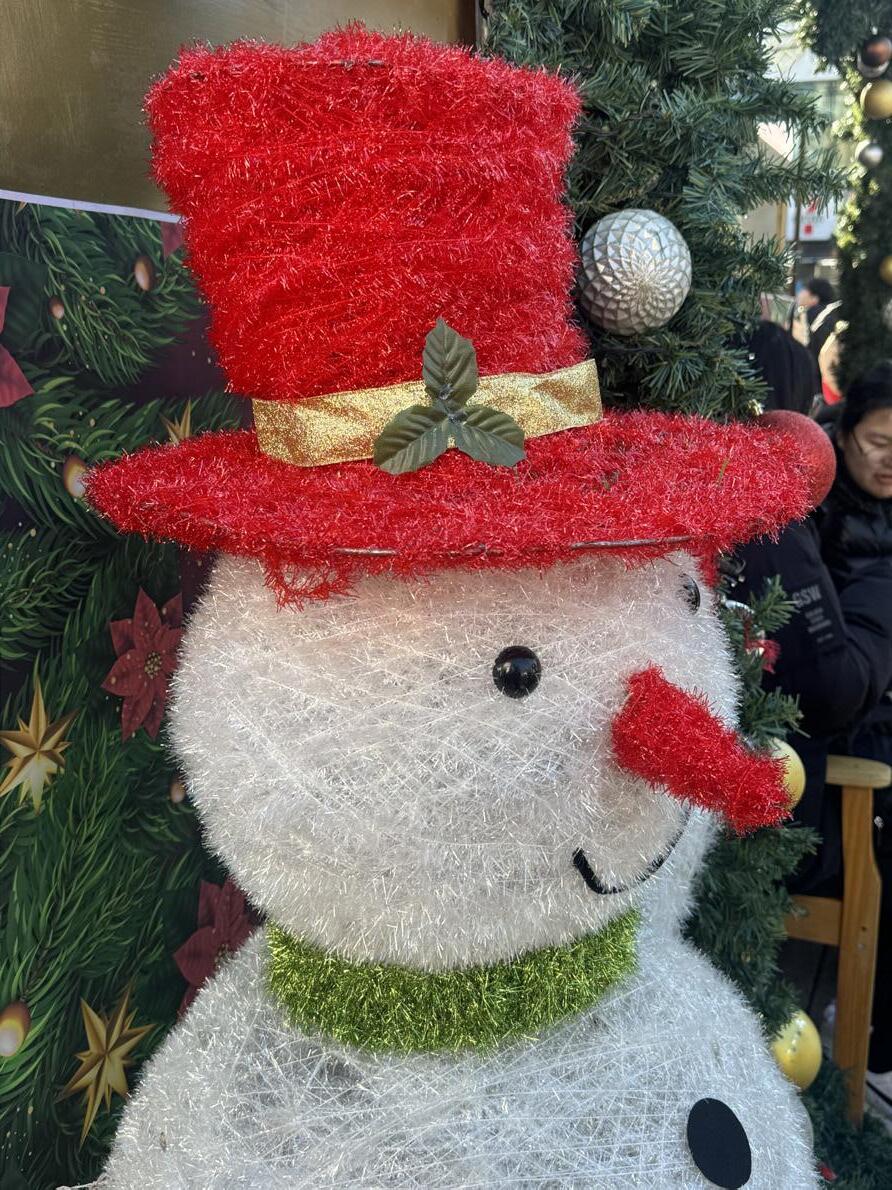
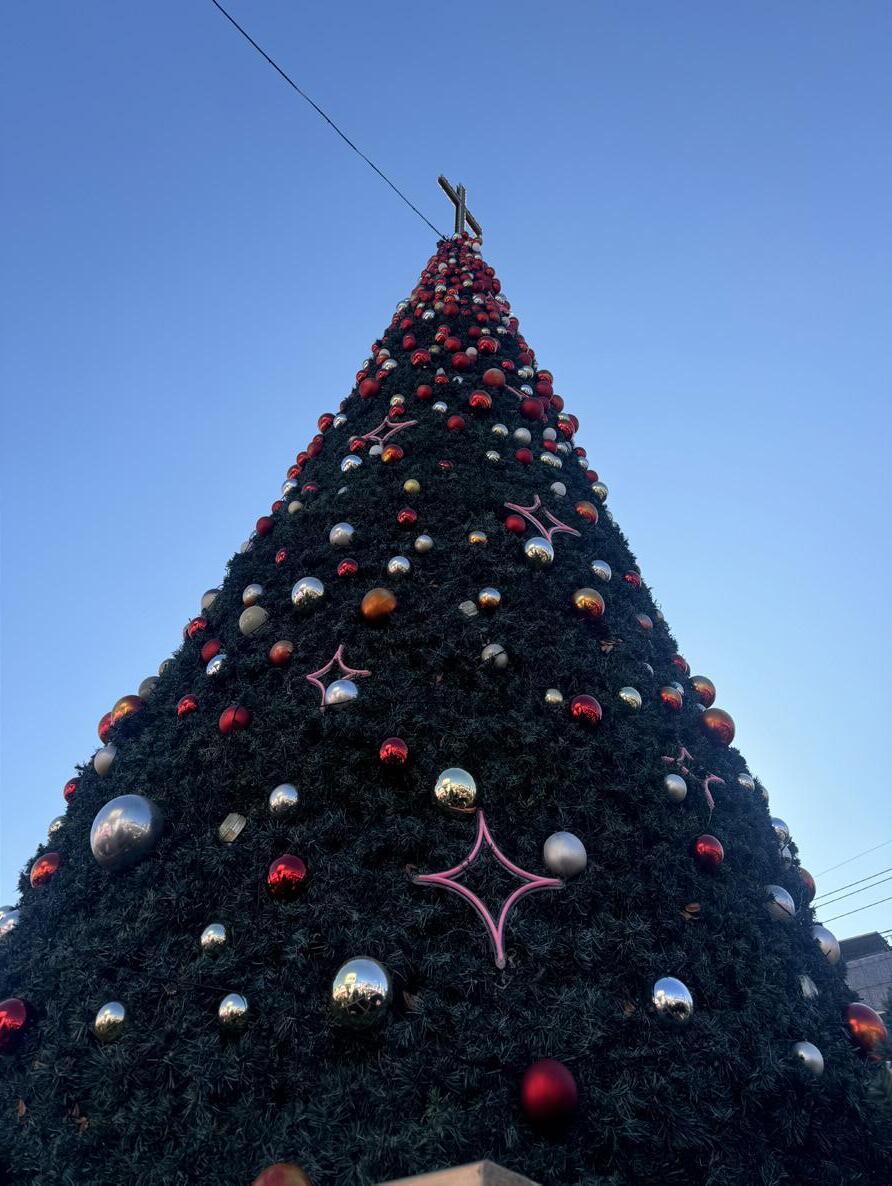
time with family, to have a drink with friends, or to grab a bite to eat with co-workers, Christmas markets offer a wide variety of things to do and items to buy. Nowhere else emits more Christmas spirit to me than a Christmas market does.
Only one issue. As far as I am aware, Gwangju does not have any Christmas markets, and they are not really a common sight anywhere in Korea. But they do exist. Some are just big corporation pop up stores with Christmas decorations. And to be honest, there might be none that truly replicate the experience of Christmas markets back home,
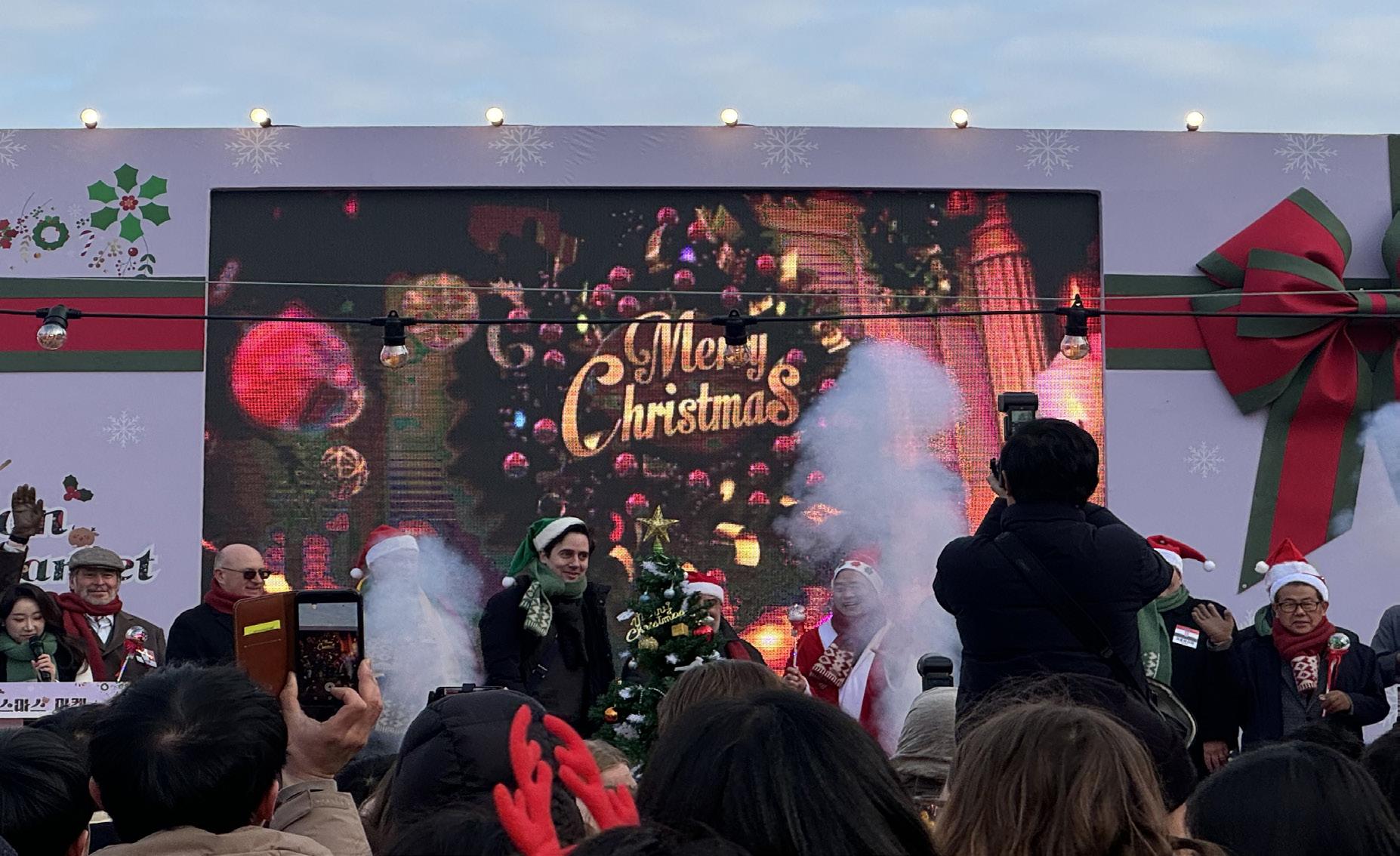
but from my experience, the European Christmas Market in Seoul is at least pretty close. Seoul’s European Christmas Market is run by a number of European embassies (including Germany, Poland, and France) and hosts a range of booths that offer foods, drinks, snacks, and handcrafted items from various countries. These booths are often operated by immigrants of the county in question and therefore offer a pretty authentic experience, considering the circumstances. Christmas market staples such as hot spiced wine, or mulled wine, are available too, of course.
The market is only open for two days, on the weekend of the 6th and 7th of December this year, so it does get rather crowded, especially during the opening ceremony, when ambassadors of various European countries will be present. All in all, it is a fun experience – one that can make you feel a little bit more at home at Christmas time than you otherwise would.
In addition to the European Christmas market, there are now other Christmas markets in Seoul, not all of which I have visited. Grouping them all together into a Christmas market weekend visit
to Seoul could be a fun way to put you into the Christmas spirit early in the Christmas month.
December 6–7, 2025 (Sat. & Sun.), 12–7 p.m. Baram Madang & Jandi Madang, Seongbuk -gu Office
Inquiries: 02-2241-6381~4
Website: https://global.seoul.go.kr/web/news/ news/bordContDetail.do?mode=W&brd_ no=2&post_no=43345FDD4FC30126E0 63C0A8A0230026&lang=EN
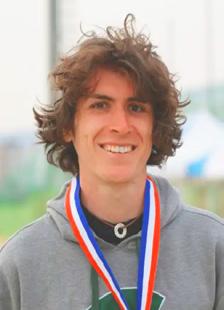
David Jona Richter, born and raised in the extreme south of Germany, is a current graduate student at Chonnam National University. Before coming to Korea in 2022, he spent three years in the U.S. Midwest city of Chicago.
Photographs by Kim Hyeonji.
By Jacqueline L. Becerra
With the cooling of the weather showing its presence by brute winds and bare trees, I have found myself seeking refuge on toasty ondol-heated floors and with warm drinks. One might imagine hot cocoa or coffee, but what I carry is a piping hot cup of tea. And it seems like I’m not the only one, with the choice of drink steadily becoming tea. Amongst younger generations, for example, matcha has received the most hype, and whether you are a matcha lover or hater, there is no denying that the popularity of tea has suddenly soared around the world. This has led me to investigate how Korea has placed itself within the tea scene.
The image of Korean tea continues to be shaped through traditional tea houses with antiquated and eclectic old charm in locations like Seoul’s Jong-ro, Insa-dong, or Ikseon-dong. These wellknown spots are popular to visiting tourists seeking aspects of traditional Korea – from a multitude of Korean souvenir shops, signage exclusively in Korean (e.g., Insa-dong), and traditional hanok-style buildings. As a result, tea houses reflect this sought-after K-experience not only in aesthetics but drink options, including ssanghwa tea (쌍화차), yuja tea (유자차), and omija tea (오미자차), a staple even with a majority of franchise coffee shops.
Korea, though it gives weight to these classic teas, also has preserved a rich history of variety in teas. While many people may recognize Hadong or Jeju-do for its ever-famous green tea, the main source of tea production actually hails from the province of Jeollanam-do, including areas such as Boseong, Naju, and Jangheung. Spanning
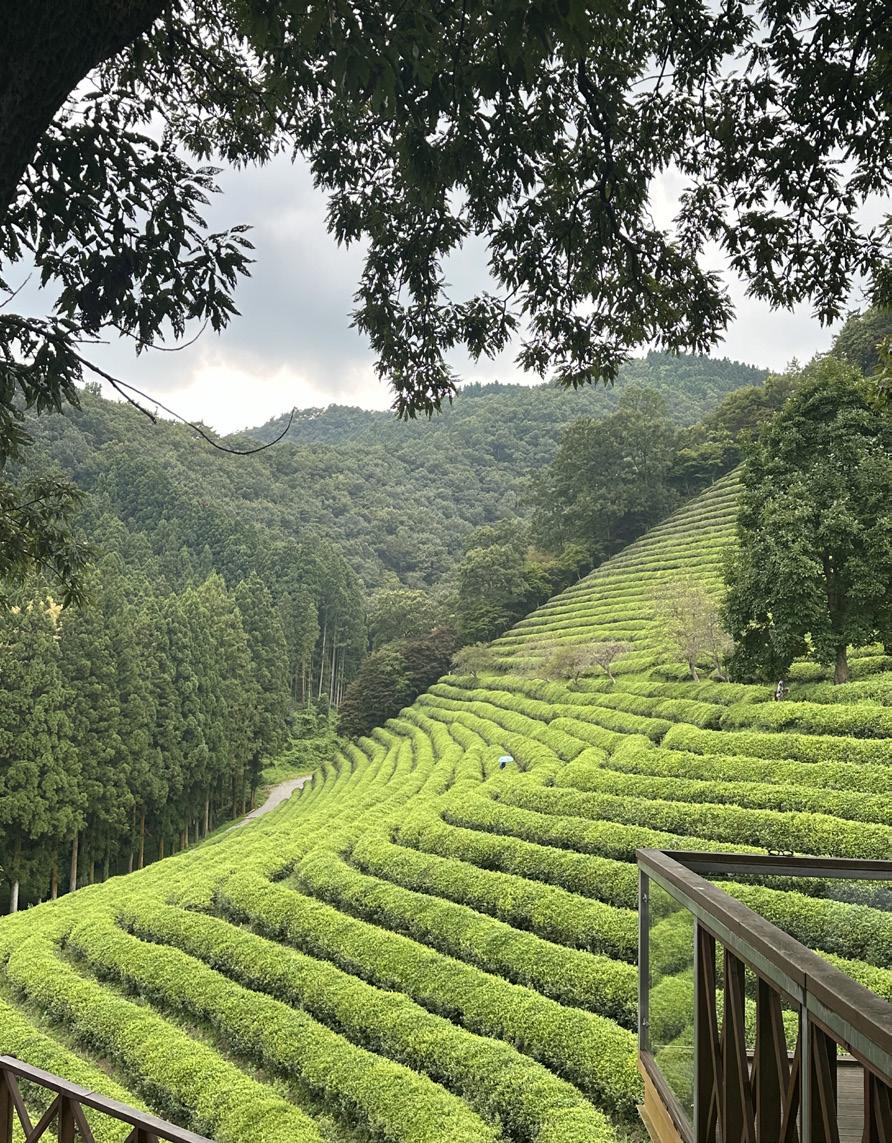
A Boseong tea field in mid-August.
from green tea, yaseng-cha (야생차, wild tea), to cheongtaejeon (청태전), Jeollanam-do has shown itself to be a historic powerhouse in the growing interest in tea culture.
Amongst tea sommeliers and those not heavily invested in tea, Boseong is known for its aesthetic luscious array of green tea trees; an iconic photo spot to check out for those in Gwangju and surrounding areas. In addition to holding the title for the oldest tea field in Korea, Boseong has a dedicated tea museum with information translated into English. And upon a simple walk
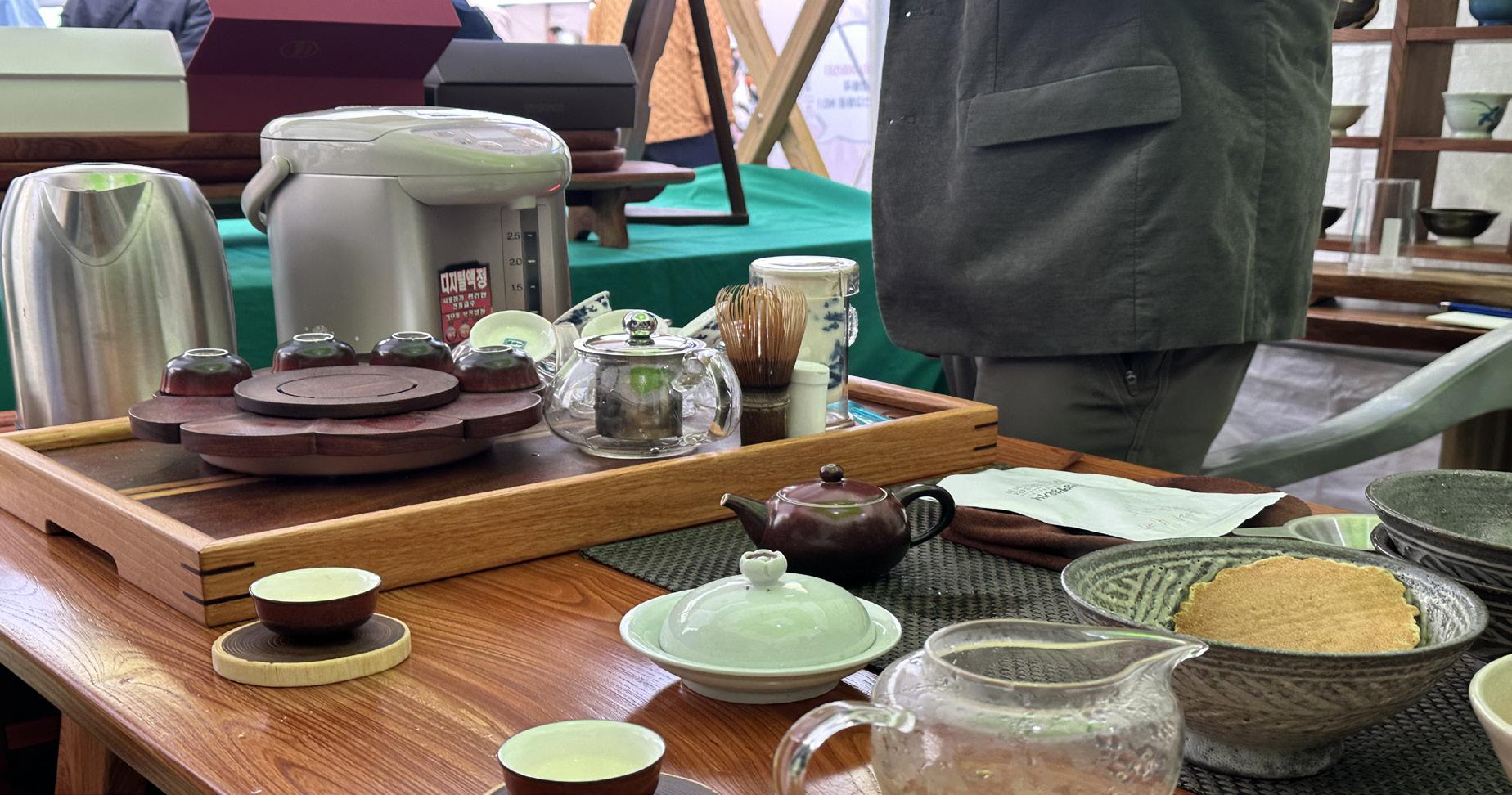
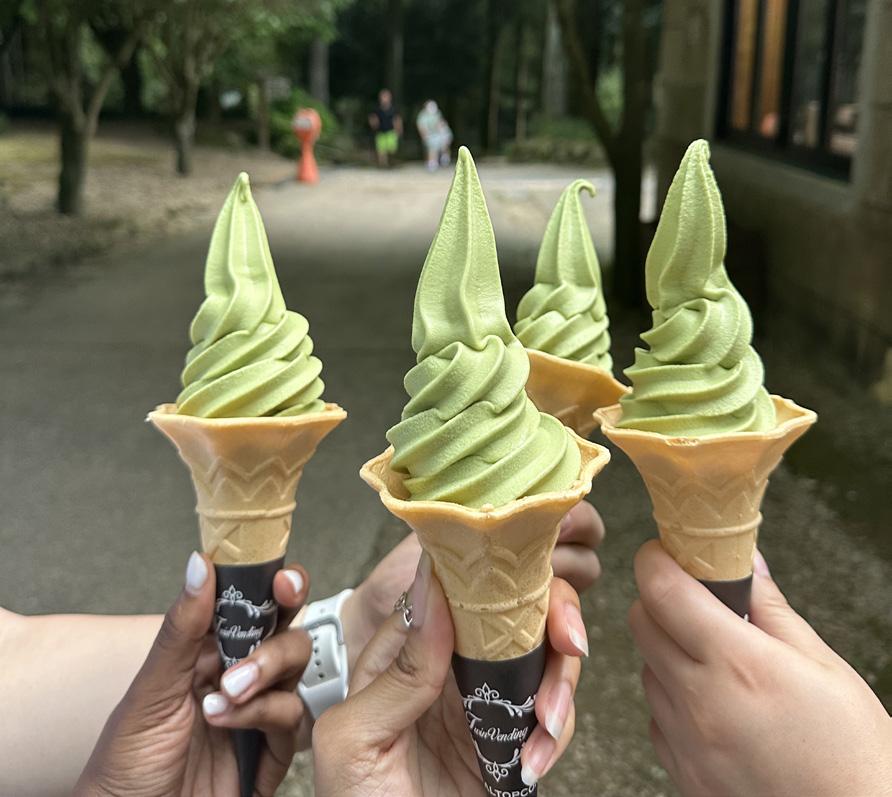
around the fields lie small souvenir shops and cafés offering green tea ice cream, teaware, and local tea goods. I went to Boseong’s Green Tea Festival (보성다향대축제) back in May, where the city not only hosted various tea vendors to share their teas, but held music performances and craft centers to accommodate a wide range of travelers coming to Boseong for the festival. Amongst these, the most memorable was a water fountain that had been filled with massive tea bags, in turn creating a warm fragrant tea bath for passerbys to soak their feet in. However, even on days with no events, it’s easy to see open tea ceremonies by long-time tea masters showcasing and brewing locally grown tea.
The conversation on tea in Jeollanam-do normally starts and ends with Boseong, being the most representative site. However, about an hour from Gwangju, lies Naju, an up-and-coming city with its production of wild teas. Wild teas can be defined as teas from native or indigenous tea plants not developed with the intent for tea consumption, like those on tea plantations.¹ In recent efforts, Naju has engaged in events such as the Gwangju Tea and Café Show and the Tea World Festival to not only display local cultural
goods but to capitalize on its teas, seeking to become the “mecca” of traditional wild tea culture.² When attending the Tea World Festival, I saw the city’s booth: steaming kettles, various tea sets ready for brewing, and a TV screen projecting footage of tea fields and the people behind specialty products. Initially surprised by the scale of the booth, I sat down to talk with one of its staff and sampled Naju-grown teas like Hasimhun’s recently developed lettuce tea (상추차).
Unaware of Naju’s tea, I realized in my conversation and research that the city has a rather extensive history with teas. This deeprooted tie begins with two Buddhist monks: Marananta and Choui Uisun. The Indian monk Maranata established a Buddhist temple in Naju that allowed for the initial spread of Buddhism and tea culture.³ And in the late 1700s, Choui Uisun, later given the name Cho Ui, cultivated tea plantations in the area of Haenam with seeds from Naju. Cho Ui is known as the father of Korean tea and the great restorer of the Way of Tea in the 19th century, writing a guide on the Way of Tea and several poems still referenced today.¹ These two figures can be viewed as pioneers in the expansion of tea culture in Korea, with Naju as the base starting point.
Thus, we find ourselves in a city south of Naju and closer to Boseong: Jangheung, known for its production of cheongtaejeon. If you translate its Chinese character-based parts, it can be broken down into cheong (blue), tae (moss), and jeon (coin), and due to its fermentation process, leaves a blue moss on its surface. This fermented wild tea is then pressed into small tea cakes that resemble coins, for which it is also called doncha (돈차, money tea). Cheongtaejeon originated in the Three Kingdoms Period and since then has gained international recognition with several wins from the World Green Tea Contest for its rich taste and quality. And when discussing cheongtaejun, Borim Temple cannot be left out – a historic site providing early records of tea consumption.⁴ To this day, travelers to this area can find Borim-sa temple workers producing this tea onsite. As such, Jangheung carries a reputable name for its production of cheongtaejeon.
Jeollanam-do, with its warm climate, may be bound to become the main producer of tea for Korea, as tea trees cannot flourish under harsh winter conditions like that north of Jeonju.¹ But it is also doing the work of furthering knowledge by encouraging studies at local universities such as that at Chosun University and Mokpo National University.⁵,⁶ These universities offer departments of international tea and culture for graduate and doctoral programs, with Mokpo
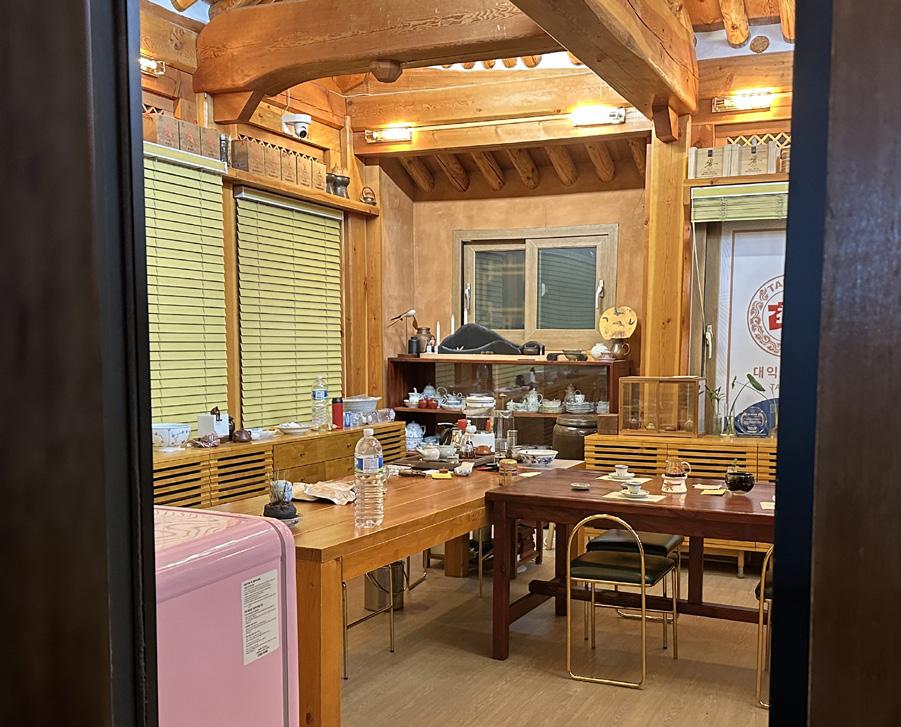
National University being the first in Korea to curate an intensive curriculum on international tea culture. For this reason, it is clear to see that Jeollanam-do is doing its part to promote and expand its position as a major tea producer.
Sources
¹ Brother Anthony of Taizé & Hong Kyeong-Hee. (2007). The Korean way of tea. Seoul Selection.
² Naju City Cultural Foundation. (2025, June 26).
나주시문화재단, ‘국제차문화대전’서 야생차 매력 알렸다 [Wild tea’s charm known at the Tea World Festival]. https://www.njcf.or.kr/www/community/ press?mode=view&idx=35
³ Korea Tourism Organization. (n.d.). Yeonggwang Bulgapsa Temple. https://english.visitkorea.or.kr/svc/contents/ contentsView.do?vcontsId=93885
⁴ Jangheung-gun Agricultural Technology Center. (2024, January 18). 세계가 인정한 명품차, 청태전이란? [What is cheongtaejeon, a world-renowned luxury tea?]. https:// www.jangheung.go.kr/jares/majorplan
⁵ Chosun University. (n.d.). Department of International Tea Culture. https://www3.chosun.ac.kr/eng/1970/subview.do
⁶ Mokpo National University. (n.d.). Department of International Tea and Culture. https://eng.mokpo. ac.kr/eng/1458/subview.do
reward ourselves for trekking the fields.
Jacqueline Becerra is a past Critical Language Scholarship recipient at Chonnam National University and reminisces back on those memories of humid summer nights. Through her writing at the Gwangju News, she wishes to convey the same fondness the city has given her.
Photographs by Jacqueline Becerra.
By David J. Richter
Gwangju has numerous partnerships with different cities all over the world. In this article we will take a look at one of these, the partnership with friendship city Leipzig. Leipzig is a city located in the east of Germany, in the former DDR (East Germany) in the state of Saxony. It is home to about 600,000 people and is the largest city in Saxony as well as the eighth largest city in all of Germany. As an old and storied university and trade fair city, Leipzig hosts numerous cultural sites.
The Leipzig–Gwangju partnership was established in 2007, after which things were made official in 2011 when both cities signed a memorandum of understanding, as did Leipzig University and Chonnam National University Hospital. Both cities share a past of democratic movements in their respective countries. Gwangju had the Gwangju Uprising of 1980, while Leipzig had the Peaceful Revolution in 1989. Leipzig’s revolution, which was part of nationwide protests at the time, led to the eventual fall of the DDR (East Germany) and made way for Germany’s reunification.
Since the establishment of the friendship and cooperation partnership, both cities have engaged in a variety of exchanges, with a lot of progress being made in recent years. In 2023, a delegation of Leipzig city officials came to Gwangju, with a Korean delegation heading to Germany only shortly after, to strengthen the cities’ ties. In the same year, Leipzig city officials traveled east to sign a cooperation agreement between the two cities’ offices of education. In 2024, a number of artist exchanges took place, where artists from both cities got the chance to exhibit their work in their partner city.
The year 2025 brought with it a number of student exchange programs enabled by the
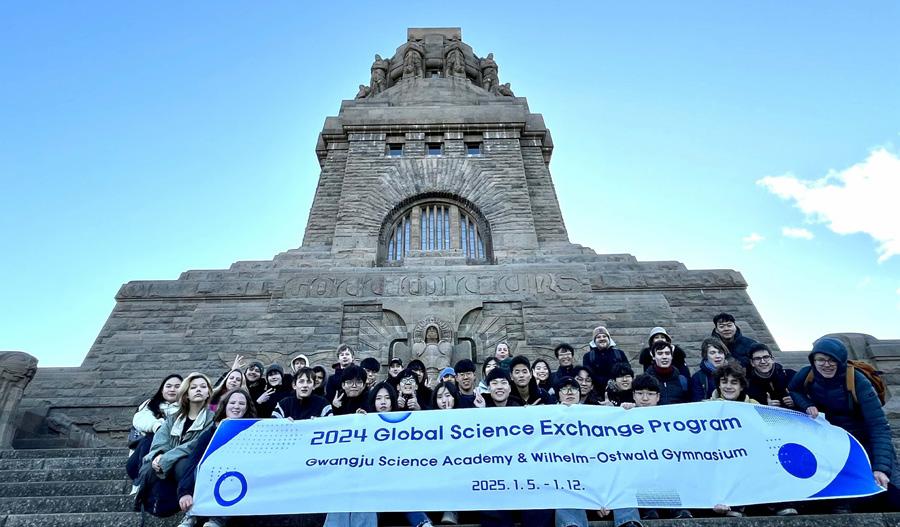
agreement signed two years earlier. A Global Science Exchange Program between two high schools took place where Gwangju students first traveled to Germany, after which the Leipzig students came to Gwangju soon afterwards in return. Gwangju Science High School sent 16 first-year students to Leipzig, where they engaged in cultural and local activities. All the students stayed with local German partner families to further immerse themselves in the foreign culture. The Korean students presented research results to their German counterparts, followed by a Q&A session. When the German students made their way to Gwangju, they too did homestays, visited the May 18 memorial site, and presented research results.
Exchanges such as these are expected to continue in the future to further strengthen cooperation and global understanding between the cities of Gwangju and Leipzig, Germany.
The Author
David Jona Richter, born and raised in the extreme south of Germany, is a current graduate student at Chonnam National University. Before coming to Korea in 2022, he spent three years in the U.S. Midwest city of Chicago.
For the past two years, the Gwangju News has had regular professional sports reporting on Gwangju’s baseball, soccer, and volleyball teams – the Kia Tigers, Gwangju FC, and the AI Peppers. More recently, we have begun carrying sports focus reports, all penned by our sports reporter Zhang Jiuzhou, also known as “Julius.” To learn more about him than just what’s in his author bio, we bring you this interview. — Editor
Gwangju News (GN): Hello, Julius. Thank you for finding time to do this interview. You’re been writing sports articles regularly for the Gwangju News for two years now. We thank you for that. What initially attracted you to the magazine?
Julius: The first time I visited the GIC, I saw that month’s newly published issue of the Gwangju News. The cover featured a high-resolution, beautifully designed photo of Gwangju FC winning the 2022 K League 2 championship. I thought, “This must be a very professional media outlet.” I immediately felt that I wanted to be part of it if I ever had the chance.
GN: Happy to hear of your first impression of our magazine! Will you give us some background information about yourself before coming to Korea?
Julius: I’m from Harbin in northeastern China, a city famous for its ice and snow culture. I lived there until I completed my undergraduate degree.
GN: You’re currently a graduate student at Chonnam National University. What made you decide on studying in Korea rather than is some other country?
Julius: I had always planned to study abroad. My university in China had exchange partnerships with schools in several countries, including Korea, Japan, Russia, and Belarus. Korea is geographically close to my hometown, and culturally it shares similarities with China. When
choosing which university in Korea to attend, my Korean teacher recommended Gwangju, saying that there were fewer Chinese students here, making it a great environment for learning Korean.
GN: For the Gwangju News, you pen the Area Sports Round-Up column, which covers the Tigers, Gwangju FC, and the Peppers, and you write a second monthly sports article that features a sports personage or event. How did you get so involved with sports?
Julius: I love sports – both participating in them and watching them. On my first weekend in Gwangju, I joined Gwangju Inter FC, a foreignerbased football club supported by the GIC. And personally, I believe that if you want to feel a sense
of belonging in a new city, the stadium is the best place. That’s where everyone cheers for the same team and chants the same slogans. Every city and every club has its own unique culture.
GN: How do you obtain all the detailed information that we find throughout you sports articles in our magazine?
Julius: Our access is still limited – we only see games from the stands. So, I usually rely on reading a wide range of reports on each team, combined with my own observations at the stadium. Whenever possible, I hope to have more direct contact with players and teams. Once, I privately contacted former AI Peppers foreign player Taylor Fricano through SNS and conducted an interview – that allowed readers to understand a player more directly. Of course, players don’t always have time to check their DMs. If we could contact players through official channels, that would make things much easier.
GN: What do you do when you’re not studying or writing articles for the Gwangju News?
Julius: I’m currently writing the conclusion of my thesis, so between following Gwangju’s sports teams and my academic work, I’ve been quite busy.
GN: A sports prediction: Do you think the Kia Tigers have a chance of making it to the finals next season?
Julius: It’s difficult to predict. Nobody expected the Kia Tigers to win the championship last year, and this year they had a chance to go even further. They even climbed to second place in the summer but then dropped all the way to eighth. That shows how important consistency is. Winter transfer activity will also be crucial. If their foreign-player signings fit well, and the team stays healthy, we can still expect strong results from the Tigers next season.
GN: What are your plans for after obtaining your degree at Chonnam National University?
Julius: I plan to stay in Korea. After earning
my degree, I’ll try looking for a job here. And if I don’t find one that suits me right away, I may continue my studies and pursue a PhD.
GN: What are the items at the top of your bucket list?
Julius: I don’t really have any grand wishes. I know my own limitations. Opportunities often appear unexpectedly, and we can’t predict what tomorrow will bring. So, I prefer to focus on the work in front of me and try to complete what I’m doing now as well as possible.
GN: To conclude our interview, do you have any final words that you would like to share?
Julius: I hope more writers will join Gwangju News and enjoy expressing themselves freely here. It would help strengthen the magazine. And I also hope more people can assist Dr. Shaffer with editing, so he doesn’t have to stay up late working so often.
GN: Thank you for your concern, ha-ha. But I know that whenever I’m working late and message you, you are always there to make a quick reply. Thank you for this interview, and thank you for your dedication to the Gwangju News!
Interviewed by David Shaffer
By Bianca Hill
Imoved from South Africa to South Korea in February 2025. Over the last ten months, I have met all manner of expat here. From first-time visitors, like me, to people who have lived in this country for almost a decade. From university students to business owners. In that time, I have asked a few of them their thoughts on whether they believe expats should learn the local language of their host country. I’ve gotten mixed responses, a divide that appears to be echoed in wider expat circles. In this article, I will provide a brief overview of both the arguments for and against the idea that expats, to some extent, need to learn the language of the country they are living in.
“The argument against learning the local language typically has to do with risk and effort.”
Learning your host country’s language has many benefits. Basic knowledge can increase your independence as you navigate daily life. Ordering at restaurants, shopping at the grocery store, and taking public transportation all become easier. As your skills increase, so will your ability to handle more complex administrative tasks such as setting up medical appointments, interacting with your landlord or employer, or dealing with your mobile company. Language is also the doorway to socialization, and with it, you can build stronger interpersonal relationships with your local community. One of the biggest impacts
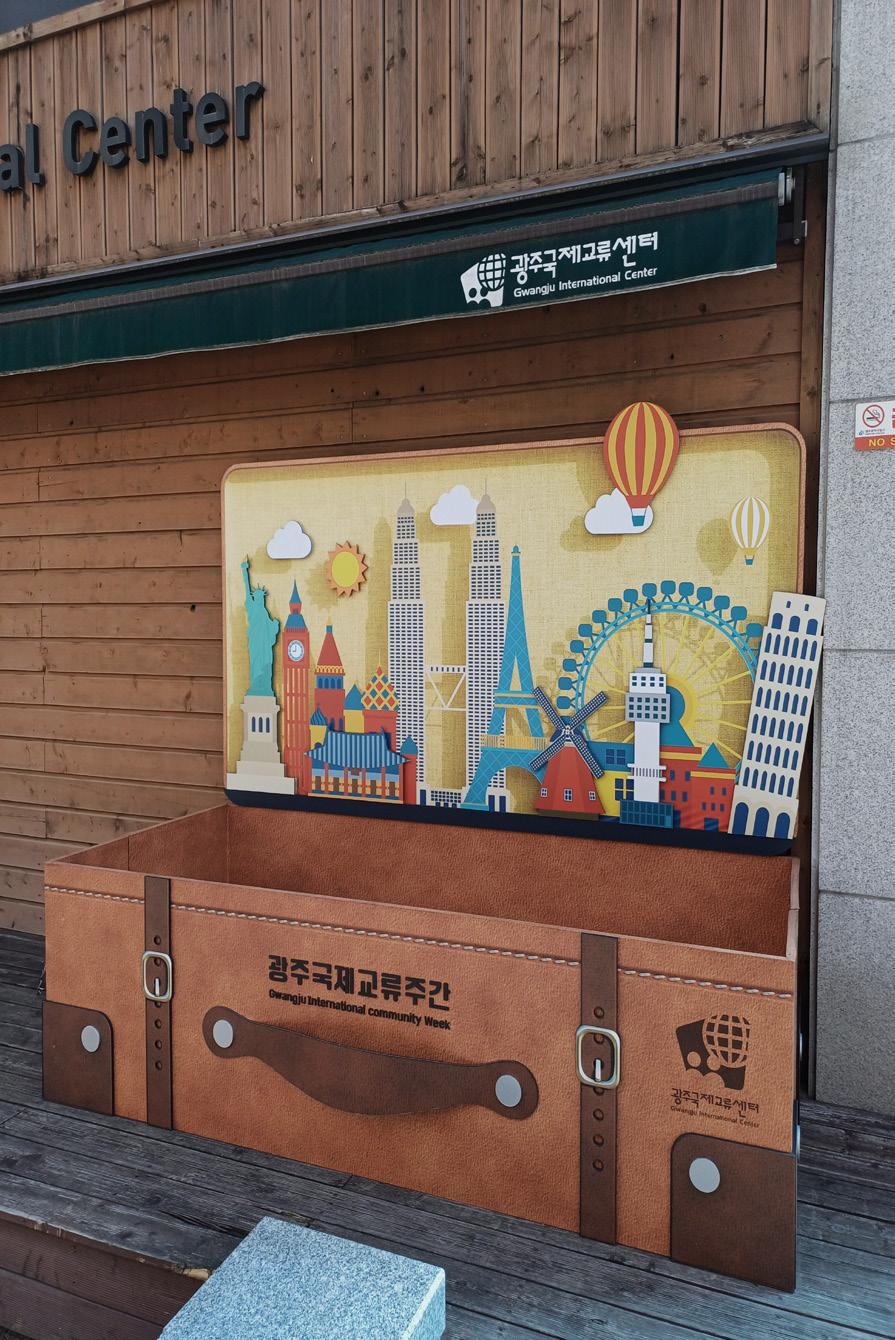
Outside the Gwangju International Center, Gwangju, April 2025.
on the mental health of expats is loneliness. Living in a new country can be isolating, so making an effort to communicate with the people around you can alleviate this. Learning your host country’s language is also a great show of respect and highlights your desire to integrate.
On the other hand, many expats can get by with only their native language(s) and digital translators just fine. The argument against learning the local language typically has to do
with risk and effort. There are always risks when learning a foreign language. The first is the risk of causing offense, be it by accidentally swearing or messing up an honorific form. Another liability is the risk of losing proficiency in your native language, along with aspects of your cultural identity. Particularly in the case of multilingual speakers, the more you use your new language, the more your other languages deteriorate.
“Basic knowledge can increase your independence as you navigate daily life.”
The effort has to do with the amount of time and/or money you can spend on learning your target language. The majority of expats are adults with jobs and families and responsibilities, so the time they have to spend on language learning is limited. Along with this, there are many expat bubbles that create safe spaces, while also facilitating language isolation. If you have a group of expats that you’re close with, that speak your native language, you’re less inclined to want to learn a new language.
While English is enough to survive in many countries, the case is not always true for South Korea, especially as you travel into the more rural areas of the country. I have visited a few cities
in my time here and can say without a shadow of a doubt, that every time I have used Korean, I’ve been met with nothing but kindness and curiosity. When I first arrived, I was very isolated, but as I’ve gotten more confident in Korean, I’ve started making small connections with the people around me.
Though I have noticed little hints of the aforementioned risks, such as making linguistic blunders or reaching for Korean words before those in my second language (Afrikaans), I have found that I actually seek out my own culture more proactively than I did in South Africa.
There are many opportunities to learn Korean in Gwangju. The Gwangju International Center (GIC) hosts Korean classes for all levels. The local universities also have excellent Korean language programs. If you don’t have the time or money to learn Korean for extended periods of time, there are great apps and platforms available to you! Ultimately, every expat is different so you have to decide how much Korean would best benefit you.
The Author Bianca Hill, a South African native, has been living in Gwangju since March. She has a background in English literature, psychology, and library studies. When she is not teaching English, she is learning Korean and hoarding secondhand books.
Photographs by Bianca Hill.
By Yuri Kim and Madeline Miller
You can see countless academies, especially for math and English, while you are living in South Korea. According to the Korean Education Statistics Service, there are about 3,500 academies registered with the Gwangju Metropolitan Office of Education! If we were to include private tutoring services, the number would be even higher.
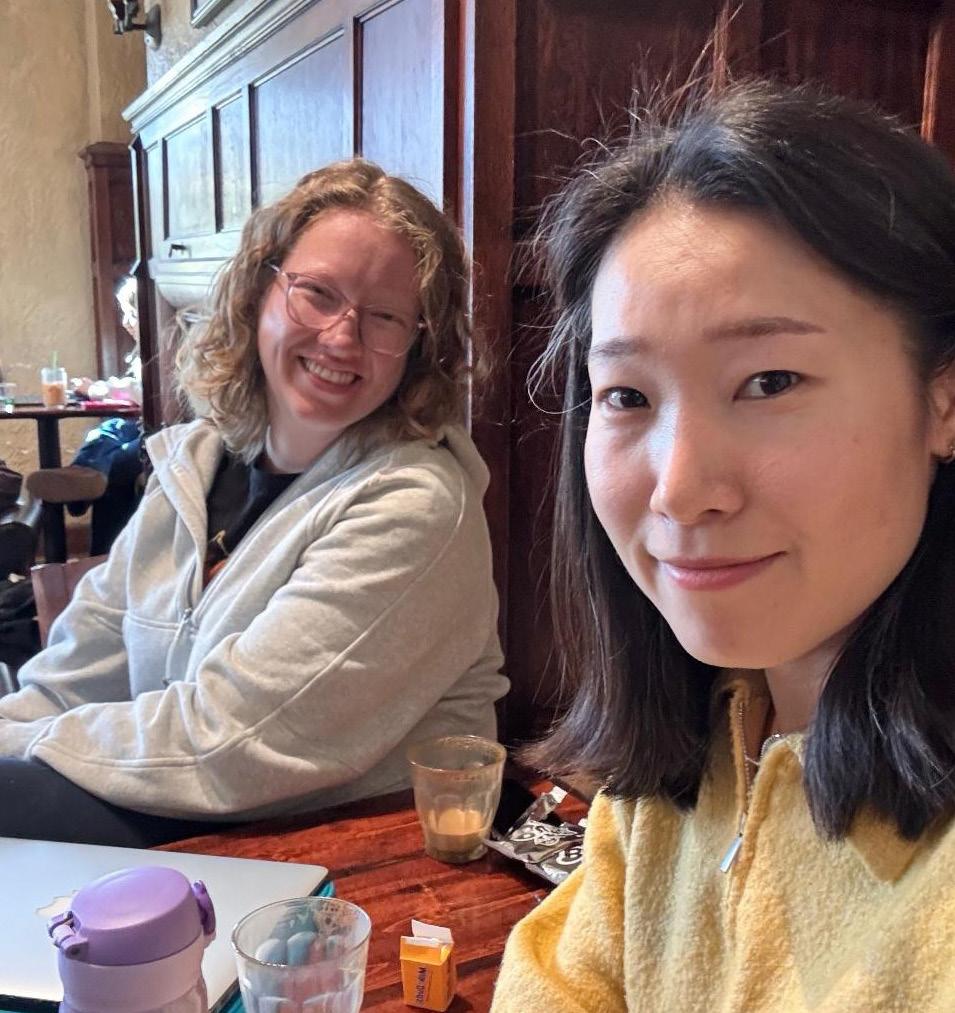
Maddy was an ESL instructor at a couple of language academies in Gwangju from 2015 to 2021, and Yuri worked at a math academy from 2013 to 2016. We each – separately – moved to Minnesota, and signed up for a language exchange program through the University of Minnesota. Yuri’s hobby recently has been English, and Maddy is still hopeful that she can learn some Korean. Lo and behold, we were both surprised to find, our language partner used to live in Gwangju! As we swapped stories at the first meeting, we each found it interesting that the other used to be a teacher. I (Maddy) think most native-speaker ESL instructors in Gwangju might relate to the feeling of difference: There are expectations placed on us that are different from those placed on Korean teachers. I remember clearly the tears some Korean co-teachers had after parent interactions, in particular, that left the co-teachers feeling defeated. Thus, we’ll focus on and lead with Yuri’s stories.
Yuri Writes
I majored in statistics at Chonnam National University. Since my department’s name was “Department of Mathematics and Statistics,” it was easy for me to find part-time work as
a math tutor. I started tutoring as soon as I entered university to earn some pocket money. Fortunately, I was good at teaching math, so I continued tutoring throughout my college years and also did some volunteer tutoring programs. These experiences eventually led me to work as a math instructor. Like any other job, this one had both pros and cons.
One of the biggest benefits of this job was the energy I gained from students. After I quit this job, I realized how much energy I had received from my students. They were teenagers and always full of energy. Even though math classes could be tiring for them, they somehow managed to find more energy to play pranks. I had to calm them down as their instructor, but I often
laughed with them. The fun mood in class often helped the students concentrate better, but to be honest, they were so funny that I couldn’t hold back my laughter. That’s how I was able to recharge my own energy through them.
Another benefit of this job was having free time during the day. I didn’t have to wake up early in the morning because my work started around 3 p.m. I could relax in the morning with coffee while my family was in a hurry. Since my working hours were different from most people’s, it was easy to visit the bank or hospital during the day. I didn’t need to take time off to run errands since those places were open during my free hours. I could also go to the gym before it got crowded. With the right mindset, I was able to use my time efficiently and make each day fulfilling.
“I used to joke, ‘We’ll end up spending all the money we earned at the hospital.’”
One disrespectful student often acted like he was our boss, saying things like “You’re getting paid because of me,” and disrupting the class. All of the instructors were having a hard time because of that student, so the academy director gave the student a strong warning. However, they were not removed from the academy. At the time, I felt hurt and became doubtful about my job. I didn’t really have to be doing private tutoring with this student, but I felt stress because the boss didn’t clarify whether we could cancel the lessons.
In addition, I had to regularly contact parents to update them on their child’s performance and behavior. If a student had good grades, the consultations were brief. However, sometimes, even when I tried my best, students’ test results didn’t meet parents’ expectations. I had to explain why the grades were low and how I planned to improve them. Even worse were the calls with parents who were considering having their children quit the academy. Even though I worked hard, those conversations left me feeling like I had done something wrong.
However, this job also had some downsides. One major downside was the unhealthy routine. I worked until 10 p.m., so I couldn’t really enjoy any nightlife. After work, I went home to rest or prepare for the next classes, and I often stayed up late. As a result, I developed an unhealthy sleep pattern. This was a chronic issue that affected not only me but also my coworkers. My coworkers and I used to joke, “We’ll end up spending all the money we earned at the hospital.” Not only did we have an unhealthy daily routine, but we suffered from stress, sore throats from speaking, and got physically tired from standing for long hours while teaching.
Another challenging part of the job was the emotional labor. Most students were kind, but there were a few students who had bad manners.
Although this wasn’t a big problem, I often had to calm students down when they came in excited from their English classes. For example, on Halloween, English academies held a party for the students because they wanted to share American culture. In contrast, math academies never held a Halloween party. Students wanted to continue the party mood in math academies, so every instructor, including me, tried to cut off the playful mood. At times, I wanted to jump in and have fun with them, but as a math instructor, I knew I had to stay professional.
Honestly, although there were some good parts, I experienced more downsides than benefits. However, the moments I laughed with students remain deeply in my memory. One of my goals was to help students avoid becoming a su-po-ja (수포자; from 수학 포기 자), a student who gives up on math. Even though math is difficult and boring, I always tried to make it more approachable. I felt a strong sense of responsibility knowing that I could
influence someone’s path in life. At the same time, I was also shaped by my students, and through these experiences, I grew into a more thoughtful and mature adult.
Like Yuri, one of my major joys in teaching was relationship-building with my students. I think, though, it looks quite different for a foreign teacher than it does for a Korean teacher. One of the main ways in which I was able to connect with students and build a relationship was through playing during class time, from board games for practicing vocabulary to leaving the classroom for map-drawing activities to practice prepositions, to watching “extra-curricular” content that actually snuck learning objectives in through the back door. This is one of the expectations of a foreign teacher, I think, in that parents and educators alike realize that “fun” learning is more effective than “boring” learning. Since the Korean education system seems to struggle in operationalizing this, many administrators defer to native speakers to do it for them, for better or worse. Watching my students improve over time – regardless of how “fun” the lesson was – was immensely rewarding. In part, this was due to
seeing that my pedagogy was effective; in part, this was because of the gratitude from students.
In our conversations, Yuri and I talked about gender and age as a factor of (dis)respect in my classrooms, most especially with adult students. I had two key interactions with older Korean males that left me feeling angry and offended –both because of my apparent “ignorance” as a young female foreigner. Yuri reminded me that this is something Korean teachers also face, not only foreigner teachers. Another struggle we both faced was having to talk all day making us tired. Thankfully, I could get away with making students do more of the talking (conversation classes) or, in fact, all of the talking (debate classes in which I was a judge). I could design lessons to help mitigate the exhaustion, while Yuri didn’t have quite as much freedom in her classroom.
In chatting together during our language exchange, where Yuri practices English and I practice Korean, we also talked about vacation, in two forms: first, teaching vacation classes when our students may not have been attending regular academic sessions at their schools, and second, being able to take time off from work for our own
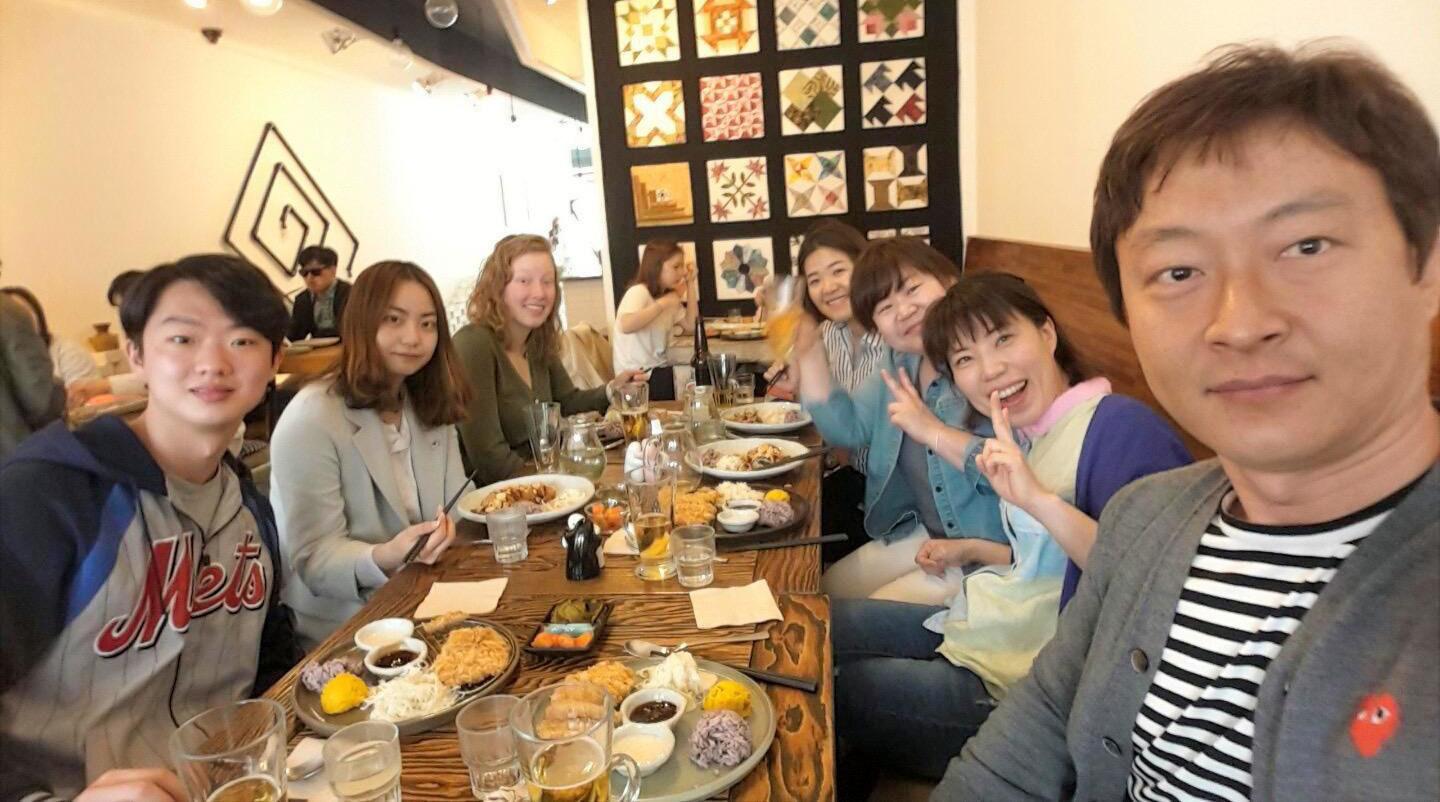
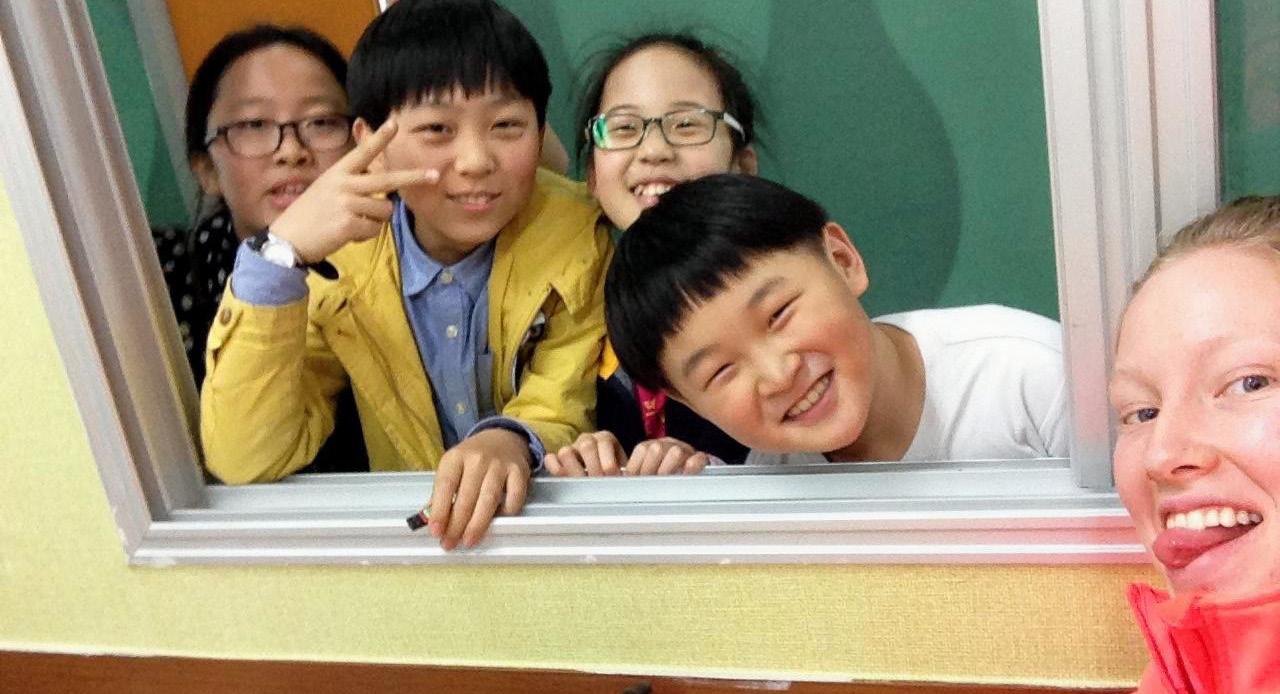
Maddy and her elementary students during her first year of teaching (2015–2016).
vacations. As a native-speaker teacher, I found teaching vacation classes simultaneously a change of pace I was grateful for and also an annoyance in that my working hours usually changed during the vacation period. Yuri mentioned that the workload could be as much as double during vacation periods, something I am forever grateful was not the case for me.
We also talked about vacation as our own time off from work; both of us mentioned feeling frustrated that we could not choose when to take vacation, though I would have to admit that the native speaker generally has a greater amount of flexibility and more time off granted than the Korean teacher. In Yuri’s experience, the only time off afforded for math teachers was on days the hagwon was closed. In my experience, I got to have five consecutive working days off, but not necessarily of my own choosing.
Another difference is employment status. Generally speaking, Korean teachers are hired as independent contractors at an academy; most native-speaker ESL instructors, on the other hand, are E2 visa holders, which means academies are legally obligated to enroll the teachers in sadaeboheom (사대보험) – the four major insurances (health, unemployment, worker’s comp, and social security/pension). Employers working with independent contractors are not required to
provide these for the employee; Korean teachers generally are expected to take care of enrollment on their own. Something Yuri was not aware of: Some employers prefer new teachers, because teachers with experience will expect the graded salary that comes with EPIK’s raise structure. A new teacher is cheaper to employ and will ask fewer questions than a seasoned one.
All in all, we both learned a lot from our teaching experiences, both good and bad. Maddy would like to stay in education, while Yuri found the job to be too taxing and burdensome. Both of us miss Gwangju, though, and loved the students as individuals, even if not necessarily the academy teacher life.

Yuri Kim was born in Gwangju, where she spent most of her life. She worked as a math tutor and instructor for eight years, and later as administrative staff at the Gwangju Institute of Science and Technology (GIST) for five years. She is taking ESL classes in Minnesota as she prepares for the next step in her life.
Madeline “Maddy” Miller lived in Gwangju from 2015 to 2021 as an English teacher and Korean language student. She is now studying medical interpreters and migrant health as part of her doctoral program at the University of Minnesota.
Photographs courtesy of Madeline Miller.
By Saqib Sharif
Yes, you read that right – nearly 80 percent of the children at Munheung Elementary School’s kindergarten in Gwangju are from foreign families. This small government-run kindergarten near Chonnam National University has quietly become one of the most multicultural learning spaces in Korea.
When I first came to Korea in 2016, many of my Korean lab mates had never heard of countries like Pakistan, India, or Bangladesh – nations that together make up more than two billion people, nearly 20 percent of the world’s population. Concepts such as halal food or vegan dietary restrictions were unfamiliar to most, and I still remember my professor kindly gifting me a beautiful bottle of wine for Seollal (Lunar New Year), unaware that Muslims do not consume alcohol.
But times are changing – and nowhere is that change more visible than in classrooms like those
at Munheung Elementary School. Ask a third- or fourth-grade student here about Pakistan, India, or Bangladesh, and you might be surprised by what they know. Many of them can describe the festivals, foods, and traditions of these countries with enthusiasm and curiosity.
That’s the real impact of diversity. In schools like Munheung, where almost every class includes children from abroad, cultural understanding isn’t just taught – it’s lived, shared, and celebrated every single day.
To better understand what makes this unique learning environment thrive, we spoke with Lim Sa-rang, a teacher who has been working at the kindergarten for three years.
Currently, the kindergarten has 15 students, 12 of which are international children. Teacher Lim describes the atmosphere as “dynamic and full of
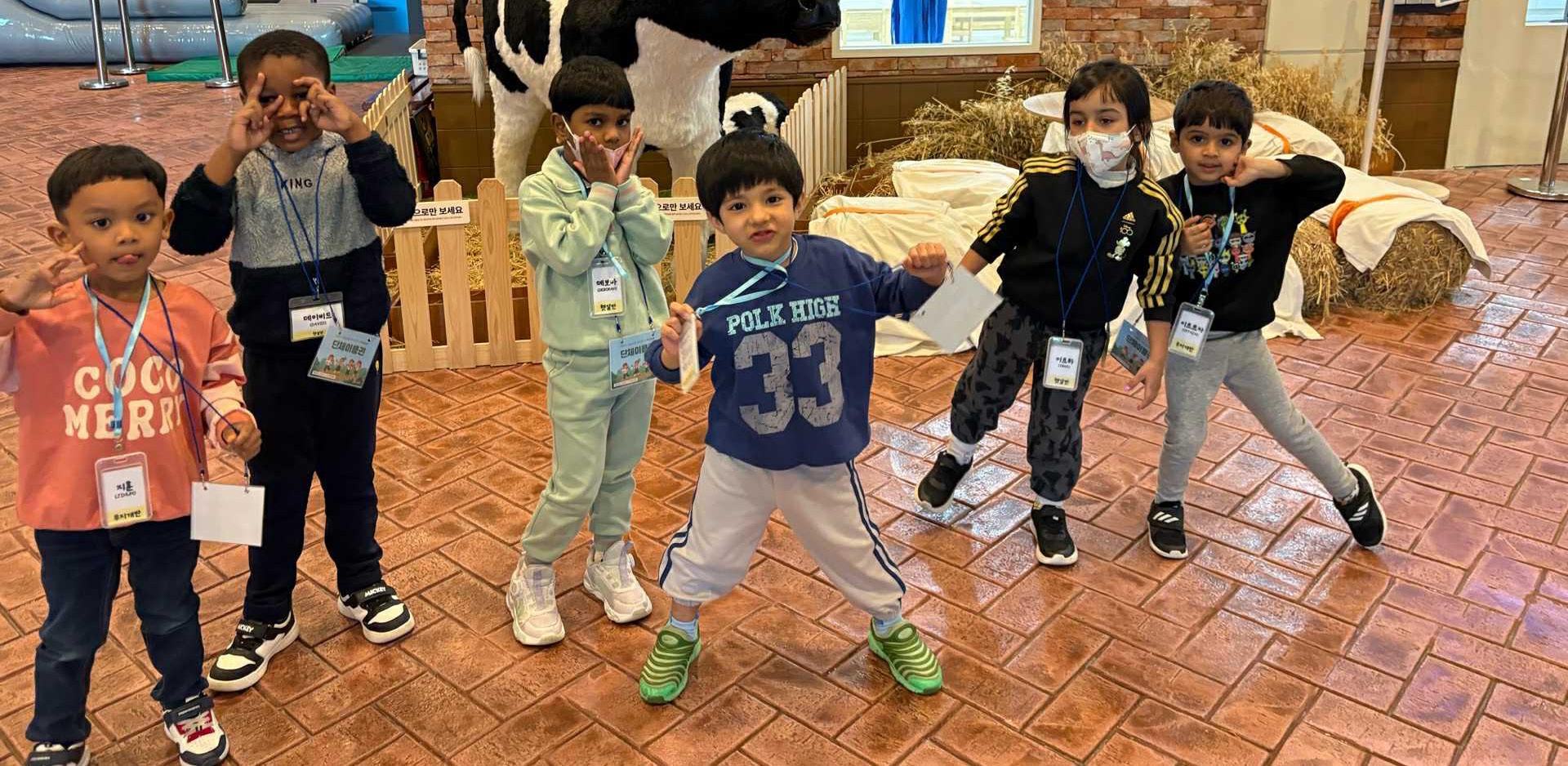
energy,” shaped by the diversity of the students. “Language barriers sometimes create challenges,” she explained, “but both teachers and children work hard to express their thoughts and feelings, and to resolve misunderstandings together.”
One of the biggest challenges, Lim noted, is communication, especially when children first arrive without any knowledge of Korean. “It can be frustrating when they can’t express simple needs like wanting water, using the bathroom, or saying they don’t feel well,” she said. To help, teachers carefully observe each child’s behavior and emotions. But there are also rich rewards: “We get to experience so many cultures, greetings, traditional clothing, festivals, and food from different countries. It’s fascinating and truly joyful,” she added.
Communication between teachers and parents, both Korean and foreign, is handled mainly through KakaoTalk messages and translation apps, ensuring that all families can stay connected. In the classroom, teachers use simple English, translation tools, and visual aids to support understanding. Sometimes, children who have already learned Korean help their peers who are still learning.
The kindergarten also offers several special multicultural programs. Three times a week, a Korean language instructor visits to teach the foreign children the Korean language and culture through one-on-one sessions. Children also engage in global play activities – learning traditional games from around the world, and exploring various national flags, flowers, and cultural symbols during lessons themed “The World and Our Country.”
Because of its proximity to Chonnam National University, many of the kindergarten’s students
are children of university faculty members and international students. “Some families come through referrals,” Lim said, noting that the school’s reputation for diversity and inclusion attracts families from across the academic community.
Lim believes this environment offers invaluable lessons for young learners. “In this global age, the greatest benefit is that children can naturally experience different cultures by meeting peers from many countries. They learn to understand, respect, and be considerate of one another.”
For Lim, the most fulfilling part of her job is witnessing her students’ growth – especially when language barriers fade away. “Three years ago, a three-year-old foreign child joined who couldn’t speak a word of Korean. Now, at seven, he speaks fluently, almost like a native speaker,” she shared with a smile. “Watching that transformation, I felt the same pride and happiness a parent feels when their child speaks for the first time.”
As the children of Munheung Elementary School’s kindergarten learn and laugh together, the school continues to stand as a beautiful example of how diversity, empathy, and education can come together to build a more connected world –starting right here in Gwangju.

Saqib Sharif is a robotics engineer with a PhD in mechanical engineering, specializing in the design of smart healthcare devices and microrobots. With a strong background in medical technology and innovation, he is passionate about creating solutions that enhance smart healthcare. Dr. Sharif has been living in Gwangju for the past ten years. Currently, he serves as a senior researcher at Shinsung Tech Pvt. Ltd., Gwangju.
Photographs by Saqib Sharif.
By Murdock O’Mooney and Kuamah Lee
Travel writer Paul Theroux once told The Atlantic in an interview, “My advice to any young person who wants to write is ‘Leave home.’” In 2008, I had just graduated from college and, taking Paul’s advice, I left home. I went to teach for EPIK (English Program in Korea) and seventeen years later, I’m still teaching. I’ve been lucky enough to experience working in a variety of secondary schools and universities, in both South Korea and the United States. So has my wife, Kuamah Lee. Here are some of our experiences and perspectives about teaching on both sides of the Pacific.
What stands out to me the most about my early years teaching in Korea are the people. By this, I mean the characters. There was the famous English teacher at Uncheon High School who carried a two-meter-long “love stick,” or disciplinary tool, and who had memorized every word to an entire Hemingway novel. Or my coteacher, Ms. Ji, who drove a little green Matiz that never left second gear – even on the highway –and the perpetually drunk, but loving, Mr. Chu. “My name means ‘alcohol’ in Chinese,” he used to tell me between shots of soju. He got a DWI [driving while intoxicated citation] while I was working with him, and his wife had to drive him to work. None of this seemed to affect his standing at the school, however.
With these people, I went on overnight camping trips, hiked mountains, and went to countless teacher dinners. My co-teachers showed me grace and hospitality like I’d never known before. Later on, I met less endearing co-teachers who didn’t see the novelty of having a foreigner in their English classes. To them, I was a burden, not a bridge to the Western world.
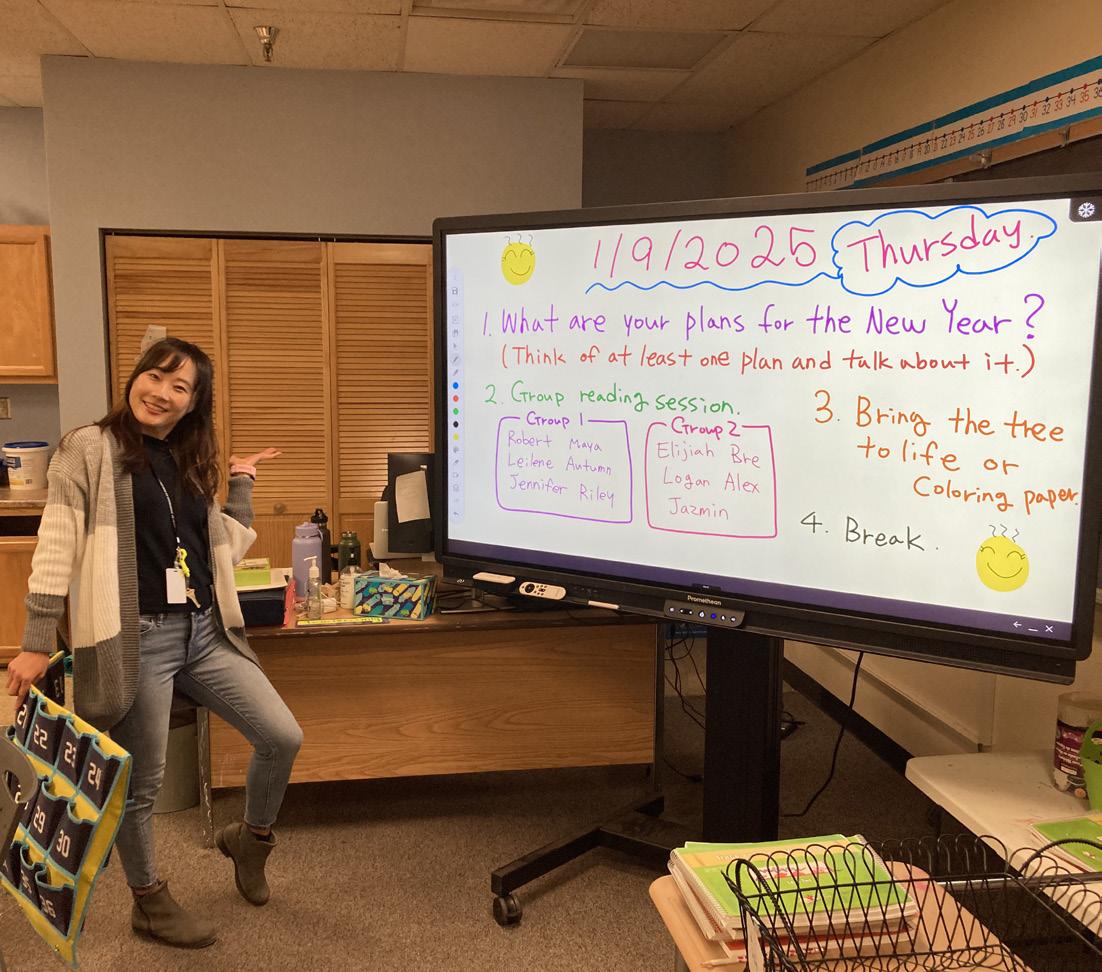
Then there were the foreigners of various pedigree and interests, such as the young man taking a year abroad before graduate school at Columbia University, the non-degree holding Canadian who did shady English dealings but spoke perfect Korean, and the young party bro from New Zealand who got drunk and arrested his first night in town – all unique but united in situation and happenstance.
Later, when I worked at universities in Korea, I saw a darker, more sinister side of foreigners with nice salaries and positions. Some of them would look down on Korea and brag about how easy their jobs were. Maybe they were depressed, or missed home. Whatever the reason, I disliked these people and thought of them as charlatans. But for every charlatan, there existed a devoted foreign instructor who did their best and was
happy and productive. These were the people who inspired me, and with whom I associated.
My time teaching in the United States – where law and policy reign supreme – has been much less eventful, I’m afraid, although I still love the job. I wish I could say that it’s been endlessly exciting, but the truth reveals that American school boards and politicians are at constant odds over the direction of education. Our contracts change every year (usually for the better), there are banned books, inclusion classes, AI in the college classroom, and a myriad of other disruptors. But no place is perfect.
My wife Kuamah also lives and works here. She is originally from Seoul and taught in Korea for 10 years, including in Gwangju, before moving to Albuquerque. “I had a difficult time finding full-time positions in South Korea,” she said. “All of my jobs were one-year contracts.” She once worked at Baekun High School in Uiwang City for three years, and loved it, but couldn't be hired for a fourth year because of her temporary worker status. “That was unfair,” she told me with a hint of sadness in her eyes.
Kuamah now has a New Mexico teaching license and feels there is much more opportunity for full-time employment here. Even though she is currently a substitute teacher, she works a lot and has many long-term appointments, including with Down syndrome kids. I’ve seen them run up to her, give her hugs, and yell her name exuberantly, “Ms. Lee!”
When asked about salaries, she said there is no comparison. “Of course, they are much higher here,” she said, “but things are also more expensive.” Overall, Kuamah finds teaching in the USA more stimulating and interesting than Korea. “In Korea, I had to teach a set curriculum, but here I have more freedom with my lessons and approach,” she told me. “It’s nice.” She notes that in America, an applicant’s character takes precedence over the reputation of their alma mater, which is another advantage over teaching in Korea, she feels.
Kuamah and I currently work at La Cueva High School in Albuquerque, which is recognized nationally and ranked sixth in New Mexico in 2024. But before that, I worked at Rio Grande High School, which is considered the worst high school in Albuquerque. I saw bloody fights, kids overdosing on drugs, and someone shot out the windows of the principal’s office one wild weekend. The disparity of schools in America is disheartening, which isn’t something I saw so much in Korea.
In conclusion, and as Nelson Mandela once said, “Education is the most powerful weapon which you can use to change the world.” If you’re a teacher, no matter which side of the Pacific you are on, and no matter what you teach, wield your weapon wisely, bless your efforts, and godspeed. The world needs you now more than ever, keep making connections and bringing people together, and keep fighting the good fight.
Sources
Introducing Nelson Mandela. (2019). Nelson Mandela: The Official Exhibition Learning Resources. https:// mandelaexhibition.com/wp-content/uploads/2019/02/ Mandela_EDU_Introducing-Mandela_power_point_ FINAL.pdf
Potts, R. (2011, May 17). Paul Theroux on blogging, travel writing, and “Three Cups of Tea.” The Atlantic. https:// www.theatlantic.com/entertainment/archive/2011/05/ paul-theroux-on-blogging-travel-writing-and-threecups-of-tea/238955/
2025 Best Public High Schools in New Mexico. (2025, November 8). Niche. https://www.niche.com/k12/ search/best-public-high-schools/s/new-mexico/
Murdock O’Mooney is an educator and writer based in Albuquerque, New Mexico, USA. He lived in Gwangju, and worked at Chosun University, from 2015 to 2022. He’s interested in geopolitics, education, and trying to help build a more just world.
Kuamah Lee is an educator based in Albuquerque, New Mexico, USA. Originally from Anyang, South Korea, she now calls “The Land of Enchantment” home. She’s been an educator for 15 years, and she loves nature, running, good food, and good company.
Photographs courtesy of Murdock O’Mooney.
By Dhivyaa S. P.
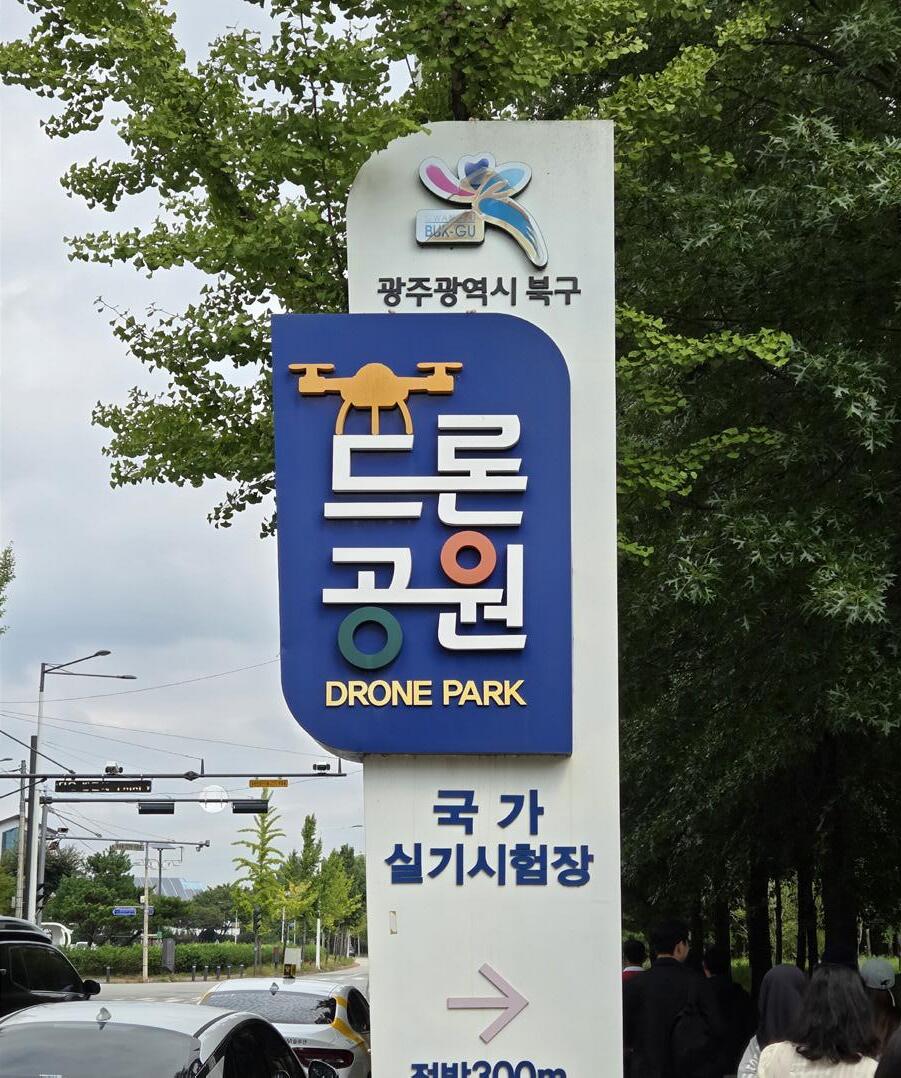
For decades, fireworks owned the night sky. But today, a new kind of spectacle is stealing the spotlight: the drone light show.
This year, drone performances have become a national attraction from the Han River to Gwangalli Beach, drawing thousands of spectators. One of the most memorable took place on September 7, 2025, at Ttukseom Hangang Park in Seoul. The 2025 Hangang Drone Light Show: “K-Pop Demon Hunters Edition” featured 1,200 synchronized drones recreating characters and scenes from the animated film. The night’s sky became a digital canvas.
Meanwhile in Busan, the Gwangalli M Drone Light Show has become Korea’s first and largest permanent drone performance. On Saturdays,
around 1,000 drones rise over Gwangalli Beach, with special shows using up to 2,500 drones, turning the oceanfront into a glowing, dynamic skyline. Seeing a drone show is breathtaking. But flying one yourself? That’s a different thrill.
Thanks to my university, I had the chance to visit Gwangju Drone Park, an experience that wasn’t on my 2025 bucket list but probably should’ve been.
Located along the Yeongsan River, the park includes a drone education center, testing grounds, charging facilities, and a beginner practice zone. A peaceful walking and cycling path surrounds the area, making it a lively place in the evenings as locals enjoy both nature and technology in harmony.
Our visit began with an educational workshop led by Prof. Seo Kwang-Seok of Dongkang University. He introduced us to RTMP (realtime messaging protocol) and demonstrated how to remotely control drones through live video transmission. For many of us, it was the first time to see how software, physics, and flight come together in real time.
Next came the hands-on session. We split into small teams and tested a variety of drones from soccer drones to the DJI Avata FPV and DJI Mavic series.
• Soccer drones are lightweight and designed inside a hollow, cage-like frame. Because of their safe structure, they can bump, roll, and collide without damaging the drone or the pilot, making them perfect for drone sports and beginner training.
• DJI Avata FPV gives a first-person-view flying
experience, as if you’re sitting inside the drone. With fast acceleration and agile turning, it feels like high-speed virtual reality but in the real sky.
• DJI Mavic became my personal favorite. Smooth, stable, and easy to control, it captures sharp photos and videos with cinematic quality. We recorded our flights and even took aerial photos together – the kind you usually see only in travel videos.
To end the day, we watched an FPV Smoke Bomb Maximum-Speed Demonstration, followed by a certificate ceremony. Each of us received a Drone Maintenance Control Instructor Level 2 certificate, awarded by the Drone Cultural Control Laboratory under Research Director Seo Kwang-Seok.
Gwangju Drone Park also provides weekend classes at no cost. Below are the available classes.
Basic Experience Class
• Time: Sat. & Sun., 10:00–12:00
• Capacity: 16 people
• Program: Basic drone theory and obstacle flight practice
Drone Beginner Class
• Time: 1st, 3rd, 5th Sat. & Sun., 13:00–15:00
• Capacity: 10 people
• Target: Basic Experience Class graduates
• Program: Sensor drone theory and control education
Aerial Photography Class
• Time: 2nd & 4th Sat. & Sun., 13:00–16:00
• Capacity: 7 people
• Target: Beginner graduates and drone certificate holders
• Program: Drone filming theory, practice, and video editing
For more information, you can visit https:// bukgu.gwangju.kr/drone/
From watching drones light up entire cities to controlling one with my own hands, I learned that drones are not just entertainment. They are education, technology, science, and art combined.
I believe drone light shows will increasingly become a key option for nightlife tourism in cities and at beaches, parks, and festive events. They may not completely replace fireworks overnight, but they are definitely on their way to becoming a mainstream alternative.
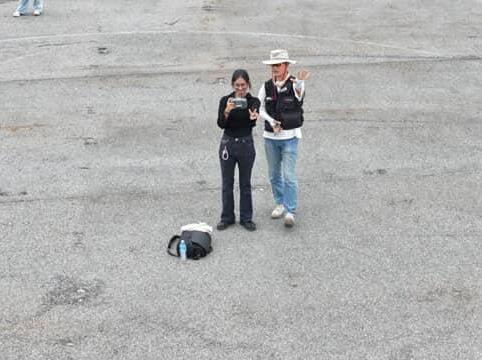
PS: DSK (Drone Show Korea) 2026 will take place on February 25–27, 2026, at BEXCO in Busan, bringing together the largest gathering of drone and future mobility experts in Korea. Drone lovers, get ready! This event is built for you!
Sources
1. https://www.seouldroneshow.com/en/gallery
2. https://www.gwangallimdrone.co.kr/en/overview
3. https://www.seouldroneshow.com/en/home
4. https://eng.droneshowkorea.com/
5. https://bukgu.gwangju.kr/drone/
Author
Dhivyaa S. P. believes that every action, no matter how small, contributes to a bigger change. This year brought both joyful and difficult moments, but her positive outlook continues to guide her forward. She wishes all readers of the Gwangju News a Merry Christmas and a prosperous New Year 2026 from Australia. See you next year!
Photographs by Dhivyaa S. P.
By Luis Andrés
Every Saturday in October, Gwangju’s Daein Market became a lively Night Art Market celebrating autumn and Halloween. The historic market, revived through art since 2008, welcomed crowds attracted by delicious food, captivating performances, and a lively community atmosphere.
Originally established in the 1960s, Daein Market faced tough times when the city moved its main train and bus stations, leaving oncebusy alleys nearly empty. However, thanks to the Bokdeokbang Project, launched during the 2008 Gwangju Biennale, the traditional food market emerged as a cultural hub where art and daily life intersected. Since then, it has been a symbol of creative strength, hosting seasonal festivals that blend art, community, and the nostalgic charm of local markets.
This year’s event was especially lively. On the final night, October 26, the market was packed with people of all ages and backgrounds. The main stage featured energetic dance and music performances for everyone, while a smaller stage showcased indie musicians and local singers. The air was filled with the irresistible scents of kimchi-jeon, dakgalbi, samgyeopsal, and hotteok, mingling with the sweetness of candy stalls glowing under warm orange lights.
The Halloween spirit added extra fun. Local makeup artists transformed children and adults into witches, ghosts, and cartoon characters –including the Saja Boys and Huntrix from K-Pop Demon Hunters. Couples and families engaged in hands-on art activities like pottery and painting, making the night a playful celebration of creativity.
It’s touching to think that Daein Market was once close to vanishing. Today, it thrives again,
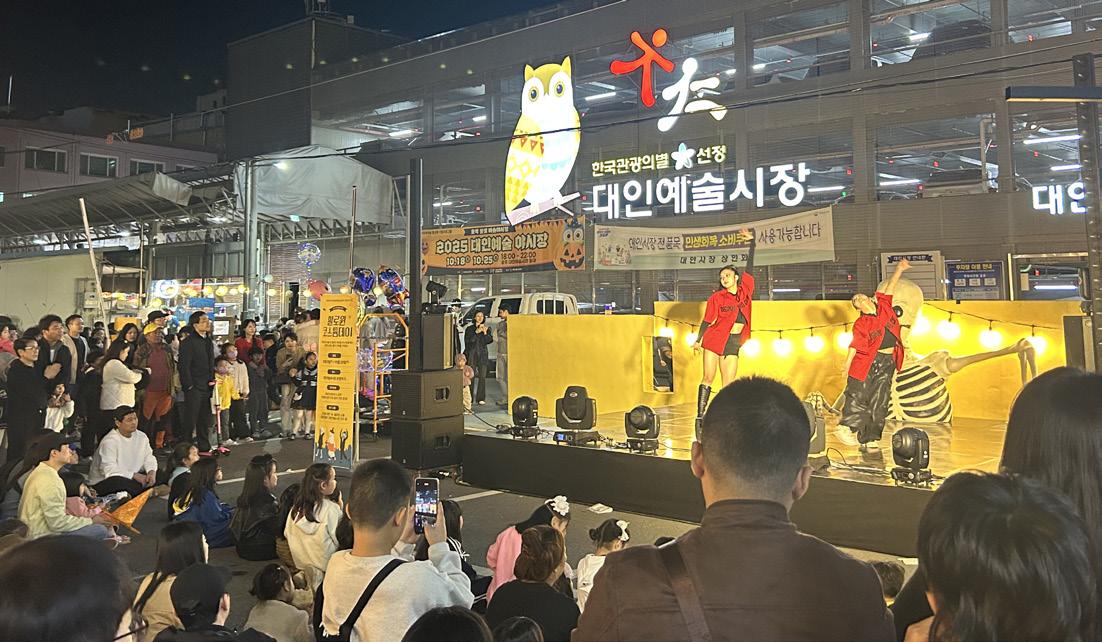
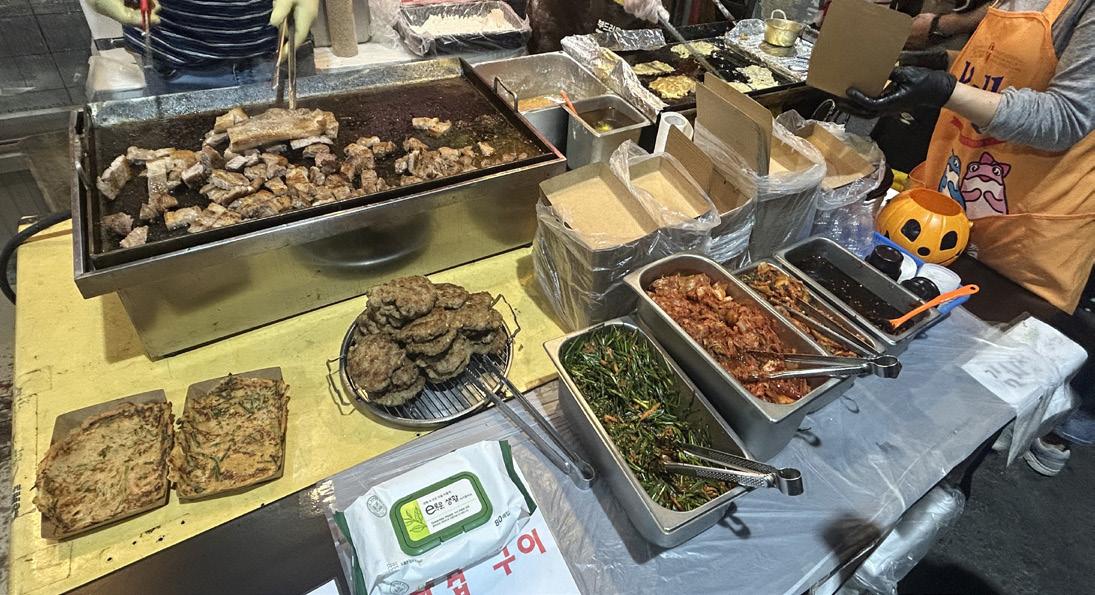
full of laughter, music, and creativity. On those nights, local vendors thrive, artists connect with audiences, and Gwangju shows that art not only decorates a city but also keeps its nightlife vibrant.
Luis Andrés González is a Mexican GKS scholar and master’s student in cultural anthropology at Chonnam National University. He advocates for LGBTQ+ rights and gender equality, and explores global affairs through pop culture. He is the founder of Erreizando, a digital magazine. Instagram: @luisin97 / @erreizando
Photographs by Luis Andrés.
By Luis Andrés
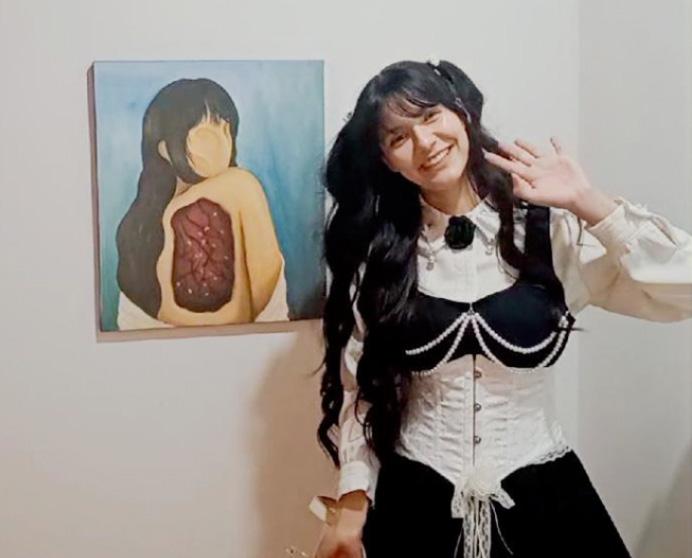
From October 16 to November 2, the Soam Art Museum in Gwangju hosted the exhibition titled Transition (전환/轉換). It showcased artwork by student artists from Chonnam National University (CNU) and their professors. The exhibition featured creators from various countries and generations, including Korea, China, Colombia, and Kazakhstan.
The goal, as described by the museum’s director, Yang Dong-ho, and the head of CNU’s Department of Western Art, Kim Byung-taek, was to promote communication and understanding between art, society, and emotion in today’s world.
However, Transition felt much more personal in the artworks themselves. It was about belonging, teamwork, and the act of expressing oneself – not just in words but in color, texture, and form. To explore this further, I spoke with two artists from the exhibition: Giselle Olaya from Colombia and Wang Shin-shin from China.
Luis Andrés: What does it mean for you to have your art displayed in a gallery like Soam?
Wang Shin-shin: I’m very grateful for this opportunity. Soam’s calm and elegant atmosphere made me proud when I saw my piece exhibited there. It made me feel part of something bigger.
Luis Andrés: What does transition mean to you, and how do you express it in your piece?
Giselle Olaya: Transition can be seen as a constant development within ourselves. It’s something that cannot be fully grasped in an instant, because it’s an endless process of change. Yet, one can make the effort to capture a single moment of it and show it to the world.
Luis Andrés: What does it mean for you to have your art displayed in a gallery like Soam?
Giselle Olaya: As a foreigner – and since this is also my first exhibition – it holds deep meaning for me. It has been a way to communicate with people beyond language, and the beginning of my journey as an artist.
The initiative to have students exhibit alongside their professors shows a genuine commitment to inclusion and cross-cultural collaboration. It welcomes international students into the professional art scene in Korea.
To me, this is the true transition: learning, working, and creating together – regardless of nationality, age, or background – because, in the end, we are all trying to understand this world together.
The Author
Luis Andrés González is a Mexican GKS scholar and master’s student in cultural anthropology at Chonnam National University. Passionate about inclusive education and cultural exchange, he connects global affairs, human rights, and pop culture to spark dialogue across borders. Instagram: @luisin97
Reviewed by Michael Attard
Transient Desires
By Donna Leon
288 pages, Atlantic Monthly Press, 2021
ISBN-10: 1787467848; ISBN-13: 978-1787467842
As of my writing of this review, Donna Leon has written thirty books about an Italian detective from the city of Venice, known as Commissario Guido Brunetti. The book, entitled Transient Desires, is the 29th in the series and was published in 2021. The reader follows Brunetti along the waterways, over the bridges, and down the narrow alleys of this historical and cultural city as he tries to piece together the events of one night as they relate to a broader heinous crime. For those who know and love Venice, the author’s penchant for digressing to talk about, describe, and praise neighborhoods, churches, and squares, may be appealing, giving one the sense of actually being in Venice. For others, these episodes may be a distraction from the story.
The story begins with a boating accident. Two young women are seriously injured and taken to
hospital. Suspicions are piqued by the manner in which the two women were abandoned on the hospital dock by two men. Why would someone, someone probably injured themselves, dump two women needing immediate medical care at the back door of a hospital and then quickly leave without notifying anyone?
The identity of the two men does not remain a mystery for long. Marcello and Filberto are brought in for questioning. The men, interviewed separately are reluctant to answer questions. What does become clear is that the boat they were in, hit a navigation marker that had come free from its moorings and was a floating hazard. With little else to go on, Brunetti decides to widen the scope of the investigation by inquiring into the business and ownership of the company for whom Marcello worked. The company and the boat that was in the accident were owned by Pietro Borgato, Marcello’s uncle.
“Brunetti convinces Filberto to trick Marcello by giving him a watch with a hidden police transmitter.”
It comes to light that Borgato is suspected of smuggling, and this would explain why he had such powerful boats. The large motors would be required for journeying well off shore into the Adriatic Sea. So, if the uncle is a smuggler, this

implicitly incriminates his nephew Marcello. By this point I was questioning the author’s mystery writing ability. A mystery is an unknown until the final clue in a lengthy series of evidence pulls the cover from the concealed secret.
With regard to Borgato being a smuggler, this fact is simply revealed. There is no “aha!” moment. Likewise, earlier, when the two men were unknown, their identity was learned by police looking at video tapes. This struck me as making things just a little too easy for a mystery novel. A third example of questionable mystery writing occurs when Brunetti’s female partner, Griffoni, states about another police officer, “He is a liar, and not to be trusted.” But then a few phone calls are made, and Griffoni retracts her statements. The mystery of her suspicion is dismissed as a mistake. Why mention it. It did nothing to move the story along.
The story does have its suspenseful moments. Filberto tells Brunetti that Marcello “is afraid someone’s going to hurt him.” By now, the reader does have sympathy for Marcello, yet there is no mystery as to where the danger would come from. Filberto tells us clearly, “His uncle’s been violent with him in the past.”
Eventually, Brunetti meets and tells Borgato that his boat was seen off the coast two months earlier and wants to know what it was doing. Borgato claims that it had been across the sea for special repairs. Brunetti knows that the story is most likely bogus. However, I as a reader, wonder why Brunetti never asked to see a receipt for this repair work.
Shortly thereafter, police suspicions about the nature of Borgato’s smuggling become stronger. With Marcello so fearful of his uncle, Brunetti convinces Filberto to trick Marcello by giving him a watch with a hidden police transmitter. And in the end, Brunetti and his forces capture the bad uncle.
I was disappointed in the book. I enjoyed the read and the conversation of the characters, but the plot moved along a series of predictable points. There was no great mystery uncovered by a brilliant detective who knew where to look and how to see clues that no one else could decipher. However, the title, ‘Transient Desires,’ is a mystery to me.

The Reviewer

Michael Attard is a Canadian citizen but has lived in Gwangju for over twenty years. He has taught English as a second language in academies and within the public school system. He is officially retired and spends time reading, writing, hiking, and spending time with friends.
Photographs by Michael Attard.
By Reeti Roy
Thunderstorms crashed outside, and because of a cloudburst, our garden looked like a pond. Two live fish had entered my bedroom – a first in all my years of existence. I carried what I could to my grandmother’s room, a space I hadn’t stepped into in two years. The room smelled of old books, of dust carried through decades, of memories stacked like the neat rows of gods on her shelves. Among them were jars of guava jelly, carefully labelled and lined up as if in devotion, made by women whose craft and labor she quietly championed. A lone Ganesh, a laughing Buddha, and a Mario Miranda painting I had brought her from Goa watched over the collection, each object holding a story, a memory, a laugh, or a prayer. She collected and preserved these remnants of the past, holding them with the same care she held her memories, her principles, her quiet acts of generosity. The rain was a mirror of the memories that surged back, pressing against the corners of the room, reminding me of what I had lost.
I remembered how, on ordinary days, I would be busily going about my work downstairs, and when I visited her, she would ask me to stay a bit longer. “Stay for a little while longer.” It was almost as if she was calling me to chat about her own day, to hear about mine, to tether our lives together with these small moments. Those pauses now feel impossibly long. Her last words haunted me: “I want to see a naat jamai!” I had laughed then, masking the ache inside me, and told her I didn’t think I’d ever meet someone who could love me as I needed to be loved. Now, her absence felt like the floodwaters themselves, relentless, impossible to escape.
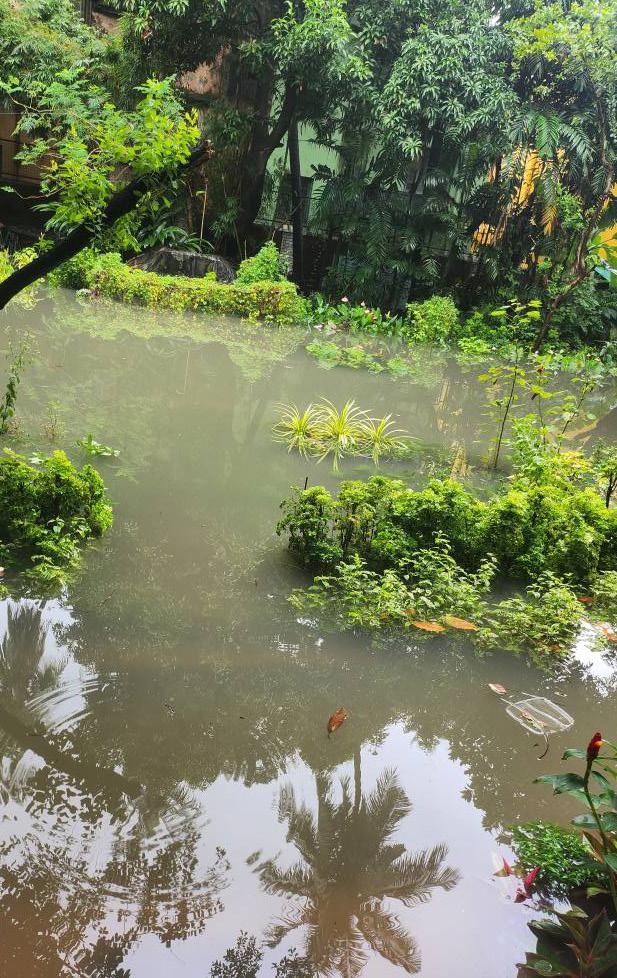
Flooding at our house.
As I sifted through her papers, I found a photograph of my brother, my sister, and me, my hands tightly clasping hers. The edges of the photo were worn, the colors softened by years of light and handling. I remembered the story behind it: In West Bengal, we have an aiburobhaat, a celebration before a young woman’s marriage. With no groom in sight, I had once convinced her to throw me a grand birthday party, inviting all our extended relatives, letting it become my replacement aiburobhaat. Some relatives were amused, some astounded, but Boo acquiesced with her characteristic quiet generosity, smiling as if to say, you may bend tradition but not the heart behind it. That memory lingered in the room with me, a thread connecting past laughter to the ache of absence. Her absence, Boo’s, hovered in the corners of my vision, pressing gently on every decision, every interaction, every imagined future.
On her shelf, I found Taslima Nasreen’s Nirbachito Column. I opened it almost hesitantly, as if touching the pages might make her disappear more completely. Among the lines that struck me was one that made me smile, nod, and ache all at once:
I joked about being his noona, since I was older by a couple of years, and we talked for hours and hours. He told me about his father and the scars from his childhood; I told him about my long-term relationship ending. Both of us talked about our preference for emotional stability over mercurial attraction. And yet, even in grief, even across oceans, moments of joy and curiosity found their way into my days.
Ganesh, Laughing Buddha, and a Mario Miranda.
(Girls who write are often assumed, in ordinary life, to be experiencing some great upheaval as they write.)
I cackled at the bold assertion. How many times had I been told to keep my opinions to myself? And yet, Jinwoo liked being around me for exactly that, for being “quick-witted and intelligent” –his words, not mine. It reminded me that even in upheaval, expression – like memory – can be a lifeline.
And then there was Jinwoo, the same one I had shared ssanghwa-cha (a medicinal tea) with in Seoul. In the grandest gesture I had ever made for a boy, I boldly gave him the most ginormous Snickers bar I could find at a convenience store.
In the dead of the night, under the pale moon and the light from a nearby shop window, I noticed something I hadn’t recognized before after knowing him for over ten days: He was undeniably handsome. Dekhteo bhalo, porashonayo bhalo. I could almost hear her cackling from somewhere nearby, her sharp laugh echoing in memory: Ei cheletai bhalo. Over the years, she had suggested countless candidates for me, each one meticulously evaluated, none ever becoming her naat jamai. Yet here, in this quiet Seoul street, I felt the same stamp of approval she would have bestowed, playful, teasing, entirely hers. Boo, a name I had affectionately given my grandmother, would have approved wholeheartedly.
I felt safe with Jinwoo, seen, understood, and unjudged. If he were Bengali, he would unironically have been a lokkhi chele. When I asked about Korean language schools, I expected a few links. Instead, he reached out to a friend and compiled every relevant course – thoughtful, precise, impossibly attentive.
Jinwoo, in a parallel universe, I would introduce you to phuchkas, take you to see all the thakurs during pujo, introduce you to Old Monk, have you steeped in the knowledge of student politics in Bengal, write cheesy love songs and poetry for you. In a parallel universe, we would raise children, maybe a chicken and a goat, maybe we would live away from the city. Maybe you would still mock me for confusing balgeun saram (밝은 사람, bright person), with ppalgan saram (빨간 사람, “red person”) And in another life, as Waymond Wang said in Everything Everywhere All at Once, maybe we would just be doing taxes and laundry together, and that would be enough. All of it would be different, and all of it impossible in this life, yet I held it tenderly, as one holds a fragile dream.
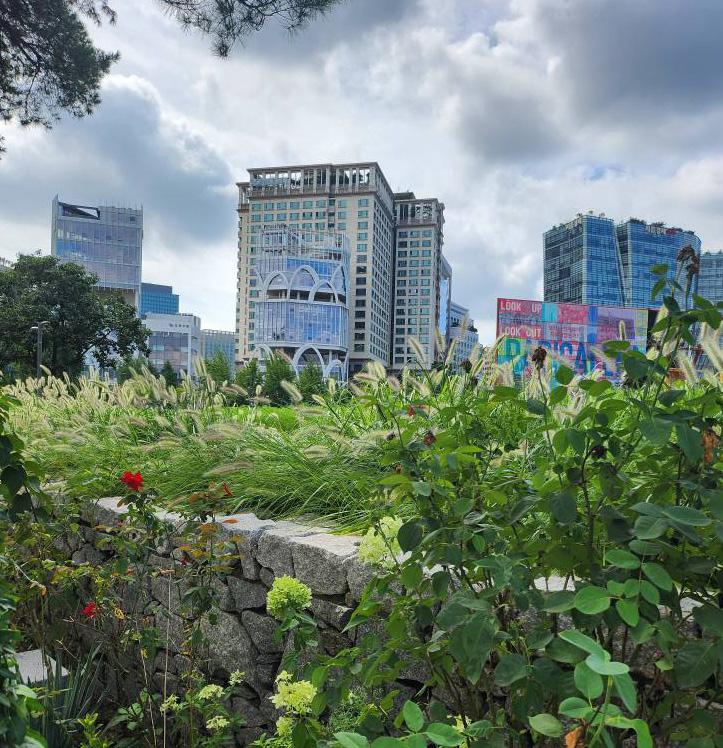
Maybe we would fight a lot, and make up even harder. Maybe we would have the same ease with which we talked that evening. Maybe you would take out your umbrella for me every day in the rains. The day I left Seoul and texted you, I playfully joked, “Even the weather gods are crying,” to which you said, “Every person in Seoul is crying.” When I told you your scars and wounds are not your fault, you quoted Good Will Hunting. I told you it was one of my favorite films
growing up, one I had watched with my brother. I told you I was feeling sad to leave this time, to which you said, “It’s a good thing, right, the memories and connection we shared will remain deeply entrenched in my heart.”
The flood outside mirrored the storm inside me. Grief is not something you overcome, it is a tide you learn to navigate, carrying the ones you have lost and the connections that matter in the way you carry love – carefully, tenderly, always aware of absence. Grief is love with no place to go. Survival and remembering, survival and opening my heart despite knowing how much it could hurt. And somewhere in that storm, in the quiet echo of the Kolkata rain, Boo, my grandmother, remained, present in memory, in love, carried into each moment I lived.
naat jamai – grandson dekhteo bhalo – also good-looking porashonayo bhalo – good at studies Ei cheletai bhalo. – This boy is good. lokkhi chele – well-mannered boy phuchka – a street food snack thakurs – Hindu dieties pujo – Hindu ritual
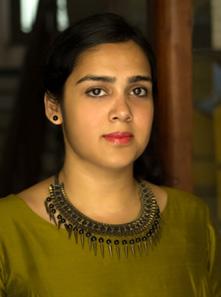
Reeti Roy is a writer, cultural commentator, and creative entrepreneur whose work explores memory, art, identity, and social justice. She holds a BA in English literature from Jadavpur University and an MSc in social anthropology from the London School of Economics. Her essays and criticism have appeared in numerous publications, including Korean media. In September 2025, she had several international engagements in South Korea, including as keynote speaker at KOTE, Insa-dong, and at the Yeosu Egg Gallery.
Photographs by Reeti Roy.
By Dhivyaa S. P.
Cafés are everywhere in Gwangju.
Each with its own theme, style, and atmosphere. But among the trendy interiors and dessert displays, there is one place that offers something truly unique: a café in a hanok-style building where you can rent a hanbok, put it on, and enjoy a full photo experience.
Hidden among quiet farms and old houses in Gwangju’s Nam-gu, “Joseon People” is a traditional hanok café that blends Korea’s past with modern café culture.
The highlight of this café is its hanbok rental and photography service.
Visitors can choose from a variety of hanbok including traditional wedding outfits, fusion designs, and everyday hanbok styles. Rental prices range from 20,000 to 30,000 won for children and 40,000 to 50,000 won for adults, with accessories available for an additional 10,000 won. If you want a professional photoshoot, you simply call and reserve three days in advance.
Once dressed, you can take beautiful photos anywhere inside the café or outside in the garden, where the scenery feels like a historical set. Both rentals and purchases are available for visitors who want to take home a piece of tradition.
Beyond the hanbok experience, the café serves traditional teas and snacks, and even offers tea tasting. The owner is friendly, welcoming, and happy to introduce the meaning behind each tea.
Joseon People can also be rented from Monday to Friday for small gatherings, club meetings, or study groups. A barbeque option is available too, including firewood and food, so guests can cook, eat, and relax outdoors.
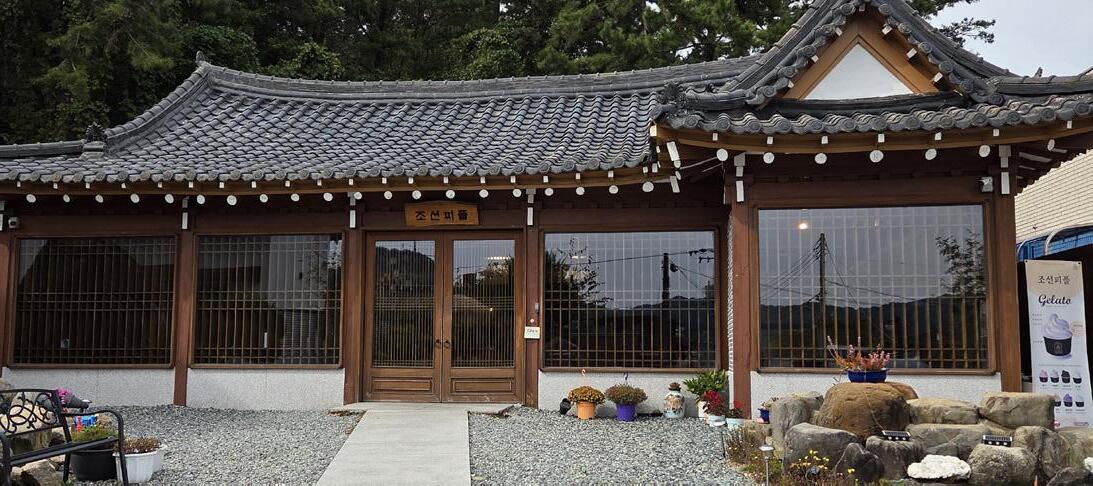
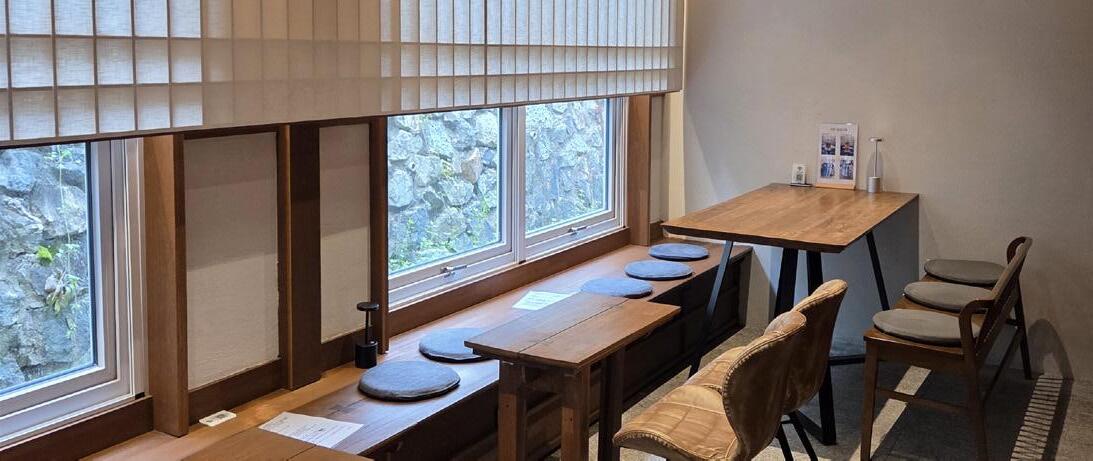
If you’re looking for a café that’s more than coffee – something cultural, peaceful, and memorable – this hidden spot in Nam-gu is worth the trip. Here, tradition isn’t just something you look at, it’s something you wear, taste, and experience.
Naver Map Location
Joseon People Café
Address: 491-6 Wonsan-dong Nam-gu, Gwangju
Website: https://naver.me/xvtIxy1N
Phone: 0507-1368-6038
Instagram: @joseonpeople
The Author

Dhivyaa is drawn to Korea’s café culture, often finding comfort in quiet corners where she can reflect, observe, or simply get lost in her research over a warm drink.
Photographs by Dhivyaa S. P.
By Johanna Lezada
This year’s Coffee Walk (커피 산책) in Dongmyeong-dong was an event that truly exceeded my expectations. As someone who couldn’t go a day without a good cup of coffee, I just knew I had to go to this event and experience all that the coffee bean had to offer here in downtown Gwangju.
The annual Dongmyeong Coffee Walk is a resident–business, win-win festival that has been held every November since 2021, where residents and visitors of the famed Café Street can taste not only the different kinds of coffee but also the different flavors of desserts, as well as the local culture, raw talent, and coffee shop ambience as they stroll along.
With every year offering a variety of experiences, here is my initial take on this year’s festival: I thought it was an unexpectedly tiny event.
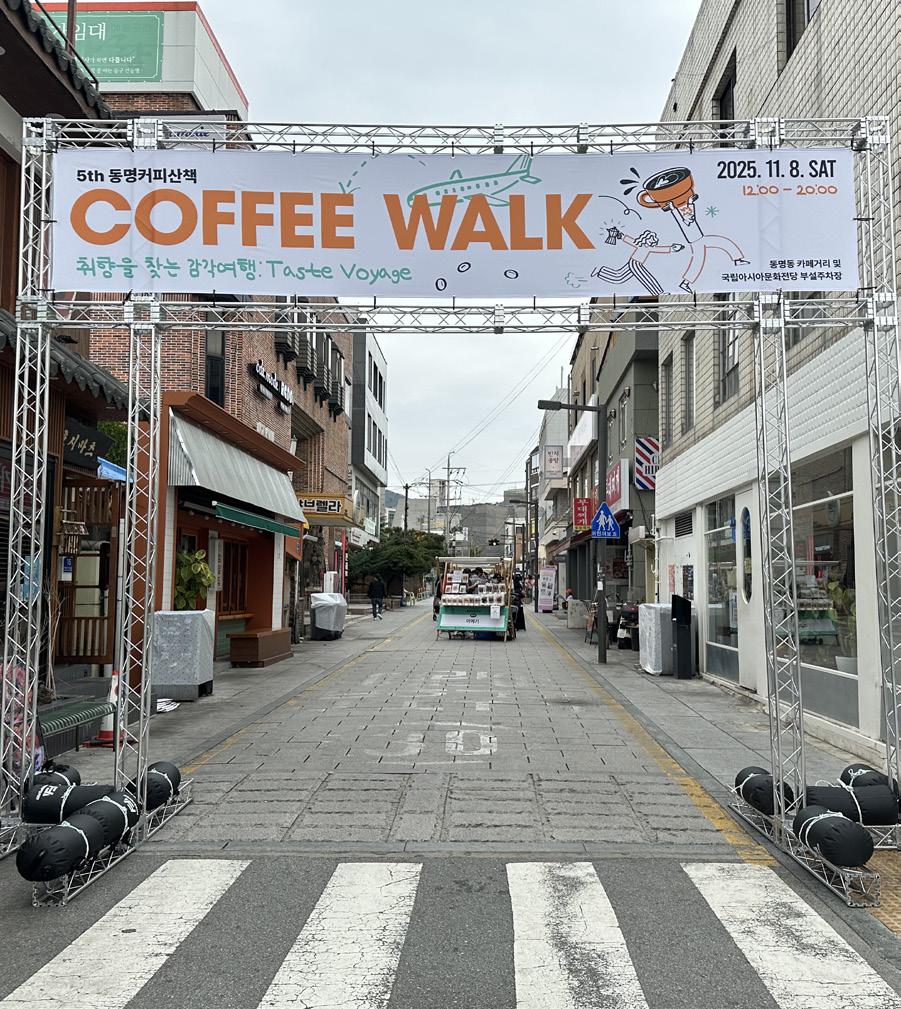
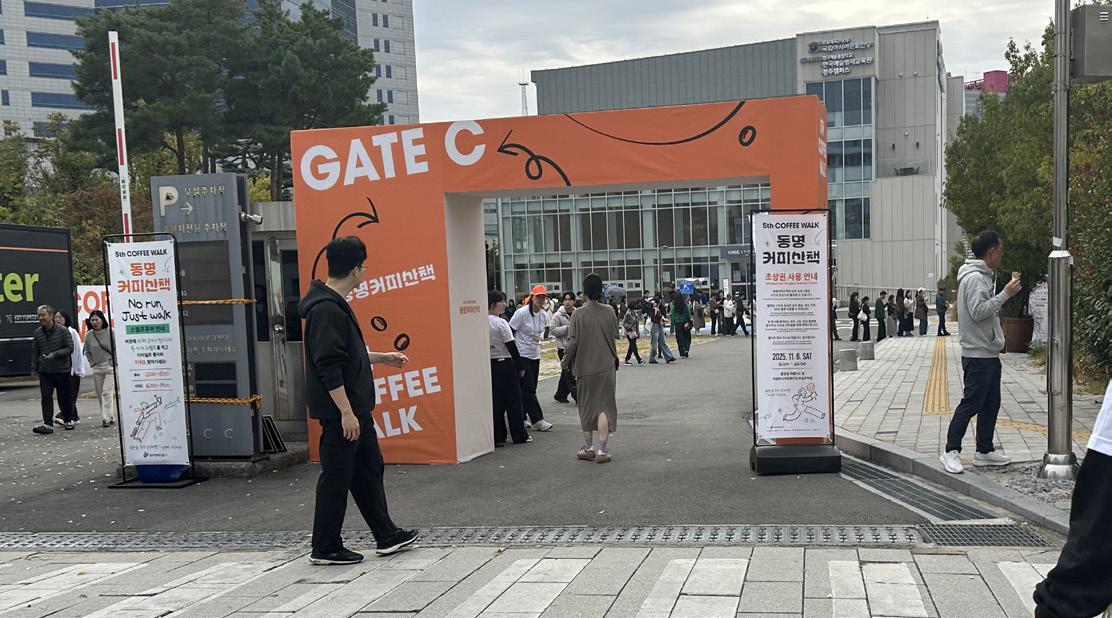
Upon walking up to the entrance of the Coffee Walk, there were booths lined up in the middle of Café Street with each coffee shop serving not just tasty coffee but also delectable desserts, with interior decorations, jewelry, organic snacks, and even strawberry jam made straight from the farms of Damyang! Each coffee shop so flaunted what made their establishment unique that I struggled to choose which one to check out first! I couldn’t help but admire the passion and effort that went into every booth to promote their business – it only further validated my desire to be a barista as a part-time job.
Suddenly, we reached the end of the booths. My brother and I looked straight ahead, left and right, but it seemed as though the Coffee Walk had truly ended there. With no more booths left to check out, I decided to turn around and go back and forth across the booths, seeing what else I could purchase until I got back to the entrance –and lo and behold…
There were even more booths lined up along the street to the right of our entrance, and as if the scent of coffee beckoned me, I followed this long line of booths – all of which were serving a
variety of snacks and meals, and even providing game prizes for customers to win – to its end, eager for more until I stumbled upon what I now recognized as the main entrance to the Coffee Walk Festival.
My mouth gaped. The fool I was to not have seen this sooner! There before me was the central hub of the festival, filling with crowds of eager customers, a plethora of coffee booths to choose from – and just who was playing that wonderful song in the background? The walk wasn’t just a walk; it was an entire coffee convention!
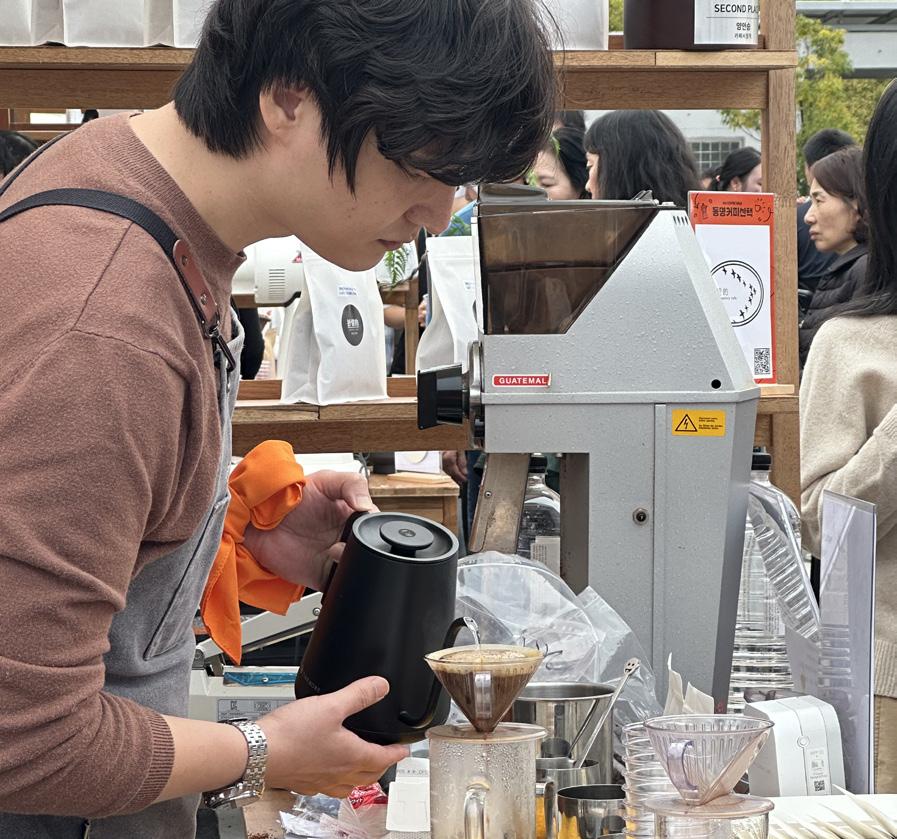
The line for the ticket booth was half the length of the venue! With my limited time, I couldn’t wait to see the entire event and ran into the center of the festival to see just what I had missed. In each booth, you could see the many baristas at work, showcasing their brewing talents as well as types of coffee that even I had never heard of before. There was a “white espresso” and a “waffle cone latte,” which was quite literally latte served in a chocolate waffle cone! It was the absolute buzz of the afternoon, with more people flocking to this booth than to any other. There was even an MBTI coffee booth, where you had to take the MyersBriggs personality test first to see which coffee best suited you!
And to top it all off, talented singers filled the festival ambience with vibrant vibes from the
festival’s center stage, as if you were chilling in a massive, roofless coffee shop.
What I personally loved the most at this festival was not just enjoying the variety of products from the coffee booths but seeing firsthand the passion these baristas and staff had for their brews. They made making good coffee look so easy, and we all know that only a person highly experienced in the field can pull off such a feat.
I believe there is a story behind every cup of coffee served, and I couldn’t help but watch in admiration as the baristas filtered the coffee from the ground beans. Perhaps to them, it was just another part of the process, but to me, it was aweinspiring to see in person the people behind the brews we enjoy every day. I know being a barista is no easy role to fill, which is why I always say “thank you” to the staff before receiving my coffee, and after emptying my cup.
I may have walked in to this festival thirsty for caffeine, but I walked out feeling more fulfilled than caffeinated. You may think that defeats the purpose of a coffee walk, but I believe this event was not solely intended for shop owners to promote their businesses or spur on the addiction of us coffee lovers. It was also an opportunity for us to get to know the people who do their best to make sure that we can enjoy a nice cup of coffee before and after a long, hard day.
Here’s to hoping for the Coffee Walk to come back next year with more fun coffee flavors, more small businesses to be spotlighted, and more unique, aromatic experiences that brew in your head for days on end!
As a Filipino living in Gwangju, Johanna Lezada aims to stay in Korea by mastering the Korean language to give back to the city she has lived in since she was eleven years old. She is a graduate of Nambu University, a devout worker at a Filipino Christian church in Hwasun, the president of Gwangju Toastmasters, and the volunteer layout editor for the Gwangju News
Photographs by Johanna Lezada.
By Zhang Jiuzhou (Julius)
With the 2025 KBO season officially over, teams across the league are gearing up for a silent but fierce battle in the upcoming free agent market as they seek to strengthen their rosters for next year.
The Korea Baseball Organization (KBO) recently released a list of 30 players eligible for free agency in 2026 – comprising seven in Class A, 13 in Class B, and 10 in Class C. Teams signing Class A free agents must compensate the player’s former club with both a non-protected player (from a list excluding 20 protected players) and either 200 or 300 percent of the player’s previous annual salary. For Class B players, the compensation is one unprotected player (excluding 25 protected players) plus 100 or 200 percent of the player’s
previous salary. Class C players, meanwhile, require no compensation player and only 150 percent of their previous salary paid.
The Kia Tigers have six players eligible for free agency this offseason: star shortstop Park Chanho, veteran slugger Choi Hyeong-woo, longtime ace Yang Hyeon-jong, reliever Lee Jun-yeong, setup man Jo Sang-woo, and catcher Han Seungtaek. At this time, all six are expected to test the market.
Among them, Park Chan-ho stands out as Kia’s top priority – and one of the hottest names in free agency. Negotiating with any of the six players will be no easy task, and the Tigers will need to decide which players they simply cannot afford

to lose. But Kia is not the only team pursuing Park; competition for his services is expected to be fierce.
Park has been Kia’s starting shortstop since 2019, appearing in over 130 games each season. Known for his excellent defense, speed, and energy, Park has also made significant strides offensively in recent years, turning one of his former weaknesses into a strength. His consistent play has made him indispensable. Ironically, his durability has prevented other players from gaining experience at shortstop – meaning Kia needs him more than anyone else.
Next in line is Choi Hyeong-woo, who turns 43 next year but remains one of the KBO’s premier clutch hitters. League insiders say several teams have expressed interest, with one reportedly preparing a competitive offer. Despite that, Choi’s loyalty to Kia runs deep, and if the conditions are reasonable, he is expected to stay.
As a Class C free agent, Choi can sign freely without compensation, which makes him an

appealing target. There is, of course, some risk that his performance could decline with age, but he has defied expectations, maintaining top form well into his 40s. Analysts believe that any team aiming to contend for the 2026 title would be wise to offer him a one-year deal worth around one billion won – a manageable investment for a player of his pedigree.
In contrast, demand for Jo Sang-woo and Yang Hyeon-jong appears limited. Jo, now classified as a Class A player, struggled this year, diminishing his market value compared to when the Kiwoom Heroes floated him in trade discussions last season. Yang, meanwhile, has shown signs of decline. At nearly 40 years old, signing him as a starter carries obvious risk, but both he and Kia are expected to continue their long-standing partnership. He will likely return next year as a member of the starting rotation, albeit with a reduced workload to help him stay healthy.
Realistically, Kia cannot retain all six free agents. The team will need to adopt a select-and-focus approach – prioritizing key players while making difficult choices elsewhere. If the Tigers believe younger players can fill certain roles, they may choose to let some veterans walk rather than overspend.
In the end, the question for Kia remains the same: Who stays, and who goes?

The Author
Zhang Jiuzhou (Julius) is from Harbin, China. He began writing in 2022 and has contributed to the Chinese media in Gwangju. He currently serves at a sports data company while pursuing a master’s degree in media and communications. He is also responsible for the Chinese Students Association at Chonnam National University..
By Zhang Jiuzhou (Julius)
Kia Tigers Begin Final Camp in Japan, Testing
The Kia Tigers began their final training camp of the year on October 4 in Okinawa, Japan. Before the start of practice, the team held a brief meeting where a new face was introduced: Japanese pitcher Nobutaka Imamura, formerly of the Yomiuri Giants.
Although not yet an official member of the Tigers, Imamura is participating in the camp on a trial basis. His arrival reflects Kia’s proactive approach ahead of the KBO’s new Asian player quota, set to take effect in 2026. Under the new rule, teams may sign one player of Asian nationality (including Australians, but excluding dual citizens) who earned less than $200,000 in salary last year and played in an Asian professional league.
Kia, like other KBO clubs, has been actively scouting candidates from Japan and Australia. Among the options, Imamura has been invited for evaluation. Imamura joined the Yomiuri Giants in 2012 and was once regarded as one of the organization’s most promising pitchers. He played a key role in the starting rotation in 2021 and transitioned to a bullpen role in 2022, appearing in 55 games. Through 2023, he remained a regular on the Giants’ first team.
However, his opportunities dwindled in recent years. In 2024, he appeared in only seven firstteam games, posting a 2.25 ERA across eight innings. In the minor league system, he recorded a strong season – 4 wins, 1 loss, and a 1.91 ERA in 41 appearances – before being released after the season. Over his NPB career, Imamura pitched
in 180 top-flight games, tallying a 25–22 record with a 4.00 ERA.
Now a free agent, Imamura is exploring options in both Korea and Japan. While he continues to draw interest from Japanese clubs, his performance during Kia’s camp could determine his next move. If he impresses during the tryout, he could become Kia’s top candidate for the new Asian player slot next year.
Beyond Imamura, Kia is also assessing several other Japanese and Australian players. While some top prospects have already been drafted by NPB teams, Kia remains committed to a careful selection process – aware that the new Asian player quota could significantly influence the club’s competitiveness in 2026 and beyond.

Gwangju FC has safely escaped the shadow of relegation. Despite losing key players and facing financial struggles, the club managed to secure top-flight survival – and now their focus turns to a new goal: winning the Korea Cup to return to continental competition.
The Korea Cup final is set for December 6 at Seoul World Cup Stadium, where Gwangju will face Jeonbuk Hyundai Motors, this season’s K League 1 champions. Jeonbuk is pursuing a domestic double, presenting Gwangju with a daunting challenge. But regardless of Gwangju’s league position, a Korea Cup victory would mark a remarkable achievement for the provincial side.
Among Gwangju’s midseason signings, Icelandic striker Hólmbert Fridjónsson has made an immediate impact. In the match against Jeju United, he scored his first K League goal – a rightfooted strike from a low cross delivered from the right flank.
“I knew it would be a tough game,” Fridjónsson said after the match. “As a striker, I needed that goal badly. When the ball hit the net, it was a huge relief. This is just the beginning – from now on, I’ll do everything I can to score more to help the team.”
“The Korea Cup final is set for December 6 at Seoul
Cup Stadium.”
The 31-year-old forward has represented Iceland at all youth levels and made six senior international appearances, scoring twice. “Joining midseason was challenging,” he added. “Gwangju plays a very distinctive style, so it took time to adapt. But now I’m starting to understand the coach’s philosophy. I believe I can contribute more and live up to the expectations of the fans.”
The AI Peppers Savings Bank women’s volleyball team has stunned the V-League with their best-ever start, posting a 4–2 record through the opening round. Once considered perennial underdogs, the Peppers have rapidly
transformed into one of the most exciting teams of the season – and fans are eager to see whether this surge can be sustained.
This year’s success stems largely from the team’s revitalized offense, led by new foreign star Zoe Weatherington and Japanese national team middle blocker Shimamura Haruyo. Both players have brought energy, precision, and balance to the Peppers’ attack.
Shimamura’s arrival has been particularly transformative. Long criticized for their weak middle play, the Peppers now boast a more dynamic and versatile offensive system. Shimamura’s combination of height, timing, and agility has stabilized both the team’s blocking and quick-attack options, giving setters greater flexibility in distribution.
Weatherington, at 184 cm, may not stand out for her height, but as an opposite hitter, she compensates with explosive power and quick tempo. Her aggressive style has made her a focal point of the Peppers’ offense, complementing domestic standouts Park Jeong-ah, Lee Han-bi, and Park Eun-seo, whose chemistry has anchored the team’s cohesion.
This season’s slogan, “Step Up to Win,” perfectly captures the club’s renewed confidence. While the roster remains young, their collective growth and unity have turned last year’s modest progress into genuine ambition, signaling that the AI Peppers are no longer a team to be overlooked.

The Author
Zhang Jiuzhou (Julius) is from Harbin, China. He began writing in 2022 and has contributed to the Chinese media in Gwangju. He currently serves at a sports data company while pursuing a master’s degree in media and communications. He is also responsible for the Chinese Students Association at Chonnam National University.
Shin Chang Woon: “Knowledgescape”
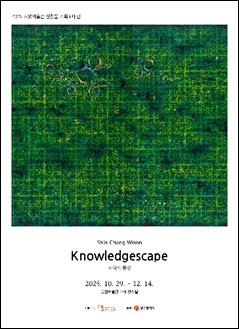
Dates: October 29 –December 14
Time: 10:00 a.m. – 5:00 p.m.
Venue: De Young Art Museum
Ticket Price: Free; All ages admitted
Reservations: No booking required
Inquiries: 062-223-6515
Kim Han-yong Archive Photo Exhibition: “Records of Dreams”
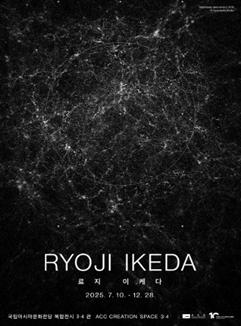
Dates: July 10 – December 28
Times: Tuesday to Sunday
10:00 a.m. – 6 p.m.; Wednesdays & Saturdays
10:00 a.m. – 8 p.m.
(Closed Mondays)
Venue: ACC, Space 3 & 4
Ticket Price: Free; All ages admitted
Reservations: No booking required Inquiries: 1899-5566
* This exhibition features intense light, high-frequency sounds, and rapid video transitions that may cause strong sensory stimulation. If you are sensitive to light or have photosensitive or auditory conditions, please take special care when viewing the exhibition.
Pianist Julius-Jeongwon Kim Grand Tour Recital: “Minor Moonlight”
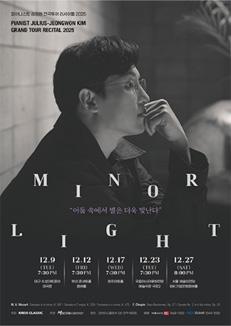
Dates: December 23 (Tue.)
Time: 7:30 p.m.
Duration: 120 min.
(including 15 min. intermission)
Venue: ACC, Theater 2
Ticket Prices: R Class 50,000 won; S Class 30,000
Admission: Must be 7 or older
Reservations: Ticket Link Inquiries: 062-226-4700
Gwangju City Children’s Choir 146th Concert:
of Harmony
Date: December 13 (Sat.)
Time: 7:00 p.m.
Duration: 80 min.
Venue: Gwangju Culture and Arts Center, Small Theater
Ticket Price: 10,000 won
Admission: Must be 4 or older
Reservations: Gwangju Culture and Arts Center website Inquiries: 062-613-8246
Dates: December 5–6 (Fri.–Sat.)
Times: Fri. 7:30 p.m. / Sat. 3:00 p.m. & 7 p.m.
Duration: 85 min. (a total of 3 performances, no intermission)
Venue: ACC, Theater 2
Ticket Price: 20,000 won Admission: Must be 7 or older
Reservations: ACC Foundation website, Ticket Office, Call Center
Inquiries: 1899-5566

Date: December 12 (Fri.)
Time: 7:30 p.m.
Duration: 60 min. (including intermission)
Venue: Gwangju Culture and Arts Center, Grand Theater
Ticket Price: 20,000 won Admission: Must be 7 or older
Reservations: Gwangju Culture and Arts Center website, TicketLink (1588-7890)
Inquiries: 062-412-2502
International Forum Celebrating the Anniversary of Han Kang’s Nobel Prize in Literature
Dates: December 10 & 11 (Wed. & Thu.)
December 10 (Wed.)
Session 1: Language Connecting the World (2:30–4:30 p.m.)
Session 2: One Year with Han Kang’s Literature and Beyond (6:30–9:00 p.m.)
December 11 (Thu.)
Session 3: Korean Literature and Humanities City, Gwangju (2:00–4:00 p.m.)
Session 4: The Power and Dynamism of Asian Literature (4:30–6:30 p.m.)
Venue: ACC, International Conference Hall (B2) Admission: Free; Pre-registration Inquiries: 010-4780-9096
Compiled by Charlene Lee
Charlene Lee is the founder of Charlene English Institute. Having lived in many different countries, she loves to explore and experience diverse cultures. She hopes to contribute to making Gwangju a more vibrant city.

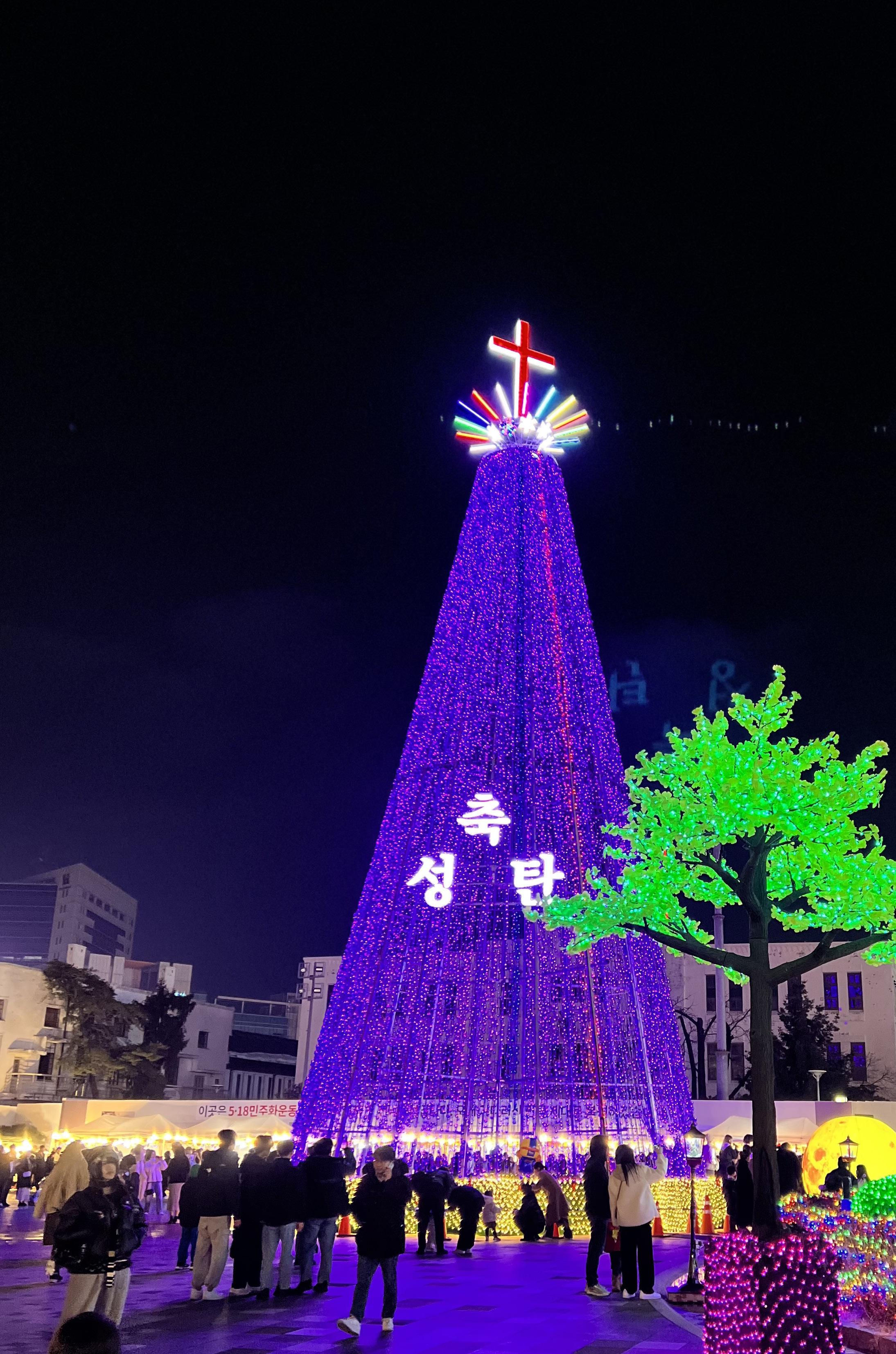
May the joy of the holiday season and the aspirations of the new year shine upon the Gwangju News family, the people of Gwangju and Korea, and communities everywhere.