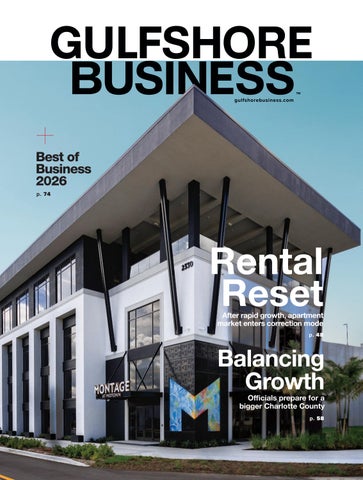
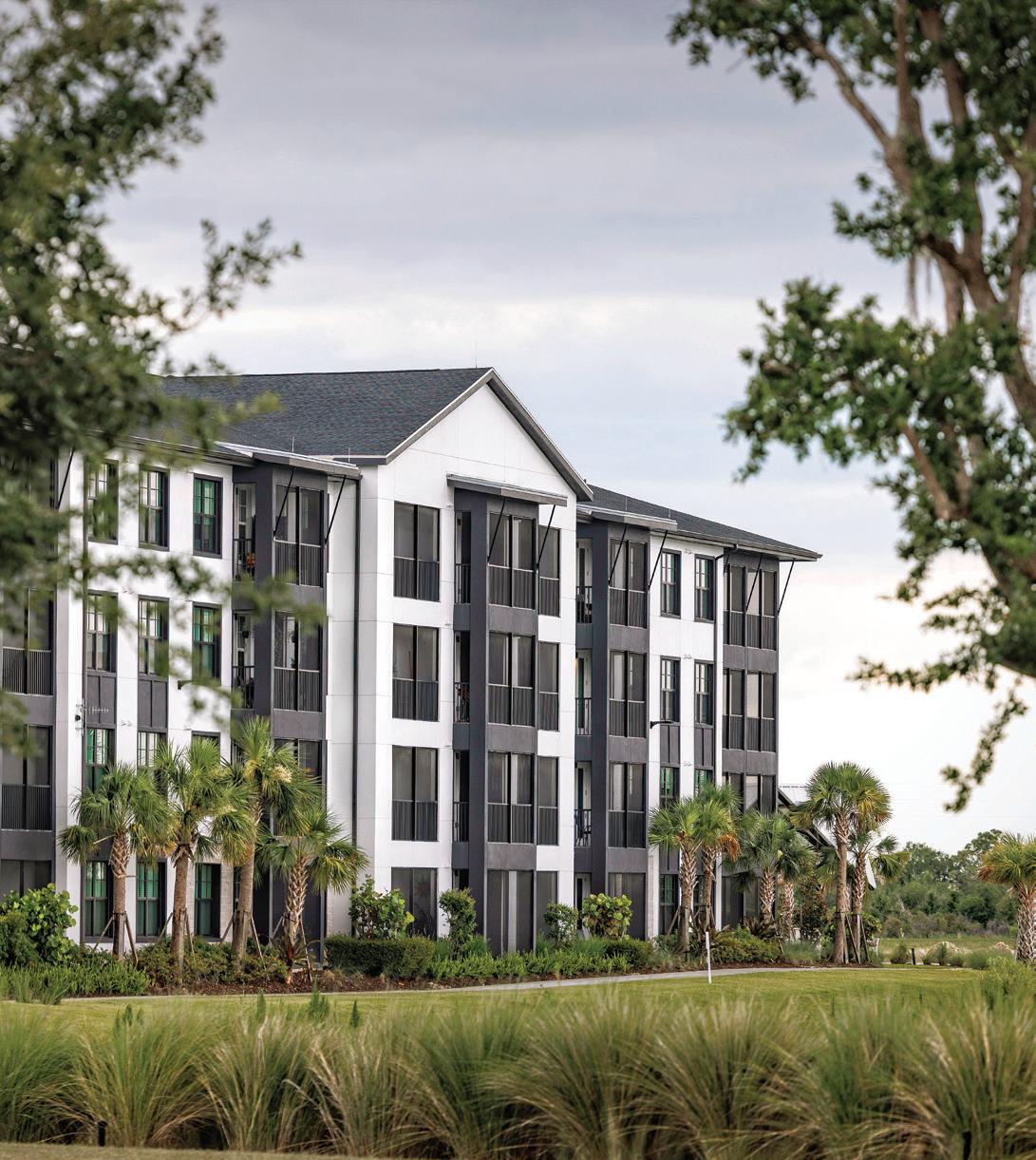
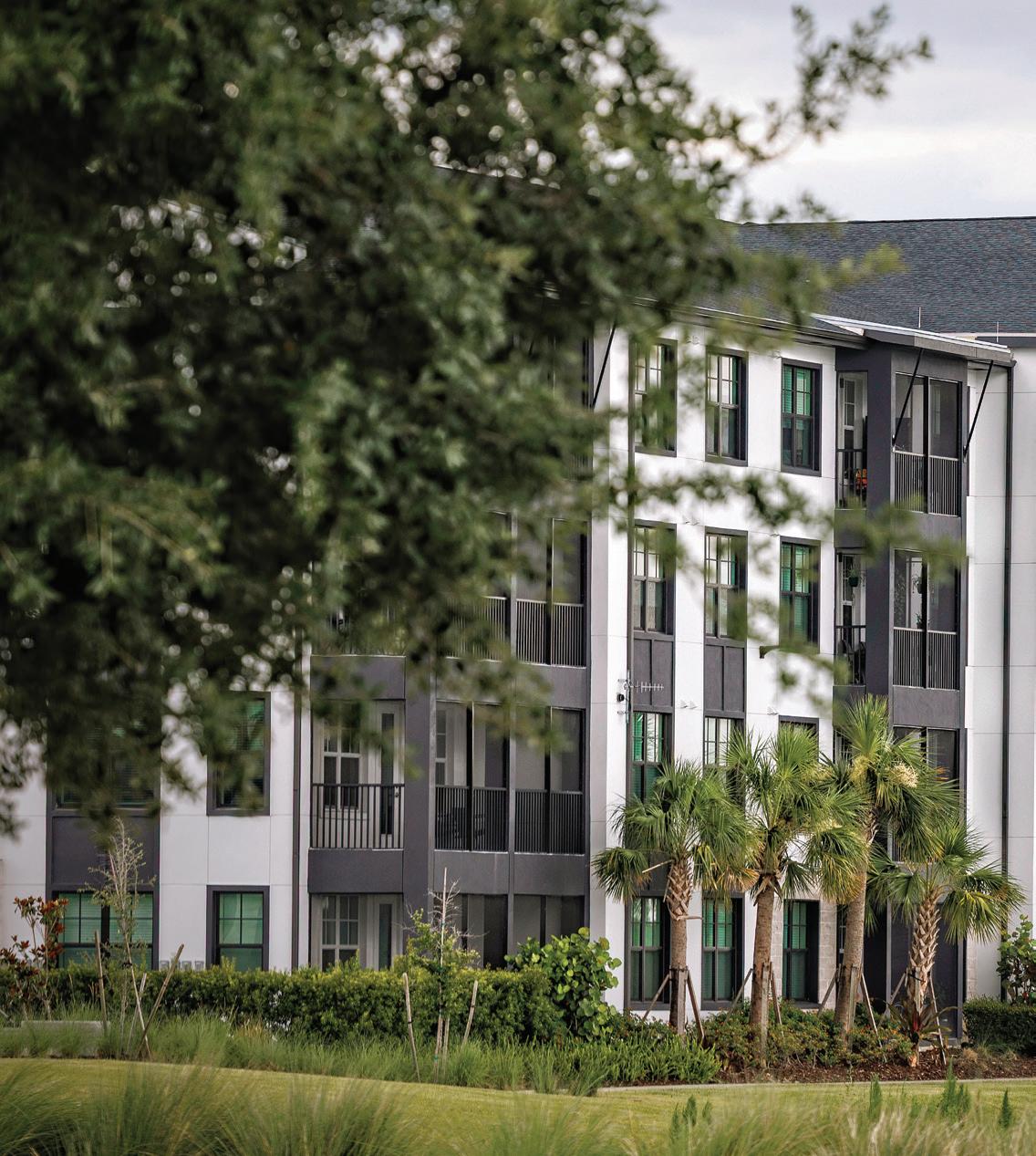
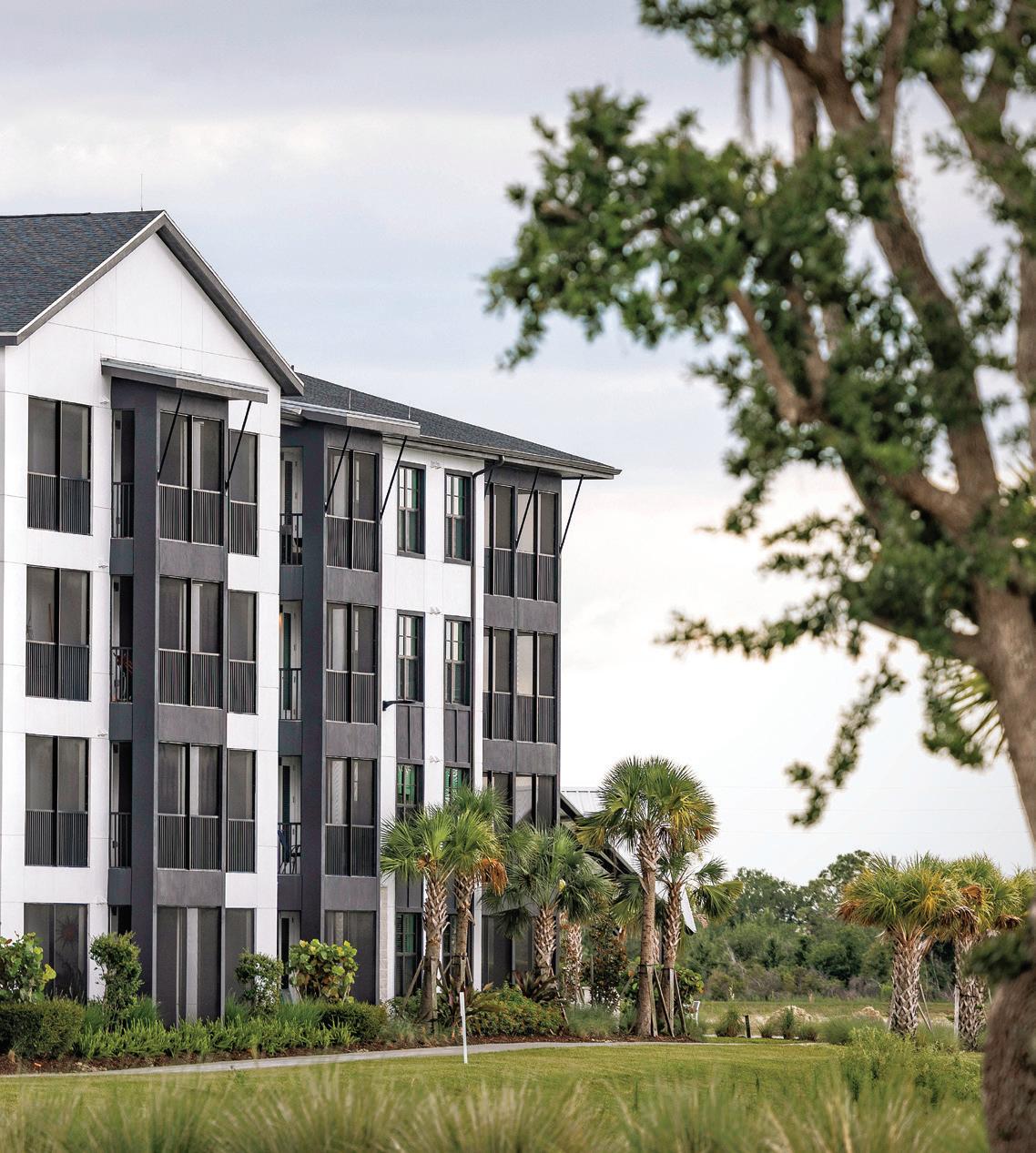
Supply Surge Apartment-building spree fueled by growth, recovery and optimism
58 Charlotte at a Crossroads County leaders prepare for decades of future growth
By Brian Tietz
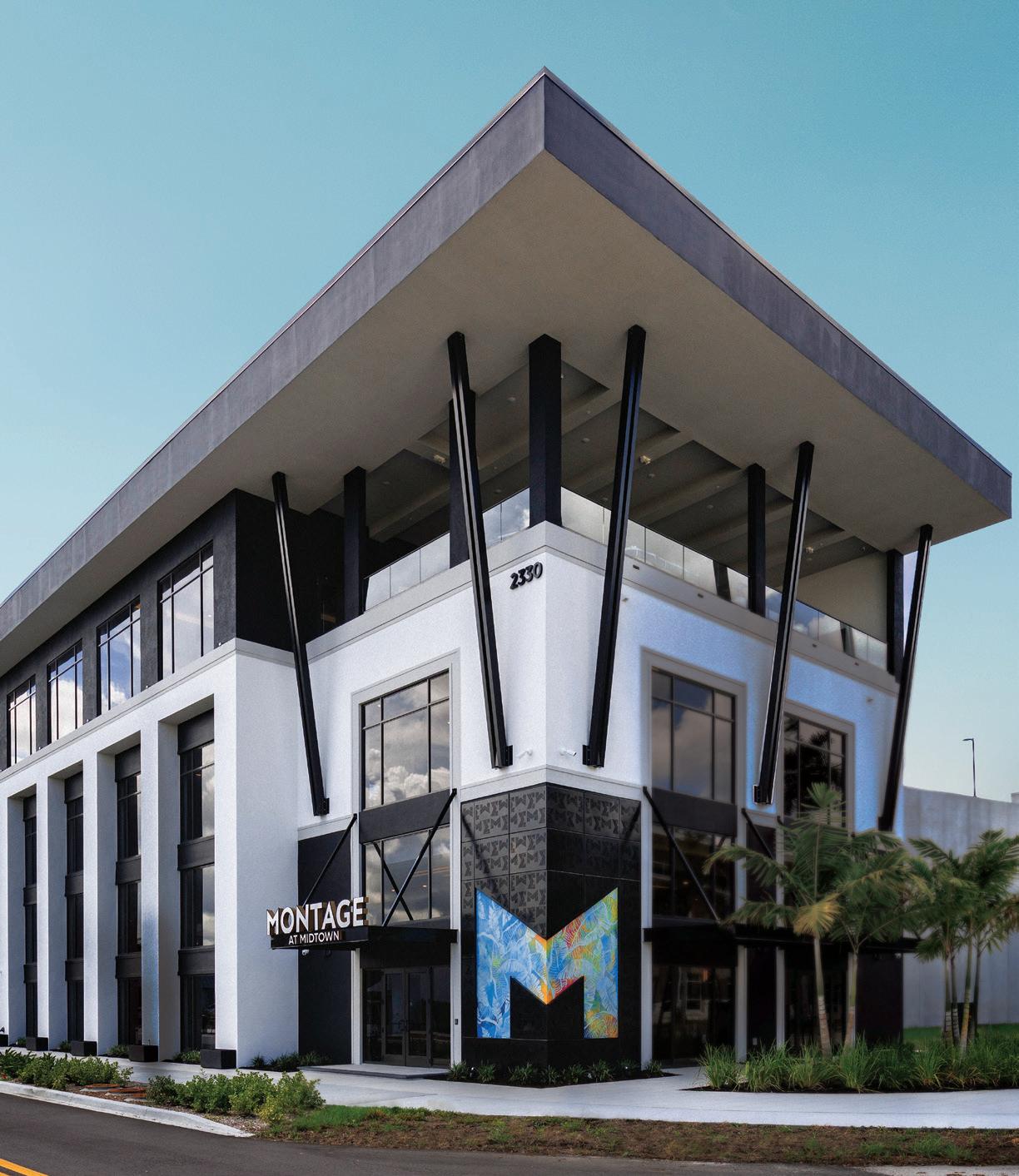
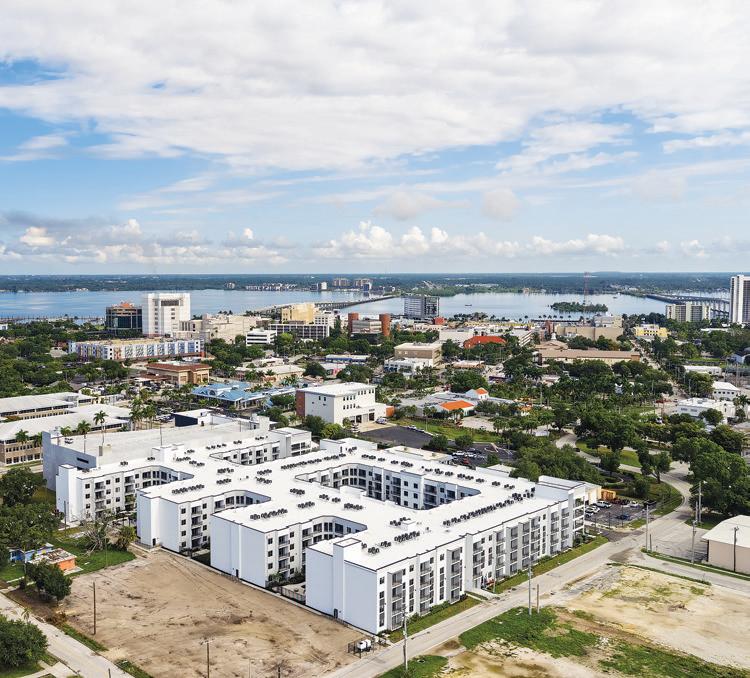
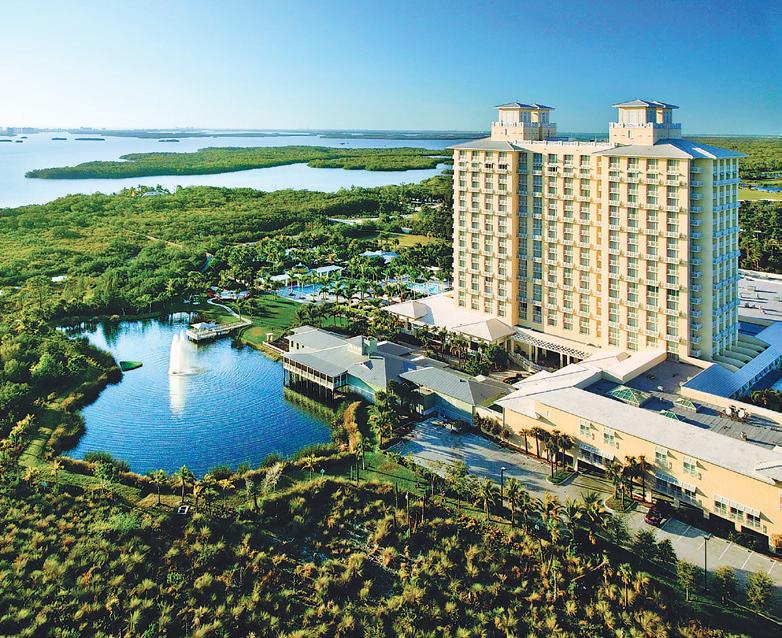
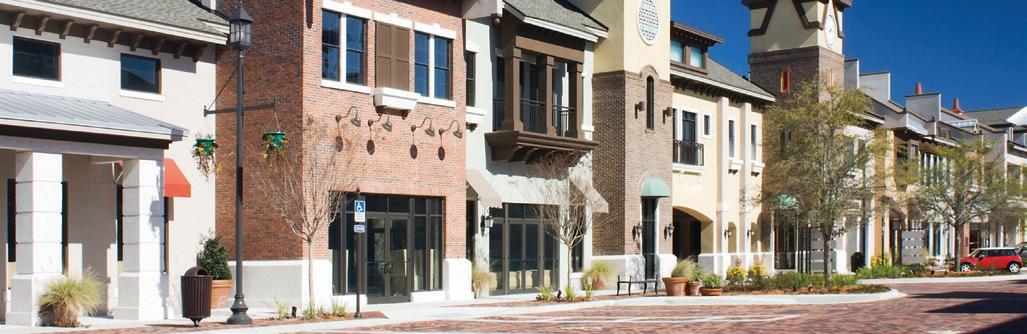
On the cover Montage at Midtown
Congratulations to our co-finalists and friends at Strayhorn & Persons-Mulicka, and all other Best of Business finalists!
Honored to Stand Among the Best
We are grateful to be named a finalist in Gulfshore Business’s Best of Business Awards for Corporate & Business Law Firm – and proud to be recognized alongside many respected businesses and valued partners.
Thank you to our clients, colleagues, and friends for your continued trust and confidence. For more than 45 years, Bruce Green Law has provided exceptional legal services and tailored solutions for complex estate, business, and tax planning.
SCHEDULE A CONSULTATION
Introducing the newest addition to our firm: Aglaë S. Van den Bergh “Aggie” Attorney at Law
PUBLISHER Carin Keane
PRESIDENT Jim Schwartzel
EDITOR IN CHIEF
Heidi Rambo Centrella
Managing Editor Kaitlin Regan
Digital Editor Adam Regan
Senior Editors Tim Aten, David Dorsey, Harriet Heithaus, Therese McDevitt, Nancy Semon, Aisling Swift, Evan Williams
Copy Editor Steve Gill
CONTRIBUTORS
Justin Paprocki, James Raia
ART
Creative Director
Jerry Pomales
ADVERTISING
Associate Publisher Tess Woods
Advertising Director Chris Renstrom
MARKETING
Director of Marketing and Events Samantha Tobias
Digital Marketing Manager Meagan Bonesteel
CIRCULATION
Director of Audience Development Kerri Nolan
PRODUCTION
Production Manager Martha Leavitt
ADMINISTRATION
Advertising Services Manager, Subscriptions & Distribution
Kathleen Hill
READER SERVICES
Office Address
26101 S. Tamiami Trail, Bonita Springs, FL 34134
Call or text 239.498.8500
gulfshorebusiness.com info@gulfshorebusiness.com
Subscriptions
Southwest Florida residents can subscribe for free online at gulfshorebusiness.com, out-of-area residents can subscribe for $12 a year, call or text 239.498.8500 for more information.
Change of address
Send old and new addresses and a mailing label, if possible, to Gulfshore Life, 26101 S. Tamiami Trail, Bonita Springs, FL 34134. Visit gulfshorebusiness.com/subscribe to login and update your address, call or text 239.498.8500 or email subscriptions@gulfshorebusiness.com.
Back issues
A limited number of back issues are available for $4.95 each plus tax and postage. Visit gulfshorebusiness.com/backissues.
Reprints
Visit gulfshorebusiness.com/reprints for plaques and reprints.
Contact Us
Please send all correspondence to: Gulfshore Business 26101 S. Tamiami Trail, Bonita Springs, FL 34134 Call or text 239.498.8500
WEBSITE gulfshorebusiness.com
The Roads to What’s Next
As this issue came together, I realized our two feature stories might have more in common than I first thought.
At first glance, they don’t seem to tell the same story. One looks at an apartment market that’s suddenly awash in inventory (p. 48). The other explores Charlotte County’s efforts to prepare for decades of projected growth (p. 58). Different topics. Different counties.
Or maybe not.
As I read both stories, I kept coming back to the same thought: Southwest Florida is still growing. It’s just no longer growing in quite the way we’ve come to expect.
For years, the conversation seemed fairly simple. More people were arriving, housing couldn’t keep up, businesses were expanding and communities were racing to build whatever came next.
Today, the picture feels more complicated. In Lee and Collier counties, developers who responded to unprecedented demand are now watching the market settle into a new rhythm. Renters suddenly have more choices, and after years of extraordinary growth, builders are facing a need to recalibrate and adjust.
Meanwhile, Charlotte County is asking a different question: How do you prepare for tomorrow’s residents without repeating yesterday’s mistakes? Roads, utilities, jobs, housing and public services all have to keep pace with growth that’s still very much underway.
Maybe that’s what connects these stories. Every community in Southwest Florida is growing, but not in exactly the same way. Some are adjusting to what rapid expansion has already brought.
Southwest Florida is still growing. It’s just no longer growing in quite the way we’ve come to expect.
Others are trying to prepare for what they believe and hope is still ahead. There isn’t a single blueprint — and there probably shouldn’t be. Still, I can’t help wondering whether one community might learn something from another. Growth has long been one of Southwest Florida’s defining stories. Perhaps the next chapter won’t be about growing faster, but about growing wiser.
HEIDI RAMBO CENTRELLA EDITOR IN CHIEF
Nobody Knows Southwest Florida Like We Do.
For five decades, Mayhugh has helped shape the commercial landscape of Southwest Florida through brokerage, leasing, property management, and advisory services.
Backed by big brokerage capabilities and small-town service, we’re grateful for the trust of our clients and community, which helped us earn Gulfshore Business Best in Business awards in 2024 and 2025 and recognition as a 2026 finalist
Economic Commentary
Artificial Intelligence
Beyond the
LEADERSHIP TRANSITION AT LEE
Lee Health selected Chief Operating Officer Ben Spence as its next president and CEO following a nationwide executive search. Spence will assume the role Oct. 1, succeeding Dr. Larry Antonucci, who is retiring Sept. 30 after nine years as CEO. The Lee Health board of directors approved the appointment June 4 after a search conducted with executive recruiting firm Heidrick & Struggles. Spence joined Lee Health in 1995 and has held leadership positions in finance, strategy and operations, including more than a decade as chief financial officer before becoming chief operating officer. Lee Health, founded in 1916, is one of Florida’s largest nonprofit health systems, operating hospitals, outpatient facilities, urgent care centers and physician practices across Southwest Florida.
SpotNews
HARBOR VIEWS, FRESH FLAVORS
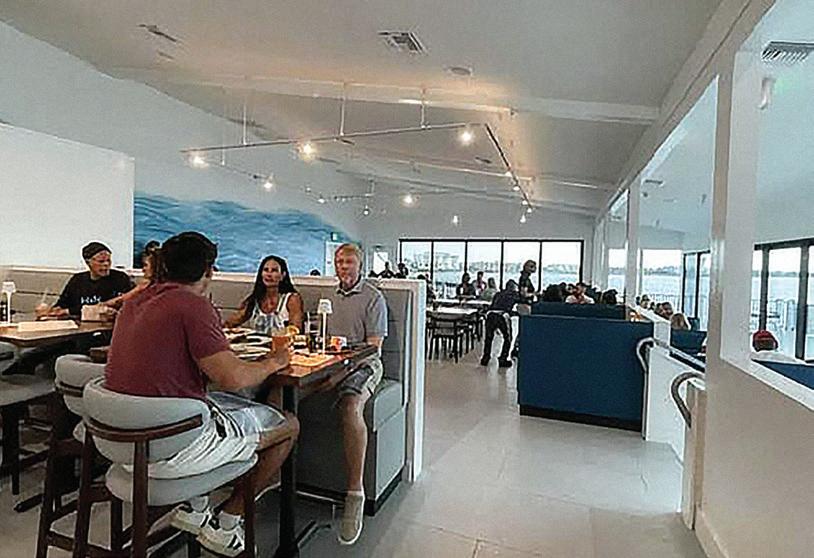
Latitude 26°, the newest restaurant at Fisherman’s Village, opened in June after months of renovations to the second-floor space formerly occupied by Captain’s Table.
The restaurant offers a polished coastal dining experience centered on seafood, hand-cut steaks, prime rib, craft cocktails and an extensive wine selection. It features
“My
enclosed waterfront dining with floor-to-ceiling windows overlooking Charlotte Harbor, along with an outdoor patio that extends the length of the building.
philosophy in both business and life is simple: Build something meaningful, do it with integrity and give back along the way. I believe success is not just measured by revenue or growth, but by impact.”
— Joann Elardo, Wicked Dolphin Distillery founder, (“Women in Business” May 2026)
COMING NEXT ISSUE
Meet the 2026 Gulfshore Business 40 Under 40 honorees. These rising leaders are making their mark across Southwest Florida through professional achievement, innovation and community involvement. Join us as we recognize the next generation of business and community leaders.
NAPLES
FLIGHTS GAIN SUPPORT
As Naples Airport weighs a proposal from American Airlines to restore commercial passenger service for the first time since 2017, Gulfshore Business readers are signaling strong support for bringing scheduled flights back to the city. In a survey that drew 658 responses, 75.8% of respondents said they support American Airlines launching service between Naples and Charlotte, North Carolina. Another 21.1% opposed the proposal, while 3% said they were unsure. American Airlines began selling tickets for the proposed nonstop flights, with service scheduled to begin Dec. 2 if key approvals are completed. Before flights can launch, Naples Airport Authority must finalize a use agreement with the airline, the Transportation Security Administration must approve passenger screening operations and renovations at the airport's North Road Terminal must be completed.
NCH NAMES CANCER DIRECTOR
Naples Comprehensive Health appointed Dr. Javier Muñoz as medical director of its cancer program and a practicing medical oncologist as the health system expands oncology services through its collaboration with Northwestern Medicine. Muñoz joins NCH from Mayo Clinic in Phoenix, where he led the lymphoma program and held leadership roles in clinical trials and cellular therapy. An academic hematologist-oncologist with more than two decades of experience, he has authored more than 100 peer-reviewed publications and helped lead clinical trials that shaped modern cancer treatments. NCH officials said Muñoz will oversee the development of an integrated cancer service line, expand access to clinical trials and help advance plans for a comprehensive cancer center serving Southwest Florida.
RECORD PROPERTY TAX REVENUE
Lee County collected a record $626.9 million in property taxes during fiscal year 2025, according to the latest edition of "The Sand Dollar," an annual financial report released by Lee County Clerk & Comptroller Kevin Karnes. The report, issued for the fifth consecutive year, details how taxpayer dollars are collected, managed and spent while highlighting economic and demographic trends across the county. Lee County’s population has grown 23.3% since 2016, making it one of Florida’s fastest-growing counties. The report also found median single-family home prices declined 2.1% and total home sales fell 1.1% during the fiscal year. Impact fee collections increased 2.5%, helping fund transportation, parks, schools, fire protection and emergency medical services needed to support new development.
DOES OVERTIME PAY OFF?
A Gulfshore Business survey found long hours remain closely tied to workplace culture and career expectations, even as many workers question whether extra time improves productivity. Nearly 69% of respondents described themselves as somewhat or definitely workaholics, while 34.4% said personal ambition drives employees to work beyond 40 hours per week and 32.8% pointed to company culture or employer expectations. Only 17.2% said working longer hours significantly improves productivity, while 48.5% said it makes little difference or reduces productivity. Despite concerns about burnout, 60.9% said their organizations still view employees who work long hours as more committed or high-performing.
Provided
COMPLETE SITEWORK. DELIVERED RIGHT.
At Myers Site Development, we deliver complete site development solutions for residential, commercial, and infrastructure projects throughout Florida. Our team is committed to completing every project safety, efficiently, and on schedule.
DEMOLITION
Safe and efficient removal to prepare your site.
EARTHWORK & SITE PREPARATION
Precision grading and excavation for any size project.
UNDERGROUND UTILITIES
Water, sewer, and utility installation built to last.
STORM DRAINAGE SYSTEMS
Engineered solutions for effective water management.
We prioritize the safety of our team, partners, and the community.
We take pride in doing the job right. ON-TIME COMPLETION
Committed to keeping your project on track.
We own our work and stand by our promises.
Built on
integrity, and communication.
Makers
Simple Passion
A lifelong love of nature shapes Naples boutique Flora & Fauna
By Justin Paprocki
Allison Keevan Flores wanted to get back to nature.
She grew up in Naples with an interest in plants and flowers, the type of child who delighted in getting a rose bush as a gift. She left to study interior design at Florida State University, then returned to her hometown to work for a design firm.
“I loved interior design, but I wasn’t really feeling fulfilled,” she says. “I had been dreaming of pursuing a more simple kind of passion.”
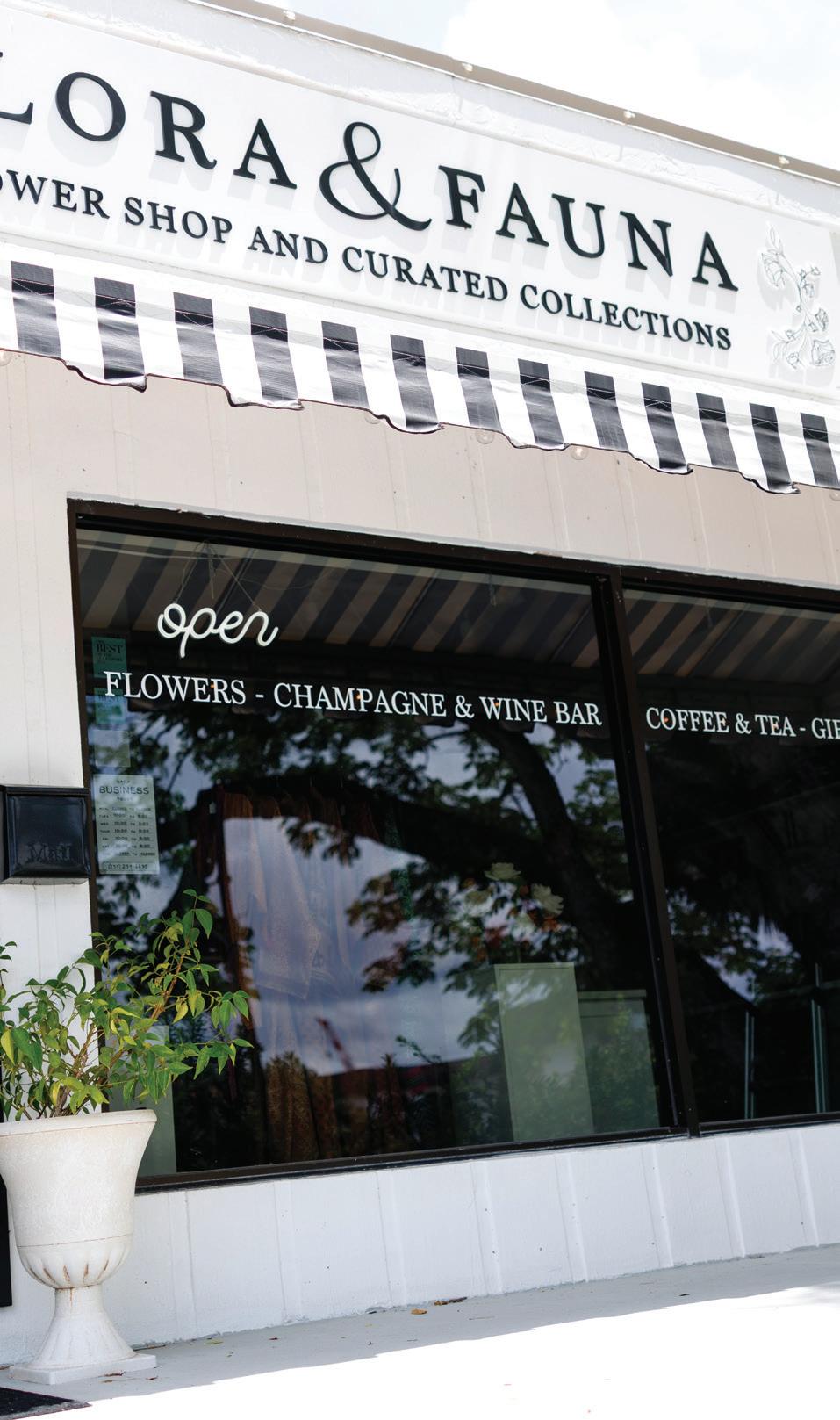
The result was Flora & Fauna. The elegant Naples shop specializes in floral design, creating everything from simple bouquets to grand arrangements for weddings and large events.
Flores actually started the business from home in 2022, with family and friends as her first clients. One of her earliest projects was designing the florals for her sister’s rehearsal dinner.
“It gave me confidence,” she says. “I thought, ‘This is exactly what I need to be doing right now.’ So, I decided to take a chance on the business. If not now, then when?”
She opened Flora & Fauna in September 2024, and it has quickly grown to include four employees. Her products are largely imported — the majority of fresh-cut flowers in the
Brian Tietz
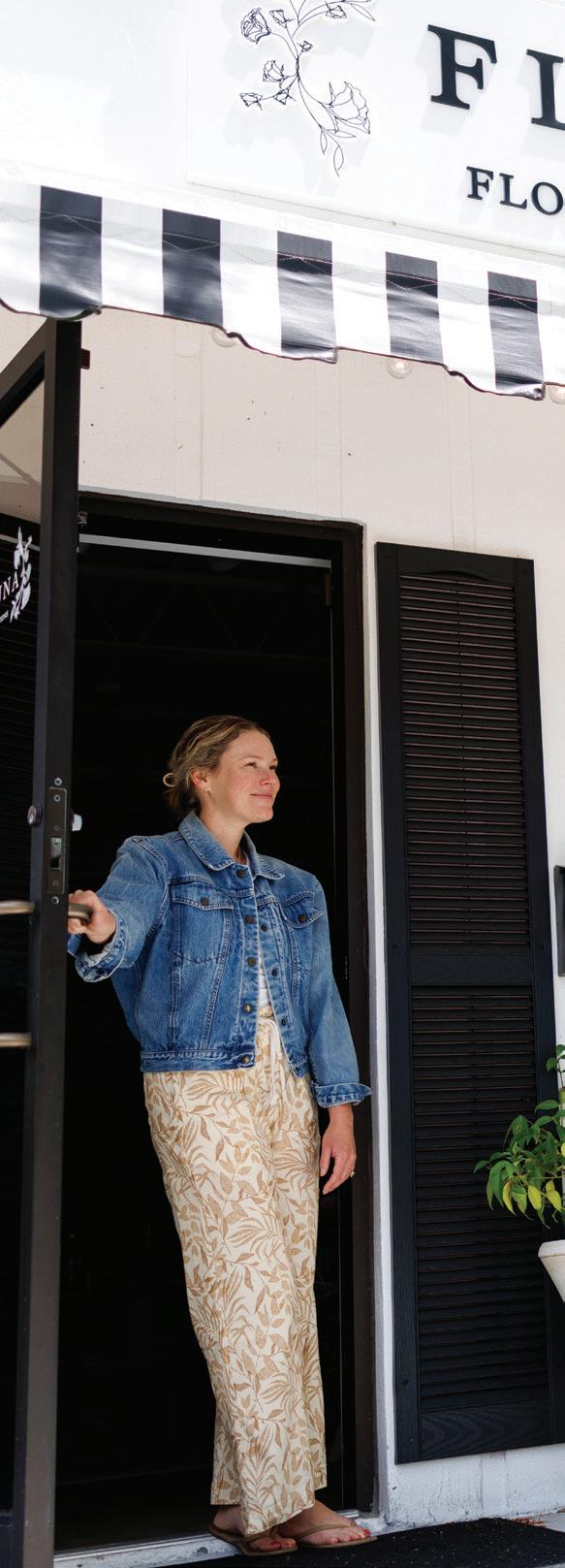
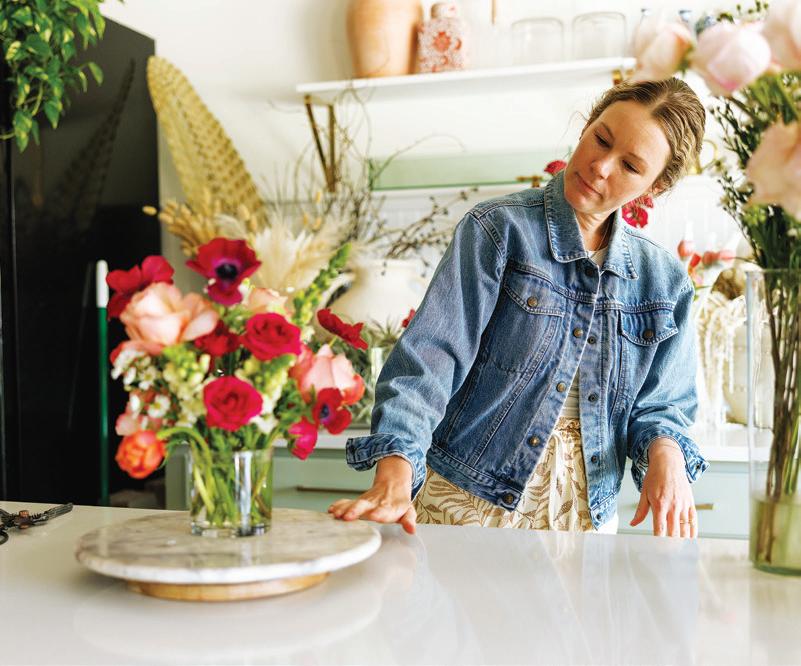
Allison Keevan Flores turned her passion for plants and flowers into Flora & Fauna, a Naples floral design studio that has grown from a homebased startup into a storefront business.
“There’s not a lot of local product, so it’s always exciting to find a grower right in our backyard.”
— Allison Keevan Flores
After launching Flora & Fauna with floral designs for family and friends, Allison Keevan Flores has grown the Naples business into a floral shop offering arrangements, classes, wine tastings and design consultations.
U.S. come from South American countries — though she also sources from local flower growers when possible.
“There’s not a lot of local product, so it’s always exciting to find a grower right in our backyard,” she says.
She has grown the business mainly through word of mouth, though she said being from Naples has helped. The goal is to make the shop itself a hub of activity; a Champagne room allows customers to sip bubbly while browsing the small home goods section or discussing floral designs. Flores also has found success hosting floral design classes and wine-and-cheese tastings.
Outside the shop, she attends pop-up events throughout town with a floral cart.
“I’m trying to get my name in front of as many people as possible,” she says.
Brian Tietz
COUNTY
Trendlines
A Real Estate Slide
The SWFL market continues to soften from its post-pandemic peak
By Justin Paprocki
It’s been a while since the real estate market felt normal in Southwest Florida.
A surge of interest in Florida homes during the pandemic pushed prices skyward. Prices peaked around 2024 and have slowly come down over the past two years as inventory has grown … although high interest rates and climbing insurance costs in recent years also have kept homeownership out of reach for some potential buyers.
Overall, the market has been softening recently, said Shelton Weeks, director of Florida Gulf Coast University’s Lucas Institute for Real Estate Development & Finance. Over the past year, median sales prices in Collier, Lee and Charlotte counties have consistently trailed where they were a year earlier. But Southwest Florida remains a diverse real estate market, meaning some segments are faring better than others, he said.
High-end coastal homes in Naples have remained in strong demand. Meanwhile, the condominium market continues to face pressure, as rising insurance costs and homeowners association fees are forcing some owners to sell and discouraging other buyers. For example, the value of a condominium in the Naples area has declined nearly 17% from its peak in August 2022, according to the Zillow Home Value Index.
While some local factors are contributing to the market’s softening, Weeks said the major drivers will come from outside the region, such as mortgage interest rates, which he predicts will probably continue inching upward through the rest of the year.
“I expect what we see here for the rest of the year will be affected by macro events,” he says. “That’s the story that’s hard to escape.”
Homes Sold
Year-Over-Year Change
Median Sale Price
Year-Over-Year Change
Total Active Listings
Year-Over-Year Change
Homes Sold
Year-Over-Year Change
Median Sale Price
Year-Over-Year Change
Total Active Listings
Year-Over-Year Change
Homes Sold
Year-Over-Year Change
Median Sale Price
Year-Over-Year Change
Total Active Listings
Year-Over-Year Change
COLLIER COUNTY
CHARLOTTE COUNTY
Creatives
CatchingCreativea Wave
Behind Brandon Bowe’s one-of-a-kind artistry
By Aisling Swift
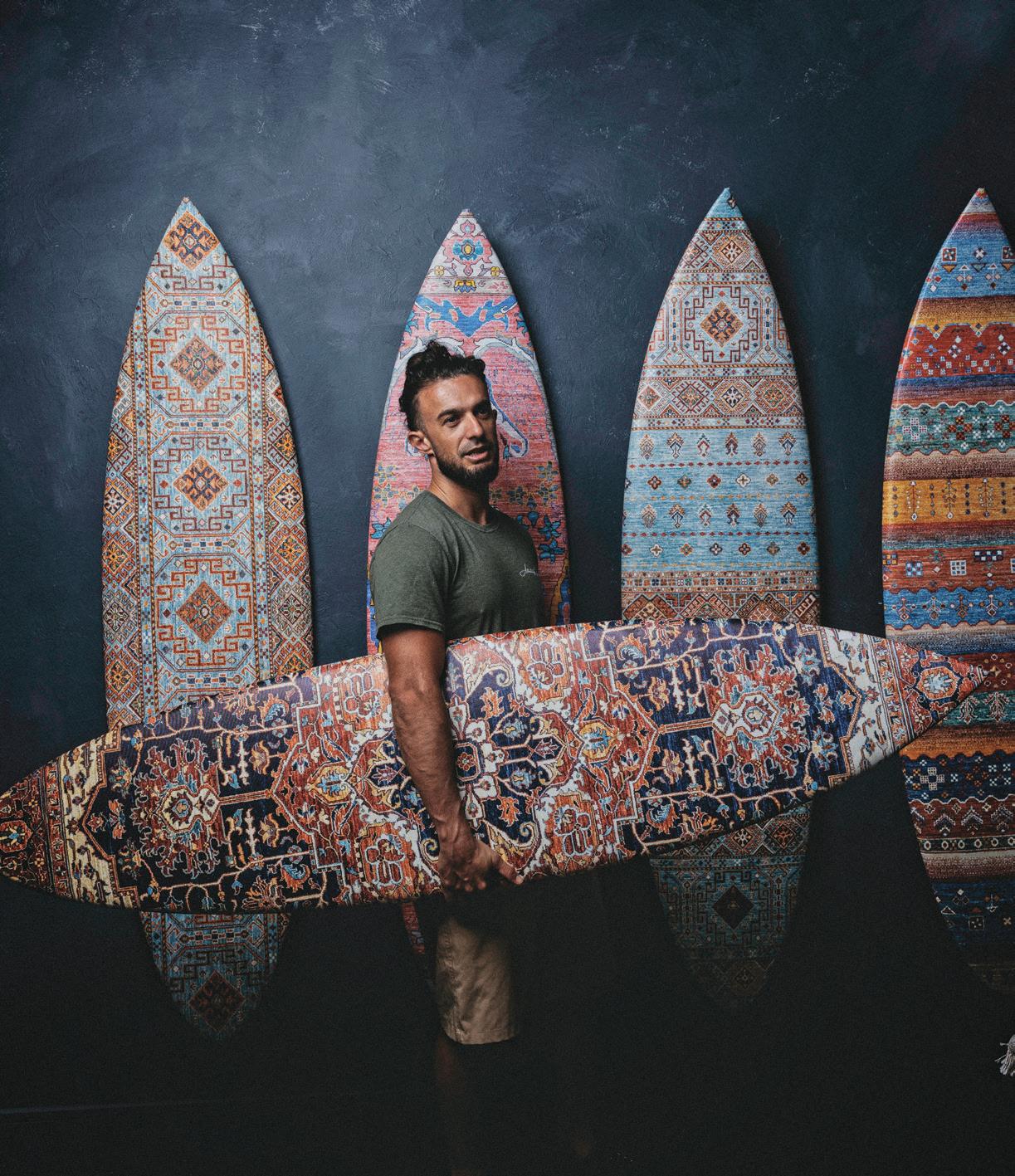
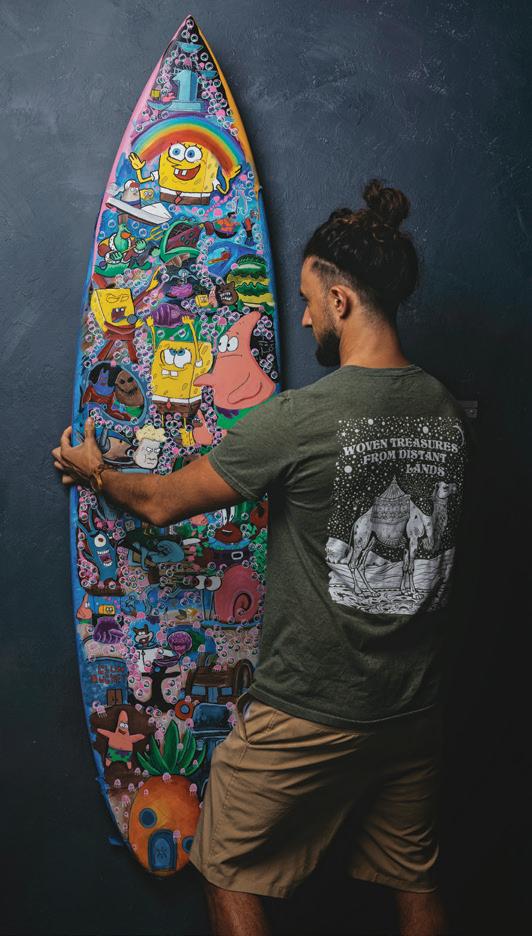
Artist Brandon Bowe’s life has been shaped by creativity and water. After spending nearly a decade as a professional kitesurfer, traveling on wind and waves around the world, it’s no surprise his artistic bent turned toward surfboards as a medium.
The Naples native gives a second life to retired boards, adding to their memories, history and sentiment. He also works with a lighter, flatter version that is easier to use as an art piece. His latest project involves wrapping surfboards with rare rugs from the Middle East and Asia, or with high-resolution images of their intricate woven patterns; a fusion of timeless global textile traditions and contemporary coastal design.
Transforming old surfboards that otherwise would be destined for landfills is a sustainable design trend that has inspired a Surfboard Artists Facebook page. But Bowe takes the concept a step further through a partnership with Authenticity Home, a luxury rug and flooring store owned by Tim Bowers on Lee Ann Lane in the Naples Art District.
“Some of them are originals, and some of them are too big because the pattern design won’t fit on a surfboard,” Bowe says, lifting rugs one by one from a pile. “Some of the patterns fit really well on the surfboards. Others look much better when we capture the whole thing and digitally adjust them.”
When an expensive hand-knotted rug needs to be cut to size for a customer, Bowe takes the leftover portion, shapes it and wraps it around a board, creating a colorful, textured, three-dimensional look.
“This is a rare one because this rug was made before airplanes were invented,” Bowe says of a colorful surfboard covered with part of a 150-year-old antique Turkish rug valued at $250,000.
Brandon Bowe gives retired surfboards new life, transforming them into art inspired by coastal culture and global design, including pieces featuring intricate rug patterns from around the world.
Brian Tietz
Most designs, however, are created in Photoshop, allowing Bowe to reproduce intricate woven rugs as high-resolution images. A photo booth at Authenticity Home uses specialized lighting to capture detailed images of the rugs. The image is then printed on canvas and applied to the board.
“If people have rugs they like, we can take their rug into the photo booth
and create a custom piece for them,” he says. “We still need to tap more into the surf market.”
Most customers, he added, are beachgoers rather than surfers.
The surfboards are just one aspect of Bowe’s varied arts career, which also includes commercial photography, videography, filmmaking and acrylic and epoxy resin painting, sometimes
incorporating textured rocks to mimic coral. He also creates wood-grainpainted surfboards with his father, Gordon, an artist and professional faux finisher whose realistic fauxwood boards are displayed at Naples Art Factory in Mercato.
“We were spending 60 hours or more fixing the boards,” Bowe says. “We needed to start doing more de-
Brian Tietz
“Some of the patterns fit really well on the surfboards. Others look much better when we capture the whole thing and digitally adjust them.”
— Brandon Bowe
signs, spend less of our time fixing and focus on the actual creative artwork.”
For this project, Bowe’s original surfboard came from SurfCycled, a Costa Rican company that upcycles old surfboards by stripping them down, reusing the foam and shaping new boards.
“We took a template from one of his boards as an outline and then got a couple of wellknown surfboard shapers to shape boards by hand for us, so we have a template,” he explains. “People don’t want to spend thousands of dollars on a surfboard that might get tossed around and broken. We’re trying to stay more in the gallery art market than the surf market.”
The creations can serve as statement pieces or enhance beach-themed spaces. In addition to wall hangings, a board can transform a coffee table into a one-of-a-kind conversation piece or be hung above a bed as a headboard, as Bowe has done in his own bedroom. He has even considered transforming them into matching lighted nightstands. They also can be paired with beach-inspired accessories, such as shells and starfish.
Brandon Bowe brings a multidisciplinary approach to his art, from photography and filmmaking to resin paintings and custom surfboards. Each piece is designed to reflect its own story and character.
The boards feature muted antique Persian motifs, bold Indian block prints and colorful Asian-inspired textiles, each with its own cultural story. Every board is hand-shaped, sanded and wrapped to create a unique work of art.
Some clients, however, ask for a board with its own history. Bowe points to the last board he rode professionally.
“That board went to Australia, Ecuador, Peru and the Cayman Islands. It’s been all over. I have videos of me riding it all over the world,” he says. “So, that one’s got a history that matches that rug.”
Each board carries its own story, memories and energy. Prices range from $2,500 to $4,500, while boards with documented surfing histories command higher prices.
To learn more about Bowe and his surfboard creations, visit Authenticity Home or boweartistry.com/shop.
Economic Commentary
—Meagan Baskin, associate professor
in the Lutgert College of Business and director of the Southwest Florida Leadership Institute at Florida Gulf Coast University
Artificial
The Power of Pride
As AI encroaches on the economic landscape, this human factor is frequently overlooked
By Meagan Baskin
intelligence is increasingly framed as an economic inevitability: Adopt it or fall behind. Automate or lose competitiveness. That framing is incomplete, particularly for regions including Southwest Florida, where our economic engine depends less on abstract innovation and more on people who show up, care deeply and take pride in what they do.
Much of the AI conversation focuses on productivity gains, cost savings and efficiency. Those matter, but there is another economic variable that deserves attention — one that rarely appears on balance sheets but strongly influences labor supply, retention and performance: pride in work.
matters in a region such as ours, where healthcare, hospitality, education and professional services already face chronic labor shortages.
As businesses integrate AI, many are seeking to enhance efficiency while preserving the human judgment, engagement and pride that drive lasting performance.
Pride is not a soft concept. Decades of organizational research show that pride is a powerful motivator, often rivaling pay in its ability to drive effort, persistence and quality. Workers who see themselves as authors of their labor, not just operators of systems, are more engaged and less likely to leave. That
AI changes the nature of work in ways that directly affect pride. When algorithms draft reports, generate marketing copy, design training materials or optimize schedules, workers risk being repositioned from creators to editors. Economically, that can look efficient, but psychologically, it can feel distancing. If employees no longer see their own skill, judgment or craftsmanship reflected in the final product, pride may eventually erode. When pride erodes, turnover rises.
That is not speculation; it is a pattern repeatedly observed in job redesign, automation and deskilling research.
This tension is especially relevant in Southwest Florida, where our workforce is disproportionately service-oriented and human-facing. Nurses, hospitality professionals, educators, trainers and managers do not just complete tasks; they exercise judgment, care and relational skill. These are precisely the roles where pride comes from mastery, owner-
ship and visible contribution. If AI is introduced into organizations in ways that flatten those experiences, we risk solving a productivity problem by creating a retention problem.
At the same time, rejecting AI outright would be economically shortsighted. Labor markets are tight, and demand for services continues to grow as our population ages. AI can reduce administrative burden, eliminate repetitive tasks and expand capacity without requiring additional
headcount. Used well, it can actually strengthen pride by allowing workers to focus on the parts of their jobs that feel most human and meaningful.
The economic question, then, is not whether Southwest Florida businesses should adopt AI. It is how. Firms that treat AI as a replacement for human contribution may see shortterm gains but long-term instability.
Firms that design AI as an augmentation tool, one that supports human judgment rather than substitutes for it, are more likely to sustain engagement and retain talent.
This distinction matters because Southwest Florida already struggles to attract younger workers and retain experienced ones. If work becomes more automated but less meaningful, the region becomes less attractive, not more. Conversely, organizations that use AI to elevate human roles, preserving authorship and pride, may gain an edge in recruiting and retention, even in tight labor markets.
Economic development conversations often revolve around infrastructure, tax policy and innovation incentives. Those are important. But the future of work in Southwest Florida will also be shaped by whether people still feel proud of what they do at the end of the day.
AI may change how work gets done. It should not decide whether work still feels worth doing.
Artificial Intelligence
“We all expect for technology to become more and more a part of taking care of seniors.”
— Dan Lavender
A Future Model for Elder Care
GardenView provides a look at how advanced tech can enhance human connections
By Therese McDevitt
When GardenView at Moorings Park Grande Lake opened in Naples in fall 2025, it became the first residential assisted living model in the country built around an ambient artificial intelligence platform designed to help keep residents safe, cared for and connected.
According to a 2024 University of South Florida article, ambient AI is a subset of artificial intelligence that “focuses on the creation of intelligent systems that can solve problems in real time and at scale.” USF said it can be a powerful tool in healthcare settings because it can help provide personalized experiences for patients.
In an assisted living setting, this can mean a system that recognizes a resident’s individual ID fob at different access points, or notices changes in sleep or walking patterns.
GardenView, a $50 million facility adjacent to the Grande Lake independent living community, consists of 23 suites designed as private condominiums, each featuring advanced technologies that Moorings Park said set the facility apart from other assisted living environments.
George and Lynne Schnyder, married for 61 years, say the compassionate, personalized care at GardenView has brought peace of mind following Lynne’s Alzheimer’s diagnosis.
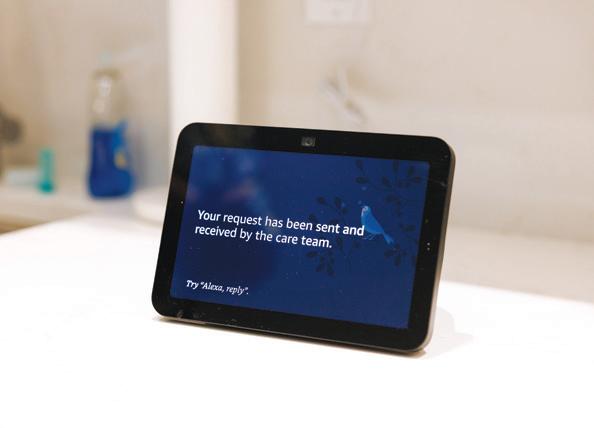
Inside the units, smart lighting embedded in the floor can detect when a resident gets up at night, providing soft illumination while also notifying the nearby nursing station. Wearable devices and in-suite monitors can track location, fall risks and health metrics, while voice-activated speakers provide twoway communication with nursing teams on each floor.
Dan Lavender, CEO of Moorings Park, said the technologies in use at GardenView are changing the model for the future of aging.
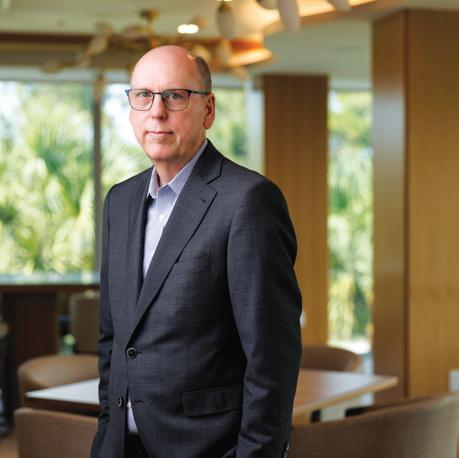
“We all expect for technology to become more and more a part of taking care of seniors,” Lavender says during an interview in one of the light-filled common areas at GardenView.
Brian Tietz
“I think what we’re doing right here is one giant leap in the direction of what the future is.”
Lavender said the goal is to anticipate challenges residents may face, allowing staff to provide more hands-on care because AI-powered technology assists with basic monitoring.
“We’ve had one resident here who has an issue with falls, as you often have in an assisted living facility,” he says. “What the AI has been able to learn is that rather than waiting for the fall to occur, we can judge even movement inside the bed, and … we can dispatch staff — rather than to pick them up off the floor — to recenter them in the bed before they fall out.
“That’s the kind of thing that this technology is going to allow us to do that’s going to change senior care.”
When Data Meets Caregiving
With safety being a top priority in the assisted living setting, each GardenView resident wears a Rythmos by Intrex smartwatch or fob that identifies accessible areas based on cognitive level so that, for example, someone with memory issues cannot board an elevator unaccompanied.
Lavender said the wearable devices — which, like the Nobi smart-lighting system, are compliant with Health Insurance Portability and Accountability Act privacy standards — can also help nursing staff detect changes that may indicate an issue that needs addressing.
He used the number of steps walked each day by a resident as an example.
“If you’re getting 7,000 steps every day and all of a sudden you’re getting 4,000, something may be going on,” Lavender says. “It’s going to give us the information to say, ‘Hey, can we talk about this change in behavior?’ Is something happening to their knees? Are they tired? And we’re also tracking sleep, another piece that we’ll be looking at over time.”
While wearable technology provides an additional level of monitoring, experts caution that increased oversight should not come at the expense of privacy or personal autonomy.
The emergence of AI offers tremendous opportunities in senior care, but also raises important questions about consent and transparency, said Brenda Hage, director of the School of Nursing at Florida Gulf Coast University and an adult-gerontology primary care nurse practitioner.
“There is tremendous opportunity with AI, and I
think it has the potential to improve quality of life, safety and efficiency in older adult care,” Hage says. “But we have to be very transparent about what those technologies are doing, and patients must have the right to refuse them, because some people may not be comfortable with that level of intrusion into their daily lives.”
At GardenView, Lavender said residents, along with their caregivers or healthcare proxies, are fully informed about the technology and that no one has refused it since the facility opened.
He said people choosing to live there are more receptive to the technology.
“This has not been an issue with any of our residents,” Lavender says. “The residents that are choosing to move there are embracing this to help them, and we haven’t gotten any people saying, ‘I moved in here, but I really want some of this data turned off for privacy’s sake.’”
Keeping Human Connection Front and Center
As exciting and innovative as the technology may be, Lavender said the human element remains the focal point of care at GardenView.
“The technology is in the background, and the human connection is front and center,” he says, citing the “best friends” approach developed by memory-care experts and authors Virginia Bell and David Troxel.
“We train our caregivers not only to care for the resident, but to know their stories; to understand them,” Lavender says. “What did they do when they were 40 or 50 or 60? What are their triggers? Because if you have short-term memory losses, you still have excellent long-term memory.
“[Caregivers] have to think like you’re their best friend and you have to know their history so you can engage them in conversation. That approach, which we are big believers in, talks about the philosophy of person-centered care, and it isn’t just about putting all the technology around you. It’s about having the relationship; the technology is just here to help.”
George Schnyder, whose wife, Lynne, is a GardenView resident, said the personalized care Lynne receives is more important to him than the advanced technology in use.
Moorings Park’s $50 million GardenView community integrates smart technologies — from floor lighting to health monitoring systems — to help redefine the future of senior living.
The Schnyders, who have been married 61 years, moved to Moorings Park Grande Lake — across the street from GardenView — two years ago after selling their home in Naples. Lynne, who was diagnosed with Alzheimer’s disease, became a GardenView resident when it opened in November 2025, and George said his peace of mind comes from the human element of her care.
“Do I have peace of mind knowing that if Lynne falls, someone will be right there because of the technology?” Schnyder asks. “Of course I do, but what gives me more peace of mind is that someone checks on Lynne every two hours. Whether it’s day or night, someone checks in on her to make sure she’s okay.
“What’s really important to me is the caring of the nurses; that’s what makes the difference.”
Innovation
Surgical Synergy in SWFL
Arthrex moves into producing powered medical instruments of its own
By Evan Williams
In orthopedic surgery, sets of powered instruments — essentially, medical-grade drills and saws — are ubiquitous. And as with so many other state-of-the-art devices, the leading producers are locked in an ongoing battle of incremental improvements.
Until recently, the Naples-based global medical device manufacturer Arthrex wasn’t one of them. It might seem a natural fit for a company famous for pioneering minimally invasive devices, but Arthrex had never designed its own standard set of orthopedic power tools. It could only offer outdated instruments once acquired, and nothing that could compete with industry leaders such as Stryker and Conmed.
Arthrex project leaders set out to change that over the last four years, building the design and manufacturing capabilities to produce the company’s first in-house set of battery-powered instruments from scratch. Senior Group Product Manager Jordan Turner oversaw and managed development of the Synergy Power System.
“It was a gap in our portfolio,” Turner says. “We had that product that existed, but it didn’t represent Arthrex’s name as far as innovation and reliability.
“We sell across hospitals and ambulatory surgery centers, but we really own
the ambulatory surgery center market because of our No. 1 sports arthroscopy portfolio. We’re the market leader in that space.”
However, she continues, “You can’t do a sports arthroscopy procedure without a powered instrument system. You can’t do an arthroplasty procedure or a trauma procedure. So, everywhere these Arthrex products are being used, a power system has to be used and it’s terrible to see a competitive power system with an Arthrex product. So, it made sense. But it was a big investment for the organization.”
Turner declined to reveal the amount because Arthrex is a private company, but orthopedic power tools are a $1.84 billion global market, according to the research firm Mordor Intelligence, set to grow to $2.16 billion in 2031. Mordor attributed that to factors that include an aging population; more musculoskeletal disease and traumas due to e-bike and traffic accidents; and growth in ambulatory surgery centers.
Turner was prepared to lead the project’s development in part by having worked for Arthrex competitors, helping sell powered instrument systems.
“We knew in order to compete with them we needed to do it the Arthrex way,” she says.
“We sell across hospitals and ambulatory surgery centers, but we really own the ambulatory surgery center market because of our No. 1 sports arthroscopy portfolio.”
— Jordan Turner, Arthrex Senior Group Product Manager
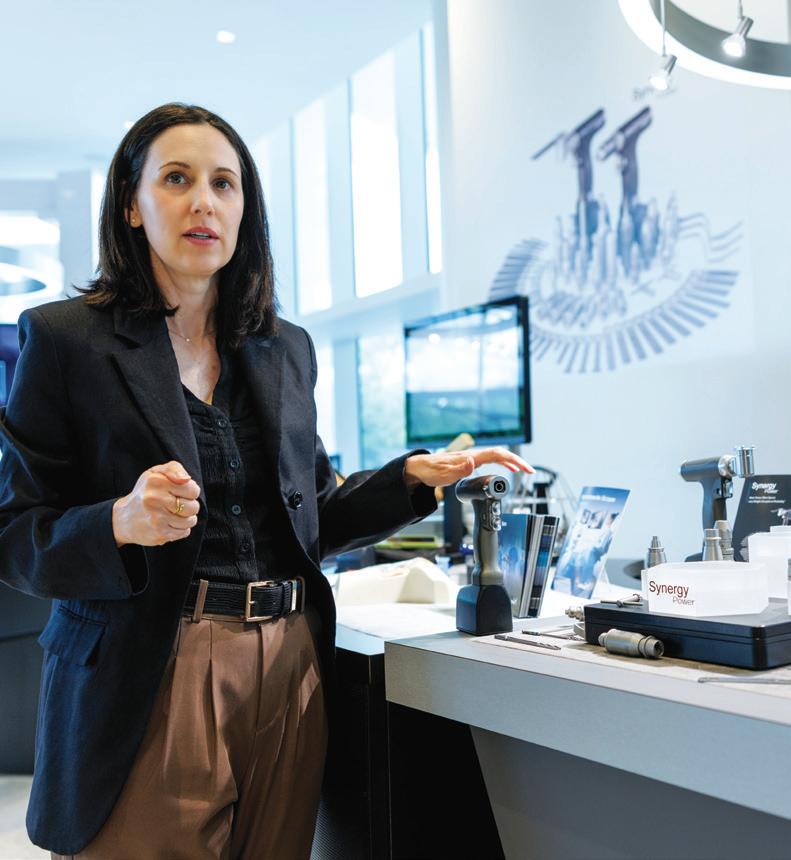
The launch of Arthrex’s Synergy Power System marks a significant investment by the Naples-based medical device manufacturer, filling a longstanding gap in its orthopedic product portfolio.
Brian Tietz; Arthrex
Turner recalled presenting a business case for the project to Arthrex founder and President Reinhold Schmieding. After earning his approval, Turner says, it was “full steam ahead.”
Arthrex hired manufacturing engineers, machinists and technicians who would hopefully remain at the company to help build Synergy’s next generation of tools, Turner said. The company also dedicated about 4,000 square feet of floor space at its South Carolina manufacturing facility to produce the products.
Synergy represents the company’s larger expansion efforts as it continues to pursue its brand of medical-device development and innovation.
“We’ve seen continuous demand for innovation in multispecialty minimally invasive surgery technology, which drives our growth in engineering, product development, quality control and manufacturing,” writes Arthrex Senior Vice President of Human Resources Kathy Sparrow.
The Synergy System debuted in June 2025. It includes two handpieces — a dual-trigger rotary drill and a precise, high-speed sagittal saw — each with a wide variety of attachments.
Naples-based orthopedic surgeon Dr. David Backstein, medical director of the Hospital for Special Surgery at Naples Comprehensive Health, switched to Arthrex’s Synergy system about a year ago.
Its top competitors make models of comparable quality, he says: “They’re all very high standard.” But Arthrex’s system stands out to him for its focus on details such as lightweight ergonomics. The system also requires fewer parts than similar sets — only two main handpieces — making it that much more cost-efficient and easier to use. It is powerful, reliable and sturdy, designed to be repeatedly sterilized under high temperatures.
The small details help, especially with tools that get used every day, often for hours at a time. It also helps that Arthrex continues to incorporate feedback from surgeons as it improves the instruments.
“It has been fine-tuned for surgeons’ needs,” Backstein says. “They’ve taken our feedback directly and incorporated it into the device they’re making to make it more friendly for the surgeon and the institution.”
The Arthrex team assembled to make Synergy, or some version of it, isn’t resting on its laurels. They are already at work on the next generation of powered instruments, systems that are expected to last four or five years before growing outdated.
“Honestly, the moment we start the first generation, we’re already thinking about the next generation,” Turner says.
Surgeon feedback helped shape Arthrex’s Synergy Power System, which was designed for ergonomic performance, efficiency and continual innovation.
However, they did get a chance to celebrate when the Synergy system was picked as a finalist at the 2026 Edison Awards, an annual global showcase of innovative companies and their creations held in downtown Fort Myers. Synergy was awarded a bronze in the health, medical and biotech category at the black-tie awards gala on April 16 at Caloosa Sound Convention Center. “And so this made us pause and actually celebrate what we accomplished,” Turner says. “I think it gave us an opportunity to reflect.”
“We have a lot of students who recognize they’re going to be working for familyowned firms. And it’s good to know what’s going on in those situations.”
— William McDowell Dean, FGCU School of Entrepreneurship
Beyond Succession
FGCU offers courses on entrepreneurship across generations
By Evan Williams
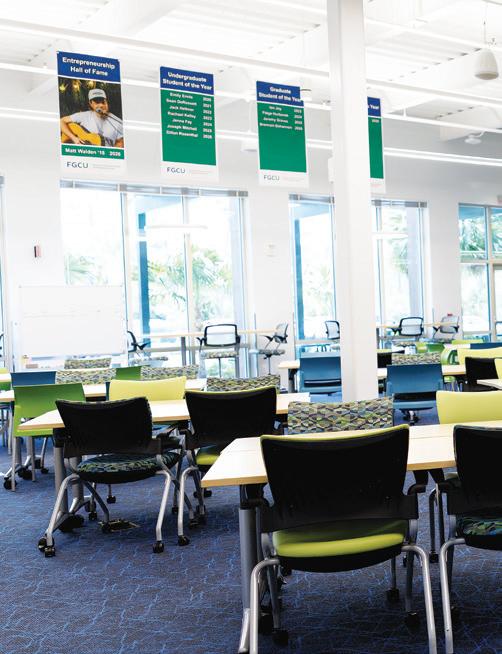
Florida Gulf Coast University students are getting up close and personal with their family histories, mapping not just genealogies but the unique relationships, behaviors, health patterns and other undercurrents that flow through their families. That might sound like an exercise in sociology, psychology or medicine, but it’s mixed with creation, innovation, profit and loss — family life through the lens of an entrepreneur.
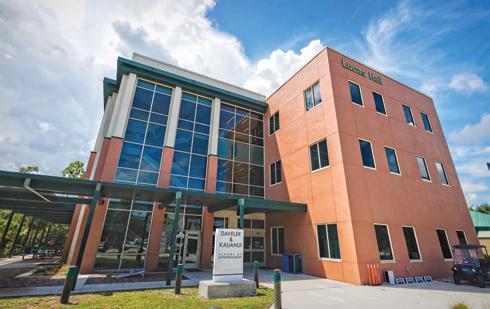
Professor William McDowell, dean of FGCU’s Daveler & Kauanui School of Entrepreneurship, led students through the genogram exercise for his class Introduction to Family Enterprise.
“We have a lot of students who recognize they’re going to be working for family-owned firms,” McDowell says. “And it’s good to know what’s going on in those situations.”
The class is part of a new course of study in Family Enterprise offered through The School of Entrepreneurship, beginning this fall as a minor for the general student body or a concentration for entrepreneurship majors. It’s aimed at students who may inherit, start up, work for or acquire a family enterprise.
“Southwest Florida has a dominant share of small businesses, which most often are family businesses,” says Michael Wynn, a third-generation leader of Sunshine Ace Hardware and past chair of FGCU’s Board of Trustees. “So, right off the bat, our future prosperity of the region is directly tied to the success of family businesses.”
Brian Tietz
Florida Gulf Coast University’s new Family Enterprise program is designed to prepare students to inherit, launch, manage or acquire family businesses.
Family businesses make up nearly one-third of the businesses in Lee, Collier and Charlotte counties and 26% of firms nationwide, based on a U.S. Census definition in which two or more family members own the majority of a company. But that understates family leadership in businesses. Firms in which family members have at least some control account for 87% of business tax returns and 59% of the private sector workforce, according to a report by the advocacy group Family Enterprise USA.
Family firms face unique challenges such as intergenerational collaboration and conflict, and potential succession
through family members or outsiders. But many schools are not equipped to educate students in family enterprise, and fewer still through an entrepreneurial lens that emphasizes real-world experience, innovation and growth.
“The thing that really makes this unique is, it’s the first time that a family type of either minor or concentration is coming specifically from an independent school of entrepreneurship,” says Associate Dean and Professor Jason Lortie, who led development of the school’s Family Enterprise curriculum.
Well-informed entrepreneurs could be a boon for family firms as current owners look toward handing off businesses to a younger generation, said Tim Cartwright, partner of the Naples-based firm Fifth Avenue Family Office, adviser to the School of Entrepreneurship and one of the pivotal figures behind its inception.
Cartwright pointed to evidence that a large part of the country’s wealth could evaporate or stop growing if current owners don’t find capable successors. Often, a family business owner’s net worth is largely tied up in their firm, according to a study by the Exit Planning Institute; yet roughly 30% of businesses that go to market end up selling.
“What is the business owner left to do?”
Cartwright asks. “He can try to sell it or shut it down. And that seems to be a shame. If there’s a business that can make it past the five-year survival rate … you want to keep that business going.”
In Family Enterprise USA’s 2026 survey, 66% of family business owners said they have not passed on ownership to the next generation due to a general lack of planning, owners’ desire to remain in control, questions about the next generation’s ability or
“If there’s a business that can make it past the fiveyear survival rate … you want to keep that business going.”
— Tim
Fifth Avenue Family Office partner
Developed by Associate Dean
Jason Lortie (top right, with William McDowell), FGCU’s Family Enterprise program gives students hands-on experience navigating the complexities of succession and business transitions.
Brian Tietz
Cartwright
desire to lead the business and financial challenges related to the handoff.
For students who may inherit a family business or acquire one, Entrepreneurship through Acquisition is another required course in the Family Enterprise minor that delves into the challenges inherent in that transition.
“That would be something that we hope (students) are well prepared for instead of just going at it blindly,” Lortie says. “They would have had experiential classroom time with thinking through those types of ideas and how it is that you properly do that with the best chance of success, if you go through that direction of doing it.”
Family foundations
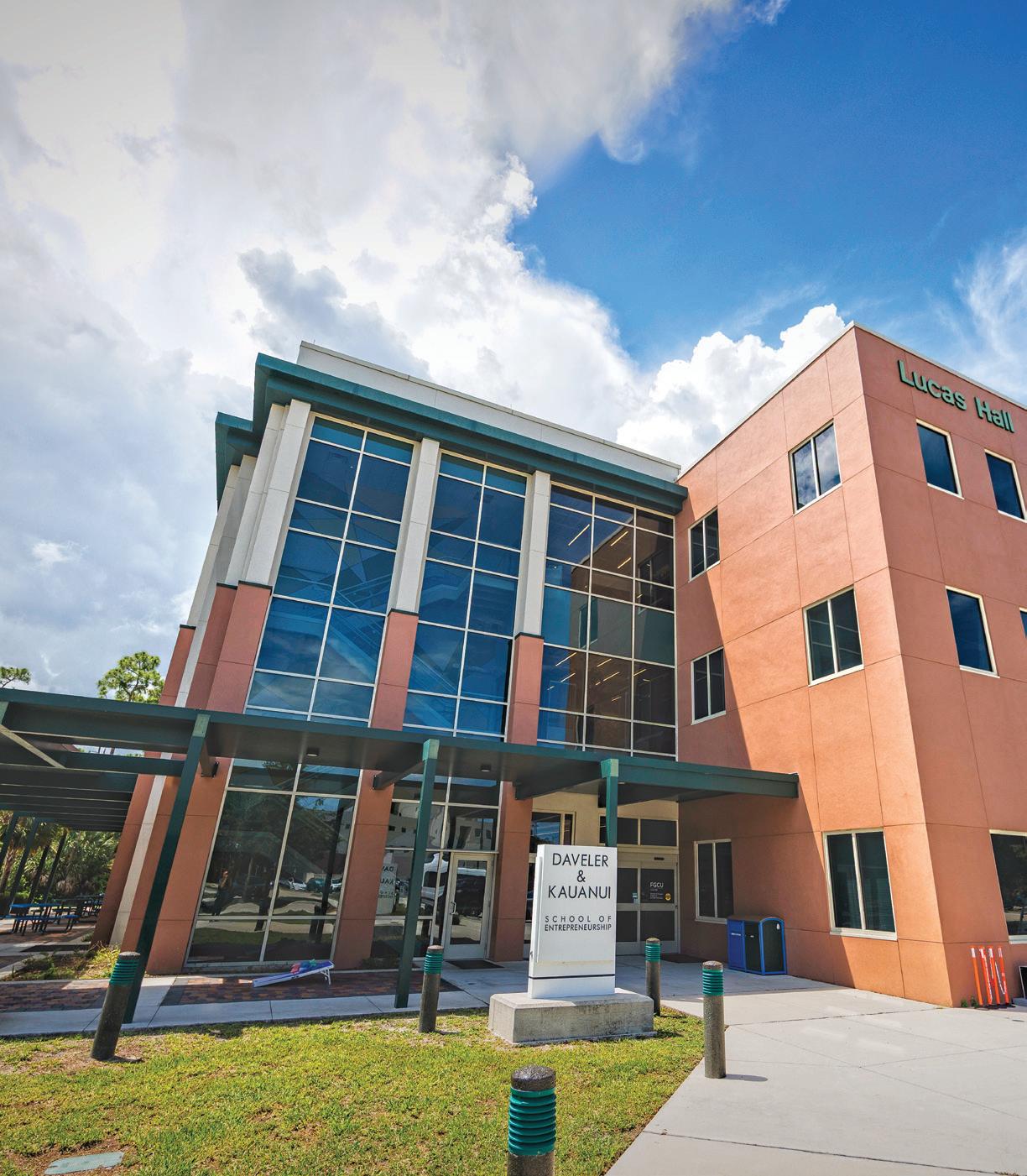
FGCU launched the School of Entrepreneurship in 2017 under founding director Sandra Kauanui and opened its three-story permanent home, Lucas Hall, in 2021. This season, its curriculum is getting a major update for the first time with new minors that, besides Family Enterprise, include Applied Blockchain Technology, Sustainable Entrepreneurship and Creator Entrepreneurship.
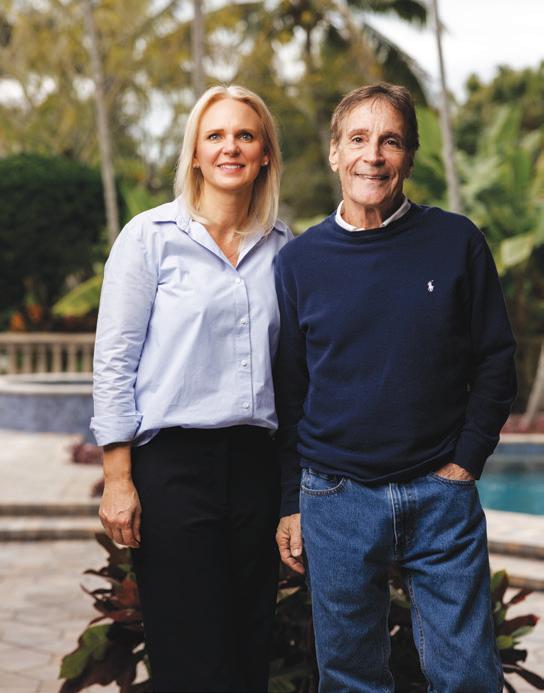
The school is in a unique position to become a well-known hub for family enterprise studies due to existing staff and program supporters along with the annual Resnick-Wynn Family Business Conference. It has become a foundation for family enterprise studies since beginning five years ago, creating an ongoing tradition and a growing library of source material for students and instructors.
Its speakers have included a roster of national figures, such as Steve Forbes, Jonathan Tisch of Loews Hotels & Co. and Jim Purdue of Purdue Farms, along with local luminaries from companies, including DeAngelis Diamond and My Shower Door.
John and Billie Resnick enlisted Wynn to help organize the conferences, modeled on similar ones that the Resnicks held at The Wharton School of the University of Pennsylvania. The
husband-and-wife team are principals of The Resnick Group, an estate and business succession planning firm in Naples.
“We saw local family businesses in the region thriving, but not really having the support that we saw in other areas of the country,” Billie Resnick says.
When McDowell was appointed dean in 2024, he brought a background of teaching family enterprise along with expertise in entrepreneurship ecosystems.
“I've been teaching family for years,” McDowell says. “I work with a lot of family firms. I was here and I could help kick it off.”
Learning from experience
Since its inception, FGCU’s entrepreneurship school has emphasized experiential education through the real-life lessons of adjunct professors or hands-on projects over academic tomes.
As part of McDowell’s introductory course, he invites area business leaders to speak with students about the realities of intertwining family and professional lives, or as Lake Yoke puts it, the “personal aspect” of family businesses.
“I think that personal aspect is important because when you’re in a family business, everything is personal,” says Yoke, 31.
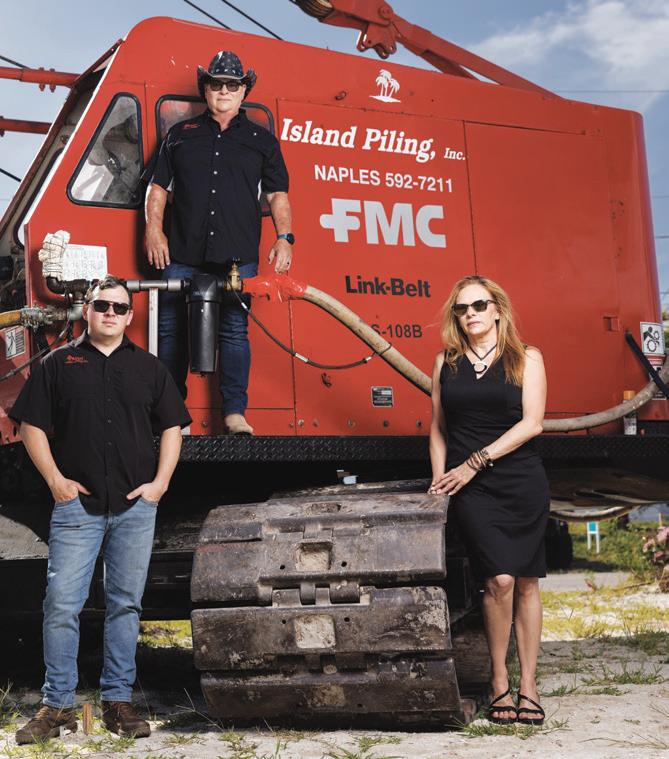
He works for Naples-based Island Piling Inc., a pile driving and foundation contractor. It was founded 40 years ago by his parents, Kena Yoke and her ex-husband Scott Yoke, who still run the business together.
Although Lake has separate ambitions, including as a competitive sport shooter and as an information systems and data analysis expert, he returned home at his parents’ request during the COVID-19 pandemic to work for the family business.
“We saw local family businesses in the region thriving, but not really having the support that we saw in other areas of the country.”
— Billie Resnick
The Resnick Group
FGCU entrepreneurship student
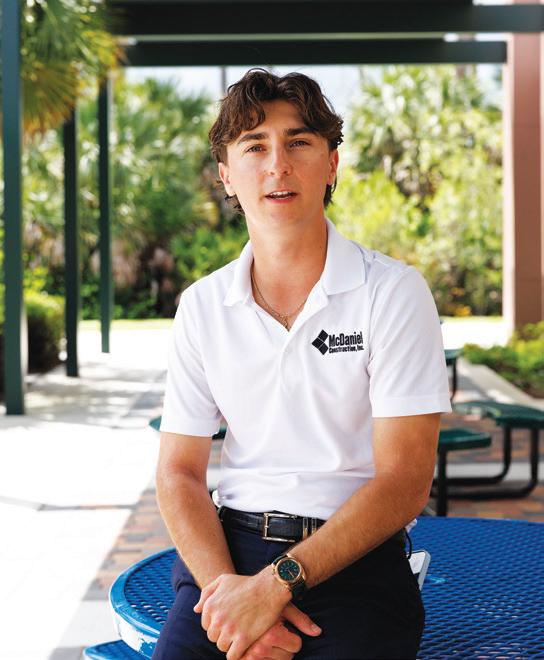
Forrest McDaniel says learning from business leaders such as My Shower Door founder Bill Daubmann gave him a new perspective on one day leading his family's construction company. Brian Tietz
“He has really helped bring technology into the office and into what we do,” Kena says.
They each have their strengths.
“(Lake’s) father is very pen and paper,” Kena says, thriving in the field while she excels at relationship management. “I’m very ‘Rolodex and Lotus.’ He (Lake) is very ‘data and AI.’”
When Kena and Lake spoke with McDowell’s family enterprise students, they spoke frankly.
“What’s it like working with your ex-husband?” one student wants to know.
“I don’t work with my ex-husband,” she answers. “I work with my business partner and my son’s father. They’re very different roles.”
For FGCU sophomore and entrepreneurship major Forrest McDaniel, 20, the class offered a fresh perspective on how to lead a construction firm.
After growing up working different roles at McDaniel Construction, founded by his parents and their former business partner in 1999, he may end up running the company with his siblings one day.
As interest grows, FGCU leaders are exploring ways to expand the family enterprise program, including a four-year major, startup competitions and a regional family enterprise center.
We'll work with you to find solutions as unique as your business, no matter the stage or size. We offer: dfcufinancial.com/businessloans 239.898.1759
Lake Yoke, Scott Yoke and Kena Yoke
“Going into that class was a complete change of pace,” McDaniel says, adding that he was inspired by a visit to FGCU from My Shower Door’s CEO and founder Bill Daubmann. Daubmann spoke in February at the Resnick-Wynn Conference.
“You can have a family culture and family atmosphere but still compete with the largest, most aggressive companies in the world,” McDaniel says. “That was kind of my biggest takeaway.”
If demand for the new minor proves strong, FGCU leadership will likely look toward creating a four-year major. For now, McDowell, Lortie, staff and students are considering several initiatives to incorporate into the school’s program such as a “spinoff” competition in which students create a startup using the assets of an existing family firm, and an official student family business organization. They are also considering how to organize a regional family enterprise center.
“What that looks like, I’m not sure,” McDowell says. “We’ve got the freedom to create whatever we want with that.”
At Cummings & Lockwood, you receive sophisticated and carefully curated legal advice based on decades of experience and tailored to your specific goals, together with the personalized attention and elevated client experience you should expect from your professional advisors.
n Private Clients | Trusts and Estates
n Fiduciary and Probate Litigation
n Corporate and Finance
n Business Litigation
n
and Residential Real Estate
SUPPLY SURGE
POPULATION GROWTH, HURRICANE RECOVERY AND INVESTOR OPTIMISM FUELED AN APARTMENT-BUILDING SPREE. NOW THE MARKET IS RECALIBRATING.
BY DAVID DORSEY
SUPPLY SURGE
Apartment vacancy
rates across Southwest Florida have climbed to levels not seen since the Great Recession following an aggressive rush to build multifamily housing.
Entering 2026, vacancy rates were 20.3% in Lee County, 13.8% in Collier County and 19.5% in Charlotte County. Lee and Collier each experienced their highest vacancy rates in 17 years, according to CoStar data pulled by Nelson Taylor, vice president of market research for LSI Companies.
Five years earlier, apartment vacancy rates had hit near-record lows: 6.3% in Lee County, 3.7% in Collier County and 4.2% in Charlotte County. The tight market triggered intense investor interest in building more units across the region.
The storm surge wrought by Hurricane Ian in September 2022 combined with other forces to create a rush to build, creating an oversupply compared with demand.
The storm was only part of the story.
The post-COVID-19 population surge in 2021, an influx of coastal residents seeking inland shelter after Hurricane Ian in 2022, and insurance, federal and investor dollars pouring into the region for hurricane recovery in the years since prompted construction of many more apartment units across Southwest Florida.
The trends unfolded amid rising interest rates that did not begin to soften until late
“The apartment sector is doing exactly what it does after a period of rapid growth. It pauses and recalibrates.”
– Phil Fischler
last year. As interest rates rose, they reinforced the perception of intense need for more multifamily units.
The current climate benefits consumers; monthly rents are finally easing for renters. An apartment that cost $2,858.07 per month in 2023 now goes for about $2,209.60 in 2026, a decrease of 22.7%, according to a survey by Mayhugh Commercial Group in Fort Myers. After averaging units of all types, the survey showed that a two-bedroom, two-bath apartment entering the year rented for substantially less, about $1,800 per month.
Many of the new complexes have responded by offering two to three months’ free rent and lowering asking rents. The Cove at 47th in Cape Coral sweetened the deal further with free bridge tolls for a year.
“Everything we have is predicated on population growth,” Taylor says of the statistics. “Think about it. If we have 10 residents on an island, and there’s 10 homes, and we build 10 new homes, we still only have 10 people.
“People will move to the island. Traditionally, this area has always been a growth market. That’s why the traffic gets worse, and we’re building new schools. We weren’t adding homes fast enough to keep up with the people coming down here. Now that we’ve added too many homes, prices are starting to come down. It’s that simple. Supply and demand.”
Supply Floods the Area
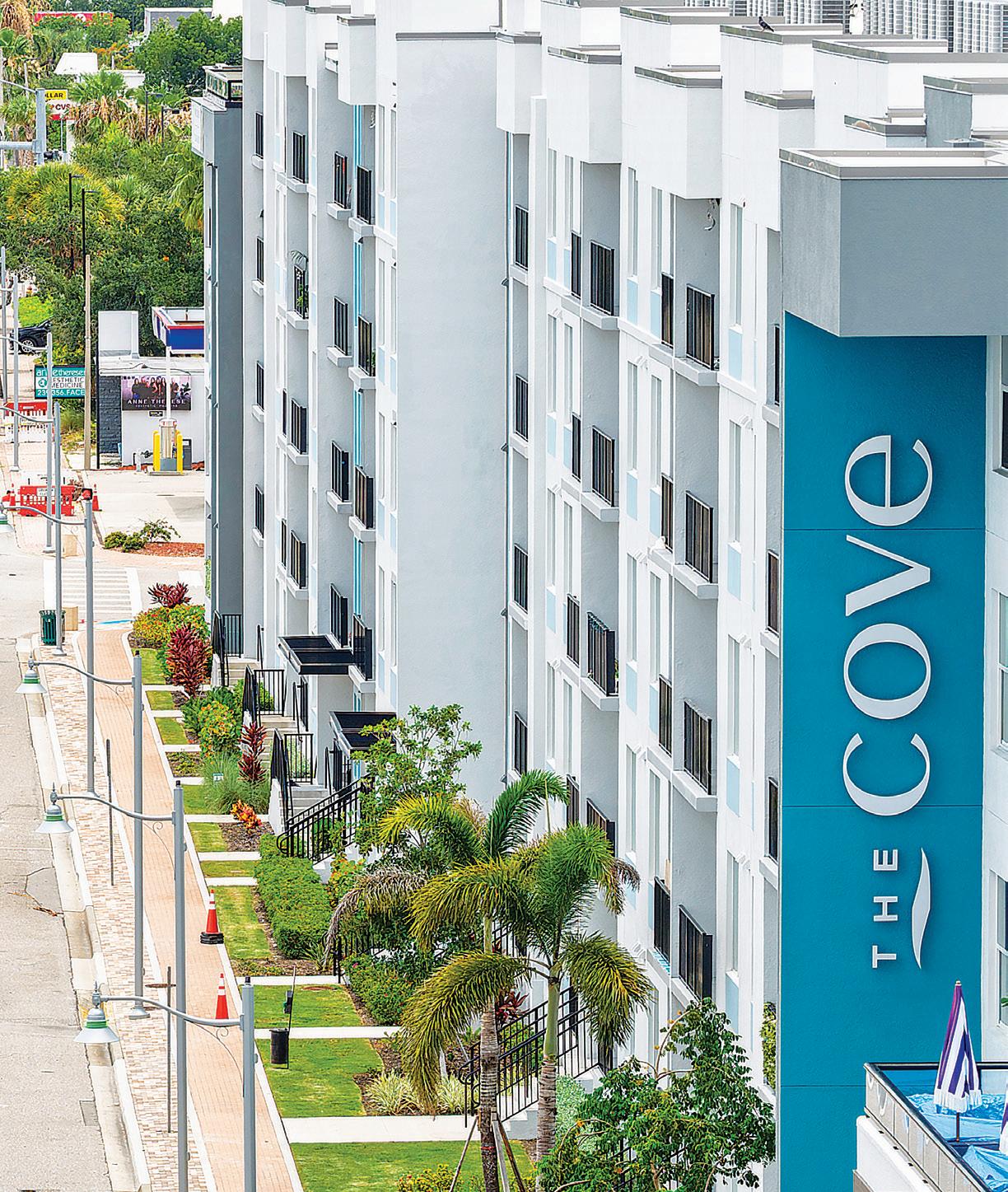
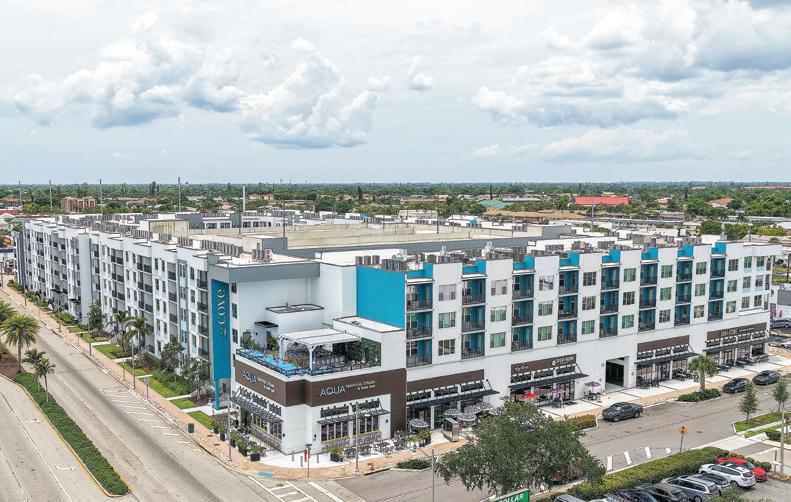
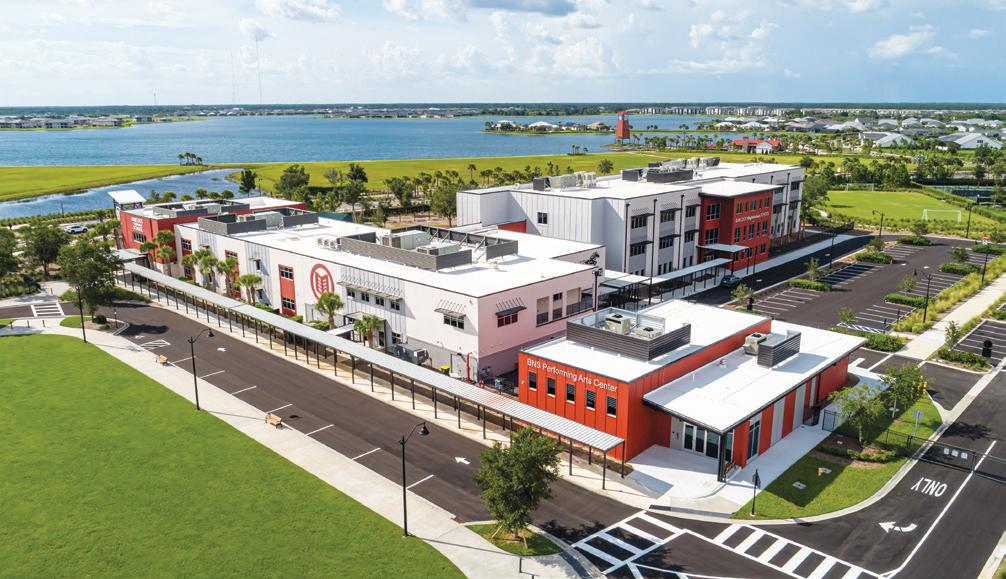
To attract renters, The Cove at 47th paired leasing incentives with a built-in restaurant row, creating a walkable mixeduse destination in downtown Cape Coral.
While the population grew by about 1.9% year over year from 2023 to 2024, per U.S. Census Bureau numbers, apartment units grew by 9.6% that same year, to a combined 53,430 units across a region with a population of about 1.3 million people.
“Rents were rising, vacancy was falling,” Taylor says of 2021. “What do I want to do? I want to fulfill that need. It just so happened that 15 other developers thought the same thing.”
In 2025 in Lee County, developers completed a record 4,330 new apartment units, according to CoStar data. That’s up 17% from the previous record, 3,696 units completed in 2024, which was up 82% from the 2,031 completed in 2023.
In 2025 in Collier County, there were 982 new units, a 12% increase from the 878 in 2024, which was a 77% increase from the 496 finished in 2023. Collier County had a record 1,130 units delivered in 2022, with a 310-unit complex in Ave Maria and 265unit Hammock Park accounting for a large portion of that record.
In 2025 in Charlotte County, there were 341 new units completed, a 36% decrease from the 533 finished in 2024.
Charlotte County set a record with 1,027 new units built in 2023. The massive jump can be attributed to three new complexes of almost 300 units each: Livano Charlotte Harbor, Babcock Ranch and Jacaranda Apartments.
The market correction signals business as usual, said Phil Fischler, who as president and founder of Fischler Property Company in Fort Myers brokers land for multifamily projects.
“From a long-term market perspective, the apartment sector is doing exactly what it does after a period of rapid growth,” Fischler says. “It pauses and recalibrates. The current increase in vacancies is giving renters more options and better deals today, and based on decades of market cycles, this is a healthy adjustment that sets the stage for a more balanced and stable market as the region continues to grow.”
“It’s like standing on your tippy toes at a parade. It works well until everyone else does it.”
– Nelson Taylor
Three years ago, numerous apartment developers all put their chips into the same place, Taylor says.
“It’s like standing on your tippy toes at a parade,” Taylor says. “It works well until everyone else does it. Someone stood on their tippy toes to have a better view. Everyone else wanted to capture that view. You will now see the tapering off of new supply moving forward. What we saw was too fast of a run-up. Now we’re seeing the correction.”
Upsides of a Renter’s Market
While that correction can create speedbumps to further development, it smooths the pavement for people looking to pay less in rent.
“Do we want to be rent burdened in this area?” Taylor says. “Or do we want to have disposable income? Retail, restaurants, food, experience. What seems like a negative, it’s more of a positive.”
Chase Mayhugh, president and CEO of Mayhugh Commercial, a property brokerage company, said softening interest rates and the single-family home market also are factors in apartment vacancies.
“The multifamily sector is also competing against other forces,” Mayhugh says. “Easing home prices have lured some renters into homeownership, while others, especially young families, are relocating to more affordable markets altogether. These shifts are shrinking the tenant pool just as supply hits new highs.”
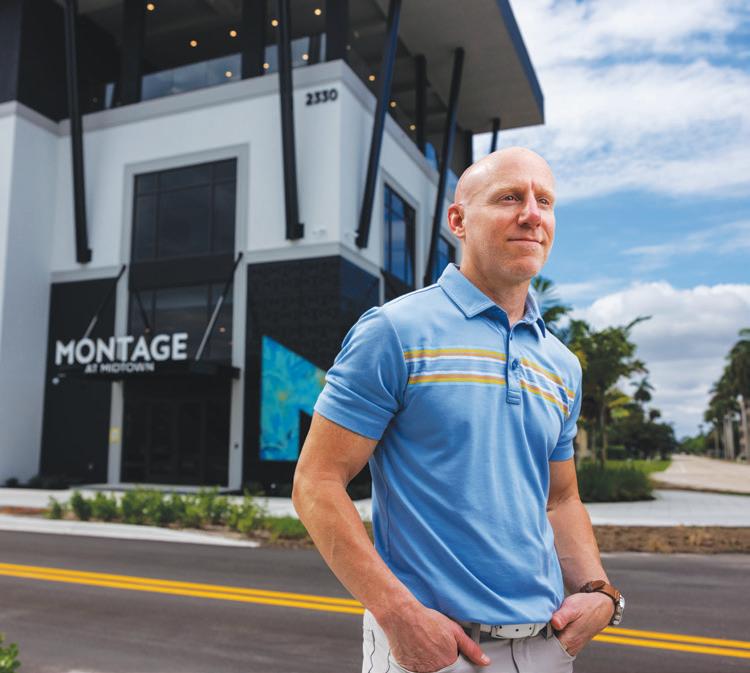
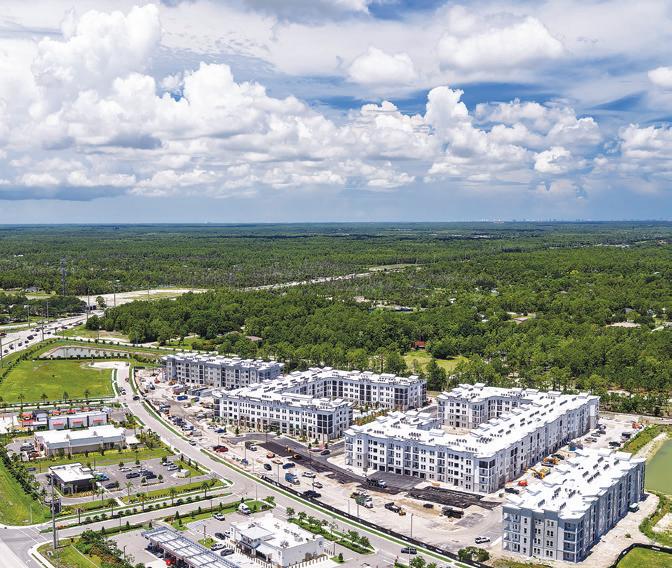
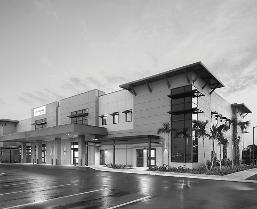
Developer Joe Bonora is leasing Montage at Midtown (opposite page) while planning the redevelopment of the former News-Press newspaper’s office, remaining active despite a slowerpaced apartment market.
Joe Bonora knows the trends. As founder and president of Catalyst Development, he developed CityWalk before selling it. He’s leasing his latest project, Montage at Midtown, and beyond that, he’s planning to redevelop 2442 Dr. Martin Luther King Jr. Blvd., former home of The News-Press newspaper’s offices and now an empty printing press facility.
Brian Tietz; LSI Companies
“Overall, compared with previous projects over the past 12 to 15 years, I expect our leasing velocity will be slower, just given the inventory on the market,” Bonora says of Montage at Midtown. “But absorption is still strong. We had a market study done not too long ago, and it showed absorption aligned with supply. Meaning, there’s still a lot of demand for apartments. There’s just a lot of supply.”
The high vacancy rates aren’t all doom and gloom from the perspective of a developer, Bonora said, just as they’re not all bright and sunny from the perspective of a renter. He cautions against taking the vacancy numbers at face value. The overall rate blends newly opened buildings — which may sit at 30% vacancy simply because they haven’t had time to fill up — with established complexes running at 95% occupancy. The result is an average that looks worse than the stabilized market actually is.
“I think the vacancy rates tend to be misleading when you look at the data,” Bonora says. “When you’re averaging all the apartments and there’s a 20% vacancy rate, that’s not indicative of stabilized apartments. It’s pulling from all of the open leasing apartments.”
Bonora said he has no regrets about building the 321-unit Montage at Midtown amid the current high vacancy rates. He said most of the next wave of apartments being built in Lee County will be workforce and affordable units using federal government funds distributed after Hurricane Ian.
“We started construction two years ago knowing there was a lot of supply,” Bonora says. “But also knowing that, as you get into 2027 and beyond, it’s not like these things get built overnight. What you’re seeing now is a result of the past two or three years.”
Rent Wars
Cape Coral luxury complexes compete with concessions and amenities amid rising vacancy rates.
Cape Coral exemplifies what happens when two luxury apartment complexes get built just as demand falls and supply rises.
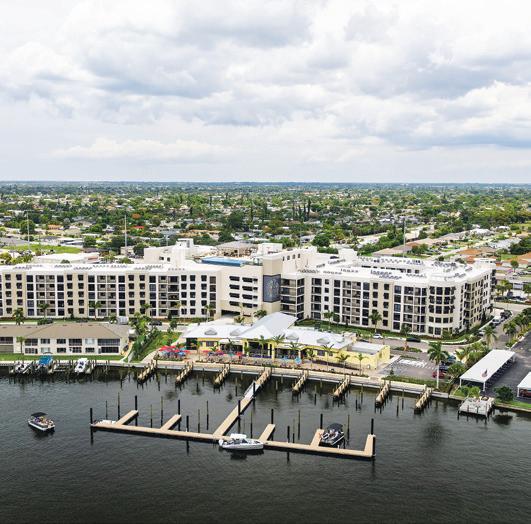
Located about half a mile apart along Cape Coral Parkway, The Cove at 47th and Bimini Square are courting similar customers, with the latter pricing above market rate and featuring amenities including a fifth-floor rooftop infinity pool overlooking adjacent Bimini Basin and an on-site Lee Health clinic.
The Cove at 47th rents start at $1,915 for a two-bedroom, two-bath unit with 979 square feet; Bimini Square rents start at $2,640 for a two-bedroom, two-bath unit with 1,146 square feet. That’s $1.96 per square foot at the Cove as compared to $2.30 per square foot at Bimini Square, about 17% more.
Both complexes began the year by offering two to three months’ free rent, depending on the lease terms. The Cove at 47th sweetened the
deal by offering free tolls over the Cape Coral Bridge.
Flaherty & Collins, based in Indianapolis, developed 327 units at The Cove at 47th. It builds apartments across the upper Midwest, making The Cove its first foray not just into Cape Coral, but into Florida.
“This was one where we were connected with the community,” says Robert Flaherty, CEO of Flaherty & Collins.
“We recognized the demand at the time. We saw this as a great
opportunity, jumping on the growth of the area, record-low vacancies. We wanted to be a piece of that with a shared vision with the city.”
Flaherty recognized the irony of vacancy rates shifting from record lows to record highs concurrent with construction of The Cove.
“The true secret to affordability is delivering more units,” Flaherty says. “That’s applicable across the nation. Right now, Southwest Florida is a good case study of
what happens when you do increase the supply, and what that does for affordability.”
The Cove also furthered its connectivity to Cape Coral by incorporating a restaurant row: Aqua Seafood Steaks & Raw Bar, Big Nick’s BBQ, Seed & Bean Market and Oak & Stone are located in a row along SE 9th Place. They are sandwiched between Cape Coral Parkway and 47th Terrace, just beneath the apartments.
“It’s unique in the market,” Flaherty says. “You can go to Aqua and get a rooftop dinner. We like how that carves us a niche in the market.”
Crown Development, based in North Dakota, developed its own niche at Bimini Square, just down the road. There are 218 units, with 20 reserved as workforce housing for Lee Health employees.
“You have to look at the niche you’re going after,” says Larry Nygard, president of Crown Development. “If you go after
Brian Tietz
that niche, I think there are still opportunities out there. On a macro level, there’s going to be some pain in the market. But that doesn’t mean we’re not looking at doing more projects in the Cape Coral-Fort Myers area.”
Crown Development also built The Club on Pine Island, a 195-unit complex at 315 SW Pine Island Road. A two-bedroom, two-bath unit with 1,169 square feet starts at $1,499 per month with up to two months free.
“We finished that in mid-2024,” Nygard says. “That one sits today at 94% leased. That’s a market niche that we went after at
the lower end of the spectrum. I think we met all the marks on that one.
“Bimini Square, I put that on the exact other end. Bimini Square isn’t a livework kind of place. It’s a lifestyle choice. Every one of the tenants could have lived in a house or a condo. They have their choice to pick from. Why would they pick Bimini Square? It’s highly amenitized. It’s very convenient. It’s got the same things they’re used to seeing in their homes.”
Nygard said he has no regrets about building apartments at either end of the spectrum, from market-rate to luxury.
“Every ‘up’ creates a down opportunity, and every ‘down’ creates an up opportunity. That’s the cycle.”
– Larry Nygard
“What is your objective when you build an apartment?” Nygard says. “Is it to fill it up and sell it? That’s being a merchant builder. We were and are inundated with merchant builders. They want to build something. They want to stabilize it, which is fill it up. Once they get it built and fill it up, they try to find investors.”
But Nygard said his company doesn’t tend to do that.
We’ve seen these ups and downs as kind of hiccups. Every ‘up’ creates a down opportunity, and every ‘down’ creates an up opportunity. That’s the cycle.”
Flaherty & Collins sometimes sells its assets. But not The Cove at 47th, at least not now.
Bimini Square offers an amenity-rich lifestyle in downtown Cape Coral, with 218 apartments, including workforce housing reserved for Lee Health employees.
“Those kinds of guys, they’re in a tough spot right now,” he says. “There are not a lot of buyers out there today at the prices they need to get out of it.
“The other owner is kind of a guy like me. I’m always building with the idea I’m going to hold long-term.
“As operators, we’re looking to buy time,” Flaherty says. “It’s all about getting through this wave of oversupply. Because the underlying trend in Cape Coral and Southwest Florida of population growth, lifestyle and regional connectivity, those are all still there.
Those aren’t going away. This is a tight window. Real estate is cyclical. It’s all about getting through it to the next cycle.”
East Side Story
Developers see long-term opportunity in eastern Collier County despite today’s softer apartment market.
Rail Gauge Partners became a “new kid on the block” in more ways than one in developing the first apartment complex of its kind in eastern Collier County.
In cooperation with TDK Companies, also an apartment developer, Rail Gauge Partners’ first multifamily project won’t just be in Collier County—it will be off Immokalee Road near Oil Well
Road. The first residents of the 400-unit Vintage Naples complex were scheduled to begin moving in around the time this issue of Gulfshore Business landed in mailboxes.
“We felt like it is smack dab in the path of growth,” says Zach Schaumburg, founder and partner of Rail Gauge Partners. “There’s more significant
development even farther east and more inland than we are.
I can make the case Naples is far from the wealthy beach community it once was. It’s a much more vibrant community.”
Schaumburg also studied the lay of the land.
“Entitlements in Florida and Collier County are generally difficult,” he says. “It’s tougher for additional
“The true secret to affordability is delivering more units.”
– Robert Flaherty
development to come in after us. It provides barriers for entry for other folks.”
The previous landowners did the heavy lifting of getting the land properly zoned and entitled.
Using the Live Local Act, the developers received permission to build 400 units on the condition that 10% of them, 40, would be workforce housing units. Those must be rented to households making 80% or less of the area median income.
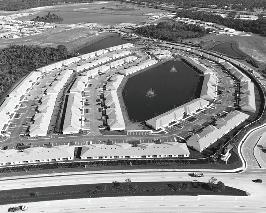
Vintage Naples, a 400-unit apartment community developed by Rail Gauge Partners and TDK Companies, is among the latest projects rising along one of Collier County’s fastestgrowing corridors.
The retail components and a nearby Publix grocery store, plus a litany of other quick-serve restaurants that are all new construction, serve as nearby amenities for newcomers, Schaumburg said, given the development’s 9-mile distance from Interstate 75.
“There’s some walkability,” he says. “That’s why we were attracted to it.”
Sonja Clark; Brian Tietz; Adriana Nelson
Rent in the Ranch
Babcock Ranch broadens its housing options with apartments and rental homes.
Babcock Ranch, which bills itself as “America’s First Solar-Powered Town,” now has another first: an apartment complex.
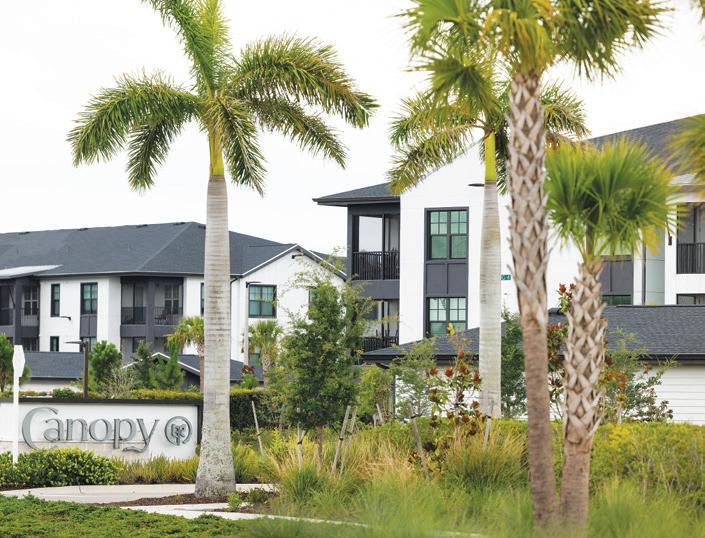
Canopy at Babcock Ranch, developed by Indianapolis-based Milhaus, has 373 units and began to take shape after Babcock Ranch sold 17 acres to Milhaus for $7.7 million in December 2021.
Leasing began in December 2023, and occupancy has reached about 85%, nearing the industry goal of exceeding 90%.
Building an apartment complex in a town known more for single-family homes made sense, said Adriana Nelson, vice president of multifamily for Kitson & Partners. She said in offering apartments in addition to the single-family homes it’s known for, Babcock Ranch can offer a more complete community.
“The people who come to Babcock Ranch to work, those people need housing but maybe they don’t want a permanent
home,” Nelson says. “We wanted to give them the opportunity to rent. We need to account for all of the demographics that will come to the city.”
Canopy won’t be the only option, either. Babcock Ranch is developing B Street, which will combine retail with a 140-unit, one- and two-bedroom apartment complex spread across two four-story buildings.
“It’s going to be a small community, but it’s going to be two buildings, four stories
“We need to account for all of the demographics that will come to the city.”
– Adriana Nelson
each,” Nelson says. “Between the two buildings, there’s going to be a clubhouse with a pool and different amenities. There will be a hub for retail and office space. Our headquarters are also here on B Street.”
Another option for renters: Flatwoods at Babcock Ranch.
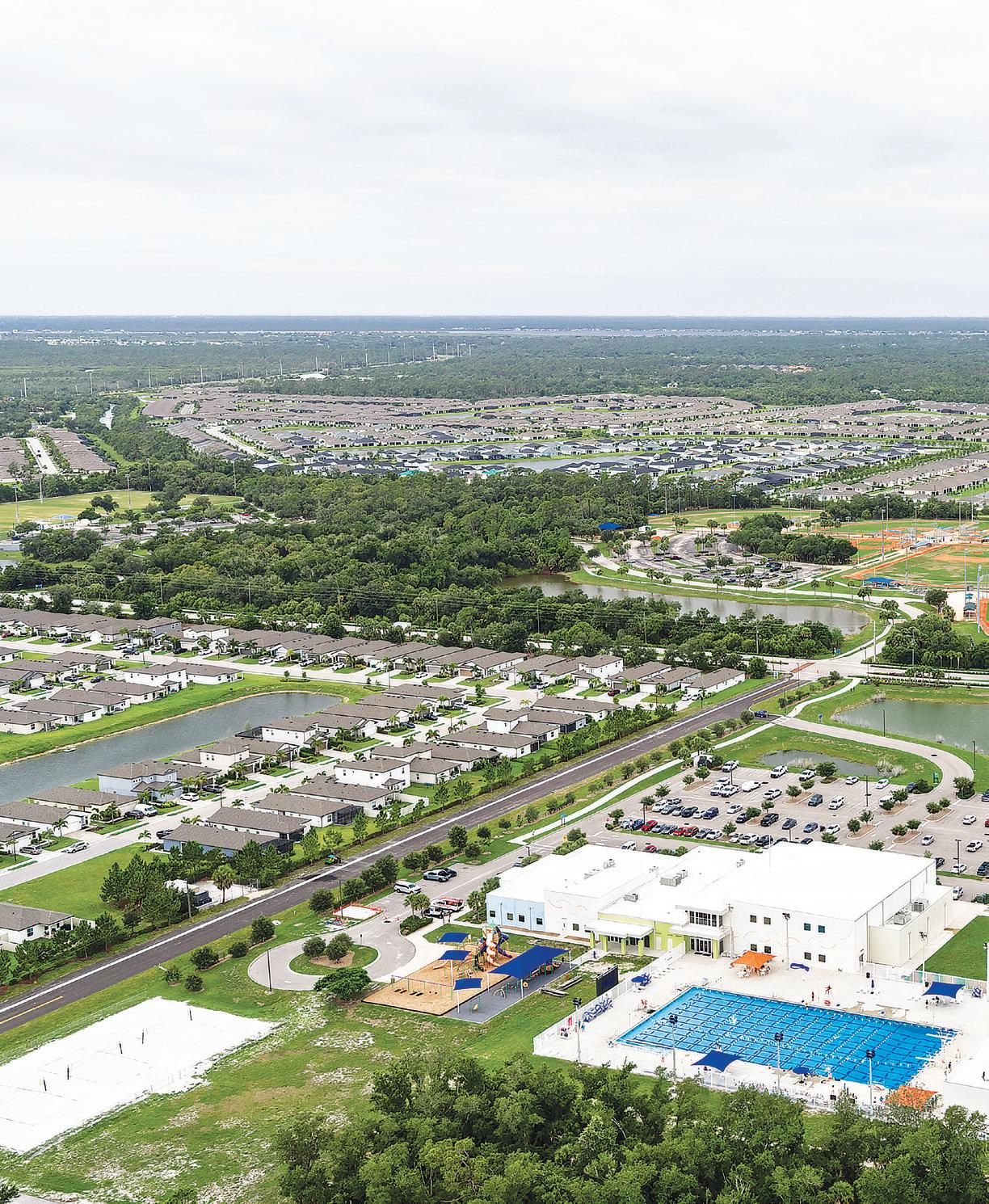
“Those are single-family home rentals,” Nelson says. “There are 246 of them. They each have a private backyard and by fall should be nearing 100% leased.”
Flatwoods has a two-month free special with a $1,000 bonus and an additional $500 monthly discount for teachers, firefighters, police officers and paramedics.
Canopy at Babcock Ranch adds 373 apartments to the growing solarpowered town, helping expand housing options beyond its traditional single-family home offerings.
“I would say that Babcock Ranch has a lot of elements,” Nelson says. “It’s one of the fastest-growing communities in Florida. It’s master-planned. At the same time, we’re trying to build a city. We need to have all kinds of uses here. This is where infrastructure, employment and quality of life converge.”
CHARLOTTE AT
POPULATION GAINS ARE CREATING NEW OPPORTUNITIES AND NEW STRAINS
Brian Tietz
A CROSSROADS
AS COUNTY LEADERS PREPARE FOR DECADES OF FUTURE GROWTH
BY NANCY SEMON
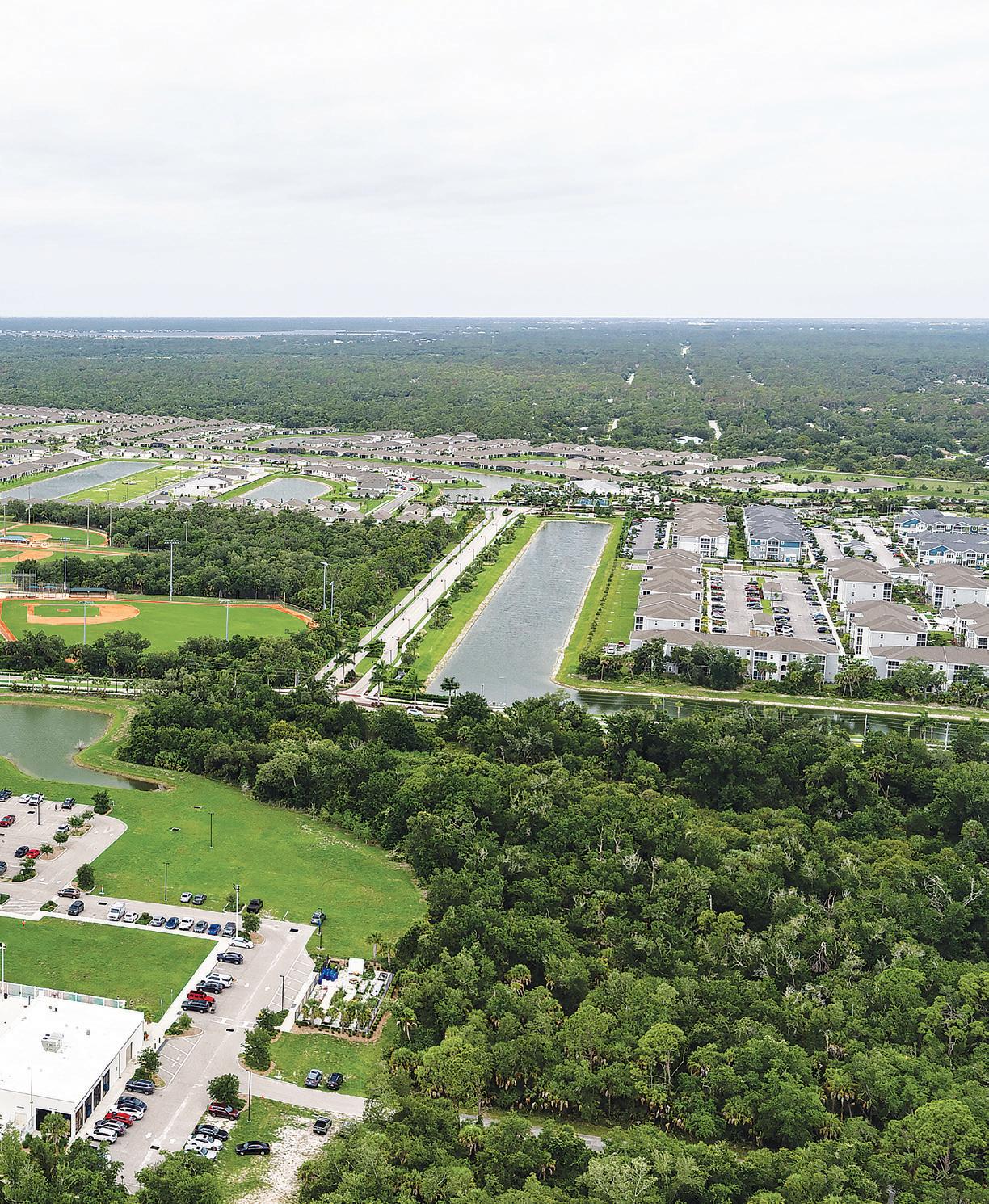
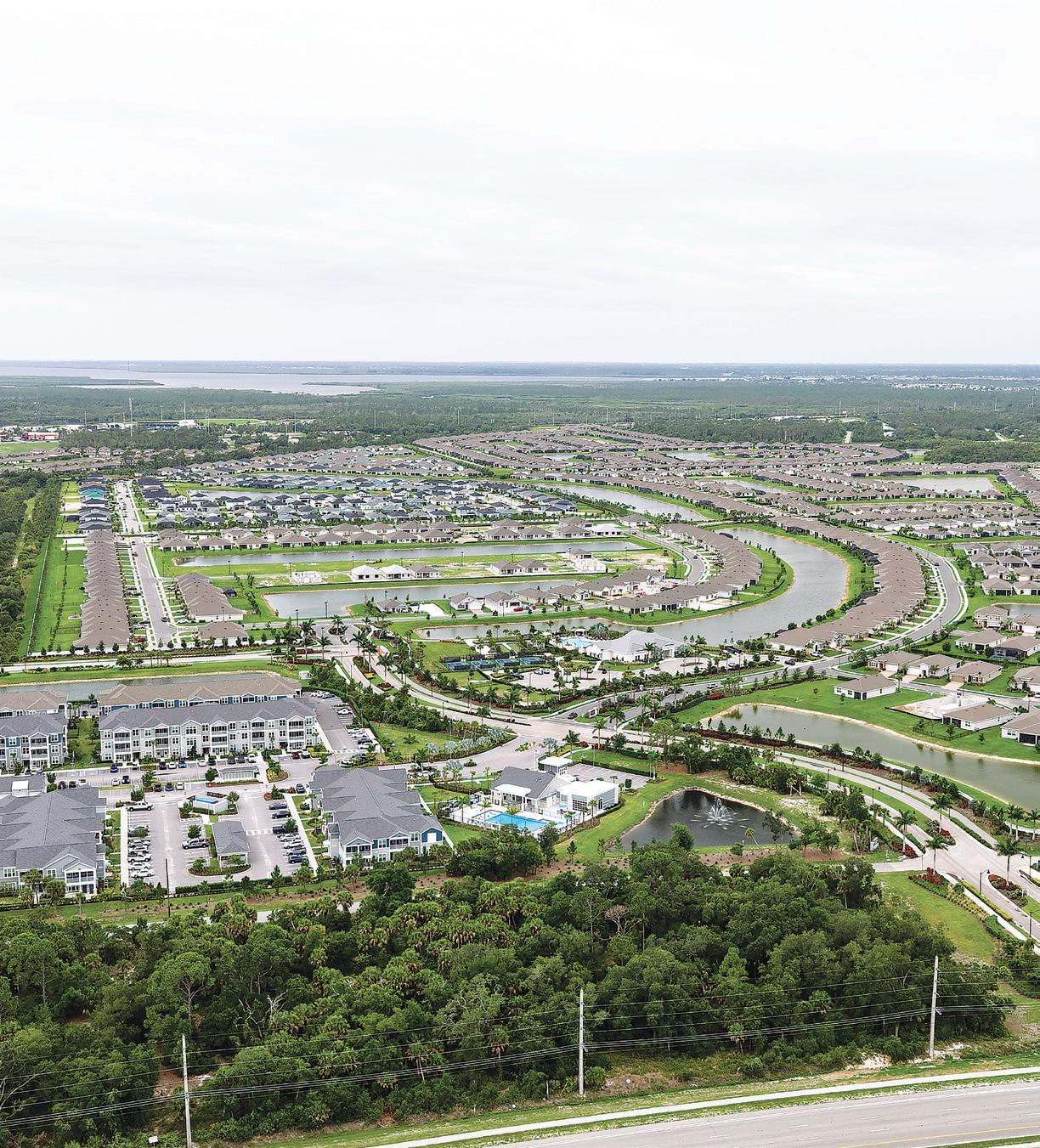
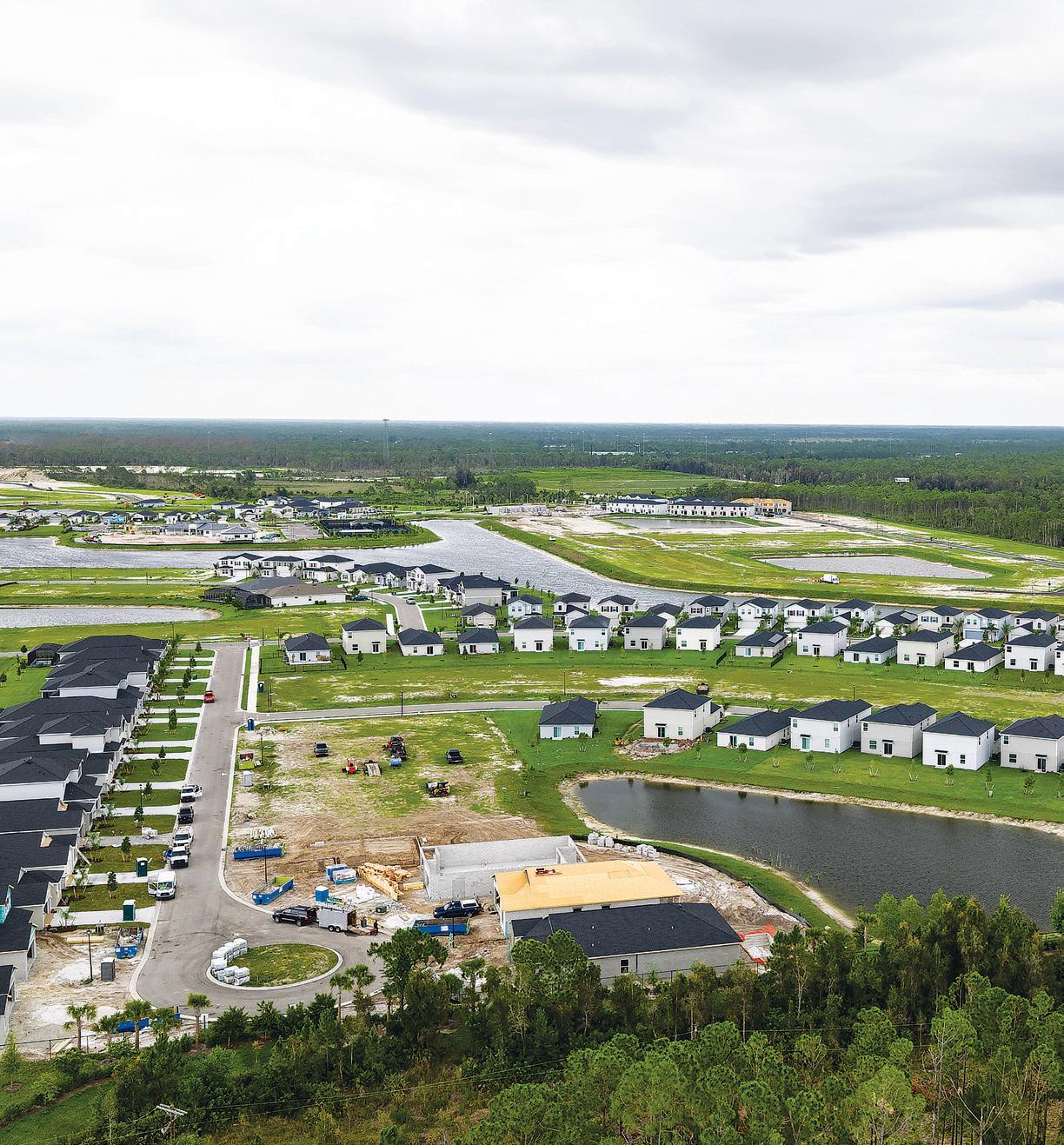
Charlotte County is in the midst of growing pains. Although the influx of new residents has slowed since the COVID-19 pandemic, migration from other states continues to strain infrastructure and services, prompting officials to revise plans for future needs.
The county’s population grew by nearly 10,000 residents between April 2024 and February 2025, increasing from 212,424 to 224,147.
According to the U.S. Census Bureau, the Punta Gorda Metropolitan Statistical Area, which encompasses all of Charlotte County, is consistently ranked among the fastest-growing areas in the U.S. and was the fifth fastest-growing metro region in 2024-25.
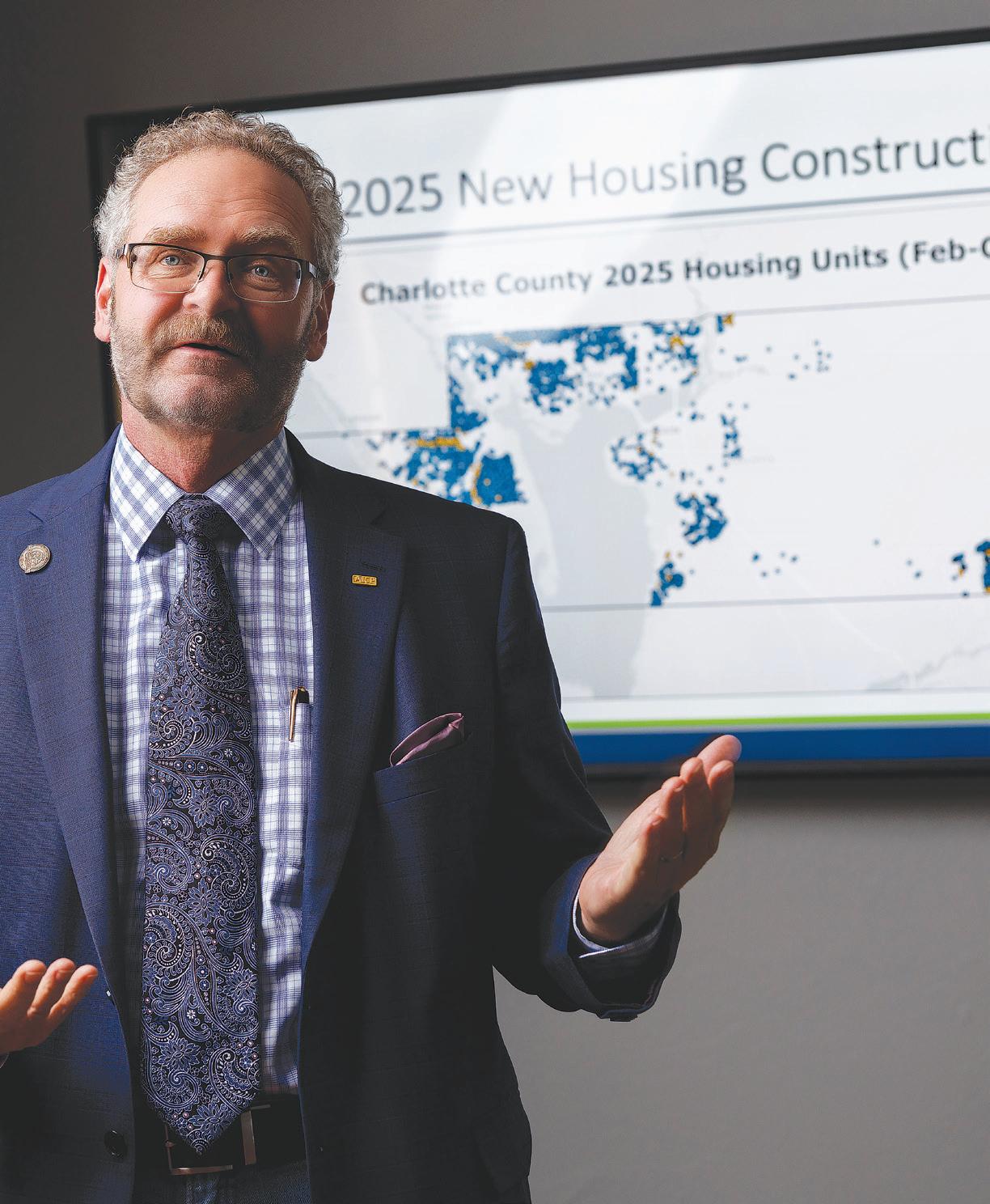
To prepare for future population growth, the county hired Bonita Springs-based Metro Forecasting Models to conduct a study. Its consultant found the county’s rapid growth had reduced service levels and increased demand for new facilities — including fire stations and libraries — and for more first responders and law enforcement. In just seven months, the county’s population grew 5%, from 224,147 residents in February 2025 to 235,255 in October 2025; emergency services received 11 more calls a day.
David Farmer, CEO and co-founder of the firm, presented the study’s findings before the Board of County Commissioners in December, saying he was surprised by the results. In nearly two-and-a-half years, from June 2023 to October 2025, the county’s population increased 16.9% — the amount of growth the county normally would experience in a decade.
The report also projected significant housing growth.
“At full buildout, the study area has the potential for nearly 280,000 housing units, more
“At full buildout, the study area has the potential for nearly 280,000 housing units, more than double the existing number of housing units.”
– David Farmer, Metro Forecasting Models CEO and co-founder
Charlotte County officials are planning for future growth
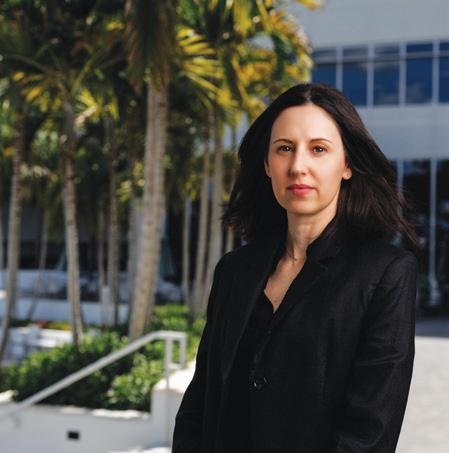
after a recent study conducted by David Farmer’s Metro Forecasting Models found population gains are outpacing infrastructure and service capacity.
CHARLOTTE AT A CROSSROADS
than double the existing number of housing units,” he said.
Between 2025 and 2030, approximately 17,000 more housing units are expected, and by the end of September 2025, the county had 134,690 residential units.
When the population increases by another 33,000 residents — a milestone projected to be reached around 2030 — the county will need at least two new fire stations, two new neighborhood shopping centers, one new community shopping center, one new community park and one new library. Farmer said if growth continues without those investments, the county will fall short by three to four fire stations.
Water treatment, wastewater and reverse osmosis facilities already are being expanded or are slated for future expansions and improvements in a county that has suffered one of the worst droughts in years: As of May, Charlotte County and Southwest Florida were experiencing an extreme drought, with 100% of Charlotte County affected.
Recognizing the need for more infrastructure and services, county commissioners placed a referendum on the November ballot asking voters to approve a 20-year extension of the 1% local option sales tax to fund countywide capital improvement projects, including expansions of the county’s water and wastewater systems.
Shaping a Retirement County
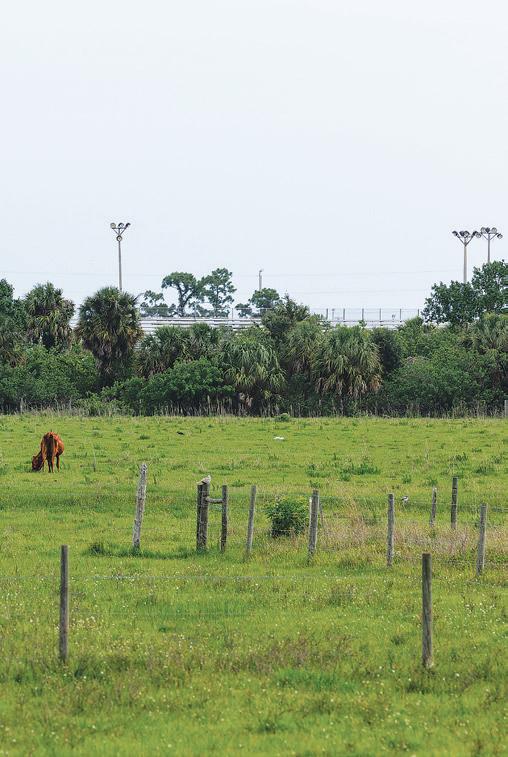
One of Charlotte County’s frequent points of criticism is the lack of large land parcels zoned for commercial and industrial development in many parts of the county — a problem that began when early developers platted much of the county into small residential lots.
Author Jason Vuic writes in The Swamp Peddlers that Port Charlotte lots were nationally advertised in various publications. The ads promised that for $10 down, purchasers
Brian Tietz
Water treatment, wastewater and reverse osmosis facilities already are being expanded or are slated for future expansions and improvements.
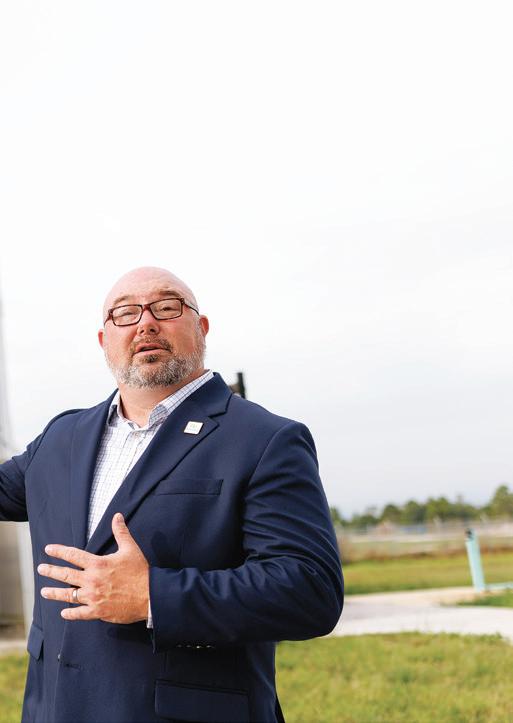
Punta Gorda Utilities Director Tom Spencer stands at the Shell Creek Reverse Osmosis Plant, part of Charlotte County’s expanding water infrastructure network designed to meet the demands of rapid growth and prolonged drought.
could choose an 80-foot-by-125-foot homesite for $895. Thousands of these platted lots were sold, and Charlotte County began to be known as a retirement community because there was little industry and few employers. Today, residents 65 and older comprise 40.6% of the population, with a median age of 60 years.
As the population surged over the last several years, demand has grown for more local and higher-paying jobs, in addition to land on which to build commercial and industrial facilities. But the lack of buildable land remains a problem. About 42% of Charlotte County’s 444,160 acres is in conservation under the authority of state, federal and local governments and private entities, according to Florida State University’s Florida Natural Areas Inventory study. It is ranked No. 11 out of the state’s 67 counties for the amount of land set aside for conservation, an issue that has been important to county voters. In 2006, voters approved a $77 million bond referendum to purchase environmentally sensitive lands with a program targeting 20 years of funding through 2027.
As more people moved into the county, remaining parcels of land were developed for residential housing, and residential growth outpaced commercial development. County officials now are working to achieve a balance, but as of 2025, residential properties continued to represent a significant portion of the county’s tax base.
Between the county’s abundance of platted residential lots and conservation areas preserved in perpetuity, the number of large land parcels zoned for commercial and industrial development is limited. The exceptions are ar-
Future Shopping Center Locations
“The goal is not just to grow but to grow in a way that creates meaningful career opportunities for our residents.”
– Kay Tracy, Charlotte County Economic Development Director
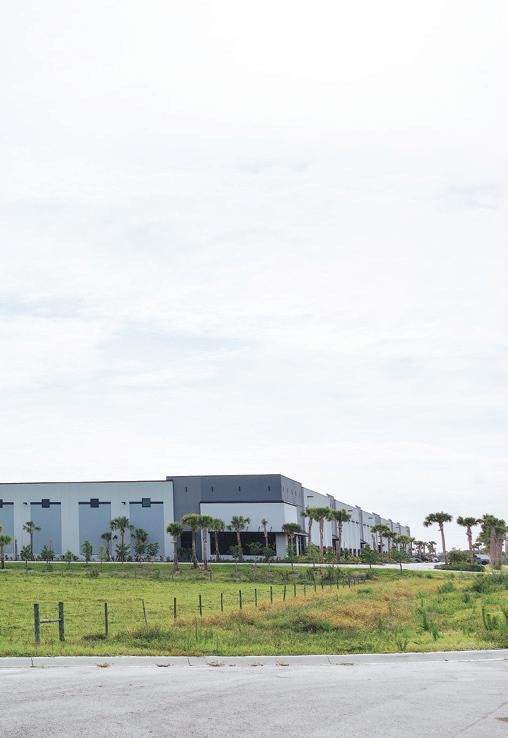
eas surrounding Punta Gorda Airport, which has a 4,380-acre mixed-use zoning district called Enterprise Charlotte Airport Park, and Babcock Ranch, whose developers planned for 6 million square feet of commercial retail and office space within the community’s 18,000acre development footprint.
Metro Forecasting Models recommended the county adopt policy changes permitting higher-density development near existing commercial and industrial employment centers, and reevaluate government facilities to maintain the county’s level of service. Farmer also recommended the county reserve more land for nonresidential uses or residents will take unnecessary trips on major corridors, increasing traffic congestion.
Farmer said many commercial entities have not yet recognized the population growth in Charlotte County, and that the available commercial square footage required for the growing population keeps falling as more residential communities are developed.
Economic Development Rises to the Challenge
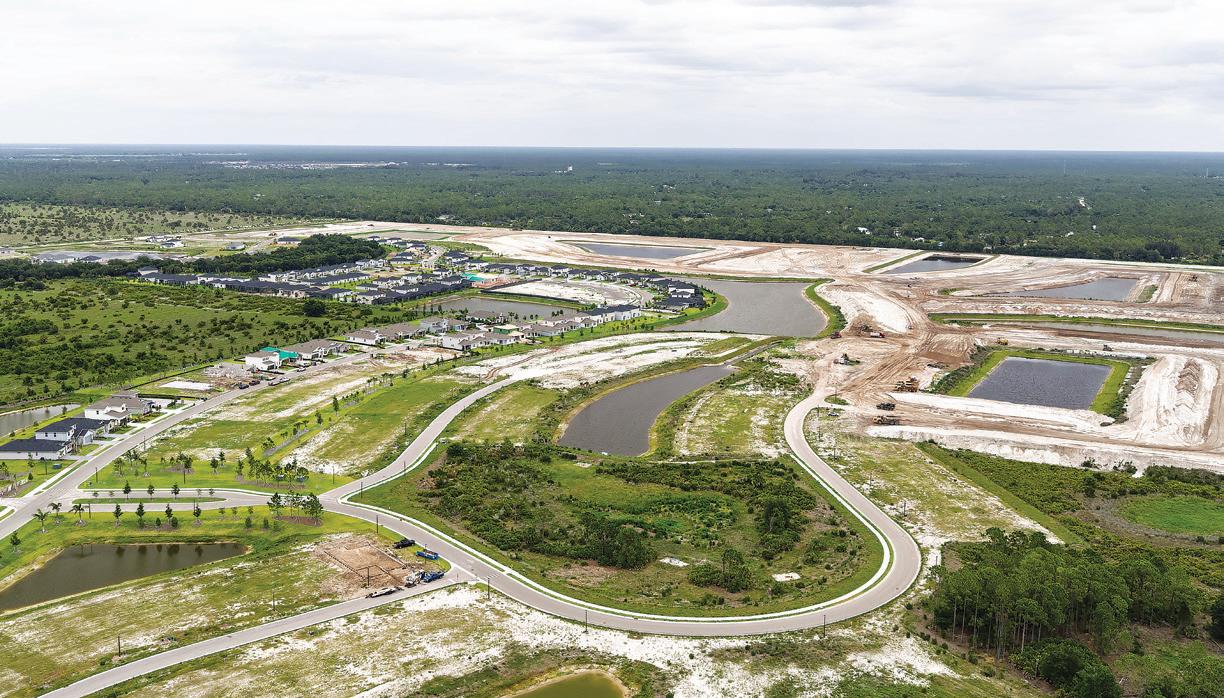
As Charlotte County’s population grows, planners say preserving land for commercial and industrial development will be essential to supporting jobs, reducing traffic congestion and maintaining service levels.
As the population has grown, major businesses and manufacturers have also begun to take notice of Charlotte County, a trend welcomed by Economic Development Director Kay Tracy. She said the county’s location and relative affordability compared with neighboring counties are factors, but a combination of elements is driving the momentum.
“We offer strategic access to Interstate 75 and regional markets,” she said. Tracy also cited available land for development, a growing population, educational opportunities, highwage and diverse employment opportunities and quality of life as contributing factors. She
Brian Tietz
In nearly two-and-ahalf years, Charlotte County grew 16.9% — growth that normally would take a decade.
has been working to attract manufacturing, warehousing, flex-use and industrial firms to the county.
The largest concentration of industrial-zoned land in Charlotte County is located near Punta Gorda Airport and Jones Loop Road in unincorporated Punta Gorda, an area Tracy said presents a major opportunity for future economic growth. She also said the airport corridor is well suited for a mix of industrial, logistics, aviation-related and commercial development.
In the near future, Tracy said, residents can expect continued site preparation, infrastructure investment and growing interest in the Jones Loop area near Punta Gorda Airport from businesses, such as aviation maintenance company NAS MRO and healthcare provider AdventHealth, which value the area’s proximity to I-75 and the airport. Among the recent large land purchasers on Jones Loop Road is Amazon, which purchased 233 acres near Punta Gorda Airport and Jones Loop Road for $20.1 million. While the retail giant has not disclosed exactly what will be built on the site, local officials anticipate it will serve as a logistics and transportation hub.
Enterprise Charlotte Airport Park and the surrounding Jones Loop area are attracting growing interest from businesses seeking access to Punta Gorda Airport and Interstate 75, positioning the area as a key economic engine for Charlotte County.
“From a workforce perspective, this growth aligns directly with our Careers on the Coast initiative, especially our From Classroom to Career education series, which is helping prepare local students for careers in aviation, logistics and skilled trades,” Tracy said. “The goal is not just to grow but to grow in a way that creates meaningful career opportunities for our residents.”
Looking toward the future, Tracy said she wants Charlotte County to continue evolving into a more balanced and resilient economy over the next five to 10 years. She said that includes expanding career pathways for stu-
Housing Forecast
CHARLOTTE AT A CROSSROADS
As residential development continues to dominate Charlotte County’s growth, officials are working to expand commercial opportunities and diversify the tax base.
dents and young professionals in advanced technology fields, such as cybersecurity and semiconductors.
Echoing Farmer’s recommendations, Tracy said there should be more workforce housing to support working families, along with “continued development that complements our natural environment and quality of life.” She added that attracting more young professionals and families to Charlotte County to build careers and long-term futures is just as important.
“Through our partnerships with Charlotte County Public Schools, Charlotte Technical College, Florida SouthWestern State College and Florida Gulf Coast University, we are building a strong pipeline from education to employment,” Tracy said. “Ultimately, our goal is simple: to ensure that as Charlotte County grows, our workforce, our economy and our community grow together.”
Meanwhile, Charlotte officials are preparing for the next 20 years. A recent advisory committee has recommended more than 40 capital projects to be funded by the 1% local option sales tax. County officials broke ground in May for two new fire and emergency medical services stations in high-growth areas of the county: Station 17, at Tucker’s Grade and U.S. 41, will serve South County, and Station 6 will serve the Cleveland area off U.S. 17, east of downtown Punta Gorda.
The county has already begun road-widening projects throughout the county, and a number of Farmer’s recommendations are on the list of projects earmarked for the future. Whatever that looks like for Charlotte County.
Growth in the Political Crosshairs
Some of Charlotte County’s recent growth has occurred along Burnt Store Road, which runs from U.S. 41 in Punta Gorda to Pine Island Road in Lee County. Residents along the Burnt Store corridor have attended Charlotte County Commission meetings urging officials to reserve more land for commercial development rather than residential use. A major complaint among corridor residents is that they have had to drive more than 8 miles round trip to reach supermarkets, stores, doctors, dentists and other service providers. Those concerns prompt-
ed resident John Fleming to co-found the Burnt Store Corridor Coalition several years ago. He recently announced his candidacy for the District 2 seat on the Board of County Commissioners in the Aug. 18 primary. He is challenging Dr. Chris Constance, who has held the position since 2010. Fleming, running on a platform opposing what he calls mismanaged growth and inadequate infrastructure planning, said the county’s current leaders have a build-first, fix-later mindset. Current commissioners, including Constance, have contended
that the county was platted for small residential lots decades before they were elected, and that property owners have the right to develop land they own.
In the city of Punta Gorda, the former City Council enacted new land development regulations that some residents claimed would result in taller buildings and higher density. The former council also planned to build a new City Hall rather than repair the existing building following Hurricane Ian in 2022. Critics called the proposed structure the city’s “Taj Mahal” and said it would be
a waste of taxpayer dollars. The opposition coalesced into a grassroots movement, and challengers ran against incumbents on campaigns focused on limiting higher-density growth, taller buildings and construction of the new City Hall.
Dr. Debi Lux defeated incumbent Mark Kuharski for the District 3 seat in the November 2023 election. A year later, Jeannine Polk, Greg Julian and Janis Denton defeated incumbents Donna Peterman, Bill Dryburgh and Mayor Lynne Matthews. Charlotte County’s growth also has caused friction between Lee and Charlotte county commissioners, with Lee officials blaming Charlotte County’s population surge for parking problems and clogged roadways caused by increasing numbers of Charlotte County visitors to Boca Grande. Lee officials also have blamed Charlotte County’s growth for increased traffic along Burnt Store Road, saying during a recent joint meeting between the two commission boards that one-third of Charlotte County’s workforce is employed in Lee County.
Although Charlotte County has widened portions of Burnt Store Road, Lee County is preparing to widen its section to accommodate increasing traffic along the corridor, which also serves as an evacuation route.
Metro Forecasting Models divided the county into six sections — West County, Mid County, Punta Gorda, Burnt Store Road, East County and Babcock Ranch.
Where Growth Is Headed Population Forecast
Most of the growth going into 2050 will be in Mid County and West County, but “Burnt Store Road is poised to really take off,” says David Farmer, the firm’s
CEO and co-founder. At buildout, Mid County and West County will have the largest populations. Shorter term, by 2030 the model shows Mid County
will have 120,080 residents, West County 63,248, Punta Gorda 26,987, Babcock Ranch 25,834, East County 21,774 and Burnt Store 10,675.
Southwest Florida’s
Best of Business 2026
Growth brings opportunity, but it also brings competition. As Southwest Florida attracts new businesses, new investment and new residents, standing out in the marketplace becomes increasingly difficult. Success requires more than keeping pace. It demands the ability to excel, adapt and continue earning the trust of customers, clients and colleagues.
That is what the Gulfshore Business Best of Business Awards are designed to recognize.
For the 14th consecutive year, Gulfshore Business invited readers to identify the companies they turn to, recommend and rely on most. Voting was conducted online, with participants required to provide their name and email address to help ensure each person could cast only one ballot.
The results represent the collective voice of our readers across 29 categories. In the following pages, you’ll find this year’s winners and finalists, businesses that have distinguished themselves in an increasingly competitive region and earned the support of the communities they serve.
We thank everyone who participated in the voting process and congratulate the businesses recognized in the following pages. These are the winners and finalists of the 14th annual Gulfshore Business Best of Business Awards.
Winner
Hissam & Associates
Accountants Inc.
Finalists
Cottrell Tax & Accounting LLC
Markham Norton Mosteller
Wright & Co.
Commercial Bank
Winner
Cogent Bank
Finalists
Edison National Bank
Sanibel Captiva Community Bank
Commercial Insurance Brokerage
Winner
Javed Kapadia, State Farm Insurance Agent
Finalists
Acrisure Naples
Chapman Insurance Group
Corporate & Business Law Firm
Winner
Bruce Green Law Firm
Finalists
ZinnLaw
Strayhorn & Persons-Mulicka
Aloia, Roland, Lubell LLC
Financial Advisory Firm
Winner
Moran Wealth Management
Finalists
Cogent Bank
Florida Trust Wealth Management
Chlumsky Wealth Management
Trust Company
Winner
Florida Trust Wealth Management
Finalists
FineMark National Bank & Trust
Northern Trust
Left to right: Brian Chapman, Janessa Weiland, Caleb Chapman
Hotel/Meeting Center
Winner
Hyatt Regency Coconut Point Resort and Spa
Finalists
Margaritaville Beach Resort Fort Myers Beach
Hilton Naples
AC Hotel Naples 5th Avenue
DoubleTree by Hilton Fort Myers at Bell Tower Shops
IT Services Contractor
Winner Naples Network Services
Finalists
CRS Technology Consultants
Maxeffect Computers & Communications LLC
Private Jet Service
Winner
PrivateSky Aviation Services
Finalists
Elite Jets
Outlier Jets
SWFL-Made Product
Winner
Norman Love Confections
Finalists
Wicked Dolphin Distillery
Naples Soap Co.
Travel Agency
Winner
MAD Travel/Travel Leaders
Finalists
Preferred Travel & Co.
America Travel Arrangements
Concierge Cruises Travel Agency
Variety Travel Management Services
Commercial Electrical Contractor
Winner B&I Contractors
Finalists
Division 16 LLC
Favazza Electric Inc.
Commercial HVAC Contractor
Winner B&I Contractors
Finalists
Caloosa Cooling
Sunset Air and Home Services
Conditioned Air
Crowther Roofing & Cooling
WHERE BUSINESS MEETS PARADISE
Margaritaville Beach Resort on Fort Myers Beach offers more than just meeting rooms – it delivers unforgettable experiences. Whether you’re planning a leadership retreat, corporate incentive trip, or annual sales conference, you’ll find flexible venue options, tailored service, and a laid-back yet energizing setting designed to spark connection and inspire big ideas.
As the largest independent day school in Southwest Florida, Community School of Naples offers students from Pre-K through Grade 12 a robust curriculum paired with exceptional opportunities in the arts, athletics, leadership, service, technology, and global learning.
Here, every student is known, challenged, and supported by dedicated faculty who inspire curiosity, confidence, and achievement. Grounded in Citizenship, Leadership, Scholarship, and Stewardship, CSN prepares students to realize their potential as engaged learners and responsible global citizens.
High Standards. High Support. Every Student, Every Day.
\We invite you to learn more. Contact the Office of Admissions to begin the conversation.
At Thrive Academy, students with ASD are understood, valued, and supported as individuals. Located in Cape Coral, Thrive Academy provides a structured and inclusive private school environment where students can grow academically, socially, emotionally, and independently. Serving elementary, middle, and high school students, the school offers individualized instruction, comprehensive student support, and a learning experience designed around each student’s strengths, needs, and goals.
Thrive Academy’s approach goes beyond the classroom, helping students build communication, confidence, independence, self-advocacy, and real-world skills for lifelong success. Through Workforce & Transition Services, students and young adults gain real-world experience, develop workplace readiness skills, explore meaningful career paths, and prepare for life beyond school. With strong family partnerships and individualized support, Thrive Academy creates a place where students are not only educated, but truly known, supported, and prepared to thrive.
For 30 years, First Baptist Academy has served the SWFL region as a premiere Christcentered, college preparatory school, educating nearly 900 students annually from preschool through high school. Our FBA students have unparalleled opportunities to excel in academics, athletics, and fine arts. We recognize each child is created with a unique personality and purpose, and our dedicated teachers provide an environment where every child is engaged and challenged to grow daily in their faith, knowledge, and talents. Applications for the 2026-2027 school year will open on November 10th, 2025. We welcome you to tour our campus and learn more about being part of the FBA family.
Royal Palm Academy is an independent Catholic Pre-K3 to 8th grade school that provides a rigorous education, partnering with families to teach the mind, educate the heart, and form the character of tomorrow’s leaders. We create a supportive environment where students explore their interests, find joy in learning, and grow in confidence. Our challenging curriculum fosters academic excellence and inspires each student to reach their highest potential. By partnering closely with parents, we support every child’s academic, social, emotional, and spiritual needs, ensuring they are well-prepared for lifelong success. Discover an education that forms compassionate, driven, and successful individuals. Come see where students thrive!
6000 Goodlette-Frank Rd N. Naples, FL 34109 (239) 325-2123 TVSNaples.org
Head of School:
Dr. Jeffrey J. Cavallo
At The Village School of Naples, we believe schools are more than buildings, they are people. They are teachers who inspire, coaches who build character, students who lead with compassion, and families who partner in a shared mission. As a faith-based PS–12 school and a three-time AP Platinum Honor Roll recipient, we combine academic excellence with character development in an environment where every child is known, nurtured, and loved. Small class sizes, individualized instruction, weekly chapel, and Christ Skills prepare students not only for college, but for lives of purpose, integrity, and service. Discover a community where innovative education meets timeless values. Schedule your private tour today.
Bishop Verot Catholic High School
5598 Sunrise Drive Fort Myers, FL 33919 (239) 274-6700
bvhs.org
Principal: Suzie O’Grady, MPA, S.Ed.
Director of Admissions: Patty Holmes
Founded in 1962, Bishop Verot Catholic High School educates the minds and hearts of all students in an innovative and community-centered learning environment, preparing them for lives of faithful service to the teachings of Jesus Christ. Our rigorous college preparatory curriculum prepares students for success in college, earning them over $16 million in scholarship offers annually. With over 28 different competitive sports and 30 extra-curricular clubs and activities offered, students are able to build an impressive resume for the college application process as well as learn valuable social and time-management skills. Bishop Verot utilizes state of the art technology and has been recognized by Apple as a distinguished school for continuous innovation in learning, teaching, and the school environment. The implementation of a Community/ House system has not only enhanced the community of Bishop Verot, it offers numerous student leadership opportunities. Schedule a private tour today to learn more about Bishop Verot Catholic High School and joining the Verot family.
Canterbury School
8141 College Parkway Fort Myers, FL 33919 (239) 481-4323
canterburyfortmyers.org
Head of School: Rick Kirschner
Canterbury School is Southwest Florida’s premier Pre-K3 through Grade 12 independent college preparatory school, built on a foundation of academics, leadership, character, and service. With exceptional faculty, a strong honor code, and a vibrant community, our students consistently outperform their peers on college entrance exams and thrive at top universities. Visit our website to schedule a tour or join us for an upcoming Open House.
Evangelical Christian School
8237 Beacon Blvd.
Fort Myers, FL 33907
(239) 936-3319
goecs.org
Head of School: John M. Hunte
Evangelical Christian School was founded in 1973 with the mission to provide students in preschool through grade twelve an excellent academic education in an environment that honors the Lord Jesus Christ and to challenge students to reach their highest potentials mentally, physically, socially, and spiritually.
In 2024, we expanded to two campuses, with the Beacon Campus for Preschool – 8th Grade and the Colonial Campus for 9th – 12th Grade. We are Sentinels with two campuses, one family, and one faith in our Lord Jesus Christ.
ECS Sentinels are encouraged to strengthen skills and build confidence through various athletics, art, and extracurricular clubs and programs. ECS is a member of the Florida High School Athletic Association (FHSAA) and offers a competitive athletic program with twenty different sports for boys and girls in 6th through 12th grade. Our Fine Arts Department has award winning music, theatre, and art programs, as well as concert band and orchestra.
We want to meet you and share the ECS experience! Please contact Melissa Bizier at mbizier@goecs.org to schedule a tour of our campus.
Southwest Florida Christian Academy
3750 Colonial Blvd.
Fort Myers, FL 33966
(239) 936-8865
sfcakings.org
Head of School: Mrs. Lisa Kleinmann
More Than a School
For more than 30 years, Southwest Florida Christian Academy has been more than a school—we are a Christ-centered community where students are known, encouraged, and equipped to thrive. Through rigorous academics, innovative STEM programs, fine arts, athletics, and leadership development, students discover their God-given gifts while building a strong foundation of faith and character. At SFCA, education extends beyond the classroom, preparing students not only for college and career, but for lives of purpose and impact. More than an education, SFCA is a place where students belong, grow, lead, and influence the world for Christ.
Saint Andrew Catholic School
1509 SE 27th St.
Cape Coral, FL 33904 (239) 772-3922
www.standrewcs.org
Principal: Mrs. Bambi Giles
“Building Faith, Hearts and Minds” is the motto and impetus in providing an exceptional education at St. Andrew Catholic School.
As a distinguished STREAM school in the Diocese of Venice, we integrate Science, Technology, Religion, Engineering, Art and Math throughout the curriculum nurturing inquiring life-long learners.
St. Andrew is also an Everglades Champion School with a Gold Level standing. Partnering with the Everglades Foundation, lessons and extra-curricular activities are designed to educate students about the Everglades and our Southwest Florida community.
Saint Ann Catholic School has provided excellence in the education of Spirit, Mind, and Body since 1956. Our emphasis and dedication to high academic standards for all students are evident throughout the school’s state-of-the-art campus and well-rounded curriculum: gifted, honors, resource classes, integration of technology, band, choir, art, music, drama, foreign language, physical education, and athletic offerings in competitive sports. Saint Ann has partnered with First Lego League encompassing PK3-8 classes.
Through the dedication and commitment of our highly trained, certified professional teachers and staff, each child is nurtured to reach their fullest potential. Many of our teachers have been classroom trained to use the Orton-Gillingham approach, which is a multi-sensory phonics technique. Students learn the value of selfless service and are taught the necessary skills for their life’s work in the kingdom of God within a caring, safe, and disciplined environment.
Providing an Exceptional Education through Faith and Community Since 1989
Catholic Traditions - Academic Excellence Respect for God’s Earth and Its Cultures
STREAM Certified Since 2019 (STEM enhanced with Religion and Art)
| www.standrewcs.org A Pre-K3 through Grade 8 School of Excellence in a Safe and Friendly Environment
|
Tuition Assistance Available
|
1509 SE 27th Street
Cape Coral, FL
(239) 772-3922
St. Francis Xavier Catholic School
2055 Heitman St. Fort Myers, FL 33901 (239) 334-7707
stfrancisfortmyers.org
Principal: John Gulley
St. Francis Xavier Catholic School empowers students to grow in faith, excel academically, and become compassionate leaders. Rooted in Catholic tradition, SFX provides a nurturing environment where students are encouraged to discover their God-given talents, build strong character, and develop a lifelong passion for learning and service.
Serving students from early childhood through middle school, St. Francis Xavier provides a well-rounded educational experience that combines faith formation with 21st-century learning. Through dedicated teachers, innovative instruction, enriching programs, and a strong partnership with families, SFX prepares students to thrive academically, lead with confidence, and make a meaningful impact in the world.
RISING STARS IN LAW
Boatman Ricci
Boatman Ricci’s next generation of litigators brings something rare to Southwest Florida’s legal landscape: attorneys defined as much by character as credentials. Together, Alex Rabinowitz, Mark Bowers, Neely Wallace, Dan Buley, Ryan Shapot, and Philip Gendro represent a collective breadth of experience spanning commercial litigation, personal injury, construction disputes, and complex civil matters — each shaped by a conviction to practice law with virtue and unparalleled competence.
From decades of combined trial experience to crossdisciplinary command of Southwest Florida’s most contested legal terrain, these six attorneys reflect a firm that takes as much care in who it develops as in how it litigates. Their backgrounds span military service, insurance defense, prosecution, and commercial advocacy — a deliberate depth that shows in the courtroom. Together, they embody Boatman Ricci’s Truth Guided, Relationship Driven commitment to principled, litigation-ready counsel for its clients.
Alex Rabinowitz, Mark Bowers, Neely Wallace, Dan Buley, Ryan Shapot, and Philip Gendro.
At a Glance Alessandro G. Secino, Esquire
Henderson, Franklin, Starnes & Holt, P.A. 1715 Monroe Street
Fort Myers, FL 33901 alessandro.secino@henlaw.com
Practice Areas
Real Estate Law
Condominium and Homeowners’ Association Law
Education
Rhodes College, B.A.
Florida State University College of Law, J.D., cum laude
In Southwest Florida’s dynamic real estate market, clients often face transactions and property issues that require both technical knowledge and practical guidance. Real estate attorney Alessandro Secino has built his practice around helping clients navigate those challenges.
Alessandro represents commercial developers, lenders, investors, landlords, tenants, and property owners in a variety of real estate matters, including commercial acquisitions, leasing, financing, title issues, waterfront property rights, and regulatory matters. His experience also extends to complex water-related issues involving riparian rights, submerged land leases, permitting, and boundary disputes.
Recognized by Florida Super Lawyers as a 2025 Rising Star in Real Estate Law and named a Naples Illustrated “Top Lawyer” in 2024-2025, Alessandro is known for his ability to guide transactions from negotiation through closing.
In the community, Alessandro serves on the Cape Coral Tarpon Hunters Board of Directors and is a member of the Real Estate Investment Society of Southwest Florida (REIS).
The Next Generation of Real Estate Counsel
Southwest Florida’s growth continues to create new opportunities for developers, investors, lenders, businesses, and property owners. Alessandro Secino assists clients with commercial real estate transactions, leasing, financing, title matters, waterfront property rights, and regulatory issues. His practice includes riparian rights, submerged land leases, permitting, and boundary disputes. Alessandro represents the next generation of legal talent helping clients navigate Southwest Florida’s evolving real estate market – just as we’ve done since 1924.
Where Tradition Meets the Future.®
Kyle C. Bacchus
Kyle Bacchus is an attorney at Wilson & Johnson, where he advises families in estate and tax planning and charitable giving. His career with the firm began in 2015 as a fiduciary accountant, giving him a strong foundation in the financial details that shape thoughtful legal counsel.
Kyle earned his J.D. from Ave Maria School of Law, magna cum laude, and his LL.M. in Estate Planning from the University of Miami School of Law. He currently serves as Chairman of the Trusts and Estates Section of the Collier County Bar Association
At a Glance
Kyle C. Bacchus
Attorney at Law
Wilson & Johnson
2425 Tamiami Trail N., Suite 211 Naples, FL 34103
239.436.1501
kcbacchus@naplesestatelaw.com
For
than
years,
&
Horsepower Charging Ahead
By James Raia p_108
Horsepower
Chef’s Table
Reservations
Local Impact
Ferrari embraces electrification without abandoning its heritage
Horsepower
Let There Be Light
Carter Kozminski grew up at his family’s Ford dealership in central Canada and embraced the automotive industry at a young age. He interned at a family friend’s exotic used-car business and, for the past three years, has worked as a sales executive at Ferrari of Naples.
The Italian brand’s only Southwest Florida dealership — one of seven in the state — is part of Ferrari’s second dramatic swerve from tradition.
Kozminski, 27, visited Italy twice earlier this year, including in late May for the unveiling of the Ferrari Luce. For a company built on decades of racing heritage, engineering prestige and the lore of founder Enzo Ferrari, few developments have generated more intrigue than its first electric vehicle.
By James Raia
“It’s a big shift for Ferrari,” Kozminski says. “But one of the things I think is important to note is that its founder was always pushing forward and innovating and never getting caught up in things because they’re tradition.
“The flip side is that Ferrari does a lot of things that are tradition. But Enzo (Ferrari) was also big on, ‘We have to innovate. Otherwise, what do we have?’”
Ferrari, whose founder died in 1988, first veered from its nearly 80-year sports-car heritage in late 2022 with its first sport utility vehicle, the Purosangue — Italian for “pureblood.” It also became the carmaker’s first production four-door vehicle.
While some brand purists were aghast at the roughly $500,000 vehicle, buyers
embraced it. Ferrari’s allocation — about 20% of its lineup — sold out through the 2025 model year. Its 2026 allocation likely has, as well.
The Luce — Italian for “light” — arrived after months of intense speculation. It was announced last October and, like the Purosangue, prompted immediate pushback. The vehicle retains classic Ferrari styling, combining hatchback functionality with an exotic sports-car aesthetic while also offering the versatility of a sedan.
But part of Ferrari’s lore is gone. Its natural engine note — a symphonic growl beloved by enthusiasts — is a trait unique to internal combustion engines. Electric vehicles do not produce the same sound unless manufacturers artificially generate it. For some purists, that loss has been difficult to accept.
“Ferrari recognizes that it’s part of the soul of its cars,” Kozminski says. “One of the things it has said is that ‘an authentic sound is part of the soul of our brand.’”
Facts & Figures
Acceleration: 0 to 62 mph in 2.5 seconds
Electric range: 328 miles (estimated)
Airbags: 7
Horsepower: 1,036
Manufacturer’s Suggested Retail Price: $523,000 base model (estimated)
Manufacturer’s website: ferrari.com
Warranty: Bumper-to-bumper: 3 years/unlimited miles
Powertrain: 3 years/unlimited miles
Maintenance: 7 years/unlimited miles
Corrosion: 3 years/unlimited miles
Roadside assistance: 1 year/unlimited miles
Test Drive
Ferrari unveils the Luce, its first electric vehicle
Ferrari of Naples 11291 Tamiami Trail N., Naples ferrariofnaples.com
Ferrari; Brian Tietz
Carter Kozminski Ferrari of Naples
While the Luce’s exterior and design nuances remained private until its release, the vehicle’s interior design and features quickly gained both supporters and detractors online. As with its powertrain and batteries, Ferrari moved away from its longtime relationship with Pininfarina in favor of in-house efforts. Sir Jonathan Ive, the former chief design officer at Apple, and Australian industrial designer Marc Newson collaborated on the project.
Featured is a textured 12.5-inch OLED instrument
cluster that blends retro and futuristic elements through analog-style dials. A 10-inch center touchscreen is mounted on a free-standing bracket. Polished steel, glass and sustainably sourced leather dominate the interior design.
Physical engine keys are increasingly rare throughout the automotive industry. In the Luce, the key is housed within the glass-encased center console. When inserted, the slot illuminates and the electric drivetrain engages.
The Luce has a 116.5-inch
wheelbase, slightly shorter than the Purosangue. For the first time, Ferrari incorporated sustainability into a vehicle’s structure, with aluminum accounting for 75% of the chassis construction. The vehicle’s power comes from four permanent-magnet electric motors arranged in a quad-motor, all-wheeldrive layout. Its top speed is 193 mph, an impressive figure considering the Luce weighs 5,071 pounds.
“It’s a leap; a big, big, big leap,” Kozminski says of Ferrari’s new approach.
“Be open-minded. When I walked into Maranello, the Ferrari factory in Italy, I was a little close-minded, too. But if people are willing to be openminded and realize that this is a different Ferrari and it’s for different people …
“I think the brand realizes it’s probably not for everybody. But they want to have a Ferrari for everybody, if that makes sense. It’s for someone who hasn’t found something that caught their eye. For Ferrari collectors who care about its lineage, it’s also cool to have the first.”
Chef’s Table
At Home with Chef Mitchell
Grilled steak perfection for late-summer cookouts
By Therese McDevitt
Jeff Mitchell
Founder/Owner/Executive Chef
The Local, Naples
Nothing says late-summer cookout quite like the sizzle and aroma of steaks on a grill, and Naples chef and restaurateur Jeff Mitchell just might have cracked the code to backyard grilling perfection.
Mitchell founded The Local on Pine Ridge Road in Naples 13 years ago, with a focus on locally sourced meats, seafood, produce and other ingredients. The restaurant, with a staff of about 25 to 35 depending on the season, has remained in the same location and continues to put a premium on sustainability and supporting local and regional farmers and seafood producers.
That commitment to sustainability continues at home, where Mitchell and his wife, Cary, often cook with their sons, Luke, Tristan and Conor, and host backyard gatherings for family and friends.
Hospitality is second nature to Mitchell. His grandparents owned an Italian restaurant in Detroit for 45 years, and his mother, who grew up in the restaurant business, passed her love of cooking and entertaining along to her son.
When steaks are on the menu for summer barbecues, Mitchell said he likes to source locally raised, grass-fed beef, and he leans toward skirt steak when selecting a cut.
“A quality skirt steak is one of the most flavorful and versatile cuts you can put on the grill, making it perfect
Jeff Mitchell champions locally sourced ingredients and sustainability at his restaurant. At home, he and his wife, Cary, share those values with sons Luke, Tristan and Conor.
Brian Tietz
AFTER HoURS
for a relaxed backyard barbecue,” he says. “It’s a great cut for the grill.”
While meat selection is important, Mitchell views grilling equipment as the real secret to cookout success.
“I think the most important part about grilling, quite frankly, is not even the meat selection; it’s having the proper equipment,” he says. “I replace the parts on my grill at home all the time, because if it’s not working properly, it just does not do a good job searing.
“The right side of my grill gets screaming hot, like 600 degrees, and then the other side of the grill is more for finishing. Honestly, if I don’t have that grill it doesn’t really turn out right.”
Preparation is also key, Mitchell said, noting that the meat should be at room temperature before grilling.
“You can’t put an ice-cold steak on a screaming-hot grill,” he emphasizes. “It’s going to seize up, it’s going to toughen, and it’s really going to change the texture of the final product of the steak.”
Also important, Mitchell said, is allowing the steak to rest after reaching the desired temperature so the juices don’t escape while the meat is still hot.
“One of the most important parts of cooking a steak is resting a steak,” he says. “If you don’t rest it, all of the juices are going to go out everywhere. You need to let it rest so that everything kind of comes down to temperature.”
Chef Mitchell’s Cowboy Steak with Coffee Spice Rub and Fire-Roasted Salsa
Serves: 4
Difficulty: Intermediate
Prep & cook time: Coffee Spice Rub, 5 minutes; Cowboy Salsa, 20 minutes; steaks, according to preference
Ingredients
2 pounds skirt steak, preferably grass-fed
Method
Begin by trimming any excess fat or connective tissue from the steak. Allow the meat to come to room temperature before grilling, which helps ensure even cooking. While the steak rests, preheat the grill to high heat and prepare the seasoning rub.
Coffee Spice Rub Ingredients
1/2 cup ground coffee
1/4 cup kosher salt
1/4 cup granulated garlic
2 tablespoons black pepper
2 tablespoons brown sugar
2 tablespoons cayenne pepper
1 teaspoon ground cloves
1 teaspoon ground cinnamon
Combine all ingredients and set aside. Wait until just before grilling to season the steak, allowing the rub to adhere while preserving its bold flavors.
Jeff Mitchell prefers skirt steak for summer barbecues, but says great grilling starts with the right equipment, proper preparation and letting the meat rest before serving.
Cowboy Salsa Ingredients
1 quart whole tomatoes
1 white onion, sliced
2 garlic cloves
1 jalapeño
1/2 bunch fresh cilantro
1/2 cup extra-virgin olive oil
Salt and pepper, to taste
Tietz
Place the tomatoes, onion, garlic and jalapeño directly on the grill and cook until lightly charred and softened.
Transfer the vegetables to a food processor, add the cilantro and olive oil and pulse until a chunky salsa forms. Season with salt and pepper to taste.
Grilling the Steak
Once the vegetables have come off the grill, clean the grates thoroughly and season the steak generously with the coffee rub. When the grill is at its hottest, nearly smoking, place the steak on the grill at the 10 o’clock position. Mitchell says this technique “helps create the crosshatch grill marks that every grill master loves to see.”
For a medium-rare to medium skirt steak, grill for approximately two minutes before rotating the steak to the 2 o’clock position on a fresh, hot section of the grill. Cook for another two minutes, then flip and repeat the process on the opposite side. In total, the steak will cook for about eight minutes.
Remove the steak from the grill and allow it to rest on a wire rack set over a sheet pan. “Resting is essential, as it allows the juices to redistribute throughout the meat,” Mitchell says.
Helpful Grilling Tips
Preheat the grill fully before the steak goes on so the meat sears quickly instead of sticking and steaming.
Keep one section of the grill slightly cooler in case of flare-ups, which makes it easier to move the steak without interrupting the cooking process.
Oil the grill grates lightly once they are hot to help prevent sticking and make turning the steak easier.
Use tongs instead of a fork when flipping so as not to pierce the meat and lose flavorful juices.
Let the steak cook undisturbed for the first side so it develops a proper crust and triggers the browning process, which creates deeper savory flavor and better color before turning it.
If the steak sticks when trying to flip it, give it another 20 to 30 seconds; it will usually release naturally once it has seared.
Avoid pressing down on the steak with tongs or a spatula, since that forces out juices and can dry the meat.
Temperature Matters
The most reliable way to achieve the perfect doneness is with a meat thermometer inserted into the thickest part of the steak. Aim for 130°F for medium-rare and 135°F for medium.
Because skirt steak naturally varies in thickness, the thinner portions will cook slightly more, offering a range of doneness to satisfy different preferences around the table.
Suggested Side Dishes
Perfect sides include grilled corn on the cob, calico beans, potato salad or a bowl of crisp kettle-cooked potato chips. “I also like to serve a simple arugula salad lightly dressed with fresh lime juice and olive oil,” Mitchell adds. “The peppery greens provide a bright contrast to the rich steak and smoky salsa.”
Wine pairing: Michel Gassier, Embruns de Viognier, Rhône Valley, FR 2024 Martinelli, Zinfandel, Vigneto di Evo, Russian River Valley, CA 2022
Beer pairing: Sun Haze IPA, Sun Lab Brewing, Miami
Reservations
Toasts of the Town
By Therese McDevitt
Dining drives a significant part of the economy in Southwest Florida, where the hospitality sector is one of the region’s most dynamic and vital industries. As restaurants open, close and reinvent themselves from season to season, the dining scene reflects broader patterns of growth, risk and community sentiment. In each issue, we ask a local business or civic leader to name three restaurants that keep them coming back, offering a glimpse into the eateries shaping how and where Southwest Florida conducts business — and builds community.
Brian Tietz; Ashley Gerry
Philanthropist Ashley Gerry sees dining as community building in Naples
Le Colonial Sails
Ashley Gerry, who will serve as cochair of the Naples Winter Wine Festival for the second consecutive year in 2027, sees the dining scene as a key part of Naples’ giving community. She shares three favorites she visits often with her husband, Adam, and their two children.
Le Colonial Barbatella Sails
Le Colonial is a feast for the senses, with a gorgeous interior that instantly transports you, making you feel as though you’ve stepped somewhere far beyond downtown Naples. Its French-Vietnamese menu offers a refreshing departure from the usual, bringing a unique and sophisticated flavor to the local dining scene. Start with Cha Gio-crispy shrimp and pork roll, followed by Bo Luc Lac-shaking beef for an entree.
457 Fifth Ave. S., Naples naples.lecolonial.com
Sails’ Champagne Brunch offers an atmosphere of understated elegance paired with impeccable service, creating an experience that feels refined and effortlessly welcoming. Each dish is a work of art: delicate, beautifully presented and executed to perfection. Favorites include the cheese souffle or crab and avocado, with an entree of lasagna and the fish du jour, enjoyed with a beautiful Champagne or a white Burgundy.
301 Fifth Ave. S., Naples sailsrestaurants.com
Barbatella is a favorite to dine with the kids. Set outdoors by a fountain underneath the lit trees, with a warm and inviting charm, it’s the perfect spot for easy and memorable evenings together as a family. The manager, Mario, loves to take the kids inside to pick out their gelato for dessert. Try the baked eggplant or the artichoke Caesar salad to start, followed by Capricciosa pizza or the short rib ravioli.
1290 Third St. S., Naples barbatellanaples.com
Barbatella
A Healthy Outlook
Healthcare employment continues to outpace national growth in SWFL
By Justin Paprocki
Local Impact
It’s a good time to be in healthcare.
More than 17 million people — nearly 11% of the nation’s workforce — are employed in the healthcare industry, making it the country’s largest employment sector. The industry also has led job growth since the pandemic, often helping offset slower gains in other sectors. As the population ages, demand for healthcare services is expected to continue rising, creating opportunities for sustained employment growth.
That trend is especially evident in Southwest Florida, where a growing population also skews older. More than 83,500 people are employed in healthcare and social assistance across the region’s five counties, according to CareerSource Southwest Florida. Employment in the sector has grown about 3.2% annually in Southwest Florida, compared with roughly 1.7% nationwide.
Growth is expected to continue, according to projections from FloridaCommerce. Nurse practitioner jobs, in particular, are projected to increase by about 40% in Southwest Florida by 2034.
National events resonating in SWFL
BUILT ON RELATIONSHIPS. POWERED BY
Over two decades ago, we set out to build a bank where people come first. Since then, we have spent our time listening, supporting milestones and showing up when it matters most. Thank you for choosing us as your financial partners. We believe that taking care of our community means taking care of our neighbors by being there when it matters and supporting the people who make this place home.