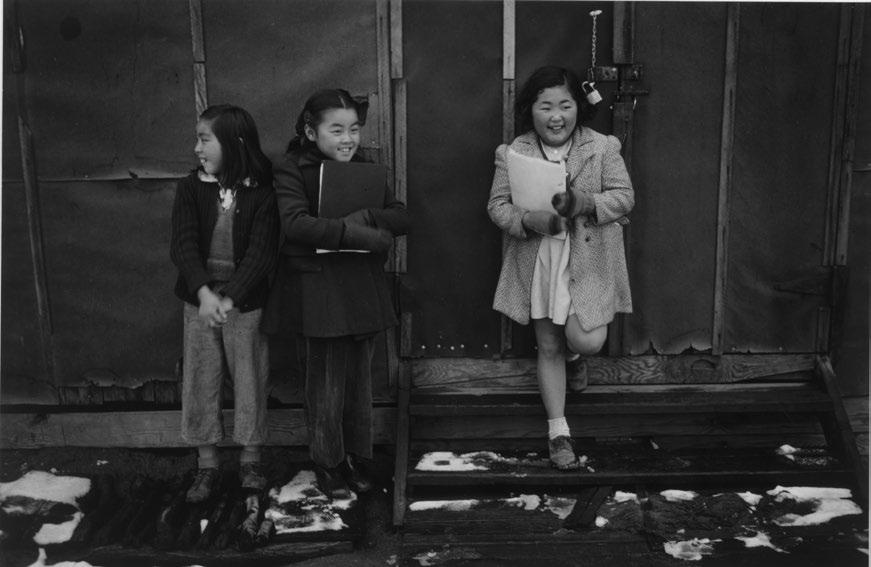
GREAT MINDS TEACHER EDITION WIT & WISDOM® 7 GRADE MODULE 2 AMERICANS ALL
Great Minds® is the creator of Eureka Math® , Wit & Wisdom® , Alexandria Plan™, and PhD Science®
Published by Great Minds PBC greatminds.org
© 2023 Great Minds PBC. All rights reserved. No part of this work may be reproduced or used in any form or by any means—graphic, electronic, or mechanical, including photocopying or information storage and retrieval systems—without written permission from the copyright holder. Where expressly indicated, teachers may copy pages solely for use by students in their classrooms. Printed in the USA A-Print
Module Summary 2 Essential Question 3 Suggested Student Understanding 3 Texts 4 Module Learning Goals 5 Module in Context............................................................................................................................... ........................ 6 Standards ............................................................................................................................... ....................................... 7 Major Assessments 9 Module Map 11
Focusing Question: Lessons 1–7 What does being Navajo mean to the protagonist of Code Talker? Lesson 1 ............................................................................................................................... ....................................... 23
n TEXTS: “Benjamin O. Davis, Jr.,” Alexis O’Neill (Handout 1A) • “Americans All” poster • “United We Win” poster ¢ Vocabulary Deep Dive: Content Vocabulary: Marginalization, segregation, equality Lesson 2 ............................................................................................................................... ........................ 37
n TEXT: Code Talker, Joseph Bruchac, “Listen, My Grandchildren” ¢ Vocabulary Deep Dive: Academic Vocabulary: Sacred and the morpheme sacr Lesson 3 49
n TEXT: Code Talker, Chapter 1 ¢ Vocabulary Deep Dive: Content Vocabulary: Reassure, remember Lesson 4 ............................................................................................................................................................................................. 61
n TEXT: Code Talker, pages 5–11 and 215–218
¢ Vocabulary Deep Dive: Academic Vocabulary: Bleak, brutal, catastrophic Lesson 5 ............................................................................................................................................................................................ 73
n TEXT: Code Talker, Chapters 2–3 ¢ Style and Conventions Deep Dive: Examine Precise and Concise Writing Lesson 6............................................................................................................................................................................................ 87
n TEXT: Code Talker, Chapters 4–5 ¢ Style and Conventions Deep Dive: Experiment with Precise Writing
Lesson 7 ............................................................................................................................................................................................ 99
n TEXT: Code Talker, Chapters 1–5
¢ Vocabulary Deep Dive: Academic Vocabulary: Culture, tradition
How does Ned’s Navajo identity provide strength during times of challenge?
Lesson 8 109
n TEXTS: Code Talker, Chapter 6 • “Pearl Harbor and World War II,” Brandon Marie Miller and Mark Clemens (Handout 8C) • Images of Pearl Harbor headlines
¢ Vocabulary Deep Dive: Content Vocabulary: The Suffix –ism
Lesson 9.......................................................................................................................................................................................... 125
n TEXTS: Code Talker, Chapters 7–8 • Images of Pearl Harbor headlines
¢ Vocabulary Deep Dive: Content Vocabulary: Motto
Lesson 10 139
n TEXTS: Code Talker, Chapter 9 and pages 222–223 • “A Beautiful Dawn,” Radmilla Cody
¢ Style and Conventions Deep Dive: Examine Formal Style
Lesson 11 153
n TEXT: Code Talker, Chapter 10
¢ Style and Conventions Deep Dive: Examine Transitional Phrases and Clauses
Lesson 12 ........................................................................................................................................................................................ 167
n TEXT: Code Talker, Chapters 11–12
¢ Style and Conventions Deep Dive: Experiment with Phrases and Clauses
Lesson 13 ........................................................................................................................................................................................ 183
n TEXT: Code Talker, Chapters 13–14
¢ Vocabulary Deep Dive: Academic Vocabulary: Offensive Lesson 14 ........................................................................................................................................................................................ 193
n TEXT: Code Talker, Chapters 15–17
¢ Style and Conventions Deep Dive: Examine Formal Tone
Lesson 15 209
n TEXT: Code Talker, Chapters 18–20
¢
Style and Conventions Deep Dive: Experiment with Concise Writing
Lesson 16 221
n TEXT: Code Talker, Chapters 21–23
¢ Style and Conventions Deep Dive: Examine Misplaced Modifiers
Lesson 17 ....................................................................................................................................................................................... 233
n TEXTS: Code Talker, Chapters 24–26 • Photograph of Flag Raising on Iwo Jima, 02/23/1945, Joe Rosenthal
¢ Vocabulary Deep Dive: Content Vocabulary: Pulverized
Lesson 18 ....................................................................................................................................................................................... 243
¢ TEXTS: Code Talker, Chapters 27–28 • “Navajo Code Talkers,” Harry Gardener (Handout 18A)
¢ Style and Conventions Deep Dive: Execute Transitional Phrases and Clauses
Lesson 19 255
n TEXT: Code Talker, Chapter 29
¢ Vocabulary Deep Dive: Vocabulary Assessment
Lesson 20 265
n TEXT: Code Talker
¢ Style and Conventions Deep Dive: Examine Sentence Structures
Lesson 21 ........................................................................................................................................................................................ 275
n TEXTS: Code Talker • Ansel Adams photographs (Roy Takeno, outside Free Press Office; Manzanar from Guard Tower; School Children)
¢ Style and Conventions Deep Dive: Examine Dangling Participles
Focusing Question: Lessons 22–31
What did the Wakatsukis experience during World War II, and how did it affect them?
Lesson 22 287
n TEXT: Farewell to Manzanar, Jeanne Wakatsuki Houston and James D. Houston, Chapter 1
¢ Vocabulary Deep Dive: Academic Vocabulary: Interrogation and Its Morphemes
Lesson 23 299
n TEXTS: Farewell to Manzanar, pages 9–13 • “Relocation Camps,” Craig Blohm (Handout 23A)
¢ Style and Conventions Deep Dive: Experiment with Formal Style and Tone
Lesson 24 ..................................................................................................................................................................................... 309
n TEXTS: Farewell to Manzanar, Chapter 2 • “World War II Internment of Japanese Americans,” Alan Taylor • “Relocation Camps” (Handout 23A)
¢ Style and Conventions Deep Dive: Execute with Transitional Phrases and Clauses
Lesson 25 321
n TEXT: Farewell to Manzanar, pages 21–34
¢ Vocabulary Deep Dive: Content Vocabulary: Subordinate, communal, integrated
Lesson 26 331
n TEXT: Farewell to Manzanar, pages 31–41 and 61–64
¢ Style and Conventions Deep Dive: Experiment with Sentence Structures
Lesson 27 ........................................................................................................................................................................................ 341
n TEXTS: Ansel Adams photographs (Roy Takeno, outside Free Press Office; Manzanar from Guard Tower; School Children)
¢ Vocabulary Deep Dive: Content Vocabulary: Geometric, organic, symmetrical, asymmetrical
Lesson 28 ...................................................................................................................................................................................... 355
n TEXT: Farewell to Manzanar, pages 71–78
¢ Style and Conventions Deep Dive: Execute Formal Style and Tone
Lesson 29 ............................................................................................................................... .................... 365
n TEXT: Farewell to Manzanar, pages 113–114, 142–149, and 167–176
¢ Vocabulary Deep Dive: Content Vocabulary: Prevail, strive, endure
Lesson 30 377
n TEXTS: Farewell to Manzanar • Code Talker
¢ Style and Conventions Deep Dive: Experiment with Modifying Phrases and Clauses
Lesson 31 387
n TEXTS: Farewell to Manzanar • Ansel Adams photographs (Roy Takeno, outside Free Press Office; Manzanar from Guard Tower; School Children)
¢ Vocabulary Deep Dive: Vocabulary Assessment
How did World War II affect individuals?
Lesson 32 395
n TEXT: Farewell to Manzanar
Lesson 33 401
n TEXTS: Farewell to Manzanar • Code Talker
Lesson 34 407
n TEXTS: Farewell to Manzanar • Code Talker
Lesson 35 ....................................................................................................................................................................................... 413
n TEXTS: Farewell to Manzanar • Code Talker ¢ Style and Conventions Deep Dive: Excel with Language Skills
GRADE 7 MODULE 2
The earth is the mother of all people, and all people should have equal rights upon it.
—Chief JosephThe history of the past is but one long struggle upward to equality.
—Elizabeth Cady StantonBy the late 1930s, the world was wracked by economic despair and facing rising fascist powers. Democracy looked weak, inadequate, and doomed. Hitler’s racially obsessed state loomed large over Europe, annexing Austria, allying with fascist Italy, and threatening to invade its neighbors. Americans were suspicious of Nazi sympathizers, but many feared that Germany could not be stopped.
In the Pacific, tensions were also mounting. An actively modernizing Japan emerged as a rising world power. Japan’s economy had suffered during the Great Depression, and in the 1930s, the nation increasingly came under military control. Espousing doctrines of national and racial supremacy, Japan’s expansionism into China in 1937 further strained relations with the West.
As relations with Japan deteriorated, the U.S. imposed embargoes on oil and other materials that Japan desperately needed. Japan viewed these measures as threats to its very existence, and in 1940, joined the Axis alliance with Germany and Italy, plotting massive invasions throughout East Asia. Japan feared that America’s industrial resources and manpower would overwhelm Japan in a prolonged war and hoped to stun the U.S. into negotiating peace. To that end, Japan launched a surprise air attack on the U.S. naval base at Pearl Harbor on December 7, 1941. America’s Pacific fleet was badly damaged—and America responded to the attack with fury and indignation. Hitler was convinced that the conflict with the U.S. was inevitable, and he was determined to stop American aid to Britain and Russia. Hitler declared war.
Japan’s attack on Pearl Harbor and Germany’s declaration of war instantly shattered America’s isolationist mood. Through the draft and widespread voluntary enlistment, young men everywhere were swept into war. A shared patriotic purpose united Americans.
As the war expanded, Germany imposed tyrannical control in the territories it conquered—forcing people into slavery, stealing their wealth, and using its feared secret police to brutally suppress dissent. An increasingly mechanized extermination system, centered on slave labor and death camps, ran ceaselessly until the war’s end. Six million Jews were murdered, while millions of other Europeans were worked to death alongside them.
Meanwhile, the American military remained racially segregated. As the U.S. fought against racially bigoted regimes abroad, many Americans noted the blatant disconnect and argued for reform at home.
Populations linked to enemy nations were at the greatest risk of government discrimination. On the West Coast, Japanese Americans faced accusations—often founded on blatant prejudice and encouraged by neighbors’ schemes to seize Japanese American property—of disloyalty and sabotage. More than 100,000 Japanese living on the West Coast, more than half of whom were U.S. citizens, were interned in federal camps (although men could win release to join the U.S. military, and many served with distinction).
Through the fictional account of Ned Begay, a Navajo teenager called to war, and the memoir of Jeanne Wakatsuki Houston, a former internee of Manzanar camp, students explore this world conflict by entering the lives of those who lived through it. In Code Talker, by Joseph Bruchac, the protagonist experiences assimilation and battlefield combat, yet his Navajo culture provides him strength, selfawareness, and language—all of which create a remarkable opportunity to serve his country. In Farewell to Manzanar, young Jeannie struggles to understand and come to terms with the effects of her family’s wartime internment. From these unforgettable stories, students gain insight into the World War II era.
The End-of-Module (EOM) Task is an informative/explanatory essay. In it, students detail how one individual encountered adversity and/or opportunity as a result of the war, and how they formed identity in a time marked by challenge on both a national and human scale.
How did World War II affect individuals?
World War II presented new opportunities and challenges for Americans.
Navajo Americans and Japanese Americans have made indispensable contributions to American society throughout history.
Cultural identity can be a source of strength and pride.
Stories about individuals can help us understand the larger forces that shaped a particular era.
Memoir (Informational)
Farewell to Manzanar, Jeanne Wakatsuki Houston and James D. Houston
Novel (Literary)
Code Talker, Joseph Bruchac
Biography
“Benjamin O. Davis, Jr.,” Alexis O’Neill
Historical Account
“Navajo Code Talkers,” Harry Gardiner
“Pearl Harbor and World War II,” Brandon Marie Miller and Mark Clemens
“Relocation Camps,” Craig Blohm
“World War II Internment of Japanese Americans,” Alan Taylor (http://witeng.link/0069)
Journalism
Pearl Harbor headlines
Music
“A Beautiful Dawn,” Radmilla Cody (http://witeng.link/0024)
Manzanar from Guard Tower, Ansel Adams (http://witeng.link/0039)
Photograph of Flag Raising on Iwo Jima, 02/23/45, Joe Rosenthal (http://witeng.link/0038)
Roy Takeno, outside Free Press Office, Ansel Adams (http://witeng.link/0040)
School Children, Ansel Adams (http://witeng.link/0041)
“Americans All” (http://witeng.link/0004)
“United We Win” (http://witeng.link/0003)
Summarize the experiences of Japanese Americans and members of the Navajo tribe—before, during, and after World War II.
Identify the effects of cultural assimilation on Navajo individuals, as shown through the story of Code Talker’s protagonist.
Describe the role of the Navajo code talkers in the United States’ World War II victory, and explain how the war affected Navajo individuals.
Explain the causes of the Japanese internment, daily life at Manzanar camp, and the internment’s effects on Japanese American individuals.
Identify the basic facts of World War II, including Pearl Harbor’s role in escalating U.S. involvement and the major theaters of the war.
Analyze the central ideas of Code Talker and Farewell to Manzanar (RL.7.2, RI.7.2).
Analyze how discrimination, war, and citizenship influenced Jeanne Wakatsuki Houston and her family (RI.7.3).
Analyze how elements of Code Talker interact—particularly how the wartime setting influences Ned’s identity (RL.7.3).
Craft a well-organized informative/explanatory essay that analyzes the wartime experiences of either Jeanne Wakatsuki Houston or Ned Begay, developing the topic with relevant details and quotations (W.7.2, W.7.2.b).
Produce informative writing that introduces a topic clearly, uses effective transitions, and concludes ideas effectively (W.7.2.a, W.7.2.c, W.7.2.f).
Attend to task, purpose, and audience with intentional decisions around content and style (W.7.2.d, W.7.2.e, W.7.4).
Develop and strengthen writing by engaging in a process of planning, drafting, editing, revising, and publishing (W.7.5).
Emphasize important points when speaking (SL.7.4.).
Overcome listening barriers.
Adapt speech to a variety of contexts and tasks, demonstrating command of formal English when indicated or appropriate (SL.7.6).
Analyze the relationship between target vocabulary (synonyms, antonyms, or both) to better understand and apply each of the words (L.7.5.b).
Use transitional phrases and clauses to connect ideas within and between paragraphs (L.7.1.a).
Use precise and concise language when writing topic sentences and evidence sentences, and eliminate wordiness and repetition in writing (L.7.3.a).
Explore the meaning of grade-appropriate Greek or Latin affixes and roots to clarify the meaning of target vocabulary (L.7.4.b).
Spell correctly (L.7.2.b).
Knowledge: Module 2 builds on Module 1’s exploration of identity in society. In Module 1, students built a foundational understanding of the concept of identity in the rigidly hierarchical Middle Ages and explored how structures can influence a society. In Module 2, students consider the influences of race, culture, war, and patriotism on identity, both individual and national.
Reading: In Module 1, students read narrative texts and analyzed how medieval settings developed characters’ identities. In Module 2, students continue to explore the influence of setting on character. Students analyze the impact of Code Talker’s World War II setting on the protagonist’s identity. They also analyze interaction between plot and character. Additionally, students extend their reading skills with a new focus on informational texts. By studying Farewell to Manzanar and several historical accounts about World War II, students make the jump from identifying literary themes to identifying informational central ideas. They also analyze the interaction between individuals, events, and ideas such as citizenship.
Writing: Students extend their writing skills by moving from Module 1’s focus on narrative writing to Module 2’s focus on informative writing. In their informative writing, students use many of the narrative writing skills they learned, such as using descriptive language, while developing new skills such as writing introductory paragraphs.
Speaking and Listening: In Module 2, students apply Module 1’s focus on how to set speaking goals and track progress. Students learn how to emphasize important points when speaking and to overcome listening barriers when listening, and they track their progress during the module’s Socratic Seminars.
RL.7.2 Determine a theme or central idea of a text and analyze its development over the course of the text; provide an objective summary of the text.
RL.7.3 Analyze how particular elements of a story or drama interact (e.g., how setting shapes the characters or plot).
RI.7.1 Cite several pieces of textual evidence to support analysis of what the text says explicitly as well as inferences drawn from the text.
RI.7.2 Determine two or more central ideas in a text and analyze their development over the course of the text; provide an objective summary of the text.
RI.7.3 Analyze the interactions between individuals, events, and ideas in a text (e.g., how ideas influence individuals or events, or how individuals influence ideas or events).
W.7.2 Write informative/explanatory texts to examine a topic and convey ideas, concepts, and information through the selection, organization, and analysis of relevant content.
W.7.4 Produce clear and coherent writing in which the development, organization, and style are appropriate to task, purpose, and audience. (Grade-specific expectations for writing types are defined in standards 1–3.)
W.7.5 With some guidance and support from peers and adults, develop and strengthen writing as needed by planning, revising, editing, rewriting, or trying a new approach, focusing on how well purpose and audience have been addressed. (Editing for conventions should demonstrate command of Language standards 1–3 up to and including grade 7 here.)
L.7.1.a Explain the function of phrases and clauses in general and their function in specific sentences.
L.7.1.c Place phrases and clauses within a sentence, recognizing and correcting misplaced and dangling modifiers.
L.7.2.b Spell correctly.
L.7.3.a Choose language that expresses ideas precisely and concisely, recognizing and eliminating wordiness and redundancy.
L.7.4.b Use common, grade-appropriate Greek or Latin affixes and roots as clues to the meaning of a word (e.g., belligerent, bellicose, rebel).
L.7.5.b Use the relationship between particular words (e.g., synonym/antonym, analogy) to better understand each of the words.
SL.7.4 Present claims and findings, emphasizing salient points in a focused, coherent manner with pertinent descriptions, facts, details, and examples; use appropriate eye contact, adequate volume, and clear pronunciation.
SL.7.6 Adapt speech to a variety of contexts and tasks, demonstrating command of formal English when indicated or appropriate.
RL.7.10 By the end of the year, read and comprehend literature, including stories, dramas, and poems, in the grades 6–8 text-complexity band proficiently, with scaffolding as needed at the high end of the range.
RI.7.10 By the end of the year, read and comprehend literary nonfiction in the grades 6–8 text-complexity band proficiently, with scaffolding as needed at the high end of the range.
L.7.6 Acquire and use accurately grade-appropriate general academic and domain-specific words and phrases; gather vocabulary knowledge when considering a word or phrase important to comprehension or expression.
1. Use an evidence guide to identify important aspects of Ned Begay’s Navajo identity in Code Talker
2. Write a paragraph that analyzes how a particular aspect of Navajo culture supports Ned Begay over the course of Code Talker.
3. In two paragraphs, analyze how Wakatsuki Houston develops two central ideas over the course of Farewell to Manzanar
Identify aspects of Navajo culture.
Demonstrate foundational understanding of Ned’s Navajo identity.
RL.7.1; L.7.2
Demonstrate understanding of how Ned’s wartime experiences affect his identity.
Write an evidence-based informative paragraph.
RL.7.1, 7.3; W.7.2, 7.4; L.7.1.a, L.7.1.c, L.7.2.b, L.7.3.a
Demonstrate understanding of how Wakatsuki Houston’s experience at Manzanar affected her.
Organize and develop a set of informative paragraphs. Write an effective introductory paragraph.
RI.7.1, 7.2; W.7.2, 7.4, 7.9; L.7.1.c, L.7.2.b, L.7.3.a
1. Read chapter 14 of Code Talker Then respond to multiple-choice questions and two writing prompts to demonstrate comprehension.
2. Read pages 34–41 of Farewell to Manzanar. Then respond to multiple-choice questions and write a summary.
Demonstrate comprehension of Code Talker’s World War II setting.
RL.7.1, 7.2, 7.3
Analyze how Ned’s identity develops.
Analyze the internment’s impact on individual members of the Wakatsuki family. Analyze the internment’s impact on the family unit.
RI.7.1, 7.2; L.7.2.b, L.7.4.a
1. Identify which aspects of Navajo culture are significant to Ned Begay at school, and explain and how these cultural aspects impact him.
Demonstrate an understanding of the role Navajo culture plays in Ned’s identity.
2. Analyze the themes and central ideas of Code Talker
3. Compare and contrast Jeanne Wakatsuki Houston’s wartime experience with Ned Begay’s.
Demonstrate an understanding of key ideas about Ned’s wartime experience.
Demonstrate an understanding of how World War II affected Jeanne Wakatsuki Houston and Ned Begay.
RL.7.1, 7.3; SL.7.1, 7.6
RL.7.1, 7.2; SL.7.1, 7.4, 7.6
RL.7.1; RI.7.1, 7.3; SL.7.1, 7.6
Write an informative essay that analyzes World War II’s effect on either Ned Begay or Jeanne Wakatsuki Houston. Revise the essay based on feedback.
Introduce a topic clearly, summarizing the individual’s experience.
Clearly organize ideas and use transitions (through words, phrases, or clauses) to develop the essay.
Include relevant facts, details, and quotations from the text.
Use words and ideas to show knowledge of the topic.
Write in an academic, formal style.
Provide a conclusion that builds off of and supports ideas.
Use precise and concise language. Spell correctly.
RL.7.1, 7.3; RI.7.1, 7.3; W.7.2, 7.4, 7.5, 7.9; L.7.2.b
Demonstrate understanding of academic, text-critical, and domainspecific words, phrases, and/or word parts.
Acquire and use grade-appropriate academic terms. Acquire and use domain-specific or text-critical words essential for communication about the module’s topic.
L.7.6
* While not considered Major Assessments in Wit & Wisdom, Vocabulary Assessments are listed here for your convenience. Please find details on Checks for Understanding (CFUs) within each lesson.
Focusing Question 1: What does being Navajo mean to the protagonist of Code Talker?
Text(s) Content Framing Question Craft Question(s) Learning Goals
1 “Benjamin O. Davis, Jr.”
“United We Win”
“Americans All”
Wonder
What do I notice and wonder about the images, text, and ideas in today’s lesson?
Examine
Why are the organization and style of an informational text important?
Identify and explain examples of the concepts of equality and marginalization in “Benjamin O. Davis, Jr.” (Handout 1A).
Use the relationships among marginalization, segregation, and equality to better understand each word (L.7.5.b).
2 Code Talker, “Listen, My Grandchildren”
Wonder
What do I notice and wonder about Code Talker?
3 Code Talker, Chapter 1 Organize
What is happening in Code Talker?
Identify observations and questions about the introduction to Code Talker (RL.7.1).
Analyze academic vocabulary by using context clues and morphology (L.7.4.a, L.7.4.b).
Analyze character traits of the protagonist of Code Talker (RL.7.1, RL.7.3).
Describe the character, setting, and key events in Code Talker chapter 1 (RL.7.3).
Use context and the prefix re– to analyze target vocabulary, and apply understanding in a brief response (L.7.4.a, L.7.4.b).
4 Code Talker, pages 5–11, pages 215–218
Organize
What is happening in the Author’s Note in Code Talker?
5 Code Talker, Chapters 2–3 Organize
What is happening in Code Talker?
Examine
Why is the organization of ideas in a paragraph important?
Identify and arrange influential events in Navajo history based on the Code Talker Author’s Note (RI.7.3).
Identify key aspects of an informational paragraph (W.7.2.a, W.7.2.b, W.7.2.f).
Evaluate the impact of the words bleak, brutal, and catastrophic in context to describe Navajo experience (L.7.4.a, L.7.5.b).
Experiment
How does writing an effective topic sentence work? Examine
Why is being precise and concise important in informative writing?
Analyze how Bruchac characterizes the protagonist of Code Talker (RL.7.3).
Practice writing clear and effective topic sentences for an informative paragraph (W.7.2.a).
Examine why precise and concise writing is important in a topic sentence (L.7.3.a).
6 Code Talker, Chapters 4–5 Reveal
What does a deeper exploration of character, plot, and setting reveal in Code Talker?
Experiment
How does providing and elaborating on evidence in an informative paragraph work?
Experiment
How does being precise in informative writing work?
Analyze how Ned Begay’s traits influence his actions (RL.7.3).
Describe and elaborate on evidence in an informative paragraph about Ned Begay (W.7.2.b).
Build skill in writing and revising for precision through word choice (L.7.3.a).
Focusing Question 1: What does being Navajo mean to the protagonist of Code Talker?7 FQT SS
Code Talker, Chapters 1–5 Know
How does Code Talker build my knowledge of Navajo culture, history, and traditions?
Analyze Code Talker through a collaborative conversation with peers, drawing on evidence, posing questions, responding to others, acknowledging new information, and using formal English as appropriate (SL.7.1, SL.7.6).
Analyze the influence of Ned’s Navajo identity on his school experience (RL.7.1, RL.7.3).
Demonstrate understanding of the meanings of and relationship between the words culture and tradition (L.7.4.d, L.7.5.b).
Focusing Question 2: How does Ned’s Navajo identity provide strength during times of challenge?
Text(s) Content Framing Question Craft Question(s) Learning Goals
8 Code Talker, Chapter 6
“Pearl Harbor and World War II”
Images of Pearl Harbor headlines
Organize
What’s happening in these texts?
Experiment
How does a topic statement or sentence for a summary work?
Identify the important ideas and events of World War II and the Japanese attack on Pearl Harbor that Bruchac develops in chapter 6.
Craft a topic statement and a summary of “Pearl Harbor and World War II” (Handout 8C) (RI.7.2, W.7.2.a).
Apply different meanings of the suffix –ism to content vocabulary, and create sentences to demonstrate understanding (L.7.4.b).
9 Code Talker, Chapters 7–8
Images of Pearl Harbor headlines
Organize
What’s happening in chapters 7 and 8?
10 “A Beautiful Dawn”
Code Talker, Chapter 9 and pages 222–223
Wonder
What do I notice and wonder about chapter 9?
11 Code Talker, Chapter 10 Reveal
What does a deeper exploration of the events in chapter 10 reveal about the central ideas being developed in Code Talker?
12 Code Talker, Chapters 11–12 Reveal
What does a deeper exploration of the interactions of plot, setting, and character reveal in chapters 11–12?
Experiment
How do the structures and styles of different genres (informative vs. narrative) work?
Examine
Why is formal style important in informative writing?
Examine
Why are transitions important? Examine
Why are transitions important in writing?
Examine
Why is it important to emphasize points when speaking? Experiment
How do transitional phrases and clauses work?
Analyze how the author develops the central idea of Ned Begay’s Navajo identity (RL.7.2).
Demonstrate understanding of target vocabulary in a brief response about the module text (L.7.4, L.7.5.b).
Explore the features of different genres by adjusting writing style to a specified genre, task, and purpose (W.7.4).
Explain why using formal style is important in informative writing (L.7.3).
Determine central ideas that Bruchac develops in chapter 10 (RL.7.2).
Identify transitional phrases and clauses and explain their function in specific instances (L.7.1.a).
Analyze how the setting and plot, specifically school experiences, shape the identity of the protagonist, Ned Begay, in Code Talker (RL.7.3).
Use transitional phrases and clauses in writing (L.7.1.a).
Focusing Question 2: How does Ned’s Navajo identity provide strength during times of challenge?13 NR Code Talker, Chapters 13–14 Organize What’s happening in chapters 13–14?
14 Code Talker, Chapters 15–17 Distill
What are the essential meanings of chapters 15–17?
Experiment
How does emphasizing important points when speaking work? Examine
Why are introductions and conclusions important? Examine
Why are tone and style important in an informative text?
After reading a new chapter, “The Enemies,” identify a central idea, describe the development of the central idea, analyze interactions between character and plot, and write a brief summary (RL.7.2, RL.7.3).
Demonstrate understanding of the multiple-meaning target word through the use of context clues, Latin affixes, and dictionaries (L.7.4).
Trace the development of a theme in chapters 15–17 (RL.7.2).
Identify the characteristics of formal tone in informative writing (L.7.3).
15 Code Talker, Chapters 18–20 Reveal
What does a deeper exploration of plot, character, and setting in chapters 18–20 reveal?
Experiment
How do topic statements and evidence work? Experiment
How does being concise in informative writing work?
Develop skills in producing focused, informative writing by creating clear topic statements and adding relevant evidence to support topic statements (RL.7.1, W.7.2).
Revise a journal entry to be more concise, eliminating unnecessary words and phrases (L.7.3.a).
Focusing Question 2: How does Ned’s Navajo identity provide strength during times of challenge?16 Code Talker, Chapters 21–23 Organize
What’s happening in chapters 21–23?
Experiment
How does elaborating on evidence work?
Examine
Why is correctly placing modifiers in my writing important?
Write elaboration sentences to clarify ideas and analyze evidence in an informative paragraph on battle fatigue (W.7.2.b, W.7.4).
Recognize and correct misplaced modifiers (L.7.1.c).
17 Code Talker, Chapters 24–26
Photograph of Flag Raising on Iwo Jima, 02/23/1945
Reveal
What does a deeper exploration of content, style, and structure reveal in chapters 24–26?
18 Code Talker, Chapters 27–28 “Navajo Code Talkers”
Organize
What’s happening in these texts?
Examine
Why is the structure of an informative text important?
Execute
How does one use transitional phrases and clauses?
Evaluate Bruchac’s content, style, and structure in chapters 24–26 in order to gain a deeper understanding of how authors engage audiences and communicate central ideas (RL.7.2).
Distinguish between the connotations of synonyms, and rank the words to better understand their use (L.7.5.b, L.7.5.c).
Analyze central idea in Code Talker (RL.7.3).
Use transitional phrases and clauses to produce cohesive informative writing (L.7.1.a).
Focusing Question 2: How does Ned’s Navajo identity provide strength during times of challenge?19 SS VOC
Code Talker, Chapter 29 Distill
What is the essential meaning of Code Talker?
How does Code Talker build my knowledge of the importance of identity and culture during times of challenge?
Execute
How do I use effective speaking and listening skills in a Socratic Seminar?
Identify central ideas in Code Talker, and discuss their development (RL.7.2).
Engage in a collaborative conversation, drawing on evidence, posing questions, responding to others, acknowledging new information, and using formal English as appropriate (SL.7.1, SL.7.6).
Demonstrate understanding of gradelevel vocabulary (L.7.6).
Execute
How do I use what I know about writing an effective paragraph to respond to Focusing Question Task 2?
Examine
Why is using varied sentence structures important when writing informative texts?
21 Code Talker Manzanar from Guard Tower
Roy Takeno, outside Free Press Office School Children
Wonder
What do I notice and wonder about images of Manzanar?
Excel
How do I improve my ToSEEC paragraph?
Examine
Why are subjects important when using participial phrases?
Write an informative paragraph analyzing how Ned Begay’s Navajo identity sustains him during challenging times (RL.7.1, 7.3; W.7.2, 7.4; L.7.1.a, L.7.1.c, L.7.2.b, L.7.3.a).
Explain how using varied sentence structures can influence a text’s fluency (L.7.a.b, L.5.3.a).
Evaluate to identify areas for improvement and strengthen response to Focusing Question Task 2 (W.7.5).
Formulate questions and observations about three photographs of Manzanar by Ansel Adams (SL.7.2).
Explain why subjects are important when using participial phrases (L.7.1.c).
Focusing Question 2: How does Ned’s Navajo identity provide strength during times of challenge?Text(s) Content Framing Question Craft Question(s) Learning Goals
22 Farewell to Manzanar, Chapter 1
Wonder
What do I notice and wonder about chapter 1 of Farewell to Manzanar?
Examine
Why is audience awareness important?
Formulate observations and questions about Farewell to Manzanar (RI.7.1).
Explain how Wakatsuki Houston uses background information to inform her audience.
Use root and affix meanings to better understand new words (L.7.4.b, L.7.4.c).
23 Farewell to Manzanar, pages 9–13
“Relocation Camps” (Handout 23A)
Organize
What is happening in Farewell to Manzanar and the informational text “Relocation Camps”?
Examine
Why are structure and style in informative writing important? Experiment
How does using formal style and tone work?
Summarize key events that took place before, during, and after the Japanese internment (RI.7.2, W.7.10).
Describe how the style and structure of the informational text “Relocation Camps” (Handout 23A), fit its purpose and audience (W.7.2.a).
Revise a personal piece of informative writing to establish a more formal style and tone (L.7.3, L.6.3.b, L.4.3.c).
Focusing Question 3: What did the Wakatsukis experience during World War II, and how did it affect them?24 Farewell to Manzanar, Chapter 2
“World War II: Internment of Japanese Americans”
“Relocation Camps” (Handout 23A)
Organize What is happening in Farewell to Manzanar and the internment photographs?
Examine
Why are introductory paragraphs in informative essays important?
Execute
How do I use transitions in writing?
Explain how images by various photographers deepen understanding of the Japanese internment (SL.7.2).
Identify the HIT introduction structure in “Relocation Camps,” and evaluate its effectiveness (W.7.2.a).
Identify opportunities for and use transitions in an informative paragraph to produce cohesion (L.7.1.a).
25 Farewell to Manzanar, pages 21–34
Reveal
What does a deeper exploration of the Wakatsukis’s early days at Manzanar reveal?
26 NR Farewell to Manzanar, pages 34–41, pages 61–64
Organize What’s happening in Farewell to Manzanar?
Experiment
How does using varied sentence structures work?
Analyze the Wakatsukis’s experience of the early days of the internment (RI.7.3).
Analyze and clarify the meanings of the words subordinate, communal, and integrated and their affixes (L.7.4, L.7.5.b).
Summarize how the internment changed the Wakatsuki family unit (RI.7.2).
Use varied sentence structures to create fluency in writing (L.7.1.b, L.5.3.a).
27 Manzanar from Guard Tower Roy Takeno, outside Free Press Office
School Children
Reveal
What does a deeper exploration of line, shape, and value reveal in Adams’s photographs?
Analyze the elements and principles of art in Ansel Adams’s Manzanar photography (SL.7.2, W.7.10).
Use context and knowledge of the suffix –ic to explore the meaning of target vocabulary, and apply understanding of those words to art analysis (L.7.4.a, L.7.4.b).
Focusing Question 3: What did the Wakatsukis experience during World War II, and how did it affect them?28 Farewell to Manzanar, pages 71–78, ending at the end of page 78
What does a deeper exploration of the Loyalty Oath reveal in Farewell to Manzanar?
Examine
Why are style and tone important? Execute
How do I use a formal style and tone in informative writing?
Analyze the effect of the Loyalty Oath on the Wakatsukis (RI.7.3).
Rewrite an informal diary entry as a formal informative paragraph (L.7.3, L.6.3.b, L.4.3.c).
29 Farewell to Manzanar, pages 113–114, pages 142–149, pages 167–176
What are the central ideas of Farewell to Manzanar’s concluding chapters?
Experiment
How does adjusting style and tone work?
Analyze how central ideas are developed through Jeanne’s adulthood visit to Manzanar (RI.7.2).
Adjust style and tone to suit purpose and audience in a short writing piece (W.7.4).
Use the relationships among words to better apply their meaning to a paragraph about adversity (L.7.5.b).
30 SS Farewell to Manzanar
Code Talker
Know
How do Code Talker and Farewell to Manzanar build my understanding of how World War II impacted individuals?
Excel
How can I improve my speaking and listening skills in a Socratic Seminar? Experiment
How does identifying and elaborating on relevant evidence work? Experiment
How does modifier placement work?
Engage in a collaborative conversation, drawing on evidence, posing questions, responding to others, acknowledging new information, and using formal English as appropriate (SL.7.1, SL.7.6).
Analyze how two central ideas about internment are developed over the course of Farewell to Manzanar (RI.7.2).
Incorporate modifying phrases and clauses into a sample text (L.7.1.c).
Focusing Question 3: What did the Wakatsukis experience during World War II, and how did it affect them?31 FQT VOC
from Guard Tower
Roy Takeno, outside Free Press Office School Children
Distill
What are the central ideas of Farewell to Manzanar?
Execute
How do I use the ToSEEC paragraph structure to respond to Focusing Question Task 3?
Experiment
How do introductions work?
Write an informative response analyzing the development of two central ideas over the course of Farewell to Manzanar (RI.7.2, W.7.2, W.7.4, W.7.9).
Apply understanding of an effective introductory paragraph by drafting an introductory paragraph for an informative essay related to the Focusing Question Task topic (W.7.2.a).
Demonstrate understanding of gradelevel vocabulary (L.7.6).
Focusing Question 4: How did World War II affect individuals?
Text(s) Content Framing Question Craft Question(s) Learning Goals
32 EOM Farewell to Manzanar Know
How does the model build my knowledge of informative essay elements?
Examine
Why are certain elements important in writing a successful informative essay?
Experiment
How do conclusions work?
Analyze a model informative essay to identify the elements of a successful EOM Task response.
Apply understanding of an effective conclusion paragraph by drafting a conclusion paragraph for an informative essay related to the Focusing Question Task topic (W.7.2.f).
33 EOM Farewell to Manzanar
Code Talker
Know
How do the core texts build my knowledge of World War II?
Execute
How can I use evidence to support my ideas in an organized informative essay plan?
Identify and organize evidence to plan an essay demonstrating World War II’s impact on an individual from a core text (W.7.2.a, W.7.2.b).
Code Talker
35 Farewell to Manzanar
Code Talker
Know
How do the core texts build my knowledge of World War II?
Know
How do the core texts build my knowledge of World War II?
Execute
How can I use the elements of strong informative writing in my own informative essay?
Excel
How do I improve my informative essay?
How do I improve my writing to show command of English grammar, language conventions, and vocabulary?
Draft an informative essay that explains how World War II affected an individual from a core text (W.7.2, W.7.4, W.7.9).
Evaluate informative essay drafts to provide peer feedback, and revise the EOM Task response (W.7.5).
Revise the EOM Task response to improve grammar and language conventions and show an understanding of module vocabulary (L.7.1, L.7.2, L.7.4).
What does being Navajo mean to the protagonist of Code Talker?
“United We Win” (poster) (http://witeng.link/0003)
“Americans All” (poster) (http://witeng.link/0004)
“Benjamin O. Davis, Jr.,” Alexis O’Neill (Handout 1A)
Welcome (5 min.)
Launch (5 min.)
Learn (57 min.)
Examine Key Concepts (20 min.)
Notice and Wonder (22 min.)
Examine an Informational Text (15 min.)
Land (5 min.)
Answer the Content Framing Question
Wrap (3 min.)
Assign the Volume of Reading
Vocabulary Deep Dive: Content Vocabulary: Marginalization, segregation, equality (15 min.)
The full text of ELA Standards can be found in the Module Overview.
RI.7.1
Writing W.7.10
Speaking and Listening SL.7.1, SL.7.2, SL.7.6
Language L.7.5.b
MATERIALS
Handout 1A: “Benjamin O. Davis, Jr.”
Identify and explain examples of the concepts of equality and marginalization in “Benjamin O. Davis, Jr.” (Handout 1A).
Write a Response Journal entry explaining how one example of marginalization and one of equality from the article demonstrate the meaning of each term.
Use the relationships among marginalization, segregation, and equality to better understand each word (L.7.5.b).
Write a sentence demonstrating understanding of the words and illustrating their relationship.
ESSENTIAL QUESTION: Module 2
How did World War II affect individuals?
FOCUSING QUESTION: Lessons 1–7
What does being Navajo mean to the protagonist of Code Talker?
CONTENT FRAMING QUESTION: Lesson 1
Wonder: What do I notice and wonder about the images, text, and ideas in today’s lesson?
CRAFT QUESTION: Lesson 1
Examine: Why are the organization and style of an informational text important?
Module 2 explores a substantial Essential Question: How did World War II affect individuals? Lesson 1 builds foundational knowledge to address this question. Students explore the meaning of marginalization and contrast that with the American ideal of equality. They also get their first taste of the war’s impact on an individual: Benjamin O. Davis, Jr., commander of the Tuskegee Airmen. Students examine the structure and style of an article about Davis’s extraordinary life, taking their first steps into this module’s focus on informative writing.
Display the following images:
“United We Win” (poster) (http://witeng.link/0003)
“Americans All” (poster) (http://witeng.link/0004)
Instruct students to note what they notice and wonder about the images on a T-chart in their Response Journal. Tell students that they will return to these ideas later in the lesson.
5 MIN.
Post the Essential Question, Focusing Question, and Content Framing Question.
Invite students to read and reflect on the meaning of the Essential Question.
n It sounds as if we’ll be reading books about World War II.
n The phrase “affect individuals” reminds me of our Essential Question from Module 1 because we looked at the effect of the social hierarchy on individuals’ identities.
Explain that students will work on fully understanding this question and the terms within it throughout this lesson.
57 MIN.
20 MIN.
Display the word marginalized, and ask students what word parts they notice. When students mention margin as a word part, have them look at the margins in a book or on a lined sheet of paper. Explain that the suffix –alized means “caused to become.”
Ask: “Putting those parts together, what do you think marginalized means?”
Provide the following definition for students to add to their Vocabulary Journal.
Word Meaning Synonyms
marginalized (v., adj.) To be excluded or treated as being of no importance. sidelined, disregarded
As needed, use the concrete demonstration of margin to deepen students’ understanding, explaining that to be marginalized means to be pushed to the margins or outside of society.
Ask: “What people or groups that we’ve read about, or that you know about, have experienced marginalization?”
Then instruct students to Think–Pair–Share, and ask: “What is the opposite of marginalizing people?”
n Including people is the opposite of marginalizing.
n Equality is the opposite of marginalization.
n Fairness or inclusion is the opposite of marginalization.
Provide the following definition for students to add to their Vocabulary Journal.
Word Meaning
equality (n.) A state of having the same value, measure, or quantity as something else.
Explain that the United States was founded on the ideal of equality, which made our country unique, as no other country up to the point of our founding had named equality as a goal.
Have students read an election timeline that provides historical information about citizenship voting rights for various groups: https://www.civiced.org/voting-lessons/voting-timeline. This text powerfully illustrates an example of marginalization and provides valuable context for the core texts.
Instruct students to Think–Pair–Share, and ask: “What do you think you already know about World War II and the time period leading up to it?”
n I know it came after the Great Depression.
n We fought against the Nazis.
n The Holocaust happened in World War II.
n D-Day was part of World War II.
n Planes were really important to fighting World War II.
Incorporating students’ responses, and addressing any misconceptions, guide students to understand the following:
The period leading up to World War II was challenging, as the United States and the rest of the world had been suffering from the Great Depression.
Due in part to the horrors of World War I and problems afterward, many in the United States were reluctant to have America enter another world war or conflict overseas.
Several countries, including Italy, Japan, and Germany, began expanding and taking over other countries, and Japan ultimately attacked the United States. During World War II, the Nazi party in Germany targeted and killed Jews, communists, intellectuals, gays, gypsies, and others. Six million Jews were murdered, while millions of other Europeans were worked to death alongside them.
For many reasons, the United States did ultimately join the war.
To build knowledge of the events that lead to World War II, have students explore the era summaries of the Alexandria Plan. Search for History at http://greatminds.org
Have students return their attention to the images displayed in the Welcome task and share what they noticed and wondered about them.
n Both posters seem to be about fighting or war. One says, “Let’s Fight for Victory,” and the other says, “United We Win.”
n One is in both English and Spanish.
n I wondered what war it is, but now that I’ve read our Essential Question, I think it’s World War II.
n I noticed the style was kind of old-fashioned.
n I noticed that both posters show men who seem to be of different races or cultures.
n I wonder what the guys in the second image are doing.
Incorporating students’ responses, explain that the images are of posters that the United States government used to recruit people to help with America’s efforts to fight in World War II.
Ask: “What is the message of the posters?”
n The posters seem to invite all people to come fight the war.
n The posters are sending a message of equality by saying, “Americans All” and “United We Stand.”
n They are telling people that everyone is needed to fight the war, not just some.
Building upon students’ responses, clarify that the United States needed everyone’s help to fight World War II and, as a result, accepted into the military and other war efforts people from all groups. NOTICE AND WONDER 22 MIN.
Explain that students will now read about the experience of one individual who enlisted to fight in the War. Remind students that noting key details and questions is an important habit of mind and comprehension strategy to use when beginning a new text. Instruct students to make a Notice and Wonder T-Chart in their Response Journal to help them note their observations and questions about the text “Benjamin O. Davis, Jr.” (Handout 1A).
Read the text aloud, pausing once or twice for students to record observations.
1 2 3 4 5
Young Davis failed the entrance exam to West Point the first time he took it. But he was “determined to succeed.” He passed it on his second try in 1932. Davis was the only black cadet at West Point. In those days, official military instructions claimed that blacks were inferior to whites and lacked courage and strong moral character. Upperclassmen at West Point wanted Davis to quit, so they enforced a “silencing” against him. For four years, no one talked to Davis. “Throughout my career at West Point and beyond, it was often difficult to reconcile the principles of Duty, Honor, and Country with the Army’s inhuman and unjust treatment of individuals on the basis of race,” Davis later said. His ability to endure the silencing made him strong. He never complained to his family, classmates, or superiors.
Davis’s graduation in 1936 made headlines. He was the first African American to graduate from West Point in the twentieth century. But when he applied to fly in the Army Air
Depending upon their prior knowledge, students may need to have several terms defined, including aviator, West Point, cadet, Corps, formation, Squadron, missions, and segregation.
Ask: “What did you notice and wonder about Benjamin O. Davis’s experience?”
n I noticed that he was the first Black man to go to West Point, but he didn’t want to be famous for that. He wanted everyone to be treated as Americans, not as part of certain groups.
n The article said that at the time, people thought Black people were “inferior to whites and lacked courage.”
n I wondered if no one really talked to him the whole time. If West Point is like a college, that would be four years of silence!
n He reached his dream of being able to fly and being in the military.
n He fought in World War II and received some kind of award.
n After the war, he also tried to fight segregation and improve the lives of African American veterans.
Instruct students to Think–Pair–Share, and ask: “What experiences or examples of marginalization did you notice in the article?”
n He was the only African American graduate of West Point because, at the time, the military believed Black people were inferior and would not admit them.
n At West Point, his classmates did not speak to him because the upperclassmen wanted him to quit. The author says the silencing made him strong, but even if this is true, which I’m not sure about, giving him the silent treatment marginalized him.
n He called the army’s treatment at West Point “inhuman and unjust.”
n Even though he graduated from West Point, he was rejected for the Air Corps because he was a Black person.
Ask: “What did you notice about how Davis worked to foster more equal treatment for African Americans?”
n He was an extremely successful pilot and leader in the war despite discrimination. He helped show that African Americans were not inferior.
n After the war, he fought against segregation at home.
n After the war, his bombardment group moved to an air base that was one of the first to be run by African Americans without the supervision of white officers.
n What he wrote in his autobiography showed that he believed in equality. He did not want to be labeled as the “first black West Point graduate” but just wanted to be considered as an equal American.
Encourage students to research this extraordinary group of pilots, the Tuskegee Airmen.
Then, ask: “What did you notice about how Davis’s experiences in World War II affected him?”
n His war experiences showed him and others that he was capable of doing great things.
n He won medals for his service and went on to fight discrimination and make the army treat African Americans more equally.
n His success in the war helped him become a role model and leader.
In their Response Journal, students identify one example of marginalization and one of equality from the article, and explain how each example demonstrates the meaning of the term.
Display the Craft Question: Why are the organization and style of an informational text important?
Explain that during this module, students will develop their skills with informative writing. Explain that the article they just read is an example of such writing.
Instruct students to Think–Pair–Share, and ask: “How is the article organized?”
n The author organized it by time. She went through Benjamin Davis’s life and told about the main events that happened to him.
n The paragraphs were each pretty short and focused on one big event or idea.
n The opening paragraph was a little more personal and told about why the rest of the article happened.
n The last paragraph summed up the article.
Ask: “How did this organization help you as readers?”
n It was easy to follow.
n The first paragraph got me interested, and then the others provided information that was very interesting about him.
n One paragraph easily led to another, which made me interested and able to understand it.
Direct students to focus on the first paragraph. Ask: “What do you think the author’s purpose was in beginning the article this way?”
n The author wants the reader to become interested in learning more about Davis right away, and the first sentence about how his life was changed forever makes you want to find out how and why.
n She wants the reader to understand why Davis was willing to put up with mistreatment and persevere. She shows how he fell in love with flying and became determined to become a pilot.
n The author wants the reader to relate to Davis, so she includes a quotation that makes him seem like an ordinary person.
Then direct students’ attention to the conclusion. Ask: “What is the effect on you as a reader of the author ending the article in this way?”
n It is inspirational and makes me want to know more about him.
n It sums up the big picture of why his story matters.
n It tells about the main idea of his life without repeating the facts.
Instruct students to Think–Pair–Share, and ask: “What do you notice about the style of writing? How does it compare to the narrative writing you did in the first module?”
n It is more to the point and doesn’t have so much description or sensory details.
n It focuses mainly on facts, not on his feelings or thoughts. When it does discuss his feelings or thoughts, it uses quotations from him.
n It is very organized and moves from one point to the next. Narrative sometimes is not so streamlined.
Build on student responses to explain that when writing informative essays, students should, like this author, maintain a formal, not conversational style. Ask: “How does this author manage to be both formal and engaging at the same time?”
n She chooses interesting facts.
n She puts quotations in that make it easier to relate to Davis.
n She doesn’t put too many facts in. Some articles overwhelm you with facts, but she really gets to the point.
Land5 MIN.
Have students write in their Response Journal in response to the following prompt: “How does the story of Benjamin O. Davis, Jr. help to start to answer the Essential Question: How did World War II affect individuals?”
Invite students to share responses as time permits.
Distribute and review the list of additional texts from Appendix D: Volume of Reading, and the Volume of Reading Reflection Questions. Explain that the list contains books with further information about topics discussed in the module. Tell students that they should consider the reflection questions as they independently read any additional texts and respond to them when they finish a text.
Students may complete the reflections in their Knowledge Journal, or submit them directly. The questions can also be used as discussion questions for a book club or other small-group activity. See the Implementation Guide (http://witeng.link/IG) for a further explanation of Volume of Reading, as well as various ways of using the Volume of Reading Reflection Questions.
To complete the CFU, students must cite textual evidence that exemplifies the concepts of marginalization and equality. Check for the following success criteria:
Cites textual evidence to illustrate the concept of marginalization
Cites textual evidence to illustrate the concept of equality.
The concepts of marginalization and equality are useful background information as students explore the impact of World War II, in America and abroad. If students struggle to understand the two concepts, ask them to sort examples of marginalization and equality, using a series of historical events, such as the ratification of the 19th amendment, the Emancipation Proclamation, etc.
Time: 15 min.
Text: “Benjamin O. Davis, Jr.,” Alexis O’Neill (Handout 1A)
Vocabulary Learning Goal: Use the relationships among marginalization, segregation, and equality to better understand each word (L.7.5.b).
TEACHER NOTE
The Module 2 Assessment Pack contains two direct vocabulary assessment tools and corresponding directions to be administered during Deep Dives 19 and 31. Consider using these tools to preassess students at the start of this module. Do not share results with students, but use the data to inform and differentiate vocabulary instruction throughout the module. At the close of the module, reassess students using the same tool to determine their growth against the baseline data.
Also consider distributing the list of words to be directly assessed so that students will know which words they will be held accountable for and can begin studying. Directly assessed words are noted in Appendix B.
Launch
Display the following words explored in the core lesson:
marginalization equality
Provide the following definition for students to record in their Vocabulary Journal.
Word Meaning
segregation (n.)
Separating or isolating certain groups based on their race, class, or ethnic origin.
Synonyms
isolation, exclusion
Ask students to examine the definition—as well as those for marginalized and equality, which they recorded in the core lesson—and underline key words in the definitions that are important to understanding the words. Have students work in pairs to paraphrase the definitions.
Call on two or three pairs per word to share their paraphrased definitions, guiding and refining students’ work as needed.
TEACHER NOTE
As students work, observe the words they underline. As time permits, talk with students individually about their decisions in order to assess students’ understanding of the words and of the process of selecting key words.
Explain that, like people, words have interesting and complex relationships to one another. Tell students that they will determine the relationships among the three words they just studied and then create a visual representation of that relationship.
Ask: “What types of relationships can words have to one another?”
As students share ideas, record their responses to serve as reminders for others during the activity that follows.
n Words can have the same parts, such as a suffix or prefix.
n One word could mean something similar to the other one.
n A word could be the opposite of another word.
n A word could help define another word.
n Words could be the same part of speech.
Instruct each pair to join with another pair, forming groups of four.
Tell students to work in their group to create a relationship map, which is a web, diagram, or other visual display that shows the relationship between words. Encourage students to revisit the underlined portions of the definitions, and to brainstorm ideas as a group before beginning.
If students have difficulty generating ideas, sketch a few examples, such as a continuum line with “negative” words at one end and “positive” words at the other; a concept web, with a word listed in the center and equal and unequal words extending from it in spokes; a picture, using human figures or facial expressions with the words listed; or a visual definition for each word that uses a similar image to connect the words.
Have students display their relationship maps and view at least two other groups’ maps.
For this exercise, there are no right or wrong answers. Instead, the thinking students display as they explain their maps is what is important. Accordingly, as students work on their relationship maps, circulate and ask them to explain their choices. Prompt students toward deeper thinking with probing, openended questions (e.g., Why did you …? What if ...? How could you …?).
Using their own experiences or the article from Handout 1A, students write a sentence or two to show their understanding of the words and their relationship.
Welcome (5 min.)
Launch (2 min.)
Learn (60 min.)
Examine Listening Barriers (10 min.)
Notice and Wonder (25 min.)
Research Topics of Interest (25 min.)
Land (7 min.)
Answer the Content Framing Question
Wrap (1 min.)
Look Ahead
Vocabulary Deep Dive: Academic Vocabulary: Sacred and the Morpheme sacr (15 min.)
The full text of ELA Standards can be found in the Module Overview.
Reading
RL.7.1
Writing W.7.7, W.7.8, W.7.10
Speaking and Listening SL.7.1, SL.7.2, SL.7.6
Language
L.7.4.a, L.7.4.b
Handout 2A: Sacred and the Morpheme sacr
Identify observations and questions about the introduction to Code Talker (RL.7.1).
Complete a Notice and Wonder T-Chart with key details and questions about the text.
Analyze academic vocabulary by using context clues and morphology (L.7.4.a, L.7.4.b).
Complete Handout 2A, defining sacred, using it in a sentence, and analyzing the root of the word.
FOCUSING QUESTION: Lessons 1–7
What does being Navajo mean to the protagonist of Code Talker?
CONTENT FRAMING QUESTION: Lesson 2
Wonder: What do I notice and wonder about Code Talker?
Students read “Listen, My Grandchildren,” the moving introduction to Joseph Bruchac’s novel Code Talker. They notice and wonder about the text, which provides insights to some of the many themes ahead, including the importance of the protagonist’s identity as a Navajo and a World War II code talker.
5 MIN.
Have pairs discuss the most important and interesting knowledge and skills they developed in Module 1, including knowledge of the Middle Ages, identity development, historical fiction, and narrative elements.
2 MIN.
Post the Focusing Question and Content Framing Question.
Remind students of the concepts they discussed in Lesson 1—that throughout history, societies segregate and marginalize groups, but societies also make strides toward equality. Explain that today, students will begin a text, Code Talker by Joseph Bruchac, that will allow them to more fully explore these concepts, as well as deepen and extend the understanding of historical fiction and narrative elements that they developed in the first module.
Explain that throughout this module, students will focus on how to become more effective listeners, as they listen to texts like the one they will begin in this lesson, instruction, or classmates in discussions.
Tell students that to begin considering their listening habits, they will play a quick game called “Me, Too.” Explain that if a statement you read is true for students, they should stand up and say, “Me, too!” and that they should stay standing until you read a statement that is not true of them. Read aloud the following statements, one at a time, pausing after each for students to reflect on whether it is true for them and respond accordingly:
Sometimes I tune out when someone else is talking.
Sometimes I look like I am listening, but really, I am not.
I rarely lose focus when listening.
Sometimes I think I listened to the teacher or a classmate, but when I try to remember what was said or answer a question about it, I realize I didn’t hear what they said.
I carefully listen to everyone who talks to me.
I listen better to some people than to other people.
Instruct students to Think–Pair–Share, and ask: “What helps you listen well, and what are some barriers, or things that can get in the way, of your listening?”
n Sometimes you’re distracted because you’re thinking or worried about something else.
n It can be hard to listen to some people because they talk too much or are monotone.
n It helps me listen if I really am interested in what the other person is saying.
n Sometimes I am listening, but the person says something that makes my brain go off in another direction.
If students do not mention it, ask: “Why is it harder to listen to some people than to others?”
n Some people speak softly.
n Some people make their points more clearly than other people.
n Some people can be really hard to understand.
Then ask: “What problems result from not listening in class?”
n You can miss important information a teacher is giving.
n You can misunderstand someone’s point, which can lead to confusion or arguments.
n It can be embarrassing when the other person catches you not listening.
Tell students that in this lesson, as they listen to a new text being read aloud and discuss it with classmates, they should consider what helps them listen well and what impedes their listening.
25 MIN.
Ask students to examine Code Talker’s front cover, and ask: “What do you notice and wonder about the front cover?”
n The title and author’s name are listed on a chain, kind of like a necklace.
n I think people in the army wear things like that called “dog tags.”
n It says it’s a novel, so I think it’s not true, but it also says it’s about the “Navajo Marines of World War II,” so I am thinking it might be based on the truth.
n Maybe it is historical fiction like The Midwife’s Apprentice
Instruct students to create a Notice and Wonder T-Chart in their Response Journal, and explain that as they listen to you read the text aloud, they should follow along in their own texts and consider what they notice and wonder.
After each pause in the Read Aloud, students identify and record key details and questions about the book.
Read aloud the first paragraph. After giving students time to record what they notice and wonder, instruct them to Think–Pair–Share, and ask: “What did you notice and wonder as you listened to the first paragraph?”
n The narrator seems to be talking to his grandchildren about a medal he won in a war.
n He says that he was not allowed to tell the story for “many winters.” I wonder why not.
n It says it’s a true story about how Navajo Marines helped America win a war, but the front of the book says it’s a novel. So, I think we were right that it’s a novel based on true events. I wonder if he is Navajo.
n He says he was trained with some other men. Trained for what, I wonder?
n Why did the lives of many men depend upon his and the other men’s memories?
Code Talker contains many Navajo words and names that may be difficult to read aloud. Before continuing reading, explain that it is possible to unintentionally mispronounce or put the wrong emphasis on certain syllables of words. Reassure students that they should simply do their best when they read the text. Do the same when reading aloud, striving to read words correctly during the Read Aloud but also modeling fluent reading.
There are many tutorials and audio pronunciation guides for the Navajo language online.
Read aloud the next paragraph, and then pause for students to note what they noticed and wondered. Ask: “What did you notice in this paragraph?”
n The back of the medal has a man riding a horse. He is a Pima Indian.
n The man telling the story knew the man on the medal.
n He says that Ira Hayes was not one of “our people,” but a Pima Indian. That makes me think we were right that the man telling this is a Navajo.
n They fought on an island far off in the Pacific Ocean.
n People got hurt in the battles.
Then ask: “What are you wondering about so far?”
n How could the man on the medal both be on a horse and be raising a flag?
n Why are some words in italics?
n What is a .25 caliber rifle?
n What does the “thumping of mortars” mean?
As students share their questions, address those or invite students to do so as necessary to understand the text. However, let students know that the book itself will address many of their questions, so it is fine for them to keep wondering about some of them.
Read aloud page 2, stopping before the last paragraph on the page, which begins, “But I am getting ahead of myself.”
Give students time to record what they notice and wonder. Instruct them to Think–Pair–Share, and ask: “What did you notice in this section of the text?”
n There was a terrible battle.
n They were going up a mountain.
n When they got to the top, they raised a flag.
n The words in italics seem to be Navajo words. He uses “we” about Navajo names, so I definitely think he is Navajo.
n The narrator did not go up to the top but helped in some other way.
n He helped send some kind of message.
n They seem to like to name things. That reminded me of The Canterbury Tales and also makes me think it might be about identity.
If students have not yet brought up the issue, ask: “What have you noticed and wondered about the author’s use of italics?”
Then ask: “What are you wondering about so far?”
n Whose flag was it that they raised?
n Why does he call the United States “a sacred land”?
n What does he mean by “bilagáanaa names”?
n What does he mean that the land “sustains us”?
n I wonder why they used “Sheep Pain” for Spain. I didn’t get that.
Again, pause for students to consider others’ questions, and address misunderstandings or necessary questions. For example, if needed, help students understand the wordplay in using “Sheep Pain” for Spain. Also, if students do not bring up the word sacred on their own, briefly point it out and discuss what students already know about the American Indian beliefs of the land as being sacred, or holy, and that all living things that grow or live off the land are connected.
Continue reading from the bottom of page 2 through to the end of the introduction. After students have had time to record what they notice and wonder, ask what they noticed in this last section of the introduction.
n Somehow being able to speak Navajo helped in the war.
n Someone tried to beat the Navajo language out of him when he was a child.
n He was a code talker, but I am not sure what that means yet.
n He is not going to start the story with the war but will get to it later.
n I am wondering if this book is about identity, too. I think it might be because this secret and the war seem really important to who he is now.
Then ask students about any questions the text raised.
n Who tried to beat the Navajo language out of them, and why?
n What was the secret?
n Why couldn’t they tell their families the secret until long after the war ended?
n What does the part about setting up a loom mean?
TEACHER NOTE The Deep Dive for this lesson provides an opportunity for a deeper exploration of the word sacred and its root, sacr.If students have not yet brought it up, ask: “What did you notice about the way the story is being told? How is it similar to or different from the other books we read, and what difference does it make to the story?”
n It is a grandfather telling a story to his grandchildren. It seems personal and real.
n The last two books we read, The Canterbury Tales and The Midwife’s Apprentice, were written in the third person, but this is more like Castle Diary because it is told in the first person.
Ask students to reread the chapter, annotating places in which the narrator directly addresses his grandchildren: “Grandchildren, you asked me about this medal of mine” (1); “Look here” (1); “he was not one of our people” (1); “But I am getting ahead of myself” (2).
Then ask: “How did you do as a listener today? Did you face any listening barriers while listening to and talking about the book, and if so, how did those affect your learning?”
n Sometimes when my partner was talking, I was thinking about what I would say next instead of listening.
n I got very interested in the italicized words and how to read those, and I suddenly realized I didn’t listen to the next paragraph.
Encourage students to continue thinking about their listening strengths and challenges, as well as any barriers and how they can overcome those.
25 MIN.
Explain that to gain helpful background information to understand the book Code Talker, students will do some research about a topic of their choice. Present the following topic choices:
What is known about the Navajo language, and how does its pronunciation work?
What kind of weaponry was used in World War II, and what are some of the weapons and artillery described in Code Talker, such as caliber, rifles, shells, mortars, and machine guns?
What are the traditional dress and jewelry of the Navajos?
Have students quickly find a partner interested in the same topic. Explain that students should research the topic they chose, take notes in their own words in their Response Journal about what they discover, and be ready to share one or two interesting discoveries with classmates at the end of the research time.
TEACHER NOTE
Doing brief, informal research assignments help students become more comfortable with the research process, practice their skills as researchers without the pressure of having to produce a formal research paper, and learn how to use research to answer questions of interest. These research topics will also help answer some of the students’ Wonder questions from this lesson and prepare them for a fuller understanding of the next chapter and the rest of the text.
Depending upon students’ skills and the technology available, consider letting students search for resources on their own with guidance on how to select sources. Or, consider providing them with links or printed articles from sites like the following:
http://witeng.link/0180. http://witeng.link/0181. http://witeng.link/0182. http://witeng.link/0183. http://witeng.link/glossary. http://witeng.link/0184.
Have students identify and record several relevant and important facts in their Response Journal in response to the research question they identified and linked to the sources they used.
After students have had time to record the results of their research, invite several to share what they learned.
Remind students of what they discussed with partners in the Welcome task. Ask them to share key learning from Module 1 about historical fiction and narrative elements, recording students’ ideas as they share.
Tell students to skim or reread the first three pages of the text to see what connections they can make between this book and the historical fiction and narrative elements from Module 1 that they just listed.
n I noticed that he uses figurative language when he says, “You cannot weave a rug before you set up the loom.”
n I can tell this is historical fiction, just like Castle Diary or The Midwife’s Apprentice, because it is based on history and seems like it might really have happened.
n So far it is hard to identify some of the key narrative elements like the characters, setting, or plot. This gave us a lot to wonder about but not as much information about elements.
Wrap1 MIN.
Tell students that in the next lesson, they will explore what the narrator means when he says, “I will go back to the beginning, pound the posts in the ground, and build the frame. I will start where my own story of words and warriors begins.”
In this lesson students annotate in their Response Journal what they notice and wonder as they encounter a new text (RL.7.1). Check for the following success criteria:
Identifies important ideas and details in the text.
Recognizes and articulates misunderstandings, questions, or ambiguities in the text.
Notices and raises questions connected to learning in prior modules.
If students struggle with noticing key details or asking questions, give them additional time to reflect and work with partners or small groups. Also consider providing prompts, such as:
What do you notice about ?
What do you wonder about ?
What words or sentences stand out as examples of narrative techniques we discussed in Module 1?
Which words or sentences are confusing to you?
Time: 15 min.
Text: Code Talker, Joseph Bruchac, “Listen, My Grandchildren”
Vocabulary Learning Goal: Analyze academic vocabulary by using context clues and morphology (L.7.4.a, L.7.4.b).
Distribute Handout 2A. Display the following sentences from Part I of the handout:
“When we Indians fought on those far-off islands, we always kept the thought in our minds that we were defending Our Mother, the sacred land that sustained us” (Bruchac 2).
The Navajos considered land to be sacred and accordingly treated it with the utmost respect and care.
Ask a volunteer to read the two sentences aloud.
Instruct students to discuss with a partner the part of speech and possible meanings of sacred.
Ask students to share their predicted definitions, encouraging them to offer possible examples that provide context clues.
n Sacred means “holy.” You could say, “The church stands on sacred ground.”
n Sacred could mean “precious,” as in “The necklace my grandmother gave me is sacred to me.”
Allow time for students to record their ideas in the space provided in Part 1 of their handouts.
Tell students that knowing the meaning of the Latin root sacr will help them better understand not only the meaning of the word sacred but other words that share this root as well. Have pairs read Part 2 of Handout 2A and predict the definition of the root sacr using the information in both Parts 1 and 2 of the handout. Invite students to share predictions, and ensure that all students understand that the root means “holy” and that all these words share that as part of their meaning.
To sacrifice comes from Latin words meaning “to do something sacred.” Sacrilege comes from Latin words meaning “to steal sacred things.” Students may enjoy trying to find other words, such as sacrosanct or sacrament, that share this root.
Give pairs a few minutes to brainstorm other words that are related in meaning to the root sacr. These might include blessed or divine. Share ideas as a whole group.
Ask students to review Parts 1 and 2 of their handouts to add any new understandings they have of the word sacred and its root.
Students review and complete Parts 1 and 2 of Handout 2A.
Close by having students reflect on the significance of believing that the land is sacred. Instruct students to complete Part 3 of the handout individually, and then share ideas as a whole group.
Welcome (5 min.)
Launch (5 min.)
Learn (60 min.)
Describe Character, Plot, and Setting (35 min.)
Analyze Character Traits (25 min.)
Land (4 min.)
Answer the Content Framing Question
Wrap (1 min.)
Assign Homework
Vocabulary Deep Dive: Content Vocabulary: Reassure, remember (15 min.)
The full text of ELA Standards can be found in the Module Overview.
RL.7.1, RL.7.3
Writing W.7.10
Speaking and Listening
SL.7.1, SL.7.2, SL.7.6
Language
L.7.4.a, L.7.4.b
MATERIALS
Chart paper Handout 3A: Character Analysis Handout 3B: Fluency Homework (optional)
Analyze character traits of the protagonist of Code Talker (RL.7.1, RL.7.3).
Complete Handout 3A, the character analysis chart for Kii Yázhí.
Describe the character, setting, and key events in Code Talker chapter 1 (RL.7.3).
Complete a 3–2–1 Reflection.
Use context and the prefix re– to analyze target vocabulary, and apply understanding in a brief response (L.7.4.a, L.7.4.b).
Complete an Exit Ticket using the target vocabulary in context related to the lesson’s text.
FOCUSING QUESTION: Lessons 1–7
What does being Navajo mean to the protagonist of Code Talker?
CONTENT FRAMING QUESTION: Lesson 3
Organize: What is happening in Code Talker?
Students begin to take note of the main character, plot, and setting of Code Talker, as they read its touching first chapter. The chapter helps readers to develop an immediate sense of Kii Yázhí’s strong connection to his community and family and to understand the emotional impact of being sent away from them. Students begin to explore some of the ways Bruchac has already developed him into a strong and compelling figure.
5 MIN.
Display this quotation from the opening to Code Talker: “You cannot weave a rug before you set up the loom. So I will go back to the beginning, pound the posts in the ground, and build the frame” (3).
TEACHER NOTE It may also be helpful to display an image of a loom with posts and frames to support student understanding. For example: http://witeng.link/0017
Have students explain this metaphor in their Response Journal.
5 MIN.
Post the Focusing Question and Content Framing Question.
Ask a student to briefly summarize what happened in the “Listen, My Grandchildren,” Code Talker’s introduction.
Invite students to share their response to the Welcome question.
Explain that in this lesson, students will continue thinking about the metaphor as they read and make sense of what is happening in chapter 1.
60 MIN.
35 MIN.
Remind students that in the previous lesson, they examined some barriers they faced as listeners and discussed the importance of overcoming those. Ask: “What strategies did you use in the last lesson or have you used in the past to help you overcome your listening barriers?”
Record students’ ideas on an anchor chart with the title Strategies for Overcoming Listening Barriers:
Move—for example, sit up straighter, shake your head, or blink a few times.
Check in with yourself every so often (“What did she just say?”).
Stop and ask a speaker to repeat themself, if necessary.
Listen with a purpose.
Save this chart for use throughout the module. If teaching multiple sections of the same class, consider the following techniques for managing anchor charts: (1) displaying the charts in the order of the classes taught so that one can simply be moved to the back of the stack at the start of the next class; (2) using large sticky notes to record students’ ideas and then removing, stacking, and labeling those at the end of class; or (3) appointing one or two students to be in charge of displaying and putting away the appropriate chart for their class at the start and end of class.
Ask students to try these and other strategies to refocus if they face listening barriers during today’s lesson.
Ask students to create the following Notice and Wonder T-Chart in their Response Journal.
Notice
Wonder
Character Plot
Setting
Tell the students to think about what they notice and wonder about the character, plot, and setting of Code Talker as they listen to you read it aloud, and follow along in their own text.
Read chapter 1 aloud, pausing occasionally to give students a chance to record what they notice and wonder.
Ask: “What did you discover about the characters so far?”
n The main character’s name is Kii Yázhí. It means “Little Boy” because he’s small for his age. It kind of goes with how they named the different groups of people in the introduction.
n His parents are both dressed up in fine clothes and their best jewelry.
n His father is so sad he can’t talk.
n His grandfather is old and small and tells Kii Yázhí to be strong. He says he has a big heart.
n His uncle is driving Kii Yázhí to the “white man’s school.” He convinced Kii Yázhí’s parents to send him.
Ask: “What questions do you have about the characters?”
n I wonder why his mom has dressed up just to send him away.
n His family seems sad to be sending him away, so why are they?
Ask: “What have you noticed about the plot so far, and what are you wondering about it?”
n Kii Yázhí is being sent to some kind of “white man’s school.” He does not want to go and thinks of running away, but he goes because his family wants him to.
n Kii Yázhí’s uncle tells about Navajo history and explains that the Navajos had problems in the past because they couldn’t communicate with the White men. He wants Kii Yázhí and other Navajos to go to the schools so they can learn to speak to the White men and tell them the Navajos will always be friends of the United States.
n I was confused about why the Americans sent Navajos on the Long Walk and what that was about.
n The author says his people didn’t go to school before but just learned from their relatives and old people.
n I remember in the intro he says that they tried to beat the Navajo language out of them. I wonder if that is going to happen at the school.
Reassure students, as needed, that they will learn more about Navajo history in the next lesson, and that they will revisit this portion of the text after doing so. Refrain from spending time explaining Navajo history at this point in the reading.
Ask: “What did you notice and wonder about the setting of the book?”
n I think his family lives in some kind of house called a hogan. At one point he says he was “leaning against its familiar walls.”
n What is a mesa?
n The school where he is going is in Gallup. The name makes me think it is in the west.
n I wonder what time period it is because they are going to ride in a wagon, not a car.
Encourage students to use the text to answer some of the questions their classmates raise. Address lingering questions and vocabulary to the extent that they affect student understanding. For example, briefly explain that a mesa is a land formation with a flat top and steep sides. Also explain that, as some students may have inferred, a hogan is a traditional Navajo home.
TEACHER NOTE Consider sharing a photo of a Navajo hogan. For example: http://witeng.link/0018
Remind students of the narrative techniques of snapshots and thoughtshots and ask students to identify examples in the chapter. Ask: “How do these snapshots and thoughtshots help you understand the main character or what is happening in the chapter?”
n The way he described the mother in so much detail was like a snapshot, and it helped me get a good picture of her.
n The moment when Bruchac describes how Kii Yázhí turns backward to watch his parents waving to him is a snapshot. That helped us feel how sad and important that moment was.
n Bruchac uses a thoughtshot when he says on page 8, “I waited, knowing that my uncle had not yet finished talking.” It made me realize that the main character is very thoughtful of others and respectful of his uncle and that the uncle had something important to say.
Reread the passage on page 5 that begins, “There stood my tall, beautiful mother,” and have students sketch how they visualize the protagonist’s mother based on Bruchac’s description. Encourage students who researched traditional Navajo dress in the last lesson to share their knowledge as needed. Invite pairs to share their drawings.
Sketching the mother helps students focus on the many details of Navajo traditional dress Bruchac provides and visualize this important moment in Kii Yázhí’s life. It also prepares students to understand the impact of school leaders stripping the students of their Navajo dress and jewelry when they read about that event in chapter 2.
Have students look over their questions and identify which have been answered and which they are still wondering about. As time permits, encourage pairs to use the text to see which of their questions they can answer, or address questions as a whole group.
Remind students that one key aspect of a successful narrative is characterization, or the creation of characters who seem authentic. Briefly review what students learned in Module 1 about characterization, by asking: “How do authors create real and convincing characters?”
Guide students, as needed, to recall that authors create authentic characters through physical description and also through the character’s name, actions, words, thoughts, and interactions with other characters.
Distribute Handout 3A. Explain that small groups will brainstorm traits they have already noticed that Kii Yázhí possesses, find evidence of how Bruchac has shown Kii Yázhí has that trait, and then elaborate on why the evidence supports that trait. If needed, clarify the meaning of the word trait
Complete an example as a class, clarifying that students should include more than one piece of textual evidence if needed to support their point.
Devoted to family
“I could run up there and hide. But I did not do so, for I had always obeyed my mother” (5).
“I nodded, trying to understand. It was not easy” (8).
“‘Can you do this?’ he asked me.
‘Yes, Uncle,’ I said. ‘I will try hard to learn for our people and our land’” (11).
Even though he is scared about leaving and even thinks about running away, he does not do so. He obeys his parents and trusts what his uncle says about why it is important to go. He puts aside his own fear because he thinks it will help his family, and it is what his family wants.
If students struggle to come up with adjectives or traits, consider providing some, such as brave, resilient, committed to the Navajo people, and tough, and then letting students come up with the evidence and elaboration.
Alternatively, consider this option for a small group of students who need the extra support.
Small groups complete Handout 3A.
Invite each group to share one example of a trait, evidence, and elaboration.
Instruct students to look over their completed handouts and briefly discuss the following question: “How does Bruchac show his characterization of Kii Yázhí?”
Ask and briefly discuss: “What listening barriers did you face during our whole-group or small-group work today, and how did you overcome those?” Add any additional strategies students share to the anchor chart.
4 MIN.
Have students complete and submit the following 3–2–1 Exit Ticket:
3 key moments from the chapter.
2 traits of Kii Yázhí that will be helpful to him as he attends a school far away from home.
1 question or wondering you still have.
As time permits, invite a few students to share their responses.
1 MIN.
(Optional) Distribute Handout 3B: Fluency Homework to students reading below grade level who might benefit from additional fluency practice. Tell students that they should keep this handout for the next four days, and can practice the passage for homework after Lessons 3, 4, 5, and 6.
Through Handout 3A, students show their understanding of the protagonist by describing traits he possesses, supporting those with evidence from the text, and elaborating on how the evidence supports the trait chosen (RL.7.1, RL.7.3). These activities build crucial skills for the EOM Task, both in terms of content (building a deeper understanding of the character) and in terms of skill (selecting relevant textual evidence and elaborating on how this connects to the topic).
Check for the following success criteria:
Chooses apt traits to describe the protagonist.
Identifies evidence from the text that supports the traits chosen.
Elaborates or explains how this evidence leads to that trait.
If students struggle, collaboratively work through Handout 3A when you return to it with students during Lesson 5. Help students look closely at descriptions or actions of the protagonist and brainstorm words to describe his traits. Then, help students pinpoint which evidence most supports those traits and verbally discuss how to elaborate on that evidence in their own words.
Time: 15 min.
Text: Code Talker, Joseph Bruchac, Chapter 1
Vocabulary Learning Goal: Use context and the prefix re– to analyze target vocabulary, and apply understanding in a brief response (L.7.4.a, L.7.4.b).
Explain that today, students will look more closely at two key words from the chapter: reassure and remember
Display the following words: Reappear. Repay. Rewrite. Rebuild. Reheat. Renew. Reconstruct.
Instruct students to Think–Pair–Share, and ask: “Based on your own knowledge of the meanings of these words, what do you think the meaning of the prefix re– is?”
Provide the following definition for students to add to their Vocabulary Journal.
re– (prefix)
Again, back, or back again.
revise, rewrite, reheat
Direct students’ attention to this passage from the text: “That is why some of us must go to their schools. We must be able to speak to them, tell them who we really are, reassure them that we will always be friends of the United States” (Bruchac 10).
Inform students that they will use the Outside-In strategy to explore the meaning of the word reassure as used in this passage.
Ask: “What clues can we find outside of the word to help discern its meaning?”
n The part of the sentence after the word reassure makes it sound like they want to be friends with the United States, so I think reassure involves communicating that message to them.
n The part before talks about communicating—speaking to them and telling them things. It sounds like reassure involves communicating something to the United States.
n It sounds like it is more than communicating because it sounds as if the United States doubts that they are friends, so it’s about making them not doubt.
Ask: “What can we learn from looking inside the word or at the word parts?”
n We know that the prefix re– means “again” or “back again,” so it sounds as if they are going to assure the United States again.
n The part assure sounds like making the United States sure. So, if you put that with re–, it sounds like making the United States sure again.
Explain that the word assure means “to make someone feel sure or confident about something.”
Ask: “Putting the clues outside and inside together, what do you predict the word reassure means?” Allow students one minute or so to jot a prediction.
Have students conduct a Whip Around to quickly share their definitions.
Provide the following definition for students to add to their Vocabulary Journal.
Word Meaning Synonyms
reassure (v.) Make someone regain confidence or feel less doubt. console, convince, comfort
Instruct students to work in pairs to use the Outside-In strategy for the word remember as used in this passage: “As my uncle spoke, I saw my great-grandfather’s face in my mind. There had been tears of love and pity in his eyes as I left our hogan. I knew now that he had been remembering what it was like when he had been forced to go far away from home” (10–11).
If students struggle, particularly with the member part of remember, reassure them that not all words can easily be defined by knowledge of their prefixes and roots, which is why using clues both outside and inside the word is important.
Students respond to the following Exit Ticket: “Why is it important to Kii Yázhí’s family to remember Navajo history? Why do they think they need to reassure the United States of the Navajos’ friendly intentions?”
FOCUSING QUESTION: LESSONS 1–7
Welcome (5 min.)
Launch (5 min.)
Learn (57 min.)
Develop a Timeline (37 min.)
Examine an Informational Paragraph (20 min.)
Land (5 min.)
Answer the Content Framing Question
Wrap (3 min.)
Assign Homework Vocabulary Deep Dive: Academic Vocabulary: Bleak, brutal, catastrophic (15 min.)
The full text of ELA Standards can be found in the Module Overview.
RI.7.1, RI.7.3, RL.7.9
W.7.2.a, W.7.2.b, W.7.2.f, W.7.10
SL.7.1, SL.7.2, SL.7.6
Language
L.7.4.a, L.7.5.b MATERIALS
Handout 3B: Fluency Homework (optional)
Handout 4A: To-SEEC Paragraph Model
Handout 4B: Informative Essay Structure
Identify and arrange influential events in Navajo history based on the Code Talker Author’s Note (RI.7.3).
Collaboratively create a timeline of key historical events.
Identify key aspects of an informational paragraph (W.7.2.a, W.7.2.b, W.7.2.f).
Annotate a paragraph, identifying the purpose of each sentence.
Evaluate the impact of the words bleak, brutal, and catastrophic in context to describe Navajo experience (L.7.4.a, L.7.5.b).
Analyze the impact of the word choice on the reader’s understanding of Navajo history.
FOCUSING QUESTION: Lessons 1–7
What does being Navajo mean to the protagonist of Code Talker?
CONTENT FRAMING QUESTION: Lesson 4
Organize: What is happening in the Author’s Note in Code Talker?
CRAFT QUESTION: Lesson 4
Examine: Why is the organization of ideas in a paragraph important?
To help build background for understanding the novel, students explore the Navajos’ history by reading the Author’s Note. They then return to chapter 1 and reread it in light of what they learned. Students also work on their own craft as writers of informative texts by examining the organization and structure of a paragraph.
5 MIN.
Have students open to a clean two-page spread in their Response Journal. Then tell them to make a bulleted list on the left-hand side of what they have learned or inferred so far from Code Talker about Navajo culture.
5 MIN.
Post the Focusing Question and Content Framing Question.
Invite students to share ideas from the lists they made in the Welcome task. Ask students, as needed, to cite textual evidence to support their ideas.
Explain that in this lesson, they will discover more information about the Navajos and their history so they can better understand the significance of the events in the life of Kii Yázhí.
Instruct students to Think–Pair–Share, and ask them to summarize what has happened so far in Code Talker.
Then ask students to recall the characteristics of historical fiction and discuss how Code Talker fits those characteristics.
Incorporating students’ ideas, emphasize that as with all historical fiction, Code Talker is based on actual events and that Joseph Bruchac included an Author’s Note at the end of the novel to explain some of the facts behind those events in more detail.
Explain that as students listen to you read aloud the portion of the Author’s Note devoted to the Navajos, they should follow along, annotating the text as follows:
* to mark important ideas about the Navajos’ history or culture.
! to note interesting details.
? to show places in the text where they have questions, wonders, or confusion.
Read aloud the beginning of the Author’s Note, “Who Are the Navajos?” ending with the chant on page 216, as students follow along and annotate. Invite small groups to share their annotations, answering one another’s questions with reference to the text.
Ask: “What did you learn about Navajo history in this section?”
n Dine’ is a Navajo word meaning “The People.”
n The Navajos came to the Southwest 1,000 or more years ago, possibly from Alaska.
n They settled near the four sacred mountains where four states now meet. He mentioned those in chapter 1, too.
n They have their own creation story about emerging from a hole in the earth.
n The Navajo culture values poetry and songs or chants.
Display the following map of the southwestern United States, pointing out the Four Corners area mentioned in the Author’s Note, the mountain ranges there, and Gallup, New Mexico, where the book’s protagonist is heading:
Point out generally where the Navajos live and where the mountain ranges referenced in the text are located. As needed, help students find these four states on a map of the United States.
Ask students to briefly sketch the hogan image described at the end of the third paragraph. Ask: “What does this image show about Navajo culture?”
Continue reading up to the last complete paragraph on page 216, ending with the sentence, “So many died along the way that modern Navajos still speak of it as if it were just yesterday” (217). After giving students time to record, invite them to share their annotations in their small groups and to again work together to answer questions with reference to the text.
Ask: “What important information did you learn about Navajo history and culture in these paragraphs?”
n When the Spanish came to the Southwest, it upset the balance and peace of the Navajo people.
n The Spanish made American Indians slaves.
n When the Navajos tried to resist being made slaves, the Spanish called it “raiding.”
n The Navajos thought the United States was coming to set them free, but instead, the United States helped other people make the Navajos slaves.
n There was a war against the Navajos led by Kit Carson, just like the narrator said in chapter 1.
n Their homes and fields were destroyed.
n On the Long Walk, more than 10,000 people trudged 400 miles across mountains and deserts, and many died along the way.
On the map, point out where the army post Fort Sumner is located, and show the route the Navajos had to walk. Explore students’ understanding of the distance of 400 miles using locations that might be familiar to them.
Ask: “What questions did you have about this section?”
n I am still wondering about why Kit Carson and the Americans went to war against the Navajos.
n In chapter 1, the grandfather said the Americans believed the “Mexicans,” but here it says “New Mexicans.” I’m still not sure who that is talking about.
n What is Dinetah?
Invite students to refer to the text to try to answer one another’s questions. If necessary, clarify that when the grandfather refers to “Mexicans” and Bruchac refers to “New Mexicans,” they are referring to the descendants of the Spanish who settled in New Mexico and enslaved the Navajos.
Read aloud the remainder of the “Who Are the Navajos?” section of the Author’s Note, and have students annotate and share in small groups. Ask: “What important information did you discover about the Navajos in this section?”
n The Navajos eventually got to go back to their homeland.
n They agreed never again to fight the United States.
n The Navajo reservation is the largest in the United States.
n I wonder how they bounced back from the Long Walk and being sent away from their homes.
Tell students that they will create a timeline of the most important events in Navajo history. Do the first timeline entry with input from the class, modeling how to write a brief but meaningful description of the event on the timeline. For example:
1,000+ years ago: The Navajos arrive in what is now the southwestern United States.
Explain that although students do not have dates for most of the events, they can and should still put them in chronological order.
If time allows, point out that the word chronological has the root chron, which comes from the Greek word khronos, meaning “time.” Conditions or problems that are chronic are those that plague someone for a long time.
Small groups use the Author’s Note to make a timeline of key events in Navajo history on the right-hand side of the two-page spread in their Response Journal that they created as part of the Welcome task.
Then, make a class timeline, incorporating ideas from different small groups.
Ask students to return to the bulleted lists in their Response Journal and record additional information they learned about the Navajos from the Author’s Note.
Instruct students to reread the portion of chapter 1 devoted to the Navajos’ history (beginning at the bottom of page 8 and continuing through the last full paragraph on page 10).
Then, ask small groups to discuss how the Author’s Note clarifies what is happening on these pages and to see if they have answered the questions they previously raised about this section of the text.
Instruct students to discuss the following question in their small groups: “What feelings do Kii Yázhí and his family seem to have about the United States’ treatment of the Navajos?”
n In the introduction, “Listen, My Grandchildren,” he says that the Navajos call the United States “Our Mother” and that it is sacred to them. That implies they feel positively about the United States.
n They seem sad about what happened but not bitter or angry. When the uncle is telling the history, he just tells what happens and even excuses what happened, explaining that the Mexicans misled the Americans.
n On page 10, the uncle says the Navajos “will always be friends of the United States.” That also makes it seem like they are sad but don’t hold a grudge against the United States.
Invite students to share their responses, asking follow-up questions as needed to clarify understanding.
Point out the following passage on page 216: “Some historians have characterized the Navajos as warlike raiders, preying on the other tribes in their region. I do not believe this is accurate, especially when one considers the importance of balance and peace in the sacred ways of the Diné.” Ask students to consider whether this is a statement of fact or belief and to support their conclusions. Then discuss how to investigate the accuracy of this claim, and encourage volunteers to do so.
Display the Craft Question: Why is the organization of ideas in a paragraph important?
Remind students that during this module, they are developing their informative writing skills. Explain that the Author’s Note they explored is an example of such writing. Ask: “What do you think Bruchac’s purpose in writing the Note was, and what made his writing effective for you as readers?”
n His purpose was to give readers background information about the Navajos.
n He wanted to provide facts about the Navajos to show how his novel was based on fact.
n What made his writing effective for me was that it was clear but also interesting.
Handout 4A: To-SEEC Paragraph Model, and display the featured paragraph.
To-SEEC Paragraph Model
The recovery of the Navajo nation that took place over the century and a half after the 1860s is remarkable in light of the devastation they endured during the Long Walk and their exile from their homeland. Today the Navajo nation comprises 26,897 square miles. It is the largest Native American reservation in the United States. There are more than 200,000 Navajos. Although it is not without its problems and challenges, the Navajo nation has been described as one of the most economically prosperous and forward-looking of all the American Indian nations in the United States. The nation is large and successful despite facing adversity that could have utterly destroyed it. Their ability to rebound so dramatically from their historic marginalization shows the incredible strength and resilience of the Navajo people.
Tell students that the paragraph on the handout is adapted from one in the Code Talker Author’s Note. Ask students to consider this question as they read the paragraph: “How does the organization of this paragraph help the reader understand what has happened to the Navajo people since the 1860s?” Invite students to share some of their ideas.
n The first sentence tells the reader the point of the paragraph.
n The other sentences stay on that point.
n The paragraph presents facts to prove the point. It doesn’t just make conclusions.
n The facts are put in an order that makes sense.
Tell students that this paragraph was written using a particular organization, the To-SEEC structure, and explain that To-SEEC is a mnemonic meaning “to see clearly.”
Display what element of a paragraph each letter of the mnemonic represents:
Ask students to work with partners to explain each element in their own words. Invite students to share the ideas they discuss with their partners, clarifying understanding as needed.
If students have had little prior writing instruction, distribute Handout 4B and explain each element without student input.
Distribute Handout 4B for students to use as a reference as they discuss the To-SEEC structure.
Pairs annotate the paragraph, showing the elements of the To-SEEC structure.
Invite each pair to join with another pair and compare their annotations.
Encourage pairs to discuss how they can best remember the To-SEEC mnemonic. Students may want to come up with their own or a class version of it, which will help them better remember and understand it.
Have students compare the original version of the adapted paragraph, on pages 217–218 to the Author’s Note. Instruct students to Think–Pair–Share, and ask: “What do you notice about the difference between the original paragraph and the modified paragraph?”
Clarify that the To-SEEC structure is a helpful guide but that writers like Bruchac often have many different ways to organize their writing. Remind students that the key purpose of writing is to communicate effectively with readers, and while To-SEEC can help them do that, they can vary it as needed to communicate effectively.
Have students do a Quick Write in response to the following question in their Response Journal: “How does the information in the Author’s Note help you better understand the significance of what the uncle is trying to communicate to Kii Yázhí in chapter 1 and why he is telling him about this Navajo history?”
Students read and annotate chapter 2.
As they read, students should pay attention to what they notice and wonder, marking the text with the following symbols:
* something that I find important and want to especially remember.
! something that I find interesting or surprising.
? something that I don’t understand or have questions about.
Alternatively, students can record what they notice and wonder on a T-chart in their Response Journal.
(Optional) Distribute Handout 3B to students reading below grade level who might benefit from additional fluency practice.
Students create timelines to point out influential events in Navajo history (RI.7.3). Review students’ timelines to ensure they have created an accurate and thorough timeline based on information from the text.
If students struggle, model listing the events of your day in chronological order, then ask them to list the events of their day in chronological order to model the process using familiar events.
Time: 15 min.
Text: Code Talker, Joseph Bruchac, Author’s Note, pages 215–218
Vocabulary Learning Goal: Evaluate the impact of the words bleak, brutal, and catastrophic in context to describe Navajo experience (L.7.4.a, L.7.5.b).
Display these excerpts from the text:
“The Navajo themselves say that they emerged into this world from a hole in the earth and that this world is only one of a number they have lived on until catastrophic events forced them to leave” (Bruchac 215).
“A brutal campaign was then waged, under the leadership of Kit Carson. It resulted in the total defeat of the Navajos, the destruction of their homes, fields, and orchards, and their forced exile for several years to a bleak outpost in eastern New Mexico, far from Dinetah” (217).
Instruct students to Think–Pair–Share, and ask: “Based on your reading of the Author’s Note and the context clues in these sentences, what do you think catastrophic, brutal, and bleak mean?”
n Catastrophic events forced them to leave. Catastrophic must mean something terrible or disastrous.
n The “brutal campaign” they talk about led to the total defeat of the Navajos, so I think brutal means “really vicious.”
n “Total defeat” makes it sound like they lost to Kit Carson. “Exile” makes it seem as if they were sent far away from home, so bleak seems really lonely or sad.
Have students verify their definitions using a dictionary, copying the definitions into their Vocabulary Journal.
Inform students that they will now consider the connotations, or shades of meaning, associated with each word.
Display the following words and sentences:
1. brutal: The society was brutal and violent, and seemed to be organized by the rule that one should kill or be killed.
2. bleak: She looked out at the bleak, gray day and thought that perhaps she would stay inside after all.
3. bad: The movie was bad but it was not the worst that I have seen.
4. awful: He looked awful after a night of no sleep, with deep, dark circles under his bloodshot eyes.
5. catastrophic: The earthquake was catastrophic, and by the time the earth stopped moving, many of the town’s buildings were destroyed.
Ask students to form groups of five and then count off, one to five, with number one taking the word brutal, number two taking the word bleak, and so on. Instruct students to write their word on a piece of scrap paper or an index card that they can hold up for display and then to line up in order from the word with the least negative to the word with the most negative connotation. Tell students to be ready to defend their lineup to their classmates.
After students discuss and line up, invite several groups to share their rationales.
n We chose catastrophic as the worst because it involves disaster and ruin, which are about as bad as can be. Then, we chose brutal because one of its definitions is “exceptionally severe.” That is not quite as bad as catastrophic but the “exceptionally” makes it sound pretty bad. Then, we did bleak because it feels pretty hopeless but not like a disaster. Awful also seems bad but not the worst ever. Bad is pretty vague, but it just seems kind of average, not as bad as a catastrophe. We might say that we had a bad day at school because we weren’t prepared for the math test, but we wouldn’t use the words bleak or catastrophic because those words feel too strong.
Direct students back to the Author’s Note. Ask students to respond to the following question in their Response Journal: “What impact does the author’s use of the words catastrophic, bleak, and brutal have on the reader’s understanding of what the Navajos experienced?”
QUESTION: LESSONS 1–7 What does being Navajo mean to the protagonist of Code Talker?
Code Talker, Joseph Bruchac, Chapters 2–3
Welcome (5 min.)
Launch (5 min.)
Learn (58 min.)
Describe Plot Developments (33 min.)
Analyze a Character (10 min.)
Experiment with Topic Sentences (15 min.)
Land (5 min.)
Reflect on Learning Wrap (2 min.)
Assign Homework Style and Conventions Deep Dive: Examine Precise and Concise Writing (15 min.)
The full text of ELA Standards can be found in the Module Overview.
RL.7.1, RL.7.3
Writing
W.7.2.a, W.7.10
Speaking
SL.7.1, SL.7.2, SL.7.6
Language L.7.3.a
Analyze how Bruchac characterizes the protagonist of Code Talker (RL.7.3).
Complete character analysis chart for Kii Yázhí/ Ned Begay.
Practice writing clear and effective topic sentences for an informative paragraph (W.7.2.a.).
Write a topic sentence appropriate for an informative paragraph analyzing a character trait of Kii Yázhí/Ned Begay.
Handout 3A: Character Analysis
Handout 4A: To-SEEC Paragraph Model
Handout 3B: Fluency Homework (optional)
Examine why precise and concise writing is important in a topic sentence (L.7.3.a.).
Examine drafted topic sentences for precision and concision, and suggest possible revisions.
FOCUSING QUESTION: Lessons 1–7
What does being Navajo mean to the protagonist of Code Talker?
CONTENT FRAMING QUESTION: Lesson 5
Organize: What is happening in Code Talker?
CRAFT QUESTION: Lesson 5
Experiment: How does writing an effective topic sentence work?
Students focus on chapters 2 and 3 of Code Talker and experience, along with Kii Yázhí/ Ned Begay, the brutal reality that awaits him at boarding school. As teachers and school administrators attempt to erase his Navajo identity, students see new traits and aspects of Ned’s strength and character. Students continue to gather evidence of those traits and prepare to write about some of them by experimenting with topic sentences.
5 MIN.
Post the following quotation from chapter 2: “We were putting ourselves in balance” (14). Ask students to write in their Response Journal about what Kii Yázhí means by this statement, citing evidence from the text to support their responses.
5 MIN.
Post the Focusing Question and Content Framing Question.
Ask students to share their response to the Welcome task.
n Kii Yázhí and some other children have arrived at the school and are feeling out of balance because they are all alone without their families. When they start talking to one another, they feel more normal.
n They start feeling happier and more peaceful when they act the way they have been taught to act. They start introducing themselves to one another and telling about their clans.
Explain that today, students will discuss what they read in chapter 2 of Code Talker as well as read chapter 3 to find out what happens to Kii Yázhí at school.
Invite a student to summarize the most important events in chapter 2.
Ask: “What do the events in this chapter show about Navajo culture?”
n The culture values feeling in balance.
n Kii Yázhí and the other children wear their fanciest clothes and jewelry. He says it’s to show people at the school how much the Navajo students’ families care for them.
n The clans each have names. The names help the children tell who their relatives are.
n Even though they all speak Navajo, they have a hard time understanding one another because Navajo is not the same everywhere.
Ask: “What do the events and descriptions of chapter 2 reveal about the interactions between the Navajos and White people?”
n It is not easy for other people to learn to speak Navajo, and we learned in the first chapter that many Navajos do not speak English, so the White people and the Navajos have trouble communicating.
n Even when they do learn English, it is easy to misunderstand one another. One man said in Navajo, “All sheep above the age of six should be in school.” But, I think he meant to say, “All kids above the age of six.” The Navajos tried not to laugh, but it was funny.
n The Navajo children look down at the ground because they don’t want to stare, but later Kii Yázhí learns White people expect you to look into their eyes.
n The white people at the school seem angry at the Navajo children.
Then, briefly invite students to share questions about chapter 2, addressing them as necessary to ensure student understanding.
Ask students to look at the last line of the chapter—“Everything about us that was Indian had to be forgotten” (18)—and then point out the title of the next chapter, “To Be Forgotten.” Ask: “Based on this quotation, what do you think will happen in chapter 3?”
The events in chapter 3, involving the systematic dismantling of much of the children’s cultural identity, can be quite unsettling for students. Be sure to allow them to process their reactions and feelings as readers, in addition to responding to the questions about the text.
Read the beginning of chapter 3 aloud, ending with the sentence, “Naked and ashamed” on page 20. After pausing to let students feel the full impact of what they just heard, ask: “What did you visualize and feel as we read this section of the chapter?”
n I visualized Ned being shoved in a chair and held down while some big boy uses a pair of big scissors to chop off his hair.
n I just had a picture of them cutting off the Navajo kids’ hair over and over again.
n I visualized their faces looking sad and embarrassed. It was hard to picture it.
Then instruct students to Think–Pair–Share, and ask: “What methods does Bruchac use to help you understand what Kii Yázhí’s experience of getting his hair cut was like and the impact it had on him and the other students?”
n He starts out by having John Benally say he is sorry but they have to go into this room. It is like John Benally is telling them how bad it is going to be.
n He explains how important having long hair was to the Navajos and that they believed cutting it off would bring bad luck.
n He uses figurative language. Kii Yázhí says that he felt as if he were “a sheep about to be sheared.” By comparing himself to an animal, it shows they treat him like one.
n He describes what is happening in detail and slows down the pace.
n He ends with just a phrase—“Naked and ashamed.” It really makes the reader understand what the children feel.
If students do not note Bruchac’s use of figurative language, point it out and ask about its meaning.
Continue reading to the top of page 21, ending with the sentence, “There was still one more thing to be taken.”
Invite students to briefly sketch, based on the description beginning at the bottom of page 20, the children lined up in the schoolyard. Have them compare that sketch with the one they drew of the mother during Lesson 2, and ask: “What is the significance to the Navajo children of having their clothes and jewelry taken away?”
n We know their clothes and jewelry are important to the Navajos and symbolic of Navajo culture. Kii Yázhí’s parents dressed up in fancy clothes and jewelry to say goodbye to him. By taking their clothes, the school takes something that is important to Navajo families.
n The families dressed the children up to show how much they cared for them. By taking the clothes away, it makes it seem like the school didn’t understand that or didn’t care.
n They never knew what happened to their stuff. It makes it seem as if the people at the school stole it.
Read aloud the remainder of the chapter. Ask: “What does the text show about why the students are given new names?”
n They want them to have English names.
n It seems like they want to have names that are easy for the White people to pronounce.
Instruct students to Think–Pair–Share, and ask: “Based both on what we discussed about the importance of names to identity in Module 1 and what we have learned in this module about names in the Navajo culture, what is the significance of students being given new names?”
n If the man doesn’t like how someone’s name sounds when it’s translated, he just gives a new name. It makes it seem as if he does not think they or their names matter.
n They give a lot of kids the names of dead presidents. When Ned later discovers that’s what those names are, he’s shocked because in Navajo culture, you don’t give someone the name of a dead person.
n At the beginning of chapter 2, they share their names, which show what clans they’re from and how they’re related. Without those, they won’t be able to do that. It’s like taking a piece of themselves.
n In some ways, it’s the opposite of what happened to Alyce in The Midwife’s Apprentice. She got a name, which helped her gain an identity. They are losing their names, which may make them lose their identity.
TEACHER NOTE For ease of reference, from this point forward, the lessons will refer to Kii Yázhí as Ned Begay.
Have students review what they previously recorded about Ned Begay’s character traits on Handout 3A.
Ask: “What are some new traits you discovered about Ned in chapters 2 and 3?”
Students work independently to add additional ideas, evidence, and elaboration to Handout 3A based on what they learned about Ned in chapters 2 and 3.
As time permits, invite a few students to share their additions, along with their evidence and elaboration.
Display the Craft Question: How does writing an effective topic sentence work?
Have students return to Handout 4A and reread the paragraph. Ask: “What makes the opening sentence to this paragraph an effective topic statement or sentence?”
n It is interesting, and by using words like remarkable and recovery, it makes the reader want to find out more.
n It tells the reader what the paragraph is going to be about: the recovery of the Navajo people.
n It links to the text that came before it, which was all about the devastation the Navajos had suffered.
Display a T-chart, labeled Dos and Don’ts, and have students re-create it in their Response Journal.
Incorporating students’ observations about the topic sentence in the paragraph on Handout 4A, share these criteria for an effective topic sentence, and have students record them under the Dos column:
State your topic.
Be clear. Engage your reader. Use your own words—not a quotation.
When appropriate, link to the content of prior paragraphs.
Then guide students to reflect on the Don’ts for writing topic sentences, and record those in the appropriate column on the T-chart.
n Be too specific.
n Be too broad.
n Use informal language (including contractions, like don’t).
n Introduce yourself or use the word I (readers assume you are writing, so you do not need to begin with “I am going to write about …” or “This paragraph will tell about …”).
Provide examples to make the Dos and Don’ts come to life. For example, share topic sentences for the paragraph contained on Handout 4A that are inappropriate for these reasons:
Too broad: “The Navajos are doing better now.”
Too specific: “The recovery of the Navajo nation that took place over the century and a half after the 1860s is remarkable in light of the devastation they endured during the Long Walk
and their exile from their homeland because they now have a large Indian reservation, a large population, and are doing well economically.”
Too informal: “The Navajos have made a totally awesome recovery from the horrible things that happened during the Long Walk.”
Using first-person inappropriately: “I’m going to tell you about the good news of how the Navajo nation has recovered over the century and a half after the 1860s.”
Display the following paragraph, explaining that it is a different type of informative paragraph, a literary analysis, and that you have omitted its topic sentence:
. Early in the book, Ned describes how a splinter went into his finger, but “he ignored the pain” (7). He doesn’t notice the pain again until after his uncle finishes talking to him. When his uncle has to leave him at the school, he says, “I was left standing there, a sad little boy holding tight against my chest the thin blanket in which my few belongings were tied. But I was not alone” (12). Later, when the two boys take him to cut his hair, he calls out, “What are you doing?” (19) Ned shows strength and toughness in each of these situations. He is able to put aside his physical pain to listen to his uncle and is willing to speak up when the boys are physically rough with him, even though doing so might put him in danger. He also shows he is emotionally tough to recover so quickly after his uncle leaves and to find the bright side of the situation—that there are other Navajo children there. Ned shows a physical and mental toughness that can carry him through the very hard situations he has already found himself in and might find himself facing in the future.
Have pairs identify the evidence and elaboration sentences in the paragraph.
Have students individually write a topic sentence for this paragraph based on the evidence and elaboration contained within it.
Invite students to share their topic sentences with a partner and evaluate whether and how their example meets the criteria. Then have them revise their sentences as needed.
Explain that students will begin writing their own paragraphs about one of Ned’s traits.
Tell students to independently choose a trait that Ned possesses and then write a topic sentence in their Response Journal for a new paragraph about that trait.
Explain that students will continue to work on these paragraphs during the next lesson.
5 MIN.
Invite pairs to share the topic sentences for their planned paragraphs and to orally preview the evidence and elaboration they will add in the next lesson. Have partners give each other feedback and revise their topic sentences based on that feedback.
2 MIN.
Students read chapter 4. (Optional) Distribute Handout 3B to students reading below grade level who might benefit from additional fluency practice.
The topic sentence CFU assesses students’ ability to write effective topic sentences (W.7.2.a). Although students most likely have written topic sentences before, they should now be moving toward a more sophisticated understanding and skill level. Check students’ topic sentences for the following success criteria:
Clearly and briefly presents the topic the paragraph will cover. When appropriate, introduces or explains why the topic is important to address.
Makes the sentence interesting and hooks the reader.
For students who have advanced writing skills, consider working with them to investigate ways writers make their topic sentences in informational texts interesting and engaging while still maintaining a formal style. Also explore with these students when and why a writer might choose to place the topic sentence somewhere other than at the beginning of the paragraph.
Time: 15 min.
Text: Code Talker, Joseph Bruchac, Chapters 2–3
Style and Conventions Learning Goal: Examine why precise and concise writing is important in a topic sentence (L.7.3.a).
STYLE AND CONVENTIONS CRAFT QUESTION: Lesson 5
Examine: Why is being precise and concise important in informative writing?
Launch
Post the Style and Conventions Craft Question.
Instruct students to read the following two paragraphs silently to themselves, focusing on the topic sentences (which are the only difference between the two paragraphs). Point out that this is the same paragraph that they worked with in the lesson. Explain that in the Deep Dive they will focus specifically on one element of an effective topic sentence: using precise and concise language.
In the book Code Talker, Ned Begay demonstrates extraordinary mental and physical resilience. Early in the book, Ned describes how a splinter went into his finger, but how “he ignored the pain” (7). He doesn’t notice the pain again until after his uncle finishes talking to him. When his uncle has to leave him at the school, he says, “I was left standing there, a sad little boy holding tight against my chest the thin blanket in which my few belongings were tied. But I was not alone” (12). Later, when the two boys take him to cut his hair, he calls out, “What are you doing?” (19) Ned shows strength and toughness in each of these situations. He is able to put aside his physical pain to listen to his uncle and is willing to speak up when the boys are physically rough with him, even though doing so might put him in danger. He also shows he is emotionally tough to recover so quickly after his uncle leaves and to find the bright side of the situation—that there are other Navajo children there. Ned shows a physical and mental toughness that can carry him through the very hard situations he has already found himself in and might find himself facing in the future.
Right from the beginning in the book Code Talker, the important main character, Ned Begay, demonstrates that he is really strong because he has lots of hard and difficult situations, like going to a school far away on his own, and doesn’t let them get to him. Early in the book, Ned describes how a splinter went into his finger, but how “he ignored the pain” (7). He doesn’t notice the pain again until after his uncle finishes talking to him. When his uncle has to leave him at the school, he says, “I was left standing there, a sad little boy holding tight against my chest the thin blanket in which my few belongings were tied. But I was not alone” (12). Later, when the two boys take him to cut his hair, he calls out, “What are you doing?” (19) Ned shows strength and toughness in each of these situations. He is able to put aside his physical pain to listen to his uncle and is willing to speak up when the boys are physically rough with him, even though doing so might put him in danger. He also shows he is emotionally tough to recover so quickly after his uncle leaves and to find the bright side of the situation—that there are other Navajo children there. Ned shows a physical and mental toughness that can carry him through the very hard situations he has already found himself in and might find himself facing in the future.
Instruct students to Think–Pair–Share, and ask: “Which topic sentence is more helpful to you as a reader, and why?”
n The first is much clearer and straight to the point.
n The second one has more words, but they don’t add much information. The first one is brief but specific.
n The first one makes me want to keep reading. The second one just makes me tired.
Incorporating students’ responses, explain that the first sentence uses more precise or exact vocabulary and is more concise, meaning it says more in fewer words.
Ask: “Why is being precise and concise important in informative writing?”
n Informative writing is supposed to convey information to readers, so it is important to be clear, and being precise can help a writer do that.
n The purpose of reading informational text is to learn new facts and ideas, and extra and unnecessary words could get in the way of learning.
n All the extra and vague words might make a reader lose interest.
Ask students to recall some of the guidelines for being precise and concise in writing that they learned in Module 1, recording their ideas and supplementing as needed:
n Replace multiword phrases (“lots of”) with single words.
n Rephrase to eliminate “there were.”
n Remove ineffectual repetition.
n Use more specific nouns and active verbs.
n Eliminate excessive use of prepositional phrases and replace them with adjectives.
n Avoid weak modifiers such as very and really
Direct students to work in pairs to revise the topic sentence for the second paragraph, eliminating those elements that make it less than precise and concise. Clarify that students should not revert to the topic sentence in the first paragraph but should instead focus on fixing what is wrong with the second, leading to their own unique sentence. Students can also look at the topic sentences they wrote in the lesson and use these as they revise the topic sentence to be more precise and concise. Invite pairs to share some of the ways they revised the sentence.
Students examine their topic sentences about one of Ned’s traits that they drafted in the lesson. Students suggest possible revisions to make their language and ideas more precise and concise. Remind students to clearly show their original topic sentence and their suggested changes in their Response Journal.
QUESTION: LESSONS 1–7 What does being Navajo mean to the protagonist of Code Talker?
Code Talker, Joseph Bruchac, Chapters 4–5
Welcome (5 min.)
Launch (5 min.)
Learn (59 min.)
Organize and Analyze the Text (20 min.)
Analyze the Effects of Plot Development on Characters (20 min.)
Experiment with Evidence and Elaboration (19 min.)
Land (5 min.)
Answer the Content Framing Question
Wrap (2 min.)
Assign Homework
Style and Conventions Deep Dive: Experiment with Precise Writing (15 min.)
The full text of ELA Standards can be found in the Module Overview.
RL.7.1, RL.7.3
Writing W.7.2.b, W.7.10
SL.7.1, SL.7.2, SL.7.6
Language L.7.3.a
Handout 3A: Character Analysis
Handout 6A: Plot and Character Analysis
Handout 3B: Fluency Homework (optional)
Analyze how Ned Begay’s traits influence his actions (RL.7.3).
Complete an evidence organizer.
Describe and elaborate on evidence in an informative paragraph about Ned Begay (W.7.2.b).
Write the evidence and elaboration portions of an informative paragraph about Ned Begay.
Build skill in writing and revising for precision through word choice (L.7.3.a).
Revise an evidence sentence about Ned Begay to make it more precise.
FOCUSING QUESTION: Lessons 1–7
What does being Navajo mean to the protagonist of Code Talker?
CONTENT FRAMING QUESTION: Lesson 6
Reveal: What does a deeper exploration of character, plot, and setting reveal in Code Talker?
CRAFT QUESTION: Lesson 6
Experiment: How does providing and elaborating on evidence in an informative paragraph work?
In reading chapters 4 and 5 of Code Talker, students find that despite mistreatment and outright discrimination, Ned Begay thrives at school, achieving academic success while others do not fare as well. Students explore how the actions of teachers and school officials affect Ned and the other students and how Ned’s traits affect his reactions to school officials.
5 MIN.
Display the text from the sign in front of the Mission School:
TRADITION IS THE ENEMY OF PROGRESS
Ask students to reflect in their Response Journal on these questions:
In your own words, what does this mean?
What is the significance of this text being the first thing the Navajo students are taught to read?
5 MIN.
Post the Focusing Question and Content Framing Question.
Invite some students to share their reflections from the Welcome task.
Challenge students to imagine what the school officials’ motivation might be for discouraging tradition in order to encourage progress. Invite students to share ideas.
n Maybe the school officials saw that American Indians had been struggling and thought that they would do better in terms of school and jobs if they acted more like White Americans.
n Maybe the school officials were racist and did not see any value in the language and culture of the Navajos.
While it is useful to understand the school’s perspective, distinguish for students the difference between understanding and condoning the actions of the school officials.
Explain that in this lesson, students will read and learn more about Ned Begay’s experiences and then explore more deeply how his traits affect how he experiences the school’s treatment.
Ask a volunteer to summarize the key events of chapter 4. Invite students to share their observations of how Ned’s experience of the events at boarding school compares with that of other students.
n When Ned and most others students get their mouths washed out with soap for speaking Navajo, they learn their lesson and don’t speak it anymore in front of school officials. John Roanhorse is more stubborn and doesn’t stop speaking it until they chain him to a corner in the basement with nothing to eat and drink but stale bread and water.
n Ned is careful not to speak Navajo in front of teachers, but he still speaks Navajo and even learns new Navajo songs and stories when he can. Ned’s friend Jesse Chow also sometimes speaks Navajo, and after Ned is punished, Jesse whispers to him, “The Holy People have not forgotten you.” But, the other students do not speak Navajo and ultimately forget some of it.
n Ned became a good student, better than most of the others.
n He says he is stubborn in many ways. Some other students, like John Roanhorse, are also stubborn that way.
Ask students if they have any remaining questions about chapter 4, and discuss these as a group to ensure understanding before moving ahead to the next chapter.
Read chapter 5 aloud, asking students to follow along silently.
Ask: “How do Ned and other students react to the school officials’ actions?”
n Ned still loves to learn and does very well in his classes. His teachers notice him.
n Some kids really got into sports. Ned was a fan but was too small to play.
n Ned doesn’t like to speak up in class because he doesn’t want to call attention to himself or embarrass students who don’t know as much.
Ask: “How does Ned’s experience of high school compare with that of boarding school?”
n Ned thinks the education is better at the high school.
n He thinks the teachers treat him better than they did at boarding school.
n It still seems as if they treat him badly and talk down to him.
If students do not raise the issue in their response, ask them to look at the two “compliments” Ned’s teachers pay him in this chapter on page 29 (“Neddie, you are almost as bright as a little white child”) and on page 31 (“Well done, Neddie, I doubt that your average white student could have said it much better”). Ask: “Even though the teachers give Ned a compliment, what message are they actually sending? How can you tell?”
Ask: “What is the difference between Ned’s view of speaking up in class and the teachers’ view of the same issue?”
n Ned does not want to call attention to himself or make other students feel bad for not knowing as much.
n His teachers just think he is shy and want him to speak up to show off what he knows. They do not realize what his reasons are for not speaking more.
Invite students to share and address some of the questions they had about the chapter.
Students may be interested to learn that Jim Thorpe was a famous American Indian athlete who won Olympic track-and-field medals and played professional football and baseball in the first half of the twentieth century.
Have students work in small groups to add additional ideas and evidence to Handout 3A based on what they learned about Ned in chapters 4 and 5. Invite a few students to share their additions, along with their evidence and elaboration.
Distribute Handout 6A and explain that students will examine chapters 2–5 more closely to think through the actions that the teachers or other officials at the boarding school take and the different effects those actions have on Ned and the other students.
Explain that students should consider the action of school officials listed in the first column. They should then briefly describe its effects in the second column, along with evidence for those effects. In the last column, students should consider some of Ned’s traits that they have been documenting on Handout 3A and whether those make the actions of boarding school officials harder or easier for Ned, providing evidence for their conclusions. Model the process by working through an example collaboratively.
Ban students from speaking Navajo and punish them if they do.
Effect: deep sadness.
“But I can never forget how sad it made me feel when I learned enough English to understand what the angry, red white man… had to say about our sacred language and our whole Navajo culture” (18).
“’Navajo is no good, of no use at all!’ ... ‘Only English will help you get ahead in this world!’” (18)
Students work with a partner to complete Handout 6A.
His commitment to his family and his determination make it easier to bear:
“If anything, rather than taking my language away from me, boarding school made me more determined never to forget it” (26–27).
Instruct students to Think–Pair–Share, and ask: “What traits are most important in helping Ned endure and even thrive at boarding school and high school?”
Then ask: “In addition to what you listed as traits on Handout 3A, what helps Ned Begay endure and even thrive in boarding school and high school?”
Display the Craft Question: How does providing and elaborating on evidence in an informative paragraph work?
Display the following paragraph from Lesson 5, explaining that it now contains a new topic sentence.
In Joseph Bruchac’s Code Talker, the protagonist’s display of toughness and resilience in the face of adversity makes him a compelling and admirable character. Early in the book, Ned describes how a splinter went into his finger, but “he ignored the pain” (7). He doesn’t notice the pain again until after his uncle finishes talking to him. When his uncle has to leave him at the school, he says, “I was left standing there, a sad little boy holding tight against my chest the thin blanket in which my few belongings were tied. But I was not alone” (12). Later, when the two boys take him to cut his hair, he calls out, “What are you doing?” (19). Ned shows strength and toughness in each of these situations. He is able to put aside his physical pain to listen to his uncle and is willing to speak up when the boys are being physically rough with him, even though doing so might put him in danger. He also shows he is emotionally tough to recover so quickly after his uncle leaves and to find the bright side of the situation—that there are other Navajo children there. Ned shows a physical and mental toughness that can carry him through the very hard situations he has already found himself in and might find himself facing in the future.
Tell students that the evidence organizer that led to this paragraph might have looked something like this:
Toughness, resilience.
“I felt a splinter go into my finger from the rough wood, but I ignored the pain” (7).
“As my uncle clucked again to the horses, I noticed the pain in my finger and saw the splinter still lodged in it. I carefully worked it free. The tip of that thin needle of wood was red with my blood” (11).
Some terrible things have happened to him, but he doesn’t let them get him down. When the splinter goes into his finger, it must hurt, but he stays focused on his uncle. He is tough enough to pull it out.
“He did not say good-bye. There is no word for good-bye in Navajo. So I was left standing there, a sad little boy holding tight against my chest the thin blanket in which my few belongings were tied. But I was not alone. There were many other Navajo children standing there, just as uncertain as I was” (12–13).
When he is left at the school, he must feel deserted and scared to death, but still he doesn’t cry or melt down. He finds a bright side—the fact that there are other children there.
“Two of the uniformed boys took me by my arms, one on each side, and pulled me over to a chair. ‘What are you doing?’ I said in Navajo, just loud enough so that they could hear” (19).
When they are going to cut his hair and get physical with him, he resists a little even though he must know they might hurt him more.
Instruct students to Think–Pair–Share, and ask: “What do you notice about the way the writer of the paragraph incorporated the evidence from the evidence guide?”
n The writer shortened the quotes and only used the most relevant parts.
n The writer introduced some of the evidence with their own words or paraphrased the whole thing.
n The writer didn’t just drop the evidence in but instead made it sound like it was a natural part of the paragraph.
Build on students’ ideas to reinforce how to seamlessly incorporate evidence into a paragraph.
Remind students that it is not enough just to present evidence in informative writing; writers also need to elaborate on that evidence. Explain that that means they need to show why the evidence connects to the deeper point the writer is making.
Instruct students to Think–Pair–Share, and ask: “How did this writer elaborate or show that the evidence cited demonstrates Ned Begay’s toughness and resilience?”
n The writer took each example and showed why Ned was tough in it.
n The writer used some of the same words in the elaborative sentences as the evidence sentences, which made them connect.
n Sometimes the text just implied things, and the writer made it clear.
Explain that students will experiment with evidence and elaboration by continuing to write the paragraph.
Students write the evidence and elaboration portions of an informative paragraph about one of Ned’s traits.
As time permits, invite pairs to share their paragraphs and provide feedback to each other.
Land5 MIN.
Have students respond in their Response Journal to the following prompt: “How do Ned Begay’s experiences at boarding school affect him?”
(Optional) Distribute Handout 3B to students reading below grade level who might benefit from additional fluency practice.
This lesson assesses students’ ability to analyze the interplay between plot developments and character, looking for the deeper meanings Bruchac offers (RL.7.3). Check students’ evidence guides for the following success criteria: Identifies the effects of the teachers’ and officials’ actions on Ned Begay and other students. Explains how certain factors heighten the impact of some of those actions for Ned Begay while others mitigate the impact.
If students continue to struggle, return to Handout 6A at the beginning of the next lesson and do a Think Aloud to model how to analyze and explain the connections between what school officials do, the effects of those actions, and how those effects uniquely impact Ned Begay.
Time: 15 min.
Text: Code Talker, Joseph Bruchac, Chapters 4—5
Style and Conventions Learning Goal: Build skill in writing and revising for precision through word choice (L.7.3.a.)
STYLE AND CONVENTIONS CRAFT QUESTION: Lesson 6
Experiment: How does being precise in informative writing work?
Post the Style and Conventions Craft Question.
Display the following instructions:
Get that thing over there.
Move it to the other place.
Be back in the spot where you used to be.
Ask: “What might happen if I asked everyone to follow these instructions?”
n We would not know what to do. What is “that thing over there”?
n We might try but would all do something different.
n Lots of us might start asking questions all at once, such as, “What thing?”
Incorporating students’ ideas, explain that these directions are problematic because they are not precise. Direct students to revise the directions to be more specific and explain exactly what to do. Then pair students, and have each follow the other’s directions to verify that they are clear and specific enough to follow.
Explain to students that, as their work with revising the instructions demonstrates, it is important to be precise. Tell them that one way to be sure of precision is to look at a sentence and ensure each word or phrase is adding something important, and is the most specific and simplest way to express an idea.
Display the following sentence, and explain that it is an evidence sentence someone might write in a paragraph about how Ned Begay is committed to retaining his Navajo identity:
Ned is trying hard not to speak his language when there are teachers in the room or somewhere else close, but he still speaks it when they are not there and even learns new Navajo things whenever it seems possible that he can do so.
Collaborating as a group, guide students to revise the displayed sentence by doing the following:
Underlining words that are precise and add meaning to the sentence in the best and most unique way, such as Ned, language, teachers, speaks, and Navajo
Circling words or phrases that are vague or add little meaning to the sentence. For example, you might suggest circling “trying hard,” “his,” or “or somewhere else close.”
Work with students to replace words or phrases with more precise language. Then display the revised sentence.
Students repeat the process of underlining, circling, and revising as needed to ensure the sentence is as precise as possible.
The boy in the book became a good student and seems OK even though bad stuff happened to him.
Students respond to the following Exit Ticket: “Revise the sentence to express ideas about Ned Begay with more precision.”
Instruct students to share their revised sentences with partners, comparing ways they made the sentence more precise. Encourage them to borrow ideas from partners and revise their sentences to be even more precise if possible, showing their changes on their Exit Ticket.
QUESTION: LESSONS 1–7 What does being Navajo mean to the protagonist of Code Talker?
Talker, Joseph Bruchac, Chapters 1–5
Welcome (5 min.)
Launch (5 min.)
Learn (59 min.)
Participate in a Socratic Seminar (25 min.)
Analyze the Text (25 min.)
Express Knowledge (9 min.)
Land (3 min.)
Answer the Content Framing Question Wrap (3 min.)
Assign Homework
Vocabulary Deep Dive: Academic Vocabulary: Culture, tradition (15 min.)
The full text of ELA Standards can be found in the Module Overview.
RL.7.1, RL.7.3
Writing
W.7.9, W.7.10
Speaking
SL.7.1, SL.7.6
Language
L.7.4.d, L.7.5.b
Assessment 7A: Focusing Question Task 1
Handout 7A: Speaking and Listening Goal-Setting and SelfAssessment
Handout 7B: Socratic Seminar Discussion Starters
Handout 7C: Word Relationships
Analyze Code Talker through a collaborative conversation with peers, drawing on evidence, posing questions, responding to others, acknowledging new information, and using formal English as appropriate (SL.7.1, SL.7.6).
Participate in a Socratic Seminar.
Analyze the influence of Ned’s Navajo identity on his school experience (RL.7.1, RL.7.3).
Complete Assessment 7A. Demonstrate understanding of the meanings of and relationship between the words culture and tradition (L.7.4.d, L.7.5.b).
Use the relationship between two words to create sentences that demonstrate understanding.
FOCUSING QUESTION: Lessons 1–7
What does being Navajo mean to the protagonist of Code Talker?
CONTENT FRAMING QUESTION: Lesson 7
Know: How does Code Talker build my knowledge of Navajo culture, history, and traditions?
Students participate in a Socratic Seminar, improving speaking and listening skills, especially the skill of overcoming listening barriers, while exploring the aspects of Navajo culture and identity that are significant to Ned Begay during his school experience. Students then use what they have learned and discussed in the Socratic Seminar to complete Focusing Question Task 1 and reflect in their Knowledge Journal.
5 MIN.
Have students turn back to the pages in their Response Journal where they recorded what they had learned or inferred about Navajo culture. Ask students to add additional ideas based on chapters 2–5.
5 MIN.
Post the Focusing Question and Content Framing Question.
Invite students to share their responses to the Welcome task with a partner.
Display the questions for the Socratic Seminar: What aspects of Navajo culture and identity are significant to Ned Begay during his school experience? How do these cultural aspects impact him?
Distribute Handout 7A.
Remind students that a Socratic Seminar is a studentdirected academic discussion. Students will build on one another’s contributions with examples, evidence, and followup questions, all with minimal teacher participation.
Briefly review the class discussion rules established in Module 1.
Instruct students to Think–Pair–Share, and, referring to the anchor chart from Lesson 3, ask: “What are some strategies we have discussed for overcoming listening barriers, and which of those strategies might be especially helpful to you during today’s Socratic Seminar?”
Have students review Handout 7A and write their goals in the space provided. Distribute Handout 7B and remind students to use the discussion starters as needed to help them participate in the conversation.
Students arrange themselves in a circle and discuss the questions for the Socratic Seminar: What aspects of Navajo culture and identity are significant to Ned Begay during his school experience? How do these cultural aspects impact him?
Encourage students to ensure they address each aspect of the questions, providing evidence and elaborating on each of these topics:
What does it mean to be Navajo?
Name Date Class
Handout 7A: Speaking and Listening Goal-Setting and Self-Assessment
Directions: Use this tool to set a goal for and assess your participation in the Socratic Seminar. Before the Discussion: Set a Goal My goal for this discussion is to: After the Discussion: Self-Assess Criteria +/ Δ came prepared for the discussion. posed questions. responded to questions. made relevant observations. acknowledged and built on others’ ideas. listened carefully. brought the discussion back on topic as needed. agreed and disagreed respectfully. did not interrupt. used a polite tone of voice. disagreed with the statement, not the person. used appropriate, formal, academic language. For example: used vocabulary that learned in this module, such as these words: * ( = Good performance; Δ = Needs improvement)
G7 M2 Handout 7A WIT & WISDOM Page 1 of 2
Name Date Class
Handout 7B: Socratic Seminar Discussion Starters
Directions During our Socratic Seminar or classroom discussions, you will want to speak clearly, support your ideas thoughtfully, listen to your classmates, and use academic English. The sentence frames will help with all of these goals for academic discussion. Challenge yourself to use them in our classroom discussions.
When You Want to State Your Opinion or Share an Idea: 1. believe that because 2. think that because 3. When the author wrote this made me think that 4. According to the author, So,
When You Want to Agree and Add More to an Idea: 1. really like ’s idea about 2. agree. In addition, 3. I’d like to go back to what said about
When You Want to Disagree and Present a Different Idea: 1. see what means, but I think that 2. can see your point, but from my perspective, 3. partly agree, but also think that
© Great Minds PBC
Which aspects of Navajo culture and identity are important to Ned Begay?
How do those aspects of Navajo culture and identity impact Ned?
Handout 7B WIT & WISDOM Page of 1
to move on to talk about
During the Socratic Seminar, guide students as needed to address these topics, and encourage students to pose questions that elicit elaboration and to respond with relevant ideas that bring the conversation back on topic when opportunities arise.
Ask follow-up questions as needed:
What evidence can you find about the importance of [memory; beliefs about the land; respect for one’s elders] in Navajo culture?
Is that aspect of Navajo identity or culture meaningful to Ned Begay? Why or why not?
How do you know that Ned values that aspect of Navajo identity and culture?
How does that aspect of Navajo identity and culture influence Ned while he is at school?
How does that aspect of Navajo identity come into play when the school officials [replace their Navajo clothing and jewelry with standard uniforms; punish them for speaking Navajo; say Navajo is “no good”]?
During the discussion, prompt students, as necessary, to cite evidence and connect their ideas to those of others.
To track participation during the Socratic Seminar, consider using the following system to take notes on who:
* P (posed questions).
* R (responded to questions).
* O (made relevant observations).
* L (demonstrated effective listening).
* F (used formal language).
* V (used vocabulary).
If so, consider having students do the job of recording and displaying key ideas during the Socratic Seminar.
After the discussion, ask students to identify what they did well during the Socratic Seminar and what they might need to improve upon. Then ask: “What strategies did you use to overcome listening barriers, and what might you improve?”
n When I found my attention wandering, I shifted in my seat.
n As people spoke, I tried to focus on their main ideas.
n I tried not to think about what I wanted to say until someone finished speaking. Invite students to share some of their key ideas and learning from the Socratic Seminar, and record those for display.
Have students complete Handout 7A, assessing their performance and setting a new goal for the next Socratic Seminar.
For more information on the Socratic Seminar routine used in this lesson, see the Wit & Wisdom Implementation Guide (http://witeng.link/IG).
Distribute Assessment 7A. Read the introductory material with students, and then ensure students understand the task. Explain that to respond to the task, students may use their book, handouts, Response Journal, or the notes from the Socratic Seminar.
Students complete Focusing Question Task 1, identifying key aspects of Navajo culture and identity, providing evidence from Code Talker for each, and explaining each cultural aspect’s connection to Ned Begay.
Remind students of the four sections in the Knowledge Journal and the purpose of each: Reflections.
Knowledge of the World: understanding of concrete information about specific subjects, events, issues, innovations, places, and other significant happenings in past and present times.
Knowledge of Ideas: understanding of abstract concepts, complex questions, and big ideas.
Knowledge of Skills: understanding of specific reading, writing, speaking and listening, and language goals.
Remind students that the Knowledge Journal differs from their Response Journal. Response Journals allow students to respond to the learning in a specific lesson while their Knowledge Journals offer a chance to step back, synthesize, and reflect on the knowledge they have developed over a stretch of time.
Instruct students to reflect on what they have learned so far in this module about the following:
Informative writing. Navajo history and culture.
The effects of marginalization on individuals.
Have students independently brainstorm and record a list of what they have learned so far from reading Code Talker in the appropriate sections of their Knowledge Journal.
3 MIN.
Do a Whip Around in which students share one new insight or idea that they had about Navajo culture or Ned Begay as a result of their work in this lesson.
Wrap3 M0IN.
Remind students of the list of books in Appendix D: Volume of Reading, and point out a few titles that students who are especially enjoying Code Talker might also enjoy.
Explain that for homework, students should read Code Talker, chapter 6, paying close attention to the central ideas and events in the chapter and how the author organizes these ideas and events.
The Socratic Seminar provides an opportunity to assess students’ speaking and listening skills (SL.7.1, SL.7.6). Assess Socratic Seminar performance using the Speaking and Listening rubric from Appendix C, notes from the discussion, and students’ self-assessments.
If some students struggle to improve, partner with them to devise strategies for setting and accomplishing goals. Consider using your assessment data to set select discussion rules to emphasize for the whole group, reminding students as needed.
Time: 15 min.
Text: Code Talker, Joseph Bruchac, Chapters 1–5
Vocabulary Learning Goal: Demonstrate understanding of the meanings of and relationship between the words culture and tradition (L.7.4.d, L.7.5.b).
Display the following sentences from Code Talker:
“But I can never forget how sad it made me feel when I learned enough English to understand what the angry, red white man, whose name was Principal O’Sullivan, had to say about our sacred language and our whole Navajo culture” (18).
That was written in large letters on the big wooden sign in front of the mission school” (23).
Ask a volunteer to read the two sentences aloud.
Ask: “Based on the context, and your prior knowledge, how would you define the word culture?”
Ask: “Based on the context, and your prior knowledge, how would you define the word tradition?”
Discuss each word, and students’ preliminary ideas of the words’ definitions.
Consider reading the entire excerpt from the novel in which the word occurs before students create their definitions. For instance, for the word culture, you may want to read the whole paragraph on page 17 in which the word occurs. This will offer more context for students than the partial sentence in this lesson. Although the word tradition has no full paragraph in which to provide more context, a brief discussion of the meaning of the phrase “Tradition is the enemy of progress” may help. Alternatively, you can offer an additional sentence that includes sufficient context.
Break the class into two large groups. Assign one group the word culture and the other group the word tradition.
Instruct students to break into pairs within their word groups. Instruct pairs to look up the word in a dictionary and record its definition onto Handout 7C. Below the word, ask students to record a synonym or related word.
Instruct pairs from the two different word groups to join together to share their entries so all students have a definition and synonym or related word for both words.
As a whole group, discuss the relationship between the two words.
Ensure that students understand the nouns culture and tradition are related, but they are not synonymous. Culture refers to the collective ideas and broad social behavior of a particular group of people. Tradition, on the other hand, refers to the passing down of specific customs and ideas from generation to generation.
Definition:
The language, values, traditions, beliefs, and arts shared by members of a group.
Relationship:
Both are nouns. People with the same culture probably have the same traditions.
Both can describe the practices or way of life of a group of people.
Definition:
The beliefs and customs of a culture or group handed down from one generation to the next.
Synonyms or Related Words: Civilization, society.
Related Words: Heritage, way of life.
Synonyms or Related Words: Customs, habits.
Instruct students to write an additional sentence for each word in the last row, including a single sentence that uses both words.
Sentence with the Word culture: What people eat and what they wear are part of their culture.
New Sentence with Both Words: In the Navajo culture it is a tradition to give descriptive nicknames to members of the tribe.
Sentence with the Word tradition: It is a tradition in our family to have a barbecue every year on New Year’s Eve.
QUESTION: LESSONS 8-21 How does Ned’s Navajo identity provide strength during times of challenge?
Code Talker, Joseph Bruchac, Chapter 6
“Pearl Harbor and World War II,” Brandon Marie Miller and Mark Clemens (Handout 8C)
Welcome (5 min.)
Launch (5 min.) Learn (50 min.)
Organize Character, Plot, and Setting (15 min.)
Analyze an Informational Text (25 min.)
Experiment with Summary Topic Statements (10 min.)
Land (10 min.)
Answer the Content Framing Question Wrap (5 min.)
Assign Homework
Vocabulary Deep Dive: Content Vocabulary: The Suffix –ism (15 min.)
The full text of ELA Standards can be found in the Module Overview.
RL.7.2, RI.7.2
Writing
W.7.2.a, W.7.10
Speaking
SL.7.1, SL.7.2, SL.7.6
Language L.7.4.b
Handout 8A: Chapter 6 Ideas and Events
Handout 8B: Code Talker World War II Map
Handout 8C: “Pearl Harbor and World War II”
Handout 8D: Fluency Homework (optional)
Handout 8E: Content Vocabulary and the Suffix —ism
Identify the important ideas and events of World War II and the Japanese attack on Pearl Harbor that Bruchac develops in chapter 6 (RL.7.2).
Complete Handout 8A.
Craft a topic statement and a summary of “Pearl Harbor and World War II” (Handout 8C) (RI.7.2, W.7.2.a).
Individually write a topic statement followed by a brief summary.
Apply different meanings of the suffix –ism to content vocabulary, and create sentences to demonstrate understanding (L.7.4.b).
Create sentences related to the context of the core lesson using the words isolationism and patriotism
FOCUSING QUESTION: Lessons 8–21
How does Ned’s Navajo identity provide strength during times of challenge?
CONTENT FRAMING QUESTION: Lesson 8
Organize: What’s happening in these texts?
CRAFT QUESTION: Lesson 8
Experiment: How does a topic statement or sentence for a summary work?
Students review Code Talker, chapter 6, before delving into an informational text on the U.S. entry into World War II and the U.S. shift away from a policy of isolationism after the Japanese attack on Pearl Harbor. This builds knowledge of Code Talker’s historical context.
Welcome5 MIN.
Display the Navajo Tribal Council’s special resolution from June of 1940 (Bruchac, 34–35).
Navajo Tribal Council, Special Resolution, June 1940
Whereas, the Navajo Tribal Council and the 50,000 people we represent, cannot fail to recognize the crisis now facing the world in the threat of foreign invasion and destruction of great liberties and benefits which we enjoy on the reservation, and
Whereas, there exists no purer concentration of Americanism than among the First Americans, and Whereas it has become common practice to attempt national destruction through sowing the seeds of treachery among minority groups such as ours, and
Where, we hereby serve notice that any un-American movement among our people will be resented and dealt with severely, and
Now, therefore, we resolve that the Navajo Indians stand ready as they did in 1918, to aid and defend our government and its institutions against all subversion and armed conflict and pledge our loyalty to the system which recognizes minority rights and a way of life that has placed us among the greatest people of our race.
Have students respond to the following question in their Response Journal: “What are the central ideas in the Navajo Tribal Council’s resolution from 1940?”
If students need additional time for the core-lesson activities, assess student understanding of the central idea of the Navajo Tribal Council’s special resolution with this multiple-choice item:
The central idea of the Navajo Tribal Council’s special resolution of June 1940 is that the Navajo nation:
A. Promises that the Navajos will form their own army.
B. Pledges allegiance and support to the United States.
C. Asks for equal protection for minorities under American law.
D. Declares that it will be neutral and not take a side in any conflict.
5 MIN.
Post the Focusing Question and Content Framing Question.
Tell students that now that they have a deeper understanding of Ned Begay’s Navajo identity, they will explore how this identity provides him with strength during times of challenge throughout the novel Code Talker.
Invite students to share the central ideas they identified in the Welcome task.
Guide students toward understanding that even on the cusp of the U.S. entry into World War II, the Navajo people affirmed their identity as Americans. They pledged their patriotism, vowed to punish any anti-American activity, and promised their aid and loyalty to the United States.
50 MIN.
ORGANIZE CHARACTER, PLOT, AND SETTING 15 MIN.
Have students open their books to page 33 and take out any notes they made for homework on the central ideas, events, and organization of chapter 6.
Handout 8A.
Small groups discuss the central ideas and events in chapter 6, with each student individually completing Handout 8A.
Should students wonder about the attack on Pearl Harbor, tell them that later in this lesson they will read an article about Pearl Harbor to learn more about this pivotal event in history.
Bring groups together, and invite students to share their ideas from the handout. Encourage students to update their handouts as needed to reflect the most important central ideas and events in the chapter.
The anchor texts in this module focus on the war in the Pacific. If time allows, however, consider providing more details about the larger, worldwide context for World War II. History.com provides a student-friendly overview, through text and video, of World War II history, both in the west and in the Pacific. Go to: http://witeng.link/0023.
To activate students’ background knowledge and refresh their memories on some of the ideas discussed in Lesson 1, ask: “What do you think you know already about World War II?” Quickly discuss students’ ideas, directly addressing any misconceptions.
Display the map (Handout 8B). Explain that as World War II began, Europe was facing Hitler’s expansion from Germany. The article they are about to read, however, will discuss what was happening on both fronts in the war, in Europe and in the Pacific. Use the map to help students see that the United States lies between these two theaters of war.
The map will be used in future lessons to help ensure students fully understand the events in the book. If students need additional support, refer to it more frequently than called for in the lesson, and substitute additional, more detailed maps as well.
Display the article “Pearl Harbor and World War II” (Handout 8C), and read it aloud as students follow along with the text in their Student Editions.
Remind students that authors of informational texts often organize them following some general patterns. These structures include:
Compare and contrast.
Cause and effect.
Problem and solution.
Chronological, or in time order.
Ask: “How is this text organized? How do you know?” Guide students to see that the article is organized chronologically.
n 1914–1918 World War I.
n 1930s The United States in an economic depression.
n Mid–1930s Hitler and the Nazi party gain control of Germany.
n 1935 Italy invades Ethiopia.
n 1936 Italy and Germany join forces.
n 1938 Germany overtakes Austria.
Date Class
Handout 8C: “Pearl Harbor and World War II”
Directions: Read this article to learn more about World War II.
“Pearl Harbor and World War II” by Brandon Marie Miller and Mark Clemens
While trouble was brewing in the rest of the world, America had its own problems in the 1930s—it was stuck in a severe economic depression. Americans did not want to get involved in another “European mess,” as they had during World War I (1914–1918).
1 2 3 4
As President Franklin D. Roosevelt said, “We seek to isolate ourselves from war.” But U.S. isolationism, a policy of not getting involved in the political or economic situations of other countries, came at a dangerous time. Building on the bitterness and bad conditions that resulted from Germany’s loss in World War I, Adolf Hitler was rising to power in that country. By the mid-1930s, using violence and hatred to spread his fascist ideas, Hitler and the Nazi party had gained control of Germany.
Other aggressive nations also were on the rise. Italian dictator Benito Mussolini looked to extend his empire into North Africa. He invaded Ethiopia in 1935. In 1936, Mussolini joined forces with Hitler in the Rome–Berlin Axis. Japan also had dreams of becoming an imperial force.
Meanwhile, Hitler began re-arming Germany. In March 1938, he took over Austria.
When Hitler threatened to swallow up part of Czechoslovakia, the other European powers did not stand in his way in the hope of preventing a war.
But Hitler would not stop. He invaded the rest of Czechoslovakia, and then, on September 1, 1939, he attacked Poland. Two days later, France and Great Britain declared war on Germany and Italy.
G7 M2 Handout 8C WIT & WISDOM Page 1 of 2
© Great Minds PBC
As a whole group, use the information in the article to create a shared timeline for classroom display, calling on volunteers to add dates and events to the timeline.
n 1939 Germany attacks Poland; France and Great Britain declare war on Germany and Italy.
n 1940 Germany bombs Great Britain; Japan joins forces with Italy and Germany.
n 1941 The United States sends help to Great Britain and the Soviet Union; the United States freezes Japanese assets in America; on December 7 Japan bombs Pearl Harbor; the United States enters the war; Hitler declares war on the United States.
Informally assess comprehension as the whole group generates the timeline events.
If students are having difficulty:
1. Support comprehension with additional visuals, such as a T-chart, with key Allied Powers (the United States, Great Britain, France, the Soviet Union) on the left side and key Axis Powers (Germany, Italy, Japan) on the right side.
2. Aid comprehension with vocabulary acquisition support. Ask students to identify unknown terms, such as isolationism, fascist ideas, empire, imperial, arsenal, assets, unprovoked, and enlisted, and then discuss and define these terms and phrases together.
Display the article, and direct students’ attention to the concluding paragraph. Ask students to identify the central idea to which the author returns in the conclusion.
Emphasize that Pearl Harbor was the event that led the United States to end its policy of isolationism and enter World War II.
Invite students to think more deeply about the American policy of isolationism. Ask: “What does it mean to isolate something?” (“To separate or remove it from others.”) Explain that Roosevelt wanted to keep the United States removed from the world’s problems.
Provide the following definition for students to add to their Vocabulary Journal.
Word Meaning
isolationism (n.) A country’s policy or official decision not to ally or involve itself with other countries’ concerns or disputes.
Display the following images, explaining that they show actual newspaper headlines from American newspapers during the days immediately after the bombing of Pearl Harbor.
You may want to remind students that at the start of World War II, very few Americans had a television in their homes and none had anything like the technology with which students today are familiar. As a result, the news of the war was shared largely via radio and newspaper. These headlines would have had Americans’ full attention!
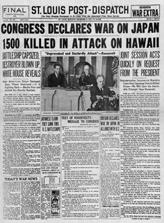
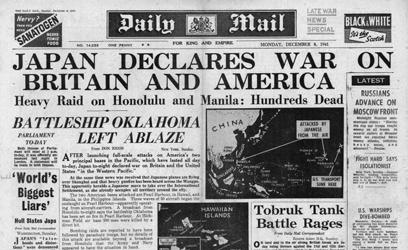
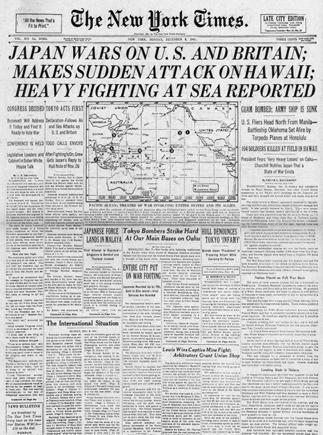
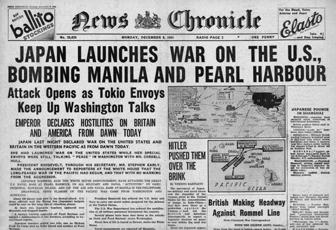
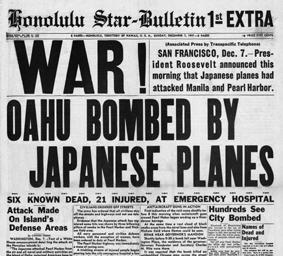
Ask: “Why do newspapers (or websites) have headlines?”
n To get your attention.
n To show readers the day’s news.
n To make people want to read the paper.
n To tell the main idea of an article.
Ask: “Why do you think all of these different newspapers wrote about the bombing of Pearl Harbor as their banner headlines on this day?”
n This was important news!
n A lot of Americans might not have been paying attention to the war because it was not in the United States. When Japan bombed, all of a sudden the United States was in the war.
n So many Americans died like on September 11, 2001.
n The news reporters probably knew that now the United States would enter the war. If your country was about to go to war, you would want to know.
Ask: “What do you notice about the headlines?”
n They use specific details, like the number of people who died.
n The nouns are specific; the headlines do not say “we”; they say “U.S.”
n The verbs are action verbs: declares, dead, votes, bombed.
n The headlines sound urgent and important; you want to read more to find out what happened.
n The headlines use few words, and they don’t use hard vocabulary words. The writers want people to quickly understand at a glance.
n The headlines use big font so you can see the headline even from far away.
n Some of the headlines go all the way across the page.
If students do not remark on some of the following details, discuss them, using questions like the following:
Headlines usually start with a noun, not a verb (“U.S. Declares War on Japan” instead of “Declare War on Japan”).
Headlines often skip articles, like and, or, the (“U.S., Japan at War” instead of “The U.S. and Japan at War”).
Headlines sometimes skip words (“1500 Dead in Hawaii” instead of “1500 Are Dead in Hawaii”).
Headlines are sometimes in two parts, with the main idea followed by important details (“U.S. Declares War on Japan: 3,000 Dead and Wounded in Attack on Hawaii”).
Extension:
If time allows, consider furthering students’ thinking about narrative and informational text structures and purposes by comparing the concluding paragraphs to the two main texts in today’s lesson, chapter 6 of Code Talker and “Pearl Harbor and World War II” (Handout 8C). Engage pairs or small groups in considering the following:
What is the purpose of the final paragraph of chapter 6? Why do you think the author ends with the question: “What was going to happen now?” (37). What is the effect of this question on the reader?
What is the purpose of the final paragraph of the article? What does the author want to accomplish?
What does this comparison lead you to conclude about an important difference between a narrative and an informational text?
Ensure students see that by ending with a question in chapter 6, the author can engage readers who want to find out what will happen next. In the article, the author restates and summarizes the important ideas, so that students see the impact of Pearl Harbor. Help students to see that while authors of both types of texts want to engage and share ideas with readers, writers create narratives to entertain readers with stories and to share a central idea or message, while writers create informational text to provide information.
Individuals
Display the Craft Question: How does a topic statement or sentence for a summary work?
Tell students that they will experiment with writing effective topic statements. Make the connection between the headlines they read and topic statements in informative writing: a newspaper headline and a topic statement both clearly state the central idea of an article or text.
Remind students of the elements of an effective summary, discussed in Module 1. Effective summaries should do the following:
Capture the central idea(s) of the text.
List only the most important details.
Restate the ideas briefly.
Be written in the student’s own words.
If they have not done so already, ask students to note these features in their Response Journal.
Remind students that in this module they are focusing on informative/explanatory writing. Explain that a summary is a kind of informative/explanatory writing and needs to have a topic statement or sentence.
Tell students that they will draft a summary of the text “Pearl Harbor and World War II” (Handout 8C) and will start by drafting a topic statement or sentence. Have students briefly review the list of Dos and Don’ts for topic sentences they previously recorded in their Response Journal.
If students need a model of a summary before they begin, provide them with an example, such as this summary of chapter 6 from Code Talker:
In chapter 6 of Code Talker, Ned Begay sees the tensions rising between Japan and the United States. The Navajos pass a resolution declaring their support for the United States, in anticipation of a war. Still, though, the war seems far away. Ned Begay is more concerned with being caught speaking Navajo than with world events on December 7, 1941. Everyone is surprised when the Japanese attack Pearl Harbor.
Students draft a topic sentence for a summary of the article “Pearl Harbor and World War II” (Handout 8C).
Should students struggle with writing an effective topic sentence for their summaries, provide them with a structure for a summary topic sentence:
+ tell the central idea(s)
For example:
In chapter 6 of Code Talker, by Joseph Bruchac + Ned Begay witnesses + rising tension between Japan and the United States.
10 MIN.
119 © 2023 Great Minds PBC G7 M2 Lesson 8 WIT & WISDOM®
Be brief. Use their own words.
Students individually write a brief summary of “Pearl Harbor and World War II” (Handout 8C).
5 MIN.
Students read chapter 7, completing a T-chart to list what they notice and wonder as they read. Direct students to note any vocabulary words related to the military that they encounter during their reading, try to predict their meaning using context clues, and be ready to discuss them in class during the next lesson.
(Optional) Distribute Handout 8D to students reading below grade level who might benefit from additional fluency practice. Tell students that they should keep this handout for the next four days, and can practice the passage for homework after Lessons 8, 9, 10, and 11.
Each student’s summary offers insight into whether he or she is able to summarize the central ideas of a text (RI.7.2). Check student summaries for the following success criteria:
Opens with a clear topic sentence. (For example, “In ‘Pearl Harbor and World War II,’ Miller and Clemens describe the event that changed the United States from trying to isolate itself to entering into World War II.”)
Briefly restates the text’s central idea(s) or events (such as that America had wanted to isolate itself from the war; that Japan attacked the United States by bombing Pearl Harbor in 1941; that the United States then entered the war, fighting against Germany, Italy, and Japan). Uses their own words. Leaves out their opinion.
Take stock of how well students identify and summarize the central idea(s). If students have difficulty, it may be helpful to distinguish topic from central idea(s), and to scaffold students’ identification of the central ideas of the text. One way to do this is with questions to prompt their thinking. For the central idea(s), ask the following:
What is the title of the text?
What is the topic, or the person, place, or thing that is the focus, of the article?
What ideas are communicated in the opening and closing paragraphs?
How is the article organized?
What points do the authors make about the topic? Why is the topic important?
—
Time: 15 min.
Texts: Code Talker, Joseph Bruchac, Chapter 6; “Pearl Harbor and World War II,” Brandon Marie Miller and Mark Clemens (Handout 8C)
Vocabulary Learning Goal: Apply different meanings of the suffix -ism to content vocabulary, and create sentences to demonstrate understanding (L.7.4.b).
Remind students of the word isolationism and its definition that they recorded during the core lesson. Explain that the suffix -ism has a number of meanings. Display the following word list.
individualism
Impressionism absenteeism activism cubism elitism extremism journalism
Instruct students to Think–Pair–Share, and ask: “Based on the definition of the word isolationism and your knowledge of some of these words, what do you think the suffix -ism means?”
n Adding the suffix -ism at the end of a word seems like it could make it mean doing something, like how criticism is when someone criticizes someone or something.
n It seems like some -ism words are negative and some are positive. Words like racism and terrorism have negative connotations. Patriotism is positive.
n Words ending in -ism often describe a way of thinking or a belief system.
Handout 8E. Direct students’ attention to the chart in Part 1 of the handout. Ask students to compare their predicted definitions of the suffix with the meanings provided in the chart, noting and correcting any misconceptions.
1. The act, practice, or process of doing something.
–ism (suffix)
2. Unfair treatment of a group of people with a specific quality.
3. Following certain principles, theories, or a system of thought.
Referring to the list of words from the Launch, instruct students to Think–Pair–Share, and ask: “Where would the words on the list fit on this chart? Fill in the Examples column, using the words on the list.”
Provide students with access to resources, such as the internet or a dictionary, so that they can look up the definitions of any unknown words from the list
1. The act, practice, or process of doing something. Criticism, cannibalism, terrorism, plagiarism.
–ism (suffix)
2. Unfair treatment of a group of people with a specific quality. Racism, sexism, ageism.
3. Following certain principles, theories, or a system of thought. Capitalism, commercialism, communism, feminism, multiculturalism, veganism, atheism, liberalism, Buddhism.
Tell students that they will now have a chance to use their knowledge of the suffix -ism to create new sentences, using the words in context.
Students complete Part 2 of Handout 8E.
Invite students to share examples of their sentences from Part 2.
Challenge students to listen and look for additional words with the suffix -ism, and to use them in their conversations with family and peers.
Code Talker, Joseph Bruchac, Chapters 7–8
Images of Pearl Harbor headlines
Welcome (4 min.)
Launch (2 min.)
Learn (63 min.)
Review Key Details and Developments (25 min.)
Reflect on the Reading (20 min.)
Collect and Organize Evidence (18 min.)
Land (5 min.)
Reflect on the Learning Wrap (1 min.)
Assign Homework
Vocabulary Deep Dive: Content Vocabulary: Motto (15 min.)
The full text of ELA Standards can be found in the Module Overview.
RL.7.1, RL.7.2
Writing W.7.10
Speaking and Listening
SL.7.1, SL.7.2, SL.7.6
Language
L.7.4, L.7.5.b
Handout 9A: Headlines
Handout 8B: Code Talker World War II Map
Handout 9B: Ned Begay, Navajo and Marine
Handout 8D: Fluency Homework (optional)
Handout 9C: Frayer Model
Analyze how the author develops the central idea of Ned Begay’s Navajo identity (RL.7.2).
Complete the evidence organizer, Handout 9B.
Demonstrate understanding of target vocabulary in a brief response about the module text (L.7.4, L.7.5.b).
Explain the purpose and effect of the Marine Corps motto, Semper Fidelis, in an Exit Ticket.
FOCUSING QUESTION: Lessons 8–21
How does Ned’s Navajo identity provide strength during times of challenge?
CONTENT FRAMING QUESTION: Lesson 9
Organize: What’s happening in chapters 7 and 8?
By reviewing the details and developments in Code Talker, chapter 7, and then engaging in a shared reading of chapter 8, students gain deeper insight into the central ideas that Bruchac develops throughout Code Talker. In these chapters, students can see how the tensions between Ned’s identity as a Navajo and as an American dissipate, as he realizes that his Navajo heritage is valued and that his Navajo experiences make him particularly well qualified to serve as a Marine.
Distribute Handout 9A, and have students briefly review the directions. Have pairs write a headline and subhead for chapter 7 next to its title on the second page of the handout.
n MARINES RECRUIT NAVAJOS! Reversing Earlier Denial of Service


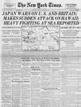

n NED BEGAY TOO YOUNG TO SERVE? Looks for a Way to Join
n MARINE RECRUITER OVERCOMES NAVAJO DOUBTS: Navajos Seek to Join
TEACHER NOTE
Students will have the chance to return to Handout 9A throughout their reading of Code Talker as one way to help them keep track of the main events in the text. In some lessons, students will engage in specific headline-writing activities. In others, they can use the space on the handout for taking notes or summarizing key chapter events. If students need additional support to follow the text, consider having them write headlines for other chapters as well.
2 MIN.
Post the Focusing Question and Content Framing Question.
Tell students that in this lesson, they will explore what happens to Ned Begay after the attack on Pearl Harbor: How do the events affect his life and the lives of other Navajos?
63 MIN.
Whole Group
25 MIN.
Invite students to share their headlines, as well as the strategies they used to generate them, such as zeroing on the most important events, eliminating unnecessary words, and using precise nouns and strong action verbs.
Ask a volunteer, or volunteers, to quickly summarize the events of chapter 7. If the students’ summary does not include Ned’s desire to serve despite being underage, ask a follow-up question to bring this point out: “What conflict does Ned experience in chapter 7?”
Point out that chapter 7 includes places, military words, and other plot developments related to World War II. Tell students they will review these details and developments as a group to ensure understanding of this chapter and to prepare them to understand what happens in the book going forward.
Display a T-chart with columns labeled Allied Powers and Axis Powers. Invite volunteers to name countries in each group, encouraging them to refer to the article on Pearl Harbor (Handout 8C) as needed to refresh their memories on the countries on the two sides of this conflict. Record countries in the correct column as students share. If students do not do so on their own, ask them to identify the side on which the United States entered the war.
Display the Code Talker World War II map (Handout 8B). Show students that Wake Island is the island located about halfway between Guam and Hawaii and that Guadalcanal is one of the Solomon Islands. Ask volunteers to share the locations of Pearl Harbor and Fort Defiance. Provide a minute for students to add any labels or notes to their maps.
Students turn to a clean page in their Response Journal. Instruct students to Think–Pair–Share and write one or two sentences about the importance of each place, or group of places, referenced in Code Talker and shown on the map. Suggest that students can use details they have learned in Code Talker or in the informational article they read in the previous lesson.
Japan:
Wake Island, Guam, Guadalcanal:
Pearl Harbor: Fort Defiance:
Germany and Italy:
n Japan: Japan’s attack on Pearl Harbor caused the United States to enter World War II.
n Wake Island, Guam, Guadalcanal: Japan took over all of these places in the Pacific, as they moved to expand their power.
n Pearl Harbor: The United States had a naval base in Pearl Harbor in Hawaii, and this was where the Japanese chose to attack.
n Fort Defiance: This was where Ned Begay went to meet with the Marine recruiter who was looking for Navajos to join the war effort.
n Germany and Italy: Japan had joined with these two countries in Europe to form the Axis Powers in World War II.
Have students take out their Vocabulary Journal and their homework lists of military words. Ask students to set aside four pages in the New Words section of their Vocabulary Journal, for a section on Vocabulary Words and Phrases Related to the Military. Invite volunteers to share words and their predicted meanings. Discuss the definitions of each word together, and have students record definitions. For example, the list might include words such as the following:
enlist (v.) To sign up for the military voluntarily.
recruiter (n.) A person who enrolls young men and women into the armed forces.
recruit (n.) A soldier recently enlisted into the armed forces; a new member of a group or organization.
platoon (n.) A group of persons trained as a unit; a military unit.
NOTE
If students are unfamiliar with the U.S. Armed Forces, it may be helpful to clarify that the U.S. Armed Forces consist of five armed service branches: the Army, Navy, Air Force, Marine Corps, and Coast Guard. The slogan of the Marine Corps is “the few, the proud,” which First Sergeant Shinn references on page 42 and Johnny Manuelito echoes on page 47. The Marine motto is Semper Fidelis, “always faithful,” which Manuelito references on page 47. In the Marine Corps, the ranks typically go in ascending order from private, to corporal, to sergeant, to sergeant major. As a First Sergeant, Shinn is a senior enlisted advisor. As a newer officer, Manuelito has the lower rank of corporal.
Quickly review:
The Japanese are continuing to advance in the Pacific.
The Navajos are asked to sacrifice for the war effort.
Many Navajos try to join and are rejected from the armed forces at first, but now a military recruit is visiting Fort Defiance to recruit Navajo volunteers.
Ask: “How does Ned respond to the Marine Corps recruiter in chapter 7?”
n Ned is impressed.
n He and his friends admire the Marine Corps uniform.
n He believes him.
n He wants to follow him and become “one of the proud and the few” (43).
Ask: “What did you wonder about his response?”
If students do not mention it, guide them to reflect on how, despite the many sacrifices the Navajos have made, Ned is still ready to serve the United States.
(Visual Learning) The scene described on pages 41 and 42 offers a great opportunity for visualization. Invite students to spend a few minutes sketching the uniform and traditional dress described.
Then, search online to display images of Marine Corps officers’ uniforms and traditional Navajo dress.
Ask students to compare the Marine Corps uniforms to the Navajo traditional Navajo dress. Ask: “How are they alike? How are they different?”
Encourage students to reflect on the significance of clothing. Help students recognize that the military uniform both identifies the wearer as part of that branch of service, and is designed to command respect and symbolize power, as this uniform so clearly does for Ned Begay. For the Navajos, the colorful clothing and jewelry are an expression of culture. Remind students of the passage when the new children at the boarding school change from their traditional American Indian dress into the drab military-style school uniforms, in which they “all looked just the same” (20).
Read chapter 8 aloud, as students follow along.
Have small groups discuss what they noticed and wondered while reading chapter 8. Encourage students to address one another’s wonderings, referring back to the text as they do so.
Invite groups to share what they noticed and wondered.
n I wonder what the special duty is. I wonder if it has to do with the secret code the author mentioned at the end of chapter 7. I noticed that the book is called Code Talker!
n I wonder why the author was interested in writing about the Navajos in World War II. Maybe he knew someone who fought in World War II.
n I wonder why the new recruits could not even write home to their families. I think I would have been worried.
n I noticed that Ned is really impressed by the Marine Corps uniforms. I wonder why he is so interested in joining even though he is still so young.
n I noticed that so many of the experiences the Navajos have had actually would make them perfect Marines. I wonder if the Marine Corps recruiters realized this.
Should students have questions about military terms, invite them to open their Vocabulary Journal to the Vocabulary Words and Phrases Related to the Military section and review or add to their lists.
boot camp (n.) Marine basic training.
As a whole group, have students answer the following Text-Dependent Questions (TDQs) about the author’s craft and its effect on readers.
1. How does the author build suspense in chapters 7 and 8?
n Bruchac refers to “the secret code” (44) and the “special duty” (45). He tells of how after the men left, “no word was heard from them” (45). At the end of chapter 8, we still do not really know what the duty is or why it is so secret.
2. Describe the author’s style and language in chapters 7 and 8. How does the author emphasize that the teller of this story is an American Indian sharing his life with his grandchildren?
n Bruchac gives a lot of information, but he still uses language that makes it sound like Ned is telling a story to his grandchildren. Bruchac makes comparisons that would have been familiar to American Indians in the Southwest. For example, he writes “his words reverberated in my mind like drumbeats” (47) and “He looked like an eagle staring down from a high mountain crag” (47).
3. Even though these chapters convey many facts—about the Marines, the war, and the Navajos—how can the reader tell that these are part of a story, or a narrative, instead of an informational text?
n Ned is a fictional character. Bruchac includes a lot of description and dialogue you probably would not see in an informational text. He uses elements of stories, like plot and character. He writes about Ned’s personality and feelings. Bruchac tries to keep readers hooked on the story by building suspense at the end of each chapter.
18 MIN.
To set the purpose for the evidence-collection activity, remind students of the following: “In chapters 7 and 8, Ned does not waver from his desire to join the Marines. Despite his experiences in boarding school, he still wants to become a Marine.”
Tell students they will search for and record evidence to show how the author develops the central idea that specific elements of Ned’s Navajo identity make him both want to join the Marines and be well qualified to serve as a Marine.
Distribute Handout 9B.
To help students get started, model a response for the first row of their charts.
The Navajos “had loved this country long before the ancestors of the bilagáanaas came here” (39).
The Navajos, and Ned, want to enlist to serve the land that they love and believe to be sacred.
Groups collaboratively discuss, and group members individually record evidence from chapters 7 and 8 onto Handout 9B.
After students have had sufficient time to work, invite them to share some of their responses.
5 MIN.
In Boot Camp, the new Marines have to march long distances and carry heavy packs (48).
Wrap
1 MIN. ASSIGN HOMEWORK
Ned’s Navajo IdentityStudents’ evidence charts (Handout 9B) will show whether they are following the development of the central idea that Ned’s Navajo identity both makes him want to serve and makes him particularly well qualified to serve as a Marine (RL.7.2). Check for the following success criteria:
Includes at least three pieces of connected evidence from across chapters 7 and 8.
Chooses evidence that clearly connects Ned’s Navajo identity with his desire and capability to be a Marine.
Assess the relevance of and insight demonstrated by students’ evidence.
If students have difficulty, provide a completed chart, with a third column labeled Explanation and have students work in groups to discuss and complete the third column, explaining how Ned’s Navajo identity makes him both want to serve and be confident he can serve well.
Ned’s Navajo Identity
The Navajos “had loved this country long before the ancestors of the bilagáanaas came here” (39).
Everyday Navajo life includes physical challenges; “We were used to walking great distances over hard terrain while carrying things” (49).
Most Navajos are experienced with guns: “Every one of us carried a rifle when we hunted to provide food for our families or … protect our herds” (48—49).
Ned’s Desire, and Qualifications, to Be a Marine Explanation
The Navajos, and Ned, want to enlist to serve the land that they love and believe to be sacred.
In Boot Camp, the new Marines have to march long distances and carry heavy packs (48).
Ned is prepared “to be brave in the face of gunfire” (48).
Or, list a set of characteristics, such as brave, prepared for physical challenges, proud of one’s country, and have students discuss how each characteristic reflects both the Navajo and the Marine identities.
If students are ready for an extension activity, encourage them to create an identity web, showing Ned in the center and including words and phrases and quotations around him that reflect his identity as a Navajo and a future marine.
Time: 15 min.
Text: Code Talker, Joseph Bruchac, Chapters 7–8
Vocabulary Learning Goal: Demonstrate understanding of target vocabulary in a brief response about the module text (L.7.4, L.7.5.b).
Display the following quote:
“Dream as if you’ll live forever. Live as if you’ll die today.”
—James Dean
Instruct students to Think–Pair–Share, and ask: “What do you think this quote means?”
n He’s saying that you should make the most out of every day of your life, and that includes aspiring to do wonderful things.
n He might have been giving advice to people who take things for granted and give up on their dreams easily. Learn
Distribute Handout 9C, and display the Frayer Model. Review the two definitions of and related words for the word motto with students. Tell them that, based on the first definition, James Dean’s quote can be considered a motto.
Ask: “Why do you think this quote can be considered a motto?”
n His quote reads like advice or words to live by.
n These words can be adopted by anyone as a personal philosophy or guidelines for how to live life.
Review with students the two mottos listed under Examples on the Frayer Model. Provide two additional examples:
“In God We Trust.”
Treat others the way you would like to be treated.
Ask students to decide which definition each motto fits and write it in the appropriate place in the Examples box.
TEACHER NOTE
If students have coins or bills in their pockets, encourage them to look on the coins or bills to find the official motto of the United States.
Instruct groups of three to brainstorm additional examples of mottos for each definition and list them under “Examples” on Handout 9C.
n Definition 1: “Carpe diem!” (Seize the day!)
n Definition 2: “E Pluribus Unum” (One from many)
Students may also provide their school motto or examples of slogans for popular brands.
As students consider the Nonexamples box, explain that a nonexample of a motto might be a treatise, manifesto, or autobiography, which are all much longer descriptions of a belief system.
If students need help getting started, provide them with a list of common proverbs, maxims, adages, mottos, or slogans, such as the following: Live every day to the fullest.
Failure can be the foundation of success.
Early to bed and early to rise makes a person healthy, wealthy, and wise.
Two wrongs don’t make a right.
When in Rome, do as the Romans do.
If time allows, students might enjoy creating and displaying posters of classroom mottos—both examples and nonexamples.
Invite groups to share their examples and nonexamples with the whole group.
Display the following sentence from Code Talker:
“Our motto is Semper Fidelis, always faithful” (Bruchac 47).
Remind students that Corporal Johnny Manuelito makes this statement in chapter 8, when he visits Ned’s high school to recruit young Navajo men to the Marine Corps.
Instruct students to Think–Pair–Share, and ask: “Why do you think that the U.S. Marine Corps uses Semper Fidelis as their motto?”
n Another word for faithful is loyal. So the Marines want people to know that loyalty is the foundation of their jobs as soldiers.
n They want to show that they are committed to their mission as soldiers who protect the United States.
Students complete the following Exit Ticket: “Briefly explain (1) why an organization like the Marines would have a motto and (2) what effect this motto might have had on Ned’s decision to join the Marines.”
QUESTION: LESSONS 8-21 How does Ned’s Navajo identity provide strength during times of challenge?
“A Beautiful Dawn,” Radmilla Cody (http://witeng.link/0024)
Code Talker, Joseph Bruchac, Chapter 9 and pages 222–223
AGENDA
Welcome (3 min.)
Launch (5 min.) Learn (60 min.)
Notice and Wonder (30 min.)
Experiment with Genre (30 min.) Land (6 min.)
Reflect on the Learning Wrap (1 min.)
Assign Homework Style and Conventions Deep Dive: Examine Formal Style (15 min.)
The full text of ELA Standards can be found in the Module Overview.
RL.7.1, RL.7.2, RL.7.3
Writing
W.7.4, W.7.10
Speaking and Listening
SL.7.1, SL.7.2, SL.7.6 Language L.7.3
MATERIALS
Handout 3A: Character Analysis
Handout 8D: Fluency Homework (optional)
Handout 10A: Examining Style
Explore the features of different genres by adjusting writing style to a specified genre, task, and purpose (W.7.4).
Rewrite a narrative paragraph from Code Talker about the Blessingway as an informative paragraph.
Explain why using formal style is important in informative writing (L.7.3).
Complete an Exit Ticket to explain why using formal style is important when writing an informative essay.
FOCUSING QUESTION: Lessons 8–21
How does Ned’s Navajo identity provide strength during times of challenge?
CONTENT FRAMING QUESTION: Lesson 10
Wonder: What do I notice and wonder about chapter 9?
CRAFT QUESTION: Lesson 10
Experiment: How do the structures and styles of different genres (informative vs. narrative) work?
Students notice and wonder as they read Code Talker chapter 9, building knowledge of Navajo traditions and beliefs, and an understanding of how this culture is crucial to the protagonist’s identity. After reading and thinking about the chapter, students reflect on genre, particularly the varying purposes and choices authors make based on the genre in which they choose to write. Reflecting on genre helps to prepare students to carefully consider the choices they will make in composing their EOM Task response.
3 MIN.
Instruct students to turn to Handout 3A and consider the list of traits they identified. Ask students to take two minutes to talk with a partner about how these traits might explain, in part, why Ned so desperately wants to become a marine.
5 MIN.
Post the Focusing Question and Content Framing Question.
Invite volunteers to share their ideas from the Welcome task.
Ask a volunteer, or volunteers, to quickly summarize where the class left Ned at the end of chapters 7 and 8. Ensure that students recall that the Marine recruiters have come to Fort Defiance to recruit Navajos to serve in World War II, and Ned is desperate to join, despite his young age
60 MIN.
NOTICE AND WONDER 30 MIN.
Before you begin reading chapter 9, ask students if they know the meaning of the word pollen. If students are unsure, share this definition: “a fine, yellow powder made by flowering plants that helps the plant produce new plants.” Pique their curiosity by telling students that pollen will play a role in the chapter they are about to read.
Begin reading chapter 9 aloud, while students follow along. Remind students to think about what they notice and wonder as they read.
If students are ready to read independently, have them read the chapter on their own, completing a Notice and Wonder T-Chart in their Response Journal as they read. Then, as a whole group, discuss their observations and questions.
If students ask about mission schools, you can use the following definition to guide their understanding, and have students add this to their Vocabulary Journal.
mission school (n.) A religious school with the goal of converting local peoples to a particular faith.
Stop at the end of the third paragraph. To check literal understanding, ask: “Ned’s parents agree to let him join the Marines on one condition. What is it?”
Follow up on this question by asking: “What did you notice and wonder about the Blessingway?”
n I noticed that a Blessingway is a ceremony. I wonder if it is a traditional Navajo ceremony.
n I wondered how to say the word in Navajo.
n I thought that the Blessingway is a ceremony performed to keep someone safe and wish them well.
n I wonder what the actual Blessingway involves. It must involve singing because they are going to look for a singer to do the ceremony.
Continue to read aloud, starting from “The singer we went to was Big Schoolboy” and reading through the end of page 51, “despite their tiny size.”
Ask: “What did you notice or wonder about Ned’s and his family’s religious beliefs?”
n Ned and his family and many other Navajos became Catholic in the mission schools.
n I didn’t realize the schools were Catholic. I thought maybe they were government or public schools.
n Their Catholic beliefs seem like just one part of them, but their Navajo Way seems stronger.
n Even though Ned’s experience at school was not positive overall, his family decided to send their other children there, and they all became Catholic. They seem to be trying to live in two different worlds, in a way.
TEACHER NOTE
If students are unfamiliar with Catholicism, a brief description may be helpful. Catholics are a sect of Christianity that is led by the pope in Rome and that follows the teachings of the Roman Catholic Church. The Catholic Church follows a strict hierarchy of leadership, with which students will be familiar from their readings about the Middle Ages in Module 1.
Ask: “What did you notice or wonder about names in Ned’s community?”
n They all seem to have nicknames and different names to show who they are.
n Big Schoolboy has four different names: his nickname, his Navajo name, his boarding-school name, and his honorary title, Hosteen.
n Their nicknames seem to tell about who they are; Ned is strong but small, like an ant.
n I wonder if it gets confusing, figuring out who is talking about who.
Students should base their contributions on the text. If they make suggestions that may not be text-based, ask, “What in the text makes you say that?” or “What part of the text gave you that idea?”
Continue reading, to the middle of page 53, ending with “Then both of us laughed even harder.”
Ask: “What did you notice or wonder about the stories Hosteen Mitchell tells?”
n He seems funny. His story about the old priest was funny. Hosteen really seems to see the humor in people.
n I noticed that the Navajo language seems difficult. I wonder whether many people still speak Navajo now.
n I noticed how he seems like he is trying to figure out how to be Navajo and Catholic at the same time.
n I liked it when it said, “A story is better if you have to wait a little bit for it to be spun out” (52). This is so true, especially when my uncle tells funny stories where it takes a really long time to get to the point of the story. It also seems like being patient might be part of Navajo culture.
Follow up by asking: “What do Hosteen’s stories reveal about being Navajo?”
n The stories show that Navajos have some practice living in different worlds, the White world and the Navajo world, the Catholic world and the world of their own religion.
n It seems like being patient might be part of Navajo culture.
n Again it seems clear that the Navajo language is really difficult to speak.
NOTE The Golden Rule in the Bible is that you should do unto others as you would have them do unto you.
Continue reading to the end of the chapter. Invite students to share what they noticed and wondered, both about the chapter and about the Blessingway.
Play the song “A Beautiful Dawn,” by Radmilla Cody (http://witeng.link/0024), and ask: “How does listening to this Navajo song help you visualize and understand the events and ideas in chapter 9?”
If students do not share specific ideas about the Navajo beliefs, culture, and traditions, prompt them to reflect. Ask: “What does this chapter and the description of the Blessingway show about being Navajo?”
n It seems as if it is important for the Navajo to show respect and be polite and not be too direct. Even though he and Hosteen seem so friendly, Ned still did not want to ask him about the Blessingway.
n The community seems really important. Family, and friends, and others all joined the ceremony.
n The Navajo seem connected to the earth. I wonder if that is true of all American Indians. This ceremony had a lot to do with the place of the sun in the sky and the four directions (north, south, east, and west) and the pollen.
n The Navajo seem to think balance is important. At the end of the chapter, Ned feels “in good balance,” (56) and that is how he knows he is ready to join the Marines.
n This seemed like a religious ceremony. I wondered how they can be Navajo and Catholic.
TEACHERThe Blessingway is an ancient, spiritual, sacred ceremony that is central to the Navajo religious tradition. The Navajo perform a variety of healing ceremonies, with chants or songs that are designed to restore balance. The Blessingways are performed to invoke positive blessings and good fortune; as the protagonist states, “the Blessingway is done for all that is good” (50). Before leaving their communities to join the armed forces in World War II, many Navajo men and women took part in Blessingway ceremonies, intended to protect them from harm.
If students do not share specific ideas about the author’s style, ask: “What did you notice and wonder about the author’s style? Why do you think he kept repeating the phrase ‘you know what it is like’ at the top of page 54 when he tells about the Blessingway?”
n I noticed that the author tries to make it seem like Ned is telling a story, aloud, to his grandchildren.
n He writes “you know what it is like” to show that Ned is talking to his grandchildren, but I think he also uses it to make us, as readers, imagine the ceremony.
n When he says “you,” I notice that I feel like I am supposed to be part of the story, and I’m supposed to imagine if I was in a Blessingway.
n I wonder what it would be like. It sounds nice to be blessed that way.
Tell students that in the next half of the lesson, they will think more about the author’s style.
30 MIN.
Display the Craft Question: How do the structures and styles of different genres (informative vs. narrative) work?
Instruct students to turn to page 222 in Code Talker.
Tell students that in the Author’s Note, Joseph Bruchac discusses the events that led to his writing the book Code Talker; he researched code talkers and decided to write a novel about the topic. Read aloud the paragraph at the bottom of page 222 which begins: “My next step was to rethink it as a novel.” Read through the short paragraph on page 223, which begins “‘Don’t worry.’”
Ask: “What was the problem with Bruchac’s first draft?”
n He included too many facts. He had done so much research he wanted to include all of it. He promised his editor he would revise it to tell a better story.
Ask: “How is Code Talker like an informational history book? How is it not?”
Ask for volunteers to define the word genre. Clarify as needed, to ensure that students understand that genre is a specific type of writing, such as mystery, historical fiction, memoir, biography, or informational essay, that has particular features or characteristics.
Instruct students to Think–Pair–Share, and ask: “What genre is Code Talker, and what are the particular features of this genre?”
As a whole group, discuss characteristics of historical fiction, generally, and Code Talker, more specifically. To spark students’ thinking, remind them of the list they generated in Lesson 31 in Module 1 when planning for their EOM Task response. Instruct students to find this list of characteristics in their Response Journal to reference here.
n Is based on a true historical person or event(s).
n Is set in the past.
n Has the elements of a story (plot, character, setting).
n Is based on research.
n Blends accurate historical facts with fiction.
n Characters and setting are shown in a realistic and convincing way.
Ask: “Why might the author have chosen to write a work of historical fiction instead of an informational book?”
n To engage readers.
n To bring the past to life.
n To emphasize parts of the events he wanted to emphasize.
n To focus on ideas that may be especially interesting to modern readers (like racism and discrimination, or possible conflicts between one’s culture and one’s nationality).
Tell students that they will now experiment with genre. Instruct them to reflect on how Code Talker would change if it were written as an informational book instead of as a narrative.
Instruct students to turn to page 53, and reread the paragraph that begins at the bottom of that page with “Some of you, my grandchildren” and continues on to page 54, ending with “you carry the memories of the goodness of Blessingway with you.”
Display the following prompt:
Imagine that you are a writer who writes books for young adults about historical events and groups, such as the Navajo during World War II.
Look at the paragraph in Code Talker where Ned Begay describes the Blessingway to his grandchildren.
Rewrite this paragraph as if it were part of an informational text instead of this novel.
Provide time for students to rewrite the paragraph.
Should students have difficulty getting started, offer a model by translating the first sentences for them. Instead of this: “Some of you, my grandchildren, have had Blessingway sung for you. Some of our chantways have been forgotten, but Blessingway is as strong as ever” (54), open with something like this: “Although some of the traditional Navajo chantways, or singing ceremonies, have been lost over time, the Blessingway continues as an important tradition in the lives of the Navajo.”
Invite volunteers to share ideas about how the original and the rewrite differ.
The rewrite does not use you, my, and our and is instead written in the third person.
The rewrite defines the word chantways and does not assume the audience knows this word.
The rewrite states a topic and central idea: the Blessingway is an important traditional Navajo ceremony.
Students writing below grade level and multilingual learners may benefit from starting with a paragraph frame that they can work with as a model, and recopy to gain the feel of the language and organization. Provide them with a frame where they can fill in the blanks, such as:
The Blessingway is an important Navajo ceremony that is conducted to .
In the Blessingway, one is not alone; many
The Blessingway takes hours, beginning in the morning with .
The ceremony continues with
At the end of the Blessingway, the one who is blessed feels .
6 MIN.
In their Response Journal, students consider the following: “How, and why, does the Blessingway give Ned strength?”
Students read chapter 10. Name Date Class
(Optional) Distribute Handout 8D to students reading below grade level who might benefit from additional fluency practice.
Handout 8D: Fluency Homework Directions: 1. Day 1: Read the text carefully, and annotate to help you read fluently. 2. Each day: a. Practice reading the text aloud three to five times. b. Evaluate your progress by placing a checkmark in the appropriate unshaded box. c. Ask someone (adult or peer) to listen and evaluate you as well. 3. Last day: Respond to the self-reflection questions at the end of this handout.
Bright late autumn sun was shining through the windows of our dormitory, but there was no sun in my heart. In the other corner of the room several of my friends were laughing and talking, but was in no mood for anything but silence. I was still smarting from what had happened to me two days before. I was so embarrassed. Although, as have explained, tried to be careful when I spoke our sacred language, that Friday I had been caught. Mr. Straight overheard me greeting one of my friends in Navajo when thought no teachers were around. It didn’t matter that could now speak English as well as any bilagáanaa It didn’t matter how good my grades had been in all my classes. By speaking one word in our sacred language I had just proved to my teacher that I was as hopeless as the rest of my people (Bruchac 37).
Students’ translations of the narrative paragraph into an informative paragraph provide insight in their ability to adjust their writing to meet the needs of a specific audience, task, and purpose (W.7.4). Check their paragraph rewrites for the following success criteria:
Changes the first-person (you, my, and our) to the third-person point-of-view.
Does not assume knowledge and defines key terms as needed.
Uses content-specific language instead of informal, conversational language (such as by changing phrases like “our people” to “Navajo”).
Organizes the paragraph as a topic with supporting ideas and examples.
If students would benefit from additional structure with adapting genres, choose a new paragraph from the text for them to work with, and guide them in the following ways:
First, pose prompting questions to guide students to think about the audience for the paragraph (in Code Talker, the narrator often speaks directly to his grandchildren, who presumably already have some background on Navajo history and culture) versus the audience for an informational essay (who may need more background on historical and cultural references). Pose questions such as:
To whom or for whom is the author writing? How is this audience made clear? What does this audience already know about the topic?
Who is the audience of your informative paragraph? What can you assume about how much your audience knows already? How will this affect how you write the paragraph?
Next, prompt students to think about the point of view or perspective of the paragraph.
From whose point of view is the historical fiction paragraph written? How do you know? How will this change in an informative paragraph? How would this change the style you will write in for an informative paragraph?
Next, help students plan the structure and organization of the informative paragraph. An informative paragraph can be organized using the To-SEEC structure, with a topic statement, evidence, elaboration, and a concluding statement.
Analyze your paragraph from the novel. What is the topic of the paragraph? What is the central idea?
To write your own informative paragraph, what informative topic statement can you start with? What evidence can you provide to support that topic? How can you conclude your paragraph?
Finally, guide students in thinking about language and word choice. Help them see how specific words and phrases can make a paragraph more informal, conversational, and familiar or can make it more formal, academic, and informative. Ask:
How should language and word choice be different in your informative paragraph than it is in the paragraph from the novel? What specific words can you change?
If students are ready for an extension activity, encourage them to write a summary of chapter 9, using characteristics of an effective informative paragraph.
Time: 15 min.
Text: Code Talker, Joseph Bruchac, Chapter 9 and pages 222–223
Vocabulary Learning Goal: Explain why using formal style is important in informative writing (L.7.3).
STYLE AND CONVENTIONS CRAFT QUESTION: Lesson 10
Examine: Why is formal style important in informative writing?
Post the Style and Conventions Craft Question. Display the following two sentences:
1. I experienced a series of unfortunate events while on vacation in the Bahamas last summer.
2. I had a bunch of really gnarly things happen to me when I was chilling on the beach last summer on vay-cay.
Ask students to explain the difference between the two sentences.
n The first one uses mature vocabulary compared to the second one, so it sounds more adult and formal.
n The second one sounds informal because it uses slang: “gnarly,” “chilling,” and “vay-cay.” The outdated slang also makes it humorous.
n The first sentence uses a strong action verb and strong descriptions, while the second sentence has a weak linking verb and vague descriptions.
n The first sentence seems more precise with its word choice; the second one seems vague.
Tell students that they will examine an important aspect of informative writing: formal style.
Distribute Handout 10A, and display the following two paragraphs:
Paragraph 1
Date Class Handout 10A: Examining Style Directions: Read the following two paragraphs, taking note of the differences between the two.
Paragraph 1 One great weapon that the U. S. armed forces used during World War II was called the MK 2 grenade. It was also known as the MK II. It was issued to all soldiers and was designed to fling deadly pieces of metal when it went off. Experts called it a fragmentation type anti-personnel hand grenade. Grooves put on the iron casing are what made it come apart. They also helped a soldier hold onto and throw the grenade. Funny thing is, the MK II looked like a pineapple because of those grooves, so soldiers called it a pineapple. But never mind the fruity nickname. The grenade was supposed to cause the enemy really bad injuries. But the MK II also had its problems, including failing to go off when it got moisture in it and stuff. You couldn’t really depend on it. Maybe it would work or maybe not. So, the U.S. got a new and improved model later on.
Paragraph 2 During World War II, the U.S. armed forces employed a weapon called the MK 2 grenade, or the MK II. This standard-issue weapon was a fragmentation type anti-personnel hand grenade designed to disperse lethal fragments of metal on detonation. Heavy grooves in the cast-iron casing enhanced fragmentation and provided a better grip for handling and throwing the grenade. As a result of these grooves, the weapon closely resembled a pineapple, and soldiers often referred to the weapon as such. Despite having such an innocent-sounding nickname, the unique design of the grenade ensured optimum bodily harm to the enemy. Nevertheless, the MK II equally posed problems during combat, including its vulnerability to moisture and resulting failure to detonate. Due to its unreliability, the U.S. military replaced the grenade with a more reliable model sometime after World War II. © Great Minds PBC
G7 M2 Handout 10A: WIT WISDOM Page of
One great weapon that the U. S. armed forces used during World War II was called the MK 2 grenade. It was also known as the MK II. It was issued to all soldiers and was designed to fling deadly pieces of metal when it went off. Experts called it a fragmentation type anti-personnel hand grenade. Grooves put on the iron casing are what made it come apart. They also helped a soldier hold onto and throw the grenade. Funny thing is, the MK II looked like a pineapple because of those grooves, so soldiers called it a pineapple. But never mind the fruity nickname. The grenade was supposed to cause the enemy really bad injuries. But the MK II also had its problems, including failing to go off when it got moisture in it and stuff. So, you couldn’t really depend on it. Maybe it would work or maybe not. So, the U.S. got a new and improved model later on.
During World War II, the U.S. armed forces employed a weapon called the MK 2 grenade, or the MK II. This standard-issue weapon was a fragmentation type anti-personnel hand grenade designed to disperse lethal fragments of metal on detonation. Heavy grooves in the cast-iron casing enhanced fragmentation and provided a better grip for handling and throwing the grenade. As a result of these grooves, the weapon closely resembled a pineapple, and soldiers often referred to the weapon as such. Despite having such an innocent-sounding nickname, the unique design of the grenade ensured optimum bodily harm to the enemy. Nevertheless, the MK II equally posed problems during combat, including its vulnerability to moisture and resulting failure to detonate. Due to its unreliability, the U.S. military replaced the grenade with a more reliable model sometime after World War II.
Read aloud the paragraphs as students follow along. Then, instruct students to reread the paragraphs, this time making note of the differences between the two.
When students have finished, ask: “Which one of these paragraphs is more formal, and how do you know?”
If needed, explain that style affects how formal a piece sounds. Style deals with the way a piece is written and emerges from the writer’s word, phrasing, and sentence-construction choices.
n The first paragraph uses slang and sounds more the way someone would talk. The second uses academic vocabulary.
n Paragraph 1 uses simple sentences, while Paragraph 2 uses more complex ones.
n The first paragraph uses vague descriptions, while the second uses precise ones.
n The first paragraph has few varied sentence beginnings compared to the second.
n Paragraph 1 uses “to be” verbs, while Paragraph 2 uses more active verbs.
Tell students that different genres require different levels of formality. In the case of the paragraphs studied here, the second paragraph uses the appropriate style for an informative essay in school.
Pairs complete the following Exit Ticket: “Why is using a formal style important when writing an informative essay?”
Welcome (5 min.)
Launch (5 min.) Learn (60 min.)
Summarize (20 min.)
Determine the Central Ideas (20 min.)
Examine Transitions (20 min.)
Land (4 min.)
Reflect on the Learning Wrap (1 min.)
Assign Homework
Style and Conventions Deep Dive: Examine Transitional Phrases and Clauses (15 min.)
The full text of ELA Standards can be found in the Module Overview.
Reading
RL.7.2
Writing W.7.10
Speaking and Listening SL.7.1, SL.7.6 Language L.7.1.a, W.7.3.c
Handout 9A: Headlines
Handout 11A: Central Ideas: Chapter 10
Handout 8D: Fluency Homework (optional)
Chart paper
Handout 11B: Examining Transitions
Determine central ideas that Bruchac develops in chapter 10 (RL.7.2).
Complete Handout 11A to reflect on central idea and theme in chapter 10.
Identify transitional phrases and clauses, and explain their function in specific instances (L.7.1.a).
In pairs, identify underlined transitions as words, phrases, or clauses, and then categorize the function each transition serves.
FOCUSING QUESTION: Lessons 8–21
How does Ned’s Navajo identity provide strength during times of challenge?
CONTENT FRAMING QUESTION: Lesson 11
Reveal: What does a deeper exploration of the events in chapter 10 reveal about the central ideas being developed in Code Talker?
CRAFT QUESTION: Lesson 11
Examine: Why are transitions important?
Students organize their ideas about chapter 10 and then reflect on how Ned’s experiences in boot camp reveal deeper messages that the author develops throughout Code Talker. To continue their study of writing, students examine transitions, which are key to connecting ideas and providing coherence to writing and are one of the elements on which students will be evaluated when they produce informative writing, such as on the EOM Task responses.
5 MIN.
Instruct students to draw a Venn diagram in their Response Journal, with one side labeled Boarding School and the other labeled Boot Camp. Display the following prompt:
In the late 1800s, Richard H. Pratt, the founder of a school for American Indians, stated his belief that the school should: “Kill the Indian and save the man” (Bruchac 220). How does this quotation relate to Ned’s boarding school situation? To his experience in boot camp? Use the Venn diagram to compare and contrast the two experiences.
5 MIN.
Post the Focusing Question and Content Framing Question.
Invite volunteers to share their ideas from the Welcome task.
Tell students that in this lesson, they will discuss boot camp, and the lessons that Ned Begay learns while he is there.
60 MIN.
SUMMARIZE 20 MIN.
Have students write a newspaper headline and subhead for chapter 10 next to the appropriate chapter title on Handout 9A. Instruct students to reflect on what points or quotations from the chapter support the headline they drafted.
Invite students to share their headlines, subheads, and evidence in small groups. As time permits, invite students to make suggestions on how to make others’ headlines more engaging or more reflective of the chapter.
Then have students write in their Response Journal about the main events in the chapter by choosing one of the following options:
Imagine you are a newspaper reporter interviewing Ned Begay for the article whose headline you wrote. Write a transcript of the interview, reflecting the most important events in chapter 10.
Imagine that you are Ned. Write a letter home to your family telling about your experiences and impressions of boot camp.
As time permits, have students share their entries with a partner.
Explain to students that a summary might capture the main events in the chapter, but it does not always capture the central ideas.
Review the definitions and distinction between plot, topic, central idea, and theme.
Students may benefit from a review of these terms, and the distinctions between them. Provide the following definitions for students to add to their Vocabulary Journal, if they have not already done so.
plot (n.) What happens in a book, play, or movie, and how characters experience those events.
topic (n.) The person, thing, or idea that is being written or spoken of. issue, subject central idea (adj. + n.) The main idea. theme (n.) The central topic, subject, or message of a literary work.
Expand on the definitions, with further clarification and an example.
To clarify, remind students that a topic could just be one word or a short phrase (e.g., “the Navajo experience in World War II”). The central idea tells what the text is mainly about. The theme is the message and should be universal, not text-specific. More than one literary work might share the same theme.
Provide an example. Discuss a story with which all students are familiar, such as “The Pardoner’s Tale: Death’s Murderers” from The Canterbury Tales
In “The Pardoner’s Tale,” the plot was that three friends decided to try to murder death, but, instead, they got greedy, and ended up killing each other.
The topic of the story was death.
One central idea was that because the friends were too greedy, they were punished. Another central idea is that even though they tried to kill Death, the friends ended up dying instead.
One theme is that greed and the pursuit of wealth can only lead to sorrow. Another theme is that, try as we might, we cannot escape death.
Display a chart with the title “Central Ideas in Code Talker,” and record the central ideas students have already discussed.
How Ned’s Navajo identity influenced his boarding school experience.
How elements of Ned’s Navajo identity make him both want to join the Marines and be well qualified to serve.
Instruct pairs to work together to discuss their ideas, and have each student complete the handout independently.
The recruits take the bus to be sworn in and are reminded of a journey that their ancestors made.
The Navajo find that boot camp does not seem as difficult for them as it does for others.
Georgia Boy does not know how to read and asks Ned to read his letter from home.
Ned and Georgia Boy become friends.
Date Class
Handout 11A: Central Ideas: Chapter 10
Directions: Think about the central ideas that Joseph Bruchac develops in chapter 10. In the table, the left-hand column lists key events in chapter 10. In the corresponding rows of the right-hand column, describe why each event is important. What does it mean, and what central idea does it develop? (The first row has been completed as an example.) Then, answer the question.
Chapter 10 Plot Event What It Means Central Idea It Supports The recruits take the bus to be sworn in and are reminded of a journey that their ancestors made.
This scene shows the strength of the Navajos’ loyalty to their land that they are enlisting despite how they were treated in the past by the government.
The Navajo find that boot camp does not seem as difficult for them as it does for others.
Georgia Boy does not know how to read and asks Ned to read his letter from home.
Ned and Georgia Boy become friends.
Wrap Up: What is a theme that is developed in chapter 10?
G7 M2 Handout 11A WIT WISDOM Page of 1
© Great Minds PBC
This scene shows the strength of the Navajo’s loyalty to their land that they are enlisting despite how they were treated in the past by the government.
Joining the Marines seems as if it will make the Navajo even more confident of their abilities. First, the United States government wants them for a special service. Now, they are proving to be better than many of the other recruits.
Ned realizes that he has strengths and something to offer to others. He realizes that Indian school was wrong; White men do not know everything.
Ned realizes that he has something in common with a White man (they both miss their families and their homes) and that they can learn from each other.
Invite students to share some of the central ideas they identified, and add those to the class chart.
Discuss the themes or deeper messages that are beginning to emerge from these central ideas.
n Times of challenge, such as wartime, can unite people.
TEACHER NOTE Save the Central Ideas Chart from this lesson for use throughout the students’ work with Code Talker
Display the Craft Question: Why are transitions important?
Display the last paragraph from page 67, with the transition words underlined:
“That day, for the first time, I realized several things. The first was that bilagáanaas are not born knowing everything. The second was that in many of the most important ways, white men are no different from Navajos. The third? That no matter who they are, people can always learn from each other” (67).
Instruct students to Think–Pair–Share, and ask: “What is the function of the underlined words in the paragraph?”
n They show the order of the things he realized.
n They connect the sentences.
n They are transition words and show how one idea is related to another.
If no student mentions the word, explain that these words function as transitions. Incorporating students’ responses, remind students that transitions are like bridges across sentences and paragraphs that show the reader how ideas connect.
Explain to students who are ready for more challenge that another definition of the word transition is “a process of changing from one position, stage, or situation to another.” Challenge them to explain how this definition connects to the use of transition words or phrases in writing.
Ask: “How does including these transition words in the paragraph help the reader understand the story or Ned Begay?”
n By saying, “That day, for the first time,” it helps the reader know this is an important moment in Ned’s life.
n The transitions help the reader pay attention to each separate reason.
n They help the reader connect the ideas. It makes it smoother and easier to read.
Should students need additional support, display and have a student volunteer read aloud the paragraph without the transition words.
Explain that as students noted, the transitions in this paragraph serve several important purposes. Display this list of the functions different transitions can have, with each listed as a header on a separate piece of chart paper posted around the room:
Agreement/Addition. Opposition/Contradiction. Examples/Emphasis/Support. Time/Sequence. Cause/Effect. Conclusion.
Discuss the purpose of each type of transition and how it functions in a piece of writing.
Agreement/Addition: reinforce ideas and agree with what has already been stated.
Opposition/Contradiction: signal a change in what has already been stated, so point out evidence to the contrary or alternative ideas.
Examples/Emphasis/Support: introduce examples or support in writing.
Time/Sequence: show the order in which events occurred or describe the time or duration. Cause/Effect: show the reason for an action and the subsequent result of that action. Conclusion: end, summarize, or restate ideas.
Provide an initial example of each type:
Agreement/Addition: Not only ... but also …
Opposition/Contradiction: On the other hand …
Examples/Emphasis/Support: In other words …
Time/Sequence: Eventually …
Cause/Effect: Because …
Conclusion: On the whole …
Ask students to look back at the underlined transition words in the displayed paragraph and reflect on which functions Bruchac’s transitions serve. Clarify as needed that the transitions might serve several functions at once.
Organize students into six small groups. Assign each group to a different kind of transition. Display the following list of transitions on the board, and have groups identify and list on their chart words or phrases from the given list that fit their assigned type.
As shown above
Sooner or later Generally speaking After all Due to All of a sudden In the same way That is why First, second In summary In conclusion Such as To sum up Immediately
For instance In addition For example On the whole As a result All in all Ultimately Before Since Later To clarify Then By that time Until now
Meanwhile During Thus If … then In contrast Another key point But Again To repeat Although As well as However Nevertheless Likewise
Consequently Therefore In other words Even though For instance In addition Furthermore Also On the contrary In contrast In another way For As For that reason
If teaching multiple sections, start new charts at the beginning of each period, but, if time allows, share charts from previous classes after groups have generated their ideas. Finish by asking student volunteers to combine all ideas into a single chart for classroom display.
If time allows, move beyond transitions. Ask students to look at the last paragraph in chapter 10 and analyze its effectiveness as a full paragraph. Ask prompting questions to guide students’ responses:
How does the author introduce the ideas?
What is the main idea of the paragraph? What sentence is most like a thesis statement?
How does the author help readers follow the ideas?
How does the author try to engage the reader?
How does the author offer a conclusion to the paragraph?
4 MIN.
As an Exit Ticket, students write one or two sentences about Ned’s experience at boot camp, using one of the transition words discussed in the lesson.
1 MIN.
read chapter 11.
(Optional) Distribute Handout 8D to students reading below grade level who might benefit from additional fluency practice.
Bright late autumn sun was shining through the windows of our dormitory, but there was no sun in my heart. In the other corner of the room several of my friends were laughing and talking, but was in no mood for anything but silence. I was still smarting from what had happened to me two days before. I was so embarrassed. Although, as have explained, tried to be careful when I spoke our sacred language, that Friday I had been caught. Mr. Straight overheard me greeting one of my friends in Navajo when thought no teachers were around. It didn’t matter that could now speak English as well as any bilagáanaa It didn’t matter how good my grades had been in all my classes. By speaking one word in our sacred language I had just proved to my teacher that I was as hopeless as the rest of my people (Bruchac 37).
Students’ work on Handout 11A demonstrates their ability to “determine a theme or central idea of a text” (RL.7.2). Check the handout for the following success criteria:
Completes right-hand column with a central idea that connects to the plot event.
Describes a theme (as opposed to a topic or brief summary) that is addressed in the chapter.
Differentiation: Should students have difficulty, allow them to work in groups to complete the activity, and provide additional examples for them to work with, such as:
In the boarding school, Ned spoke his Navajo language whenever he thought that no one would know. (This shows how important his language is to Ned’s culture and sense of identity.)
The White teachers at Ned’s school tried to tell him that Navajo was of no use to him. (This shows that they did not respect the Navajo culture or see its value.)
Ned’s family and community come together for the Blessingway. (This shows how important family and community are to the Navajo.)
Extension: If students are ready for an extension activity, encourage them to write a paragraph in which they (1) describe a central idea that the author develops in chapter 10 and (2) use transitions to connect sentences and ideas in the paragraph.
Time: 15 min.
Text: Code Talker, Joseph Bruchac, Chapter 10
Style and Conventions Learning Goal: Identify transitional phrases and clauses, and explain their function in specific instances (L.7.1.a).
STYLE AND CONVENTIONS CRAFT QUESTION: Lesson 11 Examine: Why are transitions important in writing?
Phrases, Clauses, and Transitional Devices Refresher
phrase—a group of words without a subject-verb component, used as a single part of speech. A phrase provides additional information or more context to sentences.
clause—a group of words containing a subject and verb. An independent clause is a simple sentence that can stand on its own. A dependent clause begins with a dependent marker word (although, while, but, which, if, who, as, that, besides) and cannot stand alone.
transitional devices—transitional devices signal changes that help the reader understand how ideas develop over a paragraph or essay. A transitional device may be a singular word or a phrase. They consist of several types of conjunctions (coordinating, subordinating, correlative, and conjunctive adverbs), as well as particular phrases and clauses (prepositional, noun, adverbial, and adjectival phrases; subordinate clauses).
Although the focus standard for this lesson deals with phrases and clauses, all transitions will be reviewed, allowing for better cohesion in the study of transitions across the module, and helping students understand how different words, phrases, and clauses facilitate idea development within a text.
Post the Style and Conventions Craft Question.
Distribute Handout 11B, and display the following paragraph from the handout:
Ned discovers that despite being taught in boarding school that Navajos are inferior, his Navajo background is tremendously valuable. “What most young men found challenging was easy for us Indians” (61). Many men struggle to hike in the sun carrying heavy packs. They get sick from running. Ned and the other Navajos are used to walking twenty miles to the trading post and back, often carrying hundred-pound bags of flour. “No matter what it was … we Navajos were just about the best” (61). Ned becomes friends with Georgia Boy and promises to teach him to read. Ned begins to truly understand that whites are not superior to Navajos.
Read the paragraph aloud. Then ask students to reread the paragraph silently to themselves and note what they notice about its structure or style. Ask volunteers to share their observations.
n The paragraph sounds choppy.
n The information doesn’t connect very well. It’s like a list of events from the chapter.
n It’s missing transitions that would help to show how the ideas about what happens to Ned are related to each other.
Incorporating student responses, explain that unlike the paragraph they studied in the core lesson, this sample paragraph is missing transitions.
Review the purpose for transitions, as needed, following up on the discussion in the core lesson. Ask: “Why do writers use transitions?”
n Transitions are like bridges that connect ideas.
n They connect ideas in paragraphs or in a longer piece of writing.
n They make it easier to read because the reader can follow the writer’s ideas.
Summarize transitions’ purpose: transitions help to make text readable, unified, and cohesive.
Using examples from the list from the core lesson, explain that transitions can consist of a single word, a phrase, or a clause. Each transition or transitional device helps readers. Some move a story forward or suggest the building of an idea. Others help readers compare ideas or draw conclusions from previous ideas.
Students complete Handout 11B, adding transitions where appropriate.
Tell students to share their completed work with a partner, offering feedback on each other’s work. Students should then revise as needed, based on their discussion.
Invite students to share their responses with the class.
Display the following revision of the sample paragraph, and explain that this is one of several ways that the paragraph could have been revised and that this example uses transitional words, phrases, and clauses.
At boot camp, Ned discovers that despite being taught in boarding school that Navajos are inferior, his Navajo background is tremendously valuable. He explains, “What most young men found challenging was easy for us Indians” (61). For example, many men struggle to hike in the sun carrying heavy packs. Sometimes, they get sick from running. However, Ned and the other Navajos are used to walking twenty miles to the trading post and back, often carrying hundred-pound bags of flour. Ned emphasizes, “No matter what it was … we Navajos were just about the best” (61). Later on, Ned becomes friends with Georgia Boy and promises to teach him to read. Consequently, Ned begins to truly understand that whites are not superior to Navajos.
Instruct students to Think–Pair–Share, and ask them to do the following:
1. Identify each underlined transition as a word, phrase, or clause.
2. Categorize the function each transition serves:
p Agreement/Addition.
p Opposition/Contradiction.
p Examples/Emphasis/Support.
p Time/Sequence.
p Cause/Effect.
p Conclusion.
Come together as a whole group, inviting students to share ideas.
n “At boot camp” is a phrase. It signals that the writer is going to add information about Ned’s time at boot camp.
n “He explains” is a clause. It introduces the quote, connecting the quote to the sentence before.
n “For example” is a phrase. It tells the reader that the sentence is going to be an example of how things that were challenging for others were easy for the Navajos.
n “Sometimes” is a word that used with “However” in the next sentence shows how Ned and the other Navajos are different from many soldiers.
n “Ned emphasizes” is a clause. It shows or emphasizes what Ned thought was important.
n “Later on” is a phrase showing the timing of events.
n “Consequently” is a transition word that shows that as a result of what happened in the sentence before, Ned begins to understand that whites and Navajos are equal.
Be sure to note, as needed, that transitions can serve more than one purpose. For example, “As a matter of fact” serves both to signal an added fact or idea (addition) and to signal the importance of this idea (emphasis).
Welcome (5 min.)
Launch (5 min.) Learn (57 min.)
Organize Ideas (27 min.)
Analyze Interactions among Plot, Setting, and Character (15 min.)
Determine the Central Ideas (15 min.)
Land (5 min.)
Reflect on the Learning Wrap (3 min.)
Assign Homework
Style and Conventions Deep Dive: Experiment with Phrases and Clauses (15 min.)
The full text of ELA Standards can be found in the Module Overview.
RL.7.3
Writing W.7.10
Speaking and Listening SL.7.1, SL.7.4, SL.7.6
Language L.7.1.a
MATERIALS
Handout 9A: Headlines
Handout 8B: Code Talker World War II Map
Handout 12A: Boarding School/ Code School Comparison
Handout 12B: Fluency Homework (optional)
Handout 12C: Transitional Phrases and Clauses Guide
Handout 12D: Transition Experimentation
Analyze how the setting and plot, specifically school experiences, shape the identity of the protagonist, Ned Begay, in Code Talker (RL.7.3).
Complete Handout 12A.
Use transitional phrases and clauses in writing (L.7.1.a).
Complete Handout 12D.
FOCUSING QUESTION: Lessons 8–21
How does Ned’s Navajo identity provide strength during times of challenge?
CONTENT FRAMING QUESTION: Lesson 12
Reveal: What does a deeper exploration of the interactions of plot, setting, and character reveal in chapters 11–12?
CRAFT QUESTION: Lesson 12
Examine: Why is it important to emphasize points when speaking?
Both chapters 11 and 12 develop Ned’s experience after boot camp, when he is surprised to find out the expectations for his mission. A product of his culture and his time, Ned Begay offers a perfect character for students to examine interactions among plot, setting, and character.
5 MIN. Display this part of the code from the “Native Words, Native Warriors” website from the National Museum of the American Indian.
Challenge students to translate the following by writing which letter of the alphabet goes with each Navajo word:
MOASI NE-AHS-JAH LHA-CHA-EH DZEH GAH DZEH MOASI DZEH TKIN A-KEH-DI-GLINI DZEH LHA-CHA-EH
For more information about the real-life code talkers of World War II, students can go to the National Museum of the American Indian’s “Native Words, Native Warriors” site (http://witeng.link/0030).
5 MIN.
Post the Focusing Question and Content Framing Question.
Invite volunteers to share the decoded message from the Welcome task: code received.
Tell students that today they will find out more about Ned’s experience, “Learning the Code.”
57 MIN.
ORGANIZE IDEAS 27 MIN.
Invite a volunteer to orally summarize chapter 11.
Ask students to do a Whip Around and share one thing that made them curious or one question they had while reading chapter 11. Discuss as a whole group, and respond to any confusion as needed to ensure comprehension.
Explain that students will write headlines for chapter 11 but in a slightly different way from prior lessons. Tell students that instead of writing a headline for the whole chapter, they should choose a moment that was especially powerful for them as readers and write a headline for it on Handout
9A next to chapter 11’s title. Invite students to share their headlines and the moments in the chapter to which they refer.
n BOOT CAMP OVER; MARINES READY FOR ANYTHING! But Unsure of What Comes Next
n NAVAJOS NERVOUS! New Mission Unknown
n NAVAJO LANGUAGE: Key to Powerful New Secret Code
Remind students that at the beginning of chapter 11, Ned Begay has no idea what he will be asked to do. By the end, he learns of the secret code. Tell students that sometimes writers leave clues that are like a code to readers when they foreshadow, or warn or hint of a future event.
Group students, and give them five minutes to find as many clues as they can up through chapter 11 that Bruchac has planted to foreshadow the Navajo code.
Come together as a whole group to share students’ findings.
The title of the book is a big clue!
In the beginning of the book, Ned tells his grandchildren that this “is the true story of how Navajo Marines helped America win a great war” (1), so right away we knew the Navajos would do something special!
In that first part, he talks about how the Navajos made up special names for people and countries.
He also asks questions without answers to make his grandchildren curious: “What was a code talker and what did we code talkers do? Why was the secret we shared so great that we could not even tell our families about it until long after the war ended?” (3)
A lot of the chapters end with some kind of suspenseful, cliffhanger-type ending, like this: “But I had no idea, even in my wildest dreams, that the very language those bilagáanaa teachers tried to erase—the way you erase words from a blackboard—would one day be needed by important white men” (27).
In chapter 11, Ned thinks: “Were we finally going to begin that important but secret task only we Navajos would accomplish?” (70)
When they walk into a locked room with bars on the windows, they are greeted by a teacher speaking Navajo.
They are tested right away on their knowledge of Navajo.
Tell students that chapter 11 marks the beginning of Ned’s war journey, one that will take him far from his home. Instruct students to turn to the maps in their Student Editions (Handout 8B). Identify generally where Ned’s war journey is taking him, from New Mexico to San Diego.
Read chapter 12 aloud as students follow along and jot observations and questions.
As you read, orally define unfamiliar military words like the following.
furlough: A leave of absence or vacation for a soldier.
barracks: A building or group of buildings where soldiers live temporarily.
brig: military prison.
classified: Declared to be secret or available only to specified people.
Morse code: A code in which the letters of the alphabet or numbers are represented by dots and dashes or by short and long flashes of light or sound.
If students are strong readers, have them read the chapter independently, taking notes as they read. Display definitions for unfamiliar military words for a resource as students read independently.
Observe students as you read, pausing quietly or for discussion when many students are taking notes.
After finishing the chapter, display the Craft Question: Why is it important to emphasize points when speaking?
Tell students that they will be discussing the reading, emphasizing their most important ideas as they do so. Ask students to listen and compare the following two ways of sharing ideas. First, say the following in a monotone voice with no gestures:
In chapter 12, we learned how the code worked. They had to know Navajo really well to make it work. They spoke Navajo a lot around the base and felt happy and proud about that. After all they had been through, they felt better knowing their language was valued.
Then share the following example, using voice inflection throughout but especially to emphasize the last point, how important it was to the Navajo Marines to finally feel that their language was appreciated:
It was exciting in chapter 12 to find out how the code worked. It was also interesting to find out that even though Ned and his buddies knew Navajo, they still needed to know more to really excel with the code. For the first time in their lives, people at school were encouraging them to speak their language. To me, that was the most important aspect of this chapter—that finally their language was valued.
Ask: “Which of these two presentations helped you understand what I was trying to emphasize? Why?”
n The second one helped me see what you thought was important because you used your voice in a more excited way to show what you thought.
n In the second one, you used words like “the most important aspect of this chapter,” and that let me know what you thought was important.
n In the first one, your voice was flat and your sentences were choppy, and I couldn’t tell what you thought was important.
Ask: “Why is it important to emphasize your points as you speak?”
n It is important to keep conversations going. If no one knows what is important to the other people in a conversation, it is hard to connect or build off what they say.
n It is more engaging to emphasize what you think is important.
n When you emphasize your points, it makes it easier for others to listen to you.
Invite students to share ideas and details from the chapter, and encourage them to think about how they emphasize their points. Pose questions like those that follow as needed to spark discussion:
Why is the job of a code talker so important? What skills are needed?
Why is Navajo so effective as a code? How does the code work?
Why is it so important that the code remain a secret?
How does knowing that his sacred language will help the United States in the war make Ned feel?
Why is the Navajo dance at the end of training important (significant)?
Conclude this section of the lesson with a reflection on the song that the Navajo recruits perform at the end of the chapter. Explain that the Marine Corps Hymn is the oldest and best-known official military song in the United States and that it is an important, and proud, part of the culture of the Marine Corps. Play the audio of the hymn (http://witeng.link/0031), and call students’ attention to the end of chapter 12. Display the differences between the Marine Corps Hymn and the Navajo version of the hymn:
If the Army and the Navy Ever look on Heaven’s scenes; They will find the streets are guarded By United States Marines.
Sila-go-tsoi do chah-lakai Ya-ansh-go das dez e e Washindon be Akalh-bi Kosi la Hozo-g-kay-ha-tehn.
If the Army and the Navy ever see Heaven, the U.S Marines will be living there in peace.
Ask: “What does the Navajo version reflect about the Navajos?”
Even though the Navajos have a history and identity as a tribe of warriors, their hope is to fight for peace.
Tell students that they will now develop a deeper understanding of how the events in chapters 11 and 12 affect Ned by comparing his experience at coding school with his experiences in boarding school.
Distribute Handout 12A.
Students complete the handout.
For students who struggle with reading, consider providing additional structure to the comparison. For example, suggest that students make comparisons by specific categories, such as: the Navajo language, the rules, the teachers, the students, and the general atmosphere (or school climate or culture).
To focus students’ thinking in their response to the question at the end of the handout about how he feels while at codeschool training camp, provide the following quotation: Ned felt good “that we could do something no one but another Navajo could do. Knowing that our own language and culture could save the lives of Americans we had never met and help defeat enemies who wanted to destroy us” (82). Ask: “How does Ned feel? How is this feeling new to him? Why?”
Discuss students’ responses as a whole group.
15 MIN.
Remind students that as the novel continues, Bruchac is developing a number of powerful central ideas.
Display the chart from Lesson 11, “Central Ideas in Code Talker,” and record additional central ideas that students identify from chapters 11 and 12.
n That the way one is treated affects the way that that person sees himself or herself.
n That feeling connected to others is a powerful feeling.
n That tradition is not the enemy of progress.
n That different ways of teaching have a strong impact on students.
n That it is important not to get stuck and stay bitter about the past.
n That being proud is not the same as being self-important.
Together, discuss how these central ideas are developed in chapters 11 and 12, and across the novel.
Should students have trouble distilling central ideas from the story Bruchac tells, consider providing the central ideas on the Central Ideas Chart and then guiding a discussion to explore how each idea is developed.
If time is short, organize students into small groups, and have each group discuss one central idea and how it is developed throughout Code Talker, and then share out with the whole group.
n We can see that people are affected by how they are treated by the way Ned feels in code school compared to how he feels in boarding school. He remembers his time in code school as one of the “best in [his] life” (81) because he is respected there for who he is and what he can do.
n Ned is so happy that his teachers in code school are Navajo like he is. He spends a lot of time with the other Navajo Marines and feels good knowing that they all share the same cultural pride. But he also connects with the White Marines. That seems to make him feel good, too.
n Even though the boarding school motto on page 23 said that tradition is the enemy of progress, it is ironic that now the government needs Navajo speakers! This shows how people can keep their traditions and old ways of doing things and still be useful and valued in the modern world.
n The importance of teachers in students’ lives is brought up again and again. In boarding school, the teachers make the students feel bad. They wash the students’ mouths out with soap. Ned thinks to himself: “Someday…I will become a teacher, one who does not just teach, but also shows respect to all his Indian students and expects the best of everyone” (29). In code school, the teachers make the Navajo Marines see that what they can do is important.
n It would have been so easy for Ned to be mad about the way he had been treated and the way the Navajos had been treated. Instead, he seems so forgiving! He always tries to work hard and do the right thing and prove that his ways have value. He is grateful for the opportunities he does have but he does not seem stuck on regretting what he does not have.
n Ned makes a point of telling his grandchildren that being proud is not the same as feeling selfimportant. Part of the message of the book seems to be that no one should think that they are better than someone else. Everyone has a value and everyone has something to contribute. This seems connected to the Navajo idea of balance.
5 MIN.
Ask students to do a Whip Around, sharing one impact on Ned as a result of his experience in code school.
3 MIN.
Students read and annotate chapter 13.
As they read, students should pay attention to what they notice and wonder, marking the text with the following symbols or completing a Notice and Wonder T-Chart: ! = something that I find interesting or surprising ? = something that I don’t understand or have questions about (Optional) Distribute Handout 12B to students reading below grade level who might benefit from additional fluency practice. Tell students that they should keep this handout for the next four days, and can practice the passage for homework after Lessons 12, 13, 14, and 15.
Students’ work on Handout 12A demonstrates their ability to “analyze how particular elements of a story or drama interact” (RL.7.3) by having them analyze the impact of Ned’s code school experience on his identity. Check summaries for a response like the following:
n While Ned had previously been told that his language and culture were worthless, he feels new pride, purpose, and value now when he is told that his language has value, that he is needed for a special mission, and that he is respected and can help in the design of the code.
Should students have difficulty completing the activity successfully, provide them with sentence frames that more clearly help them see the cause-and-effect relationships between Ned’s experiences and his sense of self.
Ned feels because he is supposed to speak his sacred language instead of hiding it.
Ned feels because his White Marine teachers treat him with respect, unlike his boarding school teachers.
Ned feels because he makes friends with his Navajo and non-Navajo fellow Marines.
Ned feels because the Marines need a special talent that only he and a small number of others have.
If students are ready for an extension activity, ask them to make predictions about what might happen next to Ned and how these experiences will impact him. In training, he feels peaceful, balanced, happy, and proud. Will this change when he heads off to war?
Time: 15 min.
Text: Code Talker, Joseph Bruchac, Chapters 11–12
Style and Conventions Learning Goal: Use transitional phrases and clauses in writing (L.7.1.a).
STYLE AND CONVENTIONS CRAFT QUESTION: LESSON 12
Experiment: How do transitional phrases and clauses work?
Display the following. Ask students to identify which are phrases and which are clauses, reminding them as needed that a phrase lacks a subject-verb while a clause contains a subject actively “doing” a verb: although I prepared for the test if the day goes well in addition on the other hand after we saw the movie on the north end of the bridge
Invite students to share their classifications and explain their reasoning.
n Phrases are a group of words that don’t have a verb and can’t stand alone as a complete thought, so “in addition” is a phrase. So is “on the other hand” or “on the north end of the bridge” because neither one has something doing an action.
n Example five is a clause because it has a subject and verb.
n Some clauses can’t stand alone and begin with marker words, such as although, which, and after, so number 1 is a clause. The second one seems the same.
Ask: “In what way could these phrases and clauses be used in writing?”
n The phrase “in addition” could be used to introduce information.
n Some could be used to show time, like “after we saw the movie.”
n “On the north end of the bridge” could show location.
n They could be used to contradict information, like “on the other hand,” or “although I prepared for the test.”
n “If the day goes well” could be used to suggest what might happen.
n They all could be used as transitions that add information, show time or sequence, contradict information, or suggest an idea.
Display the following definitions, and explain that two important types of transitional devices are the subordinate clause and the prepositional phrase.
subordinate clause (n.) A dependent clause that begins with a subordinate conjunction (or dependent marker word) and can indicate time, place, concession, or cause-and-effect relationship.
prepositional phrase (n.) A phrase that begins with a preposition and can tell the reader how? when? where? or which?
before we leave where the daffodils grow even she left since you are the captain
without a jacket after the movie between your ears (the store) across from the deli
Point out that subordinating conjunctions are the marker words that come before a subordinate clause and connect it to the main clause. Prepositions are the words that open a prepositional phrase. Subordinating clauses and prepositional phrases are two types of transitions.
Distribute Handout 12C, and explain that it includes examples of subordinate conjunctions and prepositions. Ask students to analyze the phrases and clauses they have just been considering by looking at the conjunctions and prepositions on the handout.
Struggling students and visual learners may benefit from (1) having other terms, such as conjunction or preposition defined and explored, and (2) the use of visuals. For example, consider teaching prepositions through spatial representations to show position or placement. You might also use color coding to show the building blocks of subordinate clauses and prepositional phrases. To do this, use different-colored index cards to represent different parts of speech: noun, verb, conjunction, preposition. Encourage students to build prepositional phrases and subordinate clauses, noting a subordinate clause will have the colored cards representing a conjunction + a noun + a verb, while a prepositional phrase will have the colored cards representing a preposition + a noun or a verb (but not a complete subject + verb).
Display the sentences from Code Talker that appear at the bottom of Handout 12C:
“As soon as we were finished, we were rounded up again and quickly marched to a building with bars on all the windows” (Bruchac 70).
“During World War One, our country had used other Indians, Cherokees and Chickasaws, to send messages in their own language to confuse the enemy” (74).
“Because it was important for us to speak Navajo, we used it with each other much of the time” (81).
“Near the end of our training, we decided to have a special Navajo dance” (82).
Instruct students to Think–Pair–Share to identify which of these sentences begin with a prepositional phrase and which begin with a subordinate clause.
Remind students that prepositional phrases have no subject/verb set, while subordinate clauses do. Also consider underlining the phrases or clauses that open each sentence in order to better focus students’ attention on the words they should be evaluating
Invite pairs to share their responses. As needed, guide students to identify that sentences 1 and 3 open with subordinate clauses (SC) while sentences 2 and 4 open with prepositional phrases (PP).
Distribute Handout 12D and ask students to combine or connect the sentences on it with transitions. Remind students that in addition to using transitions with the prepositions and subordinate conjunctions on Handout 12C, they can also use transition words from the charts they made in the previous core lesson. Explain that students can also change the order of the sentences as needed.
Students complete Handout 12D.
For students reading below grade level or multilingual learners, consider providing a more limited list of possible transitions from which to choose, e.g., but instead, first … and then …, ultimately, because, and, not only … but also
Invite students to share their responses, allowing time for multiple and varied examples.
n They thought they were going home on leave. But instead, when they got their orders, they were surprised to find they were being sent to a new barracks for training.
n Not only were the instructors speaking Navajo, but also they wanted Ned and the other Marines to speak Navajo.
n The Navajos were tough and determined Marines because in the past they had suffered and had to work hard to prove themselves.
n Navajo was one of the most difficult languages to learn. As a result, very few non-Navajos spoke the language.
n First they mastered the code, and then they had fun.
Welcome (4 min.)
Launch (5 min.)
Learn (60 min.)
Organize Ideas (15 min.)
Complete the New-Read Assessment (45 min.)
Land (4 min.)
Answer the Content Framing Question
Wrap (2 min.)
Assign Homework
Vocabulary Deep Dive: Academic Vocabulary: Offensive (15 min.)
The full text of ELA Standards can be found in the Module Overview.
RL.7.1, RL.7.2, RL.7.3
Writing W.7.10
Speaking and Listening
SL.7.1, SL.7.6
Language L.7.4
Handout 9A: Headlines
Handout 8B: Code Talker World War II Map
Assessment 13A: New-Read Assessment: Code Talker
Handout 12B: Fluency Homework (optional)
Handout 13A: Outside-In
After reading a new chapter, “The Enemies,” identify a central idea, describe the development of the central idea, analyze interactions between character and plot, and write a brief summary (RL.7.2, RL.7.3).
Complete Assessment 13A. Demonstrate understanding of the multiplemeaning target word through the use of context clues, Latin affixes, and dictionaries (L.7.4).
Complete an Exit Ticket, writing two sentences that use two different meanings of the word offensive
FOCUSING QUESTION: Lessons 8–21
How does Ned’s Navajo identity provide strength during times of challenge?
CONTENT FRAMING QUESTION: Lesson 13
Organize: What’s happening in chapters 13–14?
In chapter 13, Ned is finally shipped closer to the battlefield, and experiences firsthand the places and scenes he has imagined. Students organize their ideas about Ned’s experiences in Hawaii, before completing a New-Read Assessment on chapter 14. The New-Read Assessment assesses students against the standards they have been focusing on throughout the novel (RL.7.1, RL.7.2, RL.7.3), using a format like those that students will encounter on statewide or standardized assessments.
4 MIN.
Instruct students to write a headline on Handout 9A for part or all of chapter 13, using one of these emotion words in the headline.
Launch
Post the Focusing Question and Content Framing Question.
Fear. Worry. Anxiety. Name Date Class Handout 9A: Headlines Directions: Look at the real-life Pearl Harbor newspaper headlines, and then review the tips for effective headlines and the example from chapter 6 of Code Talker Then, write your own headline, as directed by your teacher. Your chapter headline should do the following: Follow the “Tips for Effective Headlines.” Emphasize the most important event or events from the chapter. Include a headline (in all CAPITAL letters) and a subhead (In Title Case). Real-Life Pearl Harbor Newspaper Headlines Page of 6
Calm. Peace. Gratitude.
185 © 2023 Great Minds PBC G7 M2 Lesson 13 WIT & WISDOM®
Call on a volunteer to quickly summarize the events in chapter 13. Or, moving quickly from volunteer to volunteer, have students list the events and important developments in chapter 13.
Tell students that today, they will organize their ideas about Ned’s and the other Navajos’ experiences in the Pacific, and then will read and answer questions about chapter 14.
MIN. ORGANIZE IDEAS 15 MIN.
Direct students to Handout 8B to continue to trace Ned’s journey and map key locations in Code Talker. Display the map, and point out locations mentioned in chapter 13: Hawaii, Guadalcanal and Bougainville (both part of the Solomon Islands), and the Gilbert Islands (about halfway between Hawaii and the Solomon Islands). Instruct students to label any additional locations for reference on their maps.
Small groups respond to the following TDQs to organize their ideas about Ned’s first wartime experiences with Marines who had served under fire and his own reflections on his wartime experiences.
1. Fill in a table, like the one shown, to think more deeply about the code. How the Code Works A Challenge of the Code A Benefit of the Code A Benefit to the Navajo Code Talkers
Two Navajos would be in the field and would transmit the code (with one on the radio and the other with a pad and pencil ready to write the received message). Two other Navajos would be at the command post to do the same thing: speak, write, translate, respond.
One problem is that the code is secret, even among Marines. So at first when they hear Navajo, other Marines think the Japanese are speaking on their radio.
One success is that when Sam and Bill do a test for their superiors—it takes them just over two minutes to communicate a code that would have taken four hours with the regular code.
One benefit is that the Navajos know “more about what was really going on” (91) than other Marines.
If time allows, students may enjoy the chance to engage in a more interactive, creative activity around the code. Some options include that students in small groups can:
Create a message using the code from the prior lesson.
Role-play to demonstrate how the process of the code works.
Communicate, through a tableau, how the code works using poses, gestures, and facial expressions to show the code talkers at work.
2. The Navajo code talkers were treated differently than other Marines. How were the Navajo code talkers recognized, or not, during the war for their service to the United States? Why?
n They were never promoted above the rank of corporal or given special recognition.
n They never even got to wear the blue dress uniforms.
n Part of this was because their duty was a secret.
n Ned argues, though, that it was also because “It was easy to forget Indians” (87). Even though the Navajos were an important part of the war effort, they still experienced racism.
Transition to the New-Read Assessment. Distribute Assessment 13A. Instruct students to turn to page 95 and begin to read chapter 14, “The Enemies.” Tell students that they will have forty-five minutes to complete the NewRead Assessment.
G7 Assessment 13A WIT WISDOM
Name Date Class
Assessment 13A: New-Read Assessment: Code Talker
Directions Read chapter 14 of Code Talker pages 95–97. After reading, answer these questions.
1. According to chapter 14, why were the corpses so fearful for the Navajos? a. The Navajos had never seen a Japanese person before. b. The Navajos believed that bad spirits could remain around the dead. c. The Navajos did not want to die so far away from home and from their sacred land. d. The Navajos had never had to face hardships in their daily lives.
2. How did they get over their fears? a. By sharing their fears with other White Marines. b. By telling themselves that the Japanese were not human. c. With a special ceremony for balance. d. Through their training and sense of duty.
3. Given the information in chapter 14 and the rules of the Imperial Japanese Army Instruction Manual, why would it have been difficult to fight against the Japanese? The Japanese were not required to follow orders and would have been unpredictable. b. The Japanese were always on the offense and would never have given up. c. The Japanese were stronger and better trained than the American soldiers. d. The Japanese were so weak and hungry that it would have been difficult to fight them.
4. Which quotation best shows the kind of fighters the Japanese soldiers are? a. “Monsters, not human beings” (95). b. “One of their first duties was to fight to the death” (96). “Most were common laborers” (96). d. “They were pathetic” (97).
5. Which words describe the Japanese prisoners that Sam and Bill see at Guadalcanal? a. monsters, fearful, bad b. peaceful, balanced, quiet c. brave, courageous, fierce d. small, lost, sad
© Great Minds PBC Page of
The New-Read Assessment focuses on how well students can cite textual evidence, determine central ideas, summarize, and analyze how the setting and character interact in Code Talker, chapter 14. To support multilingual learners or students reading below grade level, you may want to provide definitions for a few key terms and multiplemeaning words, such as corpse (“a dead body”), code (“a set of laws”), and offensive (“the attacking position”).
Students complete Assessment 13A.
TEACHER NOTE If students finish early, encourage them to review their responses and make any needed changes. Then, they can begin on their reading for homework, chapters 15–17.
4 MIN.
Allow students who have not finished Assessment 13A to do so. Direct students who have finished to choose one of these two options to work on in their Response Journal: Write or draw about two examples from chapters 13 or 14 of how Ned Begay relies on his Navajo identity.
2 MIN.
Students read and annotate chapters 15–17, noting any military terms or unfamiliar words in the chapters.
If it is likely that students will struggle with much of the vocabulary in these chapters, suggest that they list the words they do not know and define one or two, but encourage them not to be overly concerned. For homework with their first read, they should get the gist of what is happening but should try not to get bogged down in details or unfamiliar terms. Let students know they will have the chance to discuss terms and other questions in the next lesson.
As they read, students should pay attention to what they notice and wonder, taking notes and marking the text with the following symbols or completing a Notice and Wonder T-Chart:
! = something that I find interesting or surprising
? = something that I don’t understand or have questions about
Handout
reading below grade level who might benefit from additional fluency practice.
Code talker. It was the first time I had ever heard that name, but it sounded good to me. Then our two Navajo instructors began to explain our duties to us. The more they said, the better it sounded. Our job was to learn a new top-secret code based on the Navajo language. We would also be trained to be expert in every form of communication used by the Marine Corps, from radios to Morse code. Using our code, we could send battlefield messages that no one but another Navajo code talker could understand. realized right away that our job was a really important one. In order to win battles, Marines needed to communicate fast at long distances. In those days before computers, that meant using radio. However, anyone, including the Japanese, could listen to our radio messages. To keep messages secret, the Marines sent them in code. But the Japanese broke every code our American forces used. A new kind of code had to be created (Bruchac 73).
The New-Read Assessment assesses comprehension of chapter 14, as well as students’ ability to identify relevant textual evidence, analyze the interaction between character and plot, identify central ideas and consider their development, and summarize. Reference the answer key and sample responses in Appendix C.
Identify common strengths and weaknesses in the students’ responses and summaries in the New-Read Assessments. Do students struggle with basic comprehension? With understanding central ideas? Communicating clearly in writing? In class, discuss questions that posed problems, thinking aloud to demonstrate correct responses.
Time: 15 min.
Text: Code Talker, Joseph Bruchac, Chapters 13–14
Vocabulary Learning Goal: Demonstrate understanding of the multiple-meaning target word through use of context clues, Latin affixes, and dictionaries (L.7.4).
Tell students that they will use the Outside-In strategy to better understand the multiple-meaning word offensive
Display the following information from Part 1 of Handout 13A:
Group A
The offensive by the Marines will begin at dawn tomorrow.
Our team quickly planned a clever offensive and scored a touchdown.
I’m angry because my sister made an offensive remark about me today.
An offensive smell of rotten food penetrated the house the last time we forgot to take out the trash.
The Marines executed an offensive military strategy and prevented a terrorist attack.
To ensure a win, our team will take an offensive approach to today’s game.
Instruct students to Think–Pair–Show to explain how the word offensive is used in each group.
n In Group A, it could relate to protection or the gaining of something by force.
n In Group B, it could mean something insulting or that something smells bad.
n In Group C, it describes something as aggressive.
Distribute Handout 13A. Assign small groups to examine the sentences in Group A, Group B, or Group C and complete steps 1 and 2 in Part 1 of the handout for their assigned group.
Having more than one group with the same letter is fine.
Invite groups to share their responses. Clarify any misconceptions, and ensure that all students understand that offensive can:
Be used as an adjective (Groups B and C) or a noun (Group A).
Have different meanings, such as:
p Group A: an attack (a military offensive); an attempt to score in sports.
p Group B: unpleasant or disagreeable (an offensive odor, an offensive remark).
p Group C: designed for an attack or for an attempt to score; aggressive (an offensive military strategy; the offensive team).
Provide time for students to note these different meanings and parts of speech in an entry for offensive in their Vocabulary Journal.
Next, have students apply their understanding of the multiple meanings of offensive by labeling the three sentences in Part 2 of Handout 13A. Check answers, ensuring that all students label the sentences as C, A, B.
Finally, ask groups to review Part 3 of Handout 13A and think about the Inside or structure of the word offensive. Have students quickly brainstorm other words that share the same root or suffix as the word offensive. Conduct a Whip Around to allow each student to share one of the words from their list.
Instruct students to submit the following Exit Ticket: “Write two sentences that use two different meanings of the word offensive.”
Encourage students to connect their sentences using the word offensive to the ideas in chapters 13 and 14. For example, they might explain what the Japanese code of combat shows about the kind of soldiers that the Japanese prove to be. Or, they might describe the role of the code talkers in a military attack.
Welcome (5 min.)
Launch (10 min.) Learn (50 min.)
Acquire New Vocabulary (15 min.)
Distill the Meaning (20 min.)
Examine Introductions and Conclusions (15 min.)
Land (9 min.)
Answer the Content Framing Question
Wrap (1 min.)
Assign Homework
Style and Conventions Deep Dive: Examine Formal Tone (15 min.)
The full text of ELA Standards can be found in the Module Overview.
RL.7.1, RL.7.2, RL.7.4
Writing W.7.10
Speaking and Listening SL.7.1, SL.7.6 Language L.7.3
MATERIALS
Handout 9A: Headlines
Handout 14A: Word Exploration
paper
Handout 12B: Fluency Homework (optional)
Handout 14B: Examining Style and Tone
Handout 14C: Tone Words
Trace the development of a theme in chapters 15–17 (RL.7.2).
Write in Response Journal, identifying one theme and describing how it is developed in Code Talker
Identify the characteristics of formal tone in informative writing (L.7.3).
Complete an Exit Ticket identifying three methods writers can use to create a formal, academic informative text.
FOCUSING QUESTION: Lessons 8–21
How does Ned’s Navajo identity provide strength during times of challenge?
CONTENT FRAMING QUESTION: Lesson 14
Distill: What are the essential meanings of chapters 15–17?
CRAFT QUESTION: Lesson 14
Experiment: How does emphasizing important points when speaking work?
Examine: Why are introductions and conclusions important?
In chapters 15–17, Ned Begay moves closer to the battlefield. The three chapters give students ample opportunity to acquire new content-area vocabulary, analyze the author’s development of central ideas, and think about the author’s craft and structure, all of which help them build the foundations of a deeper understanding that will allow them to distill the essential meanings developed in this lesson’s reading
Should students have difficulty connecting the headlines with the events, prompt them to look at the following scenes and chapters:
1. The Navajos use their knowledge to survive a challenging desert training (chapter 15).
2. The Solomon Islands are full of dangers (chapter 15).
3. Ned connects with the Solomon Islanders (chapter 15).
4. Ned meets up again with Georgia Boy (chapter 16).
5. The Marines land on Bougainville (chapter 17).
10 MIN.
Post the Focusing Question and Content Framing Question.
Invite groups to share ideas from the Welcome task.
1. Chapter 15 opens with Ned training in Hawaii. He and the other Navajos use their knowledge of the desert to survive a challenging training. They hike for two days, and while the other Marines run out of water and are quickly suffering from lack of water, the Navajos drink from prickly pear cactuses and survive seemingly without a problem. (And don’t tell their secret!) This shows how resourceful the Navajos are.
2. The Marines are then shipped to the Solomon Islands to engage in more training. The islands are hot and humid, with all kinds of dangers beyond the enemy: malaria, a disease spread from mosquito bites; poisonous insects, such as spiders, scorpions, and centipedes; and snakes, crocodiles, sharks, and poisonous jellyfish. The war itself is not the only danger the Marines face.
3. On the island, Ned connects with the Solomon Islanders, who have been treated badly during the Japanese occupation of their land. Given the history of American Indians in the United States, he feels a connection with them.
4. In chapter 16, Ned meets up with his old friend Georgia Boy. War is a time when Ned has bonded with other soldiers, not just other Navajo Marines.
5. The training cannot totally prepare Ned for the chaos of war, which requires planning but results in the unexpected. In chapter 17, the Marines land on Bougainville and experience the chaos and confusion of the landing.
Provide a minute or two for students to jot notes or headline ideas onto Handout 9A.
50 MIN.
15 MIN.
Tell students that, as they have likely noticed, chapters 15–17 include many military- and war-related terms.
Some students may also note that chapters 15–17 reference military time and civilian time. Tell students that in the military, time is measured based on a twenty-four-hour clock instead of two twelve-hour clocks. Ask: “Why do you think this might be so?” (To leave no room for error. To avoid confusion because precision is important and military activities are occurring around the clock.) Provide some examples, or invite students to offer their own: 0530 = 5:30 a.m., 2020 = 8:20 p.m., 2400 is midnight, and so on.
Have students count off, one to six, and group them into six groups:
Group 1: Compound Words.
Group 2: Multiple-Meaning Words.
Group 3: Words Related to Sports.
Group 4: Weapons and Warfare Words.
Group 5: Words with Helpful Affixes (Word Parts).
Group 6: More Words with Helpful Affixes.
Tell students that they will explore some of the many military- and war-related words in chapters 15–17. Display this list of words:
Group 1: Compound Words
clockwork (104) crossfire (117) foxhole (117) minesweepers (109) outpost (107)
Group 2: Multiple-Meaning Words
canteen (98) knots (103) posts (112) shells (104)
Group 3: Sports-Related Words defense (106) exercise (98) gung-ho (98) maneuvers (98)
Group 4: Weapons and Warfare Words ammunition (110) bayonets (102) bombardment (100) shrapnel (117)
Group 5: Helpful Affix Words
amphibious (100) division (100) neutralize (107) regiment (100)
Group 6: More Helpful Affix Words
civilian (109) portable (115) reconnaissance (107) reinforcements (107) transports (111)
Distribute Handout 14A, and assign each group to the corresponding group of vocabulary words.
Challenge each group to define their set of words, either with a picture, a sentence using the word in context, a comparison or analogy, or by breaking the word down into its parts. Suggest, to the extent possible, that students’ sentences and visuals show how the words are used in Code Talker
Provide about ten minutes for groups to illustrate or exemplify their words in such a way that their products can be shared with the whole group.
Then, give about five minutes for a silent Gallery Walk in which all students review the work of other students and record any ideas that interest them onto Handout 14A.
20 MIN.
Handout
Word Exploration
Tell students that now that they have a better understanding of the meanings of specific words in the chapters, they are going to think more about the larger meanings of the chapters.
Display the Central Ideas Chart from the earlier lessons. Call students’ attention to the following four central ideas, adding those that have not been previously listed:
Naming: Names and nicknames have significance and meaning and are used for different positive and negative purposes.
Connecting: People have a human impulse to connect with others, and challenging times, like war, can unite people.
Mistreatment: Throughout human history and around the world, people have discriminated against and mistreated people who are different from them.
Culture: One’s culture can serve as a source of pride and strength.
Tell students that these four ideas are developed in chapters 15–17. Have students count off, one to four, and assign each group one of the ideas. Give groups ten minutes to discuss how their group’s idea is developed in chapters 15–17. Tell students that, while they should start with chapters 15–17, they can bring in ideas from other chapters as relevant.
If groups have trouble getting started, prompt them to look at specific pages, scenes, or quotations from the text, such as:
Group 1: Look at discussion of nicknames on pages 106–107.
Group 2: Look at quotation on page 105: “One of the strange things about war is the way it brings people together.” Look at the scene with Gene-gene on page 103: “one of the best conversations I ever had.” See descriptions of Georgie Boy, such as on page 117.
Group 3: See the full paragraph on page 102 that describes the Solomon Islanders.
Group 4: See the scene on pages 98–100 with the prickly pear cactus. See page 110, the importance of Ned’s sacred language and his pouch with pollen.
Tell groups that they will now present their ideas to the rest of the class. Each group can assign a spokesperson to share the ideas, or the group members can present together. Tell groups they will have just three minutes to present. Provide a few minutes for groups to organize their ideas for presentation.
Remind students of the discussion in Lesson 12 about the importance of emphasizing important points when speaking. Display the first Craft Question: How does emphasizing important points when speaking work?
Then ask: “What are some ways that we can emphasize important ideas when we are speaking?” Chart students’ ideas as they share.
Speak clearly and choose words carefully to get ideas across.
Repeat important ideas in an interesting way.
Pause to get other people’s attention.
Lower your voice instead of raising it.
Make your voice sound excited.
Use signal words like important, crucial, or central that will show that the ideas are important.
TEACHER
NOTE Save the chart from this lesson for use throughout the remainder of the module.
Instruct students to open to a new two-page spread in their Response Journal and label it Code Talker Central Ideas, and then write four subheaders for the central ideas: Naming, Connecting, Mistreatment, Culture. Ask students to use the space to take notes as they listen to the presentations.
Groups present their ideas, while classmates listen and take notes in their Response Journal. Encourage students to use the ideas for emphasizing important points as they present.
In chapters 15–17, Bruchac incorporates a lot of historical information about the Pacific front in World War II. The text may spark students’ curiosity about real-life code talkers, specific battles in the Pacific, World War II more generally, World War II military equipment, the American military, Pacific island locations, native peoples, and so on.
Students may be interested in conducting some short research projects to answer specific questions related to the content of the text, such as:
Who were some of the real-life Navajo code talkers who served in World War II?
When did the American public learn about the code talkers and their role in World War II? How have they been recognized since then?
What major battles were fought in the Pacific in World War II, and what were the important details of each?
What was the chronology of the American fight in the Pacific in World War II?
What was happening during World War II in Europe, while Ned was serving in the Pacific?
What kinds of equipment did the military use in World War II?
What are the branches of the American military, and what are the responsibilities of each?
What were the islands like where fighting took place in the Pacific? What were the terrain, the landscape, and the climate like?
Who were the native populations of the islands where fighting took place, and what was their relationship with the Japanese?
Invite students to select a specific topic or question, or write one of their own, to research and to share with the class as they continue to read Code Talker in Lessons 14–18. The Volume of Reading list in Appendix D includes suggestions for some additional titles that may be helpful in this research as well.
Display the second Craft Question: Why are introductions and conclusions important?
Tell students that now that they have thought about what the author wrote, they will look at how he wrote chapters 15–17, specifically how he introduces and concludes each chapter.
Have students turn to page 98 and reread the first paragraph of chapter 15, “Field Maneuvers.”
Discuss the purposes this introductory paragraph serves. Ask:
What ideas are introduced in the paragraph?
How does the paragraph preview what comes next?
Is there a sentence like a topic sentence from an informational paragraph? Which one?
Have students work with partners to discuss these same questions for the introductory paragraphs to chapters 16 (105) and 17 (113). Come together as a whole group, and discuss the key ideas from those paragraphs.
Ask: “What purposes do the introductory paragraphs for these chapters serve?”
n In chapter 15, the first paragraph sets the scene (a training exercise in Hawaii) and states a central idea [“Like many of the things that happened to me during the war, that training exercise made me very glad that I was a Navajo” (98)].
n In chapter 16, the first paragraph states a central idea: “One of the strange things about war is the way it brings people together” (105).
n In chapter 17, the first paragraph sets the stage for the action of the chapter.
Ask students to generalize: “What purposes can introductory paragraphs serve in writing?”
n To set the scene.
n To identify for the reader the central idea or subject.
n To engage the reader’s attention.
n To make the reader want to read more.
Provide time for students to record these ideas in their Response Journal.
Repeat with the concluding paragraphs for each of the chapters, on pages 104, 112, and 119.
Should students have difficulty, discuss how the purpose of the paragraphs may not be as clear as with the introductions. Provide different functions of conclusions, and ask students which function is served in each conclusion to these chapters:
To repeat a central idea.
To show the big picture or suggest a larger implication.
To provide a sense of closure, or to wrap things up.
To offer an image or scene that will stick in the reader’s mind.
Ask students to reflect on the following: “How do the concluding paragraphs in a chapter differ from the concluding chapter at the end of a story or an essay?”
Allow wait time, and prompt to encourage students to see that, in a chapter, the author wants the reader to continue into the next chapter, so chapter endings often foreshadow or create suspense, such as on page 112 when Bruchac writes of the enemy soldiers: “They had not run away from their posts this time. Their hands were on their weapons. They were waiting to kill us” (112).
If time allows, chapters 15–17 also offer an excellent chance for students to examine how the author uses sensory language to describe the island setting of the Pacific battlefield. Ned had been excited to see these tropical paradises, but the reality was not always a paradise. Challenge students to identify and discuss places where Bruchac uses descriptive and sensory language to help the scenes and settings come to life for the reader.
Alternately, provide specific passages, and invite students to discuss how each uses descriptive, figurative, and sensory language and how each sets a mood, tone, or otherwise functions in the text:
“Every Marine who’d be landing on Bougainville felt what it was like to wade through the surf up onto a boiling-hot sandy beach and then stare into the thick mysterious green of a steamy tropical jungle” (101).
“Instead of the night songs of the coyote, we would hear the buzzing and chirping and chattering of millions of insects—all of which seemed to see us Marines as their midnight snacks” (101).
“Those bursts of white fire from the guns, those red circles where shells landed, looked like exotic blossoms, flowers that bloomed, then faded in less than a heartbeat” (111).
“He had a little black mustache and thick dark eyebrows that met over his eyes, almost like there was a caterpillar crawling over his brow. His dark eyes gleamed and there was an excited wolfish grin on his face” (112).
“Despite all that confusion, the noise of hostile fire, the sound of men crying out as they were hit by shrapnel and bullets, we kept pushing forward” (117).
Display the following prompt:
Think about some of the central ideas in Code Talker that we have discussed: the significance of names, the power of human connections, discrimination and marginalization, and the importance of culture.
What themes or larger messages is the author developing about these ideas?
In your Response Journal, identify one theme and briefly describe how it is developed in Code Talker.
1 MIN.
Students read chapters 18–20.
(Optional) Distribute Handout 12B to students reading below grade level who might benefit from additional fluency practice.
Handout 12B: Fluency Homework
Name Date Class
Directions: 1. Day 1: Read the text carefully, and annotate to help you read fluently. 2. Each day: a. Practice reading the text aloud three to five times. b. Evaluate your progress by placing a checkmark in the appropriate unshaded box. c. Ask someone (adult or peer) to listen and evaluate you as well. 3. Last day: Respond to the self-reflection questions at the end of this handout.
Code talker. It was the first time had ever heard that name, but it sounded good to me. Then our two Navajo instructors began to explain our duties to us. The more they said, the better it sounded. Our job was to learn a new top-secret code based on the Navajo language. We would also be trained to be expert in every form of communication used by the Marine Corps, from radios to Morse code. Using our code, we could send battlefield messages that no one but another Navajo code talker could understand.
I realized right away that our job was a really important one. In order to win battles, Marines needed to communicate fast at long distances. In those days before computers, that meant using radio. However, anyone, including the Japanese, could listen to our radio messages. To keep messages secret, the Marines sent them in code. But the Japanese broke every code our American forces used. A new kind of code had to be created (Bruchac 73).
Page of
The CFU summary paragraph assesses students’ ability to consider the development of a central idea or theme in a text (RL.7.2). Use the paragraph to assess students’ writing, and check for the following success criteria:
Identifies a central idea.
Describes how this idea is developed in chapters 15–17. Provides textual evidence.
Should students have difficulty writing this summary paragraph about the central ideas, consider the source of the difficulty. Did students lack basic comprehension of the text? Students may benefit from rereading. Providing an audio version of the text may also help students reading below grade level. A shared Read Aloud with think-along questions can also support comprehension. Did students lack understanding of the central idea? You may need to provide additional scaffolding to distinguish the central idea and theme from the plot events. Asking general and specific prompting questions can also help to focus students’ thinking:
What did the character learn? (general)
What qualities are helping the main character face these challenges? (general)
What messages does the author want readers to reflect on or learn from reading this book? (general)
What idea (about culture and identity) is the author developing when he writes that: “Like many of the things that happened to me during the war, that training exercise made me very glad that I was a Navajo” (98)? (text-specific)
What does the author mean (about connecting during times of challenge) when he writes that: “One of the strange things about war is the way it brings people together” (105)? (text-specific)
Why is it important that after the landing, Ned realizes that “All that fighting had happened without seeing even one Japanese soldier” (119)? (text-specific)
Time: 15 min.
Texts: Code Talker, Joseph Bruchac, “Listen, My Grandchildren” and Author’s Note; “Pearl Harbor and World War II,” Miller and Clemens (Handout 8C)
Style and Conventions Learning Goal: Identify the characteristics of formal tone in informative writing (L.7.3).
STYLE AND CONVENTIONS CRAFT QUESTION: Lesson 14
Examine: Why are tone and style important in an informative text?
Post the Style and Conventions Craft Question.
Ask: “What do you already know about the terms tone and style?” TEACHER NOTE
Address any misconceptions, and clarify as needed the difference between style and tone. The author’s tone is their attitude toward the topic and is largely reflected through the author’s word choice. The author’s style is the manner of writing to the audience, such as formal or informal, and is more reflective of the author’s personality.
Have groups turn back to the opening pages of Code Talker and ask: “What is the style and tone of these pages?”
n The style is not too informal but it is not formal. It sounds like he is talking to his grandchildren.
n He uses words like, “Look here,” or “But I am getting ahead of myself.” A writer would not write that in a formal essay.
n His tone is serious and thoughtful but kind.
Distribute Handout 14B, and read the two paragraphs aloud. Then instruct students to reread the paragraphs silently to themselves, noting similarities and differences in style and tone.
Ask: “Would you describe the style of these paragraphs as formal or informal? Why?”
n Both are formal.
n They do not sound conversational.
n They use long, varied complex sentences. They use complex vocabulary.
n Both are informative and serious. They use facts and examples to explain ideas in an academic way.
Date Class
Handout 14B: Examining Style and Tone Directions: Read the following two paragraphs, noting the similarities and differences in style and tone between the two.
Paragraph 1 While trouble was brewing in the rest of the world, America had its own problems in the 1930s—it was stuck in a severe economic depression. Americans did not want to get involved in another “European mess,” as they had during World War I (1914–1918). As President Franklin D. Roosevelt said, “We seek to isolate ourselves from war.” But U.S. isolationism, a policy of not getting involved in the political or economic situations of other countries, came at a dangerous time. Building on the bitterness and bad conditions that resulted from Germany’s loss in World War I, Adolf Hitler was rising to power in that country. By the mid-1930s, using violence and hatred to spread his fascist ideas, Hitler and the Nazi party had gained control of Germany (Miller and Clemens, Handout 8C).
Paragraph 2 The recovery of the Navajo nation that took place over the next century and a half is so incredible that one might conclude that not only are the Navajos one of the most remarkable native nations that has ever existed but also that they have been truly blessed and protected by their Holy People. Today, the Navajo Reservation comprises 26,897 square miles. It is the largest Indian reservation in the United States. There are more than 200,000 Navajos. Although it is not without its problems and challenges, the Navajo nation has been described as one of the most economically prosperous and forward-looking of all the American Indian nations in the United States. Yet it is also true that a deep regard remains for the ancient traditions of Dinetah (Bruchac 217–218).
Explain that in informal writing, an author might show emotion, for example by stating how he or she feels about a topic or using exclamation points. Contrast that in formal writing, an author tries to remain objective and more factual. Stress, however, that even in formal writing, authors convey a tone through their choice of words and ideas.
Ask: “How would you describe the author’s tone or attitude toward these ideas in the two paragraphs?”
n The tone of the first one is ominous and strong. The authors show that this was a dangerous situation for the world. Words like trouble, severe, dangerous, bitterness, violence, and hatred all reinforce this negative tone.
n The second one is much more positive. The writer shows his admiration for his subject, the Navajos. Bruchac uses words like incredible, remarkable, blessed, protected, and prosperous. All of these words have such positive connotations. The tone is admiring and enthusiastic.
Distribute Handout 14C.
Review the word list and clarify the meanings of any unfamiliar words.
For students reading below grade level or multilingual learners who might be overwhelmed by the number of words on Handout 14C, create a version of the handout with fewer words in each column.
Instruct students to work with a partner to choose words from the handout to create three lists with five words each:
1. Words that would likely be used to describe formal writing.
2. Words that might describe either formal or informal writing.
3. Words that would likely be used to describe informal writing.
Academic. Authoritative. Informative. Instructive. Objective.
Approving. Concerned. Confident. Pleased. Sympathetic.
Comical. Excited. Insulting. Romantic. Sarcastic.
Have pairs share their ideas. Create three class lists, incorporating students’ ideas, as they share. Ask: “What do you notice from your lists?”
n Even in informative writing, where personal opinions are left out, the author still has an attitude about the topic.
n Tone can be positive or negative in formal or informal writing.
Have students complete an Exit Ticket in response to the following: “Identify three different methods a writer can use to create an informative text that would be described as formal and academic in tone and style.”
n Use academic vocabulary.
n Use complex sentences.
n Don’t use I.
n Show an attitude, but don’t tell feelings about the topic.
n Use facts and examples.
n Don’t use slang.
Welcome (5 min.)
Launch (5 min.)
Learn (60 min.)
Summarize Key Events (10 min.)
Explore Textual Evidence (35 min.)
Experiment with Topic Statements and Evidence (15 min.)
Land (4 min.)
Reflect on Learning Wrap (1 min.)
Assign Homework Style and Conventions Deep Dive: Experiment with Concise Writing (15 min.)
The full text of ELA Standards can be found in the Module Overview.
Reading
RL.7.1, RL.7.3
Writing W.7.2.a, W.7.2.b, W.7.10
Speaking and Listening
SL.7.1, SL.7.6
Language
L.7.3.a
MATERIALS
Handout 8B: Code Talker World War II Map
Handout 9A: Headlines
Handout 12B: Fluency Homework (optional)
Develop skills in producing focused, informative writing by creating clear topic statements and adding relevant evidence to support topic statements (RL.7.1, W.7.2).
Produce one clear topic statement to introduce the ideas in a given paragraph, and list relevant supporting evidence for another topic statement.
Revise a journal entry to be more concise, eliminating unnecessary words and phrases (L.7.3.a).
Revise a Response Journal entry to convey meaning concisely.
FOCUSING QUESTION: Lessons 8–21
How does Ned’s Navajo identity provide strength during times of challenge?
CONTENT FRAMING QUESTION: Lesson 15
Reveal: What does a deeper exploration of plot, character, and setting in chapters 18–20 reveal?
CRAFT QUESTION: Lesson 15
Experiment: How do topic statements and evidence work?
In this lesson, students explore chapters 18–20 by analyzing selected quotations from the text. This deeper exploration of the text encourages students to extend beyond a basic summary of the text into a richer understanding of the ideas about war that Bruchac conveys. Students continue to develop their writing skills by experimenting with topic statements and evidence, key building blocks in effective informative/expository paragraph writing.
Welcome5 MIN.
Provide students with two options for the Welcome task.
Compare Ned’s idea of what it would be like to visit the faraway islands he had always imagined with the reality his experience on those islands.
• Option 1—WORDS: In your Response Journal, create a T-chart, with the left side labeled Fantasy/Image and the right side labeled Reality. Describe the fantasy versus the reality.
• Option 2—PICTURES: In your Response Journal, draw two pictures: Fantasy/Image and Reality.
n He thought the islands would be like a paradise, with blue seas and beautiful sunrises.
n The islands are actually hot, humid, swampy jungles, and home to many insects, including malariacarrying mosquitoes.
5 MIN.
Post the Focusing Question and Content Framing Question.
Invite volunteers to share ideas from the Welcome task.
Tell students that today they will explore the ideas about war that are developed in chapters 18–20 and experiment with crafting effective topic sentences and identifying relevant evidence.
60 MIN.
SUMMARIZE KEY EVENTS 10 MIN.
Whole Group
Begin by checking on students’ comprehension of the events and developments in chapters 18–20. Call on volunteers to offer quick summaries of key developments in those chapters.
Ensure that students identify the major events and character developments in the chapters: Ned Begay heads deeper into war; he experiences the strange terrain of Bougainville; he finally encounters the fearsome enemy; he receives a letter from home; he goes to Hawaii for further training and realizes that the break from war is not the rest he expected; he avoids an awful battle in Saipan; he bonds with other soldiers; and he feels pride with his work as a code talker.
As students discuss chapters 18–20, they may pose questions about some of the references to historical terms and people, including:
Malaria is a blood disease that is spread through the bite of an infected mosquito. The disease causes chills and fever, and can be life-threatening.
Banzai is a traditional Japanese exclamation or cheer that wishes “ten thousand years” of long life to the recipient or is a war cry signaling patriotism to Japan. A banzai attack is a last, desperate military charge.
John F. Kennedy, also known as JFK, was the 35th president of the United States. He was the youngest man and first Roman Catholic president. He served in World War II and was later assassinated in 1963.
If time permits, students may also want to discuss that Ned’s sister attends the same boarding school he did. Encourage students to reflect on why the family might have made that same decision for his sister, even knowing what they must have known after Ned’s experience at the school.
Invite students to organize their ideas about the developments in chapters 18–20 in two more ways:
Instruct students to turn to their maps (Handout 8B) and continue to follow Ned’s war journey. Map his journey on a display copy as needed to help students see where the war is taking Ned. Remind students that Bougainville (chapter 18) is part of the Solomon Islands and Cape Torokina was the Marines’ landing site there. For a more detailed view of the Solomon Islands, this map from the Library of Congress (http://witeng.link/0035) or this from the National Park Service (http://witeng.link/0036) may be displayed. The Marianas Islands (chapter 20) include the islands of Tinian and Saipan and are part of the same island chain with Guam.
Ask students to turn to Handout 9A and add headlines for a key event in each of chapters 18–20. Invite students to share headline ideas.
Divide the class into five groups. Tell students that each group will discuss and analyze the significance of one quotation from the chapters read and prepare a short (around four minutes) presentation about that quotation, and the important idea it develops, for the rest of the class.
Tell students that their presentation should show the class why this quotation is significant to helping readers understand Ned or the events of the chapter and how it fits into the events in chapters 18–20.
In addition to a straight presentation, some creative ideas for their presentations include:
Creating a tableau to visually present a frozen, silent scene and appointing a narrator to narrate the scene for the viewers.
Performing a short Reader’s Theater to elaborate on their quotation.
Appointing an interviewer and interviewee to discuss the quotation and the idea it develops in interview form.
Presenting an analysis of the quotation while in character.
Assign each group a number, and the corresponding quotation:
1. “They would not stop until you were dead or they were dead” (124).
2. “There were four rules for sending messages in the field: SEND, RECEIVE, ROGER, and MOVE!” (129).
3. “The Navajos have proved to be excellent Marines, intelligent, industrious, easily taught to send and receive by key and excellent in the field” (137).
4. “War is a sickness that must be cured” (139).
5. “There was no way … to celebrate after that victory” (144).
Provide time for students to discuss and plan (about ten minutes). Referring to the chart made in the last lesson, remind students of what they have been discussing about how to emphasize important points when speaking. Briefly discuss, adding any new ideas students have to the chart. Have students deliver their presentations to the group.
Whole Group
Display the Craft Question: How do topic statements and evidence work?
15 MIN.
Review the To-SEEC paragraph structure, and ask a volunteer to name each of the parts. Review the function of a topic statement and the evidence in a paragraph. (The topic statement states the writer’s essential idea about the topic of the paragraph; the evidence develops this topic.)
Display a sample paragraph, and invite volunteers to identify the topic statement and evidence in the paragraph.
On the Pacific front of World War II, Navajo code talkers faced many dangers. Some of these dangers came from the environment. The Pacific islands where the war was fought were tropical jungles, with poisonous insects and malaria-carrying mosquitoes. The geography posed other risks. The islands were located on fault lines, so earthquakes posed a threat to safety. In addition to these natural dangers, this was war, and so, of course, the enemy was ever-present. The Japanese were a fearsome enemy who would fight to the death. Finally, because of their ethnicity, the Navajo code talkers faced a special threat of friendly fire, or weapon fire from their own side. Marine Harry Tsosie was killed by another American, who mistook him for the enemy. Alex Williams was also mistaken for the enemy in another attack.
“In the Pacific front of World War II, Navajo code talkers faced many dangers.” = Topic Statement
Evidence:
n The Pacific islands where the war was fought were tropical jungles, with poisonous insects and malaria-carrying mosquitoes.
n The islands were located on fault lines, so earthquakes posed a threat to safety.
n The Japanese were a fearsome enemy who would fight to the death.
n Marine Harry Tsosie was killed by another American, who mistook him for the enemy. Alex Williams was also mistaken for the enemy in another attack.
Also consider using some of the paragraphs in the Code Talker Author’s Note to look at topic statements and evidence. The paragraph about the Navajo Long Walk, on page 217, works well for this analysis. Alternatively, students benefit from seeing adults engaged in and modeling the writing process. Draft your own example paragraph for student analysis.
Tell students that although Code Talker is a fictional text, the author provides a lot of factual and historical information. The book can be useful when thinking about how to write, organize, and connect topic statements and evidence.
Remind students of the list of Dos and Don’ts they previously made for topic sentences, and tell them that they will have a chance to draft their own topic statement that follows the Dos of effective topic statements.
Display the following paragraph.
. Without modern technology, like computers, soldiers and military leaders in World War II needed a way to pass along messages. But the enemy could hear any messages sent by radio. Many Japanese already spoke English. This would not work! Keeping messages secret could mean the difference between winning and losing a battle. Lives could be saved by warning soldiers of unseen dangers ahead. The American military tried various codes. The Japanese, however, proved to be experts at cracking codes. A new code was needed.
Instruct students to Think–Pair–Share, and ask: “What topic statement would be a strong sentence to introduce this paragraph?”
Call on volunteers to share with the whole group, and discuss the key elements of each topic statement, such as that each clearly states the main idea of the paragraph.
n Having an unbreakable code to communicate in war was important.
In their Response Journal, students write a topic statement for the given paragraph.
Tell students that now that they have thought about the sentence that can be used to state the main idea of the paragraph, they will think about what goes into the body of the paragraph.
Ask students to list ideas for what can be used as evidence in an informative/explanatory paragraph or essay. Allow for wait time, but ensure that the following ideas are generated:
n Facts.
n Definitions.
n Details.
n Quotations (from a text or an expert).
n Examples.
Display the following list of topic statements related to chapters 18–20.
The geography, terrain, and climate of the Pacific islands posed challenges to the American military in World War II.
Their Navajo identity, beliefs, and culture supported many code talkers through the challenges of war.
D-Day on Saipan was one of the worst episodes in the war for many Marines.
The Japanese were a particularly fearsome enemy.
Instruct students to work with a partner to (1) choose one of the statements and (2) identify evidence from the text that supports that statement.
Give pairs five to ten minutes to work, and then come together as a whole group to share ideas.
After discussion, in their Response Journal, students list evidence for their chosen topic statement.
4 MIN.
Post the following prompt:
In your Response Journal, copy one line, description, or short quotation from chapters 18—20 (it can be one we discussed or another one that you noticed as you read) and explain why that quotation is particularly meaningful or worth noting. (It might be notable for the idea it develops, for the author’s use of language, for the humor, for the human interest, or some other reason.)
1 MIN.
Students read chapters 21–23.
(Optional) Distribute Handout 12B to students reading below grade level who might benefit from additional fluency practice.
The CFU assesses students’ ability to craft a topic statement that is clear, concise, and effective and to identify relevant evidence that supports a topic statement (W.7.2, RL.7.1). Check students’ topic sentences for the following success criteria:
Drafts topic statement that meets the Dos of effective topic statements:
p States the topic.
p Is clear.
p Engages the reader.
p Uses the student’s own words.
Selects evidence that is relevant, text-based, and clearly supports the topic statement.
Should students have difficulty, consider the source of the difficulty. If it seems that students are struggling with comprehension, consider supporting them by having them reread chapters with you or a partner or read the text aloud or have students listen to an audiobook version of Code Talker, stopping to think along, and annotating while reading can all support comprehension. If students are struggling with writing, have them examine additional models of effective writing, analyzing the specific elements that make them effective. Have students practice with frames of sentences and paragraphs, where they fill in blanks and then copy the full sentence or paragraph to gain a better feel for effective construction.
Students who would benefit from additional practice can draft a topic sentence for another paragraph, like this one:
. Despite their treatment by the United States government, many American Indians wanted to enlist and serve their country at war. In World War II, around one-quarter of American Indian men served in the war. Because of the hardships they had endured, the Navajo adjusted to life in wartime more easily than some other soldiers. Even in their boarding schools, they had lived with little food and in uncomfortable living situations. Because of their experience living off the land and hunting, the Navajo proved themselves to be resourceful. They could get water from prickly pear cactus when they needed additional water to drink on long marches. They could kill chickens to make soup when their military rations were low. It would be fair to say that without the many American Indians who served for their country and worked as code talkers in World War II, the United States may not have won the war on the Pacific front.
n The Navajos showed themselves to be especially patriotic and effective soldiers.
Students who are ready to move ahead can partner with students working below grade level. More advanced learners might also enjoy extension activities, such as engaging in independent research on a related topic of interest, pursuing related creative-writing activities (such as writing a letter home from Ned in response to his parents’ and sister’s letter, writing a newspaper article reporting on the war in the Pacific, and so on), reading additional texts related to Code Talker, such as those listed in Appendix D in the Volume of Reading, or other activities of their own design.
Time: 15 min.
Text: Code Talker, Joseph Bruchac, Chapters 18–20
Style and Conventions Learning Goal: Revise a journal entry to be more concise, eliminating unnecessary words and phrases (L.7.3.a).
STYLE AND CONVENTIONS CRAFT QUESTION: Lesson 15 Experiment: How does being concise in informative writing work?
Launch
Post the Style and Conventions Craft Question.
Display the following two examples:
Even before the time when we were going to be heading into combat battles, we had already known that we would be forced and required to look with our very own eyes and even touch with our very own hands the bodies of dead and killed people. We did that because that was what our job was, and we did our jobs.
Long before going into battle, we’d known we’d have to see and even touch the dead. We did our duty.
Ask students to read the two examples. Instruct them to Think–Pair–Share, and ask: “What meaning is each example conveying?”
n They are conveying the same meaning. They knew before they went to fight that they would have to see and touch dead people, and even though that was hard for them as Navajos, they did it because that was their job.
Then ask: “Which conveys that meaning more effectively, and why?”
n The second one is more powerful. It simply states the challenge and their bravery in response to duty.
n The first one is so wordy that it was a little hard to read.
n The second one was more effective because it was straightforward and moving at the same time.
If students do not bring up the issue of concision, ask: “Which is more concise?”
Reveal that the second example is from Code Talker, page 96.
Emphasize that as the two examples demonstrate, being concise helps writers convey their meaning more effectively to their audiences.
Display the following questions, and explain to students that they are helpful in reflecting on whether writing is concise:
What is the sentence trying to convey?
Which words are essential for that purpose?
Which words are essential because they help make a transition?
Which words are essential because they are needed to make the sentence grammatically correct?
Which words actually get in the way of conveying meaning or might confuse the reader?
The code talkers who were helping win the war with the code had to fight their battles on islands surrounded by the Pacific Ocean that had lots of tropical jungles, with tropical and poisonous insects and mosquitoes that carried malaria and could bite soldiers and cause them to die if they were bitten.
Work through the questions above with the class, annotating the sentence as needed. Then collaboratively revise the sentence to be more concise and still convey its essential meaning.
Have students revisit the Response Journal entry from the Land activity in the core lesson, analyze it using the questions above, and revise it to more concisely convey their meaning.
As time permits, have students share their revised sentences with partners, comparing ways they made their entries more concise.
AGENDA
Welcome (5 min.)
Launch (5 min.)
Learn (60 min.)
Organize Ideas Using the Paragraph Structure (35 min.)
Experiment with Elaboration (25 min.)
Land (4 min.)
Reflect on the Learning
Wrap (1 min.)
Assign Homework
Style and Conventions Deep Dive: Examine Misplaced Modifiers (15 min.)
The full text of ELA Standards can be found in the Module Overview.
RL.7.1, RL.7.2
Writing
W.7.2.b, W.7.4, W.7.7, W.7.10
Speaking and Listening
SL.7.1, SL.7.6
Language L.7.1.c
Handout 9A: Headlines
Handout 8B: Code Talker World War II Map
Handout 16A: Fluency Homework (optional)
Write elaboration sentences to clarify ideas and analyze evidence in an informative paragraph on battle fatigue (W.7.2.b, W.7.4).
Elaborate on the basic evidence in a draft of an informative paragraph.
Recognize and correct misplaced modifiers (L.7.1.c).
Complete an Exit Ticket, correcting misplaced modifiers in two sentences.
FOCUSING QUESTION: Lessons 8–21
How does Ned’s Navajo identity provide strength during times of challenge?
CONTENT FRAMING QUESTION: Lesson 16
Organize: What’s happening in chapters 21–23?
CRAFT QUESTION: Lesson 16
Experiment: How does elaborating on evidence work?
In Lesson 16, students explore the challenges of war—the battle fatigue, the wounded and the suffering, and the consequences of war and enmity. After organizing their ideas about key topics in the chapters, students explore the importance of meeting their audience’s needs through elaboration in writing.
5 MIN.
Instruct students to Think–Pair–Share in response to the following prompt:
Ned Begay says that, “When we must fight other humans, injure and kill them, we also injure a part of ourselves” (161). The armed forces call it “battle fatigue” (161). Describe this sickness. What is it about war that causes these kinds of problems?
5 MIN.
Post the Focusing Question and Content Framing Question.
Invite volunteers to share ideas from the Welcome task.
Tell students that today they will explore the challenges of war and will practice elaborating on their ideas in writing.
60 MIN.
Divide the class into three groups, and assign chapter 21, 22, or 23 to each group. Have students within each group write headlines and subheads for their assigned chapter on Handout 9A. Invite a few students from each group to share their headlines with the class, listing key evidence from the chapter that supports those headlines. Direct students from the other groups to record headlines or key ideas for chapters not their own onto Handout 9A.
As students discuss chapters 21–23, they may pose questions about some of the references to historical terms and people, including:
Guam is a United States island territory located in the Western Pacific.
The Red Cross is a humanitarian organization that was founded in the late 1800s with the goal of relieving human suffering during armed conflicts and providing emergency assistance and disaster relief.
Dog tags are small metal identification tags that are worn by military personnel. They were given this nickname because they look like the registration tags that dogs wear on their collars. (Students may see a picture of a dog tag in the illustration on the cover of their books.)
Ask students to turn to Handout 8B and continue to visualize Ned’s war journey using this map. Tell students that Saipan is part of the Mariana Islands, in the same chain with Guam, while Pavavu is part of the Solomon Islands, along with Bougainville and Guadalcanal.
Mapping Ned’s journey will be particularly helpful for visual learners. You may need to display a larger world map or provide time for students to search online for more detailed maps of the Pacific front to show all of the Pacific locations Bruchac references.
Place students into six new groups, and explain that each group will be assigned a topic to research further, using Code Talker as a resource, and other Internet-based sources, if time and resources allow.
Display the following topics, and assign or allow each group to choose a topic for further study:
The Chamorros (148, 154).
Battle fatigue (161–162).
The Enemyway Ceremony (161–162).
Kamikazes (165–167).
The Geneva Convention (168–169).
The Red Cross (168).
Allow twenty minutes for students to discuss and research their topics. Remind students to first glean all of the information they can from Code Talker. Then, they can use online resources to supplement. (In the interest of time, consider suggesting a few informational websites.)
Then, tell students that they will draft the start of a paragraph on their topic. This paragraph starter will include the following:
A topic statement.
Three pieces of evidence about that topic statement.
Provide about ten minutes for students to draft their paragraph starters.
Topic Statement: The Chamorros, the people native to the island of Guam, had much, but not everything, in common with the Navajo.
1. Like the Navajo, they were native to the land.
2. Just as the Navajo were treated by White settlers in the United States, the Chamorros were treated poorly by the Japanese when they invaded Guam.
3. Unlike the Navajo, they had nowhere to go because, at thirty miles long and seven miles wide, the island of Guam is so small.
Invite groups to share their findings and paragraph starters with the whole group. Invite students to discuss how their research helped them to understand the events in Code Talker
25 MIN.
Display the Craft Question: How does elaborating on evidence work?
Quickly review the To-SEEC paragraph structure: topic statement, evidence, elaboration, concluding statement.
Remind students that in the last lesson, they thought about and experimented with topic statements and evidence.
Ask students to recall what they discussed earlier in the module about elaboration, and ask: “How does elaboration help to make a paragraph a paragraph, and not a list of evidence?”
Incorporating students’ responses, tell them that the elaboration in a paragraph consists of the writer’s words that develop and explain the connections between the topic and the evidence. Elaboration shows why the topic and evidence matter. Elaboration adds further ideas to develop a point. Without elaboration, a paragraph would read more like a list.
Display the sample paragraph from the previous lesson, with the elaborative sentences removed.
On the Pacific front of World War II, Navajo code talkers faced many dangers. The Pacific islands where the war was fought were tropical jungles, with poisonous insects and malaria-carrying mosquitoes. The islands were located on fault lines, so earthquakes posed a threat to safety. The Japanese were a fearsome enemy who would fight to the death. Marine Harry Tsosie was killed by another American, who mistook him for the enemy.
Encourage students to notice how the paragraph without the elaboration reads more like a list:
There were dangers:
1. Insects
2. Earthquakes
3. The enemy
4. Friendly fire
Show students two complete paragraphs, with elaborative sentences included and underscored.
On the Pacific front of World War II, Navajo code talkers faced many dangers. Some of these dangers came from the environment. The Pacific islands where the war was fought were tropical jungles, with poisonous insects and malaria-carrying mosquitoes. The geography posed other risks. The islands were located on fault lines, so earthquakes posed a threat to safety. In addition to these natural dangers, this was war, and so, of course, the enemy was ever-present. The Japanese were a fearsome enemy who would fight to the death. Finally, because of their ethnicity, the Navajo code talkers faced a special threat of friendly fire, or weapon fire from their own side. Marine Harry Tsosie was killed by another American, who mistook him for the enemy. Alex Williams was also mistaken for the enemy in another attack.
On the Pacific front of World War II, Navajo code talkers faced many dangers. The Pacific islands where the war was fought were tropical jungles, with poisonous insects and malaria-carrying mosquitoes. Soldiers bitten by such insects could become very ill and in some cases even die. The islands were also located on fault lines, so earthquakes posed a threat to safety. These quakes could also lead to injuries as trees, rocks, and debris fall, or the ground shifts or craters, causing soldiers to trip or fall. In addition to these natural dangers, the Japanese were a fearsome enemy who would fight to the death, killing many, including code talkers. Finally, because of their ethnicity, the Navajo code talkers faced a special threat of friendly fire, or weapon fire from their own side. Marine Harry Tsosie was killed by another American, who mistook him for the enemy. Alex Williams was also mistaken for the enemy in another attack. Dangers, both natural and manmade, complicated the Navajo code talkers’ work and mission and often put their health and lives at risk.
Ask: “What purposes can elaboration serve? Why do writers elaborate?”
n You use elaboration to explain how the evidence connects to the topic.
n Elaboration is your chance to justify why you picked certain evidence and how it supports the topic.
n Elaboration lets you fill in gaps for your audience.
n When you elaborate, you think about what questions your audience might have and then you can respond, with additional definitions, quotations, examples, or explanation.
Ask: “In what specific ways can a writer elaborate?”
Guide students toward understand that elaboration often answers questions that readers might have by just reading the topic statement and evidence. Some common ways to elaborate include the following:
Adding an anecdote.
Including additional examples.
Adding a definition or explanation.
Adding descriptive details.
Direct students’ attention to the second displayed paragraph, and ask: “What do you notice about how transitions help connect evidence and elaboration?”
Organize students into pairs. Instruct pairs to elaborate on the following start of a paragraph.
Topic Statement: Some people who had been in combat were not physically injured but they became sick.
Evidence 1: These soldiers felt “battle fatigue.”
Evidence 2: The Navajos recognized this sickness, and had a traditional ceremony to heal warriors.
Suggest that students begin by thinking about what questions a reader might want to ask the author. Ask: “Can you answer these questions?” If necessary, guide students to turn to pages 161 and 162 for additional ideas for elaboration. Provide time for students to generate ideas together, and then instruct students to work individually to flesh out their ideas for elaboration.
In their Response Journal, students independently draft an elaborated version of the paragraph. Call on volunteers to share their responses.
n Some people who had been in combat were not physically injured, but they became sick. These soldiers felt “battle fatigue,” a sickness of the mind and spirit caused by warfare. The Navajos believed that contact with the enemy also injured the warrior himself. The Navajos recognized this sickness. The Navajos had a ceremony, called the Enemyway, to heal warriors from this sickness and restore them to balance. Unfortunately for Ned and his fellow code talkers, there was not time for the healing Enemyway; they had to return to battle.
Land4 MIN.
In their Response Journal, students describe a significant moment or quotation from chapters 21–23.
G7
1 MIN.
Students read chapters 24–26.
Analyze
M2
Date Class
Handout 16A: Fluency Homework Directions: 1. Day 1: Read the text carefully, and annotate to help you read fluently. 2. Each day: a. Practice reading the text aloud three to five times. b. Evaluate your progress by placing a checkmark in the appropriate unshaded box. c. Ask someone (adult or peer) to listen and evaluate you as well. 3. Last day: Respond to the self-reflection questions at the end of this handout.
Writes a more complete informative/explanatory paragraph in their Response Journal.
Paragraph includes at least three examples of added elaboration that function to:
p Provide anecdotes.
p Offer additional examples.
p Define terms.
p Describe in more detail.
Next Steps
“who call themselves Dine’, a word meaning ‘The People.’”
“an area bounded by the four sacred mountains, now known as the Four Corners area, where the present-day states of New Mexico, Arizona, Colorado, and Utah come together.”
229 © 2023 Great Minds PBC G7 M2 Lesson 16 WIT & WISDOM®
Time: 15 min.
Text: Code Talker, Joseph Bruchac, Chapters 21–23
Style and Conventions Learning Goal: Recognize and correct misplaced modifiers (L.7.1.c).
STYLE AND CONVENTIONS CRAFT QUESTION: Lesson 16
Examine: Why is correctly placing modifiers in my writing important?
Launch
Post the Style and Conventions Craft Question.
Display the following quotation:
“One morning I shot an elephant in my pajamas. How he got into my pajamas I’ll never know.”
—Groucho Marx
Explain that this quotation, by the late comedian Groucho Marx, is a joke from the 1930 film Animal Crackers.
Instruct students to Think–Pair–Share, and ask: “What is funny about this quotation?”
n Groucho Marx implies that the elephant was either inside his pajamas or wearing them.
n The image of the elephant inside or wearing his pajamas is funny.
If no student mentions it, ask: “How does the wording of this quotation also make it funny?”
n If he had just said he’d shot an elephant in his pajamas, without the second sentence, we might think that he was in his pajamas when he shot the elephant. The second sentence makes the audience visualize the funny image.
Explain that in the sentence “One morning I shot an elephant in my pajamas,” the phrase “in my pajamas” is a modifier. A modifier is “a word or words that restrict(s) or add(s) to another word.” For example, fast can be a modifier: “the fast car.” A phrase can be a modifier: “On my way to the store, I passed your house.”
In the Groucho Marx quotation, if a reader were to read only that first sentence, he or she might assume that “in my pajamas” was a modifier for I, and that the speaker was in their pajamas. But then the second sentence makes it seem as if “in my pajamas” modifies the noun elephant
Explain that to eliminate that kind of confusion, writers have to be very careful about where they place modifiers. Modifying words and phrases should be placed carefully so that they refer to the intended word.
Explain that Groucho Marx’s quotation has a misplaced modifier, meaning a modifier that, because of its placement in the sentence, seems to be modifying a different word from what the writer intended. Explain that misplacing modifiers is a common error that writers should be careful to avoid and look for during the editing process.
Display the following sentences:
1. She ate only salads last week.
2. She only ate salads last week.
3. Only she ate salads last week.
Instruct students to Think–Pair–Share, and ask: “What is the difference between what these sentences are saying? What causes the difference?”
n Moving the word only changes the meaning.
n In the first sentence, the only thing she ate all week was salads.
n In the second sentence, the only thing she did last week was eat salads.
n In the last sentence, she was the only one who ate salads.
n In the first sentence, only refers to the salads. In the second, only refers to the verb ate. In the last sentence, only refers to she
Display the next two sentences, and instruct students to analyze the difference between them:
4. He almost failed every math class he took.
5. He failed almost every math class he took.
n The first sentence states that the boy nearly failed all of the math classes.
n The second sentence states that the boy did fail most of the math classes he took.
n Where the word almost is placed in the sentences causes the difference. In the first sentence, the word almost refers to the verb failed. In the second, it refers to “every math class.”
Explain that in the given sentences, the words only and almost are modifiers that describe an action or a noun in each of the sentences.
Ask: “Based on the quotation from Groucho Marx and the sentences we just studied, what do you notice about using modifiers in your writing?”
n It’s important to think about which word you want the modifier to refer to. You also need to be careful about where to place modifiers.
n Using modifiers can be tricky. You have to put them in the right place or you might wind up with a confusing or funny sentence.
Offer these tips to students:
Identify the word you want to modify.
To eliminate confusion, place your modifier as close to that word as you can.
Students complete the following Exit Ticket: Revise these sentences so the underlined modifiers are in the correct place:
n My brother wrote his speech while riding the bus to school on the back of an envelope
n The shoes were the wrong size in the store.”
n “My brother wrote his speech on the back of an envelope while riding the bus to school.”
n “The shoes in the store were the wrong size.”
1 3 5 6 7
26 11 19 30 9 17 28 13 24 21 32 33 35 34 8 16 27 12 23 20 31 10 18 29 14 25 22 4
Welcome (4 min.)
Launch (4 min.)
Learn (60 min.)
Organize Ideas (10 min.)
Explore Content, Style, and Structure (40 min.)
Analyze a Visual (10 min.)
Land (6 min.)
Reflect on the Learning Wrap (1 min.)
Assign Homework
Vocabulary Deep Dive: Content Vocabulary: Pulverized (15 min.)
The full text of ELA Standards can be found in the Module Overview.
RL.7.1, RL.7.2, RL.7.3
Writing W.7.10
Speaking
SL.7.1, SL.7.2, SL.7.6
Language
L.7.5.b, L.7.5.c
Handout 8B: Code Talker World War II Map
Handout 17A: Content, Style, and Structure
Handout 16A: Fluency Homework (optional)
Note cards, six for each group
Dictionaries
Thesauri
Evaluate Bruchac’s content, style, and structure in chapters 24–26 in order to gain a deeper understanding of how authors engage audiences and communicate central ideas (RL.7.2).
Respond in writing to Handout 17A.
Distinguish between the connotations of synonyms, and rank the words to better understand their use (L.7.5.b, L.7.5.c).
Draw a conclusion as to the author’s use of the word pulverized instead of one of the word’s synonyms.
FOCUSING QUESTION: Lessons 8–21
How does Ned’s Navajo identity provide strength during times of challenge?
CONTENT FRAMING QUESTION: Lesson 17
Reveal: What does a deeper exploration of content, style, and structure reveal in chapters 24–26?
The chapters on Iwo Jima offer an unflinching look at the horrors of war; the battle on this tiny island was the bloodiest of the war. In this lesson, students organize their ideas to ensure understanding of the military strategy and facts of the battle, and then reflect on how the author uses the content, style, and structure to reveal important ideas.
4 MIN.
Tell students to complete one of the following options in their Response Journal, using what they have learned in chapters 24–26 to describe Iwo Jima:
Word Association: Write Iwo Jima in the center and jot words and ideas coming out in spokes around it.
Illustration: Draw an illustration or sketch images to show the island.
Sentences: Write about the island.
TEACHER NOTE
A number of websites offer audio pronunciation of Iwo Jima. The pronunciation of the name of the Japanese island is EE-woo-JEE-mah. Iwo Jima means “Sulfur Island,” and the island’s volcanic vents are still active.
4 MIN.
Post the Focusing Question and Content Framing Question.
Invite volunteers to share their responses from the Welcome task.
n It is an island in the Pacific Ocean that is part of Japan.
n Its shape makes it look like a “lamb chop” (172).
n It is about 600 miles from Tokyo.
n It has a high mountain, Mount Suribachi.
n It is small, only four and a half miles long and two and a half miles wide.
Show an image of Iwo Jima, pointing out its “lamb chop” shape. Have students turn to Handout 8B and locate the island on their maps, about halfway between Guam and Japan.
Tell students that today they will discuss the battle of Iwo Jima; reflect on how the author uses content, style, and structure to develop his ideas in these chapters; and study an iconic image from the battle.
60 MIN.
ORGANIZE IDEAS 10 MIN.
To ensure that students understand the military strategy and the details of these chapters, discuss the following questions.
Ask: “At the end of chapter 23 (pages 169–170), Bruchac explains how the United States hopes to avoid a full-scale invasion of Japan. Why? What two strategies do they hope will help them avoid a full-scale invasion?”
n The United States military leaders know that many American soldiers would be killed in a direct invasion into Japan.
n So, first, the United States hopes to set up blockades. They want to block supplies coming in and out of Japan so that the Japanese people cannot get the supplies that they needed.
n Second, the United States continued to bomb Japan’s cities and factories. The hope was that if the Japanese losses were great enough, Japan would surrender.
Ask: “Why does the United States want to take Iwo Jima?” (If students have difficulty answering, prompt them to skim the opening of chapter 24, page 172.)
n The United States military needs a place to land when their bombers make flights to and from Japan. Ask: “How do the Japanese prepare for the U.S. attack of Iwo Jima?” (Again, if students have difficulty responding, point them to page 173.)
n They make caves and tunnels deep underground.
n They store supplies, including food that the Americans had donated.
Prompt students to see how the preparations by the Japanese meant that despite the Marines’ attempts to pulverize, or destroy, Iwo Jima prior to their landing there, the Marines inflicted little damage because the Japanese had dug so far below ground.
Ask: “As they plan the attack on Iwo Jima, what are different Marines predicting about how the battle will go?”
n Ned Begay is nervous; he wonders if he is “going to die there” (173) on Iwo Jima.
n The commanders hope that they have learned enough to be well prepared, that “what they’d learned from the other island invasions had prepared them for anything our enemies could dish out” (173).
n The other Marines try to convince themselves that it will not be as bad as other battles: “There was no way this little piece of volcanic garbage could be as bad as what they’d been through” (176).
n General Howling Mad Smith knows the battle will be fierce: “This will be the bloodiest fight in Marine Corps history” (180).
Ask: “In the end, is the United States victorious? Do they win?”
n They do take the island, but at a high cost. About 20,000 Japanese soldiers died. American casualties were high, with 6,821 Marines killed and 19,207 wounded.
Remind students of their earlier exploration of genre and the difference between fiction and informational text. Ask students to compare the way the story of the battle of Iwo Jima is told in Code Talker to how it might be told in an informational text about the battle.
Ask: “How might an author tell of the battle on Iwo Jima in an informational text? How does this differ from how Bruchac describes it in chapters 24–26 of Code Talker?”
n An informational text might just focus on facts and information about Iwo Jima. In Code Talker the author tries to show what it was like to fight on Iwo Jima.
n If this were an informational text, it might have photographs included or tables of how many people died or a map of the island. In Code Talker, the author uses more description, dialogue, and characters, but no visuals.
Point out that Bruchac shares a lot of factual information about Iwo Jima but does it differently from how an informational-text author would. For example, Bruchac describes the shape of the island. But instead of writing that it was shaped like a chop of meat and showing an image of a map of the island, Bruchac has his character Georgia Boy say, “‘Wull, it looks jes’ like a lamb chop’” (172) after Ned shows him a map.
Organize students into small groups, and distribute Handout 17A. Tell students that they will work together to explore the author’s content, style, and structure in chapters 24–26.
Students discuss ideas, and then complete Handout 17A individually.
Come together as a whole group to discuss groups’ responses and reactions to their textual analysis. Ask: “What kinds of overall statements can you make about Bruchac’s content, style, and structure in these chapters?”
Provide a few minutes for students to reread pages 193–195.
Display the Photograph of Flag Raising on Iwo Jima, 02/23/1945 by Joe Rosenthal (http://witeng.link/0038).
Allow students two minutes to look at the photographs and to take any notes about what they notice and wonder as they look at the image.
Invite students to share their observations and questions.
n I think this is the photograph that is described at the end of chapter 26 and maybe in the introduction when he is first talking to his grandchildren.
n This must be the men on the top of Mount Suribachi.
n I wonder if the men had any idea how famous the photograph would be.
n I wonder what they are standing on. It looks like a big pile of trash.
n They look like they are working hard.
n The sky seems so huge above them, and the background looks so gray.
n I wonder how the men felt. Did they think the fighting was over?
Ask: “What makes this such a powerful image?”
Encourage students to consider the photograph both in terms of its content and its artistic composition.
Pose follow-up questions such as:
Where is your eye drawn in the photograph? What is the central point of focus?
How does the photographer use blank space? How does he use light and dark?
What are the men standing on? What can you see of the geography in the distance?
What can you tell about the men in the photograph? How would the photograph change if you could see the men’s faces?
Why do you think the raising of the flag was such an important symbol?
TEACHER NOTE
Students may be interested to learn that Ira Hayes, about whom Bruchac writes at the end of chapter 26, is not a fictional character. He was a Pima Indian who was shown in the photograph of the flag raising and became a national hero as a result. He was never comfortable with his fame and with the guilt he felt at surviving the war. Bruchac writes, “I think that’s why he drank so much” (194). In real life, Hayes descended into alcoholism and died at the age of 32.
Students may also be interested in viewing the two Clint Eastwood films made about the battle of Iwo Jima: Flags of Our Fathers, which tells the story of the iconic flag raising, and Letters from Iwo Jima, which tells the story of the battle from the perspective of the Japanese soldiers.
6 MIN.
Ask students to reflect on the events described in this lesson’s reading and to try to imagine what it would have been like to be on Iwo Jima.
Give students a choice from among the following brief writing responses:
Write a postcard home, written from the point of view of an American soldier on Iwo Jima.
Write a journal entry from a day in the life of Ned on Iwo Jima.
Write a brief summary of the lesson that could be given to a friend who missed class.
Students read chapters 27–28.
(Optional) Distribute Handout 16A to students reading below grade level who might benefit from additional fluency practice.
Handout 16A: Fluency Homework
Name Date Class
Directions: 1. Day 1: Read the text carefully, and annotate to help you read fluently.
2. Each day: a. Practice reading the text aloud three to five times. b. Evaluate your progress by placing a checkmark in the appropriate unshaded box. c. Ask someone (adult or peer) to listen and evaluate you as well. 3. Last day: Respond to the self-reflection questions at the end of this handout.
Our war in the Pacific was so different from the one fought in Europe. In Europe, when our enemies saw they were losing a battle, they would often surrender. Sometimes tens of thousands of prisoners would be taken. I saw newsreels of long lines of defeated German soldiers, just peacefully walking away from the battle, guarded by only a few Americans. They were abiding by the rules of war. How wished that the Japanese would behave that way. Their rules, though, were different.
You see, grandchildren, rules about modern warfare were made up between the nations of the world before World War II. Those rules said that prisoners of war, enemy soldiers who had surrendered or been captured, had to be fed and housed in a humane way. They had to be allowed visits by the Red Cross. Those rules, called the Geneva Convention, were agreed to in 1929 and signed by almost every major nation. But not the Japanese. They had different ideas about war. They had been taught since childhood that retreating, surrendering, or being captured in war was a great shame to your nation and family. A Japanese soldier was supposed to die in banzai charges or kill himself rather than give up. Anyone taken captive by the Japanese was scorned as a coward (Bruchac 168–169). © Great Minds PBC
Handout 17A assesses students’ analysis of the author’s content, style, and structure. Check the students’ handouts for the following success criteria:
Responds to each question thoroughly and thoughtfully. Cites specific and relevant textual evidence in response to the questions. Demonstrates an understanding of the literal and inferential ideas in the text and connects these to specific choices by the author.
Should students have difficulty, engage in a whole-group discussion about the ideas addressed in the handout. Continue as a class to analyze models of strong writing, discussing the specific techniques that the authors employ to communicate their ideas.
Time: 15 min.
Text: Code Talker, Joseph Bruchac, Chapters 24–26
Vocabulary Learning Goal: Distinguish between the connotations of synonyms, and rank the words to better understand their use (L.7.5.b, L.7.5.c).
Display the following sentences from Code Talker:
1. “Iwo Jima wasn’t just ‘softened up’ for a few days before D-Day. It was pulverized. For five months, heavy bombs dropped on that little island almost every minute” (176).
2. “For thirteen days, the battleships boomed and heavy shells rained down on target. By the time Admiral Conolly was done, the Japanese beach defenses were pulverized” (147).
Instruct students to Think–Pair–Share, and ask: “Based on context clues, what do you think pulverized means?”
n The contrast between “softened up” and heavy bombs dropping down almost every minute for five months makes it seem as if pulverized means “destroyed” or “beat up.”
n If a lot of “heavy bombs dropped on” anything, you can imagine the place was demolished.
n The second sentence says battleships were booming and “heavy shells rained down.” Those clues show that pulverized could mean “beaten” or “killed,” but in an extreme way.
Have students verify their definitions using a dictionary, writing the definitions into their Vocabulary Journal. Have students use a thesaurus or other resources to look for synonyms for the word and share those with the class. Display the words students share.
If dictionaries or thesauri are not available, look up the words online with the whole group.
Inform students that they will now consider the connotations or shades of meaning associated with pulverized to develop a deeper understanding of its meaning.
Choose five of the synonyms students shared, and display them along with pulverized. For example, a list might include these words:
Pulverized. Destroyed. Killed. Smashed. Shattered. Demolished.
Arrange students into groups of six. For every group, provide six note cards, and ask students to write one of the six words on each note card. Have groups determine how to line up the note cards in order from the word with the least intense to the most intense connotation. Tell students that they should be ready to defend their lineup to their classmates. Encourage them to look up additional definitions as needed.
Invite groups to share their sequence and reasoning. For example, students might place the words in this sequence:
shattered smashed destroyed killed demolished pulverized Land Display the following sentence from the Launch activity:
“Iwo Jima wasn’t just ‘softened up’ for a few days before D-Day. It was pulverized. For five months, heavy bombs dropped on that little island almost every minute” (176).
Students respond to the following Exit Ticket: “Explain why you think that Bruchac used pulverized rather than one of its synonyms.”
QUESTION: LESSONS 8-21 How does Ned’s Navajo identity provide strength during times of challenge? Code Talker, Joseph Bruchac, Chapters 27–28 “Navajo Code Talkers,” Harry Gardiner (Handout 18A)
Welcome (3 min.)
Launch (6 min.)
Learn (60 min.)
Build Content Knowledge (15 min.)
Examine Elements of Effective Informational Texts (15 min.)
Organize Ideas (30 min.)
Land (4 min.)
Reflect on the Learning Wrap (2 min.)
Assign Homework
Style and Conventions Deep Dive: Execute Transitional Phrases and Clauses (15 min.)
The full text of ELA Standards can be found in the Module Overview.
RI.7.1, RI.7.2, RL.7.1, RL.7.2, RL.7.3
Writing W.7.10
Speaking and Listening
SL.7.1, SL.7.2, SL.7.6
Language L.7.1.a
MATERIALS
Handout 18A: “Navajo Code Talkers”
Handout 18B: Informational Text Analysis
Handout 16A: Fluency Homework (optional)
Analyze central idea in Code Talker (RL.7.3).
List three different ways or times that Ned returns to his Navajo heritage during times of crisis or celebration in Japan at the close of World War II.
Use transitional phrases and clauses to produce cohesive informative writing (L.7.1.a).
Summarize an event or events in chapters 27–28 using at least three transitions, including a prepositional phrase and a subordinate clause.
As
FOCUSING QUESTION: Lessons 8–21
How does Ned’s Navajo identity provide strength during times of challenge?
CONTENT FRAMING QUESTION: Lesson 18
Organize: What’s happening in these texts?
CRAFT QUESTION: Lesson 18
Examine: Why is the structure of an informative text important?
Students read and reflect on the informational text “Navajo Code Talkers” (Handout 18A) to learn more about the historical backdrop for the novel and as a model of informative writing. Then, they organize their thoughts about chapters 27–28, which describe the end of the Pacific War and the bombing of Hiroshima and Nagasaki. Ensuring that students have a clear understanding of important developments in these chapters will set the stage for their reflections on the ending of the novel and its central ideas in the next few lessons, and ultimately in their completion of the EOM Task.
6 MIN.
Post the Focusing Question and Content Framing Question.
Provide one minute for students to share ideas from the Welcome task in same-number groups. Then have volunteers for each number spend about one minute presenting ideas about their responses to the whole group, while other students record ideas under the corresponding headers in their Response Journal.
60 MIN. BUILD CONTENT KNOWLEDGE 15 MIN.
Remind students of their observations and questions when they began Code Talker and how the book’s cover indicates that while the book is a novel, it is based in fact. Explain that the code talkers were real American Indians who served the United States. Read aloud the informational text “Navajo Code Talkers” (Handout 18A) as students follow along.
G7 M2 Handout 18A WIT & WISDOM
Handout 18A: “Navajo Code Talkers” Directions: Read this article to learn more about the Navajo code talkers. Navajo Code Talkers by Harry Gardiner
When Japanese planes attacked Pearl Harbor on the morning of December 7, 1941, most members of the United States’ largest Indian tribe were isolated from the problems of the day. When they heard the news, though, they picked up their guns and headed for the nearest recruiting station.
Alternate Activity
In New Mexico, one group of fighting men cleaned and oiled their rifles, packed their saddlebags, and rode off to Gallup, ready to do battle with the enemy.
More than three thousand Navajo would eventually serve their country throughout the world. They would be found in the Aleutian Islands, in North Africa, on the Normandy beaches, in Italy and Sicily, and, most of all, in the Central and South Pacific. They were better prepared to deal with conditions on the Pacific islands than most U.S. soldiers. For example, they could crawl through the jungle without making noise, hiding behind bushes their Anglo comrades had not even noticed. Because they were used to desert darkness instead of lighted streets, they were able to move around in the dark with great accuracy in almost any kind of terrain. They often amazed their White companions with their ability to spot a snake by smell or sound.
Those who did not enter military service contributed in a variety of ways at home by working in ports building ships, in munitions plants, for the Red Cross, or for the Bureau of Indian Affairs.
Many Navajo women served in the Women’s Army Corps as cooks, weather forecasters, nurses, and nutritionists.
1 2 3 4 Page of 3
Remind students of the passage on pages 186–187 from Code Talker, where Ned describes the Navajo voices that continued to speak all through the attack on Iwo Jima. Ask students to reflect on how that passage differs from the third-to-last passage in the informational text beginning, “The importance of the role played by the Navajo code talkers …” Ask: “What different purposes do each of these texts serve? How do they affect readers in different ways?”
© 2023 Great Minds PBC G7 M2 Lesson 18 WIT & WISDOM® 246
Share ideas as a whole group, and provide time for students to take notes in their Response Journal.
Display the Craft Question: Why is the structure of an informative text important?
Tell students that they will now use the informational text “Navajo Code Talkers” (Handout 18A) as a model of informative writing.
If time allows, it may be helpful to discuss with students that the one piece of advice many authors share with younger writers is that to improve at writing, it is important to read, read, read. Understanding the ways that reading and writing serve a reciprocal relationship can help motivate and engage students in reading and writing activities.
Distribute Handout 18B. Allow students ten minutes to complete the handout.
Reconvene as a whole group, and share students’ responses to the handout activity. Ask: “What was helpful about looking at the parts of an effective informational paragraph?”
Invite volunteers to share their ideas for a concluding statement.
To wrap up the discussion, ask: “Why are the elements of effective informational texts? What role do (introductions, evidence, elaboration, conclusions, transitions, effective word choice) serve?” Reflect on why all of the elements are important together in creating an effective informative piece of writing.
ORGANIZE IDEAS 30 MIN.
Angeles, changed the lives of many young Navajo men in a unique way. The son of a missionary father, Johnston had spent a large part of his early life living among the Navajo and spoke their language fluently. +
This was not easy to do, since the language is extremely complex, very difficult to learn, and nearly impossible to imitate. Johnston proposed that the Marine Corps use a code based on the Navajo language to prevent Japanese and German cryptographers from decoding U.S. messages. His plan was approved, and during the next five years, he helped turn more than four hundred Navajo into Marine “code talkers” and the Navajo language into one of the United States’ more successful secret weapons.
[Paragraph 5] The Navajo were chosen for several reasons. First, Johnston had an intimate knowledge of their language and culture. Second, the tribe was big enough to provide a large number of speakers. Third, only twenty-eight non-Navajo, mainly missionaries and anthropologists, could speak the language—and none of these was Japanese or German.
[Paragraph 6] The Navajo language developed over many centuries, making it very complex.
For example, the same word spoken with four different alterations in pitch or tone of voice has four different meanings. Depending on how you pronounce the Navajo word written ni’ it can have meanings as different as “A set of round objects extends off in a horizontal line” and “I bought it.” This complexity, combined with fluent speakers who could transmit the code more quickly than an artificial code, made it difficult to decode. © Great Minds PBC
Remind students that the chapters that they read for homework use the fictional story of Ned Begay to describe the end of the war in the Pacific. Tell students that they will spend some time organizing their ideas about the character, plot, and setting developments in chapters 27–28.
Ask: “What idea or event most struck you during the reading?”
n I was glad Georgia Boy was alive!
n So many people died.
n I can’t imagine being a Kamikaze pilot who knew he was going to die.
n They must have been so happy the war was over.
If no student raises this, consider calling attention to the use of ethnic or cultural slurs or insults in chapter 27. When Georgia Boy returns, the others call him a redneck and a cracker. He says that the Japanese can’t kill him with “one little Jap bullet” (198). Consider discussing how, during times of war, each side may use derogatory names for the enemy to make them feel that the enemy is less than human, but they may also use these names themselves to take away their power.
If Georgia Boy calls himself a cracker, then it takes away the power of someone else calling him a cracker. Many students will have experience on both sides that they can share, if time allows and the group would benefit from this conversation.
If students want to discuss this language or other developments in the chapters, provide them with a few minutes to consider the chapters as a whole group before moving ahead.
Remind students that any story has more than one side: in Code Talker, we hear about the war from the perspective of Ned Begay, but Japanese citizens, military leaders, and the emperor would tell their own stories about the war. Guide students toward understand the dynamics in Japan that are described in these chapters by discussing the following questions.
Ask: “According to Ned, what do most Japanese think of the war? Do they want to continue fighting?”
n No. Bruchac writes, “On the islands of Japan, many people wished the war to end” (196).
n “[T]he ordinary people were desperate for peace” (201).
n They are sad that so many of their loved ones have died in the war.
Ask: “Who is making the decisions about Japan’s involvement in the war?”
n Japan’s “Imperial Command” and “Supreme Military Council” are making the decisions.
n These groups are made up of military men who do not want to give up.
Ask: “What is the role and responsibility of the Japanese emperor?” (If no students respond after sufficient wait time, suggest that students reread pages 201–202.)
n The Japanese believe Emperor Hirohito was the son of the Sun God.
n He is like a god to the people.
n But he is not a day-to-day leader. He does not really know what is happening. The military leaders do not want to admit to him that the war is not going well.
Ask: “From Ned’s point of view, how do the Japanese leaders use lies and hide the truth to try to stay in power and win the war?”
n The Japanese military leaders use lies to try to convince the United States that they will lose. They broadcast on Radio Tokyo to warn the soldiers that they are about to die and that “many of you will never hear another program” (198).
n The leaders imprison and murder many Japanese citizens who try to speak out against the war. The Thought Police take away anyone “suspected of even thinking about criticizing the government” (202).
n The leaders keep bad news from their emperor and citizens. Ned thinks, “While we kept secrets from our enemies, our enemies kept secrets from each other, lying to their own people about what was truly happening” (202).
n When the emperor writes the military council, seeking peace, they ignore him.
Tell students that the Radio Tokyo broadcast Bruchac describes is a form of propaganda. Provide the following definition for students to add to their Vocabulary Journal.
propaganda (n.) Ideas, statements, or rumors spread in order to convince people or the public to believe a certain set of facts or point of view.
If students do not mention it on their own, point out that although Ned is outraged that the Japanese lied to their citizens, he is shocked when he learns of President Franklin Delano Roosevelt’s death, because, as he says, “Many Americans did not even know President Roosevelt was crippled by polio” (203). Tell students that the issue of what governments do and do not tell their citizens, especially in times of war, is a complex one, and remind them that they are hearing about many of these issues only through the lens of Ned’s point of view.
TEACHER NOTE
These chapters provide a great opportunity to discuss the role of the government in citizens’ lives and the value of a free press and information. If possible, link these chapters to civics, history, and government study and discussion of these ideas. These ideas will be relevant again later in the year with students’ reading of Animal Farm
Ask: “What eventually leads to Japan’s surrender?”
n Even though so many people had died and so many people did not want to fight any longer, the Japanese military council would have probably continued fighting until the Americans dropped atomic bombs on Hiroshima and Nagasaki. After so many people die, the emperor speaks directly to the people and tells them that Japan is surrendering.
If time allows, students may want to research more about the dropping of the atomic bombs on Hiroshima and Nagasaki, which took place over seventy years ago, but changed human history forever.
Draw students’ attention to the idea that through all of the horrors of war, and the eighty-three-day siege of Okinawa and the end of the war, Ned experiences the war as an individual and a member of the Navajo tribe. He continues to be supported and strengthened by his Navajo beliefs and culture.
Display the following prompt:
In your Response Journal, list three different ways or times that Ned returns to his Navajo heritage during times of crisis or celebration in chapters 27–28.
Reconvene as a whole group, and tell students that in the homework and the next day’s discussion, they will find out what happens to Ned after the war ends, and will reflect on the central ideas of Code Talker
4 MIN.
Explain that many people still argue about whether atomic bombs were needed to end the war against Japan. Ask students to identify one piece of evidence in the text that either supports or argues against the use of the atomic bombs. Have students submit their evidence as an Exit Ticket.
2 MIN.
Students read chapter 29, “Going Home.”
The CFU provides an opportunity to assess students’ ability to cite relevant textual evidence (RL.7.1) and to analyze the interactions among character, plot, and setting in a literary work (RL.7.3). The character of Ned Begay is constantly affected by the events around him; his identity is influenced both by his Navajo heritage and by the historical period in which he lives. Assess performance by evaluating whether students’ textual evidence is relevant and sufficient. For example:
1. When he hears that the president has died, Ned offers pollen and a traditional Navajo prayer for FDR’s family and loved ones.
2. When they catch and roast a goat, Ned and the other American Indians sit around the fire, eating and telling stories and he feels that “It was like the old days, long before any white man’s war” (204).
3. Ned celebrates the end of the war with other code talkers, “beating on those drums, yelling and singing in Navajo” (206). He says that others celebrated in their own way; his way was the Navajo way.
Should some students have trouble with this activity, engage in a class-wide discussion, inviting students to share their ideas and talk about how Ned’s Navajo identity continues to sustain him. Students will continue to build understanding of this central idea during the Socratic Seminar in the next lesson.
Students who benefit from visual, kinesthetic, and active learning styles may benefit from additional alternative extension activities, such as dramatizing key events in the text through a Reader’s Theater or drawing pictures of key events. Students might enjoy role-playing; in pairs, they can take turns assuming the role of Ned Begay and an interviewer who is interviewing him about his experiences in the war. Volunteers can perform their dramatizations, share their drawings, and act out their interviews in front of the whole group.
Time: 15 min.
Text: Code Talker, Joseph Bruchac, Chapters 27–28
Style and Conventions Learning Goal: Use transitional phrases and clauses to produce cohesive informative writing (L.7.1.a).
STYLE AND CONVENTIONS CRAFT QUESTION: Lesson 18
Execute: How does one use transitional phrases and clauses?
Post the Style and Conventions Craft Question.
Instruct students to Think–Pair–Share, and ask: “What are some types of transitional phrases and clauses, and how are they used in writing?”
n A prepositional phrase tells the reader information relating to how, when, where, or which.
n A subordinate clause tells when or where, contradicts a previous idea, or reveals cause and effect.
Ask: “What are some examples of transitional phrases and clauses?”
n According to my teacher.
n Before midnight.
n Throughout the school.
n Behind the hill.
n Across from the port.
n Until we go on leave.
n Wherever our fancy takes us.
n Although he fell.
n Because I laughed at her.
Challenge small groups to find and list in their Response Journal as many transitions used in Code Talker, chapters 27–28, as they can in five minutes.
Reconvene as a whole group, and invite students to share examples. Display the following categories, and collaboratively classify each transition students share: Agreement/Addition. Opposition/Contradiction. Examples/Emphasis/Support. Time/Sequence. Cause/Effect. Conclusion.
Invite students to share examples of how specific transitions function in the chapter and guide the reader.
Land
Instruct students to write a brief summary of an event or events in chapters 27–28, including at least three transitions, including at least one prepositional phrase and one subordinate clause. Encourage students to use Handout 12C as a reference as needed.
Welcome (5 min.)
Launch (1 min.)
Learn (64 min.)
Discuss the Final Chapter (25 min.)
Participate in a Socratic Seminar (30 min.)
Answer the Content Framing Question (9 min.)
Land (4 min.)
Reflect on the Learning Wrap (1 min.)
Assign Homework
Vocabulary Deep Dive: Vocabulary Assessment (15 min.)
The full text of ELA Standards can be found in the Module Overview.
RL.7.1, RL.7.2, RL.7.3
Writing W.7.10
Speaking and Listening
SL.7.1, SL.7.6
Language L.7.6
MATERIALS
Handout 19A: Before, During, and After Chart
Handout 9A: Headlines
Handout 19B: Speaking and Listening Goal-Setting and SelfAssessment
Handout 16A: Fluency Homework (optional)
Assessment 19A: Vocabulary Assessment 1
Identify central ideas in Code Talker, and discuss their development (RL.7.2).
Provide ideas with support and elaboration in a Socratic Seminar.
Engage in a collaborative conversation, drawing on evidence, posing questions, responding to others, acknowledging new information, and using formal English as appropriate (SL.7.1, SL.7.6).
Participate in the Socratic Seminar, completing Handout 19B to self-assess performance.
Demonstrate understanding of grade-level vocabulary (L.7.6).
Complete Vocabulary Assessment.
FOCUSING QUESTION: Lessons 8–21
How does Ned’s Navajo identity provide strength during times of challenge?
CONTENT FRAMING QUESTION: Lesson 19
Distill: What is the essential meaning of Code Talker?
CRAFT QUESTION: Lesson 19
Execute: How do I use effective speaking and listening skills in a Socratic Seminar?
The final chapter of Code Talker provides a glimpse into the Navajo experience after the war, and students will be engaged in reflecting upon how Ned Begay’s Navajo identity continues to sustain him upon his reentry to the United States. Students participate in a Socratic Seminar, building their speaking and listening skills while exploring the central ideas and themes of the novel.
Using Handout 19A, students describe Ned’s experiences and interactions with White people during two important periods of his life, in boarding school and as a Marine.
Before the War:
n He is sent to a boarding school. There, they make him speak English, cut his hair, and wear different clothes.
n Teachers at school tell him he is stupid and his language is worthless.
During the War:
n He is recruited to the Marines as a top-secret code talker. He, and his language, are respected.
n He befriends other soldiers. Some of his closest friends are White soldiers, like Georgia Boy.
1 MIN.
Post the Focusing Question and Content Framing Question.
Tell students that today they will explore the ending of Code Talker, and discuss the central ideas and themes of the novel in a Socratic Seminar.
64 MIN.
DISCUSS THE FINAL CHAPTER 25 MIN.
Whole Group
Have a volunteer orally summarize the last chapter of Code Talker, “Going Home,” with other students contributing ideas as needed.
Ask students to add a final headline to Handout 9A for an event described in chapter 29.
Have students discuss in pairs the questions below on how the plot, character, and setting interact in Ned’s post-war experiences in the United States.
To encourage the sharing of new and different ideas, organize the partner work as a Mix and Mingle, in which pairs discuss the first question. Then, pose the second question, and have students find another partner with whom to discuss it. Pose the final question and have students find another new partner to discuss it.
Ask: “What was Ned prohibited from doing after the war? How did this affect his life? When and why was this prohibition ended?”
n Ned was not allowed to share information about his work as a code talker. His skills were not described on his discharge papers.
n Sharing his important role in the war might have helped him gain greater respect after the war or find a job after returning home.
n Later, code talking was replaced by computer communications, and so then the code talkers could publicly discuss the important work they had done during the war.
Ask: “What experiences of discrimination does Ned encounter after the war? How do these experiences strengthen his resolve or determination to be proud of being Navajo and work for his people?”
n While others are treated as heroes, Ned is thrown out of a bar close to home after he is shown a sign that reads: “No Indians Served Here.”
n He decides to face the battle of responding with pride instead of shame. He decides to go on to college and become a teacher so that he can help the next generation remember their language and culture.
n When he is not able to buy a house on the reservation with the G.I. Bill benefits, he takes part in the tribal government to try to work for reforms.
Ask: “How does Ned heal after the war?”
n He returns to his “family and [their] traditional ceremonies” (211).
n Ned takes part in an Enemyway ceremony to restore balance to his life.
n He works hard for the Navajos “as a teacher and a member of [his] community” (212).
n When he can, he spreads the story of how the sacred Navajo language helped the United States win the war.
After discussion, provide time for students to enter notes into the third column of Handout 19A.
Display the Craft Question: How do I use effective speaking and listening skills in a Socratic Seminar?
Instruct students to move their chairs to form a large circle so that everyone is facing one another.
Remind students that a Socratic Seminar is a student-directed academic discussion. Students will build on one another’s contributions with examples, evidence, and follow-up questions, all with minimal teacher participation.
Briefly review the class discussion rules.
Quickly share with students that the class goals for the Socratic Seminar are that students will do the following:
Avoid barriers to listening.
Emphasize important points as they speak.
As a whole group, review speaking and listening strategies, asking: “What strategies have we discussed that you can use to be an effective listener and to emphasize your points when speaking?”
Allow time for students to share ideas, adding to posted lists as needed.
n Maintain eye contact when you are listening or speaking.
n Avoid interrupting the person speaking when you are listening.
n Use signal words like important, crucial, key ideas, or other words to show that your idea is important.
n Pause before you say an important idea, to get people’s attention.
As time permits, ask students to model speaking and listening Dos and Don’ts. This can bring the speaking and listening goals to life and provide a nice break in the middle of this lesson before students engage in the Socratic Seminar.
Distribute Handout 19B, and have students review the handout and write their goals in the space provided.
Remind students that they have spent a lot of time thinking about central ideas in the novel. Explain that in the Socratic Seminar discussion, they will spend a short time reviewing those central ideas and then extending that discussion to think about the bigger meaning of the novel. Tell them you will serve as the recorder during the first part of their conversation.
Begin with a discussion of the first question for the Socratic Seminar: What central ideas does Bruchac develop and leave readers with at the end of Code Talker? Post the Central Ideas Chart from the earlier lessons. Remind students to use handouts in their Student Editions, notes in their Response Journal, and the book as resources during discussion.
Allow students to discuss with minimal interruption. As they discuss, add to the posted chart with any additional central ideas for later reference.
During the discussion, prompt students, only as necessary, to cite evidence (“What in the text makes you think so?” “Maybe this is a good time to turn to the text?”) and connect their ideas to demonstrate their focus on listening (by paraphrasing what others say, calling their peers by name, using sentence starters like: “I agree and …”).
When students have listed multiple central ideas and discussion slows, ask the second Socratic Seminar question: What are the themes or central messages Bruchac conveys? How does he develop these themes throughout the book?
Pose prompting questions as needed:
How are Ned’s language and culture important to him? What sustained him during the challenges he faced? What message does the author deliver about culture, community, and heritage?
What do you think the author thinks of war? How did Code Talker make you think differently about war?
What do you think the author thinks of discrimination? How did Code Talker make you think about discrimination?
According to Code Talker, what does it mean to be an American?
To close the discussion, ask: “Why do you think Ned wants to tell his story to his grandchildren? What do you think he wants them to learn?”
To track participation during the Socratic Seminar, consider using the following system to take notes on who:
* P (posed questions).
* R (responded to questions).
* O (made relevant observations).
* L (demonstrated effective listening).
* F (used formal language).
* V (used vocabulary).
After the discussion, ask students to identify what they did well during the discussion and what they may need to improve. Then ask: “What strategies did you use to emphasize your most important points, and what might you improve?”
Provide a few minutes for students to complete Handout 19B, assessing their performance and setting a new goal for the next Socratic Seminar.
For more information on the Socratic Seminar routine used in this lesson, see the Wit & Wisdom Implementation Guide (http://witeng.link/IG).
Students respond to the following questions in their Knowledge Journal: “What did you learn from Code Talker? What is the most important lesson a reader should learn from the novel? What do you know now that you did not know before reading it?”
4 MIN.
Invite students to share one idea from their Knowledge Journal entry.
1 MIN. ASSIGN HOMEWORK
(Optional) Distribute Handout 16A to students reading below grade level who might benefit from additional fluency practice.
G7 M2 Handout 16A WIT & WISDOM
Handout 16A: Fluency Homework
Date Class
Directions: 1. Day 1: Read the text carefully, and annotate to help you read fluently. 2. Each day: a. Practice reading the text aloud three to five times. b. Evaluate your progress by placing a checkmark in the appropriate unshaded box. c. Ask someone (adult or peer) to listen and evaluate you as well. 3. Last day: Respond to the self-reflection questions at the end of this handout.
Our war in the Pacific was so different from the one fought in Europe. In Europe, when our enemies saw they were losing a battle, they would often surrender. Sometimes tens of thousands of prisoners would be taken. I saw newsreels of long lines of defeated German soldiers, just peacefully walking away from the battle, guarded by only a few Americans. They were abiding by the rules of war. How wished that the Japanese would behave that way. Their rules, though, were different.
You see, grandchildren, rules about modern warfare were made up between the nations of the world before World War II. Those rules said that prisoners of war, enemy soldiers who had surrendered or been captured, had to be fed and housed in a humane way. They had to be allowed visits by the Red Cross. Those rules, called the Geneva Convention, were agreed to in 1929 and signed by almost every major nation. But not the Japanese. They had different ideas about war. They had been taught since childhood that retreating, surrendering, or being captured in war was a great shame to your nation and family. A Japanese soldier was supposed to die in banzai charges or kill himself rather than give up. Anyone taken captive by the Japanese was scorned as a coward (Bruchac 168–169).
© Great Minds PBC
The Socratic Seminar provides an opportunity to assess students’ speaking and listening skills. (SL.7.1, SL.7.6). Assess Socratic Seminar performance using the rubric from Appendix C, notes from the discussion, and students’ self-assessments. Pay particular attention to the speaking and listening focus of this module: how attentively students listen during discussion and how well they emphasize important points when speaking.
Should some students struggle to improve, partner with them to target focused goals for improvement and to devise strategies for accomplishing these goals. You may want to organize students into small groups for focused work on specific speaking and listening skills.
Analyze your whole-class assessment data to set select discussion rules to emphasize for the whole group, reminding and reviewing with students as needed prior to the next Socratic Seminar (Lesson 30).
Time: 15 min.
Text: Code Talker, Joseph Bruchac
Vocabulary Learning Goal: Demonstrate understanding of grade-level vocabulary (L.7.6).
Tell students that they will take the first vocabulary assessment to measure their understanding of the content and academic vocabulary they have learned during the study of Code Talker.
Note that number 10 is about the meaning of the morpheme in bold. Students should define only the morpheme, not the whole word.
Distribute Assessment 19A, and review the directions with students.
Students complete Assessment 19A.
Circulate to provide support, including help with pronunciation and spelling.
Evaluate assessment results to see which module words need to be reviewed or retaught at a later time. When assessing students’ work, remember to focus on whether the written definition demonstrates students’ understanding of the word, not writing skills or conventions. See Appendix C for a sample answer key.
Collect the assessments. Ask students if they have any questions or comments about the process of completing the assessment.
Welcome (5 min.)
Launch (10 min.)
Learn (55 min.)
Plan the Focusing Question Task Response (15 min.)
Complete the Focusing Question Task (40 min.)
Land (3 min.)
Answer the Content Framing Question
Wrap (2 min.)
Look Ahead
Style and Conventions Deep Dive: Examine Sentence Structures (15 min.)
The full text of ELA Standards can be found in the Module Overview.
RL.7.1, RL.7.2, RL.7.3
W.7.2, W.7.4
SL.7.1, SL.7.2, SL.7.6
Language
L.7.1.b, L.5.3.a
Write an informative paragraph analyzing how Ned Begay’s Navajo identity sustains him during challenging times (RL.7.1, 7.3; W.7.2, W.7.4; L.7.1.a, L.7.1.c, L.7.2.b, L.7.3.a).
Complete Assessment 20A.
Explain how using varied sentence structures can influence a text’s fluency (L.7.1.b, L.5.3.a).
Assessment 20A: Focusing Question Task 2
Handout 20A: To-SEEC Paragraph Organizer
Write a paragraph explaining the importance of using varied sentence structures.
FOCUSING QUESTION: Lessons 8–21
How does Ned’s Navajo identity provide strength during times of challenge?
CONTENT FRAMING QUESTION: Lesson 20
Know: How does Code Talker build my knowledge of the importance of identity and culture during times of challenge?
CRAFT QUESTION: Lesson 20
Execute: How do I use what I know about writing an effective paragraph to respond to Focusing Question Task 2?
Students demonstrate their understanding of a central idea in Code Talker and their knowledge of the importance of identity and culture during times of challenge by responding to Focusing Question Task 2 with a well-structured, informative paragraph. With this task, students communicate important understanding and content knowledge while building skills that will be required for success with the EOM Task, in which students will describe, in a multi-paragraph essay, how World War II influences the identity of the central character in Code Talker or Farewell to Manzanar, which students will read in the next arc of lessons.
5 MIN.
Ask students to return to their Knowledge Journal, review their responses from the end of the last lesson, and add additional ideas to make connections with Module 1. Ask: “What do both modules explore about society?”
10 MIN.
Post the Focusing Question and Content Framing Question.
Volunteers share additional ideas from their Knowledge Journal.
Tell students that today they will complete a final writing activity to respond to Code Talker. Preview the task: students will write a paragraph in response to the Focusing Question.
Call on several students to review the parts of a To-SEEC paragraph: Topic Statement. Evidence. Elaboration. Concluding Statement. Remind students that this structure is a helpful frame to use when crafting an informative paragraph. Remind students that not every paragraph they write will have to follow this structure, but it is important that they build skill with the structure so that they can use it as needed—and deviate from it as appropriate to add variety and style to their writing.
Distribute Assessment 20A. Allow time for students to review the task and ask any clarifying questions.
Distribute Handout 20A, and explain that this organizer can help students plan their Focusing Question Task 2 responses.
Should students need additional support identifying an element of Navajo culture that is sustaining to Ned Begay in Code Talker, consider suggesting that students look back at any notes they took in the Socratic Seminar from Lesson 7, or listing options, such as:
The sacred language of the Navajo.
The Navajo ceremonies and rituals (the Blessingway, the Enemyway, Ned’s pouch of pollen).
The Navajo emphasis on balance in all things.
Ned’s connection to his family and the strength of Navajo family ties.
Ned’s sense of his people’s long history, and his knowledge that the Navajo have survived and thrived in challenging situations before.
Ned’s patriotism that results in part from his connection to the land where he is from.
Should students need additional support generating a topic statement, remind them that a topic statement should state a specific topic plus a particular stand or feeling about the topic. For example, The Navajo language + provides strength and opportunity to Ned Begay = The Navajo language provides strength and opportunity to Ned Begay. Suggest to students that they can often start by using the language of a prompt to write a topic statement. In this case, the prompt uses words like particularly helpful, provides him with strength, and this belief or way of life supports Ned. These phrases can be included in a clear topic statement.
Display the Craft Question: How do I use what I know about writing an effective paragraph to respond to Focusing Question Task 2?
Tell students that they will have about forty minutes to complete their paragraph responses to Focusing Question Task 2.
Students work independently to draft their responses to Assessment 20A: Focusing Question Task 2.
Struggling writers will benefit from an assigned topic (for Ned Begay, the Navajo language was a source of constancy and support) and a paragraph frame for their responses. They can fill in additional evidence and elaboration and transitions into the blank spaces, and then recopy the complete paragraph into their Response Journal.
For Ned Begay, in Code Talker, the Navajo language offered him a connection to his family and home when he was in boarding school and a path to make a unique contribution in World War II. When Begay goes to boarding school at the beginning of the book, the teachers tell him . (Add a detail here about how the boarding school sees the Navajo language.) But, Ned resists. Instead, he . (Add a detail here about how Ned resists by speaking Navajo.) Unlike others, Ned “held on to [his] sacred language while learning the words and the ways of the whites” (27). As he recalls later, his “sacred language, had been passed down by [his] elders” (82). If he does not speak his language, that would be as if he (Add elaboration here about what it would mean to him to not speak his language.) Later, Ned has the chance to join the Marines. They are looking for American Indian code talkers! Because of his language, he has the chance to serve his country in a special way. The code talkers will . (Explain the role of the code talkers here.) When he works as a code talker, Ned knows that “our own language and culture could save the lives of Americans we had never met” (82). This makes Ned feel (Explain how this makes him feel.) In the last paragraph of the book, Ned tells his grandchildren that the Navajo language will “keep you strong” (214). For Ned, his Navajo language has (Conclude with a restatement of how the Navajo language has helped Ned.)
If students finish early, encourage them to reread their paragraphs, checking against the criteria listed with the prompt for Assessment 20A, adding additional evidence and elaboration, and making edits or revisions as needed.
Encourage students to take time to plan, carefully draft, and revise their paragraphs during the time allowed. However, if students are strong writers who can quickly produce a well-formed, fully developed paragraph, provide a concluding activity for them to do as they complete their Focusing Question Task responses. Post chart paper around the room with passages from various points of Code Talker, and invite students to silently add their responses telling:
What the passage means. Why it is important.
Or other relevant responses or connections. Passages might include:
“You cannot weave a rug before you set up the loom. So I will go back to the beginning, pound the posts in the ground, and build the frame” (3).
“Tradition Is the Enemy of Progress” (23).
“… no matter who they are, people can always learn from each other” (67).
“It was easy to forget Indians” (87).
“One of the strange things about war is the way it brings people together” (105).
“The winds of battle never broke our web. As the battle for Iwo Jima raged all around us, our voices held it together” (187).
“Let our language keep you strong and you will never forget what it is to be Navajo. You will never forget what it means to walk in beauty” (214).
Collect students’ responses.
3 MIN.
Have students do a Whip Around to share the Navajo belief or way of life they wrote about in their Focusing Question Task 2 paragraphs.
Wrap2 MIN.
Inform students that in the next lesson, they revisit and strengthen their Focusing Question Task responses to build their skills with the revision stages of the writing process, and then look at three photographs that will likely pique their curiosity about where this module will take them next.
Focusing Question Task 2 assesses students’ ability to draft an informative paragraph (W.7.2) that analyzes a central idea in Code Talker (RL.7.2, RL.7.3). This Focusing Question Task prepares students for the EOM Task both by developing their skill with informative writing in a literary response essay and by deepening their understanding of this character’s identity. Ensure that students hand in these draft paragraphs before or with the revised version in Lesson 21; students should be assessed for the Focusing Question Task on the draft paragraph. Check for the success criteria listed on Assessment 20A, and refer to the exemplar in Appendix C. For a more detailed understanding of success criteria, refer to the informative writing rubric in Appendix C.
First, determine which success criteria students struggle to meet. This will likely become clearer during the review and revision work students complete in Lesson 21. Accordingly, insert any necessary mini-lessons as part of instruction in the remaining days of Module 2. For some students, it may be necessary for you to collaborate with them individually or in a small group.
Time: 15 min.
Text: Code Talker, Joseph Bruchac
Style and Conventions Learning Goal: Explain how using varied sentence structures can influence a text’s fluency (L.7.1.b, L.5.3.a).
STYLE AND CONVENTIONS CRAFT QUESTION: Lesson 20
Examine: Why is using varied sentence structures important when writing informative texts?
1. A simple sentence has one independent clause (or complete thought) and no dependent clauses. For example, “My dad bought a new car.” An independent clause has a complete subject and verb component.
2. A compound sentence has multiple independent clauses joined by a conjunction or semicolon but no dependent clauses. For example, “The dog frightened the little girl, and she ran off screaming.”
3. A complex sentence has one independent clause and at least one dependent clause. For example, “After Mary took her test, she went home.” Generally, a dependent clause cannot stand alone and begins with a dependent marker word such as after, although, as, because, before, to, since, unless, until, when, whenever, whether, and while
4. A compound-complex sentence has multiple independent clauses and at least one dependent clause. For example, “When I went to bed last night, my cat fell asleep on my head and I had dreams about suffocating.”
Post the Style and Conventions Craft Question.
Display the following modified paragraph from Code Talker, page 215:
The Navajos’ distant ancestors came into the Southwest 1,000 or more years ago. Ethnologists tell us that. The Navajos’ language links them with the Athabaskan people of Alaska. The Navajos themselves say that they emerged into this world from a hole in the earth. The Navajos also say that this world is only one of a number they have lived on. The Navajos lived here until catastrophic events forced them to leave.
Read the paragraph aloud, then ask: “What do you notice about this paragraph?”
n Almost every sentence begins with “The Navajos.”
n Most of the sentences are around the same length.
n All are simple sentences.
Post a list of the different sentence structures—simple, compound, complex, compound-complex—along with their definitions, such as in the refresher above.
Ask: “What is the effect of the construction of the sentences in this paragraph?”
n Because nearly every sentence begins the same way, the paragraph sounds choppy when read aloud.
n The message of the paragraph doesn’t come through clearly.
n The paragraph doesn’t seem interesting or doesn’t seem to have personality because almost every sentence is the same or sounds the same.
Tell students that they will compare the original paragraph from Code Talker to the one they just read. Display the original paragraph from Code Talker below the modified paragraph displayed in the Launch:
“Ethnologists tell us that the distant ancestors of the Navajos came into the Southwest 1,000 or more years ago. That may be so, for their language links them with the Athabaskan people of Alaska. The Navajos themselves say that they emerged into this world from a hole in the earth and that this world is only one of a number they have lived on until catastrophic events forced them to leave” (Bruchac 215).
Read the paragraph aloud, and instruct students to think about the sentence structures the author uses in this original paragraph. Ask: “How is this paragraph different from the first one?”
n There are transitions.
n Different sentence structures are used.
n It sounds more connected or fluid compared to the first one, which was choppy.
n The content is easier to understand because the sentences connect ideas better.
n The different sentence beginnings help create more personality and interest compared to the other paragraph.
Incorporating students’ ideas, summarize that the original paragraph is more connected, fluid, or less choppy. Explain that as a result, the paragraph is more fluent and that fluent writing is clear, easy to read, and smoothly connects ideas. Tell students that using varied sentence structures is an effective way to create fluency in any type of writing.
Students write a brief paragraph explaining why it is important to use a varied sentence structure in informative writing.
Code Talker, Joseph Bruchac
Manzanar from Guard Tower, Ansel Adams (http://witeng.link/0039)
Roy Takeno, outside Free Press Office, Ansel Adams (http://witeng.link/0040)
School Children, Ansel Adams (http://witeng.link/0041)
Welcome (5 min.)
Launch (5 min.) Learn (58 min.)
Strengthen Writing (38 min.)
Notice and Wonder (20 min.)
Land (5 min.)
Answer the Content Framing Question
Wrap (2 min.)
Style and Conventions Deep Dive: Examine Dangling Participles (15 min.)
The full text of ELA Standards can be found in the Module Overview.
Reading RI.7.1
Writing W.7.5
Speaking and Listening SL.7.1, SL.7.2, SL.7.6
Language L.7.1.c
Handout 21A: Checklist for Focusing Question Task 2
Handout 21B: To-SEEC Paragraph Structure Review
Evaluate to identify areas for improvement and strengthen response to the Focusing Question Task 2 (W.7.5).
Revise response to Assessment 20A.
Formulate questions and observations about three photographs of Manzanar by Ansel Adams (SL.7.2).
Share a Whip Around response that demonstrates a thoughtful observation of or question about Adams’s Manzanar photographs.
Explain why subjects are important when using participial phrases (L.7.1.c).
Explain how to correct dangling participles.
FOCUSING QUESTION: Lessons 8–21
How does Ned’s Navajo identity provide strength during times of challenge?
CONTENT FRAMING QUESTION: Lesson 21
Wonder: What do I notice and wonder about images of Manzanar?
CRAFT QUESTION: Lesson 21
Excel: How do I improve my To-SEEC paragraph?
In this lesson, students wrap up their study of Code Talker by developing and strengthening their responses to Focusing Question Task 2. Students then examine photographs of Manzanar Internment Camp—quite a significant setting to the texts of Focusing Question 3. In Lesson 24, students examine a variety of additional photographs to contextualize their reading, and then they revisit this lesson’s particular three photos in Lessons 27 and 30.
5 MIN.
In their Response Journal, students describe a strategy that helps them when they want to improve their writing.
5 MIN.
Post the Focusing Question and Content Framing Question.
Inform students that they will spend the first part of the lesson exchanging feedback on and revising their Focusing Question Task 2 responses. Explain that in the last part of the lesson, they will look at and think about some photographs that may make them curious about what is coming next.
Ask students to share ideas for techniques for strengthening writing, charting them for display as students share.
Post the Craft Question: How do I improve my To-SEEC paragraph?
Invite a volunteer to summarize the task, purpose, and audience for Focusing Question Task 2.
Ask: “What was challenging to you about responding to Focusing Question Task 2?”
Ask: “What are the benefits of having a friend or teacher review your writing? What are the benefits of rereading your own work?”
n Other people might notice things that you have not noticed.
n New readers might ask questions that show you where you need to add evidence or elaborate.
n Another reader might have an idea you have not thought of.
n If you wait a little, you can read your draft as if you were a new reader.
Organize students into pairs. Explain that reading aloud is a useful way to listen to what one has written and identify errors or places that are unclear or awkward. Instruct students to begin by reading aloud their paragraphs to their partners. Encourage students to note any edits or places for revision as they read.
Remind students of the conversations they have been having about being effective listeners and overcoming listening barriers. Ask: “What do you need to do to do your best listening as your partner reads their work aloud?”
n We might have to consciously stop thinking about our own responses.
n We can make sure we nod or smile at certain points.
n We could take some notes.
Once each student has read aloud to the other, distribute Handouts 21A and 21B. Instruct students to complete the handouts, starting with Handout 21A and continuing with Handout 21B. Tell students that you will be collecting their peer feedback along with their revisions and will review it to ensure students offer thoughtful feedback to their peers.
G7 M2 Handout 21A WIT & WISDOM
Handout 21A: Checklist for Focusing Question Task 2
Directions: Use this checklist to review your own or a classmate’s Focusing Question Task 2 response.
Writer: Reviewer:
To-SEEC Structure
Does the paragraph include the following:
A clear topic statement, stating one Navajo belief or way of life that supports the protagonist?
Evidence (from several different places in the book and including quotations from Code Talker of how the author develops the idea that this belief or way of life supports him?
Elaboration that explains how the evidence develops the topic?
A concluding statement that reinforces the essential idea?
Cohesion
Does the paragraph demonstrate the following:
A logical organization?
Language and Style
Does the writer use the following:
Precise language, including two words from the module’s Vocabulary Journal entries?
A formal style (no slang, no contractions) appropriate to purpose and audience?
Conventions of Writing
Does the writer use the following:
Correct spelling?
Correct punctuation?
Correct grammar and avoid sentence fragments?
© Great Minds PBC
Page of
Name Date Class
Handout 21B: To-SEEC Paragraph Structure Review
Directions: Use this review sheet to review your own or a classmate’s Focusing Question Task 2 response.
Writer: Reviewer:
Topic Statement: Underline the topic statement.
Does the topic statement clearly state one Navajo belief or way of life that supports Ned Begay? Y N
If No, how can it be improved?
Does the topic statement
Depending on students’ skill level and maturity, peer review can be more or less beneficial. If working independently with some teacher support may be more effective with your students, invite students to complete the handouts independently, evaluating their own paragraphs. As students work, circulate to offer one-on-one conferencing to students who may benefit from a more structured review process.
After students have completed the handouts, encourage them to analyze the feedback and identify the focus for their targeted revisions.
If students need to work on the To-SEEC structure, challenge them to identify the focus for their revisions: Topic statement? Evidence? Elaboration? Concluding statement? Encourage them to refer to Handout 21B to generate specific ideas for revisions.
If students need to work on cohesion, suggest that they review their notes and work from the relevant lessons and Deep Dives on transitions. Suggest that students underline any transitions and make note of sentences that do not include any transition words. Encourage students to think about how each sentence connects to the one before and after it. Ask: “How have you organized your ideas? (In a series? As cause and effect? As a main idea with several examples?) What transitional words and phrases can you include to help your reader follow your line of thought?”
If students need to work on language and style, encourage them to review their Vocabulary Journal and to revise for word choice and formal style by:
Eliminating or replacing overused or vague words (stuff, thing, good, bad, hard).
Revising contractions (don’t to do not, can’t to cannot).
Replacing repeated words to vary word choice (replace Ned Begay by alternating Ned, Ned Begay, the protagonist, the main character; replace said with wrote, informed, expressed, communicated, told).
If students need to work on conventions, remind them to correct for spelling, punctuation, and complete sentence structures.
Consider working with students one-on-one, or organizing students with similar needs into small groups for targeted mini-lessons. For example, organize the room with focused revision tables or areas with additional materials and prompting questions displayed and available to students by paragraph or writing element.
Provide time for students to revise and rewrite their Focusing Question Task responses for submission. Ask students to submit the revision along with the original draft and any related feedback (such as completed Handouts 21A and 21B) so that you can evaluate students’ revisions against their original drafts and the feedback. (You can also do an informal review of the peer feedback forms themselves to ensure that students have provided thoughtful feedback to their classmates.)
Instruct students to make a Notice and Wonder T-Chart. Explain that you will display three photographs important to the next series of lessons. Tell students that they will learn the image titles and photographer in a future lesson but that for now, they should simply focus on the images themselves, noting their questions and observations. Explain that students should remain silent to ensure that everyone is able to focus.
Display three Ansel Adams photographs: Manzanar from Guard Tower (http://witeng.link/0039).
Roy Takeno, outside Free Press Office (http://witeng.link/0040). School Children (http://witeng.link/0041).
Allow at least two or three minutes of silence for students to notice, wonder, and record.
Viewing art requires concentration, just as reading does, and it uses many of the same analytical skills and habits of mind. With ample time to observe and describe what they see without analysis or judgment, students begin to understand the work, taking in the overall image as well as specific details.
Ask: “What do you notice and wonder about these three images?”
If students struggle or do not seem to be recording ideas, consider having them talk with partners about what they noticed or wondered and then record ideas. You may also wish to begin as a whole group, writing down observations and questions on chart paper. Students can even return to this chart paper upon the next viewing and see which questions they can answer based on the knowledge they develop from Farewell to Manzanar.
Additionally, consider asking follow-up questions to help students look more deeply. For example:
Where is your eye drawn first when you look at the photograph?
What do you see when you look from corner to corner? From top to bottom?
What seems to be in the front of the image? What seems to be in the back or rear of the image?
Have small groups discuss, adding to their T-charts as necessary. Encourage students to return to the images to see if they can answer their group’s questions.
Then, have students share what they notice with the class.
n Those are giant mountains with snow.
n The buildings are all the same. There are no windows. These photos all depict the same place.
n The buildings are all in rows and look very simple in front of the mountains.
n There are no trees or streetlights or cars or signs in any image. This place is bare.
n All the people in these images appear to be Japanese.
n There are three men reading a newspaper.
n The sign says free press.
n There are three smiling girls in front of a broken-down building.
n The girls are holding notebooks.
n One girl has bare legs even though there’s snow on the ground.
n One girl’s clothes don’t look like they fit well.
n The photographer uses many lines. I remember lines from the last art study.
Generally, the goal is for students to voice their noticings without teacher interference. However, it is important to explain that the people in the images are of Japanese descent.
Ask students what they wondered.
n Where is this place? What year is this?
n Is this a city or a camp?
n Is this the United States? Is it Japan?
n Are these photographs of people from our next text?
n How do the three men know each other?
n What are they reading? Is that the local newspaper?
n What’s free press?
n What are the girls doing?
n The girls are holding notebooks. Is that building their school?
n Why aren’t the girls wearing warmer clothes?
When students ask, explain that the term free press refers to news that is not controlled by the government. Point this out if no student notices this sign.
Instruct students to Think–Pair–Share, and ask: “Based on this photography, what do you think the next text will be about? Make a prediction.”
Land5 MIN.
Conduct a Whip Around in which students share either an observation they are especially proud of or the question they are most curious to have answered.
Wrap2 MIN.
Preview for students that in the next lesson they will begin a new text relating to some of the ideas they have been discussing in their art study in this lesson.
To provide closure with the novel Code Talker, remind students of the list of books in Appendix D: Volume of Reading containing many texts set in the same time period as Code Talker. Encourage them to keep using the list as a reference for their independent reading.
Students’ revision of their Focusing Question Task 2 responses provides a window into how well students can self-assess or assess, provide and receive feedback, and then use that analysis to strengthen a piece of writing (W.7.5). Check that students can: Articulate the task, purpose, and audience for writing. Identify areas for improvement in their own and others’ writing. Engage in the processes of revising, editing, and trying a new approach as needed.
Should students have difficulty with drafting, reviewing, and revising their informative/ explanatory paragraphs, consider grouping students and conducting additional mini-lessons in which you address targeted elements of writing: language and conventions, style, elements of the To-SEEC structure, content development, attending to audience, and so on. Devoting a class period to independent reading or research to allow for one-on-one writing conferences with students will also be beneficial.
Time: 15 min.
Text: Code Talker, Joseph Bruchac
Style and Conventions Learning Goal: Explain why subjects are important when using participial phrases (L.7.1.c).
STYLE AND CONVENTIONS CRAFT QUESTION: Lesson 21
Examine: Why are subjects important when using participial phrases?
Post the Style and Conventions Craft Question.
Display the following sentences:
1. The running soldier tripped over a vine.
2. The washed uniforms were dried and put away.
Tell students to review the two sentences and pay special attention to the underlined words.
Ask: “What are the underlined words referring to in each sentence?”
Students should say that running refers to soldier in the first sentence and washed refers to uniforms in the second sentence.
Ask students to tell what part of speech the underlined words are and explain how they know. Students should say that the underlined words are adjectives because they each describe a noun within the sentence. Explain that as students may have already realized, the words running and washed are most commonly used as verbs but can also be used as adjectives, as in the example sentences.
Ask students to brainstorm a list of present and past participles describing nouns (for instance, jumping children, singing choir, sunburned man). This activity will help students internalize how a present or past-tense verb can be used as an adjective.
NOTE
Consider annotating all the displayed examples in this lesson. For instance, add arrows identifying the modified words in the displayed sentences.
1. The running soldier tripped over a vine.
2. The washed uniforms were dried and put away.
Explain that a participle is a verb or verbal form of a word that ends in –ing or –ed and is used as an adjective.
Display the following sentences:
1. Running from the enemy, the soldier tripped over a vine.
2. The uniforms, washed of the jungle grime, were dried and put away.
Tell students that the words running and washed as used in these sentences are participles. Then explain that, in these sentences, the present and past participles are followed by other words to create a participial phrase. Add that participial phrases behave like regular adjectives and describe nouns or pronouns.
Read the sentences aloud with students, and ask: “What is each participial phrase describing in these sentences?”
n “Running from the enemy” in the first sentence describes the soldier.
n “Washed of the jungle grime” in the second sentence describes uniforms.
Display the following sentences:
1. Storming the beach, the bullets whizzed past the soldiers.
2. Speaking over the radio, the world heard of Japan’s surrender.
3. Living within the four sacred corners, the land is seen as sacred.

4. Speaking to his grandchildren, Ned Begay’s story is powerful.
Note that it is a common error to place a participial phrase at the beginning of a sentence without including the word it modifies. This is referred to as a dangling participle because the participle does not logically connect to the nearest subject or the logical subject is missing.
Tell students that, as with other modifiers, correctly using participial phrases can be tricky— particularly when they are positioned to modify the subject of a sentence.
Ask a volunteer to read the sentences aloud. Instruct students to Think–Pair–Share, and ask: “What does each participial phrase seem to refer to, and does the sentence make sense?”
n “Storming the beach” refers to the bullets, but I think the phrase is supposed to refer to the soldiers. Bullets would not storm a beach!
n It seems like the world is speaking over the radio in the second sentence, but the sentence really means that someone announced the surrender, and everyone in the world heard it.
n In the last sentence, it looks like Ned Begay’s story is speaking.
Instruct students to read the displayed sentences again, and ask: “How can we correct the dangling participles?”
n Storming the beach, the soldiers ran with bullets whizzing past them.
n Speaking over the radio, the emperor announced Japan’s surrender.
n Living within the four sacred corners, the Navajos see their land as sacred.
n Speaking to his grandchildren, Ned Begay tells a powerful story.
Ask: “What do you notice about the way dangling participles are corrected?”
n A dangling participle can’t be corrected just by moving it to a different place in the sentence.
n You have to add an appropriate subject for the participial phrase to modify.
Welcome (5 min.)
Launch (5 min.)
Learn (55 min.)
Notice and Wonder (35 min.)
Examine Background Information (20 min.)
Land (5 min.)
Revisit the Book Cover
Wrap (5 min.)
Assign Homework
Vocabulary Deep Dive: Academic Vocabulary: Interrogation and Its Morphemes (15 min.)
The full text of ELA Standards can be found in the Module Overview.
RI.7.1
Writing W.7.10
Speaking and Listening
SL.7.1, SL.7.6
Language
L.7.4.b, L.7.4.c
MATERIALS None
Formulate observations and questions about Farewell to Manzanar (RI.7.1).
Stop and Jot key details and questions in a T-chart.
Explain how Wakatsuki Houston uses background information to inform her audience.
Complete a T-chart response, identifying and analyzing an example of background information.
Use root and affix meanings to better understand new words (L.7.4.b, L.7.4.c).
Compare and contrast two words that share a prefix and similar meaning, but have different connotations.
FOCUSING QUESTION: Lessons 22–31
What did the Wakatsukis experience during World War II, and how did it affect them?
CONTENT FRAMING QUESTION: Lesson 22
Wonder: What do I notice and wonder about chapter 1 of Farewell to Manzanar?
CRAFT QUESTION: Lesson 22
Examine: Why is audience awareness important?
Students begin Jeanne Wakatsuki Houston’s Farewell to Manzanar, a compelling memoir describing one family’s experience in Manzanar Internment Camp in California. To build a foundation for ultimately understanding internment’s complex effects on this family, the students pay close attention to, record, and ask questions about the key events, characters, setting, and other details in the opening chapter. They also examine how Wakatsuki Houston tailors her writing to her audience’s needs by providing background information.
5 MIN.
Have students complete a Quick Write in response to their choice of one of the following prompts:
If you were to write a book about your life, what would its title be? Brainstorm several ideas.
If you were to write a book about a particular stage of your life, which experiences might you write about? Why?
5 MIN.
Post the Focusing Question and Content Framing Question.
Have small groups discuss their Welcome task responses, and invite a few students to briefly share with the whole group.
Explain that the type of book in which a person describes their life is called a memoir. Have students record the word in their Vocabulary Journal.
memoir (n.) A narrative of the author’s personal experiences. memories, history, autobiography
Extend the conversation about memoir, leading students to understand that the genre blends elements of narrative and informational writing. Put the word in context by having students discuss examples of memoirs they have read or written.
Two authors, Jeanne Wakatsuki Houston and her husband, James Houston, wrote Farewell to Manzanar. However, to simplify the discussion for students and clarify understanding of the memoir genre, these lessons refer solely to Jeanne Wakatsuki Houston.
NOTICE AND
Learn55 MIN.
35 MIN.
Inform students that Farewell to Manzanar is a complex text featuring a lot of new information and that formulating observations and questions as they begin reading will help them to comprehend and enjoy the text.
Ask students to examine the book’s front and back cover and list what they notice and wonder on a T-chart in their Response Journal. Invite students to share their observations and questions.
n There’s a picture of a little girl with an interesting hairstyle. I think she’s the one who wrote this memoir.
n There are some simple houses in the background. They’re identical.
n It says a child was forced to grow up behind barbed wire.
n Jeanne was sent to an internment camp with ten thousand Japanese Americans. I sense racism.
n What’s an internment camp?
n Why did the child grow up behind barbed wire? How did this affect her?
n Why does it specify that the child is a native-born American?
When students mention the term in an observation or question, provide a definition for the word internment and have them record it in their Response Journal.
internment (n.) The condition of being confined or imprisoned during wartime.
Students may ask additional questions about the internment. Rather than answering those, reassure them that the many questions this chapter sparks will be answered as the memoir unfolds.
As you read aloud Farewell to Manzanar, periodically ask students to Stop and Jot to record what they notice and wonder about the book so far using their T-chart.
Begin at chapter 1, and read until the sentence, “They would take off from Terminal Island ... competing and cooperating at the same time.”
Pause for students to take notes. Then ask: “What have you noticed so far?”
n Wakatsuki Houston is telling the story from her perspective as a seven-year-old.
n Papa attended military school in Japan and now fishes with his sons. He is proud.
n It sounds like the family fishing business is successful. They have multiple boats worth a lot of money.
n Wakatsuki Houston uses descriptive details to help characterize Papa. The reader can visualize him giving orders from his boat in his rust-colored turtleneck.
Ask: “What have you wondered so far?” Have students discuss questions in pairs before sharing with the whole group.
n They’re Japanese. Why does this matter?
n This book discusses Pearl Harbor like Code Talker did. I wonder if we’ll learn more about it.
n Why do only the men get to go fishing?
n What’s military school?
Provide answers only as needed to support comprehension of the text read so far. For example, you might explain that the word skipper refers to a ship’s captain.
Continue reading until the break before the final paragraph, ending with the sentence, “But he was running along the docks, like Paul Revere … and didn’t have time to explain.”
After giving students time to note observations and questions, ask: “What did you notice about this section?”
n The families see the boats come back, but they don’t know why.
n The families seem supportive to wait on the dock.
n Wakatsuki Houston uses figurative language, describing the boats as tiny white gulls. This helps us visualize how far away the boats were. It must have been unsettling to see them turn around and grow bigger.
n A fellow ran shouting that the Japanese had bombed Pearl Harbor. This appears to be urgent news.
n Mama doesn’t know what Pearl Harbor is.
Then instruct students to Think–Pair–Share, and ask: “What questions did you have as we read this section?”
n Why is it so urgent to share the news about Pearl Harbor?
n I wonder if the Japanese bombing had something to do with the boats returning.
n Why did the boats come back?
Read to the middle of page 7, ending with the sentence, “The next morning two FBI men ... knocked on Woody’s door, and when they left, Papa was between them.” Pause to inform students that the word alien in this context means “foreign.”
After students Stop and Jot, ask: “What observations did you record for this section?”
n Papa burns all evidence that he’s from Japan. That’s sad to have to hide your culture.
n It says he’s from Hiroshima—that’s where they dropped the atomic bomb.
n His daughter can’t believe he burned the Japanese flag, because he brought it from Hiroshima and it was beautiful.
n The FBI feared that “alien” fishermen were making contact with enemy ships. They believed that ordinary objects like radios were dangerous.
n Wakatsuki Houston uses a simile that compares the FBI men to actors from a thirties movie. This helps us visualize them and shows how confusing and strange it must have felt when Papa was taken away. It must not have felt real—more like a movie.
Then instruct students to Think–Pair–Share, and ask: “What did you wonder as we read this part of the text?”
n Why does Papa get arrested? What evidence is there?
n Why does Papa burn the flag?
n Why is the FBI so afraid?
n Why are they only searching the homes of Japanese people?
Prompt students to return to the text read so far to resolve comprehension issues. Clarify misunderstandings as needed.
Read through to the end of the chapter, briefly pausing to share the definition for the word interrogation: “to question for a long time for an official purpose.”
After students jot down their notes, instruct them to Think–Pair–Share, and ask: “What did you notice and wonder in this final section?”
n Papa was a man without a country and rights. Japan was an enemy, and even though he’d lived in America for 35 years, he was prevented by law from being a citizen. I wonder why.
n They took all the “alien” men to an interrogation center.
n It seems like Papa was arrested because he looked like the Japanese enemy.
n What was Papa charged with? Did he receive a fair trial?
n Mama cries a lot, but how does the daughter feel?
Support comprehension as needed. For example, explain that at the time, Japanese not born in the United States were refused citizenship.
Display the Craft Question: Why is audience awareness important?
Emphasize that all writers must consider the following questions and adjust their stories accordingly: Who is my audience? What might the audience already know about the topic? What might they not know?
Explain that audience awareness is especially important for books that address experiences in a particular historical period. Wakatsuki Houston knows her audience may lack familiarity with the Japanese Americans’ experience during WWII, so she provides background information and details to make sure her audience has the context necessary to understand what happened to them.
Instruct students to make a new T-chart in their Response Journal. Explain that small groups will record at least one example of background information that Wakatsuki includes to inform her audience. On the other side of the chart, they should explain how this information provides context for the audience.
TEACHER NOTE To ensure students choose a variety of examples, consider assigning each group a different page to examine.
Think Aloud with an example.
I’m skimming for details that provide background information for readers, instead of details that describe the scene. I’m going to record this example on my T-chart: After thirty-five years, Papa “was still prevented by law from becoming an American citizen” (7). This background information helps me understand the context of Papa’s arrest. It shows that Papa doesn’t have the rights of a citizen. I’m going to note that in the other column.
Have each small group share its example.
n “In those days—1941—there was no smog around Long Beach” (3). This reveals the date and helps readers picture the setting. It sounds bright and nice.
n “In typical Japanese fashion,” the fishermen competed and helped each other at the same time. Apparently, helping each other is part of Japanese culture. This teaches readers who might not know much about Japanese culture.
n “500 Japanese families lived there then, and FBI deputies had been questioning everyone” (7). This helps readers understand how many other families were being targeted.
n Papa was over fifty, and “ten children and hard luck had worn him down” (7). This helps readers understand the father. He had already been through a lot.
Ask: “How does Wakatsuki Houston’s writing demonstrate audience awareness?”
5 MIN.
Ask small groups to return to their questions about the book’s front and back cover and see which ones they think they can make inferences about now that they have started reading. Have a few students share their ideas with the whole group.
5 MIN.
Students read chapter 2 up to the break on page 13, ending on “scattered blue and white fragments across the wooden floor.” Students add questions and observations to their T-chart.
This lesson assesses students’ understanding of how authors can tailor their writing to meet the needs of their audience. Check for the following success criteria: Identifies an example of background information. Explains how this information impacts the reader’s understanding.
Should students struggle, open the next lesson with a discussion on background information versus plot details. Then, collaboratively annotate chapter 2 to identify background information.
Time: 15 min.
Text: Farewell to Manzanar, Jeanne Wakatsuki Houston and James D. Houston, Chapter 1
Vocabulary Learning Goal: Use root and affix meanings to better understand new words (L.7.4.b, L.7.4.c).
Display and read the following sentence from Farewell to Manzanar:
“Mama knew they were taking all the alien men first to an interrogation center right there on the island” (8).
Provide the following definition for students to add to their Vocabulary Journal.
Word Meaning Synonyms
interrogation (n.) The act of being questioned for a long time and thoroughly, often for an official purpose. grilling, examination, questioning
Instruct students to Think–Pair–Share, and ask: “Based on the context, what do you think an interrogation center was, and how might Mama feel knowing that ‘they were taking all the alien men first to an interrogation center’?”
n An interrogation center must have been a place where the government or police took people and asked them a lot of questions.
n An interrogation center makes me think of a police station or concrete building with dark rooms with no windows like you might see in a movie.
n Mama must have been worried about Papa going to such a place and that they might arrest him afterward.
Tell students that to better understand the word interrogation and to be able to understand other words that share its prefix and root, they will study those.
Explain that interrogation begins with the prefix inter–, and display the following list of words beginning with the prefix:
Interactive. Interception. Interview.
Interchangeable. Intercom. International.
Intersect. Interstate. Intertwine.
Ask: “Based on your knowledge of interrogation and these words, what do you think the prefix inter– means?”
n Interact means to communicate with others, so it could mean “with” or “among others.”
n Intersect means “to cut into two,” and interstate means “between states,” so inter– must mean “between.”
Provide the following definition for students to add to their Vocabulary Journal.
Morpheme Meaning Examples inter–(Latin prefix) Among; between; during; or in the midst of. interact international interstate
Then have them briefly revisit the word list to see how understanding the meaning of the morpheme inter– enhances their understanding of some of the words. Invite a few students to share their ideas.
Display the following information about the root rogat:
Morpheme Meaning Examples rogat/rogare (root) To ask. derogatory prerogative surrogate interrogative
Ask: “How does knowing what the prefix and root of the word interrogation mean help you better understand the word interrogation?”
n I now know that the word refers to asking “during” or “in the midst of something.” And the root means “ask.” So, to be in the midst of asking might mean an interview or an investigation.
Direct students’ attention to the word interview on the list of inter– words. Ask students to consider what this word means based on their understanding of the meanings of inter– and view Guide students as needed to see that interview is used to describe a face-to-face meeting. Invite students to provide examples of how the word is used (such as a job interview or an interview on television).
Ask: “Given what you know about the words and their word parts, what are the connotations of the words interrogation and interview?”
If students have trouble reflecting on the connotation of the two words, ask questions such as
Does one word suggest a friendlier meeting? Does one suggest a more hostile meeting?
Does one word suggest an assumption of innocence? Does one suggest an assumption of guilt?
What kinds of settings might an interview take place in? In what settings might an interrogation take place?
n An interrogation seems like the two people are against each other. The person asking the questions already thinks the other person is guilty. An interview seems friendlier, to learn information about someone.
In their Response Journal, students respond to the following prompt: “Based on your understanding of the words interrogation and interview, what would be the difference in meaning if Wakatsuki Houston had used the word interview instead of interrogation to describe the center where Papa and the other ‘alien men’ were taken?”
Farewell to Manzanar, Jeanne Wakatsuki Houston and James D. Houston, pages 9–13 “Relocation Camps,” Craig Blohm (Handout 23A)
Welcome (5 min.)
Launch (10 min.)
Learn (50 min.)
Notice and Wonder (15 min.)
Summarize an Informational Text (20 min.)
Examine Style and Structure (15 min.)
Land (5 min.)
Answer the Content Framing Question
Wrap (5 min.)
Assign Homework
The full text of ELA Standards can be found in the Module Overview.
RI.7.1, RI.7.2
SL.7.1, SL.7.2, SL.7.6
Speaking and Listening
W.7.2.a, W.7.4, W.7.10
Language
L.7.3, L.6.3.b, L.4.3.c
MATERIALS
Handout 4B: Informative Essay Structure
Handout 23A: “Relocation Camps”
Summarize key events that took place before, during, and after the Japanese internment (RI.7.2, W.7.10).
Write a summary of “Relocation Camps” (Handout 23A).
Describe how the style and structure of the informational text “Relocation Camps” (Handout 23A) fit its purpose and audience (W.7.2.a, W.7.4).
Complete an Exit Ticket, describing the text’s style and structure.
Revise a personal piece of informative writing to establish a more formal style and tone (L.7.3, L.6.3.b, L.4.3.c).
Revise the Exit Ticket from the core lesson or another journal entry using criteria for establishing a formal style and tone.
FOCUSING QUESTION: Lessons 22–31
What did the Wakatsukis experience during World War II, and how did it affect them?
CONTENT FRAMING QUESTION: Lesson 23
Organize: What is happening in Farewell to Manzanar and the informational text “Relocation Camps”?
CRAFT QUESTION: Lesson 23
Examine: Why are structure and style in informative writing important?
Students build knowledge helpful for understanding Farewell to Manzanar by reading an overview of the Japanese internment, “Relocation Camps” (Handout 23A). This informational text also provides an opportunity to examine structure and style, helping students understand the components of strong informative writing in preparation for the EOM Task.
Welcome5 MIN.
Have students revisit the following quotation from the text: “Mama took out a dinner plate and hurled it at the floor, then another and another, never moving, never opening her mouth, just quivering and glaring at the retreating dealer, with tears streaming down her cheeks” (13).
Ask students to respond to the following question in their Response Journal: “What is the significance of this event for Mama and the family?”
n This shows how frustrating and heartbreaking the situation is for the family.
n Mama has no control over the situation. She can’t stay in her home, bring her possessions, or get a fair price. All she can do is break plates.
n Mama is offended that the man to acts as if her china isn’t valuable. She would rather break it than settle for a price lower than it was worth. It makes me think about how the family is being treated as if their lives aren’t worth as much as other Americans. They aren’t being treated as equal.
Extension
To promote engagement and visualization, have students examine the emotional film scene depicting this event (from the 1976 movie adaptation of the text). See 18:03–19:53 from http://witeng.link/0067
10 MIN.
Post the Focusing Question and Content Framing Question.
Invite a few students to share their responses from the Welcome task.
Then, ask pairs to discuss what they noticed and wondered for homework and to resolve questions with reference to the text. Discuss any remaining questions with the whole group.
For example, ensure that students understand that the Wakatsukis have to move because it is considered dangerous “having that many Asians so close to the Long Beach Naval Station” (12).
Consider explaining that Asian people experienced discrimination in such forms as exclusion acts that barred them from emigrating to the United States or acquiring citizenship—a time period about which students are beginning to learn.
Note the following text on page 11: They were tough and mean, like ghetto kids everywhere.” Point out to students that this generalization is a stereotype, a false and oversimplified image or idea of a particular type of person. You may also wish to provide historical context for ghettos during World War II using the Alexandria Plan era summary.
Ask a student to orally summarize the reading.
MIN.
15 MIN.
Explain that students will listen to an informational text, “Relocation Camps” (Handout 23A), read aloud, that addresses questions about internment. Clarify that relocation camp is another term for internment camp
Have students record the definition for the following word in their Vocabulary Journal.
concentration camp (n.) An enclosed area in which a country or group keeps enemies, prisoners of war, or others confined against their will.
As you read aloud, have students take notes on what they notice and wonder about the internment camps using their T-chart.
Have students Think–Pair–Share, and ask: “What did you discover and wonder about the internment camps?”
n Japanese Americans tried to prove their loyalty.
n The camps sound terrible. People didn’t even have privacy.
n Why did the president send them to camps? Was it legal?
n Why does the author say they return to “uncertain freedom”?
n What’s an Executive Order?
Explain that an Executive Order is a legally binding order that the president may issue in certain circumstances. It is like a law but has not gone through the process that most laws do. Students should understand that this Executive Order allowed the government to restrict Japanese Americans’ liberty in the name of protecting the country. The government later determined that these actions violated the rights of Japanese Americans.
Consider having students view a facsimile of the original typewritten Executive Order 9066, which can be found here: http://witeng.link/0068, and study the text of the Order in more depth.
Have students write a summary that clearly captures the informational text’s central idea and the most important supporting details. Remind students to write in their own words and refrain from adding personal opinion or analysis.
For students who need additional support, consider starting with a graphic organizer such as the following.
Supporting Detail 1:
Supporting Detail 2:
Supporting Detail 3: Supporting Detail 4:
Have students share in small groups, and then invite a student who wrote a particularly strong example to share it with the whole group.
n The period of World War II was a difficult time for Japanese Americans and for the United States. There had already been prejudice against Japanese Americans, and when Japan bombed Pearl Harbor, that prejudice increased. Japanese Americans tried to prove their loyalty, but President Roosevelt issued Executive Order 9066. This ordered thousands of Japanese Americans to move into relocation camps. They were only allowed to take what they could carry. The camps were surrounded by barbed wire and lacked privacy. The stress of living together in poor conditions caused conflict that divided families. Occasionally it caused violence. Eventually, it became clear that the mainland was not vulnerable to Japanese attack, but the camps remained open for two years after that.
15 MIN.
Display the Craft Question: Why are structure and style in informative writing important?
Explain that when writing, authors should adjust their style and structure to their purpose and audience. Explain that style refers to the characteristics of an author’s writing, such as their word choice, sentence construction, voice, and level of formality.
Remind students that the purpose of informational texts is to build the knowledge of an audience that may not be familiar with the topic. Tell students that they will analyze “Relocation Camps” (Handout 23A) to determine how its author uses a style appropriate to his purpose and audience. Explain that this investigation will help students learn to develop their own strong informative writing.
Should students have trouble with the concept of adjusting style to purpose and audience, consider repeating activities done earlier in the module in which students write about the same topic for different purposes and audiences. For example, students could write about their summer plans as if they were writing a letter to their grandmother, creating social media content, and planning a college essay.
You might also think aloud to help students identify the style of “Relocation Camps” (Handout 23A).
Use Freeze–Mix–Pair to help students examine the text’s style and structure. Instruct students to circulate, taking “Relocation Camps” (Handout 23A) and Handout 4B with them. Say “freeze” and display the first question, and then have students stop and discuss it with the peer closest to them. Then, say “mix,” directing students to circulate again before freezing and discussing the next question with a new partner. Have a few students share answers after pairs discuss each question.
1. How would you describe the style of “Relocation Camps”?
n The writer shows he’s knowledgeable, like an expert.
n He uses lots of dates and examples.
n He uses precise vocabulary and transitions so it’s clear.
n The writing is interesting but formal.
2. What organizational structure does this text use? How do you know?
n The text is organized chronologically. It begins with a description of immigration in the 1800s and ends by describing camps closing in 1944.
Have students choose from among the following structures:
Compare and contrast.
Cause and effect.
Problem and solution.
Chronological, or in time order.
3. Examine paragraph 9 and identify each component of the To-SEEC paragraph structure.
n Topic statement: “Although life in the camps reached some degree of normality, it was not without conflict.”
n Evidence: “Tension also grew between the Issei (older evacuees who were born in Japan) and the Nisei (younger, American-born Japanese).”
n Elaboration: “Arguments about the advantages of the Nisei’s American citizenship were frequent, sometimes bitterly dividing families.”
n Concluding statement: “On one occasion, riots between the two groups broke out at Manzanar.”
5 MIN.
Students submit an Exit Ticket describing how the style and structure of “Relocation Camps” (Handout 23A) helps to convey knowledge about the internment to middle school students.
Wrap5 MIN.
Students finish chapter 2 and use a T-chart to note key observations and questions.
This lesson assesses students’ ability to provide an objective summary of an informational text (RI.7.2). Check the students’ summaries for the following success criteria:
Clearly captures the text’s central idea and supporting details.
Conveys information using the student’s own words.
Is free from personal opinion and analysis.
At this point, students should feel comfortable writing summaries. Should students struggle, determine whether the issue is reading comprehension, difficulty identifying central idea, difficulty writing, or difficulty withholding personal opinion. Group students who need support, and examine the text together. Point out the main idea with a Think Aloud, and ask which details support it to collaborate on a summary. You may also wish to provide a Cloze Sheet or sentence frames.
Time: 15 min.
Text: “Relocation Camps,” Craig Blohm (Handout 23A)
Style and Conventions Learning Goal: Revise a personal piece of informative writing to establish a more formal style and tone (L.7.3, L.6.3.b, L.4.3.c).
STYLE AND CONVENTIONS CRAFT QUESTION: Lesson 23
Experiment: How does using formal style and tone work?
Post the Style and Conventions Craft Question.
Display the two paragraphs. Instruct students to read the paragraphs, jotting notes about differences between the two.
There were lots of terrific Japanese Americans. They tried to show they were for America. The Japanese American Citizens League sent a telegram to the president. The telegram said the league would be loyal to its country. It just wasn’t enough. The fear was too great. Even President Roosevelt gave in. On February 19, 1942, the president signed an order. What did it say? All Japanese Americans on the West Coast were to move. They got put into these horrible camps.
Many Japanese Americans tried to prove their loyalty to America. The Japanese American Citizens League sent a telegram to President Franklin D. Roosevelt, affirming the league’s allegiance to the United States. But the fear had become too great for even President Roosevelt to resist. On February 19, 1942, the president signed Executive Order 9066. By this decree, all Japanese Americans living on the West Coast were to be removed from their homes and put into relocation, or concentration, camps (Paragraph 5, “Relocation Camps,” Handout 23A).
Invite a few students to share ideas about the differences between the two paragraphs.
Ask: “Which paragraph is more formal and which is more informal, and why?”
Incorporating students’ responses, collaborate with students to create categories of factors that make the paragraphs more or less formal, such as precise word choice, academic word choices, personal opinions, and sentence types. Point out that the authors’ choices impact the level of formality. Create and display a class set of categories, which might include the following:
Precise vs. Imprecise Word Choice.
Academic vs. Conversational Vocabulary.
Complex vs. Simple Sentence Structures.
Facts vs. Opinions.
Organize students into small groups, and challenge groups to identify examples from the two paragraphs for each of the categories.
Create a class display of differences by category as the groups share.
n Precise vs. Imprecise Word Choice: The first example says “There were lots,” while the more formal paragraph uses a more exact word: “Many.” The first states that the league would be loyal to “its country.” The second one is specific: “the United States.” The first states that the Japanese Americans were to “move”; the second states that they were “to be removed.”
n Academic vs. Everyday Vocabulary: The first paragraph states that the “telegram said the league would be loyal,” while the second paragraph states that the telegram was sent “affirming the league’s allegiance.”
n Complex vs. Simple Sentence Structures: The first paragraph uses short sentences. The second uses more complex sentences.
n Facts vs. Opinions: The first paragraph says the Japanese Americans were “terrific” and the camps were “horrible.” The first paragraph says the group sent a telegram to the president. The second paragraph states more objective facts about the events. The second paragraph identifies that the president was President Franklin D. Roosevelt.
Students revise their Exit Ticket from the core lesson (or a previous journal entry in their Response Journal) to make the writing more formal in style and tone.
Students can use the following criteria discovered during this lesson:
Choose precise words.
Use academic vocabulary when appropriate.
Be concise; avoid wordiness and redundancy.
Use complex and varied sentence structures.
Support ideas with facts instead of emotions or opinions.
Farewell to Manzanar, Jeanne Wakatsuki Houston and James D. Houston, Chapter 2 “World War II: Internment of Japanese Americans,” Alan Taylor (http://witeng.link/0069) “Relocation Camps,” Craig Blohm (Handout 23A)
22–31
Welcome (5 min.)
Launch (5 min.) Learn (55 min.)
Organize Chronology (20 min.)
Examine Images (20 min.)
Examine an Introductory Paragraph (15 min.)
Land (5 min.)
Analyze an Image Wrap (5 min.)
Assign Homework Style and Conventions Deep Dive: Execute with Transitional Phrases and Clauses (15 min.)
The full text of ELA Standards can be found in the Module Overview.
RI.7.1, RI.7.2
Writing
SL.7.1, SL.7.2, SL.7.6
Speaking and Listening
W.7.2.a, W.7.10
Language L.7.1.a
Handout 4B: Informative Essay Structure
Handout 23A: “Relocation Camps” Handout 24A: Transition Revision
Chart paper
Explain how images by various photographers deepen understanding of the Japanese internment (SL.7.2).
Write a thesis asserting that one photo reveals a particular idea about the internment.
Identify the HIT introduction structure in “Relocation Camps,” and evaluate its effectiveness (W.7.2.a).
Offer a Think–Pair–Share response that identifies HIT in the “Relocation Camps” introduction and explains why each component is effective.
Identify opportunities for and use transitions in an informative paragraph to produce cohesion (L.7.1.a).
Add transitions to a given informative paragraph, attending to issues of organization and punctuation.
FOCUSING QUESTION: Lessons 22–31
What did the Wakatsukis experience during World War II, and how did it affect them?
CONTENT FRAMING QUESTION: Lesson 24
Organize: What is happening in Farewell to Manzanar and the internment photographs?
CRAFT QUESTION: Lesson 24
Examine: Why are introductory paragraphs in informative essays important?
Students begin with a timeline, organizing their understanding of the chain of events leading up to the Wakatsukis’s journey to Manzanar. Then, to visualize and gain insight into upcoming chapters about camp life, students explore a large collection of internment photos. At the lesson’s end, they take a crucial step in preparing for strong informative writing: examination of an introductory paragraph.
5 MIN.
Have pairs discuss what they noticed and wondered about their homework reading, the second part of chapter two (pages 13–20).
5 MIN.
Post the Focusing Question and Content Framing Question.
Have students briefly review what has happened in Farewell to Manzanar so far, using the following questions:
Who are the members of the Wakatsuki family?
What has happened in the memoir so far?
Ask students to share observations about the events that led to the Wakatsukis’s journey to Manzanar from their homework reading, as well as any questions. Address questions as needed to support comprehension.
Instruct students to Think–Pair–Share, and ask: “What organizational structure does part two of chapter 2 use? How does this structure affect the reader’s understanding?”
n The text uses a chronological structure. The reader sees the story unfold the way it really happened.
n The text uses a cause-and-effect structure. First, Wakatsuki describes Executive Order 9066 and the prejudice against Japanese Americans. Then, she shows the effects.
Have pairs create a timeline of significant moments in the chapter in a two-page spread in their Response Journal.
Then have each pair quickly share their timelines with another pair.
Ask: “What is one particularly significant event on your timelines? Why?” Use a few key responses to begin creating a timeline anchor chart for the memoir. Explain that the class will add significant events to the timeline in each lesson.
n Executive Order 9066 is significant because it’s the cause of everything else that happened in the chapter.
n I included the first time Jeannie experiences racism in school. This shows how “public attitudes toward the Japanese … were shifting rapidly” (15). This leads to the internment.
n The moment someone ties a numbered tag to Jeannie’s collar is significant. It shows how dehumanizing the internment is. Jeannie’s family is just a number to them. The internees aren’t seen as individuals.
n The first night at Manzanar is significant. It’s a new life chapter and shows how hard the change is. It’s “bitter cold,” there’s no space in the home, and the family argues.
Ask: “Which important event from earlier in the book shall we add on the timeline?” (Add one or two events based on responses.)
n Pearl Harbor’s bombing should be on the timeline because it caused many Americans to view Japanese people as enemies.
n Papa being arrested is important because that broke up the family.
n Papa burning the flag is important because he suddenly felt that he had to hide an aspect of his identity. It ended up being true that it was a dangerous time for Japanese Americans.
n Jeannie seeing the boats turn back is the first sign that something is wrong.
It is important that students understand the cause-and-effect relationship between prejudice and the Japanese internment. If students do not demonstrate this understanding, ask them what the effects of prejudice are in this chapter. Then, have students annotate the text to identify causes and effects.
Have students consider the most important moments on their timeline and determine two central ideas from the chapter based on these moments.
The article “World War II: Internment of Japanese Americans” provides additional context for students’ understanding of the events in Farewell to Manzanar through a variety of photos taken by multiple photographers. One of these photographers is Dorothea Lange, whose Migrant Mother photo is used in Module 1 of Grade 6. Another photographer is Ansel Adams, who also took the three photos that this module singles out for deeper study in Lessons 21, 27, and 31.
Recall that at this point in the module, students have not yet discussed Ansel Adams by name but in Lesson 21 considered his photographs. Also note that the photographs in this lesson are being used to further students’ understanding of the Wakatsukis’s experience, while those in Lessons 21, 27, and 31 are being studied as texts themselves, to develop students’ knowledge of art and their skills as observers of art.
Display photo number 34 from “World War II: Internment of Japanese Americans,” and read the caption aloud (http://witeng.link/0069).
As a whole group, briefly discuss what students notice and wonder about the setting in the photograph.
n The environment looks barren. There’s no pavement, trees, or cars. It’s dusty.
n The houses are simple and identical. Those must be the barracks.
n There’s a man in a hat sitting on his front steps alone. I wonder what he’s doing.
n It looks lonely. There are only a few people and they’re alone in a barren space.
n The mountains are beautiful. But, I wonder if the mountains made some people feel more isolated when they were already surrounded by barbed wire.
n I wonder if the mountain snow means the camp’s cold.
n Why does the caption say street scene when this doesn’t look like a real street and doesn’t look like much of a scene?
n Is this the same photographer that took the photos we looked at before we started the book?
Tell students they will examine a series of photographs from before, directly after, and during the internment. Explain that examining more photos will help them visualize and deepen their understanding of Farewell to Manzanar.
Have students create the following Notice and Wonder T-Chart in their Response Journal.
Print images from the article that are in the public domain (those that have the credit line NARA (National Archives and Records Administration) or LOC (Library of Congress), and post the images at various points in the room. Then have students complete a Gallery Walk in which they write down observations and questions about each photo. It is not necessary to use all of the images—simply select the images that will be most interesting to your students.
Emphasize that spending time formulating thoughtful observations and questions is more important than covering all the images.
A Gallery Walk is an effective way to facilitate student-centered learning and engagement, but if printing the photos is inconvenient, you might give a slideshow instead. Flip through the photos, allowing about twenty seconds for students to note observations and questions about each one.
Briefly review with students some of the class strategies for overcoming listening barriers and emphasizing important points when speaking, and encourage students to use these strategies in the discussion that follows.
Have small groups discuss what they learned about the internment from studying the images and then discuss as a whole group.
n The sign on the shop that says, “I am American,” is heartbreaking and shows how frustrating the situation was. Japanese Americans weren’t being treated like Americans.
n One image shows that homes belonging to Japanese Americans were vandalized. Maybe the shop owner also wrote, “I am American” to prevent vandalism. Prejudice is dangerous.
n There’s a photo of Japanese sumo wrestling and there was also a photo of boys reading American comic books. Both cultures existed in the camp.
n The photo of the dance showed that there was still joy despite the unjust situation. People made the best of it and created a community.
n The photo of the family looking out at their farm and the car lot photo show that people lost valuable possessions in addition to freedom.
Display the Craft Question: Why are introductory paragraphs in informative essays important?
M2
Handout 23A: “Relocation Camps”
Directions: Read this article to learn more about the Japanese internment camps of World War II.
Relocation Camps by Craig E. Blohm
1 2 3 4
Seven-year-old Jeanne Wakatsuki watched wide-eyed as the California countryside rolled past the windows of the Greyhound bus. She was excited, for this was her first bus ride. But what little Jeanne did not know was her ultimate destination, a relocation camp called Manzanar. It was the early days of World War II, and for the United States and its Japanese citizens, a sadchapter of history was beginning.
Japanese immigration to the United States had begun in the late 1800s. Japanese citizens left their homeland in hopes of finding a better life in this country. But unlike the European immigrants who preceded them, the Japanese brought with them customs that seemed strange to Americans.
Emperor worship and Shintoism, a religion in which the dead are revered, were difficult for Americans to understand. Before long, racial discrimination against the Japanese began, especially on the West Coast where most of the immigrants had settled. This unfortunate situation was made worse on the morning of December 7, 1941.
Read aloud the HIT structure from Handout 4B. Instruct students to Think–Pair–Share, and ask: “Can you identify each component of HIT in the introductory paragraph of “Relocation Camps” (Handout 23A, paragraph 1)? What makes each component of the paragraph effective?”
We interrupt this program to bring you a special news bulletin. The Japanese have attacked Pearl Harbor!
n The hook is, “Seven-year-old Jeanne Wakatsuki watched wide-eyed as the California countryside rolled past the windows of the Greyhound bus.”
n This is a strong hook because it uses descriptive details to get me interested. The reader can visualize a vivid scene and wonder where this little girl is going.
n The sentences, “She was excited, for this was her first bus ride. But what little Jeanne did not know was her ultimate destination, a relocation camp called Manzanar,” introduce us to the topic of relocation camps.
n The thesis is, “It was the early days of World War II, and for the United States and its Japanese citizens, a sad chapter of history was beginning.”
n This thesis tells what essential idea the essay will focus on: the era of relocation camps was sad. The thesis doesn’t give details, but it presents a clear idea that’s broad enough to cover the entire essay. This helps us understand the author’s ideas clearly. It might have been even clearer if the author had included supporting points.
Guide students to notice the descriptive language in the hook. Explain that a hook is an excellent place to implement narrative techniques students learned in Module 1. Adding techniques such as figurative language and descriptive detail can engage the audience.
Extension
Explain that students will focus on the thesis statement in more depth because it announces the essay’s purpose and is essential to a clear, focused informative-writing piece.
Collaborate with students to create a Thesis Dos and Don’ts T-Chart based on the model. Have students copy the list into their Response Journal.
Dos Don’ts
n Assert a clear essential idea about the topic.
n Add your most important supporting points.
n Write one or two sentences.
n Use an academic tone.
Display the following text, and read it aloud:
n Don’t simply state a fact.
n Don’t be vague.
n Don’t be too specific or complex.
n Don’t add evidence.
HOOK: Like paint, music, and grandpa’s homemade mint cookies, photography can express emotions and ideas in a way the written word can’t always achieve. INTRODUCE: In “World War II: Internment of Japanese Americans,” Alan Taylor compiles photographs of the Japanese internment, helping readers to visualize the relocation camps and to deepen understanding of this period in history. THESIS: .
Display the following thesis statement options. Instruct students to Think–Pair–Share, and ask: “Which of these sentences is a strong thesis? Why?”
1. A photographer took a photo of a dance in an internment camp.
2. The most powerful photo is the dance, because it reveals that although internees faced injustice, they were able to create community and joy.
3. The most powerful photo is the dance photo. It features a large group of teenagers dancing with partners. Broad smiles cover their faces as they twirl around the wooden room.
4. That cool dance photo is best (I’m a dancer, haha).
n The second option is the strongest because it asserts a clear essential idea. It also mentions supporting points.
n The first is too general.
n The third states an essential idea by identifying the most powerful photo, but it then mentions random details instead of clear supporting points.
n The fourth doesn’t use academic language. It’s too informal.
Students can experiment with alternate hook ideas for the paragraph. Instruct them to use the narrative techniques they know to write engaging questions and descriptions that can serve as opening sentences.
To debrief, ask the class: “Why is an introductory paragraph important?”
Have students independently respond to the following in their Response Journal: “Write a strong thesis asserting that a different image is the most powerful. What does it reveal about the internment?”
Struggling writers may benefit from the following sentence frame. The most powerful photo in the collection is because it reveals that .
Challenge advanced writers to write a full introduction to the image. Or, consider having them identify details from the image that support their thesis.
Have students share their thesis statements with partners as time permits.
Students read chapters 3, 4, and the beginning of 5, ending on page 34 with: “The reason I want to remember this is because I know we won’t be able to do it again.” In their Response Journal, students note unfamiliar words and predict their meanings from context.
Students may be confused by the grunion-catching scene described in the reading’s final paragraph. Explain that chapter 5 mentions the word grunion, which is “a small edible fish that leaves the water to lay eggs in the sand.”
To aid in visualization, you might display an image of grunion, such as this one: http://witeng.link/0070.
The Exit Ticket assesses students’ ability to write a thesis that analyzes ideas in a visual text (SL.7.2). Check for the following success criteria:
Clearly asserts the most powerful image from the article’s collection.
Mentions at least one supporting point asserting a key idea that the image reveals about the internment.
Should students struggle, begin the next lesson with a Think Aloud in which you analyze a particularly striking photo. Then collaboratively respond to the prompt before asking students to revise their own responses.
Time: 15 min.
Text: Farewell to Manzanar, Jeanne Wakatsuki Houston and James D. Houston, Chapter 2
Style and Conventions Learning Goal: Identify opportunities for and use transitions in an informative paragraph to produce cohesion (L.7.1.a).
STYLE AND CONVENTIONS CRAFT QUESTION: Lesson 24 Execute: How do I use transitions in writing?
Post the Style and Conventions Craft Question.
Instruct students to Think–Pair–Share, and ask: “When should you use transitional words, phrases, or clauses in your writing? Offer an example to illustrate your responses.”
Tell students that they may use their notes and handouts from previous lessons to help answer the question.
n When I want my reader to note a change in time or sequence of events: I can say something like, “At the beginning of its life, a Monarch butterfly is a tiny egg. Next, it hatches into a caterpillar.” The phrase “At the beginning” and the word Next give the reader a sequence in the order events occur.
n When connecting a cause to an effect: I could say something like, “Because I was late to the theater, I missed the movie.” Or, “I was late to the theater; therefore, I missed the movie.” Both because and therefore show cause and effect. The transition word because introduces the cause or reason I missed the move. The word therefore introduces the effect—what happened because I was late.
n When I want to note a shift in setting: I can say something like, “We went to eat pizza after we left the movie.” The clause “after we left the movie” tells when. I can also do a flashback and say something like, “Before their tragic wreck in San Francisco, they had been sightseeing in Hollywood.” The phrase “before their tragic wreck in San Francisco” puts the scene in a previous timeline.
n When I want my reader to note an opposing idea or concession: I could say something like, “Jim wanted to see the movie with us. However, he was grounded for having poor grades.” The word however lets the reader know that the first sentence is being opposed and Jim could not go to the movies after all.
Display the paragraph below, modified from the ideas on pages 9–10 of Farewell to Manzanar:
Jeanne Wakatsuki’s father disappeared. She claims that it didn’t bother her nearly as much as the world she eventually found herself in. Jeanne and her family lived in Ocean Park near Santa Monica, a block away from the beach. They were the only Japanese family in the neighborhood, and Jeanne’s father liked it that way. Jeanne believes he didn’t want to be labeled or grouped by anyone. Jeanne’s mother moved the family down to Terminal Island. The island was a country as foreign as India or Arabia would have been. It was the first time that she had lived among other Japanese or gone to school with them. She was terrified much of the time.
Distribute Handout 24A while paragraph is displayed.
Instruct students to pair up and identify opportunities for transition use in the paragraph and then add transition words, phrases, and clauses as needed. Remind them to check their punctuation use with beginning transitions and to reorganize information in the paragraph to add effective transitions as needed.
Students may refer to pages 9 and 10 of Farewell to Manzanar for more content with which to develop transitions.
n In December of 1941, Jeanne Watkasuki’s father disappeared. However, she claims that it didn’t bother her nearly as much as the world she eventually found herself in. When they picked up her father, Jeanne and her family lived in Ocean Park near Santa Monica a block away from the beach. They were the only Japanese family in the neighborhood, and Jeanne’s father liked it that way though Jeanne believes he didn’t want to be labeled or grouped by anyone. With Papa gone and no way of knowing what to expect, Jeanne’s mother moved the family down to Terminal Island. For Jeanne, at age seven, the island was a country as foreign as India or Arabia would have been. It was the first time, after all, that she had lived among other Japanese or gone to school with them. Understandably, she was terrified much of the time.
Have pairs share their work with the class.
Answer questions or clarify confusion about how some transitions are used.
FOCUSING QUESTION: LESSONS 22–31 What did the Wakatsukis experience during World War II, and how did it affect them?
31
TEXT
Welcome (5 min.)
Launch (5 min.)
Learn (55 min.)
Analyze Internment Effects (15 min.)
Plan a Narrative Letter (25 min.)
Compose a Narrative Letter (15 min.)
Land (5 min.)
Answer the Content Framing Question
Wrap (5 min.)
Assign Homework
Vocabulary Deep Dive: Content
Vocabulary: subordinate, communal, integrated (15 min.)
The full text of ELA Standards can be found in the Module Overview.
RI.7.1, RI.7.2, RI.7.3, RI.7.5, RI.7.6
Writing
SL.7.1, SL.7.6
Speaking and Listening
W.7.3, W.7.10
Language
L.7.4, L.7.5.b
Handout 25A: Narrative Letter Plan
Analyze the Wakatsukis’ experience of the early days of the internment. (RI.7.3, W.7.3).
Write a letter from Jeannie to her father that describes how the family is doing at Manzanar. Use at least four specific details from the text.
Analyze and clarify the meanings of the words subordinate, communal, and integrated and their affixes (L.7.4, L.7.5.b).
In small groups, research the morphology, synonyms, related words, and connotation of one of the three target words.
FOCUSING QUESTION: Lessons 22–31
What did the Wakatsukis experience during World War II, and how did it affect them?
CONTENT FRAMING QUESTION: Lesson 25
Reveal: What does a deeper exploration of the Wakatsukis’s early days at Manzanar reveal?
This lesson gives students the opportunity to plan and compose a narrative letter written from Jeannie’s perspective and addressed to her father. Through composing this letter, students closely examine significant moments in the text that reveal the effects of the Wakatsukis’ early experiences at Manzanar. In narrating the Wakatsukis’s early days at Manzanar, students develop deeper empathy as well as textual and historical insight.
5 MIN.
In groups of three, students each write a brief summary of a different chapter from the reading homework (chapters 3, 4, and 5 up to page 34).
For students who still struggle to write strong summaries, consider providing a Cloze Chart or a copy of a classmate’s summary of “Relocation Camps” (Handout 23A) to serve as a model. Annotate the aspect of the model upon which students most need to improve.
5 MIN.
Post the Focusing Question and Content Framing Question.
Have students review one another’s summaries in their groups of three. Instruct students to ensure that each summary in their group includes the most important events, transitions, and a topic statement.
Ask the class which events they recommend adding to the Timeline Anchor Chart created in the previous lesson. Add one or two ideas.
Briefly discuss some of the words from homework whose meaning was unclear to students. Provide definitions as needed. For example, share definitions of the following:
Word Meaning Synonyms
mess hall (n.) A place where meals are served to soldiers.
subordinate (v.) To put in a position of lesser rank or importance; make less important than.
communal (adj.) Relating to or shared by members of a community. public, shared
integrated (adj.) Unified or having all parts brought together to form a whole.
Have pairs respond to the following TDQs to analyze how the early days of the internment affected individuals at Manzanar. Pause between questions to have students share.
1. On page 24, Mama and Woody react to their new living conditions. What do their responses reveal about their feelings?
n Mama uses a quietly furious voice to say, “we can’t live like this. Animals live like this” (24). Mama’s simile shows that she feels her family is being forced to live like they are inferior. They’re not being treated with basic human decency.
n “Grief flickered” in Woody’s eyes, showing that he is inwardly deeply upset. But, he smiles and jokes and reassures Mama. He wants to stay strong for his family and make the best of things.
n Woody jokes that they will be served rice with syrup. Earlier, the text said that combining rice and sweets tastes terrible to most Japanese people. Such internment meals reveal ignorance about Japanese culture. Woody helps his family laugh at this.
Mama’s animal comparison is an important simile expressing the dehumanizing effects of internment. If students do not analyze it in response to TDQ 1, explicitly ask them to interpret the simile.
2. In chapter 4’s final paragraph, Wakatsuki Houston states that almost everyone at Manzanar shared two traits. The first trait is the ability to subordinate their desires to those of the family or community. The second trait is a belief in the importance of privacy. What role does each trait play at Manzanar?
n Wakatsuki Houston says that because of the first trait “they were able to take a desolate stretch of wasteland and make it livable” (30). The ability to cooperate and help one another allowed internees to improve life at Manzanar.
n Mama’s tendency to subordinate her desires to those of the community helped her endure the lack of privacy. Wakatsuki says Mama “knew cooperation was the only way to survive” (30).
n Due to the second trait, Mama and many others never got used to the open toilet: “It was a humiliation” (30).
n In addition to open toilets, there were communal mess halls and packed sleeping quarters. The way Manzanar was set up was “an open insult to that other, private self, a slap in the face you were powerless to change” (30). It made many people feel powerless, insulted, and humiliated.
3. On page 33, Wakatsuki Houston says that her family, “after three years of mess hall living, collapsed as an integrated unit” (33). For the Wakatsukis, what is the relationship between mealtime and family unity?
n Before the internment, eating huge, noisy meals together was an important way they spent time together. She writes, mealtime was “the center of our family scene” (31).
n The Wakatsukis grew apart because in Manzanar they ate in mess halls and couldn’t continue their family meal ritual. Mama tried to hold them together for a while, “but it was hopeless” (32).
n Sociologists studied Manzanar life, noticed what was happening to families, and recommended they eat together again. But, “it was too late” (33).
n Even after the internment, the Wakatsukis had to move to an apartment too small to eat in together, so they continued to grow apart. Jeannie “yearned all the more for our huge round table” (34) because she wanted to be close with her family again.
n After the internment, Jeannie writes about a happy memory of her family catching and eating grunion. She says, “The reason I want to remember this is because I know we’ll never be able to do it again” (34). The internment’s disruption of family mealtimes changed them permanently.
Explain that students will now plan to write a narrative letter written from Jeannie’s perspective and addressed to her father that describes the Wakatsuki family’s early days at Manzanar.
Instruct students to Think–Pair–Share and discuss what they recall about the ESCAPE model of narrative writing from Module 1. Distribute Handout 25A and, as needed, review aspects of ESCAPE: Establish, Setting, Characters, Action, Problem (Conflict), Ending (Resolution). Ask: “How does Jeannie Wakatsuki structure the narrative in Farewell to Manzanar?”
Affirm that Farewell to Manzanar is a linear narrative, told in chronological order. Point out to students that this assignment asks them to write about the family’s “early days” at Manzanar. Ask: “Why might focusing on the ‘early days’ be important to understanding the Wakatsukis’ experience at Manzanar?”
n Focusing on the early days helps us understand the family’s first impressions of a new place, which helps us understand the development of their later experiences.
n Focusing on the early days provides contrast to where the family came from immediately before Manzanar, which helps us understand the Wakatsukis’ responses to arriving in the internment camp.
n Beginnings and endings are very important in storytelling. Focusing on the early days gives us a strong sense of the beginning of Jeannie’s time at Manzanar.
Explain that while a letter differs from a narrative story in some ways, students can use the elements of narrative to give their letter structure, sequence, and interest. Ask students to recall what they learned in Module 1 about how writers use storytelling elements and techniques to engage an audience.
Ask: “Who is the audience for Farewell to Manzanar?”
n Farewell to Manzanar is written for a general audience, or anyone who might not know what life was really like during Japanese internment.
Affirm for students that while Farewell to Manzanar is already written from Jeannie’s perspective, and they have lots of practice engaging with her specific point of view, this assignment asks them to write to a more specific audience: Jeannie’s father.
Instruct students to Think–Pair–Share and ask: “How might Jeannie describe the early days at Manzanar to her father? How might she describe the same events to a friend?”
Extension
Consider assigning half the class to write a letter from Jeannie to her father and the other half to write a letter from Jeannie to a friend. After composing the letters, students exchange their letter with someone who wrote to the other audience and discuss how the letters differ.
Distribute Handout 25A. Provide students with the following list of scenes, and instruct them to select a minimum of two scenes to include in their letter:
Mama, Woody, and Kiyo (and Jeannie) react to their living conditions (23–24).
The boys climb the rafters (25–26).
The internees need new clothes (26–27).
The family gets typhoid shots (27).
The family stops eating together (31–33).
Jeannie remembers hunting grunions with the family (34).
Students reread their selected scenes and annotate them for evidence to use in their letter. Students use Handout 25A to collect at least four pieces of evidence from the text to include in their letter and to plan their narrative.
Consider assigning scenes to students ahead of time to students, either individually or in pairs. Striving students can work together to plan and compose their letter. Students may also benefit from having the option to include an illustration in the letter to demonstrate their understanding of these scenes.
15 MIN.
Using the planning they completed on Handout 25A, students compose a narrative letter from Jeannie to her father that describes the family’s early experiences at Manzanar.
Land5 MIN.
Have individuals submit an Exit Ticket in response to the following: “What does writing a letter from Jeannie’s perspective reveal about the effects of internment on the Wakatsuki family?”
5 MIN.
If more time is needed, students complete their narrative letter for homework. Students add an illustration to depict one of the scenes they describe.
Composing a narrative letter that uses scenes and characters from the text assesses how skillfully students can analyze the connections between individuals, events, and ideas in the text (RI.7.3). Specifically, the assignment assesses students’ understanding of how the internment affected individuals at Manzanar.
Check each letter for the following success criteria:
Accurately represents two scenes from the text.
Identifies a minimum of four pieces of textual evidence that are relevant to these scenes.
Additionally, on Handout 25A and in the Exit Ticket response, each student should explain what their letter reveals about the effects of the early days of internment on the Wakatsuki family.
Should students struggle, determine whether the issue is with reading comprehension or analysis. Share and discuss a model letter with striving students, and collaborate with students to create a thoughtful, evidence-based plan for their writing by using the ESCAPE framework.
Time: 15 min
Text: Farewell to Manzanar, Jeanne Wakatsuki Houston and James D. Houston, pages 21–34
Vocabulary Learning Goal: Analyze and clarify the meanings of the words subordinate, communal, and integrated and their affixes (L.7.4, L.7.5.b).
Display the following excerpts from Farewell to Manzanar:
“She would quickly subordinate her own desires to those of the family or the community, because she knew cooperation was the only way to survive” (30).
“But the entire situation there, especially in the beginning—the packed sleeping quarters, the communal mess halls, the open toilets—all this was an open insult to that other, private self, a slap in the face you were powerless to change” (30).
“My own family, after three years of mess hall living, collapsed as an integrated unit” (33).
Have students turn to the definitions of the underlined words above that they recorded in their Vocabulary Journal as part of the core lesson. Instruct them to briefly discuss with a partner what each sentence means, based on those definitions.
Arrange students into groups of five, and assign each group one of the underlined words— subordinate, communal, or integrated. Note that some groups may have the same word.
Explain that the students in each group will become the experts on their assigned word by completing the following tasks in their Vocabulary Journal:
Identifying the word’s morphemes—at least one important prefix or root of the word.
Discovering the meaning of this word part.
Brainstorming or finding other words that share the word part.
Finding words that are not synonyms but are related to the assigned word.
Exploring the word’s connotation; for example, writing whether the word has a positive or negative connotation.
Should students struggle to complete the task, consider providing them with more structure. For example, provide the word parts (such as sub–, comm–, inter–), and then have students discover their assigned word’s meaning and find additional words with those word parts.
Have groups share with the whole group while others record word parts, related words, or connotations in their Vocabulary Journal.
Then instruct each group to create a simple visual or text representation of its word, showing how what students learned about their word helps them understand its meaning in the text excerpted above. For example, groups could make a graphic with their word appearing in the center in larger font and other related words in different sizes around it, an image that shows how the word relates to the text, or a new sentence explaining what the text means.
Conduct a silent Gallery Walk.
FOCUSING QUESTION: LESSONS 22–31 What did the Wakatsukis experience during World War II, and how did it affect them? WIT & WISDOM®
3 5 6 4
9
10
25 27 20 21 23 24 22
Welcome (5 min.)
Launch (10 min.)
Learn (50 min.)
Complete a New-Read Assessment (25 min.)
Organize Events (25 min.)
Land (5 min.)
Discuss Central Ideas
Wrap (5 min.)
Assign Homework
Style and Conventions Deep Dive: Experiment with Sentence Structures (15 min.)
The full text of ELA Standards can be found in the Module Overview.
RI.7.1, RI.7.2, RI.7.3
Speaking and Listening
SL.7.1, SL.7.2, SL.7.6
Language
L.7.4.a
Assessment 26A: New-Read Assessment
Summarize how the internment changed the Wakatsuki family unit (RI.7.2).
Complete Assessment 26A.
Use varied sentence structures to create fluency in writing (L.7.1.b, L.5.3.a).
Revise a paragraph using varied sentence structure.
FOCUSING QUESTION: Lessons 22–31
What did the Wakatsukis experience during World War II, and how did it affect them?
CONTENT FRAMING QUESTION: Lesson 26
Organize: What’s happening in Farewell to Manzanar?
This lesson features some emotional text sections that reveal the extent to which the internment caused conflict and strife within the Wakatsuki family unit. Students begin exploring this reading independently, completing a New-Read Assessment. Then the whole group reconvenes to collaboratively organize their understanding as the story unfolds.
5 MIN.
Have small groups share the creative letters they wrote for homework.
10 MIN.
Post the Focusing Question and Content Framing Question.
Invite a student to share their letter with the whole group. Inform students that in internment camps, innocent letters were often censored. An internee could tell a letter had been censored when any words were blacked out, which is referenced in this lesson’s reading.
Have the class briefly discuss which parts of the volunteer’s letter might get censored and why. Then have students discuss the same issue for one another’s letters in small groups.
Ask a student to orally summarize the experience of Jeannie’s family so far.
50 MIN.
COMPLETE NEW-READ ASSESSMENT 25 MIN.
Distribute Assessment 26A, and have students complete the New-Read Assessment independently.
25 MIN.
Tell students that going forward, they are going to focus on reading pivotal events in the book, but that individuals may read the entire book if they wish. Explain that in the other chapters, Papa is released from Fort Lincoln prison camp and reunited with his family at Manzanar. The family sees that though Papa had only been gone for one year, he seems like he has aged ten years. Wakatsuki Houston doesn’t specify what happened to Papa at Fort Lincoln, but she says it was something terrible. He has changed.
Add Papa’s return to the Timeline Anchor Chart.
To help students understand how emotional the father’s return was for Jeannie and her family, consider showing the corresponding scene from the film. Play from 1:02:26 to 1:04:29 (http://witeng.link/0067).
Have students record the following definitions in their Vocabulary Journal.
Word Meaning Synonyms
pacify (v.) To calm another’s anger or frustration.
calm, soothe, appease detain (v.) To keep a person against their will. imprison, keep oblivion (n.) A state of being unaware, unconscious, or forgetful.
Read chapter 8 aloud as students follow along, briefly pausing to discuss these words when they appear in the text.
While reading, also briefly define the word Issei: “a first-generation Japanese immigrant like Jeannie’s father.” Ensure students understand that a first-generation immigrant came to the United States from another country. The second generation, called Nisei, is their children, citizens like Jeannie.
TEACHER NOTE Remind students as needed that Issei could not become citizens or own land on the West Coast. Sometimes Nisei children owned the land for their parents.
Before beginning the final paragraph on page 61, stop and ask: “Why is Papa drinking and isolating himself?”
n People are gossiping and calling him the insulting name, inu, meaning “traitor.”
n People assume he was released early because he shared traitorous information.
n He’s ashamed. The text says being called inu “added to the shame of everything that had happened to him, was more than he could bear” (61).
At the end of the chapter, instruct students to Think–Pair–Share, and ask: “Based on this chapter, how has the Wakatsukis’s family life changed at Manzanar?”
n Papa “kept pursuing oblivion through drink, kept abusing Mama, and there seemed no way out of it for anyone” (64). Papa has become a damaged, destructive person.
n Mama is miserable and tired of dealing with the hardship. When Papa threatens her, she says, “I just don’t care…Who wants to go on living like this?” (62).
n The family feels trapped in their tiny cubicle, barbed-wired concentration camp, and family conflict: “You couldn’t even run” (64).
n The family has fallen apart more dramatically in this chapter. Kiyo punches Papa to protect Mama.
n Kiyo and Jeannie are now desperate for order and stability. Kiyo apologizes to Papa.
TEACHER NOTE
Bear in mind that domestic violence is a sensitive subject that some students may have experienced.
Instruct students to Think–Pair–Share, and ask: “How have changes in the family affected Jeannie?”
n Jeannie says, “I felt the miserable sense of loss that comes when the center has collapsed and everything seems to be flying apart around you.” Her family was like her center, but now it has collapsed. She feels like her life is no longer stable after “Papa’s downfall.”
n She feels a miserable sense of loss because she’s lost family unity, an important part of her life. Even after Papa accepts Kiyo’s apology, she says “that aching sadness did not go away” (64).
Now is a fruitful moment for comparing Jeannie and Ned Begay. Ask what happens when Ned feels out of balance, and what happened when Jeannie does. Challenge students to consider the reasons for this difference.
5 MIN.
Ask small groups to discuss what central ideas about family are developed in the text for this lesson.
Wrap5 MIN.
Inform students that chapters 9 and 10 are optional. They describe discrimination, the beating of a man named Fred Tayama, and a riot of Manzanar internees.
For homework, students read chapter 11 up to the first sentence on page 87, and they add two or three of the most important events to a timeline in their Response Journal. The next lesson focuses on art, and then the following lesson returns to the memoir, so let students know that they have an extra day to complete this reading.
The New-Read Assessment assesses comprehension of chapter 5 as well as objective summarywriting that begins with a topic sentence (RI.7.2). Reference the answer key in Appendix C to view a model response that uses transitions to summarize the central ideas.
Identify common strengths and weakness in the multiple-choice section and summaries. Do students struggle to understand particular central ideas? Do they misunderstand vocabulary? In class, review the questions that caused problems.
Time: 15 min.
Text: Farewell to Manzanar, Jeanne Wakatsuki Houston and James D. Houston, pages 34–41, pages 61–64
Style and Conventions Learning Goal: Use varied sentence structures to create fluency in writing (L.7.1.b, L.5.3.a).
STYLE AND CONVENTIONS CRAFT QUESTION: Lesson 26
Experiment: How does using varied sentence structures work?
Post the Style and Conventions Craft Question.
Instruct students to Think–Pair–Share, and ask: “Why is it important to use varied sentence structures in writing?”
n Varied sentence structure can prevent writing from sounding choppy.
n It helps the message come through clearly because variety can make writing easier and more interesting to read.
n It prevents repetition, which can cause confusion.
Learn
Tell students that they will practice revising the information in a paragraph so that it uses more varied sentence structures.
Display the following paragraph, which summarizes the reading from the lesson:
The once-close family falls apart. This happens dramatically in chapter 8. The other internees gossip about Papa. They call him Inu. Inu means traitor. It is an insult. Papa isolates himself. He does not go outside. He drinks too much. Papa attacks Mama. This happens one day. Kiyo punches Papa. Kiyo does this to protect Mama. Jeannie witnesses this scene. Then she feels trapped. They’re isolated in the camp. The home is small. She has nowhere to turn. Jeannie says, “I felt the miserable sense of loss that comes when the center has collapsed and everything seems to be flying apart around you” (64). She has lost her family.
Ask: “What do you notice about this paragraph?
n Most of the sentences are the same length.
n They are all simple sentences.
Ask: “What do you notice about the first two sentences?”
n They describe an event that happens in chapter 8.
Tell students that, since the first two sentences both describe a key development in chapter 8, it makes sense to combine them into one sentence.
Challenge pairs to combine the two sentences into one, and invite volunteers to share their revisions.
Incorporating students’ strategies if possible, share some specific ways that students can combine sentences, including by:
Using commas in a series.
Using commas with appositives.
Using commas to create compound sentences.
Adding transitional words to connect ideas.
Using commas in a series: Point out to students that sometimes sentences can be combined using commas in a series. For example, highlight these sentences from the displayed paragraph: “Papa isolates himself. He does not go outside. He drinks too much.” Show students that these sentences can be combined as a series of actions (or in this case, inactions) with commas: “Papa isolates himself, no longer goes outside, and drinks too much.”
Using commas with appositives: Sometimes sentences can be combined using commas to separate a word from another word or words that define it. (These are called commas with appositives.) For example, call students’ attention to these two sentences from the displayed paragraph: “They call him Inu. Inu means traitor.” These two sentences can be rewritten as: “They call him Inu, meaning ‘traitor.’”
Using commas to create compound sentences: Remind students as to how commas can be used with conjunctions to create compound sentences. For example, the sentences, “The other internees gossip about Papa. They call him Inu,” can be rewritten as: “The other internees gossip about Papa and call him Inu.”
Adding transitional words to connect ideas: For example, the sentences, “Papa isolates himself. He drinks,” can be rewritten as: “As a result, Papa begins isolating himself and drinking.”
If students need more support and structure, provide them with both the original paragraph and the rewritten paragraph and ask them to identify which sentences are combined and to orally describe how they are combined, to begin to classify specific strategies for combining simple sentences and creating compound and complex sentences.
Students work independently to revise the displayed paragraph to vary the sentence structures.
Remind students that to vary the sentence structures they should: Combine sentences (as in the Learn part of the lesson) with similar ideas. Punctuate carefully and correctly once they revise. Adjust wording and add transitions as needed.
If students have difficulty starting, instruct them to begin by looking at the remaining sentences in the paragraph and identifying those that address the same general ideas and could be combined.
n In chapter 8, the once-close family dramatically falls apart. The other internees gossip about Papa, calling him the insulting name for traitor: Inu. As a result, Papa begins isolating himself indoors and drinking too much. One day, Papa attacks Mama. Aiming to protect her, Kiyo punches him. After witnessing this scene in their small home and isolated camp, Jeannie feels trapped, with nowhere to turn. Jeannie says, “I felt the miserable sense of loss that comes when the center has collapsed and everything seems to be flying apart around you” (64). She has lost her family.
If time allows, volunteers share their revisions. Point out that sometimes short, simple sentences can help to emphasize a point, such as in the last sentence of the example: “She has lost her family.”
Finally, emphasize the benefits of combining short, simple sentences to help writers to do the following: Connect ideas. Develop ideas. Eliminate repetition. Create variety. Support formal style and tone.
Manzanar from Guard Tower, Ansel Adams (http://witeng.link/0039)
Roy Takeno, outside Free Press Office, Ansel Adams (http://witeng.link/0040)
School Children, Ansel Adams (http://witeng.link/0041)
Welcome (7 min.)
Launch (5 min.)
Learn (53 min.)
Organize Understanding (18 min.)
Analyze Elements and Principles (35 min.)
Land (5 min.)
Answer the Content Framing Question
Wrap (5 min.)
Assign Homework
Vocabulary Deep Dive: Content
Vocabulary: Geometric, organic, symmetrical, asymmetrical (15 min.)
The full text of ELA Standards can be found in the Module Overview.
Writing
W.7.10
Speaking and Listening
SL.7.1, SL.7.2, SL.7.6
Language
L.7.4.a, L.7.4.b
MATERIALS
Handout 27A: Photography Analysis
Chart paper
Handout 27B: Fluency Homework (optional)
Analyze the elements and principles of art in Ansel Adams’s Manzanar photography (SL.7.2, W.7.10).
Complete an Exit Ticket that explains how Adams uses artistic elements and principles to convey a message.
Use context and knowledge of the suffix –ic to explore the meaning of target vocabulary, and apply understanding of those words to art analysis (L.7.4.a, L.7.4.b).
Choose one of the photographs, and describe its composition using two of the four words addressed in the lesson.
FOCUSING QUESTION: Lessons 22–31
What did the Wakatsukis experience during World War II, and how did it affect them??
CONTENT FRAMING QUESTION: Lesson 27
Reveal: What does a deeper exploration of line, shape, and value reveal in Adams’s photographs?
When offering his Manzanar photography collection to the Library of Congress in 1965, Ansel Adams said in a letter, “The purpose of my work was to show how these people, suffering under a great injustice, and loss of property, businesses and professions, had overcome the sense of defeat and dispair [sic] by building for themselves a vital community in an arid (but magnificent) environment .... All in all, I think this Manzanar Collection is an important historical document, and I trust it can be put to good use.”
In Lesson 21, students brainstormed initial questions and observations about three of Adams’ photos. In Lesson 24, students examined other photos in order to contextualize their reading. In this lesson, students return to the three Adams photos from Lesson 21 to reach an important stage in fully appreciating Adams’s work: Reveal. After organizing their understanding with a Chalk Talk, students apply new knowledge of the elements and principles of art to a deeper analysis of Adams’s photographs.
Distribute Handout 27A. Have students review the terms and create a small drawing to illustrate an example of each one in the spaces provided.
To save time, have students to divide up the work within small groups and then independently illustrate their assigned terms. Then as part of the Launch activity, they can add one another’s ideas to Handout 27A.
5 MIN.
Post the Focusing Question and Content Framing Question.
Explain that now that students know more about Manzanar, they will revisit the three photos they examined before they started Wakatsuki Houston’s memoir and will deepen their analysis of those.
Clarify that elements of art are the building blocks used by artists to create a work of art and that photography uses these same elements.
Have students share their drawings in pairs and check each other’s work to make sure they share an accurate understanding of these terms. Students can collaborate to complete any drawings they didn’t have time to finish during the Welcome task.
Have a few students share especially creative illustrations with the whole group.
53 MIN.
ORGANIZE UNDERSTANDING 18 MIN.
Display the three Ansel Adams images and their titles: Manzanar from Guard Tower; Roy Takeno, outside Free Press Office; and School Children. Reveal to students that the famous photographer Ansel Adams took these photos. Explain that Adams was not allowed to photograph the guard towers, the armed guards, or the barbed wire surrounding the camp, because government officials believed that would give a negative impression of the camp to anyone who saw the photos.
Tell students that they will consider several questions to help them solidify their understanding of what is happening in the images. Display the following questions:
1. What do these images show us about the way the camp was constructed and how it connects with its environment?
2. What do these images show about daily life at Manzanar?
3. Manzanar from Guard Tower is taken from a guard tower at the edge of the camp. Why might Adams have wanted to take a photograph from there?
Ask students to spend two minutes silently examining the photographs with these questions in mind.
Tell them that they may jot down notes in their Response Journal, but emphasize that close observation is a higher priority than writing during this time.
The focus in this section is on understanding what is happening in the photos, not analyzing them. Students should not incorporate the artistic elements of the work at this stage of the lesson.
Explain that to explore what is happening in the images, small groups will have a Chalk Talk in response to the three questions. Explain that groups will have a silent conversation by writing down their thoughts on chart paper and responding to one another’s ideas.
Give each group one large piece of chart paper with prewritten questions, three papers with one question written on each, or a chart or blank paper so that students can write down the questions themselves. For a more detailed explanation of a Chalk Talk, see the Implementation Guide (http://witeng.link/IG).
Possible responses may include the following:
1. What do these images show us about the way the camp was constructed and how it connects with its environment?
n The camp was temporary and uncomfortable. All the buildings look the same. The camp was not built to last. There are dirt streets and shacks with no windows. The building behind the girls looks as though it is broken.
n A large, empty desert surrounds the camp.
n Beautiful mountains behind the camp show its isolated location, far from any big roads or buildings. The camp has no cars or buses. All the buildings look the same. It doesn’t look comfortable.
2. What do these images show about daily life at Manzanar?
n Internees did normal things like read newspapers and go to school.
n The mountains and empty landscape show the isolation of camp life. People walk down the wide, empty street that has no bicycles or cars, because there is nowhere to go.
n Many people stand in a long line.
n There are happy moments. The girls are smiling and seem like friends enjoying a moment before school.
n Although internees were taken from their previous lives, they worked together to build community. They have a newspaper and social lives.
3. Manzanar from Guard Tower is taken from a guard tower at the edge of the camp. Why might Adams have wanted to take a photograph from there?
n The camp is built with straight roads and square buildings. Adams may have wanted to contrast the geometric lines and shapes of the camp with the rugged mountains behind it.
n Adams wasn’t allowed to photograph the towers, so this is one way show them anyway.
n Taking a photograph from high up shows the large, empty spaces surrounding the camp.
Join the Chalk Talk. Circulate and add questions and comments to various groups’ conversations.
If pressed for time, consider having students focus on question 2. If more time is available, consider adding a fourth question asking students to describe the general composition and balance of the photos.
Complete a whole-group Chalk Talk by placing charts on the board or around the classroom.
Then, end the silence and ask students to share some of the most important ideas they discovered.
Tell students that to help them analyze the photographs more deeply in the next section of the lesson, they should have Handout 27A available to use as a reference.
Encourage students to use the art terms they have learned during the module. These words will be helpful during the Socratic Seminar and Focusing Question Task.
Adams uses complex arrangements of line, shape, and value. This creates movement that draws the eye through the image and holds viewers’ interest. If possible, use a pointer to direct students’ attention toward the image details their classmates describe.
Display Roy Takeno, outside Free Press Office. Ask: “Where do you see Adams’s use of line in this photo?”
n The telephone poles.
n The barracks.
n The men’s legs.
n The edges of the newspapers.
n The shadows.
Ask: “Where do you see repeating vertical and horizontal lines in this photograph?”
n The telephone poles form repeating vertical lines.
n The edges of the newspapers form white lines.
n The barracks walls and the boards in the walls form lines going down the roads.
n A smokestack on a roof in the middle of the frame has vertical sides.
n The men’s legs, the sign’s edges, and the vent to its right form vertical lines.
n The telephone wires form repeating horizontal lines.
n The tops and bottoms of the newspaper pages and the shadow of a person you can’t see on the left are horizontal lines.
n The soft lines in the dirt, the top of the roof, and the shadow below it on the building behind the press office are all horizontal lines.
Ask: “How do the lines contribute to the image?”
n At first, we might just think this is a photograph of some men standing in the street. But if we look closely, we can see that Adams has composed the photograph so that we notice all the different parts of the camp and mountains.
n The slats in the step at the front of the photograph form diagonal lines that seem to point toward the men.
n The lines from the telephone wires and the building roofs create a repeated pattern. My eye follows those lines down the road, past all the identical buildings, and all the way back toward the mountains.
n The wide, light line formed by the stair support divides the bottom front corner of the frame. The shadow going across the road, the telephone wires, and the roofs of the buildings all form diagonal lines that keep our eye moving between the men, who are close to us on the steps, and mountains behind the camp.
n If the short diagonal line weren’t there, the image would seem less balanced.
Explain that geometric shapes have even sides, curves, or edges. Examples are circles, rectangles, and triangles. Organic shapes seem to come from nature, with uneven edges and sides. Ask: “Where do you see organic and geometric shapes?”
n There are many geometric shapes, because of all the lines and rectangles.
n The telephone poles, the barracks, and the newspaper are all geometric shapes.
n The men and their shadows and the mountains are organic shapes.
Ask: “What do these organic and geometric shapes contribute to the photo?”
n There is a strong contrast between the organic and inorganic shapes.
n The contrast between shapes is interesting and draws the eye around the photograph.
n The contrast between the organically shaped mountains and geometrically shaped barracks makes me think about how quickly this camp was built to hold the internees. The buildings are each the same as each other, and they don’t look very well built. They look more like sheds than offices or homes.
n The contrast between the shapes of the mountains and the camp emphasizes the camp’s isolation.
n The contrast between the shapes of the men and their camp emphasizes how uncomfortable it might have been to live there.
Ask: “Value refers to the lightness or darkness of a color or shape. How does Adams use value?”
n The photograph is full of white and dark shapes that stand out against the gray dirt and the gray buildings. The white and dark shapes draw my eye around the image.
n My eye goes between the white shapes of the newspapers, the white pants of the figure in front, and the white Free Press sign. After a while, I notice the other white shapes—the smaller white signs, the snow on the mountains, and the bands on the telephone poles.
n Just like the image has many light shapes, it also has many dark shapes, such as the type on the newspaper and the sign, the men’s hair and clothing, and their shadows. These dark areas contrast with the lighter areas, and hold our attention.
n Dark shapes of the barracks, the small figures of the people in the middle ground farther away, and the telephone poles and wires also draw my eye through the space of the street.
n The black chair between the men’s legs fills in space between the men. Without the chair the empty space would be less interesting.
Pose additional questions to scaffold deeper analysis as needed.
What happens to your eye when you see the repeating vertical lines you identified?
What art term can you apply to that observation?
What do you notice about the lines and value of the newspaper?
What do you see behind the men?
What is the effect of that black chair you noticed?
Where do you see dark colors?
Where do you see light colors?
What are the men wearing?
What do you notice about the shadows?
Where does your eye move first? Where does your eye move next? Why might that be?
Have pairs complete Handout 27A, analyzing Manzanar from Guard Tower and School Children.
For Manzanar from Guard Tower, responses on the handout may include the following:
n The image is divided into three or layers by horizontal lines. A road separates the bare foreground from the camp. The dark line of the back of the camp separates it from the tall mountains.
n The long line of people forms another horizontal line.
n The vertical line formed by the bare tree to the right balances the vertical line of the front telephone pole. Both cross the road. The second tree and the next telephone pole also cross the road. This moves the eye around the frame.
n The main road going back into the distance balances the darker shape of the barracks with the lighter snowy ground.
n The contrast between the organic shapes of the mountains and the geometric shapes of the barracks and telephone poles show how empty and isolated the camp’s environment is.
For School Children, responses on the handout may include the following:
n The faces of the girls are turned outward, and we follow their eyes around the frame. They smile, even in front of this broken-down building.
n Adams contrasts shapes to hold our attention. The organic shapes of the girls and the snow contrast with the geometric shapes of the building and steps.
n He also uses light and dark values to create interest and balance. The two dark shapes of girls on the left balance the one girl in light colors to the right. The girl in dark clothing holds a black folder. The girl in white holds a white folder.
n Adams uses repeating lines. The organic lines of the logs on the ground contrast with the geometric lines of the wooden steps. The line of the stair rail repeats the line of the girl in white’s leg.
n The vertical lines of the girls’ legs break the horizontal line of the wood plank that runs behind them. The building is a series of horizontal and vertical lines.
Provide sentence frames to support students.
In Adams’s photograph, the creates In Adams’s photograph, creates contrast.
The viewer’s eye moves around the frame due to The contributes to the image by The balances the image. Viewers see repeating vertical lines when they look at , which moves the eye toward . The geometric shapes of the contrast with the organic shapes of the .
In the photograph, creates a pattern.
Advanced students will benefit from exploring the content more deeply. Consider offering them a longer list of art elements and principles, such as form, space, proportion, and emphasis
Extension
To broaden students’ understanding of the internment, consider showing them the following display of antiJapanese WWII propaganda on the covers of Time, Vanity Fair, and Collier’s: http://witeng.link/0071
Display Adams’s quotation cited at the beginning of the lesson:
When offering his Manzanar photography collection to the Library of Congress in 1965, Ansel Adams said in a letter, “The purpose of my work was to show how these people, suffering under a great injustice, and loss of property, businesses and professions, had overcome the sense of defeat and dispair [sic] by building for themselves a vital community in an arid (but magnificent) environment .... All in all, I think this Manzanar Collection is an important historical document, and I trust it can be put to good use.”
Instruct pairs to select one of the three images and complete an Exit Ticket in response to the following: “How does Adams’s framing of the images—what’s included within the photograph—support the ideas he expresses in this quotation? Use at least two art terms from this lesson in your response.”
n Roy Takeno, outside Free Press Office shows that despite being forced to live in a barren, isolated setting, people created a livable community. There is even a newspaper, and the three men stand together and read the way they would in any other community, demonstrating resilience. Adams’s use of line moves the eye toward the mountains and around the frame.
n Manzanar from Guard Tower shows the camp’s setting. The scale of the mountains dehumanizes the camp buildings and shows its temporary and flimsy construction. The contrast between organic and geometric shapes emphasizes the camp’s discomforts. It is impressive that internees were able to create a community in this environment.
n School Children shows the strong spirit of the girls, laughing and enjoying each other despite the barren setting and broken-down school building. The photo shows their poor living conditions. Even on a day with snow on the ground, one girl has bare legs. However, the photo comes in close enough to focus on the girls’ smiling faces. Adams’s use of value in the photograph creates contrast and movement. It directs the eye around the frame but keeps the focus on the girls’ faces.
Students read Chapter 11 (71) until the bottom of page 78, and they add two or three of the most important events to the timeline in their Response Journal. Date Class
(Optional) Assign Day 1 of Handout 27B to students reading below grade level who might benefit from additional fluency practice.
Handout 27B: Fluency Homework Directions: 1. Day 1: Read the text carefully, and annotate to help you read fluently. 2. Each day: a. Practice reading the text aloud three to five times. b. Evaluate your progress by placing a checkmark in the appropriate unshaded box. c. Ask someone (adult or peer) to listen and evaluate you as well. 3. Last day: Respond to the self-reflection questions at the end of this handout.
“ ... you must believe in what you’re fighting for. If you do not believe, you will not be willing to die. If you are not willing to die, you won’t fight well. And if you don’t fight well you will probably be killed stupidly, for the wrong reason, and unheroically. So tell me, how can you think of going off to fight?” Woody always answered softly, respectfully, with a boyish and submissive smile. “I will fight well, Papa.” “In this war? How is it possible?” “I am an American citizen. America is at war.” “But look where they have put us!” “The more of us who go into the army, the sooner the war will be over, the sooner you and Mama will be out of here.” “Do you think would risk losing a son for that?” (Wakatsuki Houston 75).
The Exit Ticket assesses students’ ability to analyze the main ideas and supporting details presented in diverse media and formats (SL.7.2). Check for the following success criteria: Explains how one of the images supports Adams’s quotation. Mentions details from the image. Uses at least two art terms from this lesson.
Should students have difficulty, determine the cause of the struggle. Do students misunderstand the elements and principles of art? Do they need support articulating their analysis? Consider returning to Handout 27A and collaborating on responses with a small struggling group, Thinking Aloud as needed. Then, prompt pairs to respond to the Exit Ticket using sentence frames.
Ansel Adams’s photograph, , shows that . Adams uses the element of
Time: 15 min.
Texts: Manzanar from Guard Tower, Ansel Adams (http://witeng.link/0039); Roy Takeno, outside Free Press Office, Ansel Adams (http://witeng.link/0040); School Children, Ansel Adams (http://witeng.link/0041)
Vocabulary Learning Goal: Use context and knowledge of the suffix –ic to explore the meanings of target vocabulary, and apply understanding of those words to art analysis (L.7.4.a, L.7.4.b).
Have students look at these four words from Handout 27A—geometric (shape), organic (shape), symmetrical (balance), and asymmetrical (balance)—and identify what they have in common morphologically.
Display the following words: Fantastic. Microscopic. Dramatic. Democratic. Aquatic. Pathetic.
Instruct students to Think–Pair–Share, and ask: “Based on your knowledge of the meanings of the words from Handout 27A and these displayed words, what do you think the suffix –ic means?”
Provide the following definition for students to add to their Vocabulary Journal.
suffix –ic Like, having to do with.
fantastic, microscopic, dramatic
Inform students that they will explore the meaning of the four words more deeply using the Outside-In strategy. Display and have students read the following paragraph silently to themselves:
The math teacher gave students triangles and asked them to figure out if they were symmetrical or asymmetrical and to explain how they knew. One student explained that she tried folding her shape in half several different ways, but she could never find a way that the two halves were the same. She decided that her triangle was asymmetrical.
Ask: “What clues can we find outside of the words?”
n Both words have to do with shapes because the paragraph talks about triangles.
n It talks about folding the shape in half and trying to have two halves that are the same, so symmetrical means you can fold it in half and have the same on each side, and asymmetrical means you cannot.
Ask: “What can we learn from looking inside the word or at the word parts?”
n The sym part sounds like “the same.” So, symmetrical means the two sides are the same, and asymmetrical means the two sides are different.
n The part metric sounds like math. It makes me think that the words are like measurement and involve measuring how much is on one side or another of a shape or photograph.
Ask: “After completing the Outside-In activity, what do you predict the two words mean?”
Provide the following definitions for students to add to their Vocabulary Journal.
symmetrical (adj.) The image or form is equally weighted on both sides of a central line.
asymmetrical (adj.) The image or form is unevenly weighted. lopsided, offset, one-sided
Divide the class in half, assigning one half the word geometric and the other half the word organic Direct them to use the Outside-In strategy to predict the meanings of their assigned words and then verify it using a dictionary.
Students use two of the target words to write two sentences about the Adams photographs from the core lesson.
Farewell to Manzanar, Jeanne Wakatsuki Houston and James D. Houston, pages 71–78, end at the bottom of page 78
Welcome (5 min.)
Launch (5 min.)
Learn (55 min.)
Examine Tone and Style (10 min.)
Analyze Conflict (27 min.)
Express Conflict (18 min.)
Land (5 min.)
Answer the Content Framing Question
Wrap (5 min.)
Assign Homework
Style and Conventions Deep Dive: Execute Formal Style and Tone (15 min.)
The full text of ELA Standards can be found in the Module Overview.
RI.7.1, RI.7.2, RI.7.3
W.7.2.e, W.7.10
Speaking and Listening
SL.7.1, SL.7.2, SL.7.6
Language
L.7.3, L.6.3.b, L.4.3.c
Handout 27B: Fluency Homework (optional)
Analyze the effect of the Loyalty Oath on the Wakatsukis (RI.7.3).
Fill in a Loyalty Oath T-Chart that outlines each side of the debate.
Rewrite an informal diary entry as a formal informative paragraph (L.7.3, L.6.3.b, L.4.3.c).
Rewrite a diary entry as a formal informative piece.
FOCUSING QUESTION: Lessons 22–31
What did the Wakatsukis experience during World War II, and how did it affect them?
CONTENT FRAMING QUESTION: Lesson 28
Reveal: What does a deeper exploration of the Loyalty Oath’s effects reveal in Farewell to Manzanar?
CRAFT QUESTION: Lesson 28
Examine: Why are style and tone important?
Months into imprisonment, internees confronted a document that demanded they pledge loyalty to the United States, renounce loyalty to Japan, and declare their willingness to fight in the U.S. Army. To explore the agonizing internal and external conflicts this Loyalty Oath created, students delineate the pros and cons attached to its signing. Creative diary writing then deepens students’ understanding of the Wakatsukis’s plight.
5 MIN.
Have students reread the footnote on page 76 and respond to the following question in their Response Journal: “How does this footnote influence your understanding of World War II’s impact on individuals?”
5 MIN.
Post the Focusing Question and Content Framing Question.
Ask students to share their responses from the Welcome task with partners, and then invite a few students to share with the whole group.
n The All-Nisei combat team was the most decorated American unit in the war, and it suffered the highest percentage of casualties and death. This was proof that Japanese Americans could be trusted.
n Their combat unit made huge sacrifices and fought bravely. This highlights the contributions Japanese Americans made to help win the war. This also highlights the injustice of the internment.
n Masaoka believed “the most effective way Japanese Americans could combat the attitudes that put them in places like Manzanar was to shed their blood on the battlefield” (76). This shows how powerful and terrible racism was at the time. People felt they had to risk death to combat racist attitudes.
Facilitate further knowledge building about the All-Nisei combat unit by exploring the Fighting for Democracy website (http://witeng.link/0072). This site features information about the political context, individuals’ reasons to enlist, and the soldiers’ bravery and sacrifice. The videos clips are particularly moving, featuring veterans’ powerful personal accounts.
Ask students what they noticed and wondered about their homework reading.
Then ask students what they added to their homework timelines, and add a few significant events to the Timeline Anchor Chart based on responses.
10 MIN.
Display the Craft Question: Why are style and tone important?
Tell students that before they discuss the Loyalty Oath’s effects, they will examine its tone and style. Explain that this examination will strengthen students’ ability to use effective tone and style in their own writing, and they will be able to practice this later in the lesson.
Remind students that the word tone refers to the writer’s attitude toward the subject. Style refers to the characteristics of their writing, such as their word choice, sentence construction, voice, and level of formality.
First, read aloud the Loyalty Oath on page 73 and discuss any questions and unknown vocabulary. For example, model the use of context clues to explain that the word forswear means “to give up or renounce, often with an oath or pledge.” If necessary, provide the definition for the word oath
Have students add the words domestic and allegiance to their Vocabulary Journal, and ask them how these words are used in the oath.
Synonyms domestic (adj.) Of the home country or home. indigenous, native allegiance (n.)
Commitment or loyalty to a country, leader, or cause. faithfulness, fidelity
Then, display the following quotation from this lesson’s reading:
“It was an honest gesture, but it wasn’t much of a Christmas that year. The presents were makeshift, the wind was roaring, Papa was drunk” (74).
Instruct students to Think–Pair–Share, and ask: “How would you describe the tone and style of Wakatsuki Houston’s quotation? How would you describe the tone and style of the Loyalty Oath on page 73? How is each appropriate to its purpose and audience?”
n Wakatsuki Houston’s writing is reflective, honest, and personal. Her words often tell her opinions about her memories: “It wasn’t much of a Christmas” (74).
n She uses descriptive language and figurative language to engage her audience and help them picture a scene: “The wind was roaring” (74).
n She’s often calm and truthful about personal topics: “Papa was drunk” (74). This helps the audience trust her perspective and understand what happened at Manzanar.
n The Loyalty Oath is much more formal, with no descriptive details or figurative language. This is appropriate because it’s not meant to entertain an audience.
n This oath is objective and direct, without obvious personal opinion. This is appropriate because it’s a document that should seem objective and official.
Tell students that they will transition to a discussion of the Loyalty Oath’s effects, but they will apply their understanding of tone and style before the lesson ends.
Ask: “What are the Loyalty Oath’s effects?” Give students a few minutes to independently annotate, identifying as many effects as possible.
Then, have students share.
n The oath asks internees to pledge loyalty to the United States, renounce loyalty to Japan, and declare their willingness to fight in the U.S. Army. This feels insulting to many internees.
n It causes conflict within the Wakatsuki family and their community.
n It cuts “deeper than the riot because no one could avoid it” (74).
n It is “the final goad” that causes “many once-loyal citizens to turn militantly anti-American” (77).
n It motivates Woody to enlist.
Chart responses, and have students copy the list of effects in their Response Journal. These notes will be useful when students participate in the next Socratic Seminar and complete the EOM Task.
Emphasize that there was debate among the internees over how to respond to the oath, and for many people it was difficult to decide what to do. Explain that pairs will reread pages 73–78 (ending at the bottom of page 78) to deepen understanding of this conflict.
Before students read, inform them that the JACL, which plays a role in this section, is the Japanese American Citizens League. It still exists today and promotes civil rights.
Explain that as pairs read, each student should use a T-chart to record the Pros and Cons of answering “YES YES.” Encourage partners to embody Woody and Papa as they read their dialogue.
Give students time to add notes to their T-charts. Then, have students share with the whole group.
n Woody wants to fight because he’s an American citizen, and “America is at war” (75). He feels genuine loyalty.
n Woody says that the war will end sooner if more people join the army, which means the internment will end sooner.
n The disloyal would be sent to Tule Lake camp, from which they would probably be sent back to Japan.
n Answering “NO NO” could lead to the family being split further apart.
n Fighting in U.S. Army would prove their loyalty.
Japanese Americans shouldn’t be expected to fight for America when they don’t have freedom and equal rights in America.
The oath is insulting because it assumes Japanese Americans might not be loyal due to their race.
It requires Japanese Americans to swear allegiance to the government that incarcerated them and their children.
Papa has to deny connection to Japan, the one place he has the rights of a citizen.
Answering “NO NO” would be a way to protest the internment, a “massive resistance” (78).
Have students get into character and role-play a similar type of discussion that Woody and his father might have had about signing the Loyalty Oath.
Explain that students will create a diary entry to express their understanding of the conflict the Loyalty Oath created. Ask: “What tone and style might be appropriate for a diary entry?”
n A diary entry can be emotional and personal.
n A writer can express their deepest feelings and frustrations without censoring themself.
n It is informal and completely honest.
n I sometimes include drawings in my diary to illustrate what’s on my mind.
Have students complete a ten-minute Quick Write in response to the following: “In your Response Journal, write a diary entry from the perspective of Woody, Mama, Papa, or Granny. In the diary, your subject should express thoughts and feelings about the Loyalty Oath and attempt to decide the best way to respond to it. Reference your T-chart and mention details from both sides of the debate.”
Challenge students to use writing techniques they learned about in Module 1, such as sensory language and figurative language.
Provide a sentence frame to help struggling students get started: What do I do? When I read the Loyalty Oath, my reaction is
Have small groups share among themselves. Encourage them to read aloud with expression.
Invite a few students to share with the whole group.
Have students revise and develop their Quick Write responses into monologues. Then, have students practice and perform them dramatically. This is a highly effective strategy for engaging students, nurturing multiple intelligences, and fostering deep and critical thinking about the text. To promote excitement, you might have students vote on the best performance in the class.
Land5 MIN.
Have students complete a Whip Around to share a sentence from their Quick Write response that expresses the impact of the Loyalty Oath.
5 MIN.
Remind students that they are targeting specific chapters to read. In the chapters that are not being targeted, Woody leaves Manzanar to join the army. He also visits his relatives in Japan, which strengthens his sense of self. Briefly review the concepts of sense of self and identity.
For homework, students read the first page and a half of chapter 16 and the entirety of chapter
20. Students should, as usual, pay attention to key details of what is happening and what they are wondering about, and add two or three key events to the timeline in their Response Journal.
(Optional) Assign Day 2 of Handout 27B to students reading below grade level who might benefit from additional fluency practice.
“
Handout 27B: Fluency Homework
Directions:
Name Date Class
1. Day 1: Read the text carefully, and annotate to help you read fluently.
2. Each day: a. Practice reading the text aloud three to five times.
b. Evaluate your progress by placing a checkmark in the appropriate unshaded box.
c. Ask someone (adult or peer) to listen and evaluate you as well.
3. Last day: Respond to the self-reflection questions at the end of this handout.
... you must believe in what you’re fighting for. If you do not believe, you will not be willing to die. If you are not willing to die, you won’t fight well. And if you don’t fight well you will probably be killed stupidly, for the wrong reason, and unheroically. So tell me, how can you think of going off to fight?”
Woody always answered softly, respectfully, with a boyish and submissive smile.
“I will fight well, Papa.”
“In this war? How is it possible?”
“I am an American citizen. America is at war.”
“But look where they have put us!”
“The more of us who go into the army, the sooner the war will be over, the sooner you and Mama will be out of here.”
“Do you think I would risk losing a son for that?” (Wakatsuki Houston 75).
The Loyalty Oath T-Chart offers an opportunity to assess how well students can analyze the circumstances of the internment, the conflicts it caused, and the individuals at Manzanar (RI.7.3). Reference the student voice examples in the Pros and Cons chart within the lesson. Check for the following success criteria:
Identifies clear and accurate pros and cons associated with each side of the conflict.
Includes specific details and examples from the text.
Should students fill out general, sparse, or unclear T-charts, create a whole-group T-chart and have each group contribute. Then have students add the information to their own T-chart in their Response Journal. It can be helpful for students to start by acting out Woody and Papa’s dialogue and then completing a T-chart that details how each of them views the issue.
Time: 15 min.
Text: Farewell to Manzanar, Jeanne Wakatsuki Houston and James D. Houston, page 73
Style and Conventions Learning Goal: Rewrite an informal diary entry as a formal informative paragraph (L.7.3, L.6.3.b, L.4.3.c).
STYLE AND CONVENTIONS CRAFT QUESTION: Lesson 28
Execute: How do I use a formal style and tone in informative writing?
Post the Style and Conventions Craft Question.
Instruct students to Think–Pair–Share, and ask: “Based on what you’ve learned about style and tone, what obstacles might writers face when writing informative texts?”
n It’s hard to stay away from everyday phrases, because that’s how I talk.
n A writer needs to know vocabulary related to their topic.
n A writer may not be able to identify redundancies in their own writing.
n It’s difficult to always know whether you are using the most precise words.
As a class, identify ways a writer can establish and maintain the appropriate style and tone for informative writing.
Ask: “How might a writer avoid the obstacles you just noted?”
n Ask someone to read the writing to look for academic language instead of everyday language.
n To learn or brush up on vocabulary, writers can research and take note of the special language used to discuss the subject.
n To identify redundancies, read the work out loud to catch repeated information.
n To check whether words are precise, use resources such as a dictionary and thesaurus to doublecheck verbs and descriptions.
Display the following paragraph modified from page 73 of Farewell to Manzanar:
At the end of December, the administration gave each family a spindly Christmas tree hauled in from the Sierras. This was a pathetic way of saying sorry for all the problems that had led up to the riot, particularly since many of the families didn’t even celebrate Christmas. It was seemingly a promise of better treatment and better times to come. It may have been an honest gesture, but it wasn’t much of a Christmas that year. The presents were handmade and sparsely wrapped with old newspaper, the wind roared outside the thin walls, and Papa was drunk.
Instruct pairs to rewrite the informal excerpt as a biographical paragraph about Jeanne Wakatsuki Houston. Students should execute revisions based on what they’ve learned about formal style and tone. Review the criteria for formal style and tone discussed in Deep Dive Lesson 23 and in the core lesson.
Student volunteers share with the class and explain the changes they make.
Following is a possible revision of the displayed paragraph:
n At the end of December that year, the administration gave each family a Christmas tree transported from the Sierras. The trees were a gesture of apology for the difficulties that caused the riot, despite the fact that many of the families were Shinto or Buddhist and did not celebrate Christmas. It was a promise of better treatment and better times to come. Although noted as an honest gesture by many of the internees, morale was low that year, particularly for Jeanne. Presents were makeshift or scarce, the thin walls did little to keep out the wind’s chill, and Jeanne’s father was drunk.
If time is short, display the original and the revised paragraphs, and have students identify differences between the two rather than writing their own revision. Connect the differences to the criteria for formal style and tone discussed in previous lessons and in the core lesson. This alternative activity will allow more time for student writing in Land.
Instruct students to rewrite their diary entry from the core lesson as a formal, informative piece.
TEXT G7 M2 Lesson 29 © 2023 Great Minds PBC
Lesson 29 FOCUSING QUESTION: LESSONS 22–31 What did the Wakatsukis experience during World War II, and how did it affect them? WIT & WISDOM®
Welcome (5 min.)
Launch (5 min.)
Learn (55 min.)
Identify Effects (20 min.)
Analyze Central Ideas (20 min.)
Experiment with Style and Tone (15 min.)
Land (5 min.)
Share Writing
Wrap (5 min.)
Assign Homework
Vocabulary Deep Dive: Content
Vocabulary: Prevail, strive, endure (15 min.)
The full text of ELA Standards can be found in the Module Overview.
RI.7.1, RI.7.2, RI.7.3
W.7.2.e, W.7.4, W.7.10
SL.7.1, SL.7.2, SL.7.6
Language L.7.5.b
Analyze how central ideas are developed through Jeanne’s adulthood visit to Manzanar (RI.7.2).
Respond to TDQs 2 and 3.
Adjust style and tone to suit purpose and audience in a short writing piece (W.7.4).
Write three versions of the same central idea for three different purposes and audiences.
Handout 27B: Fluency Homework (optional)
Handout 29A: Content Vocabulary Word Relationships
Use the relationships among words to better apply their meaning to a paragraph about adversity (L.7.5.b).
Write a short paragraph about the adversity Jeanne faces in Farewell to Manzanar, using all three vocabulary words.
FOCUSING QUESTION: Lessons 22–31
What did the Wakatsukis experience during World War II, and how did it affect them?
CONTENT FRAMING QUESTION: Lesson 29
Distill: What are the central ideas of Farewell to Manzanar’s concluding chapters?
CRAFT QUESTION: Lesson 29
Experiment: How does adjusting style and tone work?
This lesson’s reading focuses on life post-Manzanar. Students investigate the ways the internment continued to affect Jeanne’s identity throughout adolescence and adulthood. In this process, students analyze central ideas and how those are conveyed through events in the story. Then they experiment by writing out these ideas in several different ways, adjusting tone and style for different purposes and audiences.
5 MIN.
Display the first epigraph from Part I of Farewell to Manzanar:
“It is sobering to recall that although the Japanese relocation program, carried through at such incalculable cost in misery and tragedy, was justified on the ground that the Japanese were potentially disloyal, the record does not disclose a single case of Japanese disloyalty or sabotage during the whole war …”
—Henry Steele CommagerHave students respond to the following in their Response Journal: “Now that you have read much of Farewell to Manzanar, reflect on the meaning and impact of this quotation.”
Post the following definitions for reference.
Word Meaning sobering (adj.) Becoming or being made more thoughtful or serious. incalculable (adj.) Too great or large to be calculated. disclose (v.) Reveal.
5 MIN.
Post the Focusing Question and Content Framing Question.
Have small groups share among themselves their responses to the Welcome task.
n This quotation emphasizes how inspiring it is that people were resilient enough to survive the injustice of the internment.
n The words, “incalculable cost in misery and tragedy” make me think about how much Jeanne’s family loses. I think of when Papa is arrested and Mama cries for days.
n This makes me think of the danger of fear. People were so afraid of being attacked that they interned thousands of innocent Americans like Jeanne, but “the record does not disclose a single case of Japanese disloyalty.”
Ask a student to summarize pages 113–114 from chapter 16, sharing information about the court cases against the internment. Guide students to understand that the internment ended due to the efforts of Japanese American individuals who fought for justice by challenging the internment. Inform students that the brave performance of Japanese American soldiers also helped Americans to understand that the internment was wrong.
Inform students that in 1988, due to the relentless work of many Japanese American individuals, President Reagan signed the Civil Liberties Act to officially apologize for the internment on behalf of the U.S. government. The government paid $20,000 to each survivor. Paying individuals for the wrongdoing of the government is called reparations.
Consider having students explore the achievements of Japanese Americans in more depth. Share this podcast from National Public Radio: “From Wrong to Right: A U.S. Apology for Japanese Internment”: http://witeng.link/0073 The apology letter from George Bush featured on this Digital History web page: http://witeng.link/0074 is another source to discuss.
Ask what students added to their homework timelines. Add a few events to the Timeline Anchor Chart based on responses.
20 MIN.
TEACHER NOTE This lesson refers to the author as Jeanne instead of Jeannie to reflect her shift from childhood to adolescence and adulthood.
Have small groups discuss the ways Jeanne’s experience at Manzanar affects her identity after the internment. Each student should write a list in their Response Journal.
n Jeanne realizes others view her as foreign. Radine assumes she didn’t know English. This causes Jeanne to feel shame in her Japanese American identity.
n Jeanne feels she isn’t seen as an individual: “They wouldn’t see me, they would see the slant-eyed face of an Asian” (142).
n The text says a certain set of rules prevailed due to Jeanne’s race. For example, she had to choose friends based on whether their parents allowed her into their home.
n Jeanne sometimes feels invisible and wants to disappear: “You are going to feel invisible anyway, so why not completely disappear” (143).
n Jeanne develops an extreme desire to fit in and be accepted: “I wanted in” (144).
n The text says she strives to be Miss America. This creates conflict with her father, who wants her to be “Miss Hiroshima of 1904” (147).
n Jeanne’s self-esteem and sense of self weaken. She says when friends’ parents discriminate against her, “I would see it as my fault, the result of my failings” (143).
n She’s ashamed of her father, “for being what led to our imprisonment, that is, for being so unalterably Japanese” (149).
n She’s not proud to be Japanese American. She also isn’t proud of her family and feels disconnected from them.
Ask groups to share, and chart responses. Have students add any new items to their lists.
Answer questions to support comprehension as needed. For example, tell students that the word prevail means “to emerge as dominant” and that strive means “to work hard toward a goal.”
Provide the following definitions for students to add to their Vocabulary Journal.
Word Meaning
seldom (adj.) Not often; rarely; in only a few cases.
validation (n.) The act of declaring or recognizing that something is accurate, reasonable, or legal.
Have students take notes on what they notice about Jeanne’s adulthood while you read aloud pages 185–187. Briefly stop to note how the words above are used in the text.
Give students a moment to take notes. Then, instruct students to Think–Pair–Share, and ask: “What do you notice about Jeanne’s adulthood?”
n Jeanne is married with kids. I wonder how much the kids know about Manzanar.
n She says that as she grew up, Manzanar filled her with “shame for being a person guilty enough to deserve this kind of treatment.” Why did she feel she deserved something so terrible?
n She remembers an old woman who made a racist verbal attack on her and Kiyo after they left Manzanar. It’s a painful memory that shows racism didn’t end just because the internment did.
n Her family doesn’t talk about Manzanar. I wonder if not talking about it makes them feel worse.
n She was surprised to meet someone who had seen Manzanar, which caused her to finally talk about it and visit it.
Have students read the entire final chapter to gain a stronger sense of closure and learn more about the thoughts and memories Jeanne reflects on as she visits the camp.
Inform students that the rest of the chapter describes adult Jeanne walking through Manzanar’s ruins and reflecting on her memories. Display the following quotation, and explain that Jeanne says this at Manzanar later in the chapter: “Now, having seen it, I no longer wanted to lose it or to have those years erased. Having found it, I could say what you can only say when you’ve truly come to know a place: Farewell” (176).
Have small groups respond to the following TDQs to analyze central ideas.
1. How does this quotation affect your understanding of the story?
n This provides closure. Jeanne has been negatively affected by the internment for years despite not discussing it much. Saying “Farewell” suggests that she’s finally confronting Manzanar and letting go.
n After many years avoiding the topic of Manzanar, she decides she wants to remember it. She says, “I no longer wanted to lose it” (176). This shows that memory is important, just like Code Talker shows memory is important.
n Jeanne says that she’s truly come to know the place. This is important because Manzanar was an important place in her life and now she understands it.
n The word memory is repeated many times. Jeanne explains that Manzanar affected her, but the memories, “for many years, lived far below the surface” (168).
n After Jeanne and Kiyo left the camp, a woman made a racist verbal attack. Even though they were both affected by it, they didn’t discuss it. Just like Manzanar, “it stayed alive in our separate memories but it was too painful to call out into the open” (168).
n It seems like Jeanne feels better when she finally discusses the memories. She’s excited to get validation that her memories were real and talks about Manzanar more and more.
n When Jeanne finally gets closure by visiting Manzanar, this shows that memory is important.
n In chapter 20, Jeanne explained how Manzanar weakened her sense of self. Then she starts chapter 22 by emphasizing that Manzanar made her feel shame “for being a person guilty enough to deserve this kind of treatment.”
n Jeanne shows that her sense of self improved, even if the process was slow. She begins talking about her memories and feeling confident. She realized trying so hard to fit in was “false and empty” (167).
n She says visiting Japan helped Woody, and “it took me another twenty years to accumulate the confidence to deal with what the equivalent experience would have to be for me” (167). This shows that visiting Manzanar was important to her sense of self.
n Manzanar shaped Jeanne’s identity, so it’s important that she realizes she doesn’t want to “have those years erased” (176). Coming to terms with Manzanar helps her become comfortable with her memories, strengthening her sense of self.
Have a few students share with the whole group.
15 MIN.
Display the Craft Question: How does adjusting style and tone work?
Tell students they will write different versions of sentences explaining a central idea from Farewell to Manzanar. They must adjust tone and style to the following purposes and audiences: essay for a teacher, book advertisement for young adults, helpful note to a friend. Use one of the samples below to model how to complete the task with input from students.
n Essay: In Farewell to Manzanar by Jeanne Wakatsuki Houston, Jeanne grows up struggling to repress her painful memories of internment. Ultimately, however, it becomes clear that our memories are a part of who we are and should not be erased. Memory and history are important for individuals and for nations.
n Advertisement: For this teen, some events are too horrifying to remember, but too important to forget. Discover shocking yet essential memories of United States history through Jeanne’s true story of the Japanese internment of World War II. This heartbreaking account of racial injustice will always be indispensable.
n Note: Hey! So, one central idea’s that memory’s important. Jeanne realizes when she visits the camp at the end. We also need to remember what happened in U.S. history, right? I mean, that’s probably why she wrote the book.
Ask: “What makes each of these examples appropriate for its purpose and audience?
Have individuals complete the task using a different central idea.
For struggling students, consider creating a graphic organizer that they can use to write their three versions of the central idea.
5 MIN.
Have students share their versions of the central idea within small groups, and then invite a few students to share with the whole group.
5 MIN.
(Optional) Assign Day 3 of Handout 27B to students reading below grade level who might benefit from additional fluency practice.
The craft CFU assesses how well students can adjust tone and style to purpose and audience, ensuring that they learn to establish and maintain a formal style (W.7.2.e). Check for the following success criteria:
Communicates a central idea from Farewell to Manzanar
Adjusts tone and style to suit each purpose and audience.
Establishing a formal style is essential to academic writing and to this module’s EOM Task. Should students struggle, show them several writing samples and a list of purposes and audiences. Then ask students to match the writing samples to the appropriate purpose and audience, explaining the differences between formal and informal styles.
Time: 15 min.
Text: Farewell to Manzanar, Jeanne Wakatsuki Houston and James D. Houston
Vocabulary Learning Goal: Use the relationships among words to better apply their meaning to a paragraph about adversity (L.7.5.b).
Display the following sentences from Farewell to Manzanar:
1. “I also learned that outside school another set of rules prevailed” (143).
2. “While I was striving to become Miss America of 1947, he was wishing I’d be Miss Hiroshima of 1904” (147).
3. “There is a phrase the Japanese use in such situations, when something difficult must be endured” (14).
Instruct students to Think–Pair–Share to determine the meanings of the underlined words. Instruct them to use context clues and explain the reasoning behind their predictions. Consider reading aloud the surrounding content in the paragraphs in which the words appear.
n Because she says “outside school another set of rules,” the word prevailed could mean “existed.” It seems like she is comparing the rules inside to the rules outside.
n Striving could mean “trying,” because someone wanting to become Miss America is trying to win the title.
n Sentence 3 mentions “something difficult,” so endured might mean “tolerated or lived through.”
Distribute Handout 29A, and display the following three definitions from the top of its page:
Word Meaning Synonyms prevail (v.) To win a victory or prove to be better than. overcome, predominate, triumph strive (v.) To try or work hard toward a goal; to exert oneself. endeavor, strain, struggle, try endure (v.) To persist or keep going in the face of hardship. persevere, withstand
Review the definitions with students and tell them that each of these words has more than one meaning, but they will focus mainly on those that support the text’s sentences.
Review the words’ synonyms column. Explain that most dictionaries list similar or related words in addition to synonyms. For instance:
Words similar to prevail: Persist. Rule.
Words similar to strive: Aim. Aspire. Seek.
Words similar to endure: Obtain. Persist. Prevail.
Tell students to note these similar words on their handout, and explain that similar or related words are not true synonyms but have some connection (direct or indirect) with the target word.
Instruct students to consider how or in what ways the words prevail, strive, and endure are connected based on the vocabulary chart review.
Have students pair up and complete the Word Relationship Map on Handout 29A. Ask student volunteers to share their work when finished.
Prevail is a similiar word to endure.
Prevail shares the similiar word persist with endure
People must strive in order to prevail over or endure a hardship.
endure
Endure is a similiar word to prevail Endure shares the similiar word persist with prevail.
Be sure students know that a similar word is not the same as a synonym. Even if persist is a similar word to prevail and endure, it cannot be used in place of those words.
Instruct students to write a short paragraph about the adversity Jeanne faces in Farewell to Manzanar, using all three vocabulary words.
Welcome (10 min.)
Launch (5 min.)
Learn (50 min.)
Participate in a Socratic Seminar (30 min.)
Analyze Central Ideas (20 min.)
Land (8 min.)
Share Writing
Wrap (2 min.)
Assign Homework
Style and Conventions Deep Dive: Experiment with Modifying Phrases and Clauses (15 min.)
The full text of ELA Standards can be found in the Module Overview.
RL.7.1, RI.7.1, RI.7.2, RI.7.3
Writing W.7.10
Speaking and Listening
SL.7.1, SL.7.6
Language L.7.1.c
Handout 30A: Speaking and Listening Goal-Setting and SelfAssessment
Handout 30B: Central Idea Analysis
Handout 27B: Fluency Homework (optional)
Handout 30C: Using Modifying Phrases and Clauses
Engage in a collaborative conversation, drawing on evidence, posing questions, responding to others, acknowledging new information, and using formal English as appropriate (SL.7.1, SL.7.6).
Participate in a Socratic Seminar.
Analyze how two central ideas about internment are developed over the course of Farewell to Manzanar (RI.7.2).
Complete Handout 30B, analyzing how two central ideas emerge and unfold.
Incorporate modifying phrases and clauses into a sample text (L.7.1.c).
Complete Handout 30C.
FOCUSING QUESTION: Lessons 22–31
What did the Wakatsukis experience during World War II, and how did it affect them?
CONTENT FRAMING QUESTION: Lesson 30
Know: How do Code Talker and Farewell to Manzanar build my understanding of World War II?
CRAFT QUESTION: Lesson 30
Excel: How can I improve my speaking and listening skills in a Socratic Seminar?
Experiment: How does identifying and elaborating on relevant evidence work?
Students participate in a Socratic Seminar, improving speaking and listening skills while exploring content. By comparing Jeanne’s experience to that of Ned Begay from Code Talker, students build knowledge of the experience of Japanese Americans during World War II. Then, students solidify their understanding of Farewell to Manzanar by analyzing central ideas from Farewell to Manzanar, which will also help them prepare for the next lesson’s Focusing Question Task.
10 MIN.
Display the question for the Socratic Seminar: Like Ned Begay from Code Talker, Jeanne Wakatsuki Houston is an individual who was affected by World War II. How is her experience similar to and different from Ned’s?
Have pairs use Venn diagrams to list similarities and differences.
5 MIN.
Post the Focusing Question and Content Framing Question.
Have pairs share their responses to the Socratic Seminar question in small groups, adding to their Venn diagrams as needed.
50 MIN.
Display the first Craft Question: How can I improve my speaking and listening skills in a Socratic Seminar?
Distribute Handout 30A.
Remind students that a Socratic Seminar is a studentdirected academic discussion. Students will build on one another’s contributions with examples, evidence, follow-up questions, and minimal teacher participation.
Briefly review the class discussion rules and the strategies students have been learning for overcoming listening barriers and emphasizing important points as they speak.
Have students review Handout 30A and write their goals in the space provided.
Have students form a circle and discuss the question for the Socratic Seminar: Like Ned Begay from Code Talker, Jeanne Wakatsuki Houston is an individual who was affected by World War II. How was her experience similar to and different from Ned’s?
During the Socratic Seminar, encourage students to pose questions that elicit elaboration and to respond with relevant ideas that bring the conversation back on topic when opportunities arise.
Ask follow-up questions as needed:
How does the war affect Jeanne and Ned?
What happens to each of them during the war?
What forms of discrimination do they each experience?
What conflicts do they face? How did they respond?
What helps sustain each of them during the war?
What factors make each of their experiences more challenging?
How does Jeanne’s identity and sense of self compare to Ned’s before, during, and after the war?
What role does culture play in each text?
What role does family play in each text?
What role does memory play in the text?
To lead to a richer discussion, consider having pairs discuss or reflect on some of the questions before the Socratic Seminar.
During the discussion, prompt students, as necessary, to cite evidence and connect their ideas to those of others.
Record and display students’ ideas.
To track participation during the Socratic Seminar, consider using the following system to take notes on who:
* P (posed questions).
* R (responded to questions).
* O (made relevant observations).
* L (demonstrated effective listening).
* F (used formal language).
* V (used vocabulary).
If so, consider having students do the job of recording and displaying key ideas during the Socratic Seminar.
Ask students to identify what they did well during the discussion and what they may need to improve. Then ask: “What strategies did you use to overcome listening barriers or emphasize your most important points, and how did using those strategies help your learning in the Socratic Seminar?”
Students complete Handout 30A, assessing their performance and setting a new goal for the next Socratic Seminar.
For more information on the Socratic Seminar routine used in this lesson, see the Wit & Wisdom Implementation Guide (http://witeng.link/IG).
Because the importance of memory is emphasized in both Code Talker and Farewell to Manzanar, consider having students devise a memorial or monument to honor the Navajo code talkers, the Japanese Americans interned during World War II, or the all-Nisei 442nd Regimental Combat Team. After investigating the role of memorials and monuments in our society, students can design and construct their own using art materials—ideally, clay. In writing, students should thoughtfully explain their choices.
Display the second Craft Question: How does identifying and elaborating on relevant evidence work?
Distribute Handout 30B. Explain that students will select two of Farewell to Manzanar’s central ideas and record evidence that demonstrates how each central idea develops.
To start, have small groups brainstorm a list of as many central ideas as possible. Then have students share with the whole group. Chart responses.
n The internment tears the Wakatsuki family apart.
n The internment compromises Jeanne’s ability to feel pride in her Japanese American identity.
n This internment was an immense hardship that took a physical and emotional toll on internees.
n Americans can be from any culture and ethnicity.
n Persecution impacts how an individual develops a strong sense of self.
n The internees were resilient.
n Memory is important.
n Racism and fear are dehumanizing.
Have pairs select two central ideas and use them to complete Handout 30B.
If students need more support identifying central ideas, consider having them review the central ideas they discussed for Code Talker and then collaboratively identify and chart some central ideas that are present in Farewell to Manzanar. Then, use a Think Aloud to model how to analyze and elaborate on what the text says about the topic.
If students need more support analyzing central ideas, consider collaboratively completing Handout 30B using a central idea from Code Talker before asking them to complete the task with Farewell to Manzanar
8 MIN.
Have individuals respond to the following in their Knowledge Journal:
How does Farewell to Manzanar build my understanding of World War II? How is Jeanne’s experience similar and different to Ned’s? What other knowledge, skills, or reflections have I developed from reading Farewell to Manzanar?
(Optional) Assign Day 4 of Handout 27B to students reading below grade level who might benefit from additional fluency practice.
a
will fight well, Papa.”
this war? How is it possible?”
am an American citizen. America is at war.” “But look where they have put us!” “The more of us who go into the army, the sooner the war will be over, the sooner you and Mama will be out of here.” “Do you think would risk losing a son for that?” (Wakatsuki Houston 75).
The Socratic Seminar provides an opportunity to assess students’ speaking and listening skills (SL.7.1, SL.7.6). Assess Socratic Seminar performance using the rubric from Appendix C, notes from the discussion, and students’ self-assessment. Pay particular attention to how well students perform in terms of emphasizing important points when speaking and the strategies they use for doing so.
Should some students struggle to improve, partner with them to devise strategies for setting and accomplishing goals. Consider using your assessment data to set select discussion rules to emphasize for the whole group, reminding students as needed.
Time: 15 min.
Text: Code Talker, Joseph Bruchac; Farewell to Manzanar, Jeanne Wakatsuki Houston and James D. Houston
Style and Conventions Learning Goal: Incorporate modifying phrases and clauses into a sample text (L.7.1.c).
STYLE AND CONVENTIONS CRAFT QUESTION: Lesson 30
Experiment: How does modifier placement work?
Post the Style and Conventions Craft Question.
Display the following sentences:
1. Lying on the beach, the clouds passed over and blocked the sun.
2. Joni and Raj played chess lying on the beach.
3. He went out to find his dog in his pajamas and slippers.
4. She found her ring on the bedside table where she left it.
Scaffold
Remind students how to distinguish between phrases and clauses. A phrase is a group of words that does not have a subject-verb set and adds information about a word or phrase in the main sentence. A clause is a group of words that does contain a subject and verb. An independent clause is a complete thought that can stand on its own as a sentence. A dependent clause cannot stand alone.
Instruct students to Think–Pair–Share, and ask: “What are the modifying phrases and clauses in the posted sentences, and are they placed correctly? Why or why not?”
Encourage students to use their notes from Deep Dive Lessons 16 and 21 as needed to refresh their memories.
n The first sentence has a dangling participle. “Lying on the beach” is modifying “the clouds,” so it seems like the clouds are lying on the beach.
n The second sentence is correct as is. The participial phrase, “lying on the beach” modifies the subjects in the sentence, Joni and Raj, and describes where they played chess.
n The third sentence has a misplaced modifier. The prepositional phrase “in his pajamas and slippers” is modifying “dog” instead of the subject “he,” so it seems like the dog is either in the man’s pajamas or
n wearing its own pajamas and slippers.
n The fourth sentence is correct as is because the modifying phrases—“on the bedside table” and “where she left it”—are right next to the word they modify. These are prepositional phrases because they have no subject-verb set, begin with prepositions, and tell where she found her ring.
Instruct students to Think–Pair–Share, and ask: “How can a writer make sure a participial phrase modifies a subject correctly and is not dangling?”
n The sentence should include a clear subject or word being modified.
n The modified word or words should be placed close to the modifying participial phrase.
Tell students that they will practice how to use phrases and clauses as modifiers.
Display the following sentences and prompts:
1. I was splashed by a truck that drove through a puddle.
[Modify the subject with a present-participial phrase.]
2. Raj found his uniform.
[Modify the word uniform with a prepositional phrase.]
Have students identify the subject of each sentence before completing the task. Explain that the subject of a sentence is always the noun or pronoun that is completing the action.
Instruct students to consider the type of modifier needed for each sentence. Then invite students to share their ideas, and address incorrect or illogical responses as necessary.
n In sentence 1 you could say, “Standing on the corner, I was splashed by a truck that drove through a puddle” or “Waiting at the bus stop, I was splashed by a truck that drove through a puddle.”
n For sentence 2 you could write, “Raj found his clothes from his camping trip” or “Raj found his clothes in the hamper.”
Distribute Handout 30C. Instruct pairs to incorporate phrases and clauses that modify subjects or other nouns or pronouns in the paragraph, just as they did in the previous activity. They may use their notes and handouts from the previous lessons.
Farewell to Manzanar, Jeanne Wakatsuki Houston and James D. Houston
Manzanar from Guard Tower, Ansel Adams (http://witeng.link/0039)
Roy Takeno, outside Free Press Office, Ansel Adams (http://witeng.link/0040)
School Children, Ansel Adams (http://witeng.link/0041)
Welcome (7 min.)
Launch (5 min.)
Learn (53 min.)
Complete the Focusing Question Task (30 min.)
Experiment with Introductory Paragraphs (23 min.)
Land (9 min.)
Reflect on Central Ideas
Wrap (1 min.)
Look Ahead
Vocabulary Deep Dive: Vocabulary Assessment (15 min.)
The full text of ELA Standards can be found in the Module Overview.
RI.7.1, RI.7.2
Writing
SL.7.1, SL.7.6
Speaking
W.7.2, W.7.2.a, W.7.4, W.7.5, W.7.9
Language L.7.6
Handout 30B: Central Idea Analysis
Assessment 31A: Focusing Question Task 3
Handout 4B: Informative Essay Structure
Assessment 31B: Vocabulary Assessment 2
Write an informative response analyzing the development of two central ideas over the course of Farewell to Manzanar (RI.7.2, W.7.2, W.7.4, W.7.9).
Complete Focusing Question Task 3.
Apply understanding of an effective introductory paragraph by drafting an introductory paragraph for an informative essay related to the Focusing Question Task topic (W.7.2.a).
Write an introductory paragraph.
Demonstrate understanding of grade-level vocabulary (L.7.6).
Complete Assessment 31B.
FOCUSING QUESTION: Lessons 22–31
What did the Wakatsukis experience during World War II, and how did it affect them?
CONTENT FRAMING QUESTION: Lesson 31
Distill: What are the central ideas of Farewell to Manzanar?
CRAFT QUESTION: Lesson 31
Execute: How do I use the To-SEEC paragraph structure to respond to Focusing Question Task 3?
Experiment: How do introductions work?
Students demonstrate their understanding of how World War II affected the Wakatsukis, writing well-structured informative responses that express Farewell to Manzanar’s central ideas. In this process, students communicate central content knowledge while honing the informative-writing skills required for EOM Task success.
7 MIN.
Display the three Ansel Adams images: Manzanar from Guard Tower; Roy Takeno, outside Free Press Office; and School Children.
Have students take out their Knowledge Journal. Ask them to add to the entry they wrote for homework by responding to the following prompts:
1. What in these photographs reinforces what you learned from having studied Farewell to Manzanar?
2. What in the photographs surprised or interested you?
3. How do these photographs build your knowledge of how documentary photographers make choices in their work?
4. What else have you learned by studying these photographs?
5 MIN.
Post the Focusing Question and Content Framing Question.
Invite students to share some of the ideas they wrote in their Knowledge Journal.
In preparation for writing their responses to the Focusing Question Task, ask a student to summarize the different parts of a To-SEEC paragraph and explain why the structure is helpful.
53 MIN.
Whole Group
MIN.
Display the first Craft Question: How do I use the To-SEEC paragraph structure to respond to Focusing Question Task 3?
Have students take out Handout 30B. Distribute Assessment 31A.
Invite pairs to discuss what they plan to write in each paragraph.
Instruct students to independently complete Focusing Question Task 3 in response to the prompt on Assessment 31A. Students should use evidence they recorded on Handout 30B, as well as Farewell to Manzanar, and related Response Journal entries and handouts.
Consider providing sentence frames for struggling writers.
In Farewell to Manzanar, Jeanne Wakatsuki Houston develops the idea that . At the beginning of the text, . This shows that . Later in the text . This example demonstrates that
Display the second Craft Question: How do introductions work?
Tell students that to gain practice with writing them, students will write introductory paragraphs that would introduce the essay if they were to expand their responses to the Focusing Question Task to a full essay.
Remind students that they should use the HIT introduction structure, and ask for a brief explanation of each component. Remind students they can reference the structure on Handout 4B.
n Hook: Catch your audience’s attention.
n Introduce: Introduce your audience to the topic.
n Thesis: State your essential idea about the topic, and preview your supporting points.
Ask: “What might each of these components look like for this lesson’s writing task?” Chart helpful responses.
n Hook: The hook might be a vivid description of a Manzanar moment, a surprising statement about what happened to Jeannie’s family, or a thought-provoking question about internment.
n Introduce: The next part should introduce the text title and author, and it should provide brief background information about what happened at Manzanar.
n Thesis: This is your essential idea about the topic. So, it should assert the two central ideas you wrote about.
Have individuals write an introductory paragraph for an informative essay related to the Focusing Question Task topic.
Consider displaying a model for students to refer to as they write. For example, make a copy of a strong student introduction from a previous lesson or use the introduction from “Relocation Camps” (Handout 23A).
Hook: Seven-year-old Jeanne Wakatsuki watched wide-eyed as the California countryside rolled past the windows of the Greyhound bus.
Introduce: She was excited, for this was her first bus ride. But what little Jeanne did not know was her ultimate destination, a relocation camp called Manzanar.
Thesis: It was the early days of World War II, and for the United States and its Japanese citizens, a sad chapter of history was beginning.
Have pairs check each other’s introductions, making sure the paragraph includes each component of HIT.
9 MIN.
Ask pairs to reflect on 1) whether their hook would truly draw a reader in, 2) whether their introduction is sufficient, and 3) whether their thesis asserts a clear essential idea. Then have students revise as needed.
Time permitting, invite a student to share with the class.
Be prepared to give responses back to students. In the next lesson, they will draft possible conclusion paragraphs for an essay related to the Focusing Question Task.
9 MIN.
Inform students that in the next lesson, they will experiment with writing conclusion paragraphs. They will also begin working on the EOM Task.
Focusing Question Task 3 assesses students’ ability to create an informative writing piece (W.7.2) that analyzes the development of multiple central ideas (RI.7.2). Check for the success criteria listed on Assessment 31A, and refer to the exemplar in Appendix C. For a more detailed understanding of success criteria, refer to the informative writing rubric in Appendix C.
Limit formal assessment of Focusing Question Task 3 to the two paragraphs. The introductions and conclusions students write in this lesson and the following lesson should not be formally assessed, as their function is practice for the EOM Task.
First determine the success criteria that students struggle to meet. Accordingly, insert any necessary mini-lessons into the upcoming EOM Task writing lessons. Should some students continue to struggle with writing tasks, consider working with them individually or in a small group.
Time: 15 min.
Text: Farewell to Manzanar, Jeanne Wakatsuki Houston and James D. Houston
Vocabulary Learning Goal: Demonstrate understanding of grade-level vocabulary (L.7.6).
Tell students that they will take the second Vocabulary Assessment to measure their understanding of content and academic vocabulary.
Note that number 13 is about the meaning of the morpheme in bold. Students should define only the morpheme, not the whole word.
Distribute Assessment 31B, and review the directions with students.
Students complete Assessment 31B.
Circulate to provide support, including help with pronunciation and spelling.
Evaluate assessment results to see which module words need to be reviewed or retaught at a later time. When assessing students’ work, remember to focus on whether the written definition demonstrates students’ understanding of the word, not writing skills or conventions. See Appendix C for a sample answer key.
Collect the assessments. Ask students if they have any questions or comments about the process of completing the assessment.
Welcome (5 min.)
Launch (5 min.)
Learn (58 min.)
Analyze a Model Essay (30 min.)
Experiment with Conclusion Paragraphs (28 min.)
Land (5 min.)
Reflect on the Content Framing Question
Wrap (2 min.)
The full text of ELA Standards can be found in the Module Overview.
RI.7.1
Writing W.7.2.f
Speaking and Listening SL.7.1, SL.7.6
Assessment 32A: End-of-Module Task
Handout 32A: Informative Essay Model
Handout 4B: Informative Essay Structure
Each student’s Focusing Question Task 3 response
Analyze a model informational essay to identify the elements of a successful EOM Task response.
Annotate a model according to EOM Task success criteria.
Apply understanding of an effective conclusion paragraph by drafting a conclusion paragraph for an informative essay related to the Focusing Question Task topic (W.7.2.f).
Write a conclusion paragraph.
FOCUSING QUESTION: Lessons 32–35
How did World War II affect individuals?
CONTENT FRAMING QUESTION: Lesson 32
Know: How does the model build my knowledge of informative essay elements?
CRAFT QUESTION: Lesson 32
Examine: Why are certain elements important in writing a successful informative essay?
Experiment: How do conclusions work?
In this lesson, students commence a Focusing Series dedicated to EOM Task development. They begin the process by analyzing a model informative essay to identify what makes the writing successful. Solidifying understanding of successful informative writing prepares students to demonstrate their clearest ideas about how World War II affected individuals in their EOM Task responses.
5 MIN.
Distribute Assessment 32A. Ask students to read the EOM Task silently to themselves. In their Response Journal, have students unpack the prompt, writing down in steps what they will need to do in order to complete the EOM Task.
5 MIN.
Post the Focusing Question and Content Framing Question. Explain that students will begin the writing process by analyzing an informative essay model.
Have students share the steps into which they broke down the EOM Task with a partner. Ask for questions about the task.
Distribute Handout 32A.
Tell students that to help them prepare to write their EOM Task, they will evaluate a model informative essay using the Checklist for Success from Assessment 32A. Clarify that the prompt for the model is slightly different from their EOM Task prompt, but because it is also an informative essay, the success criteria are the same.
Tell students that for each criterion listed on Assessment 32A, they will annotate examples from the text showing why the essay meets the criterion.
Model, using the first paragraph as an example.
Name Date Class
Handout 32A: Informative Essay Model Directions: Evaluate the model using the Checklist for Success from your End-of-Module Task prompt. For each criterion, annotate textual examples. Prompt (different from your End-of-Module Task!): Individuals responded to the challenges of World War II in many ways. Select an individual from Farewell to Manzanar and explain how they responded to the war’s challenges. Your purpose is to demonstrate your understanding of responses to the war. Your audience is your teacher and classmates.
Wartime Woody Wakatsuki Being a big brother is never easy. Top that off with a race-based forced relocation to a concentration camp, and I would say you have earned the right to complain. In Jeanne Wakatsuki Houston’s memoir, Farewell to Manzanar however, brother Woody Wakatsuki never does! After Japan bombed Pearl Harbor, the U.S. government feared Japanese Americans might be disloyal, so they imprisoned Woody’s family and thousands of others at Manzanar Internment Camp. Internees responded to this injustice in diverse ways. Woody responded in a manner that reflected his unique personality. Woody chose to express a positive attitude in order to help his family endure. He also chose to serve in the U.S. Army.
Woody chose to maintain a positive attitude in order to help his family endure a painful wartime experience. The Wakatsukis’s first day at Manzanar was difficult because they had been separated from Papa, it was cold, and their living conditions were appalling. Mama was distraught. Woody responded by smiling, hugging her tight, and saying “We’ll make it better, Mama. You watch” (24), although “Grief flickered in his eyes” (24). This shows that inwardly, Woody felt upset. Instead of expressing it, though, he comforted his mother and provided hope. After they were served terrible food, Woody joked that their next meal would be rice with syrup. This would taste even more terrible, and Woody helped his family laugh about the camp’s food. He stayed strong for his family and made the best of things.
Despite what the government had put his family through, Woody still felt loyal and chose to serve in the U.S. Army. When internees were asked to pledge their allegiance to the United States by taking the Loyalty Oath, many felt conflicted about how to respond to the government that had stolen their freedom. Woody, however, explained that he wanted to fight in the army because he was an American citizen, and “America is at war” (75). This shows that he considered being American an important part of his identity and felt genuine loyalty. When Papa argued with him, Woody revealed another reason to fight: “The more of us go into the army, the sooner the war will be over, the sooner you and Mama will be out of here” (75). Woody was devoted to his family’s welfare in addition to his country, so he chose to fight for them in the most literal way possible.
Woody responded to wartime challenges by expressing his positive attitude and sense of humor to comfort his family. He also chose to join the U.S. Army. It would have been understandable for him to respond to the internment by rioting, but the path he chose instead shows how optimistic, loyal, and caring he was. He was a model American citizen. If President Roosevelt had gotten to know individuals like Woody instead of stereotyping all Japanese Americans, perhaps he would not have signed Executive Order 9066. © Great Minds PBC
32A WIT WISDOM Page of 1
First, I’ll examine the Checklist for Success. It says the essay should introduce the topic clearly. I know clear introductions often use the HIT structure, and I can see that this introduction starts with a clear hook. It clearly pertains to the subject, Woody, and it makes me feel curious about his experience. I’m going to underline “Being a big brother is never easy,” and I’m going to write “Engaging, relevant hook” in the margin. Does this essay effectively address the next part of HIT? Tell me what to annotate here.
Have students independently annotate the model and then share their annotations in small groups, adding ideas from others.
Consider supporting struggling writers by having them use colored pencils to highlight each component of the HIT and To-SEEC paragraph structures. Advanced writers may begin to break away from these formulas.
Display the second Craft Question: How do conclusions work?
Distribute the Focusing Question Task 3 responses. Remind students that in the last lesson, they experimented with introductory paragraphs by writing one based on their Focusing Question Task responses. Explain that in this lesson, students will experiment with strong conclusions by drafting what a concluding paragraph might look like if students were to expand their Focusing Question Task responses into a full essay. Emphasize that a strong conclusion is essential to the EOM Task.
Direct students’ attention to the conclusion structure on Handout 4B. Ask students where the model conclusion reinforces the thesis and where it reflects on the thesis’ significance.
n The conclusion emphasizes the thesis stating that Woody responded in these two ways. It summarizes the main points. It also states that Woody’s response reflected a uniquely caring and loyal personality.
n The conclusion reflects on the thesis’ significance when it states that Woody’s qualities made him a model American.
n It then makes a connection to broader internment policy, so it reflects on the thesis’ significance in a meaningful way.
Invite pairs to discuss what they will write in their Focusing Question Task conclusion, and then have students write independently.
Have students share their conclusion paragraphs with partners, discussing how their paragraphs meet or could be improved to meet the conclusion criteria.
5 MIN.
Have students submit an Exit Ticket that identifies one aspect of the EOM Task they feel confident about and one aspect of the task that will be more challenging.
Wrap2 MIN.
Tell students that they will spend the next lesson gathering evidence and planning for their EOM Task responses. Suggest that they reflect on the EOM Task prompt overnight to begin to organize their thoughts.
The model analysis CFU assesses students’ understanding of the elements of a strong informative essay (W.7.2). Check for the following success criteria: Identifies at least one example of each success criterion from the EOM Task prompt.
Writes margin notes that explain what makes each example effective.
Should many students struggle to evaluate the model, consider having them contrast the model against a weaker essay and identify the elements that make the model stronger. Should a few students struggle, collaborate in a small group. Consider beginning by having this group identify what they notice and wonder about the model.
*Note that there is no Deep Dive in this lesson. Use any additional time to support practice of the vocabulary and/or style and conventions skills introduced in the module.
33 34 2 1 3 5 6 7 15 26 11 19 30 9 17 28 13 24 21 32 8 16 27 12 23 20 31 10 18 29 14 25 22 4 35 WIT & WISDOM®
FOCUSING QUESTION: LESSONS 32–35
TEXTS G7 M2 Lesson 33 © 2023 Great Minds PBC
AGENDA
Welcome (3 min.) Launch (12 min.) Learn (55 min.)
Execute Essay Planning Land (4 min.) Reflect on the Content Framing Question Wrap (1 min.)
The full text of ELA Standards can be found in the Module Overview.
RL.7.1, RL.7.3, RI.7.1, RI.7.3
W.7.2.a, W.7.2.b
SL.7.1, SL.7.6
Assessment 32A: End-of-Module Task
Identify and organize evidence to plan an essay demonstrating World War II’s impact on an individual from a core text (W.7.2.a, W.7.2.b).
Complete Handout 33A.
Handout 33A: End-of-Module Task Planner
FOCUSING QUESTION: Lessons 32–35
How did World War II affect individuals?
CONTENT FRAMING QUESTION: Lesson 33
Know: How do the core texts build my knowledge of World War II?
CRAFT QUESTION: Lesson 33
Execute: How can I use evidence to support my ideas in an organized informative essay plan?
In this lesson, students plan their EOM Task essays, selecting and organizing relevant content.
3 MIN.
Ask students to independently create an identity web for the individual they will feature in their essays, just as they created identity webs for medieval characters in Module 1. The web should include as many aspects of either Ned’s or Jeannie’s identity as possible (sense of self, family members, activities, home, culture, traits and values, etc.).
Display a model web for Woody Wakatsuki. His name should be written in the center with lines extending outward to meet words such as big brother, devoted son, American citizen, Japanese descent, sense of humor, loyal, and optimistic
Also consider providing a checklist that indicates aspects of identity to address (activities, home, etc.)
Consider offering the opportunity to include small drawings that represent aspects of identity. For example, Woody’s web might include an American flag drawing.
12 MIN.
Post the Focusing Question and Content Framing Question. Explain that students will plan their essays.
Have students meet with partners who chose the same essay subject and continue working on the webs together.
Briefly review the EOM Task, and ask for questions.
55 MIN.
EXECUTE ESSAY PLANNING 52 MIN.
Display the Craft Question: How can I use evidence to support my ideas in an organized informative essay plan?
Remind students of the EOM Task by having them briefly review Assessment 32A.
Inform students that they will begin the EOM Task planning process by brainstorming ideas about how the war influenced their essay subject’s identity development. Encourage students to use their identity webs, as well as their notes and handouts, to support their brainstorming, as needed.
If I created an identity web for Woody Wakatsuki, I would definitely include the words American citizen. Seeing that on the web reminds me to ask: “How did Woody’s wartime experience influence this aspect of his identity?”
n The war reinforced Woody’s identity as an American citizen. He joined the army to fight for the United States.
n The government imprisoned him, treating him like he was not American. He believed so strongly in his American identity that he proved them wrong and fought for the country. This experience reinforced his American identity despite the internment.
Give students a few minutes to independently brainstorm in their Response Journal ways the war influenced their subject’s identity development. Then, have students discuss their ideas in small groups consisting of students focusing on the same subject.
Distribute Handout 33A. Explain that students should focus on the two most significant ways the war influenced their subject’s identity.
Have students complete Handout 33A.
Then have small groups discuss their essay plans and offer feedback.
4 MIN.
Have students return to their identity webs and make one addition based on the insight they gained from examining the text during this lesson. For example, a student might add family dinner to Jeannie’s web after revisiting the text and realizing this ritual’s significance in holding the Wakatsuki family together.
Wrap1 MIN.
Invite students to share their identity web with a partner, identifying the most important elements of their chosen character’s identity.
Students plan their informative essays, selecting and organizing relevant details (W.7.2.a, W.7.2.b). Check for the following success criteria:
Identifies two ways the war significantly influenced the individual’s identity development. Identifies relevant textual evidence that clearly supports ideas.
Should students struggle, consider collaboratively filling out the essay planner using Woody as an example before asking students to develop their plans independently. At this point, students should feel comfortable recording quotations, but review the skill and remind students to cite their evidence as needed.
*Note that there is no Deep Dive in this lesson. Use any additional time to support practice of the vocabulary and/or style and conventions skills introduced in the module.
33 34 2 1 3 5 6 7 15 26 11 19 30 9 17 28 13 24 21 32 8 16 27 12 23 20 31 10 18 29 14 25 22 4 35 WIT & WISDOM®
FOCUSING QUESTION: LESSONS 32–35
TEXTS G7 M2 Lesson 34 © 2023 Great Minds PBC
Welcome (5 min.)
Launch (5 min.) Learn (55 min.)
Execute Essay Drafting Land (5 min.) Reflect on the Writing Wrap (5 min.)
The full text of ELA Standards can be found in the Module Overview.
RL.7.1, RL.7.3, RI.7.1, RI.7.3
W.7.2, W.7.4, W.7.9
SL.7.1, SL.7.6
Assessment 32A: End-of-Module Task
Draft an informative essay that explains how World War II affected an individual from a core text (W.7.2, W.7.4, W.7.9).
Complete an informative essay draft.
Handout 33A: End-of-Module Task Planner
Handout 4B: Informative Essay Structure
FOCUSING QUESTION: Lessons 32–35
How did World War II affect individuals?
CONTENT FRAMING QUESTION: Lesson 34
Know: How do the core texts build my knowledge of World War II?
CRAFT QUESTION: Lesson 34
Execute: How can I use the elements of strong informative writing in my own informative essay?
In this lesson, students have the opportunity to demonstrate their deepest understanding of how World War II affected individuals. Students draft their informative essays, implementing the key content and craft learning they have developed throughout the module.
5 MIN.
Ask students to write a thesis statement for their EOM Task responses based on the guidelines from the HIT introduction structure from Handout 4B and their ideas from Handout 33A.
Provide a sentence frame, such as: “World War II (strengthened or weakened the individual’s sense of self) because it caused (your first reason) and (your second reason).”
5 MIN.
Post the Focusing Question and Content Framing Question. Explain that students will draft their essays.
Ask and address students’ questions about the EOM Task.
Display the Craft Question: How can I use the elements of strong informative writing in my own informative essay?
Have students discuss their thesis statements with partners and explain what they plan to write in each paragraph to support them.
For students who need more support in organizing their essay, provide the following organizational structure choices:
Compare and contrast: discuss life before, during, and after the war.
Cause and effect: discuss different effects of the war.
Chronological: describe chronologically how the war affected the character and influenced their identity.
Have students independently draft their informative essays using the texts and Handout 33A.
Tell students they are free to reference the model from Handout 32A and the structure from Handout 4B. Additionally, consider displaying vocabulary words that they can integrate into their writing.
Remind advanced writers that the To-SEEC structure is one of many effective ways to structure paragraphs. Encourage them to break away from the To-SEEC structure as needed and simply use the structure that works best with their ideas. You might also challenge these students to write a more in-depth essay, deepening analysis through an additional paragraph or a third facet of identity.
5 MIN.
Have students complete an Exit Ticket that identifies the hardest aspect of this lesson’s drafting and one sentence from their draft that exemplifies how World War II affected individuals from the core texts.
5 MIN.
Tell students that in the next lesson they will have a chance to review and revise their draft EOM Task responses. Provide them with a few minutes to quietly read over their drafts from this lesson, reflecting on areas for revision and editing.
Students draft their informative essays (W.7.2). Assess progress by checking drafts against Assessment 32A’s Checklist for Success and the sample response in Appendix C. In particular, it is important that students are using thesis statements that clearly assert two different ways that World War II affected the subject’s identity.
Should many students struggle with an aspect of the task, begin the next lesson with a minilesson focused on another examination of the model from Handout 32A. You may also wish to use this lesson’s assessment data to group students according to their areas of difficulty. Some students may benefit from templates and sentence frames to help them express their analyses.
*Note that there is no Deep Dive in this lesson. Use any additional time to support practice of the vocabulary and/or style and conventions skills introduced in the module.
Welcome (5 min.)
Launch (10 min.)
Learn (50 min.)
Provide Feedback (25 min.)
Improve the Essay (25 min.)
Land (8 min.)
Answer the Content Framing Question
Wrap (2 min.)
Look Ahead
Style and Conventions Deep Dive: Excel with Language Skills (15 min.)
The full text of ELA Standards can be found in the Module Overview.
RI.7.1, RL.7.1, RI.7.3, RL.7.3
Writing
W.7.2, W.7.4, W.7.5, W.7.9
Speaking and Listening
SL.7.1, SL.7.6
Language
L.7.1, L.7.2, L.7.4
Evaluate informative essay drafts to provide peer feedback, and revise the EOM Task response (W.7.5).
Provide peer feedback using the Informative Essay Checklist.
Revise EOM Task draft using the Informative Essay Checklist and peer feedback.
Assessment 32A: End-of-Module Task
Handout 35A: Informative Essay Checklist
Handout 35B: Editing and Revising for Style and Conventions
Revise the EOM Task response to improve grammar and language conventions and show an understanding of module vocabulary (L.7.1, L.7.2, L.7.4).
Revise EOM Task response against specific criteria for conventions.
FOCUSING QUESTION: Lessons 32–35
How did World War II affect individuals?
CONTENT FRAMING QUESTION: Lesson 35
Know: How do the core texts build my knowledge of World War II?
CRAFT QUESTION: Lesson 35
Excel: How do I improve my informative essay?
In this lesson, students use a writing checklist, peer feedback, and self-evaluation. These forces combine to support students in completing their EOM Task essays with excellence.
8 MIN.
Distribute Handout 35A. Have students read the checklist and write down any questions.
TEACHER NOTE
While there is a rubric with more nuanced criteria for grading, the checklist is designed for student-friendly peer and self-assessment.
10 MIN.
Post the Focusing Question and Content Framing Question. Explain that this lesson’s goal is to help students revise their writing and create the strongest essay possible.
Address students’ questions about the checklist. Ask students to evaluate their own drafts using the checklist.
Have students mark a star next to each criterion on which they would like to receive feedback. Explain that they will ask their peer reviewer to pay especially close attention to these items.
50 MIN.
PROVIDE FEEDBACK 25 MIN.
Pairs
Display the Craft Question: How do I improve my informative essay?
Explain that after students evaluate their partners’ essays, they will use Handout 35A to elaborate on one piece of praise and one suggestion. Inform students that you will collect the handout and assess it to ensure the feedback is thoughtful and constructive.
To clarify expectations for providing feedback, display the following examples:
Praise
Example 1: “Best essay ever!”
Example 2: “This essay is powerful because it’s clear! You use the To-SEEC structure and lots of transitions, so I can easily understand all your great ideas.”
Example 1: “This essay’s boring. You should make it interesting.”
Example 2: “It was a bit hard for me to pay attention at times. Perhaps you could experiment with a more creative hook to engage readers and a thought-provoking connection at the end of your conclusion.”
Instruct students to Think–Pair–Share, and ask: “Which examples of praise and suggestion feedback are helpful, and why?”
n The second example of each type of feedback is more helpful and specific. The first example of each type of feedback is ineffective and vague.
n The first piece of praise isn’t helpful because it’s so general. It also doesn’t seem genuine.
n The first suggestion seems like it could discourage a writer. It’s negative without helping the writer understand how he or she could improve.
n The second suggestion offers specific ideas that would help the writer revise.
Should students need more support, consider collaboratively using a checklist to evaluate a piece of writing, such as a segment of the model on Handout 32A.
Ask pairs to swap papers and explain any elements on which they would like their peer reviewer to focus.
Have students read their partners’ essays and evaluate them using Handout 35A.
Students can use colored pencils to color code elements of the checklist in the draft.
When they finish evaluating, have pairs discuss their feedback and plans for revision.
Have students revise their essays, taking into account the feedback from Handout 35A.
Circulate to provide additional feedback and support.
As time permits, have students meet with additional partners to give, receive, and apply feedback.
To extend their study of how World War II affected individuals, consider having students complete research projects that analyze the wartime experiences of individuals not featured in this module. For example, the truly inspiring stories of the Women Airforce Service Pilots, the Tuskegee Airmen, and the Triple Nickles all represent topics in the context of World War II. Students could even move beyond World War II to explore the subject in the context of a more recent conflict.
8 MIN.
Have students respond to the following prompts in their Knowledge Journal:
1. What are the most important things you learned about World War II’s impact on individuals?
2. What are the elements of a successful informative essay?
3. What other reflections or knowledge do you want to record for this module?
Time permitting, have students do a Whip Around to share one sentence from their Knowledge Journal entries.
Wrap2 MIN.
Tell students that the next module will be Module 3: Language and Power.
Students revise their informative essays with guidance and support from peers (W.7.5). Assessing the quality of students’ self-assessment and peer feedback will offer insight into their critical evaluation skills and understanding of the elements of effective informative writing. To assess the revised essays, reference the rubric and sample response in Appendix C.
Take note of common strengths and weaknesses. Use this data to inform upcoming writing instruction. In assessing the essays, consider adding a third column for teacher feedback to Handout 35A’s checklist. Then, support students in reflecting on their finished essay and setting writing goals.
Time: 15 min.
Texts: Farewell to Manzanar, Jeanne Wakatsuki Houston and James D. Houston; Code Talker, Joseph Bruchac
Style and Conventions Learning Goal: Revise the EOM Task response to improve grammar and language conventions and show an understanding of module vocabulary (L.7.1, L.7.2, L.7.4).
STYLE AND CONVENTIONS CRAFT QUESTION: Lesson 35
Excel: How do I improve my writing to show command of English grammar, language conventions, and vocabulary?
TEACHER NOTE Before conducting this lesson, duplicate and cut out enough sets of the vocabulary cards attached to the end of this lesson for each group of three students to have one set.
Post the Style and Conventions Craft Question.
Explain that students will continue to strengthen their essays by intensifying their focus on style and conventions.
Distribute a set of vocabulary cards to groups of three.
TEACHER NOTE If possible, group multilingual learners and students writing below grade level with students who are strong writers and natural coaches.
Explain that students will sort the cards according to a category that they create or that can fall under an existing vocabulary word. For instance, all words dealing with World War II could go under “war,” or words like pulverized and slaughtered could go under the category “words with negative connotations.”
Then ask students to record words they could add to their EOM Task responses. Note that it may be beneficial for students to record these on the drafts themselves.
Learn
Distribute Handout 35B. Have students independently follow the directions on the handout, using the Targeted Style and Conventions Checklist to annotate for self-assessment.
Tell students to begin making edits once they identify areas that can be improved.
Remind students to consider ways they could integrate some of the vocabulary they sorted and discussed.
Some students may no longer have errors in their essays. If that is the case, challenge them to improve their work through methods such as integrating more precise vocabulary.
Students make final edits to their EOM Task responses.
discrimination marginalization sacred reassure
catastrophic bleak culture tradition
isolationism Americanism patriotism motto offensive pulverized maneuvers interrogation
subordinate geometric organic symmetrical prevail strive endure asymmetrical
Great Minds® carefully selects content-rich, complex module texts. Module texts, especially the core texts, must be appropriately challenging so that students develop their literacy skills and progress toward meeting Anchor Standard for Reading 10 by year’s end. Great Minds evaluates each core module text using quantitative and qualitative text-complexity criteria outlined in both Appendix A of the Common Core State Standards (CCSS) (http://witeng.link/0483) and the updated supplement (http://witeng.link/0093).
This Appendix provides text-complexity details for each core text in order of appearance in the module. The analysis supports teachers and administrators in understanding the texts’ richness and complexity, and the module’s knowledge building and goals. Alongside the Family Tip Sheets, this information can also support conversations with families about texts.
Core module texts:
Title and Author Code Talker: A Novel About the Navajo Marines of World War Two, Joseph Bruchac
Description of Text Code Talker tells the story of a Navajo man’s experiences as a World War II code talker, part of a group of military intelligence operators who used the Navajo language to transmit secret messages that could not be intercepted, or if they were, could not be decoded.
Complexity ratings Quantitative: 910L
Qualitative:
Meaning/Purpose: The text is accessible and engaging, bringing World War II history to life for students—specifically the role that code talkers played in winning the war for the Allied forces. The central ideas of the importance of culture and identity, as well as the power of patriotism, are presented clearly and developed fully.
Structure: The novel is narrated in the first-person point of view as a story that the protagonist tells his grandchildren. The introductory chapter may challenge students with its many references to Navajo culture and World War II history, but the rest of the novel is presented as a straight chronology of events, following the protagonist’s journey from the reservation, to boarding school, to the US Marines, to the war in the Pacific, and finally home again.
Language: The text includes numerous words specific to the military context of the story.
Knowledge Demands: The book could present a challenge to students unfamiliar with the United States history of American Indian oppression, World War II, and the concepts of cultural assimilation. However, the engaging nature of the first-person narration and the deep reliance on the historical facts and details of events make the story accessible.
Text-Reader-Task Considerations
Code Talker provides students with a rich base of knowledge about American Indian history and the essential role that code talkers played during World War II. Supplementary informational texts in the module provide deep background understanding to support students’ comprehension. The novel and the work students engage in collaboratively in the corresponding lessons provide students with the opportunity to reflect on forming an identity in times of challenge and how historical events and settings deeply affect individuals.
Students are introduced to the World War II era and start their module-long work developing an understanding of historical context and applying that knowledge to historical fiction. Through the accessible text Code Talker, students are also introduced to module-long concepts of identity and community, concepts that bridge their work from Module 1.
Description of Text Farewell to Manzanar is the true story of a Japanese American’s lifelong struggle to understand and accept herself, reconcile her identity as Japanese and as an American, and maintain family connections after a childhood in captivity in Manzanar, a World War II internment camp. The novel offers the story of one individual while illuminating the experience of a family and a people during a challenging episode of American history.
Complexity Ratings
Quantitative: 1040L
Qualitative:
Meaning/Purpose: As an adult, Jeanne Wakatsuki Houston recalled her experiences living in the Manzanar internment camp. This is her powerful first-person account. Students will be able to connect with the story as it is told through the eyes of a child. The central ideas of racism, forming an identity, feeling torn between two worlds, struggling to understand one’s own family, and coming-of-age will resonate with a middle-school audience. On the other hand, because this is a true story, the central ideas and themes are complex and not as neatly resolved as they may have been in a fictional work.
Structure: The memoir is a series of Wakatsuki Houston’s childhood recollections. Events do not always proceed chronologically and are filtered through the lens of Jeanne’s adult understanding. Because students read excerpts from the novel, readers working below grade level may need support to keep the chronology of events clear.
Language: A few Japanese words are used but are clearly defined, either explicitly or in context.
Knowledge Demands: The memoir could present a challenge for students unfamiliar with the World War II relocation camps for Japanese Americans. The sequence of texts in the module will ensure that students, through reading Code Talker, have background knowledge of the Pacific front of World War II and the war’s impact on Japanese Americans.
Students continue to develop their understanding of the impact wartime had on individuals through examination of the facts, key details, and personal narrative that Wakatsuki Houston shares in this memoir. Students also consider Wakatsuki Houston’s informative writing techniques, applying their understanding of her rhetorical awareness to their own informative writing. This memoir describes the challenging experiences Wakatsuki Houston’s family faced during internment, including food scarcity. Depending on students’ personal contexts, care should be taken in addressing this material.
Students apply the skills they developed reading Code Talker and their knowledge of the World War II era to this more challenging but still accessible text. Farewell to Manzanar also supports students’ development of their End-of-Module Task, an informative essay.
Wit & Wisdom focuses on teaching and learning words from texts. Students develop an awareness of how words are built, how they function within sentences, and how word choice affects meaning and reveals an author’s purpose.
The purpose of vocabulary study in Wit & Wisdom is to achieve the following three key student outcomes:
Improve comprehension of complex texts.
Increase students’ knowledge of words and word parts (including affixes, Latin or Greek roots, etc.).
Increase students’ ability to solve for unknown words on their own.
In order to achieve these outcomes, vocabulary study in Wit & Wisdom emphasizes the following three categories of vocabulary words:
Content Vocabulary: Necessary for understanding a central idea of the domain-specific text and/or module topic.
Academic Vocabulary: “High-priority” words that can be used across disciplines and are likely to be encountered in other texts. Often abstract and with multiple meanings, these words are unlikely to be known by students with limited vocabularies.
Text-Critical Vocabulary: Words and phrases that are essential to students’ understanding of a particular text or excerpt.
Vocabulary study in Wit & Wisdom will occur within the following types of instruction:
Core 75-minute daily lessons: Vocabulary study that is essential to understanding the text at hand. Instructional strategies are explicitly introduced and practiced during vocabulary instruction and put into practice during a reading of a text.
Vocabulary Deep Dives: Vocabulary instruction and practice that advances students’ knowledge of high-value words and word-solving strategies, focusing on aspects such as abstract or multiple meanings, connotation, relationships across words, and morphology.
Vocabulary learning is assessed indirectly through application, and directly through two-question assessments (Grades K–2) and sentence assessments (Grades 3–8).
Indirect Assessment: Students are expected to use and incorporate words from the following list into their academic discourse, through speaking and listening (during Socratic Seminars) and writing (during formal writing tasks, such as the EOM).
Direct Assessment: Students’ word knowledge will also be evaluated directly, through definition assessments. Assessment words are selected because of their importance to the module’s content as well as their relevance and transferability to other texts and subject areas. Teachers should make this list of assessed words available to students. (List of assessment words can also be broken down into smaller word banks for ease of use.)
Apply Understanding Word Study (Morphology)
Direct Assessment in Deep Dive 31 25, 25 DD subordinate
Apply Understanding Direct Assessment in Deep Dive 31 25, 25 DD communal
Apply Understanding 25, 25 DD integrated Apply Understanding 26 detain
Apply Understanding Direct Assessment in Deep Dive 31 26 pacify
Apply Understanding Direct Assessment in Deep Dive 31 27 oblivion
Apply Understanding Direct Assessment in Deep Dive 31 27 contrast
Apply Understanding Direct Assessment in Deep Dive 31 27, 27 DD geometric (shape)
Apply Understanding Word Study (Morphology)
Direct Assessment in Deep Dive 31 27, 27 DD organic (shape)
Direct Assessment in Deep Dive 31 G7 M2 Appendix B: Vocabulary WIT & WISDOM® 428
27 pattern
27, 27 DD symmetrical
27, 27 DD asymmetrical
Apply Understanding
Apply Understanding Word Study (Morphology)
Apply Understanding Word Study (Morphology)
28 domestic Signal Unknown Words 29, 29 DD prevail
Direct Assessment in Deep Dive 31
Direct Assessment in Deep Dive 31
Teacher Definition Word Mapping Direct Assessment in Deep Dive 31 29, 29 DD strive
Teacher Definition Word Mapping Direct Assessment in Deep Dive 31 29, 29 DD endure
Teacher Definition Word Mapping Direct Assessment in Deep Dive 31 29 validation
Teacher Definition
Understanding vocabulary and building background knowledge are essential for students’ comprehension of complex text. Wit & Wisdom students study topics for an extended period of time, building background knowledge. However, students may need additional support with unfamiliar vocabulary as they access complex text.
The words listed here may pose a challenge to student comprehension. Provide definitions or a glossary for these challenging words so that students will comprehend complex text. Use a free resource such as Wordsmyth (http://witeng.link/wordsmyth) to generate glossaries for students.
Code Talker, Joseph Bruchac
“Listen, My Grandchildren” caliber (1)
Chapter 3, “To Be Forgotten” drab (20)
Chapter 6, “Sneak Attack” alliance (33) resolve (35) treachery (35) averted (36)
Chapter 7, “Navajos Wanted” fluent (40)
Chapter 8, “New Recruits” reverberate (47)
Chapter 12, “Learning the Code” frequency (77)
Chapter 16, “Bombardment” objective (173)
Chapter 17, “First Landing” droning (115)
Chapter 18, “On Bougainville” salvaged (127, 131) vital (127)
Chapter 19, “Do You Have a Navajo?” crucial (135) unanimous (136)
Chapter 21, “Guam” distorted (153)
Chapter 23, “Pavavu” humane (168)
Chapter 29, “Going Home” reform (213)
Author’s Note, “Who Are the Navajos?” exile (217) prosperous (218)
Farewell to Manzanar, Jeanne Wakatsuki Houston and James D. Houston “Forward” indebted (x)
Chapter 1, “What Is Pearl Harbor?” turbulent (7) futile (7) sinister (7)
Chapter 2, “Shikata Ga Nai” persecute (11) inevitable (14)
Chapter 5, “Almost a Family” tangible (34)
Chapter 6, “Whatever He Did Had Flourish” flourish (53)
Chapter 8, “Inu” wrath (62)
Chapter 11, “Yes Yes No No” repatriation (77) resistance (78)
Chapter 12, “Manzanar, U.S.A.” duration (88) subdued (88) induct (90)
Chapter 15, “Departures” dwindle (109)
Chapter 17, “It’s All Starting Over” deprive (125)
Chapter 19, “Re-entry” resignation (136) indication (137)
Chapter 20, “A Double Impulse” intangible (146)
Chapter 22, “Ten Thousand Voices” validation (169) careen (182)
“Afterword” resonance (187)
Assessment 7A: Focusing Question Task 1 Sample Response
Lessons 7, 19, and 30: Speaking and Listening Rubric
Assessment 13A: New-Read Assessment Answer Key
Assessment 19A: Vocabulary Assessment I Answer Key
Assessment 20A: Focusing Question Task 2 Sample Response
Assessment 26A: New-Read Assessment Answer Key
Assessment 31A: Focusing Question Task 3 Sample Response
Assessment 31B: Vocabulary Assessment II Answer Key
Assessment 32A: EOM Task Annotated Sample Response
Assessment 35A: Informative/Explanatory Writing Rubric
Text: Code Talker, Joseph Bruchac
Focusing Question: What does being Navajo mean to the protagonist of Code Talker?
Prompt: Identify four specific elements of Navajo identity or culture. Then, provide textual evidence of how that element connects to Ned Begay. (RL.7.1, L.7.2.b)
Sample Response:
Element of Navajo culture or identity.
1. Identify textual evidence that shows how this element of Navajo culture or identity connects to Ned.
Element 1: Sacred language
“I spoke nothing but Navajo while I was alone with other Indian students” (26).
“Rather than taking my language away from me, boarding school made me more determined never to forget it” (27).
2. Based on your example from Column 2, what role does this element play in Ned’s life?
Even after he’s punished for speaking Navajo, Ned doesn’t give up his sacred language. In fact, he becomes even more determined to remember it. This shows how important it is to him.
Element 2: Importance of family
“Our clan system teaches us how were were born and shows us how to grow. By knowing each other’s clan—the clan of the mother that were were born to, the clan of the father that we were born for—we can recognize our relatives” (13).
Family helps give Ned a sense of his identity and the identities of his classmates. Talking with other Navajo children about their families and recognizing his relatives makes Ned feel better on his first day of school.
Element 3:
Ned’s uncle tells him, “you must go to school, not for yourself, but for your family, for our people, for our sacred land” (10). Ned responds, “I will try hard to learn for our people and our land” (11).
Though Ned is nervous to leave for school, his uncle’s words about the family, the people, and the sacred land motivate him. The sacred land is one of three important things that guide Ned’s actions.
Element 4: Respect for elders
“I spoke the polite Navajo greeting my parents had told me I should always use to an elder” (23).
Even when Ned is living in a stressful, unfamiliar environment among disrespectful adults, Ned automatically uses the polite Navajo greeting that is reserved for elders.
4 (Exceeds expectations) 3 (Meets expectations) 2 (Partially meets expectations)
Poses probing questions that elicit elaboration.
Responds to questions with relevant and coherent observations and ideas.
Requests elaboration to further understanding.
Organizes relevant and related information to strong effect.
Effectively analyzes information and connects it to the topic of discussion.
Coherently and effectively presents claims and findings emphasizing salient points.
Prepares thoroughly in advance for discussions and draws extensively on evidence from that preparation.
Logically and strategically orders contributions.
Effectively and strategically evaluates the soundness of others’ reasoning.
Effectively reflects on and modifies own views in response to new, stronger ideas.
Uses multimedia components to strengthen spoken descriptions.
Chooses precise and meaningful words to express ideas and feelings clearly.
Optimally adapts inflection, tone, and nonverbal expression to audience and purpose.
Effectively varies formality of speech to context.
Poses questions that elicit elaboration.
Responds to questions with relevant observations.
Requests more information to clear up confusion.
Organizes relevant and related information.
Analyzes information and connects it to the topic of discussion.
Poses clarifying questions.
Responds to clarifying questions.
Sometimes requests more information.
Sometimes connects information.
Interprets information and connects it to the topic of study.
1 (Does not yet meet expectations)
Does not yet pose questions.
Does not yet respond to questions.
Does not request more information.
Does not connect information.
Does not yet present information connected to the topic of study.
Coherently presents claims and findings emphasizing salient points.
Prepares in advance for discussions and draws on evidence from that preparation.
Logically orders contributions.
Evaluates the soundness of others’ reasoning.
Modifies own views in response to new, stronger ideas.
Presents claims and findings using pertinent descriptions, facts, and details.
Prepares in advance for discussions.
Responds with some attention to logic.
Responds to others’ reasoning.
Acknowledges new ideas.
Does not yet present claims.
Does not prepare for discussions.
Does not yet use logic.
Does not yet respond to others’ reasoning.
Does not yet acknowledge new ideas.
Uses multimedia components to add detail to spoken descriptions.
Chooses strong words to express ideas and feelings clearly.
Adapts inflection, tone, and nonverbal expression to audience and purpose.
Varies formality of speech to context.
Uses multimedia components when speaking.
Chooses words to express ideas and feelings.
Adapts inflection, tone, or nonverbal expression to audience or purpose.
Speaks formally in academic conversations.
Does not use multimedia components.
Word choice doesn’t yet enhance expression.
Does not yet use inflection.
Does not yet speak formally.
Does not yet adapt inflection, tone, or nonverbal expression to audience or purpose.
Multiple-Choice Answer
Question 7 Sample Response:
Answers will vary, but should briefly summarize chapter 14, “The Enemies” (RL.7.2)
When the code talkers go to Guadalcanal where there is fighting, they have to face many challenges. First, they have to take care of the dead, which is challenging for the Navajo because of their beliefs about dead bodies and bad spirits. Second, they face a fearsome enemy, whose code makes them promise to fight to the death. Third, they realize that the enemy are humans just like they are.
Question 8 Sample Response:
Answers will vary, but should (1) use textual evidence to (2) analyze the development of this idea in the chapter (RL.7.1, RL.7.2)
As a Navajo, Ned Begay has been taught to avoid the dead because bad spirits may be nearby. As a Marine, though, one of his duties is to take care of the dead. He does his duty and tries to get over his fear with his training as a Marine. All through the book, while his Navajo identity gives him strength, he shows that he sees himself as loyal to the United States.
1. segregation: the act of excluding people from certain places or activities because of their race or ethnicity; exclusion.
2. marginalization: the act of excluding or treating as being of no importance; disregard.
3. sacred: worthy of worship or respect; holy.
4. catastrophic: of or relating to a momentous tragic event; disaster.
5. bleak: cold, windswept, or barren.
6. tradition: the beliefs, customs, and mores of a culture or group handed down from one generation to the next; custom.
7. culture: the language, customs, beliefs, and art characteristic of a particular group of people; civilization.
8. isolationism: the belief that a country should not be involved with other countries, or a policy of not making agreements or working with other countries.
9. Americanism: any cultural characteristic specific to America or Americans.
10. ism: practice; process; characteristic, state or condition; principle; peculiarity of.
11. motto: a short phrase used to recall or represent a philosophy or code of behavior; proverb.
12. offensive: an act of aggression; assault.
13. neutralize: to cause to be ineffective; counteract.
14. pulverized: to destroy, demolish, or annihilate; smash.
Text: Code Talker, Joseph Bruchac
Focusing Question: How does Ned’s Navajo identity provide strength during times of challenge?
Prompt: One of the central ideas of Code Talker is how the protagonist’s Navajo identity provides him with strength during times of challenge. What is one element of Navajo culture that is particularly helpful to him (RL.7.1, RL.7.3, W.7.2, W.7.4, L.7.1.a, L.7.1.c, L.7.2.b, L.7.3.a)?
n The Navajos’ practice of taking the time to put themselves in balance and at peace helps sustain Ned both at boarding school and in the war. When he and the other Navajo students arrive at the boarding school, they are feeling “uncertain” (13). However, once they begin talking to each other, sharing their names and their mothers’ and fathers’ clans, they start feeling “happier and more peaceful” (15). Making connections with other Navajos helps restore their sense of balance and allows them to feel less alone in an alien place. Similarly, during the war, Ned keeps himself in balance through his rituals with the corn pollen and contemplation and prayers to the Navajo Holy People (82). As he says, “The blessing of that corn pollen helped keep me calm and balanced and safe” (82). When he is about to get sent on his first mission, he says, “I rose before dawn and prayed with my corn pollen” (89). In one the earliest battles, he again touches his pollen and asks “the Holy People for protection” (110). Similarly, at the start of the battles to take Iwo Jima, Ned “faced the east, took a pinch of pollen from my pouch and placed it on top of my head and spoke my words to the Holy People” (178). In his wartime experiences, Ned feels fear and worry like other soldiers, but rather than giving in to those, he uses his Navajo practices to steady and prepare himself to face the challenges. His deep Navajo spirituality and practices, as well as his awareness of when he is nervous and needs to restore his balance, gives Ned strength to face the hardships of school and the many dangers of the war.
n For Ned Begay, the protagonist of Code Talker, his Navajo language is a constant in his life that helps him feel connected to his family and culture when he is in boarding school and offers him a path to make a unique contribution during World War II. When the protagonist goes to boarding school, his form of resistance is to speak Navajo. Unlike some others, he “held on to [his] sacred language while learning the words and the ways of the whites” (27). He seems to realize that if they take that away from him they will be taking an essential part of him away. As he recalls later, his “sacred language, had been passed down … by [his] elders” (82). To not speak the language would be to reject his ancestors. Later, in the Marines, he feels pride “knowing our own language and culture could save the lives of Americans we had never met” (82). His language offers him a way to prove his value to the United States. In the final paragraph of the book, the protagonist ends with a reminder to his grandchildren that they must never forget their sacred language. He says: “Let our language keep you strong and you will never forget what it is to be Navajo. You will never forget what it means to walk in beauty” (214).
1A. c
1B. b
2A. d 2B. b 3A. a 3B. c 4A. a 4B. a 5A. a 5B. c
Relevant Standards
1. L.7.4.a 2. L.7.4.a 3. L.7.4.a 4. RI.7.2 5. RI.7.2
Answers will vary, but should briefly summarize pages 34–36 (RI.7.2)
The Wakatsukis’s daily lives at Manzanar are very different than from before the war. They no longer eat family meals together. Mama worries a great deal about money and about Papa. She works at the camp to make extra money. The children, including Jeannie, often spend the day outside together, apart from their families. One positive at Manzanar is that Jeanne learns not to be afraid of other Japanese Americans but to appreciate them as individuals.
Text: Farewell to Manzanar, Jeanne Wakatsuki Houston and James D. Houston
Focusing Question: What did the Wakatsukis experience during World War II, and how did it affect them?
Prompt: Identify two central ideas from Farewell to Manzanar, and explain how Wakatsuki Houston develops each of these central ideas over the course of the text (RI.7.1, RI.7.2, W.7.2, W.7.4, W.7.9, L.7.1.c, L.7.2.b, L.7.3.a).
n In Farewell to Manzanar, Jeanne Wakatsuki Houston develops the idea that the Japanese internment tore families apart. At the beginning of the book, she describes how her father is first taken away from the family. Before the internment begins, her family worries about being broken up further. She says, “I remember my brothers sitting around the table talking very intently about...how we would keep the family together” (16). Unlike many families who were sent to different camps, Jeannie and her family end up living in Manzanar together. However, their new apartment is too small to continue eating and spending time together. They continue growing apart even after the internment ends, despite Mama’s efforts to keep the family together. Large families can become distant for many reasons, but Jeannie’s family is imprisoned and forced to lead new lives that make it increasingly difficult to maintain their family ties. The internment destroys her family’s closeness.
Additionally, Wakatsuki Houston portrays the terrible consequences of prejudice and fear. In the first chapter, she describes the reasons her father is taken away. After the Japanese bombing of Pearl Harbor, the FBI fear that Japanese fishermen with radios are making contact with the enemy. They “seemed to be acting out the general panic, seeing sinister possibilities in the most ordinary household items” (7). Jeannie’s father is imprisoned simply because he has a radio and looks “exactly like the enemy” (7). Throughout the rest of the text, Wakatsuki Houston describes how the rest of her family is imprisoned in Manzanar without a trial along with thousands of other loyal citizens. They are forced to endure humiliation, strife, and broken latrines, due to the prejudice and fear of others.
1. interrogation: the act or an instance of being interrogated; questioning.
2. subordinate: to treat as or put in a position of lesser rank or importance; lower.
3. detain: to hold in confinement; confine.
4. pacify: to calm or restore peace of mind to; soothe; calm.
5. oblivion: the state of forgetting or unconsciousness, as in sleep; forgetfulness.
6. contrast: to compare two things or people in order to make differences clear
7. geometric: composed of lines or figures like those of geometry, as a painting or design.
8. organic: developing in a manner similar to living things; natural.
9. symmetrical: having a form or arrangement of parts with an equal and matching distribution on each side of a central position; balanced.
10. asymmetrical: different, especially in arrangement of space, on either side of a center line; uneven,
11. strive: to try or work hard; exert oneself; struggle.
12. prevailed: to emerge as dominant; overcome.
13. ic: having to do with; characterized by; like.
14. endured: to bear up under adversity, or to function in spite of; persevere.
Who says politics don’t affect kids? President Roosevelt affected thousands by signing Executive Order 9066 after the Japanese bombing of Pearl Harbor in World War II. This order forced Japanese American citizens of all ages to evacuate the west coast, leaving their homes, schools, jobs, communities, and sometimes even their families. The American government feared Japanese Americans might be loyal to Japan and imprisoned them in internment camps during the war. However, there was no evidence of disloyalty among Japanese Americans. None even received a trial. Jeanne Wakatsuki Houston wrote a memoir, Farewell to Manzanar, that describes her childhood years at Manzanar Internment Camp and the ways this wartime experience affected her. In the memoir, the internment weakens Jeannie’s connection to her family, and it also impedes her ability to feel proud and secure in her Japanese American identity, compromising her sense of self.
W.7.2.a: The thesis introduces the topic clearly, previewing what is to follow by identifying the ways Jeannie’s wartime experience influenced her identity.
W.7.2.b: The topic of the internment’s impact is developed with relevant details and quotations from the memoir.
Jeannie has a large, tight-knit family in Ocean Park before the war, but the internment weakens her connection to them. Before the war, the Wakatsukis live together in a house where they enjoy rituals such as fishing and eating large, noisy meals. The internment disrupts their family rituals. Jeannie explains, “Before Manzanar, mealtime had always been the center of our family scene…Now, in the mess halls, after a few weeks had passed, we stopped eating as a family. Mama tried to hold us together for a while, but it was hopeless” (31). It is impossible for Mama to nurture family closeness while living in the camp and spending so little time together. Though Jeannie enjoys playing so frequently with other children at Manzanar, she later reflects on how the camp contributes to her family “sliding apart.” She says, “Not only did we stop eating at home, there was no longer a home to eat in…We spent most of our waking hours elsewhere” (34).
Even after the internment ends, it continues to impact Jeannie’s connection to her family. Because they had been forced to leave their jobs to join the camp, half of Jeannie’s family has to move to the east coast to find work after the internment. The rest have to move into an apartment that is still too tiny to eat in together. Jeannie longs for the closeness of her family before the war. She says, “We ate in shifts, and I yearned all the more for our huge round table in Ocean Park” (34). Additionally, at the beginning of the internment, Jeannie’s father is sent to a different camp. He returns to his family after months of separation as a damaged man. Jeannie is never able to become close with him after that.
W.7.2.c: The essay uses appropriate transitions that clarify the relationships among ideas and concepts.
W.7.2.d: Precise words and domain-specific vocabulary describe the war’s impact.
Jeannie’s experience being persecuted for her Japanese heritage prevents her from developing a proud and secure Japanese American identity after the war. As Jeannie grows older, she feels shame in her identity. She reflects on Manzanar, saying, “it gradually filled me with shame for being a person guilty of something enormous enough to deserve that kind of treatment. In order to please my accusers, I tried… to become someone acceptable” (154). As a teenager, she works to excel in typically American activities such as baton twirling and to make popular friends. Sometimes friends’ parents refuse to allow a Japanese girl into their houses. Jeannie reflects, “what was so infuriating was how I accepted the situation...I would see it as my fault, the result of my failings. I was imposing a burden on them” (143). Rather than finding pride in her identity the way Ned does in Code Talker, Jeannie blames herself for the prejudice against her and becomes obsessed with fitting in as a result of her wartime experience.
Jeannie’s wartime experience weakens her connection to her family and it also prevents her from developing pride in her Japanese American identity in the years following the war. The family breaks apart after the internment forces them to abandon their stable life filled with rituals and traditions. Being persecuted causes Jeannie to feel shame and motivates her extreme desire to be accepted. At the end of the book, adult Jeannie visits Manzanar. She reflects on her personal journey and on the importance of remembering what happened at the camp. Its lessons about fear and prejudice are important for all Americans.
W.7.2.e: The essay maintains a formal style.
W.7.2.f: The conclusion follows from the discussion of internment and supports the essay’s ideas about the war’s effects on the Wakatsukis.
Content knowledge: Through its focus on Jeanne Wakatsuki Houston’s internment, this essay provides a strong, evidence-based response to the Essential Question: How did World War II affect individuals? The essay clearly explains how Jeannie’s wartime experience caused the disintegration of her family unit and shame in her Japanese heritage. Additionally, sufficient background information and numerous textual examples communicate the tremendous hardship and injustice that characterized the Japanese internment.
Students may select from these recommended titles that support the module content or themes. These texts can be used as part of small-group instruction or as part of an independent and/or choice reading program. Volume of Reading Reflection Questions can be found in the back of the Student Edition document.
Novels (660L) Eddie’s War, Carol Fisher Saller*
(750L) Weedflower, Cynthia Kadohata
(800L) Wolf Hollow, Lauren Wolk
Historical, Scientific, Technical Accounts
(1040L) Dear Miss Breed: True Stories of the Japanese American Incarceration During World War II and a Librarian Who Made a Difference, Joanne Oppenheim*
(1170L) Navajo Code Talkers, Nathan Aaseng
(1090L) Courage Has No Color, Tanya Lee Stone
(N/A) Freedom Flyers: The Tuskegee Airmen of WWII, J. Todd Moye*
Novels
(510L) Milkweed, Jerry Spinelli
(580L) The War That Saved My Life, Kimberly Brubaker Bradley
(HL520L) The War I Finally Won, Kimberly Brubaker Bradley*
Historical, Scientific, Technical Accounts
(730L) Hana’s Suitcase: The Quest to Solve a Holocaust Mystery, Karen Levine
(970L) The Boys Who Challenged Hitler, Phillip Hoose
(1000L) The Boy on the Wooden Box: How the Impossible Became Possible...on Schindler’s List, Leon Leyson
*This title is currently out of print.
Adams, Ansel. Manzanar from Guard Tower. 1943. Gelatin silver print. Private collection, 1984. Skirball Cultural Center. Web. 1 July 2016.
Adams, Ansel. Ray Takeno, outside Free Press Office. 1943. Gelatin silver print. Private collection, 1984. Skirball Cultural Center. Web. 1 July 2016.
Adams, Ansel. School Children. 1943. Gelatin silver print. Private collection, 1984. Skirball Cultural Center Web. 1 July 2016.
“Americans Remember Pearl Harbor.” Brown University Library, n.d. Web. 1 July 2016.
Blohm, Craig. “Relocation Camps.” Cobblestone Dec. 1985. Cricket Media. Web. 1 July 2016.
Bruchac, Joseph. Code Talker: A Novel About the Navajo Marines of World War Two. New York: Speak-Penguin Random House, 2006.
CanyonRecords. “‘A Beautiful Dawn’ by Radmilla Cody.” Online video clip. YouTube. YouTube, 8 Dec. 2010. Web. 1 July 2016.
Gardiner, Harry. “Navajo Code Talkers.” Cobblestone July 1989. Cricket Media. Web. 1 July 2016.
Image of 1941 The Daily Mail front page reporting Japanese attack Pearl Harbour and declare war on USA and Britain. Alamy, contributed by John Frost Newspapers, Web. Accessed 11 Sept. 2017.
Image of 1941 Honolulu Star Bulletin front page reporting Japanese attack Pearl Harbour and declare war on USA and Britain. Alamy, contributed by John Frost Newspapers, Web. Accessed 11 Sept. 2017.
Image of 1941 News Chronicle front page reporting Japanese attack Pearl Harbour and declare war on USA and Britain. Alamy, contributed by John Frost Newspapers, Web. Accessed 11 Sept. 2017.
Image of 1941 The New York Times front page reporting Japanese attack Pearl Harbour and declare war on USA and Britain. Alamy, contributed by John Frost Newspapers, Web. Accessed 11 Sept. 2017.
Image of 1941 St. Louis Post-Dispatch front page reporting Japanese attack Pearl Harbour and declare war on USA and Britain. Alamy, contributed by John Frost Newspapers, Web. Accessed 11 Sept. 2017.
“The Marines’ Hymn.” “The President’s Own”: United States Marine Band. United States Marine Corps, n.d. Web. 1 July 2016.
Miller, Brandon Marie, and Mark Clemens. “Pearl Harbor and World War II.” Cobblestone May 2010. Cricket Media. Web. 1 July 2016.
O’Neill, Alexis. “Benjamin O. Davis, Jr: ‘Determined to Succeed’.” Cobblestone Feb. 1997. Cricket Media. Web. 1 July 2016.
“World War II History: Photo Galleries: Pearl Harbor.” History com. A+E Networks, n.d. Web. 1 July 2016.
Rosenthal, Joe. Photograph of Flag Raising on Iwo Jima. 1945. Photograph. The National Archives and Records Administration, Washington, D.C. National Archives Catalog. Web. 1 July 2016.
Schupman, Edwin. “Code Talking: Intelligence and Bravery.” Native Words Native Warriors. National Museum of the American Indian, Smithsonian Institution, 2007. Web. 1 July 2016.
Taylor, Alan. “World War II: Internment of Japanese Americans.” The Atlantic Photo. The Atlantic Monthly Group, 21 Aug. 2011. Web. 1 July 2016.
United States Marine Band. The Marines’ Hymn. United States Marine Corps, n.d. MP3.
United States Office of War Information. “Americans All” – Let’s Fight for Victory. 1943. Photomechanical print. The National Archives and Records Administration, Washington, D.C. National Archives Catalog. Web. 1 July 2016.
United States Office of War Information. United We Win. 1943. Photomechanical print. The National Archives and Records Administration, Washington, D.C. National Archives Catalog. Web. 1 July 2016.
Wakatsuki Houston, Jeanne, and James D. Houston. Farewell to Manzanar. 1973. Houghton Mifflin Harcourt, 2017
Great Minds® has made every effort to obtain permission for the reprinting of all copyrighted material. If any owner of copyrighted material is not acknowledged herein, please contact Great Minds® for proper acknowledgment in all future editions and reprints of this module.
All material from the Common Core State Standards for English Language Arts & Literacy in History/Social Studies, Science, and Technical Subjects © Copyright 2010 National Governors Association Center for Best Practices and Council of Chief State School Officers. All rights reserved.
All images are used under license from Shutterstock.com unless otherwise noted.
Handout 1A: “Benjamin O. Davis, Jr.: ‘Determined to Succeed’” by Alexis O’Neill from Tuskegee Airmen, Cobblestone magazine, February 1997. Text copyright © 1997 by Carus Publishing Company. Reprinted by permission of Cricket Media. All Cricket Media material is copyrighted by Carus Publishing d/b/a Cricket Media, and/or various authors and illustrators. Any commercial use or distribution of material without permission is strictly prohibited. Please visit Cricket Media (http://witeng.link/cricketmedia) for licensing and subscriptions
Lesson 8 and Handout 9A: Pearl Harbor newspaper images © John Frost Newspapers/Alamy Stock Photo
Handout 8C: “Pearl Harbor and World War II” by Brandon Marie Miller and Mark Clemens from 30 Greatest American Events, Cobblestone magazine, May/June 2010. Text copyright © 2010 by Carus Publishing Company. Reprinted by permission of Cricket Media. All Cricket Media material is copyrighted by Carus Publishing d/b/a Cricket Media, and/or various authors and illustrators. Any commercial use or distribution of material without permission is strictly prohibited. Please visit Cricket Media (http://witeng.link/cricketmedia) for licensing and subscriptions
Handout 18A: “Navajo Code Talkers” by Harry Gardiner from Dine the People of the Navajo Nation, Cobblestone magazine, July 1989. Text copyright © 1989 by Carus Publishing Company. Reprinted by permission of Cricket Media. All Cricket Media material is copyrighted by Carus Publishing d/b/a Cricket Media, and/or various authors and illustrators. Any commercial use or distribution of material without permission is strictly prohibited. Please visit Cricket Media (http://witeng.link/cricketmedia) for licensing and subscriptions
Lesson 23, p. 307 and Handout 23A: “Relocation Camps” by Craig Blohm from World War II The Home Front, Cobblestone magazine, December 1985. Text copyright © 1985 by Carus Publishing Company. Reprinted by permission of Cricket Media. All Cricket Media material is copyrighted by Carus Publishing d/b/a Cricket Media, and/or various authors and illustrators. Any commercial use or distribution of material without permission is strictly prohibited. Please visit Cricket Media (http://witeng.link/cricketmedia) for licensing and subscriptions
For updated credit information, please visit http://witeng.link/credits.
The following writers, editors, reviewers, and support staff contributed to the development of this curriculum.
Karen Aleo, Elizabeth Bailey, Ashley Bessicks, Sarah Brenner, Ann Brigham, Catherine Cafferty, Sheila ByrdCarmichael, Lauren Chapalee, Emily Climer, Rebecca Cohen, Elaine Collins, Julia Dantchev, Beverly Davis, Shana Dinner de Vaca, Kristy Ellis, Moira Clarkin Evans, Marty Gephart, Mamie Goodson, Nora Graham, Lindsay Griffith, Lorraine Griffith, Christina Gonzalez, Emily Gula, Brenna Haffner, Joanna Hawkins, Elizabeth Haydel, Sarah Henchey, Trish Huerster, Ashley Hymel, Carol Jago, Mica Jochim, Jennifer Johnson, Mason Judy, Sara Judy, Lior Klirs, Shelly Knupp, Liana Krissoff, Sarah Kushner, Suzanne Lauchaire, Diana Leddy, David Liben, Farren Liben, Brittany Lowe, Whitney Lyle, Stephanie Kane-Mainier, Liz Manolis, Jennifer Marin, Audrey Mastroleo, Maya Marquez, Susannah Maynard, Cathy McGath, Emily McKean, Andrea Minich, Rebecca Moore, Lynne Munson, Carol Paiva, Michelle Palmieri, Tricia Parker, Marya Myers Parr, Meredith Phillips, Eden Plantz, Shilpa Raman, Rachel Rooney, Jennifer Ruppel, Julie Sawyer-Wood, Nicole Shivers, Danielle Shylit, Rachel Stack, Amelia Swabb, Vicki Taylor, Melissa Thomson, Lindsay Tomlinson, Tsianina Tovar, Sarah Turnage, Melissa Vail, Keenan Walsh, Michelle Warner, Julia Wasson, Katie Waters, Sarah Webb, Lynn Welch, Yvonne Guerrero Welch, Amy Wierzbicki, Margaret Wilson, Sarah Woodard, Lynn Woods, and Rachel Zindler
We are grateful for the many educators, writers, and subject-matter experts who made this program possible.
David Abel, Robin Agurkis, Sarah Ambrose, Rebeca Barroso, Julianne Barto, Amy Benjamin, Andrew Biemiller, Charlotte Boucher, Adam Cardais, Eric Carey, Jessica Carloni, Dawn Cavalieri, Janine Cody, Tequila Cornelious, David Cummings, Matt Davis, Thomas Easterling, Jeanette Edelstein, Sandra Engleman, Charles Fischer, Kath Gibbs, Natalie Goldstein, Laurie Gonsoulin, Dennis Hamel, Kristen Hayes, Steve Hettleman, Cara Hoppe, Libby Howard, Gail Kearns, Lisa King, Sarah Kopec, Andrew Krepp, Shannon Last, Ted MacInnis, Christina Martire, Alisha McCarthy, Cindy Medici, Brian Methe, Ivonne Mercado, Patricia Mickelberry, Jane Miller, Cathy Newton, Turi Nilsson, Julie Norris, Tara O’Hare, Galemarie Ola, Tamara Otto, Christine Palmtag, Dave Powers, Jeff Robinson, Karen Rollhauser, Tonya Romayne, Emmet Rosenfeld, Mike Russoniello, Deborah Samley, Casey Schultz, Renee Simpson, Rebecca Sklepovich, Kim Taylor, Tracy Vigliotti, Charmaine Whitman, Glenda Wisenburn-Burke, and Howard Yaffe
The following early adopters provided invaluable insight and guidance for Wit & Wisdom:
Bourbonnais School District 53 • Bourbonnais, IL
Coney Island Prep Middle School • Brooklyn, NY
Gate City Charter School for the Arts • Merrimack, NH
Hebrew Academy for Special Children • Brooklyn, NY
Paris Independent Schools • Paris, KY
Saydel Community School District • Saydel, IA
Strive Collegiate Academy • Nashville, TN
Valiente College Preparatory Charter School • South Gate, CA
Voyageur Academy • Detroit, MI
Design Direction provided by Alton Creative, Inc.
Project management support, production design and copyediting services provided by ScribeConcepts.com
Copyediting services provided by Fine Lines Editing
Product management support provided by Sandhill Consulting