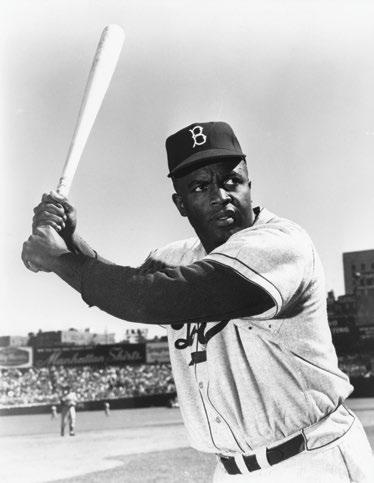
GREAT MINDS WIT & WISDOM® 5 GRADE MODULE 4 BREAKING BARRIERS
Great Minds® is the creator of Eureka Math® , Wit & Wisdom® , Alexandria Plan™, and PhD Science® .
Published by Great Minds PBC greatminds.org
© 2023 Great Minds PBC. All rights reserved. No part of this work may be reproduced or used in any form or by any means—graphic, electronic, or mechanical, including photocopying or information storage and retrieval systems—without written permission from the copyright holder.
Printed in the USA A-Print
979-8-88588-765-6
Handout 1A: Background on Nelson Mandela and Apartheid in South Africa
Handout 1B: Documentary Response Sheet
Handout 1C: Assessed Vocabulary Study Guide
Handout 2A: Story Map for “Raymond’s Run”
Handout 2B: “Raymond’s Run”
Handout 2C: Fluency Homework
Handout 3A: Evidence Organizer
Handout 3B: Common Homophones
Handout 5A: Fluency Homework
Handout 6A: Text Structures
Handout 7A: Paraphrased Evidence
Handout 8A: Directly Quoting Evidence
Handout 9A: New-Read Assessment 1 Texts
Handout 9B: Fluency Homework
Handout 12A: Frayer Model
Handout 13A: Fluency Homework
Handout 14A: Focusing Question Task 2 Evidence Organizer
Handout 16A: Self- and Peer Evaluation for Focusing Question Task 2
Handout 18A: Sources for Additional Research
Handout 18B: Fluency Homework
Handout 19A: Fugees Source Information
Handout 19B: Fugees Source Notes
Handout 21A: Fugees Summary and Reflection
Handout 21B: Fluency Homework
Handout 23A: Research Topics for Focusing Question Task 3
Handout 23B: New-Read Assessment 2 Texts
Handout 24A: Speaking and Listening Development and Style Checklist
Handout 24B: Fluency Homework
Handout 24C: Root: posit
Handout 25A: Focusing Question Task 3 Research Packet
Handout 27A: Hall of Fame Exhibit Planner for Coach Luma
Handout 30A: Hall of Fame Exhibit Feedback Forms
Handout 30B: Focusing Question Task 3 Evaluation and Reflection Form
Handout 31A: Fugees Family Organization Source Notes
Handout 31B: Exemplar End-of-Module Task Research Essay
Handout 32A: End-of-Module Task Source Information
Handout 32B: End-of-Module Task Source Notes
Handout 32C: “Street Soccer”
Handout 32D: “Finding Common Ground on the Soccer Field”
Handout 32E: “Guardians of the Game”
Handout 33A: End-of-Module Task Research Websites
Handout 33B: End-of-Module Task Essay Planner
Handout 35A: End-of-Module Task Writing Checklist
Handout 36A: Characters’ Challenges and Choices
Volume of Reading Reflection Questions
Wit & Wisdom Family Tip Sheet
Directions: Read the background on Nelson Mandela and apartheid in South Africa. Jot down what you notice and wonder about as you read.
Like most African countries, South Africa was originally the home of black African tribes. In the 1400s, White Europeans arrived in what is today known as South Africa on their way to the Far East. In the mid-1600s, White settlers from the Netherlands established the city of Cape Town on the southern coast of Africa and began settling there. In the 1800s, Great Britain took control of Cape Town, and in the early 1900s, the White British government created the country of South Africa.
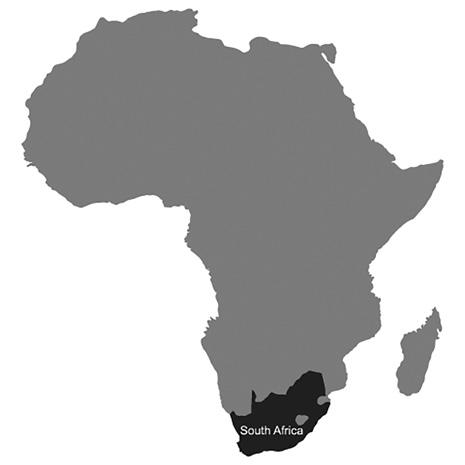
Apartheid, meaning “apart-ness,” was a system the all-White government of South Africa created in 1948 that separated people based on their race and skin color. Under apartheid, Black, mixed race, and other non-White South Africans—the majority of the country’s people— did not have the same rights as White South Africans.
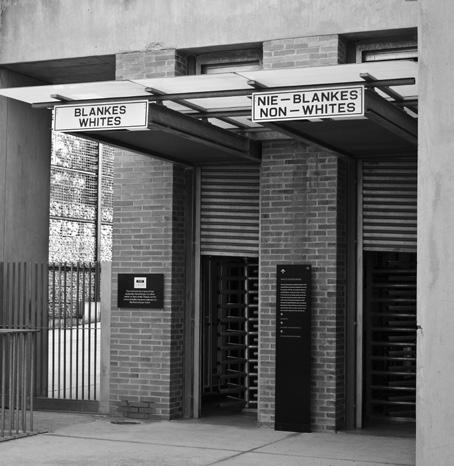
White and non-White South Africans were forced to live in separate areas, attend separate schools, and use separate public facilities, such as restrooms, buses, park benches, and even beaches. Black South Africans were not allowed to vote nor marry White South Africans. Many Black South Africans and people of other ethnicities were forced out of their homes and forced to live in areas designated as “homelands.”
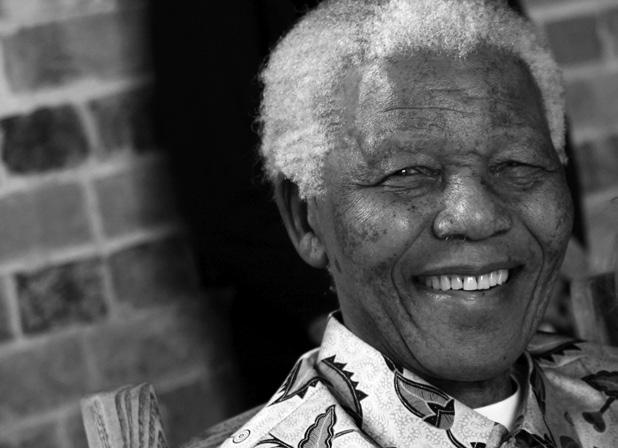
During the 1950s and 1960s, groups began to unite to protest apartheid and fight for equal rights for all South Africans. Nelson Mandela, a lawyer, led one of these groups, the African National Congress, in the fight against apartheid.
The South African government treated protesters harshly—even peaceful protesters. Many protesters were put in prison. Some were even sentenced to death. In 1962, Mandela was arrested and sentenced to prison for life. Mandela’s arrest brought international attention to South Africa, and Mandela himself became a symbol for the fight against apartheid.
In 1989, under pressure from countries around the world, South Africa began to take steps to end apartheid. The government created a new constitution, which gave equal rights to all citizens of South Africa. In 1990, after twenty-seven years, Mandela was released from prison. He was elected president of South Africa in 1994.
Sources:
•“South Africa.” National Geographic Kids, National Geographic Partners, 14 July 2021, kids.nationalgeographic.com/geography/countries/article/southafrica.
• History.com Editors, “Apartheid.” History.com, A&E Television Networks, 7 Oct. 2010, www.history.com/topics/africa/apartheid..
• Byrne, Stephen. “Apartheid.” History for Kids, 2016, Web. Accessed 6 Dec. 2016.
• Nodjimbadem, Katie. “A Look Back at South Africa under Apartheid, Twenty-Five Years after Its Repeal.” Smithsonian.com, Smithsonian Institution, 15 Oct. 2015, www.smithsonianmag.com/history/what-did-apartheid-south-africa-look-180956945/.
Directions: Read the questions for PART 1. As you watch PART 1 of the documentary a second time, listen for the answers to these questions. After watching PART 1, write down your answers in the space provided. Then, read the questions for PART 2, and repeat the same steps above as you watch PART 2 of the documentary a second time. Finally, answer the self-reflection question at the end of this handout.
PART 1
1. Why was South Africa so divided when Nelson Mandela became president in 1994?
2. Why did Nelson Mandela want to bring the 1995 Rugby World Cup to South Africa?
3. What did the sport of rugby represent to Black South Africans in the early 1990s? How did this affect Black South Africans’ attitudes toward the Springboks?
4. How—and why—did the support for the Springboks change as the World Cup tournament progressed?
5. What is the significance of Nelson Mandela’s vision, “One team, one country”?
6. Why is the Springboks’ victory such a momentous event for Nelson Mandela and the people of South Africa?
What does South Africa’s victory at the 1995 Rugby World Cup represent for Nelson Mandela and the people of South Africa? Write your answer in two or three sentences.
Directions: Use this list of vocabulary words and definitions to study for the Vocabulary Assessment. The number following the word indicates the lesson number in which the word or affix is taught.
cracy (suffix, 1) Rule by.
posit (root, 24) To place, put. antagonism (n., 14) Being against or opposed to someone or something.
baffled (adj., 23) Confused, puzzled.
barrier (n., 12) Something that prevents progress or makes it difficult for someone to achieve something.
bitter (adj., 13) Angry, resentful.
challenge (v., 17) To take a stand against something, especially something wrong or unjust.
discrimination (n., 5) The act of treating someone worse than someone else.
fortitude (n., 14) Strength of mind that helps a person to bear difficulties with courage.
hostility (n., 20) Unfriendliness or extreme dislike.
influence (v., 1) To affect someone or something in an important way.
integration (n., 11) The process of bringing together.
multimedia (n., 26) A combination of different forms of expression, such as text, images, audio, and video.
overcome (v., 17) To defeat; to gain a victory over.
para– (prefix, 22) Beside, side-by-side.
paralyzed (adj., 22) Having lost the ability to move or feel anything in part or most of the body.
plagiarism (n., 5) The act of stealing, copying.
racism (n., 5) The belief that one group of people is better than another group of people, based on the color of their skin.
refugee (n., 19) A person who is forced to flee their country to escape danger.
relevant (adj., 19) Closely related or connected to the subject being discussed.
research (n., 4) The study of information in order to learn more about something.
resilience (n., 14) The ability to recover from difficulty or change.
sculpture (n., 19) A three-dimensional piece of art made by carving or molding clay, stone, metal, or other materials.
segregation (n., 5) The separation of people based on the color of their skin.
social norms (n.; 17, 18) Behavioral expectations for certain groups of people.
stereotype (n., 17) An often unfair or untrue idea or belief about an entire group of people.
sym– (prefix, 10) With, together.
synthesize (v., 21) To combine separate things to produce something new.
trans– (prefix, 20) Change.
zeal (n., 23) Enthusiasm.
Directions: Use this chart to organize and record notes about key elements of the story.
Character(s): Who are the main characters? What are they like?
Setting: Where does this story take place?
Narrator:
Other characters:
Conflict: Describe the main problem that the narrator faces.
Setting: Where does this scene take place?
Characters: Who are the main characters in this scene? (Include new characters you meet.)
Setting: Where does this scene take place?
Characters: Who are the main characters in this scene? (Include new characters you meet.)
Events: Describe the events that happen in this scene.
First,… Next,… Then,… Finally,…
Events: Describe the events that happen in this scene.
First,… Next,… Then,… Finally,…
Resolution: How is the main conflict(s) resolved by the end of the story?
Theme: What does “Raymond’s Run” teach us about sports? Support your ideas with evidence from the story.
Directions: Read the short story “Raymond’s Run” by Toni Cade Bambara. Refer to the glossary to define or find more information about unknown words and phrases in the story.
“Raymond’s Run” by Toni Cade Bambara1
I don’t have much work to do around the house like some girls. My mother does that. And I don’t have to earn my pocket money by hustling; George runs errands for the big boys and sells Christmas cards. And anything else that’s got to get done, my father does. All I have to do in life is mind my brother Raymond, which is enough.
2
Sometimes I slip and say my little brother Raymond. But as any fool can see he’s much bigger and he’s older too. But a lot of people call him my little brother cause he needs looking after cause he’s not quite right. And a lot of smart mouths got lots to say about that too, especially when George was minding him. But now, if anybody has anything to say to Raymond, anything to say about his big head, they have to come by me. And I don’t play the dozens or believe in standing around with somebody in my face doing a lot of talking. I much rather just knock you down and take my chances even if I am a little girl with skinny arms and a squeaky voice, which is how I got the name Squeaky. And if things get too rough, I run. And as anybody can tell you, I’m the fastest thing on two feet.
3
There is no track meet that I don’t win the first-place medal. I used to win the twenty-yard dash when I was a little kid in kindergarten. Nowadays, it’s the fifty-yard dash. And tomorrow I’m subject to run the quartermeter relay all by myself and come in first, second, and third. The big kids call me Mercury cause I’m the swiftest thing in the neighborhood. Everybody knows that—except two people who know better, my father and me. He can beat me to Amsterdam Avenue with me having a two-fire-hydrant headstart and him running with his hands in his pockets and whistling. But that’s private information. Cause can you imagine some thirty-five-year-old man stuffing himself into PAL shorts to race little kids? So as far as everyone’s concerned, I’m the fastest and that goes for Gretchen, too, who has put out the tale that she is going to win the first-place medal this year. Ridiculous. In the second place, she’s got short legs. In the third place, she’s got freckles. In the first place, no one can beat me and that’s all there is to it.
4
I’m standing on the corner admiring the weather and about to take a stroll down Broadway so I can practice my breathing exercises, and I’ve got Raymond walking on the inside close to the buildings, cause he’s subject to fits of fantasy and starts thinking he’s a circus performer and that the curb is a tightrope strung high in the air. And sometimes after a rain he likes to step down off his tightrope right into the gutter and slosh around getting his shoes and cuffs wet. Then I get hit when I get home. Or sometimes if you don’t watch him he’ll dash across traffic to the island in the middle of Broadway and give the pigeons a fit. Then I have to go behind him apologizing to all the old people sitting around trying to get some sun and getting all upset with the pigeons fluttering around them, scattering their newspapers and upsetting the waxpaper lunches in their laps. So I keep Raymond on the inside of me, and he plays like he’s driving a stage coach which is OK by me so long as he doesn’t run me over or interrupt my breathing exercises, which I have to do on account of I’m serious about my running, and I don’t care who knows it.
5
Now some people like to act like things come easy to them, won’t let on that they practice. Not me. I’ll high-prance down 34th Street like a rodeo pony to keep my knees strong even if it does get my mother uptight so that she walks ahead like she’s not with me, don’t know me, is all by herself on a shopping trip, and I am somebody else’s crazy child. Now you take Cynthia Procter for instance. She’s just the opposite.
If there’s a test tomorrow, she’ll say something like, “Oh, I guess I’ll play handball this afternoon and watch television tonight,” just to let you know she ain’t thinking about the test. Or like last week when she won the spelling bee for the millionth time, “A good thing you got ‘receive,’ Squeaky, cause I would have got it wrong. I completely forgot about the spelling bee.” And she’ll clutch the lace on her blouse like it was a narrow escape. Oh, brother. But of course when I pass her house on my early morning trots around the block, she is practicing the scales on the piano over and over and over and over. Then in music class she always lets herself get bumped around so she falls accidentally on purpose onto the piano stool and is so surprised to find herself sitting there that she decides just for fun to try out the ole keys. And what do you know— Chopin’s waltzes just spring out of her fingertips and she’s the most surprised thing in the world. A regular prodigy. I could kill people like that. I stay up all night studying the words for the spelling bee. And you can see me any time of day practicing running. I never walk if I can trot, and shame on Raymond if he can’t keep up. But of course he does, cause if he hangs back someone’s liable to walk up to him and get smart, or take his allowance from him, or ask him where he got that great big pumpkin head. People are so stupid sometimes.
So I’m strolling down Broadway breathing out and breathing in on counts of seven, which is my lucky number, and here comes Gretchen and her sidekicks: Mary Louise, who used to be a friend of mine when she first moved to Harlem from Baltimore and got beat up by everybody till I took up for her on account of her mother and my mother used to sing in the same choir when they were young girls, but people ain’t grateful, so now she hangs out with the new girl Gretchen and talks about me like a dog; and Rosie, who is as fat as I am skinny and has a big mouth where Raymond is concerned and is too stupid to know that there is not a big deal of difference between herself and Raymond and that she can’t afford to throw stones. So they are steady coming up Broadway and I see right away that it’s going to be one of those Dodge City scenes cause the street ain’t that big and they’re close to the buildings just as we are. First I think I’ll step into the candy store and look over the new comics and let them pass. But that’s chicken and I’ve got a reputation to consider. So then I think I’ll just walk straight on through them or even over them if necessary. But as they get to me, they slow down. I’m ready to fight, cause like I said I don’t feature a whole lot of chit-chat, I much prefer to just knock you down right from the jump and save everybody a lotta precious time.
“You signing up for the May Day races?” smiles Mary Louise, only it’s not a smile at all. A dumb question like that doesn’t deserve an answer. Besides, there’s just me and Gretchen standing there really, so no use wasting my breath talking to shadows. 8
“I don’t think you’re going to win this time,” says Rosie, trying to signify with her hands on her hips all salty, completely forgetting that I have whupped her behind many times for less salt than that. 9
“I always win cause I’m the best,” I say straight at Gretchen who is, as far as I’m concerned, the only one talking in this ventriloquist-dummy routine. Gretchen smiles, but it’s not a smile, and I’m thinking that girls never really smile at each other because they don’t know how and don’t want to know how and there’s probably no one to teach us how, cause grown-up girls don’t know either. Then they all look at Raymond who has just brought his mule team to a standstill. And they’re about to see what trouble they can get into through him.
10
“What grade you in now, Raymond?” 11
“You got anything to say to my brother, you say it to me, Mary Louise Williams of Raggedy Town, Baltimore.”
“What are you, his mother?” sasses Rosie. 13
“That’s right, Fatso. And the next word out of anybody and I’ll be their mother too.” So they just stand there and Gretchen shifts from one leg to the other and so do they. Then Gretchen puts her hands on her hips and is about to say something with her freckle-face self but doesn’t. Then she walks around me looking me up and down but keeps walking up Broadway, and her sidekicks follow her. So me and Raymond smile at each other and he says, “Gidyap” to his team and I continue with my breathing exercises, strolling down Broadway toward the ice man on 145th with not a care in the world cause I am Miss Quicksilver herself. ***** 14
I take my time getting to the park on May Day because the track meet is the last thing on the program. The biggest thing on the program is the May Pole dancing, which I can do without, thank you, even if my mother thinks it’s a shame I don’t take part and act like a girl for a change. You’d think my mother’d be grateful not to have to make me a white organdy dress with a big satin sash and buy me new white baby-doll shoes that can’t be taken out of the box till the big day. You’d think she’d be glad her daughter ain’t out there prancing around a May Pole getting the new clothes all dirty and sweaty and trying to act like a fairy or a flower or whatever you’re supposed to be when you should be trying to be yourself, whatever that is, which is, as far as I am concerned, a poor black girl who really can’t afford to buy shoes and a new dress you only wear once a lifetime cause it won’t fit next year.
15
I was once a strawberry in a Hansel and Gretel pageant when I was in nursery school and didn’t have no better sense than to dance on tiptoe with my arms in a circle over my head doing umbrella steps and being a perfect fool just so my mother and father could come dressed up and clap. You’d think they’d know better than to encourage that kind of nonsense. I am not a strawberry. I do not dance on my toes. I run. That is what I am all about. So I always come late to the May Day program, just in time to get my number pinned on and lay in the grass till they announce the fifty-yard dash.
16
I put Raymond in the little swings, which is a tight squeeze this year and will be impossible next year. Then I look around for Mr. Pearson, who pins the numbers on. I’m really looking for Gretchen if you want to know the truth, but she’s not around. The park is jam-packed. Parents in hats and corsages and breastpocket handkerchiefs peeking up. Kids in white dresses and light-blue suits. The parkees unfolding chairs and chasing the rowdy kids from Lenox as if they had no right to be there. The big guys with their caps on backwards, leaning against the fence swirling the basketballs on the tips of their fingers, waiting for all these crazy people to clear out the park so they can play. Most of the kids in my class are carrying bass drums and glockenspiels and flutes. You’d think they’d put in a few bongos or something for real like that.
17
18
19
20
Then here comes Mr. Pearson with his clipboard and his cards and pencils and whistles and safety pins and fifty million other things he’s always dropping all over the place with his clumsy self. He sticks out in a crowd because he’s on stilts. We used to call him Jack and the Beanstalk to get him mad. But I’m the only one that can outrun him and get away, and I’m too grown for that silliness now.
“Well, Squeaky,” he says, checking my name off the list and handing me number seven and two pins. And I’m thinking he’s got no right to call me Squeaky, if I can’t call him Beanstalk.
“Hazel Elizabeth Deborah Parker,” I correct him and tell him to write it down on his board.
“Well, Hazel Elizabeth Deborah Parker, going to give someone else a break this year?” I squint at him real hard to see if he is seriously thinking I should lose the race on purpose just to give someone else a break. “Only six girls running this time,” he continues, shaking his head sadly like it’s my fault all of New York didn’t turn out in sneakers. “That new girl should give you a run for your money.” He looks around the park for Gretchen like a periscope in a submarine movie. “Wouldn’t it be a nice gesture if you were . . . to ahhh . . . ”
21
I give him such a look he couldn’t finish putting that idea into words. Grown-ups got a lot of nerve sometimes. I pin number seven to myself and stomp away, I’m so burnt. And I go straight for the track and stretch out on the grass while the band winds up with “Oh, the Monkey Wrapped His Tail Around the Flag Pole,” which my teacher calls by some other name. The man on the loudspeaker is calling everyone over to the track and I’m on my back looking at the sky, trying to pretend I’m in the country, but I can’t, because even grass in the city feels hard as sidewalk, and there’s just no pretending you are anywhere but in a “concrete jungle” as my grandfather says.
22
The twenty-yard dash takes all of two minutes cause most of the little kids don’t know no better than to run off the track or run the wrong way or run smack into the fence and fall down and cry. One little kid, though, has got the good sense to run straight for the white ribbon up ahead so he wins. Then the second-graders line up for the thirty-yard dash and I don’t even bother to turn my head to watch cause Raphael Perez always wins. He wins before he even begins by psyching the runners, telling them they’re going to trip on their shoelaces and fall on their faces or lose their shorts or something, which he doesn’t really have to do since he is very fast, almost as fast as I am. After that is the forty-yard dash which I used to run when I was in first grade. Raymond is hollering from the swings cause he knows I’m about to do my thing cause the man on the loudspeaker has just announced the fifty-yard dash, although he might just as well be giving a recipe for angel food cake cause you can hardly make out what he’s sayin for the static. I get up and slip off my sweat pants and then I see Gretchen standing at the starting line, kicking her legs out like a pro. Then as I get into place I see that ole Raymond is on line on the other side of the fence, bending down with his fingers on the ground just like he knew what he was doing. I was going to yell at him but then I didn’t. It burns up your energy to holler.
Every time, just before I take off in a race, I always feel like I’m in a dream, the kind of dream you have when you’re sick with fever and feel all hot and weightless. I dream I’m flying over a sandy beach in the early morning sun, kissing the leaves of the trees as I fly by. And there’s always the smell of apples, just like in the country when I was little and used to think I was a choo-choo train, running through the fields of corn and chugging up the hill to the orchard. And all the time I’m dreaming this, I get lighter and lighter until I’m flying over the beach again, getting blown through the sky like a feather that weighs nothing at all. But once I spread my fingers in the dirt and crouch over the Get on Your Mark, the dream goes and I am solid again and am telling myself, Squeaky you must win, you must win, you are the fastest thing in the world, you can even beat your father up Amsterdam if you really try. And then I feel my weight coming back just behind my knees then down to my feet then into the earth and the pistol shot explodes in my blood and I am off and weightless again, flying past the other runners, my arms pumping up and down and the whole world is quiet except for the crunch as I zoom over the gravel in the track. I glance to my left and there is no one. To the right, a blurred Gretchen, who’s got her chin jutting out as if it would win the race all by itself. And on the other side of the fence is Raymond with his arms down to his side and the palms tucked up behind him, running in his very own style, and it’s the first time I ever saw that and I almost stop to watch my brother Raymond on his first run. But the white ribbon is bouncing toward me and I tear past it, racing into the distance till my feet with a mind of their own start digging up footfuls of dirt and brake me short. Then all the kids standing on the side pile on me, banging me on the back and slapping my head with their May Day programs, for I have won again and everybody on 151st Street can walk tall for another year. 24
“In first place . . . ” the man on the loudspeaker is clear as a bell now. But then he pauses and the loudspeaker starts to whine. Then static. And I lean down to catch my breath and here comes Gretchen walking back, for she’s overshot the finish line too, huffing and puffing with her hands on her hips taking it slow, breathing in steady time like a real pro and I sort of like her a little for the first time. “In first place . . . ” and then three or four voices get all mixed up on the loudspeaker and I dig my sneaker into the grass and stare at Gretchen who’s staring back, we both wondering just who did win. I can hear old Beanstalk arguing with the man on the loudspeaker and then a few others running their mouths about what the stopwatches say. Then I hear Raymond yanking at the fence to call me and I wave to shush him, but he keeps rattling the fence like a gorilla in a cage like in them gorilla movies, but then like a dancer or something he starts climbing up nice and easy but very fast. And it occurs to me, watching how smoothly he climbs hand over hand and remembering how he looked running with his arms down to his side and with the wind pulling his mouth back and his teeth showing and all, it occurred to me that Raymond would make a very fine runner. Doesn’t he always keep up with me on my trots? And he surely knows how to breathe in counts of seven cause he’s always doing it at the dinner table, which drives my brother George up the wall. And I’m smiling to beat the band cause if I’ve lost this race, or if me and Gretchen tied, or even if I’ve won, I can always retire as a runner and begin a whole new career as a coach with Raymond as my champion. After all, with a little more study I can beat Cynthia and her phony self at the spelling bee. And if I bugged my mother, I could get piano lessons and become a star. And I have a big rep as the baddest thing around. And I’ve got a roomful of ribbons and medals and awards. But what has Raymond got to call his own?
25
So I stand there with my new plans, laughing out loud by this time as Raymond jumps down from the fence and runs over with his teeth showing and his arms down to the side, which no one before him has quite mastered as a running style. And by the time he comes over I’m jumping up and down so glad to see him—my brother Raymond, a great runner in the family tradition. But of course everyone thinks I’m jumping up and down because the men on the loudspeaker have finally gotten themselves together and compared notes and are announcing “In first place—Miss Hazel Elizabeth Deborah Parker.” (Dig that.) “In second place—Miss Gretchen P. Lewis.” And I look over at Gretchen wondering what the “P” stands for. And I smile. Cause she’s good, no doubt about it. Maybe she’d like to help me coach Raymond; she obviously is serious about running, as any fool can see. And she nods to congratulate me and then she smiles. And I smile. We stand there with this big smile of respect between us. It’s about as real a smile as girls can do for each other, considering we don’t practice real smiling every day, you know, cause maybe we too busy being flowers or fairies or strawberries instead of something honest and worthy of respect . . . you know . . . like being people.
Bambara, Toni Cade. “Raymond’s Run.” Gorilla, My Love, Penguin Random House, 1971.
Directions:
1. Day 1: Read the text carefully, and annotate it to help you read fluently.
2. Each day:
a. Practice reading the text three to five times.
b. Evaluate your progress by placing a √+, √, or √- in each unshaded box.
c. Ask someone (adult or peer) to listen and evaluate you as well.
3. Last day: Respond to the self-reflection questions at the end.
… All I have to do is mind my brother Raymond, which is enough.
Sometimes I slip and say my little brother Raymond. But as any fool can see he’s much bigger and he’s older too. But a lot of people call him my little brother cause he needs looking after cause he’s not quite right. And a lot of smart mouths got lots to say about that too, especially when George was minding him. But now, if anybody has anything to say to Raymond, anything to say about his big head, they have to come by me. And I don’t play the dozens or believe in standing around with somebody in my face doing a lot of talking. I much rather just knock you down and take my chances even if I am a little girl with skinny arms and a squeaky voice, which is how I got the name Squeaky. And if things get too rough, I run. And as anybody can tell you, I’m the fastest thing on two feet …
… So as far as everyone’s concerned, I’m the fastest and that goes for Gretchen, too, who has put out the tale that she is going to win the first-place medal this year. Ridiculous. In the second place, she’s got short legs. In the third place, she’s got freckles. In the first place, no one can beat me and that’s all there is to it.
Bambara, Toni Cade. “Raymond’s Run.” Gorilla, My Love, Penguin Random House, 1971.
Student Performance Checklist Day 1 Day 2 Day 3
You Listener* You Listener* You Listener*
Accurately read the passage three to five times.
Read with appropriate phrasing, pausing, and expression.
Read articulately at a good pace and an audible volume.
*Adult or peer
Self-reflection: What choices did you make when deciding how to read this passage, to try and capture Squeaky’s voice and personality? Why? What would you like to improve on or try differently next time? (Thoughtfully answer these questions in the space below.)
Directions: How does Squeaky’s perspective of her brother Raymond and her rival Gretchen change after the race? Choose either Raymond or Gretchen. Then, choose the best evidence from the story that shows Squeaky’s perspective of this character leading up to and after the race. Elaborate on each piece of evidence. Use the back of this handout if you need more space for your notes. How does Squeaky view _______________ at the beginning of the story?
How does Squeaky view_______________ differently after the race?
Consider: • Why is this evidence important?
• What does it show us about Squeaky’s new view and understanding of Raymond/Gretchen? • What do you think causes this change in Squeaky’s perspective?
List details from the story that show how Squeaky views Raymond/ Gretchen after the race. Use both quotations and paraphrasing.
Consider: • Why is this evidence important? • What does it show us about how Squeaky views Raymond/Gretchen?
• What factors do you think shaped Squeaky’s perspective of Raymond/ Gretchen?
List details from the story that show how Squeaky views Raymond/Gretchen leading up to the race. Use both quotations and paraphrasing.
Directions: Work with a partner to write a simple definition for each word.
Word Meaning Word Meaning Word Meaning accept except it’s its medal metal know now hole whole tale tail tell two too to their they’re there
Directions:
1. Day 1: Read the text carefully, and annotate it to help you read fluently.
2. Each day:
a. Practice reading the text three to five times.
b. Evaluate your progress by placing a +, , or - in each unshaded box.
c. Ask someone (adult or peer) to listen and evaluate you as well.
3. Last day: Answer the self-reflection questions at the end.
By the late 1800s, Negroes began to disappear from professional baseball teams and were soon gone from them altogether. Now, there was never any written rule that prohibited Negroes from playing professional baseball, but soon after 1887, somehow Negroes all over couldn’t get on a professional baseball team. Come to find out that all the white owners had gotten together in secret and decided to do away with Negroes in professional baseball. They agreed not to add any more to their teams and to let go of the ones they had. Called it a “gentlemen’s agreement.” And I’ll tell you this, the white pro-ballclub owners held to that agreement for almost sixty years.
So, what were we Negroes left to do? We loved to play baseball, and a lot of guys had genuine talent. Sure, we could play against small semi-pro teams, which paid little, if at all; or swallow our pride and get a job working in some factory, but who wanted to do that? Especially after tastin’ the fruits of what professional baseball had to offer. We had no choice but to start our own professional teams–our own leagues.
And that’s just what we did.
Nelson, Kadir. We Are the Ship: The Story of Negro League Baseball. Disney Hyperion, 2008, p. 1–3.
Student Performance Checklist
Accurately read the passage three to five times. Read with appropriate phrasing and pausing. Read with appropriate expression. Read articulately at a good pace and an audible volume.
*Adult or peer
Day 1 Day 2 Day 3 Day 4 You Listener* You Listener* You Listener* You Listener*
Self-reflection: What choices did you make when deciding how to read this passage, and why? What would you like to improve or try differently next time? (Thoughtfully answer these questions in the space below.)
PART 1 Directions: Review each text structure in the first column. Then read the text excerpts from “1st Inning” of We Are the Ship, and match each excerpt to a specific text structure by writing the letter of the excerpt on the appropriate numbered line.
Gives information in order of when things happen.
A. “Too many times [Bud Fowler] was forced to leave the field on crutches after being spiked by a base runner. Now, this was a terrible thing, but some good came out of it. His scarred shins gave him the idea to attach wooden staves from a barrel to his legs for protection. They were the first shin guards and the first protective gear in baseball” (2).
Describes the similarities and/or differences between two or more things.
B. “[Bunt-and-run] was a simple play. They’d put a racehorse on first base, and the batter would bunt the ball down the third-base line. The runner would lead off the base with the pitch and be halfway around the bases by the time the ball hit the bat. The runner didn’t stop at second and kept charging full speed toward third, which was left unguarded because the third baseman had to come in to pick up the ball. If the third baseman played behind the base, it was an automatic hit. If he came in, the runner slid safely into third” (5).
Provides a clear picture of a topic in a reader’s mind by using descriptive or sensory language.
C. “They say baseball was invented by a fellow named Abner Doubleday … in the mid-1800s … In the mid-1860s, most professional baseball teams had only white ballplayers … By the late 1800s, Negroes began to disappear from professional baseball teams … In the early 1900s, there were many Negro baseball teams all over the Northeast and the South” (1–3).
Explains a problem and offers a way of solving it.
D. “And the pitchers, they got their pitching instructions from Rube sitting in the dugout … He’d puff signals from his pipe or nod his head one way to signal a play. One puff, fastball. Two puffs, curveball” (5).
Provides a reason or explanation for why something happens.
Cause Effect
E. “Rube ran his ball club like it was a major league team. Most Negro teams back then weren’t very well organized, Didn’t always have enough equipment or even matching uniforms … But not Rube’s team. They were always well-equipped, with clean, new uniforms, bats, and balls” (5).
PART 2 Directions: After reading each chapter in We Are the Ship, jot down one or two main ideas of the chapter. Then, explain how the author, Kadir Nelson, structured, or organized the information in the chapter. Think about how the text structure supports your understanding of the ideas in each chapter. The row for 1st Inning has been completed as an example.
What is this chapter mostly about? Jot down one to two main ideas from this chapter.
How does the author structure, or organize, the information in this chapter? Use the text structures on the first page of this handout as well as evidence from the text to explain the overall structure of the chapter.
This is about the events that led to the created of the Negro Leagues.
“Chapter 1” is organized using chronological order. Nelson explains, in the order in which they happen, the events that led to the start of the Negro Leagues. For example, he explains that baseball was invented in the 1800s, ; then he moves to the 1860s when most professional teams had only white players. He continues this structure throughout the chapter.
“4th Inning”
“5th Inning”
“6th Inning”
“7th Inning”
“8th Inning”
“9th Inning”
Directions: Read the following text excerpts from We Are the Ship and the sample paraphrase of that information. Determine whether each paraphrase meets the characteristics of a successful paraphrase, and revise the paraphrases that do not meet the criteria.
Rewritten Paraphrase
Sample Paraphrase
We Are the Ship explains that players could only sleep on the bus. That was hard because they had to take the back roads to get to the towns. The roads were really bumpy. They couldn’t go very fast.
If the driver got sleepy, some of the players would drive for him. They sang songs and played cards to pass the time.
Text Excerpt
“All of that traveling would wear on you. Many times the only sleep we got was on the bus. But that could be hard because we had to take the back roads to get to some of those little towns, and they were so bumpy they’d have us bouncing around the bus like popcorn on a hot stove. Fastest we could go was about thirty-five to forty miles per hour. If the driver got sleepy, a couple of the guys on the team would take turns driving the bus. To pass the time we played cards or sang old Negro spirituals or barbershop numbers” (23).
Kadir Nelson says that traveling was rough in the South. Most people didn’t treat black folks very well. They would have to travel several hundred miles without stopping because there was no place to eat along the way.
“Traveling was even rougher down South. They didn’t take too kindly to black folks down there–especially if you were from up north. We would have to travel several hundred miles without stopping because we couldn’t find a place where we could eat along the way” (24).
Sometimes the players could stay in hotels.
“In cities, we stayed in Negro hotels or Negro rooming houses. We slept two, three guys to a bed. That’s all the team owner could afford. A number of the Negro hotels were very clean and neat. But more than a few times, we’d run into those places—and I won’t call out any names—that had so many bedbugs you’d have to put a newspaper between the mattress and the sheets” (24).
Directions: Read the main idea statement. Then, using the chapter or page number(s) provided in the second column, select the most powerful direct quotation to support the main idea statement. Record the direct quotation in the final column.
Direct Quotation
Chapter/Page Number
Main Idea Statement
“4th Inning,” page 38 “3rd Inning,” pages 23–24 “2nd Inning”
Life as a Negro League baseball player was tough.
PART 1 Directions: Read the following article, “Cool Papa Bell,” from the National Baseball Hall of Fame website. After you read this text, answer questions 1 and 2 on Assessment 9A.
“One time he hit a line drive right past my ear. I turned around and saw the ball hit him sliding into second.” —Satchel Paige
Cool Papa may well have been the fastest man ever to play the game of baseball. We’ll never know for sure, mostly because the Negro Leagues were not well covered in the press, and Bell, who played from 1922–46, never got the chance to show what he could do in the major leagues. “I remember one time I got five hits and stole five bases, but none of it was written down because they forgot to bring the scorebook to the game that day,” he told the Hall in 1981. But the stories of his speed are legendary
The most colorful story was told by fellow roommate Satchel Paige, who said that Cool Papa was so fast he could flip the light switch and be in bed before the room got dark. There may have been some literal truth to this one, as one room they shared had a short in the switch. But stories of his base running speed are legion, advancing two and even three bases on a bunt, beating out tappers back to the pitcher, and also playing a shallow center field, because his speed allowed him to catch up to just about anything out there.
His nickname derived from his youthful stint as a pitcher—at age 19 he joined the St. Louis Stars as a left-handed pitcher, with an assortment of curves, knucklers, and screwballs thrown from any of three release points. His calm demeanor on the mound, especially after a pressure-packed strikeout of Oscar Charleston, earned him the colorful sobriquet
He was a member of three of the greatest Negro League teams in history, winning three championships each with the Stars, the Pittsburgh Crawfords, and the Homestead Grays. The 1935 Crawfords featured five future Hall-of-Famers: Bell, Oscar Charleston, Josh Gibson, Judy Johnson, and Satchel Paige.
Bell was a switch hitter and a contact hitter, with great bat control, bunting ability, and speed. Though not a power hitter, he could take an extra base perhaps more often than any other player in history. In addition to the Negro Leagues, Bell played several seasons in the Mexican League, having great success and enjoying the more relaxed racial atmosphere. He also played 21 seasons of winter ball in Cuba, Mexico, and California. Late in his career he became a player-manager, and later, a scout in the early 1950s for the St. Louis Browns. Bell was elected to the Hall of Fame in 1974.
“Cool Papa Bell.” National Baseball Hall of Fame, National Baseball Hall of Fame and Museum, baseballhall.org/ hall-of-famers/bell-cool-papa
legendary: Well-known. derived: Came from. sobriquet: A nickname.
PART 2 Directions: Read the following article, “Josh Gibson,” from the National Baseball Hall of Fame website. After you read this text, answer questions 3–5 on Assessment 9A.
Was the myth larger than the reality? Not really.
But the applause Josh Gibson received should have been louder. He was considered the best power hitter of his era in the Negro baseball leagues and perhaps even the majors.
Gibson was born in Buena Vista, Ga. His father, Mark Gibson, moved his family to Pittsburgh in 1923 rather than try and continue to nurse a crop from his meager farm.
Josh’s education ended after the ninth grade. His introduction to organized baseball came at age 16 when he joined the Gimbels A.C. In 1929, the Crawford Colored Giants, a semi-pro team in Pittsburgh, convinced him to leave the Gimbels and join their squad.
He became a professional by accident July 25, 1930 while sitting in the stands. When Homestead Grays catcher Buck Ewing injured his hand, Gibson was invited to replace him because his titanic home runs were already well known in Pittsburgh.
“If someone had told me Josh hit the ball a mile, I would have believed them,” said Sam Jethroe, who starred for the Cleveland Buckeyes.
His legendary feats with the Homestead Grays have many experts regarding Gibson as the sport’s greatest home run hitter. Negro Leagues statistics of the time are largely incomplete. But the legend of Gibson’s power has always been larger than life.
The 6-1, 215-pound Gibson was nearly indestructible behind the plate. He occasionally played left field or third base, but never for more than a game or two.
Gibson’s natural skills were immense. His powerful arm, quick release, and agility made base runners wary of trying to steal.
But hitting is what made Gibson the second-highest paid player in black baseball behind Satchel Paige, another future Hall of Famer.
The Sporting News, baseball’s written authority for decades, credited Gibson in 1967 with hitting a 580-foot home run in Yankee Stadium. The ball landed two feet from the top of the bleacher wall.
titanic: Enormous, huge. indestructible: Not able to be destroyed or broken. agility: The ability to move quickly.
“Josh was a better power hitter than Babe Ruth, Ted Williams, or anybody else I’ve ever seen,” said former Cleveland Buckeye pitcher and manager Alonzo Boone. “Anything he touched was hit hard. He could power outside pitches to right field. Shortstops would move to left field when Josh came to the plate.”
In 1972, Gibson became the second player from the Negro Leagues elected to the National Baseball Hall of Fame, joining Paige.
Paige may have put it best when describing Josh at the plate: “You look for his weakness and while your lookin’ for it, he’s liable to hit 45 home runs.”
“Josh Gibson.” National Baseball Hall of Fame, National Baseball Hall of Fame and Museum, baseballhall.org/hallof-famers/gibson-josh
Directions:
1. Day 1: Read the text carefully, and annotate it to help you read fluently.
2. Each day:
a. Practice reading the text three to five times.
b. Evaluate your progress by placing a +, , or - in each unshaded box.
c. Ask someone (adult or peer) to listen and evaluate you as well.
3. Last day: Answer the self-reflection questions at the end.
If you ask most people what they know about the Negro Leagues, they probably won’t be able to tell you much. They might name a few players like Satchel Paige, Josh Gibson, or maybe Cool Papa Bell, but that’s usually about it. These guys were excellent players for sure, but the Negro Leagues were much more than just a few ballplayers. Satchel, Josh, and Cool Papa were great athletes because they played against other great athletes. Satchel Paige was one of our finest pitchers, but we had other guys who threw just as hard, and even harder. Josh Gibson was a powerful hitter, but we had other fellows who could hit just as far. The Negro Leagues were full of guys who were stars in their own right. Many of our guys could have rewritten the record books if they had been given the chance to play in the majors …
… We had many Josh Gibsons in the Negro Leagues. We had many Satchel Paiges. But you never heard about them. It’s a shame the world didn’t get to see them play. The Negro Leagues were home to some of the greatest baseball players that ever lived … there were just so, so many. Can’t even name them all. Unfortunately, most of them will never receive the recognition they deserve. We can only hope the Baseball Hall of Fame in Cooperstown will someday open the doors to more of these fellows.
Nelson, Kadir. We Are the Ship: The Story of Negro League Baseball. Disney Hyperion, 2008, pp. 41, 51.
Student Performance Checklist
Accurately read the passage three to five times. Read with appropriate phrasing and pausing. Read with appropriate expression. Read articulately at a good pace and an audible volume.
*Adult or peer
Day 1 Day 2 Day 3 Day 4 You Listener* You Listener* You Listener* You Listener*
Self-reflection: What choices did you make when deciding how to read this passage, and why? What would you like to improve or try differently next time? (Thoughtfully answer these questions in the space below.)
Directions: Complete the handout, adding two additional items into each section.
Definition Word: barrier G5 M4 Handout 12A • WIT & WISDOM® Page 1 of 1
Directions:
1. Day 1: Read the text carefully, and annotate it to help you read fluently.
2. Each day:
a. Practice reading the text aloud three to five times.
b. Evaluate your progress by placing a √+, √, or √- in the appropriate, unshaded box.
c. Ask someone (adult or peer) to listen and evaluate you as well.
3. Last day: Answer the self-reflection questions at the end.
People ask all the time if we’re bitter because we weren’t given the chance to play baseball in the major leagues for all of those years. Some of us are, but most of us aren’t. Most Negroes back then had to work in factories, wash windows, or work on some man’s plantation, and they didn’t get paid much for it. We were fortunate men. We got to play baseball for a living, something we would have done even if we hadn’t gotten paid for it. When you can do what you love to do and get paid for it, it’s a wonderful thing.
We look at guys like Bob Gibson and Ken Griffey, Jr. and smile, because we made it possible for these guys to play in the majors. If there had been no such thing as a Negro League, there would have been no Jackie Robinson or Willie Mays or Hank Aaron. These guys stand on our shoulders. We cleared the way of them and changed the course of history. And knowing that satisfies the soul. How can you be bitter about something like that?
Nelson, Kadir. We Are the Ship: The Story of Negro League Baseball. Disney Hyperion, 2008, pp. 77–78.
Student Performance Checklist
Accurately read the passage three to five times. Read with appropriate phrasing and pausing. Read with appropriate expression. Read articulately at a good pace and an audible volume.
Day 1 Day 2 Day 3 Day 4 You Listener* You Listener* You Listener* You Listener*
*Adult or peer Self-reflection: What choices did you make when deciding how to read this passage, and why? What would you like to improve or try differently next time? (Thoughtfully answer these questions on this paper.)
Directions: Use this chart to help you plan your speech for Focusing Question Task 2.
Task: Plan a speech to give to students at your school who have not learned about the history of the Negro Leagues, explaining why we should honor and remember the Negro Leagues and its players on April 15, along with Jackie Robinson. Use evidence from We Are the Ship to develop three points to support your thesis statement. Consider the Negro Leagues’ accomplishments and contributions to the sport of baseball, and elaborate on your evidence to support your points.
Introduction: What information does your audience need to know about the Negro Leagues, its players, and Jackie Robinson?
Thesis Statement with Three Points: Why should the Negro Leagues and its players be honored on April 15, along with Jackie Robinson? Carefully consider the order of your three points.
Point 1: Introduce your first point. Then, use paraphrased or directly quoted evidence to support your point. Finally, elaborate on the importance of your evidence and how it relates to your thesis statement.
Point 2: Introduce your second point. Then, use paraphrased or directly quoted evidence to support your point. Finally, elaborate on the importance of your evidence and how it relates to your thesis statement.
Point 3: Introduce your final point. Then, use paraphrased or directly quoted evidence to support your point. Finally, elaborate on the importance of your evidence and how it relates to your thesis statement.
Conclusion: Restate your thesis statement, and explain why it is an important idea to consider.
Directions: Write your own name and the names of your group members in the boxes below. For each criterion listed, rate yourself and each group member using the values in the scale below. Then, reflect on your own performance by answering the self-reflection questions at the end of this handout. 4 = Exceeds expectations
2 = Somewhat meets expectations
3 = Meets expectations
1 = Does not meet expectations Criterion
Preparation
Uses note cards as a tool to aid in the presentation of ideas.
Execution Uses a strong voice. Speaks in a clear and understandable way. Organization Logically sequences ideas. Uses transitions to introduce and connect points.
Gives background information on the Negro Leagues in an introduction. Includes a thesis statement with three points. Provides evidence and elaboration for each point. Includes a conclusion that reinforces the thesis. Content Explains why the Negro Leagues, its players, and Jackie Robinson should be honored and remembered on April 15 every year.
Self-reflection: What do you think you did really well in your speech? In what area would you most like to improve? Why?
PART 1 Directions: In the first table below, record information about the sources you watched or read about Bobbi Gibb and Tahmina Kohistani, including the source title, author or producer, website name, publication date, and source type, as well as a brief description of the source.
Source Description Briefly describe the information provided in this source. What do you notice about how it is organized? What interesting text features do you notice?
Source Type (e.g., documentary, article, interview, biography)
Publication Date (if applicable)
Website Name
Source Title, Author/ Producer (if known)
Topic
Bobbi Gibb
Tahmina Kohistani
PART 2
Directions: Now, choose either Bobbi Gibb or Tahmina Kohistani, and conduct an Internet search to find at least two additional sources about this athlete. Record information about each source in the second table.
Source Description Briefly describe the information provided in this source. What do you notice about how it is organized? What interesting text features do you notice?
Source Type (e.g., documentary, article, interview, biography)
Publication Date (if applicable)
Website Name
Additional Sources About My Topic, Topic
Source Title, Author/ Producer (if known)
Directions:
1. Day 1: Read the text carefully, and annotate it to help you read fluently.
2. Each day:
a. Practice reading the text aloud three to five times.
b. Evaluate your progress by placing a √+, √, or √- in the appropriate, unshaded box.
c. Ask someone (adult or peer) to listen and evaluate you as well.
3. Last day: Answer the self-reflection questions at the end.
The petite woman in the Islamic headscarf nestled into the starting blocks ... She looked straight toward the finish line in the 100-meter preliminary heat on the first day of track and field at Olympic Stadium …
Just 100 more meters and it would all go away. The abuse: the men watching her train in Kabul, heckling her to go home … or the taxi driver who kicked her out of his cab when he found out she was training for the Olympics.
One more sprint of less than 15 seconds, this time in front of 60,000 people who boomed with applause as her name was called over the stadium’s loudspeaker, and Kohistani would complete the longest of journeys for the shortest of races.
Wise, Mike. “Afghan Sprinter Tahmina Kohistani Shows What’s Possible for Muslim Women.” The Washington Post, 3 Aug. 2012, www.washingtonpost.com/sports/olympics/afghan-sprinter-tahimakohistani-shows-whats-possible-for-muslim-women/2012/08/03/aa7414f6-dda6-11e1-9ff91dcd8858ad02_story.html.
Student Performance Checklist
Accurately read the passage three to five times. Read with appropriate phrasing, pausing, and expression. Read articulately at a good pace and an audible volume.
*Adult or peer
Day 1 Day 2 Day 3 You Listener* You Listener* You Listener*
Self-reflection: What choices did you make when deciding how to read this passage about Tahmina Kohistani? Why? What would you like to improve or try differently next time? (Thoughtfully answer these questions in the space below.)
Directions: In table below, keep track of sources you watch or read about the Fugees by recording information about each source, including its title, author or producer, website name, publication date, and source type, as well as a brief description of the source.
Source Description Briefly describe the information provided in this source. What do you notice about how it is organized? What interesting text features do you notice?
Source Type (e.g., documentary, article, interview, biography)
Publication Date (if applicable)
Website Name
Topic
Source Title, Author/Producer (if known)
Source 1 Source 2 Source 3 Source 4
Directions: Use the chart below to gather relevant information from your sources about the Fugees. Use the questions in each category to guide your note-taking. Remember to write your evidence in your own words (they do not have to be written as complete sentences!), and cite the source where you found the information. Use the right column to record powerful quotations that support your answers.
Background ( Somebody )
• Who are the Fugees?
What important details do you learn about the players’ and coach’s backgrounds?
•
Goals ( Wanted )
• What goals do the Fugees and their coach have?
Why are these goals important to them?
•
( But )
• Describe some of the barriers that the Fugees face as refugees in the United States and as members of the Fugees team.
• Why do these barriers exist?
Challenging Barriers ( So ) • How do the Fugees challenge or overcome barriers through soccer? • How does the coach use soccer to help the players overcome barriers?
What happened as a result Coach Luma’s decision to form the Fugees’ team?
What impact does the Fugees team have on the the players? On the coach?
Directions: Think about what you have learned from all of your sources about the Fugees, and complete PART 1 and PART 2 below.
PART 1: Review your notes on Handout 19B, and use them to help you write a “Somebody-Wanted-But-SoThen” statement to summarize what you have learned about the Fugees, their background, the barriers they faced, how they overcame barriers as members of the Fugees soccer team, and what impact being part of the Fugees program has had on them.
PART 2: In the box below, synthesize what you have learned to reflect on the significance of the Fugees’ story—or the “So what?” Why is their story important? What can it teach us? Write your answer in three to five sentences. Be sure to support your ideas with information you learned from at least two of your sources. Use the back of this handout if you need more space to write.
Directions:
1. Day 1: Read the text carefully, and annotate it to help you read fluently.
2. Each day:
a. Practice reading the text aloud three to five times.
b. Evaluate your progress by placing a √+, √, or √- in the appropriate, unshaded box.
c. Ask someone (adult or peer) to listen and evaluate you as well.
3. Last day: Answer the self-reflection questions at the end.
The Fugees, as the players are known, are young boys from global hot spots: They’ve fled famine, war and other horrors in places such as Sudan, Afghanistan, Bosnia and Burundi. They wound up in the small town of Clarkston, Georgia, which has become a center for refugee resettlement due to its access to public transportation, cheap and plentiful housing, and proximity to Atlanta.
The transition to life in America has not been easy for the families in Clarkston’s refugee community. But many of the children have bonded as teammates in the Fugees—short for “the refugees.”
The team’s coach, Luma Mufleh, first brought the kids together through soccer, but she says they have come to rely on each other for much more.
Lohr, Kathy, reporter. “Refugees Find Hope, Film Deal on Soccer Field.” All Things Considered, NPR, 9 Mar. 2007. www.npr.org/2007/03/09/7761970/refugees-find-hope-film-deal-on-soccer-field.
Student Performance Checklist
Accurately read the passage three to five times. Read with appropriate phrasing, pausing, and expression. Read articulately at a good pace and an audible volume.
*Adult or peer
Day 1 Day 2 Day 3 You Listener* You Listener* You Listener*
Self-reflection: What choices did you make when deciding how to read this passage about the Fugees? Why? What would you like to improve or try differently next time? (Thoughtfully answer these questions in the space below.)
Directions: Below is a list of potential research topics for Focusing Question Task 3. Each of these athletes has, in some way, challenged or overcome barriers through sports. Read the short blurb about each person. Then, mark your level of interest in researching this athlete in the column furthest to the right. After you have read about and marked your interest level for each person, rank in order your top four choices of individuals to research for Focusing Question Task 3.
Rank Choices (1, 2, 3, 4)
Name About Interest Level for Research
Hank Aaron
African American baseball star who famously broke Babe Ruth’s homerun record
Very interested Interested Somewhat interested Not interested
Roberto Clemente
The first Latin American baseball player to be inducted into the Hall of Fame
Very interested Interested Somewhat interested Not interested
Misty Copeland
Very interested Interested Somewhat interested Not interested G5 M4 Handout 23A • WIT & WISDOM® Page 1 of 3
Gertrude Ederle Olympic champion swimmer who became the first woman to swim across the English Channel in 1926
Billie Jean King
Tennis champion who won six Wimbledon and four U.S. Open titles and fought for equality in women’s professional sports
Very interested Interested Somewhat interested Not interested
Very interested Interested Somewhat interested Not interested
Ibtijaj Muhammad
American fencer who became the first Muslim American woman to wear a hijab while competing at the Olympics
Alana Nichols
American Paralympic champion who competed in three different sports: wheelchair basketball, skiing, and canoeing/ kayaking
Very interested Interested Somewhat interested Not interested
Very interested Interested Somewhat interested Not interested
Jesse Owens
Very interested Interested Somewhat interested Not interested G5 M4 Handout 23A • WIT & WISDOM® Page 2 of 3
Wilma Rudolph
A pioneer for women’s track and field who won three gold medals as a sprinter at the 1960 Olympic Games
Erik Weihenmayer An adventurer who is blind and climbed Mount Everest and kayaked the rapids of the Grand Canyon
Very interested
Interested
Somewhat interested
Not interested
Very interested
Interested Somewhat interested Not interested
PART 1 Directions: Read the following section of the text “Mann on a Mission” about Ludwig Guttmann from the British Paralympic Association website. After you read this text, answer questions 1–3 on Assessment 23B.
Dr. Ludwig Guttmann started work at Stoke Mandeville Hospital in 1944, where he faced the possibility of receiving large numbers of wounded soldiers. But in many ways that was the least of his worries ...
He could deal with the medical issues. A far bigger concern was how to overcome the widely held belief, both within the medical profession and among the public, that patients, once they had been paralyzed, faced a pointless future and could never be reintegrated into society. And because of that his colleagues in the medical profession were baffled by Guttmann’s zeal for his new Stoke Mandeville job ...
Guttmann fundamentally disagreed with the commonly held medical view on a paraplegic patient’s future and felt it essential to restore hope and self-belief in his patients as well practical re-training so when they were well enough to leave they could once more contribute to society.
He achieved this firstly by changing the way they were treated–he had them moved regularly to avoid the build up of pressure sores and the possibility of urinary tract infections developing—and secondly by engaging them in physical and skill-based activities. Sports like archery improved their mental wellbeing while learning new skills, such as woodwork, clock and watch repair and typing, would ensure they would be employable
Wood, Cathy, contributor. “History in Detail: Dr. Ludwig Guttman.” British Paralympic Association, Web.
baffled: Confused, puzzled. zeal: Enthusiasm about trying to reach a goal. employable: Able to get a job that pays wages or a salary.
PART 2 Directions: Read the following sections of the text “About the Paralympics: Paralympic History” from the PBS Medal Quest website. After you read this text, answer questions 4–6 on Assessment 23B.
July 28, 1948. The first Olympic Games after World War II opened in London.
On the same day, 35 miles northwest of London, a very different competition opened.
The Stoke-Mandeville Games for the Paralyzed, held on the grounds of a hospital that treated injured war veterans, featured sixteen people—fourteen men and two women—competing in one sport, archery.
The games were the brainchild of Dr. Ludwig Guttmann, head of the Stoke-Mandeville Hospital’s Spinal Injuries Unit. Guttmann had realized that enforced, immobile bed rest, the standard practice in spinal injury cases, was hurting his patients. He experimented with moving the patients, gently turning them over regularly, and was encouraged by the results. He began programs to strengthen the patients with simple games of ball, then wheelchair polo and basketball, darts, and archery. Patients lived and thrived, and the idea of competitive sports for people with physical disabilities took hold.
Two years later, the Stoke-Mandeville competition had expanded to sixty competitors, and javelin throwing was included. By 1954, fourteen nations were represented at Stoke-Mandeville, with athletes from as far away as Australia, Egypt, Pakistan, and Portugal.
And in 1960, 400 athletes with disabilities, from twenty-three countries, gathered at the Olympic Stadium in Rome, just days after the Olympics had concluded. They competed in archery, basketball, swimming, fencing, javelin, shot put, club throwing, snooker, swimming, table tennis, and the pentathlon.
For more than a decade, Paralympic competition was only held for summer sports. Then, in 1976 in Sweden, the first Winter Games were held—the first games, also, to feature athletes who were not wheelchair users. Onehundred and ninety-eight athletes from sixteen countries competed in Alpine and Nordic skiing for amputees and visually impaired athletes; ice sled racing was a demonstration sport.
brainchild: An original idea or invention. immobile: Unable to move. amputees: People who have lost an arm or a leg.
The first Summer Games of the modern Paralympic era were held in Seoul, South Korea, in 1988. One hundred thousand attended the Opening Ceremonies, which featured skydivers, thousands of children, and 700 wheelchair dancers. Over 950 world records were set, with Trischa Zorn of the US winning twelve Gold medals in swimming and setting nine world records.
The first Winter Games to take place in Olympic venues were held in 1992, in Tignes and Albertsville, France. Since then, both Winter and Summer Paralympic Games have taken place exactly two weeks after the Olympic Games, in the same arenas and on the same tracks and slopes.
Stephen Hawking, the renowned physicist with disabilities due to ALS, spoke at the Opening Ceremonies of the 1992 Barcelona Games. “Each one has within us the spark of fire, a creative touch.” An archer lifted a flaming arrow over the Paralympic cauldron, igniting the Paralympic torch for the Summer Games.
Lillehammer, Sweden, 1994: ice sled hockey debuted as a Paralympic sport. The home team, Sweden, takes Gold.
In 1998 the first Winter Games held outside of Europe took place in Nagano, Japan. Almost 600 athletes competed in four sports: Alpine skiing, Nordic skiing (cross-country and biathlon), ice sled racing and sled hockey.
Sydney, Australia, 2000: 3,800 athletes, 122 countries. For the first time, Paralympic athletes stayed in the Olympic village.
Team USA took gold for the first time in sled hockey in the Salt Lake City Games, 2002, the first Winter Games held in the Americas. The US placed first in the medal count, taking forty-three medals.
“About the Paralympics: Paralympic History.” Medal Quest: American Athletes and the Paralympic Games, WGBH, The Corporation for Public Broadcasting, www.pbs.org/wgbh/medal-quest/past-games/.
ALS: A disease that affects nerve cells in the brain and spinal cord, eventually resulting in paralysis; also called Lou Gehrig’s disease after a famous baseball player.
cauldron: A large pot used for cooking over an open fire; in the Olympic and Paralympic Games, the torch bearer lights a symbolic flame in the cauldron that burns throughout the duration of the Games.
Directions: Evaluate your participation by marking + for “yes” and Δ for “not yet” in the appropriate boxes. Ask someone (adult or peer) to evaluate your participation as well.
Self +/ ∆ Peer +/ ∆ Teacher +/ ∆
I prepare in advance for discussions.
I logically order my contributions in conversations.
I respond to points and reasons in conversations.
I use relevant, descriptive details when I share ideas about topics and texts in discussions.
I use relevant facts and details when I recount stories and experiences in discussions.
Total number of “ + ”s:
Directions:
1. Day 1: Read the text carefully, and annotate it to help you read fluently.
2. Each day:
a. Practice reading the text aloud three to five times.
b. Evaluate your progress by placing a √+, √, or √- in the appropriate, unshaded box.
c. Ask someone (adult or peer) to listen and evaluate you as well.
3. Last day: Answer the self-reflection questions at the end.
The Stoke-Mandeville Games for the Paralyzed, held on the grounds of a hospital that treated injured war veterans, featured 16 people—14 men and 2 women—competing in one sport, archery.
The games were the brainchild of Dr. Ludwig Guttmann, head of the Stoke-Mandeville Hospital’s Spinal Injuries Unit. Guttmann had realized that enforced, immobile bed rest, the standard practice in spinal injury cases, was hurting his patients. He experimented with moving the patients, gently turning them over regularly, and was encouraged by the results. He began programs to strengthen the patients with simple games of ball, then wheelchair polo and basketball, darts, and archery. Patients lived and thrived, and the idea of competitive sports for people with physical disabilities took hold.
“About the Paralympics: Paralympic History.” Medal Quest: American Athletes and the Paralympic Games, WGBH, The Corporation for Public Broadcasting, www.pbs.org/wgbh/medal-quest/past-games/.
Student Performance Checklist
Accurately read the passage three to five times. Read with appropriate phrasing, pausing, and expression. Read articulately at a good pace and an audible volume.
*Adult or peer
Day 1 Day 2 Day 3 You Listener* You Listener* You Listener*
Self-reflection: What choices did you make when deciding how to read this passage about Dr. Ludwig Guttmann? Why? What would you like to improve or try differently next time? (Thoughtfully answer these questions in the space below.)
PART 1 Directions: Match the word below with the correct definition by writing the word in the blank space beside the definition.
expository opposition repository supposition
A place where someone stores or places a large amount of something.
A word used to describe a type of writing that explains someone’s opinion about or position on a subject.
An idea or position that you think is true even though you do not have proof.
Actions or opinions that show you disagree with another person’s opinion or position on a topic or an issue.
PART 2 Directions: Complete each sentence stem.
1. The teacher assigned an expository essay about school uniforms because
2. The mayor was surprised by the opposition to his idea to build a park because
4. Lena’s supposition about a change in the schedule was proven wrong because
3. The textbook repository is huge because
Directions: Use this packet to help you organize your research about your topic for Focusing Question Task 3.
Directions: With your group, conduct research to learn about your athlete. As a group, explore a variety of sources, including biographies, interviews, news or feature articles, and videos. You may use recommended sources from your teacher, or search online for additional sources.
As you explore each source, consider the type of source it is and information it provides—particularly about how your athlete challenged or overcame barriers through sports. Use the charts below to help you capture this basic source information. Be prepared to share this information about the source you explored with your group.
Topic Our topic is …
Source 1 Title and Type
One source I explored about my topic is …
Source 1 Description Briefly describe the information provided in this source. What is it mostly about?
What do you notice about how the information in this source is organized?
What do you learn from this source about how your athlete challenged or overcame barriers through sports?
Topic Our topic is …
Source 2 Title and Type One source I explored about my topic is …
Source 2 Description Briefly describe the information provided in this source. What is it mostly about?
What do you notice about how the information in this source is organized?
What do you learn from this source about how your athlete challenged or overcame barriers through sports?
Directions: As a group, decide on at least three sources—including a video, if possible—to focus on for your research. Use the table below to record key information about each of your sources, including its title, author or producer, website name (if applicable), publication date, and source type. In the right-hand column, explain why your group chose each source.
Why did your group choose this source?
Source Type (e.g., documentary, article, interview, biography)
Publication Date (if applicable)
Website Name (if applicable)
Source Title, Author/Producer
Source 1 Source 2 Source 3
Directions: Use the chart extending across this and the following four pages to gather important, relevant information about your athlete with your group. As a group, divide up the research questions; each member should be responsible for taking notes for one or two of the research categories below. Use the questions in each category to guide your note-taking. Remember to write your notes in your own words, and cite the source where you found the information. Use the righthand column to record powerful quotations that support your answers.
• Who are the Fugees?
• What important details do you learn about the players’ and coach’s backgrounds?
Goals ( Wanted )
• What goals do the Fugees and their coach have?
• Why are these goals important to them?
( But )
• Describe some of the barriers that the Fugees face as refugees in the United States and as members of the Fugees team. • Why do these barriers exist?
( So )
• How have the Fugees challenged or overcome barriers through soccer?
• How has the coach used soccer to help the players overcome barriers?
)
(
What happened as a result
•
Coach Luma’s decision to form the Fugees’ team?
• What impact does the Fugees team have on the players? On the coach?
Directions: Synthesize what you have learned about your athlete, and reflect on the significance of their accomplishments and story—the “So what?” Discuss the following questions with your group.
Following your discussion, record your three biggest takeaway ideas from this discussion.
Why are your athlete’s accomplishments important?
•
What can your athlete’s story teach you? (1) (2) (3) G5 M4 Handout 25A • WIT & WISDOM® Page 7 of 12
Directions: Use this planner to develop and organize ideas for the written text for your group’s Hall of Fame exhibit.
Compose a thesis statement that explains who your athlete is and why they are being honored in this “Hall of Fame for Barrier-Breakers in Sports.”
Write a paragraph to give your audience important background about your athlete. Support your ideas with evidence from the sources you used in your research.
Write a paragraph to explain the barrier(s) your athlete faced. Support your ideas with evidence from the sources you used in your research.
Write a paragraph to explain how your athlete challenged or overcame the barrier(s) through sports. Support your ideas with evidence from the sources you used in your research.
Write a paragraph that summarizes the impact of your athlete’s accomplishments and reflects on the significance of their story. Support your ideas with evidence from the sources you used in your research.
Plan and Create Your Exhibit
Step 1
Directions: As a group, brainstorm ideas for visual and multimedia components you might include as part of your athlete’s Hall of Fame exhibit. Be sure to choose visual and multimedia elements that enhance, or add to, the main ideas of your exhibit. You must include at least one visual or multimedia element from each category. As time and space allow, feel free to include more than one element from a single category.
Category 3: Multimedia Content (e.g., audio recording, sound clip, short video or video clip, slideshow of photographs)
Category 2: Graphic/Visual Displays ( e.g., diagram, chart, or table with data or information; text box with a quotation)
Category 1: Images (e.g., photographs, illustrations)
Step 2
Directions: Use the planner below to help you design and plan your athlete exhibit for the Hall of Fame.
Consider how you will arrange the title, text, and any visual or multimedia elements on your group’s tri-fold project display boa
PART 1 Directions: Read the text below for a Hall of Fame exhibit about Coach Luma Mufleh, coach and founder of the Fugees Family. Underline or highlight the main ideas of the text as you read.
Coach Luma Mufleh is a dedicated soccer coach and school leader who has inspired hope and changed the lives of hundreds of refugee children in Georgia.
Coach Luma came to the United States from Jordan to attend college. One day, in 2004, she discovered a group of young refugee boys playing soccer in their apartment complex in Clarkston, Georgia. She joined them, not knowing it would forever change her life and theirs. Soon after, Coach Luma started a soccer team called the Fugees, which is short for refugees. All of the players on Coach Luma’s team were new to the United States, having fled their home countries because of war and violence.
As refugees, the boys on Coach Luma’s team faced many barriers. Many of them didn’t speak English. Some had very little schooling. The horrors they witnessed back home were not easily forgotten. Furthermore, the refugees and their families were often met with hostility, and even racism, from people in the community who resented how much the refugee population had changed Clarkston. But Coach Luma did not let these barriers stop her or her team.
Coach Luma created not only a soccer team in the Fugees but also a family. She is a tough coach and sets high expectations, but she also cares deeply about her players and their families. The Fugees has given the young refugees a community where they feel accepted. Their shared experiences bring them together and make their team stronger. Most importantly, Coach Luma has given the young refugees hope for their futures. Ishmael Beah, author of A Long Way Gone, about his own experiences as a boy soldier, says, “When you have seen so many bad things, there are two choices: You can either dwell on it, or you can actually transform that experience, and use some of it as a strength to actually move forward. And I think that’s what (Coach Luma is) doing for them.”
Coach Luma and the Fugees Family has transformed the lives of hundreds of young refugees in Georgia. Since 2004, the Fugees Family has grown to include a school designed to help the kids succeed in the classroom as well as on the soccer field. The original Fugees team was made up of only a small group of boys. Today, the Fugees Family serves many more, including girls. Because of Coach Luma, the Fugees have found respect, loyalty, and belief in themselves. She has earned her place in this Hall of Fame for her dedication to changing lives and helping young people overcome barriers.
Sources:
• “Fugees-Arete-honors.mov.” YouTube, uploaded by Fugees Family, 4 Dec. 2008, www.youtube.com/watch?v=GhT_ BjY36a0&list=UUG4TzTapLSjXhILmTmF4grg&index=36.
• Klairmont, Laura. “Helping Refugee Kids Find Their Footing in the U.S.” CNN, 10 Jun. 2016, www.cnn.com/2016/04/14/us/cnnheroes-luma-mufleh-soccer-fugees/.
• Lohr, Kathy, reporter. “Refugees Find Hope, Film Deal on Soccer Field.” All Things Considered, NPR, 9 Mar. 2007, www.npr. org/2007/03/09/7761970/refugees-find-hope-film-deal-on-soccer-field.
• “Meet CNN Hero Luma Mufleh.” YouTube, uploaded by CNN, 14 Apr. 2016, www.youtube.com/watch?v=EoZT7uG7Yuc.
PART 2 Directions: Choose a section of the text—Background, Barriers, Challenging Barriers, or Impact and Significance—and consider the following visual and multimedia elements you could include to develop or support the main idea(s) of this section:
• Images such as photographs or illustrations.
• Graphic or visual displays such as diagrams, charts, or tables with data or information, or text boxes with powerful quotations.
• Multimedia content such as audio recordings, sound clips, short videos or video clips, animations, or slideshows of photographs.
You may use the Internet to help you find visual or multimedia elements (e.g., photographs, audio, video); or, you may think about how you would create your own (e.g., illustrations or graphics). In the space below, describe a visual or multimedia element you would incorporate into this exhibit, and explain how your choice develops or supports the main idea(s) of one of the sections of text. If you have time, choose another section of text, and describe a different type of visual or multimedia element to enhance its main idea(s).
Text section:
One visual or multimedia element I would include for this section would be:
Explain your choice. How would this visual or multimedia element enhance the main idea(s) of this section?
Text section:
One visual or multimedia element I would include for this section would be:
Explain your choice. How would this visual or multimedia element enhance the main idea(s) of this section?
Directions: Use the following forms to reflect on and provide feedback for your peers’ Hall of Fame exhibits. Complete one form for each exhibit you visit.
My name Exhibit I visited
Two things I learned about this athlete are ...
1)
2)
The most surprising/interesting thing I learned about this athlete is ...
The thing I liked best about this exhibit is ________________________________because ...
One question I have after visiting this exhibit is ...
Two things I learned about this athlete are ...
1)
2)
The most surprising/interesting thing I learned about this athlete is ...
The thing I liked best about this exhibit is ________________________________because ...
One question I have after visiting this exhibit is ...
Two things I learned about this athlete are ...
1)
2)
The most surprising/interesting thing I learned about this athlete is ...
The thing I liked best about this exhibit is ________________________________because ...
One question I have after visiting this exhibit is ...
Two things I learned about this athlete are ...
1)
2)
The most surprising/interesting thing I learned about this athlete is ...
The thing I liked best about this exhibit is ________________________________because ...
One question I have after visiting this exhibit is ...
PART 1: Self-Evaluation and Peer Evaluation
Directions: Write your own name and your group members, in the boxes below. For each criterion listed, rate yourself and each group member using the values in the scale below.
4 = Exceeds expectations
3 = Meets expectations
2 = Somewhat meets expectations
1 = Does not meet expectations Criterion Myself Group Member Group Member
Participated thoughtfully in group discussions.
Helped the group stay on task and on track to complete the project. Demonstrated a cooperative attitude. Contributed quality work.
Directions: Reflect on your own contribution to your group’s research and Hall of Fame presentation, as well as your group’s work, by answering the following questions or completing the sentence frames.
Briefly describe how you contributed to your group’s research and Hall of Fame exhibit.
One thing I did really well was …
One thing I would do differently to improve my work is …
How effectively did your team work together? Explain your answer.
One thing our group did really well was …
One thing our group could have done differently to improve our work is …
Directions: Use the following chart to gather relevant information from your sources about the Fugees Family. Use the questions in each category to guide your note-taking. Remember to write your notes in your own words (they do not have to be written as complete sentences!), and cite the source where you found the information. Use the right-hand column to record powerful quotations that support your answers.
What is the Fugees Family?
•
What important details do you learn about the Fugees Family’s background and how the organization was begun?
•
What is the mission/purpose of the Fugees Family organization?
•
• What are the different ways Fugees Family achieves its mission/purpose?
How does Fugees Family influence individuals? • How does Fugees Family influence society?
•
Directions: Read the following Exemplar Research Essay. Follow your teacher’s directions to annotate the essay as an example of what success on the End-of-Module Task looks like.
Prompt: Write an essay for your teacher and classmates, explaining how the Fugees Family organization is using the sport of soccer to influence individuals and society. Support your ideas by using information from three researched sources.
Exemplar Research Essay:
Imagine being forced out of your home country after witnessing extreme acts of violence. This is the reality for many refugee children who flee their countries for a new home in the United States. When these refugees come to the United States, though, they have a hard time adjusting to this country and being successful. The Fugees Family is an organization created by Luma Mufleh to help children who have survived war be successful in a new country by supporting them and providing them the structures they need to reach their full potential.
First, the Fugees Family is using the sport of soccer to influence individuals and society by helping refugee children feel included by playing soccer and by providing them with a quality education. According to the article “Helping Refugee Kids Find Their Footing in the U.S.” by Laura Klairmont, refugee children have a hard time adjusting to their new communities and are often picked on or bullied. In an interview with CNN, Mufleh states that soccer is a “universal language.” She tells CNN, “For kids that were robbed of their childhood, this is one place they get to be kids again. They feel comfortable. They feel confident and happy.” She has given refugee children a chance to feel included on the Fugees soccer team. This shows the power of sports like soccer in helping kids who are scared and alone find a place where they feel like they belong.
The Fugees Family’s impact doesn’t stop at the soccer field, though. The organization
uses the children’s love of soccer to provide them with a quality education, too. Members of the Fugees soccer team, in addition to other refugee children, are able to attend school at the Fugees Academy. According to the Fugees Family website, the school is dedicated to giving “students the support, guidance, and direct instruction necessary to put them on a path to better adjustment, high school graduation, and further successes.” One of the problems refugee children face in coming to the United States is not being able to read. According to the Fugees Family website, students go from not knowing the alphabet to catching up with gradelevel peers by sixth grade. This type of academic growth prepares refugee children to graduate and go on to college or get a job that will help them support their family. In fact, according to the website, twenty-three out of twenty-nine students in the Fugees Academy’s first graduating class are currently in college, and the other six are in a jobs program. The sport of soccer not only brings these children together on the field but also provides them with an education that is changing their lives and the future of their community. The more successful the refugee children become as adults, the more successful their community will be as well.
Through the sport of soccer, the Fugees Family is changing the lives of individuals and society for the better by helping children feel included in a new country and providing them with a quality education. The world needs more organizations like this to help children be successful.
List of Sources Used
• “Helping Refugee Kids Find Their Footing in the U.S.,” Laura Klairmont, CNN (http://witeng.link/0470)
• Fugees Family (http://witeng.link/0506)
PART 1 Directions: Read an overview of each of the following soccer organizations. Then, circle which organization sounds most interesting to research further for your End-of-Module Task.
“Through its unique power and universality, football can bring people together, transform lives, and inspire entire communities. It creates powerful opportunities to break down barriers to social development, education, and health awareness.”
“Conflict and differences are inevitable. Violence is not. We partner with people around the world to ignite shared solutions to destructive conflicts.”
“Changing The World through Football. Football has a unique power to change the world for good. Our goal is to unleash this power.”
“Guardians of the Game” by Todd Tuell Handout 32E
“Finding Common Ground on the Soccer Field” by Todd Tuell Handout 32D
“Street Soccer” by Connie Cólon Handout 32C
Directions: In table below, keep track of sources you read about your selected soccer organization. Record information about each source, including its title, author, website name, publication date, and source type, as well as a brief description of the source.
Source Description Briefly describe the information provided in this source. What do you notice about how it is organized? What interesting text features do you notice?
Source Type (e.g., documentary, article, interview, biography)
Website Name Publication Date (if applicable)
PART 2
Source Title, Author/ Producer (if known)
Source 1 Source 2 Source 3
Directions: Use the following chart to gather relevant information from your sources about your chosen organization. Use the questions in each category to guide your note-taking. Remember to write your notes in your own words (they do not have to be written as complete sentences!), and cite the source where you found the information. Use the right-hand column to record powerful quotations that support your answers.
Organization
( Somebody ) •
What does the organization you’ve selected do? •
What important details do you learn about your organization’s background and how the organization began?
• What is the organization’s mission/purpose?
• How des this organization achieve its mission/purpose?
How does this organization influence individuals? • How does this organization influence society?
Directions: Read the following article to build knowledge about your sports organization for your response to the End-of-Module Task.
“Street Soccer” by Connie Colón
Sometimes soccer is more than a game. Sometimes it helps transform the lives of those who play it.
Streetfootballworld is a network that links some 80 organizations that use soccer for social development in more than 50 countries worldwide. Established in 2002, this network of global partnership strives to contribute to positive social change. Local communities use these soccer programs to better the lives of disadvantaged kids and teens from around the world.
Take Slum Soccer based in Nagpur, India, for instance. Where soccer leagues and programs are provided for homeless and slum-dwelling individuals, there has been a dramatic decrease in crime and drug use. Slum Soccer is currently developing a community center to offer housing and educational and vocational training to program participants and has expanded to more than 15 cities.
Niko Wieland, media manager of Streetfootballworld, talks about a common thread at the core of all of their network members: “Every network member has countless stories to tell. But at the core of all of them is the use of soccer as an attractive tool to engage with young people and provide access to new opportunities.”
Former participant DeAndre Harrison was given one of those new opportunities. He now works for the organization as a program coordinator for Soccer in the Streets in Atlanta, Georgia. Harrison is grateful to the organization that introduced him to a game he knew nothing about back when he was 11 years old.
“In 2001, Soccer in the Streets restarted a program in my apartment complex in a small baseball field near the complex,” says Harrison. “I had never heard of soccer before Soccer in the Streets and was kicked out of the program two weeks after starting.”
So how does someone go from being kicked out of the program to become a program coordinator? “Most of us didn’t have jerseys or shorts and would go to practices wearing jeans. My coach told me to wear a belt to keep my pants from falling down. I didn’t want to wear a belt, so my pants kept falling down! I didn’t think he was really going to kick me off the team, but he did. I was very upset when it happened, and we exchanged some words. After two weeks, I realized how much it meant to me to be on the team.”
Harrison explains how he got back onto the team. “I apologized to the coach and brought my belt with me. He gave me a second chance, and I always wore my belt after that!”
In his current position as program coordinator, Harrison now knows how his coach felt. “I have the pleasure of teaching life skills and soccer skills to more than 200 kids every week.” Harrison understands the need to discipline and has had to kick several kids off of the team. “Nine times out of 10 they come back to apologize, and I give them a second chance to stay on the team.”
In the summer of 2006, Soccer in the Streets traveled to Germany for the Streetfootballworld Festival. In 2010, Streetfootballworld partnered with FIFA for the Football for Hope Festival in South Africa. Harrison had the chance to travel on both occasions, as a player in ’06 and a youth leader in ’10.
Harrison enjoyed meeting teens from other countries on these trips. He says, “After playing soccer, we would all hang out in the lounge and play pool. It was fun even though we all spoke other languages. I still speak to friends from both festivals until this day, and even though some of them don’t speak English, we always found a way to communicate, even using Google translator every once in a while when sending messages back and forth.”
Having once been in their shoes, Harrison advises the local kids and teens he works with to enjoy life as much as possible. “We deal with kids everyday who have a great burden and
responsibility on their shoulders to help their families in every way possible,” he says. “So when we offer 90 minutes of just soccer, kids run to the opportunity to just be a kid.”
Harrison believes that soccer is a powerful tool all over the world, and he’s glad that Soccer in the Streets has found a way to use the power of soccer to help kids. “I’m very excited about what is happening here at Soccer in the Streets and all over the world in other organizations just like this one.”
Naturally, lots of donations and fund-raising efforts are necessary to keep these beneficial programs running. One year, Soccer in the Streets held a fancy, yet fun black-tie soccer match that resulted in $15,000 raised for the organization. Hopefully no one needed a reminder from Harrison to wear belts that day!
Soccer is a relatively simple sport. As long as you have a ball, a couple of goals, and some space, it can be played almost anywhere.
For more information go to: www.streetfootballworld.org.
Colón, Connie. “Street Soccer.” Faces, Nov. 2011.
Directions: Read the following article to build knowledge about your sports organization for your response to the End-of-Module Task.
“Finding Common Ground on the Soccer Field” by Todd Tuell
Sahr is a teenage boy. Like many boys his age around the world he loves sports, especially soccer. When he was still in elementary school, his life took a turn different from most children growing up in the United States, but too much like the lives of many boys in his home country of Sierra Leone. He was snatched up from his village playground and forced into military service. At just eight, nine, and 10 years of age, boys like Sahr had weapons shoved into their hands and were forced to commit terrible acts. These children fought on behalf of the government or the rebels against their own neighbors for reasons they did not understand.
When the fighting ended, Sahr and thousands of other child soldiers returned home, but they had forgotten how to be children. Having been raised in a culture of violence, the only thing they knew was war. Even with an end to the fighting, the horrors of war remain. “Unfortunately for too many years people have been fighting with each other and they have been using adversarial means of dealing with conflict,” explains John Marks, president of Search for Common Ground, an organization working to change how people around the world deal with conflict. He continues, “Conflict is a completely normal way of human interaction, but how a society deals with conflict and how they try to resolve it is the question that we are dealing with.”
Many organizations have tried to help resolve conflict, but Search for Common Ground is doing something new with their efforts. They have developed a soccer soap opera called The Team. “Using soccer, the most popular sport in the world, as a way to reach people on common ground where they could move past their differences was something that we could do,” says Marks. “A few years ago we started making dramas like ones Americans see on television any given night, but we made them about a soccer team.” In the dramatic format, the actors live out situations common in local viewers’ lives. The audience sees
healthy methods for resolving conflict between people traditionally in opposition to one another. The goal is to reincorporate these young men back into society by showing them teammates working together to resolve problems where violence is not an acceptable answer.
Conflict is not unique to Sierra Leone. For the people living in areas of conflict from Cote d’Ivoire and Morocco to Congo, Pakistan and Palestine, simply instructing them how to live peacefully is not enough. Seeing it lived out by the characters in a realistic, dramatic situation helps social change become part of the attitude and behavior of that society. Search for Common Ground produces The Team series for television and radio in seventeen different countries. In each country it is a local version of the show written by local writers who understand the culture and the conflicts. These conflicts stem from the tribal, ethnic, religious and economic differences of the region.
Many of these countries are quite poor. In rural areas where the hatred and conflict are sometimes most deeply rooted, there is often no access to television. Search for Common Ground brings The Team to these areas quite literally. In addition to setting up movie screenings of the show in small villages, they bring along some of the show’s cast members to meet their audience and discuss the shows. In these countries, the program has become tremendously popular, and its actors have become national celebrities.
In Kenya, the show focuses on the idea of a soccer team made up of people from two different tribes with a history of violence. The storyline of The Team shows that members of different tribes can be on the same soccer team and work together. “The core ideas,” notes Marks, “is if they don’t cooperate they don’t score goals.” They can find respect for each other and even see something of themselves in people they considered their enemy. They can discover that their enemies can in fact become valued teammates. In something as simple as passing the ball allowing a teammate to score, they can become winners, too, because they all have the same goal, to win.
The Team is regularly rated as one of the top 10 most viewed programs in all of Kenya. Independent evaluations and surveys have shown that the program has had a profound impact on the behavior and the attitudes of people in Kenya with an actual decrease in the number of tribal-related, violent occurrences. People watch The Team. They talk about it.
And it is making a difference around the world.
Sports have the unique ability to unify people. There is something pure about working toward the good of the team. Because The Team uses the idea to demonstrate that people can come together despite age-old conflicts, boys like Sahr can find common ground in something as simple and as beautiful as a game. They can learn to resolve their differences on a soccer field rather than a battlefield.
Want to learn more about The Team? Visit www.sfcg.org.
Tuell, Todd. “Finding Common Ground on the Soccer Field.” Faces, Nov. 2011.
Directions: Read the following article to build knowledge about your sports organization for your response to the End-of-Module Task.
“Guardians of The Game” by Todd Tuell
Here on the eve of the FIFA World Cup, the eyes of the world turn towards Brazil in anticipation of watching the world’s most popular sport. This is an event that brings fans together every four years. But FIFA, the world governing body of soccer, realizes this sport can offer much more than a celebration of sportsmanship, athletic achievement, and passion for this game. It can have a lasting legacy in people’s lives.
It is easy to consider it just a game. Only the most talented few can ever hope to compete professionally and earn a living playing a sport. Through its Football For Hope Movement, however, FIFA believes communities can harness the power of soccer to make a positive impact on the world and improve the lives of people in the poorest and most disadvantaged areas.
To support these Football For Hope programs, FIFA launched its “20 Centres for 2010” campaign during the last World Cup in South Africa. “20 Centres for 2010 was the social initiative of the 2010 FIFA World Cup,” explains Federico Addiechi, head of corporate social responsibility at FIFA. “It was the decision back in 2007 that was taken by FIFA to leave a lasting legacy in the African continent by providing it an infrastructure which would help them address education and public health issues with the aid of football.”
The goal in building these 20 centers was much more than offering young kids a place to learn to play soccer. These new centers, which are spread across the entire continent from Mali to Ethiopia to South Africa, include classrooms, health clinics, libraries, and computer labs. These are the vital facilities necessary to make health and educational programs a reality in areas that previously had none.
But soccer is the common thread to all of the centers. It inspires the kids to show up. “It’s a great way to bring young people together in any community. More importantly, it’s a brilliant way to create role models,” says James Donald, managing director of Grassroot Soccer, a FIFA partner in South Africa.
These centers provide children and young adults the opportunity to learn skills both on and off the field. These programs are making cultural changes in each community as these kids return to their homes and neighborhoods. “Football can change things socially,” explains Souadou Diabate, head of FIFA’s partnership in Mali. “The centre will still be running in 20 or 30 years. It’s going to touch a lot of people.”
Each center includes a 40-by-20-meter soccer field as well as buildings for education and public health. But Africa is a huge continent with very diverse needs. Each of the 20 soccer locations is unique. FIFA understands that it will not work to simply make a single one-sizefits-all blueprint of a center. Mark Warren of Architecture for Humanity, the organization that coordinated the design and construction of these facilities says, “What we wanted was 20 unique, different designs that fit the environment and the community needs.”
Understanding those community needs is key. To be successful and to ensure these centers continue operating for 20 or 30 years and beyond, FIFA partners with established charitable organizations with workers who understand the unique challenges facing each location. The challenges range from literacy and unemployment to nutrition and HIV/AIDS awareness.
Each community owns its center. They are involved from the very beginning. Having that involvement ensures that the community will work to make the programs successful.
In Mali, gender inequality is a serious social challenge. This center is located in Baguinéda, a rural area where 40 percent of girls do not attend school. Without an education, most have very poor job prospects and additionally end up suffering from very treatable illnesses. This center brings soccer, education, and personal development skills together for young women to improve their social status.
Individuals with special needs are targets of severe discrimination in Namibia. FIFA partners with Special Olympics Namibia to help children with disabilities not only train and compete in athletics, but also to provide them education to help overcome social and employment barriers in the community.
But it all starts with soccer.
For one glorious month this summer, fans will be thrilled and entertained as they cheer on the best players and teams the world has to offer as they face off against one another. As heroes are discovered and one team rises to the top, remember it’s not just every four years that soccer can touch our lives. Soccer is changing the world every day.
Todd Tuell is a freelance writer, literacy blogger, and author of children’s books including the picture book Ninja Ninja Never Stop. He lives in Colorado and is a frequent contributor to FACES.
Tuell, Todd. “Guardians of the Game.” Faces, May/June 2014.
Directions: Use the following websites to help you gather and organize information about your chosen sports organization. You can search for the website name or article name in an Internet search browser.
• Streetfootballworld (http://witeng.link/0560).
Note: Slum Soccer and Soccer in the Streets are smaller organizations within Streetfootballworld that would have information to support your thesis for the EOM Task. Consider using these websites for your research:
• Slum Soccer (http://witeng.link/0561).
• “From the Slums of India to the Other World Cup,” NBC News (http://witeng.link/0550).
• “Slum Soccer claims inaugural FIFA Diversity Award,” FIFA.com (http://witeng.link/0551).
• Soccer in the Streets (http://witeng.link/0562).
Search for Common Ground
• Search for Common Ground (http://witeng.link/0563).
o Hint: Find even more information by using the search bar on this website to search for “The Team.”
• “Soap Opera for Social Change,” NOW on PBS (http://witeng.link/0552).
• “Football for Hope: Football’s Commitment to Social Development,” FIFA (http://witeng.link/0553).
• “FIFA Celebrates Ten Years of Football for Hope,” FIFA.com (http://witeng.link/0554).
Directions: Use this planner to help you develop and organize your ideas for your Endof-Module essay.
Introduction
Hook (H)
Introduce (I)
How will you hook your audience, or catch their attention?
Introduce your organization. State your organization’s mission as well as other useful background information about it.
Thesis (T)
State your essential idea about your sports organization, previewing your two supporting points (i.e., the two points you are going to explain about how this organization is using the sport of soccer to influence individuals and society).
Point 1—(first influence on individuals and society)
Point 2—second influence on individuals and society)
State your first point in support of your thesis.
Cite evidence (directly quoted or paraphrase) from your research that develops Point 1, including necessary context.
Explain how the evidence develops Point 1, and explain how this evidence relates to influencing individuals and society
Close your paragraph.
Evidence (E)
Transition from your last point, and state your second point in support of your thesis.
Cite evidence (directly quoted or paraphrase) from your research that develops Point 2, including necessary context.
Elaboration (E)
Explain how the evidence develops Point 2 and explain how this evidence relates to influencing individuals and society.
(C)
Close your paragraph.
Conclusion (C)
Reinforce your thesis.
Reflect on the significance of your thesis. What do you want your readers to remember about this organization’s influence?
Directions: Use this checklist to revise your writing. Mark + for “yes” and Δ for “not yet.” Ask someone (adult or peer) to evaluate your writing as well.
I write about my sports organization knowledgably.
I explain the influence my sports organization has on individuals and societys.
I focus on my topic throughout the piece.
I introduce my topic and explain my organization’s mission statement.
I write a thesis statement with two key points.
I organize my ideas into body paragraphs.
I develop my topic with evidence from texts, using both paraphrased and directly quoted information.
I include evidence related to the topic.
I elaborate upon evidence by explaining or analyzing it.
I use a variety of sentence lengths and structures to keep my readers interested.
I use vocabulary words that are specific and appropriate to the content.
I use information from at least three sources.
I provide a list of sources and refer to those sources throughout my essay.
I use planning handouts to gather information and draft my essay prior to typing my response.
I keep my notes organized during the research and planning phases of writing.
Total number of “+”s
Self +/ ∆
+/ ∆ Teacher +/ ∆
Directions: For each character or person listed next to a core text, brainstorm the challenges that character or person/group faces. Then, briefly explain the choice that character or person/group makes in response to each challenge. Record notes about as many challenges for each character or person/group as you can. Use the core texts to help you remember details about each story.
Challenges and Choices What challenges does this character/person face? How do they choose to respond to these challenges?
Main Characters/ Person/Group
Text
Chief Joseph–Chief of the Nez Perce Sound of Running Feet–Chief Joseph’s daughter
Thunder Rolling in the Mountains
Milo–Boy transported to the Lands Beyond to rescue Rhyme and Reason
Chief Joseph The Phantom Tollbooth
Lincoln Hall Speech
Tilly–Noah’s twin sister Noah–Tilly’s twin brother who leaves to fight in the Civil War
Boy soldiers from the Civil War The River Between Us
Delphine–Stranger from New Orleans who lives with Tilly and Noah
Negro League baseball players Jackie Robinson–First African American to integrate Major League Baseball G5 M4 Handout 36A • WIT & WISDOM® Page 2 of 2
Breaking Barriers, Grade 5 Module 4
Student Name Text
Author Topic Genre/Type of Book
Directions: Share your knowledge by answering the following questions.
Informational Text
1. Wonder: How do the author and/or illustrator tap your curiosity by the title, the cover illustration, and the back matter of this text? What questions do you have before you begin the book?
2. Organize: What are the main points the author makes in this text? How does the author use reasons to support the main points?
3. Reveal: Explore the structure of this text. Was it written as chronology, comparison, cause and effect, or problem/solution? Why do you think the author made this choice? How does it compare to other texts you have read?
4. Distill: What is the essential meaning of this book? How does it support an essential meaning of another text you read in this module?
5. Know: How did this text build your knowledge? Create a list of your new learning. Put an asterisk (*) beside anything you learned about how barriers are broken through sports.
6. Vocabulary: What are three words that were new to you in this text? Look up the definition in a dictionary. What would be a synonym for the word? What would be an antonym? Describe how knowing the synonym and antonym increases your knowledge of the word.
1. Wonder: What drew your attention to this text? How do you think the story might connect to the module theme of breaking barriers through sports?
2. Organize: Write a short retelling of the story in the form of a cartoon. Try to retell the story in five frames. Use the cartoon to share a summary with a friend or an adult.
3. Reveal: Choose one significant quotation that shows a character’s bravery or determination in the story. How does this quotation show bravery or determination?
4. Distill: What is a theme of this story? Provide evidence from the text to support your response. How does the theme of this story compare or contrast to the theme in another story you read this year?
5. Know: How does this literary writing add to your knowledge about the barriers in society that have been broken or need to be broken? Provide specific examples of what you have learned through reading fiction.
6. Vocabulary: Find three words that have either a Greek or Latin affix or root. Tell how each affix or root gives a clue to the meaning of the word. Check your thinking with a dictionary.
Wit & Wisdom is our English curriculum. It builds knowledge of key topics in history, science, and literature through the study of excellent texts. By reading and responding to stories and nonfiction texts, we will build knowledge of the following topics:
Module 1: Cultures in Conflict
Module 2: Wordplay Module 3: A War Between Us
Module 4: Breaking Barriers
In the fourth module, Breaking Barriers, students are exposed to the power that sports have to affect how people view each other, to create opportunities for people, and to help people overcome and challenge barriers. Students will read and research a variety of informational texts about individual athletes, coaches, teams, and organizations to answer the question: How can sports influence individuals and societies?
OUR CLASS WILL READ THIS BOOK:
Literary Nonfiction (Informational)
We Are the Ship: The Story of Negro League Baseball, Kadir Nelson
OUR CLASS WILL EXAMINE THIS ARTWORK:
Joie de Vivre, Mark di Suvero
The Fall of Icarus, Henri Matisse
OUR CLASS WILL READ THESE ARTICLES:
“Afghan Sprinter Tahmina Kohistani Shows What’s Possible for Muslim Women,” Mike Wise
“Finding Common Ground on the Soccer Field,” Todd Tuell
“Guardians of the Game,” Todd Tuell
“Refugees Find Hope, Film Deal on Soccer Field,” Kathy Lohr
“Street Soccer,” Connie Colón
OUR CLASS WILL READ THIS SHORT STORY:
“Raymond’s Run,” Toni Cade Bambara
OUR CLASS WILL WATCH THESE VIDEOS:
“Always #LikeAGirl,” Always
“Jackie Robinson,” History.com
“Nelson Mandela Iconic Speech —‘Sport Has the Power to Change the world’” 2000 Laureus World Sports Awards
OUR CLASS WILL ASK THESE QUESTIONS:
How can sports affect the way we view others?
How can sports create opportunities for change?
How can people challenge or overcome barriers through sports?
How can sports influence individuals and societies?
As your Grade 5 student reads, ask them this question:
How does this text build your knowledge of breaking barriers or the power of sports? Share what you know about breaking barriers or the power of sports.
America’s Champion Swimmer: Gertrude Ederle, David Adler
A Splash of Red: The Life and Art of Horace Pippin, Jen Bryant and Melissa Sweet
Six Dots: A Story of Young Louis Braille, Jen Bryant
Who Was Roberto Clemente? James Buckley, Jr.
The Bat Boy and His Violin, Gavin Curtis
Babe Didrikson Zaharias: Making of a Champion, Russell Freedman
Mr. Matisse and His Cutouts, Annemarie van Haeringen
Wilma Unlimited: How Wilma Rudolph Because the World’s Fastest Woman, Kathleen Krull
In the Year of the Boar and Jackie Robinson, Bette Bao Lord
Wheels of Change: How Women Rode the Bicycle to Freedom, Sue Macy
America Street: A Multicultural Anthology of Stories, Ann Mazer
Jesse Owens: Fastest Man Alive, Carole Boston Weatherford
Roberto Clemente: Pride of the Pittsburgh Pirates, Jonah Winter
Encourage your Grade 5 student to think about the ways that sports can be used to bring people together, to change people’s opinions, and to give people hope. Additionally, invite your Grade 5 student to reflect on their own experiences with sports—either watching or playing—and consider how sports have influenced them or have helped them, or someone they know, to overcome a barrier.
Great Minds® has made every effort to obtain permission for the reprinting of all copyrighted material. If any owner of copyrighted material is not acknowledged herein, please contact Great Minds® for proper acknowledgment in all future editions and reprints of this module.
All material from the Common Core State Standards for English Language Arts & Literacy in History/Social Studies, Science, and Technical Subjects © Copyright 2010 National Governors Association Center for Best Practices and Council of Chief State School Officers. All rights reserved.
Handouts 2B and 2C: “Raymond’s Run,” copyright © 1971 by Toni Cade Bambara; from GORILLA, MY LOVE by Toni Cade Bambara. Used by permission of Random House, an imprint and division of Penguin Random House LLC. All rights reserved. Any third party use of this material, outside of this publication, is prohibited. Interested parties must apply directly to Penguin Random House LLC for permission.
Handout 9A: “Cool Papa Bell” and “Josh Gibson” reprinted with permission from the National Baseball Hall of Fame Library, Cooperstown, N.Y.
Handout 21B: ©2007 National Public Radio, Inc. Excerpt from NPR news report titled “Refugees Find Hope, Film Deal on Soccer Field” by Kathy Lohr was published on npr.org on March 9, 2007, and is used with the permission of NPR. Any unauthorized duplication is strictly prohibited.
Handouts 23B and 24B: “About the Paralympics: Paralympic History” from PBS Medal Quest ©WGBH Educational Foundation
Handout 32C: “Street Soccer” by Connie Colón from People, Places, and Cultures, Faces November 2011. Text copyright © 2011 by Carus Publishing Company. Reprinted by permission of Cricket Media. All Cricket Media material is copyrighted by Carus Publishing d/b/a Cricket Media, and/or various authors and illustrators. Any commercial use or distribution of material without permission is strictly prohibited. Please visit http://www.cricketmedia.com/info/licensing2 for licensing and http://www.cricketmedia.com for subscriptions
Handout 32D: “Finding Common Ground on the Soccer Field” by Todd Tuell from People, Places, and Cultures, Faces November 2011. Text copyright © 2011 by Carus Publishing Company. Reprinted by permission of Cricket Media. All Cricket Media material is copyrighted by Carus Publishing d/b/a Cricket Media, and/or various authors and illustrators. Any commercial use or distribution of material without permission is strictly prohibited. Please visit http://www.cricketmedia.com/info/licensing2 for licensing and http://www.cricketmedia.com for subscriptions
Handout 32E: “Guardians of the Game” by Todd Tuell from Faces May/June 2014. Text copyright © 2014 by Carus Publishing Company. Reprinted by permission of Cricket Media. All Cricket Media material is copyrighted by Carus Publishing d/b/a Cricket Media, and/ or various authors and illustrators. Any commercial use or distribution of material without permission is strictly prohibited. Please visit http://www.cricketmedia.com/info/licensing2 for licensing and http://www.cricketmedia.com for subscriptions
All images are used under license from Shutterstock.com unless otherwise noted. For updated credit information, please visit http://witeng.link/credits
The following writers, editors, reviewers, and support staff contributed to the development of this curriculum.
Karen Aleo, Elizabeth Bailey, Ashley Bessicks, Sarah Brenner, Ann Brigham, Catherine Cafferty, Sheila Byrd-Carmichael, Lauren Chapalee, Emily Climer, Rebecca Cohen, Elaine Collins, Julia Dantchev, Beverly Davis, Shana Dinner de Vaca, Kristy Ellis, Moira Clarkin Evans, Marty Gephart, Mamie Goodson, Nora Graham, Lindsay Griffith, Lorraine Griffith, Christina Gonzalez, Emily Gula, Brenna Haffner, Joanna Hawkins, Elizabeth Haydel, Sarah Henchey, Trish Huerster, Ashley Hymel, Carol Jago, Mica Jochim, Jennifer Johnson, Mason Judy, Sara Judy, Lior Klirs, Shelly Knupp, Liana Krissoff, Sarah Kushner, Suzanne Lauchaire, Diana Leddy, David Liben, Farren Liben, Brittany Lowe, Whitney Lyle, Stephanie Kane-Mainier, Liz Manolis, Jennifer Marin, Audrey Mastroleo, Maya Marquez, Susannah Maynard, Cathy McGath, Emily McKean, Andrea Minich, Rebecca Moore, Lynne Munson, Carol Paiva, Michelle Palmieri, Tricia Parker, Marya Myers Parr, Meredith Phillips, Eden Plantz, Shilpa Raman, Rachel Rooney, Jennifer Ruppel, Julie Sawyer-Wood, Nicole Shivers, Danielle Shylit, Rachel Stack, Amelia Swabb, Vicki Taylor, Melissa Thomson, Lindsay Tomlinson, Tsianina Tovar, Sarah Turnage, Melissa Vail, Keenan Walsh, Michelle Warner, Julia Wasson, Katie Waters, Sarah Webb, Lynn Welch, Yvonne Guerrero Welch, Amy Wierzbicki, Margaret Wilson, Sarah Woodard, Lynn Woods, and Rachel Zindler
We are grateful for the many educators, writers, and subject-matter experts who made this program possible.
David Abel, Robin Agurkis, Sarah Ambrose, Rebeca Barroso, Julianne Barto, Amy Benjamin, Andrew Biemiller, Charlotte Boucher, Adam Cardais, Eric Carey, Jessica Carloni, Dawn Cavalieri, Janine Cody, Tequila Cornelious, David Cummings, Matt Davis, Thomas Easterling, Jeanette Edelstein, Sandra Engleman, Charles Fischer, Kath Gibbs, Natalie Goldstein, Laurie Gonsoulin, Dennis Hamel, Kristen Hayes, Steve Hettleman, Cara Hoppe, Libby Howard, Gail Kearns, Lisa King, Sarah Kopec, Andrew Krepp, Shannon Last, Ted MacInnis, Christina Martire, Alisha McCarthy, Cindy Medici, Brian Methe, Ivonne Mercado, Patricia Mickelberry, Jane Miller, Cathy Newton, Turi Nilsson, Julie Norris, Tara O’Hare, Galemarie Ola, Tamara Otto, Christine Palmtag, Dave Powers, Jeff Robinson, Karen Rollhauser, Tonya Romayne, Emmet Rosenfeld, Mike Russoniello, Deborah Samley, Casey Schultz, Renee Simpson, Rebecca Sklepovich, Kim Taylor, Tracy Vigliotti, Charmaine Whitman, Glenda Wisenburn-Burke, and Howard Yaffe
The following early adopters provided invaluable insight and guidance for Wit & Wisdom:
Bourbonnais School District 53 • Bourbonnais, IL
Coney Island Prep Middle School • Brooklyn, NY
Gate City Charter School for the Arts • Merrimack, NH
Hebrew Academy for Special Children • Brooklyn, NY
Paris Independent Schools • Paris, KY
Saydel Community School District • Saydel, IA
Strive Collegiate Academy • Nashville, TN
Valiente College Preparatory Charter School • South Gate, CA
Voyageur Academy • Detroit, MI
Design Direction provided by Alton Creative, Inc.
Project management support, production design and copyediting services provided by ScribeConcepts.com
Copyediting services provided by Fine Lines Editing
Product management support provided by Sandhill Consulting