GREAT MINDS TEACHER EDITION WIT & WISDOM® 2 GRADE MODULE 2 THE AMERICAN WEST
Great Minds® is the creator of Eureka Math® , Wit & Wisdom® , Alexandria Plan™, and PhD Science® .
Published by Great Minds PBC greatminds.org
© 2023 Great Minds PBC. All rights reserved. No part of this work may be reproduced or used in any form or by any means—graphic, electronic, or mechanical, including photocopying or information storage and retrieval systems—without written permission from the copyright holder. Where expressly indicated, teachers may copy pages solely for use by students in their classrooms. Printed in the USA A-Print
Module Summary 2
Essential Question 3
Suggested Student Understandings 3 Texts 3
Module Learning Goals 4 Module in Context............................................................................................................................... ........................ 6 Standards ............................................................................................................................... ....................................... 7 Major Assessments 8 Module Map 11
Focusing Question: Lessons 1–5
How did the actions of American Indians and early Americans impact the prairie in the American West?
Lesson 1 21
n TEXTS: The Buffalo Are Back, Jean Craighead George; Illustrations, Wendell Minor • “Buffalo Dusk,” Carl Sandburg
¢ Vocabulary Deep Dive: Using Root Words to Find Meaning: Settle Lesson 2 ................................................................................................................................................................................... 35
n TEXTS: “Buffalo Dusk,” Carl Sandburg • The Buffalo Are Back, Jean Craighead George; Illustrations, Wendell Minor
¢ Vocabulary Deep Dive: Word Line: Wobble, roam, gallop, charge, rush Lesson 3.................................................................................................................................................................................. 53
n TEXTS: The Buffalo Are Back, Jean Craighead George; Illustrations, Wendell Minor • “Buffalo Dusk,” Carl Sandburg
¢ Vocabulary Deep Dive: Academic Vocabulary: Tough Lesson 4 67
n TEXTS: The Buffalo Are Back, Jean Craighead George; Illustrations, Wendell Minor • “Buffalo Dusk,” by Carl Sandburg
¢ Vocabulary Deep Dive: Topic-Specific Vocabulary Lesson 5 81
n TEXTS: The Buffalo Are Back, Jean Craighead George; Illustrations, Wendell Minor • “Buffalo Dusk,” Carl Sandburg
¢ Vocabulary Deep Dive: Academic Vocabulary: Impact
What was life like for Plains Indians in the early American West?
Lesson 6 ................................................................................................................................................................................. 93
n TEXT: Plains Indians, Andrew Santella
¢ Style and Conventions Deep Dive: Examine Irregular Plural Nouns
Lesson 7 107
n TEXT: Plains Indians, Andrew Santella
¢ Style and Conventions Deep Dive: Experiment with Irregular Plural Nouns
Lesson 8 119
n TEXTS: Plains Indians, Andrew Santella • American History to 1920—Children’s Video Project
¢ Style and Conventions Deep Dive: Excel with Irregular Plural Nouns
Lesson 9 131
n TEXT: Plains Indians, Andrew Santella
¢ Vocabulary Deep Dive: Explore Academic Vocabulary: Nomadic
Lesson 10............................................................................................................................................................................... 141
n TEXT: Plains Indians, Andrew Santella
¢ Vocabulary Deep Dive: Academic Vocabulary: Reserve, reservation
What was life like for pioneers in the early American West?
Lesson 11 153
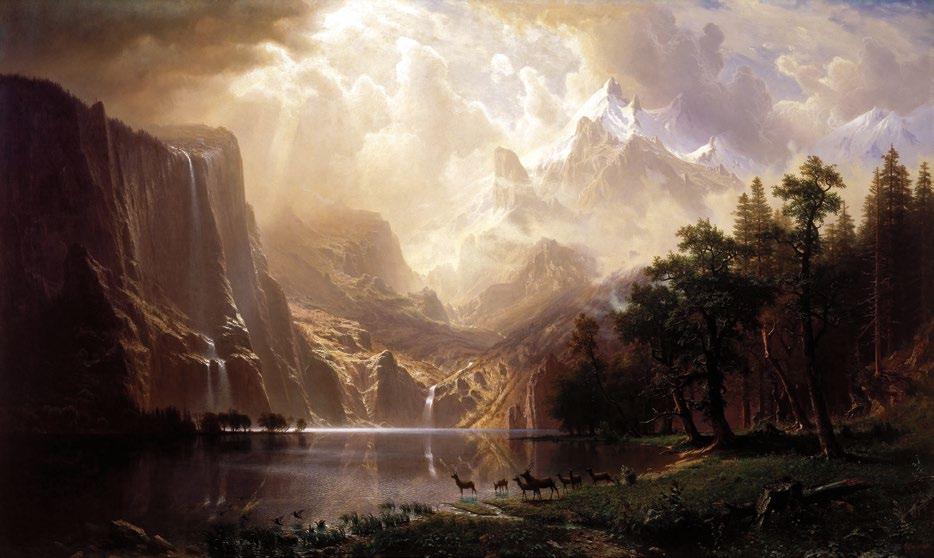
n TEXTS: Journey of a Pioneer, Patricia J. Murphy • Among the Sierra Nevada, California, Albert Bierstadt
¢ Style and Conventions Deep Dive: Examine Capitalization
Lesson 12 ............................................................................................................................... ................................... 167
n TEXTS: Journey of a Pioneer, Patricia J. Murphy • Among the Sierra Nevada, California, Albert Bierstadt • Autumn Landscape, Maurice de Vlaminck • Hunters in the Snow, Pieter Bruegel the Elder • Oregon Trail Map, Legends of America
¢ Style and Conventions Deep Dive: Examine Capitalization
Lesson 13 181
n TEXTS: Journey of a Pioneer, Patricia J. Murphy • Among the Sierra Nevada, California, Albert Bierstadt
¢ Vocabulary Deep Dive: Academic Vocabulary: Expressions
Lesson 14 195
n TEXTS: Journey of a Pioneer, Patricia J. Murphy • Among the Sierra Nevada, California, Albert Bierstadt
n Vocabulary Deep Dive: Academic Vocabulary: Tragedy
Lesson 15 ............................................................................................................................................................................. 209
n TEXTS: Journey of a Pioneer by Patricia J. Murphy • Among the Sierra Nevada, California, Albert Bierstadt ¢ Style and Conventions Deep Dive: Excel with Capitalization
What life lesson can we learn from the story of Bluebonnet?
Lesson 16 ............................................................................................................................................................................... 221
n TEXTS: The Legend of the Bluebonnet, Tomie dePaola • “Legend,” Encyclopedia Britannica
¢ Vocabulary Deep Dive: Context Clues: Distant, thrust, cease
Lesson 17 233
n TEXTS: The Legend of the Bluebonnet, Tomie dePaola • “American Indians and Alaskan Natives in the United States,” United States Census Bureau
¢ Vocabulary Deep Dive: Academic Vocabulary: Sacrifice
Lesson 18 245
n TEXT: The Legend of the Bluebonnet, Tomie dePaola
¢ Vocabulary Deep Dive: Academic Vocabulary: Valued, possession, forgiveness Lesson 19 .............................................................................................................................................................................. 257
n TEXT: The Legend of the Bluebonnet, Tomie dePaola
¢ Vocabulary Deep Dive: Explore Academic Vocabulary: The Suffix –ly
What life lesson can we learn from the story of Johnny Appleseed?
Lesson 20 269
n TEXT: The Story of Johnny Appleseed, Aliki
¢ Style and Conventions Deep Dive: Examine Past-Tense Verbs
Lesson 21 283
n TEXT: The Story of Johnny Appleseed, Aliki
n Style and Conventions Deep Dive: Examine Irregular Past-Tense Verbs
Lesson 22 ............................................................................................................................................................................. 297
n TEXT: The Story of Johnny Appleseed, Aliki
n Style and Conventions Deep Dive: Execute with Irregular Past-Tense Verbs
Lesson 23 ............................................................................................................................................................................ 309
n TEXTS: Johnny Appleseed, Steven Kellogg • “Who Was Johnny Appleseed?” Scholastic News (http://witeng.link/0124)
¢ Style and Conventions Deep Dive: Excel with Irregular Past-Tense Verbs
Lesson 24 323
n TEXTS: The Story of Johnny Appleseed, Aliki • Johnny Appleseed, Steven Kellogg
¢ Vocabulary Deep Dive: Academic Vocabulary: Shelter
Lesson 25 337
n TEXTS: The Story of Johnny Appleseed, Aliki • Johnny Appleseed, Steven Kellogg
¢ Style and Conventions Deep Dive: Examine Collective Nouns
How do different authors tell the story of John Henry’s life?
Lesson 26 351
n TEXT: John Henry: An American Legend, Ezra Jack Keats
¢ Style and Conventions Deep Dive: Experiment with Collective Nouns Lesson 27 363
n TEXT: John Henry: An American Legend, Ezra Jack Keats
¢ Style and Conventions Deep Dive: Execute with Collective Nouns Lesson 28 ............................................................................................................................................................................. 377
n TEXTS: John Henry: An American Legend, Ezra Jack Keats • John Henry, Julius Lester; Illustrations, Jerry Pinkney
¢ Vocabulary Deep Dive: Word Line: Groaned, shouted, roared, soundlessly, whisper, murmur, mumble Lesson 29 389
n TEXT: John Henry, Julius Lester; Illustrations, Jerry Pinkney
n Vocabulary Deep Dive: The Prefix un–Lesson 30 401
n TEXTS: John Henry: An American Legend by Ezra Jack Keats • John Henry, Julius Lester; Illustrations, Jerry Pinkney
n Style and Conventions Deep Dive: Excel with Conjunctions
Lesson 31 .............................................................................................................................................................................. 413
n TEXTS: John Henry: An American Legend, Ezra Jack Keats • John Henry, Julius Lester; Illustrations, Jerry Pinkney
n Vocabulary Deep Dive: Vocabulary Assessment Part 1 Lesson 32 421
n TEXTS: All Module Texts
¢ Vocabulary Deep Dive: Vocabulary Assessment Part 2
What was life like in the West for early Americans?
Lesson 33 431
n TEXTS: All Module Texts
Lesson 34 439
n TEXTS: The Story of Johnny Appleseed, Aliki • John Henry: An American Legend, Ezra Jack Keats • Journey of a Pioneer, Patricia J. Murphy Lesson 35 447
n TEXTS: All Module Texts
Appendix A: Text Complexity 453
Appendix B: Vocabulary 463
Appendix C: Answer Keys, Rubrics, and Sample Responses 473
Appendix D: Volume of Reading 483
Appendix E: Works Cited............................................................................................................................... ....... 485
Then something strange happened. Afterward folks swore the rainbow whispered it. I don’t know. But whether it was a whisper or a thought, everyone had the same knowing at the same moment: “Dying ain’t important. Everybody does that. What matters is how well you do your living.”
—Julius Lester, John Henry
Throughout our nation’s history, the West has symbolized hope, courage, and possibility. Native populations and early settlers, however, encountered the harshness of life in the West firsthand. What growth came from their struggles? What was life like in the American West for those native to the land? What was it like for those who settled there? How do changes impact people and nature? This module explores changes to the people and the environment of the West, building on the concept of change introduced in Module 1.
Students begin their study of the American West by reading The Buffalo Are Back. Students analyze connected historical events as they question the relationships between people and nature. Students also engage with Carl Sandburg’s poem, “Buffalo Dusk,” which furthers students’ understanding of life—and change—in the West.
Through the texts Plains Indians and Journey of a Pioneer, students understand life in the West before and after the arrival of the settlers. Students build knowledge of informational text features and identify topics and details as they read Plains Indians. The first-person account Journey of the Pioneer provides insight to characters’ responses to new experiences and challenges while traveling West on the Oregon Trail.
Students examine meaningful life lessons in The Legend of Bluebonnet and in stories of the legendary Johnny Appleseed and John Henry. Students compare and contrast major events in two versions of two legends: Johnny Appleseed (The Story of Johnny Appleseed by Aliki and Johnny Appleseed by Steven Kellogg) and John Henry (John Henry: An American Legend by Ezra Jack Keats and John Henry by Julius Lester). This analysis reveals the exaggerations in these stories and illuminates how authors build legends.
The culminating End-of-Module (EOM) Task requires students to write an informative paragraph using evidence from the texts to compare the legends of either Johnny Appleseed or John Henry to the lives of real pioneers. In this culminating task, students share their knowledge of the growth that emerged from the struggles of early settlers in the American West.
What was life like in the West for early Americans?
The West inspired a sense of wonder and awe in many early Americans.
Native Americans inhabited the West long before the settlers came.
Pioneers faced many challenges during the journey west.
People and nature are interconnected.
Sometimes sacrifice is required when times are tough.
Picture Book (Informational)
The Buffalo Are Back, Jean Craighead George
Journey of a Pioneer, Patricia J. Murphy
Plains Indians, Andrew Santella
Picture Book (Literary)
Johnny Appleseed, Steven Kellogg
John Henry: An American Legend, Ezra Jack Keats
John Henry, Julius Lester
The Legend of the Bluebonnet, Tomie dePaola
The Story of Johnny Appleseed, Aliki
“American Indians and the Alaskan Natives in the United States,” United States Census Bureau (http://witeng.link/0119)
Oregon Trail Map, Legends of America (http://witeng.link/0109)
USA Territorial Growth, Wikimedia Commons (http://witeng.link/0121)
“Who was Johnny Appleseed?” Scholastic News (http://witeng.link/0124)
John Henry and the Coming of the Railroad, NPS (http://witeng.link/0127)
“Legend,” Encyclopedia Britannica (http://witeng.link/0118)
American History to 1920 - Children’s Video Project (http://witeng.link/0113)
The Donner Party, History Channel (http://witeng.link/0116)
“Comanche Warrior - Documentary Excerpt, Part 1” (http://witeng.link/0120)
“Buffalo Dusk” (http://witeng.link/0104)
Among the Sierra Nevada, California, Albert Bierstadt
“Buffalo Dusk,” Carl Sandburg (http://witeng.link/0103)
Recognize change over time in the West.
Build understanding of the interrelationships between people and nature.
Identify characteristics of life and challenges faced by the pioneers and Native Americans in the West.
Recognize that stories can contain important life lessons.
Build knowledge of topic-specific words and use text features in informational text to support comprehension. (RI.2.4, RI.2.5)
Identify the main topic of informational text and describe connections between historical events. (RI.2.2, RI.2.3)
Recount a story and determine the underlying lesson. (RL.2.2)
Identify similarities and differences in two versions of the same story. (RL.2.9)
Identify how characters respond to major events challenges in a text. (RL.2.3)
Write informative paragraphs using information from module texts that include an introduction, topic statement, evidence, and conclusion. (W.2.2, W.2.8)
Incorporate peer feedback when revising informative paragraphs. (W.2.2, W.2.5, W.2.8)
Publish informative paragraphs using digital tools. (W.2.6)
Write informative paragraphs comparing and contrasting differences between texts about the same legend. (W.2.2, W.2.8)
Organize and choose text evidence to respond to a prompt. (W.2.8)
Create an audio recording of a story. (SL.2.5)
Produce sentences that are complete and contain detail. (SL.2.6)
Describe events using the past tense of regular and frequently occurring irregular verbs. (L.2.1.d)
Use irregular plural nouns and collective nouns. (L.2.1.a, L.2.1.b)
Provide specific detail by choosing and capitalizing proper nouns. (L.2.2.a)
Determine the meaning of unknown words and phrases in a text, using context clues, affixes, and root words. (L.2.4.a, L.2.4.b, L.2.4.c)
Knowledge: The American West is a story of change and perseverance. In this module, students closely read stories and informational texts to build their knowledge of the American West: its history, its land, and its people. Students develop an understanding of how the lives of people and nature are interconnected. They learn from the courage, determination, and spirit demonstrated by the main characters in the module texts as they face challenges. By engaging with a series of rich, complex texts, including a painting and a poem, students explore the wonder and awe that the West inspired in its people.
Reading: Students closely read stories and informational texts to build their knowledge of the American West. Immersion in rich texts around a topic builds students’ vocabularies to include words related to the Great Plains, the Native Americans, the pioneers, and life on the prairies. Students practice finding major events and details in informational and multiparagraph texts. Students also read stories to determine how characters respond to challenges and to identify underlying life lessons. Students learn about legends and practice comparing two different versions of the same story.
Writing: Building on what they learned in Module 1, students write informative paragraphs stating an introduction, topic statement, evidence, and a concluding sentence. Over the course of the module, students focus on adding topic-specific words in their writing, as well as choosing strong points and clearly explaining them. Students use digital tools to produce and share their work. The focus of revision in this module is on how students respond to feedback and use it to improve their writing. The EOM Task asks students to collect evidence, draft, revise, and use digital tools to publish an informative paragraph comparing the life of either Johnny Appleseed or John Henry to the lives of the pioneers.
Speaking and Listening: Students develop their speaking and listening skills first by thinking about how to listen and then becoming aware of how to vary inflection. Students practice varying inflection in the poem, “Buffalo Dusk.” During two Socratic Seminars, students practice and integrate these skills with those they learned in Module 1. In the first Socratic Seminar, students discuss the similarities and differences of Plains Indians tribes. In the second, they compare two versions of the story of Johnny Appleseed.
RL.2.2 Recount stories, including fables and folktales from diverse cultures, and determine their central message, lesson, or moral.
RL.2.3 Describe how characters in a story respond to major events and challenges.
RL.2.9 Compare and contrast two or more versions of the same story (e.g., Cinderella stories) by different authors or from different cultures.
RI.2.4 Determine the meaning of words and phrases in a text relevant to a grade 2 topic or subject area.
W.2.2 Write informative/explanatory texts in which they introduce a topic, use facts and definitions to develop points, and provide a concluding statement or section.
W.2.5 With guidance and support from adults and peers, focus on a topic and strengthen writing as needed by revising and editing.
W.2.6 With guidance and support from adults, use a variety of digital tools to produce and publish writing, including in collaboration with peers.
W.2.8 Recall information from experiences or gather information from provided sources to answer a question.
SL.2.5 Create audio recordings of stories or poems; add drawings or other visual displays to stories or recounts of experiences when appropriate to clarify ideas, thoughts, and feelings.
SL.2.6 Produce complete sentences when appropriate to task and situation in order to provide requested detail or clarification.
L.2.1.a Use collective nouns (e.g., group).
L.2.1.b Form and use frequently occurring irregular plural nouns (e.g., feet, children, teeth, mice, fish).
L.2.2.a Capitalize holidays, product names, and geographic names.
L.2.4.a Use sentence-level context as a clue to the meaning of a word or phrase.
L.2.4.b Determine the meaning of the new word formed when a known prefix is added to a known word (e.g., happy/ unhappy, tell/retell)
L.2.4.c Use a known root word as a clue to the meaning of an unknown word with the same root (e.g., addition, additional).
RL.2.10 By the end of the year, read and comprehend literature, including stories and poetry, in the Grades 2–3 text complexity band proficiently, with scaffolding as needed at the high end of the range.
RI.2.10 By the end of year, read and comprehend informational texts, including history/social studies, science, and technical texts, in the grades 2–3 text complexity band proficiently, with scaffolding as needed at the high end of the range.
L.2.6 Use words and phrases acquired through conversations, reading and being read to, and responding to texts, including using adjectives and adverbs to describe (e.g., When other kids are happy that makes me happy).
1. Write an informative paragraph about how the American Indians, settlers, and President Theodore Roosevelt made an impact on the prairie in the early American West.
2. Write an informative paragraph about how the Plains Indians used plants and animals.
Write an informational paragraph that answers the question and includes a topic statement, three pieces of evidence, and a concluding sentence.
RI.2.3, RI.2.1, W.2.2, W.2.8
Use topic-specific words to convey meaning. Use temporal words to organize the evidence in the paragraph.
Write an informational paragraph that answers the question and includes a topic statement, two pieces of evidence with clearly defined points, and a concluding sentence.
Use topic-specific words to convey meaning. Use text features to locate information.
RI.2.4, RI.2.5, W.2.2, W.2.8
3. Write an informative paragraph about the challenges Pioneers face and how they respond.
Write an informational paragraph that answers the question and includes a topic statement, two pieces of evidence, and a concluding sentence.
RL.2.1, RL.2.2, RL.2.3, W.2.2, W.2.8
4. Identify the lesson of The Legend of Bluebonnet and write an informative paragraph using details to support the idea.
Identify challenges and responses. Details that answer who, what, when, where, and why
Write an informational paragraph that answers the question and includes an introduction, topic statement, two pieces of evidence, and a concluding sentence.
Recount the story and identify the lesson.
Identify challenges and responses of the main character.
RL.2.2, RL.2.3, W.2.2, W.2.8
5. Write an informative paragraph about the lesson of The Story of Johnny Appleseed.
6. Write an informative paragraph that explains how the Keats version of John Henry is different from the Lester version.
Write an informational paragraph that answers the question and includes an introduction, topic statement, two pieces of evidence, and a concluding sentence.
Recount the story and identify the lesson.
Write an informational paragraph that answers the question and includes an introduction, topic statement, two pieces of evidence, and a concluding sentence.
Identify differences between two versions of John Henry.
1. Read pages 18–31 of Journey of a Pioneer and then answer questions about topic-specific words and details from the story.
2. Read pages 18–32 of The Story of Johnny Appleseed by Aliki and complete the Story Stones Chart.
RL.2.2, W.2.2, W.2.8
RL.2.9, W.2.2, W.2.8
Use newly learned topic-specific vocabulary to form complete sentences.
Identify details about how characters respond to events.
Recount the story by demonstrating an understanding of story elements such as setting, character, problem, and resolution.
Identify how characters respond to major events and challenges.
RI.2.4, RL.2.3
RL.2.2, RL.2.3
1. Identify characteristics of what life was like for the Plains Indians in the early American West.
2. Analyze the two versions of Johnny Appleseed and identify differences between the ways the legend is told.
Analyze evidence and cite the text to form an answer.
Demonstrate the ability to vary inflection during conversations.
SL.2.1.a, SL.2.1.b, SL.2.5, RI.2.2
Identify differences between two versions of Johnny Appleseed.
Demonstrate the ability to vary inflection during conversations.
SL.2.1.a, SL.2.1.b, SL.2.5, RI.2.9
Write an informative paragraph comparing the life of one legendary person (either Johnny Appleseed or John Henry) to real-life pioneers and explaining the differences.
Write an informational paragraph that answers the question and includes an introduction, topic statement, two pieces of evidence, and a concluding sentence.
Recount and synthesize information from two versions of Johnny Appleseed.
Identify and include main topics about pioneers.
RI.2.2, RL.2.2, W.2.2, W.2.5, W.2.8
Demonstrate understanding of academic, text-critical, and domain-specific words, phrases, and/or word parts.
Acquire and use grade-appropriate academic terms.
Acquire and use domain-specific or text-critical words essential for communication about the module’s topic.
L.2.6
*While not considered Major Assessments in Wit & Wisdom, Vocabulary Assessments are listed here for your convenience. Please find details on Checks for Understanding (CFUs) within each lesson.
Focusing Question 1: How did the actions of American Indians and early Americans impact the prairie in the American West?
Lesson Text(s) Content Framing Question
1 The Buffalo Are Back
“Buffalo Dusk”
2
“Buffalo Dusk”
Wonder What do you notice and wonder about The Buffalo Are Back?
Organize What’s happening in The Buffalo Are Back?
Craft Question(s) Learning
3
“Buffalo Dusk”
Examine Why are topic-specific words important?
Reveal What does a deeper exploration of connections between people, plants, and animals reveal in The Buffalo Are Back?
Experiment How do topicspecific words work?
“Buffalo Dusk”
Distill What is the essential meaning of The Buffalo Are Back?
Execute How do I use topic-specific words in an informative paragraph?
Ask and answer question about The Buffalo Are Back and “Buffalo Dusk.” (RI.2.1) Use a known root word (settle) as a clue to the meaning of unknown words (settling, settler, settled) with the same root. (L.2.4.c)
Understand and retell main topics and key events described in The Buffalo Are Back. (RI.2.2)
Understand and use topic-specific words and phrases in informative writing. (W.2.2) Distinguish shades of meaning among the related verbs wobbled, roamed, galloped, charged, and rushed. (L.2.5.a, L.2.5.b)
Describe relationships between people, plants, and animals in The Buffalo Are Back. (RI.2.3)
Identify words that are not topic-specific in a sentence and replace with topic-specific words. (W.2.2)
Categorize academic words from The Buffalo Are Back into two categories to build understanding of the word tough. (L.2.4.a, L.2.5.a)
Use the words and illustrations in The Buffalo Are Back to determine the text’s essential meaning. (RI.2.2, RI.2.7)
Express understanding of how the American Indians and early Americans impacted the prairie in the early American West. (RI.2.3, W.2.2, W.2.8)
Categorize topic-specific vocabulary to make real-life connections between words. (L.2.5.a)
“Buffalo Dusk”
How do The Buffalo Are Back and “Buffalo Dusk” build my knowledge of the American West?
Execute
How do I use topic-specific words in an informative paragraph? Excel How do I improve my informative paragraph with topicspecific words?
6
What do I notice and wonder about the text Plains Indians?
Examine Why are irregular plural nouns important?
7
What’s happening in Plains Indians?
Examine Why is choosing points important? Experiment How do writers form irregular plural nouns?
Understand and apply correct structure to an informative paragraph with topic statement, evidence, and concluding statement and include text specific words and phrases that enhance meaning. (RI.2.3, W.2.2, W.2.8)
Identify real-life connections between the concept of impact and topic-specific vocabulary. (L.2.5.a)
Use a Wonder Wheel to ask and answer questions about Plains Indians. (RI.2.1)
With support, identify and explain the purpose of frequently occurring irregular plural nouns. (L.2.1.b)
Recount the main topic and key details from pages 10–12 of Plains Indians. (RI.2.2)
Analyze how points support a topic statement about nomadic and non-nomadic Plains Indians. (W.2.2)
Form and use frequently occurring irregular plural nouns. (L.2.1.b)
Focusing Question 2: What was life like for Plains Indians in the early American West? Lesson Text(s) Content Framing Question Craft Question(s) Learning GoalsWhat’s happening in Plains Indians?
Experiment
How does choosing points work? Experiment
How do I vary inflection when reading a fluency passage? Excel
How do I use irregular plural nouns in my writing?
9 FQT Plains Indians Reveal What does a deeper exploration of plants’ and animals’ importance reveal about Plains Indians?
Execute
How do I vary inflection when reading a fluency passage? Execute
How do I choose points for my informative paragraph?
10 SS Plains Indians Know
How does Plains Indians build my knowledge?
Execute
How do I vary inflection when participating in a Socratic Seminar?
Identify main topics and details and explain how they are used to organize understanding of informative text. (RI.2.2)
Demonstrate how to choose points when writing informatively. (W.2.2)
Form and use frequently occurring irregular plural nouns. (L.2.1.b)
Record evidence and choose strong points for the Focusing Question Task. (W.2.2, W.2.8)
Use context clues and text features to determine the meaning of the academic and content vocabulary word nomadic. (L.2.4.a, L.2.4.e)
Explain what life was like for Plains Indians while practicing how to vary inflection in discussions. (RI.2.1, RI.2.2, SL.1.a, SL.1.b)
Express understanding of content knowledge and new skills, citing evidence from Plains Indians. (RI.2.2)
Pull from a variety of strategies (context clues, root words, and glossary) to build an understanding of the academic and content word reservation. (L.2.4.a, L.2.4.c, L.2.4.e)
11
Among the Sierra Nevada, California
Wonder
What do I notice and wonder about Among the Sierra Nevada, California?
Examine Why is capitalization important?
12
Among the Sierra Nevada, California
Organize
What’s happening in Journey of a Pioneer?
Examine Why are clearly explained details important to my informative paragraphs? Examine How do writers use proper capitalization?
13
of a Pioneer
Among the Sierra Nevada, California
Reveal
What does a deeper exploration of the text structure reveal about Journey of a Pioneer?
Experiment How do I write paragraphs containing clearly explained details?
Among the Sierra Nevada, California
Distill
What is the essential meaning of Journey of a Pioneer?
Execute How do I use clearly explained details in my paragraphs?
Apply previously learned reading skills to state observations and generate/answer questions. (RL.2.1)
Apply previously learned reading skills to reading and comprehending new text with unfamiliar topic or text specific vocabulary words. (RI.2.4)
Examine how proper capitalization changes the meaning of writing. (L.2.2.a)
Match key details with major events in a story. (RL.2.2.a)
Examine examples and non-examples of clearly explained details, or evidence. (W.2.5)
Edit sentences to ensure capitalization of holidays and geographic names. (L.2.2.a)
Identify information in a narrative nonfiction text. (RL.2.3)
Examine how specific words help indicate challenges and responses in a text. (L.1.5.a)
Explain the phrases and expressions jumping off, trains, make camp, and sitting watch. (L.2.6)
Collect evidence of challenges and responses in a text. (RL.2.1, RL.2.3, W.2.8)
Draft an informative paragraph with clearly explained details. (W.2.2)
Develop vocabulary knowledge of the word tragedy using a Frayer Model. (L.2.2.e, L.2.4.e, L.2.6)
Focusing Question 3: What was life like for pioneers in the early American West?Among the Sierra Nevada, California
Know
How does Journey of a Pioneer build my knowledge?
Excel
How do I add clearly explained details to improve my informative paragraphs? Excel
How do I improve my informative paragraphs with correct capitalization?
16 The Legend of the Bluebonnet Wonder
What do I notice and wonder about The Legend of the Bluebonnet?
17 The Legend of the Bluebonnet Organize What’s happening in The Legend of the Bluebonnet?
18 The Legend of the Bluebonnet Reveal
What does a deeper exploration of how characters respond to major events reveal in The Legend of the Bluebonnet?
Examine Why are introductions important?
Examine How do introductions work?
Identify new knowledge gained from a text. (RL.2.3)
Revise to more clearly explain ideas. (W.2.5, W.2.8)
Edit independent writing to ensure capitalization of holidays and geographic names. (L.2.2.a)
Ask and answer questions about The Legend of the Bluebonnet. (RL.2.1)
Use sentence-level context to determine the meaning of the words distant, cease, and thrust (L.2.4.a)
Recount what happens in The Legend of the Bluebonnet. (RL.2.2)
Determine criteria for an introduction in an informative paragraph. (W.2.2)
Make real-life connections to the word sacrifice and use a beginner dictionary to confirm its meaning. (L.2.4.e, L.2.5.a)
Explore story events and character responses. (RL.2.3)
Examine the function of introductory statements in informative paragraphs. (W.2.2)
Use a known root word (value, possess, forgive) as a clue to the meaning of an unknown word with the same root (valued, possession, forgiveness). (L.2.4.c)
19
FQT
The Legend of the Bluebonnet Distill
What is the lesson of The Legend of the Bluebonnet?
Execute
How do I use introductions in informative paragraphs?
20 NR The Story of Johnny Appleseed Wonder
What do I notice and wonder about The Story of Johnny Appleseed by Aliki?
Examine How do writers use past- and present-tense verbs?
21 The Story of Johnny Appleseed
Organize
What’s happening in The Story of Johnny Appleseed by Aliki?
Examine Why are digital tools important? Experiment How do digital tools work? Examine Why is knowing irregular pasttense verbs important?
22 FQT The Story of Johnny Appleseed Distill
What is the lesson of The Story of Johnny Appleseed by Aliki?
Execute
How do I use digital tools to make an online book?
Execute
How do I use irregular pasttense verbs?
Determine the lesson of The Legend of the Bluebonnet and explain how it is supported by key details. (RL.1.2)
Write an introduction as part of an informative paragraph. (W.2.2)
Identify and determine the meaning of adverbs ending in –ly. (L.2.1.e, L.2.6)
Answer questions about key details and character responses. (RL.2.1, RL.2.3)
Generate questions and observations about The Story of Johnny Appleseed. (RL.2.1)
Identify and sort past- and present-tense verbs. (L.2.1.d)
Comprehend and recount what happens in The Story of Johnny Appleseed. (RL.2.1, RL.2.2)
Experiment with using a digital publishing tool. (W.2.6)
Identify and sort regular and irregular past-tense verbs. (L.2.1.d)
Determine the lesson of The Story of Johnny Appleseed and support it with key details. (RL.2.2, W.2.8)
Craft an informative paragraph using a digital bookmaking tool. (W.2.2, W.2.6)
With support, form and use the past tense of frequently occurring irregular verbs. (L.2.1.d)
Focusing Question 5: What life lesson can we learn from the story of Johnny Appleseed? Lesson Text(s) Content Framing Question Craft Question(s) Learning Goals23
What’s happening in Johnny Appleseed by Kellogg?
Execute
How do I use digital tools to make an online book? Excel
How do I improve my use of irregular past-tense verbs in my writing?
The Story of Johnny Appleseed
Reveal
What does a deeper exploration of comparing two versions reveal in two Johnny Appleseed texts?
Excel How do I improve my digital book?
25 SS Johnny Appleseed
The Story of Johnny Appleseed
Know How do different stories and research build my knowledge of the legendary Johnny Appleseed?
Execute
How do I vary inflection when participating in a Socratic Seminar? Examine Why do writers use collective nouns?
Comprehend and recount what happens in Johnny Appleseed. (RL.2.1, RL.2.2)
Craft an informative paragraph using a digital bookmaking tool. (W.2.2, W.2.6)
Form and use the past tense of frequently occurring irregular verbs in writing. (L.2.1.d)
Compare and contrast two versions of Johnny Appleseed. (RL.2.1, RL.2.2, RL.2.9, W.2.8)
Improve the use of digital tools for informative writing. (W.2.2, W.2.6)
Use context clues and a Frayer Model to develop vocabulary knowledge of the word shelter (L.2.4.a, L.2.4.e)
Vary inflection to improve meaning in a discussion of the legend of Johnny Appleseed. (SL.2.5, SL.2.6)
Describe knowledge and skills gained from reading and comparing texts about the legend of Johnny Appleseed. (RL.2.9)
Identify and explain the purpose of collective nouns. (L.2.1.a)
26 John Henry: An American Legend Wonder
What do I notice about John Henry by Keats?
27 John Henry: An American Legend Organize What’s happening in John Henry: An American Legend by Keats?
Experiment How do writers use collective nouns?
Examine Why is responding to feedback important? Execute How do I use collective nouns in my writing?
28 John Henry
John Henry: An American Legend
Wonder
What do I notice and wonder about John Henry by Lester?
29 John Henry Organize What’s happening in John Henry by Lester?
30 John Henry
John Henry: An American Legend
Examine How does revising work?
Examine/ Experiment How do I write to explain differences between texts?
Reveal What does a deeper exploration of a comparison between the two versions reveal in the John Henry texts?
Excel How do I improve my sentences using conjunctions?
Notice and wonder about a new text. (RL.2.1, L.2.1) Identify and generate collective nouns from module texts and real-word experience. (L.2.1.a, L.2.5.a)
Identify story elements in John Henry: An American Legend. (RL.2.2)
Examine the importance of understanding feedback. (W.2.5) Use collective nouns. (L.2.1.a)
Generate observations and questions about John Henry. (RL.2.1, L.2.1)
Respond to and apply peer feedback. (W.2.5)
Distinguish shades of meaning among the words related to sound. (L.2.5)
Identify and discuss story elements in John Henry by Lester. (RL.2.2, SL.2.1, SL.2.4, SL.2.6)
Identify the structure of an informative paragraph that describes differences between texts. (W.2.2)
Determine the meaning of the new word formed when the prefix un– is added to a known word. (L.2.4.b)
Identify similarities and differences between the two versions of the John Henry story. (RL.2.9, W.2.8)
Combine simple sentences into compound sentences using conjunctions. (L.2.1.f)
Focusing Question 6: How do different authors tell the story of John Henry’s life? Lesson Text(s) Content Framing Question Craft Question(s) Learning Goals31
Distill
John Henry: An American Legend
What is the life lesson in the John Henry texts?
Execute How do I write to explain differences between texts?
32
John Henry: An American Legend
Know
How do the two versions of the John Henry story build my knowledge?
33 All Module Texts Know
How do the module texts build my knowledge of the Essential Question?
Excel How do I improve my writing to better explain differences between texts?
Examine Why is explaining differences between texts important?
34
EOM The Story of Johnny Appleseed
John Henry: An American Legend John Henry Journey of a Pioneer
Know
How do the module texts build my knowledge of the Essential Question?
35 All Module Texts Know
How do the module texts build my knowledge of the Essential Question?
Execute How do I explain differences between texts in my EOM Task paragraph?
Identify the lesson of the stories of John Henry. (RL.2.2)
Use text evidence to describe differences between two versions of the John Henry story. (RL.2.9, W.2.2, W.2.8)
Demonstrate understanding of module words by analyzing correct or incorrect use in context. (L.2.6)
Recall and extend new knowledge about the two versions of the John Henry story. (RL.2.9)
Demonstrate understanding of module words by analyzing correct or incorrect use in context. (L.2.6)
Collaboratively draft an informative paragraph comparing droughts in The Buffalo Are Back and The Legend of the Bluebonnet. (RL.2.2, RI.2.2, W.2.2, W.2.8)
Draft an informative paragraph comparing a legendary figure with real-life pioneers. (RL.2.2, RI.2.2, W.2.2, W.2.8)
Revise an informative paragraph with a focus on points and topic-specific words. (W.2.2, W.2.5, W.2.8)
The Buffalo Are Back, Jean Craighead George; Illustrations, Wendell Minor “Buffalo Dusk,” Carl Sandburg (http://witeng.link/0103) “Buffalo Dusk” video (http://witeng.link/0104)
How did the actions of American Indians and early Americans impact the prairie in the American West?
Welcome (4 min.)
Understand the Essential Question
Launch (5 min.)
Learn (60 min.)
Explore Illustrations (5 min.)
Prepare to Listen (5 min.)
Listen Actively (20 min.)
Share Observations and Questions (20 min.)
Examine “Buffalo Dusk” (10 min.)
Land (4 min.)
Answer the Content Framing Question
Wrap (2 min.)
Reflect on Volume of Reading
Vocabulary Deep Dive: Using Root Words to Find Meaning: Settle (15 min.)
The full text of ELA Standards can be found in the Module Overview.
RI.2.1
Speaking and Listening SL.2.1
Language L.2.4.c
Compass rose (drawing or display)
Map of the United States
Second copy of The Buffalo Are Back, with pages cut apart (see lesson for details)
Plastic sheet protectors
Speaking and Listening Anchor Chart
Notice and Wonder T-Chart (retain for future lessons) Sticky notes
Volume of Reading Reflection Questions
Ask and answer questions about The Buffalo Are Back and “Buffalo Dusk.” (RI.2.1)
Contribute questions to a Notice and Wonder T-Chart for The Buffalo Are Back
Use a known root word (settle) as a clue to the meaning of unknown words (settling, settler, settled) with the same root word. (L.2.4.c)
Complete close activity using settling, settler, and settled
ESSENTIAL QUESTION: MODULE 2
What was life like in the West for early Americans?
FOCUSING QUESTION: Lessons 1–5
How did the actions of the American Indians and early Americans impact the prairie in the American West?
CONTENT FRAMING QUESTION: Lesson 1
Wonder: What do you notice and wonder about The Buffalo Are Back?
In the second module of Grade 2, students explore the life of early Americans in the West. Building on the Module 1 foundation of observing and questioning, students record observations about the rich text and beautiful illustrations of The Buffalo Are Back. They also consider how the words and phrases in Carl Sandburg’s poem “Buffalo Dusk” lead them to develop pictures in their minds.
4 MIN.
Draw or display an image of a compass rose, marked with the initials for north, south, east, and west. Circle the “W” on the compass rose and ask: “What does the ‘W’ on a compass stand for?” Have volunteers respond. Confirm that the “W” stands for west.
As needed, support students in understanding the purpose of a compass rose, using probing questions to help them make real-life connections to their experiences with directions. For example:
Where does the sun rise? Set?
What state is north of our state? South?
Explain that west is a direction we can travel and it is also the name we use to describe part of our country. Use a map of the United States to point out the location of the western states.
Tell students that people have been exploring the area of the American West for thousands of years! In this module, students will join the exploration of the West as they read books about the land, people, and animals that are part of its history.
Post and read aloud the Essential Question, asking students to stand when they hear the word west
TEACHER NOTE
Leave the Essential Question posted for reference throughout the module.
Remind students that the Essential Question is the big question they will be trying to answer over the next few months. Essential Questions take a lot of thinking and learning to answer. Ask: “How do we work to answer Essential Questions?” Have volunteers respond.
Reinforce that students will work together to find answers using the books they read. They will also answer smaller questions along the way to lead up to answering the Essential Question.
5 MIN.
Students will continue to work with the concept of impact in this first set of lessons. Support them in making connections between Module 1 and 2 by encouraging them to look carefully at the Focusing Question and bringing in Module 1 artifacts as needed to infer the meaning.
Post and read aloud the Focusing Question. Highlight the word prairie and explain that the prairie is a large area of land in the West that is flat and grassy.
Tell students that they will begin their exploration by reading about a very important animal in the life of the West, the buffalo. Display the front cover of The Buffalo Are Back and read the title aloud.
Ask: “What do we do the first time we read a new book?” Have volunteers respond.
n We notice things about the book.
n We ask questions about the book.
n We write down what we notice and wonder.
Confirm that students will notice and wonder about the text during this lesson. Post and read aloud the Content Framing Question and remind students that the Content Framing Question tells them their job for this lesson.
60 MIN.
5 MIN.
Prior to the lesson, separate the pages of the second copy of The Buffalo Are Back and use plastic sheet protectors to protect the pages. Display this copy using a clothesline or bulletin board for the duration of the lessons about The Buffalo Are Back so students can easily reference illustrations.
Explain that students will start by wondering about the text with a Gallery Walk of the separated pages of The Buffalo Are Back. Instruct students to examine the pages of the book and write a question they have about the text on a sticky note. Students then place their note on the corresponding page. If time permits, allow students to write down multiple questions.
Instruct students to Think–Pair–Share, and ask: “What is the most important question you have about the text?” Use Equity Sticks to call on students to respond.
TEACHER NOTE Retain the sticky notes with student-generated questions and revisit the questions during the week, as time allows.
5 MIN.
Display the Speaking and Listening Anchor Chart from Module 1, and ask: “What do we record on this chart? How does it help us?”
Reinforce that this is where they record reminders about how to do their best speaking and listening. Highlight the Module 1 Listening Goal “Noticing the Whole Message” and ask a volunteer to share how that goal helped them become a better listener.
Explain that the new Listening Goal for this module is “Prepare to Listen” as you record it on the chart.
Think aloud to explain the goal of preparing to listen. For example:
Before we listen to the Read Aloud, we are going to take a deep breath. A good, deep breath helps our bodies and minds wake up, and it helps to focus our brains. Having an alert, focused brain helps prepare our minds and bodies to be good listeners. Good listeners focus on the reader and the book, and that helps them understand the text better.
Have students take three deep breaths and notice how their body changes. Instruct students to Think–Pair–Share on what they notice. Call on two pairs to share.
n I feel more awake.
n I feel quieter and calmer.
n My body feels more relaxed.
Ask students to take another deep breath together before starting the Read Aloud. Remind them that when they feel tired or distracted, they can take a deep breath to refocus to help them listen more carefully to the text.
Support students in brainstorming different times of the day when they have a hard time listening, such as before lunch or before recess. Look for opportunities to reinforce this listening habit during these moments.
LISTEN
NOTE
20 MIN.
There are inconsistencies in the language authors use to describe the people native to America in these module texts. Lessons on The Buffalo Are Back use the term American Indians from the text. If a more general descriptor is needed, the term Native American is used. Explain to students that throughout time, names of groups of people sometimes change based on the way groups define themselves, or based on the name that a particular group prefers. For further information about each tribe, visit the tribe’s website.
Post a blank Notice and Wonder T-Chart.
Display the front cover of The Buffalo Are Back and read aloud the title and author’s name. Point out the beautiful paintings illustrating the text. Show how the cover of the book doesn’t say “illustrator,” but instead says, “Paintings by Wendell Minor.” Remind students that as they are noticing and wondering about the text today, they can be noticing and wondering about the paintings, too.
Depending upon student need, The Buffalo Are Back can be read in one sitting or two different sittings in the same day. If the book is read in two parts, first read aloud pages 1–19 (about 12 minutes), then pages 20–31 (about 10 minutes). Provide a break between sections with an alternate activity.
The Buffalo Are Back does not have numbered pages. Page 1 begins on the title page. To understand text references, write small numbers in your text.
Read page 5 aloud to the students. Instruct students to Think–Pair–Share, and ask: “What did you notice about this page of text?”
n I noticed that this page is about the buffalo.
n There were 75 million buffalo, but then there were almost none.
Record responses on the Notice and Wonder T-Chart.
Explain that students will now individually write down what they notice about sections of the book. Distribute three sticky notes to each student. Ask them to number each note with a 1, 2, or 3. Explain that when you pause between sections of the text, students will write what they notice about each section.
Return to the text and remind students that headings help the reader to know what the topic will be in each section of text. Begin reading again on page 6, emphasizing the heading, “The American Indians.”
Pause to allow the students to write something they noticed about the topic of “The American Indians” on their first sticky note.
Continue to read the book aloud to the students, pausing after the following sections to allow them to record what they noticed in the text:
Pages 9–11, with the heading “The Buffalo”
Pages 12–19, with the heading “The Grass”
Ask: “What problem is happening in the story?” Have volunteers respond.
n The buffalo are gone.
n The farmers’ crops died.
n People are hungry and some died.
n The prairie grass is gone and the dirt from the prairie is blowing all over.
n The prairie is in trouble.
Emphasize the problem presented in the text by rereading the question posed on page 18: “What could be done to save the prairie?”
Explain that students will now share their observations about the text so far before they continue reading the book. Students will share each of their three sticky notes with a different partner.
Students share sticky notes with different partners by circulating around the classroom. Give them a cue to freeze with a partner and then share their first note about what they noticed about the American Indians section. Repeat the movement and partner share with the buffalo section and then again with the grass section.
After students have shared their notes with partners, have them place their sticky notes in the “Notice” column of the Notice and Wonder T-Chart. Highlight several strong responses.
Instruct students to Think–Pair–Share, and ask: “What questions do you wonder about the text?” Use Equity Sticks to call on students to respond. Record responses on the Notice and Wonder T-Chart.
Encourage students to think about whether their questions may relate to key details in the text.
Provide question sentence stems for students if they have difficulty generating questions on their own.
Read the remainder of the book, pages 20–31, without stopping, possibly gathering the students onto the carpet or in a different area to sit.
Allow students some time to discuss what they noticed in the last part of the book. Then encourage them to ask lingering questions they have about the text.
Record students’ observations and questions on the Notice and Wonder T-Chart. Explain that you will keep the chart posted as students dig deeper into the text; look for organic opportunities to encourage students to revisit their questions and reflect on new information or answers they have learned.
Display page 5 of The Buffalo Are Back as you explain that many authors have written about the disappearance of the buffalo from the American West. For example, a writer named Carl Sandburg wrote a poem about the buffalo. Tell students that they will use Sandburg’s poem about the buffalo for their fluency work this week.
Display the poem “Buffalo Dusk” by Carl Sandburg on a chart or projected for the class.
The buffaloes are gone.
And those who saw the buffaloes are gone. Those who saw the buffaloes by thousands and how they pawed the prairie sod into dust with their hoofs, their great heads down pawing on in a great pageant of dusk, Those who saw the buffaloes are gone.
And the buffaloes are gone.
Read the poem aloud. Ask: “What pictures did you see in your head as you listened to this poem?” Have volunteers respond.
Explain that understanding the words and phrases in the text helps readers form vivid pictures in their minds. Just as they wondered about The Buffalo Are Back to help them think deeply about the text, they can also wonder about the words of this poem.
Reread the poem and instruct students to make a nonverbal signal, such as placing an index finger against their temple, when they hear a word they wonder about. It could be a word that they do not understand or cannot picture clearly.
As students make the nonverbal signal, provide explanations to support student understanding of unknown words. For example, if students identify the word pawed, ask students what smaller word they recognize inside the larger word. The word paw is an animal’s foot. Ask: “What kind of action might the buffalo be doing with his hoofs?”
n The buffalo might be beating the ground with its feet. The buffalo might be scratching at the ground with its feet.
Ask students to act out what they might do if they were pawing the ground like a buffalo.
Continue to work through the poem, focusing on explaining vocabulary that students wonder about.
Invite the students to choral read the poem with you. Reinforce that knowing what the words mean in a poem, in combination with the way the poem sounds, helps readers see pictures in their minds.
Access this link and view a short video of “Buffalo Dusk” (http://witeng.link/0104).
The video will help all readers see the vocabulary in the poem and provide additional multilingual learners’ The Buffalo Are Back. In particular, the images support English learners’ deeper understanding of the vocabulary. Use your knowledge of students’ vocabularies to determine when to show students the video, supporting their work with understanding unknown words while also allowing for productive struggle.
Note that this video includes images of American bison as well as African and Asian buffalo, which are different animals. Students will examine the terms bison and buffalo and the difference between the two animals in Lesson 2.
Ask: “How did this video add to or change the picture you had in your head?”
n I didn’t know it was the Native Americans who saw the buffalo.
n I knew buffalo were that shape, but they were actually much bigger than I imagined.
Land4 MIN.
Read aloud the Content Framing Question. Ask: “What did we do to help us answer this question today?” Have volunteers respond.
n We wrote down what we noticed.
n We talked about what we noticed.
n We asked questions about the book.
n We wrote down our questions on the chart.
Remind students that answering the smaller questions in each lesson, like today’s Content Framing Question, helps them answer the big, Essential Question for the module. Students Choral Read the Essential Question.
Highlight the words early Americans. Point out that the early Americans are Americans that lived a long time ago, when the United States was a new country. Ask: “What early Americans did you read about today in The Buffalo Are Back?” Have volunteers respond.
n We read about fur hunters.
n There were explorers.
n We read about settlers and farmers on the prairie.
Explain that students will continue to learn more about early Americans, as well as American Indians, in the next lessons.
If students struggle to identify early Americans from the text, prompt them by displaying illustrations in the text that show pictures of different groups. For example, show pages 12–13 as an example image of settlers.
Wrap2 MIN.
Distribute and review the Volume of Reading Reflection Questions. Explain that students should consider these questions as they read independently and respond to them when they finish a text.
Students may respond in the Reflections section of their Knowledge Journal, or submit them directly. The questions can also be used as discussion questions for a book club or other Small Group activity. See the Implementation Guide for a further explanation of Volume of Reading, as well as various ways of using the reflection.
In this lesson, students practice generating their own questions and observations about a text. This is assessed when students contribute verbally to a Notice and Wonder T-Chart, as well as when they record what they noticed on sticky notes. Because of the focus on topicspecific, content-area words, students should be able to generate text-related questions and observations and build on each other’s comments. (SL.2.1, RL.2.1)
Analyze students’ questions and observations to see how close they stay to the text. If students are struggling, supply question stems. Also, over the course of the next four lessons, look for ways to help students identify which questions relate to key details in the text. In addition, draw students’ attention to the topic words they explored today about “The American Indians,” “The Buffalo,” and “The Grass.” Over time, gradually release more responsibility so students can generate their own questions using content-specific words.
Time: 15 min.
Text: The Buffalo Are Back, Jean Craighead George; Illustrations, Wendell Minor
Vocabulary Learning Goal: Use a known root word (settle) as a clue to find the meaning of unknown words (settling, settler, settled) with the same root. (L.2.4.c)
The words settle, settled, settler, and settling appear numerous times in this module’s texts. When students investigate the prefix un-, they will investigate the effect of the prefix in the word unsettled. This lesson builds students’ conceptual understanding of these words, preparing them for future lessons.
Ask: “Who can remember our Essential Question? Which region of the United States are we studying?” Have volunteers respond.
Reinforce that students are learning about the West and the people who lived there. Instruct students to Think–Pair–Share, and ask: “Who are the settlers?”
n The settlers are people who moved west to the prairie.
n The settlers plowed the grass and killed lots of buffalo. They impacted the prairie.
n The settlers left the prairie when their crops died.
Explain that students will be learning the meanings of words that are similar to the word settler.
Post the following words vertically aligned on the board: settler settling settle settled
Ask students: “What do you notice about each of these words?”
n They all have different suffixes, or endings.
n They all have settle in them.
Confirm for students that they all have the same root word settle. Explain that a root is the base of a word, and that when students know a root word’s meaning, they are in a better position to make a strong guess about other words with the same root. This works for settle, and it works for other words, too.
Post the definition of settle for students.
Word Meaning settle (v.) To start a new life in a new place.
Explain that students can use what they know about the definition of settle to check the meaning of settler within a sentence.
Post the following sentence: “The settlers moved west and bought land from the government.”
Ask: “What do you think the definition of settler is now?”
n A person who settles.
n A person who moves to a new place to live there. Look up this word for students to confirm the definition. Write the definition below settle
Have students copy both words and definitions into their personal dictionaries.
Word Meaning settle (v.) To start a new life in a new place. settler (n.) Someone who moves to a new place to start a new life.
Display the following sentences on the board:
1. Families from Europe and the East Coast rushed west to the rich black prairie land.
2. People moved west and the land.
3. The plowed the grass out of the prairie.
4. After the land, the farmers’ crops died.
Identify the words displayed on the board as the word bank: settle, settling, settlers, settled.
Point out that they are different forms of the word settle. Explain that students will work in pairs to determine which form of the word fits in each sentence. Remind students that each word will be used only once and they will write down the answers in their notebooks. Encourage students to say each form out loud before deciding on one to write down.
Pairs complete the sentences with different forms of settle.
The words explore, explorer, exploring, explored, and unexplored offer another good opportunity for practice. (The Buffalo Are Back, page 6) Tell students that explore is a verb that means “to travel in order to discover or search for something.” Then, have students examine the words explorer and exploring and generate sentences with the different forms.
“Buffalo Dusk,” Carl Sandburg (http://witeng.link/0103)
The Buffalo Are Back, Jean Craighead George; Illustrations, Wendell Minor
“Buffalo Dusk,” Video (http://witeng.link/0104)
How did the actions of American Indians and early Americans impact the prairie in the American West?
Welcome (3 min.)
Revisit “Buffalo Dusk”
Launch (4 min.)
Learn (63 min.)
Define Key Vocabulary (10 min.)
Identify the Main Topic and Key Events in The Buffalo Are Back (28 min.)
Illustrate Key Details (10 min.)
Examine Topic-Specific Words (15 min.)
Land (3 min.)
Answer the Content Framing Question
Wrap (2 min.)
Assign Homework
Vocabulary Deep Dive: Word Line: Wobble, roam, gallop, charge, rush (15 min.)
The full text of ELA Standards can be found in the Module Overview.
RI.2.1, RI.2.2, RI.2.4, RI.2.7
Writing
W.2.2, W.3.10*
Speaking and Listening SL.2.4
Language L2.4.a L.2.5.a, L.2.5.b
Handout 2A: Fluency Homework
Handout 2B: Word Line
Large note cards or cardstock 3”×5” note cards
Plastic sheet protectors
Second copy of The Buffalo Are Back with illustrations separated
Understand and retell main topics and key events described in The Buffalo Are Back. (RI.2.2)
Contribute to a class timeline by illustrating the sequence of events in The Buffalo Are Back
Understand and use topicspecific words and phrases in informative writing. (W.2.2)
Identify and replace topic-specific words and phrases.
Distinguish shades of meaning among the related verbs wobbled, roamed, galloped, charged, and rushed (L.2.5.a, L.2.5.b)
Organize words on a word line, according to the speed the words describe.
* This lesson prepares students for W.10, which first appears in the Grade 3 CCSS.
FOCUSING QUESTION: Lessons 1–5
How did the actions of American Indians and early Americans impact the prairie in the American West?
CONTENT FRAMING QUESTION: Lesson 2
Organize: What’s happening in The Buffalo Are Back?
CRAFT QUESTION: Lesson 2
Examine: Why are topic-specific words important?
In this lesson, students use “Buffalo Dusk” and The Buffalo Are Back to develop an understanding of how the environment of the American prairie changed over time. They identify the main topic and key details of the informational text by sequencing the major events in the text. Students use the text to illustrate these important events and capture the details on a class timeline. Finally, students learn the importance of defining key vocabulary and using topic-specific vocabulary words to enhance both their understanding of the content and their writing about what they know.
3 MIN.
Remind students that they learned a new poem in the Lesson 1 that will help them learn more about buffalo and the prairie. Explain that today they will listen briefly to the poet reading his poem aloud and think about how the poem makes them feel about the buffalo. Reinforce that thinking about how a text makes them feel can help them understand it better.
Prompt students to close their eyes and listen closely to Carl Sandburg’s reading of “Buffalo Dusk.”
Access the following link and play the audio of the poem “Buffalo Dusk” (http://witeng.link/0103).
Instruct students to Think–Pair–Share, and ask: “How did Carl Sandburg’s voice sound? Was he happy or sad?” Have volunteers respond.
Ask: “Why do you think he read this poem using a sad and serious voice?” Have volunteers respond.
Use responses to reinforce that Carl Sandburg felt that the disappearing of the buffalo (and of “those who saw the buffalo”) was a very important and serious topic. Explain that in this lesson they will look closely at what happens in The Buffalo Are Back to understand the events.
4 MIN.
Post the Focusing Question and the Content Framing Question.
Have students Echo Read the Content Framing Question, and remind students that this question will help them explore the organization and events of the book.
Remind students that thinking about the text type can help them understand what is happening. Hold up a copy of The Buffalo Are Back and flip through the pages. Instruct students to Think–Pair–Share, and ask: “What type of text do you think this is? Why?”
As needed, use the following text-dependent questions (TDQs) to scaffold and push students’ thinking.
1 How is this book like an informational text?
n The book has headings.
n We heard a lot of information and I think it is true.
2 How is this book like a story?
n This book has painted illustrations, not photographs.
n There are a few characters like the girl and her father, but they do not have names.
Guide students to understand that this book is informational and also a story. This kind of book is called “narrative nonfiction,” a name that incorporates both the idea of story and the fact that it is an informational text. The book tells a true story about the buffalo in the West.
Explain to students that in this lesson they will learn more about the buffalo and the American West by looking closely at key vocabulary as well as the main topic and key details in The Buffalo Are Back
63 MIN.
10 MIN.
Explain to students that during this module they will be learning many useful words. These are topicspecific words that will help them build their knowledge of life in the West. These are words they will use as they talk and write about what they are learning.
Ask: “How did the video in the Lesson 1 help us understand the words in the poem?” Have volunteers respond.
n It helps us see what the words mean.
n The pictures show us what the words mean.
Ask: “Why is it important to learn the meaning of new words? How did learning these words help us understand what we were reading?”
n When we know the words, we understand the events on the prairie.
n These words teach us about an important time and place in our history.
n When we learn the words, we understand what the author knows about the West.
Use student responses to reinforce that learning and understanding new vocabulary is important because it helps readers gain deeper understanding of a topic.
Access the video “Buffalo Dusk” using the following link: (http://witeng.link/0104). Play the first minute of the video. Remind students of the vocabulary words previously discussed in the poem and text work: pawing, prairie, dusk, pageant, and buffalo. Instruct students to Think–Pair–Share, and ask: “What word from the previous lesson helps you understand the poem better? How does knowing the meaning of this word help you picture what is happening in the poem?” Have volunteers respond.
Point to the Word Wall. Explain to students that a useful way to keep track of the words they learn is by adding them to the Word Wall. This tool will help them remember topic words from the text. Readers and writers often keep track of important words when they talk or write about the books. Explain that they will learn how to find the meaning of new words and add the words to the Word Wall.
For this module, only topic-specific words related to early American life in the West are included on the Word Wall. To enhance understanding, have students record the words and definitions in their Vocabulary Journal, or provide copies of the words and definitions for students to glue into their Vocabulary Journal. Explain to students that they can use these Vocabulary Journal as a reference if they need to remember the definition of a word.
Display pages 22–23 of The Buffalo Are Back. Explain that they can use the illustrations in the text to help understand the meaning of words, just as they used the images in the video to help define difficult words.
Ask: “What animal do you see on this page? How does the illustration help us learn more about this animal?” Have volunteers respond.
n It is a buffalo. They are big and hairy.
n Buffalo stomp and paw the ground.
n They have really big backs.
n They have hooves and stomp the grass when they run.
n They are on the grass and eat it.
n The big buffalo have horns.
Use responses to introduce the term bison. Explain to students that bison is another word for American buffalo. Define bison for the class. For example, say:
A bison is a hoofed and shaggy animal with a large head and shoulders. It has short, curved horns and a hump at the shoulders. It is found in North America.
Explain that bison are in the same family as African and Asian buffalo, but the American bison (here called buffalo) have a larger shoulder hump and massive head. When early explorers first encountered these animals, they called them buffalo because they resembled the animals called buffalo in Africa and Asia.
Read the first sentence in the second paragraph on page 23. Emphasize the word bison in the title of the range. Reinforce that knowing the word bison is important because they now know that Theodore Roosevelt created the National Bison Range in order to protect the bison that live in North America.
Add bison and buffalo to the Word Wall. Reinforce that in this module, while students will only be learning about the bison from North America, all the texts refer to them as “buffalo” because that is how they are commonly known. Students can use these terms interchangeably.
Display a map of the world in front of the class. Explain that there are other kinds of buffalo that exist on other continents that look a little bit different. Locate images of bison from North America as well as buffalo from Asia and Africa. Display these in front of the class to allow students to see the difference between the two. If time allows, sort images of the buffalo from Asia and Africa and the bison from North America on a map to enhance student understanding.
Turn back to pages 22–23. Read the first sentence on page 23, emphasizing the word plains. Turn slowly back between the illustrations on 20–21 and 22–23, and ask: “What does plains mean? How can you use the illustration to learn more about the plains?” Have volunteers respond.
n It’s where the buffalo live.
n I think it’s a big field.
n It looks like the plains are near mountains, too.
n The plains have lots of grass and flowers, too.
n It is flat but with little hills.
n I don’t see many trees.
Use responses to reinforce that the plains are a large and flat grassy area of land without many trees.
Ask: “What word did we learn about in Lesson 1 that has a similar meaning? Think back to the poem. Where do the buffalo run and ‘paw’ the ground?” Have volunteers respond.
n The prairie is also flat, grassy land.
Use responses to reinforce that plains and prairie are words used in this module to describe large, flat areas of land that are covered in grass. Much of the American West is made up of the Great Plains. Point to the Great Plains on a map of the United States and explain to students that they will learn a lot about the Great Plains over the course of the module.
Add plains and prairie to the Word Wall.
TEACHER
NOTE
Images often reinforce concepts for early learners. If needed, consider providing visual aids to support student understanding of these new terms. Refer to the following websites for more information and images:
Bison: (http://witeng.link/0107)
Prairie: (http://witeng.link/0108)
Students take out their Vocabulary Journal. Explain to students that a Vocabulary Journal is a great tool for keeping track of what words mean, or their definitions. Students write the word plains at the top of a page in their Vocabulary Journal. They record the definition for plains and create a drawing to accompany their definition.
Explain to students that as they read the Module 2 texts, they will encounter many unfamiliar words. Students can use the illustrations or the other words in the text to help them understand the meaning of these words. Explain that in future lessons the students will further explore many of these words using various vocabulary strategies.
In past exploration of informational texts, students have used Boxes, Bags, and Buttons. Because of the sequential nature of this informational text, students use an illustrated timeline to organize events from this text. Encourage students to use what they know of narrative transition words from Module 1 as they interact with the timeline. Major event is used loosely, as the idea is not to pinpoint events so much as much as it is to tell the sequence of what happened in the book.
Prior to the lesson, prepare the timeline in front of the class. Using a clothesline attach date dividing markers with the following dates: Long Ago, 1850, 1900, 1950, Now.
Reread the Content Framing Question. Explain that one way to understand an informational text is to identify the main topic and key details. Highlight that in this text, the key details are actually key events that happen over time.
Point to the timeline in front of the class. Explain that a timeline is a way to keep track of key events that help readers understand a main topic. Readers put important events in the order that they happen on a timeline, or they sequence them. Putting events in order helps one understand changes overtime.
Ask: “What is a main topic?” Have volunteers respond.
n It is what the book is about.
n It is the big idea that the book is telling us about.
n It can be the big idea of a small part, too.
Ask: “What are key details?” Have volunteers respond.
n They are bits of information that help us understand the main topic.
n They support the main topic.
Use student responses to reinforce that key details in this text will be key events or information from the text that helps readers understand the main topic. Readers will come back to the details of these events later in the lesson.
Explain to students that now they will dive deeper into The Buffalo Are Back to identify the main topic and key events in the text.
Prepare students for the Read Aloud by reminding them of the Lesson 1 Listening Goal.
Instruct students to Think–Pair–Share, and ask: “How can you prepare to listen?”*
n I can take a deep breath to help me focus before listening.
n I listen to the topic words to help me form pictures in my mind.
Prompt students to listen for major events and the details that describe these events as they hear The Buffalo Are Back read aloud for a second time. Explain that as they listen to each section, students will describe the major event in that section.
Read pages 4–7 aloud, showing the illustrations as you read. Instruct students to Think–Pair–Share, and ask: “What is the main topic in this part of the text? What is this section of the text telling us happened at this time in America?” Use Equity Sticks to call on students to answer.
n The American Indians are taking care of the prairie.
n They are burning the grasses.
n There are millions of buffalo.
Use student responses to reinforce that these are all details about what happened. To build a timeline of what happened in the story, students will describe a main idea or named event in just a few words. Model synthesizing a main idea and write it on a large card:
Indians and buffalo lived together.
Walk to the timeline and post the large main event card above the “Long Ago” marker.
Read pages 8–9 aloud.
Instruct students to Think–Pair–Share, and ask: “What is the main topic in this part of the text? What is this section telling us about what happened next in America?” Use Equity Sticks to call on students to answer.
n Hunters came.
n Explorers shot the buffalo for fun.
n Settlers sent the Indians away.
Ask: “How could we describe the major event?” Have volunteers respond.
n New people came west.
Create the card and walk to the timeline. Post the large main event card above the 1850s marker.
Second graders need not memorize specific dates, but they can grasp understand the concepts of long ago, times in-between, next, and now. They should also be able to sequence events. Dates are helpful markers for posting things in correct order.
* This icon indicates an opportunity to practice Speaking and Listening skills.
Read aloud pages 10–11.
Instruct students to Think–Pair–Share, and ask: “What is the main topic in this part of the text? What is this section telling us about what happened next in America?” Use Equity Sticks to call on students to answer.
n There was trouble in the plains because there was fighting.
n The buffalo were shot by settlers.
n There were battles with American Indians.
Read aloud the sentence “The government broke its treaties with the Indians.” Explain that treaties are formal agreements between governments. In this case, there was a treaty between the American Indian tribes and the United States. Breaking a treaty is like breaking a promise.
Ask, “How could we describe the major event?”
n We could say there were Indian Wars.
Create the card and walk to the timeline. Post the large main event card above the 1850s marker, a little after the previous card.
Read aloud pages 12–19.
Instruct students to Think–Pair–Share, and ask: “What is the main topic in this part of the text? What is this section telling us about what happened next in America?” Use Equity Sticks to call on students to answer.
n There was no rain.
n The fences kept the animals in.
n The fields were plowed up.
n Grasshoppers came.
n There was too much dust for crops to grow.
Use student responses to reinforce the definition for drought. Explain that droughts are long periods of time without rain.
Ask: “How could we describe the major event?”
n The land dried up, so nothing grew.
Create the card and walk to the timeline. Post the large main event card before the 1900s marker to represent 1874.
Read aloud pages 20–29.
Stop to explain that a scout is a person sent to gather information. In this case the president sent a scout to find buffalo in the West.
Instruct students to Think–Pair–Share, and ask: “What is the main topic in this part of the text? What is this section telling us about what happened next in America?” Use Equity Sticks to call on students to answer.
n Roosevelt sent a scout to look for buffalo.
n The National Bison Range was started.
n Farmers learned to plant in curves.
n People found old grasses.
Ask: “How could we describe the major event?”
n People helped the prairie become healthy again.
Create the card and walk to the timeline. Post the large main event card after the 1900s marker to represent 1908.
Read aloud the last two pages of the book.
Instruct students to Think–Pair–Share, and ask: “What is the main topic in this part of the text? What is this section telling us about what happened next in America?” Use Equity Sticks to call on students to answer.
n There are now 200,000 buffalo.
n There are preserves for buffalo.
Ask: “How could we say this as a main event?”
n Buffalo are back.
Create the card and walk to the timeline. Post the large main event card after at the Now marker on the timeline.
Ask: “How did preparing to listen help you today?” Have volunteers respond.
Tell students that they will illustrate the key details to support the main topic by adding drawings to the timeline. They will draw smaller details on smaller cards to post around the large major event card.
Ask: “How does having images help us use and understand our timeline?” Have volunteers respond.
Quickly review the large main event cards, assigning each group one event to illustrate with details.
Divide students into six groups. Distribute the appropriate plastic-protected pages of text from the cut up book to each group. Prompt groups to look closely at the illustrations in the text and refer back to the words they recognize in the text.
Prior to this lesson, divide one copy of the text and place each page of the text inside a plastic sheet-protector. This gives students the ability to look closely at the illustrations as there is only a teacher copy of this text.
Students work together to decide which details to illustrate and add to the timeline. As students finish, collect the cards and post on the timeline. The cards can be stuck around the main event card or hung like a chain with paper clips between.
Highlight the details that students illustrated using topic-specific words such as buffalo and prairie Tell students that they just added specific details to the timeline through their illustrations and next they will be learning how to include specific details in their writing through the words they choose to add.
Ask: “What is a topic?” Have volunteers respond.
n It is what we learn about.
n It is an idea that the book is telling us.
n A topic is something we are reading many books about.
Display the Craft Question: Why are topic-specific words important? Explain to students that topicspecific words are words that relate to an idea or subject they are learning. Remind students of the vocabulary they discussed earlier in the lesson. Reinforce that these words are topic-specific because they come from the text and help readers and writers understand and talk about a topic.
Explain that today the class will look closely at which topic-specific words the author uses to communicate facts about prairie life. Students can collect some of these words to use in their own writing about prairie life.
Project and read aloud the first two sentences from page 12 of The Buffalo Are Back. Ask students to listen for the words that have to do specifically with life on the prairie. Encourage them to count on their fingers the number of topic-specific words they hear.
Some students will require additional support recognizing topic-specific words. As needed, go through the first several words of a sentence by examining each word and determining if it’s a topic-specific word or not. For example, point to and read the words with and the. Ask: “Do these words tell us specific information about life on the prairie, or are they general words that are used in writing all the time to describe lots of different things?” Highlight student responses categorizing these words as general, or not topic-specific. Then, point to the word buffalo and ask if this word gives us specific information about life on the prairie. Explain that this word gives us specific information about life on the prairie and it most likely wouldn’t be used if we were writing about life somewhere else, such as a city.
If there is an unknown word, guide students to determine meaning using the Outside-In strategy. Then reread the sentence, underlining words students indicate as topic specific.
For example:
With the death of the buffalo, the Indian Wars were over. The settlers faced a new fight—the battle of the grasses.
Replace topic-specific words with general words. Compare the sentences and discuss the clarity of the word choice.
For example:
With the death of the animals, the fights were over. The people faced a new fight—the fight of the plants
Ask: “Which sentence do you understand more clearly? Why?”
n The first sentence is clear because I know what kind of animals they are talking about.
n The second sentence uses the word people so I’m not sure whom the sentence is about.
Display the following sentence from The Buffalo Are Back, leaving blanks for the underlined words in the example below:
The buffalo’s sharp hooves, and the Indians’ fires, had helped keep the grasses healthy. (page 12)
Students take out their Response Journal and copy the sentence frame down on a blank page. Students Think–Pair–Share about the following questions and write their topic-specific words in the spaces:
Who had sharp feet that pawed the ground? (first blank)
Who set fires to the grass to bring nutrients to the soil? (second blank)
Conduct a Think Aloud to determine the meanings of hooves and grasses, modeling the thought process students will need to use to be successful with this task.
Ask: “How did the topic-specific words make our sentence better?” Have volunteers respond.
n They gave more detail.
n They gave specific details about what we are learning.
3 MIN.
Reread the Content Framing Question.
Ask: “In our lesson today, how did you know what was happening in The Buffalo Are Back?” Have volunteers respond.
n We described the major events using topic-specific words.
n We created a timeline with important events.
n We drew details about each major event.
Ask: “How does using the timeline to describe what is happening in the text help us?” Have volunteers respond.
n It helps us keep track of the events.
n We know how things change over time.
n We learned that once the buffalo were here, then they were gone, but now they are coming back.
n We learned that it happened in a certain order.
If students need extra practice with the three sounds of -ed, review the sounds using words from The Buffalo Are Back Select words ending in -ed such as wobbled, blinked, barked, rippled, roamed, lived, helped, defeated, and replanted, then display the words or print them on strips of paper. Students sort the words by the sound -ed makes (/t/, /ed/, /d/), then discuss the patterns.
2 MIN.
Today is the first day of fluency homework practice for Module 2. Distribute Handout 2A to students and assign students a fluency passage based on their level. Alternatively, invite students to choose which passage they would like to practice. Explain that students are to read the fluency passage every night, and turn in the homework at the end of this set of lessons.
Name: Handout 2A: Fluency Homework
Directions: Read the text for homework. Have an adult or peer initial the unshaded boxes each day that you read the passage.
Buffalo Dusk
The buffaloes are gone.
And those who saw the buffaloes are gone.
Those who saw the buffaloes by thousands and how they pawed the prairie sod into dust with their hoofs, their great heads down pawing on in a great pageant of dusk,
Those who saw the buffaloes are gone.
And the buffaloes are gone.
57 words
Sandburg, Carl. Smoke and Steel New York: Harcourt, Brace, and Howe, 1920.
G2 Handout 2A WIT & WISDOM Page 1 of 2
If students have learned various sound-spelling patterns for ea, practice using them with words from “Buffalo Dusk.” Students identify and read words with ea, then discuss which sound ea makes in each word. Reinforce that ea makes different sounds in great, heads, and pageant
In this lesson, students identify main topic and key events in The Buffalo Are Back. (RI.2.1, RI.2.2) Each student should:
identify the main topic in sections of the text.
use the illustrations and words from the text to identify key events and key details.
contribute to a class Major Event Timeline by adding illustrations to the timeline cards.
Additionally, students practice using topic-specific words in informative writing. (RI.2.4, W.2.2) Students should be able to add a topic-specific word to a sentence from The Buffalo Are Back They will use this skill again in the first New-Read Assessment of this module.
If students need additional support with illustrating the timeline, prompt them with more directed TDQs to highlight specific details that can be added to the illustrations. Some students may need additional practice identifying and adding topic-specific words to sentences. The vocabulary in this text provides a foundation for the rest of the module—it provides students with examples to help them better understand key topic words and definitions so that they can more easily recognize these terms and use them in their own writing.
Time: 15 min.
Text: The Buffalo Are Back by Jean Craighead George; Illustrations, Wendell Minor
Vocabulary Learning Goal: Distinguish shades of meaning among the related verbs wobbled, roamed, galloped, charged, and rushed. (L.2.5.a, L.2.5.b)
When analyzing a group of verbs that are close in meaning, students can place the words on a word line to rate the relative intensity of the words. This helps students understand the subtle shades of difference in meaning between words.
Explain to students that they are going to explore several verbs from the text that all describe how people or animals move. They are going to relate the verbs to walk to learn their meanings.
Post the following two sentences from the text.
A little orange calf wobbled to her feet and blinked. (page 17)
On that day in the mid-1800s, seventy-five million buffalo roamed in North America. (page 2)
Draw attention to the underlined words in each sentence.
Encourage students to visualize how a calf might move to her feet after birth, or how buffalo would move on the plains. To further support understanding, instruct students to wobble to their feet and to roam around the room.
Instruct students to Think–Pair–Share, and ask: “What is similar about the underlined words? And what is different?”
n They are both verbs.
n They both explain the way an animal moves.
n They both end in –ed
n They make you picture different things.
n One describes a shaky movement. The other does not.
Emphasize that the author carefully chose these verbs to build an image in the reader’s mind about the way the animals moved.
Draw a Word Line on the board. Post notecards above with the following words: wobbled, roamed, galloped, charged, rushed, walked. Place walked in the center of the Word Line.
Explain that words that indicate a stronger or faster movement than walked should be placed on the right. Words that describe less strong or slower movement than walked should be placed on the left.
Ask: “Can you tell one word from this list which describes a stronger motion than walked?” Have volunteers respond.
n Gallop is a stronger word than walked because galloping is faster than walking.
Students use Handout 2B to complete word lines. Partners arrange the verbs in order according to the strength of the motion described. Students cut out and use Handout 2B, affixing verbs along a sentence strip with paperclips so that they can experiment and revise as needed.
As students create Word Lines, encourage them to look at the words’ usage in the text, to act out the words, and to try to use the words in their own sentences.
When completed, pairs share with one another. A sample student Word Line might resemble the one that follows. Note that there is some leeway in determining which verb goes where. wobbled roamed walked galloped charged rushed
If students continue to struggle with understanding the words in context, provide real-life examples of the words. For example, ask students to show you how a student moves when he or she roams the halls, how a desk wobbles, or how students move when they rush to catch the bus.
Post the following sentence from page 6.
Families from Europe and the East Coast rushed west to settle the rich black prairie land.
Instruct students to Think–Pair–Share, then ask: “How would the meaning of this sentence change if the underlined word was roamed?”
n Rushed makes it sound like the families really want to travel west.
n Roamed makes it sound like the families don’t care about getting there quickly.
n Roamed is not as strong of a word.
Remind students that a single verb can change the entire meaning of a sentence and that authors choose verbs carefully for this reason.
Split the class into six or seven groups and give each group a word. Each group must create a skit that portrays the word. Other groups watch the skit and guess which verb is being enacted.
TEXTS WIT & WISDOM®
FOCUSING QUESTION: LESSONS 1–5
33 34 2 1 3 5 6 7 15 26 11 19 30 9 17 28 13 24 21 32 8 16 27 12 23 20 31 10 18 29 14 25 22 4 35
Welcome (5 min.)
Practice Fluency with “Buffalo Dusk”
Launch (3 min.)
Learn (62 min.) Make Connections (27 min.)
Experiment with Topic-Specific Words (15 min.)
Gather Evidence (20 min.)
Land (4 min.) Answer the Content Framing Question Wrap (1 min.)
Assign Homework
Vocabulary Deep Dive: Academic Vocabulary: Tough (15 min.)
The full text of ELA Standards can be found in the Module Overview.
RI.2.3
Writing W.2.2, W.3.10*
Speaking and Listening SL.2.2
Language L.2.4.a, L.2.5.a
Handout 3A: Response Cards with Icons
Handout 3B: Topic-Specific Words Assessment 3A: Focusing Question Task 1
Evidence Organizer Chart for The Buffalo Are Back
Handout 3C: Academic Vocabulary Sort
Handout 2A: Fluency Homework
Describe relationships between people, plants, and animals in The Buffalo Are Back. (RI.2.3)
Record one connection from The Buffalo Are Back in Response Journal.
Identify words that are not topic-specific in a sentence and replace with topic-specific words. (W.2.2)
Complete Handout 3B. Categorize academic words from The Buffalo Are Back into two categories to build an understanding of the word tough. (L.2.4.a, L.2.5.a)
Complete Handout 3C.
* This lesson prepares students for W.10, which first appears in the Grade 3 CCSS.
FOCUSING QUESTION: Lessons 1–5
How did the actions of the American Indians and early Americans impact the prairie in the American West?
CONTENT FRAMING QUESTION: Lesson 3
Reveal: What does a deeper exploration of connections between people, plants, and animals reveal in The Buffalo Are Back?
CRAFT QUESTION: Lesson 3
Experiment: How do topic-specific words work?
Students dig deeply into The Buffalo Are Back as they identify and describe connections between people, plants, and animals using topic-specific vocabulary. Then, they continue their work with these key terms as they experiment with using topic-specific vocabulary in their writing. Finally, students preview the Focusing Question Task and prepare to write by gathering evidence from the text.
5 MIN.
Instruct students to Think–Pair–Share, and ask: “What have you learned about fluent reading?”
Use responses to reinforce that fluent readers pay attention to the phrasing—noting sets of words read almost as if they are one word—and the pauses in-between those sets of words.
Display and read “Buffalo Dusk” (http://witeng.link/0103). As you read, follow the phrasing with a pointer or your finger, making swooping motions under the phrases as you read. Pause between phrases.
Ask: “What did you notice about the way I read the words?” Have volunteers respond.
n You read some words in chunks.
n You pause between some words.
Use responses to confirm that reading with phrasing means chunking information into meaningful pieces.
Play the first minute of one of the videos used in previous lessons and direct students to listen for how the readers read with phrasing.
Show students where Sandburg’s “Buffalo Dusk” would fit in the timeline of events (1922). Ask: “Why do you think the poem was written during this time?”
n I see that it is near the “people helped bring back the buffalo.” Maybe the poem is an example of someone who talked about the buffalo.
n Sandburg was like Roosevelt. He was worried about the buffalo.
Add “Buffalo Dusk” to the timeline.
3 MIN.
Post and read aloud the Focusing Question and Content Framing Question.
Ask: “What does it mean for texts to have a connection?”
As needed, remind students that in Module 1 there was frequently a connection between the beginning and ending of a story or poem.
Display “Buffalo Dusk.” Instruct students to Think–Pair–Share, and ask: “Did you notice a connection between the beginning and ending of the Sandburg poem?”
n The poem begins and ends with the same line, “The buffalo are gone.”
n But the line “And those who saw the buffaloes are gone” is also at the beginning and end.
Call on two pairs to share their connections.
Ask: “Did you notice a connection between the beginning and ending of The Buffalo Are Back?” Reread the first and last page if necessary. Have volunteers respond.
n At the beginning of the book, it says “long ago.” At the end of the book, it says “not too long ago.”
n At the beginning of the book, there is an orange buffalo calf born. At the end of the book, there is also an orange calf.
n Both give numbers of buffalo.
n Both talk about larks and grass.
Explain that today students will think deeply about connections between different people, the buffalo, and the prairie.
62 MIN.
MAKE CONNECTIONS 27 MIN.
Remind students how important topic-specific words are to being able to understand and make connections about a text.
Distribute Handout 3A.
TEACHER NOTE To maximize time, consider cutting up this handout ahead of time.
Students work independently to choose two cards they believe are connected. Then, they share their connection with a partner and choose one connection to share with the whole group.
Explain that students should continue to think about the connections between these words as they revisit sections of The Buffalo Are Back. Students listen for topic-specific vocabulary as you read, holding up the corresponding Response Card for words they hear.
Remind students to prepare to listen.
Read the sections specified below, pausing after each section to call on students to identify the topic-specific words. Then, use the associated TDQ to support students in identifying connections. Look for opportunities to both reinforce and extend students’ initial thinking about the interaction between various people, plants, and animals.
Instruct students to Think–Pair–Share for each TDQ. Use Equity Sticks to call on pairs to share their thinking.
1. What connections do you hear between the American Indians, the buffalo, and the grass on page 6?
n The Indians set fire to the grass to keep it healthy.
n American Indians took care of the grass, which took care of the buffalo.
n The buffalo were the American Indians’ food and used to make shelter and clothing.

n The buffalo didn’t eat too much grass and their hooves helped water to get into the soil.
2. Page 11 describes links between the American Indians and the government. How did this affect the buffalo?
n The government broke its treaties with the American Indians.
n The government wanted to hurt the Indians so they killed the buffalo.
n The Indians couldn’t stay on the plains without the buffalo.
3. On page 16, how are settlers linked to the buffalo? How are the buffalo linked to the grass?
n The farmers’ crops died because the buffalo were gone and they couldn’t keep the prairie grass healthy.
4. What connections do you hear between President Theodore Roosevelt and the buffalo on page 20 (paragraph 1) and page 23 (paragraph 2)?
n Roosevelt loved buffalo because he loved nature.
n Roosevelt established a place in Montana for buffalo to be safe.
n Roosevelt made it illegal to shoot a buffalo.
As students share, record topic-specific vocabulary words and the connections between them on a connections chart similar to the one below.
Pairs use sticky notes to record their connections. Circulate and choose connections to add to the class connections chart, adding clarifying language and returning to the text as needed.
Who/What Connection
Who/What
American Indians kept the prairie healthy by setting fires to give it nutrients prairie
American Indians used the buffalo for food, shelter, and clothes buffalo
buffalo kept the prairie healthy making holes in the soil with their hooves prairie prairie provided food for the buffalo buffalo
government broke treaties with the American Indians American Indians
settlers killed as many buffalo as they could buffalo settlers destroyed the prairie by planting crops where there was native grass prairie government helped to bring back the prairie prairie
Students will likely contribute simpler phrases than the ideas provided above. As needed, simplify the charted language so students will be able to access the ideas.
Read the Content Framing Question, and ask: “What are some connections we found?” Have volunteers respond. As needed, support them in identifying the topic-specific word in each example.
Students pick one connection and write a sentence about the connection in their Response Journal.
Pull students together into a small group if they are stalled on the writing component. Ask: “How are the buffalo and the prairie connected? How are the people and the prairie connected? How are the buffalo and the people connected?” After each question, listen to several responses. When a student provides an accurate response, send them back to work independently and continue with others.
Explain that now students will practice with using topic-specific words in their own writing.
15 MIN.
Ask: “Why are topic-specific words important?” Have volunteers respond. Reinforce that topicspecific words help writers clearly communicate ideas about a topic, including connections they can make between ideas.
Display and read aloud the Craft Question: How do topic-specific words work?
Explain that students will experiment with topic-specific words to precisely describe relationships between different people, plants, and animals in The Buffalo Are Back.
Distribute Handout 3B. Read the directions aloud. Students Echo Read the three sentences about connections.
Each student completes the handout, discussing ideas for topic-specific words with a partner.
Review relevant vocabulary words from students’ Vocabulary Journal and Response Cards. Review other relevant words such as soil and hooves. Use the words to create a word bank for students to reference while completing the handout.
n The government wanted to hurt the Indians so they killed the buffalo.
Name:
n Government workers taught farmers how to make the prairie healthy again.
n The buffalo’s hooves poked holes in the soil, which helped the grass get water.
Have students Choral Read the completed sentences. Explain that now that students have a strong understanding of these words, they are ready to think about how they will use them in their Focusing Question Task.
20 MIN.
Display the first part of Assessment 3A:
Write an informative paragraph to answer the Focusing Question: How did the American Indians, settlers, and President Theodore Roosevelt impact the prairie in the early American West?
Read the prompt aloud, and then have students Echo Read. Ask: “What do we need to do before we can answer this question?” Have volunteers respond.
Reinforce that students first need to gather evidence from the text. Post an Evidence Organizer Chart.
3A:
Begin by writing the top line of the table to set the focus of the writing. Ask students if they remember the temporal words, or time-transition words, that link ideas when writing in sequence. Have volunteers respond. Add the words, First, Then, and Finally to the chart in the second row.
Ask students to put their people Response Cards in order of who came to the West first, next, and last. Acknowledge that all of these people had an impact on the prairie. Use Equity Sticks to call on students to share their answers. Students stand when they hear a topic-specific word.
Ask: “Who were the first people to impact the prairie?”
Fill in American Indians in column one.
Ask: “Who impacted the prairie next?”
Fill in settlers in column two.
Ask: “Who made an impact on the prairie after the settlers?”
Fill in the Roosevelt government in the final column. Explain that focusing on the government led by President Roosevelt will allow students to include more evidence.
Ask: “How did the American Indians impact the prairie?” Have volunteers respond, and then flip to the part of the book the student references. Ask all students to point to evidence of the student’s idea in the book’s illustrations. If needed, reread relevant sentences in the text. If text evidence supports the student’s idea, record it on the Evidence Organizer Chart.
Continue finding and recording evidence, asking: “How did the settlers impact the prairie? How did the Roosevelt government impact the prairie?”
People’s Impact on the Prairie
First, American Indians… Then, settlers…
n burned grasses for healthy soil
n shot buffalo no hooves, soil not moved
n brought cattle ate grass, packed the soil
n tore out grass to plant crops soil dried out, dust clouds
Finally, the Roosevelt government…
n made buffalo reserves buffalo help the soil
n planted trees made the prairie healthier
Explain that students will use this tool in Lesson 4 to respond to the Focusing Question Task.
4 MIN.
Students Choral Read the Content Framing Question. Ask: “What helped us to answer this question?” Have volunteers respond.
Direct students’ attention back to the Connections Chart. Students Think–Pair–Share one connection from the chart that they think is interesting.
1 MIN.
Students complete Day 2 of Fluency Homework.
In this lesson, students practice making connections between major events in The Buffalo Are Back (RI.2.3). Students use topic-specific words to describe connections in the text. They should use at least one new vocabulary word as they contribute to the Connections Chart. Then, in their Response Journals, they should write a sentence about one of the connections. (W.2.2)
Analyze students’ connections. Do students understand how the historical events are connected? Is each student able to incorporate at least one topic-specific vocabulary word? Try to determine whether students are struggling with specific vocabulary or with recognizing the connections. Prompt students who are struggling by providing additional modeling of how they might connect ideas or incorporate a topic-specific word.
Time: 15 min.
Text: The Buffalo Are Back, Jean Craighead George; Illustrations, Wendell Minor
Vocabulary Learning Goal: Categorize academic words from The Buffalo Are Back into two categories to build understanding of the word tough. (L.2.4.a, L.2.5.a)
Instruct students to Think–Pair–Share, and ask: “Where have you heard the word tough before?”
n I heard someone call meat tough when it was hard to bite.
n People call something tough when it’s difficult.
Explain to students that they will investigate the word tough by looking for clues in the sentences around the word. Then they will deepen their understanding of tough by thinking about words that mean the same as and the opposite of tough.
Post the following excerpts from pages 11 and 13 with the word tough underlined. Instruct students to listen for phrases around the word tough that give clues to its meaning.
Long ago, when drought came and grasshoppers chewed the healthy grass, the plants would grow back. Their tough roots always survived. But when the fragile crops were chewed by grasshoppers, nothing grew back.
When the buffalo lived on the prairie, their sharp hooves helped rain reach deep into the earth, and the tough roots of the grass held in the wet. Now, no moisture remained in the soil. The farmers’ crops withered and died.
Emphasize that there may be some unfamiliar words in the sentences around tough, but there are also words they know.
As needed, think aloud to model how to use context clues with a different section of the text before moving into the task.
Instruct students to look for words they know that helped them figure out the meaning of the word tough. Use Equity Sticks to call on students to share their ideas.
n It says the roots held in the wet soil.
n It says the plants would grow back because the roots survived.
n It says the grass was healthy when the roots were tough.
Circle the words healthy and survived in the quotes above as they are referenced by student responses.
Provide the definition of tough for students.
Word Meaning Synonyms tough (adj.) Long lasting. sturdy, strong
Post the following definitions:
Word Meaning Synonyms withered (v.)
Dried up or wilted. shriveled, wilted crumbled (v.) Broken into bits. decayed, disintegrated fragile (adj.) Breakable. breakable, weak, delicate
Instruct students to Think–Pair–Share, and ask: “What do you notice about these definitions? How do they relate to the word tough?” Have volunteers respond.
n These words mean the opposite of tough. They all have to do with something breaking or dying. Ask: “What are some examples of things that wither, crumble, or are fragile?”
n Flowers wither when they get too much or too little sunlight.
n Soil crumbles when it is too dry.
n Pottery is fragile.
As students provide an example, circle the referenced word in the quotes above: withered, fragile, and crumbled.
Reread each excerpt from the text. Instruct students to pay close attention to the circled words. Distribute Handout 3c.
Students sort the words on Handout 3C into two categories: “words like tough” and “words unlike tough.”
Like tough Unlike tough healthy survived fragile crumbled withered
Name: Handout 3C: Academic Vocabulary Sort Directions: 1. Cut out the words at the bottom of the page. 2. Sort the words into the correct category. Like tough Unlike tough
If students are ready, encourage them to add their own synonyms or antonyms to each group of words they sorted.
Students draw or act out the process of drought that resulted in the grass shifting from its tough, healthy, and sturdy state to its fragile, withered, and dead state.
Encourage kinesthetic learners to use their bodies to interact with the words. Assign students to create a hand or body motion that matches each word’s definition. Students might hunch their body to show withered
Use sentence frames from today’s core lesson to support students in comparing and contrasting words as they sort (e.g., “Both and describe because ”).
Instruct students to Think–Pair–Share, and ask: “Which of these words are unlike tough and which words are like tough?”
n Crumbled is not like tough because if something crumbles it breaks apart.
n Withered is not like tough because when something withers, it doesn’t last long.
n Fragile is not like tough because something that is fragile breaks easily.
n Healthy is like tough because something that is healthy is strong.
n Survived is like tough because something that survives keeps living and is strong.
If students have learned the ough sound-spelling pattern, practice using it with words from The Buffalo Are Back like bought, fought, brought, drought, tough, and coughed. Display the words or print them on strips of paper. Have students Echo Read the words, and then sort them by the sound ough makes.
TEXTS WIT & WISDOM®
FOCUSING QUESTION: LESSONS 1–5
33 34 2 1 3 5 6 7 15 26 11 19 30 9 17 28 13 24 21 32 8 16 27 12 23 20 31 10 18 29 14 25 22 4 35
Welcome (5 min.)
Sort Response Cards
Launch (5 min.)
Learn (62 min.) Determine the Essential Meaning (15 min.)
Plan an Informative Paragraph (22 min.)
Execute Focusing Question Task 1 (25 min.)
Land (2 min.)
Answer the Content Framing Question Wrap (1 min.)
Assign Homework
Vocabulary Deep Dive: TopicSpecific Vocabulary (15 min.)
The full text of ELA Standards can be found in the Module Overview.
RI.2.2, RL.2.3, RI.2.6, RI.2.7
W.2.2, W.2.8, W.3.10*
Speaking and Listening SL.2.1
Language L.2.4 L.2.5.a
MATERIALS
Handout 3A: Response Cards with Icons
Assessment 3A: Focusing Question Task 1
Evidence Organizer Chart
Handout 4A: Focusing Question Task 1 Evidence Organizer Handout 4B: Topic-Specific Vocabulary Sort Handout 4C: Informative Writing Checklist
Handout 2A: Fluency Homework
Use the words and illustrations in The Buffalo Are Back to determine the text’s essential meaning. (RI.2.2, RI.2.7)
Write a sentence detailing the essential meaning in Response Journal.
Express understanding of how the American Indians and early Americans impacted the prairie in the early American West. (RI.2.3, W.2.2, W.2.8)
Write an informative paragraph to begin Focusing Question Task 1.
Categorize topic-specific vocabulary to make real-life connections between words. (L.2.5.a)
Identify and describe the process of categorizing words.
* This lesson prepares students for W.10, which first appears in the Grade 3 CCSS.
FOCUSING QUESTION: Lessons 1–5
How did the actions of American Indians and early Americans impact the prairie in the American West?
CONTENT FRAMING QUESTION: Lesson 4
Distill: What is the essential meaning of The Buffalo Are Back?
CRAFT QUESTION: Lesson 4
Execute: How do I use topic-specific words in an informative paragraph?
Students engage in a group discussion about the words and illustrations in The Buffalo Are Back to determine the text’s essential meaning. Students reflect upon the actions of the American Indians and early Americans, and how these actions lead to certain historical events. In preparation for completing the Focusing Question Task, students investigate and record evidence about the impact of people on the environment of the American West. Students use the Evidence Organizer Chart to orally rehearse and write an informative paragraph to begin their Focusing Question Task.
5 MIN.
Distribute the cards for President Roosevelt, government, settlers, and American Indians from Handout 3A.
Ask: “Which people impacted the prairie in a good way? Which people impacted the prairie in a bad way?”
Students sort cards to show their responses, and explain their reasoning to a partner.
TEACHER NOTE Have students keep these cards in their sorted piles. They will use these in the beginning of the Learn.
Explain to students that they will continue exploring these questions and determine how the actions of the American Indians and the early Americans impacted the American West.
Whole Group
5 MIN.
Post and read the Content Framing Question. Have students Choral Read the Content Framing Question.
Remind students that the essential meaning is the big, overarching idea of the text. Explain that to find the essential meaning, they must consider the textual evidence and formulate an essential meaning. Provide an example of the essential meaning of one of texts from Module 1, such as: “the essential meaning of Sky Tree is that change happens in cycles.”
Post and read the Focusing Question. Ask: “What does the word impact mean? Remember back to how we used it Module 1 to talk about seasonal changes.” Have volunteers respond.
n It means to cause changes.
n It means to cause a change that can be good or bad.
n It causes a reaction.
n People react to changes. Use responses to reinforce the definition of impact.
Reinforce that in this module, students will also be learning about changes, but changes that happened in the West because of the actions of different people.
Explain to students that in this lesson they will explore how people, specifically the American Indians and early Americans (such as settlers and the government), had an impact on the prairie. This understanding will help them determine the essential meanings of the text, as well as begin work on their Focusing Question Task.
Ask students to look at their Response Card piles created earlier in the lesson. Ask: “How did you sort your Response Cards?” Have volunteers respond.
n Some people were good for the prairie. They did things that helped keep it healthy.
n Some people were bad for the prairie. They did things that hurt it.
Use responses to reinforce that people’s actions can cause certain changes or events to happen. Sometimes these changes or events can be good, which means they have a positive impact. Model using the nonverbal signal of a thumbs-up to indicate positive. Sometimes these changes or events can be bad, which means they have a negative impact. Model using the nonverbal signal of a thumbsdown to indicate negative
Ask: “Who did you put in the bad pile? Who had a negative impact on the prairie?” Have volunteers respond.
n Farmers had a negative impact on the prairie. They didn’t see how the buffalo’s hooves helped the prairie. The cows just pushed down the ground.
n Farmers had a negative impact on the prairie. They plowed up the land, instead of keeping the grass.
n The government had a negative impact. They paid settlers to kill buffalo. And the buffalo died without the healthy prairie.
Ask: “Who did you put in the good pile? Who had a positive impact on the prairie?” Have volunteers respond.
n The American Indians were good because they burned the grass. That gives it nutrients.
n The president was part of the government. Theodore Roosevelt helped the prairie by bringing buffalo back. That was a positive impact.
n The government also made a positive impact. They taught farmers how to plant crops in better ways.
n The farmers helped because they planted the grasses again. This was a positive impact.
As needed, follow up with specific questions such as:
Why did you say settlers had a negative impact on the prairie?
Why did you say the government had a negative impact on the prairie?
How did the government have a positive impact later on?
For students struggling to think from memory, refer back to the illustrations of the book posted on the wall. Instruct students to stand near one picture from the list below. Tell them that when they get to the picture they should ask and answer the question, “How do people impact the prairie in this illustration? Do they help or hurt the prairie?”
Page 4: Native Americans burn the prairie.
Page 10: Settlers plow the prairie.
Page 16: Settlers leave the prairie.
Page 18: President Roosevelt stands proudly on the prairie.
Page 22: Farmers plow the prairie in curves.
Access “Buffalo Dusk” and play the audio of Carl Sandburg reading the poem. Prompt students to listen closely to the poem and think about what it says about the impact the settlers had on the buffalo.
Ask: “What does this poem teach us about the impact the settlers had on the buffalo?” Have volunteers respond.
n It was bad because all the buffalo are gone.
n They had a negative impact because they made all the buffalo disappear.
n I think they say that the American Indians go away, too. That isn’t good either.
Explain to students that thinking about the impact other people had on the prairie can teach a lesson, which can be the essential meaning.
Ask: “What can we learn from this story of saving the prairie and the buffalo?” As needed, prompt students to provide text evidence for their responses, and use topic-specific words.
n People can help or hurt the environment.
n The American Indians helped the prairie. The settlers hurt the prairie.
n One person can have a positive impact in helping nature.
n The little girl found the prairie grass. President Roosevelt helped save the prairie.
n People, plants, and animals all impact each other.
n The American Indians took care of the grass. The buffalo ate the grass.
n When the grass was gone, the buffalo had no food.
n People make problems and create solutions.
n The settlers made problems with the buffalo and the American Indians.
n President Roosevelt helped to solve the problems with the prairies and the buffalo.
Instruct students to Think–Pair–Share, and ask: “What lessons can we learn from the events in both the poem and the book?” Use Equity Sticks to call on students to answer.
n Everything that is alive is important: animals, plants, and people.
n I learned that it is possible to save animals from being extinct. I know there are other animals that are almost extinct like kinds of gorillas and turtles.
n They make me want to take care of things around me. One mistake can hurt a lot of living things.
Ask students to take a minute and think about what they think is an essential meaning, and then write it in their Response Journal.
Explain that next students will be continuing to think about the big idea, or essential meaning of the text, as they plan their informative paragraphs describing how the American Indians and early Americans impacted the prairie in the early American West.
Explain to students that now they will begin their work with the Focusing Question Task. Post and read the Focusing Question.
Read aloud all the information on Assessment 3A. Ask: “What do you already know about this task’s success criteria?”
Name: Assessment 3A: Focusing Question Task 1 Task: Write an informative paragraph to answer the Focusing Question: How did the actions of the American Indians, settlers, and President Theodore Roosevelt impact the prairie in the American West?
Support your response using evidence from the following texts:
• The Buffalo Are Back, Jean Craighead George Checklist for Success:
Be sure to include all of the following in your response: A topic statement. At least three sentences with evidence.
The words first then and finally. A conclusion.
Topic-specific words. Page of
Reinforce that most of the criteria relate to the Topic-Evidence-Elaboration-Conclusion (TEEC) model for writing an informative paragraph. Display the Informative Writing Anchor Chart from Module 1. Have volunteers identify each part of the informative paragraph, including the order in which they appear in the paragraph.
n The paragraph starts with a topic sentence.
n Then, we give our evidence about the topic.
n We tell our evidence in a special order using the words first, then, and finally.
n We end the paragraph with a conclusion. That’s just like a topic sentence but we say it differently.
If students struggle to recall this information, support them by reviewing each item on the chart as a class. It might also be helpful to review how to form each of these sentences. Ask questions such as:
How do you create a topic sentence? Did people have a big impact or a small impact on the American West?
Where do we find evidence to support this topic sentence?
How do we create a concluding sentence? How can we use the essential meaning of a text to help us complete our paragraph?
Use responses to reinforce the Informative Writing Anchor Chart.
Part of Paragraph What It Does
T = Topic Statement
E= Evidence 1 Evidence 2 Evidence 3
Tells the essential idea.
How You Use … in a Paragraph with Change
Answers the question. Comes near the beginning States the essential idea.
Develops your topic. Comes from the text.
Supply evidence that explains the beginning.
Use the word first
Supply more evidence that describes the middle
Use the word then
Supply more evidence that describes the end
Use the word finally
C = Conclusion Reinforces your essential idea.
Comes near the end Reinforces the essential idea.
Explain that now that students have reviewed the parts of an informative paragraph, they are ready to choose specific information to include in their own informative paragraphs.
Post and read the Craft Question: How do I use topic-specific words in an informative paragraph?
Ask: “Why is it important to use topic-specific words when answering a question about the text?” Have volunteers respond.
n Topic words give our readers details and information.
n The more information people have, the more they can learn about the impact to the prairie from reading our writing.
n These words give more information and knowledge.
Ask: “What artifacts in the classroom can we use to find topic-specific words?” Have volunteers respond.
n We can use the Evidence Organizer Chart.
n We can use the Word Wall.
n We can use our Vocabulary Journals.
Reread the Focusing Question. Call on a volunteer to approach the Word Wall and locate a topic-specific word they could use to answer this question.
Name:
Display the Evidence Organizer Chart from Lesson 3. Distribute Handout 4A. Introduce the different parts of the handout. Explain to students that they will use this handout to organize the evidence they want to use for their Focusing Question Task.
Ask: “How can we use topic-specific words to help us plan our paragraph?” Have volunteers respond.
n The words we choose help us share what we know about how the American Indians and early Americans impacted the prairie.
n The topic-specific words are special to this text about life in the American West.
n We can find topic words on the Word Wall to use in our paragraphs.
Students complete Handout 4A by choosing one piece of evidence from the Evidence Organizer Chart to put in each column. Encourage students to use topic-specific words to complete the handout.
Explain to students that another way to plan a paragraph before writing it is to verbally rehearse the sentences together.
Ask: “Why do we use the words first, then, and finally when we write about our evidence?” Have volunteers respond.
n Those words put events in order. They show how and when things happened.
n Events happen in order. Sometimes one thing happens that causes the next thing.
n Those words help readers know the timeline.
Explain that students can move around as a way to remember to use words that describe order, or sequence. Model standing up and jumping in a straight line forward as you recite evidence from the Evidence Organizer Chart. Jump forward to a new spot when you say first, then, and finally. For example:
First, the American Indians helped the prairie by burning the grasses. (Jump forward.) Then, the settlers planted crops with fragile roots that created big dust storms and droughts. (Jump forward.) Finally, Theodore Roosevelt made the National Bison Range to protect the buffalo and restore the prairie.
Divide the class into pairs. Remind students to look at the Informative Writing Anchor Chart to remember each part of the paragraph, and look at their individual evidence organizer to recall their evidence. Students use Handout 4A to verbally rehearse their paragraphs for the Focusing Question Task with partners. Students take turns stating topic sentences and jumping through the stages of evidence in their paragraph.
The purpose of this activity is to help students prepare for their Focusing Question Task. Jumping the sequence of their evidence will help reinforce the act of putting events in a specific order. In addition, moving around actively will break up the lesson and give students new energy before they sit down to begin their speaking task.
Move quickly to help students who will have difficulty orally composing a paragraph from the Evidence Organizer Chart. Guide them to see how the Evidence Organizer Chart creates the paragraph for the student, by starting at the top, then reading each column left to right. If students struggle to write the paragraph, allow them to record their oral retell. A scribe could write it or it could be transferred to print electronically.
Sample Oral Paragraph
n People in the West had an impact on the prairie. First, the American Indians helped the prairie. They burned the grass to make it healthy. Then, the settlers hurt the prairie. The prairie turned to dust because the settlers took out the grass. Finally, the government taught the farmers to plant crops in curves. They saved the prairie. The buffalo came back. People both helped and hurt the prairie.
Reintroduce the criteria for success for the Focusing Question Task:
Write an informative paragraph detailing how people’s actions had an impact on the American West.
Include a topic sentence, at least three evidence sentences, and a concluding sentence.
Cite evidence from the text to support your answer. Use topic-specific words.
Students begin work on Focusing Question Task 1.
Students progress at different rates. Some students may be able to write three sentences during this lesson, while some may only be able to write one or two. Circulate as students begin their task to provide support where needed.
See the sample response in Appendix C.
Land2 MIN.
Ask: “What is the essential meaning of The Buffalo Are Back? How did discussing the essential meaning of the text prepare us for the Focusing Question Task?”
n Even though people hurt the prairie in the middle of the story, the buffalo and grass were healthy at the beginning and end.
n We learned about the changes to the prairie because of the American Indians, settlers, and government. This helped us put our sentences in order.
n The essential meaning is that it is important to take care of things around us. We can write about why it is important to do that.
n Everybody can have an impact. Sometimes it is good and sometimes it is bad.
n Thinking about the changes people make helps us answer the Focusing Question.
Remind students that they will be working on expression with their poem for homework. Encourage students to perform their fluency passage for someone new: a teacher, a sibling, a friend, or neighbor.
Students express understanding of the ways various groups impact the American West. (RL.2.3, W.2.2, W.2.8) Each student:
writes an informative paragraph detailing how people’s actions had an impact on the American West.
includes a topic sentence, at least three evidence sentences, and a concluding sentence.
cites evidence from the text to support the answer.
uses topic-specific words.
If students struggle with the Focusing Question Task, consider the root cause of the difficulty. Is the student struggling to understand the content? If so, provide support by working with the student to look closely at the words and illustrations in the text. Consider choosing one set of people, American Indians for example, and diving deeper into their impact on the prairie. Ask pointed questions to direct student understanding.
Is the student struggling with the process of writing a paragraph? If so, consider revisiting the Informative Writing Anchor Chart and breaking down each piece of the paragraph. Direct the student to the Evidence Organizer Chart and support them in locating pieces of evidence for each column on Handout 4A. Distribute Handout 4C so students have an additional resource for understanding the task.
Group students with similar needs and plan small group support for these skills to set students up for success with their next Focusing Question Task.
Time: 15 min.
Text: The Buffalo Are Back, Jean Craighead George; Illustrations, Wendell Minor
Vocabulary Learning Goal: Categorize topic-specific vocabulary to make real-life connections between words. (L.2.5.a)
TEACHER NOTE In this lesson, students dive more deeply into vocabulary specific to the Core Lessons, many of which are already captured in students’ Vocabulary Journals and on the Word Wall.
Remind students that they have learned a lot of new topic-specific words in the text The Buffalo Are Back. Have volunteers share an example, using the Word Wall as a resource.
Instruct students to Think–Pair–Share, and ask: “What are some tools you can use to add more topic-specific words and phrases to your informative writing?”
n Use the Word Wall.
n Use the Knowledge Chart.
n Ask a friend for ideas.
n Use my Vocabulary Journal.
n Reread the story.
Use responses to emphasize that learning the meanings of topic-specific words helps students better understand the text and helps them add more information to their writing.
Explain to students that they will look back at many of the topic-specific words they’ve encountered in the text and explore some other important words.
Organize students into pairs and distribute Handout 4B. Review the directions at the top. Instruct students to first cut out the words and place them in categories by thinking about their meanings.
To maximize instructional time, ask a school volunteer to precut the handout and place the words in plastic or paper bags for easy student use.
Explain how the sentence frame supports students in a key part of sharing their learning: being able to explain why they grouped specific words together. Remind students that every word does not need to be sorted if they do not see a way to categorize. Prompt students to reference the text to develop categories or to explore word meanings.
Circulate to analyze whether student dialogue signals an understanding of vocabulary. Provide support and prompting as needed.
Given the focus in the core lessons, many students might group words within categories that relate to buffalo words, prairie words, settler words, or Native American words. If students suggest alternate categorization, encourage them to express their reasoning and accept all reasonable answers. I think and belong together in a category called because .
Group the words into categories and have students name the category.
Name the categories and have students sort the words.
Have students work with fewer words.
Substitute or add more words.
Pairs identify a category they created and practice how they would explain it to the class.
Use Equity Sticks to call on pairs to share a category they created and how the words within that category relate to one another. Ask students to explain a real-life connection based on the category and words they share. Take anecdotal notes of student responses to ensure mastery of understanding.
Challenge students by doing a Link Up: each student gets a card with a word on it. Students stand up, find a partner, and link arms. Partners must talk about their two words and form some kind of connection between them.
TEXTS WIT & WISDOM®
FOCUSING QUESTION: LESSONS 1–5
33 34 2 1 3 5 6 7 15 26 11 19 30 9 17 28 13 24 21 32 8 16 27 12 23 20 31 10 18 29 14 25 22 4 35
Welcome (6 min.)
Practice Fluency
Launch (3 min.)
Learn (57 min.)
Record Knowledge (17 min.)
Complete Focusing Question Task 1 (25 min.)
Excel with Using Topic-Specific Words (15 min.)
Land (6 min.)
Answer the Content Framing Question Wrap (3 min.)
Assign Homework Vocabulary Deep Dive: Academic Vocabulary: Impact (15 min.)
The full text of ELA Standards can be found in the Module Overview.
RF.2.4, RI.2.3
Writing
W.2.2, W.2.5, W.2.8
Language L.2.5.a
Handout 2A: Fluency Homework Module 1 Fluency Anchor Chart Assessment 3A: Focusing Question Task 1
Handout 4A: Focusing Question Task 1 Evidence Organizer Knowledge Journal Chart Timeline bulletin board display Ball of yarn
Response Cards from Handout 3A
Understand and apply correct structure to an informative paragraph with a topic statement, evidence, and concluding statement and include text-specific words and phrases that enhance meaning. (RI.2.3, W.2.2, W.2.8)
Complete informative paragraph for Focusing Question Task 1.
Identify real-life connections between the concept of impact and topic-specific vocabulary. (L.2.5.a)
Students use impacted correctly and make connections between impact and a real-life example.
FOCUSING QUESTION: Lessons 1–5
How did the actions of American Indians and early Americans impact the prairie in the American West?
CONTENT FRAMING QUESTION: Lesson 5
Know: How do The Buffalo Are Back and “Buffalo Dusk” build my knowledge of the American West?
CRAFT QUESTIONS: Lesson 5
Execute: How do I use topic-specific words in an informative paragraph?
Excel: How do I improve my informative paragraph with topic-specific words?
In this final lesson for The Buffalo Are Back, students reflect on new knowledge of how the prairie changes throughout history. Students write informative paragraphs that include topic-specific words and phrases. These experiences provide them with the tools to answer the Essential Question What was life like in the West for early Americans? at the conclusion of this module.
6 MIN.
Display the Fluency Anchor Chart. Ask: “Why is it important to read fluently?” Have volunteers respond.
n Reading fluently helps people understand what you’re saying.
n It helps other people enjoy what you’re reading.
n So people can make pictures in their minds of what you’re saying.
Use the chart to highlight the fluency skills of reading with a proper pace and with good expression. Explain that students will focus on these skills during today’s fluency practice.
Instruct students to take turns reading “Buffalo Dusk” aloud to a partner as they practice proper pace and expression. Then invite the class to Choral Read the poem as a whole group.
Students use a thumbs-up, thumbs-sideways, or a thumbs-down to self-assess their use of proper pace and good expression.
For additional support, have students Echo Read “Buffalo Dusk” as a class instead of working with a partner.
3 MIN.
Post and read aloud the Focusing Question Task and Content Framing Question.
Display the Knowledge Journal Chart, and ask: “What information do we record on this chart?” Have volunteers respond.
Reinforce that the Knowledge Journal Chart is a space where new and big learning is recorded.
As needed, add to the Knowledge Journal by creating new charts. However, to support students in making connections throughout the year, continue to look for opportunities to encourage them to reference their learning from previous modules.
57 MIN.
17 MIN.
Explain that students will think about the new knowledge they have gained from reading “Buffalo Dusk” and The Buffalo Are Back in the past few lessons. Remind students that it is helpful to be aware of and think about all that they are learning.
Use classroom items, such as the timeline and Word Wall, to remind students of the work they have done with the book and the poem.
Instruct students to Think–Pair–Share, and ask: “What did you learn about the American West from ‘Buffalo Dusk’ and The Buffalo Are Back?” Make note of student responses to review them as a class prior to recording them on the Knowledge Journal Chart.
As needed, use supportive questions to help students identify new, significant learning. For example:
What does the poem “Buffalo Dusk” tell us about life in the early American West?
How does The Buffalo Are Back explain what life was like for the American Indians in the West?
How does The Buffalo Are Back explain what life was like for the settlers in the West?
Choose strong responses to consider for recording on the “What I Know” side of the Knowledge Journal Chart. Explain that, while all students’ thinking and contributions are valuable, the Knowledge Journal is where the class records learning they might need to remember later.
Read each response aloud. Ask students to stand if they believe the idea is big or important enough to think about later and direct them to remain seated if they disagree or are unsure. If a majority of students agree, record the idea on the Knowledge Journal Chart.
Over time, students gradually take ownership over which ideas get detailed on the Knowledge Journal. To support this process, briefly explain the rationale behind the ideas chosen before students vote.
Point to the side of the Knowledge Journal labeled “What I Can Do.” Ask: “What information goes in this part of our Knowledge Journal?” Have volunteers respond.
n Things we learned how to do.
n New skills we learned how to do this week.
Instruct students to Think–Pair–Share, and ask: “What new skills have you learned as a reader this week? As a writer?”
Repeat the process detailed above to engage students in a class vote and add responses to the Knowledge Journal Chart.
The buffalo were very important to the land.
I can use timelines to help view a book’s events in order.
The buffalo were important to the American Indians in the West.
I can take a deep breath to prepare to listen.
The settlers in the West wanted the land. They took the land as their own, even though the American Indians lived there.

I can use topic-specific words to help communicate ideas.
The buffalo in the West were almost extinct.
At first the government ordered the buffalo to be killed. Then at the end they protected the buffalo.
One change can impact everything!
Explain that students will continue to think about their learning as they complete the informative paragraphs they started in Lesson 4.
Distribute Handout 4A to students along with their partially completed paragraphs from Lesson 4.
Post and read aloud the first Craft Question: How do I use topic-specific words in an informative paragraph?
Ask students to silently read the sentences they wrote in Lesson 4 and identify at least one topic-specific word they used. Use Equity Sticks to call on several students to share their topicspecific word or words.
Ask: “What resources can you use to find topic-specific words for your paragraph?” Have volunteers respond.
n I can use the Word Wall.
n We can look in our Vocabulary Journals.
n I can use the Evidence Organizer.
n I can look in the text.
Encourage students to continue to use their resources to help them use topic-specific words as they complete their paragraphs.
Distribute Assessment 3A and use the information on the handout to reintroduce the criteria for success for the Focusing Question Task:
Write an informative paragraph detailing how people’s actions had an impact on the American West.
Include a topic sentence, at least three evidence sentences, and a concluding sentence.
Cite evidence from the text to support answer.
Use topic-specific words.
Name:
3A:
Question Task
words.
For additional support with writing a conclusion sentence, reference the Informative Writing Anchor Chart and ask: “What do you already know about writing a conclusion sentence for your paragraph?” Have volunteers respond.
n It goes at the end of the paragraph.
n The conclusion tells the essential idea.
n It can answer the question, “So what?”
Invite students to rehearse their conclusion sentence verbally with a partner, making sure to include a topic-specific word.
Students complete Focusing Question Task 1. After students have drafted their paragraphs, they self-assess and revise their work by using the checklist on Assessment 3A.
Display and read the second Craft Question: How do I improve my informative paragraphs with topicspecific words?
Explain that students will revise their informative paragraphs by focusing on the topic-specific words they already used and trying to add more or change them to improve the reader’s understanding.
Students read their paragraphs to a partner. When the partner hears a topic-specific word, they make a nonverbal signal like thumbs-up. When they hear a word that doesn’t clarify the topic, they make a nonverbal signal like thumbs-sideways. Students underline words to improve.
In their own paragraphs, students revise one or more sentences using topic-specific words. Remind them to think about all the words available to them from the Word Wall and their Vocabulary Journal.
Students Mix and Mingle to read their revised paragraph to one or more peers.
Ask more confident writers, “Did you use the word impact?” Encourage them to try adding it to their piece.
6 MIN.
Display the Knowledge Journal Chart and explain that the knowledge students gain continues to build as they explore new topics and ideas. Help students see connections in their learning by reviewing the concept of change, which was a core idea in Module 1. Highlight several points from the Knowledge Journal that reference change.
Instruct students to Think–Pair–Share, and ask: “Change was an important idea in Module 1 and it’s also important to Module 2. What did you notice about change in The Buffalo Are Back and ‘Buffalo Dusk?’”
n Things changed in the book. The buffalo were there, then they were gone. In the end they came back.
n The prairie changed from grasslands to dust. Then it came back again.
n Things changed in the poem. The buffalo were there at one time but then they were gone.
To tie these similar literary pieces to future learning focused on differences in versions, ask: “Both the poem and the book are similar because they talk about the buffalo, the Native Americans, and the prairie. What is the biggest difference in the two texts?”
n The biggest difference is that change is hopeless in the poem. They don’t think the buffalo will ever come back.
n The book tells the same beginning of the story but it has hope. It tells how even though the buffalo were almost gone, they came back. Things can change.
Students complete Day 4 on Handout 2A.
Practice for clear articulation with good pace and volume using the poem “Buffalo Dusk.”
Students write and revise informative paragraphs to include topic-specific words and phrases. (W.2.5) Students should demonstrate the ability to incorporate topic-specific words, as well as recognize how they provide meaning and clarity to their writing.
Analyze students’ informative paragraphs: Is there evidence of topic-specific words and phrases?
If not, workshop student sentences in small groups to provide additional modeling of how to revise to include topic-specific words. Ask students to circle words in their writing that are not topic specific. Then point them to the Word Wall or Vocabulary Journal to select topic-specific words as replacements.
Time: 15 min.
Text: The Buffalo Are Back, Jean Craighead George; Illustrations, Wendell Minor
Vocabulary Learning Goal: Identify real-life connections between the concept of impact and topicspecific vocabulary. (L.2.5.a)
TEACHER NOTE
In Lesson 4, students explore the impact of the actions of various groups of people on the prairie. In today’s Deep Dive, students explore connections between the settlers, American Indians, the government, buffalo, President Roosevelt, and the grass to develop a better understanding of the word impact.
Post students’ evidence notes from Handout 4A. Remind students that they have been exploring the term impact
Instruct students to Think–Pair–Share, then ask: “What do you remember about the word impact?”
n Impact means when something changes because of something else.
n Impacts can be positive or negative.
n The Native Americans, settlers, and Roosevelt did things that had an impact on the prairie.
Use student responses to emphasize that the meaning of impact is “to strongly affect someone or something.”
Remind students that in the last lesson they sorted Response Cards to help them understand how groups of people impacted the prairie. In this lesson they will think more deeply about the word impact by remembering ways these people also affected, or impacted, each other in The Buffalo Are Back
This lesson includes the use of yarn to support visual and kinesthetic learning. Students may need instruction on how to use the material appropriately if they have not had previous exposure. Likewise, if students are familiar with a different multisensory strategy, it may be used instead.
Organize the class into groups of six. Give each group a set of Response Cards from Handout 3A and a ball of yarn.
Students each receive one Response Card. Students stand in a circle facing each other with their cards visible. The first student holds a ball of yarn and announces one way that their Response Card word impacted another Response Card word. The student throws or rolls the ball of yarn to this student, forming a visible connection. Students continue to repeat the process, using the following sentence frame:
The impacted the by .
Circulate and take notes on student statements. Ensure that each student uses impacted correctly and makes a connection between impact and a real-life example.
n The government impacted the settlers by giving them American Indian land to farm.
n The American Indians impacted the prairie by burning grass each year
n The Native Americans impacted the buffalo by only killing what they needed to survive.
n The settlers impacted the Native Americans by killing many buffalo
Ask students to analyze the cause-effect relationship of each event. Challenge students to connect the effect of one event to the cause of another to begin to see cause-effect chains and relationships over time. Consider drawing a chain on the board to go along with student statements. Encourage students to use the same sentence frame as above to describe the chain of events.
Congratulate students for building connections by analyzing how people and places from the West impacted each other. Instruct students to Think–Pair–Share, and ask: “How does your understanding of these connections help you build your knowledge of what life was like in the early American West?”
It helps me understand how the West changed when the settlers moved west.
It helps me understand how Native Americans’ lives were impacted by the settlers moving West and the buffalo dying.
Welcome (5 min.)
Explore Text
Launch (5 min.)
Learn (60 min.)
Preview Text (5 min.)
Introduce Wonder Wheel (20 min.)
Read Aloud with Notice and Wonder (35 min.)
Land (3 min.) Answer the Content Framing Question Wrap (2 min.) Assign Homework
Style and Conventions Deep Dive: Examine Irregular Plural Nouns (15 min.)
The full text of ELA Standards can be found in the Module Overview.
RI.2.1
Writing W.3.10*
Speaking and Listening SL.2.2, SL.2.6
Language L.2.1.b
MATERIALS
Wonder Wheel Chart
Notice and Wonder T-Chart Sticky notes
Handout 6A: Fluency Homework Handout 6B: Irregular Plural Nouns
Use a Wonder Wheel to ask and answer questions about Plains Indians. (RI.2.1)
Write questions on sticky notes to contribute to a Notice and Wonder T-Chart about Plains Indians.
With support, identify and explain the purpose of frequently occurring irregular plural nouns. (L.2.1.b)
In pairs, students sort and label nouns as irregular or regular.
* This lesson prepares students for W.10, which first appears in the Grade 3 CCSS.
FOCUSING QUESTION: Lessons 6–10
What was life like for Plains Indians in the early American West?
CONTENT FRAMING QUESTION: Lesson 6
Wonder: What do I notice and wonder about the text Plains Indians?
In this lesson, students listen closely to the first read of Plains Indians, pausing along the way to notice and wonder about the text topic. In Module 1, instruction focused more on noticing than wondering during Notice and Wonder lessons. Beginning in this lesson, students will learn to state questions in the form of a question using a variety of question stems. The Wonder Wheel is a tool to help students ask a variety of questions. Being conscious of questions as they read influences students’ ability to read fluently. Caution students to ask questions they are truly curious about, not just to try to use a question stem.
5 MIN.
Tell students that they will begin exploring a new text today. Distribute copies of the text to pairs of students. Read aloud the title. Ask students to page through the book discussing similarities and differences between it and The Buffalo Are Back.
NOTE
Although this text may be especially challenging for Grade 2 students, they have spent a week building relevant background knowledge with The Buffalo Are Back. For this reason, students begin by comparing texts. This prepares students for the straightforward, informational structure of the text. The reading level is well above Grade 2, requiring Read Alouds. Use discretion to determine the appropriate amount of Read Aloud time for your students. Stop during the Read Aloud to take a movement break, as needed.
5 MIN.
Use Equity Sticks to call on volunteers to share similarities and differences between The Buffalo Are Back and Plains Indians
This whole book is about the Indians that lived on the plains. The Buffalo Are Back had a part on American Indians. The rest was about the prairie and the buffalo.
I see buffalo in some of the pictures in this book.
This book seems to have all facts and no story.
This book has mostly photographs. The Buffalo Are Back had paintings.
I think both books tell a lot about the past.
This book is titled Plains Indians. They must be the American Indians that were in The Buffalo Are Back book.
Display and Choral Read the Essential Question: What was life like in the West for early Americans? Explain that students will continue thinking about this big question as they read a book about Plains Indians.
Display and read the Focusing Question for Lessons 6–10.
Display and Echo Read the Content Framing Question. Tell students that today they will be starting an in-depth investigation of the Plains Indians: who they were, how they lived, and how they interacted with the animals and land around them.
During this module, inconsistent language describes the people native to America. Throughout the lessons about Plains Indians, the term Plains Indians is used to match the text. If a more general descriptor is needed, the term Native American or American Indian is used. For further information about each tribe, visit the tribe’s website.
60 MIN.
Open to the table of contents. Remind students that they learned about the table of contents in Module 1. Read a few of the section titles of the book.
Ask: “What kind of book do you think this is? Why do you think that?”
n This is a book of facts. The sections tell different facts about Plains Indians.
n This is an informational book. It’s nonfiction. I notice a lot of maps and photographs.
Ask: “What do you know about the American Indians from The Buffalo Are Back?” Point students back to the Knowledge Journal or to the timeline, still posted in the classroom.
n Native Indians understood how to keep the prairie and buffalo herds healthy.
n The settlers took lands from the Native Indians
n The Native Americans could not survive without the buffalo.
Whole
20 MIN.
Display the Wonder Wheel Chart. Tell students to study the chart and ask: “What do these words have in common?”
n They are all question words.
n They are words that are usually used in sentences with a question mark at the end.
Confirm that most questions begin with one of these words. Explain that deep thinkers wonder and ask thoughtful questions as they read. The words on the Wonder Wheel will help them ask a variety of questions and learn about different ideas.
Ask: “When do readers and thinkers ask questions?” Record some answers at the bottom of the Wonder Wheel. Explain that now, students will use the Wonder Wheel in some of those situations.
where how
H
To practice using the Wonder Wheel, read aloud page 4, stopping after every few sentences to invite questions. For example, read the first line: “It sounded like an earthquake.”


Ask: “What are your questions about that first line?” Pairs think of at least two questions to share. Use Equity Sticks to facilitate sharing, and ask students to point to the relevant section of the Wonder Wheel when they ask a question.
n What sounded like an earthquake?
n Why does it sound like an earthquake? Is it really an earthquake?
n How did people feel when they heard the sound? Is it dangerous?
n Who heard the sound?
who G2 M2 Lesson 6 WIT & WISDOM® 98


I wonder...? © 2023 Great Minds PBC
n Where does this happen?
Ask: “How did the question stems help you to think more deeply about that one sentence?”
n I didn’t know what made the sound, so I asked what
n The why question made me think about whether it was an earthquake or something else.
n The how question made me think about the people in danger.
n The who question made me wonder about the people who heard the sound.
Continue reading the text to the end of the page. Ask: “How did asking a variety of questions about the first line help you understand the rest of the page?”
n I wanted to know what the earthquake sound was. It was a herd of bison.
n I listened more closely to find out who the people were that heard the sound. They were hunters of the Great Plains.
n I found out why the hunters were in danger. They needed to hunt the buffalo for food and clothing.
Ask students to recall the buffalo in The Buffalo Are Back and explain that bison is another word for buffalo.
Congratulate students on their willingness to use a new tool to help them formulate questions. Tell students to continue using the Wonder Wheel to help create questions as they listen to the rest of the text read aloud.
NOTE
This text is read aloud over two days of instruction. Since the text includes many pages of dense information, the lessons focus on a selection of pages that balance depth with breadth of knowledge. Before this lesson, put sticky notes on the pages that are part of the first Read Aloud: 5, 8, 10, 12, 14–19, 20–23, and 27. Each page takes about one minute to read aloud, leaving only a few minutes for discussion between each section. Use discretion in balancing reading with discussion.
Tell students that today they will hear some sections of the text read aloud and then during Lesson 7 more of the text will be read aloud. Remind students to refer to the Wonder Wheel as they start generating questions about the text in their minds as they listen
Remind students of the Listening Goal for this module: Prepare to Listen. Tell students that if theirminds wander during the Read Aloud, they should take a deep breath to refocus on the text.
Read aloud sections of the text tabbed prior to the lesson. After reading a page or section aloud, students Think–Pair–Share about what they noticed and wondered. As students share with the class, be sure the “wonderings” are in the form of questions, prompting students to refer to the Wonder Wheel if they need assistance. Record student responses on a Notice and Wonder T-Chart.
Plains Indians, Andrew Santella
Page Notice Wonder
5 There are many names for Native Americans.
Tribes are unique groups.
8 The Great Plains cover fourteen states.
It talks about grasses like in the other book.
10 They say bison in this book.
There are many tribes from the Great Plains.
12 The eastern tribes farmed. They didn’t move around.
More rain helped some tribes farm.
14–19 Bison are big and fast.
People lived in tipis.
“The bison was like a walking store.”
The hunters had sneaky ways to kill buffalo.
Why did Columbus think he was in Asia?
What does immense mean? Are the Great Plains the prairie?
What does nomadic mean? What are the horses pulling in the photo?
How did people grow their crops? Why are the houses round in the photo?
Where did the people get the dogs?
Does “nomadic” mean “moves”?
How close can the hunters get to the buffalo? (photo, page 18)
20–23
Corn, squash, and beans are called three sisters. They help each other grow.
They used tipis as houses so they could move to new camps.
27 Men and women were not equal.
They both worked hard.
Does that picture have prairie sod on the house?
Were the houses comfortable inside?
Were women ever allowed to hunt?
Did men ever help with the children?
What’s a cradleboard? (note photo on page 26)
Congratulate students on their hard work with listening, noticing, and wondering. Assure them that they will explore the questions on the Notice and Wonder T-Chart throughout the week. They will also record one of their questions before the end of Lesson 6. Encourage them to research questions in their spare time, satisfying their own curiosity and then reporting back to the class.
3 MIN.
Ask students to consider what they notice and wonder about Plains Indians.
Tell each student to write their most pressing question on a sticky note. As students finish, they post the questions on the Wonder Wheel near the relevant question word.
Tell students that during Lesson 7 they will examine the text again to find out what’s happening and how it is organized.
2 MIN.
Distribute and read aloud Handout 6A: Fluency Homework to students. Either assign students one of the fluency passages according to their reading level using the word count as a guide, or invite students to choose which passage they would like to practice. Tell students that they will continue to practice all they have learned about fluency with these passages. Review any tricky words from the passage with students.
Name: Handout 6A: Fluency Homework Directions: Choose one of the text options to read for homework. Have an adult or peer initial the unshaded boxes each day that you read the passage. Option A
Students can practice applying previously learned vowel teams with words from both fluency passages. After reading aloud the passage to students, distribute slips of paper with words that include previously learned vowel teams. Words with vowel teams include took and food for oo; plains and against for ai; and treaties and defeat for ea. Students read each word aloud, then sort them by vowel team and/or vowel sound. After sorting and discussing the patterns, have students Echo Read the full passage.
Students write questions about the text and post them on the Wonder Wheel. (RL.2.1)
Students form questions using who, what, when, where, why, and/or how.
Students formulate questions relevant to the text.
Support students to use a variety of question words and types of questions moving them beyond the concrete, simple questions and answers to questions that promote deeper thinking about the text. If needed, pause after reading a page rather than a full section to help students focus more on developing questions and less on wading through large amounts of detail.
Time: 15 min.
Text: Plains Indians, Andrew Santella
Style and Conventions Learning Goal: With support, identify and explain the purpose of frequently occurring irregular plural nouns. (L.2.1.b)
STYLE AND CONVENTIONS CRAFT QUESTION: Lesson 6
Examine: Why are irregular plural nouns important?
Writers must understand irregular plural nouns and use them correctly in order for writing to make sense.
Most nouns become plural by adding an s or es to the end of the word. In addition, words that end in -y become plural by changing the y to an i and adding -es
An irregular noun becomes plural by changing its spelling in other ways than adding an s or es to the end.
Some irregular plurals have specific spelling patterns. For example, nouns that end in f adopt -ves when they become plural (e.g., calf to calves) or nouns that end in o adopt -es (e.g., tomato to tomatoes).
Other irregular plural nouns change the form of the word itself (e.g., goose to geese, mouse to mice).
Still, other irregular plural nouns are unchanging from their singular form (e.g., deer, bison, moose).
The best way for students to learn to form and use irregular plurals is to practice reading them, writing them, and listening for them.
This Style and Conventions arc primarily focuses on irregular plural nouns that change the word form itself or stay in the singular form.
Post the Style and Conventions Craft Question.
Remind students that a noun is a word that means one person, animal, place, thing, or idea. A plural noun is a word that means more than one person, animal, place, thing, or idea.
Instruct students to flip through the pictures in Plains Indians and come up with one plural noun to share.
This lesson builds on students’ previous experience with common nouns and common plural nouns. (L.1.1.b, L.1.1.c) If students need additional support, remind students that a noun is a person, place, or thing. Take students on a Grammar Safari to search for common nouns in Plains Indians. Explain to students that they will go on a hunt for plural nouns in the text. Encourage them to visualize the sentence and to draw a picture to determine if there are one or many of the object.
As students share their examples, record them on chart paper in a table like the one below. Be sure to record some irregular plural nouns and some common plural nouns. Record three or four examples of each.
Many (Plural)
One bison horses tipis calves tribes children
Explain to students that they will provide the singular noun for each plural noun. Model for students by saying, “Many tipis, one tipi” and “Many children, one child.” Post the sentence frame: Many , one .
Record student responses next to each plural as they are shared.
Many (Plural)
One bison horses tipis calves tribes children
bison horse tipi calf tribe child
Instruct students to Think–Pair–Share, and ask: “What do you notice about these plural nouns? Are all of them made by adding an -s or -es?”
n Some of the nouns stay the same when they become plural, like bison.
n Some of the nouns have a different spelling at the end, like calves.
n Some of the nouns have a very different spelling, like children and child.
Circle the irregular plural nouns. Explain to students that these are “irregular plural nouns” because they do not become plural the “regular” way (adding -s, -es, or taking away the -y and adding -ies.) Irregular means “not regular.”
TEACHER NOTE Retain this chart for subsequent Deep Dives.
Organize students into pairs and distribute Handout 6B. Instruct students to cut out the words and to sort them by whether they are irregular or regular plural nouns. Circulate and encourage students to use the plural nouns in sentences and to use the sentence frame, Many , one .
Bring students back together and review their sorts. Use Equity Sticks to call on students to share an example using the sentence frame, Many , one
Instruct students to Think–Pair–Share, and ask: “How would you describe irregular plural nouns?”
n Irregular plural nouns do not have –s or –es on the end. The whole word changes when we shift from singular to plural.
Welcome (3 min.)
Examine the Table of Contents Launch (3 min.)
Learn (59 min.)
Read Aloud with Questioning (19 min.)
Use Text Features (10 min.) Determine Main Topics and Details (15 min.)
Examine Points in Informative Writing (15 min.)
Land (9 min.)
Add Events to Timeline Wrap (1 min.)
Assign Homework
Style and Conventions Deep
Dive: Experiment with Irregular Plural Nouns (15 min.)
The full text of ELA Standards can be found in the Module Overview.
RI.2.2, RI.2.5
Writing W.2.2, W.2.5, W.3.10*
Speaking and Listening SL.2.2, SL.2.6
Language L.2.1.b
MATERIALS
Notice and Wonder T-Chart (from Lesson 6)
Wonder Wheel Chart from Lesson 6
Handout 7A: Main Topics and Details or real buttons and bags
Handout 6A: Fluency Homework
Handout 7B: Irregular Plural Nouns
Recount the main topic and key details from pages 10–12 of Plain Indians. (RI.2.2)
Think–Pair–Share about text-dependent question 2. Analyze how points support a topic statement about nomadic and non-nomadic Plains Indians. (W.2.2)
Jot–Pair–Share in their Response Journal.
Form and use frequently occurring irregular plural nouns. (L.2.1.b)
Complete Handout 7B.
* This lesson prepares students for W.10, which first appears in the Grade 3 CCSS.
FOCUSING QUESTION: Lessons 6–10
What was life like for the Plains Indians in the early American West?
CONTENT FRAMING QUESTION: Lesson 7
Organize: What’s happening in Plains Indians?
CRAFT QUESTION: Lesson 7
Examine: Why is choosing points important?
In this lesson, students read the final sections of Plains Indians, adding to their knowledge of the United States’ past and present. Then they quickly return to parts of the text to review text features. Next, students listen again to pages 10 and 12, and discuss that section’s main topic and key details. The information about nomadic and farming tribes contributes essential knowledge about Plains Indians’ lives in the early United States. Finally, students examine two sets of points from that section to understand the significance of choosing important points in informative writing.
2 MIN.
Display the table of contents. Instruct students to Think–Pair–Share, and ask: “What do most of the sections’ headings have in common?”
n They all end with a question mark.
n The headings ask questions about Plains Indians’ lives.
n They start with a question word from the Wonder Wheel.
Read aloud the section headings as students follow along. After reading each heading, ask students which of the questions from the Lesson 6 Notice and Wonder T-Chart might be answered in that section. Reread sections to look for answers to select questions.
3 MIN.
Invite students to share responses that connect to the Lesson 6 work with the Wonder Wheel. Explain that the section headings in Plains Indians state a variety of questions, helping readers learn about different aspects of Plains Indians’ lives. In this lesson, students will listen to two new sections of Plains Indians to explore answers to more questions. Then, they will reread parts of the text to organize their thinking about what’s happening.
Display and Choral Read the Content Framing Question.
59 MIN.
READ ALOUD WITH QUESTIONING 19 MIN.
Read aloud pages 36–43. Pause periodically for students to Think–Pair–Share about what they notice and wonder. Add responses to the Notice and Wonder T-Chart from Lesson 6. As needed, remind students to use words from the Wonder Wheel.
SAMPLE NOTICE AND WONDER T-CHART
Page Notice Wonder
36–39 The explorer called bison “wild cows.” Bison almost all died, like in The Buffalo Are Back Plains Indians didn’t want to move to reservations.
40–41 Some reservations were difficult places to live. Now, Plains Indians live in lots of places.
42–43 Plains Indians started farming a long time ago. A Cheyenne person was in the Senate.
Why did the explorer call tipis “skin tents?”
Where did the settlers come from?
How did people make railroads?
Why did the settlers take Indians’ land?
Who teaches at tribal colleges? What kind of dances do Plains Indians do?
What is the Bering Land Bridge? Who is Billy Mills?
Remind students of the timeline they worked on during The Buffalo Are Back. Tell students that the class will contribute to the timeline at the end of the lesson. Now that students have heard most of the book, they will look back at text features to understand the book’s organization.
The timeline of events from The Buffalo Are Back will be kept up and added to for the duration of the module. It will serve as a Module Timeline to keep track of events and show connections across the module texts.
Remind students that in Module 1, they learned about informational texts’ unique text features. To quickly review the features and organize their thinking about Plains Indians, students will engage in a scavenger hunt for text features.
Distribute the books to partners and give them some small objects to use as a marker (e.g., counting chips, sticky notes). Explain that they will be participating in a scavenger hunt to recall what different text features look like in informational texts.
Name one text feature at a time: table of contents, heading, map, and timeline. If time allows, name additional features like photo caption, index, and glossary. As students hear the name of the text feature, they look through the book quickly, but carefully, to find an example of the text feature. They place the token on the feature, then discuss the question: “How can you use that type of text feature to understand Plains Indians?”
n The table of contents tells me the book’s sections.
n The big headings might help me know the main topics of each section. Some sections have smaller headings, too.
n Maps show where something is in the world, like the maps we looked at today.
n They include timelines to show when things happen, just like the timeline we made.
n An index helps readers find information quicker.
n The glossary helps me when I am stuck on a new word.
Challenge students to identify events related to the buffalo or bison on the timeline on page 42. Students work with a partner to discover other interesting words or events on the timeline. Since the text is complex, students might look for familiar words, including ones from The Buffalo Are Back
Tell students they will combine their knowledge of text features with the text’s words to understand one important section’s main topic and key details. Remind students of the strategy Buttons and Bags that they used to find key details and determine main topics during Module 1. Ask: “What did we use the buttons and bags to help us describe?” Call on a volunteer to respond. The response should confirm that they used buttons when describing key details, and bags when describing main topics.
Students can use cut-out buttons and cut-out bag images, or small bags of real buttons. The ideal experience for Grade 2 students is to touch the buttons for a tactile difference from the bag (main topic) they use to store the buttons (key details.) But if real buttons and bags are not available, Handout 7A has the images of the buttons and bags that can be used for this activity.
1 How did eastern Plains Indians live differently from western Plains Indians?
n Tribes in the west were nomadic. They moved around following buffalo.
n Tribes in the east were not nomadic. They stayed in one place, because they could grow food on their farms.
Ask: “What is the main topic of this section?” Have pairs discuss the main topic, placing their buttons in a bag.
n Some Plains Indians were nomadic and some were not.
n Western Plains tribes moved around, and eastern Plains tribes stayed near their farms.
Tell students that they just highlighted many important details from the text and they will use their work with identifying topics and details in order to select which information is the most important to include in their writing.
Display the Craft Question: Why is choosing points important?
In this arc, students begin using the term point to describe evidence within their writing. Common Core State Standard W.2.2 calls for students to “use facts and definitions to develop points” in their informative writing. While all points come from some type of evidence, point refers to an intentionally selected group of evidence. That group might just contain a single piece of evidence, or it may include multiple pieces. In this arc of lessons, students learn to choose points that support their topic statement. For example, the point “Horses helped Plains Indians hunt buffalo” supports the topic statement “The Plains Indians used animals to help them survive.”
TEACHER NOTE
In the next arc, they will include detailed evidence to clearly explain each point. For example, students could explain the point “Horses helped Plains Indians hunt buffalo” by adding the details “Horses could run fast and follow buffalo that ran away.”
In preparation for this module’s Focusing Question Task 6 and the EOM Task, they will cite evidence from multiple texts to explain each point in a comparison paragraph. For example, students could develop the point that different actions caused drought in The Buffalo Are Back and The Legend of the Bluebonnet with the evidence, “In The Buffalo Are Back, settlers caused the drought by killing the buffalo and grass. In the legend, the Great Spirits sent a drought because the Comanche People were acting selfish.”
In later modules, students will learn to elaborate on the evidence within a point, adding their own analysis of textual evidence. In Grade 3, students’ points will develop into supporting paragraphs that develop the thesis of an essay.
Let students know that the work they will be doing today to improve their informative writing is hard work but that they are up to the challenge! Today’s task is to think hard about choosing the points, or important evidence, to support a topic statement.
Ask students to consider this scenario: They have a brand-new bike. They are writing to a grandparent to tell about the new bike. Ask: “Which of the following details about the bike would be the most important points to share?”
The bike came in a box.
The bike is red with black stripes.
The bike has black tires.
The bike has a sign that says, “Safety first. Wear a helmet.”
The bike has gears and hand breaks.
The gears and hand breaks! I would want them to know I had a big-kid bike with gears.
The box isn’t important. Lots of new things come in boxes.
Almost all bikes have black tires. I would want them to know about the color of the bike.
Share that choosing points for an informational paragraph is a similar process. There are many points that can be shared, but a writer has to choose the most important ones to include.
Explain that students will examine two different plans for a paragraph about the section, “Who Are the Indians of the Great Plains?”
Display the following information:
Western Plains Indians were nomadic, while Eastern Plains Indians were not.
Points
Plan 1 Plan 2
The Assiniboine people lived in northern Montana.
Comanche people got horses from Spanish explorers.
Tribes in the east ate buffalo and plants.
Western Plains Indians ate mostly buffalo. They followed the herds.
More rain falls in the Eastern Plains, so people could grow crops.
Eastern Plains Indians lived mostly in farming villages.
Have students Echo Read the topic statement and the two sets of points.
Students Jot–Pair–Share in their Response Journal on the following questions: “Which set of points supports the topic statement best? Why?”
n Plan 2 has the best points. The detail about following buffalo relates to the topic of nomadic tribes. The detail about rain is important, too. People didn’t need to be nomadic when they could grow crops.
n Plan 2 is better. The points in Plan 1 don’t tell much about the topic of nomadic and not nomadic tribes.
Circulate as students discuss and highlight refined responses that explain how the important points relate to the topic.
Tell students that when they have a lot of information to include in their writing it is important to choose the most important points that will help readers understand the topic.
Display the Informative Writing Anchor Chart. Change the information highlighted below by covering the old writing with a new piece of paper. Explain that much of the chart’s information applies to any informative paragraph, but some of it only applies to paragraphs about change. In the
following lessons, students will write a different type of informative paragraph. Read aloud the new information about choosing important points, which will help students write their next informative paragraph.
T = Topic Statement
E= Evidence 1 Evidence 2 Evidence 3
Tells the essential idea. Answers the question. Comes near the beginning. States the essential idea.
Develops your topic. Comes from the text.
Choose important points about the topic.
C = Conclusion Reinforces your essential idea. Comes near the end. Reinforces the essential idea.
Choral Read the Content Framing Question. Explain that timelines can represent important events that happen in a text. Students will add a few more events to their timeline about the Great Plains today.
Review the timeline from previous lessons’ work with The Buffalo Are Back. Explain that Plains Indians affirms the information gathered previously. Prepare cards in advance on a different color of paper or marker to distinguish the information as being from a different source. Write the date on the back of the card for reference. Display this information on cards:
Thousands of years ago: People came to the Great Plains. (page 6)
1880s: Plains Indians were forced into reservations. (page 38)
Late 1800s: Bison nearly died out. (page 37)
Read the date and the information on the cards. If clarification is necessary, read the page in the book where the information is found. Because dates are challenging for Grade 2 students, ask students where “Thousands of years ago” would go on the timeline. Place the card at Long Ago.
Use Equity Sticks to choose volunteers to add the other two cards to the timeline. Guide students to use the time anchors that are already written on the timeline.
Tell students that they will continue to add to this timeline throughout the module. Referring to this timeline will help them organize their understanding of important events. During the next lesson, they will continue to work with identifying key details and main topics of the text, focusing on sections about how Plains Indians used plants and animals.
Name: Handout 6A: Fluency Homework
Wrap1 MIN.
Students complete Day 2 of Fluency Homework on Handout 6A. Remind students to practice varying inflection, using expression, in their reading when completing their homework.
Directions: Choose one of the text options to read for homework. Have an adult or peer initial the unshaded boxes each day that you read the passage.
Option A
By taking care of the grass, the Indians took care of the buffalo. In return, the buffalo took care of the Indians and the plains. Buffalo were the Indians’ food. They were used to make their shelter and clothing.
39 words
Jean Craighead George, The Buffalo Are Back. New York: Dutton Children’s Books, 2010.
Handout 6A WIT & WISDOM Page of 4
Students choose a set of points that supports a topic statement, and explain their rationale. Choosing points, or important evidence, is a key skill for informative writing. Module 1 (W.2.2) briefly introduced students to choosing relevant evidence. In this arc of lessons, students practice and apply the skill in greater depth.
Review your anecdotal notes and students’ Response Journals, checking criteria for success below:
Identify Plan 2 as the more effective set of points.
Explain the relationship of specific points to the topic statement.
Explain why specific points do not support the topic statement.
Choosing points can be challenging for students. If students to not demonstrate success over the next several writing lessons, give students extra practice with everyday topics. Provide a topic statement about a familiar topic like “Students travel to school in different ways” or “Cartoons can be funny.” Students brainstorm points that support the topic.
Time: 15 min.
Text: Plains Indians, Andrew Santella
Style and Convention Learning Goal: Form and use frequently occurring irregular plural nouns. (L.2.1.b)
STYLE AND CONVENTIONS CRAFT QUESTION: Lesson 7
Experiment: How do writers form irregular plural nouns?
Post the Style and Conventions Craft Question.
Remind students that in the Deep Dive for Lesson 6 they learned about irregular plural nouns. Display the chart created during the lesson.
Instruct students to Think–Pair–Share, then ask: “What are irregular plural nouns?”
n Irregular plural nouns are nouns that don’t follow the normal rule of adding -s or -es when there is more than one.
n Sometimes, the word stays the same. Other times, the whole word changes.
Encourage students to reference the examples of regular and irregular plural nouns on the chart. Ask students to identify which follow the regular plural noun rule and which are irregular. Have volunteers respond.
Explain to students that you are writing a sentence about the text and that you need support in forming the plural noun. Then, post the following sentence with the choices underneath: The buffalo calf wobbled to his . (foots, feet, feets)
Instruct students to Think–Pair–Share, then ask: “Which plural noun is correct? How did you figure this out?”
n The correct plural noun is feet. I know that we change the word foot to feet to make it plural.
n I remember that foot is an irregular plural noun; I can’t just add –s to the end of the word to make it plural.
n I remember that in The Buffalo are Back the text said “feet.”
Confirm for students that authors change words to form irregular plural nouns. Authors also think about other books they have read with the same words.
Explain that authors follow the steps that students will follow today as they determine the correct form of the plural noun. Distribute Handout 7B. Explain the directions as students follow along:
1. Read the sentences.
2. Ask yourself, “Is this a word I can add –s or –es to or is it an irregular one?”
3. Think about where you have seen the word before or a time you have used it while speaking.
4. Circle the correct form of the plural noun. Write it on the line. Read it aloud one more time.
Students independently complete Handout 7B using the steps explained. Circulate and encourage students to follow the steps listed.
Call students together to share responses. Ask students which answers on the handout were irregular plural nouns (#1 ,2, 4) and which were regular plural nouns (#3).
Ask: “How do writers form irregular plural nouns correctly?” Have volunteers respond.
n They read the sentence and think about the different possibilities.
n They think about how they use the word when they are speaking.
They think about where they have seen the word before.
FOCUSING QUESTION: LESSONS 6–10
33 34 WIT & WISDOM®
2 1 3 5 6 7 15 26 11 19 30 9 17 28 13 24 21 32 8 16 27 12 23 20 31 10 18 29 14 25 22 4 35
TEXTS G2 M2 Lesson 8 © 2023 Great Minds PBC
Welcome (5 min.) Listen Actively Launch (5 min.)
Learn (60 min.)
Vary Inflection (10 min.)
Determine Meaning of Key Terms (10 min.)
Determine Main Topic and Details (23 min.)
Experiment with Choosing Points for Informative Writing (17 min.)
Land (4 min.)
State New Learning Wrap (1 min.)
Assign Homework
Style and Conventions Deep Dive: Excel with Irregular Plural Nouns (15 min.)
The full text of ELA Standards can be found in the Module Overview.
RI.2.2, RI.2.4, RF.2.4
Writing
W.2.2, W.3.10*
Speaking and Listening SL.2.6
Language L.2.4A, L.2.4E L.2.1.b
MATERIALS
Speaking and Listening Anchor Chart
Handout 6A: Fluency Homework Handout 8A: Points that Support Buttons and Bags or Handout 7A
Handout 8B: Irregular Plural Nouns
Sticky notes Scratch paper
* This lesson prepares students for W.10, which first appears in the Grade 3 CCSS.
Identify main topics and details and explain how they are used to organize understanding of informative text. (RI.2.2)
Recount a section’s main topic and details using Buttons and Bags.
Demonstrate how to choose points when writing informative text. (W.2.2)
Sort points to support a topic statement.
Form and use frequently occurring irregular plural nouns. (L.2.1.b)
Students complete Handout 8B and write captions for photos on pages 14, 19, 21, and 27.
FOCUSING QUESTION: Lessons 6–10
What was life like for Plains Indians in the early American West?
CONTENT FRAMING QUESTION: Lesson 8
Organize: What’s happening in Plains Indians?
CRAFT QUESTIONS: Lesson 8
Experiment: How does choosing points work?
Experiment: How do I vary inflection when reading a fluency passage?
In today’s lesson students are introduced to and experiment with a new Speaking and Listening skill, varying inflection as they speak. They continue to work with key terms and to determine main ideas and details in an informational text. In the final activity, students sort points to support a main topic tying the content back to the focus of the informational text.
5 MIN.
Post and read the Focusing Question aloud. Remind students that informational texts come in many different forms. They can be books; they can be videos; they can be recordings. Explain that they will now view a video about the Plains Indians. Prompt students to think about how this video helps them learn more about the Plains Indians.
Access the following link and play the first minute and a half for the class: (http://witeng.link/0113).
Instruct students to Think–Pair–Share, and ask: “Do you think animals were important to the Plains Indians? What makes you think so?” Use Equity Sticks to call on students to answer.
5 MIN.
Post and read the Content Framing Question.
Ask: “How did we learn what was happening in The Buffalo Are Back? What type of information from the text helps us answer this question?” Have volunteers respond.
n We made a timeline.
n We talked about the main topic and key events.
n We used the pictures to find key details.
Turn to page 14 and read the heading aloud. Ask: “What does it mean to need something?” Have volunteers respond.
n It means you must have it to live or survive.
n It means it is something you can’t live without.
n If you need something, that thing helps you in some way.
Use student responses to explain that in this lesson they will look closely at what is happening in the text to learn more about what the Plains Indians needed and used to live on the plains.
Explain that students will focus on what’s happening in the sections about plants and animals. First, students will practice a speaking skill to help them express their understanding.
60 MIN.
VARY INFLECTION 10 MIN.
Remind students of the homework passages they read from The Buffalo Are Back. Tell students that they are going to return to that passage again to practice a new skill: varying inflection, which is part of how we express ourselves when we read. Add this new skill to the Speaking and Listening Anchor Chart.
Explain that when someone speaks, the sound of their voice changes and when that happens, it adds meaning to what is being said. For example, you can change your voice in the following ways:
Raise your voice slightly to indicate a question.
Lower it to end a declarative sentence.
Speak louder to indicate excitement.
Speak softer to express sadness.
Stress, or emphasize, certain words that matter.
Ask: “How did the Indians take care of the buffalo?” Emphasize the way your voice goes up to ask a question.
Display these sentences from Handout 6A: “By taking care of the grass, the Indians took care of the buffalo. In return, the buffalo took care of the Indians and the plains.” Read aloud the sentences, stressing the underlined word.
Ask: “Which word did I emphasize in these sentences? Why is that word important?”
n You said buffalo louder. This sentence tells how the buffalo takes care of the Indians.
n Yes. Now the buffalo is the one doing the work on the plains.
Display the second passage on Handout 6A: “But there was trouble on the plains.”
Name: Handout 6A: Fluency Homework
Directions: Choose one of the text options to read for homework. Have an adult or peer initial the unshaded boxes each day that you read the passage.
Option A
By taking care of the grass, the Indians took care of the buffalo. In return, the buffalo took care of the Indians and the plains. Buffalo were the Indians’ food. They were used to make their shelter and clothing. 39 words
G2 M2 Handout 6A WIT & WISDOM Page of G2 M2 Lesson 8 WIT & WISDOM®
Ask, “How would you say this sentence? Which word(s) would you stress?”
n I would say trouble louder. That is what the sentence is really about, the trouble.
n I would stress but so you know it’s a change.
Display Handout 6A and instruct students to practice reading the passage adding inflection to the sentences. Circulate and note which students need more support and which students already incorporate varying inflection into their spoken language.
Inform students that good speakers use their voices in all sorts of ways to help communicate the emotion behind what is on the page. Explain to students that in the rest of the lesson they can practice using their voices in different ways to express their thoughts and ideas about the main topic and key details in the text.
10 MIN.
Explain that key terms help understand what’s happening in a text. Students will use the Outside-In strategy to infer the meaning of key terms, then check the definition in the glossary.
Display the key terms plain, tipis, tribes, and fertile from the sections “What Animals Did Early Plains Indians Need?” and “What Did Early Plains Indians Farm?” In pairs, students find each term in the book, then infer the meaning of each term using context and/or morphological clues, and then check their inference in the glossary.
n The text says “farming tribes lived on very fertile land.” The fertile land was near rivers, got lots of rain, and was good for growing things.
n I think fertile means good for growing.
n Fertile sounds like fertilizer. My family puts fertilizer on the garden to help it grow.
n The glossary says fertile means “able to produce plentiful crops.” So the fertile lands could grow plenty of plants to eat.
Add the terms to the Word Wall. Have students choose one term to record in their Vocabulary Journal, or provide copies of all the terms and definitions for students to glue into their Vocabulary Journal.
plain
Large and flat grassy area of land without many trees. tipis Portable, tent-like dwellings made with wooden poles and animal skins.
tribes Groups of American Indians who share a culture.
fertile Able to produce plentiful crops.
If students have learned phonics rules for VCE syllables, ask them to explain how the rules for VCE syllables help them read tribe. Next, challenge students to manipulate the phonemes in the word. For example, after hearing “change /t/ to /b/,” students say bribe
Explain that these key terms will help students understand the two sections about plants and animals. They will use Buttons and Bags to represent the sections’ main topics and key details.
Read aloud pages 14–17 as students follow along, pausing periodically for students to discuss key details. Have pairs recount key details, setting out one button for each detail.
n Plains Indians made lots of things from bison, like clothes, tipis, and tools.
n They used every part of the bison.
n Plains Indians ate bison meat.
n Dogs pulled the Indians’ things when they traveled.
n Plains Indians rode on horses to follow bison and move their homes.
Ask: “What is the main topic of this section?” Pairs discuss the main topic, placing their buttons in a bag.
n Plains Indians needed different animals.
n Plains Indians got different things from animals.
Read aloud pages 20–21 as students follow along, pausing periodically for students to discuss key details. Pairs recount key details, setting out one button for each detail.
n Village tribes got most of their food from farming.
n The fertile land made it easy to grow food.
n Tribes grew extra food and traded it for new things.
n Women did most of the farming.
n Plains Indians ate a lot of corn.
n Corn, squash, and beans helped each other grow.
Ask: “What is the main topic of this section?” Pairs discuss the main topic, placing their buttons in a bag.
n Farming was important to some Plains Indians.
n Crops gave tribes food and wealth.
Tell students that they just thought about the relationship between a main topic and supporting details in Plains Indians. Next, they will practice how to support a topic with important details in their own writing.
17 MIN.
Individuals
Display the Craft Question: Experiment: How does choosing points work?
Let students know that as Grade 2 writers they go through the same process that adult writers do. The author of Plains Indians had to choose what to include in the book and how to organize the information. Tell them that today’s task is to experiment with choosing important points to include in their writing.
Explain to students that today they will practice choosing points that support a given topic sentence. Activate prior knowledge from the Lesson 7 to remind students how to identify if a point supports a topic.
Display Handout 8A. Students Echo Read the topic statement and possible points. Distribute precut topic statements and possible points to students.
Students sort the points into evidence that supports the topic statement, and evidence that does not. Optionally, students can glue the topic statement and supporting points into their Response Journal.
Instruct students to Think–Pair–Share, and ask: “How did each point you chose support the topic statement?”
G2 M2 Handout 8A WIT & WISDOM
Name: Handout 8A: Points That Support
Directions: Sort the points into evidence that supports the topic statement, and evidence that does not.
Topic Statement: Farming provided food and wealth from eastern Plains Indians.
Possible Points
Plains Indians ate a lot of corn.
Beans climbed up corn stalks like a pole.
Village tribes got most of their food from farming.
The fertile land helped food grow.
Plains Indians made farming tools from animals.
Tribes grew extra food and traded it for new things.
4 MIN.
Page of
Ask students to think back to the video they viewed at the beginning of class. Ask, “Think about the buttons, or details, you put in your bags today. How did the video connect to the ideas we learned in our work with buttons and bags?”
n One of the details was how people used every part of the bison. In the video, we saw how many things Plains Indians made from the buffalo.
n Another detail in the text was about making clothes from bison, but the video said they made clothes from deer and antelope. It still connected because it is animal skins.
n And they wore eagle feathers, still from an animal, but not from a bison like the book said.
6A: Fluency Homework
Students complete Day 3 on Handout 6A: Fluency Homework. Remind students to practice varying inflection, or using expression in their reading when completing their homework.
Both CFUs in this lesson measure students’ ability to discern details when reading and writing. Students should be able to identify a main topic with at least two of the details that support that main topic of an informative text. (RI.2.2) Students then turn that skill into a different form by sorting the points that support a topic statement, showing they have used the same skill in reading and writing. (W.2.2)
Continue to support students who are not yet discerning details from main topics. If students struggle to sort key points for writing, provide support by helping them to see the connection with main ideas and details from the Buttons and Bags lesson. Using the same skill in both reading and writing will show the depth of student misunderstanding in reading and writing, or provide a pathway of understanding in one of the two skills. For example, if students understand that buttons represent details in their reading, use the buttons to sort the points as they write. Have students place buttons on the writing while capturing key points.
Time: 15 min.
Text: Plains Indians, Andrew Santella
Style and Conventions Learning Goal: Form and use frequently occurring irregular plural nouns. (L.2.1.b)
STYLE AND CONVENTIONS CRAFT QUESTION: Lesson 8
Excel: How do I use irregular plural nouns in my writing?
Post the Style and Conventions Craft Question.
Explain that students will construct their own sentences including irregular plural nouns.
Consider posting a list, like the one provided below, with steps for supporting students in forming an irregular plural noun.
How do writers use irregular plural nouns correctly in their writing?
They think about different possibilities.
They ask themselves if they can add –s or –es to the end.
They think about how they use the word when they are speaking.
They think about texts where they have seen the word before.
Remind students that a caption gives information about what is in a picture or illustration. Project or show students the image on page 26 with the caption covered.
Ask: “Who is holding the baby?”
n A woman.
Distribute sticky notes or scratch paper. Instruct students to Stop and Jot and write the plural form of woman. Prompt them to use the steps discussed in the previous Deep Dive to determine the plural form, women.
Instruct students to Stop and Jot and write a caption (sentence about the picture) using the word women
n Women carried babies on their backs when they worked.
Explain that students will practice writing their own captions for pictures that include irregular plural nouns.
In pairs, students complete Handout 8B. Students write captions for the photos on pages 14, 19, 21, and 27.
Instruct one partner to cover up the existing caption and the other partner to write a caption before uncovering to check for the correct plural noun. Then partners switch roles, taking turns for the remainder of the handout.
Page 14: The bison roamed on the Plains.
Page 19: Women put the bison skins in the sun.
Page 21: Corn was a crop that the Plains Indians farmed.
Page 27: Children learned many skills from adults.
Name:
Handout 8B: Irregular Plural Nouns
Using Equity Sticks, call on students to share their captions. Record their captions and underline the irregular plurals.
Welcome (5 min.)
Vary Inflection
Launch (4 min.)
Learn (55 min.)
Choose Points for an Informative Paragraph (30 min.)
Draft an Informative Paragraph (25 min.)
Land (10 min.)
Share Informative Paragraphs Wrap (1 min.)
Assign Homework
Vocabulary Deep Dive: Explore Academic Vocabulary: Nomadic (15 min.)
The full text of ELA Standards can be found in the Module Overview.
RI.2.3, RF.2.4
Writing
W.2.2, W.2.8
Speaking and Listening SL.2.6
Language L.2.4.a, L.2.4.e
MATERIALS
Handout 6A: Fluency Homework Assessment 9A: Focusing Question Task 2
Handout 9A: Focusing Question Task 2 Evidence Organizer
Informative Writing Anchor Chart Handout 9B: Informative Writing Checklist
Sticky notes
Record evidence and choose strong points for the Focusing Question Task. (W.2.2, W.2.8)
Draft Focusing Question Task 2.
Use context clues and text features to determine the meaning of the academic and content vocabulary word nomadic. (L.2.4.a, L.2.4.e)
Underline words/phrases that give more information about the meaning of nomadic
FOCUSING QUESTION: Lessons 6–10
What was life like for Plains Indians in the early American West?
CONTENT FRAMING QUESTION: Lesson 9
Reveal: What does a deeper exploration of plants’ and animals’ importance reveal about Plains Indians?
CRAFT QUESTIONS: Lesson 9
Execute: How do I vary inflection when reading a fluency passage?
Execute: How do I choose points for my informative paragraph?
In this lesson, students will continue to understand and practice varying inflection as a speaking goal. Then they complete Focusing Question Task 2 by collaboratively collecting evidence, and individually choosing important points to include as they write informative paragraphs.
5 MIN.
Explain that students will use Handout 6A to orally rehearse their assigned passage with a partner, trying out a variety of inflections. If students prefer, they could also try the varied inflection again with the poem from earlier in the module, “Buffalo Dusk.” Encourage students to try out a few ideas to see what inflection works best.
Students read a selected fluency passage and complete these steps:
Underline the words that are most important to the feeling of the passage. You will stress these when you read.
Name: Handout 6A: Fluency Homework Directions: Choose one of the text options to read for homework. Have an adult or peer initial the unshaded boxes each day that you read the passage. Option A By taking care of the grass, the Indians took care of the buffalo. In return, the buffalo took care of the Indians and the plains. Buffalo were the Indians’ food. They were used to make their shelter and clothing.
Draw an arrow pointed up next to a word when your voice will go up. Draw an arrow pointed down next to a word when your voice will go down.
At the bottom, write your tone, or feeling, when reading the passage.
Then have students read their fluency passage to a partner, practicing varied inflection.
4 MIN.
Ask: “What have you learned about reading and speaking with varied inflection?”
n I think more about what I’m reading when I’m using my voice that way.
n I notice how the teacher’s voice goes up for a question.
n My partner’s reading sounded better. When I tried too hard, it sounded weird.
Display and read the Focusing Question for Lessons 6–10 and explain that during this lesson, they will plan and draft an informative paragraph to share their knowledge of Plains Indians.
Display and Choral Read the Content Framing Question. Explain that students will plan their informative paragraphs by exploring how plants and animals were important to Plains Indians’ lives.
55 MIN.
Display and read aloud Assessment 9A: Focusing Question Task 2. Explain that students will choose whether to write about plants or animals.
Display the Craft Question: Execute: How do I choose points for my informative paragraph? Have students Echo Read the Assessment 9A success criteria about important points. Ask: “How do you choose important points?”
n You think about your topic statement. You choose evidence that connects to the topic.
n Decide what the reader needs to know about your topic.
30 MIN.
Task 2
Acknowledge that students need to know their topic to choose strong points. Display Handout 9A: Focusing Question Task 2 Evidence Organizer. Have students Echo Read the two draft topic statements. Discuss the meaning of survive. Let students know that when they write their paragraphs, they will choose to focus on either plants or animals, but as a class they will find evidence for both.
Handout 9A: Focusing Question Task 2 Evidence Organizer
Name:
Remind students that in Lesson 8, they recounted the main topics and key details in the sections “What Animals Did Early Plains Indians Need?” and “What Did Early Plains Indians Farm?” In this lesson, they will choose points from those sections that support the draft topic statements that Plains Indians used plants and animals to survive.
In pairs, students look at the two sections to recall evidence. On sticky notes, students jot one or more points about animals, and one or more about animals, using differently colored sticky notes for plants and animals.
Students use the Give One–Get One–Move On routine to share evidence. After each share, students trade sticky notes, then record a new point on their evidence organizer.
Draft #1: The Plains Indians used plants to help them survive.
Draft #2: The Plains Indians used animals to help them survive.
1 most food from farming made clothes and tipis from bison hides
2 traded crops for goods dogs pulled load
3 corn made soups, stews, and cornmeal horses traveled far and fast
Read aloud pages 14–17 and 20–21. Students show a nonverbal signal when they hear evidence that supports the topic statement. Ask students to share their evidence and discuss how it relates to the topic. If a point supports the topic, students jot it on their evidence organizers.
Individually, students choose their paragraph topic, then circle the corresponding topic statement on their Evidence Organizer Chart. They reread their evidence and circle the points that best support the topic statement.
In pairs, students talk through an oral paragraph. Remind them to look at the Informative Writing Anchor Chart to remember each part of the paragraph, and look at their individual Evidence Organizer to recall their evidence. As students successfully rehearse the paragraph, allow them to begin writing the paragraph.
Have students write the paragraph they just rehearsed with a partner. They can use the draft topic statement on the Evidence Organizer, or draft their own statement for the same topic.
See the sample response in Appendix C.
Move quickly to students who will have difficulty orally composing a paragraph from the Evidence Organizer Chart. Guide them to see how the Evidence Organizer Chart creates the paragraph for the student, by starting at the top and reading down. If students struggle to write the paragraph, allow them to record their oral retell. A scribe could write it or it could be transferred to print electronically.
10 MIN.
Display Handout 9B: Informative Writing Checklist and highlight the criteria about topic-specific words and important points. Explain that students will give feedback about those two criteria to a peer.
Pair students who chose to write about animals with students who focused on plants. Pairs exchange drafts, complete the second column of Handout 9B for the highlighted criteria, then share a Praise and Suggestion.
Students complete Day 4 of Fluency Homework on Handout 6A: Fluency Homework. Remind students to practice varying inflection in their reading when completing their homework.
Students write an informative paragraph for the Focusing Question Task. (W.2.2, W.2.8) Students now know how to select important points to include in their writing based on facts and definitions from the reading.
Informative paragraph includes a topic statement, two evidence statements, and a concluding statement.
Evidence statements are important points and incorporate topic specific vocabulary.
Students that do not meet criteria for success on this Focusing Question Task will need more intensive support during writing in future lessons. Reteach sorting of important points in a small group and make explicit why the points that are most important are most important. Students who are struggling will also need support incorporating topic-specific vocabulary. Provide a word bank on future writing within the module.
Time: 15 min.
Text: Plains Indians, Andrew Santella
Vocabulary Learning Goal: Use context clues and text features to determine the meaning of the academic and content vocabulary word nomadic. (L.2.4.a, L.2.4.e)
Launch TEACHER NOTE
During the past several core lessons, students have been discussing how events, such as the disappearance of millions of buffalo, affected the Plains Indians’ lifestyle. The Plains Indians’ lifestyle was nomadic and revolved around hunting buffalo. In this lesson, students investigate the term nomadic and its connection to hunting. Because this term is above a Grade 2 level, students work closely with the teacher in developing their understanding through context and text features.
Explain that students will learn more about Plains Indians and their lifestyle. A lifestyle is the way someone lives.
Read aloud the second paragraph on page 17 for students. Return to the word nomadic. Remind students that good readers become detectives when they are not sure what a new or challenging word might mean. In this Deep Dive, students will look for clues in the text about the word nomadic.
Ask: “What do you notice about the word nomadic on page 17?”
n It is boldfaced
n This means we can learn more about it in the glossary in the back of the book.
Remind students that a glossary is a list of hard words that we need to know. It is a mini-dictionary for words in the book. Turn to the glossary and read the definition of the word nomadic. Then, write it on the board.
Word Meaning nomadic
Moving from place to place without keeping a home in one place.
Organize class into pairs and distribute texts. Remind students that good readers do not just move on once they get a definition. They go back to where they were reading and try to learn more about the word. Guide students back to page 17. Explain that now students can read the page again and see if the text makes more sense.
Instruct students to open the text to page 17. Reread the second paragraph
Instruct students to Think–Pair–Share, and ask: “Why did horses make nomadic life easier?”
n Horses made it easier for Plains Indians to move from place to place quickly.
n Horses made it easier for Plains Indians to follow the bison and hunt.
Explain to students that Plains Indians were nomadic and were called nomads. A nomad is a person who moves from place to place without having one home in one place.
Ask: “How could we find more information about nomads without searching through every page of the book?” Have volunteers respond.
n We could use the index.
n The index gives us more information about key terms.
Direct students to the index and remind them that it is in alphabetical order. Have students locate nomads with a partner and read the page numbers with more information.
Direct students to page 18 and read the first paragraph aloud.
Post the following sentence from page 18:
“The nomadic tribes moved from place to place to stay close to the wandering bison.”
Instruct students to underline words or phrases in the sentence that give more information about the meaning of nomadic. Students should underline “moved from place to place.” Then instruct students to circle the reason that the Plains Indians were nomadic. Students should circle the phrase “to stay close to the wandering bison.”
Students add the word nomadic and its glossary definition to their Vocabulary Journal.
Instruct students to Stop and Jot, then ask: “What three ways did we find out more information about the words nomad and nomadic?”
n We used the glossary.
n We used the index.
n We used clues in the sentence around the word.
Welcome (5 min.)
Record Vocabulary
Launch (3 min.)
Learn (60 min.)
Prepare for a Socratic Seminar (10 min.)
Vary Inflection in a Socratic Seminar (35 min.)
Recall Knowledge (15 min.)
Land (6 min.)
Record Learning in Response Journals
Wrap (1 min.)
Assign Homework
Vocabulary Deep Dive: Academic
Vocabulary: Reserve, reservation (15 min.)
The full text of ELA Standards can be found in the Module Overview.
RI.2.1, RI.2.2, RF.2.4
W.2.8, W.3.10*
Speaking and Listening
SL.2.4, SL.2.6, SL.2.1
L.2.4.a, L.2.4.c, L.2.4.e
Explain what life was like for Plains Indians while practicing how to vary inflection in discussions. (RI.2.1, RI.2.2, SL.2.1.a, SL.2.1.b)
Participate in a Socratic Seminar.
Express understanding of content knowledge and new skills, citing evidence from Plains Indians. (RI.2.2)
Contribute to the class Knowledge Journal Chart.
Handout 10A: Socratic Seminar Self-Reflection
Speaking and Listening Anchor Chart
Knowledge Journal Chart
* This lesson prepares students for W.10, which first appears in the Grade 3 CCSS.
Pull from a variety of strategies (context clues, root words, and glossary) to build an understanding of the academic and content word reservation. (L.2.4.a, L.2.4.c, L.2.4.e)
Locate and add the definitions of reservation and reserve to their personal dictionaries.
FOCUSING QUESTION: Lessons 6–10
What was life like for Plains Indians in the early American West?
CONTENT FRAMING QUESTION: Lesson 10
Know: How does Plains Indians build my knowledge?
CRAFT QUESTION: Lesson 10
Execute: How do I vary inflection when participating in a Socratic Seminar?
Students contribute to the class Knowledge Journal, and then participate in the first Socratic Seminar of Module 2.
There is no lesson for the Content Stage Distill in Lessons 6–10. The reason for this is that the Native American information is a key part of the study of the West. Building this knowledge through the Organize stage and the Knowledge stage were a priority. The book is at a challenging reading level for partner reading in Grade 2, thus heavy scaffolds are needed to analyze the text. Instead of focusing on the whole text, students focus on parts of the text that highlight the differences in life for the Plains Indians in different regions of the West. Consequently, it would be difficult for students to discern the essential meaning of this text. A key takeaway, or essential understanding, from the passages studied might be that Plains Indians were not all nomadic, living in tipis and killing buffalo on the plains. Some were farmers and were sustained by growing crops, while living in permanent housing.
Students record their three favorite new words from Plains Indians in their Vocabulary Journal.
After students record their favorite words and display their selections. Reinforce foundational skills concepts by inviting students to identify words that relate to a particular concept. For example, to practice syllabication rules, students find several two-syllable words and discuss how syllabication principles help them read the words.
3 MIN.
Instruct students to share with a partner, and ask: “Why did you choose each word as a favorite?” As needed, prompt their explanations by asking questions such as: “What do you like about the meaning? Do you like the way it sounds? How did you learn the meaning of word?”
Display and Choral Read the Content Framing Question. Explain that students will reflect on their new learning in a Socratic Seminar and add new skills and knowledge to the Knowledge Journal.
60 MIN.
Share with students that today is the last day they will work with Plains Indians and that there has been so much new learning it is a good idea to review. Students discuss the following questions, citing text evidence from Plains Indians.
1 What are some of the most important facts that you learned about the Plains Indians? Why are these facts important?
n Plains Indians lived in a very large part of the country called the Great Plains. The part of the country where they lived is now fourteen different states. It’s important because Plains Indians lived on the prairie with buffalo.
n It’s important that the Plains Indians were forced to move to reservations. People took away their home and way of life.
n The most important fact is that some Plains Indians are hunters and some are farmers. That is how they survived. Also, being hunters or farmers caused them to live as nomads or stay in one place.
2 Why do you think the author wrote this book?
n The author wanted us to learn about Plains Indians.
n The author wrote this book so we can know more about their lives. The book teaches about houses, religion, hunting, and farming.
n The author wrote this book to teach about how the Plains Indians used to live and how they live now.
3 Compare and contrast Plains Indians’ lives in the 1800s and today.
n They lived on the prairies in the 1800s.
n Now they live on reservations and in cities.
n They used to hunt bison, but now they can’t hunt.
n They fought for their rights then and they fight for their rights now.
Explain to students that they will participate in their third Socratic Seminar of the year and that they are becoming experts at talking about their learning during these Socratic Seminars.
Post and Echo Read the Opening Question.
What was life was like for Plains Indians in the early American West? Cite evidence from Plains Indians and The Buffalo Are Back.
Review the expectations for a Socratic Seminar. Review the Speaking and Listening Anchor Chart and ask for volunteers to demonstrate what each of the goals looks like: Linking What I Say to What Others Say Noticing the Whole Message Prepare to Listen
Display any class charts related to The Buffalo Are Back and Plains Indians, and remind students that they can reference them to help remember what they learned.
Students form the Socratic Seminar circle. Read aloud the opening question one more time. Have students Think–Pair–Share about three things they might contribute to the Seminar today.
Students participate in the Socratic Seminar, following the expectations discussed earlier.
As needed, pose additional discussion questions such as these: Do you think the life of the Plains Indians was exciting, hard, or both? Why? What could the settlers have learned from the Plains Indians? How would it have changed life for the settlers, the Plains Indians, and the buffalo?
n Life for the Plains Indians depended on nature, like the buffalo, the prairies, and even the weather.
n Yes, we learned that some of the Plains Indians moved from place to place to follow and hunt the bison.
n I agree with that. Also, we learned that some of the Plains Indians stayed in one place because there was enough rain to grow crops.
n Yes, that’s right. The farmers stayed in one place because they had to grow crops. Their houses lasted longer than tipis.
n I remember that the women helped a lot with the farming. The men mostly hunted and led the tribes.
n I can add to that. The men were the chiefs who led the tribes.
n I don’t think that was fair. If I were a Plains Indian girl, maybe I would want to be chief.
As a facilitator of the discussion, you may need to prompt students to think more deeply about their answers and responses to one another. Some probing questions you might ask include:
Can you say more about that?
Where in the text did that come from? Do you agree with that statement? Disagree? Why? Does anyone see this another way?
How are these two ideas alike? Different?
Can you summarize what was just said?
Students reflect on their participation in the Seminar on Handout 10A: Socratic Seminar Self-Reflection.
15 MIN.
Display the Knowledge Journal Chart and remind students that they have been keeping track of all of their learning this year on the chart. Read the headings of each column and remind them to think about what they know (i.e., their knowledge about the world) and what they can do (i.e., their knowledge about the skills they learned while studying the book).
Name: Handout 10A: Socratic Seminar Self-Reflection
Directions: Use one of the letters below to describe how often you performed each action during the Socratic Seminar.
A = always did that.
S = I sometimes did that.
N = I’ll do that next time.
Expectation Evaluation (A, S, N)
I noticed the whole message.
I linked what said to what others said.
I looked at the speaker.
I spoke only when no one else was speaking.
I used kind words.
I varied inflection when speaking.
G2 M2 Handout 10A WIT & WISDOM Page of
© Great Minds PBC
Instruct students to Stop and Jot in their Response Journal, then ask: “What did Plains Indians teach you about the world?”
Choose strong responses to consider for recording on the “What I Know” side of the Knowledge Journal Chart. Explain that, while all students’ thinking and contributions are valuable, the Knowledge Journal is where the class records information they might need to remember later.
Read each response aloud. Ask students to stand if they believe the idea is big or important enough to think about later and direct them to remain seated if they disagree or are unsure. If a majority of students agree, record the idea on the Knowledge Journal Chart.
Repeat the same process for the “What I Can Do” column, asking: “What did you do to read, write, speak, and listen about Plains Indians?”
As needed, follow up with specific questions like:
“What important points about Plains Indians did we discuss in the Socratic Seminar?”
“What did you learn about choosing important points for informational writing?”
“What text features did you use from Plains Indians?”
Some Plains Indians were nomadic and some were farmers.
Men and women had different roles.
Animals and plants were important to the Plains Indians’ lives.
The Plains Indians were forced to move to reservations when settlers moved west.
I can choose important points to support my topic.
I can use glossaries to check words’ meanings.
I can ask questions with who, what, when, where, why, and how
Explain to students that discussing information with a friend helps their brains to process and hold information. Challenge students to think deeply about their newfound knowledge as they now share with a friend. Instruct students to Mix and Mingle, then ask: “What knowledge on the Knowledge Journal Chart challenged you? How did you build your understanding?”

Remind students to continue their home reading routine.
During the Socratic Seminar today students have an opportunity to practice all of the Speaking and Listening Goals that have been taught and practiced in Module 1 and 2.
Check criteria below for success: Students speak with inflection to stress important words, express feelings, ask a question. Students listen to others’ ideas and link their ideas to those of peers.
For students who are not varying inflection, practice daily by modeling and Echo Reading until the student is demonstrating automaticity.
Time: 15 min.
Text: Plains Indians, Andrew Santella
Vocabulary Learning Goal: Use a variety of strategies (context clues, root words, and glossary) to build an understanding of the academic and content word reservation. (L.2.4.a, L.2.4.c, L.2.4.e)
Launch
TEACHER NOTE
Today students continue to use the glossary and context clues, in addition to the base academic word reserve, to develop a deeper understanding of the content-specific word reservation. After the Deep Dive in Lesson 9 on the word nomadic, students will begin to understand that the Plains Indians’ nomadic lifestyle shifted once the government tried to force them onto reservations
Instruct students to Think–Pair–Share, and ask: “What are some of the ways that we have been determining the meaning of unknown words?” As students share, write down their ideas on the board.
n Looking outside the word for clues in the text or pictures.
n Looking up the word in the glossary.
n Looking inside the word for parts we know.
Validate students’ ideas and explain to students that they will use these strategies in this lesson to understand the word reservation. Post the word reservation. Some students may see the word reserve inside this word and others may not.
Ask: “Do you see a familiar word inside this word?” Have volunteers respond.
n I see the word reserve
To help students make a real-life connection to the word, instruct them to Think–Pair–Share, and ask: “Where have you heard or seen the words reserve or reservation before in your own life?”
n When the librarian saves a book for me, they reserve it for me.
n When a table is reserved, it is saved for someone. This is called a reservation.
Validate students’ thoughts and explain that to reserve is “to set aside or save something for a particular person or a purpose.” Tell students that they can use their understanding of this base word to grow their understanding of the word reservation. Post the definition for student reference.
reserve (v.) To save or put aside.
Organize students into pairs and distribute texts. Remind students that they also know to look outside the word for more information. Direct students to page 38 and read aloud:
“In the mid-1800s, the U.S. government tried to force Plains Indians to move to reservations Reservations were public lands set aside as homelands for Indians. On reservations, the Plains Indians would have to give up many of their traditional ways of life and depend on the government for support.”
Ask: “Are there any clues outside of the word that help us with its meaning?” Have volunteers respond.
n It says in the sentence right after the word reservation that reservations were lands set aside for Indians.
Validate and underline this sentence. Explain that sometimes, authors help the reader by putting the definition of the word right in the text in the sentence following the word. You may want to add this to a growing classroom chart on types of context clues.
Ask: “What do you notice about the word reservation on page 38?” Have volunteers respond.
n It is in boldface, like nomadic was in Lesson 9!
n This means we can learn more about it in the glossary in the back of the book.
Add the definition underneath reserve on the board. Instruct students to independently locate the definitions of reserve and reservation in their glossary. Students add both of the definitions to their Vocabulary Journal.
reserve (v.) To save or put aside.
reservation (n.) An area of land in the United States put aside for American Indians to use.
Ask: “How are the words reserve and reservation connected?” Have volunteers respond.
n Reserve is an action and reservation is a thing.
Remind students that in core lessons, they discussed whether the impact of certain actions was negative or positive. Tell students that you will reread the passage on page 38 one more time. This time, tell students to highlight, underline, or jot down any words that show that creating reservations had a negative impact on American Indians in the mid-1800s.
“In the mid-1800s, the U.S. government tried to force Plains Indians to move to reservations. Reservations were public lands set aside as homelands for Indians. On reservations, the Plains Indians would have to give up many of their traditional ways of life and depend on the government for support.”
Instruct students to share the words or phrases that signaled to them that reservations had a negative impact (see the underlined words above).
n It says the government tried to force the Indians.
n It says the Plains Indians had to give up their traditions.
n It says they had to depend on the government.
n All of these clues tell me that the author saw the American Indians going to reservations as negative and that they did not want to be on reservations.
Ask: “What were some of the ways that we learned more about the word reservation?” Use Equity Sticks to call on students to answer.
n Used the base word reserve.
n Looked up the word in the glossary.
n Looked for clues around the word in the text.
Instruct students to Think–Pair–Share, and ask: “How did the American Indians’ nomadic lifestyle change because of the reservations?”
n Before, lots of Indians roamed from place to place, chasing the buffalo. Then, the government and settlers started killing the buffalo and taking the Indians’ land and putting them on reservations. The impact was that they had to give up their traditions. Many also became poor and sick.
What was life like for pioneers in the early American West? Journey of a Pioneer, Patricia J. Murphy Among the Sierra Nevada, California, Albert Bierstadt Oregon Trail Map, Legends of America
Welcome (4 min.) Explore the Text
Launch (4 min.)
Learn (63 min.)
Notice and Wonder about Visual Art (10 min.)
Read Aloud with Notice and Wonder (15 min.)
New-Read Assessment (28 min.)
Notice and Wonder (10 min.)
Land (3 min.) Wrap (1 min.) Assign Homework
Style and Conventions Deep Dive: Examine Capitalization (15 min.)
The full text of ELA Standards can be found in the Module Overview.
RI.2.1, RI.2.4, W.10*
Speaking and Listening
SL.2.1, SL.2.2, SL.2.6
Language L.2.4a L.2.2.a
MATERIALS
Notice and Wonder T-Charts Wonder Wheel from Lesson 6 Sticky notes, two colors Speaking and Listening Anchor Chart
Assessment 11A: New-Read Assessment 1 Handout 11A: Fluency Homework
Apply previously learned reading skills to state observations and generate/ answer questions. (RL.2.1)
Contribute to a Notice and Wonder T-Chart about Journey of a Pioneer
Apply previously learned reading skills to reading and comprehending new text with unfamiliar topic-specific vocabulary words. (RI.2.4)
Complete New-Read Assessment.
Examine how proper capitalization changes the meaning of writing. (L.2.2.a)
Do a Quick Write explaining how capitalization impacts meaning.
* This lesson prepares students for W.10, which first appears in the Grade 3 CCSS.
FOCUSING QUESTION: Lessons 11–15
What was life like for pioneers in the early American West?
CONTENT FRAMING QUESTION: Lesson 11
Notice and Wonder: What do I notice and wonder about the painting Among the Sierra Nevada, California?
Today’s lesson begins with noticing and wondering about Among the Sierra Nevada, California. This piece of art depicts a wondrous, untouched world and sets the stage for Journey of a Pioneer. (Although students may be interested in learning the title of the painting, wait to introduce a work’s title until students have had ample time to determine meaning from within the work itself.) After a Read Aloud of the first half of the text, students share what they noticed and wondered. They then read the remaining pages with a partner and complete a New-Read Assessment focusing on understanding new vocabulary.
4 MIN.
Distribute copies of the text to pairs of students. Read aloud the title. Ask students to look through the book to find evidence of ideas or images in this book that connect, or link, to ideas or images in The Buffalo Are Back and Plains Indians.
4 MIN.
Use Equity Sticks to call on volunteers to share ideas about similarities and connections across the books.
1 From your quick preview, what story does this book tell?
n It looks like it is about the settlers moving west.
n The cover shows a girl. Maybe it is about her trip.
n I saw a picture with an American Indian. I think it is mostly about settlers, though.
2 How does the book link to the other books we have already read?
n The setting is in the west.
n It’s a long time ago.
n There was a picture of the prairie.
n I saw a picture of buffaloes and Plains Indians.
Post and read aloud the Focusing Question and Content Framing Question.
Students Echo Read the Content Framing Question.
3 MIN.
10 MIN.
Background information about the artist: Albert Bierstadt painted many romantic, dramatic works showing parts of the country that few had seen. Before the transcontinental railroad was completed, travel to the West was dangerous and difficult. Few photographers made the journey with the cumbersome equipment of the time, so Bierstadt’s works, some as large as this painting, at approximately six by ten feet, offered an exciting way for the public to learn about these new worlds.
Display the painting Among the Sierra Nevada, California so all students can easily see it, possibly using a projector.
Like reading, viewing visual art requires concentration. Reading and viewing visual art requires us to use many of the same analytical skills and habits of mind. This seemingly simple process of observing a work of art is essential. Give students ample silent viewing time to observe the entire work of art, noticing both details and the “big picture.” Allow students time to grapple with the confusion that sometimes arises from seeing a new image for the first time.
Ask students to notice and wonder about the painting. Read aloud the Content Framing Question. Allow students quiet, individual thinking time. Have students draw a simple T-chart in their
Response Journal, labeling one side with an “N” for notice and the other with a “W” for wonder. Ask students to jot down a few things they notice and wonder about in the appropriate columns.
Instruct students to Think–Pair–Share what they notice and wonder about the painting.
Share responses to help students see the many things they noticed and wondered about.
Although students may be interested in learning the title of the painting, wait to introduce the work’s title until students have had ample time to determine meaning from within the work itself.
3 What do you notice?
n I see really tall mountains, a cloudy sky, and rays of sun.
n I see a lake, waterfalls, grass, and trees.
n I see deer and birds at the edge of the lake in front.
n The painting has no people. It’s a wild place. No one lives here.
4 What do you wonder about this painting?
n Is this a real place?
n Does anyone live here? Could anyone live here?
n Are there bears or dangerous wild animals?
5 What do you think life was like in the setting of this painting?
n Calm, because there are no cars or people.
n Peaceful. The deer are there because no one chases them away; they’re eating grass by the lake.
n The big mountains look scary and dangerous.
n Exciting. It looks like a place to explore.
6 What part of the painting would you want to explore?
n I would love to swim in that lake!
n I would explore to find more animals.
n I’d climb that cliff to see what’s on top!
n I wonder what I’d find behind the waterfall?
Post a blank Notice and Wonder T-Chart and label it: Among the Sierra Nevada, California. Distribute two colors of sticky notes to each student. Identify one color for the observations and a different color for the questions.
Ask students to Think–Pair–Share to select one question and one observation from the T-chart that they think is most essential to unpacking the painting. Have them write them on the sticky notes and post them on the chart. Tell students that they will have a chance to view the painting again. Throughout the module, they will revisit the painting and make connections between the art and the literature in the unit.
As students add their notes to the chart, sort any similar or redundant questions or observations together on the chart. Look for responses that indicate complexity of thought and relate directly to the topic.
During this module, keep in mind that there is inconsistent language used to describe the people native to America. Throughout the lessons about Journey of a Pioneer, the term Indians is used to match the text. If a more general descriptor is needed, the term Native American or American Indian is used.
Distribute class copies of the text and instruct students to follow along with their partner as you read aloud pages 1–14 of the text.
Congratulate the students on already noticing that this is a book about the settlers. Ask: “How have settlers been represented in the last two books we read?”
n Settlers didn’t take care of the prairies.
n They caused problems for the buffalo.
n They pushed the Plains Indians off their land.
Explain that when studying history, it’s important to think about different peoples’ stories. This will be a time to think about why the settlers journeyed, or moved, to the west and why they were called pioneers.
Provide the definitions to students. Echo Read the definitions and post words on the Word Wall. Have students quickly record the words and definitions in their Vocabulary Journal or provide copies of the words and definitions for students to glue into their Vocabulary Journal.
journey
A trip across a long span of time.
pioneer Someone who is one of the first of a culture to live in a new place
This book is not just literary or informational, but a combination of the two. Books like this are called narrative nonfiction. Explain that special parts of the text will be explored separately so the whole can be understood. Turn to pages 3–4 of the text and ask: “What text features do you notice?”
n I notice two maps.
n Yes, they are of the United States.
n There is also big text, plus some small text below.
Support students in noticing the text features that help make this an informational text: photos and captions, maps, and a glossary. Students will learn more about how this text is a story and an informational text in the next lessons.
Remind students that during a Read Aloud, they should try to practice their best listening. Display and reference the Speaking and Listening Anchor Chart.
Ask: “What do you need to remember when you practice your best listening?”
n I need to take a deep breath to get ready to focus.
n My mind will be ready to listen if I relax and take a deep breath.
Read aloud pages 1–17 of the text, modeling fluent phrasing. This is an uninterrupted read of the first half of the text. Since students will be expected to finish the book with a partner, be sure they are following along in the text as it is read aloud. Pause to give them an opportunity to look at the text features on each page.
After finishing the Read Aloud, post a fresh Notice and Wonder T-Chart and label it Journey of a Pioneer. Ask students to draw another T-chart in their Response Journal and jot a few things they noticed and a few things they wondered about while listening closely to the first half of the text. Display the Wonder Wheel to remind students to use key question words.
Use Equity Sticks to call on students to share one thing they noticed or wondered about the text. Tell students that for now, they are just going to share their questions and observations and not discuss them in-depth. They will discuss them more in-depth at the end of the lesson.
Since this Notice and Wonder lesson occurs before the New-Read Assessment, discussion and guiding questions are limited to sharing. You may even want to skip the Notice and Wonder T-Chart, going directly into the New-Read Assessment. However, you may choose to extend the discussion and Notice and Wonder instruction in response to the needs of your students.
Distribute Assessment 11A: New-Read Assessment.
Tell students that the purpose of this assessment is to show their ability to apply the skills they have been practicing in a new text, without support from their teachers or peers.
Instruct students to partner read the remainder of the text pages 15–29. Direct students to complete Assessment 11A independently. Remind students to be kind as they share the text with their partner.
Students complete the New-Read Assessment, rereading sections in their copies of the text as needed.
Name:
Assessment 11A: New-Read Assessment 1
Directions: Read pages 18–31 of Journey of a Pioneer. Then answer these questions.
Use these words to complete the sentences correctly.
trades brave celebrates diary prairies buffalo mountains
1. Olivia tries to be when she faces challenges on the Oregon Trail.
2. She writes about her journey in her
3. Along the trail, Olivia’s mother blankets for meat with the Indians.
4. After months of traveling across the , Olivia and her family reach steep
5. In the end, Olivia’s family their arrival to Oregon. They made it!
Page of
Depending on the needs of your class, you may choose to read the text to the whole class a second time, read with a small group of selected students, or have students read in partnerships. You may want to provide an audio recording of the text as a scaffold for selected students.
Consider scribing answers, or taking dictation, for students with limited writing skills. You may also suggest that they sketch their answers when appropriate.
See Appendix C for sample student responses.
When students finish, instruct them to draw another T-chart in their Response Journal to notice and wonder about the second half of the text.
TEACHER NOTE
10 MIN.
Students may need more time with the New-Read Assessment. As students finish, allow them to begin the Notice and Wonder for the second half of the text.
Congratulate students for reading the second half of the text and completing the New-Read Assessment. Tell them now that they have read the whole text once, they are going to share what they noticed and wondered in the second half.
Ask students to share what they noticed and wondered about the second half of the text. Remind students of the focus of the module—the American West—and suggest that they choose observations or questions that relate to that topic.
Students share observations and questions to add to the class Notice and Wonder T-Chart.
Record student questions and observations on the class Notice and Wonder T-Chart.
If students are struggling to generate observations or questions related to the topic, prompt them with the following questions.
1 What do you notice about how the story connects to the title?
n Olivia is a pioneer and her family is going on a journey to Oregon Territory.
n They might be the only “white folks around!”
n They are traveling in a covered wagon pulled by oxen.
2 What do you wonder about the writing?
n I wonder if Olivia is real.
n I wonder if Olivia actually wrote this diary.
n I wonder what is made up and what is true.
3 What did you notice about their wagon?
n They couldn’t take some of their things like her doll bed because the wagon is small.
n The wagons followed each other like trains and made traffic jams.
n They had to unpack and pack every day on their journey.
4 What else do you wonder?
n I wonder if she will ever see her grandma again.
n I wonder if she will like her new home.
n I wonder if she will miss her old things.
n I wonder how many people are traveling together.
n I wonder if traveling across the country is fun.
n Who will she meet?
n When will she get to Oregon Territory?
Congratulate students on their excellent attention to this text. Tell students that over the next few lessons, they will get the chance to dig into their questions and observations.
3 MIN.
Instruct students to choose one question or observation from the discussion that they would like to continue to think about. Advise students to choose a question or observation that relates to the module topic—the American West. Have students jot this observation in their Response Journal.
Wrap1 MIN.
Distribute Handout 11A to students. Either assign students one of the fluency passages according to their level using the word count as a guide or invite students to choose which passage they would like to practice.
Each day students will practice all they have learned about fluency with a passage from the text. After reviewing the passages and directions, review any tricky words from each passage with students.
Name: Handout 11A: Fluency Homework Directions: Choose one of the text options to read for homework. Have an adult or peer initial the unshaded boxes each day that you read the passage.
Option A Today, we said our last goodbyes. Grandma hugged me so tight I almost stopped breathing. Ma cried when friends gave her a friendship quilt. Pa had tears in his eyes, too. I wondered why everyone was so sad. Ma told me later that we might not see many of these people ever again. I didn’t want to believe her, but Ma never lies. 63 words Murphy, Patricia J. Journey of a Pioneer. New York: Dorling Kindersley Limited, 2008. Page of
If students need practice distinguishing long and short vowels when reading words, they can practice with words from the first fluency passage. After reading aloud the passage to students, distribute slips of paper printed with singlesyllable words from the passage such as last, tight, cried, gave, quilt, had, in, and his. Students read each word aloud, then sort them by short and long vowels. After sorting and discussing the patterns, students Echo Read the full passage.
In this lesson, students practice generating their own questions and observations about a text. Students are assessed on this twice: after the Read Aloud of the first half of the text, and then again at the very end of the lesson. Students should be able to generate text-related questions and observations and build on each other’s comments. (RI.2.1, SL.2.1)
Students also complete a New-Read Assessment after partner reading the second half of the text. They practice using topic-specific words in sentence frames (RI.2.4) and answering questions using textual evidence. (RI.2.1)
Analyze students’ questions and observations to see how close they stay to the text. Encourage students to stay grounded in the text as they notice and wonder. If students are struggling, use the provided scaffolding questions to support discussion. Over time, gradually release more responsibility on the students to generate questions.
Time: 15 min.
Text: Journey of a Pioneer, Patricia J. Murphy
Style and Conventions Learning Goal: Examine how proper capitalization changes the meaning of writing. (L.2.2.a)
STYLE AND CONVENTIONS CRAFT QUESTION: Lesson 11
Examine: Why is capitalization important?
Writers use capitalization to indicate a specific person, place, or thing, as opposed to a common noun, which indicates a general name of a person, place, or thing. In short, a common noun is a person, place, thing, or idea, while a proper noun names a person, place, thing, or idea.
Capitalization is important because it can change the meaning of a sentence. For example, “the white house in Washington, D.C.” means something much different from “the White House in Washington, D.C.”
In Grade 1, students focused on capitalization of dates and names of people.
This lesson builds on students’ previous experience (L.1.2.a) with capitalizing dates and names of people. Journey of a Pioneer offers a great opportunity for review of this standard, as each section begins with a date in a diary entry. You might have students go on a search for names (Olivia Clark, Johanna) or places throughout the book.
Ask: “What do you know about capitalization?” Call on several student volunteers to share.
n Writers capitalize the first word in a sentence.
n Writers capitalize the word I
n Writers capitalize dates and names of people.
Add that writers capitalize the names of holidays, products, and places or geographic locations.
Instruct students to look through their reading from today’s lesson for capitalized places or holidays. Chart student examples.
Writers capitalize…
The word I
The beginning of a sentence
Dates
• May 4, 1845
Names of people
• Olivia
• Johanna
Names of places
• Sierra Nevada, California
• Oregon Territory
• North America
Names of holidays
• Fourth of July
A proper noun names a person, place, thing, or idea.
Explain to students that now they will examine how capitalization changes the meaning of a word and sentence so they can understand why capitalization is so important.
Post the following sentences:
Bison roamed on great plains.
Bison roamed on the Great Plains.
Instruct students to Mix and Mingle, then ask: “Why is capitalization important in these sentences? How does the meaning change?”
n The Great Plains is the name of a place in North America.
n The first sentence just means that bison roamed on a big grassy area.
n The second sentence means that the bison roamed in a specific place in North America.
n Capitalization is important because it told us that the author meant a specific place.
Quick Write: What is the difference between these two sentences? How does capitalization change the meaning of the underlined words?
There are rocky mountains over there.
Those are the Rocky Mountains
In one sentence, “Rocky Mountains” is capitalized, but in the other, it is not. The first sentence makes me think of mountains that are very rocky with lots of stones. They could be any rocky mountains. The other sentence makes me think of a specific place. This sentence is talking about the mountains named the “Rocky Mountains” in the West.
Students share their ideas from their Quick Write about why capitalization is important in the previous sentences.
What was life like for pioneers in the early American West? Journey of a Pioneer, Patricia J. Murphy Among the Sierra Nevada, California, Albert Bierstadt Autumn Landscape, Maurice de Vlaminck Hunters in the Snow, Pieter Bruegel the Elder Oregon Trail Map, Legends of America (http://witeng.link/0109)
Welcome (3 min.)
Examine Map
Launch (5 min.)
Learn (62 min.)
Discuss Text Types (7 min.)
Match Key Details with Major Events (30 min.)
Add Major Events to the Timeline (5 min.)
Organize with Visual Art (10 min.)
Examine Clearly Explained Details, or Evidence (10 min.)
Land (4 min.)
Wrap (1 min.)
Assign Homework
Style and Conventions Deep Dive: Examine Capitalization (15 min.)
The full text of ELA Standards can be found in the Module Overview.
RL.2.1, RL.2.2, RL.2.3
W.2.2, W.3.10*
Speaking and Listening SL.2.1, SL.2.6
Language
L.2.2.a
MATERIALS
Handout 12A: Main Events and Key Details
Scissors
Highlighters Handout 12B: Clearly Explained Details
Handout 11A: Fluency Homework Handout 12C: Examine Capitalization
Match key details with major events in a story. (RL.2.2)
Work in pairs to group details with the correct major event.
Examine examples and nonexamples of clearly explained details, or evidence. (W.2.5)
Identify topic statements and important details in sentences.
Edit sentences to ensure capitalization of holidays and geographic names. (L.2.2.a)
Work in pairs to correct capitalization in sentences.
* This lesson prepares students for W.10, which first appears in the Grade 3 CCSS.
FOCUSING QUESTION: Lessons 11–15
What was life like for pioneers in the early American West?
CONTENT FRAMING QUESTION: Lesson 12
Organize: What’s happening in Journey of a Pioneer?
CRAFT QUESTION: Lesson 12
Examine: Why are clearly explained details important to my informative paragraphs?
In this lesson students briefly discuss the text type of Journey of a Pioneer. Students then reread to retell the events using a Timeline graphic organizer. Students revisit the painting, Among the Sierra Nevada, California, focusing on the artist’s techniques. Finally, students explore the importance of crafting clearly explained details in informative writing.
3 MIN.
Display the following map of the United States showing the Oregon Trail and Independence Rock (http://witeng.link/0109).
Ask: “Why do you think Independence Rock was important?”
5 MIN.
Ask students to share their answers to the question above with a partner. Use Equity Sticks to call on volunteers to share answers.
n It looks like it is about halfway.
n Maybe people had to stop there to get more food.
n Maybe people got more water and rested.
Post and read aloud the Focusing Question and Content Framing Question.
62 MIN.
In narrative nonfiction texts there are many features that help readers more fully understand the setting and historical context of the topic, including diary entries, photos and captions, illustrations, maps, the “Pioneer Facts” page, and the index.
1 What do you notice about the different features of this text?
n I remember it has different dates on different pages.
n The dates go in order. That is like The Buffalo Are Back.
n It seems like a diary.
n There are drawings and real pictures.
n There are facts in boxes with the real pictures. I think it’s nonfiction or informative.
If students don’t realize it is a diary and what that means, look at the illustrations on pages 4–5 that show her writing and remembering, then point out the date, “Dear Diary,” and the first-person nature of the writing.
Ask students to think about the differences between informative and narrative writing. Direct them to Think–Pair–Share the answer to the following question.
2 Why do you think all these different features are included in Journey of a Pioneer?
n The features give us information about the places in the story.
n They help us learn about pioneers.
n The diary is fun to read!
n The features tell about the pictures.
Explain that this text is an example of narrative nonfiction. It is narrative because it is a fictional diary about a girl named Olivia living in 1843. It is nonfiction because it includes facts about pioneers traveling along the Oregon Trail in the 1800s. When the two kinds of writing are put together, it makes the writing both entertaining and informative.
Discuss the importance of understanding the major events of a story to a reader’s overall comprehension. Distribute books and have students reread pages 4–5. Ask students to answer the question and use Equity Sticks to hear a few student responses.
1 What event did Olivia record in her diary for March 23, 1845?
n Her father heard many families are moving.
n Their plot of land can’t produce many crops.
n Her family is leaving, too.
Students note the major event from these two pages is that Olivia’s father told the family they were moving to Oregon Territory. Point out that students noticed some key details in addition to the major event.
Students reread the Journey of a Pioneer with a partner. As they finish each diary entry, they look to see if one of the key details on Handout 12A matches a key detail in the book.
Distribute Handout 12A. Students work together to cut apart the events on the handout. Remind students that the bolded events on page 1 are the major events, and the smaller strips on page 2 of the handout are the key details. Have students work in pairs to group the key details under the appropriate major event. If students are struggling, prompt them to return to the text to reread.
Olivia and her family prepare and head out on the Oregon Trail. (March–April 1845)
Olivia and her family prepare and head out on the Oregon Trail (March–April 1845).
Olivia and her family face challenges on the trail.
Olivia and her family arrive in Oregon Territory (September 1845).
Pa tells Olivia they are moving west.
Olivia and her family say goodbye to their friends.
Olivia and her family reach the “jumping off point.”
Olivia and her family face challenges on the trail.
Olivia and her family cross a river.
Olivia and her family reach the mountains.
Olivia has to say goodbye to her friend Lizzie.
Olivia and her family arrive in Oregon Territory. (September 1845)
Olivia and her family pick a plot of land for their home.
Olivia and her family celebrate!
Use Equity Sticks to have students share the key details they grouped with each major event and resolve any discrepancies by returning to the text for evidence.
Students work in pairs to group details with the correct major event.
Ask: “How do key details support the major event?” Reinforce that key details help make the main event clearer to the reader by providing specific examples. Tell students that good writers know how to use key details to support their main events and ideas, which is something they will practice later in the lesson.
To allow time for the art in this lesson, there is not time to completely recount the events in this text. There are students who would benefit from recounting. Consider working with them on recounting, entry by entry, while the other students do the read-and-sort activity with Handout 12A. Tableaux or a series of quick sketches would help students to solidify the beginning, middle, and end of this journey’s account prior to focusing on the challenges and responses.
5 MIN.
Write the major event from Journey of a Pioneer on an index card. On the other side of the card, write March–September 1845. Using Equity Sticks, ask volunteers to place the event on the timeline.
1 Olivia and her family traveled west on the Oregon Trail. (March–September 1845)
Write a card to capture the event of the painting, Among the Sierra Nevada, California. Write the title on one side and the year (1868) on the other. Using Equity Sticks, ask volunteers to place the event on the timeline.
2 Albert Bierstadt painted Among the Sierra Nevada, California. (1868)
Guide students to use the time anchors that are already written on the timeline.
Ask: “What do you notice about these two events?”
n The painting happened at around the same time as Olivia’s journey.
n This is when new people came west.
Revisit the painting Among the Sierra Nevada, California. Tell students that this is a chance to look more closely at the painting.
Remind students that in Lesson 11, students discussed what the artist shows in this painting, such as the lake, the tall mountains, the dramatic clouds, and the deer. Explain that next, they will examine two images from Module 1: Autumn Landscape and Hunters in the Snow.
1 What do these paintings have in common?
n They all show scenes of nature.
n There are no buildings in any of these.
n There aren’t any people!
Explain to students that these paintings are called “landscapes.” Instruct students to Think–Pair–Share, and ask: “What do you recognize?
2 What might landscape mean?
n The word landscape has the word land in it.
n Maybe it means paintings about the land.
Define the term landscape as an image with natural scenery as the major focus, or paintings about nature. Post the term landscape on the Word Wall. Explain that a cityscape depicts a setting in a city, and a seascape depicts the ocean. Among the Sierra Nevada, California is a landscape because the natural world is the major focus, not people or buildings.
Tell students now they are going to think back to some of what they learned about visual art and the seasons in Module 1.
3 What are some of the ways artists show seasons? Think back to what we learned in Module 1.
n We learned that artists use color to show seasons. We made palettes that showed the colors that artists used to show seasons. For example, the painter of Autumn Landscape used lots of red and orange, and the artist of Hunters in the Snow used whites and dull colors.
4 What season is shown in the painting? How do you know?
n The snow on the ground has melted, but high up the mountains have lots of snow. Waterfalls are full of melted snow. I think it’s spring.
n The grass and the trees are bright green, as though they are just starting to grow. I think the colors show that it’s spring.
5 What time of day is shown in the painting? How do you know?
n From where the light is coming, the sun must be pretty high in the sky.
n I think late morning or in the afternoon because it is bright.
6 Imagine you are in this painting. What sounds do you hear and what might you smell?
n I might hear the wind blow through trees, although it doesn’t look like a windy day.
n I would hear birds.
n I would hear the waterfalls.
n I could smell grasses and trees and fresh air.
Instruct students to Think–Pair–Share. Ask: “Why do you think we are examining this painting while reading Journey of a Pioneer?”
7 Why do you think you are looking at this painting again after rereading Journey of a Pioneer?
n The pioneers were traveling into the wilderness and this shows wilderness.
n A pioneer like Olivia might cross big mountains in the Rocky Mountains.
8 How does looking closely at this painting help us understand what Olivia and her family and the other pioneers experienced as they traveled west?
n The painting shows that the mountains in the west are beautiful, but also high and wild.
n If you get lost or need something or run out of food, you will have to rely on yourself, because there are no people or stores.
Congratulate students on all their hard work looking at and analyzing this painting. Explain that students will be viewing this painting again during later lessons.
10 MIN.
Introduce the Craft Question: Examine: Why are clearly explained details important to my informative paragraphs?
Tell the students that you are going to read them an informative paragraph. Read aloud the following: “Fire was good for the prairie. Trees grew. Ashes fell.”
1 How is this a good start for an informative paragraph?
n It has a topic statement: Fire was good for the prairie.
n It uses topic-specific words like prairie and ashes.
n It has details about how fire was good for the prairie.
2 What are your suggestions for improving this paragraph?
n Sentences are too short
n We don’t really understand why trees growing and ashes falling are connected with the topic sentence.
Now read the actual sentences from The Buffalo Are Back. Distribute Handout 12B so students can follow along.
The fire was good for the prairie. The calf may have been afraid of the flames, but they kept the trees from taking over the grasslands. The fire’s ashes put nutrients into the soil, making the grass healthier for the buffalo to eat.
Demonstrate for students how to highlight the topic statement and underline the important details in each sentence. Have students do this with you for Passage 1 on Handout 12B.
Students identify topic statements and important details in sentences.
3 How do the key details relate to the topic statement?
n The key details tell us more about the topic statement.
n The key details connect right back to the topic statement.
Name: Handout 12B:
Directions: Follow along as the teacher reads aloud. Then, highlight the topic statement and underline each important detail.
Passage 1:
1. The fire was good for the prairie. 2. The calf may have been afraid of the flames, but they kept the trees from taking over the grasslands. 3. The fire’s ashes put nutrients into the soil making the grass healthier for the buffalo that ate it.
Passage 2 (Extension Activity):
1. As the dust storms attacked farms and cities, the government worked to save the prairie. 2. Farmers were taught to plant and grow crops in curves, instead of straight lines. 3. The contour plowing helped to prevent dirt from blowing away.
4. Government workers planted trees with deep roots to hold moisture in the soil and break the wind. 5. When the rains returned, farmers planted grass between their curving rows of corn to hold the soil in place. 6. Crops flourished again.
Page of
4 Look at the words that you did not highlight or underline. What is the purpose of those words?
n Those words explain even more about the key details.
n They help me paint a picture in my mind.
Support students in noticing how the key details connect directly back to the subject of the topic statement. The words that are not highlighted or underlined help explain the key details further, so readers can paint pictures of what is happening in their minds.
Read aloud Passage 2 if time allows. Have students follow along using Handout 12B.
Remind students to take a breath so they can listen very carefully.
1. As the dust storms attacked farms and cities, the government worked to save the prairie. 2. Farmers were taught to plant and grow crops in curves, instead of straight lines. The contour plowing helped to prevent dirt from blowing away.
3. Government workers planted trees with deep roots, to hold moisture in the soil and break the wind. 4. When the rains returned, farmers planted grass between their curving rows of corn to hold the soil in place. 5. Crops flourished again
Instruct students to highlight the topic statement and underline the important details with a partner. Have students compare ideas with another group and discuss how the other words better explain the major details.
n It helps me picture things in my mind.
n New words are better explained.
n When writing is too short it isn’t very clear.
Land4 MIN.
Explain to students that understanding the organization of a text helps a reader understand the text. Commend them for working hard to appreciate the different informational parts of the text. To be sure they have balanced the work with text features, while still understanding the literary component, give them one more opportunity to discuss it.
Instruct students to Think–Pair–Share, and ask: “How does the author of Journey of a Pioneer organize the telling of Olivia’s story?”
n Olivia is writing in a diary.
n There are dates on each page that show how long it is taking to travel.
n Each new day has a new entry.
n The pictures show what she might have seen.
1 MIN.
Students complete Day 2 of Fluency Homework on Handout 11A.
Name: Handout 11A: Fluency Homework Directions: Choose one of the text options to read for homework. Have an adult or peer initial the unshaded boxes each day that you read the passage.
Option A
Today, we said our last goodbyes. Grandma hugged me so tight I almost stopped breathing. Ma cried when friends gave her a friendship quilt. Pa had tears in his eyes, too. I wondered why everyone was so sad. Ma told me later that we might not see many of these people ever again. I didn’t want to believe her, but Ma never lies. 63 words Murphy, Patricia J. Journey of a Pioneer. New York: Dorling Kindersley Limited, 2008. Great Minds PBC Page of 4
In this lesson, students organize major events chronologically to retell the story in Journey of a Pioneer. Students are assessed on their ability to identify the major event of each section of the text as they reread it with a partner. Students should be able to identify and order the major events of the text. (RL.2.2)
Additionally, students annotate to understand the importance of clearly explained details. Students are assessed in their ability to identify important details and answer questions about the importance of clearly explaining them. (SL.2.1, SL.2.6)
Analyze students’ Response Journal work from this lesson: Was each student able to understand the importance of clearly explained details and evidence? If not, provide another example at the start of the next Craft lesson.
Time: 15 min.
Text: Journey of a Pioneer, Patricia J. Murphy
Style and Convention Learning Goal: Edit sentences to ensure capitalization of holidays and geographic names. (L.2.2.a)
STYLE AND CONVENTIONS CRAFT QUESTION: Lesson 12
Examine: How do writers use proper capitalization?
Today, students practice editing work with peers so they can be better prepared in the Excel stage to improve their use of capitalization in their own work. Today, students only focus on correcting capitalization errors of places and holidays. However, when they edit their own work they will look for all types of capitalization errors.
Instruct students to Think–Pair–Share, then ask: “Why is proper capitalization important?”
Make sure that the chart from yesterday’s lesson is visible to students as a reference.
Learn Post the following sentence from page 15 of Journey of a Pioneer:
To avoid traveling in the winter, families hoped to get to Independence Rock, wyoming, by the fourth of July.
Instruct students to Think–Pair–Share, and ask: “What are the capitalization errors in this sentence? Why are these capitalization errors?”
n Wyoming should be capitalized because it is the name of a state.
n Fourth of July should be capitalized because it is the name of a holiday.
Show students how you annotate the sentence and substitute capital letters. Then, post another sentence:
“When the Rivers are low, we just walk across.”
Ask: “What is capitalized in this sentence that shouldn’t be?”
n River should not be capitalized because it’s not the name of a specific place. It’s a thing, but not the name of a thing.
Students work in pairs to annotate the sentences on Handout 12C.
Students share their reasoning for their corrections.
Other texts in the module also provide good opportunities for examples of capitalizing geographic locations. The Buffalo Are Back and Plains Indians includes appendices with lists of places to visit to see buffalo or to learn more about the Plains Indians. In addition, maps in Plains Indians provide a good opportunity for noting the capitalization of places.
Name: Handout 12C: Capitalization Directions: Correct the capitalization mistake in each sentence. Then, explain why it is a mistake. Writers capitalize:
• The word “I”
• The beginning of a sentence.
• Dates
• Names of people, places, and holidays. Correct the mistake Explain the mistake Ma said oregon territory is far away and it will take many months to get there.
Pioneers try to get to Wyoming before the fourth of july. We arrive at our Home in Oregon.
Pioneers traveled along the oregon trail Climbing up the steep Mountain is hard work.
Oregon Trail Video (Donner Party) (http://witeng.link/0116) Journey of a Pioneer, Patricia J. Murphy Among the Sierra Nevada, California, Albert Bierstadt
Welcome (3 min.)
View Oregon Trail Video Launch (5 min.)
Learn (62 min.)
Reveal with Visual Art (10 min.)
Examine Narrative Nonfiction (15 min.)
Learn the Language of Challenges and Responses (27 min.)
Experiment with Clearly Explained Details (10 min.)
Land (4 min.)
Share with a Partner Wrap (1 min.)
Assign Homework
Vocabulary Deep Dive: Academic Vocabulary: Expressions (15 min.)
The full text of ELA Standards can be found in the Module Overview.
Reading RL.2.3
Writing
W.2.2, W.2.5, W.3.10*
Speaking and Listening SL.2.2
Language L.1.5.a**, L.1.5.b** L.2.6
MATERIALS
Timeline
Highlighters Handout 11A: Fluency Homework
Identify information in a narrative nonfiction text. (RL.2.3)
Complete a T-chart identifying story elements and facts in the same passage.
Examine how specific words help indicate challenges and responses in a text. (L.1.5.a)
Complete a T-chart to sort vocabulary from the text.
Explain the phrases and expressions jumping off, trains, make camp, and sitting watch (L.2.6)
Define and illustrate the meaning of a phrase from the text in their Vocabulary Journal.
* This lesson prepares students for W.10, which first appears in the Grade 3 CCSS.
** In alignment with the CCSS, students continually return to previously introduced skills and knowledge for additional learning and reinforcement as they progress and encounter increasingly sophisticated tasks. Accordingly, this lesson contains instruction and/or references to standard(s) from an earlier grade level in an effort to reinforce and extend students’ learning.
FOCUSING QUESTION: Lessons 11–15
What was life like for pioneers in the early American West?
CONTENT FRAMING QUESTION: Lesson 13
Reveal: What does a deeper exploration of the text structure reveal about Journey of a Pioneer?
CRAFT QUESTION: Lesson 13
Experiment: How do I write paragraphs containing clearly explained details?
After examining color and texture in Among the Sierra Nevada, California, students delve deeply into the hybrid style of writing used in this text. Students examine language to identify the challenges the characters face and their responses to those challenges. Finally, students experiment with clearly explaining ideas using rich, evidence-based details when they write.
3 MIN.
VIEW OREGON TRAIL VIDEO 5 MIN.
Play the video at the following link from the beginning to 2:40 (http://witeng.link/0116)
(Watch from the beginning through 2:40. WARNING: Do not play the video to beyond the 2:40 time stamp. The content that follows is not Grade 2 appropriate.)
Post the word: challenges.
Students view the video and think about the challenges faced by the pioneers as they headed west on the Oregon Trail.
5 MIN.
Have students jot their thoughts about the challenges of the pioneers in their Response Journal as one complete sentence. Then, call on students using Equity Sticks to share answers for each question.
Provide sentence frames for Response Journals:
The pioneers faced the challenge of
One challenge of pioneer life was
Pioneers faced , which was a challenge.
n Everyone had to walk for ten miles a day while they were on the trail.
n Some men went through ten pairs of boots as they walked.
n They had to bring everything they would need out west.
n They collected rainwater with the wagon canvas.
n They said they even used cow dung to fuel fires.
Like this video, where actors show events from pioneer life, the story of Olivia helps us understand events from the trail. In this lesson, students examine what structure Journey of a Pioneer uses to recount true events.
Post and read aloud the Focusing Question and Content Framing Question.
62 MIN.
Tell students that today they are going to look again at Alfred Bierstadt’s Among the Sierra Nevada, California. Inform them that the focus of their study today is how the artist uses color and texture.
Give students time to look closely at the painting, and use the following questions to prompt student discussion as needed.
1 What colors do you see in this painting, and where do you see them?
n I see green grass and trees in the front and bottom of the painting. I see dark rocks and tree trunks there, too.
n The darker colors are towards the bottom and sides of the painting, in the foreground.
n I see lighter browns in the middle ground of the painting.
n The background, the tops of the mountains, and the sky have lots of white and light colors. The mountains to the back are a little bit blue and purple to show they are far away and high.
TEACHER NOTE
The kind of lighting in this painting is called backlighting. We see forms and figures lit from behind, creating a dramatic shadows and light effects.
Connect students to the idea of the artist’s palette introduced during Module 1. Remind them that artists often use a palette, like a tray, to hold and mix their paint.
2 What kinds of colors might you find on Bierstadt’s palette?
n Lots of greens and browns like the earth.
n His palette would look like nature: browns and blues and greens.
n His palette would have lots of colors that you could find outside.
3 How does the artist use color to draw your eye around the painting?
n My eye tends to go towards the lightest areas of the painting, which are the mountains and clouds towards the middle.
n My eye goes past the dark colors to the furthest background. It’s hard to tell where the mountains end and the clouds begin.
n The light part of the painting is mostly towards the center.
4 Why might the artist want to draw your eye to the back of the painting?
n The artist wants to show how huge the mountains are and how far they go.
n If our eye stayed with the deer or the trees to the front, we wouldn’t notice the deep space.
Tell students that texture means how something would feel if you touched it. Artists can try to paint an object’s texture.
5 What textures do you think you would feel?
n I would feel the rough rocks.
n The trees and grasses might feel soft. If the deer would let me touch them, their fur would feel soft.
n Water in the lake would feel smooth, while water from waterfall would feel rough and strong on your hand.
n The clouds look so fluffy. The snow might feel soft or icy.
6 Why might the artist include so many different textures in this painting?
n Even though there are no people in this painting, we have a lot to look at. The setting is interesting and unusual.
Congratulate students for all they have learned about Bierstadt’s use of color and texture in Among the Sierra Nevada, California. Tell them they will look at this painting again in Lesson 14.
Prompt students to think back to their discussion of text type from Lesson 12. Remind students that most texts are literary or informational, but there is something special about Journey of a Pioneer. Ask students, “What kind of text is Journey of a Pioneer?”
n It is both literary and informational! It combines the two.
n It is a story but it also has facts about events that really happened.
n It is narrative nonfiction.
If students do not remember the term, explain to them that the phrase used to describe this text is narrative nonfiction. Tell students that what is special about this kind of text is that the reader can enjoy the story and learn new things about the world. Today, they are going to look at how that works in Journey of a Pioneer.
Inform students they are now going to reread two sections of Journey of a Pioneer, one with the teacher and one with a partner.
Before rereading, have students draw a simple T-chart in their Response Journal. Have them label one side “S” for story and the other side “I” for information. Tell students that as they reread each section, they are going to think about two things: what is happening to Olivia in the story and what kind of information about the West they are learning. After rereading, they will jot down notes in the appropriate column.
Pass out texts and have students follow along. Reread pages 20–21. Model how to complete the T-chart with events from the story and information from the text. Call on students to help supply the notes for the chart.
S I
Olivia has to cross rivers.
Olivia tries to be brave.
They wait until the rivers are low.
The oxen help pull the wagon.
One man drowned.
Pioneers had to cross rivers.
Many rivers have fast currents.
Pioneers used oxen to help cross. People could die crossing rivers.
Put students into pairs and have them draw a new T-Chart. Have students Partner Read pages 26–27 and jot notes in the T-chart. Circulate the room to support struggling students.
Students complete a T-chart identifying story elements and facts in the same passage.
The family has to climb the mountain.
They have to unload the wagon to lighten their load.
They travel a different way.
Mountains have steep sides.
Pioneers had to get rid of their belongings to help them through mountains.
The South Pass goes through the Rocky Mountains.
The South Pass is near the end of the trail.
Once students have completed the T-chart, instruct them to Think–Pair–Share. Ask the following questions:
1 How is Journey of a Pioneer both a story and an informational text? Give one example from your chart.
n It tells a story but also includes facts.
n It tells the story of having to climb the mountains. It also tells me the Rocky Mountains were too steep to climb.
n It tells how Olivia’s family traveled the mountains and also tells me facts about the South Pass.
2 Describe what it is like to read a text that tells a story and provides information.
n It gives you the chance to enjoy a story.
n It gives you knowledge!
n It gives you the best of both literary and informational texts.
3 Can you think of another text in this module that tells a story and provides information?
n I think this happened in The Buffalo Are Back
n Yes, it was a story but it was also based on facts.
n I agree. But even though that book sounded like a story, it was all true.
Congratulate students on doing such a great job unpacking this type of text. Ask students to look at the story columns of the two T-charts they just worked to see what they share in common. Ask, “What do both of these parts in the text describe?” Support students in unpacking that they both describe challenges.
Tell students that now they are going to look more in-depth at the challenges Olivia and her family faced and how they responded to them, to prepare for the Focusing Question Task they will write in the Lesson 14.
Have student draw a simple T-chart in their Response Journal with two headings: Challenge and Response.
Quickly provide definitions for challenge and response
Word Meaning challenge A difficult task or problem. response Something done as a reaction to something else.
Have students draw a frowning face to remind them that a challenge is something hard or difficult. Draw a neutral face (a mouth with a line) to help students remember that a response is the way people react to challenges. Tell students that the words in the text can help them figure out whether an event is a challenge or a response.
Post the following words on chart paper. Instruct students to talk to classmates near them to decide whether to jot each word under Challenge or Response on the T-chart.
Students complete a T-chart sorting vocabulary from the text.
windy tragedy leave rainy end build steep sides beginning wondering lighten our load parting sitting watch risky stampede protect slowly trample brave wide path celebrated scary wait offered traded
Depending on time, students may not make it through all of these words. After students have had time to work through the majority, pose the following questions. Through this questioning, help students see that the words associated with challenges and the words associated with responses have different tones.
1 Describe the words in the Challenge column. What do they have in common?
n They all sound less happy.
n They talk about things that are bad.
n They sound scary or difficult.
2 Describe the words in the Response column. What do they have in common?
n They all sound a little happier.
n They sound like things are getting better.
n They have a little more hope.
n In this text, the characters responded positively to challenges.
To help students understand the different tones of Challenge and Response words, have them practice varying their inflection while reading aloud words from the chart. Remind students that changing tone is one way to vary inflection.
Tell students that because this text is a story and it contains facts, the readers get to learn in different ways about the challenges that Olivia faces. Have students go back to the Story and Information T-charts they created previously in the lesson. Distribute highlighters and have students highlight any words from the chart that they see in their notes.
Help students see that this text tells the reader about the challenges and responses that Olivia faces through both story and information. That makes it both entertaining and helps people learn about the world!
10 MIN.
Display and Chorally Read the Craft Question: Experiment: How do I write paragraphs containing clearly explained details?
Tell students that today they are going to practice revising their sentences to more clearly explain the details they use in their writing.
Model for students the process of revising to clearly explain details by thinking aloud: If I say, ‘The trip was hard,’ then how can we explain that idea better?
Ask students to think about who the question is asking about: the pioneers. Explain that to be even clearer the sentence could say, “Olivia and her family.”
Continue asking who, what, when, where, and why to help students craft a more specific version using details. The last version of the sentence should be very clear: The journey on the Oregon Trail was challenging for Olivia and her family.
Tell students now they are going to practice revising one of their own sentences to make their main idea more clear by explaining with details.
Ask students to put a star next to the Story and Information T-chart notes they created about pages 26–27 of the text. Tell students to turn to a partner and identify the major challenge Olivia faced on pages 26–27. Once they have named the challenge, have them write it in their Response Journal.
Have students reread the sentence they wrote and see if they can ask who, what, when, where, and why to make their sentence more detailed. For example, if they wrote, They had to get rid of their belongings to climb the mountain, ask: “Who?” or “What belongings?”
Circulate and listen to students and prompt them to continue to explain their ideas by asking questions: who, what, when, where, and why. Challenge them to add strong evidence-based details.
As students finish, allow them to share with a partner.
Land4 MIN.
Explain that our close-reading focus was to examine how an author carefully uses text features to tell more of a story. Instruct students to Think–Pair–Share, and ask: “How did the text features we studied today help you to understand Olivia’s story better?”
n Her family had to go up the mountain. The picture makes me imagine how steep the mountains were.
n The photo showed what the mountain pass looked like. I could imagine how glad she was to get there.
n Seeing the picture of the oxen in the water showed how deep it was. It helped me understand why Olivia had to try to be brave.
1 MIN.
Students complete Day 3 of Fluency Homework on Handout 11A.
Name: Handout 11A: Fluency Homework Directions: Choose one of the text options to read for homework. Have an adult or peer initial the unshaded boxes each day that you read the passage. Option A Today, we said our last goodbyes. Grandma hugged me so tight I almost stopped breathing. Ma cried when friends gave her a friendship quilt. Pa had tears in his eyes, too. I wondered why everyone was so sad. Ma told me later that we might not see many of these people ever again. I didn’t want to believe her, but Ma never lies. 63 words Murphy, Patricia J. Journey of a Pioneer. New York: Dorling Kindersley Limited, 2008. Page of 4
In this lesson, students learn about how stories can convey information about the world, too. The teacher models note-taking in a T-chart, and then the students complete this task in partners. The gradual release of this note-taking offers the chance to assess student progress in identifying the information in a narrative nonfiction text. (RI.2.5, RI.2.6) Students should be able to locate key facts within the story Journey of a Pioneer.
Additionally, students revise a sentence to more clearly explain an idea by adding details. (W.2.5) The revised sentence should offer the reader more details about who, what, when, where, and why
Analyze students’ note-taking in the Response Journal: Did each student identify major narrative events and key facts? If not, provide additional modeling by examining another challenge through the lens of who, what, when, where, and why. Unpack the additional example Challenge and Response using the five W’s.
Time: 15 min.
Text: Journey of a Pioneer, Patricia J. Murphy
Vocabulary Learning Goal: Explain the phrases and expressions “jumping off,” “trains,” “make camp,” and “sitting watch.”
Tell students that in Journey of a Pioneer (RI.2.4, L.2.4.A) the author does even more than include text features to help readers imagine and understand a pioneer’s journey. She also includes expressions that help describe life as a pioneer.
Explain that students will explore the expressions in the text to help them better understand the journey of a pioneer. Build anticipation by asking several volunteers to demonstrate their ideas of the following by acting them out: jumping off, trains.
Direct students to page 12 and read aloud.
Ask: “What do you think ‘jumping off’ means in this sentence?”
n It means the starting point.
n It means the very beginning point of the pioneer’s journey.
If the student volunteer who acted out “jumping off” literally leapt or jumped, have them return and act out what the text means by “jumping off.”
Read aloud page 13.
Ask: “What does ‘trains’ mean in this sentence?”
n It means a long moving line or group of wagons.
Again, give students the opportunity to correct any misconceptions they had about the meaning of “train” on page 13.
Instruct students to Think–Pair–Share, and ask: “Why do you think the author put quotation marks around the phrases on these two pages if no one is talking?”
n The words are not used in the way we normally think of them.
n So we notice them.
n So they stand out.
Explain to students that we call these words or phrases expressions. These words or phrases have a meaning that might be different than their usual meaning. Authors often highlight expressions for readers by placing quotation marks around them.
Instruct students to read pages 16–19 with a partner and go on a hunt for other expressions by finding other words or phrases in quotation marks.
Ask: “What other words or phrases did you find in quotation marks?” Use Equity Sticks to call on students to respond. Record responses in a place easily visible to students.
n We found the words “make camp.”
n We found the words “sitting watch.”
Reread pages 16–19 to support student in using context clues from the text and illustrations to define the meanings of the expressions they found. Ask: “What do you think ‘make camp’ means? ‘Sitting watch?’ ” (Follow-up: “What makes you think that?”)
n Maybe “make camp” means get settled for the night to rest.
n I think “sitting watch” means you look out for danger while others are sleeping.
Students record and illustrate definitions for the expressions “make camp” and “sitting watch” in their Vocabulary Journal.
Students share their work with a partner.
Ask: “What is a new reason we learned that authors might use quotation marks?”
n If words are not used the way they normally are.
n If a phrase is an expression.
11-15 What was life like for pioneers in the early American West?
Journey of a Pioneer, Patricia J. Murphy
Among the Sierra Nevada, California, Albert Bierstadt
Welcome (8 min.)
Distill with Visual Art
Launch (2 min.)
Learn (55 min.)
Collect Evidence for the Focusing Question Task (25 min.)
Draft Writing with Clearly Explained Details (30 min.)
Land (4 min.)
Review Craft Focus Wrap (1 min.)
Assign Homework Vocabulary Deep Dive: Academic Vocabulary: Tragedy (15 min.)
The full text of ELA Standards can be found in the Module Overview.
RL.2.1, RL.2.2, RL.2.3
Writing W.2.2, W.2.5, W.2.8, W.3.10*
Speaking and Listening SL.2.1
Language
L.2.2.e, L.2.4.e, L.2.6
MATERIALS
Assessment 14A: Focusing Question Task 3
Sticky notes
Evidence Organizer Chart Handout 11A: Fluency Homework Handout 14B: Frayer Model Timeline
Collect evidence of challenges and responses in a text. (RL.2.1, RL.2.3, W.2.8)
Contribute to an Evidence Organizer Chart for the Focusing Question Task.
Draft an informative paragraph with clearly explained details. (W.2.2)
Write the first draft of the Focusing Question Task. (W.2.8)
Develop vocabulary knowledge of the word tragedy using a Frayer Model. (L.2.4.e, L.2.2.e, L.2.6)
I search their text for more examples and nonexamples of tragedies and complete Handout 14A: Frayer Model.
* This lesson prepares students for W.10, which first appears in the Grade 3 CCSS.
FOCUSING QUESTION: Lessons 11-15
What was life like for pioneers in the early American West?
CONTENT FRAMING QUESTION: Lesson 14
Distill: What is the essential meaning of Journey of a Pioneer?
CRAFT QUESTION: Lesson 14
Execute: How do I use clearly explained details in my paragraphs?
In this lesson, students focus on collecting evidence of characters’ challenges and responses in Journey of a Pioneer to unpack the essential meaning of the text. Students then create a topic statement and write the first draft of the Focusing Question Task.
Share the title of this painting, Among the Sierra Nevada, California by Albert Bierstadt. Show students the Sierra Nevada Mountains on a classroom map. Tell students there is something very special about this painting: its size. Explain that this painting is approximately six feet by ten feet, and demonstrate the size of the canvas by showing how it would compare to a wall in the classroom. It’s hard to believe, but the artist would travel with the painting, in Europe and around the United States, selling tickets to a viewing. He would hide the painting behind a curtain in a dark room, and when the viewing started, he would open the curtain in a dramatic unveiling. People were amazed by the size and grandeur of it!
1 How do you think people felt when they saw a painting of mountains like this for the first time?
n People probably wondered if this was a real place!
n They must have thought the mountains were beautiful.
n If they lived somewhere with lots of people, they probably wanted to go there and see such a beautiful place in real life.
2 If people lived far from California, why might they be interested in seeing a painting like this one?
n The painting shows what another part of the country/world looks like.
n If you wanted to find a new place to live, you might be excited to know that you could find a place this beautiful.
n Although the mountains are big, the painting also shows grass, trees, and animals.
3 What effect do you think this painting might have had on the people who saw it?
n People must have been really excited and surprised.
n If they had never seen photographs or paintings of mountains like this, they wouldn’t have known there were such beautiful places.
n They might have wondered how difficult it would be to go to those mountains, and if they could live there.
4 What do you think might be the essential meaning of this painting?
n I think the most important idea of this painting is that the West is full of beautiful, untouched landscapes.
n I think this painting shows that the West is full of surprises, and that people will want to go see for themselves.
2 MIN.
Post and read aloud the Focusing Question and Content Framing Question.
Explain that students will look in depth at the challenges Olivia and her family faced over the course of their journey, and how they ultimately responded to them.
Just as they discussed the essential meaning of the painting, they will also be discussing the essential meaning of Journey of a Pioneer.
55 MIN.
Remind students that they examined texts called narrative nonfiction—a story that contains information, too. Students examined sections of the book that described challenges Olivia faced. Explain that now students will look more in-depth at the challenges Olivia and her family faced and how they responded to them.
To complete Focusing Question Task 3, students prepare and plan by collecting important information from the text. Students are very familiar with the text so they do not have to reread the entire book from beginning to end. However, they will want to reread pages and sections where Olivia’s family faced a challenge.
What challenges do you remember that Olivia’s family faced?
n Olivia and her family had the challenge of walking all the way from Missouri to the Oregon Territory.
n One challenge from the book is when they had to cross the river.
n Camping and cooking outdoors during the journey was difficult.
n They had to overcome their fears. That was a challenge.
Congratulate students for recalling some of the most important challenges from the book. Now tell them that for the Focusing Question Task they will write an informative paragraph about the challenges that the Clarkes and other pioneers faced, and how they responded.
TEACHER NOTE Ask: “What does response mean?” to reiterate the meaning for students who do not have this word integrated into their working vocabulary.
To make sure students understand the concept of Challenge/Response, provide students with some hypothetical challenges and ask them to name a response.
Challenge: You wanted to go play at the park with friends but your ball didn’t have any air in it.
n Response: You asked an adult to help you inflate the ball; or, you inflate the ball with your pump.
Challenge: You went on a trip with your family and the car got a flat tire.
n Response: You fixed the tire.
Instruct students to go through the text and put sticky notes in parts where there is a challenge or a response. Use two different colors of sticky notes. Have students write a “C” on the sticky notes that show a challenge and an “R” on sticky notes that show where there is a response.
Students contribute to an Evidence Organizer Chart for the Focusing Question Task.
TEACHER NOTE
Because students are sharing a book, have each student place four to six sticky notes when identifying Challenges and Responses. To identify which sticky notes belong to which students, they can put their initials in the corner of the sticky notes.
After students have identified challenges and responses in the text, use Equity Sticks to have them share with the class. Guide students to work chronologically, starting with the sticky notes they placed in the beginning of the text and working to the end. Record student’s evidence on a class Evidence Organizer Chart.
Remind students to take a deep breath if they lose focus during the completion of the Evidence Organizer Chart. By taking a breath, they can refocus and listen more carefully.
Display the Evidence Organizer Chart. Give students feedback on their process of identifying challenges and responses in the text.
TEACHER NOTE
Praise students for their effort and for specific habits they demonstrate as they identify challenges and responses. Point out when you see effective strategies, such as annotating words that indicate a challenge or a response, or using the face icons students previously recorded as a visual cue. Avoid general praise such as “fantastic job.” Rather, make feedback clearly tied to the action or decision students demonstrate.
Pa told the family they were leaving for the Oregon Trail. “I Couldn’t sleep” (page 5)
Olivia and her family said their last goodbye to Grandma. Ma cried and Pa had tears in his eyes. Olivia didn’t want to believe that she might never see her family again. (page 11)
Olivia walks behind the wagon up to fifteen miles a day. They walk until they “fall over.” (page 15)
Being on the road doesn’t feel like home. To celebrate Pa’s birthday, they used a tablecloth and candles to make it feel more like home. (page 17)
Olivia wants to rest but the sounds of the wolves scare her. She counts backwards to try to sleep. (page 19)
The camp must be watched at night. Men take turns “sitting watch.” (page 19)
It is cold, wet, and scary to cross rivers.
Olivia tries to be brave. (page 20)
It is dangerous to cross the rivers when they are high. They wait until they are lower and then the oxen pull the wagons across. (page 20)
Olivia thought Indians would be scary. Ma and Pa traded with the Indian and she thinks “Indians aren’t as scary as I thought they would be.” (page 23)
Meals on the trail are different than back home. They eat cornmeal, beans, or rice with bacon or dried beef. (page 24)
On windy days they can’t start a fire to cook food. They eat old meals. (page 24)
It is hard to climb the steep sides of the mountain. They have to lighten their load including Ma’s stove and trunk. (page 26)
Lizzie leaves for a different part of the Oregon Territory. Olivia will miss her. (page 29)
Ask: “What kind of people were able to face these challenges?”
n The pioneers had to be brave to face these challenges.
n They also had to be creative to solve problems. When they were going up the mountain, they knew to lighten the weight.
n But they also had to be selfless. They were leaving their supplies for someone else to find.
n They had courage, because it would be hard to face all of those challenges.
Ask: “Thinking about all of these challenges, what is the essential meaning of this account, or historical story, of Olivia?”
n It took bravery to be a pioneer.
n Courage helped people to go on long, hard journeys.
n You have to leave one place in order to go somewhere else.
n Problem solving helped the pioneers face challenges. DRAFT WRITING WITH CLEARLY EXPLAINED
Congratulate students on collecting such strong evidence of the challenges and responses Olivia and her family faced. Tell them that this evidence has pointed them to the essential meaning of the text. This evidence will also provide details for their answers to the Focusing Question Task.
Have students Chorally Read the Focusing Question Task: What challenges do the Pioneers face and how do they respond?
Allow students to work with a partner to create a topic statement for their informative paragraphs.
For students who may need support, or for students who have the ideas, but are having difficulty creating the sentence, read and post the topic statement examples.
Post example topic statements on sentence strips:
Being a pioneer meant you would face challenges.
Pioneers couldn’t be afraid of a challenge, because they had to face many.
Pioneers worked hard to face challenges well.
Display the Craft Question: How do I use clearly explained details in my paragraphs?
Remind students that they have been practicing clearly explaining their ideas by asking questions to add more to their sentences. Today they will practice clearly explaining their ideas with strong details again to see if their topic statement works.
Model for students by briefly performing a Think Aloud:
Pioneers responded to many challenges.
One of my important ideas is: Olivia heard wolves at night. She tried to ignore it and counted backwards to fall asleep.
A second important idea is: Olivia had to cross cold scary rivers. She tried to be brave.
Tell students to orally list two pieces of evidence to support their topic statements and to say them out loud. Students can all practice oral rehearsal at the same time. This provides a perfect opportunity to listen in and see which students need support.
The final task today is for students to jot these ideas down in the Response Journal and include an explanation. Ask students to think about how they learned to state their ideas and to explain them with details. Tell students to orally rehearse their ideas by adding information to answer “why” something happened. When they are ready, have them write their points in the Response Journal under the topic sentence.
Tell students that the topic statement and the two pieces of evidence they recorded in the Response Journal are almost a paragraph. Distribute and read aloud Assessment 14A. Give students the remaining time in the lesson to finish drafting their Focusing Question Task paragraphs.
Students write the first draft of the Focusing Question Task.
4 MIN.
Ask: “How did gathering evidence about challenges and responses help us to arrive at the essential meaning of Journey of a Pioneer?”
n Collecting evidence helped me to think about the kind of people pioneers were.
n Pioneers were strong and brave.
n The author didn’t tell us who the pioneers were. She showed us in the stories.
n She wanted us to know how brave pioneers had to be.
Students complete Day 4 of Fluency Homework on Handout 11A.
Name: Handout 11A: Fluency Homework Directions: Choose one of the text options to read for homework. Have an adult or peer initial the unshaded boxes each day that you read the passage. Option A
Today, we said our last goodbyes. Grandma hugged me so tight I almost stopped breathing. Ma cried when friends gave her a friendship quilt. Pa had tears in his eyes, too. I wondered why everyone was so sad. Ma told me later that we might not see many of these people ever again. I didn’t want to believe her, but Ma never lies. 63 words Murphy, Patricia J. Journey of a Pioneer. New York: Dorling Kindersley Limited, 2008.
In this lesson, students collect evidence of challenges and responses to complete the Evidence Organizer Chart for the Focusing Question Task. Students place sticky notes in the text and are assessed when they share their evidence verbally with the class so it can be added to the Evidence Organizer. (SL.2.1) Students should be able to identify clear challenges and responses from the text. (RL.2.3, W.2.8)
Additionally, students construct a topic statement that describes the essential meaning of the text. (RL.2.2, RL.2.3, W.2.2) Topic statements should clearly answer the Focusing Question Task and be able to be supported by evidence.
Analyze students’ topic statements in their Response Journal: Did each student record evidence in support of the topic statement they wrote? If not, coach students on revising topic statements until they each have one that can be supported by their evidence. Students can highlight the evidence that supports the topic sentence and highlight the corresponding language of their topic sentence in the same colors.
Time: 15 min.
Text: Journey of a Pioneer, Patricia J. Murphy
Vocabulary Learning Goal: Develop vocabulary knowledge of the word tragedy using a Frayer Model. (L.2.2.e, L.2.4.e, L.2.6)
Launch TEACHER NOTE
As students examine what life was like for pioneers, they have learned about an array of challenges that the pioneers faced, ranging from inconvenience to tragedy. In today’s lesson, students pull from what they have learned in the core lesson to gain a deeper understanding of the word tragedy.
Instruct students to Think–Pair–Share, and ask: “What are some of the challenges that pioneers faced on the Oregon Trail?”
n Saying goodbye to their families.
n Walking fifteen miles a day.
n Feeling scared of wolves.
n Crossing rivers when the water is high.
Instruct students to Think–Pair–Share, and ask: “Are all of these problems the same size? Which are bigger challenges and which are smaller challenges?”
n Some of the challenges are big problems. For example, drowning in the river because it’s too high is a big problem. Feeling scared of wolves is a smaller problem than that.
Distribute Handout 14A. Post a copy of the Frayer Model for students to see. Tell students that a Frayer Model is a tool for helping to explore and remember a new word.
Write tragedy in the center of the Frayer Model. Look up tragedy in a beginner dictionary and read that a tragedy is “an unfortunate event.” Instruct students to write this in the “definition” box.
Ask: “What other facts or characteristics do you know about tragedies?”
n Tragedies are very serious.
n Tragedies make people feel sad or devastated.
Jot student answers with students in the “Characteristics” box of the Frayer Model.
Direct students to pages 26–29 and read aloud. Ask: “Which of the challenges I just read about was a tragedy? Which was not a tragedy?”
Students Stop and Jot a response using the following sentence frames:
It was a tragedy when It was not a tragedy when
Call on two students to share their answers. Jot student answers in the “Examples” and “Nonexamples” boxes of the Frayer Model.
n It was a tragedy when someone was struck by lightning.
n It was not a tragedy when they climbed up the steep mountain.
Students independently search their text for more examples and nonexamples of tragedies and complete their Frayer Model on Handout 14A. A nonexample of a tragedy could mean a small problem, or it could mean a positive occurrence (e.g., reaching Oregon Territory).
A completed Frayer Model may look like this:
Definition: An unfortunate event.
Characteristics: serious, sad, negative, hard, difficult, challenging
Word: tragedy
Examples: cowboys falling from their horses losing everything you own in the river drowning in a river crossing
Nonexamples: Olivia missing Lizzie eating and dancing at the end of the journey walking 15 miles/day
You might consider using a visual of a pebble, a rock, and a boulder to support students’ understanding of the severity of a tragedy in comparison to a problem or worry. Label the pebble as a worry, the rock as a problem, and the boulder as a tragedy.
Students share the remainder of their examples and nonexamples with a partner using the sentence frames: It was a tragedy when and It was not a tragedy when
What was life like for pioneers in the early American West?
Journey of a Pioneer, Patricia J. Murphy
Among the Sierra Nevada, California, Albert Bierstadt
Welcome (3 min.)
Read the Room
Launch (5 min.)
Learn (63 min.)
Know about Visual Art (15 min.)
Add to the Knowledge Journal (15 min.)
Finish and Improve the Focusing Question Task (33 min.)
Land (3 min.)
Wrap (1 min.) Assign Homework
Style and Conventions Deep Dive: Excel with Capitalization (15 min.)
The full text of ELA Standards can be found in the Module Overview.
RL.2.3
Writing W.2.2, W.2.5, W.3.10*
Speaking and Listening SL.2.1, W.2.8
Language L.2.2.a
MATERIALS
Sticky notes
Knowledge Journal Chart Highlighters
Informative Writing Anchor Chart
Assessment 14A: Focusing Question Task 3
Handout 15A: Informative Writing Checklist
Identify new knowledge gained from a text. (RL.2.3)
Record new learning in their Knowledge Journal.
Revise writing to more clearly explain ideas. (W.2.5, W.2.8)
Integrate peer feedback to improve the clarity of ideas in an informational paragraph by adding supporting details and evidence.
Edit independent writing to ensure capitalization of holidays and geographic names. (L.2.2.a)
Revise sentences with appropriate capitalization.
* This lesson prepares students for W.10, which first appears in the Grade 3 CCSS.
FOCUSING QUESTION: Lessons 11–15
What was life like for pioneers in the early American West?
CONTENT FRAMING QUESTION: Lesson 15
Know: How does Journey of a Pioneer build my knowledge?
CRAFT QUESTION: Lesson 15
Excel: How do I add clearly explained details to improve my informative paragraphs?
In this lesson, students consider the painting with the new knowledge they have gained about the American West from reading Journey of a Pioneer. Students then identify new information they have learned about the world from reading the text and add it to their Knowledge Journal. Finally, students help each other improve informative paragraphs by more clearly explaining their evidence.
3 MIN.
Explain to students that throughout a module or the study of a text, special charts and word collections are posted around the room. The goal of posting is to have a place where knowledge and ideas are stored. These places have to be revisited to have value. Give students a few minutes to practice reading the room. Ask them to pay special attention to evidence of all the new words and information they have been learning from reading Journey of a Pioneer. In particular, draw student attention to the Word Wall and the Timeline.
5 MIN.
Post and read aloud the Focusing Question and Content Framing Question.
Ask students to take out their Vocabulary Journal. Ask them to jot three new words from Journey of a Pioneer that taught them something about pioneer life. Ask them to explain what each word taught them. Prompt students with questions: “What is the meaning? Was the word hard to learn?”
Have students share with a partner.
Tell students that they will be thinking about all that they have learned about the world from looking at Among the Sierra Nevada, California and from reading Journey of a Pioneer. They will make notes in their Knowledge Journal, and then finish their informative paragraphs.
63 MIN.
In today’s lesson students revisit the painting Among the Sierra Nevada, California, to reflect on what they learned about the artist’s purpose.
Display the painting and remind students that in Lesson 14 they talked about its essential meaning: the West is full of beautiful, untouched landscapes. Post the part of the class Knowledge Journal Chart that has notes about this painting.
Ask students to imagine they are living in the 1800s and are considering becoming a pioneer. Have them Think–Pair–Share and ask: “How might this painting influence your decision to journey west?”
n It makes the West look so beautiful and peaceful.
n It would not be crowded or dirty there, so I might want to go.
n The colors and realistic textures make me feel like I could really live there.
n I would worry that there wouldn’t be any good farmland, so I might not go.
Explain to students that it might be difficult for people to settle in these kinds of places since the land is not ideal for farming and it might be too cold. However, the painting does stir wonder and awe in the viewer and is inspiring. Paintings such as this are useful persuasive tools.
Ask students to think of an example of when they saw a piece of art, photograph, or advertisement that really made them wish they could visit the place pictured. Have students Think–Pair–Share their ideas and select a few students to share using Equity Sticks.
n In a museum I saw a painting of a field of flowers and I wanted to run around in it!
n I have seen pictures of beaches in advertisements that made me really wish I were relaxing in the sand.
n I have a painting in my house of a cityscape and I like to imagine myself there among the skyscrapers.
Not all students have previous experience with fine art. If students are struggling, remind them of other places they might have seen images of places they want to visit—in magazines, on television, online, or in movies. The purpose of this task is for students to uncover that the purpose of an image can be to inspire people to want to visit.
Instruct students to choose a setting from one of the module texts and make a quick sketch of a landscape from that setting. Have students describe to a partner the details they would include to make the painting appealing such as a beautiful sunset or swaying grasses in the plains.
1 What can we add to the Knowledge Journal Chart about art that inspires and even persuades the viewer to travel?
n Sometimes places in paintings are made to be very realistic but really are too good to be true.
n Some paintings persuade people to travel to new places.
n Art can make unfamiliar places look really exciting and wonderful.
2 How does this painting add to your knowledge of the early American West?
n It shows that people imagined it to be peaceful and completely natural.
n The early American West was beautiful.
n The land in the West is not just prairie land.
Choose a few responses using Equity Sticks and add them to the class Knowledge Journal Chart.
15 MIN.
Continue adding content knowledge to the class Knowledge Journal Chart. Remind students of the work they did to examine all the rich information that Journey of a Pioneer offered about what it was like to travel the Oregon Trail. Work with students to choose three pieces of information from the text to add to the content side of the Class Knowledge Journal Chart. Ask: “What new information do you know since studying Journey of a Pioneer?”
n People walked thousands of miles to go west.
n The Oregon Trail was long and dangerous.
n Independence Rock was an important goal on the trail.
Remind students that in addition to learning about the challenges pioneers faced on the Oregon Trail, they learned some new skills during the reading of Journey of a Pioneer. Ask: “What are some new things you know that you didn’t know before this study?”
n There are books with both a story and information.
n Books written like a story with true information are called narrative nonfiction.
n Adding details to our writing makes it stronger.
n The Wonder Wheel questions help us ask questions when we write.
People walked thousands of miles to go west.
People carried all of their belongings in a wagon.
Pioneers had many challenges on their journey.
I can write narrative nonfiction using both information and stories.
I can add details to my writing to make it stronger.
The Oregon Trail was long and dangerous.
Independence Rock was an important goal on the trail.
I can use the Wonder Wheel to help me ask questions while I write.
Students jot one new piece of information in their Knowledge Journal.
Ask a few students to share the new information they chose. If the student shares content knowledge, extend the conversation with questions such as: “Did the fact teach you more about the West? Did the fact connect to another text? Did the fact build on something you already know about the world?”
Recording learning in the Knowledge Journal Chart provides an excellent opportunity to prompt students to build off of each other’s comments. Facilitate a student-led discussion of the facts they chose and encourage students to add a detail or fact to a classmate’s contribution.
Guide students to notice that Journey of a Pioneer taught them about a new kind of text, told an interesting story, and helped them learn about the history of the American West.
Display and read aloud the Craft Question: Excel: How do I add clearly explained details to improve my informative paragraphs?
Tell students that they will finish drafting the informative paragraphs they began in Lesson 14. Then they will determine if they can more clearly explain their ideas by adding more strong evidence and supporting details.
Give students 10–15 minutes to finish writing. If students finish at different times, prompt them to draw a picture of one of their pieces of evidence until all students are ready to move on to revising.
Once students are ready to revise, post and ask for volunteers to read the Informative Writing Anchor Chart. Tell students that because of all they have learned this week about clearly explaining their ideas, they are going to add two new goals to the chart:
Select the most important evidence.
Explain the ideas clearly by adding details to explain the topic statement.
Assign partners and ask students to read each other’s informative paragraphs. Have students highlight the topic statement, and then underline one idea they think needs to be revised with more details. Remind students to ask questions about: who, what, when, where, and why. Instruct students to write the question word they have about the detail next to it.
Prompt students to return paragraphs to their partners. Give students time to look at the sentence their partner underlined and consider how they might add more details to explain it more clearly. Ask students the following questions: “Which part is underlined? What question word is next to it?”
Give students time to revise the sentence. If time allows, ask students if there are any more places in their writing that they would like to make clearer by answering who, what, when, where, and why. Have students spend the remaining time adding details to clearly explain their ideas.
G2 M2 Handout 15A WIT & WISDOM G2 M2 Lesson 15 WIT & WISDOM®
Distribute Handout 15A for students to self-evaluate their paragraphs. The criteria may help them identify other revisions they would like to make.
Students integrate peer feedback to improve the clarity of ideas in an informational paragraph.
When students are done, ask the following questions:
1 What helped you to more clearly explain your ideas in your writing?
n Asking the question words: who, what, when, where, and why.
n Having a partner help me.
n Rereading my paragraph again.
2 How did the changes you made improve your writing?
n The changes made my writing more interesting to read.
n The changes made my writing easier to understand.
n I added more details.
Name: Handout 15A: Informative Writing Checklist Directions: After completing your informative paragraph, circle Yes or Not Yet to answer each prompt. Be sure to include a writing goal. Reading Comprehension Self Peer Teacher
I understand how the pioneers responded to challenges. Yes Not Yet Yes Not Yet Yes Not Yet Structure Self Peer Teacher
I include a topic statement. Yes Not Yet Yes Not Yet Yes Not Yet I include at least two points with evidence. Yes Not Yet Yes Not Yet Yes Not Yet
I end the paragraph with a conclusion. Yes Not Yet Yes Not Yet Yes Not Yet Development Self Peer Teacher
Leave the last five minutes for students to read the final version of their paragraph aloud to their partners. Remind students to thank each other for the help.
Remind students that this is an excellent opportunity to practice varying their inflection when they read aloud. Varying inflection will make the paragraph even more interesting to their partner.
Land3 MIN.
Explain to students that reading multiple texts about a time period allows us to see different points of view in history. Follow up the Knowledge Journal work by asking students to think about whether this study of a pioneer’s journey changed some of their thinking about the settlers from The Buffalo Are Back and Plains Indians.
Ask: “Did you learn anything in Journey of a Pioneer that made you think differently about the settlers from The Buffalo Are Back or Plains Indians?”
n I learned that the settlers had to be brave to go west.
n I learned that not all settlers were unkind to the Native Americans.
n Now I know why pioneers wanted to move west, but I still don’t think they did the right things with the land and the buffalo.
Remind students to continue their home reading routine.
In this lesson, students focus on identifying how Journey of a Pioneer helped them build knowledge about what it was like to travel to the West as an early American. (RL.2.3) Students are assessed through their participation in partner and class discussion (SL.2.1), and by adding notes to their Knowledge Journal. Students should be able to identify the new text type they learned about and how stories can contain facts, too.
Additionally, students complete and revise to more clearly explain the ideas in their informative paragraphs using evidence. (W.2.2, W.2.5, W.2.8) Students should demonstrate the ability to add details to their writing to make it clearer.
Analyze students’ informative paragraphs: Is there evidence of student attention to adding more details to clarify their ideas? If not, coach students in using the question words: who, what, when, where, and why
Time: 15 min.
Text: Informative Paragraphs
Style and Conventions Learning Goal: Edit independent writing to ensure capitalization of holidays and geographic names. (L.2.2.a)
STYLE AND CONVENTIONS CRAFT QUESTION: Lesson 15
Excel: How do I improve my informative paragraphs with correct capitalization?
Remind students that several days ago they practiced editing capitalization mistakes. Explain that today they will edit their own writing from Focusing Question Task 3 for capitalization errors, paying special attention to the names of places.
Ask: “What kinds of place words would a writer have to capitalize?”
n Names of places are capitalized.
n This could mean cities, states, countries, continents, street names, etc.
Review capitalization chart with students. Have students create a checklist in their Style and Conventions Journal using the chart.
Capitalize… the word “I” first letter in a sentence dates (May 4, 1845)
names of people (Olivia, Johanna)
names of places (North America, Great Plains)
names of holidays (Fourth of July, Thanksgiving)
Remind students that in the core lesson today, they helped each other improve and revise the content of their informative paragraphs.
Explain that in today’s lesson, they will be helping each other edit their informative paragraphs from Focusing Question 3. Explain that writers reread their own work many times to look for different types of errors or ways to improve. For example, a writer might read their work once to look for incomplete sentences. A writer might read their work again to look for capitalization or spelling errors.
Assign partners and ask students to read each other’s informative paragraphs together, searching for capitalization errors using the Capitalization Checklist.
Give students these sentence frames for support You should have capitalized because . You should not have capitalized because .
Give students time to integrate peer feedback to improve their capitalization.
Ask: “What helped you to edit your work for capitalization errors?”
n Using the editing checklist helped.
n Having a partner help me edit my work.
n Rereading my paragraph and looking only for capitalization mistakes helped.
Ask: “How did your changes impact your writing?”
n These changes made my writing more clear for my reader.
QUESTION: LESSONS 16–19 What life lesson can we learn from the story of Bluebonnet?
The Legend of the Bluebonnet, Tomie dePaola
“Legend,” Encyclopedia Britannica
Welcome (3 min.)
Explore the Text Launch (3 min.)
Learn (60 min.)
Review the Knowledge Journal Chart (5 min.)
Preview the Text (5 min.)
Read Aloud (15 min.)
Notice and Wonder (15 min.)
Vocabulary Discussion (20 min.)
Land (4 min.)
Answer the Content Framing Question Wrap (5 min.)
Assign Homework
Vocabulary Deep Dive: Context Clues: Distant, thrust, cease (15 min.)
The full text of ELA Standards can be found in the Module Overview.
RL.2.1, RI.2.4
Writing W.3.10*
Speaking and Listening SL.2.1, SL.2.2, SL.2.6
Language L.2.4.a
Notice and Wonder T-Chart for The Legend of the Bluebonnet Knowledge Journal Chart
Speaking and Listening Anchor Chart
Wonder Wheel from Lesson 6 Sticky notes
Handout 16A: Reader’s Theater Script Timeline
Ask and answer questions about The Legend of the Bluebonnet. (RL.2.1)
Contribute to a Notice and Wonder T-Chart about The Legend of the Bluebonnet.
Use sentence-level context to determine the meaning of the words distant, cease, and thrust. (L.2.4.a)
Define the word distant in a given sentence using the Outside-In strategy.
* This lesson prepares students for W.10, which first appears in the Grade 3 CCSS.
FOCUSING QUESTION: Lessons 16–19
What life lesson can we learn from the story of Bluebonnet?
CONTENT FRAMING QUESTION: Lesson 16
Wonder: What do I notice and wonder about The Legend of the Bluebonnet?
The focus shifts to narrative text as the students explore the Comanche people’s legend that explains the origin of the “bluebonnet” wildflower native to the American West. They will notice and wonder about how the main character, She-Who-Is-Alone, becomes One-Who-DearlyLoved-Her-People in this powerful, thought-provoking legend. As they notice and wonder about this text, students will practice using the Wonder Wheel.
3 MIN.
Show students the cover of The Legend of the Bluebonnet and ask: “What do you notice about the cover of this text?”
Have students Think–Pair–Share.
3 MIN.
Use Equity Sticks to have pairs share what they noticed about the cover.
n It looks like a desert.
n It looks like there are rolling hills.
n There are flowers at the bottom but not in the scene.
n I can see tipis in the background. I think this is going to be about Plains Indians.
n The tipis are painted like in the Plains Indians book.
n Something is hanging up on a stick. Is it a dreamcatcher?
n A girl is on the cover and looks like a Native American. She is holding a doll.
Have students read the Essential Question to their partners. Remind students that they will think about this big question as they read books about early Americans in the West.
Display and Choral Read the Focusing Question and Content Framing Question.
60 MIN.
Display the Knowledge Journal Chart. Congratulate students on all they know and all they can do. Have students take turns reading facts from the class Knowledge Journal Chart with a partner. Ask to look also at the cumulative timeline posted in the classroom. Ask: “Where on this timeline do you think this story might happen?”
n It might be long ago because the American Indians were here a long time.
n It might be sometime when the settlers are first coming. The Native Americans aren’t in Indian Wars yet or sent to reservations.
5 MIN.
Allow students to continue to wonder about the timeline placement. Display the text The Legend of the Bluebonnet. Ask students to recall the three other books from Module 2. Plains Indians is informational and The Buffalo Are Back and Journey of the Pioneer are narrative nonfiction. Explain that the next book is narrative. It is a story.
1 What do you think the word legend means?
n Maybe a legend is a story.
n I think a legend is a type of story that teaches us something.
n A legend is about someone really important.
Further students’ understanding of the word legend by explaining and displaying some of the characteristics that may be present (http://witeng.link/0118).
passed on through word of mouth, like a folktale
includes supernatural beings or forces superior to what are considered natural laws
explains a natural phenomenon or occurrence
associated with a person
told as if it was historical but is not factual
Explain to students that not every legend contains all of these characteristics. Tell students that after reading The Legend of the Bluebonnet, the class will check to see which characteristics are present in the text.
TEACHER NOTE
During this module, there is inconsistent language used to describe the people native to America. Throughout the lessons about The Legend of the Bluebonnet, the term Comanche is used to match the text. The Comanche people are in the group of Plains Indians, so there may be times they are referred to more regionally. Native American and American Indian will continue to be used in a general way. For further information about each tribe, visit the tribe’s website.
Remind students of the Listening Goal—Prepare to Listen—and guide them to take deep breaths in order to be more awake, quiet, relaxed, and ready to focus and listen to the text.
Read aloud the text, uninterrupted, modeling fluent phrasing. If possible, display the text while you are reading to enable students to view illustrations.
Post a fresh Notice and Wonder T-Chart and label it “The Legend of the Bluebonnet.” Ask students to draw a T-chart in their Response Journal and jot a few things they noticed and a few things they wondered about while listening closely to the text. Display the Wonder Wheel to remind students to use key question words. If students struggle to remember, display pages of illustrated text.
At this point in the module, students should notice more than simply surface information. If not, press students to go to the next level of thinking about what they hear. In this unpaginated book, the title page is designated as page 1.
There is a drought, no rain. Like with the settlers. (Page 3) What is the feathered circle hanging on the pole? (Page 5)
It talked about the buffalo being gone. Maybe this is not long ago. (Page 8)
I think the bird is a bluejay. It cries “Jay Jay Jay” and the flowers were blue.
Why didn’t anyone else volunteer to give up something they loved?
Why does it say the people were like shadows? (Page 9)
Who was the shaman? (Page 11)
Are bluebonnets a real flower in Texas?
Have students turn to a partner and discuss what they wrote in their Response Journal. Ask students to choose one question about the text that they would most like to share with the class. Distribute sticky notes and have students write a question to post on the Notice and Wonder T-Chart.
Students write a question about the story on a sticky note. Have students underline the question word used in the question. Students post their notes onto the Wonder Wheel near the question word they used. Save unused questions to use on other days of instruction.
Provide sticky notes with sentence frames for students who may have difficulty getting started. For example: What does mean? or How did the author ?
Examine the chart after every student posts a question. If many students post the same question, remove the extra sticky notes and add a star to the one question. Ask: “What do you notice about this chart?” Guide students to think about the type of question. For example, students may respond that a question beginning with who is about a person and a question beginning with where is about a place. Provide the following clues if students are unclear:
Who was involved?
What happened?
When did it happen? Where did it happen? How did it happen?
Acknowledge that students generated rich questions, and congratulate them for building their questioning skills since the start of the year. Select and discuss some of the student-generated questions. Explain that over the next few days the questions will be revisited. They may also come up with more!
It is likely that students will ask questions about the culture of the Comanche People. If students do not ask about words and ideas specific to Comanche’s culture, guide them to think about this new knowledge through the following questions. Choose from among the following questions to stir curiosity about vocabulary and to encourage students to use context to solve unknown word meanings.
1 Do you notice any topic-specific words from the other books of this module?
n Drought.
n Buffalo.
n Restored.
n Tipis.
2 What do you notice about the word shaman?
n He went off to listen to the Great Spirits. That might mean God.
n He seems important because they waited for him and were excited when he returned.
n He’s the only one dressed in red.
3 What do you wonder about the word famine?
n It went together with the word drought and that means no rain.
n It said famine was hard on the young and old.
n People died from the famine.
4 What do you wonder about the Great Spirits?
n I wonder if they are in charge because they are the ones who tell the people to give something up.
n I wonder why we didn’t get to see them. What do they look like?
5 What do you notice about She-Who-Is-Alone?
n She got a new name at the end.
n She was very brave.
n She saved her people.
6 Do you notice any of the characteristics of a legend in this story?
n It seems like the story included all of the characteristics.
n I’m not sure if it was passed on by stories people told or a story someone wrote down.
n It does not seem normal that the flowers would grow overnight so I think that means supernatural.
Students add the following words and definitions to their Vocabulary Journal. To save time, print out the chart and have students glue them into their journal.
shaman A Native American priest or healer.
famine A shortage of, or not enough food.
miraculous Describes an event that cannot be explained.
sacrifice Giving up something that is important to you for others.
legend A handed-down story, believed by many, but that cannot be proven true.
Display and read aloud the word Comanche. Ask: “What sound does the final e make in Comanche? How is this word different from most words that end with e?” Discuss how Comanche does not follow the typical sound-spelling pattern for words ending with e, since the e is not silent and the a does not make a long /a/ sound.
Land4 MIN.
Ask students to write their most pressing question about The Legend of the Bluebonnet in their Response Journal. This should be the question that students want to try to answer before the end of the lessons on this text. Suggest to students that this may or may not be the same as the question they shared on the Notice and Wonder T-Chart. A new question may emerge because of the discussion. Instruct the students to share their question with a partner.
In Response Journals students answer the Content Framing Question, based on their new understanding of the story.
Distribute Handout 16A to students. Assign parts to students. Strong readers should be assigned the parts of She-Who-Is-Alone and the Narrator. Less confident readers should be in a small group of dancers. Tell students that all three passages are from the text, but have been adapted. As students practice these parts, they will play with varying inflection for more effective oral language.
Tell students each day they will practice their passage. Throughout the week they will have opportunities to showcase their fluency skills with their parts. After reviewing the passages and directions, discuss any tricky words from each passage with students.
G2 M2 Handout 16A WIT & WISDOM
Name: Handout 16A: Reader’s
Adapted from excerpts of The Legend of the Bluebonnet by Tomie dePaola
Directions: Read through the script. Highlight your part wherever it appears on the script. Practice as fluency homework and with your small group. Remember to vary your inflection.
Characters:
• Dancers • She-Who-Is-Alone • Narrator
Section 1: Adapted from pages 3–9
Dancers: Our land is dying. Our People are dying, too. We do not know what we have done to anger the Great Spirits. Great Spirits, tell us what we must do so you will send the rain that will bring back life.
Narrator: For three days, the dancers danced to the sound of the drums. For three days, the People called Comanche watched and waited. And even though the hard winter was over, no healing rains came.
Among the few children left was a small girl named She-Who-Is-Alone. She sat by herself watching the dancers.
Page of 2
© Great Minds PBC
If the foundational skills curriculum uses scooping for phrasing, draw lines to scoop natural reading phrases on a large copy of the Reader’s Theater Script passage. Model reading the phrases, using a pointer or your fingers to model reading with phrasing. Have students Echo Read one or more lines with phrasing, scooping the phrases using two fingers on their own copies or Sky Writing to follow along on the large copy.
In this lesson, students practice generating questions and observations about a text. Students are assessed on this when they are asked to choose one question to share on the Notice and Wonder T-Chart. Students should be able to generate text-related questions and observations and build on each other’s comments. (RL.2.1, SL.2.1)
Analyze students’ questions and observations to see how close they stay to the text. Encourage students to stay grounded in the text as they notice and wonder. If students are struggling, use the provided scaffolding questions to support discussion. Over time, gradually release more responsibility on the students to generate questions.
Time: 15 min.
Text: The Legend of the Bluebonnet, Tomie DePaola
Vocabulary Learning Goal: Use sentence-level context to determine the meaning of the words distant, cease, and thrust. (L.2.4.a)
Instruct students to Think–Pair–Share, and ask: “How can we determine the meaning of an unknown word?”
n We can look around the word for other words.
n We can look for clues in the illustrations.
n We can look inside the word for parts we know.
Tell students that you know two other strategies to help them when they are figuring out an unknown word in the text. One is thinking of the type of word it is (verb, noun, adjective). Another strategy is thinking of another word that makes sense in the sentence.
Post these steps on a chart, along with other steps the students already know. You may want to draw or paste visuals on the chart with examples. For example, post an example of looking inside a word (uncurl or disappear) from Module 1.
1 Look for words and phrases outside the word that give clues.
2 Look inside the word for word parts we know (prefixes, suffixes, roots).
3 Look at the pictures for extra information.
4 Think about what kind of speech the word is (noun, verb, adjective, etc.).
5 Replace the word with another word and ask, “Does this make sense in the sentence?”
Read aloud page 7. Explain to students that together, you will attempt some of the strategies for figuring out the meaning of distant.
Ask: “What clues do you see outside the word, in the text and pictures that might tell us what distant means?”
n The text says she never knew her grandfather and grandmother.
n The text says that the doll is the only thing she has left from those days.
n The text says that members of her family “were all like shadows.”
n The illustrations show her thinking of people from a long time ago.
Ask: “What is distant describing?”
n The days.
Confirm that distant is describing the noun, days. Explain that now students know that distant is a describing word, or an adjective.
Ask: “If you put all of these clues together, what do you think distant means?”
n I think it means far away.
Ask: “Does this definition fit in the sentence and still make sense?”
n Yes, it would make sense to say “the warrior doll was the only thing she had left from those far away days.”
Direct pairs of students to page 17: “And before she could change her mind, she thrust the doll into the fire.”
Instruct students to follow the steps on the chart in their notebooks and to jot down clues and to determine the meaning of the word thrust
Instruct students to Think–Pair–Share, and say: “Discuss the clues you gathered with your partner.”
n In the picture, she is putting the doll into the fire and the text says “into the fire.”
n Thrust is an action word. It is a verb.
n A word that I could substitute for thrust is push
In their notebooks, students independently follow the steps on the chart for the word cease on page 9: “When this sacrifice is made, drought and famine will cease.”
Instruct students to use clues around the word and to think about what other word would make sense instead of cease.
The people want the drought and famine to stop.
The text says life will be restored.
Cease is an action word, a verb.
Stop would make sense instead of cease.
Ask: “What tool might we use if we want to be sure what we discovered from our clues is correct?”
n We could use a dictionary!
Look up the words distant, thrust, and cease in a beginner dictionary. Students write an entry for these words in their vocabulary journals.
distant Far away.
thrust To push hard. cease Stop, end.
Ask: “What new strategies did we learn today for helping us figure out an unknown word?”
n We can think about the kind of word it is.
n We can say another word instead of the word to see if that fits.
Extend students’ understanding of the words by asking them to come up with antonyms, or opposites. Distant and close, thrust and pull, and cease and continue are all pairs of opposites that could support students’ understanding of the words.
1 3 5 6 7
26 11 19 30 9 17 28 13 24 21 32 33 35 34 8 16 27 12 23 20 31 10 18 29 14 25 22 4
The Legend of the Bluebonnet, Tomie dePaola
“American Indians and Alaskan Natives in the United States,” United States Census Bureau
Welcome (5 min.)
Examine a Map Launch (5 min.) Learn (60 min.)
Practice Vocabulary (5 min.)
Identify Story Elements with Story Stones (25 min.)
Recount Events with Story Stones (10 min.)
Add Major Events to the Timeline (10 min.)
Determine Criteria for an Introduction (10 min.) Land (4 min.)
Answer the Content Framing Question Wrap (1 min.)
Assign Homework
Vocabulary Deep Dive: Academic
Vocabulary: Sacrifice (15 min.)
The full text of ELA Standards can be found in the Module Overview.
RL.2.2, RL.2.3, RI.2.4 Writing W.2.2, W.3.10*
Speaking and Listening SL.2.1, SL.2.6 Language L.2.4.e, L.2.5.a
MATERIALS
Story Stones Story Stones Chart Informative Writing Anchor Chart
Speaking and Listening Anchor Chart
Handout 16A: Reader’s Theater Script
Recount what happens in The Legend of the Bluebonnet (RL.2.2)
Orally recount the story using Story Stones and a sentence frame.
Determine criteria for an introduction in an informative paragraph. (W.2.2)
Add criteria to the Informative Writing Anchor Chart.
Make real-life connections to the word sacrifice and use a beginner dictionary to confirm its meaning. (L.2.4.e, L.2.5.a)
Students write and draw an entry for the word sacrifice in their Vocabulary Journals.
* This lesson prepares students for W.10, which first appears in the Grade 3 CCSS.
FOCUSING QUESTION: Lessons 16–19
What life lesson can we learn from the story of Bluebonnet?
CONTENT FRAMING QUESTION: Lesson 17
Organize: What’s happening in The Legend of the Bluebonnet?
CRAFT QUESTION: Lesson 17
Examine: Why are introductions important?
In this lesson, students practice using vocabulary from The Legend of the Bluebonnet and make connections to words learned earlier in the module. Students listen to a second read of the text, pausing along the way to add details to a class Story Stones Chart. Students then order the events on a Story Timeline. Finally, students learn about introductions and add notes to the Informative Writing Anchor Chart.
Welcome5 MIN.
Show students the map on page 11 in Plains Indians. Find Comanche on the map. Remind students that The Legend of the Bluebonnet tells a story of the Comanche people. Identify that the tribal lands of the Comanche people are in present-day Texas.
Then, show students the following map of Native American reservations from 2010: (http://witeng.link/0119). Point out that the map has the locations of tribes labeled, and show students where the Comanche people live now. Support students in seeing that this is Oklahoma.
Then, ask: “What do you think happened to the Comanche?”
5 MIN.
Have students Think–Pair–Share an answer to the Welcome question.
n The Comanche moved to a different place.
n It looks like they lost a lot of land.
n Maybe this is like what happened in The Buffalo are Back and Plains Indians. They had to move because of the government.
Post the Essential Question, Focusing Question, and Content Framing Question.
Tell students that today they will be rereading The Legend of the Bluebonnet so that they can add to a Story Stones chart and order a Story Timeline. Then, they will learn a new kind of sentence to add to informative paragraphs.
60 MIN.
5 MIN.
Ask students to quickly whisper to two class members sitting near them the meaning of drought and restore.
Students will know drought from The Buffalo Are Back.
Let students know that the word restore is an important concept in The Buffalo Are Back and in The Legend of the Bluebonnet. Have students describe the cycle that happens in The Buffalo Are Back. Ask, “What was the relationship between the people, the animals, and the land like in The Buffalo Are Back?”
n The Indians took care of the grass. The grass fed the buffalo. The buffalo helped take care of the Indians, too. The Indians used them for food and shelter.
n It is a big cycle.
n The people help the land that helps the animals who help the people.
Then, ask, “Are there any similarities to The Legend of the Bluebonnet?”
n Yes. The Legend of the Bluebonnet also has a cycle.
n First the land was healthy, and then there was a drought. The people make a sacrifice and the earth is better.
Reread this passage from page 11: “When this sacrifice is made, drought and famine will cease. Life will be restored to the Earth and to the People!” Show students the illustration on pages 26–27 and ask the following TDQ.
1 If drought caused the earth to wither, crumble, and erode and we understand that it can be restored, what do you think restore means?
n I think restore means to come back to life.
n In the pictures it looks like the drought killed the flowers and other plants, and then the earth was green and colorful again like it was before the drought.
n Restore means to make the earth healthy, like; in The Buffalo Are Back, the prairie became healthy again.
Ask a few pairs to share their definitions of restore. Then, direct all students to write the word in their Vocabulary Journal.
Whole Group
25 MIN.
Display the Story Stones Chart and remind students that Story Stones are a helpful tool for recounting a story in the correct sequence, including all the elements of a narrative.
Reread the text aloud and have students hold up the corresponding stone when they hear a detail for the Story Stones Chart. At the pause points, prompt students to share details they heard from the text and take notes on the class Story Stones Chart.
Sections for rereading the text:
Pages 1–9
Pages 10–23
Pages 24–29
Sample Responses for the Class Story Stones Chart
Setting: Comanche tribal land in a time of drought and famine.
Character(s): She-Who-Is-Alone, the People, the Great Spirits, and the shaman.
Problem: The People have not given back to the land so “the Earth” cannot restore itself. There is drought and famine.
Resolution: She-Who-Is-Alone gives up her doll and the Great Spirits send rain.
After students have had the chance to share their own observations, ask the following questions to prompt additional discussion, as time allows.
1 What are some words that describe She-Who-Is-Alone?
n She is young.
n She loves her doll.
n She cares for others.
n She is kind.
2 What is the setting like at the beginning of the story and at the end of the story?
n At the beginning the land is dry and there are no plants.
n The setting is the home of the Comanche Indians. There is no grass. It’s all brown.
n At the end of the book, the setting looks different. There are flowers and grass.
n On page 28, the author tells us that the setting is in Texas.
3 What changes do you see in the setting from the beginning to the end?
n In the beginning the earth is dry and the people are hungry, but by the end there is rain and lots of flowers.
n In the pictures, the land goes from being brown to being green again.
n There is rain so the drought is over.
Split students into two equal groups and explain that they will discuss the problem and the resolution in the story using Inside-Outside Circle.
Ask one group to bring their Problem Story Stones and create an inner circle.
Ask the other group to bring their Resolution Story Stones and create an outer circle.
Then ask the inner circle to turn and face the outer circle to create partnerships.
Have pairs discuss the problem and resolution in the story. Direct students in the inner circle to explain the problem and those in the outer circle to explain the resolution.
After 1–2 minutes, ask students to exchange stones and have the inner circle rotate clockwise so students can discuss their new Story Stone with a different partner.
Challenge students to avoid repeating what others have shared and to remember all the Speaking and Listening Goals they have learned this year. Refer to the Speaking and Listening Anchor Chart to remind students to Notice the Whole Message, Link ideas to Others, and Breathe to Listen.
Sample Problems:
n The People are dying because of the famine.
n There is a bad drought.
n The People have to make a sacrifice to the Great Spirits.
Sample Resolutions:
n She-Who-Is-Alone gives up her doll.
n She-Who-Is-Alone burns it in the fire.
n The Great Spirits send the rain so the land is green again.
n There are lots of blue flowers everywhere!
Explain that when readers talk about books it is important to recount the story clearly and in the correct order. Tell students that Story Stones help them keep track of all the important information when recounting a story.
Post the following sentence frame: It started in (setting) when (main character + problem). Then, (something changes). Finally, (resolution).
Explain that since the students have identified the elements of the story they are ready to recount the story in a small group. Have each group practice and revise a complete sentence to recount the story using the sentence frame.
Depending on the skills and needs of your students you may choose to remove the sentence frame from the activity, or provide individual sentence frames for specific students.
Have small groups recount The Legend of the Bluebonnet through oral rehearsal. Ask students to hold up each stone and say each story element to their group mates. Be sure to listen to students’ rehearsals and guide those who are struggling.
Sample student responses:
n It started in Texas when She-Who-Is-Alone’s people were facing a bad drought. Then, She-Who-IsAlone sacrificed her doll. Finally, the rains came and there were blue flowers everywhere.
n It started in Texas when the Comanche were dying from no rain. Then, a little girl named She-Who-IsAlone gave up her most prized possession to the Great Spirits. Finally, the Great Spirits brought rain to the people.
Review the Module Timeline. Write the following historical event on an index card and read aloud to students:
Late 1850s: Comanche People pushed out of Texas and forced to live on reservation in Oklahoma.
Ask for a student volunteer to place this event on the timeline. Guide students to use the time anchors that are already written on the timeline.
Return to the question of when the legend may have begun. Ask, “According to clues in the text, when do you think the legend may have first been told?”
n It was in Texas so it was before the reservation.
n It was during a drought or famine.
n It was during the time when there were not many buffaloes.
Write on a card: Legend of the Bluebonnet. Allow students to use clues to place the card in a logical spot on the timeline.
Whole Group
10 MIN.
Display the Craft Question: Examine: Why are introductions important?
Tell students that they are going to add a part to their informative paragraphs at the beginning called the Introduction. Display the Informative Writing Anchor Chart with a new blank row at the top of the chart.
Describe to students how the introduction is different from a topic statement. The introduction gives some background information about the topic of the paragraph, but it doesn’t tell what the paragraph is about. The Topic Statement tells what the paragraph will teach the reader.
Display the following exemplar paragraph and have students read along silently:
Different old stories come from different Native American tribes. The Legend of the Bluebonnet tells a story about the Comanche tribe. The Comanche in the book live in Texas. They dance and sing to the Great Spirits for help during a bad drought. The Comanche in The Legend of the Bluebonnet are one of many Native American tribes.
1 Which parts of an informative paragraph can you identify in this paragraph?
n There are two pieces of evidence in the paragraph.
n I see a concluding sentence but there seems like there might be two topic statements.
2 Which sentence is the topic statement?
n We learned that the topic statement is usually the first sentence so it could be, “Different old stories come from different Native American tribes.” At first I thought it was the first sentence, but I think the evidence supports the second sentence better.
n The first sentence has important facts but the paragraph is not about the many different Native American tribes. It is about the Comanche.
Encourage students to continue to be such inquisitive thinkers and congratulate them on uncovering the clues to the new part of an informative paragraph: the Introduction!
Add criteria for writing an Introduction to the Informative Writing Anchor Chart:
Part of Paragraph What It Does How You Use It
I = Introduction Provides background information on the topic. Starts the paragraph. Identifies the overall topic.
Ask students, “What do you now know about introductions?” Have students discuss with a partner and write one sentence in their Response Journals.
4 MIN.
Review the use of Story Stones to answer the Content Framing Question and to recount The Legend of the Bluebonnet. To give recounting a different spin, ask the students to stand up. Hold up the story stones one at a time and have the students act out the story elements with creative movement. Narrate as students show exemplar interpretations of an element or event.
1 MIN.
Students complete Day 2 of Reader’s Theater Script on Handout 16A. Tell students to be sure to practice tonight because they will read these lines aloud to the class in Lesson 18.
Name:
Handout 16A: Reader’s Theater Script
Adapted from excerpts of The Legend of the Bluebonnet by Tomie dePaola
Directions: Read through the script. Highlight your part wherever it appears on the script. Practice as fluency homework and with your small group. Remember to vary your inflection.
Characters:
• Dancers • She-Who-Is-Alone • Narrator
Section 1: Adapted from pages 3–9
Dancers: Our land is dying. Our People are dying, too. We do not know what we have done to anger the Great Spirits. Great Spirits, tell us what we must do so you will send the rain that will bring back life.
Narrator: For three days, the dancers danced to the sound of the drums. For three days, the People called Comanche watched and waited. And even though the hard winter was over, no healing rains came.
Among the few children left was a small girl named She-Who-Is-Alone. She sat by herself watching the dancers.
© Great Minds PBC
For today’s CFU students orally recount the events in The Legend of the Bluebonnet as preparation for writing about the text. (RL.2.1, RL.2.2) In Grade 2, students are expected to move beyond retelling, toward recounting narratives. Students should be able to recount the story with accuracy and identify the correct problem and resolution.
Some students may have difficulty recounting the events of the story accurately. Use additional questioning to support students in unpacking the problem and resolution, or have students work together in small groups to act it out. Rereading key passages of the text multiple times will support struggling students.
Time: 15 min.
Text: The Legend of the Bluebonnet, Tomie DePaola
Vocabulary Learning Goal: Make real-life connections to the word sacrifice and use a beginner dictionary to confirm its meaning. (L.2.4.e, L.2.5.a)
TEACHER NOTE
The word sacrifice is an above-grade level academic word that is essential to this text. This Deep Dive is more teacher-directed to support students with this word.
Explain to students that for some words, readers need the help of a dictionary and cannot always figure out words based on their context. Invite pairs to locate the word in their beginner dictionaries. Clap out the syllables and spell the word aloud.
Word Definition Synonyms
sacrifice To give up something that is important to you for others. offering
Explain to students that when you give up or offer something that is important to you for others, you make a sacrifice
Turn to page 9 and reread to students, “When this sacrifice is made, drought and famine will cease. Life will be restored to the Earth and to the People!”
Instruct students to locate the illustration(s) in the story that shows a character making a sacrifice, or giving up something important for others. Circulate to ensure students go to pages 17 or 19.
Instruct students to Think–Pair–Share about why these illustrations show the girl making a sacrifice.
Ask: “Why is her action a sacrifice?”
n She gives up her doll so that the drought and famine will stop for her people.
n It is a sacrifice because she is giving up something important to her for others.
Now, students connect the textual example of sacrifice to real-life examples to further their understanding of the word.
Ask: “When have you seen someone give up something (time, an object) for someone else? When have you seen someone make a sacrifice?” Tell students that sacrifices can be big and sacrifices can be small.
As students share their examples of sacrifices, encourage them to use the sentence frame made a sacrifice when . If students struggle to come up with examples, give your own real-life example. Chart examples, along with the example from the text, under the heading “Examples of Sacrifices.”
n Firefighters make a sacrifice when they risk their lives for others.
n My family made a sacrifice when we saved money so that I could have dance lessons.
n I made a sacrifice when I gave up my time to help my friend with her homework.
n I made a sacrifice when I let my sister have the last bit of food, even when I wanted it.
Students write and draw an entry for the word sacrifice in their Vocabulary Journals.
Land
Ask: “Why is sacrifice important to the story?”
n The sacrifice stops the drought and famine.
n The sacrifice shows us a lot about the character.
QUESTION: LESSONS 16–19 What life lesson can we learn from the story of Bluebonnet?
The Legend of the Bluebonnet, Tomie dePaola
“Comanche Warrior—Documentary Excerpt, Part 1” (http://witeng.link/0120)
Welcome (4 min.)
Watch a Video Launch (5 min.)
Learn (60 min.)
Map Word Relationships (15 min.)
Perform Reader’s Theater (25 min.)
Experiment with Introductions (20 min.)
Land (4 min.) Wrap (2 min.)
Assign Homework Vocabulary Deep Dive: Academic Vocabulary: Valued, possession, forgiveness (15 min.)
The full text of ELA Standards can be found in the Module Overview.
RL.2.1, RL.2.3
Writing W.2.2, W.3.10*
Speaking and Listening SL.2.2
Language L.2.4.c, L.1.5.a*
Explore story events and character responses. (RL.2.3)
Participate in a Readers’ Theater of The Legend of the Bluebonnet
Examine the function of introductory statements in informative paragraphs. (W.2.2)
Experiment with creating introductory statements for informative paragraphs.
Handout 16A: Readers’ Theater Script Handout 18A: Mixed-Up Paragraph
Informative Writing Anchor Chart
Speaking and Listening Anchor Chart
Timeline
Chart paper (with words for Word Map exercise) Scissors
Use a known root word (value, possess, forgive) as a clue to the meaning of an unknown word with the same root (valued, possession, forgiveness). (L.2.4.c)
Students use the Outside-In strategy to define the word forgiveness
* This lesson prepares students for W.10, which first appears in the Grade 3 CCSS.
* In alignment with the CCSS, students continually return to previously introduced skills and knowledge for additional learning and reinforcement as they progress and encounter increasingly sophisticated tasks. Accordingly, this lesson contains instruction and/or references to standard(s) from an earlier grade level in an effort to reinforce and extend students’ learning.
FOCUSING QUESTION: Lessons 16–19
What life lesson can we learn from the story of Bluebonnet?
CONTENT FRAMING QUESTION: Lesson 18
Reveal: What does a deeper exploration of how characters respond to major events reveal in The Legend of the Bluebonnet?
CRAFT QUESTION: Lesson 18
Examine: How do introductions work?
In this lesson, students categorize key words in terms of their relationship to the characters, setting, and problem/resolution of The Legend of the Bluebonnet. They participate in a Readers’ Theater rendition of the story and answer questions about character responses to events. Finally, students experiment with new learning about introductions in informative paragraphs.
4 MIN.
Post this question: What were some important parts of life in the Comanche nation?
Students watch this video to learn about the Comanche nation and see what was important to the culture of the people (http://witeng.link/0120).
5 MIN.
Have students jot their answer to the question in their Response Journal as a complete sentence. Then call on students using Equity Sticks to share answers for the question.
n Riding horses was important to Comanche life.
n Horses helped the people to hunt buffalo.
n The buffalo were important to the Comanche. They used it in fifty-two different ways.
n It was important to be a warrior and to protect your people.
Tell students that in today’s lesson they are going to look at some of the key words in The Legend of the Bluebonnet, a Comanche legend, and then do a Readers’ Theater to look at the characters and how they respond to major events.
60 MIN.
Place students into small groups. Model for students how to draw a chart with four columns in their Response Journals. Have them label the columns with “Character,” “Setting,” “Problem,” and “Resolution.” Help students recall that they often use these category words with Story Stones.
Post a chart with the following words from The Legend of the Bluebonnet: Texas, buckskin, sacrifice, valued, restored, famine, warrior, selfish, shaman, drought, miraculous, possession, offering, She-Who-IsAlone, and forgiveness
Have students collaboratively discuss their understandings of these words and determine how they are connected in the story The Legend of the Bluebonnet. Remind students to explain their reasons to each other for placing each word in the following categories: character, setting, problem, and resolution.
Acknowledge that there are many ways to categorize the words. A suggested categorization is provided below. Offer to reread sections of the text, or pass the text around the groups to reference throughout the activity.
shaman
She-Who-Is-Alone
Texas famine drought selfish
sacrifice valued possession warrior buckskin offering forgiveness restored miraculous
Ask: “Why did you sort the words this way?” Have students discuss in small groups and then share with the class.
n I know that the shaman is a character. He is the person who everyone listened to in the story.
n I know that the legend happened in Texas.
n The famine and drought were the problems in the story.
n The people were selfish, so that was a problem too.
n I put the words buckskin and warrior in the “Resolution” category. She was a warrior doll made of buckskin.
n I could have put She-Who-Is-Alone in the “Resolution” column because her sacrifice solved the problem. Remind students to listen to the whole message as groups are sharing and allow time for them to ask questions or discuss the categorizations shared as a whole group.
25 MIN.
Explain to students that in this Readers’ Theater, they are going to perform and look closely at the beginning and the end of the text. Divide students into groups based on their assigned parts: Dancer, She-Who-Is-Alone, and Narrator. Remind students that they have been practicing these lines on their own for homework, and now they will get the chance to perform them together.
Guide students through the steps of the Readers’ Theater activity:
Have students with the same part practice together a few times. Encourage students to listen closely to each other. Prompt them to consider how the character(s) respond and what they might sound like.
After practicing, divide the class in half. Have one-half of the class perform Part 1 of the Readers’ Theater, and the second half perform Part 2. If time allows, have the students perform twice.
Use the following TDQs to guide student discussion after the performance.
If students need additional support varying inflection with these lines, prompt them with the following questions. Display the Speaking and Listening Anchor Chart.
1 What are some ways you can vary inflection as you read?
n You can change how high or low your voice goes.
n You can pause in places.
n You can play with the feeling behind what you say.
2 How do you think your speaker(s) felt when they were saying these lines?
n The Dancers probably felt sad and scared in the beginning, but then happy in the end.
n She-Who-Is-Alone might sound a little sad thinking of her family, but she is proud of her doll.
n The Narrator tells us about sad times in the beginning, and then happy times in the end.
Prompt students to try out the emotions they come up with and see which one works best. They should choose this one to perform to the class.
1 In the beginning, what were the Dancers doing, and why?
n They were dancing and singing to the Great Spirits. They wanted to know why there was no rain.
n They were dying from a drought. They needed to bring the rain back to the land.
2 How does She-Who-Is-Alone feel about her doll? How do we know?
n The text says she really loves her doll!
n She tells us all about it and what it looks like, so she cares about it.
n Her mom and dad made it for her, so it is very special.
3 Why did She-Who-Is-Alone become One-Who-Dearly-Loved-Her-People?
n She was alone but when she gave up her doll, everyone knew she really cared about her tribe.
n The people were so happy because of her. They see how much she cares about them.
Have students Stop and Jot their answer to this last TDQ in their Response Journal and then Think–Pair–Share with a partner.
4
What do you think the Comanche people learned from She-Who-Is-Alone?
n They learned that one child’s sacrifice could save them.
n They were selfish compared to her.
n She loved her people enough to give up her doll.
n They should be thankful for her gift to them and to the Great Spirits.
20 MIN.
Display the Craft Question: Examine: How do introductions work?
Have students reread the sentence about introductions that they added to their Response Journals in Lesson 17. Ask: “What do you remember about introductions?”
Help them recall that introductions provide background information that helps to understand the topic more clearly. Remind students that introductions work to strengthen the topic statement but not restate it. Review the criteria for writing an introduction on the Informative Writing Anchor Chart.
G2 M2 Handout 18A WIT & WISDOM G2 M2 Lesson 18 WIT & WISDOM®
Distribute Handout 18A. It contains the following exemplar paragraph about the text Journey of the Pioneer, but the strips are out of order.
Life was hard on the Oregon Trail. Olivia and her family faced many challenges on their journey. They had to walk 15 miles a day. Sometimes they fell over because they were tired. The camp had to be watched at nighttime. Men had to take turns “sitting watch.” Being a pioneer was hard, but they were excited to find a new home.
Ask students to cut apart the sentences and then reorganize the sentences into a paragraph that makes sense. Once done reorganizing, have students compare paragraphs with a partner. Use Equity Sticks to have partners share the order with the class, providing support as needed.
Name: Handout 18A: Mixed-Up Paragraph
Directions: Cut on the dotted lines. Then, place the sentences of the paragraph in the correct order.
They had to walk 15 miles a day. Sometimes they fell over because they were tired.
Life was hard on the Oregon Trail.
The camp had to be watched at nighttime. Men had to take turns “sitting watch.”
Olivia and her family faced many challenges on their journey.
Page of
Ask: “How is the introduction different from the topic statement in this paragraph?
n The introduction gives us background information about life on the Oregon Trail.
n The topic statement tells us the main idea of the paragraph.
If time allows, have students look through their Response Journals for other informative paragraphs. Ask students to try adding an introduction to one of them. If students are struggling, have them work with partners to do this.
Tell students that they will use their new knowledge of introduction sentences tomorrow when they write an informative paragraph as the Focusing Question Task.
Land4 MIN.
Tell students to think back to how She-Who-Is-Alone responded when the Great Spirits demanded a sacrifice. Based on her response and what it reveals about her character, students should come up with one word they think best describes She-Who-Is-Alone and write it in their Response Journals.
n Unselfish. n Kind. n Caring. n Loving. n Giving. n Sacrificial.
2 MIN.
Students complete Day 3 of Readers’ Theater Script on Handout 16A. Congratulate students for doing such a wonderful job with these lines in the lesson. Ask them to practice them once more to see if they can vary inflection to match the emotions of the speakers.
Name: Handout 16A: Reader’s Theater Script
Adapted from excerpts of The Legend of the Bluebonnet by Tomie dePaola
Directions: Read through the script. Highlight your part wherever it appears on the script. Practice as fluency homework and with your small group. Remember to vary your inflection.
Characters:
• Dancers • She-Who-Is-Alone • Narrator
Section 1: Adapted from pages 3–9
Dancers: Our land is dying. Our People are dying, too. We do not know what we have done to anger the Great Spirits. Great Spirits, tell us what we must do so you will send the rain that will bring back life.
Narrator: For three days, the dancers danced to the sound of the drums. For three days, the People called Comanche watched and waited. And even though the hard winter was over, no healing rains came.
Among the few children left was a small girl named She-Who-Is-Alone. She sat by herself watching the dancers.
G2 M2 Handout 16A WIT & WISDOM Page of
© Great Minds PBC
In this lesson, students explore character responses by dramatically reading from the text in a Readers’ Theater. Students are assessed through their performance in the Readers’ Theater (SL.2.4) and their ability to answer questions about character responses. (RL.2.3)
Additionally, students reorganize the parts of an informative paragraph. (W.2.2) Students should be able to distinguish the difference between the topic statement and introduction.
The Readers’ Theater provides an opportunity to assess students’ understanding of character responses in the text, as well as how they vary inflection to demonstrate this. If students are struggling to vary inflection, reread key passages to help them understand the character motivations and to express their understanding by varying inflection during a fluent read.
Time: 15 min.
Text: The Legend of the Bluebonnet, Tomie dePaola
Vocabulary Learning Goal: Use a known root word (value, possess, forgive) as a clue to the meaning of an unknown word with the same root (valued, possession, forgiveness). (L.2.4.c)
Instruct students to Think–Pair–Share. Ask: “What are some of the new strategies we use to determine the meaning of unknown words?”
n We can think about the kind of word (part of speech) it is.
n We can say another word instead of the word to see if that fits.
n We can look around the word for clues in the text and illustrations.
n We can look inside the word for parts we know.
Explain to students that they have had experience looking at parts of words, such as prefixes. However, readers can also look at the most basic part of the word—the root—to try to figure out the word.
Show students the following sentence from page 17: “O Great Spirits, here is my warrior doll. It is the only thing I have from my family who died in this famine. It is my most valued possession. Please accept it.”
Write the word possession on the board. Show students how you take the word part “possess” apart from the word part “ion.”
possess + ion = possession
Tell students that the root word is possess and that you already know that possess means “to own something.”
Ask: “If possess means ‘to own something,’ what do you think it means that the doll is the girl’s possession?”
n It means that it is hers.
n It means that it is something that she owns.
Validate that when students knew the root word, they were able to figure out the meaning of an unknown word—possession—something that is owned by someone.
Direct students back to the same sentence, but this time underline valued and annotate the sentence to include the meaning of possession to support students’ new acquisition.
“O Great Spirits, here is my warrior doll. It is the only thing I have from my family who died in this famine. It is my most valued possession. Please accept it.”
Highlight the base word (see above). Ask: “Can you think of another word that looks or sounds like valued?
n Valuable.
n Value.
Write the words valuable, value, and valued on the board.
Validate that these words do have the same root word as valued and that students can use the meaning of this root to help them figure out the meaning of valued.
Ask: “Where else have you heard the words value or valuable?”
n I heard the word value when talking about money.
n Value is how much something is worth.
n If something is valuable, it is important.
n If something is valuable, it is expensive and it is worth a lot.
Ask: “So, if we know a possession is something that someone owns, what do you think a valued possession is?”
n Something that someone owns that is very important.
Look up these words in a beginner dictionary and have students write them in their Vocabulary Journal:
Word Meaning
valued (adj.)
Worth a lot; important; precious. possession (n.) Something someone owns.
Instruct students to independently use this new strategy with the underlined word in the following sentence from page 22: “There was no doubt about it, the flowers were a sign of forgiveness.” Call on student volunteers to share the root word they know inside the word forgiveness, and to think about the word’s meaning and use to come up with the meaning of forgiveness. Support students in sharing with the sentence frame: I think forgiveness means because
n I see the word forgive
n I know that when someone forgives someone, they accept their apology.
n I know that in this sentence, the drought ended after the girl threw her doll into the fire.
n I think the sentence is saying that flowers mean that the Great Spirits are forgiving the people for being selfish.
n I think that forgiveness means saying you forgive someone or that you accept their apology.
Ask: “What is one more strategy that you learned today to use when we come to an unknown word?”
n We can look inside the word for a root word that we know, or think about other words we know with this root.
You might have students Whip Around and share what their most valued possession is using the sentence frame: My most valued possession is because
Welcome (3 min.)
Discuss a Life Lesson Launch (5 min.)
Learn (60 min.)
Determine Life Lesson (20 min.)
Answer the Focusing Question Task (40 min.)
Land (5 min.)
Answer the Content Framing Question Wrap (1 min.)
Vocabulary Deep Dive: The Suffix –ly (15 min.)
The full text of ELA Standards can be found in the Module Overview.
RL.2.1, RL.2.2, RL.2.3
Writing
W.2.2, W.2.8, W.3.10*
Speaking and Listening
SL.2.1, SL.2.2
Language L.2.1.e
Handout 19A: Informative Writing Checklist
Handout 19B: Identification and Explanation of Adverbs
Assessment 19A: Focusing Question Task 4
Informative Writing Anchor Chart
Central Message Anchor Chart
Lesson Oval Chart
Blank sentence strips
Slips of paper with printed key details (see lesson for key details)
Tape or magnets
Determine the lesson of The Legend of the Bluebonnet and explain how it is supported by key details. (RL.1.2)
Participate in a Lesson Oval routine to determine how key details help readers understand lessons from the text.
Write an introduction as part of an informative paragraph. (W.2.2, W.2.8)
Answer the Focusing Question Task.
Identify and determine the meaning of adverbs ending in –ly. (L.2.1.e, L.2.6)
I identify and explain adverbs used in sentences.
* This lesson prepares students for W.10, which first appears in the Grade 3 CCSS.
FOCUSING QUESTION: Lessons 16–19
What life lesson can we learn from the story of Bluebonnet?
CONTENT FRAMING QUESTION: Lesson 19
Distill: What is the lesson of The Legend of the Bluebonnet?
CRAFT QUESTION: Lesson 19
Execute: How do I use introductions in informative paragraphs?
Students participate in a Lesson Oval routine to examine the lessons of The Legend of the Bluebonnet and how these lessons are supported by key details from the text. Students will repeat the Lesson Oval routine in future lessons, transferring their learning to new texts. After identifying the lesson of the text, students draft an informative paragraph, including an introduction, to answer the Focusing Question Task.
3 MIN.
Read the following account aloud to your students or share a real-life example from your life: One day, I wanted to go quickly to my friend’s house. There was a ball game on, and I was already late. So I jumped on my bike, without putting on my helmet, and raced down the street to his house. I didn’t see the rock in the road. I hit the rock and went flying into the air. My bike went one way, and I went the other way. I hurt my shoulder and hit my head. The first thing the doctor asked was, “Were you wearing a helmet?” The first thing the X-ray technician asked was, “Were you wearing a helmet?” But worst of all, the first thing my dad asked me when he got to the hospital was, “Were you wearing a helmet?” I sure learned my lesson that day!
5 MIN.
Ask: “What lesson did I learn that day?” Have students Think–Pair–Share.
n That’s easy! You learned to wear a helmet!
n Safety first!
n Take the time to follow the rules.
Post and read aloud the Focusing Question and Content Framing Question.
Ask: “How are these two questions similar?”
n They have a lot of the same words.
n They have the word lesson like in the story you told.
n They’re both about the lesson from The Legend of the Bluebonnet
Affirm that answering this lesson’s Content Framing Question will help students write their response to the Focusing Question Task.
Explain that there are lessons to learn everywhere, just like those of the story from the beginning of class. A story’s lesson is similar to its central message. Ask: “What is a central message?” As needed, remind students of the central messages they discussed in Module 1.
n A central message is the big idea in a story.
n A central message is an idea the story teaches.
n A central message is what the story says to the reader.
TEACHER NOTE
Legends provide great opportunities to continue students’ work with story elements and central message in Module 1. The simple structure of a legend and the clearly identified central message (lesson) allow students to recognize these components. The term lesson will be used in place of the term central message during this arc. Although in this case the lesson is the central message, a central message is not always directly connected to a lesson.
60 MIN.
MIN.
Remind students that in Module 1, they found clues about the central message of stories by studying important parts of each text. Explain that students will think deeply about key details in the story to determine The Legend of the Bluebonnet’s lesson.
Review this question from a prior lesson:
Ask: “What do you think the Comanche people learned from She-Who-Is-Alone?”
n They learned that one child’s sacrifice could save them.
n They were selfish compared to her.
n That she loved her people enough to give up her doll.
n That they should be thankful for her gift to them and to the Great Spirits.
These are all lessons the Comanche people probably learned from She-Who-Is-Alone.
Extend this learning and ask: “What lesson might a reader like you learn from The Legend of Bluebonnet?” Students Think–Pair–Share to generate a lesson.
Consider giving them the sentence frame: A lesson I could learn from this story is
n ... one child can make a difference in the world.
n … sometimes you have to make sacrifices to help others.
n … things are not as important as people.
n … it is better to be selfless than selfish.
As students share plausible lessons write them on sentence strips. After the sentence strips are written, allow students to participate in choosing two of the lessons to “test drive.” Explain that just like adult drivers might “test drive” a new car to see if it is the one they want, we have to “test drive” a story’s lesson to see if it is right for the story. Test driving is gathering evidence from the story to see if it fully supports the lesson.
Display the Lesson Oval Chart with one of the student-generated lessons written on a removable sentence strip.
SAMPLE LESSON OVAL CHART
She-Who-Is-Alone gave up her doll.
The Bluebonnets bloomed to show forgiveness.
Lesson of The Legend of the Bluebonnet
One child can make a difference in the world.
They called her, One-Who-Dearly-Loved-Her-People.
She-Who-Is-Alone gives up her doll.
The Great Spirit says the people have to sacrifice.
The rains came.
The famine ended.
The drought ended.
The rains come.
The famine ends.
The drought ends.
The Dancers thank the Great Spirit.
The Bluebonnets bloom to show forgiveness.
They call her One-Who-Dearly-Loved-Her-People.
Instruct students to Think–Pair–Share, and ask the following question.
1 Which of these key details in the story support this lesson? How?
n She-Who-Is-Alone is the only person who sacrifices something, her doll. She is only a child.
n The famine and drought end because of her gift. She makes a difference in their world.
n Her sacrifice gives the whole nation forgiveness. She is a child who helps the whole nation to live again.
n The rain comes after her sacrifice. The rain helps the land to live again for her nation.
As students share well-chosen evidence and reasoning from the story, attach the key details strips around the Lesson Oval Chart. Point out that if the key details in the story support the lesson, they point to a strong lesson from the story.
If concerned about having enough time for students to write their informational paragraphs, choose just one of the student-generated lessons to test drive. Select one that is well supported by textual evidence so students will be prepared to write after the test drive.
If there is time, test drive another lesson using the same process to demonstrate the possibility of more than one strong lesson from a well-told, well-written story.
Remind students that pieces of evidence always back up a strong statement of the story’s lesson. The Lesson Oval Chart represents how a story’s lesson ties many key details together.
The rains came.
Lesson of The Legend of the Bluebonnet
Sometimes you have to make sacrifices to help others.
They call her One-Who-Dearly-Loved-Her-People. She-Who-Is-Alone gave up her doll. The Bluebonnets bloom to show forgiveness.
The drought ended. The Great Spirit says the people have to sacrifice.
The famine ended.
Have students write one of the life lessons in their Response Journal. Prompt them to select two of the key details from the Lesson Oval Chart that they think best support the lesson and jot them down, too. These will serve as strong evidence for the Focusing Question Task.
Individuals
40 MIN.
Display the Craft Question: Execute: How do I use introductions in informational paragraphs?
Read aloud the Focusing Question Task: What is the lesson of The Legend of the Bluebonnet, and what key details support it?
Have students look at the topic statement and two key details they wrote in their Response Journal earlier in class. Ask: “What is missing to make this a complete paragraph?” Support students in noticing they still need an introduction and conclusion.
Review the criteria for an introduction on the Informative Writing Anchor Chart:
Part of Paragraph What It Does How You Use
I = Introduction provides background information on the topic starts the paragraph identifies the overall topic
Pairs orally rehearse an introduction sentence with a partner until they find one they like. Students then write their paragraphs for publication. Distribute Handout 19A so students can use the checklist to self-evaluate their paragraphs when they are done.
Name: Handout 19A: Informative Writing Checklist Directions: After completing your informative paragraph, circle Yes or Not Yet to answer each prompt. Be sure to include a writing goal. Reading Comprehension Self Peer Teacher
I understand the life lesson of Bluebonnet. Yes Not Yet Yes Not Yet Yes Not Yet Structure Self Peer Teacher
I start the paragraph with an introduction. Yes Not Yet Yes Not Yet Yes Not Yet I include a topic statement. Yes Not Yet Yes Not Yet Yes Not Yet
I include at least two points with evidence. Yes Not Yet Yes Not Yet Yes Not Yet
WIT & WISDOM Page of
Identify an audience to whom students can read their finished paragraphs, such as another Grade 2 class, families, or administrators. Post students’ final paragraphs in a prominent community place like the front lobby or hallway.
Meet with a small group of students who need support. Collaboratively write a paragraph with each student rehearsing and contributing a sentence to the paragraph. Give these students a paragraph frame as a launching point.
Ask students why this story has Bluebonnet in the name. Introduce the idea of symbolism to students by posting an image of bluebonnets. Ask students to think about what the bluebonnet flowers represent to the Comanche people. Allow students time to think about the role of forgiveness in a culture. Discuss the symbols on the totem on page 5 of The Legend of the Bluebonnet, thinking about what they might mean. Consider looking at other flowers or animals that are symbols in the local culture or the American culture at large. Attaching meaning to symbols prepares students for a deepened understanding of literature.
If students finish early, organize students into small groups. Each student practices reading their paragraph fluently to their group.
Handout 19A G2 M2 Lesson 19 WIT & WISDOM® 264
5 MIN.
Ask the Content Framing Question.
Place a sentence strip with a well-supported, student-generated exemplar response on the Central Message Anchor Chart. Explain that students will add central messages and lessons to this chart throughout the year to record their knowledge about life lessons.
Text Central Message, Lesson, or Moral
The Legend of the Bluebonnet
Sometimes you have to make sacrifices to help others.
Wrap1 MIN.
Congratulate students on all the hard work they did reading and learning from The Legend of the Bluebonnet
Students examine how key details support the lesson of The Legend of the Bluebonnet. In the Lesson Oval routine, they should be able to test out plausible lessons using key details from the text. (RL.2.2, SL.2.2)
Additionally, students write an informative paragraph with an introduction. (W.2.2, W.2.8) They should be able to distinguish the difference between the topic statement and introduction in their writing.
Analyze students’ informative paragraphs: Did each student clearly craft an introduction and a topic statement? If not, students may need additional practice developing this skill. Return to Focusing Question Tasks 1 and 2 from earlier in the module. Have students reread their informative paragraphs and orally rehearse an introduction sentence that identifies the overall topic. If students are struggling to identify the topic, prompt them to reread the topic statement and underline topic-specific words. Model this process using the Sample Response to Focusing Question Task 1 in Appendix C.
Time: 15 min.
Text: The Legend of the Bluebonnet, Tomie dePaola
Vocabulary Learning Goal: Identify and determine the meaning of adverbs ending in –ly. (L.2.1.e, L.2.6)
Post the following sentence from page 14 in The Legend of the Bluebonnet:
“She took it and quietly crept out into the night.”
Ask: “What is the verb in this sentence? What is the little girl doing?”
n The verb is crept. That is what she is doing.
Underline the verb (see above).
Instruct students to Think–Pair–Share, and ask: “What word in the sentence describes how the little girl crept into the night?
n The word quietly describes how the little girl crept.
Circle quietly (see above).
Learn
Explain that words that describe verbs (actions) are called adverbs and that lots of adverbs (not all of them) end in –ly. Explain that the –ly at the end of the word means “acting in a certain way or manner.”
Adverbs also describe adjectives and other adverbs, as well as clauses or whole sentences. For this lesson, a partial definition suffices. In future modules, students will further explore adverbs.
Write “The girl crept in a way” on the board and have students fill in the blank with quiet.
G2 M2 Handout 19B WIT G2 M2 Lesson 19 WIT & WISDOM®
Students complete Handout 19B with a partner.
&
Name: Handout 19B: Identification and Explanation of Adverbs
Directions:
1. Read the sentence. Underline the verb.
2. Circle the adverb (word with –ly).
3. Explain the adverb.
Example:
“She took it and quietly crept out into the night.”
Explain: She crept in a quiet way. (action)
“She held her doll tightly to her heart.” Explain: She the doll in a way. (action)
“Horses let Plains Indians travel quickly.”
Explain: Plains Indians in a way. (action)
“The lark sang sweetly.”
Explain: The bird in a way. (action)
“The Plains Indians proudly keep alive their traditions.”
She held the doll in a tight way.
Plains Indians traveled in a quick way.
The bird sang in a sweet way.
The Plains Indians keep alive their tradition in a proud way.
Explain: The Plains Indians alive their traditions in a way. (action)
WISDOM Page of 2
Rewriting sentences without -ly words can help students to understand how these words help writing to flow. Consider posting the following sentences. Ask students which flows and sounds better. Even though both sentences have the same meaning, the -ly suffix helps writers to give more information in a direct way.
She took it and quietly crept out into the night.
She took it and crept out into the night in a quiet way.
Bring the whole class together. Ask students to share the adverb, its meaning in each sentence, and their own sentence using the adverb with a partner.
n Tightly = tight + ly = In a tight or close way. She was scared so she held on tightly.
n Quickly = quick + ly = To move in a quick or fast way. I walked quickly through the rain.
n Sweetly = sweet + ly = In a sweet or kind way. You said thank you so sweetly.
n Quietly = quiet + ly = In a quiet way. Whisper quietly in the library.
Welcome (3 min.)
Explore Text
Launch (5 min.)
Learn (60 min.)
Preview Text (10 min.)
Read Aloud with Notice and Wonder (15 min.)
Complete a New-Read Assessment (25 min.)
Record Notice and Wonder (10 min.)
Land (4 min.)
Wrap (3 min.)
Assign Homework
Style and Conventions Deep Dive: Examine Past-Tense Verbs (15 min.)
The full text of ELA Standards can be found in the Module Overview.
RL.2.1, RL.2.3, W.3.10*
SL.2.6, SL.2.2
Language L.2.1.d
MATERIALS
Assessment 20A: New-Read Assessment 2
Handout 20A: Fluency Homework Handout 20B: Grammar Safari Knowledge Journal Chart
Notice and Wonder T-Chart Sticky notes (two colors)
Answer questions about key details and character responses. (RL.2.1, RL.2.3)
Complete the New-Read Assessment.
Generate questions and observations about The Story of Johnny Appleseed. (RL.2.1)
Contribute to a Notice and Wonder T-Chart about The Story of Johnny Appleseed.
Identify and sort past- and present-tense verbs. (L.2.1.d)
Sort identified verbs into two columns: past tense or present tense.
* This lesson prepares students for W.10, which first appears in the Grade 3 CCSS.
FOCUSING QUESTION: Lessons 20–25
What life lesson can we learn from the story of Johnny Appleseed?
CONTENT FRAMING QUESTION: Lesson 20
Wonder: What do I notice and wonder about The Story of Johnny Appleseed by Aliki?
Students hear the first half of The Story of Johnny Appleseed read aloud for the first time and record what they notice and wonder. They read the end of the text with a partner and complete the New-Read Assessment independently. After completing the assessment, students share what they noticed and wondered about the text and answer questions.
3 MIN.
Explain to students that there are people from history with whom they are probably already familiar, at least by name. Ask: “If you have ever heard of Johnny Appleseed, give me a thumbs-up!” Distribute copies of the text to pairs of students. Read aloud the title. Ask: “Some of you already know something about Johnny Appleseed, and now you have a book about him. What do you already know about him? What do you notice about the illustration on the cover of the book?” Have students generate one word to describe Johnny Appleseed and record it in their Response Journal.
TEACHER NOTE
Encouraging students to tap their prior knowledge before reading a book prepares them to build on that knowledge. If students have no background knowledge, encouraging them to glean information from the image on the cover also provides them with an entry point. All students prepare to read a new text.
5 MIN.
Ask students to share their observations and background knowledge about Johnny Appleseed with their partner.
Use Equity Sticks to call on volunteers to share their word. Ask students to share whether their word came from background knowledge, the cover illustration, or some of both. Affirm those responses with strong support, challenging others to be sure they have strong reasons for choosing their word. Explain to students that at the end of this lesson, they will have the chance to think again about the word they wrote to describe Johnny Appleseed.
Display and choral read the Essential Question: What was life like in the West for early Americans? Explain that students have already learned quite a bit about life in the West for early Americans. They have learned about the settlers in general during The Buffalo Are Back and more specifically, about one pioneer girl in Journey of a Pioneer. During this arc they will learn about someone who bridged relationships between the settlers and the American Indians.
Display and read the Focusing Question for Lessons 20–25 and explain that during the next six lessons students will learn about Johnny Appleseed.
Again, affirm that students are bringing background knowledge about Johnny Appleseed to the text. In this study, though, students will be focusing on how to learn lessons from someone else’s story. Share the great value of learning life lessons through reading great books and biographical stories.
Display and have students Echo Read the Content Framing Question. Tell students that in today’s lesson students notice and wonder about The Story of Johnny Appleseed.
60 MIN.
PREVIEW TEXT 10 MIN.
Prepare for the Notice and Wonder work, by adding to and reviewing the Knowledge Journal Chart and Word Wall. Remind students that there is not information added to the Knowledge Journal about The Legend of the Bluebonnet. Ask a few volunteers to state something new they learned during that study. Quickly add the ideas to the class Knowledge Journal Chart, especially drawing out transferable ideas about the concept of legend as described in the questions provided. Remind students to use their Vocabulary Journal to help them state clear responses during class discussions and to remember some of the topic-specific words they learned.
n We learned that She-Who-Is-Alone made a sacrifice and became One-Who-Dearly-Loved-Her-People.
n Sometimes you make a sacrifice to help others.
n It was a legend because it is an old story that explains why there are blue flowers in Texas.
Tell students that the Johnny Appleseed story is also a legend. Ask students if they can remember what makes a story a legend.
n I think a legend is a story that is kind of true but can’t be proven.
n A legend is about a legendary, amazing person.
n A legend is a story that is retold for a long time.
n She-Who-Is-Alone makes a sacrifice and becomes One-Who-Dearly-LovedHer-People.
n The Bluebonnet represents forgiveness.
n The Comanche were a nation of Plains Indians.
n I can tell a legend again and again, like a folktale.
n I can tell a legend about amazing people long ago.
Choose three students to come to the front of the class and stand in a line. Tell the class that you are going to whisper a sentence to one student. That student is going to try to remember it and then whisper it to the next student, and so on. The third student will speak out loud what they heard. Tell the class the original sentence.
Repeat this activity with all students. Put students in lines of four or five and give the first person in each line the same new sentence. The last person in each line shares what they hear before the original sentence is revealed to the class.

Suggested sentences:
1. Johnny met wolves, and foxes, birds, and deer. They were all his friends.
2. Johnny carried only a large sack on his back, filled with apple seeds, and his cooking pan on his head.
Ask: “What did you notice about the sentences after the activity?”
n What you said really changed by the end!
n People had a hard time remembering what you said.
n Every line had a different last word!
Tell students that sometimes when you tell a story from person to person it changes. In addition to being a legend, The Story of Johnny Appleseed is also a folktale. The important thing to know about a folktale is that it is a story that is told from person to person over time and that it usually changes through retelling.
To demonstrate the way one literary piece can fall into categories, consider demonstrating with a collection of three bowls—small, medium, and large—with one fitting inside the other. Call the largest bowl “literary text.” Let students know that there is another big (imaginary) bowl called “informational text.” Back in the “literary text” bowl there are lots of other bowls that can fit in that bowl, like “folktales.” Folktales are simply stories that are told from person to person over time, possibly changing over time. Then take the next bowl and call it “legends.” Place both The Legend of the Bluebonnet and The Story of Johnny Appleseed in (or on) that bowl. Explain that legends are a special kind of folktale that have big exaggerations in them. So The Story of Johnny Appleseed is a literary piece because it tells a story. It is also a folktale because it was passed down over time. And it is a legend because it is an exaggerated folktale that got bigger and bigger as it was retold.
Post a fresh Notice and Wonder T-Chart and label it “The Story of Johnny Appleseed by Aliki.” Distribute copies of the text to pairs.
During this module, there is inconsistent language used to describe the people native to America. Throughout the lessons about Johnny Appleseed, the term Indians is used to match the text. If a more general descriptor is needed, the term Native American is used. For further information about each tribe, visit the tribes’ websites.
Tell students you are going to read aloud the first half of the text so they can concentrate on noticing and wondering. Encourage them to think deeply about what they notice and wonder about as they listen to the text Read Aloud.
Read pages 1–17 of the text aloud, modeling fluent reading.
Remind students that this is a good time to practice their Listening Goal of Prepare to Listen. If students feel their minds wandering, they should take a deep breath and refocus on the text.
Distribute two colors of sticky notes to each student. Identify one color for observations and a different color for questions.
After the Read Aloud is completed, students post one observation and one question on the Notice and Wonder T-Chart. Remind students to use a variety of question words and to underline the question words on the sticky notes. Choose a few to read aloud.
If students are not deeply observing and generating strong questions, consider creating questions that lead to some of the observations and questions below. For example, “Hmmmm. I noticed some really interesting things on page 10. Why don’t you reread the paragraph and tell me if you notice something?” All of these observations and questions do not need to be covered. They are simply examples of looking at the text deeply as a Grade 2 student.
I notice … I wonder …
There is a smile on Johnny’s face on the cover, and the apple is in his hand.
Is John Chapman the same as the Johnny Appleseed on the cover? (page 2)
All of the color is gone from the pictures. (page 2) Why are all of the animals around John? (page 5)
All of the color is back! It keeps switching, color to no color. It says he lived on the frontier. Does frontier have to do with front? (page 7)
John has fewer supplies than the other pioneers. (page 8) Are the pioneers in this book the same as in Journey of a Pioneer? (page 9)
People start calling John Chapman “Johnny Appleseed” because he gives them apple seeds! (page 10)
The animals are all Johnny’s friends, just like the bird on the cover. (page 14)
Johnny travels for years and years. He must have been tired from all that walking! (page 22)
The Indians all look so sad when Johnny is ill. They are his true friends. (page 28)
All of the color comes back to the pictures when Johnny gets better! (page 30)
What kinds of stories did Johnny tell to the kids? (page 12)
Did Johnny give apple seeds to the Indians too? (page 19)
Why are these settlers and Indians fighting? Is it like in The Buffalo Are Back or Plains Indians? (page 21)
What would Johnny do if all his trees died? (page 25)
Will Johnny keep walking and giving out seeds? (page 30)
Since this Notice and Wonder activity occurs before the New-Read Assessment, discussion and guiding questions are limited to sharing. However, you may extend the discussion and Notice and Wonder instruction in response to the needs of your students. There is another opportunity for sharing after the New-Read Assessment.
Instruct students to partner read the remainder of the text, pages 18–32. Direct students to complete Assessment 20A independently. Remind students to be kind as they share the text with their partner. Remind students that the purpose of this assessment is to show their ability to apply the skills they have been practicing in a new text, without support from their teachers or peers.
Post and distribute Assessment 20A: New-Read Assessment 2. Choral read the directions.
Have students complete the New-Read Assessment.
See Appendix C for sample student responses.
Assessment 20A: New-Read Assessment 2 Directions: Read pages 18–32 of The Story of Johnny Appleseed and complete the Story Stones Chart below. Story Stones Chart
Name: = SETTING: When and where does it take place?
= CHARACTER(S): Who is in the story?
= RESOLUTION: How does the problem end?
Depending on the needs of your class, you may choose to read the text to the whole class or read with a small group of selected students. You may want to provide an audio recording of the text as a scaffold for selected students.
Consider scribing answers, or taking dictation, for students with limited writing skills. You may also suggest that they sketch their answers when appropriate.


Instruct students to independently write one or two observations and questions on sticky notes about the second half of the book and post them on the chart. Remind students to use a variety of question words and to underline the question words on the sticky notes.
If there is time, use Equity Sticks to select students to share a few observations and answer a few questions.
Use the following questions to guide deeper noticing and wondering as needed.
1 What do you wonder about the relationships between Johnny Appleseed, the pioneers, and the Indians?
n Why do the pioneers chase the Indians from their homes?
n What are the pioneers and Indians fighting about?
n How is Johnny able to be friends with everyone?
n Is Johnny able to make peace by standing between the Indians and settlers?
2 What do you wonder about the way Johnny lives during his journey?
n Why isn’t he afraid?
n Is he lonely?
n Why is he so helpful to everyone he meets?
n Does he have a family or home anywhere?
Land4 MIN.
Students reread their Response Journal entry from the beginning of the lesson.
1 How did noticing and wondering as we read the text change or confirm your word for Johnny Appleseed?
You may choose to add a new word in your Response Journal.
n First, I wrote happy because of his smile on the cover. Now, I think generous is a better word to describe him. He was happy because he was giving his apple seeds away to others.
n I said poor because of his clothes, but now I know he looks like that because he lives in the wilderness with animals. He probably didn’t care about his clothes. A better word would be adventurous. It was important to him to travel around and spread the apple seeds to settlers.
3 MIN.
Distribute and read aloud Handout 20A to students. Either assign students one of the fluency passages according to their reading level using the word count as a guide, or invite students to choose which passage they would like to practice. Tell students that they will continue to practice all they have learned about fluency with these passages. Review tricky words from the text with students.
Handout 20A WIT & WISDOM
Name: Handout 20A: Fluency Homework
Directions: Choose one of the text options to read for homework. Have an adult or peer initial the unshaded boxes each day that you read the passage.
Option A
As he walked, John planted seeds. He gave a small bagful to everyone he saw. Soon, everyone who knew him called him Johnny Appleseed. Sometimes Johnny stopped for many weeks, helping the pioneers. They cleared the land. They built homes. They planted rows and rows of apple trees. When they were finished, Johnny walked on to help others. But he always came back to see his friends.
67 words
Aliki, The Story of Johnny Appleseed. New York: Aladdin Paperbacks, 1963
If needed, review the three sounds of –ed using words from both fluency passages. After reading aloud the passages to students, distribute slips of paper printed with –ed words from the passage such as stopped, cleared, planted, walked, and called. Students read each word aloud, then sort them by the sound of –ed. After sorting and discussing the patterns, have students Echo Read the full passage.
Students generate questions and observations about The Story of Johnny Appleseed and post them on a Notice and Wonder T-Chart. (RL.2.1)
Students use who, what, when, where, why, or how to start their question.
Students formulate questions relevant to the text.
Support students to use a variety of question words and types of questions moving them beyond the concrete, simple questions and answers to questions that promote deeper thinking about the text.
Time: 15 min.
Text: Johnny Appleseed, Aliki
Style and Conventions Learning Goal: Identify and sort past- and present-tense verbs. (L.2.1.d)
STYLE AND CONVENTIONS CRAFT QUESTION: Lesson 20
Examine: How do writers use past- and present-tense verbs?
Writers use verbs to specify a particular action and to create sentences that express complete thoughts.
A verb is a word that expresses an action or a state of being.
Regular verbs are verbs that form the past tense by adding the letter(s) d or ed at the end. Irregular verbs are verbs that do not follow the simple system of adding d or ed at the end of the word to form the past tense.
TEACHER NOTE
In this Style and Conventions arc, students will move from identifying pasttense verbs, to delineating between regular and irregular past-tense verbs, to forming and using the past tense of frequently occurring irregular verbs in their writing.
STYLE AND CONVENTIONS CRAFT QUESTION: Lesson 20
Examine: How do writers use past- and present-tense verbs?
Launch
Ask: “What do you already know about verbs?”
n A verb is a word that tells an action.
n A verb tells what the subject is or does.
n Every sentence has a subject and a verb.
Remind students that verbs can also be in past, present, or future tense.
This lesson reviews and builds on students’ previous experience with past-tense regular verbs (L.1.1.e). If students require additional support, briefly review this concept by generating a list of familiar after-school activities, such as ride a bike, play games, watch television, etc. Guide students to notice the verbs in each sentence or phrase generated. At this level, verbs can be easily identified as “things we can do,” as in “I can jump,” and “I am jumping.”
Instruct students to conduct a Grammar Safari in their texts on pages 3, 9, and 10, searching for verbs. Tell students to record the verbs they find on sticky notes or write them on Handout 20B.
“One day, after a long walk, John sat under a tree to rest. He felt the warm sun on his back, and the fresh grass tickling his toes. John took an apple from his sack and ate it. And when he had finished, he looked in his hand at what was left—just a few brown seeds. And John thought: If one gathered seeds, and planted them, our land would soon be filled with apple trees.”
“As he walked, John planted seeds. He gave a small bagful to everyone he saw. Soon, everyone who knew him called him Johnny Appleseed.”
“Sometimes, Johnny stopped for many weeks, helping the pioneers. They cleared the land. They built homes. They planted rows and rows of apple trees. When they were finished, Johnny walked on to help others. But he always came back to see his friends.”
Bring students back together and collect their sticky notes, ensuring that only one of each of the verbs is posted on the board.
Instruct student pairs to sort the verbs into two columns on Handout 20B, past-tense or present-tense verbs.
Name: Handout 20B: Grammar Safari Directions: Go on a Grammar Safari for verbs. Then, sort the verbs as past or present tense. Jot down the verbs you find as you read the assigned pages. Sort your verbs as past tense or present tense. Past Tense Present Tense
Have students bring their charts to the whole group. As a class, go through each verb on students’ lists and transform it from the past to present tense or present to past tense. A completed chart might look like this:
Present Tense (happening right now)
sat felt looked thought gathered planted filled walked gave knew called stopped cleared built were came helped saw tickled G2 M2 Lesson 20 WIT & WISDOM®
Tell students that they will further investigate the past-tense verbs in the Lesson 21 Deep Dive.
Welcome (5 min.) Interact with Module Maps
Launch (5 min.)
Learn (60 min.)
Reread to Identify Story Elements (15 min.)
Record Story Elements (15 min.)
Recount Story Events (10 min.)
Examine and Experiment with a Digital Bookmaking Tool (20 min.)
Land (3 min.)
Wrap (2 min.) Assign Homework
Style and Conventions Deep Dive: Examine Irregular PastTense Verbs (15 min.)
The full text of ELA Standards can be found in the Module Overview.
RL.2.1, RL.2.2
Writing W.2.6, W.3.10*
Speaking and Listening SL.2.6
Language L.2.1.d
MATERIALS
Handout 21A: Digital Tool Checklist Handout 21B: Past-Tense Verb Sort Handout 20A: Fluency Homework Story Stones Chart Story Stones class set Book Creator or another bookmaking application
Classroom tablets or computers
Comprehend and recount what happens in The Story of Johnny Appleseed. (RL.2.1, RL.2.2)
Orally recount major events using Story Stones and sentence frames.
Experiment with using a digital publishing tool. (W.2.6)
Use a digital publishing tool to complete a skills checklist.
Identify and sort regular and irregular past-tense verbs. (L.2.1.d)
Sort identified verbs into two categories: irregular and regular past tense using Handout 21B.
* This lesson prepares students for W.10, which first appears in the Grade 3 CCSS.
FOCUSING QUESTION: Lessons 20–25
What life lesson can we learn from the story of Johnny Appleseed?
CONTENT FRAMING QUESTION: Lesson 21
Organize: What’s happening in The Story of Johnny Appleseed by Aliki?
CRAFT QUESTIONS: Lesson 21
Examine: Why are digital tools important?
Experiment: How do digital tools work?
Students reread The Story of Johnny Appleseed and use Story Stones to identify the main events and recount the text. In preparation for the Focusing Question Task, students experiment with a bookmaking application as a tool for helping them organize and publish their writing.
Display a series of maps showing expansion into the West beginning in 1810 (http://witeng.link/0121). Tell students the areas in red are states and the areas in blue and green are unsettled territories like the Oregon Territory they learned about in Journey of a Pioneer
TEACHER NOTE This is an animated series of images.
5 MIN.
Read aloud the beginning of page 6 of The Story of Johnny Appleseed: “John Chapman lived on the frontier, in Massachusetts, where the country had been settled. But every day pioneers were leaving to travel west”
Identify Massachusetts on the map. Tell students that when Johnny Appleseed was born, most of America was still unsettled wilderness.
Post the definition of frontier on the Word Wall and instruct students to record it in their Vocabulary Journal.
Word Meaning frontier (n.) The far edge of settled land.
Direct students to Think–Pair–Share, and ask: “What happened to the American frontier?”
n More and more states were made so the frontier kept moving farther west.
n More land was settled in the West because people must have moved there like it talked about in the book.
Use Equity Sticks to call on volunteers to share their observations.
Display and read the Focusing Question for Lessons 20–25.
Display and choral read the Content Framing Question. Explain that today students reread and recount The Story of Johnny Appleseed.
60 MIN.
15 MIN.
Explain that in this lesson students reread the Aliki text to identify story elements. Display the Story Stones class chart and remind students that Story Stones are a helpful tool for recounting a story in the correct sequence, including all the elements of a narrative.
= SETTING: When and where does it take place?

When: many years ago when America was a new country Where: on the frontier in Massachusetts
= CHARACTER(S): Who are the main characters in the story?

Johnny Appleseed (John Chapman)
John lived in Massachusetts and dreamed of filling the country with apple trees.
Middle Event 1
E E G2 M2 Lesson 21 WIT & WISDOM®
He lived in the woods and became friends with many animals.
Middle Event 2
E E E
He met Indians and became their friend.
He tried to make peace between Indians and settlers.
Middle Event 3
He met Indians and became their friend.
He got sick one winter.
His Indian friends found him and helped him get well.
Post the Story Stones Chart from The Legend of the Bluebonnet completed in Lesson 17. Ask students if they notice anything about the new Story Stones Chart for The Story of Johnny Appleseed that is different:
n The old chart had “Problem” and “Resolution.”
n This chart has boxes for many events instead.
n I notice beginning event, middle events, and ending event.
Tell students that because of how Johnny Appleseed is written, the story doesn’t have a typical “problem” and “resolution.” Instead, there are several major events that happen in Johnny’s life that they will identify using Story Stones.
You may wish to prepare event stones in advance for use during recounting. Point out that setting changes often signal event changes. By continually using the Setting Stone to note a different setting, students are probably noting a new event.
If students have difficulty with identifying character, setting, or events, ask guiding questions to ensure understanding.
1 Think about where to look for the setting of the story. Share the details you find and show where to find them in the text.
n In the picture on page 3, it looks like Johnny is in the woods with flowers and trees and birds.
n On page 7, it says he lives on the frontier in Massachusetts.
n In the beginning, it says: “Many years ago when America was a new country…”
2 What major event happens in the middle of the story on pages 10–13? Try to include important details in one sentence.
n He helps other pioneers by building homes and planting trees. (page 11)
n Johnny is helpful when he gives seeds and plants trees for pioneers. (pages 10–11)
n He helps pioneers clear land, build homes, and plant apple trees. (pages 10–11)
3 What major event happens at the end of the story? Try to include important details in one sentence.
n Johnny gets sick because he is outside worrying about his trees in the winter. (pages 24–27)
n The Indians help Johnny get better. (pages 28–31)
4 How does the setting change from the beginning to the end?
n Johnny plants many apple trees. (page 32)
n The trees he plants in the story are still here. (page 32)
n It talks about “today” instead of “many years ago.” (page 32)
15 MIN.
After students have worked with the Story Stones, they use what they learned to contribute to the class Story Stones Chart. Ask for volunteers or use Equity Sticks to select students to provide setting and character details. Prompt them to read evidence from the text that supports their answers and record their responses.
Remind students that major events are the most important things the main character does in a narrative. Use the following pages to focus on specific major events. Ask: “What major event is happening in this section?” for each section listed and record responses on the class chart.
Pages 2–7 for Beginning Event
Pages 8–13 for Middle Event 1
Pages 14–17 for Middle Event 2
Pages 18–21 for Middle Event 3
Pages 22–32 for Ending Event
Encourage students to feel confident and ready to recount the text. There are many ways students may recount the text. Students are expected to include the beginning event, at least two major events from the middle of the story, and the ending event.
Give students the option of a retell using the Story Stones Chart or using the additional support with the following set of sentence frames. The sentence frames can help students organize their thinking— and use academic language—as they retell a series of events.
The Story of Johnny Appleseed started in (setting) with (main character). First, (event). Then, (event). Along the way, (event). In the end, (event).
If the students choose the sentence frame option, read the frames aloud. Continue to remind students to use events from the Story Stones Chart.
Circulate to listen to students retelling the story to a partner. Correct any misunderstandings by rereading passages listed on the Story Stones Chart. Encourage students to use words from the Word Wall and Vocabulary Journal to clarify details and events in a clear recounting. Select a few partner groups to share their retells with the class.
Give students time to work in pairs to complete the retell twice. One partner recounts while the other partner confirms the recounting using the text and Story Stones Chart. Instruct students to physically touch or move the stones as they say each part of the retell.
Remind students to listen to the whole message as they check their partner’s recounting against the text and to speak clearly in complete sentences during recounting.
To enhance the story retell, read the story aloud section by section. Draw a symbol to represent that part of the story, make something tactile, or ask a student to find one object in the room that represents one event in the story. Representative objects might include an apple (pages 2–7), a toy building log piece (pages 8–13), a bear (pages 14–17), a peace symbol (pages 18–21), and a tepee or feather (pages 22–32). Allow students to retell the story using the objects as memory triggers. Using these objects with multilingual learners allows students to focus on the oral language development in the actual telling of the story, rather than having to remember each event in sequence. The activity yields a strong concept of story in preparation for the work to come in the following lessons. Set up a center where students can go to retell the events in order using the objects.
Long ago in Massachusetts, John Chapman dreamed of planting apple trees. First, John decided to travel west to plant apple seeds. Then, he helped pioneers clear land. He helped build homes and plant more apple trees. He made friends with animals as he traveled. Along the way, he met Indians. They became friends. Finally, one winter, Johnny Appleseed got very sick. His Indian friends found him and helped him get well.
Congratulate students on how well they recounted the text. Point out specific details they added or note correct sequences. Instruct students to Think–Pair–Share. Ask: “What was one example of how your second recounting was better than your first?”
Display the Craft Question: Examine: Why are digital tools important?
Explain to students that digital tools are programs on computers, tablets, and other mobile devices that help people accomplish tasks. Digital tools can make things easier or help people do things more efficiently.
Ask: “What are some digital tools that help you or someone you know?”
n I go online, using my computer to look stuff up.
n I use the camera on my phone to help me take pictures to add to my stories.
n My friend has an app that helps her study math.
Ask: “Why are digital tools important?” Instruct students to Stop and Jot ideas in their Response Journal and use Equity Sticks to select students to share.
n My parents have to use the computer all the time for work.
n We use map apps to help us know where to go or else we might get lost.
n I want to learn how to create more things like pictures and movies on my tablet so I can share them with my family.
n I want to work with technology when I grow up.
Introduce students to a digital tool for making books on tablets or computers. Open the application and demonstrate and/or project how to use the features listed below. Be sure to clearly explain both their purpose and how to use them correctly.
In Lessons 21–24, students learn how to produce their own books using a bookmaking app. Students use this digital tool to write the answer to the Focusing Question Task. If classroom tablets are not available for every student, have students collaborate to produce a book. If access to a bookmaking app is not possible, students can produce a simpler version of the Focusing Question Task in a word-processing program such as Microsoft Word or Pages, inserting digital images or drawing pictures after printing.
NOTE
Try Book Creator by Red Jumper or Book Writer by Good Effect. You may prefer to use a different bookmaking tool but will need to adjust lesson instructions accordingly. Customize the list of available features to align with the needs and abilities of your class and your district’s usage policies.
Book Creator by Red Jumper (http://witeng.link/0122).
Book Writer by Good Effect (http://witeng.link/0123).
1. Create a new book and select the shape or page orientation.
2. Add background color.
3. Type text, select it, and alter its size, font, color, and appearance (bold, italic, underline).
4. Move the text around the page.
5. Draw a picture of an apple using a drawing feature.
6. Undo/delete the drawing and the text.
7. Add a photo using the camera feature.
8. Record your voice saying your name.
9. Add another page to the book.
10. Name and save the book.
Assign pairs and distribute Handout 21A. Students work in pairs to help each other experiment with the tool features as directed on the handout.
Have students reflect on how well they completed the checklist by answering the following question in their Response Journal.
Ask: “Which activity was most challenging, and why?”
n I had trouble copying and pasting a picture from a website, but then my partner helped me.
n I had trouble making my drawing look the way I wanted it to because I didn’t have enough time.
G2
Name: Handout 21A: Digital Tool Checklist
Directions: Complete this checklist by experimenting with bookmaking features. Try every feature and check each off the list.
Features Checkmarks
I created a new book.
I changed the background color or pattern.
I added text by typing my name.
I selected my name.
I changed the size of my name.
I changed the font of my name.
I changed the color of my name.
I changed my text using bold, italic, or underline
I moved my name around the page.
I used the drawing feature to add a picture of an apple.
I used undo and delete.
I added a photo.
I recorded myself saying my name and listened to it.
I added another page.
I saved my book.
© Great Minds PBC
Assure students that using this program is new for them and that they will have time to practice these skills as they create a digital book in later lessons.
Land3 MIN.
Students Stop and Jot a sketch of their favorite event from The Story of Johnny Appleseed in their Response Journal and share with a neighbor.
Students complete Day 2 of fluency homework. Remind students to practice varying inflection in their reading when practicing fluent reading.
Students recount major events in The Story of Johnny Appleseed by Aliki using a sentence frame and Story Stones. This is the first time students include major events for the middle of a narrative. (RL.2.1, RL.2.2)
Students recount events in the correct sequence.
Students correctly move Story Stones for each story element stated.
Students include at least two middle major events as well as the beginning and ending major events.
Encourage students to rely on their memories for recounting rather than the Story Stones Chart. Recounting events will be revisited in Lesson 23 to strengthen students’ confidence and skills.
Time: 15 min.
Text: The Story of Johnny Appleseed, Aliki
Style and Conventions Learning Goal: Identify and sort regular and irregular past-tense verbs. (L.2.1.d)
STYLE AND CONVENTIONS CRAFT QUESTION: Lesson 21
Examine: Why is knowing irregular past-tense verbs important?
TEACHER NOTE
Irregular verb forms are memorized through repetition because they do not follow a rule. You might want to play repetition games with irregular verb forms so that students get to hear them. This is particularly helpful to multilingual learners.
Post the following chart created in the Deep Dive from Lesson 20 and remind students that they collected verbs from The Story of Johnny Appleseed in that Deep Dive.
sit(s) feel(s) look(s) think(s) gather(s) plant(s) fill(s) walk(s) give(s) know call(s) stop(s) clear(s) build(s) be (am/are/is) come(s) help(s) see tickling
sat felt looked thought gathered planted filled walked gave knew called stopped cleared built were came helped saw tickled
Ask students to notice similarities and differences between the past- and present-tense forms of verbs.
To support students struggling to see a pattern, use an “auditory bombardment” strategy. Say lots of regular verb pairs in a row and then say one that does not fit the rule and ask students what was different. For example, “call/called, walk/walked, clear/cleared, fill/filled, sit/sat. What was different?”
Ask: “What is different about some of these past-tense verbs, like thought or sat?”
n They don’t fit the rule of adding –ed or –d
Explain that most past-tense verbs have –ed or –d added to the end, but in some verbs, that rule does not apply. Tell students that we have a name for verbs that do not follow the simple rules (i.e., those that add –ed or –d). We call these irregular verbs.
With a partner, students sort the past-tense verbs on Handout 21B into two categories: irregular and regular past-tense verbs.
As students work, circulate and support them in using the words in sentences in the present and past tense. This will help them determine whether the verb is regular or irregular.
Irregular verbs: sat, felt, built, flew, took, ate, sold, thought, came, bought, saw, gave. Regular verbs: looked, gathered, roamed, called, helped, rested.
Name: Handout 21B: Past-Tense Verb Sort Directions: 1. Cut apart the word cards below. 2. Say each word in a sentence to your partner. 3. Sort the words into two categories: regular verbs and irregular verbs. sat felt looked gathered roamed built flew took ate sold called thought came helped bought saw rested gave
Bring students back together. Conduct a Whip Around, having each student use one of the pasttense verbs in a sentence.
Welcome (5 min.)
Launch (3 min.) Learn (60 min.)
Determine Lesson (25 min.)
Write Using a Digital Bookmaking Tool (35 min.)
Land (5 min.) Answer the Content Framing Question Wrap (2 min.)
Assign Homework Style and Conventions Deep Dive: Execute with Irregular PastTense Verbs (15 min.)
The full text of ELA Standards can be found in the Module Overview.
RL.2.1, Rl.2.2
Writing W.2.2, W.2.6, W.2.8
Speaking and Listening SL.2.6
Language L.2.1.d
MATERIALS
Handout 22A: Evidence Organizer Handout 22B: Irregular Past-Tense Verbs
Assessment 22A: Focusing Question Task 5
Handout 20A: Fluency Homework
Lesson Oval Chart
Central Message Anchor Chart Sticky notes
Sentence strips
Book Creator or another bookmaking app
Classroom tablets or computers
Determine the lesson of The Story of Johnny Appleseed and support it with key details. (RL.2.2, W.2.8)
Complete an evidence organizer.
Craft an informative paragraph using a digital bookmaking tool. (W.2.2, W.2.6)
Use an Evidence Organizer Chart to begin the Focusing Question Task, writing an informative paragraph about the lesson of The Story of Johnny Appleseed, in digital form.
With support, form and use the past tense of frequently occurring irregular verbs. (L.2.1.d)
Use the past tense of irregular verbs in complete sentences.
FOCUSING QUESTION: Lessons 20–25
What life lesson can we learn from the story of Johnny Appleseed?
CONTENT FRAMING QUESTION: Lesson 22
Distill: What is the lesson of The Story of Johnny Appleseed by Aliki?
CRAFT QUESTION: Lesson 22
Execute: How do I use digital tools to make an online book?
The story of John Chapman is told as the legend of Johnny Appleseed. Chapman’s kindness and generosity made him legendary. In this lesson, students use text details to determine the lesson of The Story of Johnny Appleseed. They organize their evidence and use a digital bookmaking tool to craft an informative paragraph that completes the Focusing Question Task.
5 MIN.
Students write a short response to the following questions in their Response Journal: “Was Johnny a typical, or usual, pioneer? Why or why not?” Be sure students recognize his unusual bravery and gentleness and refer to the text.
n Yes, because he went west and had to walk on the journey.
n No, because he was a kind and gentle friend to everyone.
n No, because other white pioneers fought the Indians, but not Johnny.
n No, because he didn’t carry weapons. He was brave to trust people and animals along the way.
n No, because he traveled on foot and lived with animals instead of building a house. Pioneers built houses and settled.
n No, because his goal was to keep moving to give lots of people apple trees. The pioneers traveled west to build farms.
3 MIN.
Post and choral read the Content Framing Question. Explain that students can learn life lessons from the story of Johnny Appleseed, who was an unusual pioneer in many ways.
Ask: “How did you find the lesson of The Legend of the Bluebonnet?”
n We thought about what the Comanche learned from She-Who-Was-Alone. Then we thought about what we could learn from the story.
n We thought about what the main character did in the story, especially her sacrifice.
n We checked to see if key details supported the lesson.
n We wrote the lesson inside the oval and put key details around it. Explain that students will use a similar process to determine the lesson of The Story of Johnny Appleseed, but this time they will choose their own key details and lesson.
In Lesson 19, students generated the lesson ideas and the key details were provided by the teacher. In this lesson, students will be generating the key details, being coached to look closely at the actions of the character. Most lessons in stories with strong characters stem from the way the character solves a problem, learns a lesson about life, or demonstrates positive character qualities. Johnny Appleseed displays similar character qualities throughout the story. His character guides his actions and the recorded events in the story.
Give each pair of students three or four sticky notes. Explain that they will look at key details in The Story of Johnny Appleseed to find clues about its lesson. Encourage students to focus on Johnny’s actions to think about the details that support a lesson.
Pairs flip through the text, rereading and discussing parts they might relate to the story’s lesson. They record one key detail on each sticky note.
Call on a volunteer to share an important detail and place it on the Lesson Oval Chart. Invite students with a similar key detail to group their sticky notes together on the chart. Continue calling on students until they have shared several different details.
Ask: “What lesson can we learn from these key details?” Students discuss in pairs, then write an answer in their Response Journal.
Acknowledge that students can describe a story’s lesson in many ways; stronger lessons have more supporting details. Share a strong student response, and record it on a removable sentence strip in the middle of the Lesson Oval Chart.
Johnny gave the pioneers apple seeds. Page 10
Johnny was kind to the Indians. Page 19
Lesson: The Story of Johnny Appleseed You should be kind and generous.
Johnny gave the Indians seeds and herbs. Page 19
Johnny didn’t hurt the bear cubs. Page 17
Johnny gave the animals food. Page 15
Explain that repeated details within a story often provide clues to its lesson, or central message. Read aloud the following quotations from the text, then discuss the question about them.
Remind students to prepare to listen by breathing deeply, and to focus on the entire message of each quotation as it is being read so they are ready to answer the following questions.
As students discuss new details, add them to sticky notes on the Lesson Oval Chart.
“When they were finished, Johnny walked on to help others. But he always came back to see his friends.” (page 11)
“He met wolves and foxes, birds and deer. They were all his friends.” (page 14)
“Although the Indians were not friendly to any white men who chased them from their homes, Johnny was their friend.” (page 19)
1 What do those details have in common?
n They talk about Johnny being friendly to different people.
n They all say the word friend.
Read aloud the following quotation: “He smiled at his Indian friends. He knew they had saved his life.” (page 30)
2 How is this detail similar to and different from the others?
n It’s also about friends.
n This one is about Johnny’s friends helping him. The others are about Johnny helping his friends.
3 Do these repeating details support the lesson we wrote? If not, how can we revise the lesson?
n Yes, the new details are about being kind. You should be kind to your friends.
n No, our lesson doesn’t say anything about friends. We should add something about friends.
Suggest a revised lesson statement, and write it on a removable sentence strip in the middle of the chart.
Johnny was friends with the pioneers. Pages 11, 22
Johnny was friends with the Indians. Pages 19, 30
Lesson: The Story of Johnny Appleseed
Johnny didn’t hurt the bear cubs.
Johnny gave the animals food.
Help your friends with kindness and generosity.
Johnny was kind to the Indians.
Johnny gave the Indians seeds and herbs.
The Indians saved Johnny’s life. Page 30
Place the sentence strip with the exemplar lesson on the Central Message Anchor Chart. Explain that students will add central messages and lessons to this chart throughout the year to record their knowledge about life lessons.
Text Central Message, Lesson, or Moral
The Story of Johnny Appleseed
Help your friends with kindness and generosity.
Individuals
MIN.
Display the Craft Question: Execute: How do I use a digital tool to make an online book?
Choral read the Focusing Question Task: What is the lesson of The Story of Johnny Appleseed?
Explain to students that now that they have collected evidence to support the lesson, they are ready to write the Focusing Question Task. Tell students that what is special about this task is that they will write it using the bookmaking tool they’ve been exploring.
Name: Assessment 22A: Focusing Question Task 5
Task: Using a digital bookmaking tool, write an informative paragraph to answer the Focusing Question: What is the lesson of The Story of Johnny Appleseed?
Support your response using evidence from the following texts:
• The Story of Johnny Appleseed Aliki
Checklist for Success: Be sure to include all of the following in your response: An introduction.
A topic statement.
At least two clearly explained points with key details from the text.
A conclusion.
drawings
In Lessons 21–24, students learn how to produce their own books using a bookmaking app. Students use this digital tool to write the answer to the Focusing Question Task. If classroom tablets are not available for every student, have students collaborate to produce a book. If access to a bookmaking app is not possible, students can produce a simpler version of the Focusing Question Task in a word-processing program such as Microsoft Word or Pages, inserting digital images or drawing pictures after printing.
Instruct students to individually open the bookmaking app and select “New Book.” Direct them to complete the following tasks, in order, as time allows.
1. Choose the book size/orientation.
2. Create a cover by typing “My Johnny Appleseed Book” by (student name).
3. Add a new page to start writing.
Remind students that they already determined a strong lesson from the text in the Lesson Oval Chart activity. Have students use this lesson and orally rehearse a topic statement with a partner. If students are struggling, offer the following sentence frame: The Story of Johnny Appleseed teaches us that .
Ask students to select two key details from the Lesson Oval Chart that support this lesson. Remind students to select key details that strongly support their topic statement.
4. Type the topic statement into the first page of the book.
5. Add a new page for each piece of evidence. Include a sentence that clearly explains each key detail, as well as a photo or drawing that illustrates it.
Ask: “What is missing from our book that we usually include when we write informative paragraphs?” Support students in noticing that the introduction and conclusion are missing. Direct partners to orally rehearse and add these as new pages in their books.
TEACHER NOTE
Students may need support recognizing where to add the introduction and conclusion in their books. If students are struggling, model how to use the bookmaking tool to insert a new page before the topic statement.
6. Add a new page for the introduction sentence. Place this before the topic statement.
7. Add a new page at the end for the conclusion.
Congratulate students on using a digital tool to produce a new informative paragraph. Reassure students that they will get time to finish and improve these books in future lessons.
TEACHER NOTE
Students may not finish all five pages of their digital books in this lesson. Additional time for drafting is offered in Lesson 23.
Depending on students’ level of proficiency with typing text and using digital tools, you may need to provide additional support such as scribing or opportunities to use additional features such as using the drawing tool.
5 MIN.
Ask the Content Framing Question: What is the lesson of The Story of Johnny Appleseed by Aliki?
Place the sentence strip with the exemplar lesson on the Central Message Anchor Chart. Explain that students will add central messages and lessons to this chart throughout the year to record their knowledge about life lessons.
Text Central Message, Lesson, or Moral
The Legend of the Bluebonnet Sometimes you have to make sacrifices to help others.
The Story of Johnny Appleseed Help your friends with kindness and generosity.
Students complete Day 3 of fluency homework on Handout 20A. Remind students to practice varying inflection in their reading when practicing fluent reading.
Students collect evidence and distill the lesson of The Story of Johnny Appleseed. This is the first time students use the process of collecting evidence, testing lesson statements, and revising them. (RL.2.2, W.2.8)
Students use evidence to distill the lesson.
Students reexamine evidence and evaluate the strength of the lesson statement.
Students revise the lesson statement using new evidence.
As students have more opportunities to distill the lesson of a story, they will be expected to gradually increase ownership of the process. Provide support as students reexamine evidence to evaluate the strength of the lesson statement and provide additional examples and nonexamples as needed. This process will be revisited in later lessons to strengthen students’ confidence.
Time: 15 min.
Text: The Story of Johnny Appleseed, Aliki
Style and Conventions Learning Goal: With support, form and use the past tense of frequently occurring irregular verbs. (L.2.1.d)
STYLE AND CONVENTIONS CRAFT QUESTION: Lesson 22
Execute: How do I use irregular past-tense verbs?
Instruct students to Think–Pair–Share and ask: “What is the difference between a regular and irregular past-tense verb? What is an example of an irregular past-tense verb?”
n Irregular past-tense verbs don’t fit the rule of adding –ed or –d.
n An example of an irregular past-tense verb is sat. The present tense is sit. We don’t make this verb past tense by adding –ed (sitted); we change the word to sat.
Remind students of their ongoing list of regular and irregular past-tense verbs.
Post the following sentence with the two common irregular verbs underlined:
Johnny takes an apple from his sack and eats it.
Ask: “What is the past tense of take(s)?”
n Took.
Ask: “What is the past tense of eat(s)?”
n Ate.
Have students work with a partner to rewrite the sentence using the past-tense form of the verbs.
Johnny took an apple from his sack and ate it.
Show students how they were able to form a past-tense verb, just like the real sentence on page 3.
In pairs, students rewrite the first four sentences on Handout 22B to include the past-tense irregular verb. Examples of rewritten sentences include the following:
In their covered wagons, the pioneers made a long and dangerous journey.
Everyone knew Johnny Appleseed.
The pioneers built homes.
Johnny always came back to see his friends.
Independently, students write the last two sentences on the handout.
The mother bear came and saw them playing together.
He met wolves and foxes.
Handout 22B WIT & WISDOM
Name: Handout 22B: Irregular Past-Tense Verbs
Directions:
1. Read the sentence.
2. Change the underlined word to its past-tense form.
3. Write a new sentence in the past tense.
In their covered wagons, the pioneers make a long and dangerous journey.
Past-Tense Form:
Everyone knows Johnny Appleseed.
Past-Tense Form:
The pioneers build homes.
Past-Tense Form:
Page of 2
Collect students’ independent work to note who needs additional support during Lesson 23.
Ask: “Why is it important to know past-tense irregular verbs?”
n So that we can explain action that happened in the past when we write or speak.
n They don’t follow a rule, so we have to memorize them so that our writing makes sense.
Welcome (3 min.)
Explore Text
Launch (4 min.)
Learn (62 min.)
Read Aloud Text (12 min.)
Use Story Stones to Recount the Text (20 min.)
Add Important Events to the Module Timeline (5 min.)
Conduct Research (15 min.)
Write Using a Digital Bookmaking Tool (10 min.)
Land (3 min.)
Wrap (3 min.)
Assign Homework
Style and Conventions Deep Dive: Excel with Irregular PastTense Verbs (15 min.)
The full text of ELA Standards can be found in the Module Overview.
RL.2.1, RL.2.2
Writing W.2.2, W.2.6, W.2.8, W.10*
Speaking and Listening SL.2.6
Language L.2.1.d
MATERIALS
Handout 20A: Fluency Homework Story Stones class chart Story Stones class set Sticky notes Research Chart (to be created) Book Creator or another bookmaking application
Classroom tablets or computers Ball
Comprehend and recount what happens in Johnny Appleseed. (RL.2.1, RL.2.2)
Orally recount the major events using TDQs, Story Stones, and sentence frames.
Craft an informative paragraph using a digital bookmaking tool. (W.2.2, W.2.6)
Add a Fun Fact page about the real John Chapman in a digital book.
Form and use the past tense of frequently occurring irregular verbs in writing. (L.2.1.d)
Students revise writing to incorporate peer feedback on verb use.
* This lesson prepares students for W.10, which first appears in the Grade 3 CCSS.
FOCUSING QUESTION: Lessons 20–25
What life lesson can we learn from the story of Johnny Appleseed?
CONTENT FRAMING QUESTION: Lesson 23
Organize: What’s happening in Johnny Appleseed by Kellogg?
CRAFT QUESTION: Lesson 23
Execute: How do I use digital tools to make an online book?
Students hear a new version of Johnny Appleseed and use Story Stones to identify the major events and recount the text as a class. They then have the opportunity to research biographical information about the real John Chapman and answer the question, “What’s true about the real John Chapman?” If time allows, students add a fun fact from their research on John Chapman to their digital books.
3 MIN.
Remind students that they have probably seen various versions, or different tellings, of other stories, such as the plethora of Cinderella stories in Grade 1. Hold up the Aliki version of The Story of Johnny Appleseed. Explain that beginning in this lesson, they will be able to build on the background knowledge they now have built as a class.
Display Johnny Appleseed by Kellogg and show a few of the illustrations to the class. Explain that versions of the same story always have similarities because there are certain parts of the story that must be told. But the authors and illustrators also enjoy making their version of the story different. Ask students to notice similarities or differences between the Aliki and Kellogg texts.
4 MIN.
Ask students to share their observations with their partner.
Remind students to vary their inflection as they speak to better communicate their ideas.
n The pictures have a lot of stuff happening and it’s hard to see everything. I want to look at the pictures again!
n There are some two-page pictures!
n Johnny has longer hair and dresses differently, but he still is barefoot and has a cooking pot on his head.
n I see similar characters and places like pioneers and wilderness.
n It looks like he still goes west and plants apples. So that part of the story is the same.
Use Equity Sticks to call on volunteers to share what they noticed about the similarities and differences in the texts.
Display and read the Focusing Question.
Display and choral read the Content Framing Question. Explain that today students hear a new version of the Johnny Appleseed legend and learn facts about the real John Chapman.
MIN.
Tell students that now they are going to listen to a different version of Johnny Appleseed. Remind students of the whisper activity earlier in the module, showing how stories change in the telling and become legends. Explain to students that because the story is a legend or folktale, this version is expected to be a little bit different from the Aliki text. In legends, the stories sometimes get grander, or more exaggerated, becoming the proverbial fish story, or tall tale. Ask students to listen carefully to the text and look closely again at the illustrations for such differences.
Read the entire text aloud to students, modeling fluency and expression.
Remind students to prepare to listen. If they start to lose focus, they should take a deep breath to refocus on the words and pictures.
Instruct students to Stop and Jot in their Response Journal at least one difference they noticed about the story and another about the illustrations.
1 Ask, “What are some big differences you noticed between this book and Aliki’s book?” Have students Think–Pair–Share their ideas.
n Some of Johnny Appleseed’s adventures are much harder to believe in this version.
n He had many more dangerous adventures.
n Johnny Appleseed dies at the end in this version.
This book has remarkable illustrations that will support the students in understanding the text and how it works as a tall tale. Much of the exaggeration lives in the illustrations, making the display of illustrations vital to the students’ understanding. The definition of a tall tale is similar to a legend, in that it is exaggerated. Although Johnny Appleseed is based on a real person like a legend tends to be, the Kellogg version bridges over into tall tale characteristics of wild exaggeration. Tradition says that tall tales were first told in the American West by the pioneers sitting around campfires. As the fictional stories were told they became bigger and bigger. Consider introducing tall tales for students to read, such as Pecos Bill and Paul Bunyan.
Explain to students that with this new version of Johnny Appleseed, they are going to use Story Stones to recount the text as a full class. To do this, they will answer questions and add notes to a class Story Stones Chart. Remind students to answer these questions they will have to work together as a class to reread sections of the text to find evidence. When they answer a question, they will hold up the Story Stone addressed in their answer.
In this lesson, the Story Stones routine is adapted to be done as a whole class rather than as individuals or in pairs. The reasoning for this is twofold: students do not have individual copies of the text on which to place Story Stones, and the writing instruction requires additional time as students are learning a new digital tool in addition to writing a paragraph. To save time on the Story Stones routine, jot quick notes on a class Story Stones Chart as students respond to the following guiding questions.
Setting: Reread pages 4–7.
1 What do we know about the setting of this version of Johnny Appleseed?
n John is in Massachusetts.
n It is 1774.
n He lives in a house with a large family.
After answering the question, add wilderness to the Word Wall as students record it in their Vocabulary Journal.
wilderness (n.) A wild space where only animals live.
Beginning: Reread pages 9–10.
2 Why did John Chapman leave home?
n He wanted to explore the West.
n He was excited by the wilderness.
3 Who did he befriend along the way?
n Johnny befriended, or made friends with, the Indians.
After answering the question, add befriended to the Word Wall as students record it in their Vocabulary Journal.
Word Meaning
befriended (v.) To make friends with.
Event: Reread pages 14–15.
4 What do we learn about John Chapman from his contest with the woodsmen?
n He won’t hurt an animal or use a gun.
n He is very smart. He got the woodsmen to help him chop down all the trees by making it a contest.
5 Come up with one word that describes John Chapman during this event. n Kind. n Peaceful. n Smart.
Event: Reread pages 27–33.
6 What do you notice about the kinds of stories people tell about Johnny?
n They are very wild!
n They are probably not all real.
n I think they might be exaggerated.
After answering the question, add exaggerate and tall tale to the Word Wall as students record them in their Vocabulary Journal.
exaggerate (v.)
tall tale (n.)
To think of or describe something as larger or greater than it really is.
A greatly exaggerated story that is hard to believe.
Ending: Reread pages 37–39.
7 How does this version of the story of Johnny Appleseed end?
n It is very cold and Johnny gets ill.
n He stays in a settler’s cabin, but he dies.
n People keep telling stories about Johnny.
Story Stones Chart: Johnny Appleseed by Kellogg
= SETTING: When and where does it take place?
When: 1774
Where: Massachusetts. John lives with a big family.
= CHARACTER(S): Who are the main characters in the story?
Johnny Appleseed (John Chapman)
John leaves home to explore the West. He is excited by the wilderness. He makes friends with Indians along the way.
Middle Event 1
John has a contest with woodsmen.
He won’t hurt an animal or use a gun, so they chop trees.
John is very smart because he got the woodsmen to chop down all the trees for his orchard.
Middle Event 2
People tell all sorts of stories about Johnny when he is away.
They are very wild!
They are exaggerated.
It gets very cold, and Johnny gets ill. He stays in a settler’s cabin and dies.
People keep telling stories about Johnny.
After answering these questions, students are ready to recount the text. Tell students that today, they will recount the text as a class.
Post the following set of sentence frames:
Johnny Appleseed started in (setting) with (main character). First, (beginning event). Then, (event 2). When Johnny was away, (event 3). In the end, (ending event).
Remind students to use the Story Stones Chart to help them fill in each of the blanks in the sentence frame. Call on students to complete the blanks orally, writing their answers directly into the sentence frame. After the sentence frame is complete, students chorally read it twice as a class.
Students collaborate in recounting the text. They rehearse this recount orally by choral reading the sentence frame.
n Johnny Appleseed started in Massachusetts in 1774 with a man named John Chapman. First, John Chapman lived at home and loved apples. He left home to travel west to explore and plant apple seeds. He met Indians along the way. Then, he challenged woodsmen to a tree-chopping contest. They cleared the land for his largest orchard. When Johnny was away, people told exaggerated stories about him, turning him into a legend. In the end, Johnny Appleseed got sick one winter, asked for shelter in a settler’s cabin, and died.
Congratulate students on answering such challenging questions to help them recount the text. Explain how this work will help them when they compare the two versions of the story in Lesson 24.
After recounting the text, remind students that even though Johnny Appleseed is an exaggerated story, it is based on the life of a real man named, John Chapman. Put the dates on the back of index cards and the event on the front. Select students to add them to the Module Timeline, approximating where they go in reference to the anchor dates:
1774: John Chapman was born. (page 4)
1845: John Chapman died. (page 37)
Ask students again, “Who is the character Johnny Appleseed based on?” Support students in remembering that the character is based on a real man named John Chapman. Explain that in today’s lesson, they will conduct research to learn more about the real John Chapman.
Project the digital text, “Who Was Johnny Appleseed?” by Scholastic News: (http://witeng.link/0124). Point out that this text is an online book similar to the one they are writing for the Focusing Question Task.
Post and have students Echo Read the research question: What’s true about the real John Chapman?
Explain that this digital text can be used to look for factual information that answers the research question. Read aloud pages 2–3 of the text. Call on individuals or pairs to volunteer to read a paragraph aloud.
TEACHER NOTE If classroom tablets are available, have students work in pairs to read the text aloud to one another.
Create a research chart and distribute sticky notes. Ask students to work with a partner to find one fact about the real John Chapman. Students write the fact on a sticky note and post it on the Research Chart.
The Real John Chapman
Page 2 He planted apple trees a long time ago.
He was a good citizen. He helped the settlers build homes.
Page 3 He was generous. He helped animals. He gave away his new clothes. He loved to tell stories!
Ask: “Are any of these facts about John Chapman different from what we read about the character Johnny Appleseed?” Students discuss with a partner.
n The stories never mentioned Johnny giving away clothes.
n The stories didn’t say that he let people pay what they could, but he might have.
n Most of these facts match what we read about Johnny Appleseed.
Prompt students to notice that the majority of the facts align with what they read about Johnny Appleseed in the texts. Through research, they discovered that the character Johnny Appleseed is a lot like the real John Chapman.
Offer an additional online text to advanced readers looking for a challenge: (http://witeng.link/0110). Read the text aloud with students. As this text is a 1260L, even advanced readers may need extra support. Support students in looking for similarities between the real John Chapman and Johnny Appleseed. Add this evidence to the Research Chart.
Individuals
Display the Craft Question: Execute: How do I use digital tools to make an online book?
Remind students that in Lesson 22 they drafted informative paragraphs about the lesson of The Story of Johnny Appleseed using a bookmaking tool. If needed, offer students additional time to complete the first draft of their books.
Reinforce that the books should have five pages: one for the introduction, one for the topic statement, two for the evidence, and one for the conclusion. In addition to complete sentences, each page should include a drawing or photo that illustrates and supports the writing.
Depending on the level of proficiency with digital tools, students may need the rest of the lesson time to finish drafting the Focusing Question Task. If students finish, assign the research extension below.
Display the following sentence frame: Johnny Appleseed was a real man named John Chapman. John Chapman (fun fact)
Assign students partners and direct them to complete the following tasks, in order, as time permits:
1. Add a new page to their Focusing Question Task books titled, “Fun Fact.” This page goes after the conclusion of the informative paragraph.
2. Complete the sentence frame with one fact from the Research Chart. Type the two sentences into the book.
3. Add a photo or drawing that illustrates this fun fact.
In creating a Fun Facts page about the real John Chapman, students have added a new text feature to their informative writing. Support students in noticing that their Fun Facts page is similar to the fact boxes included in Journey of a Pioneer and Plains Indians. Congratulate students for learning how to incorporate this text feature in their own writing.
Congratulate students on completing the first draft of their books. Let them know that in the next lesson, they will revise and share their books with a partner.
Land3 MIN.
Ask students to sketch their favorite exaggerated story about Johnny in their Response Journal and share them in small groups.
Students complete Day 4 of fluency homework. Remind students to practice varying inflection in their reading when practicing fluent reading.
Students recount major events in Johnny Appleseed by Kellogg using a sentence frame and Story Stones. This is the second time students include major events for the middle of a narrative. (RL.2.1, RL.2.2)
Students recount events in the correct sequence.
Students correctly move Story Stones for each story element stated.
Students include at least two middle major events as well as the beginning and ending major events.
Encourage students to rely on their memories for recounting rather than the Story Stones Chart. This process will be revisited in later lessons to strengthen students’ confidence and recounting skills.
Time: 15 min.
Text: Johnny Appleseed, Steven Kellogg
Style and Conventions Learning Goal: Form and use the past tense of frequently occurring irregular verbs in writing. (L.2.1.d)
STYLE AND CONVENTIONS CRAFT QUESTION: Lesson 23
Excel: How do I improve my use of irregular past-tense verbs in my writing?
Start today’s lesson with a warm-up that reminds students of some frequently occurring pasttense irregular verbs.
Write the following irregular present-tense verbs on the board: bring, catch, know, sit, fly, eat, get, grow, build, think, leave, sell, see, feel, give.
Irregular Verb Ball Toss: Choose an irregular verb and say the present-tense form aloud in a sentence (e.g., “He sits under the apple tree.”). Say the name of a student and toss the ball to them. The student must catch the ball and say the verb in its past form (e.g., “He sat under the apple tree.”). Then the student chooses another verb and repeats the steps above. Continue until all students have had a turn.
Post the following sentence:
Along the way, Johnny selled young trees to pioneers.
Instruct students to Think–Pair–Share, then ask: “What is wrong with this sentence?”
n You should have written sold.
n You formed the irregular verb incorrectly.
Show students how you cross out the error and write sold above it. sold
Along the way, Johnny selled young trees to pioneers.
Tell students that they will revisit one piece of writing they worked on (this might be the Story Chart from the core lesson, their digital research notes, or some other piece of work).
Explain that just as they did with capitalization, they will help each other edit their work. Remind students that writers reread their own work many times to look for different types of errors or ways to improve, and they also ask other writers to help them improve their work. Assign partners and ask students to read each other’s work.
Give students time to integrate peer feedback independently. If students do not have past-tense irregular verb errors, encourage them to write several sentences using the growing chart of irregular past-tense verbs.
Search for students who made several corrections to irregular verb usage. Have one or two students share their corrections with the class, explaining why they made them.
Ask: “How did your corrections improve your writing?”
n When I used the verb correctly, the writing made sense and it sounded right.
n It will help the reader understand the action in my writing.
Students will be assessed on their use of irregular past-tense verbs in the EOM Task paragraph in the Deep Dive for Lesson 34.
Welcome (3 min.) Interact with Module Timeline
Launch (5 min.)
Learn (60 min.)
Compare Two Versions of Johnny Appleseed (30 min.)
Excel with a Digital Bookmaking Tool (30 min.)
Land (4 min.)
Wrap (3 min.)
Vocabulary Deep Dive: Academic Vocabulary: Shelter (15 min.)
The full text of ELA Standards can be found in the Module Overview.
RL.2.1, RL.2.2, RL.2.9
W.2.2, W.2.6, W.2.8, W.3.10*
Speaking and Listening SL.2.5, SL.2.6
Language
L.2.4.a, L.2.4.e
Handout 24A: Johnny Appleseed Comparisons
Assessment 22A: Focusing Question Task 5 Handout 24B: Informative Writing Checklist
Handout 24C: Frayer Model
Book Creator or another bookmaking application
Classroom tablets or computers
Compare and contrast two versions of Johnny Appleseed. (RL.2.1, RL.2.2, RL.2.9, W.2.8)
Contribute evidence to a graphic organizer comparing the two texts.
Improve the use of digital tools for informative writing. (W.2.2, W.2.6)
Identify ways to improve and complete the Focusing Question Task and research task.
Use context clues and a Frayer Model to develop vocabulary knowledge of the word shelter. (L.2.4.a, L.2.4.e)
Complete a Frayer Model to demonstrate understanding of the word shelter
* This lesson prepares students for W.10, which first appears in the Grade 3 CCSS.
FOCUSING QUESTION: Lessons 20–25
What life lesson can we learn from the story of Johnny Appleseed?
CONTENT FRAMING QUESTION: Lesson 24
Reveal: What does a deeper exploration of comparing versions reveal in two Johnny Appleseed texts?
CRAFT QUESTION: Lesson 24
Excel: How do I improve my digital book?
Students work with a graphic organizer to compare the two versions of Johnny Appleseed. Students complete Focusing Question Task 5 and the research task using the bookmaking tool, considering ways to improve their use of the technology before they publish.
3 MIN.
Explain to students that one of the most interesting things about timelines is the way events happen at the same time but in different places. The more students study the class timeline, the more they will see connections between events.
Turn students’ attention to the Module Timeline. Post the following three questions and instruct students to choose one question to answer.
1. What is another event that happened around the same time as when Johnny Appleseed was born?
2. What is another event that happened around the same time as when Johnny Appleseed died?
3. How does John Chapman’s life help you understand more about early America?
5 MIN.
Direct students to Stop and Jot their answer in their Response Journal as a complete sentence. Remind students to refer to the Word Wall and their Vocabulary Journal to help them craft clear responses. Then call on students using Equity Sticks to share answers for each question. Refer to the Module Timeline as needed to confirm students’ responses.
n John Chapman lived at the time when Native Americans and buffalo were still living in the West.
n John Chapman died at about the same time that people starting using the Oregon Trail to travel far west.
n When John Chapman lived, there were still buffalo and Native Americans in the West. When he made friends with the Native Americans, it may have been before other settlers came.
Display and read the Focusing Question for Lessons 20–25.
Display and choral read the Content Framing Question. Explain that today students are thinking deeply about how to compare different versions of the Johnny Appleseed legend and researching information about the real John Chapman.
60 MIN.
30 MIN.
In this lesson, students begin by generating their own ideas about differences between the Aliki and Kellogg versions of Johnny Appleseed’s story. The lesson then moves to examine two scenes in the story, for a closer comparison of both text and illustrations. If the class discussion seems rich enough with the studentgenerated comparisons, keep that work going. Students will discuss these differences again in the Socratic Seminar in Lesson 25.
Acknowledge that students have already noticed some similarities and differences between the Aliki version of Johnny Appleseed they read and the Kellogg version that was read aloud during the previous lesson.
Display both Story Stones Charts. Inform students that in this lesson they look more closely at the major events of both versions to discover more similarities and differences in the way two different authors chose to tell this legend.
Give each student two index cards. Begin comparing texts by asking the following questions, one at a time. Have each student record an answer on an index card and have students Give One–Get One–Move On with their index card responses. Remind them to use the Story Stones Chart for ideas if needed.
This activity provides an excellent opportunity for students to practice varying inflection to show levels of excitement.
1 What similar events happened in both texts?
n Both books start with Johnny moving west to plant apple seeds.
n Both have him getting sick one winter.
n Johnny becomes friends with pioneers and Indians in both versions.
n Johnny is gentle with animals in both books and wouldn’t hurt them.
n He plants apple orchards for pioneers in both books.
2 What differences in events do you notice in the story chart or remember from reading the texts?
n The events happen in a different order. In Kellogg’s book, Johnny befriends Indians first and helps pioneers later.
n More facts are in Kellogg’s book like dates and states.
n Kellogg’s book has the tree chop challenge!
n Johnny tries to make peace in Aliki’s book and tries to warn pioneers of danger in Kellogg’s book.
n Playing with bears in the Aliki version is an event but a story retold in the Kellogg version.
n Johnny gives Indians seeds and herbs in the Aliki text.
n Pioneers tell exaggerated stories in Kellogg’s book.
n The stories in Kellogg’s book seem more like Johnny Appleseed wasn’t really real. I know he couldn’t have done all of the things in the illustration of pages 32 and 33.
n The story of the bear cubs seems believable in the Aliki version, but not in the Kellogg version. I don’t think they would have all been rolling around on the ground.
n Johnny dies in Kellogg’s version. Aliki’s version doesn’t talk about his death.
n In Aliki’s version, the Indians heal him when he’s sick. He goes to a settler’s house (and dies) when he’s sick in Kellogg’s version.
Use Equity Sticks to select a few students to share the response on the index card they last received.
Read aloud and display the covers of both texts. Point out the fact that both were written and illustrated by a single person, allowing readers to compare not only Kellogg and Aliki’s words but also their visions and imaginings of story events.
Create and display the Johnny Appleseed Comparison Chart. Explain that together students find text details and illustration details for two specific major events that occur in both texts.
Reread and project pages 20–25 of the Kellogg text. Ask volunteers to identify text details explaining how Johnny helped pioneers and record them on the chart. Then ask volunteers to describe illustration details that show how Johnny helped pioneers and record them on the chart. Show the illustrations again to provide ample opportunities to study the illustrations.
Place students in small groups and distribute the Aliki texts. Instruct students to flip through the text and reread pages that contain details about Johnny helping pioneers. Ask students to discuss relevant text details and illustration details. Ask for volunteers to share evidence details and record them on the chart.
Major Event 1: Johnny helped pioneers.
n gives seeds away (page 10) n helps clear land, build homes, and plants rows of apple trees (page 11)
n walks on to help others (page 11) n tried to make peace between Indians and settlers (page 21)
n settlers buy trees (pages 20–21) n gave trees away (page 22) n a helping hand to neighbors (page 22) n entertained with stories (page 23) n warned them of danger (page 25)
n smiling faces n simple drawings, few trees and details (pages 10–11) n lots of trees planted n last page with a big tree with many apples
Distribute Handout 24A. Tell students they will find examples for another major event, “Johnny becomes ill.” Project and choral read page 37 of the Kellogg text. Instruct students to add examples of both text and illustration details from both books that provide more information about this major event.
n smiling faces n has small trees bundled for sale (page 21) n helps build houses (page 21) n warned them of burning cabins during fighting (page 25)
Name: Handout 24A: Johnny Appleseed Comparisons
Directions: Use the Aliki and Kellogg texts to find examples of text details and illustration details about the major event “Johnny becomes ill.” Major Event: Johnny becomes ill. Aliki Kellogg Details in text
Circulate among groups to monitor handout completion. Reread text passages as needed to focus students’ attention to appropriate evidence. Select a few responses to record on the class chart.
Major Event: Johnny becomes ill.
n It is eight pages long! (pages 24–31)
n It is a long, cold winter.
n Spring is late.
n Johnny is worried trees would die so he doesn’t eat or sleep.
n It is one page long. (page 37)
n Johnny finds it hard to keep up with his work because he is 70+ years old.
Details in text
n Johnny gets sick.
n Johnny is found by Indian mother and son.
n Johnny is taken to village and given medicine for fever.
n Johnny recovers and is happy.
n It is snowy but calm.
n There are simple drawings, black and white. (pages 24–25, 28–29)
n Johnny doesn’t look old.
n In March 1845, Johnny is trudging through a snowstorm near Fort Wayne, Indiana.
n Johnny is ill for first time in life.
n Johnny asks for shelter in a settler cabin.
n Johnny dies a few days later.
n It is a very stormy winter.
n There is lots of detail—windy, barely holding onto tree, looks miserable.
n Johnny loses his cooking pot, hat, and axe!
Details in illustrations
n Johnny is laying in the snow, and has boots of some kind and a scarf.
n Many Indians are worried and waiting in the village.
n Everyone is smiling and waving when he is well.
n Johnny is barefoot and looks unprepared.
n Johnny looks very old.
n Johnny is trying to walk toward a cabin.
3 What do these text details reveal about the way these two different authors describe events?
n Aliki doesn’t write as many details as Kellogg.
n Kellogg uses more topic-specific words, like the names and dates of wars.
n Aliki writes it more like a story.
4 What do the illustrations reveal about the way these two different authors show events?
n Aliki’s drawings are simple and more like a cartoon than Kellogg’s.
n Kellogg puts in a lot of detail and makes the pictures come alive with movement like the wind.
Review the Lesson Oval Chart from Lesson 22.
5 Is the lesson of The Story of Johnny Appleseed also supported by the details in Kellogg’s version?
n Yes, because Johnny is a friend to the Indians, pioneers, and animals.
n Yes, because Johnny gave trees away.
n Yes, because Johnny helped the pioneers.
Display the Craft Question: Excel: How do I improve my digital book?
Tell students that they will have time to finish the digital book they drafted during Lessons 22 and 23 and improve their skills with using the digital bookmaking features.
Have students get into pairs. Read each question below aloud giving them time to respond to each other. Ask a few pairs to share their answers with the full class.
Ask: “The pages of your digital books all have text. What features can you use to make them look more interesting?”
n I could change how the text looks by using different fonts or sizes.
n I could add drawings and color them.
n I could also add photos.
Ask: “What are some tips you can share that might make digital books easier and more fun to read?”
n Check the order of the pages so that it makes sense.
n Choose colors and fonts that are easy to read.
n Record sound effects.
n Record a person reading the book.
Have students turn to their partner and name one thing they would like to do to improve their digital book.
n I want to add drawings and photos.
n I want to try out the audio recorder.
n I want to reread what I have and make sure it is in the right order.
Instruct students to open their digital books. Have them complete their books by following these steps:
1. Make an audio recording of each page and add to the book.
2. Add at least one drawing and one photo.
3. Change the introduction to red text, the topic statements to green text, the first evidence sentence to dark yellow text, the second evidence sentence to blue text, and the conclusion to green text to make sure all parts of the informative paragraphs are included. Alternate: change only the background color of each page rather than the text.
4. Complete Handout 24B and the Focusing Question Task checklist for success.
Collective Nouns Brainstorm Directions: G2 M2 Lesson 24 WIT & WISDOM®
After making revisions, students get into pairs and share their book. Allow enough time for each student to show their book and talk about it with their partner. Have students name one bookmaking tool their partner used effectively in their book. Congratulate students for learning a new digital tool to publish their writing.
Have students fill in the sentence frame in their Response Journal.
The Aliki book but the Kellogg book
a sketch of
name
Name: Handout 26B: G2 M2 Handout 26B WIT & WISDOM Page of 2 331 © 2023 Great Minds PBC
3 MIN.
Students practice reading fluently their Johnny Appleseed digital books.
Students compare similarities and differences between two versions of the legend of Johnny Appleseed. (RL.2.2, RL.2.7, RL.2.9, W.2.8) Students are expected to use text and illustration details to highlight differences for comparison.
Students reread relevant pages in both texts.
Students contribute ideas to small group discussion.
Students record evidence correctly on the handout.
Guide students to use available support tools such as class charts. Redirect and model rereading if students have difficulty finding specific, appropriate evidence. Encourage students to actively collaborate with peers in the small group setting while practicing speaking and listening skills.
Time: 15 min.
Text: Johnny Appleseed, Steven Kellogg
Vocabulary Learning Goal: Use a Frayer Model and context clues to develop vocabulary knowledge of the word shelter. (L.2.4.a, L.2.4.e)
Direct students’ attention back to the “Strategies We Know for Figuring Out Unknown Words” chart from the Deep Dive in Lesson 16.
Read page 9 in Johnny Appleseed.
Tell students that a lean-to is a sort of shack.
Instruct students to Think–Pair–Share, and ask: “What clues do you see in the words and pictures on these pages that might tell us what shelter means?”
n I see the word in. That tells me a shelter is inside.
n It says that shelter is something he found in a hollow log or lean-to.
n A hollow log and a lean-to are both places that can keep you safe from a storm.
n It says that if there wasn’t a storm, he could sleep outside.
n I don’t see familiar parts inside the word that I know.
n I think the word shelter is a thing or a noun.
n You could replace the word shelter with safety or cover or place to stay.
Ask: “What tool might we use if we want to be sure what we discovered from our clues is correct?”
n A dictionary. There is no glossary in this book!
Look up the word shelter in a beginner dictionary and read, “Shelter: A safe place to protect someone or something from harm. Synonyms: cover.”
Reread page 9 for students, and ask: “So why doesn’t Johnny need shelter on clear nights?”
n He doesn’t need protection from a storm, so he can sleep outside and doesn’t have to sleep in a shelter.
Post a copy of the Frayer Model for students to see and pass out Handout 24C. Have students write the word shelter in the middle and the definition of shelter in the “Definition” box.
Tell students that they will use the Frayer Model to explore this useful word even further.
Split up the class into groups of three or four and give them a copy of Plains Indians, Journey of a Pioneer, The Legend of the Bluebonnet, and Johnny Appleseed.
Tell groups that they will search through these module texts’ illustrations for examples and nonexamples of shelters to add to their Frayer Model.
Tell students that they’ve already found two examples of shelter in Johnny Appleseed—a hollow log and a lean-to. Write these in the “Examples” box.
Students can find images and information about shelters on the following pages: Plains Indians: pages 15, 22, and 23. Journey of a Pioneer: pages 16 and 31. The Legend of the Bluebonnet: page 13. Johnny Appleseed: pages 1, 3, 9, 19, 22, and 34.
Post the following sentence frame for students to use in their small groups: The used as shelters (e.g., “The farming tribes used sod houses as shelters” or “The Plains Indians used tipis as shelters.”).
As students search the illustrations with their group, circulate and ask students questions to facilitate their search, such as “Where did pioneers take shelter? What shelters did Native Americans use? What shelters did the settlers use once they reached Oregon Territory?”
Have students return to their seats and complete Handout 24C independently in preparation for sharing. A completed Frayer Model might look like this:
Definition: A safe place to protect someone or something from harm.
Characteristics: needed by people to stay safe housing, covering protects, gives safety can be expensive or cheap shelter
Examples: a hollow log a lean-to cabins a building tipis tipis made from bison hides sod and earth houses tents wagons
Nonexamples: walking outside in a storm sleeping under the stars sitting outside at a campfire being outside in the rain or snow “sitting watch” outside the tents
Bring students back together to share examples, nonexamples, and characteristics from their Frayer Model. Post the completed Frayer Model somewhere in the classroom. You may also want to add some of the illustrations students found of shelters to the poster under “Examples.”
Bring students back to the word shelter in Johnny Appleseed, the current module text, to see how their understanding of the word shelter has grown during this Deep Dive.
Read page 34. Ask: “Why did Johnny ask for shelter on this page?”
n Johnny asks for shelter because he needs a place to stay.
n The weather looks very dangerous, so it looks like he needs a shelter so he can stay safe and indoors.
Students can further study the word impact and its connection to shelter by examining how someone’s environment impacts the type of shelter they use, and how a change in their environment may impact their shelter. For example, on the Oregon Trail, pioneers needed quick shelters so they used tents. Plains Indians used tipis as shelters because of their nomadic lifestyle and because of their reliance on buffalo. The loss of the buffalo impacted Plains Indians because they could not use buffalo hides to build tipis any longer.
Welcome (3 min.)
Read the Room
Launch (5 min.)
Learn (60 min.)
Extend Knowledge (20 min.)
Vary Inflection in a Socratic Seminar (25 min.)
Record Knowledge (15 min.)
Land (5 min.)
Wrap (2 min.)
Style and Conventions Deep Dive: Examine Collective Nouns (15 min.)
The full text of ELA Standards can be found in the Module Overview.
RL.2.1, RL.2.2, RL.2.9
Speaking and Listening
SL.2.5, SL.2.6
Language
L.2.1.a
MATERIALS
Vary inflection to improve meaning in a discussion of the legend of Johnny Appleseed. (SL.2.5, SL.2.6)
Participate in a Socratic Seminar.
Describe knowledge and skills gained from reading and comparing texts about the legend of Johnny Appleseed. (RL.2.9)
Handout 10A: Socratic Seminar Self-Reflection
Knowledge Journal Chart
Story Stones Charts, Research Chart, and Johnny Appleseed Comparison Chart from previous lessons
Contribute to a class Knowledge Journal Chart.
Vocabulary Deep Dive Identify and explain the purpose of collective nouns. (L.2.1.a)
Students illustrate and explain a collective noun.
FOCUSING QUESTION: Lessons 20–25
What life lesson can we learn from the story of Johnny Appleseed?
CONTENT FRAMING QUESTION: Lesson 25
Know: How do different stories and research build my knowledge of the legendary Johnny Appleseed?
CRAFT QUESTION: Lesson 25
Execute: How do I vary inflection when participating in a Socratic Seminar?
In this final lesson about the legend of Johnny Appleseed, students reflect on their learning and extend their knowledge as they prepare for a Socratic Seminar discussion. New learning is then discussed and recorded on the class Knowledge Journal Chart.
3 MIN.
Instruct students to practice “read the room” by looking and reading with a partner from the timelines, class charts, and Word Wall.
5 MIN.
Instruct students to record their three most important new words from the lessons this week in their Vocabulary Journal. They need to include an explanation of why they are important. Prompt their explanations by asking questions such as: “Is it because you will use it in your writing? Is it because it is useful in life?”
Direct students to share their most important words with a partner.
Display and read the Focusing Question.
Display and choral read the Content Framing Question. Explain that today students reflect on their new learning and add new skills and knowledge to the class Knowledge Chart.
EXTEND KNOWLEDGE 20 MIN.
Tell students that in this lesson they review what they have learned about Johnny Appleseed from reading two different versions of the legend and learning factual information about the real John Chapman. In this lesson, they revisit the texts to make new discoveries about the similarities and differences in how the legend has been told.
Have students think about the idea of storytelling. Ask students to discuss with their neighbor what storytelling is and how storytelling happens.
n My dad makes up stories for me and my brother at bedtime.
n When the teacher reads a book, that is like storytelling.
n My mom tells me not to tell stories, but she means not to lie.
n When I write stories I am a storyteller.
n Sometimes storytelling is just out loud, and sometimes they are written down.
1 Are Aliki and Kellogg storytellers?
n Yes, because they write stories.
n Yes, because even though John Chapman was real, Johnny Appleseed is a legend, and that makes these books stories.
2 Was Johnny Appleseed a storyteller? Have students Think–Pair–Share remembrances of Johnny Appleseed telling stories in the texts.
n Johnny told children stories in both books.
n In Kellogg’s book, I remember him telling children in a cabin about his adventures and again later around a campfire.
Tell students that they are going to investigate both texts to find examples of storytelling.
Create and display the following chart. Tell students that you will first reread parts of the Kellogg book and then they will look for parts of the Aliki book that have something to do with storytelling. Distribute Aliki texts. Record the information on the chart after sharing by volunteers.
Storytelling events (pages 12–13) When Johnny rested from his planting, the children sat around him, listening to all his adventures.
(page 23) He enjoyed entertaining children with tales of his wilderness adventures and stories from the Bible. (pages 35–36) Johnny recognized some of the children who had listened to his stories and told them again when they were grown up with their own children.
3 What did you learn about legends and tall tales from these texts?
n Johnny Appleseed is a legend because he is still remembered for the great things he did long ago.
n Johnny’s stories were exaggerated into tall tales
Tell students that they are going to investigate both texts to find examples of Johnny Appleseed becoming a legend or a tall tale. Reread and add to the class chart as shown.
Legend or tall tale evidence (page 32)
We still see the apple trees he planted. They are the gift he gave to his country, to you and me.
(pages 27–31)
People retell stories about him and exaggerate them like when he played with bears and had a pet wolf.
(page 36)
Friends welcomed him and asked to hear his tales again.
(pages 31–33)
Storytellers outdid each other with tall tales about his feats of survival in the wilderness.
(pages 38–39)
Curiously, stories continued to move westward without him, and even today people still claim they’ve seen Johnny Appleseed.
Post and have students Echo Read the Socratic Seminar Opening Question: “What are the differences between the two ways the legend of Johnny Appleseed is told?”
Follow-up questions:
Of the two books, which legend was “taller,” or more exaggerated?
In each text, which specific illustrations were best matched to the storytelling?
Of the two books, which seemed more like a biography, the true telling of a person’s life story?
According to Aliki, which of Johnny Appleseed’s challenges was the greatest one? According to Kellogg, which challenge was greatest? How did Johnny Appleseed respond to the challenges?
Tell students that to prepare to answer this question in a Socratic Seminar they should think about the question and collect some evidence on sticky notes. Have students think and jot ideas about the Opening Question. Refer students to the Storytelling Chart as well as the Story Stones Charts, Research Chart, and the Johnny Appleseed Comparison Chart completed during previous lessons. Remind them they can also use the charts during the seminar.
Tell students that today they will participate in their fourth Socratic Seminar of the year and, similar to the third Socratic Seminar, they will demonstrate how varying inflection when having a discussion adds meaning to the conversation.
Review the Speaking and Listening Chart and ask for volunteers to demonstrate what each of the goals looks like:
Linking What I Say to What Others Say
Noticing the Whole Message
Preparing to Listen
Varying Inflection
Display and have students Echo Read the Craft Question: Execute: How do I vary inflection when participating in a Socratic Seminar?
TEACHER NOTE
It may be helpful to have students review their self-assessment checklist and feedback they received on their participation in the last Socratic Seminar to focus their attention on what they can improve in this one.
Review the expectations for Socratic Seminar. Have students form the seminar circle.
Remind students that during discussion, the inflection in their voice goes up when asking a question and when making a statement the inflection in voice does not go up. Also remind students that another way their voice changes or varies is if they are excited about an idea that another student says, they comment with excitement in their voice.
Read aloud the Opening Question one more time: What are the differences between the two ways the legend of Johnny Appleseed is told? Then have them discuss their response to the question.
n The first book we read, by Aliki, has less detail.
n Yes, even though the major events are similar, Kellogg added a lot more details.
n Even the pictures were way more detailed!
n Do you remember the two-page picture showing Johnny in those dangerous situations? They were unbelievable!
n That’s why Kellogg’s book shows the legend is a tall tale.
n It’s cool how a real person like John Chapman who lived so long ago can be remembered as a legend even today in these books.
n Why do you think the authors wrote about him and wrote so differently?
n I think it is because he was so different from the other pioneers. Who else was that brave and nice to the animals and Indians back then?
n Kellogg told me he sold the trees, which is a real fact he decided to write in his version. I think he was pretty smart to plant those trees to sell them, but he was also nice to give them away and help everyone he met.
n I think Aliki didn’t want us to be sad thinking about how he died. I wonder if the story about the Indians taking care of him is true.
n Both books make me wonder if I have ever eaten an apple from a tree Johnny planted!
Students begin the Socratic Seminar, following the expectations discussed earlier.
As a facilitator of the discussion you may need to prompt students to think more deeply about their answers and responses to one another. Some probing questions you might ask include the following: Can you say more about that? Where in the text did that come from? Do you agree with ? Do you disagree with ? Why? Does anyone see this another way? How are these two ideas alike? Different? Can you summarize what was just said?
Students reflect on their participation in and effectiveness with the Listening and Speaking Goal using Handout 10A.
Display the class Knowledge Journal Chart and remind students that they have been keeping track of everything they have learned so far on this chart. Ask students to think about what they have learned by reading about Johnny Appleseed and crafting a digital book.
Ask the following questions and have students Think–Pair–Share their responses. Then select a few students using Equity Sticks to share aloud. Record strong responses on the Knowledge Journal Chart.
1 The lessons found in these two texts are similar. Which details that the authors described helped you understand the lesson of Johnny Appleseed the most?
n He spent his whole life planting apple trees and giving away trees and seeds so the other pioneers would have apples to eat. That was really generous.
n He helped everyone with a lot of different kinds of work like clearing land, planting crops, building houses, and even warning them of danger. He was always kind and helpful.
n He was different from the regular pioneers who traveled west. He was especially gentle and kind.
2 How did doing research about the real John Chapman help you better understand the legend of Johnny Appleseed?
n He was a real person, and his name was John Chapman.
n He really was a good and generous citizen.
n He really did help the settlers build homes.
n He was a storyteller.
3 Think about what you have learned about storytelling, legends, and tall tales. Why might there be differences in versions of a legend?
n Johnny Appleseed lived long ago so nobody really knows what is true.
n When we played the telephone game it showed me how statements can change easily when they are retold.
n When there is no proof, it’s OK to use your imagination.
n Tall tales are stories that are really exaggerated.
4 What did you learn about making digital books?
n Digital books are a fun way to publish and share writing.
n There are a lot of ways to make a digital book special and different like recording your voice and drawing pictures.
n Using the features takes time and practice to do well like using the pen, but once you practice they are easy and fun to use.
5 What did you learn by participating in the Socratic Seminar?
n I pay more attention to how my voice sounds and make sure I vary my inflection when I say different kinds of ideas.
n My classmates have lots of good ideas.
n It is important to listen to each other and use the charts or books if we disagree about evidence.
6 What did you learn about life in the early United States this week?
n People had to work hard to survive.
n Everything was wilderness when Johnny Appleseed lived.
n People kept moving farther and farther west.
n Different groups of people like settlers and Native Americans sometimes had trouble getting along.
n People had to rely on one another for help.
What I Know What I Can Do
n Johnny Appleseed was especially gentle and kind to people and animals in the wilderness.
n Johnny Appleseed spent his whole life planting apple trees and giving away seeds.
n Tall tales are stories that are really exaggerated.
n People kept moving west and had to work hard to survive.
n Digital books are a way of publishing writing.
n I can vary inflection when I speak.
n I can see differences in different versions of the same story.
Consider showing a Johnny Appleseed video to give students one more opportunity to compare versions. Teach students to watch closely and raise the ASL sign for “same” when the video is similar to the book. Responding visually to a video will help students for whom the comparison of language is difficult. Hearing and seeing will give them an opportunity to simply compare without writing it down. For the other students, it is an opportunity to think critically about the way media presents stories.
Land5 MIN.
Ask: “Which source of information—Aliki’s book, Kellogg’s book, or the research—most added to your knowledge this week?” Students jot the answer on a sticky note and post as a graph. Discuss which book has the most votes and what it might mean about the writing and illustrating of the book.
n I learned more from Aliki because that was the first time I heard the story of Johnny Appleseed. It was a simple story, and I learn more from simpler texts.
n I learned more from Kellogg, because he told so many details about history. It seemed more about knowledge than just a story.
n I learned from Kellogg, because the illustrations made me imagine how big the story has gotten over time.
n For me, it was the research. I like it when things that are true are written out. I don’t like having to wonder what is true and what is exaggerated.
2 MIN.
Have students review a favorite fluency passage from this module. If they have the technology tool available, challenge them to record the passage and send it to a grandparent or friend to enjoy.
During the Socratic Seminar today, students have an opportunity to practice all of the Speaking and Listening Goals that have been taught and practiced in Modules 1 and 2.
Check criteria below for success:
Students speak with inflection to stress important words, express feelings, and ask a question.
Students listen to others’ ideas and link their ideas to those of peers.
For students who are not varying inflection, practice daily by modeling and echo reading until the student is demonstrating automaticity.
Time: 15 min.
Text: Johnny Appleseed, Steven Kellogg
Style and Conventions Learning Goal: Identify and explain the purpose of collective nouns. (L.2.1.a)
STYLE AND CONVENTIONS CRAFT QUESTION: Lesson 25
Examine: Why do writers use collective nouns?
Collective Nouns Refresher
Writers use collective nouns to denote groups of objects and to add vivid imagery. For example, “a bouquet of flowers” sounds much more vivid and concise than “a lot of flowers wrapped together.”
A collective noun is a countable noun that names a group of people, animals, or things.
Although a collective noun is a single thing, individual units in the group can be counted (e.g., an army of soldiers, a bunch of carrots, a band of musicians, or a crowd of people).
Some collective nouns describe a specific group of objects (a flock, a herd, a bouquet) while some can be used more broadly (group, team, company).
Ask: “What do you know about nouns? What types of nouns have we learned about in this module?”
n I know that a noun is a person, place, thing, or idea.
n Proper nouns name a person, place, thing, or idea.
n Plural nouns describe more than one.
n Irregular plural nouns don’t follow the normal rule of adding –s or –es.
Explain that today, you want to teach them about another type of noun called a collective noun
A collective noun is a noun that describes a group of people, animals, things, or ideas. Uncover the following chart:
Singular Noun Plural Noun
Collective Noun
Hold up one pencil. Ask: “What is this?”
n It is a pencil.
Write “pencil” in the singular noun column.
Hold up a handful of pencils. Ask: “What are these?”
n They are pencils.
Write “pencils” in the plural noun column.
Hold up a pack of pencils. Ask: “What is this?”
n It is a pack of pencils.
Singular Noun Plural Noun
Collective Noun pencil pencils pack of pencils
Explain to students that pack describes the group of pencils. A noun that refers to a group of people, animals, or things is called a collective noun.
Tell students that now they will investigate how the authors of the module books used collective nouns to help build images of groups in the reader’s mind.
Turn to page 4 of Johnny Appleseed and show students the illustration. Ask: “What kind of tree is this?”
n An apple tree.
Ask students which column apple tree should be placed in (singular). Then ask students for the plural of apple tree. (apple trees)
Tell students to listen closely for a word that describes a group of apple trees. Read page 4 of Johnny Appleseed.
n Orchard!
Write orchard in the collective noun column. Confirm for students that orchard is a collective noun because it describes a group of something else, trees. An orchard of trees is a group of trees.
Singular Noun Plural Noun Collective Noun apple tree apple trees an orchard
Repeat these steps as a group with the words on the chart below, including words from this text and previous module texts.
First, ask students for the singular noun. Then, ask students for the plural noun. Then, ask students for the collective noun that describes a group of the noun.
Singular Noun Plural Noun Collective Noun A group of ( ) = apple tree apple trees an orchard buffalo buffalo a herd Native American Native Americans a tribe goose geese a flock wagon wagons a train soldier soldiers an army state states a nation
Invite students to chorally use the sentence frame, “A of ,” and say each collective noun and what it is in the group.
For example, I would say “an orchard of trees.”
n A herd of buffalo.
n A tribe of Indians.
n A flock of geese.
n A train of wagons.
n An army of soldiers.
n A nation of states.
Give each student a note card. Instruct students to choose a collective noun from the lesson and draw a sketch showing it. Instruct students to write a sentence explaining the picture using a collective noun.
Example:
This is a herd
Encourage students to write increasingly complex sentences if they are ready. For example, students might elongate the above sentence by writing, “This is a herd of buffalo” or “This is a herd of buffalo grazing.”


Students bring their note cards back to the group and share them. Post them next to the collective nouns on today’s chart.
Welcome (5 min.)
Explore Text
Launch (5 min.)
Learn (55 min.)
Review the Knowledge Chart (5 min.)
Preview the Text (5 min.)
Review the Listening Goal: Prepare to Listen (5 min.)
Read Aloud (20 min.)
Notice and Wonder (20 min.)
Land (5 min.)
Answer the Content Framing Question
Wrap (5 min.) Assign Homework
Style and Conventions Deep Dive: Experiment with Collective Nouns (15 min.)
The full text of ELA Standards can be found in the Module Overview.
RL.2.1
Writing W.3.10*
Speaking and Listening SL.2.2
Language L.2.1, L.2.2.a, L.2.5.a L.2.1.a, L.2.5.a
MATERIALS
Handout 26A: Fluency Homework Handout 26B: Collective Nouns Brainstorm
Speaking and Listening Chart Sticky notes (two colors)
Notice and wonder about a new text. (RL.2.1, L.2.1)
State observations and generate questions about John Henry: An American Legend
Identify and generate collective nouns from module texts and real-world experience. (L.2.1.a, L.2.5.a)
Generate examples of collective nouns.
* This lesson prepares students for W.10, which first appears in the Grade 3 CCSS.
FOCUSING QUESTION: Lessons 26–32
How do different authors tell the story of John Henry’s life?
CONTENT FRAMING QUESTION: Lesson 26
Wonder: What do I notice and wonder about John Henry: An American Legend by Keats?
This is the first lesson that explores different versions of another American legend, John Henry. Students hear the text read aloud while noticing important details and wondering about the story. Students then review the text and share their observations and ask questions both with a partner and the whole class.
5 MIN.
Distribute copies of the text to students. Read aloud the title. Ask students to look through the book and notice similarities to other module texts.
Show a short video to introduce the story of John Henry and to re-orient them to the historic time period. Multilingual learners benefit from visual contextualization to history, as do the students who lack background knowledge. There are many versions of the “Ballad of John Henry.” Here is one version sung by Doc Watson (http://witeng.link/0126). Listen carefully before playing for students.
5 MIN.
Ask students to Think–Pair–Share their observations with a partner. Use Equity Sticks to call on volunteers to share what they noticed about the texts.
n The word legend is in the title just like The Legend of the Bluebonnet.
n It looks like it’s about one person just like the Johnny Appleseed books.
n I think the book tells a story instead of gives facts, so it is more like Johnny Appleseed than Plains Indians.
n I saw a picture of an Indian on horseback that reminded me of the Plains Indians.
n It looks like the boy was leaving home, like Johnny Appleseed did and Olivia did.
Display and choral read the Essential Question: What was life like in the West for early Americans? Explain that students will think about this big question as they read the last two books about early Americans in the West. This time their focus will turn from the Native American homeland and the settlers’ move west to something else that was moving west. The railroad was moving from east to west and required builders to hammer the rails and to tunnel through mountains.
Display and read the Focusing Question for Lessons 26–32 and explain that during the next seven lessons students will learn about the legendary John Henry. The legend of John Henry introduces an African American hero. His legacy is honored through songs, stories, and monuments.
Display and have students Echo Read the Content Framing Question. Tell students that in today’s lesson they notice and wonder about Ezra Jack Keats’s version of this early American legend and that later they will read a second text about John Henry, just like they read two texts for Johnny Appleseed.
Tell students to take turns reading from the Knowledge Chart with a partner. Ask students to note the knowledge and skills that have been recorded in the Knowledge Journal. In this module focused on the West, the knowledge builds from one set of lessons to the next. The concept of comparing two versions that has been building since the Bluebonnet lessons should be noted, as students read two more versions of a legend.
Before reading the text, ask students to recall the nature of a legend. Hold up a copy of The Legend of the Bluebonnet and Johnny Appleseed. Ask: “What is a legend?”
n A legend is a story passed on through word of mouth, like a folktale.
n A legend is a story that can’t be proven completely true but is told as if it were true in history.
n A legend is a story about a person and what they did.
n I think a legend is a type of story that teaches us something.
n A legend is about someone really important.
n A legend exaggerates a story that might have begun as true. It’s like when we whispered the idea to a friend, and it came out differently after so many people whispered.
Ask students if they remember the Listening Goal they have been working on throughout Module 2. After a student names it, “Prepare to Listen,” have the whole class turn to a partner and Think–Pair–Share why breathing deeply is an important listening skill.
n When I take a breath, it helps me pay better attention.
n It helps me calm down so I can listen.
n It helps me feel more awake.
Have students turn back to their partners and see if they can think of a time when they have used this skill in the module. This could be during a Read Aloud, or during a conversation when they were losing focus. Give students a minute to think and then share with their partner.
n I used it when we first learned it and read The Buffalo Are Back.
n I used it when I was losing focus talking to a partner.
n I don’t really think I’ve used it except when the teacher reminds us.
Remind students how important it is to practice these skills on their own. “Prepare to Listen” is a skill that they can use anytime they start to lose focus. As the teacher, you have been reminding them of this skill, but now they can help remind each other and hopefully, start to do it themselves.
READ ALOUD 20 MIN.
The lesson directions indicate reading the book aloud to the class. However, in this module, students have not yet had the opportunity to read a new module text on their own. With a Lexile of 520, this book may be in the range of some of your readers to read with a partner or even independently. If so, you may want to give them the opportunity to read the book first, keeping track of what they notice and wonder about as they read. Keats supports the struggling reader well, teaching the value of looking closely at the story in the illustrations. The book is very well-illustrated. If you make the choice to give some time to build independence in your students, set a time limit. Then you may still need to read it aloud at the end, to fill in the gaps of understanding or to finish the story.
Post a fresh Notice and Wonder T-Chart and label it “John Henry: An American Legend by Keats.”
Direct students to follow along as the text is read aloud. Have them view illustrations, listen closely to passages, and place sticky notes on pages where they notice and wonder. Suggest using annotation symbols such as writing an exclamation point on pages where they notice something and writing a question mark on pages where they are wondering.
Read aloud the entire text, pausing briefly between pages to allow time for students to place their sticky notes or to jot notes as needed.
Ask students to pair up and share observations and questions by looking back at the pages where they put their exclamation and question sticky notes.
State observations and generate questions about John Henry: An American Legend.
Instruct students to look through the entire book and write three new things they are noticing and three things they are wondering about in their Response Journal in a T-chart. By this time, students’ observations should be deepening to show evidence of knowledge integration and skill depth.
Encourage students to use the question words on the Wonder Wheel. Next, ask students to share with the whole class either an observation or question. Affirm students who vary inflection appropriately when asking a question.
If students are not deeply observing and generating strong questions, consider creating questions that lead to some of the following observations and questions. For example, “Hmm. I noticed some really interesting things on page 10. Why don’t you reread the paragraph and tell me if you notice something?”
Ask each student to share either an observation or question that their partner generated during the pair sharing to encourage listening to the whole message.
I wonder …
There is beautiful writing about nature. (page 3) Why did all of the animals stop to say “welcome”? (page 3)
The hammer in the baby’s hand seems like an exaggeration already. (page 4)
The railroad was going through “Indian lands and stomping buffalo herds” just like in other books we’ve read. (page 10)
The book mentioned building the railroad across the prairie, which may have also caused the dust and moving Native Americans to reservations. (page 10)
They keep saying, “Goin’.”
That sure seems like a lot of work to build a tunnel by hand! (page 13)
What does it mean when he says the work was “too tame”? (page 6)
What is a paddle wheel on a ship? (page 8)
Were the Native Americans really happy about the railroad like it shows in the picture on page 11?
Why didn’t the author put a “g” at the end of “goin’ ”?
John Henry saves peoples’ lives more than once. (page 16) In legends, do the main characters always win the competitions? (page 19)
When John Henry said “try me” it reminded me of when Johnny Appleseed set up the competition with the woodsmen. (page 19)
There are a lot of hammer sounds in this story. (page 22)
Did this competition between John Henry and the machine really happen? Did he really die at the end?
As students share questions, record them on the Wonder Wheel Chart. Take note of which question words were used more often and less often by students and discuss possible reasons why. Also notice which questions will be quick and easy to answer and wonder about which questions will be harder such as “why” questions.
Select and discuss student-generated questions, particularly those that indicate confusion or misunderstanding. Save questions that reveal more about the character and the book’s life lesson to explore in later lessons.
Select one or two student-generated why questions to post on a chart titled, “Research!” Encourage students to research the question by taking books out of the library relevant to the topic and searching on the Internet with the support of an adult.
5 MIN.
Return to the idea of module continuity and integration by asking students how their prior knowledge helped them to think about this book as a legend. Ask: “Knowing it is based on a legend, what did you notice in your first reading of John Henry: An American Legend?”
n It made me wonder on every page. What’s true? What’s not true?
n I didn’t really wonder about what was true. I just wondered what was exaggerated.
n I thought about how much more we will learn this week, especially if we research what IS true about John Henry.
5 MIN.
Distribute and read aloud Handout 26A: Fluency Homework to students. Either assign students one of the fluency passages best suited for them, or invite students to choose which passage they would like to practice. Tell students that they will continue to practice all they have learned about fluency with these passages. Review tricky words from the text with students.
Name: Handout 26A: Fluency Homework
Practice reading words with suffixes in the fluency passage. After hearing the fluency passage read aloud, students underline words with suffixes, focusing either on all known suffixes or a specific suffix(es) like –ing. Words include suddenly, streamed, broken, holding, stepped, glowing, and dying Students circle each suffix, then read the words aloud to a partner. After discussing the suffixes, have students Echo Read the full passage.
Students notice and wonder about the text by asking questions, making observations orally, and then writing in their Response Journal. This task demonstrates that they are building comprehension of the story, as they prepare to recount and to determine the lesson of the text. At this point in the module, the observations should show evidence of module-focused knowledge and skill integration, as seen in the exemplar student responses in the Notice and Wonder T-Chart. (RL.2.1)
Review students’ observations and questions and check criteria below for success:
Students’ questions are relevant to the story elements and pertain directly to building comprehension.
Students’ questions connect to the text and/or show evidence of the metacognitive awareness if they lose focus as the story is read.
Students use a variety of question words.
Work with students who are still making observations and asking questions that are disconnected to the text. Make explicit to them the type of questions that help build comprehension when reading such as predictions, noticing when a big event happens, asking questions about why something happens in the story, why a character makes a decision or says something, etc.
Time: 15 min.
Text: Johnny Appleseed, Steven Kellogg
Style and Conventions Learning Goal: Identify and generate collective nouns from module texts and real-world experience. (L.2.1.a, L.2.5.a)
STYLE AND CONVENTIONS CRAFT QUESTION: Lesson 26
Experiment: How do writers use collective nouns?
Knowing various collective nouns and how to use them appropriately in writing adds clarity and imagery to students’ work. In addition, understanding which collective nouns to use in describing particular units (e.g., a “bunch of carrots” vs. “bouquet of carrots”) will assist students in creating images for readers and supporting clear writing and speaking.
Instruct students to close their eyes and listen carefully as you read the collective noun orchard.
Ask: “What do you see?”
n I see a bunch of apple trees.
Continue this process with these words from yesterday’s lesson: herd, tribe, flock, army
n I see a big group of buffalo.
n I see a group of Native Americans.
n I see a group of birds flying.
n I see a line of soldiers marching.
Have students open their eyes. Instruct students to Think–Pair–Share, then ask: “Why do writers use collective nouns? Why might a writer or speaker use a collective noun instead of saying “a group of ?”
n Writers use collective nouns to describe groups of people, animals, or things.
n They help writers make pictures in readers’ minds of a group of something.
Affirm student ideas that collective nouns help writers to be more specific. Collective nouns can put clearer pictures in the readers’ minds. For example, saying there were “lots of buffalo walking together” is not as specific or concise as “a herd of buffalo walking.”
Tell students that with a partner, they are going to think of collective nouns in the world around them. Ask them to look around the classroom or to think about what they saw on their way to school. Remind students that a good test of whether it is a collective noun or just a plural noun is whether they can say, “A of .” Another good test is to think about whether the word is naming the group as a whole
Present previous student responses on a new chart that only lists collective nouns. Place students’ sketches from the previous day in the sketch column.
Collective Noun Sketch Names a Group of … herd buffalo tribe Native Americans flock birds army soldiers
Students work together in groups of two or three on Handout 26B to generate at least three collective nouns, either from module texts or in the world around them. Several other collective nouns in the module include clan in Plains Indians and band (of men) or forest in Johnny Appleseed.
Name: Handout 26B: Collective Nouns Brainstorm Directions: 1. Think of collective nouns in the module books or in the world around you. 2. Write the collective noun. 3. Draw a sketch of the group it describes and write the name of the objects in the group. Collective Noun Sketch Names a group of … Example: herd buffalo/bison
A completed student chart might look like this: Collective Noun Sketch Names a Group of … library books class students forest trees team athletes school fish deck cards Land



Bring students back together and have them share some of the collective nouns they generated.
33 34 2 1 3 5 6 7 15 26 11 19 30 9 17 28 13 24 21 32 8 16 27 12 23 20 31 10 18 29 14 25 22 4 35 WIT & WISDOM®
TEXTS G2 M2 Lesson 27 © 2023 Great Minds PBC
Welcome (5 min.)
Launch (5 min.)
Add Events to Module Timeline
Learn (59 min.)
Recount the Text (25 min.)
Discuss Author’s Work (20 min.)
Examine: Responding to Feedback (14 min.)
Land (5 min.) Answer the Content Framing Question Wrap (1 min.)
Assign Homework
Style and Conventions Deep Dive: Execute with Collective Nouns (15 min.)
The full text of ELA Standards can be found in the Module Overview.
RL.2.1, RL.2.2, RL.2.3
Writing
W.2.5, W.3.10*
Speaking and Listening SL.2.4, SL.2.6, SL.2.1
Language L.2.1.a
MATERIALS
Handout 27A: Collective Nouns Handout 26A: Fluency Homework Module Timeline
Story Stones and Story Stones Chart
Sticky notes
Index cards (large) Colored pencils/crayons/markers
Identify story elements in John Henry: An American Legend (RL.2.2)
Record three main events from John Henry: An American Legend in Response Journal.
Examine the importance of understanding feedback. (W.2.5)
Answer questions to identify ways to respond to feedback.
Use collective nouns. (L.2.1.a)
Create a sentence and draw a picture of collective nouns using Handout 27A.
* This lesson prepares students for W.10, which first appears in the Grade 3 CCSS.
FOCUSING QUESTION: Lessons 26–32
How do different authors tell the story of John Henry’s life?
CONTENT FRAMING QUESTION: Lesson 27
Organize: What’s happening in John Henry: An American Legend by Keats?
CRAFT QUESTION: Lesson 27
Examine: Why is responding to feedback important?
Students use Story Stones to answer TDQs about John Henry: An American Legend. They then work together to illustrate the main events from the story and add them to a story timeline. Students answer questions about the importance of feedback to their writing process.
5 MIN.
Post the question: Where is John Henry’s tunnel?
Display the website: (http://witeng.link/0127).
Show the images on this page to students and read a bit of the article, especially the paragraphs related to John Henry. Note how the Big Bend Tunnel is thought to be the tunnel where John Henry and L’il Bill raced against the steam-powered drill. According to legend, this was the place where John Henry may have died.
Encourage student-generated questions about the historic account of the building of this tunnel. Curious students can be tasked with creating another collection of fun facts during this arc of lessons.
5 MIN.
Post and read aloud the Focusing Question.
Keats is the author of this story about John Henry. In the next lesson, they will compare it to another author’s version of the same legend.
Post and have students Echo Read the Content Framing Question.
Students will use Story Stones to recount the legend of John Henry. Similar to the work with Johnny Appleseed, special attention will be paid to the events this author chooses to retell.
Tell students that today they will add cards to the Module Timeline. Read aloud the date on the back of the card and the information on the front.
Use Equity Sticks to choose volunteers to add the historical dates to the top of the timeline. Guide students to use the time anchors that are already written on the timeline.
1840–1850s: John Henry Born
1870–1873: Big Bend Tunnel, West Virginia
TEACHER NOTE
The majority of dates used in the timeline are drawn directly from the text. When a date was not provided in the text the information was drawn from website sources. The websites consulted to create the timeline for this text include the following: (http://witeng.link/0128) and the NPS website sited in the Welcome.
Ask: “What do you notice about the Big Bend Tunnel’s placement on the timeline?”
n It came after people had moved west in wagons.
n People could probably get to the West faster in a train. They didn’t have to walk behind a wagon.
n Maybe the railroad was also part of the reason for the prairie being ripped up and the dust.
n Maybe the Native Americans were moved to reservations because the railroad was coming.
Post a blank Story Stones Chart for this lesson to remind students that Story Stones are a helpful tool for recounting major elements of a narrative. Due to the legend story structure, it will be more helpful to recount events rather than a problem and resolution.
In most stories, there is a problem and a solution. There is also a protagonist that changes from the beginning of the story to the end. However, in many legends, the main character has such outstanding character qualities from early on that the character simply demonstrates the quality in different situations, or events. This is why the story structure can best be told with an event chart. It is also why key events and character actions are used to deduce the lesson, or central message. In most stories, to find the life lesson, we look more at the change of character throughout the story, as the plaguing problem is resolved through that character’s newfound life skill. In a legend like John Henry, the life skill was there from the beginning. The events simply reveal his character qualities.
If students are able to read this text with confidence, have them partner read to identify story elements. Gather a small group of students struggling to read the text fluently and read the story aloud together. As the text is read aloud, have students identify the story elements: setting, character, and events.
If using the Story Stones is helpful, instruct students to place the Story Stones on the pages where they find the story elements in the text. After one read-through, students go back to each place where they put a Story Stone. They discuss the elements with a partner and orally rehearse the main events of the text.
If working with a small group of striving readers, jot notes from their discussion onto the class Story Stones Chart. If students are all working in partners to identify the major events, circulate the room and jot quick notes on a class Story Stones Chart. Either way, be sure to complete a Story Stones Chart for this text as students will need it when they compare versions of the legend in future lessons.
Support student recounting by providing the story-framing sentences. Read the sentence frames aloud. Remind students to include the setting and character details in the beginning of the recount. Include three important middle events, and then the ending.
It started in (setting) with (main character) when (beginning event). First, (event). Then, (event). Along the way, (event). In the end, (event).
Encourage students who have demonstrated competency with identifying the story elements to use more complex sentences in their oral recounting. The primary objective is for students to recount the story succinctly; however, students may be ready to vary the sentences they use when recounting.
After students have successfully found the story elements and orally retold the major events, they record at least three important events in their Response Journal.
Students record at least three main events from John Henry: An American Legend in their Response Journal, including the riverboat work, the railroad work, and the race with the steam drill.
n John Henry was born. (pages 2–5)
n He left home, got a job on a riverboat, and kept the boat going to shore. (pages 6–9)
n He began working on the railroad, laying track and building tunnels. (pages 10–13)
n He saved peoples’ lives in a cave-in. (pages 14–17)
n He raced a steam drill and won, but died in the end. (pages 18–29)
If extra support is needed, prompt students using the following TDQs:
Setting and Character: Reread page 3.
1 What is the setting in the beginning of the story?
n It looks like a house on top of a hill.
n There are animals and rivers.
n It is the cabin where John Henry is born.
For extra vocabulary support, reread page 2 and ask students to make the sound effects that correspond to what the text says happened. By making these sound effects, students will understand roaring, whispering, whistling, singing, croaking, hooting, and chirping, and also get a sense of the atmosphere at the start of the text.
Beginning: Reread page 5.
2 What happens when John Henry is born?
n The river and the wind and the frogs and crickets stopped. Then they started making noise again!
n He is born with a hammer in his hand.
n He grows big and strong quickly.
Event: Reread pages 8–9.
3 What happens when John gets his first job on a riverboat?
n The paddle wheel breaks and John saves them.
n John keeps the broken wheel turning until they are all safe.
Event: Reread pages 10–11.
4 What happens when John hears people talking about building railroads?
n John felt excited.
n John wants to feel a hammer in his hand again.
n He wants to help build the railroad too!
Event: Reread pages 14–17.
5 What happens when John gets caught in a cave-in?
n John runs to put out the fuse, but he falls!
n John is hurt, but he reaches out with his hammer and puts out the fuse.
n The men carry John out because he is so hurt.
Ending: Reread pages 18–29.
6 What happens during John’s competition against the machine?
n John thinks he can beat the steam drill.
n John uses two hammers to try to drill faster than the steam drill.
n Everyone cheers when he wins.
n He works so hard that his heart stops and he dies.
TEACHER NOTE
Just like with page 2, reread page 26 aloud and ask the students to make the sound effects as you read. Pause and help them if there are words it is clear that students do not understand. They will learn shrieked, groaned, rattled, drilled, shook, shuddered, wheezed, rang, strong, and steady heartbeat
= SETTING: When and where does it take place?

When: at the time of John Henry’s birth
Where: It takes place outside John Henry’s home. The animals are watching and waiting. There are lots of sounds.
= CHARACTER(S): Who are the main characters in the story?
John Henry Beginning Event
John being born
born with a hammer in his hand
grows strong and quickly
Middle Event 1
hears about people building railroads
wants to feel a hammer in his hand again
gets excited and goes to join
Middle Event 2
gets first job on a riverboat
Paddle wheel breaks and he saves them
goes to work for the railroads
Middle Event 3
caught in a cave-in
runs to put out the fuse and trips
reaches out with his hammer to put it out
Ending Event
thinks he can beat the steam drill
uses two hammers and is faster than the steam drill
works so hard that his heart stops and he dies
Story Stones Chart: John Henry: An American Legend by Ezra KeatsCreate small heterogeneous groups of three or four students, giving each group multiple copies of the text. Explain to students that now they have the chance to think deeply about Keats’s John Henry: An American Legend before they read a new version of the legend. Challenge students to work together to decide what they think is great in this book. Ask groups to think about this question: “What was the best feature in this author/illustrator’s work?”
n Keats uses great words! Evidence: the words from the day John Henry was born.
n Keats’s illustrations tell the story. Evidence: pages 16 and 17 show how John Henry had to stretch to hammer the fuse.
n Keats uses great words to describe sounds. Evidence: murmuring, whispering, roared, whispered, hooted, chirped, echoed, bang, smash, smack.
n Keats’s illustrations show motion. Evidence: page 20 when he is swinging his hammer or page 23 when the water is coming down on his head.
n Keats’s repetition with the hammer. Evidence: born with it, used it on the railroad, used it in the tunnel, used it with the fuse, used it in his competition, sang a song about it, died with it in his hand.
n Keats’s exciting way of storytelling. Evidence: the way he told the story of the competition on page 22.
As small groups discuss, walk around to each group, encouraging their own corporate, thoughtful response to the question. If students are struggling, ask them to think about what they liked about the book and then go from there. Assure them this is their chance to share ideas and opinions. Invite each group to show the textual evidence for their thinking. As they are ready, hand them a piece of chart paper and a set of markers to record their thinking. Allow them to communicate ideas creatively. Post the charts around the room.
Display the Craft Question: Examine: Why is responding to feedback important?
Remind students of the work they did at the end of Module 1 to practice the skill of revision. Writers constantly reread their work to see how they might improve it.
Read the following questions aloud, giving students time to Think–Pair–Share before moving on to the next. If time allows, record student answers on chart paper.
1 What are some ways that you get feedback on your writing?
n Teachers write feedback on my papers.
n We get checklists sometimes and fill them out.
n Sometimes I read something to a partner, and they help me.
n Sometimes I read something to my parents at home, and they help me make it better.
2 How do you feel when you get feedback?
n I feel glad to know how to make it better.
n Sometimes I feel bad that I made a mistake, but then I learn how to do it.
n I like getting to fix the stuff I missed the first time.
3 What do you do when you get more than one piece of feedback?
n Usually I try to pick one thing and work on it first.
n Sometimes I don’t know what to do, and I freeze.
n I try to decide what is most important to fix.
Ask students to look around the room to try to guess what item you are thinking about, giving no clues. Then ask them to find something that is yellow and pointed. Students will quickly answer, “a pencil.” Ask: “Why is it easier to find something when you know what you are looking for?”
n It helps me focus.
n It helps me see more, like I then noticed all of the yellow things in the room.
n It makes me have a goal. I know what I’m looking for, and it is more fun to have more information.
When a writer has a focus, it is like that yellow, pointed pencil. You know what you are looking to improve in your revisions. Tell students that in the next lesson they will put this focused revision skill into practice by revising an informative paragraph about Johnny Appleseed. While there are many parts of the writing they could focus on, they will look specifically at the topic-specific words.
Land5 MIN.
Ask: “How did identifying events in the story of John Henry help you understand the text?”
n Identifying the events about John Henry helped me understand his life better.
n Knowing the events from the text taught me what kind of person John Henry was.
Tell students to practice Day 2 of the fluency homework. Remind students that the passages on the homework are great for varying inflection.
Today students work to identify the major events occurring in the text and record them in their Response Journal. Then they incorporate the major events into their recounting of the text. (RL.2.2)
The following criteria indicate student success. Correctly identify 2–3 major events in the text. Demonstrate use of the major events to recount the story.
Work with students who are having difficulty determining the major events. Some students may not be able to separate the major events from the details. In that case, make explicit how recounting the major events is like telling the whole story in a short version, but using details without the major events is not like telling the whole story, instead it’s only telling its small parts.
Time: 15 min.
Texts: All module texts
Style and Conventions Learning Goal: Use collective nouns. (L.2.1.a)
STYLE AND CONVENTIONS DEEP DIVE: Lesson 27
Execute: How do I use collective nouns in my writing?
Tell students that today, they will warm up their brains with a game that will help remind them of what some common collective nouns mean.
Hand out note cards with the following words and phrases to students or pairs of students.
herd library army fish books tribe crowd deck Native Americans people
class birds soldiers cards flock orchard pack buffalo students trees wolves musicians athletes band team
Tell students that each of them has a note card with either a collective noun or plural noun on it that matches with someone else’s card. Give the example that flowers and bouquet would match because a bouquet is a group of flowers.
Students Mix and Mingle, deciding whether their collective nouns or phrases match.
Circulate and support students in using the phrase, “A is a group of ” and asking them if the cards make sense together or sound right. For example, “An army is a group of books” doesn’t make sense, and therefore those cards would not match.
Tell students that after sorting collective nouns, brainstorming collective nouns, and matching collective nouns, they should now be familiar enough with collective nouns to use them in writing.
Tell students that now they will create a sentence and draw a picture for some of the collective nouns they have studied.
Students complete Handout 27A.
Students get together with a partner and share their sentences, helping each other to correct their use of collective nouns.
Name: Handout 27A: Collective Nouns Directions: Write a sentence and draw a picture to go with the collective nouns listed.
Collective noun: herd Sentence: Sketch:
TEXTS G2 M2 Lesson 28 © 2023 Great Minds PBC
How do different authors tell the story of John Henry’s life?
33 34 2 1 3 5 6 7 15 26 11 19 30 9 17 28 13 24 21 32 8 16 27 12 23 20 31 10 18 29 14 25 22 4 35 WIT & WISDOM®
Welcome (3 min.)
Explore Text
Launch (5 min.)
Learn (60 min.)
Read Aloud (20 min.) Notice and Wonder (20 min.) Revise to Add Topic-Specific Words (20 min.)
Land (3 min.) Wrap (4 min.)
Assign Homework
Vocabulary Deep Dive: Word Line: Groaned, shouted, roared, soundlessly, whisper, murmur, mumble (15 min.)
The full text of ELA Standards can be found in the Module Overview.
RL.2.1
Writing W.2.2, W.2.5, W.3.10*
Speaking and Listening SL.2.2, SL.2.6
Language L.2.5 L.2.5.a, L.2.5.b
Handout 24B: Informative Writing Checklist (to project) Handout 28A: Word Line Handout 28B: Revise for Topic-Specific Words
Handout 26A: Fluency Homework
Speaking and Listening Anchor Chart
Sticky notes (two colors)
Peer Revision Process to project (see lesson)
Generate observations and questions about John Henry (RL.2.1, L.2.1)
Record observations and questions on the Notice and Wonder T-Chart in their Response Journal.
Respond to and apply peer feedback. (W.2.5)
Revise Johnny Appleseed digital books to include more topic-specific words.
Distinguish shades of meaning among the words related to sound. (L.2.5)
Work in partners, arranging the words in order from quietest to loudest on the Word Line.
* This lesson prepares students for W.10, which first appears in the Grade 3 CCSS.
FOCUSING QUESTION: Lessons 26–32
How do different authors tell the story of John Henry’s life?
CONTENT FRAMING QUESTION: Lesson 28
Wonder: What do I notice and wonder about John Henry by Lester?
CRAFT QUESTION: Lesson 28
Examine: How does revising work?
Today students interact with the second version of the legend of John Henry. Students hear the text read aloud while noticing important details and wondering about the story. Students then review the text and share their observations and ask que.stions both with a partner and the whole class.
3 MIN.
Distribute student copies of John Henry: An American Legend. Display John Henry, by Julius Lester. Read aloud the title and show the cover. Flip through John Henry as students review John Henry: An American Legend. Ask students to notice similarities and differences between the two texts.
5 MIN.
Ask students to Think–Pair–Share their observations with a partner.
n There are more words in the Lester text. It might be longer.
n The pictures in the Lester text have more going on; they are more detailed.
n Both books show John Henry carrying two hammers in a lot of the pictures.
n John Henry is tunneling through the mountain without L’il Bill in the Lester version.
n John Henry is bigger than the other men in both texts.
Use Equity Sticks to call on volunteers to share what they noticed about the texts.
Display and choral read the Essential Question. Explain that students will think about this big question as they read the last two books about early Americans in the West. Point out that John Henry traveled west as the railroads were being built across the country. This was a much slower process than when the pioneers journeyed on the Oregon Trail by wagon, as it took many, many years for the railroads to be built.
Display and read the Focusing Question for Lessons 26–32 and explain that today they will notice and wonder about the Lester version of the John Henry story and soon they will write about how the texts are similar and different.
Display and have students Echo Read the Content Framing Question.
60 MIN.
20 MIN.
Post a fresh Notice and Wonder T-Chart and label it “John Henry by Lester.” Display the illustrations using a document projector during the Read Aloud. Direct students to use the illustrations to help them visualize the scene as the text is read aloud.
Read aloud the entire text.
Remind students to Prepare to Listen to the Lester version of the legend of John Henry. Tell them that if their minds start to wander or if they lose focus during the Read Aloud, take another few breaths to refocus.
20 MIN.
Ask students to draw a Notice and Wonder T-Chart in their Response Journal and write what they noticed and wondered during the first Read Aloud.
Next, tell them that you will do a picture walk and reread selected pages for them to capture more ideas on their Notice and Wonder T-Charts.
Record observations and questions on the Notice and Wonder T-Chart in their Response Journal.
After students have time to write in their Response Journal, have them do Give One–Get One* with peers in their small group.
Reflect on whether students’ observations and questions are similar to what they asked and noticed during the Keats Read Aloud.
I notice … I wonder …
This book is a Caldecott Honor book. Did they really have indoor swimming pools back then? (page 8)
It seems like the author is talking to me. What’s a “soda mom”? (page 13)
This one has animals at the birth too. (page 5) Is it possible for a man to outrun a horse? (page 13)
This feels more like a tall tale or a legend. He grew and grew—head busted through the roof. (page 5)
What did it mean when he talked about the boulder ringing like freedom when it came to the slaves? (page 18)
The illustrations are funny, like on page 7. What is the difference between a hammer and a sledgehammer? (page 14)
The sun is like a character at the beginning. (page 8) Did the artist make John Henry’s red neck wrap stand out on purpose? (many illustrations)
He did so much work. It was impossible in one day. (page 8) What does it mean that his arms were “hard as wisdom”?
This book has a different challenge with Henry against a horse. (page 10) What is the rainbow in this story? (page 30)
Frederick the Friendly still starts with “Fs.” (page 13) Is John Henry really buried in Washington, D.C.? (page 37)
Henry didn’t get hammers until he left home. (page 14) Why was the sun so interested in John Henry? (page 35)
This author uses sound words, too. (page 17)
John Henry sang in this book too. (page 22)
This author named the tunnel. (page 24)
Explain to students that the language in this text is very fantastical; that is, it could not really happen and sometimes doesn’t mean exactly what the words say. Read from page 22 to see if students can hear the examples. If students are struggling, share these two examples of nonliteral language:
“John Henry sang … and the air danced and the rainbow shimmered.”
“John Henry waving goodbye, a hammer on each shoulder, the rainbow draped around him like love.”
1 Why did the author write that “the air danced” in the first sentence and “the rainbow [was] draped around him like love” in the second example?
n I think the air dancing means that the air around John Henry is full of happiness.
n I think the rainbow draped around him like love because John Henry does good things and is loved.
n Maybe the rainbow draped around him like love means that John Henry spreads love to other people.
Select one or two student-generated why questions to post on the chart titled “Research!” created during the Read Aloud of the Keats version of the legend of John Henry. Encourage students to research the question by taking books out of the library relevant to the topic and searching on the World Wide Web with the support of an adult.
20 MIN.
Display the Craft Question: Examine: How does revising work?
Remind students of their learning about the importance of focusing when they revise their writing. Tell students that today they are going to practice revising a piece of writing that is not their own.
Distribute Handout 28B. Have students chorally read the paragraph aloud. Ask: “What do you notice about the underlined words in this paragraph?” Support students in noticing that the words are general and unspecific to the topic.
Aliki and Steven Kellogg tell the story of Johnny Appleseed. Both books show how John Chapman moved west to plant a bunch of apple trees. But the versions have many differences. Aliki says Appleseed moved west after people were settled. Kellogg says he went to the new places before the pioneers. Also, Aliki says the Indians helped Appleseed when he was sick. In the Kellogg version, people helped him get well. Authors tell different versions of Johnny Appleseed’s story.
Name: Handout 28B: Revise for Topic-Specific Words
Directions: Read through the paragraph. Cross out the underlined words and replace them with topic-specific vocabulary. Reread the paragraph to make sure it works. If there is time remaining, look for other generic words that could be replaced with topic-specific words.
Aliki and Steven Kellogg tell the story of Johnny Appleseed. Both books show how John Chapman moved west to plant a bunch of apple trees. But the versions have many differences. Aliki says Appleseed moved west after people were settled. Kellogg says he went to the new places before the pioneers. Also, Aliki says the Indians helped Appleseed when he was sick. In the Kellogg version, people helped him get well. Authors tell different versions of Johnny Appleseed’s story.
Ask: “Why is it important to use topic-specific words in informative paragraphs?”
n They make my writing about the topic clearer.
n It’s a good way to add the new vocabulary words I know.
Explain that when a paragraph is missing topic words, writers can revise to make the language more specific. Tell students they will work together to revise the bolded words to be more topic specific.
Ask: “Where could you look for ideas on how to revise to include more topic-specific words?”
n My Vocabulary Journal.
n The Word Wall.
n One of the texts.
Model this process for students, using the first sentence. Read the sentence aloud and note that story is bolded. Think aloud: “What’s another word for story that describes these books? Are there words on the Word Wall? Or in my Vocabulary Journal?” If students struggle to come up with a word, point them back to the cover of the two texts to notice the word legend.
Students work in pairs to revise the paragraph to include topic-specific words.
If students need additional support, limit the number of topic words to choose from by posting a small Word Bank for them to use in their revision process. Include the following legend, orchards, pioneers, frontier, and settlers, as well as a few other words from the Word Wall.
Once students are done, have them practice reading the new paragraph aloud with their partners. Suggest they find other more generic words that can be replaced with topic-specific words.
Appleseed paragraph revised:
Aliki and Steven Kellogg tell the legend of Johnny Appleseed. Both books show how John Chapman journeyed west to plant apple orchards. But the versions have many differences. Aliki says Appleseed moved west after the pioneers were settled. Kellogg says he went to the frontier before the pioneers. Also, Aliki says the Indians helped Appleseed when he was sick. In the Kellogg version, the settlers helped him get well. Authors tell different versions of Johnny Appleseed’s story.
Ask: “How do our revisions help make this paragraph better?”
n The words are more specific.
n The words tell me about the topic.
n The revisions help me paint a clear picture in my mind.
Ask: “Did you find any other words that could have been replaced with a topic-specific word or even just a stronger, more interesting word?”
n I replaced Indian with Native American
n I changed books to versions.
n I changed west to westward.
n I replaced sick with ill. Is that OK?
n I replaced different with contrasting.
Explain to students that revising to improve writing is always an important part of the process.
3 MIN.
Select a few students to share answers to these questions using Equity Sticks.
2 Ask: “What have you learned about John Henry?”
n He was very determined in everything he did.
n He is a legend because of the amazing things people say he accomplished.
3 Ask: “How will this lesson help you become a better writer?”
n I will look forward to peer revising again.
n I learn from my partner, and we can help each other with the focus for revision.
n My partner has great ideas to try.
4 MIN.
Tell students to practice Day 3 of the Fluency Homework on Handout 26A.
Page of © Great Minds PBC
G2 M2 Handout 26A WIT & WISDOM G2 M2 Lesson 28 WIT & WISDOM® 384
Students notice and wonder about the text by asking questions and making observations and writing them in their Response Journal. Success on this task demonstrates that students are building comprehension of the story, preparing to recount, and determining the lesson of the text. (RL.2.1)
Review students’ observations and questions and check criteria below for success:
Some questions are relevant to the story elements and pertain directly to building comprehension.
Students’ wonderings help build their knowledge of the text and are not abstract or disconnected from the story.
Students use a variety of question words.
Work with students who are still making observations and asking questions that are disconnected from the text. Make explicit to them the type of questions that help build comprehension when reading such as predictions, noticing when a big event happens, asking questions about why something happens in the story, why a character makes a decision or says something, etc.
Time: 15 min.
Text: John Henry: An American Legend, Ezra Jack Keats
Vocabulary Learning Goal: Distinguish shades of meaning among words related to sound. (L.2.5.)
Read the first part of page 2 to students slowly and deliberately, purposely exaggerating the “sound words” and making them sound like the word themselves.
“A hush settled over the hills. The sky swirled soundlessly round the moon. The river stopped murmuring, the wind stopped whispering, and the frogs and the owls and the crickets fell silent—all watching and waiting and listening.”
Ask: “How did I read the sound words? What did you notice about them?”
n You read them very quietly.
n You made your voice match the word. When it said whispering, you whispered.
n I noticed that all of the words seemed like quiet words.
Read the last part of page 2 to students, again emphasizing the sound words.
“Then—the river roared! The wind whistled and sang. The frogs croaked, the owls hooted, and all the crickets chirped. ‘Welcome, welcome!’ echoed through the hills.”
Ask: “How did I read the sound words this time? What did you notice about them?”
n These words seemed much louder and more lively.
n You made your voice match the word again. When you said roared, you made your voice loud.
Remind students that the author carefully chooses words to build a “movie” in the reader’s mind. This “movie” includes sounds. Explain that today, students will create a Word Line (as they did in the Deep Dive in Lesson 2) to examine the sound words and their strength.
Lesson 28 Deep Dive: VocabularyDraw a Word Line on the board and post note cards with the following words in no particular order: silent, groaned, shouted, shrieked, roared, soundlessly, whisper, murmur, mumble.
Instruct students to Think–Pair–Share and ask: “Which is the quietest of all these words? Which is the loudest?”
n Silent is the quietest because when you are silent you make no sounds.
n Roared is the loudest. Place roared on the far right and silent on the far left.
Students cut out the words on Handout 28A. Students work in partners arranging the words in order from quietest to loudest, referencing the text excerpts when they need to. You might have students slide the words along a sentence strip with paper clips so that they can easily revise their work, or give students a sentence strip and a marker.
As students create their Word Lines, encourage them to look at the words’ usage in the text, try to make the sound on their own, or try to use the words in their own sentences.
ScaffoldConsider reducing the number of words if you feel that it will be too overwhelming for some students. If students still struggle with understanding the words in context, give real-life examples of the words. For example, ask students to whisper the way they would in the library, or to murmur something shyly, or to shriek the way they would if they were scared.
A sample student Word Line might resemble the one below. Note that there is some leeway in determining which verb goes where.
silent soundlessly whisper murmur mumble groaned shouted shrieked roared
Land
Reread page 2 to students, this time having students chorally read with you and practicing making their voice match the sound words.
Instruct students to Think–Pair–Share, and ask: “Why do you think the author uses sound words in this way on page 2?”
n I think the author is trying to show us what a big deal it was when John Henry was born. The author made everything in nature get very quiet and stop, and then start going again loudly right when he was born.
n The author is trying to put a picture in our minds of what the environment looked, felt, and sounded like.
Other groups of words in John Henry provide a wonderful opportunity for Word Lines. For example, words such as hammer, rattle, drill, crashed, smack, and tremble all relate to movements. Students might arrange them from least intense (tremble) to most intense (crashed)
TEXT
, Julius Lester; Illustrations, Jerry Pinkney WIT & WISDOM®
FOCUSING QUESTION: LESSONS 26–32
Welcome (3 min.)
Launch (5 min.)
Revisit Topic-Specific Vocabulary
Learn (60 min.)
Read Aloud (15 min.)
Use Story Stones to Recount the Text (25 min.)
Write to Explain Differences Between Texts (20 min.)
Land (5 min.)
Wrap (2 min.)
Assign Homework
Vocabulary Deep Dive: The Prefix un– (15 min.)
The full text of ELA Standards can be found in the Module Overview.
RL.2.3, RL.2.2
Writing W.2.2, W.2.5, W.10
Speaking and Listening SL.2.1, SL.2.2, SL.2.4, SL.2.6
Language L.2.4.b
Handout 28B: Revise for TopicSpecific Words
Handout 9B: Informative Writing Checklist
Handout 29A: Prefix: un
Handout 26A: Fluency Homework
Story Stones and Story Stones Chart
Sticky notes
Index cards (large) or card stock
Colored pencils/crayons/markers
Identify and discuss story elements in John Henry by Lester. (RL.2.2, SL.2.1, SL.2.4, SL.2.6)
Participate in InsideOutside circle to discuss story elements.
Identify the structure of an informative paragraph that describes differences between texts. (W.2.2)
Color-code an informative paragraph that describes differences between texts.
Determine the meaning of the new word formed when the prefix un– is added to a known word. (L.2.4.b)
Complete sentences using words on Handout 29A that contain the prefix un–.
FOCUSING QUESTION: Lessons 26–32
How do different authors tell the story of John Henry’s life?
CONTENT FRAMING QUESTION: Lesson 29
Organize: What’s happening in John Henry by Lester?
CRAFT QUESTION: Lesson 29
Examine/Experiment: How do I write to explain differences between texts?
Students hear John Henvry by Julius Lester read aloud. Then they use Story Stones to identify the story elements and recount the story, building greater independence as they are very familiar with this routine. Finally, students continue to build knowledge of responding to feedback and revise their writing based on peer suggestions.
3 MIN.
Display pages 34–35 of John Henry using a document projector or copy a paragraph onto chart paper. Ask students to work with a partner and pick out topic-specific vocabulary. Some words students might identify include steam drill, tunnel, hammer, and mountain.
5 MIN.
Remind students that topic-specific vocabulary are words that are used most when discussing one particular topic.
Use Equity Sticks to select students to share some topic-specific words they found on the displayed pages. Help them determine if they are topic-specific words and the meanings of the words. Ask students to record relevant words in their Vocabulary Journal and record them on the Word Wall.
Let students know that today they are going to be using Story Stones to answer questions about the second version of John Henry. Then they will recount the story using their Story Stones.
Post and read aloud the Focusing Question.
Post and have students Echo Read the Content Framing Question.
Learn60 MIN.
READ ALOUD 15 MIN.
Whole
Tell students that now they are going to listen to a different version of the legend of John Henry.
After the story, you will ask them questions using their Story Stones to identify the major elements: setting, character, beginning, major events, and ending. Students will work together as a class.
Remind students that since you will be reading this text with no interruptions for the second time that this is a great chance for them to practice their Listening Goal of Preparing to Listen.
Read aloud John Henry by Julius Lester modeling fluency and expression.
Lester’s version of John Henry begs dramatic reading. Beautifully written, students will be captivated by an interpretation that seizes the language, emphasizes the humor, and focuses on the exaggeration in the story. In the spirit of Appleseed’s and Henry’s competitions, you may choose to set up a competitive dramatic Read Aloud contest using their choice of passages from this text or the Keats version.
MIN.
Explain to students that with this new version of John Henry, they are going to use Story Stones to recount the text as a full class. To do this, they will answer questions and add notes to a class Story Stones Chart. Remind students that to answer these questions, they will have to work together as a class to reread sections of the text to find evidence. When they answer a question, they hold up the Story Stone addressed in their answer.
In this lesson, the Story Stones routine is adapted to be done as a whole group rather than as individuals or in pairs. The reasoning for this is twofold: students do not have individual copies of the text on which to place Story Stones, and the writing instruction requires additional time as students are learning a new digital tool. To save time on the Story Stones routine, jot quick notes on a class Story Stones Chart as students respond to the following questions. Students will need this Story Stones Chart when they compare versions of the legend in future lessons.
Setting and Character: Reread pages 5–6.
1 What is special about the setting at the beginning of this version of John Henry?
n The setting is John Henry’s house when he is being born.
n There are lots of animals watching! The sun tries to watch too.
n The animals make lots of sounds.
Beginning: Reread pages 4–9.
2 What do we learn about John Henry’s birth and early life?
n John Henry is born and grows so much that his head makes a hole in the roof.
n He helps his dad with chores, too many, too fast to believe.
Event: Reread pages 10–13.
3 What do we learn about John Henry when he races Ferret-Faced Freddy?
n John Henry likes to compete.
n He likes a challenge.
n He is very, very fast!
Event: Reread page 14.
4 How does John Henry get his hammers?
n His dad gives them to him when he leaves home.
n They were his granddaddy’s hammers.
n His dad says the hammers will help him in the world. He leaves home.
Event: Reread pages 17–22.
5 How does John Henry first use his sledgehammers?
n He helps some men building roads.
n There is a boulder in their way.
n John Henry uses his hammers to get rid of the boulder.
Ending: Reread pages 37–39.
6 What is the last major event of this legend? How does it end?
n John thinks he can beat the steam drill, and he does.
n His heart gives out, and he dies of exhaustion.
n He gets taken on the railroad. Some say he was buried at the White House.
= SETTING: When and where does it take place?
When: at the time of John Henry’s birth
Where: John Henry’s house. Lots of animals making sounds. The sun tries to come out too.
= CHARACTER(S): Who are the main characters in the story?
John Henry Beginning Event born grows so much he puts a hole in the roof helps his dad with chores, too many, too fast
Middle Event 1 races Ferret-Faced Freddy and wins Freddy nice for a whole year
Middle Event 2 gets granddaddy’s hammers from his dad leaves home
Middle Event 3 helps build roads hammers to clear away a big boulder
Story Stones Chart: John Henry by Julius Lester thinks he can beat the steam drill
wins the race but his heart gives out and he dies
Some say buried at the White House.
After answering these questions, students are ready to recount the text. Tell students that today, they will recount the text with a partner.
Post the following set of sentence frames:
The story of John Henry begins in (setting) with (main character) when (beginning event). When John leaves home, (event 1). Then, (event 2). When he starts to work on the railroad, (event 3). In the end, (ending event).
Remind students to use the class Story Stones Chart to help them fill in each of the blanks in the sentence frame. Call on students to complete the blanks orally, writing their answers directly into the sentence frame. After the sentence frame is complete, Students chorally read it twice as a class.
Students recount Lester’s John Henry in their own words. Encourage students to look at the Story Stones Chart to be sure they include all of the events, including the beginning and the ending.
Students collaborate in recounting the text. They rehearse this recount orally by sharing with a partner.
n The story of John Henry begins in his house with little John Henry being born. There were lots of animals making sounds, and even the sun came to see. When John leaves home, his dad gives him two big hammers. They were his granddaddy’s hammers. Then he uses the hammers to get rid of a giant boulder in the way. When he starts to work on the railroad, John wants to have a contest with a steam drill. He thinks he is stronger and faster. In the end, John beats the steam drill, but he dies. Some people think he is buried at the White House.
Congratulate students who do a great job recounting the text. Explain how this work will help them when they compare the two versions of the story in Lesson 30. If time allows, have a few students share exemplar recounts with the whole class.
MIN.
Students chorally read the Craft Question: Examine/Experiment: How do I write to explain differences between texts?
Students return to Handout 28B. Remind them that in Lesson 28 they revised the paragraph about Johnny Appleseed to include more topic-specific words. Today, they are going to look again at the same paragraph because it has a special structure.
With a partner, have students read the revised Johnny Appleseed paragraph. Ask: “What does this paragraph describe?” Notice how the paragraph describes differences between the two versions of the story.
Students will write a paragraph like this one when they write about the two versions of John Henry. To prepare, they are going to look closely at the structure of the Johnny Appleseed paragraph by color coding the introduction, topic statement, points, and conclusion.
Name: Handout 28B: Revise for Topic-Specific Words
Directions: Read through the paragraph. Cross out the underlined words and replace them with topic-specific vocabulary. Reread the paragraph to make sure it works. If there is time remaining, look for other generic words that could be replaced with topic-specific words.
& WISDOM Page of
Walk students through the process of color coding Handout 28B. Point out the following key aspects of this new writing structure as students color along with you:
[color red] Introduction: Includes one sentence that introduces the two versions.
[color green] Topic Statement: States that although the events are similar, the texts have differences.
[color yellow] First Point: Focuses on the evidence of one difference as seen in each text.
[color blue] Second Point: Focuses on the evidence of another difference as seen in each text.
[color green] Conclusion: Restates that the texts have differences.
Students color-code an informative paragraph that describes differences between texts.
Ask students to look closely at the two points that support the topic statement. Explain how in paragraphs that describe differences between texts, the writer includes two pieces of evidence: one from each text.
If students are struggling to understand how one point contains two pieces of evidence, offer them extra practice. Ask students to think of one way they are different from their best friend. Have students share this with the class, and help students notice the two pieces of their answer. To tell the class what is different, students must name what they do and what their best friend does.
Handout 28B WIT G2 M2 Lesson 29 WIT & WISDOM® 396
Explain that each point should include evidence focused on the event or text feature being compared. Ask: “What is being compared in this point?” Support students in noticing how the first point compares when Johnny went west in both texts.
If students are struggling to understand why the evidence from both texts should be focused on what you’re comparing, offer a nonexample:
I like to eat apples. My best friend has a sister named Jenny.
Help students correct this example to focus both pieces of evidence on the same event or idea, so that it is a true comparison.
I like to eat apples. My best friend likes to eat oranges.
I have a brother named James. My best friend has a sister named Jenny.
Congratulate students on learning how to write an informative paragraph to explain differences between texts. Explain how they will get the chance to practice this structure when they write about the two versions of John Henry for their Focusing Question Task.
5 MIN.
Ask students how the word organize relates to what was done with the Lester version of John Henry. Transfer the idea of organize as it relates to the structure of the now color-coded paragraph.
Emphasize the important role of organizing in both reading and writing. Organization helps the student understand what is read and plan what to write.
Assign Day 4 of the Fluency Homework, reminding students to use creativity as they interpret the assigned passages.
During this lesson, students contribute to a whole-class identification and discussion of story elements in a literary text and then orally recount the story. (RL.2.2, SL.2.1, SL.2.4, SL.2.6)
The following criteria indicate student success.
Students identify story elements as shown by correctly raised Story Stones and shared responses.
Students demonstrate the use of Story Stones elements to correctly recount the story.
Work with students who are having difficulty recounting the entire text including the middle events. Consider using sentence frames that clearly prompt students to include middle events.
Time: 15 min.
Texts: All module texts
Vocabulary Learning Goal: Determine the meaning of the new word formed when the prefix un– is added to a known word. (L.2.4.b)
Instruct students to Think–Pair–Share, and ask: “What do you remember about prefixes from Module 1?”
n A prefix is a small word part.
n A prefix is added to the beginning of a base word.
n Prefixes change words’ meanings.
Remind students that in Module 1, they looked at the prefixes un– and dis– so that when they came across an unknown word with that same prefix, they could look both outside and inside the word to figure out what it meant. Ask students what un– means (not).
Tell students that after reading the following excerpt in John Henry, you wanted to learn more about the word tame: “He worked on farms and in cotton field, but all that was too tame. So he got himself a job on a riverboat.” Tell students that you looked up the word tame and it means “gentle.”
Write “tame = gentle” on the board.
Tell students that a feat is an accomplishment, as they have not learned this word. Display the following sentence from page 31 in Johnny Appleseed
“The storytellers outdid each other with tall tales about his feats of survival in the untamed wilderness.”
Write “untamed = un + tamed = ” on the board.
Ask: “What does untamed mean?”
n It means “not tamed” or not “not gentle.”
Instruct students to Think–Pair–Share, and ask: “What does the word untamed tell readers about the wilderness?”
n It tells us that the wilderness is wild and not gentle.
n It tells us that the wilderness can be dangerous.
Tell students that now, they will look at several other words from the module and determine their meaning by taking them apart.
In pairs, students complete Part 1 of Handout 29A. Students determine the meaning of each word using its prefix and the known base word.
words
of the
Students fill in the blanks on Part 2 of Handout 29A with the words from Part 1 of Handout 29A. The prairie grasses became unhealthy when they had no more water. Pioneers thought that the land was unsettled so they moved west. One-Who-Dearly-Loved-Her-People was unselfish for thrusting her doll into the fire. Tall tales can be unbelievable. John Henry was unafraid of dangerous things, like working on a riverboat.
Students add the examples, including untamed, from this lesson to the morphology section of their personal dictionaries under un–.
QUESTION: LESSONS 26–32 How do different authors tell the story of John Henry’s life?
John Henry: An American Legend, Ezra Jack Keats
John Henry, by Julius Lester; Illustrations, Jerry Pinkney
Welcome (7 min.)
Launch (5 min.)
Learn (57 min.)
Compare Two Versions of the John Henry Story (30 min.)
Complete Evidence Organizers (27 min.)
Land (4 min.)
Wrap (2 min.)
Assign Homework
Style and Conventions Deep Dive: Excel with Conjunctions (15 min.)
The full text of ELA Standards can be found in the Module Overview.
RL.2.1, RL.2.7, RL.2.9
Writing
W.2.2, W.2.8
Speaking and Listening SL.2.4
Language L.2.1.f
MATERIALS
Handout 26A: Fluency Homework Story Stones and Story Stones Chart
Sticky notes Index cards (large)
Colored pencils/crayons/markers
Handout 30A: Focusing Question Task 6 Evidence Organizer
Identify similarities and differences between the two versions of the John Henry story. (RL.2.9, W.2.8)
Complete an Evidence Organizer Chart.
Combine simple sentences into compound sentences using conjunctions. (L.2.1.f)
Select sentences to compare using conjunctions.
FOCUSING QUESTION: Lessons 26–32
How do different authors tell the story of John Henry’s life?
CONTENT FRAMING QUESTION: Lesson 30
Reveal: What does a deeper exploration of a comparison between versions reveal in the John Henry texts?
Students collect evidence on the differences between the telling of a similar event in two versions of the John Henry story. After completing the evidence organizer, they rehearse and draft their informative paragraph for Focusing Question Task 6.
7 MIN.
Students do a Gallery Walk of the Keats John Henry posters they did in Lesson 27, refreshing their memory of what they found special in the text. Ask one student from each of the groups to stand by the chart to act as a docent, reading the main idea and supporting evidence. Students spend about a minute at each of the charts.
5 MIN.
Post and read aloud the Focusing Question.
Post and have students Echo Read the Content Framing Question.
Both questions are about different authors or versions of the books. Let students know that one of the beautiful things about reading versions of one text is to think about how the authors and illustrators made complicated and creative decisions as they worked on the text. Revisit each chart, highlighting strong features of the Keats version. Conduct a discussion similar to the one below, but use the class chart created by your students.
Ask: “On this chart, you mentioned that Keats talked a lot about Henry’s hammers. Did that focus on the hammers happen in the Lester version?”
n In the Lester version, John Henry still had hammers. The two hammers were called sledgehammers.
n I thought Lester talked more about the rainbow throughout the story than the hammers.
n I thought Lester put in more about the sun than the hammers.
Focus on how Lester carefully chose the words to describe each event and how the illustrator, Jerry Pinkney, carefully chose his colors and images. Remind students that Keats is both author and illustrator of John Henry. Repeat the comparison process with various student charts to build student confidence in their ability to think deeply about comparing two texts from a more global perspective. This lesson will zoom in on scenes of events portrayed differently, as students gather evidence of those differences.
57 MIN.
30 MIN.
Tell students they are now going to look at some of the ways these two texts are similar and different. To do this, they will work together as a class to collect evidence that they will use to write the Focusing Question Task.
Ask students to tell a classmate next to them what compare means and what contrast means. Tell them that compare means to find things that are the same and contrast means to find what is different.
If students need to see this concept contextualized, quickly model comparing and contrasting two students in class. Write the words compare and contrast on a T-chart. Then list similarities and differences using two students.
Both students have white shirts on.
They have the same color shoes.
They are the same height.
One thing in common is that they both have curly hair.
One is a girl, but the other is a boy.
One difference is that he has short hair and she has long hair.
Something different is one has brown eyes and one has hazel eyes.
Have students notice words that indicate similarities (both, same, in common) and differences (but, difference, different).
Tell students that today they are going to compare the two books about John Henry. They will think quickly about what is the same but focus more on what is different in the two versions. They will look at a similar scene in each story, reading carefully and looking closely to see differences.
Display the class Story Stones Charts from both of the John Henry legends. Ask: “Which events appear on both of the charts?”
n Both books tell about his birth at the beginning of the story.
n Both books tell about getting his hammers.
n Both books tell about the contest with the steam drill and John Henry.
n Both books tell about his death at the end of the story.
Tell students they are going to concentrate on one event at a time, “zooming in” on one part of the text and one related illustration. This will require close reading of both versions to see differences.
Display a blank Evidence Organizer Chart as seen in Handout 30A. Use the questions below as a guide for discussion, filling in the evidence guide in a notation style as you go. Avoid writing the notes in complete sentences. At this point in Grade 2, students need to create their own sentences from notes rather than copying teacher sentences into paragraphs.
Name: Handout 30A: Focusing Question Task 6 Evidence Organizer Directions: Use the Keats and Lester texts to find examples of text details and illustration details about major events.
Introduction: [color red] Keats and Lester both wrote about Page of G2 M2 Lesson 30 WIT & WISDOM®
TEACHER NOTE
To facilitate this discussion with maximum student involvement, hand out the Keats version to partners. Give them a few minutes to come up with the answer to the question from the Keats version. Then read aloud the Lester book and display the illustration for comparison.
Students examine how John Henry got his hammers to collect evidence for the Focusing Question Task. Have students work in partners to collect evidence from the Keats text.
1 When and how does John Henry get his hammers in the Keats text? In the Lester text?
n In the Keats book, he is born with the hammer in his hand. His mom laughs at him. He bangs the hammer around the cabin.
n In the Lester book, he doesn’t get his hammers until he leaves home. His dad gives him two sledgehammers. They belonged to his granddaddy. They had handles made of whalebone.
Keats 405 © 2023 Great Minds PBC
2 Look closely at the illustrations that go with the text. Describe the illustration in each text.
n In the Keats illustration, there is a happy baby with a small hammer. The picture shows only the baby, the hammer, and a blanket. It looks like paper cutouts.
n In the Lester illustration, it shows him after he has the hammers. He is grown up. The hammers are over his shoulder. He is ready to work. The painting is mostly shades of brown, so it looks serious.
This would be a good time to have students look closely at Keats’s illustration style and contrast it with Pinkney’s style. Keats uses a collage style of art, most famously seen in A Snowy Day, a Caldecott winner. Pinkney, the illustrator in the Lester version, is well known for his water color. In this particular set of illustrations, he uses shades of brown, but makes choices to brighten certain objects with a dash of color, like the handkerchief and later the rainbow.
3 What kind of feeling do you get reading the words and looking at the pictures when John Henry received his hammer in the Keats version? In Lester’s?
n In the Keats book, it seems funny that he has a hammer as a baby. The illustration shows a happy baby.
n In the Lester book, the hammers seem to mean he is ready to work. It is much more serious. The dark colors make it seem like he’s grown up and needs to find work.
Evidence Organizer Chart:
Introduction: [color red]
Keats and Lester both wrote about (the legend of John Henry).
Topic Statement: [color green]
There are differences in (how John Henry got his hammer).
Keats
Lester
given two hammers by Dad when he leaves home belonged to his granddaddy more details about the hammer G2 M2 Lesson 30 WIT & WISDOM® 406
born with a hammer in his hand laughed at by Mom bangs his hammer around the cabin © 2023 Great Minds PBC
[color yellow]
[color blue]
Point 2
Difference in illustrations
baby smiling with the hammer in his hand
looks very happy
colors bright and happy
older and grown two hammers on one shoulder ready to work dark colors looks serious
Conclusion: [color green]
Authors tell different versions of John Henry’s story.
27 MIN.
Post and choral read the Focusing Question Task: How is the Keats version of John Henry different from the Lester version?
Distribute Handout 30A for students to complete in small groups. Tell them that they can zoom in on a scene of an event to look for differences in the way the author and illustrator told/showed the event. Recommended events and correlated pages are in the chart below:
John Henry was born.
Text, pages 3–5 Illustration, pages 2–3
Text, page 5 Illustration, pages 4–5
John Henry went to work on the railroad.
John Henry won the steam drill contest.
Text, pages 10–11 Illustration, pages 10–11
Text, page 28 Illustration, page 29
John Henry died. Text, page 28 Illustration, page 29
Text, page 24 Illustration, page 25
Text, page 35 Illustration, pages 34–35
Text, page 35 Illustration, pages 36–37
Tell students to note which event they will write about on their fresh Evidence Organizer Chart. They will complete four blocks of evidence for the event. Circulate from group to group to help with the supply of the Lester version evidence, since there is only one copy. Extra library copies would be helpful for this activity.
After adding notes to each of the boxes on Handout 30A, students work on filling in the sentence frames for the introduction and topic statement. They add a conclusion in their own words. Have students color-code the Evidence Organizer Chart as indicated on Handout 30A. Explain that because of all their hard work on Handout 30A, students will be well prepared to write the Focusing Question Task in Lesson 31.
To make the Evidence Organizer Chart more accessible, allow students to use the one prepared in class. Ask students to spend their time deciding which evidence they want to use in each square, choosing one contrast in the text and one contrast in the illustrations for both Keats and Lester.
After students have completed their Evidence Organizer Chart, distribute colored pencils and have them color their evidence on Handout 30A. If students require support, sentence frames will be supplied in Lesson 31 for the introduction and the focus statement.
Students complete the Evidence Organizer Chart for the Focusing Question Task, working in small groups with other students who have chosen to focus on the same event.
4 MIN.
Ask students to share with a classmate which event they decided to write about and why. Briefly discuss the most interesting difference they found in the two versions.
Assign Day 5 of the Fluency Homework, asking students to be prepared to share their reading with peers.
Students select which major event they will use to compare and contrast the two texts, and then they complete the Evidence Organizer Chart. (RL.2.9, W.2.8) Success is demonstrated by the criteria below:
Evidence is relevant to the major event that was selected.
Evidence demonstrates knowledge of similarities and differences between the texts.
Provide students who are having difficulty citing evidence specific to the major event with page numbers where they will find the appropriate evidence.
Time: 15 min.
Texts: John Henry: An American Legend, Ezra Jack Keats; John Henry, Julius Lester; Illustrations, Jerry Pinkney
Style and Conventions Learning Goal: Combine simple sentences into compound sentences using conjunctions. (L.2.1.f)
STYLE AND CONVENTIONS CRAFT QUESTION: Lesson 30 Excel: How do I improve my sentences using conjunctions?
Ask: “What do you remember about conjunctions from Module 1? What is their purpose?”
n Conjunctions are connecting words.
n They help us connect ideas.
n They help us make our writing more interesting.
n Conjunctions connect simple sentences into compound sentences.
n Some conjunctions are and, but, and so.
Explain to students that different conjunctions have different purposes in sentences.
Learn
Explain that today, students will use conjunctions to help compare and contrast the evidence they gathered for the Focusing Question Task.
Show students two pieces of evidence on sentence strips or paper and the following conjunctions on note cards.
[color yellow]
In the Keats book the drill breaks
[color yellow]
In the Lester book the drill does not break
[color blue] but
[color blue] and
[color blue] or
[color blue] so
Tell students you want to combine these two sentences into a compound sentence.
Try out each of the conjunctions to combine the sentences, telling students to listen carefully to decide which makes sense and sounds right.
Instruct students to Think–Pair–Share, and ask: “Which conjunction should I use?”
n In the Keats book the drill breaks, but in the Lester book the drill does not break.
n You should use but because you are comparing and contrasting the two sentences.
Explain to students that yet is another conjunction that means the same thing as but. Combine the sentences with both conjunctions, as shown below.
[color yellow]
In the Keats book the drill breaks
[color yellow]
In the Keats book the drill breaks
[color blue] but [color yellow]
In the Lester book the drill does not break
[color blue] yet [color yellow] In the Lester book the drill does not break
Repeat the above activity, asking students which conjunction to use, but this time post the following two sentence parts:
“In the Keats book John races against a steam drill”
“In the Lester book John races against a drill”
This time, students should explain that the conjunction and fits and that the books are being compared.
Instruct students to choose two simple sentences from their Evidence Organizer Chart that they want to compare or contrast. Students first connect the sentences out loud to their partner using a conjunction. Then, students write down the compound sentence in their notebook.
Post the following sentence frames to support comparing and contrasting: , and . , but . , yet .
Ask: “How did practicing conjunctions help prepare you for your Focusing Question Task?”
n It helped me compare and contrast two ideas.
n It helped me put two ideas together into one compound sentence.
n It helped me make my writing more interesting.
TEXTS G2 M2 Lesson 31 © 2023 Great Minds PBC
How do different authors tell the story of John Henry’s life?
33 34 2 1 3 5 6 7 15 26 11 19 30 9 17 28 13 24 21 32 8 16 27 12 23 20 31 10 18 29 14 25 22 4 35 WIT & WISDOM®
Welcome (5 min.)
Launch (7 min.)
Interact with the Timeline
Learn (55 min.)
Create a Moving Tableau to Identify the Lesson (25 min.)
Execute the Focusing Question Task (30 min.)
Land (5 min.)
Wrap (3 min.)
Assign Homework
Vocabulary Deep Dive: Direct Vocabulary Assessment Part 1 (15 min.)
The full text of ELA Standards can be found in the Module Overview.
RL.2.1, RL.2.2, RL.2.9
W.2.2, W.2.8, W.10*
Language L.2.6
MATERIALS
Handout 32A: Informative Writing Checklist
Handout 30A: Focusing Question Task 6 Evidence Organizer
Assessment 31A: Focusing Question Task 6
Assessment 31B: Vocabulary Assessment Part 1
Module Timeline
Story Stones and Story Stones Chart
Sticky notes Index cards (large)
Colored pencils/crayons/markers
Identify the lesson of the stories of John Henry. (RL..2.2)
Create a Moving Tableau and answer questions to discover the lesson.
Use textual evidence to describe differences between two versions of the John Henry story. (RL.2.9, W.2.2, W.2.8)
Write Focusing Question Task 6.
Vocabulary Deep Dive Demonstrate understanding of module words by analyzing correct or incorrect use in context. (L.2.6)
Complete the Vocabulary Assessment Part 1.
* This lesson prepares students for W.10, which first appears in the Grade 3 CCSS.
FOCUSING QUESTION: Lessons 26–32
How do different authors tell the story of John Henry’s life?
CONTENT FRAMING QUESTION: Lesson 31
Distill: What is the life lesson in the John Henry texts?
CRAFT QUESTION: Lesson 31
Execute: How do I write to explain differences between texts?
5 MIN.
Now that all of the events have been posted to the Module Timeline, invite students to study it once more. Working with a partner, have them tell the knowledge story from the beginning to the end. As you listen to students connect literary and historical ideas accurately and thoughtfully, congratulate them for becoming historians.
7 MIN.
Ask students to share what they think is the most important event on the timeline and why. Talk about how events are like links in a chain. Each event connects to another in positive or negative ways. Each event creates challenges for people, and people choose ways to respond to those challenges.
Discuss the intentional way they prepared for the writing task they will do later in class, by gathering evidence and focusing on paragraph planning.
Let students know that today they will be doing some creative movement to help them discover the life lesson of the story of John Henry.
Remind students that yesterday they identified ways that the two versions of the John Henry story are different when telling about the same event. Tell them that today they are going to look at a major event to determine the lesson.
In both versions, John Henry has a contest with the steam drill to see who can drill the fastest.
Divide the class in half. Tell each large group that they will create a Moving Tableau of the steam drill event from the book. One group will use details from the Keats version to create their Moving Tableau. The other group will use details from the Lester version.
Give students the class copies of the texts so they can look back at the words and pictures. With group one, read aloud pages 24–33 in the Lester text. Direct students in group two to reread pages 18–28 in the Keats text, as needed. Inform students that given how important sound is in this text, they can add some sound effects to their Tableau.
Circulate between the groups as students work for 10 minutes to create their Tableaux. Have each group share their Tableau and then ask the following questions.
1 What does John Henry manage to accomplish in both versions of the Tableaux?
n He beats the steam drill.
n He manages to go even faster than the machine!
2 What does John Henry prove is possible by winning?
n He proves he can beat the machine.
n He proves that a man can do something better than a machine!
3 What is it about John Henry that helps him do this?
n John Henry never gives up.
n John Henry is very strong, and he works very hard.
n John Henry believes he can do it.
n John Henry sings while he works.
n John Henry has courage.
Tell students that this event helps illustrate the lesson of the story of John Henry. Ask students to discuss with a partner what they think the lesson of this story, for both versions, might be. If they are struggling, point them back to the questions they just answered.
Have students share their lessons.
TEACHER NOTE
As a visual reminder of the life lesson work students did with prior legends, draw students’ attention to the Lesson Oval Chart. The chart should remind students that a lesson must be supported by the actions of a character, as seen in the Tableaux activity they just completed.
Remind students that life lessons need to be something they can prove with evidence. Have students jot down at least two details they can remember from the texts that would support their lesson. If they can’t think of two details, they should try a different lesson.
Have students write the lesson in their Response Journal.
n A person has more spirit than a machine.
n It takes courage to finish a hard task.
n Bravery wins.
n To win, you have to persevere.
n Winners never quit.
Display the Craft Question: Execute: How do I write to explain differences between texts?
Tell students that today they are going to write a paragraph explaining differences between the two versions of the John Henry story. To do this, they are going to use the evidence they collected on Handout 30A.
Ask students to look at the evidence they collected on Handout 30A. Ask: “Which piece of evidence most strongly supports the point?” Have students circle one piece of evidence from each of the four squares on the chart. Reinforce that they should choose evidence that supports the topic statement and helps them write about differences between the two texts.
Because this work introduces a new way of thinking about writing as they contrast texts, Handout 30A offers extensive support for every student. As students build to the EOM Task, this scaffolding eases the transfer of responsibility for evidence gathering, planning, and writing organization to the student.
Have students orally rehearse their essays beginning at the top of the Evidence Organizer Chart with the introduction, the topic statement, the first point (read from left to right in the chart), the second point (read from left to right in the chart), and the conclusion. If there is time, ask a few students to share their paragraph.
Students complete Assessment 31A: Focusing Question Task 6, using Handout 30A for support.
See Appendix C for a sample student response to Focusing Question Task 6.
Name: Assessment 31A: Focusing Question Task 6 Task: Write an informative paragraph to answer the Focusing Question: What are the differences and similarities in the two stories of John Henry?
Support your response using evidence from the following texts:
• John Henry: An American Legend Ezra Jack Keats
• John Henry Julius Lester; illustrations, Jerry Pinkney
Checklist for Success: Be sure to include all of the following in your response:
An introduction with a similarity. A topic statement.
At least two clearly explained points with evidence about differences. A conclusion. Topic-specific words. Page of
Land5 MIN.
Think about the life lessons that different groups shared. Reinforce the transferability of these life lessons. Have students discuss how one of these lessons can apply to areas of life like school, sports, arts, or home life.
Tell students that the homework is to select a passage from a book at home, from the library, or from the teacher’s library and practice reading fluently.
Today students draft an informative paragraph in response to their Focusing Question Task. (RL.2.9, W.2.2, W.2.8) See exemplar and criteria for success in Appendix C.
Work with students who are not demonstrating competency with clearly explaining points to practice having them elaborate on their ideas by asking and answering questions about the statement.
Time: 15 min.
Text: N/A
Vocabulary Learning Goal: Demonstrate understanding of module words by analyzing correct or incorrect use in context.
Introduce the assessment to students by explaining that in this module they have learned many new words, and now you are going to ask them questions about some of those words to help find out which ones they know well.
Pass out Assessment 31B and pencils.
Explain to students how to fill out the response sheet: each question can be answered with a “Yes” or a “No.” If students think the answer is “yes,” they should draw a circle around the smiley face. If they think the answer is “no,” they should draw a circle around the frowny face.


Begin the assessment. Read each questions two times before students fill out their answers. As students work, make sure they are following directions correctly.
Provide oral cues as necessary if students need help locating the proper row and where to mark their answers.
Give students feedback on their effort. Point out positive effort such as students who took their time, students who revisited their answers to double-check, and students who wrote neatly.
This material is based on research from the following study and on materials based on the study created by Gail Kearns:
Kearns, Gail, & Andrew Biemiller (2010). Two-Questions Vocabulary Assessment: Developing a New Method for Group Testing in Kindergarten through Second Grade. Journal of Education, 190 (1/2), 31–41.
Welcome (5 min.)
View a Video
Launch (10 min.)
Learn (45 min.)
Record Knowledge (15 min.)
Excel with Explaining Differences (30 min.)
Land (10 min.)
Think about Module Texts
Wrap (5 min.)
Vocabulary Deep Dive: Direct Vocabulary Assessment Part 2 (15 min.)
The full text of ELA Standards can be found in the Module Overview.
RL.2.1, RL.2.2, RI.2.3, RL.2.9
W.2.2, W.2.5, W.10*
SL.2.1, SL.2.4, SL.2.6
Language L.2.6
Recall and extend new knowledge about the two versions of the John Henry story. (RL.2.9)
Record new learning in Response Journal and contribute to the class Knowledge Chart.
Demonstrate understanding of module words by analyzing correct or incorrect use in context. (L.2.6)
Complete Vocabulary Assessment Part 2.
Handout 32A: Informative Writing Checklist
Assessment 32A: Vocabulary Assessment Part 2
* This lesson prepares students for W.10, which first appears in the Grade 3 CCSS.
FOCUSING QUESTION: Lessons 26–32
How do different authors tell the story of John Henry’s life?
CONTENT FRAMING QUESTION: Lesson 32
Know: How do the two versions of the John Henry story build my knowledge?
CRAFT FRAMING QUESTION: Excel: How do I improve my writing to better explain differences between texts?
Students reflect on their learning in this final lesson in the John Henry sequence.
5 MIN.
On this last day of a John Henry focus, introduce a short video clip that adds to the knowledge of John Henry. Remind students of the ASL “same” sign. Explain that each time they hear or see something about John Henry that they already know, they should make the “same” sign.
Play the first five minutes of this video: (http://witeng.link/0129).
10 MIN.
Display and choral read the Essential Question.
Explain that the learning has focused on what life was like for the Native Americans, the pioneers, and the settlers who moved into the West. A recent focus has included those who worked on the railroads as they were built to take people westward. Today the possible reasons for John Henry’s involvement in the building of railroads will be considered.
Display and read the Focusing Question for Lessons 26–32.
Display and have students Echo Read the Content Framing Question. Tell students that in this lesson they are collaboratively summarizing all their learning about John Henry and extending this knowledge beyond the texts.
Ask: “I saw many of you with your hands down during parts of the video. What new information did you learn about John Henry?”
n It said he was a freed slave.
n It said he wanted to go west because there was free land.
n I didn’t know that he had been a slave.
Explain that based on the period of time that the story took place, mid 1800s, and the fact that John Henry was an African American man, it is believed to be true that he was a former slave who was freed.
Share two more historic events that impacted the lives of people during this era of moving west.
The Emancipation Proclamation was an executive order signed by President Lincoln in 1863 that declared slaves to be free men. Some of these freed slaves went to work on the railroads.
The Industrial Revolution came about when machines were invented to do work that humans had been doing. Some people claim that the legend of John Henry was a tribute to the hardworking men who were replaced by machines. The machines invented during the Industrial Revolution were meant to make work easier for men and women, but sometimes those machines took jobs from men and women. The contest between John Henry and the steam-powered drill symbolizes that conflict.
Both events are important to understanding how the African American community passed down the story of John Henry from generation to generation. This legendary person represented a beacon of hope and inspiration for the African American community.
Consider these two quotations in the Lester text:
“Dying ain’t important. Everybody does that. What matters is how well you do your living.” (page 36)
“I’m still not certain what the connection is between John Henry and (Martin Luther) King. However, I suspect it is the connection all of us feel to both figures—namely, to have the courage to hammer until our hearts break and to leave our mourners smiling in their tears.” (page 2, Dedication)
Ask students to Think–Pair–Share what those lines might mean. Tell them that knowing a little bit more about the history of the time period helps to understand why John Henry was such a key figure in storytelling.
Commend students for all the hard work they have done analyzing the similarities and differences between the two versions of the John Henry story.
Display a new Knowledge Journal Chart and discuss new learning using the following discussion questions. Select a few responses to record on the chart on the content side. As students note knowledge they want to personally remember, have them record the ideas in their Response Journal.
Ask: “Why are John Henry and Johnny Appleseed both legendary?”
n They are legends that help to tell part of history.
n They are remembered in lots of different stories.
n They were both hard workers who made a difference.
Ask: “What can we record on the Knowledge Journal Chart about legends?”
n They are stories about important people or time periods.
n They are known by many people, passed down through storytelling.
n The truth is exaggerated in a legend.
Ask: “What other knowledge can we add to our class Knowledge Journal Chart?”
n The Emancipation Proclamation was signed by Lincoln. It said slaves were free.
n Machines were being invented to do peoples’ jobs. It was called the Industrial Revolution.
Revisit the John Henry Notice and Wonder T-Charts with the class. Attempt to answer remaining questions.
Refer to the blank skills side of the Knowledge Journal Chart.
Ask: “What skills have you learned or practiced as readers and writers this week?”
n We learned to compare how different authors write different versions of the same events in stories.
n There may be a number of life lessons in the same story. We have to support them with evidence.
n Story Stones help us remember characters, settings, and events.
n Timelines are useful for thinking about the order things happened.
n We learned how to improve our writing by giving and receiving feedback.
n We learned our writing gets better and better the more times we revise.
Use Equity Sticks to hear ideas from a few students. Choose a few ideas to add to the Knowledge Journal Chart.
John Henry and Johnny Appleseed are legends that help to tell part of history.
I can learn to compare how different authors write different versions of the same events in stories.
John Henry and Johnny Appleseed were both hard workers and made a difference.
The truth is exaggerated in a legend.
The Emancipation Proclamation was signed by Lincoln. It said slaves were free.
Machines were being invented to do peoples’ jobs. It was called the Industrial Revolution.
I can learn there may be a number of life lessons in the same story.
I can learn about how timelines are useful for thinking about the order things happened. I can learn how to improve our writing by giving and receiving feedback.
Have students record new learning in their Response Journal and contribute to the class Knowledge Journal Chart.
Display the Craft Question: Excel: How do I improve my writing to better explain differences between texts?
Remind students of the color-coding exercise they did in Lesson 28. Today, they are going to colorcode a partner’s John Henry writing to be sure it contains all the parts of a paragraph that explain differences between texts. Remind students to pay special attention to each point to see if it contains a piece of evidence from both texts.
TEACHER NOTE Make copies of student paragraphs so that they are not color-coding the original.
Students color-code a partner’s paragraph to make sure it has an introduction, topic statement, two points with evidence, and the conclusion.
If this writing structure still feels new to students, have the full class look at a couple of student responses, rather than work individually. Ask for student permission to share their paragraph. Choose one paragraph that excels in meeting the structural demands of explaining differences, and choose another paragraph that needs some revision.
Circulate the room to support students as they color-code a partner’s paragraph. Assure students that their partner’s paragraph may not contain all the parts, and that is OK. This information will help them to think about how they might improve this kind of paragraph the next time they write it.
Once students have finished coloring, have them return paragraphs to their partners. Give students the remaining time to study the color-coded version of their paragraph to see if it is missing pieces.
In their Response Journal, students write one revision focus to keep in mind for the next writing opportunity.
This Craft exercise focuses students’ attention on the new structure of writing about differences in an informative paragraph. If there is time, distribute Handout 32A for students to self-evaluate other aspects of their writing.
Name: Handout 32A:
Writing Checklist
10 MIN.
Tell students to Think–Pair–Share to tell their favorite text from the module and why it is their favorite. Encourage students to elaborate based on evidence about why they chose that text to discuss.
If there is time, discuss how each text built the knowledge story of the module. Ask students if they can remember the story in the way it was told:
The Buffalo Are Back introduced the story and set up the timeline for the big events of the module.
The Plains Indians told us about the Native American side of the story. They were usually nomadic or farmers and needed the buffalo to live. The government moved them to reservations.
Journey of a Pioneer was about a settler named Olivia. It told her story of moving west on the Oregon Trail. We learned about the challenges of that journey and how they responded to those challenges.
The Legend of the Bluebonnet showed us what a legend is. We learned how the bluebonnet represents forgiveness to the Comanche nation. This was the book where we learned about finding life lessons.
We looked at two versions of the legend of Johnny Appleseed. We learned about how one pioneer kept moving to give apple seeds to settlers. He was a man that made friends with both Native Americans and settlers.
Finally, John Henry was the legend in the last two books. We learned that this African American was a newly freed slave who wanted to use his strength to work on the railroad. He worked so hard to win a contest that he died in the end.
Use Equity Sticks to select volunteers to share their answers.
5 MIN.
Remind students to spend time reading at home and practicing fluency daily.
In this lesson, students focus on identifying how different versions of the John Henry legend helped them build their knowledge about legends. (RI.2.9) Students are assessed through their participation in class discussion (SL.2.1), and by adding notes to their Knowledge Journal. Students should record at least two new learnings about content and two new learnings about skills in their Response Journal.
Additionally, students examine peer-written paragraphs to identify the parts of an informative paragraph that describe differences between texts. They also reflect on their own writing and record their own revision focus for future writing. (W.2.2, W.2.5, W.10*) Students should correctly identify the introduction, topic statement, two points of evidence, and the conclusion in their partner’s paragraph and should craft an appropriate personal revision goal.
Students may benefit from practicing identifying informative paragraph parts using additional exemplar paragraphs. If students struggle with generating a personal revision goal, model how to examine each part of the paragraph, thinking aloud about how successfully each part was written. Encourage them to self-reflect on one specific part such as the introduction or conclusion.
* This lesson prepares students for W.10, which first appears in the Grade 3 CCSS.
Time: 15 min.
Text: N/A
Vocabulary Learning Goal: Demonstrate understanding of module words by analyzing correct or incorrect use in context. (L.2.6)
Distribute Assessment 32A. Repeat directions from Deep Dive Assessment Lesson 31.
Explain to students that they will take the second half of the Vocabulary Assessment and will answer questions in the same way that they did the day before. Each question can be answered with a “Yes” or a “No.” If students think the answer is “yes,” they should draw a circle around the smiley face. If they think the answer is “no,” they should draw a circle around the frowny face.
Name:
Assessment 32A: Vocabulary Assessment Part 2
Begin the second half of the assessment. Read each question two times before students fill out their answers. As students work, make sure they are following directions correctly.
Provide oral cues as necessary if students need help locating the proper row and where to mark their answers.
Give students feedback on their effort. Point out positive effort such as students who took their time, students who revisited their answers to double-check and students who wrote neatly.
This material is based on research from the following study and on materials based on the study created by Gail Kearns:
Kearns, Gail, & Andrew Biemiller (2010). Two-Questions Vocabulary Assessment: Developing a New Method for Group Testing in Kindergarten through Second Grade. Journal of Education, 190 (1/2), 31–41.
QUESTION: LESSONS 33–35 What was life like in the West for early Americans?
Welcome (5 min.) Compare Module Texts
Launch (4 min.)
Learn (60 min.) Practice Organizing Evidence (30 min.)
Collaboratively Draft an Informative Paragraph (30 min.)
Land (5 min.) Answer the Content Framing Question Wrap (1 min.) Assign Homework
The full text of ELA Standards can be found in the Module Overview.
RL.2.1, RL.2.2, RI.2.1, RI.2.2
W.2.2, W.2.8
Speaking
SL.2.1, SL.2.6
Language L.2.1.f
Handout 33A: Evidence Organizer Chart for End-of-Module Task Practice
Informative Writing Anchor Chart Individual erasable writing boards Colored markers
Collaboratively draft an informative paragraph comparing droughts in The Buffalo Are Back and The Legend of the Bluebonnet (RL.2.2, RI.2.2, W.2.2, W.2.8)
Share or jot ideas for parts of a paragraph in Shared Writing.
ESSENTIAL QUESTION: Lessons 33–35
What was life like in the West for early Americans?
CONTENT FRAMING QUESTION: Lesson 33
Know: How do the module texts build my knowledge of the Essential Question?
CRAFT QUESTION: Lesson 33
Examine: Why is explaining differences between texts important?
Students prepare for the EOM Task by collaboratively recording evidence from two texts and collaboratively writing an informative paragraph. The paragraph students practice in this lesson follows a similar structure to the EOM Task students will complete in Lesson 34 but addresses different content.
5 MIN.
Pairs choose texts from the module and discuss similarities and differences between the texts.
4 MIN.
Ask: “What similarities do you notice between two or more texts?”
n We read three books that told about Native Americans. All those texts mentioned the buffalo.
n There are two books about John Henry and two about Johnny Appleseed. They have similar stories.
n The way Julius Lester wrote about John Henry and Steven Kellogg wrote about Johnny Appleseed are similar. They both used a lot of exaggeration.
n The stories about Olivia Clarke and She-Who-Is-Alone are similar because they are both little girls.
n The central messages about being helpful and kind are similar in The Legend of the Bluebonnet and Johnny Appleseed.
Affirm that students have learned life lessons that apply to any time period, as well as historical details about life in the early American West.
Post and read aloud the Essential Question and Content Framing Question.
60 MIN.
Explain that students will write an EOM Task informative paragraph to answer the question: How was one legendary person different from real-life pioneers? In the next lesson, they will choose to write about John Henry or Johnny Appleseed. Today, they will practice by writing a response to a similar question:
How was the drought in The Legend of the Bluebonnet different from real-life droughts in the West?
Display and read aloud the Craft Question: Examine: Why is explaining differences between texts important?
Remind students that when they first read The Legend of the Bluebonnet, they discussed similarities between that legend and the informational text The Buffalo Are Back. To prepare for their Shared Writing piece, students will organize evidence from those texts. Display both texts, and distribute Handout 33A: Evidence Organizer Chart for End-of-Module Task Practice.
Ask: “What similarities do you remember between The Legend of the Bluebonnet and The Buffalo Are Back?”
n Both told about a drought.
n Plains Indians were characters in both.
In the Introduction row of Handout 33A, students record notes on a couple major similarities. (See example further below.)
Explain that the prompt focuses on differences, so students will find evidence about differences between the droughts in the book. Students complete the sentence in the Topic Statement row of Handout 33A.
Read aloud excerpts from The Buffalo Are Back and The Legend of the Bluebonnet. After hearing each excerpt, students respond to the corresponding TDQ by jotting notes on a Point row on Handout 33A, then discuss it with peers.
As needed, remind students to take a breath to listen during the Read Aloud.
1 In The Buffalo Are Back, what caused the Plains to dry up? (Excerpt: Page 16, first paragraph)
n Buffaloes’ hooves poked holes in the dirt and let water in. When settlers killed the buffalo, water couldn’t get in.
n Grasses’ roots hold water in the dirt. When the settlers ripped up the grass, the dirt dried up.
n There was a drought, so no more water came to the soil.
2 In The Legend of the Bluebonnet, what caused the Plains to dry up? (Excerpt: Page 11)
n The Comanche people were being selfish. They weren’t taking care of the earth.
n The Great Spirits made a drought because the people were selfish.
3 In The Buffalo Are Back, what caused the Plains to flourish again? (Excerpt: Page 24, second paragraph)
n The government helped the prairie.
n People planted trees and grass. The roots held in water.
n Farmers planted in curves. That helped keep dirt on the ground.
4 In The Legend of the Bluebonnet, what caused the Plains to flourish again? (Excerpt: Page 11)
n The Great Spirits said someone had to sacrifice their favorite thing.
n The little girl gave her doll to the Great Spirits. Then the Spirits forgave the people and stopped the drought.
n Rain came back so grass grew again.
Extension
Ask: “What caused the buffalo to die in each text?” Find, discuss, and record evidence from page 11 of The Buffalo Are Back and page 10 of The Legend of the Bluebonnet
Introduction: The Legend of the Bluebonnet and The Buffalo Are Back both describe … n drought n Plains Indians
Topic Statement: There are differences in n how the books describe droughts. The Buffalo Are Back The Legend of the Bluebonnet
Point 1 n Settlers killed buffalo and grass Plains dried (16) n People selfish Drought Dried plains (11)
Point 2 n Better planting Crops grew (24) n Sacrifice to Great Spirits Drought stopped (11, 26) COLLABORATIVELY DRAFT AN INFORMATIVE PARAGRAPH 30 MIN.
Explain that students will use the evidence they just collected to collaboratively write a paragraph similar to the EOM Task. The paragraph will answer the following question:
How was the drought in The Legend of the Bluebonnet different from real-life droughts in the West, like the one described in The Buffalo Are Back?
Display the Informative Writing Anchor Chart and point to the Introduction section. Think aloud to formulate an introduction that states a basic similarity about the droughts in the two books, then write it on chart paper with red marker. For example:
The Legend of the Bluebonnet is a legendary story. The Buffalo Are Back describes real events. In both books, a terrible drought caused suffering.
Point to the Topic Statement section on the Informative Writing Anchor Chart. Ask: “What topic statement answers the question?”
Students respond orally, or by jotting answers on individual erasable boards. Choose one strong response, or synthesize several, then write the topic statement with green marker on the chart paper. However, the books describe droughts differently.
Continue Shared Writing for the first and second points, and the conclusion, writing in yellow (highlight black writing), blue, and green.
First point: In real life, the settlers killed the buffalo and grass. That made the land dry, and many people had problems. In the legend, the Great Spirits sent a drought to punish the Comanche people.
Second point: A girl sacrificed her doll to heal the land. In contrast, the real prairie grew back when settlers planted in better ways. People started and solved the droughts differently.
Conclusion: People started and solved the droughts differently.
While writing the paragraph, cue students to spell words they can figure out using previously taught phonics and highfrequency word knowledge. For example, before writing a sentence with the word killed, ask students how to spell the word using familiar sound-spelling patterns and suffixes; before writing a sentence with the word when, ask students how to spell the word using their knowledge of high-frequency words.
Read aloud the full paragraph with students following along:
The Legend of the Bluebonnet is a legendary story. The Buffalo Are Back describes real events. In both books, a terrible drought caused suffering. However, the books describe droughts differently. In real life, the settlers killed the buffalo and grass, which made the land dry, and many people had problems. In the legend, the Great Spirits sent a drought to punish the Comanche people. A girl sacrificed her doll to heal the land. In contrast, the real prairie grew back when settlers planted in better ways. People started and solved the droughts differently.
Instruct students to Mix and Mingle, then ask: “How did explaining differences between two module texts build your knowledge of peoples’ lives in the early American West?”
n Drought was a problem for people in real life and legends.
n In real life, settlers caused the land to dry up. People told legends about other ways for the land to dry up.
n Maybe people told legends to explain what really happened in the West.
Students select and practice their favorite fluency passage from the entire module.
During Shared Writing, students say or jot ideas for parts of an informative paragraph. (RL.2.2, RI.2.2, W.2.2, W.2.8) Check for the following success criteria:
Provides a topic statement that states the focus and answers the prompt.
Clearly explains points with evidence about differences.
Provides a conclusion that reinforces the topic.
In the next lesson, students will independently complete a similar task for the EOM Task. If students struggle with explaining differences, discuss intertextual differences one-on-one or in a small group. Provide a detail from one text, and invite students to find a detail that is different in another text.
*Note that there is no Deep Dive in this lesson. Use additional time to support practice of the vocabulary and/or style and conventions skills introduced in the module.
What was life like in the West for early Americans?
The Story of Johnny Appleseed, Aliki
John Henry: An American Legend, Ezra Jack Keats
Journey of a Pioneer, Patricia J. Murphy
Welcome (3 min.)
Read EOM Task
Launch (7 min.)
Learn (60 min.)
Organize Evidence (25 min.)
Plan Informative Paragraph (10 min.)
Draft Informative Paragraph (25 min.)
Land (4 min.)
Exchange Feedback Wrap (1 min.) Assign Homework
The full text of ELA Standards can be found in the Module Overview.
RL.2.1, RL.2.2, RI.2.1, RI.2.2
W.2.2, W.2.8, W.3.4*
SL.2.1, SL.2.6
Language
L.2.1.e, L.2.1.f, L1.1.a*, L.1.1.b*
Draft an informative paragraph comparing a legendary figure with real-life pioneers. (RL.2.2, RI.2.2, W.2.2, W.2.8)
Draft EOM Task.
Assessment 34A: End-of-Module Task
Handout 34A: End-of-Module Evidence Organizer
Informative Writing Anchor Chart
* This lesson prepares students for W.4, which first appears in the Grade 3 CCSS.
* In alignment with the CCSS, students continually return to previously introduced skills and knowledge for additional learning and reinforcement as they progress and encounter increasingly sophisticated tasks. Accordingly, this lesson contains instruction and/or references to standard(s) from an earlier grade level in an effort to reinforce and extend students’ learning.
ESSENTIAL QUESTION: Lessons 33–35
What was life like in the West for early Americans?
CONTENT FRAMING QUESTION: Lesson 34
Know: How do the module texts build my knowledge of the Essential Question?
CRAFT QUESTION: Lesson 34
Execute: How do I explain differences between texts in my End-of-Module Task paragraph?
Students begin the EOM Task. Classes can modify the suggested times for each part of the lesson according to the needs of students. After the explanation of the task, students can move through the steps at their own pace. Before the lesson, choose an authentic audience with whom students will share their writing, such as another class, families, or public library visitors.
3 MIN.
Have students Echo Read Assessment 34A: End-of-Module Task.
7 MIN.
Post and have students choral read the Essential Question and Content Framing Question. Explain that students will express their knowledge of life in the West by drafting their EOM Task today.
Display Assessment 34A: End-of-Module Task. Explain that later in the lesson, students will choose either John Henry or Johnny Appleseed for their comparison.
Invite students to underline the parts of the task they already know a lot about. Acknowledge that students may be able to highlight the whole question!
Ask: “Which parts of the task are familiar? Which parts are new?”
n We have written all these parts in other paragraphs—introduction, topic statement, points, and a conclusion.
n On our last EOM Task we chose between two categories to write about. Now we are choosing between two legends.
n We’ve compared other things, like versions of the John Henry story and the droughts in two books.
n It’s new to compare a person to a group of people.
Express your confidence in students’ ability to complete the EOM Task, based on their hard work reading and writing throughout the module. Explain that the class will share their paragraphs with an audience, such as another class, students’ families, or visitors to the public library. Students’ writing will teach that audience about the early American West. Students write the audience in the blank on Assessment 34A.
60 MIN.
Explain that students will collect their first evidence of differences as a class, then continue working independently. Display a large version of Handout 34A: End-of-Module Evidence Organizer Chart, and circle “Johnny Appleseed.” First, students will practice finding differences between pioneers and Johnny Appleseed.
Pairs take out copies of Journey of a Pioneer. Read aloud the first few pages of The Story of Johnny Appleseed by Aliki. Students make a nonverbal signal when they hear a detail about Appleseed that is different from other pioneers. When students signal, invite them to share the difference, citing evidence from both texts. Record notes on the large Evidence Organizer Chart.
Name: Handout 34A: End-of-Module Evidence Organizer Directions: Organize evidence to respond to the question: How was one legendary person (John Henry or Johnny Appleseed) different from real-life pioneers? Introduction (Similarities)
Topic Statement John Henry or Johnny Appleseed Real-life Pioneers
Display another large version of Handout 34A, and circle “John Henry.” Now, students will practice finding differences between pioneers and John Henry. Read aloud a few pages of John Henry: An American Legend by Keats with students signaling and sharing differences between the pioneers and John Henry. Record notes on the Evidence Organizer Chart.
Tell students they will continue processing evidence about one of the legendary people. Students choose either Johnny Appleseed or John Henry, then circle that person’s name on Handout 34A.
Students join a partner who chose the same legend. Each pair takes out one copy of the legend they chose (Aliki or Keats) and one copy of Journey of a Pioneer. One partner reads aloud part of the legend, while the other holds Journey of a Pioneer. When students hear a difference, they stop to find evidence in both texts and jot notes in their Evidence Organizer Charts. Students switch texts, then continue reading and recording evidence.
Remind students they will describe at least one major similarity between the legendary figure and real settlers in the paragraph’s introduction. Students record evidence about similarities in the Introduction row of Handout 34A.
After students record evidence, they come back together as a whole class. Invite students to share strong pieces of evidence with the class. Students record one or two new pieces of evidence on Handout 34A.
It is easier for students to find evidence about Johnny Appleseed since Aliki directly addresses differences between Johnny Appleseed and other pioneers. Find evidence in a teacher-led group, recording it on a large chart. Students select two points from the chart and record that evidence on Handout 34A.
Johnny Appleseed Real-Life Pioneers traveled alone traveled with families no weapons carried guns friends with animals killed animals for food friendly to American Indians, gave seeds and herbs scared of American Indians tried to make peace fought with Indians
John Henry Real-Life Pioneers
traveled alone and with workers traveled with families traveled by boat traveled with wagons built a railroad west walked on Oregon Trail blasted through mountain climbed mountain died from hammering some died from being sick and accidents
Display the Informative Writing Anchor Chart, and point to the Topic Statement row. If needed, review the criteria for a strong topic statement.
Reread the prompt: How was one legendary person different from real-life pioneers?
Tell students they can focus their paragraphs on the idea that the legendary people and real pioneers were different, or choose a specific type of difference as their topic. Students write a phrase about their topic in the Topic Statement row of Handout 34A.
Have students circle the verb was in the prompt on Assessment 34A. Point out to students that this is a past-tense verb, and consequently, they should write their response to the question in the past tense. Emphasize to students that this will give them extra practice in working with regular and irregular past-tense verbs as they write. As students practice their oral paragraphs, circulate the room and pay special attention to whether they are speaking in the past tense. If not, use the oral rehearsal as an opportunity to redirect them to use the past tense. This will be important as they will be revising irregular past-tense verbs in their paragraphs in the Deep Dive.
Remind students how they learned to choose important evidence that supports the topic statement. Students choose evidence for their first point and circle it with a yellow colored pencil, then circle evidence for their second point in blue. Remind students to include information from both texts in each point. If students want to include more points, they can alternate yellow and blue circles.
In pairs, students talk through an oral paragraph. Remind them to look at the Informative Writing Anchor Chart to remember each part of the paragraph, and look at their individual Evidence Organizer Chart to recall their evidence. As students successfully rehearse the paragraph, allow them to begin writing the paragraph.
25 MIN.
Students draft their paragraphs, referring to their Evidence Organizer Charts and Informative Writing Anchor Chart as needed.
See sample responses in Appendix C. Scaffold
If students struggle to write the paragraph, allow them to record their oral retell. Record the students’ words as a “scribe,” or provide a digital device that transfers speech to text. Alternately, provide sentence frames for parts of the paragraph such as: Real pioneers . John Henry
4 MIN.
Pairs exchange drafts, then share a Praise and a Suggestion. Remind students to incorporate specific criteria from the task and Informative Writing Anchor Chart into their feedback.
1 MIN.
Students perform their favorite fluency passage for a family member.
For their EOM Task, students draft an informative paragraph comparing a legendary figure with real-life pioneers. (RL.2.2, RI.2.2, W.2.2, W.2.8, L.2.1.f, L.2.1.e, L.1.1.a, L.1.1.b) Check students’ writing for the criteria on Assessment 34A and Handout 35A: Informative Writing Checklist.
If students struggle with their work on the EOM Task, consider the root cause of the difficulty. Is the student struggling to compare fictional and real-life characters? If so, students can act out scenes from each text that show differences between the legend and Journey of a Pioneer, then explain the evidence in their own words.
Name: Handout 35A: Informative Writing Checklist
Is the student struggling with the process of writing a paragraph? If so, consider orally rehearsing each section of the paragraph before students write it. When it is time to write a section, point to the relevant part of the Informative Writing Anchor Chart and ask students to say the sentences they plan to write next. Discuss and correct misunderstandings. Once students have a successful sentence(s) planned, have them say it multiple times to help remember it.
Group students with similar needs and plan small-group support for these skills to set students up for success in the next module.
QUESTION: LESSONS 33–35 What was life like in the West for early Americans?
Welcome (5 min.)
Review EOM Task Launch (4 min.)
Learn (60 min.)
Revise EOM Task Paragraph (20 min.)
Publish EOM Task Paragraph (25 min.)
Reflect on Module (15 min.)
Land (5 min.)
Respond to the Essential Question Wrap (1 min.) Assign Homework
The full text of ELA Standards can be found in the Module Overview.
RL.2.1, RL.2.2, RI.2.1, RI.2.2
W.2.2, W.2.5, W.2.8, W.2.10*
Speaking and Listening SL.2.1
Language L.2.1.f
Revise an informative paragraph with a focus on points and topic-specific words. (W.2.2, W.2.5, W.2.8)
Revise EOM Task paragraph.
Handout 35A: Informative Writing Checklist
Informative Writing Anchor Chart Knowledge Journal Charts
* This lesson prepares students for W.10, which first appears in the Grade 3 CCSS.
ESSENTIAL QUESTION: Lessons 33–35
What was life like in the West for early Americans?
CONTENT FRAMING QUESTION: Lesson 35
Know: How do the module texts build my knowledge of the Essential Question?
Students revise and share the EOM Task, then reflect on all the learning they have accomplished. The lesson begins with revising; however, students who need to complete drafts should begin the lesson by doing so.
5 MIN.
Students independently reread their EOM Task draft paragraphs.
4 MIN.
Post and read aloud the Essential Question and Content Framing Question.
Instruct students to Think–Pair–Share and ask: “What information in your EOM Task answers the Essential Question?”
Tell students they will revise their EOM Task paragraphs, then share them with an audience to teach about life in the early American West.
60 MIN.
Display Handout 35A: Informative Writing Checklist. Highlight the Structure and Development criteria about points. Ask: “How should you write about points in an informative piece?” As needed, remind students of criteria on the Informative Writing Anchor Chart.
n Your points should explain your topic statement.
n You use textual evidence to support your points.
n Include enough detail, so your reader understands the points.
Students look at their paragraphs for the two criteria, then score the criteria as “yes” or “not yet” on Handout 35A. Students explain their rating to a peer, citing evidence in their paragraph.
Students revise their points as needed by adding or changing sentences.
Name: Handout 35A: Informative Writing Checklist
Display Handout 35A and highlight the Style criterion about topic-specific words.
Students look at their paragraphs for topic-specific words, then score the criterion as “yes” or “not yet” on Handout 35A. Students explain their rating to a peer.
Students read their paragraphs to a visiting family member, students from another class, etc. Alternately, students combine their paragraphs into a class book and display it in a public location such as the classroom, school, or a local library.
If time allows, students perform their favorite fluency passages.
Ask the audience: “What did you learn about life in the early American West from students’ paragraphs?”
Students copy their final paragraph on a piece of paper or a digital device. Students may add illustrations.
ON MODULE 15 MIN.
Post all the Knowledge Journal Charts from throughout the module. Students engage in a Gallery Walk of all the charts and then complete a Three-Two-One Reflection in their Response Journal. This Module Reflection will consist of the following:
three things I learned about people in the West two questions about the West I want to learn more about one thing about the West I will teach to others
Students complete an additional Three-Two-One Reflection on new skills they have learned: Three new skills I learned, two skills I want to practice more, and one skill I will help others learn.
5 MIN.
Students Mix and Mingle to share parts of their Three-Two-One Module Reflection. Congratulate students on the careful reading and writing they did to build their knowledge of the West. They will apply those skills to become experts on a new topic in Module 3.
Students share the Three-Two-One Module Reflection with a family member.
Evaluate students’ final EOM Task paragraphs using the success criteria on the Informative Writing Rubric in Appendix C. (RL.2.2, RI.2.2, W.2.2, W.2.8, L.2.1.f)
Note which students completed the task with targeted support such as teacher-facilitated revision, and which students completed it independently. Keep in mind the Informative Writing Rubric expresses end-of-year expectations for Grade 2. Students will continue practicing the rubric criteria in upcoming modules.
*Note that there is no Deep Dive in this lesson. Use additional time to support practice of the vocabulary and/or style and conventions skills introduced in the module.
Great Minds® carefully selects content-rich, complex module texts. Module texts, especially the core texts, must be appropriately challenging so that students develop their literacy skills and progress toward meeting Anchor Standard for Reading 10 by year’s end. Great Minds evaluates each core module text using quantitative and qualitative criteria outlined in both the Common Core State Standards (CCSS) (http://witeng.link/0483) and the updated CCSS Appendix A guidance on text complexity (http://witeng.link/0093).
This Appendix provides text-complexity details for each core text in order of appearance in the module. The analysis supports teachers and administrators in understanding the texts’ richness and complexity and the module’s knowledge building and goals. Alongside the Family Tip Sheets, this information can also support conversations with families about texts.
For ideas to support multilingual learners, see the Wit & Wisdom® Multilingual Learner Resource.
Core module texts:
Title and Author The Buffalo Are Back, Jean Craighead George
Description of Text This narrative nonfiction book, written in four sections, details the fate of the buffalo during the westward expansion of American settlements and the buffalo’s comeback under the oversight of President Theodore Roosevelt.
Complexity Ratings Quantitative: 800L
Qualitative:
Meaning/Purpose: This informational text, told in a narrative style, shows the many layers of interrelationships among the buffalo, the American Indians, the settlers, the grass, the government, and President Theodore Roosevelt. This look at historical events emphasizes the profound effect one change can have on the world.
Structure: This book is narrative nonfiction—a hybrid of a narrative story and informational text. There are four distinct sections highlighted by clear headings. Told chronologically with words and watercolor illustrations, the text and artwork provide a succinct narrative of the American prairies from the 1800s to recent times.
Language: Heavy use of topic-specific vocabulary, as well as many similes and metaphors used to explain historical events, may present challenges to students. However, some language is supported with in-text explanations and illustrations.
Knowledge Demands: The reader would benefit from nuanced knowledge of the Westward Expansion during this period in history.
Text-Reader-Task Considerations
Building on the Module 1 foundation of observing and questioning, students record observations about the rich text and beautiful illustrations of The Buffalo Are Back. Students develop an understanding of how the environment of the American prairie changed over time, using the text to illustrate important events, to capture the details on a class timeline, and to examine topic-specific vocabulary. Students listen to this complex text read aloud, and are further supported in their comprehension by text features.
Rationale for Placement
This work of narrative nonfiction serves as a bridge from Module 1 to Module 2 and prepares students for their work with both informative and literary texts in this module.
Description of Text This informative text details the history and culture of the Plains Indians through short chapters and text features that extend the text. Every page features an abundance of information, much of it in rich graphics that include photographs, paintings, and drawings that strengthen understanding.
Complexity Ratings Quantitative: 970L
Qualitative:
Meaning and Purpose: This text provides the reader with a glimpse of the Plains Indians’ way of life and reveals how the expansion of the settlers westward changed the way of life for the Plains Indians in unfavorable ways.
Structure: This informational book contains many text features such as a table of contents, photographs, paintings, maps, section headings, a timeline, a glossary, and an index.
Language: This dense text contains many topic-specific words along with complex and varied sentence structures.
Knowledge Demands: Some knowledge of Native American culture would be beneficial to understanding the text.
Students build their knowledge of the United States’ past and determine key points, main ideas, and details in an informational text. Multiple text features throughout Plains Indians support student comprehension.
Plains Indians builds essential content knowledge that prepares students for their reading of subsequent module texts. This informational book also builds on information presented in The Buffalo Are Back.
Text-Reader-Task ConsiderationsDescription of Text Journey of a Pioneer is a tale of a family moving to the Oregon Territory in the time of the Westward Expansion. Told from the perspective of a little girl writing in her diary, the text shares with its readers the new experiences and challenges the family has traveling in a covered wagon to their new home.
Complexity Ratings Quantitative: 750L
Qualitative:
Meaning and Purpose: The text’s meaning about new experiences and challenges falls within the appropriate complexity band for Grade 2.
Structure: This narrative nonfiction text is a hybrid of informational text that is told through a narrative diary format. The story proceeds chronologically and in a straightforward fashion. The book contains informational text features such as photographs with captions, an index, and a page with pioneer facts.
Language: The book is written in first person and uses some topic-specific vocabulary. Most words are appropriate for this grade level.
Knowledge Demands: Understanding of the growth of the United States westward in the 1800s would be beneficial.
Students work to retell, organize, and record events from the text onto a timeline. Students also deepen their work with hybrid genre texts, exploring how the combination of narration and information build their knowledge of life during settler-colonialism times. Students collect evidence of challenges and characters’ responses to those challenges, developing their own skill of identifying problems and resolutions within texts.
Journey of a Pioneer establishes knowledge necessary for students to access subsequent module texts. This text also allows students to further their analysis of hybrid works as the way that it combines information with a narrative structure is like that in The Buffalo Are Back
Description of Text This book tells the story of the Comanche Nation and a young Comanche girl who decides to sacrifice her most important possession to help her tribe survive. This legend is retold with careful detail to historical accuracy in representing the Comanche people, a Native American tribe.
Complexity Ratings Quantitative: 680L
Qualitative:
Meaning and Purpose: This story is moderately complex with multiple levels of meaning including sacrificing for the greater good of the tribe and finding personal courage.
Structure: The story is clear and chronological. Simple illustrations complement the text.
Language: The text contains some topic-specific words.
Knowledge Demands: Cultural knowledge of Native Americans and their legends would be beneficial to students.
Students apply what they have learned in this module about Native American life to The Legend of the Bluebonnet to make connections to build their knowledge. Students continue to develop their skill of sequencing events and analyzing problems and solutions within a narrative before discerning a life lesson from the text.
The Legend of the Bluebonnet shifts instructional emphasis to a fictional narrative, transitioning from the narrative nonfiction texts students have been reading to their work with American legends and tall tales.
Description of Text This story is based on the real-life John Chapman who helped settlers by planting apple trees. The book describes how he gained the nickname Johnny Appleseed because of his generosity in taking care of people through the apples.
Complexity Ratings Quantitative: 610L
Qualitative:
Meaning and Purpose: While the story is straightforward and grade-level appropriate, there are sections in which the symbolism and language may need explanation. The illustrations are simple but full sketches.
Structure: The narrative voice and story structure are consistent, and events proceed chronologically. The sentences are mostly short and simple with some compound sentences interspersed.
Language: Vocabulary and language use is typical and appropriate for Grade 2.
Knowledge Demands: Some explanation of the relationship between settlers and Native Americans will support students. Knowledge of legends and how they are different from the real person would be beneficial.
Text-Reader-Task Considerations
Rationale for Placement
Students apply their skills recounting and organizing events in a story to this accessible text. They also practice discerning a life lesson from a narrative, building on their work with The Legend of The Bluebonnet.
This more accessible retelling of the legend of Johnny Appleseed provides the basis for students’ work with Steven Kellogg’s more complex version of the same legend.
Description of Text Johnny Appleseed, thought to be the legendary counterpart of real-life John Chapman, travels west during the period following the Revolutionary War. As he plants apple seeds for settlers, he shows his respect for nature and people. This legend is told in vivid prose and through detailed illustrations that paint a picture of the fantastical figure considered to be an American hero.
Complexity Ratings
Quantitative: 920L
Qualitative:
Meaning and Purpose: This is a straightforward story of the generosity and kindness of the legendary Johnny Appleseed.
Structure: The story is told chronologically from Johnny’s birth to his death. The detailed illustrations support interpretation of the text.
Language: The text consists of primarily simple and compound sentences with some complex constructions, as well as some abstract and figurative language.
Knowledge Demands: Background knowledge of the Westward Expansion would be beneficial to readers. Understanding of the exaggerated nature of legends would be useful to comprehension.
Students compare Kelloggs’s and Aliki’s versions of the Johnny Appleseed legend to deepen their understanding of the story’s central message. Students extend their knowledge of John Chapman through comparison and consider what information stories can teach us.
Rationale for Placement
Kellogg’s Johnny Appleseed provides students with an opportunity to apply what they have learned throughout the module about early America, literary text analysis, and what lessons legends can teach us.
Text-Reader-Task ConsiderationsDescription of Text Winner of the Caldecott Medal, this is the story of an African American folk hero who is legendary among the tales of the railroad expansion across America in the 1800s. This story of a hardworking man who perseveres while building the railroad and challenges a machine and wins will resonate with all who value hard work.
Quantitative: AD670L
Qualitative:
Meaning and Purpose: This chronological tale with many fantastical elements demonstrates how exaggeration helps form a legend. The legend of John Henry was inspirational to other newly emancipated African Americans as well as to all people who value hard work. The text also shows the underlying importance of man’s struggle to be more powerful than machines.
Structure: The narrative voice and story structure are consistent, and events proceed chronologically.
Language: Frequent use of onomatopoeia, similes, and metaphors, as well as the inclusion of song lyrics in the text, may pose a challenge for some students.
Knowledge Demands: While the story is grade-level appropriate, background knowledge of formerly enslaved people and the expansion of the country through the Transcontinental Railroad would be helpful. Knowledge of the Industrial Revolution could be beneficial although not necessary. Comprehension of a legend would help students understand the fantastical elements.
Students apply their skills recounting and organizing story events to this accessible text. They also practice discerning a story’s life lesson with this text, building on their work with the texts about Johnny Appleseed and The Legend of the Bluebonnet.
Students transition from the legend of Johnny Appleseed to the legend of John Henry. This more accessible retelling of the John Henry legend provides a basis for students’ reading of Julius Lester’s version as the culmination of the module.
Description of Text This legend from the African American oral tradition recounts the momentous accomplishments of John Henry, which are brought to life by vibrant illustrations by Jerry Pinkney. The author builds the legend along with the narrative structure and the illustrations. The story is based on three versions of the African American folk ballad referred to by Julius Lester. The commonality found in all three is the famous contest between John Henry and a steam drill in the building of Big Bend Tunnel in the Allegheny Mountains.
AD620L
Qualitative:
Meaning/Purpose: The tale is told in a straightforward manner with fantastical elements depicting the life of an American hero. The underlying meaning of the text presents John Henry’s indomitable spirit, hardworking nature, and ability to overpower a machine.
Structure: The chronological order of the story follows John Henry’s life from birth to death.
Language: Julius Lester’s uses of anthropomorphism, lyricism, African American dialect, and cultural references can make the text challenging for readers. Unfamiliar vocabulary words could be challenging.
Knowledge Demands: Knowledge of African American culture and dialect would make comprehension easier. Background knowledge about the Industrial Revolution could help students understand the importance of the competition. Students should understand the nature of legends and their importance in people’s lives.
Though this text is relatively complex, students have had practice with routines and work independently recounting story elements and organizing story events. Students extend their knowledge of John Henry through comparison and consider what information stories can teach us about life in the early American West.
The legend of John Henry culminates students’ work with early America and the power of myth, providing an opportunity for students to apply what they have learned in this module to a new historical context, transitioning to their work with the civil rights movement in Module 3.
Wit & Wisdom focuses on teaching and learning words from texts. Students develop an awareness of how words are built, how they function within sentences, and how word choice affects meaning and reveals an author’s purpose.
The purpose of vocabulary study in Wit & Wisdom is to achieve the following three key student outcomes:
Improve comprehension of complex texts.
Increase students’ knowledge of words and word parts (including affixes, Latin or Greek roots, etc.).
Increase students’ ability to solve for unknown words on their own.
To achieve these outcomes, vocabulary study in Wit & Wisdom emphasizes the following three categories of vocabulary words:
Content Vocabulary: Necessary for understanding a central idea of the domain-specific text and/or module topic).
Academic Vocabulary: “High-priority” words that can be used across disciplines and are likely to be encountered in other texts. Often abstract and with multiple meanings, these words are unlikely to be known by students with limited vocabularies.
Text-Critical Vocabulary: Words and phrases that are essential to students’ understanding of a particular text or excerpt.
Vocabulary study in Wit & Wisdom will occur within the following types of instruction:
Core 75-Min. Daily Lessons: Vocabulary study that is essential to understanding the text at hand. Instructional strategies are explicitly introduced and practiced during vocabulary instruction and put into practice during a reading of a text.
Vocabulary Deep Dives: Vocabulary instruction and practice that advances students’ knowledge of high-value words and word-solving strategies, focusing on aspects such as abstract or multiple meanings, connotation, relationships across words, and morphology.
Vocabulary learning is assessed indirectly through application, and directly through two-question assessments (Grades Kindergarten–2) and sentence assessments (Grades 3–8).
Indirect Assessment: Students are expected to use and incorporate words from the Module Word List into their academic discourse, through speaking and listening (during Socratic Seminars) and writing (during formal writing tasks, such as the EOM Task).
Direct Assessment: Students’ word knowledge will also be evaluated directly through definition assessments. Assessment words are selected because of their importance to the module’s content as well as their relevance and transferability to other texts and subject areas. Teachers should make this list of assessed words available to students. (List of assessment words can also be broken down into smaller Word Banks for ease of use.)
Module Word List The following is a complete list of all words taught and practiced in the module. Those that are assessed, directly or indirectly, are indicated.
2 DD wobble Word Line Direct assessment in Deep Dives 31–32
Lesson Number Word ContentSpecific Academic Text Critical Teaching Strategy Assessment 8 fertile Interactive Word Wall 9 DD nomadic Outside-In Direct assessment in Deep Dives 31–32; Socratic Seminar in Lesson 10 8 plain Interactive Word Wall 10 DD reservation Outside-In Socratic Seminar in Lesson 10 8 tipi TDQ, Interactive Word Wall 8 tribe TDQ, Interactive Word Wall
Lesson Number Word ContentSpecific Academic Text Critical Teaching Strategy Assessment 13, 14, 15 challenge Teacher-provided definition; categorization Indirect assessment in Assessment 14 FQT 11 journey Teacher-provided definition 11 pioneer Teacher-provided definition 13, 14, 15 response Teacher-provided definition; categorization Indirect assessment in Assessment 14 FQT
Understanding vocabulary and building background knowledge are essential for students’ comprehension of complex text. Wit & Wisdom students study topics for an extended period of time, building background knowledge. However, students may need additional support with unfamiliar vocabulary as they access complex text.
The words listed here may pose a challenge to student comprehension. Provide definitions or a glossary for these challenging words so that students will comprehend complex text. Use a free resource such as Wordsmyth (http://witeng.link/glossary) to generate glossaries for students.
The Buffalo Are Back, Jean Craighead George; Illustrations, Wendell Minor adapted (9) conquer (9) defeat (8) destroyed (15) exotic (3) flourished (25) fragile (9) generation (17) grazed/grazing (3, 20) healthy (3) hooves (13) importance (9) lark (2, 17) native (25) nutrients (3) plows (9) prevent (21) rippled (2) secluded (17) targets (6) tractors (9) treaties (8)
Plains Indians, Andrew Santella bluffs (13) ceremony (35) charge (4) chiefs (28) clans (26) climate (9) culture (7, 18) decorative (32) depend (7) fertile (20) hides (15) migrated (6, 12) nation (5) pestles (21) quest (35) roles (27) sacred (5, 10, 31) slaughtered (37) travois (16) unique (5)
Journey of a Pioneer, Patricia Murphy blacksmiths (13) diary/diaries (4, 31) fiddles (18) harmonicas (18) (un)hitches (14, 16) moccasins (23) oxen (9) plot (5) quilt (11) stampede (22) steep (26) wilderness (6)
The Legend of the Bluebonnet, Tomie dePaola catch (18) clutching (10) council (13) crept (14) drought (1, 4) famine (4) healing (3) miraculous (24) polished (5) restored (9) scarcely (24) suffering (19)
Johnny Appleseed, Aliki collected (21) frost (29) gathered (3) gentle (1) harm (16) herbs (18) ill (26) medicine (18) nursed (27) peace (20) pleasure (21) wilderness (8)
Johnny Appleseed, Steven Kellogg band (11) cellar (4) eagerly (12) explore (6) gentleness (5) incited (21)
invaded (21) penetrate (26) pouch (6) recollections (24) replenish (16) routes (17) sawdust (15) suggested (12) survival (28) tranquil (5) westward (16)
John Henry: An American Legend, Ezra Jack Keats boiler (20) dynamite (13) echoed (2) foreman (11) fuse (14) hoarse (18) locomotive (12, 27) plowed (7) riverboat (5) seized (7) sprawling (11)
John Henry, Julius Lester ; Illustrations, Jerry Pinkney boulder (11) chips (17) commotion (14) ferret (7) flabbergasted (30) shawl (29) sledgehammer (11) steam drill (21)
Lesson 4: Focusing Question Task 1 Sample Response
Lesson 9: Focusing Question Task 2 Sample Response
Lessons 10, 25: Socratic Seminar Grade 2 Speaking and Listening Rubric
Lesson 11: New-Read Assessment 1 Answer Key
Lesson 14: Focusing Question Task 3 Sample Response
Lesson 19: Focusing Question Task 4 Sample Response
Lesson 20: New-Read Assessment 2 Answer Key
Lesson 22: Focusing Question Task 5 Sample Response
Lesson 30: Focusing Question Task 6 Sample Response
Lesson 31: Vocabulary Assessment Part 1 (teacher-facing version with key)
Lesson 32: Vocabulary Assessment Part 2 (teacher-facing version with key)
Lesson 34: EOM Task Annotated Sample Response
Lesson 35: Grade 2 Informative/Explanatory Writing Rubric
LESSON 31: Vocabulary Assessment Part 1 (teacher-facing version with key):
1 Roam: Can animals roam in an open field? (Yes)
2 Wobble: Would someone wobble if they try to balance on one foot? (Yes) 3 Nomadic: Would a nomadic group of people live in one place forever? (No) 4 Distant: If you hear a distant sound, is it far away? (Yes) 5 Untamed: Would it be safe to go in an untamed animal’s cage? (No) 6 Tragedy: Is it a tragedy to spill your milk? (No) 7 Murmur: Would you murmur in a library? (Yes) 8 Possession: Is your friend’s lunch your possession? (No) 9 Orchard: Is there only one tree in an orchard? (No)
1 Shelter: Is a house an example of a shelter? (Yes)
2 Impact: Would cutting down lots of trees impact the forest? (Yes)
3 Settled: If you just settled somewhere, did you leave that place? (No)
4 Valued: Is something that is valued by someone important to them? (Yes)
5 Sacrifice: Would it be a sacrifice to give up your time to help others? (Yes)
6 Tough: Is something tough easy to break? (No)
Lesson 32: Vocabulary Assessment Part 2 (teacher-facing version with key):
16 Tough: Is a piece of paper that is hard to rip tough? (Yes)
17 Distant: Is the person that sits next to you in class distant? (No)
18 Roam: Would you roam to school if you didn’t want to be late? (No)
19 Tragedy: Is it a tragedy when someone loses everything they own? (Yes)
20 Possession: If you own something, is it your possession? (Yes)
21 Settled: If someone settled in the West, did they move there? (Yes)
22 Impact: If you fell and nothing happened, did the fall impact you? (No)
23 Wobble: Do mountains wobble when it is windy? (No)
24 Nomadic: Does a nomadic person move a lot? (Yes)
25 Shelter: Is a field an example of a shelter? (No)
26 Valued: Would someone throw out something that is valued by their friend? (No)
27 Murmur: If you murmur something, do you say it loudly? (No)
28 Orchard: Are there many trees in an orchard? (Yes)
29 Untamed: Would an untamed animal be dangerous? (Yes)
30 Sacrifice: Is it a sacrifice to give someone something you didn’t want? (No)
Text: The Buffalo Are Back, Jean Craighead George; Illustrations, Wendell Minor
Focusing Question: How did the actions of the American Indians and early Americans impact the prairie in the American West?
Prompt: Write an informative paragraph to answer the question: How did the American Indians, settlers, and President Theodore Roosevelt impact the prairie in the early American West? (RI.2.3, RI.2.1, W.2.2, W.2.8)
Be sure to include all of the following in your response:
A topic statement.
At least three sentences with evidence. The words first, then, and finally A conclusion. Topic-specific words.
People impacted the prairie in different ways. First, American Indians helped the prairie. They burned grasses. Then, settlers hurt the prairie. They shot buffalo and the ground dried up. Finally, the government helped make the prairie better. Government workers taught farmers to make the land healthy. Some people hurt the prairie, and some helped.
Text: Plains Indians, Andrew Santella
Focusing Question: What was life like for Plains Indians in the early American West?
Prompt: Write an informative paragraph to answer the question: How did the Plains Indians use plants and animals? (RI.2.4, RI.2.5, W.2.2, W.2.8)
Be sure to include all of the following in your response:
A topic statement.
At least two points with evidence. A conclusion.
Topic-specific words.
The Plains Indians used plants to help them survive. They grew the “three sisters,” squash, corn, and beans, for food and to trade. They could trade crops they grew to get other things they needed to survive like tools and bison hides. The plants grown by the Plains Indians were very important to their survival.
The Plains Indians used animals to help them survive. The bison helped them survive by providing food, clothing, and tipis. Another animal that helped the Plains Indians survive was the horse, which they needed for hunting. The Plains Indians relied on the bison and horses to survive.
4 (Exceeds expectations) 3 (Meets expectations) 2 (Partially meets expectations) 1 (Does not yet meet expectations)
Process Alternates speaking and listening in conversations through multiple exchanges
Follows all agreedupon rules for conversations
Voice inflection varies consistently to put emphasis on important points, express feelings, and when asking a question.
Listening Eye contact and body language demonstrate interest.
Can repeat back what is heard in sequence from memory
Independently takes breaths to ready the body and mind to listen
Speaks in conversations through multiple exchanges
Follows most agreed-upon rules for conversations
Responds to what others say
Voice inflection varies consistently to put emphasis on important points, express feelings, or when asking a question.
Eye contact and body language demonstrate attention.
Can repeat back what is heard in sequence
When teacher directed, takes a breath to prepare to listen
Speaks in conversations
Follows some agreed-upon rules for conversations
Sometimes responds to what others say
Voice inflection varies sometimes to put emphasis on important points, express feelings, or when asking a question.
Does not speak in conversations
Follows few, if any, agreed-upon rules for conversations
Rarely, if ever, responds to what others say
Voice remains monotone in conversation and when reading.
Tracks speakers
Can repeat back what is heard
Attempts to breathe to listen without effectively calming the body and mind
Sometimes tracks speakers
Doesn’t remember what is heard
Not yet able to practice breathing to listen effectively
Text: Journey of a Pioneer, Patricia J. Murphy
1. brave RI.2.4
2. diary RI.2.4
3. trades, buffalo RI.2.4
4. prairies, mountains RI.2.4
5. celebrates RI.2.4
6. Olivia celebrates her Pa's birthday. RL.2.3
7. C RL.2.3
8. So she does not wonder how close the howling animals are. RL.2.3
9. "Sitting watch" means staying up to help keep the camp safe. RI.2.4
Text: Journey of a Pioneer, Patricia J. Murphy
Focusing Question: What was life like for pioneers in the early United States?
Prompt: What challenges do the pioneers face, and how do they respond? (RL.2.1, RL.2.2, RL.2.3, W.2.2, W.2.8)
Be sure to include all of the following in your response:
A topic statement.
At least two clearly explained points with evidence.
Details that answer who, what, when, where, and why and/or how. A conclusion.
Topic-specific words.
Pioneers had to be brave. Olivia was brave when Pa said they were leaving home. She was brave when her friend left the trail. She knew she would miss Lizzie. Olivia was brave and made a new home.
Pioneers were brave on the trail. Olivia was not scared when she left to go west. She was not scared when she crossed big rivers. Olivia had challenges but she was brave.
Text: The Legend of the Bluebonnet, Tomie dePaola
Focusing Question: What is the lesson of The Legend of the Bluebonnet, and what key details support it?
Prompt: What is the lesson of The Legend of the Bluebonnet, and what key details support it? (RL.2.2, RL.2.3, W.2.2, W.2.8)
Be sure to include all of the following in your response:
An introduction. A topic statement.
At least two clearly explained points with key details from the text. A conclusion.
The Comanche told stories to teach lessons. The life lesson of Bluebonnet is sometimes you have to sacrifice to help others. The spirits told the people they had to give up something they loved. She-Who-Is-Alone gave up her doll. The rain came and the famine ended. Then the people called her One-Who-Dearly-Loved-Her-People.
Comanche legends teach lessons. The Bluebonnet lesson is that one child can make a difference in the world. Someone had to sacrifice something. She-Who-Is-Alone was the only one who did. She sacrificed her doll. After she did, the rain came. The people were able to have food again. They renamed her One-Who-Dearly-Loved-Her-People because she made a difference.
Text: The Story of Johnny Appleseed, Aliki Story Stones Chart (RL.2.2, RL.2.3, W.2.8)
Setting: When (two answers possible): during many years (in the past), during a long, cold winter. Where (two answers possible): Outdoors where Johnny walked, in an Indian village
Characters: Johnny Appleseed, Indians (or Indian mother and son), settlers/pioneers
Problem: The winter was long and cold, and Johnny was afraid his apple trees would die. He fell ill after not eating or sleeping and walking among the trees in the cold.
Resolution: Johnny was found by an Indian mother and son who took him to their village and helped him. Spring came at last, and Johnny was well again.
1. He did not like people to fight and thought all men should live like brothers.
2. (two possible answers): He visited friends. He saw the many apple trees that covered the land.
3. He knew they saved his life.
RL.2.2, W.2.8
RL.2.3, W.2.8
RL.2.3, W.2.8
Text: The Story of Johnny Appleseed, Aliki
Focusing Question: What is the lesson of The Story of Johnny Appleseed?
Prompt: Write an informative paragraph that states the lesson of the text and states the evidence that supports that lesson. (W.2.2, RL.2.2, W.2.8)
Be sure to include all of the following in your response: An introduction. A topic statement.
At least two clearly explained points with key details from the text. A conclusion.
Photos or drawings that support writing.
Johnny Appleseed was friends with pioneers, Indians, and even animals. The lesson of The Story of Johnny Appleseed is help your friends with kindness and generosity. Johnny showed kindness when he helped his pioneer friends build homes and plant trees. He was generous when he gave seeds and herbs to his Indian friends. This story teaches us it is important to be a kind and generous friend.
Johnny Appleseed was a friend to pioneers, Indians, and animals. The lesson of The Story of Johnny Appleseed is help your friends with kindness and generosity. Johnny showed kindness to Indians. He was generous when he gave bags of apple seeds to people he met. The legend of Johnny Appleseed helps me be a better friend.
Johnny Appleseed was a real man named John Chapman. In real life, John Chapman loved to tell stories too.
Johnny Appleseed was a real man named John Chapman. In real life, John Chapman helped the settlers build homes.
Texts: John Henry: An American Legend, Ezra Jack Keats; John Henry, Julius Lester; Illustrations, Jerry Pinkney
Focusing Question: What are the differences and similarities in the two stories of John Henry?
Prompt: Write an informative paragraph to answer the question: What are the differences and similarities in the two stories of John Henry? (RL.2.9, W.2.2, W.2.8)
Be sure to include all of the following in your response:
An introduction with a similarity. A topic statement.
At least two clearly explained points with evidence about differences. A conclusion.
Topic-specific words.
Sample Response:
Keats and Lester both wrote about the legend of John Henry. There are differences in how John Henry got his hammer. In Keats, John Henry is born with his hammer. In Lester, he gets two hammers when he leaves home. In Keats, a picture shows a happy baby with the hammer. In Lester, it shows an older John leaving home with two hammers. Authors tell different versions of John Henry’s story.
Texts: Journey of a Pioneer, Patricia J. Murphy; The Story of Johnny Appleseed, Aliki or John Henry: An American Legend, Ezra Jack Keats
Essential Question: What was life like in the West for early Americans?
Prompt: Write an informative paragraph to explain your answer to the question: How was one legendary person different from real-life pioneers? (RI.2.2, RL.2.2, W.2.2, W.2.5, W.2.8)
Be sure to include all of the following in your response:
An introduction with a similarity. A topic statement.
At least two clearly explained points with evidence from the text. A conclusion.
Topic-specific words.
Johnny Appleseed is a legend based on a real man named John Chapman. Johnny Appleseed was a pioneer like Olivia Clarke and her family. Johnny did many things differently than other pioneers. Most pioneers traveled with their families. Johnny Appleseed traveled alone. Other pioneers were afraid of Indians. They often fought Indians. But Johnny Appleseed was friendly to the Indians. He tried to help pioneers and Indians get along. Johnny Appleseed was a pioneer, but his life was very different from most pioneers.
John Henry is a legend about a real man in the West. He went west like the pioneers. But John Henry was not an ordinary pioneer. John Henry hammered through a mountain to make a railroad. Real pioneers climbed over mountains. They had to throw out heavy things to pull the wagon up. John Henry left home to do exciting jobs. Pioneers left to find a new home with better land. John Henry was a legend, and he was different from real pioneers.
Structure Responds thoroughly to all elements of the prompt
Introduces topic thoroughly
Provides three or more additional pieces of information about the topic in the middle
Provides a strong concluding statement or section
Development Develops topic with a variety of evidence from text(s)
Evidence provided strongly and clearly develops points.
Responds to all elements of the prompt
Introduces topic
Provides two additional pieces of information about the topic in the middle
Provides a concluding statement or section
Responds to some elements of the prompt
References topic but does not clearly introduce it
Provides one piece of information about the topic in the middle
Provides a brief or unclear sense of closure
Does not respond to the prompt; offtopic
Does not introduce or reference topic
Does not provide additional information
Does not provide closure
Develops topic with evidence from text(s)
Evidence provided relates to topic and develops points.
Develops topic with general evidence that may not come from text or may not be factually accurate
Evidence may not consistently relate to topic.
Does not provide evidence
Style Uses a variety of appropriately chosen simple and compound sentences
Uses several words and phrases specific to the text and topic
Conventions Shows consistent command of end-of-grade-level language standards for conventional written English, including mechanics, usage, and spelling; occasional errors may interfere with meaning but main points are intelligible to reader
Uses simple and compound sentences
Uses several words and phrases relevant to the text and topic
Attempts to use one or two compound sentences but may be improperly used
Uses 1–2 words and phrases related to the topic
Does not use compound sentences
Uses limited vocabulary inappropriate to the content
Shows general command of end-of-gradelevel language standards for conventional written English, including mechanics, usage, and spelling; some errors interfere with meaning
Shows partial command of end-of-grade-level language standards for conventional written English, including mechanics, usage, and spelling; errors interfere with meaning and some main points are not intelligible to reader
Does not show command of end-of-grade-level language standards for conventional written English, including mechanics, usage, and spelling; errors significantly interfere with overall meaning and writing is difficult to follow
Students may select from these recommended titles that support the module content or themes. These texts can be used as part of small-group instruction or as part of an independent and/or choice reading program. Volume of Reading Reflection Questions can be found in the back of the Student Edition.
Lexile measures are listed below when available. The Lexile code AD (Adult Directed) refers to a book that is usually read aloud to a child and includes difficult language or text elements.
(460L) Sacajawea: Her True Story, Joyce Milton* (1000L) Bill Pickett: Rodeo Ridin’ Cowboy, Andrea Pickney
(400L) Cowgirl Kate and Cocoa, Erica Silverman
(830L) Cowboys and Cowgirls: Yippee-Yay!, Gail Gibbons
(AD840L) The Legend of the Indian Paintbrush, Tomie dePaola
(N/A) Maybelle the Cable Car, Virginia Lee Burton
(N/A) Buffalo Bird Girl: A Hidasta Story, S.D. Nelson
(AD610L) Pow Wow Day, Tracey Sorell
(610L) The Trail of Tears, Joseph Bruchac
(840L) Locomotive, Brian Floca
(890L) How We Crossed the West: The Adventures of Lewis and Clark, Rosalyn Schanzer*
(N/A) Children of the Wild West, Russell Freedman * This title is currently out of print.
“About the Refuge.” National Bison Range. USA.gov, 12 Mar. 2013. Web. 1 July 2016.
Aliki. The Story of Johnny Appleseed. Simon & Schuster, 1963.
“American History to 1920—Children’s Video Project.” YouTube, uploaded by kodiakbear4493, 29 Mar. 2010, Web. Accessed 1 July 2016.
BHS. “John Henry.” Black History Now. Black Heritage Commemorative Society, 9 June 2011. Web. 1 July 2016.
Bierstadt, Albert. Among the Sierra Nevada, California. 1868. Oil on canvas. Smithsonian American Art Museum, Washington, D.C. Smithsonian American Art Museum. Web. 1 July 2016.
“Bison (Buffalo)—Bison bison.” Wind Cave, National Park Service, United States Department of the Interior, 10 Apr. 2015, Web. Accessed 1 July 2016.
Book Creator. Red Jumper Limited, Web. Accessed 1 July 2016.
“Book Writer.” Good Effect, 2013, Web. Accessed 1 July 2016.
“Buffalo Dusk by Carl Sandburg.” YouTube, uploaded by Anjie Carpenter, 6 Oct. 2013, Web. Accessed 1 July 2016.
Bureau of Land Management. Map of the Oregon Trail. “Old West Legends: Oregon Trail—Pathway to the West.” Legends of America, Web. Accessed 1 July 2016.
Byrne, Stephen. “Emancipation Proclamation.” History for Kids. History for Kids, n.d. Web. 1 July 2016.
“Comanche Warrior—Documentary Excerpt, Part 1.” YouTube, uploaded by SirMixItAllUp2, 6 Nov. 2009, Web. Accessed 1 July 2016.
dePaola, Tomie. The Legend of the Bluebonnet. 1983. Puffin Books-Penguin Random House, 1996.
“The Donner Party.” History, A&E Television Networks, Web. Accessed 1 July 2016.
Feydey. “Oregontrail 1907.” Wikimedia Commons. Wikimedia, 18 May 2005. JPEG. 1 July 2016.
Geography Division. “American Indians and Alaskan Natives in the United States.” United States Census Bureau. United States Department of Commerce, 2010. PDF file. 1 July 2016.
George, Jean Craighead. The Buffalo Are Back. Dutton Children’s Books, 2010.
GIF of United States Territorial Growth. Wikimedia Commons, Wikimedia Foundation, uploaded by Exdaix, 19 Jan. 2005, Web. Accessed 1 July 2016.
“John Henry.” YouTube, uploaded by Doc & Merle Watson—Topic, 8 Nov. 2014, Web. Accessed 1 July 2016.
“John Henry and the Railroad.” Vimeo, uploaded by Whitestone Motion Pictures, 15 Feb. 2013, Web. Accessed 1 July 2016.
“Johnny Appleseed Was Born.” America’s Story from America’s Library. Library of Congress, n.d. Web. 1 July 2016.
Kavanagh, Thomas W. “Comanche.” Oklahoma Historical Society. Oklahoma History Center, 2009. Web. 1 July 2016.
Keats, Ezra Jack. John Henry: An American Legend. 1965. Dragonfly Books, 1993.
Kellogg, Steven. Johnny Appleseed. HarperCollins Publishers, 1988.
“Legend.” Encyclopædia Britannica, Web. Accessed 1 July 2016.
Lester, Julius. John Henry. Illus. Jerry Pinkney. 1994. Puffin Books, 1999.
“The Man: John Chapman, Johnny Appleseed.” The Johnny Appleseed Educational Center & Museum Urbana University, n.d. Web. 1 July 2016.
Murphy, Patricia J. Journey of a Pioneer. DK-Penguin Random House, 2008.
Ojibwa. “Buffalo 19th century.” Photobucket. Photobucket, n.d. PNG. 1 July 2016.
Ojibwa. “Current Distribution.” Photobucket. Photobucket, n.d. PNG. 1 July 2016.
Ojibwa. “Original Distribution.” Photobucket. Photobucket, n.d. PNG. 1 July 2016.
“reservation.” www.amauta.info. Amatua.info, n.d. JPEG. 1 July 2016.
Sandburg, Carl. “Buffalo Dusk.” Poetry Foundation. Poetry Foundation, n.d. Web. 1 July 2016.
Santella, Andrew. Plains Indians. Heinemann-Raintree, 2012.
“Tallgrass Prairie: National Preserve Kansas.” National Park Service. United States Department of the Interior, n.d. Web. 1 July 2016.
“Theodore Roosevelt.” The White House. USA.gov, n.d. Web. 1 July 2016.
“web_Great_Bend_Tunnel_square_1.” John Henry and the Coming of the Railroad. USA.gov, n.d. JPEG. 1 July 2016.
“Who Was Johnny Appleseed?” Scholastic News, Scholastic, vol. 72, no. 1, Sept. 2015, Web. Accessed 1 July 2016.
Great Minds® has made every effort to obtain permission for the reprinting of all copyrighted material. If any owner of copyrighted material is not acknowledged herein, please contact Great Minds® for proper acknowledgment in all future editions and reprints of this module.
All material from the Common Core State Standards for English Language Arts & Literacy in History/Social Studies, Science, and Technical Subjects © Copyright 2010 National Governors Association Center for Best Practices and Council of Chief State School Officers. All rights reserved.
All images are used under license from Shutterstock.com unless otherwise noted.
For updated credit information, please visit http://witeng.link/credits
The following writers, editors, reviewers, and support staff contributed to the development of this curriculum.
Karen Aleo, Elizabeth Bailey, Ashley Bessicks, Sarah Brenner, Ann Brigham, Catherine Cafferty, Sheila Byrd-Carmichael, Lauren Chapalee, Emily Climer, Rebecca Cohen, Elaine Collins, Julia Dantchev, Beverly Davis, Shana Dinner de Vaca, Kristy Ellis, Moira Clarkin Evans, Marty Gephart, Mamie Goodson, Nora Graham, Lindsay Griffith, Lorraine Griffith, Christina Gonzalez, Emily Gula, Brenna Haffner, Joanna Hawkins, Elizabeth Haydel, Sarah Henchey, Trish Huerster, Ashley Hymel, Carol Jago, Mica Jochim, Jennifer Johnson, Mason Judy, Sara Judy, Lior Klirs, Shelly Knupp, Liana Krissoff, Sarah Kushner, Suzanne Lauchaire, Diana Leddy, David Liben, Farren Liben, Brittany Lowe, Whitney Lyle, Stephanie Kane-Mainier, Liz Manolis, Jennifer Marin, Audrey Mastroleo, Maya Marquez, Susannah Maynard, Cathy McGath, Emily McKean, Andrea Minich, Rebecca Moore, Lynne Munson, Carol Paiva, Michelle Palmieri, Tricia Parker, Marya Myers Parr, Meredith Phillips, Eden Plantz, Shilpa Raman, Rachel Rooney, Jennifer Ruppel, Julie Sawyer-Wood, Nicole Shivers, Danielle Shylit, Rachel Stack, Amelia Swabb, Vicki Taylor, Melissa Thomson, Lindsay Tomlinson, Tsianina Tovar, Sarah Turnage, Melissa Vail, Keenan Walsh, Michelle Warner, Julia Wasson, Katie Waters, Sarah Webb, Lynn Welch, Yvonne Guerrero Welch, Amy Wierzbicki, Margaret Wilson, Sarah Woodard, Lynn Woods, and Rachel Zindler
We are grateful for the many educators, writers, and subject-matter experts who made this program possible.
David Abel, Robin Agurkis, Sarah Ambrose, Rebeca Barroso, Julianne Barto, Amy Benjamin, Andrew Biemiller, Charlotte Boucher, Adam Cardais, Eric Carey, Jessica Carloni, Dawn Cavalieri, Janine Cody, Tequila Cornelious, David Cummings, Matt Davis, Thomas Easterling, Jeanette Edelstein, Sandra Engleman, Charles Fischer, Kath Gibbs, Natalie Goldstein, Laurie Gonsoulin, Dennis Hamel, Kristen Hayes, Steve Hettleman, Cara Hoppe, Libby Howard, Gail Kearns, Lisa King, Sarah Kopec, Andrew Krepp, Shannon Last, Ted MacInnis, Christina Martire, Alisha McCarthy, Cindy Medici, Brian Methe, Ivonne Mercado, Patricia Mickelberry, Jane Miller, Cathy Newton, Turi Nilsson, Julie Norris, Tara O’Hare, Galemarie Ola, Tamara Otto, Christine Palmtag, Dave Powers, Jeff Robinson, Karen Rollhauser, Tonya Romayne, Emmet Rosenfeld, Mike Russoniello, Deborah Samley, Casey Schultz, Renee Simpson, Rebecca Sklepovich, Kim Taylor, Tracy Vigliotti, Charmaine Whitman, Glenda Wisenburn-Burke, and Howard Yaffe
The following early adopters provided invaluable insight and guidance for Wit & Wisdom:
Bourbonnais School District 53 • Bourbonnais, IL
Coney Island Prep Middle School • Brooklyn, NY
Gate City Charter School for the Arts • Merrimack, NH
Hebrew Academy for Special Children • Brooklyn, NY
Paris Independent Schools • Paris, KY
Saydel Community School District • Saydel, IA
Strive Collegiate Academy • Nashville, TN
Valiente College Preparatory Charter School • South Gate, CA
Voyageur Academy • Detroit, MI
Design Direction provided by Alton Creative, Inc.
Project management support, production design, and copyediting services provided by ScribeConcepts.com
Copyediting services provided by Fine Lines Editing
Product management support provided by Sandhill Consulting