
3 minute read
Weather influence on BVLOS flight planning

Challenges and solutions from Christoph Selig, CCO/Co-Founder, Unisphere
Weather plays a significantly more critical role in civil drone operations compared to conventional aviation. Drones typically operate at 50-100 km/h, making them more susceptible to the impact of wind than airliners, which travel at speeds around 800 km/h. In addition, a drone’s smaller size and lower battery energy density (compared to jet fuel) prevent it from carrying weather-resistance equipment such as de-icing systems, making them more sensitive to weather.
For these reasons, thorough flight planning is essential for safe drone operation. Historically, aviation meteorology has not focussed on the challenge of obtaining reliable weather data at lower altitudes for drones. Fortunately, a wave of innovations including high-resolution and AI-powered weather models, advanced computational fluid dynamics (CFD) simulation and affordable weather sensors are now addressing this crucial data gap.
Flight planning remains challenging, with beyond visual line-of-sight (BVLOS) operations covering longer distances and adding further complexity in flight planning. During a multi-kilometre flight, weather can change dramatically from take-off to landing, and conditions at altitude often differ from those on the ground. Consequently, the simple, point-based weather apps commonly used by drone pilots are insufficient. BVLOS planning requires a 4D approach, considering weather not just in 3D space along the route, but also how it evolves over the time of the flight. This ensures that decisions are based on the conditions the drone will actually encounter throughout the flight.
For accurate 4D weather planning, a detailed understanding of the drone’s specific performance capabilities is essential. The drone space often lacks this detailed knowledge. Accurately modeling a drone’s performance - how it behaves in specific wind, temperature, and precipitation conditions - is crucial to truly understand weather’s impact on any given mission.
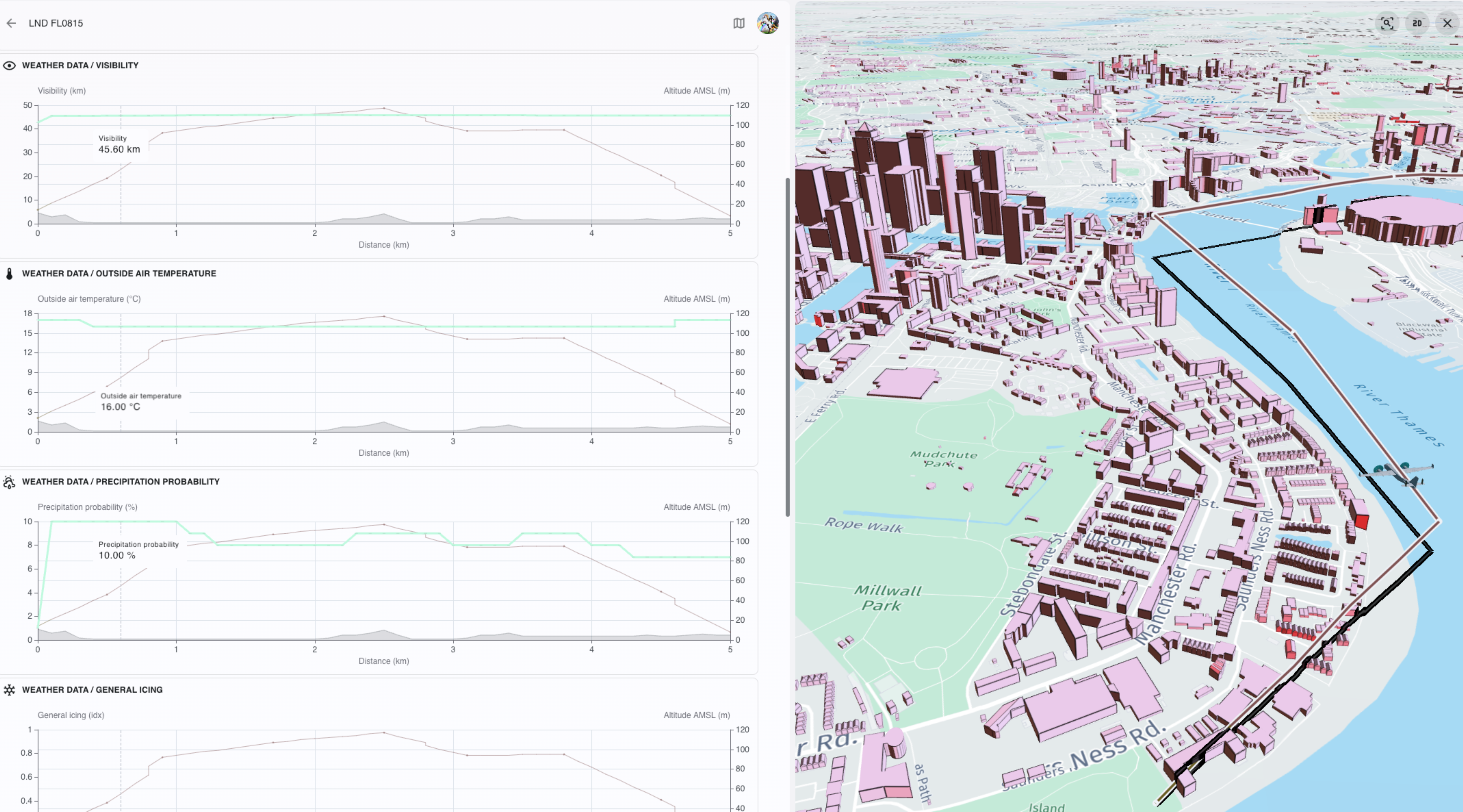
The role of weather has changed since the early days of the civil drone industry. Back then, it was the main factor in take-off decisions, often resulting in no-fly situations due to the technology’s immaturity. Today, drones are becoming increasingly capable of withstanding weather conditions and the focus has shifted from mere feasibility to business optimisation: maximising flight time, fulfilling customer contracts, and enhancing operational efficiency. Weather remains a critical aspect, but the challenge is now about deeply understanding drone capabilities to operate at the edge of their performance envelope without compromising safety.
The need for new technological capabilities is underscored by the FAA’s recent announcement of Part 108, which states: “the operator would need to ensure that there is enough available power or fuel, considering wind and forecast weather conditions, for the UAS to operate for the intended operational time”.

CHRISTOPH SELIG
Christoph Selig oversees the go-to-market of Unisphere’s portfolio, including its simulationbased flight planning and weather intelligence platform for drone, UTM, eVTOL, and vertiport operations.
