
3 minute read
Weather forecasting in the digital age

Maxime Warnier, CTO, MetSafe takes us from forecasting to operational data
Weather and aviation have always been intertwined. There are three phenomena impacting Air Traffic Controllers (ATCOs) and pilots lives: convective weather causing turbulence and detours, fog limiting landing capacities, and wind impacting travel times and the calculation of estimated times over points.
The Asia-Pacific (APAC) region has specific challenges. Thunderstorms can develop to higher altitudes in the inter-tropical area, getting even more powerful. This can lead to lateral weather deviation up to 100 Nautical Miles, sometimes in areas with low surveillance capabilities. This is one of the cases where the role of ATCOs changes from giving instructions to accommodating for the pilots’ request.
The sheer size of the region creates specific challenges. In oceanic areas, ground-based observations are limited: meteorologists rely heavily on satellite observations. Some projects have tried to use the aircraft as weather sensors but it did not improve forecasts as flights tend to fly the same route at the same times for operational reasons.
Getting access to accurate and timely weather observations is the key to better weather forecasts and therefore flight operations. Technology makes real-time data distribution possible, from sensors to the controller working position and ultimately the cockpit. Data sharing creates a virtuous cycle between meteorology and aviation as forecast quality improves with the number of observations. One key barrier to innovation in APAC is the lack of raw weather data sharing. This is less common than Europe or in the U.S.
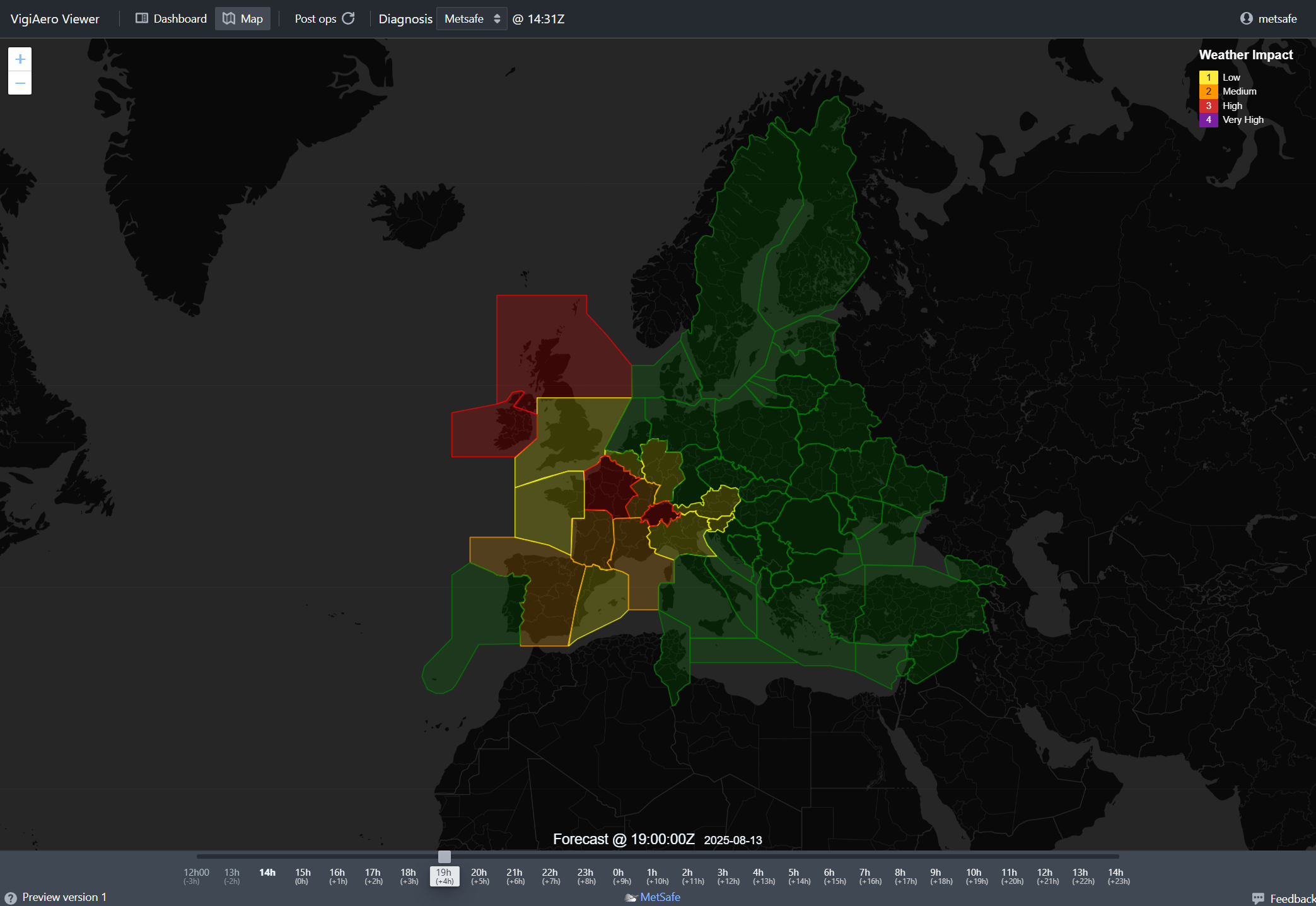
Another challenge is to present accessible and actionable weather information for pilots and ATCOs. This is what MetSafe does with its VigiAero online service. Instead of showing raw weather visualisation of thunderstorms developing at a certain place, VigiAero uses this data as a basis to calculate weather impact.
The results are presented using operationally significant factors like airspace sectorisation. This results in information like “High weather impact resulting in capacity limitation in a given sector, starting in six hours, lasting for three hours”, upon which Air Navigation Service Providers (ANSPs) can anticipate staffing and traffic restrictions. As in many domains, artificial intelligence (AI) is a game changer, but in a slightly surprising way: reducing the required computational power. Weather forecasting remains computationally intensive, requiring expensive super-computers and AI will lead to a lesser need for computational power. AI is also expected to support new nowcast capabilities that should unleash operational benefits in air traffic control short-term decision making.
MAXIME WARNIER
Maxime Warnier has been MetSafe’s CTO since 2018 and is a senior expert in weather, air traffic management, and software engineering.
