5 minute read
Artificial Intelligence and Air Traffic Control

What changes and what remains - Vincent Lambercy looks ahead
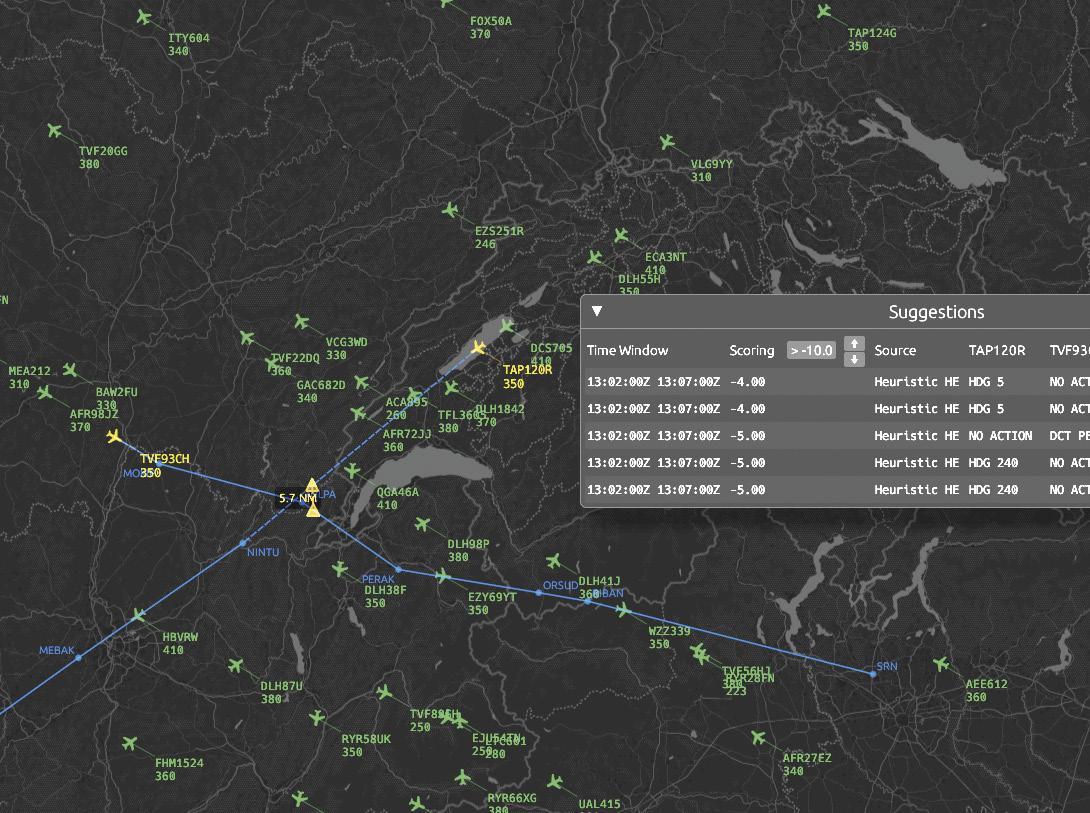
The core problem of Air Traffic Control (ATC) was solved by Artificial Intelligence (AI) years ago when IBM and the Swedish Air Navigation Service Provider (ANSP) LFV worked together on an AI-based tool capable of giving clearances to keep simulated aircraft separated. Just like no human will ever be better than AI at playing chess, no human will beat AI at maintaining separation.
Traffic must be managed in a human way
Being an air traffic controller (ATCO) requires separating aircraft according to rules, but there is much more to it and while the AI tool I mentioned above worked in a vacuum, real ATC happens in a complicated environment. The introduction of AI will happen in a context made of humans, equipment, and procedures. It will not be a big-bang and AI-based separations must be realised in a way that humans have to comprehend. Otherwise, it is of little value because humans must be able to take over at any time if AI fails – and it will fail. AI integration will require communicating with ATCOs in an appropriate way, including good timing. Controllers often work in pairs and knowing when it is
OK to nudge a colleague and when it is better to let them finish a task before talking is a very human skill. AI will have to master this too, otherwise it will be rapidly rejected.
ATCOs also talk with pilots, colleagues, supervisors, and assistants, some who often belong to other organisations. While speech recognition made a lot of progress lately, it is not yet to a point where an AI would make a coordination call all by itself. Digital, silent communication exists - like Controller Pilot Data Link Communications (CPDLC) with aircraft or On-Line Data Interchange (OLDI) between centres - but is limited to basic, standard situations.
Maintaining ATC skills
Let us imagine for a second, a control centre in which AI does all the routine work, with humans being present to take-over only in case of problems. If the AI completely fails, a number of ATCOs would have to take over all traffic within a few seconds. This requires situation awareness and very sharp ATC skills. Maintaining both only by watching traffic is impossible for humans, not to mention that having ATCOs waiting on-site wouldn’t make economic sense.
If the AI cannot solve a conflict and requires human input, the situational awareness will be less of a problem but the question of maintaining proper skills remains. How could an ATCO keep their skills sharp if they have only a few conflicts to solve per week?
The liability question
Passing the responsibility for separation to an AI also raises questions of liability, even in a system where the ATCO remains in charge. What happens if an AI suggests an action that leads to an incident? Or viceversa, if an AI tasked with identifying problems misses one? Is the AI liable or does the liability remain with the ATCO? If the AI fails, there is still an extended liability question - is the developer of the software liable or the owner of the software? AI-based tools are different from the usual software solutions used by ATCOs because they can fail in rare, unpredictable cases, and in spectacular ways.
The path forward with AI in ATC
ANSPs are constantly fighting to acquire new talent and struggle with under-staffing. Any help is welcome and it is certain that AI will be used to empower the existing workforce to manage more traffic. ATCOs will remain at the centre of the Air Traffic Management (ATM) system.
AI assistants will be introduced progressively, for example with Machine Learning (ML) systems undergoing training outside of the operational system. Once trained, the models can be used operationally without evolving anymore, making them work in a reproducible way, which is easier to explain and control.
ATC also comprises problems for which it is hard to find a solution, but easy to verify if one candidate solution really is good. For example, finding the furthest possible direct clearance for a given flight is exponentially complicated, but an AI tool can do it easily. If the solutions proposed by such a tool are sent through an existing, deterministic Medium Term Conflict Detection (MTCD) tool and do not trigger a conflict, they can be offered to an ATCO for their final decision. Having an additional deterministic layer on top of the AI is the best of both worlds: the power of AI, with hallucinations identified and eliminated in a deterministic way.
Where will the industry be in five years?
AI brings its exponential progress to every industry and aviation is no exception. It will spread through ATM for sure - the hard part to predict is how. One thing is certain though: ATCOs will still be at the centre of the system.