

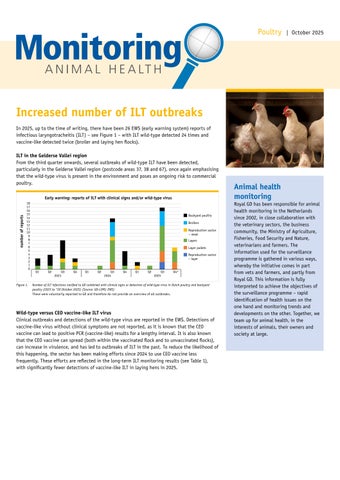
In 2025, up to the time of writing, there have been 26 EWS (early warning system) reports of infectious laryngotracheitis (ILT) – see Figure 1 – with ILT wild-type detected 24 times and vaccine-like detected twice (broiler and laying hen flocks).
ILT in the Gelderse Vallei region
From the third quarter onwards, several outbreaks of wild-type ILT have been detected, particularly in the Gelderse Vallei region (postcode areas 37, 38 and 67), once again emphasising that the wild-type virus is present in the environment and poses an ongoing risk to commercial poultry.
Early warning: reports of ILT with clinical signs and/or wild-type virus
number of reports
Reproduction sector
Clinical outbreaks and detections of the wild-type virus are reported in the EWS. Detections of vaccine-like virus without clinical symptoms are not reported, as it is known that the CEO vaccine can lead to positive PCR (vaccine-like) results for a lengthy interval. It is also known that the CEO vaccine can spread (both within the vaccinated flock and to unvaccinated flocks), can increase in virulence, and has led to outbreaks of ILT in the past. To reduce the likelihood of this happening, the sector has been making efforts since 2024 to use CEO vaccine less frequently. These efforts are reflected in the long-term ILT monitoring results (see Table 1), with significantly fewer detections of vaccine-like ILT in laying hens in 2025.
Royal GD has been responsible for animal health monitoring in the Netherlands since 2002, in close collaboration with the veterinary sectors, the business community, the Ministry of Agriculture, Fisheries, Food Security and Nature, veterinarians and farmers. The information used for the surveillance programme is gathered in various ways, whereby the initiative comes in part from vets and farmers, and partly from Royal GD. This information is fully interpreted to achieve the objectives of the surveillance programme – rapid identification of health issues on the one hand and monitoring trends and developments on the other. Together, we team up for animal health, in the interests of animals, their owners and society at large.
Laying hens and breeders (meat and layers)
In January, a vvMDV-1 strain (very virulent Marek’s disease virus) was detected in broiler chickens with swollen spleens that had been submitted because of suspicions of Marek’s disease. The MDV-1 DIVA-PCR result was positive for the Rispens vaccine strain (i.e. result ‘Rispens vaccine strain detected’). However, additional research into a specific gene demonstrated that it was a vvMDV-1 strain rather than the Rispens strain. There is therefore a serogroup 1 Marek’s disease strain circulating that cannot be distinguished using the MDV DIVA-PCR for serogroup 1. This DIVA-PCR can distinguish the Rispens vaccine strain from an MDV field strain on the basis of a single gene (the pp38 gene). This gene is used worldwide to distinguish MDV serogroup 1 field strains from Rispens vaccine strains, but the technique seems to be unsuitable for the newly discovered strain.
Further investigations
Further research is being conducted through the VMP collaboration (Veterinary Monitoring of Poultry) to gain a better understanding of the occurrence of this new vvMDV-1 strain in the Dutch broiler sector. In addition, GD has drawn up a research proposal for molecular research into Marek’s disease virus serogroup 1 Rispens-like field strains.
At the end of May 2025, the Ministry of Agriculture, Fisheries, Food Security and Nature reported that an outbreak of Newcastle disease virus (NDV) had been detected in pigeons kept as a hobby in Oldenzaal (province of Overijssel). This small flock had increased losses and nervous symptoms.
In the Netherlands, all commercially kept chickens and turkeys, racing pigeons and show birds are vaccinated against Newcastle disease. Nevertheless, outbreaks of NDV do occasionally occur among captive birds. To stop the virus spreading, the pigeons at the site were culled by the NVWA (source: AVINED).
Situation for NDV abroad
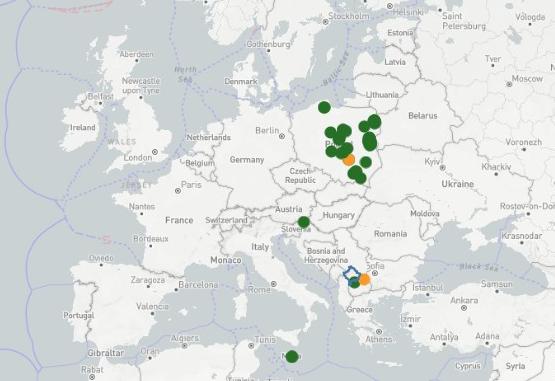
NDV is endemic in Central and South America, Asia, the Middle East and Africa. Outbreaks of NDV also occur in Europe. Several outbreaks occurred in Poland in the first half of 2025 among commercial poultry. In addition, there have also been several outbreaks among captive birds in other southern and eastern European countries (source: WAHIS).
Numbers of Salmonella Enteritidis (SE) infections in the Netherlands have increased since 2023 in both laying poultry and humans. New infections continue to occur at an elevated level in 2025, with 47 flocks of laying hens already notified as being infected with SE in the first half of the year. The bulk of the infections are still in older flocks. The sampling frequency has been increased for participants in IKB EI (QC system for the egg production chain in the Netherlands). This should now be done every eight weeks for laying flocks up to 65 weeks old and every four weeks for flocks older than 65 weeks. You can find the complete implementation decree here
The increased prevalence means that strict hygiene measures on farms and between farms are essential, such as showering when coming in or out of the barn and informing farmyard staff and visitors of the flocks’ salmonella status. People going into the barn should weigh up whether visiting a salmonella-positive flock is necessary. To reduce the risk of salmonella infections, biosecurity is paramount, e.g. pest control, clean egg trays and safe feed. Vaccination against salmonella is another important tool, but it is only effective if proper hygiene measures are also taken. We provide up-to-date information on the salmonella dossier page .
In the Veekijkernieuws July 2025 edition, we reported an increase in the number of early warning system (EWS) reports of Gumboro disease in layer pullets. Apart from a single notification in August, there were no new reports for layer pullets in the third quarter. It should be noted that EWS notifications are on a voluntary basis and therefore do not provide an complete overview of all Gumboro outbreaks in the Netherlands during the period in question.
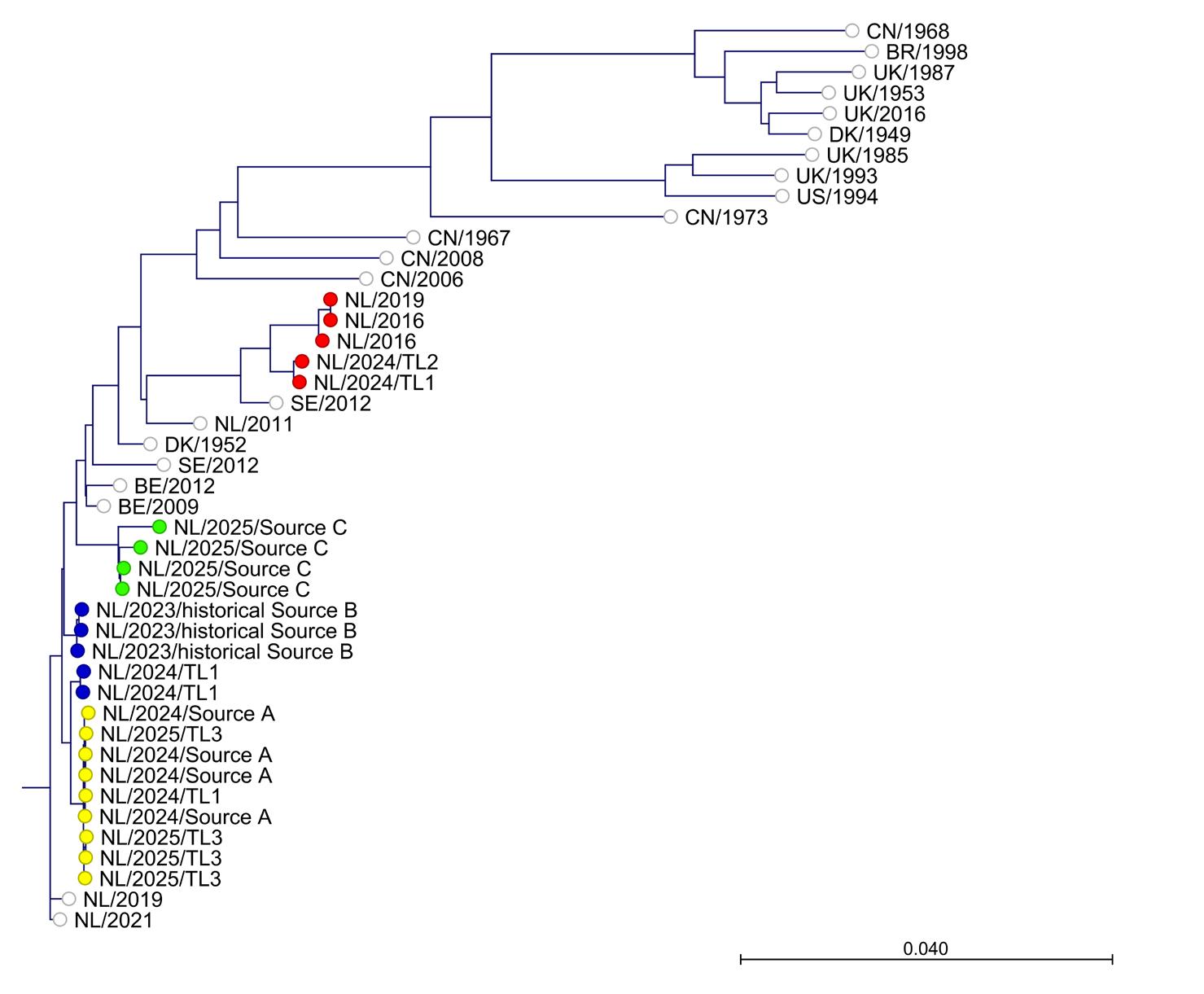
In 2024 and 2025, GD received a total of three submissions for necropsy from a specialist shop for the non-commercial poultry sector, involving various breeds and origins. GD showed that Salmonella Pullorum (SP) was present. GD conducted genetic testing of the SP strains identified. The results are given in Figure 5; the three submissions are labelled TL1, TL2 and TL3. They originated from breeding flocks and hatcheries (designated as sources A, B and C) of non-commercial poultry that were sampled and found to be positive for SP. The genetic relationships between the Salmonella Pullorum isolates found in non-commercial poultry are shown in the figure as a phylogenetic tree. We saw back in 2024 that three different clusters (and therefore three different sources) of Salmonella Pullorum could be identified: the red, blue and yellow boxes in Figure 5. A fourth cluster was added based on new submissions from 2025: the green box. In a small number of cases, relationships have been demonstrated with strains that have also been isolated in the past.
Various strains of Salmonella Pullorum are present among non-commercial poultry in the Netherlands. This potentially poses an ongoing threat, in particular for the breeder sector. SP is a salmonella variant that leads to clinically ill chicks and losses through vertical transmission*. Biosecurity is particularly important for limiting the risk of introduction into a farm. There is also continuous monitoring of SP at hatcheries, as required by EU regulations.
Disease/disorder/ health characteristic
Execution decree (EU) 2018/1882 of the Animal Health Law (AHL) (EU) 2016/429 (Category A disease)
Avian influenza (AI) in the Netherlands (H5/H7)
(Source: GD, WBVR, national government)
ND in the Netherlands
(Source: GD, WOAH)
Highly pathogenic AI (H5/H7)*: (first detection in flock)
* In commercial poultry and in backyard situations with >50 birds.
Serological monitoring by GD: (first detection in flock) (antibodies for H5/H7)
Commercial poultry:
Execution decree (EU) 2018/1882 of the Animal Health Law (AHL) (EU) 2016/429 (Categories B through E)
Avian influenza (AI) in the Netherlands (H5/H7)
(Source: GD, WBVR, national government)
Low pathogenic AI (H5/H7): (first detection in flock)
Campylobacteriosis No data available
Avian mycoplasmosis (Source: GD)
Mycoplasma gallisepticumA
Serological monitoring by GD: Reproduction sector: Layer pullets: Layers: - not vaccinated and infected: - vaccinated and infected: Turkeys:
Cases in EWSC based on positive serology and/or voluntary PCR testing:
Reproduction sector: Layers: Turkeys: Backyard poultry:
M. meleagridis (Source: GD)
Salmonellosis (non-zoonotic salmonella) (Source: GD)
Salmonella arizonae
Salmonella Gallinarum (SG) Commercial poultry: Backyard poultry: Number of farms/cases
Salmonella Pullorum (SP)
West Nile fever Not monitored
Article 2.1 Designation of animal diseases in the ‘Rules for Animal Health’ of the Dutch Animal Act Avian chlamydiosis (Source: GD)
Detected by GD:
Commercial poultry: Backyard poultry:
Disease/disorder/ health characteristic
(numbers at the farm level)
Article 2.2. Designation of zoonoses in the ‘Rules for Animal Health’ of the Dutch Animals Act Salmonellosis (zoonotic salmonella) (at the flock level) (Source: GD)
Salmonella Enteritidis Reproduction:
Salmonella Typhimurium Reproduction:
pullets:
Other types of Salmonella
(S. Hadar, S. Infantis, S. Java, S. Virchow) Reproduction:
Other WOAH-list poultry diseases in the Netherlands subject to compulsory notification Duck viral hepatitis (Source: GD)
Gumboro (IBD)
(Source: GD, EWS)
Infectious bronchitis (IB)
(Source: GD)
Infectious laryngotracheïtis (ILT)
(Source: GD, EWS)
Mycoplasma synoviaeB
(Source: GD)
Turkey
rhinotracheïtis (TRT) (Source: GD)
Detected by GD:
Reported in EWSC: Broiler breeder pullets: Broilers:
pullets:
poultry:
Types most commonly detected by GD: Broilers: Layers:
Reported in EWSC: Layer pullets: Layers:
Broiler breeders:
Serological monitoring and/or dPCR GD:
Broiler pullets:
Broiler breeding:
Broiler breeder pullets:
Broiler breeders:
Layer pullets:
Layer rearing:
Layer breeder pullets
Layer breeders:
Layer pullets:
Layers:
Turkeys:
Detected by GD:
Broiler reproduction sector (incl. pullets):
Layer reproduction sector (incl. pullets):
Broilers:
Layer pullets:
Layers:
Meat turkeys:
Backyard poultry:
Royal GD P.O. Box 9, 7400 AA Deventer
Disease/disorder/ health characteristic
Other poultry diseases
Avibacterium paragallinarum
(Source: GD, EWS)
Histomonosis (Source: GD)
T. +31 (0)88 20 25 575
info@gdanimalhealth.com www.gdanimalhealth.com
Reported in EWSC: (see §5.6.1)
Layers: Small commercial farms (<250)
Backyard poultry:
Detected by GD: (see §5.5.1)
Reproduction (meat sector):
Reproduction (layer sector):
Layer pullets:
Layers: Meat turkeys:
Backyard poultry:
Pasteurella multocida (Source: GD)
Erysipelas (Erysipelothrix rhusiopathiae) (Source: GD)


Number of EWS reports

Continuation of table
Detected upon necropsy: Broiler breeders: Layers: Number of farms
Detected by GD: Layers:
Ç Moderate to marked increase
Ç Slight increase - No change
È Slight decrease
È Moderate to marked decrease
A Based on serological monitoring
B Based on serological monitoring and/or differentiating Ms-PCR
C Early Warning System