NORDIC
HIGHLIGHTS
3/2026
NEWSLETTER FROM GEHRMANS MUSIKFÖRLAG & FENNICA GEHRMAN
Q & A: Thomas Jennefelt Lotta Wennäkoski and the art of subtle messages
NEWS Photo: Anna Grundström
Helena Tulve to plan Summer Sounds Festival 2027 Helena Tulve has been appointed Artistic Planner of Avanti! chamber orchestra’s Summer Sounds Festival, one of Finland’s most exciting contemporary music festivals. One of Estonia’s leading contemporary composers, Tulve is known for her sensitive approach to sound, space and transformation and will bring a distinctive artistic vision to the festival. Inspired by 2026 summer’s festival atmosphere and its audience’s openness to new musical experiences, Tulve will begin planning the 2027 programme around different ways of listening, the search for something new and possible echoes of Estonian musical and choral traditions.
Meri Louhos, Hui-Ying Liu-Tawaststjerna and Carlos Juris – the team behind Repertoire Treasures for Pianists – celebrated the new publication at the Fennica Gehrman office.
New pedagogical publications broaden the repertoire for young musicians
Emmy Lindström
Code Red premiered by The Nordic Wind Ensemble Emmy Lindström has written a concerto for trumpet and winds that was given its premiere on 25 September by Filip Draglund and The Nordic Wind Ensemble. The concerto, which she calls Code Red, takes its point of departure from the climate crisis and depicts both the seriousness of the state of the planet and the hope for change. The opening of the piece is based on the repetitive character of the SOS signal, while the trumpet functions as a call to vigilance and action. The concerto concludes on a light and hopeful tone conveying her belief that change is possible. NORDIC
HIGHLIGHTS
3/2026
NEWSLE T TER FROM GEHRMANS MUSIKFÖRLAG & FENNICA GEHRMAN
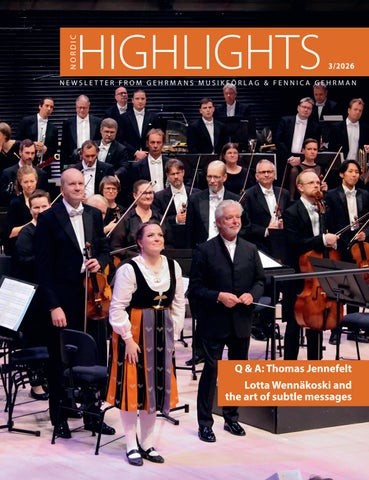
Editors: Hanna Isolammi, Kristina Fryklöf Translations: Robert Carroll, Copilot Cover: Cecilia Damström, Jukka-Pekka Saraste and the Helsinki Philharmonic Orchestra from the performance of Damström’s Information in Helsinki Music Centre. (Photo: Yolanda Harding) Design: Tenhelp Oy and video symbols . Click the links, sound ISSN 2000-2750 (Online)
2
HIGHLIGHTS
3/2026
Repertoire Treasures for Pianists, selected by the team behind the Piano Key series Meri Louhos, Hui-Ying Liu- Tawaststjerna and Carlos Juris, presents 53 pieces by 41 composers spanning five centuries. The collection offers lesser-known repertoire for teaching, performance and independent exploration. It includes works by eight women composers, an arrangement by Clara Schumann, a newly found piece by Einojuhani Rautavaara and brief introductions to the composers and their music, encouraging pianists to choose pieces suited to each occasion. László Rossa and Géza Szilvay’s Colourstrings Duettini I and II contain 38 previously unpublished violin duos in Colourstrings and conventional notation. Based on the Colourstrings Violin ABC books, they introduce ensemble playing from the start and are suitable for lessons, group teaching and early performances; viola and cello versions are in preparation. Also forthcoming is Näppärä näppäri I, the first volume in a series of Finnish folk music repertoire for violin based on the Näppäri Method.
Eduard Tubin festival in Estonia
The seventh TubIN Festival will take place in Tartu, Tallinn and Alatskivi 28 September – 4 October. This year’s festival will research themes including identity, belonging and cultural roots through music from the whole range of Eduard Tubin’s creativity. The programme revolves around Tubin’s personal and artistic journey, from Estonian folk tradition to symphonic masterpieces such as Symphony No. 5 and Sinfonietta on Estonian Motifs. These works will be performed by the Estonian National Symphony Orchestra under the direction of conductor Mihhail Gerts. The festival will also feature an ample chamber music programme. The Estonian National Male Choir will perform the monumental choral work Requiem for Fallen Soldiers. Closing the festival is a production of the mythical ballet Kratt (The Goblin) at the Vanemuine Theatre, where 400 young dance students will participate.
Photo: Hans Lindén Photo: Matti Lind
Albert Schnelzer
Early autumn has been busy for Albert Schnelzer. Recent highlights include performances of Burn My Letters – Remembering Clara by the New Generation Symphony Orchestra at Elbphilharmonie in Hamburg, followed by performances by the Hong Kong Sinfonietta. From 27 September – 4 October Schnelzer will be composer-in-residence at Holstebro International Music Festival in Denmark. As part of the residency, the O/Modernt Chamber Orchestra, conducted by Hugo Ticciati, will perform Apollonian Dances with Johan Bridger as percussion soloist, alongside Aksak & Ciphers and the world premiere of Drive featuring Janne Thomsen (flute) and Bram van Sambeek (bassoon). Van Sambeek will also perform the bassoon concerto Auroral Dances with DUEN – The Danish Youth Ensemble. Looking ahead November will see the premiere of Schnelzer’s trumpet concerto Frozen Light with Tine Thing Helseth and the Wermland Opera Orchestra.
Géza Szilvay conducts a string orchestra of 280 children and young people at the ESTA Conference concert.
ESTA brings string teachers to Helsinki The 54th Annual International ESTA Conference brought more than 350 delegates and hundreds of string teachers and players to the Sibelius Academy in Helsinki in late August. Highlights included Mirka Malmi’s lecture-recital on Finnish violin works by women composers and Maryan Balkwill’s practical Colourstrings cello session, which demonstrated how harmonics and left-hand pizzicato support early movement and a natural hand position. Mariesther and Marielisa Alvarez explored how Colourstrings can enrich El Sistema’s inclus2ive approach. The conference culminated in the FiESTA! of String Orchestras, where around 280 young musicians from eleven music schools performed Finnish repertoire by Rautavaara, Madetoja, Kuula and Sibelius, with ESTA Honorary President Géza Szilvay conducting the finale. Photo: Josef Sjöblom
Schnelzer’s eventful autumn
Rolf Martinsson
Gehrmans at chor.com in Leipzig Gehrmans will participate in this year’s chor.com congress 1 – 4 October in Leipzig. Among the programme highlights, Bo Rosenkull will present his book, Come and Sing – Together! Janna Vettergren will lead the workshop Singing in Swedish, where she takes as a starting point songs from Swedish Voices, an anthology of choral music brought out jointly by the Swedish music publishers Gehrmans, Ejeby and Wessmans. Songs from Swedish Voices will also be performed by the Gustaf Sjökvist Chamber Choir at a concert in St. Thomas Church on 3 October. At the same concert the German premiere of Matthew Peterson’s The Sanctuary Mass will be given under the direction of Florian Benfer.
New Requiem by Rolf Martinsson Rolf Martinsson’s Requiem will receive its world premiere in Växjö Cathedral on 1 November. “Writing this 80-minute work has been a profound challenge, heavily influenced by both the current world situation and my brother’s untimely decease”, says Martinsson. Commissioned by Växjö Cathedral Parish in collaboration with the cathedrals in Luleå, Härnösand, Karlstad and S:t Petri Church in Malmö, the work is based on the Latin Requiem Mass and incorporates six contemporary texts by Bishop Fredrik Modéus. The premiere features soprano Lisa Larsson, baritone Staffan Liljas, the Växjö Cathedral Oratorio Choir and Orchestra, conducted by Sten-Inge Petersson. The work will be published in three versions: for soprano and baritone soloists, mixed choir and organ, together with chamber orchestra, a sextet ensemble or solely organ with a solo instrumental part. HIGHLIGHTS
3/2026
3
Photos: Touko Hujanen
Robert Ruohola
Matthew Whittall
PREMIERES September-December KALEVI AHO
Joy, more joy! Turku PO Ensemble, Meeri Pulakka, sopr 28.10. Turku, Finland
ESA PIETILÄ
String Quartet No. 5 CORA Quartet 31.10. Kauniainen, Finland
Mizar (Violin Concerto) St. Michel Strings/Janne Nisonen, sol. Erkki Lasonpalo, vln 17.9. Mikkeli, Finland
Honours for Matthew Whittall and Robert Ruohola
ALEX FREEMAN
A Field of Sunlight Eesti Rahvusmeeskoor/Nils Schweckendiek 17.9. Tallinn, Estonia
EMMY LINDSTRÖM
Code Red – Concerto for Trumpet and Wind Orchestra Nordic Wind Ensemble/Sergej Bolkhovets, sol. Filip Draglund, tr 25.9.2026 Linköping, Sweden
ESKIL KAUPPI
Landmarks Brass Unit 26.9.2026 Hudiksvall, Sweden
Two major honours for Lotta Wennäkoski Composer Lotta Wennäkoski received the First-Class Knight’s Cross of the Order of the Lion of Finland on 5 June 2026 and has been nominated for the Fondation Prince Pierre de Monaco’s Music Composition Prize 2027 with Vents et lyres. The distinction recognises her contribution to Finnish music, while the international nomination— following an earlier selection of her orchestral work Prosoidia—further highlights her standing as one of the leading Nordic composers.
ALBERT SCHNELZER
Photo: Maarit Kytöharju
Photo: Eeva Anundi
Matthew Whittall’s The World Tree won the Finnish Music Publishers’ Award for contemporary small-scale and choral works at the association’s 50th anniversary gala on 10 September. The 70-minute a cappella work for mixed choir, sets a libretto by Robert Macfarlane and was created with the Helsinki Chamber Choir. The jury praised it as one of Finland’s most significant largescale choral works of the 21st century. At the same event, Robert Ruohola received the Young Creator’s Grant. Other Fennica Gehrman nominees in different categories included Aulis Sallinen’s Shaka, the international success of recordings of Kalevi Aho’s works, Pasi Lyytikäinen’s Piano Concerto, Lotta Wennäkoski’s Zelo, Antti Auvinen’s Ämminkäiset and a collection of solo songs by Finnish women composers.
Tiina Myllärinen
Tiina Myllärinen’s chamber music will feature prominently across Central Europe in autumn 2026. Her guitar quartet Shades will be performed by the Bibra Guitar Quartet in Hausen, Fulda and Würzburg. Meanwhile, NeoQuartet will premiere Myllärinen’s third string quartet, Smooth Out (2026), at the NeoArte Festival in Gdańsk on 24 October, followed by performances at Prague’s Contempuls Festival on 1 November and the quartet’s 20th-anniversary concert in Gdańsk on 17 December.
4
HIGHLIGHTS
3/2026
ROLF MARTINSSON
Requiem Växjö Cathedral Oratorio Choir and orchestra/Sten-Inge Petersson, sol. Lisa Larsson, sop, Staffan Liljas, bar 1.11.2026 Växjö, Sweden
BENJAMIN STAERN
Banī Ādam (Children of Adam) Annastina Malm, mz; David Härenstam, gtr 4.11. Stockholm, Sweden
KALEVI AHO
Concerto for piccolo and orchestra Oulu Sinfonia/Rumon Gamba, sol. Carlotta Petri, picc 5.11. Oulu, Finland
DANIEL NELSON
Concerto for Orchestra Nordic Chamber Orchestra/Michael Collins 5.11. Örnsköldsvik, Sweden
ANTTI AUVINEN
Requiem – Concerto for Bassoon and Orchestra Lappeenranta city orchestra/Erkki Lasonpalo, sol. Mikko-Pekka Svala, bsn 12.11. Lappeenranta, Finland
Diesel Engel Rodeo Radio (Violin Concerto) Finnish Radio SO/Nicholas Collon, sol. Ava Bahari, vln 7.10. Helsinki, Finland
PER-GUNNAR PETERSSON
TUOMAS TURRIAGO
Danzas Latinas Seinäjoki city orchestra/Jukka Iisakkila 5.11. Seinäjoki, Finland
MATEI GHEORGHIU
EDVARD GRIEG, ORCH: ROLF MARTINSSON
Eternal Father Halmstad Vocal Ensemble/Göran Persson 7.10.2026 Skottorp, Sweden (Halländsk Musikfestival)
Jeg elsker Dig Tonhalle-Orchester Zürich/Paavo Järvi, sol. Lisa Larsson, sopr 18.11. Zürich, Switzerland
JACOB MÜHLRAD
Perfect Match (Opera) Sieglinde Feldhofer, Peter Bording, Judith Jandl etc; Grazer Philharmoniker, Ballett Graz, Chor und Statisterie der Oper Graz, cond. Johannes Braun 19.12. Graz, Austria
TIINA MYLLÄRINEN
Smooth Out (String Quartet No. 3) NeoQuartet 24.10. Gdansk, Poland
Lotta Wennäkoski
JYRKI LINJAMA
Drive O/Modernt Chamber Orchestra/Hugo Ticciati, sol. Janne Thomsen, fl, Bram van Sambeek, bassoon 1.10.2026 Holstebro, Denmark (Holstebro International Music Festival) Trumpet Concerto – Frozen Lights Wermland Opera Orchestra/Magnus Fryklund, sol. Tine Thing Helseth, tr 12.11.2026 Karlstad, Sweden
Resil II Swedish Chamber Orchestra/Brett Dean 22.10 Örebro, Sweden
Tiina Myllärinen in Central Europe
MINNA LEINONEN
Sonata di fantasia (Piano Sonata No. 3) Alexandre Kantorow, pno 5.9. Grafenegg, Austria (Grafenegg Music Festival)
IIRO RANTALA
Q & A: Thomas Jennefelt When Thomas Jennefelt received the 2026 Preis der Europäischen Kirchenmusik last summer in Schwäbisch Gmünd, he took his place in the same exclusive circle as Arvo Pärt, Sofia Gubaidulina, John Rutter, Krzysztof Penderecki and Peteris Vasks. The distinction draws attention to an artistry in which the socio-political issues of our time join with sacred traditions in a personal and unique tone language. For nearly five decades Jennefelt has established himself as one of Sweden’s major composers. His works are performed regularly by the most prominent choirs and ensembles of Europe and the world. With lifelong roots in singing, both as a composer and as a member of Eric Ericson’s Chamber Choir for many years, Thomas Jennefelt has developed a unique relationship to the voice as an instrument and as a means of expression. Here he tells us about the art of composing for choir and the challenges when writing for the voice, about the choice of texts and music’s capacity to evoke reflection and hope in troubled times.
There are doubtless many reasons. The voice has always been my musical starting point. I have sung since I was a child, and in parallel with my composing I have been a professional singer in Eric Ericson’s Chamber Choir for many years. So singing has in every possible way been a part of my professional life. As a young composer, I had an early success with my piece Warning to the Rich (which is actually more of a short opera scene than a typical choral work!), and after that I immediately received many commissions from various choirs. And it has continued in this way throughout the years. At times it has been a challenge to try to find new ways to develop my composing for choir. But at the same time it has been stimulating for me. I am happy over all the meetings I have had through the years with accomplished singers, professional as well as amateur, of all ages too. Do you think there is a big difference composing for choir compared with writing for orchestra?
Musically there is no difference for me. What I am seeking to express in my music is the same in my vocal pieces as in the purely instrumental ones. But writing for choir (especially a cappella) involves adapting oneself in a special way. It is, for example, a lot more difficult to sing an advanced part than to play it on an instrument. As Eric Ericson put it, “singers have no place to press down their fingers”. One must therefore find smart solutions if one wants to write well for choir, also when it comes to intonation. For this reason it is in fact harder to write for choir than for orchestra. Another difference between the vocal and the instrumental is of course that the actual work with the form in a piece differs. In vocal music one usually follows the content and purpose of the text. The music is given shape more clearly and simply in vocal music, I think. How do you choose the texts for your pieces?
A text’s content and meaning are central for me. I prefer to choose texts that comment on social issues and have a clear message; as for example in
Photo: Hartmunt Hientzsch
How come you have written so much music for choir?
Thomas Jennefelt receives the European Church Music Award in Schwäbisch Gmünd
Dixit Dominus , which links up the Crusades with the massacre in Srebrenitsa. Often there is also a musico-dramatic idea involved in my choice of text. I can see a gathering of singing choristers before me when I write choral music, almost as in an opera. I sometimes tire, however, of searching for significant texts and only want to write music. For this reason I have occasionally replaced meaningful texts with made-up words that just sound like a text; as in my Villarosa Sequences, where the words sound like Italian or Latin. It opens up a more meditative side of my music, too. This particular work has also been used in other contexts, as for example in the choreographer Sacha Waltz’s acclaimed dance project Dialoge 09 in Berlin, where Villarosa Sarialdi played a major part. Which composers have inspired you through the years?
Since I have sung so much newly-written choral music over the years I have had the possibility to study different techniques and means of expression at close quarters. The first to impress me in
my youth was Ingvar Lidholm, who with his large-scale, almost symphonic, pieces created entirely new possibilities for choral music. He has meant a great deal to me also on a more personal level. And after him came Sven-David Sandström with his very own universe, which has also influenced me to a great extent. They represent a golden age in Swedish vocal music. What are you composing just now?
My latest piece for choir, In der Nähe, was premiered in connection with the awarding of the prize in Schwäbisch Gmünd. It is a setting of the opening lines from Friedrich Hölderlin’s poem ‘Patmos’. I have just finished the composition of yet another choral work, Der Blützenzweig, to a poem by Herman Hesse that is scheduled to be premiered by Athesinus Consort in Berlin in February of next year. Moreover, all work is done on my, and librettist Magnus Florin’s, “short-story opera” Sightseeing, which takes place in various venues in Stockholm. Just now I am about to begin working on some songs for three fine singers.
HIGHLIGHTS
3/2026
5
Following her international breakthrough at the 2017 BBC Proms, Lotta Wennäkoski now works with leading orchestras and soloists. Communication – with musicians and audiences, as well as through poetry – lies at the heart of her music.
Photo: Maarit Kytöharju
Lotta Wennäkoski and the art of subtle messages
S
ummer is approaching its end. The green of the large elm tree behind Lotta Wennäkoski’s kitchen window is slowly melting towards yellow. It’s harvest season in Wennäkoski’s professional life as well. “I had five, no, six premieres last season!” she exclaims with delight. “And earlier works such as Verdigris and Hava are also being widely performed.” The impetus behind this abundance is Flounce , a sparkling 5-minute fanfare commissioned by the BBC Symphony Orchestra for the 2017 Last Night of the Proms concert. Seemingly small but rich in content, like a seed, the mini-ouverture proved to be a perfect business card for the Finnish composer, crystallising her signature witty energy, mastery of orchestration, and imaginative textures. Wennäkoski has been a household name in Finland for years. Last season, Vents et lyres , a recorder concerto premiered by the Concertgebouw Orchestra and Lucie Horsch, and Zelo, a five-movement orchestral work for the London Philharmonic Orchestra, marked a new phase of major international premieres following the recognition sparked by Flounce. “My music is played a lot, and I couldn’t be happier. What makes me especially glad is to hear that the orchestra members have enjoyed playing my music.”
Bouncing ideas and getting involved Although her daily work is solitary – Wennäkoski has a studio in the basement of her house – making music is, for her, all about communication: with audiences, whom she offers cues through the playful titles of her works, and with performers. This is why concertos have always played an important role in her music. “The exchange is such a joy for me. Musicians are the ones who make all this happen.” The flute concerto Soie (2009) , guitar concerto Susurrus (2016) and harp concerto Sigla count among Wennäkoski’s finest (2021) works. With Lucie Horsch, the young virtuoso
6
HIGHLIGHTS
3/2026
behind Vents et lyres, Wennäkoski had already worked on chamber concerto Zeng , and was happy to tailor the work expressly for her astonishing talent as both a recorder player and singer. “She sent me dozens of videos. It’s a luxury to be able to bounce ideas around! I love opening myself up to that exchange.” A next set of concertos is already scheduled, and the performers include world-class names. At the same time, it is vital for Wennäkoski to continue working on home turf, staying involved with the Finnish musicians with whom she grew up, as well as with those she wants to help grow.
“I just had a wonderful collaboration with the young musicians of the Erinys quartet playing my Pige. The future generations are everything.”
Poetry of sounds As an essentially orchestral composer, Wennäkoski finds the orchestra itself a fascinating environment. “I’m endlessly intrigued by the orchestra as an organism, a practical unit and a workplace. It’s inspiring to try to take the individual players into account and give them satisfying assignments, so to speak!” Music never stays in a vacuum for Wennäkoski.
Photo: Maarit Kytöharju
NE W A L B U M S KALEVI AHO
Sonata for Violoncello and piano
CECILIA DAMSTRÖM
Aveo
OUTI TARKIAINEN
Sanasi, kiveen uponneet Jonathan Roozeman, vlc; Johannes Piirto, pno
BIS2714 (’Kaiku (Echo): Finnish Contemporary Works for Cello’)
DANIEL BÖRTZ
Double Concerto for One, Sinfonia 14, Piano Trio Swedish Radio SO/Alan Gilbert, sol. Malin Broman vl & vla, Musica Vitae, Kungsbacka Piano Trio
BIS-SACD-2633 (‘Double Concerto for One’)
ARMAS JÄRNEFELT
Du Solsken Helena Juntunen, sopr., Sinfonietta Fortis / Teemu Hämäläinen Pilfink JJVCD-279 (’Ballad – Classical and Romantic orchestral songs from Finland and Sweden’)
She has always been in love with words, poetry, and phonetics of different languages. This is often evident in her titles. Sigla, for instance, means ‘to sail’ in Icelandic and ‘a jingle’ in Italian. Words and their allusions offer starting points for creation and something to relate to for the audience. With vocal works, Wennäkoski can spend hours browsing her extensive home library, searching for the perfect text to fit certain music, or to find an image that feeds her imagination. “In a way I envy poets who have specific meanings at their use. Music doesn’t mean anything in itself, but with the means of repetition and proportioning it is possible to create meanings within sounds.”
while she was composing her first full-length opera, Regine, completed in 2021. It explores the tumultuous relationship between Regine Olsen and Søren Kierkegaard. “When composing a work of this magnitude, I had to accept that creating a particular event required a great deal of musical time. I had to keep the whole arc of events in sight at all times. It was the perfect thing to do during Covid!” she notes with a laugh. Regine, with a libretto by Laura Krohn Voipio that won the Savonlinna Opera Festival’s national libretto competition, still awaits its first performance.
Going large-scale
“When I was young, everything extramusical felt fresh and even rebellious. I loved to make the music point little arrows at something outside it. In 30 years, my musical principles haven’t changed but the musical world has turned upside-down, in a way. Messages and stories are now the mainstream.” Wennäkoski, who grew up amid the rigid ethos of post-serialism, finds this somewhat unsettling. For her, openness to different interpretations is art’s essence. “The meanings of music cannot be reduced to a single message. Musical material remains the same even when a particular agenda is assigned to it. I like to make my messages subtle enough to set the listener’s imagination free.” That said, Wennäkoski is not opposed to tackling contemporary issues through music. At
At this point in their careers, some artists tend to stick to tried-and-tested methods. Wennäkoski, by contrast, is one of those who like to set themselves new challenges. “All my music has been acoustic up to this point, but I’m now planning something electroacoustic for the first time,” she reveals. Concentration of expression has been a trademark of Wennäkoski’s. In Zelo, commissioned by London Philharmonic Orchestra as a pair for Sibelius’s Kullervo symphony, Wennäkoski challenged herself to write a larger-scale, almost symphonic work. Kullervo proved to be a surprisingly rewarding companion, as the tragic story and the landscapes of Kalevala spurred her to stretch the musical events and rely on repetitive patterns, too. The same challenge arose
Subtle messages can mean more
MATS LARSSON GOTHE
Ringraziamenti Ostrobothnian CO/Malin Broman Alba ABCD 539 (‘Ringraziamenti’)
times, she feels compelled to take a stand in her works. Musical theatre, in particular, offers ways of exploring difficult themes without oversimplifying them. Her chamber opera Lelele (2010), for example, is a documentary monodrama about sex trafficking. A recent work for the Sitkovetsky Trio, Blended Notes, was expressly commissioned to address climate change. “I accepted the challenge and approached the subject my way, taking a Wordsworth poem as a starting point.” By juxtaposing historical and contemporary perspectives on climate anxiety, Wennäkoski found a way to convey intimate, mixed feelings of disarray and confusion. For her, a live concert is a unique, intimate space worth cherishing. “Amid the constant noise of our time, the stillness of a concert setting is magical and luxurious: it offers the possibility of being alone and together at the same time.” Auli Särkiö-Pitkänen
HIGHLIGHTS
3/2026
7
Lara Poe
Photo Yolanda Harding
Photo: Taylor Hesskamp
REVIEWS Lara Poe’s skillful use of timbral colours
The familiar point of reference in Whirligig (the title refers to a small plastic spinning toy) is dance – more specifically, the waltz – which provides the central material for the work’s development. The first dance element dissolves into a shimmering, tranquil flute ostinato, but its fragments circle back in altered form, disappearing and re-emerging as the work’s perceptible arcs follow one another. The instrumental writing – exemplified by the snare drum and bass clarinet – is rich and makes skillful use of timbral colours. The music culminates in expansive, singing string passages, and the ending brings the waltz motif into the light and to the surface in a way that recalls the side of a sailing boat gliding across misty morning waters and becoming partly visible: the shape is recognisable, but never seen in its entirety. Jälkikaikuja korvakäytäviltä 9.6. Jukka-Pekka Saraste and Cecilia Damström
An important work by an important composer
Photo: Peter Bothén.
Lara Poe: Whirligig Oulu Sinfonia / Rumon Gamba, 6.6.2026 Naantali, Finland (Naantali Music Festival)
Fanny Källström
Kalevi Aho’s Seventeenth symphony is a deeply serious utterance. [- -] Aho is highly effective in the way that he deploys his vast instrumental forces; much of the scoring is highly imaginative. The performance by Erkki Lasonpalo and the Lahti Symphony Orchestra is magnificent. [- -] This is clearly an important work by an important composer. Admirers of Kalevi Aho’s music should lose no time in hearing it. MusicWeb International 15.6. Kalevi Aho: Symphony No. 17 CD: Lahti SO, cond. Erkki Lasonpalo (BIS2676)
Schnelzer in Hong Kong
Schnelzer’s “Burn My Letters” was pleasant, approachable and, at times, distinctly cinematic. Structured like an arch, it began and ended with a quiet “A” note that sandwiched passages of immense energy and delicate counterpoint. The musicians relished the performance, as did the audience, who responded with rapturous applause. South China Morning Post 15.9. Albert Schnelzer: Burn My Letters - Remembering Clara Asian premiere: Hong Kong Sinfonietta/Holly Choe, 12.9.2026 Hong Kong, China
8
HIGHLIGHTS
3/2026
The density of information is sky high and the musicians, especially the string players, have to be careful and stay focused through the intricate rhythmical jungle. It is a matter of razor-sharp arguments here and to be on the safe side Damström adds whistles and sirens to complement the already threatening and aggressive soundscape. However, Damström would not be Damström if she did not offer a glimmer of hope, represented by a slower section with pleading woodwind and harp passages and urging chords in the brass. Otherwise, it is a slap in the face on both the rational and emotional level, and one can only admire Damström’s ability to obtain considerable effects with apparently simple means. Hufvudstadsbladet 4.9.
Photo: Hong Kong Sinfonietta
Cecilia Damström: Information Helsinki PO/Jukka-Pekka Saraste, 2.9. 2026 Helsinki, Finland
Euphoric folk music mass
Poignant and moving Jennefelt
Fanny Källström: Tiden har sin gång (Time Marches On) German premiere: Hamburger Singakademie/Fredrike Sagebiel, 10.5.2026 Hamburg, Germany
Thomas Jennefelt: Warning to the Rich, Dixit Dominus, In der Nähe (world premiere) Vokalharmonin/Stuttgarter CO/Fredrik Malmberg, 23.7.2026, Schwäbisch Gmünd, Germany
The music features classical, folk and sacred genres. In all its simplicity it touched musicians as well as listeners. The most uplifting movement was the Summer Polka, which was performed both in the first part of the work and at the end. With this swinging and euphoric music the ensemble left the audience and the musicians in a cheerful and relaxed mood, full of energy. Panorama, VDKC 7.7.
Photo: Rauma Festivo
Albert Schnelzer and Hong Kong Sinfonietta
Cecilia Damström’s slap in the face
Iiro Rantala and Aarne Pelkonen at Rauma Festivo.
Jennefelt’s compositions have a distinctive musical voice – powerful sound worlds, dramatic contrasts and melodic lines, rhythmical structures and expressive interpretation of the text. This is modern music, but rooted nevertheless in the tradition of the great masters, from Heinrich Schütz to the Romantics – music that is at the same time poignant, moving and deeply rewarding. Schwäbische Post 24.7
Iiro Rantala’s Apollo smiled with joy and mischief
The Smiling Apollo was a splendid success dramaturgically. Iiro Rantala’s settings of the poems and the other incidental music bound the story and the poems together into a seamless whole. Aarne Pelkonen’s singing moved effortlessly through the many nuances of vocal expression. [- -] The instrumental parts took shape as an orchestra, even though the performing ensemble was a trio. Alongside Rantala’s piano, Mila Laine’s cello occasionally accompanied the singer alone, playing pizzicato. [- -] The audience in the sold-out hall plunged delightedly into an Eino Leino bubble and applauded after every poem. Satakunnan kansa 6.8. Iiro Rantala: Hymyilevä Apollo (The Smiling Apollo) Iiro Rantala, pno; Aarne Pelkonen, bar; Mila Laine, vlc; Jukka Perko, sax, 5.8.2026 Rauma, Finland (Rauma Festivo)
R E P ER TO I RE TIPS
Fresh concert starters
ANTTI AUVINEN Stabat tiger mater (2022, Helsinki Variations) Dur: 7’
man hearing, the music gives shape to life’s capacity to adapt through chaos and change. Continually shifting musical landscapes reflect nature’s complex, interconnected systems in an intense sonic experience.
4444-4331-14-str
Antti Auvinen’s Stabat Tiger Mater transforms echoes of Toivo Kuula’s Stabat Mater and Aarre Merikanto’s Olympia Fanfare into a striking orchestral statement. Linking private grief with the Swedish wartime slogan “En svensk tiger”, it confronts silence, complicity and the uneasy relationship between cultural spectacle and human rights. Bursts of absurd sporting euphoria threaten to sweep serious questions aside, while the source materials remain deliberately transformed rather than directly quoted.
TOBIAS BROSTRÖM Rubedo – The Red Chapter (2022-23) Dur: 10’ 3333-4331-13-1-pf/cel-str
Rubedo is the concluding part of Broström’s trilogy inspired by the alchemic stages Nigredo, Albedo and Rubedo, that in Jungian psychology symbolise the individual’s development toward increased self-knowledge. The work begins with a searching, four-tone motif in the flutes that gradually expands. Bright orchestral sonorities pass over into a section with intense energy, rhythmic ostinatos and powerful chords, after which the music becomes calm again, ending in a feeling of confidence.
CECILIA DAMSTRÖM Information (2024) Dur: 10’ 3333-4231-13-1-pf-str
Drawing on the writings of Jessikka Aro and Naomi Klein, Information explores information overload, misinformation and disinformation in a digital world. Throughout the piece, English words are rendered in Morse code. In addition the tone material is taken from the letters of the same words – knowledge, truth, lies, fear, hope, empathy, peace, unity etc. With over 47,000 tones in ten minutes this is Damström’s most information-rich work so far.
KIMMO HAKOLA WAKE! Op. 105 (2021, Helsinki Variations) Dur: 15’ 3343-4431-13-2hp-pf-cel-str
In WAKE!, Kimmo Hakola combines perceptual psychology with a thrilling sense of musical discovery. Unpredictable turns reshape the listener’s experience of time, inviting every ear to find its own path. Beneath the vivid orchestral energy lies an urgent call to embrace a more responsible way of life and confront the selfishness threatening our shared future. With Maro and KIMM, WAKE! completes a trilogy expressing deep concern for the Earth.
ESKIL KAUPPI Vingslag (2025) Dur: 11’ 2222-4231-11-0-str
Eagles, dunlins and sparrowhawks have provided the inspiration for the suite Vingslag (Wingbeat), in four movements for symphony orchestra. Eskil Kauppi has been fascinated by the birds that fly by the isthmus of Falsterbo in Skåne, Sweden’s most southwesterly peninsula, during the migratory seasons in the spring and autumn. He has translated their movements into music.
JACOB MÜHLRAD ( FROM 59:00) RESIL I (2024) Dur: 10’ for orchestra: 2232-4331-12-1-str for chamber orchestra: 2222-2221-02-1-str
MATTHEW PETERSON Vagabond (2024) Dur: 11’ 2222-2200-1*-0-str
Matthew Peterson’s overture Vagabond reflects the composer’s own musical and personal journey. The music is charged with tension and characterised by driving, rhythmical and repetitive patterns. It gushes forth through a winding soundscape broken off toward the end by a stunningly beautiful, tranquil section that conjures up a feeling of harmony. This serenity ends abruptly, however, when the intensely rhythmical music returns and eventually culminates in a forceful final climax.
LARA POE As the Mists Gently Chime (2024) Dur: 10’ 3333-4331-12-hp-pf(+cel)-str
Lara Poe’s As the Mists Gently Chime transforms bell resonance into a luminous orchestral landscape. Inspired by recordings from the Pyhäsalmi bell collection and memories of St Paul’s Cathedral echoing across London, it imagines church bells over a mist-covered Finnish lake. Shimmering harmonies evoke waterways, distant landmarks and mythical underwater bells. Two sweeping arches carry the listener from veiled stillness towards a richer, more colourful world.
SEPPO POHJOLA Juuret (2020, Helsinki Variations) Dur: 13’ 2222-4231-12-str
In Juuret (Roots), Seppo Pohjola turns the beginnings of an unfinished symphony into a gripping orchestral journey. Fragments of Oskar Merikanto’s Valse Lente repeatedly press into the music, lending it an uncanny, almost demonic momentum. Moving boldly between spiky modernism, romantic colour and urban rhythms, Pohjola transforms this insistent memory into a vivid meditation on musical roots, creative instinct and the unexpected paths a composition can take.
MARIE SAMUELSSON Calls for New Times (2021) Dur: 8’ 2222-4231-02-0-str
Calls for New Times by Marie Samuelsson is an anniversary overture that looks ahead rather than back. With her characteristic tone language Samuelsson combines forceful rhythms, colourful orchestration and sonorous associations to nature, bird calls and the sound of our present time. The work captures a feeling of movement, change and belief in the future. It is an appeal to listen to the voices and possibilities of the new age.
ALBERT SCHNELZER Through the Eye of the Pegasus (2021) Dur: 10’ for orchestra: 2222-4231-12-1(ad.lib)-str for chamber orchestra: 2222-2200-10-0-str
With the mythical winged horse atop Frankfurt’s Alte Oper as its point of departure, Through the Eye of the Pegasus was composed for the 40th anniversary of the opera house’s reopening. Fast-paced and dance-like, the work draws on the Veni Creator motif from Mahler’s Symphony No. 8 while echoing musical memories from the hall’s history. In the final section, these elements converge in a powerful, rhythmically driven culmination.
BENJAMIN STAERN The Eternal (2025) Dur: 11’ Symphonic song without words 2222-4231-11-0-str
The Eternal draws on a poem by Esaias Tegnér in a meditation on time, temporality and permanence. Dedicated to conductor Leif Segerstam, the work is built on a tone sequence derived from his name. Subtitled Song without Words, it lets the orchestra convey the poem’s essence through melodic lines, rich harmonies and dynamic contrasts, reflecting on art’s enduring power to transcend the passage of time.
HELENA TULVE Wand’ring Bark (2024) Dur: 12’ 2222-4231-12-hp-str
Wand’ring Bark by Helena Tulve is inspired by Shakespeare’s Sonnet 116. Its simple arch form unfolds in gradual waves: a hovering opening gathers motion before subsiding into weightlessness. Spectral harmonies, shimmering harp, delicate percussion, fluid strings and subtle colour changes evoke wind, water, mist and reflected light, while a steady marimba pulse suggests the guiding star of Shakespeare’s poem.
JENNAH VAINIO Sylvia’s Lullaby (2023, Helsinki Variations) Dur: 16’ 3232-2221-13-2hp-strIn
In Sylvia’s Lullaby, Jennah Vainio transforms eight bars from Robert Kajanus’s The Pauper Girl’s Lullaby into a moving orchestral tribute to her grandmother Sylvia. Orphaned during the 1918 influenza pandemic and raised in hardship, Sylvia led an adventurous life spanning wartime Lapland, Brazil and work at sea. Rather than narrating events directly, the music evokes vivid pages from her resilient, richly lived story.
LOTTA WENNÄKOSKI Om fotspår och ljus (2019, Helsinki Variations) Dur: 11’30’’ 3232-2211-03-hp-str
Om fotspår och ljus (Of Footprints and Light) draws inspiration from Ida Moberg’s unfinished opera Asiens ljus (Light of Asia). Moberg devoted nearly four decades to this visionary work on the life of Buddha, yet only its Lullaby excerpt is thought to have reached the concert stage. Lotta Wennäkoski reimagines a luminous palace-garden scene in which the young Prince Siddhartha sings to his faithful servant Channa.
MATTHEW WHITTALL Silence speaks (2022, Helsinki Variations) dur. 14’ 4444-6441-13-2hp-cel-strIn
In Silence Speaks, Matthew Whittall transforms a beloved Finnish choral melody into a luminous orchestral soundscape. Sampled, looped and stretched fragments emerge through shimmering clusters, chiming harmonies and growling noise, while quiet strings hover beneath. The vast orchestra creates depth rather than sheer volume, exploring silences of solitude, loss, protest and togetherness. From this atmospheric world, the music rises in a radiant surge of light and renewal.
RESIL I is inspired by Professor Carl Folke’s research on resilience and panarchy. It depicts the rise of the biosphere, from the earliest states of the earth to the Holocene. By means of shimmering overtones, microtonal sonorities and frequencies beyond hu-
HIGHLIGHTS
3/2026
9
N E W P U B L I C AT I O N S VOCAL & CHORAL
OSKAR ÖSTERLING
HILLEVI DUUS
Grain for female choir Text: This piece explores phonetic shifts and vowel vocalisation as a means of enriching and shaping the choir’s timbre.
FG 9790550181038
MATS LARSSON GOTHE
(2019/2024)
Norwegian traditional melody arranged by
GE 14667 (score), GE 14668 (solo part), GE 14669 (study score)
Available from Uusinta Catalogue
ALEX FREEMAN
MARKUS FAGERUDD
EINOJUHANI RAUTAVAARA
Suomalainen myytti (A Finnish Myth) for string orchestra
I rörelse for mixed choir Text: Karin Boye (Swe)
Morgensang
FG 9790550181199 (score & parts)
for mixed choir (2020)
FG 9790550181007
In der Nähe Thomas Jennefelt Friedrich Hölderlin
Veljo Tormis
VELJO TORMIS
Reminiscentia: Sügismaastikud (Autumn Landscapes) for string orchestra FG 9790550181205 (score & parts)
Apropos Duo for two flutes
LASSE EEROLA
Encore! Caprice for solo bassoon (with violin solo pizz ad lib)
25 Studies for clarinet
OSMO TAPIO RÄIHÄLÄ
Reminiscentia
Sliding Mine, Itch & Ague Three pieces for solo violin
SÜGISMAASTIKUD for string orchestra
SATB solo and mixed choir a cappella
CHAMBER & INSTRUMENTAL
GE 15143
Three Wedding Marches for organ
PER GUNNAR PETERSSON
Eternal Father for solo, mixed choir and piano/harp Mel: John B. Dykes Text: William Whiting (Eng) GE 15062
KALEVI AHO
FG 9790550180840
TOBIAS BROSTRÖM
PEDAGOGICAL & COLLECTIONS
ANNA-KARIN KLOCKAR
Duettini for two violins
GE 15034, dig 12408 (digital)
IIRO RANTALA
FG 9790550180932
Dalska danser for organ
KARIN REHNQVIST
OLLE LINDBERG Piano-ohjelmiston aarteita (Repertoire treasures for pianists) edited by Meri Louhos, Hui-Ying Liu-Tawaststjerna, Carlos Juris
GE 15103
EMMY LINDSTRÖM
Tales from the Caves for string quintet
Day is Here! for eight voice/double choir and strings Text: Pawnee, Tohono O’odham, Navajo, Laurentius Laurinus (Eng/Sw)
Shades for four guitars
GE 14912 (score), GE 14914 (study score), GE 14915 (choral score)
FG 9790550119277
GE14823 (score), GE 14824 (parts)
ARJA SUORSA-RANNANMÄKI
Colour Keys the Piano ABC – Book C FG 9790550111677
TIINA MYLLÄRINEN
FG 9790550119888
MARIE SAMUELSSON
BO ROSENKULL
Winding Expeditions in Remembering the Ice for violin
NF 2365
ERKKI-SVEN TÜÜR
Come and Sing – Together! 22 songs for choir
Voices of Hope for female choir and piano Text: Three settings of texts by Nobel Peace Prize laureate and education activist Malala Yousafzai (Eng) 1. When the whole world is silent
LÁSZLÓ ROSSA, GÉZA SZILVAY
FG 9790550119994 (Duettini I – traditional notation) FG 9790550180017 (Duettini II – traditional notation) FG 9790550119987 (Duettini I – Colourstrings notation) FG 9790550180000 (Duettini II – Colorstrings notation)
GE 15102
Färden till Arareko (The Way to Arareko) children’s opera for sop, mz, ten, fl, cl, vla, hp Libretto: Mercedes Gómez, transl. Lisbeth Hagerman (Sw) GE15010 (score)
Individual works from the collection Other Finnish Works for Violin: Works for Violin and Piano by Finnish Women Composers 1886–1936 are now available as downloadable PDF editions.
The Juggler for horn and piano
Naiva akvareller for organ
Hymyilevä Apollo – 10 laulua elämästä for voice and piano Text: Eino Leino (Fin)
Trio for flute, clarinet and bassoon “The Series of Spirits”
SCORE
THOMAS JENNEFELT
In der Nähe for mixed choir Text: Friedrich Hölderlin (Ger)
LAURI TOIVIO
Three pieces for solo violin
Autumn Landscapes
FG 9790550181069
2. I raise up my voice
UNIKEKO
Sleepyhead SIGNES
käyrätorvelle ja uruille | for horn and organ for violoncello and organ (2017, rev. 2026) (2025)
Concerto for Cello and Orchestra
for treble choir
FG 9790550180994
GE 15088
Jennah Vainio
Lotta Wennäkoski
LOTTA WENNÄKOSKI
Signes for violoncello and organ
ORCHESTRA
Calle sin nombre for treble choir Text: Alex Freeman (Eng)
LINDA SANDSTRÖM
FG 9790550180987
GE 15123
Calle sin nombre
Morgensang – Norwegian traditional melody for mixed choir Text: Thomas Kingo (Nor)
Unikeko (Sleepyhead) for horn and organ
ALEX FREEMAN
GE 15163
ALEX FREEMAN
JENNAH VAINIO
Moarsi fávrrot – The Wind’s Will for solo and mixed choir Text: Christina Rosetti, Olaus Sirma, Henry Wadsworth-Longfellow (Eng/Sami)
GE 15115, dig 12378(digital)
Nähtamatute salajane tants (The Secret Dance of Invisibles) for two pianos FG 9790550181021
EVA NIVBRANT WEDIN
Reading Music With The Whole Body A book that imparts knowledge on teaching music reading through rhythmics and body-based learning. GE 14953
Sonatina for two pianos
FG 9790550181014
For further information contact us at:
GE 15089
3. Let Us Make Our Future Now GE 15090
ALVIN VIKMAN
North Sea
for mixed choir Text: Nakahara Chūya (Jap) GE 15122
Gehrmans Musikförlag AB
Box 42026, SE-126 12 Stockholm, Sweden Tel. +46 8 610 06 00 info@gehrmans.se Web shop: www.gehrmans.se Hire: hire@gehrmans.se Sales: order@gehrmans.se
Fennica Gehrman Oy Ab Fredrikinkatu 61 A 22, FI-00100 Helsinki, Finland
Tel. +358 10 3871 220 info@fennicagehrman.fi Web shop: www.fennicagehrman.fi Hire: hire@fennicagehrman.fi Sales: customerservice@storia.fi
Several publications by Fennica Gehrman are also available as PDF editions or eBooks in our web shop.