TAKE ONE
Gardener News
Read The Paper Online
Serving the Agricultural, Environmental, Horticultural & Landscaping Communities
November 2026
Re a d th e G ar dener N ew s O nl i ne at G ar dener N ew s . com
No. 283
Sharing Public Roadways with Agricultural Equipment
Tom Castronovo/Photo
Tom Castronovo/Photo
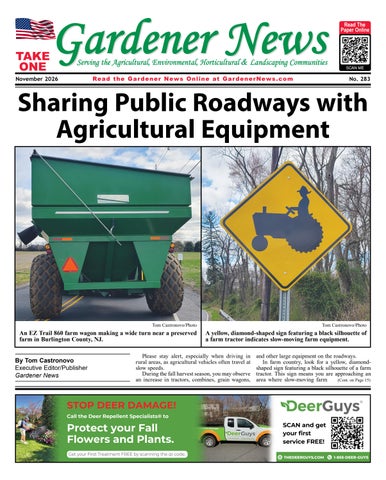
An EZ Trail 860 farm wagon making a wide turn near a preserved farm in Burlington County, NJ.
A yellow, diamond-shaped sign featuring a black silhouette of a farm tractor indicates slow-moving farm equipment.
By Tom Castronovo Executive Editor/Publisher Gardener News
Please stay alert, especially when driving in rural areas, as agricultural vehicles often travel at slow speeds. During the fall harvest season, you may observe an increase in tractors, combines, grain wagons,
and other large equipment on the roadways. In farm country, look for a yellow, diamondshaped sign featuring a black silhouette of a farm tractor. This sign means you are approaching an area where slow-moving farm (Cont. on Page 15)
STOP DEER DAMAGE!
STOP DEER DAMAGE!
STOP DEERDAMAGE! DAMAGE! Call the Deer Repellent Specialists® to STOP DEER Call the DeerCall Repellent Specialists® to Call the the Deer Deer Repellent Repellent Specialists® Specialists® to to
Protect your Fall Protect your Protect your Fall Protect your Fa Fall Flowers and Plants. lants. Flowers and Plants. Flowers and Plants.
Get your First Treatment FREE byTreatment scanningFREE the by qr scanning code. the qr Get qr code. code. Get your your First First Treatment FREE by scanning the Get your First Treatment FREE by scanning the qr code.
SCAN and get SCAN and get SCAN and SCAN andget get your first your first your yourfirst first service FREE! service FREE! serviceFREE! FREE! service
THEDEERGUYS.COM THEDEERGUYS.COM THEDEERGUYS.COM
THEDEERGUYS.COM
1-855-DEER-GUYS 1-855-DEER-GUYS 1-855-DEER-GUYS
1-855-DEER-GUYS
2 November 2026
GardenerNews.com
GardenerNews.com
November 2026 3
Around The Garden By Tom Castronovo Gardener News
A Special Recognition and November Gardening Chores
First and foremost, congratulations to the Jonathan Green Company for winning the 2026 “Vendor of the Year” award from Costello’s Ace Hardware. Costello’s Ace Hardware is a family-owned and operated retailer with more than 60 locations across New York, New Jersey, Pennsylvania, Maryland, Virginia, and Delaware. The family business is still growing. Known for its commitment to customer service and community engagement, Costello’s offers a wide range of hardware, paint, lawn and garden, and home improvement products. Jonathan Green was founded in 1881. Their commitment to growing healthy, carefree lawns has stayed the same. Jonathan Green was born out of the need for better lawns, and they continue that mission at their turfgrass research farm where they study, breed, and think outside the box to create the best grass seed on the market today. Jonathan Green supports only independent retailers and never sells to big box stores. Local stores are the best place to get quality lawn and garden advice that’s specific to your yard’s individual needs. The company minimizes environmental impact by formulating superior grass seed varieties that are naturally dark green and need less fertilizer and pesticides. A special thank you goes out to Jonathan Green for always supporting the Gardener News through ads on both the online and print editions. Another special thank you goes out to Costello’s Ace Hardware for allowing the printed edition of Gardener News to be available in select hardware stores. Moving onto frozen outdoor facets. If you haven’t done this winterizing chore yet, disconnect the hose from your outdoor faucet. I drain the hose and store it in the basement. Water left in a hose can freeze and damage the hose if left outdoors. If your outdoor faucet has an interior shutoff valve, close it inside the house. After it’s closed, open the outdoor faucet to let any remaining water drain out. I also leave it open for the winter — this lets any trapped water expand without bursting the faucet pipe. Moving on to plant hoppers. While I’m outside, I’m going to take a walk around the property and look for spotted lanternfly, Lycorma delicatula, egg masses. The egg masses look like a smear of gray or brown mud, wet putty, or cracked plaster on outdoor surfaces like tree bark (especially tree of heaven and maples), rocks, stone walls, metal, plastic, patio furniture, firewood, and vehicles.
Egg masses are usually about 1.5 inches long. If you find any eggs on your property, you can scrape them off using a plastic card or a plastic putty knife. Scrape them into a bag or container filled with rubbing alcohol or hand sanitizer and keep them in this solution permanently. Egg masses that are scraped to the ground can still hatch. Females lay one or two egg masses, each containing 30-60 eggs laid in rows. It has been reported that the bugs feed on almost anything as they move from one area to another in search of a preferred food source. As an example, populations have been found feeding in corn and soybean fields for short periods of time, and spotted lanternfly nymphs have been found feeding on basil, cucumber, flowers, and even grass, though none are a preferred food source. It is hypothesized they are only feeding to get the energy needed to plant hop to a more preferred host. Using piercing-sucking mouthparts, both nymphs and adults extract large amounts of sugary sap from stems, branches, and trunks. This causes oozing sap, wilting, leaf curling, and branch dieback. As they feed, they excrete a sticky, sugar-rich liquid called honeydew onto plants. This substance blocks sunlight from reaching leaves, reducing photosynthesis, and weakening plant health. Now is the time to reduce their population so we see fewer of them next year and our plants remain healthy. As I type this column, a few of my potted geraniums, Pelargonium spp., are still alive. I’m going to try and save a few of them over the winter so I have a jump on spring and save some money. I’m going to give them a good drink of bottled water. Before it gets too cold, I’m going to bring them inside. Once indoors, I’m going to trim the plants back by one-third to one-half, water thoroughly again, and then set in a sunny west-facing window. They fare much better in cooler temperatures (60 to 65 degrees F). If my plants start looking “leggy,” which often happens with reduced light, I’ll prune or pinch back the stems just above a leaf node to produce new growth. I’m only going to water them when the soil feels dry to the touch. Wish me luck! My final gardening chore this month will be to plant a few spring-blooming bulbs (daffodils, hyacinths, crocus, and alliums). I’m going to plant these deer resistant bulbs 2 to 3 times as deep as the bulb is tall, with the pointed end facing upward, in freshly tilled soil. I can’t wait until the spring equinox, which is Saturday, March 20, 2027.
Editor’s Note: Tom Castronovo is executive editor and publisher of Gardener News. Tom’s lifelong interest in gardening and passion for agriculture, environmental stewardship, gardening, horticulture and landscaping, led to the founding of the Gardener News, which germinated in April 2003 and continues to bloom today. He is also dedicated to providing inspiration and education to the agricultural, environmental, horticultural, and landscaping communities through this newspaper and GardenerNews.com.
APHIS Deregulates Chrysanthemum White Rust; Updates Import Requirements for Chrysanthemum Plants for Planting and Fresh Cut Flowers The U.S. Department of Agriculture’s Animal and Plant Health Inspection Service (APHIS) is deregulating chrysanthemum white rust (CWR), a fungal disease caused by Puccinia horiana, and removing its designation as a quarantine pest. An APHIS economic evaluation concluded that the current eradication-based approach is no longer technically or economically justified. CWR is now considered established in the United States, and growers can manage it more effectively using commonly available fungicides and other industry practices. After extensive analysis and research, APHIS has determined that Chrysanthemum spp., Leucanthemella serotina, and Nipponanthemum nipponicum, may be safely imported into the continental United States as cuttings and in vitro plantlets from 20 countries—including Belgium, Bolivia, Brazil, Colombia, Costa Rica, El Salvador, Ethiopia, Germany, Guatemala, Kenya, Mexico, the Netherlands, Nicaragua, Panama, Spain, Tanzania, Tunisia, Uganda, the United Kingdom, and Vietnam—under a systems approach. APHIS also authorizes the importation of Chrysanthemum spp., Leucanthemella serotina, and Nipponanthemum nipponicum cuttings, in vitro plantlets, and plants with roots from Canada under a separate protocol. APHIS is removing CWR-specific import restrictions on fresh cut flowers and consolidating all commodity-specific import requirements into the Agricultural Commodity Import Requirements (ACIR) database. In addition, APHIS is adding the notice-based process to 7 CFR 319 Subpart P-Cut Flowers to enable a more rapid response to changing pest situations on this commodity. To view the details of this action, go to www.regulations. gov and enter APHIS-2021-0081 in the search field for the plants for planting regulation and APHIS-2019-0024 in the search field for the chrysanthemum fresh cut flowers rule in the Federal Register. These changes are effective 30 days after publication in the Federal Register on November 9, 2026.
SHARE THE
Gardener News! FORWARD IT TO A FRIEND
www.GardenerNews.com
4 November 2026 November is a special month that brings many notable days each year for Americans. First there’s Election Day on the Tuesday following the first Monday of the month, followed by Veterans Day on November 11, and, of course, Thanksgiving on the fourth Thursday of the month. And let’s not forget World Jellyfish Day on November 3. On second thought, maybe we can pass on that one. One thing is for certain; we don’t have to be and shouldn’t be thankful on only one day of the year. We should be thankful all year ’round. Thankful that we live in the Garden State with access to so many great agricultural products throughout all the seasons. But that one special day does give us a repast we all look forward to. And our whole Thanksgiving meal can be Jersey Fresh or Jersey Raised with just a little effort. From the turkey to the sweet potatoes and Brussels sprouts or green beans. (I even use Jersey Fresh corn that I freeze every September or early October.) There are lots of greens and hard squashes still available from New Jersey’s farms for salads and
GardenerNews.com NJ Dept. of Agriculture By Joe Atchison III Assistant Secretary of Agriculture
We Should Be Thankful All Year soups. And what is Thanksgiving without Jersey Fresh cranberries? You can also source Jersey Fresh clams and oysters for appetizers or for use in your stuffing. If you are so inclined, you can toast family and friends with Jersey wines, beer, or distilled spirits. You can also decorate your home with beautiful nursery stock from one of our many nurseries and garden centers. We can thank New Jersey’s farmers, ranchers, aquaculturalists, brewers, vintners, and distillers for all of these fantastic local agricultural products. We should thank our farmers more than once a year. They provide us with healthy, fresh options all across the calendar. New Jersey farmers, year after year, generation after
generation, work diligently from planning and planting to tending and harvesting their crops. But it’s not that simple. Garden State growers face ever increasing challenges to bring us the best. The cost of diesel fuel is at an all-time high. Yes, farmers use diesel in their vehicles. But it’s also needed frequently to power the motors that run irrigation pump systems and other equipment. When you are using hundreds or thousands of gallons daily to run your operation, the recent cost increase is overwhelming. Other input costs such as fertilizer, seeds, pesticides, and equipment continue to climb, as do farm labor costs where New Jersey operators face much higher rates than those paid in neighboring states or countries. And farmers aren’t the only
Jersey Tastes.
people paying much higher costs for just about everything they use daily. Consumers, too, are feeling the pinch, meaning they’ve got far less money than usual and are not as willing to spend a lot to create a perfect Thanksgiving feast. Finally, weather plays a critical role for farmers, and it has been getting more and more unpredictable and causing more crop loss recently. From freezes to droughts to flooding, our growers have had several challenging years, including the devastating loss to an unusual spring freeze/frost this year that impacted many fruits growers, wineries, nurseries, and some vegetable crops as well. It is essential that we thank our farmers and other agricultural producers for all the
time, effort, and hard work they and their workers put in year after year. It is physically and mentally draining for them, with long hours and grueling work, especially throughout the hottest summer months. So, show them you are thankful for them and what they produce. Seek out and support local New Jersey farmers. And, when you’re out on the roads, slow down and use caution around large, slow farm vehicles as they cross highways and other roads to access fields. Every year, there are horror stories about people injured or killed due to aggressive, impatient drivers. If we show our thanks and support our farmers, they’ll be thankful for us. Have a great Thanksgiving and also enjoy “National Pizza with the Works Except Anchovies Day” on November 12. Editor’s Note: Joe Atchison III is the New Jersey Assistant Secretary of Agriculture. Atchison is also the Director of the Division of Marketing and Development for the New Jersey Department of Agriculture. He can be reached at (609) 292-3976.
Jersey Fresh Harvest of the Month: Squash
A Year-Round Celebration of the Garden State's Fruits and Vegetables
NUTRITION FACTS:
ALL ABOUT NEW JERSEY:
A single cup of orange squash provides more vitamin A than most people need in a day (457% of the daily value, to be exact).
Plant winter squash between May & June in New Jersey. It needs a long, warm growing ffall. ll. season and is harvested in fa
HOW DOES IT GROW:
FUN FACT:
Squash like to grow on long, trailing vines. One growing method is to grow squash up a f . Another trellis, like the one shown to the left left. method is to build mounds or hills, plant the squash seeds directly into the ground, once a out 2 inches in ab they come up and grow to about height, thin the plants to three plants per hill. Always remember that squash need a lot of space to grow either horizontally or vertically f r wel ll d ained soil. ll-dra and they prefe prefer well-drained
The heaviest squash weighed 2,164 lbs. and was grown by Todd & Donna Skinner. It was authenticated by the Great Pumpkin Commonwealth at the Oakland Nursery National Pumpkin Weighoff f in Dublin, Ohio, USA, on October 10, 2021.
https://www.nj.gov/agriculture/farmtoschool Jersey Tastes for the Gardener News
1
10/18/2026 9:53:19 AM
GardenerNews.com
November 2026 5
Grown by
Your
Neighbors
Since 1984, Jersey Fresh has been a proud partner of the hardest working people in the Garden State who produce some of the finest fruits and vegetables in the USA. When you see the Jersey Fresh logo, you know it’s Grown Right. Right Here. By Your Neighbors. Fruits and vegetables from New Jersey are frequently picked, packed and on shelves for you in the same day. Please support our local farmers and buy Jersey Fresh! (And if you don’t see it, ask for it!)
The Jersey Fresh Team | 1.609.913.6515 | FindJerseyFresh.com | Jersey Fresh is a program of the New Jersey Department of Agriculture | Mikie Sherrill, Governor | Edward D. Wengryn, Secretary of Agriculture
6 November 2026
GardenerNews.com The Garden Historian By Lesley Parness Garden Educator
Extra, Extra - Read all about it! Herbarium Makes Headlines!
Celebrating 47 Years! *Award Winning Wine List* Seafood, Steaks, Pasta. Are Our Specialties Daily Lunch & Dinner Specials Live Entertainment
601 Grand Central Avenue (Rt. 35 North) Lavallette, NJ | 732-793-4447 Order Online
Herbaria are not the usual stuff of headlines. So, I read with great interest an article sent to me from the University of North Carolina’s newspaper, The Daily Tar Heel. The headline on September 5, 2026 – “Rich botanical legacy: UNC acquires Duke Herbarium.” The article described a historic merger of Duke University’s herbarium with that of UNC’s. Coker Hall, within whose labyrinthine shelves are filled with more than 800,000 plants specimens, will soon double, growing to about 1.7 million specimens. This will create the 3rd largest university herbarium in America. Harvard’s has 5,000,000 and the University of California’s has 2,200,000. When Duke University announced in 2024 that it would divest itself from the collection, the news sparked a panic among scientists across the country. This happy solution of merging with UNC’s collection elicited a sigh of relief from botanists, horticulturists, taxonomists, botanic artists, evolutionary biologists, ethnobotanists, ecologists, climatologists and the like - who all use herbaria. So – what is a herbarium exactly? It is a biological collection of plants, preserved in a manner similar to flower pressing. They serve as a foundational resource for scientists and researchers who draw on the preservation of these plants to observe trends in biodiversity, ecology, history, genetics, and pollution, tracking plant distribution and invasive species, and documenting the rarity of plants and their habitats. The first recorded herbarium is credited to Luca Ghini around 1544. He was a professor of medicine and botany at the University of Pisa, the first European university botanical garden. Early herbaria like Ghini’s (none of which survived) were created by gluing plant specimens to a sheet of paper which were then bound into a book. I recently saw a 16th century herbarium, “Historia Stirpium,” by German physician Johannes Harder at the Oak Spring Garden Foundation in Virginia. Pressed plants from 500 years ago were “enhanced” by charming painted elements such as roots, flowers and in some cases the surrounding environment. Today, pressed, dried, and labeled specimens are mounted on single archival quality pages and given a register which has relevant information
like habitat, collector name, dates, location, and nearby species. For although the standard process for collecting new specimens has changed little over time, changes in other herbarium practices now often include the use of GPS coordinates and specific sampling methods for genetic analyses. At the Carnegie Museum of Natural History in Pittsburgh, PA, the herbarium collection is being linked to a popular citizen science platform - iNaturalist. Those tracking specimens in the field can compare them instantly to examples of the “same” plant as it grew hundreds of years ago. QR codes and apps are all parts of today’s herbarium. In the future, researchers will scan QR codes on museum specimens and be immediately directed to images of the specimen in the field. In fact, instead of fading away like some dusty remnant, herbaria have re-invented themselves for the 21st century and beyond. The MidAtlantic Megalopolis Project (mamdigitization. org) is a network of thirteen herbaria from East Coast cities, and its mission is to achieve a greater understanding of how plants have evolved in urban environments. The New York Botanic Gardens plays a big role here – learn more at https://www.nybg.org/science-project/ mid-atlantic-megalopolis. Other research areas veer into the realm of Jurassic Park as scientists unravel DNA from dried herbarium samples in attempts to bring them back to life. If you want to explore this topic, I recommend an extraordinary book, “The Hidden Stories of the Linnean Herbarium,” by Nina Ulmaja, Lena Granefelt, and Sverker Sörlin. It is a photographic work depicting backlit herbarium sheets from Linnaeus’ original 18th century herbarium. By letting the light illuminate from below, folds and veins appear, the colors are enhanced, and the structure of the paper, watermarks, and texts written on the back of the sheet become visible. The Carl Linnaeus herbarium laid the foundation for the binomial nomenclature, the system we still use today when we talk about our favorite subject – plants. And if you want to participate in documenting the world’s plant diversity, go here and check out the links, https://herbariumworld.wordpress.com/ online-herbaria. Given climate change and global food insecurity, I suspect that there will be many future Herbarium headlines.
Editor’s Note: Lesley Parness offers a variety of presentations and workshops for garden clubs, plant societies, and horticultural gatherings. Recently retired from her position as Superintendent of Horticultural Education at the Morris County Park Commission, and with four decades of teaching environmental science and garden education, her focus now is garden history. A complete listing of her talks can be seen at lesleyparness.com and she can be reached at parness@verizon.net. This column will appear in the paper every other month.
GardenerNews.com
November 2026 7
Moving Firewood Long Distances Can Spread Invasive Forest Pests
As winter home heating get underway, the U.S. Department of Agriculture’s Animal and Plant Health Inspection Service (APHIS) is urging everyone to make safe firewood choices that help prevent the spread of invasive forest pests. “Invasive pests pose significant risks to our forests, parks, and communities,” said USDA Under Secretary Dudley Hoskins. “Observing federal and state firewood quarantines, including those for spongy moth and Asian longhorned beetle, helps protect the trees we rely on for recreation, wildlife habitat, shade, and clean air.” “Healthy forests depend on everyone doing their part to stop invasive pests,” said Forest Service Chief Schultz. “Buying firewood where you burn it is one of the simplest ways people can protect the places they love, from neighborhood parks to our national forests. Local firewood keeps harmful insects from hitchhiking into new areas, helping us safeguard wildlife habitat, outdoor recreation, and the communities that rely on America’s trees.” During October, APHIS is joined partners across the country to recognize National Firewood Month, a nationwide effort to raise awareness about the risks of moving firewood. Tree killing insects and plant diseases can hide inside or on the surface of firewood. I have been a fan of Crocus speciosus from the moment I first discovered this fall bloomer! Commonly known as Bieberstein’s Crocus, I eagerly planted the small corms and have enjoyed watching their deep blue flowers slowly spread about my garden in the 35+ years since. Of course, there are other autumn blooming Crocus, and I recently began experimenting with some of these species, including Bieberstein’s closely related cousin Crocus pulchellus, commonly called Hairy Crocus! Crocus are members of the Iridaceae or Iris Family and consist of over 90 species native to regions of Southern Europe and Northern Africa, stretching east to Western China. Crocus pulchellus is native to the Balkans and N.W. Turkey where it experiences dry summers with moist autumns and winters. Like all Crocus, it survives the inhospitable months of summer as a modified underground stem called a corm. The genus name of Crocus was penned in 1753 by the Swedish botanist and physician Carl Linnaeus (1707-1778). It originates from the Greek krokos, meaning Saffron which has been harvested from Safron Crocus (Crocus sativus) for
While these pests don’t travel far on their own, moving firewood even a short distance can carry threats like spongy moth, Asian longhorned beetle, emerald ash borer, and other invasive insects— moving them hundreds of miles into new areas. Firewood movement may be restricted in many areas. Several states maintain quarantines that limit how untreated firewood can be moved within or across state lines. These quarantines are designed to prevent the spread of invasive insects that damage forests and cause costly control and eradication efforts. APHIS encourages all travelers, and anyone who uses firewood at home, to know and follow the rules that apply where they live, camp, hunt, or heat their homes. Here are simple ways you can help slow the spread of forest pests: • Buy firewood near where you will burn it. Purchase firewood close to your destination, whether a campsite, cabin, or your own home. “Local” wood means it comes from the immediate area and stays there. • Buy certified heat treated firewood. Heat treated firewood has been processed to eliminate insects and diseases. Look for a state or federal certification mark on the packaging.
• Gather firewood on site, when allowed. Many parks and campgrounds permit gathering small amounts of firewood locally. Check with the land manager before collecting. • Use it all at the same location. Do not take leftover firewood home or to a different site. Burn it where you bought or gathered it.
Pay attention to firewood rules. Campers, hunters, anglers, and RV owners can unknowingly move pests in firewood when they travel. Only transport certified, heat treated wood or plan to gather or buy wood at your destination. Home and cabin owners who heat with wood should buy firewood from reputable local dealers who understand and comply with firewood movement restrictions. Some operations may not be aware of quarantine rules. Tourists and “leaf peepers” travelers should purchase firewood locally, buy certified heat treated wood, or gather on site when allowed. Visit www.aphis.usda.gov/hungrypests to learn how invasive pests spread, how to identify them, and how you can help protect the places you love. Report suspected invasive pests to your local State Plant Health Director. Join the conversation throughout October using #FirewoodMonth.
Morris County Park Commission By Bruce Crawford Horticultural Manager
The Spice of Autumn
the past few thousand years. Crocus pulchellus was named and described in 1841 by the British botanist William Herbert (1778-1847). The species name comes from the Latin Pulcher for beautiful and the diminutive suffix Ellus for cute, literally meaning ‘little beauty’ – a most appropriate description! Very similar to Bieberstein’s Crocus, the lavender-blue flowers are 2-3 inches wide and display dark blue veining with a yellow central eye. Adding to the colorful display are the three bright red female styles and three hairy (pubescent) white filaments that inspired the common name. Unlike its cousin, the 6-inch-long stems are stronger and the flowers are less likely to flop prematurely. Its slender green foliage waits until spring to appear, whereupon it grows to 6 inches tall and appears remarkably like grass. In fact,
the corms can easily be grown in turf so long as the first cut is not until late May, allowing ample time for the corms and flowers to develop for the following fall. One of the more common selections available in the trade is Crocus pulchellus ‘Zephyr.’ Introduced in 1940 by the nurseryman Thomas Hoog (1899-1991) of the Van Tubergen Nursery, Zephyr means a gentle breeze, perhaps referencing the gentle, pale blue flowers with dark, bluish-gray lines leading to the yellow base. Even though it is speculated to be a cross with Crocus speciosus, the flowers still have the bright orange style and ‘hairy’ white filaments typical of the species. Another attractive species that I have long admired at Frelinghuysen Arboretum is Crocus goulimyi. Uninspiringly called Fall Crocus, it once
again has blue to violet flowers although white forms are in the trade. Providing floral contrast are the bright yellow style and filaments. The unique characteristic of this Crocus is the deeply contoured, spoonshaped petals that give the open flowers a very ‘full’ appearance. Native to Greece, the plant was named and described in 1955 by the English Botanist William Bertram Turrill (18901961). The species name honors Constantine Goulimis (18861963) who first found the plant in November of 1954. Although Goulimis received a Doctorate in law, he developed a passion for botany during his later years when he botanized throughout Greece, ultimately amassing a large herbarium and writing Wild Flowers of Greece, published posthumously in 1968. Very adaptable, these autumn
Crocus grow best in well-drained soils in full sun with a pH range between 6.0-8.0. All the species are hardy in zones 6-9 and should be given protection from early frosts, enabling flowering to continue into November. Otherwise, the plants require very little care and look great paired with creeping, silver foliaged plants such as Alpine Pussy Toes (Antennaria alpina) or the complementary dark purple foliage of Black Mondo Grass (Ophiopogon planiscapus ‘Nigrescens’). Sadly, many gardeners have yet to discover these autumn bloomers. I have always enjoyed being surprised by the unexpected floral displays that suddenly burst to life while most of the garden is preparing for a winter nap. Much like its namesake, these Crocus provide that little touch of ‘spice’ every autumn garden requires! Editor’s Note: Bruce Crawford is a lover of plants since birth, is the Manager of Horticulture for the Morris County Parks Commission, and a Past President of the Garden State Gardens Consortium. He can be reached at BCrawford@ morrisparks.net
8 November 2026
RUTGERS NJAES/RCE
GardenerNews.com
LAND-GRANT UNIVERSITY NEWS NJ 4-H Welcomes 2027 Agriculture Ambassador Cohort, Cultivating the Next Generation of Leaders
The future of agriculture depends on young people who can champion the industry, communicate its value, and help shape its direction. Fourteen New Jersey 4-H members from eight counties have been selected for the 2027 NJ 4-H Agriculture Ambassador Program, a statewide leadership initiative preparing teens to represent and promote agriculture across New Jersey, and led by Melissa Bright, 4-H agent, Somerset County. Launched in fall 2024 through a partnership between National 4-H Council and Nutrien, the program gives high school youth opportunities to deepen their understanding of agriculture while developing skills in leadership, public speaking, communication, and advocacy. Open to active New Jersey 4-H members in grades 9 through 13, the program welcomes teens with interests spanning farming, animal science, food systems, and natural resources. Throughout the program year, ambassadors will connect with agricultural industry professionals, explore career pathways, and learn about current issues affecting the industry. “Educational programs, agricultural tours, leadership development experiences, and outreach activities help them build confidence in communicating agriculture’s importance to diverse audiences,” said Bright. The 2027 cohort represents Gloucester, Hudson, Hunterdon, Monmouth, Salem, Somerset, Union, and Warren counties. Together, these young leaders will build connections across the state while gaining firsthand insight into the people, practices, and systems that sustain New Jersey agriculture. By equipping youth with the knowledge and skills to engage their communities, New Jersey 4-H is helping cultivate a new generation of agricultural advocates, professionals, and leaders prepared to advance the industry’s future.
Caldwell Expands Green Infrastructure Footprint
Three rain gardens, were completed this summer in the Borough of Caldwell, funded by a 2022 Stormwater Management Grant for Water Quality and Quantity Improvements from the New Jersey Department of Environmental Protection. The rain gardens were designed and built at the Sisters of St Dominic, St. Aloysius Roman Catholic Church, and Grover Cleveland Park of the Essex County Parks System. Each of the rain gardens is green stormwater infrastructure designed to manage stormwater runoff from existing impervious surfaces on a site, like the rooftop or pavement. The gardens are planted with resilient native grasses, flowering plants, and shrubs, stabilizing soil and providing pollinator wildlife habitat. • The 175 square foot rain garden at the Sisters of St. Dominic manages a rooftop drainage area of 700 square feet and is designed to manage 16,506 gallons of stormwater annually. • The 455 square foot rain garden at St. Aloysius Church manages a rooftop drainage area of 1,845 square feet and is designed to manage 43,565 gallons of stormwater annually. • The 135 square foot rain garden at Grover Cleveland Park manages a rooftop drainage area of 1,050 square feet and is designed to manage 24,895 gallons of stormwater annually. Rutgers Cooperative Extension Water Resources Program provided engineering design and technical support with construction and planting and construction oversight while a local contractor completed the site work. Volunteers for planting the rain gardens were organized by Caldwell Environmental Commission, Rutgers Cooperative Extension of Essex County Master Gardeners, and the Grover Cleveland Park Conservancy. These rain gardens build on previous efforts of the community including a rain garden built in 2019 at the First Presbyterian Church as a part of a grant from Sustainable Jersey.
How Rotting Food in the Kitchen and a Whiff of Vinegar Led to a ‘Happy’ Agricultural Accident Rutgers scientists have identified natural repellents against an invasive blueberry pest, a scientific breakthrough that was accidentally discovered when fruit flies invaded their laboratory. The accident, more than a decade in the making, could one day transform how commercial crops are protected. “As a kid, this is what I thought science was – you stumble on something and go, ‘Eureka!’” said Beth Ferguson, a postdoctoral researcher at the Rutgers Philip E. Marucci Center for Blueberry and Cranberry Research, and lead author of the study, published in the journal Applied and Environmental Microbiology. “Of course, that doesn’t happen most of the time, which is why I call this a very happy accident.” Each summer, Ferguson and colleagues conduct research on an invasive fruit fly, the spotted-wing drosophila (Drosophila suzukii). Found in New Jersey in 2011, the fly is one of the biggest threats to commercial fruit production, particularly soft-fleshed fruit such as blueberries. Unlike other Drosophila flies, which lay eggs on and feed on rotten fruit, the spotted-wing drills into intact, ripening fruit, using a saw-like tube to deposit its eggs. The fly larvae hatch and destroy the fruit from within. The resulting spoilage is costly to producers. In 2025, New Jersey growers produced 47.5 million pounds of blueberries, with a production value of more than $94 million. The state consistently ranks among the top blueberry producers nationwide, and blueberries are New Jersey’s No. 1 crop. But growers spend heavily on chemical insecticides, which do not always provide complete control and can harm
nontarget organisms. In their lab, Ferguson and colleagues breed colonies of spotted wing to test new, nonchemical management strategies. And nearly every summer, something curious happened to the colonies they raised: the enclosure, located close to the research center’s kitchen, would be invaded by a common fruit fly, D. melanogaster, which led to die-offs of the spotted-wing flies. With thousands of flies in these containers, not even a skilled researcher can differentiate them with the naked eye, said Ferguson. But fly colonies do have different smells, and when enough D. melanogaster flies had reproduced to outnumber the spotted wing flies, the scent was unmistakable. “We’d notice a smell change, going from a spotted wingsmell – like corn meal – to a very heavy vinegar decay odor, which is the telltale smell of melanogaster,” said Ferguson. In nature, the two flies often avoid competition. But the accident of placing the enclosure near the kitchen, where melanogaster flies would feed on rotting fruits, fueled a hidden rivalry. Ferguson noticed that as the vinegar smell intensified, a strange film-like deposit was forming on the flies’ food source. As with dogs marking territory, fruit flies mark food and egg-laying areas by depositing fecal and gut fungi. Ferguson swabbed the film and worked with colleague James Polashock from the United States Department of Agriculture (USDA) to identify the yeast. She and lab director Cesar Rodriguez-Saona then reached out to Jennifer S. Sun, an assistant professor in the
Department of Biochemistry and Microbiology at Rutgers– New Brunswick, and a coauthor of the paper. Sun and undergraduate researcher Tia Hart ran a series of tests to confirm the spotted wing’s aversion to melanogaster’s fungi and how exposure affected the fly’s egg-laying preferences. “Our first question was whether this is truly repulsive to spotted wing,” said Sun. “The answer came quick.” What she found was striking: The yeast “elicited aversive responses” in spotted wing while remaining attractive to melanogaster. Spotted wing flies also laid far fewer eggs after having encountered the yeast. Further testing will be needed to assess how the labproduced compound might behave in nature. Ferguson said it can take years from discovery to gain regulatory approval. But already, the eureka moment is paying dividends. “I’ve been using it as a model for my students, explaining that when an experiment yields unexpected results, they shouldn’t assume that they did something wrong,” said Sun. “Instead, they could ask why it’s happening, and if there’s another phenomenon we could be studying. When the scientific process is used in experimentation, the result could be a very fruitful project like this one.” This work was funded by several grants, including $2.1 million (award number R35GM165839) from the National Institute of General Medical Sciences of the National Institutes of Health. The content is solely the responsibility of the authors and does not necessarily represent the official views of the National Institutes of Health. This article first appeared in Rutgers Today.
GardenerNews.com
RUTGERS NJAES/RCE
November 2026 9
From the Director’s Desk
Rutgers Outreach Provided by Brian Schilling Director
Preparing Your Vegetable Garden for Winter Organic matter holds moisture and nutrients in the soil and improves tilth, referring to the physical condition of the soil in relation to its suitability for planting. Excellent sources of organic matter include compost, shredded leaves, straw mulch, and manure. Spread these materials evenly at a depth of 2–4 inches and leave on top of the soil surface during the winter as a mulch to protect the soil from erosion. In the spring, this layer can be tilled into the soil or left in place, planted into, and used as a mulch. Fresh animal manures can be applied to the garden in the fall, allowing it to age over the winter, but finished manure that has been aged at least six months must be used when applied in the spring to prevent food-borne diseases. Cover crops offer another means of protecting garden soil while adding organic matter. There are two general groups of cover crops: non-legumes (e.g. grasses) and legumes (e.g. clovers). Both protect the soil equally well; however, legumes add nitrogen, reducing fertilizer needs. Legumes fix nitrogen from the air through a special relationship with beneficial bacteria present in soil. This nitrogen is stored in root nodules until the legume decomposes, making the nitrogen available to nearby crop plants. Planting Garlic Fall is the right time to plant garlic for harvesting the following summer. For more information on growing garlic, see Cooperative Extension Fact Sheet FS1233, “Growing Garlic in the Home Garden.” Garden Equipment Maintenance Checklist At the end of the season, caring for all garden tools and equipment is essential. Following are tips to ensure
(ƺƬƺȅƫƺȸ האא ًג۴ يחƏȅ ٫ בيבȵȅ אڟن٪ƺƏȸǼɵ ǔƺƺ ۴ zƺɯ ȸɖȇɀɯǣƬǸً zh ȸƺ ɵȒɖ ȸƺƏƳɵ ɎȒ ǣȅȵȸȒɮƺ ɵȒɖȸ ǝȒȸɎǣƬɖǼɎɖȸƏǼ ɀǸǣǼǼɀ ǣȇ Ɏǝƺ ƬƏȸƺ ƏȇƳ ȅƏǣȇɎƺȇƏȇƬƺ Ȓǔ ȒȸȇƏȅƺȇɎƏǼ ȵǼƏȇɎɀّ
smooth operation and longevity. 0ȇȸȒǼǼ ɎȒƳƏɵ ǣȇ Ɏǝǣɀ Ȓȇƺ ƳƏɵ ƬǼƏɀɀ ɎȒ ǼƺƏȸȇ ǔȸȒȅ Clean and store all useful ƺɴȵƺȸɎ ǝȒȸɎǣƬɖǼɎɖȸǣɀɎ ȸɖƬƺ zƺƏȸɵِ RƺټǼǼ ƳǣɀƬɖɀɀ Ɏǝƺ garden stakes and cages. Dispose of broken stakes or rusted wire ȅȒɀɎ ȅȒƳƺȸȇ ȅƺɎǝȒƳɀ Ȓǔ ȅƏȇƏǕǣȇǕ ǝȒȸɎǣƬɖǼɎɖȸƺ cages. Ȓȇ ƬȒȅȅƺȸƬǣƏǼ ƏȇƳ ȸƺɀǣƳƺȇɎǣƏǼ ɀǣɎƺɀِ çȒɖټǼǼ ǼƺƏȸȇ ɎȒ Rinse soil off garden tools ȵɖɎ Ɏǝƺ ȸǣǕǝɎ ȵǼƏȇɎ ǣȇ Ɏǝƺ ȸǣǕǝɎ ȵǼƏƬƺٍ and clean the metal sections with a wire brush and sandpaper to IƺƏɎɖȸƺƳ ÁȒȵǣƬɀ remove built-up rust. ¨ȸȒȵƺȸ ȵȸɖȇǣȇǕ Ɏǣȅƺɀ ƏȇƳ ɎƺƬǝȇǣȷɖƺɀ Spray the tools with a cleaning solution such as 10% ɖǣǼƳǣȇǕ ƫƺɎɎƺȸ ƫƺƳɀ bleach or 70% isopropyl alcohol ³ȒǣǼ ɎƺɀɎǣȇǕ solution to sanitize and prevent ³ȒǣǼ ƬȒȅȵƏƬɎǣȒȇ the spread of plant diseases. ȇƳ ȅȒȸƺٍ Sharpen tools to create an edge, then use lubrication oil ١«ƺǕǣɀɎƺȸ ƫɵ (ƺƬ٫ װɎȒ ɀƏɮƺ תں٨ in any pivot joints. Finish by applying plant-based oil such as linseed oil to prevent rust and nƺƏȸȇ xȒȸƺ ƏȇƳ «ƺǕǣɀɎƺȸ ÁȒƳƏɵٍ preserve wooden handles. Drain fuel tanks in power ǕȒِȸɖɎǕƺȸɀِƺƳɖٖȒȸȇƏȅƺȇɎƏǼ equipment by running the equipment or adding fuel stabilizer to gasoline tanks OCPE to Gardeners News Nov 2026 - Caring for Ornamental Plants AD-6986 1 10/18/2026 10:17:38 AM avoid difficulty starting in the spring (fuel stabilizer cannot be used in diesel equipment). Turn off outside water and drain house pipes before the first frost to prevent frozen and bursting pipes. Drain all water in hoses and irrigation equipment, Atlantic County Middlesex County then store irrigation equipment Phone: 609-625-0056 Phone: 732-398-5260 in a shed or garage for winter. Bergen County Monmouth County Planning for Next Year’s Phone: 201-336-6780 Phone: 732-431-7260 Garden After the garden is put to Burlington County Morris County bed for the winter, gardeners Phone: 609-265-5050 Phone: 973-285-8300 start dreaming about next Camden County Ocean County season’s vegetable garden. Phone: 856 216 7130 Phone:732-349-1246 Keeping a gardening journal with notes of garden successes Cape May County Passaic County and frustrations, weather, crop Phone: 609-465-5115 Phone: 973-305-5740 rotation, planting dates, and Cumberland County Salem County favorite plant varietals can Phone: 856-451-2800 Phone: 856-769-0090 assist the gardener in growing a better garden. There are Essex County Somerset County many seed companies and Phone: 973-228-2210 Phone: 908-526-6293 nurseries, so make sure seeds Sussex County Gloucester County and plants are purchased from Phone: 973-948-3040 Phone: 856-224-8040 reputable sources. For tips on Union County planning a vegetable garden, Hudson County see Cooperative Extension Phone: 908-654-9854 Phone: 201-915-1399 Fact Sheet FS129, “Planning a Warren County Hunterdon County Vegetable Garden.” Phone: 908-475-6505 Phone: 908-788-1339 Mercer County Editor’s Note: This article was written by Peter Nitzsche, Agricultural Agent, Morris Phone: 609-989-6830 County; Angela Monaghan, Master Gardener Coordinator, Middlesex County; and Claudia Urdanivia, Agricultural Agent, Essex County.
Rutgers Cooperative Extension Phone Directory
Now that the summer growing season is starting to wind down, there are several steps gardeners can take in the fall to improve and protect their soil over the winter to ensure a successful garden next year. Clean Up Once the harvest is over, it’s time to remove dead and dying debris from the garden to a compost pile. Plants heavily infested with insects and diseases should be removed and discarded in a trash bin, as organisms may not die when composted. If infested material remains in the area, pest problems will likely recur from overwintering organisms in the soil, while removing weeds in the fall will help to reduce weed pressure for the following growing season. Improving Soil Fall is an excellent time to test soil. A soil test kit can be purchased from some local Rutgers Cooperative Extension offices. If a kit cannot be obtained, visit the Rutgers Soil Testing Lab website (https://extension. rutgers.edu/soil-testing-lab) and print out the questionnaire to accompany the soil sample to be submitted. Test results including pH, nutrient levels, lime, and fertilizer recommendations are returned via e-mail. Once the soil pH level is determined, lime should only be applied to the garden according to Extension recommendations. If lime is applied in the fall, that allows time for it to alter the pH of the soil, and fertilizer applications should only be made in the spring to prevent leaching. Call your local Extension office for advice and see Cooperative Extension Factsheet FS626, “Fertilizing the Home Vegetable Garden.” Garden soil always benefits from the addition of organic matter amendments.
!ƏȸǣȇǕ ǔȒȸ ȸȇƏȅƺȇɎƏǼ ¨ǼƏȇɎɀ
10 November 2026 How many times have you been listening to the news and heard something to the effect of, “after the commercial break, Joe the Weatherman will tell us just how much snow we are going to get”? And then when they do finally deliver a forecast, after quite a few ads of course, it is something along the lines of, “snow totals could be anywhere between a dusting to six inches, with higher or lower amounts possible, depending on the track of the storm. Please stay tuned for our updated forecast…” So, what they are basically saying is “We could get snow, they have no idea how much, but they will hype it up as much as possible so that they can generate as much as possible in terms of advertising revenue. As someone who grows fruits and vegetables here in the Garden State, I pay a lot of attention to the weather. Probably a lot more attention than most people, and for the most part, a lot of the general news weather forecasts have turned into nothing more than a tool to drive viewership, or in simpler terms, clickbait. Anytime there is any type of outside the norm weather predicted, news outlets love As autumn sweeps across the fields, bringing cooler weather and vibrant harvests, there is no better way to celebrate the season than with a dish that captures its warmth and abundance: quinoa stuffed acorn squash. Acorn squash is a standout crop on the farm, known for its sweet, buttery flesh and natural, bowl-like shape that makes it ideal for stuffing. We recently prepared this dish for a fall catering event, and after receiving overwhelming praise from guests, it quickly became a featured pre-made favorite sold daily at our farmstand. The key to this recipe lies in the contrast of textures and the harmony of savory and sweet flavors. Roasting the acorn squash halves first allows their flesh to caramelize and become meltingly tender, creating a rich foundation for the filling. Meanwhile, the quinoa base is packed with a mix of tendercrisp diced zucchini, yellow squash, and small broccoli florets. Sautéing the vegetables briefly ensures they retain their bright bite while picking up a deep, savory depth. The flavor profile relies on a handful of well-chosen spices and accents. Earthy ground cumin and smoky paprika ground the grain mixture with a warm, savory note, while a touch of molasses binds the spices and subtle sweetness of the squashes together. To finish the
GardenerNews.com The Town Farmer By Peter Melick Agricultural Producer
Sensationalizing the Weather
to promote and sensationalize them. They know that bad or extreme weather is good for ratings, and they are in a ratings driven business. Don’t get me wrong, weather forecasting is extremely important for my business and many other businesses as well. Crucial decisions have to be made regarding planting and harvesting schedules, pesticide, and fertilizer applications, and how many donuts should we make for the weekend. For us as farmers, we are used to sifting through the data of different forecasts and tend to learn which ones are more reliable than others. Like I said, the weather is critical to our business and the more we know in advance, the better we will be, but now,
we have to not only predict the weather but predict how the general public will react to the weather forecast. Take the recent Nor’easter that hit New Jersey earlier this year on the last weekend of September. The storm ended up being noteworthy as it inflicted quite a bit of damage up and down the Jersey shore, mostly through coastal flooding and beach erosion. Some areas of the State got over five inches of rain, but these places were mostly located close to the shore area. The inland areas of the state received a couple of days of on and off rain with breezy conditions. But this reality was not shared by the news media when they started hyping up their forecasts in the week leading up to the storm. It
was, “batten down the hatches,” “wash-out weekend,” and “check back later to see how bad it will be.” By the time the weekend and the storm arrived, people were so scared of the pending, “Storm of the Century,” that they were afraid to leave their homes. Sporting events were postponed, community festivals were cancelled, and there was an air of apprehension throughout the state. But for large areas of the state, the weather was not that bad. Sure, there was some rain and breezy conditions, but there were long stretches of the weekend that were just cloudy and rain-free, just as some of the details in the forecasts had indicated. Except these forecasts were not highlighted by most media outlets. There it was,
Culinary Experiences from the Farm By Andrew Melick Executive Farm Chef
Quinoa Stuffed Acorn Squash
filling, tart dried cranberries add bright pops of acidity, and crunchy pumpkin seeds offer a nutty bite that echoes the roasted squash. When spooned generously into the warm squash cavities and baked just long enough to toast the edges, every bite delivers a balance of richness, crunch, and comforting fall warmth. Whether served as a wholesome main dish for a chilly weeknight or as a colorful side for holiday gatherings, this stuffed acorn squash is a true celebration of autumn produce. It proves that humble, farm-fresh ingredients can come together effortlessly into a meal that is nourishing, vibrant, and deeply memorable. Quinoa Stuffed Acorn Squash Yield: 6 servings (1 stuffed squash half per serving) Ingredients For the Acorn Squash: • 3 medium Acorn squash, halved
top-to-bottom and seeded • 1.5 tbsp Extra-virgin olive oil • 1/2 tsp Kosher salt • 1/4 tsp Black pepper For the Quinoa Filling: • 2 cups Dry quinoa, thoroughly rinsed • 4 cups Water or vegetable broth • 2 tbsp Extra-virgin olive oil • 1 medium Zucchini, finely diced (about 6 oz) • 1 medium Yellow squash, finely diced (about 6 oz) • 1.5 cups Broccoli florets, chopped small (about 4.5 oz) • 1 tsp Ground cumin • 1 tsp Smoked or sweet paprika • 1 tbsp Molasses • 1/2 cup Dried cranberries (craisins) • 1/2 cup Pumpkin seeds (pepitas), raw or roasted • 1 tsp Kosher salt (or to taste) • 1/2 tsp Freshly ground black pepper (or to taste) Method of Preparation
1. Roast the Acorn Squash • Preheat the oven to 400°F (200°C) and line a large baking sheet with parchment paper. • Drizzle the cut sides and cavities of the 6 squash halves with 1.5 tablespoons of olive oil, then season evenly with 1/2 teaspoon salt and 1/4 teaspoon black pepper. • Place squash halves cut-side down on the sheet and roast for 30–35 minutes until tender. 2. Cook the Quinoa • In a medium saucepan, combine 2 cups of rinsed quinoa and 4 cups of water or broth. • Bring to a boil over medium-high heat, reduce heat to low, cover, and simmer for 15 minutes until liquid is absorbed. Remove from heat, let stand covered for 5 minutes, then fluff with a fork. 3. Sauté Vegetables & Mix Filling • Heat 2 tablespoons of olive oil in a large skillet over medium-high
“Storm Central.” And these hyped-up forecasts have worked their way into other areas of society as well. Look no further than our schools’ cancellation policies for bad weather. Now, it seems as if there is even a hint of snow in the forecast, schools will be quick to pull the trigger and cancel school instead of waiting to see if it snows or not. Someone told me that if one school cancels, other neighboring schools feel almost obligated to cancel as well for fear that if something bad were to happen, they would be blamed for not canceling. Maybe it’s better not to watch the weather! Editor’s Note: Peter Melick is co-owner of Melick’s Town Farm in Oldwick and a 10th-generation New Jersey farmer. Peter is Mayor of Tewksbury Township, Hunterdon County, NJ. He also served as a director for the New Jersey Farm Bureau and is a past president of the New Jersey State Board of Agriculture. Peter has also been featured on NJN, News 12 New Jersey and on the Fox Business Network. heat. Add diced zucchini, yellow squash, and broccoli florets; sauté for 5–7 minutes until tender-crisp. • Stir in ground cumin, paprika, 1 teaspoon salt, and 1/2 teaspoon black pepper. Cook for 1 minute until fragrant. • Reduce heat to low, stir in molasses, then fold in cooked quinoa, dried cranberries, and pumpkin seeds until fully integrated. 4. Stuff and Bake • Turn roasted squash halves cutside up. Scoop exactly 1 cup of quinoa filling into each half, gently mounding it on top. • Return stuffed squash to the oven and bake for 10 minutes to warm through and lightly toast the top. Serve warm.
Editor’s Note: Andrew Melick is an eleventhgeneration farmer from Oldwick, New Jersey. A graduate of Johnson & Wales University with a culinary arts degee, he manages the commercial kitchen operations for Melick’s Town Farm. In this role, Andrew specializes in leveraging home grown ingredients to develop and craft a diverse lineup of farm to table products featured at the farm market.
GardenerNews.com
November 2026 11
PEAR AL N TRADITLIOAPPLE CARME ART CHERRY T ) GEORGEHSANDY (Seasonal LEMON SG STREET HOPS KIN EY GINGER JERS I-DRY SEM From the farm to the bottle, the apples in our hard To F i n d A L i c e n s e d R e t a i l e r cider have been handpicked and crafted into cider on our traditional cider press. N erack a r and Yo cloth u
To Find a Licensed Retailer Near You
m l i clk is tco w me e k nsf a tr mo. cwo mn f a r m . c o m
Must Be 21 Years of Age or Older
Farm Service Agency 2027 Crop Acreage Reporting Dates In order to comply with Farm Service Agency program eligibility requirements, all producers are encouraged to visit the their local FSA office to file an accurate crop certification report by the applicable deadline. The following acreage reporting dates are applicable for New Jersey: • Nov. 16, 2026 - wheat, barley, rye and other fall-planted small grains • Jan 4, 2027 - honey (honeybee colonies) • Jan 15, 2027 - apples, blueberries, peaches, grapes, & strawberries • May 31, 2027 - nursery for 2028 crop year • July 15, 2027 - soybeans, corn, most vegetables, hay, CRP, & most other crops • Aug 16, 2027 - processing beans The following exceptions apply to the above acreage reporting dates: • If the crop has not been planted by the above acreage reporting date, then the acreage must be reported no later than 15 calendar days after planting is completed. • If a producer acquires additional acreage after the above acreage reporting date, then the acreage must be reported no later than 30 calendars days after purchase or acquiring the lease. Appropriate documentation must be provided to the county office. Noninsured Crop Disaster Assistance Program (NAP) policy holders should note that the acreage reporting date for NAP covered crops is the earlier of the dates listed above or 15 calendar days before grazing or harvesting of the crop begins.
12 November 2026
GardenerNews.com
GARDEN CENTER HARDWARE LANDSCAPE MATERIALS NURSERY STOCK
POW E R EQUIPMEN T 18 Hamilton Rd., Hillsborough, NJ 08844 (908) 359-4652 • CentralJerseyNurseries.com
Read The
Gardener News Online
GardenerNews.com
Robot Precision and Zero Turn Muscle: Toro’s 2027 Residential Mower Collection
From robotic to riding, Toro, America’s #1 Walk Mower Brand*, is bringing two completely different ways to dominate your lawn in 2027. The new HAVEN® AM75 autonomous mower is the easy-to-use, reliable solution that takes traditional mowing work completely off the homeowner’s to-do list. The newly refreshed Toro® TimeCutter® zero turn lineup is built for bigger yards and tighter storage, including a new compact 50-inch model that saves up to 20% on storage space^ without sacrificing cutting width. “Lawn care isn’t one-size-fits-all, so we built two differentiated solutions to solve two very real homeowner challenges: taking back your time with set-and-forget robotic tech, and maximizing garage real estate without giving up an ounce of power or cutting width,” says Jens Hoffman, senior marketing manager at Toro. “No two yards are alike, and no two homeowners manage them the same way. Our 2027 releases give you the best of both worlds.” HAVEN® AM75 Autonomous Mower Designed for properties up to three-quarters of an acre, the HAVEN AM75 autonomous mower is powered by a LiDAR-guided navigation system specifically engineered to maintain a pristine, always-ready lawn. Its auto-mapping feature detects where the grass ends to build its own map. If the lawn lacks defined edges, homeowners can steer the unit around the desired perimeter using a mobile app that works like a remote-control car to establish the mower’s boundaries. HAVEN AM75 can easily handle hills and slopes, cross driveways and sidewalks to reach
separate lawn areas, and allows homeowners to set custom “exclusion zones” to steer clear of flower beds, gardens or newly seeded grass. The autonomous mower relies on 360-degree situational awareness powered by LiDAR laser technology and camera obstacle detection to continuously learn and adapt to the contours of the yard over time. It safely detects and navigates around pets, children and toys. Built-in weather sensors also detect rain, ensuring the mower only operates when the grass is dry. Unlike many startup robotic brands, the HAVEN AM75 is backed by the trusted reputation and longstanding heritage of the Toro brand. Homeowners gain access to reliable warranties, ongoing product support, routine maintenance and expert service through Toro’s extensive nationwide network of authorized dealers. Refreshed TimeCutter® Series of Zero Turn Mowers The refreshed TimeCutter lineup incorporates several upgrades across every model, including styling that mirrors the bold, sculpted front-end design of Toro’s premium options for a look that commands attention from the curb. An aggressive tire tread pattern delivers enhanced traction and control, while a redesigned high-back seat features custom bolstering to provide superior operator support during longer mows. Additionally, a low-step front-end design makes getting on and off the mower quick and effortless. The lineup offers versatile options for every yard layout: • 34-Inch Twin Cylinder, Fabricated Deck: For homeowners with tight yard access or narrow
storage constraints, featuring an ultra-compact footprint engineered specifically to navigate standard residential backyard gates. • 42-Inch Single Cylinder, Stamped Deck: For homeowners transitioning from walk-behind or tractor mowers, combining zero turn speed and easy maneuverability for faster mowing on suburban yards. • 42-Inch Twin Cylinder, Stamped Deck: For midsize yards needing extra cutting muscle, pairing an upgraded engine’s power with a smooth stamped deck for faster cuts through thicker rass. • 42-Inch Twin Cylinder, Fabricated Deck: For property owners facing rough terrain or heavy debris, featuring a heavy-duty welded, fabricated deck built to hold up season after season. • 50-Inch Twin Cylinder, Fabricated Deck: For larger properties up to two acres, maximizing cutting width on a narrow, space-saving chassis with a heavy-duty welded deck built for long-term durability. With the HAVEN AM75 autonomous mower and refreshed TimeCutter lineup, homeowners can choose the right combination of convenience, capability and performance to ensure lawn care is never a chore and always a job well done. Homeowners can find both the HAVEN AM75 autonomous mower and the refreshed TimeCutter series at authorized Toro dealers, toro.com and major retail partners starting in 2027. For more information, visit toro.com.
GardenerNews.com
November 2026 13
Discover the Difference of Jonathan Green! Available at garden centers and hardware stores in your area.
Sign up to receive timely lawn tips
www.jonathangreen.com
Ask for a free copy of our Lawn Care Guide.
Sign up to receive timely lawn tips
www.jonathangreen.com
10/26
14 November 2026
GardenerNews.com
Gardener News Gardener News is the leading Agricultural, Environmental,
Horticultural & Landscaping industry publication, both online and in print, in the New Jersey metropolitan area.
Gardener News is written by amazing, credentialed industry
professionals, industry leaders and brilliant industry specialists.
Gardener News covers local, national and regional farming, forestry, horticultural, landscaping and outdoor industry news. We also feature a wide variety of interesting reading material and great educational tips.
SIGN UP TODAY
for a Complimentary E-Newspaper Subscription. It’s Fast and Easy! Please visit the top right-hand corner of
www.GardenerNews.com Gardener News is published and disseminated monthly. *Whether you are looking to promote your business, a sale or event, celebrate an expansion, enhance your image or maintain relationships with customers, Gardener News can help meet your advertising goals. Germinated in 2003
GardenerNews.com The Meskwaki Nation used the fruits of our bladdernut shrub in dream dances and ritual ceremonies. The hard popcornlike seeds were considered sacred and were also inserted into dried gourds as the noisemakers to create rattles. But if you would rather leave ceremonial dances to the more qualified, you could grow bladdernut just because it is a unique native shrub. American bladdernut is a multibranched, native flowering shrub. In May, you will find drooping clusters of 1/3-inch white flowers on long thin stems. After fertilization, the ovaries expand into three angled, inflated, 1-2inch bladders. When fully ripened, each dried bladder will contain one or two loose, hard, small, dark seeds which emit a soft rattle when shaken. These unusual bladders resemble the popular Chinese lantern plants, except bladdernuts are tan at maturity not bright orange. Bladdernut, Staphylea trifolia L., derives its scientific name from staphyle which is Greek for cluster, which refers to the drooping flower clusters, and trifolia which refers the three leaflets of each leaf. The plant is fast growing, reaches a maximum height of about 8-15
November 2026 15 The Native Plant Society of New Jersey By Hubert Ling Horticulture Chair
Grow an Authentic North American Ceremonial Rattle!
feet, and will live for about 40 years. However, unfortunately it is a suckering shrub and may spread beyond your desired limits. In fall the bladdernut leaves, which are very similar to poison ivy, turn yellow or coppery brown and in a few cases a rosy pink or even scarlet. Bladdernut is easy to grow in medium to damp, neutral soil. It grows naturally in moist, rich, loamy bottomland soil in part shade and is often found along waterways. However, the plant tolerates a variety of soils and full sun or full shade. Bladdernut has no serious insect or disease problems, but it is sensitive to drought, and soil compaction. Propagation is done by seeds, which need vernalization, but
can also be done by root or stem cuttings. If you want viable seeds, you need at least two different plants. Bladdernut flowers provide nectar and pollen to pollinators. The flowers are visited by honey and bumble bees, hummingbirds, and flies. The plant is also a host for the tussock moth. A variety of birds and small mammals such as quail, robins, finches, squirrels, and chipmunks eat the hard, nutrientrich seeds. There is mention on the internet that the seeds are edible and even good tasting. It was also mentioned that an edible oil can be pressed from the seeds. However, there is not much verification of these claims, and I would be very reluctant to put any unverified food in my mouth. In addition, the
small number of seeds per fruit and the relatively small number of fruits on a shrub would discourage much gathering of this product as food, which was apparently why it was ignored by native Americans as a possible food staple. The Native Americans did use the plant to treat a variety of ailments. This plant also appears in traditional Chinese medicine, but modern scientific studies on the plant for medicinal purposes have just begun and no commercial US products have yet emerged. However, there are several interesting results with commercial potential. Bladdernut plants contain flavonoids and polyphenols of medicinal interest, and extracts have been shown to be cytotoxic and antibacterial against
Pseudomonas and Staphylococcus. Bladdernut extracts may also be useful as an anti-cancer agent. Since these studies are in their infancy and we have no safety data for human medicinal use, I would strongly discourage experimenting on yourself. Currently the best use of bladdernut is to raise it as a unique plant, and possibly for use in dried flower displays which can make noise. If you have room for bladdernut and can keep an eye on it to prevent excess spreading, you might want to give this unique plant a spot in your garden. It will do well in a rain garden and near a stream or lake, or in a medium moisture, semi-shady area. You can visit this unique plant at Hacklebarney or Kittatinny Valley State Parks or check our plant profile and pictures at: h t t p s : / / w w w . awesomenativeplants.info/photo_ galleries/photo_pages/staphylea_ trifolia.html Editor’s Note: Hubert Ling is Past President of The Native Plant Society of NJ and Horticulture Chair. He can be reached at milhubling@verizon.net.
Sharing Public Roadways with Agricultural Equipment (Continued from page 1)
equipment frequently enters, crosses, or travels along the roadway. This yellow diamond-shaped sign also means passenger vehicles must follow specific traffic laws and safety requirements when encountering and overtaking agricultural vehicles. No Passing on Double Yellow Lines: It is strictly illegal to pass farm equipment in a no-passing zone marked by solid double yellow lines. Drivers must remain behind the equipment until they reach a legal passing zone with broken lines. Mandatory Speed Reduction: When approaching a slow-moving vehicle (identifiable by the triangular red and orange emblem) from behind on a road with fewer than two lanes in the same direction, you must reduce your speed before attempting to pass. Please be alert and always watch for slow-moving vehicles, especially during this harvest season. Slowmoving vehicles can be identified by the slowmoving vehicle emblem, an orange triangle with red borders. Please don’t tailgate. All it accomplishes is making the equipment driver stressed and distracted. Leave at least 50 feet between you and the farm equipment. Watch for turns. A farmer may use hand signals as well as blinkers. Farm machinery makes wide turns, and often directly into a field, where there is no obvious road. Also, tractors may sometimes look like they’re turning right or pulling over, when in reality the farmer is swinging wide to make a turn. Never
assume and try to pass when this happens. Please be patient! Don’t assume the equipment operator can move aside to let you pass. The shoulder may not be able to support a heavy farm vehicle. If you absolutely have to pass, wait for a safe passing zone, watch for oncoming traffic, signal before changing lanes, and return to the lane once the vehicle is in your rearview mirror. Don’t pass near intersections, around curves, over railroad crossings, or near bridges. If the farm vehicle is extra-wide, wait to pass until the driver pulls over and signals that it’s safe. Honk your horn beforehand in case the driver can’t see you. Understand the tractors and farm vehicles may be turning into a farm field. Look for entrances to farm fields and consider this possibility before attempting to pass. This is what a farmer needs to do in the name of safety: Before a farmer takes farm equipment on public roads, they should take a moment to review the traffic laws. They should also know how wide their equipment is. It could mean the difference between getting to a field safely versus hitting a bridge — or other drivers. They should ensure lights, flashers, reflectors, and signals all work properly. They should make sure that the familiar slow-moving vehicle sign can be seen. And they should make sure their load is balanced and securely mounted. Farm equipment does not operate at its best while on the road. That’s why taking the time to evaluate
environment and conditions can help keep them and other drivers safe. Hopefully farm equipment operators can transport their equipment during low-traffic periods of the day, and they can avoid driving at night or in low light conditions. They should also be familiar with the road they’ll be traveling. Before entering the roadway, they should drive a preplanned route in their car or pickup truck and make a mental note of potholes, sharp curves, narrow bridges, loose gravel, or weak shoulders and be prepared for them. A special thank you goes out to the New Jersey State Board of Agriculture for inspiring me to write this story. Safety during the spring planting season is also important. Please pass carefully! If you know a farmer, thank them… Editor’s Note: Tom Castronovo is executive editor and publisher of Gardener News. Tom’s lifelong interest in gardening and passion for agriculture, environmental stewardship, gardening, horticulture and landscaping, led to the founding of the Gardener News, which germinated in April 2003 and continues to bloom today. He is also dedicated to providing inspiration and education to the agricultural, environmental, horticultural, and landscaping communities through this newspaper and GardenerNews.com.
16 November 2026
GardenerNews.com
When to Cut Back Your Coneflowers Coneflowers is the common name for Echinacea purpurea as well as a handful of other Echinacea species. If your coneflowers were healthy throughout the year, you shouldn’t need to do any fall pruning. Leaving coneflowers intact through winter can provide nesting spots for pollinators, attract seed-eating birds like finches, and provide
extra cold insulation for the coneflower plant’s roots. During the growing season, though, you can deadhead any spent or dying blooms to encourage more growth. Once the weather starts to warm in the spring—but before your plants begin to sprout leaves—prune the old, dead stems and leaves to about 2 to 3 inches above the soil line. This
should freshen up the look of your plants and make your garden look a little tidier. Make sure you use sharp, clean pruning shears. Native plants like coneflowers rarely need fertilizing and can develop floppy stems in overly rich soil. If your plants need a pick-me-up, use compost or aged manure instead.
Pennsylvania Horticultural Society Announces 2027 PHS Philadelphia Flower Show Theme ICONIC
Icons shape culture. They influence how we live and what we create, leaving an imprint across time. Few forces have had that kind of reach through eras and culture quite like the garden. For thousands of years, our relationship with plants has influenced how we live, make, design, eat, and express ourselves. As PHS celebrates its 200th anniversary, the 2027 Philadelphia Flower Show presents ICONIC, a bold celebration of the garden as muse and the extraordinary mark it has left on our creative culture. ICONIC explores the power of gardening as a source of beauty, sustenance, and inspiration. Its cultural influence can be traced across centuries and creative disciplines, from Claude Monet’s “Water Lilies” and the botanical patterns of William Morris to floral motifs in fashion and textiles and the garden-inspired worlds in literature and film. Beyond art and design, the garden has long inspired how we experience flavor and fragrance, from the herbs, fruits, and vegetables we cultivate to the botanical ingredients at the heart of perfumery. Today, the garden continues to inspire art, design, fashion, food, film, architecture, and beyond. ICONIC brings that far-reaching influence into focus, exploring why we return to the garden again and again for inspiration. At the 2027 Flower Show, ICONIC will take many forms. Over 30 major exhibitors will bring this theme to life through gardens, floral artistry, and horticultural displays ranging from unexpected and whimsical to provocative and awe-inspiring, each offering a distinct creative interpretation of the theme. No two exhibits will tell the same story, giving guests the opportunity to encounter ICONIC through a wide range of distinct creative visions. For the first time, PHS is bringing together five of Pennsylvania’s most iconic public gardens and hosting them at the Flower Show. Each will create a garden that reflects its distinctive horticultural
vision. The Pennsylvania Public Gardens Showcase will feature Chanticleer Garden, Longwood Gardens, Phipps Conservatory and Botanical Gardens, Pittsburgh Botanic Garden, and The Arboretum at Penn State. Together, these institutions will give visitors a rare opportunity to experience the artistry, expertise, and horticultural excellence of leading public gardens from across the Commonwealth. The Showcase also reflects the Philadelphia region’s unique position as home to one of the country’s greatest concentrations of public gardens, arboretums, and horticultural institutions, earning it the distinction of “America’s Garden Capital.” “Iconic is a word we hear everywhere today, so we started by asking what it actually means for something to be iconic,” said Seth Pearsoll, Vice President and Creative Director of the PHS Philadelphia Flower Show. “We kept coming back to gardening’s remarkable ability to evolve while remaining relevant. It has been reimagined countless times, shaped by different cultures, artistic movements, and creative voices, yet continues to inspire us in new ways. ICONIC gives our exhibitors the freedom to explore that rich history while imagining what gardening can become next.” Now in its 198th year, the award-winning PHS Philadelphia Flower Show is a world-renowned gardening event and PHS’s main fundraiser for its acclaimed greening work throughout the Philadelphia region that aims to advance health and well-being for all. “As PHS celebrates its 200th anniversary in 2027, ICONIC reflects our longstanding belief in the extraordinary power of gardening to shape lives and strengthen communities. For 200 years, PHS has harnessed that power to create healthier, more beautiful, and more connected places where people can thrive. The Philadelphia Flower Show has always been where we bring the possibilities of gardening to life on the grandest
scale, and there is no better place to celebrate this milestone. We invite everyone to join us at ICONIC to celebrate 200 years of PHS and experience the creativity, joy, and transformative power of gardening that will carry us into our next century,” said PHS President Matt Rader. ABOUT THE PHS PHILADELPHIA FLOWER SHOW The award-winning PHS Philadelphia Flower Show is the nation’s largest, and the world’s longest-running horticultural event and features stunning displays by some of the world’s premier floral and landscape designers. Started in 1829 by the Pennsylvania Horticultural Society, the Show introduces diverse and sustainable plant varieties and garden and design concepts. In addition to acres of garden displays, the Flower Show hosts world-renowned competitions in horticulture and artistic floral arranging, gardening presentations and demonstrations, and special events. ABOUT THE PENNSYLVANIA HORTICULTURAL SOCIETY The Pennsylvania Horticultural Society (PHS), an internationally recognized nonprofit organization founded in 1827, uses horticulture to advance the health and well-being of the Greater Philadelphia region. PHS programs create healthier living environments, increase access to fresh food, expand access to jobs and economic opportunities, and strengthen deeper social connections between people. PHS’s work spans 250 neighborhoods; an expansive network of public gardens and landscapes; year-round learning experiences; and the nation’s signature gardening event, the Philadelphia Flower Show. PHS provides everyone with opportunities to garden for the greater good as a participant, member, donor, or volunteer. Online Ticket Pricing for the Philadelphia Flower Show: Available on phsonline.org.
GardenerNews.com Many homeowners have very small gardens, such as a small city garden or a garden at a retirement community. There are several native trees where their overall stature lends themselves to being planted in small spaces. The flowering dogwood, Cornus florida, is an excellent tree for the smaller garden. In its native habitats the flowering dogwood is an understory tree, however, in the garden it thrives in part shade to full sun. This is a multi-seasoned tree which over many decades can reach 30 feet tall with an equal spread. In late April to early May, it is covered in an abundance of flowers with four large white bracts. Flowering is followed by an abundance of shiny red fruits which are an important food source for many native songbirds, and in the autumn the fall color can vary from purple to brilliant red. ‘Appalachian Spring’ is noted for its smaller habit, reaching 20 feet tall and wide at maturity, an abundance of white flowers, and resistance to dogwood anthracnose. Commonly called hornbeam, Carpinus caroliniana has grown in popularity in the last ten years due to its durability as a small to medium-sized native tree. Carpinus caroliniana is often used as a small ornamental tree or as a street tree that can be planted under powerlines. It is called
November 2026 17 Pennsylvania Horticultural Society By Andrew Bunting Vice President of Horticulture
into your garden space. There is likely a native tree to fulfill your requirements for flowers, fruit, winter interest, and ecological benefits. Visiting local botanic gardens and arboreta is a fun way to research native trees.
Note: Andrew Great Native Trees for Small Spaces Editor’s Bunting is Vice President of Horticulture for the musclewood because overtime it develops silver-grey sinuous trunks. The relatively small leaves turn bright golden in the fall. It is adaptable to urban conditions because it can tolerate many soil types, including poorly drained soils or wet places in the garden. ‘Firespire’ is an upright selection that reaches 20 feet tall and 10 feet wide and has red-orange fall color. The American fringetree, Chionanthus virginicus is noted for its very lacy, white, fragrant flowers in May. The fringetree can be grown as a large multistemmed shrub or can be pruned when it is young to be a more upright tree. It has large leaves that turn yellow in the fall. The female plants will produce plump olive-like fruits which are a food source for the American Robin, Eastern Bluebird, and Wood Thrush. The redbuds, Cercis canadensis have seen a real
renaissance in their popularity in the home garden in the last 15 years. This broad spreading medium-sized tree can reach 20-25 feet tall at maturity with an equal spread. It flowers equally well in full sun to nearly full shade. Before the leaves emerge in the spring, the stems are covered in magenta-pink, pea-like flowers. Redbuds are an important early flowering tree for pollinators, and leafcutter bees feed on the leaves of the redbuds. Many interesting selections of redbuds have been made including ‘Tennessee Pink’ with bubblegum pink flowers, ‘Appalachian Red’ with reddish pink flowers, and ‘Alba’ has white flowers. There are many native trees that are unequalled for their fall color. One of the very best is Franklinia alatamaha, which was named by John Bartram for his friend and colleague, Benjamin Franklin. In late summer it is covered in four-inch-wide
camellia-like white flowers with a boss of yellow stamens. This usually multi-stemmed tree reaches about 30 feet tall, and in the fall the narrow leaves turn a brilliant fire-engine red. Another native tree for exceptional fall color is the sourwood, Oxydendrum arboreum. Heading south on I-95 into Virginia, this tree starts to appear at the sides of the highway. In late summer it has striking panicles of gooseneck-like white flowers. The fall color can vary from crimson to orange and is always a vivid display. The flower stalks remain white, and the contrast between the spent flowers and the fall color only adds to the autumnal ornamental interest. There are seemingly endless choices of excellent native trees that can be considered for the home garden. Pick a tree that suits your site. Your tree should be able to appropriately mature
Pennsylvania Horticultural Society. He is one of the most recognized horticulturists in the Philadelphia, Pa., region and a highly regarded colleague in the world of professional horticulture. Bunting has amassed a plethora of awards, including the American Public Gardens Association Professional Citation, Chanticleer Scholarship in Professional Development, Delaware Center for Horticulture’s Marion Marsh Award, and the Certificate of Merit from the Pennsylvania Horticultural Society. In addition, Bunting has lectured extensively throughout North America and Europe, and participated in plant expeditions throughout Asia and Africa. Learn more at https://phsonline.org/team/ andrew-bunting
Pennsylvania Horticultural Society and The Athenaeum of Philadelphia Announce Bouquet of Stories: Celebrating Philadelphia’s Gardening Heritage The Pennsylvania Horticultural Society (PHS), in partnership with The Athenaeum of Philadelphia, will bring three centuries of Philadelphia’s rich gardening history to life with Bouquet of Stories: Celebrating Philadelphia’s Gardening Heritage, opening November 6, 2026. The museum exhibition invites visitors to experience Philadelphia’s gardening legacy and discover the many ways it has shaped the city. Presented as part of PHS’s 200th anniversary celebration, the free exhibition will be on view at The Athenaeum through January 30, 2027. Through a collection of rare objects and striking photographs, Bouquet of Stories explores the stories of the growers, dreamers, and changemakers who have cultivated beauty and community through gardening across generations. From immigrant seed traditions and trailblazing women to neighborhood greening movements and the world-renowned Philadelphia Flower Show, the exhibition reveals how gardening has served as an act of creativity and resilience while highlighting Philadelphia’s enduring influence on American horticulture. Visitors will discover stories from the underrepresented communities that have helped make Philadelphia one of America’s great gardening cities and see how those traditions continue to shape the city today. “As PHS approaches its 200th anniversary, Bouquet
of Stories gives us an opportunity to celebrate not only Philadelphia’s extraordinary gardening history, but the people and communities who made that history possible,” said Matt Rader, President of the Pennsylvania Horticultural Society. “For generations, Philadelphians have used gardening to create beauty, build community, share knowledge, and care for the places they call home. Those stories are an important part of our city’s history, and they continue to inspire the work PHS does today and our vision for the next 200 years.” Complementing the exhibition is The Athenaeum Garden, a new garden designed by award-winning landscape designer Wambui Ippolito in community with PHS and renowned Philadelphia gardeners. Conceived as a garden of fragrance and calm, the space reflects the diverse knowledge and traditions found across Philadelphia’s neighborhoods and communities. The garden emerged from a year-long process of community collaboration and exchange and will continue to evolve throughout the seasons, creating a living collection where visitors can learn, explore, and connect with the landscape around them. “This exhibit and new garden space amplify The Athenaeum’s core programmatic, and collections focus on Philadelphia’s built and designed environment in new
and exciting ways,” said Beth Hessel, Executive Director of The Athenaeum of Philadelphia. “This partnership with PHS and the Philadelphia gardening community is an opportunity for us to share the abundance of stories of diverse communities and individuals whose gardening traditions and practices enrich our city.” Bouquet of Stories is part of PHS’s 200th anniversary celebration, marking two centuries of gardening and community impact in the Philadelphia region. Founded in 1827, PHS has grown alongside Philadelphia’s gardening culture, working with generations of gardeners and communities to use horticulture as a tool to improve quality of life and bring beauty and joy to communities. Today, PHS uses horticulture to advance the health and wellbeing of the Greater Philadelphia region through programs that create healthier living environments, increase access to fresh food, expand economic opportunity, strengthen social connections, and provide opportunities for people to experience the joy and benefits of gardening. Bouquet of Stories: Celebrating Philadelphia’s Gardening Heritage is FREE and open to the public from November 6, 2026, through January 30, 2027, at The Athenaeum of Philadelphia, 219 S. 6th Street, Philadelphia. For more information, please visit https:// philaathenaeum.org
18 November 2026
GardenerNews.com
NORTHEASTERN ASSOCIATION OF STATE The Northeastern Association of State Departments of Agriculture convenes the following 10 states: Connecticut, Delaware, Maine, Massachusetts, New Hampshire, New Jersey, New York, Pennsylvania, Rhode Island, and Vermont.
PENNSYLVANIA DEPARTMENT OF AGRICULTURE
2027 Pennsylvania Farm Show Theme Announced Agriculture Secretary Russell Redding announced the 2027 Pennsylvania Farm Show theme, “Leading A Legacy,” at Winterside Farm in Lenhartsville. For over five decades, the Bowman family has bred and raised sheep on their Berks County farm, competing at the Pennsylvania Farm Show for the past 38 years. Like the Bowmans, generations of farm families embody the 2027 Pennsylvania State Fair™ theme, proudly producing excellence and leading Pennsylvania and our nation into a better tomorrow. “Pennsylvania has never been afraid to lead, “said Secretary Redding. “From leading the nation in preserved farms to launching the nation’s first Agricultural Innovation program and state-level Farm Bill, leadership is about what we pass on to the next generation. The sum of the land we steward, the knowledge we share, the values we teach, and the communities we strengthen through tradition and progress — our legacy is a measure of our leadership. Every year, the PA Farm Show brings half a million visitors to the capital city for eight days of competition, and family fun with an educational twist. The 2027 event will run from Saturday, January 9 through Saturday, January 16 at the Pennsylvania Farm Show Complex and Expo Center in Harrisburg. The 2027 Farm Show will feature fan-favorites like the 1,000-pound butter sculpture, delicious Farm Show Food Court, thousands of competitive agricultural events, homegrown celebrity cooking demonstrations at the PA Preferred® Culinary Connection stage, and more than one million square-feet of hands-on agriculture education opportunities and chances to engage with the people who are leading Pennsylvania’s powerhouse agriculture industry into the future. To stay up to date on PA Farm Show news, visit farmshow.pa.gov.
NEW JERSEY DEPARTMENT OF AGRICULTURE
New Jersey Department of Agriculture Presents “Best of Farm to School Award” to Delaware Township School
The New Jersey Department of Agriculture presented Delaware Township School, located in Hunterdon County, the “Best of Farm to School Award” during a visit to the school. The award recognizes exemplary efforts to connect local food into cafeterias while also integrating agriculture into the learning experience for students. The presentation took place during the celebration of the 16th annual Jersey Fresh Farm to School Week and Fourth Annual Ag Literacy Week held September 22-26. “Delaware Township School is an outstanding example of the Farm to School purpose. By tying agriculture and nutritional education and embracing agriculture as an everyday part of the community where their students live, the school has earned this recognition,” said New Jersey Secretary of Agriculture Ed Wengryn. “By using hands on learning, farmer presentations, including farm visits, and incorporating Jersey Fresh and school-grown produce in their menus, students are able to see the process of growing and harvesting the food they get to enjoy and learn the importance of healthy-eating habits while developing an appreciation of where their food comes from. The Delaware Township School was recognized for their commitment to connecting students to New Jersey agriculture with educational emphasis on community support, healthy eating habits, and the importance of supporting local farmers. Delaware Township School’s efforts to include daily activities, farm visits, farmer presentations, school-grown produce, animal care, and more have made agriculture a crucial part of student life. They also offer many programs such as Garden Club where students learn to plant, grow, and harvest food; as well as their Crop Box program that emphasizes the importance of community by offering school-grown produce to local neighbors. “Delaware Township School benefits from being part of a rural farm community. Our local farm, Sweet Valley, has been instrumental in supplying us with fresh produce for our school cafeteria. We also are fortunate to have many volunteers who help maintain our gardens and supervise our students with their recycling and TerraCycling efforts”, said Delaware Township School Assistant Principal Valerie Wheatley. “The
food waste that we collect is shared with home flocks and farm animals as well as composted for our gardens. We have been utilizing a hydroponic tower to grow greens and starter plants and our newest effort which is being supported by the Department of Agriculture is to have a greenhouse in the Kitchen Garden to extend our growing season.” The school highlights daily Jersey Fresh items on their menu, often partnering with neighboring farms, and participating in taste-testing events chef events, and other educational opportunities for students to gain the full seed-to-table experience. Through a Green Team comprised of parents, teachers, volunteers, and Board members, the Delaware Township School is able to remain committed to incorporating agriculture into the everyday life of students, while simultaneously emphasizing community relationships and focus on nutritional Jersey Fresh ingredients. Jersey Fresh Farm to School Week was designated as the last week of each September by a law signed in 2010. During this week, the New Jersey Department of Agriculture showcases schools that connect with New Jersey farmers to purchase local produce for school meals to increase student consumption of fresh fruits and vegetables and integrate agriculture into their curriculums. Jersey Fresh Farm to School Week celebrates the partnerships being built between New Jersey farmers and schools which encourage schools to purchase produce from local farmers to incorporate into meals, creating healthier eating habits, a better understanding of local agriculture, and agricultural educational experiences. New Jersey schools that entered the Farm to School Recognition Program for the current school year were required to show evidence of working with farmers and the community to ensure students have access to healthy Jersey Fresh fruits and vegetables in their school cafeterias and classrooms. School gardens are an integral part of Farm to School activities and provide hands-on education for students to connect to the state’s agricultural history and learn healthy, lifelong eating habits. To learn more, visit www.farmtoschool.nj.gov.
Read the Gardener News online at GardenerNews.com
GardenerNews.com
November 2026 19
DEPARTMENTS OF AGRICULTURE NEWS DELAWARE DEPARTMENT OF AGRICULTURE
Bipartisan Legislation Supporting Delaware Farmers, Expanding Access To Healthy, Local Food Signed into Law
Governor Matt Meyer signed Senate Bill 53 on September 16, establishing the Delaware Farm to Community Program in state law and strengthening a program that connects Delaware farmers with local markets while increasing access to fresh, fruits, vegetables, dairy, meats, eggs and breads for communities across the state. The Delaware Farm to Community Program connects local farmers directly with community outlets like food pantries, senior centers, communitybased organizations and other locations that receive funding to subsidize their food budgets to specifically purchase and distribute locally grown food. Unlike food donation programs, Delaware Farm to Community is a market-based model in which farmers are paid for the food they produce while participating community outlets receive funding to
expand their food budgets to purchase fresh, locally grown options. The program was established in 2023 by the Delaware Farm & Food Council through the U.S. Department of Agriculture’s Local Food Purchase Assistance Cooperative Agreement. In just over two growing seasons the program has grown to include 33 local farmers supplying more than 100 varieties of fruits, vegetables, meats, dairy products and other foods to nine community outlets collectively serving 113 food distribution sites across Delaware. To date, community outlets have purchased $2.3 million in locally grown food, participating farmers have established five dedicated transportation routes that provide same-day pickup and aggregation from farms and delivery to food distribution sites across all three counties.
The program also provides Delaware farmers with more predictable demand at a time when producers are navigating higher costs for labor, energy, transportation, equipment and other inputs, along with uncertainty in commodity markets and trade. For specialty crop producers and orchards, those pressures are compounded by weather, changing growing seasons and the significant investment required years before new plantings become productive. The legislation strengthens Delaware’s local food supply chain by connecting producers directly with markets in their own state. That approach gives farmers additional opportunities to sell what they grow while making Delaware less vulnerable to disruptions in distant supply chains and increasing the availability of fresh, seasonal food in communities experiencing food insecurity.
NEW YORK DEPARTMENT OF AGRICULTURE
NYS Grown & Certified Serves as a Gateway Program for Farmers to Take Part in Nourish New York, Farm-to-School, and the NYS 30% Initiative
New York State Agriculture Commissioner Richard A. Ball joined Indian Ladder Farms on September 25, to celebrate the 10th anniversary of the NYS Grown & Certified Program, as well as 10 years of the Indian Ladder Farms Cidery and Brewery. A nationleading program, NYS Grown & Certified helps local products stand out by indicating that they were grown with a focus on environmental stewardship and food safety practices. Over the past decade, NYS Grown & Certified has proudly dedicated more than $34 million in support of its participating producers and retailers, including Indian Ladder Farms, since its launch, with funding supporting farm infrastructure upgrades and on-farm environmental stewardship and food safety efforts. During the event, Indian Ladder sampled their flagship NYS Grown & Certified craft cider, now in its tenth year, with several other NYS Grown & Certified farms and businesses also sampling their products to visitors of the Altamont, NY farm and cidery. Commissioner Ball said, “When we launched the NYS Grown & Certified Program, we wanted to strengthen the link between producers and consumers and provide new opportunities for agricultural development in New York State. A decade later, I’m proud to say this program has done just that – and continues to grow its reach. With thousands of farms participating, millions of dollars dedicated, and countless consumers touched, NYS Grown &
Certified is spreading the word that the food you love is grown right, right here in New York State. Today, we’re proud to join our longstanding partners and program participants Indian Ladder Farms to celebrate ten years of the NYS Grown & Certified Program and 10 years of their Cidery and Brewery, whose products showcase the very best of this program.” As part of the celebration, Commissioner Ball joined Indian Ladder Farms owner Laura Ten Eyck and head brewer Dietrich Gehring to toast 10 years of partnership by raising a glass of Indian Ladder’s flagship NYS Grown & Certified cider, which has proudly carried the NYS Grown & Certified seal since 2019. The dry cider is a blend of Indian Ladder Farms’ dessert and bittersharp apples and features a crisp apple aroma and enjoyable tartness. The NYS Grown & Certified seal on the cider indicates that it was crafted with environmental stewardship and food safety practices at the forefront. Since its founding, the NYS Grown & Certified Program has set a higher standard for New York agriculture, supporting a total of more than 3,000 participants. The program is dedicated to promoting New York’s farms and agri-businesses to consumers and buyers from all over the world. The NYS Grown & Certified Program has also helped hundreds of farms and producers connect to new markets and participate in other state programs, such as the NYS 30% Initiative, Nourish New York, and more.
In addition, NYS Grown & Certified provides many benefits to its participating farmers, producers, and retailers, including a statewide marketing campaign that encourages New York State consumers to look for the NYS Grown & Certified seal and drives them to retailers who stock NYS Grown & Certified products; full use of the NYS Grown & Certified seal in advertising and marketing materials; and presence on the NYS Grown & Certified website as a participating retailer. Shoppers can be assured that NYS Grown & Certified partner retailers care enough to offer local products that are safer, fresher, and produced in ways that protect the environment. In 2016, the NYS Grown & Certified Program was launched to meet the growing consumer demand for local food grown or produced to a higher standard, and to help tell the story of New York’s tremendous agricultural industry. The New York State Department of Agriculture and Markets is proud to support this ground-breaking program that not only spotlights New York agriculture and local producers but also promotes farmers and processors who take extra care in the areas of food safety and environmental stewardship. The program started with fruit and vegetable growers and has since grown to add even more commodities to capture the breadth and diversity of New York agriculture, like dairy, beef, maple, craft beverages, aquaculture, Christmas trees, and even fiber.
20 November 2026
LNJ27-GN-FullPageAd.indd 1
GardenerNews.com
10/16/2026 3:26:24 PM
GardenerNews.com
November 2026 21
New Jersey Landscape Contractors Association Landscape professionals spend their days making other people’s properties look their best. Then they load up the trucks and head to the next job. There isn’t always time to stand back and appreciate what they have just accomplished. That’s one reason I love awards programs: they give us a chance to stop and say, “We did that.” Now, I know what some contractors are thinking. “I don’t have time to sort through photos and fill out an entry,” or “It’s a nice project, but is it award nice?” You might be surprised. Awards aren’t just for the companies with the biggest crews or the projects with the biggest price tags. A small foundation planting done beautifully, a patio that solved a tricky problem, or a property that looks great season after season can be just as impressive. There’s a business reason to enter, too. When a potential customer is deciding whom to hire, an award gives them another reason to take a closer look at your company. You can share it on your website, in a proposal, or on social media. “Award-winning” may get their attention, but the story behind the work is what sticks. What was the customer hoping for? What challenges did you run into? How did your crew make it all come together? Your existing customers can share in the excitement. Imagine calling a homeowner to tell them their property has received an award. They’ll be
The NJLCA Today By Gail Woolcott Executive Director
Why Enter a Landscape Awards Program?
proud of it, too. With their permission, you can share photos and talk about how their ideas and your team’s expertise came together. It’s a nice reminder of why they hired you, and a story that could help your next customer picture what you can do for them. And please don’t forget the crew. They’re the ones out there grading, building, planting, pruning, and making sure the details are right, often in weather that would send the rest of us inside. An award recognizes their work as much as it recognizes the company. Bringing your team to the dinner and hearing their project announced? That’s a moment they’ll remember. It’s also a pretty good way to say thank you. Even putting an entry together is worthwhile. You have to look closely at the finished work, choose the photos that tell its story, and explain the decisions behind it. You may notice something
you’re especially proud of or spot something you’d handle differently next time. Either way, you come away with a record of what your team accomplished and photos you can use long after the judging is over. So why does NJLCA offer the Landscape Achievement Awards? We want to celebrate the work our members design, build, and maintain. We also want more people to understand what goes into a professional landscape. A well-designed and maintained property can manage water, support plants, and wildlife, create space for families to enjoy, and make a neighborhood more welcoming. None of that happens by accident. It takes skill, planning, and a lot of hard work. NJLCA’s Landscape Achievement Awards program includes Design/Build and Maintenance entries, with subcategories for different kinds and sizes of projects. Experienced green industry
professionals review the entries without knowing which company submitted them. They judge what they see in the photos and read in the descriptions. So, show the details. Tell them about the slope that complicated the installation, the planting choices that serve a purpose, or the care it takes to keep a property looking its best all year. Recognition continues after the awards dinner. Winning projects may appear in The New Jersey Landscape Contractor magazine, on NJLCA’s social media, and in our other promotions, with credit to the company. We send press releases to media outlets as well. And at the dinner, we display all the entries, because I want people to see the talent and variety of work our members bring to this industry. Will every project win? Of course not. But entering tells your crew that you’re proud of what they did and
willing to put it in front of their peers. That alone can start a good conversation about the standards you set for your company. So the next time everyone steps back at the end of a job and says, “Wow, that came out great,” take the pictures. Save the plan. Jot down the problem you solved while it’s still fresh. Otherwise, a year from now somebody will say, “Remember that great job we did?” and everyone will be searching their phones for a photo. Winners of the 2026 NJLCA Landscape Achievement Awards will be announced December 1st at Westmount Country Club. If you’re an NJLCA member with a project you’re proud of, I hope you’ll enter it. Give your crew the chance to see their hard work celebrated. Editor’s Note: Gail Woolcott is the Executive Director for the New Jersey Landscape Contractors Association. Gail was presented with a community service award from the Borough of Fairview, New Jersey for her assistance in leading the 9-11 Memorial Park project and the Legislative Champion of the Year award from the Federation of Employers and Workers of America. She can be reached at 201-703-3600 or by emailing gwoolcott@ njlca.org.
DR Power Equipment Recalls Pilot and Premier Trimmer Mowers Due to Risk of Serious Injury or Death from Fire and Burn Hazards This recall involves DR Power Equipment Pilot and Premier walkbehind trimmer mowers. The trimmer mowers are orange and black and have the DR Power logo on the top of the motor and on the top of the frame above the cutter head. The trimmer mowers are labeled “Premier” or “Pro” on the side of the frame. Hazard: Grass and debris can accumulate in the trimmer mowers and ignite, posing a risk of serious injury or death from fire and burn hazards.
Recall Date: October 08, 2026 Units: About 42,860 (In addition, about 340 were sold in Canada) Remedy: Consumers should stop using the recalled trimmer mowers immediately and contact DR Power Equipment for a free repair kit. If consumers have concerns about installing the repair kit, contact DR Power Equipment to schedule a free repair installation from an authorized dealer.
Incidents/Injuries: The firm has received 19 reports of incidents involving the trimmer mowers catching fire, including two reports of minor injuries such as blisters on hands and feet. Sold At: Ace, TSC, Bomgaars, other home improvement, hardware and independent power equipment stores nationwide and online at drpower. com from November 2022 through July 2026 for between $380 to $550.
Manufactured In: United States and Vietnam Recall number: 27-016 DR Power Equipment toll-free at 800-854-3194 from 8:30 a.m. to 5 p.m. ET Monday through Friday, email at recall@drpower.com or online at http://drpower.com/recalls or www. drpower.com and click “Product Recalls” at the bottom of the page for more information.
22 November 2026
GardenerNews.com
USDA Boosts New Jersey Agricultural Economy Through $6 Million in Safety Net and Conservation Program Payments The U.S. Department of Agriculture’s (USDA) Farm Service Agency (FSA) is delivering approximately $6.28 million in farm safety net and conservation program payments to New Jersey farmers, ranchers and landowners. USDA recently announced nationwide historic safety net assistance totaling $13.8 billion in gross payments through the Agriculture Risk Coverage (ARC) and Price Loss Coverage (PLC) programs for the 2025 crop year and an additional $1.8 billion in Conservation Reserve Program (CRP) annual payments for 2026. “These dollars help producers and landowners in our state cover operating expenses, purchase supplies and equipment, and do business with local companies, creating a positive economic ripple effect throughout our rural communities,” said Bob Andrzejczak, State Executive Director in New Jersey. “It’s a tremendous investment in New Jersey agriculture and, collectively, in American agriculture.” ARC and PLC Working Families Tax Cuts Act Improvements The Working Families Tax Cuts Act (WFTCA) strengthens ARC and PLC beginning with the 2025 crop year, including
higher statutory reference prices and improvements to the effective reference price calculation. Additionally, for the 2025 crop year only, producers automatically receive the higher payment rate of either ARC or PLC, regardless of their program election. The WFTCA also increases the ARC and PLC payment limit from $125,000 to $155,000, starting with the 2025 crop year with annual adjustments based on inflation. The payment limit for the 2025 crop year is $160,000. The following 7 crops in New Jersey triggered a PLC payment for the 2025 crop year: corn, grain sorghum, mustard seed, oats, soybeans, sunflower seed, and wheat. Barley and grain sorghum did not trigger payment in any county. Producers receiving ARC and PLC payments are reminded that this does not account for payment limitation reductions and the 5.7% sequestration rate required by statute that will be applied to all ARC and PLC payments. ARC-County (ARC-CO) payments are based on county-level revenue and therefore trigger at the county level. FSA will issue payments to eligible producers as calculations are completed.
Also, the ARC and PLC election and enrollment period for the 2026 crop year opened Sept. 16 and runs through Dec. 11, 2026, and for the 2027 crop year from Nov. 2, 2026, through March 15, 2027. The WFTCA added an additional 30 million new base acres to farms nationwide. Because eligible acres exceeded the nationwide 30-millionacre cap, FSA applied an across-theboard, prorated reduction of 3.69% to all newly allocated base acres. In New Jersey, 60,928.9 additional base acres were added. These additional base acres impact ARC and PLC starting with the 2026 and future crop years, further improving the farm safety net. Through annual election and enrollment on covered commodities, ARC and PLC protect producers from substantial declines in crop prices or revenues. PLC provides income support when the effective price for a covered commodity falls below its effective reference price. ARC provides income support when actual crop revenue falls below a guaranteed level. Depending on the coverage elected, ARC protection is based on either county-level revenue or the revenue of an individual farm.
Producers with questions about ARC or PLC enrollment or 2025 crop year payments should contact their local FSA county office. CRP Acres and Impact CRP payments to agricultural producers and private landowners for 2026 cover 1,879 acres currently under active CRP contracts in New Jersey. These annual rental payments are made to eligible landowners who establish long-term, resource-conserving vegetative covers. CRP payments support participating landowners while protecting natural resources, enhancing wildlife habitat and strengthening rural economies. Grassland CRP continues to play an important role in working lands conservation. Following 2026 enrollment, Grassland CRP is expected to account for more than 40% of all CRP enrolled acreage nationwide including 737 acres in New Jersey, helping ranchers conserve valuable grasslands while maintaining livestock grazing and haying operations. Questions about participation in CRP and 2026 annual rental payments should be directed to the local FSA county office.
Full Moon October 24, 2026
Advertise in the
Gardener News Please visit www.GardenerNews.com and click on the Advertising Link in the center of the Navigation Bar to view our Media Kit. We can be contacted through our Contact Us Form, also on the Navigation Bar. Thank you!
The Premier Gardening Monthly Newspaper Number 283 Published Monthly RESERVE AD SPACE Website: www.GardenerNews.com E-Mail: Mail@GardenerNews.com Staff
Executive Editor/Publisher . . . . Tom Castronovo Art Director . . . . . . . . . . . . . . . . . Susan Kessel Advertising . . . . . . . . . . . . . . . . . Tom Castronovo
November 2026 Columnists Tom Castronovo Gail Woolcott Brian Schilling
Peter Melick Bruce Crawford Joe Atchison III
Hubert Ling Andrew Bunting
Andrew Melick Lesley Parness
Gardener News is published monthly by
Gardener News, Inc.
16 Mount Bethel Road #123 Warren, NJ 07059 The Gardener News invites correspondences on gardening subjects of interest. Gardener News, Inc, and its Publisher reserve the right to accept, refuse, or discontinue any editorial or copy, and shall not be liable to anyone for printing errors, misinformation or omissions in editorial or copy. The information contained in articles herein represents the opinions of the authors and, although believed to be accurate and complete, is not represented or warranted by Gardener News, Inc. to be accurate or complete. All advertising is subject to the Gardener News advertisement rates, and must be PAID IN FULL at time of submission. Publisher reserves the right at its absolute discretion, and at any time, to cancel any advertising order or reject any advertising copy whether or not the same has already been acknowledged and/or previously published. In the event of errors or omissions of any advertisement(s), the newspapers liability shall not exceed a refund of amounts paid for the advertisement. NOTE: All editorial, advertising layouts and designs and portions of the same that are produced and published by Gardener News, Inc., are the sole property of Gardener News, Inc. and may not be reproduced in any form unless written authorization is obtained from the publisher. POSTMASTER: Send all address changes to: Gardener News, 16 Mount Bethel Rd - #123, Warren, NJ 07059. (c) 2026 Gardener News, Inc.
GardenerNews.com
November 2026 23
24 November 2026
GardenerNews.com
BEAST OF THE NOR’EAST
S
A
O
W
N
SN
W H E N A N O R ’ E A S T E R R OA R S I N , YO U N E E D A B E A S T O F A S N OW B LOW E R TO R OA R BAC K .
ERICA’
D †*
AM
B L
O W E R
B
R
*Based on average Traqline unit share for snow blower market from 2013 – October 2017
AMERICA’S NUMBER ONE SNOW BLOWER BRAND
†
POWER CLEAR®
COMMERCIAL SNOW BLOWERS
21” SINGLE-STAGE SNOW BLOWERS AVA IL A BL E IN 60V BAT T ERY A ND GA S POWER TO BLAST SNOW
POWER TRX HEAVY-DUTY
All the power to break through heavy, wet snow in no time and throw it up to 40 feet.
MORE ROOM FOR WHAT MATTERS
28” I 32” TRACKED TWO-STAGE
Sleek, compact design for easy storage and quick use.
SELF-PROPELLED HYDROSTATIC TRANSMISSION TRACKS PROVIDE INCREASED STABILITY FOR TOUGH SLOPES AND STEEP TERRAIN
SNOWMASTER® 24” SNOW BLOWERS
NEW! BATTERY
POWERED
P
O
W
POWER CLEAR®
LIGHTNING FAST
P E
R
S
Y
S
T
E
M®
Tear through snow and ice in record time with the powerful engineered auger.
O KEEP W UPE THERPACE S
Y
S
T
E
M®
You control your speed with the Personal Pace® Self-Propel System.
POWER MAX®
24” I 26” TWO-STAGE SNOW BLOWERS AVA IL A BL E IN 60V BAT T ERY A ND GA S BUILT 2X STRONGER Hardened gears and no shear pins to break or replace in the cold.
TRIGGLERLESS STEERING Self-propelled, triggerless steering for smooth turns. (Select models)
21” COMMERCIAL SINGLE-STAGE EXTENDED LIFE PADDLES AND REINFORCED HANDLE
POWER MAX® HD
28” I 32” COMMERCIAL TWO-STAGE CAST IRON SKID PLATES AND DRIFT CUTTERS
GRANDSTAND® MULTI FORCE™
WITH BOSS® 48” OR 60” SNOW BLADE, 48” SNOW BLOWER OR 55” POWER BROOM
POWER MAX® HD
28” I 30” I 32” HEAVY-DUTY TWO-STAGE POWER UP Optimal performance and years of dependable use with Toro Premium 4-cycle OHV engines.
NIGHT VISION Your visibility will never be clearer with the LED headlight.
Find Your Local Dealer at WWW.TORO.COM/DEALER
†Based average Traqline Traqline unit forfor snow blower market from 2013-March 2021. 2021. †Based ononaverage unitshare share snow blower market from 2013-March