4
O C TO B E R 2 0 2 6 . fourstatesliving.com
O C TO B E R 2 0 2 6 . fourstatesliving.com
5
THE WAY I SEE IT ...
PUBLISHER’S LETTER Robin Rogers, Ed.D.
I
’ve always looked a challenge straight in the eye. If I wanted to accomplish something, I figured I had to work for it, learn what I didn’t know, and keep moving forward—even when I wasn’t entirely sure what I was doing. In my early 20s, I started my family, which is by far the best thing I have ever had a part in. I also bought my first business: a couple of vending machines. I was convinced snacks and sodas would supplement my income (pay for embroidered dresses for my girls) while I taught classes and managed babies. By the time I had earned enough to pay off those vending machines, I sold them. Apparently, vending machines were not my calling. In my mid 20s, I began writing stories and copyediting a little newspaper tabloid owned by a friend. A couple of years later, I bought Four States Living Magazine. I was an adjunct English instructor. I had two children under 5. I had a bank loan for the business. And I didn’t have the first clue how to read a profit-and-loss statement or do my payroll taxes. (About six months in, a federal tax agent called me and explained that payroll taxes had to be sent to the government regularly. It was one of those things that I didn’t know until I knew.) There were a lot of hard firsts. I remember a businessman looking at my business plan and telling me, “In order for your business to break even, you have to sell $12,000 in advertising the first month.” The previous owner had never sold more than $10,000 in a month. It all seemed crazy. But there is nothing quite like the frantic feeling of do-or-die. That first month in business, we sold $12,500 in advertising, and I felt like I had written a bestseller. I had asked nearly everyone I knew to believe in my idea and advertise, and thankfully, friends and local businesses took a chance on me. Somehow, I lucked into a career I have genuinely loved. Four States Living has given me the freedom to learn about our communities, know the people who make things happen, and become part of the fabric of Texarkana. It has also given me something I never expected to love quite so much: history. Three years ago, I was fortunate to volunteer on a TXK150 team that helped put together a musical program celebrating Texarkana’s history for our sesquicentennial. With the help of historians, volunteers, the Texarkana Symphony Orchestra, and Judge Josh Morriss III, we dug into the people, places, railroads, and businesses that helped build this community. Judge Morriss, owner of Silvermoon on Broad, knows a tremendous amount about Texarkana history. I loved listening to him connect names, dates, and stories to the city I thought I PUBLISHER Dr. Robin Rogers EDITOR Ellen Orr INSPIRE THE PESSIMIST EL E VAT E T H E O PT I M I S T STIR THE MIND EN T ERTA I N T H E S O U L
GRAPHIC DESIGN & PHOTOGRAPHY Shane Darby
W W W. F O U R S TAT E S L I V I N G .C O M F O U R S TAT E S L I V I N G M AG A Z I N E F O U R S TAT E S L I V I N G
6
O C TO B E R 2 0 2 6 . fourstatesliving.com
already knew. Then I discovered something particularly fun: both of us could trace our families back to the 1800s. My great-great-great-grandfather Henry F. Briley came to Texarkana in the 1800s and opened Briley Dry Goods on Broad Street. Judge Morriss’ greatgrandfather F.W. Offenhauser arrived in Texarkana as a young man in the 1880s to work for B.F. Smith’s Dry Goods, serving the men who were building the railroads. Both men worked in retail on Broad Street, at the same time, right in the middle of the bustling, Wild West railroad town of Texarkana. By all accounts, Henry Briley was a good businessman, but Fred Offenhauser was exceptionally industrious. Through a series of events, he became the founder of Offenhauser Insurance, a company still thriving today. Texarkana took a chance on Fred Offenhauser, and Fred Offenhauser took care of the people in Texarkana who trusted him. That simple exchange of trust, hard work, and keeping promises became a legacy. When I think about Henry Briley and Fred Offenhauser, I like to imagine them as friends. With only a few thousand people living here at that time, surely they knew one another. I have scoured old newspapers from the 1880s and discovered that both Briley Dry Goods and Offenhauser Insurance were doing their regular share of advertising with the local daily newspapers. That tickles me. After all, my own business has flourished because businesses still need to advertise in print, even in 2026. H.F. Briley was the only generation of my family to work retail on Broad Street. His offspring were sheriff deputies, real estate businessmen, and oil men. Now, there is a publisher in the family. There is something powerful about being able to trace where you came from. When Texarkana celebrated its sesquicentennial in 2023, Four States Living published a history issue that received rave reviews. With 2026 marking our nation’s 250th anniversary, it seemed only fitting that we return to history. And when we started thinking about the cover, one man kept coming to mind: Fred Offenhauser. Four generations and over 120 years later, the Offenhauser name remains on an expanding insurance company, with descendants and community-minded partners continuing his legacy. Fred Offenhauser could never have imagined what his name would mean all these years later. That is the magic of history. When I think about Texarkana families whose roots run deep and whose service has touched this community in countless ways, the Offenhauser-Morriss family immediately comes to mind. Boy Scouts, United Way leadership, Chamber presidents, museum boards, community honors—the list goes on. But what moves me most is not a list of accomplishments. It is the idea that one young man arrived in a rough railroad town, saw an opportunity to make it better, worked hard, kept his promises, and left something behind that continued long after he was gone. The Offenhauser descendents inherited more than a name—they inherited an example to follow, in more ways than one. That is legacy. Looking backward doesn’t mean living in the past. It gives us perspective for moving forward. As we celebrate 250 years of our nation, I hope we remember that every great community was built the same way—one person, one business, one family, one promise, and one act of service at a time. None of us can know what our future holds. We simply do our best work, keep our promises, serve our people, and hope that what we build will matter to someone who comes after us. Look to the past when planning your future. History teaches us wonderful lessons. I hope you enjoy all of the great stories of community stalwarts we share in this special issue, and as always, thanks for reading FSLM.
ADVERTISING SALES MANAGER Victoria Herman ADVERTISING SALES REPRESENTATIVE Katie Thomas
CONTRIBUTING WRITERS
Jaime Knighton, Ellen Orr Dr. Robin Rogers, Jamie Simmons
Four States Living Magazine is published the first business day of every month. © Copyright 2026 by Four States Living Magazine. No part of this publication may be reproduced in any form without written permission of the publisher. Four States Living Magazine is distributed free of charge. Direct mail subscriptions are $40.00 per year. Reader correspondence and editorial submissions are welcome. We reserve the right to edit or reject any material contributed.
Do You Have a Story or a Photo?
We welcome information regarding topics of interest for future publications. If you have a story or photos that in some way depicts living or visiting in the Four States area and would be of interest to our readers, we want to hear from you. Call 903-792‑2262 or write: Editorial Department, Four States Living Magazine, 4104 Summerhill Square, Texarkana, Texas 75503. Comments are also welcome at our e-mail address: info@fourstatesliving.com
Want to Advertise?
Advertising rates may be obtained by contacting the Sales Department at 903-792-2262, writing to Four States Living Magazine, 4104 Summerhill Square, Texarkana, Texas 75503, visiting our website www.fourstatesliving.com or emailing our Sales Department at info@fourstatesliving.com.
O C TO B E R 2 0 2 6 . fourstatesliving.com
7
CONTENTS VOLU M E 33 • IS SU E 1 0 • OCTOB ER 2 02 6
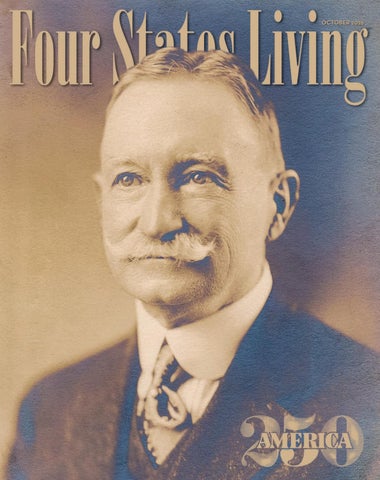
ON THE COVER OCTOBER 2026
Fred Offenhauser founded his insurance company in 1882 and, in the process, helped transform a young, precarious railroad town into a reliable community poised for growth. Nearly 150 years later, the Texarkana of today retains the marks of his influence—and that of other early Texarkanians. This month, in honor of America 250, we share stories of our city’s ancestors and longstanding institutions. A look back into Texarkana’s history starts on page 11.
TABLE OF CONTENTS
Early Texarkana From Risk Came Opportunity Farmers Bank and Trust Company The Four States Fair The Robbins Way From Three Graduates to 6,500 Tigers Making Space for Art Generations of Trust The First People
ALSO IN THIS ISSUE
12 16 22 28 34 40 46 54 60
The Way I See It—An op-ed piece from the publisher 6 How Area Cities Got Their Names 33 39 Bonnie and Clyde and the Grim Texarkana’s First European Settlement 50 A Walk Through Time 52 JFK on Broad Street 64
CONTRIBUTOR SPOTLIGHT For more than three decades, Jamie Simmons has dedicated her career to preserving and sharing the history of Texarkana and the surrounding region. What began as an unexpected internship at the Texarkana Museums System became a lifelong calling, leading to roles as museum assistant, curator, and public historian. Combining her backgrounds in history and art, Jamie has created exhibits, led tours, presented programs, and brought the community’s stories to life through artifacts, documents, and oral histories. Today, she serves as curator of the Nevada County Depot and Museum in Prescott while continuing her work with Main Street Texarkana, helping preserve the region’s past for future generations. 8
O C TO B E R 2 0 2 6 . fourstatesliving.com
O C TO B E R 2 0 2 6 . fourstatesliving.com
9
10
O C TO B E R 2 0 2 6 . fourstatesliving.com
If
you ask people to describe Texarkana, you will receive a multitude of answers. Most will begin with the fact that Texarkana is technically two cities, connected by a thriving State Line Avenue. Some will note the population, the local institutions, and maybe even the urban amenities paired with the smalltown culture. These answers get close to what Texarkana has become over its 153-year history. Texarkana is a regional center for health and medical services, commerce, education, and entertainment. We serve a population of over 350,000 from 18 counties who choose Texarkana as the ideal destination for shopping, dining, entertainment, business, and learning. On any given evening, take note of the vehicles parked around our city; you’ll easily find license plates from Texas, Arkansas, Louisiana, and Oklahoma. Texarkana’s greatest economic drivers are its defense contractors, tire manufacturer, and healthcare services, along with two paper mills, agricultural professionals, and hundreds of smaller businesses. Our hospital system services a population that
exceeds 350,000, making Texarkana the largest medical hub between Little Rock and Dallas. Our school districts provide exemplary educational opportunities to all of our city’s students. Texarkana College, Texas A&M University Texarkana, and University of Arkansas Hope– Texarkana provide higher education to thousands of students from several states. Our geographic location gives us access to the Port of Houston, the Port of New Orleans, and several river ports in a matter of hours. Residents and visitors also take advantage of the Texarkana Regional Airport and Amtrak to travel to and from the city. Whether you were born and raised here or moved here for education, work, or love, it is probable that you have never thought about the long history of this place— the land we live on, the birth of the city, the businesses that have weathered decades of once-unimaginable changes, the families who have built and rebuilt the community generation after generation. The history of our vibrant, complex city is vast, unable to be contained in a single publication. Still, this issue offers its readers a glimpse into the past, with a stronghold in the present and an eye to the future.
O C TO B E R 2 0 2 6 . fourstatesliving.com
11
EARLY TEXARKANA People from all walks of life built the city in which we now reside by JA M I E S I M M O N S
T
exarkana was a town in development for many years before being formally established by a sale of city lots on December 8th, 1873, the culmination of close to three decades of effort. At that time, the Cairo and Fulton Railroad hadn’t quite completed its lines into the townsite. In fact, very little in the way of actual preparations had been made beyond platting the original city. The railroad had, however, begun advertising the sale in newspapers across the country. This included Jefferson, Texas, a bustling port city that had turned away the railroad, believing that riverboats were still the way to go. Jefferson, as it turns out, was an incubator for the entrepreneurs and industrialists who would make up Texarkana’s early population. Among those who traveled from Jefferson to attend the sale was a businessman named Anthony L. Ghio. This 30-something father of four had immigrated from Italy as a teenager. He was a man of drive and vision who became the third person to purchase lots and, within 12
O C TO B E R 2 0 2 6 . fourstatesliving.com
hours of the sale, became the first person to begin building in the new city. Town lore states that Colonel Montrose, representing the railroad, used a large stump as an auction block. That stump was said to have been located on the state line, approximately where Union Station (constructed in 1929) is now standing. The first streets laid out were Front, Broad, and Clinton (now Third) Streets, all of which were laid parallel to the planned location of the railroad tracks. As expected, the cross streets were laid out perpendicular to these first three streets. It was all to be very normal and regulated, with square blocks and rectangular lots aligning to a grid. Then came Robert W. Rodgers. Also a man of vision, Robert Rodgers capitalized on the potential of owning lots on both the Arkansas and Texas side of the city. He began buying up lots along the state line, from Front Street to what is now Fourth Street. He eventually graded a few yards on either side of the line to create Texarkana’s most iconic street:
Anthony Ghio (left) was the third person to purchase lots in Texarkana. Soon after, Dr. James McMahon (right) recorded the minutes of the first meeting held to establish a city government.
This is the earliest known photograph of a church in downtown Texarkana.
This photo, taken near the turn of the century, shows a bustling Broad Street.
State Line Avenue. Since this street follows the state line, and due to the fact that the rest of the city was laid out on a grid, many oddlyshaped lots were suddenly littering downtown. One such lot is home to what is arguably the most historic building in Texarkana. The Offenhauser Building at 219 North State Line Avenue has held court over downtown Texarkana since 1879. The oldest portion, the center section of the first two floors, was built by W.H. Hakes, a Union veteran of the Civil War who traveled west like so many others to rebuild his life. He established the Bank of Texarkana on the first floor. The upper floor, which originally had a separate entrance accessible only by an exterior set of stairs, was rented out. In 1882, one of Texarkana’s oldest continuously operating businesses, Offenhauser Insurance Company, was established above Hakes’ bank. Fred W. Offenhauser purchased the entire building in 1894, and the company remained at that location until 1971, when it moved to a newer building on Pine Street. Several of the city’s “founding fathers” have been mentioned already, but what about the women? Good question. History is often told from the point of view of, as someone once put it, “old, dead white guys.” That’s often because they were the ones recording the stories, printing the news, controlling how history was remembered. Were there women at the first sale of lots? Many families attended the sale, so there were surely women. Who and how many, the formal histories don’t say. One of the earliest businesswomen was Lizzie O’Donnell, a seamstress and milliner who owned a shop on Broad Street in the 1880s. She was successful enough to have once owned the fabulous 1895 mansion on Pecan Street, now known as the Wadley House. There were many women of all walks of life in Texarkana in its early decades. Wealthy women, poor women, business owners, homemakers, women of different nationalities and ethnicities. Women were often the ones establishing churches, schools, and generally turning a wild new town into a thriving modern city. There were also madams who owned large, successful brothels. At one time, Front and Broad Streets were full of saloons and brothels right alongside mercantiles (or general stores), professional offices, and even churches. Lottie Belmont and Zoe LeRoy operated two of the most well-known “houses of assignation,” Belmont House and the Silver Dollar. Texarkana’s early history is full of personal stories of people looking to start their lives or start over. Immigrants from all over the world followed the call of opportunity and made Texarkana their home. Among them were the Kosminsky and Marks families, the first two Jewish families to settle in Texarkana. In 1875, the Kosminsky family owned a store on the rapidly growing Broad Street. The first services for what would become Mount Sinai Synagogue were held at Kosminsky Hall.
The Ensign Fountain was originally at 6th and State Line and was a spot where people gathered for conversation and to water their horses.
Featured on postcards, the Offenhauser Building at 219 North State Line Avenue was built in 1879. Kline Bakery was located in the heart of downtown in the 1890s.
O C TO B E R 2 0 2 6 . fourstatesliving.com
13
Scott Joplin was born around 1868 and grew up in Texarkana. He became one of America’s most important composers.
As motor vehicles began replacing horses and buggies in the early 1900s, dirt roads were challenging to navigate when muddy.
14
O C TO B E R 2 0 2 6 . fourstatesliving.com
By the 1880s, Texarkana was a miniature melting pot of different cultures. This atmosphere produced one of Texarkana’s most well-known citizens and one of America’s most important composers, Scott Joplin. Born in approximately 1868 in northeast Texas, Scott grew up in Texarkana. His story reflected that of many young Black people of the time. His father, a formerly enslaved man, moved the family to Texarkana in search of work. The Joplins were self-taught musicians, but Scott showed particular promise at an extremely young age. He learned folk songs from his parents alongside receiving a formal education in classical music. He was exposed to a variety of musical traditions brought to Texarkana by the many immigrants who made the city their home. All of these influences can be heard in Scott Joplin’s later compositions. His masterwork, the Ragtime opera Treemonisha, is set in this area, demonstrating the lasting impression Texarkana left on the brilliant composer. Scott Joplin may be the most well known, but there have been many other important musicians, composers, and performers from Texarkana. Among them were Lois Towles, Yetta Wexler, and Conlon Nancarrow, all of whom left indelible marks on the international music scene. Coincidentally, all of them were born in 1912. There are, of course, tens of thousands of stories about Texarkana that can be told. One hundred fifty-three years of ordinary and extraordinary events make up the Texarkana of today. Each story deserves to be told and remembered. What is your Texarkana story?
O C TO B E R 2 0 2 6 . fourstatesliving.com
15
FROM RISK CAME OPPORTUNITY Offering fire insurance in a town built of wood, Offenhauser Insurance was born in a young Texarkana and remains a pillar of the community today by JA M I E S I M M O N S
E
arly Texarkana was a Reconstruction-era town that seemingly sprang up overnight. Construction began on its first buildings within hours of the sale of town lots. In just a few months’ time, the town had expanded along 20 blocks and was growing fast. This building boom was possible thanks to the ready supply of lumber created as lots were cleared. All of the storefronts, public buildings, and residences were made of wood, which brought with it the threat of destruction by fire. By the time young Fred Offenhauser stepped off the train in the 1880s, Texarkana had been forced to rebuild several times after devastating blazes consumed huge sections of the young city. For years, insurance companies considered Texarkana a “hot spot” and refused to issue fire policies in the city—but where others saw risk, Fred Offenhauser saw opportunity. Fred, a 21-year-old Ohio native, was sent to Texarkana as an employee of C.E. Hayden and Company, when they opened Ben F. Smith Dry Goods (in the current Texarkana Gazette building). He moonlighted for the Best and Beard Insurance Agency, handwriting insurance policies, as he had excellent penmanship. He became acquainted with a cashier at First National Bank named Kelsey, who proposed they go into the insurance business together. In 1882, Fred launched the Offenhauser Insurance Company, then called Kelsey and Offenhauser. The company was founded in offices on the second floor of the Texarkana Bank Building, still standing at 219 State Line Ave. This location was one of the first brick buildings constructed in town, built in 1879 by W.H. Hakes. Fred Offenhauser purchased the building outright in 1894. As the only insurance firm willing to issue fire policies, Offenhauser grew as rapidly as the young city it served. “Texarkana was a railroad town [in the 1880s], and the railroad workers coming through town were burning the place down and having drunken bar fights and all that,” said Don Morriss, descendent of Offenhauser. “And Mr. Offenhauser said, ‘We need to do better than that. We need to clean up the town and be upstanding citizens.’ And part of the insurance business was standing behind what you promised. He said, ‘We’re going to stand behind our claims, even if we have to go borrow the money to 16
O C TO B E R 2 0 2 6 . fourstatesliving.com
A portrait of Fred Offenhauser taken in 1915.
take care of things,’ and so they got the reputation as a company that stood behind their promises.” Offenhauser Insurance Company represented numerous fire and liability insurance companies from across the globe. By the 1930s, Offenhauser was underwriting for such globally famous insurance marketplaces as Lloyd’s of London. In the 1940s, an officer of Offenhauser Company, Robert Maxwell, was part of the delegation that argued for, and won, the placement of Red River Army Depot in Bowie County, which provided a tremendous boost to the local economy. “[Offenhauser] paid his salary and put him on loan, sent him to Washington D.C. to work for the Chamber of Commerce to bring Red River Army Depot here, which is why the Maxwell Industrial Park has his name on it,” Don explained. Fred Offenhauser’s descendants have continued his commitment to Texarkana. In the late 1960s, his sonin-law and grandson, Josh Morriss Sr. and Jr., decided to build a modern building on Pine Street. They donated the original building for use as a museum. Thanks to their generosity, the Texarkana Historical Society and Museum was born. This iconic State Line Avenue building still stands guard over the original city and is a reminder of Texarkana’s growth. The “new” building on Pine Street has since become historic in its own right, and the Offenhauser Insurance Agency partners and officers once again filled a community need by donating this building to the Texarkana Regional Arts and Humanities Council for use as a makerspace. The Morriss family has produced three generations of C.E. Palmer Award winners, civic leaders, and community champions. Their commitment to community can be traced through the decades, from Fred Offenhauser’s extensive civic involvement to Josh Morriss Jr. spearheading fundraising efforts to preserve another iconic Texarkana building: the Saenger Theater.
Morriss brought childhood friend Ross Perot into the project. The two had been Eagle Scouts together, and, in his biography, Perot pointed to Morriss as his inspiration for attending the US Naval Academy; young Ross was impressed with the way Josh Jr. looked in his uniform, and the future billionaire wanted to follow suit. Thanks to Perot’s $800,000 contribution, the effort to restore this beautiful 1924 building was a complete success. It now bears the name Perot, in honor of Ross’ parents. A group of Boy Scouts poses in from of the Offenhauser Building in 1939.
“
After completing Cub Scouting, I joined the Boy Scouts. Troop 18 was sponsored by the Morriss family, who owned the Offenhauser Insurance Company. Our scoutmaster was Sam Shuman, who worked for the Offenhauser Company. One of my boyhood idols was Josh Morriss, Jr., the son of the owner of the Offenhauser Company, who lived down the street from us. The Morriss family represented all that is good in America. – H. Ross Perot, My Life and the Principles for Success
”
Known colloquially as the Offenhauser Building, Offenhauser & Co.’s original location was the first brick building in Texarkana. Built in 1879 by W.H. Hakes, the building originally housed the Bank of Texarkana. Offenhauser purchased it in 1894 and donated it in the 1960s for use as a museum. It is now the home of the Museum of Regional History.
O C TO B E R 2 0 2 6 . fourstatesliving.com
17
One of the most interesting community projects the Offenhauser Insurance company ever participated in involved a wedding on State Line Avenue and a house built in a day. In 1915, the Texarkana Board of Trade initiated a nationally famous publicity stunt that emphasized Texarkana’s “dual personality.” A real couple was chosen—a bride from the Texas side and a groom from the Arkansas side—to be married on the state line. The chosen couple, Brandon Gray and Irene Taylor, recreated their courtship on film (with plenty of creative license from the filmmakers), and the movie would end with their genuine marriage on State Line Avenue. Marriage licenses for the couple were granted in both Miller and Bowie Counties. (Technically, two ceremonies took place, one on each side of the specially-constructed dais, each presided over by an officiant from their respective states.) Filming took all day, and the resulting movie was shown in theaters across the country. The prize awarded to the couple was a new home, fully furnished and including all the modern utilities such as electricity, phone service, and indoor plumbing. The home, which still stands today on County Avenue, was built over an eight-hour period while the filming and wedding took place. By 5 p.m., Fred Offenhauser was handing over the keys to the couple. Offenhauser contributed a full year’s worth of homeowner’s insurance. 18
O C TO B E R 2 0 2 6 . fourstatesliving.com
During his term as president of the Texarkana Board of Trade, Fred Offenhauser led one of the most famous publicity stunts in Texarkana history. A couple was married on the Texas-Arkansas border, and their love story was turned into a motion picture. Filming took place over one day, during which a brand-new bungalow was built and furnished, to be gifted to the newlyweds. At the end of the day, Fred Offenhauser handed them the keys and granted them free home insurance for one year.
In 1971, Offenhauser & Co. moved into the 518 Pine Street office. Pictured here: Robert Maxwell, Ben J. Ellis, Lewis H. Arnold Jr., Jack Bruner, Joseph S. Morriss, Josh R. Morriss Jr., Sam Shuman, and Josh R. Morriss Sr.
In 2017, 46 years later: Philip Harbin, Derick Giles, Tom Wilson, Beth Sparks, Scott Bruner, Collins Bruner, Joseph S. Morriss, Steve Morriss, Josh R. Morriss Jr., Don Morriss, and William Morriss.
H. Ross Perot and his wife, Margot, came to Texarkana to attend the premiere of Judge Josh Morriss III’s show, Texarkana the Musical, at Silvermoon on Broad in September of 2011. Pictured left to right: Rita Morriss, Melanie Tkach, Ben Tkach, Martha Morriss, Ross Perot, Judge Josh Morriss III, Josh Morriss Jr., Patsy Morriss, Margot Perot, William Morriss, Diana Morriss, and Don Morriss.
Fred Offenhauser passed away in 1926 while attending a convention of the Texas Association of Insurance Agents in Galveston, still working in the field he loved. He was a charter member of the association and had served as its president, as well as president of the National Association of Insurance Agents. Today, Fred Offenhauser’s legacy lives on through his descendants, Don Morriss, William Morriss, and Steve Morriss. The company is largely still a family operation, made strong by both the owners’ differences and also their unifying dedication to bettering the community, à la Fred Offenhauser. “That’s the beauty of the partnership that we’ve had through the years,” William Morriss said. “We’ve got different angles, different aspects, different relationships, different community involvement organizations, different attitudes, different thought processes—and together, we’ve made it work.”
Don Morriss, now retired, and William Morriss, vice-president, have spent their careers in Offenhauser Insurance. Both attribute strong working relationships with family partners, business co-owners, and the community in remaining strong and relevant for over 150 years. Here, Don and William stand in front of the original Offenhauser sign that was featured on the first brick building in Texarkana. O C TO B E R 2 0 2 6 . fourstatesliving.com
19
20
O C TO B E R 2 0 2 6 . fourstatesliving.com
O C TO B E R 2 0 2 6 . fourstatesliving.com
21
FARMERS BANK AND TRUST COMPANY 120 years of community connections
F
armers Bank and Trust Company was founded in 1906 in Magnolia, Arkansas, by T.S. Grayson and Robert Warnock Sr. with a philosophy of serving their neighbors. The company started with $75,000 in assets, equivalent to approximately $2,782,500 in 2026 dollars. Since its founding, the bank has reinforced its founding philosophy by heavily investing in the communities it serves. “The ethos of the company has always been that banking is about relationships,” said James Bramlett, Texarkana market president. “We serve our neighbors, local businesses, schools, and nonprofits, not just accounts. When the community succeeds, we all succeed.” When FBT opened, the primary focus was providing deposit services to the farmers, 22
O C TO B E R 2 0 2 6 . fourstatesliving.com
by JA M I E S I M M O N S sawmill employees, and working-class families of Columbia County. Neither Grayson nor Warnock had extensive formal education, which makes the success of the bank even more impressive. The former was an acknowledged “math whiz,” and the latter served as the company’s front man until 1916, when Warnock was elected to the state legislature. At that time, Grayson stepped into the lead role and served for 33 years. Grayson’s tenure as bank president included guiding the company through its first real test: the Great Depression. In spite of the failure of many larger, more established banks, Farmers Bank and Trust remained open. At one point, FBT was one of only a handful of banks to remain open in the state of Arkansas. The only time the bank closed was due to a federally mandated bank holiday.
“
We believe there is still significant opportunity to grow, both in the communities we already serve and in markets where we are still relatively young. – Chris Gosnell
”
Cofounder T.S. Grayson served as bank president for 33 years, including through the Great Depression.
Farmers Bank & Trust was founded in 1906 in Magnolia, Arkansas.
“
Cofounder Robert Warnock Sr. served as president of the bank for 10 years, until he was elected to the Arkansas State Legislature in 1916.
Mr. Grayson and Mr. Warnock would be amazed and proud to see what their small community bank has become 120 years later. I think what would mean the most to them is that the heart of the bank has never changed. What they started as a small act of service has become a legacy of family, trust, and commitment that reaches far beyond what they could have imagined.
”
– Molly Burns
Farmers Bank & Trust in Magnolia, Arkansas, has undergone several remodels since its founding.
“In 1933, President Franklin Roosevelt temporarily closed the nation’s banks to stop the panic and prevent bank runs,” explained Molly Burns, the great-granddaughter of the founders. “Farmers Bank’s doors were physically closed, but Mr. Grayson stood outside the front door with saddlebags full of money. He told customers that if they needed their money, he would give it to them. He also told them something even more important: he was keeping his own money in the bank, and he would protect their money just as he protected his own.” After weathering the financial crises of the 1930s, FBT forged ahead into the modern era. Throughout the 1940s and 50s, it continued to evolve with the community. This included hiring the first women to work at the company. During this time, Robert Warnock’s son, Bob, took the helm. In an almost movie-like twist, Nina Grayson, daughter of T.S. Grayson, married Bob Warnock. Their descendants are still leading the bank today.
Farmers Bank and Trust remained a local bank until the 1990s, but the groundwork for expansion began in the 1980s under the leadership of Bob Burns, grandson-in-law of the founders (Molly’s husband). Bob joined FBT in 1980 and was elected president in 1983. Under his leadership, FBT made several changes that allowed the bank to begin the evolution from a small community bank to the multi-billion dollar regional institution it is today. Those changes included updating technology and expanding banking products and services offered by FBT. In 1998, FBT began its first expansion by acquiring the First Nations Bank in Camden, Arkansas. From there, the steady expansion continued to include locations across Arkansas, Oklahoma, and Texas. This gradual expansion included Texarkana’s first branch in 2012. The most recent locations opened in Anna, Texas, located in the north DFW area. “We have about $3.15 billion in assets today with 34 locations across Arkansas, Northeast Texas, and Southeast Oklahoma, and we believe there O C TO B E R 2 0 2 6 . fourstatesliving.com
23
is still significant opportunity to grow, both in the communities we already serve and in markets where we are still relatively young,” said Chris Gosnell, bank president. He shared that his vision for the future of the bank is “bigger, but the same at the core. The way people bank will continue to change, but what I do not want to change is the reason people choose Farmers Bank & Trust: so that they can have a relationship with people who know them and so that decisions can be made by people who understand their communities.” Chris (married to Rebecca Burns) was elected as bank president, CEO, and chairman of the board in 2017. In 2020, Elizabeth Burns Anderson, daughter of Molly and Bob, became senior vice-president. She also serves as the executive director of the Farmers Bank Foundation. “Giving back has always been part of who we are, but the foundation allows us to be more intentional and impactful in how we serve,” Elizabeth said. “We don’t just want to write checks. We want to build partnerships, provide resources, and help nonprofits strengthen their ability to fulfill their missions. We support schools, municipalities, veterans, community organizations, and initiatives that contribute to the overall economic strength and quality of life in the communities we serve.”
“
Giving back has always been part of who we are, but the foundation allows us to be more intentional and impactful in how we serve. – Elizabeth Burns Anderson
”
Farmers Bank & Trust expanded into Texarkana in 2012.
24
O C TO B E R 2 0 2 6 . fourstatesliving.com
Bob Burns (1944-2024)
Molly Burns
Elizabeth Burns Anderson
Chris Gosnell
“
Farmers Bank & Trust was named Best Bank in the 2026 “Best of Texarkana” competition. James Bramlett, former mayor, is the Texarkana market president.
Mr. Bob Burns, our former president, believed Texarkana was an important community where Farmers Bank & Trust could build lasting relationships and make a meaningful impact.
”
– James Bramlett
James Bramlett, FBT’s Texarkana market president, also has deep local roots. His family’s connections stretch back to Texarkana’s boom days, when his great-grandfather arrived to work with the Texas and Pacific Railroad. Bramlett grew up here, earned his college degrees here, and even served 10 years as mayor and two years as a city council member. He has worked with the Chamber of Commerce, CHRISTUS St. Michael Health System, and the Four States Fair, and he has been the board chairman of the A&M Alumni Association. Bramlett has also served for 20 years on the Pleasant Grove Education Foundation. As market president, he has overseen the growth of FBT’s Texarkana locations from one branch with five employees to the current four branches with 85 employees. “Mr. Bob Burns, our former president, believed Texarkana was an important community where Farmers Bank & Trust could build lasting relationships and make a meaningful impact,” James said. “His decision to establish a presence here represented a long-term commitment to the people and businesses of Texarkana.” Through all of the expansion and the journey into the future, Farmers Bank and Trust has always held onto its founding principle of “know your customers, invest in your community and help your neighbors succeed.” O C TO B E R 2 0 2 6 . fourstatesliving.com
25
26
O C TO B E R 2 0 2 6 . fourstatesliving.com
O C TO B E R 2 0 2 6 . fourstatesliving.com
27
THE FOUR STATES FAIR
A tradition built by generations by D R . R O B I N R O G ER S
T
he Four States Fair wasn’t built by one person. It was built by generations of local people who treated it almost like a family responsibility—people who showed up, worked hard, passed along what they knew, and, when their time came, handed the reins to someone else. That may be the best way to understand how an event that began in 1945 has become such a lasting part of Texarkana. The official story begins at Spring Lake Park, where the Four States Fair & Rodeo was chartered and organized on March 6th, 1945. Even then, the idea of a regional fair and rodeo was already familiar to local residents: there are records of a “second annual rodeo” held on September 19th, 1941, at Texarkana Baseball Park. Sponsored by the Four States Livestock Association, the event featured bronc riding, bulldogging (steer wrestling), calf roping, and bull riding. Between the competitions, a performer named Charlie Schultz entertained the crowd with trick riding, fancy roping, and other stunts. According to longtime local memories, there also may have been an unofficial fair held in the College Hill area before the organization of the Four States Fair. Lisa Garner, the fair’s executive director, has heard those stories from people who remember Texarkana in the 1940s. But 1945 was when things became official for fun in Texarkana. The war was over, and Texarkana was ready for something to celebrate. The first official Four States Fair & Rodeo opened at Spring Lake Park on October 9th, 1945. The occasion began with a downtown parade that wound through the two Texarkanas, complete with rodeo horses, highway patrolmen, school bands, fire department equipment, Boy Scouts carrying 28
O C TO B E R 2 0 2 6 . fourstatesliving.com
In 1945, the first Four States Fair & Rodeo was opened in Spring Lake Park. Here Teresa Fumagalli assists the organization’s first president, Judge E. Harold Beck.
the flags of the United Nations, Girl Scouts, and civic groups. It was a grand beginning for what organizers hoped would become a permanent regional institution. The fair drew enormous crowds almost immediately. In its inaugural year, more than 10,000 people passed through the gates on opening day, followed by thousands more during the week. Organizers had expected more than 50,000 visitors, but the crowds were large enough to create traffic problems and require additional ticket and office workers. The road into Spring Lake Park had been paved only a month earlier. Extra buses ran from downtown every 20 minutes, and people arriving by car could park inside the fairgrounds for 25 cents. The fair was entertainment, certainly, but it was also intended to be something more. Agriculture was at its heart. Livestock competitions brought in respected judges from throughout the country, and agricultural exhibits gave local farmers an opportunity to see what their neighbors were producing. Between 1945 and the mid ‘60s, the fair was a place to learn, compare, compete, and go home with new ideas. People eagerly anticipated the early fall, when the amusement park rides began going up in Spring Lake Park, and people gathered everything from artwork and canned goods to prized animals for competition. As Texarkana grew, so did the fair. Eventually, the very infrastructure designed to connect the region changed the fairgrounds forever. In 1967, Interstate 30 cut through Spring Lake Park. According to a historical marker, construction of the interstate substantially reduced the amount of land
During the golden era of daredevil entertainment (1970s), a motorcycle stuntman practices jumping cars.
For decades, the fair celebration began in downtown Texarkana with a grand parade connecting the two states. It included marching bands, floats, antique automobiles, horses, Shriners, and civic organizations.
From 1945 until 1984, Spring Lake Park was home to the Four States Fair and Rodeo. This view captures the rodeo arena with the landmark Texarkana water tower standing in the background.
Once the sun went down, music and dancing provided a different kind of entertainment during early fairs. Square dancing was wholesome, social, and very much part of the fair’s culture.
“
her daughter, Danette Perkins, followed her mother, available in the park and changed the character of the When we devoting 38 years to the organization. And then came grounds. Even while people had grown accustomed started in 1945, the Danette’s daughter, Lisa Barr Garner. to Spring Lake Park being the location of the annual original idea was Lisa’s relationship with the fair started long before event, the writing was on the wall. By the mid ‘70s, all she had a title. She was first a little girl answering realized that the Four States Fair needed a new home. to put agriculture, phones and helping wherever she could. Lisa grew In 1979, 104 acres west of Loop 245 and south of education, and up around the fairgrounds, watching her mother and I-30 were deeded to the fair for relocation, including community grandmother work, learning piece by piece how the a substantial amount of acreage for parking. Building organization functioned. Today, Lisa is approaching on this property would give organizers more room together. 30 years of leadership with the fair and serves as the for events and parking—and a chance to grow into – Lisa Garner CEO, overseeing the operation and most of the events the future, with endless year-round opportunities. In that take place on the grounds throughout the year. the 1980s, the Four States Fair moved to what is now These three generations of strong women equaled over a century of Bobby Ferguson Park. One of the earliest documented leaders was J.A. Whyte, who served as combined family connection to the fair. Many others helped Lisa as she president when the organization was established in 1945. By 1948, local grew to her current position. Dwight Duncan, a longtime director and newspapers reported changes in the organization’s leadership, including former leader of the fair, looked out for and helped Lisa learn the business Judge E. Harold Beck succeeding Whyte as president. Over the decades, during the 2000s. Even now, when Lisa has a question that her mother other names became part of the fair’s history. By the 1970s, Marion Reed or grandmother can’t answer, Dwight is her “go-to” person. Institutional was identified as the fair’s general manager. In 1971, Betty Nix came to knowledge hasn’t been simply written down in a manual and handed over; work at the fair to help out her friend, Marion—and that is where one of it has passed from one generation to another. Lisa inherited an organization with a tremendous history, and she has the most remarkable family connections in the fair’s history begins. Betty spent 51 years working with the Four States Fair in a leadership role. Then helped expand what the Four States Fairgrounds means for Texarkana.
”
O C TO B E R 2 0 2 6 . fourstatesliving.com
29
Ida Lou Ames served as the home arts director from the very beginning. The Ida Lou Ames Home Arts Building was named in her honor.
Left: The fairgrounds became an ice rink for the Border City Bandits in the early 2000s.
Nothing says fair-time excitement quite like a demolition derby. Right: Cynthia Rutherford-Stone painted and showcased her depiction of rodeo clowns well-known to Texarkana: Ronnie and Donnie Sparks. Far right: In a breathtaking spectacle of balance, skill, and showmanship, a daring performer takes the reigns while Roman riding. Far left: The arena/ entertainment center opened in 1985 and gave the fair the ability to bring in bigger performers, such as George Jones in 1992. Middle: CEO Lisa Garner is the third woman in her family to run the fairgrounds. Here she is pictured with her grandmother Betty Nix and mother, Danette Perkins. Behind them stand Lisa’s husband, Paul, and son, Dawson. Left: A symbol of the annual 10-day fair Ferris wheel lights up the night sky.
The annual fair and rodeo, which draws 100,000 to the region each spring, is only one aspect of the organization. Events such as barrel racing, roping, cutting, and other horse-related competitions bring competitors and spectators throughout the year. The fairground complex includes a 70,000-square-foot arena with 4,794 permanent seats, a fine arts building, and an agricultural learning center. The property hosts entertainment events, competitions, community gatherings, and educational programs through every season. That expansion is one of Lisa’s most important contributions to the fair’s continuing story. “My goal was to make the property useful 365 days a year,” she said. “When we started in 1945, the original idea was to put agriculture, education, and community together. Over the years, we have implemented that plan, and the original founders would be amazed at what happens 30
O C TO B E R 2 0 2 6 . fourstatesliving.com
here year-round. Today, we have a fair, a rodeo, livestock shows, an equine center, youth programs, an ag learning center, community events, and a lot of entertainment.” In 2026, the organization is much more than the annual 10-day event. It has survived changing times, an interstate highway, a relocation, and generations of change. Programming has broadened because the community’s needs and interests grew. And through all of it, generation after generation kept showing up. That’s how community institutions survive—not simply because someone wrote down their history, but because somebody cared enough to learn it, and somebody else cared enough to carry it forward. Generations of Texarkanians grew up with the fair. Thankfully, the next chapter is being written by Lisa Garner and a group of people who respect the past as they plan for the future.
WHERE THE FARM
MEETS THE CLASSROOM W
hen the Four States Fair began more than 80 years ago, agriculture was a familiar part of everyday life. Many families had direct connections The Ag Learning to farms, livestock, and the people who produced Center offers their food. Today, that connection is not always as year-round educational obvious to children. That is where the Four States programming Fair Ag Learning Center comes in. for children and Opened in 2006 as the first facility of its kind families. in Arkansas and the four states region, the Ag Learning Center provides year-round, hands-on agricultural education for children and families, and the educational programs are free. “We’re really a year-round agricultural classroom,” said Kristen Larey, director of the Ag Learning Center. “We welcome school groups, childcare centers, homeschool groups, summer programs, and other youth organizations throughout the year, and our goal is to make Former classroom teacher Kristen Larey is agriculture understandable and exciting for the director of the Ag Learning Center. children.” Kristen brings a teacher’s perspective to the job. She has a degree in education and spent years Helping students understand the connection between agriculture in a traditional classroom before becoming director. learning and real-world applications is important to Kristen. “I don’t want children to simply walk through and look at displays,” “I want children to understand that a hamburger doesn’t begin at a she said. “I want them to touch, explore, ask questions, make something, restaurant, catfish doesn’t begin on a dinner plate, and food doesn’t begin and experience agriculture for themselves.” on a grocery store shelf,” she said. “There are people, animals, crops, The lessons change throughout the year and cover everything from natural resources, science, and an incredible amount of work behind what crops and livestock to pollination, soil, food production, and agricultural bywe consume every day.” products. Children learn about beef cattle, soybeans, corn, grain sorghum, The Ag Learning Center was a natural addition to the Four States Fair catfish, dairy, poultry, and natural resources, all while discovering how in 2006. Agricultural education had long been part of the Four States Fair agriculture affects their everyday lives. One of the center’s most popular from its earliest days. The original fair gave farmers and stockmen a place experiences is its milking simulator, which gives children an opportunity to exhibit their livestock and crops while allowing visitors to see, learn, and to try something many have never experienced firsthand. discover new agricultural practices. The Ag Learning Center carries that “For many children, their understanding of agriculture begins and tradition into the present. ends with the grocery store,” Kristen said. “The fair has always provided a place where our community can The center helps children make the connection between the come together and experience agriculture,” Kristen said. “The Ag Learning products they use and the agricultural industry behind them. They learn Center allows us to carry that mission beyond fair week and make it a yearthat agriculture isn’t simply about growing crops or raising livestock. round experience.” It encompasses science, technology, transportation, business, food The fair’s buildings, exhibits, and entertainment have changed production, and a wide variety of careers. considerably since 1945, but the idea that agriculture is something worth “We want children to understand that you do not have to own a farm seeing, understanding, and celebrating remains. to have a career in agriculture,” Kristen said. “There is a place in agriculture “We are connecting children to the agricultural heritage this for so many different talents.” organization was built around while also showing them what agriculture A child interested in animals might someday become a veterinarian or looks like today—and what it may look like in their future,” Kristen animal nutritionist. Another who enjoys science might pursue agricultural explained. “We are honoring where we came from while preparing children research or food science. Others may find opportunities in engineering, to understand where agriculture is going.” equipment technology, transportation, marketing, or education. O C TO B E R 2 0 2 6 . fourstatesliving.com
31
32
O C TO B E R 2 0 2 6 . fourstatesliving.com
HOW AREA CITIES GOT THEIR NAMES H. Pope Briley (1875–1970) was a pioneer real estate dealer in Texarkana. At various times, he served as president of the Chamber of Commerce, president of the Public Library, president of the Rotary Club, president of the Community Chest, and president of the Boy Scout Council. Around 1950, he made this interesting study of the towns, tracing some back through several changes in names which occurred over the years.
Most of the towns and villages in Bowie County were named for the pioneers who helped found them or for the families who owned the land originally, according to a study of the origin of names of towns in the county made by H.P. Briley. Nash was first named Park after J.N. Parker. Later it became T.C. Junction because the main line of the T&P Railroad and the Transcontinental division met there. The name was finally changed to Nash after Mannie Nash, who was division superintendent of the railroad. Midway was so named because it is half-way between Nash and Leary, and Leary County, where the present courthouse is located. Leary was named for Dan T. Leary, an attorney in Texarkana who owned a farm where Leary is located. Hooks was named for Warren Hooks, who owned a farm or plantation where the town is located, and Whaley was named for the Whaley family of Marshall, Texas, who owned a large farm there. Boston was named for W.J. Boston, who was the first storekeeper in that area. What is now called Old Boston, was located four miles south of present New Boston. When the railroad came some time in the 1870s, many of the Boston population moved to New Boston. In 1887, the courthouse burned, and an election was held which
resulted in the county seat being moved to Texarkana. In a later election the county seat was moved to the present Boston, the geographical center of Bowie County, where the present courthouse is located. Malta was named by Lynn Tucker because he came from Malta, Ill. DeKalb was named for Baron DeKalb, a German, who became an American general in the Revolutionary War. His name has been given to many places in the United States. Wake Village was patriotically named for Wake Island during World War II. Redwater was first named Ingersoll. E.T. Page, a merchant, and others were opposed to their village having the same name as the noted “infidel,” Robert Ingersoll. It was changed to Redwater because of the color of water in springs nearby. Maud was named after Maud Springer, whose family lived nearby, and Corley was named for Corley Turner, a relative of Maud Springer and of W.J. Springer, who was at one time fire chief of Texarkana. Carbondale was named after coal or lignite, which were found there. Simms was named for G.W. Simms, who seems to have established the first post office there. Harvey Simms and Lem Simms, brothers, owned several thousand acres adjoining the village. Dalby Springs was named for Warren K. Dalby, who came from Tennessee in 1839 and settled there. He first owned the spring. Bassett was named for J. Bassett, who owned the land on which Bassett is located. There is no record on how Oak Grove and Springhill got their names, but my guess would be that Oak Grove was named for the trees there, and Springhill because there was a spring somewhere near.
New Boston was created in 1877, when businessmen in the area realized the T&P railroad missed Boston by 4.5 miles. Seen here is the dedication of the New Boston Railroad on June 22nd, 1983.
O C TO B E R 2 0 2 6 . fourstatesliving.com
33
THE ROBBINS WAY Through 60 years of ups and downs, the Robbins Toyota team has run on a simple ethos: do the right thing by EL L EN O R R
T
Susan Robbins took ownership of Robbins Toyota after her father, Eddie, died in 2014. Soon after, she hired Charles Pankey, general manager. 34
O C TO B E R 2 0 2 6 . fourstatesliving.com
he story of Robbins Toyota begins with founder Eddie Robbins, who grew up the son of a used-car dealer. He graduated from the University of North Texas, with plans of becoming a banker. He and his young bride, Janis, even moved to Dallas so he could pursue that career—but the call of automobile sales beckoned. “It was in his blood,” said Janis Robbins, Eddie’s wife of 53 years. “He would bring cars from Texarkana to Dallas, advertise, and sell them.” Soon, Eddie and Janis returned to Texarkana to work at, and eventually purchase, his father’s business, Robbins Motor Company, which was located at 4601 Texas Boulevard. In addition to selling preowned vehicles, he was also an American Motor Company dealer—and a very successful one: in 1965, AMC awarded him an all-expensespaid trip to the Bahamas in recognition of his sales volume. The weeklong vacation was more pivotal than anyone could have predicted. “We met a guy from California who was in the Toyota business,” Janis recalled. “He said it was brand-new in the United States.” Eddie became interested and, upon research, discovered that the Japanese manufacturer was charging virtually no franchise fees in order to encourage growth in the American market, which was still gripped with anti-Japanese sentiment post–World War II.
Eddie Robbins, pictured here in the 1980s, was known as a hands-on owner, spending his days at the dealership until his passing in 2014.
In 1965, as a dealer for American Motors, Eddie won a trip to Nassau, the capital of the Bahamas. On that trip, he learned about Toyota, which changed his life.
Susan, Eddie, and Janis pose for a photo at the 2011 grand opening of the dealership’s current location on Mall Drive.
“The story that [Eddie] told me was that the cost of getting into the franchise, once you were approved, was buying the sign for $960,” said Susan, Eddie’s daughter and the current dealer. Despite local and national prejudice, Eddie believed in Toyota. He founded Robbins Toyota in 1966. The dealership remains today the secondoldest Toyota store in Texas. Sales were hard to come by in the early days. “The first several cars that were sold were sold to close friends,” Janis said, “and then it was a long time before he sold another.” However, by the 1980s, Toyotas had gained the reputation they hold today—as some of the most efficient, reliable vehicles on the American market. By the late ‘80s, the store had outgrown its Texas Boulevard location. In 1986, they relocated to Summerhill Road, where they remained until 2011. Today, the store is located in Nash, Texas, on Mall Drive. During both the highs and lows, Eddie personally thrived as a dealer. “Eddie loved it,” Janis said. “He came early and stayed late. It wasn’t work to him.” O C TO B E R 2 0 2 6 . fourstatesliving.com
35
“
Eddie loved [being a dealer]. He came early and stayed late. It wasn’t work to him. – Janis Robbins
”
Until his death in 2014, Eddie spent his days at the dealership, cultivating the business’ reputation as a hometown operation, where shopping locally is rewarded and the presiding ethos is to “do the right thing.” “Eddie had a certain way of doing business,” Susan said. “He believed in doing business the right way and taking care of your customer. I think that’s why we’ve always stayed who we are. If you do things the right way, people continue to come back, and they continue to support you.”
Right: Robbins Toyota related to their Summerhill location in 1986. Below: Eddie Robbins received the distinguished Toyota President’s Touch Award in recognition of his leadership and operational excellence.
36
O C TO B E R 2 0 2 6 . fourstatesliving.com
Charles Pankey, the current general manager, shared that, though he never met Eddie, the founder’s legacy was apparent to him from his first interview. “When I first interviewed with Susan, she said two things that were the most important thing to her,” he recalled. “One: I had to live in the community. The second thing she said was, ‘I don’t want any of that big Dallas nonsense in my store.’ She said, ‘I live in the community, I eat in the community, I shop in the community, I’m
on several boards. I’m not going to be out in the public and hear that my stores are not running properly.’ If someone just bought a car and there’s a problem a week later, a lot of dealerships will go, ‘I’m sorry, you just bought the car; it’s as-is.’ She told me just to do the right thing [and help them]. ‘You don’t have to justify, you don’t have to make excuses. You just do the right thing.’” Susan, a graduate of Southern Methodist University, spent nearly 20 years establishing a career in financial services in Dallas. But, like her father, she always felt drawn to the car industry. She always intended to take the reins of the store one day. In 2014, when her father became ill with cancer, she discovered that that day might be sooner than she expected. Eddie endured a short illness and died on May 28th, 2014. Mere days prior, he had spent Memorial Day Weekend at the lake with his family, unaware that it would be his last holiday. During that gathering, Susan told him that it was time he prepared her to be his successor. He demurred; she persisted. Finally, he told her that the car business was “a man’s world.” “That didn’t go over real well,” Susan said. “I realized later that he was trying to protect me. I did remind him that I was already in a male-dominated field, and I was used to the environment.” As Eddie correctly predicted, since stepping into the automotive industry, Susan has faced hardships that a man, perhaps, would experience differently. The first of the hurdles was becoming a Toyota-approved dealer as someone who had no formal experience in the car business. The process took several years, and lawyers were involved. Janis recalled one attorney in particular referring to her and Susan as “that lady and her little girl.” “It was real frustrating to sit across the table from Toyota [representatives], where your father has built a great legacy, and them tell you no,” Susan said. “I felt like what they were trying to do wasn’t right. I told them that, if I couldn’t [run the store successfully] and was going to be a detriment, I’d be the first one to throw in the towel—because the last thing I wanted was to tarnish the Robbins name or ruin what my dad had built. I was just asking for a chance.” After a long battle, Susan and Toyota entered into a temporary dealer agreement; over three years, Susan’s store needed to increase one of its metrics—called “sales efficiency”—to 100%. “I was confident that, under my leadership, and with the staff that was already here, we could get to where we needed to be,” Susan said. The store hit 135% sales efficiency in just one year. Though COVID and other shifts in the economic climate have proven challenging for Susan, Charles, and the rest of the team, through it all, Susan thrives—just as her dad did for so many years.
“Susan will come in, and she’ll see customers and go to service. She’ll sit down and talk to them. She has customers call her personally to buy cars. There aren’t too many owners who go into the showroom and talk and work deals with customers,” Charles said. Susan laughed, adding that her hands-on approach sometimes “freaks out” her GM. “Charles nearly dies if I go out to wait on a customer,” she said. (“It makes me think someone’s not doing their job!” Charles interjected.) “But that’s what my dad would do.” Under the leadership of Susan and Charles, Robbins Toyota has not just maintained its status as a local bedrock; it has, in fact, expanded its community reach. For four consecutive years, they have held their Attend and Win Giveaway, which is open to all students who have maintained perfect attendance through their senior years. The lucky winner receives a brand new Toyota vehicle. Relatedly, since 2023, Robbins has annually awarded area educators with free one-year leases on new vehicles. In addition to the vehicle, Teachers of the Year from area districts (Texarkana ISD, Texarkana Arkansas School District, and LibertyEylau ISD) receive one free tank of gas, one free car wash per month, and free vehicle maintenance throughout the year. “A great Susan quote is, ‘There’s no better way to invest in the community than to invest in the future of the community,’” Charles said. “I think that is ‘doing things the right way.’”
“
Charles nearly dies if I go out to wait on a customer. But that’s what my dad would do. – Susan Robbins
”
Above: For four years, Robbins Toyota has held the Attend and Win Giveaway for students with perfect attendance through their senior year.
O C TO B E R 2 0 2 6 . fourstatesliving.com
37
38
O C TO B E R 2 0 2 6 . fourstatesliving.com
BONNIE AND CLYDE
AND THE GRIM The fact that Texarkana straddled two states made it an appealing place for those on the wrong side of the law. In the early days of the city, Texas and Arkansas operated under separate jurisdictions, and criminals could exploit that invisible line between the two states. A crime committed on one side could create frustrating complications for law enforcement on the other. It helped give Texarkana a reputation as a place where a little Wild West lawlessness could flourish. According to the long-told Texarkana story, Bonnie (Parker) and Clyde (Barrow) stayed at the Grim Hotel in 1934—the same year they were killed in Bienville Parish. The legend says that the gang robbed Texarkana National Guard Armory in days before they were finally captured, riddled with bullets in Louisiana. Bonnie and Clyde and the “Barrow Gang” were notorious bank robbers, thieves, and killers during the Great Depression. Whether every detail of the tale has survived intact is part of the folklore, but their connection to the Grim Hotel and Texarkana has become woven into the colorful history of a town that has always had one foot in Texas and the other in Arkansas.
O C TO B E R 2 0 2 6 . fourstatesliving.com
39
Texas Senior High School faced Pine Street in 1930.
FROM THREE GRADUATES
TO 6,500 TIGERS
I
More than 130 years of growth, change, and perseverance have transformed Texarkana Independent School District from a tiny school system into a thriving district
f the walls of Texarkana ISD could talk, they would have one heck of a story to tell. They could tell us about three teenagers who made up one of the district’s earliest graduating classes. They could tell us about boys who left high school to serve in World War I, World War II, and the Korean War, sometimes never returning to finish the diplomas they had started. They could tell us about football games that could turn an ordinary Friday night into a citywide event, and about a school system that spent decades wrestling with segregation before finally bringing Black and white students together. And, if those walls were particularly nostalgic, they might tell us about a remarkable piece of ground on Pine Street that has been a high school, a junior college, and a junior high school, and is now a gleaming new elementary school. That is the story of the Texarkana Independent School District. TISD traces its history to 1889, when Texas High’s earliest graduating class was taking shape. Texarkana was still a young railroad town, and public education was growing right along with it. One of the earliest classes was so small that the names of its graduates are still known: Eugenie Reid, Nina Trigg, and Jack Trigg. By the early 1900s, Texarkana was growing too large for the little school buildings of the previous century. In 1909, the school board purchased four acres from Mr. and Mrs. John S. Casey on Texas Boulevard (then Maple Avenue at West 16th Street). That property became the educational heart of Texarkana for generations. Texas High moved there, and the campus continued to evolve. In 1927, Texarkana decided it needed something more than a high school. It needed a college. Enter Dr. Henry W. Stilwell. Stilwell was 40
O C TO B E R 2 0 2 6 . fourstatesliving.com
superintendent of TISD at the time and became the first president of Texarkana Junior College, (serving in both roles simultaneously). The new junior college was established on the Pine Street property right next to Texas High, and the two institutions shared facilities, including laboratories and a gymnasium. For a time, a Texarkana teenager could walk from high school to college without leaving campus. Texarkana College moved to its Robison Road location in 1953 and formally separated from TISD in 1957. In 1955, 92 Black parents and students petitioned TISD to integrate. The school board acknowledged the petition but made no moves to end segregation throughout the district. At the time, Dunbar High School was the center of Black education in Texarkana. The school produced generations of accomplished community leaders, including George Moore, Dr. Joyce Armstrong, and Melvin Bradley. A full decade after Brown v. Board of Education, the district adopted a “freedom of choice” plan—what some saw as a step toward integration—but the district remained practically segregated. The truly consequential change came in 1968, when TISD submitted a plan to the federal government that would close Dunbar as a senior high school and send students of all races to the new Texas Senior High campus on Kennedy Lane, which had opened the year prior. The district’s own records show just how separate the schools had been at that time: Texas High had 1,127 white students and 71 Black students, while Dunbar had 744 Black students and no white students. By 1969, TISD was moving toward a fully integrated system, but integration was more challenging than the school board changing attendance zones.
The first Texas High School photographed in 1889.
A class at Highland Park Elementary in 1925.
Clearing the land for the first Texas High School. This location is now Parks Elementary School.
Texas High School around 1910.
Mrs. Plant’s class at Dunbar School in 1900.
Dunbar School East was one of the earliest Black schools in the area for African Americans.
A Texas High class poses on the front steps, circa 1920s.
Texarkana Junior College’s first building was on the same campus with TISD (at the Pine Street location). This building faced W. 16th Street.
A Texas High School bus from 1946. O C TO B E R 2 0 2 6 . fourstatesliving.com
41
In February 1971, Bob Ingram, the Texas High band director, announced that he was opening up two majorette spots for Black girls. This led to large-scale protests on campus in which hundreds of students were caught up in racial tension, suspensions, and disciplinary hearings. More than 200 students were initially suspended, and parents sued the district. Despite these growing pains, the district persisted; also in 1971, biology teacher George Moore entered Texas High School in its new prized location on Kennedy Lane at Summerhill. Moore had experienced segregation as a Black student, so coming to work in a recently integrated high school was a bridge between two eras of the district’s history. As a Black educator, Moore understood the significance of students seeing someone who looked like them at the front of the classroom. Over 48 years with TISD, Mr. Moore’s influence continued into administration as a principal and assistant superintendent who shaped the lives of students and community members. Today, TISD proudly serves a diverse student body, providing a firstrate education to students from all backgrounds. While Texas High School grew at its new location, the original Pine Street campus was left with a gymnasium, a library, and original facilities from the early 1900s. Pine Street Junior High School, later called Pine Street Middle School, served students in that location until the district opened Texas Middle School on College Drive and the original campus was finally shut down in 2002. Right: Educational giant Professor Beecher A. Jackson, a graduate of Fisk University and Harvard University Law School, accepted the principalship of Dunbar in 1916. He proposed changing the school’s name from Central, which was in conflict with the white school of this vicinity, to Dunbar. Far right: Andrea Hopwood was a majorette in the 1971–72 school year. Below: Dunbar High School operated for over 100 years. Principal A.E. Alton led the school for 36 years. Alton served Dunbar through the years of segregation; today, streets near the school are named for him.
42
O C TO B E R 2 0 2 6 . fourstatesliving.com
Two couples from the Texas High Class of 1973 visit in front of the Kennedy Lane marquee.
Today, that original school property on Pine has come full circle. Thanks to many citizens who toured all of the district facilities and helped pass a $189 million bond in 2022, 1915 Pine Street is now home to Parks Elementary School, a state-of-the-art elementary campus designed around leadership and college/career preparation. The property that once educated teenagers and college students is now home to kindergarten and elementary classrooms. Also thanks to that historic bond (voted for by the taxpayers) the historic Dunbar School has a new life, too. The Paul Laurence Dunbar Early Education Center, opened in 2025, is a modern early-childhood facility designed especially for the hundreds of 3- and 4-year-old students it serves. Further, bond dollars have transformed facilities across the system. Nash Elementary has received incredible renovations. At Texas High, the bond is funding major career and technical education renovations and new state-of-the-art learning environments designed for workforce training and dual-credit opportunities. Right: Over the years, Mr. George Moore served TISD as a biology teacher, assistant principal at Westlawn Elementary, and principal at 15th Street Elementary, Pine Street Middle School, and Texas Middle School. His leadership later extended to the district level as assistant superintendent for campus operations and assistant superintendent for alternative education. Below: TISD students across 12 campuses are thriving and learning the skills and arts that will take them far into the future.
O C TO B E R 2 0 2 6 . fourstatesliving.com
43
Above: Parks Elementary brings a new generation of learning to a site with more than a century of educational history. The modern campus features flexible learning spaces, a library designed for literacy and creativity, a bright cafeteria, a central courtyard, and technology-rich classrooms—all while incorporating architectural details and artifacts that honor the schools and students that came before. The site of Parks Elementary previously housed Pine Street Middle School, Texas High School, and Texarkana College.
Left: Texas High School at Kennedy Lane and Summerhill Road has grown into a sprawling campus where academics, athletics, fine arts, and student activities come together under one roof—and where generations of Texarkana students have made memories along the way.
Today, TISD serves more than 6,500 students across its 12 campuses. Interim Superintendent Sherri Penix, a longtime TISD leader, is guiding the district during its search for a permanent superintendent. It is a long way from three graduates. The buildings have changed. The neighborhoods have changed. The curriculum has changed. Texarkana itself has changed. But one thing hasn’t: for more than 130 years, the people of Texarkana have continued to believe that the next generation is worth investing in. Thankfully, that is the true story of TISD. That original Pine Street campus taught high school students, college students, and juniorhigh students. In 2026, it is teaching little Tigers. Parks Elementary now sits at 1915 Pine. The new campus opened its doors in 2025, bringing little Tigers back to the same ground where generations of older Tigers once went to school. The building intentionally incorporates reminders of the past while providing a thoroughly modern learning environment. Same ground, new generation. And, if history is any indication, another chapter is already being written. 44
O C TO B E R 2 0 2 6 . fourstatesliving.com
Below: Sherri Penix returned from retirement in 2026 to lead Texarkana Independent School District as interim superintendent, bringing more than four decades of experience in education and a deep familiarity with TISD. After serving as the district’s deputy superintendent, Penix stepped into the top leadership role during a year of transition, guiding TISD into the 2026–27 school year.
O C TO B E R 2 0 2 6 . fourstatesliving.com
45
The Regional Arts Center is located in a former federal courthouse, built in 1911.
MAKING SPACE FOR ART Established by the Junior League of Texarkana in the 1970s, the Texarkana Regional Arts & Humanities Council continues to grow its services by JA I M E K N I G H TO N
N
estled in an unassuming building at the corner of Pine and Sixth Streets in downtown Texarkana is one of the Texarkana Regional Arts & Humanities Council’s newest ventures: TRAHC’s ArtSpace at 518 Pine. Step inside, and the building is anything but ordinary. Rooms are dedicated to creativity and hands-on opportunities to explore ceramics, visual arts, dance, and much more. There are spaces for workshops, private events, and creative gatherings—all designed to give people the opportunity not just to experience art but to create it. TRAHC’s ArtSpace didn’t simply appear as the latest home for its growing programs. There is nearly half a century of history behind what happens inside these walls—and that history began long before TRAHC had any facilities to call its own. In the mid-1970s, the Junior League of Texarkana sent Judy Morgan and Tony Nixon to Beaumont, Texas, for a two-day seminar 46
O C TO B E R 2 0 2 6 . fourstatesliving.com
The TRAHC ArtSpace, located at 518 Pine Street, opened in 2025.
TRAHC advertises arts experiences at the Regional Arts Center and the Perot Theatre in April of 1989.
Students on a field trip line up outside the Perot Theatre in anticipation of a performance.
Above: In the late 1980s, an artist holds a contest-winning poster, created by Jane Plalz, in the For Arts’ Sake Gift Shop. The print was sold at the Perot Theatre for many years and is still available for purchase at the Regional Arts Center.
Left: A local Girl Scout troop visits the Regional Arts Center is pursuit of arts merit badges.
about arts councils. They returned convinced that Texarkana could support one. The Junior League committed $100,000—$50,000 a year for two years—to help get it started. TRAHC began in what Judy remembers as a roughly 100-square-foot, city-provided office in a park near Texas Boulevard and College Drive. Its first major performance was the Dallas Ballet’s The Nutcracker at Texarkana College. She said that slow advance ticket sales caused plenty of worry, but those concerns were quickly alleviated when people came out in droves on a beautiful Sunday afternoon. From that tiny office and uncertain first performance, TRAHC would grow into an organization with a presence at the Perot Theatre and, later, the beautifully restored Regional Arts Center. A few years later, the restored Perot Theatre gave TRAHC the community presence its founders had envisioned. After being granted stewardship of the Regional Arts Center, TRAHC gained management of the Perot Theatre, which gave it the ability to advance the
community’s artistic activity. Standing onstage when Ross Perot brought the Dallas Symphony Orchestra for the theatre’s opening, Judy remembered thinking, “My gosh, we have made this. We have done it. We’re here.” For decades, TRAHC’s management of the Perot Theatre allowed the organization to bring performances to Texarkana that residents once had to travel elsewhere to experience, helping make the arts a more visible part of community life. That was really only the beginning. After an extensive restoration, the historic former federal courthouse became the Regional Arts Center, giving TRAHC the kind of permanent home Judy and Tony had first heard was so important at that seminar in Beaumont. For Judy, the transformation—from that tiny office in a park to a restored courthouse filled with exhibits, performances, and community events—remains one of the accomplishments she is proudest of. That growth was fueled not only by new spaces but also by people willing to raise money,
volunteer, and build programs. Women for the Arts became an important part of that effort, organizing fundraisers and supporting TRAHC’s work as the organization expanded. Judy remembers those early efforts as operating on a “shoestring” budget. For one early fundraiser at the Elks Lodge, volunteers even brought in refrigerators and ovens because the venue had no kitchen. TRAHC’s reach extended beyond performances and exhibits and into area schools. Programs designed to introduce children to theater, visual art, and other creative experiences became an important part of the organization’s work, particularly for students who might not otherwise have had those opportunities. Judy said that seeing children experience the arts for the first time was one of the things that has made the work worthwhile. The impact of those programs can be seen across generations. Former TRAHC President Phyllis Deese, also a former school principal, remembers watching children enter the Perot O C TO B E R 2 0 2 6 . fourstatesliving.com
47
Theatre and experience a performance for the first time. Decades later, TRAHC Marketing Coordinator Sara Vaughn represents the other side of that story: she grew up attending TRAHC programs herself and now helps provide those experiences for another generation. Sara said that those childhood experiences shaped her own perspective, and today, as she watches students walk into Theatre for Young Audiences performances, she knows that many are experiencing live theater for the first time. She sees that impact in a different way at TRAHC’s ArtSpace when students return to pick up pieces they have made in ceramics classes. Their excitement over being able to say, “I made this with my own hands,” she said, captures the kind of experience she wants everyone to have. Community support has continued through each generation. “Organizations like TRAHC don’t just happen by accident,” Phyllis said. Volunteers, donors, sponsors, board members, and staff have all played roles in keeping it moving forward. Current president Louise Tausch has seen that growth bring both opportunity and new challenges. When she became president, Louise made increasing corporate sponsorships a priority, believing that greater business involvement could lead to greater community and family engagement. At the same time, TRAHC was entering unfamiliar territory. “This is the first time I am aware of that TRAHC has supported and managed two beautiful, large buildings, with ample room to 48
O C TO B E R 2 0 2 6 . fourstatesliving.com
fulfill so many of our needs,” she said. “While it is a dream come true, the beginnings have been a little bit of a challenge.” Louise credited community supporters, TRAHC’s staff and board, and the incoming president, Gary Gathright, whom she said was at TRAHC’s ArtSpace “day after day during the remodeling,” with helping turn ArtSpace into what it is today. According to her, that kind of community involvement is also the answer as to how TRAHC has survived for nearly 50 years. From Women for the Arts and longtime sponsors to the couple taking a ballroom dance class or the stressed businessperson trying clay for the first time, they all are working toward the same purpose—encouraging people to experience art and creativity in their lives. As Interim Executive Director Marcus Zwiebel explained, the two buildings now serve complementary purposes. The addition of ArtSpace doubled TRAHC’s square footage, but its purpose goes beyond simply having more room. “We maintain the Regional Arts Center to experience art, and our second location is maintained to be the space where folks actually create art,” he said, adding that the two buildings have allowed TRAHC to expand its impact while remaining true to its mission. As Gary prepares to lead TRAHC toward its 50th anniversary, he is looking at what comes next while protecting what has carried the organization this far. Long before joining TRAHC’s board, he experienced the organization from the community side, taking his daughter to events such as Jump, Jive,
Above, top row: The ArtSpace is a creative facility featuring the Mayo Arts MakerSpace, as well as ceramics and visual arts studios. They offer hands-on classes and workshops for artists of all ages. Above, bottom row: The Regional Arts Center is the home of TRAHC’s public art gallery. Additionally, it contains the For Arts’ Sake Gift Shop and Cabe Hall, an event space.
& JamFest and even helping build TRAHC art installations as a young engineer. Now, as he prepares to serve as president from 2026 to 2028, he wants to continue developing ArtSpace into what he calls a “self-sustaining entity,” with opportunities ranging from performances and creative nights out to technology-based activities such as robotics and electronics. “Who better to be creative than an arts organization?” he said. The buildings have changed. The programs have grown. Generations of leaders have come and gone. But the idea that Judy and Tony brought home from Beaumont remains: giving people opportunities to experience creativity, connect with one another, and grow through the arts. As TRAHC approaches its next half-century, the incoming president hopes to continue expanding those opportunities while building community involvement and the support needed to sustain them. Gary’s goal for what comes next is simple: “We want Texarkana to be proud of us,” he said.
O C TO B E R 2 0 2 6 . fourstatesliving.com
49
TEXARKANA’S FIRST EUROPEAN SETTLEMENT Major General Arthur Wavell, 1785–1860
50
O C TO B E R 2 0 2 6 . fourstatesliving.com
The Wavell’s Colony historical marker is near the United States Post Office and Courthouse in downtown Texarkana. This marker commemorates the first organized and recorded European settlement of this region. The settlement was launched in 1826 by General Arthur G. Wavell, a Scottishborn soldier of fortune. While fighting in South America, Wavell met Moses Austin, whose Texas colonization project interested Wavell. Under the terms of a Mexican land grant, Wavell ambitiously agreed to bring 400 to 500 families into a vast area along the Red River. Ben Milam, noted Texas frontiersman, served as his agent. Wavell and Milam successfully introduced only around 140 families to the area, and disputes between Mexico and the United States prevented them from issuing land titles. Later, some settlers were able to secure titles from the Republic of Texas. The colony’s boundaries once encompassed what is now Lamar, Red River, and Bowie Counties (and parts of Fannin and Hunt Counties) in Texas, as well as Miller County in Arkansas.
O C TO B E R 2 0 2 6 . fourstatesliving.com
51
A WALK THROUGH TIME
Darlene Taylor on her most recent mural celebrating Texarkana history
Commissioned by the Abernathy family, owners of the property, this mural was designed to honor the legacy of their family enterprise in Texarkana and to celebrate the diverse architecture, individuals, and enterprises that have contributed to the city’s vitality. The composition of the mural presents a chronological progression from Texarkana’s founding in 1874 to the contemporary State Line.
52
O C TO B E R 2 0 2 6 . fourstatesliving.com
Darlene’s newest mural is located at the corner of E. 3rd and Wood Streets.
O C TO B E R 2 0 2 6 . fourstatesliving.com
53
GENERATIONS OF TRUST Family-owned Texarkana Funeral Home has served generations of Texarkanians for 87 years
S
ince 1939, Texarkana Funeral Home has had the privilege of serving families throughout the Texarkana area. What began with Howard Fuqua and Harry L. Everett at 6th and Main Streets has become a lasting part of the community, serving families through some of the most difficult and meaningful moments of their lives. Over 87 years, much has changed. Funeral customs have evolved, families have more choices, and Texarkana itself has grown and changed. But one thing has remained the same: families need people they can trust when they are facing the loss of someone they love. That trust is at the heart of Texarkana Funeral Home’s commitment to Our Families Serving Yours. Vickers Fuqua, president of Texarkana Funeral Home, is a third-generation funeral director who has been part of the funeral home since 1990. His brother, Thomas Fuqua III, serves as vice president. Both grew up around the funeral business and learned early that the work is about much more than the services provided. It is about people, relationships and being there for families when they need someone most. “We have families we’ve served for three, sometimes four, generations,” Vickers said. “That’s pretty special. It reminds me that we’re not just providing a service. We’ve become part of these families’ stories.” That responsibility is shared by the entire Texarkana Funeral Home team. Some of the strongest examples of that commitment are found in the people who have spent their lives serving families through Texarkana Funeral Home. Robert Cowley began working at the funeral home at just 14 years old and eventually ran the operation. Vickers credits Robert with teaching him much of what he knows about the funeral business. For Robert, this wasn’t simply a job or 54
O C TO B E R 2 0 2 6 . fourstatesliving.com
Vickers Fuqua and his brother Thomas Fuqua III
a career. It was his life. His son, Danny, grew up in the funeral home and followed the same path, becoming a licensed funeral director and continuing to serve families today. Eddie Hawkins has that same kind of story. After 33 years as Miller County coroner, Eddie retired from Texarkana Funeral Home as a manager and funeral director. Even after retirement, he wasn’t ready to stop serving families and continues to help part-time today. The dedication of people like Robert, Danny and Eddie is a big part of what has shaped Texarkana Funeral Home. Their commitment to serving families and sharing what they have learned with those who came after them continues today. Managers like Archie Shipp and Lynsey Gwin carry that same commitment forward, helping mentor and lead the next generation of people who serve our families. Their stories are part of what makes Texarkana Funeral Home unique. Generations of employees have devoted their careers to serving generations of families.
“Our Families Serving Yours” is more than a slogan. It reflects the belief that everyone at Texarkana Funeral Home has a role in caring for the families who walk through the doors. From funeral directors and arrangers to office staff, cemetery employees and those working behind the scenes, each person contributes to the experience a family receives. The funeral home itself has changed considerably since 1939. The original downtown location was at the center of community life, where families worked, worshiped, shopped and gathered with neighbors. In 1966, Texarkana Funeral Home moved to a larger facility on Texas Boulevard as the community expanded. Hillcrest Memorial Park, established in 1929, became part of the Texarkana Funeral Home family in 1977. Today, the organization serves families through seven funeral homes and three cemeteries, including Hillcrest Memorial Park, Memorial Gardens Cemetery and Memory Gardens Cemetery.
“
‘Our Families Serving Yours’ isn’t just a slogan to us; it’s a responsibility, and it really says what we believe. – Vickers Fuqua
”
Far left: Robert Cowley, Harry L. Everett, Thomas “Howard” Fuqua Sr. (framed), Thomas “Tommy” Howard Fuqua Jr., and Mina Margaret Allday Fuqua Left: Chuck Cox, Eddie Hawkins, and Robert Cowley Bottom left: The first location opened in 1939 at the corner of 7th & Main Streets downtown. Bottom right: In 1966, Texarkana Funeral Home moved to a larger location on Texas Boulevard, where it still operates today.
O C TO B E R 2 0 2 6 . fourstatesliving.com
55
Good people have always been the cornerstone of Texarkana Funeral Home; here, circa 1982, staff gathered for a photo at the Texas Boulevard location.
The current staff seen here at the Texas Boulevard location: Archie Shipp, Craig Cobb, Lindsay Marie Quick, Amy Damron, Thomas Fuqua, Vickers Fuqua, Lynsey Gwin, Maddie Fields, Alonna Dixon, Lorne Kellogg, and Danny Cowley.
The way families choose to honor their loved ones has changed as well. In 1939, most services involved traditional burial, and the funeral hearse sometimes doubled as an ambulance. Today, families have many more choices, including cremation and a variety of ways to create meaningful tributes. Through Family Liberty Life Insurance Company, Texarkana Funeral Home is also able to help families plan ahead and prearrange their funeral services. It is another opportunity to provide families with peace of mind and help ease the burden their loved ones may face in the future. Through all of these changes, the purpose has remained remarkably consistent: to serve families with respect, compassion and kindness. Thomas believes the people who make up the organization are a significant part of that commitment. “We’re fortunate to have employees who believe in what we do and care about the families we serve,” he said. “We’re all part of a team, and every person plays an important role.” 56
O C TO B E R 2 0 2 6 . fourstatesliving.com
That team includes people who have been here for decades, people who are newer to the profession and generations of families who continue to call Texarkana Funeral Home when they need help. The Fuqua family is part of that story, but they are not the whole story. The history of Texarkana Funeral Home is also the history of the people who have worked here, the families who have trusted them, and the community they have had the privilege of serving for nearly nine decades. The buildings have changed. The funeral profession has evolved. Texarkana has grown. But the commitment remains the same: Our Families Serving Yours. For 87 years, that commitment has been carried forward by people who believe in caring for others and who understand what an honor it is to be invited into a family’s life during one of its most difficult times. That is the legacy of Texarkana Funeral Home—not simply a business passed from one generation to another, but a team of people serving generations of families in the community they are proud to call home.
O C TO B E R 2 0 2 6 . fourstatesliving.com
57
58
O C TO B E R 2 0 2 6 . fourstatesliving.com
O C TO B E R 2 0 2 6 . fourstatesliving.com
59
THE FIRST PEOPLE Long before the city’s founding, the Caddo people lived in present-day Texarkana by EL L EN O R R
T
his year, America celebrates 250 years as a country. Texarkanians just three years ago celebrated 150 years of cityhood. However, for thousands of years prior to the sale of the first city plots, people lived on this land. Texarkana is situated on the ancestral lands of the Quapaw, Osage, and Caddo peoples. Most notably for Texarkanians, Caddo people have lived in this area for around 2,000 years, if not longer. Between 200 B.C.E. and 800 A.D., a network of indigenous people who came to be known as the Caddo settled in what we now call the four states region: northeast Texas, west Louisiana, southwest Arkansas, and southeast Oklahoma. Archaeological evidence suggests that humans have inhabited North America for at least 20,000 years, the earliest Caddo ancestors among them. These people were transient hunter-gatherers, though by 2000 B.C.E., it is believed that many were also gardening, using artificial selection to domesticate crops such as squash, sunflower, and goosefoot (a leafy green closely related to spinach). This agricultural success allowed them to settle in the Red River valley. By 500 B.C.E., the Caddo people primarily lived in villages. This territorial stability set them apart from neighboring indigenous groups, whose territories shifted frequently; in contrast, hundreds of generations of Caddo people lived on the same land. Beyond squash, sunflower, and goosefoot, early Caddos also cultivated beans and pumpkins. (Evidence of maize, or corn, does not emerge until around the year 800 A.D.) In addition to agriculture, they gathered seasonal foods, such as berries, and hunted white-tailed deer and other game. Through drying, smoking, sealing in granaries, and keeping in underground storage pits, they were able to preserve their food. The abundance and safety of this lifestyle allowed the population to expand and thrive. The Caddo people of this period were skilled craftspeople, known for their weaving, ceramics, carved bows, and shell work. Archaeologists have 60
O C TO B E R 2 0 2 6 . fourstatesliving.com
uncovered evidence of long-distance trading between the Caddos and other indigenous peoples throughout Turtle Island (or North America). By the year 800, the Caddo society was well established and flourishing as a collective of hamlets. Some settlements became what we now know as capitals—places where important ceremonies were held and community leaders resided. The religious culture acknowledged a central god as well as various spirits. Religious and civic leaders were decided by heredity. These people, born into power, made community decisions in conjunction with a council of elders. Throughout the early 1000s, the Caddo people thrived, living among lush cornfields. Their population likely numbered around 200,000. In 1542, Hernando de Soto and other Spanish colonials became the first Europeans to visit the region, though their stay was brief. They brought with them new plants, new animals (including horses), new tools, new weapons, and Old World illnesses, such
Top: Five Caddo Native Americans are seated beneath a lean-to, all dressed in Anglo-style attire, except for decorative details on their clothing like beads and necklaces. Right: This photo, from 1870, shows a traditional Caddo homestead.
O C TO B E R 2 0 2 6 . fourstatesliving.com
61
Born in Louisiana around 1816, Sho-e-tat or “Little Boy” (also known as George Washington) was a prominent principal chief and progressive leader of the Caddo Nation.
62
Ring Nose was the oldest Caddo alive at the time of this photo in 1876.
O C TO B E R 2 0 2 6 . fourstatesliving.com
as smallpox and influenza. When they returned a century later, they would see the effects of epidemic disease and gun warfare. While exact numbers are not known, historians agree that European contact led to extreme population loss for the Caddo; some estimate that, by 1680, there were as few as 10,000 Caddo people living. In the late 1600s and early 1700s, French colonials were living in the area, and the Caddo people welcomed them and their economic contributions. In fact, trade between the family of French-Canadian adventurer Louis Juchereau de St. Denis and the Caddos was the backbone of the region’s economy at this time. Colonial governments met with Caddo chiefs at chiefdoms, the most significant of these located in the village Nasoni, very near presentday Texarkana. Throughout the 1600s and 1700s, relations between (mainly French) settlers and Caddos were largely genial. However, when Caddo land was illegally sold and purchased as part of the Louisiana Purchase in 1803, things took a turn for the worse. Unlike the French, the U.S. government did not honor the treaties between settlers and Caddos, despite agreeing to do just that. Anglo-Americans forcibly took land. Caddos living in Texas during Spanish domination fared better, until the end of the Texas Revolution; the newly established Republic of Texas was actively hostile toward indigenous people, and the U.S. government failed to protect Caddo people or their rights. In 1835, the Caddos were forced to cede much of their ancestral land in exchange for a promised $80,000, only
some of which was ever paid. They first migrated westward, into northcentral Texas. Then, in the 1850s, they, along with other tribes, were moved to a small area west of Fort Worth. Life on this so-called reserve was short-lived; violent settlers soon forced the indigenous people to “Indian Territory,” or modern-day Oklahoma. Robert Simpson Neighbors, a federal agent, escorted them to Oklahoma. When he returned to Texas, he was murdered as an act of anti-Native hatred. During the Civil War, many Caddo people fled to Kansas, wary of Confederate rule. After the war, they returned to Oklahoma to find that their native lands had been designated for and given to other indigenous groups. The Caddo settled in west-central Oklahoma, on the ancestral lands of the Wichita people. This remains the heart of the Caddo Nation to this day. In the following years, the Caddo people would endure numerous atrocities. Their children were sent to residential schools, where they were stripped of their culture, abused, and sometimes killed. Life on reservations is brutal, too: housing is inadequate in terms of both quantity and quality. Mental and physical health risks are elevated, as are the rates of interpersonal violence. Thirty percent of Indigenous students dropout of school before high school graduation (twice the national average), and Indigenous people are the most impoverished ethnic group in the country. Despite these grave injustices, Caddo people continue to survive and even thrive. The Caddo Nation has about 7,000 registered members. They work hard to maintain and pass down their rich culture, including their language. In 2019, a survey showed that just seven people were able to speak the Caddo language fluently—and, over the course of the COVID-19 pandemic, five of those people died. Those working for the Nation’s language preservation program
The turkey dance has come to represent the Caddo peoples’ will to survive and keep their culture alive.
are learning and documenting the language from the two remaining speakers. Chairman Bobby Gonzalez, the tribe’s elected leader, was quoted in a March 2023 KERA News article as having said, “The most important thing is that we’re still alive. We’re alive and well. We’re an ancient tribe, and we’re going to be here time immemorial.” The word “Arkansas” is derived from the Algonquian word for the Quapaw people. “Texas,” however, comes from the Caddo word “taysha,” meaning “friends.” As we celebrate Texarkana’s history, it is critical that we acknowledge the people on whose land we reside and express gratitude for the hundreds of generations of Caddo friends who cared for this corner of the world, which we now call home. Readers interested in learning more about the Caddo Nation should look to mycaddonation.com. To learn more about the ancestral lands throughout North America, visit native-lands.ca.
O C TO B E R 2 0 2 6 . fourstatesliving.com
63
JFK ON BROAD STREET Straddling the Texas-Arkansas state line in Texarkana is a monument commemorating John F. Kennedy and his historic visit to the city during his 1960 presidential campaign. On September 13th, 1960, Kennedy waved to massive crowds from a Pontiac Bonneville convertible as his motorcade traveled through downtown Texarkana. Following the parade, Senator Kennedy stopped at the federal building and post office steps on State Line Avenue, where he delivered a major campaign speech to an enthusiastic crowd.
64
O C TO B E R 2 0 2 6 . fourstatesliving.com
JFK rode down Broad Street in the Four States Fair Parade in 1960.
O C TO B E R 2 0 2 6 . fourstatesliving.com
65
66
O C TO B E R 2 0 2 6 . fourstatesliving.com
O C TO B E R 2 0 2 6 . fourstatesliving.com
67
68
O C TO B E R 2 0 2 6 . fourstatesliving.com