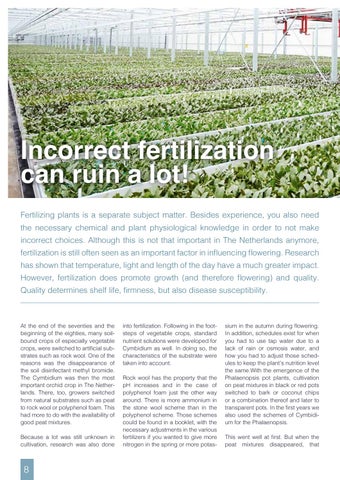
Incorrect fertilization can ruin a lot! Fertilizing plants is a separate subject matter. Besides experience, you also need the necessary chemical and plant physiological knowledge in order to not make incorrect choices. Although this is not that important in The Netherlands anymore, fertilization is still often seen as an important factor in influencing flowering. Research has shown that temperature, light and length of the day have a much greater impact. However, fertilization does promote growth (and therefore flowering) and quality. Quality determines shelf life, firmness, but also disease susceptibility.
At the end of the seventies and the beginning of the eighties, many soilbound crops of especially vegetable crops, were switched to artificial substrates such as rock wool. One of the reasons was the disappearance of the soil disinfectant methyl bromide. The Cymbidium was then the most important orchid crop in The Netherlands. There, too, growers switched from natural substrates such as peat to rock wool or polyphenol foam. This had more to do with the availability of good peat mixtures. Because a lot was still unknown in cultivation, research was also done
8
into fertilization. Following in the footsteps of vegetable crops, standard nutrient solutions were developed for Cymbidium as well. In doing so, the characteristics of the substrate were taken into account. Rock wool has the property that the pH increases and in the case of polyphenol foam just the other way around. There is more ammonium in the stone wool scheme than in the polyphenol scheme. Those schemes could be found in a booklet, with the necessary adjustments in the various fertilizers if you wanted to give more nitrogen in the spring or more potas-
sium in the autumn during flowering. In addition, schedules exist for when you had to use tap water due to a lack of rain or osmosis water, and how you had to adjust those schedules to keep the plant’s nutrition level the same.With the emergence of the Phalaenopsis pot plants, cultivation on peat mixtures in black or red pots switched to bark or coconut chips or a combination thereof and later to transparent pots. In the first years we also used the schemes of Cymbidium for the Phalaenopsis. This went well at first. But when the peat mixtures disappeared, that