More light means higher humidity
In general, amongst many cultivations, including orchids, we often speak about the relative humidity (RH). With Phalaenopsis 65% is already considered good, even though some growers think that is too high. With Cymbidium an RH of 80% is seen as high and is actually rarely talked about too low. In Miltoniopsis and Odontoglossum, especially Nelly Isler, an RH of 65% is considered a minimum. Unfortunately, this means nothing. But why not? Two reasons: 1. What is the temperature? 2. What is the amount of light?
Temperature At a temperature of 20°C and an RH of 65%, the moisture deficit is 6 gr/ m³. This is already on the ‘dry’ side, because the optimum is a moisture deficit between 3.5-5.3 gr/m³. If you would start warming this air up, the RH will drop. Assume the temperature rises to 25°C, the RH becomes about 49% and that’s a moisture deficit of 11.8 gr/m³. The evaporation will stop because the RH is too low. Moisture deficit is explained as; how many grams of water can there still be in 1 m³ of air, at the same temperature. In other words, if the air gets warmer, the air becomes drier (lower RH) and more moisture can enter. The moisture deficit increases. When the air gets colder, less moisture can enter, and the air is wetter (higher
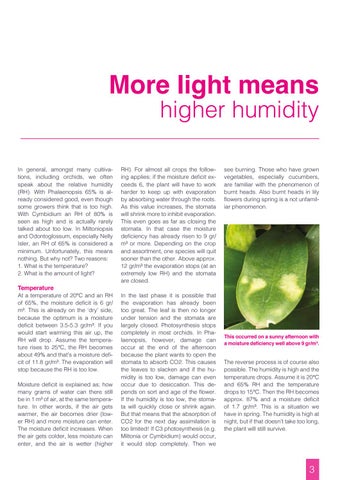
RH). For almost all crops the following applies; if the moisture deficit exceeds 6, the plant will have to work harder to keep up with evaporation by absorbing water through the roots. As this value increases, the stomata will shrink more to inhibit evaporation. This even goes as far as closing the stomata. In that case the moisture deficiency has already risen to 9 gr/ m³ or more. Depending on the crop and assortment, one species will quit sooner than the other. Above approx. 12 gr/m³ the evaporation stops (at an extremely low RH) and the stomata are closed. In the last phase it is possible that the evaporation has already been too great. The leaf is then no longer under tension and the stomata are largely closed. Photosynthesis stops completely in most orchids. In Phalaenopsis, however, damage can occur at the end of the afternoon because the plant wants to open the stomata to absorb CO2. This causes the leaves to slacken and if the humidity is too low, damage can even occur due to desiccation. This depends on sort and age of the flower. If the humidity is too low, the stomata will quickly close or shrink again. But that means that the absorption of CO2 for the next day assimilation is too limited! If C3 photosynthesis (e.g. Miltonia or Cymbidium) would occur, it would stop completely. Then we
see burning. Those who have grown vegetables, especially cucumbers, are familiar with the phenomenon of burnt heads. Also burnt heads in lily flowers during spring is a not unfamiliar phenomenon.
This occurred on a sunny afternoon with a moisture deficiency well above 9 gr/m3.
The reverse process is of course also possible. The humidity is high and the temperature drops. Assume it is 20°C and 65% RH and the temperature drops to 15°C. Then the RH becomes approx. 87% and a moisture deficit of 1.7 gr/m³. This is a situation we have in spring. The humidity is high at night, but if that doesn’t take too long, the plant will still survive.
3