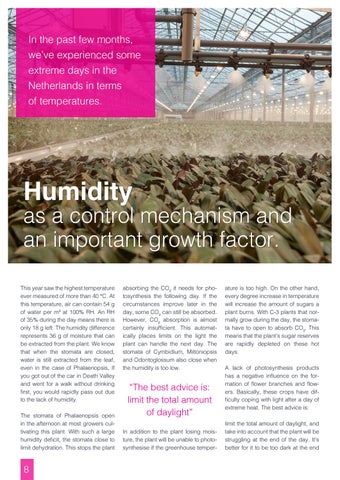
In the past few months, we’ve experienced some extreme days in the Netherlands in terms of temperatures.
Humidity
as a control mechanism and an important growth factor. This year saw the highest temperature ever measured of more than 40 °C. At this temperature, air can contain 54 g of water per m3 at 100% RH. An RH of 35% during the day means there is only 18 g left. The humidity difference represents 36 g of moisture that can be extracted from the plant. We know that when the stomata are closed, water is still extracted from the leaf, even in the case of Phalaenopsis, If you got out of the car in Death Valley and went for a walk without drinking first, you would rapidly pass out due to the lack of humidity. The stomata of Phalaenopsis open in the afternoon at most growers cultivating this plant. With such a large humidity deficit, the stomata close to limit dehydration. This stops the plant
8
absorbing the CO2 it needs for photosynthesis the following day. If the circumstances improve later in the day, some CO2 can still be absorbed. However, CO2 absorption is almost certainly insufficient. This automatically places limits on the light the plant can handle the next day. The stomata of Cymbidium, Miltoniopsis and Odontoglossum also close when the humidity is too low.
“The best advice is: limit the total amount of daylight” In addition to the plant losing moisture, the plant will be unable to photosynthesise if the greenhouse temper-
ature is too high. On the other hand, every degree increase in temperature will increase the amount of sugars a plant burns. With C-3 plants that normally grow during the day, the stomata have to open to absorb CO2. This means that the plant’s sugar reserves are rapidly depleted on these hot days. A lack of photosynthesis products has a negative influence on the formation of flower branches and flowers. Basically, these crops have difficulty coping with light after a day of extreme heat. The best advice is: limit the total amount of daylight, and take into account that the plant will be struggling at the end of the day. It’s better for it to be too dark at the end