still controls competition. So how can you say you have competition if the
NIEWS AND VIEV/S
tition?"
ñ ?
Han said he welcomed the government's crackdown on corruption "but it doesn't have the means," he said.
lt I
Han
Èl
C4
Dongfang: a simple
position had got worse.
"As the system changes from one dominated by State enterprises to a free market system many workers are now finding themselves without jobs. "For the first time people are finding themselves without jobs and, unlike other countries, China does not have a social
omparisons with Poland's Lech Walesa are easy to draw when listening to Han
security net. "Despite years of low wages, workers
Dongfang, the trade union activist who was expelled from China on August 14. Walesa, the shipyard worker from Gdansk, took on a brutal, rePressive communist regime and, within 10 years,
are now asking themselves 'what ever happened to allthe money we made for the State?'
"China has
The fight was not easy and even today
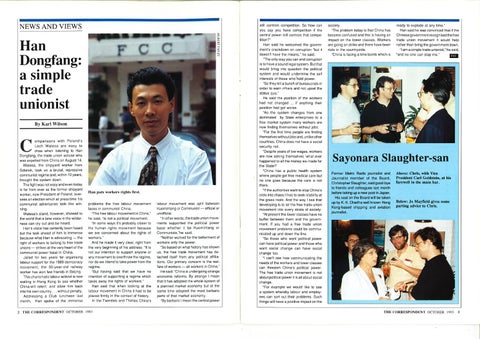
Han puts workers rights first. problems the free labour movement
labour movement was split between
faces in communist China.
official or Kuomintang or Communist unoff icial. "ln otherwords, the trade union movements supported the political power base whether it be Kuomintang or Communists,"he said. "Neither worked for the betterment of workers only the power. "So based on what history has shown us, the free trade movement has detached itself from any political affiliations. Our primary concern is the welfare of workers - all workers in China." He said: "China is undergoing strange economic reforms. By strange I mean that it has adopted the whole system of a planned market economy but at the same time adopted the most barbaric parts of that market economy. "By barbaric I mean the central power
Walesa's stand, however, showed to
"The free labour movement in China,"
the world that a lone voice in the wilderness can cry out and be heard. Han's voice has cerdainly been heard but the task ahead of him is immense because what Han is advocating - the right of workers to belong to free trade heart of the unions - strikes at the very communist power base in China. Jailed for two years for organising labour support for the 1989 democracy movement, the 30-year-old railwaY worker has won few friends in Beijing. This charismatic labour activist is now
he said, "is not a political movement. "ln some ways it's probably closer to the human rights movement because we are concerned about the rights of
China will relent and allow him back into his own country . . . without penalty.
Addressing a Club luncheon last month, Han spoke of the immense
2
THECORRESPONDENT OCTOBER
a public health system
where people get free medical care but no one goes because the care is not there.
brought the system down.
waiting in Hong Kong to see whether
@
had not changed ... if anything their
By Karl Wilson
nrng.
ready to explode at any time." Han said he was convinced that if the Chinese government recognised the free trade union movement it would help rather than bring the government down. "l am a simple trade unionist," he said, "and no one can stop me."
"The only way you can end corruption is to,have a sound legal system. But that would bring into question the political system and would undermine the self interests of those who'hold power. "So they kill a bunch of bureaucrats in order to warn others and not upset the status quo." He said the position of the workers
trade ao unionist
is far from over as the former shipyard worker, now President of Poland, oversees an election which at press time his communist adversaries look like win-
central power still controls that compe-
S
society. "The problem today is that China has become confused and this is having an impact on the lower classes. Workers are going on strike and there have been riots in the countryside. "China is facing a time bomb which is
workers." And he made it very clear, right from the very beginning of his address: "lt is not our intention to supporl anyone or any movement to overthrow the regime, nor do we intend to take power from the regrme.
"But having said that we have
no
intention of supporting a regime which takes away the rights of workers."
Han said that when looking at the labour movement in China it had to be placed firmly in the context of history. ln the Twenties and Thirlies China's 1993
"lf the authorities want to stop China's slide into chaos it has to seek stability at the grass roots. And the way I see that developing is to let the free trade union movement into every strata of society. "At present the lower classes have no buffer between them and the government. lf you had a free trade union movement problems could be communicated up and down the line. "So those who want political power can have political power and those who want social change can have social change too. "l can't see how communicating the needs of the workers and lower classes can threaten China's political power. The free trade union movement is not about political power it is all about social change. "For example we would like to see a system whereby labour and employees can sort out their problems. Such things will have a positive impact on the
Sayonara Slaughter-san Former Metro Radio journalist and
Journalist member of the Board, Christopher Slaughter, said good-bye
Above: Chris, with Vice President Carl Goldstein, at his farewell in the main bar.
to friends and colleagues last month before taking up a new post in Japan. His seat on the Board will be taken up by K. K. Chadha well known Hong Kong-based shipping and aviation
Below: Jo Mayfield gives some parting advice to Chris.
journalist.
Þ
È¡ THECORRESPONDENT OCTOBER 1993 3