Parenting
Drama Class
Your Secret Weapon Against Childhood Anxiety By Elizabeth Avery Scott
For many parents, having an anxious child is one of the great parenting challenges. It can be frustrating – and even embarrassing – when your child refuses to get into the water at swimming lessons, or has a screaming meltdown before going into a friend’s birthday party, or feigns sickness every time there’s an exam. These are all manifestations of anxiety – where your child is willing to do anything to avoid facing what’s making them anxious.
But did you know that joining a drama class may help your anxious child?
How drama can help At Perform Australia we’ve given a lot of thought to this. While drama is often about a performance – admittedly a scary thought for the shy and nervous – it is the process of drama that assists with anxiety. A drama class is a creative way to gradually develop skills for dealing with life’s challenges. But how does this actually work? Traditionally, a drama class begins with a warmup – just as professional actors warm up before a show. There is a focus on breathing and relaxation, stretching the body, and exercising the voice in preparation for the activities to come. It’s these very activities – breathing, slowing things down, and body awareness or ‘mindfulness’ – that are often taught by psychologists to assist with anxiety. A drama student learns them as part-and-parcel of being an actor. Next, there may be some activities that invite imaginative input. Creative storytelling, embodiment of characters, improvising a scene based on a theme – all of these require drama students to delve into their own ideas bank. They bring their inner selves out into the open. While initially, anxious children may be tentative about this process, once they get the hang of it, we watch them experience a sense of release and freedom in their own creative expression. Science is confirming again and again that creative expression is good for us; creativity floods the brain with dopamine, which relieves anxiety and depression and generates a general sense of happiness.
6
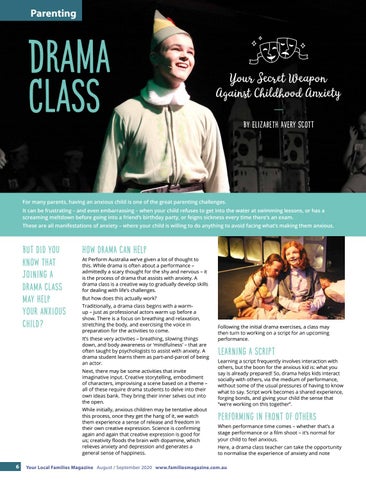
Following the initial drama exercises, a class may then turn to working on a script for an upcoming performance.
Learning a script Learning a script frequently involves interaction with others, but the boon for the anxious kid is: what you say is already prepared! So, drama helps kids interact socially with others, via the medium of performance, without some of the usual pressures of having to know what to say. Script work becomes a shared experience, forging bonds, and giving your child the sense that “we’re working on this together”.
Performing in front of others When performance time comes – whether that’s a stage performance or a film shoot – it’s normal for your child to feel anxious. Here, a drama class teacher can take the opportunity to normalise the experience of anxiety and note
Your Local Families Magazine August / September 2020 www.familiesmagazine.com.au