Families Health
W H Y C L I M AT E C H A N G E M AT T E R S
to your children
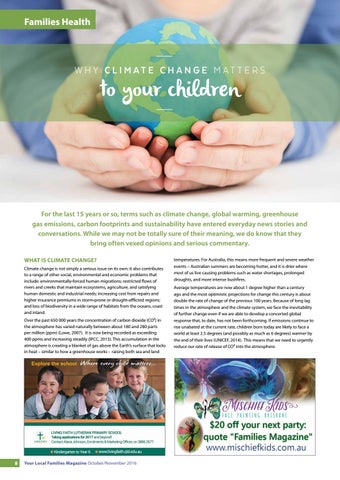
For the last 15 years or so, terms such as climate change, global warming, greenhouse gas emissions, carbon footprints and sustainability have entered everyday news stories and conversations. While we may not be totally sure of their meaning, we do know that they bring often vexed opinions and serious commentary. WHAT IS CLIMATE CHANGE? Climate change is not simply a serious issue on its own; it also contributes to a range of other social, environmental and economic problems that include: environmentally-forced human migrations; restricted flows of rivers and creeks that maintain ecosystems, agriculture, and satisfying human domestic and industrial needs; increasing cost from repairs and higher insurance premiums in storm-prone or drought-afflicted regions; and loss of biodiversity in a wide range of habitats from the oceans, coast and inland. Over the past 650 000 years the concentration of carbon dioxide (CO²) in the atmosphere has varied naturally between about 180 and 280 parts per million (ppm) (Lowe, 2007). It is now being recorded as exceeding 400 ppms and increasing steadily (IPCC, 2013). This accumulation in the atmosphere is creating a blanket of gas above the Earth’s surface that locks in heat – similar to how a greenhouse works - raising both sea and land
8
Your Local Families Magazine October/November 2016
temperatures. For Australia, this means more frequent and severe weather events – Australian summers are becoming hotter, and it is drier where most of us live causing problems such as water shortages, prolonged droughts, and more intense bushfires. Average temperatures are now about 1 degree higher than a century ago and the most optimistic projections for change this century is about double the rate of change of the previous 100 years. Because of long lag times in the atmosphere and the climate system, we face the inevitability of further change even if we are able to develop a concerted global response that, to date, has not been forthcoming. If emissions continue to rise unabated at the current rate, children born today are likely to face a world at least 2.5 degrees (and possibly as much as 6 degrees) warmer by the end of their lives (UNICEF, 2014). This means that we need to urgently reduce our rate of release of CO² into the atmosphere.