Monumental Controversy
A timely exhibition explores the history of memorials as flashpoints of national debate
By Sarah Gianelli
Through December 20, 2025
Fairfield University
Art Museum
200 Barlow Road, Fairfield, CT 06824
t: (203) 254-4046
www.fairfield.edu
Exhibitions tied to the 250th anniversary of the United States, and that explore democracy and our nation’s complex and complicated history, are popping up in museums across the country this year and next. They offer opportunities to better understand the moment we find ourselves in now, by looking deep into the past.
One such touring exhibition is Monuments: Commemoration and Controversy, organized by the New York Historical, and presented by Fairfield University Art Museum (FUAM) in Connecticut, through December 20.
Through nearly 30 works, ranging from 19th-century artists like Johannes Adam Simon Oertel (1823-1909), John Quincy Adams Ward (1830-1910), and their European counterparts, to early 20th-century artists like Augusta Savage (1892-1962), the exhibition explores public monuments as instigators of debate over national identity, politics and race.
The exhibition features sculptures, photographs, prints and artifacts, including a fragment of the statue of King George III torn down during the American Revolution, and a maquette of New York City’s first monument to a Black woman, Harriet Tubman, that illuminate how the construction and destruction of public monuments has long been part of the American narrative.
“This exhibition is, in one sense, about the stories we tell ourselves about our nation and its past,” says FUAM executive director Carey Mack Weber. “We have done a lot of that storytelling by putting some monuments up and pulling others down. The exhibition begins with one such example of destruction, displaying the tail of an equestrian statue of King George III, the rest of which was torn down and melted into lead bullets by revolutionaries in 1776 (a number of the bullets are also in the show). But the exhibition also looks at how visual representations shape our collective memory. Oertel’s depiction of the statue’s fall, according to the New York Historical label, ‘includes women, a Black man and an Indigenous family. It pictures the diversity of Revolutionary New York—if only to expose the hypocrisy of the Revolution as the fight for liberty, selectively applied.’ In this case, the

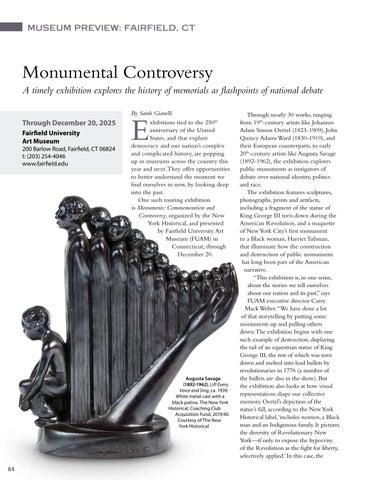
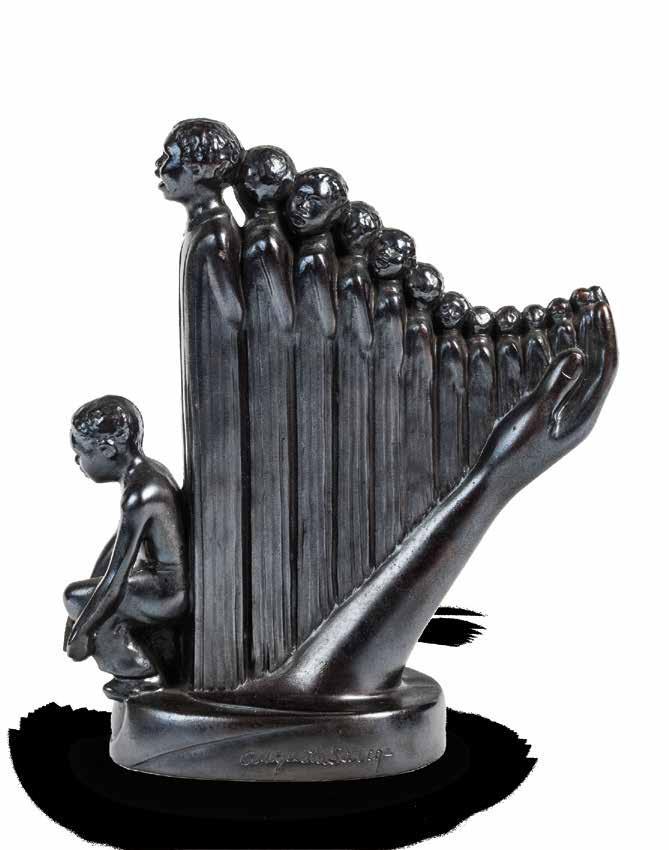
Augusta Savage (1892-1962), Lift Every Voice and Sing, ca. 1939. White metal cast with a black patina. The New York Historical, Coaching Club Acquisition Fund, 2019.90. Courtesy of The New York Historical.
look back at this historic moment, for better or for worse.”
Another significant work in the exhibition is Savage’s Lift Every Voice and Sing, circa 1939, a 10-inch metal cast that is the only physical remnant from the sculptor’s 16-foot-tall plaster monument to Black American music created for the 1939 World’s Fair, and the only commission from a Black woman artist. The label reads, “one of the most popular works on display.”
Weber adds, “Without the funding to cast her sculpture in lasting bronze, however, the full-size plaster monument was ultimately destroyed. This piece invites us to consider the intersection of economics (making large-scale bronze sculpture has always been an expensive proposition for artists) and race and gender (it was even harder for Savage to get the kind of economic support needed for her projects as a Black woman sculptor).”
Barbara Chase-Riboud’s maquette, for a monument to the abolitionist Sojourner Truth, is another work of note. The small-scale bronze model was a study for a larger work. As the label explains, “Truth takes her place in an
equestrian monument tradition usually reserved for white male statesmen. She does not ride her horse, however, but leads it while holding a lantern aloft. The figure appears less to command than to seek, even as she brings light into a dark world.”
Closing out the exhibition’s special programming is the lecture “Sculpting the Past: Art, Identity, and Commemoration in Public Space,” which will be held on November 6 at 5 p.m. at Barone Campus Center, Dogwood Room, and via livestream.

Johannes Adam Simon Oertel (1823-1909), Pulling Down the Statue of King George III, New York City, ca. 1852-1853. Oil on canvas. The New York Historical, Gift of Samuel Verplanck Hoffman, 1925.6. Courtesy of The New York Historical.
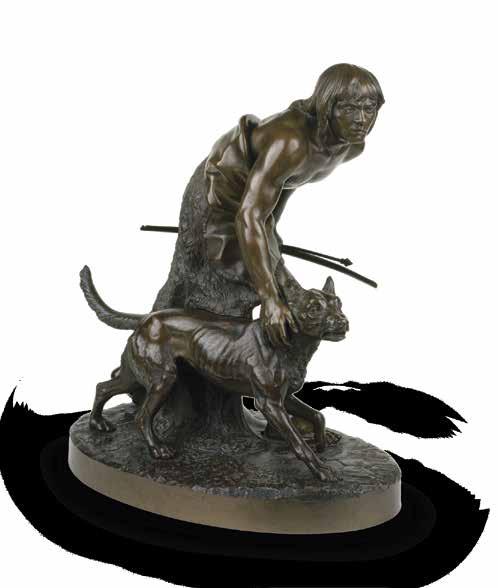
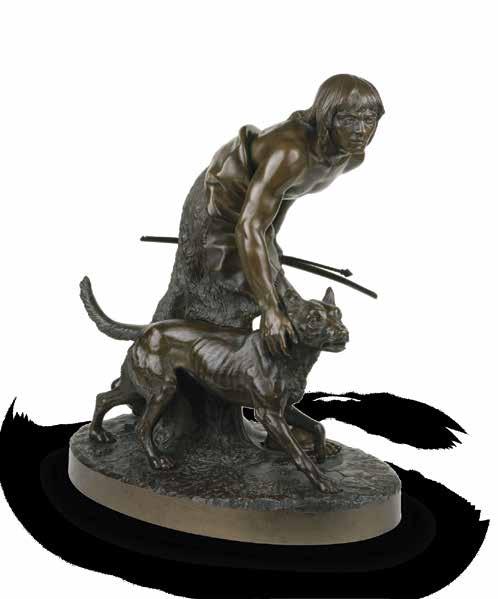
Far Left: John Quincy Adams Ward (1830-1910), The Indian Hunter, 1860, bronze. The New York Historical, Gift of Mr. George A. Zabriskie, 1939.390. Courtesy of The New York Historical.
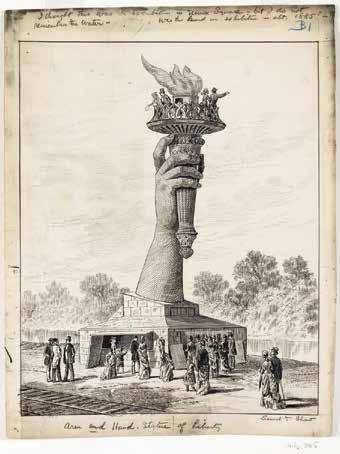
Left: Samuel T. Shaw (1861-1945), Arm and Torch of the Statue of Liberty, ca. 1877-1884. Black ink and touches of white lead pigment and scratching out on card. The New York Historical, Samuel T. Shaw Memorial Collection, 1946.385. Courtesy of The New York Historical.