2
(Re)searching for Orpheus
A written research on the creative process for The Myth(s) of Orpheus
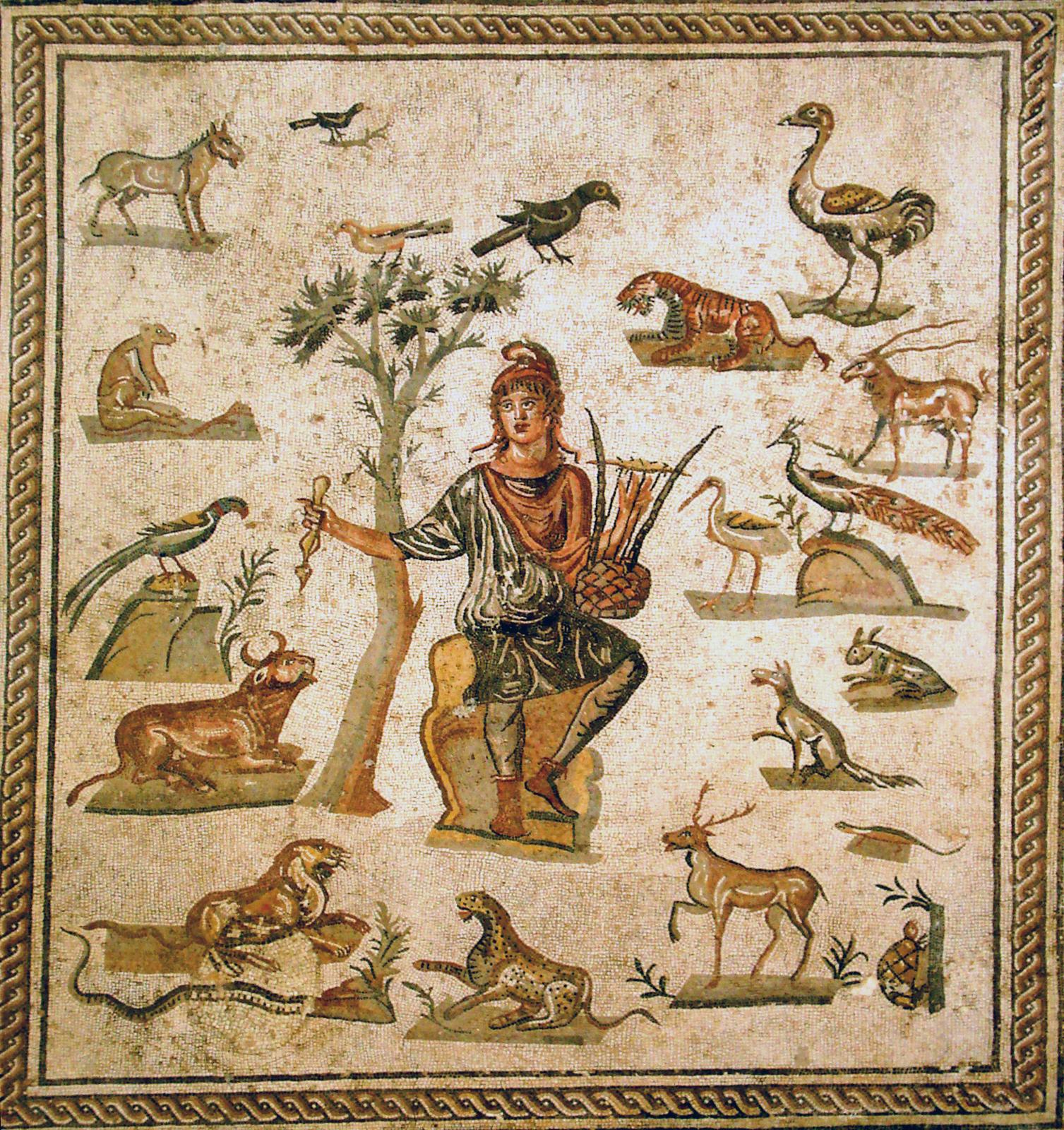
My first contact with the myth of Orpheus was through a very contemporary iteration: Arcade Fire’s 2013 album Reflektor (specially the track Afterlife). It made total sense for this world to feel so interesting to my high-schooler version; the motifs of death, ghosts and the afterlife roamed around most of the conversations between the older members of my family. Like Arcade Fire, they understood the realm of the underworld as something that could be palpable in the living/awakening world. In their stories, someone could say goodbye to their loved ones in some subtle way on their way to the afterlife; some told-aloud joke about the dead could be seen as the spell for a bad faith. I usually heard this kind of conversations when everyone gathered around after a midday lunch, trying to sleep if only for a brief moment before going back to work, but
1
still opening their eyes to add to the conversation from time to time. This kind of stories made me understand the realms of dreams and death as one, and therefore, later, the realms of death and art. Dreams, ghost, ideas… they could be the same thing.
I had my next encounters with the myth of Orpheus while trying to be a filmmaker. Devouring all the movies I could get my hands on, I found Marcel Camus’ Black Orpheus (1959) and Cocteau’s Orphée (1950). Since then I knew I wanted to explore my own vision of the Orphic Myth at some point. When I was gifted the space and time to work on a project for Fabrica under the curation theme of Archaism, I decided Orpheus would be the seed for the creative and research process.
During this journey I visited Ovid’s Orpheus inside The Metamorphosis, and I realized how much it mirrored this TikTok Era of storytelling. It is an impatient, fragmented form that gives shape to the myth; a fleeting vignette of the whole gives way to another one, all in a multiplicity of voices. I was relieved to see how it reinforced my intention for this iteration of Orpheus; a collage of references strange to the myth, but through their own particular similes with it, forming a whole that hopefully brings back its essence and conflicting themes to life. The multi-channel video presented in the installation is the result of this collage of references.
Whole rest symbol: The grief of Orpheus, which could also be read as a renunciation to the act of creation, here is represented by the whole rest symbol usually used in music sheets to represent times of silence. This silence/grief is forcefully displaced by the sound of an orchestral tuning; the power of music/art/creation.
2
Aged Movies: I found the land of the death in the images of some of the movies I treasure in my memory (The Wizard of Oz (1939), Pinocchio (1940), Rear Window (1954)); because of their age, and by being referenced and resignified over and over in the collective and personal memory, they had turned into ghosts that could perfectly inhabit the archive that is the afterlife.
Volcano of Popocatépetl: During the research I got fixated on the idea of Volcanoes, so I started reading about the Popocatépetl volcano, which had erupted recently, just to realize there was a myth about its origin which I found very similar to the myth of Orpheus; another intersection of love and the afterlife.
Heart Emojis: In making a project that has a lot to do with the intersection of text as image / image as text, I could not leave out the use of emojis, which is a manifestation of this imagetext relationship that we deal with in our everyday digital lives.
Personal Videos: In associating Orpheus’ grief with the renouncing to creation —the question of if it’s worth to keep creating or not—, the result/end after this grief had to be represented by newly created images, opposing them to the main use of plain text and appropriated images.
In his book Orpheus: The Myth of the Poet, Charles Segal proposes three fundamental elements that have remained essential throughout the evolution of the orphic myth: Death, Love and Art —I will switch the word art for the word creation —. Successful iterations of the myth have a balance that allows a dialogue between these three themes. The pieces of this installation —apart from the multi-channel video, which explores all three of them in different chapters— each deals with one of the three themes:
3
The Death of Orpheus: The way stories, mythologies and language mutates/evolves is explored through this installation in which Orpheus’ own story is always contained inside the song he chooses to sing. By choosing to write text in a motion picture film strip, it also invites us to reflect on the image-text relationship in the evolution of language and story-telling.
The Song of Orpheus: I found an echo of Orpheus’ grieving but obsessive drive in the love-notes written on public walls that I found in train stations or waiting in line for a museum. The ones that really interested me were the ones that not only depicted a love story, but a story of grief. The theme of death also enters the equation when you realize this essential human gesture of attempting to immortalize our feelings, of tracing ourselves in the walls of the cave, remain a way to pass on our own iterations of stories already told.
The Head of Orpheus: As David Levi Strauss says quoting Cervantes: A proverb is a short sentence based on long experience. For me, this hispanic proverbs that have taken journey from generation to generation are a way of communication with the land of the dead. In some versions of the myth, the head of Orpheus, after his death, was used as a fortune-telling device and contained all the knowledge he gained from the underworld. This view-master turns into the head of Orpheus by transferring to us this sayings that have traveled a long way from the land of the dead.
There are many other pivotal references that I found during the research process for this project. Each of them fed in their own way my perspectives on the three orphic themes that Segal proposes:
Death: 1. Reading Baudrillard’s Simulacra & Simulation I found the founding words for the underworld I wanted to depict: Take your desires for reality! 2. Revisiting Plato’s brief but majestic impression of the myth inside Symposium, I knew my iteration would deal with archive images as ghosts, ghosts as glimpses of images. 3. Alfred Gel’s theory on The Technology Of Enchantment and the Enchantment of
4
Technology made me see art-making almost as witchcraft, and to consider these obsolete image artifacts I was so keen to experiment with not just as gadgets but as mystical objects.
Love: 1. Reading Mircea Eliade’s research on variations of the orphic myth in different cultures I got the impression of understanding its essence: someone goes to the land of the dead looking for something lost, but the world commands them to go back to live instead. 2. Barthe’s concept of the atopos of love in Fragments from a Lover’s Discourse made me more closely understand the reason for Orpheus’ grief. 3. David Levi Strauss’ Photography and Belief makes an interesting etymological association between the concepts of loving, seeing and believing.
Creation: 1. John Cage’s Silence made me look at randomness, noise, chance and the “unwanted” as a fertile soil to create a new kind of order and meaning. 2. Jeremy Miller’s Sentences On Magic (After Sol Lewitt) helped me transpose the concept of art to the magical realm, turning the whole process more into a ritual rather than just a research.
This is not the Orpheus I would’ve made ten years ago when I first encountered the myth; after attempting to create images through cinema that could be worthy of existing in a world plagued by them, I started exploring alternative mediums of expression beyond image-creation. Therefore, at the beginning of this research/creative process on Orpheus, I intended my telling of the myth to be put in form after the image… since the orphic myth seems to have a circular nature, I arrived at a place before images: Silence, sounds, noise… colors, textures, words, text, emojis (which could also go back to hieroglyphics)… then arrived at the re-appropriated images of the film history archive, remixed images of the bigger internet archive, and finally, to newly created images again; hopefully the story I’m trying to tell ends with hope for the gesture of creation.
5
6
Bibliography
Bibliography for the creation of the artwork:
• Silence (1962), John Cage
• Simulacra and Simulation (1981), Jean Baudrillard
• The Technology of Enchantment and the Enchantment of Technology (1994), Alfred Gell
• Orpheus Myths from Essential Sacred Writings from Around the World (1967), Mircea Eliade
• Photography and Belief (2020), David Lei Strauss
• Sentences On Magic (After Sol Lewitt) (2009), Jeremy Millar
Bibliography for the writing of this text:
• The Myth Of Orpheus and Eurydice in Western Literature (1960), Mark Owen Lee
• Orpheus: The Myth Of The Poet (1989), Charles Segal
Main visited iterations of the myth:
• Brief reference inside Symposium (360 B.C.E), Plato
• Book II, Passage IV of Georgics (29 B.C.E.), Virgil
• Books X-XI of The Metamorphoses (8 C.E.), Ovid
• Orpheus. Eurydike. Hermes (1904), Rainer Maria Rilke
• Orphée (1950), Jean Cocteau
• Black Orpheus (1959), Marcel Camus
• Reflektor (2013), Arcade Fire
Written by ERIK ALFREDO MARTÍNEZPRINTED AT FABRICA RESEARCH CENTRE FOR THE COLLECTIVE EXHIBITION MONUMENT TO DUST
JULY 2023
Special Thanks to CARLOS CASAS, FRANCESCA PERPETUINI, DANIELA MESINA & MARTA CELSO