Nature & Science Astronomy I and II: Our View of the Cosmos
Enroll in both courses The heavens have fascinated our species from the dawn of time. Now it’s your turn to explore them! In and pay $365! this two-part introductory course, survey the strange and wonderful objects that inhabit our universe, from the smallest fundamental particles to the universe itself. Discover how solar system science has gone from strictly observational myth and mysticism to a hands-on, go-there-and-find-out field science. Look at stellar nurseries, stars like the sun in midlife, stellar demise, and the formation of black holes. Examine the Milky Way, our home galaxy, and see how it fits into the grander scheme of all the matter in the universe of galaxies. Finally, explore the whole universe, its beginnings and possible ends, and everything in between. Astronomer Paul Hemenway makes ample use of images and videos from the largest telescopes, latest satellites and space probes, and animations from the latest computer simulations. Both courses will also include an evening at DU’s historic Chamberlin Observatory. Follow the footsteps of some giants of discovery including Newton and Einstein, examine their data and follow their reasoning to reach our current understanding of the very nature of space, time, matter, energy and the universe itself. Astronomy I deals with two main topics: the solar system and stars. From Mercury to Saturn’s rings and Pluto, examine the solar system’s contents and its formation and history. Then look at the nature of stars: their variety of sizes, masses and compositions. Discover how they form, how they die, how they live their lives and how they create the elements of life in their interiors. When looking at the star formation process, examine the debris left over and learn the implications of the discovery of a thousand planetary systems nearby in our galaxy.
Five sessions
Tue., 6:30–8:30 pm, Feb. 19, 26, Mar. 5, 12, 2019 Historic Chamberlin Observatory visit TBD $190
Astronomy II also addresses two main topics: galaxies and the universe. Start with our galaxy, the Milky Way, to get a personal look at a goodsized spiral and discover how we are about to collide (in about 4 billion years) with our nearest big neighbor, the Andromeda Galaxy. Look at the galaxy menagerie: small satellite galaxies to gigantic and galaxy-consuming galaxies. Learn how galaxy mergers lead to black hole mergers and gamma-ray bursts, the most violent explosions known outside the Big Bang itself. Then examine the universe: the evidence (starting with Hubble’s work) for a violent beginning (the Big Bang) that probably started from literally nothing except quantum fluctuations, and conclude with two observational enigmas: dark matter and dark energy.
Five sessions
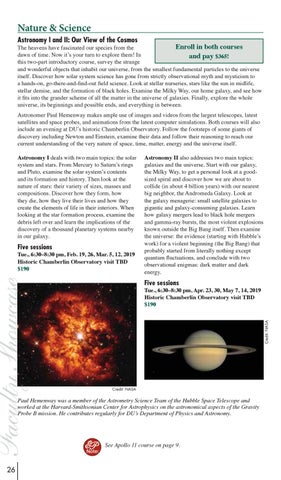
Credit: NASA
Tue., 6:30–8:30 pm, Apr. 23, 30, May 7, 14, 2019 Historic Chamberlin Observatory visit TBD $190
Credit: NASA
Paul Hemenway was a member of the Astrometry Science Team of the Hubble Space Telescope and worked at the Harvard-Smithsonian Center for Astrophysics on the astronomical aspects of the Gravity Probe B mission. He contributes regularly for DU’s Department of Physics and Astronomy.
See Apollo 11 course on page 9.
26