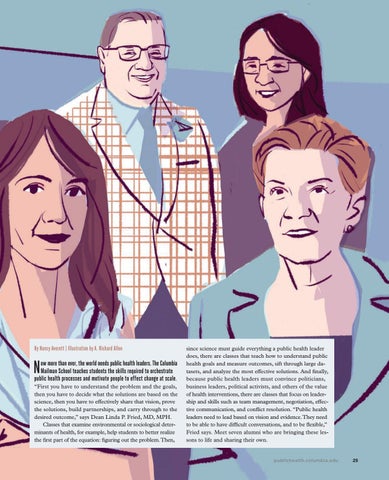
By Nancy Averett | Illustration by A. Richard Allen
N
ow more than ever, the world needs public health leaders. The Columbia Mailman School teaches students the skills required to orchestrate public health processes and motivate people to effect change at scale. “First you have to understand the problem and the goals, then you have to decide what the solutions are based on the science, then you have to effectively share that vision, prove the solutions, build partnerships, and carry through to the desired outcome,” says Dean Linda P. Fried, MD, MPH. Classes that examine environmental or sociological determinants of health, for example, help students to better realize the first part of the equation: figuring out the problem. Then,
since science must guide everything a public health leader does, there are classes that teach how to understand public health goals and measure outcomes, sift through large datasets, and analyze the most effective solutions. And finally, because public health leaders must convince politicians, business leaders, political activists, and others of the value of health interventions, there are classes that focus on leadership and skills such as team management, negotiation, effective communication, and conflict resolution. “Public health leaders need to lead based on vision and evidence. They need to be able to have difficult conversations, and to be flexible,” Fried says. Meet seven alumni who are bringing these lessons to life and sharing their own.
publichealth.columbia.edu
25