PotatoCountry.com • November 2026 Western focus. National impact.
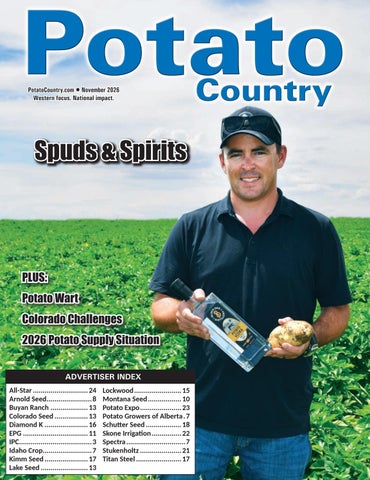
Spuds & Spirits
PLUS: Potato Wart Colorado Challenges 2026 Potato Supply Situation Advertiser Index All-Star............................. 24 Arnold Seed........................ 8 Buyan Ranch.................... 13 Colorado Seed.................. 13 Diamond K....................... 16 EPG.................................. 11 IPC...................................... 3 Idaho Crop......................... 7 Kimm Seed....................... 17 Lake Seed......................... 13
Lockwood......................... 15 Montana Seed.................. 10 Potato Expo...................... 23 Potato Growers of Alberta.. 7 Schutter Seed................... 18 Skone Irrigation................ 22 Spectra............................... 7 Stukenholtz...................... 21 Titan Steel........................ 17
Table of Contents Vol. 42 No. 7 PO Box 333, Roberts, Idaho 83444 Telephone: (208) 520-6461 Circulation: (503) 724-3581
PotatoCountry.com
Country Western focus. National impact.
november 2026
Editor
Denise Keller editor@ColumbiaMediaGroup.com
Operations Manager, Advertising Brian Feist brian@ColumbiaMediaGroup.com
Publisher, Advertising
4 Spuds and Spirits
Dave Alexander dave@ColumbiaMediaGroup.com
Block One Distillery
8 Potatoes Mark a Decade as America’s Favorite Vegetable
insect Identification
Josephine Antwi josephine.antwi@oregonstate.edu
Disease Identification
Potatoes USA
Jeff Miller jeff@millerresearch.com
12 Planting Essentials
Ben Eborn napmn@napmn.com
Market Report
Buyers' Guide
16 Colorado Challenges Require Collaboration and Communication Colorado Potato Administrative Committee
18 Potato Wart: A Step Forward, But Vigilance Must Continue National Potato Council
20 2026 Potato Supply Situation Market Report
Potato Growers of Washington Dale Lathim dale@pgw.net
EDITORIAL INFORMATION
Potato Country is interested in newsworthy material related to potato production and marketing. Contributions from all segments of the industry are welcome. Submit news releases, new product submissions, stories and photos via email to: editor@ColumbiaMediaGroup.com.
ADVERTISING SALES
For information about advertising rates, mechanics, deadlines, etc., call (208) 520-6461 or email dave@PotatoCountry.com.
SUBSCRIPTIONS
U.S. $50 per year / Foreign $120 per year Subscriptions can be entered online at: potatocountry.com/subscribe or call (503) 724-3581. Email address changes/corrections to: brian@ColumbiaMediaGroup.com or send to Potato Country, PO Box 333, Roberts, ID 83444. Potato Country magazine (ISSN 0886-4780), is published eight times per year and mailed under a standard rate mailing permit at Idaho Falls, Idaho and at additional mailing offices. It is produced by: Columbia Media Group, PO Box 333, Roberts, ID 83444 Copyright 2026. All rights reserved. No part of this publication may be reproduced or transmitted in any form or by any means, electronic or mechanical, for any purpose without the express written permission of Columbia Media Group.
Editorial Board Prepare now for a smooth potato planting season next spring with the Planting Essentials Buyers’ Guide on pages 12-14.
On The Cover
DEPARTMENTS
James Alford is using potatoes grown on his Pasco, Wash., farm to produce potato vodka at his on-farm distillery. Read about Block One Distillery’s first year in business on pages 4-6.
9 Calendar 10 Disease Quiz 11 Insect Quiz
Chris Voigt
Executive Director Oregon Potato Commission (503) 239-4763
19 New Products 22 PGW Column 22 Advertiser Index Aritra Choudhury
2 Potato Country • November 2026
Gary Roth
Executive Director Washington State Potato Commission (509) 765-8845
Director Montana Seed Potato Certification (406) 994-3150
Jamey Higham President/CEO Idaho Potato Commission (208) 334-2350
Jessica Bradshaw Executive Director Colorado Potato Admin. Committee (719) 852-3322
When it comes to potatoes, everyone cares about quality, even those you would never expect. In its latest TV commercial, the Idaho Potato Commission playfully highlights the difference real Idaho® potatoes make. As two delivery drivers bring fresh produce to a local restaurant, the seasoned veteran explains to his younger colleague that they deliver only Idaho® potatoes, and that no other potatoes make the cut. A moment later, two nearby pigs who overheard the entire conversation, reveal that they too have no interest in potatoes that weren’t grown in Idaho. The final takeaway? Always look for the “Grown in Idaho® ” seal. The ad will air nationally on popular networks including TBS, TNT, Food Net�ork, Disco�ery, HGTV, ID, Hallmark, and TLC. Additionally, it can be seen on streaming platforms like Disco�ery+, Hulu/Disney+, and Tubi. The spot is also available for viewing anytime at IdahoPotato.com.
Block One Distillery
Spuds and Spirits Story and photos by Denise Keller, Editor
I
t was after a few cocktails that potato grower James Alford had an idea that would become one of his most satisfying business ventures to date. “Ten years ago while enjoying some vodka and kicking some ideas around, it just popped into my head that here’s a product that my wife and I enjoy and we have the materials to make it,” Alford says. “So with that in mind, we decided it would be cool to make our own potato vodka.” Alford grows 500 acres of potatoes, mostly for processing, in Pasco, Washington. His 2,000-acre row crop farm also grows hybrid seed crops including wheat, corn, canola and carrot, as well as grass seed and onion seed. Corn, wheat and hay are grown as rotational crops. The grower is also involved with the production of chicken eggs, blueberries, and specialty pollen crops for a pharmaceutical supply company. He likes to keep his operation diversified. But adding potato vodka to the product portfolio started as less of a business move and more of a passion project.
James Alford, owner of Alford Farms and Block One Distillery, displays a bottle of his potato vodka in a field of Shepody potatoes.
4 Potato Country • November 2026
“I really just wanted to be able to enjoy a product that we made with our own hands, that we planted in the ground, that we harvested, that we turned into the product, but also to have it be an expression of quality and to share it with family, friends and neighbors,” Alford says. Knowing how he wanted his vodka to taste, Alford set out to create the recipe. Using potato flakes as the base, he worked with other distillers to create the perfect potato vodka. After four to five years of trial and error, he found the ideal formulation and shared it with family and friends. “People who weren’t vodka fans, people who are vodka fans, people who have had their particular vodka for 20 years, everyone enjoyed it,” Alford says.
Customers and Critics
Alford began to take steps to turn his hobby into a business, including building a distillery on the farm. He also brainstormed ideas for a brand, choosing the name Block One Distillery. He James Alford enjoys sharing the story of his family farm with consumers while promoting Block One Distillery’s potato vodka at tastings and events.
invested more resources to design a bottle and label, secure necessary licensing and permitting, and set up shop for bottling, packaging and sales. Block One Distillery started selling potato vodka to the public in November 2025. The product was well received by customers and critics alike. In December 2025, the vodka finished first in the Best of the Northwest Spirits Awards contest and earned a gold medal in the San Francisco World Spirits Competition this June. On the world stage, Block One took home a silver medal from the International Wine and Spirit Competition in London, with a tasting note from the judges describing the vodka as “A warm, chocolate malt aroma with subtle earthiness leads into a creamy palate rich with vanilla and white pepper, offering both sweetness and body, onto a creamy lingering finish.” These wins helped drive sales, which have been growing exponentially. One year after launching, the vodka is now sold in more than 100 locations in eastern Washington, including liquor stores, bars and restaurants. “The reception has been way better than I thought it would be,” Alford says. “I did not expect the demand to be so strong or to have the success we have had.” Perhaps as much as the accolades, Alford has enjoyed meeting customers and sharing the agriculture story at tastings and special events. “We realized that with our story of the family farm and Block One Distillery began selling potato vodka in November 2025. One year later, the vodka is available in more than 100 locations in eastern Washington.
being a third-generation Pasco potato grower and a fourthgeneration Washington state farmer, we had a strong story. And we’re passionate about what we do, the crops we grow and the quality we have, and those are all really important things within the alcohol industry,” Alford says. While estate wines and generational businesses are commonly promoted in the wine industry, it’s less common in the spirits business, Alford says, explaining that distillers tend to source their product. “From start to finish, the vodka is in our hands the whole time, and that’s allowed us to have the unique opportunity to share our story as we go,” he says. “It’s so easy to be passionate about it because as farmers, we don’t get a lot of opportunities to really have a direct relationship with the consumer.”
Challenges and Opportunities
In addition to providing an avenue to share the ag story with consumers, the potato vodka is a product Alford can be excited about. “I think that’s the biggest thing whenever you are embarking in a new venture because the novelty wears off soon and you have to be able to stay with it because there’s going to be lots of hiccups along the way,” he says. One of the biggest challenges for Alford has been learning about the federal and state spirits regulations and navigating The distillation process – from dehydrated flakes to bottled vodka – takes about two weeks.
PotatoCountry.com
5
Block One Distillery the approval process. “As a farmer, I’m used to regulations and I’m used to having more of them every year, but I would have never estimated how difficult it would be,” Alford says. Challenges aside, producing potato vodka has given Alford Farms a use for its lower grade potatoes. Each bottle of Block One vodka contains 2.6 pounds of potato flakes, the equivalent of about 16 pounds of potatoes. “We’re being more efficient with what we harvest, and we’re able to extract more value per acre. All those things – especially in farming, where the margins always seem to shrink – are extremely important to us,” Alford says.
Growth and Plans
Based on Block One’s sales trajectory and projected consumption of potato vodka, Alford could imagine the distillery becoming the biggest share of his business and someday growing more potatoes for vodka than French fries. While potato vodka will remain Block One Distillery’s flagship product, Alford plans to release potato gin soon, using potato vodka as the base, as well as limited releases of bourbon and whiskey. He also wants to begin selling in other states. However, that will take some time because each state has its own legal hoops to jump through. And last but not least, Alford is working on plans to build a “destination distillery” to include a large distillery, tasting room, production facility, barrel storage, restaurant and outdoor event center. Slated to sit on six acres in Pasco, the distillery could open in two years, Alford says. In the meantime, he is enjoying making a unique product that represents agriculture. “We’re able to share our story, we’re able to make good quality and have a product that we’re happy with that connects right back to our farm,” Alford says. “Now I have two of my favorite things – French fries and vodka – and we get to share that experience with a lot of folks.”
About 2.6 pounds of potato flakes, the equivalent of about 16 pounds of potatoes, go into each bottle of Block One Distillery potato vodka. 6 Potato Country • November 2026
James Alford says the glycerol content in potatoes gives potato vodka a creamy, silky mouthfeel compared to the more astringent profile of wheat- or corn-based vodka.
AG EXPO
January 19-21, 2027 ICCU Dome Tuesday 9 a.m. to 5 p.m. Wednesday 9 a.m. to 5 p.m. Thursday 9 a.m. to 1 p.m.
TrADE ShOW & IDAhO POTATO COnFErEnCE
January 20-21, 2027 ISU Pond Student Union Building Wednesday 8 a.m. to 5 p.m. Thursday 8 a.m. to noon
For more information:
(208) 939-6426 SpectraProductions.com
PotatoCountry.com
7
Potatoes USA
Potatoes Mark a Decade as America’s Favorite Vegetable By Marisa Stein, Director of Marketing, Potatoes USA
P
otatoes are America’s favorite vegetable for the 10th consecutive year, and the 2026 Consumer Attitudes & Usage study, sponsored by Potatoes USA, suggests the ranking is built on more than just tradition. Over three-quarters of consumers say they eat potatoes at least weekly, and 22% have had them within the past 24 hours. They increasingly see potatoes as healthy, nutrient dense and a high-quality carb, and the youngest consumers are potatoes’ most enthusiastic eaters. For the industry, that points to a demand base that’s durable today and building for the years ahead.
Health Perceptions Are Rising Health perceptions have been climbing steadily. Today, 65% of consumers consider potatoes to be healthy, up significantly from 55% in 2020. And 72% say potatoes provide nutrients, with 58% saying potatoes are nutrient dense. Across fueling attributes, the trend runs the same direction. Agreement sits at 68% for the sentiments that potatoes help fuel everyday activities and provide sustained energy, both up from 61% in 2020, and the share who say that spuds help them feel good about what they’re serving their families has climbed to 68% from 59% over the same span. The idea that potatoes are “Fuel for my body and brain,” a newer attribute tracked since 2023, also stands at 68%.
Seed Without Compromise
Russett Burbank Ranger •Clearwater Teton Russet Reveille Russet Norkotahs 278, 296 & Jorde Strain Northwest Norkotahs 111 & 218
www.ArnoldSeed.com Jeremy: 208-313-2875 • Eric: 208-313-5422 •Denver: 208-709-9227 10308 North Highway 32 • Felt, Idaho 83424 • office@arnoldseed.com
8 Potato Country • November 2026
Barriers, meanwhile, have largely held steady. The belief that other vegetables offer more nutritional benefits is the single largest barrier to eating more potatoes, with 19% of consumers calling it a highly significant reason they don’t eat more. Other reasons include perceptions that potatoes are “high in carbs” (16%) and “I already eat enough potatoes” (15%). A Better Understanding of Carbohydrates Perhaps the most consequential shift this year is how consumers think about carbohydrates. Forty-five percent now hold a positive view of carbs, a five-point jump from last year. More than half (58%) consider potatoes a high-quality carb, and among carb-positive consumers, that climbs to 71%. Potatoes are also increasingly seen as a whole, natural food, with 78% rating them minimally processed. This shift creates room to keep positioning potatoes as a nutrientdense source of energy. Potatoes as Performance Fuel: Strong Growth, Opportunities Remain Consumers are also connecting potatoes to energy and performance more often, and the gains are measurable. Every performance-related attribute has improved significantly since the launch of the “Potatoes. Real Food. Real Performance.” campaign in 2018, with the belief that potatoes are “good for athletic performance” now at 52%, up from 43% in 2020. Sixty-two percent now call potatoes an energy-packed vegetable, up from 55% in 2020. More than half (56%) rate them good for recovery, and 48% say they’re used and approved by athletes. However, there remains a gap between belief and behavior. Among consumers who exercise, just 14% use potatoes as workout fuel, compared with 36% for protein bars and 35% for sports drinks.
Convenience Still Drives the Decision Alongside those perception gains, potatoes hold a durable practical advantage. Nearly half of consumers (48%) name convenience and ease of cooking as a primary reason they choose potatoes, the top-ranked message tested. Potatoes deliver on it, with 82% rating them convenient and easy to use, and 88% saying they can be eaten in a number of ways. Consumers define a convenient potato dish first as something everyone in the house will eat (28%), followed by minimal steps (26%). Gen Z Drives the Category’s Momentum The most encouraging signal for the industry’s future is Gen Z. This generation names potatoes as its favorite vegetable – even more decisively than the general population – and eats them often, with
48% having three or more servings a week. They are also the most carbpositive generation by a wide margin, at 56% versus 37% of Baby Boomers, and they spend time in the kitchen. Eighty-eight percent use recipes at least sometimes, gravitating toward food that’s flavorful and “something you get excited to eat.” Foodservice Stays a Workhorse Away from home, potatoes remain a staple. Eighty-seven percent of consumers eat some form of potatoes at a restaurant at least monthly, and fries rank first on most attributes tested, including favorite side dish. What It Means for Growers Taken together, the 2026 results point in a hopeful direction: a category holding its lead, shedding dated perceptions and connecting with the next generation
of consumers. Some work remains, however. The industry still needs to close the nutritional comparison perception gap with other vegetables, demonstrate how potatoes can be used as fuel so belief turns to action, and keep Gen Z engaged as they age into their peak cooking years. The Consumer Attitudes & Usage online study is conducted annually to gather insights on U.S. consumers, evaluating their attitudes toward foods – potatoes in particular – and their dietary choices. This year’s study was fielded in February 2026 and included results from 2,000 respondents balanced to current census data on gender, income and age. Explore the 2026 Consumer Attitudes & Usage study at potatoesusa.com/ wp-content/uploads/2026-ConsumerAttitudes-and-Usage-Research.pdf.
CALENDAR Nov. 11-12
Jan. 5-7
Montana Seed Potato Seminar
Potato Expo 2027
Holiday Inn Missoula, Mont. www.mtseedpotatoseminar.com
Gaylord Rockies Denver www.potato-expo.com
Nov. 17-18
Jan. 20-21
Fresh Pack Potato Symposium Canyon Crest Event Center Twin Falls, Idaho Gustavo Teixeira, (208) 423-6678 or gteixeira@uidaho.edu
Nov. 18-19
Pacific Northwest Vegetable Association Conference and Trade Show Three Rivers Convention Center Kennewick, Wash. Sheri Nolan, (509) 585-5460 or www.pnva.org
Dec 2-4
Potatoes USA Winter Meeting
Idaho Potato Conference and Ag Expo Pond Student Union Building and Holt Arena Pocatello, Idaho Kristy Mayer, kristym@uidaho.edu
Jan. 25-28
Washington-Oregon Potato Conference Three Rivers Convention Center Kennewick, Wash. www.potatoconference.com
Editor’s note: To have your event listed, please email Denise Keller at editor@columbiamediagroup.com. Please send your information 90 days in advance.
Denver Caitlin Roberts, caitlinr@potatoesusa.com
PotatoCountry.com
9
Disease Identification Quiz
This material is provided courtesy of Chakradhar Mattupalli, an assistant professor in the Department of Plant Pathology at Washington State University. He can be reached at c.mattupalli@wsu.edu.
Can you name the disease resulting in the wilting of potato plants in Photo A? If so, can you identify the black structures in Photo B? Do you know what causes surface blemishes on the potato tuber in Photo C? How do those black structures in Photo D differ from Photo B? Finally, is there any known association between the pathogens causing the diseases in Photos A and C? Answers Page 19
Photos A, B and D courtesy Francely Flores, WSU
A
B
C
10 Potato Country • November 2026
D
INSECT BIOLOGY Quiz
This material is provided courtesy of Josephine Antwi, Ph.D., Assistant Professor of Irrigated Crop Entomology at the Oregon State University Hermiston Agricultural Research & Extension Center. She can be reached at josephine.antwi@oregonstate.edu.
You are scouting your field one morning and notice plants with vibrant mottled yellowing, as seen in Photos 1 and 2. These plants show disease symptoms caused by a pathogen that can be transmitted to potato by insects. 1. What pathogen do you suspect is causing these symptoms, now that you know that insects play a role here? 2. Which insects do you suspect transmit this pathogen? Hint: these insects are also linked to other leaf Answers Page 15 yellowing disease symptoms.
1
2
EXCEPTIONAL QUALITY
SEED POTATOES SINCE 1960
EXPERIENCE. DEDICATION. PERFORMANCE. WWW.EPG.AB.CA
Our isolated northern location along with our group of 11 experienced growers have been producing exceptional seed potatoes with increased energy and the lowest possible disease levels for over 60 years.
Our longevity and historical performance have made us a valued resource and seed potato supplier to growers across North America and the world. With over 100 varieties including main crop and specialty selections, we invite you to give us a call to discuss how we can help you make this growing season the best one yet.
Contact us to discuss how we can help make this year’s crop the best it can be.
Toll Free: 1 (800) 362–9791
(780) 447-1860 • darcyo@epg.ab.ca Edmonton Potato Growers 12220 – 170 Street, Edmonton, AB T5V 1L7 PotatoCountry.com
11
Planting Essentials Buyers' Guide All Star Manufacturing & Design LLC allstarmfgllc.com
Better Built Potato Seed Cutter
All Star Manufacturing and Design offers potato seed cutters designed to cut both long and round potato varieties. The company is always striving to make improvements in its equipment and has a new optional electronic control system for 2026 that allows users to save settings that can be recalled later for even quicker setup. This feature will be particularly useful when cutting different varieties and sizes in a season.
Greentronics
greentronics.com
Conveyor Scale
Potato seed treating involves setting a chemical application rate. It’s set for an estimated average flow rate of seed potatoes through the treater. In practice, potato flow rate will vary, leaving potential for poorly treated seed to reach the field. To avoid this, some operators will err on the side of caution and set the rate a little higher than necessary. While this reduces risks in the field, it also leads to waste and higher costs. To solve this problem, growers can install a scale from Greentronics in the conveyor ahead of the treater. The scale can be equipped to output a signal proportional to the flow rate over the scale. This output becomes the input for the chemical application pump. With this connected, the pump will apply chemical according to the flow rate measured by the scale. This offers greater uniformity in chemical application and reduced waste and cost.
Lockwood Manufacturing lockwoodmfg.com
Planters
With the 2025 potato season wrapped up, it is time to think about planting the 2026 crop. Lockwood is known for offering accurate, efficient planters. The company’s Air Cup and Belted Cup planters offer the best options available. New for 2026, Lockwood’s Air Cup planters will include advanced urethane “cups” designed to improve seed retention and placement. This makes the already accurate planters even better. Also new for 2026 is the ability to provide Surepoint liquid application systems directly from Lockwood’s company headquarters in West Fargo, North Dakota.
12 Potato Country • November 2026
Buyan Ranch
PVX GIII
SEED INC.
Some of Montana’s Finest Certified Seed Potatoes
l RUSSET BURBANK l RANGER RUSSET
l On-farm tissue culture laboratory and greenhouse facility for nuclear seed production l 4 year rotation on clean fields l Strict sanitation program throughout l Modern storage and handling facilities l Rigorous Spray Program
We are dedicated to providing you with consistent high quality, high yielding seed that you can depend on year after year. You are always welcome to visit our farm. Let us show you what our program can do for you.
Umatilla G3 Clearwater Russet G3 Isolated Area • Strict Roguing & Sanitation Hawaii Seed Plot Tested • Virus Tested 242 Bivens Creek Road • Sheridan, MT 59749 Bill: 406-596-5142 • Marcus: 406-596-7353
Colorado Certified Potato Growers Association “Quality as High as our Mountains” RUSSET VARIETIES: Russet Norkotah S3 Russet Norkotah S8 Rocky Mountain Russet Silverton Russet Rio Grande Russet Canela Russet Mesa Russet Mercury Russet Fortress Russet Crimson King COLORED VARIETIES: Columbine Gold Colorado Rose Rio Colorado Red Luna Purple Majesty Masquerade Mountain Rose Vista Gold
David
Dan Tim
Tim Dan
Pat
Dan, Dave, Pat and Tim Lake
(406) 253-3638 (office), (406) 676-2175 (fax) e-mail - spudman@ronan.net 35822 Spring Creek Road l Ronan, MT 59864
Seed Growers: Zapata Seed Company Worley Family Farms SLV Research Center San Acacio Seed Salazar Farms Rockey Farms, LLC Pro Seed Price Farms Certified Seed, LLC Palmgren Farms, LLC Martinez Farms La Rue Farms H&H Farms G&G Farms Bothell Seed Allied Potato Colorado Certified Potato Growers Association P. O. Box 267 Monte Vista, CO 81144 ColoradoCertifiedPotatoGrowers.com Lyla@ColoradoCertifiedPotatoGrowers.com (719) 274-5996
Lorem ipsum
PotatoCountry.com
13
Planting Essentials Buyers' Guide Mayo Manufacturing mayomfg.com
Mayo Web Belt Sizer
For seed potato preparation, the Web Belt Sizer provides Mayo’s most accurate method of sizing round seed potatoes. The unique rubber web belts are known for accuracy, gentle handling and durability while maintaining a high capacity. Mayo Web Belt Sizers are available in stainless steel or painted mild steel.
Micro-Trak Systems micro-trak.com
ProPlant
Micro-Trak’s hardworking team is dedicated to helping growers achieve greater precision, reliability and efficiency in every pass. The company backs its solutions with a three-year warranty, a loaner program, and flexible manufacturing to meet both small- and largescale needs. Designed with growers in mind, the ProPlant system is built to optimize potato planting by delivering programmable planting rates, on-the-go adjustments, auto section control and VRA planting capability – all while requiring less than three gallons of hydraulic flow per planter section. Wireless remote control makes calibration a quick, one-person task, and “as applied” maps ensure accurate records of every acre. By eliminating drive wheel inaccuracies and simplifying setup and operation, ProPlant helps potato producers save time, reduce waste and maximize yield
Milestone
milestone-equipment.com
Potato Seed Cutters
Milestone potato seed cutters are designed and built to be the ultimate example of capacity, technology and raw performance. Designed and proven to produce a uniform and blocky seed piece, new Milestone seed cutters incorporate several improvements and enhancements over older generations, such as smart coulter/sizer adjust, fullwidth one drop belt, quick adjust trim section and reinforced cutting table support. All Milestone potato seed cutters are backed by knowledgeable and responsive support that customers can rely on when they need it the most.
14 Potato Country • November 2026
KNOW YOUR Insects ANSWERS (from page 11)
1. The plants in Photos 1 and 2 are infected with alfalfa mosaic virus (AMV), causing calico symptoms. These symptoms on potato leaves appear as pale to bright yellow or blotching. Alfalfa and clover are the usual hosts for AMV. Therefore, when there are potato fields near infected alfalfa or clover fields, the virus is likely to move into potato. AMV can also be present in seed potatoes, and planting certified seed is critical to disease management. Some AMV strains can cause severe stunting and stem necrosis in potato. AMV can also cause external and internal tuber necrosis. 2. Aphids are the main insect vectors of AMV on potato, including green peach aphid (Myzus persicae) (Photos 3 and 4). At least 12 aphid species are also linked to AMV spread. Aphids transmit AMV in a non-persistent manner. This means that when aphids acquire the virus from infected sources, no latency period is required for the virus to replicate within aphids before becoming infective. In the Pacific Northwest, AMV is not considered economically important in potato production. However, the green peach aphid is important in transmission dynamics of viruses of economic importance including Potato virus Y (PVY) and potato leafroll virus (PLRV). It is important to monitor aphids throughout the season and select control options that keep their populations low. Be mindful of control options that lead to aphid flare-ups, especially those that undermine beneficial insects that naturally suppress aphid populations in the field.
3
4
PotatoCountry.com
15
Colorado Potato Administrative Committee
Colorado Challenges Require Collaboration and Communication By Jessica Bradshaw, Executive Director, Colorado Potato Administrative Committee
P
keeping it moving forward. ensure we stay relevant in an evolving otato My responsibilities over the past marketplace. As I step into the role of growers are executive director of the Colorado Potato several years with CPAC have grown no strangers significantly, giving me institutional Administrative Committee (CPAC), these to change and experience across many areas – from issues are top of mind. challenges. For those I haven’t had the opportunity marketing, education and research Agriculture to industry outreach, community to meet, my name is Jessica Bradshaw. is rooted in involvement, policy and more. That While my title may be new, I’m no resilience, adaptability and facing the experience has given me a deeper stranger to CPAC or Colorado potatoes. future head-on, even as trials continue. appreciation for the people behind My connection to Colorado potatoes The pressures facing our industry seem Colorado potatoes and an even greater began long before I started at CPAC. to be growing and accumulating daily. Growing up, my dad was a potato grower, respect for the responsibility that comes Rising labor costs, regulatory with representing them. Taking on the so I’ve seen firsthand the tenacity, hard pressures, changing markets, water executive director role is an opportunity work and dedication that come with concerns, pest and disease pressures, I am incredibly grateful for and humbled making a living in ag. I’ve worked at and the challenge of maintaining by, but I also recognize that it comes at CPAC for the past eight years, where profitability are all common parts of an important time for our industry. my personal connection has grown into the conversation for Colorado potato No single organization can address the a more professional one. I have had growers. However, our industry issues facing Colorado potato growers. the opportunity to work alongside our continues to navigate these challenges They require collaboration, strong growers, shippers, researchers, industry with poise, grace and grit. We continue communication and, most importantly, partners and community members, and to tell agriculture’s story, invest in a voice for growers in the conversations to see the challenges this industry faces research, and nurture relationships Diamond K - 3 New Products Ad_1-3rd page4.875 x 4.875" – 1/3 page ad for potato country_color_4.875x and decisions that affect their operations. and the tremendous work that goes into with consumers and policymakers to As I begin this new chapter with CPAC, one of my priorities is to listen to our growers, our board and our partners. I plan to continue strengthening Colorado 3 NEW WATER-IMPROVEMENT SOLUTIONS FROM DIAMOND K Potato’s presence beyond the San Luis Valley and build relationships with industry leaders who can help us address the challenges ahead. There is a lot of work to be done, but Increase Water Efficiency on Your Potato Acres that’s the beauty of having a lot worth fighting for. Colorado’s potato industry has NEW AQUA-DRIVE ELITE™ —Increase water penetration. Non-ionic a story worth telling. It is a story of family surfactant and block polymers helps water soak deeply throughout farms, innovation, stewardship, resilience the root zone for enhanced deep root and tuber development. and generations of people who have built their livelihoods around producing a highNEW AQUA-DRIVE ELITE BIO™ —Co-Pack combines Aqua-Drive quality crop in a unique and sometimes advanced block polymers with microbial super-foods to boost challenging environment. But more than nutrient availability. that, it is a story about people who care deeply about their land, communities and NEW DIAMOND K BIO ALGAE™ —Helps increase soil microbiome the future of this industry. activity by up to 33% to unlock nutrient cycling for stronger root My goal as executive director is not and tuber growth. only to help tell that story, but to make sure CPAC continues to be an organization that works for the people who make that story possible – our growers. In the months ahead, I look forward to sharing more about the issues affecting Colorado potato production, the work CPAC is Better Better Water. Water. Better Better Soil. Soil. Better Better NUE. NUE. doing on behalf of the industry and the opportunities we have to strengthen Colorado agriculture together.
Get More Out of Your Water.
diamondkgypsum.com
16 Potato Country • November 2026
BUILDING RELATIONSHIPS, ONE PROJECT AT A TIME.
Every project reflects our dedication to quality, built to meet the specific needs of our clients. www.titansteelidaho.com
K-line Russet Burbank G2 and G3 - early maturing, high yielding, bulky tuber type
Clearwater G2 and G3 Umatilla G2 and G3 K-line Norkotah G2 and G3
Rigid Sanitation Line Selection Program & MSU Tissue Culture Hawaii & Washington Seed Plot Trials 406-282-7592 Office 6140 Kimm Road, Manhattan, MT 59741
406-580-7592 Bill 406-539-3620 Jason
Bill
Jason
Alan
Mark
PotatoCountry.com
17
National Potato Council
Potato Wart: A Step Forward, But Vigilance Must Continue By Kam Quarles, CEO, National Potato Council
T
he May 2026 confirmation of potato wart outside of the quarantine zone on Prince Edward Island exposed ongoing vulnerabilities in containment strategies. This most recent detection forced Canadian officials to expand its quarantine area to 1,000 additional production acres as the pathogen continues to spread. None of this should be surprising. Potato wart is an insidious, soil-borne fungus that deforms tubers, destroys crop yields and can linger in soil for more than 40 years. It will exploit every available pathway to expand its presence. Billions of dollars are on the line in how the Canadian Food Inspection Agency (CFIA) and the USDA’s Animal and
Plant Health Inspection Service (APHIS) deal with those pathways. Fortunately, the U.S. does not have this destructive disease and we want it to stay that way. If potato wart breaches the U.S. border, American growers will face the brutal reality that other countries have endured. U.S. potato farms generate over $100 billion in annual economic activity for our country and support more than 714,000 jobs. An outbreak would immediately shut down access to foreign markets, inflicting over $225 million in direct annual export losses and billions more in indirect damage. Recognizing the danger to our industry, in August, APHIS acted on longstanding industry recommendations by issuing an updated federal order establishing strict regulatory controls on one of the remaining pathways through which
Growing Quality Seed For 70 Years!
Left to right: Sid, John, Jonathan, Carl, Nick and Cliff.
Russet Burbank Umatilla Clearwater
Derived from Meristem Culture Very Uniform and High Producers Rigid Sanitation Program in Field and Storage Long Rotations on Isolated Fields Modern Air and Humidity Control in All Storages All available Seed Generation II & Generation III A beautiful, smooth crop
SCHUTTER SEED FARM 25 Wytana Rd., Manhattan, MT 59741 Sid: (406) 539-6478 John: (406) 580-6446 Nick: (406) 539-6125 Cliff: (406) 580-6818
18 Potato Country • November 2026
the disease might be able to enter our country, specifically in the waste generated through the handling and processing of bulk shipments from PEI. The order mandates APHIS-approved waste disposal methods for U.S. facilities handling bulk shipments of 50 pounds or more, prohibits imports of cull potatoes for animal feed, requires thorough washing to remove excess soil and enforces full traceability back to origin packing sheds. NPC applauds APHIS for addressing these critical pathways. As I noted following the announcement, this action is another step in ensuring that this virulent disease never becomes established in our country, thereby avoiding billions of dollars in negative economic impact and thousands of job losses to America’s family potato farms and the communities they support. For years, federal officials treated this crisis as a diplomatic irritation rather than a genuine phytosanitary issue. However, the disease does not care about political talking points. Its singular purpose is to find new host material to survive. The most recent detection of it outside the quarantine zone on PEI is the latest reminder of this reality. The APHIS action to address bulk shipments is important and timely. Another important step is for Canadian regulators to establish an ongoing testing program on PEI that ensures fields shipping to the U.S. are clear of the disease. This is the same standard that Canada has demanded of the U.S. for separate phytosanitary issues. Its reciprocity here is both fair and warranted. As I recently told the press, “The threat targets the entirety of our industry, and we are desperately trying to avoid potato wart. The solution to potato wart is, don’t get it. That is your first and best line of defense.” Hope is not a strategy. Protecting American agriculture requires continuous vigilance, strict enforcement and an uncompromising commitment to keeping U.S. fields free of potato wart.
new products
Diamond K Gypsum Expands Product Portfolio
Redox Releases New Nitrogen Product
Vive Receives EPA Registration for New Insecticide
KNOW YOUR DISEASE ANSWERS
Diamond K Gypsum’s lineup of gypsum products now includes Premium HA humic acid and Premium 95 HA solutiongrade gypsum with humic acid. Premium HA humic acid is derived from freshwater sources in Canada and processed at temperatures below 150 degrees Fahrenheit to preserve more organic compounds. It’s said to be highly soluble and highly pure and is engineered to increase soil microbial activity. Premium 95 HA solution-grade gypsum with humic acid combines Diamond K water-soluble organic gypsum with the new Premium HA humic acid. According to the company, 92% of the product dissolves in the soil within the first two hours, and it is designed to leach salt, reduce soil crusting and irrigation water runoff, and increase bioavailability of calcium, sulfur, phosphorus and micronutrients. Visit diamondkgypsum.com/new-products.
Vive Crop Protection has received federal registration from the U.S. Environmental Protection Agency for its new product Biofender Duo. The new hybrid soil insecticide combines synthetic chemistry with biological technology. Specifically, the product pairs bifenthrin with a biopesticide active ingredient from ProFarm registered as a new active ingredient in 2025. This gives growers two distinct modes of action against soil insects along with nematocidal activity. Vive is now pursuing state registrations for Bifender Duo, with key state approvals expected by Feb. 1, 2027. Visit www.vivecrop.com.
Redox Bio-Nutrients has introduced RDX-Flex as a new foliar product designed to give growers more flexibility in how and when they put nitrogen technology to work. Redox developed RDX-Flex as a 10% urea nitrogen formulation for foliar application. It uses the same botanical extract technology as the company’s RDX-N, working inside the plant to support the natural processes involved in assimilating nitrogen and converting it into amino acids and other compounds essential to plant growth, yield and crop quality. RDX-N and RDX-Flex complement each other during the growing season. RDX-N is soil applied at planting, while RDXFlex fits later foliar timings. Both are shelf stable, effective at a low use rate and compatible with a wide range of commonly applied crop inputs. They can be used independently or together. Visit redoxgrows.com. Bret Mize
(from page 10)
Photo A shows symptoms of Verticillium wilt, caused by the soilborne fungus Verticillium dahliae. Characteristic symptoms include unilateral leaf yellowing and wilting. This fungus survives from season to season by producing small, black microsclerotia (Photo B). These microsclerotia can survive in soil for more than a decade. In Photo B, you can also see sporulating structures (conidia arranged in whorls on a stalklike conidiophore) of the fungus. Surface blemishes observed on the tuber in photo C are due to a disease called black dot. It is caused by another fungus called Colletotrichum coccodes. On closer look, the lesion shows several small black dots from which the disease gets its common name. These black dots are sclerotia, which are the resting structures of the fungus, and they too can survive for several years. In photo D, sclerotia can be seen along with bristle-like structures (setae), which are characteristic of C. coccodes. Of note, C. coccodes can infect both below- and aboveground plant parts and form sclerotia on senescing tissue, including roots, stems, stolons and tubers. Black dot is often confused with other potato diseases such as Verticillium wilt, Rhizoctonia canker, early blight and silver scurf. Potato early dying (PED) syndrome is manifested as premature vine decline and yield losses. Plants senesce four to six weeks earlier than normal maturity. Verticillium dahliae is the primary causal agent of PED, but other pathogens such as root-lesion nematode (Pratylenchus penetrans) and C. coccodes have been shown to be associated with PED. For correct disease identification, ask a university Extension agent or crop consultant, or submit diseased samples to a plant diagnostic clinic. PotatoCountry.com
19
MARKET REPORT
2026 Potato Supply
U
.S. potato production in the reporting states is currently expected to fall 23 million cwt below production from the 2025 crop, according to North American Potato Market News’ estimate as of press time. Though overall production is projected to decline by 5.5%, we expect significant variation in production intended for each of the industry sectors. Table 1 outlines our current usage projections for the 2026 crop, along with a three-year history of usage, as reported by USDA. Please note that relative demand between the industry sectors and market forces will alter the distribution of the 2026 potato crop relative to our current outlook. In the remainder of this article, we outline our projections for the various industry sectors in greater detail.
Fresh Potatoes
Program states shipped 87.8 million cwt of table potatoes from the 2025 crop. That is 3 million cwt, or 3.5%, more than they shipped a year earlier. We believe that supply conditions and market forces will encourage a reduction in 2026 crop-year shipments. NAPMN
currently projects fresh potato sales from the 2026 crop to fall 4.7% short of 2025 movement. We expect most of the downturn in table potato sales to come from Idaho due to reduced yields and likely an increase in demand for open Russet Burbanks for the frozen processing sector. We also expect fresh sales to decline from several other shipping regions. Early-season red potato shipments are down 14.9% from a year earlier. Red potato shipments will likely fall below the 2025-26 pace throughout the storage season. Early-season yellow potato shipments nearly match last year’s pace. Yellow potato shipments from the storage states could remain relatively flat this year. The russet supply situation is complicated by its intersection with the processing industry. Early russet table potato shipments have been running 3.3% ahead of the 2025 pace. Slower early-season russet movement from Idaho has been offset by increased shipments from the San Luis Valley, northeast Colorado, Wisconsin, the Columbia Basin and Michigan. Russet
Table 1. Usage projections for the 2026 potato crop
US POTATO DISPOSITION - PROGRAM STATES (Million Cwt) ----------------Year Produced---------------Production
2023
2024
2025
2026*
Change
440.1
421.2
417.6
394.6
-5.5%
88.8
84.8
87.8
84.2
-4.1%
Fresh Sales AMS Reported Other
10.8
14.5
13.7
12.5
-8.9%
Subtotal
99.6
99.3
101.5
96.7
-4.7%
Frozen
176.1
163.4
173.1
169
-2.4%
Dehydration
42.7
42.6
42.1
36
-14.6%
Other
13.8
15.7
13.9
12
-13.9%
Subtotal
232.5
221.6
229.2
217
-5.3%
51.2
47.7
37.9
34
-10.3%
Seed Sales
21.4
20.3
18.7
18
-3.5%
Ttl Commercial
404.7
389
387.3
365.7
-5.6%
Other
35.4
32.2
30.3
28.9
-4.7%
Shrinkage
28
26.2
25.6
24.4
-4.8%
Feed, Farm, etc.
7.4
6
4.7
4.5
-3.7%
8 State Processing
Other Processing†
Of Which:
Sources:: Data from USDA - NASS and AMS extrapolated by NAPMN *NAPMN projections †Includes chip potatoes and other processing outside of the 8 states
20 Potato Country • November 2026
table potato prices have improved significantly relative to year-earlier levels. Fresh Weighted Average (FWA) shipping point prices (as of press time) are up in each of the major shipping regions including Idaho (+81.1%), the San Luis Valley (+44.9%), the Columbia Basin (+55.4%) and Wisconsin (+29.6%). The Idaho Grower Returns Index (GRI) was unchanged during the week of Sept. 30, at $9.85 per cwt compared to only $3.10 per cwt a year earlier. Rising fuel costs have given packers closer to the eastern markets a substantial freight advantage during the past several months. Idaho marketers are struggling to compete with other major russet shipping regions. We expect reduced russet table potato movement and stronger prices throughout the 2026-27 marketing year.
Frozen Processing
Processors in the eight reporting states used 173.1 million cwt of potatoes from the 2025 crop for frozen processing. That is 9.8 million cwt more than yearearlier usage, a 6% increase. NAPMN expects fryers to use 169 million cwt of potatoes from the 2026 crop. That is 4.1 million cwt less than last year’s reported usage, a 2.4% reduction. We expect a downturn in frozen processing due to a limited supply of raw product from the 2026 crop. The planted area for frozen processing potatoes is down in several states. In addition, we currently project that yields will be down from last year in most of the processing states including Idaho, Washington, Oregon, Minnesota and North Dakota. We also believe the expected reduction will partially be caused by uncertain domestic and export demand for French fries and other frozen potato products. North American fryers shipped 7% less frozen potato products to offshore markets during the year ending June 30 than they did a year earlier. Though 2026 potato production is currently estimated to be down close to 25% in the European Union, North American fryers will continue to face strong competition from China, India, Argentina and other exporters during the 2026-27 processing season. Local supplies could be tight for processors in the Pacific Northwest. Fryers may pull
Situation some Russet Burbank potatoes from Idaho’s flex pile. Challenging harvest conditions and expanded processing capacity in Alberta, along with rising transportation costs, will likely prevent a substantial volume of Canadian raw product from flowing south.
Dehydration
Dehydrators in the reporting states used 42.1 million cwt of potatoes from the 2025 crop. That is 1% less than the year-earlier volume, according to USDA reports. We expect dehydrators in the eight reporting states to use 36 million cwt of potatoes from the 2026 crop. That is 6.1 million cwt less than they used from the 2025 crop, a 14.6% reduction. It falls 17.9% below the three-year average pace. Though we do not have reliable data for domestic dehydrated product sales, offshore sales remain sluggish. Reported U.S. potato flake exports during the year ending July 31 fell 10.2% short of the previous year’s sales volume. That was the smallest U.S. potato flake export volume for the period since 2009-10. Growers in Idaho and across the country indicate that demand for off-grade potatoes has been extremely soft. Dehydrators also made significant contract reductions for both fielddelivery and storage potatoes from the 2026 crop. Dehy processing use could fall below our estimate if finished-product demand does not pick up.
Other Eight States Processing Use
This is the difference between total processing use reported for the eight states and usage reported for dehydration and frozen products. It may include usage at chip plants in the reporting states, as well as other miscellaneous uses. At 12 million cwt, usage in this category would fall 13.9%.
Other Processing Use
This is the difference between total processing use reported for the program states and usage reported for the eight processing states. This is where most of the program states’ chip potato usage would show up. At 34 million cwt, we are projecting a 3.9 million cwt reduction
in 2026-crop processing use outside of the eight reporting states. Despite the relatively large 10.3% decline, the projected usage downturn in this category is less than last year’s reduction, which was 20.6%. Chip potato usage could vary from our projection depending on finished product demand shifts.
Seed Potatoes
Reported seed potato shipments from
By Ben Eborn, Publisher, North American Potato Market News
the 2025 crop totaled 18.7 million cwt, down 8% from the previous year. Rapidly rising production costs and thin profit margins will likely encourage acreage reductions in 2027. At 18 million cwt, NAPMN expects 2026 seed movement from the program states to decline by 3.5% relative to the 2025 crop.
Key Points • NAPMN currently forecasts the 2026 U.S. potato crop to fall 5.5% below 2025 production due to acreage reductions and lower yields in several major growing regions. • NAPMN expects 2026-crop table potato shipments from the program states to fall 4.7% short of year-earlier movement. • Fryers could use 169 million cwt of potatoes from the 2026 crop, 4.1 million cwt less than they used from the 2025 crop. Editor’s note: To contact Ben Eborn, or to subscribe to North American Potato Market News (published 48 times per year), write or call: P.O. Box 176, Paris, ID 83261; (208) 525-8397; or email napmn@napmn.com.
Agricultural Consulting & Testing • Soil Testing • Irrigation Scheduling • Feed Analysis • Contract Research • Tissue Testing • Pest Management
• Field Research • Grid Sampling • Variable Rate Fertilization • International Testing • Agronomic and CCA Seminars • Nematode Testing
Contact: Paul Stukenholtz, Consulting Agronomist
Crop Consultants: JP Kruckeberg • Bart Kunz • Cameron Brower Antone Christensen • Wess Gibson • Cody McCoy • Kevin Victor
www.stukenholtz.com 208-734-3050 • 800-759-3050
PO Box 353 • 2924 Addison Ave E. • Twin Falls, ID 83301 PotatoCountry.com
21
In the News Potato Growers of Washington
A Good Harvest and a Necessary Conversation By Dale Lathim, Potato Growers of Washington
A
s we finish harvest, growers across the Columbia Basin have reason to take pride in what they have produced. Some of the potatoes coming out of the ground are
considerable risk they carry from planting through delivery. Both sides need to be profitable if this industry is going to remain strong. For growers, the immediate concern is the cost of producing the next crop. Fuel is a major driver, and its effect reaches well beyond the diesel burned in a tractor or truck. It adds to the cost
"But an excellent crop does not, by itself, mean a profitable year." among the best quality I have seen. That reflects a season of careful decisions, hard work, and substantial investment by growers and their employees. Quality matters to everyone in the supply chain. It gives processors the raw product they need to make the finished products their customers expect. It strengthens the reputation our region has earned over decades. And it reminds us what growers can deliver when they have the resources to do the job well. But an excellent crop does not, by itself, mean a profitable year. As we approach negotiations for the next crop, both growers and processors face a question: What kind of contract will allow this partnership to succeed beyond a single season? Processors must earn a return on their plants, people and markets. Growers must earn a return on their land, equipment, labor and the
of bringing in seed, parts and other supplies. It affects the cost of hauling potatoes from the field and, later, out of storage. Fertilizer costs are also closely tied to energy through production and transportation. An increase in fuel prices shows up in places throughout a grower’s budget. Based on what we are seeing, I estimate the overall increase in production costs at 8 to 10 percent. That is a substantial increase for any business to absorb. For a potato grower, it comes after three crop years in which contract prices declined while many costs continued to rise. That history is why the coming negotiations cannot be limited to covering this year’s cost increase. Growers also need to restore some of the profitability that has eroded over the past three years. An increase that
merely keeps pace with new expenses would leave them at the same weakened starting point. I recognize that processors face their own pressures. They compete for customers in a demanding market, manage large operating costs and need to price their finished products responsibly. Those realities deserve a place in the conversation. So does the economic position of the people who grow their potatoes. Strong grower returns support more than the current crop. They allow farms to maintain equipment, invest in storage, manage disease and pest risks, and make the improvements that sustain quality over time. When margins are repeatedly compressed, those decisions become harder. Eventually, the whole supply chain feels the effect. This harvest gives us a positive place to begin. Growers have delivered exceptional quality. Now we need contracts that recognize both the value of that crop and the rising cost and risk of producing the next one. The goal should be straightforward: a price that covers higher costs, begins to rebuild grower profitability and still allows processors to succeed in their markets. We have a shared interest in getting that balance right. The strength of the potato industry depends on what each side can build with the other, year after year.
Advertiser Index All-Star..................................24 Arnold Seed.............................8 Buyan Ranch.........................13 Colorado Seed.......................13 Diamond K............................16 EPG.......................................11 IPC...........................................3 Idaho Crop..............................7 Kimm Seed............................17 Lake Seed..............................13 22 Potato Country • November 2026
Lockwood..............................15 Montana Seed.......................10 Potato Expo...........................23 Potato Growers of Alberta.......7 Schutter Seed........................18 Skone Irrigation.....................22 Spectra....................................7 Stukenholtz...........................21 Titan Steel.............................17
POTATO EXPO JANUARY 5-7, 2027
GAY LO R D R O C K I E S D EN VER , C O LO RA D O
(801) 225-4199, www.allstarmfgllc.com, allstarmfgllc@gmail.com
Come See Us at the Following Events: Seed Potato Seminar, Missoula, MT National Potato Expo, Denver, CO NEW ELECTRONIC CONTROL SYSTEM
Allows users to save settings that can be recalled later for even quicker setup. This optional feature will be particularly useful when cutting different varieties and sizes in a season.
Eastern Idaho Ag Expo, Pocatello, ID Washington-Oregon Potato Conference, Kennewick, WA International Crop-Expo, Grand Forks, ND