Navigating the 2026 Financial Plan
Navigating the Financial Plan
This document has been hyperlinked for your convenience. You will be able to navigate to the necessary information using one of the options below.
If reviewing online
Table of Contents
The table of contents is hyperlinked to each listed section within the Financial Plan. Guide your mouse cursor over the section title and click to be redirected. To return to the table of contents, click on the City of Kelowna text at the top right of all pages.
If reviewing as a downloaded PDF
Bookmarks (option 1)
Select the bookmark icon located on the left-hand side menu. A list of bookmarked pages will appear. Click on the topic of interest to be taken directly to that selection.
Table of Contents (option 2)
The table of contents is hyperlinked to each listed section within the Financial Plan. Guide your mouse cursor over the section title and click to be redirected. To return to the table of contents, click on the City of Kelowna text at the top right of all pages.

FINAL BUDGET
Report to Council
Financial summaries
Analysis of tax demand
Financial
Analysis of total revenues
Analysis of total expenditures
Use of tax dollar by service area
Ongoing budget impacts
Summary of requests
FIVE-YEAR FINANCIAL PLAN
Financial
Five-Year

About this Document
About this document is intended to provide a basic understanding of the Financial Plan and briefly describe the contents of each major section of this document. The Financial Plan provides detailed funding requirements over the next five years and serves as a policy document, financial plan, operations guide, and communications tool.
2026 Council changes
The Financial Plan Volumes are presented to Council as a recommendation from the City Manager. During budget deliberations, Council may choose to make changes to the presented budget resulting in a revised gross taxation demand and property owner impact for the year. This page summarizes all changes made by Council.
Introduction & overview
This section provides an introductory message from the City Manager outlining the priorities and challenges considered in the development of the 2026 Financial Plan. An overview of Our Community, Our City, and Our Citizens tells the story of what makes Kelowna a desirable place to live. Budget highlights provide a summary of how we budget for and deliver on Council and Corporate priorities
Strong financial management
This section discusses the City of Kelowna’s organizational structure, funds, debt, strategies and policies, and goes into detail about the budget process.
Financial summaries
This section presents a financial analysis of tax requirements, revenues, and expenditures.
Service area budget
The Financial Plan is structured by service area and consists of three main components: operating budgets, which reflect the total costs of delivering City services offset by direct revenues; enabling services operating budgets, which highlight the support costs required to provide services to the community; and capital budgets, which outline the annual capital investments allocated to each service. Each service area section includes service descriptions, activities planned for the budget year, performance metrics and a budget overview presenting information for the completed 2024 year, the estimated/ revised 2025 year and the proposed/Preliminary 2026 year. Following that are the individual budget requests being presented to Council for consideration.
Carryovers & Final Budget
Unfinished projects that require budget to be moved to the next fiscal year are presented to Council in March, as part of the Carryover Budget – Volume 2.
Final Budget – Volume 3 is presented in April and includes final adjustments to the Financial Plan and the requisition
amounts from other taxing jurisdictions. This plan is mandated by the Community Charter to be approved by bylaw annually before May 15 prior to the annual property tax bylaw adoption.
Five-Year Financial Plan
The Five-Year Financial Plan is mandated by the Community Charter to include a planning period of five years, the first being the year in which the plan is specified to come into force and the following four years.
Appendix
Supplemental information including the City’s Citizen Survey results, Official Community Plan and Indicators Report, Community Trends report and various statistical information are provided for the reader. All reports are also available on kelowna.ca. For clarity of terms throughout the Financial Plan, a glossary and acronyms list is provided.

2026 Council Changes
The Financial Plan Volumes are presented to Council as a recommendation from the City Manager. During budget deliberations, Council may choose to make changes to the presented budget resulting in a revised gross taxation demand and property owner impact for the year. This page summarizes all changes made by Council in the three budget volumes.
This page will be updated after each Financial Plan Volume is approved by Council.
Analysis of tax demand ($ thousands)
Items added/deleted by Council – Preliminary Budget – Volume 1
Information to be added after December 4, 2025 Council Budget Deliberation meeting.
Items added/deleted by Council - Carryover Budget - Volume 2
Information to be added after March 16, 2026 Council meeting.
Items added/deleted by Council - Final Budget - Volume 3
Information to be added after April 27, 2026 Council meeting.

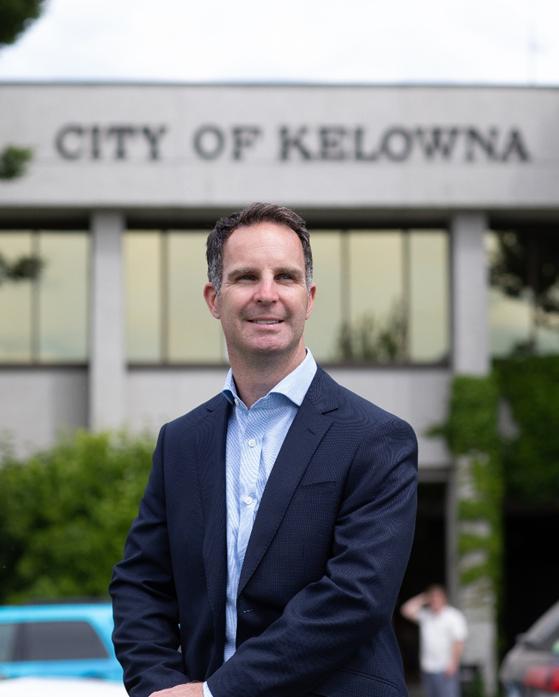
A MESSAGE FROM THE CITY MANAGER
To Council and Residents,
As we look ahead to 2026, I’m pleased to present Kelowna’s Financial Plan, our funding roadmap for building a City of the Future. As the last budget before the 2026 municipal election, the plan is focused on continuing to deliver of Council’s stated priorities and making smart investments in services and infrastructure that our citizens need. We are doing this, all while keeping taxes competitive, stable and predictable.
The priorities of our community come first. Each year’s budget is part of a multi-year financial cycle that ties every funding decision to community needs. From Crime & Safety, Homelessness, and Affordable Housing, to Transportation, Agriculture & Environment, and the Economy, these six Council priorities serve as our compass. They ensure every dollar works toward tackling our biggest challenges and making life better for residents.
Our budget also builds for the future. Guided by the Imagine Kelowna vision and long-range plans such as; the 2040 Official Community Plan, the 10-Year Capital Plan, and the Five-Year Financial Plan, we ensure each year’s budget fits into a bigger 5, 10, even 20-year strategy. Because our 2026 budget isn’t just about this year, it’s part of a sophisticated, long-term plan to keep our city thriving, affordable, and positioned to respond to our dynamic environment.
Our investments for 2026 are focused and strategic.
Top community priorities like Crime & Safety and Transportation receive the greatest attention. We’re boosting resources for police, fire, and bylaw services to enhance public safety, and accelerating the construction of roads, bridges, sidewalks, and bike lanes to improve mobility. We’ve also earmarked new funding for transit operations and traffic safety improvements.
At the same time, we’re moving ahead with transformative projects that will benefit Kelowna for generations. We’re opening new urban parks in more neighbourhoods and building modern recreation facilities and sports fields through our Building a Stronger Kelowna initiative. Projects are underway to redevelop the 50-year-old Parkinson Recreation Centre and create all-ages community centres in Glenmore, Mission, and Rutland, alongside upgrades to sports fields in Rutland as well. We’re also investing in our major parks throughout the city and venues to keep Kelowna vibrant and attractive for residents and visitors alike.
While much of our budget looks to the future, we never lose sight of the everyday work that keeps Kelowna running smoothly. From road repairs and snow removal, to park upkeep and boulevard enhancements, City crews are out there every day ensuring Kelowna remains clean, safe, and reliable for everyone. Through proactive maintenance and asset management, we take care of our existing infrastructure behind the scenes, so that services continue uninterrupted and our assets last longer.
Inside the City, we’re also modernizing how we do business. Our corporate priorities remain focused on building a high-performance organization: implementing smarter automation, strengthening cybersecurity, and improving customer service both online and in person. To this end, we will have added emphasis on improving the Customer Experience, to our Corporate Priorities. These internal investments will make it easier for residents to access services and ensure the City operates efficiently and securely.
And finally, we recognize that some costs—such as RCMP policing, BC Transit service, and construction materials—are rising beyond our control. Thanks to our strong financial position and careful planning, we’re able to absorb many of these pressures with minimal impact on taxes. This means we can continue delivering the essential services that support community safety, mobility, and quality of life without sudden tax increases or cuts in service.
Kelowna’s 2026 budget builds on our past successes. Following the success of our inaugural service-based budget in 2024, we’ve continued to evolve how we plan and invest. By organizing our budget around 20 distinct service areas rather than traditional departments, we’ve made it easier to see where tax dollars are invested, while also giving Council more flexibility to respond to what residents need most, not just at budget time, but throughout the year.
For 2026, we’re taking another step forward by embedding new performance measures across all services, so we can shift our focus from funding services to funding outcomes. We’re also exploring new tools to adjust service levels up or down as needed, helping us better balance community needs with stable taxes. As these tools become available, we’ll more strongly link the dollars we spend to the results we expect, improving accountability.
Our budgeting approach is grounded in strong financial principles. We’ve adopted a cash-flow budgeting model for multi-year capital projects, meaning we only collect the funds needed for each year’s planned spending. This enhances financial transparency and improves project scheduling. We also continue to pursue external funding opportunities—such as partnerships and grants—to reduce reliance on property taxes and make every dollar go further. Across all service areas, from public safety to transportation, our funding decisions prioritize cost-efficiency, high-quality service delivery, and meaningful community impact.
Building a City of the Future requires thoughtful, intentional decisions. Every decision, from maintaining stable, competitive taxes to making strategic investments, must balance fiscal responsibility with bold action, because meaningful progress doesn’t happen by chance. Our long-term plans and careful financial strategies keep us on track toward a city that is more connected, inclusive, and ready for the future.
I invite Council and residents to engage with the 2026 Financial Plan and explore how we’re investing in what matters most. Together, we’re shaping a city that delivers value for taxpayers, supports a vibrant community, and leads with innovation and foresight.
Let’s continue to build the City of the Future—today and for generations to come.
– Doug Gilchrist, City Manager


TERRITORY ACKNOWLEDGEMENT
We acknowledge that our community is located on the traditional, ancestral, unceded territory of the syilx/ Okanagan people
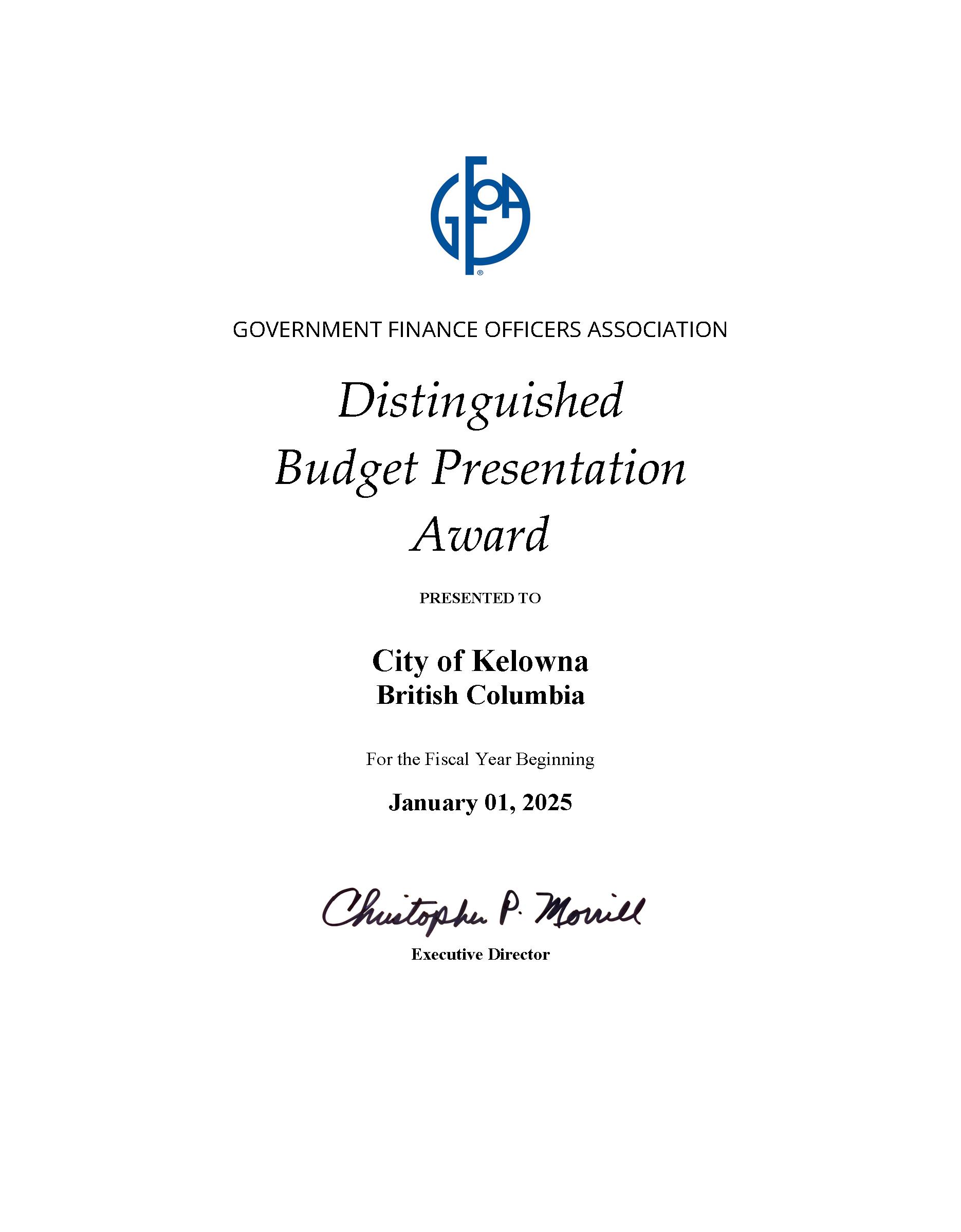
Award for Financial Reporting
The Government Finance Officers Association (GFOA) has presented a Distinguished Budget Presentation Award to City of Kelowna, British Columbia, for its 2025 Annual Budget for the fiscal year beginning January 1, 2025
In order to receive this award, a governmental unit must publish a budget document that meets program criteria as a policy document, as a financial plan, as an operations guide, and as a communications device.
This award is valid for a period of one year only. We believe our 2026 budget continues to conform to program requirements, and we are submitting it to GFOA to determine its eligibility for another award.
The City of Kelowna has received the GFOA Distinguished Budget Presentation Award for 24 consecutive years. The 2025 Annual Budget also received special recognition in the category of long-range operating financial plans.
Our Community
Lifestyle
Nestled along the shores of Okanagan Lake in the heart of the Okanagan Valley, Kelowna is a vibrant four-season destination that welcomes over two million visitors annually. Surrounded by mountains, beaches, hiking trails, ski resorts, golf courses, and the scenic Okanagan Rail Trail, the city offers year-round opportunities for outdoor adventure and active living.
Kelowna is also the gateway to the world-renowned Okanagan wine country, with more than 40 wineries within a 20-minute drive. Its rich agricultural heritage is reflected in a flourishing scene of award-winning microbreweries, distilleries, and cideries. The city’s dynamic urban core features a thriving farm-to-table culinary network, bustling outdoor markets, a vibrant arts and music scene, and a variety of galleries, theaters, and boutique shops.
Residents enjoy a high quality of life, with 92 per cent rating it as good or very good, citing recreational amenities, safety, accessibility, employment opportunities, and exceptional weather as key contributors.
Growth & Demographic Changes
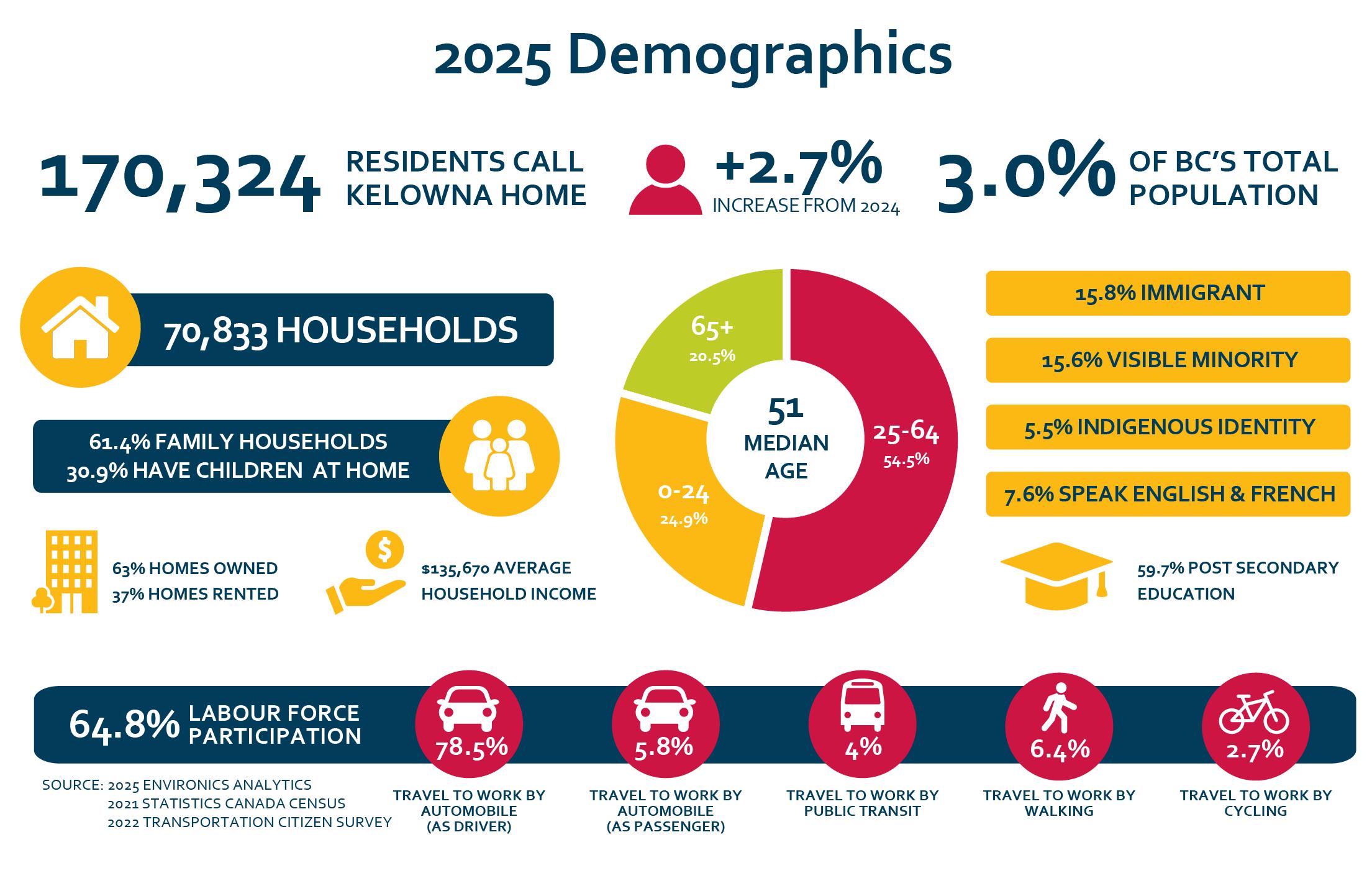
Kelowna continues to be one of Canada’s fastest-growing cities, but recent population forecasts are more moderate than before. From a population of 170,000 residents in 2025, the city is projected to reach approximately 200,000 by 2045, compared to the previous estimate of 230,000. Growth remains fueled by interprovincial migration, a younger and increasingly diverse population, and Kelowna’s strong appeal as a destination for education, employment, and lifestyle.
Currently, the median age is 51, and by 2040, one in four residents will be 65 or older. This shift underscores the need for continued investment in housing, transportation, and healthcare services to support an aging population.
Construction activity remains strong to meet our growing population’s needs. While building permits in 2024 totalled $646 million—down from the record $1.756 billion in 2023—many projects are nearing completion, driving a surge in occupancy permits. This progress has eased pressure on the rental market, with vacancy rates improving from 1.7 per cent in June 2024 to 4.5 per cent in June 2025.
Economy & Services
Kelowna’s economy is diverse and resilient, anchored by traditional sectors such as agriculture, construction, and retail, and bolstered by emerging industries like technology, healthcare, education, and tourism. The city is home to over 780 tech companies, contributing $4.98 billion in economic output, while tourism generates $2.4 billion annually.
The Kelowna International Airport, Canada’s largest municipally owned and operated airport, serves over 2.1 million passengers annually and is undergoing a $118 million terminal expansion, including a new parkade and hotel. These investments are expected to further strengthen Kelowna’s aviation and aerospace sectors.
Kelowna is also a centre for education and innovation, hosting the University of British Columbia’s Okanagan campus and the largest campus of Okanagan College. Together, they welcome nearly 30,000 students annually, supporting workforce development and research excellence.
In healthcare, Kelowna is home to the Kelowna General Hospital, the largest and most comprehensive hospital in the southern Interior of B.C., and the headquarters of the Interior Health Authority. These institutions provide world-class care and serve as teaching hubs for medical students from UBC Okanagan.
Our City
In Kelowna, the future isn’t something we wait for—it’s something we build together. With a spirit of innovation and openness, our city embraces new ideas, welcomes diverse voices, and creates space for businesses and residents to thrive. Our goal is to be ready for growth and new economic opportunities.
At the heart of this progress is a team of more than 1,200 dedicated City employees, working alongside Mayor Tom Dyas, City Council, and our City Manager. Together, they ensure Kelowna remains a safe, vibrant, and sustainable place to call home.
Our story is one of stewardship and service. As a fiscally responsible municipality, we focus on what matters most: delivering essential services, maintaining the infrastructure that supports daily life, and building new amenities when our growing community needs them.
We believe in keeping our residents informed and connected. Whether it’s through the monthly City Views digital newsletter, our Annual Report, timely news releases, or active social media channels, we’re committed to transparency and engagement. And with our mobile-friendly website, kelowna.ca, it’s easier than ever to request services and stay in the loop on City projects and updates.
Mayor and Council
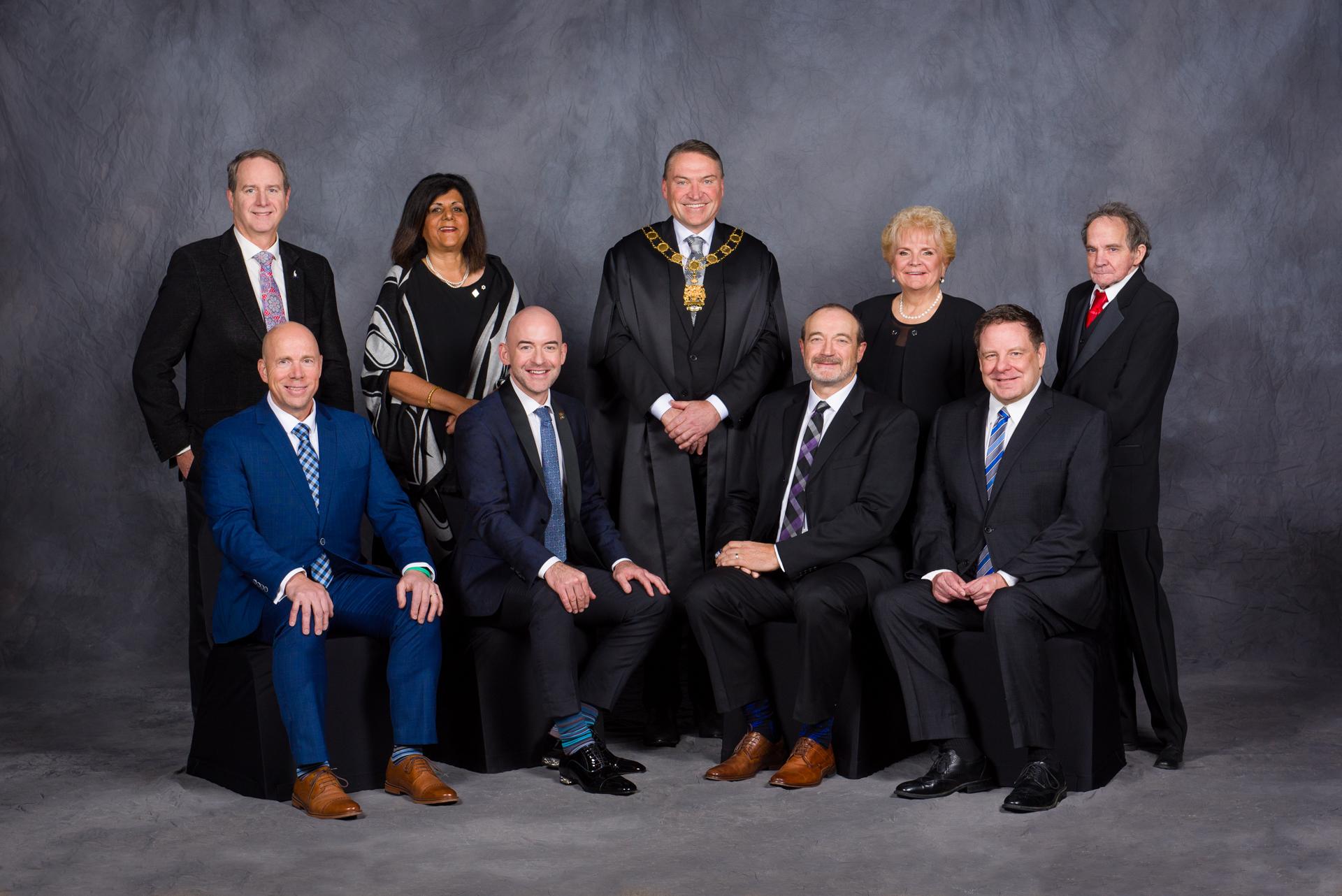
Kelowna’s City Council is made up of the Mayor and eight Councillors, elected to serve a four-year term (2022–2026). Led by Mayor Tom Dyas, Council is focused on building on past successes, embracing new opportunities through community engagement and strong partnerships, and addressing the most pressing issues in our community through Council Priorities. Their commitment to transparency and consistency helps foster a welcoming environment for residents, businesses, and developers alike.
Top row: Councillors Luke Stack and Mohini Singh, Mayor Tom Dyas, Councillors Maxine DeHart and Charlie Hodge. Seated: Councillors Ron Cannan, Loyal Wooldridge, Gord Lovegrove and Rick Webber.
Our Citizens
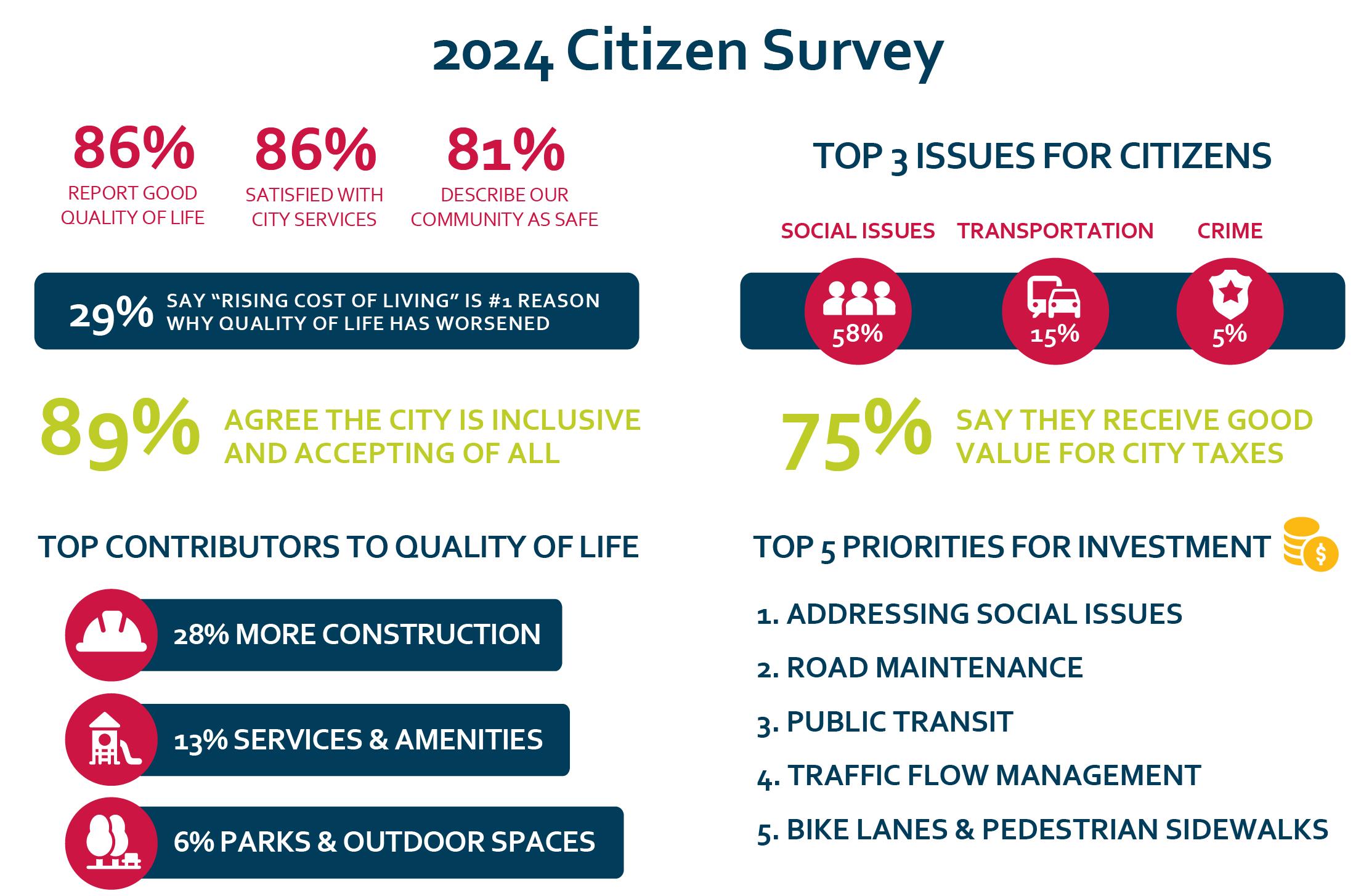
The 2024 City of Kelowna Citizen Survey helped gauge public satisfaction with municipal programs and services, providing insights into citizens’ priorities. For information, see the Appendix.
Kelowna on the Map
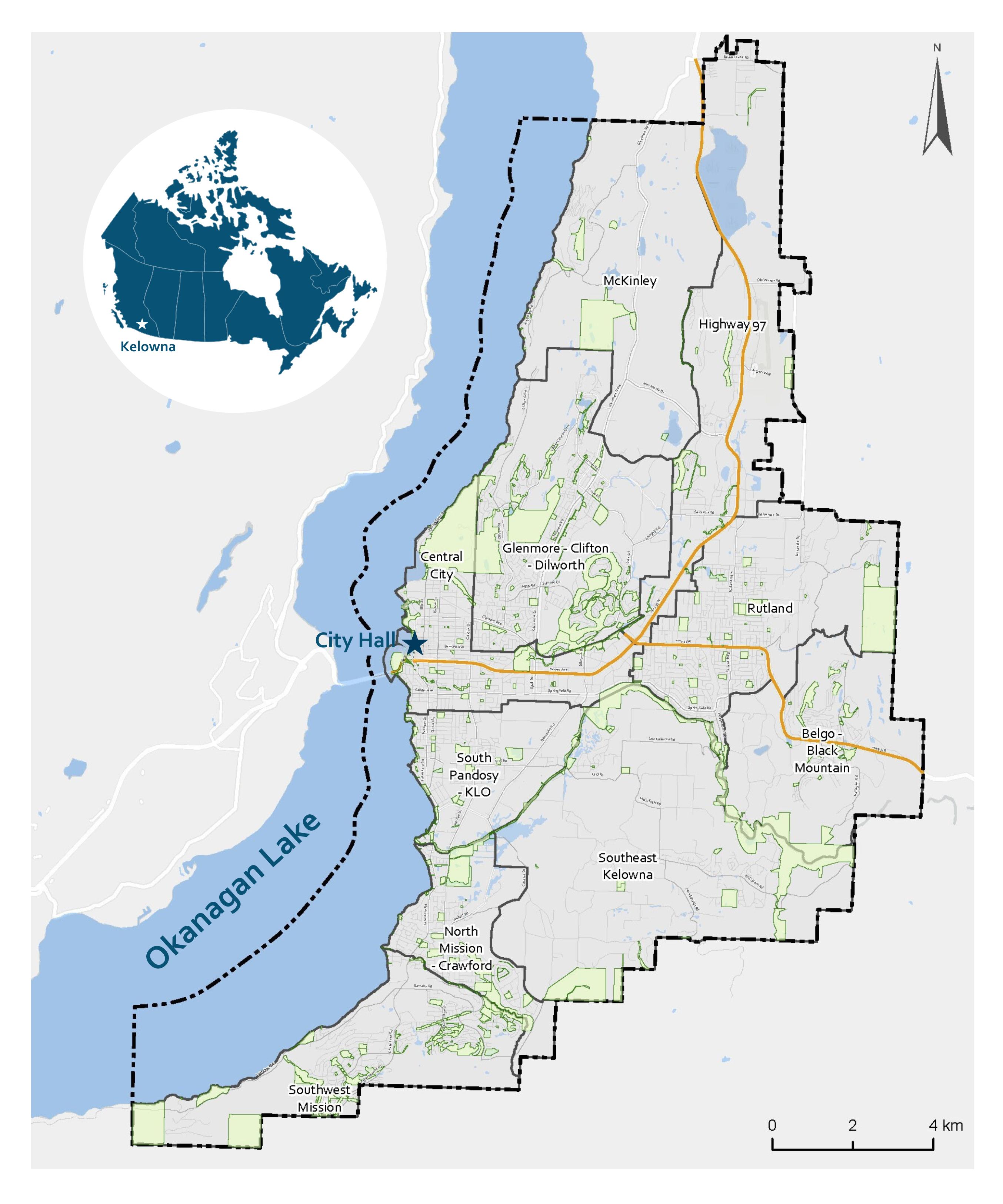


At-a-glance
In 2018, we are a city in transition and Imagine Kelowna is the community’s vision for how to thrive in the face of unprecedented growth and change. The result of almost 4,000 resident contributions, this is a vision created by our community, for our community.
We need to be agile, resilient and unafraid to do things differently. The community has made it clear that as we grow, we need to look out for one another and protect the stunning environment that sustains us.
In 2040, Kelowna is a thriving mid-sized city that welcomes people from all backgrounds. We want to build a successful community that honours our rich heritage and also respects the natural wonders that contribute to our identity. As a place with deep agricultural roots, Kelowna understands the need to protect our environment, manage growth and be resilient as our future unfolds. We want a community that:
• puts people first: We try to balance the needs of everybody in our decision making. We recognize that inclusivity and diversity makes us a stronger and more innovative community.
• values its history: We celebrate our heritage, and learn from our past to reconcile it with a better, more inclusive future we see for ourselves.
• encourages curiosity and creativity: We learn continuously to respond and adapt to rapid change. We find innovative ways to meet social, economic and environmental challenges and opportunities.
• recognizes the changing roles of individuals, businesses, governments and community organizations: The well-being of our city is a shared responsibility and everyone needs to do their part to seize opportunities for improvement.
Principles
Principles and goals
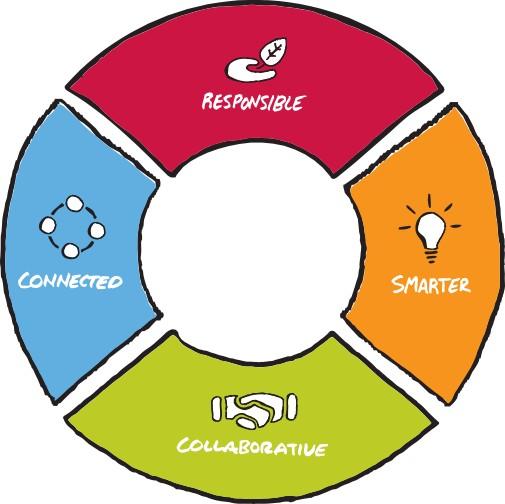
The following principles and goals work together as a system to help the community achieve its vision.


Principle 1 – Collaborative: A community where people of all backgrounds work together to meet collective challenges.
Goal: Engage with the Okanagan’s traditional past and heritage as foundations for building a fair and equitable community.
We will honour our rich heritage while also following the lead of our local Indigenous communities towards a path of reconciliation.
Goal: Nurture a culture of entrepreneurship and collaboration.
Entrepreneurship is weaved into Kelowna’s cultural fabric, making our community more creative, collaborative and better able to meet the challenges of the future.
Goal: Foster resident-driven solutions.
We unleash our community’s hidden talents to solve the tough challenges of the future.

Draft principles and goals

Principle 2 – Smarter: A community willing to learn, adapt and grow so we can thrive amid rapid change.
Goal: Support innovation that helps drive inclusive prosperity.
We are building a nimble and resilient economy that doesn’t leave anyone behind.
Goal: Take action and be resilient in the face of climate change.
We will seize the opportunity to face climate change head-on for a hopeful and sustainable future.
Goal: Build healthy neighbourhoods that support a variety of households, income levels and life stages
Everyone in our community should be able to find stable and appropriate housing.

Principle 3 – Connected: A community where residents are connected to their neighbours, their city and the wider world.
Goal: Embrace diverse transportation options to shift away from our car-centric culture.
Making it easy for people to choose non-driving options protects the beauty of Kelowna and makes getting around more enjoyable.
Goal: Create great public spaces that bring people together.
We need great public gathering places like parks, plazas and community centres where people can meet and connect with others.
Goal: Provide opportunities for people of all ages, abilities and identities.
We all benefit when everyone in the community has access to economic, recreational and social opportunities.
Goal: Cultivate an accessible and engaging arts and culture scene.
Everyone can find something that interests them to engage in, from grassroots initiatives to professional endeavours.
Principle 4 – Responsible: A community where decisions are made ethically and where social and environmental concerns are prioritized.
Goal: Concentrate on growing vibrant urban centres and limit urban sprawl.
Denser neighbourhoods make our city healthier, more sustainable and easier to get around. They make more financial sense, too.
Goal: Preserve Okanagan Lake as a shared resource.
Okanagan Lake is the jewel that makes Kelowna sparkle.
Goal: Strengthen the protection of our land, water and air resources.
Our stunning environment is the foundation that all of our other aspirations stand on.
Goal: Protect agricultural land and promote sustainable farming.
Supporting agriculture helps ensure food security while preserving vital green infrastructure.
Now what?
Under the banner of Imagine Next, the City will use Imagine Kelowna to help shape its priorities and provide the foundation for future strategies and projects such as the Official Community Plan (Our City as we Grow), the Transportation Master Plan (Our City as we Move), Intelligent City Strategy, and many others.
The Imagine Kelowna goals are also aligned with the United Nation’s Sustainable Development Goals, linking what we are doing locally with larger global efforts to shift the world onto a more equitable, sustainable and resilient path.
However, Imagine Next doesn’t only involve the City. It also provides direction to our entire community to change the way we work together, how we make decisions, and how we engage with residents. Ultimately, Imagine Kelowna is the community’s vision to ensure a vibrant and resilient future. It is up to all of us to imagine what’s next and help make Imagine Kelowna a reality.
Stay informed about Imagine Kelowna by subscribing to eupdates or get involved by visiting imagine.kelowna.ca
Council Priorities
Kelowna’s 2023–2026 Council Priorities serve as a strategic compass that directs how the City allocates resources, plans services, and invests public dollars. These priorities reflect the issues that matter most to residents—identified through public input, surveys, and long-term planning frameworks like Imagine Kelowna and the 2040 Official Community Plan.
In 2025, Council reaffirmed its commitment to six core areas and endorsed 25 targeted actions to advance these goals. These priorities are not just aspirational—they are operational. They shape budget decision to ensure public funds are used effectively to improve quality of life. Council tracks progress through regular public reports every six months, helping turn community vision into measurable impact. Learn more at kelowna.ca/councilpriorities.
Crime & Safety
Council Priority Actions
• Advocate for more crown prosecutors and bail reform to address repeat property offenders
• Advocate for the activation of a regional secure, compassionate care facility
• Support sustainable funding model for Business Improvement Areas to enhance public safety programs
• Enhance traffic safety enforcement through RCMP visibility and greater enforcement of traffic violations
• Advance alternate call response and flexible deployment models (e.g., civilian-based response to people experiencing crisis)
Affordable Housing
Council Priority Actions
• Construct in-progress supportive and affordable housing (e.g., Bertram project) in partnership with BC Housing and through the Housing Accelerator Fund (five projects)
• Advocate for accelerated implementation of electrical distribution infrastructure to support growth
• Implement the Council-approved Housing Action Plan initiatives
Homelessness
Council Priority Actions
• Facilitate a purpose-built permanent shelter with “wrap-around” supports, in partnership with BC Housing
• Continue to implement the outdoor sheltering strategy
• Advocate for an Indigenous-led regional care facility (e.g., Red Fish Healing Centre model)
Transportation
Council Priority Actions
• Complete the functional design of Clement Avenue multi-modal extension corridor and propose a partnership delivery model to the Province
• Advance and secure funding for a new transit operations centre
• Enhance traffic safety infrastructure (e.g. traffic calming and pedestrian infrastructure)
• Explore alternative modes of transportation between UBCO/YLW and downtown (e.g. light rail)
• Improve transit service including expanding the transit pass program and weekend transit
• Improve traffic flow and capacity on major road networks (e.g. roads bundle)
• Advance “quick build” model for cycling infrastructure and seek design consistency throughout the City
Agriculture & Environment
Council Priority Actions
• Implement the Climate Resilient Kelowna Strategy
• Continue to include “Climate Lens” in decision making to assess mitigation and adaptation
• Ensure reliable agricultural water supply
Economy
Council Priority Actions
• Establish a Community Task Force on Economic Prosperity
• Support accelerated development of major employment lands
• Review the City’s current investments into economic development programs
• Enhance sports tourism and recreation development
Plans & Strategies
Kelowna’s budget isn’t just about this year—it’s about the next 5, 10, even 20 years. Every dollar we spend is part of a bigger plan to keep our city thriving, affordable, and ready for the future.
We set priorities for 4 years
After each municipal election, Council sets the priorities like housing,safety,andtransportation that shape which projects move forward through the City’s annual financialcycle.
We plan our community 20 years ahead
We budget 5 years ahead
Council uses the Five-Year Financial Plan to carefully assess current funding needs and future budget impacts—ensuring property taxes stay fair and predictable, not left to chance.
The 2040 Official Community Plan (OCP) is Kelowna’s roadmap for housing, transportation, parks, and economic development—essentially, shaping the kind of community we want Kelowna to become. The OCP is built on the foundation of Imagine Kelowna, our community-driven visionforaconnected,inclusive,andsustainablecity.
Dive Deeper
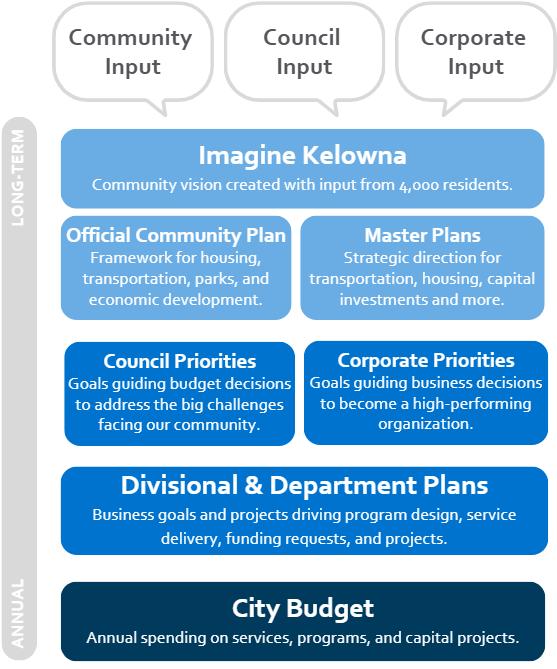
The City of Kelowna’s budget is built on a foundation of community input, Council direction, and corporate priorities. It starts with Imagine Kelowna, a long-term vision shaped by feedback from more than 4,000 residents. This vision drives big-picture plans like the Official Community Plan, which sets the framework for housing, transportation, parks, and economic growth, and Master Plans, which provide detailed strategies for transportation, housing, and major investments.
Next come the priorities. Council Priorities tackle the community’s biggest challenges, while Corporate Priorities focus on making the City a high-performing organization. These priorities guide Divisional and Department Plans, where teams design programs, services, and funding requests.
Finally, it all comes together in the City Budget—an annual plan that funds services, programs, and capital projects. Every dollar connects back to the community’s vision and the strategies that support it.
We plan big projects 10 years ahead
From new parks or roads to community facilities, the 10-Year Capital Plan is both a construction schedule—funded via the FiveYear Financial Plan - and a longterm wish list for Council to
How plans work together
TheOCPsetsthedirectionforKelowna’sfuture,the10-Year Capital Plan translates that vision into major projects, and the5-YearFinancialPlanensureswecanaffordit.Together, these multi-year planning frameworks turn long-term goals intoreal-worldresults
Measurement
Performance Measurement
City of Kelowna has a corporate-wide performance measurement program that is integrated into the Annual Financial Plan in accordance with the BC Community Charter. We believe that measuring and reporting on performance is foundational to responsible management.
Performance measurement is used to:
• Assess and communicate the value provided to citizens through our services including the performance measures contained in the Annual Financial Plan
• Make transparent and defensible decisions about where to prioritize tax revenue.
• Demonstrate progress on Council priorities, corporate priorities and significant city plans such as the Official Community Plan and Transportation Master Plan through interactive progress reports
• Compare how well we deliver services and the cost of services compared to other cities through industry and municipal benchmarking programs
• Regular use and monitoring of internally facing management and financial data to identify highperforming areas, detect issues early and make informed decisions to improve outcomes
In 2024, the City of Kelowna joined the Municipal Benchmarking Network of Canada (MBNC), a collaboration of 16 municipalities committed to sharing and comparing performance data annually. This partnership enables us to identify best practices, improve service delivery, and make informed, data-driven decisions across 36 municipal service areas. Where applicable, comparative benchmark data is presented in the 2026 Financial Plan as part of the performance measures for service areas.

Budget Highlights
Budget at a glance
The City of Kelowna acts as a steward of public funds on behalf of our residents and makes the right choices to protect our city and community. We do this by having a clear set of priorities based on our community led Imagine Kelowna vision, solid master plans and a firm dedication to active financial management. This is supported through continuous and consistent progress reporting, showing how the City is implementing priority Imagine Kelowna actions. Public reporting not only invites useful feedback and input from the community, it shows Council’s commitment to transparency, accountability and providing value to residents.
Previously, Kelowna’s annual budget was presented according to its organizational structure, which sometimes made it hard to show the true cost of the services being provided. To improve transparency and align budgeting with citizen expectations, the City shifted to a Service Based Budgeting model for the 2024 and 2025 Financial Plans—focusing on the costs and performance of specific services delivered to the community. This approach continues in the 2026 Financial Plan Preliminary Volume, offering a comprehensive view of operating, capital, and enabling services, and better connecting spending to service levels, Council priorities, and long-term community goals
2026 priorities
Kelowna’s 2026 Financial Plan, the final budget of this Council term, serves as a strategic roadmap for the year ahead. Guided by long-range plans, it ensures today’s investments strengthen Kelowna’s future while addressing immediate priorities.
First, the plan aligns every funding decision with six core priorities: Crime & Safety, Homelessness, Affordable Housing, Transportation, Agriculture & Environment, and the Economy. Council remains committed to completing the 25 actions outlined in the Council Priorities progress report, driving meaningful progress on public safety, housing, transportation, and economic development.
Second, the City is focused on stable services and stable taxes. Rising costs for essential services like RCMP policing and transit—pressures largely beyond our control—make this challenging. The 2026 Budget works to absorb these increases without significant tax impacts, ensuring services remain reliable and affordable for residents.
Third, major infrastructure projects are moving forward. Since 2022, Kelowna has accelerated investment in roads, parks, utilities, and facilities. That momentum continues with the 2026–2035 Capital Plan, approved in October 2025, which commits $2.8 billion over the next decade. This year’s budget funds key phases to keep progress on track.
Finally, the plan emphasizes modernization and efficiency. Investments in automation, cybersecurity, and improved customer service will help the City deliver high-quality services while maintaining core infrastructure. Major requests include enhanced security, support for vulnerable populations, upgrades to transit and roads, climate action initiatives, and economic development projects.
Despite rising costs and economic uncertainty, Kelowna is working hard to keep taxes stable, secure external funding, and embed performance measures to maintain service levels. Together, these efforts ensure Kelowna remains safe, inclusive, and ready for the future.
Budgeting by priority
Each budget request must indicate the Council or Corporate priority that it is best aligned with. Council priorities identify where residents and City Council want to see a difference in our community. Corporate priorities identify what is needed to be a high-performance organization and be able to deliver services and value to residents.
Listed below by Council and Corporate Priority, are some of the exciting programs and projects being requested in 2026
Crime and Safety
Council Priority Actions:
1. Advocate for more crown prosecutors and bail reform to address repeat property offenders.
2. Advocate for the activation of a regional secure, compassionate care facility.
3. Support sustainable funding model for Business Improvement Areas to enhance public safety programs.
4. Enhance traffic safety enforcement through RCMP visibility and greater enforcement of traffic violations.
5. Advance alternate call response and flexible deployment models (e.g., civilian-based response to people experiencing crisis).
Operating requests:
Kelowna’s 2026 Crime & Safety Operating Requests propose investment in enhanced security coverage at Orchard Park Exchange and funding for a two-year continuation of City-led outdoor sheltering site, which integrates case management and security to reduce illegal sheltering and support vulnerable populations.
A request is proposed to advance a recommendation from the Mayor’s Task Force on Crime Reduction for increased funding for Business Improvement Areas, including support for a Clean Team in Uptown Rutland, to help businesses manage the impacts of crime and homelessness. Additional support for the Child & Youth Advocacy Centre is requested to expand shared services for children and families affected by abuse.
Finally, key Public Safety Levy budget requests include two dedicated Bylaw Enforcement Officers for Rutland to address rising incidents and social disorder and, four new RCMP members and a Police Services Financial Analyst are proposed to meet growing community needs, improve safety, and enhance financial oversight financial oversight to meet growing community needs. One of the new members will be stationed at and partially funded by the Kelowna International Airport.
These investments are essential in supporting Kelowna’s commitment to enhancing public safety and meeting Council’s crime and safety priorities by enhancing security coverage throughout the city, supporting at-risk residents, and strengthening community resilience.
Capital requests:
The 2026 Crime & Safety Capital Requests for Kelowna include two significant projects.
First, funding is requested to support continued development of the Glenmore Protective Services Campus on John Hindle Drive, including new fire hall and training facilities, site works, and the eventual demolition and agricultural restoration of the current Fire Hall #5.
Second, funding is requested for the mandatory transition to Next Generation 9-1-1 (NG 9-1-1) technology by 2027, a project supported by multi-year grants from the Union of BC Municipalities. The system will replace aging on-premises dispatch tools with a hosted platform that offers enhanced reliability, scalability, and 24/7 support for critical dispatch services.The provincial government’s extension to 2027 allows time to address resource shortages, develop standards, and ensure all public safety answering points are prepared, ultimately enhancing emergency service delivery for the community.
Affordable Housing
Council Priority Actions:
1. Construct in-progress supportive and affordable housing (e.g., Bertram project) in partnership with BC Housing and through the Housing Accelerator Fund (5 projects).
2. Advocate for accelerated implementation of electrical distribution infrastructure to support growth.
3. Implement the Council-approved Housing Action Plan initiatives.
Operating requests:
The 2026 Affordable Housing Operating Requests focus on Strategic Land Development initiatives that align with the Official Community Plan and broader City corporate objectives. Funding will be used for surveying, consulting, appraisal, legal, and other professional services required to manage feasibility studies, negotiations, and complex development projects. These resources will enable the City to act strategically, advance projects efficiently, and deliver long-term benefits to the community.
Homelessness
Council Priority Actions:
1. Facilitate a purpose-built permanent shelter with “wrap-around” supports, in partnership with BC Housing.
2. Continue to implement the outdoor sheltering strategy.
3. Advocate for an Indigenous-led regional care facility (e.g., Red Fish Healing Centre model).
There are no operating or capital requests for this priority in 2026.
Transportation
Council Priority Actions:
1. Complete the functional design of Clement Avenue multi-modal extension corridor and propose a partnership delivery model to the Province.
2. Advance and secure funding for a new transit operations centre.
3. Enhance traffic safety infrastructure (e.g. traffic calming and pedestrian infrastructure)
4. Explore alternative modes of transportation between UBCO/YLW and downtown (e.g. light rail)
5. Improve transit service including expanding the transit pass program and weekend transit.
6. Improve traffic flow and capacity on major road networks (e.g. roads bundle)
7. Advance “quick build” model for cycling infrastructure and seek design consistency throughout the City.
Operating requests:
The 2026 Transportation Operating Requests focus on advancing support to enable strategic improvements such as adopting the Umo electronic fare system, continuing the transition to electric buses, and expanding the transit maintenance facility—key steps toward modernizing service delivery, improving sustainability, and enhancing rider experience.
Additionally, the budget will maintain current service levels for bike path cleaning, sidewalk repairs, walkway and park pathway inspections, and waste collection at transit stops, ensuring cleanliness, safety, and reliability as infrastructure and public expectations grow.
Lastly, planning for the Hollywood Transit Centre continues with budget allocated to project management and completion of site servicing planning and design initiated in 2025 in collaboration with Hollywood Road design and area developments. This budget will also support continued project advocacy and ongoing coordination with BC Transit to advance the project business case through funding approval stages.
Capital requests:
The 2026 Transit Capital Requests continues the focus on improving transit exchanges. Projects include enhancements and expansion to the Okanagan College Exchange, Orchard Park Exchange and Mission Recreation Exchange to improve rider comfort, upgraded amenities, safety, and accessibility. These enhancements along with the development of mobility hubs at multiple exchanges and planning for a new transit hub at Kelowna International Airport will make public transit more reliable and convenient, support sustainable travel options, and foster better connections for all residents. The projects also encourage active transportation, reduce operating costs, and strengthen partnerships with local organizations, delivering lasting value to the community.
Funding is also requested for annual active transportation growth and renewal as well as upgrades to the bicycle network, crosswalk safety, signals and flashers and safe routes to school. Both projects will include design, land acquisition and construction.
Roads capital projects target essential upgrades to transportation infrastructure, including bridge rehabilitation to ensure safety and longevity, continued work on the replacement of the KLO Road bridge to improve flood resilience and enhance walking and cycling routes, and the extension of Burtch Road to create a continuous north-south corridor between Glenmore Road and KLO Road, including upgrades to existing segments, a new arterial section, and future expansion to Benvoulin Road, supporting development in southern Kelowna.
Other projects include urbanizing local streets in infill areas, extending Clement Avenue as a major arterial, and upgrading Glenmore Road to boost vehicle capacity, safety enhancements and connect active transportation routes Hollywood Road N
will be upgraded from John Hindle Drive to Sexsmith Road, with intersection improvements and development of a major arterial roadway, forming part of a larger plan to connect Airport Way and Highway 97.
These investments will improve traffic flow, support active transportation, and deliver lasting benefits for residents by making travel safer, more efficient, and better connected across the community with necessary planning, design, construction and land acquisition.
Agriculture & Environment
Council Priority Actions:
1. Implement the Climate Resilient Kelowna Strategy
2. Continue to include “Climate Lens” in decision making to assess mitigation and adaptation.
3. Ensure reliable agricultural water supply.
Operating requests:
The 2026 Agriculture and Environment operating requests include a provincial grant to advance climate action initiatives such as the Home Energy Navigator program, EV charging rebates, air purifier and lawn swap programs, and Sustainable Forestry certification. This additional funding will enhance youth and community engagement, launch a climate resilience dashboard, conduct agricultural irrigation assessments, and develop a new Water Conservation Plan.
Budget is also requested to meet new federal landfill monitoring and reporting requirements, and to add technical coordination to support expanded operations and ensure environmental compliance. These investments will help reduce greenhouse gas emissions, improve water resiliency, and promote waste reduction, delivering lasting environmental benefits for the community.
Capital requests:
Several infrastructure and environmental initiatives in Kelowna are requested in 2026, including carbon neutral projects and flood protection at the Airport, upgrades to water service and fire protection for customers on the Glenmore Ellison Improvement District and ongoing flood protection work at Mill Creek.
Additional investments will expand electric vehicle charging stations and enhance parking facilities, non-potable network renewal and systems upgrades including design of a new water storage tank, all aimed at improving service reliability, operational efficiency, environmental resilience, and community benefits. Economy
Council Priority Actions:
1. Establish a Community Task Force on Economic Prosperity.
2. Support accelerated development of major employment lands.
3. Review the City’s current investments into economic development programs.
4. Enhance sports tourism and recreation development.
Operating requests:
The 2026 operating request to advance Council's priority for economic development and enhance the delivery of city-wide sports and community events, funding is requested to support program development which includes a Sport Services Supervisor position dedicated to community activation initiatives. These initiatives aim to broaden event outreach within the community and facilitate coordination with event organizers. This funding will enable innovative programming, promote widespread participation, and generate enduring positive benefits.
Capital requests:
The 2026 Council Priority Economy Capital Requests include continued funding on a range of capital improvements and expansions at Kelowna International Airport (YLW); including technology upgrades and security enhancements. Funding is sought for the completion of new general aviation and helicopter parking areas, runway rehabilitation, and the construction of new airside pavement under the Soaring Beyond 2.5 Million Passengers Airport Improvement Fee (AIF) Program. The expansion of the Child Care Facility, primarily funded by a provincial grant, will add 24 spaces to meet community needs. Additional budget is requested for the new combined operations building, hotel and parkade enabling services, and phased terminal expansion.
The Capital Opportunities and Partnership Fund requests aims to leverage City funds through strategic partnerships for greater community benefit. There are also significant investments in recreation facilities, including Parkinson Recreation Park, Glenmore Recreation Park, Rutland Lions Park, and performing arts venues, proposed to enhance service levels, attract visitors and participants and support economic development and diversification.
Our People
Corporate Priority:
1. Leadership everywhere
Leadership isn’t just for managers—it’s for everyone. This priority encourages all City staff to lead by example, whether through projects, mentoring, or driving innovation. Leadership means spotting opportunities to improve, influencing how we work, and supporting colleagues along the way. Leaders inspire others to achieve more and make things better. Our people take ownership of their growth, supported by managers and the organization.
Operating requests:
The 2026 Our People Operating Requests prioritize building internal capacity and fostering a positive culture that enables corporate priorities. Funding will address critical gaps in HR service delivery, including safety performance, workforce planning, and leadership development. Investments will support workforce analytics, strategic consulting, and digital transformation—ensuring the City meets future service demands, advances innovation, and aligns talent with strategic goals.
Transformation
Corporate Priority:
1. Making it easier to do business with the City, and within the City
2. Using data to make decisions
Transformation means scaling services without increasing costs, while making it easier for residents, businesses, and staff to interact with the City. It’s about rethinking processes, leveraging technology where it adds real value, and using data to drive smarter decisions. This approach empowers every staff member to embrace change, simplify work, and deliver services more efficiently—making everyday tasks faster, easier, and more meaningful for employees and the community.
Operating requests:
The 2026 Transformation requests prioritize strengthening security, modernizing infrastructure, and improving recruitment processes. Key initiatives include advancing the City’s Cyber Strategy to enhance threat monitoring, prevention tools, and disaster recovery capabilities, ensuring data protection and operational continuity.
Funding is requested to transition on-premises datacentre infrastructure to a hosted solution, providing greater reliability, scalability, and compliance with cybersecurity standards. Additionally, a one-year pilot of candidate testing software will streamline recruitment through customized skills assessments, reducing manual workload and improving hiring efficiency. These investments support corporate priorities by making it easier to do business with the City, improving internal operations, and safeguarding critical systems.
Capital requests:
The 2026 Transformation Capital Requests focus on advancing technology and infrastructure to improve efficiency and service delivery. Key investments include airside enhancements at the Kelowna International Airport through vehicle transponders, phase one of a private wireless 5G network, and apron artificial intelligence to optimize gate operations under the Soaring Beyond 2.5 Million Passengers AIR program.
Funding is also requested for the annual program supporting major systems enhancements, modernization, and new technology acquisitions to improve decision-making and customer service. Additionally, upgrades to fleet management systems and fuel infrastructure will accommodate growth and maintain service levels.
These projects aim to strengthen operational performance and deliver an enhanced experience for residents and businesses.
Customer Experience
Corporate Priority:
1. Balancing service in a digital-first environment with in-person needs
2. Consistent interactions with customers
3. Seamless service experience with the City
Customer Experience is central to how the City delivers value to residents. It’s not just about being polite or helpful; it’s about making every interaction count. Whether online or in person, how customers experience a service shapes their trust in the City and their sense of satisfaction.
Operating requests:
The 2026 Customer Experience Operating Requests include funding to strengthen technology support for residents and staff. Information Technology, in collaboration with Human Resources, seeks budget to develop a resourcing plan that ensure reliable and responsive service delivery as technology needs grow. Continued investment will maintain expertise across applications, cloud services, and GIS, supporting the tools that enable efficient interactions and positive experiences for customers and employees.
Other
Corporate Priority:
1. Deliver core services to residents
Many requests for budget are directly aligned with Corporate and Council priorities but some are requested to continue to maintain service levels in core programs, services, and infrastructure.
Operating requests:
Maintaining the delivery of core services to residents is crucial for ensuring the well-being, safety, and quality of life of the community. Essential services like public safety, clean water, waste management, and transportation support daily activities, contribute to public health, and help maintain a functioning society, while disruptions can lead to increased risks, dissatisfaction, and economic setbacks.
The 2026 budget includes several requests to maintain essential municipal services, including reliable parks and playground maintenance, facility maintenance, insurance premiums and equipment repairs amid rising costs. Funding will support continued improvement in fire department responsiveness, compliance with updated standards for traffic management and dam safety, and investments in IT systems to sustain high service levels for residents.
Capital requests:
Maintaining capital infrastructure is essential for ensuring safety, reliability, and cost efficiency, while also supporting economic growth and quality of life. Regular upkeep supports sustainability by minimizing environmental impacts and helps cities prepare for future growth, ensuring infrastructure can meet rising demands.
The 2026 budget includes requests for various annual capital programs. These programs include infrastructure renewal and proactive enhancements for water, wastewater, stormwater, and landfill systems, as well as replacement and growth of city vehicles and equipment; in particular fire vehicles. The funds are aimed at ensuring efficient and reliable services for city customers. Additionally, improvements to recreation infrastructure throughout the city and expansion of the art walk and Queensway transit area are proposed to create vibrant public spaces that encourage social connection, active living, and year-round enjoyment.
Property taxation and major contracts
Property taxation
The annual property taxation demand is the difference between net operating and capital expenditure requirements and the revenues generated by the City. It is the amount of money the City needs to collect from property owners for the operations, maintenance and capital improvements planned for the fiscal year. The net property owner impact is the annual property taxation demand less additional tax revenue generated through new construction.
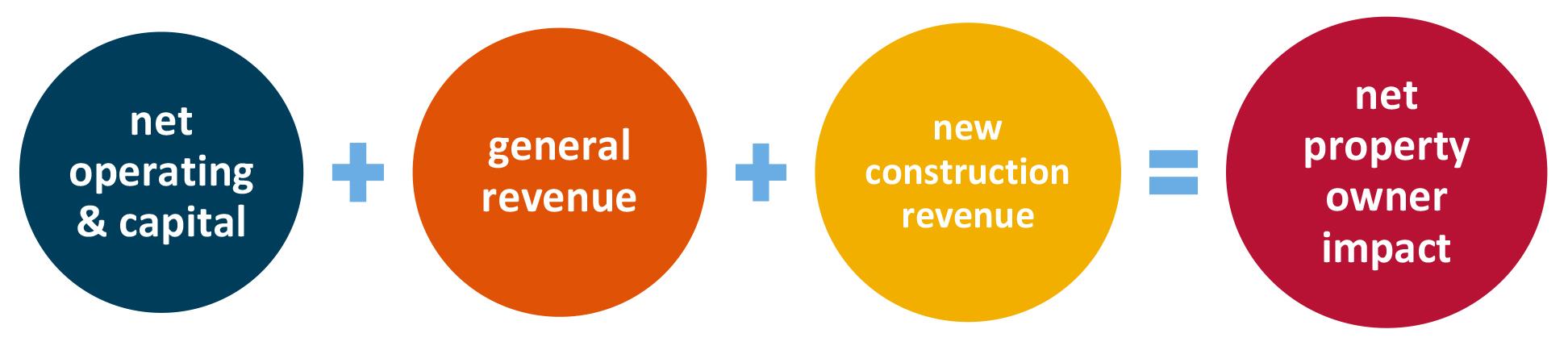
Taxation Revenue from new construction is based on Preliminary Assessment Roll information from BC Assessment (BCA). New construction revenues are used to reduce the overall net property owner impact. In 2026, the new construction revenue is estimated to be $3.0 million. The finalized new construction assessment value will be available from BCA in the second quarter of 2026 and will be reflected in the Final Budget volume of the Financial Plan.
It is important to note that while it is possible to project the average property tax increase using the overall assessment base and the revenues required to operate the City, the impact on each individual property owner will vary depending on the relationship of their assessment change to the average. Further analysis will be required when BCA provides the Revised Assessment Roll in the second quarter of 2026
For 2026, the overall taxation demand has increased from $204.3 million to $216.4 million, which includes general revenue, net operating and capital. Taking into consideration the revenue generated from new construction, the average impact on existing property owners is 4.47 per cent.
Salaries, wages and fringe benefits
A significant portion of the annual operating budget is for staffing. The City of Kelowna has four collective agreements for municipal staff:
• CUPE Local 338 – collective agreement ratified in 2023 for the term 2024 to 2025
• IAFF Local 953 – collective agreement was renewed in 2022 for 2020 to 2024
• CUPE Local 338 - Airport – collective agreement was ratified in 2022 for the term 2020 to 2026
• IBEW Local 213 – collective agreement ratified in 2021 for the term 2020 to 2024 Fringe benefit load factors are reviewed annually and are reflected throughout the divisional operating budgets.
RCMP contract
The current RCMP collective agreement expired on March 31, 2025. The current authorized strength is at 251 members with the average cost per member estimated at $254k for 2026 Reserve funding is used as a budget tool to manage anticipated surpluses from the RCMP member vacancies.
Capital projects by location
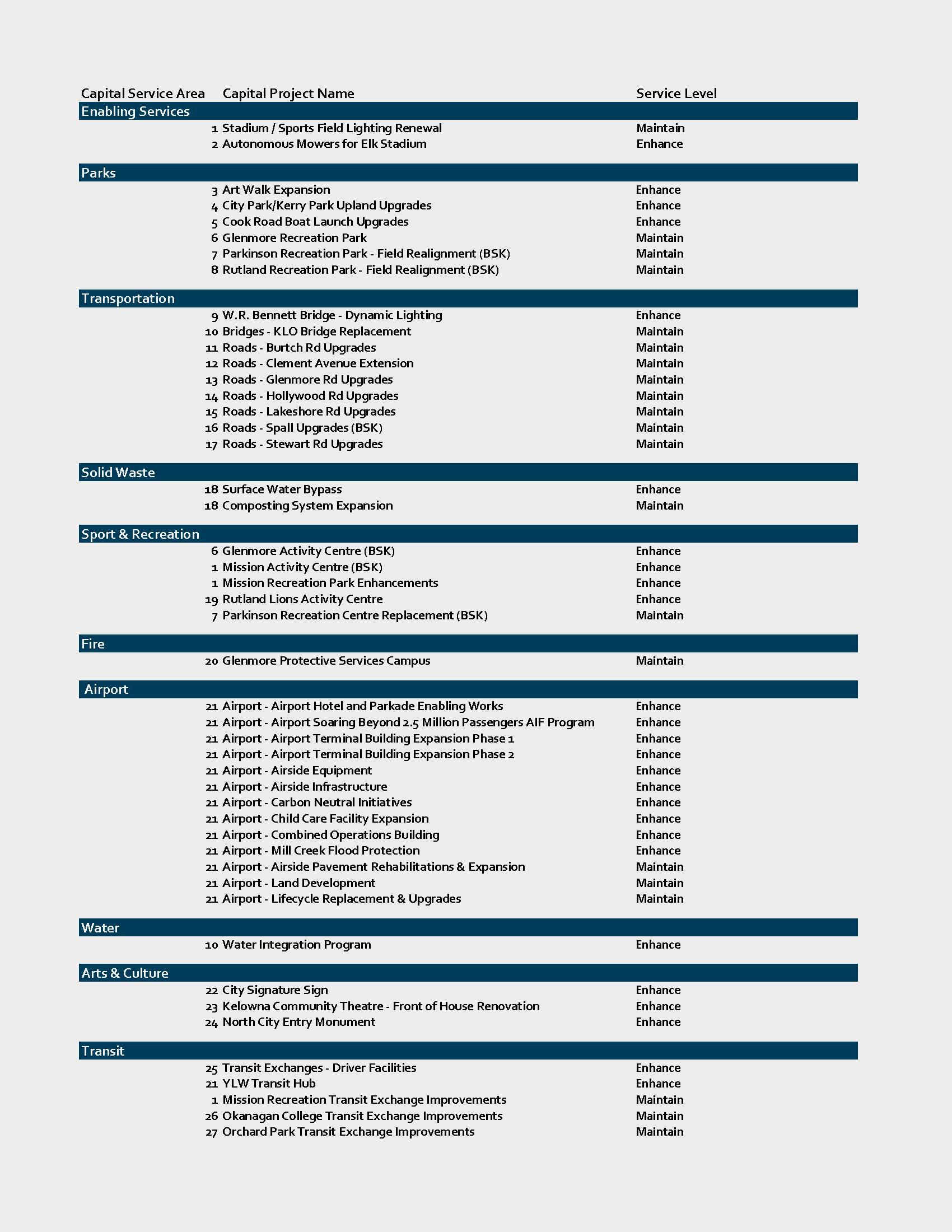
The capital plan works to create vibrant urban centres, a balanced transportation network and an inclusive community. Infrastructure projects improve and maintain outdoor spaces, buildings, active transportation networks, utilities, roads and bridges. This section of the Financial Plan displays a graphical presentation of the 2026 Capital projects. This map view allows the reader to easily see what construction is planned for during the year and where it will occur. Further details can be found on the Current capital projects website.
Capital Projects by location
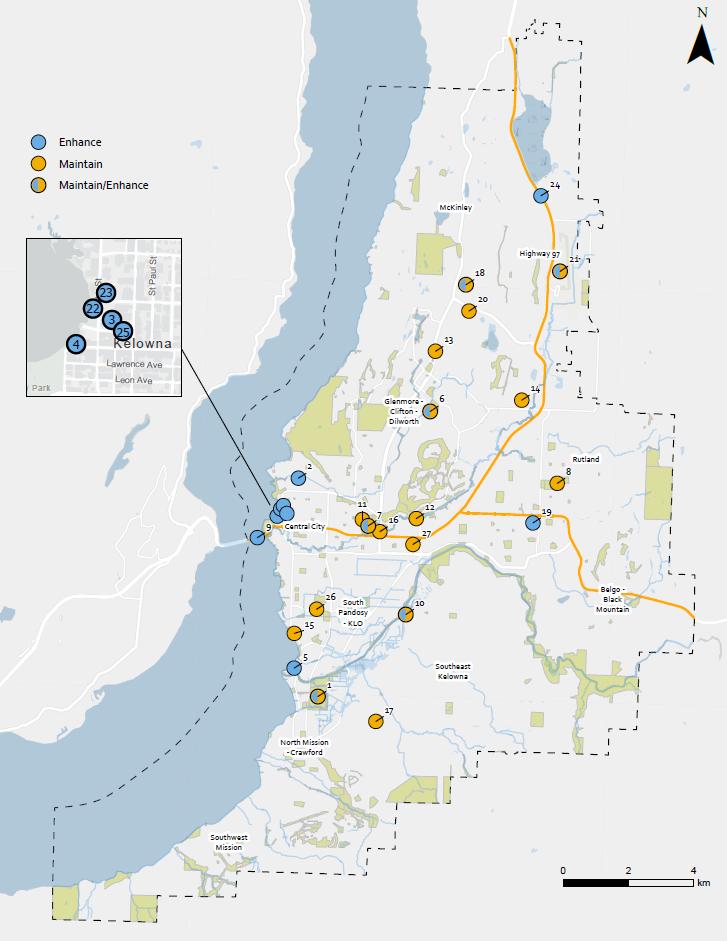
This map is intended for general informational purposes only The City of Kelowna does not warrant its accuracy. The map includes only projects that can be geographically represented. For locations with multiple projects having different Service Levels, the project with the highest cost has been used to determinetheServiceLevel.November18, 2025

STRONG FINANCIAL MANAGEMENT
STRONG FINANCIAL MANAGEMENT
THE CITY & ITS DIVISIONS
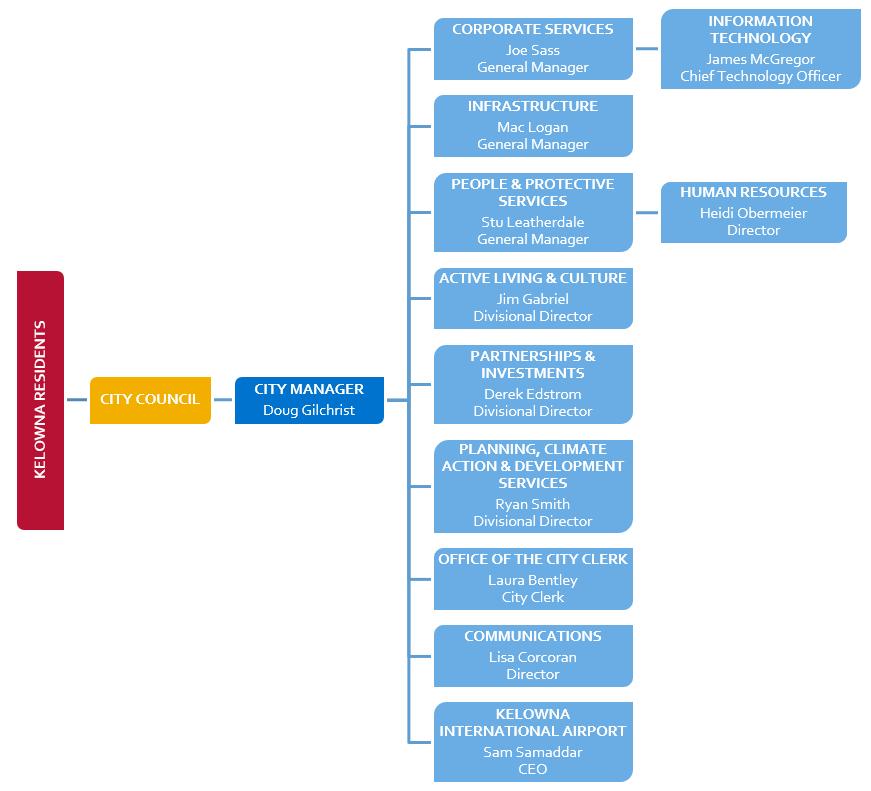
At the City of Kelowna, leadership begins with an elected Mayor and eight Councillors who serve a four-year term (2022–2026). Together, they represent the entire community and set the direction for the City’s priorities and policies.
Supporting this vision is the City Manager—the sole employee of City Council—who oversees day-to-day operations and ensures that Council’s decisions are carried out effectively. Reporting to the City Manager is the Senior Leadership Team, which represents all departments and lines of business across the organization, including contracted services. This structure ensures that the City’s work is coordinated, responsive, and aligned with the needs of Kelowna’s residents
BUDGET PROCESS
City plans that influence the budget include:
• Council Priorities
• Official Community Plan
• 10-Year Capital Plan
• 2030 Infrastructure Plan
• 20-Year Servicing Plan
• Imagine Kelowna - Community Vision
• Community Trends report
Input from City staff, City Council, outside agencies funded by the City, citizens, various City committees, and guidance from the Imagine Kelowna community vision, all helps to build a solid annual and five-year financial plan that meets the needs of our growing community.
Public input
Public input is gathered in a variety of ways. Citizens are able to provide input through Imagine Kelowna, citizen surveys, the elected mayor and council members, and public council meetings. All of which allow for the public to engage in the decision-making process for their city, voicing concerns and recommendations for their community.
Imagine Kelowna is the result of an 18-month long conversation with over 4,000 resident contributions about the future of our City. It is the vision, principles and goals created by our community, for our community. The principles and goals of Imagine Kelowna guide the development of plans such as the Official Community Plan, the Transportation Master Plan and other initiatives, and draw on the rich data of public input and research that was compiled through the extensive engagement process. The vision of Imagine Kelowna will unify strategies and projects that already exist or are underway to make sure they work together to build the kind of community Kelowna residents want.
The Citizen Survey is conducted to determine how satisfied the public is with municipal programs and services, and to learn citizens’ service priorities. Responses are weighted by age, gender, and city-wide distribution to accurately reflect Kelowna’s population. Results are benchmarked against other local governments. Insights gained by this research help us make important decisions regarding planning, budgeting, and service improvements.
The City strives to balance the needs of all citizens in decision making and offers engagement opportunities to our communities to gather feedback and ideas on everything from community vision to park design.
Engagement activities include surveys, focus groups, online discussion forums, information sessions and virtual panels.
Budget development
The City of Kelowna’s annual budget aims for a balance between setting a reasonable tax rate and delivering services expected by residents and businesses. As the City is limited by the amount of resources available, the budget helps in determining which objectives have the highest priority and will produce the greatest positive impact in our community.
Every year City Council, the City Manager and City staff work together to develop the annual budget. Several plans are used as the basis for the development of the Financial Plan, including the Official Community Plan (OCP), 2030 Infrastructure Plan, 20-year Servicing Plan, 10-year Capital Plan and Council Priorities.
Linking to strategic plans
All operating and capital requests strive to support Council and Corporate Priorities and therefore, have been specifically linked to a Strategic Direction
Service area leaders have outlined the activities that will be undertaken in the current year to support the Council and Corporate Priorities. These activities can be found in the first few pages of each service area section and are tied back to a specific priority. Through the use of service work plans, the City will embark on a purposeful effort to effectively coordinate human and financial resources to achieve the priorities as set by Council and the community.
Budget cycle & timeline
The City uses a line item approach to budgeting within service areas. Base budgets are subject to annual review and scrutiny to identify need in relation to approved service level requirements.
A year-round process
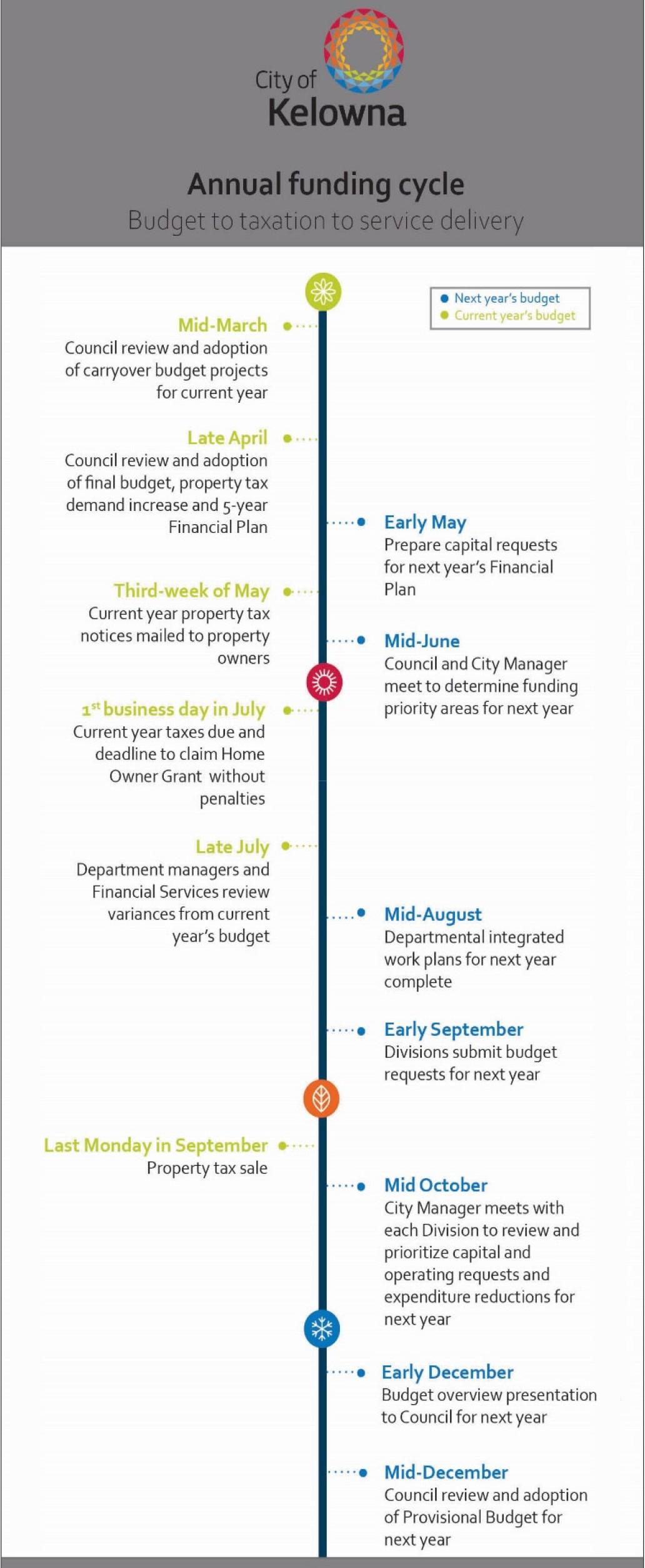
The City’s budget cycle is a near year-round process with the fiscal year beginning January 1 and ending December 31, guided by the requirements of the Community Charter as described in Section 165 and Section 166. The City Manager and Council meet in June each year to determine priority areas for the following budget year. This information is shared with all service areas to assist with the preparation of goals and objectives, and the review and analysis of budget requirements to ensure they align with Council priorities.
In September, each budget request is carefully reviewed, and a recommended priority is assigned by the Budget Review Team. This evaluation considers human resources and financial impacts, as well as opportunities for transformation and risk mitigation. Following this review, the recommended prioritization is presented to the City Manager. The City Manager and Financial Planning team then meet with each service area to discuss their performance metrics and requested enhancements. This discussion and the accompanying information enable the City Manager to finalize the prioritization of budget requests to be included in the Preliminary BudgetVolume 1, which is prepared for deliberation and adoption by Council in December.
Projects not completed in the previous year are presented to Council, as part of the Carryover Budget – Volume 2, in March after accounts are finalized through the year-end process. As we complete transitioning from full project budgeting to cash flow budgeting, it is expected that the number of carryover projects will be significantly reduced.
Final adjustments to the Financial Plan, including requisition amounts from other taxing jurisdictions, are presented to Council in late April as part of the Final Budget – Volume 3. These three volumes combined make up the annual Financial Plan and is the first year of the City’s Five-Year Financial Plan. The Five-Year Financial Plan and the associated Tax Rate Bylaws must be adopted by May 15 each year.
Budget transfers & amendments
As per section 165 (2) of the Community Charter, the Financial Plan may be amended by bylaw at any time. Budget amendment reports are presented to Council each quarter with the last quarter including an amendment of the annual bylaw. Council Policies 261 & 262 ensure that the City’s overall internal control objectives are maintained and that there are no material changes to the original budget approved by Council. Appropriate approvals and back-up documentation are required for all transfer or amendment requests.
Budget transfers involve the re-allocation of existing approved budget and do not change the overall budget total. Budget amendments alter the City’s budget total but must not impact the taxation total. Council approval is required to cancel an approved project or to add a new program or project over $200k.
2026 budget calendar Description
2025
Establish City priorities for the 2026 budget year, based on discussion with Council & City Manager Jun. 25
City Manager meets with each service area to review prioritization of all capital and operating requests Oct. 8-10
Council receives and adopts the annual update to the 10-Year Capital Plan Oct. 27
Council receives overview presentation of the 2026 Preliminary Budget Dec. 1
Council reviews and adopts the 2026 Preliminary Budget – Volume 1 Dec. 4
2026
Council reviews and adopts Carryover Budget –Volume 2 Mar. 16
Council reviews and adopts Final Budget –Volume 3 and the Five-Year Financial Plan 2026-2030 Apr. 27
Prioritization
There are two priority levels used for budget requests:
• Priority 1 (P1) items include budget requests that are essential to maintain current service
quality or recommend improvements to enhance service levels. These items have been included as part of the recommended budget.
• Priority 2 (P2) items include budget requests intended to enhance service levels but are not recommended in the effort to maintain an acceptable general taxation demand or utility user rate.
P1 requests are included in the service area totals but the P2 requests are not. The priority of each budget request is shown on the top right-hand corner of the request. Operating requests are shown as one-, two- or three-year financial impacts and are marked as ongoing or one-time. Changes in years two or three of ongoing requests are automatically added to the base budget of those years. Capital project budgets are presented in full as part of the request summary of each service area with the cash flow expectations detailed by year. All capital budgets are presented and approved annually, with project amendments made as part of the annual update to the 10-Year Capital Plan. All capital submissions have been evaluated to ensure alignment with Council Policy No. 342 Tangible Capital Assets
Operating impacts of capital requests are included with the related capital request. When a vehicle or equipment is required as part of a new position, the capital cost is presented in the operating request and will be transferred to the capital program upon Council approval.
BASIS OF ACCOUNTING/BUDGETING
Basis of accounting
Definition
The basis of accounting refers to the methodology under which revenues and expenditures are recorded and reported in the financial statements. Specifically, as it relates to the timing of measuring and recording of transactions, regardless of the measurement focus applied.
The focus within the budget process is that all interfund transactions are budgeted, but in the financial statements all material interfund transactions and balances are eliminated in preparation of the consolidated financial statements.
Accrual basis of accounting
City of Kelowna revenues and expenditures are recognized on an accrual basis of accounting. Revenues are recognized in the accounting period in which the transaction or event occurred that gave rise to the revenue. Expenses are recognized in the accounting period in which the goods or services were acquired, or a liability was incurred.
• Inventory is valued at the lower of cost, determined principally on a weighted average and specific item basis, or replacement cost
• Portfolio investments that are quoted on an active market are recorded at their fair market value. All other investments are recorded at cost.
• Tangible capital assets on the consolidated statement of financial position will be shown at the net book value (cost, less amortization, less disposal)
• Tangible capital assets will be impaired if required
• Amortization, gain or loss on disposal, and writedowns of tangible capital assets will be a charge against annual income
Basis of budgeting
The basis of budgeting is on the modified accrual basis. The acquisition of capital assets and the repayment of long-term debt are considered as expenditures in Municipal Fund Accounting and are required to be included in the Financial Plan. Revenues are budgeted in the year they become measurable and available to finance expenditures. Proceeds from borrowing are considered to be revenues. Proceeds from the sale of assets are considered to be revenues and the related gain or loss is not.

POLICIES
The City of Kelowna is committed to a regular review and updating of the following Council & Corporate policies that guide the preparation of the Financial Plan.
Financial planning programs & policies
Balanced Budget | The Financial Plan is developed for the City of Kelowna to operate within its means. Each department is expected to operate within the limits of the financial resources identified, maintaining a balanced budget for the year. The Utility Funds will have planned deficits some years based on large capital projects in that year. When over-expenditures are known, the department must first investigate transfer of budget from other sources within their area. Use of surplus or reserve accounts is available under special circumstances to cover budget shortfalls.
Fees and Charges | The City of Kelowna is committed to fiscal responsibility with the aim to ensure the City’s financial well-being; this includes increasing non-tax revenue and reducing reliance on taxation through appropriate fees and charges. Fees and charges are based on the principles of equity, transparency, alignment with the City’s strategic priorities, recovering the full cost to deliver whenever reasonable, partial cost recovery being deliberate and considering the community benefits. This is outlined in Council Policy No. 395 Fees and Charges
Long Range Planning | The Community Charter mandates that a Five-Year Financial Plan is prepared. The plan must contain current year operating and capital costs along with projected future costs and revenues. The plan is adopted by bylaw in May after Final Budget requests are approved by Council. The 20-Year Servicing Plan and the 2030 Infrastructure Plan sets the direction for infrastructure investment to 2030. The Council approved 10-Year Capital Plan is guided by the direction set in the 2030 Infrastructure Plan and is updated annually to be responsive and practical. The annual capital program is directed by the 10-Year Capital Plan but is responsive to emerging issues and priorities. The planning horizon for this plan referenced in this document is 2026 – 2035. Long-term financial models are developed for the utilities to ensure that rates and fees are set at a level that allows the funds to be self- supporting (without taxation assistance). There is a strong link between the various plans as they flow from the future, into the current year requirements.
Asset Inventory | Civic facilities are reviewed on an annual basis to determine the requirements for maintaining the asset. Funding is included in the base operating budget in the Facilities Department which supports repair and maintenance projects. The amount
included in the base is reviewed annually to ensure it is adequate to address the facilities requirements.
A portion of the road network is assessed each year under the Pavement Management Program. The condition assessment is updated and a listing of priority road improvements for the next five years is prepared. Works are coordinated with the various utilities to provide the most cost-effective service with the least disruption on the community.
Water, wastewater and storm water systems are reviewed annually to determine the priority for replacement of the older infrastructure.
Heritage Building Tax Incentive Program | The City of Kelowna is committed to the ongoing restoration, rehabilitation and maintenance of buildings on its “Heritage Register.” It is acknowledged that the restoration, rehabilitation and structural maintenance of heritage buildings and particularly agricultural, commercial, industrial and institutional buildings can be costly and cost prohibitive for some property owners. The Heritage Building Tax Incentive policy has been created in order to encourage the restoration and rehabilitation of agricultural, commercial, industrial and institutional buildings listed on the City’s Heritage Register.
Tangible Capital Asset | The PSAB (Public Sector Accounting Board) Section PS 3150 outlines standards on how to account for and report tangible capital assets in government financial statements. The Tangible Capital Asset Policy promotes sound corporate management of capital assets and complies with the Public Sector Accounting Board (PSAB). Department requests are measured against Tangible Asset Criteria and where they do not meet the criteria, are reported as operating expenses of the current year.
Revenue | A diversity of revenue sources is encouraged, and appropriate recovery levels should be established for municipal services. The level of community resources that the City dedicates toward municipal services should be directly related to the extent of benefit to the community and the City’s ability to pay. Higher rates of cost recovery for certain services will be achieved by charging fair market value for services when it is appropriate to do so and by using prudent cost control measures. Fees and charges should be reviewed annually to ensure compliance with Council Policy No. 395 Fees and Charges.
One-time revenues should not be used for ongoing costs except in the case of startup costs for a new program. These programs should be carefully reviewed and justified through the budget process.
Expenditure | Regular monthly, quarterly and annual financial reports are prepared that compare the actual revenues and expenditures to budgeted amounts. These reports are distributed to management at various times of the year and presented to Council quarterly. Budget must be in place for all expenditures at the Division level for operating costs and at the program level for capital projects. An expenditure may be made for an emergency that was not contemplated in the financial plan, but the plan should be amended, as soon as practical, to include the expenditure and the funding source.
Debt | All borrowing, debt, or liabilities must adhere to legislative requirements and comply with the relevant Community Charter regulations. Debt must only be undertaken if it balances sustainability, flexibility and will not be used to fund current operating expenses. Debt is one component of the capital financing structure and must be integrated into realistic long-term financial plans. The maximum debt servicing should not exceed 15 per cent of City own source revenues or 8 per cent of annual tax demand and cannot exceed debt servicing limits established by the Province.
Reserves | Council Policy 384 provides guidance for the responsibility of reserve oversight and the use of reserves to support the goal of providing adequate infrastructure, services, and resources to meet community requirements, and to aid in the financial sustainability of the City. Both statutory and non-statutory reserves will be maintained to achieve policy objectives to acquire, replace, and renew major capital assets; to ensure stable, predictable tax and utility levies; to minimize the financial impact of unusual and unexpected events; to achieve long-term financial stability; to balance the costs of maintaining sufficient reserve levels to current and future taxpayers.
Surplus Allocation | Any surplus generated in a year will be allocated to reserves as recommended by the City’s Audit Committee. Consideration is given to the requirements identified in the 2030 Infrastructure Plan, the area where the surplus was generated, future capital requirements, or to offset funding shortfalls from other anticipated funding sources. The City will maintain an accumulated surplus account within the general fund of three per cent of the previous year’s taxation requirement to assist with the expenses of unforeseen emergencies and to ensure a continued strong financial position.
Tax Exemption | The Community Charter states that a council may exempt land or improvements, or both, from taxation. The City of Kelowna recognizes the significant value of volunteers, volunteer groups and agencies to the spiritual, educational, social, cultural, and physical wellbeing of the community. A permissive tax exemption is a means for Council to support organizations within the community that further Council’s objective to enhance the quality of life while delivering services economically to the citizens of Kelowna. The Permissive Tax Exemption Policy is intended to provide clarity, consistency and certainty to the municipality, the public and prospective applicants.
Tax Distribution | The Community Charter states that the financial plan must set out the objectives and policies of the municipality in relation to the distribution of property value taxes among the property classes that may be subject to the taxes. The Tax Distribution Policy establishes the methodology for the distribution of taxation demand among property classes to reflect the assessment changes in property market values.
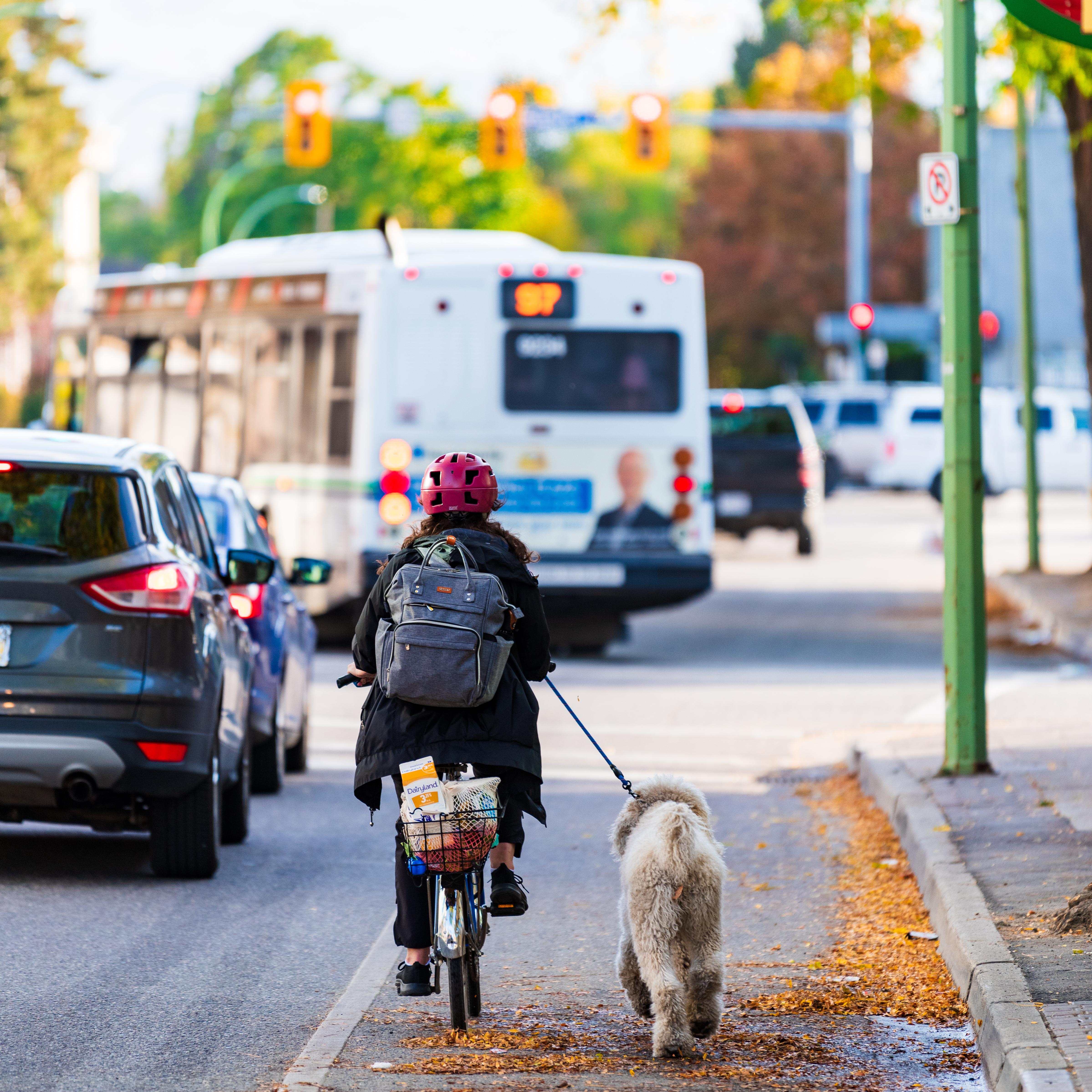
Investment & cash management policies
The City will maintain sufficient short term liquid assets to enable it to meet its annual operating budget as required. Due to the uncertain nature of future expenses, the portfolio will focus on high quality, liquid securities. The goal is to maximize the investment return on the fund, while ensuring that the liquidity, quality and diversification requirements are satisfied. The primary performance objective is to achieve a rate of return greater than the Canada Consumer Price Index for all items. Additionally, the fund’s performance should match or exceed the Municipal Finance Authority of BC Shortterm Bond Fund and Money Market Fund for the same period. Permitted investments in the fund are eligible securities defined in Section 183 of the Community Charter and investments in internally financed City of Kelowna projects. The portfolio of invested funds will be diversified into AAA, AA, or A rating investments and is restricted to a maximum of 60 per cent. A rated investments. Maximum exposure to a single government (Government of Canada, BC MFA, Provincial, and Municipal) or corporation, as a per cent of the total portfolio will be as follows:
In addition, the maximum exposure for a single internally financed project is 15 per cent of the total portfolio and the maximum exposure for all internally financed projects is 30 per cent of the total portfolio. Funds will also not be borrowed to acquire securities or otherwise deal in margin trading. Reports on the fund’s performance will be provided annually to Council in the first quarter of the following year and will include investment information on: cash assets relating to cash flow demands of the City, the City Cemetery Care Maintenance Funds and the Endowment Fund.
Capital strategies
Previous Councils approved the following 10 major corporate strategies to provide direction for long term capital plans.
▪ Park Acquisition Strategy | This plan provides for the park land acquisition standard of 2.2 hectares per thousand of population and the acquisition of natural space by means other than cash outlay.
▪ Parks Development Strategy | Parks development costs will be a function of the capital allocation deemed reasonable annually
and are to be shared by the community and development cost charge fees.
▪ Waterfront Amenities Strategy | An annual allocation is provided for some waterfront land acquisitions, but the emphasis is on private enterprise or community contributions to develop other amenities.
▪ Major Recreational Facilities Strategy | Major recreational/cultural facilities are budgeted with substantial emphasis on funding from public private partnerships, public sector partnering and other contributions. Pay-as-you-go capital and reserve funding will be required to minimize long-term debt financing.
▪ Civic Buildings Strategy | Buildings will be planned and constructed as required, subject to funding availability, with a focus on Public Private Partnerships in the development of these future civic buildings.
▪ Pavement Management Strategy | Annual general revenue contributions are to increase from the baseline of $1.9 million over the 10-year program to achieve an overall roads condition of 73 out of 100.
▪ Storm Drainage Retrofit Strategy | Annual general revenue contribution of $1.6 million to this program over the 10-year plan.
▪ Generation/Disposition of Surplus Strategy | A portion of annual surplus should be allocated to reserves each year to help mitigate the need for abnormal tax increases or incurring of new debt and to provide for capital expenditure opportunities which might otherwise require an alternative approval and/or referendum process.
▪ Capital Pay-As-You-Go Strategy | 40 per cent of new construction taxation revenue each year is to be allocated to capital, increasing the percentage of capital to Municipal Taxation to a maximum of 30 per cent.
▪ Debt Management Strategy | The existing strategy of using alternative funding for discretionary expenditures, capitalizing on debt reduction opportunities and using short term borrowing has been maintained. Maximum debt servicing should not exceed 15 per cent of City own source revenues or 8 per cent of annual tax demand.
FINANCIAL HEALTH INDICATORS
Financial health indicators are important for municipalities to monitor because they provide essential insights into fiscal health, enabling informed decision-making and the sustainable delivery of services to the community. The City of Kelowna monitors three types of indicators; financial flexibility, financial sustainability, and competitiveness.
Financial flexibility enables the City to adapt quickly to unforeseen challenges or opportunities, ensuring we can respond effectively to emergencies or shifts in community needs. Sustainability, on the other hand, reflects the City’s ability to maintain services and infrastructure over the long term without compromising future generations—serving as a safeguard against fiscal distress. Competitiveness allows the City to attract investment, residents, and talent by demonstrating sound financial management and the capacity to deliver quality services efficiently. Together, these indicators form the backbone of prudent governance, maintaining public trust and fostering a vibrant and resilient community.
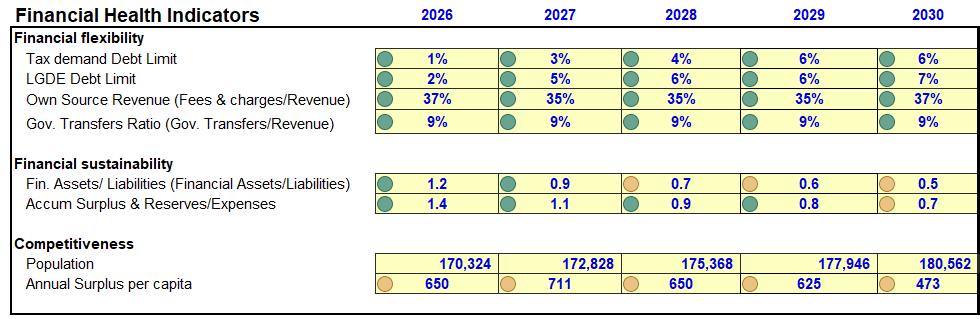

FUNDS & DEPARTMENTAL RELATIONSHIP
Municipal funds
The City’s resources and operations are separated into various funds. Each fund is a separate fiscal and accounting entity organized by their intended purpose. They are segregated to comply with finance related legal and contractual provisions. The use of these funds is restricted by the Community Charter and associated municipal bylaws.
The following funds are used for accounting and financial reporting purposes:

General Fund | This is the largest fund and covers all municipal operations aside from the utilities and airport funds. This fund is not allowed to operate at a deficit.

Wastewater Fund | This fund provides for the capital construction, operation, and maintenance of wastewater treatment including sewer mains, lift stations and The difference between annual expenditures and other revenues generated by the fund forms the annual property tax levy.
treatment facilities. Revenues generated in this fund, or prior years’ surplus, must be sufficient to offset all operating and capital costs of this utility on an annual basis.

Water Fund | This fund provides for the capital construction, operation, and maintenance of a water utility within specific areas of the City not served by

maintenance. This fund is required to be self-sufficient so that revenues generated must offset all operating and capital expenditures.
Airport Fund | The Kelowna International Airport operates within this fund, and is responsible for capital construction and ongoing administration, operation, and water districts. Revenues within this fund, or prior years’ surplus, must be sufficient to cover all operating and capital costs of this utility on an annual basis.
The following table lists the City’s service areas and the funds they use:
Revenues used for projects in these funds may also come from the City’s Statutory Reserve Funds:


Land Sales Reserve Fund | This fund was established in accordance with Provincial Legislation. Sales proceeds from all properties disposed of by the City are required to be placed in this reserve fund. Council may, by bylaw, use this fund to purchase land for general municipal or utility purposes.
Parking Reserve Fund | This fund was established to provide funds to purchase land for parking lots, develop onstreet parking and to construct parking lots or parkades. The General Fund contributes net revenues from the operations of parking lots, parkades and parking meters to the Parking Reserve Fund. Both the revenues and expenditures relating to the collection and use of these funds will be found in the General Fund Financial Plan.

Capital Works, Machinery and Equipment Reserve Fund | This reserve fund was established by the City to provide funds for such items as the purchase of replacement equipment, retirement of capital debt and replacement of cemetery property. Revenue for this reserve is provided from various sources within the General and Utility Funds. The estimated amounts of the revenue to be contributed may be found in the General or Utilities Funds Financial Plans along with the budgeted use of these funds.

Density Bonusing for Public Amenities and Streetscape Reserve Fund | This fund was established to hold payments associated with the density bonus provisions of Zoning Bylaw 12375. These funds will be utilized for urbanization and streetscape amenities, including sidewalks, curb and gutter, drainage, landscaping, street furniture, bus pullouts, improved on-street parking design and other boulevard streetscape components.


Septic Removal Specified Area Reserve Fund | This fund is to hold and manage the funds collected for the design and construction of sanitary sewer connection area projects, which are identified in Sewer Connection Area Prioritization Bylaw No. 12343.
Non-statutory reserves | The City of Kelowna also maintains reserves for future expenditures. These are nonstatutory reserves (reserve funds are ‘statutory’ reserves) which represent a contribution of surplus for specific purposes. In the financial plan the use of these reserves for future expenditures is shown under ‘Accumulated Surplus’ for either revenues or expenditures.
Deferred Development Cost Charges | Development Cost Charges are collected to provide funding for required expansion of parkland acquisition and development, roads, water works, sewer works, wastewater treatment, and drainage infrastructure resulting from new development. Monies collected may only be used for the specific purpose and in the specific area for which the funds were collected. The financial plan budget for the use of these funds will be reflected in the appropriate fund.

RESERVES & FUND EQUITY
Council Policy No. 384, Financial Reserves, was adopted in July 2021. This policy provides guidance for the responsibility of reserve oversight and the use of reserves to support the goal of providing adequate infrastructure, services, and resources to meet community requirements, and to aid in the financial sustainability of the City. Both statutory and non-statutory reserves will be maintained to achieve policy objectives to acquire, replace, and renew major capital assets; to ensure stable, predictable tax and utility levies; to minimize the financial impact of unusual and unexpected events; to achieve long-term financial stability; to balance the costs of maintaining sufficient reserve levels to current and future taxpayers; and to fund asset retirement obligations.
The following are audited reserve and fund equity balances as at December 31, 2024 and projected balances to the end of 2026. The 2026 projected balances are derived from the estimated 2025 year-end balance, which accounts for the expected utilization of reserves through the end of 2025. However, some projects may not be completed before the end of the year and the actual reserve balance at the end of 2025 and 2026 may be higher than indicated.
*Fund equity is also referred to as accumulated surplus
Note: Totals may not add due to rounding.
Reserve
& fund equity summary by type
The Development Cost Charges (DCC) are shown separately from other reserves and fund equity as they are revenues received for specific projects and cannot be used for any other expenditures. Some of the deferred DCC balances include a receivable portion which is not available for use at December 31, 2026. Major projects being funded by DCC reserves in the 2026 preliminary budget include DCC Parkland acquisition, Recreational Park development (Glenmore and Parkinson and Rutland sites), road corridor improvements along Burtch Road, Clement Extension, Glenmore Road, Hollywood Road North, KLO Road, and Lakeshore Road, Water and Wastewater system upgrade and Mill Creek Flood Protection.
Statutory Reserve Funds are reserves earmarked for a specified purpose by Council pursuant to section 188(2) of the Community Charter. Reserve Funds are established through Council bylaw and use must align with the established purpose. The 2026 accelerated capital program relies heavily on statutory reserves funds. Major projects included in the 2026 preliminary budget consist of the North Glenmore Fire Hall, Rutland Lions Activity Centre, and Apple Bowl improvements.
General reserves, or reserves for future expenditures, have more flexibility of use. The 2026 preliminary budget is requesting to use these reserves to fund various 2026 budget requests such as the Stadium / Sports Field Lighting, and the Kelowna Community Theatre -Equipment Program.
The table below presents the same reserves, fund equity, and projected balances, categorized by service area or fund.
*Other Reserves include grant funds such as the Growing Communities Fund and the Local Government Climate Action Program, as well as reserves to support future capital and financial stabilization.
Note: Totals may not add due to rounding.
DEBT MANAGEMENT
The City of Kelowna has various options available to obtain, through borrowing, funds necessary to acquire assets. Debt financing will only be undertaken in compliance with the relevant sections of the Community Charter and related regulations. Policy has been established to ensure that debt financing is used strategically to maintain the City’s financial strength and stability. The following section describes each borrowing option, the City’s legal limits, and the estimated outstanding debt balances at December 31, 2026
Under the Community Charter (C.C.) legislation, the Provincial regulations establish a limit based on the cost of servicing the aggregate liabilities of the municipality. The cost of servicing the liabilities cannot exceed 25 per cent of the total revenues for the previous year (excluding revenue received for another taxing jurisdiction, tax sharing revenues paid to another municipality, revenue from the disposition of assets, Federal or Provincial conditional grants such as water/sewer infrastructure grants and Municipal Finance Authority actuarial adjustments). To further ensure debt affordability and sustainability, the City of Kelowna debt policy also includes internal municipal debt limits of 15 per cent of City own source revenues and 8 per cent of annual tax levy revenues for tax supported debt.
The City of Kelowna does not issue bonds. Borrowings are done through the Municipal Finance Authority which has a triple A rating.
General Fund debt servicing costs
Net Debt Servicing Costs are budgeted at $4.9 million in 2026. The current net general debt (including internal financing) as a percentage of taxation demand is 2.3 per cent in 2026, as compared to 2.4 per cent of taxation demand in 2025
Long Term Debenture (C.C. Section 174 & 179)
Long Term Debenture borrowing involves the repayment of both principal and interest over a period not to exceed 30 years. Debenture borrowing for most long-term needs requires the assent of electors through an alternative approval process and/ or the passing of a referendum.
The outstanding debenture borrowing for all funds for 2026 ($ thousands) is:
Liabilities Beyond the Current Year (C.C. Section 175)
Under an agreement, Council may incur a liability payable after the current year as long as it is not a debenture debt and the liability does not exceed the life expectancy of the activity. If the agreement is for longer than five years or contains a right of renewal that could exceed five years, an alternative approval process must be provided. This borrowing method has been used by the City of Kelowna to secure the purchase of land from a vendor.
Short Term Borrowing (C.C. Section 178)
Short Term Borrowing is used to undertake minor capital works programs and must be repaid over a period not to exceed five years. The City of Kelowna's short-term borrowing legal capacity is approximately $25.5 million based on $150 per capita and a 2026 population estimate of 170,000. The City has used this borrowing method for the upgrade or construction of facilities and the purchase and development of parks. There are no projects currently funded through short term borrowing.
Revenue Anticipation Borrowing (C.C. Section 177)
Operating loans may be required to meet current expenditures pending receipt of taxation revenue. This most often occurs in the few months prior to the annual July due date for tax payment and is repaid once tax revenue is received. To transact
operating loans, a Revenue Anticipation Borrowing Bylaw must be approved by Council and is limited to 75 per cent of all property taxes imposed for all purposes in the preceding year.
Loan Guarantees & Commitments (C.C. Section 179)
The City of Kelowna has a loan guarantee in place with the YMCA of Southern Interior BC for the Kelowna Family Y Centre. The remainder of the debt under guarantee is $346k as of January 2026
Internal financing
The City of Kelowna may borrow funds from its own general reserves with repayment of principal and interest in order to finance capital projects. This may relate to projects that are pending debenture issues and require interim financing or to projects that make use of reserve funds not required in the near future. There is no statutory limit to this borrowing as it is offset by existing reserve balances.
The outstanding internal financing for all funds for 2026 ($ thousands) is:
Internal financing is also used in the Development Cost Charge program where a deficit in one reserve can be temporarily offset by a surplus in another reserve. Repayment to the reserve includes any interest charge.
Borrowing over the next five years will be determined by the 10-Year Capital Plan
Further detailed debt repayment information for 2026 and future years is illustrated on the following pages.
Note: Totals may not add due to rounding
Five-year net debt repayment ($ thousands)
Over the next five years, the City of Kelowna's net debt in the general fund is expected to increase, primarily due to the "Building Stronger Kelowna" initiative. This plan encompasses the redevelopment of the Parkinson Recreation Centre, the establishment of new activity centres in Glenmore and Mission, and the optimization of Rutland sports fields. These projects, as part of the city's broader effort to enhance community recreational and wellness facilities, are detailed in City of Kelowna's 10-Year Capital Plan Debt financing is also required for the expansion of the Kelowna International Airport terminal building which are recovered by Airport Improvement Fee revenues. The below graph shows the different funds debt, net of recoveries

Taxation funded debt ($ millions)
Council policy has set internal debt limits based on debt servicing costs at 15 per cent of City own source revenues, and 8 per cent of annual tax levy revenues for tax supported debt. Net debt repayment for 2026 will be 2.3 per cent and is anticipated to reach a maximum of 7.2 per cent over the next 10 years; Should debt servicing costs rise as anticipated, an update to the existing Council policy will be necessary prior to authorizing the additional debt.
The following chart illustrates the annual debt repayment and the per cent of taxation for the next 10 years:
Existing debt – all funds
The maximum annual debt a municipality can undertake is capped at 25 per cent of its previous year's revenue. BC municipalities report financial data annually to the Ministry of Municipal Affairs using the Local Government Data Entry (LGDE) system. This system calculates the Liability Servicing Limit (LSL), ensuring municipalities adhere to borrowing limits set by the Community Charter
Although the City's financial data has been submitted, the official LSL calculation has yet to be released. Based on 2024 revenues reported to the Ministry, our calculations estimate a current LSL of $106.4 million. Of this, $31.6 million has already been utilized, leaving an available borrowing capacity of $74.8 million. The $31.6 million includes approved debt capacity, with $12 million allocated to servicing costs (principal and interest) and the remaining $19.6 million tied to guarantees, commitments, and approved but unissued borrowings.
Using current Municipal Finance Authority (MFA) lending rates and a 15-year repayment term, the unused borrowing capacity of $74.8million translates to an approximate borrowing potential of $789 million for 2026. The chart below illustrates borrowing allocations across various funds, with the solid line indicating the maximum borrowing limit.
Note: Based on current estimated borrowing rates. Totals may not add due to rounding.
OPERATING FULL-TIME EQUIVALENT (FTE) POSITION SUMMARY
The City of Kelowna requires that all new positions and changes to existing salaried or wage personnel, both permanent and temporary, be supported by a business case. The business case must include the reason for the request, a cost/benefit analysis, the recommended funding source, other alternatives considered and the organizational impact.
Below is a visual representation of all 2026 operating budgeted FTEs for the City of Kelowna by Service area, if all priority one position requests included in this budget volume are approved by City Council.



The following table provides operating FTE counts for the 2024 budget,2024 actuals, 2025 revised budget and the proposed 2026 preliminary budget. It further details these positions by separating them into the payroll groups of mayor and council, management, union hourly and union salary.
Full-time Equivalent (FTE) Summary
2026 Operating full-time equivalent (FTE) position changes
Each year position counts change with the addition, reduction, or movement of positions. The narrative below explains the changes that have been made, or are being requested, for 2026 by each division/department.
Full-Time Equivalents Summary
Airport
Addition 2.0 FTE for the Airport Strategic Enhancements operating request Arts & Culture
Addition 0.9 FTE for annualization of 2025 planned program growth
Addition 0.5 FTE for annualization of 2024 operating requests
Community Development
Addition 1.7 FTE for annualization of 2024 operating requests
Community Safety & Bylaw
Addition 3.5 FTE for annualization of 2025 operating requests
Addition 1.0 FTE for the Bylaw Services Enhancements - Public Safety Levy operating request Development Planning
Reduction 0.5 FTE for annualization of 2025 operating requests Enabling Services
Reduction 0.5 FTE for annualization of 2024 operating requests
Addition
Addition 1.6 FTE for the IT Resourcing Redevelopment operating request
Addition 1.6 FTE for the Human Resources Organizational Development operating request
Addition 1.0 FTE for the Risk Management Recovery Enhancement operating request
Addition 0.8 FTE for the Materials & Park Washroom Maintenance operating request
Addition 0.5 FTE for the Facilities Support Service Enhancement operating request Fire Safety
Addition 2.0 FTE for the Fire Safety Enhancements - Public Safety Levy operating request
Addition 0.5 FTE for the KFD Service Support Enhancement operating request
Addition 2.5 FTE for annualization of 2024 operating requests
Reduction 2.0 FTE for removal of Regional Emergency Program Parking
Addition 0.5 FTE for annualization of 2025 operating requests
Addition 0.4 FTE for annualization of 2025 operating requests
Addition 0.1 FTE for the Park Playgrounds Material and Supplies Maintenance operating request Police Services & RCMP
Addition 2.0 FTE for annualization of 2025 operating requests
Addition 0.5 FTE for the Police Services and RCMP Enhancements - Public Safety Levy operating request Solid Waste & Landfill
Addition 0.5 FTE for the annualization of 2025 operating requests
Addition 0.5 FTE for the Landfill Operations - Growth operating request
Sport & Recreation
Addition 0.4 FTE for the annualization of 2025 operating requests
Addition 0.1 FTE for 2026 planned program growth
Addition 0.5 FTE for the Community Partnerships operating request
Addition 0.5 FTE for the Sports and Community Events Activation operating request
Addition 0.1 FTE for the Autonomous Mowers for Elk Stadium operating linked to capital request
Stormwater & Flood Protection
Addition 0.5 FTE for the Utility Infrastructure Planning operating request
Transportation
Reduction 0.9 FTE for annualization of 2025 operating requests
Wastewater Utility
Addition 1.0 FTE for annualization of 2025 operating requests
Addition 0.5 FTE for Wastewater Collection Operations - Growth operating request
Water Utility
Reduction 0.1 FTE for annualization of 2021 operating requests
Reduction 1.0 FTE for annualization of 2024 operating requests
Addition 1.3 FTE for annualization of 2025 operating requests
Addition 0.5 FTE for Dam Safety Program - Growth operating request
Addition 0.5 FTE for Water Operations - Growth operating request


FINANCIAL SUMMARIES
FINANCIAL PLAN SUMMARY
The City of Kelowna’s proposed total 2026 annual budget is $1.05 billion when including all funds. The following table reports the actual results for the year ending 2024, the revised budget as of October 2025, and the proposed preliminary budget for the 2026 Financial Plan year.
Note: Totals may not add due to rounding
Analysis of Revenues and Expenditures by fund
Revenue by fund
The City operates under four funds. The table below presents the dollar value of the revenue budget for each fund, separating the operating and capital information for the proposed Financial Plan year. The graph illustrates the 2026 revenues for each fund, visually depicting the comparison between each one.
Expenditures by fund
BC municipalities are mandated to have a balanced budget by provincial legislation. The table below reports the dollar value of the expenditure budget for each fund, separating the operating and capital information for the proposed 2026 Financial Plan year matching the revenues presented in the previous section. The graph below illustrates the comparison between funds of the expenditure budget for 2026, matching the revenue graph.

Analysis of Revenues and Expenditures by type
Revenue by type
The City of Kelowna has multiple revenue sources including property taxes that are levied on property owners based on the municipal taxation demand; parcel taxes which are levied through bylaw on properties receiving a specific service; fees & charges for public services like water, parking, and building permits, and fines for things like bylaw infractions; grants are funds awarded to the City by various grantors to be used for a specific purpose; other revenues that includes interest revenue, provincial gaming funds, and service revenue from other governments; proceeds of borrowing; and transfers from reserve which are predominately made up of previous years’ surplus funds. The graphs below present the same operating and capital revenue information at the revenue source detail level.
Revenue by type
Note: Totals may not add due to rounding
Expenditures by type
The City’s expenditures can be grouped in the following categories: salaries & wages, materials & other, contract services, debt servicing, capital expenditures, and transfers to reserve which are primarily made up of expected profits generated by profit centres operating within the City to be used for things like future capital requirements and to fund emergent events. The table below presents the same total operating and capital expenditures information for each expenditure type.
Expenditure by type
Note: Totals may not add due to rounding
Analysis of taxation demand
The 2026 net taxation demand of 216.40 million is an increase of $12.12 million, or a 5.93 per cent over 2025. This is reduced by the expected new construction tax revenue estimated to be $3.00 million in 2026 to bring the total net property owner impact to 4.47 per cent. This increase includes $2.04 million, a 1 per cent increase over 2025, for the 2023 Council approved Public Safety Levy.
Tax-supported operations by service area
The 2026 Financial Plan uses service-based reporting. There are two types of service areas in the City of Kelowna, community services and enabling services. A community service is a service that is provided directly to the community, and an enabling service is a support service provided internally that enables the community services to be provided. As the community services could not be provided without internal support, the enabling services net operating budget has been allocated to each community service.
Not all service areas require taxation funding. The graph and table below shows the community service areas that do require taxation funding, and the amount of taxation used in 2024, budgeted to use in 2025, and is recommended to be budgeted for 2026.
Net tax-supported operations by service area
Ongoing impacts - general fund
Below is a projection of the net property owner impacts over the next five years using the best information available at the time of preparation of the Preliminary Budget volume. This projection will be updated for the Final Budget volume in April of 2026 and additional details on projections will be provided. As with any planning exercise, the level of certainty and detail is most appropriately found in the current year. For the years after 2026, budgets have been adjusted for current one-time projects, changes in operating budgets from previously approved requests, new capital projects included in the Council endorsed 10-Year Capital Plan, growth and/or inflationary rates, and other key assumptions. Although this forward-looking information is based on what is believed to be reasonable assumptions, there can be no assurance that this information will prove to be accurate as actual results and future events could differ materially from the anticipated information contained in this forecast.
Note: Totals may not add due to rounding


SERVICE AREA BUDGET
SERVICE AREA BUDGET
SERVICE AREA SUMMARY
The City’s service area budgets are influenced and guided by strategic direction provided by City Council, the community and corporate leadership. This direction is communicated through plans and priorities such as capital plans, master plans, Council and Corporate priorities, the annual action plan, and service area, department and divisional plans.
In 2024, the City adopted the service-based budgeting approach, organizing the budget by service areas rather than by departments or divisions. This format helps readers clearly understand the services provided, their associated costs, and the trade-offs involved when prioritizing one service over another. This method enhances transparency, accountability, and fiscal flexibility, offering greater insight into how, where, and when the City allocates its limited resources to address various needs.
It also improves reporting and communication by showing how tax dollars and other revenue sources are spent, fostering more meaningful discussions about service levels. For 2025, the Financial Plan integrated the capital and operating programs within each service area, providing additional insights for both Council and the community. This comprehensive view highlights the interplay between operational expenses and capital projects, offering a clearer understanding of how they influence each other.
The service areas highlighted in this budget volume were chosen to reflect the broad scope of services delivered directly to the community. These range from essential functions like public safety, utilities, and infrastructure maintenance to community-focused offerings such as parks, recreation, and transportation. Each service directly impacts and benefits residents.
Departments that support multiple community services—such as Financial Services, Human Resources, Information Technology, and Facilities Capital—are categorized as Enabling Services. The overall budget for Enabling Services is proportionally allocated across all direct community service areas. This approach ensures a transparent presentation of the comprehensive costs associated with each service. To enhance transparency, detailed financial information for Enabling Services is provided in a dedicated section of this budget volume, offering stakeholders a clear understanding of their role in supporting the City's service delivery.
Budget Overview
Enabling Services, $108.5M
Sport & Recreation, $146.6M
Transportation, $117.6M
Airport, $113.1M
Water Utility, $93.9M
Police Services & RCMP, $83.2M
Parks Services, $80.4M
Fire Safety, $78.4M
Wastewater Utility, $65.9M
Transit, $53.6M
Solid Waste & Landfill, $38.9M
Stormwater & Flood Protection, $14.9M
Parking, $13.2M
Community Safety & Bylaw, $11.4M
Arts & Culture, $8.6M
Development Services, $7.6M
Governance & Leadership, $5.4M
Community Development, $5.4M
Development Planning, $2.9M
Partnerships Office, $1.8M
Total $1.05B
2026 Total Expenditure Budget Breakdown
Analysis of expenditures
The table below lists the various service areas of the City and presents their individual expenditure budgets, as well as the proportion of the Enabling Services expenditures that has been attributed to that service area. Allocations of costs incurred by enabling services in support of the City are shown in each service area to illustrate the complete cost of that service. These costs are then reduced in enabling services for presentation purposes.
Reading the service area sections
Each service area section begins with a cover page outlining the following: the service's goal and community benefits, the primary customers and partners, the services delivered, key objectives, and the strategic plans that guide the service. In support of the City’s comprehensive review of fees and charges calculations, a new Revenue section has been added in the 2026 budget volume. This section explains the revenues generated in each service area and details how rates are determined, when relevant. This introduction is followed by performance measures, presented through a mix of narratives and graphs, to illustrate how the service area is performing. These measures include the service's goals or targets and, where available, comparative data from other municipalities for context.
Each section details the activities within the service area and their alignment with Council and Corporate priorities. Key accomplishments and ongoing improvement initiatives are highlighted, showcasing progress and efforts to enhance service delivery. Finally, the section concludes with a financial summary, outlining projected expenditures and the recommended funding strategy to support the service.
Following the introduction section are the individual budget requests being presented to Council for approval. These are presented in the order of priority one operating, priority one capital and then priority two operating if applicable. The recommended priority of each budget request is shown on the top right corner of the request. Priority one items are budget requests that are being requested to maintain current service levels or to enhance them. These items have been included as part of the recommended budget. Priority two items include budget requests intended to enhance service levels but are not being recommended in an effort to maintain an acceptable general taxation demand or utility user rate.
2026 Budget requests
The 2026 Financial Plan includes 57 operating and 103 capital priority one requests for a total of $518.2 million of expenditure budget. There are 11 priority two requests included for Council consideration. The funding strategy being recommended includes a combination of reserves, development cost charges, borrowing, property taxes, utility fees, grants, and other smaller revenue sources.
Each budget request is categorized into two categories; maintain and enhance. Maintain requests are the budgets requested to maintain current service levels. Additional budget may be required to address factors such as inflation, growth of the community, infrastructure investments for equipment replacement or the maintenance of existing or additional infrastructure. Enhance requests are the budgets requested to increase or improve the service level such as the addition of a new program offering, new service availability, or new infrastructure. It could also be offering a better customer experience for our community. The assigned category can be found at the top right-hand side of each budget request. In the 2026 Financial Plan, operating and capital requests total $518.2 million. Requests to maintain current service levels make up 77 per cent of these 2026 requests at $396.9 million. Enhanced service requests make up $121.2 million which is 23 per cent of the total request expenditures.
Request type
Maintain 77%
Enhance 23%
Total $518.2M
If a capital project has an operating impact, such as additional maintenance, the operating budget is presented as part of the capital request. If an operating request has a capital impact, such as a vehicle required for a new position, the capital cost is presented as part of the operating request.
The following table provides a summary of the operating and capital priority one and priority two requests highlighting the amount coming from taxation versus other funding sources. Other funding sources could include reserves, user fees, grants, or community/developer contributions.
Note: Totals may not add due to rounding
The following graphic provides a visual summary of the funding strategy being proposed for the priority one requests including taxation, reserves, grant funding, revenues and utility funds (user fees).
Funding Strategy - Priority 1 requests

AIRPORT
LED BY: AIRPORT CHIEF EXECUTIVE OFFICER
Our goal & community benefit:
The airport is a vital and rapidly growing aviation and transportation hub in British Columbia’s Okanagan Valley, serving as a key gateway for business and leisure travelers, and for commercial trade. As one of Canada’s busiest airports, YLW connects a large geographic region to major domestic and international destinations, supporting the area’s fast-growing economy and its established aerospace cluster, its tourism industry, and many local businesses. Our goal is to serve communities within the Okanagan Valley by being an economic engine for the region and providing high-quality facilities in a safe and cost-effective manner while also ensuring the capability and flexibility to meet future changes in air transportation, technology, and operations.
Our customers:
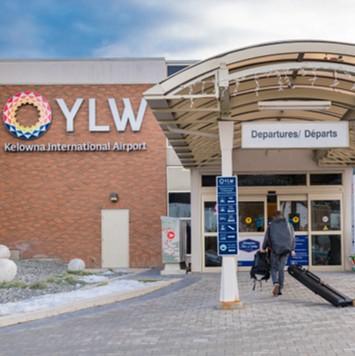
YLW provides over 60 daily non-stop commercial flights to 21 destinations, along with access to more than 200 connecting destinations, through eight airlines to support the travelling community. With over 2.1 million passengers travelling through the Airport during 2024 and passenger numbers forecasted to continue to grow to an all-time high of over 2.3 million passengers in 2025, YLW is currently ranked as the 9th busiest airport in the country.
Our partners:
As a cluster and centre of excellence for aviation, the airport is home to a diverse range of leading tenants that contribute to its role as a dynamic aviation hub, including KF Aerospace, Executive Aviation, Carson Air, and Stolarius Aviation, to mention a few. With our eight airline partners, ground transportation providers, car rental agencies, food and beverage providers, and other airport campus partners, we strive to provide a positive passenger experience.
Our partners also include our federal regulatory agencies such as Transport Canada, Nav Canada, the Canadian Air Transport Security Authority, and the Canada Border Services Agency, as well as organizations which provide contracted services critical to the operation, maintenance, and development of the Airport.
The aerospace cluster, which includes nearly 50 companies, supports approximately 4,550 jobs and generates an estimated $790 million in total economic activity each year, serves as a cornerstone of the region’s economy.
Revenue:
The Airport is self-funded through user fees and charges with no funding from taxation and operates based on a competitive, low-cost business model to help attract air service and drive passenger growth. Revenue sources include parking fees, landing and terminal fees, car rental concessions, terminal concessions, lease revenues, other ground transportations services and government grants. The Airport also collects an Airport Improvement Fee per departing passenger, used to fund capital projects or service the debt associated with capital projects.
What we deliver:
We are forecasting that we will serve over 2.3 million passengers in 2025 and currently offer more than 60 daily non-stop commercial flights to 21 year-round and seasonal destinations and hubs with eight airlines (Air Canada and Air Canada Express/Jazz Aviation, Air North - Yukon’s Airline, Alaska Airlines, Central Mountain Air, Flair Airlines, Pacific Coastal Airlines, Porter, and WestJet).
Our key objectives:
Our key objectives include:
• Improve and innovate the way we plan and operate our business
• Lead and foster economic prosperity within the region
• Act in a financially sustainable & resilient manner
• Lead in the areas of safety, security, social responsibility, governance, and the environment
Our guiding plans:
• Airport Master Plan 2045
• Airport Strategic Plan
Measuring performance:
Performance measure 1
Optimization and transformation
Improve and innovate the way we plan and operate our business
Airport Service Quality (ASQ) Score
The ASQ score is an industry-leading, globally recognized metric derived from the Airports Council International’s survey, which captures and quantifies passengers’ satisfaction with their overall airport experience.
Performance measure 2
Financially responsible
Act in a financially sustainable & resilient manner
Aeronautical revenues per landed air carrier seat.
Aeronautical fees and charges are determined strategically, consistent with the International Civil Aviation Organization guidelines, in order to balance revenue generation while positioning YLW as a competitive, low-cost airport to continue to attract air service routes and carriers which drives these revenues.
PM#2: Financially responsible
Performance measure 3
Driver of regional economic development Lead and foster economic prosperity within the region
Annual number of passengers.
As the 9th busiest airport in Canada and the 2nd largest airport in British Columbia, the Airport welcomed over 2.1 million passengers in 2024 and expects to see continued growth in 2025 and 2026, positioning the Airport as a regional economic gateway and driver of economic growth within the region.
PM#3: Regional economic development (number of passengers)
# of passengers (millions)
Performance measure 4
Accountable leadership
Lead in the areas of safety, security, social responsibility, governance, and the environment
Airport Carbon Accreditation Level.
The Airport successfully achieved Level 3 Airport Carbon Accreditation in 2025, recognizing sustained reductions in Airport operational emissions and active engagement with campus partners to reduce campus-wide emissions. YLW continues to advance its decarbonization strategy to achieve carbon neutrality by 2030 and net-zero by 2040 through meaningful investments in electrification and energy efficiency.
Accountable leadership (airport carbon accreditation level)
PM#4:
Activities by priority:
Priorities Activities
Crime & Safety
Transportation
Agriculture & Environment
• % of residents who feel safe in Kelowna increases:
◦ Safety and security initiatives to further improve passenger and airport operations safety, including curb hardening and upgrades to security infrastructure
◦ Rehabilitation and enabling works for the expansion of Airside aprons and taxiways to further improve safety
◦ Use of AI and machine learning to improve efficiency and safety for aircraft operations
◦ Continued partnership with Not in My City, including training to educate individuals working in aviation to identify and respond to signs of human trafficking
• Capacity and traffic flow is enhanced on major road corridors:
◦ Continue to engage with partners and stakeholders on potential road improvements leading to the Airport
◦ Continue to undertake innovative initiatives to make the flow of traffic within and out of the Airport more efficient
• Include a Climate Lens in City decision-making, ensuring we always consider climate impacts:
◦ Continued commitment to the Airport’s environmental goal of carbon neutrality by 2030 and net zero by 2040
◦ Maintain Airport Carbon Accreditation Level 3
◦ Explore opportunities for the airport as an energy hub
• Reduce corporate and community greenhouse gas (GHG) emissions:
◦ Continued implementation of carbon neutral initiatives, including engagement of the Campus Green Committee to work with stakeholders on reducing wholecampus emissions, and promoting sustainable operating and building practices across the campus, targeting energy efficiency and renewal energy integration
Economy
Our People
Transformation
• The number of businesses is increasing:
◦ Continued pursuit of commercial development opportunities in and around the Airport
• Priority sectors for economic diversification are supported:
◦ Forecasted passenger growth from 2.3 million in 2025 to 2.4 million in 2026
◦ Retain and grow the air service options to YLW offering greater options to passengers and supporting the regional economy
• The opportunity for all employees, regardless of position or role, to learn and grow their leadership competencies is increasing:
◦ Continue to provide and support opportunities for professional development, mentorship, and growth opportunities
• Digital tools are used to improve the online service experience and make processes more efficient:
◦ Phase 1 of deploying a Private Wireless 5G Network at the Airport, providing operations and campus partners with improved connectivity and security, and supporting improved passenger and partner experience
• Data is used to inform decision making:
◦ New software implementation for enhanced data-driven Airport operations, including the use of artificial intelligence airside to facilitate increased datagathering and optimize apron operations and gate scheduling
Customer Experience
Base Business
• Continue to innovate and improve Airport operations to offer an elevated passenger experience
• Complete construction of the Airport Terminal Building expansion, delivering an expanded hold room with new food and beverage amenities and enhanced preboard screening
• Continue advancing air service development to provide the travelling public with new and expanded transborder and regional routes and destinations
• Enhance the passenger experience through the commencement of operations in the new Airport Hotel and Parkade following construction completion
• Continue to raise the service level of all elements of the Airport
• Continue to increase air service routes and destinations
• Continue to pursue diverse commercial development and partnerships
• Complete construction and take occupancy of the expansion of the Airport Terminal Building and retrofit parts of the existing building
• Commencement of Phase 1 design of the Apron 1 South Expansion
• Renewal of certain infrastructure in the Air Terminal Building to extend the useful life of the infrastructure
• Commence operations in the new parkade
• Robust budgeting and financial modelling to ensure service levels are maintained and/or increased while remaining financially viable and in accordance with financial health targets
2025 Key accomplishments:
• Anticipated passenger growth to over 2.3 million passengers
• Increased air service frequency and destinations available to the travelling public, including new and expanded transborder and regional destinations
• Launch of a new airline operating out of Kelowna International Airport
• Commenced construction of the Child Care Facility expansion, increasing capacity to offer an additional 24 childcare spaces for children under 36 months to open in 2026
• Completion of construction and opening of the Operations and Emergency Services Building, previously referred to as the new Combined Operations Building
• Continued construction work for the expansion of the Airport Terminal Building
• Completed construction of the Apron 1 South Expansion enabling works Mill Creek crossing, providing access and creating additional long-term parking capacity
• Commenced construction of the Airport Hotel and Parkade
• Initiated the process of updating the Airport Master Plan and Economic Impact Study with input from key stakeholders
• Sustained progress towards the Airport’s environmental goal of carbon neutrality through continued implementation of initiatives and projects promoting sustainability and climate action; achieved Airport Carbon Accreditation Level 3, an increase from Level 2 in 2024, one year ahead of target
• Transitioned to a 100 per cent common use passenger processing system in order to increase operational flexibility and efficiency
• Upgraded airfield lighting and supporting infrastructure for greater visibility, energy efficiency and lifecycle replacement
Continuous improvements:
• Continue to pursue improved air service and passenger growth
• Renewal of infrastructure in the Airport Terminal Building to extend the useful life
• Rehabilitation of existing airside pavement to further improve the safety of aircraft and passengers
• Purchase of airside equipment
• Continued investment in people
Note: Totals may not add due to rounding
Budget needed to achieve results
The Airport operates under a separate, self-sustaining fund. Any unused revenue generated each year is allocated to a reserve dedicated to future airport infrastructure investments. Revenues from the Airport Improvement Fee (AIF) program are kept in a separate reserve and exclusively used to fund AIF-specific infrastructure projects. Additionally, the Airport contributes $2.54 million annually to the general fund to support enabling services and offset property taxes.
Note: Totals
Note: Totals may not add due to rounding Expenditure by type
2026 Operating Requests ($ thousands)
Priority 1
2026 Capital Requests ($ thousands) Priority 1
2026 Operating Request Details
Service Area: Airport
Airport Improvement Fee
Justification:
The budget for the Airport Improvement Fee revenues is based on forecasted passenger numbers of 2.47M passengers in 2026. The 2025 budget was based on passenger numbers of 2.34M. Anticipated revenues resulting from increased passengers is offset by a reduction in the Airport Critical Infrastructure Program grant now complete.
Revenues are contributed to the Airport Improvement Fee Reserve.
2026 Base Budget: $32.2M
Strategic Direction: Other
Justification:
The increase in budgeted Airport non-airport improvement fee (non-AIF) revenues and expenditures is based on the forecast that the Airport will have 2.47M passengers in 2026 (2025 budget was based on 2.34M passengers). The Airport's non-AIF expenditures will exceed revenues by $200k due to passenger growth and investment in key aspects of the Airport's business combined with inflationary pressures. This deficit will be funded from the Airport reserves with no impact on taxation.
Strategic Direction: Other
2026 Operating Request Details
Service Area: Airport Priority 1 Enhance ON-GOING
Title: Airport Strategic Enhancements PRELIMINARY
Justification:
The Airport aims to move forward with strategic priorities, business objectives and goals according to its official Strategic Plan. To achieve this, budget is requested for the hiring of an Airport Duty Manager, as well as moving an existing Airport Operations Technician (AOT) to an FTE position. These positions will provide the necessary capacity and skills to meet current and future requirements for key airport activities, as well as support increased demand resulting from growth of the airport. These positions would be funded equally from the Airside, Groundside and Terminal reserves and have no impact to taxation.
Strategic Direction:
2026 Capital Request Details
Service Area: Airport Priority 1
Title: Airport - Airside Pavement Rehabilitations & Expansion PRELIMINARY
Justification:
Budget is requested to continue work on the runway rehabilitation and for design, enabling works, and construction of new airside pavement as part of the Soaring Beyond 2.5 Million Passengers AIF Program.
Strategic Direction: Economy
Service Area: Airport Priority 1
Title: Airport - Land Development
Justification:
Budget is requested to complete the construction of a new general aviation parking area including conceptual design of a new helicopter parking area and conceptual design for repurposing the old general aviation and helicopter parking areas.
Strategic Direction: Economy
2026 Capital Request Details
Service Area: Airport Priority 1
Title: Airport - Lifecycle Replacement & Upgrades
Justification:
Lifecycle replacement and upgrades include the air terminal building (ATB) capital replacements and upgrades, small capital projects and groundside infrastructure. Budget is requested for groundside resurfacing work, work related to the parking lot relocations, technology adoption, security enhancements for the ATB, and other capital improvements.
Strategic Direction: Economy
Service Area: Airport Priority 1
Title: Airport - Airside Equipment
Justification:
Budget is requested for airside equipment purchases to support airport operations and the Airport's goal of carbon neutrality by 2030. The request includes the purchase of a light electric vehicle, two electric all-terrain vehicles, and equipment attachments as part of the Soaring Beyond 2.5 million Passengers AIF Program. This project will offer an enhanced level of service at the Airport.
Strategic Direction: Agriculture & Environment
2026 Capital Request Details
Service Area: Airport
Title: Airport - Airport Hotel and Parkade Enabling Works PRELIMINARY
Justification:
Hotel and parkade subleases were previously approved in 2022 and 2023. Budget is requested to complete the enabling services for the construction of the hotel and parkade. This project will offer an enhanced level of service at the Airport.
Strategic Direction: Economy
Service Area: Airport
Title: Airport - Airport Terminal Building Expansion Phase 1
Justification:
Budget is requested to complete the construction of the Terminal Expansion Phase 1, for which budget was previously approved by Council in 2020, 2022, and 2023 as part of the Soaring Beyond 2.5 Million Passengers AIF Program. This project will offer an enhanced level of service at the Airport.
Strategic Direction: Economy
2026 Capital Request Details
Service Area: Airport
Title: Airport - Airport Terminal Building Expansion Phase 2
Justification:
Budget is requested to commence the preliminary verification and design of Phase 2 of the terminal complex expansion as part of the Soaring Beyond 2.5 Million Passengers AIF Program. This project will offer an enhanced level of service at the Airport.
Strategic Direction: Economy
Service Area: Airport
Title: Airport - Airside Infrastructure
Justification:
Budget is requested for airside purchases and implementation of vehicle transponders, phase 1 of the private wireless 5G network, and apron artificial intelligence on Apron 1 gates as part of the Soaring Beyond 2.5 million Passengers AIF Program. This project will offer an enhanced level of service at the Airport.
Strategic Direction: Transformation
2026 Capital Request Details
Service Area: Airport
Title: Airport - Carbon Neutral Initiatives
Justification:
Budget is requested for carbon neutral initiatives at the Airport, which are aligned with the Airport's goal of being carbon neutral by 2030. This project will offer an enhanced level of service at the Airport.
Strategic Direction: Agriculture & Environment
Service Area: Airport
Title: Airport - Child Care Facility Expansion
Justification:
Budget is requested to allow for the expansion of the Child Care Facility at the Kelowna International Airport that was previously approved by Council in 2024 as a multiyear project. This expansion will provide an additional 24 child care spaces, helping to alleviate the significant waitlist and meet the needs of families working on the airport campus and surrounding community. The expansion is primarily funded through a grant from the BC Provincial Government's ChildCareBC New Spaces Fund and the remaining amount will be funded through the Airport's Groundside Reserve. This project will offer an enhanced level of service at the Airport.
Strategic Direction:
2026 Capital Request Details
Service Area: Airport
Title: Airport - Combined Operations Building
Justification:
Budget is requested to complete the construction of the new combined operations building under the Soaring Beyond 2.5 Million Passengers AIF Program, for which budget was previously approved by Council in 2022 and 2024, and to complete required upgrades and reconfiguration to the existing building. This project will offer an enhanced level of service at the Airport.
Strategic Direction: Economy
Title: Airport - Mill Creek Flood Protection
Justification:
Budget is requested for design and construction associated with Mill Creek at the Airport, as part of the City of Kelowna's Mill Creek Flooding Mitigation plan. This project will offer an enhanced level of service for flood protection at the Airport.
Strategic Direction: Agriculture & Environment
2026 Capital Request Details
Service Area: Airport
Title: Airport - Airport Soaring Beyond 2.5 Million Passengers AIF Program
Justification:
Budget is requested to design, construct and make purchases for certain aspects of the Soaring Beyond 2.5 Million Passengers AIF Program including terminal building improvements, design of the integrated operations centre, baggage system upgrades and equipment, lift station upgrades and roadway improvements, and servicing of Airport lands. This project will offer an enhanced level of service at the Airport.
Strategic Direction:
COMMUNITY SAFETY & BYLAW
LED BY: GENERAL MANAGER, PEOPLE & PROTECTIVE SERVICES
Our goal & community benefit:
Our goal is to enhance community safety and well-being for all who live, work and play in Kelowna through efficient and effective education, prevention, intervention, engagement, coordination, collaboration and enforcement. With an increased focus on innovation and evidence-based approaches, we work to uphold community bylaws and respond to crime and social issues while leading multi-disciplinary initiatives (i.e. Community Safety Plan) to reduce criminality and victimization in the future.
Our customers:
• Community residents, commercial businesses and visitors
• Other stakeholders and community partners
Our partners:
We are a convener of community/governmental partners and stakeholders who are integral to community safety.
Revenue:
Community Safety & Bylaw does not generate significant direct revenues. As a result, our ongoing activities and service delivery are primarily supported by allocations from property tax revenues, rather than self-generated income sources.
What we deliver:
We deliver a balanced approach of education, prevention, intervention and enforcement to preserve and enhance safety –and sense of safety – in our community. The Community Safety Services Branch focuses on crime prevention, crime reduction, public education, innovation and improving sense of safety for all who live, work and play in Kelowna through a variety of programs and initiatives while Bylaw Services’ core mission is to maintain community standards with the aim of driving collaborative and multi-disciplinary strategies to reduce criminality, crime and victimization. Services provided include General Duty, Investigative Services, Legal/Adjudication, and an Encampment Response Unit.
Our key objectives:
• Preserve and enhance safety – and sense of safety – in our community
• Foster a predictable and respectful community for all citizens through bylaw education and compliance
• Enhance enforcement visibility, proactivity and responsiveness in priority areas
Our guiding plans:
• Community Safety Plan
Measuring performance:
Performance measure 1
Citizen satisfaction with Bylaw Service
Data for this metric is collected through the bi-annual Citizen Survey. This measure helps gauge the level of community satisfaction with the type and level of services being provided by Bylaw Services. Expectations are that the satisfaction levels will increase commensurate with efforts to further resource, recruit, train and professionalize Bylaw Services.
PM#1: Citizen satisfaction with Bylaw Service
Performance measure 2
Total Number of General Duty and Encampment Response Service Requests
Bylaw Services categorizes the nature of frontline services as either General Duty or Encampment Response. The scope of work differs greatly by nature of the file, as does the demand for reduced response times, particularly due to managing the impacts of public interface with complex health needs and social disorder. The total number of General Duty and Encampment Response Service Requests indicates the shifting demand of the public, and the ability of Bylaw Services to respond accordingly. General Duty files typically require single officer attendance, whereas all Encampment Response files require a minimum of two officers per file
PM#2: Total number of general duty and encampment response service requests
Performance measure 3
Average number of days to close General Duty and Encampment Response Bylaw Service requests
Most Bylaw Services investigations are complaint-driven. Monitoring the number of average days to close a service request indicates the responsiveness and efficiency of service being provided to our citizens. In general terms, Bylaw Services categorizes the nature of files as either General Duty or Encampment Response. These files demand differing levels of officer time and effort, whether for investigative purposes or immediate priority response due to managing the impacts of public interface with complex health needs and social disorder. General Duty files typically require longer to close given the investigatory nature, whereas Encampment Response files are a matter of priority to respond to as quickly as possible in the interest of the community’s safety and sense of safety
PM#3: Average number of days to close General Duty and Encampment Response service requests
# of days
Performance measure 4
Caseload (general duty, investigative services and encampment response)
Caseload is defined as the number of service requests per authorized strength. This represents the workload per officer and is often a better indicator of the demand for Bylaw Service than annual calls for service or population
PM#4: Caseload per officer
# of service requests
Caseload per BEO Target
2026 Activities by priority:
Priorities
Crime & Safety
Homelessness
Agriculture & Environment
Our People
Customer Experience
Base Business
Activities
• Ongoing implementation of Kelowna’s first Community Safety Plan of preventionfocused strategies and actionable initiatives to reduce crime and vulnerability in our community
• Continued participation in, and support for actions arising from, the Mayor’s Task Force on Crime Reduction
• Support for local Business Improvement Areas to reduce crime and improve sense of safety
• Development and implementation of strategies to address property crime
• Continued leadership to advocate for system-based solutions to address underlying crime drivers (i.e. repeat offenders)
• Continued improvement in Bylaw-based strategies to mediate the public impacts of social issues while maintaining base business
• Support for the implementation of an alternative response model that will divert calls for service from first responders
• Continue to support a multi-agency effort to enable successful inclusion of housing with supports
• Mitigate the public-facing impacts of visible homelessness and illegal outdoor sheltering in collaboration with enforcement, health, social service and private notfor-profit community partners
• Develop and co-lead an inter-agency (Provincial Agricultural Land Commission (ALR) Compliance and Enforcement) and multi-departmental team to address long standing and emergent concerns with ALR non-compliant entities
• Increase individual and departmental capacity through targeted engagement strategies, enhanced training and professional leadership development
• Development and implementation of initiatives that promote mental and physical wellness and safety of all Community Safety Department staff
• Training in effective communication and empathy to ensure that all interactions, even enforcement actions, are handled with professionalism and respect, making people feel heard and valued
• Introduction of the Community Safety Plan progress dashboard
• Provided simplified service access through a Crime Prevention Through Environmental Design (CPTED) Service Request button
• Increased communications through social media on programs and services
• Further develop and monitor performance metrics for all branches to drive actions and deliver impactful and meaningful results
• Optimize efficiency and effectiveness of resources both human and financial
2025 Key accomplishments:
• Presented third annual Community Safety Plan (CSP) progress report to Council
◦ Six CSP Action Teams completed their work
◦ Nine additional initiated
◦ Launched the public-facing CSP progress dashboard
• Initiated the Crisis Response, Community Led (CRCL) initiative in partnership with CMHA-BC
• Delivered on Mayor’s Task Force on Crime Reduction initiatives
◦ Ongoing Advocacy efforts including the Chronic Offenders – Closing the Revolving Door paper
◦ Created stable and expanded funding for Business Improvement Area On-Call programs
◦ Increase in use of Crime Prevention Through Environmental Design (CPTED) principles
◦ Delivered eight Kelowna Gospel Mission (KGM) -led Business Coaching Workshops
• Implemented new Outdoor Sheltering Management Strategies including significant decampment operations
Continuous improvements:
• Implement an inter-agency Investigative Services Section to address complex property matters
• Implement a new Records Management System (RMS) to support decision making and enhance performance management
• Establish an Officer Training Academy to deliver and maintain service and maintenance of community standards
• Completion of the Bylaw Master Facilities plan and incorporation into the City’s Strategic Facilities Master Plan (SFMP)
Budget Overview
2026 Total Expenditure Budget Breakdown
Note: Totals may not add due to rounding
Budget needed to achieve results
Community Safety & Bylaw is a property tax funded service area. Revenues earned through bylaw fines are used to offset operating costs and reduce property taxation as much as possible.
Note: Totals may not add due to rounding Funding strategy
Note: Totals may not add due to rounding
2026 Operating Requests ($ thousands)
Priority 1
2026 Capital Requests
There are no 2026 Priority 1 Preliminary Capital budget requests for this service area.
2026 Operating Request Details
Service Area: Community Safety & Bylaw
Title: Bylaw Services Enhancements - Public Safety Levy
Justification:
As part of the City's commitment to addressing Crime & Safety and Homelessness priorities, budget is requested for two Bylaw Enforcement Officers (BEO) dedicated to serving Rutland in support of the City. As social disorder impacts city-wide continue to increase, there is a need to have dedicated resources operating in Rutland to deliver the results expected for the community. These two officers would take the Rutland dedicated team from half-time to seven days per week coverage for up to 11 hours per day. Annual cost of the enhancement is $282k, funded from the existing Public Safety Levy program
Strategic Direction:
&
Service Area: Community Safety & Bylaw
Title: Enhanced Business Improvement Area Services
Justification:
The Mayor's Task Force on Crime Reduction provided recommendations to reduce crime and enhance safety. Budget is requested for funding to enhance Business Improvement Area (BIA) services. BIAs identified funding increases are needed to address service demand increases. Conditions contributing to social disorder persist (homelessness, crime, drug crisis). Additionally, businesses are facing additional economic pressures, making it difficult for businesses to absorb additional costs associated with addressing social disorder impacts (e.g., private security, vandalism repair costs, increased BIA levies). For Uptown Rutland Business Association (URBA), additional funding would permit the hiring of a Clean Team.
Strategic Direction:
& Safety
2026 Operating Request Details
Service Area: Community Safety & Bylaw Priority 1 Enhance ON-GOING
Title: Outdoor Overnight Sheltering PRELIMINARY
Justification:
Budget is requested for 2026 and 2027 to sustain the ongoing innovation of the City-led outdoor sheltering operations at the designated overnight sheltering site with security and integrated case management which enables onward movement of people upstream into services, thereby reducing the impact to community by approximately 25% given current numbers. By case law, the City is required to not prohibit access to public space for those sheltering outdoors. The designated overnight sheltering site fulfills this obligation while reducing illegal sheltering elsewhere in community.
Strategic Direction: Crime & Safety
POLICE SERVICES & RCMP
LED BY: GENERAL MANAGER, PEOPLE & PROTECTIVE SERVICES
Our goal & community benefit:
Our goal is to preserve and enhance safety – and sense of safety – in our community. We deliver 24/7 operational support services to the Royal Canadian Mounted Police (RCMP)
Our customers:
• Community residents, commercial businesses and visitors
• Other stakeholders and community partners
Our partners:
We work with community/governmental partners and stakeholders who are integral to community safety to support the provision of efficient and effective police services.
Revenue:
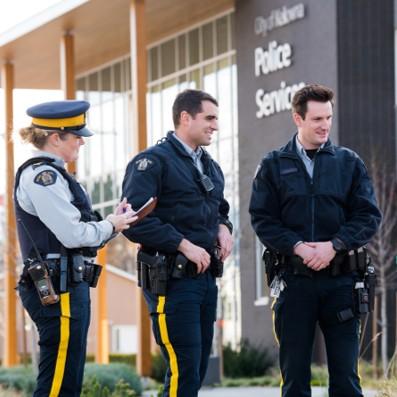
Police Services receives revenue from a variety of sources which help to offset the impact on taxpayers. The primary ones identified as the Municipal Cost Recovery for Support Services from our regional partners and revenue received from the Provincial Government through the Host Local Government program (gaming revenue). The Modernization project, currently underway, is reviewing and revising cost recovery agreements with our regional partners to ensure they are fair and reasonable for all parties.
What we deliver:
Police Services provides 24/7 operational support to the RCMP as part of its mandate to ensure public safety in our community. Services include information management, frontline supports, facility operations, quality assurance and all other administrative facets necessary for effective, efficient, and responsive policing in Kelowna.
Our key objectives:
• Support the preservation and enhancement of public safety – and sense of safety – in our community
• Support longer-term evidence-based initiatives to appropriately address upstream demands on police
• Implement strategies to improve the overall efficiency and effectiveness of the RCMP
• Implement efficiency and effectiveness strategies for City of Kelowna/civilian staff to support the reduction of the amount of administrative work done by uniformed members
Our guiding plans:
• RCMP Strategic Plan
• Community Safety Plan
Measuring performance:
Performance measure 1
Citizen satisfaction with police services
Data for this metric is collected through the bi-annual Citizen Survey. This measure helps gauge the level of community satisfaction with the type and level of services being provided by the City’s contracted police agency. Expectations are that the satisfaction levels will increase commensurate with RCMP recruitment, resourcing, efficiency, investigative effectiveness, communications, accountability, and transparency toward public trust, as well as outreach/community policing efforts. The 2024 data highlights an improvement from the 2022 actual of 74 per cent.
Performance measure 2
Police priority 1,2 and 3 response times
The timeliness of RCMP responses to priority 1, 2, and 3 calls is an important metric to monitor police service delivery. Priority 1 (P1) calls are deemed very urgent and are typically a major incident in progress that require immediate police protection. They can involve risk/loss of life and account for an estimated five per cent of all citizens calls for police service. Priority 2 (P2) calls are urgent and need to be dispatched as soon as possible as the potential for escalation of violence exists. Priority 3 (P3) calls tend to be more routine. While they do not require immediate police presence, they do need to be dispatched as soon as possible. Continued resourcing commensurate with growth in population, service demand and emergent case law will enable maintenance of existing response times. The target for P1, P2 and P3 response times are eight minutes, 10 minutes and 28 minutes, respectively.
PM#1: Citizen satisfaction with police services
PM#2: Police response to calls for service
Performance measure 3
Citizen callbacks for police service calls
RCMP communication with complainants to follow up on service provided is an important aspect of community policing. False alarms, abandoned calls for service, online reporting, assistance outside of public safety, and failure to appear, are not specified for follow up calls while all other file types should conclude with a callback.
PM#3: Citizen callbacks for police service calls
Performance measure 4
Traffic safety: police enforcement interactions
Council has prioritized the visibility of police enforcement as a key strategy in addressing high-risk traffic behaviours. Evidence supports that visible policing - including traffic checks - can reduce crime and traffic collisions. Enforcement activities – tracked through the issuance of violation tickets, warnings and notices/orders – are routinely reported by the RCMP to ensure accountability and alignment with traffic safety goals. Noteworthy, that operational demands related to investigating complex collisions can impact these noted enforcement objectives. While enforcement remains a priority, understandably some resources may need to be diverted which can have a temporary impact on visibility and interaction metrics.
Performance measure 5
Caseload
Caseload is defined as the number of criminal code offenses (excluding drugs & traffic offenses) per authorized strength. This represents the workload per officer and is often a better indicator of the demand for police service than crime rate or population. The caseload is calculated by dividing the total number of Criminal Code offenses in the calendar year by the authorized strength as of December 31st of the same calendar year. Kelowna’s caseload routinely surpasses other communities with a population greater than 15,000 in BC. In 2023, Kelowna had a caseload/officer 27 per cent higher than the average of other communities in BC with populations greater than 15,000; 11th highest with 80 files/officer.
PM#5:Caseload
officer
2026 Activities by priority:
Priorities Activities
Crime & Safety
Our People
Customer Experience
Base Business
• Advance longer-term evidence-based initiatives to appropriately address upstream demands on police
• Continue to support implementation of the Community Safety Plan
• Support relevant actions arising from the Mayor’s Task Force on Crime Reduction
• Maintain current service levels, responsiveness, and visibility in priority areas (i.e., downtown and Rutland)
• Support efforts, as feasible, to enhance prevention and community-policing based initiatives, particularly in Business Improvement Areas
• In partnership with the City and stakeholders, co-develop and implement a property crime reduction strategy
• Continue to develop, implement, measure and provide provincial leadership in respect to strategies to reduce the impacts of repeat offenders in our community
• Continue to implement education and prevention-focused communications to increase public prevention and reporting of criminal activity
• Increase individual and departmental capacity through targeted engagement strategies, enhanced training and professional leadership development
• Development and implementation of initiatives that promote mental and physical wellness and safety of all CSD staff
• Further develop and monitor performance metrics for all Police Services’ units to drive actions and deliver impactful and meaningful results
• Participation of RCMP in local events and programs to build long-term trust and sense of partnership with the community
• Establishing a KPI for callback service to increase the customer service experience
• Ongoing implementation of more effective quarterly RCMP contract performance reporting
Caseload per
2025 Key accomplishments:
• Increased occupancy rates for RCMP and Municipal staff
• Re-introduced the Speed Watch program; leading on Auxiliary program re-introduction; both Mayor’s Task Force on Crime Reduction initiatives
• Led successful rollout of Body Worn Cameras (BWC)
• Strategic crime reduction through targeted enforcement of prolific offenders
• Augmented and re-staffed youth unit
• Initiated coordination of the newly adopted Auxiliary Police Program
• Improved operational outcomes through data-informed resource deployment
Continuous improvements:
• Initiating an organizational effectiveness review
• Development of a Capital Infrastructure Plan to support future growth/expansion
• Implementation of the RCMP Service Delivery review recommendations
• Modernization of technology to improve the effectiveness of internal operations (i.e.: CCTV infrastructure)
• Advance a culture of wellness and psychological safety
• Establish a culture of continuous improvement, learning and leadership development
• Explore and realize new opportunities for innovation, including automation
Budget overview:
Note: Totals may not add due to rounding
Budget needed to achieve results
Police Services and RCMP are funded through property taxes. Revenues received from the Province via the Host Local Government program (gaming revenue), and recovery from our regional partners, help to offset the impact on taxpayers. Additionally, reserve funding is used as a budget tool to manage anticipated surpluses from RCMP member vacancies.
Note: Totals may not add due to rounding
Expenditure by
2026 Operating Requests ($ thousands)
Priority 1
2026 Capital Requests
There are no 2026 Priority 1 Preliminary Capital budget requests for this service area.
2026 Operating Request Details
Service Area: Police Services & RCMP Priority 1
Title: Child & Youth Advocacy Centre Enhancement
Justification:
Budget is requested to support the Child & Youth Advocacy Centre (CYAC), which provides a multidisciplinary environment where agencies serving children and families impacted by abuse and neglect collaborate to deliver comprehensive care. CYAC's annual operating expenses exceed $1.7M. The City currently contributes $73k toward rent. CYAC is requesting an additional $58k to support shared services, including the Child & Family Advocate Program, which encompasses child interviews, case conferences, follow-ups, and ongoing support. This program is frequently utilized by the RCMP. Cost recovery from partner municipalities is anticipated as part of the modernization project.
Strategic Direction: Crime & Safety
Title: DNA Analysis Services Fee
Justification:
DNA analysis is an integral part of many RCMP investigations and is managed through the Biology Casework Analysis Agreement. This agreement is endorsed by the Ministry of Justice and is administered by the Organized Crime agency of British Columbia. A cost sharing model is calculated based on the total cost of DNA analysis in British Columbia and distributed proportionally based on an agency's two-year average usage. Budget is requested for the forecasted increase in the proportional share of costs.
Strategic Direction: Other
2026 Operating Request Details
Service Area: Police Services & RCMP Priority 1 Enhance ON-GOING
Title: Police Services and RCMP Enhancements - Public Safety Levy PRELIMINARY
Justification:
Police Services provides 24/7 operational support to the RCMP as part of its mandate to ensure public safety in our community. As our community continues to grow, so do caseloads, calls for service, and the need for financial support. Budget is requested for four Regular Members and one Police Services Financial Analyst. The additional RCMP resources will improve safety, visibility, and proactive policing throughout the city and at the YLW Airport. The Financial Analyst will strengthen financial forecasting, budgeting, and compliance, mitigating risk and enabling data-driven decisions. Three Regular Members (at $253.5K each) and one Financial Analyst ($130K) will be funded through the Public Safety Levy program. One Regular Member will be funded 80/20 through the Airport fund and taxation.
Strategic Direction: Crime & Safety
2026 Operating Requests ($ thousands)
2026 Operating Request Details
Service Area: Police Services & RCMP Priority 2 Enhance ON-GOING
Title: RCMP Regular Member x 2 PRELIMINARY
Justification:
The cost of two additional RCMP members requested funded from taxation. These additional RCMP resources would be assigned to high risk, repeat and violent offender enforcement services at the Kelowna Detachment. If moved to priority 1, this request would increase taxation demand in 2026 by 0.07 per cent, with a further 0.18 per cent increase for annualization in 2027.
Strategic Direction: Crime & Safety
FIRE SAFETY
LED BY: GENERAL MANAGER, PEOPLE & PROTECTIVE SERVICES
Our goal & community benefit:
Our goal is to provide effective fire protection and public safety services to all areas of the City of Kelowna. This includes fire suppression and rescue, fire prevention, fire safety inspections, public education, fire training, first medical responses, hazardous material response, specialty rescue, pre-incident planning, dispatch and emergency management.
Our customers:
• Residents of Kelowna and visitors to the community (Suppression Branch)
• Commercial and multi-family development proposals (Fire Prevention Branch)
• Fire departments across five regional districts (Dispatch)
Our partners:
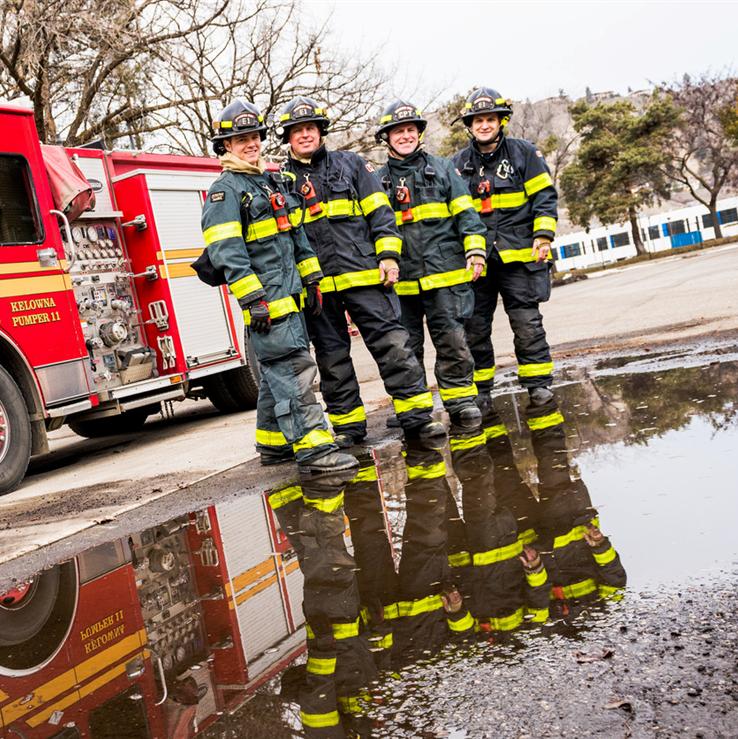
We work with local and provincial governments, community groups, citizens and volunteers to provide public safety services.
Revenue:
Kelowna Fire Communications Centre provides fire dispatch services to 58 fire departments across British Columbia. These contracts generate revenue that help offset the cost of dispatching Kelowna Fire Department to over 14,000 incidents annually.
What we deliver:
Kelowna Fire Department (KFD) provides a wide range of services to the City of Kelowna and the surrounding region. In addition to fire suppression and rescue, we offer inspection services and contribute input into new developments. Our Kelowna Fire Communications Centre (KFCC) provides fire dispatch services to over 58 fire departments across five regional districts. KFD’s specialty teams deliver technical rescue capabilities—including high-angle, tower crane, swift water, marine rescue, and hazardous materials response—throughout the Central Okanagan.
Our key objectives:
Provide life safety for the residents of the City of Kelowna through fire suppression, rescue, dispatch, training, inspections, and public education.
Our guiding plans:
• 2025 KFD Strategic Plan
Measuring performance:
Performance measure 1
Fire and life safety inspections
Fire and life safety inspections are conducted through two streams: the Fire Prevention Branch and company inspections. The Prevention Branch includes five inspectors and one Fire Prevention Officer, with an annual capacity of 2,800 inspections. Company inspections are carried out by on-duty firefighters across five stations, targeting 2,400 inspections annually.
The revised Fire Safety Act, effective August 1, 2024, introduces a risk-based compliance monitoring system. This allows municipalities to adjust inspection intervals based on building risk levels and enables the use of self-assessment forms completed by building owners. These changes shift some of the workload from fire services to property owners, helping reduce the number of required physical inspections. In 2025, changes were assessed with some implementation, resulting in a small decrease in number of inspectable properties for 2025 and anticipated further decrease in 2026.
PM#1 Fire and life safety inspections
Performance measure 2
Kelowna dispatch centre percentage of 911 calls answered
The percentage of dispatch incidents answered within 10 seconds is measured according to the National Fire Protection Association (NFPA) standard. This standard excludes certain emergency calls—such as technical rescues, hazardous material incidents, and those impacted by factors like language barriers or large-scale events—from response time metrics. As communities continue to grow, overall call volumes are increasing by approximately 2% each year, reflecting the expanding needs of the populations we serve. Despite these rising demands, dispatch performance remains aligned with national standards, ensuring timely and effective emergency response.
PM#2: Kelowna dispatch centre percentage of 911 calls answered ≤10 seconds
Kelowna Fire Dispatch NFPA Standard (Benchmark) Call Volume
Performance measure 3
Effective Response Time (ERT)
Effective response time refers to how quickly the Kelowna Fire Department (KFD) can arrive at the scene of an emergency after being dispatched. The KFD has set specific goals for response times and resource allocation based on the type and severity of the incident and the location. Within the Permanent Growth Boundary (PGB), the goal is for the first fire truck to arrive within nine minutes, 90 per cent of the time, for all types of emergencies. These goals ensure that the KFD can provide timely and effective responses to emergencies, enhancing safety and protection for the community.
Effective Response Force (ERF)
Kelowna Fire Department (KFD) Strategic Plan identifies the Effective Response Force (ERF) as the ability of the KFD to quickly assemble three fire engines and one Incident Commander, with a total of 13 personnel on scene, to a residential house fire to ensure effective firefighting and rescue operations. A typical residential fire response should ideally include at least 14-15 firefighters who perform essential tasks like fire attack, search and rescue, ventilation, water supply, and command. This staffing level is crucial for managing fires safely and efficiently, protecting lives and property, and ensuring that all critical tasks can be performed simultaneously without overburdening any single team. An adequate ERF allows the fire department to respond promptly and effectively to emergencies, thereby keeping the community safe.
Performance measure 4
KFD suppression calls
KFD had 16,705 suppression calls in 2024, and the population was 165,907. This is 100.69 calls per 1,000 population in 2024 with future years showing growth in both population and incidents. # of calls
suppression calls per 1,000 population
Performance measure 5
Firefighters on duty
KFD had 25 firefighters on duty in 2024 with a population of 165,907
PM#5: Firefighters on duty per 1,000 population
Priorities
Crime & Safety
Activities
• Continued participation in the Property Safety Compliance Team and other opportunities to integrate with partnering agencies such as police and bylaw
• Continued improvement of Effective Response Force (ERF) – the ability to quickly assemble three fire engines and one Incident Commander, with a total of 13 personnel on scene, to a residential house fire to ensure effective firefighting and rescue operations
Homelessness
Agriculture & Environment
Our People
Transformation
Customer Experience
Base Business
• Engage with other stakeholders on safety for those experiencing homelessness, including fire safety education
• Continued focus on Wildland Urban Interface (WUI) response, including education around FireSmart
• KFD has partnered with UBCO on the Okanagan Wildfire Lab to advance wildfire research and training to enhance wildfire resilience and management
• Continued focus on wellness initiatives to ensure a safe and healthy working environment
• Enhanced MRI screening of firefighters to aid in the early detection of work-related cancers
• Upgraded lighting and siren packages on command vehicles to improve scene visibility, responder safety, and alignment with current emergency response standards
• Continued implementation of NG911 systems within Kelowna Fire Communications Centre
• Working with GIS to improve mapping for major events, including interactive tools to share information real time
• Implementation of drones to support response
• Use recommendations of Master Plan to better use data to make informed decisions and set benchmarks
• The Okanagan Wildfire Lab project uses AI-powered sensors to help KFD improve fire monitoring and response
• Deploy real-time major incident field mapping software and hardware to streamline information sharing with the regional Emergency Operations Centre
• Continued implementation of NG911 systems, particularly the Call Handling Solution, introduces IP-based technology that processes emergency communications, enabling faster, more precise emergency response and enhancing the public’s experience during critical incidents.
• Continue to review long term capital plans including fleet to ensure the best use of capital for mid to long term needs
• Comprehensive review of Kelowna Fire Communications Centre dispatch contracts to ensure cost-effectiveness and fiscal accountability
2025 Key accomplishments:
• Completed the 2025 Kelowna Fire Department Strategic Plan
• Advanced fleet modernization with new apparatus deployed: Engine 1, Ladder 2, PC 1, and Bush 2
• Developed a comprehensive 5-Year Fleet Capital Plan
• Completed the Kelowna Fire Communications Centre Staffing and Operational Review
• Conducted targeted prescribed burns to reduce wildfire risk and support ecological health
• Executed a full-scale evacuation exercise in the Magic Estates community
• Finalized the Fire Facilities Master Plan
• Achieved construction validation for the Glenmore Protective Services Campus
• A new Type 2 SPU and an Urban Structure Protection trailer were added, bringing the City’s total structure protection resources to three trailers, with the ability to protect up to 600 homes within the City of Kelowna
• Six Kelowna neighbourhoods achieved FireSmart Neighbourhood recognition
• Over 60,000 kg of combustible landscaping (e.g., cedar hedges) was removed from home ignition zones, funded by the UBCM CRI FireSmart grant
• Partnered with UBC Okanagan to support their successful achievement of FireSmart recognition—making them the first university in Canada to receive this designation
Continuous improvements:
• Implementation of the 2025 Kelowna Fire Department Strategic Plan
• Review and enhancement of Kelowna Fire Communications Centre recruit training and Quality Improvement/ Quality Assurance programs
• Expansion of firefighter training, including Live Fire exercises and the in-house Fire Officer development program.
• Improved data tracking and reporting across Kelowna Fire Department operations to support informed decisionmaking and performance monitoring
• Partnering with UBC Okanagan to deploy 15 fire weather stations across the city to enhance wildfire conditions monitoring
• Strengthening partnerships with organizations focused on wildfire response and detection, including initiatives such as heavy-lift drones and AI-powered camera technology
• Actively promoting the FireSmart Neighbourhood program, with 26 additional neighbourhoods currently working toward recognition
Budget overview:
2026 Total Expenditure Budget Breakdown
Note: Totals may not add due to rounding
Budget needed to achieve results
Fire Safety is funded through property taxes. The City also provides Dispatch Services to several regional districts across the province, creating operational efficiencies that lower dispatch costs for Kelowna taxpayers and help reduce the overall tax burden. Annual reserve contributions are made to mitigate the financial impact of significant future capital purchases.
Note:
2026 Operating Requests ($ thousands)
Priority 1
2026 Capital Requests ($ thousands)
1
2026 Operating Request Details
Service Area: Fire Safety Priority 1
Title: Fire Safety Enhancements - Public Safety Levy
Justification:
Budget is requested for four firefighters, including incidental costs, with a full annualized cost of $537k funded from the Public Safety Levy program. Fire safety incidents are forecasted to reach 17.8k by 2028, and the population is expected to continue to grow. With current resources, the Kelowna Fire Department (KFD) is meeting its Incident Response Time target (nine minutes) 81.3 per cent of the time and its Effective Response Force (ERF) time target (12 minutes) 55 per cent of the time. The staffing plan for KFD is to build minimum on-shift staffing over time to enhance both Response Time and Effective Response Force time.
Strategic Direction: Other
Justification:
Budget is requested to maintain existing service levels for Kelowna Fire Department (KFD) fleet repairs due to factors such as rising vehicle part prices, increased mechanic labour rates, and the addition of third-party mechanic services. This allocation will continue providing existing service levels for maintaining integrity and responsiveness of the KFD fleet.
Strategic Direction: Other
2026 Operating Request Details
Service Area: Fire Safety Priority 1 Enhance ON-GOING
Title: KFD Service Support Enhancement PRELIMINARY
Justification:
Budget is requested for a permanent full-time Executive Assistant - Communications & Administration position within the Kelowna Fire Department (KFD). This staffing proposal involves converting the current term Procurement Specialist role into a permanent Executive Assistant position. The role will provide confidential administrative support to the Deputy Chief and four Assistant Chiefs, who collectively oversee 160 staff. In addition, the position will be responsible for operational procurement and financial processing functions.
Strategic Direction:
2026 Capital Request Details
Service Area: Fire Safety Priority 1
Title: Communications Systems PRELIMINARY
Justification:
Budget is requested for this annual program to accommodate growth and renewal to maintain levels of service for fire communications systems for the replacement of old communication equipment that is beyond its' service life, or the purchase of new communication equipment to meet current needs, or regulatory changes.
Strategic Direction: Other
Justification:
Budget is requested for this annual program to accommodate growth and renewal to maintain levels of service for fire vehicles and equipment for the replacement of old equipment/vehicles that are beyond its' service life, or the purchase of new equipment/vehicles to meet current needs, or regulatory changes.
2026 Capital Request Details
Service Area: Fire Safety Priority 1
Title: Glenmore Protective Services Campus PRELIMINARY
Justification:
Budget is requested to accommodate growth to maintain current service levels for the continued work on the Glenmore Protective Services Campus on John Hindle Drive. The scope includes new fire hall facilities, protective services training facilities, associated site works, the demolition of the of current Fire Hall #5 and it's eventual return to agricultural use.
Strategic Direction: Crime & Safety
Service Area: Fire Safety Priority 1
Title: Next Generation 911 Implementation
Justification:
Budget is requested to support all costs related to the mandatory transition to NG 9-1-1 technology by 2027. The Union of BC Municipalities provided multi-year grant funding for the Next Generation 9-1-1 (NG 9-1-1) project to the City of Kelowna. The provincial government delayed the date to 2027 to give stakeholders time to address challenges like skilled resource shortages, develop necessary standards, and ensure all public safety answering points (PSAPs) are prepared. This implementation offers an enhanced level of service for this operation.
Strategic Direction: Crime & Safety
2026 Operating Request Details
Service Area: Fire Safety Priority 2 Enhance ON-GOING
Title: Firefighters (2) PRELIMINARY
Justification:
Budget is requested for two additional Firefighters to support phased staffing of the Rescue Truck out of Station 1. The requested Public Safety Levy addition of four FTEs fills the third of four positions on the Rescue Truck. Full staffing of four on the Rescue is projected to improve our Effective Response Force (ERF) by 9 per cent. Once achieved, the Rescue will cross-staff the Ladder Truck, enabling deployment of two units with two firefighters each, enhancing tactical capacity and emergency response flexibility. If moved to priority 1, this request would increase taxation demand in 2026 by 0.09 per cent, and a further 0.04 per cent for annualization through 2028.
Strategic Direction: Other
Budget is requested for KFD Captains and Lieutenants Spring and Fall Development Training wages. Training includes strategies and tactics for firefighting and leadership. If moved to priority 1, this request would increase taxation demand in 2026 by 0.02 per cent.
Strategic Direction: Our People
WASTEWATER UTILITY
LED BY: GENERAL MANAGER, INFRASTRUCTURE
Our goal & community benefit:
We are dedicated to safeguarding Okanagan Lake, promoting human health, and preserving our environment through the efficient collection and effective treatment of wastewater. By ensuring proper treatment, we maintain the natural balance of nutrients and prevent toxins from entering the lake, reducing impacts to public health, wildlife habitats, fisheries, tourism, and recreational activities.
Our customers:
• All citizens, businesses and visitors to Kelowna
◦ Residential
◦ Commercial (e.g., restaurants, hotels)
◦ Industrial (e.g., breweries, wineries, food producers)
◦ Institutional (e.g., hospitals, schools)
• The District of Lake Country
Our partners:
• Surrounding communities, including First Nations
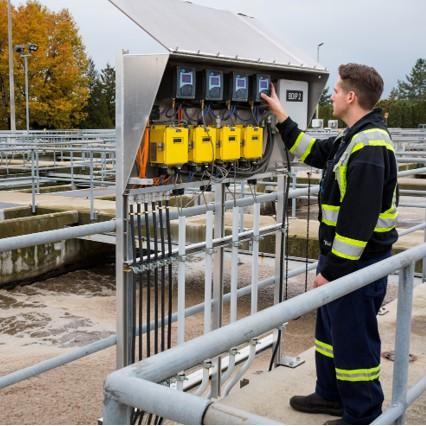
• Research from the University of British Columbia, consultants, and the National Benchmarking Initiative
• Government agencies include Environment Canada, BC Centre for Disease Control, City of Vernon, and the Province
• Biosolids customers, including the Regional Composting Facility (OgoGrow) and the Ingerbelle Compost Facility (Princeton)
Revenue
The Wastewater Utility is fully self-funded from user fees and parcel taxes.
What we deliver
• The City collects, on average, 37 million litres of wastewater per day (ML/d), and routes it through over 650 km of buried mains and 44 sanitary lift stations to be treated at our wastewater treatment plant
• Our wastewater treatment facility, operated by highly trained professional staff, removes contaminants and nutrients and then disinfects wastewater into a clean and safe high-quality effluent. The effluent is used for irrigation or immediate safe release to Okanagan Lake
• We deliver resiliency in our infrastructure and redundancy to our operations, ensuring year-round releases of safe effluent back to Okanagan Lake
• We reliably service the needs of a growing city 24 hours a day and 365 days per year
• We deliver competitive rates in comparison to other communities in the country
Our key objectives:
• Collect wastewater from all urbanized areas of the city and route it safely to the wastewater treatment facility
• Effectively treat and disinfect all wastewater to protect public health, the environment and Okanagan Lake
• Assure that policies are consistent across the valley to prevent the discharge of sanitary wastewater to Okanagan Lake
• Sustain investment, resources and trained professional staff to service the needs of a growing city reliably for 24 hours a day and 365 days per year
• Ensure that rates that reflect these objectives, a reasonable level of service, are competitive with other communities and provide value to Kelowna citizens
Our guiding plans:
• Kelowna’s Water Security Plan (2025)
• 20-year Servicing Plan
• 10-Year Capital Plan
• 2040 Official Community Plan
• Ministry of Environment Operating Permit
Measuring performance:
Performance measure 1
Wastewater treatment facility capacity (organic and hydraulic annual average loading)
The long-term trend shows that more litres of wastewater are treated each year (hydraulic loading), and each litre contains a higher concentration of organics (organic loading). This trend reflects Kelowna's growing population and the success of water conservation efforts, which have decreased personal water consumption. The increased concentrations will continue and impact treatment effectiveness. Staff are evaluating the need for process changes and accelerating facility upgrades to match growth projections and ensure compliance with Ministry of Environment regulations.
PM#1: Facility average capacity used %
Performance measure 2
Wastewater utility is sustainably funded
Identifies the ratio of capital reinvestment (renewal) divided by the current year estimated replacement value of infrastructure. Measure is in per cent. 0.8 per cent implies the renewal rate would take 125 years to renew existing infrastructure. The long run target should range from 1.2 per cent to 1.5 per cent (67-to-83-year average infrastructure life). The current renewal rate is adequate given the relatively young age of the assets, but renewal will need to increase in the longer term as the system ages
Performance measure 3
Residential rates are stable
Wastewater utility rate increases have been modest over the last few years and are reviewed each year to ensure financial sustainability.
Performance measure 4
Residential rates are competitive
Residential rates are competitive with other communities. Kelowna has one of the lowest wastewater rates within the valley. The average monthly rate for single-family residence among other communities in the Interior of B.C. in 2025 was $41.14 (Vernon, West Kelowna, Penticton, and Kamloops) compared with Kelowna’s 2025 rate of $24.82.
2026 Activities by priority:
Priorities
Crime & Safety
Affordable Housing
Transportation
Agriculture & Environment
Activities
• Increased security measures at utility infrastructure to protect citizens utility investment
• Efficient and affordable wastewater service contributes to overall housing affordability
• We coordinate our sewer and trunk renewal construction with our roads and transit infrastructure
• Ongoing involvement with Provincial and Federal bodies, gathering and evaluating data for facility effluent and its effects on public health and the environment
• Continued teamwork with other municipalities reviewing facility operations and discussing optimization of similar facilities
Economy
Our People
Transformation
Customer Experience
Base Business
• Efficient and affordable wastewater service contributes to overall affordability
• Our three-year confidential online employee engagement survey helps create and foster a workplace that offers purpose and inspires staff to achieve their best
• Utility leaders actively pursue and support staff training and development
• Ensure that all certified staff receive the training needed to maintain Provincial required certifications
• The team continues working towards the creation of online forms and data sheets which will streamline data entry and allow for easier information transfer for operational optimization
• Working with other groups within the City, the utility supports a central data warehouse that allows users to have easier access to data for operations, modelling, and development
• Cityworks information is being used to create service-based budget data and dashboards to help inform other departments and operations
• Pilot new odour management technology at one location
• Efficient, effective wastewater collection and treatment, protecting the public health and the environment and increasing effluent reuse
• Continuing with effective renewal of end-of-life infrastructure
• Engineering support has been engaged to support operational changes for side stream processes and support stress testing overall treatment process to reach maximum operational capacity. Following that, testing recommendations will be provided on future process changes/additions
• Continued work on alignment of utility operational budgets between different utility work groups allowing for a clearer view of operational spending and increased transparency for financial reporting
• Continue to improve use of benchmarking for effective operations through ongoing participation in the Canadian Infrastructure Benchmarking Initiative
2025 Key accomplishments:
• Completion of the asset condition assessment of the Raymer Avenue Wastewater Treatment Facility. This comprehensive assessment provides us with valuable data that will prioritize our major component renewals and upgrading to assure safe and effective continuous operation of the facility into the future
• Over 600 new urban sewer connections have replaced septic systems across the City. The 3-year construction of new sewers in Rutland Centre provides connections for existing properties to the City wastewater system and decreasing reliance on aging urban septic systems. Another big project saw remaining properties from the Belcarra development from the 1990’s connected in the Upper Mission
• Completion of the asset condition assessment of the Brandt’s Creek Tradewaste Treatment Facility. This comprehensive assessment provides us with valuable data that will significantly enhance our budgeting and planning efforts, both in the short and long term
• Completion of connections to support Lake Country treated effluent disposal to Okanagan Lake through the City wastewater system, including significant upgrades to McCarthy Lift Station
• Completion of Water Security Plan identifying short, medium and long-term Utility goals and integration of those goals into our planning process
Continuous improvements:
• Conducting process modeling and facility stress testing at the wastewater treatment facility. This critical work aims to optimize our operations to handle increased organic loading. The results will guide us in making informed decisions on process changes or facility upgrades to meet our current challenges effectively
• Seven out of our 44 sanitary sewer lift stations are currently undergoing design or construction activities for upgrades or retrofits. These improvements are crucial in ensuring the efficiency and reliability of our operations
• Renewing aging and undersized sewers in residential and commercial areas, including Coronation Ave, Walrod St, Lapointe St, Richter St, Royal Ave and Lawson Ave
• Energy management and energy optimization remain at the forefront for the Utility. Fall 2025 will see the installation of a replacement aeration blower with a high efficiency blower
• Staff continue to adopt new technologies to address utility network odours. A pilot test completed in 2025 provided information on a technology that may be implemented in higher traffic areas (parks, residential areas) where odours have been a concern
• The complete renewal of the Water Street Lift Station, the City’s largest and most important system component servicing downtown Kelowna
Budget overview:
Note: Totals may not add due to rounding
Budget needed to achieve results
The Wastewater Utility operates under a separate, self-sustaining fund. Any unused revenue generated each year is allocated to accumulated surplus and used to fund future wastewater infrastructure investments. Annually, the Wastewater Utility contributes to the general fund to support enabling services and offset property taxes. In 2026, the contribution to Enabling Services is $902 thousand
Note: Totals may not add due to rounding
2026 Operating Requests ($ thousands)
2026 Capital Requests ($ thousands)
1
2026 Operating Request Details
Service Area: Wastewater Utility
Title: Network Roadway WorkSafe Requirements - Wastewater
Justification:
Budget is requested to support field crews working within roadways to meet updated WorkSafeBC standards and Ministry of Transportation (MOT) Traffic Management for Work on Roadways requirements. Recent changes to these regulations mandate increased traffic control measures, including signage and certified flaggers, when performing work in roadway environments. These requirements apply to Storm, Sanitary and Water Networks, covering routine maintenance and emergency response activities. The funding will ensure crews are equipped to operate safely and in full compliance with current standards.
Strategic Direction: Other
Justification:
Sanitary and Stormwater Network Integrity Programs
Budget is requested for funding to support a storm network integrity program and to expand the sanitary network integrity program. Both the storm network and the sanitary network are growing and aging. Expanded condition assessment is needed to assess the pipe networks structural condition, identify blockage and partial blockages helping to prevent service disruptions and flooding situations to aid with extending infrastructure lifespan and to aid capital replacement programs. This proactive approach will help make informed, data-based decisions based on the foundation of critical asset management and condition ratings.
Strategic Direction: Other
2026 Operating Request Details
Service Area: Wastewater Utility Priority 1 Maintain ON-GOING
Title: Wastewater Collection Operations - Growth PRELIMINARY
Justification:
Budget is requested to maintain The City of Kelowna's Wastewater operations consisting of two treatment facilities, 44 lift stations and over 650 km of pipes that service approximately 95 per cent of the Kelowna population. As the City grows, additional operation and maintenance budget is required to maintain this 24 hour/day, 365 days/year service level. This request includes the addition of one new Wastewater Maintenance Supervisor to oversee mechanical and electrical systems, predictive maintenance, and digital optimization while supporting asset renewal planning, contract management, and interdepartmental coordination.
Strategic Direction: Other
2026 Capital Request Details
Service Area: Wastewater Utility Priority 1
Title: Regional Compost Facility & Equipment Renewal PRELIMINARY
Justification:
Budget is requested to replace end of life equipment at the Regional Compost Facility. The cost of this equipment renewal project is funded 1/3 by the City of Vernon.
Strategic Direction: Other
Service Area:
Title: Wastewater Network Growth & Renewal
Justification:
Budget is requested for this annual program to ensure reliable wastewater service delivery for City customers connected to the sanitary collection system. Annual items for consideration will renew existing mainlines and lift stations.
Strategic Direction: Other
2026 Capital Request Details
Service Area: Wastewater Utility Priority 1
Title: Wastewater Treatment Growth & Renewal PRELIMINARY
Justification:
Budget is requested for this annual program to ensure reliable wastewater service delivery for City customers connected to the sanitary collection system. Annual items for consideration will renew existing wastewater treatment assets.
Strategic Direction: Other
Service Area: Wastewater Utility
Title: Recreation Vehicle Sanitary Disposal Facility PRELIMINARY
Justification:
Budget is requested for the planning and design of a recreational vehicle (RV) sanitary disposal facility. This project will offer an enhanced level of service for RV users in the city.
Strategic Direction: Other
2026 Capital Request Details
Service Area:
Title: Regional Compost Facility Enhancements
Justification:
Budget is requested for upgrades at the Regional Compost Facility. Upgrades for this year are for a new recirculation system at the Compost Facility to reroute the leachate flow. This project will offer an enhanced level of service at the Regional Compost Facility. The cost of these upgrades is funded 1/3 by the City of Vernon.
Strategic Direction: Other
Title: Sewer Connection Areas
Justification:
Budget is requested to continue conversions of septic systems to the City wastewater utility. This year the program focuses on the Hall Road area connection over Mission Creek on KLO Bridge, as well as final design and construction of the Chamberlain and Stellar sewer services. Customers will benefit from a safe, reliable, and environmentally sustainable wastewater collection, treatment and treated effluent disposal to Okanagan Lake. This project will offer an enhanced level of service for wastewater operations.
Strategic Direction: Other
2026 Capital Request Details
Service Area: Wastewater Utility Priority 1 Enhance ONE-TIME
Title: Wastewater Network Upgrades PRELIMINARY
Justification:
Budget is requested for this annual program to ensure reliable wastewater service delivery for City customers connected to the sanitary collection system. Annual items for consideration will enhance existing/install new mainlines and lift stations. This project will offer an enhanced level of service for the wastewater network.
Strategic Direction: Other
STORMWATER & FLOOD PROTECTION
LED BY: GENERAL MANAGER, INFRASTRUCTURE
Our goals & community benefit:
We are committed to protecting Okanagan Lake, public health, and the environment by managing stormwater efficiently - minimizing impacts to riparian areas, infrastructure, and waterways - while building community resilience to lake and creek flooding.
Our customers:
• All citizens, businesses and visitors to Kelowna
◦ Residential
◦ Commercial (e.g., restaurants, hotels)
◦ Industrial (e.g., breweries, wineries, food producers)
◦ Institutional (e.g., hospitals, schools)
Our partners:
• Developers
• Okanagan Basin Water Board
• First Nations
• Regulators
• Private landowners
Revenue:
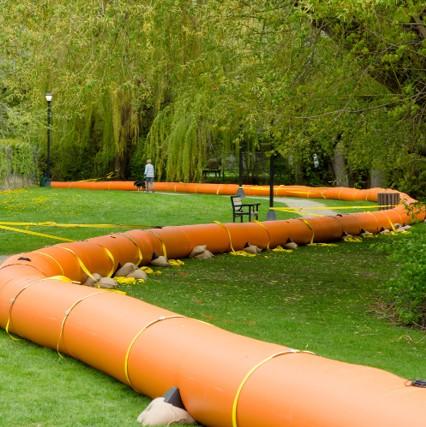
Stormwater & Flood Protection does not generate significant direct revenues. As a result, our ongoing activities and service delivery are primarily supported by allocations from property tax revenues, rather than self-generated income sources.
What we deliver:
The City’s stormwater and flood protection efforts, now with greater focus on water quality, are essential for maintaining over 475 km of stormwater pipes, 103 ponds (including four regulated dams), 23 tanks, 68 oil and grit separators, and one major creek diversion structure that help protect the community. The City's infrastructure is designed to capture and route stormwater through minor and major systems that direct runoff to natural features like lakes, creeks, and wetlands. The piped system handles minor storms and snowmelt events, while the major systems such as curbed roads, channels, culverts, and storm ponds route and manage extreme storm events. The City’s expanded focus on improving stormwater quality involves activities like cleaning and maintaining catch-basins, stormwater separators, and stormwater ponds. We rely on engineered solutions created by new development to reduce stormwater pollutants and sediment at the source. We also participate in ongoing studies on public stormwater ponds to help us understand nutrient loads and their impact on natural habitat development. Our flood mitigation efforts currently focus on the Mill Creek Flood Protection Project, with $55 million allocated until 2030. All flood protection works incorporate creek and riparian elements that support fish habitat. Operationally, Stormwater management services are a collaborative effort across several departments, including Wastewater Operations, Roadways Operations, the Water Quality and Customer Care Team, Utility Planning, and Parks Services. These teams provide a mix of proactive and reactive services to manage stormwater in our community.
Our key objectives:
• Safely route rain and snowmelt to natural systems
• Protect the quality of water entering Okanagan Lake and its contributing creeks, ponds, and channels
• Protect people, property, key infrastructure, and the environment from the impacts of flooding
• Assure stormwater asset renewal and operating budgets together are sustainably funded
• Ensure the Stormwater and Flood Protection service area is funded to meet community expectations
Our guiding plans:
• Water Security Plan (2025)
• 20-Year Servicing Plan
• 10-Year Capital Plan
• 2040 Official Community Plan
• Area Stormwater Basin Plans
• Flood modelling of flood prone creeks and Okanagan Lake
• Stormwater Pond Asset Renewal Program
Measuring performance:
Performance measure 1
Protect Okanagan Lake by minimizing contaminants in creeks
The stormwater quality impact rating we use considers a weighted average of stormwater quality in nine creeks sampled at 11 locations. Over 200 water quality samples are collected annually and compared to recreational water quality guidelines for dissolved oxygen, E. coli and turbidity using weighted averages based on size of creek. Less than 26 is considered good. 27-43 is fair and greater than 43 is poor.
PM#1: Protect Okanagan Lake by minimizing contaminants in creeks - Stormwater quality impact rating
Performance measure 2
Infrastructure
Identifies the ratio of capital reinvestment (renewal) divided by the current year estimated replacement value of engineered stormwater infrastructure; measured in per cent. 0.5 per cent implies renewal rate would take 200 years to renew existing infrastructure. The current renewal rate is adequate given the relatively young age of the assets, but renewal will need to increase in the longer term as the system ages.
PM#2: Infrastructure is sustainably funded
Performance measure 3
Catch-basin servicing
A stormwater catch-basin is a structure designed to collect and direct rainwater runoff from streets, parking lots, and other surfaces into the stormwater drainage system. Target is 100 per cent of catch basins serviced each year. This level of service is performed to help ensure that the stormwater systems are clear of debris which can potentially cause flooding situations and ensure functionality of downstream infrastructure and water quality discharging to the environment.
Performance measure 4
Stormwater treatment device servicing
A stormwater treatment device is any engineered system or technology used to remove pollutants from stormwater before it is discharged into the environment. Target is 100 per cent of stormwater treatment devices serviced each year. This level of service is performed to help ensure that the stormwater systems are clear of debris which can potentially cause water quality concerns.
2026 Activities by priority:
Priorities
Crime & Safety
Affordable Housing
Transportation
Agriculture & Environment
Activities
• Increased security measures at utility infrastructure to protect citizens’ utility investment
• Flood risk mapping to identify areas of low-risk development opportunities
• Incorporate Stormwater management into all City road works
• Mill Creek Flood Protection – Year 5 of the Disaster Mitigation and Adaptation Fund project plan. Current work includes flood resiliency measures at Parkinson Recreation Centre and KLO Bridge on Mission Creek
• Annual catch-basin cleaning program to reduce contaminants entering the environment
Economy
Our People
Transformation
Customer Experience
Base Business
• Effective flood protection through the City and RDCO’s annual freshet response
• Our three-year confidential online employee engagement survey helps create and foster a workplace that offers purpose and inspires staff to achieve their best
• Utility leaders actively pursue and support staff training and development
• Ensure that all certified staff receive the training needed to maintain Provincial required certifications
• Development of online forms and data sheets to streamline data entry and improve information sharing for operational efficiency
• Support a central data warehouse that enhances access to operational, modelling, and development data for staff and citizens
• Utilize CityWorks data to build service-based budgets and dashboards to support decision-making across departments
• Continue to provide stormwater basin plan results in an online GIS platform for easy access and interpretation by City staff
• Through simple web based graphics provide citizens easy access to surface water quality data
• Increase frequency of containment device management and cleaning
• Stormwater Facility and Dam Operations and Maintenance - New operations and maintenance needs for the Mill Creek diversion
• Stormwater Genset Operations and Maintenance – operations and maintenance, and parts for new genset at Avonlea storm lift station
• Improve resiliency and operations and maintenance for four stormwater lift stations
• Clifton Rd stormwater pond study
• Investigation to reconfigure two stormwater ponds on Clifton Rd
• Miscellaneous Drainage Program - Drainage complaint responses requiring minor works (<$100,000)
• Development of a Stormwater Management and Flood Protection Council Level of Service Policy planned for 2026
• Development of a holistic environmental permitting strategy to facilitate operational activities of nature-based stormwater systems like ponds and vegetated ditches
2025 Key accomplishments:
• Wastewater Operations continues to achieve over 90% annual catch-basin cleaning. This is a notable accomplishment every year as it is one of the primary mechanisms for reducing pollutant loading to natural systems and ensuring a functional stormwater management system
• Completion of the Central Area Basin Stormwater Management Plan. This basin plan considers growth, pluvial flood risk climate change, and water quality impacts in some of the fastest growing areas of the City
• Completion of the Jim Bailey Basin Stormwater Management Plan, in coordination with the District of Lake Country
• Completion of the Stormwater Pond Asset Renewal Program study. This study aimed to better understand the City’s 103 stormwater management ponds from a risk-based, asset management, and GIS lens. The results provide greater insight into our existing system and the operational and capital requirements to keep it sustainable
• Detailed design for the replacement of the hydro-excavation dewatering facility at City Yards. This critical facility treats materials removed from our stormwater system via the City’s vacuum truck fleet. The existing facility is at end of life
• Completion of the State of Infrastructure Report and supporting dashboard for the City’s stormwater infrastructure. The results from this work will help us better understand capital reinvestment requirements to keep our stormwater management system sustainably funded. This dashboard will be used to update long-term renewal projections in 2026
• The City’s stormwater renewal programs continue to renew aging infrastructure to limit service disruption. In 2025, over 15 renewal projects were in the design or construction phase. These projects include replacement of failed pipes, proactive renewal via cured in place pipe (CIPP) lining, rehabilitation of regulated dams, and coordinated renewal with Transportation and other utility projects
• Staff and Council evaluated the feasibility and benefits of funding stormwater management through a utility model but decided to maintain the current approach of funding via property taxes
Continuous improvements:
In the coming years, Utility Services plans to work on the following initiatives to support sustainable service delivery:
• Development of a Stormwater Network Integrity Program, focused on condition assessment and water quality impacts
• Development of a Stormwater Pond Asset Renewal Program with supporting operational and capital resourcing
• Re-establishment of the City’s Rain Gauge program (currently suspended)
• Study the link between the City’s street cleaning program and improving stormwater quality in receiving waterbodies
2026 Total Expenditure Budget Breakdown
Note: Totals may not add due to rounding
Budget needed to achieve results
Stormwater & Flood Protection are funded through property taxes. Mill Creek Flood Protection work will continue in 2026, supported by funding from the Disaster Mitigation and Adaptation Fund. Additional capital funding is recommended to come from development cost charges and capital reserves.
Note: Totals may not add due to rounding
Note: Totals may not add due to rounding
Expenditure by type
2026 Operating Requests ($ thousands)
Priority 1
2026 Capital Requests ($ thousands)
Priority 1
* denotes capital request has operating & maintenance impacts included in the request
2026 Operating Request Details
Service Area: Stormwater & Flood Protection Priority 1 Enhance ON-GOING
Title: Utility Infrastructure Planning PRELIMINARY
Justification:
The City of Kelowna's Utility Planning team plans for and manages over $4 billion of water, wastewater, stormwater and landfill infrastructure. The team is responsible for lifecycle and growth-related infrastructure planning, including system integration and expanded dam oversight. With increasing demands and complexity, budget is requested for a new Utility Engineer position to help ensure timely infrastructure renewal, address growth-related servicing needs, and uphold operational efficiency across all utility services.
Strategic Direction:
2026 Capital Request Details
Service Area: Stormwater & Flood Protection
1 Maintain ONE-TIME
Title: Stormwater Infrastructure Renewal PRELIMINARY
Justification:
Budget is requested for this annual program to accommodate growth and renewal to maintain levels of service for stormwater infrastructure. Annual items for consideration may include, but are not limited to, major system upgrades from Basin Plans, stormwater linear asset renewal and pond renewal.
Strategic Direction: Other
Service Area: Stormwater & Flood Protection
Title: Flood Protection - Mill Creek PRELIMINARY
Justification:
Budget is requested to continue the seven-year, Disaster Mitigation and Adaptation funded flood protection program, which includes several sub-projects. These projects include, but are not limited to, flood resiliency upgrades at Kelowna International Airport and capacity upgrades to reduce flood risk throughout the lower reaches of Mill Creek with associated land purchases, all while improving riparian and fish habitat. The Parkinson Recreation Park - Mill Creek Restoration collaboration, aims to enhance flood conveyance, widen the creek channel, and improve riparian habitat, in coordination with the planned redevelopment of the Parkinson Recreation Centre. This work offers an enhanced level of service for flood protection within the city.
Strategic Direction: Agriculture & Environment
2026 Capital Request Details
Service Area: Stormwater & Flood Protection
Title: Stormwater Infrastructure Enhancements PRELIMINARY
Justification:
Budget is requested for this annual program for stormwater infrastructure enhancements. Annual items for consideration may include, but are not limited to, critical stormwater service requests and offsite and oversize (development coordination). This work offers an enhanced level of service for stormwater management.
Strategic Direction: Other
Service Area: Stormwater & Flood Protection
Title: Stormwater Quality Enhancements PRELIMINARY
Justification:
Budget is requested for this annual program for stormwater quality enhancements. Annual items for consideration may include, but are not limited to, design and construction of new oil-grit separators and upgrades of critical stormwater management facilities. This work offers an enhanced level of service for stormwater management.
Strategic Direction: Other
WATER UTILITY
LED BY: GENERAL MANAGER, INFRASTRUCTURE
Our goal & community benefit:
All residents and water users in the City have a safe, affordable, resilient and sustainable supply of highquality drinking water and a reliable supply of water for agriculture.
Our customers (in our service area):
• Residents, businesses and visitors
• Agricultural community
• Fire Department
• Other departments and organizations (including Interior Health Authority)
Our partners:
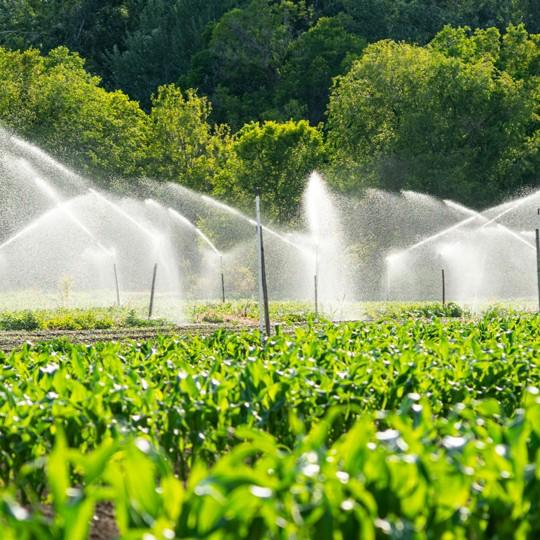
• Research partners with the University of British Columbia and the National Benchmarking Initiative
• Government agencies
• Rutland Waterworks, Black Mountain Irrigation District and District of Lake Country
• Engineering firms, contractors, surrounding municipalities
• Okanagan Indian Band, Westbank First Nation and the Okanagan Nation Alliance
Revenue:
The Water Utility is fully self-funded from user fees and parcel taxes.
What we deliver:
The City of Kelowna thrives in an arid environment with limited water supply. We share water resources with other communities, visitors, wildlife, and the natural environment. We safeguard a secure water supply that relies on public and personal responsibilities towards conservation, and partnerships with neighbouring municipalities and First Nations. We respect all interests and needs.
• The City Water Utility now serves approximately 120,000 customers from water sourced from Okanagan Lake and provides non-potable water for irrigation in Southeast Kelowna from Hydraulic Creek and in Ellison from Mill Creek
• We deliver up to 200 million litres of water per day through a system of 735 km of buried pipe, five treatment & water pump stations, 37 booster stations, 36 reservoirs, 108 pressure reducing stations and six groundwater wells
• The Utility operates and maintains 18 dams and two creek intake structures to provide water to the agricultural community in the Ellison area as well as Southeast Kelowna
• The Utility provides a sustainable investment regime and staff that are highly trained to reliably service the needs of a growing City 24 hours a day and 365 days per year
Our key objectives:
• Protect all residents and visitors by supplying a safe supply of drinking water
• Assure that Okanagan Lake, its creeks, and aquifers are a safe and high-quality supply for all to share and use
• Ensure resiliency in operations and infrastructure to continue to provide high-quality water
• Maintain and operate a reliable non-potable supply, where available, to agricultural customers
• Invest, operate, maintain & resource the utility effectively to mitigate service interruptions as they inevitably occur
• Rates that reflect these objectives, a reasonable Level of Service, and that are competitive with other communities
Our guiding plans:
• 2040 Official Community Plan
• Water Security Plan (2025)
• 20-Year Servicing Plan`
• 10-Year Capital Plan
• Water Supply Policy #383 and Water System Integration Policy #378
Measuring performance:
Performance measure 1
Water supplied by the Kelowna utility is safe
The percentage of water quality tests conducted that meet the Canadian Drinking Water Quality Guidelines (CDWQG) for the Kelowna Utility area. Over 6,000 tests are conducted annually for physical, biological and chemical parameters at our treatment facilities and throughout the water distribution networks.
Water quality tests meeting drinking guidelines
Performance measure 2
We conserve our drinking water resource
Per capita potable water production. Annual potable water produced divided by the population served. The goal is to continue to see this number decrease and lead the Okanagan Valley in water use efficiency. The Canadian average water use is shown by the orange dashed line.
PM#2: Per capita potable water production (litres/day)
Performance measure 3
Our water systems are reliable
Number of main breaks requiring repair each year. Total on potable and non-potable systems. Increases in this measure demonstrate the impact of aging infrastructure. Kelowna’s break rate is low compared to other Canadian cities because the average age of our assets is lower.
Performance measure 4
Potable system renewal is sustainably funded
Capital re-investment (renewal) / replacement value of potable system (%), which consists of assets such as water pipes, and pump stations that pump water to houses at higher elevation The long range target should span from 1.2 per cent to 1.5 per cent (67 to 83 year average infrastructure life). The current renewal rate is adequate given the relatively young age of the assets, but renewal will need to increase in the longer term as the system ages. This measure does not yet include the Glenmore Ellison system.
Performance measure 5
Non-potable systems are sustainably funded
Capital reinvestment (renewal) / replacement value of non-potable system (%), which consists of assets such as water pipes and lift stations that pump water for users located at higher elevations. The long range target should span from 1.2 per cent to 1.5 per cent (67 to 83 year average infrastructure life). The current renewal rate is adequate given the relatively young age of the assets, but renewal will need to increase in the longer term as the system ages. This measure does not yet include Glenmore Ellison system
Annual renewal for non-potable water system
Performance measure 6
Residential rates are competitive
Residential rates are competitive with other communities. Kelowna has one of the lowest water rates within the valley. The average monthly rate for single-family (SF) residence among other communities in the Interior of B.C. in 2025 was $88.25 (Vernon, West Kelowna, Penticton, and Kamloops) compared with Kelowna’s 2025 rate of $60.04.
PM#6: Monthly SF residential rate for Water servicing - 40m3 / mth
2026 Activities by priority:
Priorities
Crime & Safety
Affordable Housing
Homelessness
Transportation
Agriculture & Environment
Economy
Our People
Transformation
Customer Experience
Base Business
Activities
• Ensure water is available for firefighting
• Maintain affordable water rates
• Support drinking water facilities for all
• Coordinate infrastructure renewal effectively with transportation upgrades
• Protect the environment and be good environmental stewards
• Support agriculture producers with a reliable and cost-effective supply system
• Maintain affordable water rates
• Utility leaders actively pursue and support staff training and development
• Ensure that all certified staff receive adequate training to maintain Provincial required certifications
• Use technology as a tool to improve service delivery:
◦ Cityworks is an Asset Management tool that uses software to track time and resources to maintain assets
◦ A non-potable irrigation system dashboard was developed to permit real time access to storage and irrigation use
◦ Continue to build enhanced City data warehouse with more water data including customer water consumption
◦ Evaluate the Glenmore Ellison water system data availability and develop a plan to integrate into the City system at City standards
• Enhance efforts to work with the farm community to improve water efficiency and effectively use the Eye on Water tool for water use monitoring
• Water Supply and Treatment:
◦ Upgrade computer controlling systems to allow effective operation of the systems
◦ Ultraviolet Light Disinfection Isolation valves at the three remaining pump stations and upgrade UV controls
◦ Major Equipment Renewal: Install Variable Frequency Drive motors at Pump Stations
◦ Operational Improvements: Drainage improvements at reservoirs
◦ Renewal of Pressure Reducing Valve stations to renew the asset and eliminate confined space requirements for staff
• Non-Potable Water:
◦ Improvements to Hydraulic Creek intake
◦ Turtle Lake Remediation: Improvement to both dams to return them to an acceptable functional level
◦ Upgrading pressure reducing valves
• Water Distribution:
◦ Begin Phase 2 of water transmission upgrades between Poplar Point supply and Dilworth Reservoir and complete transmission upgrades between Cedar Creek supply and the Kettle Valley Reservoir
◦ Air Valve Replacement Program: Annually replace valves on a prioritized basis
◦ Flushing Program Improvements to optimize program, water quality and service delivery
• GEID:
◦ Complete renewal of the South Lake Dam spillway that is necessary due to increased risk classification of the South Lake Dam
2025 Key accomplishments:
• Council adoption of Water Security Plan identifying short, medium and long-term Utility goals and integration of those goals into our planning process
• Council adoption of Agricultural Allotment sale process to allow property owners that need additional water on the non-potable system the opportunity to purchase more Allotment. This has come after thorough review of the capacity of the non-potable system to provide adequate water for irrigation as well as meeting our environmental commitments
• Workplace Safety and Health Alternative Work Measures: Confined Spaces
• Completion of an additional potable water reservoir on Summit Drive to address needs of growth
• Cyber security improvements for the water supply control system
• Development of a Transition Plan to effectively transition the Glenmore Ellison Improvement District (GEID) system and staff to the City
• Update of the GEID 5-Year Capital Plan and amalgamation of that plan into the City 10-Year Capital Plan
• New back-up power supply installed at three GEID pump stations as valuable improvements coming out of the 2023 wildfires
• Completion of chlorination transition at the Eldorado and McKinley water supplies from gas to sodium hypochlorite reducing risks to staff, environment and the public
• Numerous transmission main installations and renewal to address growth in both the City and Glenmore Ellison water systems
Continuous improvements:
• Complete second year of integrating GEID staff and systems to the City with a focus on systems and staff agreements
• Implementation of data driven decisions for water distribution system flushing program
• GEID Asset Management planning. We are developing an inventory and analytical tools to develop an asset management plan framework that prioritizes maintenance and future capital investment, consistent with a process framework by Asset Management BC. A grant of $25,000 was awarded for the Assessment Phase for Water System Asset Management Program, to be completed in 2026
• Continue to make progress on eliminating confined space in both water systems
• Continue with assessment of large diameter water transmission mains. 2026 efforts will focus on the GEID 3.1 km concrete “syphon” from Kelowna Creek to McKinley Reservoir as well as the 2.5 km 750 mm diameter supply main on Glenmore Road
Budget overview:
2026 Total Expenditure Budget Breakdown
Note: Totals may not add due to rounding
Budget needed to achieve results
The Water Utility operates under a separate, self-sustaining fund. Any unused revenue generated each year is allocated to accumulated surplus and funds future water infrastructure investments. Revenues collected through the Water Quality Enhancement fee are kept in a separate reserve and exclusively used to fund water quality enhancement projects. Annually, the Water Utility contributes to the general fund to support enabling services and offset property taxes. In 2026, the contribution to Enabling Services is $945 thousand.
Note: Totals may not add due to rounding
Expenditure by
2026 Operating Requests ($ thousands) Priority 1
2026 Capital Requests ($ thousands) Priority 1
* denotes capital request has operating & maintenance impacts included in the request
2026 Operating Request Details
Dam Safety Program - Growth
Justification:
Budget is requested to enhance The City of Kelowna's dam safety portfolio which now includes 24 dams, four of which are high risk due to infrastructure and agricultural risks. With the increase in the number of dams and regulatory requirements, additional operation and maintenance budget is requested. This request includes a new Design Technician position. This specialized position requires knowledge in water licensing, environmental permitting, and dam safety. It will ensure compliance with Provincial regulations, oversees inspections, budgeting, renewal planning, and support project delivery.
Strategic Direction: Other
Budget is requested to support field crews working within roadways to meet updated WorkSafeBC standards and Ministry of Transportation (MOT) Traffic Management for Work on Roadways requirements. Recent changes to these regulations mandate increased traffic control measures, including signage and certified flaggers, when performing work in roadway environments. These requirements apply to Storm, Sanitary and Water Networks, covering routine maintenance and emergency response activities. The funding will ensure crews are equipped to operate safely and in full compliance with current standards.
Strategic Direction: Transportation
2026 Operating Request Details
Service Area: Water Utility Priority 1 Maintain ON-GOING
Title: Water Operations - Growth PRELIMINARY
Justification:
Budget is requested to maintain established service levels and continue to meet regulatory requirements for water operations in response to growth and aging infrastructure. This request includes a new Water Maintenance Supervisor position to oversee the condition monitoring, maintenance, expansion and renewal of all water supply and treatment mechanical and electrical systems. It will work to optimize current and future digital transformation to improve predictive maintenance and effectiveness increasing data-based decisions allowing current Utility needs to be met and support City Infrastructure more effectively while ensuring adequate capacity for future growth.
Strategic Direction:
2026 Capital Request Details
Service Area: Water Utility Priority 1
Title: GEID Infrastructure Growth & Renewal PRELIMINARY
Justification:
Budget is requested for this program to maintain reliable water service delivery and fire protection for all customers serviced by the Glenmore Ellison Improvement District (GEID) water system. A number of sub-projects previously identified by GEID and recognized here are included as part the City water utility integration process.
Strategic Direction: Agriculture & Environment
Service Area: Water Utility Priority 1
Title: Non-Potable Water Network Growth & Renewal PRELIMINARY
Justification:
Budget is requested for this annual program to ensure reliable irrigation water service delivery and fire protection for City customers connected to the non-potable system. Annual items for consideration will renew existing mainlines, hydrants, pump stations, reservoirs, dams and pressure reducing valves (PRVs).
Strategic Direction: Agriculture & Environment
2026 Capital Request Details
Service Area: Water Utility Priority 1 Maintain ONE-TIME
Title: Potable Water Network Growth & Renewal PRELIMINARY
Justification:
Budget is requested for this annual program to ensure reliable safe drinking water service delivery and fire protection for City customers connected to the potable system. Annual items for consideration will renew existing mainlines, hydrants, pump stations, reservoirs, and pressure reducing valves (PRVs).
Strategic Direction: Other
Service Area: Water Utility Priority 1 Maintain ONE-TIME
Title: Water Treatment Growth & Renewal PRELIMINARY
Justification:
Budget is requested for this annual program to ensure reliable safe drinking water service delivery and fire protection for City customers connected to the potable system. Annual items for consideration will renew existing water treatment facilities.
Strategic Direction:
2026 Capital Request Details
Service Area: Water Utility
Title: Non-Potable System Upgrades - New Reservoir
Justification:
Budget is requested for the construction of a new 4 million litre storage tank downstream of the old Hydraulic Creek intake to the non-potable system to improve operational efficiency and reduce water loss. Project design will start in 2026 followed by construction in future years. This project will offer an enhanced level of service for non-potable water operations.
Strategic Direction: Agriculture & Environment
Service Area: Water Utility Priority 1
Title: Water Integration Program
Justification:
Budget is requested to continue work on capital improvements that provide connectivity, resiliency and consistent drinking water quality between the City utility and other improvement districts that supply water to our residents and businesses in Kelowna and consistent with our water integration planning. The focus this year will on completing the interconnection across Mission Creek using the upgraded KLO Bridge. This includes new watermain and pressure reduction, in addition to planning and design for future elements. This project will offer an enhanced level of service for water operations for the City.
Strategic Direction: Other
2026 Capital Request Details
Service Area: Water Utility Priority 1 Enhance ONE-TIME
Title: Water Network Enhancements PRELIMINARY
Justification:
Budget is requested for the City's annual share of costs to oversize/extend water infrastructure in excess of the developer's own needs as a result of City requirements. This project will offer an enhanced level of service for the water network.
Strategic Direction:
SOLID WASTE & LANDFILL
LED BY: GENERAL MANAGER, INFRASTRUCTURE
Our goal & community benefit:
Our goal is to effectively plan, design, manage, operate, and maintain the essential services of the Glenmore Landfill and deliver efficient, cost-effective waste collection services for over 43,000 homes in the City. Collection and the sage disposal of recyclables, compostables, and solid waste is critical in our community. For disposal services, we proudly serve the communities in the Regional District of Central Okanagan (RDCO) and Big White. The current fill plan allows us flexibility and to extend the life of the Landfill rather than looking at costly alternatives including new landfill locations or shipping waste out of the region for disposal.
Our customers:
• Residents and citizens
• Commercial haulers
• Construction companies
• Private developers
• Other City departments
• Other Municipal Governments
Our partners:
We work with the BC Ministry of Environment and Parks, WorksafeBC, the University of British Columbia, the Regional District of Central Okanagan and member municipalities, utility companies, our collection contractor, recycling facilities and regional waste reduction officers to provide sustainable services
Revenue:
Rates for garbage tipping fees are reviewed and set based on a 25-year Financial Model to ensure that the landfill site is sustainably funded for future capital work and closure. Rates for recyclable materials are generally provided at close to or below costs as cost recovery and to promote waste recovery and diversion.
Rates for curbside collection are charged as a Solid Waste User fee on applicable dwelling units. The fee includes the costs of waste collection, procurement and management of curbside carts, funding of the Regional Waste Reduction Office, administration and landfill tipping fees.
What we deliver:
We provide garbage, recycling and yard waste collection services to over 43,000 households in the City.
At the landfill, we offer a variety of waste management options including recycling, organic materials diversion, and household/commercial waste management in our solid waste disposal facility for residents within the Regional District of Central Okanagan. We produce and sell OgoGrow and GlenGrow compost as soil amendments. We also manage landfill gas as landfills are being recognized as a source of valuable energy, providing renewable natural gas for approximately 700 homes through FortisBC.
Landfill operations are seven days per week, 362 days per year, to allow residents and haulers to access waste management on their preferred schedules.
Our key objectives:
• Protect the environment through delivery of safe and efficient waste processing and disposal services at the City’s waste management facilities by complying with regulatory requirements and continually improving assets and operations in response to service demands
• Provide safe and reliable collection services for residential curbside programs by adjusting to demand, continually improving service performance, investing in technology and responding to growth
• Continue supporting the community to reduce and manage their waste responsibly by working with regional partners and providing community-wide waste management programs
• Enable Kelowna to move towards zero waste and a more circular economy by improving access to and participation in waste reduction and diversion through communications, education, enforcement and engagement with customers
Our guiding plans:
• 2020 Regional District of Central Okanagan Solid Waste Management Plan
• 2023 Glenmore Landfill Design, Operations and Closure Plan
• 10-Year Capital Plan
Measuring performance:
Performance measure 1
Regional per capita waste landfilled
The Landfill provides regional waste management services for the entire Central Okanagan. Performance measure 1 is the tonnage of waste buried—excluding contaminated soil, which was removed from the calculation following changes in Provincial permit in 2024, with prior years restated to align with the updated methodology— divided by the estimated population of the total service area (Regional District of Central Okanagan and Big White). Waste generation rates have fluctuated around COVID, natural disasters and selected large scale projects that are variable for short terms. Demolition and construction wastes contribute 35 – 42 per cent of the wastes increasing waste disposal variability depending on rate of development. The goal is to minimize disposal of waste with a target of 600kg/person disposed of in the Regional District of Central Okanagan Solid Waste Management Plan
Performance measure 2
Curbside waste collected per household
Garbage collected measured in kg/household serviced in the Kelowna residential curbside cart program. The City works with the Regional District of Central Okanagan to implement additional waste reduction and increase diversion activities.
PM#2: Curbside waste collected per household (kg / household)
Performance measure 3
Reduce GHG by using or destroying landfill gas
Volume of landfill gas managed by landfill flare or converted to Renewable Natural Gas by FortisBC (millions m3). Wildfires damaged the landfill gas collection system in 2023, resulting in decreased gas recovery through 2023 and 2024. These repairs were completed in 2024. An additional eastern sub header should result in increased collection efficiencies moving forward to meet the Provincial Target of 75 per cent collection of the theoretical total volume of gas produced. Total volumes of landfill gas collected should increase over time as the system continues to grow with the Landfill.
PM#3: Reduce GHG by using or destroying landfill gas (millions m3)
Performance measure 4
Organics diversion
Tonnage of organic material including yard waste, branches, clean wood, logs and stumps managed at the Landfill (tonnes). The Landfill diverts approximately 30 per cent of the waste received at the site, and this waste diversion saves landfill airspace, provides waste based raw materials, and compost that provides nutrients to the region.
PM#4: Organics diversion (tonnes)
Performance measure 5
Curbside program is cost effective
Cost per dwelling unit serviced for residential garbage, yard waste and recycling collection and management. Rate adjustments are primarily due to changes in hauling costs, cart replacement costs, and the lower household disposal volumes seen in Performance Measure 2. In 2026, RecycleBC will be taking over the recycling collection from the previous model where they funded the City to collect this on their behalf. The net impact of these changes is a slight reduction in the curbside collection program costs in 2026. In future years a municipal cost index (MCI) will be used, which provides a more accurate forecast of materials purchased by cities than the consumer price index (CPI).
PM#5: Curbside program is cost effective
Performance Measure 6
Garbage tipping fee per tonne
The rates for diverted wastes are set at or close to cost recovery to maximize diversion. The rates for garbage fund the future capital and current landfilling operations. Rates are reviewed and set based on a 25-year Financial Model to ensure that the landfill site is sustainably funded for future capital work and closure. In future years a municipal cost index (MCI) will be used, which provides a more accurate forecast of materials purchased by cities than the consumer price index (CPI).
Tipping
PM#6: Garbage tipping fee per tonne
2026 Activities by priority:
Priorities
Crime & Safety
Affordable Housing
Homelessness
Transportation
Agriculture & Environment
Activities
• Develop and operate the landfill in a manner that promotes safe waste hauling and processing
• Continue to educate public and commercial haulers about the risks of disposing of hazardous and unacceptable waste
• Provide efficient and cost-effective waste management allowing for lower costs to residents as well as lower site preparation and building development costs
• Continue to mitigate public unsightliness by providing waste and debris disposal in support of Community Safety
• Operate our scales and entry to avoid traffic impacts on John Hindle Drive
• Provide continued environmental stewardship and minimize GHG emissions
• Manage water, air, and land-based pollution with proactive and sound waste management techniques
• Continue to provide cost effective soil amendments and organic matter back to agriculture to offset chemical fertilizer
Economy
Our People
Transformation
Customer Experience
Base Business
• Reliable, resilient and affordable waste disposal supports our local economy
• Promote staff development and opportunities to learn
• Work as One Team by assisting other City departments
• Continue to refine “Oscar”, the online chatbot assistant
• Implementation of online appointment system for receiving selected wastes to streamline processes and increase waste diversion
• Begin selling crushed concrete and asphalt as an aggregate replacement
• Complete design and installation of the second phase of the Aerated Static Pile composting system
• Complete final design and begin construction of the Surface Water Bypass to minimize stormwater contamination and impact at the landfill site
• Expand operations to manage additional waste and recoverable materials from Infill Housing activities
• Complete design work and procurement for the landfill flare replacement
• Review of rates and costs ensure that waste management is sustainably funded for possible rate adjustment in 2026
2025 Key accomplishments:
• Completed Area 3 Liner installation, and began to fill this area
• Partnered with the RDCO to complete an evaluation of further organics diversion
• Completed design and initiated construction of the Surface Water Bypass that improves stormwater management at the landfill site
• Began filling of the sliver-fill on the western side of the site to add airspace according to the landfill design
• Acquired a full-sized electric loader
• Implementation of online appointment system increased drywall diversion from 58 per cent of material received to 97 per cent
Continuous improvements:
• Complete a landfill leachate pre-treatment study and consider designs for implementation
• Begin crushing and sales of concrete and asphalt as an aggregate replacement
• Conversion of compost screening equipment from diesel to electric operations
• Expansion of the Landfill Operation Building
2026 Total Expenditure Budget Breakdown
Note: Totals may not add due to rounding
Budget needed to achieve results
The Solid Waste & Landfill service is a self-sustaining operation within the general fund. Any unused revenue generated each year is allocated to a reserve dedicated to future infrastructure investments and closure requirements. Solid Waste & Landfill operations contributes $500 thousand annually to offset property taxation funds required for enabling and other community services such as Transportation and Parks as this service area impacts municipal transportation infrastructure and space available for parkland.
Note: Totals may not add due to rounding
The difference between the two graphs below is the $500 thousand surplus earned by this service area that is used to offset taxation funds required for other community services areas and infrastructure such as Transportation and Parks.
Funding strategy
Note: Totals may not add due to rounding
Expenditure by type
2026 Operating Requests ($ thousands)
Priority 1
2026 Capital Requests ($ thousands)
Priority 1
* denotes capital request has operating & maintenance impacts linked to this request
2026 Operating Request Details
Service
Justification:
Landfill Emissions Monitoring
Budget is requested to address new annual federal regulatory requirements. Environment and Climate Change Canada will now include monitoring and reporting requirements for landfills related to surface emissions, green house gas reporting, and annual assessments for pollution reporting that requires consultants to perform analysis, interpretation and reporting.
Strategic Direction: Agriculture & Environment
Service Area: Solid Waste & Landfill
Title: Landfill Operations - Growth
Justification:
Budget is requested is to add a Technical Coordinator to the landfill site. Due to growth of the landfill operations and the implementation of new Environmental Management Programs, additional technical and project coordination is needed to adequately maintain systems and meet new environmental compliance requirements. This position is recommended to be funded by existing landfill tipping fees. This request addresses Council Priorities within the Climate & Environment portfolio GHG emission reduction, improved water resiliency, and waste reduction.
Strategic Direction: Agriculture & Environment
2026 Capital Request Details
Service Area: Solid Waste & Landfill Priority 1 Maintain ONE-TIME
Title: Composting System Expansion PRELIMINARY
Justification:
Budget is requested to expand the composting system at the Glenmore Landfill. Projects included are construction of a second Primary Area Static Pile composting system, supply and installation of a new leachate lift station and forcemain, pre-treatment elements prior to disposal to sanitary, and the addition of a sales and screening area.
Strategic Direction: Other
Service Area: Solid Waste & Landfill Priority 1
Title: Solid Waste Equipment Growth & Renewal
Justification:
Budget is requested for this annual program for solid waste equipment. Annual items for consideration may include, but are not limited to, replacing end of life equipment, purchasing new equipment to meet future demands and advances in technology and the purchase of automated collection curbside carts.
Strategic Direction:
2026 Capital Request Details
Service Area: Solid Waste & Landfill
1
Title: Solid Waste Infrastructure and Facilities Growth & Renewal PRELIMINARY
Justification:
Budget is requested for this annual program for solid waste infrastructure and facilities. Annual items for consideration may include, but are not limited to, site works and investigations, progressive closure and landfill gas and leachate recirculation laterals.
Strategic Direction:
Service Area: Solid Waste & Landfill
Title: Surface Water Bypass
Justification:
1
Budget is requested to complete the construction of the surface water bypass mainline between the Glenmore Landfill and Brandt's Creek that was started in Fall 2025. This phase of the project completes the 2.6km piped bypass and a Robert Lake maximum water level control structure. This work offers an enhanced level of service for environmental protection.
Strategic Direction:
TRANSPORTATION
LED BY: GENERAL MANAGER, INFRASTRUCTURE
Our goal & community benefit:
Kelowna aims to become a city where people and places are conveniently connected by diverse transportation options, which is the vision in our 2040 Transportation Master Plan (TMP). We are working to keep Kelowna moving as our community grows by doubling transit ridership, quadrupling trips by bike, and reducing per capita distance driven 20 per cent by 2040. Recognizing that transportation impacts many aspects of life in Kelowna, the TMP identified the following 12 goals: improving travel choices, optimize travel times, enhance travel affordability, foster a growing economy, enhance urban centres, be innovative and flexible, improve safety, protect the environment, ensure value for public investment, improve health, promote inclusive transportation, and support livable communities.
More detailed information on progress towards the City’s transportation goals is published in the 2040 Transportation Master Plan - Progress report.
Our customers:
Our customers are all who live, work, and play in Kelowna.
Our partners:
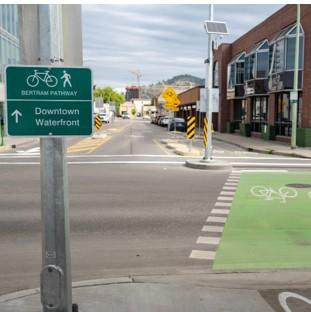
We work with our residents, community organizations, and other levels of government to ensure our transportation network keeps up with our growing community.
Revenue:
Transportation does not generate significant direct revenues. As a result, our ongoing activities and service delivery are primarily supported by allocations from property tax revenues, rather than self-generated income sources.
What we deliver:
We help prepare transportation projects across all modes for delivery, from strategic planning through final design. We develop transportation plans, policies, corridor studies, and design capital projects to help develop our multi-modal transportation system. We also maintain over 850 kilometres of streets that accommodate over 340,000 trips per day, operate and maintain the transportation network, deliver traffic calming, transportation demand management, regional transportation education and encouragement programs, and our shared micromobility program. We monitor our progress toward meeting our transportation targets and goals and report annually.
Our key objectives:
• Deliver and maintain a high-quality transportation system that keeps Kelowna moving, as we grow
Our guiding plans:
• Imagine Kelowna
• 2040 Official Community Plan
• 2040 Transportation Master Plan
• Central Okanagan Regional Transportation Plan
• Pedestrian/Bicycle Master Plan
Measuring performance:
Performance measure 1
Traffic safety
Traffic collisions have significant impacts on people’s lives.
A decline in collisions resulting in injury or fatality (injury collisions) was measured from 8.9 injury collisions per 1,000 residents in 2022 to 8.1 injury collisions per 1,000 residents in 2024 (ICBC data). It is estimated that this rate will further decline to 7.6 injury collisions per 1,000 residents in 2025.
In 2025 we developed a Safe Mobility Action Plan that will identify key actions to reduce the number of injuries and fatalities on our roadways in pursuit of being a ‘Vision Zero’ community. The Action Plan will look at safety related to all modes of travel and involve working with community partners to improve safety outcomes.
Traffic safety
Performance measure 2
Traffic delays
Reliable travel times are important for our quality of life.
In 2020, we began tracking travel times on 85 routes between key destinations. We defined a moderate delay as 50 per cent longer than the overnight travel time. Moderate delays are three to six minutes for most routes.
In 2023, 47 per cent of the routes we tracked had moderate or greater delays in the afternoon peak. In 2024, 57 per cent of routes had delays. Based on this trend, 57 per cent of routes are expected to have delays in 2025. The Transportation Master Plan defines success as having the rate of traffic delays increase at a much lower rate that population growth
PM#2: Traffic delays
(thousands) % Routes with delay
Performance measure 3
Access to sidewalks
Many streets in the Core Area were built without sidewalks. A lack of safe and accessible sidewalks is a barrier for people to walk.
The long-term goal is to have a sidewalk on both sides of major roads, and at least on one side of quieter neighbourhood streets, with a target of 70 per cent completion by 2040. By this standard, the sidewalk completeness in the Core Area is forecasted to be 64.1 per cent in 2026.
We are prioritizing locations to fill the sidewalk gaps in the Core Area based on busy roads, near parks, and around schools. 2025 was also the first year of the updated Neighbourhood Street Urbanization Program, a new funding and delivery model to accelerate progress on adding sidewalks as neighbourhoods grow.
PM #3: Access to sidewalks
Performance measure 4
Access to bike routes
Biking is an affordable alternative to driving. Being close to primary bike routes like protected bike lanes and multi-use pathways makes it easier for households to live car-free or car-light.
Roughly 30 per cent of all residents were within 400 m of the primary bike network in 2025. This is an increase from 28 per cent the previous year and 26 per cent in 2023. According to the 2040 Transportation Master Plan, the target is for 50 per cent of residents to be within 400 m of the primary bike network by the year 2040.
Looking ahead, the Bertram active transportation corridor and Abbott bikeway extensions are expected to increase this share to 32 per cent of residents by 2026.
PM #4: Access to primary bike routes
% of residents within 400m of primary bike routes
Performance measure 5
Pavement quality
Keeping roads in good condition is important for safety and goods movement. Timely preventative maintenance can avoid more costly repairs in the future.
The pavement condition index (PCI) is a score between 0 and 100 that indicates the general condition of roads in Kelowna. An average score of 60 or higher is a common target for Canadian municipalities. A rating between 40-60 is considered Fair, and between 60-80 is considered Good.
Kelowna’s estimated PCI for 2025 is 69, up from 67 in 2024. The City is currently working on a 10-year forecast to understand how pavement conditions could change based on different investment and action strategies.
Pavement quality
Performance measure 6
Winter maintenance
Clearing snow and ice from roads, pathways, and bus stops keeps them functional and safe.
Standards for snow clearing are set by Council Policy #332 with top priority streets being cleared within eight hours of an end of a storm. These timelines were met 93 per cent of the time in 2022 95 per cent of the time in 2023 and 2024. The estimated performance in 2025 is 95 per cent however, the winter was very light, making it more difficult to accurately measure.
Unexpected and hard to predict weather patterns can cause volatility in winter road maintenance and make this performance measure a challenge to track.
Winter maintenance
PM#6:
Priorities
Transportation
Activities
• Continue planning and design for key road projects (Clement Avenue Extension, Commonwealth Rd, Richter Street, and Burtch Rd)
• Continue construction of Glenmore Rd upgrades in conjunction with wastewater trunk connection
• Complete replacement of the KLO Bridge over Mission Creek, including a new roundabout at KLO and Spiers Rd
• Improvements to Stewart Rd West, including upgrades to the intersections of Stewart/Bedford and Bedford/Swamp/Casorso
• Start construction on road, utility, and active transportation improvements along Lakeshore Rd between Lanfranco and Cook Roads
• Continue to advance the design of road and active transportation improvements along Lakeshore Rd between Lexington and DeHart Roads
• Start construction of improvements to Burtch Rd and Bernard Ave between Spall Rd and Mill Creek – in conjunction with Parkinson Rec Park improvements
• Continue to advance the construction of Hollywood Rd and Burtch Rd extension
• Continue reviewing projects which can be added to the Transportation Accelerator Program (TAP)
• Continue determining next steps for the Highway 97 Strategic Corridor Review with the Ministry of Transportation and Transit (MoTT) to protect for the long-term goal of dedicated transit lanes on Highway 97 in Kelowna
• Expand the bike network with construction of the Bertram Active Transportation Corridor and the first section of the Rutland Neighbourhood Bikeway
• Council endorsement and implementation of the Safe Mobility Action Plan
• Council endorsement and implementation of the Transportation Accessibility Strategy
• Urbanization of 1.8 km local streets as part of the Neighbourhood Street Urbanization Program
• Construction of new roundabouts to improve road capacity at Springfield and Rutland roads, and continued design for Springfield and Belgo Roads
Agriculture & Environment
Our People
Transformation
Customer Experience
Base Business
• Continuation of Employer Commute Trip Reduction Program Pilot (now renamed “Commuter Choice”)
• Work as One Team by assisting other internal departments
• Continued focus on training and professional development to provide opportunities to learn and grow
• Update the Travel Demand Model to allow for enhanced decision making
• Continued tracking of travel time using cloud-based data
• Continue optimizing our existing roads with innovative traffic detection technology at intersections
• Continue to accelerate the design and construction of transportation infrastructure in order to continue to provide people with convenient travel options
• Continue to enhance the City’s bicycle and sidewalk infrastructure in order to ensure residents can travel comfortably using alternative modes
• Complete the Transportation Accessibility Strategy in order to ensure that transportation infrastructure is safe and accessible for all
• On-going review of the 10-Year Capital Plan to ensure alignment of financial resources with corporate priorities
• Continue delivering select projects with City resources to control time, cost, and quality where feasible
• Continuation of the Transportation Accelerator Program to deliver more projects faster, optimizing the use of Development Cost Charges (DCCs), reducing the impact of inflation and maximizing the purchasing power of our reserves
• Continued pursuit of grants
2025 Key accomplishments:
• Completion of the Bertram Overpass, connecting Downtown with Central Green across Harvey. The overpass will form part of the future Bertram ATC currently under construction
• Installed one new pedestrian half-signal, three new crosswalk rectangular flashing beacons (RRFBs) and 11 accessible pedestrian push buttons, two new basic crosswalks (signs and markings only), and one crosswalk network plan
• Completed construction of the Hollydell Neighbourhood Traffic Calming Plan and delivered traffic calming measures to nine local and collector streets experiencing high vehicle speeds and volumes
• Pavement resurfacing on 20 lane kilometres of roadways including sections of Glenmore Road, Valley Road, McKinley Road, McClure Road, and Glenmeadows Road. Repaving in coordination with other capital and utility projects and crack sealing roads to extend the lifespan of existing pavement
• Constructed the Frost Rd extension and Frost at Chute Lake Rd roundabout
• Began construction on Glenmore Rd upgrades in conjunction with water and wastewater trunk main installation
• Began construction of the KLO Bridge over Mission Creek, including a new roundabout at KLO and Spiers Rd
• Completed the design of the Burtch Road and Hollywood Road extensions in preparation for 2026 construction
• Urbanized three local streets (1.2 km) as part of the Neighbourhood Street Urbanization program
• Completed 660m of new sidewalk, improving access to schools, on McClure, Raymer and Cornwall roads
• Conducted a citywide Safety Network Screening coordinated with the upcoming Safe Mobility Action Plan
• Completed the Richter Corridor Study and identified the corridor protection needs for the long-term goal of higher order transit on Richter Street
Continuous improvements:
• Completing the Transportation Accessibility Strategy which will provide clear design guidance and operational direction to ensure access to the network for all users
• Completed the Safe Mobility Action plan identifying key action items for investment in the safety of Kelowna’s transportation system
• Began the Downtown Transportation Review with the objective of developing an action plan for transportation improvements in the Downtown which will maximize the efficient movement of people and goods
• Continuation and enhancement of the program to optimize existing roads by utilizing innovative traffic detection technology at intersections
• Continue to enhance and refine the Transportation Accelerator Program to deliver more projects faster
Note: Totals may not add due to rounding
Budget needed to achieve results
Transportation is funded through property taxes. Revenues earned through road permits and gravel sales help to offset the impact on taxpayers. The 2026 accelerated capital program is funded through development cost charges, capital reserves, and taxation.
Note: Totals may not add due to rounding
Expenditure by type
2026 Operating Requests ($ thousands)
Priority 1
2026 Capital Requests ($ thousands)
Priority 1
2026 Operating Request Details
Service Area: Transportation Priority 1
Bike Path Sweeping & Litter and Debris
Justification:
Budget is requested to maintain current service levels of Bike Paths and litter and debris cleanup as the inventory of bike paths increase. Current service levels include bike path sweeping ten times annually, in addition to responsive servicing for debris and hazard-related service requests. The nature of dealing with litter and debris has evolved significantly in recent years with heightened public expectations for cleanliness.
Strategic Direction: Transportation
Service Area: Transportation Priority 1
Title: Gravel Operations - Clean Fill Removal
Justification:
Budget is requested for the removal of clean fill currently located atop the city-owned and operated gravel pit in West Kelowna. By undertaking this removal, the facility's operational life can be extended by approximately 23 years. This is a unique opportunity to deposit this material on a neighbouring property at roughly one-third of the cost compared to hauling it to the City's landfill.
Strategic Direction: Other
2026 Operating Request Details
Service Area: Transportation Priority 1 Maintain
Title: Sidewalk Inspections & Furniture Repair PRELIMINARY
Justification:
Budget is requested to maintain current service levels for sidewalk and furniture repairs and to support the inspection program of walkways and park pathways. This additional funding will ensure service continuity and identify needed repairs as assets age and inventory expands.
Strategic Direction: Transportation
Service Area: Transportation Priority 1 Maintain
Title: Transit Litter PRELIMINARY
Justification:
Budget is requested to support and address seasonal fluctuations in demand for waste collection at Transit stops to deal with increased costs and inventory. Current service levels include waste collection twice weekly, and transit exchanges receive daily servicing. This request does not propose to make any changes to the existing service level.
Strategic Direction: Transportation
2026 Capital Request Details
Service Area: Transportation Priority 1 Maintain
Title: Active Transportation Growth & Renewal PRELIMINARY
Justification:
Budget is requested for this annual program to accommodate growth and renewal to maintain levels of service for the active transportation network. Annual items for consideration may include, but are not limited to, bicycle network improvements and sidewalk & bikeway renewal. Individual project components may include design, land acquisition and construction.
Strategic Direction: Transportation
Service Area: Transportation Priority 1
Title: Bridge Renewal Program
Justification:
Budget is requested for this annual program to accommodate growth and renewal to maintain levels of service for bridge rehabilitation. This program undertakes inspections and repairs on the City's bridges to maintain their structural integrity and extend their service life.
Strategic Direction: Transportation
2026 Capital Request Details
Service Area: Transportation Priority 1 Maintain ONE-TIME
Title: Bridges - KLO Bridge Replacement PRELIMINARY
Justification:
Budget is requested to accommodate growth and renewal to maintain levels of service for the continued work of the replacement of the KLO Rd bridge over Mission Creek. The new bridge will provide reliable vehicle access to South East Kelowna, will meet current flood and environmental requirements, and enhance walking and cycling facilities including the Mission Creek Greenway. This project will be delivered concurrently with the McCulloch Area DCC (KLO/Hall/Spiers) project that addresses the approaches of the bridge, including a new roundabout at KLO and Spiers roads. Project components include land acquisition and construction.
Strategic Direction: Transportation
Service Area: Transportation Priority 1 Maintain
Title: Intersections Improvements
Justification:
Budget is requested for this annual program to accommodate growth and renewal to maintain levels of service for the DCC road programs, which targets capacity and safety improvements at key intersections on the major road network. Approaches and adjacent intersections will also see changes to support improvements. Project components may include design, land acquisition and construction.
Strategic Direction: Transportation
2026 Capital Request Details
Service Area: Transportation Priority 1 Maintain ONE-TIME
Title: Road Network Growth & Renewal PRELIMINARY
Justification:
Budget is requested for this annual program to accommodate growth and renewal to maintain levels of service in the road network. Annual items for consideration may include, but are not limited to, traffic signal and communications renewal, road renewal and street lighting renewal. Individual project components may include design, land acquisition and construction.
Strategic Direction: Transportation
Service Area: Transportation Priority 1 Maintain ONE-TIME
Title: Roads - Burtch Rd Upgrades PRELIMINARY
Justification:
Budget is requested to accommodate growth and renewal to maintain levels of service for the continued work on the Burtch Rd extension project which will create a continuous north/south corridor between Glenmore Rd and KLO Rd. The project includes upgrades along existing segments of Burtch Rd, a new section of arterial roadway between Byrns Rd and KLO Rd, and considers a future extension to Benvoulin Rd. The project supports development and population growth in the south of Kelowna. Project components include design, construction and land acquisition.
Strategic Direction: Transportation
2026 Capital Request Details
Service Area: Transportation Priority 1 Maintain
Title: Roads - Clement Avenue Extension
Justification:
Budget is requested to accommodate growth and renewal to maintain levels of service to extend Clement Ave from Spall to Highway 33 as a major arterial with at-grade intersections at Spall Rd, Hardy St, Dilworth Rd and Highway 33. This new link will increase people-moving capacity through the Midtown area in conjunction with future planned traffic and transit improvements along Highway 97. Realignment of the Okanagan Rail Trail and coordination with Mill Creek Flood improvements will be required. Project components include planning, design, land acquisition and construction.
Strategic Direction: Transportation
Service Area: Transportation Priority 1
Title: Roads - Glenmore Rd Upgrades
Justification:
Budget is requested to accommodate growth and renewal to maintain levels of service for the continued improvements along the Glenmore Rd corridor. At the south end of the corridor, development of an active transportation corridor between Glenmeadows Rd and the Okanagan Rail Trail will link existing walking and biking facilities in the Glenmore valley to the rest of the City's active transportation network. Between Union Rd and John Hindle Dr, intersection improvements and widening will increase vehicle capacity and extend existing multiuse pathways on Glenmore Rd and John Hindle Dr. Between John Hindle Dr and the Lake Country boundary alignment, access, intersection and shouldering upgrades will improve the safety performance of this busy rural corridor. Project components include planning, design, land acquisition and construction.
Strategic Direction: Transportation
2026 Capital Request Details
Service Area: Transportation Priority 1
Title: Roads - Hollywood Rd Upgrades
Justification:
Budget is requested to accommodate growth and renewal to maintain levels of service for the continued work to upgrade and extend Hollywood Rd N from John Hindle Dr to Sexsmith Rd. Improvements include development of a suburban major arterial roadway and intersection upgrades at Sexsmith Rd, Academy Way and John Hindle Dr. This is one of a series of projects planned to develop Hollywood Rd N as a continuous arterial corridor between Airport Way and Highway 97, initial design for some of these future series of projects is included in this request. Project components include design, land acquisition and construction.
Strategic Direction: Transportation
Service Area: Transportation Priority 1
Title: Roads - Lakeshore Rd Upgrades
Justification:
Budget is requested to accommodate growth and renewal to maintain levels of service for the continued work to make improvements along the Lakeshore Rd corridor. Improvements include roadway urbanization from Lanfranco Rd to Cook Rd coordinated with a major utility replacement project and adjacent developments. A gap in the Lakeshore Rd Active Transportation Corridor (ATC) will also be addressed at Rotary Beach Park. From Lexington Dr to DeHart Rd, roadway urbanization and extension of the ATC will link existing facilities to the north and south. Project components include design, land acquisition and construction.
Strategic Direction: Transportation
2026 Capital Request Details
Service Area: Transportation
Title: Roads - Spall Upgrades (BSK)
Justification:
Budget is requested to accommodate growth and renewal to maintain levels of service for the continued work for improvements along Spall Rd between Bernard Ave and Highway 97 to support redevelopment of the Parkinson Recreation Centre. Improvements include turn lane upgrades at Highway 97, intersection upgrades at Parkinson Way, bus stop and active transportation corridor upgrades. Project components include design and construction, and may include land acquisition.
Strategic Direction: Transportation
Service Area: Transportation
Title: Roads - Stewart Rd Upgrades
Justification:
Budget is requested to accommodate growth and renewal to maintain levels of service to continue the work to improve traffic flow and safety on Stewart Rd between Crawford Rd and DeHart Rd. The corridor inherits a number of sub-standard road alignments and geometric challenges. Improvements are required due to continued growth in the Upper Mission. Project components include design, land acquisition and construction.
Strategic Direction: Transportation
2026 Capital Request Details
Service Area: Transportation Priority 1
Title: Active Transportation Upgrades PRELIMINARY
Justification:
Budget is requested for this annual program to support upgrades to the active transportation network. Annual items for consideration may include, but are not limited to, crosswalk safety, signals and flashers and safe routes to school. Individual project components may include design, land acquisition and construction. These upgrades offer an enhanced level of service for users of the active transportation network.
Strategic Direction: Transportation
Service Area: Transportation Priority 1
Title: Neighbourhood Street Urbanization PRELIMINARY
Justification:
Budget is requested for this annual program of new neighbourhood street urbanization that will upgrade existing local streets in areas with significant infill development. Initial projects will prioritize locations with recent infill development, missing infrastructure, increasing street use, existing deferred revenue, high walking and biking activity, opportunities for capital project coordination and projected future growth. Individual project components include design, land acquisition and construction. This work offers an enhanced level of service for these neighbourhoods.
Strategic Direction: Transportation
2026 Capital Request Details
Service Area: Transportation Priority 1 Enhance ONE-TIME
Title: Road Network Upgrades PRELIMINARY
Justification:
Budget is requested for this annual program for road network improvements. Annual items for consideration may include, but are not limited to, traffic calming, road safety improvements, intelligent transportation systems and roadway urbanization. Individual project components may include design, land acquisition and construction. These upgrades offer an enhanced level of service for users of the transportation network.
Strategic Direction:
Service Area: Transportation Priority 1 Enhance ONE-TIME
Title: W.R. Bennett Bridge - Dynamic Lighting PRELIMINARY
Justification:
Budget is requested to complete a feasibility and design for dynamic lighting along the W.R. Bennett Bridge. Proposed lighting would improve safety, aesthetics and highlight the bridge and advance overall placemaking objectives for the City. This dynamic lighting offers an enhanced level of service for the city.
Strategic Direction:
2026 Operating Request Details
Service Area: Transportation Priority 2
Title: Kelowna's Go-By-Bike Week
Justification:
Budget is requested to introduce a City of Kelowna led Go-By-Bike Week, a community-wide event that encourages cycling for commuting, school, and recreation. The program was delivered previously by the City of Kelowna in collaboration with the Sustainable Transportation Partnership of the Central Okanagan. This request is to deliver and support a Kelowna specific Go-By-Bike week campaign. In 2025, participation reached a record 4,560 riders across the Central Okanagan, including students from 31 schools. The program promotes cycling as a healthy, sustainable travel choice while fostering community spirit and raising awareness of active transportation. If moved to priority 1, this request would increase taxation demand in 2026 by 0.02 per cent
Strategic Direction: Transportation
Service Area: Transportation Priority 2
Title: Pandosy Urban Centre Transportation Plan
Justification:
Urban Centres are the most efficient areas to accommodate new housing and jobs. Growth requires updated transportation planning to ensure the network can support all modes and set clear expectations for development. The Pandosy Urban Centre Transportation Plan addresses these needs and advances the Thriving Urban Centres Future Directions Report, which shows that focusing growth in Urban Centres reduces infrastructure costs, limits environmental impacts, and ensures infrastructure for future growth. Plan implementation will be in two phases (2026-2027), evaluating development, travel demand, and right-of-way needs, and confirming priorities for walking, biking, transit, and vehicle access. If moved to priority 1, this request would increase taxation demand in 2026 by 0.03 per cent and an additional 0.01 per cent for annualization in 2027.
Strategic Direction: Transportation
TRANSIT
LED BY: GENERAL MANAGER, INFRASTRUCTURE
Our goal & community benefit:
Our goal is to provide fast and reliable transit service to our community. Transit provides numerous benefits to the community including an affordable transportation option that helps reduce congestion and emissions, as our community grows.
Our customers:
Our customers are all transit patrons who live, work and play in Kelowna.
Our partners:
We work with BC Transit and our regional government partners (West Kelowna, Westbank First Nation, Peachland and Lake Country) to deliver affordable conventional and paratransit (HandyDART) transit service.
Revenue:
Revenue is collected through the collection of fares on buses and through sale of fare products within the BC Transit Umo fare system and affiliated vendor network throughout the region. Fares generate revenue that is shared between all local government partners based on ridership and service hours in each community and is applied to offset the local share of transit operating costs with the remainder funded through taxation and provincial contributions (through BC Transit).
What we deliver:
We provide service annually with 32 routes, 110 buses and 220,000 hours in the Central Okanagan, managing a network of over 900 bus stops and multiple transit exchanges. We work in liaison with BC Transit on contract administration, service planning and delivery, customer service, security, marketing and community programs. We provide a variety of transit pass options to enable access to transit for everyone in our community.
Our key objectives:
• Attract new riders
• Deliver operational excellence
• Improve transit sustainability
• Improve custom transit utilization
Our guiding plans:
• Imagine Kelowna
• Regional Transportation Plan
• Transportation Master Plan
• Central Okanagan Transit Future Plan
• Transit Future Action Plan
Measuring performance:
Performance measure 1
Transit ridership
Transit is an efficient way to move more people in our limited road space. It helps reduce congestion and emissions and is a great alternative to driving for longer trips. The Transportation Master Plan (TMP) aims to double transit ridership by 2040, reaching approximately 12 million riders annually. In 2023, ridership grew beyond pre-pandemic levels, increasing from 5.97 million in 2019 to 6.11 million and has grown since to 6.58 million in 2025. Ridership is trending in the desired direction to meet the 2040 target. A new transit facility, a current Council advocacy priority, will be required to reach the 2040 target.
PM#1: Transit ridership
Performance measure 2
Resident satisfaction
This measure reflects the overall public perception of transit based on our Citizen Surveys. Resident satisfaction with public transit increased from 56 per cent in 2022 to 61 per cent in 2023 and has increased further since to 65%. The aim is to achieve 75 per cent customer satisfaction, as outlined within the Central Okanagan Transit Service Guidelines. A fare increase taking effect in the fall of 2025 may weigh on customer satisfaction in the short term. However, proposed service expansions detailed in the Transit Improvement Program in conjunction with further enhancements to the Umo fare system (debit and credit card payments) are expected to increase customer satisfaction further and support meeting this target.
Performance measure 3
On-time performance
On-time performance tells us how often buses arrive on schedule, which is important for people to trust and rely on transit. A trip is considered on time if it departs no more than three minutes late or one minute early. The estimated on-time performance is 67 per cent in 2025. The aim is to achieve on-time departures 70 per cent of the time, with 80 per cent ontime departures for local coverage routes, as per The Central Okanagan Transit Service Guidelines
Performance measure 4
Transit service
Investing in new transit services is essential for sustaining and expanding a successful transit system in Kelowna. In 2025, approximately 220,000 hours of service were provided in the Kelowna Regional Transit System (a 2,350 hour increase over 2024), with about 176,000 hours within Kelowna. This equates to 1.06 hours of transit service available per person in Kelowna, holding steady from the prior year. It represents a slight decline from previous years, likely due to rapid population growth.
The closest Municipal Benchmarking Network Canada (MNBC) comparator community based on service area population, achieved 1.17 service hours per capita in 2023. The City of Kelowna aspires to increase service hours per capita beyond 1.28 by 2028 progressing to closer to alignment with levels of service in other larger Canadian centres. The investments proposed in the Transit Improvement Program coupled with expansion of the Hardy transit centre will help us move toward our target.
2026 Activities by priority:
Crime & Safety
Transportation
Agriculture & Environment
• Okanagan College and Mission Transit Exchanges 2026 upgrades include provisions for CCTV monitoring
• Hardy Transit Centre expansion completion in 2026 facilitating transit service expansion and introduction of electric buses in the region
• Completion of future Hollywood Transit Centre site/facility master planning and site servicing design including business plan development to support funding approvals. Ongoing advocacy for senior government funding support
• Implement transit service enhancements including on-time performance improvements and network restructuring in the Mission and Rutland areas per local area plans
• Completion of construction of Rutland and Okanagan College transit exchanges
• Begin construction of Mission Transit Exchange in conjunction with Mission Recreation Park Plaza and Activity Centre projects
• On-going preparation for introduction of battery electric buses through electrical upgrades and installation of charging infrastructure at the Hardy transit operating centre
• Formalized on-demand service in Crawford area after successful pilot period and exploring further application of this service type
Economy
Our People
Transformation
Customer Experience
Base Business
• Continue to provide transit at a fair cost with affordable options for people facing financial barriers
• Enhanced focus on staff development to provide opportunities to learn and grow
• Complete the transition of community fare programs into Umo electronic fare system
• Support BC Transit in planning introduction of open-loop payments (debit/credit card) within the Umo system
• Expand the reach and convenience of transit through targeted network and service changes
• Implementation of open loop fare payments to support revenue growth
• Continued pursuit of grants including the Canada Public Transit Fund
2025 Key accomplishments:
• Completed Agricultural Land Reserve exclusion for the future Hollywood Road transit centre property and advanced site and facility design and business plan to support funding requests
• Supported BC Transit in completing the design for Hardy Transit Centre expansion and upgrades and initiated construction
• Completed a regional transit fare review and secured region-wide approval to implement new fare rates and programs including EcoPASS and Automatic DayPASS
• Completed an Affordable Transit Pass study that investigated means-based fare options including an implementation strategy
• Initiated construction of Rutland Transit Exchange enhancements adding transit capacity, bike parking, driver washrooms, park & ride area and other amenities and security upgrades
• Finalized detail design of Okanagan College exchange upgrades in preparation for 2026 construction
• Completed preliminary design of the new Mission transit exchange in preparation for 2026 construction
• Began design of the new YLW transit hub
• Designed and constructed 25 bus stops including 15 new stops required for Phase 2 Rutland Transit Network restructuring, and five new stops in the Upper Mission to support the 2026 Mission Network restructuring
Continuous improvements:
• Transitioned remaining community fare programs to the Umo electronic fare system
• Supported transit service and infrastructure planning for the Central Okanagan Integrated Transportation Network (COITN) program
• Supported transit service and infrastructure planning for the Richter Corridor Study
• Planned for the expansion of On-Demand service in 2026
Note: Totals may not add due to
Budget needed to achieve results
The provincial government, through BC Transit, covers approximately half of the transit contract costs. The remaining expenses are funded through a combination of transit fares, advertising revenue, and property taxes. In 2026, reserve funding will serve as a budget tool to address anticipated changes in the transit contract. However, these reserve funds will only be accessed if revenues fall short of covering all expenses.
Note:
Expenditure by
2026 Operating Requests ($ thousands)
Priority 1
2026 Capital Requests ($ thousands)
1
2026 Operating Request Details
Service Area: Transit
Title: Hollywood Transit Centre Phase 2 Planning
Justification:
Budget is requested for the City to support continued progress toward the development of a new transit operations centre including project management and completion of site servicing planning and design initiated in 2025 in collaboration with Hollywood Road design and area developments. This budget will also support continued project advocacy and ongoing coordination with BC Transit to advance the project business case through funding approval stages.
Strategic Direction: Transportation
Area: Transit
Title: Orchard Park Transit Exchange Security
Justification:
In 2024, security coverage hours for Orchard Park Exchange were increased from 46 hours per week to 74 hours per week aligning with mall operating hours. This budget request is to support extending evening security coverage to midnight Monday to Saturday and to 10pm on Sundays. A stronger presence for our customers using the transit system outside of current coverage hours is recommended based on the levels and type of incidents occurring, particularly in evenings. As transit ridership at this important exchange continues to rise, additional security coverage is necessary to ensure the ongoing safety and security of transit customers and to support transit operators.
Strategic Direction: Crime & Safety
2026 Operating Request Details
Service Area: Transit Priority 1 Enhance ON-GOING
Title: Transit Operations - Enhance PRELIMINARY Justification:
Budget is requested to support strategic improvements in transit operations, including the adoption of the Umo electronic fare system, the transition to electric buses, and the expansion of the existing transit maintenance facility. These initiatives are critical to modernizing service delivery, improving sustainability, and enhancing rider experience.
Strategic Direction: Transportation
2026 Capital Request Details
Service Area: Transit
Title: Mission Recreation Transit Exchange Improvements
Justification:
Budget is requested to accommodate growth and renewal to maintain levels of service to reconfigure the Mission Rec Exchange to improve rider comfort and reduce bus delays, operating costs and conflicts with other facility users. Anticipated improvements include a potential mobility hub and relocated exchange within the existing parking lot and improved access to Gordon Dr.
Strategic Direction: Transportation
Service Area: Transit
Title: Okanagan College Transit Exchange Improvements
Justification:
Budget is requested to accommodate growth and renewal to maintain levels of service to reconfigure and add a transit bay at the Okanagan College Transit Exchange to increase exchange capacity and address ongoing operating issues. Anticipated improvements include relocation of an existing bay, an additional bay, shelters, rider amenities, stronger active transportation links and better integration adjacent Okanagan College buildings. This project is being developed in coordination with Okanagan College and BC Transit.
Strategic Direction: Transportation
2026 Capital Request Details
Service Area: Transit
Title: Orchard Park Transit Exchange Improvements PRELIMINARY
Justification:
Budget is requested to accommodate growth and renewal to maintain levels of service to redevelop the Orchard Park Exchange replacing aged infrastructure, increasing transit capacity, improving customer amenities and users safety. The Orchard Park exchange is one of Kelowna's largest transit exchanges but is located on private property on Orchard Park Shopping Centre (OPSC) property . There is no tenure agreement in place today. Senior government funding is anticipated to be required to successfully deliver the project as is significant collaboration with OPSC. Funding splits assumed as 33% local share, remainder grant (fed/prov) which is not secured.
Strategic Direction: Transportation
Service Area: Transit
Title: Transit Improvements
Justification:
Budget is requested for this annual program to accommodate growth and renewal to maintain levels of service for transit. Annual items for consideration may include, but are not limited to, new bus stop and amenity improvements, upgrades to existing bus stops and land acquisition for new bus stops. Improvements associated with local area plan changes are also included. Individual project components may include design, land acquisition and construction.
Strategic Direction: Transportation
2026 Capital Request Details
Service Area: Transit
Title: Mobility Hubs at Transit Exchanges
Justification:
Budget is requested to develop mobility hubs at multiple transit exchanges. Mobility hubs provide space for shared micromobility vehicles, ride share providers, personal scooters and bikes within or adjacent to transit exchanges. These hubs facilitate efficient transition from transit to modes better suited to fill the last mile of longer trips. Hubs can be effective in extending the range of transit stops and exchanges beyond the typical walk distance of 4-600m. These mobility hubs will offer an enhanced level of service for transit operations.
Strategic Direction: Transportation
Service Area: Transit
Title: Transit Exchanges - Driver Facilities
Justification:
Budget is requested to develop transit operation and security facilities at exchanges not equipped today with a focus on the Queensway Transit Exchange. These facilities are essential for operators, security, and supervisory staff. This project is being planned in conjunction with broader Queensway Area Revitalization. These new facilities will offer an enhanced level of service for transit operation.
Strategic Direction: Transportation
2026 Capital Request Details
Service Area: Transit Priority 1 Enhance ONE-TIME
Title: YLW Transit Hub PRELIMINARY
Justification:
Budget is requested to deliver a new transit hub at YLW airport. This will include new transit stops integrated into the airport site to improve transit access and rider comfort, and reduce operating costs from delays and conflicts with other airport users. This new transit hub will offer an enhanced level of service for transit operations at the Airport.
Strategic Direction:
2026 Operating Request Details
Service Area: Transit Priority 2 Enhance ON-GOING
Title: Transit Fare Program Initiatives PRELIMINARY
Justification:
Budget is requested to our support equity-based transit fare programs including implementation and ongoing operation of the new Affordable Transit Pass Program (ATP) developed in 2025. The program will provide access to reduced-cost transit passes for low-income households removing a key barrier to accessing community services, employment and other opportunities. The ATP will work in conjunction with the Emergency Transit Assistance Program (ETAP) administered by United Way on behalf of the city. ETAP provides no-cost fare products to the community's most marginalized residents. 2026 budget will also support delivery UPASS referendum triggered by the transit fares increased approved in 2025 including communication and engagement activities. If changed to priority 1, this request would increase taxation demand in 2026 by 0.01 per cent.
Strategic Direction: Transportation
PARKS
LED BY: GENERAL MANAGER, INFRASTRUCTURE
Our goal & community benefit:
Our goal is to manage, operate and maintain the City's parks in a sustainable manner meeting community needs. Currently, Parks is creating a master plan which will guide the expansion, development, and operations of its parks system as the City grows. Our parks support a resilient and active city by providing equitable access to a diverse recreational and cultural experiences. Our customers:
• Residents, tourists and visitors
• People of all ages and abilities
• User groups, sports members
• Athletes at all ages and stages of development
Our partners:

We work with our citizens and industry professionals to create and maintain recreational and cultural activities in the community.
Revenue:
Parks does not generate significant direct revenues. As a result, our ongoing activities and service delivery are primarily supported by allocations from property tax revenues, rather than self-generated income sources.
What we deliver:
We provide guidance for making both long-range and short-term decisions about the parks system. We also provide the financial strategy needed to support and sustain the City’s portfolios of parks, open spaces and natural areas. We provide a phased implementation strategy for improving existing parks and public shorelines, unfunded but Council-approved parks as well as the acquisition, location, and/or development of future parks.
Park Services maintains 250 hectares of sport and park land, 692 hectares of managed natural areas, and 132 hectares of low management natural areas.
Our key objectives:
• A vibrant community
◦ Public parks are clean and safe spaces for the public
◦ Ensure parks, beaches, playgrounds and natural park areas are managed long-term
◦ A healthy community
◦ Well maintained trails and natural areas
◦ Growing a healthy tree canopy
• An engaged team
◦ Staff are connected and informed
◦ Resources and training are available
Our guiding plans:
• Imagine Kelowna
• Parks Master Plan (under development)
• Community for All – Healthy City Strategy
• Kelowna Community Sport Plan (2019)
• Kelowna Event Strategy (2022)
• Sustainable Urban Forest Strategy (2024)
• Council and Corporate Priorities
Measuring performance:
Performance measure 1
Park user satisfaction with Parks
Parks services provide stewardship of park assets, management of thriving natural and active recreational features in the City. Based on 2024 City-Wide Citizen Survey, Kelowna residents attach greater importance to parks and sports fields than other municipal residents (95% versus the norm of 89%). The latest survey indicated that parks were mentioned in two of the top three mentions of what make a City a good place to live: a) low crime rate, b) good recreation facilities/opportunities/ activities, c) good parks/green space.
Performance measure 2
Park cleanliness (Washrooms)
Cleanliness is a critical factor influencing citizen satisfaction with parks. Park services proactively allocates additional resources to busier parks and during special events, ensuring that standards remain high even under increased use. Washroom service levels are reflected in the targeted intervals between washroom cleanings. These targets not only help maintain clean and welcoming facilities but also enable swift identification and resolution of issues such as vandalism or plumbing failures. By continuously refining these approaches, parks services strive to provide environments that are both pleasant and hygienic for all visitors.
Performance measure 3
Park cleanliness (Waste bins)
Cleanliness is a critical factor influencing citizen satisfaction with parks. Park services proactively allocates additional resources to busier parks and during special events, ensuring that standards remain high even under increased use. One important measure is the maximum number of hours a standard 100L waste bin may remain full, as this indicates the likelihood that a visitor will encounter an overflowing garbage can. To address this risk, many parks are now adopting larger underground bins with a capacity of 1,300 litres, which require less frequent emptying and can better accommodate peak demand without overflowing.
Performance measure 4
Beautification in high impact areas
Parks Services enhances urban environments by introducing colour, texture, and fragrance inviting Kelowna residents and visitors to engage with carefully curated plant displays. Prominent areas, such as Waterfront Park beds and key gateways including downtown Kelowna, contribute to the city’s tourism sector and advance Council objectives related to economic diversification. The financial sustainability of this extensive program is maintained through the cultivation and finishing of annual plants by the Parks Services greenhouse team. By growing these plants from seed or cuttings, the program generates a substantial inventory at a fraction of retail prices.
Performance measure 5
Tree planting to meet Sustainable Urban Forest Strategy
The 2024 Sustainable Urban Forest Strategy identifies the need for an increase to Kelowna's canopy cover in the next 25 years. This will be achieved in three ways; City planted trees on municipal property, the Neighbourwoods program, and trees planted on private property through the Development Planning (DP) process (Zoning Bylaw regulations). The benefits of tree canopy include improved air quality, reduced heat island effect and quality of place. The data illustrates the importance of regulating and enforcing trees required on private land in Kelowna through the development process. The Sustainable Urban Forest Strategy goal is to establish 78,500 trees throughout the City in the next 25 years. This is 3,140 trees per year for 25 years.
The following data does not yet include the number of trees removed in the City each year due to health, vandalism, or private development.
PM#5: Tree planting to meet sustainable Urban Forest Strategy
# of trees planted
2026 Activities by priority:
Priorities Activities
Crime & Safety
Homelessness
Agriculture & Environment
Our People
Transformation
Base Business
• Develop staff safety protocols and documentation for community-based program/ service delivery
• Help to reduce impact by continuing to provide clean safe public spaces
• Protect and restore natural areas (riparian areas and forests)
• Continue to grow healthy urban canopy
• Provide safe natural areas for the public to enjoy
• Develop and maintain green infrastructure throughout the City
• Develop a long-term Divisional staffing model and succession plan
• Promote and deliver staff engagement and growth initiatives
• Using data to make informed decisions
• Embrace innovation to increase turf maintenance practices
• Continue integration and implementation of the Cityworks program into Parks Operations, providing greater clarity of responsibilities and assets
• Continued implementation of service-based budget to ensure that the associated infrastructure, maintenance, and operating costs are explained
• Continue to provide financially responsible public-maintained parks
• Opening DeHart Community Park
• Breaking ground on the Parkinson Recreation Centre BSK Project
• Breaking ground on Glenmore Recreation Park – Phase 5
• Breaking ground on the Tennis Canada Dome at Mission Recreation Park
• Opening Knox First Lookout Summer Home tuktánixw Installation
• Opening Waterfront Stage
• Opening Strathcona Park Accessible Playground – Phase 2
• Opening of Burne Avenue Park and Summit Park
• Kilometres of decommissioned rogue trails
• Investigate autonomous mowers for secure stadiums
• Continue to add more battery-operated equipment
• Added second robotic sports field line painter
Note: Totals may not add due to rounding
Budget needed to achieve results
Parks services are primarily funded through property taxes, except for the Kelowna Memorial Park Cemetery, which operates on revenue generated through fees and charges. The Parks 2026 capital program is supported by a combination of funding sources, including grants, debt financing, developer contributions, capital reserves, and taxation.
Note: Totals may not add due to rounding
2026 Operating Requests ($ thousands)
1
2026 Capital Requests ($ thousands)
1
2026 Operating Request Details
Service Area: Parks Priority 1 Maintain ON-GOING
Title: Park Maintenance PRELIMINARY
Justification:
Budget is requested to maintain core operational needs across Parks service areas due to cost and inventory increases. This includes maintaining seasonal maintenance through early vegetation control and increased mechanical treatments, addressing long-standing roadside weed issues that affect safety, infrastructure, and visual appeal. This funding will allow Parks Services to maintain current service levels for playground maintenance as well as provide resources needed to assess aging wooden infrastructure in natural areas, such as boardwalks and viewing platforms, to preserve public safety and accessibility. Strategic Direction:
(1,088,500)
(1,114,500)
2026 Capital Request Details
Service Area: Parks Priority 1 Maintain ONE-TIME
Title: Glenmore Recreation Park PRELIMINARY
Justification:
Budget is requested to accommodate growth and renewal to maintain levels of service for the continued construction at the Glenmore Recreation Park in parallel with the construction of the new activity centre.
Strategic Direction: Other
Service Area: Parks Priority 1 Maintain ONE-TIME
Title: Park Development PRELIMINARY
Justification:
Budget is requested for this annual program to accommodate growth and renewal to maintain levels of service for both the design and construction of neighbourhood parks throughout the City to meet the demands of population growth.
Strategic Direction: Other
2026 Capital Request Details
Service Area: Parks
Title: Park Infrastructure and Facilities Growth & Renewal
Justification:
Budget is requested for this annual program to accommodate growth and renewal to maintain levels of service for park infrastructure and facilities. Annual items for consideration may include, but are not limited to, accessibility improvements, irrigation renewal, playgrounds and other park improvements.
Strategic Direction: Other
Parks
Title: Parkinson Recreation Park - Field Realignment (BSK)
Justification:
Budget is requested to accommodate growth and renewal to maintain levels of service for the design and construction of layout changes and improvements to Parkinson Recreation Park in association with the construction of the new recreation centre. This project is valuable for ensuring a superior user experience, fostering community well-being, and remaining competitive in a dynamic recreational landscape.
Strategic Direction: Economy
2026 Capital Request Details
Service Area: Parks
Parkland Acquisition
Justification:
Budget is requested to accommodate growth and renewal to maintain levels of service for the acquisition of land for future use as neighbourhood, community, city-wide, recreation and linear type parks. This is in accordance with the 20-year Servicing Plan and DCC reserve funding. Budget is also requested for acquisition of natural areas that fall outside of the 20year Servicing Plan and DCC program.
Strategic Direction: Other
Title: Rutland Recreation Park - Field Realignment (BSK)
Justification:
Budget is requested to accommodate growth and renewal to maintain levels of service for the proposed realignment at Rutland Recreation Park of the existing fields and other amenities to create an additional field. The current City inventory of multi-use fields is heavily subscribed and at capacity.
Strategic Direction: Economy
2026 Capital Request Details
Service Area: Parks Priority 1
Title: Art Walk Expansion
Justification:
Budget is requested for work on the art walk expansion and Queensway transit area. Some of the programs/initiatives that are being considered are: updating Bennett Plaza, transit operations/security building, bicycle repair/storage, public washroom, mobility hub, traffic flow updates and patio program extension. This work offers an enhanced level of service for users.
Strategic Direction: Other
Service Area: Parks Priority 1
Title: Capital Opportunities & Partnerships - Parks
Justification:
Budget is requested for this annual program to fund both anticipated partnerships for the upcoming year as well as any high value grants or other unknown opportunities that may arise. The City receives multiple unsolicited proposals for partnerships each year, often from community, sports or special interest groups. The focus of the Capital Opportunities and Partnership Fund is to leverage City funds through these partnerships, to achieve a much greater gain in community benefit that in most cases represents a significant multiplier of our investment. These partnerships create the opportunity for City services to provide an enhanced level of service.
Strategic Direction: Economy
2026 Capital Request Details
Service Area: Parks
Title: City Park/Kerry Park Upland Upgrades PRELIMINARY
Justification:
Budget is requested for the continued work at City Park. Work will focus on City Park promenade phase 3, aquatic centre and Kerry Park promenade. These upgrades offer an enhanced level of service for users of this park.
Strategic Direction: Other
Service Area: Parks
Title: Cook Road Boat Launch Upgrades
Justification:
Budget is requested for upgrades at the Cook Road boat launch. Work may include but is not limited to asphalt ramp, fencing, pedestrian crossing, launch docks, and a new groyne. These upgrades offer an enhanced level of service for users of this boat launch.
Strategic Direction: Other
2026 Capital Request Details
Service Area: Parks Priority 1 Enhance ONE-TIME
Title: Park Upgrades PRELIMINARY
Justification:
Budget is requested for this annual program for both the design and construction of neighbourhood parks throughout the City. The following parks up for consideration this year for upgrades may include, but not limited to are: Manhattan Point Park, Rotary Beach Park, Strathcona Beach Park and Rutland Lions Park. These upgrades will offer an enhanced level of service for parks users throughout the city. Strategic Direction:
2026 Operating Request Details
Service Area: Parks Priority 2
Title: Bear-Proof Waste Receptacles
Justification:
Budget is requested to enhance public safety in natural parks. All parks are currently equipped with waste receptacles, most of which are open blue plastic barrels identified by Conservation Officers as wildlife attractants. This funding would install 20 bear-proof waste containers in 2026 and continue enhancing waste management by replacing two bear-proof units annually thereafter. If moved to priority 1, this request would increase taxation demand in 2026 by 0.03 per cent.
Strategic Direction: Agriculture & Environment
Service Area: Parks Priority 2
Title: Trail Network
Justification:
Budget is requested to inventory and connect our existing 72 kilometres of trails within Kelowna's natural area parks. Additional work includes repairs and maintenance of aging trail infrastructure, upgrades to surfaces to meet specifications, and restoration of unsanctioned trails to their natural state. An estimated 5 kilometres of new trails are needed to connect existing trails to park entrances, 20 kilometres of trails need to be added to the trail inventory, and 50 kilometres of unsanctioned trails require either decommissioning or incorporating into the official trail network. If moved to priority 1, this request would increase taxation demand in 2026 by 0.04 per cent, and a further 0.01 per cent for annualization through 2028.
Strategic Direction: Agriculture & Environment
SPORT & RECREATION
LED BY: DIVISIONAL DIRECTOR, ACTIVE LIVING & CULTURE
Our goal & community benefit:
Our objective is to expand opportunities for sport, recreation, and active living for all individuals, thereby improving citizens' health and well-being and elevating the overall quality of life within our community. Sport and recreation initiatives offer numerous advantages, including the promotion of mental, physical, and social wellness, strengthening of families and communities, stimulation of economic activity, and support of community growth and development. Providing highquality, accessible sport and recreation options is a fundamental need at every stage of life and essential to a healthy, functioning society.
Our customers:

We serve a variety of individuals and organizations to ensure that sport and recreation programs and services are available and accessible to all.
• Residents of Kelowna and across the Central Okanagan
• People of all ages and abilities
• Equity-deserving groups
• School boards and educational institutions
• Social, community and sport organizations
• Visitors to the region
• Athletes at all ages and stages of development
• Neighbourhoods
• Other City of Kelowna business units
Our partners:
We work with various local organizations, other levels of government and the public/private sector to develop mutually beneficial relationships.
• Recreation facility and program partners
• Not-for-profit service organizations (e.g., BGC Okanagan, KCR)
• Recreation providers (e.g., YMCA, Sport organizations, accessibility advocates)
• Public institutions (e.g., SD23, UBC Okanagan, Interior Health Authority, Okanagan College)
• Regional, provincial, and national governing bodies (e.g., BC Recreation and Parks Association, ViaSport, Childcare Advocacy groups)
• Private service delivery organizations (e.g., Daycare organizations, health & wellness)
• Other City of Kelowna business units
Revenue:
Facility admissions, programs and exclusive use rentals are the primary revenue streams within the Sport & Recreation service area. Revenue collected, in the form of user fees, supports ongoing operational costs and facility improvements while reducing reliance on taxation. The methodology for determining user fees follows Council Policy - Fees and Charges, ensuring that user fees are set in a transparent, accessible, and responsive manner.
What we deliver:
We offer an extensive array of programs and services designed to enhance the wellbeing of individuals throughout our community. Our delivery model comprises direct provision, support, and facilitation of community-based initiatives, activities, and events that foster engagement and connectivity. Primary areas of focus include advancing a healthy, active,
and inclusive environment; reducing obstacles to participation in sport and recreation; strengthening neighbourhood relationships; activating parks and public spaces; supporting a cohesive sport system; maintaining sports fields, courts, and related infrastructure; and cultivating a dynamic events sector.
Our key objectives:
• A vibrant community
◦ Public spaces are animated
◦ Strong program delivery model that leverages strategic partnerships
• A healthy community
◦ Systems and services are aligned
◦ Residents are thriving and resilient
◦ Great cities are made up of strong neighbourhoods
• An equitable and inclusive community
◦ Practices and processes prioritize equity and inclusion
◦ Financial assistance programs to remove participation barriers
• An engaged team
◦ Staff are connected and informed
◦ Resources and training are available
• An exceptional Infrastructure program
◦ Infrastructure is available and well-maintained
◦ Innovative approaches and sustainable practices are explored and/or implemented
Our guiding plans:
• Imagine Kelowna
• Official Community Plan (2040)
• Kelowna Community Sport Plan (2019)
• Kelowna Event Strategy (2022)
• Indoor Recreation Facility Strategy (2023)
• Community for All – Healthy City Strategy
• Conditions of Use and Allocation Guidelines
• Parks Master Plan (under development)
• Accessibility Plan (2025)
• Building a Stronger Kelowna (BSK)
Measuring performance:
Performance measure 1
Grass sports parks area
Sports parks provide opportunities for physical activity within our community. The measure used is the area of grass sports fields (playing areas and immediate surrounds) supplied in hectares per 1,000 residents. The City of Kelowna's provision is in the mid-range compared to other municipalities in British Columbia and is slightly below the provincial average. Data is collected through Yardstick, a parks and recreation benchmarking process that includes a rigorous review to ensure consistent reporting among municipalities across Canada.
PM#1: Sport park area per 1,000 residents
Performance measure 2
Citizen satisfaction — recreation facilities and programs
Every two years, the Citizen Survey is carried out to assess public satisfaction with municipal programs and services. It is crucial for residents to have access to sports and recreational activities. Evaluating resident satisfaction with City-provided sport and recreation facilities and programs assists in guiding decisions related to planning, budgeting, and service standards. The target is for residents to be highly satisfied with sport and recreation amenities and programs, fostering a vibrant and active community for all.
Sport & recreation resident satisfaction
Grass sport park area (hectares) Provincial average
Surrey Richmond Kamloops Kelowna Maple Ridge Coquitlam
PM#2:
Performance Measure 3
Sport and recreation participation
Engaging in sport and recreation programs offer numerous routes to improved individual health, while fostering a more interconnected, and resilient community. By delivering a wide variety of programs tailored to the interests and needs of residents, participation rates rise along with community health and vitality. The objective is for Kelowna residents to actively participate in the City of Kelowna's sport and recreation programs annually. Overall, sport and recreation participation rates are steadily increasing
Performance measure 4
Tournaments and events
Tournaments and events are essential for energizing the community and advancing city initiatives. They help boost the economy, activate public spaces, promote healthy lifestyles, and attract both locals and tourists. The City is committed to organizing and supporting a wide array of tournaments and events by keeping outdoor spaces and sports fields accessible, thereby enhancing community participation and tourism. For 2025-2026, the major events program is expected to bring over $50 million in economic benefits to the community and region. Notable events include Montana’s Brier, the Canadian Country Music Awards, the Olympic Curling Qualifiers, the Memorial Cup, and the BC Summer Games
PM#4: Tournaments & events
Performance measure 5
Sports facility capacity hours
Ensuring sport and recreation facilities are well-maintained, accessible to the public, and efficiently utilized is essential to deliver program benefits including quality of life within a community, promoting residents’ health and community sustainability. Currently arenas are operating at capacity which limits future increases to program participation. Stadiums are operating over capacity, which increases the risk of diminished participant experience due to issues such as grass and play surface quality and field maintenance closures. Sportsfields capacity will reduce in 2025 and 2026 due to five sportsfields fields going offline for field renovation, then in 2027 the fields will be back online and forecasted booked hours will increase.
PM#5: Sports facility capacity hours
2026 Activities by priority:
Priorities
Crime & Safety
Economy
Our People
Transformation
Customer Experience
Activities
• Continue building the Block Connector network and increasing the capacity of Neighbourhood Associations to enhance sense of safety and connectedness among neighbours
• Collaborate with Lead Organizations and Host Committees to advance plans for 2026 Major Events including the 2026 Memorial Cup, Touchdown Kelowna 2026, and 2026 BC Summer Games
• Update the Events strategy with action items, resource plans and performance indicators. Continue to build out the Major Events procurement framework
• Develop the Divisional staffing model, including succession plan, to plan for the resources required to implement and operate the Building a Stronger Kelowna (BSK) bundle of facilities
• Expand online presence by promoting sport leagues, tournaments and events, while evaluating and integrating an online facility booking features
• Create the digital strategy for a seamless digital and physical integration of all programs, services, and facilities to ensure a positive staff and customer experience for the opening of the BSK bundle of facilities
• Further innovate operations to increase turf maintenance practices, including but not limited to the advancement of robotic and autonomous machines to increase field quality and performance
• Registration software updates and exploration of enhanced online services related to program information, schedules, bookings, and memberships
• Created standards and increase opportunities to collect customer feedback through automation
• Exploration of online program participation – virtual program model
• Establishing new criteria and administrative processes to streamline the allocation of financial assistance funds for recreation programs and facility memberships
• On-site and virtual assistance ensures prompt issue resolution and supports the seamless execution of tournaments and events
• Digital platforms provide a centralized hub of resources and information for community sport organizations, streamlining facility bookings, event planning, and communications
• Enhanced online support and timely responses empower users with personalized guidance, feedback mechanisms, and collaboration tools to improve sport and event experiences
Base Business
• Develop and implement the operational plan for the BSK facility portfolio, including new recreation centres. Expand service delivery models at these facilities to support programming, rentals, community use, memberships, and childcare partnerships
• Expand community partnerships with UBC Okanagan, Okanagan College, the Canadian Premier League, local sports organizations, child care operators, and the Okanagan Regional Library to establish agreements that encourage collaboration, community development, and enhanced services for residents
• Conduct an audit of the Kelowna Community Sport Plan and Kelowna Event Strategy, and develop performance indicators to measure and report impact
• Continue to enhance and improve the overall turf quality of our sports fields and optimize the use of existing equipment
• Continuous performance monitoring of user fees throughout the year to ensure fees remain consistent in the market, address operational changes, and align with Council policy
• Building out the financial framework for the BSK bundle
2025 Key accomplishments:
• Completion of the Neighbourhood Association Affiliation Pilot Program
• Initiate the development of the BSK implementation plan
• Creation of the corporate Accessibility Plan
• Contributed to the detailed design of the Redevelopment of Parkinson Recreation Centre (RPRC) and validation of the three Activity Centres (BSK bundle)
• Selected child care operators for future RPRC, Mission Activity Centre, and Glenmore Activity Centre
• Developed a three-year extension of SD23 Joint Use agreements
• Implemented a “Sensory Swim” program for those with neurodiversity or who just prefer a calmer aquatic environment
• Oversaw successful delivery of 2025 Major Events (Montana’s Brier, Canadian Country Music Awards) and Civic Events (Apple Triathlon and Marathon, and Kelowna Made)
• Implemented an enhanced Sport Leagues playoff and tournament format to support effective program delivery, improved customer service and increased participation
• Completed recreation facility project plans for the new Waterfront Park stage, Edith Gay Park “Jays Care” Field of Dreams and Glenmore Recreation Park sportsfield lighting
• Facilitated the participation of local non-profit organizations in the Evolve leadership conference
• Developed a Tennis Clubs of Canada Service Agreement to advance partnership opportunity and align with Operating Agreement terms
• Implemented enhanced safety protocols for events involving road closures to ensure the well-being of attendees. These measures included strengthened traffic control strategies, such as the strategic placement of safety vehicles and the acquisition of anti-ram barriers, designed to prevent unauthorized vehicle access to event areas
• Update of the Fees and Charges Bylaw #12810
• Implemented robotic line painting at all Recreation parks to provide high-quality sports fields that meet tournament and recreation user needs
• Administered efficiencies to allow muti-use sports on fields M6 converted for baseball and softball use
Continuous improvements:
• Develop an operational plan for the BSK facility portfolio, expanding service delivery for programs, community use, memberships, and partnerships
• Improve inclusion and access to recreation programs by offering targeted support
• Create an Event Services resource and implementation plan that clarifies service levels for local events and aligns with City expectations
• Encourage collaboration between local sport organizations and partners to strengthen relationships through joint sport initiatives
• Monitor user fees regularly to maintain market consistency and adapt to operational changes; future steps include reviewing service costs, developing program metrics, and setting financial benchmarks
• Building efficiency in the Contracted Hours of Work process for Recreation Instructors
• Conversion of irrigation controller systems to Rainbird IQ4 allowing for enhanced control and monitoring, water conservation and improved system reliability
Note: Totals may not add due to rounding
Budget needed to achieve results
Sport and Recreation services are primarily funded through property taxes, with approximately 30 per cent of the direct operating costs covered by user fees and charges. The 2026 capital program is financed through a combination of debt financing and capital reserves.
Note: Totals may not add due to
2026 Operating Requests ($ thousands)
Priority 1
2026 Capital Requests ($ thousands)
Priority 1
2026 Operating Request Details
Service Area: Sport & Recreation
Title: Community Partnerships PRELIMINARY
Justification:
Budget is requested for a Community Partnership Supervisor, responsible for the development and maintenance of community-level partnerships, and third-party contracts and agreements. Working within the broader partnership framework, the Community Partnerships Supervisor will play an integral role in supporting the City's facility renewal plans and managing tenant improvement requests, providing proactive divisional leadership with new partnership opportunities and contractual oversight of over 80 current facility and program agreements. The addition of this position recognizes the volume and time required to effectively manage this portfolio.
Strategic Direction: Other
Service Area: Sport & Recreation
Title: Sports and Community Events Activation
Justification:
To advance Council's priority for economic development and enhance the delivery of city-wide sports and community events, budget is requested to support program development which includes a Sport Services Supervisor position dedicated to community activation initiatives. These initiatives aim to broaden event outreach within the community and facilitate coordination with event organizers. This funding will enable innovative programming, promote widespread participation, and generate enduring positive benefits.
Strategic Direction: Economy
2026 Capital Request Details
Service Area: Sport & Recreation
Title: Parkinson Recreation Centre Replacement (BSK) PRELIMINARY
Justification:
Budget is requested to accommodate growth and renewal to maintain levels of service for the continued work on the replacement recreation centre at Parkinson Recreation Park, as part of the Building a Stronger Kelowna initiative. The facility is intended to become the jewel of the recreational facilities portfolio, while preserving Parkinson Recreation Centre's tradition of offering a warm, welcoming and safe environment for all.
Strategic Direction: Economy
Service Area: Sport & Recreation
1
Title: Recreation Equipment and Infrastructure Growth & Renewal PRELIMINARY Justification:
Budget is requested for this annual program to accommodate growth and renewal to maintain levels of service to maintain park infrastructure and facilities that is beyond its service life, or the purchase of new equipment to meet current needs or regulatory changes. Annual items for consideration may include, but are not limited to, recreational services equipment and fixtures, bleachers, netting and batting cages.
Strategic Direction: Other
2026 Capital Request Details
Service Area: Sport & Recreation
Title: Glenmore Activity Centre (BSK) PRELIMINARY
Justification:
Budget is requested for the continued work on the building of a new activity centre in Glenmore Recreation Park as part of the Building a Stronger Kelowna initiative. Project includes design and new build, associated site works, and childcare centre. This new facility will offer an enhanced level of service for the Glenmore area.
Strategic Direction: Economy
Service Area: Sport & Recreation
Title: Mission Activity Centre (BSK)
Justification:
Budget is requested for the continued work on the building of a new activity centre in Mission Recreation Park as part of the Building a Stronger Kelowna initiative. Project includes design and new build, associated site works, and childcare centre. This new facility will offer an enhanced level of service for the Mission area.
Strategic Direction: Economy
2026 Capital Request Details
Service Area: Sport & Recreation
Title: Mission Recreation Park Enhancements
Justification:
Budget is requested for improvements to Mission Recreation Park. These include the design and construction of a central plaza, youth park, and children's play area as the heart and focal point of the park connected to the rest of the park with an enhanced trail system, replacing end of life LED stadium lighting at the softball complex, as well as landscaping and washrooms services. These improvements will offer an enhanced level of service at Mission Recreation Park. Strategic Direction: Other
Impacts:
Service Area: Sport & Recreation
Title: Recreation Facilities Infrastructure Upgrades
Justification:
Budget is requested for recreational infrastructure upgrades throughout the City. Large and small recreation facilities will be under consideration for upgrades. These upgrades will offer an enhanced level of service for recreation.
Strategic Direction: Other
2026 Capital Request Details
Service Area: Sport & Recreation
Title: Rutland Lions Activity Centre PRELIMINARY
Justification:
Budget is requested for the continued work on the construction of a new activity centre at Rutland Lions Park, on the site of the 155 Gray Road leased facility that was destroyed by fire. This project includes design, site preparation, and construction, and will be partially funded by insurance proceeds. This project will be managed in coordination with the Building a Stronger Kelowna initiative. This new facility will offer an enhanced level of service for the Rutland area.
ARTS & CULTURE
LED BY: DIVISIONAL DIRECTOR, ACTIVE LIVING & CULTURE
Our goal & community benefit:
We envision a future where arts, culture and heritage actively bridges and uplifts communities, celebrates creativity, and enriches quality of life for all. Arts & Culture connects Kelowna's diverse communities by offering accessible cultural spaces, fostering vital networks, and supporting artistic expression. We champion arts and culture as a dynamic force that enriches our lives and creates meaningful community impact.
Our customers:
• Residents of Kelowna and across the Central Okanagan
• Visitors to the region

• Emerging, aspiring, and established artists and artist collectives
• Local arts, culture, and heritage organizations
• Promoters, presenters, and touring artists
• Event producers and local sports teams
• Audiences
• Cultural grants program applicants and recipients
• Other City of Kelowna business units
Our partners:
We work with various local organizations, other levels of government and the public/private sector to develop mutually beneficial relationships.
• Local arts, culture, and heritage organizations
• Syilx Nation, Metis and urban Indigenous Elders, community leaders, organizations, and artists
• Strategic facility partners (Rotary Centre for the Arts, Kelowna Art Gallery, Kelowna Museums Society)
• Intercultural community groups and members
• Local post-secondary institutions
• Funders, business sector and community capacity builders
• Regional, provincial, and national arts service organizations
• Cultural grant program recipients
• Kelowna Community Theatre volunteers
• Other City of Kelowna business units
Revenue:
Theatre rentals and ticketing service fees are the primary revenue streams within the Arts & Culture service area, directly supporting the sustainability of Kelowna’s arts sector. Rental revenue from Kelowna Community Theatre supports ongoing facility maintenance and upgrades - ensuring the Kelowna Community Theatre remains a professional, competitive venue that attracts diverse performances. Ticketing fees generated through theboxoffice.ca are reinvested locally, unlike thirdparty platforms, and directly support marketing, communications, and audience development.
Together, these revenues create a reinvestment cycle that enhances technical capacity, broadens audience reach, and raises the overall standard of cultural offerings. This positions Kelowna as a regional cultural hub while reducing reliance on taxation.
What we deliver:
We deliver programs and services that strengthen cultural development in Kelowna and enrich the daily lives of residents and visitors. This includes leading the City’s cultural policies and plans, organizing special events and community convenings, supporting healthy partnerships with cultural facility operators, community organizations, and both professional and emerging artists, administering grant programs, and operating the Kelowna Community Theatre (KCT).
Through these efforts, we create a welcoming and inclusive destination for cultural tourism and artistic expression within Kelowna’s Cultural District. Our work also extends to collaboration with partners and other City departments on advancing Truth and Reconciliation and transforming systems that create barriers to equitable, diverse, and inclusive participation in the cultural life of our city.
Our key objectives:
• Communicate the economic, social, and community building value of arts and culture, while driving greater investment and appreciation for the sector’s contributions to Kelowna’s quality of life
• Foster and strengthen collaborative networks and partnerships that drive cultural development and ensure the long-term sustainability of the sector through robust support systems
• Ensure City policies and services are inclusive and reflective of Kelowna’s diverse communities. Foster meaningful engagement, embrace DEIAR (Diversity, Equity, Inclusivity, Accessibility and Respect) principles, and advance reconciliation efforts
• Ensure the long-term growth and sustainability of the creative sector by developing strategic plans that embrace innovation, anticipate emerging trends, and foster sustainable practices
Our guiding plans:
• Imagine Kelowna
• Official Community Plan 2040
• 2020-2025 Cultural Plan
• Weaving our Collective Threads: Offering a pathway for syilx creativity within the City of Kelowna
• Cultural Facilities Master Plan
• Council and Corporate Priorities
Measuring Performance
Performance measure 1
Arts & Culture investment per capita
The City’s investment in Arts & Culture reflects its commitment to advancing the community’s cultural vision, as outlined in the Cultural Plan. Sustained and responsive funding is essential to ensure programs and services grow alongside our population and continue to enrich community life. As costs rise and expectations evolve, maintaining strong investment will be critical to achieving the goals set out in the next iteration of the Cultural Plan, which will define the level of support required to realize this vision. The target rate per capita is under review and will be updated as part of the Cultural Plan review in 2026.
Arts & Culture investment per capita
Performance measure 2
Leveraged investment in Arts & Culture
Local non-profit Arts & Culture organizations leverage each dollar invested by the City to generate alternative sources of revenue including other grants, sponsorships, funding from other levels of government and earned revenue. This indicator demonstrates the importance of the initial investment in sector sustainability and increased funding diversity with organizations. The goal is to achieve an ongoing increase in the leverage dollars while continuing to grow the direct economic impact of the creative sector of Kelowna. There has been a trend in reduced funding support from other levels of government. This will have an impact in the future sustainability of arts organizations.
PM#2: Leveraged investment in Arts & Culture
Performance measure 3
Average Arts & Culture attendance per resident
This indicator provides an average count of cultural programs and events that a resident is expected to participate in annually. It encompasses only those programs and events that receive support through City grants. This metric aids in understanding whether participation in Kelowna’s creative sector is evolving over time. By using an average attendance per resident, this measure mitigates the population growth bias that can often skew total participation figures. The objective is to achieve a continuous increase in the number of cultural activities attended by the average resident in Kelowna
Performance measure 4
Kelowna Community Theatre average fill rate (tickets sold)
The fill rate at Kelowna Community Theatre refers to the percentage of tickets sold to Main Stage performances compared with the capacity available for audiences at Kelowna Community Theatre. The rate provides one indicator that the shows being offered are of interest to community members and that shows are right sized for the venue type. Additionally, increased fill rates will typically mean increased non-taxed based revenues for theatre operations are increasing. The goal would be to maximize the average fill rate while balancing our goal for cultural development by supporting less popular genres and emerging performers. In 2025, department capacity challenges and a business unit reorganization impacted the ability to reach full potential. It is anticipated that 2026 will see substantial growth in this area.
PM#4: Kelowna Community
Performance measure 5
Kelowna Community Theatre revenue
The Kelowna Community Theatre revenue measure includes income from theatre rentals, front of house operations, and other sources of recovery revenue. This financial measure is important for the City of Kelowna, showing how the Kelowna Community Theatre supports both the city’s economy and its cultural life. Monitoring this indicator ensures that the theatre’s financial strategy supports Kelowna’s larger goals—encouraging artistic excellence, making the arts accessible to everyone, and strengthening the city’s image as a lively cultural centre.
2026 Activities by priority:
Priorities Activities
Economy
Our People
Transformation
Customer Experience
Base Business
• Advancing the work of the Mayor’s Task Force on Performing Arts to design a new Performing Arts Centre and modernize lobby and bar areas at the Kelowna Community Theatre, enhancing customer service, revenue generation, and the overall guest experience
• Development of the ‘Learning Journey’ program for City of Kelowna employees working to advance knowledge and action toward Truth and Reconciliation (multiyear)
• Build advanced audience segmentation, digital remarketing campaigns, and measurable sales conversion tools for the community ticketing program
• Integration of Spektrix API (beyond iframe use) for streamlined patron journeys, mobile-first ticketing, and enhanced financial reporting
• Activating the arts, culture, and heritage sector through a variety of communitybased supports, services and programs that enhance the vibrancy and wellbeing of the community
• Enhance operations of the Kelowna Community Theatre
• Ongoing development and enhancement of community ticketing services (theboxoffice.ca)
• Building collaborations and partnerships with local Indigenous communities, leaders, and organizations toward meaningful reconciliation actions
• Financial process optimization with Financial Services to reduce manual settlement processes and increase efficiency, accuracy, and timeliness of payouts
• Preparation and revision of the Cultural Facilities Master Plan to guide future infrastructure development and investment
2025 Key accomplishments:
• Kelowna Community Theatre (KCT) hosted over 200 performances, welcoming an estimated 90,000 patrons
• Upgraded technical infrastructure (audio/visual systems and backstage equipment), improving production quality for more than 75 local and touring companies
• Supported a volunteer corps of 150+ active volunteers, contributing over 7,500 hours across front-of-house, bar, and event operations
• Expanded ticketing services by adding major venues including the Rotary Centre for the Arts, Apple Bowl, and Elks Stadium
• Established new ticketing partnerships with sports organizations such as the Kelowna Falcons and Okanagan Sun
• Processed over 200,000 tickets for nearly 300 community events through the box office
• Co-developed and piloted the Foundations of Inclusive and Respectful Engagement: Accessibility Module (FIRE) in partnership with UBC Okanagan
• Introduced the Advancing Equity Micro Grant, supporting equity-focused art creation in inclusive communities
• Released the 2025 Economic Impact Assessment of the Creative Sector, highlighting the sector’s value and contributions to the local economy
Continuous improvements:
• Developing a new Cultural Plan with a strong focus on community engagement
• Expanding partnerships with regional venues, sports organizations, and festivals to increase the number of events ticketed annually through the community ticketing service
• Continuing the growth of the Inspired City Summit to support capacity development for regional non-profit organizations
Budget overview:
2026 Total Expenditure Budget Breakdown
Note: Totals may not
Budget needed to achieve results
Arts & Culture are primarily funded through property taxes, with approximately 40 per cent of the direct operating costs covered by revenues from concession sales, facility rentals and ticket administration fees from the Kelowna Community Theatre box office. Additionally, the theatre collects a $2 Capital Improvement Fee (CIF) on ticket sales to fund future upgrades and maintenance. These CIF revenues are reserved until required for specific projects.
Note: Totals may not add due to rounding
Expenditure by type
2026 Operating Requests
There are no 2026 Priority 1 Preliminary Operating budget requests for this service area.
2026 Capital Requests ($ thousands)
1
2026 Capital Request Details
Service Area: Arts & Culture
Title: Cultural Facilities Equipment Renewal
Justification:
Budget is requested for this annual program to accommodate growth and renewal to maintain levels of service for the replacement of old equipment that is beyond its service life, or the purchase of new equipment to meet current needs, or regulatory changes. This equipment is for any of the Cultural facilities, including: Kelowna Community Theatre, Art Gallery, Rotary Centre for the Arts, and others.
Strategic Direction: Other
Service Area: Arts & Culture Priority 1
Title: City Signature Sign
Justification:
Budget is requested to continue work on a city signature sign. The signature sign will be on the waterfront bearing the City's name. This project was established to cultivate a cultural identity that reflects Kelowna's values and special sense-of-place. It will be a higher-profile, civic monument that is creative and engaging, yet able to differentiate itself from other mainstream works. This sign will offer an enhanced level of service for placemaking within the city.
Strategic Direction: Other
2026 Capital Request Details
Service Area: Arts & Culture
Title: Kelowna Community Theatre - Front of House Renovation PRELIMINARY
Justification:
Budget is requested for feasibility and design for front of house renovation at the Kelowna Community Theatre as recommended by the Mayor's performing arts task force. this project will provide an enhanced level of service for visitors to the theatre.
Strategic Direction: Economy
Title: Kelowna Performing Arts Centre PRELIMINARY
Justification:
Budget is requested for a feasibility study for a new performing arts centre as recommended by the Mayor's performing arts task force. This project will provide an enhanced level of service for cultural events in the city. Strategic Direction:
2026 Capital Request Details
Service Area: Arts & Culture Priority 1 Enhance ONE-TIME
Title: North City Entry Monument PRELIMINARY
Justification:
Budget is requested to continue work on the north city entry monument, which is a new landmark designed to welcome visitors to the city, located on Highway 97 between Duck Lake and the airport. The monument represents the City's themes of land, water, heritage, community, and future aspirations through an interwoven design. This monument will offer an enhanced level of service for placemaking within the city.
Strategic Direction:
COMMUNITY DEVELOPMENT
LED BY: DIVISIONAL DIRECTOR, PLANNING, CLIMATE SUSTAINABILITY & DEVELOPMENT
Our goal & community benefit:
Our goal is to provide long-term planning, sustainability and development-related services to our community. By 2040, the community vision is to be a thriving mid-sized city that welcomes people from all backgrounds. We want to build a successful community that honours our rich heritage and also respects the natural wonders that contribute to our identity. As a place with deep agricultural roots, Kelowna understands the need to protect the environment, manage growth and be resilient as our future unfolds. The 2040 Official Community Plan (OCP) is a foundational plan to help realize this vision by leveraging growth to make our community more resilient and inclusive and to enhance the quality of life for all Kelowna citizens.
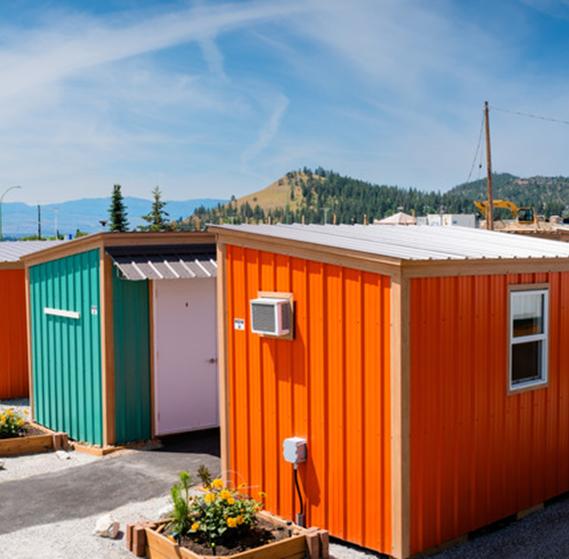
Our customers:
• All of our community, both current and future generations
• Vulnerable populations, including lived & living experience, individuals experiencing homelessness, Indigenous community
• Business owners
• Social serving sector
• Industry members and investors
• Other City departments
• Council
Our partners:
We work with our citizens, various local organizations, other levels of government and the private sector to build our community.
Revenue:
Community Development does not generate significant direct revenues. As a result, our ongoing activities and service delivery are primarily supported by allocations from property tax revenues, rather than self-generated income sources.
What we deliver:
We develop leading-edge planning policies based on extensive research in land use, housing, built and natural environments, heritage, and data analytics to build a foundation for strong and diverse neighbourhoods. We set the course for Kelowna’s future by anticipating trends, understanding best practices and shaping innovative policies for short and long-term community goals.
Our team works to balance development with considerations of climate change and protection of the natural environment. To do so, we develop and implement policies and programs to reduce community greenhouse gas (GHG) emissions, build climate resilience, protect and restore the City’s natural ecosystems, and shift to a circular economy. We also work with other departments at the City to embed climate and environmental considerations into corporate initiatives.
Social Development closely monitors social issue trends and provides strategic advice and to respond to unmet and emerging social issues. This group also aims to increase the capacity of various community organizations to contribute to a whole-systems social approach that responds to emerging community need.
Our key growth management objectives:
• Develop and manage the City’s growth strategy through implementation of and regular updates to our Official Community Plan
• Strategically monitor the City’s growth strategy to measure progress towards achieving long-term goals and objectives
• Update and develop new neighbourhood and area plans to ensure that growth and development is being guided in a way that enhances quality of life for residents
• Establish a clear understanding of housing need, grounded in trusted data
• Develop and implement effective housing policies and programs
• Strengthen partnerships and amplify our impact
Our key social development objectives:
• Drive lasting change through evidence-based approaches to social development to achieve sustainable equity and belonging
• Support and connect local change makers to facilitate collective action among diverse leaders to solve major community challenges, i.e., homelessness
• Remove barriers so all citizens can thrive
• Advance opportunities and advocacy for upstream initiatives and investments within the City, the sector, and the broader community
Our key climate and environment objectives:
• Lead efforts to reduce community greenhouse gas emissions in line with community targets
• Develop policies and programs that build resilience to local climate hazards (e.g., floods, wildfires, extreme heat)
• Develop policies and programs to ensure growth is balanced with protection and restoration of the City's natural ecosystems
• Expand the urban tree canopy in line with community targets
Our guiding plans:
• Imagine Kelowna
• 2040 Official Community Plan
• Transportation Master Plan
• Housing Action Plan
• Climate Resilient Kelowna Strategy
• Sustainable Urban Forest Strategy
• Agriculture Plan
• Urban Centre and Neighbourhood Plans
• Community Safety Plan
Measuring performance:
Performance measure 1
Expanding the urban tree canopy
Urban forest tree canopy coverage, a measure of tree coverage in cities, is estimated as the per cent of land covered by trees when viewed from above. Tree canopy coverage for five Growth Strategy Districts was measured against established targets to reflect different development patterns and growth projections expected within each district.
Increasing the urban tree canopy is a desired result of the Agriculture & Environment Council Priority. An expanded urban forest is desirable because trees provide many benefits, like cooling the urban heat island, filtering polluted air and water, diverting floods, and improving people's physical and mental health.
Baseline tree canopy coverage data was established in 2023 using LiDAR and imagery to map individual tree canopies. Canopy coverage varies by district, with lower coverage in highly developed areas such as the Gateway District (10 per cent), Urban Centres (12 per cent) and the Core Area (15 per cent), and higher coverage in Suburban (20 per cent) and Rural (27 per cent) areas. The Sustainable Urban Forest Strategy proposes that by 2050, canopy cover should reach:20 per cent in Urban Centres and the Core Area, 25 per cent in Suburban and Rural areas, and 15 per cent in the Gateway. Tree canopy coverage is expected to be measured every 3-5 years.
The Sustainable Urban Forest Strategy was endorsed by Council in 2024 and outlines actions to expand the urban tree canopy: (1) Protecting, connecting, and expanding the urban forest; (2) Maintaining a healthy, safe, and viable urban forest; (3) Involving people and organizations in urban forest management; and (4) Monitoring and innovating to achieve our urban forest vision.
PM#1: Urban canopy growth strategy per area 2023 2050 Targets
Performance measure 2
Community Greenhouse Gas Emissions
The City of Kelowna has set community greenhouse gas (GHG) emissions reduction targets as part of the Climate Resilient Kelowna Strategy. These targets align with those of the provincial government: a 40 per cent reduction from 2007 levels by 2030, and net-zero by 2050. All local governments and Modern Treaty Nations receive community GHG emissions data through the Province’s Community Energy and Emissions Inventory (CEEI). The CEEI is broken down by transportation, buildings, and waste. The latest data available through the CEEI is for the year 2022 and shows that absolute community GHG emissions increased (3.7 per cent) compared to 2021. The majority of the increase occurred within the building sector, primarily due to higher heating energy demands resulting from extreme cold, as well as a rebound effect following the COVID-19 pandemic. Progress is being made on a per capita basis (declining approximately 20 per cent capita since the 2007 baseline year).
Performance measure 3
Focusing growth in urban centres and the core area
This measure shows the share of total new homes that are being built in the Urban Centres and Core Area compared to the rest of the city (Gateway, Suburban Neighbourhoods and Rural Lands). The Official Community Plan (OCP) currently targets 73 per cent of future residential growth to be located in the five Urban Centres and the Core Area. This allows the City to grow in an economically and environmentally responsible way, while avoiding urban sprawl. Notably the target may be revised to 71 per cent based on updated growth projections, pending Council’s adoption of OCP Amendments in Fall 2025. The year-to-year actuals are anticipated to fluctuate above and below the target, with an anticipated increase later in the OCP’s lifespan. The share of growth over the past few years has increased significantly, but with development slowing, staff will be monitoring possible shifts in this trend in the coming years.
PM#3: Focusing growth in Urban Centres and Core Area
PM#2: Community greenhouse gas emissions
Performance
measure 4
Delivering housing supply
This measure shows the number of new homes built, compared to official housing targets. This is an anchor measure that is vital in understanding whether enough new homes are being built to meet the needs of Kelowna's current and future residents. Adequate housing supply is a foundation to a healthy housing system. Without enough new homes to meet growing demand, any actions to address housing affordability and homelessness are made much more difficult.
Housing target years are from July 1st – June 30th. The targeted annual number of occupancy permits required to meet the cumulative totals are shown on the graph. Official housing target cumulative totals are listed below.
• Year 1 Cumulative Target: 1,363
• Year 2 Cumulative Target: 2,856
• Year 3 Cumulative Target: 4,545
• Year 4 Cumulative Target: 6,496
• Year 5 Cumulative Target: 8,774
The first official annual housing target reporting was recently completed and shows that Kelowna has far surpassed its first annual target of 1,363 new homes occupied. In the first reporting year, a total of 3,438 new homes were occupied, well over double the target. Early in 2025, Council also adopted the new Housing Action Plan, which lays out 26 actions to improve housing outcomes for residents across the community. Several key actions have already been completed or are currently underway.
It is anticipated that strong new home completions will continue through 2026, but will begin to decline in 2027 due to more challenging economic conditions for development.
Performance measure 5
Provide diverse housing options
This measure shows the share of total new homes that were issued building permits that were in apartment buildings as compared to ground-oriented housing options (e.g., townhomes, detached homes). A resilient community has a wide variety of housing options available to meet the needs of residents at different price points and different life stages.
Recent years have seen a more significant shift towards multi-unit housing, particularly in the form of low-rise apartments, providing a more balanced offering. These forms of housing are typically less costly than single detached housing and come in a larger variety of sizes, configurations and price points. Apartment housing construction is still expected to drive the housing market for the coming year. However, overall levels of housing construction have started to decline from 2022/23 peak levels as broader macro-economic conditions weigh on the housing market. There remains a gap in the market for “missing middle” ground oriented housing options, such as multiplexes and townhomes.
Staff are continuing to review process, regulatory options, incentives (e.g., tax exemptions) and programs (e.g., Middle Income Housing Partnership) to enable more affordable housing, and to encourage more “missing middle” ground-oriented housing options through actions such as the Infill Design Catalogue and Fast Track approval process.
Revised targets for housing variety were developed to reflect revised growth projections and updated Housing Needs Assessment as required by new provincial legislation. These growth projections and a new growth scenario were presented to Council in April 2025. New targets are expected to be incorporated into the updated Official Community Plan in fall 2025.
PM#5: Apartment share (%) of new housing
% of apartment housing type
Performance measure 6
Individuals transitioning from rapid safety net housing into permanent housing
The City, through an agreement with the Province and its Homelessness Encampment Response Temporary Housing (HEARTH) program has provided 180 units of temporary transitional housing to help people transition out of homelessness. All three sites are now operational and showing positive results. In the short time since they opened, hundreds of unique resident goals have been accomplished, including finding full time employment, accessing mental health and substance use services, and moving into market or supportive housing. On average, site residents are able to transition to permanent housing within 3.5 months, though some may require longer stays. As of March, 2025, 66 residents had transitioned into permanent housing.
PM#6: # Individuals transitioning from HEARTH sites to supportive or market housing
# of individuals
Performance measure 7
People experiencing unsheltered homelessness
Housing is a fundamental social determinant of health, which can prevent ill health and support well-being and community inclusion. The experience of homelessness impacts not only one’s individual health, but also community functioning and the wellness of all. Understanding the inflows and outflows of homelessness in Kelowna is key to informing appropriate policy development, advocacy efforts and a coordinated response. As we work towards achieving real time, person-specific data, Bylaw Services continues to conduct a daily count of the number of people sheltering outside in key locations across the community. While this information does not reflect a point-in-time count for the City as a whole, it provides an opportunity to monitor trends and changes in community needs.
PM#7: Number of people experiencing unsheltered homelessness
# of people
Performance measure 8
Social development grants distributed in community
Community Social Development grants are available to registered non-profit, Kelowna-based organizations that make an impact on the social well-being and resiliency of the community. The goal is to make funding available to organizations offering services or programs with the goal of generating, promoting or accelerating socially beneficial services or programs in Kelowna. Strategic investments in diverse, equity seeking agencies and programs help to build a strong and resilient community Available grant funding has increased from $187k in 2021 to $231k in 2025.
2026 Activities by priority:
Priorities
Crime & Safety
Affordable Housing
Homelessness
Transportation
Agriculture & Environment
Activities
• Participate in the implementation of the Community Safety Plan
• Complete the review and update to the City’s Density Bonus program to enhance outcomes for affordable housing
• Complete the review of and implement new direction for the City’s DCC relief program for affordable housing with the aim of increasing the number affordable housing projects
• Complete the Transit Supportive Corridor Pilot Program, onboarding new housing options along key corridors
• Complete the Kelowna Gospel Mission (KGM) Shelter relocation feasibility study
• Develop community-engaged learning and improvement framework to support the implementation of a local Coordinated Access (CA) system and the use of the Homeless Individuals and Families Information System (HIFIS) in Kelowna
• Establish a strategic working group comprised of representatives from City, BC Housing, Central Okanagan Foundation, and Ki-low-na Friendship Society to implement, monitor, and improve coordinated, systems-based, data-driven homelessness policies and protocols
• Complete the Transit Supportive Corridor Pilot Program
• Continue to expand the public electric vehicle charging network and support EV charging in multi-unit residential buildings
• Continue the Home Energy Navigator Program to support homeowners through the complicated retrofit journey
• Implement a community engagement program to mobilize local climate action (including youth programming)
• Offer contractor training to better protect trees, enhance biodiversity and landscaping climate resilience
• Offer ‘DIY Air Cleaner Workshops’ to give vulnerable groups affordable access to protection against wildfire smoke
Economy
Transformation
• Develop new policy direction and targets for employment growth in Urban Centres through the Thriving Urban Centres Program
• Develop a new Employment Growth Scenario that anticipates job growth in sectors across the city
• Deliver progress reporting on industrial, office and retail vacancy rates
• Initiate a Midtown Corridor Mobility and Employment Strategy to encourage job growth
• Invest in infrastructure that supports a growing community through the Housing Accelerator Fund
• Continued improvements to Urban Centre Explorer and Dashboard
• Continue implementation of the Housing Dashboard
• Complete the Community Housing Information Library, establishing leading practices for gathering, stewarding and reporting housing data
• Implement the online application and permitting portal
• Continue the implementation of new permitting software (Cityworks) across division
Customer Experience
Base Business
• Created the Climate Resilient Kelowna Tracker, an online dashboard to help the public easily navigate the Climate Resilient Kelowna Strategy and keep track of implementation progress
• The new Urban Centres Explorer provides the public with real time data on housing, population, employment, transportation, and other key topics in our five rapidly growing Urban Centres
• The Housing Dashboard is being expanded and refined based on internal and external customer feedback. New functionality and data integrated will make this housing dashboard a truly powerful tool for the public, Council, staff and industry
• Created a Community Working Group composed of local interest holders to collaborate on implementation of the Climate Resilient Kelowna Strategy
• Staff have been holding workshops with employment lands experts and business groups, such as HM Commercial and Uptown Rutland Business Association to inform policy development in our employment lands and Urban Centres
• Implementing the Community Housing Table to bring together leaders from across the housing system to share information and resolve challenges early
• Coordinating with IT and subject matter experts to implement digital-first improvements to the development approvals system, with a focus on a digital application portal
• Following the completion of the new Heritage Conservation Area Development Guidelines, a complete overhaul of the various heritage webpages was undertaken, landing a simplified up-to-date location for residents to learn about various heritage initiatives across the city
• Strengthen coordination and collaboration among social serving sector
• Strengthen engagement with the community, interest holders, and relevant staff on climate and environmental issues and initiatives
• Advance the ‘sustainability as a service’ model, by supporting City staff in embedding climate/environment considerations in their work
• Undertake one or more Urban Centre Action Plans
• Begin implementing short-term actions identified in the Thriving Urban Centres Future Directions Report
• Continue to collaborate on the North Glenmore Sector Study
• Implement the North End Neighbourhood Plan alongside the Mill Site Area Redevelopment Plan
• Expand on growth strategy data for more robust data analytics
• Continue to implement the seven Housing Accelerator Fund initiatives
• Continue to support rental housing and affordable housing with financial incentives such as municipal tax relief
• Continue to work with partners (internal and external) to implement the 26 actions of the Housing Action Plan
• Report on housing data, including mandated provincial housing targets reporting
• Convene the Community Housing Table to bring together all of the key participants of the housing system
• Facilitate the Social Development Committee to coordinate housing work between City departments
• Continue to implement the seven approved initiatives of the Housing Accelerator Fund
• Continue to develop and expand criteria to apply a climate lens to development applications and capital planning
• Implement priority initiatives of the Climate Resilient Kelowna Strategy
• Implement priority initiatives of the Sustainable Urban Forest Strategy
• Continue to implement and expand the Neighbourwoods Program
• Continue to implement the business climate action program
• Continue to support the Neighbourhood Association Affiliation program which aims to grow the capacity of Kelowna's Neighbourhood Associations to help deepen community relationships
Long
Range Planning
• Completion of the North End Plan
• Completion of the Heritage Conservation Area Guidelines
• Delivery of the Thriving Urban Centres Community Trends Report and Future Directions Report
• Launch of the Urban Centres Explorer and Dashboard
• Completion of the Bill 44 Mandated 2025 Official Community Plan Update (anticipated November 2025)
• Delivery of revised 2041 Residential Growth Scenario
• Delivery of the OCP / TMP Progress Report
• Delivery of Draft Transit Supportive Corridor Pilot Project (adoption targeted for Q4 2025 or Q1 2026)
• Completion of Employment Projections Study
• Completion of the Commercial Demand Study for Kelowna to 2046 (Q4 2025)
• Launched the North Glenmore Sector Study
Climate and Environment
• Established internal and external working groups to support implementation of the Climate Resilient Kelowna Strategy
• Implemented priority initiatives in the Sustainable Urban Forest Strategy
• Offered a municipal supplement to the provincial e-bike rebate program
• Offered ‘DIY Air Cleaner Workshops’ to give vulnerable groups affordable access to protection against wildfire smoke. In 2025, 230 Kelowna residents were able to build their own free air purifier to improve their indoor air quality
• Offered year two of the Home Energy Navigator Program to support homeowners through the complicated retrofit journey
• Received funding from the Zero-Emission Vehicle Infrastructure Program (ZEVIP) to install 37 public EV chargers over the next few years
• Continued to offer municipal top-ups for low-carbon building technologies (e.g., heat pumps)
• Initiated a community engagement program to mobilize local climate action at the household level
• Continued to support the local business climate action program
• Engaged with the building industry and other interest holders on the higher steps of Energy and Zero-Carbon Step Code
• Made climate/environment related recommendations for the Zoning Bylaw (e.g., policies to support FireSmart, building energy efficiency, and tree canopy expansion)
• Formed an internal/staff Climate Action Team and external/community Working Group to support implementation of the Climate Resilient Kelowna Strategy
• Launched the Climate Resilient Kelowna Tracker, a dashboard for the Climate Resilient Kelowna Strategy
Social Development
• Delivered 60 rapid transitional housing units under the HEARTH/HEART program; partnered with the Province for a total of 180 units
• Expanded the Community Social Development Grant program to include a new funding stream to support treatment and recovery services related to problematic substance use
• Co-created the City’s first Housing Action Plan
• Led or co-led 10 of 30 Community Safety Plan Actions
• Expanded the Community Cares project, a peer supported work program for individuals experiencing homelessness
• Supported the development of a new Outreach App, with a goal of increasing coordination and timely service delivery among outreach and shelter providers
Housing Policy & Programs
• Continued the implementation of the Housing Accelerator Fund (HAF) initiatives, with a notable focus on incentives for affordable housing, infrastructure investment, and enabling housing along transit corridors
• Initiated the Community Housing Information Library project to streamline and update City housing data practices, including the Housing Dashboard
• Completed and implemented the City’s first Tenant Protection regulations
• Updated the Revitalization Tax Exemption program for rental housing in order to align with updated policy direction and to better support affordable housing and co-op housing
• The Housing Action Plan (HAP), completed in coordination between Housing Policy & Programs and Social Development, was adopted by Council
• Initiated the review of the City’s DCC relief for affordable housing program
• Initiated the review of the City’s Density Bonus program for affordable housing
• Initiated and completed the Infill Design Catalogue update, with a suite of new 4-6 unit infill projects given “fast track” approval benefits
• Coordinated adoption of several CMHC Standardized Designs as an official “local partner”
• Initiated a program to consider the addition of new designs to the Infill Design Catalogue on an ongoing basis
• Completed the initial process to identify, catalogue and prioritize the remaining major barriers to infill housing
• Launched the Community Housing Table to bring the voices of the entire housing system together to share information and co-ordinate action
Continuous improvements:
• Improve data quality and sources to establish better measurements of needs and impact within the social servicing sector
• Advance planning for extreme weather and disaster driven events to ensure support of vulnerable populations
• Expand and improve indicators to support better measurement of climate and environmental performance
• Seek alternate funding sources to advance key initiatives and expand departmental resources
Note: Totals may not add due to rounding
Budget needed to achieve results
Community Development is funded through property taxes, with partial financial support from the Regional District of the Central Okanagan for regional air quality programs. Grant funding from FortisBC further supplements the budget, specifically for energy improvement initiatives.
Note: Totals may not add due to rounding
Funding
Note: Totals may not add due to rounding
Expenditure by type
2026 Operating Requests ($ thousands)
Priority 1
2026 Capital Requests
There are no 2026 Priority 1 Preliminary Capital budget requests for this service area.
2026 Operating Request Details
Service Area: Community Development Priority 1 Enhance ONE-TIME
Title: Climate and Environment Initiatives PRELIMINARY
Justification:
The Local Government Climate Action Program has provided funding to the City of Kelowna to support climate initiatives. These funds are currently being held in reserve and are being recommended to support Council environmental priorities and programs like the Home Energy Navigator program, EV charging top-up rebates, the Lawn Swap Go Electric & Build your own air purifier programs, and Sustainable Forestry Initiative certification. The funds also allow for increased funding for ClimateSmart engagement programs for youth, residents, businesses, a climate Resilient Kelowna Strategy dashboard, agricultural irrigation assessments, a new Water Conservation Plan, biodiversity awareness training for contractors, and strong neighbourhoods grants for climate.
Strategic Direction: Agriculture & Environment
Service Area: Community Development Priority 1 Maintain ON-GOING
Title: Neighbourhood Association Affiliation Program PRELIMINARY
Justification:
A two-year pilot program to create an Affiliation Program for Neighbourhood Associations (NAs) was included in the 2024 budget. Five associations participated by committing to various community development initiatives and attending capacity building workshops. Associations were given a $5,000 grant per year. Noticeable outcomes at the end of two years include expanded membership, more diverse and engaged boards, enhanced communication platforms, and focused strategic direction. Associations have reported improved administrative processes, access to meeting spaces, increased volunteerism, and new partnerships. This has improved communication between NAs and the City, and resulted in stronger, safer, more connected communities. The budget request is to make this an on-going program that supports up to 10 associations.
Strategic Direction: Crime & Safety
2026 Operating Request Details
Service Area: Community Development Priority 2 Enhance ON-GOING
Title: Community Social Development Grant PRELIMINARY
Justification:
The Community Social Development Grant supports services and programs to address social challenges within our community. In the past five years, annual funding requests average 118 per cent above available resources, reflecting sustained high demand. This underscores the challenges of shifting social issues, funding uncertainty, and the need to support social service organizations as they manage growing demand. Budget is requested to increase funding to enhance non-profits' capacity to develop, implement, and evaluate prevention and risk intervention strategies to address issues facing vulnerable populations, such as youth, seniors, newcomers, and individuals experiencing homelessness. If moved to priority 1, this request would increase taxation demand in 2026 by 0.02 per cent, and a further 0.05 per cent for annualization through 2028.
Strategic Direction: Homelessness
DEVELOPMENT SERVICES
LED BY: DIVISIONAL DIRECTOR, PLANNING, CLIMATE SUSTAINABILITY & DEVELOPMENT
Our goal & community benefit:
Our purpose is to provide compliance reviews on building and civil infrastructure plans, permits, and business licences, as well as provide inspection oversight during the construction/ development process.
Our customers:
• Builders, plumbers, and contractors
• Business owners
• Architects, engineers, and building designers
• Realtors, lawyers, and other registered professionals
• Property owners
Our partners:
We work with our citizens, licenced builders, engineers, third party service and utility agencies, industry associations, and other levels of government.
Revenue:
Revenue is generated through permit and licensing fees outlined in the fee schedules and bylaws and is based on a full cost recovery of administrative and inspection costs.
What we deliver:
Establishment and enforcement of operational policies, processes, and practices to ensure adherence to bylaws, codes, regulations, and Council policies related to building/developments and business licensing in the City. These regulations oversee the development process, including road construction, utilities installation, building construction, and business licensing, from inception to completion and occupancy.
Our key objectives:
• Provide excellence in customer service and operational efficiency
• Inspect permitted activities for compliance with approved plans
• Review applications for civil infrastructure design and construction for compliance
• Promote and foster new businesses that contribute to our vibrant community
• Review business licence applications for compliance with the zoning bylaw and other relevant bylaws
Our guiding plans:
• Municipal Bylaws: Building, Subdivision and Development Servicing, Zoning & Business Licensing
• Area Structure Plans
• Urban Centre Plans
• Official Community Plan
Measuring performance:
Performance measure 1
Inspections completed within 24 hours of request
The Development Services Department aims to complete 96 per cent of building, plumbing, and gas inspections within 24 hours of booking. This commitment ensures exceptional customer service and enables projects to progress smoothly without unnecessary delays between construction stages.
Performance measure 2
Multifamily building permits with 2-6 units processed and issued within 10 days
The Development Services Department completes 96 per cent per cent of multifamily dwelling building permit packages for constructions that provide 2 to 6 dwelling units within 10 business days of a complete application. These stats are monitored through a third party, the International Accreditation Service, to help us achieve exemplary customer service.
Performance measure 3
Fast track program permits issued within two days
The City of Kelowna takes pride in leading the Fast Track Program, which facilitates the issuance of smaller building permit subtypes, such as garages, secondary suites, and additions, within two business days of receiving a complete application. This efficient process does not require an in-depth review, ensuring prompt service. Our performance is consistently monitored by the International Accreditation Service, a third-party auditing organization, which helps us maintain exceptional customer service standards and promote better business practices.
Performance measure 4
New business licences issued within two weeks
The Business Licensing team is dedicated to delivering exceptional customer service to Kelowna's growing business community. Application processing time can vary due to the nature of the business however our goal is to process 85 per cent of new business licence applications within two weeks or less.
Performance measure 5
Utility and building permit drawings reviewed within two weeks of submission
Applications reviewed by Development Engineering correlate with higher value, complex projects with on-site engineering requirements. These add value by giving confidence in the systems that support citizens’ dwellings and workplaces in meeting established engineering standards. These reviews vary significantly in complexity, however, the target is to have 80 per cent of all projects reviewed within two weeks of submission.
Performance measure 6
Engineering drawings approved within two submissions
Reduced number of submissions required to achieve design approval indicates that the Development Engineering department has set clear requirements and provides high-quality, comprehensive, integrated, and accurate reviews early in the development process. This gives cost certainty for developers and results in fast approval and reduced costs for development. While drawing applications vary in complexity, Development Engineering aims to have 75 per cent of all drawing applications approved for construction within one re-submission (two total submissions).
2026 Activities by priority:
Priorities Activities
Crime & Safety
Affordable Housing
Agriculture & Environment
Economy
Our People
Transformation
Customer Experience
Base Business
• Support the operations of the Property Standards & Compliance team
• Collaborate to prepare a comprehensive approach on Community Fire Safety
• Collaborate with Bylaws Enforcement Department to create process efficiencies
• Continuing to provide efficiencies in our process and reduce red tape
• Continue to support Housing Accelerator Fund projects
• Support the operation of the Agricultural Standards Compliance Team to reduce conflicting land uses on farmland
• Implement digital plan checking to further reduce our carbon footprint
• Collaborate with both external and internal stakeholders to promote grants and incentives for greener homes
• Continue to look for efficiencies in the business licence system to promote small business growth in the City
• Continue to support individuals and our team in forming a cohesive, uniform and successful building focused unit
• Digital Plan review process with 24/7 service delivery
• Continue to fine tune the new Property Information Request software
• Launch new online permit application portal for all building permit types
• Continue to adjust and utilize Cityworks to collect data to make date informed decisions
• Work towards implementing online Development applications
• Implement online payment for all types of permits
• Update internal templates to improve standardization and automation through our workflow to increase efficiency and improve consistency and quality of work
• As the first community in all of Canada to be accredited by the International Accreditation Service, we will continue to maintain accreditation status for the building permitting branch
• Work with finance to implement credit card payments for all permits
• Implement a process for provincial mandate of surety bonds for DCCs
2025 Key accomplishments:
• Implemented Cityworks software, a new building permitting application portal, and Property Information Requests software
• Successful succession planning and reorganization of the department
• Implemented and expanded payment option for permits
• Received accreditation from International Accreditation Services
Continuous improvements:
• Update bylaws
• Continue to implement digital plan checking
• Update policies and procedures
• Continue data transfer from existing permitting software to Cityworks
Budget overview:
2026 Total Expenditure Budget Breakdown
Note: Totals may not add due to rounding
Budget needed to achieve results
Development Services is a revenue-generating service area with revenue from activities such as permitting, licensing, and development fees used not only to cover operating costs but also to contribute to broader municipal planning efforts. The significant decline in revenue seen in 2024 is expected to continue through 2026, due to regulatory changes affecting shortterm rentals, reduced cannabis licensing fees, and a slowdown in construction activity, which impacts building permit income. These fluctuations are expected, and reserves have been established to cushion the financial impact. In 2026, these reserves will be used as a temporary measure to balance the budget until market conditions improve.
Note: Totals may not add due to rounding
The difference between the two graphs below is the $5.12 million surplus earned by this service area that is used to offset taxation funds required for other community services areas and infrastructure such as Buildings, Transportation, and Community Development. Funding strategy
Expenditure by type
Note: Totals may not add due to rounding
2026 Operating and Capital Request Details
This service area has no Priority 1, 2026 budget requests
DEVELOPMENT PLANNING
LED BY: DIVISIONAL DIRECTOR, PLANNING, CLIMATE SUSTAINABILITY & DEVELOPMENT
Our goal & community benefit:
Our goal is to ensure high-quality urban design, promote housing affordability, and ensure new development supports a high quality of life in Kelowna. The Development Planning team provides land use planning and growth-related direction in the community. We work with the public and other stakeholders to ensure development reflects our community priorities. The Official Community Plan (OCP) focuses on slowing the outward growth of suburban neighbourhoods, which protects rural/agricultural lands and environmentally sensitive areas, while reducing the amount of new infrastructure that is needed to service growth. Urban centres are prioritized for residential and mixed-use growth.
Our customers:
• Developers, architects, engineers, and planners
• Builders and contractors
• Property owners
• Residents
• Commercial and Industrial Businesses
• Institutions
• Internal City departments
• Other municipalities
Our partners:
We partner with a wide range of internal City departments including Transportation Planning, Infrastructure Delivery, YLW Airport, Real Estate Services, and Parks Planning. We work with external partners and agencies, including the Urban Development Institute, Canadian Home Builders Associations, Tourism Kelowna, Utility Providers, Provincial ministries, post-secondary institutions, special interest groups, community organizations, and residents’ associations.
Revenue:
Development Planning fees in Kelowna are a mix of administrative fees for processing applications and Development Cost Charges (DCCs) that fund capital projects like new roads and drainage, that are required due to community growth. These fees help ensure that new developments cover the infrastructure costs they create, with exact costs varying by project type and determined by the Development Application Fees Bylaw. Development Application Fees are charged for processing applications for various planning matters, such as rezonings, development permits, and subdivisions. A portion of the fee is based on the staff time required to review and process applications and the inter-departmental referrals that are involved.
What we deliver:
We review and process land use and development permit applications and provide advice and information on planning processes to Council and the public. We also promote, implement, and advocate for change that moves the City towards the Kelowna envisioned by Imagine Kelowna and the policy direction of the Official Community Plan (OCP).
Our key objectives:
• Review various applications related to land use change and form and character analysis against Council endorsed regulations and policies
• Maintain and update regulations, policies, and processes to ensure a streamlined and efficient development application process
• Prioritize Council, corporate and divisional priorities, such as affordable housing, protecting agriculture and climate/ environment
• Identify ways to modify our policies, procedures and bylaws by keeping informed of market conditions and planning trends that impact development
Our guiding plans:
• Official Community Plan
• Zoning Bylaw
• Subdivision and Development Servicing Bylaw
• Development Cost Charge Bylaw
• Development Application Fees Bylaw
• Development Application and Heritage Procedures Bylaw
Measuring performance:
Performance measure 1
Development Permit (DP) applications that utilized the existing zone
The planning, development and permitting of land and buildings requires the City to balance an efficient development application process with growth management. Development planning pre-zones areas of the City to direct growth and target densities in locations that support the vision in the Official Community Plan. This reduces the time and costs associated with land development and permitting, which supports affordability for housing and businesses. The aim is for 80 per cent of development applications to utilize the existing zone.
Performance measure 2
Development application streamlined approvals
Development application timelines play an important role in addressing housing supply and affordability. Shorter timelines support market responsiveness to housing and commercial supply and demand. Developers of residential and commercial property prefer to invest in communities where approval timelines are transparent, reliable, and standardized. The target is for 50 per cent of development applications to be approved through a streamlined approval process.
% Development application streamlined approvals
Performance measure 3
Residential building permits in growth districts
While the Official Community Plan (OCP) provides growth estimates in different areas of the City, development may be faster or slower based on market trends. Monitoring this rate of growth in our urban centre helps to make informed decisions about investments in infrastructure, such as transportation and utility servicing, as well as when to initiate urban centre plans. The OCP target is 73 per cent of building permits issued in core areas.
Priorities
Crime & Safety
Affordable Housing
Activities
• Continue to develop staff knowledge in Crime Prevention Through Environmental Design (CPTED) principles when reviewing form and character Development Permits, site planning reviews, and landscape design elements
• Initiate placemaking strategies that support safe, clean and vibrant public spaces
• Continuously seek ways to encourage and support the construction of all housing forms to increase supply, and provide supports, policies, and incentives for different types of affordable housing providers
• Lead the review and implementation of parking reform, which is proven to be the most effective means to boost housing development
• Continue to support FortisBC to strengthen electric grid capacity and reduce costs to development associated with legacy infrastructure
Homelessness
Transportation
Agriculture & Environment
• Support colleagues and external organizations working to support those experiencing homelessness through the permitting approval process and advise on community engagement best practices to ensure effective communications
• Support the review of transit supportive corridors for additional land use density
• Incorporate active transportation, transit, and curbside management into development design considerations
• Prioritize enforcement efforts for non-farm uses on agricultural lands
• Explore opportunities to support and house farm labour
• Refine Climate Lens to review land use change applications
• Work to expand implementation of Fire Smart practices, tree canopy targets, landscape requirements, and efficient building design in our bylaw
• Develop urban design guidelines for a cooler city to improve our resiliency in the summer months
• Work to expand implementation of Fire Smart practices, tree canopy targets, landscape requirements, and efficient building design in our bylaw
Our People
Transformation
Customer Experience
Base Business
• Implement projects related to Divisional Strategic Plan and Council/Corporate Priorities
• Create opportunities for guest lecturing and design studio labs with post-secondary programs for interested planning staff
• Ensure learning opportunities for professional growth and development are distributed to retain high performing team members
• Implement online portal to streamline application submissions, and improve submission quality
• Continue development of KAI chatbot to planning applications
• Implement digital portal for application submission
• Implement recommendations of development process review
• Customer experience and service training deployment
• Continue to identify and act on opportunities to streamline the development application process for housing delivery
• Monitor Development Application Fee bylaw to ensure updated bylaw is functioning as intended
• Monitor density bonus programs and refine as necessary
• Review financial impact of fees and charges associated with development, such as frontage improvement fees and area specific Development Cost Charges
• Work with other departments, such as Operations, Transportation and Real Estate to identify cost implications through the development process
2025 Key accomplishments:
• Vacancy rate was reported at 3.8 per cent and continues to trend upwards after a chronically low vacancy rate over the last two decades
• Changes were made to the Planner of the Day program and Plan Technician role, to reduce low value tasks, redirect efforts to improve service delivery on development applications, support planning staff, and improve staff retention
• Efficiently updated the zoning bylaw and coordinated with Business Licensing to allow more short-term rentals in Kelowna immediately after the launch of the Provincial registration platform in January 2025
• Two Council Workshops held on parking strategies for off and on-street parking in response to a Council resolution on parking, and initiated a parking reform review to be implemented in 2026
• Provided additional workshops to Council in response to resolutions related to infill in suburban areas
• Actively worked with FortisBC to identify areas for improvement regarding the reliability of the electrical grid
• Successful media interactions related to infill, parking, and short-term rentals
• Supported several large City-led projects, including the Glenmore Protective Services Campus, Parkinson Recreation Centre, and Kelowna Paddle Centre
Continuous improvements:
• Development Planning is working with other departments to identify and reduce barriers to infill, generally associated with approval timelines, quality and consistency of information, and fees and charges
• Planning is working to create a short-term rental subzone in 2026 for principal use, in anticipation of eligibility to apply for exemption status with the province
• Implementation of recommendations from the 2025 Development Process Review
• Ongoing efforts to enhance transformation and improve customer experience
• Working on new process with other departments to improve road closures during construction
• Refinement of the density bonusing program
• Quarterly zoning bylaw updates, and ongoing maintenance to the OCP
• Partnering with UBCO and Okanagan College to enhance local relationships and to provide opportunities for planning staff to guest lecture
Budget overview:
Note: Totals may not add due to rounding
Budget needed to achieve results
Development Planning is primarily funded through property taxes, with additional revenue from development permits providing an offset to overall costs.
Note: Totals may not add due to rounding Funding strategy
2026 Operating and Capital Request Details
This service area has no Priority 1, 2026 budget requests
PARKING
LED BY: DIVISIONAL DIRECTOR, PARTNERSHIPS & INVESTMENTS
Our goal & community benefit:
Our goal is to manage Kelowna’s on- and off-street parking facilities to balance convenience for residents and visitors while protecting vehicle access for those who need it most. Parking is one part of the broader transportation picture and aids with predictable, orderly access to destinations. This helps connect communities, encourages economic growth, improves traffic safety, and fosters the growth of more inclusive public spaces.
Our customers:
• Community members
• Local businesses & employees
• Visitors & tourists
• Delivery & service providers
Our partners:
We work with institutions, businesses, developers, contractors, equipment vendors, and other City departments to create, operate, adjust, and maintain our parking facilities, equipment, policies, rates, and bylaws.
Revenue:
Parking Services generates revenue from parking fees (on and off-street); fines collected for parking-related bylaw offence notices, public EV charger use, and intermittent funds from developers in lieu of providing required on-site parking.
What we deliver:
Parking Services manages over 1,375 on-street pay parking spaces, loading zones and accessible parking spaces to create or maintain turnover in commercial areas, ensuring customer access to support businesses. In residential areas adjacent to commercial/institutional areas, we manage more than 200 on-street blocks where time limits or residential restrictions are in effect to maintain the integrity of neighbourhoods.
We also operate the majority of off-street parking facilities in the City, including three parkades and 26 surface parking lots (approximately 3,220 spaces), that provide longer term employee and resident parking options. Our team manages Cityowned publicly accessible EV charging stations, oversees parking planning, and capital projects for our facilities. We also respond to more than 10,000 public inquiries/service requests annually.
Our key objectives:
The City-wide parking management strategy, endorsed by Council, is guided by a set of principles to ensure our parking system:
• Improves the availability of short-term parking spaces
• Continues to pay for itself so that general taxation is not impacted
• Offers customer service options for better customer interaction
• Provides a balanced transportation network for residents
• Works with institutions, businesses, and developers
Our guiding plans:
• Imagine Kelowna
• Official Community Plan
• Transportation Master Plan
• Downtown Area Parking Plan
• Hospital Area On-Street Parking Plan
• South Pandosy Area Parking Plan
• Parking Management Strategy
Measuring performance:
Performance measure 1
Revenue to cost ratio: operation of parking system
The ratio of parking revenue to the cost of operating the parking system indicates the amount of revenue collected beyond associated expenses. This measure confirms the parking system is operating in a self-funded manner, capable of supporting debt servicing and providing funding for future capital projects. The goal is to maintain a ratio above 2.0, signifying that revenue is at least twice the amount of expenses. If this ratio decreases, it suggests expenses are rising faster than revenue, which could necessitate a rate increase beyond the annual CPI value. This measure is benchmarked against the Canadian municipal median per the Municipal Benchmarking Network. Revenue to cost ratio
PM#1: Revenue to cost ratio: operation of parking system
Performance measure 2
Peak capacity of pay parking stalls
This measure reflects the peak capacity of managed pay parking stalls, both on- and off-street. As this number nears 100 per cent, it becomes necessary to reduce demand by providing transportation alternatives or raising rates or increase inventory by developing/purchasing new facilities. A value of 60 per cent or less implies there is surplus capacity available, while a value exceeding 85 per cent signals that the parking system may be nearing capacity. In the parking field, it is commonly accepted that an optimal occupancy rate is 85 per cent, ensuring that one to two spaces are available on each block to reduce the need for vehicles to circle in search of parking.
PM#2: % Peak capacity of pay parking stalls
Performance measure 3
Blocks with time limits or residential restrictions
This measure reflects the number of blocks (sections of road between two intersecting streets) where time limits or residential restrictions are in effect. Once a restriction is implemented, active management and enforcement are necessary. There is no target for this measure, and the number of blocks will increase with densification, necessitating additional staff and equipment to effectively manage.
2026 Activities by priority:
Priorities
Crime & Safety
Transportation
Economy
Our People
Transformation
Customer Experience
Base Business
Activities
• Focus on providing a safe, clean parking experience for our customers using Crime Prevention Through Environmental Design (CPTED) principles
• Provide support for the corporate security function and Kelowna Security Operations Centre (KSOC)
• Continue renewal of older security cameras to enhance real-time monitoring and improve security for customers
• Advance the feasibility assessment and development of design options for a new parkade facility in the South Pandosy Urban Centre
• In partnership with Integrated Transportation, as part of the Downtown Transportation Review, finalize development of a curb space management strategy to accommodate alternative uses, such as loading and pickup zones
• Re-launch development of an area parking plan for the Capri-Landmark Urban Centre
• Continue to optimize parking rates to reduce traffic congestion and promote the use of transit and alternative modes of transportation
• Continue to support the economic vitality and competitiveness of the City by providing adequate and convenient short- and long-term parking for residents, tourists, and businesses
• Generate revenue to be reinvested in parking infrastructure, transportation projects, and other public services
• Re-allocate existing resources to improve management of the complex systems we use to operate parking and enforcement infrastructure, improve financial management and ensure compliance with policies and industry standards
• Continue modernization of the Residential Parking Permit program by phasing out the legacy system to support transformation and reduce fraudulent use by adopting a virtual, licence plate-based permit system
• Advance development of an interactive parking map to display real-time occupancy data and improve the overall customer experience
• Introduce a second mobile parking payment app to enhance service reliability and offer customers more choice
• Continue the multi-year asset renewal program for City parkades to ensure they achieve maximum life expectancy
• Review and reallocate existing staff to ensure the most efficient and effective use of resources
• Leverage the Parking Analyst to identify new revenue opportunities, optimize our pay parking system, and improve management of programs
• Continuously review and compare parking rates and fines to other municipalities, private operators, and institutions to maximize effectiveness
2025 Key accomplishments:
• Contributed $1.65 million from parking revenues to reduce taxation
• Hired and onboarded a new Parking Analyst
• Established a street-level office on St. Paul Street to streamline parking operations in a single, accessible location to improve customer service and bring all staff together to increase collaboration and efficiency
• Established a Senior Traffic Officer position to improve enforcement coordination and training
• Enhanced single-space meter equipment with the addition of HD Screens and EMV credit card readers, improving usability and expanding payment options to include debit cards
• Designed and kicked-off project to install ten additional Level 2 Electric Vehicle chargers in the Rutland and South Pandosy areas
• Implemented a new program that allows holders of BC Veteran licence plates to register for complimentary, timerestricted on-street parking
• Completed a second Parking Workshop with Council, in partnership with Development Planning
• Invested $900,000 in parkade restoration projects – focused on replacement of expansion joints, door repairs/ replacements and renewal of sealants and protective coatings
Continuous improvements:
Continuous improvements:
• Consistently improve the quality and regularity of parking data collection to strengthen analysis and support informed decision-making
• Reallocate resources to prioritize areas with regular complaints, improve response times, and implement crosstraining to ensure full role coverage
Budget overview:
Total Expenditure Budget Breakdown
Note: Totals may not add due to rounding
Budget needed to achieve results
Parking Services is a self-sustaining operation within the general fund. Any unused revenue generated each year is allocated to reserves dedicated to future infrastructure investments. Parking operations contributes $1.65 million annually to offset property taxation funds required for enabling and other community services such as Transportation and Transit.
Note: Totals may not add due to rounding
The difference between the two graphs below is the $1.65 million surplus earned by this service area that is used to offset taxation funds required for other community services areas such as Transportation and Transit.
Funding strategy
Expenditure by
type
Note: Totals may not add due to rounding
2026 Operating Requests ($ thousands)
There are no 2026 Priority 1 Preliminary Operating budget requests for this service area
2026 Capital Requests ($ thousands)
Priority 1
* denotes capital request has operating & maintenance impacts included in the request
2026 Capital Request Details
Service Area: Parking Priority 1
Title: Parking Infrastructure Growth & Renewal PRELIMINARY
Justification:
Budget is requested for this annual program to accommodate growth and renewal to maintain levels of service for parking infrastructure and facilities. Annual items for consideration may include, but are not limited to, major maintenance to parkades, parking equipment and new off street parking.
Strategic Direction: Other
Service Area: Parking Priority 1
Title: South Pandosy Parkade PRELIMINARY
Justification:
Budget is requested to accommodate growth and renewal to maintain levels of service for the continued work to allow for planning, design and construction of a new parking structure in the South Pandosy town centre, and to accommodate increasing density of the surrounding commercial and residential zones.
Strategic Direction: Other
2026 Capital Request Details
Service Area: Parking
Title: Electric Vehicle Infrastructure PRELIMINARY
Justification:
Budget is requested for this annual program to support the on-going expansion of electric vehicle charging stations in Cityowned parking lots and facilities within urban centres of our community. As well as to fund partnerships and strategic initiatives that enhance the parking experience and maximize the community benefit associated with parking assets. These installation will offer an enhanced level of service for the city.
Strategic Direction: Agriculture & Environment
PARTNERSHIPS OFFICE
LED BY: DIVISIONAL DIRECTOR, PARTNERSHIPS & INVESTMENTS
Our goal & community benefit:
Our goal is to lead and cultivate high-priority strategic partnerships that challenge the status quo of how civic services and capital are delivered. Through strategic partnerships, effective advocacy, robust grants management and innovative alternative revenue approaches, we seek to increase the City’s non-tax revenue, strengthen partnerships and influence policies and investments that address community need to ensure Kelowna is a great place to live, work, play and invest in. We provide economic and social benefits by mobilizing civic resources in a financially supportive way to our partners.
Our customers:
• Citizens who benefit from our partnered projects

• Existing partners and potential partner organizations including academia, non-profits, corporations, and key stakeholders
• Other levels of government
Our partners:
We work with other levels of government, academia, corporations, non-profits, and other key stakeholders to support Council priorities and community goals.
Revenue:
Generating non-taxation revenue is a critical strategy to reducing our reliance on taxation as our City continues to grow and change. These include initiatives like new user-pay services and amenities, leasing select assets or generating value from assets through sponsorships, as well as creating opportunities for commercial activities in public spaces which align to our community needs and vision. Alternative revenue sources give the City the flexibility to accelerate our capital plan, increase service levels or enhance and animate public space without a direct taxation impact.
What we deliver:
We create partnerships with other levels of government, academia, corporations, non-profits, and other key stakeholders to advocate for and advance Council and Corporate priorities. We target grant programs and seek-out sponsorship and advertising opportunities that align with the City's values and priorities. We advise across divisions on innovative and entrepreneurial service delivery. We aim at diversifying the City's revenue sources beyond property taxes.
Our key objectives:
• Partnerships – We build relationships and develop high-impact partnerships with government, academia, corporations and other key partners. Through these collaborations, the City seeks to foster innovative solutions, attract and leverage capital investment, and deliver infrastructure and services that benefit our community
• Grants – We strategically identify grant opportunities for City projects and initiatives. We work across the organization to secure and manage grants that advance Corporate and Council priorities. We are driven to leverage the financial contributions of Kelowna's taxpayers
• Intergovernmental Relations – We advocate for Council priorities and City projects by building relationships with other government levels to drive investment and policy changes. Through a centralized approach we ensure infrastructure and program needs are effectively communicated to provincial and federal ministers to enable transformational change. As a rapidly growing community, Kelowna positions itself as a leading municipality and strong partner for government investments
• Alternative Revenue – We develop new revenue streams and we advise and contribute to expanding existing relationships to include mutual revenue sharing arrangements. Through market analysis, business planning and guidance on value exchange and negotiations, we ensure revenue opportunities are cost effective to realize, stable
and innovative. Through our asset inventory, policy tools, and business to business relationship building, we foster a proactive ecosystem of municipal and private sector partnership
Our guiding plans:
• Imagine Kelowna
• Council and Corporate Priorities
• Council Advocacy Priorities Framework
• Grants Strategy
Measuring performance:
Performance measure 1
Partnerships leverage ratio – major and emerging opportunities
To reduce reliance on tax revenue, the City develops major partnerships to deliver services and infrastructure, while also allocating $1.5 million annually to leverage partner dollars for emerging opportunities. The leverage ratio represents the proportion of external funding compared to the City's capital contribution towards the total value of partnership projects. The target ratio is 2:1.
Performance measure 2
Success rate on grant applications based on 20 applications submitted per year
Grants minimize the City’s reliance on tax revenues and allow us to leverage funding to complete infrastructure projects and programs for our growing community. The success rate of grant applications is an indication of the submission quality, our ongoing grant management practices, and relationships with other levels of government. We maintain a success target of 50 per cent to promote a balanced approach between aligned funding sources and more variable, opportunity-driven but less predictable funding.
PM#2: % Success rate on grant applications based on 20 applications submitted per year
Performance measure 3
Successfully completed advocacy priorities through Minister meetings
Advancing Council’s advocacy priorities by engaging in focused and strategic intergovernmental relations, underpinned by building strong relationships with other levels of government, including consistent and effective in-person meetings with provincial and federal ministers. The target is 1 per year.
2026 Activities by priority:
Priorities
Crime & Safety
Affordable Housing
Homelessness
Activities
• Advocacy to increase crown prosecutor resources locally to address repeat property offending
• Collaboration to develop and launch the Chronic Offenders: Closing the Revolving Door advocacy paper
• Supporting the implementation of the Housing Accelerator Fund
• Advocating for the construction of the 176-unit BC Housing Bertram affordable housing project
• Advocacy for a regional Red Fish Healing Centre model for compassionate mandatory care and for a regional dignified secure care facility in the Okanagan
• Advocacy to ensure progress on the Complex Care facility on Pacific Avenue advances to development permit and construction
Transportation
Agriculture & Environment
Economy
Our People
Transformation
Customer Experience
Base Business
• New transit operations centre advocacy and grant applications
• Clement Avenue multi-modal corridor extension advocacy
• Apply for Provincial and Federal grant applications supporting Climate and Environment initiatives
• Pursue grant funding for agricultural water projects
• Develop an Economic Development Strategy to meet the needs of Kelowna’s businesses and entrepreneurs
• Advance public-private partnerships opportunities, through advocacy for economic development at YLW Kelowna International Airport
• Continue the Leadership Development and Employee Engagement Committee to support leadership growth within the Partnerships & Investments Division
• Look towards team expansion to increase impact, particularly in academic partnerships and agreements
• Integrate a project management digital tool to manage the partnership development process
• Enhance amenities and services to improve customer experience through alternative revenue strategies, activations, and partnerships
• Establish an external-facing profile for the Partnerships Office activities
• Update the City’s asset inventory for making strategic brand partnerships
• Identify and pursue high-impact commercial partnerships
• Update the Alternative Revenue Strategy to reflect progress on high impact opportunities
• Pursue alternative revenue, including grants and other investments
• Advance new applied research projects through the City of Kelowna UBCO Research Alliance
• Develop a Major Partnership Development Strategy to inform a proactive and strategic approach to future partnerships for the City
• Developed a Partnerships Office Strategic Plan to prioritize resources and implement strategic initiatives for highimpact opportunities
• Hired an Alternative Revenue Manager to develop and implement a program to diversify non-tax revenue sources beyond sponsorship and advertising to include broader service and amenity partnerships with local and national brands
• Created and implemented a Major Partnership Development Policy & Procedures to provide direction and guide staff on the development of new major partnerships for the City
• Partnered with Tennis Clubs of Canada to provide year-round play with five new courts and a winter tennis facility at Mission Recreation Park
• Partnered with Okanagan College on a new Recreation & Wellness Facility at their Kelowna Campus, providing funding to build a larger facility, with more spaces for programming
• Advanced the City UBCO Research Alliance through dedicated resources and new applied research projects to address shared community challenges
• Successfully advocated for the completion of the third HEART & HEARTH site, resulting in Provincial investments to create 180 rapid shelter units at three sites in Kelowna
• Facilitated Mayor’s in-person presentations of Kelowna’s priorities to the Provincial Select Standing Committee on Finance, the Federal Budget Consultations with the Secretary of State for Finance, and to the Federal Pacific Caucus
• Met twice with Premier David Eby to advocate for Council’s priorities including economic development at YLW, addressing repeat property offenders, and to see a regional mandatory care facility in the Okanagan
• Facilitated advocacy tours to Victoria and Ottawa for Mayor with meetings secured with key Ministers in portfolios aligned with Council’s Advocacy Priorities
• Delivered Federal Election analysis, facilitating interactions with local election candidates, and supporting postelection intergovernmental relations with newly elected local Members of Parliament
• Managed Kelowna’s delegation participation at the 2025 UBCM convention, resulting in meetings for Mayor and Council with six Provincial Cabinet Ministers, five panel speaking opportunities, and receiving two Energy and Climate Action Awards for the Climate Resilient Kelowna Strategy and the DeHart Park’s Carbon Neutral Design
• Created the Book of Kelowna, a visually-focused publication highlighting our community and Council’s priorities that positions Kelowna as a premier destination for partnership and investment
• Developed and launched a Corporate Awards Program for a systemic and centralized approach to pursuing external awards for recognition of City projects and initiatives
• Celebrated the opening of the Bertram Overpass with a minister event, recognizing the Provincial Growing Communities Fund and the Federal Canada Community Building Fund contributions
• Managed $119 million in grant contracts and awarded grants valued at $8.5 million (Jan-Sept)
• Awarded the Next Generation 911 grant to support local preparedness for the implementation of NG911
• Awarded the Agriculture Water Infrastructure Program for Nonpotable Reservoir Construction to mitigate the current water supply issues in agricultural properties throughout South East Kelowna
• Awarded two grants from BC Active Transportation awarded for Rutland Neighbourhood Bikeway which will provide a safe connection between parks, schools, and the Rutland Urban Centre; and for KLO Bridge Replacement which will provide a safe connection across Mission Creek
• Celebrated the opening of the new Waterfront Stage with the Provincial Minister of Tourism, Arts, Culture and Sport, Council, funders, community partners and staff which included provincial grant funding
• Celebrated the opening of the second phase of Strathcona Beach Playground with Council, funding partners, community and staff which included grant funding from Kiwanis Legacy Endowment Fund – KGH Foundation
Continuous improvements:
• Optimizing the Partnerships Office resources to increase our ability to respond to the highest impact opportunities
• City UBCO Research Alliance continues to leverage collaboration and research grant opportunities that benefit our city
• Execution of Council’s revised advocacy priorities for 2023-2026 with evidence-based background materials
• Developing foundational policies and procedures that guide Intergovernmental Relations, Partnerships, Alternative Revenue and corporate awards
• Reviewing the Grants Procedures, Grants Strategy and Grants Policies to ensure effective guidance to pursue the highest impact funding opportunities
Budget overview:
2026 Total Expenditure Budget Breakdown
Note: Totals may not add due to rounding
Budget needed to achieve results
The Partnerships Office is primarily funded by property taxes, with advertising revenue partially offsetting its costs. The office also generates substantial revenue through grants and partnerships, which is directly allocated to specific projects. This approach reduces financial pressure on taxpayers by funding initiatives that benefit the community outside of property taxes.
Note: Totals may not add due to rounding
Note: Totals may not add due to
This service area has no Priority 1, 2026 budget requests
GOVERNANCE & LEADERSHIP
LED BY: CITY CLERK
Our goal & community benefit:
Our goal is to foster a culture of open government in the provision of corporate administrative services to Council, their committees, and the organization. We communicate opportunities for the public to engage with Council and learn about City governance, ensure public access to information and protection of privacy in accordance with provincial legislation and City policies.
Our customers:
• Council
• Senior Leadership Team
• City of Kelowna employees
• Community members
Our partners:
We partner with Council, divisions within the City, and various provincial ministries and agencies
Revenue:
Governance & Leadership does not generate significant direct revenues. As a result, our ongoing activities and service delivery are primarily supported by allocations from property tax revenues, rather than self-generated income sources.
What we deliver:
We are responsible for delivering the right systems, skills, services, and processes to meet Council priorities and community goals. We provide Council meeting management, corporate access to legal services, the management of corporate records and information, public access to records and protection of privacy, elector approval processes and general local elections as well as training for new and existing employees on governance.
Our key objectives:
• To advise on Council procedures and meet legislative requirements
• To promote good governance, clear direction, and legislative compliance through Council and corporate policy frameworks
• To manage physical and electronic records in accordance with the records and information management program
• To share information in timely and transparent ways through routine release and formal request processes
• To protect privacy and personal information with up to date plans, policies, procedures, and training
Our guiding plans:
• Imagine Kelowna
• Provincial legislation
Measuring performance:
Performance measure 1
Council policies reviewed or created
Relevant and current Council policies support good governance and provide clear direction for decision-making. An initiative is underway to review Council policies, and in 2025 a set of obsolete or unnecessary policies was rescinded. In 2026, the number of policies reviewed is expected to return to more typical levels and stabilize.
Performance measure 2
Days to address Mayor & Council correspondence
Council receives over 2,500 pieces of correspondence annually. As Council spokesperson, the Mayor responds to correspondence submitted to Mayor & Council, with support from staff. Some correspondence is submitted for information only. We began to measure this metric in 2024 with use of a new reporting system.
Performance measure 3
FOI requests responding to within the legislated timeline
The public may request access to information under the Freedom of Information and Protection of Privacy Act. Most requests are responded to within the initial required 30 days. The response timeline may be extended to 60 days or longer when needed. An estimated 96 per cent of requests will be responded to within the legislated timeline in 2025, above the estimated 95 per cent, and with a target of 96 per cent in 2026.
PM#3: % of FOI requests
2026 Activities by priority:
Priorities Activities
Affordable Housing
• Continue to interpret and implement changes to provincial land use legislation to refine policies and procedures that support the creation of more affordable housing Agriculture & Environment
• Provide meeting management support for the Agricultural Advisory Committee Economy
Our People
Transformation
Base Business
• Provide meeting management support for the Economic Prosperity Task Force
• Provide training for new and existing employees on governance, Council reports and procedures, access to information and protection of privacy, and records management
• Enhance support to develop and review privacy impact assessments that advance digital transformation and AI initiatives
• Support transformation and AI initiatives through oversight of privacy measures and guidance on responsible use
• Conduct the 2026 general local election in compliance with legislation and based on the principles of fairness, transparency, accessibility, integrity, and awareness
• Provide governance and meeting management to Council and their Committees and Task Forces, including agenda preparation, minutes, and statutory notices
• Draft regulatory bylaws for and provide policy and procedural advice to City departments
• Lead Council policy review and advance corporate policy development
• Conduct annual archiving and disposition of records across City business areas
• Advance records management in SharePoint and other electronic systems to ensure compliance with information and privacy legislation and to manage electronic records and information from creation to disposition
• Ensure public access to information and protection of privacy in accordance with provincial legislation and City policies
• Supported review and update of Council priorities for the 2022-2026 Council term
• Developed a new Council Policy Framework to guide the establishment, management and review of Council policies, and brought forward 31 obsolete Council policies to be rescinded
• Implemented revisions to the Code of Conduct and Lobbyist Registry Council policies
• Initiated election planning for 2026, including a review of election procedures
• Modernized methods of providing statutory notice to the public, including digital methods
• Enhanced guidance and tools to support policy and report development
Continuous improvements:
• Advocate on Council priorities and key initiatives with the federal and provincial governments
• Provide governance and meeting management to committees and task forces
• Advise on bylaw and Council and administrative policy development through expanded policy function
• Provide guidance on privacy assessments that advance transformation and other priority initiatives
• Explore digital solutions to automate tasks and enhance delivery of existing functions
Budget needed to achieve results
Governance & Leadership is primarily funded through property taxes, with a small portion of its costs offset by cost recovery revenue.
Note: Totals may not add due to rounding
Expenditure
by type
Note: Totals may not add due
2026 Operating Requests ($ thousands) Priority 1
2026
Capital Requests
There are no 2026 Priority 1 Preliminary Capital budget requests for this service area.
2026 Operating Request Details
Service Area: Governance & Leadership
Title: 2026 Local Government Election
Justification:
1
Local government elections are held every four years, with the next scheduled for October 2026. Budget is requested to fund the 2026 election and to request additional ongoing funds to reflect cost increases to manage and conduct elections. This includes responding to inflationary pressure over the past four years, election worker wage increases, and reaching a growing and more diverse electorate. The current ongoing budget that is included in the financial plan, as well as the proposed increase in non-election years, will be contributed to reserve to offset the costs during election years.
2026 Base Budget: $70.6k
Strategic Direction: Other
Service Area: Governance & Leadership
Title: Council Initiatives
Justification:
Kelowna City Council is dedicated to fostering collaboration with residents, community partners, and all levels of government to drive meaningful change. Council-approved funding has enabled the expansion of the Social Development mandate to strengthen leadership in addressing homelessness, supported the initiative to enhance citywide cleanliness, and provided funding for multiple projects that align with council priorities. To maintain progress and continue supporting impactful initiatives, additional budget is being requested to further invest in programs that contribute to a more vibrant, inclusive, and resilient community. Examples of supported projects include grant funding to support Business Associations, enhancement of snow and ice clearing, the Electric Mobility Incentives program, and the Public Safety Task Force creation.
Strategic Direction: Crime & Safety
ENABLING SERVICES
LED BY: GENERAL MANAGER, CORPORATE SERVICES
Our goal & community benefit:
Our goal is to assist City staff in providing municipal services to the community. We achieve this by offering leadership, guidance, systems, tools, and standards that support the delivery of services that help shape our community.
Our customers:
• Council
• Senior Leadership Team
• City of Kelowna employees
Our partners:
We work collaboratively with all internal divisions, as well with members of the public, Council, and external agencies, to support the delivery of the City's services.
Revenue:

Enabling Services supports all City services and as a result, our ongoing activities and service delivery are primarily supported by allocations from property tax revenues, operating and capital reserves, internal and external cost recoveries, investment interest, grants, penalties and fines, traffic fine revenue sharing, and property rental income.
What we deliver:
We ensure the City attracts, retains, and develops the best quality public servants through training and development programs; providing convenient, accurate and timely access to City services and information through advanced communications, technology, and financial accountability; and fostering a culture of open government in the provision of corporate administrative services.
Our key objectives:
Enabling Services provide support to the City's Community Service Areas by helping them to carry out their duties effectively. These support services include administrative support, facilities, communications, financial services, fleet services, human resources, information technology, infrastructure delivery, real estate, risk management, senior leadership, and strategy & performance.
• Communications provides strategic planning to inform, consult, involve, collaborate and empower internal and external audiences, as well as support those who are designated spokespeople for the City
• Corporate strategy & performance provides internal advisory services and facilitates the process to set corporate level strategy, monitor strategies and key projects and track and improve performance
• Facilities provide safe, operational and well-maintained facilities by focusing on best practices in building maintenance, asset management, and energy management
• Financial services are responsible for managing the City's finances and asset replacement, including budgeting, accounting, and financial reporting
• Fleet services are responsible for the procurement, management and maintenance of the vehicles and equipment used for various municipal services
• Human resources are responsible for managing the City's human resources, including hiring, training, and employee relations, as well as the development and implementation of the City’s corporate safety program
• Information technology provides direction, support and maintenance of the City’s information systems and technology infrastructure
• Infrastructure delivery manages the delivery of City infrastructure projects while ensuring compliance with Council approved policies and applicable Acts and regulations
• Real estate administers the City's land acquisition and disposition activities, including acquiring land for public use, such as parks and roads, as well as maintaining leases, licenses, contracts and agreements for the use of important City assets, and providing property management services for City-owned properties
• Risk management is responsible for the development, implementation, and administration of the City’s risk management and security programs
• Senior leadership provides direction, oversight, support, and accountability for the various municipal departments and functions, and fosters a culture of collaboration, innovation, and excellence
Our guiding plans:
• Communications Strategy
• Transformation Strategy
• HR Strategic Plan
• Safety 8 Program
• Official Community Plan
• Strategic Energy Management Plan
• Five Year Financial Plan
• 10-Year Capital Plan
• Corporate Fleet Sustainability Policy
• Green Fleet Strategy
• Transportation Master Plan
• Building Master Plan
• Parks Master Plan
• Utilities Master Plan
• Enterprise Risk Management Framework
Measuring performance:
Performance measure 1
Enabling percentage of total operating budget
This performance measure tracks the percentage of enabling services compared to the total operating budget of the City. Capital expenditure budgets have been excluded due to the significant fluctuations year to year. The target of 25 per cent of expenditures ensures the City prioritizes core purpose by focusing resources on program delivery rather than overhead. This target promotes efficiency, accountability, and transparency, reassuring Council and the community that funds are being used effectively.
Performance measure 2
Deferred building capital renewal
Deferred capital renewal refers to the postponed investments required for maintaining and renewing facility assets. If not addressed, this deferral accelerates asset deterioration, leading to compounding future capital costs, higher operational expenses, increased risk exposure, potential unplanned service disruptions, and a decline in service quality and customer satisfaction. As infrastructure continues to age, the backlog of deferred renewal grows annually, requiring strategic investments to mitigate further increases and maintain operational performance.
Performance measure 3
Buildings greenhouse gas emissions
This performance measure tracks the total emissions generated by the buildings in the Facilities inventory, measured in metric tons of CO₂ equivalent (tCO₂e). This measure is crucial for advancing sustainability and climate action while reducing the City's carbon footprint. The aim is to consistently decrease emissions year over year, as targeted within the Strategic Energy Management Plan. This metric is to align with the figures presented for the Local Government Climate Action Program (LGCAP). To further reduce emissions, investments must be made in energy-efficient building upgrades, renewable energy sources, and enhanced operational practices.
PM#3: Buildings green house gas emissions
Performance measure 4
Buildings preventative maintenance
This performance measure tracks the ratio of preventative to reactive work orders. Increasing preventative maintenance is critical for achieving long-term cost savings, improving asset reliability, and enhancing operational efficiency. The current target is to meet industry standards, with around 70 per cent of work orders being preventative. To improve, we are investing in maintenance planning tools, staff training, and improved asset monitoring to ensure timely work activities.
Performance measure 5
Total capital spend
Annual capital spend is a key performance measure that reflects an organization’s investment in long-term assets and infrastructure. Tracking this metric over time helps identify trends and optimize budget allocation, supporting informed strategic decisions aligned with long-term goals.
PM#5: Infrastructure investment
Performance measure 6
Turnover rate
The ability to retain staff is measured by analyzing our total turnover rates and is an indicator of responsiveness to market conditions. Retaining staff ensures we have the talent to consistently provide quality services to the community. Our low turnover rate is attributed to the employee engagement efforts in relation to training, professional development and improved workplace culture. Unemployment rates are lower in the Central Okanagan that nationally, making the job market more competitive, which can explain the modestly higher turnover in comparison to the average. An engagement survey will be completed in 2026 to understand turnover drivers and action plans. The 2026 forecast is to maintain the 6 per cent turnover rate.
Performance measure 7
Vacancy rate
Filling vacant positions efficiently provides workforce stability and reputation as an employer. Maintaining a consistent vacancy rate is a demonstration of efficient recruitment processes and effective use of workforce utilization. As such, the target for 2026 onward is currently 6.5 per cent.
PM#6: Turnover
PM#7: Vacancy
Performance measure 8
WorkSafeBC experience rating
Experience rating is an adjusting percentage applied to the WorkSafeBC insurance base rate of the classification unit (CU) the City of Kelowna belongs to, Local Government and Related Operations. Each year, WorkSafeBC calculates a base rate, which reflects the historical cost of injuries in an industry. An experience rating discount or surcharge, based on a firm's health and safety record, is then applied to determine the net rate. Maintaining a negative experience rating means the corporation receives a deduction to the assessable amount. It also reflects that minimizing time loss injury claims and ensuring our employees return home each day healthy and safe is a corporate priority.
PM#8: Safe workplace insurance discount
Performance measure 9
Communications delivers strategy and tactics to help citizens learn about City programs, services and initiatives. The growth of the City’s communication channels signals that citizens and interested parties value the information provided by the City and the City invests in the optimal channels to reach its audiences.
PM:#9: Communications channels
Performance measure 10
Online service availability
The City is increasing the number of services available online and the quality of the online experience so residents can access services and information online when it's convenient for them, and create efficiency so staff can spend time on higher value work. The number of questions asked to voice and chat assistants shows citizen uptake of online services as we expanded to services including snow plowing, landfill and property taxes. Quality of the digital assistant is measured through the diversion rate, which measures the percent of questions that can be answered by the digital assistant, specifically the voice assistant. Services with a high-volume of similar and simpler questions can have diversion rates of 80% while complex or account specific services such as property tax can have diversion rates closer to 20%.
Performance measure 11
Process automation
As part of our commitment to provide value and operate efficiently, the City is regularly automating manual and paperbased processes using technology including AI. The cost and staff time savings are redeployed to higher value work and reduce new resource requests. # of hours
Financial indicators
Key annual financial health indicators compare other municipalities throughout the province, specifically those with populations over 100,000 as well as within the Okanagan. The comparative data is provided by the province and is updated to 2023. The ratios presented for Kelowna are from 2024. The key annual financial health indicators used are:
• Tax burden per capita: Measures property taxation revenue collected per City of Kelowna citizen
• Debt level per capita: Measures how much debt the City of Kelowna has per citizen
• Annual surplus per capita: Measures the City’s annual surplus per citizen. This metric indicates opportunity to add service capacity within existing taxation levels $ Per capita
PM#12: Financial indicators
$4,000
2024 Actuals Pop>100K Okanagan
2026 Activities by priority:
Priorities
Crime & Safety
Affordable Housing
Homelessness
Transportation
Economy
Agriculture & Environment
Activities
• Installation and maintenance of security cameras and alarm systems technologies in public buildings and spaces to deter crime and assist law enforcement
• Actively reviewing and updating operational procedures, systems, and documentation to ensure alignment with regulatory requirements and industry standards
• NextGen 911 data readiness and integration with the new dispatch system
• Improved security incident reporting system designed to integrate with other City systems and identify trends
• Addition of Development Application data into the Housing Dashboard
• Delivery of middle-income housing program
• Leverage City lands to create innovative, sustainable, made-in-Kelowna partnership models to deliver below market housing units
• Work with Partners to secure lands to support emergency and transitional housing opportunities
• Enhanced hazard assessment and deployment of protection devices for events with road closures
• Finalize disposition of New Transit Facility
• Finalize acquisitions to support Lakeshore, Burtch, Springfield and Bertram Active Transportation Corridors
• Boxoffice.ca launch
• Ensuring continuity of key City services through Business Continuity Planning
• Review Meet Me on Bernard (MMOB) / patio program for fee / program duration improvement opportunities
• Revisit commercial boat licensing bylaw / review marine licensing mandate
• Facility energy use and emissions are tracked and monitored
• Strategic Energy Management Plan – 2026 update
• Advance GHG reduction initiatives by embedding energy efficiency into daily operations and capital planning
Our People
Transformation
• IT Business Partner program pilot
• Digital Confidence Program development
• Data Governance and Standards development
• Lead collective bargaining to maintain strong labour management partnerships, employee engagement and alignment with emerging legislation
• Support a positive employee experience by advancing wellness initiatives and safety excellence by implementing wellness framework, safety audit recommendations and measuring engagement in employee surveys
• Prepare the workforce for the future by aligning talent development, organizational structures and human resources systems to support agile service delivery
• Development and phased implementation of the Facilities Technology Roadmap through stakeholder engagement, technology evaluation, pilot testing, and continuous performance monitoring to align with organizational objectives
• Responsible Artificial Intelligence framework & Copilot adoption program
• Human Resources technology roadmap and request for proposal
• Support incident preparedness and cyber security so digital infrastructure is resilient to disruptions and threats
• Customer relationship management (CRM) database research & implementation
• Optimize Human Resources systems and processes, including the HRIS selection & implementation, process review with a focus on increasing data accuracy to support decision making and reporting
• Develop a learning path to grow organizational capacity for use of digital tools to improve operational efficiency and employee utilization
Customer Experience
Base Business
• Online e-newsletter, City Views, is now sent out bi-weekly to thousands of subscribers as a result of the Citizen Communication Survey results
• City Services Hub (311) project & public service request intake enhancements
• Claims Support: Guiding customers through submitting and resolving claims against the City, with clear communication and fair investigation. Timely updates and transparent communication
• Insurance Services: Guidance on insurance requirements for events and contract, as well as insurance requirements for claims
• Conflict Resolution: Fair and impartial mediation to support City staff and customers during disputes and difficult conversations. Support for maintaining respectful interactions
• Extreme Heat Response: Emergency coordination with community partners during heat events, especially for vulnerable populations, such as people sheltering outdoors and the elderly and infirm
• Implemented a customer-facing service request process for Real Estate Services, enabling clients to easily submit and track requests
• Continue collaboration and coordination with:
◦ Communications to effectively share plans, updates, schedules and impacts with construction projects
◦ Traffic Operations to best schedule and manage traffic impacts during road and utility infrastructure work
◦ consultants and contractors to ensure projects are delivered as safely and sensitively as possible
• Completion of new Project Management Framework that will make delivery more efficient and improve both internal and external reviews and acceptance
• Further integration of ongoing building condition assessments and energy study findings into maintenance and capital planning, supporting data-driven decisions
• Enhance maintenance protocols for primary, core, and support facilities, aligning with asset reliability and lifecycle optimization goals
• With a focus on equity, transparency and strategic collaboration, human resources are evolving as an enabling service. Continuous improvement will be focused on quality reporting, strategic advice and industry best practice
• Build human resources capacity to support workforce planning within business areas to maintain customer experience and fiscal responsibility
2025 Key accomplishments:
• Created a detailed list of sub-services with service levels as part of the ongoing transition to a service based budget that better communicates the quality and cost of services provided by the City
• Updated Council priorities and related performance measures, and delivered semi-annual progress reports on Council priorities
• Development and completion of the Facilities Energy Dashboard
• Completed three Climate Lens Assessments to help guide 2026 renewal projects
• Executed various building system renewal projects, improving asset health, energy performance, and safety compliance
• Development of the Facilities Maintenance Strategy
• Development and rollout of the Facilities Hub – a go-to directory of resources for Facilities staff
• Facilitated cross-departmental collaboration for the future of our current facilities through regular steering committee and capital coordination meetings
• Development and completion of the Facilities Building Management System Framework
• Development and completion of the Facilities Commissioning Strategy
• Emergency planning and tabletop exercises performed to enhance emergency preparedness in areas of: cyber security, extreme weather, hostile vehicle, water utility, workplace accident and traffic disruption
• Enhanced security measure implemented for special events and water reservoirs
• Recovery of non-insured property losses for damage to infrastructure & trees to exceed $500,000
• Marine unit established to enhance foreshore safety, including removal of illegal buoys and environmental hazards
• Signed two major operating agreements (Tennis Clubs of Canada & Michaelbrook Golf Course)
• Partnered with BC Housing as part of BC Builds initiative to deliver approximately 150 units on City-owned property
• Partnered with non-profit to deliver 195 new rental units (including approximately 80 below market units) on City lands as part of the middle-income housing program
• Diversity, Equity, and Inclusion (DEI) training - All staff completed virtual DEI Foundations; supervisors completed advanced DEI People Leader workshops aligned with the five-year strategic plan
• Corporate Safety Reporting System - A new system was implemented to enhance reporting accuracy and timeliness, supporting proactive hazard mitigation and safety culture
• Human Resources Roadmap Project - Conducted a review that produced 62 actionable recommendations for process and system improvements. Two actions completed, 10 in implementation, seven ready for implementation, five completed, 26 not started and 12 awaiting system selection
• Launched a NewsRoom where citizens can come find trusted news about the City
• Completed discovery and design phases for the City Services Hub (311) project, which aims to improve and simplify how City customers access information, services and staff
• Piloted an AI plan reading tool to assist permit applicants in understanding compliance with City Zoning bylaws prior to submitting applications
• Developed and launched a Planner of the Day digital assistant to support daily public requests
• Community Safety Plan (CSP) Dashboard - The CSP is a five-year action plan focused on proactive actions by local systems leaders to improve Kelowna's overall safety and sense of safety. The CSP Dashboard will be used to ensure transparency and accountability to our citizens and community partners, highlighting the work and engagement of the many organizations and agencies involved in advancing our CSP. This dashboard is publicly available on Kelowna.ca
• Supported the deployment of drone technology to assist farmers in better understanding crop health and targeted inputs for precision agriculture
• HAF Dashboard – This dashboard was developed with the Housing Policy & Program team and brings together data around the HAF initiatives and validates that the City is working towards our HAF goals. This includes data such as, permits, stats, housing wheels house segments, etc.
• Urban Centre Explorer Dashboard – This web application is an interactive, dashboard-like, data-driven tool to help monitor and support the transformation of Kelowna's five Urban Centres. It consolidates data from various sources to visualize trends in housing, population, employment, infrastructure, and amenities, aiding in the assessment and improvement of these areas
• Groundbreaking for the Parkinson Recreation Centre Redevelopment, part of the Building Stronger Kelowna project, and the North Glenmore Protective Services Campus. Both projects being delivered through the Integrated Project Delivery (IPD) process
• Commencement and completion of a record number and value of capital construction projects, with focus on parks, utility projects to facilitate housing development and improved transportation networks
• Sustainable Fleet Strategy - Optimizing vehicle use reduces excess assets, lowers emissions and energy consumption, cuts costs, improves reputation, and ensures regulatory compliance, providing lasting economic and environmental benefits
Continuous improvements:
• Clarify standards for departmental-level strategic plans and performance measures, and created more objective assessment of the current practices within departments
• Development of KPIs and focus on benchmarking
• Implement energy-efficient systems to reduce utility costs and carbon footprint
• Evaluate and adopt smart building technologies to monitor and optimize building performance in real-time
• Regularly review vendor contracts for cost-saving opportunities and service quality improvements
• Standardize maintenance processes to improve consistency, efficiency, and staff performance
• Provide resources for staff training in new skills, emerging technologies, and the industry’s best practices
• Use data to forecast preventative maintenance needs to reduce unplanned repairs and increase safety
• Engage in benchmarking activities and monitor industry standards for operational excellence
• Recommissioning of buildings to optimize performance, energy efficiency, and occupant comfort
• Grow effectiveness and scope of cost recovery for damages caused by third parties
• Facilitate the development and review of business continuity plans with operational units and utilities
• Actively working to ensure compliance with the City’s Commercial Boat Operations program through ongoing monitoring, enforcement of safety and environmental standards
• 2026 projected Q1 completion of the revised HR Strategic Plan to provide future HR directives, responsible decision making, objectives, performance measures and actions to enable the City of Kelowna organizational success and evolve HR service delivery
• Optimize HR systems and processes including the HR Road Map system selection & implementation, process review and improvement project and increase data accuracy to support decision making and reporting
• Pay Transparency and Job Architecture including compensation framework for the airport, continued pay transparency demographic data collection and transparent classification for career pathing
• Designed a new smart search to help customers select the correct Service Request type, reducing frustration and time to submission
• Added real-time parking availability to the Kelowna International Airport voice and web digital assistants, helping travelers plan ahead by providing public information about how full the parking lots are
• Created a proof of concept for using SMS (text messaging) as a digital assistant channel to help customers submit service requests
• Developed an AI redaction tool to help staff redact Personal Information from Property Information Requests (PIR) Documents, reducing the amount of staff oversight involvement required for PIR applications
• Permit portal enhancements ongoing to improve the user experience and increase capabilities
• Centralized IT help tickets through one help portal to streamline the process and improve visibility into technology issues and requests
• Accounts Payable Dashboard, which provides metrics about the AP workflow, tracking stats around invoice volumes processed, payment processing times, invoice registrations, invoice reviews and workload as well as workflow task completion rates
• Housing Dashboard – This dashboard was developed with the Housing Policy & Program team related to building permits, construction, sales, rental rates, vacancy rates, occupancy permits, occupancy predictions, forecast tax revenue, etc, in a one-stop dashboard
• Snowplow Application and Dashboard – This solution was developed with the Infrastructure Operations team to help better understand the cost of winter snow plowing. This application is a mobile-friendly tool used by operators to track route completion, identify missed segments, and navigate snow-clearing routes in real time – ultimately, helping the team organize and understand service level agreement targets around winter operations
• Add the Capital Projects Dashboard as an enhancement to the existing SMOR Dashboard. This is designed to provide deeper insights into capital project financials. It tracks budget, spend, and committed amounts, along with variance analysis, across the past five years and the current year
• Implementation of a new Project Management Framework and information system for Capital construction projects
• Continue to accelerate capital delivery to meet needs of a growing community
Budget overview
2026 Total Expenditure Budget Breakdown
Note: Totals may not add due to rounding
For presentation purposes, the net operating budget of Enabling Services is allocated to each community service area and presented in their budget breakdown. In 2026, this allocation of enabling expenditures totals $48.2 million. The chart above presents the total expenditure budget of Enabling Services including the amount allocated in the presentation of other service areas.
Budget needed to achieve results
Enabling Services is a group of essential, varied services that support the delivery of programs and operations to the community. These services ensure the effective functioning of municipal operations and contribute to the overall quality of life for residents. These services are funded through a mix of sources, including property taxes, operating and capital reserves, internal and external cost recoveries, investment interest, grants, penalties and fines, traffic fine revenue sharing, and property rental income. For presentation purposes, the enabling services net operating budget is allocated to each community service area. Below, this allocation is shown as a recovery from service areas.
Note: Totals may not add due
Note: Totals may not add due to rounding
Expenditure by
type
General revenue
General revenues are revenues that are not specifically attributable to or generated by any particular City of Kelowna service area. The graph and the table following summarizes the City’s general revenues by type for amounts received in 2024, budgeted to use in 2025, and is recommended to be budgeted for 2026
The table below details the dollar value of City’s general revenues (by type) and includes property taxation revenue
Note: Totals may not add due to rounding
Expenditures within Enabling Services
All enabling service areas require taxation funding. The graph and table below illustrate the taxation used in 2024, budgeted to use in 2025, and is recommended to be budgeted for 2026 for the enabling service areas. A long-term view is used when developing the funding strategy for the ten-year capital plan. As part of this strategy, the 2026 pay-as-you-go capital taxation allocation was contributed directly to reserve instead of being applied to individual capital projects. This is why the 2026 taxation allocation for Debt & Other is considerably higher than previous years, and service areas with capital programs are reduced.
Note: Totals may not add due to rounding *2024 Surplus allocation has been removed.
* denotes capital request has operating & maintenance impacts linked to this request
2026 Operating Request Details
Justification:
Budget is requested for a Mechanical Maintenance Supervisor position within the Facilities team to support day-to-day operations. This role is intended to address a resource gap in operational support that has emerged due to increased volume and expanded scope. It is anticipated that the addition of a supervisor level role will reduce the time spent on operational work at the Manager level, allowing the focus to remain on higher-level responsibilities including strategic planning, resource allocation and overseeing overall performance of the department.
Service Area: Enabling Services
Justification:
Budget is requested to maintain service levels for the maintenance program for civic facilities, including park washrooms, due to cost, facility age, and inventory increases. The preventative maintenance program saves money, reduces risk, and ensures reliability. Addressing issues early prevents costly emergencies, extends asset life, improves safety and compliance, and enhances energy efficiency.
Strategic Direction: Other
2026 Operating Request Details
Service Area: Enabling Services
Human Resources Organizational Development
Justification:
Budget is requested to build internal capacity and to support strategic initiatives that will support positive organizational culture and enable corporate priorities. This funding will address critical gaps in Human Resources service delivery, including safety performance, workforce planning, and leadership capacity, specifically, enabling workforce analytics, strategic consulting capabilities, and digital transformation efforts. These funds will ensure the organization will meet service demands of the future, advance innovation and align talent with strategic goals.
Strategic Direction: Our People
Service Area: Enabling Services
Title: Pre-employment Testing Software Implementation
Justification:
Budget is requested for a one-year pilot of candidate testing software. The platform will enable customized skills assessments and verification of candidate competencies, helping to streamline the recruitment process. Additionally, the software will reduce manual workload, increasing the capacity of the HR Services team to support broader recruitment activities. Budget in US dollars has been converted to Canadian dollars for presentation.
Strategic Direction: Transformation
2026 Operating Request Details
Service Area: Enabling Services Priority 1 Maintain
Title: Cyber Strategy PRELIMINARY
Justification:
Cyber security threats continue to grow in frequency and sophistication, requiring strengthened defenses to protect the City's data, systems, and critical services. Budget is requested to both maintain and enhance our security posture through improved monitoring, advanced threat prevention tools, and resilient backup and disaster recovery capabilities. This investment ensures continuity of operations, safeguards sensitive information, and reduces the risk and impact of potential cyber incidents.
Strategic Direction: Transformation
Service Area: Enabling Services Priority 1 Enhance ON-GOING
Title: Datacentre as a Service PRELIMINARY
Justification:
Budget is requested for the transition of our on-premises datacentre infrastructure to a hosted solution. A hosted environment ensures consistent uptime, automatic updates, and compliance with modern cybersecurity standards, while enabling flexible resource scaling to meet future demands without significant capital investment.
Strategic Direction: Transformation
2026 Operating Request Details
Service Area: Enabling Services Priority 1 Enhance
Title: IT Resourcing Redevelopment
Justification:
Information Technology (IT) is in a transitionary period as the City's digital environment becomes more integrated and interdependent. Budget is requested to enable IT, with support from Human Resources, to prepare a resourcing plan that will guide the City's digital transformation by implementing optimal technologies while managing associated risks. Sustained investment ensures IT can continue delivering high-level expertise across applications, cloud services, SharePoint, and GIS, and maintain the capacity needed to meet evolving corporate technology demands and opportunities.
Strategic Direction: Customer Experience
Service Area: Enabling Services Priority 1 Maintain
Title: IT Software & Services - Maintenance
Justification:
Budget is requested to support the Information Technology department in managing and funding over 30 annual subscriptions essential for various systems across the organization. This request reflects the increased costs of existing subscriptions required to maintain consistent service levels organization-wide.
Strategic Direction: Other
2026 Operating Request Details
Justification:
Budget is requested to support Strategic Land Development initiatives that align with the Official Community Plan and broader City corporate objectives. Funding will be used for surveying, consulting, appraisal, legal, and other professional services required to manage feasibility studies, negotiations, and complex development projects. These resources will enable the City to act strategically, advance projects efficiently, and deliver long-term benefits to the community.
Strategic Direction: Affordable Housing
Justification:
Budget is requested to for insurance premiums for City facilities and contents due to increased costs and inventory. Rising construction costs, increasing facility replacement values, and inflationary pressures have resulted in increased costs to insure City buildings and facilities. Appropriate and sufficient insurance coverage ensures that, in the event of significant damage or loss, the City can recover or repair assets without incurring substantial unplanned expenditures.
Strategic Direction: Other
2026 Operating Request Details
Service Area: Enabling Services
Title: Risk Management Recovery Program PRELIMINARY
Justification:
Budget is requested to make the City's Risk Management recovery program ongoing. In 2023, the City implemented a temporary Recovery Coordinator position to focus on recovery initiatives. This role has enabled the City to recover losses caused by third parties and recoup expenses. The program to date has resulted in over $1.1M being recovered, with an additional $1.9M in progress. The goal of this program is to establish expectations within the community and among business partners to take financial responsibility for errors, damage, and unreasonable costs resulting from their actions or negligence, and to provide staff across the organization with support to follow up on situations that cost the City money, that might otherwise go unaddressed.
Strategic Direction: Other
Justification:
Budget is requested to maintain the current level of service for the City's security guard program due to inflationary cost increases. This program plays a critical role in ensuring the ongoing safety and security of our people and facilities.
Strategic Direction: Crime & Safety
2026 Capital Request Details
Service Area: Enabling Services
Title: Communication Systems PRELIMINARY
Justification:
Budget is requested for this annual program to accommodate growth and renewal to maintain levels of service for IT communications systems. Annual items for consideration may include, but are not limited to, upgrade existing networking, security and communications equipment such as network switches, firewalls, wireless access points, fibre optic service lines, networking and security software, and phone system upgrades. Strategic Direction: Other
Service Area: Enabling Services
Title: Front Office Equipment
Justification:
Budget is requested for this annual program to accommodate growth and renewal to maintain levels of service for front office equipment. As work patterns shift, a mobile-friendly setting for information workers is vital. Annual items for consideration may include, but are not limited to, purchasing and renewing staff computers, devices, meeting systems as well as software, Microsoft licensing, and cybersecurity.
Strategic Direction: Other
2026 Capital Request Details
Service Area: Enabling Services
Title: Major Systems Growth & Renewal
Justification:
Budget is requested for this annual program to accommodate growth and renewal to maintain levels of service for major systems across service areas. Annual items include modernization and upgrades of legacy applications, data analytics solutions, and dashboards. The City currently has over 200 legacy systems, data analytics solutions, and dashboards that are at or nearing end-of-life.
Strategic Direction: Other
Service Area: Enabling Services Priority
Title: Server & Data Storage
Justification:
Budget is requested for this annual program to accommodate growth and renewal to maintain levels of service for server and data storage. Annual items for consideration may include, but are not limited to, advance the implementation of disaster recovery infrastructure and aids the cyber security program in safeguarding the City's digital assets.
Strategic Direction: Other
2026 Capital Request Details
Service Area: Enabling Services Priority 1 Maintain ONE-TIME
Title: Building Systems and Infrastructure Growth & Renewal PRELIMINARY
Justification:
Budget is requested for this annual program to accommodate growth and renewal to maintain levels of service for building systems and infrastructure. Annual items for consideration may include, but are not limited to, replacing end of life equipment, energy efficiency improvements and general building renewal items.
Strategic Direction: Other
Service Area: Enabling Services Priority 1 Maintain ONE-TIME
Title: Infrastructure Operations Facility PRELIMINARY
Justification:
Budget is requested to accommodate growth and renewal to maintain levels of service for facility upgrades and potential land purchase as an interim solution until the eventual infrastructure operations facility is decided on.
Strategic Direction: Other
2026 Capital Request Details
Service Area: Enabling Services Priority 1 Maintain ONE-TIME
Title: Park Washrooms Growth & Renewal PRELIMINARY
Justification:
Budget is requested for this annual program to accommodate growth and renewal to maintain levels of service for park washrooms. The program will look at either renovating existing washrooms or replacement through the design process.
Strategic Direction: Other
Service Area: Enabling Services Priority 1
Title: Stadium / Sports Field Lighting Renewal
Justification:
Budget is requested to accommodate growth and renewal to maintain levels of service by replacing outdated lighting across sports fields and stadiums with high-efficiency LED fixtures and modern lighting controls.
Strategic Direction: Other
2026 Capital Request Details
Service Area: Enabling Services
Title: Fleet Management System Replacement PRELIMINARY
Justification:
Budget is requested to accommodate growth and renewal to maintain levels of service for fleet management software for fuel and fuel filling station upgrades.
Strategic Direction: Transformation
Service Area: Enabling Services
Title: Vehicles & Equipment - Growth
Justification:
Budget is requested for this annual program to accommodate growth and renewal to maintain levels of service for growth vehicles which is for additional equipment to support increased expectations for service and maintenance, growth, and regulatory requirements. Zero emission vehicles will be selected where viable/possible.
Strategic Direction: Other
2026 Capital Request Details
Service Area: Enabling Services
Title: Vehicles & Equipment - Renewal
Justification:
Budget is requested for this annual program to accommodate growth and renewal to maintain levels of service for vehicle/ equipment renewal which replaces end of life vehicle/equipment for various City departments. Unit replacement considers equipment type, seasonal use and equipment condition. Electric or Zero Emission Vehicles will be selected where viable/ possible.
Strategic Direction:
Service Area: Enabling Services
Title: Major Systems Enhancements
Justification:
Budget is requested for this annual program for major systems enhancement projects. Annual items for consideration may include, but are not limited to, enhancements, modernization and the purchase of new systems to enhance efficiencies, decision making, and customer service. These projects offer an enhanced level of service for various service areas within the City.
Strategic Direction: Transformation
2026 Capital Request Details
Service Area: Enabling Services
Title: Capital Opportunities & Partnerships - Facilities
Justification:
Budget is requested for this annual program to fund both anticipated partnerships for the upcoming year as well as any high value grants or other unknown opportunities that may arise. The City receives multiple unsolicited proposals for partnerships each year, often from community, sports or special interest groups. The focus of the Capital Opportunities and Partnership Fund is to leverage City funds through these partnerships, to achieve a much greater gain in community benefit that in most cases represents a significant multiplier of our investment. These partnerships create the opportunity for City services to provide an enhanced level of service.
Strategic Direction: Economy
Service Area: Enabling Services
Title: Autonomous Mowers for Elks Stadium
Justification:
Budget is requested for two autonomous mowers for Elks Stadium. This project will result in reduction in yearly costs, zero emission, increased field usage, increased turf quality. The two units are for one outfield and one infield mower. This purchase offers an enhanced level of service for this operation.
Strategic Direction: Agriculture & Environment
2026 Capital Request Details
Service Area: Enabling Services Priority 1 Enhance ONE-TIME
Title: General Land Acquisition PRELIMINARY
Justification:
Budget is requested for this annual program to purchase lands that are of strategic value and in alignment with the City of Kelowna's Land Strategy. Potential considerations in the purchase of specific lands include facilitating land assemblies in conjunction with other city assets, creating a revenue-generating land bank, and enhancing the City's ability to revitalize and redevelop areas within our community. Land purchases can be used to address the ever-increasing, complex challenges of our community, making it imperative that the City continue to capitalize on opportunities as they come available. These land purchases create the opportunity for City services to provide an enhanced level of service.
Direction:
2026 Operating Request Details
Service Area: Enabling Services
Title: Infrastructure Planning and Design PRELIMINARY
Justification:
Budget is requested to support the addition of a Design Technician within the City of Kelowna's Technical Services team. This team is responsible for planning, designing, and overseeing infrastructure projects related to transportation, water, storm drainage, and sewer systems. It ensures compliance with engineering standards, manages consultants and contractors, and facilitates stakeholder engagement. As project demands and complexity continue to grow, the new position will enhance the team's capacity to integrate innovative technologies, utilize advanced engineering software and data analysis, address growth-related servicing requirements, and maintain operational efficiency across all service areas. If moved to priority 1, this request would increase taxation demand in 2027 by 0.01 per cent.
Strategic Direction: Other
Budget is requested to support the IT team in testing and evaluating the feasibility of proposed projects. This budget will produce technical assessments, proof of concepts and pilot programs, prior to any major investments in these programs. If moved to priority 1, this request would increase taxation demand in 2026 by 0.06 per cent.
Strategic Direction: Transformation

APPENDIX
SUPPLEMENTAL INFORMATION
Citizen Survey results
The Citizen Survey is conducted to determine how satisfied the public is with municipal programs and services, and to learn what citizens’ service priorities are.
Responses are weighted by age, gender and city-wide distribution to accurately reflect Kelowna’s population. Results are benchmarked against other local governments.
Insights gained by this research help us make important decisions regarding planning, budgeting and service improvements. Ipsos has conducted the Citizen Survey for the City in 2024, 2022, 2020, 2018, 2017, 2015 and 2012.
Full results can be found at kelowna.ca.
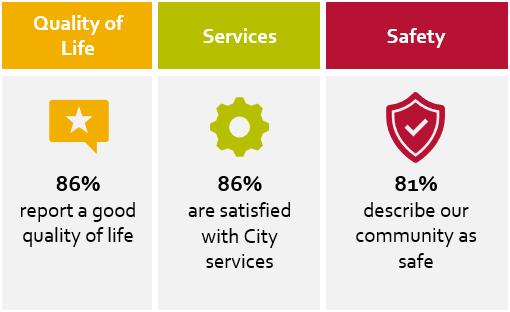
The latest Citizen Survey reports that:
• 86% of citizens have a good quality of life
• 86% of citizens are satisfied with the overall level and quality of City services
• 89% of citizens agree that the City is inclusive and accepting of all
• 81% of citizens feel safe in the community
• 79% of citizens were satisfied with the customer service they received
• 73% of citizens believe they receive good value for their tax dollars
Important issues for citizens include addressing social issues such as homelessness (41%), transportation (26%) and crime (12%).
Citizens’ top three priorities for investment are addressing social issues, encouraging a diverse supply of housing, and traffic flow management.
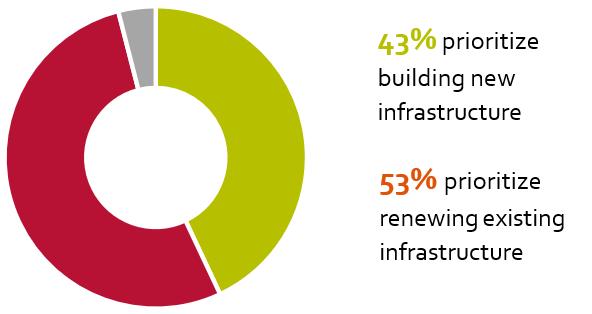
While all evaluated services are important to citizens, the services most important to our residents in 2022 include:


Fire Services
Drinking Water Quality
Community Cleanliness
Police Services
Road Maintenance
Areas of strength amongst City services include fire services, parks and sports fields, drinking water quality, recreational facilities and programs, snow clearing, road maintenance, and police services. Citizens also identified cultural facilities and bylaw services as secondary strengths.
Areas for improvement include traffic flow management and community cleanliness, as well as growth management, public transit, adapting City operations and infrastructure to climate change, and bike lanes and pedestrian sidewalks.
Citizens were also asked if they would prefer tax increases over service reductions:
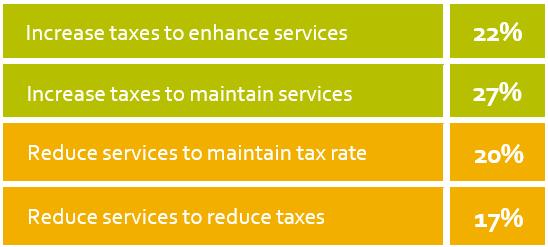
2040 OFFICIAL COMMUNITY PLAN
Our Kelowna as we grow
Kelowna is one of Canada’s fastest growing cities, with another 45,000 citizens expected by 2040. This growth will bring both opportunities and challenges that require us to plan strategically to ensure Kelowna remains prosperous, vibrant and resilient in the years to come.
Our city’s approach to growth will be shaped by the recently adopted 2040 Official Community Plan (OCP), a guiding document which sets a strategic course for the next two decades. An OCP provides a decision-making framework for Council with policies and objectives aimed at growth management and issues related to housing, transportation, infrastructure, parks, economic development, and the natural and social environment.
The 2040 OCP also strives to bring our community’s Imagine Kelowna vision of an equitable, inclusive, sustainable city to life. This will mean making smart choices about how and where we grow, protecting our environment, making meaningful progress towards Reconciliation, and ensuring that everybody who lives here can make a living, find suitable housing, and get around easily and safely.
Building on the goals laid out in Imagine Kelowna, the Plan contains the following 10 Pillars:
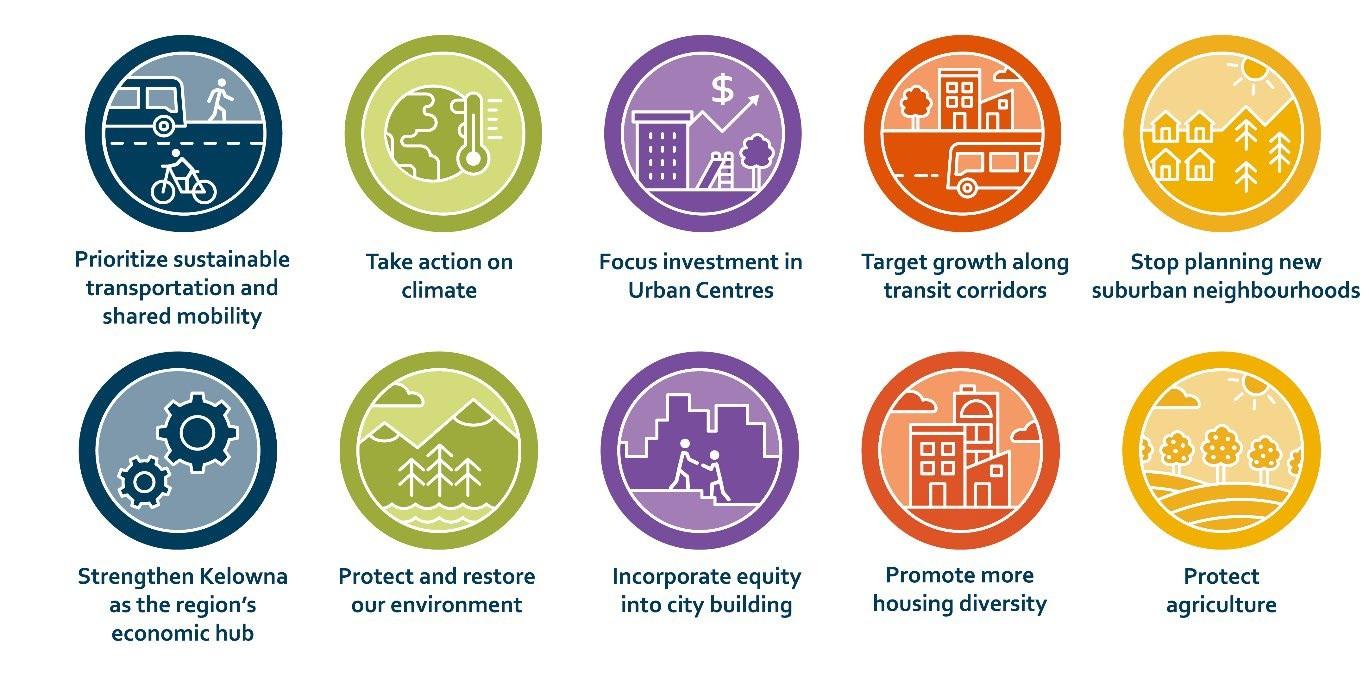
The 2040 OCP includes updated land uses, mapping and policies to reflect these Pillars and clearly signal where development will be prioritized and supported with infrastructure and amenities.
Now that the Plan has been adopted, putting it into action will require several key implementation actions throughout its lifespan. A comprehensive implementation table is being used to guide the timing and resourcing of OCP implementation actions, with due recognition of available budget and other work planning considerations.
STATISTICS
Note:
Local Economy
The City of Kelowna is the largest city in the Central Okanagan. It borders the beautiful Okanagan Lake and has the best of rural and urban lifestyles packed into one unique city. With a diverse economy supported by quality post-secondary institutions, Kelowna has become the main marketing and distribution centre of the Okanagan Valley. Kelowna also has a thriving arts and culture scene combined with all the outdoor activities that make the Central Okanagan a must-see tourism destination, as well as a popular place to live. Settled in 1879 and incorporated in 1905, Kelowna is known for its agriculture and forestry roots and has grown into a modern city.
Doing Business in the Community Development Incentives
Occupation
North American Industry Classification System (NAICS)
Construction Manufacturing
Wholesale and retail trade
Transportation and warehousing
Finance, insurance, real estate, rental and leasing
Professional, scientific and technical services
Business, building and other support services 13
Educational services
Health care and social assistance
Information, culture and recreation
Accommodation and food services
Public administration
Other services (except public administration)
Statistics Canada. Table 14-10-0355-01 Employment by industry, monthly, seasonally adjusted and unadjusted, and trend-cycle, last 5 months (× 1,000)
The City of Kelowna offers several developer incentives to encourage alignment with the City’s strategic priorities for urban development. Tax incentives are available for development in City Centre and Rutland Urban Centres, and grants and tax incentives are available to promote the development of purpose-built rental housing throughout Kelowna. Further information regarding development incentives in Kelowna may be found Kelowna.ca/homes & buildings/developers/ developer incentives
Commercial Land
The major commercial areas within Kelowna are the downtown, Highway 97, and Mission / South Pandosy districts. Kelowna’s 2040 Official Community Plan projects the need for 193,100 square metres of retail commercial space between 2021 and 2040. We also anticipate the need for 119,450 square metres of office space over the same period. The OCP emphasizes land re-use and densification over continued expansion into greenfield areas.
Industrial Land
There are 1,466 acres of existing zoned industrial land within Kelowna’s boundaries. Kelowna has also identified 1,867 acres of land designated for future industrial development in the 2040 Official Community Plan | City of Kelowna. Industrial vacancy rates are currently low, and the market is active and dynamic.
For more information on the local economy, visit www.investkelowna.com.
Source: Economic development | City of Kelowna
Business licences
*The City of Kelowna stopped issuing secondary suite licences in 2017. The business licence stats are measured December 1st to December 1st due to business licence rollover.
Access to markets
Kelowna’s central location provides the city with access to key markets, as well as their population base.
Distance (km) to Kelowna from:
▪ Vancouver – 457
▪ Seattle – 579
▪ Calgary – 612
▪ Portland – 826
▪ Saskatoon – 1,233
▪ Salt Lake City – 1,614
▪ San Francisco – 1,872
▪ Winnipeg – 1,970
▪ Los Angeles – 2,494
▪ Denver – 3,215
GLOSSARY
Accrual basis of accounting: A method of accounting in which transactions are recognized at the time they are incurred, as opposed to when cash is received or spent.
Accumulated surplus: The balance in a fund that represents the cumulative excess in revenues over expenditures. This term also refers to reserve accounts.
Activities: Details how Council, Corporate and Divisional priorities lead the work done at the divisional level; activities are work plans to be accomplished in the current year.
Alternative approval process: To provide electors the opportunity to seek a vote on a particular matter being proposed by Council. Approval is obtained if fewer than 10% of eligible electors in the area submit elector response forms (formerly known as counter-petition process).
Amortization: Is the gradual reduction of debt by means of equal periodic payments sufficient to meet current interest and liquidate the debt at maturity.
Appropriation: Term used to refer to the setting aside of monies into a reserve account or fund.
Balanced budget: Budgeted expenditures and transfers to funds are equal to budgeted revenues and transfers from funds.
Base budget: The initial budget that provides for the existing levels of service in the current year.
Capital assets: Is a long-term asset that is not purchased or sold in the normal course of business. Generally, it includes fixed assets.
Capital expenditures: Expenditures of a non-operating or maintenance nature, such as costs to acquire equipment, land, buildings and costs associated with new infrastructure or improvements to existing infrastructure.
Capital lease: Is a lease obligation that has to be capitalized on the balance sheet.
Cost centre: Within the City’s reporting structure a cost centre refers to a specific director, manager, supervisor or division (see Department/Division/Branch).
Conditional grants: Grants (e.g. Federal and Provincial Government) that are dependent on annual approval and potentially limited in how they may be expended.
Debenture: A form of long-term corporate debt that is not secured by the pledge of specific assets.
Debt service: The amount of interest and payments due annually on long term debt.
Deficit: An excess of expenditure over revenue. A loss in business operations.
Division/Department/Branch: Part of the City’s organization structure. Divisions are the highest level grouping; departments are sections under the division and branches are sections under department. (i.e. Division – Financial Services; Department – Financial Planning; Branch – Budget).
Depreciation: Accounting method used to allocate the cost of a tangible or physical asset over its useful life.
Development Cost Charges (DCCs): Monies collected from land developers to offset some of the infrastructure expenditures required to service new development. Charges are intended to facilitate development by providing a method to finance capital projects related to water, sewer, drainage, roads and parkland acquisition.
Expenditure: The payment of cash on the transfer of property or services for the purpose of acquiring an asset, service or settling a loss.
Expenditure reduction: A request to reduce an existing expenditure level.
Fees and charges: A source of revenue generated by the activities, works or facilities undertaken or provided by or on behalf of the City.
Financial Plan: Section 165 of the Community Charter requires that a municipality must have a financial plan that is adopted annually, by bylaw, before the annual property tax bylaw is adopted. The financial plan may be amended by bylaw at any time and is for a period of 5 years. The financial plan identifies the revenue sources and the proposed expenditures to be incurred to meet the outlined objectives.
Franchise fee: A charge made to a privately owned utility for the ongoing use of City property.
Full-Time Equivalents (FTEs): A conversion measure to express all staffing (temporary, part-time, etc.) in terms of a common full-time denominator.
Fund: A fiscal entity with revenues and expenses which are segregated for the purpose of carrying out a specific activity. The City has four main funds: general, water, wastewater, and airport. There are also various statutory reserve funds.
General Fund: This fund is used to account for general operations and activities and includes most city departments except the enterprise funds of water, wastewater, and airport. The departmental activities in the general fund are funded wholly or in part by property taxes.
General revenue: Refers to the revenues which are not specifically attributable to or generated by any particular department within the City’s reporting structure.
Grants-in-lieu: Properties within a municipality that are owned by the Federal or Provincial governments are exempt from taxation. The City may receive a grant-in-lieu in place of a tax levy.
Infrastructure: Facilities and improvements such as buildings, roads, sidewalks, storm drainage, waterworks, sanitary sewer systems.
Internal control: Include policies and procedures that pertain to the maintenance of accurate and reasonably detailed records.
Internal equipment revenue: Revenue generated from a charge against current operations for the use of a City vehicle or equipment. The charge is similar for a class of vehicles and is based on full recovery plus inflation.
Local Government Act (LGA): Provincial legislation that provides authority for municipal expenditure and revenue collection. Some sections of the LGA have been replaced by the Community Charter.
Modified accrual basis: Modified accrual accounting recognizes revenues when they become available and measurable and with a few exceptions, recognizes expenditures when liabilities are incurred.
Official Community Plan (OCP): A City bylaw that defines policies for land use and development.
Operating expenses: The cost for personnel, internal equipment, materials, contract services and transfers required for a department to function.
Operating request: A request for operating budget that is required to provide a new service or expand an existing service beyond the current funding level.
Operating revenue: Funds that the City receives as income to pay for ongoing operations. It includes such items as taxes, fees and charges from specific services, interest earnings, and grant revenues.
Pay-as-you-go Capital: Capital expenditures that are financed from current year taxation revenues.
Parcel tax: A tax imposed on the basis of a single amount for each parcel, the taxable area of the parcel, or the taxable frontage of a parcel.
Property taxation: The process by which the City obtains the required funds to pay for the General Fund Operating and Capital expenditures of any given year not funded from another source. This is provided by a levy on each property of various classes within the municipality.
Reserve account: Part of the Accumulated Surplus that has been earmarked for future operating or capital expenditures.
Reserve Fund (statutory reserves): A reserve fund is established by Council by bylaw for a specified purpose that is within the powers of the municipality within the powers of the LGA or another Act.
Revenue: Sources of income financing the operations of the City.
Tradewaste Treatment Facility (TWTF): Wastewater treatment facility run by the City but charged back to specific commercial users.
UPASS: A program where students pay a fee per semester that lets them use their student card as a bus pass.
Utility: The City owns two utilities: water, and wastewater. The airport is also treated like a separate utility. These utilities pay for themselves through a separate revenue structure specific to each one that pays for their respective operating costs, debt servicing costs and capital projects not funded from other sources.
Working capital: The excess of current assets over current liabilities.
ACRONYMS & ABBREVIATIONS
AHLAS Affordable Housing Land Acquisition Strategy
AI Artificial Intelligence
AIF Airport Improvement Fee
ALC Active Living & Culture
ALR Agricultural Land Reserve
AMCP Asset Management and Capital Planning
AMS Asset Management System
ASQ Airport Service Quality
ATC Active Transportation Corridor
BCA BC Assessment
BCRPA British Columbia Recreation and Parks Association
BP Building Permit
C&E Climate and Environment
C.C. Community Charter
CAC Child Advocacy Centre
CCTV Closed-circuit television
CLS Corporate Land System
CMHA Canadian Mental Health Association
COJHS Central Okanagan Journey Home Society
COK City of Kelowna
COVID-19 Coronavirus Disease 2019
CPIC Canadian Police Information Centre
CPO Community Policing Office
CPTED Crime Prevention through Environmental Design
CRTC Canadian Radio-television and Telecommunications
CSP Corporate Strategy and Performance
CUPE Canadian Union of Public Employees
CWME Capital Works Machinery & Equipment –statutory reserve fund
DAR Development Application Review
DCC Development Cost Charge
DKA Downtown Kelowna Association
DMAF Disaster Mitigation Adaptation Fund
DMAF Disaster Mitigation and Adaption Fund
DOCP Design Operation and Closure Plan
DVP Development Variance Permit
EOC Emergency Operating Centre
ERF Effective Response Force
ESS Emergency Support Services
EV Electric Vehicle
FCA
Facility Condition Assessment
FOI Freedom of Information
FTE Full-time Equivalent
GAAP Generally Accepted Accounting Principles
GFOA Government Finance Officers Association
GHG Greenhouse Gas
GIS Geographical Information Systems
HAP Heritage Application Permit
HR Human Resources
HVAC Heating, Ventilation and Air Conditioning
IAFF International Association of Fire Fighters
ICBC Insurance Corporation of British Columbia
ICG International Children’s Games
ICIP Investing in Canada Infrastructure Program
IHA Interior Health Authority
IK Imagine Kelowna
IoT Internet of Things
IS Information Services
ITIL Information Technology Infrastructure Library
KCR Kelowna Community Resource
KCT Kelowna Community Theatre
KFD Kelowna Fire Department
KMMFA Kelowna Major Men’s Fastball Association
KPI Key Performance Indicators
KSS Kelowna Secondary School
LAS Local Area Service
LiDAR Light Detection and Ranging
LGCAP Local Government Climate Action Program
LOA Lease and Operating Agreement
MBL Multiple Bottom Line
MEP Major Events Program
MFA Municipal Finance Authority
MoTI Ministry of Transportation and Infrastructure
MOU Memorandum of Understanding
MUP Multi-Use Path
NA Neighbourhood Associations
NG911 Next Generation 911 compliant equipment
NPS Net Promoter Score
NRCan Natural Resources Canada
OC Okanagan College
OCP Official Community Plan
ORT Okanagan Rail Trail
PAC Performing Arts Centre
PAWS Pre-Authorized Withdrawal System
PBMP Pedestrian & Bicycle Master Plan
PBMP Pedestrian and Bicycle Master Plan
PCARD Purchasing CardL
PEOPLE Paid Employment Opportunities for People with Lived Experiences
PRC Parkinson Recreation Centre
PRV Pressure Reducing Valve
PSAB Public Sector Accounting Board
PSAS Public Sector Accounting Standards
Q1 First Quarter
Q2 Second Quarter
Q3 Third Quarter
Q4 Fourth Quarter
RCMP Royal Canadian Mounted Police
RDCO Regional District of the Central Okanagan
RFI Request for Information
RFP Request for Proposal
RIM Records & Information Management
ROI Return on Investment
RRFB Rectangular Rapid Flashing Beacons
S4L Sport For Life
SCA Sewer Connection Area
SCADA Supervisory Control and Data Acquisition
SCBA Self Contained Breathing Apparatus
SD23 School District No. 23
SEK Southeast Kelowna
SEKID Southeast Kelowna Irrigation District
SMART Specific, Measurable, Achievable, Relevant, Timely
SMOR Strategic Management Owned Report
SOMID South Okanagan Mission Irrigation District
STPCO Sustainable Transportation Partnership of the Central Okanagan
TAP Transportation Accelerator Program
TCA Tangible Capital Assets
TMP Transportation Master Plan
TWTF Trade Waste Treatment Facility
UBCM Union of British Columbia Municipalities
UBCO University of British Columbia
URBA Uptown Rutland Business Association
UTV Utility Vehicle
VFD Variable Frequency Drive
WQA Water Quality Advisory
WWTF Wastewater Treatment Facility
YLW Kelowna International Airport