52 MAHARAJA BHIM SINGH IN DURBAR
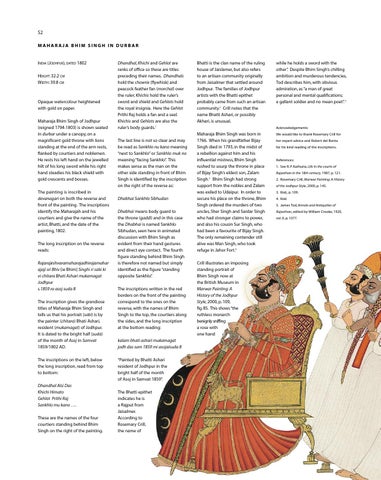
INDIA (JODHPUR), DATED 1802 HEIGHT: 32.2 CM WIDTH: 39.8 CM
Opaque watercolour heightened with gold on paper. Maharaja Bhim Singh of Jodhpur (reigned 1794-1803) is shown seated in durbar under a canopy, on a magnificent gold throne with lions standing at the end of the arm rests, flanked by courtiers and noblemen. He rests his left hand on the jewelled hilt of his long sword while his right hand steadies his black shield with gold crescents and bosses. The painting is inscribed in devanagari on both the reverse and front of the painting. The inscriptions identify the Maharajah and his courtiers and give the name of the artist, Bhatti, and the date of the painting, 1802. The long inscription on the reverse reads: Rajarajeshvaramaharajadhirajamahar ajaji sri Bhiv [ie Bhim] Singhi ri sabi ki vi chitara Bhati Ashari mukamagat Jodhpur s.1859 ra asoj suda 8 The inscription gives the grandiose titles of Maharaja Bhim Singh and tells us that his portrait (sabi) is by the painter (chitara) Bhati Ashari, resident (mukamagat) of Jodhpur. It is dated to the bright half (suda) of the month of Asoj in Samvat 1859/1802 AD. The inscriptions on the left, below the long inscription, read from top to bottom: Dhandhal Alsi Das Khichi Himato Gehlot Prithi Raj Sankhlo mu kano …. These are the names of the four courtiers standing behind Bhim Singh on the right of the painting.
Dhandhal, Khichi and Gehlot are ranks of office so these are titles preceding their names. Dhandhals hold the chowrie (flywhisk) and peacock feather fan (morchal) over the ruler; Khichis hold the ruler’s sword and shield and Gehlots hold the royal insignia. Here the Gehlot Prithi Raj holds a fan and a seal. Khichis and Gehlots are also the ruler’s body guards.1 The last line is not so clear and may be read as Sankhlo nu kano meaning “next to Sankhlo” or Sankhlo muk no meaning “facing Sankhlo”. This makes sense as the man on the other side standing in front of Bhim Singh is identified by the inscription on the right of the reverse as: Dhabhai Sankhlo Sibhudan Dhabhai means body guard to the throne (gaddi) and in this case the Dhabhai is named Sankhlo Sibhudan, seen here in animated discussion with Bhim Singh as evident from their hand gestures and direct eye contact. The fourth figure standing behind Bhim Singh is therefore not named but simply identified as the figure “standing opposite Sankhlo”. The inscriptions written in the red borders on the front of the painting correspond to the ones on the reverse, with the names of Bhim Singh to the top, the courtiers along the sides, and the long inscription at the bottom reading: kalam bhati ashari mukamagat jodh das sam 1859 mi asojaisuda 8 “Painted by Bhatti Ashari resident of Jodhpur in the bright half of the month of Asoj in Samvat 1859”. The Bhatti epithet indicates he is a Rajput from Jaisalmer. According to Rosemary Crill, the name of
Bhatti is the clan name of the ruling house of Jaislamer, but also refers to an artisan community originally from Jaisalmer that settled around Jodhpur. The families of Jodhpur artists with the Bhatti epithet probably came from such an artisan community.2 Crill notes that the name Bhatti Ashari, or possibly Akhari, is unusual.
while he holds a sword with the other”. Despite Bhim Singh’s chilling ambition and murderous tendencies, Tod describes him, with obvious admiration, as “a man of great personal and mental qualifications; a gallant soldier and no mean poet”. 5
Acknowledgements:
Maharaja Bhim Singh was born in 1766. When his grandfather Bijay Singh died in 1793, in the midst of a rebellion against him and his influential mistress, Bhim Singh rushed to usurp the throne in place of Bijay Singh’s eldest son, Zalam Singh.3 Bhim Singh had strong support from the nobles and Zalam was exiled to Udaipur. In order to secure his place on the throne, Bhim Singh ordered the murders of two uncles, Sher Singh and Sardar Singh who had stronger claims to power, and also his cousin Sur Singh, who had been a favourite of Bijay Singh. The only remaining contender still alive was Man Singh, who took refuge in Jahor Fort.4 Crill illustrates an imposing standing portrait of Bhim Singh now at the British Museum in Marwar Painting: A History of the Jodhpur Style, 2000, p. 109, fig. 85. This shows “the ruthless monarch benignly sniffing a rose with one hand
We would like to thank Rosemary Crill for her expert advice and Robert del Bonta for his kind reading of the inscriptions.
References: 1. See R. P. Kathuria, Life in the courts of Rajasthan in the 18th century, 1987, p. 121. 2. Rosemary Crill, Marwar Painting: A History of the Jodhpur Style, 2000, p. 145. 3. Ibid., p. 109. 4. Ibid. 5. James Tod, Annals and Antiquities of Rajasthan, edited by William Crooke, 1920, vol. II, p. 1077.