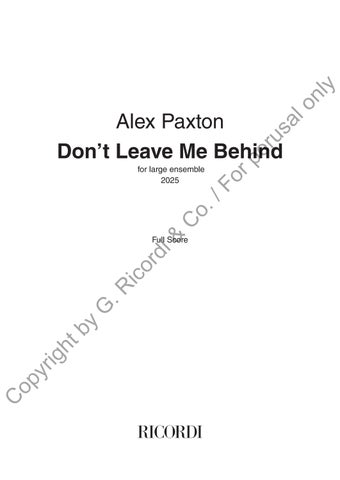
Sy. 9236 - Alex Paxton - Don't Leave Me Behind(2025)

Page 1


Alex Paxton

Don’t Leave Me Behind

master processed on 24.04.2025

Sy. 9236/01

ISMN 979-0-2042-9236-3

Copyright © 2025 by G. Ricordi & Co. Bühnen- und Musikverlag GmbH, Berlin

Alle Rechte vorbehalten

rights reserved / Tutti i diritti riservati

Commissioned by Wigmore Hall, Ensemble Modern & Philharmonie Essen

Premiered on 28th June 2025 at Wigmore Hall, London by Ensemble Modern, conducted by Vimbayi Kaziboni

PERFORMANCE NOTES

All things should be heard all the time.

is piece can be played amplied or un-amplied. Amplied is preferred.

Busy sections should not be a cacophony. If necessary each rhythmic unison layer in these sections should be isolated and built back up to build the whole, and sensitively balance with the rest of the orchestra.

For best results keyboard and sample patches (and individual samples) can be edited throughout the rehearsal process in order to t with a given ensemble/ room.

Rhythms should always be interpreted with strict and uncompromising metric accuracy, as if in a big band (or other rhythmic-music context).

Many phrases should be interpreted with an emphasised lyrical shape to the dynamic. String players should consider senza vibrato as the default unless instructed otherwise.

In the winds and brass, playful inconsistencies and ornamentation in articulation, tone, intonation, expression, vibrato, dynamics etc. are warmly encouraged.

Keyboards/MIDI Vibraphone output can be in stereo or mono. If stereo, onstage monitors for the performers is advised. Mono can be used with individual amps/speakers

A careful balance should be achieved where the loudspeakers are as loud as possible without obliterating the acoustic sounds. e balance of sounds should be constructed from the perspective of the listener and include all sounds from speakers and acoustic instruments equally.

INSTRUMENTATION

Flute (= Piccolo, Alto Flute)

Oboe(= Kazoo)

Clarinet in Bb (= Clarinet in Eb)

Bassoon

Trumpet in Bb (= Piccolo Trumpet in Bb) (Harmon mute with stem)

Percussion (1 player)

MIDI Vibraphone F3-F6 (to mono onstage amp or stereo L & R)

Egg Shaker, Triangle, Kokiriko

Keyboard 1 (= Melodica)

Keyboard 2 (= Kazoo) (Keyboards to mono onstage amp or stereo L & R)

Violin I

Violin II

Viola

Violoncello

Bass*

*Option 1: Upright Electric Double Bass (or Bass Guitar) doubling Double Bass for arco passages

Option 2: Upright Electric Bass

Option 3: Double Bass, in which case pizz. passages need to be louder than written

CopyrightbyG.Ricordi&Co./Forperusalonly

Duration: approx. 21 minutes

Score is in transposing pitch

Sung material of Clarinet & Trumpet is in C

b

Don’t Leave Me Behind

SING (any octave, sounds that feel most natural)

SING (any octave, sounds that feel most natural)

SING (at pitch, any sounds; as if singing to yourself)

con sord. default: senza vib.ad lib. gliss. gliss.

ad lib bowing (long)

ad lib bowing (long)

con sord. default: senza vib.ad lib. gliss. q q. gliss.

con sord. default: senza vib. ad lib. bowing (long)

con sord. default: senza vib. >

Alex Paxton (2025)
Oboe
Clarinet in B
Bassoon

ad lib. circular bowing senza vib.

ad lib. circular bowing senza vib.

ad lib. circular bowing senza vib.

ad lib. circular bowing senza vib.

ad lib. gliss. (across strings)

ad lib. gliss. (across strings)

Vln. II

ad lib. gliss.

ad lib. gliss.

ad lib. gliss.

ad lib. gliss. pizz., to the fore

Vln. II

pizz., to the fore

sul tasto

ad lib. low gliss. between two pitches out of sync with all others

ad lib. low gliss. between two pitches out of sync with all others

electric guitar-like

electric guitar-like

ad lib. gliss (across strings)

as loud as poss.

as loud as poss.

whistle (no instrument)

as loud as poss.

as loud as poss.

as loud as poss.

as loud as poss.

with a straight course tone. Celtic "ddle" with a straight course tone. Celtic "ddle"

Vln. I
Vln. II

SING (no instrument) any octave

SING (no instrument) any octave

SING (no instrument) any octave

as loud as poss.

as loud as poss.

as loud as poss.

as loud as poss.

as loud as poss.

sing long slow gliss. from top to bottom of singing range

sing long slow gliss. from top to bottom of singing range

SING (any octave, using sounds that feel most natural)

SING (any octave, using sounds that feel most natural)

SING (any octave, using sounds that feel most natural)

R1

SING (any octave, using sounds that feel most natural)

SING (any octave, using sounds that feel most natural)

SING (any octave, using sounds that feel most natural)

SING (any octave, using sounds that feel most natural)

SING (any octave, using sounds that feel most natural)

f espress.

f espress.

f espress.

Vln. I
Vln. II
Vla.

SING (any octave)

SING (any octave)

SING (any octave)

SING (any octave)

ad lib. noisy gliss. circular bowing

SING gliss. from bottom to top of singing range

Turn static files into dynamic content formats.

Create a flipbook
Sy. 9236 - Alex Paxton - Don't Leave Me Behind(2025) by Ricordi - Issuu