The Canadian
ISSUE NO. 23
SEP–OCT 2026
INDIGENOUS SME Empowering Canadian Indigenous Businesses
Shipping Partner
Page 7
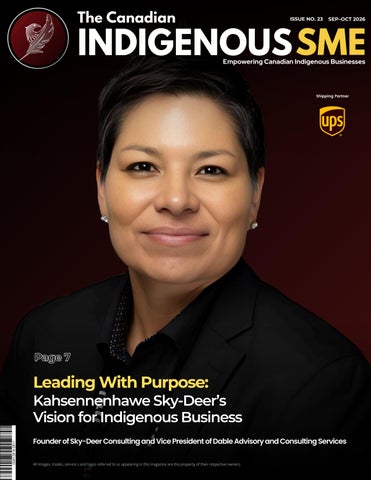
Leading With Purpose:
Kahsennenhawe Sky-Deer’s Vision for Indigenous Business Founder of Sky-Deer Consulting and Vice President of Dable Advisory and Consulting Services All Images, trades, service s and logos referred to or appearing in this magazine are the property of their respective owners.
CONTENTS
10 Business Woman of the Month
Alissa Assu 35
Creating Pathways for Indigenous Founders Through Innovation
35
Creating New Opportunities Through Indigi-Tech Skills
41
Supporting Indigenous Entrepreneurs Through Traditional Wellness
32
Supporting Indigenous Entrepreneurs Through Financial Education
SEP–OCT 2026
20
17
29
14
How Young Indigenous Entrepreneurs Are Creating Community Impact
Empowering Indigenous Leaders Through Business Education
26
Indigenous Business Women Strengthening Communities Through Mentorship
More Than the Mic: Justin Holness on Creating Meaningful Experiences as an MC
Brewing Change: Mark MarsolaisNahwegahbow’s Vision for Birch Bark Coffee Company
44
Integrating Indigenous Wellness Into Modern Business Practices
47
How Indigenous-Led Training Programs Are Shaping the Workforce
Dear Readers, In this September–October 2026 edition of Indigenous-SME Business Magazine, we focus on Skillsets and Wellness, exploring how education, cultural knowledge, digital literacy, and well-being are contributing to stronger Indigenous businesses and communities. From skill development and business education to holistic health and mental well-being, this issue highlights the resources, ideas, and leaders helping Indigenous entrepreneurs build sustainable futures. We are proud to feature Alissa Assu, Owner of West Coast Wildflowers, RavenSong Soap & Candle, and Bear Essential Oils, and Indigenous Consultant, as our Business Woman of the Month. Her entrepreneurial journey reflects the power of creativity, cultural connection, and community-centred business leadership. This edition also brings together inspiring conversations with Indigenous leaders and entrepreneurs. Mark MarsolaisNahwegahbow, Founder and CEO of Birch Bark Coffee Company Inc., shares the vision behind building a purpose-driven Indigenous coffee company. Kahsennenhawe Sky-Deer, Founder of Sky-Deer Consulting and Vice President of Dable Advisory and Consulting Services, discusses leadership, purpose, and creating opportunities for Indigenous businesses. We also feature Justin Holness, an Afro-Indigenous artist and entrepreneur, exploring how meaningful experiences, storytelling, and connection can extend far beyond the microphone. Our broader features examine building future-ready Indigenous talent through community leadership, empowering Indigenous leaders through business education, and creating pathways for Indigenous founders through innovation. Together, these stories demonstrate how knowledge, mentorship, technology, and community support can strengthen entrepreneurial capacity and create lasting opportunities. Through this edition, we celebrate the entrepreneurs and leaders who recognize that business success is about more than growth. It is also about developing skills, supporting well-being, strengthening communities, and creating opportunities for the generations that follow.
www.indigenous-sme.ca info@canadiansme.ca IndigenousSME indigenousSME indigenousmagazine canadiansme
Editor Darian Kovacs Publisher Shaik Khaleeluddin (SK) Creative Design Ceting Inc Client Manager Maheen Bari Social Media Ceting Inc Photography Deposit Photos/Canva/123RF/CanadianSME Web design Ceting Inc For Advertisements info@canadiansme.ca Ceting Inc 6345 Dixie Rd, Unit 202, Mississauga, ON L5T 2E6 Call us at +1 416 655 0205 /647 668 5785
ISSN 2816 - 2811 (Online)
Warm regards,
Published by Indigenous-SME Inc., 6345 Dixie Rd, Unit 202, Mississauga, ON L5T 2E6 Copyright © 2026 Indigenous-SME Inc. All rights reserved. Reproduction in whole or part of any text, photography or illustrations without written permission from the publisher is prohibited. Darian Kovacs Indigenous Business Leader in eting, Communications, & PR
All Images, trades, service s and logos referred to or appearing in this magazine are the property of their respective owners.
The contents in The Canadian Indigenous-SME Business Magazine are for informational purposes only. Neither Ceting Inc, the publishers nor any of its partners, employees, or affiliates accept any liability whatsoever for any direct or consequential loss arising from any use of its contents.
Image Courtesy: Kahsennenhawe Sky-Deer
In an exclusive interview with IndigenousSME Business Magazine, Kahsennenhawe Sky-Deer, Founder of Sky-Deer Consulting and Vice President of Dable Advisory and Consulting Services, reflects on her transition from community leadership to entrepreneurship and her continued commitment to creating meaningful opportunities for Indigenous communities.
Interview By SK Uddin Kahnawà:ke. She made “herstory” in 2021, when she was the first woman who also identifies as Two Spirit to ever be elected to the position. Prior to that she served her community as a Council Chief for twelve consecutive years. During her tenure as Grand Chief, she signed a historic deal with Hydro Quebec for a partnership to bring clean renewable electricity to New York City (CHPE). She recently was able to help raise 56 million dollars as the chairperson of a capital campaign for a new building for Language, Culture, Tourism and a museum in Kahnawà:ke.
Leading With Purpose: Kahsennenhawe Sky-Deer’s Vision for Indigenous Business Founder of Sky-Deer Consulting and Vice President of Dable Advisory and Consulting Services
7 - Indigenous-SME Sep–Oct 2026
Economic Reconciliation
In July 2024, she launched her own business called Sky-Deer Consulting and in January 2025 she became the Vice President of Dable Advisory and Consulting Services in Kahnawà:ke. Through these roles she continues to work in advancing and improving the realities faced by First Nation communities. Sky-Deer has always been a trailblazer as she was a starting quarterback in the inaugural season of women’s professional tackle football in 2000, playing for 6 seasons in Florida before going back to school and graduating with a Bachelor’s Degree in Psychology from the University of Central Florida. She was an honored with the United Natives Athlete of the Year Award during the Super Bowl Week in New Orleans in February 2025 for trailblazing in the sport and in
What inspired you to launch Sky-Deer Consulting? After my mandate came to an end during the 2024 Election cycle, I took the summer to reflect on what would be my next move. I really enjoyed the work that I was doing during my tenure at the Mohawk Council of Kahnawà:ke as a Council Chief and then becoming the first Two-Spirit Grand Chief in the community. I dedicated 15 years of my life to the position, taking valuable time away from family and friends to serve my community, but also doing purpose driven work to leave Kahnawà:ke in a better place than when I got here. So I decided that I didn’t need to be the Chief to Chief and that I could continue to create positive relationships with other Nations, Companies, Corporations and people across Turtle Island. I once had a great mentor who told me that the future of our People will depend on the balance of Cultural Preservation and Economic Development. That stuck with me, so I launched Sky-Deer Consulting on his birthday August 29th, to always remember his legacy and because the date also resonated with me by also being born on a 29th of a month.
leadership. She received the King Charles III Coronation Medal of Honor in December 2024 for Commerce, Industry and Economy. In 2023 she received a lesbian visibility award from the Quebec Lesbian Network and was on the cover and featured in the 7th edition of lstw magazine. More recently, she was one of the Stone Gatherers for the Thunderhead Monument in Ottawa to commemorate the LGBTQ Purge. Sky-Deer continues to motivate and inspire young girls, women, 2SLGBTQ+ individuals that you can shatter glass ceilings and achieve your dreams by being your true and authentic self. Sky-Deer does public speaking engagements and panels across various sectors to educate and inspire the next generation of leaders.
How do your community values shape the way you lead and work with clients? There are many teachings and values in my culture that I carry with me. I’ve learned from a young age to give thanks and to be grateful for all of the elements of creation and to try to live in balance with the natural world as much as possible. I understand the Seven Generations principle and considering the impacts of the decisions we make today, must consider the faces yet to come. Although not from my culture, I find the Seven Grandfather Teachings of the Anishnabek Nations also fundamental of how to be and carry yourself in life. In terms of professionalism and having a strong work ethic, I have had many examples from people on both sides of my family who inspired me. So leading by example, in other words walking the talk is also important when dealing with clients. I treat everyone with compassion, dignity and respect and try to relate to people through my sense of humor. Another value is our reputation of being trailblazers and a proud Nation as the Kanien’keha:ka, so I like to try to help other Nations build their capacity, to inspire their youth by sharing our stories of resilience and success.
8 - Indigenous-SME Sep–Oct 2026
Economic Reconciliation What does meaningful partnership with Indigenous communities look like to you?
What has been one important lesson from your leadership journey?
I’m tired of hearing about IBA’s aka Impact Benefit Agreements! I want to hear more about Equity partnerships, Indigenous ownership and empowerment. I think if this Country is going to move in a positive direction now and in the future, we need to break down the barriers and silos that have kept us segregated. This is what has led to continued stereotyping, ignorance and racism. At the end of the day, we will realize that we all want the same things; peace, love, safety, opportunity, equality. So I’d like to see more collaboration between non-indigenous settlers and the First Nations whose land they are on. A perfect example is how so many people in the Montreal area helped my community raise 56 million for a Language and Cultural Center, Museum, Theatre so that we could have a collective space to share knowledge and history. They seen a vision and dream
I would say to take the risk and follow my gut. In 2021 when I made the decision to run for Grand Chief, had I lost I would have been jobless after 12 years as a Council Chief. I took the chance, won the election and made history, but it was a difficult yet fulfilling 3 years of my life, because I did a lot of amazing things despite the Pandemic. I also learned that you cannot please everyone and that you are the easiest target in the community for lateral violence and personal attacks. When I lost my re-election in 2024 I made the decision to start my own business with my name, experience, reputation and hope that I would be successful. I trusted that things would work out as the universe intended because I’m a believer in “everything happens for a reason”. It’s been two years and I could not be happier with my freedom, flexibility and passion to do purpose driven work! So the lesson and take away is to not be afraid to take a risk, because if things don’t work out the way you thought, maybe you are just meant to be on a different path.
What advice would you give to Indigenous entrepreneurs and future leaders? To believe in yourself and You will never be 100 percent ready for the curve balls that life will throw at you.
Disclaimer: Indigenous-SME Business Magazine is committed to providing insightful interviews that highlight the successes and challenges faced by small and medium-sized businesses. The views expressed in this interview are those of the guest and may not reflect the opinions of the magazine or its affiliates.
9 - Indigenous-SME Sep–Oct 2026
Image Courtesy: Alissa Assu
By SK Uddin
Alissa Assu’s Journey of Healing, Leadership, and Enterprise Alissa Assu (Derrick-Nguyễn) aims to create an enterprise that prioritizes culture, care, and community. She is a proud member of the Wet'suwet'en First Nation, with Nisga'a and Vietnamese ancestry, and the founder of West Coast Wildflowers and Little Wildflowers, as well as a co-owner of Bear Essential Oils
and second-generation storyteller for RavenSong Soap & Candle, four Indigenous-owned businesses grounded in authenticity, land
stewardship, and intergenerational healing. Her narrative is also one of tenacity: as a mother, former Youth-In-Care participant, and kidney transplant recipient celebrating 15 years post-
transplant in June 2026, she has converted personal experience into purpose, and purpose into business.
Business Woman of the Month
Alissa Assu Owner West Coast Wildflowers, RavenSong Soap & Candle, Bear Essential Oils. Indigenous Consultant
10 - Indigenous-SME Sep–Oct 2026
Business Woman of the Month
A Journey Rooted in Resilience
Image Courtesy: Alissa Assu
Alissa's entrepreneurial journey is inextricably linked to her life experiences. She identifies herself as a mother, a former Youth-In-Care, a kidney transplant survivor, an Indigenous patient partner advocate for equity and accessibility in health care, and an Indigenous entrepreneur—identities that are both difficult and empowering. Rather than viewing her experiences as obstacles, she has turned them into sources of wisdom and leadership. Her work is profoundly rooted in traditional ecological knowledge, land stewardship, and intergenerational healing. That grounding is important because it influences not just what she sells but also how she
builds. Alissa's approach is slower, more relational, and purposeful in a retail industry that frequently prioritizes speed and scale. She is building enterprises that appreciate place, respect people, and reflect reciprocity.
For readers of Indigenous-SME Business Magazine, her
path serves as a reminder that entrepreneurship may be a kind of reclamation. It has the potential to restore cultural pride, offer economic opportunities, and allow Indigenous worldviews to be heard in settings where they have previously been excluded.
West Coast Wildflowers and Indigenous Commerce Alissa founded West Coast Wildflowers, an Indigenous lifestyle and wellness gift store on Vancouver Island that does more than just sell things; it also conveys stories. Located on the ancestral territory of the Ligwiłda'xw Peoples, the store promotes authentic Indigenous artisans and manufacturers in Canada through ethical and local trade. West Coast Wildflowers is more than just a store; it's a hub for Indigenous creativity and economic autonomy. By curating products by Indigenous artists and artisans, the company promotes awareness, et access, and financial prospects for groups who are frequently excluded from mainstream retail channels. It also promotes the notion that Indigenous commerce should be based on respect, permission, and partnership, rather than extraction.
The boutique’s concept echoes Alissa’s bigger mission: to enhance local economies one story, one product, and one collaboration at a time. That word is significant because it embodies the essence of Indigenous entrepreneurship—business as relationshipbuilding, not transaction-making. In a province like British Columbia, where Indigenous tourism, arts, and retail are becoming more prominent, West Coast Wildflowers exemplifies what a culturally grounded company can look like when values guide the way.
11 - Indigenous-SME Sep–Oct 2026
Business Woman of the Month
Image Courtesy: Alissa Assu
This is especially relevant in a et where Indigenous identity is frequently taken, commodified, or utilized without permission. Alissa's company approach challenges this pattern by emphasizing sincerity and respect. According to her, the purpose is to build safe and inclusive spaces for Indigenous peoples in competitive retail markets—spaces that reflect a different perspective and oppose continued appropriation. Bear Essential Oils demonstrates how Indigenous entrepreneurship can be both commercially
successful and culturally protective. It provides a product while also inviting customers to engage in an ethical relationship with land-based
knowledge and Indigenous values. That difference elevates the company beyond a wellness brand and transforms it into a declaration of sovereignty.
RavenSong and the Power of Story Bear Essential Oils: Wellness with Cultural Integrity Alissa's work now extends into the wellness sector with Bear Essential Oils. The brand sells 100% pure,
organic, ethically sourced, and wildcrafted essential oils that combine cultural teachings with modern self-care techniques. However, the company's relevance extends beyond product promises. It is intended to honour traditional knowledge and communal spirit while allowing for Indigenous methods to wellbeing.
Alissa's RavenSong Soap & Candle combines ritual, storytelling, and design. Each piece is
handcrafted to reconnect people to their culture, place, and purpose. In many respects, this venture exemplifies the emotional and cultural side of Indigenous entrepreneurship: the
awareness that things may carry memory, meaning, and responsibility. RavenSong also contributes to her broader ecosystem of businesses by demonstrating how diverse ventures can collaborate to reinforce a shared objective.
Alissa's businesses, whether they sell soaps, candles, oils, or retail, are united by a common thread: healing through creation. For Indigenous-SME readers, this is a powerful lesson in brand coherence. When the story, values, and product all coincide, a company becomes more durable, memorable, and influential. Image Courtesy: Alissa Assu
12 - Indigenous-SME Sep–Oct 2026
Business Woman of the Month
Leadership, Community, and Collective Care Alissa's leadership extends beyond business ownership. As a 2022/2023 Coralus Activator, she collaborated with changemakers to reimagine the company through collaborative care and shared leadership. This accolade demonstrates her dedication to community-based entrepreneurship and business concepts that do not divorce success from responsibility. Her work also emphasizes the need to build environments where Indigenous
As Alissa looks toward our next major milestone, she is building her own dedicated production and retail facility. A significant step toward long-term Indigenous economic sovereignty and self-determination. For Indigenous entrepreneurs, owning and building spaces rather than renting them represents an investment in community wealth and the ability to create opportunities for future generations. By establishing a permanent home for her businesses, Alissa is creating a space where entrepreneurship, research and innovation can thrive.
people can thrive without compromising their identity or values. In the retail and wellness industries, she is actively resisting appropriation
She is actively seeking bulk ordering partnerships with
than exploit Indigenous contributions.
corporate gifts, conference packages, client appreciation
and advocating for models that recognize rather
This is especially important for female
entrepreneurs because it illustrates that leadership can be both commercially successful and culturally responsible. Alissa demonstrates that when
organizations, businesses, tourism operators, and community groups across Canada. If you are planning items, tourism retail offerings, or special event gifting in 2026, Alissa invites you to consider West Coast Wildflowers and RavenSong Soap & Candle. To discuss bulk orders, partnerships, or custom gifting opportunities, please
Indigenous women lead with their lived truth, they can build enterprises that heal, protect, and inspire.
contact Alissa Assu at alissa@ravensongsoap.com.
Lessons for Indigenous Entrepreneurs
Creating Lasting Impact Through Culture and Enterprise
Alissa Assu's path offers clear insights for Indigenous SMEs. Build on your values. Her enterprises are based on reciprocity, authenticity, and respect. Let culture guide commerce. She uses retail, wellness, and storytelling to create spaces that reflect Indigenous worldviews. Think ecosystem, not single product. Her ventures complement one another and enhance their communal impact. Make a place for healing. Entrepreneurship can lead to healing, restoration, and rejuvenation. Her experience demonstrates how business may promote both economic progress and cultural continuity.
Alissa Assu is proving that business can be an act of healing, sovereignty, and relationship on Vancouver Island and in larger Indigenous and Canadian markets. Through her enterprises, she creates spaces for Indigenous voices, values, and knowledge to thrive.
The Indigenous-SME Business Magazine is a great new and seasoned resource for Canada's small Indigenous businesses. Visit the website below to view our magazine. Click here to follow our X account for news updates. So, what are you waiting for? Join our business-loving community for inspiration, motivation, and growth. Disclaimer: This article is based on publicly available information intended only for informational purposes. Indigenous-SME Small Business Magazine does not endorse or guarantee any products or services mentioned. Readers are advised to conduct their research and due diligence before making business decisions.
13 - Indigenous-SME Sep–Oct 2026
Image Courtesy: Mark Marsolais-Nahwegahbow
Brewing Change: Mark Marsolais-Nahwegahbow’s Vision for Birch Bark Coffee Company Founder & CEO of Birch Bark Coffee Company Inc In an exclusive interview with Indigenous-SME Business Magazine, Mark MarsolaisNahwegahbow, Founder & CEO of Birch Bark Coffee Company Inc., shares his journey of building a First Nations-owned Canadian coffee company rooted in culture, quality and community impact. An Ojibwe entrepreneur and Citizen of Whitefish River First Nation, Mark brings nearly four decades of experience in justice, education and Indigenous advocacy to his work in business.
Interview By Darian Kovacs From a vision to create meaningful change through everyday coffee, Mark has grown Birch Bark Coffee Company into a Certified Indigenous, Fairtrade and Canada Organic business, while establishing the Birch Bark Foundation Fund to support Indigenous communities and organizations. His story demonstrates how Indigenous entrepreneurship can combine national business growth with cultural identity, purpose and lasting community impact.
14 - Indigenous-SME Sep–Oct 2026
Community Impact Mark Marsolais-Nahwegahbow is an Ojibwe entrepreneur, Band Member and Citizen of Whitefish River First Nation on Manitoulin Island. He is the founder and CEO of Birch Bark Coffee Company, a First Nations-owned Canadian coffee company built on the belief that business can be successful while creating meaningful change. Before becoming an entrepreneur, Mark spent close to four decades working in justice, education and Indigenous advocacy, including work as a Gladue writer, consultant and college instructor.Through Birch Bark Coffee Company, Mark has built relationships with major institutions, corporations, retailers, colleges and universities across Canada. The company is a Certified Indigenous Business, Fairtrade certified and Canada Organic certified. Mark also established the Birch Bark Foundation Fund through the Ottawa Community Foundation to create a permanent way for the company’s success to support Indigenous communities and organizations.
How does Indigenous culture and community shape your business? Indigenous culture is not something we added to Birch Bark Coffee Company as a marketing strategy. It is part of who we are. I am Ojibwe and a citizen of Whitefish River First Nation. The way I was raised, the teachings I have received and my experiences working with Indigenous communities have shaped how I look at business. For me, relationships matter. Respect matters. Accountability matters. And when you are successful, you have a responsibility to think beyond yourself. That is reflected in our products, our artwork, our storytelling and the organizations and communities we work with. But it also affects how I make decisions behind the scenes. I want young Indigenous people to see companies like Birch Bark Coffee and understand that we can build businesses that compete nationally without giving up who we are. We do not have to choose between culture and business success. We can bring both together and create something uniquely our own.
What inspired you to launch Birch Bark Coffee Company? Birch Bark Coffee Company started with something much bigger than coffee. I was deeply troubled by the fact that First Nations communities in Canada were still living without reliable access to clean drinking water. I kept asking myself what I could personally do about it. I did not come from the coffee industry. I came from close to four decades of working in justice, education and with Indigenous people and communities. But I understood that business could become a vehicle for change. Coffee made sense because it is something millions of Canadians drink every day. I saw an opportunity to build a First Nations-owned national coffee company that could compete based on quality while also creating a way to give back. I started Birch Bark Coffee Company with very little, but with a clear purpose: sell great coffee, build a strong Indigenous business and use that success to help create lasting positive change. That purpose still guides us today.
15 - Indigenous-SME Sep–Oct 2026
Community Impact What does meaningful impact mean to you as a business owner?
What advice would you give to Indigenous entrepreneurs starting a business today?
Meaningful impact must outlast the sale that created it. As the company grew, I realized the commitments I had made needed a permanent structure behind them, not just good intentions. That led to the creation of the Birch Bark Foundation Fund through the Ottawa Community Foundation. It provides a transparent and long-term way for our success to support Indigenous-serving organizations and initiatives, and it supports seven of them, each one paired with one of the Seven Grandfather Teachings. Impact also means creating visibility. Every time Birch Bark Coffee is served in a workplace, university, institution, store or home, people are seeing a First Nations-owned company competing in the mainstream Canadian economy. To me, success is not simply how much coffee we sell
You can spend years waiting for the perfect business plan, enough money, the right partner or someone to tell you that your idea is good enough. At some point, you have to move. Know why you are starting the business and protect that reason. Learn your numbers. Understand your costs. Ask questions when you do not know something and never be embarrassed about learning. Most importantly, do not underestimate your value as an Indigenous entrepreneur. Being Indigenous should never mean that your company is expected to be smaller, cheaper or less competitive. Build something that can stand beside any other company in your industry. Surround yourself with people who genuinely want you to succeed, but maintain control over your business and your decisions.There will be mistakes. I have made plenty. The important thing is learning from them quickly and continuing forward. And remember that success does not require you to leave your identity behind.
It is what we are able to build because we sold it. What challenges have helped shape your entrepreneurial journey? Almost every stage of building Birch Bark Coffee Company involved learning something the hard way. I did not start with investors, a large team or decades of experience in the coffee industry. While building the company, I had to learn purchasing, roasting, packaging, logistics, pricing, distribution, retail and national accounts.There have been supplier changes, rising coffee costs, distribution challenges and relationships that did not work out as I expected. Those experiences taught me one of the most important lessons in business: never become so dependent on one supplier, customer or relationship that you lose control of your company. They also taught me to trust my instincts. As Indigenous entrepreneurs, we sometimes walk into rooms where nobody expects us to own the company or be the decision-maker. You learn quickly that you have to understand your value and be prepared to stand your ground. Challenges have made Birch Bark Coffee stronger because they forced me to keep adapting.
Bring it with you. What is next for Birch Bark Coffee Company, and how can readers support the work? We are focused on growth that we can sustain. That means expanding into more retail, campus and workplace coffee programs across the country, and continuing to build the kind of national presence that lets the Foundation Fund do more every year. The most direct way to support this work is to choose our coffee. Anyone can order through our website, and organizations can bring Birch Bark into their offices, campuses and events through our wholesale program. For companies thinking about economic reconciliation, this is one of the most practical places to begin. Procurement is a decision you already make every day. Choosing to buy from Indigenous-owned businesses turns a routine purchase into something that strengthens Indigenous families and communities. Every bag does something. That has been the idea from the first day.
Disclaimer : Indigenous-SME Business Magazine is committed to providing insightful interviews that highlight the successes and challenges faced by small and medium-sized businesses. The views expressed in this interview are those of the guest and may not reflect the opinions of the magazine or its affiliates.
16 - Indigenous-SME Sep–Oct 2026
Justin Holness
on Creating Meaningful Experiences as an MC Interview By SK Uddin
Afro-Indigenous Artist, Entrepreneur, Humanitarian, and Emcee In an exclusive interview with Indigenous-SME Business Magazine, Justin Holness, Afro-Indigenous Artist, Entrepreneur, Humanitarian, and Emcee, shares how music, storytelling, and community have shaped his approach to creating meaningful experiences. From performing as an artist to guiding audiences through live events, Justin discusses the importance of authenticity, presence, and understanding the energy of a room.
17 - Indigenous-SME Sep–Oct 2026
Image Courtesy: Justin Holness
More Than the Mic:
Arts & Culture
Image Courtesy: Justin Holness
Justin Jah’kota Holness is an AfroIndigenous artist, entrepreneur and humanitarian who believes in serving the greater good of the community. His father is from Kingston, Jamaica and his mother is Nakota Assiniboine. He was born and raised in Winnipeg and now lives full time in his home community of Ocean Man First Nation in the Treaty 4 territory. Justin Jah'kota Holness is a multitalented artist with two songs reaching number one on the Indigenous music countdown and has been nominated for multiple awards throughout his career. He is a
Indigenous Economic Development. As of June 2025, he was nominated for his first term as elected council for his community of Ocean Man First Nation.
What inspired you to become an emcee, and how did you begin your journey? My journey began as an artist. Sharing my story in the form of rap has been transformational. I have always tried my best to encapsulate a moment in time of a life event, history, or a moment that I find to be significant and transform those moments into music. I had to learn how to become a truth teller to advocate for the greater good of our shared community. Over time I would get invitations to not only perform my music but also to MC. I have always been curious about how I can be the best version of myself and improve my public speaking and live performance. What I came to realize is the more I show up as my authentic self the better I would get. From performing on stage to helping events navigate their mission as emcee, it became something I truly enjoyed and honored to be invited to do. I believe that MCing found me, and I am simply doing my part to walk the path The Creator designed.
What does a great event experience mean to you? A great event experience for me is when I am simply able to be a helping hand in uplifting and support the audience to navigate the gathering or event. When I can fulfill the needs of the organizers to deliver the agenda and script and help the event flow smoothly. It is especially meaningful when audience members share with me that I helped them have a positive experience. When someone compliments your energy it is one of the most appreciated compliments to receive. A great experience is truly manifested when I can infuse a positive vibe in the room that allows everyone to enjoy the event while serving in the best interest of the audience and the needs of the organizers.
Image Courtesy: Justin Holness
graduate from the First Nation University of Canada with a Diploma in Business Administration and a Certificate in
18 - Indigenous-SME Sep–Oct 2026
Arts & Culture
How do you connect with different audiences and create an inclusive atmosphere?
What have been the biggest lessons from working in live events and public speaking?
Image Courtesy: Justin Holness
One of the biggest lessons I learned from working live events and public speaking is that it's also a metaphysical experience. It’s not just what is being said, but it’s also how people felt during the event. I’ve learned that memory is correlated to the frequency of emotion. So the different spectrums of emotions that are experienced during the event will be part of the memory people walk away with. So I always try my best to ensure the audience is enjoying their experience to the best of my ability in the short moments I may have on the mic. It’s also important knowing that it’s not about me, it's about the theme or the purpose of the event and If I can do a good job to help fulfill the mission of the organizers while supporting the audience through it, we all get to have a positive experience together.
Image Courtesy: Justin Holness
One of the ways I try to connect is to be present with the audience. I actively listen to not only what is being shared, but more importantly listening to the energy in the room. Sometimes the spirit in the room will guide me to bring the energy up or I may need to acknowledge something heavy that was shared and bring us back to balance or re-centre the audience into their heart. Being able to read the room is probably one of the most important elements that help create an elevated and inclusive atmosphere.
What advice would you give to young people who want to build confidence and pursue a career on stage? One thing I would suggest to a young person who wants to build confidence and pursue a career on stage is to first find your true self. Practice developing positive coping skills and establish healthy outlets like exercise, connecting with nature, or knowing how to cleanse your energy. I would also encourage a young person to live a positive lifestyle because your spirit will come out in your energy when you are in front of large audiences. It is much better to be confident and secure in who you are and be tapped into your true sense of purpose, than trying to fake it to make it. Take care of your mental health, and never let a title, role, or position become your identity. Always be kind to people, genuinely listen, and respond with care. Lastly, don't be afraid to be yourself, it's your greatest asset. Go out into the world, try new things, and explore what life has to offer, because you never know when you might positively impact someone's life for the better and that is a beautiful path to walk.
Disclaimer: Indigenous-SME Business Magazine is committed to providing insightful interviews that highlight the successes and challenges faced by small and medium-sized businesses. The views expressed in this interview are those of the guest and may not reflect the opinions of the magazine or its affiliates.
19 - Indigenous-SME Sep–Oct 2026
How Young Indigenous Entrepreneurs Are Creating Community Impact By Darian Kovacs
Indigenous adolescents in Canada are exploring entrepreneurship as a tool to achieve self-determination, cultural
revitalization, and communal wellness. Young founders, aged 15 to 29, are starting social enterprises, artistic ventures, and service businesses that represent their identities and community objectives.
National programs like Growing Strong
Roots, MFI's Indigenous Entrepreneurship Course, Futurpreneur's Ohpikiwin series, and NACCA's Indigenous Youth Entrepreneurship (IYE) Program provide young entrepreneurs with skills, funding, and mental health support as they build early-stage ventures.
Growing Strong Roots: Seed Funding and Mentorship for Youth-Led Enterprises Growing Strong Roots is a youth-focused initiative recognized by Indigenous SME as a vital component of the Indigenous entrepreneurship ecosystem. The initiative provides 2,000 CAD in initial financing to Indigenous youth aged 15-29 who operate social enterprises or businesses in remote, rural, and on-reserve areas. In addition to funding, Growing Strong Roots offers coaching and training to help young founders refine their ideas, create business plans, and make early pricing, marketing, and operational decisions.
20 - Indigenous-SME Sep–Oct 2026
Image Courtesy: Canva
Tech Adoption The initiative ensures that entrepreneurial opportunities are not limited to metropolitan centers by supporting underrepresented youth and regions, and that they can remain rooted in their home communities while developing companies.
MFI’s Indigenous Entrepreneurship Course: Business Skills with Wellness and Community The Martin Family Initiative (MFI) provides an Indigenous Entrepreneurship Course (IEC) that teaches Indigenous individuals of all ages, particularly youth and young adults, how to start a business. The course, which is delivered in conjunction with school boards and communities, covers topics such as opportunity identification, business planning, marketing, and financial management, with an emphasis on education, health, and community well-being. Instructors incorporate Indigenous viewpoints into classroom discussions, emphasizing how businesses may meet community needs, respect land and culture, and foster a safe workplace. The IEC's emphasis on personal growth and communal impact helps young people understand entrepreneurship as more than just a source of wealth; it becomes an opportunity to contribute to common well-being while developing their own future.
Image Courtesy: Canva
Ohpikiwin: Financial Empowerment as Mental Wellness The Ohpikiwin: Journey to Financial Empowerment series is a key component of Futurpreneur Canada's Indigenous Entrepreneur Startup Program (IESP) for youth entrepreneurs. Ohpikiwin offers culturally relevant financial literacy training for Indigenous entrepreneurs aged 18-39, covering budgeting, cash flow, credit, loans, and long-term planning from an Indigenous perspective. As an Indigenous SME points out, this series recognizes that financial stress can harm mental health and that developing financial competence is a sort of wellness work. Ohpikiwin decreases fear and boosts confidence by helping young entrepreneurs understand money from both technical and cultural perspectives, allowing them to focus on creativity, innovation, and community impact in their businesses.
Indigenous Youth Entrepreneurship (IYE) Program: National Network of Support The Indigenous Youth Entrepreneurship (IYE) Program, designed by NACCA in collaboration with Futurpreneur, expands this support to a national network of Indigenous youth aged 1839. IYE combines mentorship, coaching, skill development, and business training with microloans and financing choices provided by over 30 Indigenous Financial Institutions across Canada. Young entrepreneurs receive personalized advisory help, courses on eting and operations, and networking opportunities with fellow Indigenous businesses. According to NACCA research, many young Indigenous entrepreneurs are passionate about establishing firms that prioritize community wellness—including their own mental health as well as that of their employees and customers— rather than maximizing profit. IYE views entrepreneurship as a means to promote community resilience and healing throughout time. 21 - Indigenous-SME Sep–Oct 2026
Tech Adoption
Programs that Braid Culture, Business and Wellness
Youth-Led Ventures as Pathways to Community Wellness
Other youth initiatives in Canada expressly tie culture, business, and wellness together. The BC Indigenous Youth 3C Challenge, created in collaboration with the University of Victoria's National Consortium for Indigenous Economic Development, provides youth teams with microloans to start mini-businesses that provide value in three areas: culture, community, and cash. Participants base their ventures on culture and land, learn business fundamentals, and see entrepreneurship as a form of community contribution.
Youth-focused initiatives such as Growing Strong Roots, MFI's Indigenous Entrepreneurship Course, Ohpikiwin, IYE, the 3C Challenge, and JA's Indigenous Company Program demonstrate a strong tendency. Indigenous adolescents are starting enterprises that promote community wellbeing, cultural continuity, and economic independence.
Similarly, the JA Company Program for Indigenous Learners use a Cedar Weaving Framework—Reflect, Connect, Weave, Share—to lead kids in reflecting on land and ancestors, connecting with community needs, weaving business concepts, and sharing results with others. These designs emphasize that wellness and identity are essential aspects of entrepreneurship, not just add-ons.
These programs help young founders handle the challenges of early-stage ventures by providing mental health and financial support, while also basing entrepreneurial instruction in Indigenous values. Indigenous Business Magazine's "Indigenous Founder Spotlight" and "Interviews & Insights" feature young entrepreneurs who have used seed capital and training to create companies that benefit their communities, providing a fascinating story of optimism, innovation, and overall well-being.
The Indigenous-SME Business Magazine is a great new and seasoned resource for Canada's small Indigenous businesses. Visit the website below to Image Courtesy: Canva
Young Founders Balancing Mental Health and Growth Indigenous SME and NACCA's youth engagement study show that young Indigenous entrepreneurs are highly aware of mental health issues ranging from exhaustion and anxiety to intergenerational trauma. Businesses often incorporate health practices such as flexible schedules, land-based breaks, access to elders and counsellors, and clear boundaries during work hours.
view our magazine. Click here to follow our X account for news updates. So, what are you waiting for? Join our business-loving community for inspiration, motivation, and growth. Disclaimer: This article is based on publicly available information intended only for informational purposes. Indigenous-SME Small Business Magazine does not endorse or guarantee any products or services mentioned. Readers are advised to conduct their research and due diligence before making business decisions.
Youth programs promote these behaviours by providing wellness seminars, peer support circles, and access to mental health resources like the Hope for Wellness Help Line. Young founders receiving seed money or loans through initiatives like Growing Strong Roots or IYE are urged to design business plans with sustainable workloads and self-care strategies, emphasizing the importance of personal wellness for long-term success. 22 - Indigenous-SME Sep–Oct 2026
Building Future-Ready Indigenous Talent Through Community Leadership By SK Uddin Indigenous-led training groups in Canada are quietly reshaping the skills landscape for First Nations, Inuit, and Métis communities. These organizations, funded by the government's
Indigenous Skills and Employment Training (ISET) Program, provide everything from basic reading and numeracy to advanced trades,
management, and entrepreneurial training. As a result, Indigenous workers are more prepared to pursue meaningful occupations, create enterprises, and promote economic selfdetermination in their communities.
Flexible Funding Enables Community-Designed Programs The ISET Program offers flexible support to over 119 Indigenous service delivery groups nationwide, allowing them to customize training tailored to local objectives and labour et demands. ISET allows towns to tailor programming to their specific circumstances, such as resource development in northern British Columbia, hospitality in central Ontario, or digital entrepreneurship in metropolitan centers. Flexibility is key to closing the skills and employment gap between Indigenous and nonIndigenous individuals in Canada.
Image Courtesy: Canva
Local Training Centres Driving Sector-Specific Skills Localized training can support sector-specific growth, as demonstrated by organizations like CCATEC, PGNAETA, and Anishinabek Employment and Training Services in British Columbia and Ontario, respectively. These centers include Indigenous-based programs, including trades, apprenticeships, management, entrepreneurship, and community-based employment services, conducted by Indigenous professionals. Clients can focus on training without abandoning family or community connections by combining technical learning, cultural safety, mentorship, and wrap-around assistance.
23 - Indigenous-SME Sep–Oct 2026
Workforce Training
Wrap-Around Supports Remove Barriers to Learning
NEAT Shows the Power of Remote Upskilling
The variety of assistance available in these Indigenous training ecosystems distinguishes them. ISET-funded organizations offer extensive "wraparound" services, including childcare aid, transportation support, counselling, and direct
NEAT projects have a transformative impact on small Indigenous enterprises. Many entrepreneurs work in areas where access to specialist training is restricted by geography, expense, or a scarcity of local providers. The NEAT model, which covers
access to companies with open opportunities.
These services are not incidental; they acknowledge the structural challenges that Indigenous learners and workers frequently encounter, such as distance from training centres, caregiving duties, systemic
training expenses such as tuition and allowances when training takes place during working hours, reduces the financial risk of upskilling. Entrepreneurs can send employees to an online course on search engine optimization or bookkeeping, knowing that their investment is protected. Over time, targeted
addressing these challenges, Indigenous training organizations help participants stay in programs, complete certificates, and transition into sustainable
businesses, increases their digital presence, and opens up new markets beyond their immediate region.
racism, and the long-term effects of colonialism. By
employment.
skill development strengthens Indigenous
Image Courtesy: Canva
Entrepreneurship and Business Skills at the Core Beyond job preparation, Indigenous training ecosystems are increasingly emphasizing
entrepreneurship and business skills. A significant example is the Northern Entrepreneurs Accessing
Training (NEAT) project, delivered by Contact North and funded by the Government of Canada's Future Skills initiative.
NEAT provided online skills training to over 500 Indigenous entrepreneurs and employees from rural and remote areas in northern Ontario and northwest British Columbia. The project provided training in digital eting, e-commerce, finance, and other business-critical areas, enabling owners and staff to learn without leaving their communities.
Cultural Relevance Strengthens Skills and Well-Being When labour market data is combined with cultural relevance, Indigenous-led training has a greater impact. ISET service delivery organizations and programs, such as NEAT, operate from an Indigenous perspective, incorporating respect for community, land, and culture into program design. In reality, this may entail timing training around fishing seasons or community rites, enlisting Elders as consultants, or incorporating Indigenous languages and teachings into classroom content. This method boosts program completion rates while also strengthening identity and well-being, which are crucial for longterm success in work and business. 24 - Indigenous-SME Sep–Oct 2026
Workforce Training
Partnering with Employers for Long-Term Impact
Image Courtesy: Canva
Indigenous training ecosystems also involve employers directly. ISET-funded organizations often provide pay subsidies, job placement services, and specialized training collaborations with local employers. Employers gain access to engaged, community-connected
workers, while participants acquire work experience and training. In certain circumstances, Indigenous service delivery organizations cooperate with non-Indigenous enterprises to co-design training that enhances cultural competency and workplace inclusion, allowing employers to better partner with Indigenous staff and contractors.
Indigenous Skills Ecosystems as Models for Inclusive Growth Together, these Indigenous skills and training ecosystems provide a reable model for inclusive
economic development in Canada. Indigenous groups are developing sector-specific skill sets by combining
long-term funding from programs like ISET with community-driven design, wraparound assistance, and creative projects like NEAT.
The Indigenous-SME Business Magazine is a great new and seasoned resource for Canada's small Indigenous businesses. Visit the website below to view our magazine. Click here to follow our X account for news updates. So, what are you waiting for? Join our business-loving community for inspiration, motivation, and growth. Disclaimer: This article is based on publicly available information intended only for informational purposes. Indigenous-SME Small Business Magazine does not endorse or guarantee any products or services mentioned. Readers are advised to conduct their research and due diligence before making business decisions.
More Indigenous entrepreneurs and workers will benefit from training in trades, management, digital literacy, and finance, resulting in stronger enterprises, higher employment rates, and healthier communities. For policymakers and industry partners, the message is clear: when Indigenous communities drive their own skill development, everyone benefits. 25 - Indigenous-SME Sep–Oct 2026
Image Courtesy: Canva
Indigenous Business Women Strengthening Communities Through Mentorship By Darian Kovacs Indigenous women entrepreneurs across Canada are leading the way in developing business skills, mentorship networks, and wellness resources for their communities. Women-focused initiatives, like Kwe-Biz and the Indigenous Women Entrepreneurs (IWE) Program, offer training, coaching, and microfinance to First Nations, Inuit, and Métis women in urban and rural areas across Ontario. These efforts are about more than just business growth; they address gendered hurdles, wellness issues, and the need for culturally appropriate spaces where Indigenous businesswomen can learn, connect, and thrive.
Kwe‑Biz: Indigenous-Led Training and Mentorship in Ontario Okwaho Equal Source and Queen's University's WE-CAN Project collaborated to launch KweBiz, a program for Indigenous women entrepreneurs in southeastern Ontario. The program provides Indigenous-led online and in-person business training and mentorship for women at all stages, including idea, early startup, and development.
26 - Indigenous-SME Sep–Oct 2026
Women Entrepreneurs & Mentorship Kwe-Biz offers culturally intuitive learning from an Indigenous viewpoint through business accelerators, workshops, and personalized mentorship. Indigenous facilitators lead courses on business planning, eting, pricing, branding, and financial literacy, as well as offering opportunities for participants to explore wellbeing, confidence, and combining entrepreneurship with family and community duties.
Startup Accelerator Empowering New Women Founders Kwe-Biz's Startup Accelerator Program supports Indigenous women who are new to entrepreneurship or have been in business for less than a year. The accelerator accepts up to 12 women at a time and follows a five-step process, including application and selection, onboarding calls to establish expectations, cohort introductions, and regular check-ins. Participants are helped to improve their ideas, establish business plans, and effectively promote their products and services. Workshops and mentorship emphasize both technical skills (e.g., pricing, branding, and digital eting) and soft skills (e.g., confidence, time management, and resilience), acknowledging that entrepreneurship requires both mental and emotional fortitude in addition to numbers.
Regional IWE Programs: Localized Support and Community Wellness Regional IWE programs apply the national paradigm to local circumstances. Ulnooweg Development Group's Indigenous Women Entrepreneurs Program in Atlantic Canada offers money, training, and personalized assistance for Indigenous women who own or start majority-woman-owned enterprises. In British Columbia, the Indigenous Women Entrepreneurs Program at ABDC offers training and mentoring in conjunction with NACCA, while organizations in Saskatchewan and Manitoba provide micro-loan programs and skill development sessions on pricing, budgeting, taxation, and eting. Regional programs recognize gendered barriers, including caregiving responsibilities, lateral violence, and the psychological impact of systemic discrimination. They incorporate wellness considerations into training, encouraging women to set boundaries, seek support, and prioritize selfcare along with business planning.
Image Courtesy: Canva
National Indigenous Women Entrepreneurs (IWE) Program The Indigenous Women Entrepreneurs (IWE) Program, designed by the National Aboriginal Capital Corporations Association (NACCA) and sponsored by Indigenous Services Canada, offers women-specific business help nationwide, while Kwe-Biz concentrates on regional areas. The program, launched in 2022, provides access to business support officers, workshops, and micro-loans for Indigenous women through over 30 Indigenous Financial Institutions (IFIs).
By 2025, IWE partners had provided over 5,000 advising services, trained over 5,000 participants, and authorized more than 600 loans totalling over 11.4 million CAD. This program combines training, coaching, and relationship-based funding to assist women in starting and growing businesses, overcoming challenges such as limited access to capital, personalized advice, and lack of confidence. 27 - Indigenous-SME Sep–Oct 2026
Women Entrepreneurs & Mentorship
Addressing Gendered Barriers in Indigenous Entrepreneurship Research on Indigenous women's entrepreneurship in Canada identifies distinct gendered challenges, including limited access to childcare, lower median salaries, greater rates of unpaid care work, and encounters with sexism and racism in financial and economic contexts. According to the "Early Stages of Indigenous Women's Entrepreneurship" report, the IWE Program's business support officers assist women in navigating finance applications, developing business strategies, and accessing mentorship. This relationship-based support directly addresses these hurdles. Kwe-Biz programs provide culturally sensitive courses and safe venues for women to discuss the emotional and mental challenges of entrepreneurship, fostering peer networks and reducing loneliness.
Culturally Grounded Approaches to Wellness and Skill-Building Women-led Indigenous skill-building programs incorporate culture and wellbeing into their designs. Indigenous facilitators provide Kwe-Biz seminars and mentorship sessions, incorporating teachings on balance, community, and self-care into revenue and growth talks.
Women-Led Programs as Community Multipliers Indigenous women's leadership in skill-building, mentorship, and wellness initiatives helps entire communities. Graduates from Kwe-Biz and IWE programs regularly mentor younger women, relatives, and peers. Indigenous women commonly develop businesses that provide community services, such as cultural products, wellness programs, learning spaces, and social enterprises, which multiplies the impact of training investments. For Indigenous Business Magazine's "Business Woman of the Month" feature, profiling leaders behind Kwe-Biz, regional IWE programs, or similar initiatives offers a powerful narrative. Indigenous women entrepreneurs are not only building their own businesses, but also creating ecosystems of training, support, and healing that help entire communities move toward prosperity and wellness.
The Indigenous-SME Business Magazine is a great new and seasoned resource for Canada's small Indigenous businesses. Visit the website below to view our magazine. Click here to follow our X account for news updates. So, what are you waiting for? Join our business-loving community for inspiration, motivation, and growth. Disclaimer: This article is based on publicly available information intended only for informational purposes. Indigenous-SME Small Business Magazine does not endorse or guarantee any products or services mentioned. Readers are advised to conduct their research and due diligence before making business decisions.
IWE programs across Canada prioritize patient funding and enduring partnerships over short-term transactions, which aligns with Indigenous principles of reciprocity and trust. Indigenous SME has covered projects where women entrepreneurs incorporate healing circles, flexible work practices, and access to Elders into their company models, highlighting the importance of skillbuilding for women's mental, emotional, and spiritual well-being.
28 - Indigenous-SME Sep–Oct 2026
Empowering Indigenous Leaders Through Business Education By SK Uddin
Image Courtesy: Canva
As Indigenous businesses expand across Canada, many founders and managers seek additional education to improve their strategic, financial, and leadership skills. Mid-career Indigenous leaders can benefit from personalized training programs such as CCIB's Capital Skills online learning series and the Schulich Mini-MBA for Indigenous Leaders, which combine mainstream business methods with Indigenous economic realities. These programs support experienced professionals in improving decisionmaking, capital management, and team leadership, while balancing intensive study, daily operations, and personal well-being.
CCIB’s Capital Skills: Practical Learning for Busy Entrepreneurs The Canadian Council for Indigenous Business (CCIB) created Capital Skills as an online learning environment where Indigenous entrepreneurs and business owners can meet, learn, ask questions, and plan their next steps in finance and growth. Capital Skills is designed exclusively for Indigenous participants and covers themes such as loan and equity access, grant negotiation, risk knowledge, and relationship building with financial institutions. Sessions are tailored to the schedules of working professionals, allowing participants to attend from anywhere in Canada. Capital Skills reduces founders' fear about money and growth by demystifying capital and providing community-based assistance. This leads to clear and effective solutions.
29 - Indigenous-SME Sep–Oct 2026
Indigenous Leadership & Empowerment
Schulich Mini‑MBA for Indigenous Leaders: Executive-Level Training
Balancing Intensive Study with Business and Wellness
CCIB has teamed with Schulich ExecEd at York University to offer the Schulich Mini-MBA for Indigenous Leaders, aimed at strengthening leadership skills. This virtual program offers 12 instructor-led, interactive sessions over several months for Indigenous business professionals in management and entrepreneurship. The program, co-designed by CCIB and Schulich, covers strategic thinking, financial acumen, leadership, risk management, eting, data and analytics, governance, negotiation, and change management. Participants complete a capstone project that applies learning directly to their business or group, ensuring that new abilities have real-world impact.
Mid-career Indigenous leaders frequently balance demanding duties while participating in these programs. The Mini-MBA program, established by Schulich ExecEd and CCIB, combines live sessions with self-paced online materials to provide a demanding yet manageable learning experience. Participants attend regular modules but can complete readings and videos on their own time, minimizing disturbance to company activities and family duties. According to CCIB's communications and Indigenous SME reporting, leaders commonly emphasize the need to arrange study time, delegate duties within their enterprises, and establish limits to avoid burnout. These programs recognize the importance of "whole-self leadership" and careful time management in balancing advanced learning with personal wellbeing and community commitments.
Tailored Curriculum Grounded in Indigenous Business Realities The Schulich Mini-MBA for Indigenous Leaders is not your typical executive program. The course content was chosen based on the primary skill needs indicated by CCIB and Indigenous professionals, and it is provided through a culturally appropriate lens. The modules on strategy, leadership confidence, critical thinking, eting, high-performance teams, business communications, presentation skills, managerial finance, risk management, HR, leading change, and negotiation address the systemic barriers that Indigenous leaders face, such as limited access to capital and navigating partnerships with governments and corporations. The program combines Schulich's commercial knowledge with CCIB's insights into Indigenous economies, providing participants with highlevel skills that support economic reconciliation and communal prosperity.
Image Courtesy: Canva
30 - Indigenous-SME Sep–Oct 2026
Indigenous Leadership & Empowerment
Participant Outcomes: Confidence, Networks and Growth
Leadership Education as Economic Reconciliation
Early cohorts of the Schulich Mini-MBA for Indigenous Leaders have gathered founders, owners, and senior managers from many sectors, including construction, energy, creative industries, and professional services. Participants in program spotlights and LinkedIn features report enhanced confidence in strategic planning, a better comprehension of financial statements and capital structures, and improved communication and negotiation abilities. Graduates of the Schulich MiniMBA program receive an official certificate, coaching, and continuous CCIB support to build their professional networks. These networks serve as useful peer communities for leaders to share best practices, cooperate on projects, and support each other throughout adversities, ultimately improving resilience and mental well-being.
Capital skills training can help Indigenous leaders reduce stress. Uncertainty regarding finance, debt, and investment can cause significant anxiety, especially in regions where historical exclusion from mainstream financial systems persists. CCIB's Capital Skills training provides leaders with a safe space to address questions regarding loans, equity, grants, and risk without judgment. Learning how to arrange transactions, evaluate funding options, and plan for expansion gives entrepreneurs a sense of control over their financial destiny. When leaders understand capital correctly, they can make strategic decisions rather than fearbased ones, which directly benefits their own and their family's mental health.
Capital Skills as a Stress-Reduction Tool Capital skills training can help Indigenous leaders reduce stress. Uncertainty regarding finance, debt, and investment can cause significant anxiety, especially in regions where historical exclusion from mainstream financial systems persists. CCIB's Capital Skills training provides leaders with a safe space to address questions regarding loans, equity, grants, and risk without judgment. Learning how to arrange transactions, evaluate funding options, and plan for expansion gives entrepreneurs a sense of control over their financial destiny. When leaders understand capital correctly, they can make strategic decisions rather than fearbased ones, which directly benefits their own and their family's mental health.
Image Courtesy: Canva
The Indigenous-SME Business Magazine is a great new and seasoned resource for Canada's small Indigenous businesses. Visit the website below to view our magazine. Click here to follow our X account for news updates. So, what are you waiting for? Join our business-loving community for inspiration, motivation, and growth. Disclaimer: This article is based on publicly available information intended only for informational purposes. Indigenous-SME Small Business Magazine does not endorse or guarantee any products or services mentioned. Readers are advised to conduct their research and due diligence before making business decisions.
31 - Indigenous-SME Sep–Oct 2026
Supporting Indigenous Entrepreneurs Through Financial Education By Darian Kovacs For many Indigenous entrepreneurs and community members in Canada, financial literacy is more than just budgets and balance sheets; it is the foundation for mental health and resiliency. When people learn how to manage their money, access benefits, and plan for the future, they feel less anxious, more in charge, and more confident. Financial literacy programs adapted to culture and context are reducing stress, supporting families, and improving the general health of Indigenous business owners and employees.
Image Courtesy: Canva
Futurpreneur’s Indigenous Startup Support Futurpreneur Canada's Indigenous Entrepreneur Startup Program is a crucial effort that combines finance and business coaching for First Nations, Inuit, and Métis entrepreneurs aged 18 to 39. The program provides up to 60,000 CAD in loan financing (via a partnership with the Business Development Bank of Canada), repayable over five years, as well as coaching from experienced business owners. This combined support—capital and guidance—assists founders with cash flow, budgeting, and investment decisions early in the life of their enterprises. By decreasing financial uncertainty and offering a trusted mentor to help with obstacles, the program promotes emotional stability and confidence, making entrepreneurship feel more doable and less intimidating.
Business & Finance
IG Wealth’s Indigenous Peoples’ Money & Youth Resource Financial literacy for Indigenous youth is another crucial component of the wellness puzzle. In 2024, the Canadian Foundation for Economic Education (CFEE) and IG Wealth Management introduced "Indigenous Peoples' Money and Youth," a free digital resource based on the award-winning Money and Youth curriculum. The resource consists of 15 modules as well as an Adolescent Guide, Teacher's Guide, and Caregiver's Guide, which address themes such as financial goals, borrowing, saving, and investing, all of which are specifically geared to Indigenous adolescents in Canada. By teaching real financial skills in grades 9-12, the program helps younger generations gain confidence in their finances early on, which can minimize stress later on when they start jobs, pursue higher education, or start enterprises.
AFOA Canada: Financial Wellness Across the Life Course AFOA Canada focuses on Indigenous financial wellness and literacy, providing a variety of programs for adolescents, adults, and communities. Its Dollars and Sense modules offer financial literacy courses to Indigenous kids in grades 3 through 12, covering budgeting, saving, goal-setting, and the true cost of things and services. For adults, AFOA provides tax clinic training so that community members may assist Elders, families, and students in filing returns and accessing federal and provincial benefits. AFOA provides learning modules for Indigenous individuals receiving lumpsum payments, teaching them how to manage daily spending, create emergency savings, and minimize debt. These tools are purposefully culturally based and offered in ways that reflect Indigenous beliefs and reality.
These programs use stories, beliefs, and practical exercises to help people create financial goals, track spending, plan for emergencies, and navigate settlement payouts. Prosper Canada combines Indigenous teachings with step-by-step coaching to help Canadians make confident, values-based financial decisions that promote mental health.
Financial Literacy Courses Tailored to Indigenous Realities In addition to community-based programs, financial institutions have created courses tailored exclusively for Indigenous people. The Royal Bank of Canada (RBC) developed the Financial Literacy for Indigenous Peoples Course in response to feedback from First Nations youth and residential school survivors. The course includes fundamentals such as money and banking, budgeting, debt and credit management, and saving and investing, all given through interactive modules and multimedia content.
Image Courtesy: Canva
Prosper Canada: Culturally Grounded Financial Wellness Tools Prosper Canada collaborates with Indigenous partners to promote financial well-being in First Nations communities. Its "Building Financial Wellness in First Nation Communities" project places financial empowerment supports in areas where people already get services, making assistance more accessible. Managing your money, a collection of seven worksheets intended for Indigenous individuals and families, features Simon Brascoupé's artwork and animal-based teachings. 33 - Indigenous-SME Sep–Oct 2026
Business & Finance
Similarly, ABC Life Literacy Canada's Money Matters for Indigenous Peoples provides free classes on budgeting, banking basics, borrowing, and saving, with workbooks and activities tailored to Indigenous experiences. These personalized programs recognize that financial education must consider historical and structural factors to truly support wellness.
Linking Financial Confidence to Mental Health There is a strong link between financial confidence and mental wellness among entrepreneurs. When Indigenous business owners feel confident in handling cash flow, taxes, and debt, they report less stress, better sleep, and a greater inclination to plan for development rather than crises. Indigenous SME coverage of mental health advances in Indigenous business reveals that financial stress is a significant cause of anxiety and burnout.
Financial Literacy as Community Resilience Ultimately, financial literacy efforts such as Futurpreneur's Indigenous Startup Program, IG Wealth's Indigenous Peoples' Money & Youth, AFOA Canada's workshops, Prosper Canada's toolkits, and RBC's specialized courses help to build community resilience. When Indigenous businesses and families understand their finances, know how to access benefits, and feel comfortable making financial decisions, they are better equipped to weather economic downturns, invest in opportunities, and support one another. Building financial abilities is not only a wise business strategy, but also a significant act of self-care and community care that enhances mental well-being across Indigenous business ecosystems.
Image Courtesy: Canva
Combining business training, financial planning support, and mental health resources, such as BDC's wellness-linked programs and community trauma-informed services, can provide entrepreneurs with economic and emotional support.
Crisis Supports and TraumaInformed Financial Guidance Even with good financial skills, entrepreneurs can experience difficulties and stress. National resources like the Hope for Wellness Help Line offer 24/7 culturally safe crisis counselling by phone or online chat in many languages, assisting Indigenous peoples, especially business owners, during times of acute stress. Trauma-informed financial counsel, such as toolkits for managing settlement payments and workshops led by Indigenous facilitators, can prevent money-related conversations from causing further pain. Integrating financial literacy training, mental health support, and trauma-informed techniques can help Indigenous entrepreneurs handle both financial and emotional challenges, leading to long-term wellness.
34 - Indigenous-SME Sep–Oct 2026
The Indigenous-SME Business Magazine is a great new and seasoned resource for Canada's small Indigenous businesses. Visit the website below to view our magazine. Click here to follow our X account for news updates. So, what are you waiting for? Join our business-loving community for inspiration, motivation, and growth. Disclaimer: This article is based on publicly available information intended only for informational purposes. Indigenous-SME Small Business Magazine does not endorse or guarantee any products or services mentioned. Readers are advised to conduct their research and due diligence before making business decisions.
Creating Pathways for Indigenous Founders Through Innovation By SK Uddin Across Canada, Indigenous innovation and entrepreneurship centers are establishing specialized locations where Indigenous founders can receive mentorship, training, and technology. These hubs provide culturally safe spaces for Indigenous entrepreneurs to launch tech firms, creative agencies, and social enterprises while remaining connected to their communities and cultures. At the heart of this trend is Toronto's Indigenous Center for Innovation & Entrepreneurship (ICIE), the country's largest incubator dedicated solely to First Nations, Inuit, and Métis business leaders.
ICIE: Canada’s Largest Indigenous Incubator ICIE, located at 200 Dundas Street East in downtown Toronto, is a 22,000-squarefoot community hub that supports Indigenous entrepreneurs throughout their journey. The City of Toronto and Indigenous stakeholders collaborated to create ICIE, which provides shared coworking space, meeting spaces, training facilities, retail areas, and community event locations. It is explicitly committed to empowering Indigenous entrepreneurs and innovators by offering business programming, advisory services, mentorship support, and connections to business networks, all in a space that incorporates Indigenous cultural elements into both the interior and exterior design.
A Three-Floor Hub for Collaboration and Growth ICIE's three floors are purposefully designed to serve various facets of Indigenous entrepreneurship. The ground floor provides streetlevel retail space for Indigenous enterprises to promote their products and services. The second level houses community event spaces, conference rooms, catering kitchen facilities, and lounge areas, as well as a "knowledge house" and traditional lodge structure that anchors the center in Indigenous beliefs and communal life. The third floor offers leased offices and training rooms for entrepreneurs to use for teamwork, programming, and administration. ICIE's multi-use design serves as an incubator, cultural center, and business district, meeting the demands of Indigenous entrepreneurs in an urban setting.
Image Courtesy: Canva
35 - Indigenous-SME Sep–Oct 2026
Startup Innovation
Wrap-Around Supports and Financial Literacy
Tech Startups, Creative Agencies and Social Enterprises
ICIE aims to provide "wrap-around support" to Indigenous founders beyond its physical presence. The center's development plan, created in partnership with consulting firm Pontiac Group, focuses on complete services in finance, legal, technology, media, human resources, accounting, procurement, and mentorship. These resources are organized under the Pontiac Indigenous Virtual Enterprise Team (PIVET) framework, which aims to assist entrepreneurs in addressing common business challenges such as debt, grant, and equity financing, as well as website and app development, social media management, talent recruitment, and tax strategy navigation. Financial literacy and access to financing are critical cornerstones, with ICIE projected to help hundreds of Indigenous enterprises and create hundreds of jobs in southern Ontario.
As ICIE opens its doors to founders, it expects to accommodate a diverse range of Indigenous-led ventures. Pontiac Group's mission, as detailed in Native Business Magazine, includes tech companies that develop apps and enterprise software, creative agencies that provide design, video, and digital media services, and social enterprises that focus on community health, education, and environmental sustainability. Through programs and mentorship, ICIE will help these entrepreneurs refine their ideas, secure funding, and expand operations. The center's focus on digital tools, innovation networks, and relationships with technology specialists can help tech-focused entrepreneurs access the broader tech ecosystem while maintaining an Indigenous approach to problem-solving and innovation.
Indigenous-Led Governance and Cultural Safety ICIE's commitment to Indigenous-led governance sets it apart. The City of Toronto has picked an Indigenous-led group or consortium to manage and govern the center, following a transparent process. This ensures that programs, policies, and partnerships are based on Indigenous values and respond to community priorities. ICIE is also part of Toronto's larger Reconciliation Action Plan, which positions the incubator as a step forward in the long journey of reconciliation by providing culturally safe spaces for Indigenous entrepreneurs to explore their aspirations, develop their skills, and celebrate innovation, culture, and community.
Image Courtesy: Canva
36 - Indigenous-SME Sep–Oct 2026
Startup Innovation
A Model for Indigenous Innovation Across Canada ICIE is part of an expanding network of Indigenous innovation centers in Canada. The Center for Indigenous Innovation and Technology (CIIT) in Toronto offers tech skills accelerators and collaborative innovation networks, while regional Indigenous innovation centers linked to Indigenous Protected and Conserved Areas (IPCAs) demonstrate a national movement to create spaces for Indigenous people to use technology and entrepreneurship to solve community-identified challenges. These centers have three fundamental pillars: research and advocacy, skill training, and collaborative networks that bring together elders, youth, technicians, and business leaders.
Image Courtesy: Canva
Urban Indigenous Business Ecosystems In Toronto, ICIE is envisioned as the foundation of a growing Indigenous business and cultural area. City planners and Indigenous leaders see the incubator as a method to bring together Indigenous company owners, culture makers, and innovators in one area, hence increasing exposure and collaboration. For the city's estimated tens of thousands of Indigenous residents, ICIE and associated locations offer an alternative to isolation and dispersed support services, instead providing a unified ecosystem where entrepreneurs can get mentorship, attend events, and exchange resources. As these networks mature, more Indigenous-led companies, partnerships, and innovations will emerge, reshaping urban economies with Indigenous leadership at the heart.
Innovation Centers as Pathways to Economic Sovereignty Ultimately, Indigenous innovation and entrepreneurship centers are more than just commercial infrastructure; they are avenues to economic sovereignty. With centers like ICIE providing space, mentorship, digital tools, and culturally grounded support, Indigenous founders can establish enterprises that align with community values while fully engaging in Canada's innovation economy. These centers provide Indigenous Business Magazine readers with both opportunity and inspiration: they demonstrate how Indigenous-led incubators can nurture tech startups, creative agencies, and social enterprises that honour culture, build wealth, and contribute to a future in which Indigenous innovation is visible and valued across the country.
The Indigenous-SME Business Magazine is a great new and seasoned resource for Canada's small Indigenous businesses. Visit the website below to view our magazine. Click here to follow our X account for news updates. So, what are you waiting for? Join our business-loving community for inspiration, motivation, and growth. Disclaimer: This article is based on publicly available information intended only for informational purposes. Indigenous-SME Small Business Magazine does not endorse or guarantee any products or services mentioned. Readers are advised to conduct their research and due diligence before making business decisions.
37 - Indigenous-SME Sep–Oct 2026
First Nations Technology Council: Closing the Digital Divide In British Columbia, the First Nations Technology Council (FNTC) is an important player in promoting digital literacy and connectivity. The BC Assembly of First Nations, the Union of BC Indian Chiefs, and the First Nations Summit have mandated that FNTC work to ensure that all First Nations in the province have the digital infrastructure, skills, and governance they require to prosper. Its digital skills training programs, created in collaboration with communities, span from basic computer classes to advanced Image Courtesy: Canva
Creating New Opportunities Through Indigi-Tech Skills By Darian Kovacs Indigenous entrepreneurs throughout Canada are leveraging digital literacy and technology skills to change how they start, operate, and grow their enterprises. Indigenous company entrepreneurs use digital tools such as social media eting, e-commerce, data analysis, and AI to reach new consumers, streamline operations, and share their experiences online. Indigenous-designed training initiatives, such as the First Nations Technology Council's digital skills programs and the IndigiTECH / BEST online training alliance, help Indigenous learners gain technical expertise and entrepreneurial confidence.
training in cybersecurity, data science, drone stewardship, and artificial intelligence. These initiatives help Indigenous learners develop the skills necessary to participate in the digital economy and bring technology-driven
opportunities back to their communities.
Indigenous-Designed Courses Grounded in Culture FNTC's training programs are Indigenousdesigned and based on traditional cultures, beliefs, and worldviews. Our courses are designed to meet learners where they are, whether they are learning to video-call relatives, organize digital files for a Band office, or prepare for a career in technology. The company has developed 18 technology training courses of varied levels and specialties, serving over 1,700 Indigenous people in British Columbia, with a stated graduation success rate of 75%. Free, flexible training, including self-paced introductions to AI and digital tools, removes cost and geographical obstacles, making digital literacy accessible to ambitious business owners and community leaders.
38 - Indigenous-SME Sep–Oct 2026
Digital Literacy
IndigiTECH and BEST: Blending Tech Skills with Entrepreneurship The Indigenous Friends Association (IFA) and the Canadian Center for Aboriginal Entrepreneurship (CCAE) have collaborated on IndigiTECH and the Business & Entrepreneurship Skills Training (BEST) program to empower Indigenous learners across Canada. IndigiTECH provides a free online full-time education curriculum including digital literacy, website building, coding, UX/UI design, digital art, and entrepreneurship. Participants learn core tech skills including web development and user
experience design, as well as business and eting training. The program includes mentorship, internship possibilities, and
the offer of laptops and digital art pads for learners to keep upon completion, removing financial barriers to technology access.
Image Courtesy: Canva
BEST: Turning Digital Skills into Business Success The BEST (Business and Entrepreneurship Skills Training) program, which has been in operation for over 25 years, has assisted over 5,000 Indigenous participants in starting and growing enterprises. BEST, delivered online in conjunction with IndigiTECH, covers themes such as idea generation, business planning, eting, e-business, financial literacy, and funding presentations. The courses include lessons on "How to Make Sales Online," leveraging digital eting and technological platforms, and employing AI to improve corporate operations. BEST assists learners in translating digital abilities into business ideas, enhancing their ability to construct websites, run online stores, and manage digital campaigns.
Digital Literacy Initiatives Empowering Indigenous Entrepreneurs Beyond FNTC and IndigiTECH/BEST, digital literacy projects across Canada are preparing Indigenous entrepreneurs to flourish in today's economic et. The Indigenous Digital Accelerator and Digital Indigenous Business Hub offer practical training in website construction, social media management, digital eting, and e-commerce operations, along with mentorship and access to digital resources. These projects address the structural "digital divide" by providing tailored training and support to Indigenous company owners, allowing them to fully engage in the internet economy. They also underline that digital literacy entails not only using technology, but also enabling Indigenous communities to define, manage, and benefit from digital spaces.
39 - Indigenous-SME Sep–Oct 2026
Digital Literacy
E-Commerce and Social Media Success Stories
Digital Skills as a Pathway to Economic Sovereignty
Digital literacy has positively impacted Indigenous businesses, as seen by numerous e-commerce success stories. Indigenous Box, Manitobah Mukluks, and other Indigenous-led brands have used online channels to expand beyond local markets and reach national and worldwide audiences. They blend cultural
Initiatives such as FNTC's digital skills programs, IndigiTECH/BEST, and Indigenous-led digital training hubs demonstrate the importance of digital literacy and IndigiTech skills in achieving economic sovereignty. Indigenous entrepreneurs gain more control over how they share their stories and engage with markets when they can build websites, operate online stores, analyze data, and use
storytelling, high-quality images, and targeted social media campaigns with a
emerging technologies such as artificial intelligence.
strong e-commerce platform. According to Canadian business press, these companies demonstrate how digital skills, built through
specialized training and mentorship, enable Indigenous entrepreneurs to scale operations, diversify revenue streams, and construct sustainable brands that honour culture while competing globally.
Women-Led Digital Literacy and Online Business Programs Indigenous women entrepreneurs are finding
new opportunities thanks to digital literacy efforts. Indige‑preneurs, a program supported by the Canadian Internet Registration Authority (CIRA), provides digital literacy seminars to help establish online enterprises. Participants learn how to develop websites, use e-commerce platforms, and et their business online. Women have achieved success by bringing brick-and-mortar businesses online, creating new brands for health and wellness items, and reaching out to hundreds of clients via social media and domain-based websites. These efforts highlight how Indigenous women may use digital literacy to achieve economic independence and communal leadership.
Indigenous Business Magazine readers can gain inspiration and practical examples from these programs. By investing in community-based digital training and highlighting success stories, Indigenous business ecosystems can strengthen their presence and power in the digital economy.
The Indigenous-SME Business Magazine is a great new and seasoned resource for Canada's small Indigenous businesses. Visit the website below to view our magazine. Click here to follow our X account for news updates. So, what are you waiting for? Join our business-loving community for inspiration, motivation, and growth. Disclaimer: This article is based on publicly available information intended only for informational purposes. Indigenous-SME Small Business Magazine does not endorse or guarantee any products or services mentioned. Readers are advised to conduct their research and due diligence before making business decisions.
40 - Indigenous-SME Sep–Oct 2026
Image Courtesy: Canva
Supporting Indigenous Entrepreneurs Through Traditional Wellness
Across Canada, Indigenous communities and organizations are expanding traditional healing programs to support workers,
professionals, and business owners directly. Indigenous wholistic health models emphasize the interconnectedness of physical, mental, emotional, and spiritual wellbeing, which is the foundation of these programs. Traditional healing methods such as rituals, land-based activities, talking circles, and plant medicines can help Indigenous professionals recover from stress, burnout, and intergenerational trauma, allowing them to stay involved in work and entrepreneurship while building resilience.
By SK Uddin
41 - Indigenous-SME Sep–Oct 2026
Traditional Wellness
Indigenous Wholistic Models in Practice Indigenous Traditional Healing programs in Canada use a holistic approach that addresses all components of the "body-mind-spirit" to promote balance and harmony. Rather than treating sickness or stress in isolation, these programs emphasize relationships—with oneself, family, community, and land. Traditional healing practices can be employed as the primary form of therapy, as a supplement to Western biological care, or to preserve wellness in the face of daily work pressures. This holistic framing helps Indigenous workers and entrepreneurs recognize burnout not only as a workplace issue, but also as a symptom of larger historical and social settings, and it provides methods for addressing those deeper layers.
Ceremonies, Circles and LandBased Activities for Workers Traditional healing programs for the workplace usually include ceremonies and group processes that address workplace stress and trauma. Sweat lodge ceremonies, smudging, fasting, and other rituals are meant to purify, ground, and reenergize participants. Healing circles and talking circles provide an opportunity for Indigenous professionals and business owners to share their experiences, seek guidance
from Elders, and support one another. Farm-based components, such as time
Community-Based Healing Lodges and Centres
on the farm, plant and animal education, or community harvesting, let workers disconnect from commercial
Indigenous-led health care partnerships across Canada have developed healing lodges and traditional healing centres to
equilibrium.
serve community members, including those who work in demanding occupations or own businesses. Examples include the Giigewigamig Traditional Healing Center and the Turtle Lodge, which demonstrate how communities incorporate
traditional healers, Elders, and natural helpers into care teams. Workers can engage with their culture and identity through land-based activities such as hunting, fishing, and medicine collection, as well as attending ceremonies and seminars.
These centers frequently integrate with mainstream health facilities, ensuring that Indigenous professionals can receive both biomedical and traditional healing in a coordinated, culturally safe setting.
expectations, reconnect with nature, and regain spiritual and emotional
Sector-Based Traditional Healing Initiatives Some organizations are intentionally developing sector-based traditional
healing programs to satisfy the requirements of employers and employees. In Ontario, the Indigenous Primary Health Care Council (IPHCC) is spearheading a Traditional Healing and Wellness effort to address workforce problems such as recruitment, retention, skill development, and inclusiveness. The initiative builds skills for traditional healers, creates e-learning modules on traditional healing and wellness, and helps businesses integrate cultural services into their workplaces. Employersponsored programs can provide customary support to Indigenous professionals at the sector level, rather than just community health centers.
Image Courtesy: Canva
42 - Indigenous-SME Sep–Oct 2026
Traditional Wellness
Wellness Benefits that Cover Traditional Healing
Addressing Stress, Burnout and Intergenerational Trauma
Traditional healing programs are now making their way into the benefits system, providing Indigenous workers and entrepreneurs with financial assistance in accessing ceremonies, healers, and medicines. In British Columbia and Ontario, Indigenous communities and certain corporations have tested "Indigenous wellness benefits" that reimburse for traditional medicines, ceremony expenses, and
Indigenous professionals encounter multiple stressors, including workload constraints, institutional racism, and the continued effects of colonial policies and residential schools. Traditional healing methods can help address these issues. Indigenous programs prioritize traumainformed care, strengths-based empowerment, elder wisdom, culturally safe practices, and community-led services to promote recovery. These efforts combine ceremonies, circles, traditional medicines, and counselling
TELUS, for example, launched an Indigenous Wellness Benefit that pays up to a fixed amount per year for Indigenous healers,
reconstruct their lives in ways that honour culture and promote long-term wellness.
travel to healing meetings.
traditional medicines, and ceremonies, while communities like Sagamok Anishnawbek have partnered with Indigenous Workplace Wellness to provide similar coverage through wellness
accounts. These benefits acknowledge traditional healing as real health treatment and a valuable resource for dealing with workrelated stress and trauma.
Partnerships with Business Networks and Chambers Traditional healers are increasingly working with Indigenous business networks and chambers of commerce to help entrepreneurs and professionals. These collaborations could take the shape of wellness retreats for Indigenous businesswomen, sweat lodges and healing circles integrated into entrepreneurship conferences, or counselling services provided alongside training sessions. Indigenous Workplace Wellness collaborates with companies and community organizations to create trauma-informed wellness programs that address workplace concerns such as bereavement, burnout, and lateral violence. When chambers of commerce and business associations include traditional healing in their services, they send a clear message that economic progress must be accompanied by emotional and spiritual care.
with practical resources like employment training and education referrals to help workers cope with stress and
Traditional Healing as a Strategic Workforce Resource Traditional healing programs are key workforce resources
for Indigenous business communities, alongside cultural services. Employers, chambers of commerce, and business networks that invest in traditional healing help minimize stress, boost morale, and create workplaces where Indigenous professionals can be themselves. Indigenous workers and entrepreneurs can expect holistic assistance throughout their careers through community-based healing lodges, sector efforts such as IPHCC's Traditional
Healing and Wellness program, and wellness benefits that include traditional practices.
The Indigenous-SME Business Magazine is a great new and seasoned resource for Canada's small Indigenous businesses. Visit the website below to view our magazine. Click here to follow our X account for news updates. So, what are you waiting for? Join our business-loving community for inspiration, motivation, and growth. Disclaimer: This article is based on publicly available information intended only for informational purposes. Indigenous-SME Small Business Magazine does not endorse or guarantee any products or services mentioned. Readers are advised to conduct their research and due diligence before making business decisions.
43 - Indigenous-SME Sep–Oct 2026
Image Courtesy: Canva
Integrating Indigenous Wellness
Into Modern Business Practices
By Darian Kovacs Holistic wellness is increasingly being recognized as a fundamental business strategy rather than a side benefit among Indigenous firms in Canada. Indigenous owners and managers are incorporating indigenous medicines, ceremonies, and land-based practices into their businesses to benefit employees, clients, and communities.
These organizations prioritize physical, mental, emotional, and spiritual health in their workplaces, guided by frameworks like the Indigenous Wholistic model and Medicine Wheel teachings. They believe that well-being is linked to productivity and long-term success.
44 - Indigenous-SME Sep–Oct 2026
Cultural Resilience
The Indigenous Wholistic Model and Medicine Wheel Teachings
Land-Based Wellness and NatureCentred Practices
Indigenous entrepreneurs often use the Indigenous Wholistic concept and Medicine Wheel to create wellness-focused enterprises. The Medicine Wheel, utilized by many First Nations in Canada, illustrates interconnected quadrants symbolizing the physical,
Land-based wellness is another aspect of Indigenous holistic enterprises. Indigenous beliefs highlight nature's healing potential, and businesses often incorporate outdoor activities, land-based gatherings, and seasonal routines into their
mental, emotional, and spiritual components of existence. It reminds CEOs that business decisions should be judged not just on profit or development, but also on their influence on people's bodies, brains, emotions, and spirits, as well as their relationships with the land and community. When Indigenous business owners use the Medicine Wheel to drive their strategy, they actively fight "hustle culture" and build businesses where rest, ritual, and connection are part
wellness plans. Owners urge staff to engage in outdoor activities, such as hunting and harvesting, during stressful times. Wellness-focused businesses offer retreats and programs on the land, demonstrating how interacting with nature can decrease stress, develop clarity, and strengthen cultural identity. Activities include ceremonies, treks, and plant gathering.
of the daily routine.
Ceremonies, Circles and Plant Medicines at Work Many Indigenous-owned wellness enterprises integrate traditional traditions into their services and workplace culture. As noted by Indigenous SME, Indigenous businesses throughout Canada
frequently invite Elders and Knowledge Goalkeepers to organize smudging ceremonies, discussion circles, and cultural teachings. These techniques promote emotional resilience, provide space for stress management, and enhance community relationships between staff and clients. Plant-based healing, including traditional medicines, teas, and balms, is widely used, with supervision from organizations like the First Nations Health Authority and community health practitioners that integrate Indigenous healing with modern mental health resources.
Workplace Policies that Honour Wellness and Culture Indigenous firms prioritize holistic wellbeing in their daily operations and policies. Indigenous-owned businesses commonly use flexible scheduling, allowing employes to attend ceremonies, care for family, or engage in seasonal events without consequence. They create trauma-informed workplaces that prioritize trust, cultural safety, and emotional support. They frequently collaborate with Indigenous health organizations and promote resources like the Hope for Wellness Help Line. Wellness check-ins, culturally relevant mental health benefits, and designated locations for silent reflection or cultural art reinforce the idea that employes are appreciated as individuals, not just workers. 45 - Indigenous-SME Sep–Oct 2026
Cultural Resilience
Indigenous Wellness Enterprises as Role Models
Holistic Wellness as a Competitive Advantage
Several Indigenous-owned wellness businesses in Canada demonstrate how traditional medicine and holistic practices may support a modern commercial operation. Medicine Wheel Natural Healing in Alderville First Nation, Ontario, is one example of a cannabis dispensary that explicitly adheres to Anishinaabe Medicine Wheel
Finally, incorporating traditional Indigenous medicine and holistic wellness into business practices is not only culturally appropriate, but it also provides a competitive
promoting healing and cultural continuity.
Authentic and caring businesses
principles. The business focuses on health, emotion, mind-body connection, and collective well-being, demonstrating how a for-profit enterprise may serve as a social innovation initiative to promote sovereignty and community wellness. Indigenous ventures, like landbased health retreats, cultural healing circles, and trauma-informed consulting firms, demonstrate the ability to generate cash while also
advantage. Enterprises that prioritize rituals, land-based practices, and emotional safety have higher retention, stronger team cohesion, and more innovative problem-solving.
attract clients, while entrepreneurs that emphasize collective wellbeing over short-term gain build
Whole-Self Leadership for Indigenous Entrepreneurs Holistic wellness techniques also influence how Indigenous
entrepreneurs run their businesses. Indigenous business founders practice "whole self leadership" by starting meetings with smudging or prayer, setting aside time for land-based introspection, and openly discussing rest and limits with personnel. This technique counters burnout and the negative perceptions surrounding perpetual hustle. Indigenous leaders show that economic success can coexist with spiritual, emotional, and physical well-being by mapping local and virtual wellness providers, engaging with Indigenous Workplace Wellness initiatives, and modeling healthy boundaries.
trust with communities. The Indigenous Wholistic model and Medicine Wheel teachings provide a roadmap for resilient, values-
driven Indigenous firms that can guide Canada toward more compassionate and balanced corporate practices.
The Indigenous-SME Business Magazine is a great new and seasoned resource for Canada's small Indigenous businesses. Visit the website below to view our magazine. Click here to follow our X account for news updates. So, what are you waiting for? Join our business-loving community for inspiration, motivation, and growth. Disclaimer: This article is based on publicly available information intended only for informational purposes. Indigenous-SME Small Business Magazine does not endorse or guarantee any products or services mentioned. Readers are advised to conduct their research and due diligence before making business decisions.
Image Courtesy: Canva
46 - Indigenous-SME Sep–Oct 2026
How Indigenous-Led Training Programs Are Shaping the Workforce By SK Uddin
Indigenous-led training groups in Canada are quietly reshaping the skills landscape for First Nations, Inuit, and Métis communities. These organizations, funded by the government's Indigenous Skills and Employment Training (ISET) Program,
provide everything from basic reading and numeracy to advanced trades, management, and entrepreneurial training.
As a result, Indigenous workers are more prepared to pursue meaningful occupations, create enterprises, and promote economic self-determination in their communities.
Flexible Funding Enables Community-Designed Programs
Image
Courte
sy: C a
nva
The ISET Program offers flexible support to over 119 Indigenous service delivery groups nationwide, allowing them to customize training tailored to local objectives and labour et demands. ISET allows towns to tailor programming to their specific circumstances, such as resource development in northern British Columbia, hospitality in central Ontario, or digital entrepreneurship in metropolitan centers. Flexibility is key to closing the skills and employment gap between Indigenous and non-Indigenous individuals in Canada.
47 - Indigenous-SME Sep–Oct 2026
Skills Development
Local Training Centres Driving Sector-Specific Skills
NEAT Shows the Power of Remote Upskilling
Localized training can support sector-specific growth, as demonstrated by organizations like CCATEC, PGNAETA, and Anishinabek Employment and Training Services in British Columbia and Ontario, respectively. These centers include Indigenous-based programs, including trades,
NEAT projects have a transformative impact on small Indigenous enterprises. Many entrepreneurs work in areas where access to specialist training is restricted by geography, expense, or a scarcity of
apprenticeships, management, entrepreneurship, and community-based employment services, conducted by Indigenous professionals. Clients can focus on training without abandoning family or community connections by combining technical learning, cultural safety, mentorship, and wraparound assistance.
Wrap-Around Supports Remove Barriers to Learning The variety of assistance available in these Indigenous training ecosystems distinguishes them. ISET-funded
organizations offer extensive "wrap-around" services, including childcare aid, transportation support, counselling, and direct
local providers. The NEAT model, which covers training expenses such as tuition and provides allowances when training takes place during working hours, reduces the financial risk of upskilling. Entrepreneurs can send employees to an online course on search engine
optimization or bookkeeping, knowing that their investment is protected. Over time, targeted skill development strengthens Indigenous businesses, increases their digital presence, and opens up new markets beyond their immediate region.
access to companies with open opportunities. These services are not incidental; they acknowledge the structural challenges that Indigenous learners and workers frequently encounter, such as distance from training centres, caregiving duties, systemic racism, and the long-term effects of colonialism. By addressing these challenges, Indigenous training organizations help participants stay in programs, complete certificates, and transition into sustainable employment.
Entrepreneurship and Business Skills at the Core Beyond job preparation, Indigenous training ecosystems are increasingly emphasizing entrepreneurship and business skills. A significant example is the Northern Entrepreneurs Accessing Training (NEAT) project, delivered by Contact North and funded by the Government of Canada's Future Skills initiative. NEAT provided online skills training to over 500 Indigenous entrepreneurs and employees from rural and remote areas in northern Ontario and northwest British Columbia. The project provided training in digital eting, e-commerce, finance, and other business-critical areas, enabling owners and staff to learn without leaving their communities. 48 - Indigenous-SME Sep–Oct 2026
Skills Development
Cultural Relevance Strengthens Skills and Well-Being
Indigenous Skills Ecosystems as Models for Inclusive Growth
When labour et data is combined with cultural relevance, Indigenous-led training has a greater impact. ISET service delivery organizations and programs, such as NEAT, operate from an Indigenous perspective, incorporating respect for community, land,
Together, these Indigenous skills and training ecosystems provide a reable model for inclusive economic development in Canada. Indigenous groups are developing sectorspecific skill sets by combining long-term
well-being, which are crucial for long-term success in
resulting in stronger enterprises, higher
and culture into program design. In reality, this may entail timing training around fishing seasons or community rites, enlisting Elders as consultants, or incorporating Indigenous languages and teachings into classroom content. This method boosts program completion rates while also strengthening identity and work and business.
Partnering with Employers for Long-Term Impact Indigenous training ecosystems also involve employers
directly. ISET-funded organizations often provide pay subsidies, job placement services, and specialized training collaborations with local employers. Employers
gain access to engaged, community-connected workers, while participants acquire work experience and training. In certain circumstances, Indigenous service
delivery organizations cooperate with non-Indigenous enterprises to co-design training that enhances cultural competency and workplace inclusion, allowing employers to better partner with Indigenous staff and contractors.
funding from programs like ISET with community-driven design, wraparound assistance, and creative projects like NEAT. More Indigenous entrepreneurs and workers will benefit from training in trades, management, digital literacy, and finance,
employment rates, and healthier communities. For policymakers and industry partners, the message is clear: when Indigenous communities drive their own skill development, everyone benefits.
The Indigenous-SME Business Magazine is a great new and seasoned resource for Canada's small Indigenous businesses. Visit the website below to view our magazine. Click here to follow our X account for news updates. So, what are you waiting for? Join our business-loving community for inspiration, motivation, and growth. Disclaimer: This article is based on publicly available information intended only for informational purposes. Indigenous-SME Small Business Magazine does not endorse or guarantee any products or services mentioned. Readers are advised to conduct their research and due diligence before making business decisions.
Image Courtesy: Canva
49 - Indigenous-SME Sep–Oct 2026
Presents
SMALL BUSINESS SUMMIT 2026 Beyond AI: Building Intelligent, Resilient, and Human Centered Canadian SMEs
October 13th, 2026 Metro Toronto Convention Centre, North Building, Level 100
Register Now www.smesummit.ca #SMEsummit2026