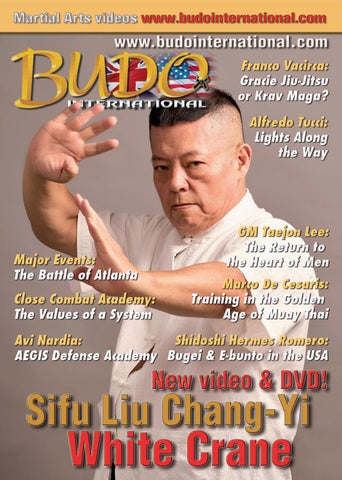
Ma r t i a l A r t sv i d e o swww. b u d o i n t e r n a t i o n a l . c o m
www. b u d o i n t e r n a t i o n a l . c o m
Newv i deo&DVD!
Si f uL i uChangYi
Whi t eCr ane
Budo International magazine is a product of:
BUDO MAX INTERNATIONAL LLC GM Maurice Elmalem CEO/Director 684 BRITTON ST SUITE 4 BRONX NY 10467 USA e-mail contact: info@budomaxintl.com Tel: 718.652.7100
Budo MAX International Your source to a World audience!
We produce and sell Martial Arts videos and books: Please visit our website: www.budointernational.com Also available our Youtube channel: With more than 100,000 subscribers at: Budo International Official. We produce every month a free on line magazine available in our website and in issuu.com in 5 languages. English, Spanish, German, French, and Italian with already over 1,000,000 readers all over the world. All the issues remain available on line forever so they keep receiving reads for years. We have 1,000 different instructional videos available with the best masters of 5 continents. Any questions suggestions or ideas please contact GM Maurice Elmalem 1. Budo to add coverage of Boxing, Mix Martial Arts, Kick Boxing, Wrestling, UFC, entertainment & celebrity corner of pages in the last end of magazine pages.
2. Offer business card size advertising at $29.95 (and other sizes) monthly fee for organizations, schools, associations, personal, tournaments. 3. Cover stories on past today and world champions M/A, UFC, body builders. 4. Become a sponsor of Budo magazine, make legacy gifts to family in need. Create annual fund for online donations. 5. Always your special media of MA stories are welcome anytime. 6. Let us hear your story, you got photos of martial arts celebrities, updated news, send info to: Main office USA 718.652.6600 email: info@budomaxintl.com or call USA-888-455-8181 7. We collaborate with world renown organizations, MA Grand Master schools and association worldwide. 8. Free monthly Budo commercial for online and media promotions. 9. Budo Magazine Calendar that includes photos, events, advertising, Join Budo Club – Tell us your story - Got Talent. 10. Advertise with Budo Max International and be seen worldwide.
“It brings all the storms and shipwrecks, what falls from me to me, is increasingly essential and true.”
Pearls of the Warrior
Fernando Abreu
Editorial Lights Along the Way here is no profession more noble than that of the teacher. In ancient China, there were three classes of doctors. Surgical doctors—who, unlike in the West where they are the most highly valued, were considered the lowest class, akin to butchers—came into play when things inevitably began to go wrong, when the patient’s mistakes led to consequences that left no choice but to cut. The second group consisted of acupuncturists and herbalists, who, using their knowledge, sought to remedy the imbalances that each person had created through their habits by harnessing the body’s energy— readjusting, balancing, compensating, and cleansing; and finally, the so-called “barefoot” doctors, whose work was to teach—that is, to prevent and create the conditions so that imbalances would not occur in the first place. These individuals, who led humble lives in touch with nature, were the most revered; they were undoubtedly figures akin to teachers or magicians who intervened before matters came to a bad end, guiding people’s lives. According to Hindu tradition, the masters were those beings who, having raised their vibration beyond the limits of human form, nevertheless chose to remain to help the rest of their fellow humans transcend their miseries. It is the image of someone who, having leaped over the wall that confines humans, has seen and confirmed that beyond it lies a more beautiful reality; yet instead of staying there, he remembers that those left behind are suffering just as he once did. Consequently, he climbs back onto the wall and begins shouting his discoveries to the others. Many laugh at him; many say he’s an idiot, that he’s crazy… From the wall, the man reaches out his hands to those who want to jump, but he can no longer descend to the other side—it is the others who must strive to climb up to him. Each culture shapes and colors this image according to its own characteristics, but the essence is always the same. In the Hagumo tradition, this is the role of a Shidoshi or a Tonbo. The first shamans emerge from the group because of their strangeness. There is something odd or different about them— something that sometimes causes resentment, sometimes brings calm, especially in difficult or uncertain situations. Faced with the unknown, everyone’s gaze turned to them. A clan member falls and breaks his leg. All eyes turn to him… An unknown natural phenomenon becomes apparent; the occurrence of a death; a strange sign in the heavens… an extraordinary event. Shamans were distinguished from the rest by having been marked by the spirit in enigmatic ways. Animals obeyed them; lightning struck them without killing them… birthmarks; bearers of strange dreams, they predicted events before they occurred; nature seemed to speak to them—thus they became the chosen ones, intermediaries between the invisible world and the world of mortals. Shamans, the chosen ones of the spirit, are therefore abnormal people—that is, “not normal”—but they all share the characteristic of seeming to possess a great deal of energy. This energy arises when the difference between a person’s positive traits (strengths, virtues) and negative traits (flaws, faults) is greater than the norm. Thus we can understand why geniuses are all, in a certain sense, a bit crazy; in their effort to compensate for the imbalance in their natures, they generate the momentum that ultimately sets them apart. There is no front without a back; the greater the front, the greater the back. Personal energy can stem from various factors. According to Castaneda, the first derives from a gift from one’s parents. Don Carlos maintained that the very circumstances at the moment of conception had an extraordinary influence on the intensity of that gift. He said that we were all the result of “a good fuck or a bad one.” The second source is related to the situation and the burden of the spirit itself as it approaches birth in that body, and is the result of its past lives and what it has come to fulfill or readjust. The third factor would serve to amplify or diminish the previous ones, as a result of the responses that person gave to the circumstances they faced throughout their life. Every decision we make either takes away or gives us power; every crossroads makes us stronger or weaker; there is no middle ground here. People never stop to think about it, but every decision we make leads us in only one direction. On just one plane—if we consider the whole as a circle—each direction will point to a specific degree among the 360 degrees of possibilities. In other words, when we decide to go in a specific direction, we are saying “no” to the other 359 degrees of possibilities! And that’s just in a two-dimensional circle! Since we exist in a universe with more dimensions, start multiplying! Everything in this life is a matter of degree, dosage, frequency, and rhythm. That is why the discourse of good and evil, of right and wrong, is outdated. The rational has been superseded by a new paradigm—one that is far more versatile, inclusive, and evolutionary.
T
Lights Along the Way Everything carries within itself the seed of its own development and its own destruction. That is why those who argue incessantly in one direction—whether it be toward pressure or toward decompression—are already diagnosing themselves. It is just as valid to praise the virtues of one as of the other; it all depends on the situation, the moment, and the individual. Preconceived notions and justifications in favor of either position are dualistic formulations. When one views things from a place of unity, one understands that yin and yang are one and the same; they differ only in degree. Take the example of heat and cold; we know them only by their differentiation within the same range of measurements. As sensations, they will always be somewhat subjective. The same applies to the many analyses we might conduct. What is good for one person is bad for another; establishing absolutist positions or taking a stance at one extreme will only lead to its opposite. The road to hell is paved with good intentions; it is just as wise to be wary of those who sell you a bill of goods as it is of those who hide behind manners and formalities to conceal their true objectives. Nothing replaces naturalness, and this does not mean being careless or impertinent. Freedom is not licentiousness, but when in doubt, prohibition is never the right answer. We must start from the premise that we are all a version of ourselves—a work in progress—yet along the way, no one has the right to berate us with the aim of improving us, no matter what their position or role may be. Nothing is absolute; nothing is pure. Nature abhors the pure! Therefore, no truth is absolute, and every truth is a half-truth. The only thing that is permanent in and of itself is change. The great universal laws are not personal. “The Tao treats men like straw dogs,” says the Tao Te Ching. Blind, however, is the one who cannot see beyond this—the interplay of the whole with the parts—in a permanent evolutionary process, grounded solely in its own nature: that of eternal becoming. Muta mutandis, life passes by as we pass through it, where the trees prevent us from seeing the forest, where the immediate takes on the proportions of the absolute, as we strive to chase after illusions, only to discover in the end that behind them, there is nothing. The world is made of illusions where the Lord of a Thousand Faces reigns, showing us at every turn through his deceptions what we must learn, making us hostages to our desires, longings, and dreams. What is the point, then, of defending positions tooth and nail? Do we argue over the sex of angels while the world goes up in flames? We are living in a time of awakening, enveloped in the crises marking the end of the world as we know it, but despite the urgency of the situation, we find ourselves in a scenario where nothing is black and white anymore—yet we remain locked in the greatest polarization ever experienced. It is a curious situation, at a time when structures are depolarizing, while functions are becoming more polarized. While masculine and feminine lose their polarity in human bodies, merging into the androgynous, in their roles they nevertheless vie for position, driven by the law of the pendulum and embroiled in a fratricidal struggle. The figure of a teacher is needed today more than ever, yet few accept that role, and even fewer succeed in fulfilling it. “He who speaks does not know; he who knows does not speak,” says the Tao Te Ching. There comes a moment when the futility of effort becomes clear before our eyes; each person looks out for their own interests, and the fear of commitment weighs heavily on those who think the world is strewn with infinite options, when in fact, the path of free will is much narrower than we might imagine. A good teacher is a light on the path; not a light to follow, not a light to emulate; a light that should illuminate our steps, but both these steps and the final destination of our journey are—and always will be—a personal prerogative. Be kind and grateful to those who taught you, especially the older teachers. Know that we are all versions of ourselves with plenty of room for improvement, that nothing human or divine is foreign to us, and that each person gives what they can, what they are capable of, and what they know how to give. We cannot blame others for failing to meet the expectations we ourselves have created for them. There is no teacher more perfect than nature itself—the teacher who is never wrong. To have the privilege of having someone more knowledgeable than you illuminate your part of the path is, in and of itself, a blessing to be cherished with care. However, elevating them to the status of a saint is the stuff of fools; if, on the other hand, it were they who were constantly exalting themselves, then the fool—poor thing…—the fool is them.
WHEN THUNDER ROARS How one life-changing encounter transformed a family tradition into a lifelong mission to preserve Taiwan's authentic Feeding White Crane Kung Fu. For centuries, some of the world's most sophisticated martial arts have remained hidden from public view. They were never designed to attract attention or impress spectators. Instead, they were quietly transmitted from one generation to the next, entrusted only to students whose sincerity and perseverance earned the confidence of their teachers. Among these rare traditions stands Feeding White Crane Kung Fu, one of the least-known yet most complete systems of Southern Chinese martial arts. Although White Crane Boxing has spread throughout Fujian, Taiwan and Southeast Asia in many different forms, the original tradition preserved within the Liu family occupies a unique place in its history. Rather than presenting White Crane as a collection of unrelated styles, this lineage preserves a coherent system composed of four complementary expressions: Flying Crane, Calling Crane, Resting Crane and Feeding Crane. Together they represent the complete martial life of the crane, from movement and breathing to balance, structure and decisive action. nlike many martial systems whose techniques can be appreciated immediately through demonstrations, Feeding White Crane reveals itself gradually. Every exercise prepares the next. Every movement develops a specific principle. Body structure, breathing, timing, footwork, intention and mental discipline evolve together through years of progressive practice. This philosophy explains why the Liu family has devoted nearly a century to preserving the art without altering its essential foundations. Today, Grandmaster Liu Chang-Yi, third-generation successor of the Liu family lineage in Taiwan, continues this mission. Having begun training in childhood under the guidance of his father, Grandmaster Liu Yin-Shan, he has spent decades teaching throughout Taiwan and introducing Feeding White Crane to practitioners in Europe and the United States. Yet despite his international activity, his approach has remained remarkably consistent: preserve first, teach second, and never sacrifice authenticity for popularity. His own commitment to this mission became even stronger after an extraordinary event that nearly cost him his life. Confronted one night by five-armed attackers, he survived thanks entirely to the martial principles transmitted to him by his father. That experience profoundly changed the way he understood his inheritance. It convinced him that Feeding White Crane was not merely a cultural tradition or a sophisticated fighting system, but a priceless legacy whose preservation had become his personal responsibility. To better understand this remarkable martial art, Budo International travelled to Taiwan to meet Grandmaster Liu Chang-Yi. During our conversation, he spoke at length about the origins of White Crane Boxing, the philosophy behind the four forms, the history of his family's lineage and the responsibility that every traditional master bear toward future generations. Far from being simply an interview about techniques, what follows is a reflection on transmission itself—on how an authentic martial tradition survives across centuries, remaining faithful to its origins while continuing to inspire new generations of practitioners around the world.
U
Budo International.: Grandmaster Liu, before discussing techniques, could you tell our readers what Feeding White Crane Kung Fu represents for you? Grandmaster Liu Chang-Yi.: "For me, Feeding White Crane is first a complete system of transmission. People often begin by looking at techniques. In our tradition, we begin with principles. Techniques change according to circumstances. Principles do not. Everything that we practice today has been preserved because previous generations considered it indispensable. Our responsibility is therefore not to invent new methods or modify what we have inherited, but first to understand it correctly before transmitting it faithfully to the next generation. Feeding White Crane is much more than a collection of fighting techniques. It is a complete educational system-built step by step. Every exercise has a precise purpose. Every stage prepares the next one. Nothing exists independently. Modern practitioners often wish to learn advanced techniques immediately. Our tradition follows the opposite path. We spend years developing posture, balance, breathing, coordination and body structure before seeking speed or power. Once these foundations have been established, techniques emerge naturally. This progressive method has allowed our lineage to preserve the same essential principles for generations. Although every master expresses them with his own personality, the foundations remain unchanged.
Only after respecting this progression can a practitioner begin to understand why our predecessors organized the system exactly as they did." Budo International.: Every traditional martial art has its own story of origin. Could you tell us how the White Crane School began according to your lineage? Grandmaster Liu Chang-Yi.: "Without Fang Qiniang there would be no White Crane School. Our lineage has preserved her story for centuries because it explains not only the origin of our techniques but also the spirit of observation upon which the entire system was built. Her father, Fang Huishi, mastered the martial arts of Shaolin and taught his daughter while they lived in seclusion at the Bi Lian Temple. Although still very young, Qiniang possessed exceptional natural ability and quickly absorbed everything her father transmitted. One day, while washing clothes near the temple, she noticed a large white crane standing nearby. Fearing that the bird would soil the freshly cleaned garments, she attempted to chase it away with a bamboo pole. What happened next changed martial arts history. Whenever she struck toward the crane's head, the bird simply moved aside with extraordinary precision. When she attacked again from another angle, the crane answered immediately with its wings, claws or beak. No matter how determined she was, she could neither strike nor frighten it away. She realized that the bird possessed principles of movement that she herself had never encountered. Most people would simply have walked away. Instead, she returned every day. She observed the crane patiently, carefully studying how it moved, how it balanced, how it changed direction without losing stability and how it transformed defense into immediate counterattack. Gradually she combined these observations with the Shaolin methods inherited from her father and with her own understanding of footwork. From this remarkable synthesis White Crane Boxing emerged. Within our lineage another tradition has also been preserved. It tells that the Ancestor of White Crane appeared in the form of a great white crane and personally transmitted the essential principles of art. Whether understood symbolically or literally, both traditions express the same idea: White Crane was born through profound observation of nature and faithful transmission rather than through personal invention." Budo International.: Your school speaks of four forms: Flying, Calling, Resting and Feeding. Many readers may imagine four different styles. Is that really the case? Grandmaster Liu Chang-Yi.: "No. That is perhaps the most common misunderstanding among people encountering our tradition for the first time. The four forms should never be understood as four independent schools. They are four expressions of one complete martial system. To explain this, our ancestors simply observed the natural life of the crane. Before a crane can survive, it must first fly in search of food. When it has found a suitable place, it calls. Then it rests, conserving its energy while remaining perfectly balanced and alert. Finally, it feeds. These four natural actions became the four expressions of White Crane Boxing."
Flying Crane "Flying Crane is the beginning. It teaches the practitioner how to move freely while maintaining structure. The body becomes extended without becoming rigid. Distance, posture and defensive positioning are established during this stage. People often admire the graceful appearance of Flying Crane, but elegance is never its objective. Every movement develops balance, mobility and the ability to create the correct fighting distance before contact even occurs. Without correct distance, no technique can truly succeed."
Calling Crane "Calling Crane introduces another essential dimension. The crane's call is not simply a sound. It represents breathing. Correct breathing allows the entire body to work as one unified structure. In our tradition, inhalation and exhalation are carefully coordinated with movement. • Breathing regulates rhythm. • Rhythm regulates power. • Power regulates timing. Only when these elements become naturally integrated does technique begin to acquire genuine effectiveness. External strength alone is never sufficient. Internal coordination must support every movement."
Resting Crane "Many people believe Resting Crane is passive because of its name. In reality it is one of the most demanding stages. Observe a crane standing upon one leg. Although apparently motionless, every part of its body remains alive. Its balance is dynamic. Its attention never sleeps. Its structure is constantly adjusting. Resting Crane develops exactly these qualities. • Footwork. • Root. • Stability. • One-legged balance. The ability to remain relaxed while being completely prepared to move at any instant. A practitioner who cannot remain stable under pressure cannot apply advanced techniques, regardless of how many forms he has memorized."
Feeding Crane "Only after these foundations have matured does the student begin to understand Feeding Crane. Many people believe Feeding refers only to bird taking food. Our tradition teaches something much deeper.
Everything the crane does serves one purpose. • It flies to feed. • It calls to feed. • It rests to feed. Without feeding, life cannot continue. Therefore, Feeding Crane naturally contains everything that precedes it. For this reason, our ancestors regarded Feeding Crane as the complete expression of White Crane Boxing. It is not merely the fourth stage. It is the synthesis of the entire system."
“If an opponent attacks, one does not simply block. The defense already contains the counterattack. If the opponent changes again, one's own movement changes naturally. There is no interruption. No separation. Everything flows continuously.”
“Teaching concerns techniques. Transmission concerns understanding. A student may learn movements within a few months. Understanding requires years. Sometimes decades.”
Budo International.: The word "Feeding" has always intrigued practitioners outside Taiwan. What does it mean from a martial perspective? Grandmaster Liu Chang-Yi.: "Its martial meaning is often misunderstood. Feeding should never be interpreted literally. Within our tradition, feeding symbolizes the decisive conclusion of combat. The moment when attack and defense become inseparable. If an opponent attacks, one does not simply block. The defense already contains the counterattack. If the opponent changes again, one's own movement changes naturally. There is no interruption. No separation. Everything flows continuously. This continuity is one of the defining characteristics of Feeding White Crane." He pauses before continuing. "Our lineage also preserves another important teaching. When Fang Qiniang completed her observations of the crane, she incorporated a distinctive stepping method into the system. • This footwork united attack and defense even more closely. • The body no longer reacted after the attack. • It moved simultaneously with the attack. This refinement transformed Feeding Crane into the highest expression of the White Crane tradition." Budo International.: Your family has preserved this tradition for almost one hundred years in Taiwan. How did Feeding White Crane arrive on the island? Grandmaster Liu Chang-Yi.: "According to the history preserved within our lineage, several martial artists travelled from Fujian to Taiwan during the early twentieth century. Among them were four masters from the Fuzhou region. Three specialized primarily in Flying Crane. Only one transmitted Feeding White Crane. That master was Grandmaster Lin De-Shun, whom we respectfully remember as Master Rui. My grandfather, Liu Gu, recognized the exceptional value of his knowledge. He invited Master Rui to Liying, in Tainan, as his private instructor. This represented a tremendous commitment. Such relationships were never casual. Private instruction required complete trust, many years of dedication and constant practice. Master Rui transmitted not only techniques but an entire system of principles. From that moment, Feeding White Crane became the martial tradition of our family. The lineage continued from Master Rui to my grandfather Liu Gu, then to my father, Grandmaster Liu Yin-Shan, and finally to my generation. For nearly a century, every generation has considered itself only a temporary guardian of art. None of us believe we own it. We simply preserve it until it is time to hand it to the next generation."
Budo International.: You often use the word "transmission" rather than "teaching." Is there an important difference? Grandmaster Liu Chang-Yi: "Yes. Teaching concerns techniques. Transmission concerns understanding. A student may learn movements within a few months. Understanding requires years. Sometimes decades. Many traditional martial arts disappeared because techniques survived while principles were forgotten. Our family has always believed that preserving principles is more important than preserving choreography. Forms can only remain alive when the ideas that created them remain alive. Otherwise, they become empty movements. That is why patience occupies such an important place in our training. Students are encouraged not simply to imitate, but to observe, reflect and gradually discover the meaning hidden within every movement. Only then does genuine transmission begin."
Budo International.: You began training as a child under your father. Looking back after so many decades, what do you consider to be the most important lesson he transmitted to you? Grandmaster Liu Chang-Yi.: "When I was young, I believed that my father was teaching me techniques. Only much later did I understand that techniques were never his true objective. He was teaching me how to think. Every movement contained a reason. Every correction had a purpose. Sometimes he would ask me to repeat the same exercise hundreds of times without explaining why. At the time I did not always understand. Years later, when teaching my own students, I realized that he was allowing experience itself to become my teacher. Traditional martial arts cannot be understood only through words. Certain principles must be lived before they can truly be understood. That is why patience is one of the greatest virtues in our school. Modern society often encourages rapid results. Traditional training develops the opposite attitude. One must accept that genuine progress takes time. A tree cannot be forced to grow faster by pulling on its branches. Human development follows the same principle." Budo International.: Many readers associate Southern Chinese martial arts with close-range combat. How does Feeding White Crane approach this aspect of fighting? Grandmaster Liu Chang-Yi.: "Feeding White Crane is indeed a close-range fighting system. However, close range should never be confused with aggression. Entering short distance safely requires precise judgement. • Timing. • Distance. • Positioning. • Structure. • Mental calmness. Only when these elements are already present can techniques become effective. Our system includes strikes, palm techniques, finger techniques, elbows, joint controls and continuous combinations. Yet these should never be studied as isolated skills. Everything must function together. The body moves as one unit. If one part arrives before the others, power is lost. If breathing becomes disconnected from movement, efficiency disappears. If the mind hesitates, the opportunity has already passed. Therefore, technical ability alone never determines the level of a practitioner. Correct judgement is equally important. So are self-control and humility. Martial virtue must always guide technical skills. Without virtue, martial knowledge becomes dangerous rather than beneficial."
Budo International.: Your tradition also speaks about the Five Elements. Are they philosophical concepts or practical training methods? Grandmaster Liu Chang-Yi.: "In our school they are both. Many people hear the words Metal, Wood, Water, Fire and Earth and imagine abstract philosophy. Our ancestors thought differently. Every element expresses a particular quality of movement. Each develops a different way of receiving force, redirecting energy or creating an opening. The Five Elements therefore provide practical language through which students gradually understand the relationships between different kinds of movement. They should never be memorized as theory alone. They must be experienced through practice. Only then do they become useful." He smiles before continuing. "The same movement may appear completely different depending upon timing, distance and intention. The Five Elements help practitioners understand these transformations. Rather than teaching fixed answers, they teach adaptability. That is one reason why the system remains alive instead of becoming mechanical." Budo International.: Some traditional documents also refer to what are called the Eight Principles. Could you explain their importance? Grandmaster Liu Chang-Yi.: "The Eight Principles form another essential stage of advanced practice. They are not simply eight techniques. They are eight different expressions of force. Each develops a particular quality of body organization and internal coordination. When properly understood, they teach the practitioner how power is created, absorbed, redirected and released. Our tradition describes them as: • Swallowing. • Spitting. • Floating. • Sinking. • Pouncing. • Lifting. • Casting. • Springing. Although these names sound poetic, each represents a very concrete martial reality. Some cultivate softness. Others develop explosive release. Others teach sensitivity, rooting or recovery. Together they enable the practitioner to adapt continuously without becoming rigid. One should never think of them as separate exercises. Like the four Crane forms, they support one another. Only through their combination does the complete system emerge." Budo International.: Today there are many different Crane Boxing schools throughout Taiwan and China. How does your lineage view this diversity? Grandmaster Liu Chang-Yi.: "With respect. Every traditional school has its own history. Many excellent practitioners have preserved valuable knowledge. Our purpose has never been to compare schools or to claim superiority.
History naturally produces diversity. Different teachers emphasize different aspects. Some schools specialized in Flying Crane. Others developed different branches over time. Methods from neighboring martial traditions were sometimes incorporated. New interpretations appeared. This is a normal part of martial history. Our own responsibility has simply been different. The Liu family chose another path. Rather than creating a new branch, we dedicated ourselves to preserving intact the transmission entrusted to us by Master Rui through my grandfather and my father. That continuity is our greatest responsibility." Budo International.: Has your teaching changed as you have grown older? Grandmaster Liu Chang-Yi.: "My understanding continues to evolve. The principles remain the same. But experience allows one to explain them more simply. When I was younger, I believed that good teaching meant giving many explanations. Today I often say less. Students must discover certain truths for themselves. A teacher can open the door. He cannot walk through it for another person. Every sincere student eventually reaches moments when the body suddenly understands something that the mind has struggled to grasp for years. Those moments cannot be forced. They appear naturally through correct practice. Watching that transformation occur in students is one of the greatest rewards of teaching." Budo International.: You often say that the art does not belong to the master but to the lineage. Why is this idea so important to you? Grandmaster Liu Chang-Yi.: "Because no one creates a traditional martial art alone. Every generation receives something that countless people have protected before it. My grandfather received this tradition from Master Rui. My father received it from my grandfather. I received it from my father. One day, others will receive it from me. If each generation begins changing the essential principles according to personal preference, the lineage gradually disappears. The techniques may survive. The name may survive. But the art itself is lost. That is why authenticity has always been more important than popularity. Our responsibility is not to make art fashionable. Our responsibility is to preserve its integrity."
Budo International.: When students first enter your school, what do you hope they understand before learning any techniques? Grandmaster Liu Chang-Yi.: "I hope they understand that martial arts begin with character. People often arrive hoping to become stronger. There is nothing wrong with that. But strength alone has never been the objective of traditional training. I hope they learn patience. Respect. Humility. Perseverance. Without these qualities, technical ability has very little value. Every movement that has been preserved within Feeding White Crane exists because generations before us found it useful. Nothing has survived merely because it looked beautiful. Every posture... Every step... Every change of direction... Every breath... Everything has a purpose. When students begin to understand that, their entire way of practicing changes. Instead of collecting techniques, they begin searching for principles. That is when genuine learning begins." Budo International.: After so many decades devoted to martial arts, what gives you the greatest satisfaction today? Grandmaster Liu Chang-Yi.: "Watching the tradition continue. Nothing gives me greater happiness than seeing sincere students gradually understand what previous generations worked so hard to preserve. Teaching is not about creating followers. It is about preparing for future custodians. If my students one day transmit these principles with honesty and respect, then my father's efforts—and my grandfather before him— will not have been in vain. This continuity is the greatest reward a traditional teacher can receive." Budo International.: Several years ago, you told me about an incident that profoundly changed your life. Would you be willing to share that experience with our readers? Grandmaster Liu Chang-Yi.: He remains silent for a few moments before answering. "Yes. It happened many years ago. Even today I remember every detail. I was at home late one evening when I heard unusual noises outside. At first, I thought it might simply be neighbors. Then the sounds became louder. I looked through the curtain. Five men were trying to steal my car. All of them were carrying machetes. For a moment I hesitated. I understood immediately that if I went outside, my own life could be in danger. At the same time, I also knew there was no time to wait. I decided to confront them. Everything that followed happened incredibly quickly. As I approached, one of the men attacked me immediately with his machete. There was no opportunity to think. No opportunity to analyze. No opportunity to choose from techniques.
My body simply responded. Years of training acted before conscious thought. The weapon was controlled. The attack was neutralized. Almost instantly, the remaining four men rushed towards me. The situation became even more dangerous. There was no pause. Everything happened within only a few seconds. When the police finally arrived, all five attackers were disarmed and seriously injured. They were taken directly to hospital." For a moment, Grandmaster Liu lowers his eyes before continuing. "People sometimes ask me which technique I use. That is not the right question. During a real confrontation there is no time to search one's memory. Technique alone is not enough. Only principles remain. Distance. Timing. Balance. Calmness. These are what protected me. Until that evening, I had never truly reflected upon what my father had given me. Like many children born into a martial family, I had simply trained because training was part of everyday life. It was completely natural. I never asked myself what this art might one day mean for my survival. Only afterwards did I fully realize something that changed my life forever. My father's teaching had saved me. Not symbolically. Literally. Without the education he had patiently given me since childhood, I might not be alive today." His voice becomes softer. "At that moment I felt something far stronger than pride. I felt gratitude. Profound gratitude. Gratitude to my father. Gratitude toward my grandfather. Gratitude toward all the masters who had preserved this knowledge through generations. And gratitude toward Feeding White Crane itself. In my heart I thanked this art for protecting my life. That experience completely changed the way I viewed my responsibility. Until then I had been teaching because it was my family's tradition. Afterwards I understood that preserving this system had become my life's mission. I made a promise to myself.
If I am able, I will continue teaching every sincere student who truly wishes to learn. Not because I want art to become famous. But because traditions survive only when they are transmitted with honesty. That promise continues to guide my life today."
Epilogue As our conversation comes to an end, one impression remains above all others. In an era where many martial arts are increasingly shaped by competition, commercialization or rapid certification, Grandmaster Liu Chang-Yi speaks with remarkable simplicity about values that seem almost timeless: patience, humility, responsibility and faithful transmission. Throughout the interview, he rarely speaks about victory. He speaks instead about continuity. For him, Feeding White Crane is not a museum piece, nor a collection of sophisticated fighting techniques preserved for their historical value alone. It is a living tradition that has survived because each generation accepted the responsibility of transmitting principles rather than merely reproducing movements. That perhaps explains why the Liu family's lineage has remained so coherent for nearly a century. The techniques certainly impress. The precision of movement fascinates. But what ultimately leaves the deepest impression is something less visible: the quiet conviction that martial knowledge acquires its true value only when it serves something greater than the individual. When Thunder Roars is therefore not simply the story of a master who survived a life-threatening encounter. It is the story of a promise. A promise made in a single decisive moment. A promise that continues to preserve one of Taiwan's most remarkable martial traditions for future generations. Our goal is to promote the teachings of Feeding White Crane throughout Europe. If you lead a martial arts group and would like to invite Sifu Liu Chang Yi to conduct a seminar, please don’t hesitate to contact us: info@feedingcranekungfu.eu
When the Olimpic champion Sandra Sánchez returned to the Source At the highest level of martial arts competition, victory is often determined by details invisible to spectators. Elite athletes constantly seek new ways to refine their technique, body mechanics, and mental focus. This relentless pursuit of improvement led Spanish karate champion Sandra Sánchez and her coach Jesús del Moral to Taiwan, where they trained under Grandmaster Liu Chang Yi, one of the foremost representatives of the traditional Feeding Crane Kung Fu lineage. Sandra Sánchez had already reached the pinnacle of competitive karate, becoming World Champion, multiple European Champion, and eventually Olympic Gold Medalist. Yet, despite these remarkable achievements, she continued to search for deeper knowledge. Rather than limiting herself to modern training methods, she chose to explore the historical roots of karate itself. For centuries, Okinawan Karate has maintained close connections with the martial traditions of Southern China. Among these, White Crane styles have long attracted the attention of historians and serious practitioners because of their influence on several classical Okinawan kata. One kata in particular—Pāpūren (Happoren)—sparked Sandra's curiosity. Its Chinese origins made it an ideal bridge between contemporary karate and the traditional
principles preserved within Feeding Crane. Her visit to Taiwan was therefore not motivated by the desire to learn a new fighting style, but by the determination to better understand the invisible principles hidden behind kata performance. She approached Grandmaster Liu with the humility of a lifelong student, convinced that true mastery requires constant learning, regardless of one's achievements. Training under Grandmaster Liu revealed a completely different perspective on martial movement. Rather than emphasizing muscular strength or spectacular techniques, his teaching focused on structural alignment, whole-body coordination, relaxed power, precise timing, and seamless integration of intention with movement. One of the most striking lessons was the concept of whole-body power. In Feeding Crane, strength is never generated by the arms alone. Instead, power originates from the legs, is directed through the waist and spine, and is expressed naturally through the hands. Every part of the body works together as a single integrated system, producing remarkable efficiency while eliminating unnecessary muscular tension. Equally important is the cultivation of softness. In traditional Chinese martial arts, softness does not signify weakness. On the contrary, it allows the practitioner to remain relaxed, adaptable, and capable of generating explosive power at precisely the right moment. For an elite kata competitor, this understanding transforms every movement. Kata becomes far more than an accurate sequence of techniques—it becomes the visible expression of internal principles. According to Jesús del Moral, the experience fundamentally changed their understanding of movement. Rather than collecting additional techniques, they discovered universal principles that could enrich every aspect of karate practice. Grandmaster Liu's corrections were often subtle, yet even the smallest adjustment in posture or body organization produced immediate improvements in stability, efficiency, and power. Beyond the technical instruction, the training reflected the educational philosophy of traditional Chinese martial arts. Students were encouraged to observe carefully, repeat patiently, and discover principles through direct experience instead of relying solely on intellectual explanations. This method develops not only technical ability but also humility, discipline, and continuous self-improvement. Perhaps the greatest lesson of this encounter was that excellence has no final destination. Even an Olympic champion continues to question, explore, and learn. Sandra Sánchez's decision to train with Grandmaster Liu Chang Yi demonstrates that the path toward mastery is not defined by medals but by an unwavering commitment to personal growth. Today, this meeting between one of the world's greatest karate champions and a master of traditional Feeding Crane symbolizes the enduring dialogue between classical martial arts and modern competition. It reminds us that authentic tradition is not frozen in history. Preserved by masters such as Liu Chang Yi, it remains a living source of knowledge capable of inspiring and enriching practitioners at every level, from dedicated beginners to the very highest champions.
Sandra Sánchez's decision to train with Grandmaster Liu Chang Yi demonstrates that the path toward mastery is not defined by medals but by an unwavering commitment to personal growth.
武 THE WAY OF FUNCTIONAL TRAINING Integrity, Kyo-Jitsu, and the Pursuit of Mastery A Lecture Compilation CDC — Combat Development / Realistic Training Philosophy Part I — The Core Values of CDC Teaching the Best of What We Currently Know One of the core values of CDC is simple to state, yet demanding to live by: we always teach the best of what we currently know — never the second best. When we discover a better way, we admit it, and we follow it. There is nothing wrong with training in martial arts for self-preservation. We also seek realistic training. But it must be understood clearly: aggression does not make training realistic. Manufactured aggression and rudeness in the training hall do not prepare a student for reality — they simply invite more injuries. That is ego dressed up as pedagogy, nothing more. After many years of teaching, I have come to see this clearly: the art of teaching is the art of leading a student toward reality without unnecessary injury along the way. As a trainer, I listen to my students and work alongside them to find better methods. But as a leader, safety and injury prevention must always remain my first responsibility.
The Story of the Instructors Over the years, instructors have come to me wanting to become more functional in their approach. We would begin by examining what they were already doing: What worked? What didn't? And more importantly — why didn't it work? From there, we would begin replacing what was not functional. Because most people are taught static techniques or endless flow drills, we moved beyond the memorization of technique. Instead, we focused on the underlying tactics of knife defense, and on a method for achieving those tactics spontaneously, under pressure. They left understanding a clear chain of priorities: how to counterstrike without exchanging strikes, how to intercept and catch a weapon-bearing arm in motion, and how that particular catch determines the most efficient path to a release or disarm. Ironically, what they gained was not simply “better techniques.” It was a better way to train. At that point, we would talk about integrity and honesty: Integrity is telling yourself the truth. Honesty is telling the truth to others. If people's lives are potentially at stake, and those people trust you to prepare them, then you carry a moral obligation to teach them the best way you currently know how. Every instructor I spoke with agreed with this — without exception. And yet, months later, I would see videos of these same instructors teaching the very same dysfunctional material they had originally brought with them. Think about that. They were not teaching the best they knew. They were knowingly teaching what they themselves believed to be second best. That is not a lack of knowledge. That is a lack of integrity.
To be clear: I am not claiming that CDC is “the best.” It is simply an adaptable method of training that seeks to follow realistic attacks and realistic ways of defending against them. What I am saying is that these instructors themselves concluded their new training was better — and then chose to ignore that conclusion.
CDC's Second Value and Prime Directive This is why our second value exists: whenever we discover or learn a more functional way to train, we adopt it, and we adapt to it. What we do not get to do is bury our heads in the sand because we prefer the old way, or because it is easier to teach. The people who place their trust — and potentially their lives — in our hands deserve better than that. They deserve the best of what we currently know. Always seek greater functionality. When we discover something better, we adopt it. We adapt to it. — CDC Prime Directive People should absolutely train in whatever they enjoy — there is nothing wrong with that. But instructors should have the integrity to tell their students exactly what they are learning, and just as importantly, what they are not learning. If you are preserving less functional material for reasons of tradition, enjoyment, or culture, then say so plainly. Tell your students not to bet their lives on it, if your goal is not maximum functionality. Then let them make an informed decision. How many instructors actually do that? I would venture to say almost none. That is why, at CDC, we call them martial ostriches — those who bury their heads in the sand. And, as always: only the guilty are offended.
Part II — A Lesson from Kubo Sensei The Exchange at Kyumeikan Dojo This weekend, at the Kyumeikan Dojo — the private dojo of the late Kubo Akira Sensei (RIP), in Itabashi-ku — I received the following feedback: Sensei: “Avi, you're really strong. Like, too strong.” Avi: “Why, thank you, Sensei!” Sensei: “Idiot. I meant that's why your kendo sucks!” An important lesson followed — one built around the principle of kyo-jitsu.
The Principle of Kyo-Jitsu (虚実) The principle sounds simple enough on its surface. It concerns the balance between kyo — emptiness or vulnerability (“the hole”) — and jitsu — fullness or strength (“the fortress”). Legend credits Sun Tzu himself with the concept, and it remains very much alive in dojos today. Apparently, though, it was not yet alive in my kendo. Have you ever stood in the ‘perfect’ kamae, shouting a strong kiai, looking every part the master — only for your opponent to swoop in and strike you before you could react? That happens because you appeared to be in a state of jitsu, and you likely believed you were, but you were in fact in a state of kyo. The essence of kyo-jitsu is that kyo and jitsu exist simultaneously; telling them apart is both an art and a science. To see an opponent in a true state of jitsu — completely grounded, unwavering — should prompt not an attack, but a quiet pause. A direct assault on jitsu is nothing more than headlong folly. But the moment you sense their kyo — a fractional opening, even while their kamae still looks steady — you have found your opportunity.
Strike at the false front, bypass the substance — that is the true road to victory. The beauty of kyo-jitsu is not only in spotting openings, but in creating them. This is where iro (色) — the art of the feint — plays its critical role. A budoka trained in iro learns to show an opponent precisely what they want them to see: a signalled overhead strike toward the men (head), daring the opponent to raise their guard just slightly. As their hand lifts, the real target — their now-exposed kote (wrist) — becomes fair game. Through this controlled deception, the feigned attack draws the opponent into a reaction that can then be exploited. Kyo-jitsu is not only physical; it is very much a mental game. Kyo can be an emotional lapse, a flicker of doubt, a stray thought. Jitsu, by contrast, is the unyielding state of mind that admits no distraction. A practitioner versed in kyo-jitsu learns to read both the body and the mind of an opponent, catching the subtle signs that reveal the right moment to act — or the right moment not to act.
Being “Too Strong” — The Other Side of the Coin This was the point of my reprimand. To be “too strong” means giving your opponent nothing to attack — no opening to exploit. Yet an important skill in budo is the ability to take advantage of someone taking advantage of you. Why would they take advantage of you? Because you have, very subtly, offered them something to take. “Will you walk into my parlour?” said the Spider to the Fly. ‘Tis the prettiest little parlour that ever you did spy. When your opponent thinks, in that split second, “Ah — there is an opening; now is my chance to strike men!” and follows through with an attack, they are doing exactly what you wanted them to do. You have drawn them into your web. This is what it means to “control your opponent.” Any ōji-waza (counter-technique) that answers that men strike is not a mere “reaction” — it is a “creation.”
Hanshi Patrick McCarthy's Phone Call As I was writing this lecture, I received a phone call from Hanshi Patrick McCarthy, who wished to drive the point home further. He explained that what I am currently doing works well enough in competition — as long as you score the point, you win — and that overpowering an opponent through sheer strength is not, in itself, a bad thing.
But he reminded me that, at the level of 9th Dan, more is required than simple “staunchness.” One must demonstrate a far deeper understanding of the budo mind than landing successful strikes alone. It is not a one-way exchange. Like a master puppeteer, you must guide your opponent — subtly pulling the strings and letting them dance to your story. To do this, you must get inside their head, without their ever knowing it. That is the essence of ai-ki: feeling your opponent, and guiding them. And how is this achieved? You must show weakness. Here lies the difficulty: to truly control, you must dare to appear vulnerable. Courage, in this context, is the willingness to risk being struck in order to invite that opening. Right now, you are all jitsu and no kyo — like fishing with a massive hook and no bait. Show a hint of honey, and the flies will come buzzing. But, alas, you are a little short on sweetness. — Hanshi Patrick McCarthy Listening in the dojo, and again on the phone, I was reminded that mastering kyo-jitsu is less about defeating opponents and more about seeing oneself with clarity. To understand kyo and jitsu in others, one must first learn to cultivate both within oneself — moving fluidly between vulnerability and strength, between opening and defending, as the moment demands. It is, in the end, a form of self-knowledge: a way of recognising that while strength may dominate for a time, it is the moments of vulnerability — the kyo — that hold the deepest potential for growth. Budo becomes an interplay of timing, insight, and precision, rather than simply forcing the point home along a one-way street. The difference lies in perception — learning to read beyond the obvious, and knowing the precise moment to act, and the moment to wait. In the space between kyo and jitsu, the budoka finds a path not merely to victory, but to mastery of self. On that note, I suppose it is time to sprinkle a little sweetness out there, and see who bites.
Part III — Kendo Terminology: A Closer Study What Is Kyo? The kanji for kyo conveys the following states of mind: • Emptiness • Hollowness • Unreadiness In English, we might say, “you caught me off guard.” This expresses that we did not expect what the other person just did or said. In kendo, we say aite no kyo wo tsuku — “to catch your opponent off guard.” (Note: the tsuku here is unrelated to the strike called tsuki.) The best moment to strike is precisely when our opponent is not ready — that is, when they are vulnerable. When are we not ready? Typically, we are struck at a moment when our concentration breaks, or when we are caught by surprise at our opponent's movement. Consider the simple act of breathing in: we do this because our body has run out of oxygen. This is an easy, natural example of kyo — emptiness. In the instant of breathing in, we are, quite literally, running low. That is the moment we strike, or the moment we are struck.
What Is Jitsu? Jitsu means “fullness.” We are filled with ki, or energy — fully concentrated, with no opening in our kamae or in our mind. This is the state of jitsu. It is said that one should never strike an opponent who is in a true state of jitsu. If we try, we will either be struck ourselves, or find that we cannot even enter — our opponent's shinai simply will not move.
The Moment from Jitsu to Kyo We aim to remain in the state of jitsu. This is why, when we take chudan, we concentrate fully on our opponent's physical and mental movement, filling ourselves with ki. In kendo, our goal is to move our opponent's mind from jitsu toward kyo — this is the process that unfolds before every strike, as we create an opening (kyo) through our shinai, footwork, and body movement. What happens, in turn, when our own mind slips from jitsu into kyo? Speaking from personal experience — and this may or may not apply to every practitioner — I find myself wanting to do one of the following: 1. Retreat — I want to take distance from my opponent. 2. Defend — I move my shinai from chudan and prepare to guard myself. 3. Strike — I want to hit my opponent before they hit me. Or, at times, I find I can do none of the above. This paralysis is known as itsuku.
Part IV — Shikai: The Four Prohibitions of the Mind Shi means “four.” Kai refers to something one learns to avoid — a prohibition, a lesson in what not to do, so as not to make a mistake. Kendo speaks of four such prohibitions, each describing a state of mind to be avoided. Together they are called shikai: kyō (surprise), ku (fear), gi (doubt), and waku (confusion). When your mind is clouded by any of these four states, you cannot judge correctly. Kyō — Surprise Kyō, in this context, means surprise. When you are surprised, what happens? Typically, you hold your breath, your eyes widen, and you freeze. This is precisely what you must avoid in kendo — if you allow it to happen, your opponent will strike you with ease. Ku — Fear Ku means fear. An opponent you fear becomes, in your mind, like a snake before a frozen frog — you find yourself unable to move. Fear also has a distorting effect: quite often, when you feel afraid, your opponent appears larger than they truly are. This is a feeling to be avoided entirely when you fight. Gi — Doubt Gi means doubt. If you doubt your opponent's movements, you cannot decide how to respond to them. Likewise, if you doubt yourself — your decisions, your actions — you will be unable to perform at your best. Waku — Confusion Waku means confusion, or being disturbed. Overwhelmed and puzzled, you cannot make a decision; disturbed, you cannot focus on your opponent, and you cannot make up your mind. As a result, your opponent gains the advantage. These four — kyō, ku, gi, and waku — are the shikai: the four states of mind a kendoka must learn to avoid.
Part V — Kyojitsu and Kyojutsu: Truth, Falsehood, and Balance Kyojitsu is a related and equally valuable concept. Here, kyo (虚) means “false” or “untruth,” while jitsu (実) means “truth.” Combined, the term conveys the interplay of falsehood and truth used to deceive an opponent — or, more precisely, to confuse them so that they consistently make the wrong decision. In Japan, some sensei speak instead of kyojutsu, replacing jitsu (実, truth) with jutsu (術, technique or martial skill). Yet, as with the broader concept of in-yō (yin-yang), falsehood implies the existence of truth, just as defining one thing defines its opposite: badness as an absence of goodness, cold as the counterpart of hot, darkness as the counterpart of light. It is, interestingly, always the negative that defines the positive — as though we were built to lean toward optimism. Here, “negative” and “positive” are not used as opposites but as complementary forces, in the same merging sense found in inyō — the bipolarity of a magnet. So when a sensei speaks of kyojutsu, it should be understood as kyojitsu no jutsu — technique (jutsu) born from the completion of kyo. Read between the lines: this is the very definition of balance. In-yō kyojitsu allows us, in training, to understand the permanent flow of change in life, and, on the mat, the nagare — the flow — between uke and tori. All of our actions must be balanced (kyojitsu) in order to move naturally within in-yō. Through this balance, we set aside excessive conscious thought and develop the ability (saino) to respond instinctively to what is not yet manifest. Deliberate thinking, in this sense, interrupts the process. Having developed this ability, together with spirit (kon/tamashii), we come to hold the container itself (utsuwa/ki) — and the larger that container becomes, the larger the kūkan, the space, it holds. Living fully within that kūkan, we come to understand the balance of all things, and to respond to them accordingly. Where there is no forced intention, happiness develops, and life is protected.
Part VI — Beyond the Dojo: Living Without the Approval of Others Your life is not an entertainment show for anyone. It is time to stop living for the approval of others. Your journey will always be judged — this is an unwritten law of nature. People who stand still will always find something to say about those who are in motion. That is simply how it is; it is easier for others to project their own insecurities onto you than to examine them. In the end, you may be the hero in one person's story, and the absolute villain in someone else's. You have no control over their script, and it is not your responsibility to write it. There are a thousand different angles on a single reality, and everyone views it through their own lens — the one that life has shaped for them since childhood. The real question is not “what do others think of me” or “am I valued by others.” The only question that matters is this: have you learned to set aside the noise, and give yourself your own inner appreciation?
Part VII — Words of Wisdom 4. Your wound doesn't have to become your identity. It can become your source of strength. 5. Don't judge the first chapter of your life by someone else's twentieth. 6. Life changes the moment you stop asking, ‘Why did this happen to me?’ and start asking, ‘What can I learn from this?’ 7. Not everyone who walks away from you is a loss, and not everyone who stays is a gain. 8. You don't have to see the whole road. Just see the next step. 9. Worry won't solve tomorrow's problems, but it can steal today's peace. 10. The most successful people aren't always more talented. They simply gave up less. 11. Forgive people for your own peace, not for their sake. 12. Your self-worth isn't determined by how many people applaud you. 13. One day you will discover that the thing you feared most was only a step toward becoming a stronger person. 14. Don't wait for the perfect moment. The moment you decide to begin becomes the perfect one. 15. Remember: even the hardest times are temporary. Don't lose hope. If even one of these lines reached you at just the right moment, it was worth reading. But the truth remains: twelve sentences cannot change a life. What changes a life is consistent, ongoing learning. 終
AEGIS Defense Academy: Redefining Modern Self-Protection Throughout my journey teaching civilians, military personnel, special forces, law enforcement officers, and security professionals, I have always valued the opportunity to connect with individuals who share the same background, passion, and commitment to continuous learning. Exchanging knowledge, studying together, discussing strategies, and exploring ways to progress have always been central principles of the Avi Nardia Academy. For several years, I have had the pleasure of collaborating with the Greek team led by Sensei Stefanos, whose extensive background in martial arts and security has helped establish a highly respected academy under the name AEGIS. The name itself perfectly represents the spirit of protection, strength, and responsibility associated with the academy in Greece. Together, we have shared extensive training in Close Quarters Battle (CQB), firearms, hand-to-hand combat, and Jiu-Jitsu. It is an honor to work alongside a team that includes Judoka, Brazilian Jiu-Jitsu practitioners, police instructors, and highly skilled VIP protection professionals. Their experience extends beyond teaching, as they have also provided protection for high-profile individuals, including executives from Pfizer Inc., a leading American multinational pharmaceutical and biotechnology corporation, along with many other prominent clients requiring professional security services. During my most recent visit to Greece, we once again conducted exceptional training sessions in a positive and professional atmosphere, both at the gym and by the seaside. I would like to share insights from my travels in Greece and introduce the philosophy behind AEGIS Defense Academy.
The Meaning of AEGIS The aegis (/ˈiːdʒɪs/ EE-jis; Ancient Greek: αἰγίς, aigís), as described in Homer’s Iliad, was a protective object carried by Athena and Zeus. It has been interpreted as either an animal skin or a shield, often depicted with the head of a Gorgon. Some sources connect it with a deity named Aex, a daughter of Helios and nurse of Zeus, while other interpretations describe her as a companion of Zeus. In modern language, the phrase “under someone’s aegis” refers to operating under the protection, guidance, or support of a powerful, knowledgeable, or benevolent force. The concept of aegis is deeply associated with protection and strength, rooted in Greek mythology and later adopted by Roman culture, with parallels found in Norse and Egyptian mythology as well. The Greek word αἰγίς (aigis) carries several meanings: • A violent windstorm, connected to the verb ἀίσσω (aïssō), meaning “to rush violently.” • The shield or protective device of a deity. • A goatskin cloak or shield. The original meaning may have referred to Zeus as “the bearer of the storm,” with later interpretations connecting the term to protective shields made from animal skins.
Bridging the Gap Between Theory and Reality The creation of AEGIS Defense Academy was driven by a critical observation: a persistent gap between what is practiced in training environments and what occurs during real-world violence. While traditional martial arts and combat sports provide valuable discipline, conditioning, and technical foundations, they often fail to address the chaos, unpredictability, and psychological pressure present in real confrontations. AEGIS was developed specifically to bridge that gap. The academy also serves an important international role as the official representative of Close Distance Combat (CDC) of the Avi Nardia Academy in Greece, integrating internationally recognized methodology with practical, reality-based training principles. The system prioritizes: • Realistic, scenario-based training • Situational awareness and threat recognition • Decision-making under stress • Adaptability in dynamic environments Philosophy: Prevention Over Confrontation At the core of AEGIS lies a principle often overlooked in combat training:
“The best fight is the one you avoid.” Training extends beyond physical response. Equal—if not greater—importance is placed on prevention, awareness, and understanding human behavior. Students are trained to: • Recognize pre-incident indicators • Read environments and human behavior • De-escalate situations whenever possible • Respond decisively when necessary When avoidance is no longer possible, the response must remain simple, direct, and effective—free from unnecessary complexity and capable of functioning under stress.
Training for the Real World AEGIS Defense Academy provides specialized training for a broad range of individuals: • Civilians seeking practical tools to protect themselves and their families • Security professionals requiring operational readiness and applied tactics • Organizations and teams needing structured, scenario-based training Rather than applying a generic system, AEGIS adapts its methodology to the specific needs, responsibilities, and environments of each group.
The Human Factor: Psychology Under Pressure Violence is not only physical—it is psychological. Understanding how the body and mind react under stress is a fundamental component of the AEGIS system. Training includes: • Stress response and performance degradation • Decision-making under pressure • Emotional control during critical incidents The objective is not simply to create technically skilled practitioners, but individuals capable of functioning effectively when it matters most.
A System in Continuous Evolution AEGIS Defense Academy is not a static system. It evolves continuously through real-world experience, operational feedback, and modern training methodologies. Future objectives include: • Expanding international collaborations and presence • Developing certified instructors to represent the system globally • Integrating advanced training technologies and realistic simulations • Establishing a recognized international standard in modern self-protection training The long-term vision is clear: to contribute to the evolution of self-defense into a realistic, adaptable, and globally relevant discipline.
Beyond Martial Arts AEGIS does not seek to replace martial arts. Instead, it builds upon them, refines them, and adapts them to modern reality. It is not limited by tradition or restricted by sport. Its only criterion is effectiveness.
Conclusion In a time when personal safety can no longer be taken for granted, the need for meaningful and practical training has never been greater. AEGIS Defense Academy represents a modern direction in self-protection—one that combines experience, realism, adaptability, and operational effectiveness into a complete training system. It is not only about fighting. It is about awareness. It is about preparation. It is about survival.
STEFANOS LIATOPOULOS Founder & Chief Instructor, AEGIS Defense Academy Official Representative of Close Distance Combat (CDC) in Greece – Avi Nardia Academy With more than 35 years of experience in martial arts and selfprotection training, Stefanos Liatopoulos is the founder of AEGIS Defense Academy. His work focuses on developing realistic and adaptable systems designed to address the realities of modern violence. As the official representative of Close Distance Combat (CDC) of the Avi Nardia Academy in Greece, he integrates internationally recognized methodologies into a practical, scenario-driven training framework, preparing civilians and professionals to operate effectively under real-world conditions. Contact Information For additional training information and inquiries: Stefanos Liatopoulos Phone: +30 6947 847 969
Battle of Atlanta 2026: Defining Sport Karate Entertainment ATLANTA — If you weren’t inside the Renaissance Atlanta Waverly Hotel & Convention Center from June 18-20, you missed the most electrifying sport karate tournament of 2026. Brought to you by Truth Entertainment, the 58th Battle of Atlanta lived up to every bit of its hype and legendary reputation. Thousands of athletes, coaches, and families packed the venue for three days of nonstop action that mixed elite skill, raw intensity, and unforgettable moments. From the opening rings to the high-stakes night shows, the energy never dipped. This was sport karate at its peak. What made the 2026 Battle special wasn’t just the all the international competitors, teams, and outstanding competition—it was the complete experience filled with an amazing Battle of Atlanta Expo and two amazing BATL camps — Competitive Edge Competition Camp and ACTION! Stunt Workshop. Black belts from across the United States and more than 15 countries filled the venue while the world’s best sport karate athletes delivered stunning performances that drew standing ovations and social media buzz stretching far beyond Battle of Atlanta’s two dynamic night shows, Friday Night Fights and the Battle Zone Championships. Friday Night Fights opened with a packed house and immediate energy as local Atlanta youth girls teams stepped into the ring against strong competition from Florida. The home crowd found plenty to cheer about when Team ATL claimed the Men’s 30+ Team Sparring title in front of their supporters. One of the evening’s standout battles came in Women’s Team Sparring, where Team KTOC outlasted Top Ten USA and several other national squads to earn the Battle of Atlanta championship. The Open Weight divisions lived up to their billing. Jose Letona captured the Joe Corley Award in the 18+ Men’s Open Weight, defeating a deep field of 48 competitors, while Katarina Herman of Team Paul Mitchell took the women’s Open Weight title with a strong performance.
Saturday’s Battle Zone Championship Night Show produced the weekend’s signature moment in Team Demonstration. Team Revolution delivered a polished, high-energy routine that brought the crowd to its feet and secured the title over Team Infinity and Competitive Edge. The adult forms and weapons divisions featured many of the sport’s top names. In traditional forms, Kaitlyn Vong earned the women’s title while Mason Stowell successfully defended his championship. Haley Glass and Avery Presley claimed the top spots in Traditional and CMX weapons, respectively. On the men’s side, Tennessee’s Dawson Holt swept both the Traditional and CMX titles, outlasting Paul Mitchell teammates Esteban Tremblay and Ben Jones. In the inaugural Youth Forms & Weapons Final Battle sponsored by Equipped, Michael Molina captured the 13 & Under overall and Judah Sagawa took the 14-17 crown. By the time all the awards were handed out, one truth was clear: the Battle of Atlanta is still theplace where reputations are built and legends are made. Mark your calendars now. The 59th Battle of AtlantaWorld Karate Championships returnsJune17-19, 2027. Same city. Same stage. Even higher stakes. Missed 2026? Don’t make the same mistake in 2027. Discover Greatness.
SCIENTIFIC KYUSHO: The Frisan Method “MYTHS OF KYUSHO” SERIES — MYTH 1 Myth 1: Kyusho is the “Touch of Death” Technique Anatomy, neurophysiology, and applied mechanics: debunking “Dim Mak” through the vector analysis of peripheral nerves. In martial arts folklore and cinema, Kyusho is often portrayed as the secret art of “Dim Mak” or the “Touch of Death”: an almost magical touch capable of stopping the heart or causing an immediate knockout without applying any visible force. This esoteric narrative has created a deep divide between public perception and the practical reality of Budo. But what actually happens from a neurophysiological standpoint when a pressure point is effectively stimulated? Is it possible to elicit an involuntary motor response with a simple superficial touch, or does science show that the technique’s success requires precise biomechanical parameters?
What Anatomy Tells Us Human anatomy describes Kyusho points not as mystical energy centers, but as precise areas of neurological and vascular vulnerability. Beneath the socalled “pressure points” lie branches of the peripheral nervous system, nerve plexuses, carotid baroreceptors, or dense myofascial structures. Peripheral nerves transmit tactile, thermal, and nociceptive (pain) signals from skin regions to the central nervous system. When we examine the structure of a peripheral nerve, we observe that it is protected by connective tissue sheaths and is often embedded within muscle fascia or running along bony structures. For a nerve to transmit a high-intensity nociceptive signal or undergo a temporary alteration in conduction (acute depolarization of the axonal membrane), the mechanical stimulus must reach a minimum threshold of pressure or compression.
The Martial Arts Interpretation Martial arts tradition describes the application of Kyusho as an action of apparent extreme precision and lightness, which has fueled the myth of the “light touch.” In reality, the sensation of minimal effort on the part of the practitioner does not stem from a lack of physical strength, but rather from biomechanical efficiency. In the Frisan Method, the martial application is based on the concept of a mechanical vector and a bony support plane. To trigger a neurological reflex or temporary muscle weakness (myotatic reflex), merely brushing the skin is not enough; the force must be directed at a specific angle, compressing or stretching the nerve fiber against the underlying bony structure. A correct vector-based approach acts as a force multiplier: moderate pressure, focused on a small surface area and applied at the appropriate angle, produces a high load density on the target nerve.
Scientific Overview: Depolarization and Vector Stimulation The propagation of the nerve impulse occurs through the opening of ion channels in the axonal membrane (depolarization). Mechanical receptors (mechanoreceptors and nociceptors) respond to physical deformation of tissues. An impact or pressure directed at a right angle to the underlying bone causes maximum mechanical deformation of the nerve sheath, generating an acute burst of action potentials that temporarily overwhelms the motor response.
What We Really Know • Anatomical fact: Pressure points correspond to actual sites where peripheral nerves and blood vessels pass through. • Biomechanical interpretation: The use of impact vectors directed against rigid structures (bones) optimizes energy transfer. • Neurophysiological hypothesis: Simultaneous nociceptive overload can induce a momentary inhibition of the voluntary motor response. • Martial tradition: The esoteric concept of “Dim Mak” or “Touch of Death” is an archaic codification of biomechanical efficiency and applied anatomy.
Confidence in Science Level of confidence: High confidence regarding the anatomical structure of nerves and the mechanisms of response to compression; moderate confidence regarding systemic responses in high-speed martial arts dynamics.
Safety First The study of sensitive anatomical regions must be strictly for educational and scientific purposes. Practical exercises must be conducted progressively, in a controlled manner, and under the constant supervision of qualified instructors. Under no circumstances should high-intensity strikes or pressure be applied to the vascular and nervous structures of the neck or head.
Key Message • The “Touch of Death” is a myth: martial effectiveness does not stem from magic, but from precise knowledge of anatomy and physics. • The neurological response requires the correct combination of direction, angle of impact, and resistance from the underlying bony structure. • Distinguishing tradition from scientific reality allows for training with greater effectiveness, awareness, and safety.
The Significance of Kyusho: Anatomical knowledge of Kyusho neither limits nor replaces a martial artist’s traditional technical repertoire, but rather enriches it profoundly. Understanding the human body’s physiological response allows one to refine leverage techniques (Tuite), improve the precision of strikes, and optimize distance management and body control. The journey into the science of pressure points has only just begun: don’t miss the next exclusive in-depth feature on Kyusho coming out next month! Gianluca Frisan 命 Technical Director, Kyusho.Institute™ National Technical Director of Ryukyu Kempo Karate & Kyusho, CSEN National Division Kyusho – 7th-Degree Black Belt / Ryukyu Kempo Karate – 7th-Degree Black Belt Master at the Academy of Martial Movement Contributor to the international magazine Budo International Website: https://www.kaizenmartialartsitalia.it
BJJ vs. Krav Maga – Which is better? The question often arises: 'Franco, which is better: Brazilian Jiu-Jitsu or Krav Maga?' Even black belt Jiu-Jitsu teachers ask me the same question. And, of course, when I visit a Krav Maga school, everyone wants to know the answer! People of my generation have been in these situations since the 1970s, 1980s and 1990s, and of course today. We experienced it with Karate vs. Kung-fu, and later with Ninjutsu, Thai-/Kickboxing, traditional martial arts vs. eclectic martial arts, and so on. Everything has already been here. Therefore, for me, the question is not “what” is better; it's more a question of asking yourself which one fits you better.
The two are very different, yet also similar. They were both created for survival. When I talk about BJJ, I am talking about Gracie Jiu-Jitsu – the method developed by our Grandmasters Hélio Gracie and Pedro Hemetério, not sport BJJ. I believe one motivation for comparing the two styles/methods is to establish which is superior. The idea is that knowing this makes it much easier to decide which to learn to defend yourself. Krav Maga was created by Grandmaster Imi Lichtenfeld to train military personnel in handto-hand combat (Kapap). There are no rules and no mercy to survive any aggression, whether armed or unarmed. Is there only one Krav Maga? Yes and no! There is one Krav Maga, but there are hundreds of different interpretations of it! Many of these interpretations have been developed by people who have never trained in Israel or under an Israeli teacher or master. Take Gracie Jiu-Jitsu, for example: Grandmaster Hélio Gracie modified traditional Japanese (Pre-)Judo/Jiu-Jitsu to suit the needs of his Brazilian students, who were mainly civilians from the upper classes in Rio de Janeiro. The objective was to use leverage and technique to overpower opponents. What makes the difference between BJJ and GJJ? As I mentioned before regarding KM interpretations, this is even more complex in Brazilian Jiu-Jitsu (BJJ). For some people, BJJ simply means combining Judo, Sambo and ground fighting (Newaza). Many BJJ trainers in Europe have never trained in Gracie Jiu-Jitsu and most of them earned their belt at a seminar. The founders of Gracie Jiu-Jitsu and the first generation of “Vale-Tudo” fighters used Brazilian no-rule fights to test their style in realistic, high-pressure one-on-one situations. In contrast, Krav Maga has been tested in battlefields. Krav Maga uses instinctive movements, aggressive counterattacks and a forward-pressure mentality (a warrior mindset). For marketing reasons, BJJ teachers often mention the “connection” to Samurais. This is ridiculous, like using Japanese terminology in BJJ, such as greeting with the word “Osu!”, etc. Brazilian JiuJitsu comes from a time when the founder of modern (Kodokan) Judo, Grandmaster Jigoro Kano, was developing a (fighting) sport to promote Japanese arts outside his country after the Second World War. One of Krav Maga's strong points is that it considers attacks by multiple assailants, both armed and unarmed. Gracie Jiu-Jitsu also uses techniques to defend against such attacks but relies more on throws and takedowns. In Krav Maga, striking with any part of your body is essential, to get out as fast as possible from the scenario. Gracie Jiu-Jitsu is a method of self-defense with a specific focus on ground grappling. However, strikes are also used in realistic street confrontations if needed. Gracie Jiu-Jitsu utilizes throws and takedowns to take an opponent to the floor. Then, pins or sweeps are used to get the best positions – from bottom to top, finishing with joint-locks or chokes. Although Gracie Jiu-Jitsu finishing techniques are not limited to the ground, they are most often used there. Krav Maga is a self-defense method that was never intended to be a “combat sport”. Protective gear is used to make the practice of striking techniques as realistic as possible. Krav Maga (and other systems and styles I have trained in, including Kapap, Hisardut, Haganah and a few others) emphasizes speed, simplicity and power. It was originally designed to train soldiers to fight on a battlefield; therefore, it needed to be learned in a short time, unlike martial arts (including Gracie Jiu-Jitsu), which take a few months. Krav Maga teaches striking techniques like those in Thai boxing or western boxing, such as open hand strikes, punches, elbows, knees and kicks. Krav Maga also teaches grappling techniques, with the defender aiming to inflict enough damage on the attacker to end the encounter.
Some Krav Maga (Kapap) masters, such as Avi Nardia who is well known to our magazine readers, are highly ranked Brazilian Jiu-Jitsu experts and are unique in their ability to combine Brazilian (Machado) Jiu-Jitsu and Israeli combat tactics. Over 26 years ago, I had the honor of welcoming Master Avi to our Academy in Zurich to present the first Kapap seminar in our country. The seminar was eye-opening for me and encouraged me to investigate and train in different aspects and styles of Krav Maga, which I continue to do to this day. Gracie Jiu-Jitsu and Krav Maga have some similarities when it comes to defending yourself against an armed attacker. Both methods cover knife defense, stick defense and defense against other common objects. Both also cover defenses against firearm threats; however, Krav Maga is particularly renowned for its gun disarming techniques and shooting training. Both Gracie Jiu-Jitsu and Krav Maga use a color belt system for their students, but they both focus on hard, continuous training. However, in many Jiu-Jitsu schools, students are awarded belts after just a few months of “fitness Jiu-Jitsu” training. Gracie Jiu-Jitsu helps students develop useful self-defense skills under realistic pressure. The emphasis is on close-range fighting and grappling, which is where many street fights end up. Don't join Krav Maga or Gracie Jiu-Jitsu just for fitness... in that case, I recommend you try Fitness Boxing or something similar. Krav Maga is designed to make people proficient in hand-to-hand combat in a very short period. In Gracie Jiu-Jitsu, you can learn basic techniques quite quickly, but it takes much longer to learn the complete system than it does in Krav Maga. Learn the basic principles of both systems and you will progress much more efficiently. In Gracie Jiu-Jitsu, attention to detail is as important as the technique itself. Both Krav Maga and Gracie Jiu-Jitsu have several crossovers in terms of striking and grappling. Krav Maga was tested on the battlefield, while Gracie Jiu-Jitsu was tested in the famous Vale Tudo laboratory. In fact, many GJJ and KM teachers combine the two disciplines. Conversely, striking techniques in GJJ are primarily used to close the distance, build a bridge to the opponent, take them down, establish position, and finish with a joint lock or strangulation. When striking on the ground, the main purpose is to cause a reaction in the opponent that will expose the neck or a limb, thereby creating an opportunity to submit them. Striking is not allowed in sport Brazilian Jiu-Jitsu; this is partly because striking is not taught in many BJJ schools today.
Final observation: In recent years, Jiu-Jitsu, as created by Grandmaster Hélio Gracie, has been taught to many police and military personnel, including those in Brazil. This is thanks to the work of Gracie Jiu-Jitsu experts like master Sylvio Behring, who recently visited us to demonstrate some of the techniques he teaches special forces and units in Brazil, the USA, and Canada. Master Sylvio is one of the most well-rounded Gracie JiuJitsu experts, and not only when it comes to training police and military personnel. The exchange with Gracie Jiu-Jitsu experts like master Sylvio brings us to the next level of understanding. I believe this is extremely important for our practitioners, who in the past focused only on grappling or sport. Gracie Jiu-Jitsu provides a 360-degree method of self-defense, but because of MMA, most BJJ/GJJ students are unaware of this aspect. Back in the Gracie Garage days and later when the Gracie Academy opened in Torrance, it was normal to train in stand-up self-defense techniques with master Rorion and Royce Gracie — and yes, also techniques against sticks, knives, and guns. MMA has created a misconception that Jiu-Jitsu is only ground fighting or grappling. Today, a new virus has emerged in BJJ: leg locks! Let's be honest! Would you ever use a leg lock in a street fight? So, when we train, we must keep it real! The BJJ “breakdancers” are okay for competitions, but they have nothing to do with street fighting. Yes, it can certainly be fun, but it's not realistic. Often, BJJ schools and trainers switch back and forth, and in the end, nothing good comes of it. We certainly need more teachers like master Sylvio Behring, who is willing to share the real stuff with us. In my opinion, Gracie Jiu-Jitsu is the “Brazilian Krav Maga” of today. There's no need for anything else if you train well and consistently. Israeli Krav Maga is an interesting addition to JiuJitsu, and vice versa. Keep it real! -Franco Vacirca
Hwa Rang Do®: The Way Back to the Human Heart Combating the Hollow Self Through Discipline, Compassion, and the Way of the Hwarang PART 1 Prologue: After the Diagnosis, the Cure In the previous article, we examined sociopathy as the hollowing of the human soul. We looked into the frightening possibility that a person can become highly functional, intelligent, charming, successful, even powerful and yet remain inwardly barren, unable or unwilling to feel the sacred weight of another person’s suffering. But diagnosis is not enough. To name the sickness without offering the path toward healing is incomplete. To expose darkness without lighting the way forward is not the way of the Hwarang. A true warrior does not merely identify danger. He stands between danger and the innocent. He does not merely condemn what is broken. He labors to restore what can still be redeemed. So now we must ask: What forms a human being in such a way that he does not become hollow? What kind of discipline restores conscience? What kind of training reconnects power with compassion? What kind of community prevents strength from becoming predatory? What kind of teacher can guide a student away from self-worship and toward true humanity? This is where Hwa Rang Do® must be understood not merely as a martial art, not merely as a system of techniques, not merely as combat training, but as a comprehensive way of human formation. Hwa Rang Do trains the whole person: Body. Mind. Heart. Spirit. It trains the hand that strikes, but also the conscience that must decide whether to strike. It trains the body to endure pain, but also the heart to understand suffering. It trains the mind to remain clear under pressure, but also the soul to remain humble under power. Without this wholeness, martial arts can become dangerous. A man who learns how to fight without learning why, when, and for whom he fights is not becoming a warrior. He is becoming a weapon. And a weapon without moral direction is not noble. It is merely useful to whoever holds it—even if the one holding it is his own ego. This is why Hwa Rang Do is necessary. Because the problem of sociopathy is not merely that people lack emotion. It is that they lack rightful relationship. Relationship to truth. Relationship to others. Relationship to responsibility. Relationship to suffering. Relationship to God. Hwa Rang Do, when taught properly, restores these relationships. It forces the student to confront limits. It places him under authority. It demands accountability. It exposes weakness. It disciplines impulse. It cultivates empathy through shared struggle. It teaches service.
Photos by Claire Davey
It teaches restraint. It teaches that power exists not to dominate the weak, but to protect them. This is why the dojang must never become a place where ego is fed. It must be a forge. And in that forge, the false self with all its impurities must burn away.
Part I: The Body as the First Doorway to Truth Modern people live too much in their heads. They curate opinions. They construct identities. They manipulate images. They speak endlessly about who they are, what they believe, what they feel, what they deserve. But the body does not lie so easily. The body reveals. When a student enters the dojang, he may bring with him every illusion about himself. He may think he is courageous. He may think he is disciplined. He may think he is humble. He may think he is strong. He may think he is compassionate. He may think he is superior. Then training begins.
The breath shortens. The legs burn. The mind panics. The technique fails. The body resists. The ego protests. And suddenly, truth appears. This is one of the great gifts of physical training: it bypasses fantasy. It reveals the student to himself before he has time to manufacture an excuse. You say you are disciplined? Then train when you are tired. You say you are humble? Then receive correction without resentment. You say you are courageous? Then face the technique that frightens you. You say you are compassionate? Then help the weaker student beside you. You say you are strong? Then control your strength so it does not injure another. The body becomes the first courtroom of truth. This is especially important when confronting sociopathic tendencies, because the hollow self often lives through performance. It can speak well. It can charm. It can persuade. It can imitate sincerity. It can manage appearances.
But in the dojang, performance eventually collapses. A person cannot fake endurance forever. He cannot fake humility under repeated correction forever. He cannot fake concern for others when training demands care. He cannot fake discipline when repetition strips away novelty. The dojang reveals whether a person truly submits to the process or only wants the benefits of appearing powerful. And this is where teachers must be vigilant. A talented student is not necessarily a good student. A fast learner is not necessarily a humble learner. A strong fighter is not necessarily a trustworthy person. In fact, talent without humility is one of the most dangerous combinations in martial arts or in anything for that matter. The teacher must look beyond skill. How does the student treat those beneath him? How does he respond when corrected? Does he protect his partner or use him? Does he celebrate others’ growth or resent it? Does he seek understanding or only victory? Does he train to serve or to dominate? These questions matter more than technique. Because technique reveals ability. Character reveals direction. And ability without direction is dangerous. The sociopathic spirit wants power without accountability. Hwa Rang Do must never give it that. Every physical advancement must be bound to moral expectation. Every increase in external power must be matched by an increase in internal responsibility. This is why rank must never be treated as decoration. Rank is not a trophy. It is a burden. The higher one rises, the more one must serve. The more one knows, the more one must protect. The more power one possesses, the more restraint one must demonstrate. This is the first cure: embodied truth. A person must be brought out of fantasy and into reality. The body becomes the place where illusion is corrected. Training becomes the mirror. Repetition becomes the teacher. Fatigue becomes the examiner. Pain becomes the revealer. And if the student submits rightly, the body that once served ego becomes an instrument of humility.
Part II: External Power Must Be Governed by Internal Power Hwa Rang Do is comprehensive because the human being is comprehensive. We do not train only one dimension because corruption rarely enters through only one dimension. A person may be physically strong but emotionally weak. Intellectually sharp but spiritually empty. Charismatic but morally unstable. Disciplined in public but indulgent in secret. Therefore, the training must reach everything. External power is visible. Strikes. Throws. Joint locks. Weapons. Forms. Sparring. Self-defense. Endurance. Speed. Precision. These are necessary. They develop confidence, coordination, courage, presence, and physical competence. But external power alone cannot make a person whole. A sociopathic person may love external power. Why? Because it gives control. It creates intimidation. It grants status. It feeds superiority. This is why external power must always be married to internal power. Internal power is less visible. Breath. Awareness. Stillness. Patience. Self-command. Emotional regulation. Humility. Discernment. Moral clarity. Spiritual surrender. External power asks: What can I do? Internal power asks: What should I do? External power asks: Can I defeat him?
Internal power asks: Why am I fighting? External power asks: How strong am I? Internal power asks: Can I restrain myself? External power asks: Can I impose my will? Internal power asks: Is my will aligned with truth? This distinction is everything. The sociopathic spirit is not necessarily weak. It may be very strong externally. It may be disciplined, strategic, focused, and fearless in the worldly sense. But it lacks rightful inward governance. It has power, but no reverence. Intelligence, but no compassion. Courage, but no conscience. Strategy, but no surrender. Hwa Rang Do must correct this imbalance. The student must learn that the greatest victory is not over an opponent. It is over the self. Not the sentimental self. Not the public self. The hidden self. The self that wants praise. The self that resents correction. The self that enjoys superiority. The self that wants revenge. The self that wants to use others. The self that wants to win even when truth is lost. Internal training teaches the student to see these impulses before obeying them. This is where meditation, breathing, stillness, reflection, and disciplined repetition become essential. They are not decorative. They are not mystical accessories added to martial technique. They are instruments of self-governance. A student who cannot sit with himself cannot be trusted to wield power over others. Stillness reveals restlessness. Silence reveals noise. Breath reveals fear. Meditation reveals the hidden movements of ego. When a student begins to see himself clearly, he can begin to govern himself. And when he can govern himself, he becomes safer for others. That is the goal. Not merely to create fighters. To create protectors. The protector must have external power, or his compassion remains helpless. But he must have internal power, or his strength becomes dangerous. This is the harmony of Hwa Rang Do. Um and Yang. Hard and soft. Action and stillness. Force and restraint. Sword and bow. Power and love. Where these are separated, corruption enters. Where they are united, the human being begins to flower.
Part III: Discipline as the Antidote to Impulse Sociopathy thrives where impulse is enthroned and consequence is avoided. The hollow self says: I want. Therefore I take. I feel. Therefore I act. I desire. Therefore I justify. I am offended. Therefore I punish. I am powerful. Therefore I am entitled. Discipline interrupts this. Discipline says: You may want, but you must not take what is not yours. You may feel, but you must not become a slave to feeling. You may desire, but desire does not define truth. You may be offended, but offense does not grant permission to destroy. You may be powerful, but power increases responsibility. This is why discipline is not punishment. Discipline is love applied to the will. Without discipline, love becomes indulgence. Without love, discipline becomes cruelty. A teacher of Hwa Rang Do must hold both. This is one of the most difficult responsibilities of teaching. The immature student often wants affirmation without correction. He wants encouragement without demand. He wants rank without sacrifice. He wants belonging without accountability. He wants the benefits of discipline without the pain of being disciplined. But the teacher must not betray the student by giving him what his ego wants. A teacher must give him what his soul needs. Sometimes that means correction. Sometimes confrontation. Sometimes consequences. Sometimes restraint. Sometimes silence. Sometimes allowing the student to experience the weight of his own choices. This is not cruelty. It is formation. Scripture tells us: “For the Lord disciplines the one he loves and chastises every son whom he receives.” Hebrews 12:6 Modern people often hate this verse because they misunderstand love. They imagine love as comfort, approval, softness, emotional warmth. But love that refuses to correct is not love. It is cowardice wearing a gentle face. If a child runs toward fire, love restrains.
If a student harms others, love confronts. If a leader becomes proud, love rebukes. If a warrior misuses power, love removes trust until character is restored. Teachers must understand this. To teach Hwa Rang Do is not to entertain students. It is not to build customers. It is not to gather admirers. It is not to sell confidence cheaply. It is to form human beings, proper human beings. And formation requires discipline. The teacher must be willing to be misunderstood. He must be willing to lose popularity. He must be willing to be disliked by the very student he is trying to save from himself. This is the burden of true instruction. The teacher who needs to be liked cannot discipline properly. The teacher who fears losing students will lower standards. The teacher who confuses kindness with permissiveness will create weakness. The teacher who enjoys control will create resentment. Therefore, the teacher must first discipline himself. He must ask: Am I correcting from love or irritation? Am I disciplining to restore or to dominate? Am I protecting the student’s growth or my own authority? Am I demanding excellence because I believe in them—or because their failure embarrasses me? This self-examination is essential. Because discipline is sacred only when purified by love. A sociopathic culture hates discipline because discipline dethrones appetite. But Hwa Rang Do must restore discipline as a path to freedom. The undisciplined person is not free. He is ruled by impulse. Ruled by emotion. Ruled by appetite. Ruled by fear. Ruled by resentment. Ruled by the need for approval. The disciplined person can choose. That is freedom. And when a student learns to choose what is right over what is easy, what is true over what is useful, what is loving over what is self-serving, then the hollow places begin to fill.
Part IV: The Five Rules as a Moral Compass Against Hollow Living The ancient Hwarang were not given techniques alone. They were given a code. Loyalty. Filial piety. Trust. Courage. Justice. These are not relics. They are medicines. Each one combats a dimension of the hollow self.
Loyalty combats selfishness. The sociopathic spirit is loyal only to self. It may appear devoted when devotion serves its interest, but once advantage disappears, loyalty collapses. Hwa Rang Do teaches loyalty not as blind obedience, but as faithfulness to rightful relationship. To be loyal is to understand that life is not about the self alone. It is to bind oneself to something greater: family, teacher, community, nation, truth, God. Loyalty teaches continuity. It teaches gratitude. It teaches that one does not abandon people when they become inconvenient. But loyalty must be rightly ordered. We do not ask students to be loyal to corruption. We do not demand loyalty as a shield for abuse. True loyalty is loyalty to truth first, then to the relationships that truth sanctifies.
Filial piety combats entitlement. The hollow self forgets debt. It says: I made myself. I owe no one. My life is mine alone. Filial piety destroys this illusion. You did not create your own life. You did not feed yourself as an infant. You did not teach yourself language. You did not survive without sacrifice from others.
To honor parents, elders, teachers, and ancestors is to remember that existence is received before it is achieved. This remembrance produces humility. A student who remembers what he has received becomes less likely to exploit others. Gratitude softens the heart. Entitlement hardens it.
Trust combats manipulation. Sociopathy destroys trust because it treats truth as a tool. But Hwa Rang Do requires trust. In training, one student entrusts his body to another. In joint locks, throws, weapons, sparring, and partner drills, trust is not theory. It is immediate and physical. If you are careless, someone is hurt. If you are arrogant, someone is injured. If you are dishonest, the bond breaks. This teaches the student that trust is sacred. Once broken, it is not easily restored. Therefore, a Hwarang must become trustworthy. Not merely skilled. Trustworthy. His word must mean something. His restraint must be dependable. His presence must bring safety, not fear.
Courage combats cowardice disguised as control. The sociopathic person may appear fearless, but often beneath the mask is a deep fear of vulnerability, shame, exposure, and dependence. True courage is not emotional numbness. True courage is the willingness to face truth. To admit wrong. To apologize sincerely. To make restitution. To feel grief. To accept correction. To love without control. To surrender before God. This is far harder than fighting. Anyone can strike in anger. Few can kneel in repentance.
Justice combats exploitation. Justice is the refusal to allow power to serve appetite. The true Hwarang protects the weak, honors the vulnerable, and restrains the violent. Justice does not mean vengeance. It means proper order. It means each person is treated according to truth, dignity, and moral responsibility. The sociopathic spirit asks: What can I get away with? Justice asks: What is right before God? This question must be planted deeply in every student. Not: Will I be caught? Not: Will I lose rank? Not: Will people know? But: Is this right? When that question becomes alive within the student, conscience begins to awaken.
Part V: Empathy Through Shared Hardship Empathy cannot be taught by words alone. One may lecture about compassion for years and still produce selfish people. Why? Because compassion is not merely an idea. It is a capacity formed through experience. Hwa Rang Do creates shared hardship. Students sweat together. Fail together. Struggle together. Hold pads for one another. Fall and rise together. Witness one another’s frustration, fear, pain, and perseverance. This matters. Because when you struggle beside another person, that person becomes real to you. Not a concept. Not an object. Not a competitor only. A human being. You see his exhaustion. You hear his breath. You feel his effort. You recognize his fear because you have felt your own. This is how empathy is cultivated. The sociopathic mind objectifies from a distance. Shared hardship closes that distance. A student who has been thrown knows what impact feels like. A student who has been corrected knows the sting of humility. A student who has failed publicly knows the vulnerability of imperfection. A student who has been helped by a senior knows the grace of guidance. Then, when he sees another student struggling, something in him remembers. That remembrance is the seed of compassion. This is why training must not be merely competitive. Competition has value, but if competition becomes the central spirit, the dojang will breed comparison, pride, envy, and domination. Training must be cooperative even when it is combative. We challenge one another to grow. We resist one another to sharpen skill. We test one another to reveal truth. But we do not use one another. This distinction must be taught constantly! A training partner is not a victim. Not an obstacle. Not a tool for your ego. He is a fellow traveler entrusted to your care. If you injure him carelessly, you have failed. If you humiliate him to elevate yourself, you have failed. If you exploit his weakness, you have failed. If you help him become stronger, then you are beginning to understand the Way. This is how Hwa Rang Do combats the hollow self—not by sentimental instruction, but by making compassion necessary for proper training. The dojang becomes a living community of consequence. Your actions affect others. Your attitude affects others. Your discipline affects others. Your lack of discipline affects others. This awakens responsibility. And responsibility is one of the great enemies of sociopathy. Part VI: The Bow — The Daily Death of Pride
Before training begins, we bow. Many perform this without thinking. That is dangerous. A ritual emptied of meaning becomes decoration. A bow without humility becomes choreography. The bow must be restored. When we bow, we are saying: I am not the center. I submit to truth. I honor my teacher. I respect my fellow students. I recognize the lineage before me. I accept that power must be governed by humility. The bow is the first antidote to the sociopathic spirit. Why? Because sociopathy refuses to bow inwardly. It may imitate respect, but it resists surrender. It may perform politeness, but it protects superiority. It may flatter authority when useful, but it does not truly submit to moral order. The Hwarang bow cuts against this. Every class begins by dethroning the ego. This is why teachers must explain the bow again and again, especially to children and young adults who live in a culture of self-display. They must understand that bowing is not humiliation. It is alignment. The tree with deep roots bows before the wind and survives. The rigid branch refuses and breaks. Humility is not weakness. It is proper placement. Scripture says: “God opposes the proud but gives grace to the humble.” James 4:6 This is not merely religious poetry. It is reality. Pride places the self against the order of creation. Humility returns the self to its proper place. Grace can only enter where the self is not blocking the door. Therefore, the bow is not small. It is a theological act. A moral act. A psychological act. A warrior’s act. A teacher must never allow the bow to become empty. Correct the lazy bow. Correct the arrogant bow. Correct the distracted bow. But more importantly, teach the meaning. The student must learn to bow with the body until the heart follows. Because only the warrior who bows can be trusted to stand.
Shidoshi Hermes Romero I was born in Havana, Cuba, and grew up in San Antonio de las Vegas, a small town located about 34 kilometers from the heart of the capital. From a very young age, I felt a deep attraction to martial arts and Japanese culture. I took my first steps at a modest judo school in my town. That dojo had very little compared to large sports centers, but to us, it meant the world. Together with my first instructor and several classmates, we built our own tatami using a tarp stretched over a wooden frame and filled with sawdust that we collected from local carpentry shops. We trained in the main hall of an old, abandoned house that the municipal government had provided for that purpose. There, I learned one of the first lessons that would shape my entire life: the true value of a dojo lies not in its facilities, but in the people who keep it alive and in their commitment to training. That was the first judo school in my town and the place where a journey began that would continue throughout my adolescence and youth at various sports centers across Cuba.
In 1988, I was admitted to the “Manuel Fajardo” University of Physical Culture and Sports Sciences, where I graduated with a Bachelor’s degree in Physical Culture, specializing in judo. After completing my studies, I was selected as a professor at the same university, where I taught for four years. I later emigrated to Miami, United States, where I continued to develop both my professional career and my academic training. I earned a Master’s degree in Exercise Science, a Doctorate in Physical Therapy, and subsequently doctorates in Psychology and Education. I am currently pursuing my doctoral studies in Kinesiology. I am currently a professor in the Doctoral Program in Physical Therapy at the University of St. Augustine for Health Sciences, Miami campus, where I have taught courses related to movement sciences, exercise science and prescription, and the comprehensive clinical laboratory. At the same time, I work in orthopedic rehabilitation for military personnel at the U.S. Southern Command (SOCOM). Despite the progress of my professional and academic career, I never stopped practicing judo. Over the years, I began to feel an ever-growing desire to understand the historical and technical roots of what I had dedicated my entire life to studying. That was when I came across the book *Living the Martial Way*. In it, the author recommended that practitioners of modern martial arts also explore the roots of their discipline. Those words awakened in me a deep need to find a traditional school of jūjūtsu. After a long search, in 2009 I found Kaze no Ryu Bugei Ogawa Ha. I remember perfectly the first time I saw Shidoshi Jordan’s videos. I had never before witnessed a technical execution of such subtlety, precision, and naturalness. In that instant, I realized that this was exactly what I had been searching for my entire life without ever being able to put it into words. I had not only found a traditional school; I had found a bugei tradition that answered many of the questions that had accompanied my martial practice for years.
Until then, I had felt there was a void that was difficult to define. Judo had profoundly shaped me as a martial artist, but I sensed that there was still a dimension of traditional knowledge that I was unaware of. In Kaze no Ryu Bugei Ogawa Ha, I found a tradition that preserves the transmission of classical martial knowledge and that allowed me to understand, from a new perspective, many of the principles I had been practicing for decades. After locating the contact information, I reached out to the person who was then coordinating the school’s program for international representatives. I must admit that the admission process was not easy. After several interviews, I was finally accepted as a Kohai into the international program, thus beginning my studies under the direct guidance of Shidoshi Juliana Galende and the supervision of Shidoshi Jordan. My first trip to the school took place in March 2011, almost two years after I had been accepted. I attended the international representatives’ meeting organized by the School Council under the direction of Shidoshi Jordan. That experience had a profound impact on my life. For the first time, I had the opportunity to spend two weeks with my teachers and representatives from different countries, training daily and sharing countless hours both on and off the tatami. I met Shidoshi Jordan, Shidoshi Juliana Galende, Shidoshi Thiago, and many other instructors and international representatives in person. Beyond technical learning, I had the opportunity to understand how our tradition preserves and transmits classical martial knowledge from generation to generation.
During that same gathering, I also had the immense honor of being invited to perform the Hajimeru, marking my initiation into the school’s spiritual path and the beginning of my studies in Ebunto. At the 2013 international gathering of representatives, I performed my first Ashikoro, an experience of profound spiritual contemplation that transformed my understanding of the inner dimension of our tradition.
Following the last international gathering held in 2015, my studies continued privately with Shidoshi Jordan at his home in Valencia, Spain. Those years represented a much more intimate and personalized phase of training, in which each visit provided an invaluable opportunity to delve deeper into both the technique and the principles that underpin our tradition. My most recent Ashikoro took place in December 2024. During a twelve-day retreat, a training process that had spanned more than fifteen years came to a culmination. On January 1, 2025, I received my Shidoshi (Jōhō) graduation— a moment I view not as the end of a journey, but as the beginning of an even greater responsibility within the school. My scientific training has taught me to research, analyze, and question; the practice of bugei has taught me the importance of direct transmission, patience, and respect for that which can only be understood through experience. Both dimensions have profoundly enriched my understanding of the martial arts. I am currently continuing my training under the guidance of Shidoshi Jordan and working to preserve and spread the teachings of Kaze no Ryu Bugei Ogawa Ha in the United States, striving to faithfully represent the principles, values, and traditions that I have had the privilege of receiving. Today, the school has representatives and students in various regions of the United States, including Shidoshi Hermes Romero (Miami, Florida), Sensei Alfredo García (Chicago, Illinois), Juan Guzman (Miami, Florida), and Gorki Gomez (Miami, Florida), who continue to contribute to the growth and responsible dissemination of our tradition.
Training in the Golden Era of Muay Thai. From the end of the ’80 to the second half of the ’90 I had the privilege to train in one of the foremost Muay Thai camps in Thailand, the renowned Pinsinchai Gym. Headed by Police General Sawake Pinsinchai, it was one of the most exclusive Kai Muay (training camps) in Bangkok. I attended the camp for several times during those years, mostly for periods of 3 weeks at a time. Always under the tutelage of my teacher at the time, Master Krutsuwan, I was introduced to a very high level of Muay, something that I never encountered again after then. Apart from the extreme care for physical training (typical of every professional Muay Thai camp), a great part of the daily rigorous routine was devoted to carefully refining all details of a lot of technical maneuvers. Moreover, each fighter was instructed to develop an arsenal of personal fighting strategies aimed at coping with the possible different types of opponents. Looking back now at those days, I can spot the origin of each strategy and technique that I have been taught. I can now recognise those maneuvers as being an adaptation of ancient fighting principles that formed the backbone of what we call today traditional Muay or Muay Boran. The researchers agree that it was during Rama VI to Rama VIII Eras that all the local styles of Muay went through a systematic transformation that aimed at adapting the old martial techniques and fighting strategies to the new situation imposed by the introduction of new rules, mostly borrowed from Western Boxing. In fact these years are labelled as “development” or “changing” period by the followers of ancient styles: in fact, Muay Thai changed from Traditional (Boran) to Modern. Thai people are very pragmatic: when the needs change, the tools must be changed accordingly. For this reason, all of the main regional styles adapted their skills to the new necessity of competing with rules and regulations they had never used before. Nevertheless, the bedrock upon which the “new” style evolved has to be found in well-established combat traditions. The most successful teachers were the ones that more efficiently adapted the old style to the new form of ring sport. Along the years, many teachers and training Camps gave their contribution to the development of modern Muay. According to many experts this process reached its apex in the ’80 and ’90: for this reason those decades are often referred to as the Golden Era of Muay Thai. I was extremely lucky to witness and participate in that process, being in the right place at the right time. The skills and knowledge acquired at Pinsinchai Gym helped me (and still help me) to better understand all the nuances of the ancient Siamese styles of hand to hand combat.
Life at the Camp. The Kai Muay had strict rules and regulations: the first one was a well-defined hierarchy among all the members of that community. The lower rank was formed by new boxers: they had to follow the directions of all other members of the group. Then there were the experienced boxers: some of them (at the time of my stay 5 of them were reigning Rajadamnern Stadium Champions) had special privileges because of their status, but generally they followed the mandates of seniors, coaches and of course the Camp’s owner. The older fighters, just retired or still fighting (yet, not ranked among the top 10 of any of the 3 main Bangkok Stadiums) came next. I often invited those “old” boxers to compete in Europe and most of the times they easily defeated the best we had to offer at the time. The coaches came next in the Camp’s hierarchy: all of them were former fighters and they were with no exception extremely good pad holders. The core of the daily training of all boxers was the pad work they went through for hours and hours.
The pad-men’s ability to feed the fighters with the proper target at the proper time was an outstanding skill that showed an excellent knowledge of the Art and is absolutely not easy to replicate. The head coach, Master Krutsuwan at the time of my stays, didn’t actually hold the pads but mostly supervised the training and occasionally helped fighters to refine specific techniques that needed to be perfected. The top man was the camp’s owner, General Pinsinchai. Generally, he spent some time watching the fighters rehearsing their moves, even if just occasionally: however, while I was at the camp, training with the Seniors or Coaches, under the supervision of my Master, he often took part in the “class” giving special instruction to some of the Top Boxers who then “willingly” spent some time showing me all the intricacies of a given maneuver. In such a well-regulated community, learning and perfecting fighting techniques and strategies was the main interest of all members. Contrary to a western type of gym, the members of that community lived 24 hours a day in the Camp: they continuously “breathed” Muay Thai and they absorbed as many technical information as possible from their teammates, seniors and coaches all day long. For this reason, we can distinguish two main systems learning systems that are in use in a professional Kai Muay: 1. The first one is learning directly from the teacher (coaches). 2. The second one is learning by yourself looking at others trainees. Both systems are essential for a fighter’s wellrounded technical, psychological and spiritual development. In a Kai Muay the first system cannot be implemented always: most of the times a boxer learns from observing his mates. In fact, while Muay Thai is by definition an individual activity, in a Kai Muay the ‘team’ element plays a fundamental role. Thai Masters express this concept with the saying “Kru Puk Luk Chum” which means learning by watching the others. According to many scholars of boxing techniques this part of learning is just as important as the supervision and advice given directly by the Master.
“In a Kai Muay the first system cannot be implemented always: most of the times a boxer learns from observing his mates”
Observing seniors who suffer without showing any signs of fatigue, or absorb body punishment remaining impassive (even if everybody knows this is a mask they wear to hide the opponent their true physical or emotional state) represents an invaluable learning tool for all the members of the team. Continuous contact with expert fighters teaches new students how to totally focus their concentration during the various stages of training. Any negative thought has to be kept away. Since time immemorial Kru Puk Luk Chum learning system has been in use in Siamese Kai Muays and it has proved its high value more and more times. In the years I spent as a professional thai boxers’ coach I constantly tried to replicate that system with my stable of fighters. The resulting relaxed yet energetic training atmosphere has proved very helpful for the members of my team and the results in terms of total wins and title belts very rewarding.
The lessons I learned by observing and training together with some of the best fighters of the Golden Era of Muay Thai are invaluable. Each one of them was a specialist in a specific area of combat: leg kicks, elbow slashes, knee work and so on. From each one of this elite boxers I have learned a lot in terms of pure technique, advanced ring craft and specific training methods to develop top physical prowess in terms of speed, balance, stamina, strenght. During my stays at Pinsinchai Camp I trained with the following champions: • Boglek Pinsinchai, • Thailand Pinsinchai, • Sankaeng Pinsinchai, • New Sanchien Pinsinchai, • Pumpayak Promachart, • Yodkunpon Sittripum, each one with peculiar characteristics and strong points. The skills of these great champions have always been my strong roots along the path of discovering the deepest meaning of the ancestral Art of Siamese Combat, since then.