Fig. 1
qE
q
i
j+3
j+3
j+1
n1
F+0 F0 F-0
L3
p L0 a)
Xj L1
F+1 F1 F-1
j+2
j+1
u 2 u1 L2
j+3
j+2
j+2
n0
q
j+1
u3
p b)
w1
w2
w3
v
p c)
d)
e)
Fig. 2
wise joining of timber panels. In the ICD/ITKE Research Pavilions 201112 and 201311, finger-joints have been ap plied to plywood panes and an application of dovetail joints for cross-laminated timber panels (CLT) was pre sented in the IBOIS Curved Folded Wood Pavilion 2013.18 In these prototype structures, the integrated joints have played a vital role for the assembly of the components. They have also contributed to the load-bearing connec tion of the parts, though additional adhesive bonding was needed. With few exceptions, 6 such glued joints cannot be assembled on site, because they require a curing period under controlled conditions, with a specific con stant temperature and humidity.15 Therefore, their ap plication is limited to off-site assembly of larger compo nents, which complicates both transport and handling while still requiring additional connectors for the final assembly.
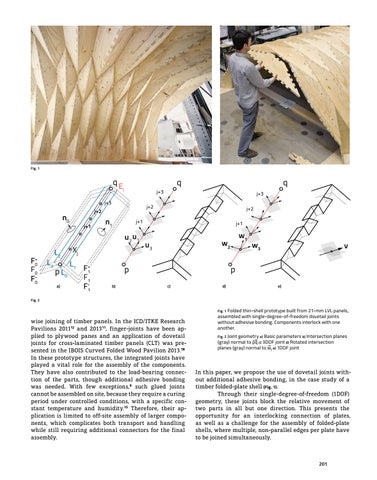
Fig. 1 Folded thin-shell prototype built from 21-mm LVL panels, assembled with single-degree-of-freedom dovetail joints without adhesive bonding. Components interlock with one another. Fig. 2 Joint geometry a) Basic parameters b) Intersection planes (gray) normal to pq c) 3DOF joint d) Rotated intersection planes (gray) normal to wj e) 1DOF joint
In this paper, we propose the use of dovetail joints with out additional adhesive bonding, in the case study of a timber folded-plate shell (Fig. 1). Through their single-degree-of-freedom (1DOF) geometry, these joints block the relative movement of two parts in all but one direction. This presents the opportunity for an interlocking connection of plates, as well as a challenge for the assembly of folded-plate shells, where multiple, non-parallel edges per plate have to be joined simultaneously.
201