Crops
The main crops are wheat, oilseed rape and spring and winter barley. I asked David where their crops go. “A fair percentage of the wheat goes into the production of Weetabix,” he tells me. “All of our oilseed rape is sold to ADM, a supplier for Unilever, for the production of Hellmann’s mayonnaise and other such condiments. And all the spring barley that makes the malting quality goes to Coors Brewery.” For its Unilever contract, Stapleford has to be a “LEAF Marque” farm (Linking Environment And Farming), which is an environmental assurance system based on environmentally responsible farming principles. “There’s a strong commitment here to farming good-quality produce with great care and to high environmental standards,” says David.
Reducing the carbon footprint
Lowering the farm’s carbon footprint is a topic that comes up repeatedly in our conversation and is clearly something to which David and his team are highly committed. They are approaching this in several ways. Firstly, there’s the accuracy of the combine harvester and the degree to which the machine disturbs the soil. The better the soil health, the lower the negative impact on the environment. There’s also a determined effort to reduce diesel consumption too.
Then there’s the worms… On areas of soil that the combine hasn’t driven over, there’s an undisturbed worm workforce busy below the surface, carrying out cultivation in the way that Mother Nature intended. Much gentler on the environment than doing it by machine! And, to further reduce the extent to which the soil is disturbed in the overall cultivation process, the team employs a farming method called “direct drilling”. This involves seeds being planted without (or with very minimal) prior cultivation directly into the “stubbles” of the previous crop (the bit of the plant left behind once the combine has done its work).
Diversification on the farm
In a move to open the farm’s land up to outsiders, Stapleford is a member of the Toll Rides Off-Road Trust (TROT), a charitable group established in 1990. It is dedicated to providing members with an extensive national network of horse riding and carriage-driving routes on privately owned land. And one rather charming, very English diversification on the farm is the planting of a series of willow trees, intended, David advises, for the production of cricket bats. This creative use of otherwise non-production land by Stapleford is expected to come to fruition in around 14 to 15 years time. Here’s hoping Rutland produces another Stuart Broad to test them out. • Stapleford Farms, Holygate Road, Stapleford, Melton Mowbray, Leicestershire LE14 2SG, 01572 787540. For further information on the LEAF Marque scheme or on TROT, visit www.leafuk.org or www.tollrides.org.uk
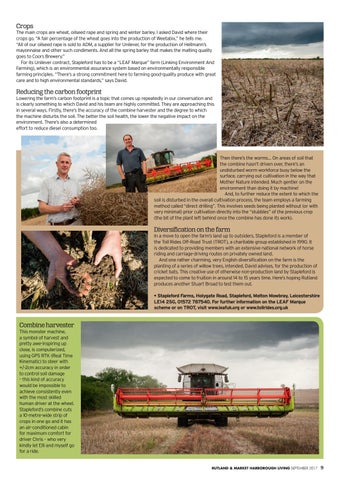
Combine harvester This monster machine, a symbol of harvest and pretty awe-inspiring up close, is computerized, using GPS RTK (Real Time Kinematic) to steer with +/-2cm accuracy in order to control soil damage – this kind of accuracy would be impossible to achieve consistently even with the most skilled human driver at the wheel. Stapleford’s combine cuts a 10-metre-wide strip of crops in one go and it has an air-conditioned cabin for maximum comfort for driver Chris – who very kindly let Elli and myself go for a ride.
RUTLAND & MARKET HARBOROUGH LIVING SEPTEMBER 2017
9