PREPARE PAV SAMPLES
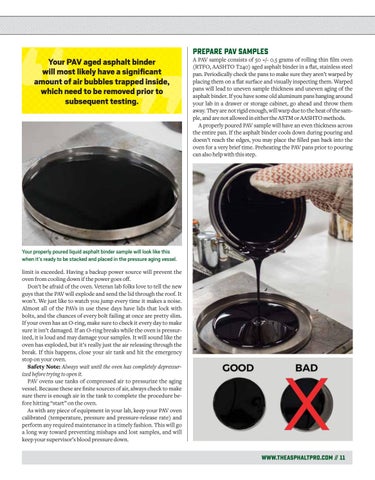
Your PAV aged asphalt binder will most likely have a significant amount of air bubbles trapped inside, which need to be removed prior to subsequent testing.
A PAV sample consists of 50 +/- 0.5 grams of rolling thin film oven (RTFO, AASHTO T240) aged asphalt binder in a flat, stainless steel pan. Periodically check the pans to make sure they aren’t warped by placing them on a flat surface and visually inspecting them. Warped pans will lead to uneven sample thickness and uneven aging of the asphalt binder. If you have some old aluminum pans hanging around your lab in a drawer or storage cabinet, go ahead and throw them away. They are not rigid enough, will warp due to the heat of the sample, and are not allowed in either the ASTM or AASHTO methods. A properly poured PAV sample will have an even thickness across the entire pan. If the asphalt binder cools down during pouring and doesn’t reach the edges, you may place the filled pan back into the oven for a very brief time. Preheating the PAV pans prior to pouring can also help with this step.
Your properly poured liquid asphalt binder sample will look like this when it’s ready to be stacked and placed in the pressure aging vessel. limit is exceeded. Having a backup power source will prevent the oven from cooling down if the power goes off. Don’t be afraid of the oven. Veteran lab folks love to tell the new guys that the PAV will explode and send the lid through the roof. It won’t. We just like to watch you jump every time it makes a noise. Almost all of the PAVs in use these days have lids that lock with bolts, and the chances of every bolt failing at once are pretty slim. If your oven has an O-ring, make sure to check it every day to make sure it isn’t damaged. If an O-ring breaks while the oven is pressurized, it is loud and may damage your samples. It will sound like the oven has exploded, but it’s really just the air releasing through the break. If this happens, close your air tank and hit the emergency stop on your oven. Safety Note: Always wait until the oven has completely depressurized before trying to open it. PAV ovens use tanks of compressed air to pressurize the aging vessel. Because these are finite sources of air, always check to make sure there is enough air in the tank to complete the procedure before hitting “start” on the oven. As with any piece of equipment in your lab, keep your PAV oven calibrated (temperature, pressure and pressure-release rate) and perform any required maintenance in a timely fashion. This will go a long way toward preventing mishaps and lost samples, and will keep your supervisor’s blood pressure down.
www.THeAsphaltpro.com // 11