Tracing how Malta’s Presidency of the Council of Europe built a visual language
EXHIBITION
DIALOGUE OF ELEMENTS
Exploring elements through the works of Arcangelo Sassolino, Victor Pasmore, and Tina Camilleri
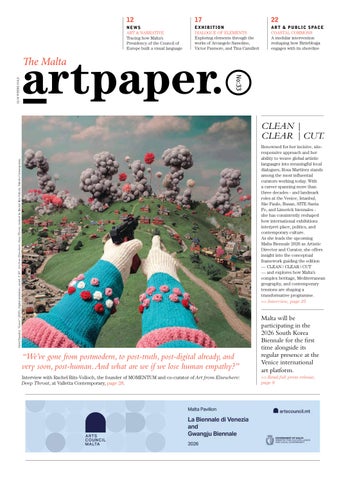
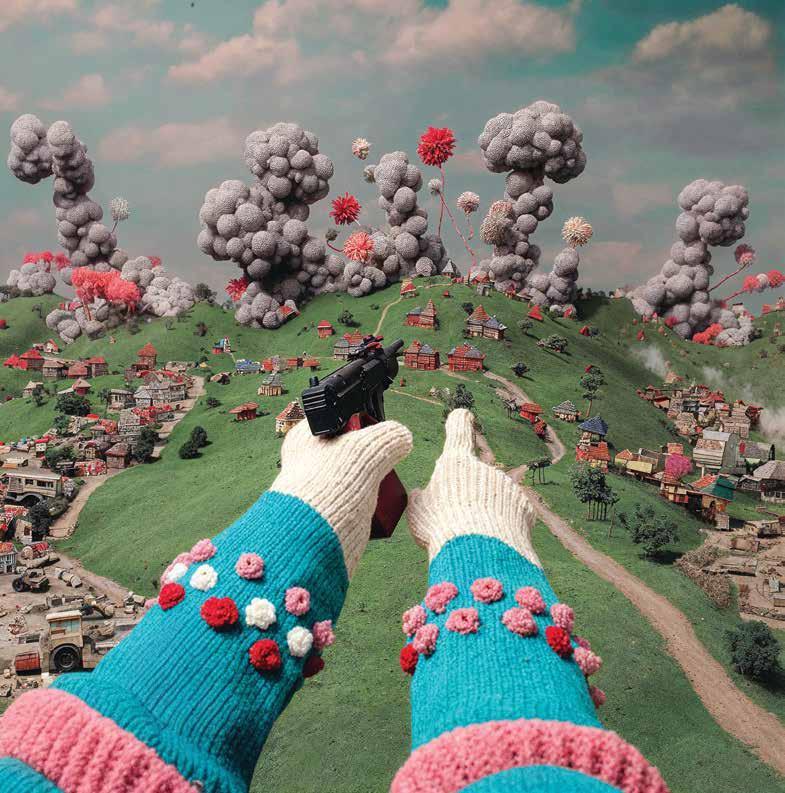
“We’ve gone from postmodern, to post-truth, post-digital already, and very soon, post-human. And what are we if we lose human empathy?”
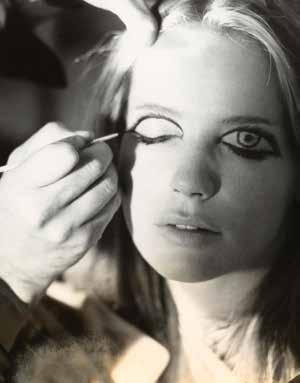
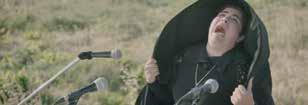
Interview with Rachel Rits-Volloch, the founder of MOMENTUM and co-curator of Art from Elsewhere: Deep Throat, at Valletta Contemporary, page 28
ART & PUBLIC SPACE
COASTAL COMMONS
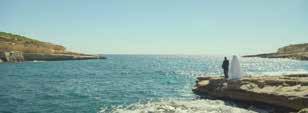
A modular intervention reshaping how Birzebbuga engages with its shoreline
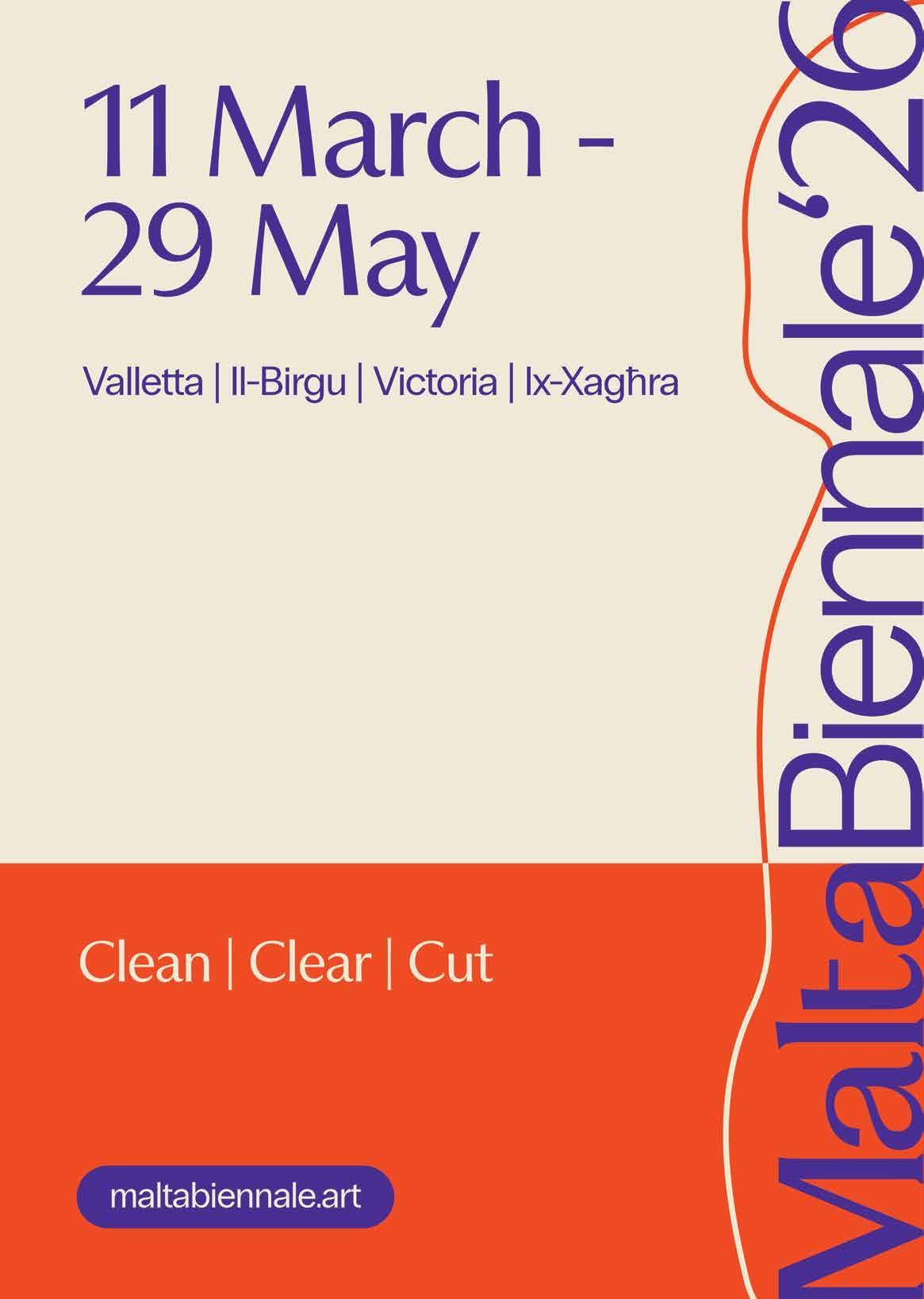
CLEAN | CLEAR CUT.
Renowned for her incisive, siteresponsive approach and her ability to weave global artistic languages into meaningful local dialogues, Rosa Martínez stands among the most influential curators working today. With a career spanning more than three decades - and landmark roles at the Venice, Istanbul, São Paulo, Busan, SITE Santa Fe, and Limerick biennalesshe has consistently reshaped how international exhibitions interpret place, politics, and contemporary culture.
As she leads the upcoming Malta Biennale 2026 as Artistic Director and Curator, she offers insight into the conceptual framework guiding the edition — CLEAN | CLEAR | CUT — and explores how Malta’s complex heritage, Mediterranean geography, and contemporary tensions are shaping a transformative programme.
>> Interview, page 25
Malta will be participating in the 2026 South Korea Biennale for the first time alongside its regular presence at the Venice international art platform.
>> Read full press release, page 9
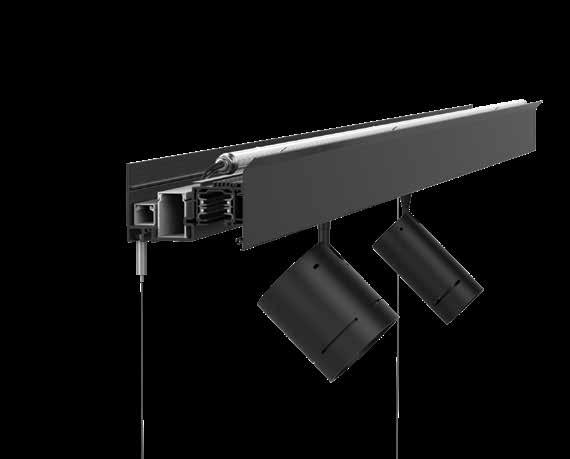
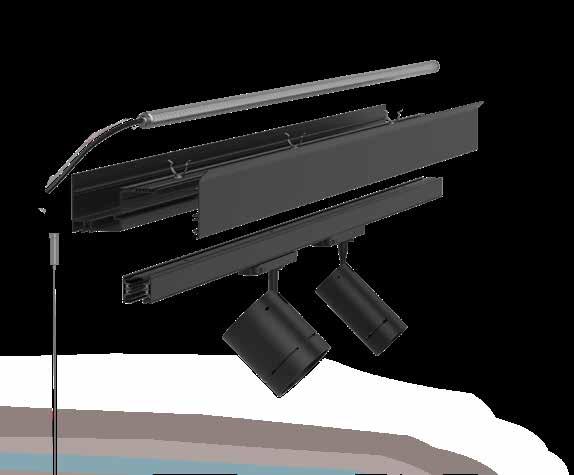
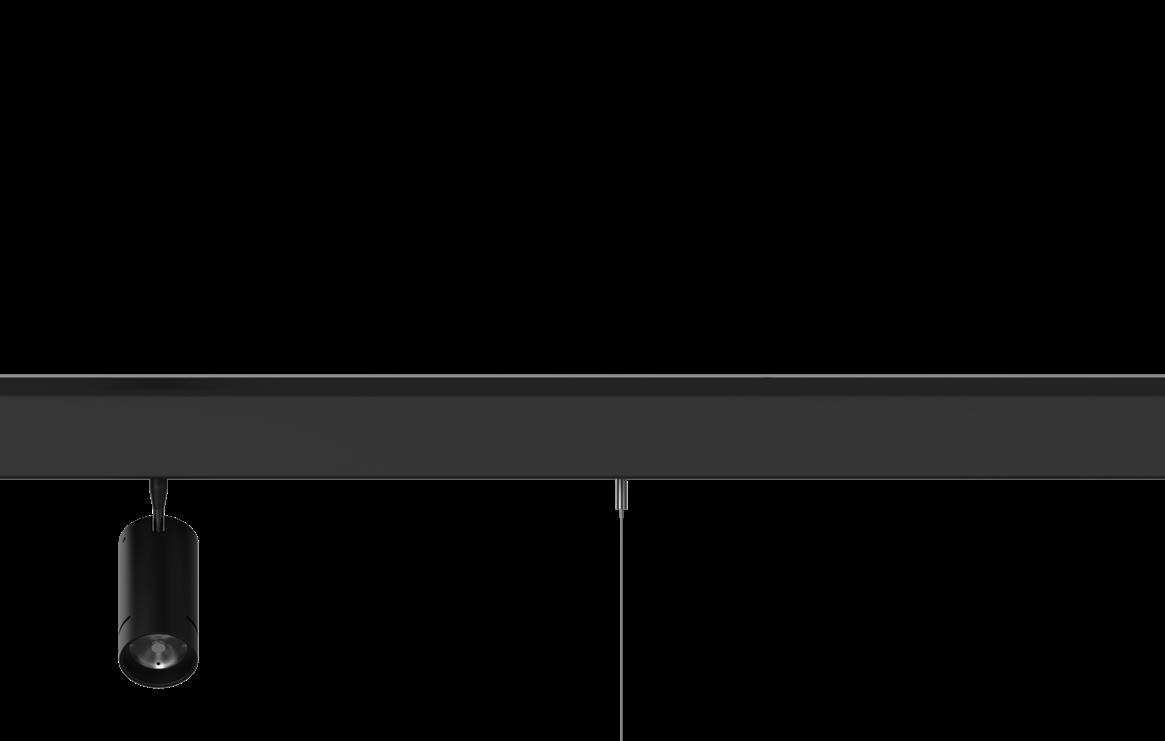
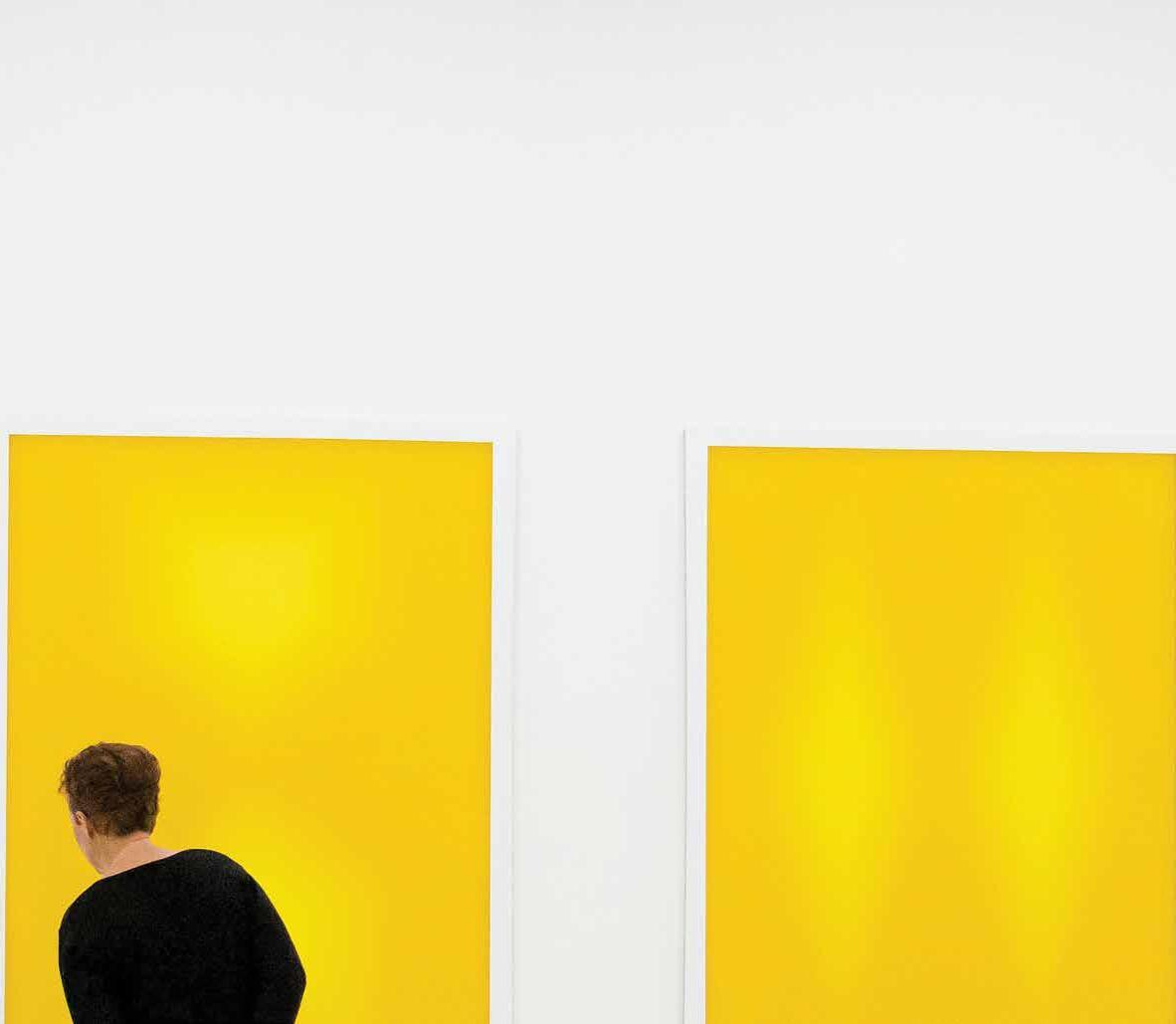
PRO4®: Multifunctional profile designed to address the lighting needs of spaces
Requiring minimal intervention on walls or ceilings, such as historic buildings and museums . The profile supports four different functions: indirect lighting with linear systems, cable routing, direct lighting with linear systems or adjustable fixtures mounted on an electrified track, and picture suspension using special grippers.
C Contents / Highlights
December 2025 - March 2026
10
R OPEN. A multidisciplinary exhibition where six artists explored the unnoticed, the unexamined and the intimate moments that quietly shape daily life, emerging from a residency at R Gallery.
18
THE PITY PARTY. A video installation by Samira Damato and Teodor Reljic that transforms private digital exchanges into a shared meditation on grief, technology, and the rituals we inherit.
VARIATIONS AT R GALLERY. Matthew Attard discusses the evolution of his practice, the poetic potential of digital tools, and the enduring pull of Malta’s sea and geology.
TWO LOST SOULS. Exhibition by Christian Palmer at 2B reveals the subtle vibrations, patterns, and energies that connect all living things, merging cymatics, sound healing, and visual art.
21
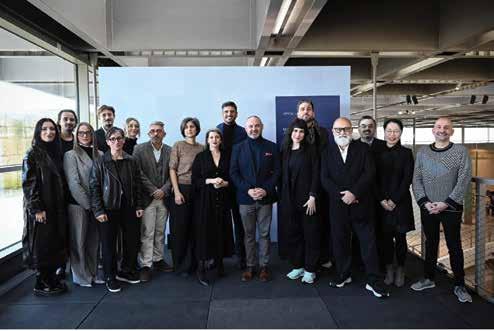
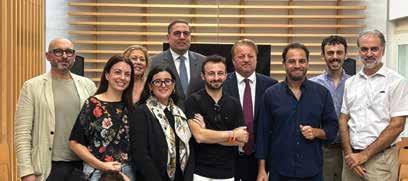
A COUNTRY SPEAKS THROUGH ART. A curatorial retrospective tracing how Malta’s Presidency of the Council of Europe built a visual language - bold, intimate, and resonant - across six months.
12
SECRETS AS REMEDY. Adrian mm Abela’s public sculpture receives its official inauguration, transforming private confessions into communal healing through participatory ritual.
15
DIALOGUE OF ELEMENTS. The Victor Pasmore Gallery hosts Burning Waters: ‘Diplomazija Astuta’ Retold, exploring the intersection of fire, water, metal, paper and sound through the works of Arcangelo Sassolino, Victor Pasmore, and Tina Camilleri. 17
Editor Lily Agius
Graphic Design
Nicholas Cutajar
Sales & Enquiries info@artpaper.press
Website www.artpaper.press
Instagram / Facebook artpaper.press
Artists & Curators:
COASTAL COMMONS. Set on the rocky shoreline of Birzebbuga, this site-specific intervention uses modular structures and community participation to redefine public space.
22
RETHINKING THE BIENNALE: Rosa Martínez on shaping global art discourse and redefining curatorial practice through clarity, disruption, and cultural responsibility.
25
MOMENTUM. 15th anniversary with Art From Elsewhere: Deep Throat, an exhibition exploring politics, voyeurism, and the human capacity to witness and empathise in a media-saturated world.
28
· AES+F · Adrian mm Abela · Inna Artemova · Sam Alekksandra · Matthew Attard · Norbert Francis Attard · Tony Attard · Luke Azzopardi · Nigel Baldacchino · Francesca Balzan
· Justine Balzan Demajo · Laura Besançon · Aaron Bezzina · Rachelle Bezzina · Andreas Blank · Anthony Borg Wirth · Austin Camilleri · Charlie Cauchi · Claudia Chaseling · Nico Conti · Samira Damato · James Dimech · Gabriel Doucet Donida · Margret Eicher · Nezaket Ekici · Shahar Marcus · Charlene Galea · Mariana Hahn · Anna Jungjohan
· Sarah Lüdemann (Beauham) · Duška Maleševic · Destil Markovic · Almagul Menlibayeva · Milovan · Christian Palmer · Kirsten Palz · Victor Pasmore · Margerita Pulè
· Michael Quinton · Teodor Reljic · Joachim Romain · Sheldon Saliba · Mark Anthony Sammut · Cyril Sancereau · Arcangelo Sassolino · Nina E. Schönefeld · Keith Sciberras · David Szauder · Tom Van Malderen · Raphael Vella · Julien Vinet · Rachel Rits-Volloch · Zhou Xiaohu · Vadim Zakharov
Writers & Contributors:
· Lisa Attard · Giuliana Barbaro-Sant · Sean Buhagiar · Maria Eileen Fsadni · Lisa Gwen · Rosa Martínez · Elyse Tonna · Elisa Von Brockdorff · Marta Wróblewska · Gabriel Zammit
Galleries & Spaces:
· 2B Gallery · Lily Agius Gallery · Malta Society of Arts · National Library of Malta · R Gallery · Rosa Kwir · Spazju Kreattiv · The Victor Pasmore Gallery · Valletta Contemporary
Lily Agius
SAĦĦARA | COMMODIFIED | 2023 | PHOTOGRAPH PRINTED ON HAHNEMÜHLE PHOTO RAG | 59.5CM X 42CM
News / Biennales + European Capital of Culture
December 2025 - March 2026
Malta will be participating in the 2026 South Korea Biennale for the first time alongside its regular presence at the Venice international art platform.
The South Korea Biennale in Gwangju is recognised as a key contemporary arts biennale in Asia.
Announcing the participation, Culture Minister Owen Bonnici said it reflected the “high calibre of Maltese artists and the continuous growth of their presence on the global stage”.
He added that Malta’s debut at the Gwangju Biennale is an “important step in extending its cultural footprint beyond Europe”.
Arts Council Malta CEO Luke Dalli said the two projects in Venice and Gwangju bring together “responsibility with ambition, uniting artists, curators and producers whose work pushes boundaries and opens new spaces for international dialogue.”
The 61st Venice Biennale will be titled In Minor Keys, curated by the late Koyo Kouoh. This theme, chosen by Kouoh herself, explores the spaces found within the “minor keys” of music, focusing on poetic, sensorial, and ethereal elements often associated with them.
Malta’s Pavilion, titled No Need to Sparkle; Experiments in Love and Revolution, will be curated by Margerita
EUROPEAN
Photo by DOI - Clifton Fenech
Pulè and created by artists Adrian MM Abela, Charlie Cauchi and Raphael Vella. The Pavilion, open from May 9 to November 22, 2026, responds to present-day realities by embracing Aristotle’s idea of “wise doubt” – a reminder that doubt can be an active and resistant force.
The work invites audiences into layered fictions, shifting narratives and melting storylines, provoking deeper reflection on truth, perception and belief systems – themes that align with the wider cultural ambitions of our country.
“No Need to Sparkle is built upon a wide range of historical and conceptual material, placing myths, stories and contemporary media side by side to explore how we understand reality. Each artist presents a screen-based and multimedia installation leading visitors into an uncertain terrain where what appears real becomes illusion, and certainty dissolves into ambiguity. The Pavilion invites us to prioritise empathy and multiplicity over fixed belief, acknowledging that multiple voices and perspectives can coexist,” Pulè said.
Malta’s debut at the Gwangju Biennale
CAPITAL OF CULTURE TITLE PROMISES ‘A NEW CHAPTER FOR VICTORIA AND
GOZO’, FOUNDATION SAYS
The Victoria 2031 Foundation has said that the European Capital of Culture title has the potential to transform Gozo culturally, socially, and economically, marking what it described as “a new chapter for the island and its people.”
In a statement, the Foundation said the shortlisting of Victoria as Malta’s sole contender for European Capital of Culture in 2031 represents an important milestone and that it hopes to strengthen Victoria’s role as “a living laboratory of ideas and inclusion”, where
cultural and creative projects inspire community connection, innovation, and opportunities for residents, nonresidents alike. A European Commission panel of experts announced that Victoria’s bid had passed an initial vetting process and will now face a second round of review with the final approval expected in September 2026.
The Foundation’s vision for Victoria 2031 is to create a cultural space built not on spectacle, but on encounter, care, and conversation, one that connects generations and communities not only across the island, but Europe. This is a European title, not a local one, we have a
in South Korea, to be held between September and December 2026, will feature the project BEJN / IN-BETWEEN, presented under the Biennale’s theme You Must Change Your Life. Hosted at the Horanggasy Art Polygon Gallery, the artistic team comprises four leading contemporary artists: Norbert Francis Attard, Sam Alekksandra, Julien Vinet, and Michael Quinton. Toni Attard is the project director, while Infinita, led by Mark Anthony Sammut, will provide extended reality (XR) support.
“The project will map an ecosystem unfolding between Malta and Korea through immersive installations, transforming the Malta Pavilion into a living threshold. The Pavilion will therefore create a new ‘between’: a reimagined sacred space for an age of polarisation – not as a refuge from tension, but as a crucible where opposing energies generate their own light,” the artists explained.
Norbert Attard’s work in ArtPolygon uses elastic material to explore Maltese identity. PONKS’ Rope Temple in the GlassPolygon creates a poetic link between Korea and Malta through sacred verses and ropes. Quinton’s work in the BasePolygon offers sound interactions and transnational experiences, expanded further through workshops and creative collaboration.
European outlook, with a responsibility to bridge Victoria and the Maltese islands to European communities. Victoria’s programme seeks to engage youth immersed in technology, working individuals who often face barriers to creative participation, and elderly citizens whose experience remains central to community life yet risks being side-lined by rapid social change.
The bid addresses Gozo’s everyday
challenges while turning the island’s distinctiveness into strength. By connecting Europe’s many “islands” (physical, digital, social, and cultural) Victoria 2031 aspires to build new bridges of care, creativity, and coexistence. The Foundation also reaffirmed its commitment to artistic freedom and to maintaining an independent, nonpartisan artistic programme, ensuring that every citizen can take part in cultural life.
December 2025 - March 2026
How well can you recall your day so far? Can you remember what colour the sponge was that you used to clean your breakfast plates with, or how many doors you have walked through today? What about yesterday, or even further: your childhood afternoons, the quiet work of your mother tending the house, the city as you knew it five years ago? Six artists in residency at R Gallery last month seemed to agree on one idea: there are so many things in life we take for granted, graze over or fail to pay attention to.
R Open was a multidisciplinary exhibition that featured works produced over a six-week residency, where artists were given space to develop and realise the ideas they carried within them. Despite no formal theme having been assigned, one could feel a common impulse: a fascination with the unnoticed, the unexamined, and the undervalued. Each work, in its own way, turned attention to the small overlooked moments, objects, or assumptions that we rarely pause to consider, yet that somehow shape the course of our lives.
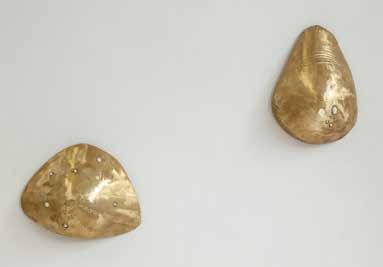
The exhibition opened on strength and vulnerability. Rachelle Bezzina’s brass sculptures revisited what we carry, consciously or not, about femininity. Delicate lace, breasts, and pearls bridged intimate memory and collective experience, hinting at beauty of light and wisdom, but also the unseen weight they bear. Brass is heavy, warm, and
“A
MARTA WRÓBLEWSKA
R OPEN
multidisciplinary exhibition that featured works produced over a six-week residency, where artists were given space to develop and realise the ideas they carried within them.”
unyielding, like being a woman; Bezzina preserved that duality in form.
On the opposite wall, Julian Vassallo’s analogue photographs turned to the one place where we can simply exist: the bed. Vulnerable, unfiltered, naked. It’s where we begin and end the day, yet we barely register it – perhaps because it’s the only place where we stop rehearsing who we are.
Aaron Bezzina’s sketches brought to light what we normally ignore in ourselves. Sent from Paris and displayed in a digital slideshow, his drawings responded
The Pity Party
The Pity Party - a video installation by Samira Damato and Teodor Reljic presented at Rosa Kwir in Novemberexplored grief, death, tradition, and the strange intimacy of the online world. The project emerged from a series of real digital conversations, WhatsApp chats, voice notes, and social media messages, exchanged between Damato and Reljic in the period following their fathers’ deaths.
These raw, imperfect exchanges became an unofficial archive of mourning: messages that spilled across platforms and emotional registers, shifting between confession, dark humour, anger, numb practicality, and the inherited weight of cultural expectations. In the wake of loss, the artists found themselves navigating not only the private terrain of grief but also the ways technology mediates, fragments, and sometimes softens our most vulnerable moments.
directly to prompts from visitors, transforming fleeting impressions and half-formed ideas into tangible forms. In doing so, his work celebrated the small, overlooked thoughts that we may often be too shy to voice but that make us uniquely ourselves.
Tom Van Malderen and Laura Besançon coaxed the forgotten and the unquestioned back into view. A doorway, a column, a corner or even a kitchen sponge - usually passed by without thought - become prompts to slow down and rethink the obvious. Van Malderen’s mirrors caught us in those
The Pity Party transformed those digital traces into a shared creative language. The original messages serve as a source text – translated, abstracted, and reimagined – to inspire artworks that blur the boundaries between memory and imagination, immediacy and reflection, the physical and the virtual. The Pity Party invited visitors to consider how mourning moves through contemporary communication channels, and how personal sorrow can become a site of connection, storytelling, and quiet resistance.
The work unfolded through a multi-screen installation that follows a ‘Griever’ as he attempts to mourn the death of a loved one, only to be interrupted by others, who seek to impose rituals and expectations. The installation was accompanied by a short publication, featuring excerpts of the artists’ personal conversations, along with original images, collages and graphic interventions.
This project was supported by Arts Council Malta
moments of hesitation, reflecting our curiosity back at us. Besançon, with that same alertness, rescued dust-gathering objects and lifted them into meditations on cultural identity, asking which memories make us feel rooted and give us a sense of belonging.
Duška Maleševic flipped the lens from memory to agency, showing how the stories we inherit are only as fixed as we allow them to be. Having begun the residency tracing Sliema’s past, she turned decisively to the present, symbolically giving both us and herself permission to rewrite the narratives we carry. Postcards that evoke memory became mirrored surfaces, and bold, hand-printed statements suggest that through measured effort, we shape the story we inhabit each day. Maleševic reminds us that what we allow into our lives, the selves we let take root, and the past we release are all ours to decide; today is what matters, and through it we define who we are.
R Open doesn’t end at the gallery door. Perhaps the act of noticing is the most fundamental form of agency we have; it is the first step toward reflection, choice, and action. Sometimes awareness alone is transformative. Leaving the exhibition, we feel an impulse to slow down and remain present: to appreciate, to reflect, to recalibrate. The next time we encounter our mother’s dinner invitation, the unmade bed from the night before, or an idea we were quick to dismiss, we may finally see them and realise how much they matter.
Rachel Bezzina, Weight of What’s Missing I-II, 2025, Brass, Genuine pearls, Each 20 x 15 x 8cm.
News / Exhibition at Spazju Kreattiv + Christie’s Press Release
October - December 2025
BLOW-UP
Exhibition of contemporary artworks alongside historical artefacts at Spazju Kreattiv
BLOW-UP is an exhibition that explores the ways in which film inspires and shapes reality. The project traces the trajectory from Michelangelo Antonioni’s 1966 film Blow-Up to today’s increasingly filmic experience of everyday life. Nearly sixty years later, the world appears to mirror cinema in reverse, as reality itself begins to feel constructed, edited, and framed.
Organised across three chapters, the exhibition examines artefacts from the 1960s in dialogue with contemporary counterparts, generating a series of visual and conceptual juxtapositions. Throughout, film and photography reflect on their own power to create, distort, or reveal truth. As the lens is inverted and the frame transcended, the viewer encounters an intensified confrontation between subject and object - between what is seen and how seeing shapes meaning.
BLOW-UP is the result of an intensive research and development process supported by Arts Council Malta between 2024 and 2025. Under the patronage of City of Art’s main patrons Jordi Goetstouwers and Valeria Limentani, and runs until the 4th of January 2026. Find out more: www.cityofart.eu/blow-up
Christie’s International Real Estate Strengthens Malta Presence with New Country Name
Malta’s official Christie’s International Real Estate affiliate will now trade as Christie’s International Real Estate Malta, streamlining its identity within the prestigious Global network and strengthening its position as the archipelago’s gateway to International Luxury property markets.
The rebrand follows four years of successful partnership. Since becoming a Christie’s affiliate in 2021, the firm has connected Maltese properties with buyers across over 50 countries whilst simultaneously helping local clients navigate property transactions from London to New York.
“The clearer name reflects where we are today,” said Miguel Bonello, Managing Director. “We’ve evolved from a boutique
local agency to Malta’s representative within one of the world’s most respected Luxury brands. It’s a two-way street, we market local properties Internationally, but we also regularly have Maltese clients asking us to buy or sell their homes in Portugal, London or Dubai. The Christie’s Malta name makes those connections instant.”
www.christiesrealestatemalta.com
December 2025 - March 2026
“A country choosing to speak through artists”
The Presidency as Exhibition: A Curatorial Retrospective of the Presidency’s Visual Language
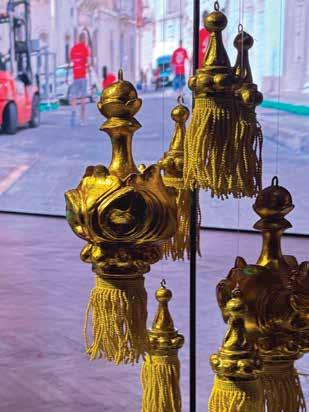
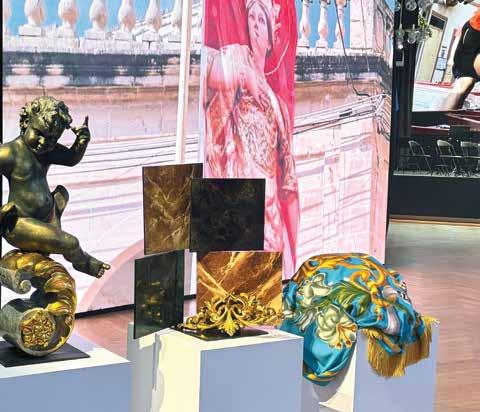
When Malta assumed the Presidency of the Council of Europe in 2025, the ambition was never simply to programme events but to shape a visual narrative that could linger beyond meetings, communiqués, and official statements. Over six months, the visual arts quietly and confidently became one of the strongest carriers of Malta’s cultural voice. From monumental sculpture to design interventions to textile-based storytelling to subversive video art rooted in ‘festa’ iconography, these projects collectively formed a creative anatomy of the Presidency, an imprint of who we are and how we chose to show ourselves. Now. Today.
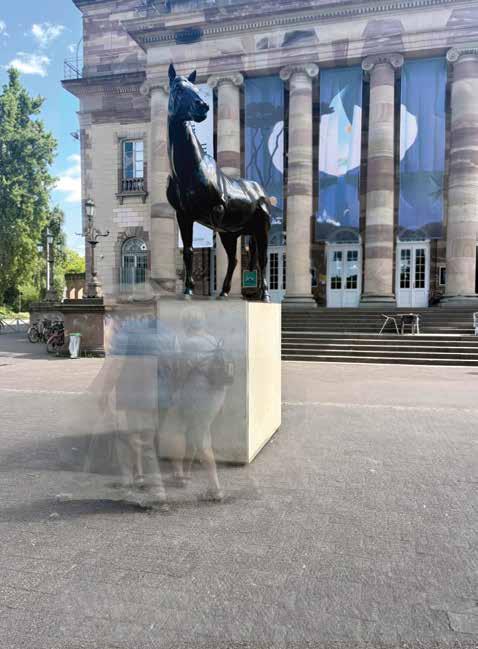
The Horse That Watched Us Back: Austin Camilleri’s Zieme
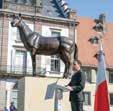
Perhaps the most photographed symbol of Malta’s term in Strasbourg was Austin Camilleri’s Zieme, installed at Place Broglie, the square where La Marseillaise was first performed. Its muscular stillness, half myth and half memory, became a silent witness to diplomatic passage. Delegations stopped, stared, and circled. Locals adopted it. Children patted its bronze flank for luck. Someone even placed a bicycle tyre around it.
“Zieme was never created to affirm official narratives,” Camilleri told me during the installation. “When the weight of monuments overshadows the silence that history leaves behind, I see
Zieme reclaiming a space for voices and visions that exist at the fringe.”
The Gavroches Return: Sciortino at Opéra National Du Rhin
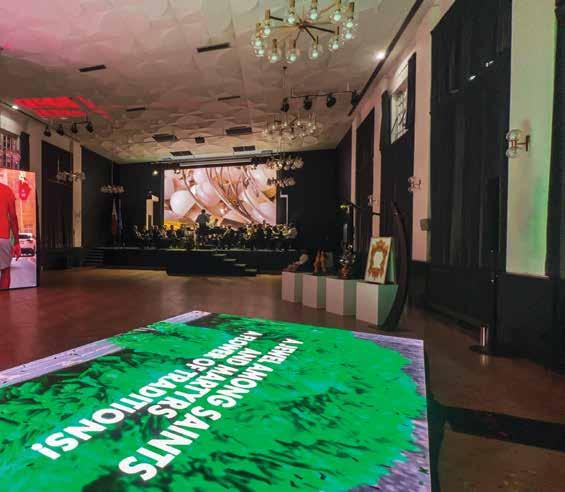
Another sculptural thread woven into the Presidency’s visual language was the decision to foreground Antonio Sciortino’s Les Gavroches - the 1904 bronze masterpiece by Malta’s greatest modern sculptor. Inspired by Victor Hugo’s Les Misérables, the work depicts three Parisian street children: symbols of innocence, struggle, and youthful hope. Reintroduced specifically for the Malta Sings for Europe concert at the Opéra du Rhin, the sculpture became a central visual metaphor for the evening.
Its presence did more than decorate the stage; it connected Malta’s story to a wider European one. Les Gavroches tied together Rome, where Sciortino built it; Paris, where Hugo wrote it; Valletta, where it lives in our collective heritage; and Strasbourg, where it now echoed through the concert hall. As the ensemble reached One Day More from Les Miserable, the sculpture anchored a subtle narrative: Maltese and French art, literature, and music converging in harmony - a small bronze reminder that Europe’s cultural fabric is woven through shared stories.
The Gavroches made the stage feel part of a much larger European conversation.
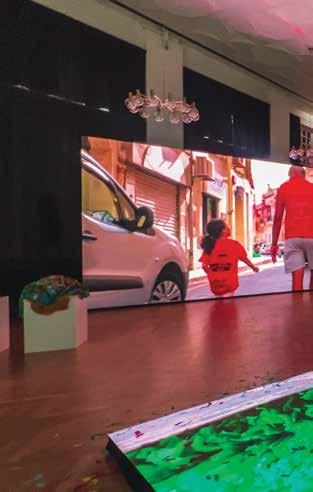
The Image of Festa Today: Charlie Cauchi’s Visuals
No visual artist captured the celebratory contradictions of Maltese identity quite like Charlie Cauchi. Her filmic and photographic works, devotional, humorous, and unexpectedly tender, offered a counterpoint to the more solemn commissions of the Presidency.
Her reflections on ‘festi’, shown in Strasbourg and Valletta, reminded viewers that Maltese culture vibrates between ritual and riot, between sacredness and spectacle.
“Festa is choreography,” Cauchi said. “It is choreography of faith, of noise, of belonging. I wanted to show the people
inside that choreography. Each screen helped to offer a unique perspective; one that is intimate, capturing not only the grandeur of the festa but also the dedication behind it.”
Folio Fashion: Paper Garments in a Library
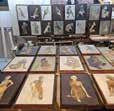
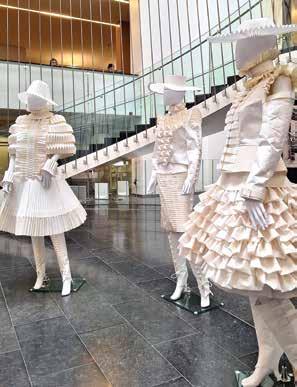
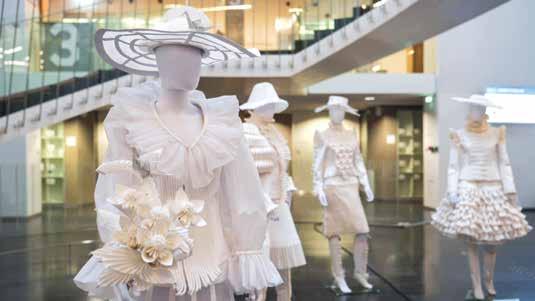
Inside the National University Library of Strasbourg (BNU), Maltese designer James Dimech unveiled a striking reinterpretation of form and material. His collection - composed entirely of paper - evoked the quiet solemnity of ceremonial and monastic dress, transforming delicate fibres into sculptural garments that carried both presence and purpose.
“These are not costumes,” Dimech clarified, as visitors leaned in to observe the pleats, folds, and stitched seams. “They’re not built to be worn. They are not books, but they carry stories, our own.”
In a space devoted to knowledge and language, the installation offered an unexpected encounter. Fragile yet intentional, the paper garments stood like guardians of memory - proof that even the lightest of materials can leave a lasting impression.
A Meditation on Mutability: Fragile Foundations at The Council Of Europe
The Presidency’s flagship exhibition, Fragile Foundations, approached instability as a state of continual transformation. Rather than treating fragility as decline, it presented it as the natural cycle through which forms emerge, erode, and return. The works invited viewers to consider how meaning is carried through change, and how the act of rebuilding becomes part of our shared cultural vocabulary.
Across the exhibition, this sense of mutability unfolded through shifting atmospheres and material languages.
The immediacy of Francesca Balzan’s clay heads spoke of creation as a primal gesture, while the contemplative calm of Rebecca Bonaci’s pastel horizons suggested moments of origin and quiet renewal. The mood shifted as Shaun Grech’s painted figures surfaced in raw colour and emotional urgency, their tension echoed in the material collisions of Kane Cali’s sculptures of steel, obsidian, and concrete. Together, these works traced a movement from emergence to rupture to reformation, revealing continuity not through permanence but through the persistence of form.
As curator Fabrizio Mifsud Soler noted, the exhibition offered reassurance in
reminding us that fragility is not a failing but, in the bigger picture, a continuous act of breaking and remaking that shapes both the self and our shared humanity.
A Presidency That Looked Like Design
Set and spatial designer Romualdo Moretti, who collaborated closely across projects, described one of the most underreported aspects of the Presidency.
“There was an unusual seriousness about design this year. Not design as decoration but design as an organising principle. The attention to form, texture, and scale created coherence. Even the political events had scenography, whether people noticed or not. They lived it.”
His observation is precise. The visual language of the Presidency was deliberate, integrated, and treated with artistic respect.
A Note from the Artistic Director, Sean Buhagiar
As Artistic Director of the Cultural Programme, I witnessed how these
works reshaped diplomatic space. They gave Malta a visual vocabulary, sometimes bold, sometimes intimate, always authentic.
To borrow my own words from the closing night: “Presidencies end, but culture endures. What we placed in Strasbourg, on plinths, on walls, on fabric and on screens, was not a show of what we produce but a reflection of who we are. Now. Today.”
And perhaps that is the lasting legacy of Malta’s Presidency in 2025: a country choosing to speak through artists, choosing to be remembered in images as much as in policy.
News / Exhibitions / Porcelain & Sculpture
December 2025 - March 2026
Incunabula and 3D Printing
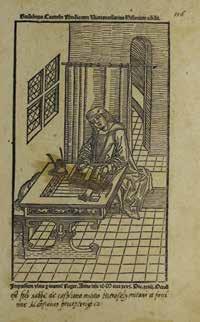
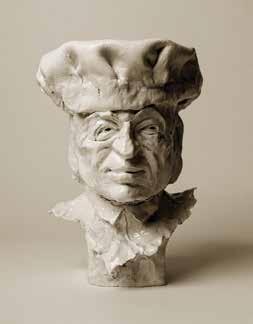
Set within the historic National Library of Malta, this exhibition draws a compelling parallel between the incunabula of early European printing and the emerging world of 3D printing, still in its own formative phase. In conversation with Artpaper, the artist, Francesca Balzan, reflects on how technological revolutions transform not only the way objects are made but how knowledge, identity, and authorship are shaped. By reworking digitally printed porcelain sculptures inspired by the Library’s rare books and the people behind them, the artist brings past and future into dialogue, reminding us that every leap forward leaves space for human intervention, imagination, and interpretation.
Technology has always changed not only how we live but also how we imagine the world. The earliest printed books in Europe were products of a technological revolution that profoundly altered human society. Printing democratised knowledge and enabled ideas to circulate with a speed and reach that had never been possible before. The earliest books, printed between 1450 and 1500, are called Incunabula meaning ‘in the cradle’.
3D printing, a technological revolution in its own right, is still in what might be described as its incunabula phase. Having been invented less than fifty years ago, it remains at an early stage of its development, and its full impact is yet to be measured.
As an artist, I am compelled to ask whether the birth of 3D printing will
transform society as radically as the introduction of printing once did in Europe. I want to explore this parallel, which to my knowledge has not yet been considered through an artistic lens. I regard these early 3D prints as incunabula in their own right, just as the earliest printed books are collectively known by that term.
This project builds upon earlier experiments I carried out with Perit Matthew Catania of Ambitious.mt in ‘Serendipitous Encounters’ (2021–22), a project supported by Arts Council Malta. At that time, I experimented with hand-altering objects that Matthew had printed on his new 3d printer, intervening directly in the process, sometimes even as the objects were being printed, to subvert the logic of digital replication. In this current project, Matthew collaborates with us once more, printing generic stylised heads that we designed together, in wet
porcelain clay which I then painstakingly assemble, alter, and transform in an act of resistance against the perceived seamlessness of the digital.
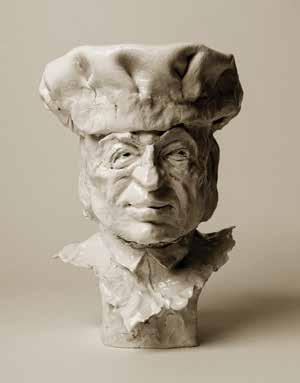
I transform the print by overwriting it in clay, by adding and layering over the underlying shape and by sometimes hacking away at it. I treat the print as a generic skull that needs flesh added to it to build up an individualised image. In positioning the National Library’s incunabula collection as the central focus of my exhibition I fished out characters - whether authors, publishers, previous owners of these books, persons who handled them
- and researched ancient and more modern sources such as paintings, coins, sculpture and book illustration to put a face to these names. Once I had some images to work on I was able to flesh out these faces. It was not so much about appropriating established images but about reimagining them and their stories and giving them visages that matched my imaginings of them.
Incunabula, curated by Justine Balzan Demajo, runs until the 12th of December.
>> Read Full Feature on www.artpaper.press
REFLECTIONS ON PORCELAIN
An immersive journey into fragility, resilience, and memory through porcelain with Nico Conti
The Malta Society of Arts (MSA) presented Reflections on Porcelain, the first solo exhibition in Malta by internationally recognised Maltese artist Nico Conti last October.
Spread across five rooms of the MSA’s Art Galleries, the exhibition took visitors on a sensory and emotional journey. Each space offers a distinct atmosphere, where porcelain shifts roles – at times comforting and familiar, at others obsessive or haunting.
“I always dreamed of having my first solo show in Malta,” says Conti. “My work has been presented in different parts of the world, but for this show I wanted the people who shaped me into who I am today to be present. My family, my friends, my educators. In a way this show is both a thank you and a reflection, a way to share what I have been exploring with the people who matter most.”
Working almost exclusively in porcelain, Conti fuses traditional craft with cutting-edge 3D printing
technology. “Porcelain is what fascinates me most because it is both fragile and strong,” he explains.
“Before firing it can collapse under the slightest touch, but once fired it becomes resilient, translucent, and can last for thousands of years.”
The exhibition drew on themes of memory, reflection, and transformation. In the opening room, for instance, Conti recalls his grandmother’s porcelain cabinet, placing delicate works behind fluted glass. “I wanted to capture that sense of familiarity and distance at the same time. It also feels like a nod to memories fading, where the shapes are still there but they start to blur.”
Visitors encountered porcelain in unexpected ways, experiencing its glow, fragility, and strength as light and shadow shift around it. “Porcelain will probably surprise them,” Conti noted during the exhibition. “Many people only know it from plates or figurines, but here they will see it transformed. The show is not just about objects, it is about experiences. Porcelain can become lace, stone, memory, or light.”
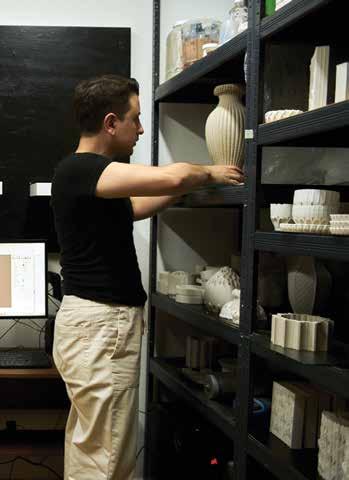
Nico Conti in his studio. Photo by Kim Sammut
A page from Incunabula 12, showing the author’s portrait printed in 1496, image courtesy of the National Library of Malta Francesca Balzan, Incunabula2025. Photo by Lisa Attard
/
Art & Performance + Exhibition
December 2025 - March 2026
The Court for Concealed Thoughts (Misrah
il-Kliem
Mistur)
Public Artwork Receives Intended Inauguration After Eight Years
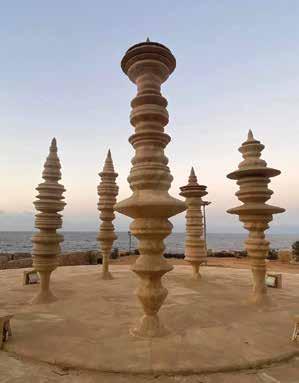
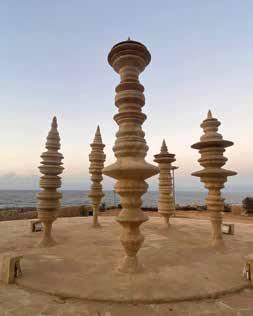
After standing by the Mediterranean Sea for eight years, The Court for Concealed Thought - a public sculpture by Maltese artist Adrian mm Abela - will be officially inaugurated through a participatory performance ritual on January 4, 2026, at sunset.
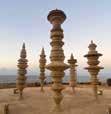
The Court for Concealed Thoughts consists of five stone pillars arranged in a circle overlooking the sea at Ghar Lapsi, Siggiewi. Each pillar’s distinctive waveform shape was derived from audio recordings of villagers sharing personal secrets they wished to release. The work’s title draws on a linguistic connection in Maltese: mistur (concealed) and mistura (medicine) share the consonantal roots {M}–S–T–R, suggesting that what we hide and what heals us spring from a common source. Through the act of voicing what was once concealed, the work transforms secrecy into remedy.
The concept was selected through a government-hosted open call in 2015, chosen by both an expert judging panel and public vote, and installed in 2018. Despite its completion, the sculpture has remained without official inauguration or informational signage - until now.
On January 4th at 5pm, the site will host its first annual ritual of collective release. Members of the public are invited to anonymously submit their secrets through the project website, kliemmistur.com. At sunset, a reader will voice these confessions toward the horizon, transforming private burdens into a shared act of healing.
This ceremony will recur annually on the first Sunday of each January, creating an ongoing tradition for as long as the site endures. The public is invited to witness this inaugural ceremony and to contribute their own concealed thoughts to future readings.
Adrian mm Abela is a Maltese artist based in Los Angeles whose multidisciplinary practice explores identity, memory, and collective ritual. His work has been exhibited internationally, including at the Venice Biennale, and is part of the National Collection of Malta.
NOTHING BUT THE SEA –Cyril Sancereau
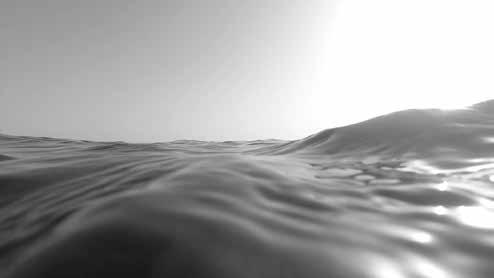
Valletta Contemporary is pleased to present Nothing But the Sea, a solo exhibition by Cyril Sancereau featuring video installations and photographic works that explore impermanence, instability, and the conditions of dwelling on an island.
The sea refuses to be fixed. It changes constantly, never the same twice. This exhibition does not document that change but makes it inhabitable. Through photography and video, Sancereau creates spaces where impermanence becomes visible, tangible, livable. A horizon trembles with the oscillations of the body. A form emerges and dissolves in the reflection of a puddle. Points of light flicker in the dark.
Based in Malta since 2015, Sancereau has developed a rigorous practice centered on a single element: the sea. For over a decade, he has returned repeatedly to the same subject, refusing the temptation to diversify. This is not landscape photography. This is not contemplation. The work begins where certainty ends.
Space is never neutral for those who must constantly adjust, read signs, sense limits. The work starts here: in the necessity of existing where welcome cannot be assumed, and finding, despite this, ways to be alive. Instability is not a problem to solve. It is a condition to inhabit.
Working primarily in black and white and through immersive installations, Sancereau removes color to refuse geographical or temporal markers. These could be any seas, any shores, any moment. What remains is texture, duration, and the trace of forces too slow or too constant to be witnessed except through sustained attention.
Visitors are invited to move, to drift, to let their perception become uncertain. Perhaps for an instant they will feel that fragility is not a threat.
VALLETTA CONTEMPORARY 12th - 24th December 2025 & 7th January - 28th February 2026
News /Exhibition / Press Release
December 2025 - March 2026
Burning Waters: ‘Diplomazija Astuta’ Retold
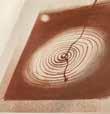
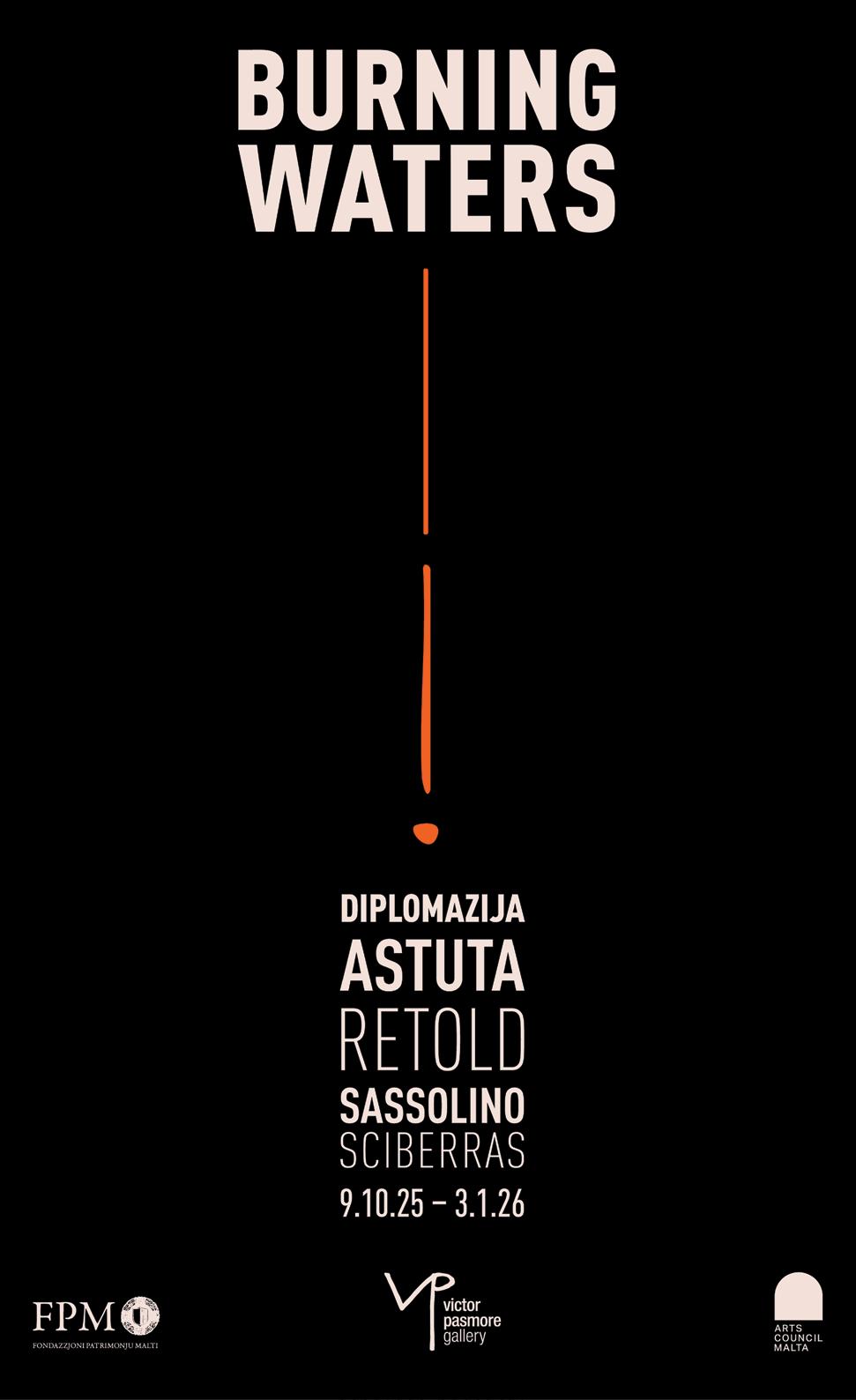
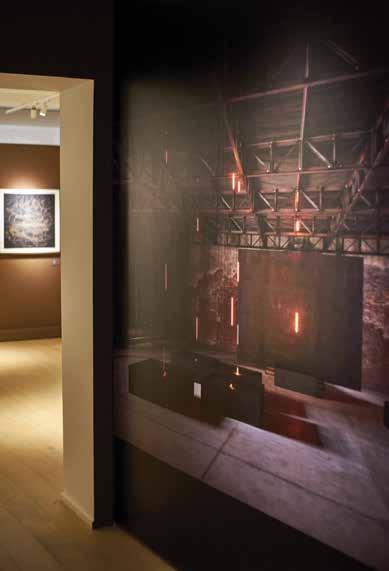
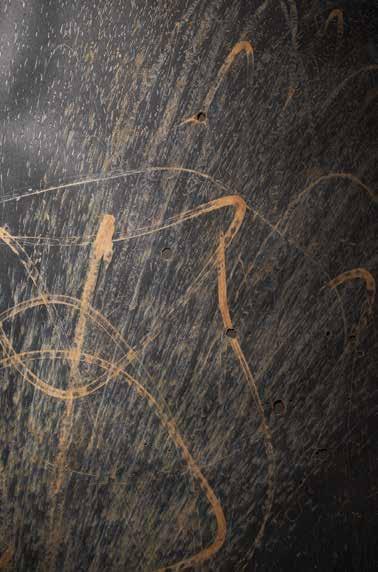
The current exhibition ongoing at the Victor Pasmore Gallery, ‘Burning Waters: ‘Diplomazija Astuta’, is a conversation between fire and water, metal and paper, silence and sound, and elements, eras, and energies. Presented by Fondazzjoni Patrimonju Malti and curated by Profs. Keith Sciberras, this exhibition forms part of the RETOLD commemorative project commissioned by Arts Council Malta.
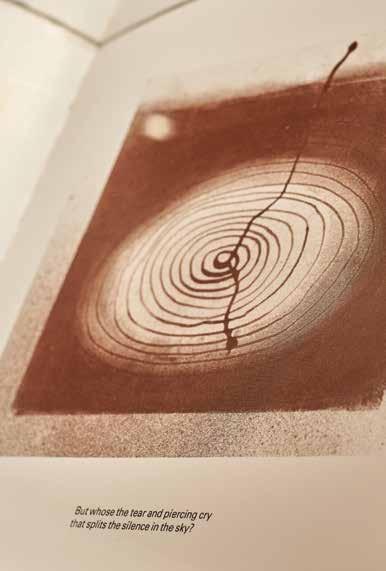
At its heart is a dialogue between two artists, Arcangelo Sassolino and Victor Pasmore, who are separated by time but connected by their shared interest in perception and change. The raw and erratic are embodied in Sassolino’s recent paper works, which are created by the collision of molten steel and delicate fibre. These works, which came from his highly regarded 2022 Venice Biennale installation Diplomazija Astuta, capture the moments when destruction gives way to creation, with each burn mark retaining the energy that went into its creation. On the other hand, Pasmore’s
prints and poetry, which include excerpts from his limited-edition book Burning Waters, provide reflections on abstraction, rhythm, and balance. His lyrical restraint and ordered geometries demonstrate a persistent interest in elemental forces, the same tensions that Sassolino explores through pressure, heat, and unpredictability.
As a bridge between the artists’ worlds, Tina Camilleri’s recently commissioned soundscape weaves through this visual dialogue. Drawing inspiration from the ethereal compositions of Victor Pasmore and Arcangelo Sassolino, Camilleri infuses the gallery’s architecture with ambient tones, hypnotic pulses, and
earthy atmospheres. Her arrangement creates a continuous flow between the floors, tying the exhibition together with space and vibration. A sensory field where visitors alternate between tension and calm is created by the sound, which reflects the material dialogue of the works; solidity meeting fluidity, violence giving way to stillness.
A world of contrasts and continuities is created by the combination of these artists. More than just an exhibition, ‘Burning Waters’ is a reflection on change, process, and the precarious balance between creation and decay.
‘Burning Waters: ‘Diplomazija Astuta’ Retold’ will be on display until the 3rd of January at the Victor Pasmore Gallery, APS House, located at 275 St. Paul Street in Valletta. The opening hours are Monday to Thursday, 10am to 5pm (last entry at 4pm); Friday, 2pm to 7pm (last entry at 6pm); and Saturday, 10am to 3pm (last entry at 2pm). You can purchase tickets at the door. Tickets are available at the door. The exhibition is commissioned by Arts Council Malta in collaboration with Fondazzjoni Patrimonju Malti.
Photo by Kim Sammut
Interview / Exhibition / Matthew Attard
December 2025 - March 2026
VARIATIONS AT R GALLERY
Exhibition by Matthew Attard
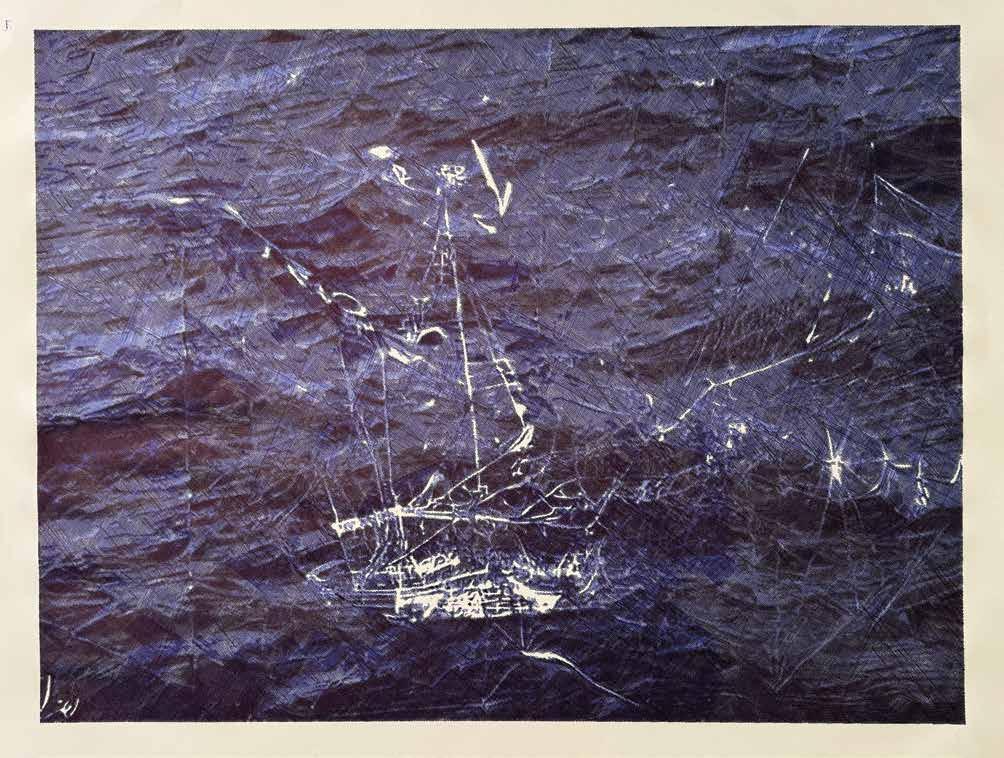
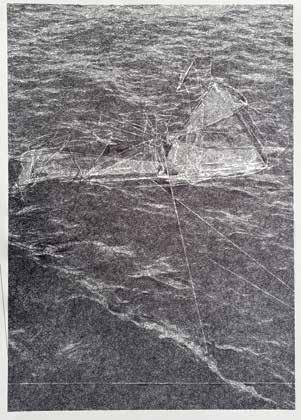
Fresh from the global spotlight of the Venice Biennale, where he represented Malta with the critically acclaimed I Will Follow the Ship, the artist returns to a local audience with renewed momentum and expanded vision. This month he unveils Variations at R Gallery—his first solo exhibition in Malta since Venice—marking a new chapter in his long-standing investigation into ships, movement, and the layered histories of the Maltese islands. Bridging drawing
with emerging technologies such as AI, 3D scanning, and eye-tracking, his latest body of work continues to push the boundaries of image-making while remaining firmly rooted in the physical and cultural landscapes that define Malta. In this interview, he discusses the evolution of his practice, the challenges and poetic potential of digital tools, and the enduring pull of the sea and geology that shape the nation’s borders.
This is your first solo show at a gallery in Malta since representing the country at the Venice Biennale
with ‘I Will Follow the Ship’. How does it feel to bring your work back to a Maltese audience?
Last month we opened ‘The Ship (unseen)’ at the Inquisitor’s Palace, as a restaging of ‘I Will Follow the Ship’ curated by Elyse Tonna, and that had felt like a great opportunity to reinterpret certain highlights from the pavilion, while also introducing an opening towards a possible future development of the project. For the show at R Gallery I wanted to exploit this and take it further, and therefore the putting together of the show felt quite exciting.
Your upcoming exhibition at R Gallery, Variations, revisits your ongoing exploration of ships while also introducing a new body of work focused on the Maltese landscape. Can you walk us through this evolution?
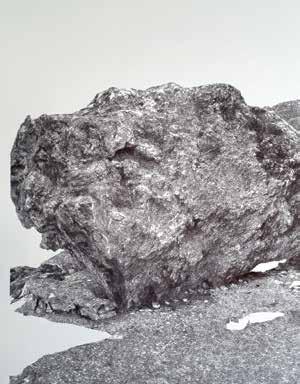
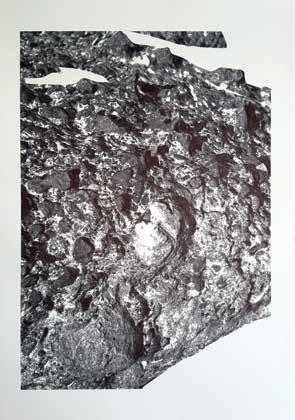
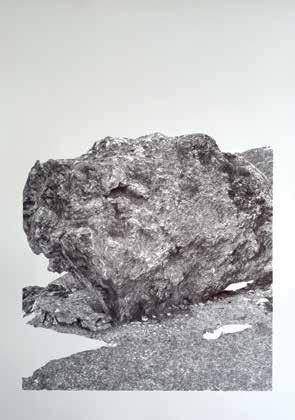
Yes, ‘Variations’ continues the ongoing possibilities of image-making relating to the ship project, while also introducing new work that stems from the 3d scanning of landscape elements such as boulders. In some ways, they are
I am not interested in using it as a tool that enhances my work, but am rather interested in its glitches and shortcomings as a critical inquiry.
parallel projects in their merging of digital technologies with a drawing exploration. I had been 3d scanning details of our landscape for quite some time, and I now have the space and time to be developing them into a drawing exploration.
You often incorporate AI into your process as a creative tool but also with a layer of irony. How does AI shape your work, and what interests you in its possibilities and limitations?
Yes, I am primarily interested in how it affects us. ‘AI is neither artificial
nor intelligent’, is a citation from Kate Crawford that informs my perspective of it. I am not interested in using it as a tool that enhances my work, but am rather interested in its glitches and shortcomings as a critical inquiry.
Drawing is a traditional medium, but in Venice you expanded it through eye-tracking technology. How has your approach to drawing continued to develop in this new body of work that you will be presenting?
I am interested in drawing as an activity that is open-ended in nature, and thus,
in its exploratory aspects of an ongoing search. As many have conceptualised, drawing is a way of seeing. This is where my primary interest in drawing lies, and part of this exploratory search consists in expanding drawing via other media, such as eye-tracking, AI glitches and 3d scanning, all part of the work in ‘Variations’.
The sea and the rock formations that define the borderlands of the Maltese islands appear frequently in your work. What draws you to these motifs, and why do they continue to be such a persistent
source of inspiration?
I go on many walks seeking such motifs and details that they offer. For example, I am interested in looking at the design resulting from the geology’s sedimentation. I am also interested in the heritage of such landscapes, that when drawn out and put in evidence, can perhaps serve as a comment on current environmental and urban issues.
‘Variations’ by Matthew Attard opens on the 4th of December and runs until the 30th of January 2026 at R Gallery, 26 Tigné Street, Sliema.
Interview / Exhibition / Christian Palmer at 2B Gallery
December 2025 - March 2026
Two Lost Souls
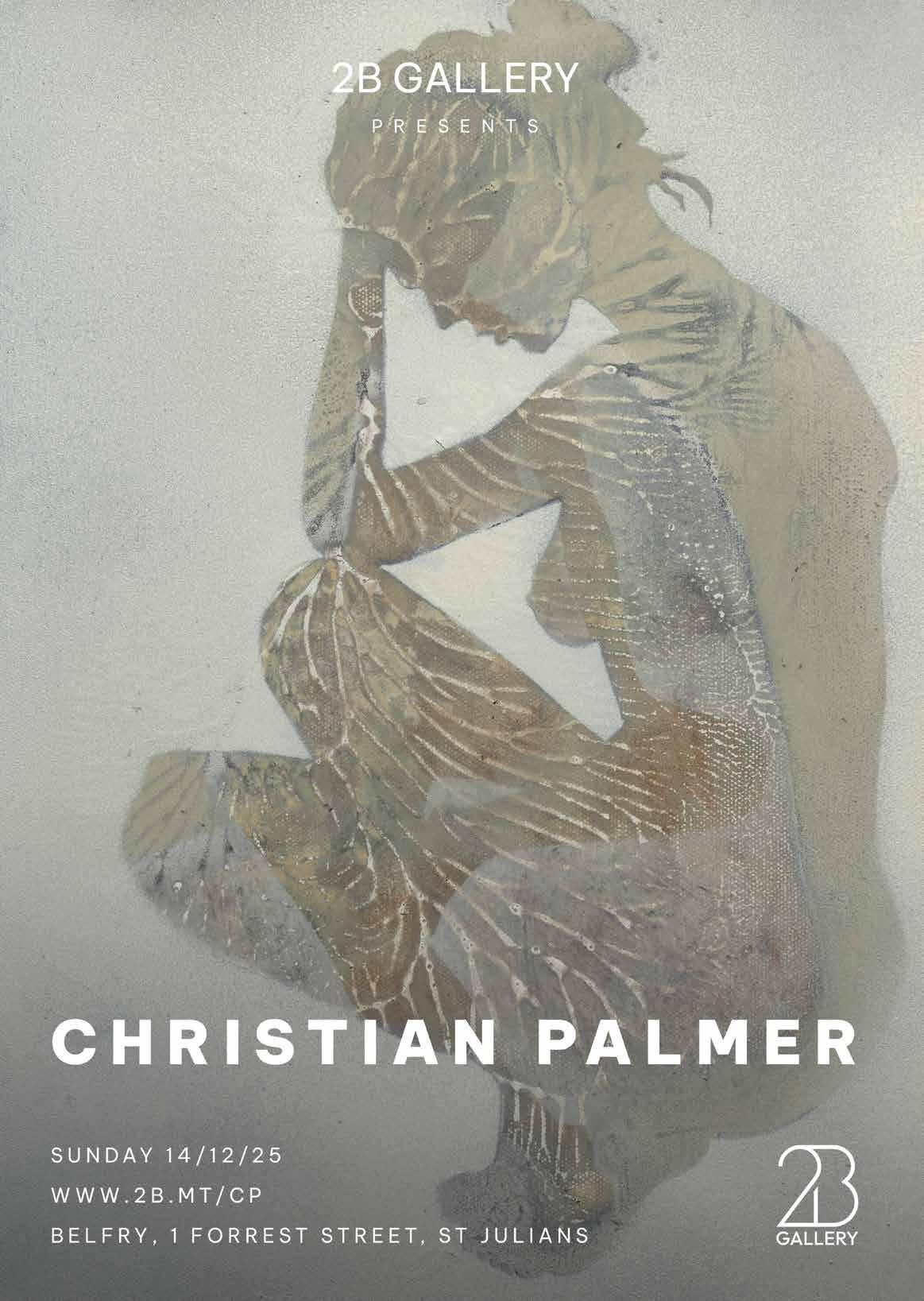
Two Lost Souls invites viewers into a world where science, mysticism, and the human experience collide, revealing the hidden vibrations and patterns that connect us all. Interview with Christian Palmer ahead of his exhibition at 2B Gallery.
Your work blends scientific exploration, mysticism, and the observation of life’s patterns. How do you balance these different influences - cymatics, sound healing, cosmic contemplationwhen deciding what ultimately becomes part of a piece?
In this body of work I am the observer, life drawing, witnessing strength through vulnerability, but also experimenting with elements, water and fire and contemplating how life functions on a scale that is beyond my capacity to fully comprehend. These are the observations of a wandering mind. It seems we are all stardust vibrating at a certain frequency. There are fractal, asymmetrical patterns that repeat themselves throughout expressions of life from a cellular level to a cosmic scale encompassing everything in-between. We are not seperate, just disconnected. We are part of a whole soul-asystem. Everything requires balance and polarity is integral to providing equilibrium. As much as we can know through technological advancements that are rewriting the laws of physics in a quantum realm of entanglement or through ancient mysticism and faith based traditions there is so much more we don’t have the answers to. Human senses only detect a fraction of physical phenomena so our perception of reality is very limited. Roughly 95% of the universe’s mass-energy content is unknown or unquantifiable with current technology and understanding. Intellect and knowledge are limited but maybe we can glimpse nature’s wisdom in moments of mindfulness where imperfection highlights real beauty and mistakes push life in new directions.
This stuff goes through my head while I procrastinate before finally embarking on a frenzied period of creative endeavour . I do cymatics experiments and infuse water with vibrations at various frequencies and use the water to mix my paint and scorch my frames with a heat gun to watch the alchemy of fire. I don’t know if it water retains the data from the frequency but its interesting to
me and makes me curious. I go to sound healing gatherings to experience the effects for myself. Learn how ancient cultures use sound and frequency and see those practices kept alive by first nations people, and religious orders in their chanting. Everything is vibration, energy, frequency according to science. Maybe a space where a soul can be found too.
Your previous exhibition titled ‘Days Are Numbered’ was a sell-out success. What is the fundamental shift or progression that led you to the theme of your latest exhibition
‘Two Lost Souls’?
‘Days Are Numbered’ dealt heavily with time as a measured unit - clocks, calendars, distance. The journey in ‘Two Lost Souls’ moves inward. While I still see the fragility of our ecosystem, this new body of work is less about the macro fear and more about the micro experience of being human. It’s about being an observer losing myself in the space between here and now, witnessing strength through vulnerability. The ‘lost souls’ aren’t necessarily tragic; they are simply wandering, searching, and vibrating.
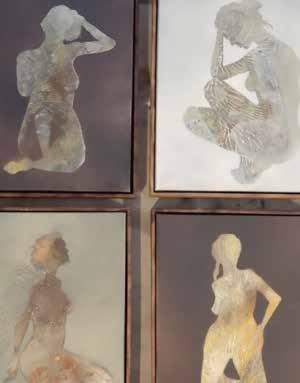
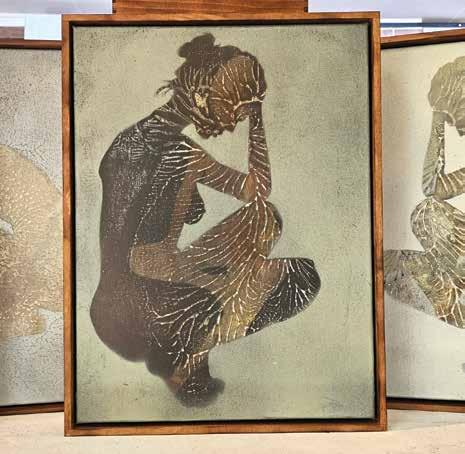
The images you’ve shared feature figures that appear simultaneously vulnerable and strong, marked by almost fractal, organic patterns. What inspired this particular composition and technique?
That’s a key observation. The pieces are observations from life drawing, a practice that intimately captures the human form. The patterns you see - the branching, asymmetrical linesare a reflection of a core idea: that we are all stardust vibrating at a certain frequency. These fractal patterns repeat themselves from a cellular level to a cosmic scale. I want the figures to show that we are not separate, just momentarily disconnected. The patterning highlights how we are all part of a larger “soul-a-system.”
Your background is your time spent studying at Central Saint Martins
fine art and the urban street art movement. How does this duality influence the creation of these new, highly textured works?
My work has always had a play on words and an edge, often using outsider animals to comment on the human condition. That street art influence is about unrestricted communication. For “Two Lost Souls,” the collision is expressed through balance and polarity. I am exploring what we know (intellect, technology) versus what we can only glimpse (nature’s wisdom, ancient mysticism). The visual texture and the raw framing are about grounding these cosmic ideas in something physical, something that feels found or weathered.
You mention some interesting methods in your process, including cymatics experiments and infusing water with frequencies before mixing your paint. Can you elaborate on this?
I’m curious about the unquantifiable - that 95% of the universe we can’t detect. Science tells us everything is vibration, energy, frequency. I conduct cymatics experiments - visualising sound - and then use the water infused with those specific vibrations to mix my paint. I can’t quantify if the water retains the data, but it’s an active way of seeking to inject that underlying energetic structure into the work. It’s an act of faith that maybe, just maybe, I’m creating a space where a soul can be “found” through frequency.
You’ve worked extensively with conservation and charitable projects, recently with the Ati Tribe in The Philippines. Does that focus on community and human connection feed into this search for “equilibrium” in the new exhibition?
Absolutely. My charitable work - whether for animal welfare or supporting kids’ education - is about recognising fragility and the need for support. That translates directly to the philosophical ideas here. We are fragile. Our current perception of reality is limited by our senses. The idea of a “soul-a-system” requiring balance means recognising that our disconnectedness is the problem. These moments we share togetherthe viewing of the art, the moment of reflection - are so precious.
What is your message to those planning to visit?
This exhibition is an opportunity for mindfulness. Come and lose yourself in the detail. Recognise the imperfection that highlights real beauty. I hope these paintings, these small windows into moments and dream time, allow you to glimpse nature’s wisdom and feel the profound connection that exists underneath all the chaos. It’s an invitation to find the ‘soul’ in the ‘system.’
‘Two Lost Souls’ opens at the 2B Gallery on Sunday 14 December. www.2B.MT/CP
Feature /Malta / Unfinished Art Space
December 2025 - March 2026
MARIA EILEEN FSADNI
Coastal Commons
“A gentle invitation directed towards the public to reimagine their relationship with the existing coastal area”
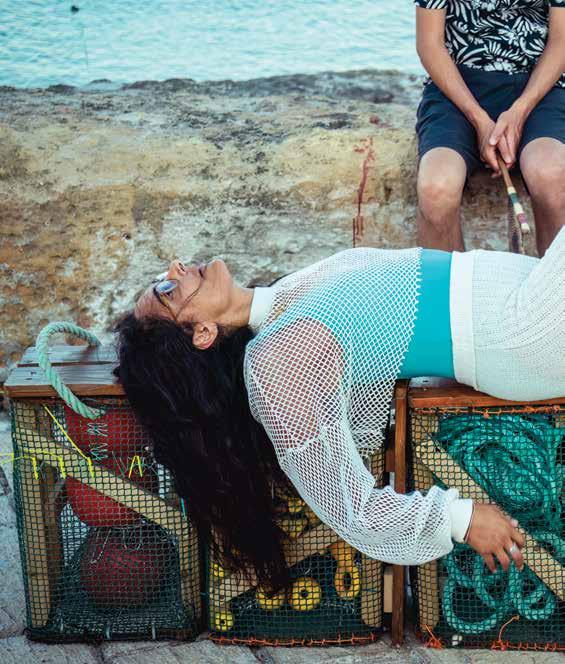
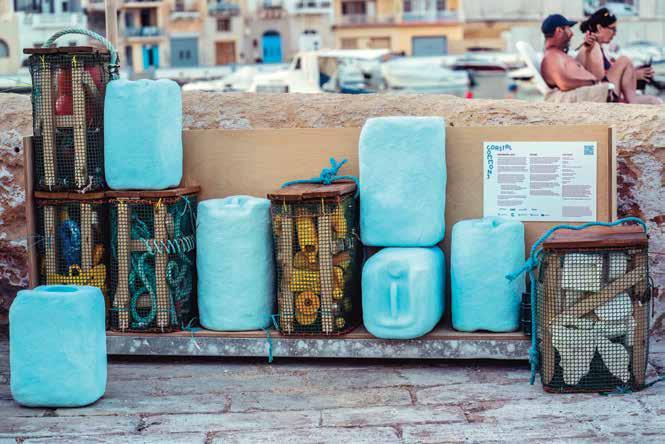
Positioned in the South-Eastern region of Malta, Coastal Commons sits on a rocky shoreline in the seaside town of Birzebbuga. The 10-day residency, and resulting intervention, was as curator Elyse Tonna describes, ‘developed around three main pillars: the commons as a conceptual framework, the site as a lived archive of memories and experiences, and marine waste as a material’. Ultimately, it seeks to challenge contemporary notions of common space.
Following the forceful commercialisation of the public arena in recent years, the commons in its very conception has been at the fore of critical discourse. Campaigns have tackled vast areas of our archipelago from the shoreline to the inner cores of our urban hubs.
Il-Bankini tac-Cittadini!, led by pressure-group Moviment Graffitti, has spread across the Maltese islands in areas like Valletta and Rabat, Gozo to
unpack the infringement of restaurants on public space, public peace and public safety. While direct actions surrounding the lack of free access to the shoreline in places like Comino’s Blue Lagoon or Manoel Island has led to reopening of areas, or a slight reduction in deckchairs.
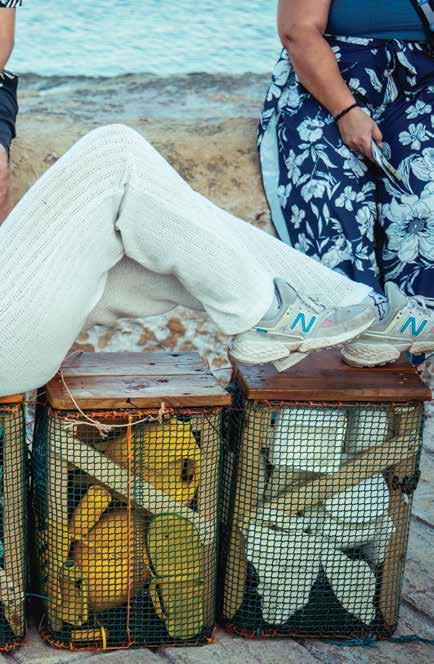
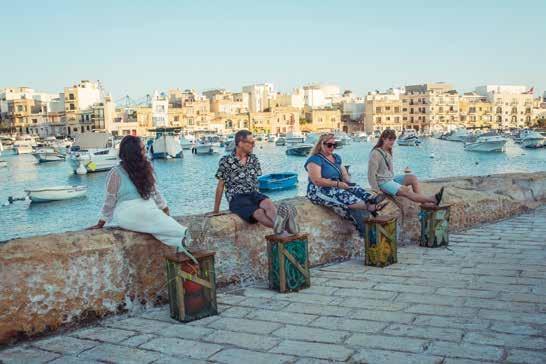
Coastal Commons instead, is a gentle invitation directed towards the public to reimagine their relationship with the existing coastal area. To find new ways to play, pause and convene within the space. The curatorial text invites the community to engage with the modular system, using it as,
A seat to rest. A step to reach.
A table to gather. A rest for your legs.
A weight to hold. A workbench to make and paint.
A box with a game. A structure to share.
Use them how you need.
Move them, stack them, play.
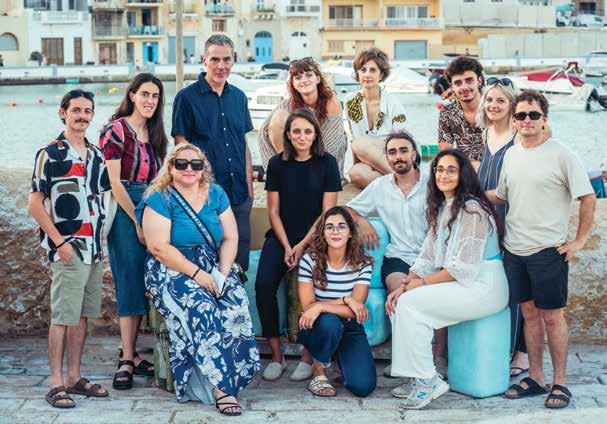
The intervention was the result of a 10-day residency curated by Elyse Tonna, featuring local artist Sheldon Saliba and French artist Joachim Romain, sent by Déchets d’Arts. The trio worked hand-in-hand to create the final piece, and the playful invitation was launched during a
Charlene Galea
Photos by Elisa von Brockdorff
residency closing, which invited artist Charlene Galea to activate the work during a short performance piece.
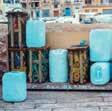
The intervention was imagined—quite intentionally—as a mainstay on the site where it remains stationed to date. A site that was selected following a series of ancillary events and workshops designed to collect feedback from the community, and collect material for the installation. Marine waste, including disused fishing nets and jerry cans, was repurposed to build this open storage structure and were collected during a clean-up held in collaboration with Zibel in June.
Birzebbuga Local Council’s were close collaborators on the project. In fact, mayor, Scott Camilleri, noted the council’s shock at the amount of waste collected during the clean-up, and that the residency drew attention to the need for environmental protection.
MARIA EILEEN FSADNI is a multihyphenate, blending her roles as a cultural manager, cultural advisor, curator and communicator. Her writings focus on the intersections between the contemporary arts, cultural heritage, activism and the environment. She is currently the Gallery Manager at Valletta Contemporary and Design Committee co-chair at MEIA.
Although I remain armed with a healthy skepticism, it is my firm belief that artistic practice can act as a voice to amplify messages and become a driver for change. In our contemporary society, artists and creative practitioners still play an integral role in the everexpanding ecosystem of activism.
Coastal Commons, produced by Unfinished Art Space, sits within the broader project titled OTRart being led by Routes of the Olive Tree, which engages with environmental sustainability through artistic
discourse. Seven partners from six European countries - Greece, France, Spain, Italy, Croatia and Maltaare collaborating to engage with more environmentally conscious creative methodologies, and craft a different narrative for our planet’s future. More information here: www. unfinishedartspace.org/projects/ otrart
The work can be found on Triq Ghar-Dalam in the Maltese town of Birzebbuga.
OTRart is co-funded by the European Union’s Creative Europe Programme, and in Malta is co-financed by NGO Co-Financing Fund managed by the Malta Council for the Voluntary Sector supported by the Ministry for Inclusion and the Voluntary Sector.
Interview / Rosa Martínez / Malta Biennale
December 2025 - March 2026
“CLEAN | CLEAR | CUT.”
Renowned for her incisive, site-responsive approach and her ability to weave global artistic languages into meaningful local dialogues, ROSA MARTÍNEZ stands among the most influential curators working today. With a career spanning more than three decades - and landmark roles at the Venice, Istanbul, São Paulo, Busan, SITE Santa Fe, and Limerick biennales - she has consistently reshaped how international exhibitions interpret place, politics, and contemporary culture.
In this conversation, she reflects on the experiences that have defined her curatorial practice, from navigating the geopolitical charge of Istanbul to the intellectual rigor of Venice. She discusses the responsibilities of creating intergenerational and crosscultural dialogues, the evolving role of the curator in interpreting the spirit of a place, and the delicate balance between global relevance and local engagement.
As she leads the upcoming Malta Biennale 2026 as Artistic Director and Curator, she offers insight into the conceptual framework guiding the edition — CLEAN | CLEAR | CUT — and explores how Malta’s complex heritage, Mediterranean geography, and contemporary tensions are shaping a transformative programme.
Q&A WITH ROSA MARTÍNEZ
You’ve curated some of the world’s most influential biennales, from Venice to Busan in Korea, from Istanbul to SITE Santa Fe in New Mexico (USA), from Sao Paulo to a small city like Limerick in Ireland. Looking back, which experiences most shaped your curatorial approach and why?
Each biennial has increased my awareness of the role that curatorship should play in interpreting the time and place in which an exhibition is presented, together with the power an exhibition might have to contribute to increase or change the meaning of a place. With the perspective of more than three decades of experience, curating sometimes alone and sometimes collectively, I can see how each type of authorship allows you to develop different skills and qualities. When curating in a group you learn to collaborate and make democratic
agreements. Curating alone allows you to be the main channel for articulating the artistic and political energies that surround you.
I would say the biggest challenge in my career happened in 1997 when I was invited to curate the 5th Istanbul Biennial alone. I had the chance to use amazing historical spaces like the Yerebatan Cistern, parts of the Topkapi Palace and also civil places like the international airport or the train stations in the European and the Asian side of the city. As there was not much funding for research trips, I had advisors worldwide who were sending artist dossiers from
different parts of the world. I made my own choices after receiving the qualified suggestions of people who knew well their local landscapes. And my choices were highly relevant for that place and time.
On another note, I can say that curating an event with global ambitions and a century-long history, such as the Venice Biennale, is not the same as curating a young and emerging biennial such as the one I am now organising in Malta - just to mention two places I love very much.
In Venice, the focus is on showcasing the most relevant international artistic languages, knowing that the event
will be judged by leading international experts and that its contribution to contemporary aesthetic and political thought will have worldwide resonance. In Istanbul, Santa Fe in New Mexico, Pusan, Limerick or Malta, the fundamental objective is to create dialogues between the local and global scenes always keeping in mind the need to create a meaningful interpretation of the zeitgeist, the spirit of the time. The possibility of creating those dialogues in close connection with the cultural heritage of a place is an enormous challenge – yet one of considerable satisfaction. This great intellectual, political and aesthetic excitement is a gift I have been able to enjoy through my many opportunities to work on sitespecific events and exhibitions.
Across your international career, you’ve worked with both established names and emerging voices. How do you balance these perspectives when developing a biennale’s narrative?
Each biennial has increased my belief that it is the curator´s duty to create intergenerational and cross-cultural dialogues that erase the boundaries that separate nations, that question the rigid aesthetic taxonomies established by the canon. Trying to dismantle the hierarchies that categorise artists by gender, national origin or other attributes helps dissolving cultural stereotypes and opens new paths for creativity. ‘La bella combinazione,’ of mixing emerging and established artists is a fruitful strategy in both directions. Younger artists can learn from their elders and the stablished ones can feel relevant and connected to new developments in contemporary art.
“I’m seeking work of genuine quality - not trendy or decorative art, but proposals that reflect critical depth, innovation, and honesty.”
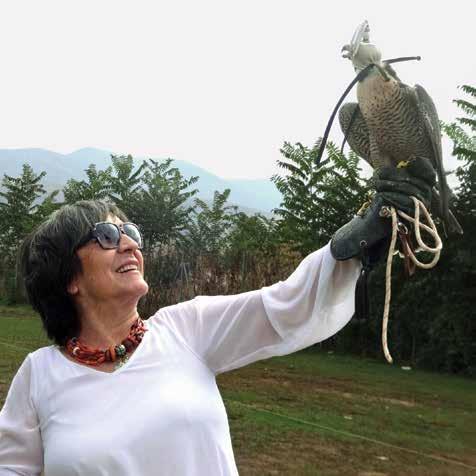
Rosa and the Falcon. Photo by Taylagas
Interview / Rosa Martínez / Malta Biennale
December 2025 - March 2026
Biennales often reflect not just art, but the cultural and political climate of their host country. How has your past experience prepared you for curating within Malta’s unique cultural landscape?
In Malta, I feel the strong desire of the country to open up to the world, to go beyond the isolation that islands, or in this case a tiny archipelago, has experienced. Malta is a fascinating place where the richness of its prehistoric past, its amazing cultural heritage and its deep connection to Catholicism meets with crazy urban speculation and the wildest trends of global capitalism.
Malta Biennale 2026 positions you as both Artistic Director and Curator. What core vision or conceptual framework is guiding your approach to this edition?
My guiding vision for the 2026 Biennale is embodied in the title “CLEAN | CLEAR | CUT.” These three verbs are not just a motto, but rather a call to action. Clean means purging the environmental, ethical, and aesthetic toxicity that saturates so much of our contemporary discourse. Clear is about discerning and making sense of what matters, cutting through superficial repetition. And Cut is about disruption: opening new paths, breaking away from the expected, and
redefining our dialogue with history and heritage.
In curating this edition, I’m seeking work of genuine quality - not trendy or decorative art, but proposals that reflect critical depth, innovation, and honesty. I want this Biennale to be transformative: to engage with the layered past of Malta, to analyze power and ideology, and to imagine new futures resonant with beauty and critical awareness.
What aspects of Malta—its history, geography, or contemporary context—are proving most inspiring or influential as you shape the 2026
programme?
Malta is an extraordinary palimpsest: its stone is not just material, it embodies so many layers of memory. War, destruction, reconstruction, colonization, liberation…Its fortresses, palaces and the humble architecture of everyday life all tell stories of conquest, faith, resistance, and survival. The Maltese heritage sites are not neutral backdrops - they are actors in the dialogues between curatiorial visions and artistic proposals.
By anchoring artworks in Heritage Malta’s historic venues (megalithic temples, palaces and forts of the
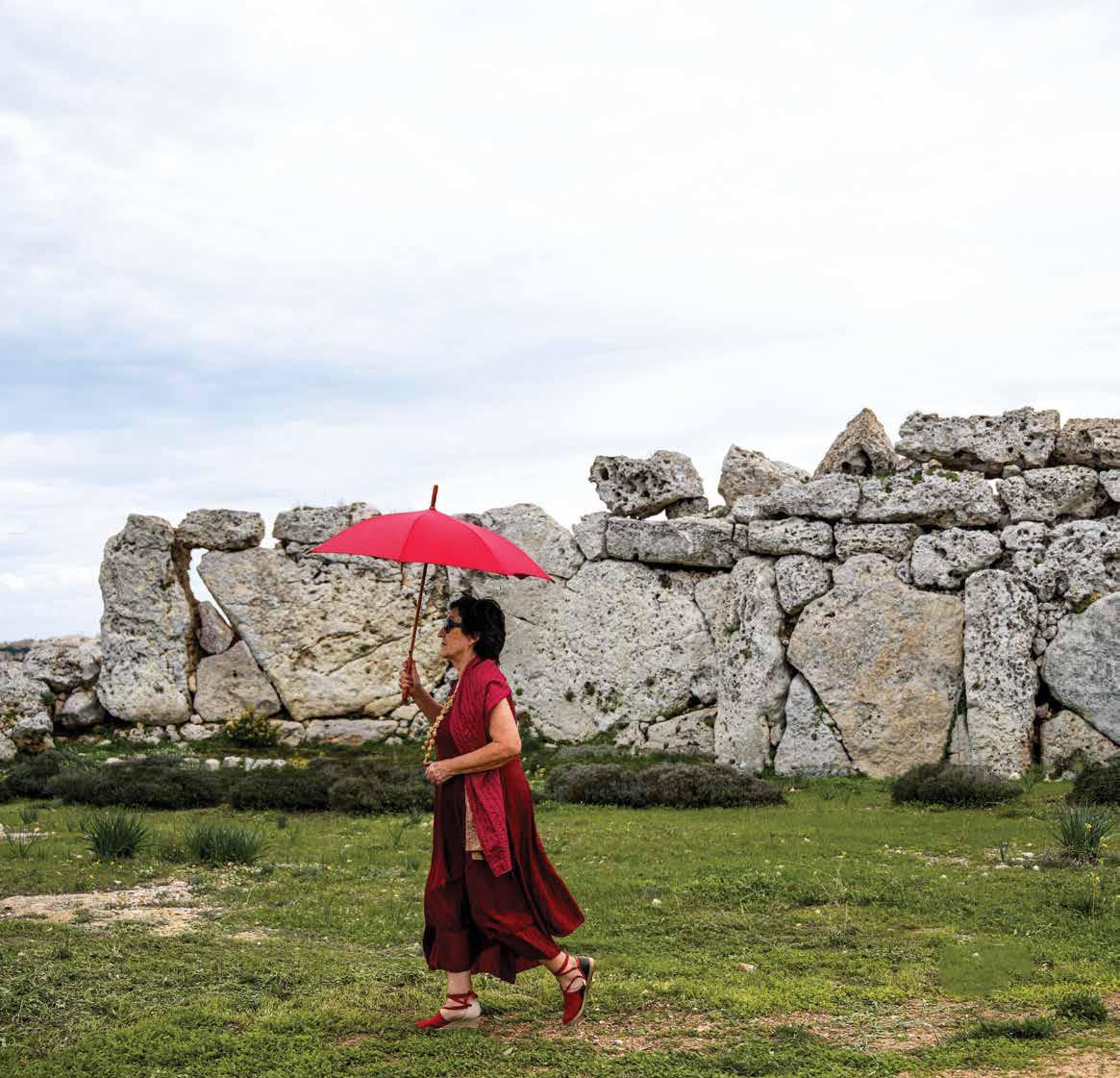
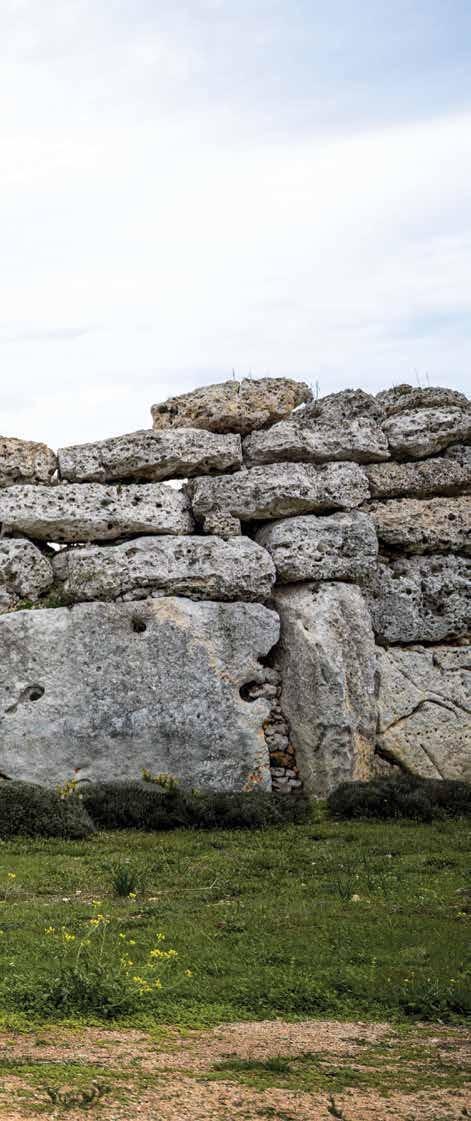
Rosa at Ggantija. Image by Revo Studio for Heritage Malta
Malta’s position in the Mediterranean - a crossroads of politics, migration, colonial legacies, ecological tension and urban speculation- makes it a powerful lens through which we can explore global inequalities and propose long-lasting dialogues that should lead towards transforming of the uneven distribution of wealth and power.
Knights, national museums) and collective urban spaces we connect the cultural weight of history with the urgency of the present. In the Inquisitor’s Palace, for instance, I wish to bring to light suppressed knowledge, crimes, punishment, and the tension of ideological power over certain beliefs and forms of wisdom that were not accepted within the Catholic orthodoxy. At the prehistoric temples, cosmic, fertility, and care narratives will evoke universal existential questions. At the Maritime Museum we will explore some of the tensions that unfold in international waters where the rules of local governments are suspended, and humanitarian laws should apply.
In fact, Malta’s position in the Mediterranean - a crossroads of politics, migration, colonial legacies, ecological tension and urban speculation- makes it a powerful lens through which we can explore global inequalities and propose long-lasting dialogues that should lead towards transforming of the uneven distribution of wealth and power.
Many biennales struggle to balance global relevance with local engagement. How do you plan to create opportunities for Maltese and Mediterranean artists while maintaining an international outlook?
One of the fundamental objectives of the Malta Biennale is to create a platform for local creators and art professionals. This is why my two curatorial assistants, Alexia Medici and Antoine Borg Micallef, are from Malta. In our continuous dialogues about the selection of artists and the connection of their projects
to the narratives of Heritage Malta locations, they are giving shape to their own criteria. The conversations with local artists give impulse to their creative potential and takes them beyond their familiar comfort zones. The choice of Maltese artists is not driven by an aim to report what is happening on the islands. I do not intend to describe the current landscape, but rather to contribute by adding new shape and form. And yes, the geographic and political placement of Malta in the Mediterranean is fuelling our desire to convert the archipelago into an artistic centre of gravity, an epicentre that attracts and expands the creativity of its surrounding countries.
As you look ahead to the opening of Malta Biennale 2026, what impact do you hope this edition will leave on both the local cultural ecosystem and the wider international art community?
My hope is that this Biennale becomes a catalyst - not only an exhibition, but an experience that resonates intellectually, emotionally, and socially both for the local audience and for international visitors. For Malta, I would like this edition to strengthen a cultural ecosystem that is already vibrant yet still evolving: to empower local artists, curators, and institutions by placing them in dialogue with international voices, and to foster a sense of pride in the island’s extraordinary heritage. Malta deserves to be seen not as a peripheral location, but as a cultural centre where urgent global questions can be critically explored with clarity and sensitivity.
Interview / Rachel Rits-Volloch / Exhibition
December 2025 - March 2026
GABRIEL ZAMMIT
Nothing Happens Until it’s Consumed
MOMENTUM’s exhibition Art From Elsewhere: Deep Throat, at Valletta Contemporary
Valletta Contemporary Gallery has just closed Art from Elsewhere: Deep Throat, an exhibition organised by MOMENTUM, a platform for time-based art in Berlin. Deep Throat marks MOMENTUM’s 15th anniversary and features artists from the platform’s collection alongside invited contributors. The exhibition frames the contemporary spectacle of politics as pornographic performance. In an age when politicians are also TV stars, where every move and moment on stage - from assassinations to awkward hugs - is televised, broadcast to the world and consumed by the general public obsessed with spectacle, Deep Throat
investigates our collective inability to look away from the performative antics of the most powerful people in the world. In an age when politics has been reduced to a spectacle, what remains of the spectator, watching anonymously from a dark room?
The title plays with the multiple meanings of the word ‘deep throat’, positioning it as a locus of the political and the pornographic. ‘Deep Throat’, as is now well known, is the pseudonym used by Mark Felt to leak information on the Watergate scandal to Washington Post journalists in 1972. At the same time, it is the name of the pornographic film starring Linda Lovelace that popularised the act and introduced
America to a new kind of sexual performance, also released in 1972. Years later, in 1986, Lovelace testified that, due to the abusive and controlling relationship with her then husband, Chuck Traynor, “virtually every time someone watches that movie, they’re watching me being raped”, so the film also came to represent the impossibility of separating consumptive voyeurism from violence
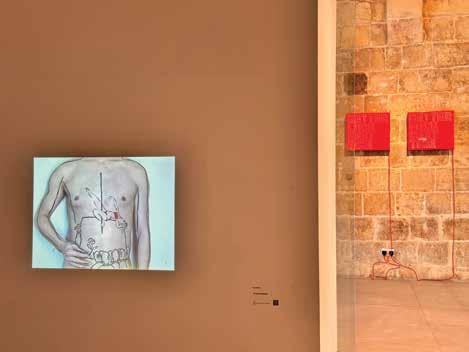
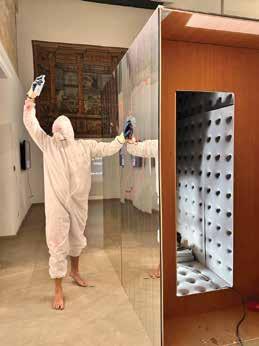
I meet Rachel Rits-Volloch, the founder of MOMENTUM and co-curator of Deep Throat. The exhibition featured an eclectic selection of video works alongside sculpture, painting, tapestry, installation and even books. All of the work, in one way or another, is political.
“Ever since we were glued to our screens during COVID and in the aftermath, it became more and more apparent that it’s just repulsive watching the news. I’m sickened by the way violence is sensationalised, the showing of destroyed bodies, and the presentation, in this almost gleeful way, of wars documented with death tolls, with the statistics of how many died on each side. I mean, it’s not a football match, or maybe it is. Maybe war is the new sport, and the shameless lowering of the bar by politicians, who will remain unnamed—but it’s obvious who they are—has denigrated the role of head of state to such a degree that they strut and rant and expose themselves all over social media like
Nina E. Schönefeld, The Anatomy of Political Scandals (2025), HD video, b/w & colour, sound, 17’ 27”, Premiere presentation
some minor starlet hoping to get a role in Hollywood. I began to realise that politics is a new pornography. We are addicted. We can’t walk away from our screens, and when we’re not watching politicians or movie stars self-combust, we’re watching ourselves, the addiction to revealing everything on social media. That’s a kind of pornography as well. I don’t know how people justify it, but everyone is paranoid about surveillance and state control. Well, why? Why are you worried about surveillance when you’re revealing everything anyway?”
We stand in front of a stop-motion animation titled The Gooey Gentleman by Zhou Xiaohu. I watch two figures move jerkily across the screen. Drawn onto naked bodies and described in the exhibition text as “a striptease gone deliciously wrong”, the figures tease, flirt and fight in an escalating performance that ultimately consumes both of them. The power dynamic between the performer and watcher in the video is continuously reversed, until you are not sure who is instigating and who is responding, who is performing and who is watching. This work becomes an allegory for the dialectics of spectatorship: the contemporary banality of a society running on the currency of spectacle, of being both consumer and the object of consumption. It is worth mentioning that Xiaohu is a Chinese artist, and even though his work is stylised and comical, it has been banned in his home country because of nudity and political content. As the exhibition text goes on to state, “[i]t reminds us that laughter can be its own form of resistance, that satire and seduction share a pulse.”
And where does art come into it for you? I ask.
“There are many inconsistencies and dualities in our culture, and I am not saying that this exhibition solves any of them, but it’s an overview of how 21 very diverse artists, from 11 countries and three generations, address these issues. Artists are not magic healers of our civilisation; that’s not the role of art, but what art can do is pull our humanity back from the brink. This
incessant watching of vacuous content on television, on blogs, on all forms of media, is sapping our humanity. We’re losing empathy by the day, and maybe that’s what art can do: remind us how to empathise, remind us what human feeling actually is, and that’s increasingly necessary in a world of post-everything. We’ve gone from postmodern, to posttruth, post-digital already, and very soon, post-human. And what are we if we lose human empathy?”
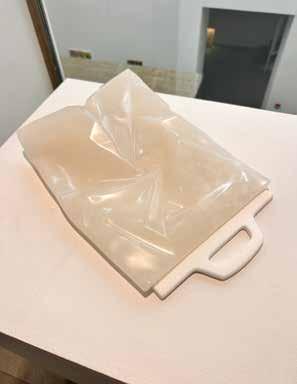
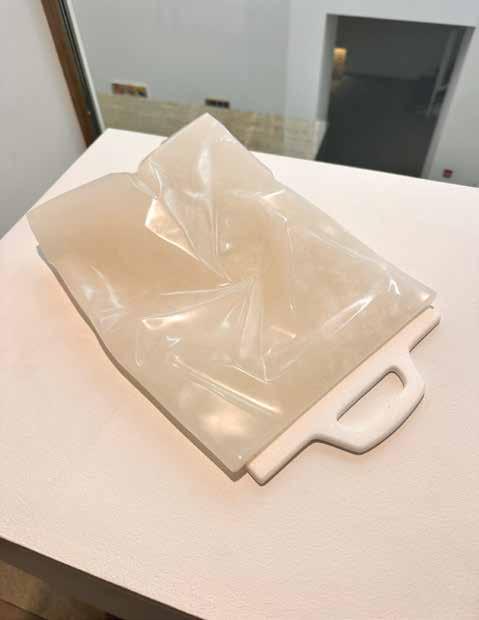
Despite the subversive and overtly political edge of the work on show, there is indeed a lot of humanity in Deep Throat, leading viewers to a place of sensitivity and vulnerability. Andreas Blank, for example, makes beautiful still-life sculptures out of alabaster and marble. Each of Blank’s objects immortalises trivial or transient items from everyday life (plastic bags and beauty products), indirectly documenting unseen and overlooked domestic moments, those fleeting instances that are not made for consumption, or broadcast as part of the spectacle-building exercise of constructing our lives in the eyes of others.
Much of the art on show, like Blank’s, are not time-based in the conventional sense of the word. Traditionally, timebased media are understood as film and performance, works that have a duration, a tangible beginning and an end. However, by including sculpture and painting, Rits-Volloch applies a more flexible definition, expanding the idea into something broader.
“I always ask my artists how they define time-based art, and if they convince me, I allow it. For example, Andreas Blank works with stone; he sees his practice as immensely time-based because stone is the actualisation of geological time.
For me, the process of production also counts - the time and labour, great physical labour in the case of Blank, as he carves these sculptures with his own hands - dedicated to the creative act.”
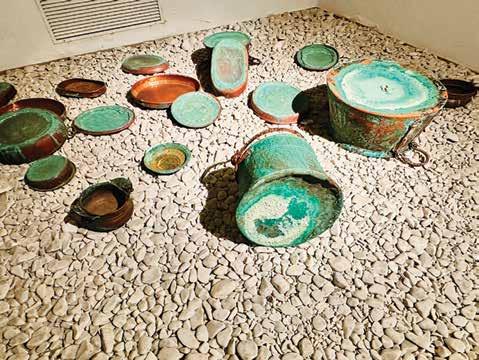
“Mariana Hahn provides another example and definition of time-based art. Basins in Copper is a work she
GABRIEL ZAMMIT is an independent curator and writer with a background in philosophy and art theory. Zammit has worked with artists and writers from all around the world. He also lectures at the University of Malta and publishes regularly, contributing speculative, critical, and academic texts to books, newspapers, journals, and other platforms.
Artists are not magic healers of our civilisation; that’s not the role of art, but what art can do is pull our humanity back from the brink.
Photo by Lisa Attard
Andreas Blank, Landscape Metaphor, 2025, Alabaster, Marble, 48x33x80cm
Mariana Hahn, Basins in Copper (2024/2025), Site-specific installation: copper basins, seawater, Dimensions variable. Originally commissioned for Poetics of an Archive, curated by Andrew Borg Wirth for the Franco-German Pavilion, 1st Malta Biennale of Art, 2024
Interview / Rachel Rits-Volloch / Exhibition
December 2025 - March 2026
We’ve gone from postmodern, to post-truth, post-digital already, and very soon, posthuman. And what are we if we lose human empathy?”
created for the first Malta Biennale, where she initiated an alchemical process that is still continuing. She filled copper basins with ocean water, salt water, and the result is this wonderful transformation. The work looks very different now than it did in the original presentation in 2024.”
Mariana Hahn’s work illustrates the effects of time on the objects in our world: the soft influence of one thing on another over a long period of time. In Hahn’s case, the salt water in the copper basins has oxidised the orange metal, turning it various shades of blue and turquoise. It makes me think about relationships, and human beings changing each other, at first imperceptibly but eventually beyond recognition. Perhaps more nefariously and in line with the exhibition, Basins in Copper also invokes the soft rot of endless social media scrolling, time drifting into a void as people in dark rooms all around the world are bathed in flickering phone-glow, our bodies and minds becoming a site for the convergence of intimacy and the information industrial complex.
It becomes clear that MOMENTUM is a platform for supporting artists in all sorts of ways, and this exhibition creates little windows into different worlds. Including the qualifier ‘time-based’ allows a shifting of focus onto relationality, process and change through time, both long- and short-term. I put the question to Rits-Volloch.
“Yes. And I am a great fan of selfreflexivity and spectatorship too. I also tend to think that much of the timebased process in art occurs in the reading of the work by the spectator. You’re not going to instantly take in a painting. It is supposedly a still image, and yet a good painting unfolds a narrative within itself, and to read it, one has to follow that narrative, and that takes time. Even though it’s a still image, it is a product, in its making and its encounter, of time. So to me, the obvious definition isn’t the only one.”
Implicit here, it seems, is a meditation on consumption more generally. The pornographic consumption of the world, politics and ourselves on the one hand, and the emancipatory consumption of art that the exhibition is suggesting might offer a window into a different world and way of being.
“It’s been proven that the same centres of our brain are activated when we think or observe an action as when we perform an action. When you watch reality TV, or the posture of politicians, which are increasingly identical, what do we feel?”
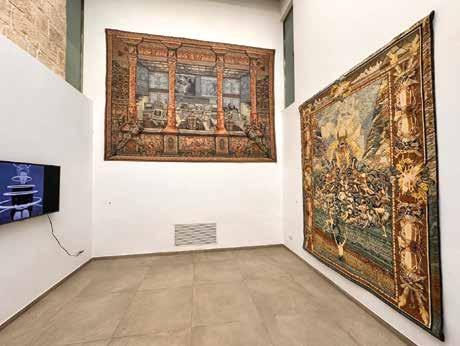
I end my visit by wandering downstairs to take another look at Margret Eicher’s monumental tapestries. Eicher’s work exemplifies the multiple temporalities we’ve been discussing. Her work weaves baroque and ancient motifs with video game characters, drowning refugees, bombed-out cities, and men sitting comfortably behind computer screens, exerting power and orchestrating
control from air-conditioned rooms. The tapestries look handmade, but they are produced on computer-guided looms. They allude back to the great court tapestries of earlier centuries, made in order to glorify God and kingdom, but at the same time they are entirely different, artefacts of the contemporary moment.
It is dark outside when I leave the gallery. Stepping into the street, a few lines from Don DeLillo’s 1991 novel Mao II come to mind, a portent, or perhaps a warning, from the cusp of the information explosion: “Two lovers quarrel in the back of a taxi and a question becomes implicit in the event. Who will write the book and who will play the lovers in the movie? Everything seeks its own heightened version. Or to put it this way, nothing happens until it’s consumed” (Mao II, 1991, p. 44)
Art From Elsewhere: DEEP THROAT was a collective exhibition with: AES+F, Inna Artemova, Aaron Bezzina, Rachelle Bezzina, Andreas Blank, Claudia Chaseling, Gabriel D. Doucet Donida, Margret Eicher, Nezaket Ekici, Mariana Hahn, Anne Jungjohann, Sarah Lüdemann (Beauham), Duška Maleševic, Shahar Marcus, Milovan Destil Markovic, Almagul Menlibayeva, Kirsten Palz, Nina E. Schönefeld, David Szauder, Vadim Zakharov, Zhou Xiaohu This interview by Gabriel Zammit with the curator, Rachel Rits-Volloch, is supported by People & Skin.
Margret Eicher, Master of the Universe (2008), Digital montage / Jacquard tapestry, 275 × 373cm; Age of Styx (2024), Digital montage / Jacquard tapestry, 280 × 206cm & David Szauder, Babel (2025), Digital animation, sound, 3’ 18”
Gabriel D. Doucet Donida in his performance The Confessional / Infinite Habitat. The Confessional is migrating to GROUND 99, a satellite event for the Malta Biennale 2026.
Zhou Xiaohu, The Gooey Gentleman (2002), Stop-motion animation, colour, sound, 4’ 40” & Duška Maleševic, Better Luck/Fuck Next Time (2025), Two lightboxes, Each 50 × 44 × 9 cm