6. BRUSH TYPE 2, CLASS 31
T
he Brush Type 2, though it underwent extreme tribulations – the very engines having to be replaced by a completely different design from a different manufacturer and more than 250 of them didn’t come cheap – was nevertheless at the heart of dieselisation on one BR Region, the Eastern. They were long-lived too (a prolonged survival owed much to the programme of replacement engines) in stark contrast to many other types deriving from the mis-firing Pilot Scheme of November 1955. The prospective rewards from economy of working with the new traction and its higher availability for work, by comparison with steam, were glittering. The Great Eastern section of the Eastern Region, for instance, intended by 1962 to replace its near-700 steam engines for all its main line passenger and freight services with just 250 main line diesels. In this it succeeded, along with the remarkable accomplishment of reducing the motive power arrangements to just four depots – Stratford, Ipswich, March and Norwich. The diesels sallied forth on five day cyclic diagrams, punctuated by routine daily inspection/refuelling while away before a ‘return to base’ for maintenance. Central to all this, and on the Great Northern section of the Eastern Region too, was the Brush Type 2s, or Class 31s as they came to be better known – all 263 of them.
By 1950, before BR’s programme of Standard steam locomotives had even begun, the construction of steam locomotives had effectively ceased in the United States. That country’s vast system of railroads was all but wholly dieselised. By contrast the British had just two main line (Type 4) units and it was five years before the decision suddenly came to move ‘rapidly’ to diesel and electric traction. The Modernisation Plan announced in 1955 the complete replacement of steam and there was a lot to do; by this time the BR Type 4 fleet had grown to just five... With no home market, the UK diesel locomotive construction industry was on the back foot; it had little in the way of a ‘shop window’ to display its wares to the world and only a few Empire markets were responding. Brush was somewhat to the fore or at least working to that end, enlarging its works to see through a 1950 order for 25 5ft 6in gauge diesel electric A1A-A1A locomotives at 1,250 ordered by Ceylon Government Railways. They were shipped out from 1953 and though various problems including engine overheating were reported, these appear to have been overcome, because the locomotives were in use for some twenty years. Brush thus had demonstrable overseas success with main line diesels and were more or less guaranteed a slice of the infamous Pilot Scheme, detailed before in earlier books in
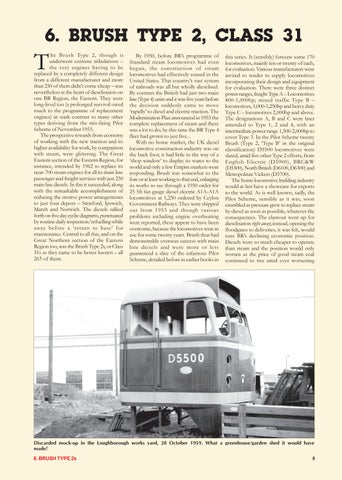
Discarded mock-up in the Lough orough works yard, 2 made 6. BRUSH TYPE 2s
DD pt6 resized doc.indd 5
cto er 1959.
this series. It (sensibly) foresaw some 170 locomotives, mainly ten or twenty of each, for evaluation. Various manufacturers were invited to tender to supply locomotives incorporating their design and equipment for evaluation. There were three distinct power ranges, freight Type A – Locomotives 800-1,000hp; mixed traffic Type B – locomotives, 1,000-1,250hp and heavy duty Type C – locomotives 2,000hp and above. The designations A, B and C were later amended to Type 1, 2 and 4, with an intermediate power range 1,500-2,000hp to cover Type 3. In the Pilot Scheme twenty Brush (Type 2, ‘Type B’ in the original classification) D5500 locomotives were slated, amid five other Type 2 efforts, from English Electric (D5900), BRC&W (D5300), North British (D6100, D6300) and Metropolitan Vickers (D5700). The home locomotive building industry would at last have a showcase for exports to the world. As is well known, sadly, the Pilot Scheme, sensible as it was, soon crumbled as pressure grew to replace steam by diesel as soon as possible, whatever the consequences. The clamour went up for dieselisation ri h away; instead, opening the floodgates to deliveries, it was felt, would cure BR’s declining economic position. Diesels were so much cheaper to operate than steam and the position would only worsen as the price of good steam coal continued to rise amid ever worsening
hat a greenhouse garden shed it would have 5
16/06/2022 13:48:53