17
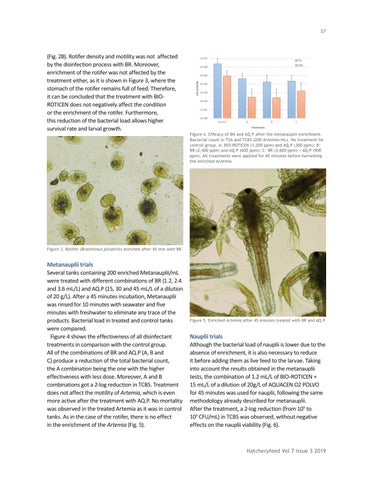
(Fig. 2B). Rotifer density and motility was not affected by the disinfection process with BR. Moreover, enrichment of the rotifer was not affected by the treatment either, as it is shown in Figure 3, where the stomach of the rotifer remains full of feed. Therefore, it can be concluded that the treatment with BIOROTICEN does not negatively affect the condition or the enrichment of the rotifer. Furthermore, this reduction of the bacterial load allows higher survival rate and larval growth. Figure 4. Efficacy of BN and AQ.P after the metanauplii enrichment. Bacterial count in TSA and TCBS (200 Artemia/mL). No treatment for control group. A: BIO-ROTICEN (1,200 ppm) and AQ.P (300 ppm); B: BR (2,400 ppm) and AQ.P (600 ppm); C: BR (3,600 ppm) + AQ.P (900 ppm). All treatments were applied for 45 minutes before harvesting the enriched Artemia.
Figure 3. Rotifer (Brachionus plicatilis) enriched after 45 min with BR.
Metanauplii trials Several tanks containing 200 enriched Metanauplii/mL were treated with different combinations of BR (1.2, 2.4 and 3.6 mL/L) and AQ.P (15, 30 and 45 mL/L of a dilution of 20 g/L). After a 45 minutes incubation, Metanauplii was rinsed for 10 minutes with seawater and five minutes with freshwater to eliminate any trace of the products. Bacterial load in treated and control tanks were compared. Figure 4 shows the effectiveness of all disinfectant treatments in comparison with the control group. All of the combinations of BR and AQ.P (A, B and C) produce a reduction of the total bacterial count, the A combination being the one with the higher effectiveness with less dose. Moreover, A and B combinations got a 2-log reduction in TCBS. Treatment does not affect the motility of Artemia, which is even more active after the treatment with AQ.P. No mortality was observed in the treated Artemia as it was in control tanks. As in the case of the rotifer, there is no effect in the enrichment of the Artemia (Fig. 5).
Figure 5. Enriched Artemia after 45 minutes treated with BR and AQ.P.
Nauplii trials Although the bacterial load of nauplii is lower due to the absence of enrichment, it is also necessary to reduce it before adding them as live feed to the larvae. Taking into account the results obtained in the metanauplii tests, the combination of 1.2 mL/L of BIO-ROTICEN + 15 mL/L of a dilution of 20g/L of AQUACEN O2 POLVO for 45 minutes was used for nauplii, following the same methodology already described for metanauplii. After the treatment, a 2-log reduction (from 105 to 103 CFU/mL) in TCBS was observed, without negative effects on the nauplii viability (Fig. 6).
Hatcheryfeed Vol 7 Issue 3 2019