Bt-resistant rootworms while providing good silage yields
PG. 6
SPECIALTY CROPS IN FOCUS
Industrial oilseeds, biomass crops and cannabinoids
PG. 14
You’re behind Canadian food and we’re behind you
We’re FCC, the only lender 100% invested in Canadian agriculture and food. That means we’re invested in you, with financing and knowledge to help you achieve your dreams.
DREAM. GROW. THRIVE.
fcc.ca
TOP CROP
MANAGER
PESTS AND DISEASES
6 | Safeguarding BT rootworm traits
An innovative rotation alternative to silage corn can clobber Bt-resistant rootworms while providing good silage yields. by Carolyn King
| Specialty crops in focus
oilseeds, biomass crops and cannabinoids show promise in Ontario. by Julienne Isaacs
SPECIAL CROPS
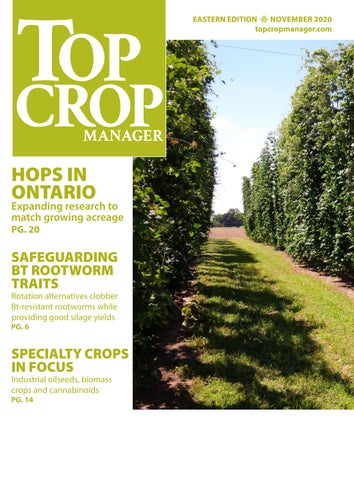
20 | Hops research continues in Ontario
As the hops market expands, so does acreage and the need for local research. by Julienne Isaacs
ON THE WEB
Our annual post-harvest weed control poster has gone digital! Our new, searchable guide allows you to easily select herbicide options for postharvest weed control. Check it out online and let us know what you think on Twitter @TopCropMag.
STEFANIE CROLEY EDITORIAL DIRECTOR, AGRICULTURE
THE DIFFERENCE A YEAR MAKES
When I look back at news, tweets and notes from last year, the general mood among the ag community was a lot less positive. In 2019, spring conditions and late planting kicked off the year on a poor note and delayed winter wheat harvest, and an early cold snap and November snowfall paused harvest season, with some fields still unharvested at Christmas.
This year, by contrast, has presented its own challenges – high insect pressure, cold weather in May and a mid-September frost, for example. But generally speaking, dry conditions this fall have been favourable and harvest is progressing as normal, as I write this in mid-October. And while lots of things about 2020 are different from 2019, this change is welcome – and much needed.
If you’ve been farming for a while, you undoubtedly have several years’ worth of notes, data and memories from your previous seasons. I bet you can recall a bumper crop year, or a midsummer hailstorm that devastated your fields. Keeping track of this information and comparing trends and changes year-over-year not only makes for interesting shop talk, but it’s also helpful when it comes to making decisions for the future. Perhaps your strategies have stayed the same for several seasons, with weather being the only variable factor from one year to the next, but looking back at how you reacted to the challenges in your way can greatly impact how you move forward. Your barn may be full of equipment and supplies, but your farm data is a valuable tool to keep on hand too.
In this issue, we introduce Shift, a special supplemental section to the magazine with a focus on farm and agronomic technology. This section is meant to highlight some of the ways technology – including data – is impacting modern farming, and how the industry is adapting. Check out the story by Carolyn King on page 10 about the new developments in smartphonebased soil and crop analysis tools.
Just as your farming conditions change from one season to the next, technology does too. As you shift (pun intended) into the next phase of your year, keep in mind how data and technology can impact what you do next spring. While you’re looking back on previous years, you may find new ways to look forward, too.
SAFEGUARDING BT ROOTWORM TRAITS
An innovative rotation alternative to silage corn can clobber Bt-resistant rootworms while providing good silage yields.
by Carolyn King
Atroubling trend emerged in some Ontario corngrowing areas in 2020. “[In several counties,] we have seen concerning levels of corn rootworm injury for all of the Bt rootworm hybrids, even the pyramid hybrids. Those injury levels make us think the rootworms are likely resistant to them,” says Tracey Baute, field crop entomologist for the Ontario Ministry of Agriculture, Food and Rural Affairs (OMAFRA).
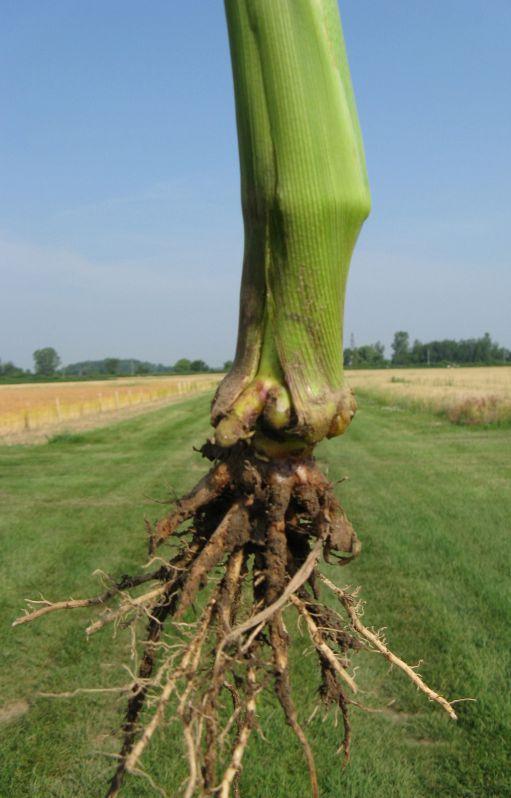
“This Bt resistance problem will not go away unless we take mitigation measures. Even if growers have not experienced rootworm injury to a significant level yet, they will over time if we aren’t able to reduce this resistant population now. In one to three years, they could start to see serious yield reductions and other impacts of corn rootworm, like corn flattened in windstorms, goosenecking and root injury,” she notes.
“Now is the best time we have to manage this issue before you can no longer use Bt corn at all for rootworm protection.”
Baute and her colleagues are working on practical options for growers to really reduce Bt-resistant rootworm populations in 2021.
The 2020 situation
Clusters of fields in the counties of Huron, Perth and Durham were identified in 2020 as having rootworm injury to Bt rootworm hybrids. Baute and other members of the Canadian Corn Pest Coalition suspect that Bt-resistant rootworm populations are likely present in these fields and in other regions of Ontario where continuous corn is common and where growers have tended not to rotate their Bt traits.
However, Baute notes that the lab bioassays to confirm Bt resis-
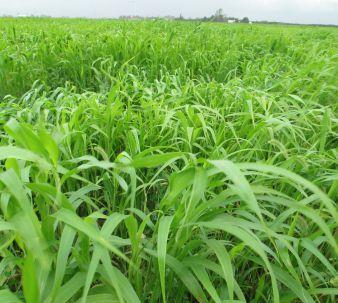
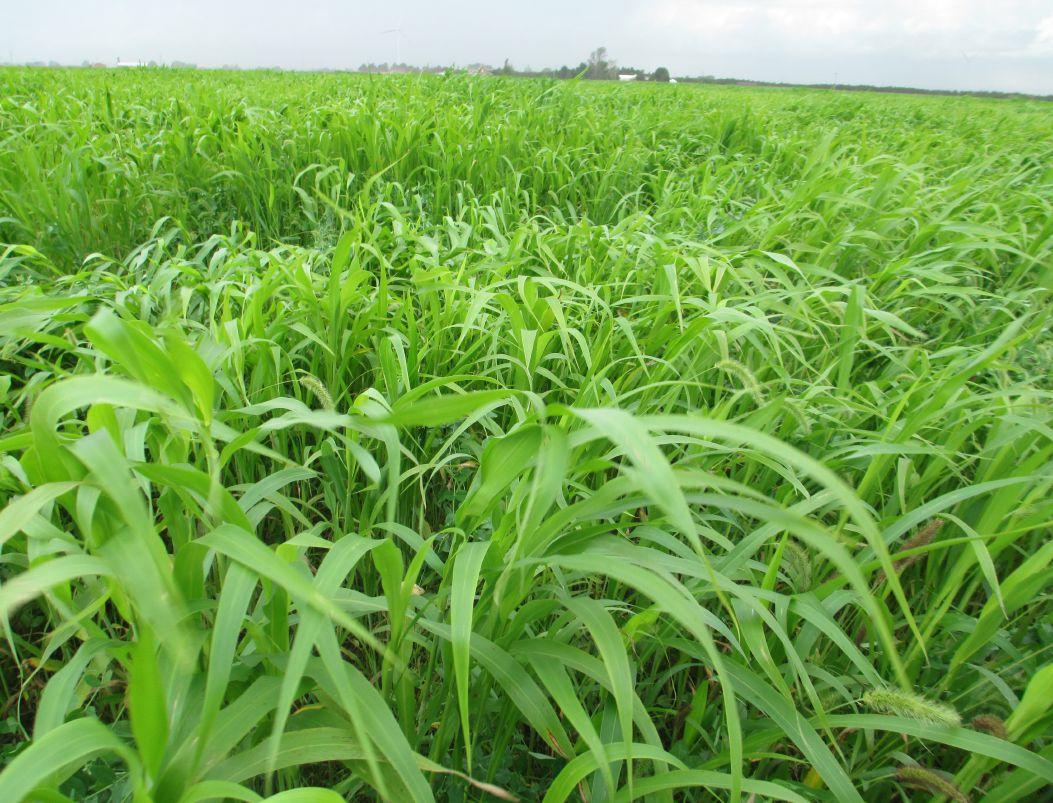
ABOVE: Christine O’Reilly suggests a double-crop rotation option that includes sorghum-sudangrass instead of silage corn.
tance will take months to complete, and some of the results may not be made public. “The corn companies are not required to disclose the results directly to us, just to the Canadian Food Inspection Agency. Some of the bioassays are done through the companies, and others choose to have the bioassays publicly done at the University of Guelph’s Ridgetown campus,” she says.
“Through public testing, we know of one field that was confirmed to have Bt-resistant rootworms in 2019.” That field had resistance to Cry3Bb1, one of four available Bt rootworm proteins. The others are Cry34/35Ab1, mCry3A, and eCry3.1.
Nowadays, many Ontario corn hybrids have two of these four proteins, but sometimes these pyramid hybrids do not provide as durable rootworm protection as one might hope for.
“When these rootworm traits first came out, they were only single traits in the hybrids. So growers grew corn-on-corn with singletrait hybrids [resulting in development of some resistance in the rootworm population]. Then pyramid hybrids came out with two rootworm traits. But the first trait that had been used for so long was part of that pyramid. It is no longer really a pyramid hybrid if the local rootworm population has already developed resistance to one of the two traits in the pyramid,” Baute explains.
“On top of that, these Bt rootworm traits are closely related to each other, so there is a tendency for cross-resistance to occur.” In other words, a rootworm population with resistance to one Bt trait may also have resistance to others.
The 2020 observations of possible issues with all four rootworm proteins are very worrisome. Continuing to grow Bt rootworm hybrids in the affected fields could allow the resistant populations to survive, thrive and spread as the resistant beetles fly to nearby corn fields to lay their eggs.
Baute notes, “Corn growers in the U.S. have been dealing with Bt rootworm resistance for about a decade. We definitely don’t want to be in that scenario. We have a chance now to fix the problem.”
Rotation is the best option
“If you have seen significant rootworm injury on your Bt rootworm hybrids, the number one very best option is to rotate out of corn,” Baute emphasizes. That’s because corn rootworm larvae must have corn roots to feed on in order to survive.
“The adult beetles lay their eggs in a corn field in the summer. Those eggs overwinter, and the larvae come out in the spring. The larvae can’t move very far in the soil, so if there are no corn roots to feed on in that field, the larvae will starve to death.”
Rotating out of corn for one year is great for Bt-resistant rootworm control, and two years would be even better. “Rotating out of corn for two years would really knock back any lingering rootworm populations that found corn somewhere in the area to sustain themselves,” she explains. “One factor is that, even if one grower rotates out of corn, nearby fields may still have corn, helping to sustain the resistant rootworm population. Another factor is that we have potential at a very low level to have the rotation variant of rootworms.” This variant develops in regions where two-year corn rotations, typically corn-soybean rotations, have been used for many years. The variant females lay their eggs in nearby noncorn fields so the larvae will be emerging in the corn year of the rotation.
Baute and her colleagues want to offer growers good alternatives to corn. “We are working on silage alternatives, grain feed
alternatives, cash crop alternatives – anything that is not corn is a better option to significantly knock back this resistant population.”
Christine O’Reilly, OMAFRA’s forage and grazing specialist, has been brought on board to help with this. She says, “Corn is commonly grown as silage and grain for livestock feed, and I am working on finding options for livestock producers to replace silage corn in their rations.”
However, finding silage options that are as good as corn is a tall order.
“One of the reasons why corn is popular as a forage crop is that it has such a high yield potential. Even though corn is expensive to grow on a per acre basis, the cost per tonne is very low because the yield potential is so high,” O’Reilly says.
“But if producers don’t rotate out of silage corn to reduce corn rootworm populations, we will see silage corn yields drop quickly [and rootworm management costs increase]. We could soon reach a point where silage corn is no longer economical on a per tonne basis.”
O’Reilly adds, “The other reason corn is so popular as a feed crop is that it is very forgiving in terms of the harvest window. Ideally, corn silage should be harvested at 65 per cent moisture content, give or take a couple percentage points depending on the type of silo. But sometimes the weather will delay harvest, or a custom contractor can’t make it to the field exactly when the crop is ready, so the corn is ensiled when it is a couple of percentage points drier than ideal. Slightly dry corn silage won’t ferment as efficiently and we get more shrink, which is an ‘invisible’ loss – a loss that is hard to measure and that people may be less aware of. However, the
Significant root clipping by rootworm larvae can affect nutrient and water uptake and plant stability.
quality of that feed remains very high because there is so much starch in corn silage.”
An innovative double-crop rotation option
By digging into the existing research on silage crops, O’Reilly has already identified one good rotation alternative to silage corn.
“To replace silage corn, we need something that can deliver a similar yield and not be a host for corn rootworm. A double-cropping option of a winter cereal, either fall rye or winter triticale, followed by sorghum-sudangrass ticks both of those boxes,” she says.
“U.S. research on potential host crops for corn rootworm has found that winter cereal roots won’t support corn rootworm larvae. And forage sorghum, sorghum-sudangrass and sudangrass produce a compound called dhurrin when they are stressed [including stress from insect feeding]. This compound will poison the corn rootworm larvae. So these crops are not rootworm hosts and will help knock back the corn rootworm population.”
Just as important, this double-crop combo is one of the few options that equals the yield potential of a silage corn crop. O’Reilly says, “Individually, neither one of these crops could fill the silo to the same extent as corn. But by combining them into that doublecrop system, in a 12-month period we can get as much forage as we could from growing a crop of corn.” However, she adds, “Producers should be aware that this double crop does not contain as much energy as silage corn. Energy will have to be supplemented to balance the ration.”
Winter triticale and fall rye are both fast-growing winter cereals with high yield potentials. “Tom Kilcer in New York State has been doing a lot of research on double cropping to increase silage production per acre overall, particularly with a winter cereal followed by a short-season silage corn crop. He has found better yields and better forage quality with winter triticale. A bit of research in Ontario found that we have better yields with fall rye, although it’s not a huge difference. So either of those crops could work for getting forage over the winter.”
She points out another advantage of this double-crop option: “These crops can be planted and harvested with conventional forage equipment – grain drill, mower, rake, and baler – so most farms are equipped to grow them.”
To implement this double crop, you would plant either fall rye or winter triticale in the fall right after harvesting silage corn. “The optimum planting date is about 10 to 14 days before the optimum seeding date for winter wheat as a grain crop. The earlier planting date is so that those plants have a chance to tiller because, in a forage situation, it is really those tillers that produce yield,” she explains.
“The winter cereal will be ready to be harvested as baleage or silage between mid-May and the end of May. Then, after tillage or burndown to terminate any regrowth of the winter cereal, the sorghum-sudangrass is planted in early June. You can take two cuts of this crop.”
O’Reilly offers some tips to growers who are new to these silage crop options. “Good agronomy is important, so pay attention to basic things like seedbed prep and fertility. Seeding rate is something to watch; these crops are often used as cover crops, which are sown at a lighter rate than a forage crop,” she says.
“The biggest challenge is correctly timing harvest. Unlike corn, these crops lose quality very quickly once they get past the ideal harvest stage. For the cereals, producers should cut them between flag leaf and boot stage for maximum quality. Sorghum-sudangrass needs to be cut before it heads out. Both the cereal and the sorghum-sudangrass are wilted to the target moisture content for ensiling or baleage. If they are not cut at the ideal stage, lignin increases quickly, digestible fibre and protein content decrease rapidly, and producers will be disappointed with the quality of the feed.”
If rotating out of corn is not an option
If you have Bt-resistant rootworms, but you have to produce corn, Baute recommends several tactics to help fight the pest.
“That corn should be pyramided for Bt rootworm traits. Even
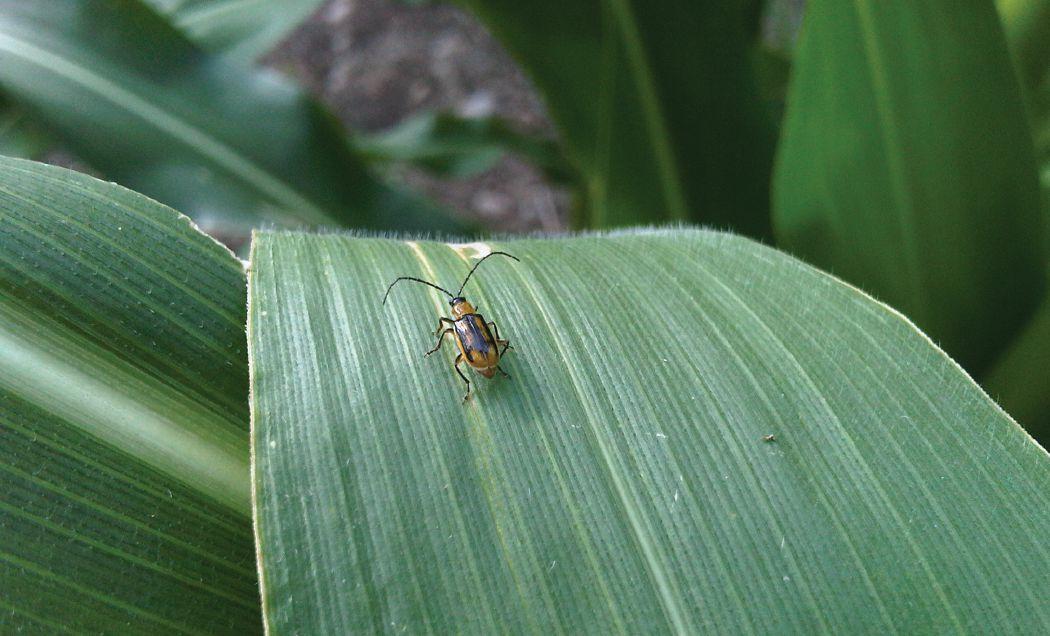
Western corn rootworm is one of two species of corn rootworm found in Ontario.
though you will see some rootworm injury, you will at least set back some susceptible individuals in the population. You could also plant a non-rootworm Bt hybrid and apply a granular insecticide to protect the corn from rootworm,” she says.
“However, those insecticides only protect the crop; they don’t knock back the rootworm population. So we’re also encouraging growers to use nematodes for rootworm biocontrol. That way, you are actually knocking back the resistant population.”
Baute explains, “Elson Shields’ lab at Cornell University produces certain nematode species for insect biocontrol. They have successfully shown many times that if we apply these nematodes on fields, the nematodes will control any surviving rootworms. It takes time for the nematodes to get going, so you’ll need to also apply an insecticide in the first year. But the nematodes are persistent – if you apply them in one year, that population will sustain itself and help control rootworms for years to come.”
According to Baute, this biocontrol treatment would cost about $50 per acre. The ideal application window is between pre-planting and V4. “The nematodes can be applied using a sprayer with the screens and filters removed and slightly reconfigured nozzles. As long as you get the product out of the tank within about half an hour, the nematodes have good success in establishing in the soil. The U.S. research also shows you can apply the nematodes in manure. We are willing to try and see if that approach will work here too.”
This treatment also controls some other insect pests in the soil, and research so far shows the nematodes are safe for plants, humans and beneficial insects. Baute says the nematode species used by Cornell also occur naturally in Ontario, so they can be shipped from New York and applied on Ontario fields without any special requirements.
Baute, O’Reilly and their colleagues are continuing to look for other possible rotation options and management measures for Bt-resistant rootworms. They will be developing guidelines for 2021 so growers can safeguard Bt rootworm traits, keep corn as a viable silage option, and trounce this major crop pest.
39 SEASONS OF NEW PERSONAL BESTS.
When you might get about 40 chances to grow your yield of dreams, you need a corn seed with proven year over year performance. So when it comes time to choose a seed, choose the one with over a century’s worth of seasons under its belt. Made with superior genetics to deliver yield and stand up against insect and disease pressure, DEKALB® corn seed is the choice you can depend on every year.
Developing innovative ways to use smartphones for in-field soil and crop testing.
BY CAROLYN KING
On-the-spot, inexpensive, easy-to-use soil and crop analysis tools could help crop growers to enhance management of their fields. Having such tools in a really convenient hand-held device would be even better. That’s why researchers like Qingshan Wei and Asim Biswas are developing smartphone-based approaches to crop and soil testing.
FAST, ACCURATE DISEASE DIAGNOSIS
Wei’s research focuses on developing field-deployable molecular imaging, sensing and diagnostic tools for plants and people. One of his research group’s current projects is to develop a smartphone
platform for cost-effective, rapid diagnosis of crop diseases.
“We like this technology because we are using existing consumer digital devices. Nowadays almost everyone has a smartphone. That will reduce your sensor cost because you already have some components in your pocket. We just supply you with the additional parts, and you can assemble them together to create a more scientific measurement tool,” says Wei, an assistant professor in the department of chemical and biomolecular engineering at North Carolina State University.
“The second thing that is really appealing about smartphones is their wireless connectivity. In the future, I think we can expand the connectivity of agriculture data; you could have water sensors,
PHOTO
temperature sensors, and other sensors that you could monitor remotely. A smartphone could be part of that sensor network.”
Wei notes that an in-field tool for accurate disease diagnosis could be really helpful, especially when different diseases or strains have similar-looking symptoms. If growers are trying to control a fast-spreading, potentially devastating disease, getting an immediate diagnosis would make a huge difference compared to waiting for days to have the samples analyzed in a lab.
The smartphone-based diagnosis system that Wei’s group is developing involves analyzing a plant’s emission of volatile organic compounds (VOCs). All plants emit VOCs; however, the composition of those emissions changes when the plant has a disease, and each pathogen species produces a distinctive VOC profile.
For their initial research to prove that this concept could work, Wei and his group have been using late blight in tomato as the model disease. Late blight is a very damaging disease caused by Phytophthora infestans, a fungus-like organism called an oomycete. Their studies so far show that their sensor system provides greater than 95 per cent accuracy in differentiating between Phytophthora infestans and other pathogens that cause similar symptoms on tomato leaves.
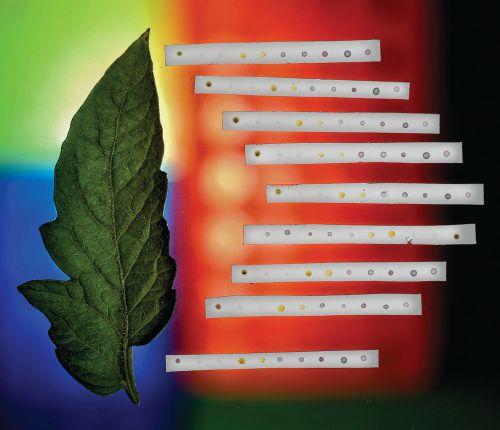
Their innovative sensor system consists of two parts. One part is a sensor strip. “This is a paper-based, one-time use, disposable strip,” Wei says. “The strip includes an array of different sensor elements, including some organic dyes and nanoparticles. Each sensor element on the array is responsive to a different type of volatile molecule emitted by the plants.” The strips are customized to respond to the particular VOCs released by the pathogen of interest – in this case, Phytophthora infestans
The other part of their system is a sensor strip reader. “We are developing a 3D-printed reader that you can attach to any smartphone model. This attachment also increases some optical components, allowing the cell phone to capture a high-quality image of the sensor strip,” he explains.
“The sensing mechanism is very simple. After exposure to the VOC emissions, the colour of the sensing element will change. So essentially we are using the cell phone camera to monitor the colour change.”
The sensor system is easy to use. Let’s say you see some suspicious symptoms on a plant while scouting in your crop. “You just
detach a leaf from the plant and put it into an enclosed container. Many parts of the plant can emit VOCs; our application targets the leaves because that is the most convenient plant tissue we can access,” he says.
“The container could be a plastic or glass bottle or tube, or even a Ziploc plastic bag. You put the leaf in the container for a few minutes to let the VOC concentration increase a little.”
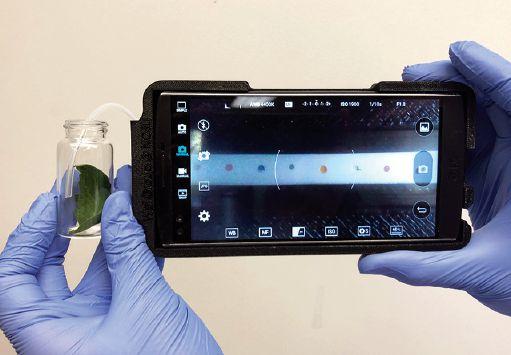
Then you open the container and insert a small hose that is attached to the reader. The reader contains a little pump that pulls the plant’s emissions from the container into a chamber in the reader that has the sensor strip. The system then analyzes the colour pattern on the strip and determines the concentration of the pathogen that you are testing for.
“We did a few pilot studies to evaluate the sensor system’s performance in a lab setting and some initial tests in the greenhouse,” Wei notes. “We are currently working with a collaborator here on the university’s campus and with some extension workers to test the sensor under real field conditions, with different weather conditions and so on. We want to make sure it can produce similar results in the field as in the lab. After that, we will probably try to find more partners, maybe first within North Carolina, and then maybe across the United States, so we can do more tests.”
The researchers have recently submitted a patent application for the sensor system. Wei is hopeful that they will be able to translate this innovation into a commercial product within a few years.
Along with being quick and accurate, the sensor system is designed to be really affordable. He says, “The smartphone attachment is relatively simple and very low cost. We are using a 3D printer in the lab to generate a few prototype devices, and we added some off-the-shelf optical components. But the overall cost for the whole reader is only about a few tens of dollars, and I believe that cost could be further reduced if you scale up the manufacturing. The sensor strips cost only a few cents per strip.”
For their next steps, Wei and his group want to develop this technology to detect Phytophthora infestans in other hosts and to detect other Phytophthora pathogens.
Phytophthora infestans infects various plant species in the same family as tomatoes, such as potatoes and peppers. “We haven’t done side-by-side comparisons, but we believe that differ-
PHOTO COURTESY OF QINGSHAN WEI, NCSU.
Wei and his group are developing a smartphone-based system that diagnoses crop disease by analyzing the volatile emissions from a plant.
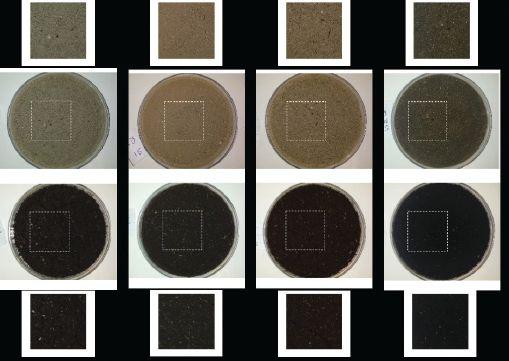
Biswas’s research group is developing a smartphone app to assess soil organic matter content based on a soil’s colour.
PHOTO COURTESY OFASIM BISWAS, UNIVERSITY OF GUELPH.
ent plant hosts may have slightly different VOC backgrounds,” he says. “But the good thing is the sensors pick up the two different types of signals. One is the baseline VOCs from the plant, and in our current sensor strip, we also have specific sensing elements selective to late blight.” So, perhaps only a few modifications to the existing late blight strip will be necessary to reflect the different host species.
He also notes, “At present, we are demonstrating that we can differentiate different types of pathogen species, but our plans include investigating whether we can go one step further and identify different strains of a pathogen. For instance, the strain types of late blight vary every year, and in some years a fungicideresistant strain will dominate.” Timely information on the late blight strain would allow a grower to make a more informed decision about fungicide options.
Further into the future, Wei and his group hope to adapt this sensing system to identify many other kinds of plant pathogens, such as fungi, bacteria and viruses.
Quick, convenient soil analysis
“Back when I was a soil science student, I spent most of my time standing in the lab doing soil analysis. I had wondered if there could be some faster alternative,” says Biswas, an associate professor at the University of Guelph’s school of environmental sciences.
This desire for alternatives to time-consuming, labour-intensive soil testing methods wasn’t just wishful thinking. It was the spark that ignited Biswas’s current research program on sustainable soil management strategies using sensor-based soil information – as well as his interest in developing in-field, low-cost soil analysis methods that anyone could use.
“The target is to bring the science to your fingertips,” he says.
One of his research group’s current projects is a smartphone app to assess soil organic matter (SOM) content. This app is based on the fact that SOM content influences soil colour.
To use the app, you would stop at various locations in a field, clear away the crop residue at each location, and take a photo of the soil surface with a smartphone. Biswas adds, “If you cannot completely clean the residue off the soil surface, this program will identify the presence of non-soil material in the image, like crop residues that might be reflecting light, and it will take out that non-soil part and analyze only the soil.”
The app analyzes the soil image in terms of its colour characteristics – its hue (wavelength), intensity (brightness), and grey value (lightness or darkness) – and uses those characteristics to estimate the soil’s organic matter content.
In the first phase of developing this app, Biswas and his research group addressed the fact that a soil’s colour can also be influenced by its moisture content. They conducted studies to quantify the effect of soil moisture on the relationship between SOM content and soil colour, and they developed a way to estimate SOM content under different soil moisture levels.
According to Biswas, this method will determine the SOM content with about 95 per cent or greater accuracy. “Plus, you’ll have the results at about one-hundredth of the cost and in a much shorter time compared to measuring soil organic matter in a lab.”
Biswas and his group have made good progress on the soil science aspect of this method. Their next steps will focus on making the app easy to use, so Biswas is looking for a graduate student interested in tackling that aspect. “One of the upcoming challenges is to find easy ways to deal with changing conditions in the field – it could be a cloudy day versus a sunny day, or you could be taking the image a little closer versus a little farther away, or you could take the image with one smartphone model versus another,” he explains.
Biswas and his group are also pursuing several other ideas for smartphone-based soil analysis. For example, they are exploring if soil colour is correlated with other important soil properties. As well, they have worked out how to use soil images to determine the size and shape of soil aggregates and to calculate soil porosity. Biswas is interested in the possibility of using a smartphone camera attachment that can capture higher resolution images so imagery analysis could identify sand, silt and clay particles, and thereby determine soil texture.
His research group is also working on in-field soil phosphorus measurement, as phosphorus management is so important in both crop production and water quality. Biswas would like to develop a low-cost kit that would include a smartphone app and an inexpensive phosphorus sensor mounted on the end of a soil probe. You would push the probe into the soil at different locations in your field and read the phosphorus measurement on your smartphone.
Biswas says, “In the long term, instead of sending soil samples to a lab, you could have an easy-to-use kit with various sensors –for soil texture, soil organic matter, pH, soil nutrients like nitrogen, phosphorus, potassium – with the whole package purchased for perhaps $100 or $150. You would be able to get 10 times more data right in the field for very little cost. And that data could be used for variable management, helping you to improve soil management for better crop production and water quality protection. That’s my dream!”
PHOTO COURTESY OF MARC HALL, NCSU.
The system uses sensor strips that change colour in response to different volatile emissions due to different diseases.
SPECIAL CROPS
SPECIALTY CROPS IN FOCUS
Industrial oilseeds, biomass crops and cannabinoids show promise in Ontario.
by Julienne Isaacs
According to Jim Todd, industrial crop specialist for the Ontario Ministry of Agriculture, Food and Rural Affairs (OMAFRA), there are lots of reasons why industrial specialty crops can be a good option for Ontario field crop producers. Specialty crops could be a source of new or additional revenue, while breaking up pest cycles on the farm.
But there’s also a big reason why many producers avoid them: the lack of processing capacity in the province.
“There are always people who want to buy the crop, but if you can’t get it processed, there’s no value,” he says. “Demand and markets have to develop in lockstep.”
Market demand and processing capacity for specialty crops are improving in Eastern Canada, albeit slowly. In the meantime, Todd’s team is working out the agronomics for crops like cannabis and hemp, camelina, feedstock plants for biogas such as cup plant, and biomass crops like switchgrass and miscanthus.
Cannabinoids
Much of Todd’s work over the last two years has been focused on cannabis and industrial hemp for CBD, and is done in close collaboration with Rene Van Acker and Rachel Riddle from the University of Guelph.
Acreage of industrial hemp increased dramatically in 2019, when growers in Norfolk County alone added at least 1,000 acres.
That’s not to say growing hemp is a walk in the park.
“There are a lot of regulatory challenges for hemp,” Todd says. “If you want to grow hemp for CBD, you want to grow the varieties that produce the highest levels of CBD, from plants that are females. But if CBD levels are raised, you risk bringing THC levels above a certain percentage, which causes problems.” Health Canada stipulates that all industrial hemp, even if grown for CBD, must have THC levels below 0.3 per cent.
This isn’t the grower’s problem, Todd is quick to point out – seed producers are required to certify THC levels are 0.3 per cent or lower. But it can become complicated for farmers if the licenced processors buying the crop ask them to have the crop analyzed.
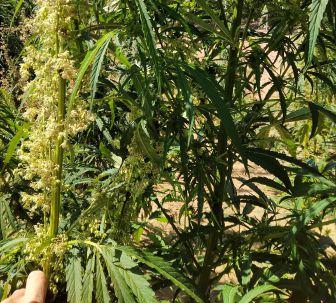
Hemp can also be grown as a seed crop, which is simpler, Todd says. At harvest, the combine requires special settings, and the fibre can be a challenge; one method is to raise the head and take the tops off, leaving the stalks to be baled or plowed down.
Growers interested in cannabis as a field crop for CBD production should be aware that the crop can only be sold to a licensed cannabis processor. “Having contracts with licenced processors before sowing the crop would be in the grower’s best interest,” he says.
Markets aside, some agronomic questions for growing indus-
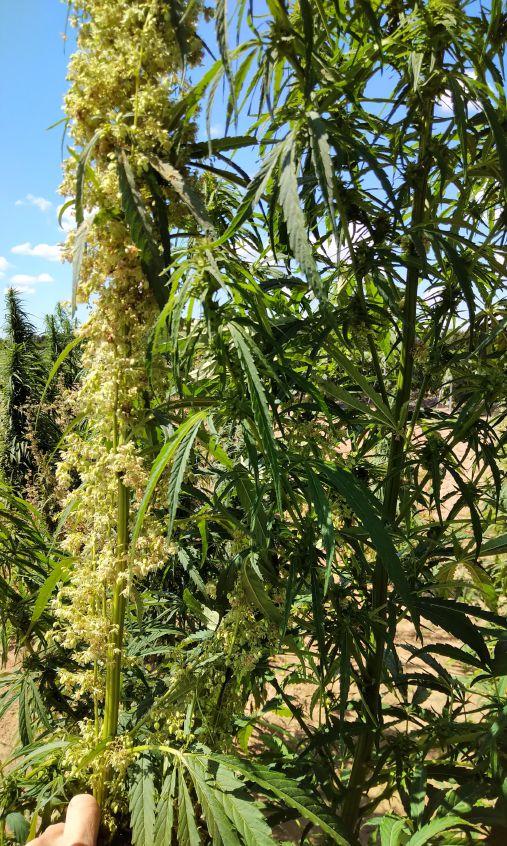
Hemp can be grown for seed stock or CBD.
PHOTOS COURTESY OF JIM TODD.
trial hemp or cannabis still need to be worked out in the province.
Todd’s team is looking at the impact of pollination on CBD yields from female flowers. The current practice, he says, is to plant just female plants to avoid running the risk that plants will be pollinated, which may reduce CDB yield. But Todd says research is still needed to establish that yields are meaningfully affected by pollination.
Camelina
Todd has also been working with Linnaeus Plant Sciences and the University of Guelph on camelina, an industrial oilseed and relative of canola.
Camelina oil is highly valued for the consumer market, while camelina seed meal is approved for use as a feed ingredient for broiler and layer hens and farmed salmon and trout.
In a recent study, Todd’s team looked at the potential for double-cropping camelina with soybeans, with soybeans seeded into fall-seeded winter camelina. This system allows for winter cover for bare fields, and potentially higher net profits from the combined yields of the camelina and bean crops.
The project failed to take off, Todd says, due to low seed vigour in the camelina crop in the first two years. But in the third and final year, when new seed was planted, the crop established well.
“I see camelina as a valuable replacement or supplement to canola, because it’s more resistant to swede midge,” Todd says. “But again, in Ontario the lack of crushing capacity for camelina means you have to find a niche specialty crusher to do it.”
“There are always people who want to buy [specialty crops], but if you can’t get it processed, there’s no value. Demand and markets have to develop in lockstep.”
Biomass crops
Todd is also working on cup plant, a feedstock for anaerobic digesters, as well as perennial grasses such as switchgrass and miscanthus, which are grown for a variety of industrial uses. The latter are the particular focus of his colleague, Mahendra Thimmanagari, bioproducts specialist for OMAFRA.
Thimmanagari says miscanthus and switchgrass are the most common biomass crops in Ontario; both have high yield potential and, once established, can remain productive for 10 to 15 years. The crops are grown on around 2,500 acres in southwestern and eastern Ontario.
In collaboration with University of Guelph associate professor Naresh Thevathasan, Thimmanagari is researching biofertilizer effects on switchgrass crop yields, as well as these crops’ potential for soil carbon sequestration.
Both crops can be grown on marginal land, Todd says, such as riparian strips or other corners of the farm where it can be tricky to grow a field crop – although they predictably do better on prime land. And both crops have “tremendously deep root systems,” Todd says – easily six- to 12-feet deep in the soil – meaning they could help draw excess nutrients from runoff.
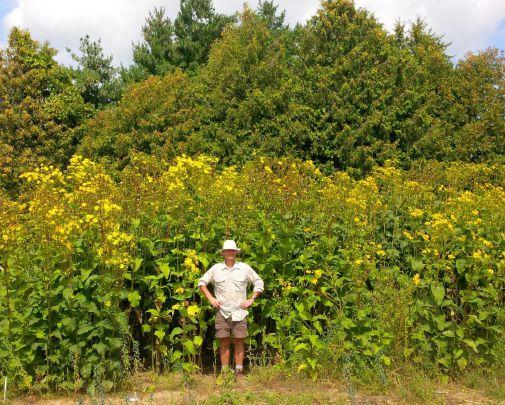
Cup plant, a native perennial and member of the aster family, is used as a feedstock for anaerobic digesters.
“One of the challenges with the digester is having a regular supply of feedstock. Cup plant could be a good alternative to corn silage,” he says.
For the last three years, together with Brandon Gilroyed at the University of Guelph’s Ridgetown campus, Todd has been working on field agronomics for cup plant, such as germination rates and response to nitrogen, as well as variety trials.
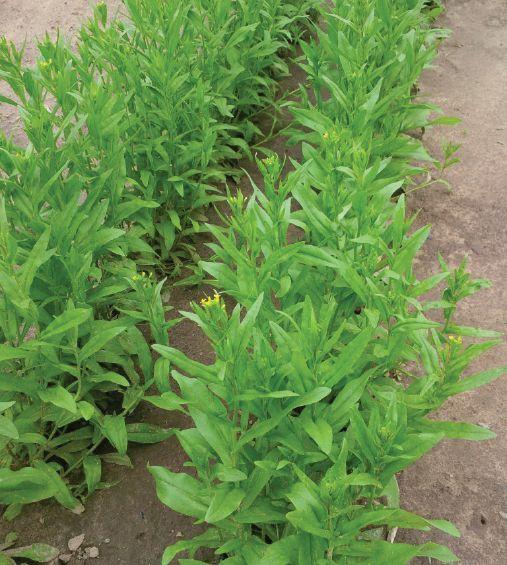
Camelina beginning to flower.
Cup plant can be used as a feedstock for anaerobic digesters.
OLD WAYS MADE NEW
Identifying bread wheat variety mixtures for better yield, quality and stress resistance.
by Carolyn King
Abread wheat research project in Quebec is aiming to capture the resiliency that comes with the genetic diversity in old-time crops while maintaining the advantages of today’s elite varieties.
Plant geneticist André Comeau explains that the development of genetically uniform wheat varieties in Canada was initially driven by the need for uniform crop maturity. “Ancient farming was never done with pure varieties; farmers grew landraces, selected over millennia. Bread wheat is a species that comes from the Middle East, and uniform ripening is never a problem in that region because the temperatures get so high,” he says.
“But bread wheat was very poorly adapted to northern climates like Canada when people first tried to grow the crop here. In Western Canada especially, in one year out of four, the crop froze to death before it was ripe. The key in Canada was to use pure varieties with uniform maturity to obtain a harvest of acceptable quality.
“Yet many possible advantages were lost through the move to pure varieties – more stable quality, better resistance to diseases and insect pests, better resistance to drought and excessive rain, and more stable and better yield,” notes Comeau, who is the project’s consultant due to his knowledge of spring wheat varieties, gained during his 42 years as a research scientist with Agriculture and Agri-Food Canada (AAFC).
The potential advantages of increased genetic diversity motivated European research on mixing crop varieties together in a field. And the research findings from Europe have sparked interest in trying this approach in eastern Canadian bread wheat production.
“The idea for this project came not from growers but from endusers. Les Moulins de Soulanges and La Milanaise [two Quebec-based companies that produce flour] would like to have more stability of quality, which could come from mixtures. But they would also like farmers to gain from growing mixtures,” he explains.
“If you mix a very high quality wheat with a somewhat lower quality wheat that has very high yields, then flour and breadmaking companies would be able to get good quality grain at a better price. And if you’re mixing varieties for more stable quality, then the varieties could also be complementary in other ways. For instance, studies in France show that if you mix varieties that differ in their disease resistance traits, you can get as much as a five-per-cent yield increase compared to the average yield of the pure varieties.” Comeau suggests there might be other improvements, such as extra yield gained from mixtures with different, non-competing root structures.
The project’s goal is to identify bread wheat variety mixtures that consistently perform well under organic wheat production in Eastern
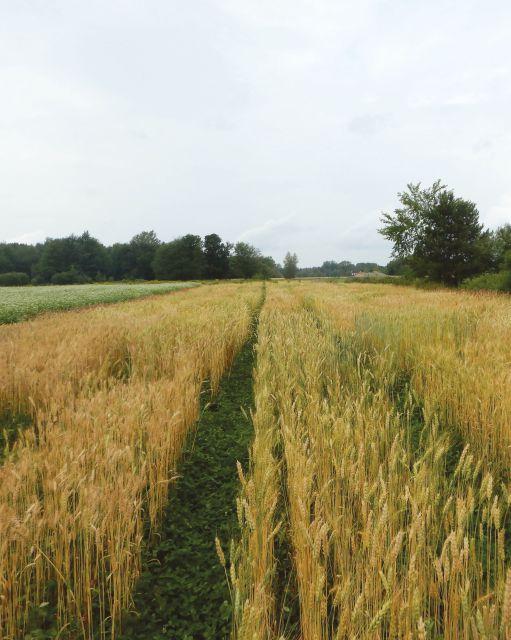
A project in Quebec is comparing different bread wheat variety mixtures to find ones that provide clear benefits to growers and end-users.
Canada. Organic growers may be especially interested in the potential of mixtures to provide better control of diseases, insect pests and weeds. However, Comeau believes these benefits and other possible improvements in sustainability and resiliency could be of interest to conventional wheat growers, too.
Funding for this project is from the Organic Science Cluster 3 (OSC 3) and La Milanaise and Les Moulins de Soulanges. OSC 3 is a research initiative supported by the Organic Federation of Canada and AAFC’s Canadian Agricultural Partnership.
Julie Anne Wilkinson with CETAB+ (Centre d’expertise et de transfert en agriculture biologique et de proximité) is managing the project, and CETAB+ is carrying out the field work. Les Moulins de Soulanges and La Milanaise are analyzing the quality of the harvested grain for the project.
ABOVE:
Seeking suitable mixtures
This five-year project, started in 2018, includes at 12 spring wheat varieties: either bread wheats or wheats that could be used in bread mixtures. Ten of the varieties are eastern Canadian and two are western Canadian.
Most of the 12 are commercially available varieties, although a few are advanced lines close to registration. Comeau says, “We want to be ahead of the game, so if an advanced line looks like it would be a very good component for a mixture and we are confident that it is going to get registered, we have entered it.” One of those lines was recently registered. This new variety, AAC Maurice, was developed under a former AAFC breeding program in Quebec, led by Comeau and his assistant François Langevin, which bred bread wheats for Fusarium head blight resistance.
With 12 varieties, many different combinations are possible. Since this project is a first look at how well the mixture concept works for organic wheat production in Eastern Canada, the project team has decided to focus on mixtures of two varieties. However, Comeau notes that the trend in Europe has been to use more diverse variety mixtures.
The number of field sites in the project varies slightly from year to year. In 2020, there were two sites, one in Victoriaville and one near Sorel. Each year, the plots compare about 15 pairings and about 12 pure varieties, with three replicates of each.
To choose specific pairings, the team identifies varieties that might work well together based on what is known about the individual varieties. “The number one factor is days to maturity. In Canada there could be 15-days’ difference in maturity between varieties in some years. You cannot make a crop mixture in which half of the wheat heads would be ripening in the middle of August and half in early September,” Comeau explains.
“Disease responses, quality aspects, yield, lodging and root traits are also important in the invention of a good mixture. Moreover, one cannot mix a short wheat with a tall one. So, it is quite complex when one tries to make combinations that would generate enthusiasm from both farmers and end-users.”
Data collection for the project includes many factors: uniformity of maturity and height, disease levels, lodging, weed infestation, root system characteristics, grain yield, percent of damaged grains, and flour quality.
So far, the team has analyzed the data from 2018 and 2019, and they will be analyzing the 2020 data in the coming months. “There are always some mixtures that look
good every year. If they look good, we try them again,” Comeau says. “We need to find mixtures that are good year after year.”
After a couple of dry years at the field sites, the team is hoping for some wet conditions in the next two seasons to provide data under a wider range of growing conditions.
If this project shows that some wheat mixtures could provide a clear benefit to eastern Canadian growers and end-users, then studies could look into ways to make the use of mixtures easy and inexpensive for growers.
Comeau adds, “Out of this project, we are
learning more about the varieties – not only how well they complement each other, but also how well they do on their own.”
“This year was pretty hot in the early part of the season, and we found that one or two of the varieties have root systems that are able to keep going in hot, dry conditions and grow faster than the others. Also, a few of the varieties are especially good at competing against weeds, which is very useful, especially in organic production systems,” he says.
“I think we are learning a lot and we have a lot more to learn.”
A LONG WAY TOGETHER
WHEREVER YOU ARE, BKT IS WITH YOU
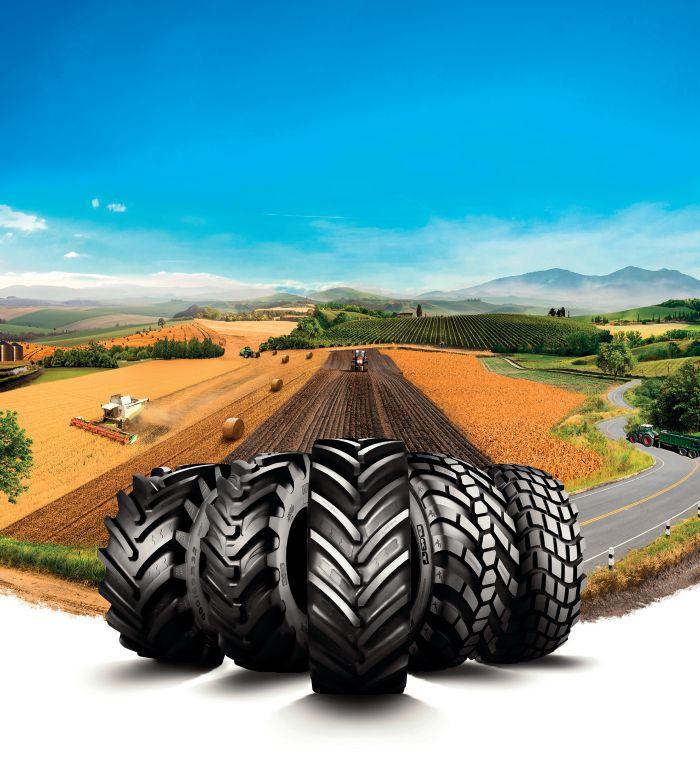
No matter how challenging your needs, BKT is always with you, offering a wide range of tires tailored to every need in agriculture: from work in the open field to the orchards and vineyards, from high power tractors to trailers for transport.
Reliable and safe, sturdy and durable, capable of combining traction and reduced soil compaction, comfort and high performance.
BKT: always with you, to get the most out of your agricultural equipment.
SOIL HEALTH: TO TILL OR NOT TO TILL?
That’s not necessarily the right question.
by Bruce Barker
In Western Canada, the long-standing belief is that no-till makes the healthiest soil, as measured by soil organic carbon and the health of soil microbes. But can reduced-till soils also be healthy?
“In drier areas, the advantage of no-till in conserving soil moisture has allowed the move to continuous cropping, and that means more carbon added to the soil. But how much tillage is too much has never been assessed in a diverse crop system in Western Canada,” says Martin Entz, professor of cropping systems and natural systems agriculture in the department of plant science at the University of Manitoba. “What we do know is that [tilled land] doesn’t necessarily mean poorer soil. Plus, tillage takes many different forms. Little things, such as tillage speed, can make a big difference.”
A contributing factor when looking at soil health is geography. In Eastern Canada, tillage without diverse crop rotations is contributing to a decline in soil health. There, a corn-soybean rotation is common. At the University of Guelph’s Elora Research Station, a long-term rotational study was set up in 1980 to compare the interaction of crop rotation and tillage. To date, the rotational study has found that a corn-soybean rotation is associated with reduced yield and greater yield instability, the lowest soil organic matter, and increased nitrogen inputs – with no difference between conventional tillage and no-till. However, diversifying the rotation to include winter wheat, or winter wheat plus a red clover cover crop, resulted in more sequestered carbon, even with conventional tillage.
“No-till can be a good option for improving soil health; however, I would argue that crop diversity is more important. My takehome message is that crop diversity directly improves soil health, and is also required for no-till/reduced-till systems to be most ef-
fective,” says Bill Deen, associate professor, cropping systems, at the University of Guelph. “It has also been observed in Ontario that simple rotations are leading to increased adoption of tillage. So, without crop diversity, a farmer may end up forgoing the benefits of no-till.”
On the Prairies, the move is also towards a simple crop rotation of canola-wheat. Whether this is sustainable from a soil health perspective is yet to be seen.
“If you look at the Prairies, the Dark Brown and Brown soil zones, no-till helps alleviate the problems caused by monoculture cropping,” Entz says. “But there is also research that shows the benefits of no-till are stronger in diverse rotations.”
For example, a three-year cropping sequence study, repeated for five cycles in Saskatchewan from 2005 to 2011, found that a cerealpulse-cereal rotation increased total grain production by 35.5 per cent in year three, improved protein yield by 50.9 per cent and enhanced fertilizer-N use efficiency by 33 per cent over a conventional wheat-summerfallow system.
Entz says there is no comparable long-term study comparing notill with different types of tillage in diverse crop rotations on the Prairies. However, he says there are many no-till studies that show that the combination of a diverse crop rotation together with no-till has produced the best overall results in terms of soil C dynamics.
“The story in Ontario is that a diversity of plants in the system is more important than simply cessation of tillage. Does this also happen in the grassland soils of the Prairies? This is what researchers are now trying to find out,” Entz says.
ABOVE: A diverse crop rotation is an important factor in soil health, with or without tillage.
Microbial Carbon Use Efficiency could compensate for tillage
One measure of the ability of soils to sequester C is microbial Carbon Use Efficiency (CUE). This refers to how efficiently soil microbes process C (straw, manure, etc.) added to the soil. A higher CUE may increase C storage and explain how a system that receives less C (tillage) can actually have more soil C sequestered than systems that receive more C (no-till).
Cynthia Kallenbach of McGill University conducted research comparing organic and conventional wheat-corn in Michigan. Both treatments received tillage, but the organic treatment had more tillage for weed management, no compost or other organic inputs, and slightly lower plant inputs than the conventional system. She was intrigued to find that the organic treatment accumulated more C, and she reasoned that this was partly due to higher CUE offsetting the potential C loss typically associated with higher tillage.
She points out that reducing tillage may have some contradictions. On the one hand, tillage reduction “could create a more heterogeneous environment with potentially positive effects on CUE via improved aggregation and increased pore size diversity.” And leaving crop residue on the soil surface could concentrate higher CUE near the soil surface.
On the other hand, incorporating crop residue with tillage could improve CUE deeper in the soil. Some research has found that CUE increases with depth under conventional tillage but declines deeper in the soil profile with reduced tillage.
While there are multiple benefits to reducing tillage, Kallenbach proposes that declines in CUE with depth are greater under no-till
systems and might explain why overall increases in soil C [with notill] are not always observed. She doesn’t suggest to increase tillage, but believes that understanding tillage effects on crop residues may involve underappreciated, complex microbial mechanisms, and that tillage may have benefits to improving CUE at greater soil depths.
Kallenbach thinks that diversifying crop rotations or mixing legume cover crop biomass with corn or wheat residues could also promote different soil microbe species to coexist. This diversity of crop rotation can help each species to “realize their optimum CUE without shifting toward an overabundance of inefficient microbes.”
While CUE is an evolving field with much to learn about how it impacts C sequestration, research by Byron Irvine at Agriculture and Agri-Food Canada found that an occasional tillage operation on longterm no-till fields isn’t the end of the world. He found soil aggregate size was reduced by a one-time tillage operation, but there was little or no impact on soil carbon, nitrogen, bulk density, potentially mineralizable nitrogen or any other soil property measured. In the years after tillage, aggregate size began to return to the pre-tillage size.
Overall, the point isn’t whether tillage or no-till is good or bad for soil health in Western Canada. The point is that crop diversity is very important for sequestering C into the soil. In Western Canada, the research hasn’t been done to understand how much tillage and of what type is too much.
“In Western Canada, I applaud farmers on their adoption of notill and its impact on soil health. The question is how to advance soil health further,” Entz says. “Prairie farmers are on the right track, but there are other tools like diverse crop rotations, perennials and cover crops that could help even more.”
HOPS RESEARCH CONTINUES IN ONTARIO
As the hops market expands, so does acreage and the need for local research.
by Julienne Isaacs
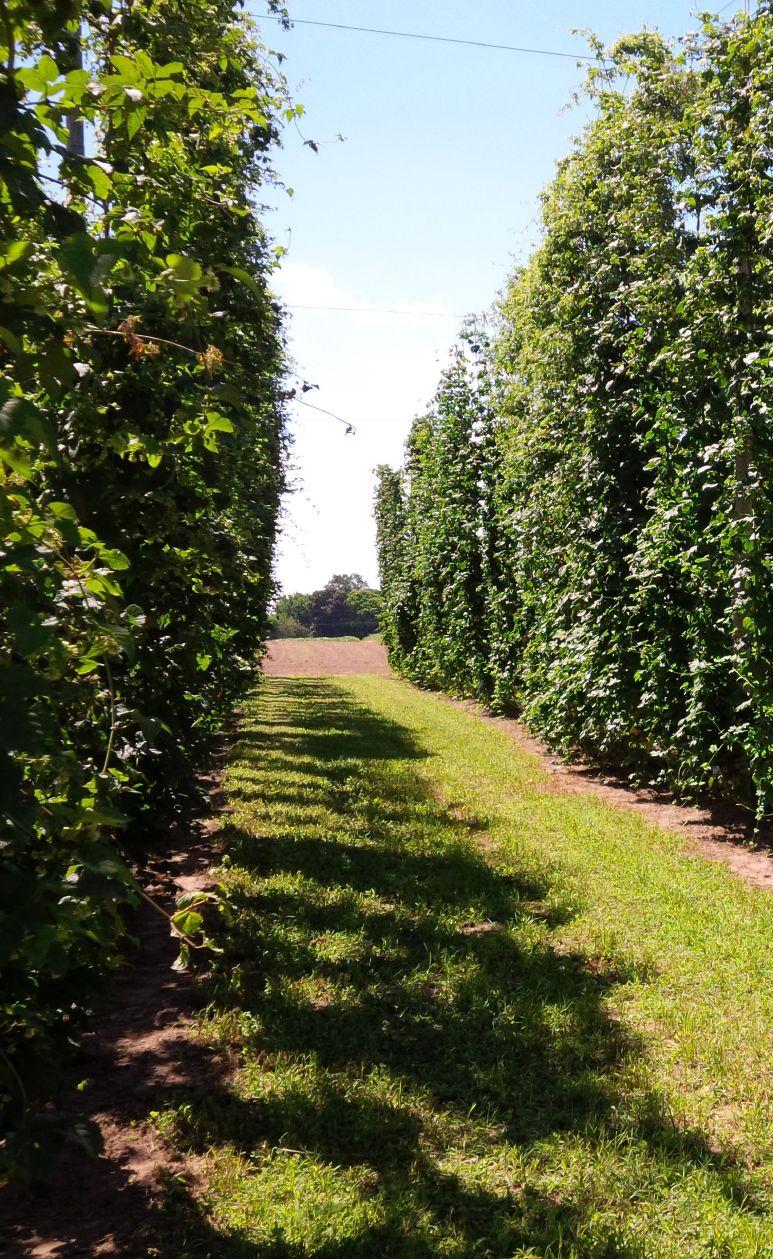
After a period of rapid market growth, hops occupy a substantial niche in Ontario.
Ten years ago, there were at most seven growers growing 15 acres of hops in the province. As of 2019, there were more than 65 farming more than 225 acres, according to Evan Elford, new crop development specialist for the Ontario Ministry of Agriculture, Food and Rural Affairs (OMAFRA).
Shortages internationally, as well as a disastrous 2006 warehouse fire in Yakima, Wash., that destroyed a significant portion of the global hops supply, initially pushed the local industry to step up, he says. But after markets recovered from the shortfall, international acreage has increased to its highest levels since the mid-1990s. At the same time, the rise in craft breweries and demand for local beer has driven growth at home.
“Back in 2011 we had around 57 craft breweries in the province,” he says. “Fast forward to 2020, there are over 300.”
As a result, the local market has changed dramatically, Elford says. “It is a much different market now than even five years ago, with much higher acreage and volumes of hops available compared to when many Ontario growers started.”
Ten years ago, most growers started with half an acre to three acres of hops, he says. Anything over half an acre of hops is considered commercial production based on the value of the crop and expected yield, but growers need significantly more than that to supply a year-round brew at a craft brewery. These days, Elford says producers generally enter hops production with four to five acres with the potential to expand to 10 to 15 acres.
More acres are required to justify equipment and storage costs;
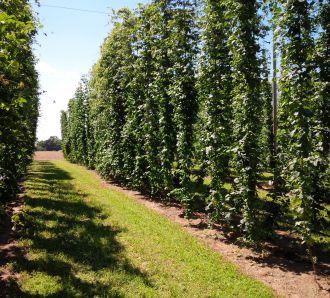
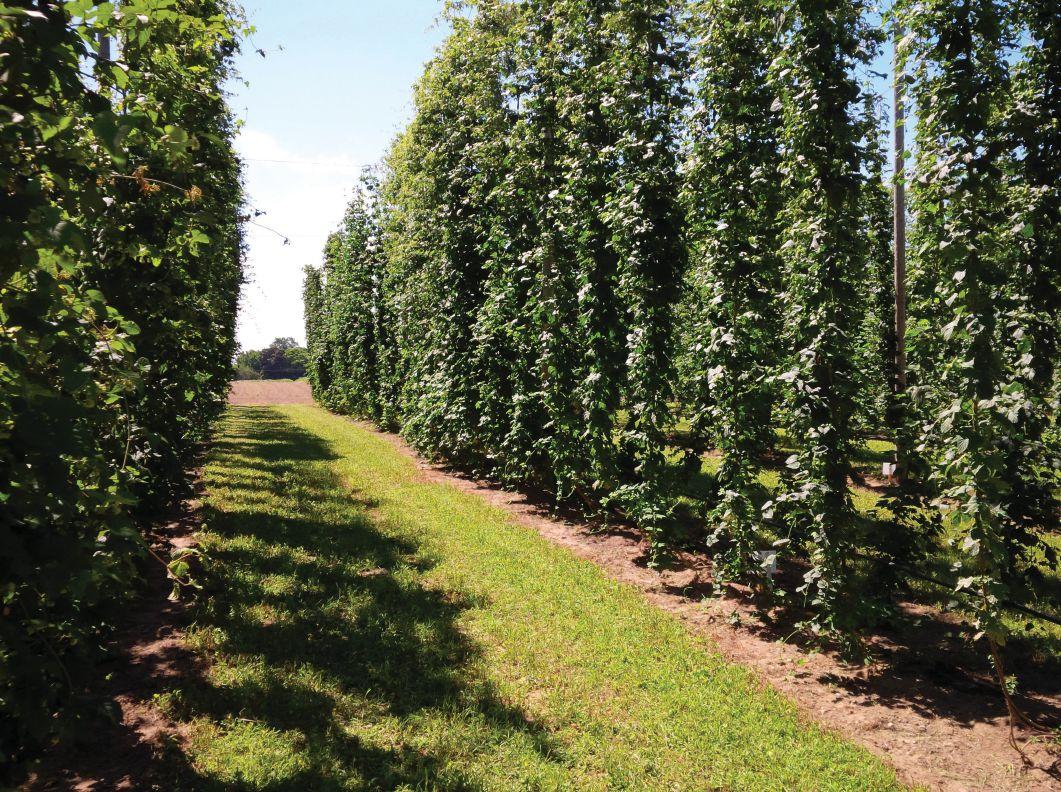
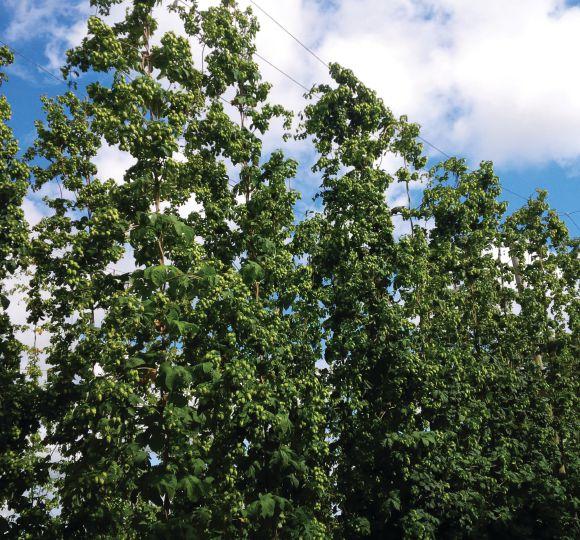
TOP: Different hop cultivars have distinct flavour and aroma profiles, so it’s best to establish a market before planting.
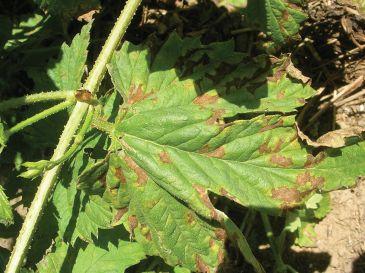
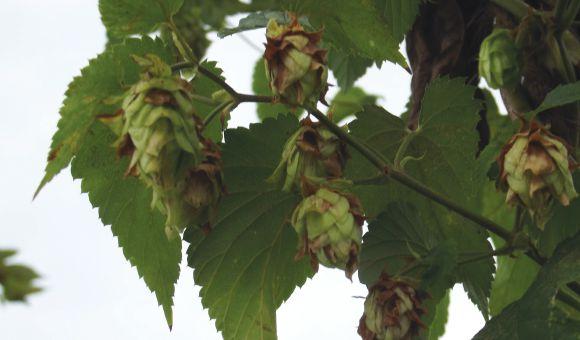
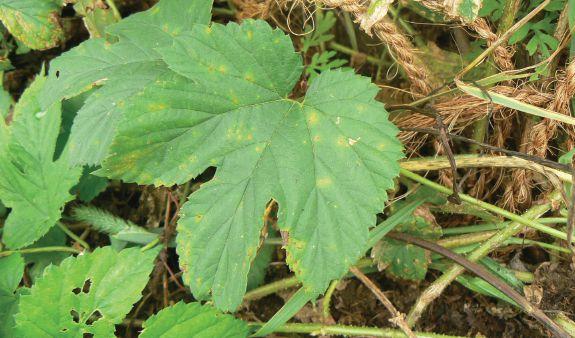
INSET: Hops downy mildew is a hops-specific disease, caused by Pseudoperonospora humuli.
producers require mechanical harvesters, processing equipment such as an oast house for drying, pelletizing and vacuum packing equipment, and cold storage facilities.
Because it’s such a high-value crop grown on so few acres, the stakes are proportionately higher when it comes to hop performance. In other words, hops research has never been more important.
Breeding and BMPs
A big focus of research in Ontario has been cultivar performance, led by the University of Guelph Simcoe Research Station. Hops are like apples, Elford explains, in that brewers buy specific cultivars depending on the style of beer they’re making. “Different cultivars impart distinct profiles in both flavour and aroma,” he says.
Agriculture and Agri-Food Canada is leading a native hops selection and screening trial to introduce new cultivars to the Cana-
dian market. It’s a new project and the results are pending, Elford says. Most hop breeding happens in the Pacific Northwest, but another big change to the market has come with a shift toward private breeding programs and an uptick in proprietary varieties.
Beyond breeding, OMAFRA has led the charge in researching hop agronomics.
The research has helped growers develop a set of best management practices. Top of the list, Elford says, is doing background market research and connecting with breweries or alternative markets prior to planting anything. This is especially important these days, as many producers reduce acreage or even exit hops production altogether due to low prices.
Once markets are established, starting with clean plants that are tested for hop downy mildew and indexed for hop viruses is vital.
Producers should also ensure good irrigation systems and fertility plans are in place before planting; hops require a large vol-
ume of water and complex fertility regimes. Hop fertility guidelines can be found on OMAFRA’s website, along with other guidelines such as hop yard construction and hop harvest timelines.
Currently, OMAFRA is running trials in Simcoe looking at chemical and mechanical removal of lower leaves on hop bines (called “leaf stripping”) to assess its impact on disease and yield.
The team has also looked at frost management strategies following late spring frost events in 2012 and 2014 that caused dieback or complete kill of the bines.
Disease and pest outlook
Since the early variety trials ten years ago, a major research focus has been hop downy mildew management. The hops-specific disease, caused by the fungallike organism Pseudoperonospora humuli, constitutes a major threat to hops production, because it can become systemic in the plant and return every year.
Another threat is viruses like hop mosaic virus and apple mosaic virus, which can cause significant crop losses within three years of planting, Elford says.
Melanie Filotas is OMAFRA’s horticulture integrated pest management specialist, who works on hops pest management. She says that in 2020, downy mildew was present at roughly normal incidence in Ontario. “As is typical, symptoms were most noticeable during spring rains earlier in the season, [but] most growers are now accustomed to managing for the disease and were able to keep the disease under control with regular spray programs,” she says.
Neither were there large outbreaks of powdery mildew in the province to match those experienced by producers in the Pacific Northwest or occasionally in Michigan.
“But growers should consider preventative sprays as, in some yards, powdery mildew has been observed where sprays were skipped to save costs,” she says.
Control of downy mildew goes beyond spraying, however, and includes sanitation practices like pruning basal foliage, which can help remove pathogen inoculum from the plant, as well as limiting excess nitrogen fertilization and avoiding overhead irrigation.
Researchers at the University of Guelph have recently wrapped up a multi-year research trial focusing on downy mildew and cone diseases, Filotas says. This included evaluating a U.S. downy mildew forecasting model for Ontario, testing Ontario downy mildew strains for resistance to two fungicides and evaluating biological/organic fungicides for control of downy mildew and cone diseases. Results are forthcoming.
Resources on hops pest management and fertility recommendations can be found at www.onspecialtycrops.wordpress.com. Additional resources can be found at OMAFRA’s hop webpage, the OMAFRA Specialty Cropportunities hop profile and the Ontario Hop Growers’ Association webpage.
In the past 10 years, hops acreage in Ontario has grown by more than 1,500 per cent.
Hops downy mildew affects the cones as well as the leaves.
As it can become systemic and return each year, hops downy mildew is a major threat to hops production.
Better Beans. Better System.
A profitable soybean crop starts with better genetics that deliver better results. That’s why we created Enlist E3™ soybeans, a more advanced seed with high yield potential and a robust herbicide tolerance. Spray them with Enlist Duo™, or new Enlist™ 1 herbicides, for a low drift, near-zero volatility solution that’s a better choice for your farm and community.
Enlist E3 soybeans are available for 2021 planting. Talk to your local seed supplier.
Simply Better Soybeans. Learn more at enlistcanada.ca