TCM - Influential Women In Canadian Agriculture August 2020
The incredible nominations we received for the inaugural year of this program highlighted just how many
To our Top 6 recipients, those who nominated an influential woman, those who offered support through social media or tuning into the podcast series on AgAnnex Talks, and to our generous sponsors.
HONOURING WOMEN IN AGRICULTURE
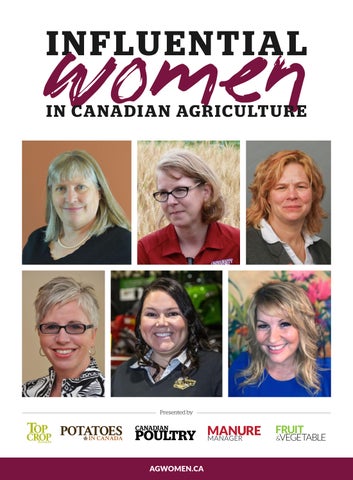
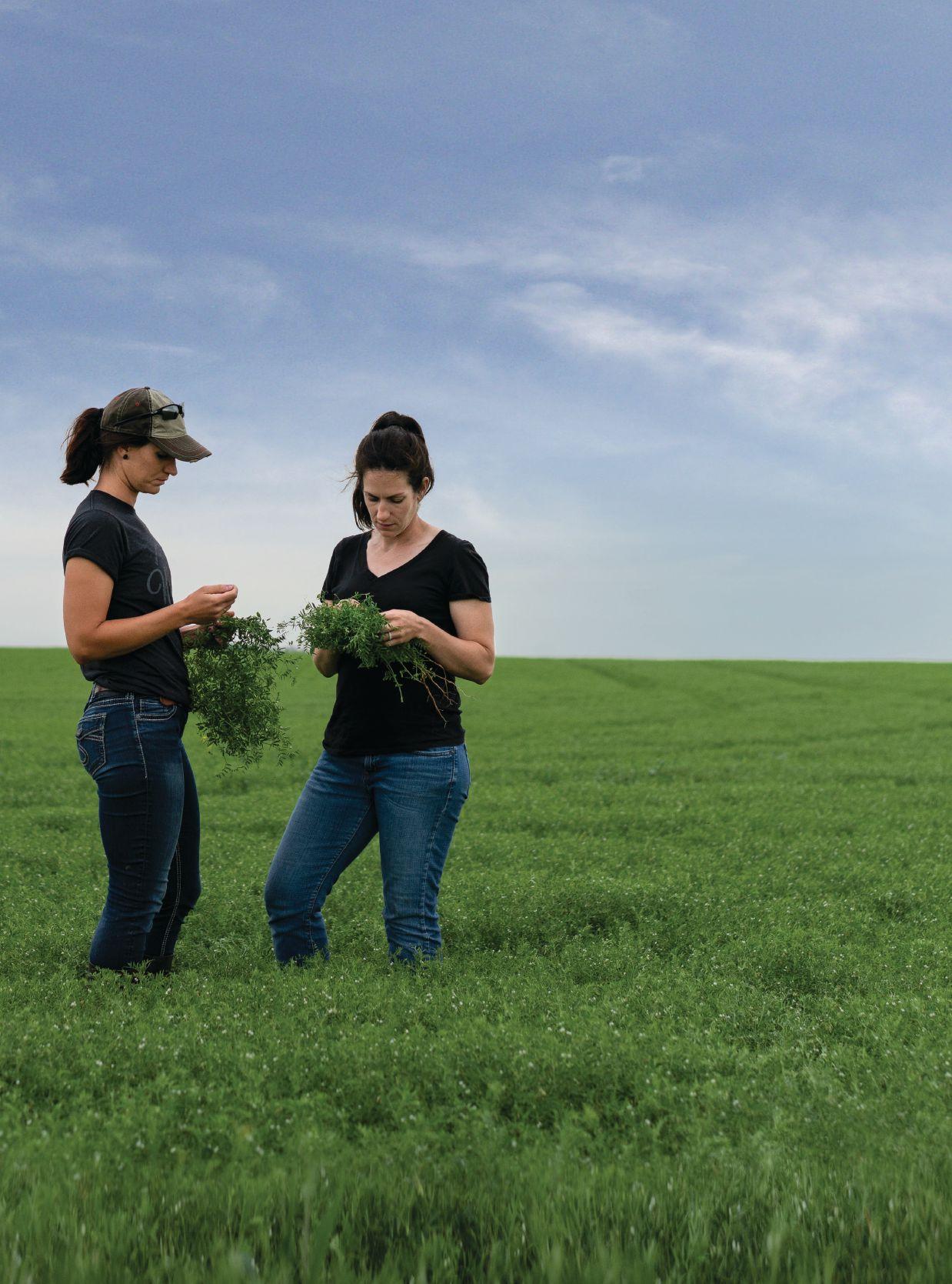
In March, the agriculture group of magazines at Annex Business Media launched Influential Women in Canadian Agriculture (IWCA). It’s a recognition program intended to highlight and promote the work that women do across Canada’s diverse agricultural landscape.
Whether actively farming, providing animal health or agronomic services or leading sales, research and marketing teams, Canadian women are essential to the success of the agriculture industry.
We asked our collective subscribers to nominate an influential woman by providing examples of their leadership, innovation and advocacy work. We were confident that we’d receive lots of great nominations, but our team of judges was truly blown away by what we read in the nomination forms.
The pages ahead contain highlights of interviews with each of the six women chosen as the inaugural Influential Women in Canadian Agriculture. From animal welfare to soil to advocacy, these trailblazers are leaders in their respective fields. We trust you’ll be inspired by their stories.
And to listen to extended versions of these interviews, check out AgAnnex Talks on Apple Podcasts, Google Podcasts, Spotify, or wherever you listen to podcasts.
Enjoy! •
5 4
6
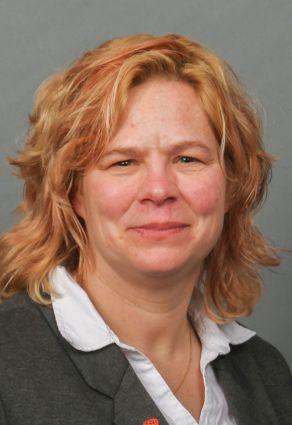
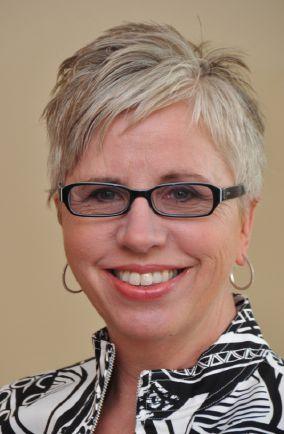
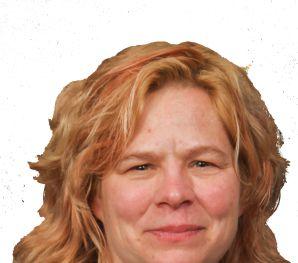
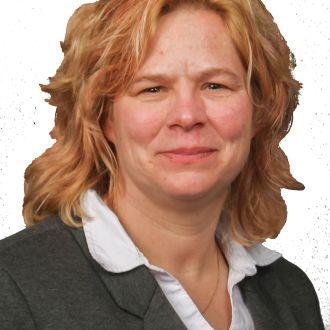
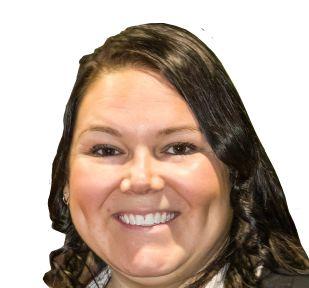
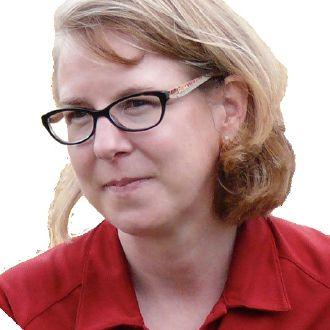
Peggy Brekveld
Ontario Federation of Agriculture and Woodstar Farms
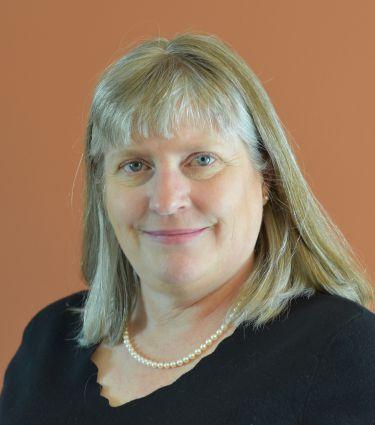
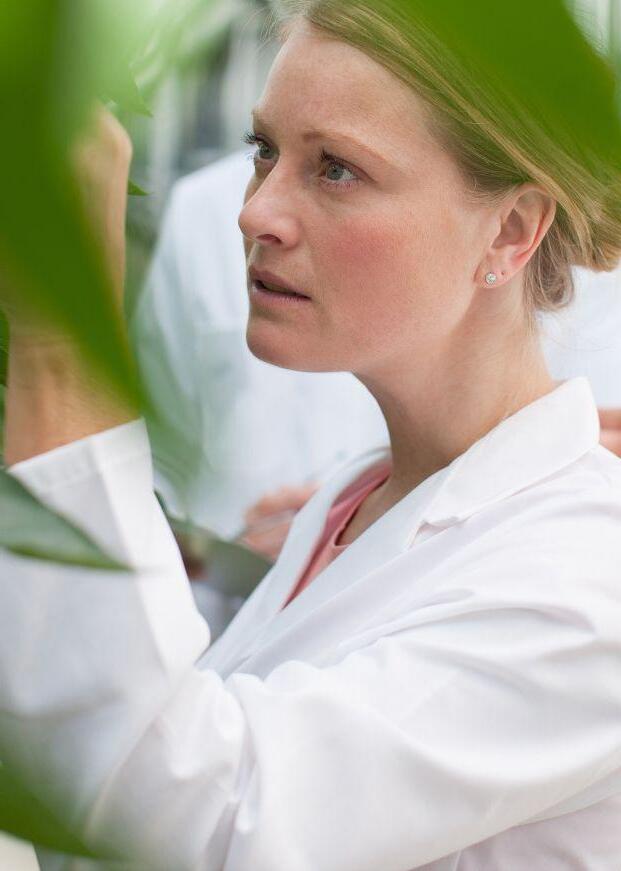
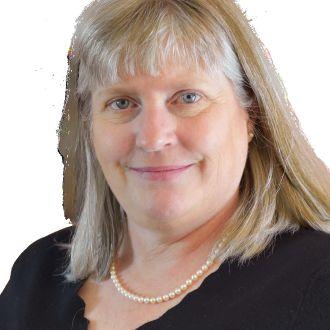
Barbara Cade-Menun
Agriculture & Agri-Food Canada
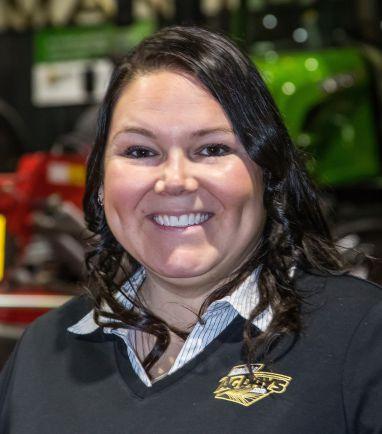
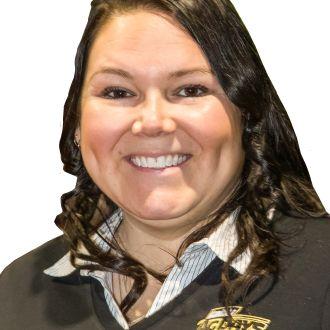
Kristen Phillips
WP Acres Ltd. and Manitoba Ag Days
7
8
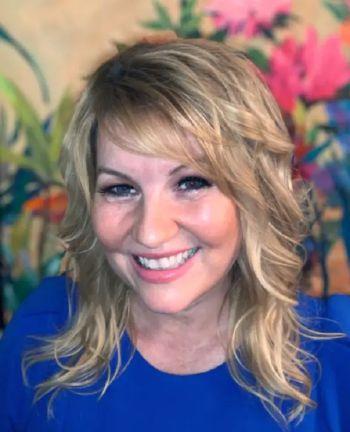
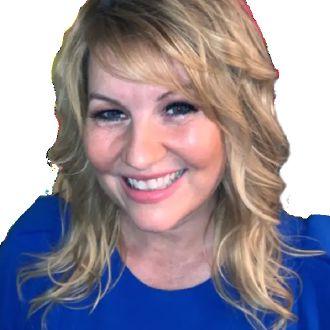
Karen Schuett
Livestock Water Recycling
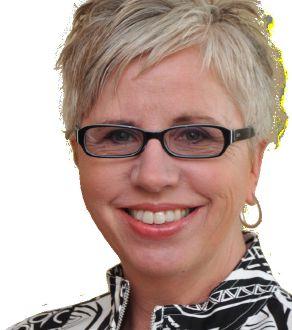
Karen Schwean- Lardner University of Saskatchewan
10
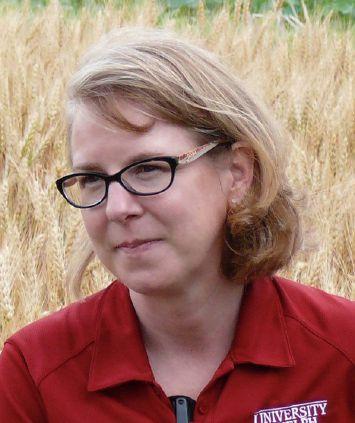
Laura Van Eerd University of Guelph
Q&A with Peggy Brekveld
To hear our full interview with Peggy, visit agwomen.ca
BRIDGING THE DIVIDE
The role of farming in Canada and Peggy Brekveld’s role within it.
by Alex Barnard
Peggy Brekveld is an ag advocate, dairy farmer and family woman living in Thunder Bay, Ont. She’s vice-president of the Ontario Federation of Agriculture (OFA) and the Agricultural Adaptation Council, and a graduate of the Rural Ontario Institute’s Advanced Agricultural Leadership Program. Alex Barnard, associate editor of Top Crop Manager and Manure Manager, chatted with Brekveld about the importance of building relationships between farming and politics and how being different helps broaden the conversation.
What do you like best about your many roles?
On the farm, I love the way of life. I love that we live in a really beautiful part of the country, I love the fresh air and the physical work every day is very good for the soul. And I love watching my family and my husband thrive there. But I have to say, I’ve probably thrived more in my role with the OFA.
I love that I’m the bridge; I’m the relationship between farmers and politicians, government and regulators. I think there’s a necessity for that role. People don’t always understand why farmers do the things they do; why certain policies may be difficult or inappropriate.
We need to be able to speak their language as well, and I like to think I’m that person. I love being at farming events and hearing the stories of farmers – both the good things and the challenges they’re having – and I like having the ability to go and convey those things to people who can make a difference in policy and government.
What keeps you excited about working in agriculture?
The people; the relationships! Farmers have a special way of looking at the world and looking at life. They often know life and death through their businesses. They know that sometimes things are not in their control – they can’t do much about the weather – and yet they still adapt and change.
I often say we’re optimists in action, even if we’re not in words, because every year we say, “I’m going to plant again.” We look forward to the rain and sunshine and we think, “Well, next year will be a better year.” Most of us, at least. There’s something special about that.
There are challenges in front of us – this COVID-19 thing has certainly shaken our world – that really have affected our bottom line. There are farmers who are seriously worried whether they’ll make it. But we still need food. I think someone will plant a crop at the beginning of the year; people will still raise animals because they love what they do.
“Never fear the fact that you are different from everyone else.”
It’s brave to keep farming year after year. There are no guarantees, but it needs to be done.
We don’t talk often enough about why agriculture is so vital to our world and why farmers are so important. It’s sometimes taken for granted that they will plant again. And yet, we do need to make a profit; we do need to make a living in order to continue. We are farmers and we love what we do, but we’re still a business and we have to make a living.
If you could go back to the beginning of your career, what advice would you give yourself?
It’s advice I would give anyone: don’t be afraid; never fear the fact that you are different from everyone else. I have sat in a lot of rooms where I may be one of two or three women, or where I’ve been the youngest participant. I’ve been in rooms in Toronto where I’m the only person that doesn’t live in a condo and really understands what farming is and has touched the soil in the last week.
I think it’s okay to be different because it brings a different perspective. You are going to challenge their thoughts on issues and bring a broader knowledge to them because you have something unique to offer. •
Q&A with Barbara Cade-Menun
To hear our full interview with Barbara, visit agwomen.ca
PROBLEM SOLVER
Nutrient cycling scientist Barbara Cade-Menun studies both sides of the phosphorus equation.
by Brett Ruffell
Barbara Cade-Menun, a research scientist with Agriculture & Agri-Food Canada, is a world leader in studying phosphorus cycling in water, soils and plants. She’s developed and refined investigative techniques that have become the preferred standard. She’s received numerous important accolades in recognition of her work. Canadian Poultry editor Brett Ruffell spoke with her about solving puzzles, taking risks and trusting your judgement.
How did you get started in agriculture?
I got into agriculture sideways for sure. I grew up here in Merritt, B.C., which is, of course, home to Douglas Lake Cattle Company and there’s a lot of agriculture in that area. I did a bachelor’s degree in biology at Queen’s University in Kingston, Ont., with the aim that I was going to be a medical doctor.
But as I started doing that, I realized that humans weren’t necessarily the most interesting species and I got interested in other things in biology. And then I actually got a summer job between second- and third-year university working at Summerland Research Centre for Agriculture Canada.
Tell us a bit about your current role.
I’m a research scientist with Agriculture and Agri-Food Canada in Swift Current, Sask. I’ve been here since 2008. I am the nutrient cycling scientist. So, I specialize in cell fertility and agro ecosystem health. I study phosphorus. Of course, that’s an important nutrient for crops. But it’s also a concern if it moves into water because it causes water pollution problems. So, my research works on both sides of the equation looking at the soil but also looking at water loss.
What do you like best about it?
I like to solve puzzles and research is like that. You get to ask interesting questions and try to figure them out. One of the advantages of phosphorus is we still don’t know as much about it as we did with nitrogen or carbon. For example, we know there’s a nitrogen cycle with organisms that are involved and we still don’t understand that for phosphorus. So, I’ve always been one of those annoying kids who always had to ask why.
What’s the biggest risk you’ve taken in your career?
I moved to California with my husband so he could do his PhD. I was still working on my PhD but we delayed it and moved. I was supposed to be finished but I had a very high-risk pregnancy with my first son. And so, I ended up in California with a four-month-old baby. My husband was at school, he’s an engineer. But that was when the Canadian dollar plummeted relative to the U.S. dollar, so we were very poor. But I made it work. My parents were very generous with child care. And then once I finished my PhD, wrote it up and defended it, I convinced someone at UC Berkeley to take a risk on me as a postdoc. And I even worked for free with some support from my parents until we got our research grants going.
“Trust your instincts and judgment and say, what harm is there in trying?”
What’s the best piece of advice you’ve received? And what advice would you give to others who are thinking about pursuing a career in ag?
I think it was just not to be afraid to try something new or different, even if others think it might not work. Trust your instincts and judgment and say, what harm is there in trying? If it doesn’t work, we’ve at least learned something. You have to, of course, plan to some extent but stop being unwilling to say yes to trying things.
What would you like to see more of?
I’d like to see people being interested in where their food comes from. Even living in a small community like Swift Current where agriculture is the main industry here, the Saskatchewan Ministry of Agriculture and some of the various people who work at the research station put on something called the food farm to show kids where their food comes from. I think people have gotten away from that. I’d like to see more of that come back where people enjoy having gardens and produce their own food. •
Q&A with Kristen Phillips
To hear our full interview with Kristen, visit agwomen.ca
SURVIVING THE VALLEYS
How Manitoba Ag Days general manager Kristen Phillips balances farm and family while succeeding through the highs and lows.
by Stefanie Croley
Kristen Phillips, the owner and operator of WP Acres Ltd., and the general manager of Manitoba Ag Days, based in Roseland, Man., has a background in agronomy and is an active participant in the ag community and beyond. Besides this, she and her husband Garret are raising the fifth generation of farmers on her family’s land. Together, they run a busy household with their three young daughters. Stefanie Croley, editorial director, agriculture, spoke with Phillips about her work experience, balancing career and family life and the future of Canadian agriculture.
Tell us about your background and roles in agriculture. I grew up on a mixed grain and beef farm, just southwest of Brandon. I grew up with my dad farming, and that’s where I got my passion for the job. I did a degree in agriculture at university and started working as an agronomist in Brandon. I’ve had several different roles and am now working as the general manager of Manitoba Ag Days. I’m also very actively involved on the family farm.
How do you balance life on the farm with a young family?
I have a bachelor of science in agronomy, so I do all the scouting on the farm. I’m responsible for all the bookkeeping and marketing decisions on the farm. I assist in the decision-making on the farm when it comes to fertility and rotation. My husband and I have three daughters who love being on the farm. We involve them in our everyday activities; they come along for meals in the field and tractor rides with dad and scouting with mom. I had those same amazing memories with my parents.
Can you describe a defining moment in your career?
I was hired as an agronomist working in a retail position straight out of university. I remember going to training events or meetings in the offseason and I would be one of five females in a room of 300 men. I felt intimidated at first, but I wanted to be an agronomist and help producers. I made a conscious effort to meet lots of people. I think you have to build your network as an agronomist because you’re not going to know every answer. Knowing which friend to call in your circle will be one of your most powerful tools.
What’s a piece of advice you’ve received through your career that you’d pass on to others?
My dad said hard work and determination will help you climb many mountains, but you need to learn how to survive in the valleys. I didn’t understand what that meant until I started actually farming and doing the books. There are lots of highs and lows in farming; you have to be successful at both extremes.
What keeps you excited about agriculture?
I think it’s the desire to do better every year and push ourselves to our limits, try new things to learn and to achieve. As an agronomist, I’ve always used the tagline, “You have to scout to know.” If you are not out in the field making decisions in the moment, you’re not doing the best that you can possibly do. As a person working in agriculture, I think the most exciting part is how we are constantly evolving. I’m raising the fifth generation of farmers in our family. I think what my grandpa and great-grandpa went through in their careers in agriculture is truly incredible. What will we experience in our careers in agriculture? The possibilities are endless.
Do you think your kids will become involved in agriculture as they grow older?
I hope that one of my kids has the same interest. I think, too often, because I have three daughters, people think, oh, that farm won’t succeed. But my dad had four daughters, and two of us are farming. I don’t think gender should hold you back from doing anything. I think that if you want something bad enough, you can accomplish anything.
How do you see the industry changing in the next five to 10 years?
In the last 10 years, there’s been an incredible push in technology and innovation. And I don’t see that slowing down anytime soon. You know, only 1.8 per cent of the population actually farms, which means that that 1.8 per cent has to keep pushing and being innovative in order for things to work and be cost effective. I want to see my girls have that opportunity. •
Q&A with Karen Schuett
To hear our full interview with Karen, visit agwomen.ca
AN AGTECH VISIONARY
Karen Schuett is disrupting agriculture globally in pursuit of lagoon-free food production.
by Brett Ruffell
Karen Schuett, co-founder and CEO of Livestock Water Recycling (LWR), is a highly regarded manure expert. Her Calgary-based agtech company has developed one of the global livestock industry’s most sought-after manure treatment innovations. In pursuing her work towards lagoon-free food, this visionary has received numerous awards. Canadian Poultry editor Brett Ruffell spoke with Schuett about taking risks, her defining moment and, of course, manure.
Tell us a bit about your background in agriculture. My background in agriculture is growing up in suburban Calgary –definitely not on a farm – visiting my family friend’s farm and thinking of it as just this magical place where the world was so different and exciting. How we got started in this business is from a background in water treatment. We had been working with hydrocarbon contaminated groundwater and we were asked by some local farms in Alberta to get involved with some of their manure water that they were dealing with. And that really inspired us to get involved in this business completely.
So, why manure?
That’s probably the most common question I get, and it’s pretty hard for me to explain how excited I was when I realized that there was this water trapped in these manure lagoons. But I’ve never really thought of it as manure or as waste. I’ve really thought of it as such an awesome opportunity to bring clean water around recycling of nutrients. And it’s just been inspirational since I very first started in it.
What do you like best about your role?
I think the diversity around what I do every day. So, one day we were on a farm tour, looking at manure. The next day I met with the Secretary of Agriculture Sonny Perdue in the U.S. And then the week after that I spoke at a junior high school in Calgary about where milk comes from. And then the week after that I met Chuck Magro, the CEO of Nutrien, at an event. It just goes to show how
agriculture touches all of us, from the classroom to the corporation to government to farms.
Could you explain your PLANT System?
We developed the system to operate like an on-farm fertilizer plant or water treatment plant. We go on-farm and install the equipment on a series of skids. It takes in manure laden water from the farms, be it a hog farm digester or dairy farm. We separate all the valuable nutrients into two different fertilizers, a solid fertilizer and a liquid fertilizer. And then the rest, so 70 per cent of what we take in, comes out as clean reusable water.
What’s the biggest risk you’ve taken in your career?
Definitely starting a manure business in the middle of Calgary. It wasn’t exactly what people were expecting in the middle of Calgary during the oil boom for someone to start a manure business. But it has been an exciting adventure and overall a really great idea.
What’s been the defining moment of your career?
A defining moment in this business was the first time we made clean water from manure. It’s still exciting every time we go to a farm and clean water comes out of our system. Everyone gets really excited when they first see that moment.
What
would
you like to see more of?
More of what’s happening with the circular economy. We see so much progress in technology to improve how we work on our land, bring crops to market and protect our waterways. Everything around the circular economy is a plus for our environment and profitability on our farms, boosting up our agricultural industry by boosting up our environment.
Why is it important to recognize and single out the achievements of women in agriculture?
I think it’s important to highlight how women are contributing so that younger women can have role models.•
Q&A wih Karen Schwean-Lardner
To hear our full interview with Karen, visit agwomen.ca
SILENCING THE DOUBTERS
Karen Schwean-Lardner used an early naysayer as motivation and became one of the world’s leading poultry scientists.
by Brett Ruffell
Karen Schwean-Lardner, an associate professor with the Department of Animal and Poultry Science at the University of Saskatchewan (U of S), is one of the most highly regarded poultry scientists worldwide. She leads a research team that investigates the effects of management systems on the welfare and productivity of commercial poultry. Canadian Poultry editor Brett Ruffell chatted with her about taking risks, ignoring naysayers, the evolving role of women in agriculture and more.
Tell us a bit about your background in agriculture. My research focuses on how management practices affect the well-being and productivity of a number of commercial poultry species. Particularly, we work with turkeys, laying hens and broilers. How I got here is a is a bit of a funny story. I still remember back in grade 12 my principal saying, “No, you cannot be working in science. That’s not what girls do.” And I found that so frustrating. I hope if there are still any young ladies getting this message that this interview helps them to say that’s not true. So, I ignored him, came to the U of S and did a degree in animal and poultry science.
What is it about animal welfare that interests you?
I have always been interested in animals and concerned for how their life is. I am a meat eater. I have no issues eating meat. But my core belief is that animals should have a good life to the point before we are able to slaughter them and consume them.
“When you are confident in yourself, you can do anything.”
What is the biggest risk you’ve taken in your career?
I think that goes back to when I had two small kids at home, a fulltime job and took on a master’s degree. I would work my full eighthour days. I’d always pick up my kids and go home and spend the evening with them. And then I would work on graduate studies late into the night. It took me a long time to get through this process. It was a big risk. I still have some sanity left after all of that. But it’s amazing what people can do when they’re motivated.
Egg Farmers of Canada is proud to inspire the next generation of agricultural leaders. Through our young farmer program and women in the egg industry program, we provide continuous education and mentorship.
What’s been the defining moment of your career?
My defining moment is an interesting one. And it comes back to my time working as a technician in the poultry science department at the University of Saskatchwan for Hank Classen. Every day we would all meet for coffee downstairs in the old basement. One day we spoke about animal welfare. At this time situations were changing, particularly in Europe with housing systems for hens. And the end of the conversation was, would you like to start a master’s program? And I said, yes. So that coffee break changed everything.
What’s the best piece of advice you’ve received?
The best piece of advice is to be confident in yourself. When you are confident in yourself, you can do anything. The second one is to keep an open mind and look for opportunities that might emerge. If I could go back, I would tell myself don’t let people convince you something’s impossible. If I had listened to that high school principal years ago, I would not be doing this job. I would be doing something very different. And that would be a loss because I love this job. If you want to do something, do it. It takes perseverance.
If you could go back to the start of your career, what advice would you give yourself?
Do not become a workaholic might be my first one. But it’s too late – we’re already there. Another thing that I would tell myself is don’t let people tell you you cannot do something. If I had listened to that high school principal years ago, I would not be doing this job. I would be doing something very different. And that would be a loss because I love this job. So, if you want to do something, do it.
How has the role of women evolved in your area?
In my undergraduate years, there were certainly fewer women in my fourth-year poultry class than there were men. That has completely switched. And now, for example, in my poultry class that I just ran last year with 62 students I had three males and 59 women. We’re starting to see that in some of the positions as well as in industry. •
Q&A with Laura Van Eerd
To hear our full interview with Laura, visit agwomen.ca
WORK HARD, WORRY LESS
Professor Laura Van Eerd shares her strong roots in agriculture and pragmatic advice to stay solutions-oriented.
Laura Van Eerd is well known for her cover crop research locally, nationally and internationally. As a professor at the University of Guelph Ridgetown Campus, Van Eerd teaches and conducts research on sustainable soil management in addition to working directly with farmers. Fruit and Vegetable editor Stephanie Gordon interviewed Van Eerd to discuss her career and what advice she would pass along.
Tell us about your background in agriculture. I really enjoyed growing up on the farm and I would say that without that exposure to agriculture I don’t think I’d be here. That, and my enjoyment of the outdoors and trying to figure out how things work, in a scientific way, is where I’m coming from.
Interestingly enough, the home farm is 16 kilometers from Ridgetown campus. I went to elementary and high school in Ridgetown, and I even worked as a summer student at Ridgetown Campus. In those dog days of summer when you’re working at counting, and counting, and counting some more, I thought to myself, ‘One of these days I’m going to come back and be everyone’s boss.’ And that’s what I ended up doing. One of the things that I really enjoyed about agriculture was being outside and the unfortunate part is, as a researcher, I get less and less opportunities to do field work but when I do, I really enjoy it.
What’s been one challenge you’ve faced during your career?
The biggest challenge was my first year as a college professor. It was my first time teaching a full course; first time in my position as a college professor having to figure out my research program. We moved to Ridgetown and we didn’t have a house yet. And my first day on campus was the blackout of 2013 where all the electricity in Eastern Canada and parts of the States was out.
It was a pretty challenging time, but I survived. What I learned from it was do your best, keep your head down and work hard. In the end you get through it and you’re on the other side.
What’s the best piece of advice you’ve been given?
You can do whatever you put your mind to – and that was from my father. There’s other advice throughout my career. When I first started, my PhD advisor said ‘Don’t go to your boss with the problem, go to your boss with the problem and the solution.’ If you go to someone with the problem and solution, it’s more likely that you’re going to get that solution implemented.
“If you go to someone with the problem and solution, it’s more likely that you’re going to get that solution implemented.”
If you could go back to the beginning of your career, what advice would you give your younger self?
I would say stop worrying. You got this. Because there’s a lot of worrying – especially at the beginning – and true for lots of people, and probably more women. I did a lot of that, especially when I first started. I think I would have enjoyed my earlier career days if I didn’t have that worry in the back of my mind. I was working really hard to calm down that worry and stress when I first began.
How would you like to see the agriculture industry change?
I would love to see rewards for environmental stewardship. That growers are compensated for the goods and services that their farm does to the environment. I think the public overlooks agriculture and sees it as a contributor to degradation. They do not see a contributor to cleaner water, filtered air, let alone the safest, most nutritious food that we’ve seen ever. My concern is that a lot of the general public are skeptical about science and skepticism prevents us from moving forward. •
OCT. 20, 2020
12:00PM ET
JOIN THE CONVERSATION
Register for a virtual mentorship event with some of the most influential leaders in Canadian agriculture.
This half-day virtual event will showcase select honourees and nominees of the IWCA program in a virtual mentorship format. Through roundtable-style sessions, panelists will share advice and real-life experiences on leadership, communication and balance working in agriculture.
Presented by
Sponsored by
Help protect your pulses and your yield with
You know producing the best pulse crop takes experience, future-forward thinking, and the best fungicide in the business. For your first pass, you want a high-performing fungicide that checks all the boxes: broad-spectrum, long-lasting, exceptional disease protection and the all-important increase in yield. You need a fungicide that works as hard as you do, as those who came before you, and those who will follow. Find out more about Bayer Fungicides at