Published as part of Potatoes In Canada, June 2019, by Annex Business Media. PO Box 530, 105 Donly Drive South, Simcoe, ON N3Y 4N5 Canada Tel: (519) 429-3966 Fax: (519) 429-3094
Produced by Top Crop Manager
Editor: Stefanie Croley
Associate Editor: Stephanie Gordon
Western Field Editor: Bruce Barker
Associate Publisher: Michelle Allison
Group Publisher: Diane Kleer
Media Designer: Brooke Shaw
Business Media’s agricultural group – Canadian Poultry, Fruit & Vegetable, Manure Manager, Potatoes in CanadaandTopCropManager
THE FUTURE OF YOUR FARM
There are two certainties in life: death and taxes. This famous idiom, originally attributed to Benjamin Franklin, is often used in a facetious manner, but it’s ironically applicable to the topic of this special digital edition: succession planning.
We’ve approached the subject before in our annual Succession Planning Month e-newsletter series: for the past two years, we’ve created and gathered content related to farm transition planning and shared it with the readers of our agricultural publications at Annex Business Media –Top Crop Manager, Potatoes in Canada, Fruit and Vegetable, Manure Manager, and Canadian Poultry – as part of FamilyFarmSuccession.ca. Our goal was to provide you, producers of all commodities across Canada, with the resources and information you need to make informed choices about the future of your farm operation.
But this year, we’ve approached the subject a bit differently. This spring, we polled our readers with an online survey regarding the state of farm succession in Canada. As you’ll see as you flip through this digital edition, the results are varied, and really reflect the notion that there isn’t a one-size-fits-all solution for every farm. To echo the thoughts of several respondents, the topic is sensitive, personal and complicated. There are many barriers to developing a plan, including costs, family dynamics and conflicting opinions. But it’s necessary and it should be an ongoing, fluid conversation – and the earlier you start, the better.
We’ve broken down the survey results into snippets and coupled them with infographics to help you digest and interpret the information. And while it’s true that every farm’s transition plan will be different, we’ve taken some of the most common questions and comments we received from survey respondents and posed them to Elaine Froese, a farm transition coach and member of the Canadian Association of Farm Advisors, in order to provide some tips and advice to help you get started. You’ll also find a list of resources on page 20.
We hope the statistics, stories and advice you find within this digital edition will inspire you to start, finish or revisit your transition plan. Current or future owner, spouse, parent, child, sibling – whatever your role is, we wish you the very best of luck.
WHO ANSWERED THE AG SUCCESSION SURVEY?
To better understand the results of the Ag Succession Survey, it’s important to understand who answered the survey.
The Ag Succession Survey is a survey conducted by Top Crop Manager, Fruit and Vegetable, Canadian Poultry, Manure Manager and Potatoes in Canada – the agricultural magazines published by parent company Annex Business Media. Throughout the months of February and March, the publications polled their readers to find out their opinions on their succession plans and the future of farming in Canada. During the month of June, survey spotlights have been shared based on the responses collected from 460 readers.
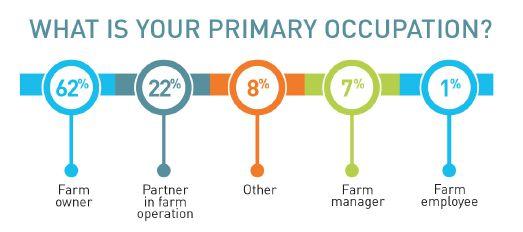
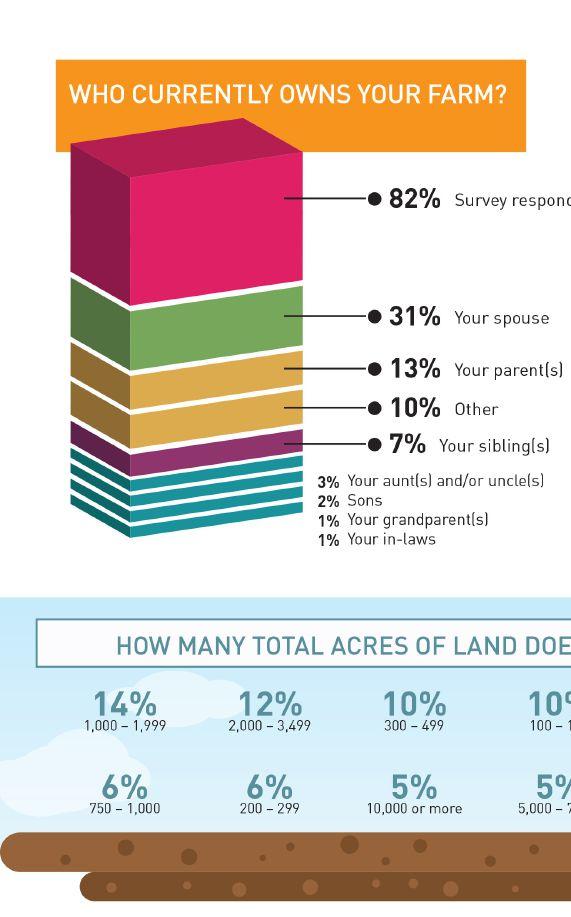
A majority of survey respondents are the current owners of their operation: 82 per cent of respondents own their operation and 31 per cent of respondents are the spouse of the current owner. To a lesser extent, 13 per cent of respondents are the children of the current owners.
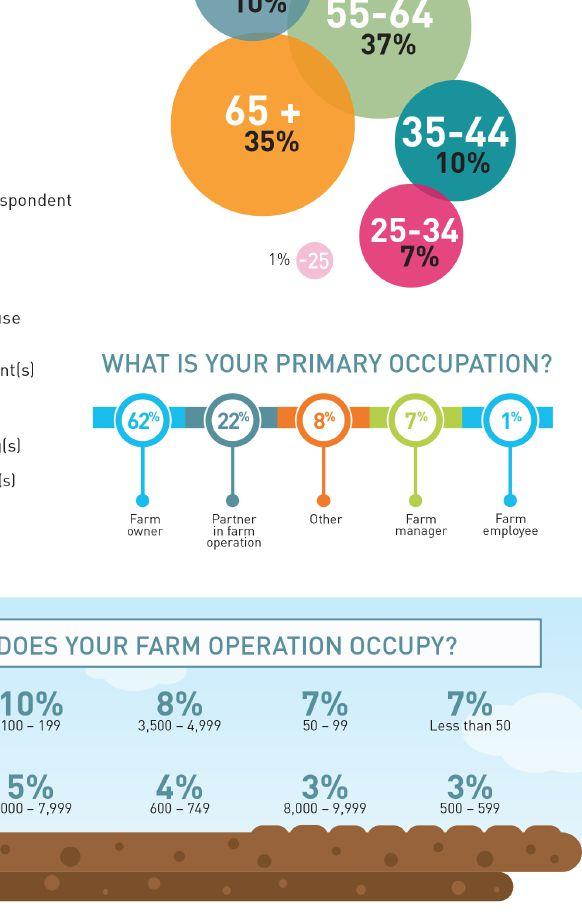
The typical size of operation for survey respondents was between 1,000 to 1,999 acres. The second most popular acreage was between 2,000 to 3,499 acres. While thousands of acres dominated the top two results, the third and fourth most popular options were between 300 and 499 acres and between 100 to 199 acres. Overall, there was a lot of variation in farm size.
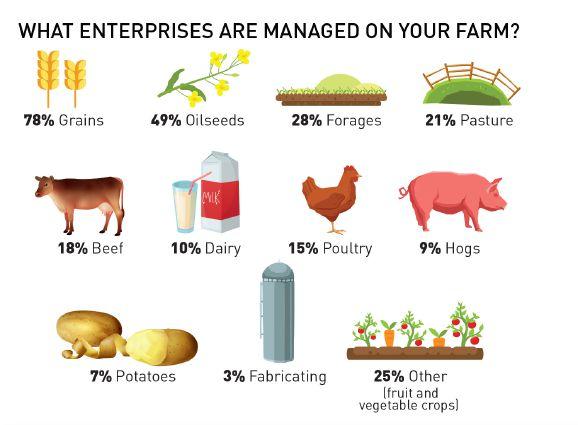
The difference in acreage could be linked to what enterprises are managed on the farm and for 78 per cent of respondents, grains (wheat, barley, corn, oats, soybeans) were the key crop for their operation. Oilseeds, such as canola and flax, came in second with 49 per cent of respondents managing oilseeds on their operation. To a lesser extent, other respondents managed forages (28 per cent), pasture
(21 per cent), beef (18 per cent), poultry (15 per cent), dairy (10 per cent), hogs (nine per cent), and potatoes (seven per cent). The fourth highest result was “Other” with 25 per cent of survey respondents managing enterprises, such as fruits and vegetables, on their operations.
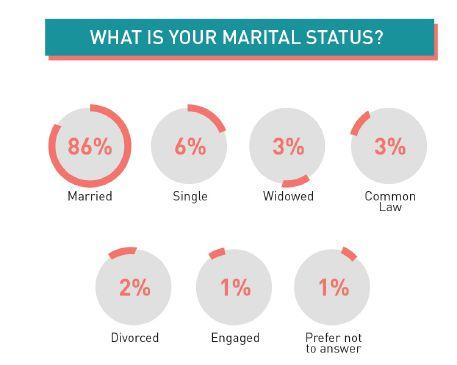
A large percentage of survey respondents are married (86 per cent). The second highest result were respondents who are single (six per cent), and to a lesser extent either widowed (three per cent), common law (three per cent), or divorced (two per cent).
In transition planning where family dynamics can become a barrier in discussions, a majority of survey respondents are going through the process with either siblings or children in the mix.
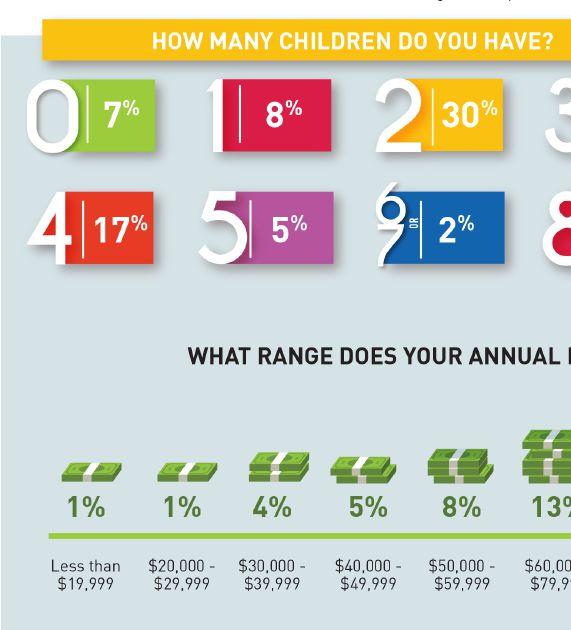
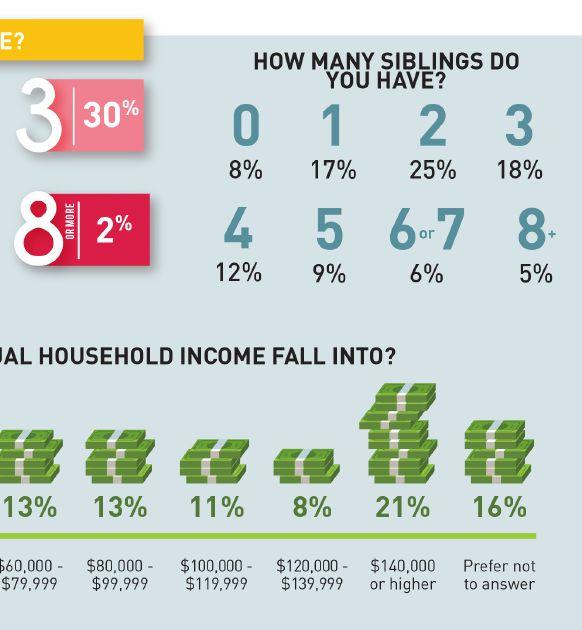
When it comes to children, 60 per cent of survey respondents have either two or three children. A small percentage have zero children (seven per cent) or just one child (eight per cent). However, having more than three children isn’t uncommon among respondents, with 17 per cent of survey respondents having four children, and five per cent having five children.
A quarter of survey respondents have two siblings, with three or one sibling(s) being the second and third most popular result respectively. Overall, 92 per cent of all respondents have one sibling or more. Only eight per cent of respondents do not have any siblings.
WHO OWNS THE FARM?
One of the key elements of transition planning is the transfer of ownership: who will own the farm?
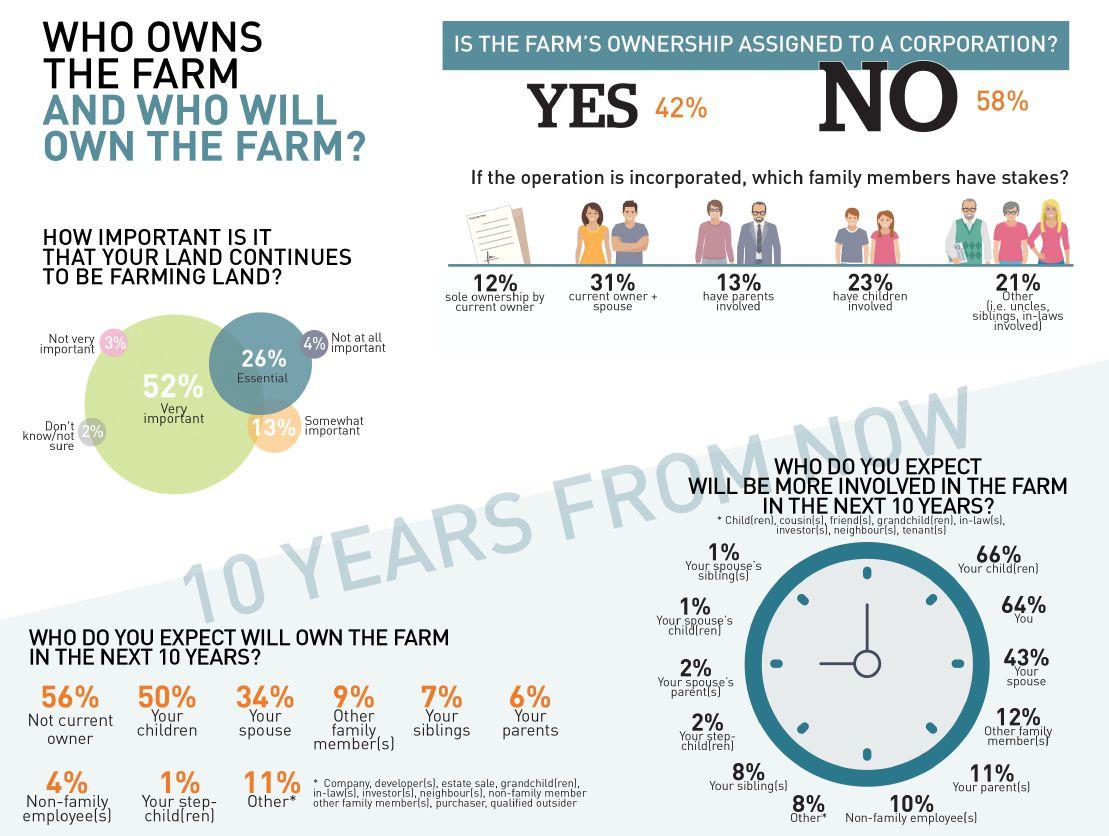
One key element remained constant: for 52 per cent of survey respondents, it was very important that their land continue to be farming land. For 26 per cent of survey respondents, it was essential. That shows that almost 80 per cent of farmers across various operations care about the legacy of their land and the future of the agriculture industry.
Fifty-eight per cent of respondents said the farm’s ownership was not assigned to a corporation. Out of the 42 per cent that had an incorporated operation, most of the corporation’s stakes were held by family members. The most common result when it came to an incorporated operation was to have the stakes split among the current owner and spouse. For 12 per cent of survey respondents with an incorporated operation, the current owner solely owned the corporation. All in all, a majority of operations were family owned and incorporating an operation was still the less popular option by 16 per cent.
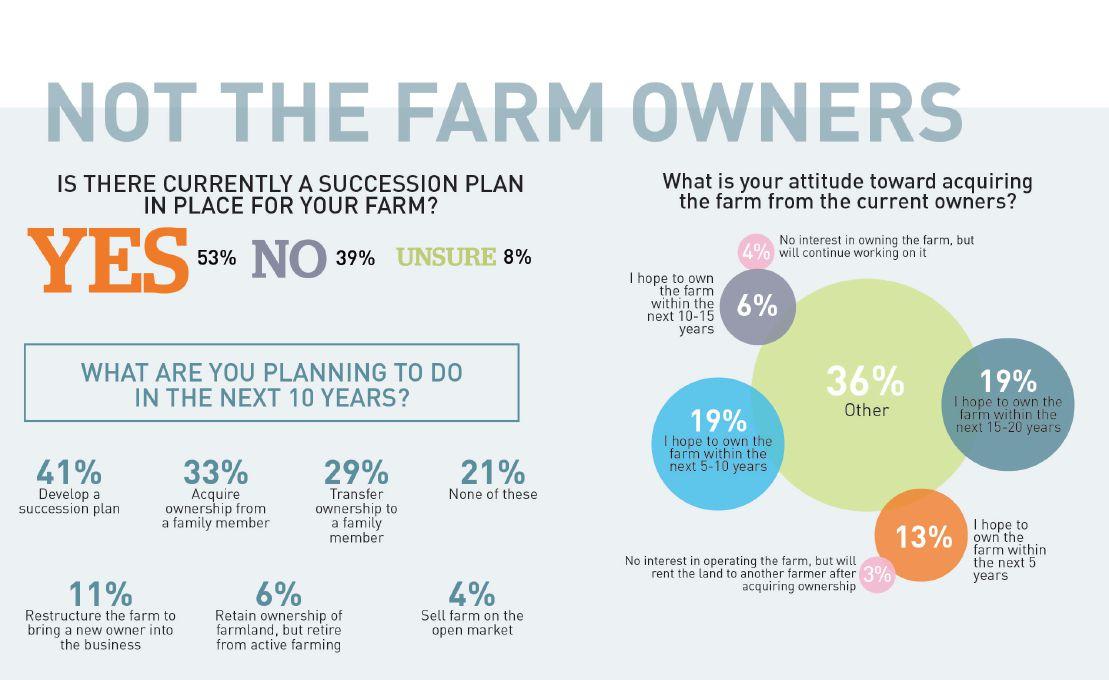
Looking forward, the 56 per cent of survey respondents who are not currently the farm owner expect to own the farm in the coming decade. In 2013, Statistics Canada identified 33,000 self-employed farmers as impending retirees, and suggested upwards of $50 billion in farm assets will be transferred over the next 10 years. The 56 per cent of survey respondents expecting to come into ownership represent the large patterns of transition that was estimated several years ago.
In second place, 50 per cent of non-farm owners expect their children will own the farm in the next years. In third place, spouses came in at 34 per cent. This answer could account for those who married into a farm family where their spouse is taking over an operation. Other responses included: a company, developer(s), estate sale, investor(s), neighbour(s), purchaser and qualified outsider.
The expectation of ownership in the next 10 years doesn’t drastically differ from current ownership patterns. Most farms expect to switch over to a family member. In addition, most survey respondents expect that certain family members will become more involved in the farm in the the next 10 years, which is key for incoming successors.
Sixty-six of survey respondents expect their children to become more involved in the coming decade. The second largest option was the survey respondents themselves: at 64 per cent, the survey respondent (who identified themselves as not the current owner) expected they will be more involved in the farm in the next 10 years. The top five results were all various family members, showing that farming operations are still largely family operations.
Outside of the family, around 10 per cent of respondents expect non-family employees to become more involved in the operation, versus the eight per cent that expected their siblings to be more involved. Cousins, friends, investors, neighbours and tenants made up the “other” responses and speak to the creative composition of operations.
DEALING WITH DYNAMICS
Farm coach Elaine Froese responds to survey questions.
By Stephanie Gordon
At the end of the Ag Succession Survey, respondents had the opportunity to leave final comments about the topic of succession planning. We’ve collected a few of these questions and comments and posed them to an expert.
Elaine Froese is a family farm coach who has worked with farm families across Canada for 40 years. Froese has gone through the succession planning process three times with her own family and pulls from personal and professional experience when talking about succession.
Here are questions and comments regarding succession from you, our readers, dealing with family dynamics, generational concerns, and emotional barriers that come up during the farm transition process.
“We always put this off, as it seems we are looking at our mortality.”
Froese: There’s a classic response. That’s a confusion between the difference between an estate plan and a succession plan. An estate plan is for your mortality, it’s for when you die, but a transition plan is for the living – who is doing the labour; the management; the ownership. It’s a very common misconception. It’s not an estate plan, it’s the succession/business plan. Yes it has estate
ramifications, but that’s the unfolding of the succession plan –once you have a succession plan. You need to plan for it being alive first, and then you need the risk management plan and the estate plan for when you pass on.
In 1997, they did a study [in Guelph, Ont.] and 20 per cent of Ontario farmers didn’t have a will, because of the reasoning if you get one, you’re going to die. What kind of logic is that?
“The person retiring needs to have plans in place to occupy their time. The transition from running a business to being retired might be the most difficult part of the transition.”
Froese: Farmers don’t retire; they need to reinvent themselves. People will not let go of a role or a responsibility on the farm, unless there’s something more exciting to move toward. I don’t expect farmers to retire, I expect the roles and responsibilities to shift.
In my case, my husband is 62 years old and he is a co-manager of the farm with our son. Many of the calls are deferred to our son, but there’s always collaborative decision making and respect for the wisdom and experience of the founding generation.
What gives your life meaning and purpose when you are no lon-
ger the main owner of the business? The second question is, what does a good day on the farm look like to you when you’re 62, 72, and 82?
“Today’s baby boomers have a hard time letting go of ownership and control. Thankfully nothing drastic has happened that would force the succession plan. That generation must release control and pass the reigns.”
The resistance in letting go is based on fear. So my question becomes, why is this person having a hard time transitioning?
“I find this topic is overwhelming because it is my retirement and our son’s future, and we want to do it right. You never know when a piece of information may come along and turn on the right light.”
“You can’t change people that don’t want to change.”
Froese: It’s important to pay attention to how old you are. In your 20s, it’s all about independence; in your 30s, it’s about mastering success; in your 40s, it’s about taking power or control of your future destiny; in your 50s, it’s about quality of life; in your 60s, it’s about legacy and starting over; in your 70s, it’s about elderhood blessings; and by the time you’re 80 and 90, [the farm] should be handed over so you can give gifts with a warm hand, not a cold hand.
The resistance in letting go is based on fear. So my question becomes, why is this person having a hard time transitioning? What are the biggest fears? Some of the biggest fears usually are loss of wealth and loss of identity. In Ontario, a fear would be changing ownership of the land and then five years down the road, the millennial flips it and sells [the land] to a developer. Typically when I ask people what they’re afraid of, it’s the loss of wealth and the fear of burdening the next generation with too much debt.
When I help families I follow my three C’s: clarity on what everyone expects, certainty of timelines and agreements, and can we actually get it done. So, if you have an 80-year-old who expects to die working on the farm with their boots on, then that’s good, you have a clear understanding that they are not ever going to let go of showing up on the farm. They may also expect to hang onto their land until it passes through their will. I’m against that because I like to see land transition with a warm hand, not a cold hand, especially for a younger generation to be able to have equity that they can borrow against.
One reason millennials are getting frustrated is because there’s a hard work ethic of the boomer and the traditionalist. They say “talk is cheap, we don’t have time to plan, there’s too much work to get done here.” What they’re not realizing is that they’re in a polarity – an unsolvable problem [with opposite sides]. We plan, and then we act. We act, and then we plan. We work, and then we play. We play, then we work. But some people are stuck on the work side, and some people are stuck on the act side. Some people never go to the planning side. There’s also the underlying question of what is the planning going to cost? That’s why it’s important to look through all the available online resources first to get a better understanding of the process.
“Whatever one plans today, will be outdated in ten years.”
Froese: A succession plan is never done. It’s a living document. It’s not an inch thick of paper that you pay $20,000 for and put on the shelf. It’s a journey, not a destination.
Where is it written that this plan would be outdated in 10 years? We’re not going to have a 10-year-plan, but a three year plan that we will keep revisiting and will get better as our business grows and as our team defines how the vision of this business will transpire. It’s just like your will, and your will should be updated whenever there’s a significant change in your family or your business.
Froese: I hear that all the time – the pressure to get it right the first time and avoiding the mistakes that farmers typically make. Farmers hate to be gouged and they hate to make mistakes, because they’re problem solvers and they’re fixers. They don’t want to make mistakes, but the fear of not getting it right the first time is called paralysis by analysis. So, they are doing nothing because they are afraid to make a mistake, rather than saying, “let’s get this process started and see how it evolves, and if we make some mistakes then there will have to be course corrections.”
For instance, we [Froese’s own family] have made mistakes with some of the accounting advice we got that wasn’t as workable as it should be, but that’s also because the tax laws changed. So you make the best decisions with the best information you can at that time, and you don’t beat yourself up for it. Keep moving forward. That’s a choice. But it’s also a farm culture thing: are you allowed to screw up on this farm and make a mistake? On our farm we are, and there have been some huge, very expensive mistakes. When a mistake gets made, the person owns up to it and says, “this is how I’m going to fix it,” and then they go and fix it. We all make mistakes.
“Succession planning can be really mind-boggling and confusing. There are too many what-ifs!”
Froese: Turn that into homework. I have an exercise called “What if?” where you brainstorm and ask yourself every “what if?” question. After one of my seminars, a woman told me she was going to brainstorm every “what if?” question on the ride home and then ask it to her parents. That’s what happened in my own succession plan process . . . it’s called contingency planning. What if there’s divorce? What if I die and my spouse remarries?
These can be very emotional questions. One of the healthy conscious behaviours is to express your emotions. You can say, I love you and respect you deeply but I’m also very aware that divorce happens on farms, so we have to talk about the divorce question. That question was put to the table by our outside facilitator, and we had these conversations. I lost my sister to a drunk driver at age 22; I lost my mom at age 64 to an asthma attack; I lost my father to Alzheimer’s. I lost my father-in-law to a brain shrinking disease and my mother-in-law to lung cancer. I’ve done palliative care four times. So in my world, these aren’t “play questions” – they actually happen.
These are all really helpful questions, and for the emotional part, everybody gets to choose their response. So you don’t get offended by saying what if your wife dies and you remarry, you talk about what you would do because it’s very helpful to see. Sometimes people don’t understand that they get to show up as adults, they get to ask powerful questions, and they always get to choose the tonality and the behaviour of their response.
Editor’s note: The responses have been edited and condensed for clarity.
THE STATE OF SUCCESSION
Succession, or transition, planning is a topic that is always present in agriculture – but quite often, the formal transition plans are not.
In 2016, Statistics Canada’s Census of Agriculture revealed that only one in 12 operations have a formal succession plan outlining how the farm will be transferred to the next generation. In other words, as previous editor Brandi Cowen wrote during our inaugural succession planning week in 2017, “the vast majority of Canada’s farm operators have not taken
steps to safeguard the businesses they’ve worked long and hard to build.”
The Census of Agriculture is conducted every five years, so only time will tell if formal succession plans will be more abundant in 2021. Until then, the Ag Succession Survey offers a glimpse into the state of succession in the meantime.
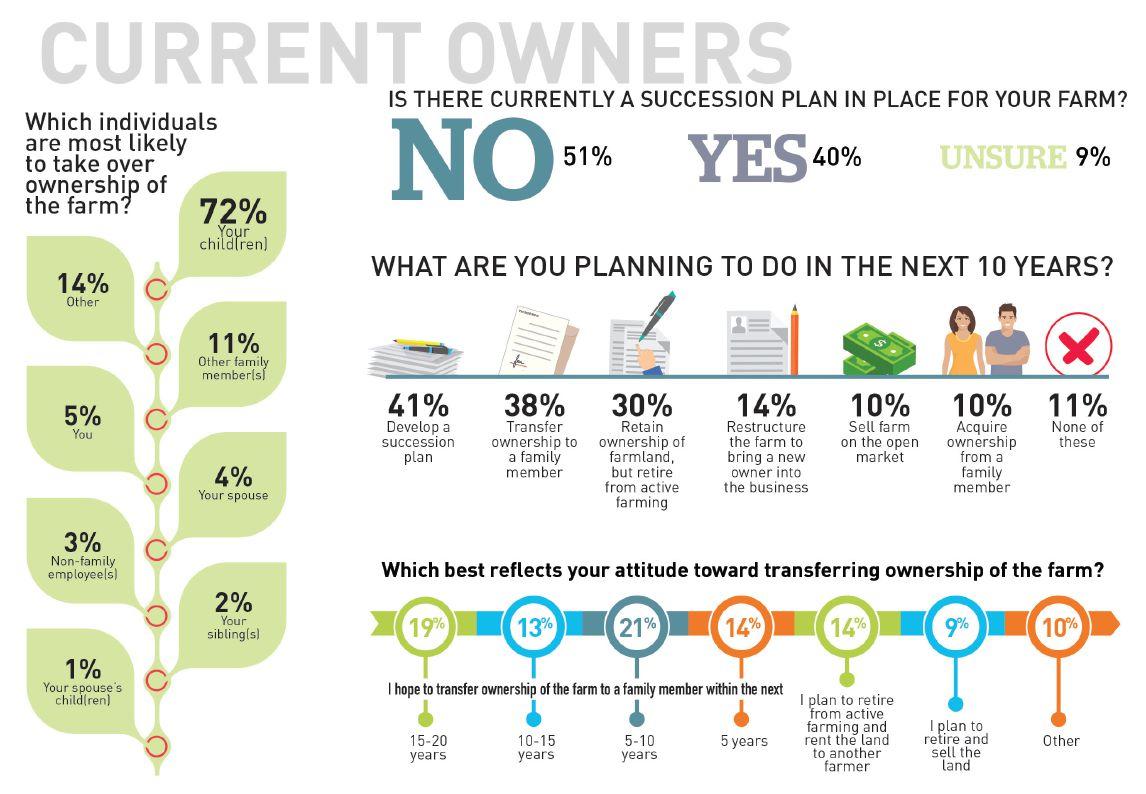
Similar to the 2016 Census of Agriculture, a majority – 51 per cent – of survey respondents who identified themselves as the current owner said they do not have a succession plan in
place. The gap is minimal, however, as 40 per cent of current owners do have a plan in place.
For a lot of current owners, developing a succession plan is in their near future: 41 per cent of current owners say they plan to develop a succession plan in the next 10 years. Developing a transition plan adds an element of certainty to an otherwise unpredictable industry.
Developing a transition plan adds an element of certainty to an otherwise unpredictable industry.
Other current owners have plans to transfer ownership to a family member (38 per cent), retain ownership of the farm but retire from active farming (30 per cent), or restructure the farm to bring a new owner into the business (14 per cent). To a lesser extent, 10 per cent of current owners plan to sell their farm on the open market in the next 10 years.
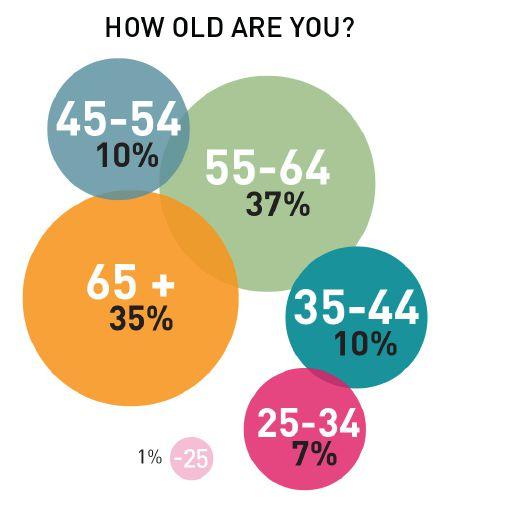
The majority of results show farms will be switching ownership and roles, where current owners will take on a lesser role and incoming family members will take on a larger role. This isn’t surprising news, given that the average age of farm operators has increased to 55, from 54, and more farm operators are nearing retirement.
When it comes to which individuals are most likely to take over ownership of the farm, 72 per cent of respondents said their children will most likely assume ownership. The second highest result was the ambiguous “Other” category, with 14 per cent of survey respondents indicating that someone other than their spouse, siblings, other family members or non-family employees will assume ownership. A closer look at “Other” responses revealed that these include neighbours, current renters, outside buyers, or a corporate partnership. Thus, for 14 per cent of current owners, the farm is not likely to remain under family ownership.
A select few responses show the farm will not remain a farm at all, instead being sold to developers or put into subdivision (Ontario). Other current owners selected “Other” only to write they are unsure who will assume ownership; a response that could be a byproduct of not having a formalized transition plan in place.
Most (67 per cent) current owners hope to transfer ownership of the farm to a family member within the next five to 20 years, with the next five to 10 years being the most popular option. A smaller group (14 per cent) of current owners plan to retire from active farming and rent the land to another farmer. Even fewer owners, only nine per cent, plan to retire and sell the land.
For 10 per cent of owners that selected “Other,” the responses are more varied. Some owners said they will “retain ownership until death” or have longer timelines, hoping to transfer ownership in the next 20 to 25 years. A few of the responses stated they were unsure, revealing for some owners, transition plans are still up in the air. Some owners said they would rent the land to another farmer, but the ownership of the land would transfer to their children. Other responses revealed a more fluid ownership structure, such as farms under corporation ownership or family trusts, or transferring farm assets into trusts instead of the entire farm.
ARE WE TALKING ABOUT SUCCESSION PLANNING?
Succession planning may appear to be a difficult topic at first, but only a very small percentage of farm owners and operators haven’t begun talking about transition.
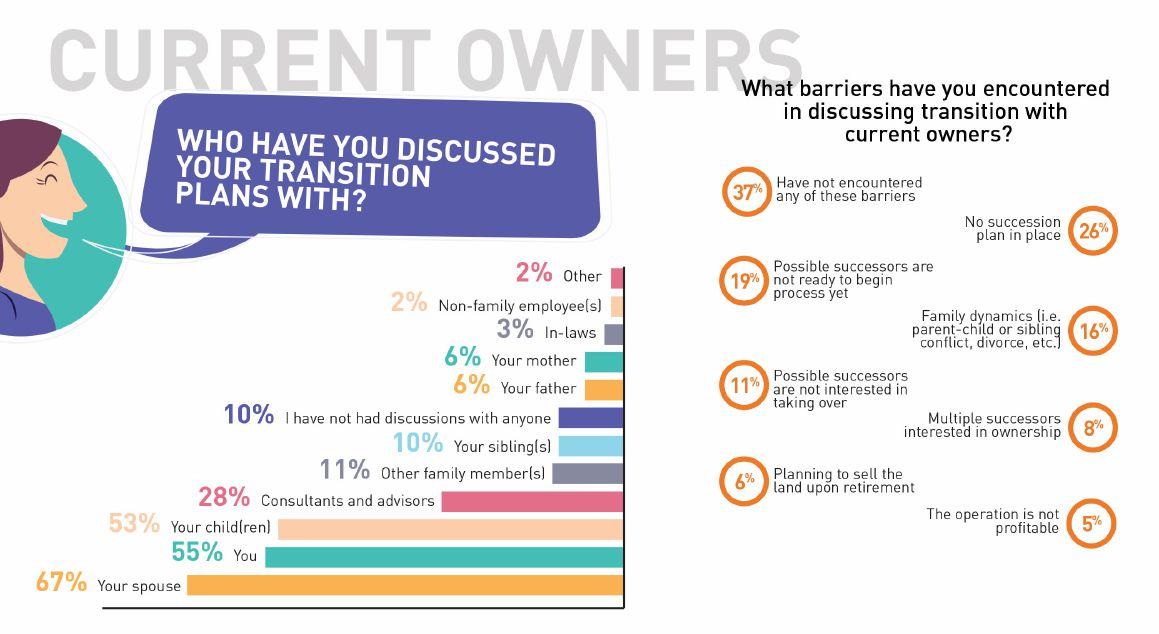
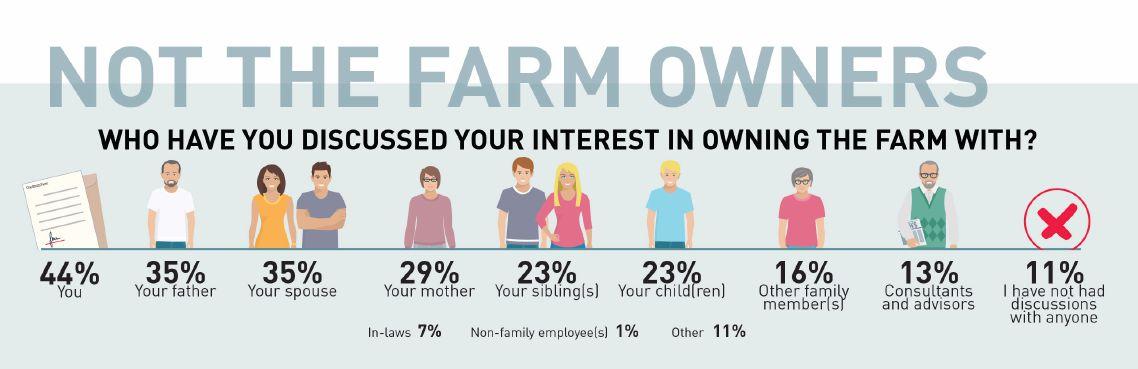
Only 10 per cent of current owners and 11 per cent of prospective owners have not had any discussions about succession planning with anyone, according to the Ag Succession Survey. Aside from this small percentage, a majority of farming families are having these discussions.
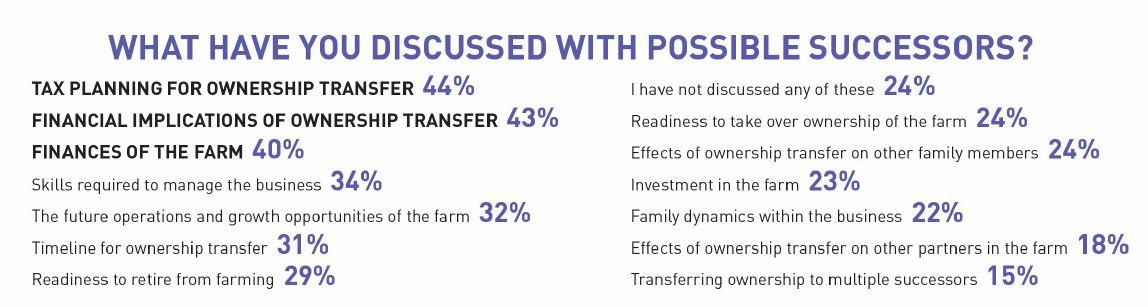
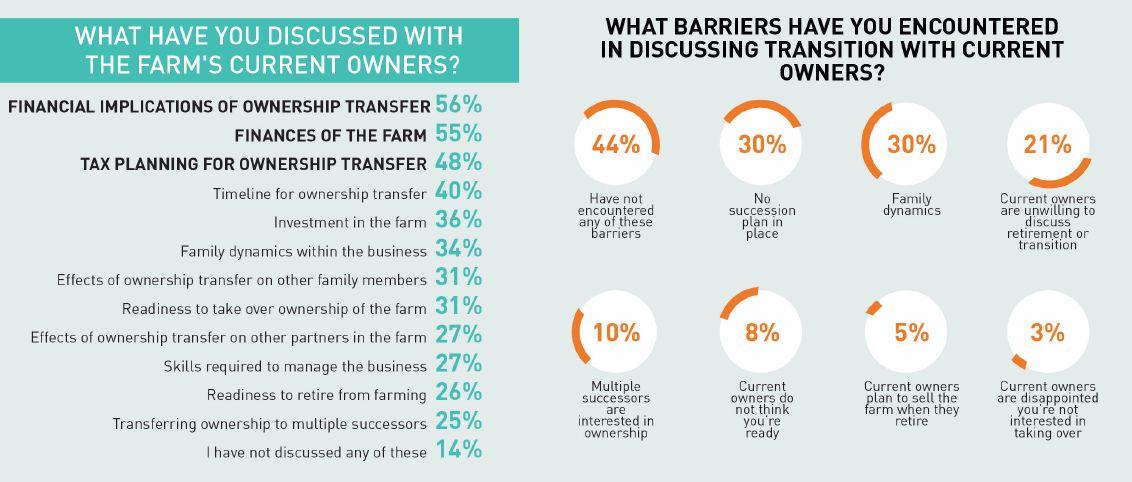
When it comes to what’s being discussed, three topics stand
out in all discussions, all relating to finances and tax planning. The top three topics discussed with possible successors or the farm’s current owners are: tax planning for ownership transfer, financial implications of ownership transfer, and the finances of the farm.
Interestingly, when comparing the discussions had by current owners and by possible successors, one point stood out: current farm owners are less likely to have discussed succession topics with possible successors, whereas potential next-
generation owners with an interest in taking over the farm were more likely to engage in a succession discussion with the owner. Twenty-four per cent of current owners have not discussed any succession topics with possible successors, whereas only 14 per cent of non-owners haven’t discussed succession with current owners. The data reflects well on prospective owners who are taking initiative in succession planning and starting conversations from the bottom-up, instead of waiting for the current owner to initiate conversations.
The lack of discussion could be due to barriers faced when it comes to talking about succession planning. For current owners, some of the top barriers hampering discussions included the lack of a succession plan (26 per cent), the possible successor is not ready to begin the process (19 per cent), family dynamics, such as a sibling conflict or divorce (16 per cent), and possible successors not being interested in taking over (11 per cent). A small percentage of owners (five per cent) state the operation not being profitable is a barrier to succession planning. If
finances and tax planning dominate transition discussions, an unprofitable operation will result in a reluctance to have these transition conversations.
For prospective owners, some of the top barriers hampering discussions included there being no succession plan in place (30 per cent), complicated family dynamics (30 per cent), current owners being unwilling to discuss retirement or transition (21 per cent) and multiple successors being interested in ownership (10 per cent). A small percentage of prospective owners (eight per cent), noted the current owner(s) does not think they are ready to take over as a barrier to succession planning.
Every situation is different, and a large percentage of current owners (37 per cent) and prospective owners (44 per cent) indicated they haven’t encountered any of the barriers listed in the survey. For those that have, there are resources to help navigate family dynamics in farm transition planning and tips for young farmers for getting starting on transition planning.
HOW ARE WE LEARNING ABOUT SUCCESSION PLANNING?
The Ag Succession Survey looked at the state of succession, but it also found out what is missing. What information do current and prospective owners feel they need to overcome hurdles in succession planning?
In order to better understand the implications of farm transition, a majority of survey respondents said they needed more tax, legal and financial information, or all three.
Tax was the most popular puzzle piece missing, with 84 per cent of respondents answering that they need more tax information to better understand the implications of transition. Legal and financial information followed closely behind with 82 per cent and 74 per cent of respondents respectively answering they need more information on the legal and financial aspects of transition.
Tax was the most popular puzzle piece missing, with 84 per cent of respondents saying they require more tax information.
Seven per cent of respondents were looking for other information to help with the transition process, such as: the capability of a successor, a potential owner’s commitment level, health options, larger human resources questions, and how to maintain enough for retirement.
When it comes to how respondents sought answers, print media, seminars, online articles and in-person events were the main sources of information. However, 19 per cent of respondents were not currently learning about the topic at all – a worrying fact, if those 19 per cent fall in the same category as the 51 per cent of respondents who currently do not have a succession plan in place.
TOP CROP
MANAGER
CONFRONTING FINANCES BEFORE TRANSITION
Farm coach Elaine Froese responds to survey comments about the financial side of transition.
By Stephanie Gordon
At the end of the Ag Succession Survey, respondents had the opportunity to leave comments about the topic of succession planning. We’ve collected a few of these comments and posed them to an expert.
Elaine Froese is a family farm coach who has worked with farm families across Canada for 40 years. Froese has gone through the succession planning process three times with her own family and pulls from personal and professional experience when talking about succession.
Here are comments regarding succession from you, our readers, dealing with the financial, tax, and business barriers that come up during the farm transition process. Editor’s note: The responses have been edited and condensed for clarity.
“Succession planning would be considerably less difficult if the long-term stability of the agricultural industry was more
predictable. Given the current hurdles, long-term profitability is very uncertain! I do not wish to transfer an operation [that] has a low chance to succeed.”
Froese: I found this response quite negative actually: “Succession planning would be less difficult if the long-term stability was more predictable.” So what do you do to mitigate risk?
You communicate, you have family business meetings, you have financial transparency, and you have a risk-management strategy, (including, for example, things like crop insurance, hail insurance and knowing what your family living costs are so you’re not overspending or taking too large a draw from the business). You’re checking costs, expenses, and revenue.
Referring to the operation as having a “low chance to succeed,” that’s total negativity. One of the biggest barriers to succession planning, or transition planning, is feeling anxious
and overwhelmed. That’s top response I see when I speak to audiences. This first response [above] is an anxious and overwhelmed response, so then the question is: what do you need to do to decrease your anxiety?
“We are pushing our teenagers to off-farm careers. The future of farming, in my mind, is not so bright, unless it changes in the next 30 years.”
Froese: Let’s define succession planning. All of the Canadian Association of Farm Advisors are using the new terminology –we’re calling it transition planning. It’s because succession planning evokes the word picture that somebody has to get knocked off the throne and then a new person comes over and the other person gets pushed out. But it’s more like a process and a journey and an evolution. It’s a transition into new roles.
So if you have a fruit and vegetable grower who doesn’t see a future in their business, and they don’t want to encourage their children to take it on, then they need to be clear really early on. Some children will have a passion for that business and say, “I don’t care if it’s not making very much money, this is my passion and this is what I want to do.” For them, the finances are not a negative thing – it’s an opportunity to make a difference.
Succession planning is the transfer of labour, management and ownership. In a fruit and vegetable operation, it’s high-intensity labour, and the management piece is a lot. What I have seen is that a founder might have $2 million in debt and he’s 65 years old. In his head he says, “I do not want to pass on any debt to my children.” That’s an unreasonable expectation, because he doesn’t have the capacity to pay that debt down to zero before he makes a transfer.
The other piece is the ownership piece: how much does he want to continue owning into the future? What is the timeline for the next generation to start getting equity? If he’s 65, and his child is 40 and they own nothing, they’re not happy. By the time you’re 40, you need to be in control of your own destiny and your equity. For a lot of farmers, it happens in their mid-30s or earlier.
These questions have many layers. Another big question of
founders is why are they so afraid to let go of ownership? It could be because they’re afraid of loss of wealth, afraid of failure – like they talked about in the first response. You have to have the ability to see if that’s a valid concern, or if is there another workaround and outcome that can shift that.
“Tax planning [needs to be] made simple. Accountant and legal advice is very expensive.”
Froese: You can’t afford not to have good advice when you’re setting up these new business plans and succession plans. Accounting and legal advice can be very expensive, yes, but you can shop around and ask for quotes. You can also do a lot of the preliminary work yourself to get ready so that the amount of time under billable is hours is decreased. If you’re having a fight at the accountant’s office, between the founder and the successor, that’s an expensive distraction.
Check out all the free resources that you can. Look at what the Canadian Agricultural Partnership (CAP) plan is for the province you live in. There is government money available through the new CAP. Thirdly, start having family meetings. The work I do around communication and conflict is to build the foundation of people want, to clarify expectations, to gain certainty in timelines and a commitment to action. That work is all pre-work that doesn’t cost a lot of money; it costs the intentional blocking off of the time to have the family meetings.
I’ve had people leave meetings after spending time with me and say, “Elaine, the lawyer was amazed at how much we knew.” And I responded with, “Of course, because you’re not going into the billable hour profession without a fairly clear idea of what you want to have happen. That makes it more efficient for everybody.”
“Why all the tax implications to pass on a farm? The government has too much involvement.”
Froese: Taxes are never going to be avoided entirely, but a transition plan should not be driven by tax. A succession plan
should be driven by what each member on the family team needs and wants and feels should happen.
People will say, “I’m not going to do that,” or “I’m going to avoid probate fees,” and what they don’t understand is that they’re being penny wise and pound foolish. They are making assumptions about the cost. What they need to do is get their basic plan in place and then use an accountant and a tax specialist, to see what the best-case and worst-case scenarios are.
“Canada needs to figure out how to better support our young and upcoming farmers. This needs to be done before we are bought by corporations and multinationals. It is very hard for someone to start farming, as startup costs are unreachable for many.”
Froese: You have to create new business models. One of them is joint ventures. For example, out here in the west, we have young farmers who become adopted by non-family business members. [Through non-traditional farming arrangements, people passionate in farming are given opportunities by owners whose next generation is not interested in taking over.]
Another element would be that the owning generation creates a personal wealth bubble that is separate from the farm. If you don’t need the retirement funds, or living funds, from your business, then there’s more likelihood that some parts of that business can be gifted to the next generation. Our son can’t buy our farm, there’s no way. So we have a personal wealth bubble that we will draw income from, and then we’ll draw a certain amount of income from the business that we just transferred to him over the next three years. But you can’t do those kinds of planning if you have always reinvested everything back into the farm and are dependent on the sale of farm assets to fund your retirement. So you have a lot of farmers who are trapped because they don’t have any flexibility in finances beyond the farm assets.
Young farmers who want to farm may have to find a different location. I see this happening in the Fraser Valley region in B.C. People are packing up and selling their farms for $80,000 per acre and moving to Alberta or Saskatchewan. And that’s not what you want, if what you want is to keep people and community and keep farms where they’re established farms. Every time I go back to Ontario, I notice [new suburbs] and think, “There used to be a corn field there.” That’s the reality of what’s going on with urban encroachment.
Editor’s question: Our survey results showed that regardless of ownership, 52 per cent of farmers said it was “very important” that their land continue to be farming land. And for 26 per cent of survey respondents, it was “essential.” It seems as if there are competing interests here – young farmers wanting to remain on the farmland and also being unable to buy it?
Froese: Exactly – and there’s a lot of pressure. There is the deep emotion of legacy and the culture of agriculture. I’ve worked in Pennsylvania with a tenth-generation fruit and vegetable farm and saw how there’s a lot of pressure to continue the legacy of the previous generation, but that may or may not be workable in today’s economy.
When it comes to having discussions about the feasibility of selling versus continuing to farm, people have to come to agreements on that. Ultimately, it’s the decision of whoever owns it. I’ve also seen it skip a generation, so I’ve seen a grandfather hang on to something for a grandson. And that brings up another question: where is it written that you have to own land to farm it?
On the Prairies, we have a lot of young farmers who don’t own a lot of land, but they have access to a lot.
A lot of people like to own land because it’s an equity growth position that we’ve experienced in agriculture over the last 30 years. It’s just not an attainable situation for young farmers to expect that they can afford to buy $10 million worth of land. Instead, have well-written lease agreements and keep a good relationship with your landlord, so [the landlord] understands how you’re stewarding the land and how you’re taking care of it, and that you both have the same vision for that land to remain in agriculture. [If someone] inherits that land and sells it because they want to cash out, the land will be gobbled up by the highest bidder, unless there’s been a conversation around the [future] intent of the land.
Final words
Froese: One of my goals in life is to be rich in relationships. The way I work with families and the work I do is always undergirded by that goal. People are more important than things, and we’re not going to take [anything] with us when we die. Live intentional lives here with strong mental and emotional health as you make plans for your business.
FUNDING THE FUTURE: DISCUSSING RETIREMENT IN TRANSITION PLANNING
For many current owners, succession planning is synonymous with retirement planning. The Ag Succession Survey looked into how farm owners are expecting to fund their future.
Current owners expect to fund their retirement in a mix of ways: 45 per cent plan to use public pension plans, 33 per cent plan to use funds from the sale of the farm, and 32 per cent of owners plan to receive a stipend/dividends from the new farm owner.
While current owners have an idea of how they plan to fund their retirement, one question lurked in the background without much discussion. When it came to whether or not it was discussed how many generations the farm is expected to pay wages to, only 21 per cent respondents had discussed the topic. A larger majority of respondents (56 per cent) had not discussed how many generations the farm is expected to pay wages to. For 23 per cent of respondents, the topic was not applicable to their situation.
However, discussions with potential successors about how the current owner’s retirement plans will affect the farm were more widely discussed. There was an even split with 40 per cent of respondents discussing the how retirement will affect the farm, and 40 per cent not discussing the effects at all.
Whether or not retirement was discussed mirrored the results from survey questions that sought to find out if succession planning was being discussed. Not having a succession plan in place was a barrier in discussing transition on the farm for 26 per cent of current owners and 30 per cent of prospective owners. Seeing that 40 per cent of respondents aren’t discussing how retirement plans affect the farm could be a by-product of there being no transition discussions in the first place.
While a succession plan is still
uncommon, a retirement plan is not. Sixty-nine per cent of survey respondents answered yes when asked if the farm’s current owner has a plan in place to fund retirement. A smaller percentage - 24 per cent - know that the owner currently doesn’t have a retirement plan. Seven per
cent of respondents were unsure if the current owner had a plan or not. When it came to prospective owners, or not the current farm owner, most had a plan for their own retirement (17 per cent answered yes, versus the 12 per cent that answered no).
RESOURCE ROUND-UP
Kickstart your succession planning with some help from these national and provincial resources. Editor’s note: This list is current as of June 2019.
Provincial resources
British Columbia
• Transferring a farm
• Succession planning
• SmartFarm BC
Alberta
• Transition planning guide for agribusiness
Saskatchewan
• Estate planning checklist for farm families
Manitoba
• How to choose an advisor
• Guide to farmland ownership in Manitoba
• Guide to farm estate planning in Manitoba
Ontario
• Farm succession do’s and don’ts
• Farm succession planning steps and checklist
Newfoundland and Labrador
• Succession planning minimum requirements
Nova Scotia
• Nova Scotia federation of agriculture succession planning portal
National resources
MNP
• Transition SMART
Canadian Association of Farm Advisors
• Presentations on transition and tax updates
Farm Credit Canada
• Good farm succession allows for change
• What can young people do to start a farm transition discussion?
• Are you financially ready for farm transition?
• What if the incoming generation can’t afford the farm?
• Some farmers never retire
FBC
• Importance of keeping good farm records and accounting for agricultural business
• Giving away the farm: succession planning
• Should a living trust be part of your estate planning?
Farm Management Canada
• Resource page - Transition Planning
Visit familyfarmsuccession.ca to read more on transition planning for current and next-gen owners, alongside expert advice and success stories.
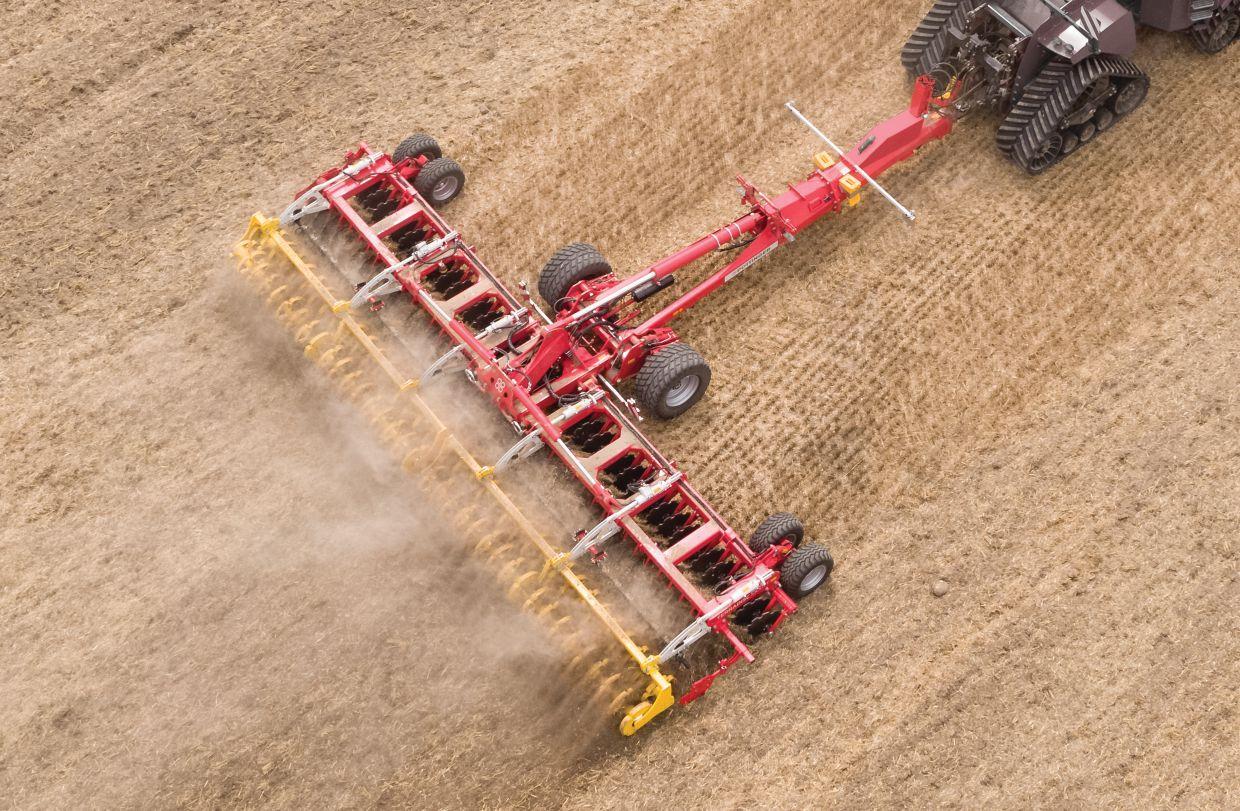
For the best soil movement
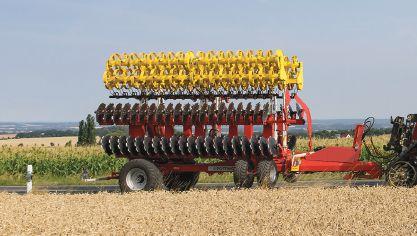
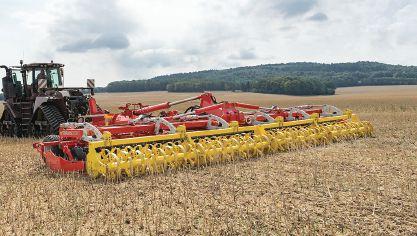
TERRADISC 8001 T / 10001 T disc harrows with working widths of 8 and 10 meters
Perfect incorporation and intensive mixing even in hard and dry conditions thanks to the solid TWIN ARM system.
High output - speeds of up to 11 mph are possible.
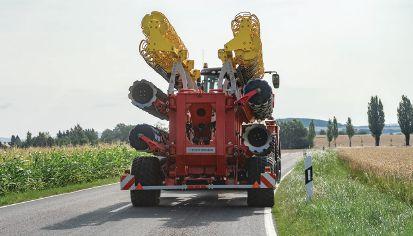
Straightforward operation without leaving the cab - folding, adjusting working depth and ground tracking.
Perfect ground tracking up and down - thanks to jockey wheels and adaptable frame sections.
Ideal utilization of the tractor's pulling power – saves fuel by correcting lateral forces.