Still the
fastest after 30 years
Thirty years after setting his still-unbroken world water speed record, Ken Warby visited the museum where his self-built, jetpowered Spirit of Australia is a centrepiece. To mark the anniversary, curator David Payne explores the theme of speed – both in and on the water.
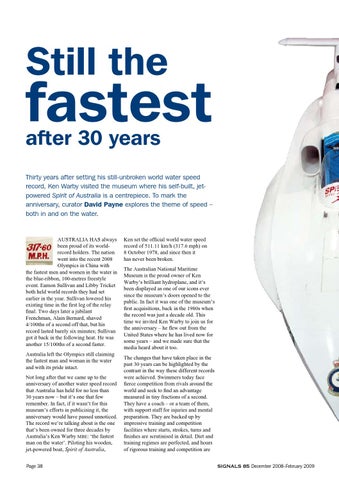
AUSTRALIA HAS always been proud of its worldrecord holders. The nation went into the recent 2008 Olympics in China with the fastest men and women in the water in the blue-ribbon, 100-metres freestyle event. Eamon Sullivan and Libby Tricket both held world records they had set earlier in the year. Sullivan lowered his existing time in the first leg of the relay final. Two days later a jubilant Frenchman, Alain Bernard, shaved 4/100ths of a second off that, but his record lasted barely six minutes; Sullivan got it back in the following heat. He was another 15/100ths of a second faster. Australia left the Olympics still claiming the fastest man and woman in the water and with its pride intact. Not long after that we came up to the anniversary of another water speed record that Australia has held for no less than 30 years now – but it’s one that few remember. In fact, if it wasn’t for this museum’s efforts in publicising it, the anniversary would have passed unnoticed. The record we’re talking about is the one that’s been owned for three decades by Australia’s Ken Warby mbe: ‘the fastest man on the water’. Piloting his wooden, jet-powered boat, Spirit of Australia, Page 38
Ken set the official world water speed record of 511.11 km/h (317.6 mph) on 8 October 1978, and since then it has never been broken. The Australian National Maritime Museum is the proud owner of Ken Warby’s brilliant hydroplane, and it’s been displayed as one of our icons ever since the museum’s doors opened to the public. In fact it was one of the museum’s first acquisitions, back in the 1980s when the record was just a decade old. This time we invited Ken Warby to join us for the anniversary – he flew out from the United States where he has lived now for some years – and we made sure that the media heard about it too. The changes that have taken place in the past 30 years can be highlighted by the contrast in the way these different records were achieved. Swimmers today face fierce competition from rivals around the world and seek to find an advantage measured in tiny fractions of a second. They have a coach – or a team of them, with support staff for injuries and mental preparation. They are backed up by impressive training and competition facilities where starts, strokes, turns and finishes are scrutinised in detail. Diet and training regimes are perfected, and hours of rigorous training and competition are SIGNALS 85 December 2008–February 2009