CONTENTS JENNESS CORTEZ BIOGRAPHY ................................................................................................ 8 FOREWORD by Robert Yassin .....................................................................................................11 A COLLECTOR’S PERSPECTIVE by Robert Watson ...............................................................14
ARTISTS AND PAINTINGS George Bellows .................................... The Prize ....................................................................... 16 Albert Bierstadt .................................... Homage to Albert Bierstadt .......................................... 18 The Rocky Mountains .................................................. 20 Rosa Bonheur ....................................... Civility and Power ....................................................... 22 Mary Cassatt ........................................ The Music Room .......................................................... 24 Boulevard des Italiens ................................................... 80 Jean-Baptiste-Chardin ......................... Chardin’s Delight ......................................................... 26 Salvador Dali ........................................ Time .............................................................................. 28 Jacques-Louis David ........................... Knight and King ........................................................... 30 Albrecht Dürer ..................................... Master of Nuremberg ................................................... 32 Jan van Eyck ......................................... The Flemish Master ...................................................... 34 Vincent van Gogh .................................. Vincent's Dream .......................................................... 36 Night ............................................................................. 38 William Harnett ................................... Study and Philosophy ................................................... 40 Childe Hassam ..................................... Stirring the Nation ....................................................... 42 Winslow Homer ................................... Homer’s American Spirit ............................................. 44 Summer Breeze ............................................................. 46 Jean-Auguste-Dominique Ingres ....... Homage to Ingres .......................................................... 48 George Inness ....................................... The Good Earth ............................................................. 50 John Kensett ......................................... Lake George ................................................................... 52 Leonardo da Vinci ................................. Leonardo ....................................................................... 54 Da Vinci's Bookcase ..................................................... 56 Missing ....................................................................... 124 Emanuel Leutze ................................... The Price of Freedom .................................................... 58 Edouard Manet .................................... Manet’s Paris ................................................................ 62
Jean-François Millet .............................. Simple Truth ................................................................. 64 Claude Monet ....................................... Winter on the Normandy Coast ................................... 66 The Artist’s Bookcase .................................................... 68 Near Giverny ................................................................ 70 Alfonse Mucha ..................................... Homage to Mucha ........................................................ 72 Edvard Munch ..................................... Missing ....................................................................... 124 Sir Alfred Munnings ........................... The Noble Horse ........................................................... 74 Maxfield Parrish .................................. Parrish Light ................................................................ 76 Camille Pissarro ................................... A London Salon ............................................................ 78 Boulevard des Italiens ................................................... 80 Raphael ................................................. The Knight and the Queen ........................................... 82 Masters of the Renaissance ........................................... 84 Rembrandt van Rijn .................................. Contemplating Rembrandt ........................................... 86 Frederic Remington ............................. Home from the West ..................................................... 88 A Tale of Two Cultures ................................................. 90 Remington’s Scout ....................................................... 92 Pierre-Auguste Renoir ........................ Under Paris Skies ......................................................... 94 Renoir's Dancer ........................................................... 96 La Maison Fournaise .................................................... 98 Norman Rockwell ................................ The Ironmen ............................................................... 100 America ...................................................................... 102 Neil's World ............................................................... 104 The Gift of Comfort .................................................... 106 Mark Rothko ........................................ Rothko's Lilacs ........................................................... 108 John Singer Sargent ................................... The Portrait Master .................................................... 110 George Stubbs ...................................... Interior with Tristram Shandy ................................... 112 Titian ...................................................... Nine Instruments of Grace ......................................... 114 John Trumbull ...................................... The Glorious Cause ..................................................... 116 Johannes Vermeer ................................ A Golden Age .............................................................. 118 Vermeer, Master of Light ............................................ 120 Missing ....................................................................... 124 Grant Wood .......................................... Town and Country ..................................................... 122
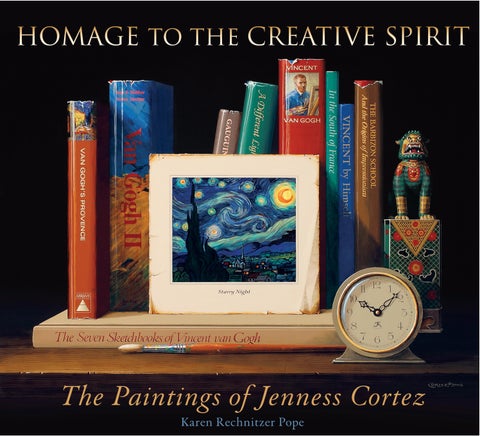
Foreword “It makes my heart sing!” After more than five decades of involvement in the art world, this simple statement, made by a friend while looking at a splendid Monet painting, brought into bright clarity the way to know the genuine article––a real work of art. The paintings of Jenness Cortez make my heart sing. It was in a serendipitous, welcome and most rewarding way that I discovered Cortez’ paintings. While doing research for an exhibition on van Gogh, I saw an advertisement for a showing of Cortez’ work at a local gallery in Los Angeles not far from where I was working. The painting in the ad featured van Gogh’s famous Starry Night as if it were hanging in the home of a collector, surrounded by exquisitely painted and carefully selected items such as books and photographs related to the artist. More than just the subject, the whole painting in the ad captivated me. Then I saw the actual painting on a visit to the gallery, along with the other equally extraordinary paintings in the exhibition. I was overwhelmed. My heart did, indeed, sing. This was my first encounter with Cortez’ work; it led me to investigate her history and, ultimately, to contact her. I was delighted to discover that her roots were in Indiana where I, too, had lived and worked for many years. I was equally impressed by the artist as a person, and by her intelligence, an intelligence that has allowed her to orchestrate her extraordinary technical ability into a unique and superb body of work. It is axiomatic that great art is only made by great minds; the creative ability of average minds is exactly that, average. In today’s post-modern, conceptual world of art, too frequently the title ”artist” is given to anyone who makes anything and calls it art. What is worse, even if it only looks new or different, it is frequently seen as “cutting-edge” and therefore important, with little if any justification. After looking at some of the more idiosyncratic and challenging examples of so-called “cutting-edge” art (contemporary critics seem to love the word “challenging” precisely because of its imprecision), Cortez’ work appears much more refreshing and intellectually stimulating. Knowing something about the artist and her history helps to explain why. Cortez was born in Indiana, a state frequently and incorrectly regarded as conservative and a bit behind the intellectual curve of other supposedly more sophisticated places in our country. I suppose if hard
T H E PA I N T I N G S O F J E N N E S S C O RT E Z
work, honesty and commitment are out of fashion, then perhaps Indiana deserves its reputation. The fact is that Indiana has a long cultural and artistic history and has produced many great artists. Indiana has given us Theodore Dreiser, Booth Tarkington, Kurt Vonnegut, the eponymous Robert Indiana, Cole Porter, James Whitcomb Riley and Hoagy Carmichael––the list is far longer, but these names make the point. And Abraham Lincoln, though born in Illinois, spent his formative years in the Hoosier state. Undoubtedly, where Cortez was born and how she was raised in an encouraging and supportive environment were significant to her artistic development. Cortez showed a very early talent for art. As a teenager, she took private lessons with Antonius Raemaekers, a well-trained Dutch-born painter and superb teacher who influenced her early decision to make art a career. Cortez chose to study at the Herron School of Art, one of the oldest independent professional schools of art in America. This provided her with a rigorous training in all technical aspects of art making. The goal in teaching at Herron, as was once true for all the independent professional art schools, was to see that students mastered the skills they needed for a career in art, skills that, if the student had a real gift, would be essential to realizing his or her full potential. To add to her store of technical mastery, Cortez took a year off from Herron’s five-year program and went to New York, studying at the Art Students League under yet another gifted teacher, Arnold Blanch, whose influence on the young art student was profound. Cortez returned to Indianapolis, completed her program at Herron and ultimately settled in upstate New York where she still lives. Because of her great skill and talent, financial and artistic success came quickly, but in a way and with subject matter that her training and life to this point would not have predicted: horses and horseracing. Undoubtedly, the fact that she was living near the famous Saratoga racetrack did influence her choice of this specialty and opened the door for sales, but it was sheer ability and talent that accomplished her success. In the next twenty years Cortez produced a substantial body of work centered on horses—portraits of famous horses, horse owners, scenes from famous races and decorative landscape scenes that included horses. Many of these became commercial products and can still be found for sale on the internet today. Nothing in them, however, prepares us for Cortez’ current body of work.
4
In 1995, a change in relationship with the New York Racing Association, accompanied by a personal realization of the positive need to take on new artistic challenges, led to the current body of work in homage to great art and artists of the past.
quality of a piece of fruit, an aged piece of paper, and so on, with a convincing and tangible realism. In the same way, the famous works reproduced in her compositions are painted with deep respect for their creators and with equal accuracy.
For an artist as well trained and technically competent as Cortez, possessed of a keen and inquiring mind and with a deep knowledge of the history of art and respect for its masters, this was an exhilarating and deeply meaningful new direction. Given the body of work she has created in the past fifteen years, this change might be viewed as the direction her work was, in fact, always intended to move. And what a body of work it is!
On the simplest basis of technical mastery, these paintings are quite extraordinary, but they go well beyond that. Cortez does what all good artists do—she changes the game. The famous paintings in her paintings, though seductive and familiar, are not the originals. They are frequently not painted to appropriate size or scale. Some are much smaller than the original in the context of the scale of the space they now occupy, and some are much larger. Some are treated as reproductions, a kind of painting within a painting within a painting. While the homage to the selected artist is clear, the works reproduced are used as elements in making pictures, and this is what makes them art, not copies. At the same time, Cortez’ use of famous works makes us see those works in new and different ways by presenting them in carefully realized contemporary interiors rather than on museum walls. This re-contextualizing adds to both the viewer’s understanding and appreciation of these famous works of art.
All art is a dialogue, a conversation through the medium of the artwork between the artist and the viewer. It is the level of that dialogue that establishes the intrinsic value of a given work. Among the many characteristics of a real work of art, two are most significant and define both the quality and significance of the dialogue. The first is that what the artist is saying must be meaningful; the second, that it is clearly communicated and understood. In Cortez’ paintings, both criteria are more than fully met. The work talks to us at many levels and creates in us a sense of both understanding and well being. This happens because there is nothing arbitrary in Cortez’ paintings. The choice of the painting reproduced, the elements surrounding it, the space the elements occupy, the lighting, the color, everything is carefully selected and orchestrated following a fully articulated plan determined by the artist. Cortez begins by selecting a famous work. She conducts extensive research leading to other elements—books, photographs, still-life elements—to be added to the whole, each having very specific importance both as fact and as visual element in the composition. The painting is completed only when Cortez is fully satisfied that everything is as it should be. Completion involves making numerous choices, each one either carefully considered or determined by the artist’s highly perfected intuitive sense to be the right one. It is the extraordinary ability to make consistently right choices that is the hallmark of the real talent that sets Cortez’ work apart as something special. There is more. By her selection of a famous work of art as the focus of a given painting, the viewer is instantly drawn into the picture. This instantaneous seduction is, however, only an artistic convention created by the artist to draw us into the further pleasures of the painting, pleasures greatly enhanced by our discovery of the details that have gone into its creation. As we explore a wonderful interior, we experience the sheer joy of painting for its own sake. Like the Old Masters she admires, Cortez is able to render textures of fabric, surfaces of wood, the tactile
5
To enhance the sense of dialogue between artist and viewer, Cortez deliberately leaves real people out of her pictures. Invited by the artist, the viewer becomes the inhabitant of the picture, moving comfortably into the interior space the artist has constructed. Were Cortez to add people to these carefully composed and artfully contrived pictures, their presence would inevitably add arbitrary human emotions to the scenes, limiting their impact. Instead, the paintings become the means for the artist to tell us about herself, her aesthetic interests, about painting in general and how she feels about the world. Through the dialogue provided by the picture, we become participants in a pleasant visit with old friends in a lovely place. And that is more than enough.
ROBERT YASSIN RANCHO PALOS VERDES, CALIFORNIA Robert A. Yassin has had a long career as curator and art museum administrator. Currently C.E.O. of the Palos Verdes Art Center in Rancho Palos Verdes, California, he served as Executive Director of the Indianapolis Museum of Art for fifteen years, and the Tucson, Arizona, Museum of Art for eleven years. He has worked extensively in the fields of American historic and contemporary art.
H O M AG E TO T H E C R E AT I V E S P I R I T
Homer’s American Spirit Oil on mahogany panel, 30 by 36 inches, 2009
Homage to: Winslow Homer (18361910) Snap the Whip, 1872, Butler Institute of American Art
Light from an unseen window creates a bright vector across a cozy reading corner and up a few steps to a hallway. The principal wall is filled with an arrangement of small, cropped pictures that frame one of Winslow Homer’s key works, Snap the Whip, an image of rural childhood in America’s innocence. A pair of ladies’ shoes between the chair and table identifies the absent reader, who has left open a book about Homer or American painting in which a detail of Homer’s Two Guides (1875) is legible on the left page. Snap the Whip is one of Homer’s most famous images; it was exhibited in the great Centennial Exposition in Philadelphia in 1876 (see Cortez’ homage to Homer, Summer Breeze). It was published as a wood engraving in Harper’s Weekly (September 20, 1873), and there are other versions of it including the well-known oil study (no mountains in the background) in The Metropolitan Museum of Art. As a pendant to Breezing Up, Snap the Whip represented Homer’s focus on American childhood and his skill at exploring contrasts such as risk and safety, study and play, land and sea. Snap the Whip was the last of Homer’s paintings to depict an active group of figures; after the 1870s, Homer, in his own adulthood, turned to less playful and more solitary subjects. The remaining works on Cortez’ fictitious wall relate to other facets of Homer’s art and times, including his Civil War figures. These images, documentary in feeling, are still appreciated for the insight they give about that period. Photographers also contributed to the imagery of the Civil War and to the exploration of the American West. The close-in photographic portrait at the upper left on Cortez’ wall, Son of the Desert–
44
–Navaho, 1904 (platinum print) made by Edward Curtis, comes from his immense photographic series called The North American Indian, twenty volumes of text and twenty portfolios of photographs produced between 1907 and 1930. The extensive text and 2,200 photogravures from Curtis’ researches combine ethnographic observation with emotional perspectives; about Son of the Desert––Navaho, Curtis wrote: “In the early morning this boy, as if springing from the earth itself, came to the author’s desert camp. Indeed, he seemed a part of the very desert. His eyes bespeak all the curiosity, all the wonder of his primitive mind striving to grasp the meaning of the strange things about him.” Homer’s pictures of masculine life in the clean air of the Adirondacks and Curtis’ The North American Indian provide historical background to the even wider-ranging outdoor adventurer, Theodore Roosevelt, who is pictured on the issue of Time magazine topping the stack on the floor below the casually-draped shawl. In Cortez’ ensemble, masculine-themed pictures of the outdoors are at home in a cozy feminine interior, echoing the traditional contrast of active and contemplative lives. Also depicted: Homer, Veteran in a New Field, 1865, The Metropolitan Museum of Art Homer, Two Guides, 1875, Clark Art Institute Homer, Autumn, 1877, National Gallery of Art, Washington Napoleon Sarony, Portrait of Winslow Homer, 1880 (photograph) Tiffany clock, 1895 Edward Curtis, Son of the Desert––Navaho, 1904 (platinum print) Michael Deas, Theodore Roosevelt, Time magazine cover (July 3, 2006)
H O M AG E TO T H E C R E AT I V E S P I R I T
T H E PA I N T I N G S O F J E N N E S S C O RT E Z
45
Leonardo Acrylic on mahogany panel, 24 by 20 inches, 2009
Homage to: Leonardo da Vinci (14521519) SelfPortrait, 151215, Royal Library, Turin (red chalk drawing) Vitruvian Man, 1492, Accademia (pen, ink, watercolor and metalpoint drawing) Lady with an Ermine (Cecilia Gallerani), c. 14831486, Czartoryski Museum Mona Lisa (La Gioconda), 1506, Musée du Louvre Great works by Leonardo vie for dominance in Cortez’ bulletin board gallery where two masterful drawings are juxtaposed with two beautiful portraits; her depictions of the drawings look like drawings, and the two portraits (each actually much larger than Cortez’ entire painting) are presented as tattered reproductions.
who is considered the world’s first engineer, also applied his skills to military problems, including siege equipment for Julius Caesar. His work, drawings and descriptions would have been valuable to Leonardo and the Duke when Ludovico’s political maneuverings turned military later in the 1490s.
The lovely Lady with an Ermine is thought to be Cecilia Gallerani, the mistress of Ludovico Sforza, the Duke of Milan, who became Leonardo’s patron when the artist moved to Milan from Florence in 1482. She conducted a kind of salon in Milan and, while Leonardo worked on her portrait, she invited the artist to enjoy the group’s intellectual discussions. In 1491, this mistress bore Ludovico a child; and in the same year, Leonardo assisted in the designs for the wedding of Ludovico to Beatrice d’Este. The ermine was Ludovico’s heraldic animal, making Leonardo’s painting of Ludovico’s mistress a painting about identity and possession.
The famous portrait drawing has been considered a self-portrait for a very long time, a work of Leonardo’s final years in France. But agreement on the bearded figure’s identity is not universal; one historian has proposed that the portrait might be that of either Leonardo’s uncle (Francesco da Vinci) or his father (Ser Piero da Vinci). Although Leonardo and the Italian Renaissance are among the most-studied topics in art history, specialists continue to search for the identities of portrait sitters, revised explanations of perplexing figure compositions and lost recipes for paint and painting mediums.
The other painting boldly visible in Cortez’ tribute to Leonardo is the iconic Mona Lisa. Leonardo worked on this portrait, thought to be Lisa Gherardini, wife of Francesco del Giocondo, after he moved to France, and it became the property of King François I. It remained in French royal collections, at one time hanging in Napoleon’s bedroom in the Tuileries Palace. Perhaps the world’s most famous painting, it has been the subject of scrutiny, speculation, theft and parody.
Fascination with early paintings by Leonardo such as his Annunciation and later works such as Madonna of the Rocks (the first version was painted for a confraternity in Milan, which figured in the sensational novel, The Da Vinci Code by Dan Brown (2003), keep Leonardo, the multi-talented thinker and creator, in the eyes of modern students of art and science.
Leonardo made the famous drawing of Vitruvian Man during his years in the Milanese ducal court. The diagrammatic drawing of a male figure is called Vitruvian Man because it preserves and makes visible a concept presented by the important Roman architect, Vitruvius (first century, BC). Ideal geometry was an important Renaissance idea; Leonardo’s drawing charts the harmony of man at the center of a universe represented by the ideal forms of the square and the circle. Vitruvius,
54
Also depicted: Leonardo, The Annunciation, 1473, Uffizi Gallery Leonardo, Madonna of the Rocks, c. 1505, National Gallery, London Leonardo, Ginevra de Benci, 1474, National Gallery of Art, Washington Nina Akamu (b. 1955), Il Cavallo, c. 1990 (sculpture) after Leonardo’s drawings for a monumental bronze horse John Ellicott, English bracket clock, 1780
H O M AG E TO T H E C R E AT I V E S P I R I T
T H E PA I N T I N G S O F J E N N E S S C O RT E Z
55
The Portrait Master Oil on mahogany panel, 18 by 24 inches, 2009
Homage to: John Singer Sargent (18561925) The Daughters of Edward Darley Boit, 1883, Museum of Fine Arts, Boston
As a young man, Sargent benefitted from the traveling life of his expatriate parents; with museum experiences around Europe, Sargent already displayed talent as an artist in adolescence. Sargent secured formal training in the Paris studio of Charles Auguste Émile Durand, known as Carolus-Duran; Carolus-Duran, an admirer of the painting of Italy and Spain, passed along to Sargent his particular enthusiasm for the work of Velazquez (1599-1660), whose brushwork attracted French painters and influenced the bold and painterly brushwork of pre-Impressionist style. Study with Carolus-Duran led to admission into the Ecole des Beaux-Arts in Paris in the year of the first “Impressionist” exhibition in 1874. Sargent was one of the leading portraitists of The Gilded Age, and full-length likenesses of America’s high society, rendered in his Impressionist bravura brushwork, can be found in many American art museums. The Boit daughters convey privilege even in their portrait’s informality, since they are grouped in a space made remarkable by Sargent’s casual grouping of the girls with two spectacular tall vases. The Boit family reputedly transported these vases among their luggage across the Atlantic for their annual extended vacations in France. Visitors to the Museum of Fine Arts, Boston are treated to the delightful surprise of these extant vases, which flank the Sargent portrait in the museum gallery. The great and celebrated Velazquez painting, Las Meninas (1656, Prado), worked its way into Sargent’s portrait of the Boit girls; in the dark deep background of the picture space, a small mirror vaguely reflects light from some point behind the painter. Velazquez had included a small mirror in Las Meninas as a way of adding royal visitors to the studio in
1010
which a princess and her companions pose for the big, informal canvas, and Sargent’s inclusion of the small mirror is a tribute to the Spanish master. At the same time, it would please and flatter the astute, well-traveled viewer of the portrait who, thanks to his own tour of the Prado, could recognize Sargent’s reference. Sargent’s portrait of the daughters must have pleased the family, since Sargent painted a similarly casual portrait of Mrs. Edward Darley Boit in 1887. The Daughters of Edward Darley Boit is, like Velazquez’ Las Meninas, a big painting––the figures are life-size––so for realism’s sake, Cortez has celebrated this great work in the form of a worn color reproduction, standing in a strong, clear light in front of a row of art history books. The chocolate kisses in Cortez’ foreground still life attract attention to two illustrations of works by Sargent: Portrait of Madame X and Portrait of Carolus-Duran, the portrait Sargent made of his teacher near the end of Sargent’s time in the master’s studio. The Portrait of Madame X (Madame Pierre Gautreau), not commissioned by the sitter, is a provocative likeness of the attention-attracting Louisiana-born young wife of a Paris banker. It stands out among the large body of Sargent’s portraiture as “the best thing I have done” even though it caused a scandal at the time of its exhibition at the Salon of 1884. Sargent proudly displayed the portrait in his London studio and sold it to The Metropolitan Museum after Madame Gautreau’s death in 1916. Also depicted: Sargent, Portrait of Madame X, 1884, The Metropolitan Museum of Art Sargent, Portrait of CarolusDuran, 1879, Clark Art Institute Archibald Knox for Liberty, Tudric pewter clock, c. 1900
H O M AG E TO T H E C R E AT I V E S P I R I T
T H E PA I N T I N G S O F J E N N E S S C O RT E Z
1111
The Glorious Cause Acrylic on mahogany panel, 30 by 36 inches, 2009
Homage to: John Trumbull (17561843) Surrender of Lord Cornwallis, 1820, United States Capitol Rotunda
John Trumbull served in the Revolutionary War as an aide to both George Washington and Horatio Gates. Therefore, when he left the service in 1777 and embarked on an artist’s career, Trumbull knew the men he would later immortalize in his paintings. As a pupil of Benjamin West at the Royal Academy, London (West, a Philadelphian, followed Sir Joshua Reynolds as the Academy’s second president), Trumbull would have been encouraged to aspire to history painting, the highest subject category in the academic hierarchy. He dreamt of history paintings with American subjects, versus the prevailing fashion for scenes from ancient European history, and he made small versions of several such compositions while he was still in London. Trumbull returned from England following the War of 1812 and negotiated with the U. S. Congress his proposal for paintings of Revolutionary events. In 1817, Congress commissioned four imposing paintings at a price of $8,000 each, President James Madison specifying that the dimensions of each canvas would be 12 by 18 feet. Trumbull spent the next eight years on this important commission, traveling to sketch the portraits and settings he needed for complete accuracy. The Yale University Art Gallery owns a huge proportion of Trumbull’s work, including the documentary key Trumbull made for the identification of all the figures in the Surrender painting. In her masterful rendering of detail, Cortez included all the identifying elements of Trumbull’s documentation, including the white banner of the Bourbon monarchy fluttering above the French troops. What gives the replica of Trumbull’s painting the powerful impact it makes in Cortez’ painting is the congenial artistic complement of numerous other smaller but important documents from the Revolutionary period, including historic flags and the portraits of important Americans, accompanied by precious objects from their times. Another important aspect of Cortez’ response to Trumbull’s painting is the arrangement of the room: as Trumbull’s painting is balanced with
116
British officers to the left and American officers to the right of the central figures, the room Cortez created for this gallery of American heroes is arranged with a heavy couch on the left and two deep chairs on the right that mimic the banks of figures in the painting and frame a clear visual axis to Trumbull’s central grouping. Trumbull completed Surrender of Cornwallis in 1820 and it was installed in the Capitol Rotunda late that year. It has hung there ever since, with Trumbull’s three other majestic images: the Declaration of Independence, the Surrender of General Burgoyne, and Washington Resigning his Commission. The books in the neat shelves of this imaginary room are too far away for reading of their titles, but one volume, clearly titled, lies on the chest below Trumbull’s painting. It is Robert Middlekauff’s The Glorious Cause: The American Revolution, 1763-1789, from which has come the title for this work, painted in honor of one of the great achievements in Western civilization. Also depicted: Gilbert Stuart, Portrait of George Washington, 1821, National Gallery of Art, Washington Abigail Smith Adams (Mrs. John Adams), 18001815, National Gallery of Art, Washington Henry M. Shrady, George Washington at Valley Forge, 190106 (study for equestrian sculpture, Continental Army Plaza, Brooklyn) George Romney, Joseph Brant, Mohawk Chief Thayendanegea, 1776, National Gallery of Canada American Revolutionary Flags: Bennington Flag, 1777; Cowpens Flag, 1781; Grand Union Flag, 1776 Walnut blanket chest, Berks County, Pennsylvania, c. 1775 United States Army Medal of Honor Myer Myers, silver tankard, c. 1750, New York Daniel Parker, silver tankard, c. 1760, Boston James Duncan, English clock, c. 1790
H O M AG E TO T H E C R E AT I V E S P I R I T
T H E PA I N T I N G S O F J E N N E S S C O RT E Z
117