Indigenous Language Revitalization
Using Mobile Technology by Mary K. Bowannie (Zuni Pueblo/Cochiti Pueblo)
I
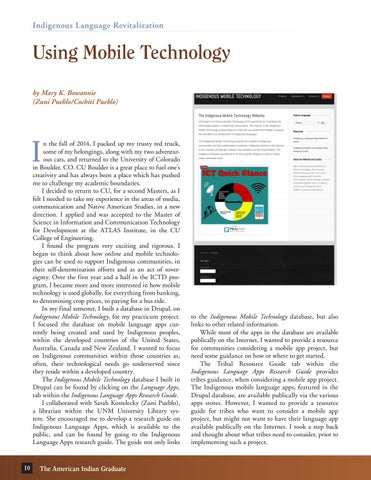
n the fall of 2014, I packed up my trusty red truck, some of my belongings, along with my two adventurous cats, and returned to the University of Colorado in Boulder, CO. CU Boulder is a great place to fuel one’s creativity and has always been a place which has pushed me to challenge my academic boundaries. I decided to return to CU, for a second Masters, as I felt I needed to take my experience in the areas of media, communication and Native American Studies, in a new direction. I applied and was accepted to the Master of Science in Information and Communication Technology for Development at the ATLAS Institute, in the CU College of Engineering. I found the program very exciting and rigorous. I began to think about how online and mobile technologies can be used to support Indigenous communities, in their self-determination efforts and as an act of sovereignty. Over the first year and a half in the ICTD program, I became more and more interested in how mobile technology is used globally, for everything from banking, to determining crop prices, to paying for a bus ride. In my final semester, I built a database in Drupal, on Indigenous Mobile Technology, for my practicum project. I focused the database on mobile language apps currently being created and used by Indigenous peoples, within the developed countries of the United States, Australia, Canada and New Zealand. I wanted to focus on Indigenous communities within those countries as, often, their technological needs go underserved since they reside within a developed country. The Indigenous Mobile Technology database I built in Drupal can be found by clicking on the L anguage Apps, tab within the Indigenous Language Apps Research Guide. I collaborated with Sarah Kostelecky (Zuni Pueblo), a librarian within the UNM University Library system. She encouraged me to develop a research guide on Indigenous Language Apps, which is available to the public, and can be found by going to the Indigenous Language Apps research guide. The guide not only links
10
The American Indian Graduate
to the Indigenous Mobile Technology database, but also links to other related information. While most of the apps in the database are available publically on the Internet, I wanted to provide a resource for communities considering a mobile app project, but need some guidance on how or where to get started. The Tribal Resource Guidetab within the Indigenous Language Apps Research Guide provides tribes guidance, when considering a mobile app project. The Indigenous mobile language apps, featured in the Drupal database, are available publically via the various apps stores. However, I wanted to provide a resource guide for tribes who want to consider a mobile app project, but might not want to have their language app available publically on the Internet. I took a step back and thought about what tribes need to consider, prior to implementing such a project.