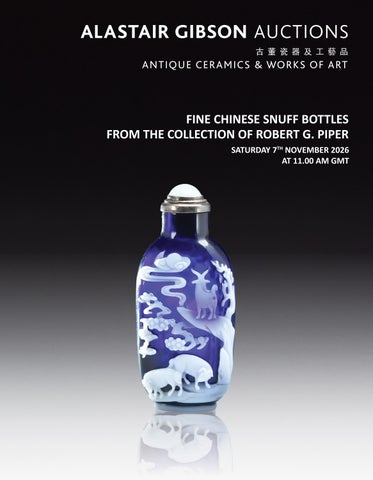
FINE CHINESE SNUFF BOTTLES FROM THE COLLECTION OF ROBERT G. PIPER SATURDAY 7TH NOVEMBER 2026 AT 11.00 AM GMT
Gibsons Oriental July Pages.qxp_Layout 1 08/06/2022 13:06 Page 1
FINE CHINESE SNUFF BOTTLES FROM THE COLLECTION OF ROBERT G. PIPER TO BE SOLD WITHOUT RESERVE LIVE AUCTION SATURDAY 7TH NOVEMBER 2026 FINE ASIAN ART AT 11.00 AM GMT WEDNESDAY 6TH JULY 2022 AT 10.30 ONLINE, TELEPHONE & COMMISSION BIDDING ONLY AM
Alastair Gibson, MRICS
249 - 253 Long Lane, Bermondsey, London, SE1Peppiatt 4PR Fine Art Viewing at Guy
Riverwide House, 6 Mason’s Yard, Duke Street, St James, London SW1Y 6BU To include: The collection of Lt. Col. George Douglas Gray, OBE, MD
Friday 30th October 2026- 1946), – 12pm – 15pm RAMC (1872 lots - 62 Saturday 31st October 2026 – 10am – 5pm The collection of Augustus Thorne (1825 - 1901), lots 66 - 71 Sunday 1st November 2026 – 12pm – 5pm Xianfeng2026 Emperor’s (1850 - 1861) silver ‘hunting’ flask, Monday 2ndThe November – 10am – 5pm
Alastair Gibson, MRICS
lot 73
Registration closes atpieces 12 noon on Friday Selected of lacquer from6th theNovember Mike Healy collection, lots 76 - 78
Front cover: Gerard Hawthorn Ltd, oriental art, lots 89 - 90 Lot 73
Stephen Loakes
Snuff bottles and archers rings from the collection of
Back cover: H.G. Beasley (1881 - 1939), lots 106 - 139
The Mujintang collection, Taipei, lots 172 - 222
88
Viewing in London:
46 12 32Monday 4th72July 2022 10am - 5pm
Marie Ma
Tuesday 5th July 2022 10am - 5pm Registration closes at 12 noon on Tuesday 5th July 2022 There will be no viewing on the morning of the sale
www.alastairgibsonauctions.com www.alastairgibsonauctions.com Tel: +44 (0)208 191 2 192
Tel: +44 7831 645468 Email: info@alastairgibsonauctions.com Email: info@alastairgibsonauctions.com
Andrew Huyan
Live Internet Bidding via Live Internet bidding via
Gibson Antiques Limited | Company No. 07211854
3
IMPORTANT INFORMATION REGISTRATION
LOT SYMBOLS
If you wish to bid at this auction you will need to register online and provide two forms of identification;
2: Proof of address – either a utility bill or official document showing your name and address
Lots marked with a dagger (†) are subject to standard UK VAT rules and 20% VAT will be charged on the ‘hammer’ and the ‘buyer’s premium’. Lots marked with an omega (Ω) are imported from outside the UK, under the Temporary Admission regime. 5% UK import VAT will be charged on the ‘hammer’ and 20% UK VAT will be charged on the ‘buyer’s premium’
Please visit www.alastairgibsonauctions.com and complete the online registration form.
ENDANGERED SPECIES REGULATIONS
1: Photographic identification – either a current passport or photographic driving licence
Identification can be provided to us in person or by email to info@alastairgibsonauctions.com Please note: registering through thesaleroom.com does not automatically register you to bid with us. You may be asked to pay a deposit and any deposit must be paid by bank transfer prior to the sale. Alastair Gibson Auctions must have cleared funds no later than 12 noon on the day before the sale. If you are not successful you will be refunded without interest within seven working days. Please note that refunds of payments made from non UK bank accounts may be subject to currency fluctuations. Bank transfers should be sent to: Lloyds Bank, Week Street, Maidstone Account name: Gibson Auctioneers Sort Code: 30-95-37 Account: 73642760 BIC: LOYDGB21121 IBAN: GB68 LOYD 3095 3773 6427 60 Once registration is complete you will be provided with a paddle number. CONDITION OF LOTS Condition reports are available on request prior to the sale. Please note that the condition of lots is not stated in the catalogue descriptions. The absence of condition reports in the catalogue does not imply that the lot is free from imperfections or faults. All measurements given in the catalogue should be regarded as approximate.
4
Lots marked λ will be subject to strict CITES regulations when being exported. Buyers should satisfy themselves prior to bidding that they are able to comply with these regulations before submitting any bids. For further information please visit https://www.gov.uk/guidance/ cites-imports-and-exports LIVE ONLINE BIDDING Live online bidding is available via various online platforms. Additional commission on the hammer price will be payable for use of these live auction facilities. This charge will be added to your invoice automatically. TELEPHONE BIDDING If you wish to bid by telephone please register online at www.alastairgibsonauctions.com before 12 noon on the day before the sale. Registrations for telephone bidding may not be accepted after this time. COMMISSION BIDDING If you are unable to bid online or by telephone you can leave a commission bid. This will be executed on your behalf by the auctioneer who will purchase the lot as cheaply as possible taking into account any reserve price and other bids. If you wish to leave a commission bid please register online at www.alastairgibsonauctions.com before 12 noon on the day before the sale. Commission bid requests may not be accepted after this time. PREMIUM LOTS Bids on premium lots can be made by telephone bidding or commission bidding. In order to bid on premium lots, you will be required to complete a premium lot registration form and pay a deposit which must be made by bank transfer. This form must be completed and the deposit received before 12 noon the day before the auction.
BUYERS PREMIUM
PACKING, COLLECTION AND SHIPPING OF LOTS
The buyer shall pay the hammer price together with a Please be aware that all lots are removed from the premium of 25% plus VAT @ 20% (totalling 30% inclusive) auction venue immediately after the sale by our on the first £500,000 and 12% plus VAT @ 20% (14.4% nominated shipper. inclusive) thereafter. Full information regarding collection and shipping will be provided with your purchase invoice. PAYMENT AND CLEARANCE We reserve the right to add storage charges to all lots Payment is due immediately after the auction and must be paid in pounds sterling. Payments can be made by bank transfer or cash. We are unable to accept card payments. Please note we can only accept cash payments up to a sterling equivalent of 10,000 euros and upon receipt of photographic identification and proof of address. We cannot accept cash payments without proof of identification Funds must be cleared in full before purchases can be released. Bank transfers should be sent to: Lloyds Bank, Week Street, Maidstone Account name: Gibson Auctioneers Sort Code: 30-95-37 Account: 73642760 BIC: LOYDGB21121
not collected or shipped within 30 calendar days of the sale. This will include a handling fee of £25 (plus vat) per invoice and a storage charge of £5 (plus vat) per lot per day. No goods will be released until these charges have been paid. EXPORTING YOUR PROPERTY FROM THE UK
If you intend to export your property, import taxes, customs duties and other fees may apply at the country of destination. It is your responsibility to ensure that your shipment can be lawfully imported to the destination country. All fees relating to this are the responsibility of the buyer. In order to qualify for a VAT refund, your lots must be exported by a shipping agent and valid export documentation must be provided prior to the VAT refund being applied. Please note that due to the withdrawal of the Retail Export Scheme by HMRC, we are unable to provide VAT refund documentation (C88) for hand-carried exports.
IBAN: GB68 LOYD 3095 3773 6427 60
5
拍賣須知 登記競投 由於“洗錢條例”的實施,買家需登記及提供兩種形式的身份 證明 以參與競拍: 1:照片身份證明——當前護照或照片駕駛執照 2:地址證明——水電賬單或具有您姓名和住址的官方文件 同時您也可以在線下參觀拍賣預展期間親自報名,也可以致電 +44(0)7831 645468或發送電子郵件至 info@alastairgibsonauctions.com與辦事處聯系. 登記時 您需要出示您的身份證明,護照您也可以 將文件的副本 通過電子郵件發送到辦公室. thesaleroom.com 請註意:通過thesalroom.com註冊或通過我們的網站不會自動 註冊您在本場拍賣的競買資格. 您可能會被要求支付競買保證金,任何保證金必須在出售前 通過 借記卡/信用卡或銀行轉賬支付.Alastair Gibson拍賣公司( Alastair Gibson Auctions)將於7月5日中午12點前 清算資金.如 果您沒有成功出價購買到拍品,我方將於7個工作日內將保證金 原數退還給您.請註意,從非英國銀行賬戶 付款的退款可能受貨 幣波動的影響。.在線競拍者可能需要支付5000英鎊的保證金, 該款項允許在 線競拍者於本次拍賣總計競拍至5萬英鎊. 任何匯款應轉賬到以下銀行賬戶: 銀行地址:Lloyds Bank, Week Street, Maidstone 賬戶名Account name : Gibson Auctioneers Sort Code:3095-37 賬戶Account: 73642760 BIC: LOYDGB21121 IBAN: GB68 LOYD 3095 3773 6427 60 在您註冊完成後您將授予競投號牌 拍品情況報告 請註意,拍品目錄中不包括拍品狀態報告.在競拍前,買家可自行 請求獲取並瀏覽拍品狀態報告.拍品目錄中沒有包括狀態報告並 不意味著拍品在真偽、品質或權利當面沒有缺陷.目錄中給出的 所有測量都應視為近似. 瀕危物種的規定 請註意,如果需要從英國出口本次拍賣中的部分拍品,部分 批次 在出口時將涉及《瀕危野生動植物種國際貿易公約》 (CITES) 的嚴格規定.如果可以實施,買家應在投標前確定自 己能夠遵守 這些規定,然後提交投標.欲了解更多信息,請 訪問 https://www.gov.uk/guidance/cites-imports-and- exports 現場競拍 如果您想要於現場競拍,您需要從我方獲得一個競買號牌.競買號 牌可以在參觀線下預展期間或在拍賣當天從辦公室獲得. 電話競拍 如果您希望通過電話競拍,請於7月5日中午12點之前通過電郵聯 繫我們:info@alastairgibsonauctions.com,此後的,電話投標 將不予接受. 委托競拍 如果您不能參加拍賣會,您可以留下一個傭金委托授權代理人參 加拍賣活動代為競買.以您的名義,拍賣官將考慮到保 留價和其 他報價,並以盡可能低的價格競買該批拍品. 在線直播競拍 在線競拍可以通過thesaleroom.com網站和51bidlive.com進行 ,額外的4.95% 的傭金加上增值稅(共5.94%)的落槌價應支付給 使用現場拍賣設施的Saleroom (ATG媒體).這筆費用將自動添加 到您的發票上.
4 6
買家酬金 買方應支付落槌價以及酬金.落槌價為五十萬英鎊以下時,費率為 落槌價的25%,加上20%的增值稅(共30%).落槌價為 五十萬英 鎊以上,前五十萬英鎊的費率不變,之後的價格為 12%加上20% 的增值稅(共14.4%)作為酬金. 拍品符號 標有匕首符號(+)的拍品需繳納增值稅.標有歐米加符號(=)的 拍 品臨時進口於英國以外地區,需額外支付按成交價和賣家 酬金的 5%繳納增值稅. 銷售結果 這些將在出售後不久張貼在我們的網站上. 拍品交付 成功競拍後需即刻以英鎊付款.資金須於我方將拍品交與您或您 指定的托運人前結清. 付款方式接受現金.借記卡/信用卡或銀行轉賬. 請註意,我方只能接受最高等同於10000歐元的英鎊現金.若持卡 人不在場,我方不能接受超過1000英鎊的信用卡付款 . 任何匯款應轉賬到以下銀行賬戶: Lloyds Bank, Week Street, Maidstone Account name : Gibson Auctioneers Sort Code:30-95-37 Account :73642760 BIC: LOYDGB21121 IBAN: GB68 LOYD 3095 3773 6427 60 包裝和運輸 Alastair Gibson拍賣行可以提供全球航運報價與指定托運公司. 請註意,我方不承擔運輸過程中任何損壞或丟失的費用. 如果拍品在銷售後三十天未被收集,我方保留收取對於每件 拍品 相關儲存費用的權利.這將包括每張發票25英鎊(加增值 稅)的手 續費和每天每件拍品5英鎊(加增值稅)的倉儲費.在支 付這些費 用之前,拍品不會被放行. 從英國出口您的拍品 如果您打算從英國出口您的拍品,您也許需要支付目的地國家相 關進口稅,關稅和其他費用.您有責任確保您的貨物可以合法地進 口到目的地國家.與此相關的所有費用均由買方負責. 請註意,由於英國稅務海關總署撤銷零售出口計劃,我方無 法提 供手提出口的增值稅退稅文件(C88).為了符合退稅條件 ,您的拍 品必須由托運公司出口,並須提供有效的出口文件 . 部分拍品在出口時可能受《瀕危野生動植物種國際貿易公約 》 規定的約束,關於《瀕危野生動植物種國際貿易公約》的 詳情請 見:https://www.gov.uk/guidance/cites-imports-and- exports **注:本須知如有任何詮釋上的問題,一概以英文版本為準。
CHRONOLOGY OF CHINA 中國歷代年表 NEOLITHIC 新石器時代
SOUTHERN DYNASTIES 南朝
MING DYNASTY 明1368-1644
c.6500-1700 BC
420-589
Hongwu 洪武 1368-1398
Liu Song 劉 宋 420-479
Jianwen 建文 1399-1402
Southern Qi 南齊 479-502
Yongle 永樂 1403-1425
Liang 梁 502-557
Hongxi 洪熙 1425
Chen 陳 557-589
Xuande 宣德 1462-1435
XIA DYNASTY 夏 c.2100-1600 BC SHANG DYNASTY 商 c.1600-1100 BC ZHOU DYNASTY 周 c.1100-221 BC Western Zhou 西周 c.1100-771 BC Eastern Zhou 東周 770-256 BC Spring and Autumn Period 春秋 770-476 BC Warring States Period 戰國 475-221BC QIN DYNASTY 秦 221-206 BC HAN DYNASTY 漢 206 BC-AD 220 Western Han西漢 206 BC - AD 8 Eastern Han 東漢 AD 25-220 THREE KINGDOMS 三國 220-280 Wei 魏 220-265 Shu Han 蜀漢 221-263 Wu 吳 222-280 JIN DYNASTY 晉 265-420 Western Jin 西晉 265-317 Sixteen Kingdoms 十六國 304-439 Eastern Jin 東晉 317-420
NORTHERN DYNASTIES 北朝 386-581 Northern Wei 北 魏 386-534 Eastern Wei 東魏 534-550 Western Wei 西魏 535-556 Northern Qi 北齊 550-577 Northern Zhou 北周 557-581 SUI DYNASTY 隋 581-618 TANG DYNASTY 唐 618-907
Zhengtong 正統 1436-1449 Jingtai 景泰 1450-1456 Tianshun 天順 1457-1464 Chenghua 成化 1465-1487 Hongzhi 弘治 1488-1505 Zhengde 正德 1506-1521 Jiajing 嘉靖 1522-1566 Longqing 隆慶 1567-1572 Wanli 萬曆 1573-1620 Taichang 泰昌 1620 Tianqi 天啓 1621-1627 Chongzhen 崇禎 1628-1644
FIVE DYNASTIES 五代 907-960 Later Liang 後梁 907-923 Later Tang 後唐 923-936 Later Jin 後晉 936-946 Later Han 後漢 947-950
QING DYNASTY 清 1644-1911 Shunzhi 順治 1644-1661 Kangxi 康熙 1662-1722 Yongzheng 雍正 1723-1735
Later Zhou 後周 951-960
Qianlong 乾隆 1736-1795
LIAO DYNASTY 遼 907-1125
Daoguang 道光 1821-1850
Jiaqing 嘉慶 1796-1820 Xianfeng 咸豐 1851-1861
SONG DYNASTY 宋 960-1279 Northern Song 北宋 960-1127 Southern Song 南宋 1127-1279
Tongzhi 同治 1862-1874 Guangxu 光緒 1875-1908 Xuantong 宣統 1908-1911
JIN DYNASTY 金 1115-1234
REPUBLIC OF CHINA 中華民國 1912-
YUAN DYNASTY 元 1271-1368
Hongxian (YUAN SHI KAI) 洪憲 (袁世凱) 1915-1916 PEOPLE’S REPUBLIC OF CHINA 中華民國 1949-
75
ROBERT G. PIPER July 8, 1922 – January 6, 2009
Originally from Deerfield, Illinois, the son of Frances Griffen and Charles E. Piper, Jr. Robert served in the Army during WWII with the 114th Infantry, part of the 44th Infantry Division, which chased the retreating German Army through the winter of 1944. The 44th arrived at Cherbourg, France, on September 15, 1944, and entered continuous combat just over a month later on October 24. The division fought in the Rhineland, Ardennes-Alsace, and Central Europe campaigns, including a gruelling winter campaign through the Vosges Mountains, and was among the first American troops to break through the heavily fortified German Maginot Line. Members of the 44th were the first U.S. soldiers to reach the Rhine between France and Germany. They later advanced deep into Germany and Austria, capturing the city of Ulm and repelling fierce counter-attacks from elite German Panzer units. After the war, with the aid of the GI Bill, Robert graduated from the Colorado School of Mines as a metallurgical engineer. The 1944 Act meant that higher education was no longer the preserve of the wealthy — by 1947, over 49% of college students were veterans of WWII. Robert went on to work on the alloy casting production of Minuteman intercontinental ballistic missiles at Standard Steel in Lewistown, PA. He always said to his family that his military service ‘was the making of him’, and was grateful for the wider opportunities it gave him in life. He married his wife, Geraldine ( “Jere” ), in 1948, and they had three adopted children: Margaret, Robert, and Charles. He became a serial entrepreneur, thriving in business and serving as president of several companies, including Standard Steel in Lewistown, PA; Wisconsin Centrifugal in Waukesha, WI; and International Petroleum Engineering Co. in Noble, OK, which produced drill bits for the oil and gas industry. He continued working into his mid-70s, when he developed another successful business, PODS (Portable On Demand Storage). In his 80’s, he experimented with a jatropha farm in Arcadia, FL, aiming to produce bio-diesel fuel. Education mattered deeply to him. He put his children and grandchildren through college and established a scholarship fund at the Colorado School of Mines. Among his hobbies, he enjoyed golf and, beginning in the late 1970’s, collecting Chinese snuff bottles. He joined the International Chinese Snuff Bottle Society and travelled the world attending their conventions. At one such convention, he met Hugh Moss, who told him bluntly he was “buying junk bottles “ — then handed him his business card and invited him to dinner. It was the start of a collector-dealer relationship that would span more than 30 years. Hugh became a trusted friend and advisor, visiting the Pipers twice a year at their home in Florida with a wheelie-bag full of snuff bottles. Bob was the collector, with Jere offering occasional suggestions and noting preferences as his gentle audience. He studied the subject closely and kept an eye on international auctions, collecting purely for the joy of it, while Moss advised and acted on his behalf. As the collection grew, Hugh began cataloguing and photographing each piece, eventually setting up a database to help Robert track it all. In the words of Hugh Moss: “The collection speaks for itself — a fitting legacy for a very civilised collector.”
8
羅伯特·G·派珀
一九二二年七月八日生,二〇〇九年一月六日卒 派珀祖籍伊利諾伊州迪爾菲爾德,父為查爾斯·E·派珀, 母為弗朗西絲·格里芬。 他與二戰時從軍, 隸屬陸軍第四十四步兵師第一百十四步兵團, 一九四四年冬追擊敗退德軍。該軍團於一 九四四年九月十五日抵法國瑟堡, 十月二十四日投入連續作戰, 轉戰萊茵蘭、阿爾薩斯-阿登、中歐諸役 。隆冬之際, 轉戰孚日山脈, 備嘗艱苦, 為率先突破德軍馬其諾防線之美軍部隊之一。第四十四師官兵, 為最早抵達法德界萊茵河之美軍。其後深入德、奧腹地, 克烏爾姆城, 力拒德軍精銳裝甲部隊之猛烈反撲 。 戰後, 派珀得《退伍軍人權利法案》之助, 畢業於科羅拉多礦業學院, 主修冶金工程。一九四四年此法既 立, 高等教育遂不復為富家子弟所專擅。 至一九四七年,大學生中逾四成九皆二戰退伍軍人。派珀隨後 於賓夕法尼亞州劉易斯敦標準鋼鐵公司任職, 參與民兵洲際彈道導彈合金鑄造研製。 一九四八年, 派珀娶妻傑拉爾丁(暱稱「傑瑞」), 育有養子女三人:瑪格麗特、羅伯特、查爾斯。 派珀善於經營, 屢創新業, 歷任數家公司總裁, 包括賓州劉易斯敦標準鋼鐵公司、威斯康星州沃基肖離心 鑄造公司, 及俄克拉何馬州諾布爾國際石油工程公司, 專產油氣鑽井鑽頭。年逾七旬,猶勤於業, 創立「 隨需可攜儲存」(PODS)公司, 再獲成功。八十歲時, 於佛羅里達州阿卡迪亞試種麻風樹,冀以製生質柴油 。 派珀深知教育之益, 遂供其子女孫輩悉數完成大學學業, 並於科羅拉多礦業學院設立獎學金, 以惠後學。 派珀雅好高爾夫球, 又自一九七〇年代中期始收藏中國鼻煙壺, 加入國際中國鼻煙壺學會, 遠涉重洋, 屢 赴其年會。於一次年會中, 結識休·莫斯;莫斯直言相告, 謂其所藏多劣品, 並遞名片,邀之共餐。 於是二人結藏家與商賈之緣, 歷三十餘載而不衰。莫斯遂為其摯友兼顧問, 每年兩度攜行李箱滿載鼻煙壺 ,造訪派珀夫婦於其佛羅里達之家。派珀主收藏, 妻傑瑞則於旁提示所好、以備參詳。派珀潛心此道,留意 國際拍賣行情, 唯以怡情悅性為樂, 而委莫斯代為訪求、經辦。藏品既豐, 莫斯乃為之編目、攝影, 終建 資料庫, 使派珀得悉全部藏品之原委。 莫斯嘗言:「此藏品自能明志,誠一位極具修養之藏家所留之美善遺產。」
9
1Ω A BLACK OVERLAY AND WHITE GLASS SNUFF BOTTLE PROBABLY IMPERIAL, ATTRIBUTED TO THE PALACE WORKSHOPS, BEIJING, 1770-1820 Opaque black and translucent white glass, of compressed spherical form tapering to a cylindrical neck and with a recessed, convex oval foot surrounded by a protruding, convex oval foot rim, carved as a single overlay of black on white with a continuous design of three chi dragons, the foot rim in the overlay colour Height: 6cm Provenance:
Robert Hall, London Meriem Collection Christie’s, New York, 19th September 2007, lot 672
Hugh Moss (HK) Ltd, 2nd October 2007, (a copy of the original invoice available) It is extremely rare to find a true black overlay glass snuff bottle, as a fine line divides what is a genuine, opaque black, and what is in reality a very dark olive-green, for instance. The present lot is one of the best examples, and only a handful of others are published (including two from the Bloch collection, illustrated by Moss, Graham, Tsang, A Treasury of Chinese Snuff Bottles, Vol. 5, Glass, nos. 962-3). Given the intensity of the black, and the confident carving of the favoured court motif of chi dragons, it is likely that this was made for the Court £3,000 – £4,000
10
The buyer shall pay the hammer price together with a premium of 25% plus VAT @ 20% (totaling 30% inclusive) on the first £500,000 and 12% plus VAT @ 20% (14.4% inclusive) thereafter
2Ω A FACETED YELLOW-GLASS SNUFF BOTTLE IMPERIAL GLASSWORKS, BEIJING, 1720-1840 Of meiping (prunus-blossom vase) form with a slightly flared cylindrical neck, wide mouth, flat lip and recessed, flat, circular foot, surrounded by a flat footrim with a circular inner, and octagonal outer profile; the exterior with a series of eight vertical hexagonal facets, lined to the foot by a series of eight pentagonal facets, and to a flat panel around the lower neck on the shoulders by a further register of pentagonal facets Height: 5.4cm Provenance: Hugh Moss (HK) Ltd, 20th February 2007, (a copy of the original invoice available) Imperial yellow was, of course, a staple at the Imperial glassworks, and faceted forms standard. Many bottles of this colour, in various shapes, have come out of tombs in and around Beijing in the last few decades, including a range of faceted, Palace shapes These glass bottles, mostly Imperial, were made in large numbers to be distributed by the Qing Emperors as gifts to officials, scholars, military men and other worthies on specific occasions each year. A large proportion of distributed bottles were in glass of various colours and shapes and because they were received from the Emperor, they were symbols of honour and were frequently buried with Qing snuff-takers This faceted meiping form is typical of the Court, but an unusual form for a Palace faceted work £1,600 – £1,800
11
3Ω AN AVENTURINE GLASS SNUFF BOTTLE 1760-1820 Brown glass with gold speckled inclusions (of the variety known as `goldstone’ or `aventurine’ glass), of rounded rectangular form with a cylindrical neck and a recessed oval foot Height: 6.8cm Provenance: Hugh Moss (HK) Ltd, 5th September 1994, (a copy of the original invoice available) This type of glass was invented in Europe and was much admired by the Chinese Court when it was first introduced during the Kangxi period by Jesuits. They apparently mastered the art of including pieces of raw material from Europe in their own glass production at the Palace (under Jesuit influence) during the Kangxi period and appear to have been able to make the material themselves by the mid eighteenth century (see, Moss, Graham, Tsang, The Art of the Chinese Snuff Bottle, p. 572). However, bottles entirely of this material seemed to have been always carved by the lapidary method from solid chunks of glass, rather than by blowing, making it difficult to determine whether the material itself was imported or whether it was simply used that way for some other reason This is one of the larger and more imposing examples known, and the size and shape of the bottle suggest a date from the mid-Qing period £2,500 – £3,500
12
The buyer shall pay the hammer price together with a premium of 25% plus VAT @ 20% (totaling 30% inclusive) on the first £500,000 and 12% plus VAT @ 20% (14.4% inclusive) thereafter
4Ω A WHITE GLASS ENGRAVED SNUFF BOTTLE ATTRIBUTED TO THE IMPERIAL GLASS WORKS, 1730-1800 The engraving Ziqing, 1845, the translucent white glass; of compressed, elongated ovoid form with a flared, cylindrical neck, flat lip and slightly recessed, flat, oval foot surrounded by a protruding, rounded, oval footrim; engraved on one main side with a mandarin duck beneath lotus plants with aquatic grass, and on the other with a four character inscription in seal script ‘The Finest qualities of the Pond,’ followed by, in clerical script, ‘Made at an auspicious time in the first ten days of the mid-Spring month of the yisi year,’ and the signature, Ziqing ke (‘carved by Ziqing’) and one seal of the artist, Ziqing shi (‘Mr. Ziqing’) Height: 6.1cm Provenance: Kavin Tian, October 2004 Hugh Moss (HK) Ltd, 30th August 2005, (a copy of the original invoice available) Ziqing was almost certainly one of a group of late-Qing engravers of glass who, working with a diamond point, engraved the surface of glass bottles and other media with scholarly designs and inscriptions. Such workers often had a supplier of blanks upon which to work, but it made no difference to them whether the bottles they engraved were new or old and many are known with later engraving on old bottles, which is the case here. Probably when it was engraved, but possibly before, the original flat foot was changed to give it a footrim. A number of early bottles had a protruding, flat foot with no rim and at some time it was decided that a rim would make it more elegant, so the foot was neatly recessed to give it a rim. It was often the case that fashion in snuff-bottles changed, and older bottles were adjusted to suit. A case in point is that prior to the mid-Qing, roughened interiors to crystal bottles were the standard, while shiny ones became fashionable in response to more sophisticated snuff connoisseurship (the shiny surface prevented moisture in the snuff from being absorbed into the roughened wall of the interior, keeping the snuff in better condition), so in the second half of the Qing dynasty large numbers of early bottles with rough interiors were polished to make them smooth. In this case, of course, the details of the bottle are somewhat irrelevant, since the art has been shifted from that of the glassmaker with his simple, formal statement in white glass, to that of the glass engraver, Ziqing, and his pictorial and calligraphic art £1,200 – £1,800
13
5Ω A RUBY OVERLAY AND BUBBLE SUFFUSED GLASS ‘GOLDFISH AND LOTUS’ SNUFF BOTTLE PROBABLY IMPERIAL , PALACE WORKSHOPS, 1770-1830 The ruby overlay well carved with a goldfish amongst lotus flowers and foliage all issuing from a wave-strewn ground, oval foot over the bubble suffused glass Height: 6cm Ruby-red overlay glass bottles suffused with milky white air bubbles were a staple production of the Imperial workshops and Beijing glass houses from the Kangxi period through until the late 18th and early 19th centuries For a similar bottle from The Water, Pine and Stone Retreat Collection of Snuff Bottles, 水松石山房鼻煙壺珍藏 attributed to the Palace workshops, see cat. no. 34.3.477, Imperial Influence over the Snuff Bottle Arts, Book I, 2017, e-yaji.com £1,200 – £1,800
14
The buyer shall pay the hammer price together with a premium of 25% plus VAT @ 20% (totaling 30% inclusive) on the first £500,000 and 12% plus VAT @ 20% (14.4% inclusive) thereafter
6Ω A WHITE JADE CARVED ‘LANDSCAPE’ SNUFF BOTTLE SUZHOU SCHOOL, (FIRST PHASE), 1700-1780 Flattened pear shape with a cylindrical neck and recessed oval foot, carved in low relief with a continuous landscape design in which Mi Fu kneels bowing to a rock formation from which grass grows while his servant stands behind him with a large fan and another scholar sits on a rocky ledge gazing contemplatively at a nearby bamboo plant with formalized clouds above and a plantain growing to one side Height: 5.5cm Provenance: Hugh M. Moss Ltd Paula J. Hallett Lionel Copley Robert Hall Ltd, Hugh Moss (HK) Ltd, 16th July 1995, (a copy of the original invoice available) Published: Robert Hall, Chinese Snuff Bottles VI, no. 105 The earlier more restrained phase of Suzhou carving is discussed in Moss, Graham, Tsang, The Art of the Chinese Snuff Bottle, Hong Kong 1993,under nos. 21 and 28 and will be more fully covered in the forthcoming volume on Jade bottles from the Bloch Collection. This superbly controlled, low relief and restrained carving in white nephrite is typical of the finest of first phase Suzhou carving. Mi Fu was the famous Song literatus and petraphile renowned for being so impressed with one large garden rock in his collection that he donned his official robes, bowed to it and addressed it as `respected elder brother’ £2,000 – £3,000
15
7Ω A PORCELAIN ‘FAMILLE-VERTE’ ‘POCKET WATCH’ SNUFF BOTTLE JINGDEZHEN, 1820- 1870 Of flattened spherical form with raised circular panels on each main face surrounded by radiating pleats, painted on one side in black enamel with a European watch dial with two hands and Roman numerals, on the other with a fisherman in a sampan beside a riverbank with trees and distant mountains struck by the sun Height: 5.7cm Provenance: Alex S. Cussons Hugh Moss (HK) Ltd, 26th September 1996, (a copy of the invoice available) There is a series of snuff bottles of this form from the nineteenth century where the shape was clearly derived from a European fob-watch, and several of them are decorated with watches, sometimes on both sides. There are others, however, which follow the form but with purely Chinese decoration on each side. For another of similar form, with a watch face on both sides, see Robert W. L. Kleiner, Chinese Snuff Bottles from the Collection of Mary and George Bloch, Hong Kong 1995, no. 221. The use of famille verte enamels here is unusual. This is the more limited palette that evolved to its height during the Kangxi period to be replaced in the early 1700s by the famille rose palette. As a rule, once the latter was well established in all the main enamelling centres the former was only used on either fakes or wares making deliberate reference to the more ancient tradition. Presumably this falls into the latter category, since there is no question of it being from the Kangxi period, nor could it have been, since porcelain snuff bottles do not appear to have been made this early in any recognizable quantities. For another example with the same palette of this shape, although without the radial pleating, see Robert Kleiner, Chinese Snuff Bottles in the Collection of Mary and George Bloch, no. 212 £800 – £1,200
16
The buyer shall pay the hammer price together with a premium of 25% plus VAT @ 20% (totaling 30% inclusive) on the first £500,000 and 12% plus VAT @ 20% (14.4% inclusive) thereafter
8Ω A RARE BLUE AND WHITE PORCELAIN ‘MEIPING’ SHAPED SNUFF BOTTLE JINGDEZHEN KILNS, 1800-1880 Of meiping (`prunus-blossom vase’) form with a recessed circular foot, painted with a continuous scene of a waterside landscape with distant towering peaks, with three sages seated on a small island in the foreground beneath a clump of pine trees growing from the nearby land Height: 8cm Provenance: Eumorphopolous Collection (no. D.12), applied paper label J. J. Lally & Co. New York Hugh Moss (HK) Ltd, 16th July 1995, (a copy of the original invoice available) This is apparently a unique subject for a blue and white snuff bottle. Sages seated in ideal landscape settings are common enough motifs, but there seems something specific about the three sages seated, strangely, on a small island suggesting that some specific meeting or event is intended Eumorphopolous was one of the pioneer European collectors of Chinese art, collecting a wide range of threedimensional arts and publishing a massive, multi-volume catalogue of his collection. Although the blue and white porcelains are given D numbers in this catalogue, D. 12 is clearly a different piece, much earlier and not a snuff bottle according to the catalogue. Either the number was re-used after the catalogue appeared, which seems unlikely, or perhaps a number off the listed piece has at some time been transferred to this snuff bottle, although why anyone would want to do this is a mystery. A question mark must remain over the provenance of this bottle, however, due to the discrepancy £1,500 – £2,000
17
9Ω A ‘FAMILLE-ROSE’ PORCELAIN ‘BOYS AT PLAY’ SNUFF BOTTLE IMPERIAL KILNS, JINGDEZHEN, DAOGUANG MARK AND OF THE PERIOD, 1821-1850 Of compressed, elongated pear-shape tapering to a cylindrical neck and with a recessed oval foot, painted with a continuous design of sixteen children each holding a flower in a garden setting, the foot inscribed in iron-red seal script Daoguang nian zhi (`made in the Daoguang period’) Height: 7.5cm Provenance: Hugh Moss (HK) Ltd, 24th November 1996, (a copy of the original invoice available) This unusual subject for porcelain appears more commonly on Imperial enamels on metal from Guangzhou (Canton), although another, of a more bulbous shape is in the Franz Collection, Hong Kong. Each of the different flowers represents a specific meaning in Chinese symbolism, some denoting riches and honour, some success in examinations, and so forth £2,000 – £3,000
18
The buyer shall pay the hammer price together with a premium of 25% plus VAT @ 20% (totaling 30% inclusive) on the first £500,000 and 12% plus VAT @ 20% (14.4% inclusive) thereafter
10 Ω A RARE ‘FAMILLE-ROSE’ PORCELAIN ‘LOTUS’ DOUBLE-GOURD SHAPED SNUFF BOTTLE IMPERIAL, JINGDEZHEN KILNS, 1796-1820 Of compressed double-gourd shape with a wide mouth, flat lip and no foot; painted with an overall design of formalized Indian lotus on a pale turquoise ground, with gold-enamel details, the base inscribed in goldenamel seal-script, Jiaqing nian zhi (‘Made in the Jiaqing period’) Height: 6.44cm Provenance: House of Precious, Hong Kong, 1999 Hugh Moss (HK) Ltd, 11th May 2000, (a copy of the original invoice available) Illustrated: Front cover ICSBS JOURNAL, Winter 2006, Volume XXXVIII, number 3 This is one of a rare group of bottles painted with gilt detail and a gilt reign mark. For two complete sets of ten, still in their original boxes in the Imperial Collection, see Chang Lin-sheng, Snuff Bottles in the Collection of the National Palace Museum, p. 122, no. 86 and p.124, no. 88, where no. 95, a set of four with red enamel Jiaqing marks (the mark shown in the catalogue is the wrong one), are similar in form and decoration. Of a different shape, but similar style of decoration, no. 84, p. 120, is another set of ten. Outside of the Imperial collection, however, they are extremely rare £6,000 – £8,000
19
11 Ω A CARVED CORAL-COLOURED GLASS SNUFF BOTTLE, 19TH CENTURY Of ovoid form, carved to each side with a carp spewing from its mouth a Yin yang symbol, above a band of crashing waves Height 6.6cm Provenance: Sotheby’s New York, 1st-2nd December 1992, lot 375, (a copy of the original invoice available) £200 – £300
12 Ω A TURQUOISE COLOURED GLASS SNUFF BOTTLE 1730-1800 Translucent turquoise-blue glass; of compressed, elongated ovoid form, with a waisted cylindrical neck, concave lip and protruding flat, oval foot Height: 6.8cm Provenance: Johnny Tseng, California, March 2006 Hugh Moss (HK) Ltd, 19th March 2007, (a copy of the original invoice available) £600 – £800
20
13 Ω AN ENAMELLED WHITE-METAL ‘DRAGON’ SNUFF BOTTLE LATE 19TH CENTURY Of hexagonal panelled shouldered ovoid form, chased with two dragons in high-relief, their tails entwined, contesting a flaming pearl, reserved against an enamelled champleve ground Height: 4.8cm Provenance: Etude Jutheau, Boston, Robert Hall, 10th October 1991, lot 5, (original invoice available) £300 – £400
14 Ω A TRANSPARENT BLUE GLASS SNUFF BOTTLE 1800-1900 Of flattened elongated ovoid form, the lavender-blue glass suffused with bubbles, well hollowed Height 6.6cm Provenance: Sotheby’s New York, Fine Chinese Ceramics and Works of Art, 26th November 1991, lot 187 (a copy of the original invoice available) £400 – £600 The buyer shall pay the hammer price together with a premium of 25% plus VAT @ 20% (totaling 30% inclusive) on the first £500,000 and 12% plus VAT @ 20% (14.4% inclusive) thereafter
21
15 Ω AN INCISED TURQUOISE GLASS SNUFF BOTTLE PROBABLY JIANGNAN REGION, 1850-1900 Of flattened pear shape with a flared neck and recessed oval foot, finely incised on one side with two boys watching a fish in a large fishbowl in a fenced garden with bamboo and on the other a lady seated reading on a rock in a garden setting, inscribed on one side `The loveliness (lit. colour) of a beautiful woman [combined with] the writing of the ancients’, and on the foot with the signature Yushan fanggu (`Yushan, copying the ancients’) Height: 5cm Provenance: Hugh Moss (HK) Ltd, 5th September 1994, (a copy of the original invoice available) The poem here seems to be suggesting that the decoration combines outward beauty with inner qualities, the writing of the ancients being a metaphor for profundity and good taste. Yushan is a zi or assumed artistic name, and is not listed as belonging to anyone in particular in the various biographical dictionaries. However, it relates to a bottle from the J & J Collection, with a similar subject incised on jet (Moss, Graham, Tsang, The Art of the Chinese Snuff Bottle, no. 91). Another is known in lacquer, apparently by the same hand as the J & J example (collection of Lutz Franz, Hong Kong) which is signed by a known literatus, Zhao Qi. It is dated to 1876, suggesting a possible date for this example as well. Zhao Qi was from Jiangsu province. He was a famous artist who studied figure painting under Wang Su, (Xiaomu) the Yangzhou painter who influenced Yangzhou glass and the likeness to whose style I proposed in relation to the above-mentioned J & J bottle. He was also well known for his bamboo carving and his ability to inscribe very small characters. In his biography in the Zhongguo meishujia renming zidian, Ed. Yu Jianhua, (p. 1290) his dates are not given, but if he studied under Wang Su, 1876 is the only possible date for the lacquer bottle in the Lutz collection. It is likely that a vogue for the subjects of Wang Su was established in the latter part of the nineteenth century in the area around Yangzhou, where he worked, and was adopted by various artists, including the mysterious Yushan who made this botttle In any case, incised work of this type signed by individual artists tends to be late in the Qing dynasty, and the artists who commanded the medium to this level of quality are rare. In glass, the other who springs to mind is the famous turn of the century artist Zhou Honglai (see, ibid. no. 406, for an example) £3,000 – £4,000
22
16 Ω A FAMILLE-ROSE ENAMELLED ‘IDLE SCHOLARS’ WHITE GLASS SNUFF BOTTLE YANGZHOU, APOCRYPHAL IRON-RED FOUR-CHARACTER SEAL MARK OF QIANLONG, 1850-1910 Of flattened, elongated oval form with a cylindrical neck, painted on one side with a scholar, reclining in a boat by the river, beneath an overhanging willow and another tree, with rocks and grass in the foreground, on the other with the scholar, Meng Haoran, holding a branch of prunus blossom on a grassy bank beneath a flowering prunus tree, with another beyond, with foreground bamboo or grass, and a rocky bank, the neck with a border of formalized flower heads on a scrolling stem, with a somewhat similar design on each narrow side separating the two designs and standing in for mask and ring handles, the foot inscribed in iron-red enamel seal script, Qianlong nian zhi (‘made during the Qianlong period’) Height: 7.4cm Provenance: Chinese dealer, Tianjing, 1941 The Ko Collection, Italy 1998 For a discussion on this group of Yangzhou enamelled bottles, illustrated, discussed and re-dated by Hugh Moss and Stuart H. Sargent, The Yangzhou Conundrum, August 2018 £2,000 – £3,000
The buyer shall pay the hammer price together with a premium of 25% plus VAT @ 20% (totaling 30% inclusive) on the first £500,000 and 12% plus VAT @ 20% (14.4% inclusive) thereafter
23
17 Ω A CORAL-RED GLAZED PORCELAN MOULDED AND RETICULATED ‘DRAGON AND FENGHUANG’ SNUFF BOTTLE IMPERIAL, JINGDEZHEN KILNS, 1796-1820 Of elongated ovoid form, moulded with a continuous design of formalized clouds, some shaped as formalized lingzhi heads, with a three-clawed dragon on one side and a fenghuang with a ruyi sceptre in front of it on the other, the upper neck rim with a band of raised dots above a neck band of continuous leiwen (‘thunder pattern’) design bordered with formalized lingzhi heads, the foot with a band of formalized lingzhi heads above a band of raised dots, the foot inscribed in gold seal script Jiaqing nian zhi (‘made in the Jiaqing period’) Height: 7.5cm Provenance: The Neal W. and Frances R. Hunter Collection Sotheby’s, New York, 15th September 1998, Lot 182 Hugh Moss (HK) 25th September 1998, (a copy of the original invoice available) In unusually fine condition for one of this group, this is a classic example of the early series of dragon and fenghuang bottles made for the Court and probably for distribution as presents at Imperial weddings, where these two mythical beasts were standard decoration. It is also exceptionally well enamelled. Often this red enamel, along with its blue equivalent, was rather thickly applied, causing a considerably loss of detail, whereas here it is an ideal combination of brilliance of colour and thinness, allowing the moulded detail to show through £2,000 – £3,000
24
The buyer shall pay the hammer price together with a premium of 25% plus VAT @ 20% (totaling 30% inclusive) on the first £500,000 and 12% plus VAT @ 20% (14.4% inclusive) thereafter
18 Ω A RARE ‘FAMILLE-ROSE’ PORCELAIN SNUFF BOTTLE IMPERIAL, JINGDEZHEN KILNS, QIANLONG MARK AND OF THE PERIOD, 1770-1799 Of flattened rectangular shouldered form, painted with two panels of flowers including peonies and poppies, the shoulder and neck painted in iron-red with a lotus design, iron-red four-character seal mark to the base, (‘Qianlong Nian Zhi’) Height 6cm Similar flat-sided porcelain bottles, painted with flowers and poems can be found in The Complete Collection of Treasures of the Palace Museum, Beijing, 1995, cat. no. 317, p.207; and another from The Water, Pine and Stone Retreat Collection of Chinese Snuff bottles, illustrated on e-yaji.com, cat no. 21.3.834 £1,500 – £2,000
25
19 Ω A BLUE OVERLAY AND CLEAR GLASS SNUFF BOTTLE PALACE WORKSHOPS, 1750-1850 Of slender elongated form, the blue overlay carved with two aquatic creatures spewing from their mouths, a pavilion, bird and cloud scrolls to one side, the other with a chilong dragon amongst cloud scrolls, three pearls to either side, all on clear crizzled glass Height: 6.8cm Provenance: Sotheby’s New York, Fine Chinese Snuff Bottles, 2nd December 1985, lot 27, (a copy of the original invoice available) For a similar blue overlay glass bottle, carved with the ‘Tally of Immortality’ see The Water, Pine and Stone Retreat Collection of Chinese Snuff Bottles, 水松石山房鼻煙壺珍藏
attributed to the Palace workshops, cat. no. 34.3.796, Imperial Influence over the Snuff Bottle Arts, Book I, 2017, e-yaji.com The “tally” or ledger of immortality in Chinese culture refers to the moral accounting system—often called gongguo ge (功過格, “ledgers of merits and demerits”)—used to track good and bad deeds to attain longevity, divine rank, or spiritual immortality £1,500 – £2,000
26
The buyer shall pay the hammer price together with a premium of 25% plus VAT @ 20% (totaling 30% inclusive) on the first £500,000 and 12% plus VAT @ 20% (14.4% inclusive) thereafter
20 Ω AN IRON-RED AND GILT MOULDED PORCELAIN ‘DRAGON’ SNUFF BOTTLE IMPERIAL KILNS, JINGDEZHEN, 1770-1830 Of slender teardrop form, moulded with identical five-clawed dragons chasing ‘flaming pearls’ to each side, picked out in iron-red and gilt Height 6.5cm Provenance: Nils Nessim, Stockholm, 1966 Guo’an Collection (Ann Kreuger) Sotheby’s Hong Kong, The Guo’an Sale 30th October 2000, lot 744 Hugh Moss (HK) Ltd, 15th November 2000, (a copy of the original invoice available) In the late Qianlong period, a group of porcelain bottles was made for the Court at Jingdezhen which simulated glass overlays. They are usually of blue enamelled relief on a white ground, but this is a rare ironred version. Standing alone, this would not obviously be seen as a simulated glass overlay, but its relationship to the blue examples suggest that it may be £800 – £1,200
27
21 Ω A BLUE AND WHITE ‘SWIRL’ GLASS OVERLAY DOUBLE-GOURD SNUFF BOTTLE ATTRIBUTED TO THE PALACE WORKSHOPS, BEIJING, 1740-1850 The sapphire-blue double-gourd with splashes of white swirling around the swelling body Height 6.2cm It is rare to find a saphire blue and white splashed double gourd snuff bottle from the Palace workshops. No other bottle appears to be recorded with such dynamic and vibrant markings. In Chinese culture, the double gourd (hulu, 葫芦) is a powerful and auspicious symbol representing good fortune, health, longevity, and family prosperity. The Mandarin word for gourd (hulu) sounds like fulu (福禄), which also translates to “happiness, prosperity, and official rank” so it has a particularly auspicious double meaning, and perhaps that is why the craftsmen chose two colours to accentuate the message £2,000 – £3,000
28
The buyer shall pay the hammer price together with a premium of 25% plus VAT @ 20% (totaling 30% inclusive) on the first £500,000 and 12% plus VAT @ 20% (14.4% inclusive) thereafter
22 Ω AN EMERALD-GREEN GLASS DOUBLE-GOURD SNUFF BOTTLE IMPERIAL, ATTRIBUTED TO THE PALACE WORKSHOPS, BEIJING, 1740-1850 Of double-gourd form with a waisted cylindrical neck, flat lip and flat, circular foot, the opaque glass with smoky trails running around the body Height: 5.3cm Provenance: Hugh Moss (HK) Ltd, 19th March 2007, (a copy of the original invoice available) The double gourd was a popular Imperial form throughout the eighteenth century, and appears in a range of different colours, although this distinctive milky emerald-green is unusual. It is likely that this dates from the mid-Qing period, although none of the construction-related tombs from which a range of glass bottles has been coming in recent years have been properly excavated as far as we know, so it is impossible to know the exact dates of the tombs £1,200 – £1,800
29
23 Ω A BLUE AND WHITE RETICULATED PORCELAIN SNUFF BOTTLE JINGDEZHEN, 1820-1865 Of compressed spherical form tapering to a narrow cylindrical neck set on a broadly splayed reticulated oval foot, the narrow sides with protruding handles based upon taotie but corrupted to resemble insects, standing free of the body to allow for a suspension cord, painted in underglaze-blue on one side with a figure sailing a small boat past a cliff growing with trees and on the other with an egret in a lotus pond, suspension cord with a reticulated, yellow-glazed porcelain bead surmounted by a separate blue-enamelled silver cover Height: 68cm Provenance: Bertrand de Lavergne, Paris, June 2007 Hugh Moss (HK) Ltd, 22nd October 2007, (a copy of the original invoice available) For a discussion on this intriguing form of snuff bottles, see Moss, Graham, Tsang, A Treasury of Chinese Snuff Bottles, The Mary and George Bloch Collection, Vol. 6. Arts of the Fire, where their origins in late-Qianlong palace agate bottles are discussed. The form was popular in porcelain during the Daoguang period and afterwards. Other blue and white examples are known, but none with this style of decoration, which suggests a school of enamel painting at Jingdezhen following the Taiping Rebellion and the destruction of the Imperial kilns in 1855 when a number of skilled painters of ceramics were out of work at the Imperial kilns and set up their own kilns and production, which became known as the Qianjiang School £2,000 – £3,000
30
The buyer shall pay the hammer price together with a premium of 25% plus VAT @ 20% (totaling 30% inclusive) on the first £500,000 and 12% plus VAT @ 20% (14.4% inclusive) thereafter
24 Ω A RARE CARVED, CELADON AND UNDERGLAZE-BLUE PORCELAIN SNUFF BOTTLE JINGDEZHEN, 1810-1870 Of slightly tapering cylindrical form with a waisted neck and wide mouth, finely painted in underglaze-blue on a raised transparent ground, of a deer, a monkey, a bee and a bird in a rocky landscape, all set against a pale celadon ground Height: 8.3cm Provenance: Sotheby’s London, 18th June 1998, lot 1515 Hugh Moss (HK) Ltd, 30th June 1998, (a copy of the original invoice available) The subject here relates to advancement through the ranks and emolument, the Chinese words for bee, (蜂 - fēng) bird, (雀 - què)monkey (猴 - hóu) and deer (鹿 - lù) combined “Fēnghóu Jùjù” (蜂猴聚爵/禄) the pun intended having the same sounds as a wish for advancement through the ranks and being well rewarded This bottle and also lot 50 in the Piper Collection are examples of a small rare group of ‘three colour’ combination with raised relief designs £1,500 – £2,000
31
25 Ω A COPPER-RED AND UNDERGLAZE-BLUE PORCELAIN ‘EIGHT HORSES OF MUWANG’ SNUFF BOTTLE JINGDEZHEN, 1810-1850 Of slightly tapering cylindrical form with a cylindrical neck, painted with a continuous scene with the Eight Horses of Mu Wang in a rocky landscape with a willow tree, set between underglaze-blue bands of rings, and a neck border of formalized lingzhi design Height: 6.6cm Provenance: Clare Chu, Los Angeles, October 2006 Hugh Moss (HK) Ltd, 19th March 2007, (a copy of the original invoice available) This is an extremely rare version of a mid-Qing underglaze porcelain bottle, not only because of the form and very wide mouth, but because of the use of the two colours, one for the main design, the other for the borders. For the Eight Horses of Mu Wang, the renowned Zhou dynasty ruler, see Ka Bo Tsang, The Horse as a Symbol of Excellence, JICSBS, Autumn 2002, p.7 (where they are named). Because of their excellence, in time the term Eight Steeds came to represent a group of like-minded people (with lofty or excellent pursuits). Thus, the Eight horses also came to mean that the owner should achieve excellence £1,800 – £2,500
32
The buyer shall pay the hammer price together with a premium of 25% plus VAT @ 20% (totaling 30% inclusive) on the first £500,000 and 12% plus VAT @ 20% (14.4% inclusive) thereafter
26 Ω A ‘FAMILLE ROSE’ ENAMELLED ‘LADIES IN A LANDSCAPE’ WHITE GLASS SNUFF BOTTLE YANGZHOU, APOCRYPHAL IRON-RED FOUR-CHARACTER SEAL MARK OF QIANLONG, 1850-1910 Of cylindrical shouldered form, painted with a partially continuous garden scene with trees, ornamental rocks a grassy ground, flowering shrubs and a woven bamboo or similar fence in which three ladies, one with a hoe, and two with full baskets are gathering plants, the lower part of the picture continuous, the upper part stopping abruptly in the middle of a rocky outcrop, the neck with a band of formalized flowers, the foot inscribed in iron-red enamel seal script 乾隆年制 Qianlong nian zhi (Made during the Qianlong period) Height: 5.9cm
Provenance: Margaret Pollack Collection, San Francisco Robert Kleiner, May 2007 Hugh Moss (HK) Ltd, 22nd October 2007, (a copy of the original invoice available) For a discussion on this group of Yangzhou enamelled bottles, illustrated, discussed and re-dated by Hugh Moss and Stuart H. Sargent, The Yangzhou Conundrum, August 2018 £2,000 – £3,000
33
27 Ω A COPPER-RED AND UNDERGLAZE-BLUE ‘LANDSCAPE’ SNUFF BOTTLE JINGDEZHEN, 1810-1880 Of squat, cylindrical shouldered form, painted with a continuous landscape scene of a woman sweeping a grave, while her long lost husband looks on, a nearby yamen official holding a cane aloft Height: 4.4cm Provenance: Potter’s Gallery, Vancouver, prior to 1970 The Meriem Collection Christie’s, New York, 19th September 2007, lot 644 Hugh Moss (HK) Ltd, 22nd October 2007, (a copy of the original invoice available) This bottle appears to illustrate a popular tale of a man who had been so long away from his wife on official service, patiently waiting an appointment in the capital for years after he passed his civil service examination, that she assumed him dead and provided him with a grave, despite the lack of a body to go in it. When he finally achieved an appointment and was allowed leave to visit his family, he found his wife near their home sweeping ‘his’ grave faithfully. At first they did not recognize each other, but when he asked her she explained and he realized it was his faithful wife. The figure with the stick is the standard official’s assistant, who carries a staff to identify him £1,200 – £1,800
34
The buyer shall pay the hammer price together with a premium of 25% plus VAT @ 20% (totaling 30% inclusive) on the first £500,000 and 12% plus VAT @ 20% (14.4% inclusive) thereafter
28 Ω A BLUE AND WHITE PORCELAIN ‘BUDDHIST LIONS’ SNUFF BOTTLE JINGDEZHEN, 1790-1850 Of shouldered octagonal faceted form, painted with a continuous design of eight Buddhist lions with one brocaded ball on a ground of flowering peonies, the neck with a band of circles enclosed between two lines, the foot painted with one further Buddhist lion Height: 4.8cm Provenance: A Private English Collection Clare Chu, Los Angeles, October 2003 Hugh Moss (HK) Ltd, 22nd October 2007, (a copy of the original invoice available) Blue and white porcelain snuff bottles were first made in the Qianlong period and became particularly popular in the nineteenth century, when the habit of snuffing had spread to the population as a whole and a massive demand from this market required a range of functional, decorative and relatively cheap snuff bottles, ideally met by the porcelain production process at Jingdezhen. This appears to come from the earlier part of that phase and is unusual in its shape, presumably inspired by faceted bottles of the eighteenth-century Court, and its decoration with the Buddhist lions set against a densely painted ground £2,000 – £3,000
35
29 Ω A WHITE-GLAZED ‘ANHUA’ PORCELAIN ‘DRAGON’ SNUFF BOTTLE POSSIBLY IMPERIAL, 1770-1850 Of squat cylindrical form with a waisted cylindrical neck, incised beneath the glaze with an Imperial fiveclawed dragon amidst clouds chasing a flaming pearl Height: 4.8cm Provenance: Unrecorded, prior to 1995 Hugh Moss (HK) Ltd, 22nd October 2007, (a copy of the original invoice available) Of the general group known as anhua (hidden painting) where the design is simply engraved beneath a colourless glaze, this is an unusual version, with its entirely white-looking glaze. As a rule the deeper, incised areas, pool to a pale turquoise blue colour. The carving is also exceptional, with unusually three-dimensional work rather than simply incised lines. The stopper is one from the Ko Collection, made in China for the owner of the collection in the early twentieth century £500 – £700
36
The buyer shall pay the hammer price together with a premium of 25% plus VAT @ 20% (totaling 30% inclusive) on the first £500,000 and 12% plus VAT @ 20% (14.4% inclusive) thereafter
30 Ω A RARE CARAMEL COLOURED GLASS CARVED ‘KUI DRAGONS’ SNUFF BOTTLE IMPERIAL, PALACE WORKSHOPS, 1730-1800 Of elongated-ovoid form with a slightly flared neck with an upper-neck-rim, carved with a continuous, symmetrical design of four Kui dragons with chi-dragon-like heads alternately facing each other or addorsed, and each linked to the next by a band tying their tails and forepaws Height: 6.5cm Provenance: Robert Kleiner, 1995 Robert and Molly Hsieh Collection Sotheby’s, New York, 23rd March 2004, lot 35 Hugh Moss (HK) Ltd, 22nd October 2007, (a copy of the original invoice available) This unique Palace glass snuff bottle seems to be related to a group of Imperial chalcedony or agate bottles produced at the court in a range of caramel, honey-beige, and grey material. Kui dragons of this type, linked often with tied bands as they are here, are a standard Imperial motif from the eighteenth century and appear on the group of chalcedony bottles and on other Imperial wares, although whether the glass or the agate versions came first is less clear. The long, sinuous bodies of the Kui and chi dragons represent long life, and when they are linked together as they are here, and so frequently in this series of designs, they reinforce the concept of longevity by becoming endless £1,800 – £2,200
37
31 Ω A ‘FAMILLE-ROSE’ PORCELAIN MOULDED ‘EIGHTEEN LUOHAN’ SNUFF BOTTLE IMPERIAL, JINDEZHEN KILNS, QIANLONG MARK AND OF THE PERIOD, 1795-1799 Of compressed ovoid form with a widely-flared cylindrical neck, moulded in high relief with a continuous design of The Eighteen Luohan, all standing on clouds against a turquoise wave ground, the foot inscribed in iron-red seal script 乾隆年製 Qianlong nian zhi (Made during the Qianlong reign), within a square cartouche Height: 6.6cm
Provenance: Quinn’s, Virginia, 2007 Hugh Moss (HK) Ltd, 22nd October 2007, (a copy of the original invoice available) For discussion on the subject of moulded porcelain snuff bottles see Moss, Graham, Tsang, A Treasury of Chinese Snuff Bottles. The Mary and George Bloch Collection, Vol. 6. Arts of the Fire. The genre reached a peak in the mid-Qing period, from the late-Qianlong reign into the Jiaqing before losing its popularity by the Daoguang reign in favour of carved porcelain wares. During its brief florescence as a vital, evolving art from, certain subjects became popularly established as Imperial favourites, among them scenes such as this of Eighteen Luohan. The writing of the mark here suggests that it was made during the abdication years, when the abdicated Emperor’s reign title was still used on Imperial orders alongside that of his successor £3,000 – £4,000
38
The buyer shall pay the hammer price together with a premium of 25% plus VAT @ 20% (totaling 30% inclusive) on the first £500,000 and 12% plus VAT @ 20% (14.4% inclusive) thereafter
32 Ω AN ‘IMPERIAL YELLOW’ GLASS SNUFF BOTTLE 1750-1850 Of shouldered flattened rectangular form, the glass with varying swirls, all raised on a flattened oval foot Height: 6.2cm Provenance: Sotheby’s New York, 1st/2nd December 1992, lot 465, (a copy of the original invoice available) £800 – £1,200
33 Ω A CARVED AND PIERCED AGATE SNUFF BOTTLE LATE 19TH CENTURY The stone of amber tone with various inclusions, carved with two chilong dragons, the associated cover with a bird finial Height: 8.5cm £400 – £500
34 Ω A FIVE-COLOUR GLASS OVERLAY SNUFF BOTTLE 1750-1850 Of elongated pear shape, carved with a butterfly amongst peonies against an opaque white ground, blue oval foot rim Height: 6.8cm Provenance: Robert Kleiner, Belfont Company (Hong Kong) Ltd, (original invoice available) £500 – £700
39
35 Ω A CARVED CARNELIAN RIBBED SNUFF BOTTLE 18TH/19TH CENTURY Of shouldered ovoid tapering form, well hollowed, the stone with white and coral-coloured inclusions Height 7.4cm Provenance: Sotheby Parke Bernet, Chinese Works of Art, 14th March 1979, lot 94, (a copy of the original invoice available) £1,200 – £1,800
40
The buyer shall pay the hammer price together with a premium of 25% plus VAT @ 20% (totaling 30% inclusive) on the first £500,000 and 12% plus VAT @ 20% (14.4% inclusive) thereafter
36 Ω A CARVED ‘LANDSCAPE’ AMBER SNUFF BOTTLE 1760-1880 Of flattened globular form, well carved with a continuous scene of a scholar seated in a pavilion beneath a pine tree, an attendant brewing tea outside, the other side with a travelling sage and attendant traversing a wooden bridge, beneath bamboo and plantain trees Height 6cm Provenance: Sotheby’s New York, 1st-2nd December 1992, lot 513, (a copy of the original invoice available) £800 – £1,200
41
37 Ω A CLOISONNE ENAMELLED ‘THREE GOATS’ SNUFF BOTTLE 1870-1960 Of flattened ovoid form, decorated to one side with a yellow long-tailed bird amongst magnolias, the other side with three goats beneath a willow tree, all on a carnelian red ground within turquoise scale borders Height 6cm £80 – £120
38 Ω A CLOISONNE BIRD AND PRUNUS SNUFF BOTTLE 1955-1970 Of globular footed form, decorated with magpie perched in a prunus tree, bearing pink flowers, an iris beneath, the other side with two yellow long tailed birds perched on a rocky mound beneath a flowering tree, all reserved against a turquoise ground, apocryphal impressed Qianlong seal mark to the base Height 6cm £200 – £300
39 Ω A BRONZE SNUFF BOTTLE AND ASSOCIATED TRAY 1760-1880 Of heavy metal alloy, moulded in two halves joined vertically at the narrow sides, of shouldered oval panelled form, with a waisted neck and splayed flat foot rim, later associated tray Height: 5.6cm, (the bottle) £100 – £200
42
The buyer shall pay the hammer price together with a premium of 25% plus VAT @ 20% (totaling 30% inclusive) on the first £500,000 and 12% plus VAT @ 20% (14.4% inclusive) thereafter
40 Ω A FINE AND RARE INCISED PORCELAIN SNUFF BOTTLE, BY ZHOU HONGBING NANJING, DATED 1906 Of elongated teardrop form, diamond-point incised recto: a poet meeting two peasants among bare trees on a foggy autumnal night below the full moon, verso: a long xingshu prose inscription describing the illustrated encounter and its inspiration by Su Shi’s Chibi Fu - `Ode to the Red Cliff’ ending `mid-spring, bingwu year’, signed `Hongbing, Zhou Yunhong of Baimen, dedicated to the Honourable Liuxi’ with one seal Zhou Height: 8cm Provenance: Nils Nessim, Stockholm, 1968 Guo’an Collection (Ann Kreuger) Sotheby’s Hong Kong, 30th October 2000, lot 615 Hugh Moss (HK) Ltd, 15th November 2000 (a copy of the original invoice available) Porcelain examples by this master-incisor are rare, and the calligraphic control on the present bottle is outstanding. A similar porcelain bottle was exhibited Snuff Bottles of the Ch’ing Dynasty, Hong Kong Museum of Art, 1978, cat.no.244, with a glass example cat.no.245. Compare an identical glass bottle in the Bloch collection, exhibited Chinese Snuff Bottles: A Miniature Art from the Collection of Mary & George Bloch, Hong Kong Museum of Art, 1994, cat.no.137, and two others in the Bloch collection, Kleiner 1987, nos.133 & 134. For the famous ode by the Song poet Su Dongpo or Su Shi (1036-1101) on the famed scenic spot in Huanggang, Hubei, see Tsang & Moss, Arts from the Scholar’s Studio, no.106 £3,000 – £5,000
43
44
The buyer shall pay the hammer price together with a premium of 25% plus VAT @ 20% (totaling 30% inclusive) on the first £500,000 and 12% plus VAT @ 20% (14.4% inclusive) thereafter
41 Ω A RARE UNDERGLAZE-RED PORCELAIN ‘DRAGONS’ SNUFF BOTTLE POSSIBLY IMPERIAL, JINGDEZHEN, PERHAPS IMPERIAL KILNS 1821-1850 Of compressed shouldered ovoid form, painted with a continuous design of two five-clawed dragons, their eyes picked out in underglaze-blue, chasing a flaming pearl among clouds, the foot inscribed in underglazeblue Ren Ruiji ji (`Ren Ruiji ware’ or `Recorded by Ren Ruiji’) Height: 6.5cm Provenance: Alex S. Cussons Hugh Moss (HK) Ltd, 26th September 1996, (a copy of the original invoice available) Bottles of this unusually large size and distinctive shape where an ovoid form is turned with the longest dimension horizontal with the addition of a cylindrical neck and ovoid foot were made in porcelain during the Daoguang period and not, apparently, at any other time. Those that are known are mostly from the Imperial kilns and several are decorated with the five-clawed dragons reserved for the Imperial family, as is this example. Despite the rare inclusion of the maker’s name, the five-clawed dragon at this time suggests an Imperial connection and it may have been made privately for the court or for a member of the Imperial family. Another example in equally well controlled and brilliant underglaze copper-red but with a landscape design is in the Ault Collection (Robert W. L. Kleiner, Chinese Snuff Bottles from the Collection of John Ault, no. 164) where a still larger example of the shape, also with an Imperial Daoguang mark, is no. 139 (with famille rose decoration) £4,000 – £6,000
45
42 Ω A CARVED RUBY GLASS SNUFF BOTTLE 1820-1880 Of globular form, the glass of rich ruby tone, carved to each side with a roundel containing a phoenix beneath a flowering peony, the other side with a sinuous chilong dragon, flanked by mask and ring handles Height: 6cm Provenance: Sotheby’s New York, 1st/2nd December 1992, lot 435, (a copy of the original invoice available) £1,200 – £1,800
46
The buyer shall pay the hammer price together with a premium of 25% plus VAT @ 20% (totaling 30% inclusive) on the first £500,000 and 12% plus VAT @ 20% (14.4% inclusive) thereafter
43 Ω A BEIGE AND BROWN YIXING STONEWARE SNUFF BOTTLE 1780-1850 Of flattened, quatrefoil shape with a cylindrical neck, decorated with a recessed foliate panel, one with peonies growing from a rocky ground, the other with lotus growing in a pond beyond a foreshore, with one leaf, one pod and one flower among aquatic grasses, the narrow sides each with tapering rectangular panels, one with orchids, the other with lingzhi, a corresponding shoulder panel with two impressed single-unit leiwen designs, the interior enamelled in white Height: 5.7cm Provenance: Jade House, Hong Kong The Lawrence and Florence Bier Collection (no. 190) Sotheby’s, New York, 23rd March 2004, lot 275 Hugh Moss (HK) Ltd, 30th August 2005, (a copy of the original invoice available) From the late-eighteenth century onwards, the Yixing potteries began to produce a group of snuff bottles, probably mostly from one workshop, among which was a group of related slip-decorated wares of high quality all, apparently, by one hand. The most famous of them is the one made for an unspecified Emperor but either the Qianlong, Jiaqing, or Daoguang Emperor and, most likely, one of the first two (see Moss, Graham, Tsang, The Art of the Chinese Snuff Bottle, no. 253, where nos. 252 and 255 are by the same hand). For another bottle of this form, see Bob C. Stevens, The Collector’s Book of Snuff Bottles, no. 325. This unusual form is also combined with an unusual subject for the group, combining lotus, with its varied symbolism of harmony, purity, Buddhism, etc., the peonies for wealth, the orchids representing the gentleman and the lingzhi longevity and the mystical realm of the immortals £2,500 – £3,500
47
44 Ω A CARVED YIXING STONEWARE SNUFF BOTTLE 1820-1900 Of compressed ovoid form, the narrow sides faceted to create an octagonal profile, the two main sides with convex, tapering octagonal panels, the foot square, with a concave, circular indentation, one side carved with flowering prunus branches, the other with a flowering orchid, one narrow side panel impressed with two seals, Yutai (‘Abundant peace’) and Fuji (‘Happiness Company’) Height: 6cm Provenance: Jade House, Hong Kong, December 2001 Hugh Moss (HK) Ltd, 30th January 2002, (a copy of the original invoice available) Fuji is the name of a commercial Yixing pottery company from the latter part of the Qing dynasty. The seal appears on a small group of wares of various forms. The other seal is probably an adopted sobriquet of a particular potter, but may simply be a good-wish seal, although it is unusual to find such wishes in the form of a seal in which more often individuals and commercial concerns are identified. The prunus blossom and the orchid, in this case, both represent the ideal gentleman £800 – £1,200
48
The buyer shall pay the hammer price together with a premium of 25% plus VAT @ 20% (totaling 30% inclusive) on the first £500,000 and 12% plus VAT @ 20% (14.4% inclusive) thereafter
45 Ω A YIXING ENAMELLED ‘LANDSCAPE’ SNUFF BOTTLE 1780-1840 Of shouldered ovoid form, painted with two recessed landscape panels on a white ground, reserved against a blue ground, the foot rim and interior white Height: 6.5cm Provenance: Bob C. Stevens Collection, Part I, Honolulu, November 7th, 1981, lot 71 Exhibited, Mikimoto, Catalogue, no.91 Sotheby’s Hong Kong, Important Chinese Snuff Bottles from the Collection of Eric Young, Part IV, 28th October 1993, lot 1242, (a copy of the original invoice available) Illustrated: Illustrated by Bob Stevens, The Collector’s Book of Snuff Bottles, no. 322 Illustrated Arts of Asia, September-October, 1973, p.34, fig.17 Front cover of the ICSBS Journal, Autumn 2005, Volume XXXVII, Number 2 £1,500 – £2,000
49
46 Ω A BLUE OVERLAY AND WHITE GLASS ‘DEER AND PINE’ SNUFF BOTTLE 1750-1820 The bright blue overlay carved with a spotted deer looking over his shoulder at a bat in flight amongst billowing cloud scrolls, a stork on one leg with a sprig of lingzhi fungus in its beak, the scene divided by a gnarled pine tree, all on an opaque white ground Height: 6.5cm Provenance: Mei Ling Collection Sotheby’s New York, Fine Chinese Snuff Bottles, from the Mei Ling Collection, 15th March 1984, lot 50, (a copy of the original invoice available) £2,000 – £3,000
50
The buyer shall pay the hammer price together with a premium of 25% plus VAT @ 20% (totaling 30% inclusive) on the first £500,000 and 12% plus VAT @ 20% (14.4% inclusive) thereafter
47 Ω A YIXING ENAMELLED BLUE-GROUND ‘MAGPIE AND PRUNUS’ SNUFF BOTTLE 1800-1860 Of bulbous moon flask shape, painted to one side with a magpie perched amongst prunus blossom and bamboo, the reverse with six shou characters in white enamel, all on a bright blue ground, raised on a circular foot, the interior glazed white Height: 5.3cm Provenance: Vanessa F. Holden, 26th April 2002, (a copy of the original invoice available) Illustrated: Front cover of the ICSBS Journal, Autumn 2005, Volume XXXVII, Number 2 £1,000 – £1,500
51
48 Ω A RARE YIXING STONEWARE GOURD SHAPED SNUFF BOTTLE 1780-1880 Reddish-brown stoneware, carved in the form of a realistic, six-lobed gourd Height: 4cm Provenance: Jade House, Hong Kong, December 2001 Hugh Moss (HK) Ltd, 30th January 2002, (a copy of the original invoice available) Illustrated: Front cover of the ICSBS Journal, Autumn 2005, Volume XXXVII, Number 2 An unusual, naturalistic form for Yixing, this is of the reddish-brown range of material which was very popular during the eighteenth century for small teapots exported to Thailand, mostly bearing Hui Mengchen signatures, Hui being a famous early eighteenth century potter. This small, realistic gourd carving is a rarity for Yixing snuff bottles and greatly enhanced by a perfectly suited glass stopper, representing the calyx and stalk £1,200 – £1,800
52
The buyer shall pay the hammer price together with a premium of 25% plus VAT @ 20% (totaling 30% inclusive) on the first £500,000 and 12% plus VAT @ 20% (14.4% inclusive) thereafter
49 Ω AN INSCRIBED CARVED BLUE OVERLAY ON WHITE GLASS SNUFF BOTTLE YANGZHOU, 1840-1900 Carved to one side with a scene of a cat seated on a rock gazing at three butterflies in flight, beside a jardiniere containing irises, the other side with classical antiques, including a vase of prunus, a teapot and two birds pecking at millet, a four-character inscription reads: 歲歲平安 sui sui ping an (Be Safe and Well Every Year) Height 6.1cm Provenance: Sotheby’s New York, Fine Chinese Ceramics and Works of Art, 1st-2nd December 1992, lot 394, (a copy of the original invoice available) £1,500 – £2,000
53
50 Ω A RARE CELADON AND UNDERGLAZE-BLUE PORCELAIN SNUFF BOTTLE JINGDEZHEN, 1810-1870 Of slightly tapering cylindrical form, finely painted in underglaze-blue on a raised transparent ground, of a scholar holding a long, gnarled staff, standing in a rocky landscape beside a pine tree while his attendant approaches him carrying his qin in a brocade bag, all set against a pale celadon ground Height: 8.6cm Provenance: Ko Collection (485/6, acquired Beijing, 1924) Hugh Moss (HK) Ltd, 7th May 1998, (a copy of the original invoice available) This bottle and also lot 24 in the Piper Collection are examples of a small rare group with ‘three colour’ combinations with raised relief designs £1,500 – £2,000
54
The buyer shall pay the hammer price together with a premium of 25% plus VAT @ 20% (totaling 30% inclusive) on the first £500,000 and 12% plus VAT @ 20% (14.4% inclusive) thereafter
51 Ω A RARE YIXING ENAMELLED STONEWARE SNUFF BOTTLE 1800-1860 Of flattened ovoid form, vividly painted against a chalky-white ground with a continuous lakeside landscape with two pagodas nestled among towering cliffs and trees, with flocks of flying geese and a solitary boatman in the distance Height 6cm Provenance: Bob C. Stevens Collection Sotheby’s New York, Fine and Important Chinese Snuff Bottles from the Collection of Bob Stevens, Part III, 25th June 1982, lot 84 Christies New York 21st March 2002, lot 57 Hugh Moss (HK) Ltd, 21st March 2002, lot 57, (a copy of the original invoice available) Exhibited: Chinese Snuff Bottles, Taipei Gallery, New York, October 1993, p.13 Literature: B. Stevens, The Collector’s Book of Snuff Bottles, New York, 1976, no.338 Arts of Asia, September-October 1973, p.45. fig.21 This is a fine example of a broad group of enamelled Yixing bottles dating from the first half of the nineteenth century and all, apparently, painted by the same workshop. Compare a very similar bottle in R.Kleiner, Chinese Snuff Bottles in the Collection of Mary and George Bloch, London, 1995, p. 372, no. 243. For a similarly decorated bottle by the same hand see G.Tsang and H.Moss, Snuff Bottles of the Ch’ing Dynasty, Hong Kong, 1978, p.87, no. 121. See also another similar bottle by the same hand, illustrated in B. Stevens, The Collector’s Book of Snuff Bottles, New York, 1976, no.339 £2,000 – £3,000
55
52 Ω A CINNABAR RED OVERLAY ON TURQUOISE GLASS SNUFF BOTTLE YANGZHOU, 1800-1880 Of flattened pear shape, the red overlay carved to each side with five bats ‘wufu’ around a central shou character, the red glass forming the oval footrim, all against a turquoise ground Height: 6cm Provenance: Sotheby’s New York, Chinese and Japanese Works of Art, 26th February 1983, lot 214, (original invoice available) £300 – £500
56
The buyer shall pay the hammer price together with a premium of 25% plus VAT @ 20% (totaling 30% inclusive) on the first £500,000 and 12% plus VAT @ 20% (14.4% inclusive) thereafter
53 Ω A RETICULATED, BLUE-ENAMELLED PORCELAIN SNUFF BOTTLE IMPERIAL, JINGDEZHEN IMPERIAL KILNS, QIANLONG FOUR-CHARACTER SEAL MARK AND OF THE PERIOD, 1770-1799 Of compressed ovoid form with a flared foot and flared neck, each side with a reticulated oval panel of formalized floral design in blue enamel, with raised mask and ring handles on each narrow side above a raised dot and raised petal design, and with bands of blue enamel around the neck and outer foot rim, the foot with an iron-red seal-script mark Qianlong nian zhi (`made during the Qianlong period’) Height: 6cm Provenance: Margaret Prescott Wise Edward Wise Hugh Moss (HK) Ltd, 24th November 1996, (a copy of the original invoice available) This is one of a small but intriguing group of enamelled porcelain bottles which were first made during the latter Qianlong period and appear to be porcelain copies of overlay glass bottles. Usually in blue, they are often of dragon decoration, and sometimes bear marks. This is unusual both in the form and decoration. A standard version of the group with blue and white dragon decoration, was sold at Christie’s New York, 16th September 2015, from the Ruth and Carl Barron Collection, lot 208 £2,000 – £3,000
57
54 Ω A YIXING ENAMELLED ‘LANDSCAPE’ SNUFF BOTTLE 1800-1860 Of compressed spherical form with a cylindrical neck, enamelled with a continuous scene of a scholar in a small boat in a lake, with various islands with pines and other foliage, one with a tall, elaborate gatehouse connected by a causeway to another two-story pagoda, with a distant range of mountains, the interior and the foot enamelled in white Height: 7.28cm Provenance: Hugh Moss (HK) Ltd, 16th April 2006, (a copy of the original invoice available) The scene here represents a summer idyll, with a scholar boating near a country temple or residence. While the enamelling and subject are standard for early-nineteenth century Yixing enamelled wares, the size of the bottle is not, with its unusually large expanse of ‘canvas’ for the enameller An almost identical bottle, with the same subject, was offered by Robert C. Eldred & Co., 25 August 1977, lot 178 £1,500 – £2,000
58
The buyer shall pay the hammer price together with a premium of 25% plus VAT @ 20% (totaling 30% inclusive) on the first £500,000 and 12% plus VAT @ 20% (14.4% inclusive) thereafter
55 Ω A YIING BROWN AND BEIGE STONEWARE ‘PEKINESE DOGS’ SNUFF BOTTLE, HU RUNFU, 1830-1930 Of compressed spherical form, each side with a moulded Pekinese dog in beige slip applied to the brownish body of the bottle, and framed in a circular panel defined by repetitive, impressions of a formalized leaf or petal set above a single-unit leiwen (‘thunder pattern’), the narrow sides with moulded animal-head and ropering handles, the foot with two impressed seal of the artist, Hu and Runfu Height: 6.1cm Provenance: David Bowden, London, July 2002 Hugh Moss (HK) Ltd, 16th August 2002, (original invoice available) Hu Runfu is listed by K. S. Lo as an early twentieth-century potter (K. S. Lo, The Stonewares of Yixing from the Ming Period to the Present Day) in his ‘Index of Potters.’ Much of this index, however, was arrived at from seeing the signature on a piece and then judging its period. Few of the potters are firmly established by either biographical details or dated works. Although possibly from the early part of the twentieth century, it seems more likely that this dates from the late Qing period in the nineteenth century. No other snuff bottles are so far recorded bearing Hu’s name. The method of production here is similar to a range of late Qing Yixing wares, where moulded design elements are luted onto the surface of a vessel with slip prior to firing, and a single carved design element is repeatedly pressed into the malleable surface to create borders and frames. The mask and ring handles also seem to be from the same mould and luted to the surface. These two beasts, also from the same mould, are amusingly depicted and an extremely rare variant on the popular Daoguang design of Pekinese dogs prompted by the Imperial love of these creatures at the time. Although nothing else like this is recorded, it is unlikely to be unique, otherwise there would be no need to go to the trouble of carving a negative mould to mass-produce the decorative elements. At the time they would have been made in batches. The subject matter may suggest that Hu worked as early as the Daoguang period, and the mid-century is a likely date for this bottle, although it may be a little later responding to the popularity of the subject £2,500 – £3,500
59
56 Ω A YIXING ENAMELLED STONEWARE BLUE-GROUND SNUFF BOTTLE 1820-1870 Of cylindrical form with a narrow, cylindrical neck and recessed circular foot, painted with a continuous design of two magpies, one nestling in the branches of a flowering prunus tree, the other in flight, against an opaque blue enamel ground, the foot enamelled in turquoise-green Height: 8cm Provenance: Bernice Straus Hasterlik Collection Sotheby’s, New York, 17th September 1996 Lot 154 Hugh Moss (HK) Ltd, 26th September 1996, (a copy of the original invoice available) Although enamels were developed at Yixing earlier, they did not become popular until the early nineteenth century, and then, probably, in response to snuff bottle demand. The enamels of Yixing are mostly opaque, since translucence would have meant little on an opaque stoneware and have appeared dirty since the dark colour of the stoneware would show through the enamel colour, but are of the same palette as the famille rose enamels of Jingdezhen, Beijing and Guangzhou. Cylindrical Yixing bottles are rather unusual, although this blue ground is one of the more common colours for Yixing enamelled grounds. For other Yixing enamelled bottles, some with blue grounds, see Bob C. Stevens, The Collector’s Book of Snuff Bottles, nos. 326-339, where 326 has a similar subject to this example £1,500 – £2,000
60
The buyer shall pay the hammer price together with a premium of 25% plus VAT @ 20% (totaling 30% inclusive) on the first £500,000 and 12% plus VAT @ 20% (14.4% inclusive) thereafter
57 Ω A YIXING THREE COLOUR STONEWARE SNUFF BOTTLE SHAO SHEDA, 1810-1880 Of flattened quatrefoil shape, with a long, slightly flaring neck, each main side with a quatrefoil panel in the paler colour with a central, raised, red taotie head and ring handle, the narrow sides with a single bat beneath a shoulder and neck decoration of formalized shou characters, the base around the outer foot rim with a band of impressed formalized petal motifs, with an oval cartouche bearing the seal Sheda to one side, the signature of the artist Height: 7cm Provenance: Michael Hughes, New York, October 2001 Hugh Moss (HK) Ltd, 7th November 2001, (a copy of the original invoice available) This unique Yixing bottle is made up of segments of three different clays, allowing for an unusual cameo effect where the details of mask and ring handles and bats and shou characters appear. It is also of a rare form for Yixing snuff bottles The potter, whose name does not, as far as we know occur on other snuff bottles, is Shao Sheda, a potter recorded by K. S. Lo in The Stoneware of Yixing from the Ming Period to the Present Day, Hong Kong University Press, 1986, in the index of potters, as being active in the nineteenth century £1,500 – £2,000
61
58 Ω A ‘FAMILLE-R0SE’ PORCELAIN ‘DOGS AND DOVES’ SNUFF BOTTLE IMPERIAL, JINGDEZHEN KILNS, SHENDE TANG MARK, 1821-1850 Of compressed oval form with a cylindrical neck with mask and elongated ring handles on the narrow sides, both enamelled in two colours of blue with iron-red rings, painted on one side with a Pekinese dog amidst bamboo plants in a grassy garden scene and on the other with two doves in a rocky garden setting with lilies, the foot inscribed in iron-red regular script Shende tang zhi (`Made for the Hall for the Cultivation of Virtue’) Height: 6.4cm Provenance: Alex S. Cussons Collection Hugh Moss (HK) Ltd, 26th September 1996 (a copy of the original invoice available) The Shende tang was the personal residence of the Daoguang Emperor. It was a palace within the Yuanming yuan compound (the Imperial Summer Palace to the north-west of Beijing) in which he died (see Clare Lawrence, Miniature Masterpieces from the Middle Kingdom. The Monimar Collection of Chinese Snuff Bottles, p. 229). There are a number of porcelain snuff bottles bearing this highly Imperial mark of the Daoguang Emperor, and two in glass. It was also used on other porcelain wares for use in the Palace. The designation indicates production for the Shende Tang in the Summer Palace and, if in porcelain at the Imperial Kilns of Jingdezhen £3,000 – £4,000
62
The buyer shall pay the hammer price together with a premium of 25% plus VAT @ 20% (totaling 30% inclusive) on the first £500,000 and 12% plus VAT @ 20% (14.4% inclusive) thereafter
59 Ω A SAPPHIRE-BLUE GLASS SNUFF BOTTLE POSSIBLY IMPERIAL GLASSWORKS, 1770-1840 Of cylindrical form with a waisted neck, flat lip, wide mouth and recessed, convex circular foot surrounded by a protruding, rounded foot rim of clear glass Height: 6.5cm Provenance: Te Feng, Hong Kong (April 2000) Hugh Moss (HK) Ltd, 22nd October 2007, (a copy of the original invoice available) Although cylindrical bottles were among the most popular forms in ceramics during the second half of the Qing dynasty, they were otherwise less common. There are few cylindrical bottles known from Court production of the mid- to late Qianlong period, and among these is a small group of glass example made at the Imperial glassworks. The wide neck and mouth on this bottle suggest that it may have been made as part of a group of bottles intended for petals to be introduced to the mouth overnight to scent the snuff, an earlynineteenth century fad which continued into the later century among snuff connoisseurs. This deep sapphireblue was a standard colour at the Imperial glassworks, but could also be made elsewhere £2,000 – £3,000
63
60 Ω A ‘FAMILLE-VERTE’ PORCELAIN ‘KATYDID’ SNUFF BOTTLE ]JINGDEZHEN, 1850-1920 Of cylindrical shouldered form, painted around the body with two katydids, the foot inscribed in pale iron-red with an apocryphal regular script Qianlong nianzhi, ‘Made during the Qianlong period’ Height: 7.9cm Provenance: Sotheby’s London, 18th June 1998, lot 1515, part lot Hugh Moss (HK) Ltd, 18th June 1998, (a copy of the original invoice available) £500 – £600
61 Ω A ROBIN’S EGG-GLAZED PORCELAIN ‘WINE JAR’ SNUFF BOTTLE JINGDEZHEN, 1810-1890 In the form of a raffia-wrapped wine jar, tapering to a cylindrical neck with a wide mouth, convex lip and recessed, flat circular foot, the interior with colourless glaze Height: 5.4cm Provenance: Jana Volf, New York, April 1997 Hugh Moss (HK) Ltd, 30th September 2008, (a copy of the original invoice available) This is an extremely unusual monochrome robin’s egg version of a series of nineteenth century porcelain snuff bottles made in the form of wine jars
64
£300 – £500
62 Ω A RARE IRON-RED ‘ZODIAC’ PORCELAIN SNUFF BOTTLE JINGDEZHEN, DATED 1868 (OR 1928) of compressed ovoid form with a cylindrical neck, painted with a continuous design of medallions containing the twelve animals of the zodiac, the other twelve with auspicious flowers and fruit, including peaches, bamboo, lotus, orchid and prunus; framed top and bottom with single line borders, the neck with a band of formalized lingzhi-heads beneath a double-line border, the foot inscribed in regular script within a double line, oval cartouche with an outer single-line border, 戊辰年 Wuchen nian ([Made in the] Wuchen year Height: 6.8cm
Provenance: Quinn’s, Virginia, 2007 Hugh Moss (HK) Ltd, 22nd October 2007, (a copy of the original invoice available) This unique porcelain bottle combines the twelve animals of the Zodiac with a series of auspicious plants, each with its own particular meaning. The precise date is not accompanied by any means of identifying which cycle is intended, leaving open two possible interpretations, 1868 or 1928, either of which is possible, although perhaps the earlier date is the more likely £3,000 – £4,000
The buyer shall pay the hammer price together with a premium of 25% plus VAT @ 20% (totaling 30% inclusive) on the first £500,000 and 12% plus VAT @ 20% (14.4% inclusive) thereafter
65
63 Ω A TEA-DUST GLAZED PORCELAIN SNUFF BOTTLE 1800-1860 Of ovoid form with a wide mouth and recessed foot rim, covered in a rich even tea-dust glaze, thinning around the mouth, the foot rim dressed in black Height 6cm Provenance: A private Canadian Collection Sotheby’s, New York, Important Chinese Snuff Bottles, 17th March 1997 lot 372 Hugh Moss (HK) Ltd, 11th May 1997, (a copy of the original invoice available) Although usually referred to as glazed, the distinctive tea-dust colour which was first developed in the Yongzheng period, is in fact a low fired enamel. This is an exceptional example for the snuff bottle world, of lovely form and very even, but distinctive colouring £400 – £600
66
The buyer shall pay the hammer price together with a premium of 25% plus VAT @ 20% (totaling 30% inclusive) on the first £500,000 and 12% plus VAT @ 20% (14.4% inclusive) thereafter
64 Ω A BLACK OVERLAY ‘CHILONG DRAGONS’ SNUFF BOTTLE BEIJING, 1770-1850 Of shouldered globular form, the jet-black overlay carved with two chilong dragons amongst lingzhi fungus issuing from rock work, all on a colourless glass suffused with air bubbles and small white flakes, with a flat lip and flat foot rim Height: 5.5cm The present design of chilong dragons and lingzhi fungus was a popular motif favoured by the Qing dynasty court and suggests an Imperial production £300 – £400
67
65 Ω A RARE YIXING STONEWARE SNUFF BOTTLE GUO YUNSHAN, 1800-1850 Of compressed spherical form with a cylindrical neck and recessed, lozenge-shaped foot surrounded by a protruding, flared foot rim, each side with a convex circular central panel surrounded by a broad, concave cavetto which in turn is set against a flaring section on each side, resulting in narrow sides with a vertical raised rib; impressed with the seals of the artist, low on one narrow side, Guo Yunshan zizao (`Self-made by Guo Yunshan’) Height:6.5cm Provenance: A Private European Collector Sotheby’s, Hong Kong, Important Chinese Snuff Bottles, 28 April 1997, lot 60 Hugh Moss (HK) Ltd, 13th May 1997, (a copy of the original invoice available) For another plain Yixing bottle by this artist, and discussion, see Moss, Graham, Tsang, The Art of the Chinese Snuff Bottle, no. 257. Another, of exactly this same unusual form, is recorded but not published and it appears that Guo Yunshan tended to repeat certain basic, although always distinctive forms. Another attributed to the same artist, was sold at Sotheby’s Hong Kong, 4th November 1996, lot 64 £1,500 – £2,500
68
The buyer shall pay the hammer price together with a premium of 25% plus VAT @ 20% (totaling 30% inclusive) on the first £500,000 and 12% plus VAT @ 20% (14.4% inclusive) thereafter
66 Ω AN OCTAGONAL FACETED GREEN GLASS SNUFF BOTTLE IMPERIAL WORKSHOPS, BEIJING, 1700-1820 Of compressed horizontal ovoid form with a tall cylindrical neck, flat lip and flat, rectangular foot, the body faceted overall, the sides each with a convex raised panel with four facets meeting in a point at the centre, set on an octagonal profile defined by rectangular side, neck and base panels, the last forming the foot Height: 3.4cm Provenance: Hugh Moss (HK) Ltd, 22nd October 2007, (a copy of the original invoice available) This is one of a large series of octagonal faceted glass bottles made at the court for distribution by the Qing Emperors as gifts to officials, scholars, military men and other worthies on specific occasions each year. The faceting arose out of the influence of the Bavarian Kilian Stumpf who set up the Imperial glassworks in 1696, and became a popular form of decoration for glass bottles, and other wares, throughout the dynasty. Because they were so frequently distributed as gifts, they were symbols of honour and were frequently buried with Qing snuff-takers This jasper green colour, perhaps inspired by the natural stone, but equally likely just another possible glass colour, is among the rarer ones found in Palace faceted octagonal snuff bottles of the eighteenth century. It does not appear to have been produced at all during the 19th century A great many bottles have come out of tombs around Beijing in the past decades, as the city expands more tombs are being uncovered. They contain a great many glass bottles, but also, of course, other types. It is just that the glass bottles show more obvious signs of burial as they are affected by contact with damp soil for so long. They are, as a rule, and as in this case, usually polished after coming out of the tomb, as they have lost their surface gloss from long burial, but in this case traces of the original iridescence have been intact. The foot and lip, however, are usually and wisely left cleaned, but unpolished so as not to obscure the original extent of wear on the bottle before it was buried £1,500 – £2,500
69
67 Ω A ‘FAMILLE-ROSE’ AND GILT PURSE-FORM ‘FLOWER AND POEM’ SNUFF BOTTLE JINGDEZHEN IMPERIAL KILNS, DATED QIANLONG BINGSHEN YEAR, CORRESPONDING TO 1776 of rigid-purse form, the pear-shaped simulated purse with a raised rib running from two loop handles high on the shoulders down the narrow sides and under the foot, with a cylindrical neck, wide mouth and convex lip, painted on one main side with a panel of a garden scene with blossoming branches growing from a grassy, foliated ground with two rock formations, and on the other with an Imperial poem entitled ‘Spring’s-end Peony (Shaoyao 芍藥) in black clerical script, preceded, also in clerical script, by the date 丙申三月 (‘Third month of the bingshen year’) and followed by two seals in vermillion, the first Qian , with the trigram standing for the initial character of the reign title, and long (隆) the latter in positive seal script, the panels surrounded by a brown ground enamelled with gold formalized floral scrolls, the interior unglazed Height: 4.7cm Width: 5cm Provenance: Robert Kleiner, 2005 Hugh Moss (HK) Ltd, 20th February 2007, (a copy of the original invoice available) £12,000 – £18,000
70
The buyer shall pay the hammer price together with a premium of 25% plus VAT @ 20% (totaling 30% inclusive) on the first £500,000 and 12% plus VAT @ 20% (14.4% inclusive) thereafter
Throughout the Qianlong reign, porcelain bottles at Jingdezhen were inscribed, along with many other wares, with poems written by the Qianlong Emperor. This practise can be traced back to the 1740s when Tang Ying oversaw the kilns and surviving instructions from the emperor to his kiln-director contain instructions for his poems to be used in this manner. There are a number of surviving examples. The practise continued long after the death of Tang in 1756, and this is one from later in the emperor’s reign. In this very rare case we can be sure that the date refers to the date of production of the snuff bottle, not of the poem, since the poem was known to have been written much earlier, in 1733 – see below. This bottle is of a particularly rare shape for such Imperial poem bottles, being one of the earlier examples of a simulated, official purse – a shape that continued to be used into the nineteenth century. The enamels are typical of the later Qianlong reign, as is the painting, and remain in good condition with the exception of the gold enamel on the brown ground on each main side where the greatest amount of wear would be expected from the constant removal and replacement of the stopper. The Qianlong Emperor was in the habit of substituting the first character of his reign title with the three lines of the trigram qian, particularly on works of art of particular personal interest to him. The poem is recorded in Yuzhi Leshantang quanji dingben御製樂善堂全集定本 (By Imperial Order, Definitive Edition of the Complete Works from the Hall of Benevolence [Writings of the Qianlong Emperor]) (Siku quanshu ed.)28:9a. Before accession to the throne, the prince who was to become the Qianlong Emperor owned the Leshan tang, and wrote this particular poem in 1733 in the Yongzheng reign – see Peter Y. K. Lam, ‘Tang Ying (16821756). The Imperial Factory Superintendent at Jingdezhen,’ TOCS, Vol. 63, 1998-1999, pp. 70 and 71. It is entitled ‘Herbaceous Peony’ (shaoyao - 芍藥 – also known as ‘Spring’s-end peony’) 繁紅艶紫殿春餘
Lush reds and gorgeous purples flourish last at Spring’s end,
第一揚州種色殊
The most unusual kinds of colours found in Yangzhou.
逞盡風流還自恨
Though she flaunts her romantic attractions, she still blames herself
被人強喚是花奴
For having people force her to bear the name ‘Flower Slave Girl’!
The ‘Spring’s end’ peony is a variety of herbaceous peony which can grow with branches up to 80cm or so in length. Strangely, the blossoming branches on the other main side of the bottle do not appear to be herbaceous peonies, but a blossoming fruit tree of some sort, suggesting that by the time this bottle was produced the original match of the poem to the subject had become unnecessary. We know what Jingdezhen enamellers thought the herbaceous peony of the poem looked like from bottles remaining in the Imperial Collection, where earlier examples exist. A set of twenty remains in the Taipei Palace Museum (Snuff Bottles in the Collection of the National Palace Museum, p. 119) and two more, of a different shape, but also earlier are in ibid., p. 118, while another, of the same set, is in the Beijing Gugong (Gugong bowuyuan cang wewu zhenpin daji, Biyanhu, p. 207, no. 317). For another similar bottle from this series, see Sotheby’s New York, Important Chinese Art, 22nd November 2021, lot 68
71
68 Ω AN UNUSUAL ‘LIME GREEN’ CLOISONNE SNUFF BOTTLE 1860-1940 Of cylindrical form, with a slightly waisted cylindrical neck, decorated around the main body with a millefleurs design in yellow, red, black, blue and green enamels on a lime-green ground, the shoulders with a band of formalized lingzhi-heads beneath a neck band of the same over a leaf-lappet band, the base with a band of formalized clouds with a further band of leaf or petal lappets above, the base turquoise blue Height: 8.1cm Provenance: Laurence Souksi, Paris, June 2006 Hugh Moss (HK) Ltd, 22nd October 2007, (a copy of the original invoice available) It is extremely rare to find tutenag (nickel silver) involved in cloisonné snuff bottles, but when it is found the metal surfaces are usually left un-gilded, as here. This colour combination is also unique, with some transparent enamels, rather than opaque or translucent ones which were standard for cloisonné wares from China – as a rule the transparent enamels were used with different techniques £300 – £400
72
The buyer shall pay the hammer price together with a premium of 25% plus VAT @ 20% (totaling 30% inclusive) on the first £500,000 and 12% plus VAT @ 20% (14.4% inclusive) thereafter
69 Ω A TRANSPARENT FOUR-COLOUR GLASS ‘AUSPICIOUS OBJECTS’ SNUFF BOTTLE YANGZHOU, 1820-1850 Of compressed pear-shape with a slightly convex oval foot, carved as a single overlay with four colours on a colourless ground, with a continuous design of two butterflies above various auspicious objects, including a flowering peony, a flowering lotus in a pot on a stand, a flowering chrysanthemum in a planter, an orchid in an ancient bronze jue, a ding incense burner on a stand, with a lingzhi shaped knop, a melon, a pomegranate, two tangerines and one other flower in a cup, the oval foot rim in blue overlay Height: 6.1cm Provenance: The Ko Collection Hugh Moss (HK) Ltd, 11th May 2000, (a copy of the original invoice available) It is unusual to find Yangzhou glass bottles with polychrome decoration on a colourless ground, a groundcolour which was, in any case, an exception for the school £800 – £1,200
73
70 Ω A RARE FACETED MILLEFIORI SANDWICHED GLASS SNUFF BOTTLE IMPERIAL, BEIJING PALACE WORKSHOPS, 1700-1840 Of faceted octagonal profile, the imported European segments of glass sandwiched between a blue inner and clear outer layer of Chinese glass, containing swirling white, green and blue canes, with coppery gold and iron-red inclusions Height: 4.5cm £5,000 – £8,000
Provenance: Jiulong Tang, Taipei, 1997 Hugh Moss (HK) Ltd, 8th November 1997, (a copy of the original invoice available) This extremely rare glass bottle (one of only two known) is made of imported rods of European glass of the type found in Venetian and Murano glass vessels of the seventeenth century. The Jesuits are known to have imported glass to the Palace workshops at the outset and for much of the early eighteenth century to supplement what could be made in Beijing and elsewhere in China and to provide types which could not be made in China. Occasionally rods like this of this obviously imported material are found incorporated into Chinese works of art, although most date from the eighteenth century and are not nearly so obviously imported and are probably Chinese copies (for instance, see Sotheby’s New York, 25th October 1997, lot 29 which may or may not be European, and lot 31 which is definitely Chinese) The other feature of this bottle which suggest that it is very early is the shape and the faceting. Faceting of this elongated octagonal form was taken from the seventeenth century watches imported to the Court at Beijing in the Kangxi period and then became a staple of Courtly glass production, although this form became more regular and symmetrical and less elongated as time passed, evolving into the standard square form of the Yongzheng and Qianlong periods. This is close to known watches of the seventeenth century in metal and crystal, for instance, and the combination of form and material suggest that it is very early from the production of the Imperial workshops, while the Jesuits were still fully involved in production, and probably from the Kangxi period. As such it is a unique and extremely important landmark in glass snuff bottles. The gold-coloured flakes are also an indication of early period. The Chinese were fascinated by Aventurine glass, of brown colour with gold flakes in it, and imported in during the Kangxi period, only learning how to make it themselves probably in the 1740’s. This is a very early style of simulating this gold-stone glass by using metallic flakes in the glass Another different but related bottle which is also comparable and may be similarly early and made from imported material is illustrated by Robert Hall, Chinese Snuff Bottles (I) no. 31, which is also faceted but with inclusions in clear glass only and without any gold flakes
75
71 Ω A BLUE AND WHITE PORCELAIN ‘DRAGONS’ SNUFF BOTTLE JINGDEZHEN, 1780-1850 Of cylindrical form with a slightly flared cylindrical neck, painted in underglaze-blue with two four-clawed dragons chasing a flaming pearl amidst formalized flames and clouds, the neck with a band of formalized lingzhi heads above a double ring, the base with a similar double-ring border, the foot also painted with a third four-clawed dragon, also amidst formalized clouds and flames Height: 6.5cm Provenance: Suzanne Weisfield, Seattle (April 2000) Hugh Moss (HK) Ltd, 27th October 2000, (a copy of the original invoice available) The four-clawed dragons here suggest that this was made for an ennobled Courtier permitted to use this lesser beast on his garb, rather than for a member of the Imperial family, who would rate five claws. It is unusual, however, to find the additional decoration on the foot £1,200 – £1,800
76
The buyer shall pay the hammer price together with a premium of 25% plus VAT @ 20% (totaling 30% inclusive) on the first £500,000 and 12% plus VAT @ 20% (14.4% inclusive) thereafter
72 Ω A CARVED DUCK-EGG GREEN GLASS SNUFF BOTTLE IMPERIAL GLASSWORKS, BEIJING, 1740-1820 Of compressed ovoid form with a cylindrical neck, wide mouth, flat lip and flat hexagonal foot with six grooves to give the impression of a recessed, hexagonal foot, carved with a faceted decagonal profile, each of the facets of hexagonal shape, the two main sides with raised oval, convex panels, each surrounded by a flat frame and a series of ten further hexagonal facets Height: 5.8cm Provenance: Hugh Moss (HK) Ltd, 22nd October 2007, (a copy of the original invoice available) This pale, duck-egg green colour is extremely unusual for the Imperial glassworks, or any other glassworks in China. It is also unusual in being decagonal rather than octagonal in profile. For a discussion on glass snuff bottles, including the faceted group made for the Court to be distributed as gifts in large numbers, see Moss, Graham, Tsang, A Treasury of Chinese Snuff Bottles, Vol. 5, Glass Estimate: £1,500 – £2,500
77
73 Ω A RARE WHITE OVERLAY ON BLUE GLASS SNUFF BOTTLE PROBABLY IMPERIAL, PALACE WORKSHOPS, 1750-1790 Of rounded rectangular form with a cylindrical neck, wide mouth, flat lip and recessed, slightly convex oval foot surrounded by a protruding, convex oval foot rim, carved as a single overlay of white on sapphire-blue with, on one main side with three goats, one standing on an outcrop of rock peering at the sun partially obscured by formalized clouds above jutting prunus branches, and on the other with chrysanthemums growing beside a natural rock formation in a garden Height: 7cm £18,000 – £25,000
78
The buyer shall pay the hammer price together with a premium of 25% plus VAT @ 20% (totaling 30% inclusive) on the first £500,000 and 12% plus VAT @ 20% (14.4% inclusive) thereafter
Provenance: Hanhai, Beijing, 24 October 1996, lot 119 Hugh Moss (HK) Ltd Meriem Collection Christie’s, New York, 19 September 2007, lot 701 Hugh Moss (HK) Ltd, 6th October 2007, (a copy of the original invoice available) Published: Zhongguo Biyanhu Zhenshang, ‘Chinese Snuff Bottle Connoisseurship’, Beijing, 1992, p. 88, no. 85 It is extremely rare to find a white overlay on dark sapphire-blue glass bottle, and the masterful and confident carving on this bottle sets this example apart as one of the most spectacular of all glass overlay snuff bottles. The three goats on one side are carved with great skill, the artist creating a sense of depth and perspective that belies the essentially two-plane carving Three goats (sanyang) represent prosperity and renewal at the beginning of the year (sanyang kaitai), an idea reinforced by the sun (taiyang) on the horizon while the blossoming prunus has long inspired the literati with its fortitude in blossoming when snow is still on the ground. Flourishing in adversity, it became a powerful symbol of the Confucian scholar who strived to serve the best interest of his country despite whatever hardships he might encounter. Along with lotus, orchid and bamboo, the chrysanthemum is regarded as one of the “Four Gentlemen of flowers”, and has traditionally been very highly regarded in China. Chrysanthemums are mentioned in such early classical literature as The Book of Odes, and are symbols of longevity and wealth as well as being the flowers representing autumn
79
74 Ω A BLUE AND WHITE PORCELAIN ‘LOTUS SCROLL’ SNUFF BOTTLE 1820-1880 Of elegant shouldered meiping form, painted in underglaze-blue with three large peony blooms against a foliate ground, all within ruyi-head and stiff-leaved bands, the waisted neck with stylised wan symbols, the base unglazed Height: 5cm £300 – £400
75 Ω A WHITE GLASS SNUFF BOTTLE LATE 19TH/EARLY 20TH CENTURY Of shouldered ovoid form, simulating white jade, together with another glass snuff bottle, simulating jadeite Height: tallest 6.5cm (2) £100 – £200
80
76 Ω A COPPER-RED AND UNDERGLAZE-BLUE PORCELAIN SNUFF BOTTLE JINGDEZHEN, 1810-1880 Of squat, cylindrical form with a waisted neck and recessed, flat, circular foot surrounded by a protruding, convex circular foot rim, painted with a continuous design of a camel being led towards a gate in Beijing, the gate inscribed 二里 溝 Erligou (Two-mile ditch) Height: 4.1cm
Provenance: Potter’s Gallery, Vancouver, prior to 1970 The Meriem Collection Christie’s, New York, 19th September 2007, lot 644, part lot Hugh Moss (HK) Ltd, 22nd October 2007, (a copy of the original invoice available) The sign above the gate identifies it as one in Beijing. The bactrian camel was the beast of burden which was used by traders to ply the Silk Route to reach the he eager markets of Central Asia, Samarkand, Persia and Syria. The two-humped Bactrian camel was known in China as early as the Han dynasty, having been brought from Central Asia and Eastern Turkestan as tribute. Its ability to survive the hardships of travel, including desert crossings was soon recognized and Imperial camel herds were established under the administration of a special bureau. These Imperial camel herds, numbering several thousand, were used for a range of state duties, including the provision of a military courier service for the Northern Frontier. Camels were not only prized as resilient beasts of burden; their hair was also used to produce a cloth, which, then as now, was admired for its lightness and warmth £1,000 – £1,500
The buyer shall pay the hammer price together with a premium of 25% plus VAT @ 20% (totaling 30% inclusive) on the first £500,000 and 12% plus VAT @ 20% (14.4% inclusive) thereafter
81
77 Ω A BLACK AND GREY JADE ‘IMPERIAL POEMS’ SNUFF BOTTLE ATTRIBUTED TO THE PALACE WORKSHOPS, BEIJING, 1736-1799 Of well hollowed, flattened apple-shape with a flared, cylindrical neck, concave lip and flat, bulging-rectangular foot, engraved on each main side in clerical script with an Imperial poem by the Qianlong Emperor, one on the subject of gui flowers, the other about chrysanthemums, each followed by a designation, the first ‘Inscribed by his Majesty on a scroll of cassia (gui flower)’ the second, ‘Inscribed by his Majesty on a scroll of chrysanthemums,’ the characters with traces of gold pigment Height: 4.9cm Provenance: Hugh Moss (HK) Ltd, 22nd October 2007, (a copy of the original invoice available) £6,000 – £8,000
82
This is an extremely rare colour jade for one of this well-known series of flattened bottles inscribed with copies of the Qianlong Emperor’s poetry which were mostly inscribed in the latter part of his reign There are two poems here, both by Tang era poets, one on each side of the bottle, both of which were favourites of the Qianlong Emperor, for he has them included in various anthologies compiled on imperial command One is: Ti dianqian guiye 題殿前桂葉 (On the Cassia Leaves Before the Palace) Lu Zhuan 盧僎 (dates unknown, flourished mid-8th century) 桂樹生南海
The cassia tree grows by the Southern Sea
今朝天上見
But this morning I see it up in the sky
芳香隔遠山
Its fragrant scent on the other side of distant mountains
疑是月中攀
So reckon that it must have climbed up to the moon
Which appears in Quan Tangshi 全唐詩 (Complete Poems of the Tang), 4:99:1072 Legend has it that a cassia tree grows on the moon
The poem is followed by the expression 御題桂卷 (Inscribed by His Majesty on a Scroll of Cassia) The other poem is entitled Dui Ju 對菊 (On the Chrysanthemum), by Jia Dao 賈島(779-843) 九日不出門
For nine days I did not leave my gate,
灼灼尚繁英
Though burning brightly, burgeoning even more,
十日見黃菊
But on the tenth I saw the yellow chrysanthemums,
美人無消息
Of my beautiful one, there’s no news at all
It appears in Quan Tangshi 全唐詩 (Complete Poems of the Tang), 17:571:6628.
The obvious implication is that the Qianlong Emperor had inscribed these poems as colophons on two handscrolls in the Imperial collection, as he often did, and then had the inscriptions added to a snuff bottle as well
83
78 Ω AN AMBER COLOURED GLASS HAND-SHAPED SNUFF BOTTLE 1780-1920 The middle three fingers closed into the palm, the thumb and little finger pointing straight out, the wrist forming the cylindrical neck with a concave lip Height: 5cm Provenance: Hugh Moss (HK) Ltd, 22nd October 2007, (a copy of the original invoice available) A series of hand-shaped snuff bottles was made in China, mostly in the mid- to late-Qing dynasty, and often of fairly rudimentary workmanship involving more the manipulation of the hot glass than carving and polishing afterwards. They are always amusing, however, and the positioning of the fingers varies, some being quite rude in certain parts of the world. The position here, however, is relatively benign and quite coincidentally resembles the surfer’s sign for ‘Hang ten’ or the number six in Chinese. It is possible that the design concept was imported from Bavaria, where it also appears as snuff bottles. Some of the glassmakers who helped set up the Imperial glassworks in 1696 were Bavarians, including Kilian Stumpf, although there is no evidence of Bavarian fist bottles being so early, but in the late-Qing Germans also helped with commercial glassmaking in Shandong province, at Boshan, in the last decades of the nineteenth century £800 – £1,200
84
79 Ω AN AMBER-COLOURED ENAMELLED GLASS SNUFF BOTTLE IMPERIAL, PALACE WORKSHOPS, 1767-1799, SIGNED WU YUCHUAN Finely enamelled in the ‘famille-rose’ palette with yellow double gourds hanging from leafy flowering tendrils, with three bats in flight, the reverse with a ten-character poem in opaque white enamel: 春遊芳草地 夏賞綠荷池 in spring, walk through fragrant meadows in summer, admire the green lotus pond two seals in yellow and puce enamel, reading: shan gao (as tall as the mountains’) and Wu Yuchuan Height: 6cm Provenance: Sotheby’s New York, Fine Chinese Snuff Bottles, 12th February 1985, lot 153, (original invoice available) Shan gao (‘as tall as the mountains’) is a popular wish for longevity and happiness and also appears in association with other imperial inscriptions on Qianlong-period painted enamel wares Enamelled glass snuff bottles with the signature Wu Yuchuan are discussed by the authors Moss, Graham, Tsang, in A Treasury of Chinese Snuff Bottles, the Mary and George Bloch Collection, Volume 6, Part I, Hong Kong, 2008, pp.195-198 where it is noted that this group has connections to the ‘Hu Xuan’ group and the Guyue Xuan group as a whole For a full discussion of the artist and his connections to the palace see Hugh Moss, ‘Mysteries of the Ancient Moon’, Journal of the International Chinese Snuff Bottle Society, Spring 2006, pp.23-27, where a number of his signed bottles are illustrated including this very one, page 25, fig.23, black and white photograph The poem is attributed to Wang Zhu (汪洙), a scholar from the Northern Song Dynasty, 11th/12th century. It is a core segment of a famous collection called 《神童詩》 (The Prodigy’s Poems / Poems by a Child Prodigy) £3,000 – £5,000
85
80 Ω A ‘FAMILLE-ROSE’ MOULDED PORCELAIN SNUFF BOTTLE IMPERIAL KILNS, JINGDEZHEN, JIAQING MARK AND OF THE PERIOD, 1796-1820 Of compressed elongated apple form with a sharply flared neck, flat lip and recessed flat oval foot surrounded by a protruding rounded foot rim, moulded and enamelled with a continuous legendary scene, probably taken from the tales of the Three Kingdoms, in which a dragon flies from clouds above two warriors on horseback, one in a turbulent river, a tiger set on clouds above them, and with two boats negotiating the waves as they approach the bank, one boat poled by a man, the tips of two furled umbrellas behind him, the other, larger boat with a two further warriors on the prow, and another scholar seated under the central canopy, a woman in a compartment behind him, a flag flying from the stern, sails unfurled, the lip with a green band edged in red, the foot with a formalized floral design in iron-red, the lip gilt, the foot inscribed in iron-red seal script Jiaqing nian zhi (‘made in the Jiaqing period’) Height: 7.5cm Provenance: The Hartman Galleries, Palm Beach, 1975 The Neal W. and Frances R. Hunter Collection Sotheby’s, New York, 15th September 1998, lot 152 Hugh Moss (HK) Ltd, 25th September 1998, (a copy of the original invoice available) This is an extremely rare mould of the group of moulded porcelain bottles which flourished under Court patronage from the 1780s into the Jiaqing period. For a discussion on the group, and some similar examples, although not of this subject, see Hugh Moss, ‘Porcelain Snuff Bottles, Part 1., in Chinese Snuff Bottles Magazine No. 5. For another example of this subject, from the same mould and similarly marked, see JICSBS, Winter 1984, back cover £4,000 – £6,000
86
The buyer shall pay the hammer price together with a premium of 25% plus VAT @ 20% (totaling 30% inclusive) on the first £500,000 and 12% plus VAT @ 20% (14.4% inclusive) thereafter
81 Ω A BLUE AND WHITE PORCELAIN ‘JIXI TANG’ LANDSCAPE SNUFF BOTTLE JINGDEZHEN, 1800-1860 Of cylindrical form with a narrow cylindrical neck and recessed circular foot, painted with a continuous mythological scene showing two men standing atop a fortified gateway at a pass through the mountains, on which is inscribed Sizhou cheng (City of Four regions), overlooking a landscape with water and clouds, on one of which a female deity floats, holding a vase, while in the waters beneath another probably female deity rides a bamboo raft, holding a flag and with vapour emerging from her mouth in which an object or creature floats, attended by partially naked attendants in the water one of whom has a fish on his back and a staff in each hand, while two more in front of the raft hold two swords and two drumsticks, the foot inscribed in underglaze-blue regular script Jixi Tang (`The bright countenance Hall’) Height: 8.3cm Provenance: Sotheby’s, New York, 17th September 1996, lot 164 Hugh Moss (HK) Ltd, 26th September 1996, (a copy of the original invoice available) The Jixi Tang is not recorded as having been adopted by any noted Qing scholar, although the combination Jixi was used by two Ming literati. However, if it was used in the Ming dynasty it would probably have been adopted by someone in the Qing who, in this case, was not otherwise famous enough to have warranted record. In this case it was probably the Hall name of the man for whom the bottle was made, although it might have been a name adopted by the manufacturer. Another bottle in the Sotheby’s sale has the same mark (lot 128, decorated with dragons) and a third, in famille-rose enamels with a military figure is inscribed with the same hall mark in iron-red enamel in Geng Baochang and Zhao Binghua, Zhongguo biyanhu zhenshang, Beijing, 1992, no. 168 £500 – £700
87
82 Ω AN IRON-RED AND CRACKLE-GLAZED PORCELAIN ‘GOLDFISH’ SNUFF BOTTLE JINGDEZHEN, 1800-1860 Of cylindrical form with a waisted neck, broad lip and recessed flat circular foot, painted with five fan-tailed goldfish in various colours swimming around the body of the bottle Height: 6cm Provenance: Sotheby’s London, Chinese Works of Art, Textiles and Snuff Bottles, 18th June 1998, lot 1515, part lot Hugh Moss (HK) Ltd, 18th June 1998, (a copy of the original invoice available) Carp of any kind share the same sound as profit, and are a rebus hoping that the owner enjoys wealth. This is an extremely unusual bottle in size, decoration and colouring £1,000 – £1,500
88
The buyer shall pay the hammer price together with a premium of 25% plus VAT @ 20% (totaling 30% inclusive) on the first £500,000 and 12% plus VAT @ 20% (14.4% inclusive) thereafter
83 Ω A BLUE AND WHITE PORCELAIN ‘FIVE-CLAWED DRAGON’ SNUFF BOTTLE JINGDEZHEN, 1795-1850 of cylindrical form with a flared, cylindrical neck and flat base, painted with a continuous design of an Imperial dragon chasing a flaming pearl in clouds, the base unglazed with concentric circles incised in the biscuit porcelain Height: 8cm Provenance: Hugh Moss (HK) Ltd, 5th September 1994, (a copy of the original invoice available) This is part of a well-known group of similar cylindrical bottles with dragons, most of which have five-claws. They appear to have been an early Imperial group made for the Court at Jingdezhen, to whatever extent they may also have been made for others later, with less Imperial dragons £1,500 – £2,000
89
84 Ω A YIXING STONEWARE ENAMELLED BLUE GROUND SNUFF BOTTLE 1820-1860 Of cylindrical shouldered form with a short neck, flat lip and concave circular foot surrounded by a protruding, narrow foot rim, painted with a continuous design of two magpies flying among the branches of a blossoming prunus tree, with bamboo leaves growing around its trunk Height: 7.6cm Provenance: Sotheby’s Hong Kong, Fine Chinese Snuff Bottles, 28th October 1992, lot 442, (original invoice available) £1,500 – £2,000
90
The buyer shall pay the hammer price together with a premium of 25% plus VAT @ 20% (totaling 30% inclusive) on the first £500,000 and 12% plus VAT @ 20% (14.4% inclusive) thereafter
85 Ω A ‘FAMILLE-ROSE’ PORCELAIN ‘MAGPIE AND ZODIAC’ DOUBLE SNUFF BOTTLE 1800-1860 Made up of two quadruple lozenge shapes, each with its outer edge with a convex curve tapering towards the foot, and each surmounted by rounded shoulders tapering to a cylindrical mouth, painted on one bottle with thirty magpies in flight and on the ground and on the other with the twelve animals of the zodiac with the addition of a bee in association with the monkey, the shoulders with floral sprays, the main decoration bordered by a double red line at the upper edge and a single red line at the base, the foot painted in iron-red with an eternal knot, one of the sacred symbols of Buddhism, in each section Height: 7cm Provenance: Hugh M. Moss Ltd. 1972 Alex S. Cussons Hugh Moss (HK) Ltd, 26th September 1996, (a copy of the original invoice available) The subject of thirty magpies relates to an amusing tale recounted by Zhao Zhiqian in his 1860’s book on snuff bottles about a man who was the subject of a confidence trick by a collector who showed him on the first day of the month a bottle with a single magpie, and on subsequent days, whenever they met, there would be the same number of magpies as days that had passed. On the thirtieth day the man had bought the bottle for a large sum only to find that the thirty magpies thereon did not change any more (see Richard John Lynn, `Research done during spare time into the Realm of Yong Lu, God of the Nose: The Yonglu Xianjie of Zhao Zhiqian’ in JICSBS, Autumn 1991, p. 20 £2,500 – £3,500
91
86 Ω A CLOISONE ENAMEL SNUFF BOTTLE 1960-63, BEIJING ARTS AND CRAFT FACTORY Of shouldered ovoid form, enamelled with a stylised lotus design reserved against a gilt ground, all raised on gilded oval foot, with turquoise enamel, matching stopper Height 6.1cm A cloisonne bottle decorated with a similar technique may be found in The Water, Pine and Stone Retreat Collection of Chinese Snuff Bottles, cat. no. 24.2.143, e-yaji.com £300 – £400
87 Ω A CLOISONNE ‘MILLEFLEURS’ SNUFF BOTTLE 1780-1940 Of shouldered ovoid form, scattered with butterflies and flowers against a predominantly white ground, the base with a band of turquoise lappets, gilt-metal base Height 5.8cm
92
£80 – £120
88 Ω A FACETED SAPHIRE-BLUE GLASS SNUFF BOTTLE IMPERIAL, BEIJING PALACE WORKSHOPS, 1700-1800 Of octagonal section with a cylindrical neck, each side with raised hexagonal panels surrounded by six facets Height: 6.2cm Provenance: Hugh Moss (HK) Ltd, 5th September 1994, (a copy of the original invoice available) This is one of a group of faceted glass snuff bottles associated with the Court at Beijing and a staple form for the Palace glassworks. The shape is derived from European watches imported at Court through the Jesuit missionaries from the Kangxi period onwards (see discussion under no. 332, Moss, Graham, Tsang, The Art of the Chinese Snuff Bottle.) Sapphire blue was one of the earliest colours to be used at the Beijing glassworks, and it is possible that this example is quite early, although a later date during the Qianlong reign, cannot be ruled out £800 – £1,200
The buyer shall pay the hammer price together with a premium of 25% plus VAT @ 20% (totaling 30% inclusive) on the first £500,000 and 12% plus VAT @ 20% (14.4% inclusive) thereafter
93
89 Ω A YIXING STONEWARE ENAMELLED BLUE GROUND ‘LOTUS’ SNUFF BOTTLE 1840-1880 Of shouldered ovoid form, painted to one side with a pink lotus flower amongst foliage, the other side with a bird in flight and a bamboo spray, all reserved against a blue ground, concave base Provenance: J.W.A. International, Inc. Oriental Fine Arts, 27th September 1993, (original invoice available) Illustrated: ICSBS Journal, Autumn 1993, fig.44, p.45 Height: 5cm £2,000 – £3,000
94
The buyer shall pay the hammer price together with a premium of 25% plus VAT @ 20% (totaling 30% inclusive) on the first £500,000 and 12% plus VAT @ 20% (14.4% inclusive) thereafter
90 Ω A CARVED ‘IMPERIAL-YELLOW’ GLASS SNUFF BOTTLE IMPERIAL, PALACE WORKSHOPS, BEIJING, 1810-1850 Of cylindrical form with a broad, flared neck, large mouth and recessed circular foot, carved in low-relief with a continuous design of a four-clawed dragon, spewing forth a stream of vapour in which is contained a flaming pearl amongst clouds Height: 7cm Provenance: C. K. Liang Hugh Moss (HK) Ltd, 16th July 1995, (a copy of the original invoice available) The court produced a large number of bottles each year as gifts to officials and others on certain occasions (there are records of 500 glass bottles being ordered from the Palace workshops for a single festival in the late eighteenth century). Ample evidence in reign-marked ceramics shows that these sometimes bore four-clawed dragons, the design being suited to the recipient rather than the donor, since only the Imperial family was entitled to use five-clawed dragons, while lesser officials were granted the right to four-clawed dragons. The implication here is that the gift was from the Court, whose prerogative the colour yellow was, as an honour to a Courtier entitled to the use of a four-clawed dragon The dating of this bottle is based upon the form, which echoes a series of blue and white porcelain bottles which did not become popular until the late eighteenth and early nineteenth century (see, for instance, Lilla S. Perry, Chinese Snuff Bottles. The Adventures and Studies of a Collector, no. 55). It is also based upon the unusually wide mouth, which apparently became a popular feature during the first half of the nineteenth century and upon the style of the dragon. As an Imperial yellow bottle, it is unique for the same three reasons £2,500 – £3,500
95
91 Ω A CARVED CHALCEDONY ‘TETHERED HORSE’ SNUFF BOTTLE PROBABLY IMPERIAL, 1770-1840 The stone of transparent pale grey-brown colour with russet brown markings, of well hollowed rounded rectangular form with a cylindrical neck and recessed oval foot, carved in relief on one side using the darker colouring in the stone with a horse, one leg raised, tethered to a post set in a brick plinth Height: 6cm Provenance: Hugh Moss (HK) Ltd, 16th July 1995, (a copy of the original invoice available) The horse tethered to a post is a symbol of unfulfilled potential and was a suitably auspicious gift for an aspiring official embarking upon his career. In the volume on Quartz bottles from the Bloch Collection, it is proposed that the group designated as Group B in Hugh Moss, Chinese Snuff Bottles of the Silica or Quartz Group is in fact the Imperial group of agates, of which this is one. This belief is based upon the fact that a large group of agates and chalcedony bottles must be the Imperial group, since the Court dominated the art of bottles in practically every field and there is no doubt they would also in this common material, and upon the predominantly auspicious symbolism linked to advancement in the civil service, such as this subject, the horse and monkey, etc £2,000 – £3,000
96
The buyer shall pay the hammer price together with a premium of 25% plus VAT @ 20% (totaling 30% inclusive) on the first £500,000 and 12% plus VAT @ 20% (14.4% inclusive) thereafter
92 Ω AN OCTAGONAL FACETED WHITISH JADE SNUFF BOTTLE PALACE WORKSHOPS, 1750-1820 The highly polished stone with mottled inclusions, of octagonal faceted form, raised on a flat base, small aperture to the neck Height: 4.9cm For a similar octagonal faceted spinach jade snuff bottle, attributed to the Palace workshop, see The Water, Pine and Stone Retreat Collection of Chinese Snuff Bottles, Imperial Influence over the Snuff-Bottle Arts, Part I, 2017, cat no.31.3.759, e-yaji.com £2,000 – £3,000
97
93 Ω A CARVED PALE YELLOW-GLAZED PORCELAIN SNUFF BOTTLE JINGDEZHEN, 1815-1860 Of compressed ovoid form with a slightly flared cylindrical neck and recessed oval foot, carved in varying relief with a continuous landscape scene with a scholar fishing from a grassy bank beside an open-sided meditation hut beneath two mature pine trees, while a fisherman sits in his sampan fishing in the same river, with foliated hills in the distance, the foot incised in seal script with a four character signature: Yao Weidong zuo (Made by Yao Weidong) Height: 6.2cm Provenance: Harriet Hamilton Collection The Chimiles Collection Hugh Moss (HK) Ltd, 24th November 1996, (a copy of the original invoice available) Published: Harriet Hamilton, Oriental Snuff Bottles, p.114, no. p.77 Illustrated: Front cover ICSBS JOURNAL, Winter 2006, Volume XXXVIII, number 3, and the back cover for a composite image During the early nineteenth century a small group of porcelain makers at Jingdezhen emerged from the traditionally anonymous production of ceramics to establish their names as individual artists. They specialized in carving porcelain and the most famous among them were Chen Guozhi and Wang Bingrong of the early to mid-century. There were several others, including Yao Weidong, however, and a few other names are recorded, some with only one bottle to their name. See, for instance, Moss, Graham, Tsang, The Art of the Chinese Snuff Bottle, nos. 248 - 251, where no. 251 appears to be by the same hand as this example, with identical style of mountains, figures and water weeds. That example is dated to 1821 and bears and Imperial mark of the Daoguang period. No other works are known by him
98
£4,000 – £6,000
94 Ω A ‘FAMILLE-ROSE’ PORCELAIN SNUFF BOTTLE IMPERIAL KILNS, JINGDEZHEN, FOUR-CHARACTER IRON-RED SEAL MARK AND PERIOD OF DAOGUANG, 1821-1850 Of compressed spherical form with a convex lip and recessed, flat, oval foot, painted with a continuous scene showing the Demon-queller, Zhong Kui, his sword across his back and holding a fly-whisk, walking towards a house with a rock and trees growing nearby in the upper storey of which a scholar is seen at his desk with a candle beside him, behind Zhong Kui comes his sister, carried by a demon on formalized clouds along a terrace of the house’s garden, inscribed in regular script with a poem preceded and followed by illegible seals, the foot inscribed in iron-red seal script Daoguang nian zhi (‘Made in the Daoguang period’), the lip and upper neck-rim gilt Height: 6.2cm Provenance: The Avon Collection, Amazon Rooks, (prior to 1970) Hugh Moss (HK) Ltd, 27th October 2000, (a copy of the original invoice available) This is one of the rarer subjects from the series of imperial Daoguang bottles made at Jingdezhen for distribution by the Court. The subject is: Lü Dongbin sanzui Yueyanglou 呂洞賓三醉岳陽樓 (Lü Dongbin Thrice Drunk At the Yueyang Pavilion), short title Yueyanglou (The Yueyang Pavilion) by Ma Zhiyuan 馬致遠(ca. 1255-ca. 1325) is a “Daoist salvation by immortals” drama £4,000 – £6,000
99
95 Ω A LANGYAO-GLAZED PORCELAIN SNUFF BOTTLE JINGDEZHEN KILNS, 1780-1860 Of elongated ovoid form with a cylindrical neck, wide mouth and recessed oval foot, covered with a pale, glass-green glaze with two powdered ruby-red splashes Height: 7.5cm Provenance: Sotheby’s, New York, 17th September 1996, lot 138 Hugh Moss (HK) Ltd, 26th September 1996, (a copy of the original invoice available) The colours in the glaze here are derived from copper, the difference between the ruby-red and green colours being due to the amount of oxygen present £1,200 – £1,800
100
The buyer shall pay the hammer price together with a premium of 25% plus VAT @ 20% (totaling 30% inclusive) on the first £500,000 and 12% plus VAT @ 20% (14.4% inclusive) thereafter
96 Ω A CARVED CINNABAR LACQUER AND BRONZE ‘EIGHTEEN LUOHAN’ SNUFF BOTTLE 1780-1880 Of compressed ovoid form with a cylindrical neck, flat lip and flat, oval foot, carved in deep relief with a continuous design of the Eighteen Luohan, each with his familiar animal or attribute, in a rocky landscape with a pine tree and other foliage, set against a background of two different diapers to represent the ground and the sky, and contained between borders of eccentric, single-unit leiwen (‘thunder pattern’), the neck with a further band of continuous leiwen, the neck with the underlying bronze bottle showing through Height: 6.5cm Provenance: Arts of China, Hong Kong The Lawrence and Florence Bier Collection, no. 177 Sotheby’s New York, Fine Chinese Snuff Bottles, 23rd March 2004, lot 252 Hugh Moss (HK) Ltd, 19th March 2007, (a copy of the original invoice available) During the eighteenth century a series of cinnabar lacquer bottles was produced, mostly probably for the Court, of this range of shapes, but with flared necks and usually, matching lacquer stoppers. This is part of an unusual group of very well-carved equivalents from the mid- to late-Qing period, and the Eighteen Buddhist Luohan was one of the more popular subjects for the group £600 – £800
101
97 Ω A COPPER-RED AND UNDERGLAZE-BLUE PORCELAIN ‘DRAGON’ SNUFF BOTTLE 1820-1860 Of tapering cylindrical form with a short neck, painted with two five-clawed dragons contesting flaming pearls, one emerging from the sea, with scattered flames and cloud scrolls, unglazed foot rim, glazed base Height 6cm £1,500 – £2,000
102
The buyer shall pay the hammer price together with a premium of 25% plus VAT @ 20% (totaling 30% inclusive) on the first £500,000 and 12% plus VAT @ 20% (14.4% inclusive) thereafter
98 Ω A FAMILLE-ROSE ENAMELLED WHITE GLASS SNUFF BOTTLE YANGZHOU, APOCRYPHAL IRON-RED FOUR-CHARACTER SEAL MARK OF QIANLONG, 1850-1910 Of square section, with rounded edges, tapering to a waisted cylindrical neck with a flat lip and protruding, flat, circular foot, painted on each of the four panels with various fruits and vegetables, including two varieties of lychee in one panel, double gourds, a pumpkin-shaped gourd, and a pair of other fruit in another, a fruiting branch, a turnip, a pair of peppers, and two smaller, spherical fruit in a third, and an orange, or grapefruit on a branch, three tangerines, some peanuts, and two other small items on the fourth, set between a base band of formalized flowers and an elaborate shoulder band of formalized lingzhi-heads filled with flower-heads beneath a neck band of formalized flowers, the foot inscribed in iron-red seal script, 乾隆年制 Qianlong nian zhi (Made in the Qianlong period) in a square format Height: 6.4cm Provenance: Robert Hall, December 2005 Hugh Moss (HK) Ltd, 16th April 2006, (a copy of the original invoice available) For a discussion on this group of Yangzhou enamelled bottles, illustrated, discussed and re-dated by Hugh Moss and Stuart H. Sargent, The Yangzhou Conundrum, August 2018. Amongst the Yangzhou enamelled glass bottles, this is extremely rare, with its unique square section, and unusual fruit and vegetable subject, where all of them are auspicious or symbolic of one thing or another. It is also in unusually good condition for a group where the much more thinly used, painterly enamels are prone to wear £1,000 – £1,500
103
99 Ω A YIXING STONEWARE ENAMELLED ‘MAGPIE AND PRUNUS’ SNUFF BOTTLE 1820-1880 Of cylindrical shouldered form, boldly painted with a continuous scene of two magpies in flight and a prunus tree, the stoneware of dark brown colour, on a short foot rim, concave base Height: 7.2cm Provenance: Sotheby’s New York, 23rd March 1998, lot 118 Hugh Moss (HK) Ltd, 7th May 1998, (a copy of the original invoice available) Illustrated: front cover of the ICSBS Journal, Autumn 2005, Volume XXXVII, Number 2 £1,500 – £2,000
104
The buyer shall pay the hammer price together with a premium of 25% plus VAT @ 20% (totaling 30% inclusive) on the first £500,000 and 12% plus VAT @ 20% (14.4% inclusive) thereafter
100 Ω A ROCK-CRYSTAL SNUFF BOTTLE LATE 19TH CENTURY Of shouldered rectangular shape, wooden stand Height: 6cm £300 – £400
101 Ω A CARVED WHITE ARAGONITE SNUFF BOTTLE 19TH CENTURY Of shouldered ovoid form, each side with a raised panel, the stone with striations, all raised on a concave oval foot Height: 5.5cm £200 – £300
105
102 Ω AN OLIVE-BROWN OVERLAY ON WHITE GLASS SNUFF BOTTLE YANGZHOU, 1850-1900 Carved in low relief as a single overlay, with olive-brown on white, with, on one side, a cockerel and two chicks beside bamboo growing from behind a natural rock-sculpture, with a butterfly overhead, the other side with an equestrian archer, followed by his dog on a lead, beneath a goose he has just shot in flight and another flying away, with one cameo seal of the artist in seal script, xinwan (‘plaything of the heart’), the narrow sides each with mask and oval ring handles, the foot in the overlay colour Height: 5.5cm Provenance: Robert Hall Martin Clatworthy Hugh Moss (HK) Ltd, 11th May 2000, (a copy of the original invoice available) The subject is a rare one for Yangzhou glass workshops, but two other versions are recorded, one of which is illustrated in Robert Kleiner, Chinese Snuff Bottles in the Collection of Mary and George Bloch (British Museum) as no. 172, where it is recorded on the narrow side of the bottle that it was made by Sun Shihua, who may also have made this bottle. The scene is taken from a painting by Hua Yan, the famous Yangzhou artist of the eighteenth century, entitled ‘The Hunter’ (see, The Eccentric Painters of Yangzhou, China Institute in America, Catalogue, p. 34. fig. 4) £2,500 – £3,500
106
The buyer shall pay the hammer price together with a premium of 25% plus VAT @ 20% (totaling 30% inclusive) on the first £500,000 and 12% plus VAT @ 20% (14.4% inclusive) thereafter
103 Ω A RARE YIXING BROWN STONEWARE SNUFF BOTTLE 1800-1880 Of tapering cylindrical form, the rounded shoulders set with a cylindrical neck with wide mouth and flat lip, and with a slightly recessed, circular foot, with a central, convex, circular panel surrounded by concentric rings and a slightly protruding, flattened, circular foot rim Height: 7.4cm Provenance: Hugh Moss (HK) Ltd., 1998 The Robert and Molly Hsieh Collection Sotheby’s New York, Fine Chinese Ceramics and Works of Art, 23rd March 2004, lot 89 Hugh Moss (HK) Ltd, 30th August 2005, (a copy of the original invoice available) This is a unique shape for a Yixing bottle, with its cylindrical form tapering towards the foot and rounded at the shoulders. The standard nineteenth-century cylindrical form was not tapered, and usually enamelled with bright colours. It is also obvious from the finely worked texturing of the surface that it was made not with a mould but by hand, with the final surface being carefully pared with a knife moving vertically and very evenly down the body of the bottle, giving it considerable presence and intriguing surface texture. Yixing is also known as zisha (‘purple clay’) admirably illustrated by the colour of this example. The concentric rings on the foot echo a finish on cylindrical blue-and-white bottles decorated mainly with dragons and made for the Court during the late-eighteenth and early-nineteenth century £1,200 – £1,800
107
104 Ω A BANDED AGATE SNUFF BOTTLE 1770-1850 Well-hollowed, of stout shouldered form, the caramel-coloured stone with prominent white striations, all raised on a flattened oval foot rim Height: 6.5cm Similar agate bottles are illustrated in Agate Masterpieces of the Qing Dynasty, a catalogue of the collection Ted Adameck and Dennis Marlow, by Chris Randall, 1992 £1,200 – £1,800
108
The buyer shall pay the hammer price together with a premium of 25% plus VAT @ 20% (totaling 30% inclusive) on the first £500,000 and 12% plus VAT @ 20% (14.4% inclusive) thereafter
105 Ω A YIXING STONEWARE ENAMELLED ‘LANDSCAPE’ SNUFF BOTTLE 1810-1860 Of compressed ovoid form with a cylindrical neck, flat lip and concave oval foot, painted with a continuous scene of two storeyed buildings set amidst trees and rocks in a lake-side setting, with a figure in a boat poling his way towards them beneath a flight of birds, all on a creamy-beige crackled ground, the lip left without enamel Height: 6cm Provenance: The Ko Collection (acquired, Jinanfu, Shandong province, 1926) Hugh Moss (HK) Ltd, 7th May 1998, (a copy of the original invoice available) This is an excellent example of the standard landscape enamels of Yixing during the first half of the nineteenth century. There are a number of them known, all probably by the same workshop and all delightfully painted evocations of Jiangnan life, with its many lakes and rivers and country residences among the hills and mountains south of the Yangzi River. They differ mainly in shape and condition. The form here is an elegant and comfortable one, and the painting beautifully disposed around its surfaces, it is also in excellent condition for one of these enamelled Yixing bottles, which are often well worn because of the softness of the enamels used at Yixing £2,000 – £3,000
109
106 Ω A ‘FAMILLE-VERTE’ AND UNDERGLAZE-BLUE PORCELAIN ‘LANDSCAPE’ SNUFF BOTTLE LI JINHUA, QIANJIANG SCHOOL, DATED 1891 Of elongated ovoid form with a waisted neck, flared mouth, rounded lip and recessed, slightly convex circular foot surrounded by a protruding, rounded, circular foot rim, painted with a continuous scene of a man in a partially covered skiff heading across a river towards a temple complex amidst trees on the foreground bank from which a plank bridge leads to a small island with a willow growing on it, the far shore hilly and foliated, inscribed where the two ends of the picture dissolve into white space in running script followed by the date, xinmao, and signature ‘painted by Li Jinhua,’ with one illegible seal of the artist, framed above and below between two underglaze-blue borders of formalized floral diaper with a gold band between border and painting Height: 8.1cm Provenance: Lawrence Yeung, Hong Kong, April 2004 Hugh Moss (HK) Ltd, 16th April 2006, (a copy of the original invoice available) The Qianjiang school flourished in the post-Taiping Rebellion period when several top ceramicists were left out of work by the closure of the Imperial potteries at Jingdezhen and started to produce a range of artistic wares in their own styles based upon the tradition of literati painting. Li Jinhua is not one of the artists listed so far in early studies of the school, but the style is very similar to other Qianjiang painters and even if a tighter school inspired others to paint similar wares they can be considered part of the broader school. Although other wares, including vessels and objects for the scholar’s studio are common from the school, snuff bottles are quite rare The poem here may be translated as: In the depths of the willows is the home of Su Xiaoxiao Su Xiaoxiao was a renowned courtesan (high class prostitute) of Hangzhou in the Southern Qi dynasty of the six dynasties (479-502 AD). She was renowned for her beauty and many refined talents. In China prostitution did not carry the same stigma as it acquired in the Christian West, and for the educated, there existed very well educated, cultured prostitutes, versed in social graces and skilled at music and other scholarly pursuits. They were well respected and, in a strange twist, often became the obsession of the scholar-class. The wealthy elite had wives and concubines on call at the snap of a finger for the usual range of sexual delights, who could not reasonably refuse, especially the concubines. Courtesans, however, were able to grant their favours only to a favoured few should they choose, and most upper-class courtesans did so choose, making them, in an ironic twist, less-readily available than the women of upper-class households and, therefore, more sought after. Many are the love stories concerning courtesans, including those who eventually married their wealthy, elite clients £3,000 – £4,000
110
The buyer shall pay the hammer price together with a premium of 25% plus VAT @ 20% (totaling 30% inclusive) on the first £500,000 and 12% plus VAT @ 20% (14.4% inclusive) thereafter
107 Ω AN INSIDE-PAINTED ROCK-CRYSTAL ‘SUMMER LANDSCAPE’ SNUFF BOTTLE ZHOU LEYUAN, BEIJING, 1890-1891 Of rounded rectangular form with a cylindrical neck, flat lip and recessed, flat, oval foot surrounded by a protruding rounded foot rim of the same shape, painted with a continuous scene of a summer landscape in the mountains, with a scholar strolling towards an open pavilion, his attendant behind him and a fisherman in a boat on a river beyond, fed by a waterfall from the distant, cloud-shrouded mountains, with pine and other trees, inscribed in drafts scrip ‘Executed by Zhou Leyuan,’ with one seal of the artist, yin (‘seal’) in negative seal script Height: 6.2cm Provenance: Wang Ning, (April 2000) Hugh Moss (HK) Ltd, 19th March 2007, (a copy of the original invoice available) Zhou Leyuan (of the Lotus Fragrance Studio, Xuanwu district, Beijing) was one of the great masters of the Beijing School of the late nineteenth century. He effectively founded the school by taking what had become a decorative art form during the mid-nineteenth century and returning it to the high artistic standards of its birth in the last years of the eighteenth century. By doing so he became immensely popular and was immediately emulated by dozens of other painters who took up the art, mostly following his style at first, and many of the lesser ones unscrupulously usurping his name on their lesser works in order to try to fill the demand which he had created for his paintings but could obviously not satisfy alone. He maintained the highest artistic standards throughout his career, never becoming commercial, although he was a professional painter, and drawing upon the literati tradition of painting for his inspiration, subject matter, and style. He was also one of the finest calligraphers in the medium. He was matched in integrity combined with literati skills only by Ding Erzhong, the scholar artist who took up the art as a hobby, and in skill only by very few other, more commercially minded artists such as Ma Shaoxuan For full details of Zhou Leyuan’s career and many of his works, see Moss, Graham, Tsang, A Treasury of Chinese Snuff Bottles No. 4, Inside Painted This is one of his masterpieces from late in his career, in a fine crystal bottle, probably earlier, and of his typical, mature landscape style based on that of Wang Hui, the famous early Qing master who inspired Zhou. It is also in almost unused condition, which is unusual for Zhou, since he painted at a time when snuff taking was still a widespread habit and most of his bottles were used to some extent. A similar unused bottle by the same artist may be found in The Water, Pine Stone Retreat Collection of Chinese Snuff Bottles, cat. no. 21.5.213, e-yaji.com £3,000 – £4,000
111
108 Ω A CARVED AGATE ‘PEACH AND BATS’ SNUFF BOTTLE 19TH CENTURY The banded agate of honey-coloured tone with white striations and red veins, carved to resemble a peach with a leafy branch, a bat in flight to the other side Height: 5cm £600 – £800
109 Ω AN UNUSUAL CARVED AMBER DOUBLE SNUFF BOTTLE 19TH CENTURY Of irregular carved rectangular form to create a double snuff bottle, each side incised with sprays of lotus and bamboo, prunus and pine and lingzhi sprigs, recessed base, and flattened foot rims Height: 4.6cm
112
£200 – £300
110 Ω A CARVED GOLD-FLECKED LAPIZ-LAZULI SNUFF BOTTLE 1750-1850 Of shouldered ribbed form, the stone with a myriad of gold, grey and black flecks Height: 4.5cm Provenance: Sotheby’s New York, Fine Chinese Ceramics and Works of Art, 1st-2nd December 1992, lot 449, (a copy of the original invoice available) £1,500 – £2,000
The buyer shall pay the hammer price together with a premium of 25% plus VAT @ 20% (totaling 30% inclusive) on the first £500,000 and 12% plus VAT @ 20% (14.4% inclusive) thereafter
113
111 Ω A YELLOW JADE SNUFF BOTTLE 1750-1850 The translucent stone of even greenish/yellow tone, of flattened shouldered ovoid form, with concave base Height: 5.5cm Provenance: Sotheby’s New York, Chinese Snuff Bottles, 12th October 1993, lot 207, (a copy of the original invoice available) £4,000 – £6,000
114
The buyer shall pay the hammer price together with a premium of 25% plus VAT @ 20% (totaling 30% inclusive) on the first £500,000 and 12% plus VAT @ 20% (14.4% inclusive) thereafter
112 Ω A RARE OPAQUE BLACK GLASS SNUFF BOTTLE PROBABLY IMPERIAL, ATTRIBUTED TO THE PALACE WORKSHOPS, BEIJING, 1736-1800 Of compressed pear shape with a wide base and recessed oval foot, the glass of impenetrable darkness Height: 5.6cm Provenance: Sotheby’s Hong Kong, 2nd May 1996, lot 1122, (not illustrated) Hugh Moss (HK) Ltd, 26th September 1996, (a copy of the original invoice available) This is a rare black example of a well-known Qianlong Imperial shape produced in the Palace workshops in glass and other materials, particularly agate. For a Qianlong marked example in dark sapphire-blue glass, see Gerard Tsang and Hugh Moss, Snuff Bottles of the Ch’ing Dynasty, no. 61, and for an Imperial yellow example of similar shape, but carved, no. 62 £1,200 – £1,800
115
113 Ω AN UNUSUAL CARVED AMYTHYST-PURPLE GLASS SNUFF BOTTLE 1760-1860 Of rounded rectangular form with a cylindrical neck, slightly concave lip and concave oval foot surrounded by a flat foot rim, carved in relief on one side with Shou Lao, the God of Longevity, holding his staff and a peach, standing by his familiar stag with a crane flying overhead, the other side inscribed in relief seal script Fulushou chuantu (‘A picture of complete happiness, wealth and longevity), followed by two seals pian and Yu (which, read together, mean ‘a piece of jade’) Height 5.5cm Provenance: Clare Lawrence, London A Private Hong Kong Collection Hugh Moss (HK) Ltd, 7th November 2001, (a copy of the original invoice available) This unusual glass bottle is carved from a solid block as if it were a hardstone, but more intriguingly it is of the school of quartz carving designated ‘Group A’ in Hugh Moss, Chinese Snuff Bottles of the Silica or Quartz Group, or emulates the style of that school if it was not produced within it. There is no reason why any lapidary skilled at stone carving should not carve a glass bottle. It was standard practise at Court for Palace lapidaries to carve glass, both from solid blocks, and blown objects, and other schools probably did the same. The potentially confusing reference to a piece of jade in the two seals which accompany a glass bottle in the style of a quartzite carving can be explained by the fact that the term can also refer to any precious object £1,500 – £2,000
116
The buyer shall pay the hammer price together with a premium of 25% plus VAT @ 20% (totaling 30% inclusive) on the first £500,000 and 12% plus VAT @ 20% (14.4% inclusive) thereafter
114 Ω A RARE ‘PASTEL-BLUE’ GLASS FACETED SNUFF BOTTLE POSSIBLY IMPERIAL, PERHAPS PALACE WORKSHOPS, 1730-1860 Of compressed spherical form, the narrow sides each with flattened facets, with a flared neck, flat lip and flat rectangular foot Height: 4.6cm Provenance: Fulika, Hong Kong, (October 1999) Hugh Moss (HK) Ltd, 11th May 2000, (a copy of the original invoice available) This colour of glass is rather rare and appears infrequently as a monochrome, and only occasionally as an overlay colour. The only clues to dating are somewhat contradictory in that as an overlay colour it appears on a group of late Qianlong and early-nineteenth century bottles of one school, attributable to the Palace, while one of the other rare monochrome examples is a multi-faceted double gourd which could be dated to the first half of the century, although it might have been made later. Intriguingly this bottle is also faceted, after a fashion, since the narrow sides have been cut with a flat facet after the bottle has been blown £1,200 – £1,800
117
115 Ω AN EIGHT-COLOUR OVERLAY ON WHITE GLASS SNUFF BOTTLE 1800-1860 Well carved with a crab, goldfish, lotus and aquatic birds above a crashing green wave ground, on white opaque glass Height: 6.5cm Provenance: Sotheby’s New York, Fine Chinese Works of Art, 3rd June 1992, lot 383, (original invoice available) £2,000 – £3,000
118
The buyer shall pay the hammer price together with a premium of 25% plus VAT @ 20% (totaling 30% inclusive) on the first £500,000 and 12% plus VAT @ 20% (14.4% inclusive) thereafter
116 Ω AN IRON-OXIDE GLAZED PORCELAIN SNUFF BOTTLE, 19TH CENTURY Of shouldered baluster form with waisted neck, covered in a rich iridescent iron-oxide glaze falling short of the foot, trimmed, revealing the unglazed porcelain flat foot, and countersunk brown base, together with another similar iron-oxide snuff bottle (2) Height: 6.4cm and 6.6cm Provenance: Jin Hing & Co., Los Angeles 18th September 1992, (original invoice available) Harriot Huntington Collection Exhibited: Pacific Asia Museum, Pasadena, California, 1983 £80 – £120
117 Ω AN ENAMELLED PORCELAIN ‘DEER AND PINE’ SNUFF BOTTLE, JINGDEZHEN, 1840-1900 Of elongated, flattened pear shape, with a recessed rounded rectangular flat foot, painted in black enamel on a turquoise ground with a deer and pine tree on one side, and a bird in the branches of a leafy tree on the other, the foot marked in iron-red enamel on white glaze with an apocryphal four-character mark probably intended to read ‘Great fortune to the Qing Dynasty’’ Height: 7.6cm Provenance: Sotheby’s London, 18th June 1998, lot 1515, part lot Hugh Moss (HK) Ltd, 30th June 1998, (a copy of the original invoice available) £100 – £200
119
118 Ω A CARVED RUBY-RED GLASS SNUFF BOTTLE IMPERIAL, BEIJING PALACE WORKSHOPS, 1736-1799 The transparent ruby-red glass suffused with irregular bubbles, of rounded rectangular form with a cylindrical neck and recessed oval foot, carved in relief to each side with a design of two chi dragons confronting each other across a formalised shou character Height: 5cm Provenance: Hugh Moss (HK) Ltd, 5th September 1994, (a copy of the original invoice available) The chi dragon was one of the most popular decorative elements on the Palace workshops snuff bottles in hardstones and glass during the first half of the Qing dynasty and is quite rare as the principal decoration from other centres, suggesting an imperial provenance for this bottle. The confronting dragons of this type are also a wel established Palace design, and ruby glass was a staple of the Palace workshops. For a related design on a chalcedony bottle attributable to the Palace during the late Qianlong period, see Moss, Graham, Tsang, The Art of the Chinese Snuff Bottle, no. 165, and for a rare tourmaline bottle from the late Qianlong period with the same design as here, see the front cover of the ICSBS, Journal, April 1944 £1,200 – £1,800
120
The buyer shall pay the hammer price together with a premium of 25% plus VAT @ 20% (totaling 30% inclusive) on the first £500,000 and 12% plus VAT @ 20% (14.4% inclusive) thereafter
119 Ω A RUBY-PINK SANDWICH GLASS DOUBLE-GOURD SNUFF BOTTLE PROBABLY IMPERIAL GLASSWORKS, BEIJING, 1730-1850 Transparent, milky, and ruby-pink glass, of double gourd-form with a flared, cylindrical neck, flat lip and concave circular foot, the pink colour sandwiched as a streaked and speckled pattern between two layers of transparent glass with a milky tinge Height: 4.4cm Provenance: Hugh Moss (HK) Ltd, 16th April 2006, (a copy of the original invoice available) Soufflé pink glass, resulting from a layer of ground ruby-red glass sandwiched between transparent white or colourless glass, was a staple at the Palace workshops of the eighteenth century, used for a wide range of plain and carved snuff bottles and even some overlay £800 – £1,200
121
120 Ω AN IRON-RED ENAMELLED PORCELAIN ‘BUDDHIST LIONS’ SNUFF BOTTLE JINGDEZHEN, 1800-1840 Of cylindrical form, with a squat, flared neck and recessed cylindrical foot, painted with a continuous design of three Buddhist lions (Dogs of Fo) playing with a single beribboned brocaded ball, the beasts in iron-red enamel, with green eyes and black pupils, the balls and ribbons in red, green and turquoise, highlighted in black Height: 8.3cm Provenance: Hugh Moss (HK) Ltd, 5th September 1994, (a copy of the original invoice available) As far as I am aware this is a unique bottle in its colouring. The enamels are a limited selection from the famille-rose palette and extremely effective in this unique combination. Jingdezhen was the great porcelain metropolis of China, where the entire town was virtually given over to the production of porcelain for both local, export and Imperial use £1,500 – £2,000
122
The buyer shall pay the hammer price together with a premium of 25% plus VAT @ 20% (totaling 30% inclusive) on the first £500,000 and 12% plus VAT @ 20% (14.4% inclusive) thereafter
121 Ω A FIVE-COLOUR OVERLAY ‘STRIPED’ GLASS SNUFF BOTTLE 1750-1850 Of broad-shouldered globular form, with flat oval foot, convex base, with broad swathes of vertical stripes, yellow, red, green, blue and black, on an opaque white ground Height: 6.5cm A similar striped glass bottle, from the Collection of the Rt. Hon. the Marquess of Exeter, K.C.M.G, Burghley House, is illustrated by Hugh M. Moss, Chinese Snuff Bottles, London 1974, cat. no. G.23, p. 65 £400 – £600
123
122 Ω AN EMERALD-GREEN OVERLAY AND COLOURLESS GLASS SNUFF BOTTLE IMPERIAL, PROBABLY PALACE WORKSHOPS, 1750-1820 Of flattened ovoid form tapering to a cylindrical neck with a flat lip and recessed, convex oval foot surrounded by a protruding, flattened oval foot rim, carved as a single overlay of green on a white speckled colourless ground with a seemingly continuous scene but in fact two separate ones separated by rocky outcrops rising from the base at the narrow sides, one main side with a crane flying above a celestial palace rising from waves, the other with an egret standing in a lotus pond, the oval foot in the overlay colour, clear convex base Height: 7.8cm Provenance: Dynasty Arts, California, October 2006 Hugh Moss (HK) Ltd, 19th March 2007, (a copy of the original invoice available) This spectacular glass overlay is of an unusual colour (emerald green overlays are among the rarer colours in any case, but are seldom as dark and vibrant as the green here). It was made in Beijing, and probably at the Court as part of eighteenth-century production of overlays, much of which was made at the Imperial glassworks and the Palace workshops (depending upon whether additional carving of designs, such as here, was needed). The style of carving, with its confident, well rounded, substantial relief and auspicious subject matter, would all suggest a late-Qianlong date and a Palace origin, although late-Qianlong style in carving was carried over by momentum into the Jiaqing reign and in some cases even into the Daoguang The subject matter is all auspicious, and generally so, allowing presentation to any deserving individual – a common feature of Imperial snuff bottles of the Qing. An (yi) egret (lusi) together with green (qing) lotus (lian) constitute the rebus: >[May you be] incorruptible throughout [your career]= (yilu qinglian). A single egret with lotus seeds can also mean >[May you win] the top places in the successive examinations.= The sea (hai) with a house (wu) and a crane holding a tally (chou) in its beak form a rebus for the expression >Adding tallies to the immortal=s abode above the sea= (haiwu tianchou), a subtle expression used to wish people many happy returns on their birthdays. According to the Shanghai cishu chubanshe, in juan 2 of Dongpo zhilin (A Collection of Writings by Dongpo), the Northern Song scholar Su Dongpo (Su Shi, 1037-1101) recounts the story of three old men chancing to meet, and inquiring after each other’s age, one responded that he could not remember his age, but recalled that in his youth he had been a friend of Pangu (the legendary first being on the earth). Another said that whenever the sea had transformed into mulberry fields, he had put aside one tally; now ten houses had been filled with tallies. Based on this anecdote, the Chinese frequently use the expression haiwu tianchou to convey the wish for longevity £3,000 – £4,000
124
123 Ω A CARVED JADEITE SNUFF BOTTLE 1820-1900 Of shouldered ovoid form, with recessed foot, flat base, the mottled green stone with brownish inclusions carved with figures in relief, a scholar and attendant fishing, a boy leading a horse Height: 5.1cm £100 – £200
124 Ω A RARE YELLOW OVERLAY AND AMBER GLASS MINIATURE SNUFF BOTTLE 1750-1850 Of pear shape, with waisted neck and with a flat oval base, the speckled yellow overlay carved with jade musical chimes, Qing and tasselled fans, all on a transparent amber ground Height: 3.8cm Provenance: Alice B. McReynolds Collection Sotheby’s New York, Important Chinese Snuff Bottles, 16th April 1985, lot 27, (original invoice available) £500 – £700
125
125 Ω A COPPER-RED AND UNDERGLAZE-BLUE ‘EIGHT IMMORTALS’ SNUFF BOTTLE JINGDEZHEN, 1820-1880 Of elongated ovoid form with a slightly flared cylindrical neck and recessed circular foot, painted with the Eight Daoist Immortals crossing the sea, represented by formalized waves, amidst clouds, each standing on something different including leaves, clouds and what may be intended as roots, the neck with three bats in underglaze-red, with blue bands bordering the neck design and around the base, the foot covered in clear glaze Height: 7.6cm Provenance: Hugh Moss (HK) Ltd, 26th September 1996, (a copy of the original invoice available) The legend of the Eight Daoist Immortals, the grouping of sages who at various times over the centuries transcended the stage of time and achieved infinitely expanded consciousness thus entering Daoist legend, crossing the sea is variously depicted. Here each is shown on a different and distinctly other-worldly vehicle, since a leaf would not normally be considered a suitable ocean-going craft by the average mortal. The control of the two underglaze colours is well maintained here, which is unusual as they are difficult to control in combination and the red is, under any circumstances, a tricky colour to manage £1,500 – £2,000
126
The buyer shall pay the hammer price together with a premium of 25% plus VAT @ 20% (totaling 30% inclusive) on the first £500,000 and 12% plus VAT @ 20% (14.4% inclusive) thereafter
126 Ω A CARVED SMOKY BROWN AGATE ‘BAT’ SHAPED SNUFF BOTTLE 1750-1850 The translucent stone with smoky brown and amethyst striations, well carved with a bat in flight to each side joined by interlocking scrollwork around the sides and base Height: 6.5cm Provenance: Hugh Moss (HK) Ltd, (by repute) £1,500 – £2,000
127
127 Ω AN IRON-RED PORCELAIN ‘ZHONG KUI’ SNUFF BOTTLE JINGDEZHEN, 1810-1870 Of elongated cylindrical form, the conical shoulders funnelling into a widely flared neck, with a recessed circular foot, painted with a continuous design predominantly in iron-red but with minor black details, of Zhong Kui, the legendary demon-queller, wielding his sword and attended by five demons, one standing on his hands pouring wine from a wine jug held between his feet into a cup held by another kneeling demon, while a third kneels to act as a footrest and two others prance in front of him holding two further unidentified objects, a bat above his right shoulder Height: 7.6cm Provenance: Scott Hsieh, Taipei Hugh Moss (HK) Ltd, 26th September 1996, (a copy of the original invoice available) During the nineteenth century the Qing mastery of iron-red enamel was applied to snuff bottles, often of extraordinary quality. A thin, very easily applied enamel, it can be used like ink to achieve very fine line, subtle gradation of wash and other distinctive qualities often absent from the heavier and less malleable enamels. Its potential for detail, however, is balanced by its weakness and it is very easily worn, a state most early and well-used snuff bottles are in. This particular example represents a kiln whose control of this colour during the nineteenth century was the height of the art. For another, of identical form and with the same subject, although a different composition, by the same artist or workshop, but rather more worn see, Robert Kleiner, Chinese Snuff Bottles in the Collection of Mary and George Bloch, no. 218 £1,200 – £1,800
128
The buyer shall pay the hammer price together with a premium of 25% plus VAT @ 20% (totaling 30% inclusive) on the first £500,000 and 12% plus VAT @ 20% (14.4% inclusive) thereafter
128 Ω A GILT-METAL AND ENAMELLED ARTICULATED SIX-CASED MEDICINE BOTTLE, 1850-1900 Of hinged rectangular form, each bottle chased with three characters: 1: 卧龙丹 Wolong Dan, (Reclining Dragon Elixir) 2: 点古丹 DianGu Dan, (Ancient Elixir) 3: 南痧药 NanSha Yao, (Medicine for Summer Ailments) 4: 时症丸 ShiZheng Wan, (Seasonal Ailments Pills) 5: 红灵丹 HongLing Dan,(Red Spirit Elixir) 6: 平安散 PingAn San, (Safety Powder) With enamelled decoration, the other side decorated with flowers and auspicious emblems, screw-top covers, two bottles with impressed makers marks Height: 4.3cm, Length: 12.3cm £100 – £200
129 Ω A CLOISONNE ENAMEL SNUFF BOTTLE, BEIJING ARTS AND CRAFTS WORKSHOP, 1955-1970 Decorated on each side with a floral design on a recessed, gilt-copper ground, one side with a panel of chrysanthemums, the other with a panel of peonies, both surrounded by a border of red dots and straight lines, the neck with a band of yellow formalized cloud patterns on a turquoise-blue ground, bordered in red, the outer foot rim with a band of red formalized flower-heads on a turquoise blue ground, the exposed metal all gilt Height 5.6cm Provenance: Jean Pigereau, Paris Robert Kleiner, October 2000 Hugh Moss (HK) Ltd, 30th September 2008, (a copy of the original invoice available) The Beijing Arts and Crafts corporation was set up to allow old craftsmen to train a new generation of craftsmen to keep the ancient arts alive. This movement began in 1955, and continued into the 1970s as a vital force. During this time a large quantity of cloisonné enamel bottles were produced of the highest quality. A few of them have only partial filling of the surface – harking back to originals of the Qianlong period. This is among the most spectacular £400 – £600
129
130 Ω A COPPER-RED AND UNDERGLAZE-BLUE ‘YAJI’ SNUFF BOTTLE JINGDEZHEN, 1830-1880 Of cylindrical form, with conical shoulders funnelling towards a cylindrical neck with a rounded lip rim, with a recessed circular foot, painted with a scene of an elegant gathering (yaji) in a pavilion garden, with wutong trees, plantains and pines, where eighteen scholars are gathered and enjoy various pursuits, including playing the guqin, weiqi), looking at paintings, the shoulders with sections of leiwen on a cracked ice ground, the neck with more conventional leiwen design, the upper neck and outer foot with bands of blue lines, the foot with a formalized floral border also in underglaze-blue Height: 7.8cm Provenance: Sotheby’s, New York, 17th September 1996, lot 171, (originally sold as a pair, see lot 148 Piper Collection) Hugh Moss (HK) Ltd, 26th September 1996, (a copy of the original invoice available) The Yaji was a popular form of gathering among the literati in China and consisted of groups of scholars, most of whom were artists, poets, musicians or otherwise creative in some manner, brought together, preferably in a garden setting so that the delights of nature could be enjoyed directly, to enjoy each other’s company and create. Several famous yaji are recorded over the centuries and frequently led to exceptional works of art either in the form of paintings of the occasion, great poetry or prose written at the event, or joint creative works of other kinds. The Lanting Preface, for instance, the most influential piece of calligraphy in the entire history of Chinese culture, was written as a preface to poems written at a famous 4th Century yaji £600 – £800
130
The buyer shall pay the hammer price together with a premium of 25% plus VAT @ 20% (totaling 30% inclusive) on the first £500,000 and 12% plus VAT @ 20% (14.4% inclusive) thereafter
131 Ω A CARVED AMBER SNUFF BOTTLE 1750-1850 Of panelled shouldered form, each main side with a circular slightly concave panel, the interior roughly hewn, all on a concave oval base Height: 5.3cm A lot of early snuff bottles appear to have integral snuff dishes, either actually dished on at least one main side or flat raised panel which would serve as a snuff dish. This trend continued into the later Qing Dynasty as a standard type, even when separate snuff dishes became a popular accoutrement £200 – £300
132 Ω A CARVED CARAMEL AGATE SNUFF BOTTLE 19TH CENTURY The stone with inclusions of melting snow, one carved and accentuated to form a chicken Height: 5.2cm £150 – £250
131
133 Ω A CLOISONNE ENAMEL ‘DRAGON’ SNUFF BOTTLE 1880-1949 Of elongated shouldered form, decorated with a continuous scene of a yellow five-clawed dragon chasing a flaming pearl, reserved against a blue cloud scroll ground, within stylised ruyi head and wave borders, concave turquoise foot Height: 5.5cm £80 – £120
134 Ω A SMOKY ROCK-CRYSTAL SNUFF BOTTLE 19TH CENTURY Of shouldered flattened rectangular form, raised on a flattened oval foot rim Height: 6cm £100 – £200
132
The buyer shall pay the hammer price together with a premium of 25% plus VAT @ 20% (totaling 30% inclusive) on the first £500,000 and 12% plus VAT @ 20% (14.4% inclusive) thereafter
135 Ω A CARVED QUARTZITE ‘PEONY AND PHOENIX’ SNUFF BOTTLE 1750-1860 Of shouldered tapering rectangular form, carved with a full-blown peony, phoenix and butterfly, the reddish skin of the stone used to accentuate the design, concave oval base Height: 5.6cm £200 – £300
136 Ω A CARVED ‘SHOU’ CHARACTER JADE SNUFF BOTTLE 1750 - 1850 Possibly Imperial. The stone of whitish tone, of flattened oval shouldered form, carved with a ground of shou characters and wrapped and tied with a simulated brocaded ribbon, oval concave base Height: 6cm This design was popular on Imperial bottles made as gifts for distribution from the court. A similarly carved agate bottle is illustrated in The Complete Collection of Treasures of the Palace Museum, Snuff Bottles, Beijing, 1995, cat. no. 229, p. 152 £300 – £500
133
137 Ω A SMOKEY TURQUOISE AND COLOURLESS GLASS SNUFF BOTTLE 1770-1900 Of compressed ovoid form with a slightly flared cylindrical neck, concave lip and recessed, convex oval foot surrounded by a protruding, flattened, oval foot rim, the three blue colours twisted into the colourless glass during the blowing to resemble hanging fabric or drifting incense smoke Height: 5.8cm Provenance: Hugh Moss (HK) Ltd, 30th August 2005, (a copy of the original invoice available) This unusually marked glass is reputed to have come from a tomb in North China. Burials grew exponentially through the Qing dynasty as the population grew in peace-time, and during the mid-nineteenth century were accelerated by the death tolls of the Opium Wars and Tiaping Rebellions, particularly the latter which involved massive loss of life. Snuff takers would be buried with their favourite bottles so they could continue to snuff in the afterlife, and often, such bottles were those received as gifts from the Court, since these so often represented little intrinsic value, but high honour, hence the quantity of Imperial glass bottles in tombs. During the latter part of the Qing, however, there is no indication that the Imperial glassworks continued unabated to produce snuff bottles for distribution and the picture is less clear. Although we know there was a decline in quality during the Daoguang period in glass carving, prompting the Xianfeng Emperor to despair and instruct them no longer to carve subjects since they couldn’t do it well, there may have been no such decline in glass blowing and, in any case, under the Tongzhi revival, the industry apparently was reborn and able to produce fine works again. Many of the bottles from tombs will be from the early Qing, but many others should come from later-Qing tombs, and bottles such as this may represent the nineteenth century continuation of Imperial distributions, or be private products from the nineteenth century £500 – £700
134
The buyer shall pay the hammer price together with a premium of 25% plus VAT @ 20% (totaling 30% inclusive) on the first £500,000 and 12% plus VAT @ 20% (14.4% inclusive) thereafter
138 Ω A WHITE GLAZED RELIEF-MOULDED PORCELAIN ‘LOTUS AND SPIDER’ SNUFF BOTTLE JINGDZHEN, 1780-1860 Moulded in the form of a lotus cluster of a large leaf, various stems, a seed pod and two buds Height: 7.5cm Provenance: Hugh Moss (HK) Ltd, 13th December 1999, (original invoice available) There is a small series of moulded lotus-form snuff bottles of this general design, usually enamelled with naturalistic colours. They all date from the nineteenth century. This is an unusual version in white, but is made even more unusual by the existence of its original stopper, moulded in the form of a spider. It is also in excellent condition, without any damage but equally without wear, which is unusual on early porcelain snuff bottles £800 – £1,200
135
139 Ω A RARE MINIATURE CARVED AQUAMARINE SNUFF BOTTLE PROBABLY IMPERIAL, 1760-1830 Semi-transparent, slightly milky aquamarine with natural striations in the stone, of well-hollowed, elongated ovoid form, with a flared neck with a flat upper neck rim, flat lip and concave lozenge-shaped foot surrounded by a flat foot rim, the two sides carved with elongated oval panels Height: 4.2cm Provenance: Universal, Taipei (April 1999) Hugh Moss (HK) Ltd, 11th May 2000, (a copy of the original invoice available) This is a rare miniature version of the series of probably Imperial semi-precious stone snuff bottles discussed in Moss, Graham, Tsang, A Treasury of Chinese Snuff Bottles, Vol. 3, Stones other than Jade and Quartz, under nos. 407-413, where no. 412 is a similar miniature aquamarine £1,000 – £1,500
136
The buyer shall pay the hammer price together with a premium of 25% plus VAT @ 20% (totaling 30% inclusive) on the first £500,000 and 12% plus VAT @ 20% (14.4% inclusive) thereafter
140 Ω A CARVED WHITE JADE AND RUSSET SKINNED SNUFF BOTTLE POSSIBLY IMPERIAL, 1750-1850 The jade pebble of whitish tone, carved with a chilong dragon issuing from a cloud scroll issuing from the base, with russet inclusions Height: 4.5cm The imperial fondness for pebble material in nephrite and carved with chilong dragons would suggest that this is likely an imperial commission £2,000 – £3,000
137
141 Ω A RARE BASSE-TAILE ENAMEL ‘SECRET COMPARTMENT’ SNUFF BOTTLE ATTRIBUTED TO GUANGZHOU, 1820-1900 Bronze, transparent blue, white and pale, turquoise-blue enamel, silver foil and gold, of modified meiping (‘prunus-blossom vase’) form with a long, waisted neck, wide mouth, flat lip and protruding, flat, circular foot, the screw-threaded foot with a cylindrical box and cover fixed to it revealed when it is removed and a hidden lower section of the bottle is revealed, the foot with a milled edge; decorated, basse-taile, with a surface design of thin silver-gilt sheets engraved and painted with the design on a transparent blue enamel over further carved sheets of silver beneath, the main design with two circular medallions, one with a squirrel on a grape-vine, the other with a scrolling pattern of fruiting finger-citron (‘Buddha’s-hand’) branches interspersed with two formalized, seal-script Shou (Longevity) characters, above a base band of formalized flowers and a shoulder band of bats beneath further formalized floral bands, the interior of the upper bottle covered with white enamel, the interior of the lower, hidden compartment in turquoise-blue, the foot and lip, and the entire circular container attached to the foot in bronze Height: 6cm Provenance: A Private French Collection Betrand de Lavergne, Paris, September 2006 Hugh Moss (HK) Ltd, 19th March 2007, (a copy of the original invoice available) One other bottle is known in this technique with a similar hidden lower compartment (Hugh Moss Records), raising the question of why it was needed. Certain possibilities present themselves. It may have been for hiding opium or some other sensitive substance. It may also have been designed to smuggle something past some sort of security system. In the Imperial examination system, candidates were locked in a cubicle while they wrote their exams and were not allowed to take anything in with them. Two typical means of cheating were to inscribe sections of the classics on the inside of one’s clothing, or on a handkerchief. It is possible that since a snuff bottle would probably have been allowed to accompany the candidate, the cheat could have inscribed in tiny characters large sections of the Classics on both sides of a piece of paper and rolled it up tightly inside the bottle. The first is the more likely reason, since the latter would not need the tightly covered container fixed to the foot, he could simply have rolled his paper into the empty base of the bottle, and had more space. It was obviously, however, designed for some nefarious purpose. This type of basse-taille enamel, derived from European style, is rare in snuff bottles. It was one of the arts practised at Guangzhou, and many pieces were made during the eighteenth and early-nineteenth century for the Court, but no doubt private wares were made as well, which this appears to be. The over-large stopper, which can only be the original, provides yet again evidence that our modern-day idea of an ideally matching stopper did not necessarily coincide with the original aesthetic. A hint as to dating may be found in a large, covered box of this type of enamel which is in the Inner Wedding Hall of the Tongzhi Emperor in the company of what appear to be a range of wares made at the time (see Imperial Court Furniture and Ornaments, Chinese Arts and Crafts (H.K.) Ltd., Hong Kong 1982, unpaginated - first illustration, left, with a better illustration in the centre of the book). This suggests that this type of ware continued to be made for the Court up until 1862, and probably thereafter £800 – £1,200
138
The buyer shall pay the hammer price together with a premium of 25% plus VAT @ 20% (totaling 30% inclusive) on the first £500,000 and 12% plus VAT @ 20% (14.4% inclusive) thereafter
142 Ω A MOSS AGATE SNUFF BOTTLE 1770-1860 Of shouldered ovoid form, well hollowed, the stone with smoky-brown and swirling white and liver-red inclusions Height: 4.8cm Provenance: A.J. Harris Ltd, New York, 28th May 1985, (a copy of the original invoice available) £300 – £500
143 Ω A SHADOW AGATE LANDSCAPE SNUFF BOTTLE 1780-1880 Of shouldered flattened ovoid form, oval foot, carved to one side with a scholar seated beneath a pine tree skilfully using the dark skin of the stone Height: 6cm Provenance: Sotheby’s New York, Fine Chinese Ceramics and Works of Art, 1st-2nd December 1992, lot 385, (a copy of the original invoice available) £300 – £500
139
144 Ω A BLUE AND WHITE PORCELAIN ‘XIYOU JI’ SNUFF BOTTLE JINGDEZHEN KILNS, 1820-1870 of elongated ovoid form with a cylindrical neck and recessed circular foot, painted with a continuous scene illustrating the Xiyou ji (Journey to the West) showing the four main protagonists in landscape, the neck with a band of five bats above doubled lines at the shoulders, the recessed foot unglazed Height: 8.6cm Provenance: David Hausmann Hugh Moss (HK) Ltd, 16th July 1995, (a copy of the original invoice available) This is an extremely unusual subject for a snuff bottle, strangely, since it was drawn from one of the most popular allegorical novels in the entire culture. For a coral example with the same subject, see Robert Hall, Chinese Snuff Bottles IV, no. 16 £800 – £1,200
140
The buyer shall pay the hammer price together with a premium of 25% plus VAT @ 20% (totaling 30% inclusive) on the first £500,000 and 12% plus VAT @ 20% (14.4% inclusive) thereafter
145 Ω A RARE UNGLAZED BISCUIT PORCELAIN ‘LOTUS’ SNUFF BOTTLE JINGDEZHEN, 1820-1880 Moulded and carved in the form of a flask, of compressed, elongated ovoid form tapering to a cylindrical neck with a raised, upper neck-rim, contained within a wrapped lotus leaf growing from a stem alongside a flower, a bud and other aquatic plants, a beetle crawling beside the gathered stems Height: 8.6cm Provenance: J. J. Lally & Co., New York, 1997 Hugh Moss (HK) Ltd, 7th November 2001, (a copy of the original invoice available) This is a rare, unglazed bottle from the school of usually brightly glazed animal and fruit form bottles from the nineteenth century discussed in Moss, Graham, Tsang, The Art of the Chinese Snuff Bottle, under nos. 243-246. Spur marks on one side suggest that it was fired on spurs to lay the bottle flat £400 – £600
141
146 Ω AN IRON-RED ‘ZHONG KUI’ PORCELAIN SNUFF BOTTLE IMPERIAL KILNS, JINGDZHEN, FOUR-CHARACTER MARK AND PERIOD OF DAOGUANG, 1821-1850 of compressed spherical form with a cylindrical neck, slightly convex lip and recessed, flat oval foot surrounded by a protruding, rounded, oval foot rim, painted on one main side with the deity Zhong Kui dressed as a scholar, holding a fan in his hand, a bat flying beside him and on the other side as the Demon Queller, wielding a sword, with two bats, the foot inscribed Daoguang nian zhi (‘Made in the Daoguang period’) in iron-red seal script Height: 5.7cm £3,000 – £5,000
142
The buyer shall pay the hammer price together with a premium of 25% plus VAT @ 20% (totaling 30% inclusive) on the first £500,000 and 12% plus VAT @ 20% (14.4% inclusive) thereafter
Provenance: Victor Topper Hugh Moss (HK) Ltd, 27th October 2000, (a copy of the original invoice available) Zhong Kui is a popular figure in later Chinese art. He became entrenched in Chinese mythology as the Protector Against Evil Spirits and was, therefore, frequently evoked in a superstitious society. According to E. T. C. Werner (A Dictionary of Chinese Mythology), legend has it that the Tang Emperor Minghuang (713756) fell ill with a fever while on a military expedition to Mount Li in Shanxi province. While feverish, he dreamed that he saw a small demon, fantastically dressed in red trousers, with a shoe on one foot and the other hanging from his girdle. He broke into the palace, and began to create mischief. The emperor grew angry and questioned him. ‘Your humble servant’ he replied, ‘is named Xu Hao (‘Emptiness and Devastation’). The emperor said he had never heard of such a person, to which the demon rejoined, ‘Xu means to desire emptiness, because in emptiness one can fly as one wishes; Hao, changes people’s joy to sadness.’ The emperor, annoyed by such flippancy, was on the point of calling his guards when in walked Zhong Kui who grabbed the mischievous demon, poked out one of his eyes, and ate it. When asked who he was, Zhong Kui explained that he was a physician from Zhongnan shan in Shanxi province and that during the reign of the Tang Emperor Gaozu (618-627) he was ignominiously rejected and unjustly defrauded of a first class in the public examinations. Overwhelmed with shame, he had committed suicide on the steps of the palace. The emperor, moved by the finality of his protest, ordered him buried with full pomp and ceremony in the green robes reserved for Imperial burials, and out of gratitude he had sworn to protect all future sovereigns in any part of the Empire against the evil machinations of the demon Xu Hao. At these words, the emperor awoke to find himself free of the fever and restored to full health. Another version says that Zhong Kui’s essay was recognized by examiners as equal to the work of the best authors of antiquity, but that the emperor rejected him on account of his extreme ugliness. When he committed suicide in his presence, he was then awarded the honour of an Imperial funeral, but either way he became forever associated with the quelling of demons. The characters, Zhong Kui, also have the same sound as those meaning ‘to crush demons.’ The legend of Zhong Kui began, as so many legends did, with a human who was deified after his death but from then on, the story was gradually embellished over the centuries and he acquired a sister, still in the human world. She was approached by her brother and informed that he had arranged for her to marry his old benefactor, Du Ping, which she was happy to do to repay his kindness to her and the benefactor’s kindness to Zhong Kui while alive, thus providing another popular subject of Zhong Kui marrying off his sister. Here, however, we see the deity in both his roles, as scholar and Demon Queller It is an unusual bottle mainly because of the use of the green enamel in combination with iron-red and black, the usual two colours if iron-red predominates
143
147 Ω A ‘FAMILLE-ROSE’ PORCELAIN ‘ZHONG KUI’S SISTERS WEDDING’ SNUFF BOTTLE JINGDEZHEN, 1821-1850 Of compressed spherical form with a cylindrical neck and flat lip; painted with a continuous scene of the demon-queller, Zhong Kui, attended by two demons and fanning himself astride a donkey as he leads his sister, seated in a wheeled sedan-chair attended by three more demons, to her wedding ceremony in a rocky landscape with foliage, the lip unglazed Height: 5cm Provenance: The Ko Collection (953/4, acquired in Shanghai, 1931) Hugh Moss (HK) Ltd, 7th May 1998, (a copy of the original invoice available) This is a unique form for a Daoguang enamelled porcelain. It is fired upside down either on a rod inside the neck, or on its lip, hence the lack of glaze on the lip, thus allowing the footless form to be glazed right underneath in a continuous design of grassy ground. Although the subject of the wedding of Zhong Kui’s sister is a common enough one in Chinese art of the Qing dynasty, this composition is otherwise unknown on Daoguang porcelains £2,000 – £3,000
144
The buyer shall pay the hammer price together with a premium of 25% plus VAT @ 20% (totaling 30% inclusive) on the first £500,000 and 12% plus VAT @ 20% (14.4% inclusive) thereafter
148 Ω A COPPER-RED AND UNDERGLAZE-BLUE ‘YAJI’ SNUFF BOTTLE JINGDEZHEN, 1830-1880 Of cylindrical form, with conical shoulders funnelling towards a cylindrical neck with a rounded lip rim, with a recessed circular foot; painted with a scene of an elegant gathering (yaji) in a pavilion garden, with wutong trees, plantains and pines, where eighteen scholars are gathered and enjoy various pursuits, including playing the guqin, weiqi (a strategic board game), looking at paintings, scattered yarrow stalks on the ground, used for divination from the Chinese Classic, the Yijing, the shoulders with sections of leiwen on a cracked ice ground, the neck with more conventional leiwen design, the upper neck and outer foot with bands of blue lines, the foot with a formalized floral border also in underglaze-blue Height: 7.6cm Provenance: Sotheby’s, New York, 17th September 1996, lot 171 (originally sold as a pair, see lot 130, Piper Collection) Hugh Moss (HK) Ltd, 26th September 1996, (a copy of the original invoice available) The yaji was a popular form of gathering among the literati in China and consisted of groups of scholars, most of whom were artists, poets, musicians or otherwise creative in some manner, brought together, preferably in a garden setting so that the delights of nature could be enjoyed directly, to enjoy each other’s company and create. Several famous yaji are recorded over the centuries and frequently led to exceptional works of art either in the form of paintings of the occasion, great poetry or prose written at the event, or joint creative works of other kinds. The Lanting Preface, for instance, the most influential piece of calligraphy in the entire history of Chinese culture, was written as a preface to poems written at a famous 4th Century yaji £600 – £800
145
149 Ω A COPPER-RED AND UNDERGLAZE-BLUE PORCELAIN ‘BUTTERFLY’ SNUFF BOTTLE JINGDZHEN, 1820-1880 Of slender shouldered tapering form, well painted with butterflies within lotus scroll and lapped and stiff leaf borders, unglazed foot rim, the recessed base painted with a peony bloom Height: 8.5cm A similarly finely painted copper-red and underglaze-blue Jingdezhen bottle was sold in these rooms, The Anne Wrangham Collection of Chinese Snuff Bottles, 8th November, lot 200, possibly from the same workshop £800 – £1,200
146
The buyer shall pay the hammer price together with a premium of 25% plus VAT @ 20% (totaling 30% inclusive) on the first £500,000 and 12% plus VAT @ 20% (14.4% inclusive) thereafter
150 Ω A COPPER-RED AND UNDERGLAZE-BLUE PORCELAIN SNUFF BOTTLE IMPERIAL KILNS, JINGDEZHEN, FOUR CHARACTER MARK AND PERIOD OF DAOGUANG, 1821-1850 Of compressed pear shape tapering to a cylindrical neck with convex lip and recessed, flat oval foot surrounded by a protruding, rounded, oval foot rim, painted with a continuous landscape scene with a fisherman seated in a boat on a river in a mountainous landscape, the foot inscribed in underglaze-blue regular script Daoguang nian zhi (‘Made in the Daoguang period’) Height: 6cm Provenance: Christie’s, New York, 21st September 2000, lot 141 Robert Hall, 2001 Hugh Moss (HK) Ltd, 7th November 2001, (a copy of the original invoice available) This is a rare bottle among underglaze-red examples from the nineteenth century in being of one of the standard forms for snuff bottles rather than of cylindrical shape so common with this type of decoration, in having such a fine balance between the conflicting properties of this mineral that you can either have fine colour or fine line but not both, and in having a Daoguang reign mark. Many nineteenth-century underglaze-red bottles have apocryphal Yongzheng or Qianlong reign marks £4,000 – £5,000
147
151 Ω AN IRON-RED DECORATED ‘FIVE-CLAWED DRAGON AND GOLDFISH’ PORCELAIN SNUFF BOTTLE JINGDEZHEN, 1830-1860 Of compressed ‘pocket watch’ shape, with a raised, convex panel on each side set in a fluted frame, with a cylindrical neck, wide mouth, rounded lip and no foot, painted on each side, framed in a gold band edged in iron-red, with a raised panel, on one side with five imperial dragons with five-claws on each foot, all chasing a single flaming pearl, and set amidst formalized flames, and on the other with five fan-tailed goldfish, the eyes of all the creatures picked out in black, the rest in iron-red enamel Height: 5.8cm Provenance: Hugh Moss (HK) Ltd, 11th May 2000, (a copy of the original invoice available) At some time during the late Qianlong period, European watches, so popular at Court, inspired the production of porcelain snuff bottles. An early Qianlong version had an octagonal profile with raised convex panels, similar to the sort of shape that inspired glass and other bottles from the Palace workshops, but a later, nineteenth century version, is of this compressed spherical form with raised convex panels on either main side. These are known with watch-faces painted on them to simulate the original (see, for instance, Robert W. L. Kleiner, Chinese Snuff Bottles from the Collection of Mary and George Bloch, no. 221 - listed as Qianlong period, but only very late in the reign if at all, and more likely to be Jiaqing or early Daoguang). The shape soon took on a life of its own for the production of a series of mid-nineteenth century bottles with no apparent connection to European watches other than the form. This is one of a small group known with dragons and fish, the former being Imperial dragons with five claws, and the latter standing for prosperity. This example is as good as they come of this group, and in extraordinary condition for this very weak enamel £2,000 – £3,000
148
The buyer shall pay the hammer price together with a premium of 25% plus VAT @ 20% (totaling 30% inclusive) on the first £500,000 and 12% plus VAT @ 20% (14.4% inclusive) thereafter
152 Ω A CARVED AMBER SNUFF BOTTLE 1780-1880 Of globular form, carved with a continuous landscape scene with a warrior and a spotted deer to one side, the other with a seated scholar in a chariot, accompanied by a cat, attendant and bird beneath a tree Height: 5.8cm Provenance: Sotheby’s New York, Fine Chinese Ceramics and Works of Art, 1st-2nd December 1992, lot 520, (a copy of the original invoice available) £1,500 – £2,500
149
153 Ω A CARVED WHITE JADE SNUFF BOTTLE 1780-1880 Of slender pear shape, on an oval convex foot Height: 6cm £200 – £300
154 Ω A CARVED CELADON JADE SNUFF BOTTLE 1760-1860 Of flattened shouldered spherical form, carved to one side with a scholar seated beneath a pine tree, gazing at the moon, beside a rocky mound, the other side incised with four characters, 渡化山人 Du Hua Shan Ren, (Mountain Recluse Who Brings Enlightenment) concave foot Height: 5.8cm
150
£500 – £700
155 Ω A CARVED JADE ‘FINGER CITRON’ SNUFF BOTTLE 1780-1880 The greyish stone with some mottled inclusions, carved as a finger citron Height: 6.8cm £300 – £500
156 Ω A CARVED SPINACH JADE SNUFF BOTTLE 19TH CENTURY Of carved tapering rectangular shouldered form, each side with a recessed panel Height: 5.7cm £600 – £800
151
157 Ω A BLUE AND WHITE PORCELAIN ‘SHOU’ SNUFF BOTTLE JINGDEZHEN, 1810-1880 In the form of a wine-pot with a gently convex curving body surmounted by shoulders tapering towards a wide mouth in a concave curve, with two raised dog-like mask and ring handles and a recessed circular foot, painted around a central band with eight formalized shou characters, in seal script, the shoulder covered in a blue glaze and below in a caramel-coloured glaze, the foot painted with a further shou character in regular script also in underglaze-blue, with matching yin yang stopper Height: 5.5cm Provenance: Hugh Moss (HK) Ltd, 26th September 1996, (a copy of the original invoice available) Illustrated: Front cover ICSBS JOURNAL, Winter 2006, Volume XXXVIII, number 3 £600 – £800
152
The buyer shall pay the hammer price together with a premium of 25% plus VAT @ 20% (totaling 30% inclusive) on the first £500,000 and 12% plus VAT @ 20% (14.4% inclusive) thereafter
158 Ω A CARVED BALTIC AMBER SNUFF BOTTLE 1750-1860 Of shouldered flattened rectangular form, the amber of vibrant golden orange and red tone, with attractive swirling striations Height: 6.5cm Provenance: Private Collection California Mrs. John Sheafe Douglas, no.52 The Chinese Porcelain Co., New York, 1st December 1992, (a copy of the original invoice available) £2,000 – £3,000
153
159 Ω A FLAWLESS ROCK-CRYSTAL SNUFF BOTTLE, PROBABLY PALACE WORSHOPS 1730-1820 Of very-well hollowed, compressed pear shape with a cylindrical neck, flat lip and concave oval foot Height: 5.7cm Provenance: A Private American Collection Hugh Moss (HK) Ltd, 27th October 2000, (a copy of the original invoice available) One of the most flawless and faultless crystal bottles known, this shape was a standard of the Qianlong period and although it is impossible to accurately date undecorated stone bottles, the Qianlong period remains the most likely for this bottle £1,500 – £2,500
154
The buyer shall pay the hammer price together with a premium of 25% plus VAT @ 20% (totaling 30% inclusive) on the first £500,000 and 12% plus VAT @ 20% (14.4% inclusive) thereafter
160 Ω A BLUE AND WHITE ‘SOFT PASTE’ ‘BUDDHIST LIONS’ SNUFF BOTTLE JINGDEZHEN, 1810-1860 Of cylindrical form with a wide, lipped neck and recessed cylindrical foot, painted with a continuous design of five Buddhist lions (Dogs of Fo) playing with two brocaded balls, the foot glazed Height: 5.6cm Provenance: Hugh Moss (HK) Ltd, 5th September 1994, (a copy of the original invoice available) The slightly beige material and the crackling are of a type known as soft-paste, but in fact soft-paste porcelain wasn’t made in China, it was made in Europe before they learned the secret, from China, of making hardpaste, or true porcelain. There is a superficial resemblance, however, between a distinctive kind of hard-paste Chinese porcelain and its European, soft-paste equivalent, hence the mistaken designation. This Chinese variety was developed in the fifteenth century apparently to arrive at a ground which would give greater definition to the cobalt blue, which tended to seep into the glaze, diffusing and becoming blurred. The type enjoyed a renaissance during the Qing dynasty £400 – £600
155
161 Ω A ‘FAMILLE-ROSE’ ENAMEL ON COPPER ‘BOYS AT PLAY’ SNUFF BOTTLE GUANGZHOU, 1870-1930 Of ovoid form with a waisted neck, flat lip and recessed, flat circular foot surrounded by a protruding, rounded, circular foot rim, painted with a continuous scene of four boys playing in room set with a large root kang backed by a screen painted with a dragon in clouds, a low table with a gu beaker with two rolls of paper set in it and a dish of finger-citrons and two barrel-shaped stools, one of which is draped with a garment from one of the children, and has a pair of shoes set in front of it, bamboo can be seen through a window above the stools, one child walks around the side of the screen, holding a fan, and looking on as the other three play a game kneeling around a tub of water, in which they are reflected, the neck with a border of double-unit leiwen above a shoulder band of formalized lingzhi heads and petals, the base with a small band of lotuspetal-shaped lappetss Height: 5.9cm Provenance: Robert Hall Hugh Moss (HK) Ltd, 11th May 2000, (a copy of the original invoice available) There is a group of enamel on metal wares which date from the end of the Qing dynasty, or the beginning of the Republican period. They are characterised by unusual shapes, including this completely ovoid form and an elongated ovoid form, derived from early Guangzhou examples, and by some rather strange subject matter. Several of them are erotic, others copy Castiglione paintings (one of his famous dogs, for instance) and most bear fake Qianlong reign marks. Whoever painted them, he was an excellent enameller with a distinctive style and often very amusing subject matter. This is one of the few works which does not bear a fake reign mark and is also one of his most amusing and delightful subjects, the reflections of the children in the water being particularly well executed £800 – £1,200
156
The buyer shall pay the hammer price together with a premium of 25% plus VAT @ 20% (totaling 30% inclusive) on the first £500,000 and 12% plus VAT @ 20% (14.4% inclusive) thereafter
162 Ω A RARE BLUE AND WHITE PORCELAIN ‘EIGHT IMMORTALS’ DOUBLE SNUFF BOTTLE JINGDEZHEN, 1790-1830 Each of the joined forms of lozenge section, the faceted sides tapering towards the foot of each, the shoulders curving into a cylindrical neck with wide mouth and rounded lip, the foot a recessed double lozenge form spanning both bottles, painted with a continuous design of the Eight Immortals Crossing the Sea, each with his or her attribute, and each borne across the waves by different means, one on a lotus leaf, one on a conch shell, one on a giant prawn, one on a dragon, one being carried by a demon, one on a crab and Li Tieguai floating on his double-gourd, the shoulders with a dream palace rising from vapour from Li’s gourd, and five bats among clouds, the foot unglazed Height: 7cm Provenance: The Ko Collection (717/4, acquired in Jinanfu, Shandong province, 1926/1927) Hugh Moss (HK) Ltd, 7th May 1998, (a copy of the original invoice available) This is a rare blue and white version of this shape which is otherwise recorded in a famille-rose palette, now in the Piper Collection (26 September 1996, JC33) formerly in the Alex Cussons Collection £1,500 – £2,000
157
163 Ω A CARVED IMPERIAL DUANSTONE ‘DRAGONS’ SNUFF BOTTLE GUANDONG PROVINCE, 1740-1820 Of compressed pear shape tapering to a cylindrical neck, with a flat lip and recessed, flat oval foot surrounded by a protruding, flattened, oval foot rim, carved on one side with a four-clawed dragon amidst clouds, spewing forth a stream of vapour enclosing a pearl, with a bat flying in the foreground, the other side with a circular panel containing the character long (‘dragon’) made up of three formalized kui dragons, the narrow sides with mask and ring handles Height: 5.7cm Provenance: Drouot, Paris, 24 April, 1983 lot 187 The Guo’an Collection, (Anne Kreuger) no. 366, label to the neck Sotheby’s, Hong Kong, The Guo’an Collection of Fine Chinese Snuff Bottles, 30th October 2000, lot 726 Hugh Moss (HK) Ltd, 7th November 2001, (a copy of the original invoice available) This distinctive stone, used extensively for ink-stones, was mined at Duan in Guangdong province, not far from Guangzhou (Canton). It has been used for ink-stone production since the Song dynasty. The style of dragons on this group of bottles, of which there is a series made, suggests that they may have been carved at Guangzhou for the Court. Many of them bear a well-known encomium about the material by the emperor. For a discussion and other examples of the group, see J & J no. 84, and Treasury 3, nos. 393 and 394, the latter including the encomium. There are also glass equivalents of the dragon-character design, which appear to have been carved at Beijing based on the same design concept £1,500 – £2,000
158
The buyer shall pay the hammer price together with a premium of 25% plus VAT @ 20% (totaling 30% inclusive) on the first £500,000 and 12% plus VAT @ 20% (14.4% inclusive) thereafter
164 Ω A FIVE-COLOUR OVERLAY GLASS SNUFF BOTTLE IMPERIAL, PALACE WORKSHOPS, BEIJING, 1730-1840 Carved with nine chilong dragons in red, amber, green and blue overlay on a milky-white translucent ground, blue oval foot rim with convex base Height: 6cm Provenance: Sotheby’s New York, Fine Chinese Snuff Bottles, 2nd December 1985, lot 148, (a copy of the original invoice available) In Chinese culture, the nine dragons symbolize supreme imperial power, cosmic completeness, and supreme good fortune. This is one of a spectacular group of multicoloured overlays of chi dragons, produced at the Imperial workshops during the Qianlong Emperor’s reign and into the mid nineteenth century. The number of colours varies, but they are usually found with seven or fewer different colours of overlay, although very rarely nine are recorded. See a similarly fine nine chi dragon bottle, from The Water, Pine and Stone Retreat Collection of Chinese Snuff Bottles, 水松石山房鼻煙壺珍藏 attributed to the Palace workshops, cat. no. 34.3.890, Imperial Influence over the Snuff Bottle Arts, Book I, 2017, e-yaji.com And another from the Collection of Mary and George Bloch, Part V, sold at Bonhams Hong Kong, 27th May 2012, lot 120, illustrated in Treasury 5, no.981 £5,000 – £7,000
159
165 Ω A CARVED CAMEO CHALCEDONY ‘LOTUS’ SNUFF BOTTLE OFFICIAL SCHOOL, 1780-1850 Of well-hollowed, rounded-rectangular form with a slightly compressed cylindrical neck, slightly concave lip and recessed, slightly convex oval foot surrounded by a protruding, broad, flattened, oval foot rim, carved, using the natural russet markings in the stone as a cameo relief of an egret flying above a lotus pond with flowers, pods and leaves all shown rising from formalized waves carved in the ground colour, inscribed in regular script in a cartouche, also in the relief colour, Lian wei chunzi (‘Lotus [stands] for the gentleman’) Height: 5.9cm Provenance: The Avon Collection, Amazon Rooks, (prior to 1970) Hugh Moss (HK) Ltd, 30th August 2005, (a copy of the original invoice available) For a discussion of the Official School of hard-stone carving, see Moss, Graham, Tsang, A Treasury of Chinese Snuff Bottles, Vol. 2, Quartz, under no. 258, where the many subsequent examples are all of the school. This comes from a mid-Qing group from the school which often used this distinctive translucent grey material with yellow-ochre relief, and sometimes incorporated titles, as here, suggesting that the lotus be associated with the ideal gentleman. Because of the variation in the darker colouring, usually striated with more opaque material, these are often particularly impressive with transmitted light £1,000 – £2,000
160
The buyer shall pay the hammer price together with a premium of 25% plus VAT @ 20% (totaling 30% inclusive) on the first £500,000 and 12% plus VAT @ 20% (14.4% inclusive) thereafter
166 Ω AN ‘IMPERIAL YELLOW’ GLASS SNUFF BOTTLE PALACE WORKSHOPS, 1780-1880 Of flattened spherical form, well hollowed, all on a neatly finished oval foot rim Height: 5.1cm Provenance: The Janos Szekeres Collection Important Chinese Snuff Bottles, Sotheby’s New York, 27th October 1986, lot 59, (original invoice available) Exhibited: New Orleans Museum of Art, October 1960 Illustrated: Journal of ICSBS, June 1975, p.13 For a similar example sold in these rooms, see The Anne Wrangham Collection of Chinese Snuff Bottles, 8th November 2025, lot 264 £1,500 – £2,500
161
167 Ω AN ENAMELLED PORCELAIN ‘PAK CHOI’ SNUFF BOTTLE 1840-1920 The extremely thinly potted bottle moulded in the form of a Chinese cabbage, its leaves painted in bright turquoise and pale green the stalks in white Height: 7.5cm Provenance: Hugh Moss (HK) Ltd, 26th September 1996, (a copy of the original invoice available) For two bottles from the same mould and kiln see, Moss, Graham, Tsang, The Art of the Chinese Snuff Bottle, nos. 245 and 246, and for discussion on the group, nos. 243 - 246 £200 – £300
162
The buyer shall pay the hammer price together with a premium of 25% plus VAT @ 20% (totaling 30% inclusive) on the first £500,000 and 12% plus VAT @ 20% (14.4% inclusive) thereafter
168 Ω A RARE FAMILLE-ROSE AND IRON-RED RELIEF-MOULDED ‘LONGEIVITY’ SNUFF BOTTLE IMPERIAL KILNS, JINGDEZHEN, FOUR-CHARACTER GILT MARK AND OF THE PERIOD OF QIANLONG, 1770-1799 Of compressed, elongated apple shape, tapering sharply towards the foot, with a flared neck, flat lip and flat oval foot, moulded on each side with an identical subject of Shoulao, the God of Longevity, standing leaning on a staff, to which is tied a double-gourd, while a bat flies overhead and his familiar stag stands beside him with a lingzhi in its mouth, all set against a raised diaper ground consisting of interlinked fylfots (swastika’s), beneath a neck band of raised, formalized lingzhi heads, the figures decorated in enamels, on an iron-red ground, the foot inscribed in gilt enamel Qianlong nianzhi (‘made during the Qianlong period’), the lip gilt Height: 6.7cm Provenance: Ko Collection (597/6, acquired, Jinanfu, 1925) Hugh Moss (HK) Ltd, 7th May 1998, (a copy of the original invoice available) This is one of a rare series from among the earliest of moulded porcelain bottles during the last decades of the Qianlong period, which ended with his death in 1799 rather than his abdication in 1795, since the use of his reign mark was continued on works of art at Court as a courtesy until he died. They occur in various colours of ground, including gold and blue, and all appear to have been made by taking two impressions from the same mould and joining them to get an identical design on each side. For another from the same mould, but with a blue ground, see Chinese Snuff Bottles Magazine, no. 5, p. 53, fig 25 (although without a reign mark that example was dated rather later than it should have been). This is one of the finest known of the entire group, reign marked, which is not standard, and in superb condition. Although the stopper looks and may be original, a number of porcelain stoppers were made for the Ko collection in China during the first half of this century and it is just possible that this was among them, although as a rule when they were made, they made spares which remained in the stopper-box which went with the collection, and there are no others of this type in that box £4,000 – £6,000
163
169 Ω A BLUE AND WHITE PORCELAIN ‘WUFU’ SNUFF BOTTLE JINGDEZHEN, 1820-1870 Of barrel shape, with a waisted neck, flat lip and recessed, flat circular foot, painted with two quatrefoil panels with various auspicious objects, set on a diaper ground consisting of repeated fylfots (swastikas), the shoulders with a band of formalized floral design, the lip with five bats, ‘wufu’ the foot with a double blue circle Height: 4cm Provenance: Te Feng, Hong Kong, 1999 Hugh Moss (HK), Ltd, 11th May 2000, (a copy of the original invoice available) Snuff-pots, with wide mouths, were apparently a development of the early nineteenth century when it became fashionable to place petals in the mouth of the bottle over night to scent the snuff. They are most common in porcelain, but many examples are known in other materials as well. The five bats at the lip represent the five happinesses or blessings: longevity, wealth, health, love of virtue and a peaceful death. ‘Avery Brundage and his Later Jades’ Terese Tse Bartholomew, Arts of Asia Vol. 29 no.1 page 42. £600 – £800
164
The buyer shall pay the hammer price together with a premium of 25% plus VAT @ 20% (totaling 30% inclusive) on the first £500,000 and 12% plus VAT @ 20% (14.4% inclusive) thereafter
170 Ω A WHITE-GLAZED ‘INDIAN LOTUS’ PORCELAIN SNUFF BOTTLE 1780-1860 Of slender tapered cylindrical form, incised with a delicate trellis of Indian lotus borne on vertically undulating stems below a ruyi-head collar, unglazed foot rim, convex glazed base Height: 6.8cm Provenance: Nils Nessim, Stockholm, 28th November 1969, lot 192, (copy of the invoice available) Guo’an Collection (Anne Kreuger) Sotheby’s Hong Kong, 30th October 2000, lot 721 Hugh Moss, (HK) Ltd, 15th November 2000, (a copy of the original invoice available) £500 – £700
165
171 Ω A YELLOW-GLAZED AND COBALT-BLUE PORCELAIN SNUFF BOTTLE GUI TING, JINGDEZHEN, 1730-1850 of rounded-rectangular form with a cylindrical neck, flat lip and recessed, flat, oval foot surrounded by a protruding, convex, oval foot rim, painted with an underglaze cobalt-blue design turned brown by the covering yellow enamel, one side with two magpies looking at each other, one in the branches of a flowering prunus tree, the other on a rocky outcrop at its base where other foliage grows, and on the other with a fisherman standing on the trunk of a willow tree beside the water, with rocks nearby, leaning forwards with his rod, the foot inscribed in regular script 桂亭手製 Gui Ting shou zhi (hand-made by Gui Ting), the interior covered with a colourless glazee Height: 5.8cm Provenance: Dynasty Arts, California, October 2006 Hugh Moss (HK) Ltd, 20th February 2007, (a copy of the original invoice available) There is a series of yellow-enamelled, underglaze-cobalt bottle of this shape with the design of the fisherman. Some are dated to 1838 in inscriptions on the reverse. About four or five are known, suggesting at least one order of ten or twenty bottles. There is one in the Bloch Collection and one in the Barron Collection. This unique example has a second design of birds on the other side and the signature of the artist who made the bottle, or painted the design, or the kiln master. It is the only one with an individual signature. The yellow ground, however, raises the possibility of whether it might have been made at the same time as the others, and by the same kiln, as a presentation piece for the emperor. By the Daoguang period, protocols for presentations of gifts to the Court had changed considerably and individual potters from Jingdezhen appear to have been encouraged to sign their wares (this is true of the porcelain carvers Chen Guozhi and Wang Bingrong, where Imperial wares bear their names on the foot – sometimes in association with a Daoguang reign mark £2,500 – £3,500
166
The buyer shall pay the hammer price together with a premium of 25% plus VAT @ 20% (totaling 30% inclusive) on the first £500,000 and 12% plus VAT @ 20% (14.4% inclusive) thereafter
172 Ω A ‘FAMILLE-ROSE’ PORCELAIN ‘THIRTY MAGPIES’ SNUFF BOTTLE GUI TING, JINGDEZHEN, 1821-1850 Of rounded rectangular form with a cylindrical neck, convex lip and recessed flat oval foot surrounded by a protruding rounded foot rim; painted with a continuous scene of thirty magpies in a blossoming prunus tree, the foot inscribed with four characters in iron-red, 桂亭手製 Gui Ting shou zhi (hand-made by Gui Ting) Height: 5.8cm
Provenance: Georgia Roode, Los Angeles, California The Neal W. and Frances R. Hunter Collection Sotheby’s, New York, 15 September 1998, lot 157 Hugh Moss (HK) Ltd, 25th September 1998, (a copy of the invoice available) This is an extremely rare example of a porcelain bottle signed by an individual maker rather than with a reign mark, although in this case we can be certain as to the period of the bottle since an identical bottle in form and decoration, with every bird similarly located and painted in every case, is in the Carl Barron Collection which bears an Imperial Daoguang mark, suggesting that Gui was one of the enamellers at the Imperial factory during the Daoguang period who painted a bottle for himself at some stage. Apart from the rarity of the signature, the painting here is exquisite and of an unusually high standard artistically for what was essentially a decorative art form by the Daoguang period, nor is this simply the case with the one he made for himself, the Barron example is also very well painted The story of the thirty magpies is a well-known snuff-bottle confidence trick recorded by Zhao Zhiqian in the 1860s, which inspired the manufacture of a number of bottles with thirty magpies on them (see Richard John Lynn, ‘Research Done during Spare Time into the Realm of Yong Lu, God of the Nose: The Yonglu xianjie of Zhao Zhiqian,’ JICSBS, Autumn 1991, p. 20.) £1,000 – £1,500
The buyer shall pay the hammer price together with a premium of 25% plus VAT @ 20% (totaling 30% inclusive) on the first £500,000 and 12% plus VAT @ 20% (14.4% inclusive) thereafter
167
173 Ω AN IRON-RED PORCELAIN ‘COCKERELS’ SNUFF BOTTLE 1840-1900 Of slender pear shape, painted with three cockerels to one side, the other with four, their details picked out in black enamel Height: 7.4cm £100 – £200
174 Ω A ‘FAMILLE-ROSE’ PORCELAIN RELIEF-MOULDED ‘GOLDFISH’ SNUFF BOTTLE 1830-1870 Painted to either side with a goldfish amongst aquatic fronds, between mask and ring handles, apocryphal four-character Qianlong mark in iron-red Height: 7cm
168
£300 – £500
175 Ω A RARE CORAL-RED GLAZED PORCELAIN ‘BUDDHIST LIONS’ SNUFF BOTTLE POSSIBLY IMPERIAL, JINGDEZHEN KILNS, 1770-1830 Of cylindrical form with a pinched neck flaring widely, flat lip and recessed circular foot surrounded by a flat foot rim, the outer body covered with a coral-coloured iron-red glaze painted in gilt with a design of two Buddhist Lions playing with brocaded and beribboned balls beneath a shoulder border of formalized lingzhi heads, the recessed foot unglazed Height: 6cm Provenance: Hugh M. Moss Ltd, An Exhibition of Snuff Bottles, June 1970, no.333 Gerry P. Mack Sotheby`s, New York, The Gerry P. Mack Collection of Important Chinese Snuff Bottles, 25 October 1997, Lot 272 Hugh Moss (HK) Ltd, 8th November 1997, (a copy of the original invoice available) This is a unique porcelain bottle. Coral-red glazed bottles are rare, and the colour of this is as fine as any known, simulated the most valued kind of coral of a deep, almost blood-red colour. This is also the only known coral glazed bottle of this distinctive form, like a column with a pinched neck and wide mouth, the form usually occupied by underglaze-blue dragons for the Court which imitate columns in temples and palaces when they have been wrapped around with woven dragon-carpets for ceremonial occasions. The subject of the Buddhist lions was a common courtly subject and may indicate, along with the form, an Imperial bottle. Gilt on coral glaze was also a known, if rare, type made for the Court under the Daoguang Emperor (18211850)) £1,200 – £1,800
169
176 Ω A RARE MOULDED PORCELAIN ‘PRECIOUS OBJECTS’ SNUFF BOTTLE JINGDEZHEN, 1820-1880 Of compressed horizontal ovoid form with a cylindrical neck, flat lip and protruding, concave oval foot, moulded in relief with a continuous design of seven precious vessels, including a ding incense burner set on a foliate stand and emitting clouds of smoke, a tall vase with formalized lingzhi, a beehive-shaped water vessel with a ladle and four other vessels, all on a formalized floral diaper ground, the base with a band of formalized lotus petals, the neck with a continuous leiwen band, all covered with a thin white enamel Height: 5.7cm Provenance: The Cai Shi Xuan Studio Collection Sotheby’s London, 21st June 1995, lot 142 Robert Kleiner Ltd., London Ann and John Hamilton Collection, no. 165 Hugh Moss (HK) Ltd, 16th April 2006, (a copy of the original invoice available) This is a unique version by a mid-nineteenth century workshop that seems to have devoted most of its time to faking Qianlong moulded porcelain bottles. Two other equally impressive bottles, probably by the same hand, are in Bob C. Stevens, The Collector’s Book of Snuff Bottles, 274, and Denis S. K. Low, More Treasures from the Sanctum of Enlightened Respect, Singapore, 2002, no. 181 £800 – £1,200
170
The buyer shall pay the hammer price together with a premium of 25% plus VAT @ 20% (totaling 30% inclusive) on the first £500,000 and 12% plus VAT @ 20% (14.4% inclusive) thereafter
177 Ω A ‘FAMILLE-ROSE’ PORCELAIN ‘FISHERMAN’ SNUFF BOTTLE IMPERIAL KILNS, JINGDEZHEN, DAOGUANG IRON-RED SEAL MARK AND OF THE PERIOD, 1821-1850 Of teardrop form, with a continuous scene of fisherman in straw hat and raincoat, squatting patiently in his boat amid a winter riverscape and frosty bare trees, all finely picked out in fugitive grisaille, iron-red and white enamels, four-character mark in iron-red Height: 7cm Provenance: J. W. Trigg collection Sotheby Parke Bernet, London, 10th February 1976, lot 62 Mrs C. Kreuger Collection, (copy of invoice available) Sotheby’s Hong Kong 30th October 2000, lot 652 Hugh Moss (HK) Ltd, 15th November 2000, (a copy of the original invoice available) Illustrated: Front cover ICSBS JOURNAL, Winter 2006, Volume XXXVIII, number 3 For a similar painted example see The Mary and George Bloch Collection, Part I, Bonhams, Hong Kong, 28th May 2010, lot 125., published in Treasury 6, no.1319 £5,000 – £7,000
171
178 Ω A BLACK-GROUND PORCELAIN SNUFF BOTTLE IMPERIAL KILNS, JINGDEZHEN, DAOGUANG IRON-RED MARK AND OF THE PERIOD, 1821-1850 Of cylindrical form with conical shoulders funnelling towards a cylindrical neck with a small, rounded upper lip rim and recessed circular foot, painted with a continuous garden scene in which a scholar, victorious in the Imperial Examinations returns to his estate where he is attended by two concubines while a third, in the branches of a tree, hands him a spray of kui flowers she has just picked from the tree, the scene bordered by formalized leaf lappets around the base and a formalized petal border beneath the shoulders, the shoulders with a design of blossoms on cracked ice, the lip painted gold, the foot with a four-character mark in iron-red seal script Daoguang nian zhi (`Made during the Daoguang period’) Height: 6.2cm Provenance: Sotheby’s, New York, 17th September 1996, lot 149 Hugh Moss (HK) Ltd, 26th September 1996, (a copy of the original invoice available) There is a small group of these fat cylindrical snuff bottles in porcelain made for the Court during the Daoguang period, several of which are in black enamel reserve, with the design left in white against a black ground, as here, an otherwise unusual form of decoration on porcelain, although reserved designs in other colours are common enough from the Daoguang reign £1,200 – £1,800
172
The buyer shall pay the hammer price together with a premium of 25% plus VAT @ 20% (totaling 30% inclusive) on the first £500,000 and 12% plus VAT @ 20% (14.4% inclusive) thereafter
179 Ω A YIXING STONEWARE ‘FAMILLE-ROSE’ ENAMELLED ‘YIN YANG’ SNUFF BOTTLE 1810-1870 Of compressed ovoid form tapering to a cylindrical neck with a flat lip and deeply concave foot surrounded by a protruding, rounded, oval foot rim, the narrow sides each with two vertical channels cut into the stoneware, painted on one side with a beribboned beauty standing beneath the moon beside some formalized clouds, and on the other in blue, white and pink enamel, with bamboo growing beneath the sun, the foot and the inside of the neck enamelled in creamy white Height: 5.5cm Provenance: Robert Kleiner & Co., London, November 2001 Hugh Moss (HK) Ltd, 16th March 2002, (a copy of the original invoice available) This is an unusual subject combination for Yixing, coupled with a distinctive use of a limited palette for the bamboos, with a white ground enamelled over in dark blue to leave a faint halo around all the painted detail, giving it emphasis, and a touch of rather formalized realism as light dancing off the leaves. The subject seems to imply the Yin yang duality, the woman and the moon representing ying and the sun and bamboo (symbol of the gentleman) representing yang £1,000 – £1,500
173
180 Ω A TURQUOISE-GLAZED MOULDED PORCELAIN ‘DRAGON AND PHOENIX’ SNUFF BOTTLE 1796-1820 Moulded with a three-clawed dragon on one face confronting a `flaming pearl’ and phoenix amid flames and clouds, between ruyi-heads and key-fret borders Height 7.3cm Provenance: Drouot, Paris, 2 February 1983, lot 72 Guo’an Collection, (Anne Kreuger) Sotheby’s Hong Kong 30th October 2000, lot 518 Hugh Moss (HK) Ltd, 15th November 2000, (a copy of the original invoice available) Illustrated: Front cover ICSBS JOURNAL, Winter 2006, Volume XXXVIII, number 3 Compare a similarly unmarked bottle from the same mould, in the Bloch Collection, Kleiner 1995, cat.no.211 Estimate: £2,000 – £3,000
174
The buyer shall pay the hammer price together with a premium of 25% plus VAT @ 20% (totaling 30% inclusive) on the first £500,000 and 12% plus VAT @ 20% (14.4% inclusive) thereafter
181 Ω A RARE IRON-RED PORCELAIN ‘FENGHUANG’ SNUFF BOTTLE, JINGDEZHEN 1780-1860 Of compressed quatre-lobed form with a waisted neck and raised, rounded lip rim, painted with a continuous design of two Fenghuang flying on a ground of formalized scrolling floral design with peony blooms, with traces of gilding Height: 4.7cm Provenance: Clare Lawrence Hugh Moss (HK) Ltd, 24th November 1996, (a copy of the original invoice available) No other bottle of this form and decoration seems to be recorded. The small, quatrelobed shape is unusual in itself and the decoration makes it even more so. The Fenghuang is usually associated with the empress, while the dragon represents the emperor, although it was not, like certain dragons, limited to Imperial use £1,200 – £1,800
175
182 Ω AN IRON-RED AND GILT PORCELAIN ‘INDIAN LOTUS’ SNUFF BOTTLE 1790-1830 Of elongated shouldered cylindrical form, painted in iron-red and gilt with a scrolling lotus design Height: 8.5cm Provenance: Sotheby’s New York, Fine Chinese Snuff Bottles, 22nd September 1995, lot 67 The Monclair Art Museum Hugh Moss (HK) Ltd, 28th September 1995, (a copy of the original invoice available) Illustrated: Front cover ICSBS JOURNAL, Winter 2006, Volume XXXVIII, number 3 Although formalised floral designs, many based upon the Indian Lotus pattern introduced into ceramics as a standard by the fourteenth century, were common on porcelain snuff bottles of the mid-Qing period. This example is apparently unique. The unusually tall thin form, the use of gold and red enamels alone, and the care with which the painting is executed all set it apart from the usual range £600 – £800
176
The buyer shall pay the hammer price together with a premium of 25% plus VAT @ 20% (totaling 30% inclusive) on the first £500,000 and 12% plus VAT @ 20% (14.4% inclusive) thereafter
183 Ω A CARVED AND CARAMEL-GLAZED PORCELAIN ‘DRAGON’ SNUFF BOTTLE ATTRIBUTED TO WANG BINGRONG, JINGDEZHEN, 1830-1860 Of flattened pearl shape tapering to a cylindrical neck with a flat lip and deeply recessed flat oval foot surrounded by a protruding, rounded, oval foot rim, carved with a continuous design of a dragon chasing a flaming pearl on a ground of formalized clouds, the eyes of the beast in black enamel surrounded by white Height: 7cm Provenance: A Private Hong Kong Collection Hugh Moss (HK) Ltd, 27th October 2000, (a copy of the original invoice available) Although unsigned, this is unquestionably the work of Wang Bingrong. There is a series of dragon bottles by him, although no others in this elongated pear-shape, in a number of different colours and all have this distinctive beast as their centre-piece. His dragons were stylistically unusual and, therefore, identifiable as his. He is also known to have favoured this caramel-coloured enamel. For works by him with dragons, see Robert W. L. Kleiner, Chinese Snuff Bottles from the Collection of Mary and George Bloch, no. 236; Hong Kong Museum of Art, Chinese Snuff Bottles. A Miniature Art from the Collection of Mary and George Bloch, no. 190, and Robert Kleiner, Treasures from the Sanctum of Enlightened Respect, no. 156 (which is the closest in shape to this version) £1,000 – £1,500
177
184 Ω A ‘FAMILLE-ROSE’ PORCELAIN DOUBLE SNUFF BOTTLE JINGDEZHEN, 1830-1870 The two joined vessels of elongated ovoid form tapering to a cylindrical neck with wide mouth and rounded lip and a recessed circular foot surrounded by a protruding rounded foot rim, painted with a continuous design disposed across both halves of the bottle of a four-clawed dragon and fenghuang in clouds, chasing a flaming pearl with the sun shown partly hidden by the clouds, the foot of one inscribed wan and the other yu (together meaning ‘playful jade’, the jade standing for any precious object) both in iron-red regular script, the lip gilt Height: 5cm Provenance: Ko Collection (218/1S, acquired in Beijing, 1921) Hugh Moss (HK) Ltd, 7th May 1998, (a copy of the original invoice available) The dragon and fenghuang were a decorative feature of weddings and particularly of Imperial weddings. The four-clawed dragon here, however, is not for the Imperial family. Four-clawed dragons were granted to members of the Official Class who attained a certain rank, and anyone else at the whim of the emperor, suggesting that this was probably made to commemorate a wedding for an official £300 – £500
178
The buyer shall pay the hammer price together with a premium of 25% plus VAT @ 20% (totaling 30% inclusive) on the first £500,000 and 12% plus VAT @ 20% (14.4% inclusive) thereafter
185 Ω A BLUE AND WHITE PORCELAIN ‘DRAGON PILLAR’ SNUFF BOTTLE IMPERIAL KILNS, JINGDEZHEN, 1770-1830 Of cylindrical form with a waisted neck, flat lip and concave circular foot, painted with a continuous design of a five-clawed, Imperial dragon chasing a flaming pearl against a crackled-glaze, the foot with a single splash of glaze, with cobalt beneath it, in the centre of a biscuit foot carved with concentric rings Height: 6cm Provenance: Jana Volf, New York, 1999 Hugh Moss (HK) Ltd, 27th October 2000, (a copy of the original invoice available) This is one of a series of ‘dragon pillar’ bottles which resemble the columns of Imperial palaces when they are wrapped around with dragon pillar-carpets. They are among the boldest of blue and white snuff bottles from the mid-Qing period, and date from the late eighteenth and early nineteenth century. This is an unusual example because of its size and the unique little blob of blue colouring in the centre of the biscuit foot £1,000 – £1,500
179
186 Ω A FAMILLE-ROSE PORCELAIN ‘COCKEREL’ SNUFF BOTTLE IMPERIAL KILNS, JINGDEZHEN, MARK AND PERIOD OF GUANGXU, 1874-1908 Of elongated ovoid form with a cylindrical neck, wide mouth and recessed circular foot, painted with a continuous scene of five cockerel’s, the foot inscribed in underglaze-blue regular script with the six-character mark Da Qing Guangxu nian zhi (`made in the Guangxu period of the Qing dynasty’) Height: 6.4cm Provenance: Hugh Moss (private collection) Alex S. Cussons Richard Cussons Sotheby’s Hong Kong, 3rd May 1995, lot 590 Hugh Moss (HK) Ltd, 16th July 1995, (a copy of the original invoice available) A small group of Imperial cockerel bottles from this period are recorded, another being in the Ault Collection (Robert W. L. Kleiner, Chinese Snuff Bottles from the Collection of John Ault, no. 194), usually of this rather bulbous, cylindrical form. A similar bottle, but with an appreciatory mark is also from the Cussons collection, and was sold in the same auction, as lot 592. For a discussion on the meaning of the cockerel, see Ka Bo Tsang `The Chicken and its Manifold Meanings’ in JICSBS, Autumn 1993, p. 17 Genuinely marked Imperial porcelain bottles from the Guangxu period are relatively rare, despite its length and more recent period. This group is among the most impressive of them in terms of both technique and drawing The green number painted on the lip of the bottle was the first numbering system used by Hugh Moss for his private collection from 1960 to about 1967 £2,500 – £3,500
180
The buyer shall pay the hammer price together with a premium of 25% plus VAT @ 20% (totaling 30% inclusive) on the first £500,000 and 12% plus VAT @ 20% (14.4% inclusive) thereafter
187 Ω A ‘FAMILLE-ROSE’ PORCELAIN ‘EIGHT HORSES OF MUWANG’ SNUFF BOTTLE IMPERIAL KILNS, JINGDEZHEN, IRON-RED SEAL MARK AND PERIOD OF DAOGUANG, 1821-1850 Of rounded rectangular form with a slightly waisted neck, convex lip and recessed, flat oval foot surrounded by a flattened, oval foot rim, painted on each side with four horses, each with different colouring or markings, on a grassy ground, the foot inscribed in iron-red seal script Daoguang nian zhi (‘Made in the Daoguang period’) Height: 6.5cm Provenance: S. Marchant & Son, London, February 2001 Hugh Moss (HK) Ltd, 7th November 2001, (a copy of the original invoice available) This is a unique subject for the range of Imperial enamelled porcelains of the Daoguang period, showing the Eight Horse (bajun) of Muwang. This subject originates from the legend of eight spirited steeds belonging to Muwang (King Mu) of the Zhou dynasty (r. 1001–946 BC). Over the years, the subject has come to symbolize men of talent because the character meaning ‘a steed’ (jun) is homophonous with the character meaning ‘a talented man.’ The message that this motif implies is, therefore, ‘May you be one of the talented people’ £2,000 – £3,000
181
188 Ω A FAMILLE-ROSE PORCELAIN ‘ONE HUNDRED ANTIQUES’ SNUFF BOTTLE IMPERIAL KILNS, JINGDEZHEN, SEAL MARK AND PERIOD OF JIAQING, 1796-1820 Moulded overall with various precious antiquities on a lozenge diaper, including qin, weiqi set, lanterns, censers and vases containing prunus, millet, coral and ruyi sceptre Height: 6.7cm Provenance: Trõngsundsboden, Stockholm, 1965 Guo’an Collection (Ann Kreuger) Sotheby’s Hong Kong, 30th October 2000, lot 630 Hugh Moss (HK) Ltd, 15th November 2000, (a copy of the original invoice available) For a similar example from the Rachelle R. Holden Collection, see Christie’s New York, 24th March 2022, lot 856 This popular moulded design was produced late in the reign of the Qianlong Emperor and continued to be a standard imperial staple during the Jiaqing period for imperial distribution. A similar bottle with a four-character Qianlong mark may be found in The Complete Collection of Treasures of the Palace Museum, Beijing, 1995, cat. No. 322, p. 212. For another similar Jiaqing marked example from the Rachelle R. Holden Collection, see Christie’s New York, 24th March 2022, lot 856 £4,000 – £5,000
182
The buyer shall pay the hammer price together with a premium of 25% plus VAT @ 20% (totaling 30% inclusive) on the first £500,000 and 12% plus VAT @ 20% (14.4% inclusive) thereafter
189 Ω A WHITE OVERLAY AND SAPPHIRE-BLUE GLASS SNUFF BOTTLE IMPERIAL, PALACE WORKSHOPS, BEIJING, 1760-1820 Of shouldered globular form, with a convex oval foot, well carved with bats encircling ‘The Temple of Heaven’ amongst cloud scrolls to one side, the other side with bats and cloud scrolls all above a crashing wave ground Height: 5.8cm Provenance: Sotheby’s New York, Fine Chinese Snuff Bottles, 2nd December 1985, lot 20, (a copy of the original invoice available) For a similar bottle from the Ruth and Carl Barron Collection, Part VI, see Christie’s New York, September 13th, 2018, lot 642 The striking combination of white overlay on a vibrant cobalt blue glass is unusual and dynamic. Here a popular imperial subject referring to longevity with mythical palaces in the sky is altered to a wish for happiness by the cranes being replaced by bats £4,000 – £6,000
183
190 Ω AN OLIVE-BROWN OVERLAY AND WHITE GLASS SNUFF BOTTLE YANGZHOU, 1850-1910 Carved with two quail and a jardiniere of peony to one side, four-character inscription, the other side with two carp, a brush pot containing brushes and a ruji sceptre together with a two-handled tripod censer, oval seal reading ‘precious treasure’, separated by stylised ring and mask handles, all raised on a slender brown oval foot Height: 5.7cm Provenance: Robert Kleiner & Co. Ltd, 16th October 1993, (original invoice available) £1,500 – £2,500
184
The buyer shall pay the hammer price together with a premium of 25% plus VAT @ 20% (totaling 30% inclusive) on the first £500,000 and 12% plus VAT @ 20% (14.4% inclusive) thereafter
191 Ω A CARVED IMPERIAL-YELLOW GLASS SNUFF BOTTLE IMPERIAL, PALACE WORKSHOPS, BEIJING, 1750-1820 Of globular shouldered form, well carved in the form of a basket of flowers, with peony, prunus and hibiscus flowers climbing around the shoulder, the base and foot rim also carved to simulate the wicker work of the basket Height: 8cm Provenance: Sotheby’s New York, Fine Chinese Ceramics and Works of Art, 1st/2nd December 1992, lot 467, (a copy of the original invoice available) The ‘basket of flower’ design first found popularity at court during the reign of the Yongzheng and Qianlong Emperor’s, with enamel on metal, enamel on glass and carved glass examples all being produced by the Palace workshops. An early enamel on metal example may be found in the Bloch Collection, see Kleiner, Chinese Snuff Bottles from the Collection of Mary and George Bloch, no. 4. The wicker basket of flowers was a popular design in many of the decorative arts of the Qing dynasty and was enduringly popular during the eighteenth century and early nineteenth century. A similar smaller yellow glass bottle, (with the addition of birds in flight), was sold at Freemans, New York, 18th September 2026, lot 375 £4,000 – £6,000
185
192 Ω A CARVED AGATE SNUFF BOTTLE 1780-1860 The stone with caramel striations, the ovoid shouldered bottle with protruding carved ring and mask handles, all raised on an oval foot Height: 5.6cm £400 – £500
193 Ω A CARVED JADE SNUFF BOTTLE 1830-1900 Of shouldered rectangular form, carved with lingzhi fungus, pine and prunus trees, the stone with caramel inclusions around the shoulder used to accentuate the design Height: 5.6cm
186
£400 – £500
194 Ω A CARVED LAPIZ LAZULI SNUFF BOTTLE 1820-1900 Of rectangular shouldered form, the stone with gold flecks and greyish striations, plain foot with slightly convex base Height: 5.7cm Provenance: Sotheby’s Parke Bernet, New York, 14th March 1979, lot 175, (a copy of the original invoice available) £600 – £800
195 Ω AN AMETHYST SNUFF BOTTLE 1750-1850 Of flattened shouldered ovoid form, with concave foot, the clear stone with inclusions of smoky amethyst-coloured ribbons Height: 4.6cm £800 – £1,200
187
196 Ω AN INSIDE PAINTED GLASS SNUFF BOTTLE LI RUNQUAN, DATED 1900 Possibly another name for Li Shouchang, of flattened shouldered rectangular form, painted with a scholar and attendant on a garden terrace to one side, beneath two-characters, 雨钱 ( Money Rain), the other side with a Katydid on a rocky outcrop, with an eleven-character inscription and one indistinct red seal, which reads: 岁在 In the
庚子Gengzi year
仲夏 in midsummer,
都门 at the capital,
李润泉 Li Runquan
all raised on a flattened oval foot, convex base Height: 6.4cm The theme is based on an old story by Pu Songling in the book Liaozhai zhiyi While studying in his study, a scholar from Binzhou made the acquaintance of an old man who claimed to be a fox immortal. The two bonded over literature and found they had many things in common. However, greed took hold of the scholar, and he begged the old man to use his magic to bring him wealth. Unable to refuse him, the old man cast a spell, and money came pouring down like a rainstorm until it filled the whole room. But when the scholar, beside himself with joy, reached out to grab the money, it vanished, leaving only the few coins he had started with. The old man angrily rebuked him for caring only about money and losing his literary integrity £300 – £500
188
The buyer shall pay the hammer price together with a premium of 25% plus VAT @ 20% (totaling 30% inclusive) on the first £500,000 and 12% plus VAT @ 20% (14.4% inclusive) thereafter
197 Ω AN INSIDE PAINTED AND CARVED ROCK-CRYSTAL SNUFF BOTTLE YE ZHONGSAN, DATED 1946 The crystal bottle carved with two bats in flight amongst cloud scrolls to one side, the other with finger citron and flowers using the natural skin colour of the stone to highlight the design, the interior painted with seven boys at play, playing blind man’s buff, six-character inscription, with two seals of the artist, inscribed and dated: 丙戊 Bing Wu (1946年) 杏月 Second Lunar Month
葉仲三作 Made by Ye Zhongsan Height 5.5cm
£1,000 – £1,500
189
198 Ω A CARVED ROCK-CRYSTAL ‘LONGEIVITY’ SNUFF BOTTLE 1750-1880 Of flattened ovoid form on a flat oval base, well carved with a continuous arrangement of one hundred different shou characters Height: 6.3cm Provenance: Fernhill Park Collection Illustrated in The Chinese Porcelain Company catalogue, no.41, New York, 1st December 1992, (a copy of the original invoice available) A similar shou character bottle is illustrated in The Complete Treasures of the Palace Museum, Beijing, 1995, cat. no. 228, p.151 £500 – £700
190
The buyer shall pay the hammer price together with a premium of 25% plus VAT @ 20% (totaling 30% inclusive) on the first £500,000 and 12% plus VAT @ 20% (14.4% inclusive) thereafter
199 Ω A CELADON AND RUSSET JADE ‘PEBBLE’ SNUFF BOTTLE 1720-1860 Of well hollowed, flattened, rounded-rectangular form with a cylindrical neck and recessed oval foot, the natural russet-coloured skin disposed across one face of the bottle, dictating its slightly irregular form Height: 6.2cm Provenance: Bernard J. Wald Collection (by repute) There was a wide series of nephrite bottles made during the mid-Qing period which combine the use of natural skin on at least one face of the bottle, with irregular faces combined with otherwise strictly symmetrical forms, a range of roughly rounded rectangular forms, excellent hollowing and often, although not always, small mouths. They are discussed in Moss, Graham, Tsang, The Art of the Chinese Snuff Bottle, under no. 40. This is an unusually rounded example but still part of the core group £3,000 – £4,000
191
200 Ω A RARE ENAMELLED PORCELAIN SNUFF BOTTLE JINGDEZHEN, 1810-1850 The enamels attributed to Yixing, 1810-1850, of rounded rectangular form, with a cylindrical neck, convex lip and recessed, flat oval foot surrounded by a protruding, rounded, oval foot rim, painted on each side with an identical design of a pair of mandarin ducks in a lotus pond against a creamy-white enamel ground Height: 6.5cm Provenance: The Harriet Hamilton Collection, California Asiantiques, Winter Park, Florida Hamilton Coll. no. 123 Sotheby’s, New York, 27th March 2003, lot 309 Hugh Moss (HK) Ltd, 27th March 2003, (a copy of the original invoice available) Published: ICSBS Journal, Volume 4, December 1973, “Chinese Symbolism in Bottles,” p. 6, fig. 6. ICSBS Journal, (front cover) Autumn 2005, Volume XXXVII, Number 2 This porcelain bottle combines a typical shape and the typical material of Jingdezhen, the porcelain metropolis where the Imperial kilns operated, but is enamelled with the distinctive enamels used at Yixing on the local brown stoneware. It is the only known bottle of this combination, and the assumption must be either that a Yixing potter got hold of a blank from Jingdezhen and enamelled it locally, or that a Jingdezhen potter used Yixing enamels. The latter seems less likely, since the style of painting is also typical of Yixing rather than Jingdezhen The symbolism here may be interpreted in two ways, both based on the punning potential of the sound of one of the names of the lotus, lian. In the first instance, lian calls to mind a homonym meaning affection. Thus, this association enhances the idea of conjugal fidelity represented by the pair of ducks. In the second instance, the names of the lotus (lian) and the ducks (yazi) evoke the term lianjia which conveys a desire to be first on the list for the three-level (district, provincial and capital) civil service examinations in succession. The lotus is also generally auspicious, being a symbol of purity, growing as it does out of muddy water to produce a straight stemmed bloom. It is also associated with Buddhism £3,500 – £4,500
192
The buyer shall pay the hammer price together with a premium of 25% plus VAT @ 20% (totaling 30% inclusive) on the first £500,000 and 12% plus VAT @ 20% (14.4% inclusive) thereafter
201 Ω A ‘FAMILLE-ROSE’ ENAMELED WHITE GLASS ‘LANDSCAPE’ SNUFF BOTTLE YANGZHOU, 1850-1910 Of flattened, elongated oval form, with a cylindrical neck, flat lip with inner concavity and protruding, flat oval foot, painted on one main side with two men seated on a grassy bank beneath foliated trees, their picnic basket and bag of necessities beside them on the ground, while a young man hails a distant fisherman beyond a reed bank to provide food for their meal, and on the other with two boats, the larger one covered with a family of a fisherman, his rod set down behind him, his wife and two sons, the smaller boat with another fisherman, his straw hat by his side, chatting to them, the boats moored in the lee of a bank o reeds, with further reed banks on the opposite side of the river in the distance, apocryphal iron-red seal script mark, Qianlong nian zhi (Made during the Qianlong period) Height: 6cm Provenance: Hong Kong Auctioneers, 27th September 1992, lot 205 Hugh Moss (HK) Ltd, 25th March 2008, (a copy of the original invoice available) For a discussion on this group of Yangzhou enamelled bottles, illustrated, discussed and re-dated by Hugh Moss and Stuart H. Sargent, The Yangzhou Conundrum, August 2018 £1,000 – £2,000
193
202 Ω A CARVED SILHOUETTE-AGATE SNUFF BOTTLE OFFICIAL SCHOOL, 1770-1860 Of well hollowed, rounded-rectangular form with a cylindrical neck, concave lip and recessed, slightly convex, elongated ovoid foot surrounded by a protruding, flat, elongated-oval foot rim, decorated on one main side with a partly natural, partly silhouette design of a hawk or eagle perched on one leg in the branches of a pine tree, looking back over its shoulder at the sun which shines through the foliage above, the other side undecorated Height: 6.1cm £3,000 – £4,000
194
The buyer shall pay the hammer price together with a premium of 25% plus VAT @ 20% (totaling 30% inclusive) on the first £500,000 and 12% plus VAT @ 20% (14.4% inclusive) thereafter
Provenance: Potter’s Gallery, Vancouver Meriem Collection Christie’s New York, 19th March 2008, lot 221 Hugh Moss (HK) Ltd, 19th March 2008, (a copy of the original invoice available) Exhibited: Canadian Craft Museum, Vancouver, 1992 The motif of an eagle standing on one leg, with sun and pine tree imparts several symbolic meanings. An eagle (ying) perched on one leg (duli) is a rebus for the phrase yingxiong duli (A great man towers over his peers). The imagery evokes ideals of courage, loyalty and the ability to achieve great things. The combination of an eagle and a pine tree convey a wish that such a great man will live a long life For a similar silhouette agate bottle with an eagle, see R. Holden, Rivers and Mountains Far from the World, The Rachelle R. Holden Collection, no. 35. For a discussion on the Official School of hardstone carving, see Moss, Graham and Tsang, A Treasury of Chinese Snuff Bottles, Vol. 2, Quartz, no. 258, with numerous examples
195
203 Ω RARE CARVED CLEAR GLASS ‘CHILONG’ SNUFF BOTTLE IMPERIAL, PALACE WORKSHOPS, BEIJING, 1700-1750 Colourless glass, with internal crizzling, of bulging, rounded-rectangular form with a cylindrical neck, flat lip and recessed, convex oval foot surrounded by a protruding, convex oval foot rim, carved around the main body with highly stylized chi dragon on each side, their tails and other sinuous extensions wrapping round onto the narrow sides to give the impression of a continuous design under a shoulder band of formalized alternating lingzhi-heads all framed between upper and lower bands of rope design, the neck with a band of pendant leaf lappets Height: 6.9cm Provenance: Dynasty Arts, March 2008 Hugh Moss (HK) Ltd, 25th March 2008, (a copy of the original invoice available) This is part of a rare, early-eighteenth century series of bottles form the Palace workshops, with glass produced in the Imperial glassworks and carving done in the Lapidary Workshops where jade was carved. There is another known bottle of similar size and shape, from a tomb in Beijing, which is of pale aquamarine colour and has somewhat similar decoration, but the closest is perhaps an overlay bottle in the Bloch Collection Treasury 5, no. 929, where exactly the same design is translated into an overlay. The use of the upper border with alternating inverted lingzhi heads is particularly unusual The crizzling also identifies this as a likely early product, perhaps even from the late-Kangxi period £1,500 – £2,500
196
The buyer shall pay the hammer price together with a premium of 25% plus VAT @ 20% (totaling 30% inclusive) on the first £500,000 and 12% plus VAT @ 20% (14.4% inclusive) thereafter
204 Ω A CARVED CRYSTAL SNUFF BOTTLE 1740-1870 Of flattened ovoid form with a flat oval panel on each side, a cylindrical neck, flat lip and recessed oval foot surrounded by a narrow flat foot rim, the off-white skin carved on one main side as two magpies, one in flight towards the other which perches in the branches of a blossoming prunus treee Height: 6.3cm Provenance: Y. F. Yang, April 1992 A Private Hong Kong Collection Hugh Moss (HK) Ltd, 25th March 2008, (a copy of the original invoice available) When crystals form in an open space such as a cavern, over an extended period of time their outer surfaces acquire a ‘skin’ of metamorphosed material, much like the skin on pebble nephrite. On crystals it is usually of a whitish or beige colour as the surface of the crystal degenerates in contact with the air or damp or other chemicals. This outer skin was often used by Chinese carvers to create cameo designs, sometimes using the original crystalline form of the material with skin on more than one face. Here however the skin has been used from a large crystal allowing the carver to create a normal shaped bottle and retain a cameo relief of skin £800 – £1,000
197
205 Ω A CARVED TRANSPARENT AQUAMARINE COLOURED GLASS ‘KUI DRAGONS’ SNUFF BOTTLE PROBABLY IMPERIAL, 1760-1880 Of neatly hollowed, compressed elongated apple shape with a waisted neck, flat upper-neck-rim, concave lip and recessed, flat oval foot surrounded by a protruding, flat oval foot rim, carved with a repeated design on each side of two confronting kui dragons, with a pearl between their open mouths, their tails metamorphosing into bird-heads, each narrow side with a line of five raised bosses Height: 5.7cm Provenance: Shakris, October 2007 Hugh Moss (HK) Ltd, 25th March 2008, (a copy of the original invoice available) During the Qianlong period the Palace glassworks produced a series of imitations of precious stones (tourmaline, aquamarine, beryl, sapphire, etc) where the blocks of glass were produced in the glassworks and then carved in the Palace workshops as if they were pieces of the original material. The use of solid blocks allowed for heavier bottles and greater verisimilitude in the final object. These were particularly popular in the mid-Qing period, into the nineteenth century and several series were reproduced many times at the Court for distribution as gifts. This is one of them, imitating aquamarine or pale green beryl, and carved with distinctive, typically Imperial kui dragon designs found elsewhere on Palace arts, such as jade carvings £2,500 – £3,500
198
The buyer shall pay the hammer price together with a premium of 25% plus VAT @ 20% (totaling 30% inclusive) on the first £500,000 and 12% plus VAT @ 20% (14.4% inclusive) thereafter
206 Ω A SILVER INLAID LACQUER SNUFF BOTTLE DATED 1891 Of rounded rectangular form with a very slightly flared cylindrical neck, flat lip and protruding, concave oval foot, the black-lacquered wood surface inlaid with a silver wire design on one main side of two ancient bronzes, a bell (zheng) and a tripod food vessel (ding), inscribed in seal script Xinmao nian zhi (‘Made in the xinmao year’), the other main side with a poetic inscription, also in seal script, followed by the seal, in seal script in a square cartouche, Yipian bingxin (‘A heart of ice’) Height: 6.5cm Provenance: A private Hong Kong Collection Hugh Moss (HK) Ltd, 25th March 2008, (a copy of the original invoice available) This is an excellent example of a small group of distinctive, late-Qing bottles with inlaid silver wire designs on lacquer. They are usually dated to the last decade of the nineteenth century and have literate, seal script inscriptions and scholarly subjects, such as the ancient bronzes here. The seal is a commonly adopted one, not specific to any individual, which indicates the heart of a sage (rather than a cruel heart as it might in English) The poem is a well-known one which has appeared on several bottles and is an encomium on snuff A bottle which is not a bottle Smoke which is not smoke The other realm within the bottle is heaven The first line refers to a snuff bottle but also to a vessel which, like the gourd in Chinese mythology, is capable of containing another realm, hence it is also not a bottle. The smoke that is not smoke is tobacco, but ground as snuff and the other realm is that of the enlightened sage, transcending reality, where all things are understood whole £800 – £1,200 The buyer shall pay the hammer price together with a premium of 25% plus VAT @ 20% (totaling 30% inclusive) on the first £500,000 and 12% plus VAT @ 20% (14.4% inclusive) thereafter
199
207 Ω A RARE CARVED WHITE JADE LOOP-HANDLED ‘BASKETWEAVE’ SNUFF BOTTLE POSSIBLY IMPERIAL, 1750-1850 Of well-hollowed, rounded rectangular form with a cylindrical neck, concave lip and no foot, carved to simulate a basket-weave container from which only the shoulders and neck of the bottle emerge, with a ropeborder around the upper extremities of the basketweave, with two horizontal pierced loops on each narrow side for a hanging cord Height: 5.3cm Provenance: Hugh Moss (HK) Ltd, 25th March 2008, (a copy of the original invoice available) For a discussion on basket-weave bottles, see Moss, Graham, Tsang A Treasury of Chinese Snuff Bottles, Vol. 2, Quartz, no. 347, where reference is made to an earlier entry, in Vol. 1 in white jade. It appears that the basket-weave bottle was a standard mid-Qing Imperial type and many of them were made for the Court. This, however, is not of the standard form, and may be a response to this Imperial output. It is also the only known basket-weave bottle with these rare cord handles on each narrow side, and because it was made to be suspended, there is no foot and the bottle does not stand on its own base very steadily £2,000 – £3,000
200
The buyer shall pay the hammer price together with a premium of 25% plus VAT @ 20% (totaling 30% inclusive) on the first £500,000 and 12% plus VAT @ 20% (14.4% inclusive) thereafter
208 Ω A CLOISONNE ENAMEL ‘SNAKE’ SNUFF BOTTLE PROBABLY BEIJING, 1800-1880 Of compressed ovoid form with a lightly flared, cylindrical neck, flat lip, and recessed, flat, oval foot surrounded by a protruding, flattened, oval footrim, decorated with a continuous design of formalized clouds and flames on a turquoise-blue ground with, on each main side, a coiled snake, the neck with a band of pendant formalized lingzhi heads, the foot enamelled in turquoise blue, the exposed metal all gilt Height: 7cm Provenance: Marsha Vargas, San Francisco, October 2003 Hugh Moss (HK) Ltd, 25th March 2008, (a copy of the original invoice available) Among cloisonné bottles this subject seems to be unique. The snake is one of the Nine Poisonous Creatures which sometimes appear together as decoration, but the snake alone would probably not represent these. More likely it was made for someone who was born in the year of the snake, making this a Zodiac subject £300 – £400
201
209 Ω A CARVED DUANSTONE SNUFF BOTTLE 1750-1850 Of rounded-rectangular form with bulging main-side panels, with a flared neck, flat lip and flat, bulgingrectangular foot, carved on one side in low relief in a framed panel with an exuberant spray of lingzhi with many heads growing from a single plant and another, single head growing nearby, beside a natural rock formation on a grassy bank, with bamboo beyond, the matching panel on the other side undecorated, the flattened narrow sides plain Height: 6.4cm Provenance: Hugh Moss (HK) Ltd, 25th March 2008, (a copy of the original invoice available) This unique Duanstone snuff bottle is of a shape much favoured for ceramics in the late-Qianlong period, from the late-Qianlong into the Jiaqing reign. Duanstone was a material beloved of the scholar class who would sometimes carve their own inkstones from it, but far more frequently inscribed them with seal-carving tools. It is likely that this bottle was made with a view to a scholar/owner later inscribing the plain panel on the back. The form would allow for an Imperial origin, but it is perhaps more likely that a private workshop would leave the panel blank so that a future scholar/owner might inscribe it £2,000 – £3,000
202
The buyer shall pay the hammer price together with a premium of 25% plus VAT @ 20% (totaling 30% inclusive) on the first £500,000 and 12% plus VAT @ 20% (14.4% inclusive) thereafter
210 Ω A FIVE-COLOUR OVERLAY ON WHITE GLASS SNUFF BOTTLE PROBABLY BEIJING, 1750-1850 Of compressed ovoid form with a cylindrical neck, wide mouth, flat lip and concave oval foot surrounded by a narrow flat oval foot rim, carved as a single overlay of red, blue, yellow, brown and streaky green on a white ground, one side with a yellow butterfly beside a blue nandina plant growing in a yellow jardinière, the other with red lotus growing from formalized waves and rocks in the streaky green colour which forms part of the foot of the bottle Height: 5cm Provenance: Bangkok, 1966 Carlos E. Pardo, Geneva, June 2007 Hugh Moss (HK) Ltd, 25th March 2008, (a copy of the original invoice available) This is part of a group of distinctive glass overlays from the mid-Qing period which may have been made at the Palace workshops but might equally have been produced at private workshops probably in Beijing, although other centres are possible. The various production centres for overlay glass are still little understood and there may have been others aside from Beijing and Yangzhou. It is also possible that glass was carved at Suzhou and other centres for hardstone carving, since the same method of carving was used and as long as the lapidary in Suzhou had access to the glass bodies, carving them would present no greater challenge than carving a range of stones, including nephrite. One feature of this group of glass bottles is the combination of brilliant, gem-like colours with usually one colour that is streaked with brown. In the past dealers in China and Hong Kong have associated this distinctive group with the families of glassmakers recorded by Zhao Zhiqian in the late Qing dynasty, known as the Xin, or Yuan family but the original reference allows only for the fact that these families produced notable multi-coloured glass bottles in the Qianlong period, but does not really allow one to identify what sort of multi-coloured glass bottles Lotus, because of it two different characters as alternative words for it (he and lian), provides many possibilities for punning. Lian can be a pun for harmony, or he for peace, and combined with other elements, a number of possible meanings are evoked. Lian can also form a pun for nian so more than one lotus (lianlian) can imply ‘year after year,’ meaning that whatever other symbolism is present be continuous. Nandina (tianzhu, Nandina domestica), can be part of a variety of puns and rebuses but is generally associated with winter where its red berries and evergreen leaves are a welcome sight. It is also known as heavenly bamboo, and is sometimes used as a visual substitute for bamboo. Since the lotus stands for summer, and the nandina winter, the original intention may also have been to convey these two seasons £1,500 – £2,000
203
211 Ω A BRONZE AND SILVER INLAID ‘DRAGON AND FENGHUANG’ SNUFF BOTTLE THREE-CHARACTER QIANLONG MARK AND OF THE PERIOD, 1779-1799 Of compressed ovoid form with a cylindrical neck, flat lip and recessed, flat oval foot surrounded by a protruding, convex oval foot rim, inlaid in silver wire with a continuous design of clouds with a three-clawed dragon on one side and a Fenghuang above a beribboned ruyi sceptre on the other, the neck with a single band of continuous leiwen, the foot inlaid with a three-character mark Qianlong nian (Qianlong period) in regular script 1779-1799 Height: 6.3cm For a discussion on this bottle, see Moss, Graham, Tsang, The Art of the Chinese Snuff Bottle, The J & J Collection, Vol. 1, no. 263. The style follows that of the known inlaid bronze bottles from the eighteenth century. There is a folk-like charm to the decoration here which sets it apart from some other inlaid metal wares of the Qianlong period. Although by the mid-Qing period, most inlaid silver-wire wares tended to refer to the legendary late Ming metal worker, Shisou, who popularized this art form so successfully. For another wire-inlaid, late-Qianlong example, see the figural panel on a silver-inlaid copper bottle illustrated in Moss, Graham, Tsang, The Art of the Chinese Snuff Bottle, The J & J Collection, Vol. 1, no. 262. While the mark on the base is an extremely unusual three-character one, the late Qianlong reign saw the occasional use of several strange variants, including two and three-character marks, and even a mark noting the Qing dynasty, but no particular reign £6,000 – £8,000
204
The buyer shall pay the hammer price together with a premium of 25% plus VAT @ 20% (totaling 30% inclusive) on the first £500,000 and 12% plus VAT @ 20% (14.4% inclusive) thereafter
Provenance: Sotheby’s, London, 9th June 1981, lot 74 Hugh M. Moss Ltd The J & J Collection Christie’s, New York, 22nd March 2007, lot 44 Hugh Moss (HK) Ltd, 17th September 2008, (a copy of the original invoice available) Literature: Moss, Graham, Tsang, The Art of the Chinese Snuff Bottle, The J & J Collection, Vol. 1, no. 263 Exhibited: Christie’s, New York, 1993 Empress Place Museum, Singapore, 1994 Museum für Kunsthandwerk, Frankfurt, 1996-1997 Percival David Foundation of Chinese Art, London, 1997 Naples Museum of Art, Florida, 2002 Portland Museum of Art, Oregon, 2002 National Museum of History, Taipei, 2002 International Asian Art Fair, Seventh Regiment Armory, New York, 2003 Poly Art Museum, Beijing, 2003
205
212 Ω A CARVED SILHOUETTE AGATE SNUFF BOTTLE OFFICIAL SCHOOL, 1740-1860 Of well hollowed rounded-rectangular form with a concave lip and recessed, flat oval foot surrounded by a protruding, flat oval foot rim, the natural markings in the stone edited to form on one main side a silhouette design of a bird looking at three eggs, the other side undecorated Height: 5.6cm This bottle represents the silhouette style of agate carving. The style usually requires cutting through much of a thin plane of darker material to leave a shallow, silhouette design It falls into a group of agate bottles where the variations in colour in the stone provide all or part of the design, with or without surface editing. In a lecture before the 1996 ICSBS convention in Hong Kong, Hugh Moss proposed the term ‘ink-play’ to relate this concept in the snuff-bottle arts to principles of ink painting (reproduced JICSBS, Autumn 1997, pp. 4-16). ‘Ink-play’ in the painting tradition refers to the interpretation of random markings made by the free expression of the artist’s brush, ink, water and surface. With respect to hardstone carvings, this effect is achieved first by reading the markings as representational imagery, and second, by achieving a balance between the natural markings and subsequent enhancements by the artist. See Moss, Graham and Tsang, A Treasury of Chinese Snuff Bottles, Vol. 2, Quartz, no. 274 for a further discussion of this genre of snuff bottles £3,000 – £5,000
206
The buyer shall pay the hammer price together with a premium of 25% plus VAT @ 20% (totaling 30% inclusive) on the first £500,000 and 12% plus VAT @ 20% (14.4% inclusive) thereafter
Provenance: Sotheby’s, New York, 3rd June 1992, lot 476 (where the undecorated reverse is illustrated) Hugh M. Moss Ltd The J & J Collection Christie’s, New York, 22nd March 2007, lot 56 Hugh Moss (HK) Ltd, 17th September 2008, (a copy of the original invoice available) Published: Moss, Graham, Tsang, The Art of the Chinese Snuff Bottle, The J & J Collection, no. 124 Exhibited: Hugh M. Moss Ltd., London, September 1974 Christie’s, London, October 1987 Christie’s, New York, 1993 Empress Place Museum, Singapore, 1994 Museum für Kunsthandwerk, Frankfurt, 1996-1997 Percival David Foundation of Chinese Art, London, 1997 Naples Museum of Art, Florida, 2002 Portland Museum of Art, Oregon, 2002 National Museum of History, Taipei, 2002 International Asian Art Fair, Seventh Regiment Armory, New York, 2003 Poly Art Museum, Beijing, 2003 For a discussion of this bottle, see Moss, Graham, Tsang, The Art of the Chinese Snuff Bottle. The J & J Collection, no. 124.
207
213 Ω AN INSIDE PAINTED ROCK-CRYSTAL ‘BOYS’ SNUFF BOTTLE YE ZHONGSAN, THE APRICOT GROVE STUDIO, CHONGWEN DISTRICT, BEIJING, DATED 1929 of compressed spherical form with a cylindrical neck, fflat lip and recessed, flat oval foot surrounded by a protruding, flattened oval foot rim, painted inside with a continuous scene of fifty-four boys playing a variety of games in a garden setting, inscribed in draft script ‘Made in the second month of the year xinyou by Ye Zhongsan,’ with seal yin (seal) Height: 6.7cm This extremely unusual bottle was painted by a member of the Ye family, and almost certainly by Ye Zhongsan himself, although in 1913 Ye was joined in his studio by his eldest son, Ye Bengzhen, and shortly thereafter by Ye Xiaofeng. According to Wang Xisan, it was Ye himself who painted the series of bottles with many boys (sometimes depicting one hundred, sometimes less). See Moss, Graham, Tsang, A Treasury of Chinese Snuff Bottles, Vol. 4, Inside Painted, no. 645, for a discussion on Ye Zhongsan and his sons For a discussion on this bottle, see Moss, Graham, Tsang, The Art of the Chinese Snuff Bottle, The J & J Collection, no. 439 Ye began painting his well-known small group of children playing in 1896 and continued to do so throughout his career. The far more complex designs representing the famous story of one hundred boys, however, were produced far less frequently. Both subjects convey a desire for male progeny and carry a blessing for abundant descendants. The subject is commonly referred to as ‘One Hundred Boys’ regardless of the actual number of children involved, as long a large number is involved. For other examples of the same subject by Ye Zhongsan, see Bob C. Stevens, The Collector’s Book of Snuff Bottles, no. 923, Christie’s, London, 10 May 1976, lot 16; Sotheby’s, London, 2 July 1984, lot 112 and JICSBS, Spring 1984, p. 53, fig. 47. As discussed in the footnote to lot 68, Ye Zhongsan’s mature style displayed attention to detail and colour, as seen on this bottle £3,000 – £4,000
208
The buyer shall pay the hammer price together with a premium of 25% plus VAT @ 20% (totaling 30% inclusive) on the first £500,000 and 12% plus VAT @ 20% (14.4% inclusive) thereafter
Provenance: Hugh M. Moss Ltd Irving Lindzon Christie’s, London, 12th October 1987, lot 323 The J & J Collection Christie’s, New York, 22nd March 2007, lot 84 Hugh Moss (HK) Ltd, 17th September 2008, (a copy of the original invoice available) Published: Christie’s International Magazine, September-October 1987, p. 29 Moss, Graham, Tsang, The Art of the Chinese Snuff Bottle, The J & J Collection, no. 439 The Miniature World - An Exhibition of Snuff Bottles from The J & J Collection, p. 75 The Art of Chinese Snuff Bottle, Poly Art Museum, p. 137 Exhibited: Christie’s, New York, 1993 Empress Place Museum, Singapore, 1994 Museum für Kunsthandwerk, Frankfurt, 1996-1997 Percival David Foundation of Chinese Art, London, 1997 Naples Museum of Art, Florida, 2002 Portland Museum of Art, Oregon, 2002 National Museum of History, Taipei, 2002 International Asian Art Fair, Seventh Regiment Armory, New York, 2003 Poly Art Museum, Beijing, 2003
209
214 Ω A RARE CARVED GREY JADE ‘RAINSTORM’ SNUFF BOTTLE, 1740-1860 Of very-well hollowed rounded rectangular form with a cylindrical neck, wide mouth, flat lip and flat, rounded rectangular foot Height: 5.5cm Provenance: Jin Hing, Beijing 2000 Hugh Moss (HK) Ltd, 30th September 2008, (a copy of the original invoice available) This extremely unusual form for a snuff bottle is made from an unusually pale grey and white nephrite with great attention to detail in the forming and hollowing of the stone. The design refers to the standard, symbolic one of a jade belt around the middle – representing high office and the desire for it – but is also an impressive river landscape in rain because of the additional diagonal strokes of paler colour in the stone £1,000 – £2,000
210
The buyer shall pay the hammer price together with a premium of 25% plus VAT @ 20% (totaling 30% inclusive) on the first £500,000 and 12% plus VAT @ 20% (14.4% inclusive) thereafter
215 Ω A SILVER MEIPING FORM SNUFF BOTTLE, NORTH CHINA OR MONGOLIA 1740- 1860 Decorated around the upper neck rim with a band of raised dots beneath a single line, at the shoulders with a band of raised dots between two serrated lines above a mantle of formalized floral design enclosed in `V’ shapes, and around the base with a broad band of stiff, formalized lotus petals above a band of raised dots which stops slightly above the foot Height: 6.4cm Provenance: Hugh Moss (HK) Ltd, 30th September 2008, (a copy of the original invoice available) Snuff apparently spread across the Steppes rapidly after its introduction to the East, probably following the nomadic tribes from its Northern introduction via Japan the Korean peninsula and Manchuria in the early to mid-seventeenth century. The Mongolians favoured metal, or metal-mounted bottles, and often used inlaid semi-precious stones, particularly coral, malachite and turquoise. They were horsemen and nomads and needed sturdy bottles that would stand up to a lot of wear. Silver bottles without inlaid stones are unusual and this is one of the most exciting recorded with its very Chinese form, unusual for Mongolian bottles, of the meiping shape with its elegantly oval body tapering to a cylindrical foot, and with a narrow, but flared mouth. It is possible that it is not Mongolian, but Northern Chinese and simply decorated in the style of the Steppes, which in part was influenced by Central Asian style and even Indian style, hence the base band of formalized design taken from a Buddhist lotus throne. Two other similar bottles are known, both in the Ruth and Carl Barron Collection £300 – £500
211
216 Ω A ‘FAMILLE-ROSE’ PORCELAIN SNUFF BOTTLE JINGDEZHEN, 1830-1900 Of compressed apple shape with a waisted neck, flat lip and recessed, concave oval foot surrounded by a protruding, rounded, oval foot rim, moulded and enamelled with a continuous design of three butterflies and three branches of a fruiting peach tree all set on a turquoise, chicken-skin textured ground, the outer foot rim decorated with a formalized floral scroll in black on a pale blue ground, the foot inscribed with an apocryphal Qianlong nian zhi (‘Made during the Qianlong period’) in iron-red seal script on a turquoise ground, the lip gilt Height: 7.6cm Provenance: Gerd Lester, New York The Blanche B. Exstein Collection Christie’s, New York, The Blanche B. Exstein Collection of Fine Chinese Snuff Bottles, 21st March 2002, lot 67 Hugh Moss (HK) Ltd, 30th September 2008, (a copy of the original invoice available) Moulded porcelain bottles, made popular by the Court during the last decade of the Qianlong reign and a major Imperial staple of snuff-bottle production during the subsequent Jiaqing reign, continued in production throughout the nineteenth century. During the Daoguang period, however, very few genuine marked, Imperial bottles are known. There was, however, considerable production of often extremely well made and original designs that bore apocryphal Qianlong marks and were made, presumably for a non-Imperial market (for the Court, the correct reign mark would have been used). It seems obvious that as Imperial interest fell away in this type of bottle, to be replaced by a massive production in painted enamels on porcelain for the Court, the Jingdezhen potters carried on production for a private market and a growing foreign collector’s market but using the more saleable Qianlong reign mark. Although some of these later, apocryphally-marked moulded porcelains were derivative, taken mostly from late Qianlong or Jiaqing originals, many were quite inventive and of excellent quality, with subjects that never were produced in those earlier reigns. This is one of them, with a unique subject of peaches and butterflies (it cannot originally have been unique, of course, since they were moulded precisely so that they could be mass produced, but no other examples seem to be recorded). The peaches represent longevity, based on the legend of the Mother Goddess of the West, Xiwangmu, who grew the peaches of longevity in her gardens, while the character for butterfly also forms a rebus for longevity, making this a suitable birthday gift. The porcelain stopper imitating turquoise is very unusual, and it is conceivably the original, although ideally the spoon should be a little longer, suggesting it may not be For a similar bottle, see Sotheby’s New York, 25th October 1997, lot 342 £800 – £1,200
212
The buyer shall pay the hammer price together with a premium of 25% plus VAT @ 20% (totaling 30% inclusive) on the first £500,000 and 12% plus VAT @ 20% (14.4% inclusive) thereafter
217 Ω A CARVED JADE SNUFF BOTTLE IMPERIAL, PALACE WORKSHOPS, BEIJING, 1700-1800 The stone of translucent grey-white nephrite, compressed apple shape with a waisted neck with a protruding, flat upper neck-rim, flat lip and concave circular foot, carved around the shoulders with a strap border with pendant petals Height: 4cm Provenance: The Chilcott Collection, Vancouver, March 2006 Hugh Moss (HK) Ltd, 30th September 2008, (a copy of the original invoice available) The size, and vase shape together with the simplified, formalized, auspicious motifs, identify this as one of a group of nephrite bottles carved at the Palace workshops for the emperor during the eighteenth or early nineteenth century, where every piece of nephrite, regardless of colour or markings was used £1,200 – £1,800
213
218 Ω A RARE ‘FAMILLE-R0SE’ PORCELAIN ‘EIGHTEEN CRANES’ SNUFF BOTTLE JINGDEZHEN, 1820-1860 Of compressed ovoid form with a cylindrical neck, flat lip and recessed, flat oval foot surrounded by a protruding, convex oval foot rim, painted with a continuous design of eighteen cranes in flight in white, black and iron-red enamel with clouds around the neck, all on a blue enamel ground with incised design of further clouds, the foot inscribed in blue enamel seal script with an apocryphal mark 乾隆年製 Qianlong nian zhi (Made during the Qianlong period)) Height: 7.7cm Provenance: Jadestone Gallery, Portland, September 2008 Hugh Moss (HK) Ltd, 30th September 2008, (a copy of the original invoice available) In the mid-nineteenth century a series of porcelain bottles was produced, often of a range of flattened, elongated pear shapes or ovals, where enamelled designs were placed on an enamel ground which was, in turn, engraved through to the white glaze to provide an engraved pattern. This type of engraved enamel ground was invented by Tang Ying (d. 1756) who was the director of the Imperial kilns from the early Qianlong period until his death. Some are unmarked, some have apocryphal marks produced mainly for a nascent collectors’ market. This design is not only extremely impressive, but very rare £1,200 – £1,800
214
The buyer shall pay the hammer price together with a premium of 25% plus VAT @ 20% (totaling 30% inclusive) on the first £500,000 and 12% plus VAT @ 20% (14.4% inclusive) thereafter
219 Ω A RARE IRON-RED ENAMELLED PORCELAIN ‘RED PEPPER’ SNUFF BOTTLE JINGDEZHEN, 1780-1850 Moulded in the form of a pepper and covered in a coral-coloured glaze Height: 6.2cm Provenance: The Ko Collection (Shanghai, 1930) Hugh Moss (HK) Ltd, 30th September 2008, (a copy of the original invoice available) This is a rare example from a range of porcelain bottles, mostly from the mid-Qing period or the nineteenth century, in the form of various fruit and vegetables. Commonest among them were corns-on-the-cob, but aubergines and peppers were also made, and this is a rare example of a red-pepper A similar example may be found in the Metropolitan Museum of Art, New York, bequest of Edmund C. Converse, 1921, object number: 21.175.401a, b £600 – £800
220 Ω A PORCELAIN GRISAILLE-DECORATED ‘ARCHAISTIC’ SNUFF BOTTLE 1820-1850 Of flattened cylindrical form, with oval foot with a slightly convex base, painted to either side with four stylised archaistic characters Height: 5.7cm £300 – £500
215
221 Ω A BLUE AND WHITE PORCELAIN ‘EIGHTEEN MONKEY’ SNUFF BOTTLE 1874-1900 Of rectangular form, painted with eighteen playful monkeys in a continuous landscape, satirizing the Buddhist nature of the Eighteen Lohan, the base with an apocryphal four-character Chenghua mark Height: 6.9cm Provenance: Stadsauktionen, Stockholm, 1968 Guo’an Collection, inventory no. 133, (Ann Kreuger) Sotheby’s Hong Kong, 30th October 2000, lot 677 Hugh Moss (HK) Ltd, 15th November 2000, (a copy of the original invoice available) This is one of a series of blue and white bottles of rectangular form which are decorated with what appear to be scenes from printed books, since the pages wrap around the shape, and the two edges are divided at one corner. There is a series of such bottles in the Snively Collection, Seattle, and most of them are dated to around 1898. This is an unusual subject for the group £400 – £600
216
The buyer shall pay the hammer price together with a premium of 25% plus VAT @ 20% (totaling 30% inclusive) on the first £500,000 and 12% plus VAT @ 20% (14.4% inclusive) thereafter
222 Ω A YIXING BROWN STONEWARE ENAMELLED SNUFF BOTTLE 1820-1880 Of flattened shouldered spade shape, painted to one side with a magpie and butterfly amongst prunus blossom, the other side with bamboo, splayed oval foot, the interior painted white Height: 5.6cm £600 – £800
217
223 Ω AN AMBER GLASS OVERLAY ON PALE-YELLOW SNUFF BOTTLE 1750-1850 Of slender shouldered tapering ovoid form, carved to each side with a group of four archaic bronzes, the handles in the form of stylised jue vessels, all raised on a plain oval foot with flattened base Height: 6.6cm Provenance: Sotheby’s New York, Fine Chinese Snuff Bottes, 2nd December 1985, lot 24 (a copy of the original invoice available) £800 – £1200
218
The buyer shall pay the hammer price together with a premium of 25% plus VAT @ 20% (totaling 30% inclusive) on the first £500,000 and 12% plus VAT @ 20% (14.4% inclusive) thereafter
SOCIETY OF FINE ART AUCTIONEERS AND VALUERS and the ROYAL INSTITUTION OF CHARTERED SURVEYORS
CONDITIONS OF BUSINESS INFORMATION FOR BUYERS 1.
Introduction. The following informative notes are intended to assist Buyers, particularly those inexperienced or new to our salerooms. All sales are conducted on our printed Conditions of Sale which are readily available for inspection and normally accompany catalogues. Our staff will be happy to help you if there is anything you do not fully understand.
2.
Agency. As auctioneers we usually contract as agents for the seller whose identity, for reasons of confidentiality, is not normally disclosed. Accordingly if you buy your primary contract is with the seller.
3.
Estimates. Estimates are designed to help buyers gauge what sort of sum might be involved for the purchase of a particular lot. The lower estimate may represent the reserve price and certainly will not be below it. Estimates do not include the Buyer’s Premium or VAT (where chargeable). Estimates are prepared some time before the sale and may be altered by announcement before the sale. They are in no sense definitive.
4.
The purchase price. The Buyer shall pay the hammer price together with a premium thereon of 25% plus VAT @20% (totalling 30% inclusive) on the first £500,000 and 12% plus VAT @20% (14.4%) inclusive thereafter.
5.
VAT. (†) indicates that VAT at the current standard rate is payable by the purchaser on the hammer price as well as being an element in the buyer’s premium. This imposition of VAT is likely to be because the seller is registered for VAT within the European Union and is not operating the Dealers Margin Scheme or because VAT is due at 20% on importation into the UK. The symbol (Ω) indicates that the lot has been imported from outside the European Union and the present position is that these lots are liable to a reduced rate of VAT (5%) on the gross lot price (i.e. both the hammer price and the buyer’s premium). Lots which appear without either of the above symbols indicate that no VAT is payable on the hammer price. This is because such lots are sold using the Auctioneers’ Margin Scheme and it should be noted that the VAT included within the Premium is not recoverable as input tax. (As at 31st December 2020. Please refer to SOFAA website for updates to the Terms and Conditions).
6.
We are, primarily, agents for the seller. We are dependent on information provided by the seller and whilst we may inspect lots and act reasonably in taking a general view about them we are normally unable to carry out a detailed or any examination of lots in order to ascertain their condition in the way in which it would be wise for a buyer to do. Intending buyers have ample opportunity for inspection of goods and, therefore, accept responsibility for inspecting and investigating lots in which they may be interested. Please note carefully the exclusion of liability for the
126
condition of lots contained in the Conditions of Sale. Neither the seller nor we, as the auctioneers, accept any responsibility for their condition. In particular, mechanical objects of any age are not guaranteed to be in working order. However, in so far as we have examined the goods and make a representation about their condition, we shall be liable for any defect which that examination ought to have revealed to the auctioneer but which would not have been revealed to the buyer had the buyer examined the goods. Additionally, in specified circumstances lots misdescribed because they are ‘deliberate forgeries’ may be returned and repayment made. There is a 3 week time limit. (The expression ‘deliberate forgery’ is defined in our Conditions of Sale). 7
Electrical goods. These are sold as ‘antiques’ only and if bought for use must be checked over for compliance with safety regulations by a qualified electrician first.
8.
Export of goods. Buyers intending to export goods should ascertain(a) whether an export licence is required for the goods to leave the U.K. and (b) whether there is any specific prohibition on importing the goods in question into the destination country because, e.g. they may contain prohibited materials such as ivory. Charges may be applicable for export licences. Ask us if you need help. The denial of any permit or licence shall not justify cancellation or rescission of the sale contract or any delay in payment.
9.
Bidding. Bidders will be required to register before the sale commences and lots will be invoiced to the name and address on the registration form. Some form of identification will be required if you are unknown to us. Please enquire in advance about our arrangements for telephone bidding.
10. Commission bidding. Commission bids may be left with the auctioneers indicating the maximum amount to be bid excluding buyers’ premium. They will be executed as cheaply as possible having regard to the reserve (if any) and competing bids. If two buyers submit identical commission bids the auctioneers may prefer the first bid received. Please enquire in advance about our arrangements for the leaving of commission bids by telephone or fax. 11. Methods of Payment. As a general rule any cheques tendered will need to be cleared before removal of the goods is permitted. Please discuss with our Office in advance of the sale if other methods of payment are envisaged (except cash). 12. Collection and storage. Please note what the Conditions of Sale state about collection and storage. It is important that goods are paid for and collected promptly. Any delay may involve the buyer in paying storage charges.
219
TERMS OF CONSIGNMENT FOR SELLERS 1.
Interpretation. In these Terms the words ‘you’, ‘yours’, etc. refer to the Seller and if the consignment of goods to us is made by an agent we assume that the Seller has authorised the consignment and that the consignor has the Seller’s authority to contract. Similarly the words ‘we’, ‘us’, etc. refer to the Auctioneers. 2. Commission is charged to sellers at the following rates: 15% + VAT on each lot sold for up to £999, 10% + VAT on each lot realising £1,000 and above. 3. Removal costs. Items for sale must be consigned to the sale room by any stated deadline and at your expense. We may be able to assist you with this process but any liability incurred to a carrier for haulage charges is solely your responsibility. 4. Loss and damage waiver. We are not regulated by the FSA for the provision of insurance to clients. However, we for our own protection assume liability for property consigned to us at lower pre-sale estimate. To justify accepting liability, we make a charge of 1.5% of the hammer price plus VAT or, if unsold, our mid estimate of the hammer price. If the owner of goods consigned instructs us in writing not to take such action, they then remain at owner’s risk unless and until the property in them passes to the Buyer or they are collected by or on behalf of the owner, and clause 4 is inapplicable. 5. Illustrations. The cost of any illustrations is borne by you. If we consider that the lot should be illustrated your permission will usually be asked first. The copyright in respect of such illustrations shall be the property of us, the auctioneers, as is the text of the catalogue. 6. Minimum bids and our discretion. Goods may be offered subject to a reserve agreed between us before the sale in accordance with clause 7. 7. We may sell lots below the reserve provided we account to you for the same sale proceeds as you would have received had the reserve been the hammer price. If you specifically give us ‘discretion’ we may accept a bid of up to 10% below the formal reserve. Reserves. (a) You are entitled to place prior to the auction a reserve on any lot consigned, being the minimum hammer price at which that lot may be sold. Reserves must be reasonable and we may decline to offer goods which in our opinion would be subject to an unreasonably high reserve (in which case goods carry the storage and insurance charges stipulated in these Terms of Consignment). (b) A reserve once set cannot be changed except with our consent. (c) Where a reserve has been placed only we may bid on your behalf and only up to the reserve (if any) and you may in no circumstances bid personally. 8. Electrical items. These are subject to detailed statutory safety controls. Where such items are accepted for sale you accept responsibility for the cost of testing by external contractors. Goods not certified as safe by an electrician (unless antiques) will not be accepted for sale. They must be removed at your expense on your being notified. We reserve the right to dispose of unsafe goods as refuse, at your expense. 9. Soft furnishings. The sale of soft furnishings is strictly regulated by statute law in the interests of fire safety. Goods found to infringe safety regulations will not be offered and must be removed at your expense. We reserve the right to dispose of unsafe goods as refuse, at your expense. The rights of disposal referred to in clause 8 and 9 are subject to the provisions of The Torts (Interference with Goods) Act 1977, Schedule 1, a copy of which is available for inspection on request.
220
10. Descriptions. Please assist us with accurate information as to the provenance etc. of goods where this is relevant. There is strict liability for the accuracy of descriptions under modern consumer legislation and in some circumstances responsibility lies with sellers if inaccuracies occur. We will assume that you have approved the catalogue description of your lots unless informed to the contrary. Where we are obliged to return the price to the buyer when the lot is a deliberate forgery under Condition 15 of the Conditions of Sale and we have accounted to you for the proceeds of sale you agree to reimburse us the sale proceeds. The liability to reimburse the sale proceeds shall not arise where you are acting reasonably and honestly and are unaware of the forgery but we are or ought to have been aware of it. 11. Unsold and withdrawn items. If an item is unsold it may with your consent be re-offered at a future sale. Where in our opinion an item is unsaleable you must collect such items from the saleroom promptly on being so informed. Otherwise, storage charges may be incurred. We reserve the right to charge for storage in these circumstances at a reasonable daily rate. 12. Withdrawn and bought in items. These are liable to incur a charge of up to 10% plus VAT of the reserve or low estimate on being bought in or withdrawn after being catalogued. 13. Conditions of Sale. You agree that all goods will be sold on our Conditions of Sale. In particular you undertake that you have the right to sell the goods either as owner or agent for the owner. You undertake to compensate us and any buyer or third party for all losses liabilities and expenses incurred in respect of and as a result of any breach of this undertaking. 14. Authority to deduct commission and expenses and retain premium and interest. (a) You authorise us to deduct commission at the stated rate and all expenses incurred for your account from the hammer price and consent to our right to retain beneficially the premium paid by the buyer in accordance with our Conditions of Sale and any interest earned on the sale proceeds until the date of settlement. (b) You authorise us in our discretion to negotiate a sale by private treaty not later than the close of business on the day of the sale in the case of lots unsold at auction, in which case the same charges will be payable as if such lots had been sold at auction and so far as appropriate these terms apply. 15. Warehousing. We disclaim all liability for goods delivered to our saleroom without sufficient sale instructions and reserve the right to make minimum warehousing charge of £2 per lot per day. Unsold lots are subject to the same charges if you do not remove them within a reasonable time of notification. If not removed within three weeks we reserve the right to sell them and defray charges from any net proceeds of sale or at your expense to consign them to the local authority for disposal. 16. Settlement. Subject to our normal trading conditions, payment will be made by BACS or cheque five weeks after the sale unless the buyer has not paid for the goods. In this case no settlement will then be made but we will take your instructions in the light of our Conditions of Sale. You authorise any sums owed by you to us on other transactions to be deducted from the sale proceeds. You must note the liability to reimburse the proceeds of sale to us as under the circumstances provided for in Condition 10 above. You should therefore bear this potential liability in mind before parting with the proceeds of sale until the expiry of 28 days from the date of sale.
The buyer shall pay the hammer price together with a premium of 25% plus VAT @ 20% (totaling 30% inclusive) on the first £500,000 and 12% plus VAT @ 20% (14.4% inclusive) thereafter
127
藝術品拍賣和股價協會(SOFAA)、英國皇家註冊測量師協會(RICS) 拍賣規則 競買人須知 1. 簡介:本規則適用於本公司的買家,特別是對於新加入拍 賣的競買人。所有拍賣品的資訊和估價都可以在相關拍賣圖 錄中翻閱。如果您有任何疑問,本公司的工作人員將非常樂 意為您服務。本中文條款如有任何詮釋上的問題,一概以英 語版本爲準。 2. 仲介:作為拍賣行,本公司通常以代理買方的身份簽署合 同。爲了保護客戶隱私權,本公司不會公開競買人的資訊。 3. 估價:估價是爲了提供競買人一個大概的價格浮動範圍。 所有提供的拍賣品均設有賣家所定的保密的最低價,拍品不 會以低於此價出售。 圖錄上較低的估價價格即可能是該拍賣 品的底價。估價不包括競買人支付的傭金和VAT增值稅。估 價會在拍賣之前提供給競買人。 4. 買入價格:競買人需要付成交價和傭金(每件拍品的成交價 低於£500,000 取25%,超過 £500,000 上部份 取12%)+ VAT 增值稅 5. VAT增值稅:買家須以有關法律所規定的稅率及時間繳付 增值稅。增值稅會在成交價和傭金之上收取。帶有星號(*)的 拍品是從歐盟國家進口的,將徵收20%進口VAT增值稅。帶 有雙星符號(**)的拍品是從歐盟以外的國家進口的,當下的 VAT增值稅為5%。如果沒有以上敘述的兩種符號,該拍品就 不需要徵收VAT增值稅。 6. Alastair Gibson拍賣行:本公司是賣家的仲介,所有拍品 的資訊均源自於賣家,同時也會檢查拍品的情況。本公司在 關於拍品的目錄、品相報告和另外口頭與書面的所有陳述, 均只屬於意見的表述,而不應依據為事實的陳述。目錄和品 相報告中所提及的有關瑕疵和未經修復的敘述只作為對該拍 品的參考,不應被依據為拍品的真實狀況。所以競買人在拍 賣前仔細檢查拍品情況是一個明智的選擇。但如果發現拍品 存在‘ 蓄意偽造’的情況,在三個星期內可能可以被退還。 (蓄意偽造的詳細解釋可以在本公司的拍賣條款裏查閱) 7. 電器拍品:所有電器拍品都以古董的形式進行拍賣,如果 是用於日常使用請在拍賣之前與專業電器公司確認其安全性 。 8. 出口拍品:買家如果想要出口競拍所得物品需要查明:a)是 否需要出口許可證。b)要攜帶入境的國家是否對該類拍品有 禁令。比如說, 可能會禁止攜帶犀角,象牙。如有需要請詢 問本公司前臺服務。但上述的兩種情況都不作為取消交易和 推遲付款的原因。 9. 競投:競買人需要在拍賣前進行註冊,登記時需要提供姓 名,地址。新客戶需要向本公司提供身份證明。如需要電話 競投服務,請儘早與本公司進行登記。 10. 競投委託:該項服務是以書面的形式委託Alastair Gibson 在不超過其指定金額下競投拍賣品。工作人員將參考底價, 盡力以最低價進行競投,如果Alastair Gibson收到兩個或以 上相同價格的書面競投, 則以最先與本公司簽訂委託競投協 定者為成功競投者。 11. 付款方式:按照規定,成交拍品需要付清所有遺留款項以 後才能取貨。關於付款方式請提前與本公司前臺聯系。 12. 取貨和存儲:請查閱本公司拍賣條款裏關於取貨和儲存的 有關信息。所有推遲提取的拍品都會徵收相應的存儲費用。
128
賣家委託條件 1. 解釋: 下文中用到‘您’代表賣家或仲介機構,同樣‘我 們’代表拍賣行。 2. 傭金: 拍品成交價在£999 內收取15%的傭金 +VAT增值稅 ,超過£1,000 拍品需要徵收10% 的傭金+VAT。 3. 運輸費:所有拍品務必要在截止日期前送達我們拍賣行, 且所有費用將由您來承擔。我們可以在運送過程中幫助您但 是本公司不承擔運輸中發生任何狀況的責任。 4. 丟失和損傷保險: 我們沒有為客戶準備FSA的保險,但本公 司用拍品的最低估價作為保護承擔責任賠償。我們會收取成 交價的1.5%作為責任賠償的保險費用,如果您的拍品沒有成 交那麼我們會以估價的中間值為標準收取費用。如果您不需 要這項服務,那麼您將承擔丟失和損傷的風險,直到買家取 走該拍品。 5. 插圖: 插圖的費用由您來承擔。若我們覺得拍品需要插圖 會尋求您的允許,我們會事先通知您。但所有圖像和文字說 明的版權都屬本公司所有。 6. 底價和我們的判斷: 在拍賣會開始之前我們會和您關於拍 品的預訂價達成共識。 7. 我們可以賣出低於拍品預訂價,但我們會支付您該拍品的 保留價。但如果您給予本公司‘裁決’的權利,我們會同意 以低於預訂價10%的價格出售。 保留價: (a) 敬請您務必在拍賣前提供給我們您需要的保留價。保留 價必須是我們認為合理的成交價格,本公司有權利下降不合 理的高保留價。 (b) 保留價確定之後不能被改動。 (c) 保留價被確定以後,您不能自己進行競投。 8. 電器拍品:這些拍品需要詳細的安全證明和防火安全證明。 若發現拍品有安全隱患,該拍品將不被進行競投,我們有權 要求您取走該拍品。 9. 室內裝飾品:室內裝飾品如果發現有防火安全隱患,根據 Provisions of The Torts (Interference with Goods) Act 1997, Schedule 1條例,我們有權要求您取走該拍品。 10. 拍品描述:請告知我們正確的拍品資訊,包括拍品來源等 等。對於拍品的描述的正確性有嚴格的責任賠償,且在很多 情況下您將承擔該責任。如果您沒有反對我們對您的拍品描 述,我們將假定您同意您已認可。若競買人發現拍品描述和 實際拍品不符我們將退還買家所付金額。我們必須引提醒您 ,即使您確實不知道拍品描述和實際不相符也必須遵循該條 例。 11. 未成交的物品:如果拍品沒有成交, 可以在您的允許下在 下一次拍賣中再次進行競投。如果我們認為該拍品無法賣出 ,請您務必儘快從本公司提貨,因為我們有權向您徵收倉庫 儲存費。 12. 撤拍和買入的物品:撤拍或自行買入的拍品若已列入圖錄 或已經開始印刷,則應支付保留價或者圖錄中最低估價的 10%的傭金加上VAT增值稅。 13. 拍賣條例:您所有同意的物品將根據拍賣條例進行出售, 您或者仲介有權出售該物品。如違反該條例您將承擔我們、 買家和第三方的所有損失和賠償。 14. 扣除賣家傭金和費用以及保留買家傭金和利息的權利: (a) 您可以授權要求我們取消傭金和所有相關費用,但是我 們有權利保留買家所支付的傭金和相關費用所產生的利息。 (b) 您可以授權我們在拍賣結束印業當天進行私下協議出售 沒有成交的拍品,但我們可以收取和拍賣成交時同樣的傭金 和費用。 15. 存儲:我們對任何不能馬上上拍的物品不負責,且我們有 權收取每天£2 儲存費。如果三個星期以後還是沒有前來領取 ,我們有權利出 售該物品並收取相關費用。 16. 結算:通常拍賣結束以後28天內可以完成款項 結算,除非 買家未付款。
221
CONDITIONS OF SALE Alastair Gibson Auctions carries on business with bidders, buyers and all those present in the auction room prior to or in connection with a sale on the following General Conditions and on such other terms, conditions and notices as may be referred to herein. 1. DEFINITIONS In these Conditions: (a) ‘auctioneer’ means Alastair Gibson Auctions or its authorised auctioneer, as appropriate; (b) ‘deliberate forgery’ means an imitation made with the intention of deceiving as to authorship, origin, date, age, period, culture or source but which is unequivocally described in the catalogue as being the work of a particular creator and which at the date of the sale had a value materially less than it would have had if it had been in accordance with the description; (c) ‘hammer price’ means the level of bidding reached (at or above any reserve) when the auctioneer brings down the hammer; (d) ‘terms of consignment’ means the stipulated terms and rates of commission on which Alastair Gibson Auctions accepts instructions from sellers or their agents; (e) ‘total amount due’ means the hammer price in respect of the lot sold together with any premium, Value Added Tax chargeable and any additional charges payable by a defaulting buyer under these Conditions; (f) ‘sale proceeds’ means the net amount due to the seller, being the hammer price of the lot sold less commission at the stated rate, Value Added Tax chargeable and any other amounts due to us by the seller in whatever capacity and however arising. (g) ‘‘You’, ‘Your’, etc. refer to the buyer as identified in Condition 2. (h) The singular includes the plural and vice versa as appropriate. 2.
BIDDING PROCEDURES AND THE BUYER (a) Bidders are required to register their particulars before bidding and to satisfy any security arrangements before entering the auction room to view or bid; (b) the maker of the highest bid accepted by the auctioneer conducting the sale shall be the buyer at the hammer price and any dispute about a bid shall be settled at the auctioneer’s absolute discretion by reoffering the Lot during the course of the auction or otherwise. The auctioneer shall act reasonably in exercising this discretion. (c) Bidders shall be deemed to act as principals. (d) Our right to bid on behalf of the seller is expressly reserved up to the amount of any reserve and the right to refuse any bid is also reserved.
3.
INCREMENTS Bidding increments shall be at the auctioneer’s sole discretion.
4.
THE PURCHASE PRICE The Buyer shall pay the hammer price together with a premium thereon of 25% plus VAT @20% (totalling 30% inclusive) on the first £500,000 and 12% plus VAT @20% (14.4%) inclusive thereafter.
5.
VALUE ADDED TAX Value Added Tax on the hammer price is imposed by law on all items affixed with a † or Ω. Value Added Tax is charged at the appropriate rate prevailing by law at the date of sale and is payable by buyers of relevant lots. (Please refer to ‘Information for Buyers’ for a brief explanation of the VAT position).
222
6.
PAYMENT (a) Immediately a lot is sold you will: (i) give to us, if requested, proof of identity, and (ii) pay to us the total amount due in pounds sterling (b) Any payments by you to us may be applied by us towards any sums owing from you to us on any account whatever without regard to any directions of you or your agent, whether express or implied. (c) In line with new legislation we reserve the right to investigate and identify the source of any funds received by us. The completion of the sale of a Lot will be postponed or cancelled at our discretion if further time is needed for investigation, or if you are in breach of your warranties as a buyer, or if we consider the sale to be unlawful or in any way cause liabilities or be detrimental to either Alastair Gibson Auctions or the Seller.
7.
TITLE AND COLLECTION OF PURCHASES (a) The ownership of any Lots purchased shall not pass to you until you have made payment in full to us of the total amount due. (b) You shall at your own risk and expense collect any lots that you have purchased and paid for from our premises not later than 3 working days following the day of the auction or upon the clearance of any cheque used for payment (if later) after which you shall be responsible for any collection, storage and insurance charges. (c) No purchase may be collected and we shall not release any lot to you or your agent until it has been paid for.
8. REMEDIES FOR NON-PAYMENT OR FAILURE TO COLLECT PURCHASES (a) If any Lot is not paid for in full and taken away in accordance with these Conditions or if there is any other breach of these Conditions, we, as agent for the seller and on our own behalf, shall at our absolute discretion and without prejudice to any other rights we may have, be entitled to exercise one or more of the following rights and remedies: (i.) to proceed against you for damages for breach of contract; (ii.) to rescind the sale of that lot and/or any other lots sold by us to you; (iii.) to resell the lot (by auction or private treaty) in which case you shall be responsible for any resulting deficiency in the total amount due (after crediting any part payment and adding any resale costs). Any surplus so arising shall belong to the seller; (iv.) to remove, store and insure the lot at your expense and, in the case of storage, either at our premises or elsewhere; (v.) to charge interest at a rate not exceeding 1.5% per month on the total amount due to the extent it remains unpaid for more than 3 working days after the sale; (vi.) to retain that or any other lot sold to you until you pay the total amount due; (vii.) to reject or ignore bids from you or your agent at future auctions or to impose conditions before any such bids shall be accepted; (viii) to apply any proceeds of sale of other Lots due or in future becoming due to you towards the settlement of the total amount due and to exercise a lien (that is a right to retain possession of any of your property in our possession for any purpose until the debt due is satisfied. (b) We shall, as agent for the seller and on our own behalf pursue these rights and remedies only so far as is reasonable to make appropriate recovery in respect of breach of these conditions
The buyer shall pay the hammer price together with a premium of 25% plus VAT @ 20% (totaling 30% inclusive) on the first £500,000 and 12% plus VAT @ 20% (14.4% inclusive) thereafter
129
9.
THIRD PARTY LIABILITY All members of the public on our premises are there at their own risk and must note the lay-out of the accommodation and security arrangements. Accordingly neither the auctioneer nor our employees or agents shall incur liability for death or personal injury (except as required by law by reason of our negligence) or similarly for the safety of the property of persons visiting prior to or at a sale.
10. COMMISSION BIDS Whilst prospective buyers are strongly advised to attend the auction and are always responsible for any decision to bid for a particular lot and shall be assumed to have carefully inspected and satisfied themselves as to its condition, we will if so instructed clearly and in writing execute bids on their behalf. Neither the auctioneer nor our employees or agents shall be responsible for any failure to do so save where such failure is unreasonable. Where two or more commission bids at the same level are recorded we reserve the right in our absolute discretion to prefer the first bid so made. 11. WARRANTY OF TITLE AND AVAILABILITY The seller warrants to the auctioneer and you that the seller is the true owner of the property consigned or is properly authorised by the true owner to consign it for sale and is able to transfer good and marketable title to the property free from any third party claims. 12. AGENCY The auctioneer normally acts as agent only and disclaims any responsibility for default by sellers or buyers. 13. TERMS OF SALE The seller acknowledges that lots are sold subject to the stipulations of these Conditions in their entirety and on the Terms of Consignment as notified to the consignor at the time of the entry of the lot. 14. DESCRIPTIONS AND CONDITION (a) Whilst we seek to describe lots accurately, it may be impractical for us to carry out exhaustive due diligence on each lot. Prospective buyers are given ample opportunities to view and inspect before any sale and they (and any independent experts on their behalf) must satisfy themselves as to the accuracy of any description applied to a lot. Prospective buyers also bid on the understanding that, inevitably, representations or statements by us as to authorship, genuineness, origin, date, age, provenance, condition or estimated selling price involve matters of opinion. We undertake that any such opinion shall be honestly and reasonably held and accept liability for opinions given negligently or fraudulently. Subject to the foregoing neither we the auctioneer nor our employees or agents nor the seller accept liability for the correctness of such opinions and all conditions and warranties, whether relating to description, condition or quality of lots, express, implied or statutory, are hereby excluded. This Condition is subject to the next following Condition concerning deliberate forgeries and applies save as provided for in paragraph 6 ‘information to buyers’. (b) Private treaty sales made under these Conditions are deemed to be sales by auction for purposes of consumer legislation.
15. FORGERIES Notwithstanding the preceding Condition, any lot which proves to be a deliberate forgery (as defined) may be returned to us by you within 21 days of the auction provided it is in the same condition as when bought, and is accompanied by particulars identifying it from the relevant catalogue description and a written statement of defects. If we are satisfied from the evidence presented that the lot is a deliberate forgery we shall refund the money paid by you for the lot including any buyer’s premium provided that (1) if the catalogue description reflected the accepted view of scholars and experts as at the date of sale or (2) you personally are not able to transfer a good and marketable title to us, you shall have no rights under this condition. The right of return provided by this Condition is additional to any right or remedy provided by law or by these Conditions of Sale. GENERAL 16. We shall have the right at our discretion, to refuse admission to our premises or attendance at our auctions by any person. 17. (a) Any right to compensation for losses liabilities and expenses incurred in respect of and as a result of any breach of these Conditions and any exclusions provided by them shall be available to the seller and/or the auctioneer as appropriate. (b) Such rights and exclusions shall extend to and be deemed to be for the benefit of employees and agents of the seller and/or the auctioneer who may themselves enforce them. 18. Any notice to any buyer, seller, bidder or viewer may be given by first class mail or Swiftmail in which case it shall be deemed to have been received by the addressee 48 hours after posting. 19. Special terms may be used in catalogue descriptions of particular classes of items in which case the descriptions must be interpreted in accordance with any glossary appearing in the catalogue. 20. Any indulgence extended to bidders buyers or sellers by us notwithstanding the strict terms of these Conditions or of the Terms of Consignment shall affect the position at the relevant time only and in respect of that particular concession only; in all other respects these Conditions shall be construed as having full force and effect. 21. English law applies to the interpretation of these Conditions. 22. Prior written consent must be sought by the buyer or any other party for the use of any images, illustrations and written materials produced by or for Alastair Gibson Auctions relating to a lot or sale, including the contents of a catalogue. Copyright for any of the aforementioned will remain the property of Alastair Gibson Auctions, subject to the provisions of the Copyright, Designs and Patents Act 1988. Alastair Gibson Auctions and the seller make no representations or warranties that the buyer of a lot will acquire any copyright or other reproduction rights to it.
130 223
PAINTINGS, DRAWINGS, LITHOGRAPHS, ENGRAVINGS AND PRINTS In accordance with long standing practice in Fine Art Sale Rooms certain terms used in descriptions in the Catalogue have the meanings ascribed to them in the glossary below. Glossary Any statement as to authorship, attribution, origin, date, age, provenance and condition is a statement of opinion and is not to be taken as a statement of fact. The Company reserves the right, in forming their opinion, to consult and rely upon any expert or authority considered by them to be reliable. (a) Edward Lear: In our opinion a work by the artist. (When the artist’s forename(s) is not known, a series of asterisks, followed by the surname of the artist, whether preceded by an initial or not, indicates that in our opinion the work is by the artist named. (b) Attributed to Edward Lear: In our opinion probably a work by the artist but less certainty as to authorship is expressed than in the preceding category. (c) Studio of Edward Lear: In our opinion a work by an unknown hand in the studio of the artist which may be or may not have been executed under the artist’s direction. (d) Circle of Edward Lear: In our opinion a work by an as yet unidentified but distinct hand, closely associated with the named artist but not necessarily his pupil. (e) Style of ...; Follower of Edward Lear: In our opinion a work by a painter working in the artist’s style, contemporary or nearly contemporary, but not necessarily his pupil. (f) Manner of Edward Lear: In our opinion a work in the style of the artist and of a later date. (g) After Edward Lear: In our opinion a copy of a known work of the artist. (h) The term signed and/or dated and/or inscribed means that in our opinion the signature and/or date and/or inscription are from the hand of the artist. (i) The term bears a signature and/or date and/or inscription means that in our opinion the signature and/or date and/or inscription have been added by another hand. (j) Dimensions are given height before width. (k) Pictures are framed unless otherwise stated.
BOOKS AUCTIONS If, on collation, any named item in this catalogue proves defective in text or illustration, the lot may be returned within 14 days of the sale with the defects stated in writing. This proviso shall not apply to defects stated in the catalogue or announced at the time of sale; nor to the absence of blanks, half titles, tissue guards or advertisements, damage in respect of bindings, stains, spotting, marginal tears or other defects not affecting completeness of text or illustration; nor to drawings, autographs, letters or manuscripts, signed photographs, music, atlases, maps or periodicals; nor to books not identified by title; nor to books sold not subject to return.
ARTIST’S RESALE RIGHT / DROIT DE SUITE Droit de Suite is a royalty payable to a qualifying artist or the artist’s heirs each time a work is resold during the artist’s lifetime and up to a period of 70 years after the artist’s death. Royalties are calculated on a sliding percentage scale based on the hammer price excluding the buyer’s premium. The royalty does not apply to lots selling below the sterling equivalent of £1,000 and the maximum royalty payable on any single lot is the sterling equivalent of £10,000. Droit de Suite, which is not subject to VAT, will be added to the buyer’s purchase price and then passed on to the relevant collecting agency by the auctioneer. Please enquire for the accepted exchange rate on the day of the sale. Royalties for Droit de Suite are as follows: 4% Up to £50,000 3% £50,000.01 - 200,000 1% £200,000.01 - 350,000 0.5% £350,000.01 - 500,000 0.25% In excess of £500,000 Up to a maximum levy of £10,000 Lots marked with a ‡ symbol are potentially subject to the levy
131 224
The buyer shall pay the hammer price together with a premium of 25% plus VAT @ 20% (totaling 30% inclusive) on the first £500,000 and 12% plus VAT @ 20% (14.4% inclusive) thereafter
拍賣條例 Alastair Gibson拍賣有限公司是與競買人、賣家和在拍賣現 場的人進行業務運作。拍賣條例可以從這裡參考查閱。
viii) 申請出售任何其他拍品的收益,或在將來您在結算的時 候,可以行使留置權。 1b) 我們作為賣家的仲介和拍賣行,我們執行以上的權利和 提醒是爲了做出合理的補償。
1. 定義: a) ‘拍賣官’代表Alastair Gibson拍賣公司或他授權的拍 賣官。 b) ‘蓄意偽造’是指一件仿品試圖偽造原創作者、時期、 年紀、年代、文化或來源於圖錄中描述的不同,而在拍賣當 天拍出了與該仿品的本身價值不符的價格。 c) ‘成交(落錘)價’是指競拍價格超過了保留價,而拍賣師 落錘成交的價格。 d) ‘委託條款’是指Alastair Gibson拍賣行規定的賣家或 仲介的條約和傭金的百分比率。 e) ‘總額’是指成交價、買家傭金,VAT增值稅和其他費 用加起來買家付款的總和。 f) ‘銷售收益’指賣家的淨收益,成交價減去賣家傭金、 VAT增值稅和其他費用的餘額。 g) ‘你,你們’等等指買家請參考條例第二條。
9. 第三方責任:所有現場的公眾人員都必須注意現場的安排和 安全隱患。拍賣官、我們的員工和都不對任何的死亡和人員 傷亡負責(除法律 認定是我們的疏忽外)。
2. 拍賣過程和買家: a) 競買人在競投之前,必須填妥及簽注登記表格才能參加 本公司拍賣。 b) 在拍賣官的決定下,競買人出價最高且被拍賣官接受的 競買人才能成為該物品的買家。下錘則表示賣家和買家之間 的拍賣合約已經達成。 c) 競買人會被我們視作委託人。我們有權利為賣家競投到 其設定的保留價,且有權利拒絕任何競投。
13. 銷售條例:買家將在委託拍賣之時起承認履行所有委託條 款。
3. 加價: 拍賣官有權自行決定加價幅度 4. 買入價格: 競買人需要付成交價和傭金(每件拍品的成交價 首£500,000 取25%,另外超過 £500,000 上部份收取12%)+ VAT增值稅 5. 增值稅:根據法律規定,買家所有成交的拍品的成交價上要 支付VAT增值稅。(具體信息請查閱買家須知的增值稅部份) 6. 付款:拍下拍品以後: i) 如果需要請提供我們您的身份證明 ii) 以英鎊為貨幣形式付款 iii) 買家需要付清我們計算出的應付金額,包括以您或您仲介 名義下的所有款項。 7. 所有權和領取已購買物品: a) 物品的所有權只有在您付清全部應付金額之後才能被轉移 。 b) 您需要在拍賣結束後三個工作日付清金額,且取走物品以 後所發生的所有責任都由您來擔當。 c) 在付款之前,任何物品不能被提取。 8. 不付款或未領取已購買拍品的提醒: a) 如果有買家沒有全部付清應付金額,根據條例我們作為賣 家仲介和拍賣行可以執行以下權利和提醒: i) 對您的違約進行法律訴訟程式。 ii) 撤回您從本公司競投的所有成交拍品 iii) 如果重新賣出拍品(通過拍賣或私人交涉成交),您就要承 擔所有重新拍賣所造成的任何高於您的成交價的部份歸賣家 所有。 iv) 您拍品的運送、存放和投保的費用都由您承擔,至於存 放地點可以在我們的儲藏室或者其他地方。 v) 如果沒有在拍賣結束後三個工作日內付款, 我們將以每 個月1.5%的比率收取利息。 vi) 直到您付清所有的應付金額,我們才能取消利息的收取 。 vii) 在今後的任何拍賣中,不接受您做出的競投,或在接受 任競投之前加一些必要條件。
132
10. 委託拍賣:雖然我們建議買家參加拍賣現場對所有競投負 責,但如果需要我們可以為買家進行競投。工作人員將參考 底價,盡力以最低價進行競投。如果Alastair Gibson收到兩 個或以上相同價格的書面競投,則以最先與本公司簽訂委託 競投協定者為成功競投者。 11. 所有權保證和有效性:賣家向拍賣行和您保證,物品的所 有權和出處是該買家,且物品不受任何第三方索賠。 12. 仲介:拍賣行通常作為仲介不履行任何買家和賣家的義務 。
14. 描述和條例: a) 在我們尋找對拍品正確的描述的時候,可能不能對每個拍 品都做到最詳盡的調查。在拍賣開始之前競買人和他們的鑒 定師會被給予對每件 拍品充分查看和調查的機會。競買人將 會對我們的描述有不同的見解。我們承諾,任何此類意見會 被相當誠實合理的接受。 b) 在這些條件下的成交的私人財產轉讓根據消費者權益法 視為交易。 15. 偽造者:儘管有之前的條件,但任何拍品被證明是蓄意偽 造,或可以在拍賣結束後21 以內原封不動的與相關證明材料 一起歸還於我們。 如果我們認可您提供的資料證據可以證明 該拍品存在蓄意偽造的事實,我們將退還您所付的傭金和成 交價。但是如果1 從成交日起,眾學者和鑒定專家都認可圖 錄中的描述。或者2 您個人無法提供一個更好的解釋給我們 ,那麼根據條例您就沒有權利要求我們退還拍品。 常規信息 16. 我們有絕對權利拒絕任何人士進入拍賣場地進行拍賣。 17. (a) 所有損壞賠償責任和毀約所帶來的費用都應該酌情賠償 給賣家和拍賣行。 (b) 這種權利可以由拍賣行和其員工或賣家強制執行。 18. 任何對買家、賣家、競買人和觀展人的通知都會都以第 一類郵件的方式在48 時內寄到其提供給我們的地址。 19. 圖錄描述中出現的特殊名詞都會在術語表中做詳細解釋 。 20. 任何沒有節制的拖延或延長競投時間的買主或賣主我們 會合情做出一定的讓步。 21. 英國法律可以用於解釋這些條例。 圖畫、素描、平板印刷、雕刻品和印刷 任何關於作者、歸屬,出處,時期,年份,來源和情況 的敘述都是一件的聲明。不能把他當做事實敘述。公司有權 利敘述意見用來提供相對可靠的顧問資訊。 書籍 如果發現書籍收藏中的描述和插圖中被證明有一些缺陷,請 您以書面的形式解釋該收藏的問題,并在14天內退回該收藏 。在圖錄中已經提及或在拍賣該物品之前指出的缺陷都不予 接受。另外包括書中空白處、半個標題、廣告、書籍裝訂損 壞、水漬和污漬。
225
ABSENTEE BIDDING FORM 委託競投表 ABSENTEE BIDDING FORM 委託競投表 FINE ASIAN BOTTLES ART CHINESE SNUFF WEDNESDAY 6TH JULY 2022 AT 10.30 AM SATURDAY 7TH NOVEMBER 2026, AT 11.00 AM GMT FINE ASIAN ART Customer name: ................................................................................................................................................................................................................................................... WEDNESDAY 6TH JULY 2022 AT 10.30 AM 客戶名稱 ................................................................................................................................................................................................................................................... Address: Customer name: ................................................................................................................................................................................................................................................. 住址 客⼾名稱
Postcode: Address: 郵編 住址
................................................................................................................................................................................................................................................... ..................................................................................................................................................................................................................................................
................................................................................................................................................................................................................................................... Telephone: ................................................................................................................................................................................................................................................. Postcode: 電話 郵編 ................................................................................................................................................................................................................................................... Email: ................................................................................................................................................................................................................................................... Telephone: 郵箱 電話 ................................................................................................................................................................................................................................................... Signed: .................................................................................................................................................................................................................................................. Email: 郵箱 簽名 ................................................................................................................................................................................................................................................. Signed: Please bid on my behalf on the lots below, up to the prices shown (excluding buyers premium and VAT) 簽名 請代表我對以下拍品出價,最高可達所示價格(不包括買家佣金以及商品稅) Please bid on my behalf on the lots below, up to the prices shown (excluding buyers premium and VAT) These bids are to be executed by the auctioneer as cheaply as possible, as permitted by the reserve price and 請代表我對以下拍品出價,最⾼可達所⽰價格(不包括買家佣⾦以及商品稅) any other bids. 委託出價將由拍賣師在其他出價允許的情況下以盡可能低的價格幫委託人竟得拍品 These bids are to be executed by the auctioneer as cheaply as possible, as permitted by the reserve price and any other bids. All委託出價將由拍賣師在其他出價允許的情況下以盡可能低的價格幫委託⼈竟得拍品 bids placed are subject to the conditions of business, a copy of which is available on request. 所有競投均受業務條件的約束,可應要求提供副本 All bids placed are subject to the conditions of business, a copy of which is available on request. 所有競投均受業務條件的約束,可應要求提供副本
BUYERS PREMIUM 買家佣金 BUYERS PREMIUM Each lot is subject to a buyers premium of 25% plus VAT at 20% 買家佣⾦ 每件拍品收取落槌價格的25%佣金以及商品稅 20% Each lot is subject to a buyers premium of 25% plus VAT at 20% 每件拍品收取落槌價格的25%佣⾦以及商品稅 20% PLEASE PRINT CLEARLY IN CAPITAL LETTERS PLEASE PRINT CLEARLY IN CAPITAL LETTERS Lot number (numerical order) Description of Lot Lot number 拍品號 拍品描述 (numerical order) Description of Lot 拍品號
226
拍品描述
Price (excluding Price buyers premium and VAT) (excluding buyers 價格(不包含傭金 premium and VAT) 及商品稅) 價格(不包含傭⾦ 及商品稅)
(Continues Overleaf)
The buyer shall pay the hammer price together with a premium of 25% plus VAT @ 20% (totaling 30%(Continues inclusive) Overleaf) on the first £500,000 and 12% plus VAT @ 20% (14.4% inclusive) thereafter
www.alastairgibsonauctions.com