“We create enduring acoustic solutions from simple, durable materials that can be renewed, repaired, or recycled to reduce resource use and avoid waste.”
— Kasper Sanchez Vibæk, Head of Sustainability at Akuart
Designing acoustic solutions for tomorrow
At Akuart, we believe sound and space are inseparable. Acoustic solutions should not only improve the way we work, learn, and live; they should also contribute positively to the future of our planet. This is why sustainability has become a cornerstone of our design ethos.
From the very beginning, our vision was to challenge the traditional approach to sound absorption. We transformed what was once hidden behind suspended ceilings or perforated wall surfaces into canvases for creativity. As we evolved, we realised that true innovation had to go beyond visual design. It had to address the environmental footprint of our materials, the longevity of our products, and their place within a circular economy.
Today, we design acoustic solutions with three equal priorities:
• Enhancing human wellbeing by creating calm, beautiful spaces.
• Reducing environmental impact by choosing recycled and recyclable materials.
• Extending product life through modular, reusable, and transparent design.
From values to practice
Sustainability is often spoken of as a goal. At Akuart, it is a practice, a framework that informs everything from product development to sourcing, from production to endof-life. Our approach can be understood as interconnected layers:
Responsible Sourcing
Every choice of material has consequences. That is why we prioritise suppliers who can demonstrate reduced environmental footprints and provide verified data. Aluminium with a high percentage of recycled content, textiles made from 100% recycled fibres, and PET absorbers containing at least 50% recycled fibres from post-consumer plastics are central to our products.
Circular Product Development
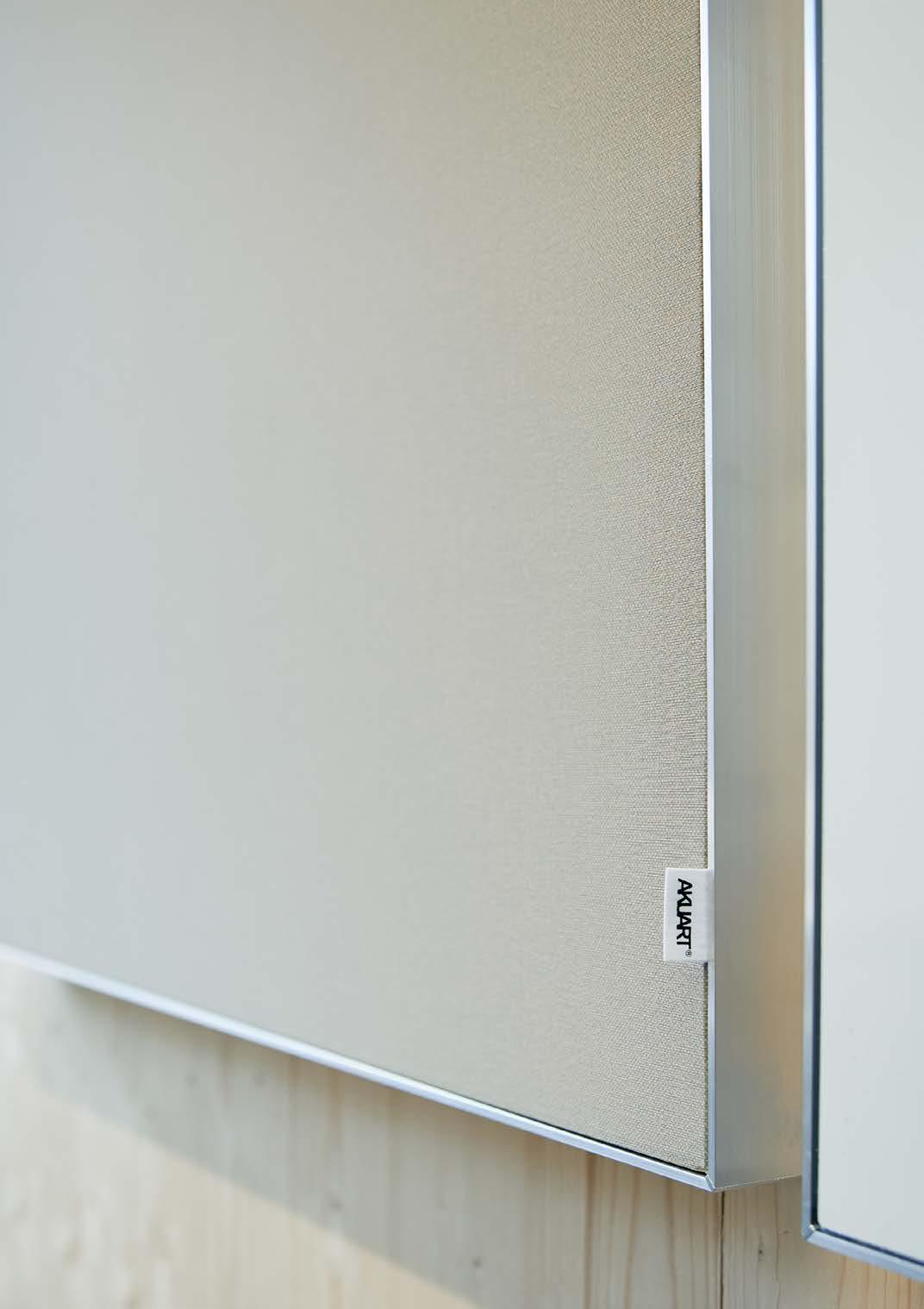
In our Supersonic Collection, circularity is designed in from the start. By ensuring that components are bolt-on and detachable, we make it possible to disassemble for refurbish, repair, or recycle at the end of use. The result is a product that can adapt and evolve rather than be discarded.
Waste Reduction through Made-to-Order
Our products are never mass-produced for stock. Instead, each piece is made to order, ensuring efficient use of resources and minimising waste from overproduction.
Transparency & Documentation
Talking about sustainability is not enough, it must be documented and verified. This is why we publish Environmental Product Declarations (EPDs) in line with EN 15804 and provide full Life Cycle Assessment (LCA) data for the products that account for the majority of our environmental impact.
Facilitating Repair & Renewal
Built to last, our products are designed for easy repair, refresh, and upgrade. We provide practical support for replacing individual components such as canvases, absorbers, or frames, allowing spaces to evolve without replacing the entire product. This approach ensures long-term value, reduces waste, and keeps materials in circulation for as long as possible.
Design Advisory Services
To help clients achieve both acoustic and aesthetic goals, Akuart offers professional guidance throughout the design process. Our team provides acoustic design advice, assistance in selecting materials and colours, and customised solutions for specific architectural contexts. This ensures that every project is tailored to its environment, combining performance, visual harmony, and enduring relevance.
This multi-layered approach ensures that sustainability is not an add-on, but embedded in the DNA of every Akuart product.
Responsible Sourcing
Circular Product Development
Made-To-Order
Transparency & Documentation
Facilitating Repair & Renewal
Design Advisory Services
Circularity as a design principle
Circular design is about enabling products to have more than one lifecycle, designed so they can be repaired, renewed, and recycled. At Akuart, this principle is part of a continuous improvement, where circular thinking drives design decision. We see our products as part of a living cycle, not a linear journey. Instead of being used and discarded, each element is conceived to be maintained, renewed, and ultimately returned to the loop. This is achieved through principles:
DESIGN FOR CIRCULARITY
DESIGN FOR LONGEVITY
DESIGN FOR REPAIRABILITY
DESIGN FOR DISASSEMBLY
Circularity means designing products that never reach an endof-life. By carefully selecting materials and creating systems that support reuse, we ensure that Supersonic panels remain part of the cycle.
01
The most sustainable product is the one that lasts. That is why Supersonic panels are built for endurance in both performance and aesthetics.
02
No product should be discarded because of minor wear or damage. Supersonic panels are designed so that parts can be easily maintained or replaced.
03
Disassembly is the foundation of circularity. If products cannot be taken apart, they cannot be recycled. The Supersonic Collection is designed for easy separation and composed of monomaterials, ensuring efficient recycling.
04
“Circular design is about enabling products to have more than one lifecycle, designed so they can be repaired, renewed, and recycled.”
— Steffen Spangmose, Head of Design & Innovation at Akuart
Closing loops with one of the world’s cleanest aluminium
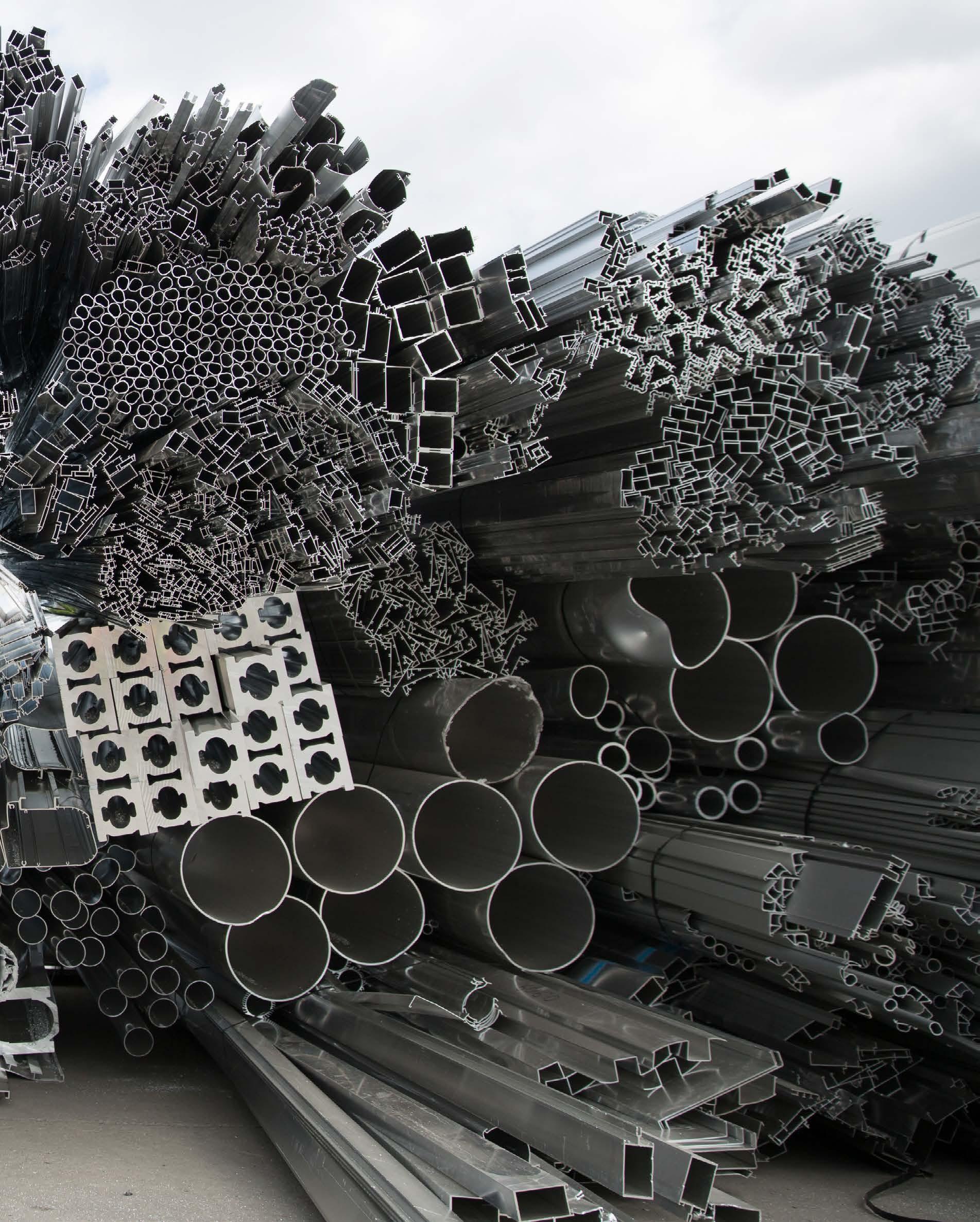
Aluminium is one of the most durable, versatile and recyclable materials available. Yet producing primary (virgin) aluminium remains highly carbon-intensive, accounting for approximately 2% of global CO₂ emissions.[1]
This is why Akuart has chosen Hydro CIRCAL 100R, a revolutionary aluminium made from 100% post-consumer scrap. Every kilogram of CIRCAL 100R comes from material that has already lived one or several lives, such as window frames, façades and other architectural products, and is re-melted into new high-quality aluminium without any loss of properties.[2]
What makes Hydro CIRCAL 100R aluminium extraordinary is its footprint:
• Below 0.5 kg CO₂e per kg aluminium, making it one of the lowest-carbon aluminium products worldwide.[3]
• Up to 97% lower CO₂ emissions compared to the global average of approximately 14.8 kg CO₂e per kg aluminium.[4]
• Third-party verified to EN 15804 + A2 and ISO 14025, ensuring full transparency of composition and environmental performance.[5]
When combined with our redesigned Supersonic frame profile, which uses 22% less aluminium than the previous version,[6] the total embodied carbon reduction becomes even more substantial.
By specifying Hydro CIRCAL 100R aluminium in the Supersonic Wall Panel range, Akuart demonstrates that premium design and verified low-carbon performance can go hand in hand. This combination of a lightweight, resource-efficient frame and 100% post-consumer recycled aluminium significantly lowers the product’s overall environmental impact while maintaining the same level of strength and precision in manufacturing.[7]
0.5 97 15 22
kg CO2e per kg CIRCAL 100R aluminium % lower CO₂ emissions compared to the global average kg CO2e per kg global average aluminium % less aluminium when combined with our new Supersonic frame profile
LCA, EPDs & Carbon
Footprint
In an industry where sustainability is often reduced to buzzwords, claims are easy, but proof is harder. At Akuart, we believe responsibility requires transparency. That is why we invest in comprehensive Life Cycle Assessments (LCAs) and publish thirdparty verified Environmental Product Declarations (EPDs) for the Supersonic Wall Panel range, prepared in accordance with the international standard EN 15804 + A2.
Our LCA calculations are based on these verified EPDs and focus so far on the Supersonic Wall Panel and Wall Panel Artwork, providing an accurate overview of their environmental impact from materials and production to transport and end of life.
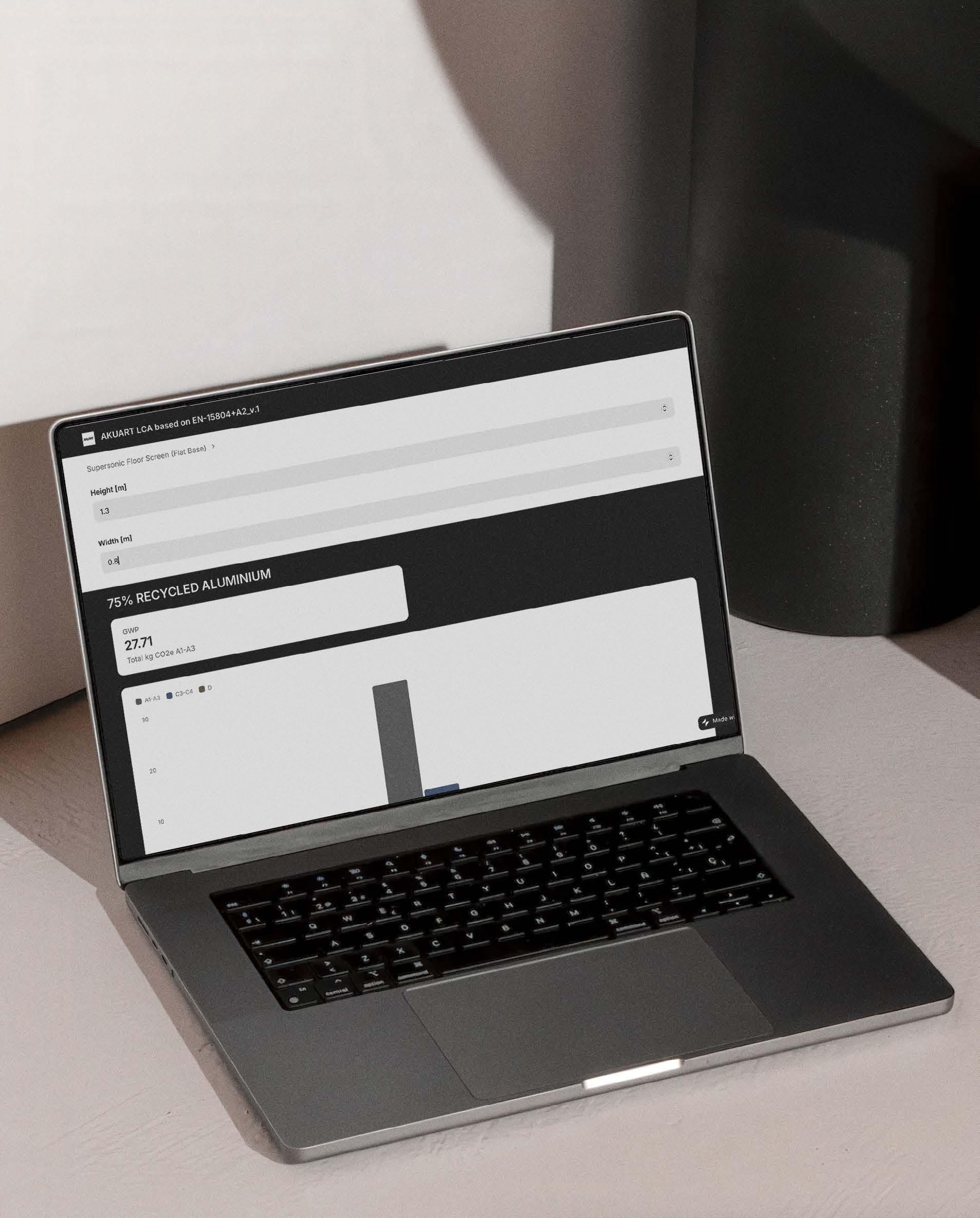
To make this data accessible and project-specific, Akuart has developed an LCA Calculator that allows architects, designers, and clients to evaluate the CO₂e emissions for custom sizes and configurations of Supersonic Wall Panels. By entering simple parameters such as dimensions, frame type (75R or 100R), users receive a detailed carbon footprint calculation based directly on the verified LCA data behind the EPDs.
This digital tool transforms complex life cycle data into actionable insights, enabling project teams to make informed design choices, compare material scenarios, and document reductions in embodied carbon with precision.
Inside our EPDs
Raw Materials & Production Use Stage End-of-Life Beyond Life Cycle
A1 –A3)
B1–B7)
C3 –C4)
D)
The EPDs for the Supersonic Wall Panel range cover all relevant life cycle stages, ensuring the complete environmental profile is documented and transparent.
Cradle to gate (A1–A3)
From raw material extraction to manufacturing. This stage captures the true embodied carbon of the materials we use, including aluminium, PET absorbers and recycled textiles.
Use stage (B1–B7)
Our products do not, under normal use, require any substantial maintenance or service. Their modular and durable construction minimises environmental impact during use and allows for easy updates if visual or functional needs change.
End of life (C3–C4, D)
When a panel reaches the end of its use, each material can enter the correct recycling stream. Because the Supersonic Wall Panel range is designed for disassembly, aluminium, PET and textiles can all be separated, reducing waste and closing loops.
By disclosing data for production, use and end of life, we give stakeholders a complete picture rather than a partial snapshot.
Proof in numbers
Circular materials make a measurable difference.
Example: Supersonic Wall Panel (1000 × 1000 mm)
With a 75R aluminium frame, the panel emits ~9.16 kg CO₂e (A1–A3). With a 100R (Hydro CIRCAL 100R) frame, emissions are ~5.39 kg CO₂e (A1–A3).
Choosing the 100R option reduces the cradle-to-gate footprint by about 41%, thanks to aluminium made from 100% post-consumer scrap. For larger projects such as offices or schools, these savings add up to hundreds or even thousands of kilograms of CO₂e avoided.
The results are based on third-party verified Environmental Product Declarations (EPDs) for the Supersonic Wall Panel range [8]. The calculations are drawn from Akuart’s Life Cycle Assessment (LCA) data [9].
Supersonic Wall Panel 75R
Size: 1000 × 1000 mm
Supersonic Wall Panel 100R
×
“Establishing data benchmarks enables improvement. By publishing EPDs, we make sure that progress in sustainability is real, tangible, and accountable.”
—
Kasper Sanchez Vibæk, Head of Sustainability at Akuart
The VELUX LKR Innovation House
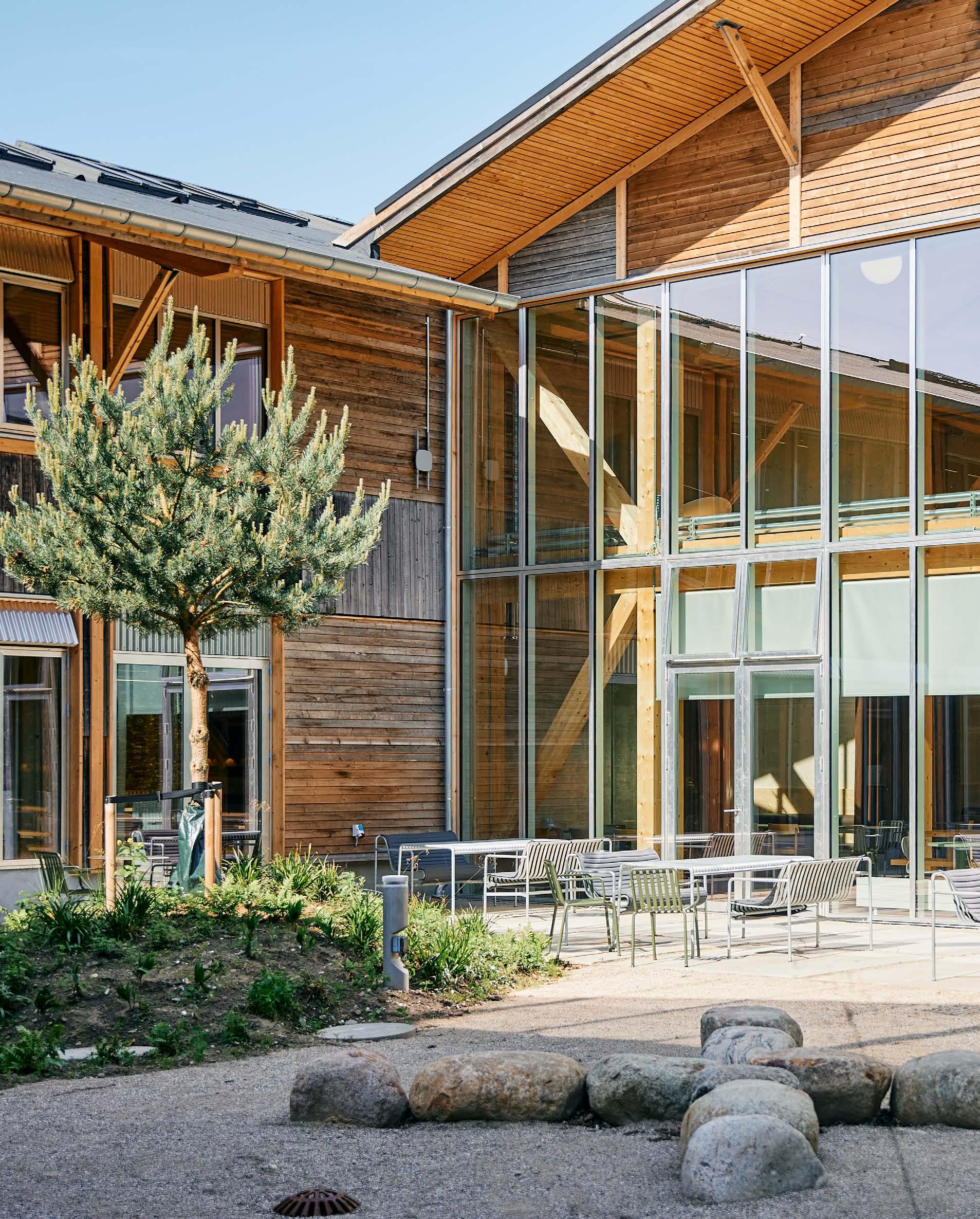
How do you turn a 1990s timber warehouse into a low-carbon workplace for the future? For VELUX, the answer was not demolition, but transformation.
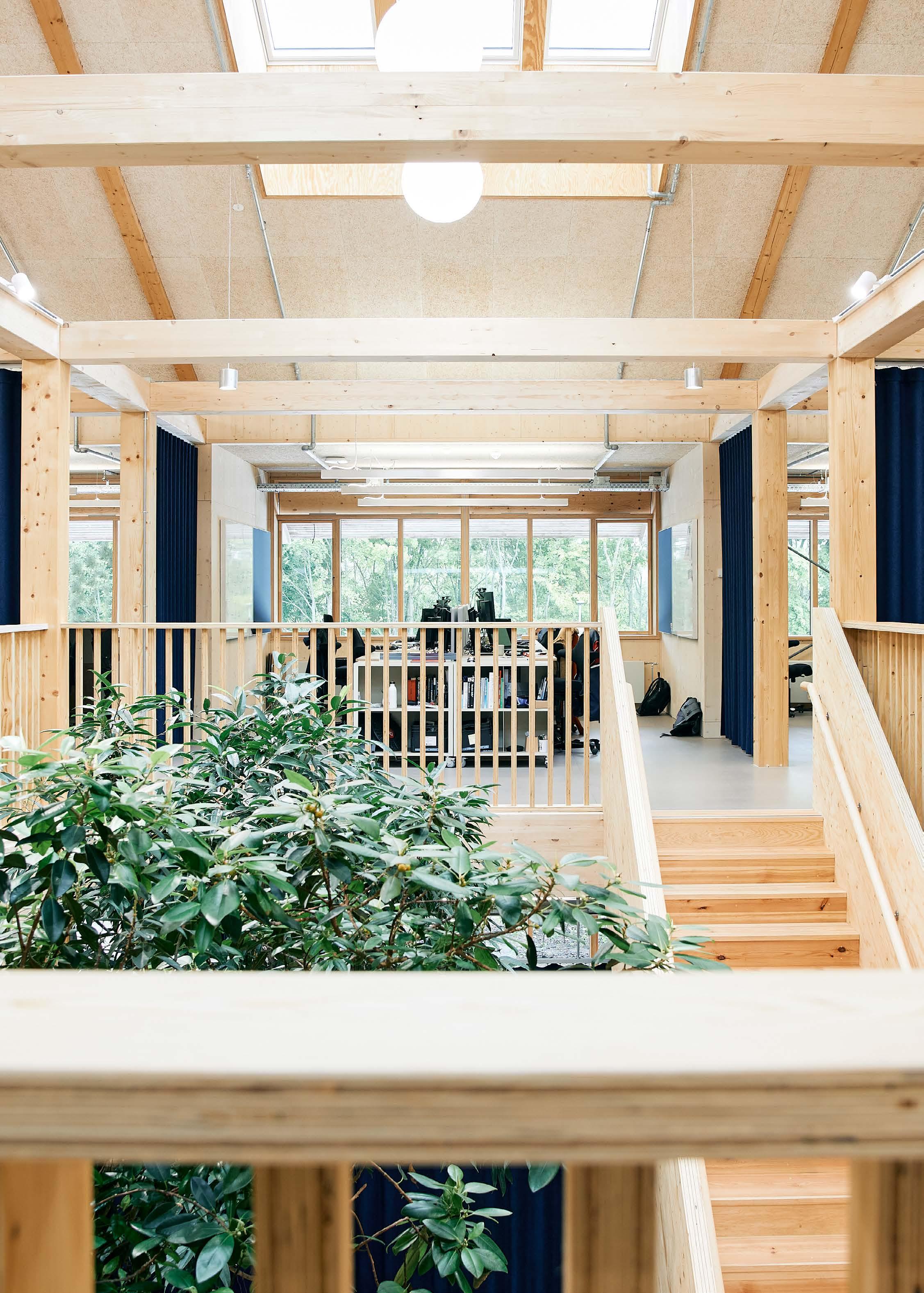
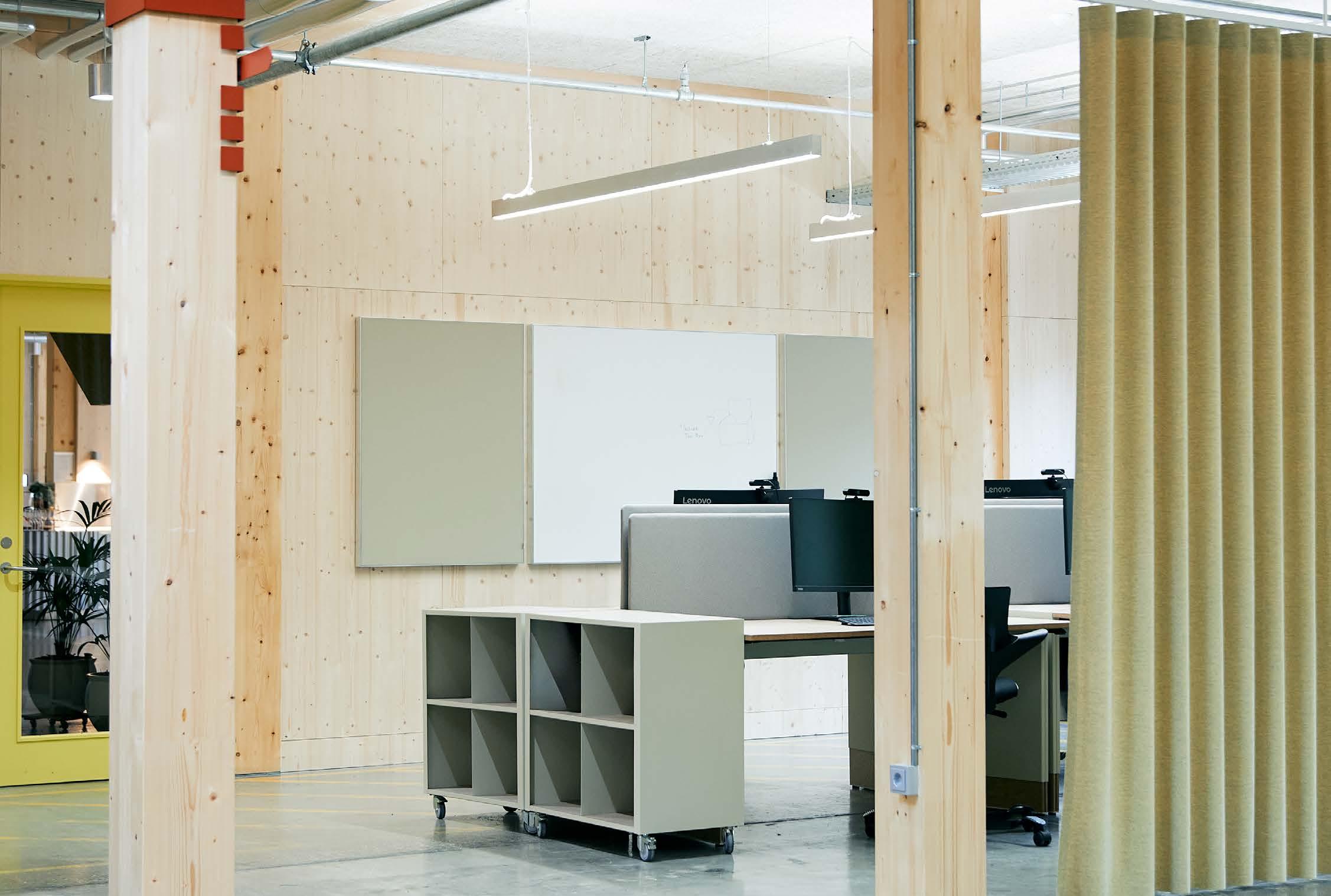
The LKR Innovation House in Østbirk, Denmark, turns the company’s former logistics facility into a bright, timber-led workspace filled with daylight and surrounded by nature. More than half of the original structure, including glue-laminated wood beams, concrete slabs, and the timber façade, was retained, reducing material use and carbon emissions.
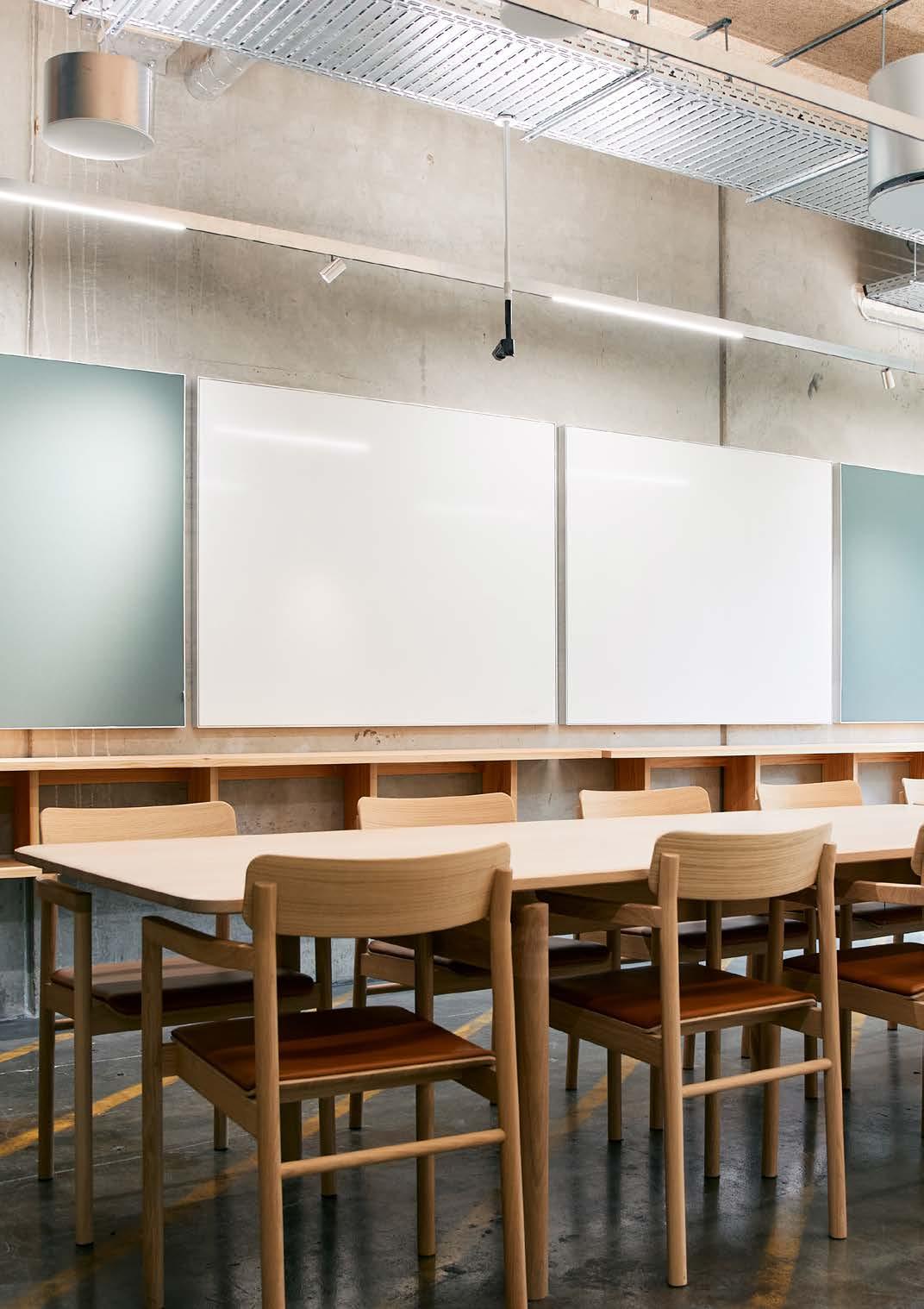
To complement this sustainable approach, Akuart supplied the upgraded Supersonic Wall Panel 100R, along with Writing Boards and Mobile Writing Boards. The panels feature Hydro CIRCAL 100R, aluminium made from 100% post-consumer scrap with a carbon footprint below 0.5 kg CO₂e/kg[10].
By choosing the 100R frame over the standard 75R version, the project achieved measurable savings[11]:
• 1,832 kg CO₂e saved compared to using the 75R aluminium frame[12]
• 17,766 kg CO₂e saved versus global-average aluminium[13]
• ≈41 % lower embodied carbon (A1–A3)[14]
Across an entire workspace, these reductions demonstrate how responsible material choices can lead to substantial, verified climate benefits turning circular design into measurable progress.
Circular acoustics for a circular building
The project’s low carbon footprint was made possible by carefully selected materials and components that embody circular thinking.
• Hydro CIRCAL 100R aluminium, produced entirely from post-consumer scrap with a verified footprint below 0.5 kg CO₂e/kg [10].
• Recycled polyester canvases, 100 % recycled, detachable, washable, and replaceable to extend product life and reduce waste.
• PET absorbers, containing 50 % recycled fibres derived from e.g. post-consumer sources such as plastic bottles.
These material choices work together to minimise embodied carbon, enable disassembly, and ensure that every part can be recovered and re-used within a closed-loop system.
Actual embodied carbon in the products used in the VELUX LKR Innovation House.[11]
≈18.000 kg CO₂e If global average aluminium had been used.[12]
≈512 kg CO₂e (≈2.8% of global)
With Hydro CIRCAL 100R aluminium.[15]
“The fact that the frames are made from Hydro CIRCAL 100R made the choice even clearer. It matched perfectly with our focus on reuse and sustainability.”
—
Kasper Mose, Architect
Evolving circularity, step by step
For Akuart, sustainability is not a box to tick; it is a continuous journey. Circular design principles are already embedded in the Supersonic Wall Panel range, but this is only the beginning. Each project teaches us something new, each partnership pushes us further, and each product update brings us closer to our long-term goal: a fully circular acoustic portfolio.
Our commitments focus on both what we deliver today and where we are heading tomorrow:
Scaling Hydro CIRCAL 100R
We are expanding the use of Hydro CIRCAL 100R, beyond the Supersonic Wall Panel range and into new product families. This will multiply the carbon reductions already achieved in projects such as the VELUX LKR Innovation House.
Take-back & Reuse Systems
We are developing take-back models that will give our products a continued life, even when they are no longer needed in their original setting. By recovering and reusing frames, canvases, and absorbers, we keep materials in circulation, extend product lifetimes, and reduce the need for virgin resources.
Transparency
Transparency builds trust. As our portfolio evolves, we will continue to publish new Environmental Product Declarations (EPDs) and expand life cycle data coverage across product categories. Our aim is to make sustainability decisions measurable, comparable, and verifiable for all clients.
Reducing Waste & Optimising Processes
We constantly refine our production and logistics to minimise material waste, streamline deliveries, and improve energy efficiency. Collaboration with suppliers is key, as working together allows us to identify new ways to cut emissions and create smarter, more efficient solutions across the value chain.
Global Commitments
Akuart aligns its practices with recognised international standards for environmental, social, and ethical responsibility. The principles of the UN Global Compact serve as an important framework for how we approach sustainability, not only in our products but also in the way we operate as a business.
Building sustainable spaces through collaboration
The path to circularity is long, and we do not claim to have all the answers. But by combining innovative materials, responsible design, and transparent reporting, we are steadily building an acoustic portfolio that is as sustainable as it is functional. For us, the journey matters as much as the destination, because every step we take helps shape more sustainable spaces of tomorrow.
Every material choice shapes a building’s footprint. Specifying Hydro CIRCAL 100R aluminium instead of global-average aluminium can reduce CO₂ emissions by more than 97 %[10]. Choosing exchangeable canvases allows for easy replacement and reuse, extending the life of installations and reducing waste. Selecting verified products with published EPDs supports certifications such as DGNB, LEED, and BREEAM, while providing transparent data for sustainability documentation.
We invite architects, designers, and project planners to collaborate with us in advancing circular acoustics. Together, we can design spaces that sound better, perform better, and contribute meaningfully to a more responsible built environment.
Akuart CPH Showroom
Sundkaj 163
2150 Nordhavn
+45 27 50 82 90
Akuart Aarhus Showroom
Balticagade 15D
8000 Aarhus
+45 27 50 82 90
Website: www.akuart.com
Email: info@akuart.com
Foot notes
1] International Aluminium Institute (IAI), “Aluminium Sector Greenhouse Gas Pathways to 2050,” 2023. The report estimates that primary aluminium production accounts for approximately 2% of global CO₂ emissions.
[2] Hydro, “Hydro CIRCAL 100R: The World’s First 100% Post-Consumer Aluminium,” product documentation and Environmental Product Declaration (EPD no. NEPD4265-3531-EN), certified by DNV (Det Norske Veritas), 2023.
[3] EPD for Hydro CIRCAL 100R Aluminium Extrusions, EPD no. NEPD-4265-3531EN, issued by Hydro Extrusion Norway and certified by DNV (Det Norske Veritas), valid until 2028.
[4] International Aluminium Institute (IAI), Global Aluminium Carbon Footprint Data 2023, reporting an average of 16.7 kg CO₂e per kg primary aluminium.
[5] Verification standards: EN 15804 + A2 (Sustainability of Construction Works) and ISO 14025 (Type III Environmental Declarations).
[6] Based on internal engineering data for the redesigned Supersonic frame profile developed by Akuart, demonstrating a 22% reduction in aluminium use compared to the previous generation frame (2024).
[7] Hydro CIRCAL 100R Aluminium Extrusions, EPD no. NEPD-4265-3531-EN, certified by DNV (Det Norske Veritas). Verified in accordance with EN 15804 + A2 and ISO 14025.
[8] EPDs for the Supersonic Wall Panel range, prepared in accordance with EN 15804 +A2, system boundary A1–A3.
[9] Life Cycle Assessment data verified by EPD HUB / Magaly González Vázquez, as an authorized verifier acting for EPD Hub Limited.
[11] The CO₂e savings refer exclusively to the aluminium material across the delivered products. The percentage reduction figure applies to the Supersonic Wall Panel version only, as we do not yet have corresponding LCA values for other product types.
[12] Akuart. Internal LCA Calculator (based on verified EPD data for Supersonic Wall Panel, EN 15804 +A2).
[13] World Aluminium. Life Cycle Inventory Data. 2023.
[14] Akuart / Acoustic Facts. LCA Calculator for Supersonic Wall Panel. Calculated cradle-to-gate (A1–A3) for 100R vs 75R. Available at https://akuart.link/LCA-Calc.
[15] Based on cradle-to-gate (A1–A3) calculations for the aluminium used in the VELUX Innovation House project. Emissions equal ≈512 kg CO₂e with Hydro CIRCAL 100R, about 2.8 % of the ≈18,278 kg CO₂e from global-average primary aluminium.
Data: Akuart LCA Calculator (EPD verified, EN 15804 +A2) and World Aluminium, 2023.