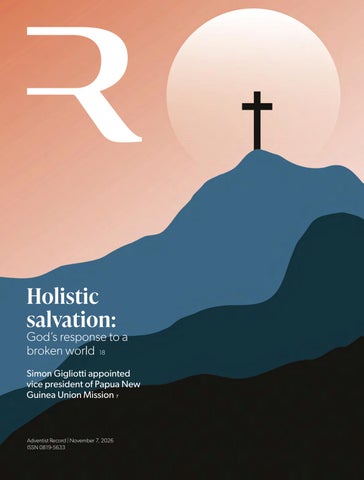
Holistic salvation:
God’s response to a broken world 18 Simon Gigliotti appointed vice president of Papua New Guinea Union Mission 7
Adventist Record | November 7, 2026 ISSN 0819-5633
EDITOR’S NOTE:
The shame and the anger Jesse Herford Editor
Rather than solving our problems in the future, worry too often steals our peace in the present.
“La hont et la colère”—“the shame and the anger”. Those were the recent words on the front page of French newspaper Le Figaro at the shocking riots happening across France. Smashing, looting and vandalism has engulfed France over the past few months, but that’s only one part of the puzzle. The price of fuel globally has gone through the roof, thanks to a war in the Middle East whose origins and future resolution are unclear. The war in Ukraine rages on. Israel is still dropping bombs on Gazan children, with the true fate of many of the hostages taken by Hamas remaining unknown. Closer to home, the Australian Bureau of Statistics recently revealed that, taking inflation into account, Australian wages are back where they were in 2011. Emigration out of New Zealand recently hit the highest it’s been in 13 years. A recent report found that Pacific nations spend between 10 and 25 per cent of their GDP on fossil fuel imports, which is more than the (on average) 8 per cent they spend on education and the 6 per cent they spend on healthcare. No matter where you are in the Pacific, unless you sit at the very top end of the tax bracket, you are feeling the pinch and the unrest that comes from it. The question is, what can be done about it? Some point to the economy: fix that, and all the other problems will go away. Certainly, if that happened, it would solve many material problems. But would it fix the systemic issues our world presently faces? I’m not so sure. As pressing as our current cultural moment may be, the reality is, humanity is sick with a disease that can’t be cured by a bigger bank balance. Faced with that reality, we can either give in to nihilism, or we can take Jesus’ perspective. In Jesus’ Sermon on the Mount, He famously tells His hearers not to “worry about your life, what you will eat or drink; or about your body, what you will wear . . . Look at the birds of the air; they do not sow or reap or store away in barns, and yet your heavenly Father feeds them. Are you not much more valuable than they?” (Matthew 6:25,26) First, Jesus challenges His listeners’ perspective on worry. The word He uses is merimnaó, which means “concerned, worried, anxious”. Concern can be good, especially when it comes to things we can control, but too often we worry about things we can’t control—the weather, other people or just the future in general. Rather than solving our problems in the future, worry too often steals our peace in the present. Second, Jesus is dissuading us from slipping into cynical nihilism. Jesus tells His listeners to first consider the birds of the air, then the flowers of the field; objects of beauty that do nothing to sustain themselves outside the behavioural patterns their Creator has set for them. “Are you not much more valuable than they?”Jesus defines anxiety and fear as unnatural and that the natural posture humans were created for is that of trust—trust that God will provide what we need, because of how valuable we are to Him. As Christians, we should be concerned for the world. We should care about inequity, injustice and greed. All these are symptoms of a world desperate for the day when “the haughty looks of man shall be brought low, and the lofty pride of men shall be humbled, and the Lord alone will be exalted” (Isaiah 2:11). Concern for our fellow humans and our world should motivate us to advocate for those without voice and hold to account those who use their power for selfish means. But the biblical perspective also is a reminder that there is more to this world than this world—that there is a day coming when all will be made right and, ultimately, justice belongs to God. “Therefore, do not worry about tomorrow, for tomorrow will worry about itself. Each day has enough trouble of its own” (6:34).
November 7, 2026 | Adventist Record
3
INSIGHT:
The “new humanity” Brendan Pratt Australian Union Conference president
4
Adventist Record | November 7, 2026
In an increasingly anxious and individualised culture, a shift is happening. We are collectively realising that the answers to our biggest questions are not being delivered through economics, technology or politics. Australia is becoming increasingly spiritual, albeit in a self-constructed way and, in response to our loneliness epidemic, people are seeking meaning-making community. If there was ever a time for our Church to reveal Jesus as the hope for humanity, it’s now. If there was ever a time for the Church to embrace and model meaning-making community, it’s now. OneVoice27 and Australia for Christ 28 are not just slogans to rally us towards outward mission. They are calls for our church family to embody and reveal a beautiful picture of God—a God whose love stirs, compels and overflows in communities of hope. The apostle Paul, in his letter to the Ephesians, outlines the difference the gospel makes, including how it shapes us to be “made alive in Christ”—a “new humanity” (Ephesians 2:15). Paul describes this new community as one where the gospel changes everything. In an increasingly fractured, polarised Australia, where social media can divide and monetise anger, what would it look like for the Seventh-day Adventist Church to model a “better humanity”? Ephesians 4 describes a loving, kind and forgiving community. In this “new community”, the distinctions that divide us are swallowed up in Christ-centred relationships. What would it look like for our congregations, schools, aged-care facilities and various ministries to be communities of hope, shining light into the broken parts of our culture? On a more personal level, what does it look like for you to make space for God to work in and through you, making you an agent of hope in your sphere of influence? Do your neighbourhood, workplace and digital networks see a beautiful picture of God reflected through you? As we focus on OneVoice in 2027 and Australia for Christ in 2028, may we be communities of hope that point people to a loving God. May we model the better humanity to our community and our nation. May your community and your nation be blessed through God’s “new community”.
Statue honours a lifetime of service to Canberra’s vulnerable Canberra, ACT | Tracey Bridcutt
Stasia Dabrowski, the “soup kitchen lady”. [Credit: National Portrait Gallery]
Titled “Hello my Wonderful”—Mrs Dabrowski’s customary greeting—the statue was unveiled on August 7.
A Seventh-day Adventist who spent nearly four decades feeding and caring for people in need has been honoured with a life-size sculpture in Canberra, Australia. The late Stasia Dabrowski OAM, a long-time member of South Canberra Seventh-day Adventist Church, is among significant Canberra women recognised through an Australian Capital Territory government public art initiative. Titled “Hello my Wonderful”—Mrs Dabrowski’s customary greeting— the statue was unveiled on August 7 and acknowledges her decades of selfless service. Known as Canberra’s “Soup Kitchen Lady”, Mrs Dabrowski became a regular fixture in Garema Place, serving homemade vegetable soup, bread and drinks to people in need each week. By 2000, she was providing several hundred loaves of bread and at least 100 litres of homemade vegetable soup, feeding more than 300 people each Friday night. But her service extended beyond providing food. She became known for offering hugs and friendship to people who were often overlooked by others. Long-time church friend Philippa Burley said Mrs Dabrowski started the soup kitchen because of her genuine love for people on the street. “She did it all by herself initially,” said Mrs Burley. “The government much later on used to help financially, but Stasia used to do it by herself. She’d make the soup, she’d get all the cups, she’d hug people on the street—she was just wonderful.” Mrs Dabrowski babysat and cleaned houses to earn money to buy ingredients for the soup kitchen. She also collected leftover bread from bakeries and vegetables from grocery stores. On Thursdays, she would peel
and cook around 180 kilograms of vegetables in preparation for the following night. Mrs Burley said her friend’s Christian faith was evident in the way she treated people. “She really cared for people that nobody else cared for. When AIDs first hit, she would never stop hugging people. She didn’t care. She just showed them love.” Mrs Burley also remembered Mrs Dabrowski as a strong and determined woman whose life had been shaped by difficult experiences growing up in Poland during World War II. “I used to go over there every Sabbath and she’d tell me the most incredible stories of what she went through in Poland,” she said. “I don’t know how she survived, but she did. “She had a very strong personality. She was a very determined lady.” Mrs Dabrowski’s community service received widespread recognition. She was named Canberra Citizen of the Year in 1996, was awarded the Medal of the Order of Australia in 1988 and received the inaugural ACT Senior Australian of the Year award in 1999. Despite the recognition, Mrs Dabrowski remained modest about her contribution. She continued her work until the age of 92 and died in 2020, aged 94. Australian Capital Territory Minister for Arts, Creative Industries and the Night-Time Economy Michael Pettersson said the sculpture recognises the values Mrs Dabrowski demonstrated through her years of service. “By immortalising Stasia in one of our city’s most important public spaces, we affirm that her compassion and generosity are the values we want to see in our community,” he said.
November 7, 2026 | Adventist Record
5
Churches equipped to nurture new members Honiara, Solomon Islands | Juliana Muniz/Obed Yamasombi
The training took place across four locations in Solomon Islands.
Church leaders and members across the Solomon Islands have been equipped with practical skills to nurture and retain new members following the Trans Pacific for Christ evangelistic campaign. Held from September 4 to 19 across four locations, the training focused on strengthening discipleship, supporting newly baptised members and encouraging their ongoing involvement in church life. The initiative was organised by the Trans Pacific Union Mission Sabbath school, personal ministries and discipleship departments in partnership with the South Pacific Division (SPD), Solomon Islands Mission and Eastern Highlands Simbu Mission (EHSM) in Papua New Guinea. SPD Sabbath school, personal ministries and discipleship director
Pastor Obed Yamasombi said retaining new members is “one of the greatest challenges facing the Church today”. “As new members join the Church, we must provide opportunities for spiritual growth, fellowship, service and practical Christian living,” he emphasised. Workshops on Sabbath school, personal ministries and discipleship explored ways to strengthen Sabbath school as a setting for Bible study, fellowship and ongoing support for new members, while encouraging greater participation in personal ministries and community outreach. Practical life skills sessions led by Pastor Joanis Fezamo from EHSM taught rice and wheat farming, food processing and book mending, aiming to build skills that promote self-reliance and support local ministry.
Live More Happy refreshed for a new decade Melbourne, Vic | Nathan Brown
Author Dr Darren Morton.
6
Adventist Record | November 7, 2026
The updated edition of Live More Happy was launched with author Dr Darren Morton at the ELIA Wellness Summit in Melbourne on October 16. “The new edition includes a substantial amount of updated research from the past decade,” explained Dr Morton. “Interestingly, the overall structure and key messages of the book haven’t needed to change significantly because the latest science has largely reinforced what was presented in the original edition.” Dr Morton is director of the Lifestyle Medicine and Health Research Centre at Avondale University and a certified diplomate of the International Board of Lifestyle Medicine. He has become a global leader in lifestyle medicine research and communication, with international opportunities including delivering the closing keynote presentation at the American College of Lifestyle Medicine conference in 2025. Dr Morton has also presented his work in the form of The Lift Project, which has seen more than 60,000 people complete the wellbeing
program globally. He said this experience has also shaped some of the updates to the new edition of his book. “One of the great lessons from The Lift Project over the past decade is that knowing what to do and actually doing it are two very different things,” he said. “So one thing I think distinguishes Live More Happy is that it doesn’t just explain what to do; it also explains why it works. I think understanding the science can be very motivating. But even when people understand the what and the why, following through can still be difficult.” He said this is why each chapter of his book has challenges for readers to apply what they have learnt in their own lives. “I’ve always been touched by stories of people giving Live More Happy to others—to friends and family members, and sometimes even to acquaintances they simply felt might benefit from it,” Dr Morton said. Live More Happy (Updated Edition) is available now from Adventist bookshops in Australia and New Zealand.
making headlines Stories to share The GC has launched two Alive in Jesus Mission Edition children’s books which adapt Bible stories to help families unfamiliar with Christianity discover Jesus. Designed for easy sharing, the books include QR codes which link to more stories and resources, aimed at helping church members start conversations about faith and connect families with local congregations.—ANN Pastor Simon Gigliotti.
Vice president appointed for PNGUM Port Moresby, PNG | Juliana Muniz
Northern Australian Conference (NAC) president Pastor Simon Gigliotti has been appointed Papua New Guinea Union Mission (PNGUM) vice president. PNGUM president Pastor Danny Philip welcomed the appointment, highlighting Pastor Gigliotti’s leadership experience and work with Indigenous Australian communities. “As the Union embarks on strengthening leadership development, governance, accountability and effective administration across all aspects of our Church systems and institutions, his experience will add considerable value to our ongoing efforts to build a stronger, more mission-focused Church,” he said. Pastor Philip also emphasised the opportunity for Pastor Gigliotti to learn from PNG’s cultural diversity and faith communities. “I believe this will be a mutually enriching experience,” he said. Pastor Gigliotti began his denominational service in 2009 as a chaplain in Queensland. He later served as assistant youth director for the Victorian Conference and youth director for the Greater Sydney Conference, before becoming NAC president in 2023. His appointment is part of a broader South Pacific Division (SPD) initiative to provide church leaders with opportunities to gain experience working in different cultural contexts. “The SPD is diverse culturally. This diversity can be a blessing if we embrace and understand it,” said SPD president Pastor Glenn Townend. He explained that the initiative aims to develop leaders who can work across cultures while learning from the communities they serve. Pastor Gigliotti is the second cross-union appointment under the initiative. Pastor Clive Tefaatau, originally from French Polynesia, was appointed vice president of the Trans Pacific Union Mission in April. Pastor Townend said the Australian and New Zealand Pacific union conferences are also working towards appointing at least one associate officer from another union by early 2027. Pastor Gigliotti will conclude his service at NAC at the end of November before moving to PNG with his wife, Brittany, and their three children. He will commence his new role in January 2027. Announcing his appointment on social media, Pastor Gigliotti said he had accepted the call with “mixed feelings” after enjoying his time leading NAC. “We are excited to follow God’s leading,” he wrote.
Messages that matter In Angola, Vicente Mendes da Silva uses a basic button phone and buys a three-day mobile data bundle for 150 kwanzas ($A0.23), making sure none of it goes to waste by sending prayerfully written messages to his contacts. His simple practice has led people facing difficult moments to seek him out for prayer and encouragement, showing that digital ministry can be as simple as a basic phone and a willingness to reach out.—SID
More than a run An Adventist church in Indonesia organised a fun run that attracted more than 1300 participants. The event opened with prayer and a devotional and helped build connections with the local community, including 432 participants with no church affiliation.—Hope Channel
Snake personalities Researchers at Loma Linda University (US) found that rattlesnakes displayed consistent individual “personalities” in how often they bit and how much venom they released when defending themselves. The findings indicate that snakes have distinct behavioural traits, showing the complexity of God’s creation.—Loma Linda Health November 7, 2026 | Adventist Record
7
flashpoint
Helping neighbours Ordained to ministry Pastor Ravosamana Hughes was ordained at Nailaga Adventist Church in Fiji after eight years of pastoral service. Attending the service were Fiji Mission representatives, including president Pastor Epeli Saukuru, who delivered the ordination charge, secretary Pastor Senitiki Waqa and ministerial secretary Pastor Leone Tubuna. Trans Pacific Union Mission vice president Pastor Clive Tefaatau presented the main message, outlining three principles of pastoral ministry: loving Jesus, caring for others and remaining faithful to His calling. He also encouraged church members to “remain close to Jesus, serve with love and humility, and support their pastor and his family”.—Juliana Muniz
8
Members of Arue church in French Polynesia joined forces to improve the homes of two local residents during a community service initiative. Led by community outreach coordinator Claudette Tavae, volunteers cleared overgrown vegetation, trimmed trees and tidied the yard of a local resident, allowing more sunlight and fresh air to reach his home. The team also visited another home, replacing roofing sheets and collecting rubbish around the property. The initiative was supported by the local Mission’s Community Services Department.—Juliana Muniz
Playing their part
Age is no barrier
A concert at Lilydale Seventh-day Adventist Church in Melbourne (Vic) on September 12 raised more than $A8000 to help local Pathfinders attend next year’s Australian camporee. Organised by the church’s worship ministries team, the event aimed to strengthen connections with the wider community by welcoming neighbours and visitors. The concert featured orchestral and choral performances, with musical resources provided by Avondale University’s Institute of Worship. Senior pastor Faye StothersKhan said the event marked the beginning of an annual concert series aimed at supporting community initiatives and bringing people together through music. “This allows the wider community to look forward to highquality sacred music events at our church,” she said.—Bruce Manners
More than 250 Pathfinders from the Bisiatabu district in Papua New Guinea took part in a literature evangelism outreach for World Pathfinder Day, distributing more than 450 books across communities in the Sogeri area on September 19. Organisers
Adventist Record | November 7, 2026
said the activity was designed to show younger church members that age does not prevent them from participating in mission.—Crawford David
E
Vanuatu service trip impacts Christchurch students
very year, Christchurch Adventist School offers an overseas service trip for our year 13 students. This year we had 16 (of a class of 20) students put up their hands for an adventure of 11 days of serving. We partnered with Harold and Sarai Stephens who live in Vanuatu (Sarai was a teacher at our Adventist high schools in Christchurch and Auckland who recently moved back to Vanuatu). They were able to secure a project at Matevulu College—the largest public high school on the island of Santo. It is a boarding school for 600 senior high school students (years 11-13) from all over Vanuatu. It is situated on a hill overlooking the ocean, 30 minutes north of Luganville. The school was built in 1982, but has fallen into a serious state of disrepair due to a lack of funding. Principal Henry Was, was grateful for our offer of help and asked us to work on repairs and painting on the biggest building on campus—their dining hall—used for assemblies, dining, worships and prizegiving. The project was requested because of the high use of this key building on campus and the impact it would have for students. Our team repainted all the walls inside and out, made new frames for the windows, replaced the louvres and glass panes for the windows, put up wire mesh across the windows for protection and repainted a feature mural at the main outside end of the hall. A team of local helpers stayed at the school for another five days after our team’s departure to ensure the project was completed. Rafa, the head prefect of the team that helped us, said, “Buildings can be restored in a week, but lives are shaped by a lifetime of service. The paint on these walls may fade one day, but the impact you’ve had on us never will.” Our students were incredible in their willingness to serve in this setting. As students, they are always curious about how other schools operate and it was interesting for them to be based at a major school in Vanuatu. Some had been apprehensive about the trip beforehand but many
shared that it had helped them conquer or face their fears. They saw God navigate through every challenge and bring them through safely (and usually landing them in a better place than the original plan). Their willingness to trust God helped them fully engage positively with everything offered on the trip. Many who hadn’t done so before stood up to share and sing at a church service and a special concert. The team was requested to sing at a morgue for the family of a pastor who had died during the trip. They didn’t hesitate to accept the invitation and offer comfort through song in a very challenging setting. But throughout the trip, they stayed positive and remained focused on serving and growing their capacity to help others and supporting one another. One student, Ahava, said, “We went thinking we had humility to serve but left utterly humbled by the way we had been served. People had hearts full of generosity and love for those they had never met before.” Our staff and students have been so grateful for the support of many entities who helped make this year’s trip possible. ADRA NZ were able to give us funds from Sanitarium NZ, which provided the project materials. Adventist Volunteer Service provided free travel insurance, which was a major help in keeping our trip costs down and providing much-needed support. We were also blown away by the support from our families and school community. We hope to continue growing this new relationship with Matevulu College and return in the next few years. These trips can only happen with the help of so many people and entities. But the results remain clear—young people truly make a difference when given a chance to go with Jesus and step outside of their comfort zones to serve others. Lance Boulton Christchurch Adventist School chaplain
November 7, 2026 | Adventist Record
9
Using AI in the Seventh-day Adventist Church in Australia: A response
The following is a response to the open letter in the October 31 issue of Adventist Record by Mitchell Strahan, regarding the use of AI in the Seventh-day Adventist Church in Australia. Dear Mitchell, It was nice to chat with you briefly at Big Camp—one of the great blessings of Big Camp is the random catch-ups that build community. Thank you for your open letter regarding the use of AI in our Church in Australia. As you point out, in wider culture and in the life of the Church, AI use is increasingly being embraced. I saw some of the examples you refer to. I agree we need to guard against a use of AI that generates quick content but may undermine authenticity, trust and ultimately engagement in the Church from the public. While I agree that we run the risk, especially among
10 Adventist Record | November 7, 2026
younger generations, of overt AI use being a negative, there are also upsides when it is used well. I agree with the challenges you outline in view of creativity and work and how we might be negating giftedness. At the same time, there are places where a message can be more effectively communicated or ministries enhanced by AI. For example, when cleverly used by a gifted person, design is enhanced without the overt AI “feel” you refer to or where translation tools allow wider engagement. You are right that study, writing and preparation “shapes the person doing it”. A leader who wrestles with a text when crafting a presentation is also changed by the wrestling. If we outsource that work, we may gain speed and lose depth, and it is depth that is desperately needed in a consumer culture that increasingly skims life as well as each other. I agree that the church is a body that includes gifted designers, writers, story tellers, artists, photographers,
musicians and more. If we simply default to AI generated content, we risk undervaluing creative parts of our church body. We must then ask the questions, “Can AI be used to strengthen giftedness without replacing it?” And, “What does it look like to value the process of human creativity over the ease and speed with which AI produces content?” As you point out, we must be informed by biblical principles and Adventist heritage as we work within the changing context of AI. Our responses must be shaped around guidelines that enhance stewardship, creativity, mission and pastoral care over reliance on quick answers and material that can negate the work of the Spirit. Our Adventist heritage provides a useful guide. As a church, we embraced the printing press, then radio, television, satellite and the internet. We recognised the opportunities and shortcomings in technology in a way that was engaged but not uncritical. We embraced, yet resisted, technology where needed. Technology has been seen as a tool that can both enhance—yet also undermine—the mission of our Church. We need to filter AI through the same lens. How might AI enhance what it means to be the church? What might it destroy? Can AI make administrative processes more efficient so that a local pastor has more capacity for pastoral leadership? Where can AI be used to create tools for mission, eg, the ability to easily translate languages? As a Church system, we are working through the seemingly ever-changing challenges and opportunities of AI. Our administrators’ gatherings include a focus on AI and implications for our Church. At our recent business professionals gathering, AI was a theme explored through various windows. Adventist Technology are very aware of the privacy and data challenges and are continually working across our Church system to guard against and mitigate challenges. Our ministerial association is acutely aware of the benefits and challenges of AI for our pastors, chaplains and elders. They continue to work on AI guidance, including implementing guidelines, resourcing and training, so that our team filters AI usage with a view to grow the ingredients of a healthy ministry, informed by AI but not reliant on or subservient to it in unhealthy ways. Our educators prayerfully work through what AI means for the mission of our schools. As you point out, OneVoice27 includes a focus on digital content and we are working toward what it looks like to use AI in constructive ways rather than simply adding AI noise that disengages. The bigger AI challenges for our Church may perhaps be around the workforce changes that are already underway. How might AI take on roles across our system and how will these changes impact our Church employees and the communities we serve within? Open AI CEO Sam Altman points out a possible dystopian future if we lose the primacy of humanity in the AI shift.1 Altman outlines if we get the AI settings wrong, we
could end up in a culture where “you’re going to get a cure for cancer, you’re going to have material abundance, but you will have no freedom, you will have no agency, it will be a perfect surveillance state . . . you’re going to get great comfort, but there will be nothing left in the world for you to really do. Nothing that really matters.” The type of future Altman outlines as possible feeds anxiety across our culture. Yet, this very “anxiety” can be a catalyst for mission as the Church models what it is to be a non-anxious presence in the world. In the face of a “nothing that really matters” culture, the Jesus story always matters. Embracing biblical community is vital in a world that undermines it. The Church’s core functions of growing, serving, connecting, sharing and worshipping are even more critical in an otherwise-dystopian context. In view of next steps, holding back the “tide” of AI use, moratorium style, is not an option where our Church system works against hierarchical control. However, increasing resourcing and guidance around the use of AI is essential and a challenge across all levels of the Church organisation. I support your call for a Church-wide conversation and a guiding framework. We are working on this very thing. Rather than a blanket prohibition, we are developing clear, practical guidelines for AI use, including the role of the human in the generation of material and where AI should be avoided. We are increasing training and resourcing around AI as, I agree, that investing in people is the best answer to the temptation of the shortcut. The gospel works through relationships and no tool can really do the work of a person who has been changed by Christ and then shares Him. If AI can help in this process, then great. If AI undermines relationships and human value, then we need to put in place strategies to negate these negative effects. Thank you for your contribution in this conversation. I look forward to continuing it with you and our church family as we inspire, empower and equip for thriving communities of hope. 1. William Elliot, “No freedom: OpenAI boss Sam Altman sparks frenzy after dystopian prediction”,<news.com.au>, Technology, August 2, 2026.
PS. This reply to your letter is not generated by AI. God bless in your ministry, Dr Brendan Pratt Australian Union Conference president
If you have any thoughts on the Church’s use of AI, we want to hear. Write to us at <editor@record.net.au>.
November 7, 2026 | Adventist Record
11
Compassion noun: σπλαγχνίζομαι | splanchnizomai [splangkh-nid’-zom-ahee] Greek presented by Fulton Adventist University College
S
planchnizomai (σπλαγχνίζομαι) is one of the New Testament’s most vivid words for compassion. In Luke 10:33, Jesus says that a Samaritan saw a wounded traveller and “had compassion”. Derived from a Greek word for the inner organs—regarded as the seat of deep emotion—it describes compassion felt so profoundly that it moves a person to act. Jesus used this word in answer to a lawyer who asked, “And who is my neighbour?” (Luke 10:29*). His parable begins with a traveller attacked by robbers, stripped, beaten and abandoned beside the road. A priest saw him and passed by. A Levite also saw him and passed by. Both recognised suffering, but neither crossed the distance between observation and assistance. Then came the least expected helper—a Samaritan. Deep religious and ethnic hostility separated Jews and Samaritans. Yet when the Samaritan saw the injured man, he was moved with splanchnizomai. His compassion crossed both the road and a cultural boundary. He treated the wounds, placed the man on his own animal, carried him to an inn and paid for his continuing care (verses 34, 35). Biblical compassion gives time, accepts inconvenience, expends resources and draws near to suffering. Luke uses splanchnizomai in two other memorable scenes. When Jesus saw the widow of Nain walking behind the bier of her only son, “He had compassion on her” and restored the young man to life (Luke 7:13–15). In Jesus’ parable of the lost son, the waiting father saw his returning child from a distance, “had compassion, and ran and fell on his neck and kissed him” (Luke 15:20). Together, these scenes reveal divine compassion. Jesus approaches the grieving widow. The father runs towards his returning son. The Samaritan crosses the road towards the wounded traveller. Splanchnizomai moves in the direction of need. This is also the movement of the gospel. God did not observe humanity’s suffering from a safe distance. In Jesus Christ, He entered our wounded world, bore our sins and opened the way home. “But God demonstrates His own love toward us, in that while we were still sinners, Christ died for us” (Romans 5:8). At the cross, divine compassion did not merely feel our pain; it acted to save us. I experienced a small but unforgettable picture of such compassion in July 2025. My wife and I, members
12 Adventist Record | November 7, 2026
of Fulton’s Theology faculty, were attending the General Conference Session in St Louis, Missouri. After the opening and Sabbath program, however, I had to rush my seriously ill wife back to New Zealand on Sunday. We did not yet understand the cause of her illness. In my distress, I mistakenly booked our return journey from San Antonio, Texas, where the previous General Conference Session had been held, instead of St Louis. When we realised we could not reach San Antonio in time, we rebooked a direct flight from St Louis to Houston to connect with our flight to Auckland. We landed in Houston as the final boarding call was being announced. The international terminal seemed kilometres from the domestic terminal. My wife was ill, we were unfamiliar with the airport and time was disappearing. Then a kind elderly man noticed our distress and showed us how to reach the international terminal. With his help, we reached the departure gate in time. We never learned much about him, but we remember what he did. He could have hurried past. Instead, he saw our need, drew near and offered practical help. At that critical moment, his kindness carried us across a distance we could not manage alone. The Good Samaritan likewise shows that compassion cannot be confined to people who resemble us, agree with us or belong to our community. Jesus reframed the lawyer’s question. Rather than defining who qualified as a neighbour, He asked which traveller “proved to be a neighbour” to the wounded man (Luke 10:36). The decisive question is not only, “Who is my neighbour?” but, “To whom will I become a neighbour?” We encounter wounded people beside many roads: a grieving colleague, a struggling student, a displaced family, a lonely church member or a stranger overwhelmed in an unfamiliar place. We cannot solve every problem, but compassion asks what help we can offer now. Remember splanchnizomai. Christian compassion sees, draws near and acts. Having received such mercy from Christ, may we cross the road and become the neighbour someone needs. Dr Limoni Manu O’Uiha dean of the school of Theology, Fulton Adventist University, Fiji. *All verse references come from the NKJV.
The secret ingredient : st a f Break for school success As well as giving you energy to start the day, breakfast plays a crucial role in powering your brain. A healthy breakfast can help children and teens get the most out of their school day. Starting the day with a nutritious meal supports concentration, focus and learning, helping young people feel energised and ready to engage in the classroom.
So, what makes a good breakfast? A mix of wholegrains, protein and fruit helps provide sustained energy for the morning. Think wholegrain cereal, such as Weet-Bix, with fruit and milk or soy milk, avocado and eggs on toast, or bircher muesli topped with fruit and nuts.
When paired with regular physical activity, a quality breakfast can also contribute to stronger literacy and numeracy outcomes, setting students up for success both in and out of school. The benefits continue into the teenage years, nutritious breakfasts associated with higher academic achievement and improved motivation to learn.
Check out the recipes on Sanitarium’s website!
So you'd like to PLANT A CHURCH?
S
hould we plant a new church when our own church is half empty?” asked Dr Wayne Krause, director of Global Mission and Mission to the Cities in the South Pacific Division. “Shouldn’t we first fill our church before moving on to establish another congregation?” Dr Krause’s thoughtful question opened his workshop during the South Pacific for Christ launch event in Brisbane, Australia, April 30. In his one-hour presentation, he explained why Seventh-day Adventists should care about planting new congregations and some of the best practices to do it in a way that contributes to their success.
Why church planting is essential Right at the beginning of his workshop, Dr Krause reminded participants that “the best way to rejuvenate a church is to plant another congregation”. Why? Because, he explained, “all our churches that currently exist are perfectly designed for the people who are there. If it were designed for other people, they’d be there.” So what happens, he said, is that some churches want people to come and, for instance, “save all our youth, but please don’t change anything!” He quoted Ellen White who, in her book Medical Ministry, wrote, “Upon all who believe, God has placed the burden of raising up churches.”1 So everyone can be involved in a church plant, Dr Krause emphasised. “Not all of us can lead as church planters, but all can get involved.”
14 Adventist Record | November 7, 2026
What is our motivation? Dr Krause acknowledged that some people may have different motivations for planting churches. But “we don’t have churches just to have churches. We have churches to make disciples,” he emphasised. “So the first question I must ask myself if I’m thinking of planting a church is ‘Why?’ And if your motivation is to make disciples, you must ask yourself, ‘How do we make disciples?’ These things need to be worked out before you plan.” He reminded participants to consider their motivations before planting a new congregation. “I don’t like the pastor here, so I’m going to start a new congregation,” Dr Krause illustrated. “That’s not a good motivation.” Dr Krause explained that if we are angry and dissatisfied in our current congregation so decide to leave and start a new church plant, “the issues we had there will go with us wherever we go”. So he advised against a church plant as the result of a fight.
A word of balance Even church plants that started the wrong way, Dr Krause said, still need care and assistance to make them succeed as much as possible. But the healthiest type of church plant is the result of a parent church and careful planning, according to Dr Krause. Using the analogy of a pregnant woman, Dr Krause explained that “some pregnancies are unwanted, but you still take care of the mother and the baby”. Likewise, it’s
true that when there’s a pregnancy and the baby is not eventually born, the baby dies. “There are some churches that should have given birth years ago,” he illustrated. But because they didn’t, “they are basically sitting at the same attendance level”.
What gospel are you teaching? Dr Krause also spent some time explaining different types of church plants, showing a difference between those congregations that embrace everyone who is far from God and then lead those people to Christ and the gospel, and those who expect people to change before they step into the congregation. It is essential to know what kind of church you are, because “the gospel you teach determines the disciples you make”, he said. Dr Krause asked those who had planted a church or were thinking of planting one, “Do we teach the gospel? Do we teach them that we can’t earn our way to heaven? Do we emphasise that God loves us?” This is important, Dr Krause emphasised, because “a disciple is a person who in every way is becoming more like Jesus Christ”. “It is possible to plant a church and not make disciples, but you cannot make disciples without eventually planting churches.”
Moving forward in faith, with careful planning According to Dr Krause, church planting “is the extreme sport of Adventism”. He referenced those who are willing to step out in faith with scarce resources to start something new out of nothing. “You are going there with the Holy Spirit going before you, which means you can do anything.” He added, “There’s no-one there telling you, ‘You can’t do it this way’; there’s no-one saying, ‘This is how it’s supposed to be.’” Against that background, Dr Krause explained, “there is no one right model”. Even so, new church plants should avoid the temptation of going independent. A healthy church plant “wishes to become part of a Bible-believing, mission-driven movement”, he explained, with a unique message for this time, as is the case of the Adventist Church. Also, being part of the organisation provides a church plant—even a house church—with insurance and legal support. “If anything happens on their property, they are covered,” he told workshop attendees. The regional church aids with an initial assessment by people who know about church planting. “They can ask you some questions to assess your preparation to launch a new church plant,” Dr Krause said.
Finally, he mentioned an increasing network of church planters who can provide support and coaching to those going into that field.
What healthy church plants do Some church plants may not be healthy, Dr Krause acknowledged, especially when they are made up of disgruntled members who “have no intention of growing. They just come together and whine.” On the contrary, “a real church that is making disciples must multiply”, Dr Krause said. To that end, he explained, there are a few things that healthy church plants usually do. For instance, he said, “Disciple-making churches know how to treat biblically illiterate, questioning sceptics”. He explained, “Those church plants know they exist for those who are not there yet, so services and the way they do church acknowledge that there are people who are still far from God.” They are very intentional in getting to know the people who come, some of whom may have never read the Bible or prayed. Also, Dr Krause shared, “disciple-making churches train, equip, release and mentor in the areas of worship, witnessing and practise a gift-focused ministry”, that is to say, they know how to highlight the spiritual gifts of their members. They help to remind people that “everyone who is a disciple of Jesus Christ is a minister and must use their spiritual gifts for ministry”, he said.
The most important thing Every participant in the South Pacific for Christ launch event received a resource booklet explaining why Adventists plant churches, including biblical and historical reasons to do so. But if you want to plant a church, there’s something you should do first, Dr Krause reminded workshop attendees. “Pray your heart out,” he emphasised. “Talk to people who are close to you and have them pray for you and with you.” Then, he suggested, get a small group of people who can support the project and go talk to your pastor and mission or conference leaders, asking them what to do. “Tell them about your plans,” Dr Krause said. “Most of them will be on board and will suggest ways to help you move forward.” 1. Ellen White, Medical Ministry (Mountain View, Calif.: Pacific Press Pub. Assn., 1932), p 315.
Marcos Paseggi writes for Adventist Review November 7, 2026 | Adventist Record
15
Faithful female leaders in Adventist history From missionary work to local church leadership, here are three examples of women who made a significant ministry impact.
Missionary Work in India and China
Y
ears ago, in Calcutta, India, an English mother and her daughter accepted the advent message. The young woman had been an active member of the Government House social set, a friend of Lady Curzon, wife of the viceroy. Lord Curzon was the highest officer of the Empire in India, ruler over nearly four hundred million. In a little time, “Miss J” was out doing missionary work, selling our books. It created no little talk and discussion in the official and social circles with which she had been associated. When I met her forty years later in London, Miss J told me: “Yes, Lady Curzon entered the lists in my behalf and defended me for keeping the Sabbath. She talked about it with everyone—with officials, with the clergy, with canons and archdeacons and bishops. She was a real missionary in arguing that the seventh day is the right Sabbath and that I was doing right in keeping it.” Two of our young women missionaries in China—one succeeding the other—gave altogether about two years of service in the household of Generalissimo Chiang Kai-shek, China’s leader, assisting Madame Chiang. In those days the educational officials of China earnestly asked our mission to lend them the services of one of the faculty of our China Training Institute to help in shaping a school that the generalissimo was starting, hoping to use somewhat the same methods of combining intellectual and industrial training that they had seen in use in our college. The request was granted, and I think Professor PE Quimby, of our staff, spent a year or more with their special school. WA Spicer Australasian Record, August 25, 1947
16 Adventist Record | November 7, 2026
Lady Evangelist Leads Church on Ocean Island
T
en adults and nine children comprise the company of Adventists who meet together on the tiny phosphate island of Banaba—known as Ocean Island—just east-south-east of Nauru. And they are led by a woman.
Mrs Tekoieta Tebana, using an old copy of JL Shuler’s Helps for Bible Study, is currently conducting an evangelistic campaign with half the island’s population attending regularly. Under Mrs Tebana’s leadership, the Sabbath school enrolment has grown to 41, and of the 16 Dorcas ladies, 10 are non-Adventists. Pastor Bwebwe Tabuariki first set up a permanent church on the island 30 years ago, although Pastor JT Howse had previously made frequent calls at the island in the Fetu-Ao. “The little building still stands on the shores of Home Bay,” says Kiribati and Tuvalu Mission president Bill Blundell. “The inside is well kept, but the ladies need help to give the outside a facelift and also erect a small hall where they could run Sabbath school, Dorcas and public meetings.” Once the administrative capital of the old Gilbert and Ellice Islands, Banaba is now largely deserted since the closure of the phosphate mine in 1979. “We thank the Lord for the faithful witness of these members who are mostly women,” says Pastor Blundell. Uncredited South Pacific Record and Adventist World Survey, February 28, 1987
ALL SHALL BE WELL
A
ll shall be well, and all shall be well, and all manner of thing shall be well.” This is my mother’s favourite quote, and growing up I heard it often. Distraught over one thing or another, I didn’t always appreciate it. In hindsight, though some of those situations still sadden me, it really did all turn out okay in the end. I guess my mother was right all along. I always thought she was quoting the Bible. Turns out, it was actually Julian of Norwich. Julian of Norwich lived in a very challenging time to be able to declare that all shall be well. Born in 1342 in England, she lived through the Black Plague, many turbulent years for the Catholic Church following a schism and the pronounced suffering of the English people due to war against France. She chose to live permanently in a cell, as a recluse, to dedicate her life to prayer and study. Through her writing came the unshakeable belief that despite suffering, the love of God prevailed. It was here she penned the famous words “All shall be well . . .” This phrase has an optimism that can be hard to stomach, especially if someone is truly suffering. But the thing is, “All shall be well” does not minimise or make light of suffering. It does not mean that our grief always has a happy ending; it’s no prosperity gospel. The optimism of “All shall be well” stems from the knowledge that despite all we face, God’s love for us is eternal, as Jeremiah 31:3 says, “I have loved you with an everlasting love; I have drawn you with unfailing kindness”, and that any situation, no matter how dire, can be turned into something not necessarily good itself, but something used for good. Horatio Spafford, the man behind the hymn “It is Well” lost his four daughters in a shipwreck, yet he was able to pen the hauntingly beautiful words, “When sorrows like sea billows roll; Whatever my lot, Thou has taught me to say, It is well, it is well with my soul.”
I have not suffered to the extent that either of these people have. It’s easy for me to say “All shall be well” and “It is well with my soul”. To read the stories of the lives of those still able to pronounce such sentiments is humbling. This topic makes me think of a verse I have often wrestled with, Isaiah 43:2: “When you pass through the waters, I will be with you; and when you pass through the rivers, they will not sweep over you. When you walk through the fire, you will not be burned; the flames will not set you ablaze.” That doesn’t always feel true. Spafford’s children died in the waters, the very “sea billows” that he wrote about. The fires of our life come hot and fast and they hurt. But this verse isn’t literal—it’s more “big picture”. Because of sin, we suffer. For now, there is no way to avoid that. We have to hold onto the promise that whatever happens we have the assuredness of being loved and being a part of a larger, eternal plan. “All shall be well” doesn’t mean everything we go through will turn out well in the end, but that despite everything we go through we have Someone who cares for us so deeply that He laid down His life for us. What is perhaps less well-known about the story of Horatio Spafford is that he wrote those words three years after his loss. And that’s the other side of “All shall be well”: time heals pain. And while grief may not ever fully go away, once we’re through the worst we can see how God was with us through the entire process, and we can hold onto the promise that one day, He will wipe away all our tears. When life feels impossible, that’s worth holding onto. Ashley Jankiewicz assistant editor, Adventist Record
November 7, 2026 | Adventist Record
17
Holistic salvation:
God's response to a broken world
A
village divided by tribal conflict. A family torn apart by violence. A young person suffering abuse. A community rebuilding after a cyclone. Across the South Pacific, we can all relate to such stories of brokenness. Behind these experiences lies a deeper reality—a world affected by sin. Yet the gospel offers more than sympathy for our pain. Through Jesus Christ, God is restoring what sin has broken. “All that was lost by sin is restored. Not only man but the earth is redeemed.”1 His plan of salvation reaches beyond individual forgiveness to bring healing to relationships, communities and ultimately, all creation. The Bible explains the source of this brokenness. Human beings were created in the image of God to live in harmony with Him, one another and the created world. However, the entrance of sin shattered this harmony. Sin did not only corrupt individuals, it also damaged relationships, communities, society and creation itself. Through Jesus Christ, God revealed and accomplished His plan of salvation that addresses every aspect of human brokenness. Salvation, therefore, is not only about forgiveness of sins and preparation for heaven, but is also about restoration, reconciliation, healing and renewal.
Sin’s impact on humanity and society The story of the Fall in Genesis 3 illustrates sin’s devastating consequences. After Adam and Eve sinned, fear, shame and blame immediately entered the human experience. Adam blamed Eve and Eve blamed the serpent (Genesis 3:12,13). Relationships once marked by trust and
18 Adventist Record | November 7, 2026
unity became marred by division and accusation. The consequences of sin quickly spread beyond the individual. Cain murdered his brother Abel (Genesis 4). Violence entered the human family. Later, the biblical narrative reveals oppression, injustice, exploitation of the poor and abuse of power. The prophets repeatedly condemned societies that neglected justice and mercy. Isaiah rebuked leaders who “make unjust laws” (Isaiah 10:1). Amos condemned those who oppressed the poor while maintaining religious ceremonies (Amos 5:21–24). These examples demonstrate that sin damages more than the individual conscience. Sin “is a rupture in relationship in all its dimensions—vertical, horizontal and internal”.2 Consequently, social injustice, racial prejudice, discrimination and violence emerge from humanity’s fractured relationship with God and one another.3
Jesus and the restoration of human dignity At the beginning of Jesus’ public ministry, He declared that His mission was to bring good news to the poor, freedom to the captives, sight to the blind and liberation to the oppressed (Luke 4:18). His ministry addressed both spiritual and social needs. Jesus’ ministry demonstrated that the gospel restores human worth. Society often devalues people based on race, class, gender or social status, but Jesus treated every person as valuable in the sight of God. The Samaritan woman in John 4 experienced both spiritual transformation and restored dignity. Zacchaeus, after encountering Jesus, not only repented personally but also corrected
social wrongs by restoring what he had unjustly taken from others (Luke 19:1–10). Genuine repentance transforms both the heart and behaviuor.
Salvation and reconciliation The apostle Paul understood salvation in holistic terms. Through Christ, barriers that divide humanity are broken down. “There is neither Jew nor Gentile, neither slave nor free, nor is there male and female, for you are all one in Christ Jesus” (Galatians 3:28). The gospel creates a new community where human division loses its power. Paul again declared that Christ “has destroyed the barrier, the dividing wall of hostility” (Ephesians 2:14). Salvation, therefore, includes reconciliation between people groups as well as reconciliation with God. Many societies continue to struggle with prejudice, racism, tribalism and social exclusion. Even within Adventist communities, divisions sometimes persist along cultural, ethnic and economic lines. Yet the church is called to model a community where people from every culture, language and background are accepted and valued, and worship together as members of God’s family. The mission of the Church is therefore not only to invite people into a personal relationship with Jesus but also to demonstrate the unity of God’s kingdom across cultural and social boundaries (Matthew 28:19,20; Galatians 3:28; Ephesians 2:14–16; Revelation 7:9). The gospel calls believers to reject prejudice, discrimination and superiority, and embrace reconciliation (Acts 10:34,35; 2 Corinthians 5:18–20; James 2:1–9). When believers choose forgiveness over retaliation, unity over division and service over self-interest, they demonstrate the transforming power of the gospel (Mark 10:43–45; John 17:20–23; Romans 12:17–21; Philippians 2:3,4; Colossians 3:12–15).
Salvation and care for creation Holistic salvation transforms how believers relate to God, other people and the created world. Creation care does not earn salvation; rather, it expresses the stewardship and discipleship that flow from a life renewed by God’s grace. Humanity was entrusted with stewardship over the earth (Genesis 2:15). However, sin distorted this relationship, leading to exploitation and environmental destruction. Scripture teaches that creation longs for redemption (Romans 8:19–22). As Christians, we are called to care for God’s creation. Responsible stewardship reflects respect for the Creator and concern for future generations. Whether through conservation, responsible resource management or environmental care, believers participate in God’s restorative mission. Therefore, creation care is not separate from the gospel. It is an expression of faithful discipleship.
The cross at the centre
of Christ. Paul writes that through Christ, God chose “to reconcile to himself all things, whether things on earth or things in heaven, by making peace through his blood, shed on the cross” (Colossians 1:20). Therefore, the cross is not only the means of an individual’s forgiveness but the foundation of God’s plan to restore all creation. “The sacrifice of Christ as an atonement for sin is the great truth around which all other truths cluster.”4 Ellen White affirms that believers are to become labourers together with God in restoring the moral image of God in humans.5 The church must call people to faith while also demonstrating practical love toward people experiencing suffering and marginalisation. It must proclaim the soon return of Christ while embodying the values of His kingdom in the present. The Bible concludes with a vision of complete restoration. Revelation describes a new heaven and a new earth with no more death, mourning, crying or pain (Revelation 21:1–4). God’s final plan is not simply the rescue of isolated individuals but the renewal of all creation. “All that was lost by sin [will] be restored.”6
Conclusion In a world marked by conflict, injustice, loneliness, broken relationships and environmental uncertainty, God calls His people to be living witnesses of His restoring grace. Every act of forgiveness, every gesture of compassion, every effort to build peace reflects His kingdom. The good news is that God has not abandoned this broken world. Through Christ, He is making all things new— and He invites us to participate in that work today while we wait for the day when every tear will be wiped away, and creation itself is fully restored. As Seventh-day Adventists in the South Pacific, we are called not only to proclaim the message of restoration, but also to embody it. Through our words, actions, relationships and service, we can reflect God’s mission of restoration. In Christ, God is making all things new. 1. Ellen G White, Patriarchs and Prophets (Oakland, CA: Pacific Press Publishing Company, 1890), 342. 2. John M. Fowler, “Sin,” in Handbook of Seventh-day Adventist Theology, ed. Raoul Dederen (Hagerstown, MD: Review and Herald Publishing Association, 2000), 252. 3. Fowler, “Sin,” 253. 4. White, Gospel Workers (Washington, DC: Review and Herald Publishing Association, 1915), 315. 5. White, Selected Messages, book 2 (Washington, DC: Review and Herald Publishing Association, 1958), 32. 6. White, The Great Controversy (Mountain View, CA: Pacific Press Publishing Association, 1911), 675.
Peter Ohura Korave PhD student in Religious Studies, Andrews University
At the heart of the biblical message stands the cross November 7, 2026 | Adventist Record
19
Conversations
Ten-year survivor
Keep looking up
Re: “San goes pink to raise breast cancer awareness” (November 7). I am a 10-year survivor of breast cancer, and it is due to the San’s care in their approach to breast screening and all the aftercare post-positive diagnosis. I thank God for the whole team, including the surgeon and his team, and all the carers.
Re: “Suffering: The divine paradox” (September 19). I suspect, Geoffrey, once this is all over, and you discover the number of people you’ve inspired over the decades via your encouragements through your challenges, you’ll decare your disability was worth every moment of frustration. May many be encouraged and led to the kingdom (or kept in—through difficult trials) from your continual testimony! Thanks for helping us all to keep looking up! Scott Wegener, via Facebook
Maxine McGrath Sutcliffe,
via Facebook
60,000 Pathfinders Re: “One million Pathfinders” (September 19). Across the South Pacific Division we have over 60,000 Pathfinders and up to 1000 youthrelated events every single week without including Pathfinder events! Our Church does incredibly well with youth up to the age of 16. After that . . . there is room for improvement as we build a discipleship movement. Thank you to each adult whose selflessness includes mentoring and coaching our youth. You’re each a legend in the kingdom of God. Terry Johnson, via Facebook
20 Adventist Record | November 7, 2026
Join the conversation! Share your thoughts with us via email or on social media. /AdventistRecord
A hot drink Re: “Your pastor is a human too” (October 3). As the wife of the first respondent, thank you to the person who met my husband for a hot drink. They solved the world’s problems and my husband is still talking about how nice it was to be truly listened to as a person and not the pastor/problem solver. Lisa Nicole Pratt, via Facebook
/thesevyrecord /AdventistRecord @AdventistNews or email editor@record.net.au
Obituaries CHOO, Pastor Wee Fong, born 18.7.1937 in Seremban, Malaysia; died 15.9.26 in Nunawading, Vic. He is survived by his wife, Audrey (Nunawading); son, Eric and Jenny (Knoxfield); daughter, Edna Choo and Laurent Salphati (San Francisco, USA); and grandchildren, Jeremy, Nathan and Hannah. Wee Fong lived a life of faithful service. He worked as a teacher, principal, mission president, pastor and church planter who always trusted that willingness mattered more than qualifications. He was a humble man, a true Christian gentleman who showed wisdom in his leadership and interaction with others. His trust in God never wavered and he shared his peace and assurance in Jesus until the end. He will be deeply missed by his family and many friends as he awaits the return of Jesus. Darren Croft, Terrance Sim
COTTRELL, Margaret Robina Clarrie, born 21.8.1932 in Narrabri, NSW; died 11.8.26. Margaret was predeceased by her husbands, Phil and Norm; son, Bill and his wife, Chris; daughter-in-law, Anne; brothers, Les and his wife, Rene, Bob, and
22 Adventist Record | November 7, 2026
David; and brother-in-law, Brian. She is survived by her sons, Michael, Barry and Trudy, and Noel and Leanne; eight grandchildren; six great-grandchildren; sister, Dot; and sister-in-law, Betty. Margaret was a gentle and kind person who loved board and word games. She was a delight to know and will be very much missed by her family. The great resurrection morning is coming! Ted White
FOWLER, Des, born 20.12.1932; died 12.9.26. His wife, Frances predeceased him in 2023. He is survived by his children Andrew, Peter, Elizabeth Bamford and Susan Collier; their spouses; nine grandchildren and 12 great-grandchildren. Des and Frances became Adventists soon after marrying, raising their children to love the Lord. Des became active in personal ministries and eldership roles, spending many hours in visitations and Bible studies. Many have benefited from his kindness and time spent helping them. This continued to his final days. We thank God for his sharing the blessed hope. Peter Glenn Fowler
Advertising MACEDON RANGES CHURCH 30TH ANNIVERSARY Celebration on November 21, 2026 at 18 Barringo Rd, New Gisborne. Sabbath school at 10am, church at 11am, then lunch followed by an afternoon program at 3pm. Previous ministers, church members and all others are welcome. Contact <lenise.mcnicol@bigpond.com>.
MISSIONARIES LUNCH December 12 at 1pm. Kressville Activities Centre. Missionaries, descendants and friends welcome. The theme of the talk is “those of us who lived and worked in isolated places”. Queries to Warren Martin on 0428 727 384. STUDY THE ADULT SABBATH SCHOOL LESSON YOUR WAY Accessible formats for vision loss (large print, audio CD, app, YouTube, podcast and
braille) or hearing loss (Hope SS captioned). Contact CVHS on +61 (02) 9847 2296 or email <cvhs@adventistmedia.org.au>. AVONDALE FAMILY FUNERALS. Offering compassionate cremation and burial services with dignity and care at your cemetery of choice in NSW led by an Adventist funeral director. Contact Mark Windus on 0411 797 854 or <director@ avondalefamilyfunerals.com.au>.
Positions Vacant FINANCE MANAGER—NORTH NEW SOUTH WALES SCHOOLS COORANBONG, NSW Seventh-day Adventist Schools (NNSW) Ltd seeks an experienced Finance Manager–Corporate Support for a permanent, full-time position based in Cooranbong, NSW. Reporting to the General Manager–Corporate Services, you will lead the Corporate Finance Team, support schools and early learning centres, and oversee financial reporting, budgeting, forecasting, audit and compliance. You will also help improve corporate finance processes and service delivery. Applicants must be baptised, practising Seventh-day Adventists, hold degree-level accounting qualifications and have at least five years’ full membership of a professional accounting body, such as CPA or CA. Strong leadership and communication skills, a current Working With Children Check and Australian work rights are required. For full details and application instructions, visit <adventist.edu.au>. Applications close November 12, 2026. VARIOUS POSITIONS—SIGNS PUBLISHING COMPANY WARBURTON, VIC Signs Publishing Company, part of Adventist Media, is a print, publishing and distribution organisation currently recruiting for the following full-time positions at its manufacturing and distribution site in Warburton, Victoria. PRINT-FINISHING MACHINE OPERATORS We are seeking print-finishing machine operators to operate a variety of print-finishing equipment in our bindery department. This role involves the set-up and operation of cutting, folding, stitching and gluing machinery. Mechanical aptitude and a willingness to learn are essential for this role. The successful applicants will have either a trade certificate in print finishing or be willing to learn how to operate various print-finishing equipment. If required, training is available to the right candidate. SENIOR STOREPERSON We are seeking an experienced senior storeperson to join our distribution team in Warburton. Reporting to the distribution manager, you will be responsible for a range of warehouse and distribution activities, including receiving goods, picking and packing orders, preparing freight documentation, operating a forklift, maintaining stock and supporting general warehouse operations. You will have warehousing experience, good communication and computer skills, the ability to work to deadlines and the capacity to lead and motivate a small team. PLEASE NOTE Both roles are active positions involving manual handling of light and heavy items and the use of relevant equipment. Applicants will need a reasonable level of fitness and be willing to undertake a pre-employment assessment. Successful applicants for all roles will demonstrate a commitment to producing high-quality work, be customer focused, have a high level of attention to detail and have a genuine interest in fulfilling the mission of the Seventh-day Adventist Church. Applicants should ensure they can satisfy Australian working visa requirements before applying. Adventist Media reserves the right to fill vacancies at its discretion and to close applications early. These roles are also advertised on the <adventistemployment.org.au> website. For further information or to learn more about these roles, email <rain.hopkins@signspublishing. com.au> or call +61 3 5965 6300 during business hours. Applications close November 23, 2026.
NOTE: Neither the editor, Adventist Media, nor the Seventh-day Adventist Church is responsible for the quality of goods or services advertised. Publication does not indicate endorsement of a product or service. Classified advertisements in Adventist Record are available to Seventh-day Adventist members, churches and institutions only. All advertisements, appreciation, anniversary, wedding and obituary notices may be submitted via <ads@record.net.au> or online at <record.adventistchurch. com>. Notices will not be reprinted unless there is an error of fact caused by Record staff.
abn 59 093 117 689 vol 131 no 22 Consulting editor Glenn Townend Editor Jesse Herford News editor Juliana Muniz Assistant editors Ashley Jankiewicz Danelle Stothers Copyeditor Tracey Bridcutt Graphic designer Theodora Pau’u Noticeboard Julie Laws Letters editor@record.net.au News & photos news@record.net.au Noticeboard ads@record.net.au Subscriptions subscriptions@record.net.au + 61 (03) 5965 6300 Mailed within Australia and New Zealand $A60.00; $NZ90.00 Other prices on application Website record.adventistchurch.com Mailing address Adventist Media Locked Bag 1115 Wahroonga NSW 2076 Australia + 61 (02) 9847 2222 Cover credit Chitraporn Nakorn —Getty Images Next issue Adventist Review November 14
life-changing gifts Run an ADRA Christmas fundraiser in your church Come together to give life-changing gifts to people in need this Christmas.
$30 Seeds n $20 Chicke
$150 toile
t
REGISTER NOW
Register for a Life-Changing Gifts resource pack online at
adra.org.au/life-changing-gifts or call 1800 242 372