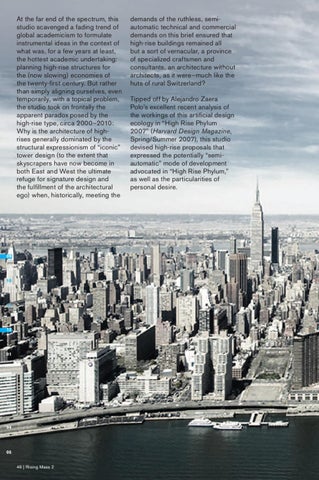
At the far end of the spectrum, this studio scavenged a fading trend of global academicism to formulate instrumental ideas in the context of what was, for a few years at least, the hottest academic undertaking: planning high-rise structures for the (now slowing) economies of the twenty-first century. But rather than simply aligning ourselves, even temporarily, with a topical problem, the studio took on frontally the apparent paradox posed by the high-rise type, circa 2000–2010: Why is the architecture of highrises generally dominated by the structural expressionism of “iconic” tower design (to the extent that skyscrapers have now become in both East and West the ultimate refuge for signature design and the fulfillment of the architectural ego) when, historically, meeting the
09
10
11
12
01
02
03
04
05 46 | Rising Mass 2
demands of the ruthless, semiautomatic technical and commercial demands on this brief ensured that high-rise buildings remained all but a sort of vernacular, a province of specialized craftsmen and consultants, an architecture without architects, as it were—much like the huts of rural Switzerland? Tipped off by Alejandro Zaera Polo’s excellent recent analysis of the workings of this artificial design ecology in “High Rise Phylum 2007” (Harvard Design Magazine, Spring/Summer 2007), this studio devised high-rise proposals that expressed the potentially “semiautomatic” mode of development advocated in “High Rise Phylum,” as well as the particularities of personal desire.